Unit 2   Keeping Healthy
综合能力演练
    责编:刘燕
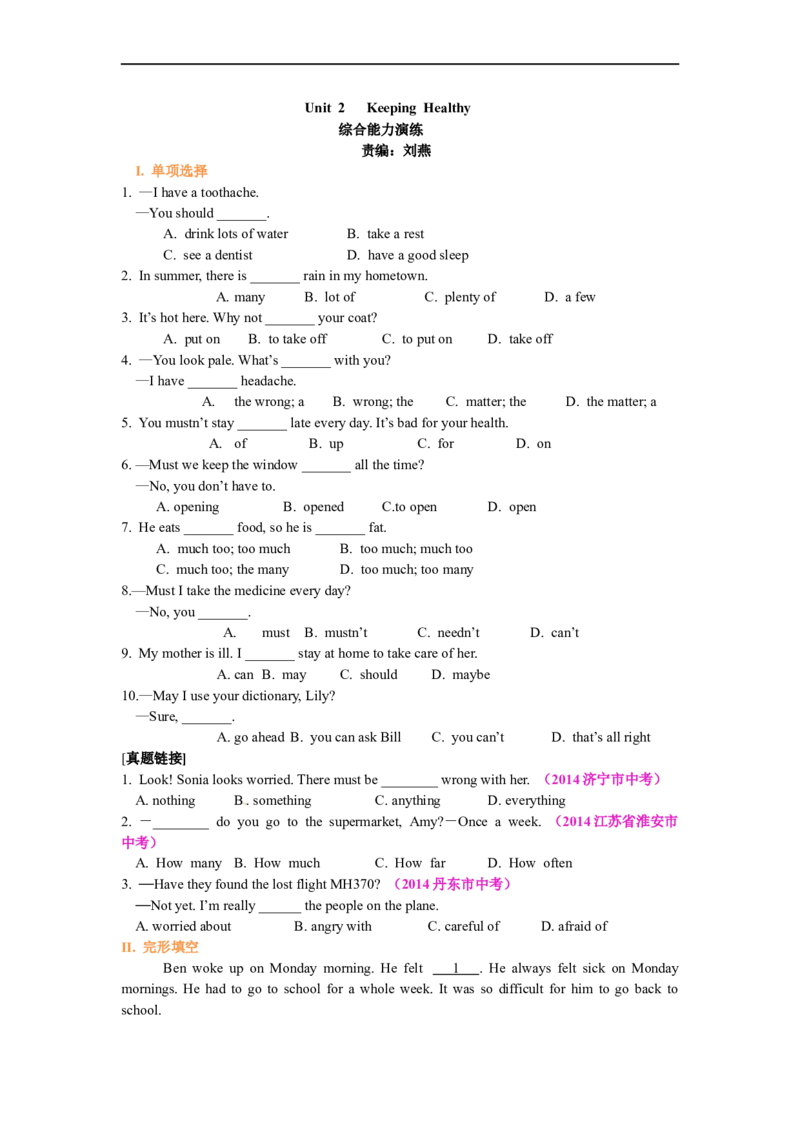
I. 单项选择
1. —I have a toothache.
—You should _______.
  A. drink lots of water
    B. take a rest
  C. see a dentist
        D. have a good sleep
2. In summer, there is _______ rain in my hometown.
A. many
  B. lot of
       C. plenty of
    D. a few
3. It’s hot here. Why not _______ your coat?
A. put on
  B. to take off
     C. to put on    D. take off
4. —You look pale. What’s _______ with you?
—I have _______ headache.
A.
the wrong; a
  B. wrong; the
  C. matter; the
   D. the matter; a
5. You mustn’t stay _______ late every day. It’s bad for your health.
A.
of         B. up          C. for        D. on
6. —Must we keep the window _______ all the time?
—No, you don’t have to.
 A. opening
       B. opened     C.to open
    D. open
7. He eats _______ food, so he is _______ fat.
 A. much too; too much       B. too much; much too
 C. much too; the many       D. too much; too many
8.—Must I take the medicine every day?
—No, you _______.
A.
must  B. mustn’t      C. needn’t      D. can’t
9. My mother is ill. I _______ stay at home to take care of her.
A. can B. may
   C. should
D. maybe
10.—May I use your dictionary, Lily?
—Sure, _______.
A. go ahead B. you can ask Bill
C. you can’t
     D. that’s all right
[真题链接]
1. Look! Sonia looks worried. There must be ________ wrong with her. (2014 济宁市中考)
A. nothing
B . something
C. anything
D. everything
2. -________ do you go to the supermarket, Amy?-Once a week. (2014 江苏省淮安市
中考)
A. How many B. How much
C. How far
D. How often
3. —Have they found the lost flight MH370? (2014 丹东市中考)
—Not yet. I’m really ______ the people on the plane.
A. worried about         B. angry with        C. careful of      D. afraid of
II. 完形填空
Ben woke up on Monday morning. He felt   1  . He always felt sick on Monday
mornings. He had to go to school for a whole week. It was so difficult for him to go back to
school.
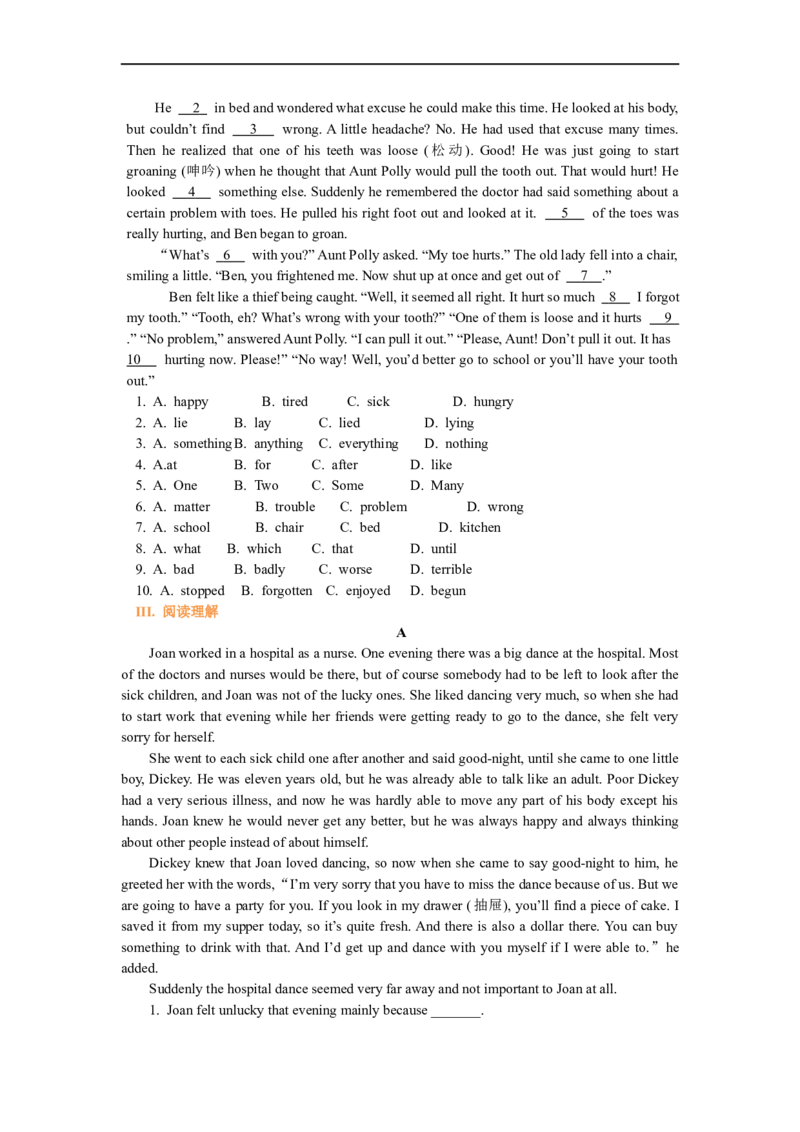
He     2     in bed and wondered what excuse he could make this time. He looked at his body,
but couldn’t find
  3
   wrong. A little headache? No. He had used that excuse many times.
Then he realized that one of his teeth was loose ( 松动). Good! He was just going to start
groaning (呻吟) when he thought that Aunt Polly would pull the tooth out. That would hurt! He
looked
  4
   something else. Suddenly he remembered the doctor had said something about a
certain problem with toes. He pulled his right foot out and looked at it.
  5
   of the toes was
really hurting, and Ben began to groan.
“What’s   6       with you?” Aunt Polly asked. “My toe hurts.” The old lady fell into a chair,
smiling a little. “Ben, you frightened me. Now shut up at once and get out of     7      .”
Ben felt like a thief being caught. “Well, it seemed all right. It hurt so much   8       I forgot
my tooth.” “Tooth, eh? What’s wrong with your tooth?” “One of them is loose and it hurts
  9
.” “No problem,” answered Aunt Polly. “I can pull it out.” “Please, Aunt! Don’t pull it out. It has
10

   hurting now. Please!” “No way! Well, you’d better go to school or you’ll have your tooth
out.”
1. A. happy
    B. tired    C. sick
       D. hungry
2. A. lie
    B. lay
    C. lied
       D. lying
3. A. somethingB. anything
C. everything   D. nothing
4. A.at        B. for     C. after
     D. like
5. A. One    B. Two
   C. Some
     D. Many
6. A. matter
   B. trouble   C. problem
     D. wrong
7. A. school
   B. chair
   C. bed
     D. kitchen
8. A. what   B. which   C. that
     D. until
9. A. bad
    B. badly    C. worse     D. terrible
10. A. stopped B. forgotten C. enjoyed
 D. begun
III. 阅读理解
A
Joan worked in a hospital as a nurse. One evening there was a big dance at the hospital. Most
of the doctors and nurses would be there, but of course somebody had to be left to look after the
sick children, and Joan was not of the lucky ones. She liked dancing very much, so when she had
to start work that evening while her friends were getting ready to go to the dance, she felt very
sorry for herself.
She went to each sick child one after another and said good-night, until she came to one little
boy, Dickey. He was eleven years old, but he was already able to talk like an adult. Poor Dickey
had a very serious illness, and now he was hardly able to move any part of his body except his
hands. Joan knew he would never get any better, but he was always happy and always thinking
about other people instead of about himself.
Dickey knew that Joan loved dancing, so now when she came to say good-night to him, he
greeted her with the words,“I’m very sorry that you have to miss the dance because of us. But we
are going to have a party for you. If you look in my drawer (抽屉), you’ll find a piece of cake. I
saved it from my supper today, so it’s quite fresh. And there is also a dollar there. You can buy
something to drink with that. And I’d get up and dance with you myself if I were able to.”he
added.
Suddenly the hospital dance seemed very far away and not important to Joan at all.
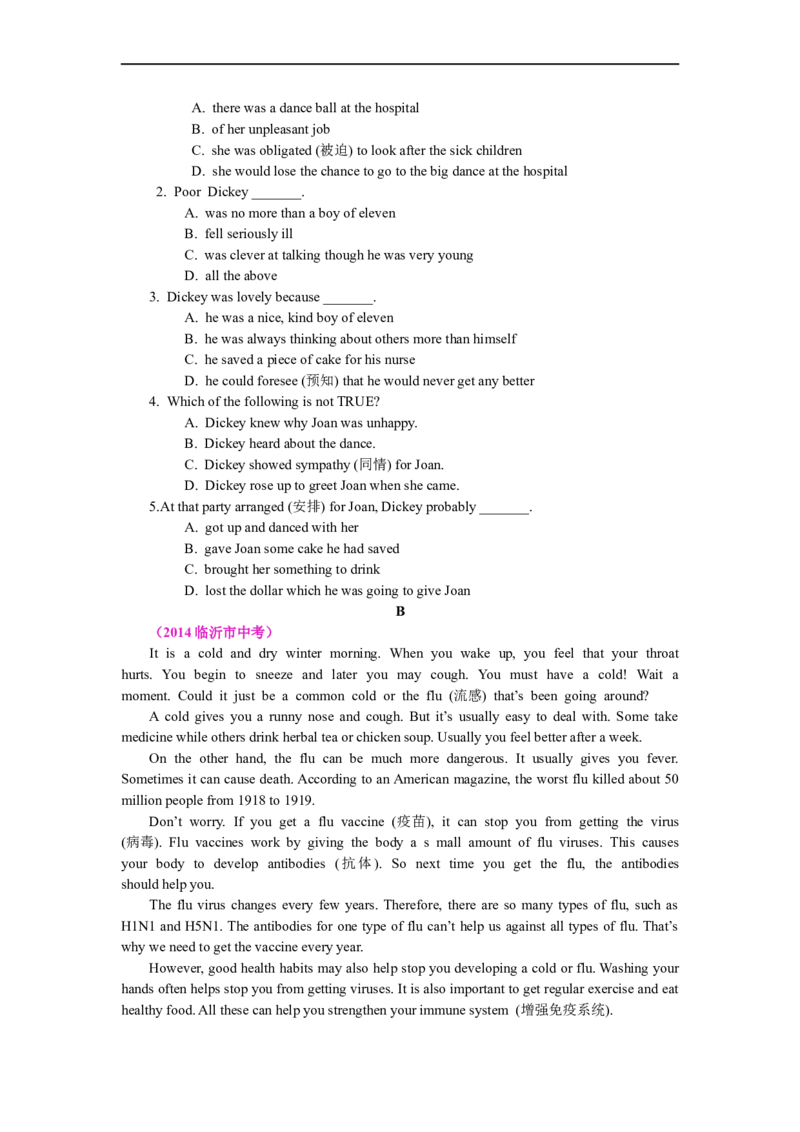
1. Joan felt unlucky that evening mainly because _______.
     A. there was a dance ball at the hospital
     B. of her unpleasant job
     C. she was obligated (被迫) to look after the sick children
     D. she would lose the chance to go to the big dance at the hospital
2. Poor Dickey _______.
    A. was no more than a boy of eleven
    B. fell seriously ill
    C. was clever at talking though he was very young
    D. all the above
3. Dickey was lovely because _______.
    A. he was a nice, kind boy of eleven
    B. he was always thinking about others more than himself
    C. he saved a piece of cake for his nurse
    D. he could foresee (预知) that he would never get any better
4. Which of the following is not TRUE?
    A. Dickey knew why Joan was unhappy.
    B. Dickey heard about the dance.
    C. Dickey showed sympathy (同情) for Joan.
    D. Dickey rose up to greet Joan when she came.
5.At that party arranged (安排) for Joan, Dickey probably _______.
    A. got up and danced with her
    B. gave Joan some cake he had saved
    C. brought her something to drink
    D. lost the dollar which he was going to give Joan
B
(2014 临沂市中考)
It is a cold and dry winter morning. When you wake up, you feel that your throat
hurts. You begin to sneeze and later you may cough. You must have a cold! Wait a
moment. Could it just be a common cold or the flu (流感) that’s been going around?
A cold gives you a runny nose and cough. But it’s usually easy to deal with. Some take
medicine while others drink herbal tea or chicken soup. Usually you feel better after a week.
On the other hand, the flu can be much more dangerous. It usually gives you fever.
Sometimes it can cause death. According to an American magazine, the worst flu killed about 50
million people from 1918 to 1919.
Don’t worry. If you get a flu vaccine (疫苗), it can stop you from getting the virus
(病毒). Flu vaccines work by giving the body a s mall amount of flu viruses. This causes
your body to develop antibodies (抗体). So next time you get the flu, the antibodies
should help you.
The flu virus changes every few years. Therefore, there are so many types of flu, such as
H1N1 and H5N1. The antibodies for one type of flu can’t help us against all types of flu. That’s
why we need to get the vaccine every year.
However, good health habits may also help stop you developing a cold or flu. Washing your
hands often helps stop you from getting viruses. It is also important to get regular exercise and eat
healthy food. All these can help you strengthen your immune system (增强免疫系统).
6. If you have a common cold, usually you’ll feel better after ________.
A. a week     B. two weeks
C. ten days       D. twenty days
7. According to the passage, which is TRUE of the flu?
A. It first happened in 1919.
B. It usually doesn’t give you fever.
C. It is easy to deal with.
    D. It can kill people sometimes.
8. If you get a flu vaccine, ________.
A. it can’t stop you from getting the flu virus
B. it won’t cause your body to develop antibodies
C. your body will develop antibodies
D. your body will get a large amount of flu viruses
9. We need to get a flu vaccine every year because ________.
A. we probably have a cold in winter
B. the flu virus changes every few years
C. the flu is very dangerous
D. you don’t need to take any medicine after that
10. The following ways can help stop the flu EXCEPT ________.
A. staying indoors
    B. getting regular exercise
C. eating healthy food
D. washing our hands often
【答案与解析】
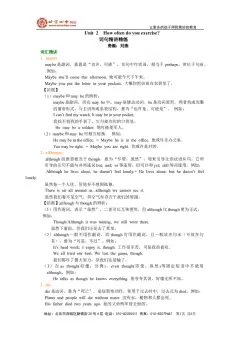
I. 单项选择。
1. C。由toothache 推断出句意应该为看牙医dentist。
2. C。rain 是不可数名词,不能用A、D。B 是一个错误的形式。
3. D。Why not+动词原形,又根据句意排除与句意矛盾的选项。
4. D。What’s the matter with …?或What’s wrong with …?表示“怎么了;患……病”。
5. B。词组stay up 表示“不睡觉”。
6. D。keep+名词(代词)+宾语补足语(形容词),表示“保持……处于某种状态”,open 既可作
动词,也可作形容词。
7. B。too much“太多”修饰名词,much too “太”修饰形容词。
8. C。must 的问句,否定回答用No, you needn’t. 或No, you don’t have to.
9. C。妈妈生病了,我应当在家照顾她。
10. A。go ahead 在这里是“用吧”的意思。
[真题链接]
1. B。本题意为:——看!Sonia 看起来很担心;她一定是出了什么问题。因为本题表示猜
测,所以用something;有肯定的意思,即可能有问题了,如果换用everything 表示完全肯
定;anything 表示“一些事情”时常用于否定和疑问句。所以答案B 最合适。
2. D。句意:——你多久去一次超市。Amy?——一周一次。how many 和how much 均
可表示“多少”;how many 修饰可数名词的复数形式,而how much 修饰不可数名词,
还可以用来询问价格。how far “多远”一般指的是一地到另一地的距离;how often“多
长时间一次”对在某一特定的时间内进行的动作次数进行提问,故答案选D。
3. A。句意:——他们已经找到了丢失的飞机mh370 吗?——还没有,我很担心飞机上的
人。worried about,担心;be angry with 对……生气;be careful of 小心;be afraid of 害
怕。故选A。
II. 完形填空。
1.C。下句有“He always felt sick on Monday mornings”。可知此处为C。
2.B。lie 当“躺卧”讲时,过去式为lay;lie 当“撒谎”讲时,过去式为lied。故应选B。
3.B。此句意为“他看看自己的身体,但是没发现任何毛病。”这里nothing 表示“没有毛
病”,
相当于“not ... anything”。
4.B。上文提到他想找个牙疼的理由不去上学,但怕姨妈把牙给拔了,此处就是讲他寻找别
的理由。故为look for 寻找。
5.A。由此句中was 可知,主语应该用单数形式,因此应用“one of the +名词复数形式”表示
“……中之一”。
6.D。“你怎么了?”常用“What’s the matter/trouble with you?”或用“What’s wrong with
you?”
7.C。因为由上文知Ben 一直不想上学,一直躺在床上想理由,所以Ben 的姨妈让他闭上嘴,
离开床。
8.C。此处为so ... that 句式。
9.B。此处应为副词原级,用来修饰动词hurt,只能选B。
10.A。由句意可知Ben 害怕姨妈把他的牙齿拔出,所以说牙已经不疼了。这里意为“停止
(疼
痛)”。故选A。
III. 阅读理解。
A 篇
1.D。 根据文章第一段内容和“Joan was not of the lucky ones.”可知, Joan 没有得到参加舞会
的机会。
2.D。根据文章第二段内容可知Dickey 的个人信息。
3.B。根据文中第二段最后一句可知Dickey 是个总是为别人着想的孩子。
4.D。根据文章第二段内容可知Dickey 得了很重的病,除了手以外,哪里都动弹不了。
5.B。根据文章第三段内容可知,Dickey 给了Joan 一片面包和一美元,为她办了个特别的
舞会。
B 篇
6. A。由文中第二段的最后一句话Usually you feel better after a week 通常你会在一周后
感觉好多了,可知正确答案选A。
7. D。由第三段的前三句On the other hand, the flu can be much more dangerous. It
usually gives you fever. Sometimes it can cause death. 另一方面,流感可以更危险。它会
让你发烧。有时会导致死亡。可知,正确答案是D。
8. C。由第四段的第三句话This causes your body to develop antibodies (抗体),如果你打
了流行性感冒疫苗,你的身体可能会有抗体;可知正确答案应该选C。
9. B。由原文中倒数第二段的第一句话The flu virus changes every few years. Therefore,
there are so many types of flu,可知答案选B。
10. A。由最后一段可知,通过平时的锻炼、吃健康的食物、经常洗手都会对阻止流行性感
冒有帮助。