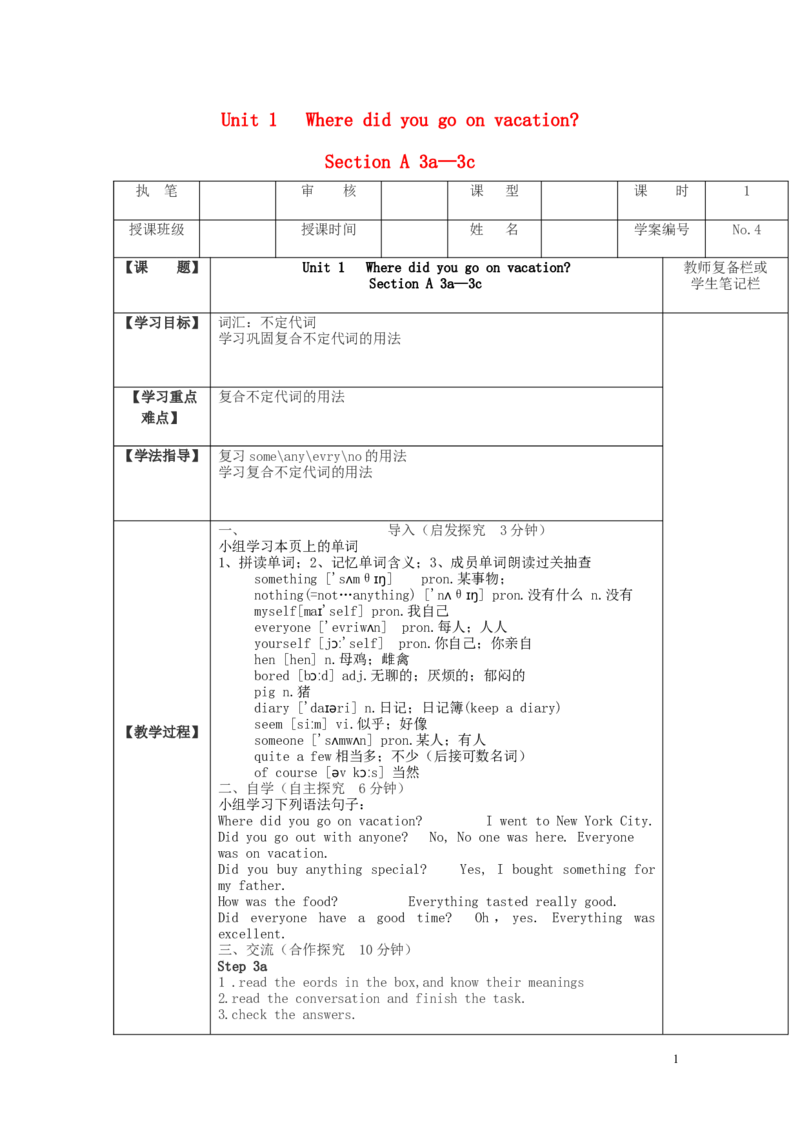
Unit 1   Where did you go on vacation?
Section A 3a—3c
执  笔
审    核
课   型
课    时
1
授课班级
授课时间
姓   名
学案编号
No.4
【课    题】
Unit 1   Where did you go on vacation?
Section A 3a—3c
教师复备栏或
学生笔记栏
【学习目标】
词汇:不定代词
学习巩固复合不定代词的用法
【学习重点
难点】
复合不定代词的用法
【学法指导】
复习some\any\evry\no 的用法
学习复合不定代词的用法
【教学过程】
一、
导入(启发探究  3 分钟)
小组学习本页上的单词
1、拼读单词;2、记忆单词含义;3、成员单词朗读过关抽查
something ['sʌmθɪ ]
ŋ
  pron.某事物;
nothing(=not…anything) ['nʌθɪ ]
ŋ pron.没有什么 n.没有
myself[maɪ'self] pron.我自己
everyone ['evriwʌn]  pron.每人;人人
yourself [jɔ 'self]
ː
  pron.你自己;你亲自
hen [hen] n.母鸡;雌禽
bored [bɔ d] adj.
ː
无聊的;厌烦的;郁闷的
pig n.猪
diary ['daɪ ri] n.
ə
日记;日记簿(keep a diary)
seem [si m] vi.
ː
似乎;好像
someone ['sʌmwʌn] pron.某人;有人
quite a few 相当多;不少(后接可数名词)

of course [ v k
ə
ɔ s]
ː
当然
二、自学(自主探究  6 分钟)
小组学习下列语法句子:
Where did you go on vacation?         I went to New York City.
Did you go out with anyone?   No, No one was here. Everyone
was on vacation.
Did you buy anything special?    Yes, I bought something for
my father.
How was the food?          Everything tasted really good.
Did everyone have a good time?  Oh ,yes. Everything was
excellent.
三、交流(合作探究  10 分钟)
Step 3a
1 .read the eords in the box,and know their meanings
2.read the conversation and finish the task.
3.check the answers.
1
【教学过程】
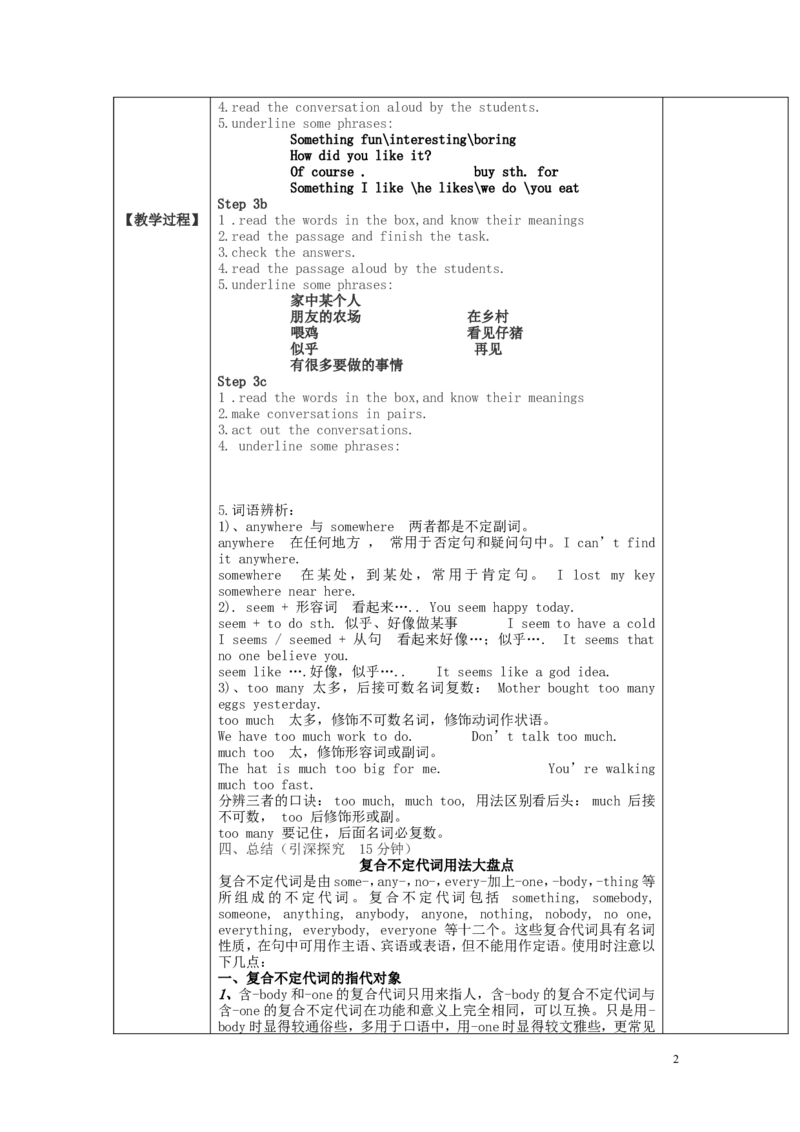
4.read the conversation aloud by the students.
5.underline some phrases:
Something fun\interesting\boring
How did you like it?
Of course .               buy sth. for
Something I like \he likes\we do \you eat
Step 3b
1 .read the words in the box,and know their meanings
2.read the passage and finish the task.
3.check the answers.
4.read the passage aloud by the students.
5.underline some phrases:
家中某个人
朋友的农场               在乡村
喂鸡                     看见仔猪
似乎                      再见
有很多要做的事情
Step 3c
1 .read the words in the box,and know their meanings
2.make conversations in pairs.
3.act out the conversations.
4. underline some phrases:
5.词语辨析:
1)、anywhere 与 somewhere  两者都是不定副词。
anywhere  在任何地方 , 常用于否定句和疑问句中。I can’t find
it anywhere.
somewhere  在某处,到某处,常用于肯定句。 I lost my key
somewhere near here.
2). seem + 形容词  看起来….. You seem happy today.
seem + to do sth. 似乎、好像做某事       I seem to have a cold
I seems / seemed + 从句  看起来好像…;似乎….  It seems that
no one believe you.
seem like ….好像,似乎…..    It seems like a god idea.
3)、too many 太多,后接可数名词复数: Mother bought too many
eggs yesterday.
too much  太多,修饰不可数名词,修饰动词作状语。
We have too much work to do.        Don’t talk too much.
much too  太,修饰形容词或副词。
The hat is much too big for me.             You’re walking
much too fast.
分辨三者的口诀: too much, much too, 用法区别看后头: much 后接
不可数, too 后修饰形或副。
too many 要记住,后面名词必复数。
四、总结(引深探究  15 分钟)
复合不定代词用法大盘点
复合不定代词是由some-,any-,no-,every-加上-one,-body,-thing 等
所组成的不定代词。复合不定代词包括 something, somebody,
someone, anything, anybody, anyone, nothing, nobody, no one,
everything, everybody, everyone 等十二个。这些复合代词具有名词
性质,在句中可用作主语、宾语或表语,但不能用作定语。使用时注意以
下几点:
一、复合不定代词的指代对象
1、含-body 和-one 的复合代词只用来指人,含-body 的复合不定代词与
含-one 的复合不定代词在功能和意义上完全相同,可以互换。只是用-
body 时显得较通俗些,多用于口语中,用-one 时显得较文雅些,更常见
2
于正式场合及书面语中。如:
Someone/Somebody is crying in the next room.有人在隔壁房间哭。
No one/Nobody is stupid. 没有谁是愚蠢的。
2、含-thing 的复合不定代词只用来指事物。如:
Are you going to buy anything?你会去买东西吗?
I can hear nothing but your vioce. 我只听到了你的声音。
二、复合不定代词的数
1、复合不定代词都具有单数的含义,因此通常被看成是单数第三人称。
当它们充当句子的主语时,其后的谓语动词用单数形式。如:
Is everyone here today? 今天,大家都到齐了吗?
Nothing is difficult if you put your heart into it. 世上无难
事,只怕有心人。
2、当要对一群人讲话时,可使用以复合不定代词作主语的祈使句,句中
的动词用原形。如:
Nobody move!= Don’ anybody move! 都别动!
Everyone lie down! 统统趴下!
三、复合不定代词的定语
复合不定代词的定语必须后置,即放在复合不定代词的后面。如:
Can you tell something interesting? 你能讲些有趣的事情吗?
Is there anybody important here? 这儿有大人物吗?
Would you like something to eat? 要来些吃的东西吗?
四、含some-和any-的复合不定代词间的用法区别
由some-和any-所构成的复合不定代词(即something 和anything;
someone 和anyone;somebody 和anybody)之间的区别跟some 和any 的
区别一样。
1、something,someone,somebody 通常用于肯定句中,而anything,
anyone,anybody 一般用于否定句,疑问句或条件状语从句中。如:
He found something strange but interesting.他发现了一些奇怪但
却有趣的事情。
Do you have anything to say ?你有话要说吗?
I can’t meet anybody  on the island. 在岛上,我没遇见任
何人。
2、在表示请求、邀请、提建议等带有委婉语气的疑问句,和希望得到对方
肯定答复的疑问句,以及表示反问的问句中,也用something,someone,
somebody 等复合不定代词。如:
Would you like something to eat?要些吃的东西吗?
Isn’t there something wrong with you? 难道你没问题吗?
及时练:用anyone ,something, anything, everything, nothing,
everyone , no one 填空。
1. Linda: Did you do ____________ fun on your bacation, Alice?
Alice: Yes, I did. I went to Sanya.
Linda: How did you like it?
Alice: Well, it was my first time there, so __________ was
really interesting.
Linda: Did you go with ___________?
Alice: Yes, I did. I went with my sister.
Linda: Did you go shopping?
Alice: Of course! I bought _________ for my parents. But
__________ for myself.
Linda: Why didn’t you buy __________for yourself.
Alice: I didn’t really see___________ I liked.
五、练评(包含“考点链接”   应用探究  6 分钟)
用所给动词的正确形式填空。
Last August, our class_________(do) something very special on
our school trip. We __________(go) to mount Tai.
We_________(start) our trip at 12:00 at night. Everyone in our
class_________(take) a bag with some food and water. After
3
three hours, someone looked at the map and _________(find) out
we __________(be ,not) anywhere near the top. My legs
________(be) so tired that I wanted to stop. My
classmates_________(tell) me to keep going, so I _________(go)
on. At 5:00 a.m., we got to the top! Everyone _________(jump)
up and down in excitement. Twenty minutes later, the sun
________(start) to come up. It was so beautiful that we
________(forget) about the last five hours!
【教学反思】
4