让更多的孩子得到更好的教育
Review of Units 1-6
                                   责编:郭素清
词汇精讲
1. work&job
work 和job 作名词是同义词,都有“工作、职业”的意思。不过,它们之间还是有些区别的。
(1)job 是可数名词,指特定工作。work 是不可数名词,泛指工作。我们可以说a job,不能说
a work。例如:
Peter has a good job in a bank. 彼得在一家银行有份很好的工作。
Tom changed jobs many times. 汤姆换了很多工作。
Looking after three cats is not easy work. 照顾三只猫咪可不是件容易事。
(2)上班用英文讲是go to work。这是一个固定搭配,我们不能说go to a job。例如:
My father goes to work at 8 a.m. 我爸爸八点上班。
(3)job 只能用作名词,work 还可以用作动词,不仅有“上班、工作”的意思,还可以作“努
力”或“从事”来讲。例如:
Both of my parents work. 我父母都工作。
If you work hard, you will speak English well. 只要你努力,你的英语就会讲得很好。
2. either, too, also
(1)too 意为“也”,一般放在肯定句句尾。例如:
He can speak English. I can speak English, too. 他会说英语,我也会说。
(2)also 意为“也”,一般放在句中。用于be 动词、情态动词、助动词之后,实义动词之前,
比too 要正式一些。例如:
He can speak English. I can also speak English.  他会说英语,我也会说。
He is also a student. 他也是个学生。
    I also like music. 我也喜欢音乐。
(3)either 意为“也”,用于否定句的句尾。例如:
He can’t swim. I can’t swim, either. 他不会游泳,我也不会。
3. sometimes, some times, sometime&some time
(1)sometimes 为副词,意思为“有时”可用于句首、句中或句末,在句中作状语。例如:
He was sometimes late for school. 他有时上学迟到。
(2)some times 是词组,意思为“几次,几倍”,其中的times 为可数名词的复数形式。
例如:He has been to Beijing for some times before. 他以前去过北京几次。
(3)sometime 指某个不明确的时间,意思为“某个时候”。 例如:
We’ll take our holiday sometime in August.  我们将在八月的某个时候度假。
(4)some time 指某一段时间,其中的time 为不可数名词,意思为“时间”。 例如:
He will stay there for some time. 他将在那里待一段时间。
4. too many, too much&much too
(1)too many 的中心词是many, 用法与many 相同,用来修饰复数可数名词。例如:
He’s got too many questions to ask you. 他有很多问题要问你。
They bought too many eggs yesterday. 昨天他们买了太多的鸡蛋。
(2)too much 作为形容词词组时,意为“太多的”,用来修饰不可数名词;too much 作为副词
词组,意为“太多”,用来修饰动词;too much 作为代词,意为“太多”,在句中作宾语。
例如:
We two have too much work to do.我们俩要做的工作太多了。
You talked too much at the meeting.你在会上讲得太多了。
地址:北京市西城区新德街20 号4 层 电话:010-82025511 传真:010-82079687  第1页 共10页
                                   让更多的孩子得到更好的教育
You have given me too much.你给我太多了。
(3)much too 是副词短语,意为“非常,太……”,常用来修饰形容词或副词。例如:
He got into the car and drove much too fast。他上了车,并开得非常快。
The necklace is much too expensive.  这条项链太贵了。
5. get to, reach&arrive
(1)arrive “到达”, 不及物动词,后接at 跟小地点;接in 跟大地点。例如:
They arrive in Shanghai today. 今天他们到达上海。
When I arrive at the hotel, I will call you. 我到达旅馆时,会给你打电话。
(2)get“到达”,不及物动词,后接介词to 跟地点。例如:
When did you get to Beijing? 你什么时候到达北京?
(3)reach“到达”,及物动词,后面直接跟地点。例如:
When she reaches the office, she likes drinking some tea.
她到达办公室时喜欢喝点茶。
6. wear, put on, dress& in
(1)wear 表示穿着、戴着的某种状态。例如:
She wears a pink coat. 她穿着一件粉红色大衣。
(2)put on 表示穿戴的动作。例如:
She puts on her pink coat. 她穿上她的红色的大衣。
(3)dress 后接人作宾语,表示“给……穿衣”。例如:
She dresses herself every day. 她每天自己穿衣。
(4)in 与wear 都表示“穿”或者“戴”,wear 在句中作谓语,in 与其他词一起构成介宾
短语,做句子的定语、表语等。例如:
She is in pink. 她穿着粉红色的衣服。
7. have to&must
(1)have to 强调客观需要;must 强调主观愿望。例如:
I must go now. 我现在必须走。
I have to finish my homework first. 我不得不先完成我的作业。
(2)must 只用一般现在时;have to 可以用各种时态。例如:
My sister had to learn how to make tea. 我姐姐不得不学习如何泡茶。
She must work hard. 她必须努力工作。
(3)have to 有人称和数的变化,但must 没有。例如:
My mother has to look after me when I am ill.
当我生病的时候我妈妈不得不照顾我。
She must tell him the truth. 她必须告诉他事实的真相。
(4)在否定结构中,don’t have to 表示“不必”; mustn’t 表示“不允许,禁止”。例如:
You don’t have to tell him the news. 你不一定要把这个消息告诉他。(不必)
      You mustn’t park your car here. 你不能把车停在这里。(禁止,不允许)
8.  always, usually, often, sometimes&never
always, usually, often, sometimes 和never 是英语中最常见的频度副词。
(1)
always 的频度为100%,表示动作重复、状态继续,中间没有间断,意思是“总
是”“永远地”。例如:
The sun always rises in the east and sets in the west. 太阳总是东升西落。
(2)usually 的频度为70%左右,意为“通常”、“平常”,即很少有例外。例如:
He usually goes to bed at ten o’clock. 他通常10 点钟睡觉。
地址:北京市西城区新德街20 号4 层 电话:010-82025511 传真:010-82079687  第2页 共10页
                                   让更多的孩子得到更好的教育
(3)often 的频度为50%左右,意为“常常”,但不如usually 那么频繁,表示动作重复,中
间有间断。例如:
He is often late for school. 他上学经常迟到。
(4)sometimes 的频度为20%左右,意为“有时”,表示动作偶尔发生。可以位于句首,
以示强调。例如:
It is sometimes hot and sometimes cold. 天气忽冷忽热。
        Sometimes he does it this way and sometimes he does it that way.
他有时这样做,有时那样做。
(5)never 的频度为0,意为“从来不”、“永不”。 例如:
           My parents are never late for work. 我父母上班从来不迟到。
9. go to bed
go to bed 指“上床睡觉”,并不意味着当时就睡着,只是进入了睡觉的形式。例如:
Jim goes to bed at nine o’clock every evening. 吉姆每天晚上九点钟睡觉。
【拓展】其他的和“睡觉”相关的词或者词组:
(1)go to sleep 和fall asleep 意思是“入睡;睡着”,强调由醒到睡的瞬间动作。例如:
The man is tired. He goes to sleep very quickly. 那人很疲劳,很快就睡着了。
(2)sleep 意为“睡眠”,强调持续的动作。例如:
You should sleep eight hours a day. 一天你应该睡八小时。
(3)be asleep 强调睡着的状态,不像sleep 强调行为,它表示当时或现在所处的睡眠状态。
例如:The baby is asleep.  那小孩睡着了。
10.  in, by, with, on
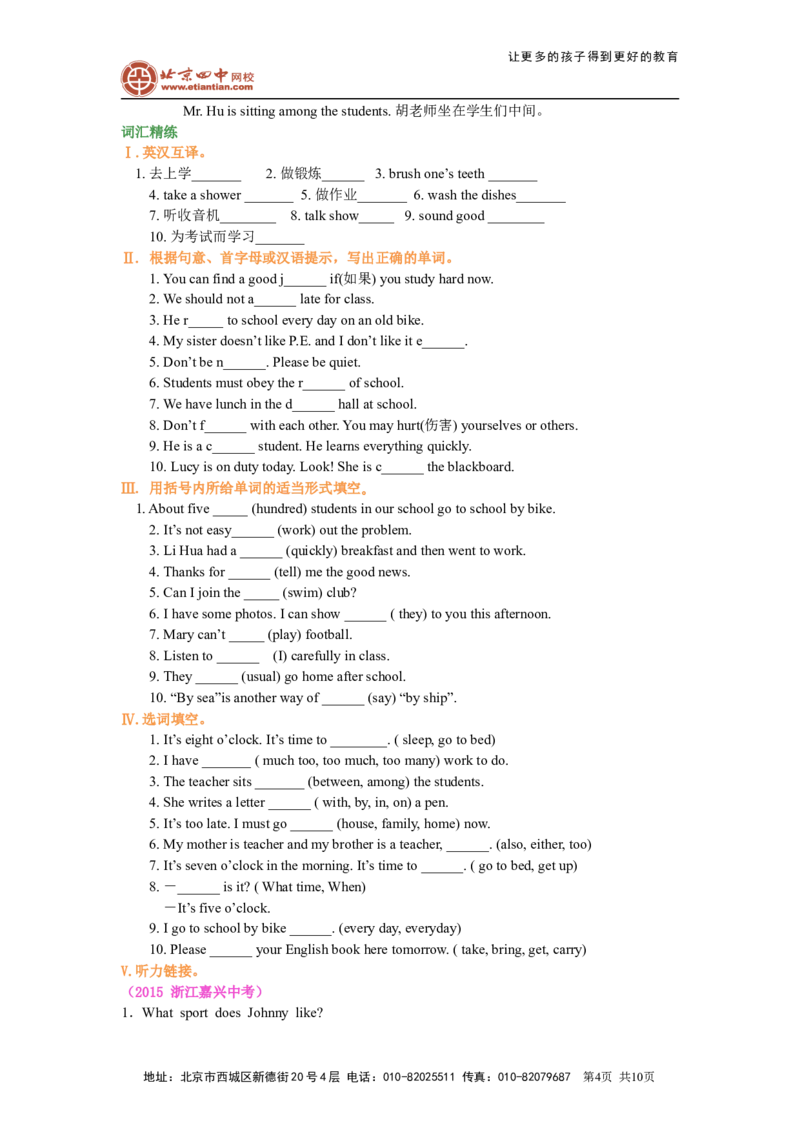
    这四个介词都有“通过……的方式”之意,其主要区别如下表所示:

11. home, family&house
   (1)house 指“房屋、住房、住宅”,指家人所居住的建筑物。例如:
        We have a new house. 我们有一座新房子。
(2)
family 指“家人、家、家庭”,是一种社会意义上的团体,不指住房。例如:
     My family are all very kind. 我们全家人都很和蔼。
(3)home“家”,指家人共同生活的地方,强调家的气氛和环境,是一个带有感情色彩的
名词。例如:
        I love my home. 我爱我家。
12. between&among
这两个介词均含“在……之间,在……之中”之意。
(1)between 多指两者之间,但现代英语中也可指三者或三者以上,表示彼此间清楚的独
立的个体关系,指每两者之间。例如:
 She takes medicine between three meals every day. 她每天在两餐之间吃药。
(2)among 指三者或三者以上的同类事物之间。例如:
地址:北京市西城区新德街20 号4 层 电话:010-82025511 传真:010-82079687  第3页 共10页
介词
in
by
with
on
区别
表示
使用
语言
或材
料。
表示行为动作的手
段或交通方式,后
面常接动词的-ing
形式或不带冠词的
名词。
表示行为
动作所用
的工具;
后面所接
名词常有
冠词。
表示使
用广播
电视等
媒体。
                                   让更多的孩子得到更好的教育
Mr. Hu is sitting among the students. 胡老师坐在学生们中间。
词汇精练
Ⅰ. 英汉互译。
    1. 去上学_______       2. 做锻炼______   3. brush one’s teeth _______
4. take a shower _______  5. 做作业_______  6. wash the dishes_______
7. 听收音机________    8. talk show_____   9. sound good ________
10. 为考试而学习_______
Ⅱ. 根据句意、首字母或汉语提示,写出正确的单词。
1. You can find a good j______ if(如果) you study hard now.
2. We should not a______ late for class.
3. He r_____ to school every day on an old bike.
4. My sister doesn’t like P.E. and I don’t like it e______.
5. Don’t be n______. Please be quiet.
6. Students must obey the r______ of school.
7. We have lunch in the d______ hall at school.
8. Don’t f______ with each other. You may hurt(伤害) yourselves or others.
9. He is a c______ student. He learns everything quickly.
10. Lucy is on duty today. Look! She is c______ the blackboard.
Ⅲ. 用括号内所给单词的适当形式填空。
    1. About five _____ (hundred) students in our school go to school by bike.
2. It’s not easy______ (work) out the problem.
3. Li Hua had a ______ (quickly) breakfast and then went to work.
4. Thanks for ______ (tell) me the good news.
5. Can I join the _____ (swim) club?
6. I have some photos. I can show ______ ( they) to you this afternoon.
7. Mary can’t _____ (play) football.
8. Listen to ______ (I) carefully in class.
9. They ______ (usual) go home after school.
10. “By sea”is another way of ______ (say) “by ship”.
Ⅳ.选词填空。
1. It’s eight o’clock. It’s time to ________. ( sleep, go to bed)
2. I have _______ ( much too, too much, too many) work to do.
3. The teacher sits _______ (between, among) the students.
4. She writes a letter ______ ( with, by, in, on) a pen.
5. It’s too late. I must go ______ (house, family, home) now.
6. My mother is teacher and my brother is a teacher, ______. (also, either, too)
7. It’s seven o’clock in the morning. It’s time to ______. ( go to bed, get up)
8. -______ is it? ( What time, When)
  -It’s five o’clock.
9. I go to school by bike ______. (every day, everyday)
10. Please ______ your English book here tomorrow. ( take, bring, get, carry)
V.听力链接。
(2015 浙江嘉兴中考)
1.What sport does Johnny like?
地址:北京市西城区新德街20 号4 层 电话:010-82025511 传真:010-82079687  第4页 共10页
                                   让更多的孩子得到更好的教育
    A.Basketball.    B.Football.    C.Volleyball.
2.Which bus goes to the museum?
   A.The No.10 bus.    B.The No.15 bus.    C.The No.20 bus.
3.What is the man probably planning to do?
    A.To eat less.    B.To do exercise.    C.To see the doctor.
4.How did the man tell his uncle their new address?
    A.By phone.    B.By letter.    C.By e-mail.
5.What is the man’s job?
A.A teacher.    B.A doctor.    C.A reporter.
参考答案
I. 英汉互译。
1. go to school   2. do exercise / play sports   3. 刷牙   4. 洗淋浴
5. do one’s homework   6. 洗餐具/盘子  7. listen to the radio  8. 访谈节目
9. 听起来很好
10. study for a test
II. 根据句意、首字母或汉语提示,写出正确的单词。
 1. job  2. arrive  3. rides  4. either  5. noisy
6. rules   7. dining   8. fight   9. clever  10. cleaning
III. 用括号内所给单词的适当形式填空。
1. hundred   2. to work   3. quick   4. telling   5. swimming
6. them    7. play   8. me   9. usually   10. saying
Ⅳ. 选词填空。
  1. go to bed   2. too much   3. among    4. with   5. home
  6. too     7. get up     8. What time    9. every day  10. bring
V. 听力链接。
听下面5 段小对话,每段对话后有一个小题。请从A、B、C 三个选项中选出最佳答案。每段对
话仅读一遍。
1.A 2.B 3.B 4.C 5.A
1.W:Do you like basketball,Johnny?
   M:Yes,I’m on the school team.
2.W:Excuse me,does this bus go to the museum?
   M:Sorry.The No. 15 bus goes there.
3.W:Dad,you are getting fat.You must do exercise every day.
   M:Yes,Dear.The doctor also says I should do that.
4.W:Tom,did you tell your uncle our new address?
   M:Yeah,I sent him an e-mail yesterday.
5.W:Michael,are you still working for the newspaper?
   M:No.I’m teaching in a college now.
句式精讲
1. help sb. with sth.
“help sb. with sth.”意为“帮助某人做某事”。此处的with 是介词,后面可以跟名词。例如:
 She helps us with our lessons. 她帮我们学习。
 I help my mother with housework. 我帮我妈妈做家务。
 拓展:help 既可以做动词也可以做名词,常见的其他相关用法有:
地址:北京市西城区新德街20 号4 层 电话:010-82025511 传真:010-82079687  第5页 共10页
                                   让更多的孩子得到更好的教育
 (1) help sb. (to) do sth. 帮助某人做某事 (动词)
例如:I often help my mother (to) do some washing.
我经常帮我妈妈洗衣服。
 (2) help oneself to sth.  随便(吃……) (动词)
      例如:Help yourselves to some fruit, children.
            孩子们,请随便吃些水果吧。

 (3) with one’s help  在某人的帮助下  (名词)
      例如:With her help, I arrived in Beijing.
            在她的帮助下,我到达了北京。
2. either…or…
(1)“either…or…” 意为“要么……要么;或者……或者……;不是……就是……”,用来
连接两个并列的词、短语或者句子。例如:
You can either go or stay. 你走也行,留下也行。
You must either go to bed or do your homework. 你要么睡觉,要么做作业。
(2)“either…or…”连接的两个并列成分作主语时,谓语动词通常与其靠近的主语保持一致,
简称为就近一致。例如:
Either I or you are right. 要么我对,要么你对。
Either you or I am right. 要么你对,要么我对。
3. 表示“乘……”的几种表达方式
(1)用介词短语来表示交通方式,介词短语在句中作状语:
  1) 用“by + 交通工具名词”表示交通方式。例如:
     by bike 骑自行车  by car 乘小汽车  by bus 乘公共汽车
  2) 用“by + 交通路线的位置”来表示交通方式。例如:
     by water 由水路  by land 从陆路  by sea 从海路  by air 乘飞机
  3) 用“in/on + 冠词/形容词性物主代词/指示代词 + 交通工具名词”表示交通方式。
    其中,in 多用在car 等交通工具之前,而on 多用在bike/horse/bus/train/ship 等交
    通工具之前,它们的用法与“by + 交通工具名词”的用法相同。例如:
    Lily often goes to school on a/her bike.= Lily often goes to school by bike.
    莉莉经常骑自行车上学。
4) on foot 步行。on foot 是固定搭配,表示步行,其中foot 不能用复数形式feet,其前也不
加任何修饰词。例如:
The little boy often goes to school on foot. 那个小男孩儿经常步行去上学。
(2)用动词短语表示交通方式,动词短语在句中作谓语:
  1) 用“take + a/the + 交通工具名词”表示交通方式。例如:
    take a train 乘火车  take a bus 乘公共汽车  take a ship 乘船  take a plane 乘飞机
    注意:“骑自行车”要翻译为“ride a bike”
  2) 用某些动词来表示交通方式。例如:
    walk to 步行去  drive to 开车去  ride to 骑车/马去
    注意:如果接地点副词here; there; home 时,介词to 应该省略。
4. How do you get to school?
这是由how 构成的一个特殊疑问句,用来提问到达某地的方式。句子的结构是“How +
do/does+主语+谓语+其他”。当主语是第三人称单数时,助动词用does,其余人称用do。例
如:
How does your mother get to work? 你妈妈怎么去上班?
地址:北京市西城区新德街20 号4 层 电话:010-82025511 传真:010-82079687  第6页 共10页
                                   让更多的孩子得到更好的教育
How do you get there? 你怎么到哪儿的?
拓展:特殊疑问词how
(1)特殊疑问词how 有“如何,怎样,多么”等意,用于询问动作执行的方式、手段、程度。例
如:
     — How do you go home? 你怎么回家?
   — On foot. 步行。
     — How do you like Beijing? 你觉得北京怎么样?
— Very much. 非常喜欢。
— How are your parents? 你父母身体怎样?
— Fine. Thank you. 很好,谢谢!
(2)how 可以和不同的词搭配,构成不同的意思来引导特殊疑问句, 除了我们之前学过的
“how about, how many/ much, how old”等,常见的搭配还有:how far 用来询问距离,意
为“多远”;how long 用于询问时间的长短或者物体的长度,意为“多长/久”。例如:
How far is it from China to America? 从中国到美国有多远?
How long is the table? 那张桌子有多长?
5. Don’t arrive late for class.
(1)这是一个表示否定的祈使句,祈使句表示请求、命令或者建议。谓语动词用原形,句子的
主语you 通常省略。祈使句句子结尾用句号,表示强烈语气的时候用感叹号, 朗读时要
用降调。可以在句末或者句首加上please, 使语气更加的缓和与客气。please 放在句首
时后面不需要加逗号,放在句末时后面要加逗号。例如:
Listen to me carefully, please. 请认真听我讲话。
Please sit down. = Sit down, please. 请坐!
(2)这种祈使句的肯定式是“Do (实义动词) + 其他成份”。例如:
   Open the window! 打开窗户!
   Close the door! 关上门!
注意:这只是祈使句最基本的一种句型,其余的相关祈使句句型,同学们可以参照语法专项
讲解—— 祈使句。
6. Why do you like pandas?
本句是why 引导的特殊疑问句,用来询问原因;常用because 引导的句子来回答,表示直接
的理由。例如:
-Why is he here? 他为什么在这儿?
-Because he has things to do. 因为他有事要做。
拓展:why 其他的常用句式
(1)why 还可以表示建议,常用于句型“Why not + do sth.?或 Why don’t you + do sth.?”
意为“为什么不……?”。例如:
Why not have a break? = Why don’t you have a break?
为什么不休息一下呢?
(2)why 可以做感叹词,表示吃惊、不耐烦或轻微的抗议、反对及犹豫等不同的语气。
例如:Why, don’t you know Zhou Jielun? 啊,难道你不认识周杰伦吗?
    Why, it’s easy-a child could do it! 嗨, 这容易的很,连小孩子都会做!
7. I’m watching TV.
(1)现在进行时表示说话的时候正在发生或者进行的动作。它的陈述句的句式是“主语 +
be(not) + doing +其他。”,意为“某人正在做……”;这个结构中的 be 有人称和数的
变化。例如:
地址:北京市西城区新德街20 号4 层 电话:010-82025511 传真:010-82079687  第7页 共10页
                                   让更多的孩子得到更好的教育
My mother is watching TV now. 我妈妈在看电视。
They aren’t playing basketball. 他们没有在踢打篮球
(2)这个句式的一般疑问句是将陈述句中的be 动词提到句首,将句子末尾的句号变为问号,
句中的某些词要做相应的变化(例如将some 变为any)。回答时用Yes../No…。特殊疑
问句是特殊疑问词加上一般疑问句,回答时根据具体情况作出答语。例如:
     -Are you reading a newspaper? 你正在看报纸吗?
-Yes, I am. 是的,我正在看。
      -What are you doing? 你在干什么?
      -I’m doing my homework. 我在做作业。
句式精练
Ⅰ. 选择方框内的句子填空格,使对话意思连贯正确。

A: Hi, James. This is Henry.
   B: Hi, Henry. How’s it going?
   A:   1  Do you know where I am?
   B: Where are you?
   A: I’m in Australia.
   B: Really?  2
   A: I’m visiting my aunt. She’s working here.
   B:   3
   A;It’s sunny. I’m playing volleyball with my new friend on the beach.
   B: A new friend?  4
   A: Yes. And he’s very friendly.
   B:  5  It’s raining in Beijing. I’m watching TV at home.
Ⅱ. 按要求完成句子。
    1. She plays the piano at around 7:30. (就划线部分提问)
      _______ _______ _______ she _______ the piano?
2. I go to school at seven thirty. (改为同义句)
  I go to school at ______ _______ _______.
3. We can’t listen to music in the room. (改为祈使句)
  ________ ________to music in the room.
4. We must keep the school rules.(改为同义句)
We must______ the school rules.
5. I want to see the lions because they are cute. (就划线部分提问)
 _______ ________ ________ want to see the lions?
6. Helen watches TV in the evening. (改为否定句)
  Helen ______ ______ TV in the evening.
7. My father goes to work by subway every day. (对划线部分提问)
      ______ ______ your father go to work every day?
地址:北京市西城区新德街20 号4 层 电话:010-82025511 传真:010-82079687  第8页 共10页
A. What are you doing there?
B. Pretty good.
C. Is he an Australian?
D. How’s the weather in Australia?
E.
Have a good time!
                                   让更多的孩子得到更好的教育
8. They can wear hats at school. (改为一般疑问句)
  _______ they _____ hats at school?
9. Does your brother have to stay at home? (做否定回答)
  ______, _______ ______.
10. Why not go to see the tigers in the zoo? (改为同义句)
   Why_____ ______ _______ to see the tigers in the zoo?
Ⅲ. 完成英语句子。
1. 你通常早晨几点起床?
   What time do you usually _______ _______ in the morning?
2. Bob 上学总是迟到。
  Bob is always _______ _______ school.
3. 我经常7:00 吃早饭。
   I usually have breakfast at______ ______ .
4. 妈妈说喝牛奶对健康有好处。
   Mom says drinking milk ______ ______ ______ health.
5. 上午我很忙, 要么你下午来,要么晚上来。
   I’m busy in the morning. You can come ______ in the afternoon______ in the evening.
6. 这个公园里有一千多棵大树。
   There are _______ _______ 1, 000 big trees in the park.
7. 我们看看熊猫吧!
   ______ ______ the pandas.
8. 这个女孩儿有点害羞。
   The little girl is _____ _____ shy.
9. 他正在打扫房间还是看书?
   Is he ______ the room or______ a book?
10. 她经常帮她妈妈做家务。
She often _______ her mother ______ housework.
IV.从下面方框中选择适当的单词填入短文空格内(每词限用一次)。
(2015 成都金堂县 期中)
three, eat, homework, work, at, they, bus, get, after, bed,
shop
Tom and his sister Amy are students. Tom takes a    1    to school every day, and Amy
does too. Some of    2    friends walk to school. Tom and Amy    3    home at four o’clock in the
afternoon. They do their    4    before dinner, and they play computer games    5

 dinner.
They usually go to
  6

 early in the evening. Tom and Amy have

 7     meals(餐,
饭) a day: breakfast, lunch and dinner. They have breakfast

 8

 home. On school
days, they have lunch at school.
They usually    9    dinner at home. Their father comes home from    10   at six and
their mother cooks dinner at seven.
参考答案
Ⅰ. 选择方框内的句子填空格,使对话意思连贯正确。
1. B  2. A  3. D  4. C  5. E
Ⅱ. 按要求完成句子。
1. What time does, play   2. half past seven   3. Don’t listen   4. follow
5. Why do you  6. doesn’t watch  7. How does  8. Can, wear
地址:北京市西城区新德街20 号4 层 电话:010-82025511 传真:010-82079687  第9页 共10页
                                   让更多的孩子得到更好的教育
9. No, he doesn’t   10. don’t you go
III. 完成英语句子。
1. get up   2. late for  3. seven o’clock  4. is good for  5. either, or
6. more than  7. Let’s see  8. kind of / a little  9. cleaning, reading
10. helps, with
IV.从下面方框中选择适当的单词并用其正确形式填入短文空格内(每词限用一次)。
 1. bus  2. their   3. get      4. homework    5. after
 6. bed  7. three   8. at      9. eat          10. work
地址:北京市西城区新德街20 号4 层 电话:010-82025511 传真:010-82079687  第10页 共10页