文档文本内容
                                   让更多的孩子得到更好的教育
地址:北京市西城区新德街20 号4 层 电话:010-82025511 传真:010-82079687  第1页 共8页
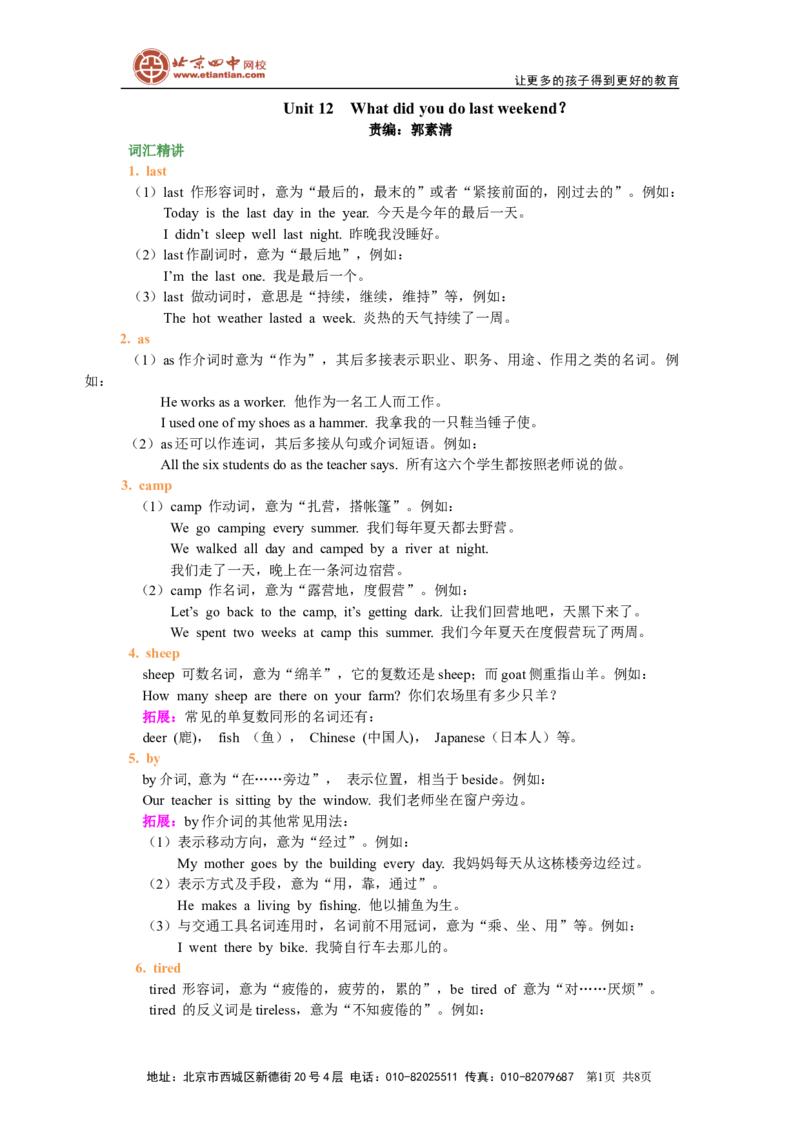
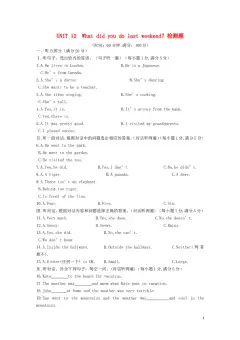
Unit 12  What did you do last weekend?
责编:郭素清
词汇精讲
1. last
(1)last 作形容词时,意为“最后的,最末的”或者“紧接前面的,刚过去的”。例如:
Today is the last day in the year. 今天是今年的最后一天。
I didn’t sleep well last night. 昨晚我没睡好。
(2)last 作副词时,意为“最后地”,例如:
I’m the last one. 我是最后一个。
(3)last 做动词时,意思是“持续,继续,维持”等,例如:
The hot weather lasted a week. 炎热的天气持续了一周。
2. as
(1)as 作介词时意为“作为”,其后多接表示职业、职务、用途、作用之类的名词。例
如:
     He works as a worker. 他作为一名工人而工作。
     I used one of my shoes as a hammer. 我拿我的一只鞋当锤子使。
(2)as 还可以作连词,其后多接从句或介词短语。例如:
     All the six students do as the teacher says. 所有这六个学生都按照老师说的做。
3. camp
  (1)camp 作动词,意为“扎营,搭帐篷”。例如:
       We go camping every summer. 我们每年夏天都去野营。
       We walked all day and camped by a river at night.
我们走了一天,晚上在一条河边宿营。
 (2)camp 作名词,意为“露营地,度假营”。例如:
      Let’s go back to the camp, it’s getting dark. 让我们回营地吧,天黑下来了。
      We spent two weeks at camp this summer. 我们今年夏天在度假营玩了两周。
 4. sheep
   sheep 可数名词,意为“绵羊”,它的复数还是sheep;而goat 侧重指山羊。例如:
   How many sheep are there on your farm? 你们农场里有多少只羊?
   拓展:常见的单复数同形的名词还有:
   deer (鹿), fish (鱼), Chinese (中国人), Japanese(日本人)等。
5. by
  by 介词, 意为“在……旁边”, 表示位置,相当于beside。例如:
  Our teacher is sitting by the window. 我们老师坐在窗户旁边。
  拓展:by 作介词的其他常见用法:
  (1)表示移动方向,意为“经过”。例如:
       My mother goes by the building every day. 我妈妈每天从这栋楼旁边经过。
  (2)表示方式及手段,意为“用,靠,通过”。
       He makes a living by fishing. 他以捕鱼为生。
  (3)与交通工具名词连用时,名词前不用冠词,意为“乘、坐、用”等。例如:
       I went there by bike. 我骑自行车去那儿的。
6. tired
   tired 形容词,意为“疲倦的,疲劳的,累的”,be tired of 意为“对……厌烦”。
tired 的反义词是tireless,意为“不知疲倦的”。例如:
                                   让更多的孩子得到更好的教育
地址:北京市西城区新德街20 号4 层 电话:010-82025511 传真:010-82079687  第2页 共8页
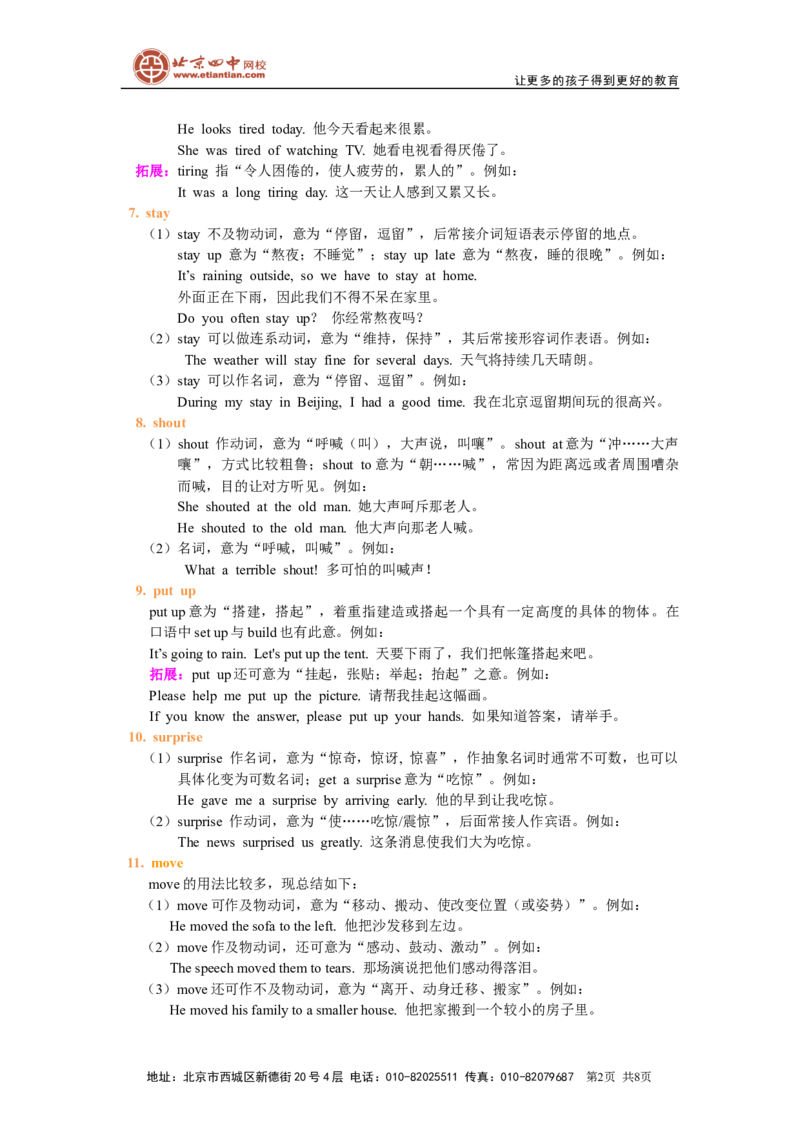
He looks tired today. 他今天看起来很累。
       She was tired of watching TV. 她看电视看得厌倦了。
 拓展:tiring 指“令人困倦的,使人疲劳的,累人的”。例如:
       It was a long tiring day. 这一天让人感到又累又长。
7. stay
  (1)stay 不及物动词,意为“停留,逗留”,后常接介词短语表示停留的地点。
stay up 意为“熬夜;不睡觉”;stay up late 意为“熬夜,睡的很晚”。例如:
       It’s raining outside, so we have to stay at home.
外面正在下雨,因此我们不得不呆在家里。
Do you often stay up? 你经常熬夜吗?
  (2)stay 可以做连系动词,意为“维持,保持”,其后常接形容词作表语。例如:
        The weather will stay fine for several days. 天气将持续几天晴朗。
  (3)stay 可以作名词,意为“停留、逗留”。例如:
       During my stay in Beijing, I had a good time. 我在北京逗留期间玩的很高兴。
 8. shout
  (1)shout 作动词,意为“呼喊(叫),大声说,叫嚷”。shout at 意为“冲……大声
嚷”,方式比较粗鲁;shout to 意为“朝……喊”,常因为距离远或者周围嘈杂
而喊,目的让对方听见。例如:
       She shouted at the old man. 她大声呵斥那老人。
       He shouted to the old man. 他大声向那老人喊。
  (2)名词,意为“呼喊,叫喊”。例如:
        What a terrible shout! 多可怕的叫喊声!
 9. put up
put up 意为“搭建,搭起”,着重指建造或搭起一个具有一定高度的具体的物体。在
口语中set up 与build 也有此意。例如:
It’s going to rain. Let's put up the tent. 天要下雨了,我们把帐篷搭起来吧。
拓展:put up 还可意为“挂起,张贴;举起;抬起”之意。例如:
Please help me put up the picture. 请帮我挂起这幅画。
If you know the answer, please put up your hands. 如果知道答案,请举手。
10. surprise
  (1)surprise 作名词,意为“惊奇,惊讶, 惊喜”,作抽象名词时通常不可数,也可以
具体化变为可数名词;get a surprise 意为“吃惊”。例如:
       He gave me a surprise by arriving early. 他的早到让我吃惊。
  (2)surprise 作动词,意为“使……吃惊/震惊”,后面常接人作宾语。例如:
       The news surprised us greatly. 这条消息使我们大为吃惊。
11. move
         move 的用法比较多,现总结如下:
        (1)move 可作及物动词,意为“移动、搬动、使改变位置(或姿势)”。例如:
            He moved the sofa to the left. 他把沙发移到左边。
        (2)move 作及物动词,还可意为“感动、鼓动、激动”。例如:
            The speech moved them to tears. 那场演说把他们感动得落泪。
        (3)move 还可作不及物动词,意为“离开、动身迁移、搬家”。例如:
            He moved his family to a smaller house. 他把家搬到一个较小的房子里。
                                   让更多的孩子得到更好的教育
地址:北京市西城区新德街20 号4 层 电话:010-82025511 传真:010-82079687  第3页 共8页
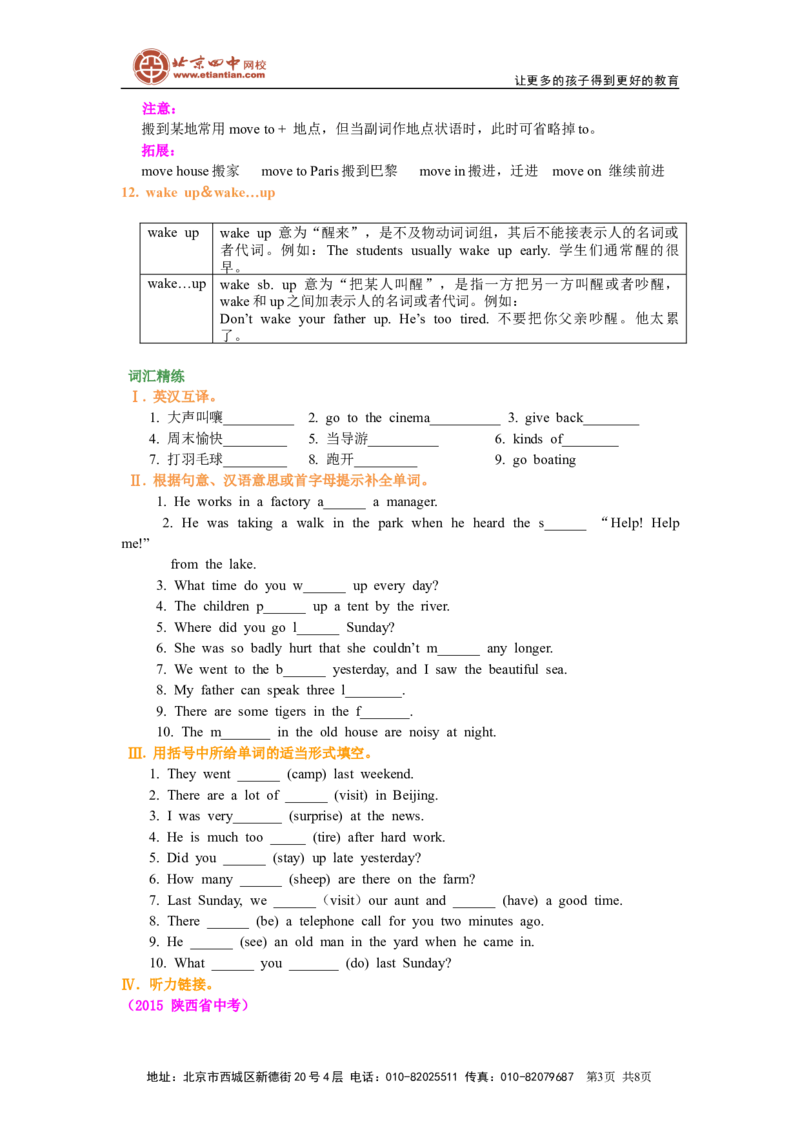
注意:
        搬到某地常用move to + 地点,但当副词作地点状语时,此时可省略掉to。
拓展:
        move house 搬家   move to Paris 搬到巴黎   move in 搬进,迁进  move on 继续前进
12. wake up&wake…up

wake up
wake up 意为“醒来”,是不及物动词词组,其后不能接表示人的名词或
者代词。例如:The students usually wake up early. 学生们通常醒的很
早。
wake…up
wake sb. up 意为“把某人叫醒”,是指一方把另一方叫醒或者吵醒,
wake 和up 之间加表示人的名词或者代词。例如:
Don’t wake your father up. He’s too tired. 不要把你父亲吵醒。他太累
了。
词汇精练
Ⅰ. 英汉互译。
   1. 大声叫嚷__________  2. go to the cinema__________ 3. give back________
   4. 周末愉快_________   5. 当导游__________        6. kinds of________
   7. 打羽毛球_________   8. 跑开_________           9. go boating
Ⅱ. 根据句意、汉语意思或首字母提示补全单词。
    1. He works in a factory a______ a manager.
    2. He was taking a walk in the park when he heard the s______ “Help! Help
me!”
from the lake.
     3. What time do you w______ up every day?
     4. The children p______ up a tent by the river.
     5. Where did you go l______ Sunday?
     6. She was so badly hurt that she couldn’t m______ any longer.
     7. We went to the b______ yesterday, and I saw the beautiful sea.
     8. My father can speak three l________.
     9. There are some tigers in the f_______.
     10. The m_______ in the old house are noisy at night.
Ⅲ. 用括号中所给单词的适当形式填空。
    1. They went ______ (camp) last weekend.
2. There are a lot of ______ (visit) in Beijing.
3. I was very_______ (surprise) at the news.
4. He is much too _____ (tire) after hard work.
5. Did you ______ (stay) up late yesterday?
6. How many ______ (sheep) are there on the farm?
7. Last Sunday, we ______(visit)our aunt and ______ (have) a good time.
8. There ______ (be) a telephone call for you two minutes ago.
9. He ______ (see) an old man in the yard when he came in.
10. What ______ you _______ (do) last Sunday?
Ⅳ.听力链接。
(2015 陕西省中考)
                                   让更多的孩子得到更好的教育
地址:北京市西城区新德街20 号4 层 电话:010-82025511 传真:010-82079687  第4页 共8页
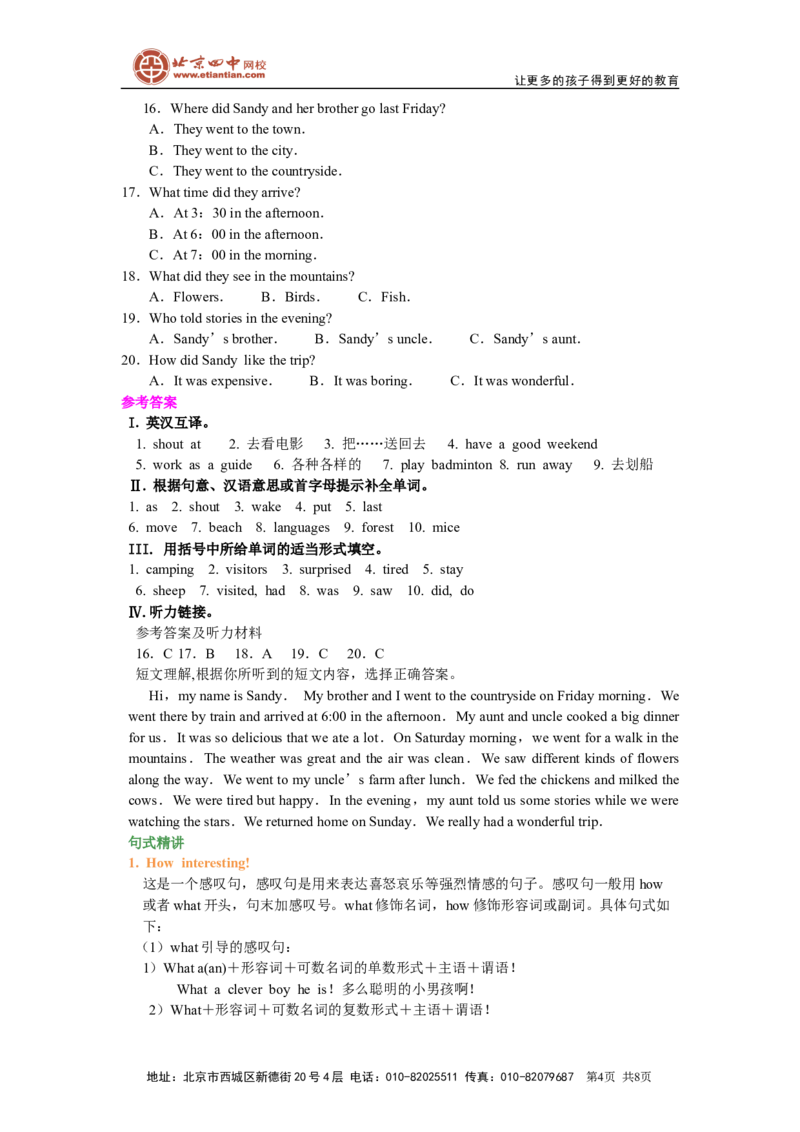
16.Where did Sandy and her brother go last Friday?
    A.They went to the town.
    B.They went to the city.
    C.They went to the countryside.
17.What time did they arrive?
    A.At 3:30 in the afternoon.
    B.At 6:00 in the afternoon.
    C.At 7:00 in the morning.
18.What did they see in the mountains?
    A.Flowers.    B.Birds.    C.Fish.
19.Who told stories in the evening?
    A.Sandy’s brother.    B.Sandy’s uncle.    C.Sandy’s aunt.
20.How did Sandy like the trip?
A.It was expensive.    B.It was boring.    C.It was wonderful.
参考答案
I. 英汉互译。
 1. shout at    2. 去看电影   3. 把……送回去   4. have a good weekend
 5. work as a guide   6. 各种各样的   7. play badminton 8. run away   9. 去划船
Ⅱ. 根据句意、汉语意思或首字母提示补全单词。
1. as  2. shout  3. wake  4. put  5. last
6. move  7. beach  8. languages  9. forest  10. mice
III. 用括号中所给单词的适当形式填空。
1. camping  2. visitors  3. surprised  4. tired  5. stay
6. sheep  7. visited, had  8. was  9. saw  10. did, do
 Ⅳ.听力链接。
  参考答案及听力材料
  16.C 17.B
18.A
19.C
20.C
短文理解,根据你所听到的短文内容,选择正确答案。
Hi,my name is Sandy. My brother and I went to the countryside on Friday morning.We
went there by train and arrived at 6:00 in the afternoon.My aunt and uncle cooked a big dinner
for us.It was so delicious that we ate a lot.On Saturday morning,we went for a walk in the
mountains.The weather was great and the air was clean.We saw different kinds of flowers
along the way.We went to my uncle’s farm after lunch.We fed the chickens and milked the
cows.We were tired but happy.In the evening,my aunt told us some stories while we were
watching the stars.We returned home on Sunday.We really had a wonderful trip.
句式精讲
1. How interesting!
这是一个感叹句,感叹句是用来表达喜怒哀乐等强烈情感的句子。感叹句一般用how
或者what 开头,句末加感叹号。what 修饰名词,how 修饰形容词或副词。具体句式如
下:
(1)what 引导的感叹句:
   1)What a(an)+形容词+可数名词的单数形式+主语+谓语!
    What a clever boy he is!多么聪明的小男孩啊!
    2)What+形容词+可数名词的复数形式+主语+谓语!
                                   让更多的孩子得到更好的教育
地址:北京市西城区新德街20 号4 层 电话:010-82025511 传真:010-82079687  第5页 共8页
What interesting books the children are reading!
孩子们读的书多么有趣啊!
    3)What+形容词+不可数名词+主语+谓语!
   What cold weather it is! 多冷的天!
(2)how 引导的感叹句:
     1)How+形容词或副词+主语+谓语!
          How lovely the baby is! 这孩子真可爱!(lovely 为形容词)
How fast he runs! 他跑地多快啊!(fast 为副词)
2) How+形容词+a(an)+可数名词的单数形式+主语+谓语!
         How heavy a box they are carrying!  他们抬的箱子多重啊!
     3)How+主语+谓语!
          How time flies! 时间过得多快!
2. -Who visited her grandma?
  -Becky did.
  本句的答语中的did 是用来代替上文中的动词visited 的。英语中为了避免不必要的重
复,经常用do, does, did, so 等来代替前面的动词或相关内容。例如:
  -Do you like music? 你喜欢音乐吗?
  -No, but my father does. (does= likes music)不,但是我父亲喜欢音乐。
  -Do you think he is clever? 你认为他聪明吗?
  -I think so.(so 代替he is clever)我认为如此。
   -Did you pass the exam? 你通过考试了吗?
   -No, but my friend Lily did. (did 等于passed the exam)
没有,但是我的朋友Lily 通过了。
3. But I was so tired that I went to sleep early.
   这句话的意思是“我是如此的累,以至于我很早就睡了。”;so… that…的意思是“如
此……以至于……”,它引导结果状语从句。在口语中,so…that…的that 常被省去。
例如:
She felt so sad that tears came to her eyes.
她非常悲伤,泪水盈眶。
John was so drunk(that)he could not stand still.
约翰醉得站也站不住了。
He spoke so rapidly(that)we could hardly follow him.
他说得很快,我们很难听清楚他在说什么。
4. This was a very useful lesson for me.
这句话的意思是“这对我来说是个很有用的教训。”。lesson 在本句中意为“教训,经
验”,是可数名词。teach sb. a lesson 表示“给某人一个教训”。learn a lesson 意为
“得到一次教训”。 例如:
That accident taught them a lesson. 那次事故给了他们一个教训。
You should teach him a lesson. 你应该教训他一顿。
  拓展:lesson 作名词时还可以表示“功课,课”,多用复数形式,也可以指具体的“一
堂课,一节课”,多用单数形式。例如:
      She gives the children lessons in music. 她给孩子们上音乐课。
      They usually have four lessons in the morning. 上午他们通常有四节课。
 5. Not really, but I visited my sister.
                                   让更多的孩子得到更好的教育
地址:北京市西城区新德街20 号4 层 电话:010-82025511 传真:010-82079687  第6页 共8页
really 是副词, 在此与否定词连用,起减弱语气的作用。not really 意为“没有,没什么,
不怎么”等,相当于not very much. 例如:
    I don’t really agree with that. 对此我不太赞同。
    -Did you enjoy that movie? 你喜欢那部电影吗?
    -Not really. 不怎么喜欢。
   拓展:
   (1)really 单独使用时,表示感兴趣或疑问、惊讶、恼怒等语气。例如:
        -My grandfather bought me a new bike. 我外祖父给我买了一辆新自行车。
        -Really? 真的吗?
   (2)用于形容词或行为动词之前,表示强调,意为“真的,的确,确实”。例如:
        She is really beautiful. 她的确很漂亮。
        I really like English. 我真的喜欢英语。
句式精练
Ⅰ. 根据对话内容补全对话。
     A:You look
  1
  .
B:Yes,I am. I had a
  2
  busy weekend.
A:Did you play
  3
   games?
B:Yes,I
  4
  .On Sunday morning,I
  5
  soccer on my computer.Then 1
watched a volleyball match.
A:Where did you
  6
  it?
B:  7
  TV.
A:Great.And what did you do on Sunday night?
B:I
  8
  to music at midnight.
A:It
  9
  fun.
B:Yes,but a
  10

  tired.
Ⅱ. 句型转换,每空一词。
      1. They went to Beidaihe on vacation. (改为一般疑问句)
        _______ they ______ to Beidaihe on vacation?
      2. He did his homework after school. (改为否定句)
        He ______ _______ his homework after school.
      3. My family visited Hangzhou last summer. (就划线部分提问)
        _______ ________ your family _______ last summer?
      4. I cleaned

  my
   room

  last Sunday.(就划线部分提问)
        ______ did you _____ last Sunday?
      5. She was at home yesterday. (改为否定句)
        She ______ at home yesterday.
      6. How excellent the teacher is! (改为同义句)
        _______ ________ ________ teacher he is!
      7. My weekend was great. (对划线部分提问)
        _______ _______ your weekend?
      8. I played basketball on
    Sunday

   morning

 . (对划线部分提问)
        ______ ______ you _______ basketball?
      9. Her

   father

  bought a car yesterday morning. .(对划线部分提问)
        ______ ______ a car yesterday morning?
                                   让更多的孩子得到更好的教育
地址:北京市西城区新德街20 号4 层 电话:010-82025511 传真:010-82079687  第7页 共8页
      10. Gina played

   the
    guitar

  last weekend.(就划线部分提问)
        _______ _______ Gina ______ last weekend?
     Ⅲ. 根据汉语意思,完成句子,每空一词。
      1. 他们正在湖边散步。
         They are taking a walk ______ ______ ______.
      2. 你不能向老师大喊大叫。
         You can’t _______ _______ your teachers.
      3. -谁把窗户打开的?-莉莉。
        -______ opened the window? -Lily_____.
      4. 对大多数女生来说,数学有点难。
        ______ _______ girls, math is a little _______.
      5. 许多人喜欢在春天放风筝。
        Many people like to _______ _______ in spring.
      6. 他上周日做了些什么事?
         What ______he ______ last Sunday?
      7. 我昨天开了一个聚会,很成功。
        I _______ _______ ________ yesterday. It _______ great.
      8. 这件事对我来说是个很好的教训。
        This thing was a very ______ _______ for me.
      9. 你喜欢这本书吗?不怎么喜欢。
        -Do you _______ this book? -______ ______.
      10. 这个箱子是如此的沉,以至于我搬不动它。
          The box is _______ _______ ________ I can’t move it.
IV. 完成句子。
(2015 重庆市中考)
根据所给提示,完成句子。每空一词,含缩略词。
1. Mark is watching TV now. (改为否定句)
Mark _____________ ____________ TV now.
2. The English dictionary is 25
    dollars

 . (对划线部分提问)
______________ ______________ is the English dictionary?
3. Linda is leaving for Guangzhou when class is over. (改为同义句)
Linda is leaving for Guangzhou ______________ ______________.
4. 我通常每天早上6:30 起床。(完成译句)
I usually _________________ _________________ at 6:30 every morning.
5. 这个女孩年龄太小不能自己穿衣。(完成译句)
The girl is ________________ young _____________ dress herself.
参考答案
Ⅰ. 补全对话,每空一词。
  1.tired    2.very    3.computer    4.did      5.played
6.watch   7.On     8.listened     9.sounds   10.little
Ⅱ. 句型转换,每空一词。
   1. Did, go  2. didn’t do  3. Where did, visit   4. What, do
   5. wasn’t   6. What an excellent  7. How was  8. When did, play
   9. Who, bought  10. What did, do
                                   让更多的孩子得到更好的教育
地址:北京市西城区新德街20 号4 层 电话:010-82025511 传真:010-82079687  第8页 共8页
III. 根据汉语意思,完成句子,每空一词。
   1. by the lake   2. shout at    3. Who, did        4. For most, difficult
5. fly kites      6. did, do    7. had a party, was   8. useful lesson
9. like, Not really    10. so heavy that
IV. 完成句子。
1. isn’t watching   2. How much   3. after class   4. get up   5. too; to