让更多的孩子得到更好的教育
地址:北京市西城区新德街20 号4 层 电话:010-82025511 传真:010-82079687  第1页 共9页
Unit 2 What time do you go to school?
                                         责编:郭素清
词汇精讲
1. do one’s homework
do one’s homework 的意思是“做某人的家庭作业”。短语中的one’s 可以用名词所有格或
者形容词性物主代词。
例如:What time do you often do your homework?
   你经常在什么时候做你的家庭作业?
2. get dressed
dressed 在本单元是形容词,意为“打扮好的,穿着衣服的”;get 在此是连系动词,后接
形容词dressed 构成系表结构。词组get dressed 意为“穿上衣服”。
例如:
Mary, can you help your baby sister get dressed?
玛莉, 你可不可以帮你年幼的妹妹穿衣服?
After I get dressed, I have breakfast.
我穿好衣服以后吃早饭。
拓展:dressed 的其他常见用法
1) dress up, 意为“装扮,乔装打扮”或者“穿上盛装,打扮”。
  例如:You needn’t dress up for the party.
        你不必为这个聚会精心打扮。
2)dress up as,意为“装扮成……,打扮成……”。
  例如:The boy often dresses up as a monkey.
         那个男孩常装扮成一只猴子。
3)well-dressed,意为“ 穿着考究的;穿着入时的;着装得体的;衣着讲究的”。
   例如:a well-dressed lady 一位穿着体面的女士
3. take a shower
1)shower 名词,意为“阵雨,淋浴”;take a shower 意为“洗澡,洗淋浴”,等于have
a shower。
shower 前面可以加形容词来修饰。
例如:
I often take a shower in the evening. 我经常在晚上洗澡。
I take a cold shower when I feel tired. 我感到累时就洗个冷水澡。
2)类似于“take a shower=have a shower”这样的用法还有:
take a look= have a look 看一看     take a seat = have a seat 坐下,入座
take a rest = have a rest  休息一下
4. work
1)work 不及物动词,意为“工作,劳动”,第三人称单数是works;worker 是名词,意为
“工人”,复数是workers。
例如:
He works very hard. 他工作很努力。
There are 30 workers in the factory. 工厂里有30 个工人。
2)work 名词, 意为“工作”,是不可数名词,但表示一份工作可以用“a piece of
work”。
   常用于以下词组:
                                   让更多的孩子得到更好的教育
地址:北京市西城区新德街20 号4 层 电话:010-82025511 传真:010-82079687  第2页 共9页
   out of work 失业/下岗      at work 在上班      after work 下班后
   go to work 去上班       in work 就业
3)work 名词, 意为“著作,作品”,是可数名词,复数为works。
She is reading a new work on history.
她正在看一本关于历史的新书。
Shakespeare’s works are very famous. 莎士比亚的作品很著名。
5. funny
1)funny 形容词, 意为“有趣的,可笑的,滑稽的,奇怪的”;意为“有趣”时,相当
于“interesting”。
例如:
What a funny (an interesting) story! 多么有趣的故事啊!
Sometimes he is funny; sometimes he seems like a poet. 有时他很滑稽, 有时他又像个诗人。
The machine is making a very funny noise. 这部机器发出一种很怪的声音。
2)fun 是funny 的名词形式,意为“乐趣,娱乐,嬉戏,有趣的事”。常用于词组have
fun doing sth 表示“做某事很开心。例如:
Life isn’t all fun; it has its bad moments. 人生不仅有乐趣, 也有令人不快的时刻。
Picnics are fun. 野餐是件有趣的事。
 We have a lot of fun in the park on weekends. 每周末我们都在公园里玩得很快活。
 Everybody has fun learning English in our class.  我们班每一位都开心得学英语。
6. exercise
1)exercise 作动词,意为“运动,锻炼”等时,既可以作及物动词也可以作不及物动词。
例如:
Every day I exercise before I go to sleep. (不及物动词)
我每天睡觉前锻炼。
We should constantly exercise our muscles. (及物动词)
我们应当经常锻炼肌肉。
2)exercise 作名词,意为“练习,操”等时,是可数名词。意为“锻炼”时,是不可数名
词。
例如:
We should do eye exercises. 我们应该做眼保健操。
Let's take exercise together. 让我们一起锻炼吧。
7. quarter
1)quarter 作名词时,可以译为“四分之一”或者“一刻钟”。
例如:
A quarter of the apples are green. 有四分之一的苹果是青的。
It’s a quarter past seven. 七点一刻了。
2)quarter 作动词时,可以译为“把…四等分”。
例如:
We should quarter the pineapple.
我们应该把这个菠萝分成四等份。
8. taste
1)taste 做行为动词时,既可以是及物动词也可以是不及物动词,意为“吃,品尝,喝,”
等。
例如:
                                   让更多的孩子得到更好的教育
地址:北京市西城区新德街20 号4 层 电话:010-82025511 传真:010-82079687  第3页 共9页
I can taste something sour. 我尝到了酸味。(及物动词)
Sometimes when you are ill, you can't taste properly. (不及物动词)
有时生病时吃什么都没有滋味。
2)taste 做连系动词时,后面跟名词或者形容词作表语,构成主系表结构;意为“吃起来,
尝起来”。
例如:
The soup tastes good. 这汤的味道不错。
The pizza tastes delicious. 比萨饼很好吃。
3)taste 还可以作名词,意为“味道,味觉,品味”等。
例如:
I like the taste of wine. 我喜欢葡萄酒的味道。
She has excellent taste in dress. 她在服装方面有极高的品味。
9. life
life 名词,既可以是可数名词也可以是不可数名词。作“生活”讲时,是不可数名词;作
“生命”讲时是可数名词,其复数是“lives”。
例如:
Life is like a journey. 生活像一次旅行。(不可数)
Three people lost their lives in the accident. 事故中三人丧生。(可数)
拓展:常见的使用life 的词组有
live a … life  过……的日子     lose one’s life  丧生     save one’s life 救……的命
give one’s life  献身             come (back) to life  复活
10. usually
1)usually 是频度副词,意为“通常”,常位于系动词、助动词或情态动词之后,实义动
词之前,在句子中作状语; 但有时也可以放在句首修饰整个句子。
例如:
I usually go to school at seven o’clock. 我通常七点去上学。
It is usually in the morning that she sees her patients. 她通常在上午看望病人。
Usually, I get up early. 通常, 我起得很早。
2)usually 的形容词是usual,意为“通常的,平常的”。常用于词组as usual,意为“像平
常一样”。它的反义词是unusual,意为“罕有的,不同寻常的”。
例如:
She goes to work as usual. 她像平常一样去上班了。
It was an unusual day for summer. 这是夏季少有的一天。
11. brush
1)brush 作动词,意为“刷,擦”,三单形式是brushes。常用于以下短语中:brush one’s
teeth / shoes / hair 刷牙/擦鞋/ 梳头。
例如;
Please brush your shoes. 请把你的鞋擦一下。
I brush my teeth every day. 我每天都刷牙。
2)brush 作名词,意为“刷子,画笔,毛笔”,是可数名词,其复数是brushes。
例如:
I can paint a picture with a brush. 我可以用刷子画画。
We gave him paint and brushes. 我们给了他油漆和几把刷子。
12. tooth
                                   让更多的孩子得到更好的教育
地址:北京市西城区新德街20 号4 层 电话:010-82025511 传真:010-82079687  第4页 共9页
tooth 名词,意为“牙齿”,可数名词。其复数形式是特殊变化teeth。
例如:
The dentist took out two of my teeth. 牙医拔掉了我两颗牙。
拓展:
1)一些名词的复数是不规则变化的。
   例如:foot → feet(脚)   child → children(孩子)  man→men (男人)
         woman→ women(女人)  mouse → mice(老鼠)
2)还有一些名词的单复数是一样的。
   例如:sheep→sheep(绵羊) deer→deer(鹿) Chinese→Chinese(中国人)
         Japanese→Japanese(日本人)
3)还有些名词是集合名词,本身就是复数的概念,不需要再变复数。
   例如:cattle 牛    people 人,人们    police 警察
词汇精炼
Ⅰ. 用适当的词填空,补全下面的短文。
        I usually
  1
  (起床)at six o’clock. I have milk and bread for breakfast. After
breakfast, I
  2
  (洗澡)and then I
  3
  (上学)by bus. I get to school at a quarter to
eight. I have five classes in the morning. And then I have lunch at twelve o’clock. In the
afternoon I have two classes. I
  4
  (回家)at half past four. I get home at 5:00. I
  5
(吃晚饭)at about 6:00. After dinner, I
  6
  (做作业). I
  7
  (睡觉)at 8:00. My
life is busy but not exciting.
Ⅱ. 根据句意、首字母或汉语提示,写出正确的单词。
1.Today I want to t_____ a shower.
2. Sally finds a new job and she goes to w_____ at seven o’clock every day.
3. What a f______ time to eat fruit after dinner.
4. The soup t______ delicious.
5. Please help the children to get d______; I’m too busy now.
6. They often do morning e________ at school.
7. You can find a good j______ if(如果) you study hard now.
8. The police saved two people’s l______ in the accident.
9. I usually go to school at a q______ past seven.
10. It’s 5 p.m.. Some students don’t want to go h______. They play basketball on
the playground.
III. 用括号内所给单词的适当形式填空。
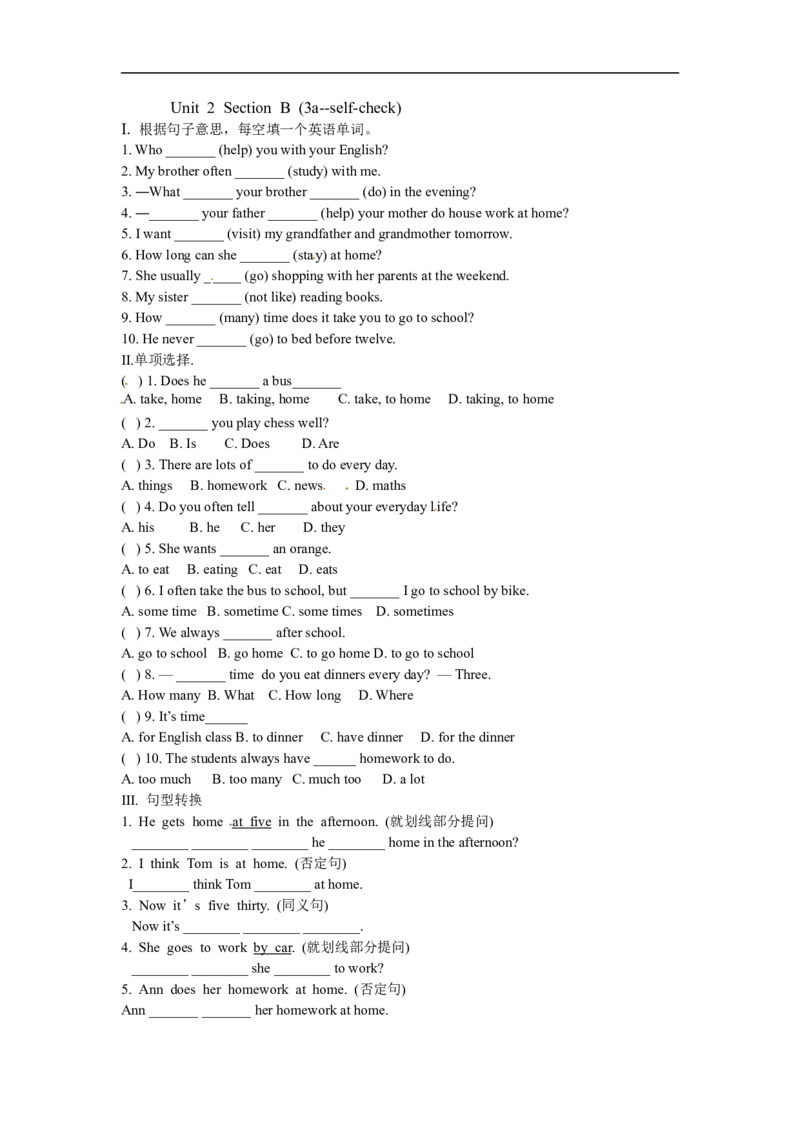
  1. My mother often _______ (watch) TV at 7:00 every evening.
  2. We usually have breakfast at six ______ (clock) in the morning.
  3. What time does your sister ______ (go) home every day?
  4. Please come in and have a cup of tea with _______ (we).
  5. My little brother ______ (not do) his homework at six in the evening.
  6. Please brush your ______ (tooth) after you get up.
  7. Many students have a lot of _______ (homework) to do every day.
  8. What time do you want ______ (have) your lunch?
   9. They ______ (usual) go home after school.
   10. They are the______ (child) books.
 IV.听力链接。
                                   让更多的孩子得到更好的教育
地址:北京市西城区新德街20 号4 层 电话:010-82025511 传真:010-82079687  第5页 共9页
 (2015 青海西宁中考)
6.A.Yes, of course.
B.It’s very kind of you.
C.Thanks,
7.A.What’s wrong with you?
B.I don’t, either.
C.It’s not bad.
8.A.Sounds terrible.
   B.I’m sorry to hear that.
   C.I’ve already tried some, but it didn’t help.
9.A.So he was like his father.
   B.So he was a nice man.
   C.So he was handsome.
10. A.Yes, he was.He taught math.
   B.No, he wasn’t.He taught math.
C.No, he wasn’t.He taught English.
参考答案
I. 用适当的词填空,补全下面的短文。
    1. get up  2. take a shower  3. go to school  4. go home  5. have supper
    6. do my homework   7. go to bed
Ⅱ.根据句意、首字母或汉语提示,写出正确的单词。
1. take   2. work  3. funny   4. tastes  5. dressed
6. exercises  7. job  8. lives  9. quarter  10. home
III.用括号内所给单词的适当形式填空。
1. watches  2. o’clock   3. go   4. us  5. doesn’t do
6. teeth  7. homework   8. to have  9. usually   10. children’s
IV.听力链接。
 答案及听力材料
  6. A     7. B    8.C    9.A    10.B
In this section,you will hear five short sentences.Listen to the sentences,and choose
the best response.Each sentence will be spoken only once.
Number 6.Excuse me.Could you give me a cup of coffee when I’m watching TV?
Number 7.I don’t like hamburgers very much.
Number 8.Why don’t you try some medicine?
Number 9.He was kind of tall and thin.
Number 10.Bob wasn’t an English teacher ten years ago,was he?
句式精讲
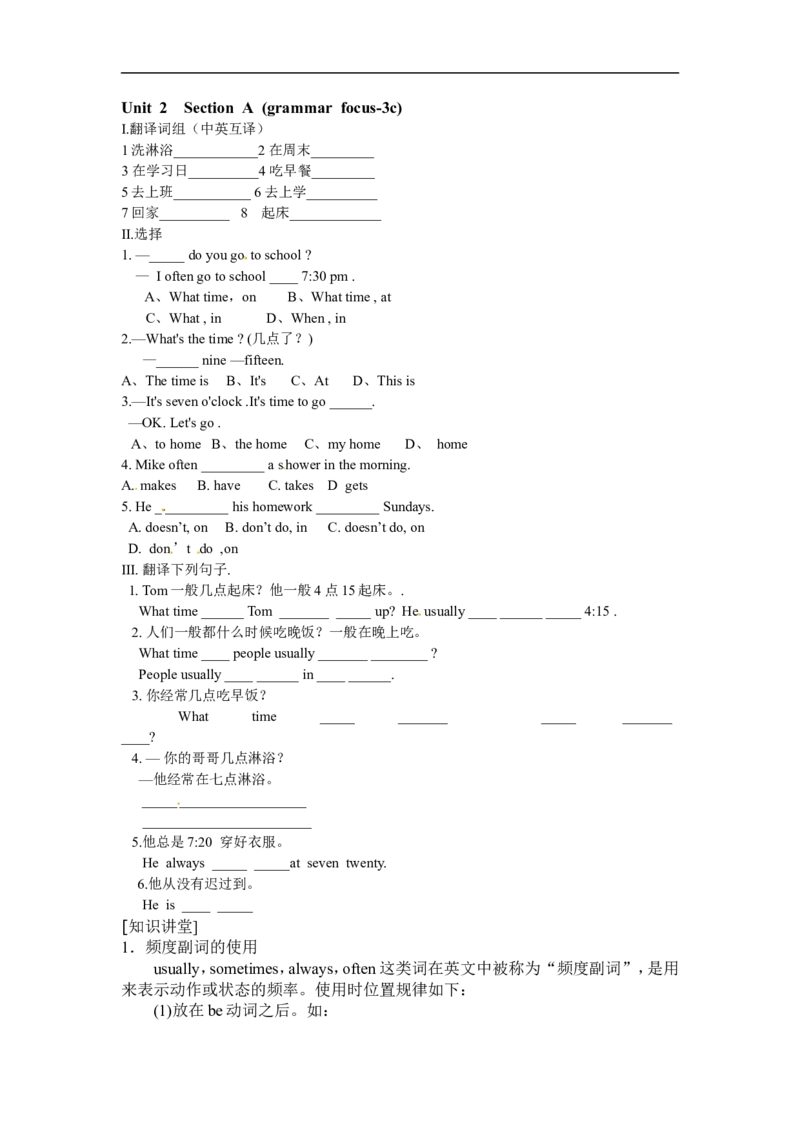
1.What time do you usually get up?
1)这是一个用来询问什么时间做某事的常用句型,意思是“你几点起床?”。它的句式
是“What+time+助动词do/does+主语+谓语动词原形+其他?”。当主语是三单时
用does,其余人称用do。它经常用来询问具体的点钟,相当于对划线部分(表示具体
时间的状语)提问。
   例如:I usually have lunch at 12:00. (对划线部分提问)
    我通常在12 点吃午饭。
What time do you usually have lunch?
    你通常什么时间吃午饭?
        -What time does Rick eat breakfast? 里克什么时候吃早餐?
        -He eats breakfast at seven o’clock. 他七点吃早餐。
                                   让更多的孩子得到更好的教育
地址:北京市西城区新德街20 号4 层 电话:010-82025511 传真:010-82079687  第6页 共9页
2)短语what time 的意思是“几点”,它和when 是同义词,都是对时间进行提问,但
what time 所问的时间范围比较小,一般用来提问比较精确的时间,回答的时候一般
具体到几点。而when 所问的时间范围比what time 要大,回答的时候可以用几点钟,
也可以是上午或者下午,甚至是哪一天、哪一年。
     例如:-What time/When do you usually get up? 你通常什么时间起床?
        -I usually get up at seven o’clock. 我通常七点起床。
        -When is your birthday? 你的生日是什么时候?
        -It’s May 10. 是5 月10 日。
  3)询问时间还可以用句型:
What’s the time now? = What time is it by your watch? =What’s the time by your
watch? (你的手表)现在几点了?
    回答别人询问几点可以用句型:“It+is+时间.”。
例如:It’s six. 现在六点了。
2. I usually get up at six thirty.
  这个句型主要用来回答“What time /When…”句型的提问。在回答做某事的具体时间
时,要注意英语时间的表达法。英语时间的表达法主要有以下几种情况:
1)如果时间在整点可以用“整点数字+o’clock”这种形式表达,有时候可以不用
o’clock。
     例如:It’s eight (o’clock) now. 现在八点了。
2)如果是几点几分,分钟不超过半个小时(包括半小时),可以直接用数字表示。
     例如:6:11→ six eleven (6 点11 分)
     也可以用介词past 表示,past 的前面是分钟,past 的后面是钟点数,表示几点过了
几分的意思。
    例如;6:11→ eleven past six (6 点11 分)
    如果是15 分钟可以用a quarter。
    例如:7:15 →a quarter past seven (七点一刻)
    如果是30 分钟可以用half。
    例如:6:30 →half past six (六点半)
3)如果是几点几分,分钟超过半小时,可以用介词to,to 的前面是分钟(是差几分到
下一点的分钟数字),to 的后面是下一个点的数字。
     例如:6:58 →two to seven (7 点差2 分)
            6:45→ a quarter to seven  (七点差一刻)
3. either…or
  1)“either…or” 意为“要么……要么;或者……或者……;不是……就是……”,用
来连接两个并列的词、短语或者句子。
例如:You can either have tea or coffee. 你喝茶也行,喝咖啡也行。
            You must either go at once or wait till tomorrow.
你要么马上走,要么等到明天。
2)“either…or…”连接的两个并列成分作主语时,谓语动词通常与其靠近的主语保持
一致,简称为就近一致。
  例如:Either he or you are right. 要么他对,要么你对。
        Either you or he is right. 要么你对,要么他对。
4. be good for
be good for 意为“对……有好处,对……有益处”,介词for 后接名词或代词。其反义词
                                   让更多的孩子得到更好的教育
地址:北京市西城区新德街20 号4 层 电话:010-82025511 传真:010-82079687  第7页 共9页
为be bad for,意为“对……有害处”。
例如:Junk food is not good for our health. 垃圾食品对我们的健康没有好处。
        Smoking is bad for you. 吸烟对你有害。
  拓展:其他常见的good 的相关词组还有:
   1)be good at  擅长……
   例如:She is good at English. 她擅长英语。
2)be good with   善于……;精明的;与……相处的好
He is very good with the children. 他与这些孩子处得很好。
   3)be good to   对……友好
   My friend was good to me when I was ill. 我生病时我的朋友对我关怀备至。
5. That’s a funny time for breakfast!
“…time for sth. /…time to do sth. ”, 表示“做……的时间”。
例如:We have no time for exercise. 我们没有时间锻炼。
       She has enough time for breakfast. 她有足够的时间吃早餐。
       He has little time to sleep. 他几乎没有时间睡觉。
拓展:由time 构成的常见的句式还有
      “It’s time for… / It’s time to do… ”意为“该做……的时候了”。
      例如:It’s time for lunch. 该吃午饭了。
            It’s time to go to bed. 该睡觉了。
      “It’s time for sb. to do sth.…”意为“某人该做某事了。”。
       例如:It’s time for us to go home now. 我们该回家了。
句式精练
Ⅰ. 填入适当的单词补全对话。
Alan: Hi, Rick!
Rick: Hi, Alan! Let’s
  1
   home together.
Alan: OK! Tomorrow is Sunday. What
  2
   do you usually get up on Sundays?
Rick:
  3
   8:00 am.
Alan: What do you usually do
  4
   Sunday morning?
Rick: I do
  5
   homework in the morning .Then I do some cleaning in the
afternoon.
Alan: Do you
  6
   TV in the afternoon?
Rick: Yes,but not often. I like to
  7
   sports with my friends.
Alan: We want to have a basketball match tomorrow.Do you want to go with us?
Rick: OK. That
  8
   good.Well, what’s the time, please?
Alan: What
  9
   eight o’clock?
Rick: That’s a little early.But I will
  10

   up early.Thank you.
Alan: You’re welcome.
1.________  2.________  3.________  4.________  5.________
6.________  7.________  8.________  9.________  10.________
Ⅱ. 句型转换。
1. He gets home at five in the afternoon.(就划线部分提问)
   _______ _______ _______ he ______ home in the afternoon?
2. Now it’s five thirty.(同义句)
   Now it’s _______ _______ ________.
                                   让更多的孩子得到更好的教育
地址:北京市西城区新德街20 号4 层 电话:010-82025511 传真:010-82079687  第8页 共9页
3. She goes to work by car.(就划线部分提问)
   ______ _______ she ______ to work?
4. Rick has two sisters.(对划线部分提问)
  ______ ______ ______ does Rick ______?
5. Scott works very hard every day.(改为否定句)
  Scott______ ______ very hard every day.
6. My friend goes to bed at 9:00.(改为一般疑问句)
  ______ your friend _______ to bed at 9:00?
7. She goes to work by
   bus
  .(对划线部分提问)
  ______ ______ she ______ to work?
8. I like taking a shower because

  it ’ s  relaxing

 .(就划线部分提问)
  ______ ______ you like taking a shower?
9. They eat lunch at    school

  on weekdays.(就划线部分提问)
  ______ ______ they eat lunch on weekdays?
10. Mary does her homework in the evening.(改为否定句)
  Mary______ ______ her homework in the evening.
Ⅲ. 根据汉语意思完成句子。
1. 玛丽通常什么时候起床?
  ______ ______ does Mary usually_______ _______?
2. 那个时间吃午餐真有意思啊!
  That’s a ______ time ______ ______!
3. 我们该去上学了。
  It’s time ______ us ______ ______ ______ school.
4. 你可以今天或者明天来。
  You can _______ _______ today_______ tomorrow.
5. 早起早睡对我们的健康有好处。
  Early to bed, early to rise. It’s ______ ______ our health.
6. 这面包闻着坏了。
  The bread _______ _______.
7. 不是你错了,就是我错了。
  ______ you ______ I _______ wrong.
8. 杰克通常在晚上10 点左右睡觉。
  Jack usually______ _______ _______ _______ten______ at night.
9. 她真是个好笑的人。
  What a _______ _______ she is!
10. 谢谢你的来信。
  _______ you ________ your _______.
IV.根据句意,用括号内所给单词的适当形式填空。
(2014 海口琼山期中)
1. I like P. E. best. Because my P. E. teacher is very _____ (friend) to us.
2.—Where is your bedroom?
—It’s on the _____ (two) floor.
3. Look! The ______(child)are playing games under the tree.
4. Turn right at the first ______(cross)and you’ll see the hospital.
5. It’s 6:30 a.m. Some students ______(run)on the playground.
参考答案
Ⅰ. 完成下列对话。
                                   让更多的孩子得到更好的教育
地址:北京市西城区新德街20 号4 层 电话:010-82025511 传真:010-82079687  第9页 共9页
1. go   2. time     3. At     4. on   5. my  6. watch
7. play  8. sounds  9. about  10. get
Ⅱ. 按要求完成句子。
1. What time does, get     2. half past five  3. How does, go
4. How many sisters, have   5. doesn’t work  6. Does, go
7. How does, go  8. Why do  9. Where do  10. doesn’t do
Ⅲ. 根据汉语意思完成英语句子。
  1. What time, get up     2. funny, for lunch    3. for, to go to
4. come either, or        5. good for  6. smells bad  7. Either, or, am
8. goes to bed at, o’clock  9. funny woman/girl  10. Thank , for, letter
IV.根据句意,用括号内所给单词的适当形式填空。
 1. friendly  2. second
3. children
4. crossing
5. are running