文档文本内容
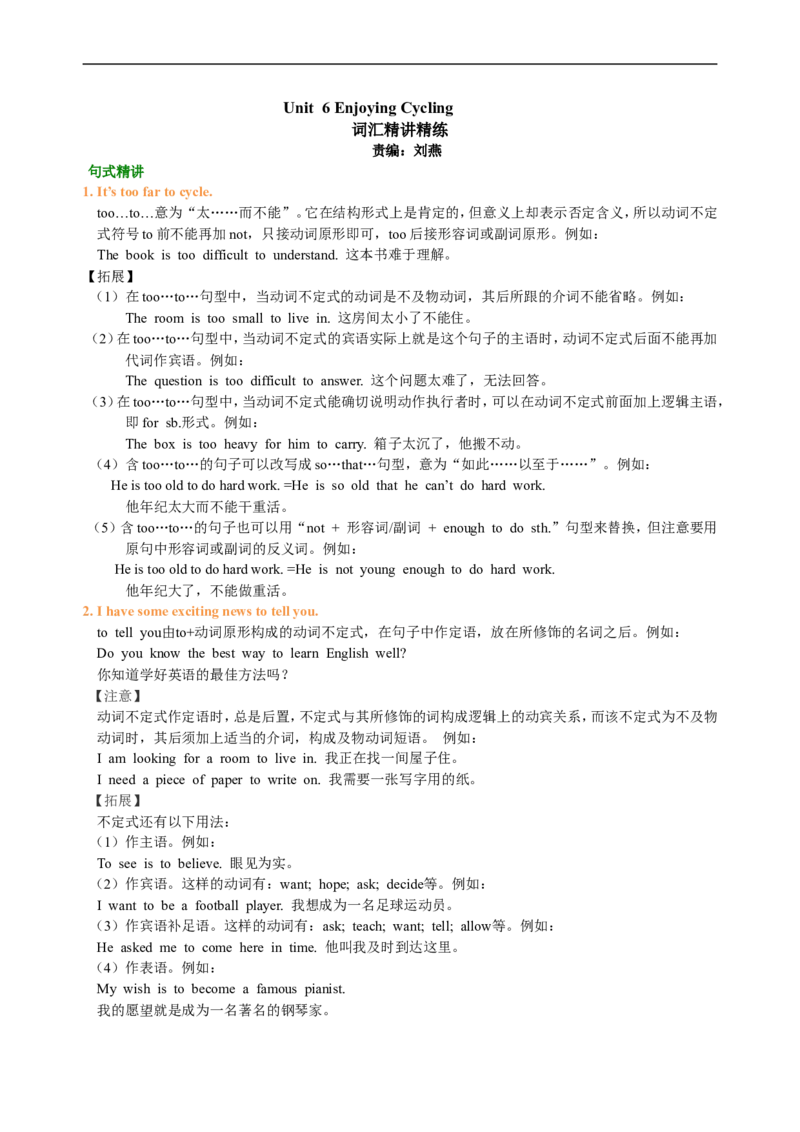
Unit 6 Enjoying Cycling
词汇精讲精练
       责编:刘燕
句式精讲
1. It’s too far to cycle.
  too…to…意为“太……而不能”。它在结构形式上是肯定的,但意义上却表示否定含义,所以动词不定
式符号to 前不能再加not,只接动词原形即可,too 后接形容词或副词原形。例如:
  The book is too difficult to understand. 这本书难于理解。
【拓展】
 (1)在too…to…句型中,当动词不定式的动词是不及物动词,其后所跟的介词不能省略。例如:
      The room is too small to live in. 这房间太小了不能住。
 (2)在too…to…句型中,当动词不定式的宾语实际上就是这个句子的主语时,动词不定式后面不能再加
代词作宾语。例如:
      The question is too difficult to answer. 这个问题太难了,无法回答。
 (3)在too…to…句型中,当动词不定式能确切说明动作执行者时,可以在动词不定式前面加上逻辑主语,
即for sb.形式。例如:
      The box is too heavy for him to carry. 箱子太沉了,他搬不动。
 (4)含too…to…的句子可以改写成so…that…句型,意为“如此……以至于……”。例如:
      He is too old to do hard work. =He is so old that he can’t do hard work.
他年纪太大而不能干重活。
 (5)含too…to…的句子也可以用“not + 形容词/副词 + enough to do sth.”句型来替换,但注意要用
原句中形容词或副词的反义词。例如:
      He is too old to do hard work. =He is not young enough to do hard work.
他年纪大了,不能做重活。
2. I have some exciting news to tell you.
  to tell you由to+动词原形构成的动词不定式,在句子中作定语,放在所修饰的名词之后。例如:
Do you know the best way to learn English well?
你知道学好英语的最佳方法吗?
【注意】
动词不定式作定语时,总是后置,不定式与其所修饰的词构成逻辑上的动宾关系,而该不定式为不及物
动词时,其后须加上适当的介词,构成及物动词短语。 例如:
I am looking for a room to live in. 我正在找一间屋子住。
I need a piece of paper to write on. 我需要一张写字用的纸。
【拓展】
不定式还有以下用法:
(1)作主语。例如:
To see is to believe. 眼见为实。
(2)作宾语。这样的动词有:want; hope; ask; decide等。例如:
I want to be a football player. 我想成为一名足球运动员。
(3)作宾语补足语。这样的动词有:ask; teach; want; tell; allow等。例如:
He asked me to come here in time. 他叫我及时到达这里。
(4)作表语。例如:
My wish is to become a famous pianist.
我的愿望就是成为一名著名的钢琴家。
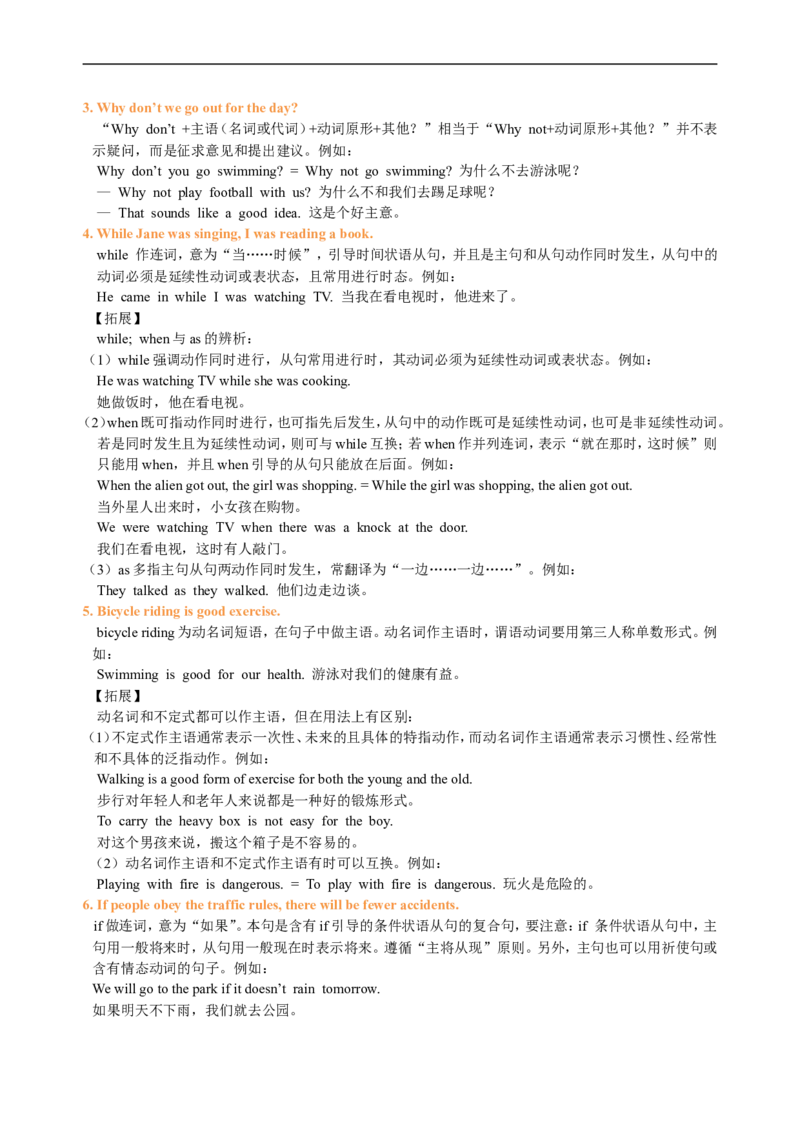
3. Why don’t we go out for the day?
   “Why don’t +主语(名词或代词)+动词原形+其他?”相当于“Why not+动词原形+其他?”并不表
示疑问,而是征求意见和提出建议。例如:
   Why don’t you go swimming? = Why not go swimming? 为什么不去游泳呢?
   — Why not play football with us? 为什么不和我们去踢足球呢?
   — That sounds like a good idea. 这是个好主意。
4. While Jane was singing, I was reading a book.
  while 作连词,意为“当……时候”,引导时间状语从句,并且是主句和从句动作同时发生,从句中的
动词必须是延续性动词或表状态,且常用进行时态。例如:
  He came in while I was watching TV. 当我在看电视时,他进来了。
 【拓展】
while; when 与as 的辨析:
(1)while 强调动作同时进行,从句常用进行时,其动词必须为延续性动词或表状态。例如:
He was watching TV while she was cooking.
她做饭时,他在看电视。
(2)when 既可指动作同时进行,也可指先后发生,从句中的动作既可是延续性动词,也可是非延续性动词。
若是同时发生且为延续性动词,则可与while 互换;若when 作并列连词,表示“就在那时,这时候”则
只能用when,并且when 引导的从句只能放在后面。例如:
When the alien got out, the girl was shopping. = While the girl was shopping, the alien got out.
当外星人出来时,小女孩在购物。
We were watching TV when there was a knock at the door.
我们在看电视,这时有人敲门。
(3)as 多指主句从句两动作同时发生,常翻译为“一边……一边……”。例如:
They talked as they walked. 他们边走边谈。
5. Bicycle riding is good exercise.
  bicycle riding 为动名词短语,在句子中做主语。动名词作主语时,谓语动词要用第三人称单数形式。例
如:
Swimming is good for our health. 游泳对我们的健康有益。
【拓展】
动名词和不定式都可以作主语,但在用法上有区别:
(1)不定式作主语通常表示一次性、未来的且具体的特指动作,而动名词作主语通常表示习惯性、经常性
和不具体的泛指动作。例如:
Walking is a good form of exercise for both the young and the old.
步行对年轻人和老年人来说都是一种好的锻炼形式。
To carry the heavy box is not easy for the boy.
对这个男孩来说,搬这个箱子是不容易的。
(2)动名词作主语和不定式作主语有时可以互换。例如:
Playing with fire is dangerous. = To play with fire is dangerous. 玩火是危险的。
6. If people obey the traffic rules, there will be fewer accidents.
        if 做连词,意为“如果”。本句是含有if 引导的条件状语从句的复合句,要注意:if 条件状语从句中,主
句用一般将来时,从句用一般现在时表示将来。遵循“主将从现”原则。另外,主句也可以用祈使句或
含有情态动词的句子。例如:
We will go to the park if it doesn’t rain tomorrow.
如果明天不下雨,我们就去公园。
Don’t wait for me if I am late.
如果我晚了就不要等我。
If you want to lose weight, you must eat less bread.
如果你想减肥,你必须少吃面包。
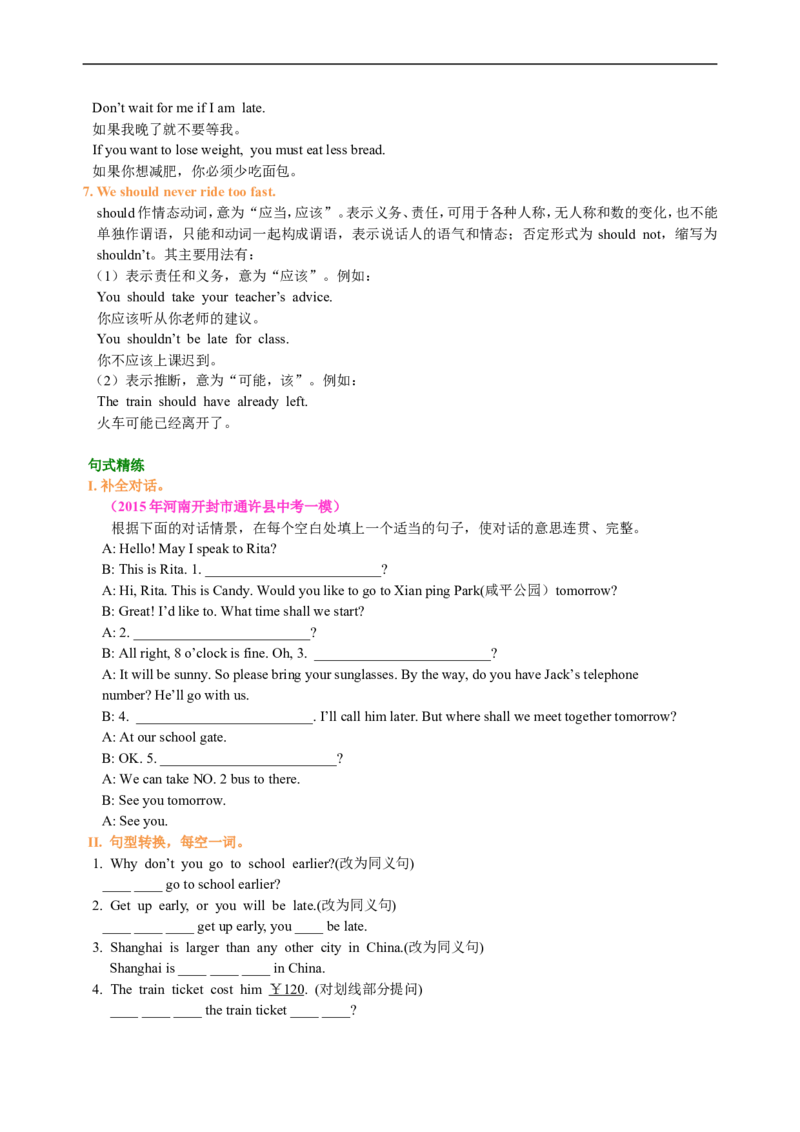
7. We should never ride too fast.
  should 作情态动词,意为“应当,应该”。表示义务、责任,可用于各种人称,无人称和数的变化,也不能
单独作谓语,只能和动词一起构成谓语,表示说话人的语气和情态;否定形式为should not,缩写为
shouldn’t。其主要用法有:
 (1)表示责任和义务,意为“应该”。例如:
  You should take your teacher’s advice.
你应该听从你老师的建议。
  You shouldn’t be late for class.
你不应该上课迟到。
 (2)表示推断,意为“可能,该”。例如:
  The train should have already left.
火车可能已经离开了。
句式精练
I. 补全对话。
   (2015 年河南开封市通许县中考一模)
根据下面的对话情景,在每个空白处填上一个适当的句子,使对话的意思连贯、完整。
A: Hello! May I speak to Rita?
B: This is Rita. 1. _________________________?
A: Hi, Rita. This is Candy. Would you like to go to Xian ping Park(咸平公园)tomorrow?
B: Great! I’d like to. What time shall we start?
A: 2. _________________________?
B: All right, 8 o’clock is fine. Oh, 3. _________________________?
A: It will be sunny. So please bring your sunglasses. By the way, do you have Jack’s telephone
number? He’ll go with us.
B: 4. _________________________. I’ll call him later. But where shall we meet together tomorrow?
A: At our school gate.
B: OK. 5. _________________________?
A: We can take NO. 2 bus to there.
B: See you tomorrow.
A: See you.
II. 句型转换,每空一词。
1. Why don’t you go to school earlier?(改为同义句)
____ ____ go to school earlier?
2. Get up early, or you will be late.(改为同义句)
____ ____ ____ get up early, you ____ be late.
3. Shanghai is larger than any other city in China.(改为同义句)
Shanghai is ____ ____ ____ in China.
4. The train ticket cost him ¥
  120
  . (对划线部分提问)
   ____ ____ ____ the train ticket ____ ____?
5. It often takes about

   16
    hours

  to go from Beijing to Shanghai by train. (对划线部分提问)
____ ____ ____ it often ____ to go from Beijing to Shanghai by train?
6. Tony doesn’t know which book he should choose. (改为同义句)
Tony doesn’t know which book ____ ____.
7. I would like to come to China for my vacation. (改为一般疑问句)
____ ____ like to come to China for ____ vacation.
8. It’s very hard to work out the math problem.(同义句)
_____ _____ _____ the math problem is very hard.
9. Tom gets a letter from his father every month. (改为同义句)
Tom ____ ____ his father every month.
10. Lucy will give a phone call to her friend. Lucy will get off the plane. (用as soon as 合并为一
句)
Lucy will give a phone call to her friend ____ ____ ____ ____ ____ ____ ____ ____.
III. 根据汉语意思完成句子,每空一词。
1. 你收到李伟的来信了吗?
Did you _______ ________ Li Wei?
2. 他们在盼望着游览北京。
They are _______ _______ _______ _______ Beijing.
3. 我想只有Peter 能想出这些奇怪的主意。
I think only Peter can _______ ________ these strange ideas.
4. Jane 经常在星期天帮她妈妈打扫房间。
Jane often ______ her mother ______ the room.
5. Michael 建议我们筹钱。
Michael ______ us ________ _______ _______.
  6. 看!康康正在看电视而明明正忙着做作业。
Look!Kangkang               TV while Mingming is busy       his homework.
7. 你能帮我们做个参观长城的计划吗?
Would you help us                     to visit the Great Wall?
8. 我很高兴收到你的明信片。
I’m          to        your postcard.
9. 走路大约需要两个半小时。
  It’s about               ________         ________on foot.
10. 那个男孩看起来不同意妈妈的意见。
   The boy seemed to               his mother.
参考答案
I. 补全对话。
   1. Who is that (speaking)?
2. What/How about 8 o’clock?
3. How will the weather be tomorrow?
4. Yes, I do.
5. How can we get there?
II. 句型转换, 每空一词。
1. Why not   2.If you don’t; will   3. the largest city   4.How much did; cost him
5. How long does; take   6. to choose  7. Would you; your    8. To work out
9. hears from   10. as soon as she gets off the plane
III. 根据汉语意思完成句子,每空一词。
1.hear from   2.looking forward to visiting    3.think of     4.helps; clean
5.advised to raise money  6. is watching; doing  7. make a plan
8. glad/ happy; receive   9. two and a half hours / two hours and a half   10. disagree with