文档文本内容
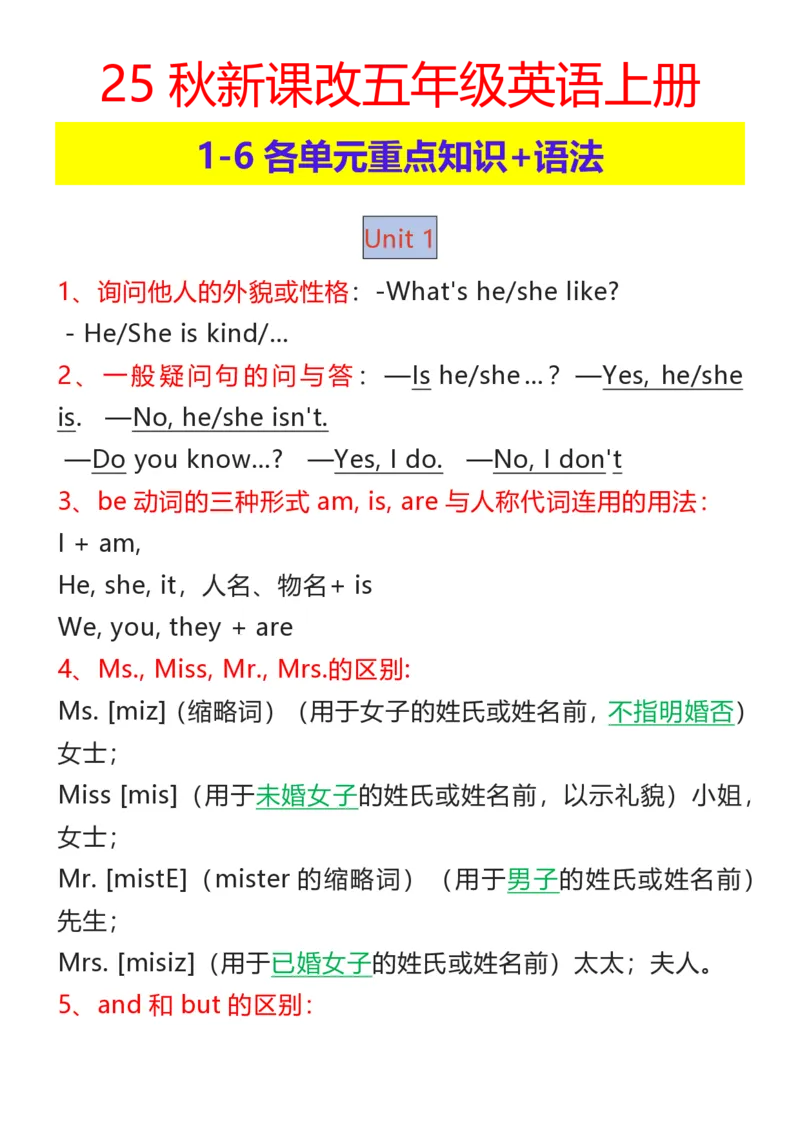
25 秋新课改五年级英语上册
1-6 各单元重点知识+语法
Unit 1
1、询问他人的外貌或性格:-What's he/she like?
 - He/She is kind/…
2、一般疑问句的问与答:—Is he/she… ?—Yes, he/she
is.   —No, he/she isn't.
 —Do you know…?   —Yes, I do.   —No, I don't
3、be 动词的三种形式am, is, are 与人称代词连用的用法:
I + am,
He, she, it,人名、物名+ is
We, you, they + are
4、Ms., Miss, Mr., Mrs.的区别:
Ms. [miz](缩略词)(用于女子的姓氏或姓名前,不指明婚否)
女士;
Miss [mis](用于未婚女子的姓氏或姓名前,以示礼貌)小姐,
女士;
Mr. [mistE](mister 的缩略词)(用于男子的姓氏或姓名前)
先生;
Mrs. [misiz](用于已婚女子的姓氏或姓名前)太太;夫人。
5、and 和but 的区别:
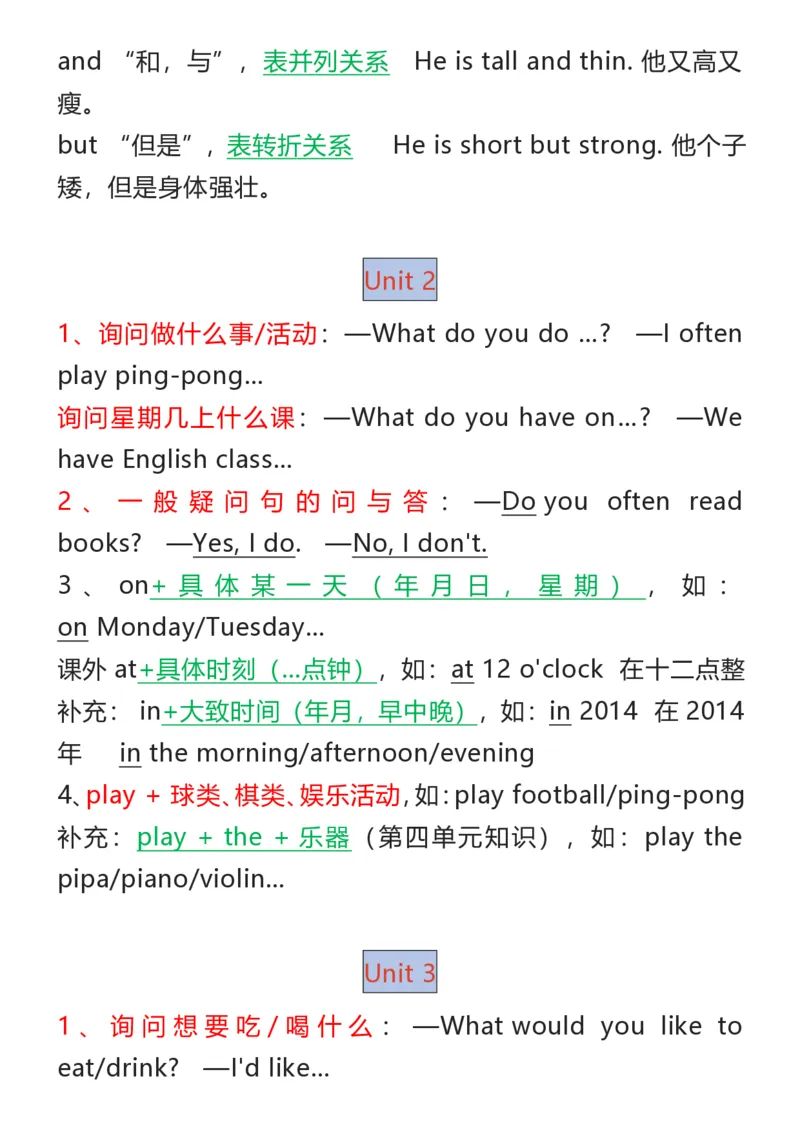
and “和,与”,表并列关系   He is tall and thin. 他又高又
瘦。
but “但是”,表转折关系     He is short but strong. 他个子
矮,但是身体强壮。
Unit 2
1、询问做什么事/活动:—What do you do …?   —I often
play ping-pong…
询问星期几上什么课:—What do you have on…?   —We
have English class…
2 、一般疑问句的问与答:—Do you often read
books?   —Yes, I do.   —No, I don't.
3 、on+ 具体某一天(年月日,星期),如:
on Monday/Tuesday…
课外at+具体时刻(…点钟),如:at 12 o'clock  在十二点整
补充: in+大致时间(年月,早中晚),如:in 2014  在2014
年    in the morning/afternoon/evening
4、play + 球类、棋类、娱乐活动,如:play football/ping-pong
补充:play + the + 乐器(第四单元知识),如:play the
pipa/piano/violin…
Unit 3
1 、询问想要吃/ 喝什么:—What would you like to
eat/drink?   —I'd like…
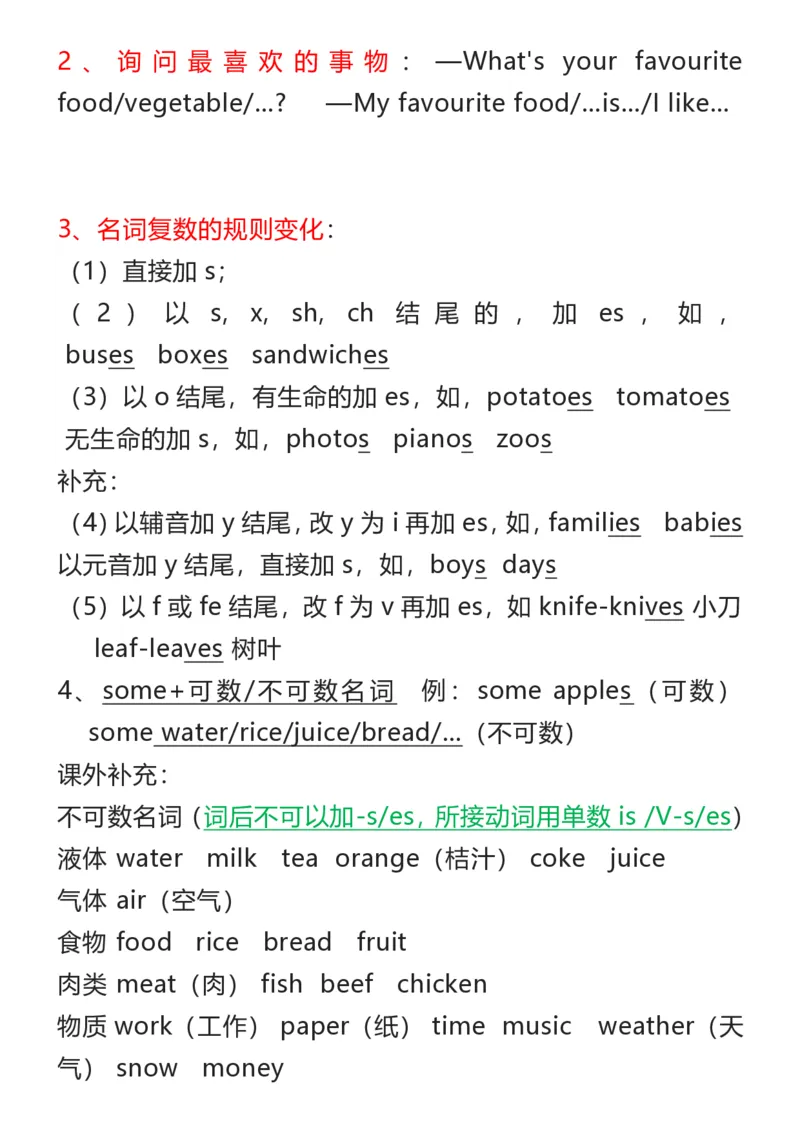
2 、询问最喜欢的事物:—What's your favourite
food/vegetable/…?     —My favourite food/…is…/I like…
3、名词复数的规则变化:
(1)直接加s;
(2 )以
s, x, sh, ch
结尾的,加
es ,如,
 buses   boxes   sandwiches
(3)以o 结尾,有生命的加es,如,potatoes   tomatoes
 无生命的加s,如,photos   pianos   zoos
补充:
(4)以辅音加y 结尾,改y 为i 再加es,如,families   babies
以元音加y 结尾,直接加s,如,boys  days
(5)以f 或fe 结尾,改f 为v 再加es,如knife-knives 小刀
    leaf-leaves 树叶
4、some+可数/不可数名词   例:some apples(可数)
    some water/rice/juice/bread/…(不可数)
课外补充:
不可数名词(词后不可以加-s/es,所接动词用单数is /V-s/es)
液体 water   milk   tea  orange(桔汁) coke   juice
气体 air(空气)
食物 food   rice   bread   fruit
肉类 meat(肉) fish  beef   chicken
物质work(工作) paper(纸) time  music  weather(天
气) snow   money
Unit 4
1、询问对方会做什么事情:—What can you do?  —I can
play the pipa.
2、can 句型的否定句:I can't play the pipa.
3、can 句型的一般疑问句的问与答:—Can you do any kung
fu?   —Yes, I can./No, I can't.
4、play + the + 乐器,例 play the erhu /pipa /piano…
play + 球类、棋类、娱乐活动,
例 play basketball/football/ping-pong…
5、some 与any 的异同:
相同之处:都有“一些”的含义;
不同之处:some+可数名词复数/不可数名词(用于肯定句中)
  例:I can do some kung fu.   我会打功夫。
any+可数名词复数/不可数名词(用于否定句或疑问句中)
例:I can't do any kung fu.  我不会打功夫。    Can you do
any kung fu?  你会打功夫吗?
课外补充:1)any 还可以用于肯定句,作“任何的”解。
例:Any student can answer this question.    任何学生都能
回答这个问题。
2)在表示建议,请求的疑问句中,或期望得到肯定回答时,
用some 而不用any。
例:Would you like some coffee?  你想来点咖啡吗?
Unit 5
1 、there be (is, are )句型的单复数形式:There is a
clock.     There are lots of flowers.
课外补充:
(1)There be 句型的动词就近原则:
例:There is a bed, a desk, two photos in my room.
There are two photos, a bed and a desk in my room.
(2)there be 与have/has 的异同:
相同之处:都有“有”的含义
不同之处:there be 表示“某地有……”(无生命的),主语
放在句末;
例:There is a book on the desk.  书桌上有一本书。
have/has 表示“某人有……”(有生命的),放在主语(人)
的后面。
例:I have a book.   我有一本书。
2、询问方位或地点:—Where is the ball?  —It's in front
of the dog.
3、lots of + 可数/不可数名词= a lot of + 可数/不可数名词
     “许多……”
比较:many + 可数名词复数   “许多……”   例:There
are many trees in the forest.
much + 不可数名词    “许多…....”   例:I drink much water
every day.   我每天喝很多水。
4、动词+very well   例:My father can draw very well.   我
爸爸画的很好。
比较:be (am/is/are)+very good     例:The book is very
good.   这本书非常好。
Unit 6
1 、there be 句型的一般疑问句的问与答:—Is there a
lake?   —Yes, there is.   —No, there isn't.
—Are there any animals?  —Yes, there are.  —No, there
aren't.
2、there be(is, are)句型的单复数形式(具体见Unit 5 的
重点知识及语法):
例:There is a nature park near the house.     There
are many ducks on the lake.
3、some 与any 在肯定句、否定句及问句中的用法:
some+可数名词复数/不可数名词(用于肯定句中)
例:There are some books on the desk.
any+可数名词复数/不可数名词(用于否定句或疑问句中)
例:There aren't any people in the forest.
Are there any tall buildings in the natures park?
4、people 人,人们(集体名词,明为单数,实为复数,词末
不能加-s)相关配套资料关注公众号学海无涯甜作舟获取
例:There are many people in the park.