•
It was eight o’clock in the evening. I’d just arrived at Heathrow Airport
with my family and we were worn out after the long flight. We were going to
stay in London for a few days before travelling to Dublin. Some friends of
ours had told us to get a taxi to our hotel, so we went to look for one. The
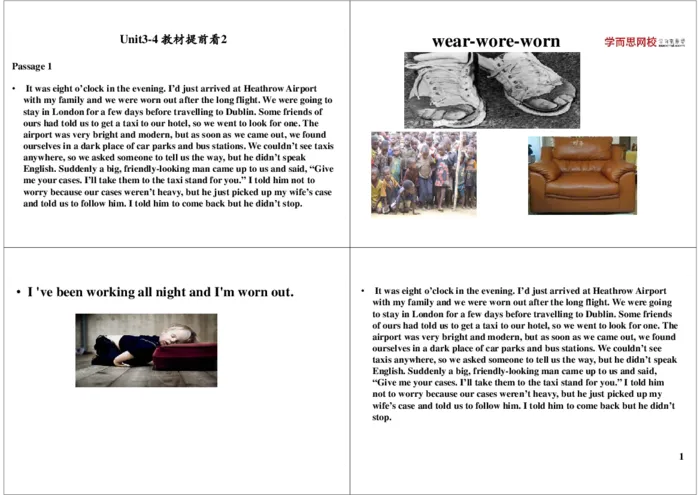
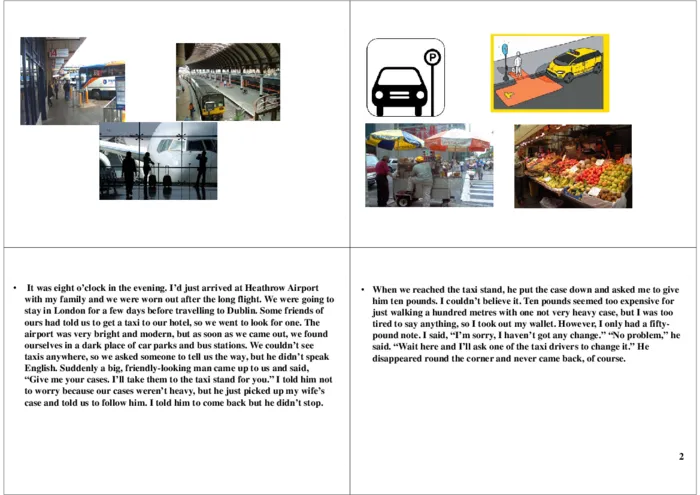
airport was very bright and modern, but as soon as we came out, we found
ourselves in a dark place of car parks and bus stations. We couldn’t see taxis
anywhere, so we asked someone to tell us the way, but he didn’t speak
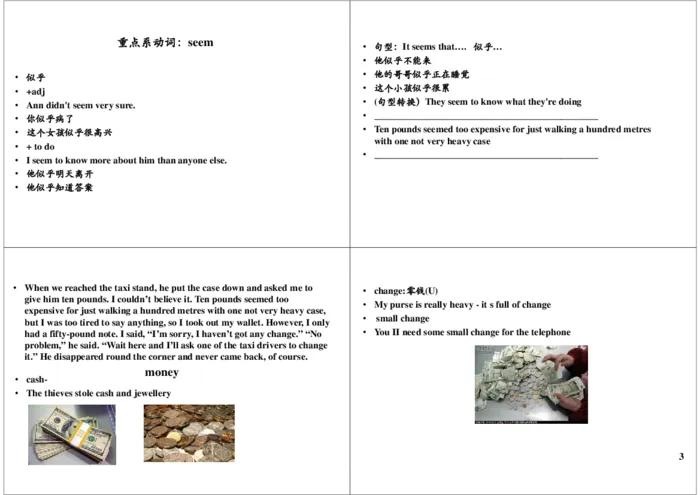
English. Suddenly a big, friendly-looking man came up to us and said, “Give
me your cases. I’ll take them to the taxi stand for you.” I told him not to
worry because our cases weren’t heavy, but he just picked up my wife’s case
and told us to follow him. I told him to come back but he didn’t stop.
Passage 1
Unit3-4 教材提前看2
wear-wore-worn
• I 've been working all night and I'm worn out.
•
It was eight o’clock in the evening. I’d just arrived at Heathrow Airport
with my family and we were worn out after the long flight. We were going
to stay in London for a few days before travelling to Dublin. Some friends
of ours had told us to get a taxi to our hotel, so we went to look for one. The
airport was very bright and modern, but as soon as we came out, we found
ourselves in a dark place of car parks and bus stations. We couldn’t see
taxis anywhere, so we asked someone to tell us the way, but he didn’t speak
English. Suddenly a big, friendly-looking man came up to us and said,
“Give me your cases. I’ll take them to the taxi stand for you.” I told him
not to worry because our cases weren’t heavy, but he just picked up my
wife’s case and told us to follow him. I told him to come back but he didn’t
stop.
1
•
It was eight o’clock in the evening. I’d just arrived at Heathrow Airport
with my family and we were worn out after the long flight. We were going to
stay in London for a few days before travelling to Dublin. Some friends of
ours had told us to get a taxi to our hotel, so we went to look for one. The
airport was very bright and modern, but as soon as we came out, we found
ourselves in a dark place of car parks and bus stations. We couldn’t see
taxis anywhere, so we asked someone to tell us the way, but he didn’t speak
English. Suddenly a big, friendly-looking man came up to us and said,
“Give me your cases. I’ll take them to the taxi stand for you.” I told him not
to worry because our cases weren’t heavy, but he just picked up my wife’s
case and told us to follow him. I told him to come back but he didn’t stop.
•
When we reached the taxi stand, he put the case down and asked me to give
him ten pounds. I couldn’t believe it. Ten pounds seemed too expensive for
just walking a hundred metres with one not very heavy case, but I was too
tired to say anything, so I took out my wallet. However, I only had a fifty-
pound note. I said, “I’m sorry, I haven’t got any change.” “No problem,” he
said. “Wait here and I’ll ask one of the taxi drivers to change it.” He
disappeared round the corner and never came back, of course.
2
重点系动词:seem
•
似乎
•
+adj
•
Ann didn't seem very sure.
•
你似乎病了
•
这个女孩似乎很高兴
•
+ to do
•
I seem to know more about him than anyone else.
•
他似乎明天离开
•
他似乎知道答案
•
句型:It seems that….   似乎…
•
他似乎不能来
•
他的哥哥似乎正在睡觉
•
这个小孩似乎很累
•
(句型转换)They seem to know what they're doing
•
_______________________________________________
•
Ten pounds seemed too expensive for just walking a hundred metres
with one not very heavy case
•
_______________________________________________
•
When we reached the taxi stand, he put the case down and asked me to
give him ten pounds. I couldn’t believe it. Ten pounds seemed too
expensive for just walking a hundred metres with one not very heavy case,
but I was too tired to say anything, so I took out my wallet. However, I only
had a fifty-pound note. I said, “I’m sorry, I haven’t got any change.” “No
problem,” he said. “Wait here and I’ll ask one of the taxi drivers to change
it.” He disappeared round the corner and never came back, of course.
money
•
cash-
•
The thieves stole cash and jewellery
•
change:零钱(U)
•
My purse is really heavy - it s full of change
•
small change
•
You II need some small change for the telephone
3
•
pocket money (美)
•
allowance (英)
•
When we reached the taxi stand, he put the case down and asked me to
give him ten pounds. I couldn’t believe it. Ten pounds seemed too
expensive for just walking a hundred metres with one not very heavy case,
but I was too tired to say anything, so I took out my wallet. However, I
only had a fifty-pound note. I said, “I’m sorry, I haven’t got any change.”
“No problem,” he said. “Wait here and I’ll ask one of the taxi drivers to
change it.” He disappeared round the corner and never came back, of
course.
•
1. They decided to take a taxi because _________.
•
A. they were very tired     B. they couldn’t find the bus station
•
C. the hotel was far away from the airport    D. they followed their friends’
advice
•
It was eight o’clock in the evening. I’d just arrived at Heathrow Airport
with my family and we were worn out after the long flight. We were going
to stay in London for a few days before travelling to Dublin. Some friends
of ours had told us to get a taxi to our hotel, so we went to look for one.
The airport was very bright and modern, but as soon as we came out, we
found ourselves in a dark place of car parks and bus stations. We couldn’t
see taxis anywhere, so we asked someone to tell us the way, but he didn’t
speak English. Suddenly a big, friendly-looking man came up to us and
said, “Give me your cases. I’ll take them to the taxi stand for you.” I told
him not to worry because our cases weren’t heavy, but he just picked up
my wife’s case and told us to follow him. I told him to come back but he
didn’t stop.
•
2. The writer paid the man _____ at last for carrying only one case.
•
A. fifty pounds   B. ten pounds     C. forty pounds   D. some change
•
3.We should learn that ______ from the story.
•
A. friends’ advice is not always correct
•
B. never forget to have some change with you when you go out
•
C. looking friendly doesn’t mean being kind-hearted
•
D. it’s safer to take a bus than to take a taxi in London
4
•
When we reached the taxi stand, he put the case down and asked me to
give him ten pounds. I couldn’t believe it. Ten pounds seemed too
expensive for just walking a hundred metres with one not very heavy case,
but I was too tired to say anything, so I took out my wallet. However, I
only had a fifty-pound note. I said, “I’m sorry, I haven’t got any change.”
“No problem,” he said. “Wait here and I’ll ask one of the taxi drivers to
change it.” He disappeared round the corner and never came back, of
course.
•
“TEENAGER” means a person from 13 to 19 years old. Although they’re
young, they have to make many important choices by themselves. Often
teachers and parents cannot handle them because they don’t understand and
know TEENAGERs, especially their wishes, problems or different moods in
a short time. They need to think about questions like these: Should we go to
college? What kind of job do I want? However, other people also influence
their choices. Who influences TEENAGERs?
Passage 2
handle
•
处理,管理(vt)
•
I thought he handled the situation very well.
•
They have no idea how to handle other people
•
If you can't handle the job I'll get someone else to do it.
•
柄, 把, 把手
•
“TEENAGER” means a person from 13 to 19 years old. Although they’re
young, they have to make many important choices by themselves. Often
teachers and parents cannot handle them because they don’t understand
and know TEENAGERs, especially their wishes, problems or different
moods in a short time. They need to think about questions like these:
Should we go to college? What kind of job do I want? However, other
people also influence their choices. Who influences TEENAGERs?
5
mood
•
情绪,心情
•
be in a good mood
•
be in a bad mood
•
我每星期一心情都不好
•
I am always in a bad mood on Mondays
•
你今早心情不错嘛
•
be/feel in the mood for sth
•
We are in the mood for a movie.
•
=would like to do
•
You should be in the mood for a meal
•
I was in no mood for a joke.
•
“TEENAGER” means a person from 13 to 19 years old. Although they’re
young, they have to make many important choices by themselves. Often
teachers and parents cannot handle them because they don’t understand
and know TEENAGERs, especially their wishes, problems or different
moods in a short time. They need to think about questions like these:
Should we go to college? What kind of job do I want? However, other
people also influence their choices. Who influences TEENAGERs?
influence
•
(n)影响
•
have an influence on sb
•
我爷爷对我的童年有很深的影响
•
飞飞老师对我的英语有很大影响
•
(v)影响
•
“TEENAGER” means a person from 13 to 19 years old. Although they’re
young, they have to make many important choices by themselves. Often
teachers and parents cannot handle them because they don’t understand
and know TEENAGERs, especially their wishes, problems or different
moods in a short time. They need to think about questions like these:
Should we go to college? What kind of job do I want? However, other
people also influence their choices. Who influences TEENAGERs?
•
It depends on the kind of choice. When TEENAGERs buy things,
friends are the most important influence. This is especially true for
clothes and music. TV shows, advertisements and parents also
influence TEENAGERs. In more serious things, parents are probably
the most important influence. Some TEENAGERs say it’s best to
regard both parents and friends as influences. James, a seventeen-
year-old boy says he’s “just a crazy man”. He also says, “Parents are
really important because they can tell you what’s right and wrong.”
6
重点词组:depend on
•
依靠,取决于
•
Choosing the right cellphone depends on what you want to use it for.
•
We are depending on you to finish the work before Friday
•
Many women have to depend on their husbands in Japan
•
independent
•
It depends on the kind of choice
•
It depends on the kind of choice. When TEENAGERs buy things, friends
are the most important influence. This is especially true for clothes and
music. TV shows, advertisements and parents also influence TEENAGERs.
In more serious things, parents are probably the most important influence.
Some TEENAGERs say it’s best to regard both parents and friends as
influences. James, a seventeen-year-old boy says he’s “just a crazy man”.
He also says, “Parents are really important because they can tell you
what’s right and wrong.”
重点词组:regard A as B
•
我把你看作我最好的朋友
•
我认为飞飞老师是最…的老师
•
长城被我们看作是中国的象征(symbol)
•
But TEENAGERs also feel they need to make choices—to make their own
mistakes. As one TEENAGER girl said, “If our parents don’t let us make
our own choices, maybe in the future we don’t know how to do it.” And they
feel friends can often be a big help, especially because friends sometimes
know more about their situation than their parents.
•
teenager, handle, mood, influence, advertisement, depend on,
make mistakes, regard A as B
•
1. School life _____ greatly on the formation (形成)of a child’s character
•
2. He is _____the best actor in the world.
•
3. We usually _____ when we do things in a hurry
•
4. His _____suddenly changed and he became calm
•
5. A satisfied customer is the best _____ we hope to have
•
6. All living things _____the sun for their growth
•
7. This port ____100 million tons of cargo (货物)each year.
•
8. Since his parents died early, he had to earn his own living when he was a
_____
7
•
1.尽管他们心情都很差,但是他们不得不处理这件事情
•
_____they are in a bad _____, they _____ _____ _____ this matter
•
2. 能把错误当成收获来对待是很好的
•
_____ _____ _____ _____ mistakes_____ gains(收获)
•
3.好的广告宣传或多或少会影响消费者的购买欲望
•
Best _____ _____ the customer’s desire of purchase (购买)more or
less
•
4.这个国家在很大程度上依靠其旅游业
•
The country _____ heavily _____ its tourism
•
5. 现代年轻人都把运动视为一种时尚
•
Modern _____ _____ the sports _____ a kind of fashion.
•
1. Why do teenagers sometimes have to make their own choices
•
A. Because the teachers want them to do it.
•
B. Because their parents want them to do it.
•
C. Because teenagers like to make choices by themselves.
•
D. Because teachers and parents don’t understand them well.
•
2. Who influences most to the teenagers when they buy music?
•
A. their teachers     B. their parents     C. their friends     D. Movie stars
•
“TEENAGER” means a person from 13 to 19 years old. Although they’re
young, they have to make many important choices by themselves. Often
teachers and parents cannot handle them because they don’t understand
and know TEENAGERs, especially their wishes, problems or different
moods in a short time. They need to think about questions like these:
Should we go to college? What kind of job do I want? However, other
people also influence their choices. Who influences TEENAGERs?
•
It depends on the kind of choice. When TEENAGERs buy things, friends are
the most important influence. This is especially true for clothes and music. TV
shows, advertisements and parents also influence TEENAGERs. In more
serious things, parents are probably the most important influence. Some
TEENAGERs say it’s best to regard both parents and friends as influences.
James, a seventeen-year-old boy says he’s “just a crazy man”. He also says,
“Parents are really important because they can tell you what’s right and
wrong.”
•
3. What does the passage mainly talk about?
•
A. Everybody needs to make choices.
•
B. TEENAGERs need to make choices by themselves.
•
C. TEENAGERs know more about TV shows and music.
•
D. Teachers and parents should help TEENAGERs as much as possible.
•
But TEENAGERs also feel they need to make choices—to make their own
mistakes. As one TEENAGER girl said, “If our parents don’t let us make
our own choices, maybe in the future we don’t know how to do it.” And they
feel friends can often be a big help, especially because friends sometimes
know more about their situation than their parents.
8