文档文本内容
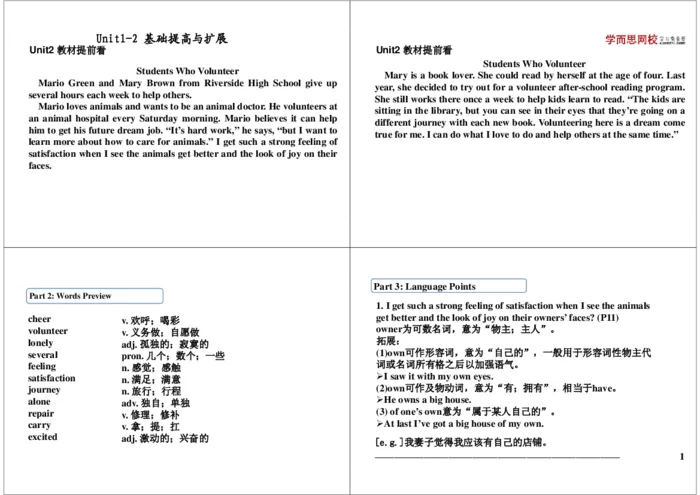
Unit2 教材提前看
Students Who Volunteer
Mario Green and Mary Brown from Riverside High School give up
several hours each week to help others.
Mario loves animals and wants to be an animal doctor. He volunteers at
an animal hospital every Saturday morning. Mario believes it can help
him to get his future dream job. “It’s hard work,” he says, “but I want to
learn more about how to care for animals.” I get such a strong feeling of
satisfaction when I see the animals get better and the look of joy on their
faces.
Unit1-2 基础提高与扩展
Students Who Volunteer
Mary is a book lover. She could read by herself at the age of four. Last
year, she decided to try out for a volunteer after-school reading program.
She still works there once a week to help kids learn to read. “The kids are
sitting in the library, but you can see in their eyes that they’re going on a
different journey with each new book. Volunteering here is a dream come
true for me. I can do what I love to do and help others at the same time.”
Unit2 教材提前看
cheer
volunteer
lonely
several
feeling
satisfaction
journey
alone
repair
carry
excited
Part 2: Words Preview
v. 欢呼;喝彩
v. 义务做;自愿做
adj. 孤独的;寂寞的
pron. 几个;数个;一些
n. 感觉;感触
n. 满足;满意
n. 旅行;行程
adv. 独自;单独
v. 修理;修补
v. 拿;提;扛
adj. 激动的;兴奋的
Part 3: Language Points
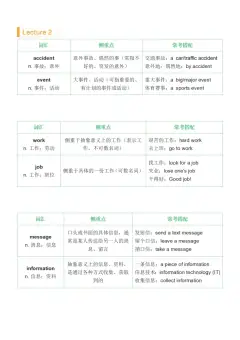
1. I get such a strong feeling of satisfaction when I see the animals
get better and the look of joy on their owners’ faces? (P11)
owner为可数名词,意为“物主;主人”。
拓展:
(1)own可作形容词,意为“自己的”,一般用于形容词性物主代
词或名词所有格之后以加强语气。
I saw it with my own eyes.
(2)own可作及物动词,意为“有;拥有”,相当于have。
He owns a big house.
(3) of one’s own意为“属于某人自己的”。
At last I’ve got a big house of my own.
[e.g.]我妻子觉得我应该有自己的店铺。
__________________________________________________
1
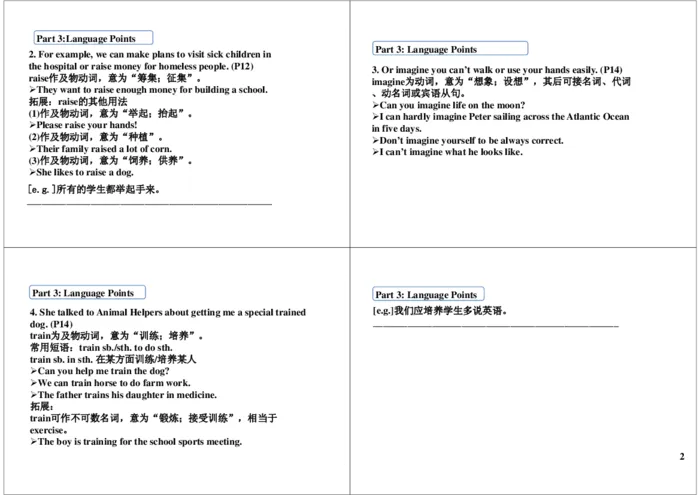
Part 3:Language Points
2. For example, we can make plans to visit sick children in
the hospital or raise money for homeless people. (P12)
raise作及物动词,意为“筹集;征集”。
They want to raise enough money for building a school.
拓展:raise的其他用法
(1)作及物动词,意为“举起;抬起”。
Please raise your hands!
(2)作及物动词,意为“种植”。
Their family raised a lot of corn.
(3)作及物动词,意为“饲养;供养”。
She likes to raise a dog.
[e.g.]所有的学生都举起手来。
__________________________________________________
Part 3: Language Points
3. Or imagine you can’t walk or use your hands easily. (P14)
imagine为动词,意为“想象;设想”,其后可接名词、代词
、动名词或宾语从句。
Can you imagine life on the moon?
I can hardly imagine Peter sailing across the Atlantic Ocean
in five days.
Don’t imagine yourself to be always correct.
I can’t imagine what he looks like.
Part 3: Language Points
4. She talked to Animal Helpers about getting me a special trained
dog. (P14)
train为及物动词,意为“训练;培养”。
常用短语:train sb./sth. to do sth.
train sb. in sth. 在某方面训练/培养某人
Can you help me train the dog?
We can train horse to do farm work.
The father trains his daughter in medicine.
拓展:
train可作不可数名词,意为“锻炼;接受训练”,相当于
exercise。
The boy is training for the school sports meeting.
Part 3: Language Points
[e.g.]我们应培养学生多说英语。
__________________________________________________
2
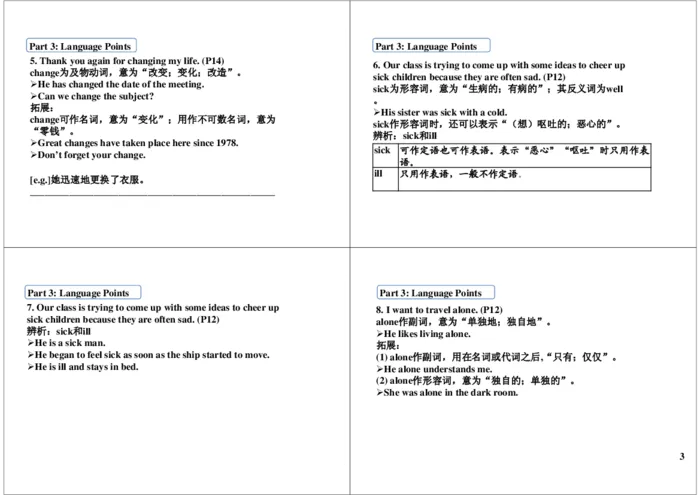
Part 3: Language Points
5. Thank you again for changing my life. (P14)
change为及物动词,意为“改变;变化;改造”。
He has changed the date of the meeting.
Can we change the subject?
拓展:
change可作名词,意为“变化”;用作不可数名词,意为
“零钱”。
Great changes have taken place here since 1978.
Don’t forget your change.
[e.g.]她迅速地更换了衣服。
__________________________________________________
Part 3: Language Points
6. Our class is trying to come up with some ideas to cheer up
sick children because they are often sad. (P12)
sick为形容词,意为“生病的;有病的”;其反义词为well
。
His sister was sick with a cold.
sick作形容词时,还可以表示“(想)呕吐的;恶心的”。
辨析:sick和ill
sick
可作定语也可作表语。表示“恶心”“呕吐”时只用作表
语。
ill
只用作表语,一般不作定语。
Part 3: Language Points
7. Our class is trying to come up with some ideas to cheer up
sick children because they are often sad. (P12)
辨析:sick和ill
He is a sick man.
He began to feel sick as soon as the ship started to move.
He is ill and stays in bed.
Part 3: Language Points
8. I want to travel alone. (P12)
alone作副词,意为“单独地;独自地”。
He likes living alone.
拓展:
(1) alone作副词,用在名词或代词之后,“只有;仅仅”。
He alone understands me.
(2) alone作形容词,意为“独自的;单独的”。
She was alone in the dark room.
3
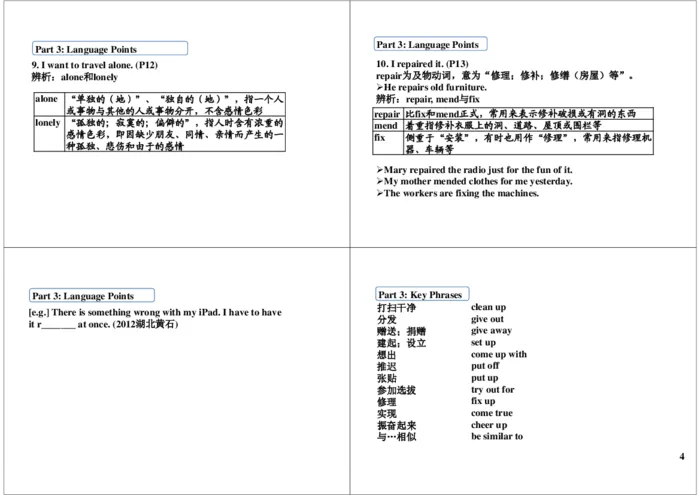
Part 3: Language Points
9. I want to travel alone. (P12)
辨析:alone和lonely
alone
“单独的(地)”、“独自的(地)”,指一个人
或事物与其他的人或事物分开,不含感情色彩
lonely “孤独的;寂寞的;偏僻的”,指人时含有浓重的
感情色彩,即因缺少朋友、同情、亲情而产生的一
种孤独、悲伤和由于的感情
Part 3: Language Points
10. I repaired it. (P13)
repair为及物动词,意为“修理;修补;修缮(房屋)等”。
He repairs old furniture.
辨析:repair, mend与fix
Mary repaired the radio just for the fun of it.
My mother mended clothes for me yesterday.
The workers are fixing the machines.
repair 比fix和mend正式,常用来表示修补破损或有洞的东西
mend 着重指修补衣服上的洞、道路、屋顶或围栏等
fix
侧重于“安装”,有时也用作“修理”,常用来指修理机
器、车辆等
Part 3: Language Points
[e.g.] There is something wrong with my iPad. I have to have
it r_______ at once. (2012湖北黄石)
Part 3: Key Phrases
打扫干净
分发
赠送;捐赠
建起;设立
想出
推迟
张贴
参加选拔
修理
实现
振奋起来
与…相似
clean up
give out
give away
set up
come up with
put off
put up
try out for
fix up
come true
cheer up
be similar to
4
Part 3: Language Points
11. The girl could visit the sick kids in the hospital to cheer
them up. (P9)
cheer up意为“变得更高兴,振奋起来”,是“动词+副词
”结构的短语。Cheer up既可作及物动词短语,也可以作
不及物动词短语。
He cheered up at once when I agreed to help him.
Cheer up! The news isn’t too bad.
He took her to the cinema to cheer her up.
拓展:
cheer on意为“为…加油”.
We will have a basketball game this afternoon. Would you
like to come and cheer us on?
Part 3: Language Points
[e.g.] He failed in the math test and looks sad. Let’s________
(2012贵州六盘水)
A. put him up
B. set him up
C. cheer him up
D. clean him up
Part 3: Language Points
12. The boy could give out food at the food bank. (P9)
give out意为“散发;分发”,相当于hand out,是“动词+
副词”结构的短语动词。
Could you give the drinks out, please?
拓展:give out还有其他含义
(1)give out表示“发出(光、热、声音、气味等)”。
The sun gives out light and heat to the earth.
(2)give out表示“用完,耗尽”。
Our food supplies began to give out.
Part 3: Language Points
[e.g.] The students are___________ the leaflets to people
over there to ask them to protect our earth. (2012江苏南通)
A. printing out
B. giving out
B. C. selling out
D. putting out
5
Part 3: Language Points
13. We can’t put off making a plan. (P10)
put off意为“推迟”,是“动词+副词”结构的短语动词,
其后可跟名词、代词或动名词作宾语。
They put off the match because of the heavy rain.
Please don’t put off doing your homework.
Never put off till tomorrow what you can do today.
Part 3: Language Points
14. We can’t put off making a plan. (P10)
拓展:
由put构成的常用短语为:
put away
put on
put down
put out
put back
put up
将…收起来
穿上,上演
放下,记下
熄灭;伸出
放回原处
张贴;搭建
Part 3: Language Points
[e.g.] Because of the bad weather, we have to_________ the
meeting till next week. (2013山东烟台)
A. take off
B. get off
C. put off
D. set off
Part 3: Language Points
15. They told me stories about the past and how things used
to be. (P10)
used to意为“过去…;曾经…”,后跟动词原形,表示“
过去常常做某事”,只表示过去和现在的对比,暗指现在
已经不存在的动作或状态。
He used to work in the hospital.
He didn’t use to walk after supper.
拓展:
be used to do sth. “被用来做某事”
be used for n./doing “被用于”
get/be used to doing “习惯于做某事”(to是介词)
6
Part 3: Language Points
[e.g.] ---My aunt goes to climb mountains every Sunday.
---Oh? But she_______ hate climbing mountains. (2013黑龙
江绥化)
A. used to
B. was used to
C. is used to
Part 3: Language Points
16. I’ve run out of it. (P13)
run out of意为“用完了…”,主语通常是表示“人”的名词
,也可用于某种能消耗物品的机器等。
I’ve run out of paper.
拓展:
(1) run out of也可表示“从…跑出来”的意思。
The dog ran out of the room.
(2)run out是“动词+副词”结构的不及物动词短语,意为“
用完;用尽”,主语通常是表示“时间、金钱”等无生命的
东西。Eg All the money ran out by me.
(3) sth. run(s) out表示“某物用尽了、用完了”。
Our food will soon run out.
Part 3: Language Points
[e.g.] (替换)Yesterday I used up all the salt to cook
dumplings. I need to buy some now. (2012广西玉林)
A. ate up B. run out of
C. ran of
D. ran out of
1
• 词汇短语连连看
2
• 课文提炼
• 重点操练
黄金总结
• 熟记单词短语句型
2
• 熟读课文
3
• 扩展练习
Homework
7