YINGYU 义务教育教科书
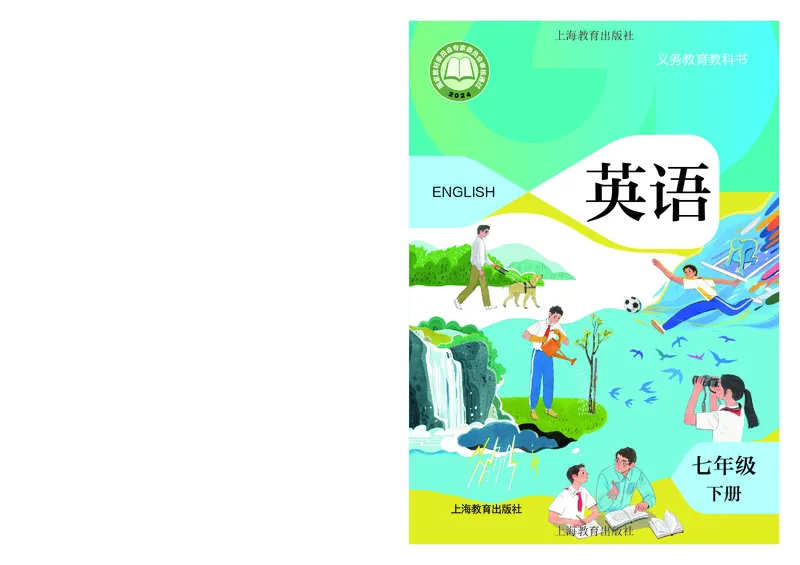
英语
英语
七年级 下册
七
年
级
七年级
下册
义
务
教
育
教
科
书
英
下
册
上海教育出版社
ENGLISH
语
上海教育出版社
英英语语 __七七下下 封封面面..iinndddd 11 22002244//1111//2211 1155::2277::0000上海教育出版社
义务教育教科书
英英语语
七年级
下册
主编 舒白梅
上海教育出版社上海教育出版社
主 编:舒白梅
副 主 编:程 林
编写人员:(以姓氏笔画为序)
叶方兴 向宗平 李 睿 何 琳
陈皓曦 秦文娟 倪 宏
责任编辑:周长天 黄 艳
特约审读:戴嘉子
特约编辑:戴思泉 陈峤琦 朱 珏
美术编辑:朱博韡
封面设计:郑 艺 朱博韡
版式设计:严 冬
插图绘制:庞 坤
本册教材部分图片由图虫网图片库、壹图网图片库、视觉中国图片库提供
义务教育教科书 英语 七年级 下册
出 版 上海教育出版社(上海市闵行区号景路 159 弄 C 座)
发 行 各地新华书店
印 刷 上海中华印刷有限公司
版 次 2025年1月第1版
印 次 2025年1月第1次印刷
开 本 787毫米×1092毫米 1/16
印 张 10.5
字 数 157千字
书 号 ISBN 978-7-5720-3112-0/G·2764
定 价 10.30元
辽宁省物价局价格审查批准文号:辽价发〔2018〕30号
版权所有·未经许可不得采用任何方式擅自复制或使用本产品任何部分·违者必究
如发现内容质量问题,请拨打 021-64319241;
如发现印、装问题,请拨打 021-64373213,我社负责调换。
声明 按照《中华人民共和国著作权法》第二十五条有关规定,我们已尽量寻找著作权人支付稿酬。著
作权人如有关于支付稿酬事宜可及时与出版社联系。
上海教育出版社上海教育出版社
致 同 学
亲爱的同学:
英语是当今世界广泛使用的语言,是各国之间交流的重要工具。学习英语能够让我们获
得跨文化交流能力,为自己成长为具有家国情怀、国际视野和跨文化沟通与交流能力的高素
质人才打下基础。
这套教材将陪伴大家度过初中阶段的英语学习。它是一套怎样的教材?
教材的每个单元都有一个主题,围绕主题呈现一个“关键问题”(Key question),以
激发同学们对主题的学习兴趣和初步认识。随着单元学习的推进,我们将基于这个关键问题,
一步步探究该单元的主题意义。在单元主题的统领下,单元内容分为四个以E开头的部分,
它们之间是循序渐进的关系。
第一个E是Experiencing and understanding language。这个部分将带领我们体验和
理解英语语言,其中的阅读和听力板块选用了题材广泛、体裁丰富的语篇。同学们能在学习
语言的同时体验生活,了解自我、自然和社会。
第二个E是Exploring and applying rules。语言意义的理解需要借助语言规则的学习。
同学们需要在不断习得和积累中归纳语言规则,并在语境中运用规则表达意义。
第三个E是Expressing and communicating ideas。语言是思维的载体和表达思想的
工具,这个部分说和写的活动为同学们提供了运用语言的机会。同学们可围绕单元主题,以
口头或书面形式表达观点,交流思想。
第四个E是Extending and developing competencies。这个部分提供了丰富的中外文
化和跨学科内容,通过听说读写看等活动,帮助同学们拓展和扩宽英语学习的边界和视野,
增加学习的深度和广度,进一步提升核心素养。
单元最后的项目(Project)是检测单元学习效果的综合实践活动。这些活动需要同学们
充分运用知识和智慧,开展合作学习,发挥想象力和创造力,以项目成果的形式呈现学习结果。
此外,教材中还有各种小栏目等着同学们去探索。同学们能在“初步思考”栏目(First
thoughts)中初步了解单元主题,在“阅读策略”栏目(Reading strategy)和“提示”栏
目(Tip)中学习阅读、视听等基本方法策略,在“词汇建构”栏目(Word building)中掌
握构词法和词汇的使用规律,在“归纳规则”栏目(Let’s sum up the rules!)中总结英语
语法规则,在“语法综合运用”栏目(Grammar in use)中灵活运用所学语法知识,在“迁
移创新”栏目(Your ideas)中充分交流自己的思想,在文化“注释”栏目(Notes)中了
解多元文化知识,在“自主探究”栏目(Exploring more)中开展自主探究学习,在“名言
警句”栏目(Wits corner)中感悟人生哲理……
希望这套教材为同学们提供珍贵的英语学习体验。通过学习这套教材,同学们能够探索
大千世界,品味不同文化的内涵,学有所思,学有所得,学有所成!
上海教育出版社上海教育出版社
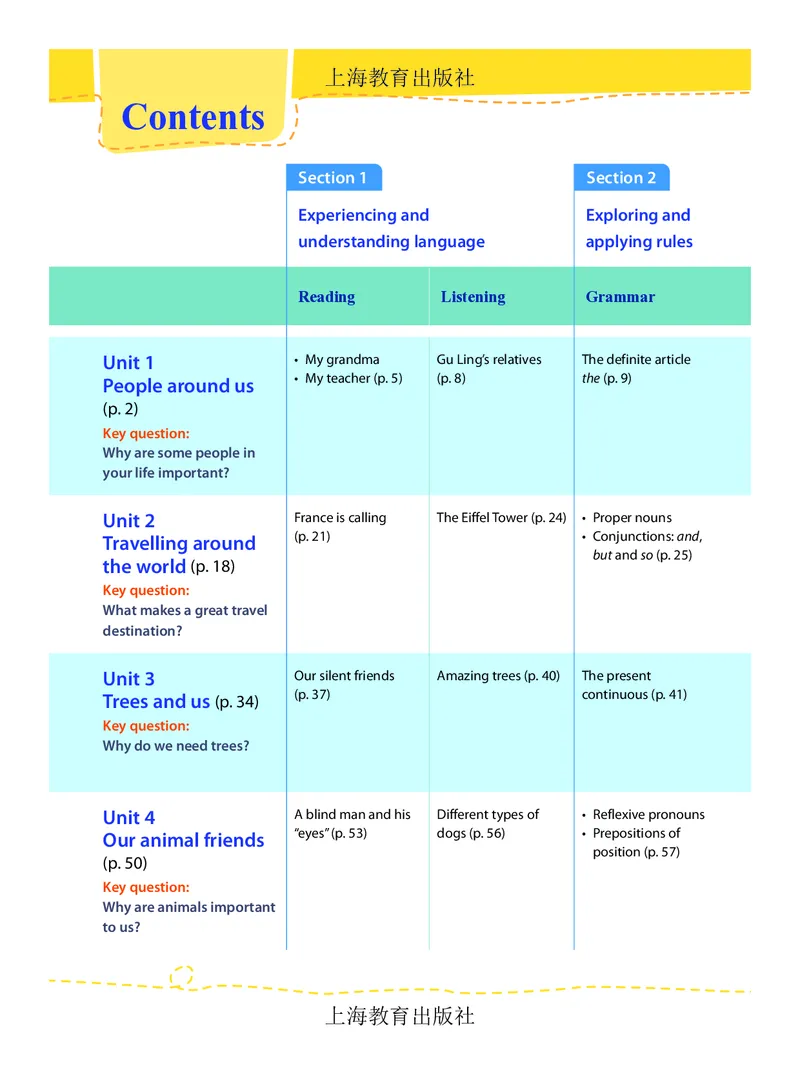
Contents
Section 1 Section 2 Section 3 Section 4 Checking
your
Experiencing and Exploring and Expressing and Extending and
progress
understanding language applying rules communicating ideas developing competencies
Focusing on Cross-curricular
Reading Listening Grammar Speaking Writing Project
culture connection
Unit 1 • My grandma Gu Ling’s relatives The definite article • Talking about the Writing an article My dad (p. 14) My social circle Making an
• My teacher (p. 5) (p. 8) the (p. 9) people you like about a person you (Sociology) (p. 16) album of
People around us
• /IR/, /eR/, /WR/ like (p. 12) the people
(p. 2)
(p. 11) important to
Key question: you (p. 17)
Why are some people in
your life important?
Unit 2 France is calling The Eiffel Tower (p. 24) • Proper nouns • Talking about Writing a postcard National parks The formation of Making a
(p. 21) • Conjunctions: and, travel plans to a friend (p. 28) (p. 30) the mountains in country fact
Travelling around
but and so (p. 25) • /tS/, /dZ/, /ts/, Zhangjiajie (Earth file (p. 33)
the world (p. 18)
/dz/, /tr/, /dr/ science) (p. 32)
Key question: (p. 27)
What makes a great travel
destination?
Unit 3 Our silent friends Amazing trees (p. 40) The present • Talking about Writing a script Lu Yu and Cha Jing Tree senses Making a
(p. 37) continuous (p. 41) ways of saving for a live report on (p. 46) (Biological science) booklet about
Trees and us (p. 34)
trees Tree Planting Day (p. 48) trees (p. 49)
Key question:
• /bl/, /br/, /fl/, (p. 44)
Why do we need trees?
/fr/, /Gl/, /Gr/,
/kl/, /kr/ (p. 43)
Unit 4 A blind man and his Different types of • Reflexive pronouns • Talking about Writing a story The story of The life cycle of bees Making a
“eyes” (p. 53) dogs (p. 56) • Prepositions of farm animals about an animal domestication (Biological science) presentation
Our animal friends
position (p. 57) • /sk/, /sp/, /st/, (p. 60) (p. 62) (p. 64) on our animal
(p. 50)
/sl/, /sm/, /sn/, friends (p. 65)
Key question: /pl/, /pr/, /kw/,
Why are animals important /tw/ (p. 59)
to us?
上海教育出版社上海教育出版社
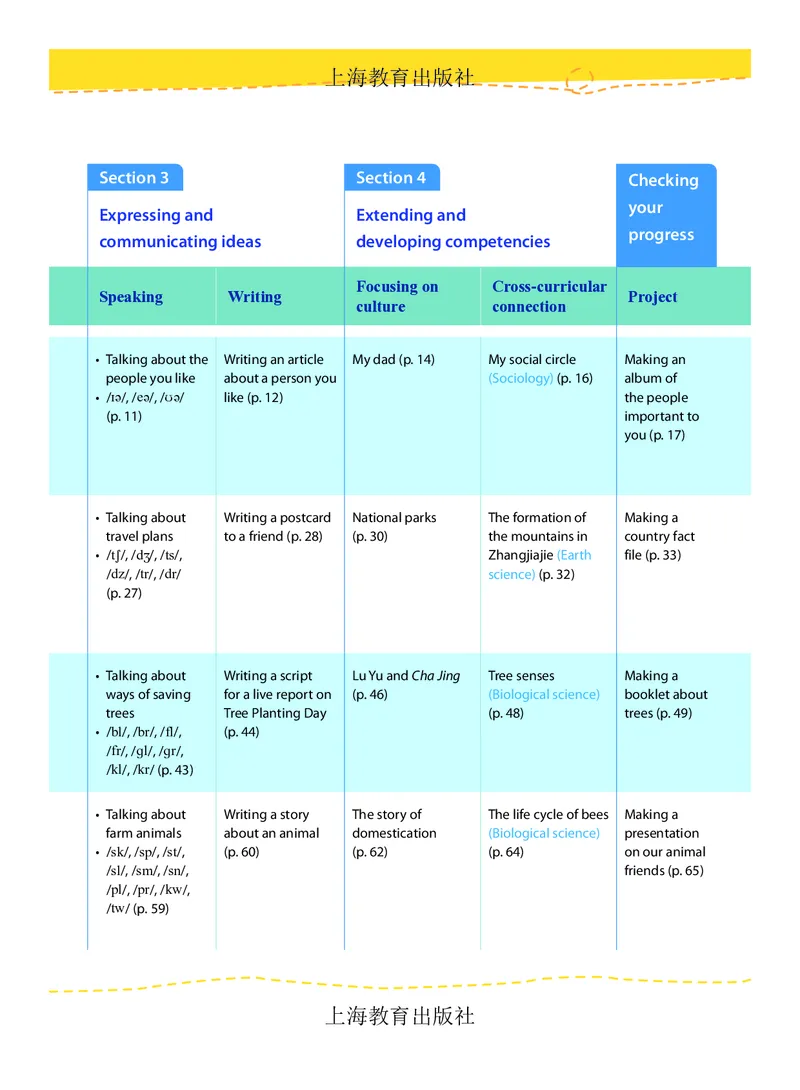
Section 1 Section 2 Section 3 Section 4 Checking
your
Experiencing and Exploring and Expressing and Extending and
progress
understanding language applying rules communicating ideas developing competencies
Focusing on Cross-curricular
Reading Listening Grammar Speaking Writing Project
culture connection
Unit 1 • My grandma Gu Ling’s relatives The definite article • T alking about the Writing an article My dad (p. 14) My social circle Making an
• My teacher (p. 5) (p. 8) the (p. 9) people you like about a person you (Sociology) (p. 16) album of
People around us
• /IR/, /eR/, /WR/ like (p. 12) the people
(p. 2)
(p. 11) important to
Key question: you (p. 17)
Why are some people in
your life important?
Unit 2 France is calling The Eiffel Tower (p. 24) • Proper nouns • T alking about Writing a postcard National parks The formation of Making a
(p. 21) • Conjunctions: and, travel plans to a friend (p. 28) (p. 30) the mountains in country fact
Travelling around
but and so (p. 25) • /tS/, /dZ/, /ts/, Zhangjiajie (Earth file (p. 33)
the world (p. 18)
/dz/, /tr/, /dr/ science) (p. 32)
Key question: (p. 27)
What makes a great travel
destination?
Unit 3 Our silent friends Amazing trees (p. 40) The present • T alking about Writing a script Lu Yu and Cha Jing Tree senses Making a
(p. 37) continuous (p. 41) ways of saving for a live report on (p. 46) (Biological science) booklet about
Trees and us (p. 34)
trees Tree Planting Day (p. 48) trees (p. 49)
Key question:
• /bl/, /br/, /fl/, (p. 44)
Why do we need trees?
/fr/, /Gl/, /Gr/,
/kl/, /kr/ (p. 43)
Unit 4 A blind man and his Different types of • Reflexive pronouns • T alking about Writing a story The story of The life cycle of bees Making a
“eyes” (p. 53) dogs (p. 56) • Prepositions of farm animals about an animal domestication (Biological science) presentation
Our animal friends
position (p. 57) • /sk/, /sp/, /st/, (p. 60) (p. 62) (p. 64) on our animal
(p. 50)
/sl/, /sm/, /sn/, friends (p. 65)
Key question: /pl/, /pr/, /kw/,
Why are animals important /tw/ (p. 59)
to us?
上海教育出版社上海教育出版社
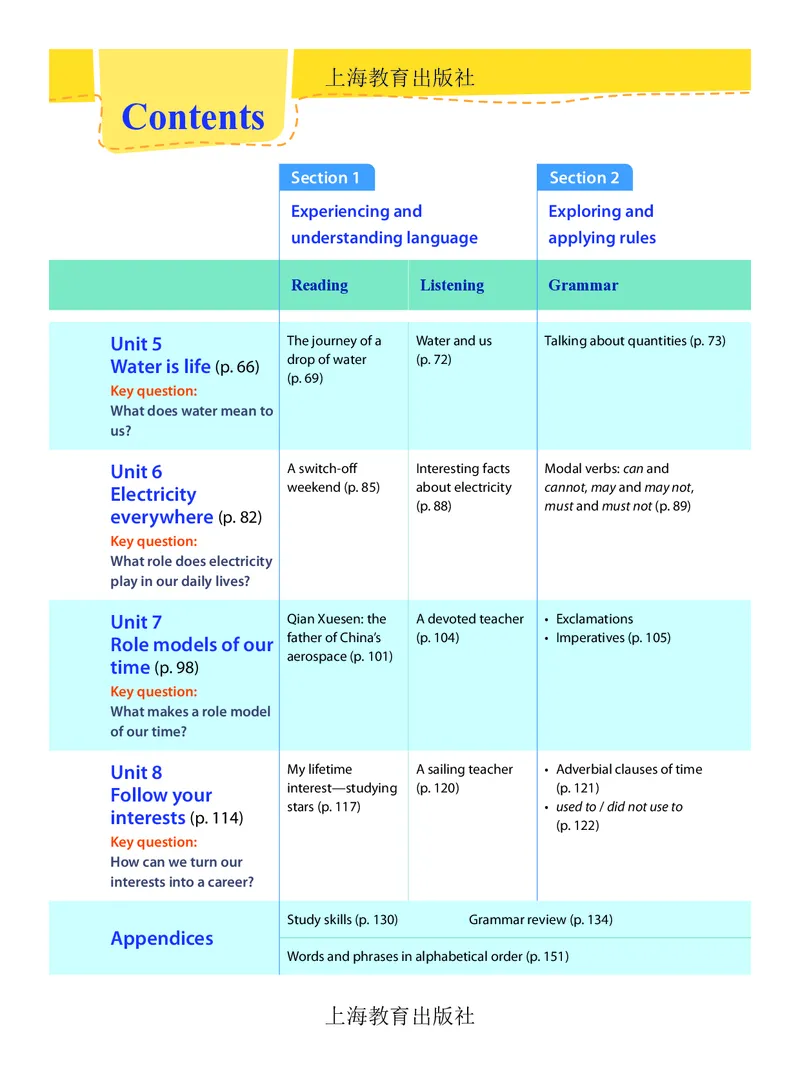
Contents
Section 1 Section 2 Section 3 Section 4 Checking
Experiencing and Exploring and Expressing and Extending and your
understanding language applying rules communicating ideas developing competencies progress
Focusing on Cross-curricular
Reading Listening Grammar Speaking Writing Project
culture connection
Unit 5 The journey of a Water and us Talking about quantities (p. 73) • Talking about Writing water- Cities and water The water in our Making a
drop of water (p. 72) different ways of saving tips (p. 76) (p. 78) bodies (Biological presentation
Water is life (p. 66)
(p. 69) using water science) (p. 80) for World Water
Key question:
• /str/, /spl/, Day (p. 81)
What does water mean to
/spr/, /skr/ (p. 75)
us?
Unit 6 A switch-off Interesting facts Modal verbs: can and • Talking about Writing rules for Earth Hour (p. 94) Renewable energy Making a poster
weekend (p. 85) about electricity cannot, may and may not, using electricity saving electricity at (Physical science) about how to
Electricity
(p. 88) must and must not (p. 89) safely home (p. 92) (p. 96) use electricity
everywhere (p. 82)
• Syllables (p. 91) wisely (p. 97)
Key question:
What role does electricity
play in our daily lives?
Unit 7 Qian Xuesen: the A devoted teacher • Exclamations • Talking about Writing an article The story of a The archaeologist: Making a video
father of China’s (p. 104) • Imperatives (p. 105) your role models about someone you smokejumper history’s detective clip about your
Role models of our
aerospace (p. 101) • Word stress admire most (p. 110) (Archaeology) role model
time (p. 98)
(p. 107) (p. 108) (p. 112) (p. 113)
Key question:
What makes a role model
of our time?
Unit 8 My lifetime A sailing teacher • Adverbial clauses of time • Talking about Writing an article Never give up Finding the Doing a survey
interest—studying (p. 120) (p. 121) dream jobs about your (p. 126) perfect job for you on hobbies and
Follow your
stars (p. 117) • used to / did not use to • Stress in nouns favourite hobby (Psychology) dream jobs
interests (p. 114)
(p. 122) and verbs (p. 123) (p. 124) (p. 128) (p. 129)
Key question:
How can we turn our
interests into a career?
Study skills (p. 130) Grammar review (p. 134) Irregular verbs (p. 142) Phonetic symbols (p. 144) Words and phrases in each unit (p. 145)
Appendices
Words and phrases in alphabetical order (p. 151) Proper nouns (p. 157) Glossary (p. 160)
上海教育出版社上海教育出版社
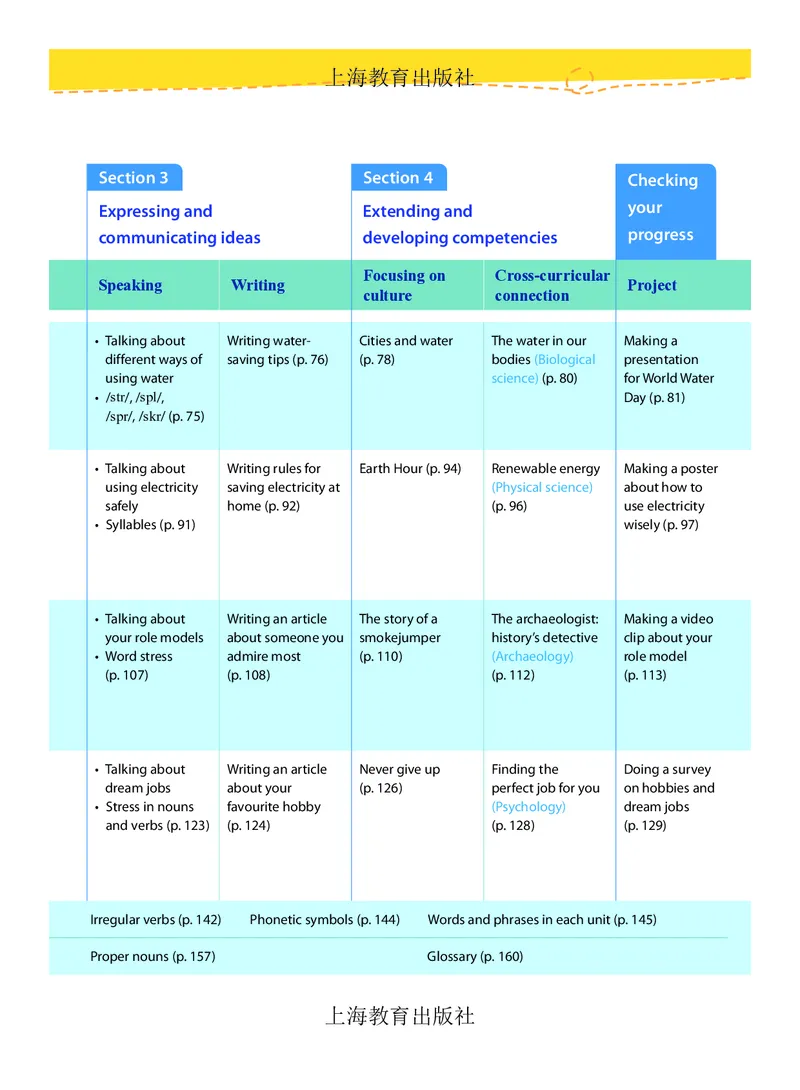
Section 1 Section 2 Section 3 Section 4 Checking
Experiencing and Exploring and Expressing and Extending and your
understanding language applying rules communicating ideas developing competencies progress
Focusing on Cross-curricular
Reading Listening Grammar Speaking Writing Project
culture connection
Unit 5 The journey of a Water and us Talking about quantities (p. 73) • T alking about Writing water- Cities and water The water in our Making a
drop of water (p. 72) different ways of saving tips (p. 76) (p. 78) bodies (Biological presentation
Water is life (p. 66)
(p. 69) using water science) (p. 80) for World Water
Key question:
• /str/, /spl/, Day (p. 81)
What does water mean to
/spr/, /skr/ (p. 75)
us?
Unit 6 A switch-off Interesting facts Modal verbs: can and • T alking about Writing rules for Earth Hour (p. 94) Renewable energy Making a poster
weekend (p. 85) about electricity cannot, may and may not, using electricity saving electricity at (Physical science) about how to
Electricity
(p. 88) must and must not (p. 89) safely home (p. 92) (p. 96) use electricity
everywhere (p. 82)
• Syllables (p. 91) wisely (p. 97)
Key question:
What role does electricity
play in our daily lives?
Unit 7 Qian Xuesen: the A devoted teacher • Exclamations • T alking about Writing an article The story of a The archaeologist: Making a video
father of China’s (p. 104) • Imperatives (p. 105) your role models about someone you smokejumper history’s detective clip about your
Role models of our
aerospace (p. 101) • Word stress admire most (p. 110) (Archaeology) role model
time (p. 98)
(p. 107) (p. 108) (p. 112) (p. 113)
Key question:
What makes a role model
of our time?
Unit 8 My lifetime A sailing teacher • Adverbial clauses of time • T alking about Writing an article Never give up Finding the Doing a survey
interest—studying (p. 120) (p. 121) dream jobs about your (p. 126) perfect job for you on hobbies and
Follow your
stars (p. 117) • used to / did not use to • Stress in nouns favourite hobby (Psychology) dream jobs
interests (p. 114)
(p. 122) and verbs (p. 123) (p. 124) (p. 128) (p. 129)
Key question:
How can we turn our
interests into a career?
Study skills (p. 130) Grammar review (p. 134) Irregular verbs (p. 142) Phonetic symbols (p. 144) Words and phrases in each unit (p. 145)
Appendices
Words and phrases in alphabetical order (p. 151) Proper nouns (p. 157) Glossary (p. 160)
上海教育出版社上海教育出版社
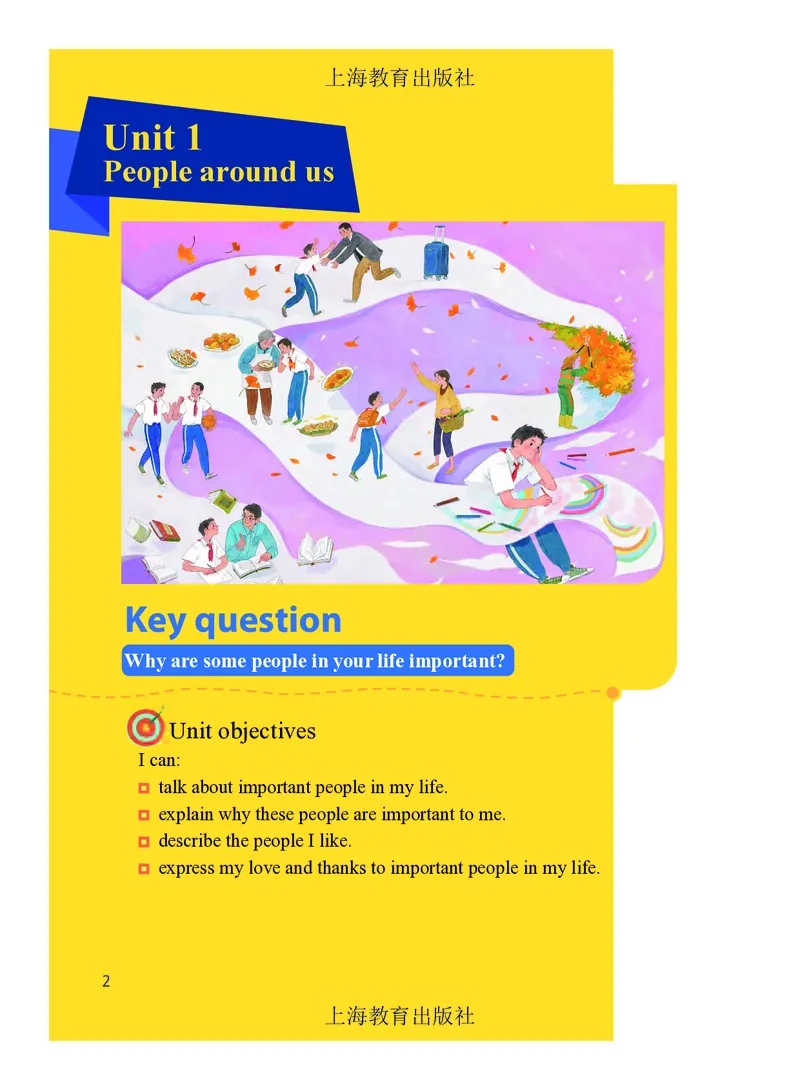
Unit 1
People around us
Key question
Why are some people in your life important?
UUnniitt oobbjjeeccttiivveess
I can:
talk about important people in my life.
explain why these people are important to me.
describe the people I like.
express my love and thanks to important people in my life.
22
上海教育出版社上海教育出版社
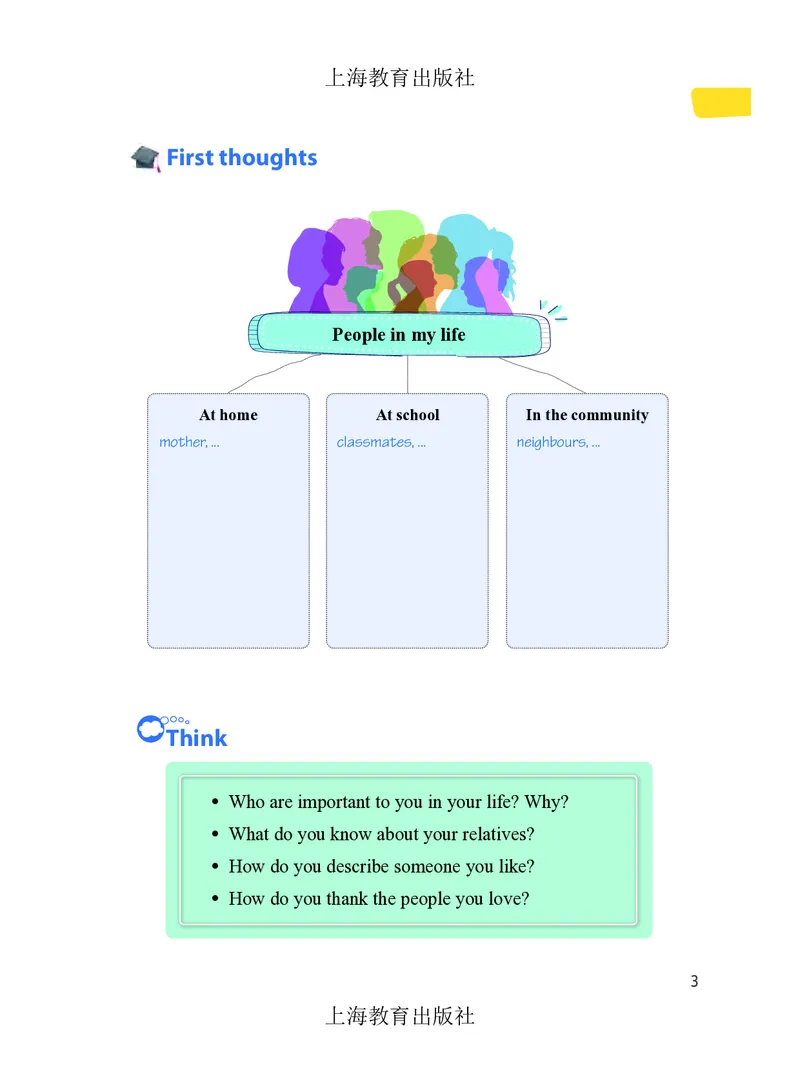
First thoughts
People in my life
At home At school In the community
mother, ... classmates, ... neighbours, ...
Think
• Who are important to you in your life? Why?
• What do you know about your relatives?
• How do you describe someone you like?
• How do you thank the people you love?
3
上海教育出版社上海教育出版社
1
SSSeeeccttiiioon Experiencing and understanding language
Reading TTThhhiiinnnkkk
Who are important to you in your life? Why?
Before you read
Think about the important people in your life. Then discuss in pairs why they are
important to you.
keep the city clean
give me advice
keep the city green
cook meals for me
keep the city safe
help us learn
give us support
encourage me to encourage us to think
study hard
I think my parents are the most important people in
my life. My mother always listens to me and gives me
aaddvviiccee.. MMyy ffaatthheerr eennccoouurraaggeess mmee ttoo ssttuuddyy hhaarrdd aanndd
never give up. I love them very much.
I think our teachers are also very important. They
help us learn and give us lots of support.
4
上海教育出版社上海教育出版社
Section 1
Two Grade 7 students wrote about the people they like most. Read the articles and find
out what these people are like.
My grandma My teacher
My grandma used to Mr Li is my
be a doctor, but she maths teacher.
retired many years He is really smart.
ago. She is kind to everyone and very He knows how to keep our
patient with people, and she is always attention in class, and his
5 30
cheerful. lessons are always interesting.
Grandma helps many old people in For example, he likes to show us
the community with their medical how to solve real-life problems
problems. She gives them tips on with maths, and tells us stories
how to stay healthy. Everyone in the 35 about famous mathematicians.
10
community knows her, and they call Sometimes he even uses fun
her “Doctor Chen”. games in his teaching! That’s why
I seldom feel bored in his maths
Grandma takes good care of us. She
lessons.
is a really good cook, and her dishes
are the best in the world! Dinner at 40 Mr Li is strict about our
15
my grandma’s is the happiest time. schoolwork, but he gives us
We all enjoy her wonderful food, and lots of support when we need
her egg fried rice is my favourite. help. If we cannot work out a
Wherever I go in the future, I will difficult maths problem, he will
never forget the taste of her cooking. 45 encourage us to think about it
20
in a new way. Mr Li often says,
A few weeks ago, my grandma got ill.
“Never give up, and you’ll be
She is in hospital now. We are very
successful.” I think he is the best
worried, and we hope she gets well
teacher in our school.
soon.
— Lin Aixin
— Lu Yuntao 50
25
Reading strategy
Understanding people through their descriptions
We can understand what a person is like by looking at the adjectives used.
She is kind to everyone and very patient with people, and she is always cheerful.
His / Her words and actions also help us understand who he / she is.
In the second article, how does Aixin describe Mr Li?
5
上海教育出版社上海教育出版社
Unit 1 People around us
Reading comprehension
1 Complete the notes below with the information from the articles on page 5.
Grandma Mr Li
Characteristics: Characteristics:
• (1)________________ • (5)________________
What she does: What he does:
• She helps many old people • He knows how to
in the community with (6)____________________ in class.
(2)_________________________. • He gives students
• She (3)________________ (7)________________ when they
her family. She cooks need help.
(4)________________ in the
What he says:
world.
“(8)__________________________.”
2 Read the articles again and answer the questions below.
(1) How does Yuntao feel about his grandma?
_______________________________________________________________________________
_______________________________________________________________________________
(2) Why do the people in the community call Yuntao’s grandma “Doctor Chen”?
_______________________________________________________________________________
_______________________________________________________________________________
(3) How does Mr Li keep the students’ attention in class?
_______________________________________________________________________________
_______________________________________________________________________________
(4) How does Mr Li help his students with diffi cult maths problems?
_______________________________________________________________________________
Your ideas
3 Discuss the questions below.
(1) Which family member do you like most? What do you like about him / her?
(2) Who is your favourite teacher? What do you like about him / her?
6
上海教育出版社上海教育出版社
Section 1
Vocabulary practice
1 The words and the phrase in italics are from the articles on page 5. Choose the correct
answers to complete the sentences.
(1) Yuntao’s grandma retired many years ago. She _________ as a doctor.
a still works b wanted to work c stopped working
(2) S he is a cheerful lady. She is always _________.
a happy b quiet c patient
(3) M r Li knows how to keep our attention in class. I always _________ what he
says.
a strongly believe b easily forget c listen carefully to
(4) M r Li always encourages us to think about a difficult problem in a new way. He
_________ us _________.
a gets ... to laugh b gives ... lots of support c makes ... feel sad
(5) Never give up, and you’ll be successful. Please _________!
a keep trying b think fast c stop doing it
2 A school reporter is interviewing Yuntao and Mr Li. Complete the conversation with the
words and the phrase in italics from Exercise 1. Change the form if necessary.
Reporter: Yuntao, your grandma is very important to you, right?
Yuntao: Yes. I really look up to her. She used to be a doctor, but she
(1)___________ many years ago. Grandma is a wonderful person. She
is so kind and patient, and she makes people feel comfortable because
she’s friendly and (2)___________. She also takes good care of us.
Grandma always (3)___________ me to study hard. I want to become a
doctor, just like her!
Reporter: What do you think of Aixin, Mr Li?
Mr Li: Aixin is a good student. She always pays (4)___________ in class.
She listens carefully and thinks fast. Aixin also works very hard.
When I give her difficult maths problems, she tries her best and never
(5)___________.
3 Make sentences about your family members and your teachers with the words and
phrases below.
cheerful patient retire smart successful be strict about
encourage ... to ... give ... support give up take good care of
7
上海教育出版社上海教育出版社
2
Unit 1 People around us Section Exploring and applying rules
Listening TTThhhiiinnnkkk
What do you know about your relatives?
Gu Ling’s relatives
1 Gu Ling's grandma is visiting her relatives in Australia. She sent Gu Ling a photo.
Discuss the photo in pairs. Describe the people in it and guess what they do.
The second person from
the left is about the same
age as me. He is wearing
a school uniform. I guess
hhee iiss aa jjuunniioorr hhiigghh sscchhooooll
student.
2 Gu Ling is phoning her grandma to ask about the people in the photo. Listen to the
conversation and tick( )the topics they talk about.
age job place of residence①
appearance personality their children
3 Listen again and complete the notes. Then help Gu Ling find Uncle Danny and Aunt
Mary in the photo.
Gu Ling’s uncle: Danny Gu Ling’s aunt: Mary
• is (1)________ • is thin
• has short, (2)________ hair • has short, straight, (6)________ hair
• is (3)________ years old • is (7)________ years old
• ( 4)_______________________ (job) • ( 8)_______________________ (job)
Gu Ling feels (5)________ of Uncle Gu Ling thinks Aunt Mary is
Danny. (9)________.
Your ideas
4 Talk in pairs about your relatives. Describe their personalities, what they look like and
what they do.
① residence /9rezIdRns/ n. 居住;定居
8
上海教育出版社上海教育出版社
2
SSSeeeccttiiioon Exploring and applying rules
Grammar
The defi nite article the
The word the is a definite article in English. It is used to identify or specify a
certain person or thing.
Gu Ling is talking about the people in the photo on page 8. Pay attention to the words in
bold and the underlined phrases.
Grandma sent me a photo a few days ago. I didn’t
recognize some of the people in the photo, so
I called her to find out. She told me something
about them.
The tall young man in the black suit is my cousin
Mark. He is a musician. He started playing the violin
at the age of 4. Now he is one of the best violinists
in Australia. The tall young lady with short wavy
hair is my cousin Kate. She is a volleyball player,
but she only started playingvolleyball three years
ago! She is an amazing girl ...
Let’s sum up the rules!
• We often use a or an before a singular countable noun when we mention
it for the fi rst time. Then we use the before the noun when we mention it
again.
• We can use the to refer to specifi c people or things.
• After the verb play, we use the before the names of musical instruments①,
but we DO NOT use the before the names of sports.
Look!
We also use the to talk about something that is the only one of its kind,
such as the Sun, the Earth, the Moon, the world and the future.
① musical instrument /0mju:zIkl 9InstrRmRnt/ 乐器
9
上海教育出版社上海教育出版社
3
Unit 1 People around us Section Expressing and communicating ideas
1 Look at the picture and complete the passage with a(n), theor/.
It’s (1)________ nice Thursday morning. (2)________ sun is shining brightly. We
are in (3)________ beautiful park with our teacher Miss Lin. (4)________ woman
in the brown skirt is Miss Lin. She is taking (5)________ photo of Xie Ling and
Li Ya. (6)________ two girls are playing (7)________ chess. (8)________ one with
short hair is Xie Ling. She is (9)________ chess champion at our school. Pan
Ming and Xia Jun are looking at (10)________ ducks in the pond. They love
animals. Where am I? I’m (11)________ boy sitting on the bench. I’m playing
(12)________ guitar. We are all having (13)________ good time.
Grammar in use
2 Find a photo with different people in it. Talk in pairs about the people in your photo.
Look at this photo of my family. We’re having a
picnic. The man in the brown jacket is my dad.
He’s playing the guitar. The girl in the lovely
dress is my younger sister, and the boy in the
orange sweater is me. We are trying to catch
the falling leaves. Mum is watching us play.
10
上海教育出版社上海教育出版社
3
SSSeeeccttiiioon Expressing and communicating ideas
Speaking TTThhhiiinnnkkk
How do you describe someone you like?
Talking about the people you like
Talk in groups about the people you like. Look at the example and use the words and
expressions below to help you.
Characteristics:
friendly helpful kind patient supportive ...
What they do:
be ready to help encourage ... to do give ... support / a helping hand
help ... do help ... with ... take good care of ...
S1: I like Aunt Li very much. She’s my next-door neighbour,
and she’s kind and helpful.
S2: What does she do?
S1: She helps old people in the local community.
S3: She is a lovely person. How does she help them?
S1: Well, she buys groceries① for them, and she also ...
...
Improving your pronunciation
Listen and repeat. Pay attention to the letters in blue.
/ IR / cheerful clearly here idea
/ eR / bear care hair where
/ WR / poor sure tour
(1) My cheerful aunt has a clear idea about her fear of bears.
(2) The barber② takes great care when he cuts children’s hair; he makes
sure they sit still on the chair.
(3) I’m sure the doctor will look after the poor tour guide over there.
① grocery /9GrRWsRri/ n. 食品杂货 ② barber /9bA:bR(r)/ n. 理发师
11
上海教育出版社上海教育出版社
Unit 1 People around us
WWrriittiinngg
Writing an article about a person you like
The school website is calling for articles on the topic “a person I like”.
Which person would you write about, and what are you going to write about
him / her?
1 Wang Yao organized her ideas by asking herself some questions about the topic. Look
at the questions and read her article.
a Who am I going to write about? (e.g. a family member / a teacher / someone in
the community)
b What is he / she like?
c What does he / she do?
d What does he / she often say?
e What do I think of him / her?
My nice neighbour Yao Yuan
Yao Yuan is my neighbour and schoolmate. He is kind and hard-working.
Yao Yuan is very active in our community. At the weekend, he often helps out
at a local retirement home. He teaches retired people to use computers and
smartphones. He says, “I’m always happy to help!”
Yao Yuan also uses his time wisely. Every day, he gets up at six and exercises
for half an hour before breakfast. Then he listens to English programmes on
the way to school. He won the school English speaking competition last year.
Yao Yuan is an amazing person, and I wish I could be like him!
2 Match the questions in Exercise 1 to the paragraphs that answer them. Some
paragraphs may contain the answers to more than one question.
Paragraph 1 _________ Paragraph 3 _________
Paragraph 2 _________ Paragraph 4 _________
12
上海教育出版社上海教育出版社
Section 3
3 Now describe the person you like.
Step 1 Plan Think about what to write about in your article. You may use
the questions in Exercise 1 as a guide.
Step 2 Write Write your article. Try to give it an eye-catching title. Find a
photo of the person you are writing about and add it to the article.
photo
Step 3 Check and revise Tick ( ) the boxes to check your writing, and then
revise it.
I wrote about what this person says and does to show his / her character.
▪
I used suitable adjectives, such as ______________, in the description.
▪
I used the words and expressions I learnt in this unit.
▪
I used correct spelling, grammar and punctuation.
▪
13
上海教育出版社上海教育出版社
4
SSSeeeccttiiioon Extending and developing competencies
FFooccuussiinngg oonn ccuullttuurree
TTThhhiiinnnkkk
Our parents are very important in our lives. Let’s How do you thank the
explore how people around the world show their people you love?
love for their parents.
1 Mary wrote a poem on Father’s Day. Read the poem to find out what Mary thinks of
her dad. Why do you think she wrote the poem?
MMyy ddaadd
by Mary
He comes home, has a shower,
And eats dinner, every day.
Now he’s sitting in his favourite chair
Too tired to laugh or play.
5 He reads online news and articles
To learn what’s new today.
And very soon, he’ll go to bed.
He’s a boring man, my dad.
Then I see him working,
10 On the building site.
He’s high up in the clouds
Higher than a kite.
He’s walking on a narrow plank①
Not worried about the height,
15 Not afraid, not afraid like me.
My dad’s a superman, you see!
In many countries, Father’s Day is celebrated on the third
Sunday in June to honour fathers. The fi rst Father’s Day was Notes
celebrated on 19 June 1910 in the USA.
① plank /plCNk/ n. 板材
14
上海教育出版社上海教育出版社
Section 4
2 Complete the summary of the poem.
My dad
Verse 1 (from line __ to line __):
Mary says that at (1)__________ her father is (2)__________ because
(3)_______________________________________.
Verse 2 (from line __ to line __):
Mary sees her father at (4)__________, high in the air, and now she thinks that
(5)_______________________________________.
3 The words and the phrase in italics are from the poem on page 14. Match the sentence
halves.
(1) When you have a shower, a people cannot walk side by side.
(2) If a path is very narrow, b you fear something bad may happen.
(3) If you are worried about c you wash your body while standing
something, under running water.
(4) If something is online, d a place with a lot of workers and
large machines.
(5) A building site is e it is connected to the internet.
Your ideas
4 Discuss the questions below.
(1) Why did Mary write the line “My dad’s a superman, you see!”?
(2) How does the poem make you feel?
(3) How do you show your love for your father / mother?
Exploring more
To explore the topic of love for one’s parents, you can:
read famous poems and stories about children’s love for their parents, such
▪
as “The Ballad of Mulan”;
collect information about the different ways children all over the world
▪
show their love for their parents.
15
上海教育出版社上海教育出版社
Unit 1 People around us
CCrroossss--ccuurrrriiccuullaarr ccoonnnneeccttiioonn Sociology
There are many people around you. Some are close to you; some are not. Which
people are in your social circle?
1 Read Anna’s presentation and complete her social circle.
My social circle games, but they are really my loyal
friends.
There are four people that are really
close to me: my parents, my sister Chloe In my third social circle, I’ve got all
and my best friend Laura. They are in my classmates from Class 7B. I’ve
my fi rst circle. My sister Chloe and I are been with some of them since primary
really different: I’m shy and she’s very school and there’s a good atmosphere
sociable and has lots of friends, but we in the class; nobody is ever rude and
get on very well. Laura and I go to the everyone is friendly. I’ve also included
same school, and we have lots of things Mrs Smith, my class teacher, in this
in common. circle, because she is very kind to me
and always encourages me to do my
In my second circle, I’ve put my
best.
grandma. She has been living with us
since Grandpa died three years ago. I Finally, in my last circle, I’ve put
love my grandma. She takes good care all the other people that I know at
of me and always tells me interesting school. There’s also my old deskmate,
stories of her childhood. I’ve also Andy Barton. He’s a bit shy, but I’ve
included the girls from the school included him because he was my fi rst
volleyball team in this circle. They’re deskmate in this school and he’s still
quite competitive when they play in my group of friends!
Anna’s social circle
everybody else at school, my old deskmate
(3)____________, Mrs Smith
(2)____________, girls from
the school volleyball team
Mum, Dad, Chloe and
(1)____________
2 Draw your social circle and then present it to the class. Use Anna’s example as a guide.
16
上海教育出版社上海教育出版社
Checking your progress
Project
Making an album of the people important to you
There are many important people in our lives. Who are the most important to you? Think
about them and make a special photo album.
Step 1 Decide who you will include in the album. For each person, answer the
questions below.
• Who is he / she?
• Why did you pick him / her?
• What makes him / her special to you?
...
Step 2 Find or take some photos of each person. Make sure the photos show the
different aspects of his / her life (e.g. at home / at school / at work).
Step 3 Write descriptions of the photos. Use the example below to help you.
This is my dad and me. We are playing
basketball together and having a good
time. We play basketball every Sunday
afternoon. My dad is very good at it!
Step 4 Present your album to the class and explain why each person is important
to you.
Step 5 Vote for the most impressive album and presentation. You can refer to the
following criteria.
• correct and clear language
• interesting photos
• logical presentation of ideas
WWiittss ccoorrnneerr
LLeett uuss bbee ggrraatteeffuull ttoo tthhee ppeeooppllee wwhhoo mmaakkee uuss hhaappppyy——tthheeyy aarree
tthhee cchhaarrmmiinngg ggaarrddeenneerrss wwhhoo mmaakkee oouurr ssoouullss bblloossssoomm..
— Marcel Proust
17
上海教育出版社上海教育出版社
Unit 2
Travelling around the world
Key question
What makes a great travel destination?
UUnniitt oobbjjeeccttiivveess
I can:
identify what makes a travel destination popular.
find key information about a travel destination.
make my holiday travel plans.
talk about the meaning of travelling around the world.
18
上海教育出版社上海教育出版社
First thoughts
Travel destination: ____________
Location Reasons it is Things to see
ppooppuullaarr and do
Think
• What can you see and do at different travel destinations?
• Why do you like a certain place?
• How would you like to spend your holiday?
• What makes a travel destination popular?
19
上海教育出版社上海教育出版社
1
SSSeeeccttiiioon Experiencing and understanding language
Reading TTThhhiiinnnkkk
What can you see and do at
Before you read different travel destinations?
How much do you know about France? Try the short quiz below in an online travel
magazine. Then talk about France in pairs.
(1) Which city is the capital of France?
a Paris b Rome c Berlin
(2) Which of the following is a famous street in Paris?
a Fifth Avenue b the Champs-Élysées c Downing Street
(3) Which drink is France most famous for?
a tea b wine c juice
(4) Match the places with the things you can do there.
the River Seine • • see the painting the Mona Lisa
the Louvre Museum • • go skiing
Nice • • take a river cruise①
the French Alps • • enjoy a beach holiday
What do you know about the Louvre Museum?
TThhee LLoouuvvrree MMuusseeuumm iiss aa mmuusstt--vviissiitt aarrtt mmuusseeuumm iinn PPaarriiss.. IItt iiss ffuullll ooff
beautiful paintings and the most famous one is the Mona Lisa.
① cruise /kru:z/ n. 乘船游览
20
上海教育出版社上海教育出版社
Section 1
Read the online magazine article and find out more about France.
France is calling
France is one of the most visited countries in the world. It is in Western
Europe, and it is a beautiful country rich in history and culture.
Paris is the capital city of France. It lies in
the north of the country, and the River Seine
5 runs through its centre. Here you will fi nd
many places of interest, such as the Eiffel
Tower and the Arc de Triomphe. You can
visit the Louvre Museum if you like art. The
most famous street in Paris is the Champs-
10 Élysées. This is the best place to go if you want to visit some world-famous
department stores. A walk along the River Seine or a short break at a café
are some must-dos in Paris.
If you want to get a taste of French wine culture, you should visit the Loire
Valley. It is in the centre of France, and there are many vineyards① there.
15 The local farmers grow great grapes to make excellent French wine. And
don’t forget to explore the beautiful castles there.
Nice is another most-visited city in France. It lies on France’s south-east
coast, and is famous for its wonderful
beaches. It is the perfect place for a
summer holiday, but if you prefer to
20
visit France in winter, you can go skiing
in the French Alps.
France has something for everyone, so
why not visit France this year?
Reading strategy
Understanding the spatial order
A description of a place usually follows a spatial order. The article above fi rst
introduces France generally, and then introduces different places in France
from north to south by using expressions like in the north of and in the centre
of. Can you fi nd other expressions that show spatial order in the article?
① vineyard /9vInjRd/ n. 葡萄园
21
上海教育出版社上海教育出版社
Unit 2 Travelling around the world
Reading comprehension
1 Complete the notes below with the information from the article on page 21.
France
• located in (1)___________________ Europe
• beautiful and rich in (2)___________________
Places to visit
• Paris—the (3)___________________ of France
famous river: (4)___________________
famous places of interest: (5)___________________ and
(6)___________________
famous museum: (7)___________________
famous street: (8)___________________
• The Loire Valley: famous for its (9)___________________
• Nice: famous for its (10)___________________
• The French Alps: the best place to (11)___________________ in winter
2 Find the sentences below in the article. What do the words in italics refer to? Write your
answers in the spaces provided.
(1) ... and the River Seine runs through its centre. (lines 4–5) _____________________
(2) Here you will fi nd ... (line 5) _____________________
(3) This is the best place to go ... (line 10) _____________________
(4) ... there are many vineyards there. (line 14) _____________________
(5) It is the perfect place for a summer holiday. (lines 19–20) _____________________
Your ideas
3 Discuss the questions below.
(1) The writer says “France has something for everyone (line 23)”. Do you agree?
Why or why not?
(2) If you have a chance to visit France, what would you like to see and do?
22
上海教育出版社上海教育出版社
Section 1
Vocabulary practice
1 Complete the sentences with the words and the phrase below. Change the form if
necessary.
coast excellent lie perfect prefer to
(1) I read a(n) ________________ article about the French Alps in an online
magazine yesterday.
(2) Uncle John lives on the ________________. His home is close to the sea.
(3) Bruce ________________ play football. He likes football more than other
sports.
(4) My hometown ________________ in the south of the country.
(5) We found the ________________ hotel for our holiday. It was exactly what we
wanted.
2 Complete the passage with the words and the phrase from Exercise 1. Change the form
if necessary.
Beijing is the capital of China. It (1)________________ in the north of the country.
It’s a beautiful city with a long history and rich culture. In the city centre, there
are many museums. If you want to learn something about China’s past, the Palace
Museum is a good place to start. If you (2)________________ go shopping,
there are many big department stores on Wangfujing Street. Don’t worry if you
get hungry: there are also lots of (3)________________ restaurants in Beijing,
and you must try Beijing roast duck while you’re there. If you want to get away
from the city centre, you can go to the Great Wall. It stretches from China’s east
(4)________________ all the way to the Gobi Desert and beyond. Beijing is the
(5)________________ travel destination. It has something for everyone.
3 If you are introducing your city to foreign visitors, what are you going to say? Make
sentences with the words and expressions below.
culture excellent a short break lies in / on prefer to
It’s the perfect place for … You can visit … if you like …
Word building
Words used both as a noun and a verb
Some words can be used as a noun or a verb.
taste: (1) I want to get a taste of French wine culture.
(2) This ice cream tastes yummy.
Can you give more examples of such words?
23
上海教育出版社上海教育出版社
2
Unit 2 Travelling around the world Section Exploring and applying rules
Listening
TThhiinnkk
Why do you like a certain place?
The Eiffel Tower
1 How much do you know about the Eiffel Tower? Read the statements below and
discuss whether they are true (T) or false (F).
(1) It is the tallest building in the world. T / F
(2) It took seven years to build the tower. T / F
(3) It is painted mostly by hand. T / F
(4) It receives about 800,000 visitors per year. T / F
(5) You can walk up to the top of the Eiffel Tower. T / F
2 Listen to a podcast① about the Eiffel Tower and check your answers in Exercise 1.
3 Listen again and complete the notes below.
Tip When you listen
The Eiffel Tower to an introduction
Key numbers about a person, a thing
• finished in (1)__________ or a place, you need
• remained the tallest building in the world for to pay attention to
(2)__________ years numbers. These can be
• (3)__________ metres tall quantities of people,
• painted every (4)__________ years things, or facts about
• takes between 18 months and over time, weight, height,
(5)__________ years to finish painting each time etc.
• almost (6)__________ visitors every year
• Two ways to get to the top:
– take the lift
– walk up more than (7)__________ steps
Unusual events
• In 1948, a(n) (8)__________ walked up to the first floor.
• In (9)__________, two men went up and down the stairs on motorcycles.
Your ideas
4 Why do you think people like to visit the Eiffel Tower? Share your ideas with your
classmates.
① podcast /9pBdkA:st/ n. 播客
24
上海教育出版社上海教育出版社
2
SSSeeeccttiiioon Exploring and applying rules
Grammar
A Proper nouns
We use proper nouns to refer to particular people, places, organizations, time
periods, etc.
Su Wen wrote a blog post about his trip to Paris. Read the post and pay attention to the
words in bold.
It is the fi rst day of my trip to France. I’m now with my friend Alfred in
Paris. Today we visit the Louvre Museum. It is July, so it is very hot outside.
We need to stand in line for a long time to get in, but we are still very excited
to see the famous artworks inside.
Tomorrow we will visit the Eiffel Tower and take a cruise on the River Seine.
In the evening we’ll watch the French National Day celebrations! There is so
much to see and do before I leave for Provence on Wednesday!
Let’s sum up the rules!
A proper noun always starts with a capital letter. We do not usually capitalize
the, prepositions and conjunctions in proper nouns.
1 Read the passage below. Some of the words should begin with a capital letter.
Underline these words and correct them.
Last july, I went to beijing to visit uncle zhang. He took me to many interesting
places, such as the great wall, the summer palace and the palace museum. I
learnt a lot about the ming and the qing dynasties. We also visited the national
stadium. It was built for the 2008 olympics. We went shopping on wangfujing
street. I had a wonderful time in beijing and I plan to go there again next year
during the spring festival.
B Conjunctions: and, but and so
We use the conjunctionsand, but and so to link two sentences. They show different
relationships between the sentences.
Read the passage about a family trip. Pay attention to the words in bold.
All my family love rugby, so we decided to go to London to watch a match. My
dad drove us there, but he put the wrong destination in the map app. After a
long drive, we ended up in Little London, a small village in the countryside! We
missed the match, but the village was pretty and I liked it a lot.
25
上海教育出版社上海教育出版社
3
Unit 2 Travelling around the world Section Expressing and communicating ideas
Let’s sum up the rules!
We use and to mean “also”. It can also be used to show that one thing
happens after another. We use but to show a different idea, and so to show a
result or a decision.
2 Read the story below and fill in the blanks with and, but or so.
A beach holiday
by David Brown
I went on holiday to the beach with my family last year. We travelled by train
(1)________ arrived on Saturday morning. I wanted to go surfing, (2)________
I went to the beach. Mum and Dad wanted to watch me surf. They got some
beach chairs (3)________ found a good spot to sit.
I jumped into the water (4)________ started surfing. The waves were good,
(5)________ the wind was too strong. I surfed for 20 minutes (6)________ then
decided to take a break. When I went back to the beach to drink some water,
I met another teenage boy with a surfboard. His name was Ken. We started
talking, (7)________ we discovered that we had a lot in common. The light
was very good, (8)________ he decided to take some photos of me surfing.
This photo here is one of my favourites!
That holiday, Ken and I went surfing together every day. It turned out he lived
in the same town as me, (9)________ we decided to meet up after the holiday.
Grammar in use
3 Write about a memorable holiday experience. Use and, but or so when necessary. You
can write about the topics below, or any other topics you are interested in.
• an interesting person you met
• a beautiful / an interesting place you visited
• some unforgettable experiences
• delicious dishes you tried
• something you learnt
26
上海教育出版社上海教育出版社
3
SSSeeeccttiiioon Expressing and communicating ideas
Speaking TTThhhiiinnnkkk
How would you like to spend your holiday?
Talking about travel plans
Talk in pairs about your travel plans. Look at the example and use the list below to help
you.
Things to do:
• eat delicious food • go sightseeing
• go shopping • visit museums / parks / zoos
...
S1: My family are planning to go on a seven-day
trip to Paris this summer.
S2: What are you going to do in Paris?
S1: I will definitely visit the Louvre Museum and
take a cruise on the River Seine.
S2: Will you visit the Eiffel Tower?
S1: Of course! It’s a must-see!
...
Improving your pronunciation
Listen and repeat. Pay attention to the letters in blue.
/ tS / beach watch / dZ / July village
/ ts / its tourists / dz / guides vineyards
/ tr / country travel / dr / drink drive
(1) Travel is never a matter of money, but of courage.
(2) I like to hike through forests with my friends because we
always see lots of plants and birds.
(3) He bought some jelly, jam and vegetables, and then he went to
the beach to enjoy a bottle of French wine.
(4) Andrew went on a trip to the countryside with Tracy, and they
drove hundreds of kilometres.
27
上海教育出版社上海教育出版社
Unit 2 Travelling around the world
WWrriittiinngg
Writing a postcard to a friend
Imagine that you are visiting your dream travel destination. Write a
postcard to a friend and tell him / her something about your trip.
1 Read Wang Yao’s postcard and label the different parts.
a Address of the recipient d Date g Name of the sender
b Body e Greeting
c Closing f Name of the recipient
_(1)____ 12 July
_(2)____ Dear Wu Di,
We arrived here yesterday
by plane. We’re staying at
the Star Hotel. It is just
_(3)____ 500 metres from the beach! Wu Di (_6)____
Tomorrow we’ll go on a trip to Room 2503, Building 8
a small island. I can’t wait!
200 Garden Road
_(4)____ Best wishes, (_7)____
Guangzhou, Guangdong
_(5)____ Wang Yao
510000 China
Tip There is not much space on a postcard, so make sure you:
• write down what you really want to share with your friend;
• use short sentences.
28
上海教育出版社上海教育出版社
Section 3
2 Now write your postcard to a friend at home.
Step 1 Plan Decide what information to include (e.g. What is the place like?
What have you done and what will you do there?).
Step 2 Write Write your postcard.
stamp
Step 3 Check and revise Tick (✓) the boxes to check your writing, and then
revise it.
I wrote about the place I am visiting and the things I have done and / or
▪
I plan to do there.
I used proper nouns correctly.
▪
I followed the format of a postcard.
▪
I used the words and expressions I learnt in this unit.
▪
I used correct spelling, grammar and punctuation.
▪
29
上海教育出版社上海教育出版社
4
SSSeeeccttiiioon Extending and developing competencies
FFooccuussiinngg oonn ccuullttuurree
TThhiinnkk
National parks are great travel destinations. Let’s What makes a travel
explore some national parks and find out what we destination popular?
can see and do there.
1 Read the article about two national parks and find out their differences.
National parks
A national park is a protected area of nature. Governments have
set up national parks to save our natural heritage, such as unique
landscapes and endangered wildlife.
Giant Panda National Park, China
5 The Giant Panda National Park is a national park in China. It stretches across
parts of Sichuan, Gansu and Shaanxi. It is huge—27,134 km2 in size. Over
70% of the park is covered by forest and its highest mountain is 5,588 m high.
This park is home to over 1,600 wild giant pandas. Every year, visitors from
all over the world come to see the cutest bears on Earth.
What to see and do:
10
• See the playful pandas in the wild all year round.
• Discover the pandas’ amazing neighbours, such as
golden monkeys and leopards①.
• Explore the forest in summer or ski down the mountains in winter!
15 • Go hiking and boating, or visit the Giant Panda Museum.
Yellowstone National Park, the USA
Yellowstone is the oldest national park in the world. It covers an area
of 8,991 km2. A lot of the park sits in the middle of an active volcano, which
is 72 km wide! It has four mountain ranges, and the highest mountain, Eagle
20 Peak, is 3,462 m high. The park gets several million visitors each year.
What to see and do:
• Visit the volcanic hot springs.
• Ride a horse in summer or snowmobile in winter!
• Watch amazing wildlife like bears and wolves.
• Go climbing, fi shing, cycling or hiking.
25
① leopard /9lepRd/ n. 豹
30
上海教育出版社上海教育出版社
Section 4
Examples of national parks in China include Sanjiangyuan
National Park, the Giant Panda National Park and the Notes
Northeast China Tiger and Leopard National Park.
2 Answer the questions below with the information from the article on page 30.
(1) What are the heights of the highest mountains in each of the two national
parks?
(2) Which national park is bigger?
(3) What can people see and do in each national park?
3 Complete the sentences with the words and the phrase below. Change the form if
necessary.
discover huge range set up wild
(1) __________ animals can be very dangerous—don’t try to feed them!
(2) The museum __________ a special area for children to learn about the city’s
history.
(3) This national park is __________: it covers an area of more than 10,000 square
kilometres.
(4) There is a wide __________ of things to see and do in Yellowstone, and you
can explore the national park on foot or by bike.
(5) Yesterday, we __________ a traditional garden in the centre of the city.
Your ideas
4 Do you know any other famous national parks in China or abroad? Share your ideas
with your classmates.
Exploring more
The Grand Canyon National Park in the USA is also world-famous. How much
do you know about it ? Find out more about this national park in the library or
online.
31
上海教育出版社上海教育出版社
Unit 2 Travelling around the world
CCrroossss--ccuurrrriiccuullaarr ccoonnnneeccttiioonn Earth science
Zhangjiajie National Forest Park is world-famous for its amazing landscape. Let’s read
the story behind the unique mountains there.
1 R Reeaadd tthhee aarrttiiccllee aanndd ppuutt tthhee ppiiccttuurreess ((aa––ee)) iinn tthhee ccoorrrreecctt oorrddeerr ((11––55))..
The formation of the mountains in Zhangjiajie
People are always amazed by the pillarlike① mountains in Zhangjiajie, but
how did these unique mountains take shape? The story started at the bottom
of the sea. Here, the forces of nature turn sand into stone. How does this
happen? Well, many of the world’s rivers pick up sand and slowly carry
it into the ocean. Little by little, new sand arrives on the sea fl oor, so the
old sand gets pressed down. It can take millions of years, but the pressure
slowly turns the sand into hard rock. This is what happened in Zhangjiajie.
Later, the sea fl oor slowly rose out of the water and became land, and
the hard sandstone of Zhangjiajie began cracking② up. The wind kept
blowing against the rock, and rivers passed through the cracks. These
forces of nature slowly cut deeper and deeper,
and the land continued to rise. Over time, strange-
looking sandstone mountains appeared. In fact, wind
and water continue to wear down the mountains.
Sometime in the future, millions of years from now,
these beautiful mountains will disappear.
The birth of the mountains of Zhangjiajie
a b c
Correct order:
(1) _________
(2) _________
d e (3) _________
(4) _________
(5) _________
2 Are there any beautiful and unique natural features in your area? Find out how these
features formed and share your findings with the class.
① pillarlike /9pIlRlaIk/ adj. 柱状的 ② crack /krCk/ v. 断裂
32
上海教育出版社上海教育出版社
Checking your progress
Project
Making a country fact file
Work in groups. Choose a country you would like to visit and make a country fact file.
Step 1 Discuss in groups what is interesting about this country. Look for
important facts about it and suitable photos of it. You can search books,
magazines or the internet.
Step 2 Plan your fact fi le. Choose the facts you want to include. They can be:
• basic information (size, language, climate, etc.)
• places of interest • festivals • history • other information
Step 3 Create your country fact fi le. Use the one below as an example.
BBrraazziill
Capital: Brasilia
Population: 203 million (2022)
Language: Portuguese
Climate: h ot and rainy in most of the
country
Wonderful beaches Cool rainforest
Brazil has a long coast so it has A large part of the Amazon
many wonderful beaches. Rio de rainforest is in Brazil. There are
Janeiro is one of Brazil’s most lots of cool plants and animals
famous cities. It has hundreds of you won’t see anywhere else!
beaches! They are perfect for games
like beach football or volleyball. Exciting festivals
The carnival is an important
Popular sport
part of Brazilian culture. It is
Football is the most popular sport
celebrated every year throughout
in the country. It is widely played on
the country. People parade along
the fields and streets by adults as
the street, dancing and singing.
well as children.
Step 4 Present your country fact fi le to your class.
WWiittss ccoorrnneerr
TThhee wwoorrlldd iiss aa bbooookk,, aanndd tthhoossee wwhhoo ddoo nnoott ttrraavveell rreeaadd oonnllyy oonnee ppaaggee..
—— SSaaiinntt AAuugguussttiinnee
33
上海教育出版社上海教育出版社
Unit 3
Trees and us
Key question
Why do we need trees?
UUnniitt oobbjjeeccttiivveess
I can:
understand what trees do for us.
identify amazing facts about trees.
describe what we can do to help protect trees.
explain the relationship between trees and humans.
3344
上海教育出版社上海教育出版社
First thoughts
02
Importance of
trees
Trees provide wood.
...
01
Facts about trees
Trees live longer than
humans.
... 03
Ways to protect
trees
Don’t waste paper.
...
Trees and us
Think
• What do trees do for us?
• How amazing are trees?
• How can we save trees?
• How do we make use of trees?
35
上海教育出版社上海教育出版社
1
SSSeeeccttiiioon Experiencing and understanding language
Reading
TTThhhiiinnnkkk
What do trees do for us?
Before you read
1 Label the different parts of a tree with the words below.
branch fl ower fruit leaf root trunk①
(1)_______________
(5)_______________
(2)_______________
(3)_______________
(4)_______________
(6)_______________
2 Talk in pairs about what trees do for us.
WWhhaatt ddoo ttrreeeess ddoo ffoorr uuss?? They provide us with different
fruits.
WWhhaatt eellssee ddoo ttrreeeess ddoo ffoorr uuss?? They also take in greenhouse
gases like CO ②. ...
2
① trunk /trVNk/ n. 树干 ② CO 二氧化碳
2
36
上海教育出版社上海教育出版社
Section 1
On Tree Planting Day, Yangguang Junior High School posted the following article on its
website. Read the article and discover some interesting facts about trees.
Our silent friends
From the deepest forests to our towns and cities, trees are all around us.
We share our world with trees. They are our silent friends, but we often
overlook them.
CO O
2 2
In fact, trees are very important for all living
5 things on Earth. To begin with, forests are a safe
place for animals, insects and plants to live. Trees
are also good for us humans because they take in
greenhouse gases like CO and produce oxygen.
2
This means they help create a clean environment
10 for everyone on this planet.
Trees make our lives more convenient. Many of
the things around us, such as paper and pencils,
come from trees. Just look around your room—
a lot of the furniture is made of wood. Trees also
provide us with delicious fruit and wonderful
15
drinks. For example, we can make tea from the leaves of the tea tree.
Trees do so much for us. We can’t imagine a world without them.
However, humans are not treating trees in a kind way. We are cutting
down forests all around the world. We are polluting the water and the air,
and this harms trees. All these things are a big problem. We need to do
20
more to protect trees and save our planet.
Reading strategy
Telling facts from opinions
Facts are true pieces of information about the world. Opinions are people’s
personal feelings and beliefs.
They (Trees) take in greenhouse gases like CO and produce oxygen. (Fact)
2
They (Trees) are our silent friends, but we often overlook them. (Opinion)
Can you fi nd more examples in the article?
37
上海教育出版社上海教育出版社
Unit 3 Trees and us
Reading comprehension
1 Complete the poster below with the information from the article on page 37.
What do trees do for us?
Trees are very important for all living things on Earth.
• Forests are home to (1)_____________________.
• Trees take in (2)_______________________ and produce
(3)________________.
Trees also make our lives (4)________________.
• Things like (5)__________________________ come from trees.
• A lot of the furniture in our homes (6)______________________.
• We get (7)_______________________________ from
trees (e.g. tea).
2 Read the article again and try to find examples of facts and opinions in it.
Facts Opinions
• ... they take in greenhouse gases like • They are our silent friends, but we
CO and produce oxygen. often overlook them.
2
Your ideas
3 Discuss the questions below.
(1) What is the purpose of the article? What does the writer want to tell us?
(2) How do you understand the sentence “We can’t imagine a world without them
(line 17)”?
(3) What else do trees do for us?
38
上海教育出版社上海教育出版社
Section 1
Vocabulary practice
1 Look at the article on page 37 and find words with similar meanings.
(1) not making any sound _________ (line 2)
(2) a gas we need in order to live _________ (line 8)
(3) easy; easy to do _________ (line 11)
(4) a hard material used for making tables, chairs, pencils, etc. _________ (line 14)
(5) to act in a certain way towards someone or something _________ (line 18)
2 Complete the information column on the school website with the words from Exercise 1.
Change the form if necessary.
Today is Tree Planting Day, and we are going to focus on the many benefi ts
of trees!
We do not often think about the trees around us. They are (1)_____________:
they don’t complain, no matter how we (2)_____________ them. However,
trees are very important for all living things on this planet, so we should be
kind to them.
To begin with, they provide us with (3)_____________ and clean the air for
us. Trees also make our daily lives easier and more (4)_____________. For
example, we use the (5)_____________ from trees to make furniture. We also
use it to produce paper.
In short, we cannot live without trees.
3 Make sentences about what trees do for us with the words and expressions below.
convenient drink environment fruit wood be made of
produce oxygen take in greenhouse gases Trees provide us with ...
Word building
Adjective suffi xes: -ful, -less
We can add -ful to the end of some nouns to make adjectives. It is a suffi x
meaning “full of”. To have the opposite meaning, we can add -less.
use→useful use→useless
harm→harmful harm→harmless
Can you give more examples of making adjectives this way?
39
上海教育出版社上海教育出版社
2
Unit 3 Trees and us Section Exploring and applying rules
Listening
TTThhhiiinnnkkk
How amazing are trees?
Amazing trees
1 How much do you know about trees? Discuss the questions below.
(1) How do trees communicate with one another?
(2) Do trees have families and relatives like us?
(3) What makes trees grow better and stronger?
2 Listen to the podcast The Natural World and tick (✓)the main topic of it.
Famous trees in China Trees and people Trees help each other
3 Listen again. Decide whether the following statements are true (T) or false (F).
(1) Trees use their branches to communicate with each other. T / F
(2) Trees can ask each other for help when bad things happen to them. T / F
(3) Older trees and younger trees help each other. T / F
(4) Healthy trees help sick trees. T / F
(5) Most trees share things with trees from different species. T / F
(6) It is harmful when the branches and leaves of trees join together. T / F
Your ideas
4 What other amazing facts do you know about trees? Share your facts with your
classmates.
40
上海教育出版社上海教育出版社
2
SSSeeeccttiiioon Exploring and applying rules
Grammar
The present continuous
We use the present continuous to show that something is happening now.
Li Na is talking to Wang Jie on the phone. Read the dialogue and pay attention to the
words in bold.
Li Na: Hi Wang Jie. What are you doing now? Are you at home?
Wang Jie: No, my parents are away, so I’m staying with my grandmother
this week. I’m watching a TV programme about trees.
Li Na: Really? Su Su and I are working on our group project. It’s about
trees. Could you help us?
Wang Jie: Sure, no problem! We can meet up tomorrow after school.
Let’s sum up the rules!
We form the present continuous with the verb am / is / are + verb-ing.
We form verb-ing like this:
Main verb -ing form Example
Most verbs + -ing feel➞feeling
Verbs ending in silent -e e + -ing write➞writing
Verbs ending in -ie ie + ying tie➞tying
Some verbs ending in double the consonant run➞running
vowel + consonant + -ing
Look!
We do not usually use some verbs in the present continuous. Instead, we
use them in the simple present.
believe hear like prefer understand
hate know love realize want
I know my deskmate well.
My younger sister likes eating apples.
41
上海教育出版社上海教育出版社
3
Unit 3 Trees and us Section Expressing and communicating ideas
1 Chen Li is making a video about how trees protect themselves from enemies. Help her
complete the video script with the correct form of the verbs in brackets.
It’s not easy to be a tree. Right now, insects
(1)_____________ (eat) my bark①. Ouch! I
(2)_____________ (feel) pain! But trees like me have clever
ways of fighting back.
We pine trees② can produce a glue-like liquid, and use it
to catch our enemies. Look at this small insect. It
(3)_____________ (move) really carefully on that pine’s
trunk. But, bad luck! The sticky liquid catches it. Now it
(4)_____________ sadly _____________ (wait) to become
a lucky bird’s big meal.
We trees don’t have eyes, but we can still sense things.
Some of us can even recognize different kinds of bugs③!
Look at this one, for example: it (5)______________ (eat)
a leaf. Don’t worry. The tree (6)______________ quietly
______________ (give) off a smell. It uses the smell to
call for help. See? Now a ladybug④ has arrived. It quickly
catches the little bug. Now the ladybug (7)______________
(enjoy) its free lunch.
Grammar in use
2 Look at the pictures and describe what people are doing.
Look! They are taking
care of the tree. They
are watering it.
① bark /bA:k/ n. 树皮 ② pine tree /9paIn tri:/ n. 松树 ③ bug /bVG/ n. 虫子
④ ladybug /9leIdibVG/ n. 瓢虫
42
上海教育出版社上海教育出版社
3
SSSeeeccttiiioon Expressing and communicating ideas
Speaking
TTThhhiiinnnkkk
Talking about ways of saving trees How can we save trees?
Trees are important to us. Talk in groups about how we can save trees. Look at the example
and use the list below to help you.
What we can do to save trees:
• Tell others why trees are important.
• Call on people to stop cutting down trees.
• Reuse paper.
• Buy forest-friendly products.
• Plant trees.
...
We should find ways to use less paper. For
example, we can reuse paper—we should
write or print on both sides. Besides, we
can borrow books from the library or share
books with friends and classmates. ...
Improving your pronunciation
Listen and repeat. Pay attention to the letters in blue.
/ bl / black trouble / br / branch breathe
/ fl / butterfly flower / fr / fresh fruit
/ Gl / glass glue / Gr / grade grow
/ kl / clean clever / kr / across crazy
(1) Trees create cleaner air for us to breathe.
(2) Butterfl ies are glad to see the fl owers in bloom①.
(3) Both Mr Black and Mr Brown grow fruit trees in their gardens.
(4) When eating the fruit, think of the person who grew it.
① bloom /blu:m/ n. 鲜花盛开
43
上海教育出版社上海教育出版社
Unit 3 Trees and us
WWrriittiinngg
Writing a script for a live report on Tree Planting Day
Do you want to be a reporter? To join our student reporter competition, write
a script for your live report on Tree Planting Day and send it to us. The winner
will be our reporter at the next student event!
1 Look at the pictures from Tree Planting Day and discuss what the students are doing.
Use the expressions below to help you.
• dig a deep hole • use a stick to support the sapling
• plant a sapling① into the hole • water the sapling
...
2 Now write a script for your live report on Tree Planting Day.
Step 1 Plan Plan your script using the outline below.
Beginning: introduction
• Where I am
• Why I am there
...
Middle: what students at the scene are doing
• Preparing the ground (digging a hole)
• Planting a sapling
...
End: closing words
• Calling on students to join
...
① sapling /9sæplIN/ n. 树苗
44
上海教育出版社上海教育出版社
Section 3
Step 2 Write Complete the script according to the outline in step 1.
Hello, tree lovers! Today is 12 March—Tree Planting Day. Some
Grade 7 students are here in People’s Park. Come with me to
see what is happening.
Do you want to help us plant trees? If yes, come over to People’s
Park right now!
Step 3 Check and revise Tick (✓) the boxes to check your writing, and then
revise it.
I wrote about Tree Planting Day in a lively and engaging way.
▪
I used the present continuous to describe the activities.
▪
I used the words and expressions I learnt in this unit.
▪
I used correct spelling, grammar and punctuation.
▪
45
上海教育出版社上海教育出版社
4
SSSeeeccttiiioon Extending and developing competencies
FFooccuussiinngg oonn ccuullttuurree
TTThhhiiinnnkkk
TTeeaa iiss oonnee ooff tthhee wwoonnddeerrffuull ggiiffttss ttrreeeess pprroovviiddee uuss
How do we make use of trees?
with. How did it become a popular drink around
the world? Let’s explore the history of tea.
1 Read the article and think about the different uses of tea.
Lu Yu① and Cha Jing
When and where did people start drinking tea?
Historians are not sure, but people in China have
grown tea for thousands of years. According to a
Chinese legend②, Shennong③ discovered tea by
accident when some leaves fell from a tree into
5
his drink. The oldest tea archaeologists④ have
found so far is almost 2,200 years old. It dates
back to the early Han dynasty.
But before the Tang dynasty, people usually
did not drink tea for the taste—they used it as
10
medicine. Thanks to a man named Lu Yu (733–804 CE⑤), people all over
China started enjoying tea as a drink. Lu Yu carefully studied the art of
making tea, and he wanted to share his knowledge with others. He decided
to write Cha Jing (The Classic of Tea). This was the world’s fi rst book about
tea and tea culture. It was only about 7,000 characters long, but the book
15
became very popular.
Not long after Lu Yu died, tea culture quickly spread across the country, and
he became known as the Sage of Tea. People still read Cha Jing today, and
there are translations of the book in English, French, Japanese and many
other languages.
20
① Lu Yu 陆羽 ② legend /'ledZRnd/ n. 传说;传奇故事 ③ Shennong 神农
④ archaeologist/0A:ki'BlRdZIst/ n. 考古学家 ⑤ CE/0si:9i:/ abbr. 公元
46
上海教育出版社上海教育出版社
Section 4
In Cha Jing, Lu Yu talks about the tea plant and how to grow it. He
describes traditional ways of making tea. He answers questions
like, “What water should I use?”, “How should I boil it?” and “What
Notes
are the best ways to drink and taste tea?” Lu Yu also discusses the
history of tea in his book and talks about diff erent tea-growing
regions in China.
2 Answer the questions below with the information from the article on page 46.
(1) How did Shennong discover tea, according to the ancient Chinese legend?
(2) How did people before the Tang dynasty use tea?
(3) Why did Lu Yu write Cha Jing?
3 Complete the sentences with the words and phrases below. Change the form if
necessary.
according to by accident character knowledge translation
(1) She has a lot of _____________ about the history of tea, and she often appears
on TV to talk about it.
(2) I discovered this book about tea _____________ in the school library.
(3) The different parts of a Chinese _____________ have different meanings.
(4) I didn’t like the old _____________ of the novel—the new one is much better.
(5) _____________ my friend Wang Yao, there was a great TV programme about
tea last night.
Your ideas
4 What kinds of tea in China do you know? Which of these have you tried? Share your
experiences / ideas in groups.
Exploring more
To learn more about tea and Chinese tea culture, you can:
▪ try different kinds of tea to experience their unique taste;
▪ fi nd information about the art of tea-making.
47
上海教育出版社上海教育出版社
Unit 3 Trees and us
CCrroossss--ccuurrrriiccuullaarr ccoonnnneeccttiioonn Biological science
From the podcast The Natural World, we have learnt that trees also have families and
relatives like us. Actually, they have senses too.
1 Read the article about how trees sense things. Match the headings below with the
paragraphs.
a Feel heat and cold d Sense light and colours
b Recognize animals e Sense sounds
c Recognize “up” and “down”
Tree senses
In the past, scientists didn’t know the tree can make its leaves taste
that trees could sense things. Now, really bad after a while.
they are discovering that trees can
(4)________________
notice lots of things around them!
Tree roots can sense different
(1)________________
sounds. They really like the sound
Trees can sense many different of running water when it is dry.
things with their roots. For example, If the sound continues for a long
they can feel where “up” and time, the roots will slowly start
“down” are. There is no light down growing towards it.
in the earth, but the roots always
(5)________________
know which way to grow.
Trees can sense different kinds
(2)________________
of light and colours. They know
Trees can feel different where the sun is, so their branches
temperatures. They know when to grow in that direction. That’s why
drop their leaves in autumn, and trees in the northern hemisphere①
when to grow new leaves in spring. usually have more branches
growing out on the south side.
(3)________________
There are still many things we
If an animal starts biting a tree of
don’t know about trees. Scientists
a certain species, the tree can find
are working hard to find out more.
out what happens. For example, if
a deer starts eating from a tree,
2 Find more information about trees in an online encyclopaedia②. Share your findings
with the class.
① hemisphere /9hemIsfIR(r)/ n.(地球的)半球 ② encyclopaedia /In0saIklR9pi:diR/ n. 百
科全书
48
上海教育出版社上海教育出版社
Checking your progress
Project
Making a booklet about trees
In this project, you are going to work in groups and make a class booklet about different
types of trees. Each group will make one page.
Step 1 Think about the trees around you (e.g. ginkgo①, maple②, pine tree,
willow③) and choose one kind of tree in your group.
Step 2 Search for information about this type of tree. Then discuss in your group
and decide what to include on your page. For example:
• What does the leaf look like? (e.g. size, colour, shape)
• Which kind of tree does it come from?
• What fruit does the tree have?
• Why is the tree important to us?
...
Step 3 Organize the information you collected and design your page. You may
add some pictures. If possible, fi nd a leaf and put it on the page. Use the
example below to help you.
Ginkgo
The ginkgo tree
• The ginkgo tree is a living fossil and belongs to one of the
earliest types of tree on Earth. Its fi rst relatives appeared over
230 million years ago.
• Today, the species is endangered. Wild ginkgo trees can only be found in
China.
• Chinese people have grown ginkgo trees for over a thousand years. The
seeds from the fruit are used for cooking and traditional Chinese medicine.
Ginkgo leaves
• Ginkgo leaves look like a traditional Chinese fan. They are usually between
5 and 10 cm long, and they can be up to 15 cm wide.
• The leaves are green in summer, and they turn golden yellow in autumn.
Step 4 Present your page to the class. Then put together the pages to make a
class booklet.
WWiittss ccoorrnneerr
GGrreeaatt ttrreeeess aarree ggoooodd ffoorr nnootthhiinngg bbuutt sshhaaddee..
— George Herbert
① ginkgo /9GINkRW/ n. 银杏 ② maple /9meIpl/ n. 枫树 ③ willow /9wIlRW/ n. 柳树
49
上海教育出版社上海教育出版社
Unit 4
Our animal friends
Key question
Why are animals important to us?
UUnniitt oobbjjeeccttiivveess
I can:
tell stories about how animals help human beings.
explain why animals are important to us.
understand the relationship between humans and
animals.
describe how wild animals became our friends and
helpers.
50
上海教育出版社上海教育出版社
First thoughts
Our
animal
friends
My experience
with animals
Things animals
provide
Ways that animals
help us Bees provide us with
honey.
...
Guide dogs help blind
people get around.
...
Think
• How do animals help us?
• Why are animals our friends?
• What can animals provide for us?
• How did wild animals become our friends and helpers?
51
上海教育出版社上海教育出版社
1
SSSeeeccttiiioon Experiencing and understanding language
Reading TThhiinnkk
How do animals help us?
Before you read
Look at the pictures below and discuss how animals help us.
Our animal friends
dogs dolphins
cows bees
hens sheep
Some dogs can become guide dogs.
They lead the way for blind people.
SShheeeepp aarree aallssoo uusseeffuull aanniimmaallss.. TThheeyy pprroovviiddee
wool so we can make warm clothes.
52
上海教育出版社上海教育出版社
Section 1
Read the story of a blind man and his "eyes" and find out what "eyes" means in the title.
A blind man and his “eyes”
JJoohhnn DDaanncceerr aallwwaayyss ttrraavveelllleedd ttooggeetthheerr wwiitthh
CChhaarrlliiee.. OOnnee nniigghhtt aatt aa hhootteell,, CChhaarrlliiee ssaavveedd hhiiss lliiffee..
““GGoooodd eevveenniinngg,, ssiirr,,”” ssaaiidd tthhee nnooww.. TThheeiirr
25
rreecceeppttiioonniisstt wwhheenn JJoohhnn aarrrriivveedd aatt rroooomm wwaass
tthhee hhootteell.. TThheenn hhee ssaaww CChhaarrlliiee.. oonn tthhee 88tthh fflloooorr,, ssoo tthheeyy ccoouullddnn’’tt
5
““SSiirr,, yyoouu’’rree wweellccoommee ttoo ssttaayy,, bbuutt cclliimmbb oouutt ooff tthhee wwiinnddooww.. TThheeyy
wwee ddoonn’’tt aallllooww ppeettss hheerree.. SSoorrrryy!!”” hhaadd ttoo ddoo ssoommeetthhiinngg ttoo ssttoopp tthhee
hhee eexxppllaaiinneedd.. ssmmookkee.. WWiitthh CChhaarrlliiee’’ss hheellpp,, JJoohhnn
30
ppuutt ssoommee wweett ccllootthheess aalloonngg tthhee
““CChhaarrlliiee iissnn’’tt aa ppeett,,”” ssaaiidd JJoohhnn..
bboottttoomm ooff tthhee ddoooorr.. TThheenn hhee ggoott
““HHee’’ss mmyy eeyyeess.. II’’mm bblliinndd,, aanndd
10
ddoowwnn oonn tthhee fflloooorr nneexxtt ttoo CChhaarrlliiee
iitt’’ss hhaarrdd ffoorr mmee ttoo ggeett aarroouunndd bbyy
aanndd wwaaiitteedd.. TThhee mmiinnuutteess sseeeemmeedd
mmyysseellff.. II nneeeedd hhiimm ttoo sshhooww mmee
lliikkee hhoouurrss.. TThheenn hhee hheeaarrdd iitt——tthhee
wwhheerree ttoo ggoo..”” TThhee rreecceeppttiioonniisstt 35
ssoouunndd ooff aa ffiirree eennggiinnee.. IItt wwaass
aappoollooggiizzeedd aanndd lleedd JJoohhnn aanndd
mmuussiicc ttoo hhiiss eeaarrss..
15 CChhaarrlliiee ttoo tthheeiirr rroooomm..
BBeeffoorree lloonngg,, aa ffiirreemmaann aarrrriivveedd aanndd
IItt wwaass llaattee.. JJoohhnn wwaass vveerryy ttiirreedd
ggoott iinn tthhee rroooomm ffrroomm tthhee wwiinnddooww..
aafftteerr aa lloonngg ddaayy.. HHee wweenntt ttoo bbeedd
WWhheenn hhee ffoouunndd JJoohhnn,, hhee qquuiicckkllyy
aanndd ssoooonn ffeellll aasslleeeepp.. CChhaarrlliiee wwaass 40
hheellppeedd hhiimm ggeett uupp aanndd ttrriieedd ttoo ggeett
sslleeeeppiinngg bbeessiiddee tthhee bbeedd.. SSuuddddeennllyy,,
hhiimm oouutt ooff tthhee bbuuiillddiinngg.. BBuutt JJoohhnn
20 CChhaarrlliiee ssttaarrtteedd bbaarrkkiinngg①①.. JJoohhnn
wwoouulldd nnoott ggoo wwiitthhoouutt hhiiss ““eeyyeess””..
wwookkee uupp aanndd ssmmeelltt ssmmookkee.. AA
FFiinnaallllyy,, tthhee ffiirreemmaann ggoott bbootthh JJoohhnn
ffiirree!! SSmmookkee ssttaarrtteedd ttoo ccoommee iinn
aanndd CChhaarrlliiee oouutt ooff tthhee bbuuiillddiinngg
ffrroomm uunnddeerr tthhee ddoooorr.. JJoohhnn kknneeww 45
ssaaffeellyy..
tthheeyy ccoouullddnn’’tt ggeett oouutt tthhaatt wwaayy
Reading strategy
Making inferences② from context clues
Good readers use context clues and their background knowledge to fi nd out
what the writer doesn’t directly mention in the text.
In this story, the writer doesn’t tell us who Charlie is. But with the picture and
the context clues (e.g. Charlie isn’t a pet ... and He’s my eyes.), we can fi gure
out that Charlie is a guide dog.
① bark /bA:k/ v. (狗)吠叫 ② inference /9InfRrRns/ n. 推断的结果;结论
53
上海教育出版社上海教育出版社
Unit 4 Our animal friends
Reading comprehension
1 The pictures show the story on page 53. Put the pictures in the correct order and write
the numbers 1–6 in the boxes.
a b c
d e f
2 Read the story again and answer the questions.
(1) When and where did the story take place?
_______________________________________________________________________________
(2) Why did Charlie start barking suddenly?
_______________________________________________________________________________
(3) How did John stop the smoke coming into the room?
_______________________________________________________________________________
(4) What does the writer mean by “It was music to his ears”?
_______________________________________________________________________________
(5) What happened in the end?
_______________________________________________________________________________
Your ideas
3 Discuss the questions below.
(1) Did John save Charlie, or did Charlie save John? Why?
(2) Why did John say that “Charlie isn’t a pet”? How would you describe the
relationship between John and Charlie?
54
上海教育出版社上海教育出版社
Section 1
Vocabulary practice
1 Complete the sentences with the words and phrases below. Change the form if
necessary.
allow apologize fall asleep fi re engine smoke
(1) The restaurant doesn’t ___________ dogs, so we cannot bring our dog with us.
(2) We lit the fi re but the ___________ got in our eyes, so we had to put it out.
(3) When you ___________ to someone, you say sorry to him or her.
(4) I fi nd it hard to ___________ when there is a lot of noise outside.
(5) A(n) ___________ carries water and equipment for putting out fi res.
2 Complete the passage with the words and phrases from Exercise 1. Change the form if
necessary.
The weather was really nice yesterday, so I took Flash for a walk on the beach. Flash
was a retired search-and-rescue dog. It was hot, so I lay down on the sand. After a
few minutes, I (1)___________.
When I woke up, I couldn’t see Flash. I looked around the beach until I finally found
him. He was barking loudly outside a small restaurant on the beach. When he saw
me, Flash ran into the kitchen. The owner of the restaurant was not happy. “We don’t
(2)___________ dogs in our restaurant!” he said. I (3)___________ to the restaurant
owner and went to get Flash. Then I found out why Flash was barking so loudly.
There was (4)___________ coming out of the kitchen! I told the owner and after a
few minutes a(n) (5)___________ arrived to put the fire out. The restaurant owner
said thank you to both of us and gave Flash a piece of chicken.
3 Make sentences about what happened to John and Charlie with the words and phrases
below.
allow apologize blind fall asleep
get down have to do something to ... travel with
wake up with Charlie’s help would not go without ...
Word building
Collocation
We often use certain words together. This is called collocation.
They arrived in London. They arrived at a hotel.
I turned off the light. We are running out of time.
Can you give more examples of collocation?
55
上海教育出版社上海教育出版社
2
Unit 4 Our animal friends Section Exploring and applying rules
Listening
TThhiinnkk
Why are animals our friends?
Different types of dogs
1 Different dogs can help people in different ways. Discuss in pairs how the dogs below
can help people.
a guide dog a search-and-rescue dog an acting dog
a police dog a service dog
S1: What can a search-and-rescue dog do?
S2: It can help find people after natural disasters.
...
2 David is interviewing people about their working dogs. Listen to the interview and
match the names of the dogs with their work.
Dog’s name Type of working dog
(1) Billy a acting dog
(2) Suzy b guide dog
(3) Winnie c police dog
(4) Bobby d search-and-rescue dog
3 Listen again and complete the notes below.
Billy Suzy
• Billy works at the airport. • Suzy is Jane’s pet dog. When two hotel
• Billy smells people’s bags to find guests (2)__________, she helped the
(1)____________________. rescue team find them.
• David thinks Suzy is (3)__________.
Winnie Bobby
• Winnie appears on TV very often. • Bobby is Tom’s (5)__________.
• She cannot act when she is • He helps Tom (6)____________________.
(4)____________________.
Your ideas
4 People often say, “Dogs are man's best friend.” What is your understanding of this
sentence? Discuss in groups.
56
上海教育出版社上海教育出版社
2
SSSeeeccttiiioon Exploring and applying rules
Grammar
A Reflexive pronouns
We use a reflexive pronoun as the object to refer back to the subject of a sentence.
We can also use a reflexive pronoun to emphasize that someone does something
on his / her own.
Barbara the baby sheep is talking about different farm animals. Read what Barbara says
and pay attention to the words in bold.
Hi. I’m Barbara! I’m a baby sheep. I could walk by myself
right after birth. That baby horse is my friend Pony.
She can already run very fast by herself. We can both
take care of ourselves now. We like playing with the
ducklings on the farm. Right now, they are looking at
themselves in the pond. How cute!
Let’s sum up the rules!
We form refl exive pronouns like this:
I—myself you (sing.)—yourself he—himself she—herself
it—itself we—ourselves you (pl.)—yourselves they—themselves
1 Ms Zhang is introducing her dog to the host of a podcast. Use reflexive pronouns to help
her complete the introduction.
We all have to take care of (1)____________, but we sometimes need help. I was very
sick last month and couldn’t walk by (2)____________. My husband and daughter
were not in the city then. Luckily, I have Bobby. Bobby is my dog, and he helped me
a lot. He turned the lights on and off for me, brought me things and answered the
door for me! He even got out his own food and fed (3)____________ without any
help from me! If you need a great helper, find (4)____________ a good dog! Dogs are
very clever animals, and they can do a lot of things for people.
B Prepositions of position
We use prepositions of position (e.g. in, on, under, in front of, behind) to talk about
where somebody or something is.
57
上海教育出版社上海教育出版社
3
Unit 4 Our animal friends Section Expressing and communicating ideas
Jenny has two pets—Mini the Mouse and Winston the Cat. Look at the pictures below
and find where they are. Pay attention to the words in bold.
Mini is in a bowl. Mini is on a shelf. Mini is in front of Mini is between two
Winston is next to Winston is under a TV. Winston is books. Winston is
/ beside the bowl. the shelf. behind the TV. above Mini.
Let’s sum up the rules!
Prepositions of position are generally followed by nouns or pronouns.
2 Look at the picture and complete the description of Jenny’s living room with suitable
prepositions.
Jenny loves animals. She keeps many
different kinds of pets (1)____________
her house. Let’s visit her living room first.
Look! There is a big desk (2)____________
the window. (3)____________ it there is a
computer. Can you see Mini the Mouse? She
is (4)____________ the computer. Puppy the
Dog is sleeping (5)____________ the chair
and Winston the Cat is playing (6)____________ Puppy! (7)____________ the desk
there is a plant with two parrots① sitting on it. They are Polly and Pip. And if you
watch carefully, you’ll find Jenny’s tortoises② Jack and Jill (8)____________ the
books on the shelf.
Grammar in use
3 Take pictures of your pets or other animals you see. Talk about the animals in your
pictures. Use reflexive pronouns and prepositions of position in your description.
Look! The dog under the table is Bobby. He is smart and can take care of my
grandpa. He brings the newspaper to Grandpa. ...
① parrot /9pCrRt/ n. 鹦鹉 ② tortoise /9tO:tRs/ n. 陆龟
58
上海教育出版社上海教育出版社
3
SSSeeeccttiiioon Expressing and communicating ideas
Speaking TTThhhiiinnnkkk
What can animals provide for us?
Talking about farm animals
Discuss in groups why farm animals are important to people. Look at the example and use
the list below to help you.
Farm animals can:
• carry goods / transport people • watch over (the sheep, ...)
• guard the farm • work on the fi elds
• provide food (milk, honey, ...) ...
• provide material for clothes (wool, ...)
S1: Farm animals are very useful.
S2: Yes, they can give us food and material for clothes.
S3: That’s right! Chickens, pigs and cows provide us with
meat, cows ..., and sheep ...
S4: And don’t forget about the animals that work for us.
For example, dogs ..., horses ... and ...
...
Improving your pronunciation
Listen and repeat. Pay attention to the letters in blue.
/ sk / desk skate / sp / respect speak
/ st / stay story / sl / sleep slide
/ sm / smell smart / sn / snail snow
/ pl / place play / pr / preposition protect
/ kw / queen quickly / tw / between twenty
(1) Stanley is a smart snail① that moves slowly but steadily②.
(2) The queen’s parrot can “speak” about twenty languages and the
foreign guests are pleased to ask him a lot of questions. That’s a lot
of practice.
① snail /sneIl/ n. 蜗牛 ② steadily /9stedRli/ adv. 稳定地
59
上海教育出版社上海教育出版社
Unit 4 Our animal friends
WWrriittiinngg
WWrriittiinngg aa ssttoorryy aabboouutt aann aanniimmaall
TeenLifeMagazine is calling for stories about amazing animals. Your story can
either be based on a news report or a real-life experience.
1 Wang Yao made an outline before she wrote her story. Read her outline and story to
see how she organized her ideas.
Time: last month Place: the sea Character(s): a dolphin, a shark, Sam
Beginning: went swimming, saw a shark, was scared
Middle: a dolphin appeared, pushed Sam away from the shark, Sam sat on its back
End: Sam stepped onto the beach, the dolphin saved his life
Saved by a dolphin
Yesterday, a news report caught my attention. Something very scary
happened to a boy named Sam.
Last month, Sam went for a swim in the sea. He swam far out into the
sea. Then he saw something moving near him. It was huge and grey,
with a large fin①. It was a shark! Sam began to swim back, but the
beach was too far away. The shark was getting closer. Sam was really
scared.
Suddenly a big animal appeared next to Sam in the water. It was a
dolphin! It pushed him away from the shark. Sam sat on the dolphin’s
back and it took him back to the beach.
Luckily, the shark did not follow Sam. As soon as he was safe on the
beach, the dolphin swam away.
Sam said he would always remember this friendly dolphin—it saved his
life!
① fin /fIn/ n. 鳍
60
上海教育出版社上海教育出版社
Section 3
2 Now write your own story.
Step 1 Plan Plan your story with an outline. Use Wang Yao’s story in
Exercise 1 as an example.
Step 2 Write Write your story. Try to give it an eye-catching title.
Step 3 Check and revise Tick (✓) the boxes to check your writing, and then
revise it.
I made an outline to organize the story clearly.
▪
I used the past tense and suitable transitional words to tell the story.
▪
I used the words and expressions I learnt in this unit.
▪
I used correct spelling, grammar and punctuation.
▪
61
上海教育出版社上海教育出版社
4
SSSeeeccttiiioon Extending and developing competencies
FFooccuussiinngg oonn ccuullttuurree
TTThhhiiinnnkkk
How did wild animals become
Many farm animals and pets used to be wild
our friends and helpers?
animals. How did they become our friends and
helpers? Let’s find out what happened.
1 Read the article about domestication① and find out how animals were domesticated.
The story of domestication
Long ago, dogs, sheep and cows used to be wild animals. How did they turn
into pets and farm animals? Let’s fi nd out!
Dogs The story of domestication started somewhere in Asia, about 15,000
to 23,000 years ago. Back then, people moved across the land. They hunted
5 large animals and often left meat on the ground. This attracted wolves,
and they probably began following the hunters. Some people started
catching baby wolves. They trained these young wolves to hunt with them.
With every generation, people kept wolves with “friendly” genes②. Over
thousands of years, these pet wolves turned into dogs.
10 Sheep Around 13,000 years ago, people in West Asia began to domesticate
animals like sheep. Sheep are small and not very dangerous, and they move
in big groups and follow their leader. This makes them easy to domesticate.
They became an important source of meat. Later, the farmers also learnt how
to make clothes from their wool.
15 Cows People in West Asia started to domesticate aurochs③—a kind of
wild ox④—sometime after 8000 BCE. Aurochs are now extinct, but they
used to live all over Europe and Asia. They provided people with milk and
meat, and they were also good working animals. As with other animals,
people chose to keep aurochs with “good”
20 genes, and the animals slowly turned into the
cows we see today.
Over many thousands of years, pets and farm
animals changed because of human efforts. The
story of domestication still continues today.
① domestication /dR0mestI9keISn/ n. 驯养;驯化 ② gene /dZi:n/ n. 基因
① snail /sneIl/ n. 蜗牛 ② steadily /9stedRli/ adv. 稳定地
③ aurochs /'O:rBks/ n. 古代野牛 ④ ox /Bks/ n. 牛
62
上海教育出版社上海教育出版社
Section 4
The history of domestication Asia
Africa
chicken North America
sheep cow
Notes
dog goat pig cat horse donkey turkey
15000 BCE 10000 BCE 5000 BCE Present
2 Complete the table with the information from the article on page 62.
The earliest domesticated animals
Dogs Sheep Cows
Time: (1)______________ Time: (4)______________ Time: (7)_______________
Place: (2)_____________ Place: (5)_____________ Place: (8)______________
• They helped people • They provided • They provided people
(3)________________. people with with (9)_______________.
(6)________________. • They were
(10)_______________.
3 Complete the sentences with the words below. Change the form if necessary.
effort extinct probably somewhere source
(1) Many years ago, some wild animals, such as wolves, __________ began living
closer to humans to get food.
(2) Thanks to the __________ of early farmers, many different animals were
domesticated.
(3) Sheep were domesticated because they were a good __________ of meat.
(4) The farmer needed __________ to keep his horses in winter.
(5) Aurochs went __________ in the wild, and their domesticated relatives
developed into the cows we see today.
Your ideas
4 Discuss the questions below.
(1) Why were dogs, sheep and cows domesticated fi rst?
(2) How do these domesticated animals benefi t us today, and how would our lives
be different without them?
Exploring more
Search the internet and fi nd out how other animals, such as cats, pigs and
camels were domesticated.
63
上海教育出版社上海教育出版社
Unit 4 Our animal friends
CCrroossss--ccuurrrriiccuullaarr ccoonnnneeccttiioonn Biological science
Bees are very different from other animals: they live together in huge groups called
colonies①. Let’s find out more about the life of bees!
1 Read the text about the life cycle of bees and complete the table.
TThhee
lllliiiiffffeeeebbee cccceessyyyycccclllleeee
ooff bbeeeess
worker bee
Bees live in colonies. Colonies are made of wax②
cells. There are three types of
drone③ This is a
bees in a colony.
worker bee.
This is a queen bee. She is the
Worker bees
biggest bee. There is only one
are female. They
queen in a colony. She lays the
build the colony and
eggs.
they clean it too. They
This is a drone.
look after the young
Drones are male
bees. They make honey
bees. Their main job
with the things they
is to mate④ with the
collect from flowers.
queen bee queen.
FFrroomm EEGGGG ttoo BBEEEE
The queen lays eggs in the cells. There are three different kinds of cells: for
the new queen, for the drones and for the workers.
After three days, the eggs hatch into grubs⑤. The grubs grow a head and a
body with two parts. They grow six legs and four wings. Then the young bees
come out of the cell. The three types of bees have different development
times. It takes about 16 days for a queen bee to grow from an egg to an
adult. A drone takes about 21 days and a worker bee takes about 24 days.
Queen bees Drones Worker bees
• What do they do? • What do they do? • What do they do?
(1)________________ (3)________________ (5)________________
_________________ _________________ _________________
• Development time: • Development time: • Development time:
(2)________________ (4)________________ (6)________________
2 Do you know any other interesting facts about bees? Discuss in groups.
① colony /'kBlRni/ n. 群居;群体;聚居地 ② wax /wCks/ n. 蜂蜡
③ drone / drRWn/ n. 雄蜂 ④ mate /meIt/ v. 交配 ⑤ grub /GrVb/ n.(昆虫的)幼虫
64
上海教育出版社上海教育出版社
Checking your progress
Project
Making a presentation on our animal friends
In this project, you are going to work in groups and make a presentation about an
animal.
Step 1 Think about different animals around us (e.g. pets, farm animals) and
choose one for your presentation. Then brainstorm ideas in groups. Use
the questions below to help you.
• What can this animal do for us?
• Are there any interesting stories about the animal (e.g. stories from the
people around you, news reports, famous legends)?
• What can we do for this animal?
...
Step 2 Plan your presentation and make slides. Remember to:
• keep the content simple and easy to understand
• find suitable images for each slide
• use clear and correct language
Horses—our
animal
What can horses do for us?
friends
by Group 1
My fi rst
encounter
with a horse What can we do for horses?
• Treat a horse gently when you ride it.
• Ensure enough space for horses to run
around.
• Give them enough food and water.
…
Step 3 G Giivvee yyoouurr pprreesseennttaattiioonn ttoo tthhee ccllaassss..
2 Do you know any other interesting facts about bees? Discuss in groups. WWiittss ccoorrnneerr
UUnnttiill oonnee hhaass lloovveedd aann aanniimmaall,, aa ppaarrtt ooff oonnee’’ss ssoouull rreemmaaiinnss
uunnaawwaakkeenneedd..
— Anatole France
65
上海教育出版社上海教育出版社
Unit 5
Water is life
Key question
What does water mean to us?
UUnniitt oobbjjeeccttiivveess
I can:
understand the usefulness and importance of water.
identify some facts about water in daily life.
explore how to save water and use it wisely.
describe the relationship between water and the
development of our society.
66
上海教育出版社上海教育出版社
First thoughts
01
Things you know about water
About 70% of the Earth’s surface is water.
...
02 Importance of water
Life cannot exist without water.
Water
...
Ways to save water
03
Take a shower instead of a bath.
...
Think
• Where does water come from?
• What interesting facts do you know about water?
• How can we save water?
• What is the relationship between water and the
development of our society?
67
上海教育出版社上海教育出版社
1
SSSeeeccttiiioon Experiencing and understanding language
Reading
TTThhhiiinnnkkk
Where does water come from?
Before you read
1 Look at the picture of the water cycle below and put the sentences in the correct order
(1–5). Then describe the picture to the class.
⑤
①
④
②
③
It runs into rivers.
It rises from the sea to the sky.
It runs into the sea.
It falls as rain again.
Water falls from the clouds as rain. 1
The picture shows the water cycle. First, water falls from
the clouds as rain. Then ... After that ... Next ... Finally ...
2 Discuss the questions below.
(1) Where can you fi nd water in your everyday life?
(2) What does water look like, and what form does it take?
68
上海教育出版社上海教育出版社
Section 1
Read the story about the journey of a drop of water.
The journey of a drop of water
Du Yun was in the bathroom. The tap was on. As she brushed her teeth, she
thought about going swimming with her friends and ...
“Turn that tap off,” said an angry voice suddenly. “You’re wasting water.”
Du Yun turned the tap off and looked around, but there was no one there.
“Who are you?”
5
“I’m Dripple, and I’m a drop of water. Do you know where I come from?”
“From the tap?” asked Du Yun.
“Well, yes, but a few days ago, I was in a cloud,” said Dripple. “Then the
wind pushed the cloud up a mountain. When the cloud cooled down, it
started raining. I became one of the raindrops.”
10
“How did you come into my house then, Dripple?”
“I fell into a river and eventually ended up in a reservoir①. Then I went to a
special place. There, people cleaned me and added some chemicals to me.”
“They cleaned you? Why?” Du Yun asked.
“Because I was a bit dirty. Then I travelled through the pipes under the
15
streets and now I’m here,” Dripple explained.
“So is this the end of your journey?” Du Yun asked.
“No. People will clean me one more time. Then I’ll go into a
river, and after that, I’ll return into the sea again.”
“Again?”
20
“Yes. My journey back to the clouds starts there. Remember
not to waste or pollute me. I’m valuable.”
“I’m sorry, Dripple!” Du Yun came out of the bathroom and
rushed to her study. She wanted to tell her diary about this at once.
Reading strategy
Understanding personifi cation
Writers sometimes make animals or things seem human to make a story more
interesting. In this story, the drop of water talks like a human being. This is
called personifi cation, and it helps the reader understand the writer’s ideas more
easily.
Read the story again to see how the writer uses personifi cation.
① reservoir /9rezRvwA:(r)/ n. 水库;蓄水池
69
上海教育出版社上海教育出版社
Unit 5 Water is life
Reading comprehension
1 Look at the picture. Complete Dripple’s journey with the information from the story on
page 69.
fell into a river
Dripple’s journey
(1)________________________________
(2)________________________________
①
(3)________________________________
④
②
(4)________________________________
③
got cleaned again and went back to
the sea
2 Read the story again and answer the questions below.
(1) Why was Dripple angry at Du Yun?
_______________________________________________________________________________
(2) How did Dripple fall down from the cloud?
_______________________________________________________________________________
(3) What did people do with the water from the reservoir? Why did they do so?
_______________________________________________________________________________
(4) What will happen when Dripple returns to the sea?
_______________________________________________________________________________
(5) Why did Dripple tell Du Yun not to waste or pollute water?
_______________________________________________________________________________
Your ideas
3 Discuss the questions below.
(1) Can you describe how water gets to your home?
(2) How will you save water in the future?
70
上海教育出版社上海教育出版社
Section 1
Vocabulary practice
1 The words and the phrase in italics are from the story on page 69. Choose the correct
answers to complete the sentences.
(1) We usually get ______ from the taps in our bathroom and kitchen.
a water b gas c electricity
(2) If someone tells you to do something atonce, you need to do it ______.
a right now b later c today
(3) A drop of water is ______ water.
a a lot of b very little c about two cups of
(4) People say “Have a good journey!” when you are going to ______.
a have a party at your house
b search for information on the internet
c travel from one place to another
(5) When you return home, you _____ home.
a leave b stay at c go back
2 Complete Du Yun’s diary entry with the words and the phrase in italics from Exercise 1.
Change the form if necessary.
12 July
Dear Diary,
You won’t believe what happened today—a (1)________ of water
started talking to me!
A moment ago, I left the (2)________ on in the bathroom. Then I heard
an angry voice. It told me to turn off the tap (3)________.
The water told me about its (4)________. It fell from a cloud into a
river and ended up in a reservoir. However, the water from the river was dirty,
so people transported it to a special place. There, they cleaned the water and
added some chemicals to it. Then the water travelled through the pipes to my
home. Now, it will (5)________ to the sea again.
Water is very valuable, so we shouldn’t waste it or pollute it.
3 Make sentences about the journey of a drop of water with the words and expressions
below.
bathroom chemicals cloud drop pipes reservoir sea
add ... to ... travel through First ... Then ... After that ... Next ... Finally ...
71
上海教育出版社上海教育出版社
2
Unit 5 Water is life Section Exploring and applying rules
Listening
TThhiinnkk
What interesting facts do you know about water?
Water and us
1 Look at the pictures and learn the words and phrases.
drinkable undrinkable shower / take a shower bath / take a bath
2 Listen to a podcast about water and write down the topics mentioned in it.
(1) _______________________________________________________________
(2) _______________________________________________________________
(3) _______________________________________________________________
3 Listen again and complete the notes below.
Water and us
• For an adult man, around
• About (1)_________% of (5)_________% of the body is water
the Earth’s surface is water. and (6)_________% of the human brain
Only about (2)_________%
is water.
is fresh water and around
• We could live for several weeks
(3)__________________%% iiss ssaalltt wwaatteerr..
without food, but only for
•• W Wee ccaann oonnllyy uussee aabboouutt (7)_________________ without water.
((44))__________________%% ooff tthhee wwaatteerr
oonn EEaarrtthh aass ddrriinnkkiinngg wwaatteerr..
• People need about (8)_________ litres①
of water each day.
• We also use a lot of water when we
(9)___________________________.
Your ideas
4 Discuss in pairs how we can use water wisely.
① litre /9li:tR(r)/ n. 升(容量单位)
72
上海教育出版社上海教育出版社
2
SSSeeeccttiiioon Exploring and applying rules
Grammar
Talking about quantities
We can use a lot of, a little, a few, enough, much, many and no to talk about
quantities.
Du Yun’s family were caught by a sudden storm when they were on holiday. Read how
they check the quantities of water and drinks in their beach house. Pay attention to the
words in bold.
Mum: How many bottles of milk do we have?
Du Yun: We don’t have many bottles of milk. Only
two. But we have a few cartons① of yogurt.
Mum: How much water do we have?
Du Yun: We don’t have enough water. We’ve only got
two 5-litre bottles.
Dad: Oh, I just remembered! We’ve got a lot of
fruit juice in the car. I’ll go and get it when it
stops raining.
Let’s sum up the rules!
• We use how much, a little and much with uncountable nouns.
How much water is there in this bottle?
• We use how many, a few and many with countable nouns.
How many bottles of water are there in the fridge?
• We use a lot of, enough and no with both countable and uncountable nouns.
There is a lot of / enough / a little / not much / no water in this bottle.
There are a lot of / enough / a few / many / no bottles of water in the fridge.
Look!
We usually use a lot of in positive sentences, much in negative sentences
and many in both.
He always puts a lot of sugar in his coffee.
There is not much fresh water on Earth.
There are (not) many new words in the article.
① carton /9kA:tn/ n. (尤指装食品或液体的)硬纸盒
73
上海教育出版社上海教育出版社
3
Unit 5 Water is life Section Expressing and communicating ideas
1 Su Mei and Su Wen want to cook orange beef. They are checking whether they have
enough ingredients①. Complete their conversation with enough, how many, how
much, a little, much or a lot of.
Orange beef Su Mei and Su Wen have:
Ingredients • orange juice 2 l
450 g beef 15 ml orange juice • sugar 5 g
3 oranges 12 g sugar
• cooking oil 100 ml
2 onions 10 ml cooking oil
• onions 0
• beef 200g
• oranges 1
Su Wen: Wow, I’m excited to make orange beef!
Su Mei: Me too! Do we have enough beef?
Su Wen: No, we don’t. We only have 200 grams.
Su Mei: We need to buy some more beef. (1)____________ onions do we have?
Su Wen: We don’t have any!
Su Mei: Let’s buy two onions then. (2)____________ cooking oil do we have?
Su Wen: We have 100 millilitres. That’s more than enough. We shouldn’t add
too (3)____________ cooking oil.
Su Mei: Do we need to buy any sugar?
Su Wen: Yes, we do. We only have five grams. The dish will be too sour if we
only add (4)____________ sugar. By the way, we have (5)___________
orange juice.
Su Mei: Great! Let’s go to the supermarket now!
Grammar in use
2 Role-play a conversation between a parent and a child. Ask each other about what food
you have at home, and whether it is enough for a week.
S1: Do we have any apples at home, Mum?
S2: No, we don’t. But we have a few oranges.
S1: How many oranges do we have?
S2: We have eight oranges. We also have three bunches of grapes. I think there is
enough fruit for a week.
...
① ingredient /In9Gri:diRnt/ n. (尤指烹饪)材料
74
上海教育出版社上海教育出版社
3
SSSeeeccttiiioon Expressing and communicating ideas
Speaking TTThhhiiinnnkkk
How can we save water?
Talking about different ways of using water
Talk in groups about how we use water in different places. Look at the example and use
the list below to help you.
Different uses of water
• At home: drinking, cooking food, bathing and showering, washing
hands / dishes / clothes, ...
• At school: drinking, washing hands, doing experiments, gardening, ...
• In factories: cooling machines, making products, ...
• On farms: watering crops, providing water for animals, ...
S1: Water is an important part of our lives. We use it for
so many things at home.
S2: You’re right. We need to drink enough water every day
to stay healthy.
S3: We also use water when we take a shower or bath.
S4: And we need water to cook food and to wash the
dishes.
...
Improving your pronunciation
Listen and repeat. Pay attention to the letters in blue.
/ str / street strong / spl / splash split
/ spr / spread spring / skr / scream screen
(1) The strawberry plant in the garden looks strange, but the strawberries
are nice and sweet.
(2) Heavy rain splattered on the roof and splashed against the windows of
the splendid house.
(3) Spread the seeds around. In spring, you will have green sprouts as it
rains.
(4) The screenwriter screamed when she spilt water on her script.
75
上海教育出版社上海教育出版社
Unit 5 Water is life
WWrriittiinngg
Writing water-saving tips
Science Club
There is not enough clean drinking water in many places around the world.
Water is precious①, so we should use it wisely. How can we save water? Share
your ideas with us!
1 Work in groups. Brainstorm different ways to save water in our daily lives. Use the list
below to help you.
• fi x / report dripping② taps • use rainwater to water plants
• take shorter showers • wash more clothes together
• turn off the tap when brushing your teeth ...
2 Now write water-saving tips in our daily lives.
Step 1 Plan O rganize your ideas in the mind map below. You may
think of other situations as well.
In the bathroom
In public places
In the kitchen
Water-saving tips
...
When washing clothes
① precious /9preSRs/ adj. 宝贵的;珍贵的 ② drip /drIp/ v. 滴滴出出;;滴滴水水
76
上海教育出版社上海教育出版社
Section 3
Step 2 Write Write a list of tips based on the mind map in step 1. Use
different situations as subheadings.
Water-saving tips
We all need water in our daily lives, so we should not waste it. There are
many ways to save water. We can make a big difference if we start today!
In the bathroom:
• _________________________________________________________
• _________________________________________________________
• _________________________________________________________
In the kitchen:
• _________________________________________________________
• _________________________________________________________
• _________________________________________________________
______________:
• _________________________________________________________
• _________________________________________________________
• _________________________________________________________
Step 3 Check and revise Tick (✓) the boxes to check your writing, and
then revise it.
I provided water-saving tips for different situations, such as
▪
_____________________________________________.
I presented the information in a clear and logical way.
▪
I used the words and expressions I learnt in this unit.
▪
I used correct spelling, grammar and punctuation.
▪
77
上海教育出版社上海教育出版社
4
SSSeeeccttiiioon Extending and developing competencies
FFooccuussiinngg oonn ccuullttuurree
TTThhhiiinnnkkk
What is the relationship between
Water is not only essential for life, but is also
important for human society. Let’s explore the water and the development of
role water plays in the development of cities. our society?
1 Read the article and find out why water is important for cities.
Cities and water
If you look at a population map of any country in the world, you will
see that most people live close to water. The world’s biggest cities
are next to rivers, lakes or the sea. This isn’t an accident. We use
water for all kinds of things in everyday life, and we also need it for
agriculture and for trade.
5
In fact, water creates jobs and helps different industries to develop.
At the end of the 18th century, water played a big role in the
Industrial Revolution. Water powered the first machines in the
clothes industry, such as Richard Arkwright’s spinning① machines.
It also provided the first steam engines with steam. Thanks to
10
rivers and oceans, businessmen could ship their goods overseas. The
growing global trade created more jobs and provided more income
for people. As a result, the cities that were close to water grew
much larger.
By 2008, over half of the world’s population lived in cities. Nearly
15
all of these cities are on the coast or by rivers or lakes. This is
because cities need water for people’s homes, industry, business,
tourism② and leisure activities. Throughout history, water helped
create and develop cities. It is now our duty to make sure we don’t
waste water or pollute it.
20
① spin /spIn/ v. 快速旋转 ② tourism /9tWRrIzRm/ n. 旅游业;观光业
78
上海教育出版社上海教育出版社
Section 4
Before people invented farming, they made a living by fishing
or hunting. Around 12,000 years ago, people began growing
crops, so it became very important to have good sources of Notes
water. Eventually, people started using water power to make
flour. They also built pipes to transport water.
2 Answer the questions below with the information from the article on page 78.
(1) Why are the world’s biggest cities often next to rivers, lakes or the sea?
(2) What role did water play in the Industrial Revolution?
3 Complete the sentences with the words and the phrase below. Change the form if
necessary.
as a result global industry nearly population
(1) This town is on an island, so many people work in the fi shing ____________.
(2) Pollution is a(n) ____________ problem. All the countries in the world need to
work together to solve it.
(3) Around a thousand years ago, the weather became drier and drier in this area.
____________, people left.
(4) ____________ all of the water on Earth is salt water, so we cannot drink it.
(5) The world ____________ is very large: there are now more than 8 billion
people on Earth!
Your ideas
4 What might be the disadvantages of living in cities near rivers, lakes or the sea? Discuss
in groups.
Exploring more
The Earth is sometimes called “the blue planet”. Why? Search the topic
online to fi nd out.
79
上海教育出版社上海教育出版社
Unit 5 Water is life
CCrroossss--ccuurrrriiccuullaarr ccoonnnneeccttiioonn Biological science
Water is important to life. About 55%–60% of the adult human body is water. Let’s
find out more facts about water in the human body.
1 Read the article about water in the human body and complete the notes below.
The water in our bodies
All living things need water. In fact, water is an
important part of all plants and animals. For
example, about 95% of the weight of a cucumber is
water. For animals, that figure is usually around 60%.
When we are born, about 70%–80% of our body weight is water. This
number goes down as we grow up. For an adult man, water makes up about
60% of the body weight. The amount of water is a bit lower for women:
around 55%. This is because women usually have more body fat than men.
A lot of water leaves our bodies every day, so we need to replace it. Adults
need to drink about 2–3 litres per day to stay healthy. Every time we go to
the bathroom, we lose water. Every day, there is around 1.5 litres of water
in our urine①. If your urine is very yellow, you need to drink more water.
The body also loses water to help it cool down. This is called sweat. We lose
about 500 ml of water as sweat per day.
It is normal to sweat a lot when we do sport or go out in hot weather.
However, if we lose more than 5% of our body weight in water, we will get
tired. It is dangerous to lose more than 10%. If that happens, we will feel
ill. Remember to bring a water bottle every time you play sport!
BBooddyy wwaatteerr ((ppeerr cceenntt ooff AAmmoouunntt ooff wwaatteerr aann aadduulltt
bbooddyy wweeiigghhtt)) lloosseess eevveerryy ddaayy
•• AAdduulltt mmaann:: ((11))________________
• Urine: about (4)________ litres
•• A Adduulltt wwoommaann:: ((22))________________
• Sweat: about (5)________ litres
•• N Neewwbboorrnn bbaabbyy:: ((33))________________
2 What else does the body use water for? Research the topic and share your findings with
the class.
① urine /9jWRrIn/ n. 尿液
80
上海教育出版社上海教育出版社
Checking your progress
Project
Making a presentation for World Water Day
World Water Day (22 March) is about helping people without access① to safe water. In
this project, you are going to work in groups and make a presentation on the topic “Water
is life” for World Water Day.
Step 1 Collect different facts about water and make a fact sheet.
Facts about water
• Water on Earth • Water in our bodies • Drinking water ...
Step 2 Discuss how important water is in our lives and for society. Find evidence
to support your opinions.
Water creates jobs and industries need
People cannot live without water.
water to develop.
...
Step 3 Discuss the different uses of water, and how we can save water. You may
refer to pages 75–76 for help.
Step 4 Organize your ideas in a logical way and give your presentation to the
class.
Hello, everyone. I’m going to share with you some facts about water.
First, we can’t live without water. Human beings need to drink water.
Without water, there will be no life. ...
Second, water creates jobs and helps our society develop. Many
cities are near rivers and lakes. Water provides transportation ...
To sum up, water is important in our lives and for society. We
must save water ...
WWiittss ccoorrnneerr
WWhheenn tthhee wweellll iiss ddrryy,, wwee lleeaarrnn tthhee wwoorrtthh ooff wwaatteerr..
— Benjamin Franklin
① access /9ækses/ n. 机会;权利
81
上海教育出版社上海教育出版社
Unit 6
Electricity everywhere
Key question
What role does electricity play in our daily lives?
UUnniitt oobbjjeeccttiivveess
I can:
understand why electricity is important.
explain different ways of producing electricity.
observe safety rules for using electricity.
talk about how to save electricity.
82
上海教育出版社上海教育出版社
First thoughts
Use of electricity
Electricity powers
street lamps and
lights in our homes.
... Electrical safety
Don’t fly kites
near power lines.
...
Electricity
Facts about
electricity
Ways to save
We can use water, electricity
wind and sunlight to
produce electricity. Turn off your
... computer when
you’re not using it.
...
Think
• How important is electricity?
• What do you know about electricity?
• How can we use electricity safely and wisely?
• How can we save energy in our daily lives?
83
上海教育出版社上海教育出版社
1
SSSeeeccttiiioon Experiencing and understanding language
Reading
TTThhhiiinnnkkk
How important is electricity?
Before you read
1 How much do you know about electricity? Try the quiz below.
(1) Which of the following can be found in nature? Which is man-made? What do
the pictures have in common?
a b c
lightning a light bulb batteries
(2) Below are three different ways of producing electricity. Write the correct
phrases in the blanks.
solar power water power wind power
a b c
_______________ _______________ _______________
2 Discuss in pairs why electricity is important in our daily lives.
WWWhhhyyy dddooo yyyooouuu ttthhhiiinnnkkk eeellleeeccctttrrriiiccciiitttyyy iiisss
iimmppoorrttaanntt ttoo uuss??
Because electricity makes our
lives easier.
CCaann yyoouu ggiivvee aann eexxaammppllee??
Air conditioners keep our homes cool in
summer. They run on electricity.
84
上海教育出版社上海教育出版社
Section 1
Read the story and find out what Daisy’s weekend without electricity was like.
A switch-off weekend
by Daisy from Grade 7
Last week, our science teacher, Mrs Brown, taught us about electricity
and how important it is. Then she gave us a special task: to try living
without electricity for a weekend. Our family thought it sounded
interesting, so we decided to do it together.
However, it turned out that it was very hard to live without electricity.
5
After it got dark, my little brother Benny and I could only read and
write by candlelight. We usually watch a movie together on Friday
nights, but the TV doesn’t work without electricity. Instead, we played
video games for a while, but then our tablet ran out of battery. “What
about tomorrow?” we thought.
10
Since there wasn’t any electricity, some things in the fridge quickly
went bad. When we woke up on Saturday morning, we discovered
that we couldn’t eat our breakfast cereal①—we didn’t have any milk
or yogurt! By noon, it got really hot inside our apartment, but we
couldn’t turn on the air conditioner. Even worse, most household tasks
15
became very difficult without electricity. For example, we had to wash
all our clothes by hand, and this took us a lot of time.
However, there were also nice things about living without electricity.
On Sunday, we went on a bike trip and visited my grandparents in the
countryside. We enjoyed a picnic in their garden, and we also played
20
chess and painted pictures together. At night, we sat under the stars
and listened to my grandad’s stories.
This was a really interesting experience, but I cannot imagine living
without electricity for more than a few days.
Reading strategy
Making predictions
You can make predictions by looking at the title, the writer’s name and the
beginning of each paragraph. Before you read the story, take a quick look at
the title “A switch-off weekend”. Notice that the writer is “Daisy from Grade
7”, and read the fi rst sentence of each paragraph. Can you guess what happens
in the story?
① cereal /9sIRriRl/ n. 麦片
85
上海教育出版社上海教育出版社
Unit 6 Electricity everywhere
Reading comprehension
1 Answer the questions with the information from the story on page 85.
(1) What did Daisy learn in her science class last week?
_______________________________________________________________________________
_______________________________________________________________________________
(2) What was special about last weekend for Daisy?
_______________________________________________________________________________
_______________________________________________________________________________
(3) How did Daisy’s feelings change throughout the story?
_______________________________________________________________________________
_______________________________________________________________________________
2 What does Daisy's family usually do at the weekend, and how was their last weekend
different? Complete the notes below.
Usual weekend Switch-off weekend
• use electric lights for reading and • read and wrote by candlelight
writing
Your ideas
3 Try a switch-off weekend yourself and then share your experience with your classmates.
86
上海教育出版社上海教育出版社
Section 1
Vocabulary practice
1 The words and phrases in italics are from the story on page 85. Choose the correct
answers to complete the sentences.
(1) If you do something for a while, you do it _________.
a every day b sometimes c for some time
(2) If a battery runs out, there is _________ electricity left in it.
a no b a lot of c some
(3) We put things in the fridge to keep them _________.
a warm and tasty b cold and fresh c hot and dry
(4) If your family lives in an apartment, you _________ as other families.
a live in the same room c live in the same building
b live in the same house
(5) The food has gone bad, so we _________.
a cannot eat it b put it in the fridge c have to cook it
2 Complete the passage with the words and phrases in italics from Exercise 1. Change
the form if necessary.
Last night, everything went dark at home. We soon realized that there was a
power cut in our (1)________________ building! The air conditioner stopped
working. After a(n) (2)________________, it got very hot. Luckily, the juice in the
(3)________________ was still cold, and that helped us cool down a bit. Dad was
worried that the other food and drinks would (4)________________, but Mum
said, “Don’t worry. The power will come back on
soon.” Later, our phones all (5)________________
of battery, so we couldn’t use them. We decided
to light some candles and play board games
instead. In the end, it turned out to be a really
fun evening!
3 Make sentences about a day without electricity with the words and expressions below.
candlelight imagine special
go bad not work run out
Even worse, ... It turned out that ...
87
上海教育出版社上海教育出版社
2
Unit 6 Electricity everywhere Section Exploring and applying rules
TTThhhiiinnnkkk
Listening
What do you know about electricity?
Interesting facts about electricity
1 How much do you know about electricity? Discuss the questions in pairs.
(1) Is electricity an invention or a discovery?
(2) How fast does electricity travel?
(3) Is the electric car a new idea? When was it fi rst invented?
2 Listen to a podcast about electricity and tick (✓)the topics mentioned in it.
(1) Who fi rst discovered electricity
(2) How we produce electricity today
(3) How electricity travels to our home
(4) When the fi rst electric car was invented
(5) How much electricity is wasted each year in the UK and the USA
3 Listen again and complete the notes.
Interesting facts about electricity
• Many believe that electricity was fi rst discovered by the Ancient Greeks.
They produced electricity by rubbing① fur② against (1)______________.
• Electricity travels at the speed of (2)______________, which is about 300
million metres per second.
• A British inventor built (3)___________________ around 1832, but it was
impossible to drive electric cars until (4)___________________________.
• Reports show that (5)___________________ of electricity is wasted in
the UK each year. In the USA, about 30% of the electricity people use in
(6)______________ is wasted each year.
Your ideas
4 What other interesting facts about electricity do you know? Share them with your
classmates.
① rub /rVb/ v. 擦;磨;搓 ② fur /fF:(r)/ n. (动物的)软毛
88
上海教育出版社上海教育出版社
2
SSSeeeccttiiioon Exploring and applying rules
Grammar
Modal verbs: can and cannot, may and may not, must and
must not
Modal verbs can be used to talk about ability, permission, obligation, etc.
Daisy is telling her brother Benny about her science lesson. Read their dialogue and pay
attention to the words in bold.
Benny: How was your school day, Daisy?
Daisy: It was great. We learnt about electricity in our science class.
Benny: Can you tell me what you know about electricity?
Daisy: We can’t see it powering everyday things but we can see it when
there is a lightning storm.
Benny: Right. Mum told me we mustn’t go outdoors during a storm. It’s
dangerous.
Daisy: Yes, that’s right. However, you can produce electricity safely by
rubbing a ruler against your sweater. Look at me!
Benny: Wow. That’s fun! May I try?
Daisy: Yes, of course. But you must give it back to me because it’s my
favourite ruler!
Let’s sum up the rules!
• After modal verbs such as can, may and must, we use the base form of a
verb.
• We use can and cannot (can’t) to say we are able or unable to do something.
• We use may and may not to ask for, give and refuse permission. In less
formal situations, some people like to use can and cannot (can’t) for the
same purpose.
• We use must and mustnot (mustn’t) to tell people what to do or what not
to do.
1 Daisy got a robot for her birthday. Complete the conversation with can, can’t/ cannot,
may, may not, must, mustn’t/ must not.
Daisy: Thank you, Dad. It is the best gift in the world!
Dad: You (1)_______ name your robot now.
Daisy: I think I’ll call him “Bobo”.
Dad: That’s a good name.
89
上海教育出版社上海教育出版社
3
Unit 6 Electricity everywhere Section Expressing and communicating ideas
Daisy: How (2)_______ I turn him on?
Dad: First you have to put the batteries inside here. Then you (3)_______ switch
it on. Now you (4)_______ talk with “Bobo”.
Bobo: Hello. Please give me a name.
Daisy: Hello. I’ll name you “Bobo”.
Bobo: I love my name, thank you.
Dad: Bobo, please tell us what you (5)_______ do.
Bobo: I (6)_______ dance and sing and play football. I (7)_______ play chess and
I (8)_______ speak Chinese, English and French.
Daisy: Wow! You (9)_______ help me with my homework then.
Bobo: If you have questions, you (10)_______ ask me. But you (11)_______ do
your homework yourself.
Daisy: OK. I’ll go swimming in the afternoon. (12)_______ you come with me?
Bobo: Sorry. I (13)_______ swim. I (14)_______ stay away from water. If I get wet,
I’ll become ill and won’t work anymore. So you (15)_______ put me in the
water.
Dad: Daisy, here are the instructions for “Bobo”. You (16)_______ read them
very carefully and find out what you can and (17)_______ do.
Bobo: Let me read them out for you, master. ...
Grammar in use
2 Imagine you are Daisy. Your little brother Benny is going to primary school in the new
term. You are telling him some dos and don’ts about school life. Write them down.
Dos
(1) Y__o_u_ m__u_s__t_ b_e_ _p_o_l_it_e_ _t_o_ _y_o_u_r_ c__la_s__s_m_a__t_e_s_ _a_n_d_ _t_e_a_c_h_e__rs__._________________________
(2) _____________________________________________________________________________
(3) _____________________________________________________________________________
(4) _____________________________________________________________________________
(5) _____________________________________________________________________________
Don’ts
(1) _Y_o_u_ _m_u__s_t_n_’t__ e_a_t_ _in__ c_l_a_s_s_._____________________________________________________
(2) _____________________________________________________________________________
(3) _____________________________________________________________________________
(4) _____________________________________________________________________________
(5) _____________________________________________________________________________
90
上海教育出版社上海教育出版社
3
SSSeeeccttiiioon Expressing and communicating ideas
Speaking TTThhhiiinnnkkk
How can we use electricity safely and wisely?
Talking about using electricity safely
Talk in pairs about safety rules for using different electrical appliances. Look at the
example and use the tips below to help you.
Electrical safety tips
• Never touch electrical appliances① with wet hands.
• Make sure all cables② are safe to use.
• Do not use broken cables / electrical appliances.
• Read the instructions carefully before you use a new electrical appliance.
...
S1: We use different electrical appliances in our homes every
day. How can we use them safely?
S2: We need to make sure that the cables are connected
correctly before we turn on the device. And we mustn’t
touch any electrical appliances with wet hands.
S1: That’s right! Also, we cannot use any broken cables.
...
Improving your pronunciation
Syllables
English words can be divided into syllables. All words have one or more
syllables.
1 syllable 2 syllables 3 syllables 4 syllables 5 syllables
safe pow-er com-pu-ter su-per-mar-ket e-lec-tri-ci-ty
Complete the table with the words below. Separate them into syllables with
hyphens (-).
cable dangerous exercise important machine produce
2 syllables ca-ble
3 syllables dan-ge-rous
① electrical appliance /I0lektrIkl R9plaIRns/ 电器 ② cable /9keIbl/ n. 电缆
91
上海教育出版社上海教育出版社
Unit 6 Electricity everywhere
WWrriittiinngg
Writing rules for saving electricity at home
Teen Post
To protect our planet, we should all try to use less energy. What rules for
saving electricity do you have in your family? Please share your rules with us.
1 Look at the pictures. Discuss some dos and don’ts of using electricity at home. Then
think of more rules.
Dos Don’ts
switch off the lights turn on the air
when you leave conditioner when
home the window is open
turn off the leave the fridge
computer when you door open
are not using it
2 Now write your family’s rules for saving electricity.
Step 1 Plan Organize your ideas. Use the examples in Exercise 1 to help
you.
We must We must not
92
上海教育出版社上海教育出版社
Section 3
Step 2 Write Make a list of rules for using electricity wisely at home.
Remember to use modal verbs in your writing.
Step 3 Check and revise Tick (✓) the boxes to check your writing, and then
revise it.
I wrote home rules about what we must and mustn’t do to save
▪
electricity.
I used modal verbs, such as _________________________, correctly.
▪
I used the words and expressions I learnt in this unit.
▪
I used correct spelling, grammar and punctuation.
▪
93
上海教育出版社上海教育出版社
4
SSSeeeccttiiioon Extending and developing competencies
FFooccuussiinngg oonn ccuullttuurree
TThhiinnkk
There are many ways to save electricity. Once a
How can we save energy
year, people take part in Earth Hour and turn off
in our daily lives?
their lights for one hour. Let’s learn more about
this event.
1 Read the article about Earth Hour and think about what we can do to save the Earth.
Earth Hour
What is Earth Hour?
On the last Saturday night of March every year, people around the
world turn their lights off for one hour. They do this because they
care about climate change. They are trying to show that small
changes can make a great difference to our planet.
5
How did it start?
The World Wildlife Fund (WWF) started Earth Hour in 2007, in
Sydney, Australia. More than 2.2 million homes and businesses
joined in. Even the lights at the Sydney Opera House were out for an
hour. This saved a lot of electricity. The same amount of electricity
10
could power thousands of computers or television sets for an hour.
When the lights were out, the stars were clearer in the sky.
People in China liked this idea too. They started to take part in the
event in 2008. Every year, many landmark buildings in Chinese cities
turn off their lights for Earth Hour.
15
What can you do?
You can take part in Earth Hour next March. Find out the date and
time of the event on the Earth Hour website. When the time comes,
turn off your lights and enjoy your special hour in the dark. It will be
even more fun if you ask your friends, family and classmates to join
20
as well.
94
上海教育出版社上海教育出版社
Section 4
Earth Hour shows our commitment to saving energy and
protecting our planet. The slogan for Earth Hour 2023 was “Give Notes
an Hour for Earth”.
2 Answer the questions with the information from the article on page 94.
(1) When do people take part in Earth Hour? Why do they do it?
(2) What were the benefi ts of the fi rst Earth Hour?
3 Complete the sentences with the words and phrases below. Change the form if
necessary.
amount care about climate change power take part in
(1) This power station produces enough energy to _______________ a city of one
million people.
(2) We only have one Earth, so that’s why people _______________ so much
_______________ the environment.
(3) Would you like to ______________ Earth Hour next week?
(4) Remember to switch off the air conditioner when you leave home, otherwise
you will waste a large ______________ of electricity!
(5) People around the world are worried about _______________, but there is
luckily a lot we can do about it.
Your ideas
4 Discuss the questions below.
(1) Do you think Earth Hour is useful? Why or why not?
(2) Have you ever taken part in Earth Hour events before? If yes, describe what
you did. If not, would you like to take part next March? What do you think you
will do?
Exploring more
Find out how much electricity you can save if your family / school take part in
Earth Hour. Think about what it means to our planet and share your ideas with
the class.
95
上海教育出版社上海教育出版社
Unit 6 Electricity everywhere
CCrroossss--ccuurrrriiccuullaarr ccoonnnneeccttiioonn Physical science
People around the world mostly burn oil, gas or coal to produce energy. This causes
two huge problems—pollution and global warming. Countries around the world
have developed different kinds of renewable energy. Let’s see what they are.
1 Read the text about how different countries use renewable energy, and then match
the paragraphs (A–E) with the pictures (1–5).
Renewable energy
(1)
A The Three Gorges Dam is the biggest dam in
the world. It took more than 10 years to build. China
is the country that makes the most electricity from
hydropower. (2)
B Some of the world’s biggest wind turbines① are
off the coast of Britain. Their blades② are bigger than
the London Eye! One turn powers a house for around (3)
29 hours!
C One of the biggest solar farms in Australia is on
a sheep farm. Thousands of solar panels make about
(4)
200 million hours of electricity a year. They also
protect the sheep from sun and rain!
D Iceland has a lot of volcanoes which produce
(5)
hot water and air. So about 30% of the country’s
electricity comes from geothermal③ energy. It’s very
cheap!
E The USA grows the most biofuels④, usually corn.
Most cars there can use 10% vegetable fuel mixed
with oil. Many cars can just use biofuel.
2 Discuss the questions below.
What kinds of renewable energy are used in your area? What are the advantages of
them?
① turbine /'tF:baIn/ n. 涡轮机 ② blade /bleId/ n. 叶片
③ geothermal /0dZi:RW9PF:ml/ adj. 地热的 ④ biofuel /'baIRWfju:Rl/ n. 生物燃料
96
上海教育出版社上海教育出版社
Checking your progress
Project
Making a poster about how to use electricity wisely
How can we save electricity and make the Earth a better place? Work in groups and make
a poster about wise ideas of using electricity.
Step 1 Discuss the questions in groups and gather ideas.
• When and where do we need to use electricity?
• Can we fi nd new ways of producing electricity?
• How can we use electricity wisely?
Step 2 Work in groups. Discuss and decide on what to include in your poster
about using electricity wisely. Here is an example.
Ideas on using electricity wisely
(1) Replace old-fashioned (2) Install solar panels to power
lights with LED ones. your building / house.
(3) Use electric cars instead of (4) Take part in events like
petrol ones. Earth Hour.
Let’s make the Earth a better place!
Step 3 Display all your posters on the classroom wall and vote for the best. You
can refer to the following criteria.
• creative and practical ideas
• correct and clear language
• logical presentation of ideas
WWiittss ccoorrnneerr
TThheerree iiss nnoo eenneerrggyy ccrriissiiss,, oonnllyy aa ccrriissiiss ooff iiggnnoorraannccee..
— Richard Buckminster Fuller
97
上海教育出版社上海教育出版社
Unit 7
Role models of our time
Key question
What makes a role model of our time?
UUnniitt oobbjjeeccttiivveess
I can:
describe what kind of people I admire most.
explain why I admire my role model(s).
understand why some people become the role models of
our time.
realize the importance of those role models to our
country and the world.
9988
上海教育出版社上海教育出版社
First thoughts
Role models
Role models of our My role model
time
• Who:
• His / Her job:
• His / Her contributions:
• Why I admire him / her:
Think
• What are the qualities of a great role model?
• What can we learn from a role model?
• Who is your role model?
• How can ordinary people become role models?
9999
上海教育出版社上海教育出版社
1
SSSeeeccttiiioon Experiencing and understanding language
Reading
TThhiinnkk
What are the qualities of a great role model?
Before you read
1 Role models are people we admire. We can learn a lot from them. Write your ideas
about role models.
Personal qualities of role models:
Contributions of role models:
Things we can learn from them:
2 Dr Qian Xuesen① was an outstanding scientist, and he is seen as a role model of our
time. What do you know about him? Fill in the K and W columns of the KWL chart.
Then fill in the L column after you read the article on page 101.
Dr Qian Xuesen
K (What I know) W (What I want to know) L (What I learnt)
① Qian Xuesen 钱学森
100
上海教育出版社上海教育出版社
Section 1
Read the article about Dr Qian and his work and find out why he is a Chinese hero.
Qian Xuesen: the father of China’s aerospace①
Qian Xuesen was a pioneer in the development of
China’s aerospace science and technology. In 1999,
he received the Two Bombs and One Satellite Merit
Award. He is called the “father of China’s aerospace”
5 and “king of rockets”.
Qian was born in Shanghai in 1911. He studied engineering at Shanghai Jiao Tong
University and then went to further his education in the USA. In 1939, he was
awarded a doctorate② in Aerospace Engineering and Mathematics. After that, he
spent many years teaching and doing research at universities in the USA.
10 While in the USA, Qian achieved lots of success and he was a well-respected
person in his fi eld. However, he decided to return to China when he heard of the
founding of the People’s Republic of China. He was eager to bring his knowledge
and skills to his homeland and began planning his return.
Qian fi nally got back to China in 1955. Once home, he worked tirelessly to raise
15 the level of China’s science and technology. One of Qian’s greatest achievements
was in the fi eld of aerospace engineering. He played a key role in developing
China’s fi rst rocket. Thanks to his groundbreaking research, China became one of
the few countries in the world to explore space. His infl uence is still present today
in the Long March rocket programme and other space missions.
20 Qian devoted③ himself to his country, and his great work brought honour and
success to China. Still, Qian lived a simple life and was not interested in fame or
money. He said, “If after I die the public feels I have made some contributions
during my life, that approval would be the highest praise of all.”
Reading strategy
Guessing the meaning of a new word from context
When you see a new word, you can guess the meaning from the context.
He played a key role in developing China’s fi rst rocket. Thanks to his
groundbreaking research, China became one of the few countries in the world
to explore space.
We can guess from the context that groundbreaking describes something that
is important, new and rare.
Can you guess the meaning of pioneer (line 1) from the context?
① aerospace /9eRrRWspeIs/ n. 航空航天(工业) ② doctorate /9dBktRrRt/ n. 博士学位
③ devote /dI9vRWt/ v. 献(身);奉献
101
上海教育出版社上海教育出版社
Unit 7 Role models of our time
Reading comprehension
1 Complete the introduction to Dr Qian’s life and work with the information from the
article on page 101.
Dr Qian’s life and work
Early life and education
• s tudied (1)____________________________ at Shanghai Jiao Tong
University
• f urthered his education in the USA and received (2)___________________
_____________________________
Success in the USA
• a chieved (3)_________________________ and was respected in his field
• d ecided to return home after (4)________________________________
Contributions after returning to China
• d evoted himself to (5)____________________________ China’s science
and technology
• p layed an important role in (6)____________________________________
• influenced (7)____________________________ and other space missions
2 Read the article again and decide whether the following statements about Dr Qian are
true (T) or false (F). Correct the false ones.
(1) He was awarded the Two Bombs and One Satellite Merit Award in 1991. T / F
_______________________________________________________________________________
(2) He received his doctorate degree from Shanghai Jiao Tong University. T / F
_______________________________________________________________________________
(3) He worked for different aerospace companies in the USA after he finished
studying. T / F
_______________________________________________________________________________
(4) Thanks to him, China has had a series of successful space missions. T / F
_______________________________________________________________________________
(5) He thought the highest praise was the approval of the people. T / F
_______________________________________________________________________________
Your ideas
3 Discuss the questions below.
(1) Why do you think Dr Qian is called the “father of China’s aerospace” and “king
of rockets”?
(2) What do you admire most about Dr Qian?
102
上海教育出版社上海教育出版社
Section 1
Vocabulary practice
1 The words in italics are from the article on page 101. Match the sentence halves.
(1) Ma Kai is eager to learn about a and she won the Nobel Prize in
China’s Long March rocket Physiology or Medicine.
programme
(2) I am going to study engineering at b because I want to design electric
university cars.
(3) Many people think the Wright c as they invented, built and fl ew the
brothers are pioneers fi rst airplane.
(4) Years of research from many d has helped us know more about
scientists space than ever before.
(5) Tu Youyou① is a well-respected e because he’s a big fan of space
woman scientist travel.
2 Complete the blog post about Dr Qian below with the words in italics from Exercise 1.
Change the form if necessary.
Qian Xuesen is a hero to China. He was a(n) (1)___________ aerospace scientist
and his work brought about big changes to his homeland.
After he graduated from a university in China, Qian was (2)___________ to learn
more about aerospace technology and he went to the USA to continue his
studies.
While there, Qian did lots of important (3)___________ and was very successful,
but he never forgot his motherland. When he returned to China, he devoted
himself to improving education in the field of aerospace (4)___________.
Qian was a(n) (5)___________ in the development of China’s aerospace science
and technology. His achievements helped China become an important part of
global space exploration.
3 Make sentences about a scientist you know of with the words and expressions below.
award honour mission pioneer be eager to
bring his / her knowledge and skills to devote himself / herself to
in the fi eld of make some contributions He / She is / was a well-respected ...
One of his / her greatest achievements is / was ...
① Tu Youyou 屠呦呦
103
上海教育出版社上海教育出版社
2
Unit 7 Role models of our time Section Exploring and applying rules
Listening TTThhhiiinnnkkk
What can we learn from a role model?
A devoted teacher
1 You are going to listen to a talk about a teacher. Look at the picture and discuss the
questions in pairs.
(1) Do you know who she is? What does
she do?
(2) What was her contribution to society?
What was she awarded?
2 Listen to the talk and write down some key words to answer the questions in Exercise 1.
(1) _______________________________________________________________________________
(2) _______________________________________________________________________________
3 Listen again and complete the notes below.
A female role model
Her story:
• Zhang was born in Heilongjiang and moved to Yunnan to
(1)________________________.
• Zhang got help from the local community during this diffi cult time, so she
decided to (2)________________________ in return.
Her work:
• It took Zhang 6 years of hard work to build (3)________________________ for
girls in the mountains.
• Zhang walked to almost every household deep in the mountains to talk to parents
about (4)________________________.
Her contributions:
• Thanks to Zhang’s efforts, around (5)________________________ from poor
families have taken the college entrance examination and realized their
university dreams.
• Zhang gave girls from the mountains a chance to (6)________________________.
Your ideas
4 Do some research in the library or online to find more information about Teacher
Zhang. What can we learn from her? Share your ideas with the class.
104
上海教育出版社上海教育出版社
2
SSSeeeccttiiioon Exploring and applying rules
Grammar
A Exclamations
When we want to express strong feelings or emphasize certain things, we use
exclamations. These sentences usually have exclamation marks at the end.
Two students are visiting the Qian Xuesen Library & Museum. Read the dialogue and pay
attention to the expressions in bold.
S1: Wow! Look at the library! What a cool building!
S2: Yes. I’ve never seen a building like this before. How well they designed
it! Let’s go inside and explore.
S1: Check out those bookshelves! How tall they are! They go all the way up
to the ceiling! Come on, let’s have a look at the exhibition.
S2: Oh, look over there: that’s China’s fi rst satellite. What an amazing
collection they have in this museum!
Let’s sum up the rules!
• We often begin an exclamation with the word what or how.
What + (a / an) + (adjective) + noun + (subject + verb) + !
How + adjective / adverb + (subject + verb) + !
• We can also use a word or phrase as an exclamation, such as Wow!
1 Rewrite the sentences below using exclamations with what or how.
(1) He is a great doctor.
_______________________________________________________________________________
(2) Anna has a challenging job.
_______________________________________________________________________________
(3) My teachers were really wonderful.
_______________________________________________________________________________
(4) A social worker’s job is very important.
_______________________________________________________________________________
B Imperatives
We use imperatives to give orders or advice. There are positive and negative
imperatives. We can use please with imperatives. It is more polite.
105
上海教育出版社上海教育出版社
3
Unit 7 Role models of our time Section Expressing and communicating ideas
Read what the librarian says about the library rules and pay attention to the imperatives.
There are some library rules you need to follow.
Be quiet.
Don’t litter in the library.
Don’t eat in the library.
Please treat books nicely.
Don’t bring pets to the library.
Let’s sum up the rules!
• We need to add be before adjectives when we use them as imperatives.
• We use the base form of a verb in a positive imperative. In a negative
imperative, we use don’t before the base form of the verb.
2 Here are some signs in the theatre. Use imperatives and the expressions below to
describe what the signs mean.
bring pets put ... in silent mode take photos
eat or drink put ... in the bin
(1) (2) (3) (4) (5)
(1) _______________________________________________________________
(2) _______________________________________________________________
(3) _______________________________________________________________
(4) _______________________________________________________________
(5) _______________________________________________________________
Grammar in use
3 Imagine you are interviewing your role model. Use exclamations to express your
feelings. You may use imperatives if necessary.
S1: Good day. Thank you for letting me interview you today. What’s your job?
S2: I’m a social worker. I help old people in the community.
S1: What a great job! How do you help them?
...
106
上海教育出版社上海教育出版社
3
SSSeeeccttiiioon Expressing and communicating ideas
Speaking
TThhiinnkk
Who is your role model?
Talking about your role models
Who is your role model? Why do you look up to him / her? Discuss the questions with your
classmates.
• Who is your role model? What contribution has he / she made to society?
• What problems did he / she face, and how did he / she solve them?
• Why do you look up to him / her? What personal qualities about him /
her do you admire most?
• How has his / her story inspired you?
S1: Who’s your role model?
S2: I really admire Yuan Longping①. He was an important
plant scientist.
S1: Why do you look up to him?
S2: He devoted his life to science, and he developed new
kinds of rice. These grow faster and produce more rice
grains than regular rice. Yuan Longping’s work helped
feed millions of people in China and around the world.
...
Improving your pronunciation
Word stress
When we say words with more than one syllable, we usually stress one of
the syllables. Words with three or more syllables usually have the stress
on the third syllable from the back, but there are many exceptions.
Listen and repeat. Pay attention to the underlined syllables.
(1) concert morning music practise
(2) award design improve perform
(3) detective director musician piano
(4) documentary exclamation magazine violin
(5) different instrument library wonderful
① Yuan Longping 袁隆平
107
上海教育出版社上海教育出版社
Unit 7 Role models of our time
WWrriittiinngg
Writing an article about someone you admire most
The school website is calling for articles about people you admire. Who do
you admire most? Why do you admire him / her? Write an article and send it
to us.
1 Decide who you want to write about. Then do some research and make notes about
this person. Use the examples below to help you.
Gu Fangzhou①—People’s Nan Rendong③—Role
Scientist Model of the Times
He was a
He developed
Chinese
the “sugar pill”
astronomer④
to stop children
and the chief
from getting
polio②. engineer on the
FAST project.
2 Now write an article about the person you admire most.
Step 1 Plan Complete the mind map based on your research.
The person I admire most: _____________
WWhhaatt hhee // sshhee ddiidd:: WWhhaatt hhee // sshhee ((hhaass)) TThhee rreeaassoonn((ss)) II
aacchhiieevveedd:: aaddmmiirree hhiimm // hheerr::
① Gu Fangzhou 顾方舟 ② polio /9pRWliRW/ n. 小儿麻痹症 ③ Nan Rendong 南仁东
④ astronomer /R9strBnRmR(r)/ n. 天文学家
108
上海教育出版社上海教育出版社
Section 3
Step 2 Write Write your article. Use the mind map in step 1 to help you. Try
to give your article an eye-catching title. Find a photo of the person you
are writing about and add it to the article.
photo
Step 3 Check and revise Tick (✓) the boxes to check your writing, and then
revise it.
I made an outline to organize my ideas.
▪
I wrote about his / her work and what he / she (has) achieved.
▪
I gave clear reasons why I admire him / her most.
▪
I used the words and expressions I learnt in this unit.
▪
I used correct spelling, grammar and punctuation.
▪
109
上海教育出版社上海教育出版社
4
SSSeeeccttiiioon Extending and developing competencies
FFooccuussiinngg oonn ccuullttuurree
TTThhhiiinnnkkk
How can ordinary people
Ordinary people can also become role models.
become role models?
What makes them stand out? Let’s explore
some stories.
1 Read the story of a smokejumper and find out what we can learn from him.
TThhee ssttoorryy ooff aa ssmmookkeejjuummppeerr
My name is Fan Yuan and I’m from north-east China. I’m a special
kind of firefighter called a smokejumper. This means that I jump
out of airplanes to stop big fires from spreading in the forest!
I live and work in the Daxing’anling region in Heilongjiang
Province. Thick forests, rich in wildlife, cover the beautiful and wild
5
mountains here. Sadly, fires are quite common at certain times of
the year. These fires are very dangerous. They can hurt or even kill
people and animals.
When a forest fire starts, my teammates and I act fast. The fires
are often difficult to reach, so we fly out in a plane and then jump
10
down with a parachute①. Once we land, we race to put out the fire.
We use simple tools to clear away dead leaves and trees to stop
fires from spreading.
It is not easy to be a smokejumper. You have to be very brave, tough
and smart. It is also important to be fit. Otherwise, you might hurt
15
yourself when you land. Finally, you need to be able to survive in
the wild and know how to find food and a safe place to rest.
My job can be difficult and dangerous. However, I’m very proud
of what I do. I love this beautiful land and I will do anything to
protect it.
20
① parachute /9pærRSu:t/ n. 降落伞
110
上海教育出版社上海教育出版社
Section 4
Forest fires can spread very fast, so it is important to stop them
as quickly as possible. That’s why there are smokejumping
Notes
teams in countries with lots of forests, such as China, America,
Canada and Russia.
2 Answer the questions below with the information from the article on page 110.
(1) What do smokejumpers do?
(2) What is the landscape like in the Daxing’anling region?
(3) How do smokejumpers put out fi res?
(4) Is it easy to be a smokejumper? Why or why not?
3 Complete the sentences with the words and the phrase below. Change the form if
necessary.
be able to brave otherwise survive tough
(1) Amazingly, he ________________ for two weeks out in the forest.
(2) She is really _______________. She didn’t cry when she broke her leg.
(3) Firefighters are very _______________: they risk their lives to save others.
(4) The pilot _______________ fl y the plane safely through the storm.
(5) We need to pick up the broken glass, _______________ it may start a forest
fi re.
Your ideas
4 What impressed you most about the work of smokejumpers? Share your ideas with the
class.
Exploring more
There are many examples of ordinary people becoming role models. Have you
heard of any people like this? Find more information about them online.
111
上海教育出版社上海教育出版社
Unit 7 Role models of our time
CCrroossss--ccuurrrriiccuullaarr ccoonnnneeccttiioonn Archaeology
We have learnt about several modern role models in this unit. Fan Jinshi①—“the
daughter of Dunhuang”— is also a modern role model. She is an archaeologist. Do
you know what an archaeologist does?
1 Read the article and find out what archaeologists do at work.
The archaeologist: history’s detective
Archaeologists are like detectives. They collect information, use scientifi c
methods and study data to make sense of past events. Archaeologists study
man-made objects and human remains from the past. These objects help them
make sense of human history.
But how do archaeologists work?
First, archaeologists need to fi nd a site. Some sites are on the surface, but
others are underground or even underwater. They use technology, such as
satellite images, to fi nd them.
Next, archaeologists start to dig with great care. They try to fi nd objects from
the past, such as tools, bones, artworks and buildings. To protect these remains,
archaeologists use special tools, like knives, picks② or brushes.
After this, archaeologists study these remains. They want to answer questions,
such as: who made this object, when and why? Their fi ndings help us
understand how people in the past lived.
Archaeologists work with other scientists and
museums to bring history back to life. Through their
careful work, we are able to learn new, important
things about historic cultures.
2 Answer the questions.
(1) Why do archaeologists need to be careful at work?
(2) What are the differences and similarities between archaeologists and other
scientists? You can choose one type of scientist to compare with.
3 Do you know any stories about famous archaeologists such as Fan Jinshi? Share them
with the class.
① Fan Jinshi 樊锦诗 ② pick /pIk/ n. 镐
112
上海教育出版社上海教育出版社
Checking your progress
Project
Making a video clip about your role model
People around you can also be role models. Who is your role model? What makes him /
her your role model? Work in groups and make a video clip about the one you choose.
Step 1 Think about role models around you (e.g. family members, community
workers, teachers, neighbours) and decide on which person to interview.
Step 2 Prepare the interview questions. You can ask questions like:
• What do you do in your job?
• What skills do you need to do this job?
• Do you love your job? Why?
...
Step 3 Interview the person and take notes.
Step 4 Write a video script with the help of your notes. Use clear and correct
language in your script. Here is an example.
(music on) My role model is my uncle. He is a lawyer. He helps companies
and schools in the local community. My uncle gives them useful legal
advice and helps them ... (show a picture of him at work)
I really admire my uncle. He loves his job and works very hard. My uncle
is friendly and kind, but he is also very serious about his work. (show a
video clip of him helping others) “A good lawyer offers professional help
to the people in need,” he often tells me. I want to be a lawyer like him. ...
Step 5 Make the video clip. Remember to add some pictures of him / her to make
tthhee vviiddeeoo cclliipp mmoorree iinntteerreessttiinngg..
WWiittss ccoorrnneerr
TThhee oonnllyy wwaayy ttoo ddoo ggrreeaatt wwoorrkk iiss ttoo lloovvee wwhhaatt yyoouu ddoo..
— Steve Jobs
113
上海教育出版社上海教育出版社
Unit 8
Follow your interests
Key question
How can we turn our interests into a career?
UUnniitt oobbjjeeccttiivveess
I can:
talk about my dream job.
understand the importance of following one’s interests.
explain how to turn my interests into a career.
describe ways of choosing a suitable career.
114
上海教育出版社上海教育出版社
First thoughts
My interests My dream job
My interests and my future career
Ways to turn my interests into a career
Think
• What careers can our interests possibly lead to?
• Why is it important to follow our interests?
• What do you want to be in the future?
• How can you fi nd your dream job?
115
上海教育出版社上海教育出版社
1
SSSeeeccttiiioon Experiencing and understanding language
Reading
TTThhhiiinnnkkk
What careers can our interests possibly lead to?
Before you read
1 Look at the hobbies below and suggest possible jobs from the list. You can also suggest
other jobs. Then discuss your interests and dream jobs in pairs.
Possible jobs
astronomer biologist dancer musician photographer reporter
athlete cook engineer painter programmer writer
Hobbies
(1) reading history books
(2) doing sport
(3) taking photos
(4) painting
(5) model-building
(6) keeping pets
(7) computer programming
(8) dancing
(9) playing a musical instrument
(10) studying the stars
WWhhaatt iiss yyoouurr hhoobbbbyy??
II lliikkee ttaakkiinngg pphhoottooss vveerryy mmuucchh..
WWhhaatt iiss yyoouurr ddrreeaamm jjoobb??
My dream job is to be a photographer. I want to travel around
the world and take photos of beautiful and unusual things.
2 Some people have turned their interests into a career. Have you heard of anyone like
that? Discuss in groups.
116
上海教育出版社上海教育出版社
Section 1
Read the article by Patrick Moore (1923 – 2012), a British amateur① astronomer, and find
out how he turned his interest into a career.
My lifetime interest—studying stars
by Patrick Moore
When I was eight, I got a book about stars from my dad as a birthday
present. That was the beginning of my lifetime interest.
I used to go outside with my mum on clear nights and look at the sky.
It looked like black velvet② with a million diamonds on it. In different
seasons, we saw different groups of stars. In winter, the “belt” of Orion
5
appeared in the night sky. In summer, we saw Vega shine brightly
as it got dark. Sometimes we saw stars shooting across the sky. How
beautiful they were! Every time I looked up, I was amazed.
Studying the stars was great fun for me, and I was
extremely curious about the night sky. Once I learnt a little,
10
I soon wanted to find out more and more. I asked all kinds
of questions, and my parents were always very patient
with me. If they didn’t know the answer, they would
encourage me to find the answers in the library. So I read a lot about
the topic, and my understanding increased as I grew older.
15
Now, studying the stars is my career. I host a TV programme called
The Sky at Night. I use my knowledge to take people on a journey
across the Milky Way and beyond, and I teach my audience about the
different stars in a lively way. My TV programme has lasted more than
50 years, and I am really proud of that!
20
Actually, you too can turn your interests into your career. Anybody
can achieve their dreams. You just have to enjoy what you do!
Reading strategy
Understanding demonstratives
A demonstrative is a word that shows which person or thing is being referred
to. For example, this and that are demonstratives. We use them to refer back to
things or situations that we have just talked or written about.
When I was eight, I got a book about stars from my dad as a birthday present.
That was the beginning of my lifetime interest. (That refers to the whole
sentence before it.)
Can you fi nd more demonstratives in the article? What do they refer to?
① amateur /9CmRtR(r)/ adj. 业余爱好的 ② velvet /9velvIt/ n. 丝绒
117
上海教育出版社上海教育出版社
Unit 8 Follow your interests
Reading comprehension
1 Complete the sentences with the information from the article on page 117.
I am Patrick Moore. When I was eight, I (1)
. That was the beginning of my lifetime interest.
I kept studying the stars because it (2)________________. I wanted to find
out more about them, so I (3)______________________________________.
Now (4)__________________ is my career.
My advice: (5)___________________________________________________
2 Read the article again and find evidence to support the statements below.
(1) Patrick Moore thought the night sky was beautiful.
_______________________________________________________________________________
(2) Patrick Moore and his mother spent many exciting moments looking at the
stars.
_______________________________________________________________________________
(3) Patrick Moore loved studying the stars.
_______________________________________________________________________________
(4) Patrick Moore’s parents knew how to encourage his curiosity.
_______________________________________________________________________________
(5) Many people liked watching Patrick Moore’s TV programme.
_______________________________________________________________________________
Your ideas
3 Discuss the questions below.
(1) Why do you think Patrick Moore was able to turn his interest into his career?
(2) What personal quality do you think was the most important for his success?
118
上海教育出版社上海教育出版社
Section 1
Vocabulary practice
1 The words in italics are from the article on page 117. Match the sentence halves.
(1) He is very curious a our understanding of the universe.
(2) E instein’s discoveries greatly b and he always asks a lot of
increased questions.
(3) Kate hosts a podcast, c to achieve their dreams.
(4) The teacher speaks in a lively way, d and it is very popular.
(5) The athletes worked extremely hard e and his lessons are always fun to
listen to.
2 Complete the conversation below with the words in italics from Exercise 1. Change the
form if necessary.
S1: Did you watch that science programme last night?
S2: No. What was it about?
S1: It was about different kinds of stars. A famous astronomer (1)_________ the
programme, and she’s great. She knows a lot about the topic, and she always
talks about it in a very (2)_________ way.
S2: What kinds of stars did she talk about?
S1: She talked about the Sun and other stars in the Milky Way. The closest star
to us is (3)_________ far away: it takes light several years to travel there! She
also introduced some famous astronomers in the 20th century. Their work
(4)_________ our knowledge about stars.
S2: That sounds interesting!
S1: Yes, and it was very inspiring too! She talked about the life of a famous
astronomer. When he was a teenager, he was very (5)_________ about the
stars. He wanted to become an astronomer, and he worked so hard to achieve
his dream!
3 Think of something you enjoyed in the past week. It can be an activity, a field trip or a
lecture. Make sentences about it with the words and expressions below.
curious extremely knowledge last lively be patient with
be proud of great fun I used to ... Once I ..., I soon ...
119
上海教育出版社上海教育出版社
2
Unit 8 Follow your interests Section Exploring and applying rules
Listening TTThhhiiinnnkkk
Why is it important to follow our interests?
A sailing teacher
1 You are going to listen to Linda talking about her hobby and her career. Look at the
picture and discuss the questions in pairs.
What is Linda doing in the picture?
How do you think she is feeling at
this moment?
2 Listen to Linda’s talk and answer the questions.
(1) What was Linda’s fi rst job? What did she think of it?
(2) What is Linda’s job now? What does she think of it?
3 Listen again. Decide whether the following statements are true (T) or false (F). Correct
the false ones.
(1) Linda’s family lived next to the sea. T / F
_______________________________________________________________________________
(2) Linda learnt how to sail from her sister. T / F
_______________________________________________________________________________
(3) When Linda worked in the office, she went sailing every day. T / F
_______________________________________________________________________________
(4) Linda took a training course before she became a sailing teacher. T / F
_______________________________________________________________________________
(5) Linda loves her job as a sailing teacher. T / F
_______________________________________________________________________________
Your ideas
4 Discuss the question below.
Why do you think Linda was able to turn her interest into a career?
120
上海教育出版社上海教育出版社
2
SSSeeeccttiiioon Exploring and applying rules
Grammar
A Adverbial clauses of time
We can use when, before, after and as to form adverbial clauses of time. These
words link two clauses together.
Read Peter Goldman’s life story and pay attention to the words in bold.
My name is Peter Goldman. I was born in 1950 in Vienna. I started school when
I was six. I liked school and studied hard, but my hobby was cars! As I got
older, I started thinking about how to turn this into a career.
My big ambition was to work on racing cars, so I went to university to study
Engineering. After I graduated, I got my dream job with a Formula 1 racing
team! Before each race started, my job was to check all the cars and fi x any
problems. I retired in 2015, but I still watch the racing when I’m free!
Let’s sum up the rules!
• We use when and as to tell people that the two actions happen at the same
time.
• We use before and after to show the order of different actions or events.
Look!
We can also use while, as soon as and till / until to form adverbial
clauses of time.
1 Complete the passage with the adverbial clauses of time below.
after I fi nished my homework before I met my bandmates
as I kept practising when I was six
Music is my hobby. I started having guitar lessons (1)________________________.
My guitar teacher was quite good, and he taught me a lot. I practised for at least
an hour every day (2)_______________________.
(3)_______________________, my skills improved. After a few years of practice,
I was finally ready to start playing with other people. My guitar teacher found a
band for me. I was very nervous (4)_______________________ for the first time,
but they turned out to be really friendly. Now we play in concerts every term.
121
上海教育出版社上海教育出版社
3
Unit 8 Follow your interests Section Expressing and communicating ideas
B used to / did not use to
We use used to to talk about something we often did in the past (but don’t do now).
Its negative form is did not use to / didn’t use to.
Let’s sum up the rules!
Liu Wei used to go to
We use the base form of the main verb after
school on foot. Now he
used to.
goes to school by bike.
2 Look at the pictures of Liu Wei at primary school and the pictures of Liu Wei now.
Describe what he used to do and what he does now.
(1)
not enjoy / swim go / swimming / every week
_______________________________________________________________________________
(2)
be shy
enjoy / do sport / classmates
_______________________________________________________________________________
Grammar in use
3 Work in pairs. Think of a hobby you developed or things you used to do in the past.
Describe it using adverbial clauses of time or used to / didn’t use to.
S1: I used to dance for an hour every day when I was at primary school, but now I
play the piano in the school band every Wednesday.
S2: I didn’t use to play basketball in the past, but I joined a basketball team after
I entered junior high.
...
122
上海教育出版社上海教育出版社
3
SSSeeeccttiiioon Expressing and communicating ideas
Speaking
TTThhhiiinnnkkk
What do you want to be in the future?
Talking about dream jobs
What do you want to be in the future? What is your dream job? Discuss the questions
with your classmate.
• What is your dream job?
• What do you like about this job?
• What skills or abilities do you need for your dream job?
• What are you doing to make your dream come true?
S1: What’s your dream job?
S2: I want to be a food writer because I’m good at cooking and I
enjoy writing food and restaurant reviews.
S1: What are you doing to make your dream come true?
S2: When I have free time, I watch cooking shows on TV and read
magazines about food and great places to eat. I’m also
learning how to take good photos of food ...
...
Improving your pronunciation
Stress in nouns and verbs
Some two-syllable words are both nouns and verbs. When we use them
as nouns, the stress is usually on the fi rst syllable. When we use them as
verbs, the stress is usually on the second syllable.
1 Listen and repeat. Stress the underlined syllables.
Nouns: increase present progress project
Verbs: increase present progress project
2 Listen and repeat. Underline the stressed syllable in each of the words in
italics.
Mary: Thanks for the book, Jack. It’s a nice present. It’ll be really useful
for my school project on stars.
Jack: I’m sure it will help you increase your understanding of the topic.
By the way, how’s your project? Is it progressing smoothly?
Mary: I’m making good progress. I’ll present it next week.
123
上海教育出版社上海教育出版社
Unit 8 Follow your interests
WWrriittiinngg
Writing an article about your favourite hobby
Teen Life Magazine
What is your favourite hobby? Why do you like it? Write an article and send it
to us.
1 Wang Yao made an outline before she wrote an article about her favourite hobby.
Read her outline and article to see how she organized her ideas.
PPaarraa.. 11:: IInnttrroodduucciinngg mmyy hhoobbbbyy
PPaarraa.. 22:: DDeessccrriibbiinngg hhooww II ddeevveellooppeedd mmyy hhoobbbbyy
•• wwaattcchheedd ddaanncciinngg sshhoowwss oonn TTVV wwhheenn II wwaass aa bbaabbyy
•• ssttaarrtteedd ttaakkiinngg ddaannccee lleessssoonnss aatt tthhee aaggee ooff 44
•• bbeeggaann pprraaccttiissiinngg eevveerryy ddaayy
PPaarraa.. 33:: EExxppllaaiinniinngg wwhhyy II lliikkee mmyy hhoobbbbyy
•• ffeeeell hhaappppyy aanndd ffrreeee
•• eexxpprreessss mmyy ffeeeelliinnggss
PPaarraa.. 44:: EExxpprreessssiinngg mmyy hhooppeess ffoorr tthhee ffuuttuurree
My happy life with dancing
My favourite hobby is dancing.
I started taking dance lessons when I was four years old, but I
got interested in dancing much earlier. My mum said I used to
follow the dancing shows on TV when I was only starting to walk!
Now I dance almost every day. I practise for one hour after
school on weekdays. At weekends, I practise for several hours
each day. During holidays, I usually perform in dance shows.
I never feel bored with dancing. When I dance, I feel so
happy and free. It is fun to express myself with my body
language, and there are always new dancing styles to learn.
I hope I can become a dancer one day.
124
上海教育出版社上海教育出版社
Section 3
2 Now describe your favourite hobby.
Step 1 Plan Brainstorm ideas and make an outline to organize them. You
may refer to Wang Yao’s outline and article in Exercise 1.
Step 2 Write Write about your favourite hobby. Try to give your article an
eye-catching title.
Step 3 Check and revise Tick (✓) the boxes to check your writing, and then
revise it.
I introduced my favourite hobby clearly at the beginning.
▪
I explained how I developed my hobby and why I like it.
▪
I used the words and expressions I learnt in this unit.
▪
I used correct spelling, grammar and punctuation.
▪
125
上海教育出版社上海教育出版社
4
SSSeeeccttiiioon Extending and developing competencies
FFooccuussiinngg oonn ccuullttuurree
TTThhhiiinnnkkk
How can you find your dream job?
Some people know clearly what they want
to do in the future. Others have not decided
yet. Let’s explore how people find their dream jobs.
1 Read the article about Jane Goodall and find out how she turned her interests into her
dream job.
Never give up
Jane Goodall is a world-famous scientist. This is the story of
how she started her career.
Jane was not very interested in animals when she was a child.
Then, one day, her father gave her a toy chimpanzee①.. SShhee lliikkeedd
it very much. From that day on, she became really interested in animals.
5
When she was a 16-year-old schoolgirl, Jane dreamt of a career
studying wild animals in Africa.
Jane’s mother said, “If you really want something, work hard and never
give up. Then you’ll find a way.”
Jane’s mother was right. When she was 26, Jane travelled from Britain
10
to the mountains of East Africa. She studied chimpanzees there for
years. She watched the animals for a long time and they became her
friends. Jane discovered that these animals greet one another with a
kiss or a hug, and make and use tools—just like humans do.
Some people questioned the methods Jane used in her research. Jane
15
gave the chimpanzees human names and compared them to humans.
People at the time thought she should not treat the chimpanzees
too much like people. However, Jane did not give up. In the end,
her discoveries changed how we think about humans and animals.
Nowadays, scientists believe that human beings have a lot in common
20
with chimpanzees.
Jane Goodall is now well known all over the world. She often gives
lectures about her work because she wants people to protect the
environment. Her life story has inspired many young people the world
over.
25
Jane Goodall made her dreams come true because she never gave up.
You can too.
① chimpanzee /0tSImpCn9zi:/ n. 黑猩猩
126
上海教育出版社上海教育出版社
Section 4
Goodall started a youth-activism programme in 1991. It’s called Roots
& Shoots. The programme encourages young people from different
Notes
cultures to come together and care for the environment as well as
each other.
2 Answer the questions below with the information from the article on page 126.
(1) How did Jane become interested in animals?
(2) What advice did Jane’s mum give her?
(3) What did Jane fi nd out about the chimpanzees in East Africa?
(4) What work does Jane do nowadays to help protect the environment?
3 Complete the sentences with the words and the phrase below. Change the form if
necessary.
human being inspire kiss lecture nowadays
(1) In France, people often greet each other with a(n) ____________ on each
cheek.
(2) In the past, people didn’t know that chimpanzees were our closest relatives.
____________, we know that over 98% of our DNA is the same as theirs.
(3) At the start of the school year, the head teacher invited a famous scientist to
give a(n) ____________ at our school.
(4) ____________ and chimpanzees have a lot in common, but there are also some
important differences.
(5) The female scientist’s great speech ____________ many of us, and we decided
to follow her example.
Your ideas
4 Discuss the questions below.
(1) Why do you think Jane could turn her interests into a career?
(2) Which part of Jane’s story impressed you most?
Exploring more
Do you know what you want to do in the future? Find out more about different
people’s dream jobs.
127
上海教育出版社上海教育出版社
Unit 8 Follow your interests
CCrroossss--ccuurrrriiccuullaarr ccoonnnneeccttiioonn Psychology
What job do you want to do in the future? The online article below can give you
some ideas about how to choose a job.
1 Read the online article and fill in the blanks with the correct subheadings below.
a What things do you value in life? d What kind of personality do you have?
b What special skills do you have? e What do you enjoy doing?
c Which school subjects are you good at?
Finding the perfect job for you
How to choose a job? Here are a few questions to help you decide.
(1)______________________________
People often need to study particular things before they can start working. For
example, an engineer needs to be good at maths. Look at the school subjects you
are good at. What jobs can these subjects lead to?
(2)______________________________
A person’s interests can tell us a lot about him or her and the jobs he or she may
like. If you like playing chess, maybe you like planning and organizing things.
And perhaps you may enjoy working as a computer programmer. Think about
your hobbies and interests. What kind of career best matches your interests?
(3)______________________________
Think about what you value most. Would you like a high-paid job with long
working hours, or do you prefer to have less money and more free time? Would
you like to work with people, or do you prefer working alone? Are you OK with
a stressful job with many business trips, or do you want to work close to nature?
(4)______________________________
You already have many different skills. Maybe you are good at drawing pictures,
or perhaps you are a good storyteller. Your skills will be important when you
choose a career. What skills do you have now, and which can you develop?
(5)______________________________
How did you answer the questions above? In one way or another, these
questions can teach you a lot about your personality. We can improve our skills
and change our interests, but it is hard to change what we are like. If you know
yourself well, it will be easier to choose a suitable job.
2 Discuss your strengths in groups and give each other career advice.
128
上海教育出版社上海教育出版社
Checking your progress
Project
Doing a survey on hobbies and dream jobs
In this project, you are going to work in groups and do a survey on hobbies and dream
jobs.
Step 1 Read the poem below and think about your favourite hobby.
WWhhoo hhaass tthhee ssaammee hhoobbbbyy aass mmee??
WWhhoo hhaass tthhee ssaammee hhoobbbbyy aass mmee??
SSoommeettiimmeess II ffiisshh iinn tthhee sseeaa..
SSoommeettiimmeess II ppllaayy ccoommppuutteerr ggaammeess..
SSoommeettiimmeess II ffllyy mmooddeell ppllaanneess..
SSoommeettiimmeess II ppllaayy wwiitthh ttooyy ccaarrss..
SSoommeettiimmeess II llooookk aatt tthhee ssttaarrss..
BBuutt mmyy ffaavvoouurriittee hhoobbbbyy iiss ttoo sskkii..
WWhhoo hhaass tthhee ssaammee hhoobbbbyy aass mmee??
Step 2 In your group, interview each other about your hobbies and fi ll in the
table below.
Group __________
Student 1 Student 2 Student 3 Student 4
What is your hobby?
Why do you like it?
What can you get out of your
hobby?
What job best matches your hobby?
Step 3 Each group should give a presentation based on the information in the
table above.
Our group’s hobbies are ...
We like these hobbies because ...
WWee ccaann lleeaarrnn hhooww ttoo ......
WWiittss ccoorrnneerr
HHaappppyy iiss tthhee mmaann wwhhoo ccaann mmaakkee aa lliivviinngg bbyy hhiiss hhoobbbbyy..
— George Bernard Shaw
129
上海教育出版社Appendices
SSttuuddyy sskkiillllss
1 Understanding and using line graphs①
We often use line graphs (or line charts②) to show how things change over time. They make it easier
for us to see the changes.
1 The following three line graphs show the average weekly hours students at Yangguang Junior High
School spent on reading, exercising and doing housework from 2018 to 2023. Look at the line graphs and
circle the correct words.
Compared to 2018, students in 2023 spent:
Average reading hours per week
12
10
10 9
8
7.5
6
6
4
2
0
2018 2019 2020 2021 2022 2023
Years
Average reading hours per week
130
sruoH
(1) (more / less)
time on reading
8
5
Average exercising hours per week
12
10
8
6
4
2
0
2018 2019 2020 2021 2022 2023
Years
2 Discuss the question in pairs.
What are some possible reasons for the changes?
Your ideas
3 How much time did you spend on reading, exercising and doing housework in the last five months?
Estimate the average hours per week, and then make line graphs for each activity.
sruoH
Average hours doing housework per week
5
5
4
4
3 3 3
3
2
2
1
0
2018 2019 2020 2021 2022 2023
Years
sruoH
上海教育出版社
(2) (more / less) time on exercising (3) (more / less) time on doing housework
① graph /GrA:f/ n. 图表;曲线图 ② chart /tSA:t/ n. 图表
上海教育出版社2 Understanding and using bar charts
We often use bar charts to compare different things. They make it easier for us to compare different
groups of data.
1 The following bar chart shows how students in Li Ming’s class get to school. Look at the chart and answer
the questions.
How do we get to school?
14 13
12
12
10 9
8 6
6
6 5
4
2
0
subway bus car bike walk
(1) Which way of getting to school is the most popular?
(2) Which way of getting to school is the least popular?
(3) Do more students get to school by bus or by bike?
2 The following bar chart shows four students’ time spent on after-school activities per week. Look at the
chart and answer the questions.
(1) Who spends the most time on after-school activities?
(2) Who spends the least time on after-school activities?
(3) Does Li Ming spend more time on after-school activities than Zhang Yan?
Your ideas
3 Do a survey of your classmates and then present your data in a bar chart. You may choose one of the
survey questions below or think of your own question.
• How do you get to school?
• How many hours do you spend on after-school activities per week?
131
elpoep
fo
rebmuN
After-school activity hours per week
6
4
5
2
0
Li Ming Wang Wei Li Lan Zhang Yan
sruoH
上海教育出版社
上海教育出版社上海教育出版社
3 Understanding and using pie charts
A pie chart gets its name because it looks like a pie. We use pie charts to show the different parts of
a total amount.
1 The following pie chart shows the favourite hobbies of the students in Li Ming’s class. Look at the chart
and answer the questions.
street dance, 6
(1) How many students are there in Li Ming’s
class?
reading comics,10
(2) How many different hobbies do the students
basketball, 9
in Li Ming’s class have?
calligraphy, 9
(3) How many students (in per cent) are doing
each of these hobbies?
chess, 5
painting, 1
2 Miss Yang asked her class to vote on where to go on a school trip. Use the information to make a pie
chart.
Choice Number of votes
art museum 12
history museum 10
park 5
science museum 22
Draw your pie chart here.
Your ideas
3 What hobbies do you and your classmates have? Design a survey to find out. Then use a pie chart to
show the information.
132
上海教育出版社上海教育出版社
4 Understanding and using tables
If we have a lot of different information, it is clearer to show the information in a table than to write
sentences or paragraphs. It is also easier to compare information in tables.
1 Li Ming did a survey on his classmates’ internet use. Read the paragraph and look at the table below.
Then answer the questions.
I interviewed my classmates about their internet use. I found that boys usually spend more time on
the internet than girls do. Both girls and boys use the internet to search for information and watch
news, and they use both smartphones and tablets to go online. Girls prefer watching TV dramas on
the internet, while boys prefer watching live sports.
Survey on internet use
Gender Average hours per day Devices Most common online activities
smartphone, Looking for information, watching
Girl 1
tablet, computer news and TV dramas
smartphone, Looking for information, watching
Boy 1.5
tablet, computer news and live sports
(1) Does the table give the same information as the paragraph?
(2) Which is easier to understand, the information in the table or the information in the paragraph?
Why?
2 Miss Zhou conducted a survey on reading habits in her class, and she then put the information in a table.
Work in groups and use the information to write a report together.
Question Answer Boys Girls
yes 20 12
(1) Do you enjoy reading?
no 10 8
printed books 14 15
(2) Do you prefer printed books or e-books?
e-books 16 5
on weekdays 15 14
(3) When do you prefer to read?
at the weekends 15 6
fiction 10 18
(4) What type of books do you prefer?
non-fiction 20 2
one hour or more 14 13
(5) How much time per day do you spend reading?
less than one hour 16 7
(Number of boys: 30 Number of girls: 20)
Your ideas
3 Do a survey on your classmates’ internet use or reading habits and then present your data in a table.
133
上海教育出版社上海教育出版社
GGrraammmmaarr rreevviieeww
Unit 1 The definite article the
The word the is a defi nite article in English. It is used to identify or specify a certain person or thing.
We use the before nouns when:
• it is clear what noun(s) we are talking about.
Dad is sitting in the garden.
• we mention the noun(s) again.
Sara has a cousin in Australia. The cousin studies in a senior high school.
• we refer to something unique (i.e. there is only one such thing).
The Earth moves around the Sun.
We use the when we talk about playing musical instruments, but not when we talk about playing
sport.
Sara plays the violin every day, and she plays volleyball twice a week.
Complete the passage with a, an, the or /.
Lin Aixin lives in (1)_______ apartment with her mum, her dad, her grandma and her brother Aijun.
(2)_______ apartment has three bedrooms, (3)_______ kitchen, (4)_______ bathroom and (5)_______
living room. Aixin’s mum works in (6)_______ offi ce and her dad works at Renmin Hospital. After
Grandma retired, she moved in with (7)_______ family. She is usually at (8)_______ home during the
day, and she spends much of her time preparing meals in (9)_______ kitchen. Aixin and Aijun always
help with (10)_______ housework after they come back from school. Aijun often plays (11)_______
basketball with other kids in the neighbourhood after dinner. Aixin usually plays (12)_______ piano
for half an hour in the evening.
134
上海教育出版社上海教育出版社
Unit 2
A Proper nouns
Names of people, places (including stars and planets), organizations, public holidays, the days of the
week and the months of the year are proper nouns. They always begin with a capital letter. We do
not usually capitalize the, prepositions and conjunctions in proper nouns.
Names of people Lu Yuntao, Sara, Mr Li, Shakespeare, Madam Curie, ...
China, Beijing, the Summer Palace, the Louvre Museum, the Alps, the Grand
Names of places
Canyon, the Sydney Opera House, the Tower of London, the Earth, ...
Organizations the Red Cross, the United Nations, the World Health Organization, ...
Days of the week Monday, Tuesday, Wednesday, ...
Months of the year January, February, March, ...
Nationalities and
Chinese, English, French, ...
languages
Public holidays the Spring Festival, the Mid-autumn Festival, Thanksgiving, ...
1 Read the diary entry and underline the proper nouns.
3 October
My cousin Sophie and I visited Nanjing during the National Day holiday. We arrived at
the train station in the afternoon and then went straight to the Ming Xiaoling. It is on the
UNESCO World Heritage List. The site was very beautiful, but it was also very crowded.
Later, we took a bus to Xuanwu Lake and arrived just as the sun was setting, and we took
some amazing photos. After that, we had some local delicacies. The next day, we bought
some beautiful souvenirs before we went to the train station. We really had a great time in
Nanjing!
B Conjunctions: and, but, and so
We use and to connect sentences that are closely linked, but to emphasize a difference or contrast
and so to show a result or a decision.
Beijing is the cultural centre of China and there are lots of historic sites there.
Summers in Beijing are usually very hot, but many travellers still visit the city during that time.
Beijing has something for everyone, so why not visit Beijing this summer?
2 Read the passage and circle the correct conjunctions.
My name is Liu Li. I live in Shenzhen (1)(and / so) I’m thirteen years old. My mum is a teacher,
and my dad is a doctor. I live near my school, (2)(but / so) I go to school on foot. I like travelling very
much, (3)(and / but) I want to be a travel writer in the future, (4)(but / so) I’m not very good at writing.
Right now, I’m trying to improve my writing skills.
135
上海教育出版社上海教育出版社
Unit 3 The present continuous
We use the present continuous to show that something is happening right now.
Am I holding the tree Yes, you are.
I am (not) planting a tree.
correctly? No, you are not (you aren’t).
You are (not) digging in the right Yes, I am.
Are you planting a tree?
place. No, I am not (I’m not).
Yes, he / she / it is.
He / She / It is (not) sitting near Is he / she / it sitting near
No, he / she / it is not (he / she /
the tall tree. the tall tree?
it isn’t).
Yes, you / we / they are.
We / You / They are (not) walking Are we / you / they heading
No, you / we / they are not (you /
to the park. to the same park?
we / they aren’t).
What are the students doing? They are planting trees.
Where is he sitting? He is sitting on a bench① next to the tall oak② tree.
Complete the conversation with the correct form of the verbs in brackets.
Jane: What (1)________________________ you ________________________ (do), Tina?
Tina: I (2)________________________ (read) a short story. I (3)________________________
(love) reading short stories. Every time I go to the library, I (4)________________________
(borrow) a new collection of short stories. What about you?
Jane: I (5)________________________ (think) science books are more interesting. Right now, I
(6)________________________ (read) one about different kinds of trees. I often
(7)________________________ (ask) my father to buy science books for me.
① bench /bentS/ n. 长凳;长椅 ② oak /RWk/ n. 栎树;橡树
136
上海教育出版社上海教育出版社
Unit 4
A Reflexive pronouns
When the subject and object of a verb are the same, we need to use a reflexive pronoun. We also
use reflexive pronouns to show that someone is doing something on their own (i.e. without any help
from anyone else).
Singular reflexive pronouns have the ending -self (myself, yourself, himself, herself, itself), while
plural reflexive pronouns have the ending -selves (ourselves, yourselves, themselves).
The cat always cleans itself very carefully.
Without their guide dogs, it is difficult for blind people to travel by themselves.
1 Complete the conversation with suitable reflexive pronouns.
Tom: Hello, I’m looking for a pet.
Shop assistant: Alright, are you buying it for (1)___________, or is it for someone else?
Tom: It’s for (2)___________.
Shop assistant: Oh, I see. Do you prefer dogs or cats?
Tom: Em ... I am thinking about getting a cat. Cats can look after (3)___________.
Shop assistant: Well, cats require less work. My cat doesn’t like being around people. She prefers
being by (4)___________.
Tom: Hmm ... I’m still not sure if I should get a cat or not.
Shop assistant: In that case, I suggest you buy this book. You can find more information about
owning a cat in this book. Read it and decide for (5)___________!
B Prepositions of position
We use prepositions of position before nouns or pronouns to show where something or someone is,
or where something is happening.
The cat is sitting on top of the shelf. The dog is hiding under the bed.
Below are some prepositions of position we commonly use:
above at behind below beside between
in in front of next to on under
2 Complete the sentences with suitable prepositions.
(1) Kate always sits ___________ the back of the bus.
(2) During the concert, there was a tall man ___________ me. It was very hard to see the singer.
(3) It was very quiet ___________ the park. We couldn’t hear any birds singing.
(4) My mother suddenly saw a snake ___________ the ground, and she told me to stand still.
(5) The village is 3,500 metres ___________ sea level, so you may find it a bit difficult to breathe
there.
(6) The letter D comes ___________ the letters C and E in the English alphabet.
137
上海教育出版社上海教育出版社
Unit 5 Talking about quantities
We can use a lot of, a little, a few, enough, many, much and no to talk about quantities.
We use how many, many and a few with countable nouns.
How many apples are there on the table? There are a few / many apples on the table.
We use how much, much and a little with uncountable nouns.
There is a little / not much orange juice in the
How much orange juice is there in the fridge?
fridge.
We use a lot of, enough and no with both countable and uncountable nouns.
There are a lot of / enough / no eggs in the fridge.
There is a lot of / enough / no milk in the fridge.
We usually use a lot of in positive sentences, much in negative sentences and many in both.
We can learn a lot of facts about water in class.
We do not have much water to drink.
There are (not) many bathrooms in the building.
Complete the conversation with how many, how much, many, much, a lot of, a little or enough.
Mr Li: ( 1)_____________ cupcakes are you going to bake today?
Mrs Li: I ’m going to make (2)_____________ cupcakes. I’m baking for everyone at work, so I’ll
make around 100.
Mr Li: (3)_____________ different kinds of cupcakes are you going to make?
Mrs Li: I ’m not going to bake (4)_____________ different kinds of cupcakes today because I don’t
have (5)_____________ time.
Mr Li: A re you going to make lemon cupcakes today?
Mrs Li: N o, I didn’t have (6)_____________ lemons—I only have one. I can only make strawberry
and chocolate cupcakes.
Mr Li: ( 7)_____________ sugar do you put in your cupcakes?
Mrs Li: T he people in my office don’t like sweet cakes, so when I make cupcakes, I only add
(8)_____________ sugar.
138
上海教育出版社上海教育出版社
Unit 6 Modal verbs: can and cannot, may and may not, must and
must not
Modal verbs can be used to talk about ability, permission, obligation, etc.
We use can and cannot (can’t) to say we are able or unable to do something.
We can use electricity to do many things.
—Can you think of an example?
—Yes, I can. / No, I cannot / can’t.
We use may and may not to ask for, give and refuse permission. In less formal situations, some
people like to use can and cannot (can’t) for the same purpose.
You may / can turn on the TV.
You may not / cannot play in the kitchen.
—May / Can I use your mobile phone?
—Yes, you may / can. / No, you may not / can’t.
We use must and must not (mustn’t) to tell people what to do or what not to do.
We must always be careful with electricity.
We mustn’t touch electrical appliances with wet hands.
—Must I come over now?
—Yes, you must. / No, you needn’t. (needn’t = you don’t have to)
Complete the conversation with must, mustn’t, can, can’t, may or may not.
Sam: ( 1)_____________ you show me how to use this blender①, please? I want to make a
milkshake.
Mary: Yes, of course I (2)_____________. But fi rst, let me tell you the most important rules about
using blenders.
Sam: OK.
Mary: First, you (3)_____________ make sure the lid② is closed before
you start it. Also, you (4)_____________ put too much stuff in
it. You (5)_____________ fi ll it above this line. Alright, let’s put
in two bananas and some milk.
Sam: Okay. I’ve closed the lid. (6)_____________ I start it now?
Mary: Yes, you (7)_____________. Good, that’s enough. Now, you
(8)_____________ pour the milkshake into a glass, but leave
some for me. Remember: you (9)_____________ unplug the
blender when you’re done, and you (10)_____________ clean it
afterwards.
① blender /9blendR(r)/ n. (电动)食物搅拌器 ② lid /lId/ n. 盖;盖子
139
上海教育出版社上海教育出版社
Unit 7
A Exclamations
When we want to express strong feelings or emphasize certain things, we use exclamations. These
sentences usually have exclamation marks at the end.
What + (a / an) + (adjective) + noun + (subject + How + adjective / adverb + (subject +
verb) + ! verb) + !
What a hard-working person (he is)! How hard-working the man is!
What smart engineers they are! How hard the engineers are working!
We can also use a word or phrase as an exclamation, such as Oh no! or Lovely!
1 Rewrite the sentences using exclamations with what or how.
(1) Sam studies very hard.
_____________________________________________________________________________
(2) Jenny is a hard-working gardener.
_____________________________________________________________________________
(3) The doctors are very friendly and patient.
_____________________________________________________________________________
(4) It is hard to publish a book.
_____________________________________________________________________________
(5) The engineers finished their work quickly.
_____________________________________________________________________________
B Imperatives
We use imperatives to give orders or advice. There are positive and negative imperatives. We can
use please with imperatives. It is more polite.
Stay still. Don’t stay still.
Hurry up, otherwise we’ll be late. Don’t be late again.
Please call them before noon. Don’t call me after 10:00 p.m., please.
2 The students are warming up in PE class. What instructions is the PE teacher giving? Put the actions
below in order and complete the instructions. You may add your own ideas.
relax bend your knees lift your left knee raise your arms to shoulder level
run on the spot take a few deep breaths touch your knee with your right hand
wave your arms from side to side
PE teacher: Please line up, everybody! ________________________________________________
_____________________________________________________________________
_____________________________________________________________________
140
上海教育出版社上海教育出版社
Unit 8
A Adverbial clauses of time
Adverbial clauses of time show when an action was performed or will be performed. We can use
when, as, before, after, till / until, as soon as in adverbial clauses of time.
Conjunction Example
when When I was little, I wanted to be an astronaut.
as As they drove to Beijing , they thought about their new life in the city.
before My grandma was a teacher before she became a writer.
after The boy began to study very hard after he read a book about a famous scientist.
till / until Professor Wang worked at the university till / until he retired.
as soon as I will call you as soon as I get home.
Note: If the adverbial clause comes before the main clause, we usually use a comma.
When I was a kid, I didn’t know how to swim. / I didn’t know how to swim when I was a kid.
B used to / did not use to
We use used to / did not use to (didn’t use to) + base form of the main verb to talk about past habits
that no longer exist at present.
He used to get up early and go running. He didn’t use to stay up late.
Did you use to play the guitar in the school band? Yes, I did. / No, I didn’t.
What did they use to do after dinner? They used to play board games after dinner.
Complete the passage with when, before, after, as, till / until or used to.
Lu Xun① was born in Shaoxing in 1881. (1)_______ he was a teenager, he moved to Nanjing to
attend the Jiangnan Naval Academy. He then studied at a mining school. (2)_______ he graduated in
1902, he received a scholarship to study in Sendai in Japan. (3)_______ he studied in Japan, he wrote
articles for magazines. China faced many serious problems at the time, and he wanted to help save
the Chinese people with literature. He stayed in Japan (4)_______ he moved back to his hometown in
1909.
Lu Xun worked as a teacher for a few years (5)_______ he became a full-time writer. He moved
to Beijing and published his first short story, “Diary of a Madman” in 1918. Many more stories
followed. (6)_______ Lu Xun travelled around China for a year, he moved to Shanghai in 1927.
(7)_______ he lived in Shanghai, he (8)_______ go to a bookstore on North Sichuan Road to meet
other writers and discuss how to save China. During this time, he wrote many essays to call on the
people to take action. Lu Xun died in 1936. Today, he is still considered to be one of the greatest
modern Chinese writers.
① Lu Xun 鲁迅
141
上海教育出版社上海教育出版社
IIrrrreegguullaarr vveerrbbss
Base Simple Past Base Simple Past
form past participle form past participle
be (am, is, fall fell fallen
was, were been
are)
feed fed fed
bear bore born / borne
feel felt felt
become became become
fi nd found found
begin began begun
fl y fl ew fl own
blow blew blown
forget forgot forgotten
break broke broken
get got got / gotten
bring brought brought
give gave given
build built built
go went gone
burnt / burnt /
burn grow grew grown
burned burned
have had had
buy bought bought
hear heard heard
can could —
hurt hurt hurt
catch caught caught
keep kept kept
choose chose chosen
know knew known
come came come
lead led led
cut cut cut
learnt / learnt /
learn
dig dug dug learned learned
do did done leave left left
draw drew drawn let let let
dreamt / dreamt / lie
dream lay lain
dreamed dreamed (位于;躺)
drink drank drunk light lit / lighted lit / lighted
drive drove driven make made made
eat ate eaten may might —
142
上海教育出版社上海教育出版社
Base Simple Past Base Simple Past
form past participle form past participle
mean meant meant smelt / smelt /
smell
smelled smelled
meet met met
speak spoke spoken
must must —
spend spent spent
put put put
spread spread spread
read /ri:d/ read /red/ read /red/
stand stood stood
ride rode ridden
sweep swept swept
rise rose risen
swim swam swum
run ran run
take took taken
say said said
teach taught taught
see saw seen
tell told told
sell sold sold
send sent sent think thought thought
shall should — understand understood understood
shine shone shone wake woke woken
shoot shot shot wear wore worn
sing sang sung will would —
sit sat sat win won won
sleep slept slept write wrote written
143
上海教育出版社上海教育出版社
PPhhoonneettiicc ssyymmbboollss
说明:
本书词汇表主要以英式英语的发音为标准。表音符号如下:
Consonants Vowels and diphthongs
辅音 元音和双元音
p pen /pen/ i: meet /mi:t/
b bad /bæd/ i happy /9hæpi/
t tea /ti:/ I sit /sIt/
d did /dId/ e ten /ten/
k cat /kæt/ æ fat /fæt/
G get /Get/ A: father /9fA:ðR(r)/
tS watch /wBtS/ B hobby /9hBbi/
dZ joy /dZOI/ O: four /fO:(r)/
f fall /fO:l/ W put /pWt/
v brave /breIv/ u actually /9æktSuRli/
P thin /PIn/ u: too /tu:/
ð this /ðIs/ V cup /kVp/
s see /si:/ F: work /wF:k/
z zoo /zu:/ R about /R9baWt/
S shoe /Su:/ eI say /seI/
Z usually /9ju:ZuRli/ RW go /GRW/
h hat /hæt/ aI my /maI/
m man /mæn/ OI boy /bOI/
n now /naW/ aW how /haW/
N sing /sIN/ IR near /nIR(r)/
l leg /leG/ eR hair /heR(r)/
r red /red/ WR sure /SWR(r)/
j yes /jes/
w wet /wet/
144
上海教育出版社上海教育出版社
WWoorrddss aanndd pphhrraasseess iinn eeaacchh uunniitt
说明:
标*的单词只要求理解。
Unit 1 wisely /9waIzli/ adv. 聪明地;明智地 p. 12
advice /Rd9vaIs/ n. 建议 p. 4 competition /0kBmpR9tISn/ n. 比赛;
encourage /In9kVrIdZ/ v. 鼓励;激励 p. 4 竞赛 p. 12
retire /rI9taIR(r)/ v. (令)退职; shower /9SaWR(r)/ n. 淋浴 p. 14
(使)退休 p. 5 online /0Bn9laIn/ adj. 在线的 p. 14
cheerful /9tSIRfl/ adj. 快乐的;高兴的 p. 5 site /saIt/ n. 建筑工地 p. 14
community /kR9mju:nRti/ n. 社区 p. 5 narrow /9nCrRW/ adj. 狭窄的;窄小的 p. 14
medical /9medIkl/ adj. 医学的; superman /9su:pRmCn/ n. 超人 p. 14
医疗的 p. 5 ____________________________________
*fried /fraId/ adj. 油炸的;油煎的; give up 认输;放弃 p. 4
油炒的 p. 5 used to 曾经 p. 5
wherever /weRr9evR(r)/ conj. 各处; in the future 在未来 p. 5
处处 p. 5 be strict about 对……要求严格 p. 5
future /9fju:tSR(r)/ n. 将来;未来 p. 5 be worried about 担心 p. 14
soon /su:n/ adv. 很快;马上;不久 p. 5
Unit 2
smart /smA:t/ adj. 聪明的;机敏的 p. 5
attention /R9tenSn/ n. 专心;注意力 p. 5 wine /waIn/ n. 葡萄酒 p. 20
seldom /9seldRm/ adv. 不常;很少; match /mætS/ v. 配对 p. 20
rich /rItS/ adj. 丰富多彩的 p. 21
难得 p. 5
bored /bO:d/ adj. (对某人/事物) lie /laI/ v. 位于;坐落在 p. 21
café /9kCfeI/ n. 咖啡馆;小餐馆 p. 21
厌倦的;烦闷的 p. 5
strict /strIkt/ adj. 要求严格的; excellent /9eksRlRnt/ adj. 优秀的;
极好的 p. 21
严厉的 p. 5
relative /9relRtIv/ n. 亲戚;亲属 p. 8 coast /kRWst/ n. 海岸;海滨 p. 21
uniform /9ju:nIfO:m/ n. 制服;校服 p. 8 perfect /9pF:fIkt/ adj. 正合适 p. 21
personality /0pF:sR9nClRti/ n. 性格; mostly /9mRWstli/ adv. 主要地;通常 p. 24
receive /rI9si:v/ v. 接待;招待 p. 24
个性 p. 8
characteristic /0kCrRktR9rIstIk/ n. key /ki:/ adj. 主要的;关键的 p. 24
remain /rI9meIn/ v. 仍然是;保持不变p. 24
特点;品质 p. 11
topic /9tBpIk/ n. 话题;标题 p. 12 lift /lIft/ n. 电梯;升降机 p. 24
active /9CktIv/ adj. 忙碌的;活跃的 p. 12 step /step/ n. 台阶 p. 24
smartphone /9smA:tfRWn/ n. 智能手机 p. 12 stair /steR(r)/ n. 楼梯 p. 24
145
上海教育出版社上海教育出版社
*motorcycle /9mRWtRsaIkl/ n. 摩托车 p. 24 silent /9saIlRnt/ adj. 不说话的;
sightseeing /9saItsi:IN/ n. 观光;游览 p. 27 沉默的 p. 37
imagine /I9mCdZIn/ v. 想象;设想 p. 28 overlook /0RWvR9lWk/ v. 忽略;
destination /0destI9neISn/ n. 目的地; 未注意到 p. 37
终点 p. 28 human /9hju:mRn/ n. 人 p. 37
address /R9dres/ n. 住址;地址 p. 28 oxygen /9BksIdZRn/ n. 氧;氧气 p. 37
government /9GVvRnmRnt/ n. 政府 p. 30 create /kri9eIt/ v. 创造 p. 37
unique /ju9ni:k/ adj. 独特的;罕见的 p. 30 environment /In9vaIrRnmRnt/ n.
endangered /In9deIndZRd/ adj. 濒危的 p. 30 自然环境 p. 37
*stretch /stretS/ v. 延伸;绵延 p. 30 convenient /kRn9vi:niRnt/ adj. 便利的;
huge /hju:dZ/ adj. 巨大的;极多的 p. 30 方便的 p. 37
wild /waIld/ adj. 野的;野生的 p. 30 *furniture /9fF:nItSR(r)/ n. (可移动的)
n. 自然环境;野生状态 p. 30 家具 p. 37
discover /dI9skVvR(r)/ v. 了解到; wood /wWd/ n. 木;木头 p. 37
查明 p. 30 treat /tri:t/ v. 以……态度对待;
volcano /vBl9keInRW/ n. 火山 p. 30 以……方式对待 p. 37
range /reIndZ/ n. 山脉 p. 30 communicate /kR9mju:nIkeIt/ v.
snowmobile /9snRWmRbi:l/ n. 交流;沟通 p. 40
雪地机动车 p. 30 *species /9spi:Si:z/ n. 种;物种 p. 40
wolf /wWlf/ n. 狼 p. 30 product /9prBdVkt/ n. 产品;制品 p. 43
____________________________________ side /saId/ n. 一面 p. 43
department store 百货商店 p. 21 borrow /9bBrRW/ v. 借;借用 p. 43
prefer to 更喜欢 p. 21 dig /dIG/ v. 掘(地);凿(洞);
by hand 用手工 p. 24 挖(土) p. 44
go sightseeing 去观光 p. 27 hole /hRWl/ n. 洞;孔;坑 p. 44
go on a trip 去旅行 p. 28 stick /stIk/ n. 棍;条 p. 44
set up 建立 p. 30 accident /9CksIdRnt/ n. 意外;
giant panda 大熊猫 p. 30 偶然的事 p. 46
in the wild 在野外 p. 30 knowledge /9nBlIdZ/ n. 知识;学问 p. 46
all year round 全年 p. 30 character /9kCrRktR(r)/ n. 文字 p. 46
golden monkey 金丝猴 p. 30 spread /spred/ v. 传播 p. 46
go hiking 去远足 p. 30 translation /trCnz9leISn/ n. 译文;
hot spring 温泉 p. 30 译本 p. 46
____________________________________
Unit 3
take in 吸收;摄入 p. 36
branch /brA:ntS/ n. 树枝 p. 36 greenhouse gas 温室气体 p. 36
*root /ru:t/ n. 根;根茎 p. 36 to begin with 首先;第一点 p. 37
146
上海教育出版社上海教育出版社
come from 来自 p. 37 somewhere /9sVmweR(r)/ adv. 在某处;
look around 环视;环顾;四下察看 p. 37 到某处 p. 62
be made of 由……制成 p. 37 probably /9prBbRbli/ adv. 很可能;
for example 例如;譬如 p. 37 大概 p. 62
communicate with 与……沟通 p. 40 source /sO:s/ n. 来源;出处 p. 62
call on 号召;动员;要求 p. 43 sometime /9sVmtaIm/ adv. 在某时 p. 62
according to 据(……所说); extinct /Ik9stINkt/ adj. 已灭绝的;
按(……所报道) p. 46 绝种的 p. 62
by accident 偶然;意外地 p. 46 effort /9efRt/ n. 艰难的尝试;试图 p. 62
____________________________________
Unit 4
lead (somebody) to 带着(某人)到 p. 53
dolphin /9dBlfIn/ n. 海豚 p. 52 fall asleep 入睡;睡着 p. 53
hen /hen/ n. 母鸡 p. 52 get down 俯身;趴下;跪下 p. 53
blind /blaInd/ adj. 瞎的;失明的 p. 52 fire engine 消防车 p. 53
*wool /wWl/ n. (羊等的)毛 p. 52
sir /sF:(r)/ n. 先生 p. 53 Unit 5
*receptionist /rI9sepSRnIst/ n. 接待员 p. 53 everyday /9evrideI/ adj. 每天的;
allow /R9laW/ v. 允许进入 日常的 p. 68
(或出去、通过) p. 53 form /fO:m/ n. 类型;种类 p. 68
apologize /R9pBlRdZaIz/ v. 道歉 p. 53 journey /9dZF:ni/ n. (尤指长途)
asleep /R9sli:p/ adj. 睡着 p. 53 旅行 p. 69
smoke /smRWk/ n. 烟 p. 53 drop /drBp/ n. 滴;水珠 p. 69
fireman /9faIRmRn/ n. 消防队员 p. 53 tap /tCp/ n. 水龙头 p. 69
type /taIp/ n. 类型;种类 p. 56 voice /vOIs/ n. 说话声 p. 69
*search-and-rescue /0sF:tS Rnd 9reskju:/ eventually /I9ventSuRli/ adv. 最后;
n. 搜索救援 p. 56 终于 p. 69
service /9sF:vIs/ n. 服务 p. 56 *pipe /paIp/ n. 管子;管道 p. 69
disaster /dI9zA:stR(r)/ n. 灾难;灾害 p. 56 return /rI9tF:n/ v. 回去;返回 p. 69
guest /Gest/ n. 旅客;房客 p. 56 rush /rVS/ v. 迅速移动 p. 69
team /ti:m/ n. 组;班 p. 56 bath /bA:P/ n. 洗澡;洗浴 p. 72
transport /trCn9spO:t/ v. 运输;运送 p. 59 salt /sO:lt/ adj. 含盐的;咸的 p. 72
guard /GA:d/ v. 守卫;保卫 p. 59 brain /breIn/ n. 脑 p. 72
honey /9hVni/ n. 蜂蜜 p. 59 fix /fIks/ v. 修理 p. 76
material /mR9tIRriRl/ n. 材料;原料 p. 59 public /9pVblIk/ adj. 公共的;公开的 p. 76
either /9aIQR(r)/ adv. 也 p. 60 population /0pBpju9leISn/ n. 人口 p. 78
shark /SA:k/ n. 鲨鱼 p. 60 agriculture /9CGrIkVltSR(r)/ n. 农业 p. 78
scared /skeRd/ adj. 害怕;恐惧 p. 60 trade /treId/ n. 贸易;买卖 p. 78
grey /GreI/ adj. 灰色的 p. 60 industry /9IndRstri/ n. 工业;生产制造 p. 78
147
上海教育出版社上海教育出版社
role /rRWl/ n. 角色 p. 78 speed /spi:d/ n. 速度;速率 p. 88
goods /GWdz/ n. 商品;货品 p. 78 safety /9seIfti/ n. 安全;平安 p. 91
overseas /0RWvR9si:z/ adv. 在国外; instruction /In9strVkSn/ n. 用法说明;
向海外 p. 78 操作指南 p. 91
global /9GlRWbl/ adj. 全球的; connect /kR9nekt/ v. (使)连接 p. 91
全世界的 p. 78 *device /dI9vaIs/ n. 装置;设备 p. 91
income /9InkVm/ n. 收入;收益; rule /ru:l/ n. 规则;条例 p. 92
所得 p. 78 climate /9klaImRt/ n. 气候 p. 94
nearly /9nIRli/ adv. 几乎;差不多; amount /R9maWnt/ n. 数量;数额 p. 94
将近 p. 78 power /9paWR(r)/ v. 驱动;推动(机器
business /9bIznRs/ n. 买卖;生意 p. 78 或车辆) p. 94
*leisure /9leZR(r)/ n. 闲暇;空闲; television set /9telIvIZn set/ n. 电视机 p. 94
休闲 p. 78 landmark /9lCndmA:k/ n. 地标 p. 94
throughout /Pru:9aWt/ prep. 自始至终; ____________________________________
贯穿整个时期 p. 78 have something in common 有相同的
duty /9dju:ti/ n. 责任;义务 p. 78 特征(或特点等) p. 84
____________________________________ light bulb 电灯泡 p. 84
a bit 有点儿;稍微 p. 69 air conditioner 空调机;空调设备 p. 84
at once 立即;马上 p. 69 video game 电子游戏 p. 85
drinking water 饮用水 p. 72 run out of 用完;耗尽 p. 85
play a role in ... 在……起作用 p. 78 go bad 变质 p. 85
steam engine 蒸汽机 p. 78 electric car 电动汽车 p. 88
as a result 作为结果;因此 p. 78 electrical appliance 电器 p. 91
make sure 确保;设法保证 p. 78 care about 关注;担忧 p. 94
climate change 气候变化 p. 94
Unit 6
join in 参加;加入 p. 94
battery /9bCtRri/ n. 电池 p. 84
Unit 7
electricity /I0lek9trIsRti/ n. 电;电能 p. 84
*switch-off /0swItS 9Bf/ adj. 关闭 contribution /0kBntrI9bju:Sn/ n. 贡献 p. 100
(电灯、机器等)的 p. 85 hero /9hIRrRW/ n. 英雄 p. 101
task /tA:sk/ n. 任务;活动 p. 85 pioneer /0paIR9nIR(r)/ n. 先锋;先驱 p. 101
while /waIl/ n. 一段时间;一会儿 p. 85 technology /tek9nBlRdZi/ n. 科技 p. 101
*tablet /9tCblRt/ n. 平板电脑 p. 85 receive /rI9si:v/ v. 拿到;接到;收到 p. 101
fridge /frIdZ/ n. 冰箱 p. 85 engineering /0endZI9nIRrIN/ n. 工程学 p. 101
yogurt /9jBGRt/ n. 酸奶 p. 85 award /R9wO:d/ v. 授予;奖励
apartment /R9pA:tmRnt/ n. 公寓套房 p. 85 n. 奖 p. 101
household /9haWshRWld/ adj. 家庭的 p. 85 education /0edZu9keISn/ n. 教育 p. 101
against /R9Genst/ prep. 紧靠;碰;撞 p. 88 spend /spend/ v. 花(时间);度过 p. 101
148
上海教育出版社上海教育出版社
research /rI9sF:tS/ n. 研究;调查 p. 101 college entrance examination
achieve /R9tSi:v/ v. (凭长期努力) 大学入学考试 p. 104
达到(某目标、地位、标准) p. 101 look up to 敬仰; 钦佩 p. 107
well-respected /0wel rI9spektId/ adj. sugar pill 糖丸 p. 108
受尊敬的 p. 101 chief engineer 总工程师 p. 108
found /faWnd/ v. 建立(城镇或国家) p. 101 put out 熄灭;扑灭 p. 110
eager /9i:GR(r)/ adj. 热切的;渴望的 p. 101 be able to 能够 p. 110
raise /reIz/ v. 增加;提高 p. 101 be proud of 为……而自豪 p. 110
*mission /9mISn/ n. 使命 p. 101
Unit 8
honour /9BnR(r)/ n. 荣誉;名誉 p. 101
public /9pVblIk/ n. 百姓;民众 p. 101 possible /9pBsRbl/ adj. 可能 p. 116
*approval /R9pru:vl/ n. 赞成;同意 p. 101 athlete /9CPli:t/ n. 运动员 p. 116
praise /preIz/ n. 赞扬;称赞;赞美 p. 101 biologist /baI9BlRdZIst/ n. 生物学家 p. 116
society /sR9saIRti/ n. 社会 p. 104 instrument /9InstrRmRnt/ n. 乐器;
female /9fi:meIl/ adj. 女的;女性的 p. 104 仪器 p. 116
admire /Rd9maIR(r)/ v. 钦佩;仰慕 p. 107 interest /9IntrRst/ n. 兴趣;业余爱好 p. 117
inspire /In9spaIR(r)/ v. 激励;鼓舞 p. 107 *career /kR9rIR(r)/ n. 生涯;职业 p. 117
regular /9reGjRlR(r)/ adj. 通常的; lifetime /9laIftaIm/ n. 一生;终身 p. 117
平常的 p. 107 *diamond /9daIRmRnd/ n. 钻石 p. 117
feed /fi:d/ v. 养活;提供食物 p. 107 belt /belt/ n. 腰带 p. 117
smokejumper /9smRWkdZVmpR(r)/ shoot /Su:t/ v. 冲;奔;飞驰 p. 117
n. 空降消防员 p. 110 extremely /Ik9stri:mli/ adv. 极其;
thick /PIk/ adj. 茂密的 p. 110 极端;非常 p. 117
certain /9sF:tn/ adj. 某个;特定的 p. 110 curious /9kjWRriRs/ adj. 求知欲强的;
kill /kIl/ v. 杀死;导致死亡 p. 110 好奇的 p. 117
tool /tu:l/ n. 工具 p. 110 increase /In9kri:s/ v. 增长;增多;
dead /ded/ adj. 失去生命的;枯萎的 p. 110 增加 p. 117
brave /breIv/ adj. 勇敢的;无畏的 p. 110 host /hRWst/ v. 主持 p. 117
tough /tVf/ adj. 健壮的;坚韧不拔的 p. 110 beyond /bI9jBnd/ adv. 在另一边;
fit /fIt/ adj. 健壮的;健康的 p. 110 在(或向)更远处 p. 117
otherwise /9VQRwaIz/ adv. 否则;不然 p. 110 audience /9O:diRns/ n. 观众;听众 p. 117
survive /sR9vaIv/ v. 生存;存活 p. 110 lively /9laIvli/ adj. 充满趣味的;
proud /praWd/ adj. 骄傲的;自豪的 p. 110 令人兴奋的 p. 117
____________________________________ actually /9CktSuRli/ adv. 事实上 p. 117
role model 楷模;行为榜样 p. 100 *sail /seIl/ v. 驾驶(或乘坐)
in the field of 在……领域 p. 101 帆船航行 p. 120
devote yourself to 献身;致力 p. 101 ability /R9bIlRti/ n. 才能;本领 p. 123
149
上海教育出版社上海教育出版社
review /rI9vju:/ n. 评论 p. 123 lecture /9lektSR(r)/ n. 讲座;讲课;
perform /pR9fO:m/ v. 演出;表演 p. 124 演讲 p. 126
kiss /kIs/ n. 吻 p. 126 ____________________________________
hug /hVG/ n. 拥抱;搂抱 p. 126 go outside 外出 p. 117
method /9mePRd/ n. 方法;办法 p. 126 more and more 越来越多 p. 117
compare /kRm9peR(r)/ v. 将……比作 p. 126 body language 肢体语言 p. 124
nowadays /9naWRdeIz/ adv. 现今; dream of 梦想 p. 126
现在;目前 p. 126 come true 实现;成为现实 p. 126
human being /9hju:mRn bi:IN/ n. 人 p. 126
150
上海教育出版社上海教育出版社
WWoorrddss aanndd pphhrraasseess iinn aallpphhaabbeettiiccaall oorrddeerr
A battery /9bCtRri/ n. 电池 p. 84
be able to 能够 p. 110
a bit 有点儿;稍微 p. 69
be made of 由……制成 p. 37
ability /R9bIlRti/ n. 才能;本领 p. 123
be proud of 为……而自豪 p. 110
accident /9CksIdRnt/ n. 意外;
be strict about 对……要求严格 p. 5
偶然的事 p. 46
be worried about 担心 p. 14
according to 据(……所说);
belt /belt/ n. 腰带 p. 117
按(……所报道) p. 46
beyond /bI9jBnd/ adv. 在另一边;
achieve /R9tSi:v/ v. (凭长期努力)
在(或向)更远处 p. 117
达到(某目标、地位、标准) p. 101
biologist /baI9BlRdZIst/ n. 生物学家 p. 116
active /9CktIv/ adj. 忙碌的;活跃的 p. 12
blind /blaInd/ adj. 瞎的;失明的 p. 52
actually /9CktSuRli/ adv. 事实上 p. 117
body language 肢体语言 p. 124
address /R9dres/ n. 住址;地址 p. 28
bored /bO:d/ adj. (对某人/事物)
admire /Rd9maIR(r)/ v. 钦佩;仰慕 p. 107
厌倦的;烦闷的 p. 5
advice /Rd9vaIs/ n. 建议 p. 4
borrow /9bBrRW/ v. 借;借用 p. 43
against /R9Genst/ prep. 紧靠;碰;撞 p. 88
brain /breIn/ n. 脑 p. 72
agriculture /9CGrIkVltSR(r)/ n. 农业 p. 78
branch /brA:ntS/ n. 树枝 p. 36
air conditioner 空调机;空调设备 p. 84
brave /breIv/ adj. 勇敢的;无畏的 p. 110
all year round 全年 p. 30
business /9bIznRs/ n. 买卖;生意 p. 78
allow /R9laW/ v. 允许进入
by accident 偶然;意外地 p. 46
(或出去、通过) p. 53
by hand 用手工 p. 24
amount /R9maWnt/ n. 数量;数额 p. 94
apartment /R9pA:tmRnt/ n. 公寓套房 p. 85
C
apologize /R9pBlRdZaIz/ v. 道歉 p. 53
*approval /R9pru:vl/ n. 赞成;同意 p. 101 café /9kCfeI/ n. 咖啡馆;小餐馆 p. 21
call on 号召;动员;要求 p. 43
as a result 作为结果;因此 p. 78
care about 关注;担忧 p. 94
asleep /R9sli:p/ adj. 睡着 p. 53
*career /kR9rIR(r)/ n. 生涯;职业 p. 117
at once 立即;马上 p. 69
athlete /9CPli:t/ n. 运动员 p. 116 certain /9sF:tn/ adj. 某个;特定的 p. 110
attention /R9tenSn/ n. 专心;注意力 p. 5 character /9kCrRktR(r)/ n. 文字 p. 46
audience /9O:diRns/ n. 观众;听众 p. 117 characteristic /0kCrRktR9rIstIk/ n.
特点;品质 p. 11
award /R9wO:d/ v. 授予;奖励
cheerful /9tSIRfl/ adj. 快乐的;高兴的 p. 5
n. 奖 p. 101
chief engineer 总工程师 p. 108
B climate /9klaImRt/ n. 气候 p. 94
climate change 气候变化 p. 94
bath /bA:P/ n. 洗澡;洗浴 p. 72
151
上海教育出版社上海教育出版社
coast /kRWst/ n. 海岸;海滨 p. 21 duty /9dju:ti/ n. 责任;义务 p. 78
college entrance examination
E
大学入学考试 p. 104
come from 来自 p. 37 eager /9i:GR(r)/ adj. 热切的;渴望的 p. 101
come true 实现;成为现实 p. 126 education /0edZu9keISn/ n. 教育 p. 101
communicate /kR9mju:nIkeIt/ v. effort /9efRt/ n. 艰难的尝试;试图 p. 62
交流;沟通 p. 40 either /9aIQR(r)/ adv. 也 p. 60
communicate with 与……沟通 p. 40 electric car 电动汽车 p. 88
community /kR9mju:nRti/ n. 社区 p. 5 electrical appliance 电器 p. 91
compare /kRm9peR(r)/ v. 将……比作 p. 126 electricity /I0lek9trIsRti/ n. 电;电能 p. 84
competition /0kBmpR9tISn/ n. 比赛; encourage /In9kVrIdZ/ v. 鼓励;激励 p. 4
竞赛 p. 12 endangered /In9deIndZRd/ adj. 濒危的 p. 30
connect /kR9nekt/ v. (使)连接 p. 91 engineering /0endZI9nIRrIN/ n. 工程学 p. 101
contribution /0kBntrI9bju:Sn/ n. 贡献 p. 100 environment /In9vaIrRnmRnt/ n.
convenient /kRn9vi:niRnt/ adj. 便利的; 自然环境 p. 37
方便的 p. 37 eventually /I9ventSuRli/ adv. 最后;
create /kri9eIt/ v. 创造 p. 37 终于 p. 69
curious /9kjWRriRs/ adj. 求知欲强的; everyday /9evrideI/ adj. 每天的;
好奇的 p. 117 日常的 p. 68
excellent /9eksRlRnt/ adj. 优秀的;
D
极好的 p. 21
dead /ded/ adj. 失去生命的;枯萎的 p. 110 extinct /Ik9stINkt/ adj. 已灭绝的;
department store 百货商店 p. 21 绝种的 p. 62
destination /0destI9neISn/ n. 目的地; extremely /Ik9stri:mli/ adv. 极其;
终点 p. 28 极端;非常 p. 117
*device /dI9vaIs/ n. 装置;设备 p. 91
F
devote yourself to 献身;致力 p. 101
*diamond /9daIRmRnd/ n. 钻石 p. 117 fall asleep 入睡;睡着 p. 53
dig /dIG/ v. 掘(地);凿(洞); feed /fi:d/ v. 养活;提供食物 p. 107
挖(土) p. 44 female /9fi:meIl/ adj. 女的;女性的 p. 104
disaster /dI9zA:stR(r)/ n. 灾难;灾害 p. 56 fire engine 消防车 p. 53
discover /dI9skVvR(r)/ v. 了解到; fireman /9faIRmRn/ n. 消防队员 p. 53
查明 p. 30 fit /fIt/ adj. 健壮的;健康的 p. 110
dolphin /9dBlfIn/ n. 海豚 p. 52 fix /fIks/ v. 修理 p. 76
dream of 梦想 p. 126 for example 例如;譬如 p. 37
drinking water 饮用水 p. 72 form /fO:m/ n. 类型;种类 p. 68
drop /drBp/ n. 滴;水珠 p. 69 found /faWnd/ v. 建立(城镇或国家) p. 101
152
上海教育出版社上海教育出版社
fridge /frIdZ/ n. 冰箱 p. 85 hug /hVG/ n. 拥抱;搂抱 p. 126
*fried /fraId/ adj. 油炸的;油煎的; huge /hju:dZ/ adj. 巨大的;极多的 p. 30
油炒的 p. 5 human /9hju:mRn/ n. 人 p. 37
*furniture /9fF:nItSR(r)/ n. (可移动的) human being /9hju:mRn bi:IN/ n. 人 p. 126
家具 p. 37
I
future /9fju:tSR(r)/ n. 将来;未来 p. 5
imagine /I9mCdZIn/ v. 想象;设想 p. 28
G
in the field of 在……领域 p. 101
get down 俯身;趴下;跪下 p. 53 in the future 在未来 p. 5
giant panda 大熊猫 p. 30 in the wild 在野外 p. 30
give up 认输;放弃 p. 4 income /9InkVm/ n. 收入;收益;
global /9GlRWbl/ adj. 全球的; 所得 p. 78
全世界的 p. 78 increase /In9kri:s/ v. 增长;增多;
go bad 变质 p. 85 增加 p. 117
go hiking 去远足 p. 30 industry /9IndRstri/ n. 工业;生产制造 p. 78
go on a trip 去旅行 p. 28 inspire /In9spaIR(r)/ v. 激励;鼓舞 p. 107
go outside 外出 p. 117 instruction /In9strVkSn/ n. 用法说明;
go sightseeing 去观光 p. 27 操作指南 p. 91
golden monkey 金丝猴 p. 30 instrument /9InstrRmRnt/ n. 乐器;
goods /GWdz/ n. 商品;货品 p. 78 仪器 p. 116
government /9GVvRnmRnt/ n. 政府 p. 30 interest /9IntrRst/ n. 兴趣;业余爱好 p. 117
greenhouse gas 温室气体 p. 36
J
grey /GreI/ adj. 灰色的 p. 60
guard /GA:d/ v. 守卫;保卫 p. 59 join in 参加;加入 p. 94
guest /Gest/ n. 旅客;房客 p. 56 journey /9dZF:ni/ n. (尤指长途)
旅行 p. 69
H
K
have something in common 有相同的
特征(或特点等) p. 84 key /ki:/ adj. 主要的;关键的 p. 24
hen /hen/ n. 母鸡 p. 52 kill /kIl/ v. 杀死;导致死亡 p. 110
hero /9hIRrRW/ n. 英雄 p. 101 kiss /kIs/ n. 吻 p. 126
hole /hRWl/ n. 洞;孔;坑 p. 44 knowledge /9nBlIdZ/ n. 知识;学问 p. 46
honey /9hVni/ n. 蜂蜜 p. 59
honour /9BnR(r)/ n. 荣誉;名誉 p. 101 L
host /hRWst/ v. 主持 p. 117 landmark /9lCndmA:k/ n. 地标 p. 94
hot spring 温泉 p. 30
lead (somebody) to 带着(某人)到 p. 53
household /9haWshRWld/ adj. 家庭的 p. 85
153
上海教育出版社上海教育出版社
lecture /9lektSR(r)/ n. 讲座;讲课; overseas /0RWvR9si:z/ adv. 在国外;
演讲 p. 126 向海外 p. 78
*leisure /9leZR(r)/ n. 闲暇;空闲; oxygen /9BksIdZRn/ n. 氧;氧气 p. 37
休闲 p. 78
P
lie /laI/ v. 位于;坐落在 p. 21
lifetime /9laIftaIm/ n. 一生;终身 p. 117 perfect /9pF:fIkt/ adj. 正合适 p. 21
lift /lIft/ n. 电梯;升降机 p. 24 perform /pR9fO:m/ v. 演出;表演 p. 124
light bulb 电灯泡 p. 84 personality /0pF:sR9nClRti/ n. 性格;
lively /9laIvli/ adj. 充满趣味的; 个性 p. 8
令人兴奋的 p. 117 pioneer /0paIR9nIR(r)/ n. 先锋;先驱 p. 101
look around 环视;环顾;四下察看 p. 37 *pipe /paIp/ n. 管子;管道 p. 69
look up to 敬仰; 钦佩 p. 107 play a role in ... 在……起作用 p. 78
population /0pBpju9leISn/ n. 人口 p. 78
M
possible /9pBsRbl/ adj. 可能 p. 116
make sure 确保;设法保证 p. 78 power /9paWR(r)/ v. 驱动;推动(机器
match /mætS/ v. 配对 p. 20 或车辆) p. 94
material /mR9tIRriRl/ n. 材料;原料 p. 59 praise /preIz/ n. 赞扬;称赞;赞美 p. 101
medical /9medIkl/ adj. 医学的; prefer to 更喜欢 p. 21
医疗的 p. 5 probably /9prBbRbli/ adv. 很可能;
method /9mePRd/ n. 方法;办法 p. 126 大概 p. 62
*mission /9mISn/ n. 使命 p. 101 product /9prBdVkt/ n. 产品;制品 p. 43
more and more 越来越多 p. 117 proud /praWd/ adj. 骄傲的;自豪的 p. 110
mostly /9mRWstli/ adv. 主要地;通常 p. 24 public /9pVblIk/ adj. 公共的;公开的 p. 76
*motorcycle /9mRWtRsaIkl/ n. 摩托车 p. 24 n. 百姓;民众 p. 101
put out 熄灭;扑灭 p. 110
N
R
narrow /9nCrRW/ adj. 狭窄的;窄小的 p. 14
nearly /9nIRli/ adv. 几乎;差不多; raise /reIz/ v. 增加;提高 p. 101
将近 p. 78 range /reIndZ/ n. 山脉 p. 30
nowadays /9naWRdeIz/ adv. 现今; receive /rI9si:v/ v. 接待;招待 p. 24
现在;目前 p. 126 v. 拿到;接到;收到 p. 101
*receptionist /rI9sepSRnIst/ n. 接待员 p. 53
O
regular /9reGjRlR(r)/ adj. 通常的;
online /0Bn9laIn/ adj. 在线的 p. 14 平常的 p. 107
otherwise /9VQRwaIz/ adv. 否则;不然 p. 110 relative /9relRtIv/ n. 亲戚;亲属 p. 8
overlook /0RWvR9lWk/ v. 忽略; remain /rI9meIn/ v. 仍然是;保持不变 p. 24
未注意到 p. 37 research /rI9sF:tS/ n. 研究;调查 p. 101
154
上海教育出版社上海教育出版社
retire /rI9taIR(r)/ v. (令)退职; snowmobile /9snRWmRbi:l/ n.
(使)退休 p. 5 雪地机动车 p. 30
return /rI9tF:n/ v. 回去;返回 p. 69 society /sR9saIRti/ n. 社会 p. 104
review /rI9vju:/ n. 评论 p. 123 sometime /9sVmtaIm/ adv. 在某时 p. 62
rich /rItS/ adj. 丰富多彩的 p. 21 somewhere /9sVmweR(r)/ adv. 在某处;
role /rRWl/ n. 角色 p. 78 到某处 p. 62
role model 楷模;行为榜样 p. 100 soon /su:n/ adv. 很快;马上;不久 p. 5
*root /ru:t/ n. 根;根茎 p. 36 source /sO:s/ n. 来源;出处 p. 62
rule /ru:l/ n. 规则;条例 p. 92 *species /9spi:Si:z/ n. 种;物种 p. 40
run out of 用完;耗尽 p. 85 speed /spi:d/ n. 速度;速率 p. 88
rush /rVS/ v. 迅速移动 p. 69 spend /spend/ v. 花(时间);度过 p. 101
spread /spred/ v. 传播 p. 46
S
stair /steR(r)/ n. 楼梯 p. 24
safety /9seIfti/ n. 安全;平安 p. 91 steam engine 蒸汽机 p. 78
*sail /seIl/ v. 驾驶(或乘坐) step /step/ n. 台阶 p. 24
帆船航行 p. 120 stick /stIk/ n. 棍;条 p. 44
salt /sO:lt/ adj. 含盐的;咸的 p. 72 *stretch /stretS/ v. 延伸;绵延 p. 30
scared /skeRd/ adj. 害怕;恐惧 p. 60 strict /strIkt/ adj. 要求严格的;
*search-and-rescue /0sF:tS Rnd 9reskju:/ 严厉的 p. 5
n. 搜索救援 p. 56 sugar pill 糖丸 p. 108
seldom /9seldRm/ adv. 不常;很少; superman /9su:pRmCn/ n. 超人 p. 14
难得 p. 5 survive /sR9vaIv/ v. 生存;存活 p. 110
service /9sF:vIs/ n. 服务 p. 56 *switch-off /0swItS 9Bf/ adj. 关闭
set up 建立 p. 30 (电灯、机器等)的 p. 85
shark /SA:k/ n. 鲨鱼 p. 60
T
shoot /Su:t/ v. 冲;奔;飞驰 p. 117
shower /9SaWR(r)/ n. 淋浴 p. 14 *tablet /9tCblRt/ n. 平板电脑 p. 85
side /saId/ n. 一面 p. 43 take in 吸收;摄入 p. 36
sightseeing /9saItsi:IN/ n. 观光;游览 p. 27 tap /tCp/ n. 水龙头 p. 69
silent /9saIlRnt/ adj. 不说话的; task /tA:sk/ n. 任务;活动 p. 85
沉默的 p. 37 team /ti:m/ n. 组;班 p. 56
sir /sF:(r)/ n. 先生 p. 53 technology /tek9nBlRdZi/ n. 科技 p. 101
site /saIt/ n. 建筑工地 p. 14 television set /9telIvIZn set/ n. 电视机 p. 94
smart /smA:t/ adj. 聪明的;机敏的 p. 5 thick /PIk/ adj. 茂密的 p. 110
smartphone /9smA:tfRWn/ n. 智能手机 p. 12 throughout /Pru:9aWt/ prep. 自始至终;
smoke /smRWk/ n. 烟 p. 53 贯穿整个时期 p. 78
smokejumper /9smRWkdZVmpR(r)/ to begin with 首先;第一点 p. 37
n. 空降消防员 p. 110 tool /tu:l/ n. 工具 p. 110
155
上海教育出版社上海教育出版社
topic /9tBpIk/ n. 话题;标题 p. 12 volcano /vBl9keInRW/ n. 火山 p. 30
tough /tVf/ adj. 健壮的;坚韧不拔的 p. 110
W
trade /treId/ n. 贸易;买卖 p. 78
translation /trCnz9leISn/ n. 译文; well-respected /0wel rI9spektId/ adj.
译本 p. 46 受尊敬的 p. 101
transport /trCn9spO:t/ v. 运输;运送 p. 59 wherever /weRr9evR(r)/ conj. 各处;
treat /tri:t/ v. 以……态度对待; 处处 p. 5
以……方式对待 p. 37 while /waIl/ n. 一段时间;一会儿 p. 85
type /taIp/ n. 类型;种类 p. 56 wild /waIld/ adj. 野的;野生的 p. 30
n. 自然环境;野生状态 p. 30
U
wine /waIn/ n. 葡萄酒 p. 20
uniform /9ju:nIfO:m/ n. 制服;校服 p. 8 wisely /9waIzli/ adv. 聪明地;明智地 p. 12
unique /ju9ni:k/ adj. 独特的;罕见的 p. 30 wolf /wWlf/ n. 狼 p. 30
used to 曾经 p. 5 wood /wWd/ n. 木;木头 p. 37
*wool /wWl/ n. (羊等的)毛 p. 52
V
Y
video game 电子游戏 p. 85
voice /vOIs/ n. 说话声 p. 69 yogurt /9jBGRt/ n. 酸奶 p. 85
156
上海教育出版社上海教育出版社
PPrrooppeerr nnoouunnss
Names of people
Alfred /9ClfrId/ 艾尔弗雷德(男名) p. 25 John Dancer /0dZBn 9dA:nsR(r)/
Anatole France /9ænR0tBl frA:ns/ 约翰·丹瑟 p. 53
阿纳托尔·法朗士 p. 65 Kate /keIt/ 凯特(女名) p. 9
Andrew /9Cndru:/ 安德鲁(男名) p. 27 Ken /ken/ 肯(男名) p. 26
Andy Barton /0Cndi 9bA:tn/ Laura /9lO:rR/ 劳拉(女名) p. 16
安迪·巴顿 p. 16 Li Lan 李兰 p. 131
Barbara /9bA:brR/ 芭芭拉(女名) p. 57 Li Ming 李明 p. 131
Benjamin Franklin /0bendZRmIn Li Ya 李亚 p. 10
9fræNklIn/ 本杰明·富兰克林 p. 81 Lin Aijun 林爱军 p. 134
Benny /9beni/ 本尼(男名) p. 85 Lin Aixin 林爱心 p. 5
Billy /9bIli/ 比利(男名) p. 56 Liu Li 刘莉 p. 135
Black /blCk/ 布莱克(姓) p. 43 Lu Xun 鲁迅 p. 141
Bobby /9bBbi/ 博比(男名) p. 56 Lu Yu 陆羽 p. 46
Bruce /bru:s/ 布鲁斯(男名) p. 23 Lu Yuntao 陆云涛 p. 5
Charlie /9tSA:li/ 查利(男名) p. 53 Ma Kai 马凯 p. 103
Chen Li 陈丽 p. 42 Marcel Proust /mA:9sel pru:st/
Chloe /9klRWi/ 克洛伊(女名) p. 16 马塞尔·普鲁斯特 p. 17
Daisy /9deIzi/ 黛茜(女名) p. 85 Mark /mA:k/ 马克(男名) p. 9
Danny /9dCni/ 丹尼(男名) p. 8 Mary /9meRri/ 玛丽(女名) p. 8
David Brown /0deIvId 9braWn/ Nan Rendong 南仁东 p. 108
大卫·布朗 p. 26 Pan Ming 潘明 p. 10
Du Yun 杜云 p. 69 Patrick Moore /0pCtrIk 9mO:(r)/
Einstein /9aInstaIn/ 爱因斯坦 p. 119 帕特里克·摩尔 p. 117
Fan Jinshi 樊锦诗 p. 112 Peter Goldman /0pi:tR 9GRWldmRn/
Fan Yuan 樊源 p. 110 彼得·戈德曼 p. 121
George Bernard Shaw /0dZO:dZ 0bF:nRd Pip /pIp/ 皮普(男名) p. 58
9SO:/ 乔治·伯纳德·萧 p. 129 Polly /9pBli/ 波莉(女名) p. 58
George Herbert /0dZO:dZ 9hF:bRt/ Qian Xuesen 钱学森 p. 100
乔治·赫伯特 p. 49 Richard Arkwright /0rItSRd 9A:kraIt/
Gu Fangzhou 顾方舟 p. 108 理查德·阿克赖特 p. 78
Gu Ling 顾玲 p. 8 Richard Buckminster Fuller /0rItSRd
Guo Chengwang 郭成旺 p. 111 0bVkmInstR 9fWlR(r)/ 理查德·
Jane /dZeIn/ 简(女名) p. 56 巴克敏斯特·富勒 p. 97
Jane Goodall /0dZeIn 9GWdO:l/ Saint Augustine /snt O:9GVstIn/ 圣·
珍·古道尔 p. 126 奥古斯丁 p. 33
John /dZBn/ 约翰(男名) p. 23 Shennong 神农 p. 46
157
上海教育出版社上海教育出版社
Smith /smIP/ 史密斯(姓) p. 16 Tu Youyou 屠呦呦 p. 103
Sophie /9sRWfi/ 索菲(女名) p. 135 Wang Jie 王杰 p. 41
Stanley /9stCnli/ 斯坦利(男名) p. 59 Wang Wei 王伟 p. 131
Steve Jobs /0sti:v 9dZBbz/ 史蒂夫· Winnie /9wIni/ 温尼(女名) p. 56
乔布斯 p. 113 Xia Jun 夏俊 p. 10
Suzy /9su:zi/ 苏西(女名) p. 56 Xie Ling 谢灵 p. 10
the Wright brothers /QR 9raIt brVQRz/ Yao Yuan 姚源 p. 12
莱特兄弟 p. 103 Yuan Longping 袁隆平 p. 107
Tracy /9treIsi/ 特蕾西(女名) p. 27 Zhang Yan 张艳 p. 131
Names of places
Berlin /bF:9lIn/ 柏林 p. 20 the Champs-Élysées /QR 0SA:nz 0eIli:9zeI/
Brasilia /brR9zIliR/ 巴西利亚 p. 33 香榭丽舍大道 p. 20
Brazil /brR9zIl/ 巴西 p. 33 the Eiffel Tower /Qi 0aIfRl 9taWR(r)/
Britain /9brItn/ 不列颠 p. 96 埃菲尔铁塔 p. 21
Canada /9kCnRdR/ 加拿大 p. 111 the Giant Panda National Park
Daxing’anling 大兴安岭 p. 110 /QR 0dZaIRnt 0pCndR 0nCSnRl 9pA:k/
Downing Street /9daWnIN stri:t/ 唐宁街 p. 20 大熊猫国家公园 p. 30
Eagle Peak /9i:Gl pi:k/ 伊格尔峰 p. 30 the Gobi Desert /QR 0GRWbi 9dezRt/
Fifth Avenue /0fIfP 9CvRnju:/ 第五大道 p. 20 戈壁 p. 23
France /frA:ns/ 法国 p. 20 the Grand Canyon /QR 0GrCnd 9kCnjRn/
Heilongjiang Province 黑龙江省 p. 110 大峡谷 p. 31
Iceland /9aIslRnd/ 冰岛 p. 96 the Loire Valley /QR 0lwA: 9vCli/
Nice /ni:s/ 尼斯 p. 20 卢瓦尔河谷 p. 21
North America /0nO:P R9merIkR/ the London Eye /QR 0lVndRn 9aI/
北美洲 p. 63 伦敦眼 p. 96
Paris /9pCrIs/ 巴黎 p. 20 the Louvre Museum /QR 0lu:vR
Provence /prB9vA:ns/ 普罗旺斯 p. 25 mju9zi:Rm/ 卢浮宫 p. 20
Rio de Janeiro /0ri:RW dR ZR9nIRrRW/ the National Stadium /QR 0nCSnRl
里约热内卢 p. 33 9steIdiRm/ 国家体育场,俗称
Rome /rRWm/ 罗马 p. 20 “鸟巢” p. 25
Russia /9rVSR/ 俄罗斯 p. 111 the Northeast China Tiger and Leopard
Sanjiangyuan National Park 三江源 National Park /QR 0nO:Pi:st tSaInR
国家公园 p. 31 0taIGR Rnd lepRd 0nCSnRl 9pA:k/
Sydney /9sIdni/ 悉尼 p. 94 东北虎豹国家公园 p. 31
the Alps /Qi 9Clps/ 阿尔卑斯山 p. 20 the River Seine /QR 0rIvR 9seIn/
the Amazon /Qi 9CmRzRn/ 亚马孙河 p. 33 塞纳河 p. 20
the Arc de Triomphe /Qi 0A:k dR 9tri:Bmf/ the Sydney Opera House /QR 0sIdni 9BprR
凯旋门 p. 21 haWs/ 悉尼歌剧院 p. 94
158
上海教育出版社上海教育出版社
the Three Gorges Dam /QR 0Pri: 9GO:dZIz Wangfujing Street 王府井大街 p. 23
dCm/ 三峡大坝 p. 96 Yellowstone National Park /0jelRWstRWn
Vienna /vi9enR/ 维也纳 p. 121 0nCSnRl 9pA:k/ 黄石国家公园 p. 30
Names of festivals
Father’s Day /9fA:QRz deI/ 父亲节 p. 14 Tree Planting Day /9tri: plA:ntIN deI/
the French National Day 植树节 p. 39
/QR 0frentS 9nCSnRl deI/ 法国国庆日 p. 25
Others
Ancient Greek /0eInSRnt 9Gri:k/ Shanghai Jiao Tong University
古希腊人 p. 88 上海交通大学 p. 101
Beijing roast duck 北京烤鸭 p. 23 Tang dynasty 唐朝 p. 46
Cha Jing (The Classic of Tea) The Ballad of Mulan 《木兰辞》 p. 15
《茶经》 p. 46 the Industrial Revolution
Earth Hour /9F:P aWR(r)/ 地球一小时 p. 94 /Qi In0dVstriRl revR9lu:Sn/ 工业革命 p. 78
FAST 500米口径球面射电望远镜, the Milky Way /QR 0mIlki 9weI/ 银河 p. 117
亦称“中国天眼” p. 108 the Nobel Prize in Physiology or
Formula 1 /0fO:mjRlR 9wVn/ 一级方程式 Medicine /QR 0nRWbel praIz In
赛车 p. 121 fIzi0BlRdZi O:(r) 9medsn/ 诺贝尔
French /frentS/ 法国的;法国人; 生理学或医学奖 p. 103
法语 p. 20 the Olympics /Qi R9lImpIks/
Han dynasty 汉朝 p. 46 奥林匹克运动会 p. 25
Long March (rockets series) the Sage of Tea /QR 0seIdZ Rv 9ti:/ 茶圣 p. 46
/9lBN mA:tS (0rBkIts 9sIRri:z)/ 长征 The Sky at Night /QR 0skaI Rt 9naIt/
(系列运载火箭) p. 101 《仰望夜空》 p. 117
Mona Lisa /0mRWnR 9li:sR/ the World Wildlife Fund (WWF)
《蒙娜丽莎》 p. 20 /QR 0wF:ld 9waIldlaIf fVnd/ 世界自然
Orion /R9raIRn/ 猎户(星)座 p. 117 基金会 p. 94
Portuguese /0pO:tSW9Gi:z/ 葡萄牙的; Two Bombs and One Satellite
葡萄牙人;葡萄牙语 p. 33 Merit Award /0tu: bBmz Rnd 0wVn
Role Model of the Times /0rRWl mBdl sCtRlaIt 9merIt RwO:d/“ 两弹一星”
Rv QR 9taImz/ 时代楷模 p. 108 功勋奖章 p. 101
Roots & Shoots /0ru:ts Rnd 9Su:ts/ Vega /9vi:GR/ 织女星 p. 117
根与芽 p. 127
159
上海教育出版社上海教育出版社
GGlloossssaarryy
adverbial clause of time 时间状语 preposition of position 方位介词 p. 58
从句 p. 121 proper noun 专有名词 p. 25
context 语境 p. 53 quantity 数量 p. 73
definite article 定冠词 p. 9 reflexive pronoun 反身代词 p. 57
demonstrative 指示代词 p. 117 syllable 音节 p. 91
exclamation 感叹;感叹语;感叹词 p. 105 the present continuous 现在进行时 p. 41
imperative 祈使语气;祈使语气动词 p. 105 verb-ing 动词-ing形式 p. 41
negative sentence 否定句 p. 73 video clip 视频短片 p. 113
personification 拟人 p. 69 word stress 单词重音 p. 107
positive sentence 肯定句 p. 73
160
上海教育出版社上海教育出版社
后 记
本教材以教育部颁布的《义务教育英语课程标准(2022 年版)》为依据修订
编写。
本教材由舒白梅教授担任主编,程林编审担任副主编。参与本教材编写的
有陈皓曦、何琳、秦文娟、向宗平、倪宏、李睿、叶方兴以及上海教育出版社英
语教材编辑团队。在保留原教材优势和特色的基础上,本教材的修订编写优化
了结构与内容,整合了英语的学科逻辑、教学逻辑与学习逻辑,明确了由体验到
理解,由探索到运用,由表达到交流,再到发展核心素养的英语学习路径,以落
实立德树人根本任务,促进学生核心素养的发展。
本次修订编写工作得到了国内英语教育、教学、测评等领域专家的鼎力支
持和悉心指导。曲卫国教授、汤青老师、徐雯老师审读了本教材内容,提出了
很多宝贵的指导性意见和建议;童欣老师参与编写了本教材的部分内容;陈琼
老师编写了本教材附录中的语法回顾(Grammar review)部分;金敏老师针对
本教材各单元项目(Project)提出了优化建议。在此,向各位专家和教师表示
衷心的感谢!在教材编写完成后,深圳市、广州市、沈阳市、西安市、晋城市和
长治市等地的部分学校参加了本教材的试教试用和一线教师审读工作,为教材
质量的提升提出了有价值的意见和建议,在此一并表示诚挚的感谢!
欢迎广大师生来电来函指出教材的不足,提出宝贵意见和建议。电话:
021-64319241。电子邮箱:jcjy@seph.com.cn。通讯地址:上海市闵行区号景路
159 弄 C 座上海教育出版社(201101)。
初中《英语》编写组
上海教育出版社
上海教育出版社YINGYU 义务教育教科书
英语
英语
七年级 下册
七
年
级
七年级
下册
义
务
教
育
教
科
书
英
下
册
上海教育出版社
ENGLISH
语
上海教育出版社
英英语语 __七七下下 封封面面..iinndddd 11 22002244//1111//2211 1155::2277::0000