义
义 务 教 育 教 科 书
务
教
育
教
科
书
英 语
七 年 级 下 册
英
语
ENGLISH
七
年
级
E N G L I S H
下
册
价格批准文号:闽发改价格[2025]35号
绿色印刷产品 价格投诉举报电话:12315 定价:10.40元义 务 教 育 教 科 书
英 语
E N G L I S H
七年级 下册
科 学 普 及 出 版 社
·北 京·图书在版编目(CIP)数据
义务教育教科书. 英语七年级 下册 / 北京市仁爱教
育研究所编著. -- 北京 : 科学普及出版社, 2024. 12.
ISBN 978-7-110-10846-8
Ⅰ. G634
中国国家版本馆CIP数据核字第2024YZ2219号
北京市仁爱教育研究所 编著
邱耀德
主 编
邓 杰
副 主 编
(按姓氏笔画排列)
编 者
[加拿大]吉姆·格林劳(Jim Greenlaw) 朱小舟 杨行胜 周大明 郭永飞 韩 华
王 珅
责任编辑
北京市仁爱教育研究所
装帧设计
徐 飞
责任印制
科学普及出版社
出 版
中国科学技术出版社有限公司
发 行
北京市海淀区中关村南大街16号
地 址
100081
邮 编
010-62173865
发行电话
010-62173081
传 真
http://www.cspbooks.com.cn
网 址
787 mm×1092 mm 1/16
开 本
273 千字
字 数
10.5
印 张
2024 年 12 月第 1 版
版 次
2024 年 12 月第 1 次印刷
印 次
北京利丰雅高长城印刷有限公司
印 刷
ISBN 978-7-110-10846-8/G·4415
书 号
10.40元
定 价
闽发改价格[2025]35号
价格批准文号:
12315
价格投诉举报电话:
(声明:我们已尽可能取得作品权利人的授权或许可,作品权利人如有关于报酬支付事宜可与我们联系)
如有质量问题,影响阅读,请联系:
地址:北京市海淀区北四环西路68号左岸工社12层北京市仁爱教育研究所 邮编:100080
电话:4008100168 010-82676936
邮箱:editor@renai-edu.com前 言
亲爱的同学们:
你们好!
本套教科书根据我国《义务教育英语课程标准(2022年版)》编写,旨在帮助你们
通过英语课程的学习,逐步形成核心素养,在提高英语语言能力的同时,领略中外优秀文
化,养成良好思想品德,发展终身学习能力。
本套教科书分为六册,共三十三个单元。每个单元围绕一个主题,先由开篇页导入,
再分四个板块从不同侧面展开学习。
开篇页为一幅精美的主题插图,图上附有单元序号和标题、一个主题之问,以及语言
交际、文化学习、思维训练、策略运用和项目实践五个方面的学习目标。这些图文可以帮
助你们了解单元主题、明确学习目标,激发你们对单元主题的学习兴趣。
开篇页之后是“准备”板块。该板块包括听说(Listening & Speaking)、功能
(Function)和语音(Pronunciation)三个部分,主要通过听、说、看、读等活动引入
单元主题,帮助你们掌握与主题相关的语言和文化基础知识,激发你们进一步探索单元主
题的兴趣。
接下来是“探索”板块。该板块包括思维技能(Thinking Skills)、阅读策略
(Reading Strategies)、主题阅读(Theme Reading)和语法应用(Grammar in
Use)四个部分。思维技能和阅读策略以专项训练的方式进行,并在主题阅读活动中复现。
主题阅读通过一个语篇和多个紧密相连的活动引导你们从语言、文化、思维、策略等不同
视角对单元主题进行探索。语法应用分为词法和句法应用,帮助你们在梳理语法规则的同
时,进一步对单元主题进行探索。
之后是“拓展”板块。该板块包括口头交际(Oral Communication)和以读促写
(Reading for Writing)两个部分,分别以口头产出和笔头产出为目的,采取先听后讨
论、先读后仿写的形式,帮助你们围绕单元主题进行拓展学习。
最后是“收篇”板块。该板块包括项目实践(Project)、复习(Review)和自评
(Self-assessment)三个部分。项目实践强调使用语言做事情,要求你们使用英语并通过
动手做来完成一项小组合作实践项目。复习部分重点复习单元的词汇和语法,同时通过听
说和阅读活动补充或升华单元的主题学习。自评部分以主观题和客观题相结合的方式,帮
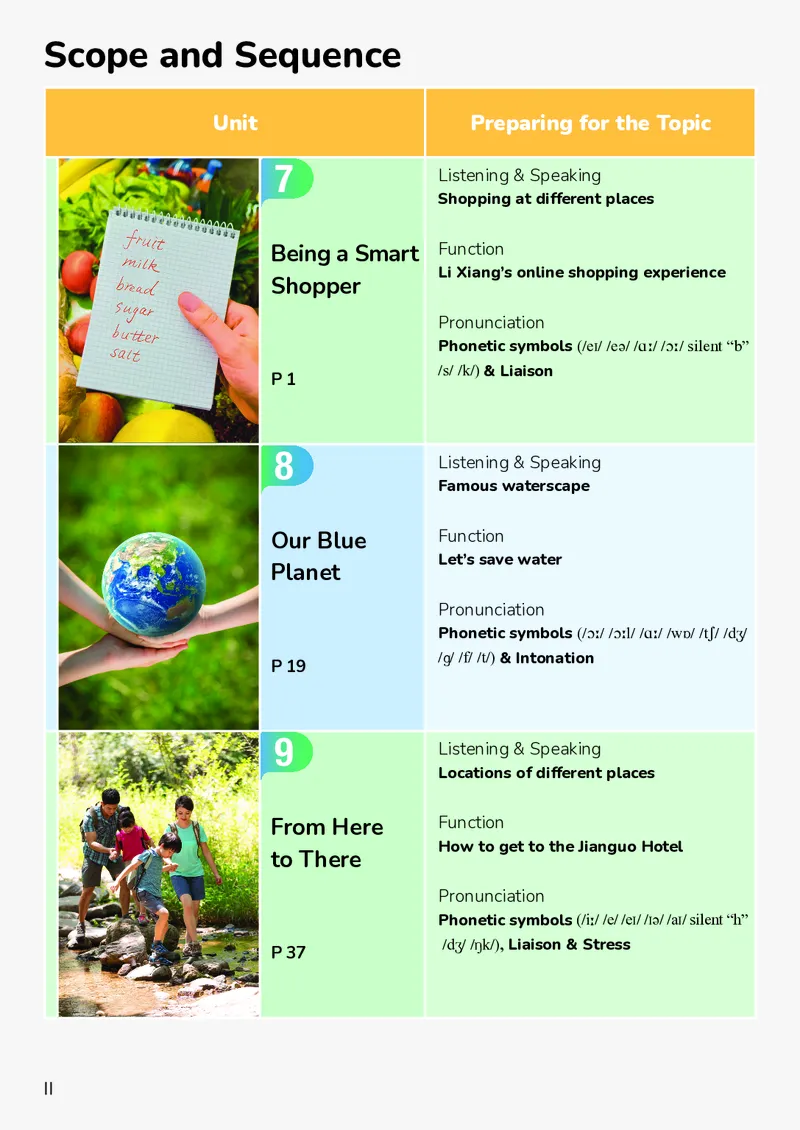
助你们对单元主题学习、核心素养达成、活动参与情况、学习计划等进行回顾和反思。Scope and Sequence
Unit Preparing for the Topic
7
Listening & Speaking
Shopping at different places
Being a Smart Function
Li Xiang’s online shopping experience
Shopper
Pronunciation
Phonetic symbols (/eI/ /e9/ / / / / silent “b”
/s/ /k/) & Liaison
P 1
8
Listening & Speaking
Famous waterscape
Our Blue Function
Let’s save water
Planet
Pronunciation
Phonetic symbols (/ / / l/ / / /wD/ /t / /dE/
/G/ /f/ /t/) & Intonation
P 19
9
Listening & Speaking
Locations of different places
From Here Function
How to get to the Jianguo Hotel
to There
Pronunciation
Phonetic symbols (/i / /e/ /eI/ /I9/ /aI/ silent “h”
/dE/ /Mk/), Liaison & Stress
P 37
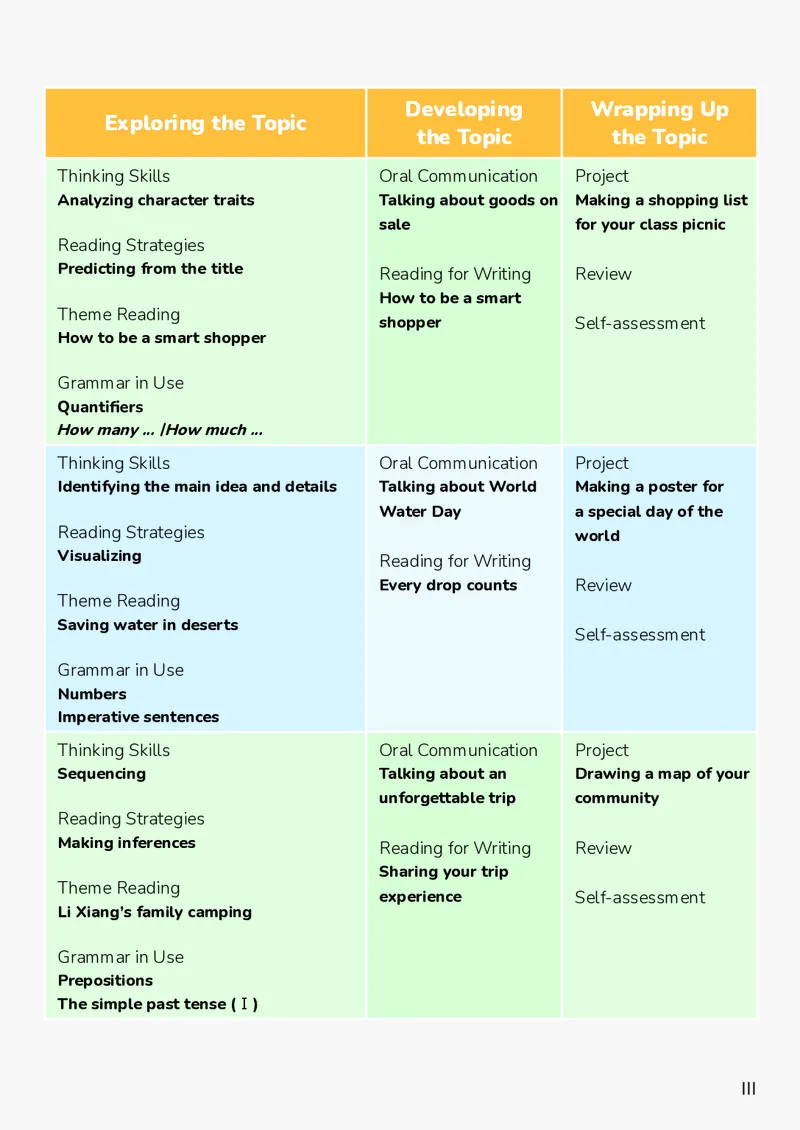
IIDeveloping Wrapping Up
Exploring the Topic
the Topic the Topic
Thinking Skills Oral Communication Project
Analyzing character traits Talking about goods on Making a shopping list
sale for your class picnic
Reading Strategies
Predicting from the title
Reading for Writing Review
How to be a smart
Theme Reading
shopper Self-assessment
How to be a smart shopper
Grammar in Use
Quantifiers
How many ... /How much ...
Thinking Skills Oral Communication Project
Identifying the main idea and details Talking about World Making a poster for
Water Day a special day of the
Reading Strategies world
Visualizing
Reading for Writing
Every drop counts Review
Theme Reading
Saving water in deserts
Self-assessment
Grammar in Use
Numbers
Imperative sentences
Thinking Skills Oral Communication Project
Sequencing Talking about an Drawing a map of your
unforgettable trip community
Reading Strategies
Making inferences
Reading for Writing Review
Sharing your trip
Theme Reading
experience Self-assessment
Li Xiang’s family camping
Grammar in Use
Prepositions
The simple past tense (Ⅰ)
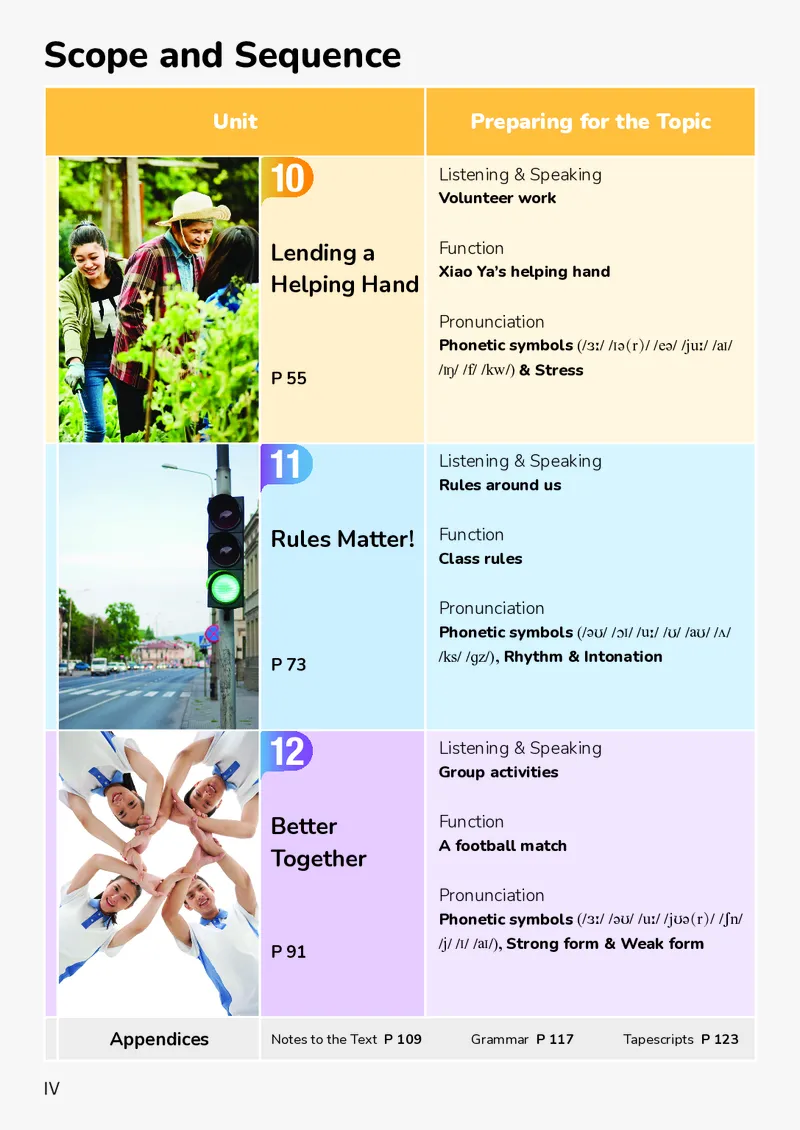
IIIScope and Sequence
Unit Preparing for the Topic
10
Listening & Speaking
Volunteer work
Lending a Function
Xiao Ya’s helping hand
Helping Hand
Pronunciation
Phonetic symbols (/ / /I9 r / /e9/ /ju / /aI/
()
/IM/ /f/ /kw/) & Stress
P 55
11
Listening & Speaking
Rules around us
Rules Matter! Function
Class rules
Pronunciation
Phonetic symbols (/9 / / I/ /u / / / /a / /7/
/ks/ /ɡz/), Rhythm & Intonation
P 73
12
Listening & Speaking
Group activities
Better Function
A football match
Together
Pronunciation
Phonetic symbols (/ / /9 / /u / /j 9 r / / n/
()
/j/ /I/ /aI/), Strong form & Weak form
P 91
Appendices Notes to the Text P 109 Grammar P 117 Tapescripts P 123
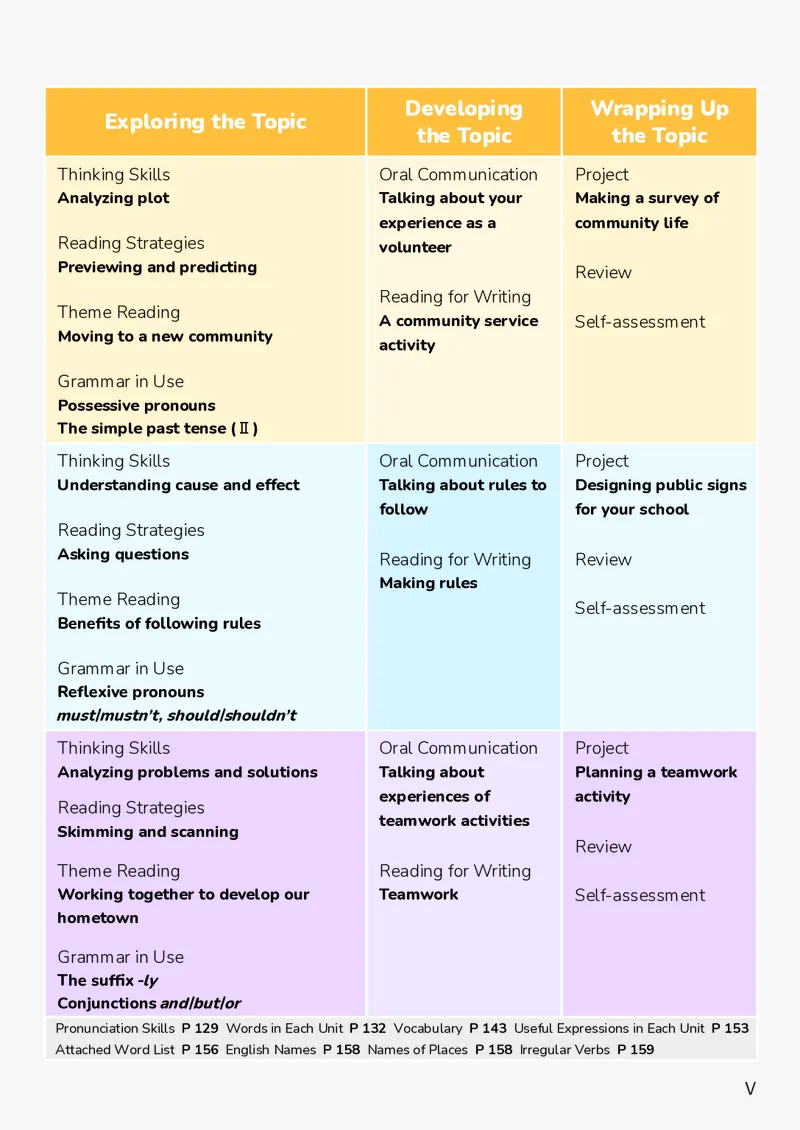
IVDeveloping Wrapping Up
Exploring the Topic
the Topic the Topic
Thinking Skills Oral Communication Project
Analyzing plot Talking about your Making a survey of
experience as a community life
Reading Strategies volunteer
Previewing and predicting
Review
Reading for Writing
Theme Reading
A community service Self-assessment
Moving to a new community
activity
Grammar in Use
Possessive pronouns
The simple past tense (Ⅱ)
Thinking Skills Oral Communication Project
Understanding cause and effect Talking about rules to Designing public signs
follow for your school
Reading Strategies
Asking questions
Reading for Writing Review
Making rules
Theme Reading
Self-assessment
Benefits of following rules
Grammar in Use
Reflexive pronouns
must/mustn’t, should/shouldn’t
Thinking Skills Oral Communication Project
Analyzing problems and solutions Talking about Planning a teamwork
experiences of activity
Reading Strategies
teamwork activities
Skimming and scanning
Review
Theme Reading Reading for Writing
Working together to develop our Teamwork Self-assessment
hometown
Grammar in Use
The suffix -ly
Conjunctions and/but/or
Pronunciation Skills P 129 Words in Each Unit P 132 Vocabulary P 143 Useful Expressions in Each Unit P 153
Attached Word List P 156 English Names P 158 Names of Places P 158 Irregular Verbs P 159
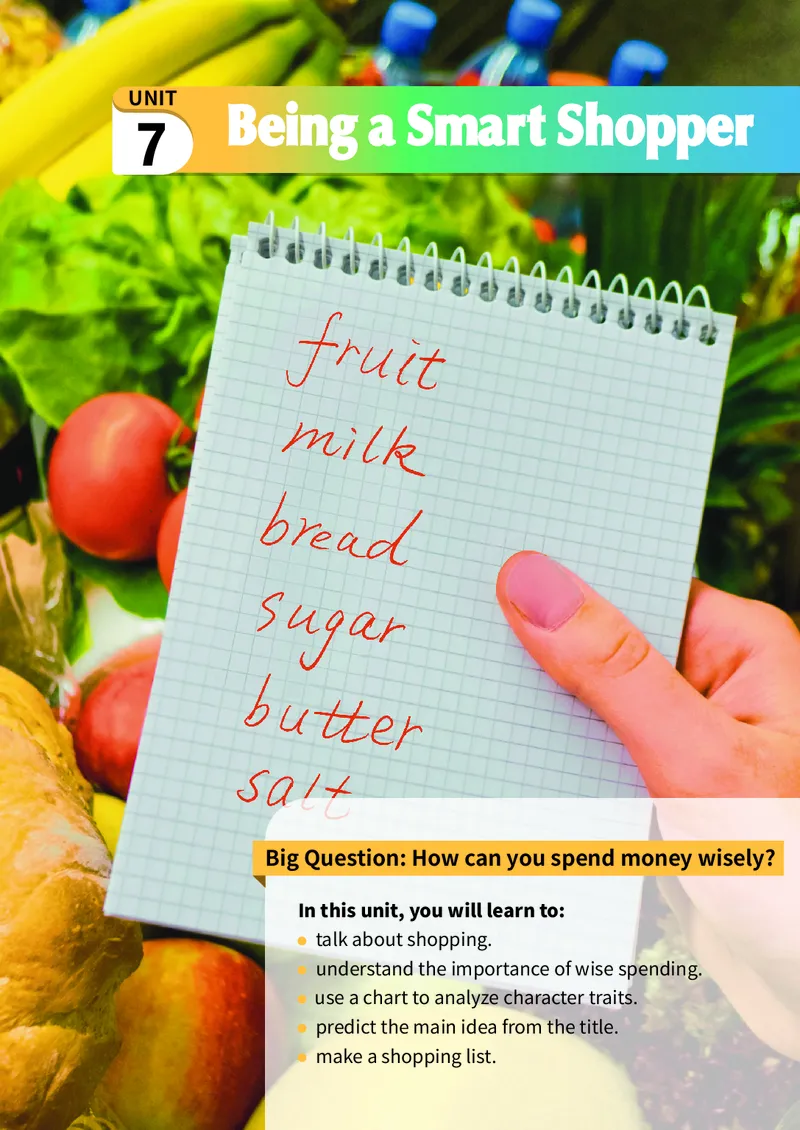
VUNIT BBeeiinngg aa SSmmaarrtt SShhooppppeerr
7
Big Question: How can you spend money wisely?
In this unit, you will learn to:
talk about shopping.
understand the importance of wise spending.
use a chart to analyze character traits.
predict the main idea from the title.
make a shopping list.UNIT Preparing for the Topic
7
Listening & Speaking Shopping at different places
Activity 1
A. Match the places (a–f) with the pictures at the top of the next page.
a. shopping mall b. market c. bookstore
d. clothes shop e. vegetable shop f. supermarket
B. Fill in each blank with a suitable place above.
___________ 1. I need two bottles of milk this week.
___________ 2. Some young people like going shopping with their friends.
___________ 3. Every weekend, my grandparents buy some fresh fish.
___________ 4. My father spends about 200 yuan on books every month.
___________ 5. Mr. Zhao’s shop sells fresh fruit and vegetables.
___________ 6. Xiao Ya’s scarf is old, so she needs to buy a new one.
C. Pair work. Listen and repeat, and then replace the parts in bold
and practice with your partner.
I need some milk. Would you like to
go to the supermarket with me?
Sure, I’d love to. How much
milk do you need to buy?
I need to buy two bottles.
2 UNIT 7Activity 2
Listen to the conversation and complete the shopping list.
A Shopping List
• salt ____ bag ( s ) • strawberries ____ kilo ( s )
• coffee ____ can ( s )
Activity 3
Pair work. Talk about what you need for lunch on Sunday and
make a shopping list. The following pictures may help you.
cabbages chicken strawberries tofu watermelons carrots
UNIT 7 3Function Li Xiang’s online shopping experience
Activity 1
Pair work. Choose what you need and what you want, and then
share with your partner.
car clothes book watch camera house food phone
Activity 2
Listen to the conversation and tick ( ) the answers.
Li Xiang needs a shirt shoes trousers for the party.
Activity 3
Listen and read, and then mark T (True) or F (False).
Mom: Li Xiang, what are you doing on the computer?
Li Xiang: I’m shopping for the school party.
Mom: What do you need to buy?
Li Xiang: I’m looking for a new shirt. What about this blue one?
Mom: It’s great for the party. How much is it?
Li Xiang: It’s 65 yuan. Everything is on sale. Look at this pair of shoes. It is
180 yuan.
Mom: Well, that’s a lot of money. I don’t think you need it. You have new
shoes. Why not buy a pair of trousers?
Li Xiang: Good idea. But I don’t like the trousers in this online shop.
Mom: How about going to the shopping mall this Sunday?
Li Xiang: OK.
1. Li Xiang is shopping in the shopping mall. ( )
2. Li Xiang needs to buy a pair of shoes for the party. ( )
3. The blue shirt is 65 yuan. ( )
4. Li Xiang doesn’t need new shoes. ( )
5. Li Xiang and his mom plan to go to the shopping mall this Saturday. ( )
Activity 4
Pair work. Talk about what you need and then make a conversation.
I need/want to buy …
How much/many … do you need?
How much is it/are they?
4 UNIT 7Pronunciation Phonetic symbols (/eI/ /e9/ / / / / silent
“b” /s/ /k/) & Liaison
Activity 1
Listen to the text. Pay attention to the pronunciation of the
colored letters.
My aunt likes drawing and climbing, and she
plans to travel in August. She goes by train
instead of by plane. She only buys a pair of
socks and a nice cake on her way back. She
is careful with money, so she is never in debt.
Activity 2
Listen and read the sounds and words aloud.
Letter(s) ai ay air are au aw mb,bt c c ck
Sound /eI/ /e9/ / / / / / / silent “b” /s/ /k/
train way pair careful aunt August draw climb nice cake sock
Word
wait may fair dare laugh autumn law debt pencil cat back
Activity 3
Listen and repeat. Mark T for the same pronunciation and
F for different pronunciations of the colored letters in each group.
1. ( ) gain way draw 2. ( ) chair careful fair
3. ( ) laugh aunt autumn 4. ( ) boat climb lamb
5. ( ) nice pencil cake 6. ( ) sock back chick
Activity 4
Read the sentences aloud and mark the liaisons ( ) , and
then listen and check.
1. He is a smart shopper.
2. We need apples, strawberries and coffee.
3. There are so many things in the shop.
4. Before shopping, he makes a shopping list at home.
5. I need a pair of shoes and a sweater.
UNIT 7 5UNIT Exploring the Topic
7
Thinking Skills Analyzing character traits
We can learn character traits from the character’s actions, feelings and thoughts.
Activity 1
Look at the picture and read the text. Learn how to analyze
character traits.
Every Sunday, Li Xiang goes to
Mom, let me take
the bag for you. the supermarket with his mother.
He always helps his mother carry
the heavy bags.
Character What he does or thinks Character trait
helps his mother carry the
Li Xiang helpful
heavy bags
Activity 2
Read the text and complete the character trait chart.
Lingling is a smart shopper. She always makes a shopping list and looks for the best
prices. She likes a skirt very much, but she doesn’t really need it. So she decides
not to buy it.
Character What she does or thinks Character trait
• makes a shopping list
• looks for the best prices
• doesn’t buy
Activity 3
Pair work. Talk about what you usually do before and during
shopping, and explain why.
6 UNIT 7Reading Strategies Predicting from the title
You can read the title of a text first, and then predict what the text is about.
Activity 1
Read the title and guess what the text is about. Circle the answer.
My Plan for My Pocket Money
The text is about how to save/make money.
Activity 2
Read the whole text and check your prediction in Activity 1.
I like saving money. A new month begins. How can I use my pocket money? Here is
my plan.
Things to Buy Last Month (yuan) This Month (yuan) Saving (yuan)
Drinks 40 30 10
Notebooks 28 25 3
Food between meals 50 40 10
Books 45 40 5
…
My prediction is right wrong.
Activity 3
Pair work. Read the title and tick ( ) what the text may be
about. Read the text and check your prediction, and then talk about how
to be a smart shopper.
A Smart Shopper
Xiaoming is a smart shopper. He never wastes
The text may be about how to money. He only buys what he needs and tries
to spend as little as possible. He usually makes
spend money wisely.
a shopping list first and then goes shopping.
make a shopping list.
To buy things at good prices, he often goes to
go to a big store. big stores for great sales.
UNIT 7 7Theme Reading How to be a smart shopper
Activity 1
Pair work. Look at the pictures and answer the questions.
1. Do you like shopping online or at the shopping
mall? Why?
2. What do you do before, during and after shopping?
Activity 2
Read the title and predict what the text is about, and then read
the text and check your prediction.
A Smart and Careful Shopper
Li Xiang is a smart shopper. He often shops in the supermarket. Things
there are not expensive, and he can make different choices. He always
makes a shopping list and only buys things on the list. This can help him
save time and money as well. He also likes to look for sales, so he can buy
things at good prices.
Li Xiang is very careful when he is doing shopping. He always checks the
price and date before he makes a choice. And when he is making payments,
he checks everything again. He is also very careful not to waste money.
For example, if he can share something with his friends, he never wastes
money on the same thing.
My prediction is right wrong.
8 UNIT 7Activity 3
Match the phrases with the sentences according to the text.
1. check the prices a. We can buy things at good prices.
2. make a shopping list b. We need to know how much money to pay.
3. look for sales c. We don’t waste money.
4. share things with others d. We can save money and time.
Activity 4
Complete the character trait chart according to the text.
Character What he does or thinks Character trait
• shops in the supermarket.
• _________________________________ smart
• _________________________________
Li Xiang • ______________________ before making
a choice.
• ______________________ when making _______________
payments.
• Not to waste money.
Activity 5
Pair work. Discuss the questions with your partner.
1. Why does Li Xiang like to shop in the supermarket?
2. How can a shopping list help save money?
3. Do you often look for sales? Why or why not?
4. How can you be a smart and careful shopper?
UNIT 7 9Grammar in Use Quantifiers
Activity 1
Look at the pictures and read the sentences. Pay attention to
the usage of quantifiers.
Here are two I need to buy a This packet of meat Two kilos of
pieces of bread. bottle of juice. I looks so fresh. strawberries cost
Let’s make a am a little thirsty. 50 yuan.
sandwich.
Activity 2
Match the following information to make complete sentences.
1. Every morning, I drink a. a bottle of milk before going to bed.
2. For breakfast, I usually have b. a glass of water before breakfast.
3. I go to school with c. a bag of fruit to share with my friends.
4. For dinner, I usually eat d. a piece of bread and an egg.
5. Every night, I drink e. a bowl of rice and some vegetables.
Activity 3
Read the text and circle what Xiao Lin buys and underline what
her mom buys.
Xiao Lin often goes shopping with her mom in
the supermarket. Today, her mom needs to buy
a bag of salt, three bottles of milk, two packets
of chicken, and a kilo of tomatoes. Xiao Lin
also needs something for school. She takes a
pair of scissors and two sets of colored pencils.
Sometimes, Xiao Lin’s little brother also goes to the supermarket with them,
and his mother usually buys a box of juice for him.
10 UNIT 7How many … /How much …
Activity 1
Pair work. Read the conversation. Pay attention to the usage
ofh ow many andh ow much.
We don’t have any rice. Can you
help me do some shopping?
Sure. How much rice do we need?
One bag. And we need
some apples, too.
How many apples?
Two kilos.
Activity 2
Complete the table and learn how to useh ow many andh ow
much.
how many plural countable nouns
uncountable nouns
how much
want to know the price of something
1. — __________ bottles of water are there in the box? — There are only two.
2. — __________ water is there in the cup? — There is only a little.
3. — __________ is this pair of cotton socks, please? — It’s 20 yuan.
Activity 3
Pair work. Complete the conversation and then practice with
your partner.
Saleswoman: Good morning! May I help you?
Lingling: Yes, please. I want to buy some honey and
sandwiches.
Saleswoman: ________ honey do you need?
Lingling: I need two boxes of honey.
Saleswoman: ________ sandwiches would you like?
Lingling: Three sandwiches, please. ________ are they?
Saleswoman: Forty-nine yuan.
Lingling: Here you are.
UNIT 7 11UNIT Developing the Topic
7
Oral Communication Talking about goods on sale
Activity 1
A. Listen to the conversation and write the prices on the price tags.
TIPS
Pictures and
other clues can
help you predict what
the text is about.
B. Listen again and circle the correct answers.
1. Lingling needs a dress/a cap and a sweater.
2. The black cap is expensive/cheap for Lingling.
3. The sweater looks good/bad on Lingling.
4. Xiao Ya needs one/three pair(s) of cotton socks.
Activity 2
Group work. Make a report with the help of the poster and the
questions.
1. What do you need?
2. How much is it?
3. Is it expensive or cheap?
4. Do you want to buy it or not? Why?
You may begin like this:
There are four students in my group. A
wants to buy … It’s his/her favorite. But
… And B needs …
12 UNIT 7Reading for Writing How to be a smart shopper
Activity 1
Read the text and complete the character trait chart.
How to Be a Smart Shopper
Title
My name is Kangkang. My parents give me
Beginning some pocket money every month. I always try
my best to save money and be a smart shopper.
At the start of every month, I always make a
Body
shopping list to save time and carefully plan how
Character traits to spend my pocket money. At the store, I check
• Before shopping the ads to look for things on sale. That way, I can
• At the store
find some cheap and good clothes at the end of
the season. I also check the prices of the same
things at different stores.
Let’s be a smart shopper! We can save money
End
and time.
Character What he does or thinks Character trait
At the beginning of every month:
• makes a shopping ____________ first.
• plans how to ____________________.
_________ careful and _______
At the store:
• looks for things ____________.
• ____________ the prices of the same
things at different stores.
Activity 2
Draw a character trait chart in your exercise book and think
about how to be a smart shopper.
UNIT 7 13Activity 3
Draft your essay about how to be a smart shopper.
__________________________________
My name is ____________________________________________________. My parents
_____________________________________________________________________________.
At the start of _____________________________________________________________.
_____________________________________________________________________________
_____________________________________________________________________________
_____________________________________________________________________________
_____________________________________________________________________________
____________________________________________________________________________.
Be a smart shopper! You can ___________________________________________.
TIPS
After writing your draft, you can read it
aloud to check every sentence, as well
as your spellings and punctuation.
Activity 4
Write your final draft in your exercise book.
Activity 5
Invite your partner to rate your final draft. Write 1 (more improvements
needed), 2 (fair), 3 (good), or 4 (excellent) for the ratings.
Partner’s
How well can you ____________________ ?
rating
express your view of wise spending
use the thinking skill of presenting character traits
write about being a smart shopper
organize ideas into a well-balanced structure
use the theme vocabulary of the unit
use punctuation
spell the words
14 UNIT 7UNIT Wrapping Up the Topic
7
Project Making a shopping list for your class picnic
Activity 1
Pair work. Look at Lingling’s shopping list for her class picnic.
Talk about why and how you can improve the list.
Things to buy Price Number Cost
Bread ¥ 4/bag 20 bags ¥ 80
Drinks ¥ 8/bottle 30 bottles ¥ 240
Apples ¥ 10/kilo 5 kilos ¥ 50
Bananas ¥ 20/kilo 5 kilos ¥ 100
In all: ¥ 470
Activity 2
Group work. Make a shopping list for your class picnic. Discuss
what you want to buy and how to save money.
Things to buy Price Number Cost
In all:_________
How to save money:
• Take some water from home.
• ______________________________ • ______________________________
• •
______________________________ ______________________________
Activity 3
Share your shopping list in class and talk about how you try to
save money.
Here is our shopping plan for …
To save money, we take ... from home…
UNIT 7 15Review
Activity 1
Pair work. Listen to the conversation and fill in the blanks,
and then make up a conversation about different ways of shopping.
I’m Xiao Ya. I often go to a _____________ with my friends.
It’s near my _________. I always find things _________ there.
It’s great fun shopping with my friends.
I’m Li Xiang. I like to _______ things online. There are
so many things in the online ________. I can just stay at
home and buy _______ the things. There’s a new _______
near our school. I can go there with Xiao Ya next time.
Activity 2
Read the sentences and fill in the blanks according to
the pictures.
1 2 3 4 5
1. Lingling’s mother often buys ___ _ ____ at the supermarket. Every time
she buys a bag. It is about one kilo.
2. Kangkang often buys two bags of ___ _____ at a time in the store near
his home.
3. Li Xiang needs to buy one kilo of ___ _ ____ at the vegetable shop today.
4. Blue is Lingling’s favorite color, so she plans to buy a blue ____ _ ___
with her pocket money.
5. My mother needs to buy some fruit and some pieces of ____ ____ for
the picnic on Sunday.
16 UNIT 7Activity 3
Complete the conversations withs ome/any/how many/how much.
(At home)
Mother: Would you like to buy food for us?
Xiao Ya: Sure. What do we need?
Mother: apples and juice.
Xiao Ya: OK. How about bread?
Mother: No, we don’t need bread.
(At the market)
Xiao Ya: is one kilo of apples?
Salesman: It’s 8 yuan. kilos of apples do you need?
Xiao Ya: Two kilos, please. is a bottle of apple juice?
Salesman: It’s 5.5 yuan. bottles do you want?
Xiao Ya: Two bottles, please. are they?
Salesman: They are 27 yuan in all.
Xiao Ya: Can I use my phone to pay for them?
Salesman: Sure.
Activity 4
Read the advertisement and complete the table.
HOME ON SALE ABOUT US
Shoes on Sale
Looking for a good pair of shoes? Come and check out our
on-sale list! We have different kinds of very good shoes in
all sizes. We sell them at good prices for this special holiday
season. The season lasts for seven days only, so you only
have seven days to make your choices.
What are you waiting for? Come and shop now! Find the
right shoes for yourself, and you can enjoy free shipping on
orders over ¥ 99.
Shoes Different ____________ and in ___________
Time This holiday season ____________ for only ___________ days
_____________ Free on orders over ¥ 99
UNIT 7 17Self -assessment
1. How much do you enjoy the topic?
I’m interested in the topic of shopping.
I always try to be a smart shopper, and I usually ______________
_____________________________________________________.
2. How well can you use the language and cultural knowledge?
I can say the vowel and consonant sounds and use liaisons.
I can use the vocabulary for/of different places and shopping.
I can use the quantifiers, how many and how much.
I can learn to spend my money wisely.
3. How well can you use English to perform the activities?
I can talk about daily shopping activities.
I can understand the texts and recordings in this unit.
I can introduce the goods on sale.
I can write about how to be a smart shopper.
4. How well can you use thinking skills and learning strategies?
I can analyze character traits.
I can predict the main idea from the title.
I can work with my partners in pair/group work.
5. How are you satisfied with your group project?
I can make a shopping list with my partners.
I can report our project to the class.
6. How are you going to improve your English learning?
____________________________________________________________________
____________________________________________________________________
18 UNIT 7UNIT OOuurr BBlluuee PPllaanneett
8
Big Question: Why is water important?
In this unit, you will learn to:
talk about the importance of water.
understand the importance of saving water.
use a thinking map to identify the main idea and details.
use the reading strategy of visualizing.
design a poster for a special day of the earth.UNIT Preparing for the Topic
8
Listening & Speaking Famous waterscape
Activity 1
A. Match the places (a–e) with the pictures at the top of the next page.
a. The Pacific Ocean b. Niagara Falls c. The Nile River
d. Lake Baikal e. The Bohai Sea
B. Read the descriptions and choose the correct places above.
___________ 1. It is a 99-meter-high waterfall in North America.
___________ 2. It is 6,671 kilometers long. It runs through eastern Africa.
___________ 3. It’s an old freshwater lake on the earth. It is over 25 million years old.
___________ 4. It is an inland sea in the north-east of China.
___________ 5. It is very large and deep. It is one of the four oceans on the earth.
C. Pair work. Listen and repeat, and then replace the parts in bold
and practice with your partner.
Kangkang, what do
It runs through
you know about the
eastern Africa.
Nile River?
It’s 6,671
How long is it?
kilometers long.
20 UNIT 8Activity 2
Listen to the conversation and complete the table.
The ________ River
※ ________ kilometers long
※ A ________ river of China
※ About ________ kilometers wide at some places
Activity 3
Pair work. Look at the picture and talk about Huangguoshu
Waterfall. The expressions in the box may help you.
Useful Expressions
in Guizhou, China
about 100 meters wide
about 80 meters high
UNIT 8 21Function Let’s save water
Activity 1
Pair work. Look at the pictures and talk about where water
comes from.
Activity 2
Listen to the conversation and answer the question.
What are Xiao Ya and her mom talking about?
Activity 3
Listen and read, and then complete the summary.
Xiao Ya: Mom, where does water come from?
Mom: There is water everywhere. It’s under the ground, in the ocean and in the sky.
Xiao Ya: But I can’t see any water in the sky.
Mom: It’s in the air. On sunny days, water goes up into the sky and forms clouds.
Xiao Ya: I see. As we all know, water is very important to us.
Mom: Yes. We need to drink water every day.
Xiao Ya: We also need to use a lot of water in our life.
Mom: That’s right. It’s lucky that we have a lot of water on the earth.
Xiao Ya: Yes. Just because of this, we call the earth a blue planet.
Mom: But we can only use about 1% of the water on the earth. The rest is all
sea water or ice.
Xiao Ya: That is very little water. Let’s save every drop of water.
Water is ___________. It is under the ground, in the ________ and in the sky. On
sunny days, water goes up into the sky and forms ________. We need to drink water
every day and we also use a lot of water in our life. The earth is a blue planet. It is
full of water. But we can only use about ________ of the water on it. We need to
save every ________ of water.
Activity 4
Pair work. Talk about the questions and make up a new
conversation about water.
1. Where is water from? 2. How important is water to us?
3. Why do we need to save water?
22 UNIT 8Pronunciation Phonetic symbols (/ / / l/ / / /wD/ /t /
/dE/ /G/ /f/ /t/) & Intonation
Activity 1
Listen to the chant. Pay attention to the pronunciation of
the colored letters.
Some children walk down from the bridge.
At the river they start to watch.
They always want to catch a fish.
So they sit down and make a wish.
Right then, they see one large enough.
Guess what! They catch it and laugh!
Activity 2
Listen and read the sounds and words aloud.
Letter(s) al ar wa ch/tch dge/g gu gh t
Sound / / / l/ / / /wD/ /t / /dE/ /G/ /f/ /t/
walk also start want chess bridge large guess laugh right
Word
talk always dark watch catch judge age guide enough fight
Activity 3
Listen and circle the word with a different sound in each
group.
1. /ɔ l/ always talk also 2. /ɑ / part around large
3. /tʃ/ chair school teach 4. /dʒ/ bridge orange guess
5. /G/ gun guest age 6. /f/ high laugh tough
Activity 4
Read the sentences aloud and mark the last word with a
rising tone ( ) or a falling tone( ) , and then listen and check.
1. Look at this river on the map.
2. Are there any people in the desert?
3. Turn off the tap when you brush your teeth.
4. What about making a poster about saving water?
5. Water comes from rivers, lakes and oceans.
UNIT 8 23UNIT Exploring the Topic
8
Thinking Skills Identifying the main idea and details
The main idea gives us the most important information and the supporting details tell
us more about the main idea.
Activity 1
Look at the pictures and read the text. Learn how the details
support the main idea.
Main idea:
All living things need water.
Detail 1: Detail 2:
People and animals Plants need water to grow.
drink water every day.
Activity 2
Read the text and complete the main idea and detail chart.
Water is very useful. At home, we use water to cook, do washing or cleaning. Outside
home, we can travel by water, do exercise in water, and have fun with water.
Main idea:
________________________
Detail 1: At home Detail 2: Outside home
• _______________________________ • _______________________________
• _______________________________ • _______________________________
• _______________________________ • _______________________________
Activity 3
Pair work. Talk about more uses of water in your daily life. Try
to use a main idea and detail chart.
24 UNIT 8Reading Strategies Visualizing
Making pictures in your mind while reading can help you have a better understanding
of what is going on in the text.
Activity 1
Read the text and use the picture to help you visualize what
you read.
Steps to visualize:
I read: how water turns into
clouds.
I see in my mind: some water,
the sun and some clouds.
Now, I understand: clouds
On sunny days, water goes up in the air come from water.
and turns into clouds in the sky.
Activity 2
Read the text and underline what makes you picture something
in your mind.
WWaatteerr CCyyccllee
Do you know the water cycle? Water in
the air gets cold, makes clouds and then
forms water drops. The drops fall and it
rains. Rainwater goes into rivers, lakes and
oceans. When it is sunny, water goes up into
the sky, forms clouds and then it rains again.
Activity 3
Group work. Read the text in Activity 2 again and tell your
partners what you visualize, and then talk about the water cycle.
Steps to visualize:
I read: _______________________________________________________________
I see in my mind: ______________________________________________________
Now, I understand: ____________________________________________________
UNIT 8 25Theme Reading Saving water in deserts
Activity 1
Group work. Look at the pictures and discuss what you can do
to save water.
Take a quick Turn off the tap while
Reuse water.
shower. brushing your teeth.
Activity 2
Read the text and visualize what you read.
I read: _________________________________________________________________
I see in my mind: ______________________________________________________
Now, I understand: _____________________________________________________
Are there any people living in the desert? The answer is yes. As a matter of
fact, the desert is home to many people. I know a family living in the desert.
Water is so important and valuable for them.
The family don’t have enough water. They seldom plant flowers or grass.
They can only take a quick shower once a week. During the shower, they
must collect the water. After the shower, they reuse the water. It doesn’t rain
much in the desert. Most people get water from the underground, so they
have to spend a lot of money digging wells.
I feel lucky. I don’t need to worry about water, but now I start to save water.
Join me and let’s make a difference together.
26 UNIT 8Activity 3
Read the text again and mark T (True) or F (False).
1. Very few people live in the desert. ( )
2. People in the desert reuse water to take a shower. ( )
3. Most families in the desert get water from the underground. ( )
4. I start to worry about water now. ( )
Activity 4
Complete the main idea and detail chart according to the text.
Main idea:
From the story, I know _____________________________________
_____________________________________ for families in the desert.
Details:
• The family don’t have _______________________________________.
• The family pay much money for ______________________________.
• Now I start to _____________, and I want others to _____________.
Activity 5
Fill in the blanks with the phrases from the text.
It rains very little in the desert, so people there
don’t have _________________.
To _________ could help them get water from
the underground.
People have to make full use of water.
___________ once a week. Collect the water _________.
UNIT 8 27Grammar in Use Numbers
Activity 1 TIPS
Look at the pictures and read the We use a comma every 3
sentences. Pay attention to the numbers. digits from the right when
the number is greater than 999.
The Qinghai Lake The coastline of
covers about 4,600 the Arctic Ocean
square kilometers. is about 45,390
kilometers long.
The Changjiang The Atlantic Ocean
River is about covers more than
6,300 kilometers 93,000,000 square
long. kilometers.
Activity 2
Read the numbers and complete the table.
4,186 four thousand, one hundred and eighty-six
45,390 forty-five __________, three __________ and ninety
6,363,000 six million, three hundred and sixty-three thousand
1,386,000,000 one billion, three hundred and eighty-six __________
nine hundred and nine __________, ninety __________,
909,090,009,900
nine __________, nine hundred
Activity 3
Complete the sentences with the numbers in the brackets.
1. Antarctica is about _________________________________________ (14,200,000)
square kilometers in size, and ice covers about 98 percent of the land.
2. The Sea of Marmara is about ____________________________________ (11,350)
square kilometers.
3. Oceans cover about ___________________________________________________
(360,000,000) square kilometers of the earth.
4. There are about ___________________________ (307,000,000) lakes in the world.
28 UNIT 8Imperative sentences
Activity 1
Pair work. Read the conversation. Pay attention to the
imperative sentences.
(Xiao Ya is knocking on the door.)
Come in, please.
Miss Wang, here
is the poster about
Oh, don’t put
saving the ocean.
it here. Please
Can I put it on this
put it on that
table?
big chair.
Activity 2
Complete the table and learn how to use imperative sentences.
Positive Negative
_____ every drop of water. Don’t _____ waste into the lake.
_____ enough water. _____ waste water.
Save water, save our planet! No _____ in that lake.
_____ your step! The floor is wet. Never _____ the water running.
Let’s _____ a poster about saving water. Let’s not _____ here!
Activity 3
Match the pictures with the words or phrases, and then make
imperative sentences.
litter take a shower swim turn off collect fish
UNIT 8 29UNIT Developing the Topic
8
ActiOvirtya 1l Communication Talking about World Water Day
Activity 1
A. Listen to the conversation and put the pictures in the correct order.
B. Listen again and complete the table.
Making a poster for World Water Day
Date _____________ 22nd
Topic How to ___________________________________________
Purpose To make a list of dos and don’ts
• Asking our _____________ and _____________ for suggestions
Tasks • Searching for information __________________________
• Introduce the poster to the _____________
Activity 2
Group work. Talk about the pictures and discuss what else
you can do to save water. Write your ideas in the blank.
collect rainwater
turn off the tap
take a quick shower
reuse water
30 UNIT 8Reading for Writing Every drop counts
Activity 1
Read the text and complete the main idea and detail chart.
Title Saving Every Drop of Water
We all need water, but there isn’t enough water on
Beginning
the earth. So, we need to save water.
You can start with little things to save water at home.
For example, turn off the tap when brushing your
Body
teeth; don’t use the washing machine for just a few
Actions of saving dirty clothes; and take a shower, not a bath. You can
water at home and
also save water outside your home. You can collect
outside your home
water when it rains. Don’t throw away drinking
water bottles when there is still water in them.
Always be careful! And you are sure to find many
End
ways to save water.
Main idea:
_________________________________
Detail 1: At home Detail 2: Outside
__________________________ __________________________
__________________________ __________________________
__________________________ __________________________
__________________________ __________________________
Activity 2
Draw your own main idea and detail chart about saving water.
UNIT 8 31Activity 3
Draft your essay about saving water.
TIPS
The title should summarize the main idea
of the passage. It should be short and clear.
_____________________________
Water is _______________________. We __________________________.
_____________________________________________________________
_____________________________________________________________
_____________________________________________________________
_____________________________________________________________
____________________________________.
______________________________________________________________
Let’s _________________________________________________________.
Activity 4
Write your final draft in your exercise book.
Activity 5
Invite your partner to rate your final draft. Write 1 (more improvements
needed), 2 (fair), 3 (good), or 4 (excellent) for the ratings.
Partner’s
How well can you ____________________ ?
rating
express your view of saving water
organize the main idea and details
write about saving every drop of water
organize ideas into a well-balanced structure
use the theme vocabulary of the unit
use the imperative sentences
use punctuation
spell the words
32 UNIT 8UNIT Wrapping Up the Topic
8
Project Making a poster for a special day of the world
Activity 1
Pair work. Talk about the poster for World Forest Day and list
more reasons why forests are important.
WWoorrlldd FFoorreesstt DDaayy
When: On March 21st
Why forests are important:
• Provide home for plants and animals
• Keep the air clean and fresh
• Protect the soil
• _______________________________
• _______________________________
Activity 2
Group work. Design a poster for a special day of the world to
protect the earth.
When: ___________________________
Why _____________________________
• _______________________________
• _______________________________
• _______________________________
• _______________________________
Draw a picture here.
Activity 3
Share your poster in class, and then choose the best design.
Here is our poster for … It …
UNIT 8 33Review
Activity 1
Pair work. Listen to the conversation and mark T (True) or
’
F (False), and then talk about what you velearned from the book.
1. The book is about water and our health. ( )
2. Up to 60% of our human body is water. ( )
3. Women need more water than men. ( )
4. We are not thirsty, so we don’t need to drink water. ( )
5. We can also get water from what we eat. ( )
Activity 2
Look at the pictures and complete the text with the correct
form of the phrases in the box.
clean up get into learn more about look like by sea
A 16-year-old boy from the Netherlands goes to Greece ____________.
He sees a lot of plastic bags in the sea. The sea ___________ a big rubbish
bin. This gives him a great shock. After he gets home, he reads a lot of
books to ___________ the plastic rubbish. He finds that far too much
rubbish ___________ the sea every year. He decides to do something for
the sea. He and other people start to ___________ the rubbish in the sea.
They use a big machine for their cleaning work. They hope more people
can join them to help make the sea clean again.
3344 UUNNIITT 88Activity 3
Pair work. Look at the pictures and talk about how to protect
our planet by using imperative sentences.
put throw collect
reuse waste keep
Example: Don’t litter! Put the waste into the bin.
Activity 4
Pair work. Read the text and then share your ideas about saving
water by answering the questions.
We all know we need to save water. But do you know how to do it? Here are some
suggestions.
1. Don’t keep the water running while brushing your teeth.
2. Turn off the tap each time after using water.
3. Do not take long showers.
4. Collect rainwater for later use.
5. Reuse the water from washing.
6. Wash as many clothes as possible at a time.
In short, we need to develop the good habit of saving water. Remember, every drop
counts! Let’s start saving water from now on.
1. What do you usually do to save water?
2. Do you keep the water running while brushing your teeth?
3. What can you do with rainwater?
4. How can you reuse water in your daily life?
5. What is most important about saving water?
UNIT 8 35Self -assessment
1. How much do you enjoy the topic?
I’m interested in the topic of the importance of water.
I always try to save water, and I usually ____________________
____________________________________________________.
2. How well can you use the language and cultural knowledge?
I can use proper rising and falling tones in my speech.
I can use the vocabulary for/of water protection.
I can use the numbers and imperative sentences.
I can save every drop of water in my daily life.
3. How well can you use English to perform the activities?
I can talk about different forms of water.
I can understand the texts and recordings in this unit.
I can introduce World Water Day to my classmates.
I can write about how to save water.
4. How well can you use thinking skills and learning strategies?
I can identify the main idea and details.
I can use visualizing strategy in reading.
I can work with my partners in pair/group work.
5. How are you satisfied with your group project?
I can design a poster for a special day of the world with my partners.
I can report our project to the class.
6. How are you going to improve your English learning?
____________________________________________________________________
____________________________________________________________________
36 UNIT 8UNIT FFrroomm HHeerree ttoo TThheerree
9
Big Question: What can make your trip safe and fun?
In this unit, you will learn to:
talk about locations and directions.
understand the importance of following safety tips.
describe the sequence of events.
use the reading strategy of making inferences.
draw a map of your community.
UNIT 9 37UNIT Preparing for the Topic
9
Listening & Speaking Locations of different places
Activity 1
A. Match the places (a–h) with the pictures at the top of the next page.
a. hospital b. bank c. gym d. hotel
e. theater f. restaurant g. museum h. supermarket
B. Fill in each blank with a suitable place above.
Bank
Hospital Zhongshan Road Bank
X
in
h u Supermarket Huaihai Road Museum
Shengli Road a
S Bridge
tre
e
t
Hotel Museum
Restaurant
1. The hospital is across from the ___________.
2. The ___________ is on the corner of Xinhua Street and Zhongshan Road.
3. The ___________ is on Huaihai Road. And you can find a museum across
from it.
4. There is a museum between the bank and the ___________.
C. Pair work. Listen and repeat, and then replace the parts in bold
and practice with your partner.
Excuse me, is there
a bank near here?
Yes, there is. It’s on
Huaihai Road.
38 UNIT 9Shengli Road Huaihai Road
X
in
h
u
a
S
tre
e
Zhongshan Road t
Activity 2
Listen to the conversations and match the places with the
buildings in the picture.
supermarket bank
gym cinema
Activity 3
Pair work. Take turns to describe the location of one place in
the picture above and ask your partner to guess which place it is.
— It’s on … Road. It’s next to the …
— Is it the …?
— Yes, it is./No, it isn’t.
— Is it the …?
UNIT 9 39Function How to get to the Jianguo Hotel
Activity 1
Pair work. Talk about the following questions.
How do you get around in your city?
When you are lost, what should you do?
Activity 2
Listen to the conversations and number the pictures.
Activity 3
Listen and read, and then complete the notes.
Li Ming: Excuse me, madam. Could you show me the way to the Jianguo
Hotel?
Woman: Sorry, I just got here. You can go and ask that policeman.
Li Ming: Thank you.
Li Ming: Excuse me, sir. How can I get to the Jianguo Hotel?
Policeman: You need to take the underground Line 2, and then get off at Zhongshan
Park Station. From there, you can change to the bus No.18.
Li Ming: How far is it?
Policeman: About 15 kilometers. And it takes 10 minutes on the underground, and
20 minutes on the bus.
Li Ming: Thank you.
Li Ming: Excuse me, I’m looking for the Jianguo Hotel. Can you help me?
Man: Yes. Go along Huanghe Road until you get to the first crossing. Turn
left and walk on. You can see it on your right.
Li Ming: Thank you very much.
The way to the Jianguo Hotel
1. take the underground Line ________ 2. take No. ________ bus
3. go _________ Huanghe Road 4. get to the _________ crossing
5. turn _________ and walk on 6. see it on the _________
Activity 4
Group work. Role play the conversations in Activity 3 by using
the notes above.
40 UNIT 9Pronunciation Phonetic symbols (/i / /e/ /eI/ /I9/ /aI/ silent
“h” /dE/ /Mk/), Liaison & Stress
Activity 1
Listen to the chant. Pay attention to the pronunciation of
the colored letters.
There is a 24-hour store on the street.
Eight boys go there to meet.
They buy either juice to drink or bread to eat.
They all jump because their ideas are so great.
Activity 2
Listen and read the sounds and words aloud.
Letter(s) ea ee ei ey h j nk
Sound /i / /e/ /eI/ /I9/ /i / /aI/ /eI/ /eI/ silent “h” /dE/ /Mk/
eat bread great idea street either eight they hour jump drink
Word
team head break really meet height weight grey honest job think
Activity 3
Listen to the words. Pay attention to the pronunciation of
the underlined letters.
/-d/ enjoyed played lived planned opened
/-t/ stopped looked jumped finished washed
/-ɪd/ acted wanted planted decided studied
Activity 4
Read the text. Pay attention to the liaisons and stresses.
Once upon a time, a boy named 'Jack
Went on a 'hike, and lost his way 'back.
He 'looked up and down, and then … hoo'ray!
He 'looked at a 'map, and found his 'way.
UNIT 9 41UNIT Exploring the Topic
9
Thinking Skills Sequencing
Things develop in order. We can use time-order words (first, next, then, last, etc.) to
describe the sequence of development.
Activity 1
Look at the pictures and read the text. Learn how things develop
in the sequence chain.
First, Xiao Ya Next, Li Xiang Then, Li Xiang Finally, Li Xiang
drew a map of looked at the dug under the found the gift in
the gift. map. tree. the box.
Activity 2
Read the text and complete the sequence chain of transportation
development.
First, people could travel only on foot. Then, they started to use animals to get
around. Next, people learned to build boats and ships and began to travel by
water. Later, people had more ways of traveling and they started to use bicycles,
cars, buses and trains. Now, people have planes and high-speed trains. They can
travel far in a short time.
First Then Next Later Now
Activity 3
Pair work. Talk about the development of transportation by
following the sequence chain above.
42 UNIT 9Reading Strategies Making inferences
You can use context clues (texts, signs, symbols, etc.) and what you know to figure out
something or the implied meaning of the text.
Activity 1
Look at the map signs first, and then follow the steps to learn
how to make an inference.
Step 1: Looking for clues
The signs stand for different places on the map.
Step 2: Thinking about what you know
We can find these places on streets.
Step 3: Making an inference
It is a street map.
Activity 2
Read the text and tick ( ) the answers.
It was dark, and the wind was strong. I rowed and rowed. Finally, there was an
island in front of me. “I’m safe,” I told myself.
Where was the writer? On land. At sea.
What was the time of the story? In the morning. In the evening.
How did the writer get to the island? By boat. By ship.
How did the writer feel in the end? Sad. Happy.
Activity 3
Pair work. Complete the table with the clues in the text, and
then tell your partner how you make the inferences.
What I can infer The clues I can find
The writer was _________________.
The time of the story was ___________________.
The writer got to the island _________________.
The writer felt _________________ in the end.
UNIT 9 43Theme Reading Li Xiang’s family camping
Activity 1
Pair work. Talk about the pictures and answer the questions.
1. Where were the people last weekend?
2. What did the people do there?
Activity 2
Read the text and answer the questions.
How did Li Xiang feel when he went back to the tent? Why?
____________________________________________________________
My family love camping. Last weekend, we had an unforgettable trip
to a forest park.
At first, my father and I set up the tent, and my mother prepared for
dinner. It was lots of fun. But then, we didn’t have enough water, so
my father and I went around to look for some. After some time, we
found a small river. It was so clean. We got a big bottle of fresh water
from it. Next, you know what? We couldn’t find the way back! It
was dark. I held my father’s hand. He told me not to worry and took
out a map from his bag. Later, we followed the map all the way back.
Finally, we returned to our tent. My mother was so happy to see us
back and gave us a big hug.
The night was clear and quiet. We enjoyed our food and shared our
stories.
44 UNIT 9Complete the sequence chain according to the text.
First Then Next Later Finally
Pair work. Complete the conversation with the words or phrases
in the text, and then continue the conversation by using the sequence
chain above.
I ______________ with my parents.
Great! Did you help ________ the tent?
Yes,I did. And I ______________
water with my father.
Did you get any water, then?
Yes. We ________ a small river and
got a big bottle of ________ from it.
…
Group work. Share a family trip and describe what you and your
family did.
…
Activity 3
Activity 4
What did you do last weekend?
Activity 5
Questions: You may begin like this:
1. Where did you go with your family? Last summer, I went to ... with my
2. What did you prepare before your trip? family. Before the trip, we ... First,
3. What did you do on your trip? we ... Next ... After that ...
4. What safety problems did you meet
On our trip, we had a little problem.
on your trip and how did you solve
...
them?
UNIT 9 45Grammar in Use Prepositions
Activity 1
Look at the pictures and read the sentences. Pay attention to
the prepositions in bold.
Go across the bridge, and There is a lake in front The girl is standing
you can find the zoo on of the teaching building. behind the door.
your right.
Activity 2
Rewrite the sentences with the words or phrases in the brackets.
1. The post office is on the left of the shopping mall. (on the right of)
______________________________________________________________________
2. There is a village in front of the mountain. (behind)
_____________________________________________________________________
3. There is a bookshop on the left of the school and a library on the right. (between … and …)
_____________________________________________________________________
4. The hotel is next to the hospital. (beside)
_____________________________________________________________________
Activity 3
Read the text and write the names of the neighbors in the houses.
Mr. Li lives at the end of Park Road. There are no houses to the right, but there is a
tree there. Next to Mr. Li’s, the house is Mr. Lin’s. And then you can see Mr. Liu’s
house. Mr. Liu lives between Mr. Lin and Mr. Wang. Mr. Zhang’s house is to the
left of Mr. Wang’s, and the Jones live next to Mr. Zhang.
Six Neighbors
46 UNIT 9The simple past tense (Ⅰ)
Activity 1
Pair work. Read the conversation. Pay attention to the simple
past tense of verbs.
Kangkang, what happened I didn’t find the way to your
to you just now? community. I was lost.
What did you do then? I asked an old man for help.
He told me the way.
Activity 2
Study the rules for forming the past tense of verbs and complete
the table.
Regular verbs
Rules Examples Rules Examples
watch – watched change -y to -i and carry – carried
add -ed
visit – _______ add -ed cry – ________
care – cared play – played
add -d add -ed
love – _______ enjoy – ________
double the last consonant plan – planned
and add -ed stop – _______
Irregular verbs
begin – began take – took say – ________ teach – _________
Activity 3
Look at the pictures and complete the text with the correct
form of the given words.
Last Sunday, Xiao Ya went camping with her mom and her sister
Xiao Mei. They first _____(try) to put up a tent. Suddenly, there
was a heavy wind and the tent _____(fly) into the air. “Please go
and find it,” their mom said.
Xiao Ya and Xiao Mei went to look for the tent and then Xiao
Mei ______(cry) out, “Look, it is in the tree.” Xiao Ya looked
up and _____(see) it. She _____(shake) the tree and the tent fell
down. They brought the tent back. They then ______(put) up the
tent together. Beside the tent, they also _____(build) a fire. They
sat around the fire and had a great time.
UNIT 9 47UNIT Developing the Topic
9
Oral Communication Talking about an unforgettable
trip
Activity 1
A. Listen to the monolog and complete the table.
A trip to the mountain
Time Last ____________
People Kangkang and his classmates
Things 1. Some yellow baseball _______ 2. A heavy _____________
to carry 3. A ___________ 4. Some bread, water and _____________
B. Listen again and answer the questions.
1. What was the weather like on the top of the mountain?
________________________________________________________________
2. What food did Kangkang prepare for this trip?
________________________________________________________________
3. Where did Kangkang go with his classmates by bus?
________________________________________________________________
4. How did Kangkang and his classmates feel about this trip?
________________________________________________________________
Activity 2
Group work. Share an unforgettable trip with your parents.
The following questions may help you.
1. Where did you go?
2. Who did you go with?
3. How did you go there?
4. What did you prepare for that trip?
5. What was the weather like on that day?
6. What did you do there?
7. How did you feel about the trip?
48 UNIT 9Reading for Writing Sharing your trip experience
Activity 1
Read the text and complete the sequence chain.
A Trip to the North Mountain
Title
This summer, I went to the North Mountain near my
Beginning
hometown with my family.
In the evening, we arrived at the top of the mountain
and set up the tent. It was very quiet, and my parents
went to sleep soon. But my brother and I were too
excited to sleep. We then went out to watch the stars.
Suddenly, it started to rain. We couldn’t see very
Body
well and my brother fell down on the ground. My
Event sequence
parents heard him cry and ran out. My father hugged
him and my mother kissed him. The next day, we
stayed with our parents along the way. We went
fishing and took many photos together.
It was a wonderful trip. Everything was beautiful,
End
but we must always put safety first.
In the evening Then Later The next day
Activity 2
Draw your own sequence chain in your exercise book.
UNIT 9 49Activity 3
Draft your essay about your trip in Activity 2.
TIPS
When you describe an event, e.g. your
trip, you can write in time sequence.
A Trip to ____________
______________________________, I went to ______________________
___________________. It was ___________________________________!
On the morning of ____________________________________________
_____________________________________________________________
_____________________________________________________________
_____________________________________________________________
_____________________________________________________________
_____________________________________________________________.
I ____________________________________________________________.
Activity 4
Write your final draft in your exercise book.
Activity 5
Invite your partner to rate your final draft. Write 1 (more improvements
needed), 2 (fair), 3 (good), or 4 (excellent) for the ratings.
Partner’s
How well can you ____________________ ?
rating
express your view of putting safety first
use the thinking skill of sequencing
introduce a trip to a place
organize ideas into a well-balanced structure
use the theme vocabulary of the unit
use the simple past tense
use punctuation
spell the words
50 UNIT 9UNIT Wrapping Up the Topic
9
Project Drawing a map of your community
Activity 1
Pair work. Look at the map of Xinhua Community and answer
the questions.
1. What can you find in Xinhua Community?
2. Do you think people’s life in the community easy and colorful? Why?
Activity 2
Group work. Draw a map for your community in your exercise
book and discuss the questions.
1. What can you find in your community?
2. What do you think of people’s life in your community? Why?
Activity 3
Share the map of your community in class.
I think people’s life in my community is ...
UNIT 9 51Pair work. Listen to the conversation and draw the way to
the pet hospital, and then ask and answer the questions with your partner.
Read the map and complete the sentences with the phrases in
the box.
next to between … and … on the right of on the corner of across from
Library
Park Haimen Street
Shoe Store
Xihua Street
Zoo Gym Restaurant Bank
1. The gym is ____________ the supermarket.
2. There is a shoe store ____________ the library ____________ the bank.
3. The restaurant is ____________ the bank.
4. The bookstore is ____________ Xiaxi Street and Xingfu Road.
5. The bus station is ____________ the post office.
Xingfu
Road
Wufeng
Road
Lianhua
Road
Review
Activity 1
Post Office Train Station
Third Street
Pet Hospital
Gym Library
High School
Activity 2
School Bookstore Hospital
Xiaxi Street
Bus
Post Office Station Supermarket
Wanfeng
Road
Hongxing
Road
Italian Supermarket
Restaurant
Museum Bookstore
Second Street
Park
Police Office
First Street
Restaurant Hospital Xinhua Hospital
Bank
52 UNIT 9Activity 3
Complete the email with the correct form of the words in the
box.
have book climb feel go see stay take
From Kangkang
To Michael
Hi, Michael,
How is everything going?
I _______ to Jiuzhaigou with my parents last month. Jiuzhaigou is in Sichuan,
China. It’s famous for its beautiful mountains, forests and lakes. My father
_______ a hotel and we ______ there for three days. We _______ mountains
and _______ a lot of photos. We ______ pandas and monkeys, too. They were
very cute and interesting.
We _______ an exciting trip! I ______ tired but happy. Did you go for a trip
during your holiday? Please tell me something about it.
Yours,
Kangkang
Activity 4
Pair work. Look at the map and read the directions, and then
ask and answer the questions.
1. Where are you going?
• Go along Xinhua Road, and then turn right
at the first turning. Go straight and it’s on
your left.
• Go along Xinhua Road, and then turn right
at the second turning. Go along the Lake
Street and then past the first crossing. It’s on
your right.
2. Which is the way to the hospital?
3. How do you go to the park?
UNIT 9 53Self -assessment
1. How much do you enjoy the topic?
I’m interested in the topic of locations and directions.
I always try to make my trip safe, and I usually ______________
____________________________________________________.
2. How well can you use the language and cultural knowledge?
I can use liaisons and stresses in my speech.
I can use the vocabulary for/of locations and directions.
I can use the prepositions and simple past tense.
I can always follow safety tips in my trips.
3. How well can you use English to perform the activities?
I can talk about locations of different places.
I can understand the texts and recordings in this unit.
I can share an unforgettable trip with my partners.
I can write about my trip experiences.
4. How well can you use thinking skills and learning strategies?
I can describe the sequence of events.
I can make inferences in reading.
I can work with my partners in pair/group work.
5. How are you satisfied with your group project?
I can draw a map of my community with my partners.
I can report our project to the class.
6. How are you going to improve your English learning?
____________________________________________________________________
____________________________________________________________________
54 UNIT 9UNIT LLeennddiinngg aa HHeellppiinngg HHaanndd
10
Big Question: What makes a community?
In this unit, you will learn to:
talk about community activities and services.
understand the importance of helping each other.
use a chart to analyze the plot of an event.
use the reading strategy of predicting.
make a survey about your community/village life.
UNIT 10 55UNIT Preparing for the Topic
10
Listening & Speaking Volunteer work
Activity 1
A. Match the activities (a–f) with the pictures at the top of the next page.
a. clean up the park b. have a community party c. clear the snow on the road
d. provide medical services e. join in a running race f. take part in tree planting
B. Read the sentences and fill in the blanks with a suitable activity above.
__________ 1. It snowed heavily last night. The boys worked very hard to clear the
snow on the road this morning.
__________ 2. We took part in a volunteer activity to plant trees yesterday afternoon.
__________ 3. Liu Mei’s mother volunteered to provide medical services for their
community last Sunday.
__________ 4. Many families took an active part in the community running race last Tuesday.
__________ 5. Last weekend, Meimei’s neighbors held a birthday party for her grandpa.
__________ 6. Li Xiang and his family joined in a volunteer activity to clean up the
park the day before yesterday.
C. Pair work. Listen and repeat, and then replace the parts in bold
and practice with your partner.
Where did you go the day before yesterday?
I went to the park with my family.
What did you do there?
We joined in a volunteer activity
to clean up the park.
56 UNIT 10Activity 2
Listen to the monolog and match the people with the
volunteer activities.
Volunteer Activities
helped the old people do some cleaning.
My grandpa
took part in a table tennis match.
My mom
gave free medical exams.
My dad
helped the old people repair TV sets and
I
washing machines.
Activity 3
Pair work. Talk about one of the volunteer activities you took
part in.
UNIT 10 57Function Xiao Ya’s helping hand
Activity 1
Pair work. Talk about how you can help others in your daily
life. Add more ideas in the blanks.
do voluntary work share your experience water flowers
tell stories to children __________________ _______________
Activity 2
Listen to the conversation and answer the question.
What did Xiao Ya do for Mrs. Li?
Activity 3
Listen and read, and then mark T (True) or F (False).
(Xiao Ya’s neighbor, Mrs. Li, knocks at the door, and Xiao Ya opens the door.)
Mrs. Li: Hi, Xiao Ya. Could you help me?
Xiao Ya: Sure, Mrs. Li. What’s up?
Mrs. Li: I left my keys and my phone at home. Now I can’t open the door.
May I use your phone to call my daughter?
Xiao Ya: Just a minute, please. Let me get my phone for you.
(Two minutes later)
Mrs. Li: Thank you so much. Here is your phone.
Xiao Ya: You’re welcome. Is your daughter coming?
Mrs. Li: Yes. She is on her way back now.
Xiao Ya: Great! Would you come in and wait for her at my home?
Mrs. Li: Oh, that’s very kind of you, but I need to do some shopping.
Thank you very much for your help.
Xiao Ya: That’s all right.
1. Mrs. Li lost her keys and her phone. ( )
2. Xiao Ya called Mrs. Li’s daughter. ( )
3. Mrs. Li’s daughter was coming back. ( )
4. Xiao Ya asked Mrs. Li to wait at her home. ( )
5. Mrs. Li asked Xiao Ya to help her do some shopping. ( )
Activity 4
Pair work. Suppose your neighbor lost his cat and you want to
help him, and then make up a new conversation.
58 UNIT 10Pronunciation Phonetic symbols (/ / /I9(r)/ /e9/ /ju /
/aI/ /IM/ /f/ /kw/) & Stress
Activity 1
Listen to the chant. Pay attention to the pronunciation of
the colored letters.
Xiao Ya got up to go to work early.
She joined a volunteer activity.
She met her new friend in the community.
There they cleaned the ground with their hands quickly.
Xiao Ya said, “Let’s sing a song quietly.”
At last they took some photos happily.
Activity 2
Listen and read the sounds and words aloud.
Letters ear eer eir/ere er ew igh ing ph qu
Sound / / /I9 / /e9/ / / /ju / /aI/ /IM/ /f/ /kw/
(r)
early volunteer their her new right sing photo quick
Word
learn cheer there term few high eating phone quiet
Activity 3
Listen and repeat. Pay attention to the differences between
the sounds in each pair.
/I9(r)/—/e9(r)/ cheer—chair beer—bear peer—pear hear—hair
/aI/—/e/ night—net light—let smile—smell price—press
/n/—/M/ win—wing thin—thing hand—hang in—ink
Activity 4
Pair work. Ask and answer the questions. Pay attention to
the stresses.
TIPS
1. —'How do you 'feel?
Content words such as
—I am 'happy to 'help these 'animals.
nouns, verbs, adjectives,
2. —'What did you 'do 'there?
adverbs and numerals are
—We 'learned and 'played. often stressed.
3. —Did 'Tom 'help to 'clean up the 'park 'last 'week?
—No, 'he didn’t. But 'I did.
UNIT 10 59UNIT Exploring the Topic
10
Thinking Skills Analyzing plot
Plot is a sequence of connected events in a story. The events show what happens in the
story and how the plot develops.
Activity 1
Look at the pictures and read the text, and then learn how the
plot develops.
Beginning Middle End
Li Xiang went to Li Xiang couldn’t He called Zhao
visit his cousin find the way to Jie, and Zhao JieL ater
Zhao Jie. Zhao Jie’s picked him up later.
community.
Activity 2
Read the text and draw a chart to show how the plot develops.
During the summer holiday, Wang Junfeng went to a summer school in
Chicago. He arrived on a sunny day and got a warm welcome from his
American host family. Most of the time, Wang Junfeng had classes in the
morning and took part in different activities in the afternoon. On weekends,
he volunteered in the community. Wang stayed with his American family for 3
weeks. He had a lot of fun there.
Activity 3
Pair work. Share a story in your summer holiday by using a
plot chart.
60 UNIT 10Reading Strategies Previewing and predicting
Before reading, you can preview the title (and the pictures if any) and make predictions
about what the text is about.
Activity 1
Read the title and look at the two pictures, and then predict
what you’re going to read.
Changes in My Community
I read:
The title is Changes in My
Community.
I see:
The pictures are about the
changes in my community.
I predict: The text talks about ___________________________.
Activity 2
Scan the text and check your prediction.
Years ago, my community was very old and crowded. There were no tall
buildings. Now, my community looks very beautiful. The buildings are new and
tall. The playground is big and wide. And there are trees and flowers everywhere.
My prediction is correct wrong not mentioned.
Activity 3
Read the title and look at the picture. Make your prediction
about what you’re going to read, and then check your prediction.
A Meaningful Activity
I read:________________________________
I see: ________________________________
I predict:_____________________________
Yesterday afternoon, we worked as volunteers in the community. Xiaoming
picked up the litter. Xiao Ya swept the street. Lingling and I put the rubbish into
the rubbish bags.
My prediction is correct wrong not mentioned.
UNIT 10 61Theme Reading Moving to a new community
Activity 1
Pair work. Look at the pictures and talk about how the neighbors
helped the Zhao family.
Activity 2
Read the title and predict what’s going to happen, and then
read the text to check your prediction.
I read: _______________________________________________________ .
I predict: ____________________________________________________ .
The New Family in Our Community
The Zhao family are from a small town. They just moved
to my community last week. Everything was new to them,
but everyone in the community offered help to them.
When the Zhao family arrived, Mr. Wang helped them
carry boxes to their house. Mrs. Wang brought them some
dishes. Miss Gao is a teacher. She showed Mrs. Zhao
the way to the school. Dr. Li loves flowers. He helped
Mr. Zhao clean up the garden. Last Sunday, we held a
welcome party for the Zhaos in the community center.
Many people came and chatted with them.
The community is a place of love and care. We all love our
community very much!
My prediction is correct/wrong/not mentioned.
62 UNIT 10Activity 3
Read the text again and mark T (True) or F (False).
1. The Zhaos moved to a small town from a city community. ( )
2. The Wangs helped the Zhaos move in. ( )
3. Miss Gao took the Zhao’s kids to the school. ( )
4. Dr. Li offered Mr. Zhao some help in the garden. ( )
5. The Zhaos went to a community party at a neighbor’s house. ( )
Activity 4
Complete the plot chart according to the text.
Beginning Middle End
The Zhao family Mr. Wang _________ There was a _______
moved to a new _________________. _________________
Later
_________________. Mrs. Wang ________ for the Zhaos.
_________________.
Miss Gao _________
_________________.
Dr. Li ____________
_________________.
Activity 5
Fill in the blanks with the correct form of the words and phrases
in the box.
community carry offer help to chat with neighbor
1. Mr. Wang helped the Zhao family boxes into their house.
2. Many neighbors the Zhao family in their own way.
3. The Zhao family moved from a small town to a new .
4. The Zhao family many people and felt love and care here.
5. The are all very nice, and the Zhao family love the community very much.
UNIT 10 63Grammar in Use Possessive pronouns
Activity 1
Look at the pictures and read the sentences. Pay attention to
the possessive pronouns.
i T s T h h m e is i n b i e s e . d m ro y o b m e droom. K k T i a h t n e e g fl y k i e a e l n s lo g h w , i g y k h o i . u t e r T w T h h a e e l k d m in o g g an is h i s i h s i s d . og.
is yours.
T T h h e e r g e i d rl b is i k r e id i i s n g h e h r e s r . bike. T T h h i e s i h s o o u u s r e house. i a T n r h e t e h p e c l i h a r y i l y i d n a r r g e d n .
is
ours.
The yard
is theirs.
Activity 2
Complete the table with determinative or nominal possessive
pronouns.
Singular Plural
Determinative my your his its our their
Nominal hers yours
Activity 3
Read the text and tick( ) the correct words.
Meimei is my neighbor. She is also a good friend of
(my/mine). We both like riding bikes to school. My
bike is red, and (her/hers) is black. After school, we
enjoy riding bikes in the community playground.
We were very careful with the grass and flowers on
the playground. We love (our/ours) community, and
everything in the community is (our/ours).
64 UNIT 10The simple past tense (Ⅱ)
Activity 1
Pair work. Read the conversation. Pay attention to the usage
of the simple past tense.
Kangkang, how was It was great! We
your volunteer activity collected some money
last weekend? for wild animals.
Did you take part Yes, we did. We
in other activities? planted some trees
in the community.
Activity 2
Complete the table and learn how to use the simple past tense.
Verb Question Answer
_____ he/she in Shanghai Yes, he/she _____. / No, he/she _____.
yesterday?
be
_____ they at home just now? Yes, they _____. / No, they _____.
_____ you in bed at that time? Yes, I _____ . / No, I _____.
Did you help out at the Yes, I _____. / No, I _____.
help community center?
Who did they help? They _____ Uncle Zhang.
Activity 3
Read the chant and answer the questions.
We all did volunteer work at the community garden.
We grew lovely vegetables and beautiful flowers.
We dug, swept and we planted.
We watered, cut out the bad plants, and then we waited.
We had fun working together.
We enjoyed helping each other.
Gardening is fun and our community is fine.
1. What did people do at the community garden?
________________________________________________________________
2. How did people feel about their community life?
_________________________________________________________________
UNIT 10 65UNIT Developing the Topic
10
Oral Communication Talking about your experience
as a volunteer
Activity 1
A. Listen to the conversation and mark T (True) or F (False).
1. Kangkang and his neighbors had a running race last weekend. ( )
2. The running race was to collect money for the old people. ( )
3. Kangkang felt very tired after the race. ( )
4. People learnt about the event from the community website. ( )
B. Listen again and fill in the blanks with what you hear.
Last weekend, Kangkang took part in a running race
in his community. It was a volunteer activity to collect
money for _________. Kangkang and his neighbors
ran 3 kilometers and they raised _________ yuan.
Kangkang felt _________ after the race. He learnt
about the event on the community website. There are
all kinds of _________ on it.
Activity 2
Group work. Talk about your experience as a volunteer and report
it to your class. The following activities and questions may help you.
Volunteer activities: Questions:
1. Learning from Lei Feng 1. Which volunteer activity did you
2. Sweeping streets take part in?
3. Caring for the old people 2. What did you do in the activity?
4. Sharing books 3. Who did you go with?
5. … 4. How did you feel about the activity?
5. …
66 UNIT 10Reading for Writing A community service activity
Activity 1
Read the text and complete the plot chart.
Volunteering at a Nursing Home
Title
On March 5th, Lei Feng Day, I volunteered at a
Beginning
nursing home. It was a wonderful experience.
We arrived there at 9:00 a.m. At first, we cleaned
the windows and swept the floor, and then we
Body
visited some elders there. We chatted and played
Plot cards with them. Mrs. Li, an old lady, was an
• Beginning English teacher. We told her about our school life.
• Middle She was very happy to be with us.
I felt good about helping others. Together, we can
End
make the world a better place.
Plot
• End
Beginning Middle End
Later
Activity 2
Draw your own plot chart about a community service activity.
UNIT 10 67Activity 3
Draft your essay about a community service activity.
Volunteering at _______________________
On ____________________________, I volunteered at ____________________
_______________________________. It was _________________________________.
_________________________________________________________________________.
At first, __________________________________________________________________
______________________________________________________________________.
Next, _________________________________________________________________
______________________________________________________________________
___________________________________.
I felt ________________________________. We ________________________________
_____________________________________________________.
Activity 4
Write your final draft in your exercise book.
Activity 5
Invite your partner to rate your final draft. Write 1 (more improvements
needed), 2 (fair), 3 (good), or 4 (excellent) for the ratings.
Partner’s
How well can you ____________________ ?
rating
express your view of helping others
use the thinking skill of making a plot
introduce a community service activity
organize ideas into a well-balanced structure
use the theme vocabulary of the unit
use the simple past tense
use punctuation
spell the words
68 UNIT 10UNIT Wrapping Up the Topic
10
Project Making a survey of community life
Activity 1
Complete the survey of your community/village life. Write your
information in the blanks and tick ( ) your choices in the table.
Survey of Community/Village Life
Name: _________ Years of living there: ______________
Items Great So-so Not good
Housing
Neighbors
Transportation
Health services
Schools nearby
Public safety
Street lighting
Green space
Activity 2
Group work. Carry out the survey in class, and then draw a
chart for each item according to the example and discuss the results.
We have … items in our
survey.
For Item One, … students
think their housing is great,
…
For Item Two, …
Activity 3
Report the survey results to the class.
Here are the results of our survey. There are …
UNIT 10 69Review
Activity 1
Pair work. Listen to the conversation and answer the
questions, and then share your opinions about volunteer activities.
1. What did Lingling volunteer to do yesterday?
__________________________________________________________________
2. Where did she learn about the activity?
__________________________________________________________________
3. When did she start to be a volunteer?
__________________________________________________________________
4. What does she think of volunteer activities?
__________________________________________________________________
5. What is her plan for volunteer work?
__________________________________________________________________
Activity 2
Pair work. Match the problems with the helpers and fill in the
blanks with proper words, and then talk about how they solve the problems.
Problems Helpers
keep us _____
keep us _____
keep our community _____
help us _____ from
one place to another
70 UNIT 10Activity 3
Pair work. Raise questions with the given words and phrases
according to the answers, and then ask and answer with your partner.
A: ____________________________________ (go to the park/last Sunday)?
B: No, I didn’t.
A: ____________________________________ (where/go)?
B: I went to my neighbor’s house.
A: ____________________________________ (what/do)?
B: I helped water their flowers.
A: ____________________________________ (why/you/do/that)?
B: Because they went to Shanghai.
A: ____________________________________ (when/they/go)?
B: Last Friday.
Activity 4
Fill in the blanks (1–4) with the sentences (A–E) in the box. There
is one extra sentence.
Every Saturday afternoon, I go to the Farmer’s Market.
___________1___________ Farmers come from the farms
nearby. _______2_________ They then drive them to the
market and wait for people to shop.
Last Saturday I went to the Farmer’s Market again.
________3________ And it was like all the people in
my community were there. ________4________ They
all bought some fresh goods. I bought some fruit and
vegetables, too.
The farmers are busy and helpful. They provide us with
fresh goods, and make the market a business center of
our community.
A. People in my community felt happy to shop.
B. It is at the back of the city park.
C. I met some friends and teachers there.
D. It was very crowded.
E. They pick fresh fruit and vegetables early in the morning.
UNIT 10 71Self -assessment
1. How much do you enjoy the topic?
I’m interested in the topic of lending a helping hand.
I enjoy helping others in my community, and I always _________
_____________________________________________________.
2. How well can you use the language and cultural knowledge?
I can say the vowel and consonant sounds and use stresses.
I can use the vocabulary for/of community activities and services.
I can use the possessive pronouns and simple past tense.
I can always join in the volunteer activities in my community.
3. How well can you use English to perform the activities?
I can talk about volunteer work.
I can understand the texts and recordings in this unit.
I can introduce my experience as a volunteer.
I can write about a community service activity.
4. How well can you use thinking skills and learning strategies?
I can analyze the plot of an event.
I can use previewing and predicting strategies in reading.
I can work with my partners in pair/group work.
5. How are you satisfied with your group project?
I can make a survey of my community/village life.
I can report our project to the class.
6. How are you going to improve your English learning?
____________________________________________________________________
____________________________________________________________________
72 UNIT 10UNIT RRuulleess MMaatttteerr!!
11
Big Question: Why do we need rules?
In this unit, you will learn to:
talk about the importance of rules.
understand the rules in different cultures.
use a chart to understand cause and effect relations.
use the reading strategy of asking questions.
design public signs for your school.UNIT Preparing for the Topic
11
Listening & Speaking Rules around us
Activity 1
A. Match the rules (a–f) with the pictures at the top of the next page.
a. traffic rules b. class rules c. shopping rules
d. eating rules e. family rules f. library rules
B. Group work. Read the rules and discuss where or when you should
follow them.
1. Don’t waste food. 5. Keep quiet.
2. Respect the old and care for the young. 6. Don’t eat or drink in the classroom.
3. Wait for the traffic lights to turn green. 7. Listen to the teacher carefully.
4. Line up for payment. 8. Return the books on time.
C. Pair work. Listen and repeat, and then replace the parts in bold
and practice with your partner.
What traffic rules should we follow?
We should wait for the traffic
lights to turn green.
What rules should we
follow in the classroom?
We should listen to
the teacher carefully.
74 UNIT 11Rules Are Everywhere.
Activity 2
Listen to the conversations and number the pictures.
( ) ( ) ( )
Activity 3
Group work. Discuss the rules in public with your partners.
We should … / We shouldn’t … in …
UNIT 11 75Function Class rules
Activity 1
Pair work. Look at the pictures and talk about what we should
and shouldn’t do.
Activity 2
Listen to the conversation and answer the question.
Why did Wang Junfeng say sorry to Zhao Li?
Activity 3
Listen and read, and then complete the classroom rules.
Wang Junfeng: Don’t eat in the classroom, Zhao Li. That’s one of our class rules.
Zhao Li: Our class rules? I’m sorry. I don’t know that.
Wang Junfeng: You are new to our school. I forgot to tell you about that. Come
and have a look! The rules are on the board behind the door.
Zhao Li: Let me see. Come to school on time. Listen to others carefully.
Don’t eat in the classroom … Oh, I see. I shouldn’t eat in the
classroom.
Wang Junfeng: There is also another rule: Always be polite. But I was not so polite
just now. I should say “please”. So, I must say sorry to you.
Zhao Li: It’s OK. Thank you for telling me about the rules.
Classroom Rules
1. Come to school _________________. 2. _______________________ carefully.
3. _________________ in the classroom. 4. _______________________________.
Activity 4
Pair work. Talk about your school rules. The following sentences
may help you.
A: What are the rules in our school? B: We should keep quiet in the library and ...
A: Are there any other rules? B: We mustn’t run in the classroom and ...
76 UNIT 11Pronunciation Phonetic symbols (/9 / / I/ /u / / / /a /
/7/ /ks/ /Gz/), Rhythm & Intonation
Activity 1
Listen to the text. Pay attention to the pronunciation of the
colored letters.
Boys in this group set good examples. In the
classroom, they never make a loud noise. On
the road, they never make troubles. Excellent!
Activity 2
Listen and read the sounds and words aloud.
Letter(s) oa oi/oy oo ou x
Sound /9 / / I/ /u / / / /a / /u / /7/ /ks/ /Gz/
road noise classroom good loud group trouble excellent example
Word
coat boy moon cook mouth through enough six exact
Activity 3
Listen and circle the word with a different sound in each group.
1. fool zoo look food
2. round enough ground found
3. text box mix example
Activity 4
Listen to the chant. Pay attention to the rhythm and intonation.
'Rules help us in our 'homes and 'schools.
And if we 'want to 'win the 'fight,
Rules We should 'try to 'do what's 'right.
'Most rules 'help us 'know,
The 'best and 'safest way to 'go.
So please be 'wise.
Take 'care of 'yourselves.
Be 'good and 'follow the 'rules.
UNIT 11 77UNIT Exploring the Topic
11
Thinking Skills Understanding cause and effect
The cause is why something happens. The effect is what happens. Causes and effects
help you understand how events are related.
Activity 1
Look at the picture and read the text. Learn how an effect comes
about.
Some libraries offer book clubs for
children. Children can share their stories
together and enjoy themselves.
Cause Effect
Some libraries offer book clubs The children can share their stories
for children. together and enjoy themselves.
Activity 2
Read the text and complete the cause and effect chart.
At about 4:00 p.m. in the Center Street, a boy was riding his bicycle very fast.
A few meters away, there was a turn to the left. Suddenly a car came out of the
turn. The boy saw it, but he couldn’t stop. He turned right, ran into the wall
and hurt his leg.
Cause Effect
There was ____________________
The boy couldn’t turn left.
and a car came out of it.
He ran into the ___________
The boy couldn’t ______________.
and __________ himself.
Activity 3
Pair work. Talk about some other road accidents and find
their causes and effects.
78 UNIT 11Reading Strategies Asking questions
A good reader keeps on asking questions before, during and after reading. The
questions can help you make predictions, better understand the text, and think more
about what is said.
Activity 1
Read the title of the text and ask some pre-reading questions.
Kangkang’s Family Rules
To help Kangkang develop some good habits, his parents made
some rules for him.
Questions:
• Get up at 6:30 a.m. and tidy up the bedroom.
1. What … ?
• Go home at once after school.
2. Who … ?
• Do homework on time and help with housework.
3. Why … ?
• Go to bed at 10:00 p.m.
Kangkang tries his best to follow the rules because he knows the
rules are good for him.
Activity 2
Read the text and check your pre-reading questions, and then
ask more questions while you are reading and after you read the text.
About the rules About Kangkang About yourself
How/Why … ? Do/Can I … ?
When/What … ?
Does … ? What/Why should I … ?
Activity 3
Pair work. Raise some questions before, during and after
reading the text and ask your partner to answer the questions.
Alone at Home
On a Sunday afternoon, I was doing my homework at home. Suddenly, there was
a knock at the door. I went to the door and looked through the peephole. I saw
a stranger. I remembered our family rule — don’t open the door for strangers. I
decided not to answer the door and went back to do my homework.
A few minutes later, my mom called. She told me it was the delivery man and she
was happy about it because I followed the family rule.
UNIT 11 79Theme Reading Benefits of following rules
Activity 1
Pair work. Talk about the pictures and answer the questions.
1. What rules do you follow in these public places?
2. Who helps you follow these rules?
Activity 2
Read the title and ask a question, and then continue reading to
find the answer to your question.
Question: (What/Who/Why/When/Where/How)
_____________________________________________________________________
Answer:
_____________________________________________________________________
Why We Follow Rules
We live in a world of rules. We should follow the rules because they can bring
us advantages.
Rules keep us safe. When we cross the road, we must listen to the crossing
guards and follow the traffic lights. In this way, we can keep away from traffic
accidents. Also, rules keep things in order. For example, we shouldn’t eat, drink
or make any noise in the library. In a nice environment, people can study or
work better. What’s more, rules can bring us more fun. When we play games,
we should follow the rules. A game is fun when it is fair.
Rules can give us safety, order and fun. The world is a better place with rules.
Activity 3
Read the text again and answer the questions.
1. Why should we follow rules?
2. How can rules keep people safe when crossing the road?
3. Why are rules important to a game?
4. What other rules can you think of for the places in the text?
80 UNIT 11Activity 4
Complete the cause and effect chart according to the text.
Cause Effect
We listen to the crossing guards and We can _____________________.
____________________________.
We shouldn’t _________________
We can _____________________.
____________________________.
We ________________ on the basketball
We can _____________________.
court.
Activity 5
Read the letter and fill in the blanks with the words in the box.
environment follow keep safety order
Dear Yiming,
I’m happy to hear from you. Since you want to know my class rules, I’d
like to tell you some of them.
During classes, we should always ________ quiet. Also, we should put
things in ________. A clean and tidy ___________ is very important
to everyone. We should never fight with others because ________
always comes first.
Rules are really important to us, so we should keep them in mind and
________ them. Please let me know what you think of the rules.
Yours,
Kangkang
UNIT 11 81Grammar in Use Reflexive pronouns
Activity 1
Look at the pictures and read the sentences. Pay attention to
the reflexive pronouns.
I have to make dinner Tell yourself to be Xiao Fang teaches herself
by myself. careful in the next exam. French, and Jim teaches
himself Chinese.
The car can drive itself. We should wash the The family are riding
clothes by ourselves. bikes and enjoying
themselves.
Activity 2
Complete the table and learn how reflexive pronouns are formed.
Singular Plural
Personal
I you she he it we you they
pronoun
Reflexive
_____ yourself herself _____ itself _____ yourselves themselves
pronoun
Activity 3
Read the text and fill in the blanks with the correct form of the
given words.
Traffic rules are important to everyone because they keep people safe. It’s useful for us
to learn and follow them. Drivers should always tell _________(they) never to break
the traffic rules. As students, we should remember the rules of the road, too. We should
try our best to learn the rules of the road by __________(we), such as traffic signs and
traffic lights. People should always keep traffic rules in mind because they are good for
others and _________(they).
82 UNIT 11must/mustn't, should/shouldn’t
Activity 1
Pair work. Read the conversation. Pay attention to the usage
of modal verbs.
Kangkang, we learned some Yes, I do. Rule 1: We must
traffic rules this afternoon. look at both sides before
Do you remember them? crossing the road.
You’re right. Rule Yes, it’s not safe. Rule 3: We
2: We mustn’t run shouldn’t put our heads or
on the streets. hands out of the car windows.
Yes. Traffic rules are very Right. We should always
important for our safety. follow the traffic rules.
Activity 2
Complete the table and learn how to usem ust/mustn’t and
should/shouldn’t.
Positive Negative
should/must shouldn’t/mustn’t
1. At home, we ________ respect the old and care for the young.
2. There are many people on the street, so you ________ drive slowly.
3. You ________ play with fire.
4. In an art museum, we ________ speak loudly.
5. When you are traveling in other countries, you need to know the rules
and ________ break the law.
Activity 3 ’
Fill in the blanks withs hould ors houldnt and put the rules in
each suitable box.
You ________ keep quiet. You ________ wait at the red light.
You ________ ask for help. You ________ play on the road.
You ________ cry out. You ________ listen to the advice.
You ________ care for the old. You ________ pay attention.
On the street In the hospital
UNIT 11 83UNIT Developing the Topic
11
Oral Communication Talking about rules to follow
Activity 1
A. Listen to the park rules and number the pictures.
B. Listen again and fill in the blanks.
Rules of Zhongshan Park
Put the waste into the waste cans.
Dos
Take care of the children under _______ years old.
Don’t litter.
Don’t play _______ music.
Don’ts
Don’t _______ in the lake.
Don’t feed the _______.
Activity 2 TIPS
Group work. Discuss what rules you You can explain or give
examples when you have
should follow in these activities or places. You
difficulty expressing yourself.
can add more activities and places.
An activity or a place Rules to follow
a family picnic 1. ______________________________________
a trip with your classmates 2. ______________________________________
a library at school 3. ______________________________________
a swimming pool 4. ______________________________________
...
84 UNIT 11Reading for Writing Making rules
Activity 1
Read the text and complete the cause and effect chart.
Title Family Rules for a House Party
My sister and I held a party at our house last
Beginning weekend. The house was in a big mess after the
party. Our parents got really angry and decided to
Reasons for
new rules make some new family rules.
First, there were a lot of dirty dishes left. From
now on, we have to clean up the kitchen after
Body every party. Second, a few of our friends moved
our dad’s books. So now, we mustn’t play in his
• Causes
• Effects study. Last, we played really loud music, and it
made our neighbors angry. The new rules say we
can’t make too much noise.
We’re really sorry. We promise to follow the new
End
rules and try our best not to break them.
Cause Effect
Activity 2
Draw your own cause and effect chart about making rules.
UNIT 11 85Activity 3
Draft your essay about making rules.
__________ Rules for __________
___________________________________________________________________
__________________________________________________________________.
Firstly, ____________________________________________________________
__________________________________________________________________.
Secondly, _________________________________________________________
__________________________________________________________________.
Lastly, ____________________________________________________________
__________________________________________________________________.
We felt ___________________________________________________________
_____________________________________.
Activity 4
Write your final draft in your exercise book.
Activity 5
Invite your partner to rate your final draft. Write 1 (more improvements
needed), 2 (fair), 3 (good), or 4 (excellent) for the ratings.
Partner’s
How well can you ____________________ ?
rating
express your view of rules and orders
use the thinking skill of organizing cause and effect relations
write about making rules
organize ideas into a well-balanced structure
use the theme vocabulary of the unit
use must/mustn’t and should/shouldn’t
use punctuation
spell the words
86 UNIT 11UNIT Wrapping Up the Topic
11
Project Designing public signs for your school
Activity 1
Look at the public signs and answer the questions. Match the
signs with their main functions.
1. What do the following public signs mean? Where can you find them?
2. Why do we need public signs in our life?
a. For information b. For good behaviors c. For warning
Activity 2
Group work. Design some public signs for your school. Think
about the types of the signs and their functions.
Signs for Signs for Signs for
being careful
No Running
Activity 3
Share your public signs in class.
Our signs for …
UNIT 11 87Review
Activity 1
Group work. Listen to the text and complete the table, and
then discuss how the rules are different from those in China.
Countries Different rules
Britain People drive on the ________.
If you ________ on the subway, you will get a fine up to
Singapore
500 Singapore dollars.
Children under ________ must wear helmets while riding
________ bicycles. At night, riders must have ________ in the front
and at the back of the bicycle.
Japan Remember not to ride a bicycle after ________.
Activity 2
Fill in the blanks according to the signs.
1. Please ____________________ in the cinema.
2. You’re driving too fast! You should ________________.
3. During the meeting, we mustn’t chat. We should ____________
carefully.
4. The water is deep. You ____________________ here.
5. You shouldn’t _______ or _______ in the library.
88 UNIT 11Activity 3
Look at the pictures. Put a check ( ) form ust/should or a cross
( ) form ustn’t/shouldn’t, and then make sentences with the given words.
1. (we, be late for, school) 2. (Jack, eat, classroom)
________________________________ ________________________________
3. (I, do homework, every day) 4. (Lingling, keep … clean, her bedroom)
________________________________ ________________________________
5. (my uncle, feed, dog, every day) 6. (Mr. Li, stay up, too late)
________________________________ ________________________________
Activity 4
Read the text and complete the reading tasks.
We Chinese think of food as an important part of our lives. Here are
some table manners in China.
Taking the Right Seat
There is usually a “Best Seat” for the most important person and a
right seat for everyone. So, don’t sit in the wrong seat.
Eating — Important Rules to Learn
• Always wait for the elders or others to try the dishes first.
• Don’t put too much food on your own plate.
Using Chopsticks
• People must not put chopsticks in rice.
• Do not make a noise with chopsticks.
• Never point at people with chopsticks.
1. Give the text a good title.
2. Who takes the “Best Seat”?
3. What are good eating manners?
4. Put a check ( ) for good manners and a cross ( ) for bad manners.
( ) ( ) ( ) ( )
UNIT 11 89Self -assessment
1. How much do you enjoy the topic?
I’m interested in the topic of the importance of rules.
I always try to follow such rules as ________________________
____________________________________________________.
2. How well can you use the language and cultural knowledge?
I can use proper rhythms and intonations in my speech.
I can use the vocabulary for/of making and following rules.
I can use the reflexive pronouns, must/mustn’t and should/shouldn’t.
I can understand the rules in different cultures.
3. How well can you use English to perform the activities?
I can talk about different rules around us.
I can understand the texts and recordings in this unit.
I can discuss what rules to follow in different public places.
I can write about making rules.
4. How well can you use thinking skills and learning strategies?
I can understand the causes and effects of events.
I can use the strategy of asking questions in reading.
I can work with my partners in pair/group work.
5. How are you satisfied with your group project?
I can design public signs and rules with my partners.
I can report our project to the class.
6. How are you going to improve your English learning?
____________________________________________________________________
____________________________________________________________________
90 UNIT 11UNIT BBeetttteerr TTooggeetthheerr
12
Big Question: Why is teamwork important?
In this unit, you will learn to:
talk about teamwork.
be active in teamwork activities.
use a chart to analyze problems and solutions.
use the reading strategies of skimming and scanning.
plan a teamwork activity.
UNIT 12 91UNIT Preparing for the Topic
12
Listening & Speaking Group activities
Activity 1
A. Match the activities (a–f) with the pictures at the top of the next page.
a. school drama show b. dragon boat race
c. tree planting d. blackboard newspaper making
e. basketball match f. spring picnic
B. Read the sentences and choose suitable activities above.
___________ 1. I dug a hole and Li Xiang put a small tree in the hole. Wang
Junfeng watered the tree.
___________ 2. We tried our best to row the boat and our teacher cheered us on.
___________ 3. I passed the ball to Zhou Weilun and he shot the ball right away.
___________ 4. We practiced together many times and tried our best to put on
the show.
___________ 5. Lingling and I planned everything together and we made a
beautiful blackboard newspaper.
___________ 6. Lingling and Xiao Ya prepared some delicious food and put
it in the bags. Li Xiang and Kangkang took some fruit.
C. Pair work. Listen and repeat, and then replace the parts in bold
and practice with your partner.
How did you work together
in the tree planting?
I dug a hole and Li Xiang put
a small tree in the hole. Wang
Junfeng watered the tree.
92 UNIT 12Activity 2
Listen to the text and tick ( ) the activities you hear.
House Cleaning Day
cleaned the kitchen swept the floors
watered the garden took out the rubbish
tidied up the toys washed clothes
Activity 3
Group work. Choose one of the activities in your school and
discuss how you and your classmates worked together in it.
UNIT 12 93Function A football match
Activity 1
Pair work. Look at the pictures and discuss what happened to
Kangkang and his friends.
1 2 3
Activity 2
Listen to the conversation and answer the questions.
1. Why was Wang Junfeng angry with Li Xiang?
2. What can we learn from the story?
Activity 3
Listen and read, and then complete the reflections of Wang
Junfeng and Li Xiang.
Wang Junfeng: We lost. Why didn’t you pass me the football, Li Xiang?
Li Xiang: Sorry, Wang Junfeng. I tried to kick it to you, but I failed.
Kangkang: It’s OK, Li Xiang. You tried your best. Class Two is a top team.
Wang Junfeng: That’s true. They have good skills and teamwork. I’m sorry,
Li Xiang.
Li Xiang: That’s all right.
Kangkang: Cheer up! You are good players, too.
Li Xiang: Yes. Let’s help each other and learn more about teamwork.
Kangkang: Sure. One player doesn’t make a team.
Wang Junfeng: Let’s practice more and do better next time.
We ______ the game. Li Xiang I failed to _____ the football
tried his ______. The players in to Wang Junfeng. I felt bad
Class Two have good football about this. We must ______
skills and good _________. We each other. _______ player
should learn from them. doesn’t make a team.
Activity 4
Group work. Suppose you and your team members have some
disagreements, and discuss how you’ll deal with them.
94 UNIT 12Pronunciation Phonetic symbols (/ / /9 / /u / /j 9 / / n/
(r)
/j/ /I/ /aI/), Strong form & Weak form
Activity 1
Listen to the chant. Pay attention to the pronunciation of
the colored letters.
Teamwork, teamwork, that is the only way.
Building our nation, at work and at play.
“Make our city tidy!” young people say.
Pure sky, fruit juice. Our friends are here to stay.
This is our purpose, at home or away:
Teamwork makes tomorrow a better day.
Activity 2
Listen and read aloud the sounds and words.
Letter(s) or ow ui ur ure tion y
Sound / / /9 / /u / / / /j 9 / / n/ /j/ /I/ /aI/
(r)
teamwork tomorrow juice purpose pure nation young city sky
Word
word slow fruit nurse cure station year tidy fly
Activity 3
Listen and circle the words you hear.
1. world for 2. know now 3. suit juice
4. fruit build 5. hurt nurse 6. sure nurse
Activity 4
Read the sentences. Compare the strong forms and weak
forms of the colored words, and then listen and imitate.
1. —Which team did he play 'for? TIPS
—He played for our school team. The wordf or sounds
/fɔ (r)/
2. —Did you work together? in the strong form
/fə(r)/
and in the weak form.
—Yes, we 'did.
3. There are many students planting trees over 'there.
UNIT 12 95UNIT Exploring the Topic
12
Thinking Skills Analyzing problems and solutions
A problem is what goes wrong, and a solution is the way to solve the problem.
Activity 1
Look at the pictures and learn how to use a chart to analyze
the problem and solution.
Problem Solution
Li Xiang fell down and hurt his Lingling looked after Li Xiang,
left leg. and Kangkang called a taxi.
Activity 2
Read the text and complete the problem and solution chart.
After the paper-cut activity of our group, our classroom was in a big mess. To help
tidy it up, we divided ourselves into three groups. One group cleaned the desks and
the blackboard. Another put the desks and chairs in order. The third swept the floor
and took out the waste. Only ten minutes later, our classroom became clean again.
Problem Solution
• One group: __________________________.
Our classroom was in
• Another group: _______________________.
a big mess.
• The third group: ______________________.
Activity 3
Group work. Think of a problem of classroom cleaning. Discuss
how to solve the problem by using the problem and solution chart.
96 UNIT 12Reading Strategies Skimming and scanning
To read quickly, you can skip the details and just skim for the main idea; also, you can
scan the text only for details to answer a question.
Activity 1
Skim the text and underline the main idea.
Basketball is a team sport. There are five players
in each team. Players must pass the ball to the
right teammates. When a team fails the match,
the team players should cheer up each other.
The best team players play for each other, not
just with each other. Five great players may not
always win a basketball game, but five players
with one heart always do.
Activity 2
Scan the text above and answer the question.
What are the best team players like?
_________________________________________________________________
Activity 3
Read the text and answer the following questions.
Teamwork can do good to us in many ways. As team members, we always
work together. First, we always help each other and we are close friends.
Second, we cheer ourselves up, so we can be active all the time. Third, we
practice together and improve our skills. In a good team, the members are
always close friends, active teammates and great players.
1. What is the main idea of the text?
2. How should team members work together?
3. What can we learn about a good team?
UNIT 12 97Theme Reading Working together to develop our
hometown
Activity 1
Pair work. Look at the pictures and talk about where the oranges
in the supermarkets come from.
Activity 2
Skim and scan the text to answer the questions.
1. What is the main idea of the text?
2. What did Zhou Dong and his friends decide to do in the end?
Zhou Dong is a hero in his hometown village. He was an engineer in a big
company. But, last year, he gave up his job and returned home to help the
villagers grow and sell oranges.
Many villagers in his hometown grew oranges. The oranges were tasty but
didn’t sell well. Zhou felt so sorry for them. Last year, he finally made up his
mind to help them. He returned with three of his friends and set up an online
shop to sell the oranges. Zhou’s team tried every means to let people know
the tasty oranges, and shoppers could get the oranges in just one or two days
through online shopping. Soon, they sold out all the oranges.
But there was another problem for most orange gardens. That’s heavy water
and soil loss. Water and soil are important to the taste of the oranges. To solve
this problem, Zhou’s team helped change the water ways and improve the soil.
Zhou and his friends decided to stay and help bring more changes to their
hometown.
98 UNIT 12Activity 3
Read the text again and complete the main idea of each paragraph.
Paragraph 1 Zhou is ____________ in his hometown village.
Paragraph 2 Zhou’s team helped solve the problem of ____________________.
Paragraph 3 Zhou’s team helped solve the problem of ____________________.
Paragraph 4 Zhou and his friends planned to help _______________________.
Activity 4
Complete the problem and solution chart and retell the text.
Problems Solutions
The villagers had difficulty in ____ Zhou and his friends ____________
________________________________ ________________________________
________________________________. ________________________________.
Most orange gardens __________ Zhou’s team helped ___________
___________________________ ________________________ and
____________________________. ___________________________.
Activity 5
Complete the sentences with the correct form of the phrases in
the box.
work as give up make up one’s mind to set up try every means to
1. We should try every means to help others and make the world a better place.
2. They _____________________ a study group to help others.
3. He decided to _____________________ a volunteer in the community.
4. They _____________________ help the old people.
5. He finally ____________________ drinking, because drinking isn’t healthy.
UNIT 12 99Grammar in Use The suffix -ly
Activity 1
Look at the pictures and read the sentences. Pay attention to
the words in bold.
There is a heavy rain. It The library is quiet. We My grandmother can only
is raining heavily. should speak quietly hear a loud voice. My
to each other. grandfather speaks to her
loudly.
Activity 2
Fill in the blanks with the correct form of the given words.
1. “We win!” he says _______(happy). “That’s wonderful teamwork!”
2. I _______(deep) love my country. I will do my best to work for it.
3. After many years, their hometown changed _______(great).
4. _______(lucky), Li Xiang didn’t give up his team and they won at last.
5. _______(last), we worked out this math problem with the help of our teacher.
Activity 3
Group work. Complete the text with the words in the box, and
then discuss how the students work together on the project.
finally openly proudly carefully fully
Last Tuesday, our painting teacher asked us to make a poster for the school art
festival. I worked with Lingling and Meimei as a team. We first discussed
how to make the poster. We listened to each other and shared our ideas
. And then, I prepared the board and the paper for the poster. Lingling
drew the pictures, and Meimei did the writing. On Thursday, we made the
poster and showed it to the class.
100 UNIT 12Conjunctions and/but/or
Activity 1
Pair work. Read the conversation. Pay attention toa nd, but
and or.
Kangkang, did our class or Class
Class Three won,
Three win the football game?
but we all had fun.
Sounds interesting! Can Xiao Ya
Sure. Welcome
and I join you next time?
to join us.
Activity 2
Complete the table and think about how the conjunctions are used.
Conjunctions
1. We tried our best, ______ we lost the game.
and joining similar parts
2. — Li Xiang, did you play soccer ______ go
fishing yesterday?
but joining opposite parts
— I went fishing with my father.
3. They practiced over and over again, ______ at
or showing choices
last they won.
Activity 3
Complete the text witha nd/but/or.
The Channel Tunnel is 50 kilometers long. It
is between Britain and France. There are three
tunnels, two for trains ______ one for workers.
At first, the workers started digging from both
sides. They dug about 2 kilometers from each
side in the first year, ______ the digging came to
a stop two years later. It was too difficult. Should
they give up _______ go on digging?
In 1966, France decided to go on with the project, ______ the British did, too. Finally,
in December 1987, the French and the British tunnel workers “met”.
UNIT 12 101UNIT Developing the Topic
12
Oral Communication Talking about experiences of
teamwork activities
Activity 1
A. Listen to the monologs and match the information.
Teamwork makes the dream
Deng Hua zoo
come true.
Alone, we can do so little;
Mr. Gao high school
together, we can do so much.
TIPS
Reading the table before
B. Listen again and complete
listening can help you predict
the table.
what you are going to hear.
Name Time Activities
• She joined the _________ club.
_________
Deng Hua • They shared _________ and helped each other to
years ago
make beautiful music.
• His work was to _________ the animals healthy.
Mr. Gao Last year
• The workers often gave him ________ and support .
Activity 2
Group work. Share your experience of a teamwork activity.
The following questions may help you.
1. What teamwork did you take part in? 4 . What did everyone do in your team?
2. Who were your team members? 5. How did you feel about the teamwork?
3. When and where did you do it?
102 UNIT 12WReraitdiningg for Writing Teamwork
Activity 1
Read the text and complete the problem and solution chart.
Title Making a Blackboard Newspaper
Last week, our group made a great blackboard
Beginning
newspaper. It was a wonderful teamwork experience!
Background
It was not an easy job. As the team head, I gave
my teammates different jobs. Xiao Ya came up
with some ideas and Li Xiang drew the pictures
Body
with colored chalks; Lingling wrote the stories and
• Problems I copied them on the blackboard. When we had
• Solutions
difficulties, we helped and supported each other. We
were all very busy, but we tried to spend some time
on it together after school.
All the students and teachers liked our blackboard
End
newspaper. We were happy with our teamwork.
Result
Problems Solutions
• It was not an easy task. • I gave my teammates different jobs.
• We ____________________ . • _________________________________ .
• We were very ____________ . • _________________________________ .
Activity 2
Draw your own problem and solution chart about a teamwork
experience in your exercise book.
UNIT 12 103Activity 3
Draft an essay about your experience of teamwork.
________________________________
______________________________ , our group (team) ________________________________
___________________________________________________________________________________
__________________________________________________________________________________ .
It was not easy. ________________________________________________________
________________________________________________________________________________
__________________________________________________________________________________ .
When we ________________________________________________________
__________________________________________________________________________________ .
________________________________________________________________________________
__________________________________________________________________________________ .
Activity 4
Write your final draft in your exercise book.
Activity 5
Invite your partner to rate your final draft. Write 1 (more improvements
needed), 2 (fair), 3 (good), or 4 (excellent) for the ratings.
Partner’s
How well can you ____________________ ?
rating
express your view of cooperation spirit
use the thinking skill of presenting problems and solutions
introduce a teamwork experience
organize ideas into a well-balanced structure
use the theme vocabulary of the unit
use and/but/or
use punctuation
spell the words
104 UNIT 12UNIT Wrapping Up the Topic
12
Project Planning a teamwork activity
Activity 1
Look at the pictures about a teamwork activity and answer the
questions.
1. What is the goal of the teamwork activity and what are the jobs?
2. What difficulty do the students face and how do they solve it?
Goal: To clean the classroom
Jobs and members:
• To clean the desks (Li Mei and Xiao Ya)
• To clean the blackboard (Kangkang and Lingling)
• To sweep the floor (Li Xiang)
Difficulty:
• It is difficult to clean the top of the blackboard.
Solution:
• Kangkang stands on a chair and Lingling helps.
Activity 2
Group work. Think about one teamwork activity and complete
the chart.
Goal: _______________________________
Jobs and members: Difficulties: Solutions:
• _________________ • _________________ • _________________
• _________________ • _________________ • _________________
• _________________ • _________________ • _________________
Activity 3
Report your teamwork activity to the class.
Our group plans to … We have different jobs … There may be some difficulties, such
as … but we can …
UNIT 12 105Review
Activity 1
Pair work. Listen to the text and fill in the blanks, and then talk
about how to work as a team.
How to Work as a Team
First, let the members know their ____________. Everyone does his part, and
together they ____________ the work as a team.
Second, all the members should know how to do their jobs. If one member of a
team ____________, then the team will not ____________ the teamwork.
Lastly, everyone should listen to the ideas and ____________ of other members
in the team. This helps build trust in each other.
Activity 2
Complete the word puzzle according to the text, and then circle
the title of the passage in the puzzle.
We try to do everything together.
We ______ each other to go through
t r y
difficult times. We talk to each
h
other and ________ our ideas with
s
each other. We help ______ each
m
other’s dream come true. We know
k n o w
each other very well and we are best
h a r d - w
friends. We are ________ and we
p e
_______ every day to improve our
s k i l l s
skills at work.
Activity 3
Complete the story witha nd/but/or.
My family had a picnic in the park last Sunday. We could
drive _______ ride bikes, _______ finally we decided to drive
to the park, because we needed to take many things with us.
In the park, my parents prepared for the lunch, _______ my
sister and I set the table. After lunch, my parents cleaned up
the table, ________ I played badminton with my sister. On
our way home, it rained suddenly, ________ we felt lucky to
see the rainbow after that. It was a wonderful day.
106 UNIT 12Activity 4
Read the text and answer the questions.
On a sunny morning, Wang
Junfeng and his friends played
a football match on the school
playground. Wang Junfeng is a
very good player, but some of his
teammates are not very good at
this sport. In the first half of the
game, Wang Junfeng’s team kept
on making mistakes. Zhao Le
and Ma Xiaochao even got angry
at each other. During the break, Wang Junfeng held a meeting as the team head. He
said, “Boys, we must play as a team. Football is a team sport.” Zhao and Ma also
made peace. In the second half, they started passing the ball better and supporting
each other. When the match ended, they lost the game, 1-- 3. But everyone felt
happy. They all found the fun in playing football as a team.
1. What did Wang Junfeng and his friends do?
______________________________________________________________
2. How did Wang Junfeng’s team play in the first half?
______________________________________________________________
3. How did Wang Junfeng’s team solve their problem?
______________________________________________________________
4. Why did everyone feel happy after losing the game?
______________________________________________________________
UNIT 12 107Self -assessment
1. How much do you enjoy the topic?
I’m interested in the topic of the importance of teamwork.
I enjoy working with others in many group activities, such as ___
____________________________________________________.
2. How well can you use the language and cultural knowledge?
I can use proper strong and weak forms.
I can use the vocabulary for/of teamwork.
I can use the suffix -l y and conjunctions and/but/or.
I can always be active in teamwork activities.
3. How well can you use English to perform the activities?
I can talk about different group activities in my daily life.
I can understand the texts and recordings in this unit.
I can introduce my experiences of teamwork activities.
I can write about my teamwork experiences.
4. How well can you use thinking skills and learning strategies?
I can analyze problems and solutions.
I can use skimming and scanning strategies in reading.
I can work with my partners in pair/group work.
5. How are you satisfied with your group project?
I can plan a teamwork activity with my partners.
I can report our project to the class.
6. How are you going to improve your English learning?
____________________________________________________________________
____________________________________________________________________
108 UNIT 12Appendices
附录
Notes to the Text
课文注释
Unit 7 Being a Smart Shopper
1. I need two bottles of milk this week. 这个星期我需要两瓶牛奶。
need 用作实义动词时意为“需要;有必要”,后面接名词、代词、动词不定式等。例如:
I need some help. 我需要一些帮助。
Where’s his pen? He needs it. 他的笔呢?他需要它。
I need to get some sleep. 我需要睡会儿觉。
2. My father spends about 200 yuan on books every month. 我父亲每个月大约花 200元钱买书。
1)spend + 时间/金钱 + on sth.意为“在……上花费时间/金钱”,相当于spend + 时间/金
钱 +(in)doing sth.。例如:
After school, I usually spend one hour on basketball. (After school, I usually spend one hour
in playing basketball.)放学后,我通常花一个小时打篮球。(句中的in可省略)
2)spend、cost、pay都有“花钱消费”的含义,但在使用时要注意区别。
spend意为“花费”时,主语是“人”,常用的搭配是“sb. spend (money) on sth.”,意为“某
人在某物上花费多少钱”。例如:
She spends half of her money on books.她把一半的钱花费在书籍上。
cost意为“花费”时,主语是“物”,常用的搭配是“sth. cost sb. (money)”,意为“某物
花费某人多少钱”。例如:
The ticket costs me 15 yuan. 这张票花费了我15元。
pay 意为“支付”时,主语是“人”,常用的搭配是“sb. pay (money) for sth.”,意为“某
人花费多少钱买某物”。例如:
She paid ten yuan for the book. 她花十元钱买了这本书。
3. ―Would you like to go to the supermarket with me? 你愿意和我一起去超市吗?
―Sure, I’d love to. 当然,我乐意。
“Would you like …?”意为“你愿意……吗?你想要……吗?”后面可接名词、代词或
动词不定式,用于礼貌地提出建议或发出邀请,有时也含有请求的意思。该句肯定回答常用
Notes to the Text 109“Yes/Sure, please.”或“Yes/Sure, I’d love to.”;否定回答常用“No, thanks.”或“I’d love to, but ...”
加以婉拒。例如:
—Would you like a cup of tea? 你想喝杯茶吗?
—Yes, please./No, thanks. 好的。/不,谢谢。
—Would you like to play basketball after school? 放学后你想打篮球吗?
—I’d love to, but I need to go back home first. 我很乐意,但我需要先回家。
4. ―How much milk do you need to buy? 你需要买多少牛奶?
―I need to buy two bottles. 我需要买两瓶。
1)how much 意为“多少……(钱)?”常用来询问物品的价格或事物的数量。用来询
问事物的数量时,后接不可数名词。例如:
—How much is this skirt? 这条裙子多少钱?
—80 yuan. 80元。
—How much meat do you need? 你需要多少肉?
—Two kilos. 两千克。
2)how many 用来询问事物的数量,后接可数名词复数。例如:
—How many apples are there? 有多少个苹果?
—There are 12. 有12个。
5. Why not buy a pair of trousers? 为什么不买一条裤子呢?
a pair of 意为“一双/对/副……”。在英语中,有一些名词不能直接用不定冠词或数词修饰,
需要用pair(s) of修饰,如shoes、socks、gloves、trousers、glasses、scissors等。例如:
a pair of glasses一副眼镜;two pairs of socks两双袜子
注意:这类名词一般不能用 one 或 ones 来代替,而要用 pair 或 pairs。例如:
My shoes are too old. I want to buy a new pair. 我的鞋子太旧了,我想买一双新的。
6. He only buys what he needs and tries to spend as little as possible. 他只买他需要的东西,而
且尽可能少花钱。
1)句中 what he needs 意为“他需要的东西”,相当于一个名词,作 buys 的宾语。
2)as ... as possible 意为“尽可能……;尽量……”。主要用来表示强调。例如:
I tried to be as friendly as possible at first. 起初我尽力表现得友好。
You should exercise as often as possible. 你应该尽可能地经常锻炼。
7. To buy things at good prices, he often goes to big stores for great sales. 为了能以优惠的价
格买到东西,他经常在大减价的时候去大商店。
at ... prices 意为“以……价格(买/卖)”。例如:
You can buy what you want at good prices at a great sale. 你可以在大促销的时候以优惠的价
110 Notes to the Text格买到你想要的东西。
8. ―Can you help me do some shopping? 你能帮我去买一些东西吗?
―Sure. 当然可以。
“Can you + 动词原形 + 其他?”常用来表示“请求别人做某事”。语气委婉、客气,意为
“你能……吗?”。肯定回答常用can,否定回答常用can’t 等。例如:
—Can you help me clean the room? 你能帮我打扫房间吗?
—Sure, I can./Sorry, I can’t. 当然可以。/对不起,不可以。
9. I always try my best to save money and be a smart shopper. 我总是尽我最大努力省钱,并且
做一个理智的购物者。
1)try one’s best to do sth. 意为“尽(某人)最大努力做某事”。例如:
Mr. Li always tries his best to help every student in his class. 李老师总是尽他的最大努力帮助班
上的每一名学生。
2)try的常见用法还有try to do sth.和try doing sth.。try to do sth. 意为“尽力做某事”,侧重
努力,为达到目的而努力。例如:
Let’s try to work out this math problem. 让我们试试解开这道数学题。
try doing sth. 意为“尝试做某事”,侧重一种新的尝试,不带明显的目的性。例如:
Can you try doing it again? 你能再试着做一次吗?
10. Find the right shoes for yourself, and you can enjoy free shipping on orders over ¥99. 找到
适合自己的鞋子,订单满99元即可享受免费运送。
1)本句为祈使句。结构为:动词原形+其他部分。主语通常是第二人称,且通常省略。
2)free shipping意为“免费运送”。例如:
You’d better provide free shipping. 你最好提供免费运送。
Unit 8 Our Blue Planet
1. ―How long is it? 它有多长?
―It’s 6,671 kilometers long. 它有6 671 千米长。
1)how long 意为“多长”,用来对物体的长度提问,也可以对时间的长短提问。例如:
—How long is the Yellow River? 黄河有多长?
—It’s 5,464 kilometers long. 它有5 464千米长。
—How long does it take you to get to school from your home? 你从家到学校需要多长时间?
—It takes me about 20 minutes. 大约需要20 分钟。
2)在英语中,表达物体的长、宽、高等概念时, 可用“数字 + 单位 + long/wide/high (tall)
等形容词”来表示。例如:
Notes to the Text 111Li Ming is about 1.8 meters tall. 李明身高一米八左右。
Our classroom is 7 meters wide and 9 meters long. 我们的教室宽7米、长9米。
2. As we all know, water is very important to us. 众所周知,水对我们来说很重要。
1)be important to sb. 意为“(某事物)对某人来说很重要”。例如:
This family photo is important to me. 这张全家福对我来说很重要。
2)“It is important for sb. (to do sth.)”意为“(做某事)对某人来说是重要的”。例如:
It is important for us to exercise every day. 每天锻炼对我们来说是重要的。
3. At home, we use water to cook, do washing or cleaning. 在家里,我们用水来做饭、洗衣服或
打扫卫生。
use sth. to do sth. 意为“使用某物做某事”。例如:
Students usually use pencils to write. 学生通常用铅笔写字。
4. Join me and let’s make a difference together. 加入我,让我们一起改变现状。
make a difference 意为“起作用;产生影响”,例如:
The rain didn’t make much difference to the game. 这场雨对这场比赛没多大影响。
difference 前面还可以有不同的修饰语,后面也可以搭配 to something,表示“对……造
成……影响”。例如:
Small kindness can make a big difference to the world. 小小的善意可以给世界带来很大的改
变(影响)。
5. The coastline of the Arctic Ocean is about 45,390 kilometers long. 北冰洋的海岸线大约有
45 390千米长。
英文中四位数或者四位以上的数的拼写规律:
从右往左每三位加一个逗号,第一个逗号读作thousand (千),第二个逗号读作million
(百万),第三个逗号读作billion (十亿)。例如:
94, 295读作ninety-four thousand, two hundred and ninety-five
16, 250, 064读作sixteen million, two hundred and fifty thousand and sixty-four
5, 237, 166, 234读作five billion, two hundred and thirty-seven million, one hundred and sixty-
six thousand, two hundred and thirty-four
6. ... turn off the tap when brushing your teeth ... ……在刷牙时关掉水龙头……
turn off 意为“关闭”,将电器、灯等设备关闭、关上。例如:
Would you turn off the TV, please? 请把电视关掉,好吗?
turn on 意为“打开”。例如:
Please turn on the light in the room. 请把房间里的灯打开。
112 Notes to the TextUnit 9 From Here to There
1. ―Excuse me, is there a bank near here? 请问,这附近有银行吗?
―Yes, there is. It’s on Huaihai Road. 有,在淮海路。
1)这是英语中最为常见的问路句型,用 excuse me 开头,以示礼貌,常译为“请问;
劳驾;打扰一下”。为了表示客气、礼貌,也常在句中加上 please。例如:
—Excuse me, where is the post office, please? 请问,邮局在哪儿?
—It’s on Chaoyang Street. 在朝阳街。
以下是一些常见的问路的表达方式:
Excuse me, can you tell/show me the way to …?劳驾,你能告诉我去……的路吗?
Do you know the way to …? 你知道去……的路吗?
How can I get to …? 我怎样才能到达……?
Which is the way to …? 去……的路是哪一条?
2)It’s on … Road/Street. 在……路/街。
常见的指路表达方式还有:
It’s next to … 紧挨着……
Go along/Follow this road/street … 沿着这条路/街走……
Turn left/right and … 向左/右转,然后……
From here, take the bus No. … 从这乘坐……路公交车
2. Turn left and walk on. 向左转,然后继续走。
句中on 用作副词,表示“动作继续进行”。例如:
Keep straight on for the beach. 一直向前走到海滩。
3. You can see it on your right. 你可以看到它在你的右边。
on one’s right 意为“在……右边”,on one’s left 意为“在……左边”。例如:
The bookstore is on your right/left. 书店在你的右边/左边。
Unit 10 Lending a Helping Hand
1. We took part in a volunteer activity to plant trees yesterday afternoon. 我们昨天下午参加了
种树的志愿活动。
take part in意为“参与;参加”,多指参加一般的活动、运动、聚会、会议等。一般情况
下可以和 join in 互换。例如:
Did you take part in the party yesterday? (Did you join in the party yesterday?)你参加了昨天
的聚会吗?
join指加入某个党派、团体组织等,成为其成员之一。例如:
Notes to the Text 113join the army 参军;join the party 入党
2. Let me get my phone for you. 让我拿手机给你。
get sth. for sb.意为“为某人取某物”,相当于get sb. sth.例如:
I got a present for my sister. (I got my sister a present.)我给我妹妹准备了一个礼物。
3. ―Would you come in and wait for her at my home? 你需要进来在我家等她吗?
―Oh, that’s very kind of you ... 噢,你太好了……
1)“Would you +动词原形+其他?”常用来表示邀请或建议对方做某事,意为“你愿
意/能……吗?”例如:
Would you tell me the way to the park? 你能告诉我去公园的路吗?
2)wait for ... 意为“等待……”,例如:
Go home first and then wait for my call.先回家然后等我电话。
4. He called Zhao Jie, and Zhao Jie picked him up later. 他给赵杰打电话,过了一会儿赵杰就把他接
走了。
pick up 本意为“捡起;拿起;提起”,pick sb. up 则意为“(开车)接某人”。例如:
He went over to his son and picked him up. 他走到儿子身边,把他抱了起来。
Please wait for me at the school gate. I will go and pick you up soon. 请在学校门口等候,我
马上(开车)去接你。
5. Everything was new to them, but everyone in the community offered help to them. 对他们来
说,一切都还陌生,但社区里的每个人都主动为他们提供了帮助。
1)be new to … 意为“对……来说是陌生的/新的/不熟悉的”。例如:
On the farm, everything is new to me, but I like it. 在农场里,一切对我来说都很陌生,但我
喜欢这里。
2)offer 意为“提供;主动提出;自愿给予”,后可接名词、代词或动词不定式,offer to
do sth.意为“主动做某事”;offer sb. sth.相当于offer sth. to sb.,意为“为某人提供某物”。例如:
He offered some useful advice. 他提出了一些有益的建议。
After dinner, the kids offered to do the dishes. 晚饭后,孩子们主动洗盘子。
She offered the job to Peter. (She offered Peter the job.)她让彼得做这份工作。
6. Together, we can make the world a better place. 我们可以一起让世界变得更美好。
make 用作使役动词,意为“使;让”。后面可接名词、代词作宾语,再接名词、形容词
或不带to 的动词不定式作宾语补足语。
make sb./sth. + 形容词,意为“使某人/物……”。例如:
Miss Shen always makes her classes interesting. 沈老师总是把自己的课上得有趣。
make sb./sth. do sth.,意为“使、让某人/物做某事”。例如:
114 Notes to the TextNothing can make me give up my dream. 什么都不能让我放弃梦想。
make sb./sth. + 名词,意为“使某人/物成为……”。例如:
Mr. Wu wants to make his son a sports player. 吴先生想让他的儿子成为一名体育运动员。
Unit 11 Rules Matter!
1. Return the books on time. 按时还书。
1)on time 意为“按时;准时”,指在规定的时间内完成某事。例如:
The bus came right on time. 公共汽车正好准时到达。
2)in time 意为“及时地”,指能在某个特定的时间之前或之内完成某事。例如:
I hope we get there in time. 我希望我们能及时到达那里。
3)at times 意为“有时候,偶尔”,用于偶尔发生的情况或行为。例如:
At times we go for a walk. 有时我们去散步。
2. I forgot to tell you about that. 我忘记告诉你那件事了。
1)forget to do sth. 意为“忘记去做某事”。例如:
I forgot to lock the door. 我忘记锁门了。(门未锁,门本应锁,但忘了锁)
2)forget doing sth. 则表示“忘记做过某事”。例如:
I forgot locking the door. 我忘记已经锁过门了。(门已锁,但我忘了做过这件事情了)
3. I’m happy to hear from you. 我很高兴收到你的来信。
hear from sb. 意为“收到某人的来信/来电等”。例如:
It’s always great to hear from you. 收到你的信总是让人很高兴。
4. It’s useful for us to learn and follow them. 学习并遵守它们对我们很有用。
在英语中,“it is/was + 形容词 + for sb. + to do sth.”是一个很常见的句型,意为“对某人
来说做某事是……的”,在这个句型中,it作形式主语,真正的主语是“to do sth.”,形容词修
饰的是主语。例如:
It is difficult for me to learn math. 对我来说,学习数学很困难。
注意:如果形容词表示的是人的性格、品质,即形容词修饰的是人,介词则用of。
例如:
It’s kind of you to help me a lot. 你帮了我很多忙,真是太好了。
5. We promise to follow the new rules and try our best not to break them. 我们承诺遵守新的
规则,并尽最大的努力不去违反它们。
1)promise 意为“保证;承诺”,promise to do sth. 意为“承诺做某事”。例如:
She promises to visit them. 她承诺去拜访他们。
promise还可用作名词,意为“诺言;承诺”。常见的搭配有:
Notes to the Text 115make a promise 许下诺言;keep a promise 信守诺言;break a promise 违背诺言。
2)try one’s best to do sth. 意为“尽力做某事”。
Unit 12 Better Together
1. One player doesn’t make a team. 一个运动员不能组成一个团队。
make a team意为“组成团队”,旨在说明团队合作的重要性。
2. Players must pass the ball to the right teammates. 队员必须把球传给合适的队友。
1)must为情态动词,后面直接加动词原形,意为“必须,一定要”,表示义务或意图。
例如:
Every student must follow the school rules.每个学生都必须遵守校规。
2)pass sth. to sb.意为“把某物递给某人”,相当于pass sb. sth.例如:
Excuse me, would you please pass me the book?打扰一下,你能把书递给我吗?
3. The best team players play for each other, not just with each other. 最好的团队成员彼此效力,
而不仅仅是在一起比赛。
play for 意为“为……效力”,指在体育比赛中为某个团队或组织效力;play with sb. 指和
某人一起比赛。例如:
I would love to play for the national football team again. 我想再次为国家足球队效力。
4. Last year, he finally made up his mind to help them. 去年,他最终下定决心帮助他们。
make up one’s mind to do sth. 意为“决定/下定决心做某事”,表示某人已经做出了决定并
且不会改变。例如:
He made up his mind not to say a word. 他打定主意一句话也不说。
表示“决定做某事”的词组还有decide to do sth.和make a decision on/to do sth.。例如:
We decide to visit Hainan in July. 我们决定七月去海南。
You can make a decision to change it. 你能做出决定去改变它。
116 Notes to the TextGrammar
语法
I. 祈使句(The imperative sentence)
1.祈使句以动词的原形起首,用来表示叮嘱、邀请、禁止、祝愿、要求、建议、指示、
命令、请求等。祈使句动词无时态与数的变化,一律用降调,句末用句号或感叹号。例如:
Lock the door before you go to bed. 你睡觉前要锁好门。(叮嘱)
Come in and sit down. 进来坐。(邀请)
Don’t touch. 请勿触摸。(禁止)
Have a nice weekend! 周末愉快!(祝愿)
Return the books on time. 按时还书。(要求)
Let’s go home. 咱们回家吧。(建议)
Turn left and walk on. 向左转,然后继续走。(指示)
2.祈使句的表达形式
主要有三种:
1)省略第二人称(you)作主语的祈使句。例如:
Drive slow near school. 学校附近慢驶。
Be careful. 小心。
Don’t make so much noise! 不要喧哗!
Don’t be late. 不要迟到。
Do come again! 请一定再来!
2)带有第一、第三人称的祈使句。例如:
Let’s go to the beach. 咱们去海滩吧。
Let me try again. 让我再试一次。
Let them do it. 让他们去做吧。
3)祈使句的省略形式。例如:
Taxi! 出租车!
Your turn! 轮到你了!
No smoking. 禁止吸烟。
Grammar 117—Shall I open the window? 我打开窗户好吗?
—Yes, please do. /No, please don’t. 好的,请。/ 不,请不要打开。
Ⅱ. 一般过去时 (The simple past tense)
一般过去时表示过去发生的动作或存在的状态。
1. 一般过去时的形式
一般过去时由动词的过去式表示。没有人称和数的变化。当主语是第一人称和第三人称
单数时,be动词用was,其他用were。
2. 一般过去时的用法
1)表示在特定的过去时间中一次完成的动作或一度存在的状态。常与表示过去概念的时
间状语连用。例如:
The police stopped me on my way home last night. 昨晚,在我回家的路上,警察拦住了我。
2)表示过去一段时间经常或反复发生的动作以及过去的习惯动作。情态动词 used to 和
would常被用来表示过去习惯动作。would强调过去的习惯动作;而used to则强调过去反复
发生的动作,现在已经没有了。例如:
He would sit there for hours sometimes, doing nothing at all. 有时他会连续坐上几小时,什么
都不做。
During my stay in Beijing, I used to go to Beijing library. 在北京期间,我常去北京图书馆。
3)常用于一般过去时的时间状语
yesterday、yesterday morning (afternoon/evening)、just now、 then (at that time)、last + 时
间 (如last week/month/year)、that +时间(如that day/afternoon/summer)、时间 + ago (如a few
minutes ago)、in +过去的年份、once upon a time、the other day等。
3. 一般过去时的句法结构
1)肯定形式:主语+动词过去式+其他。
主语+ was/were +表语。
例如:She told me the news that day. 那天她告诉了我这个消息。
I was late yesterday. 昨天我迟到了。
2)否定形式:主语+ didn’t +动词原形+其他。
主语+ was/were + not +表语。
例如:I didn’t have breakfast this morning. 今天早上我没吃早饭。
We weren’t late yesterday. 我们昨天没有迟到。
3)一般疑问句形式:Did +主语+动词原形+其他?
Was/Were +主语+表语?
118 Grammar例如:Did you do your homework? 你做作业了吗?
Was he born in 2010? 他是2010年出生的吗?
注意:助动词和情态动词的过去时态要使用他们的过去式,后面的动词使用原形。部分
情态动词过去式如下:shall―should(将要);will―would(将要);can—could(能,会);
may―might(可以); must―must( 必须);have to―had to(不得不)。例如:
I had to do my homework yesterday(. 昨天我不得不做作业。)
一般过去时的形式及其用法:
动词 肯定式 否定式
I was ... I was not (wasn’t) ...
be He/She/It was ... He/She/It was not (wasn’t) ...
We/You/They were ... We/You/They were not (weren’t) ...
I/You/He/She/It/We/You/They I/You/He/She/It/We/You/They did not (didn’t)
dance
danced ... dance ...
一般疑问式和简略答语
动词
第一人称 第二人称 第三人称
Was he/she/it ...?
Was I ...? Were you ...?
Yes, he/she/it was.
Yes, you were. Yes, I was.
No, he/she/it was not
No, you were not (weren’t). No, I was not (wasn’t).
(wasn’t).
be
Were we ...?
Were you ...? Were they ...?
Yes, you/we were.
Yes, we were. Yes, they were.
No, you/we were not
No, we were not (weren’t). No, they were not (weren’t).
(weren’t).
Did I dance? Did you dance? Did he/she/it dance?
Yes, you did. Yes, I did. Yes, he/she/it did.
No, you did not (didn’t). No, I did not (didn’t). No, he/she/it did not (didn’t).
dance
Did we dance? Did you dance? Did they dance?
Yes, you/we did. Yes, we did. Yes, they did.
No, you/we did not (didn’t). No, we did not (didn’t). No, they did not (didn’t).
Grammar 119英语中大多数动词为规则动词,规则动词过去式的构成规则如下:
work—worked
一般情况 加-ed
wash—washed
live—lived
以不发音的e结尾 加-d
hope—hoped
study—studied
“辅音+ -y”结尾 变-y为-i后再加-ed
carry—carried
enjoy—enjoyed
“元音+ -y”结尾 加-ed
stay—stayed
以一个辅音字母结尾 stop—stopped
双写词尾的辅音字母后再加-ed
的重读闭音节词 plan—planned
规则动词过去式中词尾-ed的三种读音规则:
情况说明 读音 例词
/d/和/t/后 /Id/ needed / ni dId/ waited / weItId/
除/d/以外的浊音(包括
/d/ cleaned /kli nd/ stayed /steId/
元音)后
除/t/以外的清辅音后 /t/ helped /helpt/ cooked /k kt/
Ⅲ. 连词(Conjunction)
连词是连接词、短语、从句或句子的一种虚词。连词没有句子重音,也不能单独用作句
子成分。连词按词义及其句法作用可分为并列连词和从属连词。并列连词连接具有并列关系
的词、短语、从句或句子。从属连词引导各种从句。
本部分主要讲解并列连词and、but和or的常见用法。
1. and的用法
1)表示等同关系,常连接两个事物、同时发生的动作或存在的状态,意为“和;又;
而”,有时候and不译出。例如:
Tom and I left early. 我和汤姆早离开了。
Do it slowly and carefully. 要慢慢仔细地做。
I cooked lunch, and I made a cake. 我做了午饭,还做了一个蛋糕。
2)表示动作的先后,意为“然后;接着”。例如:
120 GrammarShe came in and took her coat off. 她进来后脱了外衣。
3)表示目的,多位于动词come、go、try、stay、stop等之后,再跟动词。这种句型中,
and不必译出。例如:
We stopped and bought some bread. 我们停下来买了一些面包。
I’ll come and see you soon. 我很快就会来看你。
4)表示结果,意为“结果是;那么;就”。例如:
Miss another class and you will fail. 你再缺一次课就会不及格。
5) 连接两个相同的词,表示动作的持续或程度的增加。例如:
The pain got worse and worse. 疼痛越来越厉害了。
He read the text over and over. 他一遍又一遍地读课文。
6)在数词中,and可以用来表示加法,或连接十位与百位数。例如:
Two and two makes four. 2加2等于4。
two hundred and thirty-five 235
2. but作连词时的用法
1)表示对比或对照,意为“而;却”。例如:
I got it wrong. It wasn’t the red one but the blue one. 我弄错了。不是红的那个,是蓝的那个。
2)表示转折,意为“但是;可是”,可用来连接两个并列分句或并列成分。例如:
We were tired but happy yesterday. 昨天我们很累,但很高兴。
3)用在表示歉意的话后,引导一个分句。在这种句型中,but通常不译出。例如:
I’m sorry, but I have to go. 很抱歉,我得走了。
3. or的用法
1)表示选择,可用来连接等立的分句或句子成分,意为“或者;还是”。例如:
Would you like tea or coffee? 你想喝茶还是喝咖啡?
The children can go with us, or they can stay at home. 孩子们可以和我们一起去,或者他们
留在家中。
2)用于警告或忠告或说明原因,意为“否则;不然”。例如:
He must like her, or he wouldn’t keep calling her. 他一定喜欢她,不然他不会老给她打电话。
I must go now, or I shall be late for the birthday party. 我现在务必走,否则参加生日宴会就
迟到了。
3)表示不定,意为“约为,或”。例如:
He was born in 2010 or 2011. 他出生在2010年或2011年。
4)用于否定句,意为“也不”。例如:
He can’t read or write. 他不会读,也不会写。
Grammar 121Ⅳ. 介词 (Preposition)
介词一般用于名词或代词前,表示该词与句子其他成分的关系。介词后面的名词或代词
称为介词宾语。介词和介词宾语一起构成介词短语。
表示场所、方向、时间和日期的介词有:
1. 表示场所的介词及短语: at、in、on、under、near、next to、between、behind、in front of
2. 表示方向的介词及短语: along、across、to、across from
3. 表示时间和日期的介词:at、on、in
介词构成的短语:
of : a picture of my family some places of interest
for: a ticket for speeding for a short time
a present for Kangkang’s birthday a good plan for the holidays
to: take these flowers to the party give it to you to the east
by: by bus/bike/car/boat/ship/train/plane/subway by hand
at: at half past seven at the end of the Park Road at the first crossing at the back of the classroom
at school at home at the party be good at at the age of
on: 后面跟日期、星期几或含有日期和星期几的时间状语。例如:
on May 22nd on weekdays on Monday on the morning of New Year’s Day
其他: on foot on the playground on the street on the second floor on the right
in: 后面跟年、月和季节。例如:
in the new year in 2003 in June in spring
后面跟地点。例如:
in the park in the gym/library/swimming pool/garden/kitchen/bedroom in our area
其他: in the morning/afternoon/evening in one’s free time in Grade 7 in Chinese
from: be different from be far from be across from come from learn ... from ...
about: learn about the past know about school life something about Yunnan
with: with my friends play with houses with big yards with one’s help
after: after school/work/dinner/lunch
under: under ¥500 a month under the tree
near: near my desk
behind: behind the door
along: go along this road
across: go across the bridge
122 GrammarTapescripts
听力文本
Unit 7 Being a Smart Shopper
Listening & Speaking Activity 2
A: There isn’t any fruit at home.
B: And we don’t have any salt.
A: Let’s make a shopping list and go to the supermarket then.
B: Sure. What do we need?
A: Let me see. We need some salt, coffee and strawberries.
B: How much salt do we need?
A: We need one bag of salt.
B: How many strawberries should we buy?
A: We should buy three kilos of strawberries.
B: Coffee?
A: What about two cans of coffee?
B: OK.
Oral Communication Activity 1
(Lingling and Xiao Ya are at Xin Hua shop. There is a big sale on clothes.)
Xiao Ya: Wow, look at the pink dress! It’s only 90 yuan.
Lingling: It’s beautiful. But I don’t need a dress. I need a cap and a sweater.
Xiao Ya: How about this black cap? It’s 45 yuan.
Lingling: It’s too expensive for me. I don’t think I want it. How much is the sweater?
Xiao Ya: It’s 79 yuan. Try it on.
Lingling: It looks good on me. I’ll take it. What do you need, Xiao Ya?
Xiao Ya: I need some socks.
Lingling: The cotton socks are 6 yuan for a pair, and 15 yuan for three pairs.
Xiao Ya: I need three pairs.
Review Activity 1
Li Xiang: Hi, Xiao Ya! Where do you usually go shopping?
Xiao Ya: I often go to a shopping mall with my friends.
Li Xiang: Why?
Tapescripts 123Xiao Ya: Well, it’s near my home. And I can always find things on sale there.
Li Xiang: I like to buy things online. There are so many things in the online shop. And you can just
stay at home and buy all the things.
Xiao Ya: I know. But shopping with friends is so much fun.
Li Xiang: That’s good. There’s a new bookstore near our school. Let’s go there next time.
Xiao Ya: OK!
Unit 8 Our Blue Planet
Listening & Speaking Activity 2
Li Xiang: Lingling, look at the map. What is this river called?
Lingling: Oh, we call it the Yellow River.
Li Xiang: Can you tell me more about it?
Lingling: It’s 5,464 kilometers long.
Li Xiang: Over five thousand kilometers? It’s really a long river.
Lingling: Yes. It is a mother river of China.
Li Xiang: Yes. We all know the Yellow River is one of our mother rivers.
Lingling: Do you know how wide it is? At some places, it is as wide as about 20 kilometers.
Li Xiang: Wow! That’s amazing!
Oral Communication Activity 1
Kangkang: Tomorrow is March 22nd. It’s World Water Day.
Li Xiang: Yes. Our group needs to make a poster for this day.
Lingling: I think we can talk about how to save water.
Kangkang: Good idea! We can do many things to save water, like taking a short shower and reusing
water.
Li Xiang: Yes. And it’s also important to keep the water clean, so we can’t litter in the rivers or lakes.
Lingling: All sound like great ideas! Why not make a list of dos and don’ts?
Kangkang: Great! And we can ask our teachers and classmates for their suggestions.
Li Xiang: I can search for information online.
Lingling: OK. Let me introduce the poster to the class on this World Water Day.
Review Activity 1
Lili: What book are you reading now?
Xiaoshan: It’s a book about water and human body.
Lili: Oh yeah? What does it say?
Xiaoshan: F rom the studies, up to 60% of our human body is water, and there’s more water in some
parts of our body.
Lili: How interesting! Because of this, we need to drink a lot of water every day. Is that right?
124 TapescriptsXiaoshan: Yes. Men need more water, and women need less.
Lili: Then, how much water do we need a day?
Xiaoshan: Well, it’s hard to say. Anyway, we should drink water every now and then.
Lili: Sure. What else does the book say?
Xiaoshan: We also get water from our food, and we should eat more fruit and vegetables.
Lili: I see. Can I borrow your book to look into it?
Xiaoshan: Sure thing!
Unit 9 From Here to There
Listening & Speaking Activity 2
1. —Excuse me, is there a bank near here?
—Yes, there is. It’s next to the bookstore.
2. —Where is the supermarket?
—It’s across from the bookstore.
3. —Is there a gym near here?
—Yes, there is. It’s on the corner of Xinhua Street and Qingnian Road.
4. —Excuse me, where is the cinema?
—It’s between the gym and the supermarket.
Oral Communication Activity 1
Kangkang:
I went mountain climbing with my classmates last Sunday. The night before, I checked the weather
to make sure it was a fine day. To prepare for it, first I took some yellow baseball caps for my
classmates, so that we could easily see each other. Also, I brought a heavy coat because it was cold on
the mountain top. I took a map too. It was useful to show me the way on the mountains. As for food
and drinks, I prepared some bread and water, and I also put some fruit in my bag. The day finally
came. In the morning, we got to the foot of the mountain by bus, and then we started climbing the
mountain. We were all very excited!
Review Activity 1
Yan Hao: Mom, look at Leo. What is wrong with it?
Mom: Em ... Let me see. It seems that it is ill.
Yan Hao: What should we do then?
Mom: Don’t worry. Let me search for a pet hospital on the phone. Em ... Look, there is one not
too far away from here. Let the phone map show us the way.
Yan Hao: OK.
(The sound of the phone guide)
Go along the Hongxing Road until you get to the train station.
Tapescripts 125Turn left and go straight.
Go past the first crossing.
The pet hospital is on the left.
Yan Hao: Here we are, Mom.
Mom: OK, let’s get in.
Unit 10 Lending a Helping Hand
Listening & Speaking Activity 2
Yesterday was the Double Ninth Festival. My family took part in the volunteer activities for the old
people in the community.
My grandpa took part in a table tennis match. He did not win, but he was still very happy. My mom
is a doctor. She gave free medical exams to the old people. My dad is a worker. He helped the old
people repair TV sets and washing machines. And I helped the old people do some cleaning. It was a
busy day.
Oral Communication Activity 1
Lingling: What did you do last weekend, Kangkang?
Kangkang: I took part in a volunteer activity with my neighbors in my community.
Lingling: Oh! What did you do?
Kangkang: We had a running race to collect money for wild animals. It’s a 3-kilometer race and we
collected 550 yuan.
Lingling: How did you feel about the activity?
Kangkang: I was a little tired after the race. But I was happy.
Lingling: How did you know about the volunteer activity?
Kangkang: It’s on our community website.
Lingling: Is there much information of volunteer activities?
Kangkang: Yes. There are all kinds of activities, such as planting trees, caring for the old, and
reading story books to children.
Lingling: Wow, you really have a nice neighborhood.
Review Activity 1
Kangkang: What did you do yesterday, Lingling?
Lingling: I went to take care of the animals in the zoo. It’s a volunteer activity.
Kangkang: Great! Where did you find the activity?
Lingling: I found it on a volunteer website. I often go there to look for volunteer work.
Kangkang: When did you start to do volunteer work?
Lingling: About three years ago.
126 TapescriptsKangkang: What do you think of volunteer activities?
Lingling: I think they are important and meaningful. We can get important experiences and help
people in need.
Kangkang: Do you have any plans for future activities?
Lingling: Oh, yes! I plan to take a training lesson for volunteers. We can always be a better
volunteer!
Unit 11 Rules Matter!
Listening & Speaking Activity 2
1. A: Be careful! Drive slowly please. There are so many people here!
B: All right.
2. Dad: Xiao Yu, you go first. Xiao Lei, you are the second. Take turns to play, OK?
Xiao Yu and Xiao Lei: OK! Dad.
3. Miss Wang: Please be quiet, boys and girls. Please keep the books in order.
Kids: Sure, Miss Wang.
Oral Communication Activity 1
Welcome to Zhongshan Park. This is our last place to visit today. Before you start your activities in
the park, I’d like to talk about the park rules again.
Rule one: Don’t litter. Please put the waste in the waste cans.
Rule two: Take care of your children under 10 years old.
Rule three: Don’t play loud music.
Rule four: Don’t swim in the lake.
Rule five: Don’t feed the birds.
Thank you and have a good time!
Review Activity 1
Welcome to our program. Today I’m going to talk about different traffic rules in the world.
1. In Britain, people drive on the left.
2. People mustn’t eat or drink on the subway in Singapore. When you do so, you will get a fine up to
500 Singapore dollars.
3. Children under 18 must wear helmets while riding bicycles in Canada. At night, every rider must
have lights in the front and at the back of the bicycle.
4. Remember not to ride a bike after drinking in Japan.
Thanks for listening.
Tapescripts 127Unit 12 Better Together
Listening & Speaking Activity 2
Last Saturday we had a house cleaning day at home. Everyone in my family helped clean the house.
My mom washed clothes. My dad cleaned the kitchen. And I swept the floors of the rooms. What did
my little sister do? She tidied up her toys and put all her toys in order. The house became clean and
tidy again after the house cleaning day.
Pronunciation Activity 3
1. world 2. now 3. suit 4. build 5. hurt 6. nurse
Oral Communication Activity 1
I’m Deng Hua. I love music. Three years ago, I joined a music club in my high school. I made many
friends there. We often shared ideas about music and helped each other to make beautiful music. Our
music was very popular at school. Now I am a singer. Thanks to my friends at the music club, my
dream comes true.
I’m Mr. Gao. I worked at a zoo last year in America. My work was to keep the animals healthy. The
other workers at the zoo were very friendly to me. They often gave me help and support. I felt like
living in a big family. My uncle often says to me, “Alone we can do so little; together we can do so
much.”
Review Activity 1
Welcome, everyone. Today, we are going to talk about how to work as a team. First, let the members
of a team know their jobs. Everyone does his part, and together they finish the work as a team.
Second, members of a team know how to do their jobs well. If one member of a team fails, then
the team will not finish the teamwork. Lastly, members of a team should listen to the ideas and
suggestions of other members in the team. This helps build trust in each other. With trust in each
other, they can do the teamwork well.
128 TapescriptsPronunciation Skills
语音技巧
1. 单词重音(Word Stress)
英语单词有单音节词、双音节词和多音节词之分。
由一个音节构成的词叫单音节词。单音节词单独读时都重读,不必标重音符号。例如:
cup /k7p/ dear /dIr/ have /hæv/ cheap /t i p/
双音节词和多音节词中,其中有一个音节要重读,这个音节就是重读音节。重读音节要
读得重而强,一般用重音符号“”标注。例如:
mother /m7ð9(r)/ different /dIfr9nt / increase /In kri s/
在有些双音节或多音节词中,有两个重音,一个是主重音,另一个是次重音。主重音用“”
表示;次重音用“”表示,标在次重音的左下方。例如:
afternoon /æft9rnu n/ bamboo /bæmbu / sixteen /sIksti n/
2. 句子重音(Sentence Stress)
英语中每个单词在单独存在的时候都有重音,但在句子中会发生一定的变化。这个变化
就是,并非每个单词在句子中都重读。名词、动词、形容词、副词、数词、指示代词、疑问
代词一般重读;人称代词、物主代词、助动词、冠词、介词、连词一般不重读。例如:
Mike has gone to school.
She looks a little tired.
I usually go to school at seven thirty.
3. 成节音(Syllabic)
英语中一个元音或一个元音前(后)加上一个(或数个)辅音可以构成一个音节。如
driver / draIv9(r)/包含/draI/和/v9(r)/两个音节。但较响亮的辅音/l/、/m/、/n/在没有元音的情
况下,与它前面的辅音也可以构成一个音节,这个音节称为成节音。例如:
table /bl/,little /tl/,camel /ml/,cousin /zn/,seven /vn/
4. 弱读(Weak Form)
一般来说,英语中有些词不重读,主要是系动词、冠词、连词、介词、助动词、情态动
Pronunciation Skills 129词、人称代词等。这些词有两种或两种以上读音形式,分别是强读式和弱读式。当读单词时,
或者在语句中重读时用强读式,非重读时用弱读式。例如:
单词 强读式 弱读式 例句
am /æm/ /9m/;/m/ I am doing my homework.
an /æn/ /9n/ She had an apple.
but /b7t/ /b9t/ It’s tiring, but we are very happy.
for /f (r)/ /f9(r)/ Let’s go out for a walk.
does /d7z/ /d9z/ What does this mean?
should / d/ / 9d/;/ d/ What should I do?
them / em/ / 9m/;/ m/ Alice will tell them the news.
5. 爆破(Plosion)
1)失去爆破
在单词或语句中,当六个爆破音/p/、/b/、/t/、/d/、/k/、/G/中任意两个相邻或同一个音相
邻出现时,第一个爆破音不发生爆破,只做发音的姿势,刚要发出时,立即发出第二个爆破
音。这种现象叫失去爆破。例如:
han(d) bag /hænd bæG/ sui(t) case /su t keIs/
blac(k) coffee / blæk k fi/ shar(p) pencil / rp pensl/
2)不完全爆破
当一个爆破音后面紧跟着摩擦音、破擦音、鼻辅音或舌边音时,前面的爆破音只做部分
爆破,即刚发出时,立即过渡到第二个音,第一个爆破音声音十分轻微。这种现象叫不完全
爆破。例如:
kee(p) silent / ki p saIl9nt/ jus(t) then / dE7st en/
ma(k)e sure / meIk 9(r)/ ol(d) friend / 9 ld frend/
6. 节奏(Rhythm)
节奏指一个句子中的重音与重音之间的排列模式。通常是重读音节重而慢,非重读音节
弱而快;非重读音节越多,读得越快。这种语音起伏轻重、抑扬顿挫的变化现象就是节奏。
例如:
Over and over again.
She wanted to do it.
Don’t worry, and she’ll show you how to do it.
130 Pronunciation SkillsI must be going. Otherwise I’ll miss the last train.
7. 意群(Sense Group)
意群是句子内部意义相对完整的一个词组或分句。意群的界限是相对的。一个句子可以
是一个大意群,也可以按照它的结构和意思分为若干个小意群,用斜线“/”标出。例如:
1)It is said / practice makes perfect.
2)By the time of arrival, / he was very tired.
在说话和朗读时,意群的作用是:如果句子很长,无法一口气说完,可以在意群和意
群之间有一个短暂的停顿。正确的停顿应该在意群和意群之间,同一个意群内不应该停顿。
例如:
1)Excuse me, / is this the right way / to the teaching building?
2)Later that morning, / Mary left her house / and walked to the station / to catch the bus.
Pronunciation Skills 131Words in Each Unit
注: 星号词为小学阶段已学过的二级词, 黑体词为 《英语课程标准 (2022
年版)》 要求初中阶段应学习和掌握的基本词, 白体词为课文中只要求理解的拓
展词。
Unit 7 strawberry / str b ri/ / str beri/ n.草莓
ˈ ɔː ə ; ˈ ɔː (3)
kilo / ki l / kilogram / kIl græm/
ˈ ːəʊ ( ˈ ə )
Preparing for the Topic
n 千克 公斤
. ; (3)
coffee / k fi/ / k fi/ n.咖啡
smart /sm t/ /sm rt/ adj 聪明的 ˈ ɒ ; ˈ ɔː (3)
ː ; ː . (1)
cabbage / kæbId / n 甘蓝 卷心菜
/ p r / / p r/ n.购物者 ˈ ʒ . ; (3)
shopper ˈʃɒ ə( ) ; ˈʃː ə (1) chicken / t IkIn/ n 鸡肉 鸡
mall /m l/ n.购物商场 购物广场 ∗ ˈ ʃ . ; (3)
ɔː ; (2) tofu / t fu / n 豆腐
ˈ əʊ ː . (3)
market / m kIt/ / m rkIt/ n市场
ˈ ː ; ˈ ː . (2) watermelon / w t mel n/ / w t rmel n/
ˈ ɔː ə ə ; ˈ ɔː ə ə
/ b kst r / n.书店
bookstore ˈ ʊ ɔː( ) (2) n 西瓜
. (3)
supermarket / sup m kIt/ / sup rm rkIt/
∗ ˈ ː ə ː ; ˈ ː ə ː carrot / kær t/ n 胡萝卜
ˈ ə . (3)
n 超市 超级市场
. ; (2) camera / kæmr / n.照相机 摄影机
ˈ ə ; (4)
/ju n/ n 元 中国货币单位
yuan ˈː . ( ) (2) trousers / tra z z/ / tra z rz/ n. 裤子
∗ ˈ ʊ ə ; ˈ ʊ ə (pl.)
sell /sel/ v.出售 售卖 销售得 卖出
∗ , ; ……; (2)
(4)
fruit /fru t/ n 水果 果实
∗ ː . ; (2) party / p ti/ / p rti/ n 聚会 宴会
∗ ˈ ː ; ˈ ː . , ,
scarf /sk f/ /sk rf/ n 围巾 披巾 头巾
联欢会 政党
ː ; ː . ; ; (2)
; (4)
would /w d w d/ modal v 客气地建议或 everything / evri I / pron 所有事物 一切
ʊ ; ə .(
ˈ . ; ;
邀请 表示愿意 不愿意等 将会 每件事
);( 、 ); (2) (4)
sure / u r / / r/ adv 当然 sale /seIl/ n.特价销售 出售
∗ ʃ ə( ) ; ʃʊ . (2) ; (4)
list /lIst/ n.清单 目录 online / nlaIn/ / nlaIn/ adj 线上的
; (3) ˌɒ ˈ ; ˌː ˈ . ;
salt /s lt s lt/ n.盐 食盐 网上的 adv.在网上
ɔː ; ɒ , (3) (4)
bag /bæg/ n 购物袋 手提袋 提包 mum /m m/ mom /m m/ /m m/ AmE
∗ . ; ; (3) ∗ ʌ ( ɒ ; ː )
132 Words in Each Unitn 妈妈 again / geIn/ adv 再一次 又一次
. (4) ∗ əˈ . ; (8)
OK / keI/ excl 好 行 adj 安然无恙 example /Igz mpl/ /Igzæmpl/ n 例子
∗ əʊˈ . ; . (4) ˈ ː ; ˈ . ;
plan /plæn/ v 计划 谋划 打算 n 计划 实例
. , ; . ; (8)
详细 规划 if /If/ conj 如果 倘若
( ) (4) . ; (8)
share / e r / / er/ v 分享 合用
Exploring the Topic ∗ ʃ ə( ) ; ʃ . ; (8)
same /seIm/ adj 相同的
. (8)
carry / kæri/ v.拿 提 搬 pay /peI/ v 付费 付酬
ˈ ; ; (6) . ; (9)
heavy / hevi/ adj.重的 厚的 piece /pi s/ n.片 块
∗ ˈ ; (6) ː ; (10)
price /praIs/ n.价格 价钱 bread /bred/ n.面包
; (6) ∗ (10)
skirt /sk t/ /sk rt/ n.女裙 裙子 sandwich / sænwIt sænwId / n三明治
∗ ɜː ; ɜː ; (6) ˈ ʃ;ˈ ʒ . (10)
decide /dIsaId/ v.决定 thirsty / sti/ / rsti/ adj.口渴的
ˈ (6) ˈɜː ; ˈɜː (10)
pocket / p kIt/ / p kIt/ n 口袋 packet / pækIt/ n 小袋 小包装纸袋
ˈ ɒ ; ˈ ː . (7) ˈ . ; ;
n 零花钱 小件包裹
pocket money . (7) (10)
save /seIv/ v 节省 攒钱 挽救 meat /mi t/ n 肉
. ; ; (7) ∗ ː . (10)
notebook / n tb k/ n.笔记本
cost /k st/ /k st/ v.价钱为 n 费用
ˈ əʊ ʊ (7)
ɒ ; ɔː . (10)
between /bItwi n/ prep 在 之间
∗ ˈ ː . …… ; bed /bed/ n 床
∗ . (10)
介于 之间
…… (7) breakfast / brekf st/ n.早餐 早饭
∗ ˈ ə ; (10)
/ waIzli/ adv 明智地
wisely ˈ . (7) bowl /b l/ n.碗 盆
əʊ ; (10)
waste /weIst/ v.浪费 n 浪费 垃圾
. ; (7) scissors / sIz z/ / sIz rz/ n. pl. 剪刀
ˈ ə ; ˈ ə ( ) (10)
try /traI/ v n 试图 努力 试用 试
∗ ., . , ; ; (7) / k l d/ / k l rd/ adj 有 色的
colored ˈ ʌə ; ˈ ʌə . …… ;
possible / p s bl/ / p s bl/ adj.可能
ˈ ɒ ə ; ˈ ː ə ; 色彩 的
…… (10)
能做到 或取得 n 合适的人 或物
( ) . ( )(7) cup /k p/ n 杯子 一杯 的量
∗ ʌ . ; ( ) (11)
store /st r / n 大型 百货商店 商店
ɔː( ) .( ) , cotton / k tn/ / k tn/ n 棉织物 棉布 棉花
v 保存 ˈ ɒ ; ˈ ː . ; ;
. (7)
careful / ke fl/ / kerfl/ adj 慎重的 (11)
∗ ˈ ə ; ˈ . ,
sock /s k/ /s k/ n.短袜
细致的 精心的 小心 注意 谨慎 ∗ ɒ ; ː (11)
, ; , , (8)
may /meI/ modal v 可以 也许
expensive /IkspensIv/ adj.昂贵的 价格高的 ∗ . ; (11)
ˈ ;
honey / h ni/ n 蜂蜜
ˈ ʌ . (11)
(8)
choice /t Is/ n 选择 选中的人 或物
ʃɔ . ; ( ) (8) Developing the Topic
check /t ek/ v.检查 查看
ʃ ; (8)
/ peIm nt/ n 付款 支付 收款 sweater / swet r / n.套头衫 套头毛衣
payment ˈ ə . ; ; (8) ∗ ˈ ə( ) ; (12)
Words in Each Unit 133cheap /t i p/ adj.便宜的 metre / mi t r / meter AmE n 米
ʃː (12) ˈ ː ə( ) ( ) . (20)
bad /bæd/ adj 不适合的 质量差的 kilometre /kIl mIt r / /kIl mIt r/
∗ . ; ; ˈɒ ə( ) ; ˈː ə
感到愧疚 令人不快的 坏的 kilometer AmE n.千米 公里
; , (12) ( ) ; (20)
group /gru p/ n.组 群 through / ru / prep 穿过 贯穿
ː ; (12) ː . ; (20)
/ ke f li/ / kerf li/ adv.小心地 / i st n/ / i st rn/ adj.东方的
carefully ˈ ə ə ; ˈ ə , eastern ˈː ə ; ˈː ə ;
谨慎地 细致地 东部的
; (13) (20)
ad /æd/ advertisement/ dv tIsm nt/ / fre w t r / adj 淡水的
( ə ˈ ɜː ə ; freshwater ˈ ʃ ɔː ə( ) . (20)
/ ædv rtaIzm nt/ n 广告 million / mIlj n/ num 一百万
ˌ ə ˈ ə ) . (13) ∗ ˈ ə . (20)
/bIgInI / n 开头 开端 / Inlænd/ adj 在 内陆的
beginning ˈ . ; (13) inland ˈ .( )
/ Inlænd/ adv 向 或在 内陆
ˌ ˈ . ( ) (20)
Wrapping Up the Topic
/ n r i st/ n 东北 东北方 东北
north⁃east ˌ ɔː ˈː . ; ;
地区
banana /b n n / /b næn / n 香蕉 (20)
∗ əˈ ː ə ; əˈ ə . (15)
large /l d / /l rd / adj 大的 大量的
just /d st/ adv 仅仅 只是 刚好 刚才 ː ʒ ; ː ʒ . , ;
ʒʌ . ; ; ; (16)
大号的 广泛的 众多的
stay /steI/ v 待 保持 ; , (20)
. ; (16)
deep /di p/ adj 深的 厚的 纵深的 宽的
size /saIz/ n 尺码 号 大小 ː . , ; ,
. , ;
adv 深深地 至深处
v 标定 的大小 . ; (20)
. …… (17)
wide /waId/ adj 宽的 宽阔的
special / spe l/ adj 特殊的 特别的 . ; (21)
ˈ ʃ . , ;
everywhere / evriwe r / / evriwer/
特设的 n 特别活动 特价 ˈ ə( ) ; ˈ
. ; (17)
adv.到处
wait /weIt/ v.等 等待 (22)
∗ ; (17)
ground /gra nd/ n 地 地面
free /fri / adj.不收费的 空闲的 自由的 ʊ . , (22)
∗ ː ; ;
into / Int Intu / prep 到 里面 进入
v 释放 使摆脱 ˈ ə;ˈ ː . …… ,
. ; (17)
order / d r / / rd r/ n 订单 顺序 (22)
ˈɔː ə( ) ; ˈɔː ə . ; ;
form /f m/ /f rm/ v. 使 形成 产生
条理 秩序 命令 ɔː ; ɔː ( ) ; ;
; ; (17)
建立
(22)
cloud /kla d/ n 云 云彩
ʊ . ; (22)
Unit 8
ice /aIs/ n 冰
∗ . (22)
drop /dr p/ /dr p/ n.滴 水珠
Preparing for the Topic ɒ ; ː ,
v 使 掉落
.( ) (22)
planet / plænIt/ n.行星 full /f l/ adj 有 大量的 丰富的 充满的
ˈ (19) ʊ .( ) , ; ;
ocean / n/ n 大海 海洋 完全的
ˈəʊʃ . , (the ocean) (20) (22)
134 Words in Each UnitExploring the Topic 使担忧 使发愁 n 令人担忧的事
, . ;
担心 忧虑
, (26)
/ ju sfl/ adj 有用的 有帮助的
useful ˈ ː . ; (24) story / st ri/ n 故事 小说
∗ ˈ ɔː . ; (27)
wash /w / /w / v 洗
∗ ɒʃ ; ːʃ . (24) cover / k v r / v 覆盖 遮盖 n 覆盖物
ˈ ʌ ə( ) . ; . ;
outside / a tsaId/ prep 在 外面
ˌ ʊ ˈ . …… 躲避处
(28)
adv 在外面
. (24) / k stlaIn/ n海岸线 沿海地带
coastline ˈ əʊ . ; (28)
/ saIkl/ n 循环
cycle ˈ . (25) than / æn/ / n/ prep conj 比较数量
ð ; ðə ., .( 、
quick /kwIk/ adj.快的 迅速的
; (26) 距离等 多于 少于 用于引出比较的
) , ;(
shower / a r / n.淋浴 淋浴间 淋浴器
ˈʃ ʊə( ) ; , 第二部分 比
) (28)
v 洗 淋浴
.( ) (26) thousand / a znd/ num 一千
∗ ˈ ʊ . (28)
off / f/ / f/ adv 用以表示除去了某物
∗ ɒ ; ɔː .( ); eighty / eIti/ num 八十
∗ ˈ . (28)
休假 休息
; (26) sixty / sIksti/ num 六十
∗ ˈ . (28)
tap /tæp/ n.水龙头
(26) / bIlj n/ num 十亿
while /waIl/ conj 当 的时候 而 然而 billion ˈ ə . (28)
. …… ; , (26) per cent /p sent/ percent /p sent/
brush /br / v. 用刷子 刷净 刷亮 n 刷子 ə ˈ ( əˈ ;
ʌʃ ( ) , . /p rsent/ AmE n 百分之
ə ˈ ) . …… (28)
(26)
land /lænd/ n 陆地 大地 地带 土地
tooth /tu / pl teeth /ti / n 牙 齿 . , ; , (28)
ː ( . ː ) . ; (26)
knock /n k/ /n k/ v 敲 击 n 敲击声
/ ri ju z/ v 再次使用 重复使用 ɒ ; ː . ; . ;
reuse ˌ ːˈ ː . ; (26)
敲门 或窗户 声
matter / mæt r / n 关乎 的事情 事情 ( ) (29)
ˈ ə( ) . …… ;
door /d r / n 门
v 事关紧要 要紧 ∗ ɔː( ) . (29)
. ; (26)
/ / excl 哦 啊 嘿
fact /fækt/ n 事实 真相 现实 oh əʊ . ; ; (29)
. , ; (26)
step /step/ n 迈步 步骤 阶段
/ vælju bl/ adj 宝贵的 . ; ; (29)
valuable ˈ ə . (26)
litter / lIt r / v.乱扔 n.垃圾
enough /In f/ det.足够的 充足的 ˈ ə( ) (29)
ˈ ʌ ,
adv 足够地
. (26) Developing the Topic
once /w ns/ adv 仅一次 一次 曾经
ʌ . ; ;
conj 一 就 /s d est n/ n 建议 提议
. …… (26) suggestion əˈ ʒ ʃə . ; (30)
must /m st/ modal v.必须 n 必须做 search /s t / /s rt / v n 搜索 搜查
∗ ʌ . ɜː ʃ ; ɜː ʃ ., . ; (30)
或看 买等 的事 information / Inf meI n/ / Inf rmeI n/
( 、 ) (26) ˌ əˈ ʃ ; ˌ ə ˈ ʃ
collect /k lekt/ v.收集 采集 n信息
əˈ ; (26) . (30)
dig /dIg/ v.掘 地 挖 土 introduce / Intr dju s/ / Intr du s/
( ); ( ) (26) ˌ əˈ ː ; ˌ əˈ ː
worry / w ri/ / w ri/ v 担心 发愁 v 介绍
∗ ˈ ʌ ; ˈ ɜː . , ; . (30)
Words in Each Unit 135machine /m i n/ n 机器 机械装置 gym /d Im/ gymnasium /d ImneIzi m/
əˈʃː . , ; ʒ ( ʒ ˈ ə )
计算机 电脑 n 健身房 体育馆
, (31) . ; (38)
dirty / d ti/ / d rti/ adj 肮脏的 hotel /h tel/ n 旅馆
∗ ˈ ɜː ; ˈ ɜː . ; əʊˈ . (38)
污秽的 theatre / I t r / / i t r/ theater AmE
(31) ˈə ə( ) ; ˈːə ə ( )
bath /b / /bæ / n 洗澡 浴盆 澡堂
n.戏院 剧场
ː ; . ; ; (31)
; (38)
throw / r / v 投 扔
əʊ . ; (31)
museum /mjuzi m/ n.博物馆
ˈ ːə (38)
away / weI/ adv 在 某距离 处 离开
əˈ . ( ) ; (31) road /r d/ n 路 道路
əʊ . ; (38)
still /stIl/ adv 仍然 adj 静止的
. . (31) bridge /brId / n.桥
ʒ (38)
across / kr s/ / kr s/ adv. prep 从一边
Wrapping Up the Topic əˈ ɒ ; əˈ ɔː , .
到另一边 横过
; (38)
provide /pr vaId/ v.提供 corner / k n r / / k rn r/ n.街角 拐角
əˈ (33) ˈ ɔː ə( ) ; ˈ ɔː ə ;
protect /pr tekt/ v 保护 防护
əˈ . ; (33) (38)
soil /s Il/ n 土壤 领土 excuse /Ikskju z/ v 原谅
ɔ . ; (33)
ˈ ː .
human / hju m n/ n 人 adj 人的
/Ikskju s/ n 借口
ˈ ː ə . . (34)
ˈ ː . (38)
body / b di/ / b di/ n 身体
∗ ˈ ɒ ; ˈ ː . (34) cinema / sIn m / n 电影院
∗ ˈ ə ə . (39)
plastic / plæstIk/ adj 塑料的 n 塑料
ˈ . . (34) madam / mæd m/ n 女士 夫人
ˈ ə . ; (40)
rubbish / r bI / n 垃圾 废弃物
ˈ ʌ ʃ . ; (34) could /k d/ modal v.能 可以
ʊ , (40)
bin /bIn/ n 垃圾箱
. (34) policeman /p li sm n/ pl policemen
əˈ ː ə ( .
shock / k/ / k/ n 震惊 令人震惊的事
ʃɒ ; ʃː . ; /p li sm n/ n 男 警察
əˈ ː ə ) .( ) (40)
v 使震惊 使惊愕
. ; (34) sir /s r s r / n.先生
later / leIt r / adj 后来的 以后的 ɜː( ); ə( ) (40)
ˈ ə( ) . ; line /laIn/ n 铁 路线 线 行 列
adv 后来 以后 .( ) ; ; ,
. ; (35)
v 沿 形成行 或列 排
develop /dIvel p/ v. 使 成长 发展 . …… ( 、 ) (40)
ˈ ə ( ) ; (35)
station / steI n/ n 公共汽车站 长途汽车站
habit / hæbIt/ n.习惯 ˈ ʃ . , ;
ˈ (35)
火车站
count /ka nt/ v 重要 数数 (40)
ʊ . ; (35)
change /t eInd / v 换乘 改变 n 改变
daily / deIli/ adj 每日的 日常的 按日的 ʃ ʒ . ; . (40)
ˈ . , ; (35)
minute / mInIt/ n.分钟
∗ ˈ (40)
along / l / / l / prep.沿着 顺着
əˈɒ ; əˈɔː , (40)
Unit 9
until / ntIl/ conj. prep. till /tIl/ 直到
ə ˈ , ( ) ……
为止
Preparing for the Topic (40)
/ kr s / / kr sI / n.安全通行处
crossing ˈ ɒ ɪ ; ˈ ɔː ;
bank /bæ k/ n.银行 岸 河畔 人行横道
; ; (38) (40)
136 Words in Each Unitleft /left/ adv 向左 adj 左边的 return /rIt n/ /rIt rn/ v 返回 退还
∗ . . ˈ ɜː ; ˈ ɜː . ; (44)
n 左 左边 hug /h g/ n. v 拥抱
. ; (40) ʌ , . (44)
clear /klI r / /klIr/ adj无云的 晴朗的
ə( ) ; . ; ;
Exploring the Topic
清晰易懂的 v.移走 搬走 转晴
, ; (44)
safety / seIfti/ n.安全
gift /gIft/ n 礼物 天赋 v 白送 ˈ (45)
∗ . ; . (42)
problem / pr bl m/ / pr bl m/ n难题 困难
build /bIld/ v 建造 ˈ ɒ ə ; ˈ ː ə . ;
. (42)
speed /spi d/ n 速度 迅速 v快速 加速 (45)
ː . ; . ; (42)
solve /s lv/ /s lv/ v 解决 处理
sign /saIn/ n.标志 招牌 迹象 预兆
ɒ ; ː . ; (45)
, ; , (43)
behind /bIhaInd/ prep 在 后面
stand /stænd/ v 站立 站起来 容忍 忍受 ∗ ˈ . …… (46)
∗ . , ; ,
post /p st/ n 邮寄 邮件 帖子
əʊ . ; ; (46)
(43)
office / fIs/ / fIs/ n 办公室
dark /d k/ /d rk/ adj.黑暗的 昏暗的
ˈɒ ; ˈː . (46)
ː ; ː ; (43)
n 邮局
row /r / v.划 船
post office . (46)
əʊ ( ) (43)
village / vIlId / n.村庄
island / aIl nd/ n.岛
ˈ ʒ (46)
ˈ ə (43)
beside /bIsaId/ prep 在旁边
front /fr nt/ n.前面 前部
∗ ˈ . (46)
∗ ʌ ; (43)
neighbour / neIb r / neighbor AmE
safe /seIf/ adj 处境 或情况 安全 安全的 ˈ ə( ) ( )
∗ . ( ) ;
n.邻居
(46)
(43)
happen / hæp n/ v 发生 碰巧
myself /maIself/ pron 我自己 亲自 ˈ ə . ; (47)
ˈ . ; (43)
community /k mju n ti/ n.社区
evening / i vnI / n 晚上 傍晚 əˈ ː ə (47)
∗ ˈː . ; (43)
add /æd/ v 增加 添加
sad /sæd/ adj 悲哀的 难过的 令人悲哀 . ; (47)
∗ . , ;
cry /kraI/ v.喊叫 哭 n.叫喊 叫声
的 让人难过的
∗ ; , (47)
, (43)
care /ke r / /ker/ v 关注 在意 关心
back /bæk/ adv.回原处 n 背部 后部 ə( ) ; . , ; ,
∗ . ;
关怀 n 照料 护理 小心 谨慎
. , ; , (47)
(44)
/ s d nli/ adv.突然 忽然
tent /tent/ n.帐篷 suddenly ˈ ʌ ə ; (47)
(44)
shake / eIk/ v 摇动 抖动
camp /kæmp/ v 露营 宿营 n 营地 ʃ . ; (47)
. ; . (44)
sit /sIt/ v 坐
/ nf get bl/ / nf rget bl/ ∗ . (47)
unforgettable ˌʌ əˈ ə ; ˌʌ ə ˈ ə
adj.令人难忘的
(44) Developing the Topic
trip /trIp/ n.旅行
(44)
hold /h ld/ v 抓住 拿着 举行 arrive / ra v/ v.到达
əʊ . ; ; (44) əˈ ɪ (49)
follow / f l / / f l / v.遵循 听从 跟随 sleep /sli p/ n 睡眠 v 睡觉
ˈ ɒəʊ ; ˈ ːəʊ , ; ∗ ː . . (49)
soon /su n/ adv.很快 马上 快
(44) ː , ; (49)
Words in Each Unit 137hear /hI r / /hIr/ v.听见 听说 adv.在昨天 n 昨天
∗ ə( ) ; ; (49) . (56)
kiss /kIs/ v 亲吻 n 吻 tennis / tenIs/ n 网球
. . (49) ˈ . (57)
n 乒乓球运动
table tennis . (57)
Wrapping Up the Topic
match /mæt / n 比赛 竞赛 v 找相称
ʃ . ; .
的人 或物
easy / i zi/ adj 容易的 ( ) (57)
∗ ˈː . (51) /dæd/ n 爸爸
centre / sent r / center AmE n.中心 dad . (57)
ˈ ə( ) ( ) (51) exam /Igzæm/ examination /IgzæmIneI n/
service / s vIs/ / s rvIs/ n 服务 ˈ ( ˌ ˈ ʃə )
ˈ ɜː ; ˈ ɜː . (51) n.检查 检验 考试
pet /pet/ n 宠物 , ; (57)
∗ . (52) repair /rIpe r / /rIper/ v 修理
ˈ ə( ) ; ˈ . (57)
Italian /Itæli n/ adj 意大利 人 的
∗ ˈ ə . ( ) voluntary/ v l ntri/ / v l nteri/
ˈ ɒə ; ˈ ːə
n 意大利人 意大利语
. ; (52) adj 无偿的 义务性的 自愿的
. , ; ,
police /p li s/ n 警方
∗ əˈ ː . (52) 志愿的 主动的
, (58)
famous / feIm s/ adj 著名的 出名的
∗ ˈ ə . ; (53) experience /IkspI ri ns/ /IkspIri ns/
ˈ ə ə ; ˈ ə
exciting /IksaItI / adj 令人兴奋的 令人
ˈ . ; n 经历 经验 体验 v 经历 体验
. ; ; . ; (58)
激动的
(53) leave /li v/ v 忘了带 丢下 离开 遗弃
ː . , ; ; (58)
tired / taI d/ / taI rd/ adj 疲劳的
∗ ˈ ə ; ˈ ə . (53) key /ki / n 钥匙 关键 adj 最重要的
ː . ; . ;
yours /j z/ /j rz/ pron 你的 用于书信
ɔː ; ɔː . ( 关键的
(58)
结尾的签名前 您的 你们的
); ; (53) daughter / d t r / n 女儿
ˈ ɔː ə( ) . (58)
/ t nI / / t rnI / n 岔路口
lose /lu z/ v 丢失 输掉 比赛等
turning ˈ ɜː ; ˈ ɜː . (53)
ː . ; ( ) (58)
straight /streIt/ adv 笔直地
. (53)
Exploring the Topic
Unit 10 pick /pIk/ v 采 摘 挑选
. , ; (60)
host /h st/ n.主人 东道主
əʊ ; (60)
Preparing for the Topic
/ taItl/ n.标题 题目
title ˈ , (61)
ago / g / adv 以前
∗ əˈ əʊ . (61)
lend /lend/ v 给予 提供 帮助 支持等
. , ( 、 ); crowded / kra dId/ adj.拥挤的
ˈ ʊ (61)
借给 借出
; (55) / mi nI fl/ adj 重要的
meaningful ˈ ː . (61)
medical / medIkl/ adj.医疗的 医学的
ˈ ; (56) town /ta n/ n 镇 集镇
ʊ . ; (62)
/ hevIli/ adv在很大程度上 大量地
heavily ˈ . ; (56) offer / f r / / f r/ v 主动提供 主动
ˈɒ ə( ) ; ˈɔː ə . ,
volunteer / v l ntI r / / v l ntIr/ 给予 某事物
ˌ ɒə ˈ ə( ) ; ˌ ːə ˈ ( ) (62)
n 志愿者 v 自愿做 abbr 医生 博士
. . (56) Dr. . ; (62)
yesterday / jest deI/ / jest rdeI/ chat /t æt/ v n 闲聊 聊天
∗ ˈ ə ; ˈ ə ʃ ., . ; (62)
138 Words in Each Unitkid /kId/ n 小孩 年轻人 公立的 n 民众 百姓
∗ . ; (63) . ; (the public) (69)
own / n/ adj pron 自己的 本人的 space /speIs/ n 大片空地 太空 空隙
əʊ ., . , ∗ . ; ; ;
v 拥有 有 承担 负责 空间
. , ; ; (63) (69)
bedroom / bedrum bedr m/ n.卧室 / aIt m/ n.项目 物件
ˈ ː ;ˈ ʊ (64) item ˈ ə ; (69)
mine /maIn/ pron 我的 n 矿 矿井 farmer / f m r / / f rm r/ n农场主
. . ; (64) ∗ ˈ ː ə( ) ; ˈ ː ə . ;
hers /h z/ /h rz/ pron 她的 农人
ɜː ; ɜː . (64) (71)
ours / a z/ / a rz/ pron 我们的 farm /f m/ /f rm/ n 农场 v 务农
ˈ ʊə ; ˈ ʊə . (64) ∗ ː ; ː . . ,
yard /j d/ /j rd/ n 院子 饲养
ː ; ː . (64) (71)
theirs / e z/ / erz/ pron 他们的 她们的 drive /draIv/ v 驾车送 人 驾驶 开车
ð ə ; ð . , , . ( ); , (71)
它们的 /g dz/ n 商品 货品 运载的货物
goods ʊ . , ; (71)
(64)
business / bIzn s/ n.商业 生意
both /b / pron det 两个 两个都
ˈ ə ; (71)
əʊ ., . , (64)
early / li/ / rli/ adv 在早期 提前
cut /k t/ v 切 割 用刀等将某物 切成
∗ ˈɜː ; ˈɜː . ;
∗ ʌ . , ;( ) ,
adj 早期的 早到的
割成 削减 缩减
. ; (71)
; , (65)
Developing the Topic
Unit 11
event /Ivent/ n 大事 公开活动
ˈ . ; (66)
Preparing for the Topic
website / websaIt/ n 网站
ˈ . (66)
/ n sI / / n rsI / n 护理 看护
rule /ru l/ n.规则 规章 条例
nursing ˈ ɜː ; ˈ ɜː . ; (67)
ː ; ; (73)
elder / eld r / n.长者 长辈
traffic / træfIk/ n.交通
ˈ ə( ) ; (67)
ˈ (74)
lady / leIdi/ n.女士 女子 respect /rIspekt/ v n 尊敬 尊重
ˈ , (67) ˈ ., . ; (74)
better / bet r / adj. 的比较级 较好 forget /f get/ /f rget/ v忘记做 忘记
ˈ ə( ) (good ) əˈ ; ə ˈ . ; (76)
的 更好的 board /b d/ /b rd/ n.板 木板
; (67) ɔː ; ɔː ; (76)
polite /p laIt/ adj.有礼貌的
əˈ (76)
Wrapping Up the Topic
Exploring the Topic
/ ha zI / n 统称 住房 住宅
housing ˈ ʊ .( ) , (69)
/ trænsp teI n/ / trænsp rteI n/ cause /k z/ n 原因 起因 v 造成 引起
transportation ˌ ɔːˈ ʃ ; ˌ əˈ ʃ ɔː . ; . ; ;
n 公共交通运输系统 导致
. (69) (78)
/ nI baI/ / nIrbaI/ adv.在附近 effect /Ifekt/ n 结果 影响
nearby ˌ əˈ ; ˌ ˈ ˈ . ; (78)
adj 附近的 wall /w l/ n 墙 墙壁 城墙
. (69) ∗ ɔː . , ; (78)
public / p blIk/ adj 公众的 大众的 公共的 hurt /h t/ /h rt/ v 使 疼痛 受伤
ˈ ʌ . , ; , ∗ ɜː ; ɜː .( ) , (78)
Words in Each Unit 139himself /hImself/ pron 他自己 pron 我们自己
ˈ . (78) . (82)
housework / ha sw k/ / ha sw rk/ break /breIk/ v 违犯 背弃 使 破 弄坏
ˈ ʊ ɜː ; ˈ ʊ ɜː . , ;( ) ; ;
n 家务劳动 家务事 弄破 稍停 n 休息
. ; (79) ; . (82)
alone / l n/ adv. adj 独自 head /hed/ n 头 负责人 v 前往
əˈəʊ , . (79) ∗ . ; . (83)
/ pi ph ul/ n 墙或门上等的 / sl li/ adv.慢速地 缓慢地
peephole ˈ ː ə .( ) slowly ˈ əʊ ; (83)
窥视孔 speak /spi k/ v 说话 谈话
(79) ∗ ː . ; (83)
/ streInd r / n.陌生人 / la dlI/ adv 吵闹地 嘈杂地
stranger ˈ ʒə( ) (79) loudly ˈ ʊ . ; (83)
/dIlIv ri/ n.递送 传送 交付 law /l / n 法律 法规
delivery ˈ ə ; ; (79) ɔː . ; (83)
advantage / dv ntId / / dvæntId / advice / dvaIs/ n 劝告 建议
ə ˈ ː ʒ ; ə ˈ ʒ ə ˈ . ; (83)
n 优点 attention / ten n/ n 注意 专心
. (80) əˈ ʃ . ; (83)
cross /kr s/ /kr s/ v 穿越 横过
ɒ ; ɔː . ; (80)
Developing the Topic
guard /g d/ /g rd/ n.警卫 看守
ː ; ː , (80)
accident / æksId nt/ n. 交通 事故 意外 n 游泳池 游泳馆
ˈ ə ( ) ; swimming pool . ; (84)
pool /pu l/ n 室内 室外游泳池 水塘 池塘
(80) ː . / ; ,
noise /n Iz/ n.噪声
ɔ (80) (84)
environment /InvaIr nm nt/ n 自然环境 mess /mes/ n.混乱 杂乱
ˈ ə ə . ; ; (85)
生态环境 angry / æ gri/ adj.愤怒的 生气的
(80) ∗ ˈ ; (85)
fair /fe r / /fer/ adj.公正的 公道的 loud /la d/ adj 大声的 喧闹的
ə( ) ; ; (80) ʊ . ; (85)
/k t/ /k rt/ n.球场 法院 promise / pr mIs/ / pr mIs/ v 承诺
court ɔː ; ɔː ; (81) ˈ ɒ ; ˈ ː .
dear /dI r / /dIr/ adj.亲爱的 n 诺言
∗ ə( ) ; (81) . (85)
since /sIns/ conj 因为 既然
. ; (81)
Wrapping Up the Topic
fight /faIt/ v 打架 打仗 努力争取
. ; ; ;
为 斗争 n 打架 比赛 mean /mi n/ v 表示 的意思
…… . ; (81) ː . ……
mind /maInd/ n头脑 大脑 心思 v.介意 adj 吝啬的 小气的
. ; ; (81) . ; (87)
herself /h self/ /h rself/ pron她自己 /bIheIvj r / n行为 举止 态度
ɜːˈ ; ɜː ˈ . (82) behavior ˈ ə( ) . ; ; (87)
French /frent / n 法语 法国人 / w nI / / w rnI / n 就可能发生
∗ ʃ . ; warning ˈ ɔː ; ˈ ɔː .(
adj 法国的 法国人的 法语的 的意外等提出的 警告 警示 先兆
. ; ; (82) ) , ; (87)
itself /Itself/ pron 它自己 指施动并受 / s bweI/ n 地铁
ˈ . ( subway ˈ ʌ . (88)
其影响的动物或事物 dollar / d l r / / d l r/ n 元 美国
) (82) ˈ ɒə( ) ; ˈ ːə . ( 、
ourselves / au s lvz/ / au rselvz/ 加拿大 澳大利亚等国的货币单位
ˌ əˈ ə ; ˌ ə ˈ 、 )(88)
140 Words in Each Unit/ helmIt/ n 头盔 / pleI r / n 运动员 游戏者
helmet ˈ . (88) player ˈ ə( ) . ; ;
/ raId r / n 骑手 骑马 或自行车 参赛选手
rider ˈ ə( ) . ; ( 、 (94)
摩托车 的人
) (88)
Exploring the Topic
meeting / mi tI / n 会议 集会
ˈ ː . ; (88)
manner / mæn r / n.礼仪 礼貌 复数
ˈ ə( ) ; ( ) (89) taxi / tæksi/ n.出租汽车
∗ ˈ (96)
seat /si t/ n.座位
ː (89) paper⁃cut n 剪纸艺术
∗ . (96)
person / p sn/ / p rsn/ n 人 个人
ˈ ɜː ; ˈ ɜː . ; (89) divide /dIvaId/ v 使 分开 分散 分割
ˈ .( ) , , ,
wrong /r / /r / adj 错误的 有毛病
∗ ɒ ; ɔː . ; 分成
(96)
(89) become /bIk m/ v 开始变得 成为
ˈ ʌ . ; (96)
plate /pleIt/ n.盘子 碟子
; (89) / ti mmeIt/ n.队友
teammate ˈ ː (97)
chopstick / t pstIk/ / t pstIk/ n.筷子
ˈ ʃɒ ; ˈ ʃː (89) heart /h t/ /h rt/ n.心 心脏
ː ; ː ; (97)
point /p Int/ v.指 指向 n论点 重点 点
ɔ , . ; ; (89) close /kl s/ adj 亲密的 密切的
∗ əʊ . ;
/kl z/ v 关 关闭
əʊ . ; (97)
Unit 12 improve /Impru v/ v.改进
ˈ ː (97)
hero / hI r / / hIr / n 英雄
ˈ ə əʊ ; ˈ əʊ . (98)
Preparing for the Topic
engineer / end InI r / / end InIr/
ˌ ʒ ˈ ə( ) ; ˌ ʒ ˈ
n 工程师 设计师
drama / dr m / n 戏 剧 . ; (98)
ˈ ː ə . ; (92)
company / k mp ni/ n.公司
newspaper / nju zpeIp r / / nu zpeIp r/
ˈ ʌ ə (98)
ˈ ː ə( ) ; ˈ ː ə
/ vIlId r / n 村民 乡村居民
n.报纸
villager ˈ ʒə( ) . ; (98)
(92)
/ teIsti/ adj.美味的 可口的
cheer /t I r / /t Ir/ v 欢呼 加油 鼓励
tasty ˈ ; (98)
ʃ ə( ) ; ʃ . , ;
/mi nz/ n 方式 方法 途径
means ː . ; ; (98)
(92)
shoot / u t/ v 射门 投篮 射击 发射 loss /l s/ /l s/ n 丧失 损失
ʃ ː . , ; , (92) ɒ ; ɔː . ; (98)
practice / præktIs/ v 训练 练习 taste /teIst/ n 味道 鉴赏力 v 有 味道
ˈ . ; (92) . ; . …… ;
hole /h l/ n.洞 孔 坑 尝 品 吃 喝
əʊ ; ; (92) , ; , (98)
kick /kIk/ v 踢 射门得分 n 踢 / dIfIk lti/ n.困难 困境
. ; . (94) difficulty ˈ ə ; (99)
fail /feIl/ v 失败 未能 做到 不及格 voice /v Is/ n 说话声 嗓音
. , ( ); (94) ɔ . ; (100)
true /tru / adj 确实的 真正的 / pra dli/ adv 自豪地 骄傲地
ː . ; (94) proudly ˈ ʊ . ; (100)
skill /skIl/ n 技巧 技能 / peIntI / n 油画 画作
. ; (94) painting ˈ . ; (100)
teamwork / ti mw k/ / ti mw rk/ n 团队 discuss /dIsk s/ v 讨论 谈论
ˈ ː ɜː ; ˈ ː ɜː . ˈ ʌ . ; (100)
合作 / raItI / n.书写 写作 笔迹
(94) writing ˈ ; ; (100)
Words in Each Unit 141sound /sa nd/ v 听起来好像 n 声音 support /s p t/ /s p rt/ v n支持
ʊ . . (101) əˈ ɔː ; əˈ ɔː ., . (103)
/ s k r / / s k r/ n 足球 足球 task /t sk/ /tæsk/ n 任务 工作 活动
soccer ˈ ɒ ə( ) ; ˈ ː ə . , ː ; . , ; (103)
运动
(101)
Wrapping Up the Topic
/ t ænl/ n 水道 航道
channel ˈ ʃ . ; (101)
/ t nl/ n.地下通道 隧道
tunnel ˈ ʌ ; (101) goal /g l/ n 目标 目的 球门
əʊ . , ; (105)
difficult / dIfIk lt/ adj.困难的
∗ ˈ ə (101) face /feIs/ v 面临 必须对付 某情况
∗ . , ( );
project / pr d ekt/ / pr d ekt/ n 项目
ˈ ɒ ʒ ; ˈ ː ʒ . ; 面对 面向 n 脸
, . (105)
方案 专题研究
; (101) trust /tr st/ n v 信任 信赖
ʌ ., . ; (106)
British / brItI / adj英国的 英国人的
∗ ˈ ʃ . ; (101) adj 工作努力的 辛勤的
hard⁃working . ; (106)
lunch /l nt / n 午餐 午饭
Developing the Topic ∗ ʌ ʃ . ; (106)
rainbow / reInb / n.彩虹
ˈ əʊ (106)
dream /dri m/ n 梦想 梦 v 做梦 mistake /mIsteIk/ n 错误 失误 v 误解
ː . ; . (102) ˈ . , . ,
chalk /t k/ n 粉笔 误会
ʃɔː . (103) (107)
copy / k pi/ / k pi/ v 复制 复印 peace /pi s/ n 和平 平静
ˈ ɒ ; ˈ ː . ; ː . ; (107)
n 复印件 副本
. , (103)
说明:本词汇表音标根据《牛津高阶英汉双解词典(第 版)》标注。
10
142 Words in Each UnitVocabulary
注: 星号词为小学阶段已学过的二级词, 黑体词为 《英语课程标准 (2022
年版)》 要求初中阶段应学习和掌握的基本词, 白体词为课文中只要求理解的拓
展词。
A B
accident / æksId nt/ n. 交通 事故 意外 back /bæk/ adv.回原处 n 背部 后部
ˈ ə ( ) ; ∗ . ;
(80) (44)
across / kr s/ / kr s/ adv. prep 从一边 bad /bæd/ adj 不适合的 质量差的
əˈ ɒ ; əˈ ɔː , . ∗ . ; ;
到另一边 横过 感到愧疚 令人不快的 坏的
; (38) ; , (12)
ad /æd/ advertisement/ dv tIsm nt/ bag /bæg/ n 购物袋 手提袋 提包
( ə ˈ ɜː ə ; ∗ . ; ; (3)
/ ædv rtaIzm nt/ n 广告 banana /b n n / /b næn / n 香蕉
ˌ ə ˈ ə ) . (13) ∗ əˈ ː ə ; əˈ ə . (15)
add /æd/ v 增加 添加 bank /bæ k/ n.银行 岸 河畔
. ; (47) ; ; (38)
advantage / dv ntId / / dvæntId / bath /b / /bæ / n 洗澡 浴盆 澡堂
ə ˈ ː ʒ ; ə ˈ ʒ ː ; . ; ; (31)
n 优点 become /bIk m/ v 开始变得 成为
. (80) ˈ ʌ . ; (96)
advice / dvaIs/ n 劝告 建议 bed /bed/ n 床
ə ˈ . ; (83) ∗ . (10)
again / geIn/ adv 再一次 又一次 bedroom / bedrum bedr m/ n.卧室
∗ əˈ . ; (8) ˈ ː ;ˈ ʊ (64)
ago / g / adv 以前 /bIgInI / n 开头 开端
∗ əˈ əʊ . (61) beginning ˈ . ; (13)
alone / l n/ adv. adj.独自 /bIheIvj r / n行为 举止 态度
əˈəʊ , (79) behavior ˈ ə( ) . ; ; (87)
along / l / / l / prep.沿着 顺着 behind /bIhaInd/ prep 在 后面
əˈɒ ; əˈɔː , (40) ∗ ˈ . …… (46)
angry / æ gri/ adj.愤怒的 生气的 beside /bIsaId/ prep 在旁边
∗ ˈ ; (85) ∗ ˈ . (46)
arrive / ra v/ v.到达 better / bet r / adj. 的比较级 较好
əˈ ɪ (49) ˈ ə( ) (good )
attention / ten n/ n 注意 专心 的 更好的
əˈ ʃ . ; (83) ; (67)
away / weI/ adv 在 某距离 处 离开 between /bItwi n/ prep 在 之间
əˈ . ( ) ; (31) ∗ ˈ ː . …… ;
介于 之间
…… (7)
Vocabulary 143/ bIlj n/ num 十亿 导致
billion ˈ ə . (28) (78)
bin /bIn/ n 垃圾箱 centre / sent r / center AmE n.中心
. (34) ˈ ə( ) ( ) (51)
board /b d/ /b rd/ n.板 木板 chalk /t k/ n 粉笔
ɔː ; ɔː ; (76) ʃɔː . (103)
body / b di/ / b di/ n 身体 change /t eInd / v 换乘 改变 n 改变
∗ ˈ ɒ ; ˈ ː . (34) ʃ ʒ . ; . (40)
/ b kst r / n.书店 / t ænl/ n 水道 航道
bookstore ˈ ʊ ɔː( ) (2) channel ˈ ʃ . ; (101)
both /b / pron. det.两个 两个都 chat /t æt/ v n 闲聊 聊天
əʊ , , (64) ʃ ., . ; (62)
bowl /b l/ n.碗 盆 cheap /t i p/ adj.便宜的
əʊ ; (10) ʃː (12)
bread /bred/ n.面包 check /t ek/ v.检查 查看
∗ (10) ʃ ; (8)
break /breIk/ v 违犯 背弃 使 破 弄坏 cheer /t I r / /t Ir/ v 欢呼 加油 鼓励
. , ;( ) ; ; ʃ ə( ) ; ʃ . , ;
弄破 稍停 n 休息
; . (82) (92)
breakfast / brekf st/ n.早餐 早饭 chicken / t IkIn/ n 鸡肉 鸡
∗ ˈ ə ; (10) ∗ ˈ ʃ . ; (3)
bridge /brId / n.桥 choice /t Is/ n 选择 选中的人 或物
ʒ (38) ʃɔ . ; ( ) (8)
British / brItI / adj英国的 英国人的 chopstick / t pstIk/ / t pstIk/ n.筷子
∗ ˈ ʃ . ; (101) ˈ ʃɒ ; ˈ ʃː (89)
brush /br / v. 用刷子 刷净 刷亮 n 刷子 cinema / sIn m / n 电影院
ʌʃ ( ) , . ∗ ˈ ə ə . (39)
clear /klI r / /klIr/ adj 无云的 晴朗的
(26) ə( ) ; . ; ;
build /bIld/ v 建造 清晰易懂的 v 移走 搬走 转晴
. (42) . , ; (44)
business / bIzn s/ n.商业 生意 close /kl s/ adj 亲密的 密切的
ˈ ə ; (71) ∗ əʊ . ;
/kl z/ v 关 关闭
C əʊ . ; (97)
cloud /kla d/ n 云 云彩
ʊ . ; (22)
cabbage / kæbId / n 甘蓝 卷心菜 / k stlaIn/ n海岸线 沿海地带
ˈ ʒ . ; (3) coastline ˈ əʊ . ; (28)
camera / kæmr / n.照相机 摄影机 coffee / k fi/ / k fi/ n.咖啡
ˈ ə ; (4) ˈ ɒ ; ˈ ɔː (3)
camp /kæmp/ v 露营 宿营 n 营地 collect /k lekt/ v.收集 采集
. ; . (44) əˈ ; (26)
care /ke r / /ker/ v 关注 在意 关心 / k l d/ / k l rd/ adj 有 色的
ə( ) ; . , ; , colored ˈ ʌə ; ˈ ʌə . …… ;
关怀 n 照料 护理 小心 谨慎 色彩 的
. , ; , (47) …… (10)
careful / ke fl/ / kerfl/ adj 慎重的 community /k mju n ti/ n.社区
∗ ˈ ə ; ˈ . , əˈ ː ə (47)
细致的 精心的 小心 注意 谨慎 company / k mp ni/ n.公司
, ; , , (8) ˈ ʌ ə (98)
/ ke f li/ / kerf li/ adv.小心地 copy / k pi/ / k pi/ v 复制 复印
carefully ˈ ə ə ; ˈ ə , ˈ ɒ ; ˈ ː . ;
谨慎地 细致地 n 复印件 副本
; (13) . , (103)
carrot / kær t/ n 胡萝卜 corner / k n r / / k rn r/ n.街角 拐角
ˈ ə . (3) ˈ ɔː ə( ) ; ˈ ɔː ə ;
carry / kæri/ v.拿 提 搬
ˈ ; ; (6) (38)
cause /k z/ n 原因 起因 v 造成 引起 cost /k st/ /k st/ v.价钱为 n 费用
ɔː . ; . ; ; ɒ ; ɔː . (10)
144 Vocabularycotton / k tn/ / k tn/ n 棉织物 棉布 棉花 污秽的
ˈ ɒ ; ˈ ː . ; ; (31)
discuss /dIsk s/ v 讨论 谈论
(11) ˈ ʌ . ; (100)
could /k d/ modal v.能 可以 divide /dIvaId/ v 使 分开 分散 分割
ʊ , (40) ˈ .( ) , , ,
count /ka nt/ v 重要 数数 分成
ʊ . ; (35) (96)
/k t/ /k rt/ n.球场 法院 dollar / d l r / / d l r/ n 元 美国
court ɔː ; ɔː ; (81) ˈ ɒə( ) ; ˈ ːə . ( 、
cover / k v r / v 覆盖 遮盖 n 覆盖物 加拿大 澳大利亚等国的货币单位
ˈ ʌ ə( ) . ; . ; 、 )(88)
躲避处 door /d r / n 门
(28) ∗ ɔː( ) . (29)
cross /kr s/ /kr s/ v 穿越 横过 abbr 医生 博士
ɒ ; ɔː . ; (80) Dr. . ; (62)
/ kr s / / kr sI / n.安全通行处 drama / dr m / n 戏 剧
crossing ˈ ɒ ɪ ; ˈ ɔː ; ˈ ː ə . ; (92)
人行横道 dream /dri m/ n 梦想 梦 v 做梦
(40) ː . ; . (102)
crowded / kra dId/ adj.拥挤的 drive /draIv/ v 驾车送 人 驾驶 开车
ˈ ʊ (61) . ( ); , (71)
cry /kraI/ v.喊叫 哭 n.叫喊 叫声 drop /dr p/ /dr p/ n.滴 水珠
∗ ; , (47) ɒ ; ː ,
cup /k p/ n 杯子 一杯 的量 v 使 掉落
∗ ʌ . ; ( ) (11) .( ) (22)
cut /k t/ v 切 割 用刀等将某物 切成
∗ ʌ . , ;( ) , E
割成 削减 缩减
; , (65)
/ saIkl/ n 循环 early / li/ / rli/ adv 在早期 提前
cycle ˈ . (25) ∗ ˈɜː ; ˈɜː . ;
adj 早期的 早到的
D . ; (71)
/ i st n/ / i st rn/ adj.东方的
eastern ˈː ə ; ˈː ə ;
/dæd/ n 爸爸 东部的
dad . (57) (20)
daily / deIli/ adj 每日的 日常的 按日的 easy / i zi/ adj 容易的
ˈ . , ; (35) ∗ ˈː . (51)
dark /d k/ /d rk/ adj.黑暗的 昏暗的 effect /Ifekt/ n 结果 影响
ː ; ː ; (43) ˈ . ; (78)
daughter / d t r / n 女儿 eighty / eIti/ num 八十
ˈ ɔː ə( ) . (58) ∗ ˈ . (28)
dear /dI r / /dIr/ adj.亲爱的 elder / eld r / n.长者 长辈
∗ ə( ) ; (81) ˈ ə( ) ; (67)
decide /dIsaId/ v.决定 engineer / end InI r / / end InIr/
ˈ (6) ˌ ʒ ˈ ə( ) ; ˌ ʒ ˈ
deep /di p/ adj 深的 厚的 纵深的 宽的 n 工程师 设计师
ː . , ; , . ; (98)
adv 深深地 至深处 enough /In f/ det.足够的 充足的
. ; (20) ˈ ʌ ,
/dIlIv ri/ n.递送 传送 交付 adv 足够地
delivery ˈ ə ; ; (79) . (26)
develop /dIvel p/ v. 使 成长 发展 environment /InvaIr nm nt/ n 自然环境
ˈ ə ( ) ; (35) ˈ ə ə . ;
difficult / dIfIk lt/ adj.困难的 生态环境
∗ ˈ ə (101) (80)
/ dIfIk lti/ n.困难 困境 evening / i vnI / n 晚上 傍晚
difficulty ˈ ə ; (99) ∗ ˈː . ; (43)
dig /dIg/ v.掘 地 挖 土 event /Ivent/ n 大事 公开活动
( ); ( ) (26) ˈ . ; (66)
dirty / d ti/ / d rti/ adj 肮脏的 everything / evri I / pron 所有事物 一切
∗ ˈ ɜː ; ˈ ɜː . ; ˈ . ; ;
Vocabulary 145每件事 form /f m/ /f rm/ v. 使 形成 产生
(4) ɔː ; ɔː ( ) ; ;
everywhere / evriwe r / / evriwer/ 建立
ˈ ə( ) ; ˈ (22)
adv.到处 free /fri / adj.不收费的 空闲的 自由的
(22) ∗ ː ; ;
exam /Igzæm/ examination /IgzæmIneI n/ v 释放 使摆脱
ˈ ( ˌ ˈ ʃə ) . ; (17)
n.检查 检验 考试 French /frent / n 法语 法国人
, ; (57) ∗ ʃ . ;
example /Igz mpl/ /Igzæmpl/ n 例子 adj 法国的 法语的 法国人的
ˈ ː ; ˈ . ; . ; ; (82)
实例 / fre w t r / adj 淡水的
(8) freshwater ˈ ʃ ɔː ə( ) . (20)
exciting /IksaItI / adj 令人兴奋的 令人 front /fr nt/ n.前面 前部
ˈ . ; ∗ ʌ ; (43)
激动的 fruit /fru t/ n 水果 果实
(53) ∗ ː . ; (2)
excuse /Ikskju z/ v 原谅 full /f l/ adj 有 大量的 丰富的 充满的
ˈ ː . ʊ .( ) , ; ;
/Ikskju s/n 借口 完全的
ˈ ː . (38) (22)
expensive /IkspensIv/ adj.昂贵的 价格高的
ˈ ; G
(8)
experience /IkspI ri ns/ /IkspIri ns/ gift /gIft/ n 礼物 天赋 v 白送
ˈ ə ə ; ˈ ə ∗ . ; . (42)
n 经历 经验 体验 v 经历 体验 goal /g l/ n 目标 目的 球门
. ; ; . ; (58) əʊ . , ; (105)
/g dz/ n 商品 货品 运载的货物
F goods ʊ . , ; (71)
ground /gra nd/ n 地 地面
ʊ . , (22)
face /feIs/ v 面临 必须对付 某情况 group /gru p/ n.组 群
∗ . , ( ); ː ; (12)
面对 面向 n 脸 guard /g d/ /g rd/ n.警卫 看守
, . (105) ː ; ː , (80)
fact /fækt/ n 事实 真相 现实 gym /d Im/ gymnasium /d ImneIzi m/
. , ; (26) ʒ ( ʒ ˈ ə )
fail /feIl/ v 失败 未能 做到 不及格 n 健身房 体育馆
. , ( ); (94) . ; (38)
fair /fe r / /fer/ adj.公正的 公道的
ə( ) ; ; (80) H
famous / feIm s/ adj 著名的 出名的
∗ ˈ ə . ; (53)
farm /f m/ /f rm/ n 农场 v 务农 habit / hæbIt/ n.习惯
∗ ː ; ː . . , ˈ (35)
饲养 happen / hæp n/ v 发生 碰巧
(71) ˈ ə . ; (47)
farmer / f m r / / f rm r/ n 农场主 adj 工作努力的 辛勤的
∗ ˈ ː ə( ) ; ˈ ː ə . ; hard⁃working . ; (106)
农人 head /hed/ n 头 负责人 v 前往
(71) ∗ . ; . (83)
fight /faIt/ v 打架 打仗 努力争取 hear /hI r / /hIr/ v.听见 听说
. ; ; ; ∗ ə( ) ; ; (49)
为 斗争 n 打架 比赛 heart /h t/ /h rt/ n.心 心脏
…… . ; (81) ː ; ː ; (97)
follow / f l / / f l / v.遵循 听从 跟随 / hevIli/ adv在很大程度上 大量地
ˈ ɒəʊ ; ˈ ːəʊ , ; heavily ˈ . ; (56)
heavy / hevi/ adj.重的 厚的
(44) ∗ ˈ ; (6)
forget /f get/ /f rget/ v忘记做 忘记 / helmIt/ n 头盔
əˈ ; ə ˈ . ; (76) helmet ˈ . (88)
146 Vocabularyhero / hI r / / hIr / n 英雄 / aIt m/ n.项目 物件
ˈ ə əʊ ; ˈ əʊ . (98) item ˈ ə ; (69)
hers /h z/ /h rz/ pron 她的 itself /Itself/ pron 它自己 指施动并受其
ɜː ; ɜː . (64) ˈ . (
herself /h self/ /h rself/ pron她自己 影响的动物或事物
ɜːˈ ; ɜː ˈ . (82) ) (82)
himself /hImself/ pron 他自己
ˈ . (78) J
hold /h ld/ v 抓住 拿着 举行
əʊ . ; ; (44)
hole /h l/ n.洞 孔 坑 just /d st/ adv 仅仅 只是 刚好 刚才
əʊ ; ; (92) ʒʌ . ; ; ; (16)
honey / h ni/ n 蜂蜜
ˈ ʌ . (11) K
host /h st/ n.主人 东道主
əʊ ; (60)
hotel /h tel/ n 旅馆 key /ki / n 钥匙 关键 adj 最重要的
əʊˈ . (38) ː . ; . ;
housework / ha sw k/ / ha sw rk/ 关键的
ˈ ʊ ɜː ; ˈ ʊ ɜː (58)
n 家务劳动 家务事 kick /kIk/ v 踢 射门得分 n 踢
. ; (79) . ; . (94)
/ ha zI / n 统称 住房 住宅 kid /kId/ n 小孩 年轻人
∗ . ; (63)
housing ˈ ʊ .( ) , (69)
kilo / ki l / kilogram / kIl græm/
hug /h g/ n. v 拥抱 ˈ ːəʊ ( ˈ ə )
ʌ , . (44)
n 千克 公斤
human / hju m n/ n 人 adj 人的 . ; (3)
ˈ ː ə . . (34)
kilometre /kIl mIt r / /kIl mIt r/
hurt /h t/ /h rt/ v 使 疼痛 受伤 ˈɒ ə( ) ; ˈː ə
∗ ɜː ; ɜː .( ) , (78)
kilometer AmE n.千米 公里
( ) ; (20)
I
kiss /kIs/ v 亲吻 n 吻
. . (49)
knock /n k/ /n k/ v 敲 击 n 敲击声
ice /aIs/ n 冰 ɒ ; ː . ; . ;
∗ . (22)
敲门 或窗户 声
if /If/ conj 如果 倘若 ( ) (29)
. ; (8)
improve /Impru v/ v.改进 L
ˈ ː (97)
information / Inf meI n/ / Inf rmeI n/
ˌ əˈ ʃ ; ˌ ə ˈ ʃ lady / leIdi/ n.女士 女子
n信息 ˈ , (67)
. (30) land /lænd/ n 陆地 大地 地带 土地
. , ; , (28)
/ Inlænd/ adj 在 内陆的
inland ˈ .( ) large /l d / /l rd / adj 大的 大量的
ː ʒ ; ː ʒ . , ;
/ Inlænd/ adv 向 或在 内陆
ˌ ˈ . ( ) (20) 大号的 广泛的 众多的
; , (20)
into / Int Intu / prep 到 里面 进入
ˈ ə;ˈ ː . …… , later / leIt r / adj 后来的 以后的
ˈ ə( ) . ;
(22) adv 后来 以后
. ; (35)
introduce / Intr dju s/ / Intr du s/
law /l / n 法律 法规
ˌ əˈ ː ; ˌ əˈ ː
ɔː . ; (83)
v 介绍 leave /li v/ v 忘了带 丢下 离开 遗弃
. (30) ː . , ; ; (58)
island / aIl nd/ n.岛 left /left/ adv 向左 adj 左边的
ˈ ə (43) ∗ . .
Italian /Itæli n/ adj 意大利 人 的 n 左 左边
∗ ˈ ə . ( ) . ; (40)
n 意大利人 意大利语 lend /lend/ v 给予 提供 帮助 支持等
. ; (52) . , ( 、 );
Vocabulary 147借给 借出 metre / mi t r / meter AmE n 米
; (55) ˈ ː ə( ) ( ) . (20)
line /laIn/ n 铁 路线 线 行 列 million / mIlj n/ num 一百万
.( ) ; ; , ∗ ˈ ə . (20)
v 沿 形成行 或列 排 mind /maInd/ n头脑 大脑 心思 v.介意
. …… ( 、 ) (40) . ; ; (81)
list /lIst/ n.清单 目录 mine /maIn/ pron 我的 n 矿 矿井
; (3) . . ; (64)
litter / lIt r / v.乱扔 n.垃圾 minute / mInIt/ n.分钟
ˈ ə( ) (29) ∗ ˈ (40)
lose /lu z/ v 丢失 输掉 比赛等
mistake /mIsteIk/ n 错误 失误 v 误解
ː . ; ( ) (58)
ˈ . , . ,
loss /l s/ /l s/ n 丧失 损失
误会
ɒ ; ɔː . ; (98)
(107)
loud /la d/ adj 大声的 喧闹的
ʊ . ; (85) mum /m m/ mom /m m/ /m m/ AmE
∗ ʌ ( ɒ ; ː )
/ la dlI/ adv 吵闹地 嘈杂地
loudly ˈ ʊ . ; (83) n 妈妈
. (4)
lunch /l nt / n 午餐 午饭
∗ ʌ ʃ . ; (106) museum /mjuzi m/ n.博物馆
ˈ ːə (38)
M must /m st/ modal v.必须 n 必须做
∗ ʌ .
或看 买等 的事
( 、 ) (26)
machine /m i n/ n 机器 机械装置
əˈʃː . , ; myself /maIself/ pron 我自己 亲自
ˈ . ; (43)
计算机 电脑
, (31)
N
madam / mæd m/ n 女士 夫人
ˈ ə . ; (40)
mall /m l/ n.购物商场 购物广场
ɔː ; (2) / nI baI/ / nIrbaI/ adv.在附近
nearby ˌ əˈ ; ˌ ˈ
manner / mæn r / n.礼仪 礼貌 复数
ˈ ə( ) ; ( ) (89) adj 附近的
. (69)
market / m kIt/ / m rkIt/ n 市场
ˈ ː ; ˈ ː . (2) neighbour / neIb r / neighbor AmE
ˈ ə( ) ( )
match /mæt / n 比赛 竞赛 v 找相称
ʃ . ; . n.邻居
(46)
的人 或物
( ) (57) newspaper / nju zpeIp r / / nu zpeIp r/
ˈ ː ə( ) ; ˈ ː ə
matter / mæt r / n 关乎 的事情 事情
ˈ ə( ) . …… ; n.报纸
(92)
v 事关紧要 要紧
. ; (26) noise /n Iz/ n.噪声
ɔ (80)
may /meI/ modal v 可以 也许
∗ . ; (11) / n r i st/ n 东北 东北方 东北
north⁃east ˌ ɔː ˈː . ; ;
mean /mi n/ v 表示 的意思
地区
ː . ……
(20)
adj 吝啬的 小气的
. ; (87)
notebook / n tb k/ n.笔记本
ˈ əʊ ʊ (7)
/ mi nI fl/ adj 重要的
/ n sI / / n rsI / n护理 看护
meaningful ˈ ː . (61)
nursing ˈ ɜː ; ˈ ɜː . ; (67)
/mi nz/ n 方式 方法 途径
means ː . ; ; (98)
O
meat /mi t/ n 肉
∗ ː . (10)
medical / medIkl/ adj.医疗的 医学的 ocean / n/ n 大海 海洋
ˈ ; (56) ˈəʊʃ . , (the ocean) (20)
meeting / mi tI / n 会议 集会 off / f/ / f/ adv 用以表示除去了某物
ˈ ː . ; (88) ∗ ɒ ; ɔː .( );
mess /mes/ n.混乱 杂乱 休假 休息
; (85) ; (26)
148 Vocabularyoffer / f r / / f r/ v 主动提供 主动 per cent /p sent/ percent /p sent/
ˈɒ ə( ) ; ˈɔː ə . , ə ˈ ( əˈ ;
给予 某事物 /p rsent/ AmE n 百分之
( ) (62) ə ˈ ) . …… (28)
office / fIs/ / fIs/ n 办公室 person / p sn/ / p rsn/ n 人 个人
ˈɒ ; ˈː . (46) ˈ ɜː ; ˈ ɜː . ; (89)
/ / excl 哦 啊 嘿 pet /pet/ n 宠物
oh əʊ . ; ; (29) ∗ . (52)
OK / keI/ excl 好 行 adj 安然无恙 pick /pIk/ v 采 摘 挑选
∗ əʊˈ . ; . (4) . , ; (60)
once /w ns/ adv 仅一次 一次 曾经 piece /pi s/ n.片 块
ʌ . ; ; ː ; (10)
conj 一 就 plan /plæn/ v 计划 谋划 打算 n 计划
. …… (26) . , ; . ;
online / nlaIn/ / nlaIn/ adj 线上的 详细 规划
ˌɒ ˈ ; ˌː ˈ . ; ( ) (4)
网上的 adv.在网上 planet / plænIt/ n.行星
(4) ˈ (19)
order / d r / / rd r/ n 订单 顺序 plastic / plæstIk/ adj 塑料的 n 塑料
ˈɔː ə( ) ; ˈɔː ə . ; ; ˈ . . (34)
条理 秩序 命令 plate /pleIt/ n.盘子 碟子
; ; (17) ; (89)
ours / a z/ / a rz/ pron 我们的 / pleI r / n 运动员 游戏者
ˈ ʊə ; ˈ ʊə . (64) player ˈ ə( ) . ; ;
ourselves / au selvz/ / a rselvz/ 参赛选手
ˌ əˈ ; ˌ ʊə ˈ (94)
pron 我们自己 pocket / p kIt/ / p kIt/ n 口袋
. (82) ˈ ɒ ; ˈ ː . (7)
outside / a tsaId/ prep 在 外面 n 零花钱
ˌ ʊ ˈ . …… pocket money . (7)
adv 在外面 point /p Int/ v.指 指向 n论点 重点 点
. (24) ɔ , . ; ; (89)
own / n/ adj pron 自己的 本人的 police /p li s/ n 警方
əʊ ., . , ∗ əˈ ː . (52)
v 拥有 有 承担 负责 policeman /p li sm n/ pl policemen
. , ; ; (63) əˈ ː ə ( .
/p li sm n/ n 男 警察
P əˈ ː ə ) .( ) (40)
polite /p laIt/ adj.有礼貌的
əˈ (76)
packet / pækIt/ n 小袋 小包装纸袋 pool /pu l/ n 室内 室外游泳池 水塘 池塘
ˈ . ; ; ː . / ; ,
小件包裹
(10) (84)
/ peIntI / n 油画 画作 possible / p s bl/ / p s bl/ adj.可能
painting ˈ . ; (100) ˈ ɒ ə ; ˈ ː ə ;
paper⁃cut n 剪纸艺术 能做到 或取得 n 合适的人 或物
∗ . (96) ( ) . ( )(7)
party / p ti/ / p rti/ n 聚会 宴会 post /p st/ n 邮寄 邮件 帖子
∗ ˈ ː ; ˈ ː . , , əʊ . ; ; (46)
联欢会 政党 n 邮局
; (4) post office . (46)
pay /peI/ v 付费 付酬 practice / præktIs/ v 训练 练习
. ; (9) ˈ . ; (92)
/ peIm nt/ n 付款 支付 收款 price /praIs/ n.价格 价钱
payment ˈ ə . ; ; (8) ; (6)
peace /pi s/ n 和平 平静 problem / pr bl m/ / pr bl m/ n.难题 困难
ː . ; (107) ˈ ɒ ə ; ˈ ː ə ;
/ pi ph ul/ n 墙或门上等的
peephole ˈ ː ə .( ) (45)
窥视孔 project / pr d ekt/ / pr d ekt/ n 项目
(79) ˈ ɒ ʒ ; ˈ ː ʒ . ;
Vocabulary 149方案 专题研究 sale /seIl/ n.特价销售 出售
; (101) ; (4)
promise / pr mIs/ / pr mIs/ v 承诺 salt /s lt s lt/ n.盐 食盐
ˈ ɒ ; ˈ ː . ɔː ; ɒ , (3)
n 诺言 same /seIm/ adj 相同的
. (85) . (8)
protect /pr tekt/ v 保护 防护 sandwich / sænwIt sænwId / n三明治
əˈ . ; (33) ˈ ʃ;ˈ ʒ . (10)
/ pra dli/ adv 自豪地 骄傲地 save /seIv/ v 节省 攒钱 挽救
proudly ˈ ʊ . ; (100) . ; ; (7)
provide /pr vaId/ v.提供 scarf /sk f/ /sk rf/ n 围巾 披巾 头巾
əˈ (33) ː ; ː . ; ; (2)
public / p blIk/ adj 公众的 大众的 公共的 scissors / sIz z/ / sIz rz/ n. pl. 剪刀
ˈ ʌ . , ; , ˈ ə ; ˈ ə ( ) (10)
公立的 n 民众 百姓 search /s t / /s rt / v n 搜索 搜查
. ; (the public) (69) ɜː ʃ ; ɜː ʃ ., . ; (30)
seat /si t/ n.座位
Q ː (89)
sell /sel/ v.出售 售卖 销售得 卖出
∗ , ; ……; (2)
quick /kwIk/ adj.快的 迅速的 service / s vIs/ / s rvIs/ n 服务
; (26) ˈ ɜː ; ˈ ɜː . (51)
shake / eIk/ v 摇动 抖动
R ʃ . ; (47)
share / e r / / er/ v 分享 合用
∗ ʃ ə( ) ; ʃ . ; (8)
rainbow / reInb / n.彩虹 shock / k/ / k/ n 震惊 令人震惊的事
ˈ əʊ (106) ʃɒ ; ʃː . ;
repair /rIpe r / /rIper/ v 修理 v 使震惊 使惊愕
ˈ ə( ) ; ˈ . (57) . ; (34)
respect /rIspekt/ v. n 尊敬 尊重 shoot / u t/ v 射门 投篮 射击 发射
ˈ , . ; (74) ʃ ː . , ; , (92)
return /rIt n/ /rIt rn/ v 返回 退还 / p r / / p r/ n.购物者
ˈ ɜː ; ˈ ɜː . ; (44) shopper ˈʃɒ ə( ) ; ˈʃː ə (1)
/ ri ju z/ v 再次使用 重复使用 shower / a r / n.淋浴 淋浴间 淋浴器
reuse ˌ ːˈ ː . ; (26) ˈʃ ʊə( ) ; ,
/ raId r / n 骑手 骑马 或自行车 v 洗 淋浴
rider ˈ ə( ) . ; ( 、 .( ) (26)
摩托车 的人 sign /saIn/ n.标志 招牌 迹象 预兆
) (88) , ; , (43)
road /r d/ n 路 道路 since /sIns/ conj 因为 既然
əʊ . ; (38) . ; (81)
row /r / v.划 船 sir /s r s r / n.先生
əʊ ( ) (43) ɜː( ); ə( ) (40)
rubbish / r bI / n.垃圾 废弃物 sit /sIt/ v 坐
ˈ ʌ ʃ ; (34) ∗ . (47)
rule /ru l/ n.规则 规章 条例 sixty / sIksti/ num 六十
ː ; ; (73) ∗ ˈ . (28)
size /saIz/ n 尺码 号 大小
S . , ;
v 标定 的大小
. …… (17)
sad /sæd/ adj 悲哀的 难过的 令人悲哀 skill /skIl/ n 技巧 技能
∗ . , ; . ; (94)
的 让人难过的 skirt /sk t/ /sk rt/ n.女裙 裙子
, (43) ∗ ɜː ; ɜː ; (6)
safe /seIf/ adj 处境 或情况 安全 安全的 sleep /sli p/ n 睡眠 v 睡觉
∗ . ( ) ; ∗ ː . . (49)
/ sl li/ adv.慢速地 缓慢地
(43) slowly ˈ əʊ ; (83)
safety / seIfti/ n.安全 smart /sm t/ /sm rt/ adj 聪明的
ˈ (45) ː ; ː . (1)
150 Vocabulary/ s k r / / s k r/ n 足球 足球 support /s p t/ /s p rt/ v n支持
soccer ˈ ɒ ə( ) ; ˈ ː ə . , əˈ ɔː ; əˈ ɔː ., . (103)
运动 sure / u r / / r/ adv 当然
(101) ∗ ʃ ə( ) ; ʃʊ . (2)
sock /s k/ /s k/ n.短袜 sweater / swet r / n.套头衫 套头毛衣
∗ ɒ ; ː (11) ∗ ˈ ə( ) ; (12)
soil /s Il/ n 土壤 领土 n 游泳池 游泳馆
ɔ . ; (33) swimming pool . ; (84)
solve /s lv/ /s lv/ v.解决 处理
ɒ ; ː ; (45) T
soon /su n/ adv.很快 马上 快
ː , ; (49)
sound /sa nd/ v 听起来好像 n 声音 n 乒乓球运动
ʊ . . (101) table tennis . (57)
space /speIs/ n 大片空地 太空 空隙 空间 tap /tæp/ n.水龙头
∗ . ; ; ; (26)
task /t sk/ /tæsk/ n 任务 工作 活动
(69) ː ; . , ; (103)
speak /spi k/ v 说话 谈话 taste /teIst/ n 味道 鉴赏力 v 有 味道
∗ ː . ; (83) . ; . …… ;
special / spe l/ adj 特殊的 特别的 尝 品 吃 喝
ˈ ʃ . , ; , ; , (98)
特设的 n 特别活动 特价 / teIsti/ adj.美味的 可口的
. ; (17) tasty ˈ ; (98)
speed /spi d/ n 速度 迅速 v快速 加速 taxi / tæksi/ n.出租汽车
ː . ; . ; (42) ∗ ˈ (96)
stand /stænd/ v 站立 站起来 容忍 忍受 / ti mmeIt/ n.队友
∗ . , ; , teammate ˈ ː (97)
teamwork / ti mw k/ / ti mw rk/ n 团队
(43) ˈ ː ɜː ; ˈ ː ɜː .
station / steI n/ n 公共汽车站 长途汽车站 合作
ˈ ʃ . , ; (94)
火车站 tennis / tenIs/ n 网球
(40) ˈ . (57)
stay /steI/ v 待 保持 tent /tent/ n.帐篷
. ; (16) (44)
step /step/ n 迈步 步骤 阶段 than / æn/ / n/ prep conj 比较数量
. ; ; (29) ð ; ðə ., .( 、
still /stIl/ adv 仍然 adj 静止的 距离等 多于 少于 用于引出比较的
. . (31) ) , ;(
store /st r / n 大型 百货商店 商店 第二部分 比
ɔː( ) .( ) , ) (28)
v 保存 theatre / I t r / / i t r/ theater AmE
. (7) ˈə ə( ) ; ˈːə ə ( )
story / st ri/ n 故事 小说 n.戏院 剧场
∗ ˈ ɔː . ; (27) ; (38)
straight /streIt/ adv 笔直地 theirs / e z/ / erz/ pron 他们的 她们的
. (53) ð ə ; ð . , ,
/ streInd r / n.陌生人 它们的
stranger ˈ ʒə( ) (79) (64)
strawberry / str b ri/ / str beri/ n.草莓 thirsty / sti/ / rsti/ adj.口渴的
ˈ ɔː ə ; ˈ ɔː (3) ˈɜː ; ˈɜː (10)
/ s bweI/ n 地铁 thousand / a znd/ num 一千
subway ˈ ʌ . (88) ∗ ˈ ʊ . (28)
/ s d nli/ adv.突然 忽然 through / ru / prep 穿过 贯穿
suddenly ˈ ʌ ə ; (47) ː . ; (20)
/s d est n/ n 建议 提议 throw / r / v 投 扔
suggestion əˈ ʒ ʃə . ; (30) əʊ . ; (31)
supermarket / sup m kIt/ / sup rm rkIt/ tired / taI d/ / taI rd/ adj 疲劳的
∗ ˈ ː ə ː ; ˈ ː ə ː ∗ ˈ ə ; ˈ ə . (53)
n 超市 超级市场 / taItl/ n.标题 题目
. ; (2) title ˈ , (61)
Vocabulary 151tofu / t fu / n 豆腐 n 志愿者 v 自愿做
ˈ əʊ ː . (3) . . (56)
tooth /tu / pl teeth /ti / n 牙 齿
ː ( . ː ) . ; (26) W
town /ta n/ n 镇 集镇
ʊ . ; (62)
traffic / træfIk/ n.交通 wait /weIt/ v.等 等待
ˈ (74) ∗ ; (17)
/ trænsp teI n/ / trænsp rteI n/ wall /w l/ n 墙 墙壁 城墙
transportation ˌ ɔːˈ ʃ ; ˌ əˈ ʃ ∗ ɔː . , ; (78)
n 公共交通运输系统 / w nI / / w rnI / n 就可能发生
. (69) warning ˈ ɔː ; ˈ ɔː .(
trip /trIp/ n.旅行 的意外等提出的 警告 警示 先兆
(44) ) , ; (87)
trousers / tra z z/ / tra z rz/ n. 裤子 wash /w / /w / v 洗
∗ ˈ ʊ ə ; ˈ ʊ ə (pl.) ∗ ɒʃ ; ːʃ . (24)
waste /weIst/ v.浪费 n 浪费 垃圾
(4) . ; (7)
true /tru / adj 确实的 真正的 watermelon / w t mel n/ / w t rmel n/
ː . ; (94) ˈ ɔː ə ə ; ˈ ɔː ə ə
trust /tr st/ n v 信任 信赖 n 西瓜
ʌ ., . ; (106) . (3)
try /traI/ v n 试图 努力 试用 试 website / websaIt/ n 网站
∗ ., . , ; ; (7) ˈ . (66)
/ t nl/ n.地下通道 隧道 while /waIl/ conj 当 的时候 而 然而
tunnel ˈ ʌ ; (101) . …… ; , (26)
/ t nI / / t rnI / n 岔路口 wide /waId/ adj 宽的 宽阔的
turning ˈ ɜː ; ˈ ɜː . (53) . ; (21)
/ waIzli/ adv 明智地
U wisely ˈ . (7)
worry / w ri/ / w ri/ v 担心 发愁
∗ ˈ ʌ ; ˈ ɜː . , ;
/ nf get bl/ / nf rget bl/ 使担忧 使发愁 n 令人担忧的事
unforgettable ˌʌ əˈ ə ; ˌʌ ə ˈ ə , . ;
adj.令人难忘的 担心 忧虑
(44) , (26)
until / ntIl/ conj. prep. till /tIl/ 直到 would /w d w d/ modal v 客气地建议或
ə ˈ , ( ) …… ʊ ; ə .(
为止 邀请 表示愿意 不愿意等 将会
(40) );( 、 ); (2)
/ ju sfl/ adj 有用的 有帮助的 / raItI / n.书写 写作 笔迹
useful ˈ ː . ; (24) writing ˈ ; ; (100)
wrong /r / /r / adj 错误的 有毛病
V ∗ ɒ ; ɔː . ;
(89)
/ vælju bl/ adj 宝贵的
valuable ˈ ə . (26)
Y
village / vIlId / n.村庄
ˈ ʒ (46)
/ vIlId r / n 村民 乡村居民 yard /j d/ /j rd/ n 院子
villager ˈ ʒə( ) . ; (98) ː ; ː . (64)
voice /v Is/ n 说话声 嗓音 yesterday / jest deI/ / jest rdeI/
ɔ . ; (100) ∗ ˈ ə ; ˈ ə
voluntary/ v l ntri/ / v l nteri/ adv.在昨天 n 昨天
ˈ ɒə ; ˈ ːə . (56)
adj 无偿的 义务性的 自愿的 yours /j z/ /j rz/ pron 你的 用于书信
. , ; , ɔː ; ɔː . (
志愿的 主动的 结尾的签名前 您的 你们的
, (58) ); ; (53)
volunteer / v l ntI r / / v l ntIr/ /ju n/ n 元 中国货币单位
ˌ ɒə ˈ ə( ) ; ˌ ːə ˈ yuan ˈː . ( ) (2)
152 VocabularyUseful Expressions in Each Unit
Unit 7 每次
at a time (16)
总共 合计
in all ; (17)
购物
go shopping (2) 付款 偿还
pay for , (17)
寻找
look for (4) 检查 结账
check out ; (17)
特价销售
等待
on sale (4)
wait for (17)
一对 一双 一副 一组
a pair of ; ; ; (4)
Unit 8
好主意
good idea (4)
让某人做某事
let sb. do sth. (6) 上升 上涨
go up ; (22)
购物清单
shopping list (6) 众所周知 正如我们所知
as we all know ; (22)
/ 省钱/赚钱
save make money (7) 因为
because of (22)
尽量 地
as ... as possible …… (7) 充满
be full of (22)
以 价格
at ... prices …… (7) 变成
turn into (25)
做决定
make choices (8) 洗澡
take a shower (26)
也 还
as well ; (8) 关闭 关掉
turn off ; (26)
例如
for example (8) 刷牙
brush ones teeth (26)
一点儿
事实上 其实
a little (10)
as a matter of fact , (26)
上床睡觉
对 有价值
go to bed (10)
be valuable for …… (26)
/ 某人穿起来很好看/
担心 担忧
look good bad on sb.
worry about , (26)
不好看
开始做某事
(12)
start to do sth. (26)
/ 尽某人最大努力做 有影响 起作用
try do ones best to do sth. make a difference , (26)
某事 充分利用
(13) make full use of (27)
在 的开始 超过 多于
at the start of ... …… (13) more than ; (28)
在 末尾 在 结束时 进来
at the end of ... …… ; …… (13) come in (29)
在 的开始 寻找 搜索 搜查
at the beginning of ... …… (13) search for ; ; (30)
下一次 从 开始
next time (16) start with ... …… (31)
Useful Expressions in Each Unit 153一些 几个 起初 起先
a few ; (31) at first ; (44)
扔掉 丢弃 搭建 建立 设立
throw away , (31) set up ; ; (44)
确定/必然做某事 抓住某人的手
be sure to do sth. (31) hold ones hand (44)
拿出 取出
provide sth. for sb.=provide sb. with sth. take out ; (44)
向某人提供某物 一路上
(33) all the way (44)
打扫 或清除 干净 返回 回到
clean up ( ) (34) return to ... ; …… (44)
陷入 横穿 横过
get into (34) go across , (46)
看起来像 发生在 身上
look like (34) happen to …… (47)
总之 简言之 刚才
in short ; (35) just now (47)
养成 的习惯 向 求助
develop the habit of ... …… (35) ask ... for help …… (47)
从今以后 去露营
from now on (35) go camping (47)
尝试做某事 努力去做某事
try to do sth. , (47)
Unit 9
抬眼看 查找
look up ; (47)
落下 摔倒
在 对面 fall down ; (47)
across from …… (38)
生火
在 拐角处 build a fire (47)
on the corner of ... …… (38)
到达 抵达
在 和 之间 arrive at ; (49)
between ... and ... …… …… (38)
太 而不能
劳驾 请原谅 too ... to ... …… …… (49)
excuse me , (38)
钓鱼
四处走动 go fishing (49)
get around (40)
认为 想起
迷路 丢失 失传 think of ; (51)
be lost , ; (40)
因 而闻名
到达 be famous for ... …… (53)
get to (40)
直行
下车 go straight (53)
get off (40)
沿着 走
go along ... …… (40) Unit 10
向左转
turn left (40)
继续前行 继续走 帮助
walk on ; (40) lend a hand (55)
在某人的右边 / 敲 门 窗等
on ones right (40) knock at on ( 、 ) (58)
在短时间内 在路上 在行进中
in a short time (42) on ones way ; (58)
代表 开车 接人 捡起
stand for (43) pick up ( ) ; (60)
在 外部 前面 对 感到陌生
in front of ... ……( ) (43) be new to ... …… (62)
最后 最终 终于 向某人提供某物
in the end ; ; (43) offer sth. to sb.=offer sb. sth.
返回到 追溯到
go back to ... ……; …… (44) (62)
154 Useful Expressions in Each Unit给某人带来某物 照顾
bring sb. sth.=bring sth. to sb. take care of (84)
杂乱不堪
(62) in a mess (85)
和某人聊天 承诺做某事
chat with sb. (62) promise to do sth. (85)
以某人自己的方式 迟到
in ones own way (63) be late for (89)
帮助某人摆脱 困境 熬夜
help out ( ) (65) stay up (89)
向 学习 指向
learn from …… (66) point at …… (89)
照顾 照料
care for , (66)
Unit 12
Unit 11
为某人加油
cheer sb. on (92)
保持安静 生 的气
keep quiet (74) be angry with …… (94)
按时 准时 使 变得更高兴 振奋起来
on time , (74) cheer up( ) , (94)
向 道歉 照顾
say sorry to …… (76) look after (96)
忘记做某事 对 有好处
forget to do sth. (76) do good to …… (97)
看一看 一直 始终
have a look (76) all the time , (97)
玩得痛快 怜悯 同情
enjoy oneself (78) feel sorry for ; (98)
撞上 偶然遇见 想方设法做某事
run into ; (78) try every means to do sth. (98)
起床 售完 卖完
get up (79) sell out ; (98)
整理好 在 方面有困难
tidy up (79) have difficulty in …… (99)
帮助做某事 为 效力
help with sth. (79) work for …… (100)
以这种方式 用这种方法 终于 最终
in this way ; (80) at last , (100)
远离 解决 算出 思考
keep away from (80) work out ; ; (100)
正常 妥当 在 的帮助下
in order ; (80) with the help of …… (100)
制造噪声 多次 反复地
make noise (80) over and over again ; (101)
而且 继续做某事
whats more (80) go on doing sth. (101)
收到某人的来信/来电等 实现
hear from sb. (81) come true (102)
和 打架 找到 答案
fight with …… (81) come up with ( ) (103)
记住 将 记在心中 在工作中
keep ... in mind ; …… (81) at work (106)
自学 继续做某事
teach oneself (82) keep on doing sth. (107)
摆弄 玩弄 犯错误
play with sth. ; (83) make mistakes (107)
请求 恳求 给予 和解
ask for , ( ) (83) make peace (107)
Useful Expressions in Each Unit 155Attached Word List
/ æk n/ n.行动 /els/ adv 其他的 别的 否则 要不然
action ˈ ʃ else . , ; ,
/ æd IktIv/ n 形容词 / i meIl/ n.电子邮件 v 发电子邮件
adjective ˈ ʒ . email ˈː .
/ bækgra nd/ n.背景 / etset r Itset r / abbr 等等 以及其他
background ˈ ʊ etc ˌ ˈ ə ə;ˌ ˈ ə ə . ,
/ benIfIt/ n 好处 益处 v 对 某人 事件顺序
benefit ˈ . , . ( ) event sequence
有用 使受益 / eks l nt/ adj 优秀的 好极了
, excellent ˈ əə . ;
/ brækIt/ n 括号 /IkspleIn/ v 解释 说明 阐明
bracket ˈ . explain ˈ . ; ;
实施 执行 /Ikspre n/ n 词语 表达
carry out ; expression ˈ ʃ . ;
/t eIn/ n.链子 一系列 / ekstr / adj 额外的 外加的
chain ʃ ; extra ˈ ə . ;
/ kær kt r / n.人物 角色 特点 / fi lI / n.感觉 情感
character ˈ ə ə( ) , ; feeling ˈ ː ;
性格特征 / fIg r / / fIgj r/ v.计算 认为
character trait figure ˈ ə( ) ; ˈ ə ;
/ k m / / k m / n 逗号 弄清楚 弄明白
comma ˈ ɒ ə ; ˈ ː ə . figure out ;
/k nd nk n/ n.连词 连接词 / f k n/ n 功能 作用
conjunction ə ˈ ʒʌ ʃ , function ˈ ʌ ʃ . ;
实义词 / gIvn/ adj.指定的
content words given ˈ
/ k ntekst/ / k ntekst/ n 上下文 / help r / n 助手 帮手
context ˈ ɒ ; ˈ ː . , helper ˈ ə( ) . ;
语境 / ImIteIt/ v 模仿
imitate ˈ .
/k ntInju / v.继续 /Imper tIv/ adj.祈使的
continue ə ˈ ː imperative ˈ ə
/k p reI n/ /k p reI n/ 祈使句
cooperation əʊˌɒ əˈ ʃ ; əʊˌː əˈ ʃ imperative sentence
n 合作 协作 /ImplaI/ v.暗示 表明
. ; imply ˈ ;
/di l/ v 处理 给予 发牌 /Inf r / v.推断 暗示
deal ː . ; ; infer ˈ ɜː( ) ;
/dIt mIn tIv/ n 限定词 / Inf r ns/ n 推断的结果 推理
determinative ˈ ɜː ə . inference ˈ ə ə . ; ,
/dIvel pm nt/ n.发展 推论
development ˈ ə ə
/ dId It/ n 数字 不规则动词
digit ˈ ʒ . irregular verb
/d rek n daIrek n/ n 方向 方位 编造 组成
direction əˈ ʃ ; ˈ ʃ . ; make up ;
/ dIs gri m nt/ n分歧 意见不一 / men n/ v 提到 写到 说到
disagreement ˌ əˈ ː ə . ; mention ˈ ʃ . ; ;
156 Attached Word List/n t/ n.笔记 便条 一般过去时
note əʊ ; simple past tense
/ nju m r l/ / nu m r l/ n 数字 /skIp/ v 跳过
numeral ˈ ː ə ə ; ˈ ː ə ə . ; skip .
数码 /s lu n/ n 解决办法 处理手段
solution əˈ ːʃ . ;
/ p zIt/ / p zIt/ adj 相反的 adj 一般的 普通的
opposite ˈɒ ə ; ˈː ə . ; so⁃so . ;
对面的 / spendI / n 开支 花销
spending ˈ . ,
/ pæsId / n 段落 章节 /stres/ n.重读 压力v.重读 强调
passage ˈ ʒ . ; stress ; ;
/ prep zI n/ n 介词 重读形式
preposition ˌ əˈ ʃ . strong form
/ pri vju / n.预览 v 扼要介绍 /s p z/ v.认为 假设
preview ˈ ː ː . suppose əˈ əʊ ;
/ p zl/ n.谜 智力游戏 / sImbl/ n.象征 符号
puzzle ˈ ʌ ; symbol ˈ ;
/ kw ntIfaI r / / kw ntIfaI r/ /tæg/ n.标签
quantifier ˈ ɒ ə( ) ; ˈ ː ə tag
n 数量词 量词 / z/ det 那些 的复数
. ; those ðəʊ . (that )
/ reItI / n 等级 级别 pron 那些 的复数
rating ˈ . ; . (that )
/ ri d r / n.读者 / t/ n 想法 看法
reader ˈ ː ə( ) thought ɔː . ;
/ ri zn/ n 原因 理由 时间顺序
reason ˈ ː . ; time⁃order
/rIflek n/ n 深思 映象 / tr bl/ n 问题 困难
reflection ˈ ʃ . ; trouble ˈ ʌ . ;
反身代词 /taIp/ n.类型 种类
reflexive pronoun type ;
规则动词 / nd stændI / / nd rstændI /
regular verb understanding ˌʌ əˈ ; ˌʌ əˈ
/rIleItId/ adj.相关的 有联系的 n 理解
related ˈ ; .
/rIleI n/ n 关系 联系 / vI u laIz/ v 想象 构思 设想
relation ˈ ʃ . , visualize ˈ ʒ ə . ; ;
/ rI m/ n.节奏 韵律 n 水景 海景
rhythm ˈ ðə ; waterscape . ;
/ raIzI / adj 级别 地位或声誉 /wi k/ adj.轻读的 非重读的
rising ˈ .( 、 ) weak ː , ;
提高的 升起的 增加的 动词 规则的 弱 变化 的
; , ( ) , ( )
/r l/ n 演员的 角色 作用 弱读形式
role əʊ .( ) ; weak form
/ seIlzm n/ n 推销员 售货员 /h l/ adj 全部的 整个的
salesman ˈ ə . ; whole əʊ . ;
序列链 /waIz/ adj 明智的
sequence chain wise .
Attached Word List 157English Names
Male Names Family Name
Jack /d æk/ 杰克 Jones /d nz/ 琼斯
ʒ ʒəʊ
Jim /d Im/ 吉姆
ʒ
Names of Places
Africa / æfrIk / 非洲 Marmara / ma m r / 马尔马拉
ˈ ə ˈ ː ə ə
Antarctica /ænt rktIk / 南极洲 Netherlands / ne l ndz/ / ne rl ndz/ 荷兰
ˈ ː ə ˈ ðəə ; ˈ ðə ə
the Arctic / ktIk/ Ocean 北冰洋 Niagara Falls 尼亚加拉瀑布
( ) ˈː
the Atlantic / tlæntIk/ Ocean 大西洋 North America 北美洲
( ) ə ˈ
Britain / brItn/ 英国 the Pacific /p sIfIk/ Ocean 太平洋
ˈ ( ) əˈ
Chicago / Ik g / 芝加哥 Singapore / sI p r / / sI p r/ 新加坡
ʃ ˈ ː əʊ ˌ əˈ ɔː( ) ; ˌ ə ɔː
Greece /gri s/ 希腊 the Bohai Sea渤海
ː
Huangguoshu Waterfall 黄果树瀑布 the Nile River 尼罗河
Japan /d pæn/ 日本 Turkey / t ki/ / t rki/ 土耳其
ʒəˈ ˈ ɜː ; ˈ ɜː
Lake Baikal 贝加尔湖
158 English Names & Names of PlacesIrregular Verbs
Infinitive Past tense Infinitive Past tense
/w z/ /w z/ /fa nd/
be(am, is, are) was ɒ ; ʌ find found ʊ
/w r / /flu /
were ɜː( ) fly flew ː
/bIkeIm/ /f g t/ /f rg t/
become became ˈ forget forgot əˈ ɒ ; ə ˈ ː
/bI æn/ / t/ /g t/
begin began ˈ get got ː ; ɒ
/br k/ / eIv/
break broke əʊ give gave
/br t/ /went/
bring brought ɔː go went
/bIlt/ /gru /
build built grow grew ː
/b t/ /hæd/
buy bought ɔː have had
/k d/ /h d/ /h rd/
can could ʊ hear heard ɜː ; ɜː
/keIm/ /held/
come came hold held
/k st/ /k st/ /h t/ /h rt/
cost cost ɒ ; ɔː hurt hurt ɜː ; ɜː
/k t/ /kept/
cut cut ʌ keep kept
/d g/ /nju / /nu /
dig dug ʌ know knew ː ; ː
/dId/ /l nt/ /l rnt/
do did learn learnt əː ; ɜː
/dru / /l nd/ /l rnd/
draw drew ː learned əː ; ɜː
/dræ k/ /left/
drink drank leave left
/dr v/ /lent/
drive drove əʊ lend lent
/eIt/ /et/ /let/
eat ate ; let let
/fel/ /lIt/
fall fell light lit
/fed/ /l st/ /l st/
feed fed lose lost ɒ ; ɔː
/felt/ /meId/
feel felt make made
/f t/ /maIt/
fight fought ɔː may might
Irregular Verbs 159
Infinitive Past tense Infinitive Past tense
/ment/ /slept/
mean meant sleep slept
/met/ /sp k/
meet met speak spoke əʊ
/m st/ /spent/
must must ʌ spend spent
/peId/ /st d/
pay paid stand stood ʊ
/p t/ /swept/
put put ʊ sweep swept
/red/ /swæm/
read read swim swam
/r d/ /t k/
ride rode əʊ take took ʊ
/ræn/ /t t/
run ran teach taught ɔː
/sed/ /t ld/
say said tell told əʊ
/s / / t/
see saw ɔː think thought ɔː
/s ld/ / ru /
sell sold əʊ throw threw ː
/set/ / nd st d/
set set understand understood ˌʌ əˈ ʊ ;
/ k/ / nd rst d/
shake shook ʃʊ ˌʌ ə ˈ ʊ
/ d/ /w r / /w r/
shall should ʃʊ wear wore ɔː( ) ; ɔː
/ t/ / t/ /w d/
shoot shot ʃɒ ; ʃː will would ʊ
/ d/ /w n/
show showed ʃəʊ win won ʌ
/sæ / /r t/
sing sang write wrote əʊ
/sæt/
sit sat
160 Irregular Verbs
后 记
本套教科书根据教育部最新颁布的《义务教育英语课程标准(2022年版)》(以下
简称“2022版课标”)编修。
教科书编修小组由主编、副主编和编辑组成,同时聘请肖思宇、单小明、邓华、邓
元、李澧、王若婷、廖芬芳、李艳玲、赖永晖、王培俭、梁晶等二十余人全程参与编修
工作。然后,在全国十个省区市对原教科书的使用情况进行调查,广泛收集广大师生用
户的意见和建议,深入分析原教科书中有待修订的内容。在此基础上,编修小组制订了
详细的工作方案,随即启动了编修工作。
2022年4月,2022版课标正式颁布。编修小组深入学习课标要求,深刻领会课标
精神,重新拟定了编修思路,对原教科书的整体结构、单元编排、素材选编、活动安
排、人物形象及插图等进行了全新设计。按新思路编修的教科书具有以下特色:注重
核心素养的全面与协同发展,彰显课程的育人价值;以主题为引领对单元进行整体式
编排,帮助学生形成单元主题整体概念;践行英语学习活动观,引导学生“在体验中
学习,在应用中实践,在迁移中创新”;开展思维和策略的显性教学,强调通过目标
明确、内容具体、步骤清晰的显性教学促进学生思维品质和学习能力的发展;注重学
生对中外优秀文化的学习,拓宽学生的国际视野,坚定学生的文化自信。
自初稿定稿到出版发行,本套教科书经过了多轮修改和反复打磨。其间,得到了诸
多英语教育专家、教研员和一线教师的指导和帮助,另有数百名教师和学生参与了本套
教科书的试教试用。在此,我们谨对他们的宝贵意见和辛劳付出表示衷心感谢!
教科书使用过程中,如有任何意见和建议,欢迎随时联系我们。
电子邮箱:zks_zongbianshi@163.com
联系电话:(010)63581202