义
义 务 教 育 教 科 书
务
教
育
教
科
书
英 语
八 年 级 上 册
英
语
八
年
级
上
册
ENGLISH
E N G L I S H义 务 教 育 教 科 书
英 语
E N G L I S H
八年级 上册
科 学 普 及 出 版 社
·北 京·前 言
亲爱的同学们:
你们好!
本套教科书依据我国《义务教育英语课程标准(2022年版)》编写,旨在帮助你们通
过英语课程学习,在提高英语语言能力的同时,学习、传承和弘扬中华优秀文化,养成良
好思想品德,逐步提升核心素养,发展终身学习能力。
本套教科书分为六册,共三十三个单元。每个单元围绕一个主题,先由开篇页导入,
再分四个板块从不同侧面展开学习。
开篇页为一幅精美的主题插图,图上附有单元序号和标题、一个主题之问,以及语言
交际、文化学习、思维训练、策略运用和项目实践五个方面的学习目标。这些图文可以帮
助你们了解单元主题、明确学习目标,激发你们对单元主题的学习兴趣。
开篇页之后是“准备”板块。该板块包括听说(Listening & Speaking)、功能
(Function)和语音(Pronunciation)三个部分,主要通过听、说、看、读等活动引入
单元主题,帮助你们掌握与主题相关的语言和文化基础知识,激发你们进一步探索单元主
题的兴趣。
接下来是“探索”板块。该板块包括思维技能(Thinking Skills)、阅读策略
(Reading Strategies)、主题阅读(Theme Reading)和语法应用(Grammar in
Use)四个部分。思维技能和阅读策略以专项训练的方式进行,并在主题阅读活动中复现。
主题阅读通过一个语篇和多个紧密相连的活动引导你们从语言、文化、思维、策略等不同
视角对单元主题进行探索。语法应用分为词法和句法应用,帮助你们在梳理语法规则的同
时,进一步对单元主题进行探索。
之后是“拓展”板块。该板块包括口头交际(Oral Communication)和以读促写
(Reading for Writing)两个部分,分别以口头产出和笔头产出为目的,采取先听后讨
论、先读后仿写的形式,帮助你们围绕单元主题进行拓展学习。
最后是“收篇”板块。该板块包括项目实践(Project)、复习(Review)和自评
(Self-assessment)三个部分。项目实践强调使用语言做事情,要求你们使用英语并通过
动手做来完成一项小组合作实践项目。复习部分重点复习单元的词汇和语法,同时通过听
说和阅读活动补充或升华单元的主题学习。自评部分以主观题和客观题相结合的方式,帮
助你们对单元主题学习、活动参与情况、学习计划等进行回顾和反思。Scope and Sequence
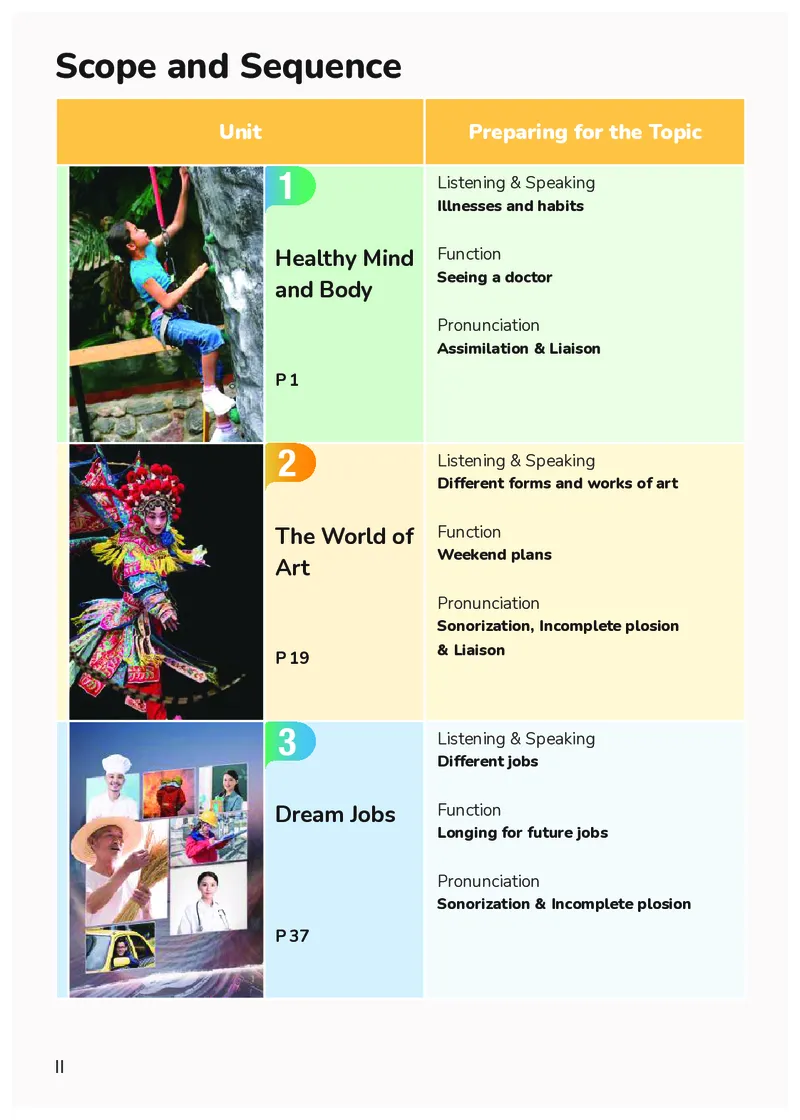
Unit Preparing for the Topic
1
Listening & Speaking
Illnesses and habits
Healthy Mind Function
Seeing a doctor
and Body
Pronunciation
Assimilation & Liaison
P 1
2
Listening & Speaking
Different forms and works of art
The World of Function
Weekend plans
Art
Pronunciation
Sonorization, Incomplete plosion
& Liaison
P 19
3
Listening & Speaking
Different jobs
Dream Jobs Function
Longing for future jobs
Pronunciation
Sonorization & Incomplete plosion
P 37
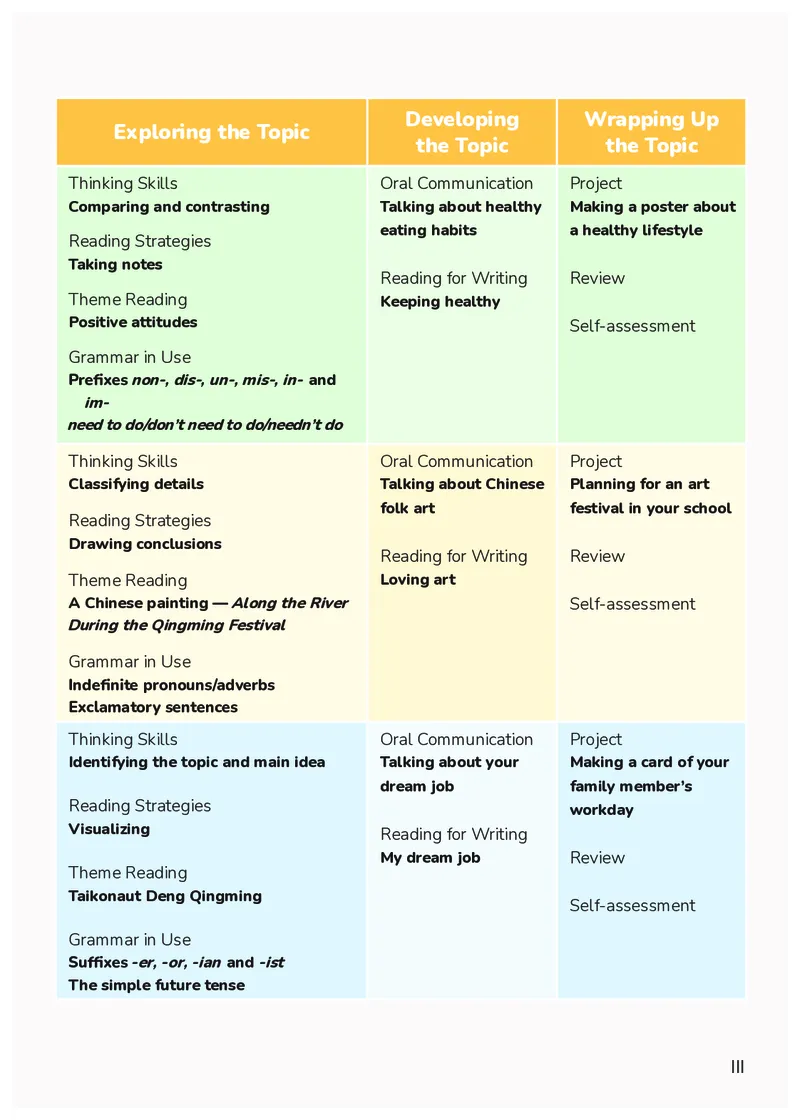
IIDeveloping Wrapping Up
Exploring the Topic
the Topic the Topic
Thinking Skills Oral Communication Project
Comparing and contrasting Talking about healthy Making a poster about
eating habits a healthy lifestyle
Reading Strategies
Taking notes
Reading for Writing Review
Theme Reading Keeping healthy
Positive attitudes Self-assessment
Grammar in Use
Prefixes non-, dis-, un-, mis-, in- and
im-
need to do/don’t need to do/needn’t do
Thinking Skills Oral Communication Project
Classifying details Talking about Chinese Planning for an art
folk art festival in your school
Reading Strategies
Drawing conclusions
Reading for Writing Review
Theme Reading Loving art
A Chinese painting — Along the River Self-assessment
During the Qingming Festival
Grammar in Use
Indefinite pronouns/adverbs
Exclamatory sentences
Thinking Skills Oral Communication Project
Identifying the topic and main idea Talking about your Making a card of your
dream job family member’s
Reading Strategies workday
Visualizing
Reading for Writing
My dream job Review
Theme Reading
Taikonaut Deng Qingming
Self-assessment
Grammar in Use
Suffixes -er, -or, -ian and -ist
The simple future tense
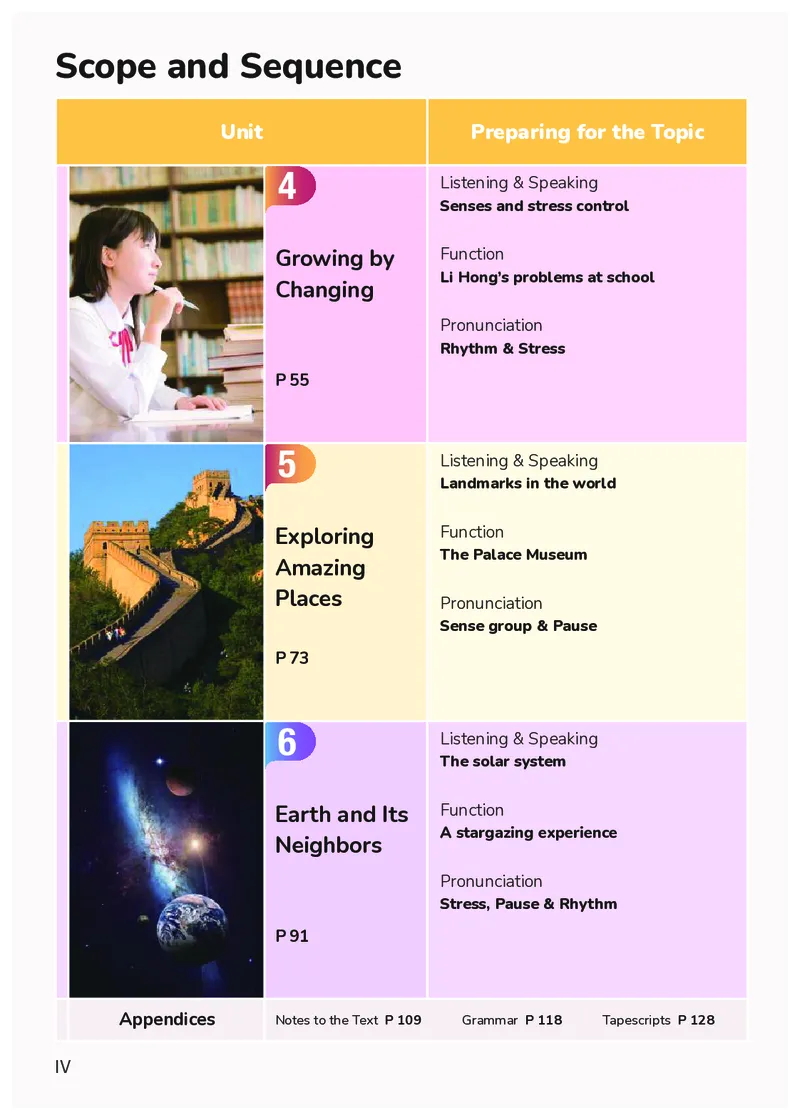
IIIScope and Sequence
Unit Preparing for the Topic
4
Listening & Speaking
Senses and stress control
Growing by Function
Li Hong’s problems at school
Changing
Pronunciation
Rhythm & Stress
P 55
5
Listening & Speaking
Landmarks in the world
Exploring Function
The Palace Museum
Amazing
Places
Pronunciation
Sense group & Pause
P 73
6
Listening & Speaking
The solar system
Earth and Its Function
A stargazing experience
Neighbors
Pronunciation
Stress, Pause & Rhythm
P 91
Appendices Notes to the Text P 109 Grammar P 118 Tapescripts P 128
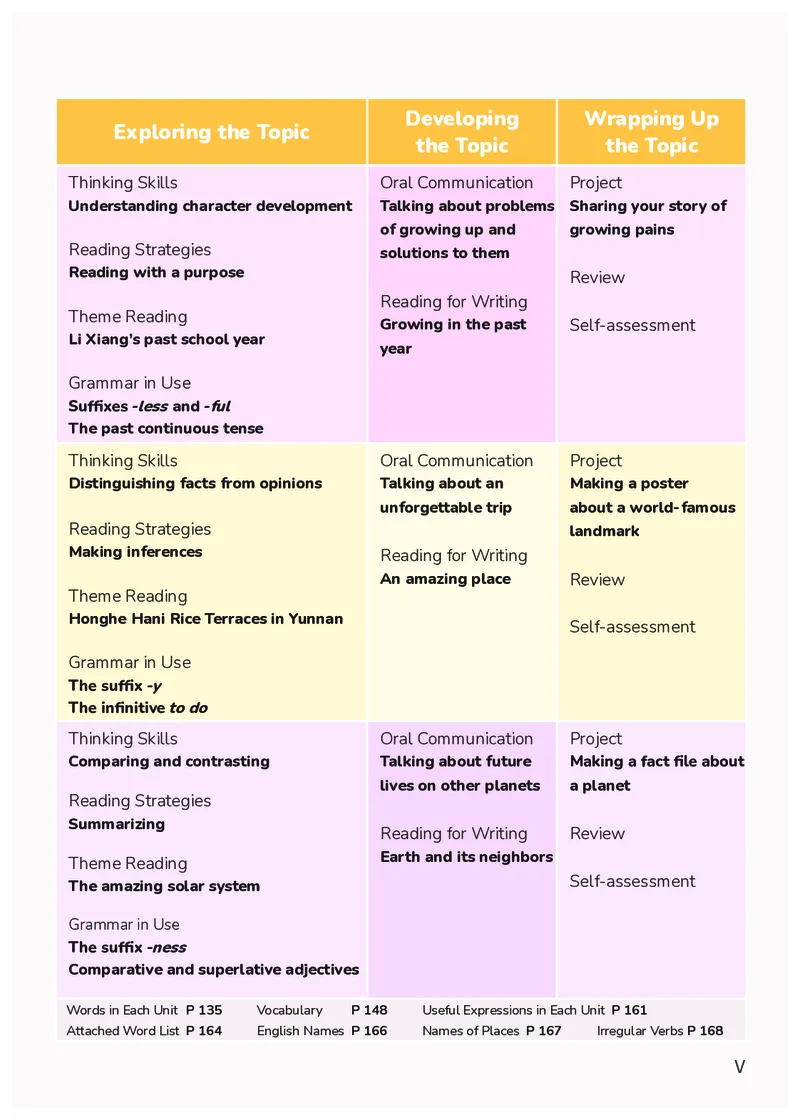
IVDeveloping Wrapping Up
Exploring the Topic
the Topic the Topic
Thinking Skills Oral Communication Project
Understanding character development Talking about problems Sharing your story of
of growing up and growing pains
Reading Strategies solutions to them
Reading with a purpose
Review
Reading for Writing
Theme Reading
Growing in the past Self-assessment
Li Xiang’s past school year
year
Grammar in Use
Suffixes -less and -ful
The past continuous tense
Thinking Skills Oral Communication Project
Distinguishing facts from opinions Talking about an Making a poster
unforgettable trip about a world-famous
Reading Strategies landmark
Making inferences Reading for Writing
An amazing place Review
Theme Reading
Honghe Hani Rice Terraces in Yunnan
Self-assessment
Grammar in Use
The suffix -y
The infinitive to do
Thinking Skills Oral Communication Project
Comparing and contrasting Talking about future Making a fact file about
lives on other planets a planet
Reading Strategies
Summarizing
Reading for Writing Review
Earth and its neighbors
Theme Reading
Self-assessment
The amazing solar system
Grammar in Use
The suffix -ness
Comparative and superlative adjectives
Words in Each Unit P 135 Vocabulary P 148 Useful Expressions in Each Unit P 161
Attached Word List P 164 English Names P 166 Names of Places P 167 Irregular Verbs P 168
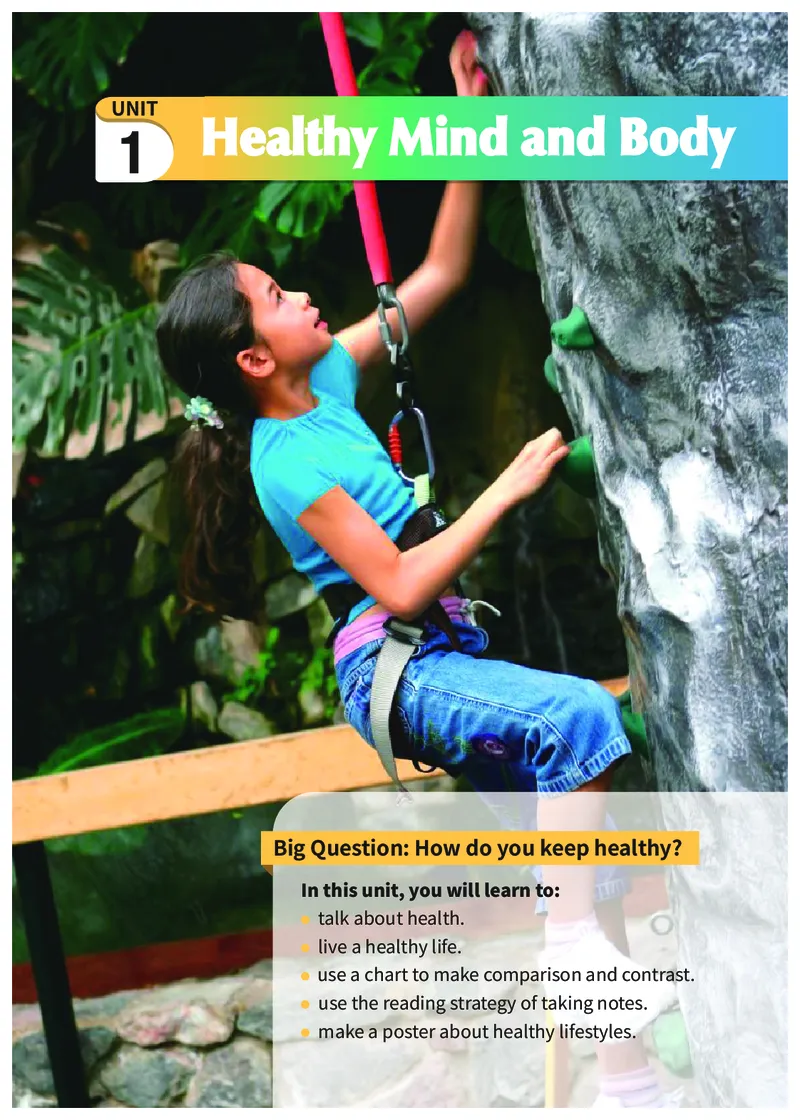
VUNIT HHeeaalltthhyy MMiinndd aanndd BBooddyy
1
Big Question: How do you keep healthy?
In this unit, you will learn to:
talk about health.
live a healthy life.
use a chart to make comparison and contrast.
use the reading strategy of taking notes.
make a poster about healthy lifestyles.UNIT Preparing for the Topic
1
Listening & Speaking Illnesses and habits
Activity 1
A. Match the illnesses (a–f) with the pictures at the top of the next page.
a. bad cough b. fever c. sore throat
d. headache e. toothache f. stomachache
B. Fill in each blank with a suitable illness above.
1. I just took my temperature. I have a _______.
2. I have a __________. I need to take some cough medicine.
3. He is coughing and losing his voice. He has a _______.
4. She has a _______. She needs to see the dentist.
5. She stayed up late last night. And now she has a _______.
6. He has a _______, because he ate too much junk food.
C. Pair work. Listen and repeat, and then replace the parts in bold
and practice with your partner.
What’s wrong with you?
I just took my temperature.
I have a fever.
I’m sorry to hear that. You
need to see a doctor.
2 UNIT 1Activity 2
Listen to the conversation and complete the table.
Name Problem Suggestion
1. spends too much time on
1. stay away from phone games
Wang phone games
2. go to bed early
Junfeng 2. always feels
3. do more
3. can’t himself
1. wants to be slim 1. have a healthy diet
Xiao Ya 2. always feels 2. do some
3. often has a 3. needn’t be slim to look
Activity 3
Pair work. Discuss whether the following habits are good. If
not, give your advice.
Take an active part in doing sports. Spend too much time on the screen.
Eat too much salt or sugar.
UNIT 1 3Function Seeing a doctor
Activity 1 ’
Pair work. Talk about the pictures and guess what s wrong
with Li Xiang.
Activity 2
Listen to the conversation and answer the question.
What does the doctor say about junk food?
Activity 3
Listen again and complete the table.
Doctor: What’s wrong with you?
Li Xiang: I feel very sick and have a stomachache.
Doctor: When did you feel the ache?
Li Xiang: About one hour ago. Just after lunch.
Doctor: Let me examine you.
(A few minutes later)
Doctor: OK. What did you have for lunch?
Li Xiang: I had some hamburgers, chips, fried pork together with some pepper
and a cold drink.
Doctor: I see. You ate too much junk food, especially hot pepper and iced
Coke. It is not healthy at all.
Li Xiang: Thanks, doctor. I will remember that.
Doctor: You need to take a rest and take some pills.
Li Xiang: OK. Thank you.
Reason Result Suggestion
ate too much • feels very __________ • stop eating _____________________
junk food • has a ____________ • rest in bed and take some _________
Activity 4
Pair work. Talk about more examples of healthy and unhealthy
habits, and then make up a new conversation.
4 UNIT 1Pronunciation Assimilation & Liaison
Activity 1
Listen and read the words aloud. Pay attention to the
pronunciation of the blue letters.
camp stamp husband blind absent account task desk
direct protect gift soft accept kept artist guest
field told herself shelf milk silk adult salt
single little table people middle uncle
often listen lesson cousin basin seven
Activity 2
Listen and read the sentences. Pay attention to the liaisons.
1. You look pale. You should see a doctor. TIPS
One vowel can be
2. In my opinion, fried food is not healthy.
linked with another
by adding a slight /j/ or /w/.
3. Why don’t we go out for a walk after dinner?
4. To keep healthy, we’d better do exercise every day.
Activity 3
Listen and chant. Pay attention to the liaisons.
Today is Monday, so I start once more
with my diet like many times before.
This time I’ll make it, I know I can, too.
Because on Sunday I ate all I could chew.
Monday morning I got up out of bed.
For breakfast, I had just one piece of bread.
Later, for lunch, I went out to the store
to buy tomatoes, bananas and more.”
My tummy then hurt. I wanted to scream.
I saw some big donuts filled with sweet cream.
UNIT 1 5UNIT Exploring the Topic
1
Thinking Skills Comparing and contrasting
When you compare and contrast, you think about how two things are alike and how
they are different.
Activity 1
Look at the pictures and read the text, and then learn how to
compare and contrast.
Pingping and Yining both love sports a lot.
Pingping is outgoing and she always plays football
with her friends. Unlike her, Yining is shy. She
likes running alone. When doing sports, they both
need to take care of their safety.
Pingping
Yining
love sports; need
• outgoing
to take care of • shy
• always plays football
their safety • likes running alone
with her friends
Activity 2
Read the text and complete the comparison chart.
Hello, I’m Wenwen. I love fruit and vegetables. I eat at home every day, and I have
meals with little salt and sugar. My favorite snack is chocolate.
My friend Xiaolu also likes fruit and vegetables. But she often eats hamburgers and
cookies. Her favorite snack is ice cream.
Wenwen Xiaolu
Activity 3
Pair work. Discuss Wenwen’s and Xiaolu’s eating habits based on
Activity 2.
6 UNIT 1Reading Strategies Taking notes
When you’re reading, you can note down the key words to help you understand and
remember the important information.
Activity 1
Read the text and underline more key words.
Exercise is good for us in many ways. For one thing, it can help build a strong
body. For example, jogging is good for our legs and heart. For another, it is a
good way to rest and relax our mind. That’s why we should do some exercise
after hours of work or study. So, don’t be lazy. Let’s exercise!
Activity 2
Read the text in Activity 1 again and complete the notes.
Notes
Doing exercise is good for us in many ways.
1. It can help _____________________________________________________
e.g., ___________________________________________________________
2. It is a good way to _____________________________________________
We can ________________________________________________________
Activity 3
Read the text and underline the key words, and then take notes.
Tips for Doing Sports
When you plan to do exercise, here are some
tips for you. Notes
Talk with your doctor. He/She can give you
1. __________
some advice according to your condition.
Warm up. You need to start slowly with a warm- 2. __________
up, and then move on step by step.
3. __________
Drink enough water. Your body needs a lot of
water, especially on hot days.
4. __________
Listen to your body. Take a break or stop right
away when you feel uncomfortable.
UNIT 1 7Theme Reading Positive attitudes
Activity 1
Pair work. Look at the pictures and talk about what you often
do when you feel down.
listen to music talk to your parents do sports with friends keep a diary
Activity 2
Read the two web posts. Underline the key information, and
then complete the notes.
· 1st post · 2nd post
Who: ________________________ Who: ________________________
What:________________________ What: ________________________
Why: ________________________ Why: ________________________
How: ________________________ How: ________________________
20:30, March 2nd
Meimei:
I’m an 8th grader. In my opinion, staying positive has
amazing benefits. I can study and work better in a good
mood. Here are a few tips to help you.
First, you should exercise more. You can try ball games,
such as volleyball and football. They will make you feel
good. Second, you can communicate with more people and you don’t need
to face bad feelings alone. Last, make sure to get enough sleep. After a good
sleep, you will be full of energy. It will make you feel excited to start a new
day.
8 UNIT 119:35, March 4th
Yinuo:
Hi, Meimei. I am glad to come across your post. I think being
positive can bring us a lot of benefits. We can become more
confident and have better chances for success.
How can we stay positive? To start with, I think playing
sports is one of the ways. I am never absent from the football
matches in my school. When I am playing football, I am always confident in
myself. Besides, we need to find the good points in ourselves. To live a happy
life, we must first love ourselves. Finally, if we do have bad feelings, we can
write them down. Talking to ourselves is a useful way to get through difficult
moments.
Activity 3
Match the words and phrases with their meanings according
to the text.
positive to meet or find (something or someone) by chance
benefit feeling sure of oneself
get through something useful or helpful
confident to succeed in doing something
come across thinking about good things
Activity 4
Read the text again and complete the comparison chart about
how to stay positive.
Meimei Yinuo
● communicate with ● find the good points
others in ourselves
● ___________________ ____________________ ● ___________________
UNIT 1 9Grammar in Use Prefixes non- , dis- , un- , mis- , in-
and im-
Activity 1 TIPS
Look at the pictures and
The prefixes non-, dis-, un-, mis-,
read the sentences. Pay attention to in- and im- usually express the
opposite meanings of the original words.
the words in bold.
He became a non- Sea food may seem Hamburgers may It is incorrect to
smoker in order to to disagree with taste delicious, but it do sports with an
keep healthy. some people. is unhealthy to eat empty stomach.
too many of them.
Activity 2
Fill in the blanks with the correct form of the given words.
dislike uncomfortable impossible nonstop misplace
1. It is ______________ to keep healthy without good living habits.
2. Don’t eat too much junk food, or you will feel ______________.
3. She ______________ ice cream because it’s bad for her teeth.
4. My sister’s room is tidy, and she never ______________ her things.
5. We felt very tired after a long and ______________ walk.
Activity 3
Read the text and fill in the blanks with the words in the box.
impatient nonsense uncomfortable improper
A(n) ____________ habit does a lot of harm to people. For example, staying up late
is very bad for people’s health. Clearly, they will feel sleepy and ____________ the
next day. What’s worse, people will become ____________ and they may even forget
important dates. Sometimes, they will speak ____________ because their minds
are not clear. To get rid of the habit, people need to sleep early and do some sports. A
healthy body and a clear mind will make them feel good all day.
10 UNIT 1need to do/don't need to do/needn't do
Activity 1
Pair work. Read the conversation. Pay attention ton eed.
I stayed up to watch the soccer
What’s the matter
game last night. I need to get
with you?
some sleep now.
You can watch the games online the
OK. Thank you
next day. You needn’t stay up. You
for your advice.
need to take care of yourself.
Activity 2
Complete the table and learn how to usen eed.
Need Example
need to do We need _____ (get) enough sleep every day.
don’t/doesn’t The girl is getting well and she doesn’t need _____ (take) the
need to do medicine now.
Kangkang needn’t ______ (do) the work today. He can hand it
needn’t do
in tomorrow.
Activity 3
Read the sentences and circle the correct words.
1. He (need/needs) to take a break now. He looks so tired.
2. We (need/needn’t) to play sports every day to keep healthy.
3. You(needn’t/ don’t need) store so much food in the fridge.
4. You (needn’t/don’t need) to worry about your grades. Just relax.
5. Both Maria and Meimei (need/needn’t) to lose weight.
UNIT 1 11UNIT Developing the Topic
1
Oral Communication Talking about healthy eating
habits
Activity 1
A. Listen to the conversation and tick the questions you hear.
_________ What should we eat every day? _________ Are they unhealthy food?
_________ What food is healthy? _________ Is that okay?
_________ How about potatoes?
B. Listen again and fill in the blanks.
Let’s talk about food and healthy diet.
• _______ and vegetables are healthy. You need to eat them every day.
• Potatoes are good vegetables, but _______ are junk food.
• Chocolate and _______ are bad for your teeth. You should eat _______
of them.
• We need to have a glass of milk, _______ and bread for breakfast.
Activity 2
Group work. Match the words with the pictures and discuss if
Kaibo’s meals are healthy. If not, give your advice.
②
ice cream cabbage tomato sandwich corn candy
① ② ③ ④ ⑤ ⑥
chicken strawberry beef biscuits rice cucumbers
⑦ ⑧ ⑨ ⑩ ⑪ ⑫
Kaibo’s meals
Breakfast: sandwich
Lunch: rice with a lot of meat, such as chicken and beef
Dinner: fish, strawberries, ice cream
Snacks: candy, chocolate, biscuits
My advice: ________________________________________________
12 UNIT 1Reading for Writing Keeping healthy
Activity 1
Pair work. Complete the table with what you do or eat to keep
healthy, and then share with your partner.
What I do What I eat
do exercise every day fruit and vegetables
Activity 2
Read the text and complete the comparison chart. Compare
’
your lifestyle and your friend s, and then draw a comparison chart.
How Healthy Are You?
I’m Xiao Lin. I have a sister, and her name is
Xiao Ya. We both live healthy lifestyles.
We like to play sports and eat good foods. I enjoy
running and playing soccer. I also love fruit, such
as apples and bananas. My sister, on the other
hand, prefers swimming and basketball. She likes
to eat vegetables, carrots, beans and cucumbers
are all her favorites. We both have fun staying
active and eating well.
Though we choose different sports and foods, we
both care about being healthy. Our lifestyles help
us stay strong and feel happy.
UNIT 1 13Xiao Lin Xiao Ya
They both
_______________ _______________
_________________
_______________
________________
_______________ _______________
_______________
________________ ________________
_______________
_______________
_______________
________________ ________________
Activity 3
Draft your essay about how healthy you and your friends are.
The phrases and sentence patterns may help you.
Useful phrase Useful sentence pattern
like to do … I also love …
enjoy doing … … are all her favorite.
prefer doing … We both have fun …
stay active Our lifestyles help us stay …
Activity 4
Make your final draft.
Activity 5
Invite your partner to rate your final draft. Write 1 (more improvements
needed), 2 (fair), 3 (good), or 4 (excellent) for the ratings.
Partner’s
How well can you ____________________ ?
rating
express your view of caring for a healthy lifestyle
use the thinking skill of making comparison and contrast
write about how to keep healthy and positive
organize ideas into a well-balanced structure
use the theme vocabulary of the unit
use need to/don’t need to/needn’t do
use punctuation
spell the words
Please invite your partner to make some comments and suggestions on your final draft
based on the form above.
______________________________________________________________________
14 UNIT 1UNIT Wrapping Up the Topic
1
Project Making a poster about a healthy lifestyle
Activity 1
Pair work. Brainstorm different aspects of a healthy lifestyle.
Discuss with your partner and write down more ideas in the blanks.
Eat more vegetables and fruit. Do more exercise.
A Healthy Lifestyle
Activity 2
Group work. Design a poster about a healthy lifestyle.
How to Live a Healthy Life?
Eat more vegetables and fruit. Do more exercise.
Activity 3
Report your group work to your class and share your poster
about how to keep a healthy lifestyle.
UNIT 1 15Review
Activity 1
Pair work. Listen to the monologs and fill in the blanks,
and then discuss the differences between Chinese and British cooking.
Differences between Chinese and British Cooking
Chinese cooking is _________.
• Different food needs different cooking methods and _________.
• Chinese cooking focuses on _________, smell and taste.
• In the north, _________ are popular. In the south,
rice is the main food.
British cooking is mostly simple and _________.
• People love easy meals like _________, fruit and drinks.
• They also enjoy dishes with plenty of _________ and
vegetables.
• They use sauces to make foods taste better, and
_________ are often served as the main food.
Activity 2
Read the text and fill in the blanks with the correct form of the
given words.
How can you stay positive? Here are some tips.
First, always try to smile. Smiling can make you ______(feel) happy. So, try to smile
at yourself and the people around you. Second, keep a _______(health) lifestyle.
Keep away from unhealthy food and take an active part in exercise every day.
Third, make a clear plan and _______(enjoy) your classes. As a student, you have
many classes. Love your classes, and you can do a great job. Fourth, take up a
hobby. You can do an activity to relax, such as reading, _________(learn) a new
sport and spending time with your pet. Fifth, be patient with everything. To be in a
hurry can make you mad ________(easy).
16 UNIT 1Activity 3
Fill in the blanks with a suitable form ofn eed in the box.
need don’t need need to don’t need to/needn’t
To stay fit and healthy, kids __________ do physical activity every day. They can
play sports, ride bikes, or just run around with friends. They __________ spend
hours in the gym; even 30 minutes of active play each day can make a difference.
Also, kids __________ eat a balanced diet of fruits, vegetables, meat, and fish.
While they may enjoy chocolates and chips, they __________ candy or junk food to
grow. Finally, a good night’s sleep is also important. Kids __________ 9 to 12 hours
of sleep each night for their health. With these good habits, kids __________ worry
about their health as they grow tall and strong.
Activity 4
Read the text and answer the questions.
Parkrun is a fun and exciting way for people to run or walk in parks every week.
It started in 2004 when a group of friends wanted to have a running event in
London, England. They wanted to make running fun and friendly for everyone.
The first event had only a few runners, but many people liked it. Soon, Parkrun
grew and spread to many other countries. Now, thousands of people join every
Saturday to run or walk the 5-kilometer course.
Parkrun welcomes everyone, no matter how fast
or slow they are. It is free, and people can bring
family and friends to enjoy the fresh air together.
Parkrun is about getting active, having fun, and
making new friends.
1. What is Parkrun?
_______________________________________________________________
2. When and where did Parkrun start?
_______________________________________________________________
3. How long is each Parkrun event?
_______________________________________________________________
4. Who can join Parkrun?
_______________________________________________________________
5. Do you like Parkrun? Why or why not?
_______________________________________________________________
UNIT 1 17Self -assessment
1. How much do you enjoy the topic?
I’m interested in the topic of health.
I always try to keep healthy and stay positive, and I need to ____
____________________________________________________.
2. How well can you use the language and cultural knowledge?
I can use proper liaisons and assimilations.
I can use the vocabulary for/of keeping healthy.
I can use the prefixes non-/dis-/un-/mis-/in-/im- and need to/don’t
need to/needn’t do.
I can understand and learn how to live a healthy life.
3. How well can you use English to perform the activities?
I can talk about different illnesses and habits.
I can understand the texts and recordings in this unit.
I can discuss healthy eating habits with my partners.
I can write about keeping healthy.
4. How well can you use thinking skills and learning strategies?
I can use a chart to make comparison and contrast.
I can take notes in reading.
I can work with my partner(s) in pair/group work.
5. How are you satisfied with your group project?
I can make a poster about healthy lifestyles with my partners.
I can report our project to the class.
6. How are you going to improve your English learning?
____________________________________________________________________
____________________________________________________________________
18 UNIT 120 UNIT 2UNIT 2 2122 UNIT 2UNIT 2 2324 UNIT 2UNIT 2 2526 UNIT 2UNIT 2 2728 UNIT 2UNIT 2 2930 UNIT 2UNIT 2 3132 UNIT 2UNIT 2 3334 UNIT 2UNIT 2 3536 UNIT 2UNIT DDrreeaamm JJoobbss
3
Big Question: What do you want to be?
In this unit, you will learn to:
introduce your dream job.
plan for future jobs.
use a chart to identify the topic and main idea.
use the reading strategy of visualizing.
’
make a card of your family member s workday.UNIT Preparing for the Topic
3
Listening & Speaking Different jobs
Activity 1
A. Match the jobs (a–h) with the people at the top of the next page, and
then add more jobs.
a. director e. artist
b. postman f. guide
More Jobs
c. office worker g. pilot
d. builder h. scientist
B. Fill in each blank with a suitable job above.
__________ shows people around a place. __________ makes films.
__________ builds or repairs houses. __________ sends letters.
__________ studies science. __________ paints or draws pictures.
__________ works in the office. __________ flies planes.
C. Pair work. Listen and repeat, and then replace the parts in bold
and practice with your partner.
What is the man doing, Xiao Ya?
He is flying a plane. He is a pilot.
What’s your dream job?
I want to be an artist.
38 UNIT 3Activity 2
Listen to the riddles and fill in the blanks.
Pencils, brushes, paper and erasers are my
tools. I ______ or paint in the park, by the
______ or at other places. What do I do?
Let me see. Oh, you are a(n) ______.
I work with actors, actresses and other artists.
I give directions to them. Together with them,
I produce ______. What do I do?
Let me see. Oh, you are a(n) ______.
Activity 3
Group work. Write riddles about different jobs and ask your
partners to guess the jobs.
UNIT 3 39Function Longing for future jobs
Activity 1
Pair work. Talk about your dream job and explain why you want
to do it in the future.
Activity 2
Listen to the conversation and number the pictures.
Activity 3
Listen again and complete the table.
Wang Junfeng: Hi, Lingling. How are you doing today?
Lingling: Not bad. I just came back from the pet hospital.
Wang Wei: What happened to your dog, Lingling?
Lingling: It got sick yesterday. But, thanks to the vets, it’s getting well now.
Wang Wei: The vets are kind and helpful. I’d like to be a vet like them. I
like to keep pets myself.
Wang Junfeng: Good for you. I’m sure you will be a very good vet. What do
you want to be, Lingling?
Lingling: I am going to be a dancer. I think I’m lively and I love dancing
very much.
Wang Wei: How about you, Junfeng?
Wang Junfeng: I want to be a news reporter. You know, I’m active and love
following the news.
Wang Wei: That will be wonderful. Maybe some day you will write a news
report about Lingling.
Character Personality Hobby Dream Job
Wang Wei ___________ keeping pets a ___________
Lingling ___________ dancing a dancer
Wang Junfeng active __________ the news a news ___________
Activity 4
Group work. Interview your group members about their
personalities, hobbies and dream jobs, and then report to the class.
40 UNIT 3Pronunciation Sonorization & Incomplete plosion
Activity 1
Listen and read the words aloud. Pay attention to the
pronunciation of the blue letters.
scare scarf score skirt skill sky speak spell sport
stand story study style stress street strong strict
Activity 2
Listen and chant. Circle the words with the pronunciation
of sonorization.
Jobs
We are learning about good jobs today.
Speak out with your friends and do as I say.
You’re a happy baker, baking a cake.
You’re a pilot with many flights to take.
You’re a fashion model who has fine style.
You’re a singing rock star with a big smile.
Stand up, be careful, and wear a tall crown.
That’s great! You’ve got the job. Now,
please sit down.
TIPS
Activity 3
The consonants in the brackets
Listen and read the
here are usually pronounced as
words and phrases. Pay attention to
stops before /p/, /b/, /t/, /d/, /k/ and /g/.
the incomplete plosions.
dire(c)tor do(c)tor sui(t)case han(d)bag blac(k)board
pos(t)card shar(p) pencil goo(d)bye ho(t) tea wha(t) time
nex(t) door ta(ke) care we(t) ground har(d) times bi(g) toy
Activity 4
Listen and read the sentences. Pay attention to the incomplete
plosions.
1. I wan(t) to be a news reporter.
2. There are many backu(p) team members.
3. Gui(de) dog teachers train gui(de) dogs to hel(p) blin(d) people.
4. She too(k) goo(d) care of the children.
UNIT 3 41UNIT Exploring the Topic
3
Thinking Skills Identifying the topic and main idea
The topic is often the general subject of a text. It is usually the title. The main idea is
about the topic. It is often the topic sentence.
Activity 1
Look at the pictures and read the text, and then learn how to
identify the topic and main idea.
Jobs with Animals
A lot of people work with animals. Some people
help sick animals. For example, vets often help
sick animals on the farm, in the zoo or in the
animal park. Some people train animals to do jobs
for people. For example, guide dog teachers train
guide dogs to help blind people.
Topic: Jobs with animals Main idea: A lot of people work
with animals.
Detail: Some people help sick animals.
Detail: Some people train animals to do jobs for people.
Activity 2
Read the text and complete the topic-and-main-idea chart.
Jobs at Night
We sleep at night, but some people do their jobs at night. For example, many
doctors and nurses work at night because patients need help at night. Some
railway workers also work at night because a few trains run during night time.
Topic: Main idea:
___________________________ ___________________________
Detail: _______________________________________________________
Detail: _______________________________________________________
Activity 3
Pair work. Talk about jobs at night based on the chart in Activity 2.
42 UNIT 3Reading Strategies Visualizing
When you are reading a text, try to picture what you are reading in your mind to help
you understand the text.
Activity 1
Pair work. Underline the words and phrases that help you
visualize, and then complete the sentences and share the steps with your
partner.
My Dream Job Steps to visualize:
I want to be a modern farmer in the I read about modern farmers in
future. Modern farmers plant more the future.
green food and care more about I see in my mind green __________
people’s health. They try to protect and good environment .
the environment and make the Now I understand modern farmers
world a better place. can _________________________.
Activity 2
Read the text and underline the key words and phrases that
help you visualize.
Friday Sunny
We had a job experience day in the fire station today. We heard the alarm
and got a fire call. A house was on fire and a child was on the sofa in the
bedroom. We then put on the fireman uniforms, rushed to the house, saved
the child and put out the fire. From this experience, we learned how to put
out fire and save people from fire. Fighting fires is really dangerous. All
firemen are brave.
Activity 3
Read the text in Activity 2 again and follow the steps to visualize.
Steps to visualize:
I read about _____________________________ in the fire station.
I see in my mind __________________________________________________.
Now I understand __________________________________________________.
UNIT 3 43Theme Reading Taikonaut Deng Qingming
Activity 1
Pair work. Look at the pictures and talk about the questions.
1. What job are the photos about?
2. What do people need to do for this job?
3. What do you know about Deng Qingming in the third picture?
Activity 2
Read the text. Underline the key words and phrases that help
you visualize, and then complete the sentences about the steps of
visualizing.
I read about how Deng Qingming __________________________________.
I see in my mind Deng Qingming in a tiny space with ___________________
_________________________________________________.
Now I understand ____________________ will pay off.
Behind every great taikonaut in the spacecraft, there are many heroes of backup
team members. Deng Qingming is such a hero. After being a backup taikonaut for
over 20 years, his hard work finally paid off.
Deng became a member of the first group of taikonauts in 1998. In the following
years, Deng trained very hard and had little time to spend with his family. During the
training, he had to stay in a tiny space with space food, strong light and no showers.
Many times, Deng missed the chance to go into space, but he never gave up. As
a backup member, he kept training himself. He always watched with care in the
control center and offered his knowledge about space. Finally in 2022, Deng went
into space in Shenzhou-15 spaceship.
A small step in space is a huge achievement for all humans. Backup taikonauts
also help a lot in such an achievement. They are just as great as other taikonauts
and we should value their hard work.
44 UNIT 3Activity 3
Match the words with their meanings according to the text.
train a new or difficult task for someone
tiny to learn the skills, especially for a job
miss very large in size
knowledge to fail to catch
challenge information from education or experience
huge very small
Activity 4
Read the text again and complete the topic-and-main-idea chart.
Topic: Main idea:
___________________________ ___________________________
Detail:
___________________________________________________________
___________________________________________________________
Detail:
___________________________________________________________
___________________________________________________________
Detail:
___________________________________________________________
___________________________________________________________
Activity 5
Group work. Discuss the questions and share your ideas.
1. What can we learn from Deng Qingming?
2. What qualities should a taikonaut have according to the story of
Deng Qingming?
UNIT 3 45Grammar in Use Suffixes -er, -or, -ian and -ist
Activity 1
Look at the pictures and read the sentences. Pay attention to
the words of jobs in bold.
My grandpa works Nuoyi likes acting. My aunt works My sister really likes
on a farm. He is a He wants to be an carefully in the playing the piano.
farmer. actor. library. She is a She wants to be a
librarian. pianist.
Activity 2
Make new words by adding suffixes, and then complete the
sentences. 1. Zhenzhen likes drawing, and she wants to be a(n)
________.
2. Wenbo is interested in tennis, and he likes to be a(n)
music
er tennis ________.
art
or 3. Ziwen began to learn dancing at the age of 5. Her
play
ist dream job is a(n) ________.
+
direct
ian 4. Jim likes watching movies very much and he dreams
dance
to become a(an) ________ one day.
5. Xuanxuan is good at music. She wants to be a(n)
________ in the future.
Activity 3
Read the text and circle the jobs, and then underline the reasons.
I want to be a teacher or a doctor. I enjoy teaching
children and I love making friends with them. I also
hope doctors can soon treat deadly diseases like cancer,
so I’d be very happy to be a doctor in the future. My
brother has a different idea about his dream job. He
wants to be an explorer. He is interested in mountains,
rivers, forests on the earth and also stars in space. He is
very curious about the secrets of nature.
46 UNIT 3The simple future tense
Activity 1
Pair work. Read the conversation. Pay attention tow ill andb e
going to.
Hi Kangkang. We will
Yes. We are going to
,
have a class meeting
talk about dream jobs.
tomorrow.
Will you share your opinion? Of course, I will.
Great Look at the clouds. Take it easy. The rain
!
It is going to rain. won’t last long.
Activity 2
Complete the table and learn how to use the simple future tense.
The simple future tense
I’m going to be a dancer, and my brother ___________ be an officer.
be going to Are you going to be artists? Yes, we are./No, ___________.
What are they going to be? They ___________ be artists.
I ___________ vote for Kangkang as our team head.
will
Will you choose to be a lawyer? Yes, I will./No, I ___________.
Activity 3
Read the text and fill in the blanks withw ill orb e going to.
Change the word form when necessary.
My cousin Zihan is 13 years old. She enjoys
cooking and she _____________ be a cook in
the future. Next week, Zihan _____________ take
part in the Top Ten Young Cooks of the Year
Competition. After that, she _____________ write
an interesting cook book for kids. She hopes to
encourage kids to learn cooking. Her friends
and family are very proud of her. They think
Zihan’s book _____________ be a big success.
UNIT 3 47UNIT Developing the Topic
3
Oral Communication Talking about your dream job
Activity 1
A. Listen to the monologs and match the names with the jobs.
Li Xiang zookeeper
Li Hong pilot
Kangkang doctor
B. Listen again and fill in the blanks with what you hear.
He is going to study hard She loves __________ He wants to help _____
and do__________ every very much. She’ll learn _______ people and he
day. He won’t give up his how to take care of will go to a __________
dream. them and try to be their school to make his
__________. dream come true.
Activity 2
Group work. Survey your group members about their dream
jobs and complete the table, and then report to the class.
What’s your Why is it your How are you going to
Name
dream job? dream job? make it come true?
48 UNIT 3Reading for Writing My dream job
Activity 1
Pair work. Complete the sentences and then talk about your
dream jobs.
1. My dream job is …
2. I started dreaming about … at the age of …
3. In order to make it come true, I will …
Step 3:
Step 2:
Step 1:
Activity 2 ’
Read about Zhao Yang s dream job and complete the topic-
and-main-idea chart, and then draw a topic-and-main-idea chart of
your dream job.
My Dream Job
My dream job is a plane engineer.
When I was twelve, my father bought me a toy plane.
I liked it very much and became interested in planes.
Now my dream is to design great planes for our
country.
To make it happen, I will study hard at school. At the
same time, I’m going to join the model plane club in
my school. I will make some friends there and we can
learn scientific knowledge about planes together. I
know it is not easy to become a plane engineer and I
will meet a lot of difficulties. However, I will try my
best to make my dream come true.
UNIT 3 49Topic: Main idea:
___________________________ ___________________________
Detail:
_________________________________________________________
Detail:
_________________________________________________________
Activity 3 TIPS
Draft your essay about your It is helpful for your writing to
dream job. The phrases and sentence collect and remember useful
phrases and sentence patterns.
patterns may help you.
Useful phrase Useful sentence pattern
become interested in … My dream job is …
try one’s best to … To make it happen, …
come true It is (not) easy to …
However, …
Activity 4
Make your final draft.
Activity 5
Invite your partner to rate your final draft. Write 1 (more improvements
needed), 2 (fair), 3 (good), or 4 (excellent) for the ratings.
Partner’s
How well can you ____________________ ?
rating
express your view of career
use the thinking skill of organizing the topic and the main idea
introduce your dream job
organize ideas into a well-balanced structure
use the theme vocabulary of the unit
use the simple future tense
use punctuation
spell the words
Please invite your partner to make some comments and suggestions on your final draft
based on the form above.
______________________________________________________________________
50 UNIT 3UNIT Wrapping Up the Topic
3
Project Making a card of your family member’s
workday
Activity 1 ’
Pair work. Look at the card about the workday of Li Xue s mom
and talk about it with your partner.
Working hours: 9:00 a.m. to 5:00 p.m. from
Monday to Friday
Daily work:
• put the books on the shelves in order
• help readers check books in and out
• check the library records
• introduce new books to readers
Feeling: My mom loves her job very much.
JJoobb:: LLiibbrraarriiaann
Activity 2 ’
Group work. Make a card of your family member s workday and
describe it to your partners.
Working hours: ________________________
Put a picture here. Daily work:
• ____________________________________
• ____________________________________
• ____________________________________
Job: _____________
Feeling: _______________________________
Activity 3 ’
Share your family member s workday in class.
UNIT 3 51Review
Activity 1
Pair work. Listen to the interview and complete the table,
’
and then ask and answer about Xiaolu s job.
Xiaolu’s Job
Job Dentist
• I want to help people with their
Reason ________.
• The job ________ well.
• Went to a medical school
Experience • Worked very hard and did a
__________ in every exam
• Get more __________
Plan
• __________ more
Activity 2
Pair work. Match the activities in Box A with the jobs in Box B,
and then make sentences and share with your partner.
A B
• love doing research on science • an artist
• be interested in showing tourists around • a police officer
different places • a guide
• care about rules and public things • a scientist
• be a deep thinker and love arts
1. Chuchu ________________________________. She wants to be ____________.
2. Feiyang ________________________________. He is going to be ___________.
3. Jiahui _________________________________. He wants to be _____________.
4. Dora _________________________________. She will work as ____________.
5. I _____________________________________. My dream job is _____________.
52 UNIT 3Activity 3
Pair work. Read and complete the conversation withw ill orb e
going to, and then practice with your partner.
A: What are you going to do this weekend?
B: I _______________________ (take photos) with my new camera.
A: Can you show me how to use a camera?
B: OK. I _______________________ (show) you after school.
A: Thanks. I _______________________ (take part in) a speech competition about
“My Dream Job” with my classmates. Can you take some photos for me?
B: When is the competition?
A: Next Wednesday.
B: No problem. I ________________________ (come) and cheer you on. Maybe I
_______________________ (join) your speech team next term.
Activity 4
Read the text and answer the questions.
I first worked as a waitress. Every day, I greeted guests with a warm smile
and led them to the tables. I also carried meals and drinks from the kitchen
to their tables. The work was boring and I had to work for long hours. Soon
after, I found a new job at a bookstore. With shelves of books all around me,
I really enjoyed my work. Before the bookstore opened or after it closed, I
always took some books from the shelves and read them. I often shared my
reading experiences with my customers
and had interesting conversations with
them. Last year, I became the new
manager. From the noisy restaurant to
the quiet bookstore, from a waitress to
a manager, it is not just a simple job
change, but a big change in my life.
1. What was the writer’s first job?
2. How did she feel about her first job?
3. What did she often do before the bookstore opened or after it closed?
4. How does she feel about her work now?
5. Do you think she will be successful? Why?
UNIT 3 53Self -assessment
1. How much do you enjoy the topic?
I’m interested in the topic of my dream job.
I will try my best to be ___________________ in the future,
because _________________________________________.
2. How well can you use the language and cultural knowledge?
I can use proper sonorization and incomplete plosions.
I can use the vocabulary for/of jobs.
I can use the suffixes -er/-or/-ian/-ist and simple future tense.
I can plan for my future jobs.
3. How well can you use English to perform the activities?
I can talk about different jobs.
I can understand the texts and recordings in this unit.
I can discuss future jobs with my partners.
I can write about my dream job.
4. How well can you use thinking skills and learning strategies?
I can identify the topic and main idea.
I can use visualizing strategy in reading.
I can work with my partner(s) in pair/group work.
5. How are you satisfied with your group project?
I can make a card of my family member’s workday.
I can report our project to the class.
6. How are you going to improve your English learning?
____________________________________________________________________
____________________________________________________________________
54 UNIT 3UNIT GGrroowwiinngg bbyy CChhaannggiinngg
4
Big Question: How do you deal with changes?
In this unit, you will learn to:
talk about growing up.
understand and deal with growing pains.
use a chart to understand character development.
use the strategy of reading with a purpose.
share your growing-up stories.UNIT Preparing for the Topic
4
Listening & Speaking Senses and stress control
Activity 1
A. Match the words (a–e) with the pictures at the top of the next page.
a. vision b. hearing c. taste
d. smell e. touch
B. Fill in each blank with a suitable word above.
______ 1. When I feel tired, I often wash my face with cold water.
______ 2. I like listening to soft music. The music makes me feel calm.
______ 3. What a fool I was to taste hot pepper! I really regreted doing that.
______ 4. I will never forget seeing so many world-famous paintings in the
museum.
______ 5. The flowers smelt so good! I took a deep breath and the smell made
me relaxed.
C. Pair work. Listen and repeat, and then replace the parts in bold
and practice with your partner.
Why do you look upset?
I’m feeling nervous about
tomorrow’s speech.
Why not take a deep breath
and smell something good?
And then you will feel relaxed.
56 UNIT 4How do
we sense?
Activity 2
Listen to the conversations and fill in the blanks.
20″ 18″
I have the flu. I can’t go out. I feel so happy. It’s the Spring
I can’t visit my grandparents Festival in Chinatown today.
and I can’t see my friends. I I _______ the fireworks and
feel ________.What should I got a red packet from a shop
I do? keeper. Lucky !
12″ 3″
Me, too. I do some _______ How much lucky money did you get?
and drawing to help me feel
2″
better. You can have a try!
_______ yuan.
Activity 3
Group work. Read the following situations and discuss what
you usually do to reduce your stress.
give a speech feel lonely in a new school
prepare for an exam
UNIT 4 57Function Li Hong’s problems at school
Activity 1 ’
Pair work. Look at the pictures and talk about the boy s feelings.
can’t find his cat have fun with friends
push see a snake
Activity 2
Listen to the conversation and answer the question.
What is Li Hong talking about with Miss Wang?
Activity 3
Listen again and complete the table.
Miss Wang: Hi, Li Hong! You look sad. What’s the problem?
Li Hong: Hi, Miss Wang. I failed the English exam.
Miss Wang: Don’t worry. You can do better next time.
Li Hong: Thanks. But what should I do? Can you give me some suggestions?
Miss Wang: If you have any problem, you can always come to me.
Li Hong: Thank you very much, Miss Wang. And you know, I moved here
a month ago. I miss my friends in my hometown. They often helped
me with my English.
Miss Wang: That’s all right. You can keep in touch with them and make new
friends here.
Li Hong: I guess so. But I don’t know how to start.
Miss Wang: Well, Lingling is nice, and her English is very good. I can
recommend her to you. I’m sure she would like to be your friend.
Li Hong: Thanks for your help, Miss Wang.
Problem Suggestion
• ___________ the English exam • can go to Miss Wang for ___________
• has no _____________ here • can _____________ with Lingling
Activity 4
Pair work. Suppose you are Lingling and your partner is Li Hong.
Make up a new conversation and act it out.
58 UNIT 4Pronunciation Rhythm & Stress
Activity 1
Listen and read the sentences aloud. Pay attention to the
rhythms.
TIPS
The rhythm is based
1. Time and tide wait for no man. on the units of strong
and weak forms. We read the
2. All in his mind is fight or flight.
stressed units clearly and the
3. I will not make the same mistake again. unstressed ones quickly.
4. An apple a day keeps the doctor away.
Activity 2
Listen and read the sentences. Mark the stresses in each
sentence.
Example: She is a 'teacher.
1. She must be excited.
2. I am glad to make many new friends.
3. My sister will become a middle school student.
4. There are big changes in body and mind at different ages.
Activity 3
Listen and chant. Pay attention to the rhythms.
The 'north winds 'blow.
And we shall have 'snow.
And 'what will the 'poor Robin 'do then?
'Poor 'thing.
He’ll 'sit in a 'barn.
And 'keep himself 'warm.
And 'hide his 'head 'under his 'wing.
'Poor 'thing!
UNIT 4 59UNIT Exploring the Topic
4
Thinking Skills Understanding character development
Characters grow and change in the story. You can understand character development
by analyzing how and why a character changes.
Activity 1
Look at the pictures and read the text, and then think about
how and why the character changes.
Beginning Middle End
Kangkang lost the His friend, Li Ming, Kangkang laughed
100-meter race and came up to him and again and walked
was very upset. cheered him up. with Li Ming
happily.
Activity 2
Read the text and analyze how and why the character changes,
and then complete the character-development chart.
Li Hong became our new classmate a month ago. In the beginning, she was always
lonely because she didn’t have any friends. Miss Wang, our English teacher, then
introduced her to Lingling. Lingling was very good at English and helped Li Hong a
lot. They soon became very close friends. Now, Li Hong has many friends at school
and gets along well with us. She enjoys her school life very much.
Beginning Middle End
Li Hong didn’t Miss Wang _______ Li Hong has many
have any friends _____________ and friends at school
and __________ they soon became and enjoys ______
_____________. very close friends. __________.
Activity 3
Pair work. Talk about how and why the character changes
based on the character-development chart in Activity 2.
60 UNIT 4Reading Strategies Reading with a purpose
Good readers set a purpose for reading. While reading, they can decide what is important
and what is not for the reading purpose.
Activity 1
Read the beginning part of a text and set a purpose for reading.
The period of time from age 13 to 19 is a very important stage of human life. Many
important life changes take place during this teen stage.
Your reading purpose is to find out ___________________________.
Activity 2
Read a sentence from the same text and decide whether the
information is important or unimportant for your reading purpose.
As teenagers grow in age, their bodies reach their full adult height. This is the clearest
change. Also, hair grows on certain areas of the body, and their voices change too.
1. Teenagers grow in age. Important/Unimportant
2. Their bodies reach their full adult height. Important/Unimportant
3. Hair grows on certain areas of the body, and
Important/Unimportant
their voices change too.
Activity 3
Read the text and set a reading purpose first, and then decide
whether the information is important or not for your purpose.
As a teenager, you also have growing pains. You face problems like schoolwork stress,
pressure from other people and so on. Then, how can you deal with the growing pains?
Firstly, learn to listen and understand. This can help you learn more about life and people
around you. Secondly, make friends with your classmates. Your friends may have the
same problem as yours, so you can always understand and help each other. Lastly, don’t
compare yourself with others. Everyone shines in their own ways. You should discover
and develop your own strong points.
Your reading purpose is to find out ____________________________.
1. You also have growing pains. Important/Unimportant
2. Learn to listen and understand. Important/Unimportant
3. Make friends with your classmates. Important/Unimportant
4. Don’t compare yourself with others. Important/Unimportant
UNIT 4 61Theme Reading Li Xiang’s past school year
Activity 1
Pair work. Talk about the following questions.
1. Did you have any happy or sad memories in junior high school? What were they?
2. When you met some troubles at school, how did you solve them?
Activity 2
Read the email and answer the questions.
What is your reading purpose for the email?
Are the following details important or unimportant for the purpose?
1. Last October, I signed up for a music club. (Important/Unimportant)
2. Mrs. Zhang advised me to have a talk with my parents. (Important/Unimportant)
3. My parents finally understood my love for music. (Important/Unimportant)
From: Li Xiang
Reply Forward
To: Uncle Wang
Dear Uncle Wang,
How time flies! Congratulations on moving to your new house! How’s
everything going in London? So many things took place in my past school year.
Last October, I signed up for a music club. I felt so lucky to make some good
friends there. The music teacher, Mrs. Zhang, helped me improve my singing
skills. But my parents didn’t allow me to learn singing. They said, “It is a waste
of time.” I was disappointed and didn’t know what to do. When Mrs. Zhang
learnt about this, she advised me to have an open and honest talk with my
parents. I gathered my courage to talk to them. After that, my parents started to
understand my love for music. Two weeks ago, they even came to cheer me on.
I was very glad to have their support.
But here is the problem. I can’t spare much time for my study because of the
singing activities. What should I do? Any advice?
Yours,
Li Xiang
62 UNIT 4Li Xiang’s past school year
Activity 3
Read the text again and complete the character-development
chart.
Beginning Middle End
• He signed up for • ______________ • ______________
a music club and ______________ ______________
made some good ______________ ______________
friends there. • ______________ • ______________
• He felt ________ ______________ ______________
______________. ______________ ______________
Activity 4
Complete the sentences with the words or phrases from the text.
1. Li Xiang wrote to Uncle Wang for help because he had ________.
2. Li Xiang signed up for a music club last October to ________ his singing skills.
3. Li Xiang’s parents didn’t allow Li Xiang to ________ singing because they
thought it was ________.
4. Li Xiang was ________ and didn’t know what to do.
5. After an open and ________ talk, Li Xiang was glad to receive his parents’ support.
Activity 5
Group work. Read the text again and discuss how to help Li
Xiang to solve his problem.
Li Xiang’s problem Your suggestion
He can’t spare much time for his study 1. plan everything well
because of the singing activities. 2. ...
UNIT 4 63Grammar in Use Suffixes -less and -ful
Activity 1
Look at the pictures and read the sentences. Pay attention to
the words in bold.
The doctor feels helpless The symbols are very Your boss doesn’t allow
to save the patient’s useful to pay online, any careless mistakes,
life. He wishes he could but they are useless so you’d better be very
be more helpful. without a cellphone. careful in your work.
Activity 2
Complete the sentences with the correct form of the given words.
1. Li Hong was _______(joy) because she got a good grade in the exam.
2. After years of hard work, my uncle became ________(success) and now he lives
an easy and comfortable life.
3. You were doing very well yesterday. Be ________(hope) and you’ll succeed.
4. He learned a lot after visiting many _______(wonder) places.
5. Smoking is _______(harm). No one should smoke in public.
Activity 3
Complete the text and fill in the blanks.
aimless helpful hurtful painful priceless useless
Youth is an important period of time for growing up. It can be hard and __________,
but you grow in every way and learn more about life. Sometimes, you may feel
___________. But your teachers are always there for you, and your friends can
also be ___________. Some people may say something __________ to you, but
they might not mean it, and you can talk to them and learn to communicate with
people. Maybe, you find some subjects difficult and __________. However, you will
understand the true value of knowledge later on. In a word, youth is a __________
experience. You should make the most of it.
64 UNIT 4The past continuous tense
Activity 1
Pair work. Read the conversation. Pay attention tow as/were doing.
What were you doing at I was watching a movie
this time yesterday? with my parents.
What movie were you
Yes. We felt moved when
watching? Is it My
we were watching it.
Country and My People?
Activity 2
Complete the table and learn how to use the past continuous
tense.
Positive form Negative form
helping Xiao Ya
I was He wasn’t
helping Xiao Ya with her
with her mood
mood problem at 7:00 p.m.
problem at 7:00
They ____ You _____ yesterday.
p.m. yesterday.
Question form
______ she helping Xiao Ya with her Yes, she ______./No, she ______.
mood problem at 10:00
Were they a.m. yesterday? Yes, they ______./No, they ______.
Activity 3
Pair work. Look at the pictures and talk about what people were
doing at 9:00 a.m. yesterday.
A: What was he/she doing?/What were they doing?
B: He/She was …/They were …
tidy up the bathroom jog write a postcard ride bikes
UNIT 4 65UNIT Developing the Topic
4
Talking about problems of
Oral Communication
growing up and solutions
Activity 1 to them
A. Listen to the drama and tick the correct answers.
1. Which is Mike’s favorite band?
a b c
2. What does Jameson do?
a b c
3. What was Mike doing in the bedroom?
a b c
B. Listen again and match the adjectives with the sentences.
exciting Jameson is Mike’s friend, and he will help Mike to get a ticket.
happy The band will hold a concert in the town.
crazy Mike’s dad bought tickets for Mike.
surprised Mike’s dad saw the band ten years ago.
Activity 2
Group work. Discuss your problems of growing up and solutions
to them. The following questions may help you.
1. What problems did you have?
2. How did you feel at first?
3. What did you do to deal with the problems?
4. How did you feel in the end?
66 UNIT 4Reading for Writing Growing in the past year
Activity 1
Pair work. Discuss the order of the sentences and read the text
in Activity 2 to check.
So, I felt very bad about myself and argued with my parents very often.
Little by little, I became more confident.
At the beginning of my 8th grade, I grew so fast and put on lots of weight.
Now, I’m feeling very happy about myself.
Luckily, Zhenzhen always encouraged me.
Activity 2
Read about Li Mei’s growth experience and complete the
character-development chart, and then think of yours and draw a character-
development chart.
Know Yourself
My name is Li Mei. Today I want to tell you my story
of growing up.
To become a happy person, you must first know
yourself. At the beginning of my 8th grade, I grew
so fast and put on lots of weight. So, I felt very bad
about myself. And I hardly talked with my parents.
I also argued with my parents very often. Luckily, my
elder sister, Zhenzhen, helped me with my problem.
She encouraged me. Little by little, I became more
confident. Also, I tried to have some open and honest
talks with my parents. Now, I’m no longer worried
about my weight and I feel very happy about myself.
Being a teenager isn’t easy. Get to know yourself and
accept yourself. Everything will turn out all right!
UNIT 4 67Beginning Middle End
• ______________ • ______________ • ______________
______________ ______________ ______________
______________ ______________ ______________
• ______________ • ______________ • ______________
______________ ______________ ______________
Activity 3
Draft your essay about your growing-up story. The phrases and
sentence patterns may help you.
Useful phrase Useful sentence pattern
feel … about … I want to tell …
argue with … To become a(n) …
try to do … Little by little, …
no longer I’m no longer …
Activity 4
Make your final draft.
Activity 5
Invite your partner to rate your final draft. Write 1 (more improvements
needed), 2 (fair), 3 (good), or 4 (excellent) for the ratings.
Partner’s
How well can you ____________________ ?
rating
express your view of knowing yourself
use the thinking skill of describing a character
write about your growing-up story
organize ideas into a well-balanced structure
use the theme vocabulary of the unit
use the past continuous tense
use punctuation
spell the words
Please invite your partner to make some comments and suggestions on your final draft
based on the form above.
______________________________________________________________________
68 UNIT 4UNIT Wrapping Up the Topic
4
Project Sharing your story of growing pains
Activity 1 ’
Pair work. Look at the pictures and talk about Meimei s
growing pains.
After Failing an Exam
Meimei failed her Meimei’s dad joined Meimei’s mom was
math exam again. them. They were hugging her, and
Her mom was very discussing Meimei’s her dad looked
angry with her. problems. very happy.
Activity 2
Group work. Draw some pictures to tell a story about your growing
pains. Give the story a proper title and share it with your group members.
Put your pictures here.
Activity 3
Report your group work to your class and share your story about
growing pains.
UNIT 4 69Review
Activity 1
Pair work. Listen to the conversation and complete the
table, and then talk about their opinions.
Xiao Ya’s opinion Mom’s opinion
I look ________ in my new dress. You look ________!
Everyone is ________!
My friend Li Hong has beautiful
Be yourself and everyone will think
________ legs.
you are beautiful.
You’re good at math and you are a
I will wear the dress at Xiaoxiao’s
good runner. You are beautiful in your
________ party.
________ way.
Activity 2
Read the letter and fill in the blanks with the correct form of the
words in the box.
advice receive enjoy review do
Dear Lingling,
How is everything going in your school? I hope you __________
everything at your new school.
Well, I’m writing to ask you for some _________. I’m going to have an
exam soon, just as you _________ last year. However, I didn’t spend
much time _________ my lessons, because I was really busy with my
robot club. Now I know the exam is really important, but I am at a loss
now. What should I do? I hope I can _________ your letter soon.
Yours,
Qingyun
70 UNIT 4Activity 3
Pair work. Look at the pictures and make conversations with
was/were doing.
A: Were you having an art lesson from
3 to 5 p.m. yesterday?
B: No, I was having it from 10 to 12 a.m.
have an art lesson listen to music
have fun with friends ride bikes do one’s homework
ridebikes
Activity 4
Read the letter and answer the questions.
Dear Qingyun,
Glad to receive your letter. I understand your problem of planning school
life, but don’t worry about it too much. Here are some tips. I hope they are
helpful.
First, good planning is an important first step to take, and then you should
follow the plan. Don’t spend too much time on your hobbies. Second, you
can also ask your teachers for help. You should talk about your problems
with them. They will be glad to help you. Third, you need to study hard.
Getting high scores in exams can help you build confidence. I hope I can
hear some good news from you very soon.
Yours,
Lingling
1. What’s Qingyun’s problem?
___________________________________________________________________
2. What is the important first step to do for Qingyun?
___________________________________________________________________
3. Why does Lingling think high scores are necessary?
___________________________________________________________________
4. What other advice could you give Qingyun?
___________________________________________________________________
UNIT 4 71Self -assessment
1. How much do you enjoy the topic?
I’m interested in the topic of growing up.
I always try to deal with the changes in growing up, and I often
___________________________________________________.
2. How well can you use the language and cultural knowledge?
I can use proper rhythms and stresses.
I can use the vocabulary for/of growing up.
I can use the suffixes -less/-ful and past continuous tense.
I can understand pains in growing and deal with them properly.
3. How well can you use English to perform the activities?
I can talk about my senses and how to reduce stress.
I can understand the texts and recordings in this unit.
I can discuss problems of growing up and solutions to them.
I can write about my growing-up story.
4. How well can you use thinking skills and learning strategies?
I can understand character development.
I can read with a purpose.
I can work with my partner(s) in pair/group work.
5. How are you satisfied with your group project?
I can share my growing-up stories with my partners.
I can report our project to the class.
6. How are you going to improve your English learning?
____________________________________________________________________
____________________________________________________________________
72 UNIT 4UNIT EExxpplloorriinngg AAmmaazziinngg PPllaacceess
5
Big Question: Why do we go around the world?
In this unit, you will learn to:
introduce amazing places.
enjoy the beauty of world-famous places.
use a chart to distinguish facts from opinions.
use the reading strategy of making inferences.
make a poster about a world-famous landmark.UNIT Preparing for the Topic
5
Listening & Speaking Landmarks in the world
Activity 1
A. Match the places (a–g) with the pictures at the top of the next page.
a. Bird’s Nest b. Big Ben c. the Great Wall d. Niagara Falls
e. Mount Fuji f. Tian’anmen Square g. Mount Huangshan
B. Fill in each blank with a suitable place of interest above.
1. _______________ is famous for its sea of clouds. It lies in the south of Anhui Province.
2. Japan lies in the east of Asia. ________________ is the highest mountain in Japan.
3. ________________ runs from the west to the east in northern China. It starts from
Jiayuguan and ends at Shanhaiguan.
4. ________________ lies in the center of Beijing. Tens of thousands of people come
here to see the national flag-raising ceremony every morning.
5. People built ____________ for the 2008 Beijing Olympics. It is in the south of the
central area of Beijing Olympic Park.
6. London is in the south-east of England. The world-famous ___________ is there.
7. ________________ is on the Niagara River. It is in the north-east of North America.
C. Pair work. Listen and repeat, and then replace the parts in bold
and practice with your parther.
Which place do you plan to I plan to visit
visit during your holiday? Mount Huangshan.
It lies in the south of
Where is it?
Anhui Province.
74 UNIT 5Activity 2
Listen to the text and fill in the blanks.
It’s ________ o’clock in the morning now. We are walking on Tian’anmen
Square. It’s so large. It’s ________ meters long from the north to the south and
________ meters wide from the east to the west. It’s cold and ________ out
here, yet it’s quite crowded already. We are getting excited. It’s going to begin
in 20 minutes. We can’t ________ to see the national flag going up.
Activity 3
Pair work. Talk about a place you would like to visit during your
holiday.
UNIT 5 75Function The Palace Museum
Activity 1
Pair work. Look at the picture and read the table. Talk about
Fujian Tulou.
Fujian Tulou
Location South-west Fujian Length over 120 km
Height 10 -- 20 meters Houses 46
Shape round/square Capacity 800 people
Activity 2
Listen to the conversation and answer the question.
What are Li Xiang and Kangkang talking about?
Activity 3
Listen again and complete the table.
Li Xiang: Kangkang, what are you looking at?
Kangkang: Oh, some photos of the Palace Museum.
Li Xiang: Can I have a look, please?
Kangkang: Sure. Here you are.
Li Xiang: Wow, they are so beautiful.
Kangkang: Yes, there are more than 70 palaces in different sizes, and they are
all buildings made of wood.
Li Xiang: How amazing! It’s said that there are about 9,000 rooms. Is that true?
Kangkang: Yes. The Palace Museum covers a very large area, more than
720,000 square meters. It is 961 meters long from the north to the
south, and 753 meters wide from the east to the west.
Li Xiang: I really want to visit the Palace Museum some day.
Kangkang: What about this National Day holiday? There will be some
interesting activities there.
Li Xiang: Good idea! Let’s ride our bikes there.
Kangkang: OK. It is in the center of Beijing, not very far from here.
The Palace Museum
Location Area
Palaces Length
Rooms Width
Activity 4
Group work. Talk about the Palace Museum based on Activity 3.
76 UNIT 5Pronunciation Sense group & Pause
Activity 1
Look at the pictures and read the words. Pay attention to the
sounds and stresses.
'Baiyang 'Lake 'Mount 'Taishan the 'Palace Mu'seum
'Mount 'Qomo'langma the 'Honghe 'Hani 'Rice
the 'Eiffel 'Tower
'Terraces
Activity 2 TIPS
Listen and read the sentences.
In an English
Pay attention to the sense groups and pauses. sentence, we often
1. Hangzhou / is beautiful. pause when we see a comma
or finish a sense group.
2. Mount Taishan / lies in Shandong Province.
3. The Potala Palace / has a history / of about 1,300 years.
4. As we know, / the Palace Museum / is the greatest palace / in China.
5. In Paris, / the capital of France, / the Eiffel Tower / is a popular tourist site.
Activity 3
Listen and read the sentences. Pay attention to the sense
groups and pauses in the sentences.
1. It may be / a perfect choice.
The Honghe Hani Rice Terraces / may be a perfect choice.
The Honghe Hani Rice Terraces / in Yunnan Province / may be a perfect choice.
2. The West Lake / lies in / Hangzhou City.
The West Lake / lies in / the west of / Hangzhou City.
The West Lake / lies in / the west of / Hangzhou City, / Zhejiang Province.
UNIT 5 77UNIT Exploring the Topic
5
Thinking Skills Distinguishing facts from opinions
A fact is something you can check true or false. An opinion is what someone thinks
or feels.
Activity 1
Look at the picture and read the text, and then learn to distinguish
facts and opinions by using a chart.
Baiyang Lake is famous for its beautiful lotus flowers.
During the flower season, the lake is like a huge lotus
garden. People can take boats to enjoy the flowers. Baiyang
Lake is also rich in culture. There are many places of cultural
interest for tourists to see. For example, Gazi Village.
Facts Opinions
1. People can take boats to enjoy 1. Baiyang Lake is famous for its
the flowers. beautiful lotus flowers.
2. There are many places of cultural 2. During the flower season, the
interest for tourists to see. lake is like a huge lotus garden.
Activity 2
Read the text and complete the fact-and-opinion chart.
The West Lake lies in Hangzhou City, Zhejiang Province. It is 3.3 kilometers long, 2.8
kilometers wide and 2.5 meters deep on average. As a Chinese saying goes like this:
Heaven above, Suzhou and Hangzhou below. There is always something to see and it is
beautiful all year round. Within this beautiful landscape, the Broken Bridge is a must-
see. To explore the lake, travelers can take boats, ride bicycles or just walk around it.
Facts Opinions
Activity 3
Group work. Discuss the West Lake based on Activity 2.
78 UNIT 5Reading Strategies Making inferences
In a sentence, pronouns replace nouns. To fully understand the sentence, you need to
make inferences about what the pronouns refer to.
Activity 1
Read the text and learn how to make inferences about pronouns.
Beijing National Stadium is a landmark of Beijing.
People also call it Bird’s Nest, because its shape is
just like a nest.
Pronoun What it refers to
it Beijing National Stadium
its the stadium’s
Activity 2
Read the next part of the text and make inferences about the
underlined pronouns.
The stadium is 333 meters long from the north to the south and 296 meters wide from
the east to the west. A large stadium like this is very difficult to build. To make it
strong and light as well, we built the whole stadium with a strong new material. No
other structure in the world was built with so much of this new material before.
Pronoun What it refers to
this
it
Activity 3
Read the text. Underline the pronouns first, and then make
inferences about them.
The Sydney Opera House is surely the best place
to see the performing arts. It is also known for the
beautiful design of its buildings. The buildings
look like boats sailing on the sea. People can enjoy
wonderful music in the Concert Hall and the Opera
Theater. They can also have an unforgettable
experience after dining in Bennelong Restaurant.
UNIT 5 79Theme Reading Honghe Hani Rice Terraces in Yunnan
Activity 1
Pair work. Look at the pictures and talk about the questions.
The words and phrases in the box may help you.
water rice field farming landscape special beautiful colorful
1. What’s special about the places?
2. Which picture do you prefer? Why?
Activity 2
Read the text and infer what the underlined pronouns refer to.
Pronoun What they refer to
it
them
Are you looking for a lovely place to spend your vacation? The Honghe Hani
Rice Terraces in Yunnan may be a good choice.
With mountains and clouds, this special landscape looks like a beautiful Chinese
painting. The color of the terraces changes from green to yellow at different
times of the year. In ancient times, the Hani people developed a watering
project. Today, it still helps them bring water from the forests to fields. To make
better use of these water-filled rice fields, farmers raise fish and ducks in them.
Near the terraces, there are many houses with three floors in the villages. The
first floor is for pigs and other animals, the second is a living area and the top
floor is for storing rice.
The lively landscape is really beautiful. How do you like it? Feel free to leave us
any message below!
80 UNIT 5Activity 3
Match the words with their meanings according to the text.
landscape a time early in history
ancient to take care of a person, an animal or a plant
raise to keep something for future use
store a view of countryside
Activity 4
Read the text again and complete the diagram.
The landscape looks like a Chinese __________.
◎
The color of the terraces changes from __________ to
◎
__________.
The watering project brings water from the
◎
__________ to fields.
The watering system
Farmers raise fish and __________ in the
◎
water-filled rice fields.
There are many houses with three floors in
Near the terraces ◎
the villages
The first floor is for __________ and __________.
○
The second floor is a living area.
○
The top floor is for __________.
○
Activity 5
Read the sentences and tick F (Fact) or O (Opinion).
1. The Honghe Hani Rice Terraces may be a perfect choice for vacation. ( F/O )
2. With mountains and clouds, this unusual landscape looks like a beautiful
Chinese painting. ( F/O )
3. The color of the terraces changes from green to yellow at different times of the year.
( F/O )
4. Farmers raise fish and ducks in the water-filled rice fields. ( F/O )
5. It is really beautiful. ( F/O )
Honghe
Hani
Rice
Terraces
in
Yunnan
Features
UNIT 5 81Grammar in Use The suffix -y
Activity 1
Look at the pictures and read the sentences. Pay attention to
the words in bold.
The traffic is heavy A healthy diet is I got a new job It was a sunny day.
because it is rainy. helpful for you to today. It’s my We visited the West
keep fit. lucky day! Lake.
Activity 2
Pair work. Talk about the pictures and use the words in the
box to make sentences.
smoky windy salty icy sleepy woody
Activity 3
Read the text and fill in the blanks with the correct form of the
given words.
The Leaning Tower of Pisa is a bell tower. It stands in Pisa,
Italy. From 1990 to 2001, the engineers fixed its ________
(shake) base. Now, the tower is firm. Every year, many
tourists come to see this ________ (dream) tower. They
take pictures in front of the tower on ________ (rain) days
and ________ (sun) days. It is ________ (fun) to see that
many of them lean to one side just like the leaning tower.
82 UNIT 5The infinitive to do
Activity 1
Pair work. Read the conversation. Pay attention to the infinitive
to do.
Where do you plan to
Mount Huangshan.
spend your holiday?
Can you help me (to) take No problem. Where are
some photos of the mountain?
you going?
I’ll go to the beach to spend my
holiday with my grandparents.
Activity 2
Complete the table and learn how to use the infinitivet o do.
Usage Positive: to do Negative: not to do
They wanted _______(have)
As an object I decided _______ (not go) there.
a rest after a long walk.
As an object The host and hostess expect The teacher warns the students
complement us _______ (arrive) on time. _______ (not swim) in the river.
As adverbials We started our journey early They got up early in order_______
of purpose _______ (avoid) the bad traffic. (not miss) the bus.
Activity 3
Read the letter and fill in the blanks with the correct form of
the given words.
1 0 0 0 8 0
Dear Li Wei,
How are you?
I have some great news ______ (tell) you. Next month, I’m going to visit
Mount Huangshan. I plan ______ (take) the train and ______ (book) a train
ticket and a hotel room online.
But now I don’t have enough money. In order ______ (not be) short of money,
I’ll take Xiao Ya’s advice ______ (make) money by selling flowers.
How will you spend your holiday? I’m looking forward to hearing from you.
Yours,
Lingling
UNIT 5 83UNIT Developing the Topic
5
Oral Communication Talking about an unforgettable
trip
Activity 1
A. Listen to the interview. Mark L for Lake Hillier and Y for Yangshuo.
1. It’s famous for its color.
2. The special geography makes it beautiful.
3. Food there is delicious.
4. It’s next to the Indian Ocean.
B. Listen again and complete the table.
Kangkang’s Trips
Lake Hillier is in the Yangshuo is in the _______
Where is it?
_______ of Australia. of Guangxi.
How did he get there? By plane. By ___________.
He saw many hills in the
He saw both the _______
What did he see? shape of ________ on both
lake and the blue ocean.
sides of the river.
Activity 2
Group work. Discuss one of your unforgettable trips with your
group members. The following questions may help you.
TIPS
You can pause
1. Where did you go?
briefly before
2. Who did you go with? conjunctions such as
and, but, because, etc.
3. How did you get there?
4. What did you see?
5. How did you feel about the trip?
84 UNIT 5Reading for Writing An amazing place
Activity 1
Pair work. Talk about the questions and write down the answers.
1. What amazing places do you know?
2. Which of the places above is your favorite?
3. What do you know about the places?
Activity 2
Read the text and complete the fact-and-opinion chart, and then
think of an amazing place and draw your own fact-and-opinion chart.
The Great Wall
When you open a map of China, you are sure to see a line
across the northern China. It’s one of the most amazing
wonders of the world. People call it the Great Wall of China.
For thousands of years, the Great Wall stood there to keep
out “enemies” from the north. Workers in ancient times
used earth and stones to build the wall. To help soldiers
quickly send messages, the ancient people designed some
watchtowers on the wall. This shows the wisdom and hard
work of the Chinese people. What’s more, the wall is also
important for trade. It protected trading routes such as the
Silk Road.
Today, you can see the Great Wall of China in movies,
books and even on people’s T-shirts. It is not just a place of
interest but also a symbol of the nation.
UNIT 5 85Facts Opinions
1. ___________________________ 1. ___________________________
2. ___________________________ 2. ___________________________
3. ___________________________ 3. ___________________________
Activity 3
Draft your essay about an amazing place. The phrases and
sentence patterns may help you.
Useful phrase Useful sentence pattern
be sure to ... It’s one of the most ...
in ancient times You can see ...
be important for ... What’s more, ...
a symbol of ... It is not just a ..., but a ...
TIPS
Activity 4 After writing your
Pair work. Write your final draft
passage, you can ask
and ask your partner to make corrections your partner or friend to read it
for you. and make corrections.
Activity 5
Invite your partner to rate your final draft. Write 1 (more improvements
needed), 2 (fair), 3 (good), or 4 (excellent) for the ratings.
Partner’s
How well can you ____________________ ?
rating
express your view of cultural self-confidence
use the thinking skill of arranging facts and opinions
introduce an amazing place
organize ideas into a well-balanced structure
use the theme vocabulary of the unit
use the infinitive to do
use punctuation
spell the words
Please invite your partner to make some comments and suggestions on your final draft
based on the form above.
______________________________________________________________________
86 UNIT 5UNIT Wrapping Up the Topic
5
Project Making a poster about a world-famous
landmark
Activity 1
Read the text about the Taj Mahal and fill in the blanks.
The Taj Mahal is one of the most famous
Facts about the Taj Mahal
sites in India. Emperor Shah Jahan built it
• a(n) ________________________
to remember his wife, Empress Mumtaz
• built it to ___________________
Mahal. It cost the emperor millions of
dollars. Over 20,000 workers spent more __________________________
than 20 years building it and used many • cost ________________________
kinds of expensive stones from different
• took ___________ workers _____
parts of the world. Tens of thousands of
________ years to build
visitors from all
• used ______________________
over the world
• receives ____________________
visit there every
year. every year
Activity 2
Group work. Make a poster about a world-famous landmark.
Write the information about it in the blanks.
Facts about ___________
• ____________________________
• ____________________________
• ____________________________
• ____________________________
Put a picture here. • ____________________________
Activity 3
Report your group work to your class and share your story about
a world-famous landmark.
UNIT 5 87Review
Activity 1
Pair work. Listen to the text and fill in the blanks, and then
talk about the differences between Chinese tea and British tea.
Chinese tea has a history British tea culture began
of about ________ years. around ________.
China Britain
People mostly plant tea There aren’t many
_______________________. _____________________.
People drink tea at _____ People drink tea with
Meimei ________ of the day. snacks ______________. Steve
Most people prefer to
People have many _____
drink tea with some
of tea to choose from.
_____________________.
Activity 2
Look at the pictures and complete the text with the help of the
first letters, and then match the underlined phrases with the pictures.
A B C D
The Ancient City of Pingyao is in Shanxi Province, China. It has a h______
of about 2,800 years. Pingyao is f______ for its city structure and traditional
culture. The ancient walls in the city are popular with the tourists. There is
a watchtower at every corner of the city walls. People built the walls and
w______ to keep themselves safe in the city. Pingyao also had the first
a______ bank in China. It was the business center in the old times. Today,
people still respect and keep the ancient culture. They c__________ festivals
with landboat dances and other shows. Thanks to government protection, we
can now still experience the past life of Pingyao.
88 UNIT 5Activity 3
Read the text and fill in the blanks with the correct form of the
given words.
I was in Britain with my mom during this summer holiday. I always wanted _______
(visit) Hadrian’s Wall, and my Dad helped us _______ (book) the tickets on the
internet. The wall is famous around the world, just like the Great Wall of China.
Today we can only see parts of the wall, but it’s still an amazing place.
The Romans built Hadrian’s Wall to keep out the _______ (enemy) in the north-west.
It is about 117 kilometers long. About 15,000 Roman soldiers began _______ (build) it
on the orders of the Emperor Hadrian.
They built the wall with stones and
earth. It _______ (take) them about 6
years. Now, we are back in China, but
the Hadrian’s Wall makes me ____
(want) to visit Britain again.
Activity 4 ’
Read Li Ming s diary and answer the questions.
January 12th Sunday
I had a wonderful holiday last week. I traveled to America with
my family.
We visited the Yellowstone National Park. It’s America’s first
national park, and it sits in the south-west part of the country.
The park is famous for its beautiful views. It covers about
9,065 square kilometers. There are high mountains, big rivers,
hot springs, thick forests, flat grassland, and lots of wild
animals in the park. I like the natural landscape so much. It’s
also a great place to relax.
I enjoyed this amazing holiday. I hope I will visit some other
places one day.
1. Where did Li Ming’s family visit? _____________________________________
2. Where is the Yellowstone National Park? _______________________________
3. How big is the park? _________________________________________________
4. What do you think of Li Ming’s holiday? Why? ___________________________
UNIT 5 89Self -assessment
1. How much do you enjoy the topic?
I’m interested in the topic of amazing places.
I know many famous landscapes and landmarks in the world, such
as __________________________________________________.
2. How well can you use the language and cultural knowledge?
I can use proper stresses and pauses.
I can use the vocabulary for/of landscapes and landmarks.
I can use the suffix -y and infinitive to do.
I can share my knowledge of world-famous places.
3. How well can you use English to perform the activities?
I can talk about famous landmarks.
I can understand the texts and recordings in this unit.
I can discuss an unforgettable trip with my partners.
I can write about an amazing place around the world.
4. How well can you use thinking skills and learning strategies?
I can distinguish facts from opinions.
I can make inferences in reading.
I can work with my partner(s) in pair/group work.
5. How are you satisfied with your group project?
I can make a poster about a world-famous landmark.
I can report our project to the class.
6. How are you going to improve your English learning?
____________________________________________________________________
____________________________________________________________________
90 UNIT 5UNIT EEaarrtthh aanndd IIttss NNeeiigghhbboorrss
6
Big Question: What can you see in the sky at night?
In this unit, you will learn to:
talk about the universe.
develop an interest of exploring the universe.
use a chart to make comparison and contrast.
use the reading strategy of summarizing.
make a fact file about a planet.UNIT Preparing for the Topic
6
Listening & Speaking The solar system
TIPS
Activity 1
We use “the Sun” to mean the
only star in the solar system,
and write Earth, Mars, Mercury, etc. for
A. Match the words with the objects (1–8)
the names of the planets in space.
at the top of the next page.
universe rocket Earth Moon
Sun stars planets satellites
B. Fill in each blank with an object above.
_______ On clear nights, you can see them shining in the sky.
_______ It is much smaller than the earth and goes around the earth once about every
27 days.
_______ It is the largest and brightest object in the solar system and gives us light and
warmth.
_______ It sends satellites and people into space, and it is one of the most important
tools for exploring the solar system.
_______ There are eight of them in the solar system, and they all go around the sun.
_______ They move around another body in space and can be natural or man-made.
_______ It is a natural satellite of the sun and the only home to animals and plants in space.
_______ It is the whole body of things, and no one knows how wide it is.
C. Pair work. Listen and repeat, and then replace the parts in bold
and practice with your partner.
What do you know about the sun?
It is the largest and brightest
object in the solar system and
gives us light and warmth.
92 UNIT 61 2
3
4
8
5
6
7
TIPS
We use “the sun” and “the earth”
when we’re talking about them as
common things like the sea and the sky.
Activity 2
Listen to the text and circle the correct words.
1. It’s about (150,000,000/15,000,000) kilometers away from the earth to the sun.
2. The temperature at the sun’s surface is about (5,625.85/5,526.85) degrees Celsius.
3. The sun provides energy, light and (electricity/heat) for the earth.
4. In about 3.5 billion years, the sun will be 40% (brighter/heavier) than it is today.
Activity 3
Group work. Collect information about the sun and make a
report about it.
______________________ ______________________
______________________ ______________________
______________________ ______________________
UNIT 6 93Function A stargazing experience
Activity 1
Pair work. Talk about the picture and answer the questions.
1. Where are Kangkang and his friends?
2. What are they doing?
Activity 2
Listen to the conversation and answer the question.
What do you know about the Big Dipper and the North Star?
Activity 3
Listen again and complete the summary.
Kangkang: Guys, come and watch the stars! They look so clear.
Meimei: Wow, there are so many stars! And some of them shine brighter
than others.
Xiao Ya: Look at the brightest ones. Are they the Big Dipper and the North Star?
Kangkang: Yes, they are. The Big Dipper looks like a spoon. Follow the two
stars on the right, you can find the North Star.
Lingling: Many stars are far, far away. Let me see more through the telescope.
Meimei: What can you see, Lingling?
Lingling: Some stars are white, some are blue and some are yellow ...
Xiao Ya: Let me have a look ... I see red stars. How amazing!
Meimei: One star never appears at night. Do you know what it is?
Kangkang: Ha! I know. It’s the sun. It’s our daytime star.
Kangkang and his friends ___________ the stars. They can see many stars
and learn a lot about them. The Big Dipper and the North Star are _______
than other stars. Stars can have many different colors, such as _______, blue,
yellow and _______. The sun doesn’t _______ at night.
Activity 4
Pair work. Share your stargazing experiences and make a new
conversation with your partner.
94 UNIT 6Pronunciation Stress, Pause & Rhythm
Activity 1
Look at the pictures and read the words. Pay attention to the
stresses.
'Sun 'Earth 'stars 'Mars
'planet 'satellite 'Neptune 'Mercury
Activity 2
Listen and read the sentences. Pay attention to the pauses
in the sentences.
1. Most parts of the earth look blue / because of the oceans.
2. “It is a little bigger / than the earth,” / they guessed.
3. Mercury is the nearest planet / to the Sun / and Neptune is the farthest.
4. We can watch TV / and make phone calls / with the help / of the satellites.
5. Earth is closer / to the Sun / than Mars, / but farther from the Sun / than Venus.
Activity 3
Read the short text aloud. Pay attention to the stresses,
pauses and rhythms.
Do you 'know anything /about 'space? / We 'all 'live on a 'planet, /
and the planet is 'Earth. / When you 'look at the 'sky /at 'night, /you
can 'see /'many other planets and stars. / The 'Sun is a 'star, / too. /
There are 'eight planets / 'going around it. / Do you 'know them?
UNIT 6 95UNIT Exploring the Topic
6
Thinking Skills Comparing and contrasting
Tables are useful tools to make comparisons. For example, we can compare different
traits of many things by using one table.
Activity 1
Read the text and learn how to compare and contrast similar things.
The Sun is a star. It has a diameter Earth is one of the eight planets of the
of about 1,391,400 kilometers. It solar system. The diameter of Earth is
may look yellow, orange, or even around 13,000 kilometers. It looks blue
red, but its real color is white. There and green, and it is the only planet with
are no living things on the Sun. life in the solar system.
Object Type Diameter (kilometers) Color With life
Sun Star 1,391,400 White No
Earth Planet 13,000 Blue and green Yes
Activity 2
Read the text and complete the table.
In the solar system, the Sun is in the center, and
eight planets go around it. Asteroid Belt separates
the planets into two groups — the inner planets and
the outer planets. The inner planets are Mercury,
Venus, Earth and Mars. They are closer to the Sun.
The outer planets include Jupiter, Saturn, Uranus and Neptune. They are farther away.
The inner planets are smaller and made of rocks and soil, while the outer planets are
larger and made of gas with rocks inside.
Group Planets Size Elements
Mercury, _______, Earth
the inner planets smaller rock and _________
and Mars
Jupiter, Saturn, Uranus
the outer planets ________ gas with ________ inside
and Neptune
Activity 3
Pair work. Discuss the differences between the inner and outer
planets based on Activity 2.
96 UNIT 6Reading Strategies Summarizing
To write a good summary, you need to identify all the important information and then
write in your own words.
Activity 1
Read the text. Underline the topic sentence for the main idea
and the key sentences for each supporting detail.
Why is the sun so important? There are at least two reasons:
• It keeps the planets in the solar system. The sun is the biggest object in the
system. It has the power to keep all the planets moving around it.
• It gives heat and light to the earth. The heat gives the just right temperature
to the living things on the earth. The light is important for people and animals
to get energy, and plants need the light to grow.
Activity 2
Read the text above again and complete the summary.
Summary:
The text mainly talks about the importance of ______________.
In the text, we can find __________________________________ :
______________ in the solar system, and ___________________.
Activity 3
Read the text and underline the important information, and
then complete the summary.
The earth is our only home planet. It is neither too close nor too far from
the sun. This helps the earth get enough light and heat from the sun. The
earth is large, and it can hold the right type of air around it. Besides,
there is plenty of water as well as some dry land on the surface of the
earth. With water and land, people can live and grow food on the earth.
Summary:
This text is mainly about why the ______________________.
The main reasons are enough ____________ and ____________,
the right type of ____________, plenty of ____________ and
some ____________ on the earth’s surface.
UUNNIITT 66 9977Theme Reading The amazing solar system
Activity 1
Pair work. Look at the picture and discuss the questions.
1. Which planet do we live on? 3. Which planet do you think might have life?
2. Which planet is the largest? 4. Which planet is the closest to the Sun?
Activity 2
Read the text and summarize the main idea.
Summary: The text mainly talks about __________ in the solar system. In
the text, we can find most of the planets are very __________ Earth, while
Mars may be similar to Earth in ___________.
When you look up at the sky at night, you can see many stars. But do you
know the Sun is a star too? Yes, it is the only one in the solar system. As a
star, the Sun has eight planets around it, and Earth is one of them.
Among the eight planets, Earth is a middle-sized one, with a diameter of
around 13,000 kilometers. Three of the planets are smaller than Earth.
They are Mercury, Venus and Mars. The other four planets are larger. They
are Jupiter, Saturn, Uranus and Neptune. In the solar system, Jupiter is the
largest planet, with a diameter of about 140,000 kilometers.
Mercury is the closest planet to the Sun, at a distance of about 58 million
kilometers, while Neptune is the farthest, at a distance of about 4.5 billion
98 UNIT 6kilometers. As for Earth, it is the third closest, closer than Mars but farther
away than Venus and Mercury. Mercury and Venus are much hotter than
Earth, while Jupiter, Uranus and Neptune are much colder. For example, the
temperature on Neptune is around minus 200℃. No living things can survive
on these planets. As our home, Earth is alive with life because it is neither too
hot nor too cold. Mars is more similar to Earth in size and temperature. And
there’s also ice there! So scientists are looking for life on Mars.
Besides the eight planets, there are many other smaller ones. Together, they
make up the amazing solar system.
Activity 3
Read the text again and complete the chart with the main idea
of each paragraph.
Introduction Para. 1: The solar system: the Sun and its _________________.
Para. 2: The ____________ of the eight planets.
Body
Para. 3: Distances from the Sun and __________ of the eight
planets; Earth is alive with life and Mars may have _______.
Para. 4: The Sun and all the _________________ make up the
Conclusion
amazing solar system.
Activity 4
Complete the comparison chart according to the text.
Distance from
Planet Size Temperature
the Sun
diameter of ______
Earth the third closest neither too hot nor too cold
kilometers
_________ than
Mercury _______ kilometers _______ than Earth
Earth
_________ than
Neptune _______ kilometers around minus _______
Earth
diameter of _______
Jupiter / _______ than Earth
kilometers
Activity 5
Group work. Find out other planets in the solar system on the
internet, and then share the information in your class.
UNIT 6 99Grammar in Use The suffix -ness
Activity 1
Look at the pictures and read the sentences. Pay attention to
the words in bold.
Carefulness and Fitness of the body The brightness of a
responsibility play and mind is of key star is related to its
an important role in importance for scientists size. The larger, the
scientific exploration. to live and work in space. brighter.
Activity 2
Fill in the blanks with the words in the box.
1. The high cost is a big ________ in space exploration.
business
2. The growing ________ of tourists will bring us
weakness
great benefits as well as huge challenges.
happiness
3. So many stars shine in the ________. What a beautiful night!
darkness
4. Nature can fill our lives with real joy, peace and ________.
Activity 3
Complete the text with the words in the box.
coldness closeness brightness smallness
Venus and Mercury are two of the closest planets to the Sun.
Because of its _____________ to the Sun and its _____________ in size,
Mercury is difficult for us to see on Earth. Venus, on the other hand, is
known for its _____________ and it’s beautiful. People can see it at night
on Earth.Venus is the hottest planet while the surface temperature on
Mercury can drop down to -173 at night. Its _____________ is due to its
℃
thin air.
110000 UUNNIITT 66Comparative and superlative adjectives
Activity 1
Pair work. Read the conversation. Pay attention to the words
in bold.
What are the differences Mercury is smaller than
between Mercury and Earth and it is closer to
Earth? the Sun than Earth.
Yes, I know that! It is the Yes, so it’s also much
closest planet to the Sun. hotter than Earth.
Activity 2
Complete the table and learn how to use comparative and
superlative adjectives.
Comparative and Superlative Adjectives
add-er/-est bright-- __________________
add-r/-st large-- ____________________
change-y into-i, add-er/-est dry-- ______________________
double the last consonant and add-er/-est hot-- ______________________
add more/the most wonderful-- ________________
irregular form far-- ______________________
Activity 3
Read the text and fill in the blanks with the correct form of the
given words.
The Death Valley is known as the _______ (hot)
place on the earth and the _______ (dry) place
in North America. In 1913, the _______ (high)
air temperature of 134°F (56.7 ) reached a
℃
record here. In summer, the average rainfall in
the Death Valley is _______ (little) than 5cm.
But winter and spring are _______ (wet) and the
weather is more comfortable. Higher places are _______ (cool) than the lower
areas in the valley.
UNIT 6 101UNIT Developing the Topic
6
Oral Communication Talking about future lives on
other planets
Activity 1
A. Listen to the letter from Mars and complete the sentences.
1. There is no _______ on Mars, so we have to produce some.
2. Mars is _______ than Earth.
3. The Sun rises from the _______.
4. At night, I can see _______ small moons in the sky.
5. Everyone has a _______ spacecraft to go ground on Mars.
B. Listen again and put the sentences in order.
____ I was designing a new spacecraft last night.
____ There are 25 hours a day on Mars.
__1__ I arrived on Mars with my parents last week.
____ Yesterday, I went to the National Park in Olympus Mons with my classmates.
____ I’m looking forward to knowing about Jupiter.
Activity 2 TIPS
Group work. Choose one planet your You can use
expressions like
group wants to visit and list the reasons why you
“Really?” “How interesting!”
want to visit it, and then report to the class.
“Wow!”, etc. to show your
The information in the box may help you. attitude in conversations.
Mercury Venus
• the smallest planet • the second brightest
in the solar system planet in the solar
• the closest planet system
to the Sun • the hottest planet
You may begin like this: Our group wants to visit … one day. It’s …
102 UNIT 6Reading for Writing Earth and its neighbors
Activity 1
Pair work. Color the Sun, Earth and Mars. Talk about Earth’s
other neighbors you know.
Activity 2
Read about Mars and complete the comparison chart, and then
think of another planet and draw a comparison chart.
Earth and Its Neighbor—Mars
Is there any life in outer space? We may think of the same planet—Mars.
Mars is smaller than Earth. It has a diameter of around 6,800 kilometers
and Earth’s diameter is around 13,000 kilometers. Mars looks red
because of its red soil, while most parts of Earth look blue because
of its oceans. As a neighbor planet, Mars is farther from the Sun than
Earth. Mars is 228 million kilometers away from the Sun, while Earth
is 150 million kilometers away. That is why Mars is colder than Earth.
The temperature on Mars is about minus 63 ; here on Earth, the
℃
temperature is about 14 on average. Although the two planets have
℃
many differences, they have something in common—water. On Mars,
there’s a lot of ice under the ground; On Earth, we have water both on
and under the ground.
Mars is waiting for us to explore, and so is the universe.
UNIT 6 103Average
Planet Diameter Distance from the Sun Water
temperature
Activity 3
Draft your essay about Earth and its neighbors. The phrases and
sentence patterns may help you.
Useful phrase Useful sentence pattern
because of ... It has a diameter of around ...
away from ... That is why ...
on average There is a lot of ...
in common ... is waiting for our exploration, so is ...
Activity 4
Make your final draft.
Activity 5
Invite your partner to rate your final draft. Write 1 (more improvements
needed), 2 (fair), 3 (good), or 4 (excellent) for the ratings.
Partner’s
How well can you ____________________ ?
rating
express your view of scientific exploration
use the thinking skill of making comparison and contrast
introduce Earth and one of its neighbors
organize ideas into a well-balanced structure
use the theme vocabulary of the unit
use comparative and superlative adjectives
use punctuation
spell the words
Please invite your partner to make some comments and suggestions on your final draft
based on the form above.
______________________________________________________________________
104 UNIT 6UNIT Wrapping Up the Topic
6
Project Making a fact file about a planet
Activity 1
Pair work. Read the fact file of Mercury and introduce it to your
partner.
Fact File of Mercury
Distance from the Sun: Size:
about 58 million kilometers away a diameter of around 4,880 kilometers
from the Sun — only a little larger than the moon
Moon Mercury
3,476 km 4,880 km
Temperature:
very hot in the daytime and very cold at night
Activity 2
Group work. Design a fact file for another planet in the solar
system.
Fact File of ______________
Distance from the Sun: Size:
_____________________ _____________________
Draw a picture here. Draw a picture here.
Temperature: ________________________________
Activity 3
Share your fact file in class. Put your fact files together to make a
class fact file about the universe.
UNIT 6 105Review
Activity 1
Pair work. Listen to the text and fill in the blanks, then retell
the life of Copernicus.
Nicolaus Copernicus:
• He was born in Poland on _________ 19th, 1473.
• He studied in Poland and later in _________.
• Copernicus liked to watch the _________.
His ideas:
• The earth and other planets _________ around the sun.
• The earth is not the center of the universe.
• In _________, Copernicus published a book. About sixty
years later, scientists proved his ideas _________.
Activity 2
Read the text and fill in the blanks with the correct form of the
words in the box.
hot close amazing member light
A black hole is at the center of the Milky Way.
It is one of the strangest and _____________
things in the universe. Nothing around a black
hole can run away, not even ___________.
Comets are ___________ of the solar system.
They look like snowballs traveling around the
sun. When comets are getting ___________ to
the sun, they will become much ___________
and leave pieces of ice and rocks behind them.
It is called a comet’s tail.
106 UNIT 6Activity 3
Group work. Discuss the information and make sentences.
Average Distance from
Planet Size
temperature the Sun
Mercury higher large far
Venus the highest larger farther
Earth high largest the farthest
Example:
The average temperature on Earth is high.
The average temperature on Mercury is higher than that on Earth.
The average temperature on Venus is the highest of the three planets.
Activity 4
Read the text and answer the questions.
Pluto is a special planet. It travels
around the Sun. It takes Pluto
about 248 Earth years to go
around the Sun. Clyde Tombaugh
discovered Pluto in 1930. Pluto
is about 40 times farther from the
Sun than Earth. It has five small
satellites (moons). To have a
better look at the planet and its
satellites, scientists sent a spaceship to fly close to it. The spaceship took many
pictures. Scientists put the pictures together and learned more about Pluto.
There is no air on the planet. It is so cold on the planet that air would freeze
into something like snow. Without air, human beings can’t live on the planet.
1. How long does it take Pluto to go around the Sun?
2. Who discovered Pluto?
3. How many satellites (moons) move around Pluto?
4. Why did scientists send a spaceship to fly close to Pluto?
5. Can people live on Pluto? Why or why not?
UNIT 6 107Self -assessment
1. How much do you enjoy the topic?
I’m interested in the topic of the universe.
I know a lot about the universe, such as ____________________
____________________________________________________.
2. How well can you use the language and cultural knowledge?
I can use proper pauses, stresses and rhythms.
I can use the vocabulary for/of the universe, stars and planets.
I can use the suffix -ness, comparative and superlative adjectives.
I can develop an interest of exploring the universe.
3. How well can you use English to perform the activities?
I can talk about the solar system.
I can understand the texts and recordings in this unit.
I can discuss future lives on other planets with my partners.
I can write about the Earth and its neighbors.
4. How well can you use thinking skills and learning strategies?
I can make comparison and contrast.
I can use summarizing strategy in reading.
I can work with my partner(s) in pair/group work.
5. How are you satisfied with your group project?
I can make a fact file about a planet with my partners.
I can report our project to the class.
6. How are you going to improve your English learning?
____________________________________________________________________
____________________________________________________________________
108 UNIT 6Appendices
附录
Notes to the Text
课文注释
Unit 1 Healthy Mind and Body
1. What’s wrong with you? 你怎么了?
“What’s wrong (with sb.)?”常用来询问疾病、意外伤害等,相当于“What’s the matter (with
sb.)?”。在询问对方健康状况时,二者可以互换。
用来询问疾病、不适或突发情况时,还可以用“What’s the trouble (with ...)?”“What
happened (to ...)?”“Is there anything wrong (with ...)?”等。例如:
You don’t look well. What’s the trouble? 你看起来气色不好,怎么了?
2. I just took my temperature. I have a fever. 我量了一下体温,我发烧了。
1)take one’s temperature 意为“量体温”。例如:
I had a cold. My mom took my temperature. 我感冒了,我妈妈给我量了体温。
2)have a(n) + 疾病的名称,表示“患……病”。例如:
have a cough/cold 咳嗽/感冒
have a headache/stomachache/toothache/backache 头痛/胃痛/牙痛/背痛
注意:“have the flu”表示“得了流感”。
3. I’m sorry to hear that. 听到这个消息我很难过。
本句是用来表示同情或遗憾的常见用法。当听到别人说到不好的情况时,可以用此句表
示安慰。有时也可以用“What a pity/shame!”等。例如:
—My uncle is in hospital, and I will visit him. 我叔叔生病住院了,我要去看望他。
—Oh, I’m sorry to hear that./What a pity/shame! 听到这个消息我很难过。/真遗憾!
4. You need to take a rest and take some pills. 你需要休息并服些药。
take pills 意为“服药”。在英语中,常用动词eat、have和 take 来表示“ 吃”。eat 指“吃东西;
吃饭”,它可以和have互换使用;have既有“吃”也有“喝”的意思;take 通常表示“服(药)”。
例如:
—What do you usually have for breakfast? 你早饭通常吃什么?
Notes to the Text 109—I usually have a sandwich and a glass of milk. 我通常吃一个三明治,喝一杯牛奶。
It’s bad for you to take too much medicine. 服太多药对你身体不好。
5. When doing sports, they both need to take care of their safety. 在做运动时,她们都需要注意
自己的安全。
when doing sports的完整表达是when they are doing sports。省略的是主语+ be动词。例如:
We should not talk when eating. 吃东西的时候,我们不要讲话。(when后面省略了we are)
6. For one thing, it can help build a strong body. 首先(一方面),它有助于强身健体。
for one thing 意为“首先;一方面”,常和 for another (thing) 搭配使用,构成 for one thing …;
for another (thing) …(首先……;其次……/一方面……;另一方面……)结构。例如:
Let him design for us. For one thing, he is good at drawing; for another, he is interested in
designing. 让他来帮我们设计吧。一方面,他善于绘画;另一方面,他对设计很感兴趣。
7. In my opinion, staying positive has amazing benefits. 在我看来,保持积极的态度有令人
惊奇的好处。
in one’s opinion 意为“在某人看来”,表示个人观点或看法。例如:
In his opinion, it is a big question. 在他看来,这是一个大问题。
8. Hi, Meimei. I am glad to come across your post. 嗨,梅梅。我很高兴能看到你的帖子。
come across 意为“偶然发现;偶然遇到”。例如:
I came across Li Xiang on the street yesterday. 我昨天在街上偶然碰到了李想。
9. Finally, if we do have bad feelings, we can write them down. 最后,如果我们确实心情不佳,
我们可以把这些坏心情写下来。
1)if意为“如果”,在这里引导条件状语从句。例如:
If you see him, give him this note. 你如果见到他,就把这个便条给他。
2)句中do用于加强语气。例如:
He does look tired. 他的确显得很疲倦。
10. Talking to ourselves is a useful way to get through difficult moments. 跟我们自己交谈是一
种度过艰难时光的有效方法。
本句的主语是动名词短语talking to ourselves,谓语动词用第三人称单数形式。例如:
Learning English all by yourself is not easy. 完全靠你自己学英语并不容易。
Unit 2 The World of Art
1. What a pity! 真遗憾!/真可惜!
当我们对某事感到遗憾或可惜时,常用此句来表达。也可以在该句的后面加上具体感到
110 Notes to the Text遗憾的事情或原因。例如:
What a pity that you couldn’t come here yesterday! 昨天你不能来,真遗憾。
What a pity that she didn’t tell me earlier. 真遗憾,她没有早点告诉我。
类似的表达还有:“It’s a pity that …”。例如:
It’s a pity that you can’t stay longer. 你不能再多待些时间,真是遗憾。
2. The violin and erhu belong to the string instruments and the drum belongs to the beat
instruments. 小提琴和二胡属于弦乐器,鼓属于打击乐器。
belong to意为“属于;是(某族类或纲目)的一部分”,to 为介词。常见搭配为belong to
sb. 意为“归某人所有”。例如:
This book belongs to my brother. 这本书是我哥哥的。
Lions belong to the cat family. 狮子属于猫科。
3. It can help us speak out our minds and allow us to communicate heart to heart. 它(音乐)
可以帮助我们说出心里话,并且让我们心灵相通。
allow sb. to do sth. 意为“允许某人做某事”。例如:
His parents won’t allow him to stay out late. 他的父母不会允许他在外待到很晚。
4. When Mei was young, he had great difficulty in remembering the lines of Beijing Opera. 梅
兰芳年轻的时候很难记住京剧的台词。
have (great) difficulty/problem/trouble in doing sth. 意为“做某事有(很大)困难”,介词 in
可以省略。例如:
When I have difficulty (in) learning English, I will ask my teacher for help. 当我学习英语有困
难时,总会向老师求助。
5. There is a great bridge over the river. 河上有一座大桥。
over 用作介词,意为“在……上面;穿越;悬在……上面”。例如:
There is a lamp hanging over the table. 有一盏灯吊在桌子上方。
They held a large umbrella over her. 他们给她撑起一把大伞。
6. Each color stands for a different type of character. 每种颜色代表一种不同的角色。
stand for ... 意为“代表/象征……”。例如:
—What does EU stand for? EU代表什么?
—It stands for the European Union. 它代表欧盟。
7. Each plays its part in its own way. 每种角色都以自己的方式扮演。
play a/one’s part 意为“扮演角色;发挥作用”。play a part (in sth.)意为“参与某事”。例如:
The world is a stage, and every person plays his or her part on it. 世界是个大舞台,每个
人都扮演着自己的角色。
Notes to the Text 111Everyone should play a part in protecting the environment. 每个人都应为保护环境出一份力。
Unit 3 Dream Jobs
1. Hi, Lingling. How are you doing today? 嗨,玲玲。你今天过得怎么样?
和“How are you?”一样,“How are you doing?”也是熟人之间见面打招呼的常用问
候语,都可译为“你好吗?”,但后者表达的意思更为丰富。“How are you?”侧重于问对
方的身体状况,而“How are you doing?”则是问对方“近况如何、是否顺利”等。常用
“Fine.”“Very well.”“Not bad.”等来回答。类似的句子还有“How’s it going?”“How’s your
day going?”“How’s everything with you?”等。例如:
—Hi, Xiaoming. How are you doing these days? 嗨,小明。你最近好吗?
—Pretty good. Thank you. 非常好,谢谢。
2. It got sick yesterday. 昨天它生病了。
get sick 意为“生病”,sick 意为“生病的”。表示生病还可用be ill。例如:
Kangkang got sick last Monday, so he didn’t go to school. (Kangkang was ill last Monday, so he
didn’t go to school.) 上个星期一康康生病了,所以他没去上学。
ill 和 sick 都可表示“生病的”,二者的区别在于ill通常只用作表语,而sick可以用作表语
和定语。例如:
Lingling was ill yesterday. 昨天玲玲生病了。
He is looking after his sick daughter. 他正在照顾他生病的女儿。
3. But, thanks to the vets, it’s getting well now. 但是多亏了兽医,它现在好多了。
1)thanks to意为“由于;多亏;幸亏”,后接名词或代词。例如:
Thanks to our teachers, we all passed the exam. 多亏了我们的老师,我们都通过了考试。
2)get well 意为“康复;(病情)好转”,此处 get 用作系动词,意为“达到;处于”。
例如:
You’ll get well soon. 你很快就会康复。
We should go; it’s getting late. 我们该走了,天色越来越晚了。
4. A house was on fire and a child was on the sofa in the bedroom. 一间房子着火了,有个小孩
还在卧室的沙发上。
on fire 意为“着火;燃烧”,强调状态。catch fire意为“着火”,强调动作。例如:
The building was still on fire three hours later. 大楼3个小时后还在燃烧。
The factory caught fire yesterday. Luckily, no one was hurt. 昨天这家工厂着火了。幸运的是,
112 Notes to the Text没人受伤。
5. We then put on the fireman uniforms, rushed to the house, saved the child and put out the
fire. 然后,我们穿上消防服,冲进房子里,救出了这个孩子,扑灭了火。
put out 意为“扑灭;熄灭”。例如:
People called the firefighters to put out the fire in the city center. 人们叫来了消防员来
扑灭市中心的大火。
Did you put out the candle in your study? 你熄灭了书房的蜡烛吗?
6. He is interested in mountains, rivers, forests on the earth and also stars in space. 他对地球上
的山川树林以及太空中的星辰都感兴趣。
be interested in (doing) sth. 意为“对(做)某事感兴趣”。例如:
I am interested in playing basketball. 我对打篮球感兴趣。
He is interested in history. 他对历史感兴趣。
7. He is very curious about the secrets of nature. 他对大自然的奥秘感到非常好奇。
be curious about 意为“对……感到好奇”。例如:
It is good to be curious about the world around you. 你对周围的世界感到好奇,这是件好事。
They are curious about the school life in China and other countries. 他们对中国和其他国家的
学校生活感到好奇。
8. Soon after, I found a new job at a bookstore. 不久以后,我在书店找到了一份新工作。
soon after 意为“稍后,不久以后”。例如:
Soon after, he sent me a book about Chinese culture. 不久以后,他给我寄了一本关于中国文
化的书。
9. With shelves of books all around me, I really enjoyed my work. 周围都是摆满了书籍的书架,
我真的很喜欢我的工作。
with shelves of books all around me 是with的复合结构,在句子中作状语,表示伴随。
with的复合结构是:with +宾语+宾语补足语。其中宾语通常是名词或代词,宾语补足
语通常是doing、to do、done、介词短语、形容词或副词。该结构常作伴随、方式、原因、条
件等状语。例如:
I like to sleep with the windows open. 我喜欢开着窗户睡觉。
With a lot of work to do, he can’t go out. 他有很多工作要做,不能外出。
He walked in the classroom with a book in his hand.他走进教室,手里拿着一本书。
Notes to the Text 113Unit 4 Growing by Changing
1. ―Why do you look upset? 你为什么看起来很沮丧?
―I’m feeling nervous about tomorrow’s speech. 我对明天的演讲感到紧张。
look、feel都可用作系动词,后接形容词作表语,分别意为“看起来……”“感觉到……;
摸起来……”。例如:
You look great! 你看起来很不错呀!
I don’t feel well today. 我今天感觉不太舒服。
具有同样用法的词还有:sound“听起来”、taste“尝起来”、smell“闻起来”等。例如:
The food smells good and tastes nice. 这食物闻起来很香,尝起来味道也很好。
2. I failed the English exam. 我英语考试不及格。
fail在本句中意为“不及格”,还可以表示“失败;未能做到”。fail to do sth. 意为“未
做成某事”。例如:
He failed his driving test. 他驾驶执照考试不及格。
His mistake made the school team fail in the game. 他的失误使校队在比赛中失败了。
She failed to get into the art college. 她未能进入艺术学院。
3. Now, Li Hong has many friends at school and gets along well with us. 现在,李红在学校有了
很多朋友,并且与我们相处融洽。
get along well with sb.意为“与某人关系良好、和睦相处”。 例如:
They get along well with each other. 他们相处得很好。
4. Last October, I signed up for a music club. 去年10月,我报名参加了一个音乐俱乐部。
sign up 意为“报名参加……”,后面一般接for sth.。例如:
What language class did you sign up for? 你报了什么语言课程?
5. At the beginning of my 8th grade, I grew so fast and put on lots of weight. 八年级刚开始的时
候,我长得很快,体重也增加了很多。
put on weight 意为“增重;体重增加”,lose weight 意为“减肥;体重减轻”。例如:
It’s very difficult for me to put on weight. 我很难长胖。
She is trying everything to lose weight. 她正在想方设法减肥。
6. Everything will turn out all right! 一切都会好的!
turn out意为“结果是;最后是”,指某事物或情况最终的结果或发展方向。例如:
The party turned out to be very successful. 晚会开得很成功。
114 Notes to the TextUnit 5 Exploring Amazing Places
1. It’s going to begin in 20 minutes. 还有20分钟就要开始了。
“ in + 一段时间”表示“在一段时间之后”,常和一般将来时态连用。例如:
I’ll be off work in 20 minutes. 我20分钟后下班。
如果表示“在某个时刻后”,则用“after + 时间点”。例如:
He will come back after 10:30 p.m. 他晚上十点半(10点30分)以后会回来。
2. It’s said that there are about 9,000 rooms. 据说那里大约有9000个房间。
“It’s said that …”意为“据说……”。例如:
It is said that Shennong was the first to discover tea as a drink. 据说神农是第一个发现茶可以
作为饮品的人。
It is said that she lived to over 100. 据说她活了100多岁。
3. Baiyang Lake is also rich in culture. 白洋淀文化底蕴深厚。
be rich in ... 意为“富含……;含有丰富的……”。例如:
Oranges are rich in vitamin C. 橘子含有丰富的维生素C。
He is poor in money, but rich in knowledge. 他贫于金钱,但富于学问。
背景知识
Baiyang Lake:白洋淀,又名西淀,古称掘鲤淀。白洋淀是国家5A级景区,在河北省保
定市雄安新区安新县境内,古有“北地西湖”之称,今有“华北明珠”之誉,诗赞“北国江南”,
歌咏“鱼米之乡”。白洋淀水域辽阔,烟波浩渺,风景绝美,气候宜人。
4. As a Chinese saying goes like this: Heaven above, Suzhou and Hangzhou below. 中国有句谚语:
上有天堂,下有苏杭。
as a Chinese saying goes … 意为“ 中国有句谚语……”。as a saying goes … 常用来引出谚语、
格言等,意为“俗话说……;正如谚语所说……”。例如:
As a Chinese saying goes, seeing is believing. 中国有句老话:眼见为实。
As an old Chinese saying goes, a journey of a thousand miles begins with a single step. 中国有
句老话:千里之行,始于足下。
5. Feel free to leave us any message below! 请随时在下方给我们留言!
feel free to do sth. 意为“随时做某事”。例如:
Feel free to ask questions if you don’t understand. 你要是不懂,可以随便提问。
Please feel free to call me for any question. 如果有任何问题,请随时给我打电话。
背景知识
The Honghe Hani Rice Terraces:红河哈尼梯田在中国云南省红河哈尼族彝族自治州元阳
县,据记载已有1300多年的历史。红河哈尼梯田是以哈尼族为主的各族人民利用当地“一山
Notes to the Text 115分四季,十里不同天”的地理气候条件创造的农耕文明奇观,是我国第一个以民族名称命名、
以农耕文明为主题的活态世界遗产。红河哈尼梯田的中心区是元阳梯田。其所有的梯田都修
筑在山坡上,梯田坡度在15度至75度之间。以一座山坡而论,梯田可达3000多级。
6. It is not just a place of interest but also a symbol of the nation. 它不只是一个名胜古迹,也是
中国的一个象征。
not only … but (also) … 是一个连词词组,意为“不仅是……而是/也是……”,连接两个
成分,表示递进,在语意上强调的是 but 后面的内容。例如:
It is not only just a job but (also) a way of life. 这不仅仅是一份工作,也是一种生活方式。
It is famous not only in China but also in the whole world. 它不仅闻名中国,而且闻名
世界。
Unit 6 Earth and Its Neighbors
背景知识
太阳系的八大行星按照离太阳的距离,从近到远依次为水星、金星、地球、火星、木星、
土星、天王星、海王星。行星的定义:一是必须围绕恒星运转的天体;二是质量足够大,能
依靠自身引力使天体呈球形;三是这个轨道附近没有其他物体。与之前提到的九大行星概念
不同,由于质量和轨道等方面的原因,在2006年8月24日于布拉格举行的第二十六届国际
天文学联会上通过的第五号决议中,冥王星被划为矮行星,不再归为行星之列。至此,太阳
系中被认为只有八大行星。
1. On clear nights, you can see them shining in the sky. 在晴朗的夜晚,你能看到它们在天空中
闪闪发光。
see sb./sth. doing sth. 意为“看到某人或某物正在做某事”;see sb./sth. do sth. 意为“看到
某人或某物做某事(的全过程)”。例如:
The boy saw the old man walking on the street. 这个男孩看到一位老人正在街道上散步。
I saw you put a key into your pocket. 我看到你把钥匙放进口袋里了。
2. The Big Dipper looks like a spoon. 北斗七星看起来像一把勺子。
look like 意为“与……外表相似;看来好像;仿佛”,相当于be like。此处like为介词,
意为“相似;类似”。例如:
Lily looks like her father. 莉莉长得像她爸爸。
3. Asteroid Belt separates the planets into two groups—the inner planets and the outer planets. 小
行星带将太阳系的行星分为两组——内行星和外行星。
separate ... into ... 意为“分成;分为”。separate … from … 意为“把……和……分开;
与……分离”。例如:
116 Notes to the TextShe separated the cake into six equal pieces. 她把蛋糕分成六等份。
You need to separate the white clothes from other colored ones before washing. 在洗衣服前你
需要把白色衣服和其他颜色的衣服分开。
4. It is neither too close nor too far from the sun. 它(地球)离太阳既不太近也不太远。
neither … nor … 意为“ 既不……也不……”可连接两个并列成分。例如:
This bag is neither big nor small. 这个包不大也不小。
与neither … nor … 容易混淆的短语是either … or …,其意为“ 不是……就是……;要
么……要么……”。 例如:
She’s either Russian or Polish. 她不是俄罗斯人就是波兰人。
当neither … nor … 和either … or … 连接两个主语时主谓搭配需遵循“就近原则”,即谓
语动词的单复数形式由离谓语动词最近的主语的单复数来决定。例如:
Either you or I am going to do the job. 这项工作要么你来做,要么我来做。
Neither the books nor the coat is Mr. Zhang’s. 这些书和这件外套都不是张先生的。
5. Mercury is the closest to the Sun, … while Neptune is the farthest, … 水星是离太阳最近的行
星,……而海王星是离太阳最远的行星,……
while 在这里意为“而,然而”,表示对比,有轻微的转折之意。例如:
Zhao Jie is very good at sports, while his brother is not. 赵杰很擅长运动,而他的哥哥则
不然。
6. Although the two planets have many differences, they have something in common—water. 尽
管这两个行星很不相同,但它们也有相似之处——水。
although 意为“虽然;尽管; 即使;然而”,同义词是though。均可以引导让步状语从句,
但不可以和but连用。例如:
Although the sun was shining, it wasn’t very hot. 尽管太阳高照,但天气并不很热。
I felt he was wrong, although I didn’t say so at the time. 我觉得他错了,尽管我当时没说出来。
Notes to the Text 117Grammar
语法
Ⅰ. 一般将来时(The Simple Future Tense)
一般将来时表示将来某个时间要发生的动作或存在的状态,也表示将来经常或反复发生
的动作,常与表示将来的时间状语连用,如tomorrow、soon、later、next week/month/year、in
a few days/months/years等。
1. 由“助动词will/shall +动词原形”构成。
表示未来的事实或对将来的预测。在口语中,will在代词后常缩写为’ll, will not常缩写为
won’t。在疑问句中,主语为第一人称(I/we)时,常用助动词shall。
人 称 肯 定 式 否 定 式 疑 问 式
第一人称 I/We will go. I/We will not go. Shall I/we go?
第二人称 You will go. You will not go. Will you go?
He/She/It will go. He/She/It will not go. Will he/she/it go?
第三人称
They will go. They will not go. Will they go?
2. 由“be going to +动词原形”构成。
表示打算、计划、意愿要做的事情或有迹象表明即将发生的事,也用来表示自然现象。例如:
—What are you going to do this Sunday?这个星期日你打算干什么?
—I’m going to play basketball with my classmates. 我打算和我的同学们去打篮球。
Look at those clouds! It’s going to rain. 瞧那些乌云!快要下雨了。
3. 现在进行时表示将来。
表示位置移动的动词 go、come、leave、fly、start、meet、move 等,可以用现在进行时
表示将要发生的事。例如:
—When are you starting out?你们什么时候出发?
—I’m leaving tomorrow. 我明天离开。
4. 一般现在时表示将来。
1)表示按计划要发生的事。例如:
The train leaves/arrives at 10:45. 火车10点45分开/到。
2)在时间状语从句或条件状语从句中用一般现在时表示将来。例如:
118 GrammarWhen she comes, I’ll tell her about it. 她来时我将把这件事告诉她。
If it doesn’t rain tomorrow, I’ll go to the zoo. 如果明天不下雨,我将去动物园。
注意:There be句型用在一般将来时中,其结构为:There will be .../There is/are going to
be ...例如:
There will be a meeting in this hall this afternoon. 这个厅今天下午有个会。
There is going to be an art festival next weekend. 下周末将有一场艺术节。
Ⅱ. 感叹句(The exclamatory sentence)
主要用来表示说话人说话时的惊异、气愤、赞赏、哀叹、遗憾等情绪。它通常由how和
what来引导,并将how或what放在句首,主语和谓语用正常词序位于其后,句末一般用感
叹号。
1.由how引导的感叹句。
在这种感叹句中,其结构一般为“How + 形容词/副词 + 主语 + 谓语!”。how修饰形
容词、副词或动词。例如:
How lovely the girl is! 这个女孩真可爱啊!
How hard they study! 他们学习真努力啊!
How time flies! 时间过得真快呀!
2.由what引导的感叹句。
在这种句型中,其结构一般为“What + a/an + 形容词 + 名词 + 主语 + 谓语!”。what修饰
名词。例如:
What a big fish it is! 多么大的一条鱼啊!
3.在感叹句中经常用省略形式,即将句中的主语和谓语动词省略。例如:
What a pity! 真遗憾!
How beautiful! 真漂亮!
4.在可数名词的复数形式和不可数名词前不可以用“how + 形容词”构成感叹句,应该
用“what + 形容词 + 可数名词的复数形式/不可数名词”。例如:
What strange ideas you have! 你的想法好奇怪啊!
What wonderful weather it is! 多好的天气啊!
Ⅲ. 情态动词(Modal Verb)
情态动词有其自身词汇意义,表示或暗示某种情绪或说话者对某一动作或状态的态度,
如可能、意愿、愿望、建议、必要、允许等。但它们不能单独作谓语,必须和具有实际意义的
动词一起构成谓语。情态动词通常没有人称和数的变化,其后要跟动词原形。
Grammar 119英语中的情态动词主要有can、could、may、might、shall、should、will、would、must、need等。
情态动词 否定式及否定式简略形式
can can not = can’t
could could not = couldn’t
may may not = mayn’t
might might not = mightn’t
shall shall not = shan’t
should should not = shouldn’t
will will not = won’t
would would not = wouldn’t
must must not = mustn’t
need need not = needn’t
注意:美式英语中常用must not而不用mustn’t。mayn’t、mightn’t和shan’t也很少用。
1. can(could)的基本用法。
1)表示能力,意为“能;会”。can表示现在的能力,could表示过去的能力。例如:
Can you play the piano?你会弹钢琴吗?
She couldn’t come yesterday because she was ill. 她昨天不能来是因为她病了。
2)表示请求,允许,意为“可以”。例如:
Could you show me the way? 你可以告诉我怎么走吗?
You can borrow my dictionary. 你可以借我的词典。
注意:表示请求、允许时,could比can语气更委婉。
(3)表示可能。例如:
The moon can’t always be full. 月有阴晴圆缺。
Could it be Li Hong? 可能是李红吗?
注意:表示可能性时,could比can表示的可能性小。
2. may (might)的基本用法。
1)表示可能,通常用于肯定句。例如:
He might get there in time. 他可能会及时赶到那里。
注意:might 比 may 的可能性小,更具有不确定性。
2)表示允许或征求同意,多用于肯定句和疑问句中。例如:
You may use my pen. 你可以用我的笔。
120 GrammarMay I park here? 我可以在这儿停车吗?
Might I use your phone? 我可以用你的电话吗?
注意:在提出请求时,might 比 may 语气更委婉,更有礼貌。
注意:句型“Can/May/Could/Might I ...?”表示请求对方许可。其中can语气最不正式;could
语气比较客气、委婉;may/might用于正式场合,语气恭敬;might比may更为客气。例如:
Can I sit beside you? 我可以坐在你旁边吗?
May I use your pen? 我可以借用一下你的笔吗?
Could you give me a hand? 你能帮我个忙吗?
Might I have your email address? 我可以要你的电子邮箱地址吗?
回答时可以说:
肯定:Of course./Yes, you can/may.
否定:No, you can’t/may not.
3. must的基本用法。
1)表示必要、命令、义务,意为“必须;一定要”,可用于肯定句和疑问句中。例如:
You must take care of your parents. 你必须照顾你的父母。
2)must表示推测,意为“一定;准是”,常用于肯定句。例如:
The letter must be from her pen pal. 这封信一定是她笔友寄来的。
3)表示劝告或建议,意为“应当”,表明事情的必要性与重要性。例如:
You must do more exercise. 你应该多锻炼。
注意:must的否定式,表示不许、禁止,意为“不能;一定不要”。例如:
You must not play on the road. 不许在路上玩耍。
回答含有must的疑问句时,要用don’t have to或needn’t作为否定回答,不能用mustn’t。
例如:
—Must we keep the windows open all the time? 我们得一直让窗户开着吗?
—No, you don’t have to./No, you needn’t. 不,没有必要。
must和have to都有“必须”的含义,但各自的侧重点不同。must强调说话者的主观看法,
而have to强调客观的需要。例如:
I must leave now. 我现在得走了。(我想走)
She missed the bus and had to walk home. 她没赶上公共汽车,只好步行回家。(错过公共
汽车的客观原因导致她不得不步行回家。)
must没有人称、数和时态的变化,have to则有。例如:
I had to borrow some money at that time. 那时我只好借些钱。
4. shall和should的基本用法。
1)shall 的用法。
Grammar 121表示征询意见,主要用于第一人称的疑问句中。例如:
Shall I take you to the hospital? 要不要我带你去医院?
2)should的用法。
①表示义务、责任,意为“应该;应当”。例如:
We should save water. 我们应该节约用水。
We should protect the environment. 我们应当保护环境。
②表示提出或征询建议。例如:
You should go to see a doctor. 你应当去看医生。
You shouldn’t always stay at home and play computer games. 你不应该总是待在家里玩电脑
游戏。
5. need的基本用法。
表示“必须;需要”,多用于疑问句和否定句中。其否定式needn’t意为“不必”。例如:
You needn’t hurry. 你不必着急。
—Need I take off my shoes? 我需要脱鞋吗?
—No, you needn’t. 不,不必了。
注意:need也可用作实义动词。例如:
You need to show your school card. 你需要出示校园卡。
My jacket needs washing. 我的夹克该洗了。
Ⅳ. 过去进行时(The Past Continuous Tense)
过去进行时表示过去某个时间或某段时间正在进行的动作。
1. 过去进行时的构成
过去进行时由“was/were +现在分词(v.-ing)”构成。以动词read为例,将过去进行时的
肯定式、否定式、疑问式以及简略答语列表如下:
肯定式 否定式 疑问式 简略答语
*Yes, I was. /
I was reading. I was not reading. *Was I reading?
No, I wasn’t.
Yes, I was. /
You were reading. You were not reading. Were you reading?
No, I wasn’t.
He/She/It was not Was he/she/it Yes, he/she/it was. /
He/She/It was reading.
reading. reading? No, he/she/it wasn’t.
122 Grammar(续表)
肯定式 否定式 疑问式 简略答语
*Yes, we were. /
We were reading. We were not reading. *Were we reading?
No, we weren’t.
Yes, we were. /
You were reading. You were not reading. Were you reading?
No, we weren’t.
Yes, they were. /
They were reading. They were not reading. Were they reading?
No, they weren’t.
注:*代表自问自答。
2. 过去进行时的基本用法
1)过去进行时表示过去某个时刻正在进行的动作,时间状语往往是表示过去的某一时间
点。例如:
What were you doing at 8:30 this morning? 今天早上八点半你在干什么?
When I called him, he was having dinner. 当我给他打电话的时候,他正在吃晚饭。
2)过去进行时还表示过去某段时间内持续进行的动作。如:
What were you doing from seven to nine yesterday? 昨天七点到九点你在干什么?
I was reading the whole morning yesterday. 昨天整个上午我都在看书。
3)一般过去时和过去进行时的比较
一般过去时表示在过去某个时间发生的动作或存在的状态,而过去进行时则表示在过去
某一时刻或某一段时间正在进行的动作。例如:
He wrote a letter yesterday evening. 他昨晚写了一封信。(信写完了)
He was writing a letter yesterday evening. 他昨晚一直在写一封信。(信不一定写完)
Ⅴ. 动词不定式(Infinitive)
1.动词不定式的基本形式是“to +动词原形”,有时可以不带to。动词不定式在句中不能
单独作谓语,不随主语的人称和数的变化而变化。
2.动词不定式具有名词、形容词和副词的特征,因此可以在句中作主语、表语、宾语、
宾语补足语、定语和状语。
功 能 例 句
To see is to believe.
作主语
It’s impolite to eat noisily in Cuba.
Grammar 123(续表)
功 能 例 句
I think the first step is to make a good plan.
作表语
Your group’s task is to finish the survey by Friday.
I want to make a room reservation.
作宾语
We decide to take the train.
作宾语 Miss Wang asked Kangkang to book the tickets.
补足语 The teacher tells the children not to eat unhealthy food.
The best way to travel is by train.
作定语
He was the last one to leave school yesterday.
They organized a show to raise money.
作状语
Let’s work in groups to carry out the project.
注意:1)不定式作主语时,谓语动词用第三人称单数;常用it作形式主语,把真正的不
定式主语放在后面。例如:
It’s polite to hold the door for people behind you. 为后面的人把着门是一种礼貌。
2)动词want、hope、like、begin、try、need、forget、learn、plan、decide等后面常接不
定式作宾语。例如:
Xiao Lin likes to ride a bicycle to the park with Kangkang. 肖林喜欢和康康一起骑自行车去公园。
help后接不定式作宾语可带to,也可不带to。例如:
They helped (to) raise money for a school in Nigeria. 他们帮助尼日利亚的一所学校筹钱。
3)动词ask、tell、want、invite、wish、allow、teach等后面常接不定式作宾语补足语。例如:
They invited me to go to Beijing with them. 他们邀请我和他们一同去北京。
You can ask them to get ready before hand. 你可以让他们提前做好准备。
make、have、let等使役动词及see、watch、notice、feel、hear等感官动词后面常接不带
to的不定式作宾语补足语。例如:
She always tells me jokes and makes me laugh. 她总是给我讲笑话,使我开怀大笑。
I saw the boy come across the street. 我看见那个男孩穿过了街道。
3.动词不定式的否定形式由“not +动词不定式”构成。例如:
The police officer told the boys not to play in the street. 警察告诉那些男孩不要在街上玩耍。
The teacher asks us not to be late for school. 老师要求我们上学不要迟到。
4.动词不定式可以和疑问词what、which、how、where、when等连用,相当于名词。例如:
I don’t know what to do. 我不知道要做什么。
124 GrammarCould you tell me where to buy a scarf ? 你能告诉我去哪儿买围巾吗?
I don’t know how to remove these bad feelings. 我不知道如何消除这些坏情绪。
Ⅵ. 形容词的比较等级(Comparative and Superlative Adjective)
1.比较等级的含义
大部分形容词有三个级:(1)原级(positive degree), 即原形;(2)比较级(comparative
degree),表示“较……”或“更……一些”;(3)最高级(superlative degree),表示“最……”。
表示两者的比较时用比较级。例如:
This room is bigger than that one. 这个房间比那个大。
表示三者或三者以上中“最……”时,用最高级。例如:
The rabbit is the smallest of them. 兔子是它们中最小的。
2.形容词的比较等级
形容词比较等级的规则变化
构成方法 原级 比较级 最高级
great greater greatest
一般在词尾加-er或-est
strong stronger strongest
brave braver bravest
单音节 以字母e结尾的词加-r或-st
fine finer finest
词和少
以重读闭音节结尾且末尾只有
数双音 big bigger biggest
一个辅音字母,应先双写这个
节词 fat fatter fattest
辅音字母,再加-er或-est
以“辅音字母+y”结尾的词, happy happier happiest
先变-y为-i,再加-er或-est lucky luckier luckiest
多音节
词和部 serious more serious most serious
在词前加more或most
分双音 interesting more interesting most interesting
节词
注:1)形容词比较等级所加的-er和-est,自成一个音节,分别读作/9/和/Ist/。例如:
quick quicker quickest
happy happier happiest
如果形容词原级的词尾为字母r,在加-er和-est时,r要发/r/音。例如:
near nearer nearest
clever cleverer cleverest
Grammar 125如果形容词原级词尾的发音为/M/,在加-er和-est时,/M/音后须加一个/G/音。例如:
long longer longest
strong stronger strongest
2)有些形容词的比较等级用-er和-est或more和most皆可,如clever、lovely等。
3)表示“较不……”和“最不……”时,可用less与least。例如:
difficult less difficult least difficult
有些形容词的比较等级变化是不规则的。常见的有:
原级 比较级 最高级
good/well better best
bad/ill worse worst
many/much more most
little less least
far farther/further farthest/furthest
3.形容词比较等级的基本用法
1)比较级:常用于“比较级+ than”结构。例如:
Cats are more lovely than other animals. 猫比其他动物更可爱。
This article is less difficult than that one. 这篇文章不如那篇文章难。
2)最高级:常用“the +最高级+比较范围”结构,比较范围常用of、in、among引导
的短语表达。例如:
The Great Wall of China is one of the greatest wonders in the world. 中国长城是世界上最伟大
的奇观之一。
I think roses are the most beautiful of all the flowers. 我认为玫瑰花在所有的花中是最漂亮的。
She was the eldest among them. 她是他们当中年纪最大的。
注:在一定的上下文中,形容词最高级后的名词(所谓的中心词)可省去。例如:
He is the youngest in the class. 他是班上年龄最小的(学生)。
4.比较结构中还须注意以下问题:
1)比较级与最高级的结构可以转换,意思不变。例如:
The Changjiang River is longer than the other rivers in China. 在中国,长江比其他河流都长。
The Changjiang River is the longest river in China. 长江是中国最长的河流。
2)当某一事物与其他事物作比较时,被比较事物中不能包括本身。例如:
He is taller than any other student in his class. 他比班上其他学生都高。
Shanghai is larger than any city in Hubei. 上海比湖北任何一个城市都大。
126 Grammar3)如果比较对象相同,可用that/those代替第二个比较对象。例如:
The weather in Shanghai is better than that in Wuhan. 上海的天气比武汉的要好。
The texts in Book Ⅲ are much easier than those in Book Ⅳ. 第三册的课文要比第四册的容易
得多。
4)两个比较级用and连在一起可表达全面增加或减少,意为“越来越……”。例如:
The weather is getting warmer and warmer. 天气变得越来越暖和。
She is becoming more and more beautiful. 她变得越来越漂亮。
5)“the +比较级,the +比较级”表示“越……,越……”。例如:
The more, the better. 越多越好。
The more you practice, the easier it becomes. 你练得越多,做起来就越容易。
6)表示两者中“较……”时,用“the +形容词比较级+ of短语”来表达。例如:
He is the taller of the two. 他是两人中较高者。
7)形容词的比较级可用much、a little、a lot、even等修饰,使原来的比较级在语意上更
加明确。例如:
Chickens are much smaller than cows. 鸡要比奶牛小得多。
This movie is a little more interesting than that one. 这部电影比那部更有趣一些。
This will make our job even more difficult. 这会使我们的工作变得更困难。
Grammar 127Tapescripts
听力文本
Unit 1 Healthy Mind and Body
Listening & Speaking Activity 2
Wang Junfeng: I’m Wang Junfeng. I play phone games too much. I always feel tired. But I can’t
stop myself. What should I do?
Lingling: You need to stay away from phone games. Also you need to go to bed early and do
more sports.
Xiao Ya: I’m Xiao Ya. I want to be slim, so I only eat vegetables. Now I always feel hungry.
And I often have a headache. What should I do?
Lingling: You need a healthy diet, and you should do some exercise. You don’t need to be slim
to look pretty.
Oral Communication Activity 1
Teacher Li: Good morning class. Let’s welcome Dr. Li. Today he’s going to tell us something about
healthy food.
Dr. Li: I’m very happy to be with you. Please feel free to ask me about food and healthy diet.
Student A: Dr. Li, what food is healthy?
Dr. Li: Fruit and vegetables are healthy. We need to eat them every day.
Student B: How about potatoes?
Dr. Li: Potatoes are good vegetables, but potato chips are junk food.
Student C: I like eating chocolate and candies. Are they unhealthy food?
Dr. Li: Yes. They are bad for your teeth. You should eat less of them.
Student D: I usually have a glass of milk, some eggs and bread for breakfast. Is that okay?
Dr. Li: That’s great. We need to eat more of these foods.
Teacher: Thank you so much, Dr. Li.
Review Activity 1
(Shanshan and Jeff are talking about the cooking of their countries.)
128 TapescriptsHey there! I’m Shanshan from China. Chinese cooking is an art. Different food needs different cooking
methods and tools. Most Chinese foods are healthy. At the same time, Chinese cooking focuses on
color, smell, and taste. In the north, noodles are popular while rice is the main food in the south.
Hi everyone! Jeff here from the UK. British cooking is mostly simple and easy. We love easy meals
like sandwiches, fruit, and drinks. We also enjoy dishes with plenty of meat and vegetables. We use
sauces to make foods taste better, and potatoes are often served as the main food.
Unit 2 The World of Art
Listening & Speaking Activity 2
Welcome to Beijing Art Museum! Do you like Chinese buildings? Look at this museum. It is an
ancient Chinese building. This building itself is a great artwork. Now, let’s get in. We can see
calligraphy works, photography works, paintings and many others here. There is also a show on
ancient money today. Follow me, please. I will show you around.
Oral Communication Activity 1
Lingling: Hey, Kangkang. Do you know anything about Chinese paper-cut?
Kangkang: Yes, it’s a very popular Chinese folk art. It has a history of over 1500 years.
Lingling: Wow! Do you know how to make a paper-cut?
Kangkang: Yes, we fold a piece of paper and then use a pair of scissors to cut out different shapes.
Lingling: That sounds interesting! What kind of paper-cuts do you like to make?
Kangkang: I like to make animals. But my grandma likes cutting flowers.
Lingling: Why do you make paper-cuts?
Kangkang: Well, paper-cuts express our wishes and hopes. We also make the Chinese character “Fu”
and put it upside down on the door. It is a symbol of good luck.
Lingling: How wonderful! Can you teach me how to do paper-cuts?
Kangkang: No problem.
Review Activity 1
Lingling: Hi, Li Xiang. What do you think of art?
Li Xiang: I think art is a very important part of our lives.
Lingling: I think so, too. Art isn’t different from any other things in our daily lives. Everyone is an
artist.
Li Xiang: Yes, we can draw pictures, take photos, and make videos like an artist.
Tapescripts 129Lingling: You’re right. Also, art is a kind of language of the heart. Sometimes, art can speak better
than words.
Li Xiang: That’s correct. Art can tell a story, record human history, and pass on cultures.
Lingling: Yes. Art is a creative activity. It can keep our minds active.
Li Xiang: Sure.
Unit 3 Dream Jobs
Listening & Speaking Activity 2
1. Xiao Ya: Pencils, brushes, paper and erasers are my tools. I draw or paint in the park, by the
river or at other places. What do I do?
Kangkang: Let me see. Oh, you are an artist.
2.Kangkang: I work with actors, actresses and other artists. I give directions to them. Together with
them, I produce films. What do I do?
Xiao Ya: Let me see. Oh, you are a director.
Oral Communication Activity 1
I’m Li Xiang. My dream job is to be a pilot. I can go to so many places, maybe anywhere in the
world. But, I know, it is not easy. I’m going to study hard and do exercise every day. I won’t give up!
I’m Li Hong. I want to be a zookeeper because I love animals very much. I’ll learn how to take care
of animals and try to be their best friend.
I’m Kangkang. I wanted to be a taikonaut a few years ago because I dreamed to travel in space some
day. But now I want to be a doctor. Doctors can help sick people. I will go to a medical school and try
to make my dream come true.
Review Activity 1
Kangkang: Hello, Xiaolu. Welcome to My Job talk show.
Xiaolu: Thank you for inviting me.
Kangkang: Xiaolu, what’s your job?
Xiaolu: I’m a dentist.
Kangkang: Sounds interesting. Why do you want to be a dentist?
Xiaolu: Well, I want to help people with their teeth. And it pays well.
Kangkang: Then, how did you get your job?
130 TapescriptsXiaolu: I went to a medical school. I worked very hard and did a good job in every exam.
Kangkang: That’s great. Do you have any plans for your job?
Xiaolu: Well, I need to get more experience, so I will practice more. Also, I’d like to study more.
Kangkang: Hope you do well in your job and help more people. Thank you for being here today.
Xiaolu: My pleasure!
Unit 4 Growing by Changing
Listening & Speaking Activity 2
1. Kangkang: I have the flu. I can’t go out. I can’t visit my grandparents and I can’t see my friends. I
feel tired. What should I do?
Ding...
Li Xiang: Me, too. I do some reading and drawing to help me feel better. You can have a try!
2. Kangkang: I feel so happy! It’s the Spring Festival in Chinatown today. I enjoyed the fireworks
and I got a red packet from a shop keeper. Lucky!
Ding...
Li Xiang: How much lucky money did you get?
Ding...
Kangkang: 50 yuan.
Oral Communication Activity 1
(In the garden, Mr. Jason was watering the flowers.)
Mike: Dad, my favorite rock band will hold a concert in our town next weekend. How exciting!
Jason: They’re quite popular. Did you get the ticket?
Mike: No, but my friend Jameson can help me to get one.
Jason: Jameson?
Mike: Yes, Jameson sells hot dogs at the stadium. I’m happy to have him as a friend. La la la …
(Two days later in the bedroom)
Jason: What were you doing this afternoon?
Mike: I was just sitting here, Dad. Jameson didn’t get the tickets.
Jason: Oh … Are you feeling upset?
Mike: … A little.
Jason: I know your feeling. In fact, I saw the band ten years ago. I was almost crazy about it.
Tapescripts 131Mike: Really?
Jason: Yes. I asked my friends to help me buy two tickets. Jameson and you can go to the concert.
Mike: Wow! You’re the best, Dad! But … I want to go with you.
Jason: Me?
Mike: Yes, most parents of my friends don’t even know this band. I really want to have this special
experience with you.
Jason: I’m so glad to hear that.
Review Activity 1
Xiao Ya: Mom, do I look fat in my new dress? I’m going to wear it to Xiaoxiao’s birthday party.
Mom: No. You look great!
Xiao Ya: Really? My friend Li Hong has such beautiful long legs.
Mom: Beauty isn’t about legs or faces. It’s about confidence. Everyone is special! Be yourself and
everyone will think you are beautiful.
Xiao Ya: But I don’t think I am …
Mom: Look, you’re good at math and you are a good runner. You are beautiful in your own way.
Xiao Ya: I get it, mom. I will wear this dress at Xiaoxiao’s birthday party.
Mom: Good for you.
Unit 5 Exploring Amazing Places
Listening & Speaking Activity 2
It’s 5 o’clock in the morning now. We are walking on Tian’anmen Square. It’s so large. It’s 880
meters long from the north to the south and 500 meters wide from the east to the west. It’s cold and
dark out here, yet it’s quite crowded already. We are getting excited. It’s going to begin in 20 minutes.
We can’t wait to see the national flag going up.
Oral Communication Activity 1
Interviewer: Kangkang, you visited many places these years. What’s your favorite?
Kangkang: That should be Lake Hillier.
Interviewer: Where is it?
Kangkang: It’s a small lake in the west of Australia, next to the Indian Ocean. It’s famous for its
color.
Interviewer: What color is it?
132 TapescriptsKangkang: It’s pink. I was surprised to see a pink lake next to the blue ocean from the plane.
Interviewer: That’s wonderful! What’s your favorite place in China?
Kangkang: Yangshuo! It’s in the north-east of Guangxi. The special geography makes it beautiful.
Interviewer: What do you mean?
Kangkang: We took boat trips along Lijiang River. We saw many hills in the shape of animals on
both sides of the river.
Interviewer: Oh, that’s really a lot of fun.
Kangkang: Yes, and the food there is very delicious.
Interviewer: I want to visit there already.
Review Activity 1
Hello, everyone! I’m Meimei. I’m from China. Let me tell you something about our tea culture.
China is one of the first countries to plant tea in the world. It has a history of about 5,000 years.
People mostly plant tea in the south. And we can drink tea at any time of the day and we have many
choices to choose from.
Hi! I’m Steve. I’m from Britain. Let me tell you about tea in my country. The tea culture began
around 1660 in the UK. Black tea is our favorite. We don’t have many tea gardens. We have to
buy tea from other countries. We drink tea with some snacks in the afternoon. It’s very important
in our daily life. Most people prefer to drink tea with some milk.
Unit 6 Earth and Its Neighbors
Listening & Speaking Activity 2
The sun is at the center of the solar system. It is about 4.5 billion years old and 150 million kilometers
away from earth. The temperature at the sun’s surface is about 5526.85 ℃. The sun provides energy,
light and heat for the earth. According to scientists, in about 3.5 billion years from now, the sun will
be 40% brighter than it is today, and it will get bigger and bigger. In about 4.5 billion years, the sun
will turn into a huge red ball and then die by breaking into small pieces.
Oral Communication Activity 1
Dear Xiaozhe,
(cid:96)(cid:96)How are you doing on Jupiter? I arrived on Mars with my parents last week. There is no air here,
so we have to produce some by ourselves. Mars is colder than Earth and the Sun rises from the east.
Tapescripts 133There is a wonderful view of two small moons in the sky at night. There are 25 hours a day on Mars.
Yesterday, I went to the National Park in Olympus Mons with my classmates. It’s one of the largest
mountains in the solar system. Everyone has a small spacecraft to get around on Mars. Last night, I
was designing my own spacecraft. I hope I can explore the whole universe one day.
(cid:96)(cid:96)Tell me something interesting about your experiences on Jupiter. I’m looking forward to hearing
from you soon.
(cid:96)(cid:96)(cid:96)(cid:96)(cid:96)(cid:96)(cid:96)(cid:96)(cid:96)(cid:96)(cid:96)(cid:96)(cid:96)(cid:96)(cid:96)(cid:96)(cid:96)(cid:96)(cid:96)(cid:96)(cid:96)(cid:96)(cid:96)(cid:96)(cid:96)(cid:96)(cid:96)(cid:96)(cid:96)(cid:96)(cid:96)(cid:96)(cid:96)(cid:96)(cid:96)(cid:96) Best,
Kangkang
Review Activity 1
Nicolaus Copernicus was born in Poland, on February 19th, 1473. Copernicus studied in Poland and
later in Italy. He studied some subjects and then became an officer in a Roman church.
In his spare time, Copernicus liked to watch the sky. He put forward many ideas about the solar
system. For example, the earth and other planets travel around the sun. And the earth is not the
center of the universe. At that time, people didn’t believe him. They thought Copernicus was crazy.
Copernicus published his ideas in a book in 1543, but his book didn’t change people’s view about the
universe. However, until about sixty years later, scientists proved his ideas right.
134 TapescriptsWords in Each Unit
注: 星号词为小学阶段已学过的二级词, 黑体词为 《英语课程标准 (2022
年版)》 要求初中阶段应学习和掌握的基本词, 白体词为课文中只要求理解的拓
展词。
Unit 1 hamburger / hæmb g r / / hæmb rg r/
ˈ ɜː ə( ) ; ˈ ɜː ə
n 汉堡包
. (4)
Preparing for the Topic
chip /t Ip/ n 炸薯条
ʃ . (4)
/fraId/ adj 油炸的
cough /k f/ /k f/ v 咳嗽 fried . (4)
ɒ ; ɔː . (2)
pork /p k/ /p rk/ n 猪肉
fever / fi v r / n 发烧 ɔː ; ɔː . (4)
ˈ ː ə( ) . (2)
pepper / pep r / n 胡椒粉
sore /s r / adj 发炎 疼痛的 酸痛的 ˈ ə( ) . (4)
ɔː( ) .( ) ; (2)
/aIst/ adj 冰镇的 加冰块的
throat / r t/ n 咽喉 喉咙 iced . ; (4)
əʊ . ; (2)
/k k/ n 可乐
/ hedeIk/ n 头痛 Coke əʊ . (4)
headache ˈ . (2)
pill /pIl/ n 药丸 药片
/ tu eIk/ n 牙痛 . ; (4)
toothache ˈ ː . (2)
/ st m keIk/ n 胃痛
stomachache ˈ ʌ ə . (2) Exploring the Topic
temperature / tempr t r / / tempr t r/
ˈ ə ʃə( ) ; ˈ ə ʃʊ
n 体温 温度 气温 / a tg I / adj 外向的 友好的
. ; , (2) outgoing ˌ ʊ ˈ əʊ . ; ;
medicine / medsn/ / medIsn/ n 药 药物 爱交际的
ˈ ; ˈ . , ; (6)
医学 shy / aI/ adj 羞怯的 腼腆的
(2) ʃ . ; (6)
n 垃圾食品 snack /snæk/ n 点心 小吃 快餐
junk food . (2) . ; ; (6)
slim /slIm/ adj 苗条的 chocolate / t kl t/ / t kl t/ n巧克力
. (3) ˈ ʃɒ ə ; ˈ ʃɔː ə . (6)
diet / daI t/ n 日常饮食 cookie / k ki/ n 曲奇饼
ˈ ə . (3) ˈ ʊ . (6)
screen /skri n/ n 屏幕 荧屏 /kri m/ n 奶油
ː . ; (3) cream ː . (6)
sugar / g r / n 糖 食糖 ice cream / aIs kri m/ / aIs kri m/
ˈʃʊ ə( ) . ; (3) ∗ ˈ ː ; ˌ ˈ ː
ache /eIk/ n 身体某部位的 疼痛 n 冰激凌
.( ) (4) . (6)
/IgzæmIn/ v 检查 检验 审查 / d gI / / d gI / n 慢跑锻炼
examine ˈ . , ; (4) jogging ˈ ʒɒ ; ˈ ʒː . (7)
Words in Each Unit 135lazy / leIzi/ adj 懒惰的 懒散的 /rId/ v 摆脱
ˈ . ; (7) rid . (10)
condition /k ndI n/ n.健康状况 状态 状况 fridge /frId / refrigerator /rIfrId reIt r /
ə ˈ ʃ ; , ʒ ( ˈ ʒə ə( ) )
n 冰箱
(7) . (11)
/ nk mft bl/ adj使人不舒服的 weight /weIt/ n 重量
uncomfortable ʌ ˈ ʌ ə . ; . (11)
令人不舒适的
(7)
Developing the Topic
diary / daI ri/ n 日记 日记簿
ˈ ə . ; (8)
positive / p z tIv/ / p z tIv/ adj 积极 potato /p teIt / n 马铃薯 土豆
ˈ ɒ ə ; ˈ ː ə .
∗ əˈ əʊ . ; (12)
乐观的 积极的 正面的
corn /k n/ /k rn/ n 小麦等 谷物 谷粒
; ; (8)
ɔː ; ɔː .( ) ;
benefit / benIfIt/ n 益处 优势
ˈ . ; (8)
(12)
/mu d/ n 心情 情绪 biscuit / bIskIt/ n 饼干
mood ː . ; (8) ˈ . (12)
volleyball / v lib l/ / v lib l/ n 排球运动 candy / kændi/ n 糖果 巧克力 一块糖
ˈ ɒ ɔː ; ˈ ː ɔː . ∗ ˈ . ; ;
或巧克力
(8) ( ) (12)
energy / en d i/ / en rd i/ n精力 能源 能量 / laIfstaIl/ n生活方式 工作方式
ˈ ə ʒ ; ˈ ə ʒ . ; ; lifestyle ˈ . ; (13)
prefer /prIf r / v 较喜欢 喜欢
(8) ˈ ɜː( ) . ; ……
glad /glæd/ adj 高兴 愉快 多于
. ; (9) …… (13)
/ k nfId nt/ / k nfId nt/ bean /bi n/ n 豆 豆荚
confident ˈ ɒ ə ; ˈ ː ə ː . ; (13)
adj 自信的 有把握的 cucumber / kju k mb r / n 黄瓜
. ; (9) ˈ ː ʌ ə( ) . (13)
absent / æbs nt/ adj 缺席 不在 though / / conj 虽然 尽管 即使
ˈ ə . ; (9) ðəʊ . ; ; (13)
moment / m m nt/ n 片刻 瞬间
ˈ əʊ ə . ; (9)
Wrapping Up the Topic
/w nself/ pron 自己 亲自
oneself ʌ ˈ . ; (9)
seem /si m/ v.好像 似乎
method / me d/ n 方法 办法 措施
ː , (10)
ˈ ə . ; ; (16)
/ nhel i/ adj 不健康的 focus / f k s/ v 集中 注意力 精力等于
unhealthy ʌ ˈ . (10)
ˈ əʊ ə . ( 、 )
empty / empti/ adj 空的 无意义的 n 中心点 关注
ˈ . ; (10)
. ; (16)
stomach / st m k/ n 胃 smell /smel/ n 气味 嗅觉
ˈ ʌ ə . (10) . ; (16)
/ lIvI / n 生活方式 adj 生活的 / m stli/ adv 通常 主要地 一般地
living ˈ . . ; mostly ˈ əʊ . ; ;
活着的
(10) (16)
/ klI li/ / klIrli/ adv 明显地 清楚地 /s s/ n 调味汁 酱
clearly ˈ ə ; ˈ . ; , sauce ɔː . ; (16)
清晰地 serve /s v/ v 端上 饭菜 接待 服务
(10) ɜː . ( ); ; (16)
/ sli pi/ adj 困倦的 瞌睡的 hobby / h bi/ / h bi/ n 业余爱好
sleepy ˈ ː . ; (10) ˈ ɒ ; ˈ ː . (16)
worse /w s/ /w rs/ adj 更差的 更糟的 hurry / h ri/ / h ri/ n 匆忙 急忙
ɜː ; ɜː . ; ; ∗ ˈ ʌ ; ˈ ɜː . ,
更坏的 做某事
(10) ( ) (16)
136 Words in Each Unitmad /mæd/ adj.很生气 气愤 /f t gr fi/ /f t gr fi/
; (16) photography əˈ ɒ ə ; əˈ ː ə
fit /fIt/ adj 健壮的 健康的 n 摄影 摄影艺术
. ; (17) . ; (21)
/ fIzIkl/ adj 身体的 wood /w d/ n 木 木头 木柴
physical ˈ . (17) ʊ . ; ; (22)
/ bæl nst/ adj 保持 或显示 平衡的 sand /sænd/ n 沙 沙子
balanced ˈ ə . ( ) . ; (22)
correct /k rekt/ adj准确无误的 正确的
(17) əˈ . ; (22)
/ r n r / n 奔跑的人 或动物 /wa / excl 哇 呀
runner ˈ ʌ ə( ) . ( ) (17) wow ʊ . , (22)
spread /spred/ v n 蔓延 扩散 pity / pIti/ n 遗憾 可惜
., . ; (17) ˈ . , (22)
Exploring the Topic
Unit 2
/ taIp/ n 类型 种类 典型 字体
type ˈ . , ; ;
Preparing for the Topic
v 打字
. (24)
/ mju zIkl/ adj 音乐的
literature / lItr t r / n 文学 文学作品 musical ˈ ː . (24)
ˈ ə ʃə( ) . ;
instrument / Instr m nt/ n 乐器 仪器 工具
ˈ ə ə . ; ;
(20)
/k lIgr fi/ n 书法 书法艺术 (24)
calligraphy əˈ ə . ;
/strI / n 弦
string . (24)
(20)
beat /bi t/ n 一击 击打 节拍 v 击打 打败
/sw n/ /sw n/ n 天鹅 ː . , ; . ;
swan ɒ ; ː . (20)
journey / d ni/ / d rni/ n 尤指长途 (24)
ˈ ʒɜː ; ˈ ʒɜː .( )
keyboard / ki b d/ / ki b rd/ n 琴键 键盘
旅行
ˈ ː ɔː ; ˈ ː ɔː . ;
(20)
west /west/ n 西 西方 adj 西方的 西部的 (24)
. ; . ; ;
violin / vaI lIn/ n 小提琴
向西的
ˌ əˈ . (24)
(20)
/ ti ha s/ n 茶馆 belong /bIl / /bIl / v 应在 某处
ˈɒ ; ˈɔː . ( );
teahouse ˈ ː ʊ . (20)
适应
/ bæleI/ /bæleI/ n 芭蕾舞剧 芭蕾舞
(24)
ballet ˈ ; ˈ . ;
/dr m/ n 鼓
drum ʌ . (24)
(20)
century / sent ri/ n 百年 世纪 / tr mpIt/ n 小号 喇叭
ˈ ʃə . ; (20) trumpet ˈ ʌ . ; (24)
spirit / spIrIt/ n 精神 情绪 language / læ gwId / n 语言
ˈ . ; (20) ˈ ʒ . (24)
classic / klæsIk/ adj 最优秀的 有代表性的 allow / la / v 允许 使可能
ˈ . ; ; əˈ ʊ . ; (24)
传统的 communicate /k mju nIkeIt/ v 交流 沟通
(20) əˈ ː . ;
novel / n vl/ / n vl/ n 小说
ˈ ɒ ; ˈ ː . (20) (24)
oil / Il/ n 石油 原油 feeling / fi lI / n 感觉 感触 情感 想法
ɔ . ; (20) ˈ ː . , ; ; (24)
/k lIgr f r / n 书法家 relax /rIlæks/ v 使 放松 放松精神
calligrapher əˈ ə ə( ) . (20) ˈ .( ) ;
ancient / eIn nt/ adj 古代的 古老的 或思想
ˈ ʃə . ; (21) ( ) (24)
Words in Each Unit 137afraid / freId/ adj 害怕 担心 河岸
əˈ . ; (24) (26)
medium / mi di m/ pl media / mi di / gate /geIt/ n 大门 栅栏门
ˈ ː ə ( . ˈ ː ə ) . ; (26)
n 传播信息等的 媒介 手段 方法 mark /m k/ /m rk/ v 标示 位置
.( ) , , ː ; ː . ( ),
标明方向 做记号 n 符号 记号
(24) ; . ; (26)
eye /aI/ n 眼睛 / bIzn smæn bIzn sm n/
∗ . (25) businessman ˈ ə ;ˈ ə ə
express /Ikspres/ v 表达 n 商界人员 企业家
ˈ . (25) . ; (26)
/ pId In/ n 鸽子 explore /Ikspl r / v 探索 考察 勘探
pigeon ˈ ʒ . (25) ˈ ɔː( ) . ; ;
opera / pr / / pr / n 歌剧
ˈɒ ə ; ˈː ə . (25) (26)
strict /strIkt/ adj 要求严格的 严厉的 /kra d/ n 人群 一伙人 v 挤满
. ; ; crowd ʊ . ; . (27)
严谨的 nothing / n I / pron没有什么 几乎什么
(25) ˈ ʌ . ;
perfect / p fIkt/ / p rfIkt/ adj 完美的 也没有
ˈ ɜː ; ˈ ɜː . ; (28)
极好的 anybody / enib di/ / enib di enib di/
(25) ˈ ɒ ; ˈ ː ;ˈ ʌ
/ peInt r / n 画家 油漆匠 anyone / eniw n/ pron 任何人
painter ˈ ə( ) . ; (25) ( ˈ ʌ ) . (28)
popular / p pj l r / / p pj l r/ nobody / n b di/ pron 没有人 没有任何人
ˈ ɒ əə( ) ; ˈ ː əə ˈ əʊ ə . ;
adj 大众喜爱的 广受欢迎的
. , ; (28)
大众 化 的 anything / eni I / pron 任何东西 任何事物
( ) (25) ˈ . ,
sentence / sent ns/ n 句子 判决 宣判
ˈ ə . ; , (25) (28)
tower / ta r / n 塔 塔楼 harm /h m/ /h rm/ v n 损害 伤害
ˈ ʊə( ) . ; (26) ː ; ː ., . ; (28)
/ n n/ / n r rn/ adj 北方的 somewhere / s mwe r / / s mwer/
northern ˈ ɔːðə ; ˈ ɔː ðə . ; ˈ ʌ ə( ) ; ˈ ʌ
北部的 adv 在某处 到某处
(26) . ; (28)
/ dIn sti/ / daIn sti/ n 王朝 朝代 anywhere / eniwe r / / eniwer/
dynasty ˈ ə ; ˈ ə . ; ˈ ə( ) ; ˈ
adv pron 任何地方
(26) ., . (28)
amazing / meIzI / adj 令人大为惊奇的 / mæd Ikl/ adj 有魔力的 奇妙的
əˈ . ; magical ˈ ʒ . ;
尤指 令人惊喜的
( ) (26) (28)
/ sentImi t r / real / ri l rI l/ adj 实际存在的 真实的
centimetre ˈ ː ə( ) (centimeter AmE) ˈ ːə ; ə . ;
n 厘米
. (26) (28)
pull /p l/ v 拉 拖 拽 without /wI a t/ prep 没有 缺乏
ʊ . ; ; (26) ˈð ʊ . ; (28)
shout / a t/ v.大声说 叫 / enitaIm/ adv 在任何时候
ʃ ʊ , (26) anytime ˈ ˌ . ;
/ rIv saId/ / rIv rsaId/ n 河畔 随便什么时候
riverside ˈ ə ; ˈ ə . ; (28)
河岸 create /krieIt/ v 创造
(26) ˈ . (28)
/ rIv bæ k/ / rIv rbæ k/ n 河堤 magic / mæd Ik/ adj 有魔力的 神奇的
riverbank ˈ ə ; ˈ ə . ; ˈ ʒ . ;
138 Words in Each Unitn 魔法 法术 adj 电子的
. ; (28) . (34)
impossible /Imp s bl/ /Imp s bl/ /f t gr f r / /f t gr f r/
ˈ ɒ ə ; ˈ ː ə photographer əˈ ɒ ə ə( ) ; əˈ ː ə ə
adj 不可能的 n 摄影师 拍照者
. (28) . ; (34)
concert / k ns t/ / k ns rt/ n 音乐会 excellent / eks l nt/ adj 优秀的 杰出的
ˈ ɒ ə ; ˈ ː ə . (29) ˈ əə . ; ;
sweet /swi t/ adj 悦耳的 含糖的 甜的 极好的
ː . ; , (29) (35)
fat /fæt/ adj 肥的 肥胖的 n 脂肪 / sp tsw m n/ / sp rtsw m n/
. ; . (29) sportswoman ˈ ɔː ʊ ə ; ˈ ɔː ʊ ə
awful / fl/ adj 很坏的 极讨厌的 n 女运动员
ˈɔː . ; (29) . (35)
/ sI r / n 歌唱家 歌手
singer ˈ ə( ) . , (35)
Developing the Topic
folk /f k/ adj 传统民间的 民俗的 Unit 3
əʊ . ; (30)
scissors / sIz z/ / sIz rz/ n. pl. 剪刀
ˈ ə ; ˈ ə ( ) (30)
Preparing for the Topic
shape / eIp/ n 形状 外形
ʃ . ; (30)
character / kær kt r / n 文字 人物
ˈ ə ə( ) . ; , director /d rekt r daIrekt r /
角色 性格 əˈ ə( ); ˈ ə( )
; (30) n 导演
/ psaId/ n 正面 . (38)
upside ˈʌ . (30) postman / p stm n/ pl postmen
symbol / sImbl/ n 象征 符号 ˈ əʊ ə ( .
ˈ . ; (30) / p stm n/ n 邮递员 邮差
/kleI/ n 黏土 陶土 ˈ əʊ ə ) . , (38)
clay . ; (30) / bIld r / n 建筑工人
/m sk/ /mæsk/ n 面具 面罩 builder ˈ ə( ) . (38)
mask ː ; . ; (31) artist / tIst/ / rtIst/ n 艺术家
role /r l/ n 角色 ˈː ; ˈː . ;
əʊ . (31) 尤指 画家
style /staIl/ n 方式 作风 ( ) (38)
. ; (31) guide /gaId/ n 导游 指南 v 指引 指导
. ; . ;
among / m / prep 在 中
əˈ ʌ . …… (31)
(38)
fan /fæn/ n 粉丝 风扇
∗ . ; (31) pilot / paIl t/ n 飞行员
ˈ ə . (38)
scientist / saI ntIst/ n 科学家 科研人员
Wrapping Up the Topic ˈ ə . ;
(38)
/ steIdi m/ n 体育场 send /send/ v 邮寄 发送 传达 派遣
stadium ˈ ə . (33) . , ; ; (38)
creative /krieItIv/ adj创造 性 的 创作的 letter / let r / n 信 信件
ˈ . ( ) ; (34) ∗ ˈ ə( ) . ; (38)
/mjuzI n/ n 音乐家 paint /peInt/ v 用颜料画
musician ˈ ʃ . (34) . (38)
/rIlækst/ adj 放松的 自在的 eraser /IreIz r / /IreIs r/ n 橡皮
relaxed ˈ . ; (34) ˈ ə( ) ; ˈ ə . (39)
operate / p reIt/ / p reIt/ v 操作 运转 tool /tu l/ n 工具
ˈɒ ə ; ˈː ə . ; ; ː . (39)
控制 动手术 actor / ækt r / n 演员
; (34) ˈ ə( ) . (39)
electronic /Ilektr nIk/ /Ilektr nIk/ actress / æktr s/ n 女演员
ˌ ˈ ɒ ; ˌ ˈ ː ˈ ə . (39)
Words in Each Unit 139/d rek n daIrek n/ n指导 方向 rush /r / v.迅速移动
direction əˈ ʃ ; ˈ ʃ . ; ʌʃ (43)
dangerous / deInd r s/ adj 有危险的
(39) ˈ ʒə ə . (43)
produce /pr dju s/ /pr du s/ v 制作 拍摄 brave /breIv/ adj 勇敢的
əˈ ː ; əˈ ː . ; . (43)
tiny / taIni/ adj 极小的 微小的
(39) ˈ . ; (44)
sick /sIk/ adj 生病的 / taIk n t taIk n t/ n 中国的
. (40) taikonaut ˈ ə ɔː ;ˈ əˌ ɔː .( )
/ æ ks/ excl 谢谢 多谢 n 感谢 航天员
thanks . , . ; (44)
谢意 / speIskr ft/ / speIskræft/
(40) spacecraft ˈ ː ; ˈ
/vet/ n 兽医 n 航天器 宇宙飞船
vet . (40) . ; (44)
/ d ns r / / dæns r/ n舞蹈演员 / bæk p/ n 增援 后援
dancer ˈ ː ə( ) ; ˈ ə . ; backup ˈ ʌ . ; (44)
跳舞者 training / treInI / n 训练 培训
(40) ˈ . ; (44)
lively / laIvli/ adj 活跃热情的 精力充沛的 miss /mIs/ v 错过 思念
ˈ . ; . ; (44)
chance /t ns/ /t æns/ n 机会 机遇
(40) ʃː ; ʃ . ; (44)
news /nju z/ /nu z/ n 新闻 消息 control /k ntr l/ n 指挥 或控制 站 控制
ː ; ː . ; (40) ə ˈ əʊ . ( ) ;
/rIp t r / /rIp rt r/ n记者 v 指挥 控制
reporter ˈ ɔː ə( ) ; ˈ ɔː ə . (40) . ; (44)
maybe / meIbi/ adv 或许 knowledge / n lId / / n lId / n 知识 学问
ˈ . (40)
ˈ ɒ ʒ ; ˈ ː ʒ . ;
report /rIp t/ /rIp rt/ n v 报道
ˈ ɔː ; ˈ ɔː ., . (40) (44)
/ speIs Ip/ n 航天 飞船
Exploring the Topic spaceship ˈ ʃ .( ) (44)
huge /hju d / adj 巨大的 极多的
ː ʒ . ; (44)
blind /blaInd/ adj 瞎的 失明的 / t i vm nt/ n 成就 功绩
. ; (42) achievement əˈ ʃː ə . ; (44)
patient / peI nt/ n 病人 adj.有耐心的 value / vælju / v 重视 珍视 n 价值
ˈ ʃ . (42) ˈ ː . ; . (44)
railway / reIlweI/ n 铁路 铁道 someone / s mw n/ somebody / s mb di/
ˈ . ; (42) ˈ ʌ ʌ ( ˈ ʌ ə )
modern / m dn/ / m d rn/ adj 现代的 pron 某人
ˈ ɒ ; ˈ ː ə . ; . (45)
当代的 近代的 especially /Ispe li/ adv 尤其 特别
; (43) ˈ ʃə . ; (45)
future / fju t r / n 将来 未来 catch /kæt / v 赶上 抓住 握住 领会
ˈ ː ʃə( ) . ; (43) ∗ ʃ . ; , ; (45)
alarm / l m/ / l rm/ n 警报 闹铃 challenge / t ælInd / n 挑战
əˈː ; əˈː . ; (43) ˈ ʃ ʒ . (45)
sofa / s f / n 沙发 education / ed ukeI n/ n 教育
ˈ əʊ ə . (43) ˌ ʒ ˈ ʃ . (45)
fireman / faI m n/ / faI rm n/ pl firemen quality / kw l ti/ / kw l ti/ n 人品 素质
ˈ ə ə ; ˈ ə ə ( . ˈ ɒə ; ˈ ːə . , ;
/ faI m n/ / faI rm n/ n 消防队员 质量 adj.优质的 高质量的
ˈ ə ə ; ˈ ə ə ) . , (45)
according to / k dI tu/ / k rdI tu/
(43) əˈ ɔː ; əˈ ɔː
uniform / ju nIf m/ / ju nIf rm/ n 制服 据 所说 按 所报道
ˈ ː ɔː ; ˈ ː ɔː . ; (…… ); (…… ) (45)
校服 grandpa / grænp / n grandfather
(43) ∗ ˈ ː .(
140 Words in Each Unit/ grænf r / 爷爷 姥爷 Developing the Topic
ˈ ːðə( ) ) ; (46)
act /ækt/ v 扮演 行动
. ; (46)
/ zu ki p r / n 动物园管理员
piano /piæn / n 钢琴 zookeeper ˈ ː ː ə( ) .
∗ ˈ əʊ . (46)
direct /d rekt daIrekt/ v 导演 指挥 (48)
əˈ ; ˈ . ;
design /dIzaIn/ v 设计 构思 计划
adj 直接的 ˈ . , ;
. (46)
n 设计 构思 设计方案
treat /tri t/ v 治疗 以 态度对待 . ; ; (49)
ː . ; …… ,
model / m dl/ / m dl/ n 模型 模特儿
以 方式对待
ˈ ɒ ; ˈ ː . ; (49)
…… (46)
/ saI ntIfIk/ adj 科学 上 的
/ dedli/ adj 致命的 致死的 scientific ˌ ə ˈ . ( ) (49)
deadly ˈ . , (46)
however /ha ev r / adv 然而
disease /dIzi z/ n 病 疾病 ʊˈ ə( ) . (49)
ˈ ː . ; (46)
cancer / kæns r / n 癌 癌症
ˈ ə( ) . ; (46) Wrapping Up the Topic
/Ikspl r r / n 探险者
explorer ˈ ɔː ə( ) . (46)
curious / kj ri s/ / kj ri s/ adj 求知欲 /laIbre ri n/ /laIbreri n/ n 图书
ˈ ʊə ə ; ˈ ʊ ə . librarian ˈ ə ə ; ˈ ə .
强的 好奇的 管理员 图书馆馆长
; (46) ; (51)
secret / si kr t/ n 秘密 shelf / elf/ pl shelves / elvz/ n 架子 搁板
ˈ ː ə . (46) ʃ ( . ʃ ) . ,
tomorrow /t m r / /t m r /
∗ əˈ ɒ əʊ ; əˈ ː əʊ (51)
adv 在明天 在明日 n 明天 明日 / ri d r / n 读者
. ; . ; (47) reader ˈ ː ə( ) . (51)
opinion / pInj n/ n 意见 想法 record / rek d/ / rek rd/ n 记录 记载
əˈ ə . ; (47) ˈ ɔː ; ˈ ə . ;
course /k s/ /k rs/ n 当然 课程 进程 /rIk d/ /rIk rd/ v 记录 记载
ɔː ; ɔː . ; ; ˈ ɔː ; ˈ ɔː . ; (51)
dentist / dentIst/ n 牙科医生
(47) ˈ . (52)
officer / fIs r / / fIs r/ n 高级职员 reason / ri zn/ n 原因 理由
ˈɒ ə( ) ; ˈː ə . , ˈ ː . ; (52)
官员 军官
research /rIs t / /ris rt / n 研究 调查
; (47)
ˈ ɜː ʃ ; ˈ ɜː ʃ . ;
vote /v t/ v 投票 选出
əʊ . ; (47)
(52)
choose /t u z/ v 选择 挑选 tourist / t rIst/ / t rIst/ n游客
ʃ ː . ; (47)
ˈ ʊə ; ˈ ʊ . (52)
lawyer / l I r / n 律师
ˈɔ ə( ) . (47) speech /spi t / n 演说 讲话
ː ʃ . ; (53)
/ k mp t n/ / k mp t n/
competition ˌ ɒ əˈ ɪʃ ; ˌ ː əˈ ɪʃ term /t m/ /t rm/ n 学期
ɜː ; ɜː . (53)
n 比赛 竞赛
. ; (47) / weItr s/ n 女服务员
waitress ˈ ə . (53)
encourage /Ink rId / /Ink rId / v.鼓励
ˈ ʌ ʒ ; ˈ ɜː ʒ ; greet /gri t/ v 和 某人 打招呼 或问好
ː . ( ) ( );
激励
(47) 欢迎 迎接
proud /pra d/ adj 骄傲的 自豪的 ; (53)
ʊ . ; (47) guest /gest/ n 客人 宾客
success /s kses/ n 成功 胜利 . ; (53)
ə ˈ . ; (47)
smile /smaIl/ n v 微笑
., . (53)
lead /li d/ v 带路 领路
ː . ; (53)
Words in Each Unit 141boring / b rI / adj 没趣的 令人厌倦 烟花
ˈ ɔː . ; (57)
或厌烦 的 / ki p r / n 保管人
( ) (53) keeper ˈ ː ə( ) . (57)
customer / k st m r / n 顾客 lonely / l nli/ adj 孤独的 寂寞的
ˈ ʌ ə ə( ) . (53) ˈəʊ . ; (57)
push /p / v 推动 推进
conversation / k nv seI n/ / k nv rseI n/
ʊʃ . ; (58)
ˌ ɒ əˈ ʃ ; ˌ ː ə ˈ ʃ
snake /sneIk/ n 蛇
n 交谈 谈话 . (58)
. , (53)
/mu v/ v 搬迁 打动 移动
/ mænId r / n 经理 move ː . ; ; (58)
manager ˈ ʒə( ) . (53)
recommend / rek mend/ v 推荐 举荐 介绍
simple / sImpl/ adj 简单的 易做的 ˌ əˈ . ; ;
ˈ . ; (53)
/s ksesfl/ adj 获得成功的 (58)
successful ə ˈ . ;
有成就的 Exploring the Topic
(53)
laugh /l f/ /læf/ v 笑
ː ; . (60)
Unit 4
/ hæpIli/ adv 快乐地 幸运地
happily ˈ . ; (60)
period / pI ri d/ / pIri d/ n 一段时间 时期
Preparing for the Topic ˈ ə ə ; ˈ ə . ;
(61)
/ vI n/ n 视力 视野 stage /steId / n 阶段 舞台
ʒ . ; (61)
vision ˈ ʒ . ; (56)
touch /t t / n 触觉 触感 v 触摸 碰 /ti n/ adj 青少年的 十几岁的
teen ː . ;
ʌ ʃ . ; . ; (56)
soft /s ft/ /s ft/ adj 轻柔的 柔软的 n 青少年
. (61)
ɒ ; ɔː . ; (56)
calm /k m/ adj 镇静的 沉着的 v 使平静
purpose / p p s/ / p rp s/ n.意图 目的
ˈ ɜː ə ; ˈ ɜː ə ;
ː . ; .
(61)
(56)
/ ti neId r / n 青少年
fool /fu l/ n 蠢人 adj 傻的 愚蠢的
teenager ˈ ː ʒə( ) . (61)
ː . . ; (56)
reach /ri t / v.达到 到达 够得着
regret /rIgret/ v 感到遗憾 懊悔 ː ʃ ; ; (61)
ˈ . ; (56)
adult / d lt æd lt/ adj 成年的 发育
breath /bre / n 一次吸入的空气 əˈ ʌ ;ˈ ʌ . ;
. (56)
成熟的 n 成年人
/ pset/ adj 难过 失望 沮丧 . (61)
upset ˌʌ ˈ . ; ;
height /haIt/ n 身高 高度
v 使烦恼 使生气 . ; (61)
. ; (56)
hair /he r / /her/ n 体毛 头发
nervous / n v s/ / n rv s/ adj 焦虑的 ∗ ə( ) ; . ; (61)
ˈ ɜː ə ; ˈ ɜː ə . ;
certain / s tn/ / s rtn/ adj 特定的 无疑的
担忧的
ˈ ɜː ; ˈ ɜː . ; ;
(56)
确实的
sense /sens/ v 感觉到 意识到 觉察出
(61)
. ; ;
n 感觉官能 意义 含义 area / e ri / / eri / n 面积 地区 地域
. ; , (57) ˈ ə ə ; ˈ ə . ; , (61)
flu /flu / n 流感 pain /peIn/ n 痛苦 苦恼 烦恼 疼痛
ː . (57) . , , ; (61)
/ t aIn ta n/ n 唐人街 / sku lw k/ / sku lw rk/
Chinatown ˈ ʃ ə ʊ . (57) schoolwork ˈ ː ɜː ; ˈ ː ɜː
firework / faI w k/ / faI rw rk/ n 烟火 n 学校作业 课堂作业
ˈ ə ɜː ; ˈ ə ɜː . ; . ; (61)
142 Words in Each Unitstress /stres/ n 精神压力 心理负担 courage / k rId / / k rId / n 勇气 勇敢
. ; (61) ˈ ʌ ʒ ; ˈ ɜː ʒ . ;
pressure / pre r / n 心理压力 紧张 压力
ˈ ʃə( ) . , ; (62)
spare /spe r / /sper/ v 抽出 留出 时间
(61) ə( ) ; . , ( 、
deal /di l/ v 发牌 金钱等 adj 空闲的 空余的
ː . (61) ) . ; (62)
/ f stli/ / f rstli/ adv 用于列举 receive /rIsi v/ v 受到 收到
firstly ˈ ɜː ; ˈ ɜː .( ) ˈ ː . , (63)
首先 第一 / self n/ n 手机 移动电话
, (61) cellphone ˈ əʊ . ; (64)
compare /k mpe r / /k mper/ v.比较 boss /b s/ /b s/ n 老板
ɒ ; ɔː . (64)
ə ˈ ə( ) ; ə ˈ ;
对比 careless / ke l s/ / kerl s/adj 粗心的
ˈ əə ; ˈ ə . ;
(61)
不小心的 不仔细的
shine / aIn/ v 出色 发光
; (64)
ʃ . ; (61)
joy /d I/ n 喜悦 乐趣
discover /dIsk v r / v 认识到 发现 ʒɔ . ; (64)
ˈ ʌ ə( ) . ; (61)
comfortable / k mft bl/ adj 舒服的
/ mem ri/ n 回忆 记忆 记忆力 ˈ ʌ ə . ,
memory ˈ ə . , ; ,
安逸的 舒适的 自在的
记性 ; ; (64)
(62)
succeed /s ksi d/ v 成功 实现目标
junior / d u ni r / adj 为 或 岁 ə ˈ ː . ; (64)
ˈ ʒ ː ə( ) . 11 13
smoke /sm k/ v 吸烟 n 烟 吸烟
以下儿童设立的 地位低下的 əʊ . . ; (64)
; (62)
bathroom / b r m/ / bæ r m/ n浴室
美国和加拿大 初级中学 ˈ ː ʊ ; ˈ ʊ . (65)
junior high school ( )
jog /d g/ /d g/ v 慢跑
ʒɒ ; ʒː . (65)
(62)
postcard / p stk d/ / p stk rd/
trouble / tr bl/ n 问题 困难 困境 ˈ əʊ ː ; ˈ əʊ ː
ˈ ʌ . , ; (62)
n 明信片
email / i meIl/ n 电子邮件 v 给 发 . (65)
∗ ˈː . .( ……)
电子邮件
Developing the Topic
(62)
/ di teIl/ n 细节 详情
detail ˈ ː . ; (62)
band /bænd/ n 乐队
/ kt b r / / kt b r/ . (66)
∗October ɒ ˈ əʊ ə( ) ; ː ˈ əʊ ə
ticket / tIkIt/ n 票 券
n 十月 ˈ . , (66)
. (62)
crazy / kreIzi/ adj 热衷的 狂热的
advise / dvaIz/ v 劝告 建议 ˈ . ; (66)
ə ˈ . ; (62) /s praIzd/ /s rpraIzd/
surprised əˈ ; ə ˈ
congratulation /k ngræt leI n/ n 祝贺
ə ˌ ʃəˈ ʃ . ; adj 惊奇的 惊讶的
. ; (66)
恭贺
(62) argue / gju / / rgju / v 争论 争吵 争辩
ˈː ː ; ˈː ː . ; ;
/ dIs p IntId/ adj 失望的
disappointed ˌ əˈ ɒ . ;
(67)
沮丧的
/ l kIli/ adv.幸好 幸运地
(62)
luckily ˈʌ ; (67)
honest / nIst/ / nIst/ adj 坦诚的 诚实的 hardly / h dli/ / h rdli/ adv 几乎不
ˈɒ ; ˈː . ; ˈ ː ; ˈ ː . ;
几乎没有
(62) (67)
Words in Each Unit 143accept / ksept/ v 接受 / sa west/ adj 西南部的
ə ˈ . (67) south⁃west ˌ ʊˈ .
n 西南方 西南地区
. ; (76)
Wrapping Up the Topic
/le k / n 长 长度
length . ; (76)
round /ra nd/ adv 旋转 环绕 adj 圆形的
review /rIvju / v n 复习 ʊ . ; . ;
ˈ ː ., . (70)
环形的
robot / r b t/ / r b t/ n 机器人 (76)
∗ ˈ əʊ ɒ ; ˈ əʊ ː . (70)
palace / pæl s/ n 王宫 宫殿
score /sk r / n 分数 得分 v 得分 ˈ ə . ; (76)
ɔː( ) . ; . (71)
confidence / k nfId ns/ / k nfId ns/
ˈ ɒ ə ; ˈ ː ə Exploring the Topic
n 信心
. (71)
necessary / nes s ri/ / nes seri/ adj必要的 / l t s/ n 莲属植物
ˈ ə ə ; ˈ ə . ; lotus ˈəʊ ə . (78)
必需的 rich /rIt / adj丰富多彩的 富有的 油腻的
(71) ʃ . ; ; (78)
culture / k lt r / n 文化
ˈ ʌ ʃə( ) . (78)
/ k lt r l/ adj 文化的 与文化
Unit 5 cultural ˈ ʌ ʃə ə . ;
有关的
(78)
Preparing for the Topic interest / Intr st Intrest/ n.吸引力 兴趣
ˈ ə ;ˈ ;
(78)
/nest/ n 鸟巢 鸟窝
nest . ; (74) average / æv rId / adj 平均的 n 平均数
ˈ ə ʒ . .
/ma nt/ n 山 山峰 在现代英语里
Mount ʊ . ; (
(78)
仅用于地名
) (74) / seII / n 谚语 格言
saying ˈ . ; (78)
lie /laI/ v 位于 坐落在 躺 平躺
. , ; , (74) / hevn/ n 天堂
/ pr vIns/ / pr vIns/ n 省份 heaven ˈ . (78)
province ˈ ɒ ; ˈ ː . (74) above / b v/ adv 在 或向 上面
east /i st/ n 东 东方 əˈ ʌ . ( )
ː . ; (74) prep 在 或向 上面
/ ser m ni/ / ser m ni/ n 仪式 . ( )…… (78)
ceremony ˈ ə ə ; ˈ ə əʊ . ; below /bIl / adv在 或到 下面
典礼 ˈəʊ . ( )
(74) prep在 或到 下面
/ lImpIks/ n 奥林匹克运动会 . ( )…… (78)
Olympics əˈ . ; within /wI In/ prep 在 某范围 之内
奥运会 ˈð . ( ) ;
(74)
在 某段时间 之内 在 某段距离 之间
central / sentr l/ adj 在中心的 中央的 ( ) ; ( )
ˈ ə . ; (74)
/ sa i st/ n 东南 东南方 东南 (78)
south⁃east ˌ ʊˈː . ; ;
landscape / lændskeIp/ n 风景 景色
地区
ˈ . , (78)
(74)
yet /jet/ conj 但是 然而 / br k n/ adj 破损的 残缺的
broken ˈ əʊ ə . ; (78)
. ; (75)
quite /kwaIt/ adv 十分 非常 相当 / træv l r / n 旅行者 旅客 游客
. , ; (75) traveler ˈ əə( ) . ; ;
already / lredi/ adv 已经 早已
ɔːˈ . ; (75) (78)
144 Words in Each Unitbicycle / baIsIkl/ n bike /baIk/ 自行车 hostess / h st s/ n 女房东 女主持人
∗ ˈ .( ) ˈ əʊ ə . ; (83)
expect /Ikspekt/ v期待 预计 要求 指望
(78) ˈ . ; ; , (83)
/ lændm k/ / lændm rk/ n 地标 warn /w n/ /w rn/ v劝告 警告 告诫
landmark ˈ ː ; ˈ ː . ɔː ; ɔː . ; ; (83)
avoid / v Id/ v 避免 防止
(79) əˈ ɔ . ; (83)
whole /h l/ adj 全部的 整体的 forward / f w d/ / f rw rd/ adv.往后 向前
əʊ . ; (79) ˈ ɔː ə ; ˈ ɔː ə ;
material /m tI ri l/ /m tIri l/ n 材料
əˈ ə ə ; əˈ ə . (83)
(79) Developing the Topic
/ str kt r / n 结构体 尤指
structure ˈ ʌ ʃə( ) . ;( )
建筑物 结构 构造 / Indi n/ adj 印度的
; , (79) ∗Indian ˈ ə . (84)
/ li/ / rli/ adv 无疑 必定 想必 hill /hIl/ n 山丘 小山
surely ˈʃʊə ; ˈʃʊ . , ; ∗ . ; (84)
enemy / en mi/ n 敌人 仇人 反对者
(79) ˈ ə . ; ; (85)
n pl 表演艺术 stone /st n/ n 石头
performing arts .( .) (79) əʊ . (85)
dining / daInI / n 用餐 soldier / s ld r / n 军人 尤指 士兵
ˈ əʊ ʒə( ) . ;( )
ˈ . (79)
vacation /veIkeI n v keI n/ n 学校的 (85)
ˈ ʃ ; əˈ ʃ .( )
/ kwIkli/ adv 迅速地 很快地
假期 quickly ˈ . ; (85)
(80)
message / mesId / n 信息 消息
/ ter s/ n 梯田 排屋 阳台 ˈ ʒ . ,
terrace ˈ ə . ; ; (80)
v 发即时信息
field /fi ld/ n 田 地 场地 . (85)
ː . , ; (80) / w t ta r / / w t ta r/
pig /pIg/ n 猪 watchtower ˈ ɒ ʃ ʊə( ) ; ˈ ː ʃ ʊə
∗ . (80) n 瞭望塔 岗楼
. ; (85)
view /vju / n.景色 风景 视野
ː , ; (81) / wIzd m/ n 智慧 才智
wisdom ˈ ə . ; (85)
countryside / k ntrisaId/ n.乡村
ˈ ʌ (81) trade /treId/ n 贸易
. (85)
/ sIst m/ n 系统 体制
system ˈ ə . ; (81) T⁃shirt / ti t/ / ti rt/ n 恤衫
ˈ ː ʃɜː ; ˈ ː ʃɜː .T (85)
/ nju u l nju l/ adj 特别的 nation / neI n/ n 国家 民族
unusual ʌ ˈ ːʒ ə ;ʌ ˈ ːʒə . ,
ˈ ʃ . ; (85)
不寻常的
(81)
Wrapping Up the Topic
/li n/ v 倾斜
lean ː . (82)
fix /fIks/ v 修理 校正
. ; (82) /saIt/ n 地点 位置 现场 站点
site . , ; ; (87)
shake / eIk/ v 摇动 抖动
ʃ . ; (82) emperor / emp r r / n 皇帝
ˈ ə ə( ) . (87)
/beIs/ n 底部 根基 基地 wife /waIf/ pl wives /waIvz/ n 妻子
base . , ; (82)
( . ) . (87)
/f m/ /f rm/ adj 牢固的 稳固的 empress / empr s/ n 皇后 女皇
firm ɜː ; ɜː . , ; ˈ ə . ; (87)
坚固的 / vIzIt r / n 来访者 游客
(82) visitor ˈ ə( ) . ; (87)
beach /bi t / n 海滩 沙滩 tea /ti / n 茶 水 茶叶
∗ ː ʃ . ; (83) ∗ ː . ( ); (88)
Words in Each Unit 145government / g v nm nt/ / g v rnm nt/ /IlektrIs ti/ n 电 电能
ˈ ʌ ə ə ; ˈ ʌ ə ə electricity ˌ ˈ ə . ; (93)
n.政府 heat /hit/ n.热量 热 高温 v加热 变热
(88) ː ; ; . ; (93)
/pr tek n/ n 保护 防卫 spoon /spu n/ n 勺 匙
protection əˈ ʃ . ; (88) ː . ; (94)
internet / Int net/ / Int rnet/ n互联网 / telIsk p/ n 望远镜
∗ ˈ ə ; ˈ ə . (89) telescope ˈ əʊ . (94)
/ r m n/ n 古罗马人 现代的 appear / pI r / / pIr/ v 出现 呈现
Roman ˈ əʊ ə . ;( ) əˈ ə( ) ; əˈ . , ,
罗马人 adj 古罗马的 罗马的 显现 显得
. ; (89) ; (94)
n 西北 西北方 西北地区 /h / n 哈哈 笑
north⁃west . ; ; (89) ha ː . ( ) (94)
thick / Ik/ adj 茂密的 厚的 / deItaIm/ n 白天 日间
. ; (89) daytime ˈ . ; (94)
flat /flæt/ adj 平坦的 平的
. ; (89)
Exploring the Topic
/ næt r l/ adj 天然的 自然的
natural ˈ ʃ ə . ; (89)
/daIæmIt r / n 直径
diameter ˈ ə( ) . (96)
Unit 6 / æst r Id/ n 小行星
asteroid ˈ ə ɔ . (96)
belt /belt/ n 环形地带 腰带
. ; (96)
Preparing for the Topic
separate / sep reIt/ v 使 分开 划分
ˈ ə .( ) ; (96)
/ In r / adj 接近中心的 内部的
/bIj nd/ /bIj nd/ adv 在另一边 inner ˈ ə( ) . ; ;
beyond ˈ ɒ ; ˈ ː . ;
内心的
在 或向 更远处 prep 在 或向 (96)
( ) . ( )……
/ a t r / adj 外围的 远离中心的
较远的一边 除 之外
outer ˈ ʊ ə( ) . , ;
; …… (91)
外边的
universe / ju nIv s/ / ju nIv rs/ n 宇宙 (96)
ˈ ː ɜː ; ˈ ː ɜː .
/ m kj ri/ / m rkj ri/ n水星
Mercury ˈ ɜː ə ; ˈ ɜː ə . (96)
(92)
rocket / r kIt/ / r kIt/ n 火箭 / vi n s/ n 金星 太白星
Venus ˈ ː ə . ; (96)
ˈ ɒ ; ˈ ː . (92)
/ sæt laIt/ n 卫星 人造卫星 /m z/ /m rz/ n 火星
Mars ː ; ː . (96)
satellite ˈ ə . ; (92)
object / bd Ikt/ / bd Ikt/ n 物体 对象 include /Inklu d/ v 包括 包含
ˈ ː . ; (96)
ˈɒ ʒ ; ˈː ʒ . ; ;
目标 宾语 / d u pIt r / n 木星
Jupiter ˈ ʒ ː ə( ) . (96)
; (92)
/ s l r / adj 太阳的 太阳能的 / sæt n/ / sæt rn/ n土星
solar ˈ əʊə( ) . ; (92) Saturn ˈ ɜː ; ˈ ɜː . (96)
/w m / /w rm / n 温暖 暖和 / j r n s/ / j r n s/ n 天王星
warmth ɔː ; ɔː . , ; Uranus ˈ ʊə ə ə ; ˈ ʊ ə ə . (96)
热情 / neptjun/ n海王星
(92) Neptune ˈ ː . (96)
/ mænmeId/ adj 人造的 非天然的 rock /r k/ /r k/ n 岩石 摇滚乐
man⁃made ˌ ˈ . ; ɒ ; ː . ; (96)
inside / InsaId/ adv 在 或向 里面
(92) ˌ ˈ . ( )
surface / s fIs/ / s rfIs/ n 表面 表层 prep 在 或向 里
ˈ ɜː ; ˈ ɜː . ; (93) . ( )…… (96)
degree /dIgri / n 度 度数 学位 least /li st/ adv 最少 最小
ˈ ː . , ; (93) ː . ; (97)
/ selsi s/ adj 摄氏的 power / pa r / n 能量 控制力 影响力
Celsius ˈ ə . (93) ˈ ʊə( ) . ; , ;
146 Words in Each Unit电力供应 /n n/ adj 知名的 出名的
(97) known əʊ . , (101)
/ meInli/ adv 主要地 首要地 / reInf l/ n 降雨量 下雨
mainly ˈ . ; (97) rainfall ˈ ɔː . ; (101)
neither / ni r naI r/ low /l / adj.低的
ˈ ːðə ;ˈ ðə əʊ (101)
adv 也不 det pron 两者都不
. ., . (97)
Developing the Topic
nor /n r / conj. adv.也不
ɔː( ) , (97)
might /maIt/ modal v.可能
(98) rise /raIz/ v 升起 上升
. ; (102)
similar / sIm l r / adj 相仿的 类似的
ˈ əə( ) . ; although / l / conj虽然 尽管 即便
ɔːˈðəʊ . ; ; (103)
(98) common / k m n/ / k m n/ n 公地
ˈ ɒ ə ; ˈ ː ə .
/ dIst ns/ n 距离
distance ˈ ə . (98) adj 共有的 共同的 普遍的
. , ; (103)
/ maIn s/ prep 零下
minus ˈ ə . (99)
survive /s vaIv/ /s rvaIv/ v 生存 存活 Wrapping Up the Topic
əˈ ; ə ˈ . ; ;
幸存
(99)
/faIl/ n 档案 卷宗 文件夹
alive / laIv/ adj 活着 在世 file . ; ; (105)
əˈ . ; (99)
born /b n/ /b rn/ v 出生
/rIsp ns bIl ti/ /rIsp ns bIl ti/ ɔː ; ɔː . (106)
responsibility ˌ ɒ əˈ ə ; ˌ ː əˈ ə
publish / p blI / v 使 发表 出版
n 责任 负责 ˈ ʌ ʃ .( ) ; (106)
. ; (100)
prove /pru v/ v 证明 证实
/ ekspl reI n/ n 探索 勘探 ː . ; (106)
exploration ˌ əˈ ʃ . ; (100)
strange /streInd / adj 奇怪的 奇特的
/rIleItId/ adj 相关的 有联系的 ʒ . ; (106)
related ˈ . ; (100)
/ k mIt/ / k mIt/ n 彗星
fill /fIl/ v 使 充满 comet ˈ ɒ ; ˈ ː . (106)
.( ) (100)
/ sn b l/ n雪球
/dju / /du / adj 由于 因为 snowball ˈ əʊ ɔː . (106)
due ː ; ː . ; (100)
/ plu t / n 冥王星
bright /braIt/ adj 明亮的 光线充足的 Pluto ˈ ː əʊ . (107)
. ; (101)
freeze /fri z/ v 使 冻结 结冰
death /de / n 死 死亡 ː .( ) , (107)
. ; (101)
/ bi I / n.生物 存在
/ væli/ n 山谷 being ˈ ː ; (107)
valley ˈ . (101)
说明:本词汇表音标根据《牛津高阶英汉双解词典(第 版)》标注。
10
Words in Each Unit 147Vocabulary
注: 星号词为小学阶段已学过的二级词, 黑体词为 《英语课程标准 (2022
年版)》 要求初中阶段应学习和掌握的基本词, 白体词为课文中只要求理解的拓
展词。
A amazing / meIzI / adj 令人大为惊奇的
əˈ . ;
尤指 令人惊喜的
above / b v/ adv 在 或向 上面 ( ) (26)
əˈ ʌ . ( ) among / m / prep 在 中
prep 在 或向 上面 əˈ ʌ . …… (31)
. ( )…… (78) ancient / eIn nt/ adj 古代的 古老的
ˈ ʃə . ; (21)
absent / æbs nt/ adj 缺席 不在
ˈ ə . ; (9) anybody / enib di/ / enib di enib di/
ˈ ɒ ; ˈ ː ;ˈ ʌ
accept / ksept/ v 接受
ə ˈ . (67) anyone / eniw n/ pron 任何人
( ˈ ʌ ) . (28)
according to / k dI tu/ / k rdI tu/
əˈ ɔː ; əˈ ɔː anything / eni I / pron 任何东西 任何事物
ˈ . ,
据 所说 按 所报道
(…… ); (…… ) (45)
(28)
ache /eIk/ n 身体某部位的 疼痛
.( ) (4) / enitaIm/ adv 在任何时候
anytime ˈ ˌ . ;
/ t i vm nt/ n 成就 功绩
随便什么时候
achievement əˈ ʃː ə . ; (44)
(28)
act /ækt/ v 扮演 行动
. ; (46) anywhere / eniwe r / / eniwer/
ˈ ə( ) ; ˈ
actor / ækt r / n 演员
adv pron 任何地方
ˈ ə( ) . (39)
., . (28)
actress / æktr s/ n 女演员 appear / pI r / / pIr/ v 出现 呈现
ˈ ə . (39)
əˈ ə( ) ; əˈ . , ,
adult / d lt æd lt/ adj 成年的 发育 显现 显得
əˈ ʌ ;ˈ ʌ . ;
; (94)
成熟的 n 成年人 area / e ri / / eri / n 面积 地区 地域
. (61) ˈ ə ə ; ˈ ə . ; , (61)
advise / dvaIz/ v 劝告 建议 argue / gju / / rgju / v 争论 争吵 争辩
ə ˈ . ; (62) ˈː ː ; ˈː ː . ; ;
afraid / freId/ adj 害怕 担心
əˈ . ; (24) (67)
alarm / l m/ / l rm/ n 警报 闹铃 artist / tIst/ / rtIst/ n 艺术家
əˈː ; əˈː . ; (43) ˈː ; ˈː . ;
alive / laIv/ adj 活着 在世 尤指 画家
əˈ . ; (99) ( ) (38)
allow / la / v 允许 使可能 / æst r Id/ n 小行星
əˈ ʊ . ; (24) asteroid ˈ ə ɔ . (96)
already / lredi/ adv 已经 早已 average / æv rId / adj 平均的 n 平均数
ɔːˈ . ; (75) ˈ ə ʒ . .
although / l / conj 虽然 尽管 即便
ɔːˈðəʊ . ; ; (103) (78)
148 Vocabularyavoid / v Id/ v 避免 防止 或厌烦 的
əˈ ɔ . ; (83) ( ) (53)
awful / fl/ adj 很坏的 极讨厌的 born /b n/ /b rn/ v 出生
ˈɔː . ; (29) ɔː ; ɔː . (106)
boss /b s/ /b s/ n 老板
B ɒ ; ɔː . (64)
brave /breIv/ adj 勇敢的
. (43)
/ bæk p/ n 增援 后援 breath /bre / n 一次吸入的空气
backup ˈ ʌ . ; (44) . (56)
/ bæl nst/ adj 保持 或显示 平衡的 bright /braIt/ adj 明亮的 光线充足的
balanced ˈ ə . ( ) . ; (101)
/ br k n/ adj 破损的 残缺的
(53) broken ˈ əʊ ə . ; (78)
/ bæleI/ /bæleI/ n 芭蕾舞剧 芭蕾舞 / bIld r / n 建筑工人
ballet ˈ ; ˈ . ; builder ˈ ə( ) . (38)
/ bIzn smæn bIzn sm n/
(20) businessman ˈ ə ;ˈ ə ə
band /bænd/ n 乐队 n 商界人员 企业家
. (66) . ; (26)
/beIs/ n 底部 根基 基地
base . ; ; (82) C
bathroom / b r m/ / bæ r m/ n 浴室
ˈ ː ʊ ; ˈ ʊ .
/k lIgr f r / n 书法家
(65) calligrapher əˈ ə ə( ) . (20)
beach /bi t / n 海滩 沙滩 /k lIgr fi/ n 书法 书法艺术
∗ ː ʃ . ; (83) calligraphy əˈ ə . ;
bean /bi n/ n 豆 豆荚
ː . ; (49) (20)
beat /bi t/ n 一击 击打 节拍 v 击打 打败 calm /k m/ adj 镇静的 沉着的 v 使平静
ː . , ; . ; ː . ; .
(24) (56)
/ bi I / n.生物 存在 cancer / kæns r / n 癌 癌症
being ˈ ː ; (107) ˈ ə( ) . ; (46)
belong /bIl / /bIl / v 应在 某处 candy / kændi/ n 糖果 巧克力 一块糖
ˈɒ ; ˈɔː . ( ); ∗ ˈ . ; ;
适应 或巧克力
(24) ( ) (48)
below /bIl / adv在 或到 下面 careless / ke l s/ / kerl s/adj 粗心的
ˈəʊ . ( ) ˈ əə ; ˈ ə . ;
prep在 或到 下面 不小心的 不仔细的
. ( )…… (78) ; (64)
belt /belt/ n 环形地带 腰带 catch /kæt / v 赶上 抓住 握住 领会
. ; (96) ∗ ʃ . ; , ; (45)
benefit / benIfIt/ n 益处 优势 / self n/ n 手机 移动电话
ˈ . ; (8) cellphone ˈ əʊ . ; (64)
/bIj nd/ /bIj nd/ adv 在另一边 / selsi s/ adj 摄氏的
beyond ˈ ɒ ; ˈ ː . ; Celsius ˈ ə . (93)
在 或向 更远处 prep 在 或向 / sentImi t r /
( ) . ( )…… centimetre ˈ ː ə( ) (centimeter AmE)
较远的一边 除 之外 n 厘米
; …… (91) . (26)
bicycle / baIsIkl/ n bike /baIk/ 自行车 central / sentr l/ adj 在中心的 中央的
∗ ˈ .( ) ˈ ə . ; (74)
century / sent ri/ n 百年 世纪
(78) ˈ ʃə . ; (20)
biscuit / bIskIt/ n 饼干 / ser m ni/ / ser m ni/ n 仪式
ˈ . (12) ceremony ˈ ə ə ; ˈ ə əʊ . ;
blind /blaInd/ adj 瞎的 失明的 典礼
. ; (42) (74)
boring / b rI / adj 没趣的 令人厌倦 certain / s tn/ / s rtn/ adj 特定的 无疑的
ˈ ɔː . ; ˈ ɜː ; ˈ ɜː . ; ;
Vocabulary 149确实的 / k nfId nt/ / k nfId nt/
(61) confident ˈ ɒ ə ; ˈ ː ə
challenge / t ælInd / n 挑战 adj 自信的 有把握的
ˈ ʃ ʒ . (45) . ; (9)
chance /t ns/ /t æns/ n 机会 机遇 congratulation /k ngræt leI n/ n 祝贺
ʃː ; ʃ . ; (44) ə ˌ ʃəˈ ʃ . ;
character / kær kt r / n 文字 人物 恭贺
ˈ ə ə( ) . ; , (62)
角色 性格 control /k ntr l/ n 指挥 或控制 站 控制
; (30) ə ˈ əʊ . ( ) ;
/ t aIn ta n/ n 唐人街 v 指挥 控制
Chinatown ˈ ʃ ə ʊ . (57) . ; (44)
chip /t Ip/ n 炸薯条 conversation / k nv seI n/ / k nv rseI n/
ʃ . (4) ˌ ɒ əˈ ʃ ; ˌ ː ə ˈ ʃ
chocolate / t kl t/ / t kl t/ n巧克力 n 交谈 谈话
ˈ ʃɒ ə ; ˈ ʃɔː ə . (6) . , (54)
choose /t u z/ v 选择 挑选 cookie / k ki/ n 曲奇饼
ˈ ʊ . (6)
ʃ ː . ; (47)
classic / klæsIk/ adj 最优秀的 有代表性的 corn /k n/ /k rn/ n 小麦等 谷物 谷粒
ɔː ; ɔː .( ) ;
ˈ . ; ;
传统的
(12)
(20)
correct /k rekt/ adj准确无误的 正确的
/kleI/ n 黏土 陶土 əˈ . ; (22)
clay . ; (30)
cough /k f/ /k f/ v 咳嗽
/ klI li/ / klIrli/ adv 明显地 清楚地 ɒ ; ɔː . (2)
clearly ˈ ə ; ˈ . ; ,
countryside / k ntrisaId/ n.乡村
清晰地 ˈ ʌ (81)
(10)
courage / k rId / / k rId / n 勇气 勇敢
/k k/ n 可乐 ˈ ʌ ʒ ; ˈ ɜː ʒ . ;
Coke əʊ . (4)
/ k mIt/ / k mIt/ n 彗星 (62)
comet ˈ ɒ ; ˈ ː . (106)
course /k s/ /k rs/ n 当然 课程 进程
comfortable / k mft bl/ adj 舒服的 安逸的 ɔː ; ɔː . ; ;
ˈ ʌ ə . , ;
舒适的 自在的 (47)
; (64)
crazy / kreIzi/ adj 热衷的 狂热的
common / k m n/ / k m n/ n 公地 ˈ . ; (66)
ˈ ɒ ə ; ˈ ː ə .
/kri m/ n 奶油
adj 共有的 共同的 普遍的 cream ː . (6)
. , ; (103)
create /krieIt/ v 创造
communicate /k mju nIkeIt/ v 交流 沟通 ˈ . (28)
əˈ ː . ; creative /krieItIv/ adj 创造 性 的 创作的
ˈ . ( ) ;
(24)
compare /k mpe r / /k mper/ v.比较 (34)
ə ˈ ə( ) ; ə ˈ ; /kra d/ n 人群 一伙人 v 挤满
对比 crowd ʊ . ; . (27)
(61) cucumber / kju k mb r / n 黄瓜
/ k mp t n/ / k mp t n/ ˈ ː ʌ ə( ) . (13)
competition ˌ ɒ əˈ ɪʃ ; ˌ ː əˈ ɪʃ culture / k lt r / n 文化
n 比赛 竞赛 ˈ ʌ ʃə( ) . (78)
. ; (47) / k lt r l/ adj 文化的 与文化
cultural ˈ ʌ ʃə ə . ;
concert / k ns t/ / k ns rt/ n 音乐会
ˈ ɒ ə ; ˈ ː ə . (29) 有关的
(78)
condition /k ndI n/ n.健康状况 状态 状况
ə ˈ ʃ ; , curious / kj ri s/ / kj ri s/ adj 求知欲
ˈ ʊə ə ; ˈ ʊ ə .
(7) 强的 好奇的
; (46)
confidence / k nfId ns/ / k nfId ns/
ˈ ɒ ə ; ˈ ː ə customer / k st m r / n 顾客
ˈ ʌ ə ə( ) . (53)
n 信心
. (71)
150 VocabularyD / dIn sti/ / daIn sti/ n 王朝 朝代
dynasty ˈ ə ; ˈ ə . ;
/ d ns r / / dæns r/ n舞蹈演员 (26)
dancer ˈ ː ə( ) ; ˈ ə . ;
跳舞者 E
(40)
dangerous / deInd r s/ adj 有危险的
ˈ ʒə ə . (43) east /i st/ n 东 东方
ː . ; (74)
/ deItaIm/ n 白天 日间
daytime ˈ . ; (94) education / ed ukeI n/ n 教育
ˌ ʒ ˈ ʃ . (45)
/ dedli/ adj 致命的 致死的 /IlektrIs ti/ n 电 电能
deadly ˈ . , (46)
electricity ˌ ˈ ə . ; (93)
deal /di l/ v 发牌 electronic /Ilektr nIk/ /Ilektr nIk/
ː . (61) ˌ ˈ ɒ ; ˌ ˈ ː
death /de / n 死 死亡 adj 电子的
. ; (101) . (34)
degree /dIgri / n 度 度数 学位 email / i meIl/ n 电子邮件 v 给 发
ˈ ː . , ; (93) ∗ ˈː . .( ……)
dentist / dentIst/ n 牙科医生 电子邮件
ˈ . (52) (62)
design /dIzaIn/ v 设计 构思 计划 emperor / emp r r / n 皇帝
ˈ . , ; ˈ ə ə( ) . (87)
n 设计 构思 设计方案 empress / empr s/ n 皇后 女皇
. ; ; (49) ˈ ə . ; (87)
/ di teIl/ n 细节 详情 empty / empti/ adj 空的 无意义的
detail ˈ ː . ; (62) ˈ . ; (10)
/daIæmIt r / n 直径 encourage /Ink rId / /Ink rId / v.鼓励
ˈ ʌ ʒ ; ˈ ɜː ʒ ;
diameter ˈ ə( ) . (96)
激励
diary / daI ri/ n 日记 日记簿 (47)
ˈ ə . ; (8)
enemy / en mi/ n 敌人 仇人 反对者
diet / daI t/ n 日常饮食 ˈ ə . ; ; (85)
ˈ ə . (3)
energy / en d i/ / en rd i/ n精力 能源 能量
dining / daInI / n 用餐 ˈ ə ʒ ; ˈ ə ʒ . ; ;
ˈ . (79)
direct /d rekt daIrekt/ v 导演 指挥 (8)
əˈ ; ˈ . ;
eraser /IreIz r / /IreIs r/ n 橡皮
adj 直接的 ˈ ə( ) ; ˈ ə . (39)
. (46) especially /Ispe li/ adv 尤其 特别
/d rek n daIrek n/ n 指导 方向 ˈ ʃə . ; (45)
direction əˈ ʃ ; ˈ ʃ . ; /IgzæmIn/ v 检查 检验 审查
examine ˈ . , ; (4)
(39) excellent / eks l nt/ adj 优秀的 杰出的
ˈ əə . ; ;
director /d rekt r daIrekt r /
əˈ ə( ); ˈ ə( ) 极好的
(35)
n 导演
. (38) expect /Ikspekt/ v 期待 预计 要求 指望
ˈ . ; ; ,
/ dIs p IntId/ adj 失望的
disappointed ˌ əˈ ɒ . ;
(83)
沮丧的
(62) / ekspl reI n/ n 探索 勘探
exploration ˌ əˈ ʃ . ; (100)
discover /dIsk v r / v 认识到 发现 explore /Ikspl r / v 探索 考察 勘探
ˈ ʌ ə( ) . ; (61)
ˈ ɔː( ) . ; ;
disease /dIzi z/ n 病 疾病
ˈ ː . ; (46)
(26)
/ dIst ns/ n 距离 /Ikspl r r / n 探险者
distance ˈ ə . (98) explorer ˈ ɔː ə( ) . (46)
/dr m/ n 鼓 express /Ikspres/ v 表达
drum ʌ . (24) ˈ . (25)
/dju / /du / adj 由于 因为 eye /aI/ n 眼睛
due ː ; ː . ; (100) ∗ . (25)
Vocabulary 151/fraId/ adj 油炸的
fried . (4)
F
future / fju t r / n 将来 未来
ˈ ː ʃə( ) . ; (43)
fan /fæn/ n 粉丝 风扇
G
∗ . ; (31)
fat /fæt/ adj 肥的 肥胖的 n 脂肪
. ; . (29)
gate /geIt/ n 大门 栅栏门
fill /fIl/ v 使 充满 . ; (26)
.( ) (100)
glad /glæd/ adj 高兴 愉快
feeling / fi lI / n 感觉 感触 情感 想法 . ; (9)
ˈ ː . , ; ; (24)
government / g v nm nt/ / g v rnm nt/
fever / fi v r / n 发烧 ˈ ʌ ə ə ; ˈ ʌ ə ə
ˈ ː ə( ) . (2)
n.政府
field /fi ld/ n 田 地 场地 (88)
ː . , ; (80)
grandpa / grænp / n grandfather
/faIl/ n 档案 卷宗 文件夹 ∗ ˈ ː .(
file . ; ; (105) / grænf r / 爷爷 姥爷
fireman / faI m n/ / faI rm n/ pl firemen ˈ ːðə( ) ) ; (46)
ˈ ə ə ; ˈ ə ə ( . greet /gri t/ v 和 某人 打招呼 或问好
/ faI m n/ / faI rm n/ n 消防队员 ː . ( ) ( );
ˈ ə ə ; ˈ ə ə ) . 欢迎 迎接
; (53)
(43) guest /gest/ n 客人 宾客
firework / faI w k/ / faI rw rk/ n 烟火 . ; (53)
ˈ ə ɜː ; ˈ ə ɜː . ; guide /gaId/ n 导游 指南 v 指引 指导
烟花 . ; . ;
(57)
(38)
/f m/ /f rm/ adj 牢固的 稳固的
firm ɜː ; ɜː . , ;
坚固的 H
(82)
/ f stli/ / f rstli/ adv 用于列举
firstly ˈ ɜː ; ˈ ɜː .( ) /h / n 哈哈 笑
ha ː . ( ) (94)
首先 第一
, (61) hair /he r / /her/ n 体毛 头发
∗ ə( ) ; . ; (61)
fit /fIt/ adj 健壮的 健康的
. ; (17) hamburger / hæmb g r / / hæmb rg r/
ˈ ɜː ə( ) ; ˈ ɜː ə
fix /fIks/ v 修理 校正
. ; (82) n 汉堡包
. (4)
flat /flæt/ adj 平坦的 平的
. ; (89) / hæpIli/ adv 快乐地 幸运地
happily ˈ . ; (60)
flu /flu / n 流感
hardly / h dli/ / h rdli/ adv 几乎不
ː . (57)
ˈ ː ; ˈ ː . ;
focus / f k s/ v 集中 注意力 精力等于 几乎没有
ˈ əʊ ə . ( 、 )
(67)
n 中心点 关注 harm /h m/ /h rm/ v n 损害 伤害
. ; (16)
ː ; ː ., . ; (28)
folk /f k/ adj 传统民间的 民俗的 / hedeIk/ n 头痛
əʊ . ; (30) headache ˈ . (2)
fool /fu l/ n 蠢人 adj 傻的 愚蠢的 heat /hi t/ n.热量 热 高温 v 加热 变热
ː . . ; (56) ː ; ; . ;
forward / f w d/ / f rw rd/ adv.往后 向前
ˈ ɔː ə ; ˈ ɔː ə ; (93)
/ hevn/ n 天堂
(83) heaven ˈ . (78)
freeze /fri z/ v 使 冻结 结冰 height /haIt/ n 身高 高度
ː .( ) , (107) . ; (61)
fridge /frId / refrigerator /rIfrId reIt r / hill /hIl/ n 山丘 小山
ʒ ( ˈ ʒə ə( ) ) ∗ . ; (84)
n 冰箱 hobby / h bi/ / h bi/ n 业余爱好
. (11) ˈ ɒ ; ˈ ː . (16)
152 Vocabularyhonest / nIst/ / nIst/ adj 坦诚的 诚实的 joy /d I/ n 喜悦 乐趣
ˈɒ ; ˈː . ; ʒɔ . ; (64)
junior / d u ni r / adj 为 岁或 岁
(62) ˈ ʒ ː ə( ) . 11 13
hostess / h st s/ n 女房东 女主持人 以下儿童设立的 地位低下的
ˈ əʊ ə . ; (83) ; (62)
however /ha ev r / adv 然而 美国和加拿大 初级中学
ʊˈ ə( ) . (49) junior high school ( )
huge /hju d / adj 巨大的 极多的
ː ʒ . ; (44) (62)
hurry / h ri/ / h ri/ n 匆忙 急忙 n 垃圾食品
∗ ˈ ʌ ; ˈ ɜː . , junk food . (2)
做某事 / d u pIt r / n 木星
( ) (16) Jupiter ˈ ʒ ː ə( ) . (96)
I
K
ice cream / aIs kri m/ / aIs kri m/ / ki p r / n 保管人
∗ ˈ ː ; ˌ ˈ ː
keeper ˈ ː ə( ) . (57)
n 冰激凌 keyboard / ki b d/ / ki b rd/ n 琴键 键盘
. (6)
ˈ ː ɔː ; ˈ ː ɔː . ;
/aIst/ adj 冰镇的 加冰块的
iced . ; (4)
(24)
impossible /Imp s bl/ /Imp s bl/
ˈ ɒ ə ; ˈ ː ə knowledge / n lId / / n lId / n 知识 学问
ˈ ɒ ʒ ; ˈ ː ʒ . ;
adj 不可能的
. (28)
(44)
include /Inklu d/ v 包括 包含
ˈ ː . ; (96) /n n/ adj 知名的 出名的
known əʊ . , (101)
/ Indi n/ adj 印度的
∗Indian ˈ ə . (84)
L
/ In r / adj 接近中心的 内部的
inner ˈ ə( ) . ; ;
内心的
(96) / lændm k/ / lændm rk/ n 地标
landmark ˈ ː ; ˈ ː .
inside / InsaId/ adv 在 或向 里面
ˌ ˈ . ( )
(79)
prep 在 或向 里
. ( )…… (96) landscape / lændskeIp/ n 风景 景色
ˈ . , (78)
instrument / Instr m nt/ n 乐器 仪器 工具
ˈ ə ə . ; ; language / læ gwId / n 语言
ˈ ʒ . (24)
(24) laugh /l f/ /læf/ v 笑
ː ; . (60)
interest / Intr st Intrest/ n.吸引力 兴趣
ˈ ə ;ˈ ; lawyer / l I r / n 律师
ˈɔ ə( ) . (47)
(78) lazy / leIzi/ adj 懒惰的 懒散的
internet / Int net/ / Int rnet/ n 互联网 ˈ . ; (7)
∗ ˈ ə ; ˈ ə . /li n/ v 倾斜
lean ː . (82)
(89)
least /li st/ adv 最少 最小
ː . ; (97)
J
lead /li d/ v 带路 领路
ː . ; (53)
jog /d g/ /d g/ v 慢跑 /le k / n 长 长度
length . ; (76)
ʒɒ ; ʒː . (65)
/ d gI / / d gI / n 慢跑锻炼 letter / let r / n 信 信件
jogging ˈ ʒɒ ; ˈ ʒː . (7) ∗ ˈ ə( ) . ; (38)
journey / d ni/ / d rni/ n 尤指长途 /laIbre ri n/ /laIbreri n/ n 图书
ˈ ʒɜː ; ˈ ʒɜː .( ) librarian ˈ ə ə ; ˈ ə .
旅行 管理员 图书馆馆长
(20) ; (51)
Vocabulary 153lie /laI/ v 位于 坐落在 躺 平躺 医学
. , ; , (74) (2)
/ laIfstaIl/ n生活方式 工作方式 medium / mi di m/ pl media / mi di /
lifestyle ˈ . ; (13) ˈ ː ə ( . ˈ ː ə )
literature / lItr t r / n 文学 文学作品 n 传播信息等的 媒介 手段 方法
ˈ ə ʃə( ) . ; .( ) , ,
(24)
(20)
/ mem ri/ n 回忆 记忆 记忆力
lively / laIvli/ adj 活跃热情的 精力充沛的 memory ˈ ə . , ; ,
ˈ . ;
记性
(62)
(40)
/ m kj ri/ / m rkj ri/ n 水星
/ lIvI / n 生活方式 adj 生活的 Mercury ˈ ɜː ə ; ˈ ɜː ə . (96)
living ˈ . . ;
message / mesId / n 信息 消息
活着的 ˈ ʒ . ,
(10) v 发即时信息
lonely / l nli/ adj 孤独的 寂寞的 . (85)
ˈəʊ . ; (57) method / me d/ n 方法 办法 措施
/ l t s/ n 莲属植物 ˈ ə . ; ; (16)
lotus ˈəʊ ə . (78) might /maIt/ modal v.可能
(98)
low /l / adj.低的
əʊ (101) / maIn s/ prep 零下
minus ˈ ə . (99)
/ l kIli/ adv.幸好 幸运地
luckily ˈʌ ; (67) miss /mIs/ v 错过 思念
. ; (44)
M model / m dl/ / m dl/ n 模型 模特儿
ˈ ɒ ; ˈ ː . ; (49)
modern / m dn/ / m d rn/ adj 现代的
ˈ ɒ ; ˈ ː ə . ;
mad /mæd/ adj.很生气 气愤
; (16) 当代的 近代的
; (43)
magic / mæd Ik/ adj 有魔力的 神奇的
ˈ ʒ . ; moment / m m nt/ n 片刻 瞬间
ˈ əʊ ə . ; (9)
n 魔法 法术
. ; (28) /mu d/ n 心情 情绪
mood ː . ; (8)
/ mæd Ikl/ adj 有魔力的 奇妙的
magical ˈ ʒ . ; / m stli/ adv通常 主要地 一般地
mostly ˈ əʊ . ; ; (16)
(28) /ma nt/ n 山 山峰 在现代英语里
Mount ʊ . ; (
/ meInli/ adv 主要地 首要地
仅用于地名
mainly ˈ . ; (97)
) (74)
/ mænId r / n 经理
manager ˈ ʒə( ) . (17) /mu v/ v 搬迁 打动 移动
move ː . ; ; (58)
/ mænmeId/ adj 人造的 非天然的
man⁃made ˌ ˈ . ; / mju zIkl/ adj 音乐的
musical ˈ ː . (24)
/mjuzI n/ n 音乐家
(92)
musician ˈ ʃ . (34)
mark /m k/ /m rk/ v 标示 位置
ː ; ː . ( ),
N
标明方向 做记号 n 符号 记号
; . ; (26)
/m z/ /m rz/ n 火星 nation / neI n/ n 国家 民族
Mars ː ; ː . (96) ˈ ʃ . ; (85)
/m sk/ /mæsk/ n 面具 面罩 / næt r l/ adj 天然的 自然的
mask ː ; . ; (31) natural ˈ ʃ ə . ; (89)
material /m tI ri l/ /m tIri l/ n 材料 necessary / nes s ri/ / nes seri/ adj必要的
əˈ ə ə ; əˈ ə . ˈ ə ə ; ˈ ə . ;
必需的
(79) (71)
maybe / meIbi/ adv 或许 neither / ni r naI r/ adv 也不
ˈ . (40) ˈ ːðə ;ˈ ðə .
medicine / medsn/ / medIsn/ n 药 药物 det. pron 两者都不
ˈ ; ˈ . , ; , . (97)
154 Vocabulary/ neptjun/ n海王星 / a tg I / adj 外向的 友好的
Neptune ˈ ː . (96) outgoing ˌ ʊ ˈ əʊ . ; ;
nervous / n v s/ / n rv s/ adj 焦虑的 爱交际的
ˈ ɜː ə ; ˈ ɜː ə . ; (6)
担忧的
(56) P
/nest/ n 鸟巢 鸟窝
nest . ; (74)
news /nju z/ /nu z/ n 新闻 消息 pain /peIn/ n 痛苦 苦恼 烦恼 疼痛
ː ; ː . ; (40) . , , ; (61)
nobody / n b di/ pron 没有人 paint /peInt/ v 用颜料画
ˈ əʊ ə (no one) . ; . (38)
没有任何人 / peInt r / n 画家 油漆匠
(28) painter ˈ ə( ) . ; (25)
nor /n r / conj. adv.也不 palace / pæl s/ n 王宫 宫殿
ɔː( ) , (97) ˈ ə . ; (76)
/ n n/ / n r rn/ adj 北方的 patient / peI nt/ n 病人 adj.有耐心的
northern ˈ ɔːðə ; ˈ ɔː ðə . ; ˈ ʃ . (42)
北部的 pepper / pep r / n 胡椒粉
(26) ˈ ə( ) . (40)
n 西北 西北方 西北地区 perfect / p fIkt/ / p rfIkt/ adj 完美的
north⁃west . ; ; (89) ˈ ɜː ; ˈ ɜː . ;
nothing / n I / pron 没有什么 几乎什么 极好的
ˈ ʌ . ; (25)
也没有 n pl 表演艺术
(28) performing arts .( .) (79)
novel / n vl/ / n vl/ n 小说 period / pI ri d/ / pIri d/ n 一段时间 时期
ˈ ɒ ; ˈ ː . (20) ˈ ə ə ; ˈ ə . ;
O (61)
/f t gr f r / /f t gr f r/
photographer əˈ ɒ ə ə( ) ; əˈ ː ə ə
object / bd Ikt/ / bd Ikt/ n 物体 对象 n 摄影师 拍照者
ˈɒ ʒ ; ˈː ʒ . ; ; . ; (34)
目标 宾语 /f t gr fi/ /f t gr fi/
; (92) photography əˈ ɒ ə ; əˈ ː ə
/ kt b r / / kt b r/ n 摄影 摄影艺术
∗October ɒ ˈ əʊ ə( ) ; ː ˈ əʊ ə . ; (21)
n 十月 / fIzIkl/ adj 身体的
. (62) physical ˈ . (17)
officer / fIs r / / fIs r/ n 高级职员 piano /piæn / n 钢琴
ˈɒ ə( ) ; ˈː ə . , ∗ ˈ əʊ . (46)
官员 军官 / pId In/ n 鸽子
; (47) pigeon ˈ ʒ . (25)
oil / Il/ n 石油 原油 pig /pIg/ n 猪
ɔ . ; (20) ∗ . (80)
/ lImpIks/ n 奥林匹克运动会 pill /pIl/ n 药丸 药片
Olympics əˈ . ; . ; (4)
奥运会 pilot / paIl t/ n 飞行员
(74) ˈ ə . (48)
/w nself/ pron 自己 亲自 pity / pIti/ n 遗憾 可惜
oneself ʌ ˈ . ; (9) ˈ . , (22)
opera / pr / / pr / n 歌剧 / plu t / n 冥王星
ˈɒ ə ; ˈː ə . (25) Pluto ˈ ː əʊ . (107)
operate / p reIt/ / p reIt/ v 操作 运转 popular / p pj l r / / p pj l r/
ˈɒ ə ; ˈː ə . ; ; ˈ ɒ əə( ) ; ˈ ː əə
控制 动手术 adj 大众喜爱的 广受欢迎的
; (34) . , ;
opinion / pInj n/ n 意见 想法 大众 化 的
əˈ ə . ; (47) ( ) (25)
/ a t r / adj 外围的 远离中心的 pork /p k/ /p rk/ n 猪肉
outer ˈ ʊ ə( ) . , ; ɔː ; ɔː . (4)
外边的 positive / p z tIv/ / p z tIv/ adj 积极
(96) ˈ ɒ ə ; ˈ ː ə .
Vocabulary 155乐观的 积极的 正面的 / reInf l/ n 降雨量 下雨
; ; (8) rainfall ˈ ɔː . ; (101)
postcard / p stk d/ / p stk rd/ reach /ri t / v.达到 到达 够得着
ˈ əʊ ː ; ˈ əʊ ː ː ʃ ; ; (61)
n 明信片 / ri d r / n 读者
. (65) reader ˈ ː ə( ) . (51)
postman / p stm n/ pl postmen real / ri l rI l/ adj 实际存在的 真实的
ˈ əʊ ə ( . ˈ ːə ; ə . ;
/ p stm n/ n 邮递员 邮差
ˈ əʊ ə ) . , (38) (28)
potato /p teIt / n 马铃薯 土豆 reason / ri zn/ n 原因 理由
∗ əˈ əʊ . ; (12) ˈ ː . ; (52)
power / pa r / n 能量 控制力 影响力 receive /rIsi v/ v 受到 收到
ˈ ʊə( ) . ; , ;
ˈ ː . , (63)
电力供应
(97) recommend / rek mend/ v 推荐 举荐 介绍
ˌ əˈ . ; ;
prefer /prIf r / v 较喜欢 喜欢
ˈ ɜː( ) . ; ……
(58)
多于
…… (13) record / rek d/ / rek rd/ n 记录 记载
ˈ ɔː ; ˈ ə . ;
pressure / pre r / n 心理压力 紧张 压力
ˈ ʃə( ) . , ; /rIk d/ /rIk rd/ v 记录 记载
ˈ ɔː ; ˈ ɔː . ; (51)
(61) regret /rIgret/ v 感到遗憾 懊悔
ˈ . ; (56)
produce /pr dju s/ /pr du s/ v 制作 拍摄
əˈ ː ; əˈ ː . ; /rIleItId/ adj 相关的 有联系的
related ˈ . ; (100)
(39) relax /rIlæks/ v 使 放松 放松精神
ˈ .( ) ;
/pr tek n/ n 保护 防卫
protection əˈ ʃ . ; (88) 或思想
( ) (24)
proud /pra d/ adj 骄傲的 自豪的
ʊ . ; (47) /rIlækst/ adj 放松的 自在的
prove /pru v/ v 证明 证实 relaxed ˈ . ; (34)
ː . ; (106) report /rIp t/ /rIp rt/ n v 报道
/ pr vIns/ / pr vIns/ n 省份 ˈ ɔː ; ˈ ɔː ., . (40)
province ˈ ɒ ; ˈ ː . (74) /rIp t r / /rIp rt r/ n记者
publish / p blI / v 使 发表 出版 reporter ˈ ɔː ə( ) ; ˈ ɔː ə . (40)
ˈ ʌ ʃ .( ) ; (106) research /rIs t / /ris rt / n 研究 调查
pull /p l/ v 拉 拖 拽 ˈ ɜː ʃ ; ˈ ɜː ʃ . ;
ʊ . ; ; (26)
purpose / p p s/ / p rp s/ n.意图 目的 (52)
ˈ ɜː ə ; ˈ ɜː ə ;
/rIsp ns bIl ti/ /rIsp ns bIl ti/
responsibility ˌ ɒ əˈ ə ; ˌ ː əˈ ə
(61)
n 责任 负责
push /p / v 推动 推进 . ; (100)
ʊʃ . ; (58)
review /rIvju / v n 复习
ˈ ː ., . (70)
Q
rich /rIt / adj丰富多彩的 富有的 油腻的
ʃ . ; ; (78)
/rId/ v 摆脱
quality / kw l ti/ / kw l ti/ n 人品 素质 rid . (8)
ˈ ɒə ; ˈ ːə . , ;
rise /raIz/ v 升起 上升
质量 adj.优质的 高质量的
. ; (102)
, (45)
/ kwIkli/ adv 迅速地 很快地 / rIv bæ k/ / rIv rbæ k/ n 河堤
riverbank ˈ ə ; ˈ ə . ;
quickly ˈ . ; (85)
河岸
quite /kwaIt/ adv 十分 非常 相当
(26)
. , ; (75)
/ rIv saId/ / rIv rsaId/ n 河畔
riverside ˈ ə ; ˈ ə . ;
R
河岸
(26)
railway / reIlweI/ n 铁路 铁道 robot / r b t/ / r b t/ n 机器人
ˈ . ; (42) ∗ ˈ əʊ ɒ ; ˈ əʊ ː . (70)
156 Vocabularyrock /r k/ /r k/ n 岩石 摇滚乐 serve /s v/ v 端上 饭菜 接待 服务
ɒ ; ː . ; (96) ɜː . ( ); ; (52)
rocket / r kIt/ / r kIt/ n 火箭 shape / eIp/ n 形状 外形
ˈ ɒ ; ˈ ː . (92) ʃ . ; (30)
role /r l/ n 角色 shelf / elf/ pl shelves / elvz/ n 架子 搁板
əʊ . (31) ʃ ( . ʃ ) . ,
/ r m n/ n 古罗马人 现代的
Roman ˈ əʊ ə . ;( ) (51)
罗马人 adj 古罗马的 罗马的 shine / aIn/ v 发光 出色
. ; (89) ʃ . ; (61)
round /ra nd/ adv 旋转 环绕 adj 圆形的 shout / a t/ v.大声说 叫
ʊ . ; . ; ʃ ʊ , (26)
环形的 shy / aI/ adj 羞怯的 腼腆的
(76) ʃ . ; (42)
/ r n r / n 奔跑的人 或动物 sick /sIk/ adj 生病的
runner ˈ ʌ ə( ) . ( ) (53) . (40)
rush /r / v.迅速移动 similar / sIm l r / adj 相仿的 类似的
ʌʃ (43) ˈ əə( ) . ; (98)
simple / sImpl/ adj 简单的 易做的
S ˈ . ; (53)
/ sI r / n 歌唱家 歌手
singer ˈ ə( ) . , (35)
/seIl/ v 航行 n 帆 /saIt/ n 地点 位置 现场 站点
sail . . (79)
site . , ; ; (87)
sand /sænd/ n 沙 沙子 / sli pi/ adj 困倦的 瞌睡的
. ; (22)
sleepy ˈ ː . ; (46)
/ sæt laIt/ n 卫星 人造卫星 slim /slIm/ adj 苗条的
satellite ˈ ə . ; (92)
. (39)
/ sæt n/ / sæt rn/ n土星
Saturn ˈ ɜː ; ˈ ɜː . (96) smell /smel/ n 气味 嗅觉
. ; (52)
/s s/ n 调味汁 酱
sauce ɔː . ; (52) smile /smaIl/ n v 微笑
., . (53)
/ seII / n 谚语 格言
saying ˈ . ; (78) smoke /sm k/ v 吸烟 n 烟 吸烟
əʊ . . ; (64)
/ sku lw k/ / sku lw rk/
schoolwork ˈ ː ɜː ; ˈ ː ɜː snack /snæk/ n 点心 小吃 快餐
. ; ; (42)
n 学校作业 课堂作业
. ; (61) snake /sneIk/ n 蛇
. (58)
/ saI ntIfIk/ adj 科学 上 的
scientific ˌ ə ˈ . ( ) (49) / sn b l/ n 雪球
snowball ˈ əʊ ɔː . (106)
scientist / saI ntIst/ n 科学家 科研人员
ˈ ə . ; sofa / s f / n 沙发
ˈ əʊ ə . (43)
(38) soft /s ft/ /s ft/ adj 轻柔的 柔软的
scissors / sIz z/ / sIz rz/ n. pl. 剪刀 ɒ ; ɔː . ; (56)
ˈ ə ; ˈ ə ( ) (30) / s l r / adj 太阳的 太阳能的
score /sk r / n 分数 得分 v 得分 solar ˈ əʊə( ) . ; (92)
ɔː( ) . ; . (71)
soldier / s ld r / n 军人 尤指 士兵
screen /skri n/ n 屏幕 荧屏 ˈ əʊ ʒə( ) . ;( )
ː . ; (39)
secret / si kr t/ n 秘密 (85)
ˈ ː ə . (46)
someone / s mw n/ somebody / s mb di/
seem /si m/ v.好像 似乎 ˈ ʌ ʌ ( ˈ ʌ ə )
ː , (46)
pron 某人
send /send/ v 邮寄 发送 传达 派遣 . (45)
. , ; ; (38)
sense /sens/ v 感觉到 意识到 觉察出 somewhere / s mwe r / / s mwer/
ˈ ʌ ə( ) ; ˈ ʌ
. ; ;
n 感觉官能 意义 含义 adv 在某处 到某处
. ; , (57) . ; (28)
sentence / sent ns/ n 句子 判决 宣判 sore /s r / adj 发炎 疼痛的 酸痛的
ˈ ə . ; , (25) ɔː( ) .( ) ;
separate / sep reIt/ v 使 分开 划分
ˈ ə .( ) ; (96) (38)
Vocabulary 157/ sa i st/ n 东南 东南方 东南 success /s kses/ n 成功 胜利
south⁃east ˌ ʊˈː . ; ; ə ˈ . ; (47)
地区 /s ksesfl/ adj 获得成功的
(74) successful ə ˈ . ;
/ sa west/ adj 西南部的 有成就的
south⁃west ˌ ʊˈ . (17)
n 西南方 西南地区 sugar / g r / n 糖 食糖
. ; (76) ˈʃʊ ə( ) . ; (39)
/ speIskr ft/ / speIskræft/ / li/ / rli/ adv 无疑 必定 想必
spacecraft ˈ ː ; ˈ surely ˈʃʊə ; ˈʃʊ . , ;
n 航天器 宇宙飞船
. ; (44) (79)
/ speIs Ip/ n 航天 飞船 surface / s fIs/ / s rfIs/ n 表面 表层
spaceship ˈ ʃ .( ) (44) ˈ ɜː ; ˈ ɜː . ;
spare /spe r / /sper/ v 抽出 留出 时间
ə( ) ; . , ( , (93)
金钱等 adj 空闲的 空余的 /s praIzd/ /s rpraIzd/
) . ; (62) surprised əˈ ; ə ˈ
speech /spi t / n 演说 讲话 adj 惊奇的 惊讶的
ː ʃ . ; (53) . ; (66)
spirit / spIrIt/ n 情绪 精神 survive /s vaIv/ /s rvaIv/ v 生存
ˈ . ; (20) əˈ ; ə ˈ . ;
spoon /spu n/ n 勺 匙 存活 幸存
ː . ; (94) ; (99)
/ sp tsw m n/ / sp rtsw m n/ /sw n/ /sw n/ n 天鹅
sportswoman ˈ ɔː ʊ ə ; ˈ ɔː ʊ ə swan ɒ ; ː . (20)
n 女运动员 sweet /swi t/ adj 悦耳的 含糖的 甜的
. (35) ː . ; , (29)
spread /spred/ v n 蔓延 扩散 symbol / sImbl/ n 象征 符号
., . ; (53) ˈ . ; (30)
/ steIdi m/ n 体育场 / sIst m/ n 系统 体制
stadium ˈ ə . (33) system ˈ ə . ; (81)
stage /steId / n 阶段 舞台
ʒ . ; (61) T
stomach / st m k/ n 胃
ˈ ʌ ə . (46)
/ taIk n t taIk n t/ n 中国的
/ st m keIk/ n 胃痛 taikonaut ˈ ə ɔ ;ˈ əʊˌ ɔː .( )
stomachache ˈ ʌ ə . (38)
航天员
stone /st n/ n 石头 (44)
əʊ . (85) tea /ti / n 茶 水 茶叶
strange /streInd / adj 奇怪的 奇特的 ∗ ː . ( ); (88)
ʒ . ; / ti ha s/ n 茶馆
teahouse ˈ ː ʊ . (20)
(106) /ti n/ adj 青少年的 十几岁的
teen ː . ;
strict /strIkt/ adj 要求严格的 严厉的
. ; ; n 青少年
. (61)
严谨的
(25) / ti neId r / n 青少年
teenager ˈ ː ʒə( ) . (61)
stress /stres/ n 精神压力 心理负担
. ; (61) / telIsk p/ n 望远镜
telescope ˈ əʊ . (94)
/strI / n 弦
temperature / tempr t r / / tempr t r/
string . (24)
ˈ ə ʃə( ) ; ˈ ə ʃʊ
/ str kt r / n 结构体 尤指 n 体温 温度 气温
structure ˈ ʌ ʃə( ) . ;( )
. ; , (38)
建筑物 结构 构造 term /t m/ /t rm/ n 学期
; , (79) ɜː ; ɜː . (53)
style /staIl/ n 方式 作风 / ter s/ n 梯田 排屋 阳台
. ; (31) terrace ˈ ə . ; ; (80)
succeed /s ksi d/ v成功 实现目标 / æ ks/ excl 谢谢 多谢 n 感谢
ə ˈ ː . ; (64) thanks . , . ;
158 Vocabulary谢意 universe / ju nIv s/ / ju nIv rs/ n 宇宙
(40) ˈ ː ɜː ; ˈ ː ɜː .
thick / Ik/ adj 茂密的 厚的
. ; (89) (92)
though / / conj 虽然 尽管 即使 / nju u l nju l/ adj 特别的
ðəʊ . ; ; (49) unusual ʌ ˈ ːʒ ə ;ʌ ˈ ːʒə . ,
throat / r t/ n 咽喉 喉咙 不寻常的
əʊ . ; (38) (81)
ticket / tIkIt/ n 票 券 / pset/ adj 难过 失望 沮丧
ˈ . , (66) upset ˌʌ ˈ . ; ;
tiny / taIni/ adj 极小的 微小的 v 使烦恼 使生气
. ; (56)
ˈ . ; (44)
/ psaId/ n 正面
tomorrow /t m r / /t m r /
upside ˈʌ . (30)
∗ əˈ ɒ əʊ ; əˈ ː əʊ
/ j r n s/ / j r n s/ n 天王星
adv 在明天 在明日 n 明天 明日 Uranus ˈ ʊə ə ə ; ˈ ʊ ə ə . (96)
. ; . ; (47)
tool /tu l/ n 工具
V
ː . (39)
/ tu eIk/ n 牙痛
toothache ˈ ː . (38)
vacation /veIkeI n v keI n/ n 学校的
touch /t t / n 触觉 触感 v 触摸 碰 ˈ ʃ ; əˈ ʃ .( )
ʌ ʃ . ; . ; (56)
假期
tourist / t rIst/ / t rIst/ n 游客 (80)
ˈ ʊə ; ˈ ʊ . (52)
/ væli/ n 山谷
tower / ta r / n 塔 塔楼 valley ˈ . (101)
ˈ ʊə( ) . ; (26) value / vælju / v 重视 珍视 n 价值
trade /treId/ n 贸易 ˈ ː . ; . (44)
. (85) / vi n s/ n 金星 太白星
training / treInI / n 训练 培训 Venus ˈ ː ə . ; (96)
ˈ . ; (54) /vet/ n 兽医
/ træv l r / n 旅行者 vet . (40)
traveler ˈ əə( ) . ; view /vju / n.景色 风景 视野
旅客 游客 ː , ; (81)
; (78) violin / vaI lIn/ n 小提琴
ˌ əˈ . (24)
treat /tri t/ v 治疗 以 态度对待
ː . ; …… , / vI n/ n 视力 视野
vision ˈ ʒ . ; (56)
以 方式对待
…… (46) / vIzIt r / n 来访者 游客
visitor ˈ ə( ) . ; (87)
trouble / tr bl/ n 问题 困难 困境
ˈ ʌ . , ; (62) volleyball / v lib l/ / v lib l/ n 排球运动
ˈ ɒ ɔː ; ˈ ː ɔː .
/ tr mpIt/ n 小号 喇叭
trumpet ˈ ʌ . ; (24)
(44)
T⁃shirt / ti t/ / ti rt/ n 恤衫
ˈ ː ʃɜː ; ˈ ː ʃɜː .T (85) vote /v t/ v 投票 选出
əʊ . ; (47)
/ taIp/ n 类型 种类 典型 字体
type ˈ . , ; ;
W
v 打字
. (24)
/ weItr s/ n 女服务员
U waitress ˈ ə . (53)
/w m / /w rm / n 温暖 暖和
warmth ɔː ; ɔː . , ;
/ nk mft bl/ adj使人不舒服的 热情
uncomfortable ʌ ˈ ʌ ə . ; (92)
令人不舒适的 warn /w n/ /w rn/ v 劝告 警告 告诫
(43) ɔː ; ɔː . ; ;
/ nhel i/ adj 不健康的
unhealthy ʌ ˈ . (46) (83)
uniform / ju nIf m/ / ju nIf rm/ n 制服 / w t ta r / / w t ta r/
ˈ ː ɔː ; ˈ ː ɔː . ; watchtower ˈ ɒ ʃ ʊə( ) ; ˈ ː ʃ ʊə
校服 n 瞭望塔 岗楼
(43) . ; (85)
Vocabulary 159weight /weIt/ n 重量 worse /w s/ /w rs/ adj 更差的 更糟的
. (47) ɜː ; ɜː . ; ;
west /west/ n 西 西方 adj 西方的 西部的 更坏的
. ; . ; ; (46)
向西的 /wa / excl 哇 呀
(20) wow ʊ . , (22)
whole /h l/ adj 全部的 整体的
əʊ . ; (79) Y
wife /waIf/ pl wives /waIvz/ n 妻子
( . ) . (87)
/ wIzd m/ n 智慧 才智 yet /jet/ conj 但是 然而
wisdom ˈ ə . ; (85) . ; (75)
within /wI In/ prep 在 某范围 之内
ˈð . ( ) ; Z
在 某段时间 之内 在 某段距离 之间
( ) ; ( )
/ zu ki p r / n 动物园管理员
(78) zookeeper ˈ ː ː ə( ) .
without /wI a t/ prep 没有 缺乏
ˈð ʊ . ; (28) (48)
wood /w d/ n 木 木头 木柴
ʊ . ; ; (22)
160 VocabularyUseful Expressions in Each Unit
Unit 1 没问题
no problem (17)
领 参观 Unit 2
show ... around …… (2)
生病 患病
get sick ; (4) 不得不做某事
幸亏 由于 have to do sth. (22)
thanks to ; (4) 属于
belong to (24)
关注 关心
care about ; (7) 允许某人做某事
allow sb. to do sth. (24)
在某人的心中
in ones mind (7) 独自一人
by oneself (25)
着火 失火
be on fire ; (7) 在他二十多岁时
in his twenties (25)
扑灭 熄灭 扔掉 出版
put out , ; ; (7) 日常生活
daily life (26)
成功 奏效 付清
pay off , ; (8) 一排 一系列
a line of ; (26)
和 一样
大叫 突然呼喊
as ... as ... …… …… (8)
shout out , (26)
根据 依照
进展顺利
according to ; (9)
go well (27)
对 感兴趣
裁剪
be/become interested in …… (10)
cut out (30)
在 岁时 颠倒 倒转
at the age of ... …… (10) upside down ; (30)
对 感到好奇 的象征
be curious about …… (10) a symbol of …… (30)
当然 爱上
of course (11) fall in love with (31)
别急 沉住气 一种不同类型的
take it easy ; (11) a different type of (31)
鼓励某人做某事 在 中受欢迎
encourage sb. to do sth. (11) be popular among …… (31)
梦想 的一部分
dream about (13) a part of…… (34)
为了
in order to …… (13)
Unit 3
给某人买某物
buy sb. sth. (buy sth. for sb.)
量体温
(13) take ones temperature (38)
从 到 失声 嗓子哑
from ... to ... …… …… (15) lose ones voice ; (38)
登记 熬夜
check in (15) stay up late (38)
借出 发烧
check out (15) have a fever (38)
Useful Expressions in Each Unit 161远离 患流感
stay/keep away from …… (39) have the flu (57)
一点也不 根本不 尝试一下 试试看
not ... at all ; (40) have a try , (57)
服药 发表演讲
take some pills (40) give a speech (57)
一来 一方面 找某人
for one thing , (43) come to sb. (58)
另一方面 在某方面帮助某人
for another (43) help sb. with sth. (58)
做某事的好方法 跟 保持联系
a good way to do sth. (43) keep in touch with …… (58)
做运动 和 和睦相处
do some exercise (43) get along with …… (60)
立刻 马上 发生 进行
right away ; (43) take place ; (61)
写日志 处理 解决 对付
keep a diary (44) deal with , ; (61)
在某人看来 等等
in ones opinion (44) and so on (61)
心情愉快 把 与 相比
in a good mood (44) compare ... with ... …… …… (61)
与某人交流 报名参加
communicate with sb. (44) sign up for (62)
确保做某事 建议某人做某事
make sure to do sth. (44) advise sb. to do sth. (62)
偶然发现 某物 偶然遇见 因为 由于
come across ( ); because of ; (62)
某人 公开地 在公共场合
( ) (45) in public ; (64)
过幸福的生活 渐渐 逐渐地
live a happy life (45) little by little ; (67)
度过 难关 困境等 通过 不再
get through ( 、 ); (45) no longer (67)
偶然 巧合 担心 忧虑
by chance ; (45) be worried about ; (67)
对 有害 结果是 最后是 证明是
be bad for …… (46) turn out , ; (67)
更糟糕的是 忙于
whats worse (46) be busy with …… (70)
摆脱 困惑 不知所措
get rid of (46) at a loss ; (70)
减肥
lose weight (47)
Unit 5
专注于
focus on (52)
开始从事 某项活动 占用 时间
take up ( ); ( 、 由 制成
be made of …… (76)
空间等
) (52) 富含 充满
be rich in ; (78)
保持健康
stay/keep fit (53) 也
as well (79)
因 而众所周知
Unit 4 be known for …… (79)
更好地利用
make better use of (80)
后悔做过某事 随意 随意
regret doing sth. (56) feel free ; (80)
深吸一口气 给某人留言
take a deep breath (56) leave sb. any message (80)
162 Useful Expressions in Each Unit对 有帮助 绕着 来回转
be helpful for …… (82) move around …… (92)
劝告 告诫某人 至少
warn sb.(not) to do sth. / at least (97)
不要 做某事 既不 也不
( ) (83) neither ... nor ... …… …… (97)
缺乏 除 之外 也 还
be short of …… (83) as well as …… ; ; (97)
盼望 与 相似
look forward to (83) be similar to …… (98)
呈 的形状 在 的距离
in the shape of …… (84) at a distance of …… (98)
数百万的 充满着
millions of (87) be alive with …… (99)
全世界 组成 化妆 编造
all over the world (87) make up ; ; (99)
更喜欢做某事 宁可做某事 在 起重要作用
prefer to do sth. ; play an important role in ……
(88) (100)
受 欢迎 与 有关
be popular with …… (88) be related to …… (100)
在网上 另一方面
on the internet (89) on the other hand (100)
有相同的特征
have something in common ;
Unit 6
有共同之处
(103)
逃跑 跑开
绕行 走遍 传播 run away ; (106)
go around ; ; (92)
如此 以至于
把 送 派遣到 so ... that ... …… …… (107)
send ... into ... …… / …… (92)
Useful Expressions in Each Unit 163Attached Word List
/ laIk/ adj 相像 十分相似 /Ikst eInd / n v 交流
alike əˈ . ; exchange ˈ ʃ ʒ ., .
/ tw k/ / rtw rk/ n 尤指 /Iksklæm tri/ /Iksklæm t ri/
artwork ˈː ɜː ; ˈː ɜː .( exclamatory ˈ ə ; ˈ ə ɔː
博物馆里的 艺术作品 adj 表示感叹的 惊叹的
) . ,
/ æspekt/ n 方面 层面 感叹句
aspect ˈ . ; exclamatory sentence
/ sIm leI n/ n 同化 同化现象 /fl / v 流 流动
assimilation əˌ əˈ ʃ(ə) . ; flow əʊ . ;
/ ætItju d/ / ætItu d/ n 态度 看法 将来时
attitude ˈ ː ; ˈ ː . ; future tense
/ r / n 作者 作家 / d enr l/ adj 概括性的 大致的
author ˈɔːə( ) . ; general ˈ ʒ ə . ; ;
/ breInst m/ / breInst rm/ 普遍的
brainstorm ˈ ɔː ; ˈ ɔː
v 头脑风暴 集思广益 /gr / n 发育 成长 生长
. , growth əʊ . ; ;
/ bri fli / adv 短暂地 暂时地 / Iln s/ n 身体或精神上的 疾病
briefly ˈ ː ː . ; illness ˈ ə .( )
/ klæsIfIkeI n/ n 分类 归类 / Ink mpli t/ adj 不完全的
classification ˌ ˈ ʃ . , incomplete ˌ ə ˈ ː . ;
/ klæsIfaI/ v 分类 归类 不完整的
classify ˈ . ,
/k mbaIn/ v 使 结合 组合 /IndefIn t/ adj 不定的 无限期的
combine ə ˈ .( ) , indefinite ˈ ə . ; ;
/ k ment/ / k ment/ n v 议论 期限不定的
comment ˈ ɒ ; ˈ ː ., . ;
评论 解释 /InfIn tIv/ n 不定式
; infinitive ˈ ə .
/k mpær tIv/ adj 比较的 / Int vju / / Int rvju /
comparative ə ˈ ə . , interview ˈ ə ː ; ˈ ə ː
相比的 n v 面试 面谈
., . ;
/k nklu d/ v 断定 推断出 / ki w d/ / ki w rd/ n 关键词
conclude ə ˈ ː . ; ; keyword ˈ ː ɜː ; ˈ ː ɜː . ;
得出结论 重要概念
/k nklu n/ n 结论 推论 / me m nt/ / me rm nt/
conclusion ə ˈ ːʒ . , measurement ˈ ʒə ə ; ˈ ʒə ə
/k rek n/ n 改正 纠正 修正 n 尺寸 长度 测量
correction əˈ ʃ . ; ; . , ;
/d rektli daIrektli/ adv 径直 宾语补足语
directly əˈ ; ˈ . ; object complement
直接 / rId nl/ adj 原来的 独创的
original əˈ ʒə . ;
/dIstI gwI / v 区分 辨别 分清 过去进行时
distinguish ˈ ʃ . ; ; past continuous tense
164 Attached Word List/ pætn/ / pæt rn/ n 范例 / st ritel r / n 讲故事的人
pattern ˈ ; ˈ ə . storyteller ˈ ɔː ə( ) .
/p z/ n v 停顿 / s fIks/ n 后缀
pause ɔː ., . suffix ˈ ʌ .
/ pl n/ n 语音 爆破 /su p l tIv/ /su p rl tIv/
plosion ˈ əʊʒ(ə) .( ) , superlative ːˈ ɜːə ; ːˈ ɜː ə
爆破音 adj 最高级的 极佳的 卓越的 最优秀的
. ; ; ;
/ pri fIks/ n 前缀 / nhel i/ adj 不健康的 虚弱的
prefix ˈ ː . unhealthy ʌ ˈ . ;
/rIdju s/ /rIdu s/ v 减少 缩小 / nImp tnt/ / nImp rtnt/
reduce ˈ ː ; ˈ ː . , unimportant ˌʌ ˈ ɔː ; ˌʌ ˈ ɔː
/rIf r / v 提到 参考 adj 不重要的 次要的
refer ˈ ɜː( ) . ; . ;
/ sIt ueI n/ n 情况 / nstrest/ adj 语音 非重读的
situation ˌ ʃ ˈ ʃ(ə) . ; unstressed ˌʌ ˈ .( ) ,
状况 形势 局面 轻读的
; ;
/slaIt/ adj 轻微的 略微的 / we r / / we r/ conj 是否
slight . ; whether ˈ ðə( ) ; ˈ ðə .
/ s n raIzeI n/ n 浊音化 / w kdeI/ / w rkdeI/ n 一天中
sonorization ˌ əʊ ə ˈ ʃə . workday ˈ ɜː ; ˈ ɜː .
/ st geIzI / / st rgeIzI / 的工作时间
stargazing ˈ ː ; ˈ ː
n 天体观察
.
Attached Word List 165English Names
Clyde Tombaugh /klaId t mb / Mona Lisa / m n li s / 蒙娜丽莎
ˈ ɒ ɔ ˈ əʊ ə ˈ ː ə
克莱德 汤博 Mumtaz Mahal /m mtaIz m h l/
· ʌ əˈ ː
Leonardo da Vinci / li n d d vInt i/ 慕塔芝 玛哈
ˌ ːəˈ ː əʊ ə ˈ ʃ ·
莱昂纳多 达 芬奇 Nicolaus Copernicus /nik la s ko p rnIk s/
· · ə ʊ ʊˈ ɜ ə
Michael / maIk l/ 迈克尔 尼古拉 哥白尼
ˈ ə ·
Mike /maIk/ 麦克 Shah Jahan / a d h n/ 沙 贾汗
ˈʃ ː ʒəˈ ː ·
166 English NamesNames of Places
Asia / eI eI / n 亚洲 North America 北美洲
ˈ ʒə;ˈ ʃə .
Australia / streIli / / streIli / Paris / pærIs/ n 巴黎
ɒˈ ə ; ɔːˈ ə ˈ .
n 澳大利亚 Pisa / pi z / 比萨
. ˈ ː ə
Bennelong / benIl / Restaurant Poland / p l nd/ 波兰
ˌ ˈɔː ˈ əʊə
本尼龙餐厅 Sydney / sIdni/ 悉尼
ˈ
Big Ben 大本钟 the Eiffel Tower / aIf l ta r /
ˈ ə ˈ ʊə( )
Birds Nest 鸟巢 埃菲尔铁塔
England / I gl nd/ n 英格兰 the Great Wall 长城
ˈ ə .
Hadrians / heIdri n/ Wall 哈德良长城 the Honghe Hani Rice Terraces
ˈ ə
Italy / It li/ n 意大利 红河哈尼梯田
ˈ ə .
Lake Hillier /hIli r / 希利尔湖 the India Ocean 印度洋
ə( )
London / l nd n/ 伦敦 the Palace / pæl s/ Museum 故宫博物院
ˈʌ ə ˈ ə
Mount Fuji /ma nt fud i/ 富士山 the Potala Palace 布达拉宫
ʊ ˈ ʒ
Mount Huangshan 黄山 the Taj Mahal 泰姬陵
Mount Taishan 泰山 the West Lake 西湖
Niagara /naIægr / Falls 尼亚加拉大瀑布 Tiananmen Square 天安门广场
ˈ ə
Niagara River 尼亚加拉河 Yellowstone National Park 黄石国家公园
Names of Places 167Irregular Verbs
Infinitive Past tense Infinitive Past tense
/w z/ /w z/ /left/
be(am,is,are) was ɒ ; ʌ leave left
/w r / /l st/ /l st/
were ɜː( ) lose lost ɒ ; ɔː
/b r / /ment/
bear bore ɔː( ) mean meant
/br k/ /r d/
break broke əʊ ride rode əʊ
/b nt/ /b rnt/ /r z/
burn burnt ɜː ; ɜː rise rose əʊ
/b nd/ /b rnd/ /s t/
burned əː ; əː seek sought ɔː
/t z/ /s ld/
choose chose ʃəʊ sell sold əʊ
/k st/ /k st/ /sent/
cost cost ɒ ; ɔː send sent
/delt/ / k/
deal dealt shake shook ʃʊ
/dru / / d/
draw drew ː shall should ʃʊ
/fel/ / n/ / n/
fall fell shine shone ʃɒ ; ʃəʊ
/felt/ /sæ k/
feel felt sink sank
/fr z/ /s k/
freeze froze əʊ sunk ʌ
/g t/ /g t/ /sæt/
get got ɒ ; ː sit sat
/gru / /slept/
grow grew ː sleep slept
/hæd/ /spent/
have had spend spent
/h d/ /h rd/ /spred/
hear heard ɜː ; ɜː spread spread
/hId/ /t t/
hide hid teach taught ɔː
/led/ /w k/
lead led wake woke əʊ
/li nd/ /w r / /w r/
lean leaned ː wear wore ɔː( ) ; ɔː
/lent/ /w n/
leant win won ʌ
168 Irregular Verbs
后 记
本套教科书根据教育部最新颁布的《义务教育英语课程标准(2022年版)》(以下
简称“课标”)编修。
教科书编修小组由主编、副主编和编委组成,同时聘请肖思宇、单小明、邓华、邓
元、李澧、王若婷、廖芬芳、李艳玲、赖永晖、王培俭、梁晶等二十余人全程参与编修
工作。编修小组在全国十个省区市对原教科书的使用情况进行调查,广泛收集广大师生
用户的意见和建议,深入分析原教科书中有待修订的内容。在此基础上,编修小组制订
了详细的工作方案,随即启动了编修工作。编修小组深入学习课标,深刻领会课标精
神,拟定了编修思路,对原教科书的整体结构、单元编排、素材选编、活动安排、人
物形象及插图等进行了全新设计。按新思路编修的教科书具有以下特色:注重核心素
养的全面与协同发展,彰显课程的育人价值;按主题对单元进行整体编排,帮助学生
形成单元主题大观念;践行英语学习活动观,引导学生“在体验中学习,在应用中实
践,在迁移中创新”;开展思维和策略的显性教学,强调通过目标明确、内容具体、
步骤清晰的显性教学促进学生思维品质和学习能力的发展;注重学生对中外优秀文化
的学习,拓宽学生的国际视野,坚定学生的文化自信。
自初稿定稿到出版发行,本套教科书经过了多轮修改和反复打磨。其间,得到了诸
多英语教育专家、教研员和一线教师的指导和帮助,另有数百名教师和学生参与了本套
教科书的试教试用。在此,谨对他们的宝贵意见和辛劳付出表示衷心感谢!
教科书使用过程中,如有任何意见和建议,欢迎随时联系我们。
电子邮箱:zks_zongbianshi@163.com
联系电话:(010)63581202