义 务 教 育 教 科 书
义
务
教
英 语
育
七年级
教
科
书 下 册
英
语
七
年
级
下
册义 务 教 育 教 科 书
英 语
七年级
下 册
主 编:赵美娟
分册主编:刘金凤
编 者(按姓氏拼音排列):
曹彦 李秀萍 毛彬彬 邱颖 王玲图书在版编目(CIP)数据
义务教育教科书. 英语七年级 下册 / 赵美娟主编 ; 刘金凤分册主编 ; 曹彦
等编. -- 上海 : 上海外语教育出版社, 2024
ISBN 978-7-5446-7922-0
Ⅰ. ①义… Ⅱ. ①赵… ②刘… ③曹… Ⅲ. ①英语课—初中—教材 Ⅳ. ①G634
中国国家版本馆CIP数据核字(2023)第229117号
策划编辑:陈 菊 韩天霖 美术编辑:董雪晴
项目负责:陈 菊 陆轶晖 封面设计:严 翔
责任编辑:林 蔚
义务教育教科书 英语 七年级下册
出版 上海外语教育出版社(上海市大连西路558号)
广东教育出版社(广州市环市东路472号12-15楼)
发行 上海外语教育出版社 字数 269千字
印刷 版次 2024年 月第 版
开本 787毫米×1092毫米 1/16 印次 2024年 月第 次印刷
印张 10.5 定价 元
版权所有·未经许可不得采用任何方式擅自复制或使用本产品任何部分·违者必究
如发现内容质量问题,请拨打电话 4008-213-263。
如发现印、装质量问题,影响阅读,请与上海外语教育出版社联系。
电话:021-65609540
全国物价举报电话:12315
声明:按照《中华人民共和国著作权法》第二十五条有关规定,我们已尽量寻找著作
权人支付报酬。著作权人如有关于支付报酬事宜可及时与出版社联系。致同学
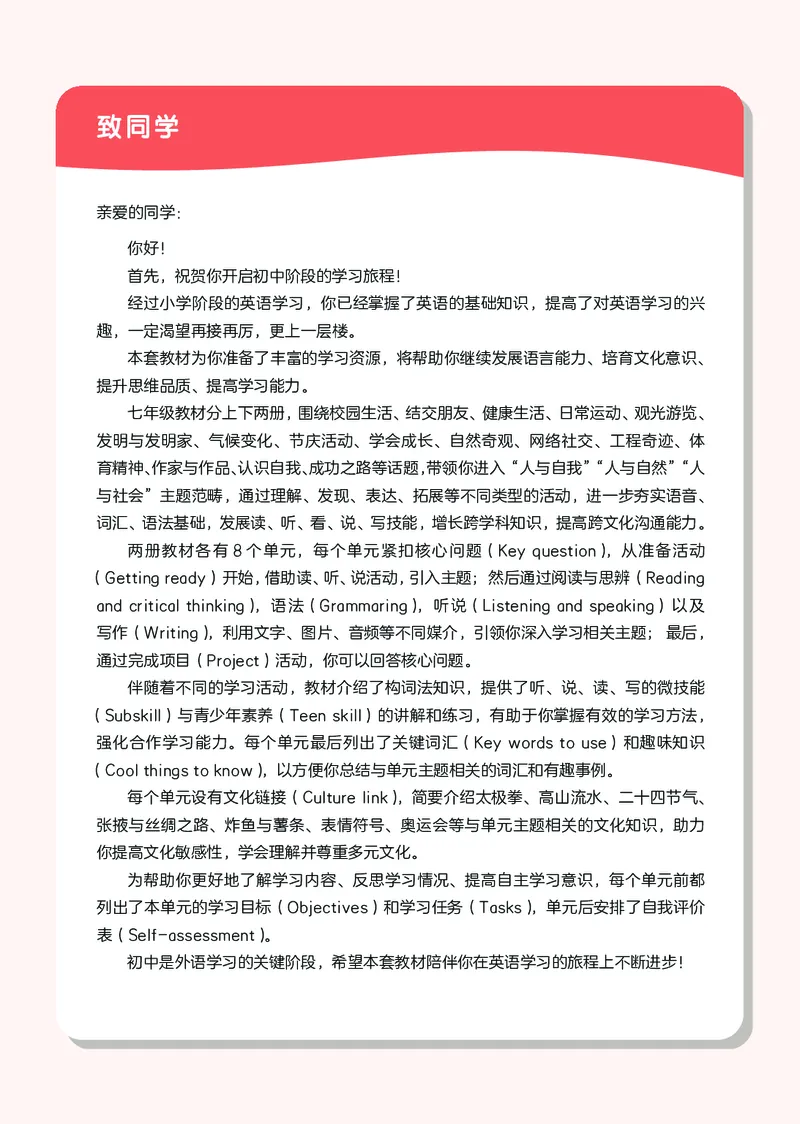
亲爱的同学:
你好!
首先,祝贺你开启初中阶段的学习旅程!
经过小学阶段的英语学习,你已经掌握了英语的基础知识,提高了对英语学习的兴
趣,一定渴望再接再厉,更上一层楼。
本套教材为你准备了丰富的学习资源,将帮助你继续发展语言能力、培育文化意识、
提升思维品质、提高学习能力。
七年级教材分上下两册,围绕校园生活、结交朋友、健康生活、日常运动、观光游览、
发明与发明家、气候变化、节庆活动、学会成长、自然奇观、网络社交、工程奇迹、体
育精神、作家与作品、认识自我、成功之路等话题,带领你进入“人与自我”“人与自然”“人
与社会”主题范畴,通过理解、发现、表达、拓展等不同类型的活动,进一步夯实语音、
词汇、语法基础,发展读、听、看、说、写技能,增长跨学科知识,提高跨文化沟通能力。
两册教材各有8个单元,每个单元紧扣核心问题(Key question),从准备活动
(Getting ready)开始,借助读、听、说活动,引入主题; 然后通过阅读与思辨(Reading
and critical thinking),语法(Grammaring),听说(Listening and speaking)以及
写作(Writing),利用文字、图片、音频等不同媒介,引领你深入学习相关主题; 最后,
通过完成项目(Project)活动,你可以回答核心问题。
伴随着不同的学习活动,教材介绍了构词法知识,提供了听、说、读、写的微技能
(Subskill)与青少年素养(Teen skill)的讲解和练习,有助于你掌握有效的学习方法,
强化合作学习能力。每个单元最后列出了关键词汇(Key words to use)和趣味知识
(Cool things to know),以方便你总结与单元主题相关的词汇和有趣事例。
每个单元设有文化链接(Culture link),简要介绍太极拳、高山流水、二十四节气、
张掖与丝绸之路、炸鱼与薯条、表情符号、奥运会等与单元主题相关的文化知识,助力
你提高文化敏感性,学会理解并尊重多元文化。
为帮助你更好地了解学习内容、反思学习情况、提高自主学习意识,每个单元前都
列出了本单元的学习目标(Objectives)和学习任务(Tasks),单元后安排了自我评价
表(Self-assessment)。
初中是外语学习的关键阶段,希望本套教材陪伴你在英语学习的旅程上不断进步!Map of the Book
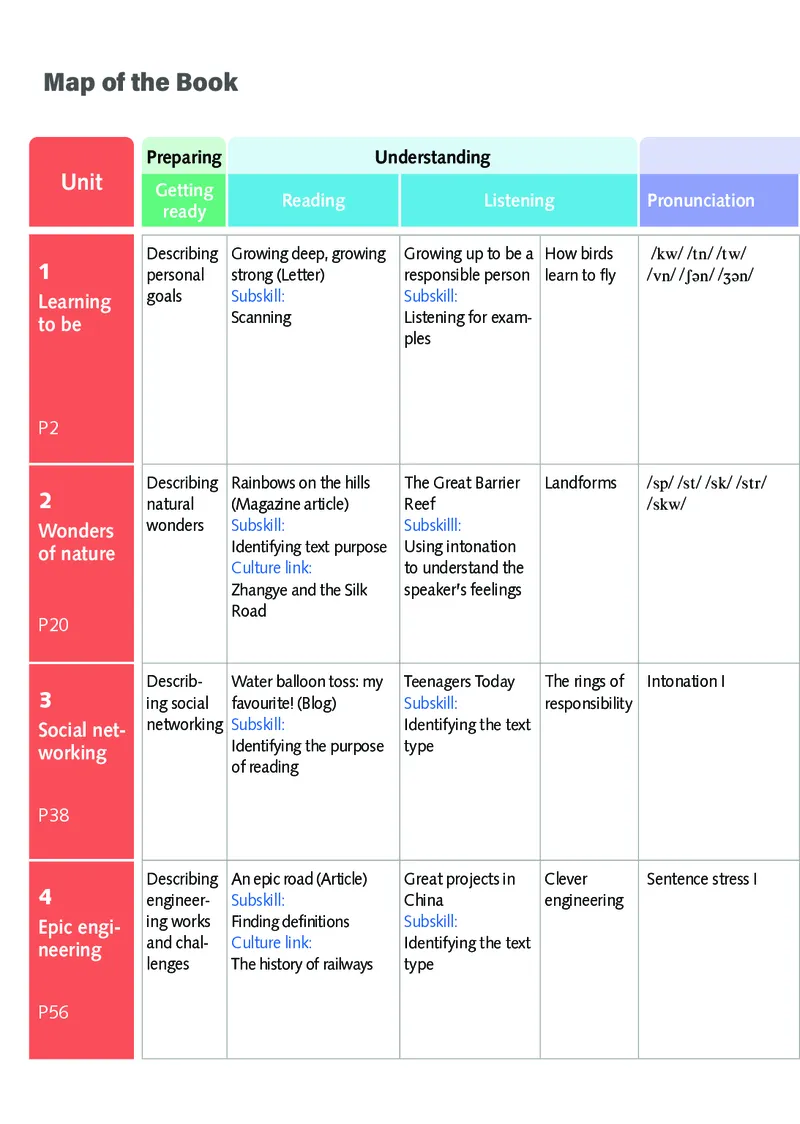
Preparing Understanding
Unit
Getting Critical
Reading Listening Pronunciation Vocabulary Grammaring Speaking Writing Project
ready thinking
S p e a k i n g
Describing Growing deep, growing Growing up to be a How birds /kw/ /tn/ /tw/ Describing per- will and be Plans for the A letter to my Making a connec- Creating a time
1
personal strong (Letter) responsible person learn to fly /vn/ /ʃən/ /Zən/ sonal goals going to future future self tion between the box
Learning goals Subskill: Subskill: Taking action Subskill: Subskill: plants' new pots
Scanning Listening for exam- Phrasal verbs Expressing inter- Writing a topic and the challenges
to be
ples est in ideas we sentence in your life
hear
Culture link:
Sayings about
P2 the importance
of taking action
Describing Rainbows on the hills The Great Barrier Landforms /sp/ /st/ /sk/ /str/ Describing natural Comparatives Experiences with A description of Analysing persua- Creating a video
2
natural (Magazine article) Reef /skw/ wonders and superla- different land- nature sive language to
Wonders wonders Subskill: Subskilll: Expressing tives forms Subskill: identify facts and
Identifying text purpose Using intonation amazement Using persua- opinions
of nature
Culture link: to understand the Abbreviation sive language
Zhangye and the Silk speaker's feelings
Road
P20
Describ- Water balloon toss: my Teenagers Today The rings of Intonation I Social networking Alternative Sharing your Text messages Analysing online Doing a survey
3
ing social favourite! (Blog) Subskill: responsibility Screen-life questions rings of respon- Subskill: behaviour and Teen skill:
Social net- networking Subskill: Identifying the text balance Indefinite sibility Using a friendly giving advice Deciding on
Identifying the purpose type Differences pronouns tone in invita- roles in a group
working
of reading between British tions work
and American Culture link:
P38 English The language of
emojis
Describing An epic road (Article) Great projects in Clever Sentence stress I Describing engi- although and Talking about A description of Creating tips Making a build-
4 engineer- Subskill: China engineering neering works though the Grand Canal an engineering for a trip on the ing plan
Epic engi- ing works Finding definitions Subskill: Dealing with chal- in China wonder Qinghai–Xizang Teen skill:
and chal- Culture link: Identifying the text lenges Subskill: Subskill: Railway by Giving praise
neering
lenges The history of railways type across, along, Checking under- Using an outline analysing the
over, and through standing challenges and
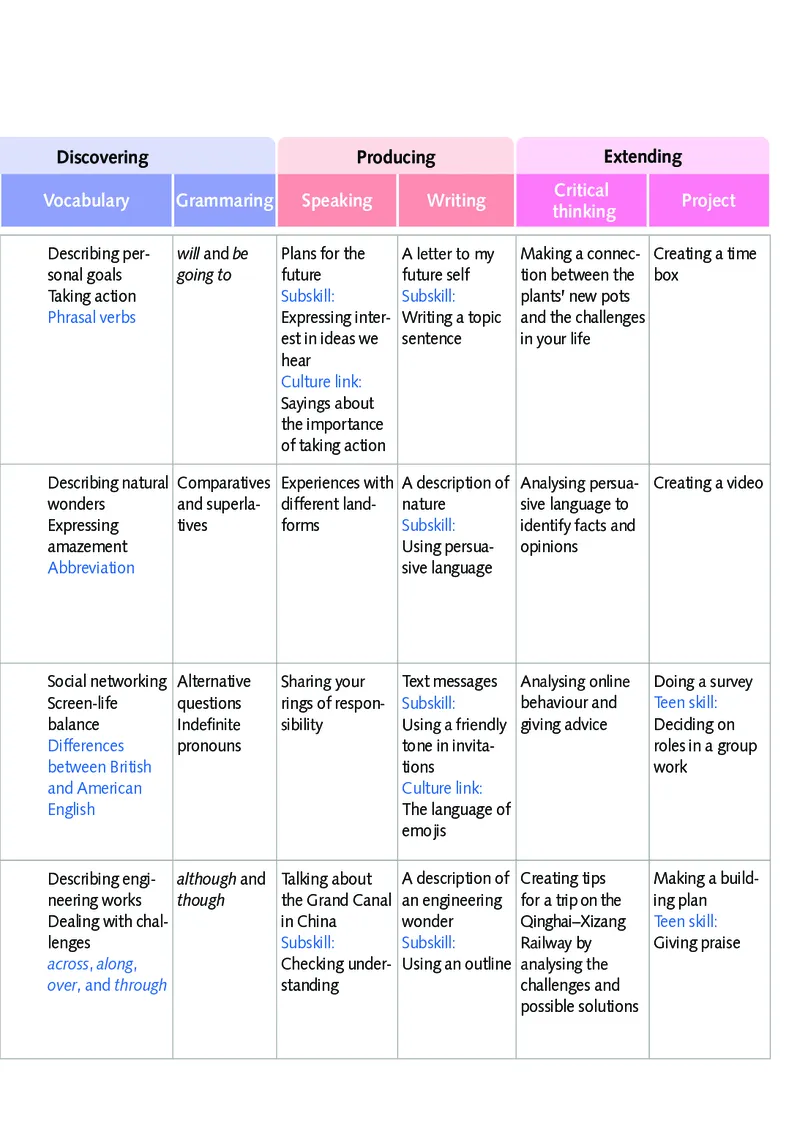
P56 possible solutionsDiscovering Producing Extending
Getting Critical
Reading Listening Pronunciation Vocabulary Grammaring Speaking Writing Project
ready thinking
S p e a k i n g
Describing Growing deep, growing Growing up to be a How birds /kw/ /tn/ /tw/ Describing per- will and be Plans for the A letter to my Making a connec- Creating a time
1
personal strong (Letter) responsible person learn to fly /vn/ /ʃən/ /Zən/ sonal goals going to future future self tion between the box
Learning goals Subskill: Subskill: Taking action Subskill: Subskill: plants' new pots
Scanning Listening for exam- Phrasal verbs Expressing inter- Writing a topic and the challenges
to be
ples est in ideas we sentence in your life
hear
Culture link:
Sayings about
P2 the importance
of taking action
Describing Rainbows on the hills The Great Barrier Landforms /sp/ /st/ /sk/ /str/ Describing natural Comparatives Experiences with A description of Analysing persua- Creating a video
2
natural (Magazine article) Reef /skw/ wonders and superla- different land- nature sive language to
Wonders wonders Subskill: Subskilll: Expressing tives forms Subskill: identify facts and
Identifying text purpose Using intonation amazement Using persua- opinions
of nature
Culture link: to understand the Abbreviation sive language
Zhangye and the Silk speaker's feelings
Road
P20
Describ- Water balloon toss: my Teenagers Today The rings of Intonation I Social networking Alternative Sharing your Text messages Analysing online Doing a survey
3
ing social favourite! (Blog) Subskill: responsibility Screen-life questions rings of respon- Subskill: behaviour and Teen skill:
Social net- networking Subskill: Identifying the text balance Indefinite sibility Using a friendly giving advice Deciding on
Identifying the purpose type Differences pronouns tone in invita- roles in a group
working
of reading between British tions work
and American Culture link:
P38 English The language of
emojis
Describing An epic road (Article) Great projects in Clever Sentence stress I Describing engi- although and Talking about A description of Creating tips Making a build-
4 engineer- Subskill: China engineering neering works though the Grand Canal an engineering for a trip on the ing plan
Epic engi- ing works Finding definitions Subskill: Dealing with chal- in China wonder Qinghai–Xizang Teen skill:
and chal- Culture link: Identifying the text lenges Subskill: Subskill: Railway by Giving praise
neering
lenges The history of railways type across, along, Checking under- Using an outline analysing the
over, and through standing challenges and
P56 possible solutionsMap of the Book
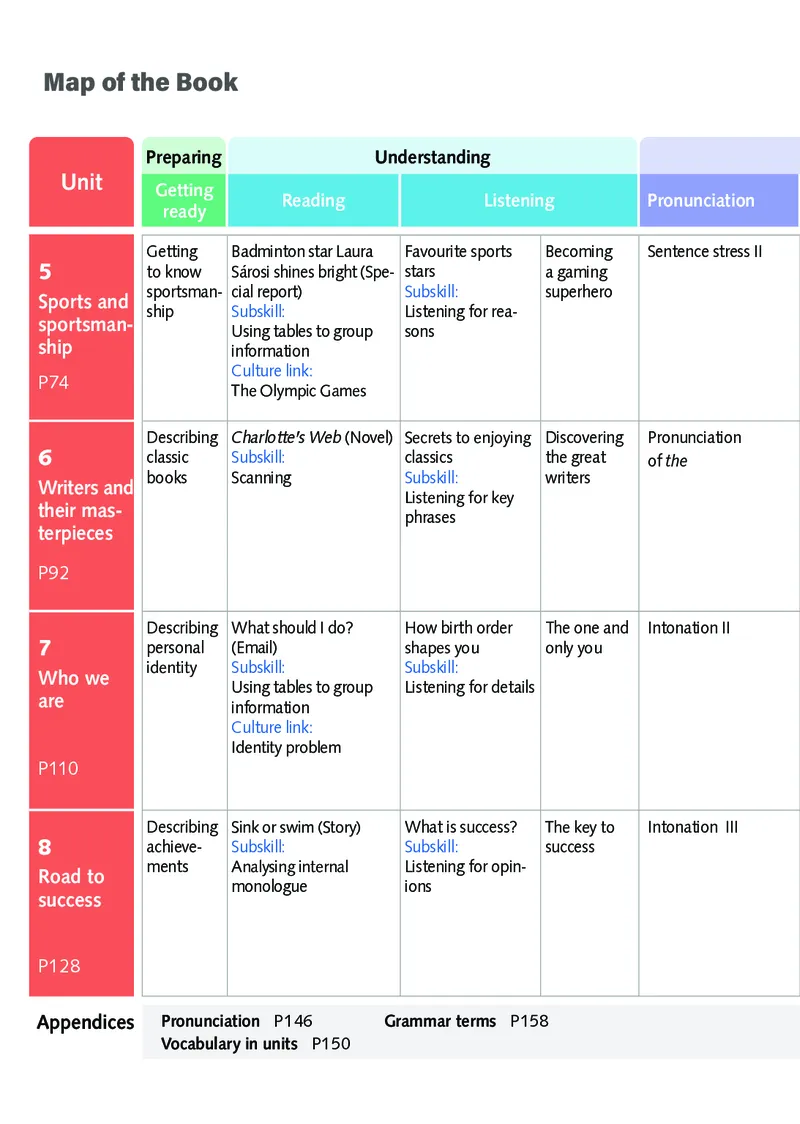
Preparing Understanding
Unit
Getting Critical
Reading Listening Pronunciation Vocabulary Grammaring Speaking Writing Project
ready thinking
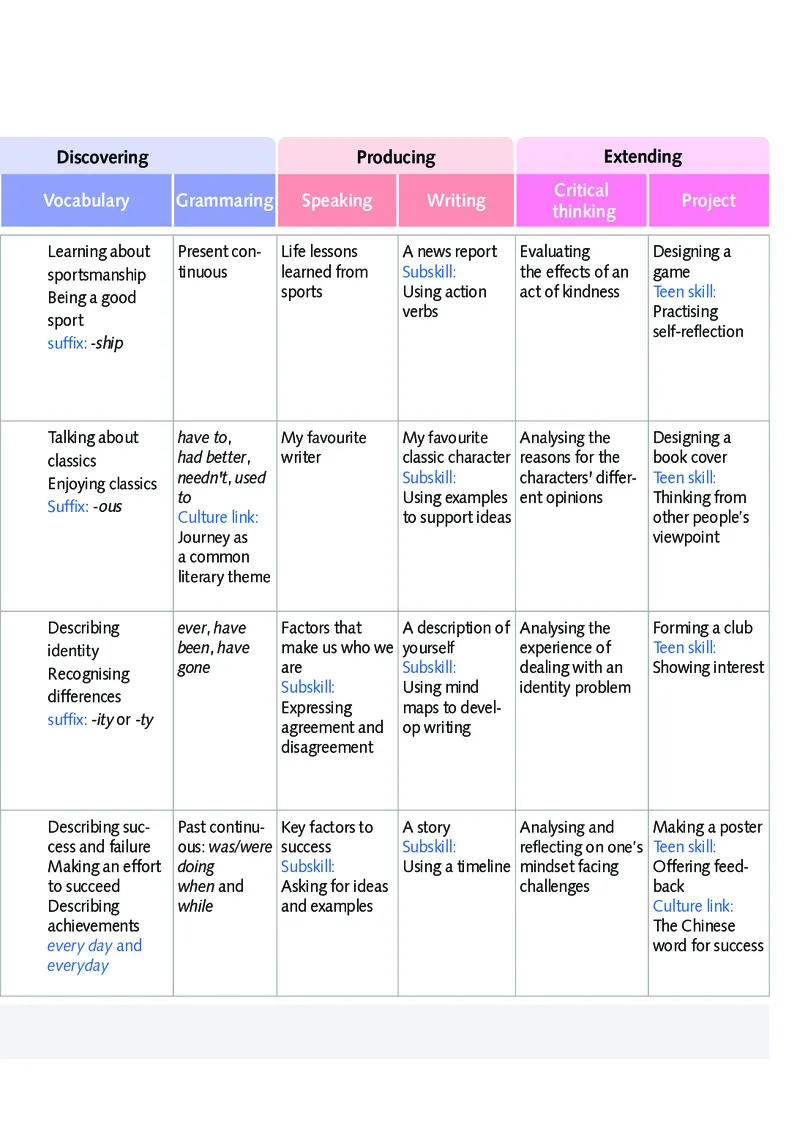
Getting Badminton star Laura Favourite sports Becoming Sentence stress II Learning about Present con- Life lessons A news report Evaluating Designing a
5 to know Sárosi shines bright (Spe- stars a gaming sportsmanship tinuous learned from Subskill: the effects of an game
sportsman- cial report) Subskill: superhero sports Using action act of kindness Teen skill:
Sports and Being a good
ship Subskill: Listening for rea- verbs Practising
sportsman- sport
Using tables to group sons self-reflection
ship suffix: -ship
information
Culture link:
P74
The Olympic Games
Describing Charlotte's Web (Novel) Secrets to enjoying Discovering Pronunciation Talking about have to, My favourite My favourite Analysing the Designing a
6 classic Subskill: classics the great of the classics had better, writer classic character reasons for the book cover
books Scanning Subskill: writers needn't, used Subskill: characters' differ- Teen skill:
Writers and Enjoying classics
Listening for key to Using examples ent opinions Thinking from
their mas- Suffix: -ous
phrases Culture link: to support ideas other people’s
terpieces
Journey as viewpoint
a common
P92
literary theme
Describing What should I do? How birth order The one and Intonation II Describing ever, have Factors that A description of Analysing the Forming a club
7 personal (Email) shapes you only you identity been, have make us who we yourself experience of Teen skill:
identity Subskill: Subskill: gone are Subskill: dealing with an Showing interest
Who we Recognising
Using tables to group Listening for details Subskill: Using mind identity problem
are differences
information Expressing maps to devel-
suffix: -ity or -ty
Culture link: agreement and op writing
Identity problem disagreement
P110
Describing Sink or swim (Story) What is success? The key to Intonation III Describing suc- Past continu- Key factors to A story Analysing and Making a poster
8 achieve- Subskill: Subskill: success cess and failure ous: was/were success Subskill: reflecting on one’s Teen skill:
ments Analysing internal Listening for opin- Making an effort doing Subskill: Using a timeline mindset facing Offering feed-
Road to
monologue ions to succeed when and Asking for ideas challenges back
success
Describing while and examples Culture link:
achievements The Chinese
every day and word for success
P128 everyday
Appendices Pronunciation P146 Grammar terms P158
Vocabulary in units P150Discovering Producing Extending
Getting Critical
Reading Listening Pronunciation Vocabulary Grammaring Speaking Writing Project
ready thinking
Getting Badminton star Laura Favourite sports Becoming Sentence stress II Learning about Present con- Life lessons A news report Evaluating Designing a
to know Sárosi shines bright (Spe- stars a gaming sportsmanship tinuous learned from Subskill: the effects of an game
sportsman- cial report) Subskill: superhero sports Using action act of kindness Teen skill:
Being a good
ship Subskill: Listening for rea- verbs Practising
sport
Using tables to group sons self-reflection
suffix: -ship
information
Culture link:
The Olympic Games
Describing Charlotte's Web (Novel) Secrets to enjoying Discovering Pronunciation Talking about have to, My favourite My favourite Analysing the Designing a
classic Subskill: classics the great of the classics had better, writer classic character reasons for the book cover
books Scanning Subskill: writers needn't, used Subskill: characters' differ- Teen skill:
Enjoying classics
Listening for key to Using examples ent opinions Thinking from
Suffix: -ous
phrases Culture link: to support ideas other people’s
Journey as viewpoint
a common
literary theme
Describing What should I do? How birth order The one and Intonation II Describing ever, have Factors that A description of Analysing the Forming a club
personal (Email) shapes you only you identity been, have make us who we yourself experience of Teen skill:
identity Subskill: Subskill: gone are Subskill: dealing with an Showing interest
Recognising
Using tables to group Listening for details Subskill: Using mind identity problem
differences
information Expressing maps to devel-
suffix: -ity or -ty
Culture link: agreement and op writing
Identity problem disagreement
Describing Sink or swim (Story) What is success? The key to Intonation III Describing suc- Past continu- Key factors to A story Analysing and Making a poster
achieve- Subskill: Subskill: success cess and failure ous: was/were success Subskill: reflecting on one’s Teen skill:
ments Analysing internal Listening for opin- Making an effort doing Subskill: Using a timeline mindset facing Offering feed-
monologue ions to succeed when and Asking for ideas challenges back
Describing while and examples Culture link:
achievements The Chinese
every day and word for success
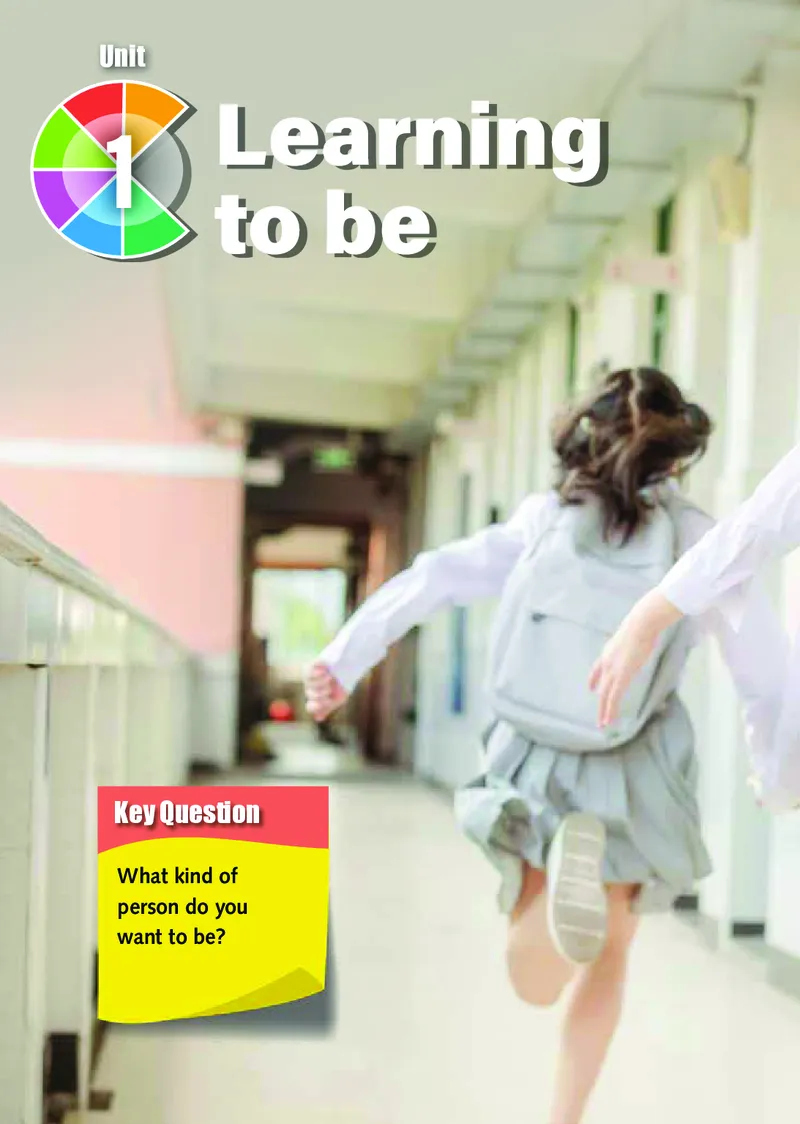
everydayUnit
L e a r n i n g
1
t o b e
Key Question
What kind of
person do you
want to be?Objectives Tasks
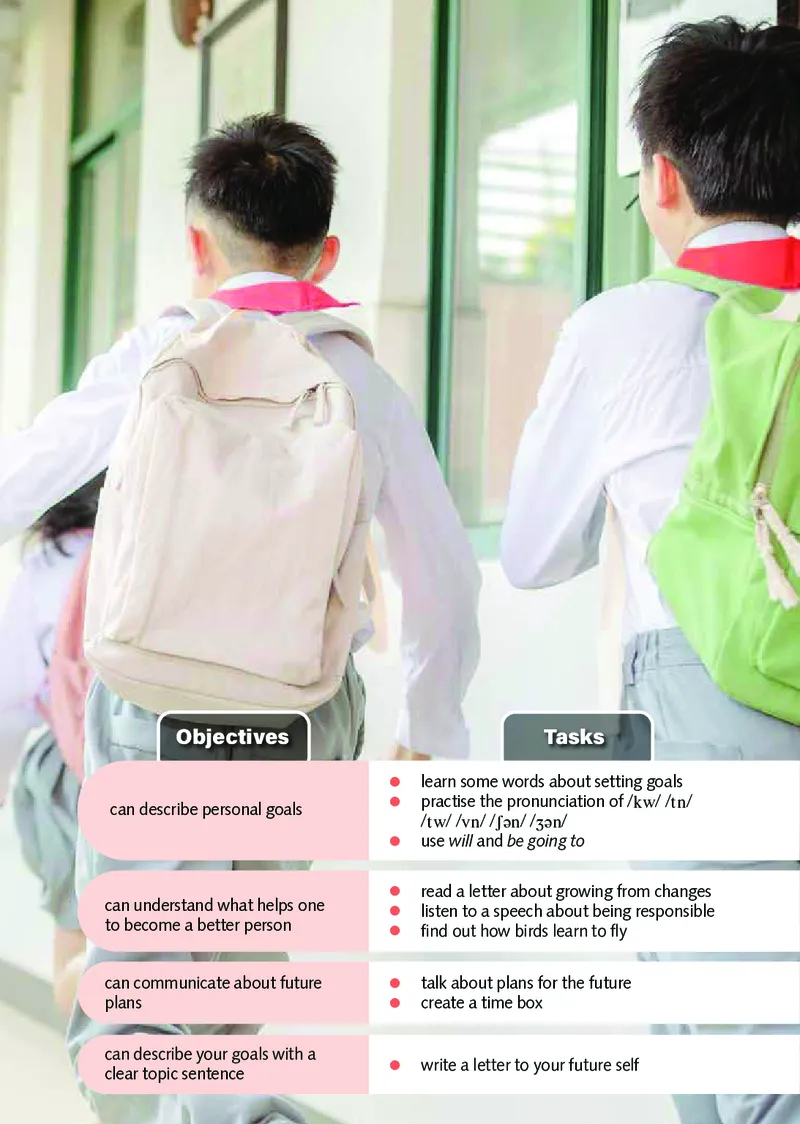
learn some words about setting goals
practise the pronunciation of /kw/ /tn/
can describe personal goals
/tw/ /vn/ /S@n/ /Z@n/
use will and be going to
read a letter about growing from changes
can understand what helps one
listen to a speech about being responsible
to become a better person
find out how birds learn to fly
can communicate about future talk about plans for the future
plans create a time box
can describe your goals with a
write a letter to your future self
clear topic sentenceAA
GGeettttiinngg rreeaaddyy
b
c
a
e
f
d
Phrasal verbs
Describing personal goals
A phrasal verb is made up of a verb
and one or more prepositions or
A1 As the new year begins, we feel the need to
adverbs. Some phrasal verbs are
make changes in our lives. Read the mini-texts
separable, e.g. tidy sth up = tidy up
and match the pictures with what Linlin and sth. Some phrasal verbs cannot be
separated, e.g. get along with.
Zihao have planned to do in this new term.
A2 Complete the chart with the changes and reasons why Linlin and Zihao want to
make each change.
Changes Reasons
Write a short essay every week. Hope to improve English grades.
4 Unit 1AA
Linlin
2 “I want to ____________ between life
I’ve set a goal to write a short
and study, so I joined the chess club
essay every week. I hope to
improve my English and get good this year. I find chess interesting but
grades. difficult, so I keep learning from others.
I want to get along with my Happily, I ____________ others and I’m
classmates. I will cooperate with making some new friends!”
others in group projects and
listen carefully to their ideas and
feelings.
I’m going to learn to dance. I’d
like to have some fun and keep a
balance between life and study. A4 Listen to a conversation and choose
the correct answers.
Zihao
1 What is Jack’s goal for the new year?
I want to be good at public
a To join the football team.
speaking. I will learn to express
b To build a football team.
myself clearly and explain with
2 Why does he want to make this
examples.
change?
I am going to read regularly and I
a To develop his skills.
have made a plan to spend about
b To make more friends.
half an hour a day reading. I really
3 How will Jack achieve his goal?
want to read more.
I can help more with housework.
a He’ll go to football training regularly.
I will do the cleaning and tidy up b He’ll learn to be a good team player.
my room every week.
A5 Work in pairs. Discuss with your
partner what changes you would like
A3 Complete the sentences that talk about to make in this new term.
changes with the expressions from the
What changes are you thinking
mini-texts.
about?
1 “My friends and I have
I’m going to read more books this
to start our own
term. I’ll read for at least 20 minutes
band next summer. We have
every day.
for ourselves that
we will create at least three songs That’s a great idea! Reading more
together. I can sing, but I can help with our studies. For me,
I’ll be more friendly and helpful to
can’t play an instrument,
others. I want to get along with my
so I’m taking a class to
classmates.
learn the guitar. It’s so
much fun!”
That’s a nice goal!
Learning to be 5BB B
RReeaaddiinngg aanndd ccrriittiiccaall tthhiinnkkiinngg
We always make changes to become the
person we want to be. Sometimes, unhappy
changes may happen to us. How can we face
change? Read this letter to find out.
GGrroowwiinngg ddeeeepp,, ggrroowwiinngg
ssttrroonngg
15 February
Hi Brad,
S fi o rs rr t y t t im o e h e n a e r x t t h w a e t e k y . o I u ’m w g er o e in w g o t r o ri e s d h a a r b e o a u t s g to iv r in y g a n a d p h u o bl p ic e s it p w ee il c l h h e f l o p r y t o h u e
feel better.
L s a h s e t s s a p w r i s n o g m , m e y p l m an o t t s h e in r a s n m d a I l l w p e o r t e s w , o s r h k e i n s g a i t d o , g “ e W t e h e w r i l i l n d t ig h e t h g e a m rd e o n u . t W a h n e d n
move them to bigger pots.”
“Won’t it hurt them? I think it is safe for them to stay where they are.” I
was worried.
M po y t m w o il t l h b e e r d d if u f g ic a u l p t. l a T n o t s o u u r t v . i v “ e I , t t w h o e n r ’ o t o h t u s r t w i t l h l g em ro , w ” s b h ig e g s e a r i a d n . d “L s if t e r o in n g th e e r. new
Stronger roots will make a stronger plant.”
And now, the plants grow very well in their new, big pots.
O I c r e h h f m t a a e v n e n e g m , e b b w e b e h e e r e n n m h d a c y u r h d g m a u f n o o p g t r h e a m e n c r e o d ’s ? m t w W u e o s r o r n n d m e ’ s t d y : i u t T w p h a b s a y e t i , d g ’ I s e o f h e o d e o d o l w w i l f i n t k I h e . s I e t t a h r a m o o y o s g w t e s o h l i i e n g t r t g r e o l e t I w o p a d l m w a e o n ? e r t p T r s y h a — . e n W n d I o I f s e n w t e ’t i r l l l o l t i n k h g e is .
How did you like my story? Please let me know when you write back.
Best wishes,
Linda
666 UUUnnniiittt 111B BB
Reading and critical thinking
Comprehension
B1 Answer the questions. Subskill Scanning
1 Who sent this letter?
2 What was Brad worried about?
3 What did Linda’s mother do with the plants?
4 Why was Linda worried about the plants?
5 Did the plants survive in their new pots?
6 Why did Linda say that she felt like those plants?
B2 Choose the correct answers.
1 Why did Linda write this letter?
a To ask Brad for gardening advice.
b To share her own worries with Brad.
c To share a life lesson and encourage Brad.
2 What did Linda learn from her mother’s words about the plants?
a It’s best to leave plants to grow in small pots.
b Change can be difficult but it leads to growth.
c Plants need a lot of sunlight to grow well.
B3 Put the pictures in the correct order. Then retell Linda’s story about the plants
in your own words.
a b c d
→ → →
Learning to be 7BB B
RReeaaddiinngg aanndd ccrriittiiccaall tthhiinnkkiinngg
Word work
B4 Write the words from the text according to their meanings. Then complete the
sentences with their correct forms.
1 continue to live
2 happen towards someone
3 want something to happen
4 uncover (something underground) by moving earth, soil,
or sand
5 tell other people your ideas, feelings, or experiences
a I do everything goes well.
b Are you surprised at the of the little plant after the big storm?
c The children love to around in the sand to find hidden
treasures.
d Would you like to your experience with the rest of the group?
e You can get through whatever , whatever happens.
B5 Complete the report about a public speaking experience with the words and
expression in the box.
upside down hurt share grow worried
I was seriously 1 about giving my first public speech.
My stomach felt 2 as I stood in front of the crowd. I could
hardly hear my own words as I began. But the crowd fell silent. Then I
remembered the advice my friend had 3 , so I spoke slowly
but clearly. I could see people nodding and I found myself enjoying
this new experience. I realised that taking on challenges doesn’t
4 me. Instead, it helps me to 5 and know what
I can do.
88 Unit 1B BB
Reading and critical thinking
Critical thinking
1 Understand. What do you think is Brad’s “new pot”? Tick and
explain your choice.
start a new hobby
live in another city
take part in a new activity
learn something new
deal with a problem
make new friends
2 Apply. Have you ever been in a situation similar to Brad's? Share
your experience of growing strong in a “new pot”.
EXAMPLE
When I studied in a new school, I felt like being moved into a
new pot. I had no friends there. To make some new friends,
I joined a drama club. I also talked to my parents about my
worries. ...
Learning to be 999CC
GGrraammmmaarriinngg
will and be going to
C1 Study the blue parts and answer the questions.
1 I’m going to share a story.
2 We will dig them out and move them to bigger pots.
3 Life in the new pot will be difficult for the plant.
4 I am going to worry.
Q1 Is sharing a story a planned action?
Q2 When did the mother decide to move the plants?
Q3 Does the speaker believe that life in the new pot will be difficult?
Q4 Is the speaker pretty sure about her future worries?
Grammar highlights
• We use will to talk about a new decision. When we have already decided to do
something, we use be going to.
• We use both will and be going to for future happenings.
• When we say something will happen, we think something is likely to happen.
• We use be going to to predict something that we think is certain to happen.
C2 Complete the sentences using will or be going to.
1 After I graduate from high school, I’m going to attend (I; attend) medical
school and become a doctor. I have always wanted to be a doctor.
2 I have borrowed a book from the library. This weekend,
(I; stay) at home and start reading it.
3 Just a moment. (I; help) you with that maths problem.
4 A: I don’t know how to do this project.
B: It’s OK. We are a team. (we; work) together to solve the problem.
10 Unit 1CCC
5 A: I forgot to wear a T-shirt. I can’t go to football training after school.
B: Don’t worry. (I; lend) you one.
6 A: Has Dandan decided what changes to make in this new term?
B: Yes. Everything is planned. First, (she; join) the drama club.
Second, (she; learn) to play volleyball.
C3 Match the sentence parts.
1 Why don’t you come and visit the a I think he’s going to fall
museum with us? asleep.
2 He looks very tired. b He’ll give us some useful
3 I’m sorry I made you so disappointed. advice.
4 The book is thick. c I’m not going to finish it
5 Let’s ask our teacher for help. tonight.
6 The sports meeting starts in five d You’ll enjoy it.
minutes and it takes 15 minutes to e We’re going to be late.
get there. f I won’t do it again.
C4 Choose the sentences that are more common. If both are very common, tick
the third choice.
1 Are you going to play basketball after school today?
Will you play basketball after school today?
Both sentences are very common.
2 Let’s ask Jack how to solve this problem. He’s going to know.
Let’s ask Jack how to solve this problem. He’ll know.
Both sentences are very common.
3 I’m going to need your help in the garden tomorrow.
I’ll need your help in the garden tomorrow.
Both sentences are very common.
4 If she doesn’t start working harder, she’s going to fail the test.
If she doesn’t start working harder, she’ll fail the test.
Both sentences are very common.
Learning to be 1111D
Listening and speaking
Subskill Listening for examples
Growing up to be a responsible
Speakers often give an example to
person
make their ideas clearer and easier
to understand. Words that give an
D1 What do you think it means to be a example: for example, like, such as.
responsible person? Tick and explain.
a Finish your
b Help with c Take care of
homework.
housework. your pets.
d Be careful
e Return f Say sorry
when
library books when you
cycling.
on time. are wrong.
D2 Listen and choose the best answers.
1 What is the main idea of this speech?
a Why being responsible is important. b What it means to be responsible.
c How we can become responsible.
2 How many examples are given by the speaker?
a Three. b Four. c Five.
D3 Listen again and put examples into the table.
Taking care of yourself Being helpful to others
D4 In pairs, ask and answer the questions.
Do you think you are a responsible person? Can you give some examples to show
that you are or you are not?
How birds learn to fly
D5 Listen and put the descriptions in the correct order.
a The bird leaves the nest. b The bird spreads wings.
c The bird flaps wings. d The bird falls off the branch.
_____ → _____ → _____ → _____
12 Unit 1D
D6 Listen and make a connection between how a bird learns to fly and how we
learn to grow.
The bird learns to fly We learn to grow
1 Falls off the branch. a Reach new goals.
2 Leaves the nest. b Experience challenges.
3 Flies high. c Keep trying.
4 Spreads wings and flaps. d Step out of our comfort zones.
D7 Discuss the question.
Subskill Expressing interest in ideas we hear
How does this material get your attention and
During a conversation or informal discussion, it’s
make you think? Think about the background
important to let other people know that we are
music, the speaker’s voice, and the pictures.
interested in what they are saying. We can give
our opinions, e.g. Great! That’s fantastic! We can
also ask follow-up questions, e.g. What are you
Plans for the future
going to do? Why do you want to do this?
D8 What are your goals for the near and far future? What will you do to achieve
them? Complete the chart. Then discuss your goals and plans with your partner.
Goals Plans
Pronunciation
/kw/ /tn/ /tw/ /vn/
1. Join the public speaking club. /S@n/ /Z@n/
Be good at public ( see p146 )
2. Study the great speakers.
speaking.
3. Practise speaking in front of the mirror.
EXAMPLE
Culture link
A: My goal is to be good at public speaking.
B: What are you going to do to achieve your “A journey of a thousand miles
goal? begins with the first step.” That’s a
popular saying in China. It tells us
A: I’m going to join the public speaking club.
that big goals can be achieved if we
I’ll learn from others and study the great
start with a small action and keep
speakers. I’ll also practise regularly. Every
moving forward. There is a similar
weekend I’ll practise speaking in front of English saying that highlights the
the mirror. importance of taking action, “Actions
speak louder than words.”
B: Great! I'm sure you can do it!
Learning to be 13E
Writing
A letter to my future self
Subskill Writing a topic sentence
How do you see yourself in ten years’ time?
A topic sentence is often the first
Where will you be? What will you be doing? sentence of a paragraph. It tells
the reader what the paragraph will
Do you become the person you want to be?
be about in a clear and direct way.
How will you make that happen? Write a
letter to your future self.
11 SSttuuddyy aa mmooddeell.. Read the letter and complete the three tasks.
18 February, 2025
Dear future me,
Biology is my favourite subject at school,
a t o p h n f e e d o c p a e I l x r e h p i n a e a g v r n e ie d f o n a r m c g e o a r t k o e h e a f e t h a r s e in r . lp e t I a i e n w l r g e a d s n o if t t u f e t i t n r o e a l n t e b c a e t e r c h . n o e I i m n r c g e e o a m a a ll b m y d o u h u o n o t c i p t t h o e y o r t w c s h e o a o n t t u t r r h y e o a b s u t o h , d I o i m e c w s a y s n w f m u h o t e e r u k l t p r . e h A m e s l s o j e o o r lf y e , ,
will make this dream come true. Keep doing your best!
Best wishes,
Yuxuan
1 The letter needs a topic sentence. Tick the one that can be used as a topic
sentence.
a How is everything going?
b This letter will help you remember the past.
c It must be very exciting to travel around the world!
d Hope you are getting closer to your dream of becoming a doctor!
e My love of science and helping others is shaping my dream of
becoming a doctor.
1144 Unit 1E
2 Tick the picture that shows the structure of this model letter.
3 The topic sentence shows the topic and the main idea the paragraph will
be about. Read the example and write a topic sentence.
EXAMPLE
• Topic: stepping out of your comfort zone
• Main idea: benefits
• Topic sentence: There are a number of benefits to stepping out of your
comfort zone and challenging yourself.
• Topic: change
• Main idea: can help you grow
• Topic sentence: .
22 Think. In the letter to your future self, you can set goals, imagine what the
future will be like, or express your hopes. Name your topic and write your
topic sentence.
1 Name the topic.
2 State the letter’s main idea.
3 Write your topic sentence.
33 Write. Write your letter to your future self.
44 Check. Read your letter and answer the questions.
1 Did you write a clear topic sentence?
2 Did you support your topic sentence with details?
55 PPeeeerr rreevviieeww.. Exchange your letter with your classmate. Answer the questions.
1 Does the letter include a clear topic sentence and supporting details?
2 Does he or she write to his or her future self?
3 Do you find the letter interesting? Why or why not?
Learning to be 1155FF
PPrroojjeecctt
What kind of Task: Create a time box for your future self. You
person do you will open it ten years later. Think about what you
want to be? are going to put in the box. Here are the things in
Yuxuan’s time box.
You are going to laugh after
reading it! It’s for you!
Be close to the people you
love.
I know you can be whatever
you want to be!
Remember your dream
of becoming a doctor?
You have a heart of gold. I’m studying really hard
now.
It’s a note from a stranger whom
I had helped. Helping others
always makes me happy.
1166 UUnniitt 11FF
Look at the things in Yuxuan’s time box and the words he left. Answer the
1
questions.
1 What is his dream?
2 What kind of person do you think he is?
3 Why do you think he chose those things?
Work in groups. Discuss what kind of person you want to be in the future. Talk
2
about your dreams and goals.
Make a list of the things you want to show to your future self. Write a
3
description for each object. Answer the questions.
1 Did you include a letter to your future self?
2 Have you made your goals clear?
Design your time box. The time box must last for a long time. So, it can’t be
4
damaged by water. Tick the useful materials for making a time box.
Put the things collected in your time box. Keep it in a safe place. Ask an adult
5
to help you if necessary. Then wait for the special day to open it!
LLeeaarrnniinngg ttoo bbee 1177SSeellff--aasssseessssmmeenntt
How well I can do these
A. identify the topic sentence and supporting
sentences
B. talk about future plans by using will and be
going to
C. ask and answer questions about future plans
D. understand old sayings about the importance
of taking action
E. make a connection between the text and
yourself
F. work together with others to create a time box
1188 Unit 1Add more! What other useful words
or cool things have you learned?
Key words to use Add them to the lists.
Describing personal goals
cooperate with get along with get good grades
help with housework keep a balance read regularly
set goals survive tidy up
Taking action
be responsible learn from others make changes
practise step out of the comfort zone
take on challenges
Cool things to know
comfort zone
LLeeaarrnniinngg ttoo bbee 1199Unit
Wo n d e r s
2
o f n a t u r e
Key Question
What makes
natural wonders
amazing?Objectives Tasks
learn new words about natural wonders
can describe the features of natu- practise the pronunciation of /sp/ /st/ /sk/ /str/
ral wonders /skw/
use comparatives and superlatives
read a travel guide to Zhangye Geopark
can find out what makes natural listen to a conversation about the Great Barrier
wonders beautiful Reef
learn about landforms
can discuss experiences with discuss experiences with different landforms
nature and make a recommen- create a video recommending a place to be
dation added to the Natural Wonders of the World
can introduce a natural wonder write about a natural wonder you have visited
using persuasive language or plan to visitAA
GGeettttiinngg rreeaaddyy
e At over 8,848 m
high, it is the highest
a It looks like a huge
mountain on Earth—
opening in the ground.
and one of the most
It is 445 km long, 24 km
dangerous to climb,
wide, and more than 1
but that doesn’t stop
km deep!
explorers!
b It is not just one
colourful coral reef.
It’s almost 3,000 of
them!
c It is the world’s largest d Imagine a waterfall so
natural bay. Its name powerful that it sounds
comes from the local like thunder! That’s
language and means the world’s largest
“a bay like a sea”. waterfall. It’s in Africa.
Describing natural wonders
A1 Read the definitions. Then match the pictures with the Seven Natural Wonders
of the World.
A bay is a part of the sea. It has land on three sides.
A canyon is a narrow, deep space cut by a river through rocks.
A waterfall forms when a river falls down from a high place.
A volcano is a mountain with a hole in the top that sometimes sends out hot rocks.
1 Parícutin Volcano 5 Mosi-oa-Tunya Falls
2 The Grand Canyon 6 Mount Qomolangma
3 The Guanabara Bay 7 The Great Barrier Reef
4 The Northern Lights
22 Unit 2AA
f They are lights of amazing shapes
A3 Complete the conversation about
and colours that dance in the sky.
natural wonders with the correct
People can have the best view of
forms of the words in the box.
them in the Arctic.
amazing imagine natural view
A Have you ever thought about why
natural wonders are so 1 ?
B Yes! One reason is their great sizes.
For example, the Guanabara Bay is
larger than any other 2 bay.
A That’s right! I think another reason
is that they show the Earth’s power.
g It is the only volcano that humans
have ever seen form. It appeared 3 Parícutin grew from a plain
in a plain and grew into a new into a 424-metre-high volcano in two
volcano in just two years!
years!
B Certainly! They also have special
features. Visiting the Grand Canyon
is like looking into the Earth’s history
book.
A And they offer wonderful 4 .
The Northern Lights can paint the sky
with magical colours.
B Yes, these natural wonders remind us
of the beauty of our planet.
A2 Listen to a short introduction to
the Seven Natural Wonders and A4 Work in pairs and discuss which
write T (true) or F (false). of the Seven Natural Wonders you
would like to visit.
1 There is a widely accepted list
Which of the Seven Natural Wonders
of the Seven Natural Wonders
would you like to visit?
of the World.
2 The list is made to encourage
I want to see the dancing Northern
people to discover the beauty
Lights. It’s like magic up in the sky!
of nature. How about you?
3 The only way to enjoy the
The place I would most like to visit
Seven Natural Wonders is to
is the Grand Canyon because ...
visit them.
Wonders of nature 23BB B
RReeaaddiinngg aanndd ccrriittiiccaall tthhiinnkkiinngg
What information would you expect to find in a travel guide to a natural
wonder? Write what you think, then read to check.
Rainbows on the hills
You are a nature lover? Then you must visit Zhangye Geopark in China! It’s
recognised by UNESCO as one of the best geoparks in the world. Here, you can see
the beauty of the rainbow hills.
They are low hills that look like waves and have many different colours, just
5 like a rainbow! There is little grass growing on the land. When you see the hills from
above, it’s like you’re looking at rainbows painted on the ground.
You may wonder how these colourful hills came to be. Millions of years ago,
this area was under a lake. Over time, rivers brought in sand and stones with different
kinds of metal elements. These were left in layers on the bottom of the lake. Some
10 layers were red, some yellow, and others turned purple or blue. Later, as the climate
became colder and drier, the lake dried up. Then, something amazing happened!
The underground land began to rise up and push against each other. The layers of
sandstone were lifted higher and higher. Through years of wind, sun, and rain, they
formed the colourful hills we see today.
15 June to September is the most wonderful time to visit. The mornings and
evenings are cooler than the hot days, giving you the perfect weather to enjoy the
sunrises and sunsets. Sunshine after a summer rain will make the colours even
brighter and more beautiful.
2244 UUnniitt 22B BB
Reading and critical thinking
Subskill Identifying text purpose
The purpose of a text is what the writer wants to achieve.
Analyse the language and think about: Where is the text from?
Who is it for? Was it written to explain, describe, or persuade?
For example, words like must and should often show that the
Comprehension
writer is persuading, or trying to make us believe something.
B1 What is the writer’s purpose? Tick and explain.
a To persuade and encourage readers to visit Zhangye Geopark.
b To share the facts about how the rainbow hills were formed.
c To make readers amazed at how the rainbow hills were created.
B2 Put the pictures in the correct order and explain in your own words how the
rainbow hills were formed.
a b c d
→ → →
B3 Are the sentences true or false, or is the information not given in the passage?
Circle T (true), F (false), or NG (not given). Correct the false sentences.
1 The rainbow hills in Zhangye Geopark are high mountains. T F NG
2 When seen from above, the hills look as if rainbows have
been painted on the ground. T F NG
3 Sand and stones formed layers of rock at the bottom of the lake. T F NG
4 Spring is the best time to visit Zhangye Geopark. T F NG
5 It is better to watch the sunrise or sunset on cloudy days. T F NG
6 The rainbow hills attract a large number of tourists and
scientists from around the world. T F NG
Culture link
Zhangye holds a special place in history
because it was an important stop on the
ancient Silk Road. The Silk Road connected
Asia with Europe. It carried goods and ideas
between Rome and China. Silk went west,
gold and silver went east.
Wonders of nature 25BB B
RReeaaddiinngg aanndd ccrriittiiccaall tthhiinnkkiinngg
Word work
B4 Complete the sentences with the correct forms of the words in the box.
bottom form layer push rainbow wave
1 If you drop a stone into a calm lake, it will make lots of that move away.
2 If the sun shines after the rain, it can create a pretty in the sky.
3 If the wind against the sandstone over time, it changes its shape.
4 If water collects in a lower part of the Earth’s surface, it will a lake.
5 If you build a sand town at the beach, you can use different of
sand to create towers and walls.
6 If you explore the of the
Abbreviation
mountains, you may discover
To abbreviate a word or sentence, letters
hidden waterfalls.
are dropped or only the first letter of each
word is used. For example, the United
B5 Complete the diary with the correct
Nations Educational, Scientific and Cultural
forms of the words from B4.
Organization is abbreviated as UNESCO.
Thursday, 21 August Sunny
My trip to Zhangye UNESCO Global Geopark was like entering an
amazing world of colourful hills. The hills looked like big 1
in different colours. They form a 2 on the ground! I have
learned that these hills were 3 a long, long time ago when
there was a big lake. 4 of sand and stones stayed at the
5 , and over time they became hills as the underground land
6 against each other. I visited the geopark in the summer,
so the mornings and evenings were nice and cool, and I saw the hills
shining under the bright sun. It was like a dream come true!
2266 Unit 2B BB
Reading and critical thinking
Critical thinking
1 Recall. Read the idea map and tick the information that is included in the
text.
the best time to visit
what the place is,
where it is
presenting a natural wonder what visitors can
what it looks like
do there
how it was formed what visitors say
about it
2 Understand. A fact is something we can prove to be true. For example:
“At over 8,848 m high, Mount Qomolangma is the highest mountain
on Earth.” An opinion is what someone thinks or believes. For example:
“Mount Qomolangma is one of the most dangerous mountains to
climb.” Are the following sentences facts or opinions? Write F (for facts)
or O (for opinions) and explain.
_____ 1 Nature lovers can see the rainbow hills in Zhangye Geopark.
_____ 2 Zhangye Geopark is one of the best geoparks in the world.
_____ 3 The rainbow hills were formed over millions of years.
_____ 4 The formation of the rainbow hills is truly amazing.
_____ 5 The best time to visit the rainbow hills is June to September.
_____ 6 Sunshine after a summer rain makes the rainbow hills a
perfect view.
3 Analyse. Does the writer like the rainbow hills?
How do you know? Give reasons for your opinion.
EXAMPLE
I think the writer loves the place because he or she uses positive
language such as “amazing”, “wonderful”, and “perfect” to describe
the rainbow hills. The writer also highlights that Zhangye Geopark is
recognised by UNESCO as one of the best geoparks in the world.
Wonders of nature 222777CC
GGrraammmmaarriinngg
Comparatives and superlatives
C1 Study the blue parts and answer the questions.
1 The mornings and evenings are cooler than the hot days.
2 The mornings and evenings are the coolest times.
3 June to September is the most wonderful time to visit.
4 June to September is a better time to visit than the other months.
Q1 Which sentences compare two things?
Q2 Which sentences compare three or more things?
Grammar highlights
-er and more ... are comparative forms. To compare two things, we use the
comparatives with than. To compare three or more things, we use the with the
superlatives. The superlative form is -est or most .... In general, we use -est for short
words and most ... for longer words.
C2 Read the sentences and complete the rules. Add examples
of comparative and superlative forms.
a The layers of sandstone were lifted higher and higher.
b The Sahara Desert is the world’s largest desert.
c The climate became colder and drier.
d The Great Barrier Reef is the biggest coral reef system in the world.
e Sunshine after a summer rain will make the colours even more beautiful.
f Zhangye Geopark is one of the best geoparks in the world.
g The Grand Canyon’s beauty and size make it one of the most easily
recognisable natural wonders on Earth.
1 For one-syllable words: add -er/-est
high → → highest
2 For one-syllable words ending in -e: add
large → → largest
3 For words ending in -y: drop and add
dry → drier →
4 For one-syllable words ending in vowel + consonant: double the
consonant and add
big → → biggest
28 Unit 2CCC
5 For words with two or more syllables: add
beautiful → more beautiful →
6 Some words are irregular:
good → better → best
7 For adverbs ending in -ly: add
easily → → most easily
C3 Circle the correct words to complete the sentences.
1 I want to visit Huangguoshu Falls someday. It looks really / more beautiful.
2 The Grand Canyon is amazing. But right now it is crowded / more crowded
than last year.
3 The Nile is longer / the longest river in the world. It can take months to travel
from one end to the other.
4 Mount Emei is nice / nicer. But Mount Taishan sounds more interesting / the
most interesting to me.
5 The Yangtze River is the third longer / longest river in the world.
C4 Read the table and write three sentences comparing the four oceans on Earth.
Surface Area (square Average Depth
Ocean
kilometres) (metres)
The Pacific Ocean about 165.2 million about 4,282
The Atlantic Ocean about 106.4 million about 3,926
The Indian Ocean about 70.6 million about 3,963
The Arctic Ocean about 14 million about 1,205
Example
The Pacific Ocean is the largest ocean in the world. It is larger than the other
oceans. It is deeper than the Atlantic Ocean.
C5 Complete the passage about the Li River with the correct forms of the given
words.
The Li River is one of 1 (famous) attractions in China. It is seen
as one of the world’s top ten watery wonders. It is known for some of the
2 (green) hills, 3 (clear) water, and strangest rocks that you
have ever seen. 4 (good) time to visit is during autumn when the trees
and plants have beautiful colours. Travelling along the Li River during this season
offers 5 (amazing) views than you can imagine.
WWoonnddeerrss ooff nnaattuurree 2299D
Listening and speaking
The Great Barrier Reef
D1 Listen and choose the best answer.
What is the most likely relationship between
the two speakers?
a Teacher and student.
b Tour guide and tourist.
c Mother and son.
D2 Listen again and complete the chart.
It is made up of thousands of smaller reefs.
You can see the reef from 2 .
1
about the Great
Barrier Reef It is home to about 3 kinds of coral.
Global warming makes some of the coral reefs
appear 4 .
Using intonation to understand
Subskill
the speaker’s feelings
D3 Answer the questions.
1 Which of the woman’s words surprises the man most?
2 How do you think we should look after the Great Barrier Reef?
Landforms
D4 Listen and pay attention to the pictures. Tick the landforms you have seen.
Volcano Hills Island Ocean
River Mountains Waterfall Plain
30 Unit 2D
D5 Listen and choose the best answers.
1 You may learn about landforms on the ___________ Channel on TV.
a News b Discovery c Film d Sports
2 Which of the following statements is NOT true?
a A mountain rises very high above the land around it.
b Volcanoes can create mountains as well as islands.
c An island must be a small piece of land separated by water.
d A plain is a very large area of flat land without hills.
D6 Answer the question.
Documentaries use a lot of bird’s eye view shots. Why do you think the video
makers did this?
Experiences with different landforms
D7 What kind of landforms are you familiar with? Work in pairs and discuss
your experiences with different landforms. Use the questions to help you.
• What’s the longest river you’ve ever seen?
Pronunciation
• What’s the highest mountain you’ve ever climbed? /sp/ /st/ /sk/ /str/ /skw/
( see p146 )
• What’s the largest lake you’ve ever been to in a boat?
• What’s the prettiest forest you’ve ever taken a photo of?
• What’s the most amazing place you’ve ever walked through?
Wonders of nature 31E
Writing
Subskill Using persuasive language
A description of nature
We often write about a natural wonder to encourage
Write about a place of the reader to visit it. When we write persuasively,
natural beauty. we use positive language, interesting facts, feelings,
and descriptive adjectives to persuade the reader to
agree with our opinion or take action.
11 Study a model.
A wonderful mountain
Mount Huangshan in Anhui is one of the most
famous mountains in China, and one of the most
visited. The Welcoming Pine welcomes millions of
travellers every year. There are rocky mountains
higher than the clouds and with more shapes
than you can imagine. Sunrises and sunsets paint
the sea of clouds with bright colours, turning the
landscape into a fantastic work of art. The best
time to visit Mount Huangshan is any time of the
year. Different seasons bring different attractions.
As a popular Chinese saying goes, “After climbing
Mount Huangshan, a trip to any other mountain
would not be worth it.”
1 Answer the questions.
1 What are the attractions of Mount Huangshan?
2 When is the best time to visit the place?
3 Where would you find this kind of text?
4 Does the writer like Mount Huangshan? How do you know?
2 The model text is full of language that expresses the writer’s opinions.
Complete the table and find out how to write a persuasive description.
Facts Opinions
Mount Huangshan is in Anhui.
There are mountains and clouds.
You can see sunrises and sunsets there.
Tips: We use comparatives and superlatives to show how special a place is. We
use adjectives, verbs, and nouns that express a (positive / negative)
opinion. We describe with details in order to create a picture in the reader’s mind.
3322 Unit 2E
3 Look at the sentences and complete the tips for how to write persuasively.
1 Add .
Sunsets and sunrises give colours to the clouds.
à Sunsets and sunrises give bright colours to the clouds.
2 Improve .
Sunsets and sunrises give bright colours to the clouds.
à Sunsets and sunrises give bright colours to the sea of clouds.
3 Improve . Add words, phrases or sentences.
Sunsets and sunrises give bright colours to the sea of clouds.
à Sunsets and sunrises paint the sea of clouds with bright colours,
turning the landscape into a fantastic work of art.
22 Think. Think of a natural wonder that you have visited or you would like to
visit. Answer the questions.
1 Where is it?
2 What attracts you to this place?
3 What does it look like?
4 What can you see or do there?
5 When is a good time to go there?
6 What do other travellers say about this place?
33 Write. Write your description using persuasive language. Use the model and
the tips from Step 1 to help you.
44 Check. Read your description and answer the questions.
1 Did you include the information listed in Step 2?
2 Did you use descriptive adjectives effectively?
3 Did you express your opinion with any persuasive language?
55 PPeeeerr rreevviieeww.. Exchange your description with your classmate. Answer the
questions.
1 Is the description clear and well-organised?
2 Does he or she use descriptive adjectives?
3 Does he or she use any persuasive language?
4 Does the description encourage you to visit the place? Why or why not?
Wonders of nature 3333FF
PPrroojjeecctt
What makes Task: Create a video to recommend a place
natural wonders to be named a new Natural Wonder of the
amazing? World. A model video script is given.
Yueya Spring: A hidden treasure
in the desert
Video script:
Scene Action Voice-over
Hello everyone! Today we are very happy to
introduce to you a place that should be
Show the title of
named a new Natural Wonder of the World.
1 the video.
That is the wonderful Yueya Spring, a lake
Music in.
in the shape of a new moon in China’s Gobi
Desert.
... Isn’t it beautiful?
Show a video of You may be wondering how Yueya Spring
2
Yueya Spring. can remain in the middle of the sand hills—
for thousands of years, in fact.
The fact is that the geographic features
Show pictures around it, especially the Mingsha Mountain,
explaining the keep it from being covered by sand in the
3
formation of Yueya desert. And the groundwater keeps it from
Spring. drying up. That’s what makes the Spring
special.
Show the text And for this reason, we believe that Yueya
“Vote for Yueya Spring is the best choice and should be
4
Spring” on the added to the Natural Wonders of the
screen. Music out. World.
3344 UUnniitt 22FF
Yueya Spring
A hidden treasure in the desert
Study the model video script. Match descriptions a–d with scenes 1–4.
1
_____ a how special the place is
_____ b a short introduction, saying what the video is for
_____ c a conclusion, summarising what has been said
_____ d what the place is, where it is, basic facts about it
Work in groups. Choose a place that you believe should be recognised as
2
a Natural Wonder of the World. Consider its special features, beauty, and
importance.
Research and collect detailed information about the place, including its natural
3
features, historical and cultural value, and any recognition.
Prepare a script that outlines the key points you want to cover in the video.
4
Organise the information clearly. Make sure you have explained the place’s
special features and the reasons why it should be named a World Natural
Wonder.
Record your words. Then edit your video. Use the questions to help you.
5
1 What kind of visuals can be added to the video to make it more interesting?
Such as a map, a picture, or a short video?
2 What kind of background music can be used?
Share your video with other groups and ask for advice. Improve your video.
6
WWoonnddeerrss ooff nnaattuurree 3355SSeellff--aasssseessssmmeenntt
How well I can do these
A. identify the purpose of the writer
B. talk about natural wonders using comparatives
and superlatives
C. write about a natural wonder using persuasive
language
D. understand the historical and cultural value of
a natural wonder
E. identify facts and opinions in persuasive texts
F. collect useful information through the internet
3366 Unit 2Add more! What other useful words
or cool things have you learned?
Key words to use Add them to the lists.
Describing natural wonders
area attract beauty best view
be home to be made up of climate feature
form imagine landform look like
power recognise shape size
sound like underground
Expressing amazement
amazing attractive bright fantastic
huge perfect popular powerful
special wonderful
Cool things to know
geopark UNESCO Global Geoparks (UGGp)
are special places that have unusual
and interesting land formations,
landscapes, history, and culture.
WWoonnddeerrss ooff nnaattuurree 3377Unit
S o c i a l
3
n e t w o r k i n g
Key Question
How can we use
social networks
wisely?S o c i a l
n e t w o r k i n g
Objectives Tasks
learn some words about social networking
can exchange ideas and
practise intonation in alternative questions
information about social
use alternative questions and indefinite
networking
pronouns
read a blog post with comments
can understand how to network
listen to a teenager’s ideas on social networking
on social media
get to know the rings of responsibility
talk about online responsibilities
can communicate about online
do a survey about students’ social networking
behaviour and responsibilities
behaviour
write text messages to invite friends to an offline
can invite friends by text messages
activityAA
GGeettttiinngg rreeaaddyy
b
a
In the morning, Jack received a Later on, his coach sent him an email
message from his teammate. reminding him to be on time.
d e
The coach shot a video of Jack
scoring the winning goal and shared Later that night, Jack wrote a blog post.
it on social networks. Many people posted comments.
Describing social networking
A1 Match the pictures with the types of social networking.
1 posting on a video-sharing app 4 chatting over a video call
2 receiving an email 5 chatting on a messaging app
3 posting on a blog 6 following an online map
A2 Read the mini-texts and answer the questions.
1 What did Jack do online?
2 How did social networking help spread the news of the game?
40 Unit 3AA
c
Have you heard about the book
sale this weekend? The library
1 emails to people who
have attended book sales before.
Did you 2 one about it?
Yes, and I’m going to 3
In the afternoon, Jack followed an the news with my friends.
online map to reach Sunshine Field.
That’s perfect! We can 4
about the sale on the internet to get
f
more people to come.
Why not 5 a video of
some of the books on sale?
Great idea! Let’s make sure everyone
knows about the sale.
The next day, Jack’s grandparents
A5 Work in pairs. Talk about social
congratulated him over a video chat.
networks you and your family often
use. Tell why you and your family use
them.
A3 Listen and identify the types of
social networking. At weekends, I chat with my friends
over video calls. It’s really convenient.
1
We can see and hear each other.
2
3 My father often uses
online maps. They show
A4 Complete the conversation with the the way clearly. They also
correct forms of the words in the box. tell him what other people
think about a place.
receive send shoot share post
Social networking 41BB B
RReeaaddiinngg aanndd ccrriittiiccaall tthhiinnkkiinngg
Jessica blogged about her weekend activity, the water balloon toss. Let’s read her blog post
and find out how it went.
Water balloon toss: my favourite! Follow this blog
Jessica
Last updated: 20 March
Yesterday was a fantastic day in the park! I played a
game called “water balloon toss” with my friends. In
this game, you must throw a water balloon to someone
without breaking it. When Linda threw a water balloon
to me, my heart raced, and I thought, “Can I catch it or
not?” Then something splashed on my face. Oops! I
was all wet, but it was so much fun.
Check out my photos!
Do you do anything fun at weekends? Share in the comments!
Coolbear 17 minutes ago
Wow!!! That sounds like a great time! It reminds me of the egg drop challenge
I did with my classmates. We each made something to protect an egg and
dropped it from the third floor. I put my egg inside a toy bear. Do you think it
broke or survived?
3
Thinker01 15 minutes ago
I love watching old movies with friends. Some are a little boring, but some are
soooo good. We like finding hidden treasures. Tell me if you know any! BTW,
nice photos! You look so happy.
Rick 13 minutes ago
Cool! I love exploring online maps. I read people’s comments and learn
interesting facts about new places. I explore a new city every weekend. I
haven’t explored many in south China. Should I try Zhuhai or Shantou next?
2 1
4422 UUnniitt 33B BB
Reading and critical thinking
Catlover 3 minutes ago
Cool idea!!! Go to Shantou!
Catlover 1 minute ago
Fun game! I’ll try it with my friends.
Comprehension Subskill Identifying the purpose of reading
When we read something, we should
B1 Tick who may read Jessica’s blog ask ourselves why we read it and what
we hope to get from it. It helps us to
post and give your reasons.
read more effectively and get a deeper
Leo understanding.
I like serious topics.
Gina
I’m looking for new ideas or ways to have fun.
Jenny
I enjoy outdoor activities, games, and fun experiences.
Bob
I prefer news or information about what’s happening in the world.
B2 Answer the questions.
1 How did Jessica show her excitement about the game?
2 Did Coolbear enjoy the egg drop challenge?
3 Why does Rick read comments on the maps?
4 How did people show interest and support for Jessica’s post?
5 Which do you think is better for exploring new places, travelling online or offline?
Why?
B3 Write a comment to Coolbear, Thinker01 or Rick.
3 minutes ago
Social networking 43BB B
RReeaaddiinngg aanndd ccrriittiiccaall tthhiinnkkiinngg
Differences between British and
Word work Subskill
American English
There are some differences in spelling,
B4 Complete the comments with the
vocabulary, and grammar between British
correct forms of the words in the box. and American English. In British English, we
write colour and metre, but in American
English, it’s color and meter. Football is soccer
check explore fantastic
in American English, and we say at weekends
online remind
instead of on weekends in British English.
Coco 30 minutes ago
Thank you for sharing the 1 moment with us!
Banana 25 minutes ago
I love camping! Putting up tents is really fun! But remember to
2 the weather before camping or you’ll be all wet!
3
Xinxin 19 minutes ago
I like your game! I tried 3 English classes yesterday!
And I enjoyed it!
iamyoda 12 minutes ago
Going on a nature walk with my dog always 4 me how much
I love spending time outdoors. It’s truly enjoyable to 5 new
places together.
5
B5 Complete the passage about screen-life balance with the words from B4.
Finding a balance between screen time and other activities in life is
important. It is 1 to 2 new interests. And taking
3 courses helps with your studies. But don’t forget to have fun offline,
too! For example, you can go for a hike, 4 out the plants in nature,
and race your friends to the top of a hill. Enjoying the outdoors is great for your
health. 5 yourself to keep a good balance so you can get the best of
both screen life and real life!
4444 Unit 3B BB
Reading and critical thinking
Critical thinking
1 Recall. What did people in the text do online? Make a list.
Online activities
• Ask for advice,
2 Analyse. Analyse the online behaviour of people in the text. Can
you find some examples of good social behaviour?
EXAMPLE
Catlover didn’t use a real name on the internet.
3 Create. Write a list of your top
three tips for young people who
Tips!
use social networks.
1.
2.
3.
Social networking 4455CC
GGrraammmmaarriinngg
Alternative questions
C1 Compare the questions and tick alternative questions.
1 Can I catch it or not?
2 Why do people use social networks?
3 Do you do anything fun at weekends?
4 Do you think it broke or survived?
5 Should I try Zhuhai or Shantou next?
6 Did Coolbear enjoy the egg drop challenge?
Grammar highlights
We ask an alternative question when we give a choice of two or more
answers in the question. We use or to separate the answer choices.
C2 Help Jessica design a quiz about screen life.
1 Do you prefer ?
a reading paper books b reading online
2 Would you rather ?
a go hiking b play video games
3 Which do you enjoy more, playing sports or killing time online?
a playing sports b
4 Do you like talking with friends in person or on social networks?
a b
5 ?
a b
Mostly a — You don’t use the internet much.
Mostly b — You need a screen-life balance.
46 Unit 3CCC
Indefinite pronouns
C3 Study the blue parts and find out what they refer to.
1 All of you are so happy.
2 Tell me if you know any!
3 Did you receive one about it?
4 We can see and hear each other.
5 I haven’t explored many in south China.
6 Some are a little boring, but some are soooo good.
Grammar highlights
We use indefinite pronouns such as all, any, one, other, many,
and some when we don’t know or don’t need to state the exact
person or thing we are talking about.
C4 Complete the speech about good screen habits with the indefinite pronouns
from C3.
Hi everyone! I think social networking
is a fun way to stay in touch with friends
and family, but it can have some problems.
1 of them is that we might spend
too much time looking at screens.
But don’t worry! There are good habits that we can develop while using
social networks. For example, it’s important to take breaks from screens and
do something we enjoy. We should also be kind to each 2 on social
networks. And 3 of us should think before sharing something
online. Good screen habits help us stay healthy and happy. Tell me if you know
4 ?
Social networking 47D
Listening and speaking
Teenagers Today
Subskill Identifying the text type
D1 Listen to identify the text type While listening, pay attention to the
number of speakers, the topic, and
and give your reasons.
the language used to identify the
a a discussion text type. This will help us predict
b a chat and understand the material more
effectively.
c an interview
D2 Listen again and tick the questions Lucy asked.
1 Do you spend much time on social networking?
2 Do you like chatting with friends online or offline?
3 How do you make sure you have that balance?
4 Do you have any advice for other kids who use social networking apps?
5 What offline activities do you like best?
D3 Listen for a third time and complete the chart.
Opinion
• Have a 1 between online and offline activities.
Alex’s ideas
Strategies
about social
• Limit 2 and take breaks to do other things.
networking
• Talk to parents about 3 and make sure it’s
safe.
4
• Do not spend too much time online.
• Explore 5 offline.
D4 Answer the question.
Do you agree with Alex’s ideas on social
networking? Why or why not?
1 _______
The rings of responsibility
D5 Answer the questions.
2 _______
1 What do you often post on social networks?
2 Do you think twice before you post?
3 _______
D6 Listen and fill in the blanks to show the rings of responsibility.
48 Unit 3D
D7 Listen and complete the chart.
Cause Effect Solutions
What we 1 , • 4 before you act.
Ripple
2 , and 3 • Use the rings of responsibility
effect
online. as your 5 .
Sharing your rings of responsibility
Pronunciation
Intonation I
D8 Work in pairs. Talk about online responsibilities ( see p147 )
and make a list. Introduce them to your classmates.
1.
Me 2.
3.
1. I don’t share photos of friends without asking.
Friends 2.
3.
1. I don’t say mean things to others online.
Others 2.
3.
EXAMPLE
Useful expressions
A: What online responsibilities do you have
to yourself?
• That’s a good point.
B: I seldom use social networks on school
• That’s wise.
days because I need to focus on studying.
• I can’t agree more.
A: That’s a good point. Anything else?
• It’s important to ...
B: Well, I don’t share photos of friends
without asking because ...
Social networking 49E
Writing
Subskill Using a friendly tone in invitations
Text messages
When making invitations, we use friendly language and
Write text messages to invite
provide details such as time, place, and transportation.
your friends to take part in an When accepting, we show excitement and thanks. When
offline activity together. refusing, we politely refuse with reasons.
11 Study a model. Read the text messages and complete the three tasks.
7.30 PM
Tigers Go Go Go (4)
Jack
Greeting @ALL Hi, there!
Guess what? This Saturday afternoon, there’s a super cool
Activity Technology Fair downtown! They’ll have all the latest
phones, pads , and laptops with really fun apps. Would you
Inviting like to come with me? I’m sure we’ll have a great time! We can
Place, time & meet at the school gate at 1.30 p.m. and catch there.
transportation
Jane
Accepting
I’d love to. Thanks for asking! I can’t wait!
Thanks Linda
Me, too! Count me in!
Jack
@Jane @Linda Great! See you then.
Jack
Inviting @Frank Can you come?
Jack
Call cancelled by caller.
Frank
Refusing Sorry, I can’t. It’s my sister’s and we’re going to have
a party. Lots to prepare, you know! Sorry! Maybe next time.
Reason
Jack
No problem. Enjoy the party! See you on Monday!
1 Match the emojis with the meanings.
a birthday b sad c bus d excited e thanks f joining in
5500 Unit 3E
Culture link
Emojis are small digital pictures
that we use to express feelings and
ideas in text messages and social
1. 2. 3.
media posts. When we talk with
someone face to face, we use body
language such as smiling, laughing,
or nodding to show how we feel. But
body language gets lost in written
4. 5. 6.
texts. And that’s where emojis come
in—they add feelings to online
2 Answer the questions.
messages. From a simple happy face
1. Who will go to the Technology Fair?
to a heart , emojis speak a
2. When and where will they meet? language that almost everyone can
3. How will they go there? understand.
4. Why can’t Frank go with his friends?
3 Complete the table with expressions to make, accept, or refuse an
invitation.
Inviting Accepting Refusing
22 Think. Decide on an offline activity you want to do and make notes for your invitation.
Your invitation must include the following four parts:
1 Greeting.
2 Inviting your friends.
3 Setting a meeting time and place.
4 Suggesting means of transportation.
33 Write. Write your invitation and use emojis if possible. Use the model to help you.
44 Check. Read your invitation and answer the questions.
1 Did you use any emojis?
2 Did you use language for inviting?
3 Did you include the four parts in Step 2?
55 PPeeeerr rreevviieeww.. Exchange your invitation with your classmate. Answer the questions.
1 Does he or she include the four parts in Step 2?
2 What expressions does he or she use to invite?
3 What emojis does he or she use? What are their meanings?
Write a reply to the invitation and check.
1 Did you give thanks and show interest after accepting the invitation?
2 Did you say sorry and give a reason after refusing the invitation?
Social networking 51FF
PPrroojjeecctt
How can we use social Task: Do a survey to find out about
networks wisely? students’ online behaviour in your
school. A model is given.
SCREEN TIME
SURVEY
Questions!
1 Do you use social networks?
Yes No
2 How many hours a week do
you spend on social networks?
less than 1 hour
1–3 hours
more than 3 hours
3 Give some advice to those
who spend too much time on
social networks.
Screen Time Survey in Sunshine School
Most students spend less than 1 hour on social
networks in a week. 25 per cent spend 1–3 hours. Only a
few students spend more than 3 hours on social networking.
This is great news because too much screen time can be
harmful. We suggest that you limit your screen time. This
way, you will have more time to do something fun like
playing outside, reading a book, or spending time with your
family and friends.
5522 UUnniitt 33FF
Look at the students’ survey in the model project. Answer the questions.
1
1 What’s the topic of the survey?
2 Find an example of each question type a–c.
a a Yes/No question b a question with some choices c an open question
3 How do the students present their results?
a a report with a pie chart b a report with a bar chart
Work in groups. Choose one of the following topics or any other topic you like.
2
1 How do you stay safe online?
TEEN SKILL
2 Do you have good screen habits?
3 How do you keep a screen-life balance?
Deciding on roles in a group work
Tips
Discuss and create at least three
3 Make a to-do list.
questions for your survey. Remember
Decide who can do each thing.
to include different question types. Check how the project goes.
Help each other and work together.
Useful expressions
Invite students in your school to take What are the things to do?
4 Why don’t we each ...?
part in the survey on social networks.
I can make the pie chart.
How’s ... going?
We can do this part together.
Write a short survey report and answer
5
the questions.
1 Did you use a pie chart?
2 Did you use similar expressions in blue?
Present the results of your survey to the class.
6
SSoocciiaall nneettwwoorrkkiinngg 5533SSeellff--aasssseessssmmeenntt
How well I can do these
A. identify the purpose of reading social media
posts
B. communicate about online behaviour and
responsibilities
C. use a friendly tone in sending and replying to
an invitation
D. understand the language of emojis
E. analyse someone’s online behaviour and give
advice
F. play a role in a team and work together on a
project
5544 UUnniitt 33Add more! What other useful words
or cool things have you learned?
Key words to use Add them to the lists.
Social networking
app chat check comment
explore follow message online
post receive screen send
share shoot video call website
Screen-life balance
camp fantastic invite limit screen time
moment nature offline outdoor
take breaks throw
Cool things to know
ripple effect The ripple effect is sometimes called the
“Domino Effect”. Just like knocking down
one domino sets
off a chain
reaction, one
action can lead to
many others!
SSoocciiaall nneettwwoorrkkiinngg 5555Unit
E p i c
4
e n g i n e e r i n g
Key Question
How can we
overcome big
challenges of
engineering?E p i c
e n g i n e e r i n g
Objectives Tasks
learn some words about engineering works and
can describe engineering works,
ways to overcome challenges
the challenges of building them,
practise sentence stress
and the solutions
use although and though
read an article about the Qinghai–Xizang Railway
can get a deeper understanding of
listen to a radio programme about the Grand Canal
what epic engineering is
study an example of clever engineering
can communicate on engineering
talk about the Grand Canal
works and ways to overcome
make a building plan based on a map
challenges
can present an example of epic
write a short description of Dujiangyan
engineering by using an outlineAA
GGeettttiinngg rreeaaddyy
a
c
b d
Describing engineering works and challenges
A1 Read the definitions and match them across, along, over, and through
with the pictures.
1 A railway is a road for trains to travel
on.
2 A bridge is a building over a river or
road. People or traffic can cross on it.
3 A dam is a special wall across a river
to stop the water.
1 Building a thrill ride
4 A thrill ride is like a train that runs
The biggest challenge is to make sure
with lots of ups and downs in a
of its safety. Engineers have to design
park.
seat belts. They also think about how
5 A canal is a long water passage
fast it goes, so that it’s fun but not too
created by people, for boats to
travel along. dangerous for people to take a ride.
A2 Miss Ding is introducing engineering 2
works to kids. Match the headings with It’s not easy to complete. It needs lots
the descriptions. of big rocks and earth, and it may hurt
the animals and plants in the river, but
a Building a bridge
it helps us take care of our water and
b Building a railway
gives us energy!
c Building a dam
3
d Building a canal
The work can connect people and
places, but building a safe track is a big
58 Unit 4AA
e A3 Listen to a dialogue and complete the
summary.
The kid and the engineer are talking
about building 1 . Though
it is a big 2 , it is fun because
engineers try to 3 ways to
help 4 people and places. To
cross mountains and rivers, they build
5 and tunnels. They also
add rocks to make the ground strong
enough. It’s not an easy job!
A4 Complete the passage with the words
in the box.
f
complete challenges engineering protect
The Great Wall of China, about
21,000 km long, is an example of epic
1 . It took around 2,000 years
to 2 . Workers faced many
3 , such as lifting heavy stones
up hills. They invented clever ways and
used special tools. Even today, engineers
work hard to 4 the old Wall.
A5 Work in pairs. Student A chooses a card
and asks questions. Student B answers.
challenge. Sometimes there are rivers and
B
mountains in the way. It’s also important
to protect the environment and animals. A C
Engineers have built passages under the
E
road for animals to cross. ?
D F
4
Engineers have to make sure it’s strong
I’ve got Card A. What is a dam?
enough for cars and people to cross. They
also need to choose the right material. A dam is a wall built to stop the
river water.
Engineers work hard and create wonders,
even though there are many challenges. Is it hard to build? Why?
Those examples of epic engineering are
not just big; they often push people’s Yes, it’s hard to build because engineers
limits. They are a mix of creativity, science, must choose a good location.
and hard work!
Epic engineering 59BB B
RReeaaddiinngg aanndd ccrriittiiccaall tthhiinnkkiinngg
The Qinghai–Xizang Railway connects Xining and
Lhasa, the capital cities of Qinghai and Xizang. It ended
Xizang’s no-railway history and set a new record for the
world’s highest railway. How did engineers deal with the
challenges? Let’s find out.
AAnn eeppiicc rrooaadd
The railway itself is a world 20 the plants, rivers and animals along
wonder. Work began in 1958, and the line. The Qinghai–Xizang Railway
it took over 50 years to complete. passes through Kekexili and Qiangtang,
Although it was a difficult task, Chinese places with many wild animals. The
5 engineers and workers did their best to engineers built 25 special passages just
overcome the challenges. 25 for animals. Now the animals can cross
the railway without danger.
The biggest challenge was
permafrost—a type of frozen ground Also, the air in the high mountains
that remains at or below 0˚C for at least is thin, and the oxygen (O ) level is low.
2
10 two years. Most of the railway is built Passengers may feel sick. Engineers
on it. The ground can break easily if it 30 designed trains that can give passengers
gets too warm. Though the engineers more oxygen.
were not familiar with this problem,
Although there were epic challenges,
they invented ways to solve it. They
Chinese engineers made history. Today,
15 built walls to block the sun. This could
the Qinghai–Xizang Railway travels
keep the ground colder and stronger. In
35 for 1,956 km across green rivers, along
some places, the railway is built above
snowy mountains, by blue lakes, and
ground, like long bridges.
through amazing deserts. It is an epic
Another challenge was to protect road.
6600 UUnniitt 44B BB
Reading and critical thinking
Comprehension
B1 Tick where you can read the text.
magazines novels cartoons dictionaries
B2 Read and find out the challenges and solutions.
Challenges Solutions
1 .
To solve the problem of permafrost,
2 .
engineers built 25 special passages,
To 3 ,
like bridges, just for animals.
To solve the problem of 4
, 5 .
B3 Answer the questions. Underline the key words in the text that
support your answers.
1 What is permafrost and why is it a challenge for building railways?
2 What can we see when we take the Qinghai–Xizang Railway?
3 Why is the Qinghai–Xizang Railway called an “epic road”?
Subskill Finding definitions
Sometimes writers use words that
readers may not be familiar with.
They will then give definitions or
explanations of the new words. The
definitions may be shown by quotation
marks “ ”, parentheses (), or a dash —.
When we find a new word, we should
read carefully to see if the writer has
explained its meaning.
Epic engineering 61BB B
RReeaaddiinngg aanndd ccrriittiiccaall tthhiinnkkiinngg
Culture link
The history of railways dates back to the early
19th century. The first public railway, the Stockton
and Darlington Railway, opened in England in 1825.
This marked the beginning of the railway age. China’s
first railway was built in 1876, and now China has the
largest high-speed rail network in the world. Railways
connect cities and even countries. They have greatly
developed trade and tourism.
Word work
B4 Choose the correct answers.
1 If you connect two things, you .
a join them together b cut them into pieces
2 Engineers can .
a build bridges b write stories
3 Building a bridge the wide river is a challenge for the engineers.
a over b along
4 The hall is full of people. But there is another passage to .
a go through b read on
5 Protect your eyes from the sun. your sunglasses.
a Put on b Take off
B5 Complete the passage about the Gotthard Base Tunnel with the correct forms
of the words from B4.
Do you know what a tunnel is? It is an
underground 1 that goes through a
hill or under a river. The Gotthard Base Tunnel
is the world’s longest and deepest tunnel. It
2 Switzerland and Italy. It was a big
3 because it goes through the Alps.
The 4 had to find out how to dig
through the hard rock safely and 5
the environment. Now the tunnel helps to
reduce traffic and keep the mountains beautiful.
6622 Unit 4B BB
Reading and critical thinking
Critical thinking
1. Recall. What are some of the challenges that the engineers had to
overcome in building the Qinghai–Xizang Railway?
2. Evaluate. Think carefully about the challenges travellers may face
when taking the Qinghai–Xizang Railway, such as low O levels, bad
2
weather, and long journey. Find out reasons and possible solutions.
EXAMPLE
Challenge: Low O levels can make some passengers feel sick.
2
Reasons: The Qinghai–Xizang Railway holds the record for being the
highest railway in the world. It goes very high up in the mountains.
The air there is thin and the O level is low.
2
Possible solutions: Drink lots of water. Don’t jump or run. Take
medicine.
3. Create. Imagine your friend is planning
a trip on the Qinghai–Xizang Railway.
Write at least three tips for a great trip
and explain why each tip is important.
Tips Reasons
Low O levels can make some passengers
Take some medicine. 2
feel sick.
The view is beautiful. The Qinghai–Xizang
Railway travels across green rivers, along
Take a camera.
snowy mountains, by blue lakes, and
through amazing deserts.
… …
Epic engineering 6633CC
GGrraammmmaarriinngg
although and though
C1 Find sentences you have read that use although or though, and write them here.
1
2
3
4
5
Grammar highlights
Both although and though express the idea of contrast. They can be put before or
after the main clause. For example:
[main clause]
He failed to solve the problem although/though he tried hard.
[main clause]
Although/Though he tried hard, he failed to solve the problem.
Though is used more often than although in speech. And we often use even with
though (but not with although). For example:
Even though he tried hard, he failed to solve the problem.
C2 Use although or though to connect the two parts of the sentences.
a they faced many difficulties
b the dam was built a long time ago
c it takes a long time to build a park
d the material was expensive
e the weather was challenging
f they didn’t get any help from abroad
1 The workers managed to complete the project on time, although/though they
faced many difficulties.
2 , it will give us a nice place to play and relax.
3 , it is still used to stop floods.
4 The engineers at home managed to build the bridge, .
5 The workers continued to work on the site, .
6 , the scientists decided to use it.
64 Unit 4CCC
C3 Use although or though to create sentences based on Bobby’s story.
Bobby is a curious little robot. He is exploring an engineering lab when
he comes across Max. Max is working on a machine that can turn sunlight
into heat. He explains, “It is challenging, but we never give up. We work
hard until we invent clever new ways to solve a problem.”
Bobby then meets Sansan. She is building a model bridge. Curious,
Bobby asks, “Isn’t it boring?” Sansan replies, “It can be boring. But it’s fun
to use maths to plan and design everything.”
Bobby learns that hard work can make anything possible.
Example
1 Although it is challenging to invent a machine that can turn sunlight into heat,
Max never gives up.
2
3
4
C4 Bobby then visits other engineers. Work in pairs and act out the dialogue by
using although or though.
Example
Bobby: What are you doing?
Engineer: We are digging through the hard rock to build a tunnel.
Bobby: Is it difficult?
Engineer: Yes. Although/Though it is challenging, we can use modern machines
to help us.
Epic engineering 65D
Listening and speaking
Great projects in China
D1 Listen to identify the text type Subskill Identifying the text type
and give your reasons.
a a travel ad
b a documentary
c a news report
d a short story
D2 Listen again and choose the best answers.
1 People built the Grand Canal to .
a go fishing and boating b transport goods across the country
c stop floods d help boats go up and down
2 It was not likely that people used when they built the canal.
a b c d
D3 Discuss the question in pairs.
Do you think the Grand Canal is a good example of epic engineering? Why or
why not?
Clever engineering
D4 Listen and choose the best answer.
What does this material explain?
a Why engineers invented locks.
b How a lock works.
c Why canals are important.
d How a boat turns around.
D5 Listen and match the parts in the picture A
with their names.
1 paddle B
2 underground pipe
C
3 top gate
66 Unit 4D
D6 How do we help a boat move up a hill? Put the four pictures in the correct order.
Then use first, second, next, and finally to describe the steps.
a b
Open the top gates and the Open the gates and let the
boat goes on. boat in.
c d
Close the gates, open the top
Open the paddles to let the
paddles, and let water go back
water out of the lock.
into the lock.
Steps:
→ → →
Pronunciation
Sentence Stress I
Talking about the Grand Canal in China ( see p147 )
D7 Read the dialogue and find out how to
Subskill Checking understanding
check understanding.
We can ask questions to make sure we
A: We need to make sure that the bridge
have understood the idea clearly.
can support the weight of heavy trucks.
B: Do you mean we need to make sure the bridge can stand much weight?
A: Exactly. We don’t want to see the bridge break down under the weight of
heavy trucks.
D8 Work in pairs. Talk with your Useful expressions
partner about the Grand Canal in
• Do you mean ...? / What do you
China. Use the questions to help you.
mean by ...?
Questions:
• Could you explain ... for me?
• When did people build it?
• So, you mean that ...? I understood
• Why did people build it?
that ... Is this correct?
• How did people build it?
• So, your point is ...? You just
• How many parts is it made up of?
explained why ..., correct?
• Why do people like it now?
Epic engineering 67E
Writing
Subskill Using an outline
An outline is like a map for
A description of an engineering wonder
writing. It helps us organise
ideas in a text. Before
Write a short description of Dujiangyan in Chengdu,
writing, draw an outline to
a great example of epic engineering still in use today.
see how we can connect all
the details to support the
11 Study a model. Read and complete the two tasks. topic sentences.
① The Qinghai–Xizang Railway is a world wonder. It took over 50 years
to complete. Although it was difficult, Chinese engineers did their best to
overcome the challenges.
② . Engineers built walls to block the sun. They also built
some parts of the railway above ground.
③ . To solve the problem, the engineers built 25 special
passages for them. Now the animals can cross the railway without danger.
④ The Qinghai–Xizang Railway ends Xizang’s no-railway history. It is an epic road.
1 Choose the correct topic sentences for Paragraphs 2 and 3.
a One big problem was the cold weather.
b The biggest challenge was permafrost.
c Animals are in danger.
d Another challenge was to protect the animals.
e Permafrost was a kind of frozen ground.
2 Complete the outline of the model with the expressions in the box.
Introduction Topic sentence Supporting details Conclusion
2 3
1 6
4 5
22 Think. Study the table and pictures about Dujiangyan. Write proper topic
sentences and supporting details.
Dujiangyan, an engineering wonder
in Chengdu, China
Basic had a history of over 2,000 years
information Li Bing designed it
three parts: Yuzui, Feishayan, and Baopingkou
6688 Unit 4E
Floods in rainy seasons:
• use Yuzui and Feishayan / keep water from entering the inner river
• clear sands
Challenges
and Not enough water in dry seasons:
solutions • use Yuzui and Feishayan / let water in
• use Baopingkou / guide water into dry farms
...
• improve the life of local people
Importance
• show the wisdom of Chinese people
Topic sentence 1: .
Supporting details: .
Topic sentence 2: .
Supporting details: .
33 Write. Write about Dujiangyan with the given information, using the model
to help you.
44 Check. Read your writing and answer the questions.
1 Did you use an outline?
2 Did you write effective topic sentences and give supporting details?
55 PPeeeerr rreevviieeww.. Exchange your writing with your classmate. Answer the questions.
1 Does he or she write effective topic sentences with supporting details?
2 What changes would you like to make to your writing?
Epic engineering 69FF
PPrroojjeecctt
How can we Task: Make a building plan. Your school has organised
overcome big an event called “Little Planners, Better Life”. You
are going to create an engineering project based on
challenges of
the map. You have to choose a suitable site, identify
engineering?
possible challenges, provide solutions, and prepare a
presentation. There are two models.
Little Planners, Better Life
1 power station
2 railway station
3
5
4
7
6
We’d like to build a railway We plan to build a power
station at Site 2. Although the site station at Site 1. The place is at
is far away from the city centre, the upper part of the river and is
there are houses and office buildings not packed with many buildings.
nearby. So we have to deal with So we can use water and wind to
the problem of noise pollution. We produce electricity. Studying the
plan to plant trees and build sound- weather report will help us decide
blocking walls to reduce train noise. the location of the power station!
7700 UUnniitt 44FF
Work in groups. Study the map and decide what kind of engineering project
1
you want to build. Search the internet to gather information about the suitable
location, possible challenges and solutions.
We’d like to build at Site because
.
Possible challenges Possible solutions
Exchange and analyse the information you have collected within the group.
2
Discuss the possible challenges and solutions to reach an agreement.
3
TEEN SKILL
Leaders give tasks to each group
Giving praise
4
member. Each person will be
Tips
responsible for a specific part of the
Don’t be afraid to praise.
presentation. Give praise from the heart.
Be exact.
Praise in public.
Present your project to the class. Useful expressions
5
Well done! / Great job!
Your idea is really good! I really like it.
I love the way you solved the problem—
Listen to the presentation of each
6 you’re so creative.
group and do peer checks.
I’m so thankful for you in this project—
we couldn’t have done it without you!
Checklist
Their presentation includes the challenges
and possible solutions.
Their presentation is clear and attractive.
EEppiicc eennggiinneeeerriinngg 7711SSeellff--aasssseessssmmeenntt
How well I can do these
A. identify the text type, the topic, challenges and
solutions in different texts
B. communicate on engineering works by using
words about overcoming challenges and
although or though
C. describe an engineering wonder by using an
outline with effective topic sentences and
supporting details
D. understand the history of railways
E. create tips for a trip on the Qinghai–Xizang
Railway by analysing the challenges and
possible solutions
F. organise information in the form of tables or
mind maps
7722 UUnniitt 44Add more! What other useful words
or cool things have you learned?
Key words to use Add them to the lists.
Describing engineering works
amazing connect lift
material passage railway
Dealing with challenges
block the sun control the rivers energy
invent ways oxygen levels
protect the environment reduce noise terrible weather
use tools
Cool things to know
canal The word “canal”
comes from the old
French word chanel,
which means
“channel”.
EEppiicc eennggiinneeeerriinngg 7733Unit
S p o r t s a n d
5
s p o r t s m a n s h i p
Key Question
How do we
understand
sportsmanship?Objectives Tasks
can explain what sportsmanship learn some words about good sportsmanship
is and how to show good practise logical stress
sportsmanship use the present continuous tense
read an article about a badminton player who
can get a deep understanding of gave fair play a new meaning
what good sportsmanship is listen to an interview about favourite sports stars
learn what it means to be a good sport
talk about favourite sports stars
can communicate on good
design a game for developing good
sportsmanship
sportsmanship skills
can describe good sportsmanship
write a news report on a sports event
using action wordsAA
GGeettttiinngg rreeaaddyy
3
Support and cheer for
teammates, even if they make
mistakes.
1
At the end of a game, players
from both teams congratulate
each other.
2
Respect the judge’s words.
Sportsmanship in Basketball
Hey everyone! As your basketball
suffix: -ship coach, I’d like to talk about something
The suffix -ship is added to a noun to really important: sportsmanship. In
show the state of having something, like
basketball, sportsmanship means being
friendship, or the skill or ability as someone,
a good winner and loser, treating your
like sportsmanship and leadership.
teammates, opponents, and judges with
Getting to know sportsmanship
respect, and following the rules. When
we have good sportsmanship, the game
A1 Read the pictures and mini-texts. Fill in the blanks with the expressions from
is more fun for everyone. Let’s talk about
the box.
some things we shouldn’t do:
a Helping others b Encouraging teammates 1 . Instead, let’s
c Shaking hands d Following rules encourage and support each other.
2 . They make
A2 Read and complete the passage about sportsmanship the decisions, and we should respect
in basketball with the expressions from the box. them.
3 . Sportsmanship
a Don’t argue with the judges means playing fair and being honest.
b Don’t push other players on purpose 4 . Let’s play fair
c Don’t say dirty words or laugh at other players and avoid hurting others.
d Don’t cheat or break the rules OK. Let’s make it a game of respect,
fairness, and fun. Are you ready?
76 Unit 5AA
A3 Listen and tick all the correct answers.
Good sportsmanship is also about how
we treat others and deal with challenges
outside of sports. For example, on group
projects, it means .
a winning a prize
b listening to others carefully
c expressing ourselves
d accepting others’ advice
4
e showing teamwork and support
Offer help to a teammate or an
A4 Complete the report of a table tennis
opponent who is hurt during
match with the words in the box.
the game.
unexpected situation respect advantage
It’s the table tennis final.
Sportsmanship in Basketball
Alex is leading 10–9 against
Hey everyone! As your basketball
Steven. He’s enjoying a(n)
coach, I’d like to talk about something
1 . Oh, a(n) 2 comes
really important: sportsmanship. In
up! Steven drops his bat by accident and
basketball, sportsmanship means being
misses. Alex wins! Wait! Alex asks for
a good winner and loser, treating your
another round. He lets Steven try again.
teammates, opponents, and judges with
That’s amazing! It’s real sportsmanship.
respect, and following the rules. When
Alex teaches us to always show 3
we have good sportsmanship, the game
and support for other players.
is more fun for everyone. Let’s talk about
some things we shouldn’t do: A5 Pair work. Talk with your partner
1 . Instead, let’s about examples of good sportsmanship.
encourage and support each other.
What do you think sportsmanship is?
2 . They make
the decisions, and we should respect
For me, I think good
them.
sportsmanship means offering
3 . Sportsmanship
congratulations.
means playing fair and being honest.
4 . Let’s play fair Can you think of an example?
and avoid hurting others.
OK. Let’s make it a game of respect, ... is a shining example of ...
fairness, and fun. Are you ready?
Sports and sportsmanship 77BB B
RReeaaddiinngg aanndd ccrriittiiccaall tthhiinnkkiinngg
In the world of sports, there are exciting competitions and moving stories that
teach us about sportsmanship. During the Badminton European Championship
in 2016, Laura Sárosi faced several challenges. How did she deal with them? Did
she win the competition in the end?
Badminton star Laura Sárosi shines bright
5 May, 2016
The competition was important for Sárosi, ranked 69th in the world. If she won, she
could go to the Olympics. It was her dream for years! In this game, Sárosi faced a
strong opponent, Karin Schnaase, who ranked 29th. It was a big challenge for her,
but she gave her best efforts and fought hard.
5 During the game, something unexpected happened. Schnaase’s shoe broke and
she didn’t have a spare. The rules don’t allow a player to rush to the locker room
to find another pair. If she couldn’t find a new one, she had to give up the match.
This was a good chance for Sárosi to win easily. But instead of taking advantage
of the situation, Sárosi ran to her bag, took out her spare shoes, and gave them
10 to Schnaase. She wanted her opponent to keep playing. Sárosi’s act of kindness
surprised everyone watching. The game went on. Sárosi lost the match and
couldn’t go to the Olympics.
“The German Federation is going to recommend Laura Sárosi for the Fair Play
Award,” MTI, a news agency reported. “By treating others with respect and showing
15 kindness, Sárosi is winning everyone’s respect.” Although Sárosi didn’t win the
match, she is a real winner for her good sportsmanship. She is a true sports hero!
7788 UUnniitt 55B BB
Reading and critical thinking
Subskill Using tables to group information
Comprehension
Tables help us organise and understand information.
We can use tables to break down what we have read,
group the key information, and show the relationships
B1 Complete the table.
among important ideas.
Challenges Actions Result
Importance of
winning the
competition
2 .
1
4 .
.
Unexpected thing:
Schnaase’s shoe 3 .
broke
B2 Tick the best answers and give your reasons.
Possible readers Text type
a sports lovers a a special report
b badminton fans b an interview
c news reporters c a story
B3 Answer the questions. Underline the key details in the text that support your
ideas.
1 Can we take the sentence “Sárosi ran to her
bag, took out her spare shoes” away from the
text? Why?
2 What does the title “Badminton star Laura
Sárosi shines bright” mean?
3 If you were Schnaase, what would you say to
Sárosi after the match?
Sports and sportsmanship 79BB B
RReeaaddiinngg aanndd ccrriittiiccaall tthhiinnkkiinngg
Culture link
The Olympic Games are a big sports event. The first Olympics
were held in Olympia, Greece, in 776 BCE. It was a festival in
honour of Zeus. In 1894, the first modern Olympics took place in
Athens. Since then, the Olympics have brought together people
from different countries. Liu Changchun was the first Chinese
athlete to take part in the Olympic Games in 1932. With “Faster,
Higher, Stronger—Together”, the Olympic Games encourage
Word work athletes to do their best, play fair, and unite together.
B4 Find the words in the text and tick the possible definitions.
competition effort advantage hero
1 competition (n.)
a a situation in which people try to be more successful
b an event in which people compete to find out who is the best
2 effort (n.)
a an act of trying to do something when it is difficult to do
b the energy that you need to do something
3 advantage (n.)
a something that helps you to be more successful than others
b a quality of something that makes it better or more useful
4 hero (n.)
a the main character in a book, film, play, etc.
b a person who is admired for doing something brave or good
B5 Complete the passage about athletes preparing for the Olympic Games with
the words from B4.
It is late April. Athletes from all over the world are
preparing for the Summer Olympics. They are working
hard to improve their skills for the 1 ahead.
In the Olympic Games, athletes come together to give
their best 2 and push their limits. They work
in teams and treat their opponents with respect and
kindness. Sometimes, they give up taking 3 .
They become 4 in people’s hearts.
8800 Unit 5B BB
Reading and critical thinking
Critical thinking
1 Recall. Describe the unexpected thing that happened during the
match and how Sárosi dealt with it.
2 Evaluate. Discuss the effect of Laura Sárosi’s act of kindness.
EXAMPLE
cause effect
The match went on.
Sárosi lost the match.
3 Create. Design a sports hero poster of Laura Sárosi. It must include
her achievements, character, and act of sportsmanship.
EXAMPLE
Laura Sárosi
Achievements:
• Ranked 69th in the world in 2016
• …
Character:
• Kind
• …
Act of Sportsmanship:
• Sárosi gave up the chance of an easy
win.
• …
Sports and sportsmanship 8811CC
GGrraammmmaarriinngg
Present continuous
C1 Study the blue parts and answer the questions.
a It’s the table tennis final. Alex is leading 10-9 against Steven. He is enjoying an
advantage.
b It is late April. Athletes from all over the world are preparing for the Summer
Olympics.
c Thanks to the coach and a lot of hard work, the girls’ volleyball skills are
improving quickly.
Q1 Is Alex’s action going on or finished at the moment the reporter speaks?
Q2 Will the athletes continue to prepare after the Summer Olympics?
Q3 Will the girls’ volleyball skills keep developing?
Grammar highlights
We use the present continuous (am/is/are+-ing) to describe an action that is going
on at the moment of speaking, as in a live report, or an action that lasts only for a
short time. We can also use the present continuous to talk about something that is
changing or developing.
C2 Complete this report on a football match using the words in the present
continuous tense.
cheer come hold lie wait
Only one minute is left and the score is still 1:1. Who will win this football match?
Oh no, the goalkeeper Jack from Class 5 hurts his leg. He 1 on
the ground. Football is full of unexpected moments and things can change in a
second.
The ball 2 to Dongdong from Class 9. Everyone
3 for him to shoot. Just one kick and his team will
win. But wait, he 4 the ball in his hands. He gives
up shooting.
Everyone 5 for him. This moment is more
exciting than any win!
82 Unit 5CCC
C3 Rewrite the passage about Lulu and her friends’ sporting habits, correcting any
mistakes that you can find.
Lulu and her friends are playing sports in the park every weekend. Lulu
is a volleyball fan, and her love has spread to the whole group. The girls
often practising passing and blocking together. Sometimes, they are having
friendly matches. They always show good sportsmanship by cheering
each other on. Look, they play volleyball now. Lulu passes the ball to her
teammate Xixi. Xixi misses. Yet, all the others encourage her. They have a
great time at the moment. Lulu and her friends also play
basketball or go swimming at weekdays. They are wanting
to get better at the games by practising more.
How many mistakes can you find in the passage?
Mistakes:
C4 Act as a reporter to retell the story by using the present continuous tense.
In a bicycle race in 2015, Esteban’s bicycle broke down when he was only
300 metres away from the finish line. He did not give up. Instead, he carried
his bicycle and ran rapidly towards the finish line. His competitor, Navarro, soon
caught up. However, Navarro just followed behind Esteban. When they crossed
the finish line, people cheered for both riders.
EXAMPLE
We are at the exciting bicycle race right
now. Let’s see how the race is going.
Oh no! Esteban’s bicycle breaks down! ...
Look! He is carrying his bicycle and running
towards the finish line! ...
Sports and sportsmanship 8833D
Listening and speaking
Favourite sports stars
Subskill Listening for reasons
D1 Tick the information that may be mentioned.
Giving reasons is important when
a What the sports star does. people are discussing what they like
b When the sports star was born. or don’t like. Listening for words
and expressions like “because”,
c Why the sports star plays the sport.
“that’s because” helps us identify
d What we can learn from the sports star. the reasons for something.
D2 Listen and match the speakers with their favourite sports stars.
Alex Charlie Emily Steven
Lang Ping Su Bingtian Yao Ming
D3 Listen again and complete the cards.
My favourite sports star
name: Lang Ping
sport: volleyball
reasons:
• led the Chinese women’s volleyball team to 1
• taught the importance of 2
My favourite sports star
name: Su Bingtian
sport: track and field
reasons:
• 3 and achieved 4
• showed 5 to others
My favourite sports star
name: Yao Ming
sport: basketball
reasons:
• 6 to improve his basketball skills
• 7 to others
D4 Talk about your favourite sports star and what you have learned from him or her.
84 Unit 5D
Becoming a gaming superhero
D5 Listen and choose the best answer.
What does this material mainly talk about?
a Tips for dealing with losing.
b Reasons why people want to win games.
c Tips for being a good sport.
d Reasons why people don’t want to play with bad losers.
D6 Listen and complete the map with the tips.
How to become a gaming superhero Tips
finish a game
a. Don’t have a big reaction to a small
opinion: It is OK to win or lose. problem.
action(s): 1 b. Help clean up the game.
c. Don’t talk about the winning. Just
win lose
move on and do something new.
action(s): 2 action(s): 3
d. Say something nice.
D7 Compare your actions with the tips. Talk about what you have done well and
what you haven’t. Give some examples.
Life lessons learned from sports
D8 Talk about why sports is important and what we can get from sports.
1 Review the sports stars and the examples of good sportsmanship we have
learned. Think about how to deal with unexpected moments and difficulties.
2 Give examples to explain what sportsmanship you have learned both in sports
and in everyday life.
Pronunciation
3 Share your ideas with classmates and listen to their ideas.
Sentence Stress II
( see pp147–148 )
Useful expressions
• From ..., I have learned an important life lesson ...
• Everyone wants to win, but ...
• To be a hero is not just about winning ...
• Although it is challenging, ...
Sports and sportsmanship 85E
Writing
Subskill Using action verbs
A news report
An action verb is a verb that expresses an action (like
Write a news report about jump, run, push). Using action verbs effectively in news
reports can help create a clear image. They can also help
a moment that shows good
the reader clearly understand what we are reporting.
sportsmanship.
11 Study a model.
headline They win the hearts of everyone
reporter & date Wu Binbin. 13 April, 2025
introduction In the 13th school sports meeting, Sarah
and Lisa showed true sportsmanship.
body Both talented runners, Sarah and Lisa
took part in the 200-metre race. However,
something unexpected happened. Sarah suddenly lost her
balance and fell to the ground. Her knees hurt badly. Lisa, a few
steps behind, 1 , 2 , and
3 . They continued the race together and crossed
the finish line side by side. The crowd cheered for Sarah and Lisa
all the way.
interviews &
“I just wanted to help her!” Lisa said after the race. She knew
conclusion
Sarah wished to finish the race. So they supported each other
and gave their best effort. And they won everyone’s respect!
1 Tick the action verbs that suit the situation. Explain your choices.
a passed by Sarah b stopped running c laughed at Sarah
d reached out her hand e sped up f helped Sarah up
2 Answer the questions.
1 What makes up a news report?
2 Why did the reporter include Lisa’s words? Can you add Sarah’s words?
3 Do you like the conclusion of this news report? Why or why not?
22 Think.
1 Recall your own experience in school sports events. Group the action verbs
into the groups “before a sports event”, “during a sports event”, and “after
a sports event”. You can add your own action verbs.
888666 UUnniitt 55E
encourage teammates introduce each other cross the finish line pass the ball
raise arms speed up shake hands jump high
score a goal congratulate on success kick off give praise
Before a sports event During a sports event After a sports event
2 Write sentences using action verbs to describe acts that show good
sportsmanship.
Showing support:
In the basketball match, the player passed the ball to
a teammate and encouraged him to shoot.
Giving one’s best effort:
Respecting one’s opponents:
Being able to accept losing:
33 Write. Write about an unforgettable moment of good sportsmanship, using
the model to help you.
44 Check. Read your writing and answer the questions.
1 Did you use proper action verbs to show sportsmanship?
2 Did you write in the form of a news report?
3 Did you include words from people who are in the story?
4 Is there any unnecessary information?
5 Is any necessary information missing?
55 PPeeeerr rreevviieeww.. Exchange your report with your classmate. Answer the questions.
1 Does he or she write in the form of a news report?
2 Does he or she write about an unforgettable sports moment using action
verbs?
Sports and sportsmanship 87FF
PPrroojjeecctt
How do we Task: Design a game for your school “Sportsmanship
understand Challenge Stations”. The game will be played in the
sportsmanship? gym or playground and must focus on developing
sportsmanship. You can design a game such as “Fair
Play: Relay Race”, “Teamwork: Tug-of-War” and so
on. A model is given.
TTeeaammwwoorrkk:: TTuugg--ooff--WWaarr
Purpose
To work together as a team and show good sportsmanship.
Steps
1 Set up: Find a place in the playground. Get a strong rope for the game.
2 Teams: Divide into two teams and make sure the way to divide is fair.
3 Rules: Explain the game’s rules. Remember, it’s about teamwork, not
just strength.
4 Game time: Start pulling the rope and try to bring it to your side.
Sportsmanship tips
1 Positive communication: Talk nicely with your teammates. Encourage
each other.
2 Cooperation, not competition: Remember, the goal is to work together,
not just beat the other team.
3 Respect: Treat your opponents with respect. Shake hands before and
after the game.
4 Teamwork matters: It’s not just about one person.
8888 UUnniitt 55FF
Work in groups. Discuss what kind Work in groups. Reflect
2
1
of Sportsmanship Challenge Stations on one’s own behaviour
you want to build. Search the internet in sports and discuss good
to gather information and decide the sportsmanship tips.
purpose, steps and sportsmanship tips.
TEEN SKILL
We’d like to design a game called .
Practising self-reflection
Purpose
Tips
Reflect on both the good and the
not-so-good.
Ask yourself questions.
Think about what you can do.
Steps
Be positive.
Useful expressions
I know how to work well with
others in sports.
I need to control myself during
Sportsmanship tips games.
I can be more understanding.
I will say nice things to others
more often.
Work in groups. Leaders give tasks to each group member. Each person will
3 be responsible for a specific part of the plan.
Stick the plan to the school notice board.
4
Read the plan of each group and do peer checks.
5
Checklist
Their plan includes purpose, steps and
sportsmanship tips.
Their plan can help improve good sportsmanship.
SSppoorrttss aanndd ssppoorrttssmmaannsshhiipp 8899SSeellff--aasssseessssmmeenntt
How well I can do these
A. identify the topics of good sportsmanship in
different texts
B. communicate on good sportsmanship skills by
using the present continuous tense
C. write a news report about a special sports
moment by using action verbs
D. understand the history of the Olympic Games
E. create a sports hero poster
F. summarise the key information by using tables
or mind maps
9900 Unit 5Add more! What other useful words
or cool things have you learned?
Key words to use Add them to the lists.
Learning about sportsmanship
accept decisions congratulate encourage teammates
offer help support and cheer teamwork matters
treat others with respect
Being a good sport
Be a wise winner. Don’t argue with the judges.
Don’t cheat or break the rules.
Don’t have a big reaction to a small problem. Don’t laugh at other players.
Don’t push other players on purpose.
Cool things to know
fair play Fair play is a way of behaving or of
treating others that is honest and fair. In
sports, playing fair means taking turns,
letting everyone play, helping one another,
working together, being nice to each
other, and following the rules.
SSppoorrttss aanndd ssppoorrttssmmaannsshhiipp 9911Unit
Wr i t e r s
6
a n d t h e i r
m a s t e r p i e c e s
Key Question
How do we enjoy
classics?Wr i t e r s
a n d t h e i r
m a s t e r p i e c e s
Objectives Tasks
learn some words about classic books
can describe what classic
practise the pronunciation of the
books are
use have to, had better, needn’t, and used to
read a part from Charlotte’s Web
can get a deeper understanding
listen to a speech on reading classics
of the benefits of reading classics
learn about E.B. White and his works
can communicate on reasons for talk about favourite writers
reading classics design a book cover
can write about a character write an essay on a favourite classic
using supporting examples characterAA
GGeettttiinngg rreeaaddyy
Archie Sphinx
A masterpiece by Mark Twain, Wu Song is one of the well-
the book was first published in known characters in the novel.
1876 and has stayed popular for He is strong and honest. He
many years. Twain used to live in saves many lives and helps
a small town by the Mississippi lots of people. The story of him
River. His story has a similar fighting a tiger with nothing
setting and offers everything a but his hands is truly amazing.
child could want: a wide river My friends and I really like this
and an island for games. brave hero.
Describing classic books
A1 Match the titles of the books with the names of their writers.
1 Gulliver’s Travels a Shi Nai’an
2 All Men Are Brothers b Mark Twain
3 The Adventures of Tom Sawyer c Jonathan Swift
A2 Complete the sentences about classic books with the words from the mini-texts.
1 They are usually a writer’s .
2 They stay for a long time.
3 They may have well-known .
4 They usually have events.
94 Unit 6AA
A4 Complete the speech with the correct
forms of the words in the box.
setting character plot skill lesson
“Classic books are treasures. They
have been loved for a long time because
they show what it is like to be human
and teach important life 1 .
One of my favourite stories is the Harry
Potter books. It has a 2 in
a world of magic and wonder. The main
3 in the story are brave, clever,
Lollipop
and kind. The exciting 4 of
I follow Gulliver to strange
Harry and his friends fighting the dark
places on his travels. He is
forces never fails to draw me in. Reading
attacked by tiny people in
Lilliput where he appears as classics helps improve my language
a giant. Funny enough, when 5 . We had better read more
he comes across giants in classic books, but we needn’t look up
Brobdingnag, he becomes a
every new word.”
tiny man. The events of this
novel are so imaginative.
A3 Listen and complete the
sentences.
A5 Work in pairs. Talk about which
1 Characters in a story can be book you would recommend.
or . For
I have read The Adventures of Tom
example, the main character in the
Sawyer recently, and I find the main
book Charlotte’s Web is a pig.
character Tom so funny!
2 A setting is the or
where the action of a Really? Why is he so funny?
story takes place.
He gets other kids to do his work
3 The that happen in a
by making it enjoyable ...
story are called the plot. The plot of
Gulliver’s Travels is about Gulliver’s
Sounds interesting. I’ll give it a try!
journeys to four strange lands.
Writers and their masterpieces 95BB B
RReeaaddiinngg aanndd ccrriittiiccaall tthhiinnkkiinngg
Charlotte’s Web is a classic children’s novel
written by E.B. White. The story is about a pig
named Wilbur and his dear friend Charlotte,
a spider. The following passage tells how
Charlotte introduces herself when they first
meet at the farm. Read the story and find out
what the two characters are like.
CChhaarrlloottttee ss WWeebb
’’
“You mean you eat flies?” Don’t you think my fly-catching web is
clever?”
“Certainly. I have to live, don’t I?”
25 “It’s terrible,” replied Wilbur. He
“Why, yes, of course.” said Wilbur.
couldn’t change his mind.
“Do they taste good?”
“Well, you can’t talk,” said
5 “Delicious. I don’t really eat them.
Charlotte. “The farmer brings you food.
I drink them. Their blood is tasty.”
Nobody feeds me. I must make my own
“Please don’t say that!” Wilbur was
30 living. I must be quick and clever, or I
shocked.
shall go hungry. I have to think things
“Why not? It’s true, and I have to out, catch what I can, take what comes.
10 say what is true. A spider has to live And somebody must kill the insects, or
somehow, and I happen to be a fly there will be too many of them. They
catcher. I can build a web and catch 35 will eat everything!”
flies. All spiders in my family are fly
“Really? I wouldn’t want that to
catchers—for thousands of years we
happen. Perhaps your web is a good
15 spiders have been catching flies and
thing after all.”
other insects.”
The goose listened to their
“It’s a terrible family you come
40 conversation and laughed. “There are a
from,” said Wilbur. He was sad because
lot of things Wilbur doesn’t know about
his new friend was a blood-drinking
life,” she thought.
20 killer.
“That might be true,” Charlotte
agreed. “But it’s also a clever family.
9966 UUnniitt 66B BB
Reading and critical thinking
Comprehension
B1 Choose the main idea of the story.
a Wilbur is surprised to learn that Charlotte’s family catch and eat insects.
b Charlotte explains to Wilbur why she needs to catch insects for food.
c The goose listens to the conversation and thinks about what they are saying.
B2 Answer the questions. Subskill Scanning
1 Why does Charlotte eat flies?
2 How does Wilbur feel when he finds out that Charlotte drinks the blood of flies?
3 Why does Charlotte think her family is clever?
4 Why does Charlotte believe that somebody must kill the insects?
5 Why do you think the goose finds the conversation between Wilbur and
Charlotte funny?
B3 Complete the table. Think about the characteristics of Charlotte and Wilbur
and find key details from the text to support your ideas.
Characteristics Key details
honest She says what is 1 .
clever She knows how to make a living with her
web. She makes Wilbur 2 his
mind.
curious He asks questions to know more about
his new friend, Charlotte.
kind He is 3 and sad when he
hears that Charlotte drinks flies’ blood.
Writers and their masterpieces 97BB B
RReeaaddiinngg aanndd ccrriittiiccaall tthhiinnkkiinngg
Word work
B4 Match the word or expression with its meaning. Then complete the description
of Charlotte with the correct forms of the expression and words.
1 feed a to consider or plan something carefully
2 insect b a small animal, such as a fly or ant, that has six
legs and sometimes wings
3 think out c to give food to eat and grow
4 own d fast in thinking, learning, or understanding
5 quick e of or belonging to oneself
Charlotte is a clever spider who has a(n) 1 mind. Unlike
Wilbur, she has nobody to 2 her. That means, she has to make
her 3 living. In order to survive, she needs to 4
solutions to life problems. Skillfully, she builds webs and catches 5 ,
like flies, in her webs to drink their blood.
Suffix: -ous
B5 Complete Wilbur’s report with the
The suffix -ous is used to form adjectives
correct forms of the words and
from nouns. For example, “courageous”
expressions in the box.
means “having courage”.
change one’s mind delicious shock make one’s living happen
“Charlotte told me that she drank the blood of insects like it was a
1 drink. I was greatly 2 ! How could someone do that?
That’s crazy! But she said that spiders had been catching insects for thousands of
years. It’s just the way she 3 . Still, I couldn’t believe it. Then she told
me that somebody had to kill the insects, or they would eat everything. I never
thought of that. I wouldn’t want that 4 . Maybe Charlotte’s web is a
clever thing. It catches flies and helps keep the balance of nature. I guess I have
5 about spiders after all. They are not as bad as I thought before.”
9988 Unit 6B BB
Reading and critical thinking
Critical thinking
1 Recall. Which sentences are Wilbur’s words, and which are Charlotte’s?
Put them into the correct box.
a “Please don’t say that!”
b “It’s a terrible family you come from.”
c “But it’s also a clever family.”
d “Don’t you think my fly-catching web is clever?”
e “Your web? It’s terrible.”
f “I have to live, don’t I?”
g “Somebody must kill the insects.”
2 Analyse. Why do Wilbur and Charlotte think differently about catching
flies? Complete the table to analyse the reasons for their different
opinions.
Charlotte Wilbur
She is a spider. She was
Who they are
born to be a fly catcher.
She must make her
How they live
own living.
It is natural to kill the
The way they see the world
insects.
3 Evaluate. At the end of the story, Wilbur agrees that perhaps Charlotte’s
web is a good thing. What makes him change his mind? Do you think
Charlotte’s words are persuasive? Give your opinion with reasons.
EXAMPLE
I think Charlotte has made me believe that it is
necessary to kill the insects. She makes me see
the possible harm of too many insects.
Writers and their masterpieces 99CC
GGrraammmmaarriinngg
have to, had better, needn’t, used to
C1 Study the blue parts and answer the questions.
1 Twain used to live in a small town by the Mississippi River.
2 We had better read more classic books, but we needn’t look up every new word.
3 I have to think things out, catch what I can, take what comes.
Q1 Did Twain live in the small town all his life?
Q2 Is it necessary to look up every new word?
Q3 Is it necessary for Charlotte to live all by herself or does she have other choices?
Grammar highlights
We use have to to show something is necessary or required. We use had better
(’d better) to express strong advice.
Positive Negative Question
I have to leave now. I don’t have to leave now. Do you have to leave now?
I had better stay here. I had better not stay here. Had I better stay here?
We use used to do to talk about a past situation that is no longer true. The negative
form is didn’t use to do.
We use needn’t do to say it is not necessary to do something.
C2 Complete the sentences with the correct Culture link
forms of have to.
Journey is a common theme
1 In Journey to the West, Monkey King in classic books. It can be a journey
where characters travel to new
go through 81 difficulties
places and overcome challenges
before he got to the West.
along the way, like in Journey to
2 To get the main idea of The Secret Garden, the West or The Adventures of Tom
Sawyer. It can also be a journey
you read from word to word.
of self-discovery, where characters
3 — Does Peter finish
learn and grow, like
reading All Men Are Brothers this week? in The Secret Garden.
— No, he needn’t do that. He can break it
up into several parts if it’s too difficult.
C3 Read the situations and complete the sentences with the correct forms of had
better. Choose a verb from the box.
try rush give up
1 Your brother finds it difficult to understand classic books. He thinks they
are boring.
100 Unit 6CCC
You say: You on classics so easily. Start with
books that interest you.
2 You and your classmate are both reading a thick book for a project, and
your classmate wants to read it all in one night.
You say: We . It’s better to read the book a bit
each day to understand it well.
3 Zhenzhen tells you that your friend David reads simple books with lots of
pictures. He doesn’t want to challenge himself.
You say to Zhenzhen: He some books with more
words. It will help him grow as a reader.
C4 Write sentences about your reading habits. Begin with I used to or I didn’t use to.
1 I used to read adventure stories, but now I prefer history books.
2
3 I didn’t use to read every night before bedtime, but I do now.
4
C5 Complete the interview with Lu Xun by using have to,
had better, needn’t, or used to.
Interviewer: Hello, Mr Lu Xun! I’m so excited to talk to
you. Do you think kids 1 read
a lot of books?
Lu Xun: Hello, young friend! I believe reading is important for learning
about the world, but you 2 feel pressured to read a
lot. It’s more important to enjoy what you read.
Interviewer: That’s good to know! What kind of books did you like when you
were young?
Lu Xun: Well, I 3 enjoy stories about ancient heroes when I was
a child. They had a big influence on my writing later in life.
Interviewer: That’s interesting! Do you have any advice for young readers like me?
Lu Xun: My advice is that you 4 read widely, not just books
but essays, too. Stay open-minded and curious. Also, keep a reading
notebook.
Interviewer: I will, Mr Lu Xun! Your advice is really helpful!
Writers and their masterpieces 101D
Listening and speaking
Secrets to enjoying classics
D1 Look at the title and tick who might be giving this speech. Explain your choice.
a a librarian
Subskill Listening for key phrases
b a book lover
Listening for key phrases can help us follow the speech and
c an English teacher
understand when the topic changes. For example, phrases
d a reading club member like “in short” or “to summarise” mean the speaker will give
a quick summary. Phrases such as “by the way” or “speaking
D2 Listen and choose the of” mean the speaker will talk about something different.
best answer.
Which is the main idea that the speaker summarises?
a Reading classics is a difficult but enjoyable adventure.
b Following tips can make reading classics more enjoyable.
c Drawing pictures in books brings a better reading experience.
d Teachers and parents can help with understanding a story.
D3 Listen again. Complete the sentences and then give tips to the correct person.
Tip 1 a
I find it hard to understand
1 books with pictures. the plot and character.
Tip 2
Follow tip(s) ____.
Break the book into 2 .
b
I find long books
Tip 3
challenging.
3 each chapter with a
Follow tip(s) ____.
parent or teacher.
Tip 4 c
I’m not feeling connected
Try fun activities, such as drawing, to the story.
4 scenes, or
5 up your own stories. Follow tip(s) ____.
D4 Discuss the question in pairs.
Which tip is the most useful to you? Why?
102 Unit 6D
Discovering the great writers
D5 Look at the photo of E.B. White and
answer the questions.
How much do you know about E.B. White?
What kind of man do you think he was?
D6 Listen and tick the information mentioned in this material. Then use the table
to group information.
Introducing a great writer
a What E.B. White once did.
Background information: d
b What E.B. White was like.
Important experience:
c Where the idea for the book
Famous works:
Charlotte’s Web came from.
Lasting influence:
d When E.B. White died.
e What we can learn from E.B. White.
f What his most famous children’s books are.
g When he wrote his most important works.
h What we can learn from Charlotte’s Web.
Pronunciation
Pronunciation of
My favourite writer (see p148)
D7 Work in pairs. Talk about your favourite writer and give your reasons.
EXAMPLE
A: Of all the writers, Lu Xun is the one I admire the most. He was an important
writer and thinker at the turn of the century. In the 1900s, China was
changing a lot. Lu Xun wrote stories about these changes. His famous works
include The Diary of a Madman and The True Story of Ah Q.
B: I have read his book Zhao Hua Xi Shi several times. His words always make me
think.
A: True. People like his books because they are food for thought ...
Writers and their masterpieces 103
t h eE
Writing
Subskill Using examples to support ideas
My favourite classic character When we write an essay, we can use
examples to support our ideas. We
Write an essay to introduce your favourite should choose examples that are
directly to the point we are making.
character from a classic book.
And be specific.
11 Study a model.
My favourite classic character
The spider Charlotte from Charlotte’s Web is my
introduction
favourite character. She is so kind. She makes friends
idea 1
with Wilbur, the loneliest pig on the farm. She gets
example 1
along well with almost every animal. She is so wise
example 2 idea 2
that she teaches Wilbur many important life lessons.
example 3
She is also very creative for she comes up with a
idea 3
perfect plan to save Wilbur’s life. Although Charlotte
example 4
is small, she has great wisdom and kindness. She is a
character that touches my heart.
conclusion
1 Tick the information mentioned in the model.
My favourite classic character
What is the character’s name? What is the character?
What are the character’s
How does the character look?
characteristics?
What does the character do? What makes the character
How do they act? behave the way they do?
What is the character’s
What kind of role does the
relationship with the other
character play in the story?
characters?
110044 Unit 6E
2 Adjectives of quality are words that tell us about the kind or qualities of a
character. Circle the adjectives that show the writer’s opinion of Charlotte.
kind lonely wise important creative perfect small
3 What are the other characteristics of Charlotte? Write examples to support
the ideas.
a Charlotte is honest. She .
b Charlotte is clever. She .
c Charlotte is . She .
22 Think. Decide who your favourite classic character is and write an essay.
Before you write, think about which aspects of the character you will cover.
Then, complete the following table.
My favourite classic character is ________.
characteristics examples
33 Write. Write your essay, using the model and the table from Step 2 to help you.
44 Check. Read your writing and answer the questions.
1 Did you give a topic sentence and a concluding sentence?
2 Did you describe the character with adjectives of quality?
3 Did you give examples to support your ideas?
55 PPeeeerr rreevviieeww.. Exchange your writing with your classmate. Answer the questions.
1 Does he or she use the simple present tense?
2 Does he or she give a topic sentence and a concluding sentence?
3 How many aspects of the character does he or she include?
4 Does he or she give enough supporting details?
5 Does the description make you want to read the book?
Writers and their masterpieces 105FF
PPrroojjeecctt
How do we Task: Design a front cover for your favourite
enjoy classics? classic book or a book you have recently read.
The book cover design should give the reader a
clear idea of what the book is about. It should
also be eye-catching so that the reader will want
to pick up the book and read. A model is given.
110066 UUnniitt 66FF
Study the model design and tick the usual features of a front cover.
1
a a title that clearly stands out
b the writer’s name in a smaller size
c a picture that helps the reader understand the book
d a short summary of the book
e the price of the book TEEN SKILL
Thinking from other people’s
viewpoint
Work in groups. Decide on the book and
2
Tips
collect necessary information.
Put yourself in other people’s shoes.
Think differently.
Ask yourself questions.
Useful expressions
Discuss and write down your idea for
3 Which part touches me deeply?
the design. Here is the reason why the Will my classmates find the setting
designers of the model book cover familiar as I think?
How might others connect with the
chose the picture of a submarine, a ship
book in different ways?
that travels underwater.
How can I get others interested in
the book?
EXAMPLE
“We think the submarine makes one think about exploring the unknown.
Submarines had hardly been invented when Verne wrote his book. His
submarine was so creative that it gave inventors the idea to improve real
submarines. That’s super cool!”
Use drawing materials or digital tools to create your book cover design.
4
Present your book cover design to the class.
5
Peer review. Then have a class vote: Which is the best design?
6
WWrriitteerrss aanndd tthheeiirr mmaasstteerrppiieecceess 110077SSeellff--aasssseessssmmeenntt
How well I can do these
A. identify key information in different texts
B. express opinions on favourite books
C. write an essay using supporting examples
D. understand journey as a common theme in
classics
E. evaluate different opinions by analysing the
reasons
F. think from the point of view of other people
110088 UUnniitt 66Add more! What other useful words
or cool things have you learned?
Key words to use Add them to the lists.
Talking about classics
character characteristic classic culture
event fantastic imaginative literature
masterpiece novel plot setting
treasure writer
Enjoying classics
adventure brave courageous curious
enjoy explore recommend
Cool things to know
theme A theme in a piece of writing, a talk,
or a discussion is an important idea or
subject that runs through it.
WWrriitteerrss aanndd tthheeiirr mmaasstteerrppiieecceess 110099Unit
Wh o
7
w e a r e
Key Question
What makes us
different and
beautiful?Wh o
w e a r e
Objectives Tasks
learn some words about personal identity
can describe personal identity practise the rising intonation
use ever, have been, and have gone
read an email about cultural identity problem
can understand what shapes listen to a podcast about how birth order shapes
personal identity personality
find out why we need to celebrate our uniqueness
discuss what plays an important role in shaping
can communicate on the factors identity
that shape personal identity make a presentation on celebrating differences
and recognising unique talents
can describe yourself by using
write a self-description
mind mapsAA
GGeettttiinngg rreeaaddyy
I dream to
become a doctor
I’m Chinese. in the future.
I enjoy chatting with
my friends.
My hobby is listening
to popular songs.
There are four members
in my family. They are
my father, my mother,
my sister, and me.
Describing personal identity
A1 Complete the explanation of what identity is with the words in the box.
play come look like do belong to
My identity is made up of all the things I 1 and dislike;
what I 2 like; the dream job I would like to 3 ;
where I 4 from; the hobbies and talents that I have; the role I
5 in the family; the group that I 6 ; and much more.
A2 Write and draw the missing piece of Zhang Qi’s identity pizza chart according
to the explanation in A1.
Suffix: -ity or -ty
The suffix -ity or -ty is added to an adjective to form a noun that means
the state or quality described by the adjective. For example, personality
means “the quality that makes a person different from other people”,
and honesty is “the quality of being honest”.
112 Unit 7AA
A4 Listen to a dialogue and complete
I am about 165 cm tall.
the summary.
Personality types help us better
understand ourselves and others,
When we say the word “me,” but they are not 1 . Take
we probably feel pretty Zhang Qi for example. He is super
clear about what that means 2 because he can always
because it is our identity. 3 smart ideas to solve
Zhang Qi is talking about problems. People enjoy chatting with
himself with the help of his him because he is 4 and
outgoing. He can also make clear
identity pizza chart.
plans and work hard to 5
his dream of becoming a doctor.
A5 Work in pairs. Complete the
I have big eyes and short
sentences so that they are true for you.
black hair.
Ask your partner about their sentences.
I consider myself to be ..., but not ...
My friends say I’m a(n) ... person and
I’m always ...
A3 Match the descriptions with the four I think I’m the ... type but I can be ...
personality types and think about sometimes.
which type you are.
Type A Type B Type C Type D
Sarah is your friend Alex likes to think Tim is good at getting Peter is warm and
who never breaks outside the box things done. He is thoughtful. He cares
her promises. She is and come up always confident and about other people’s
always there for you with solutions to likes to take the lead feelings and is always
when you need help problems. He always and organise things. willing to help.
with life and your has fun ideas for
studies. school projects.
1 the caring type 2 the creative type
3 the organised type 4 the responsible type
Who we are 113BB B
RReeaaddiinngg aanndd ccrriittiiccaall tthhiinnkkiinngg
The radio programme Teenagers Today helps
young people with school and life problems. Let’s
read an email from a 12-year-old girl and find out
what her trouble is.
WWhhaatt sshhoouulldd II ddoo??
from Amanda Subject: Need advice Monday 27/05/2025
Dear Sir or Madam,
I am from Chiloé Island, which is in my home country of Chile. It is a place
where everyone knows your name, and people are always friendly. Have
you ever been to a place like that? If your answer is yes, you know how
special it is.
I have lived in America for one year. I went to a school in New Jersey. I
have just returned home to Chiloé Island, and I feel like a different person.
In America, everything and everyone was different. The people came from
different backgrounds. I wanted to be friends with the people there, so I
changed how I spoke. I learned to speak and behave like the others around
me. Sadly, when I learned to be American, I forgot how to be Chilean.
After returning home, I have been to places I used to go to, and I have
visited my family and friends who I missed. However, I have felt out of
place. I have felt like I am not so friendly and happy anymore. I have felt
like I am between two countries. Some of my friends have even made fun
of me. They have said, “You sound so American!”
What should I do?
Looking forward to receiving your advice.
Yours sincerely,
Amanda
111144 UUnniitt 77B BB
Reading and critical thinking
Comprehension
B1 Complete the timeline with the events.
a asked Teenagers Today for some advice
b went to school in New Jersey
c lived happily and had a lot of friends
d made friends with people from different backgrounds
e returned home and visited some of her old friends
f grew up on Chiloé Island
d
2025
2023 2024
Using tables to group
Subskill
information
B2 Complete the table to analyse Amanda’s experience with an identity problem.
Situations Problems Solutions
She went from an island
in Chile to a school in the
United States.
She returned home to
Chiloé Island.
B3 Answer the questions.
1 What did Amanda’s friends in Chile say when she returned home?
2 Why did Amanda feel out of place in her hometown Chiloé Island?
3 What may Teenagers Today advise Amanda?
Who we are 115BB B
RReeaaddiinngg aanndd ccrriittiiccaall tthhiinnkkiinngg
Culture link
An identity problem happens at a time when some change
makes you feel uncertain about who you are and where you belong.
It happens to everyone as their personality develops. Positive results
can come from questioning what you like about yourself and what
you want out of life.
Word work
B4 Complete the sentences with the words from the text.
1 The way that you is the way that you do and say things.
2 Your is the thing that you are worried about.
3 Your is the details of your family, education, and experiences.
4 If you someone who is no longer with you, you feel sad and
wish that they were still with you.
5 If you to something, you will be excited and pleased about
something that is going to happen.
B5 Complete the passage with the correct forms of the words and expressions in the
box.
background different trouble make fun of out of place
Xiao Jiang’s father is from southwest China and he loves spicy food. Xiao
Jiang’s mother, however, comes from the east and she likes sweet dishes. At first,
they had 1 finding common ground with their meals. They used
to feel 2 at the dinner table and sometimes 3 each
other about their eating habits. But they learned to accept their 4 .
Xiao Jiang’s father learned to cook the dishes that his mother loved. And his
mother began to try dishes with onions and peppers. They respect each other’s
5 and preferences and like trying new foods together. Xiao Jiang is
proud of his parents and enjoys their family meals very much.
111166 Unit 7B BB
Reading and critical thinking
Critical thinking
1. Understand. Identify the changes Amanda made to fit in and the
influence on her sense of identity.
Changes Influence
• She learned to speak like • She sounded less Chilean to friends
the Americans around and family.
her.
2. Evaluate. A few days later, Teenagers Today emailed back and
asked Amanda to think about and evaluate her experience.
Help her complete the chart to rebuild her sense of self.
what I have learned what I valued
from the new experience in the past
The unique
ME!
what I like about the what I can do
changes for others
3. Create. Have you ever experienced moments when you felt
caught between two worlds or like you didn’t fully belong? How
did these moments change your feelings and sense of self?
Share how you dealt with an identity problem.
EXAMPLE
I felt very nervous when I entered the classroom on the first day of
middle school. The classroom seemed larger than any I had been in
before, and the rows of desks were filled with unfamiliar faces. ...
Who we are 117CC
GGrraammmmaarriinngg
ever, have been, have gone
C1 Study the blue parts and answer the questions.
1 Have you ever read any classic books?
2 Have you ever had the same experience as Amanda?
3 Have you ever been to a place different from your hometown?
4 Have you ever joined a school club?
Q1 Are the sentences about things in the past or now?
Q2 Are the sentences questions or statements?
Grammar highlights
Ever means “at any time in your life”. We use ever in questions about experiences
up to the present. It goes with the present perfect tense.
Have you ever joined a school club?
time from the past until now
past now
C2 Match questions 1–4 with answers a–d.
1 Have you ever played the piano? a No, never. But I enjoy watching others
go on them and seeing their faces.
2 Have you ever been on a thrill ride? b Yes, I spent the summer holiday
there last year. It was so much fun.
3 Have you ever visited your c No, I haven’t. I have never learned to
parent’s birthplace? play an instrument.
4 Have you ever performed on stage or d Yes, I have. I acted in a school
in front of a large group of people? play as a bear three years ago.
C3 Study the blue parts and answer the questions.
1 2
Where is Amanda? I haven’t Amanda has changed a lot.
seen her for weeks. Where has she been?
She has gone to New Jersey.
She has been to New Jersey.
She will be back during holidays.
118 Unit 7CCC
Q1 Where was Amanda when the first conversation was held?
Q2 Where was Amanda when the second conversation was held?
Grammar highlights
If someone has gone to a place, it means he/she is there now and hasn’t returned.
If someone has been to a place, it means he/she was at the place at some time in
the past and now has returned.
C4 Complete the quiz based on the information provided.
1 You meet your good friend Anna on the first day of school after the summer
holiday. What will you say?
Hello, Anna. Where on holiday?
2 Your classmate Jack is still training in the basketball club. What will you tell the
teacher?
Jack the school basketball gym. He will be back soon.
3 Your favourite subject is art and you like to visit art museums. What will you
say to a new friend?
I many art museums in China. I wish to visit museums
in Italy some day.
C5 Complete the conversations with the correct forms of the verbs in brackets.
1 2 3
1 A: you ever (take) up a new hobby?
B: Yes, I (paint) for the past two months.
A: That’s fantastic! It’s great to try new things, isn’t it?
2 A: you ever (lose) touch with an old friend?
B: Yes, I have. It happened a few years ago when my family moved to a different city.
A: That must have been difficult. Did you ever reconnect with your friend?
3 A: you ever (return) to your primary school?
B: Yes, I have. I (be) there twice and I found it really strange.
A: Why?
B: Well, everything looked so familiar but small. I realise how much I
(change) since I left.
Who we are 119D
Listening and speaking
How birth order shapes you
D1 Answer the questions.
1 What is your role in your family?
2 How would you describe yourself? What kind of person are you?
D2 Listen and match the descriptions with the family roles:
the oldest, the middle, the youngest, and the only child.
1 They can be self-centred: Subskill Listening for details
2 They often take the lead:
3 They are very competitive:
4 They like to make others happy:
D3 Listen again and choose the best answer.
Which statement would the speaker NOT agree with?
a Big brothers and sisters are likely to become leaders in a group.
b Kids in the middle can be very good at making friends.
c The youngest ones have a strong will to win or be the best.
d The only child is thoughtful and always willing to please others.
D4 Discuss the question in pairs.
Do you think that birth order really has an effect on who you are?
The one and only you
D5 Listen and match the pictures with the words of the song.
“The way you talk, the “So let’s all dance and “The things that
way you walk, are your have some fun ’cause you make you so unique
specific features.” are the one and only, only I think are pretty
one of you.” cool.”
120 Unit 7D
D6 Listen and choose the best answer.
Which message does this song pass on?
a Being kind and respecting others.
b Accepting and celebrating differences.
c Trying new things and having fun.
d Expressing ourselves through creativity.
D7 Rewrite a part of the song to reflect people’s unique qualities or experiences.
Share your rewritten song within a group.
Pronunciation
Factors that make us who we are Intonation II
( see pp148–149 )
D8 Discuss with your partner what is
important in shaping your identity. Consider Expressing agreement and
Subskill
disagreement
factors such as personal background,
Sharing whether you agree or disagree
living environment, life experiences,
helps others understand your thoughts.
education, and personal choices. It is always a good idea to explain your
reasons for agreement and disagreement.
Useful expressions
Agreement Disagreement
• I think so. • I don’t think so.
• That’s right/true! • I’m afraid I don’t agree.
• Yes, I agree (with you)! • I completely disagree.
• I couldn’t agree with you more! • I’m not sure about it.
• You are right. That’s a good point.
EXAMPLE
A: What do you think is the most important factor in shaping who you are?
B: For me, … is the most important. It certainly has a strong effect on … because …
A: I agree with you. But I think … also plays an important role because …
B: Hmm, that’s an interesting point. Actually, …
Who we are 121E
Writing
Using mind maps to
Subskill
A description of yourself develop writing
Using mind maps in writing can
As we grow, we discover what makes us special.
help with planning and organising
Write a description of yourself to show your ideas. It also encourages us to be
unique qualities, strengths, and personality. more creative.
11 Study a model. Read and complete the two tasks.
This is me!
I’m Nana, a 13-year-old from Shanghai. You’ll recognise me by my
long dark hair and round glasses. I’m friendly and always willing to help
others because I believe kindness can make a difference. I belong to a
family of music lovers—my dad plays the guitar and my mum sings like a
superstar. Maybe that’s where my talent for the piano comes from. Music
is my special way of expressing my feelings. Oh, guess what?
I can do a cool magic trick with cards! It’s my secret
superpower that never fails to amaze my friends.
I really love being myself and am proud of all the
things that make me who I am.
1 Look at the start of Nana’s mind map and complete it.
2 Write the order in which details a–e appear in Nana’s description of her
personal identity.
a a fun fact b a description of her appearance and personality
c a short introduction about herself d her hobbies and interests
e a short conclusion
112222 Unit 7E
22 Think.
1 Complete the passage about how to create a mind map.
• Write your title in a box in the 1 and draw lines out from
the box.
• At the end of each line, write a 2 related to the main title in
a circle. Then draw lines out from the circle.
• At the end of each line, write a key 3 , phrase or idea related
to the topic.
• Continue to develop the mind map by adding more topics and key words
or phrases.
• You can use different colours for each topic and use pictures 4
words/phrases. Using bigger writing for the topics and smaller writing for
the key words/phrases can help.
2 Think about what makes you special and what you would like to share
about your appearance, personality, hobbies, life experiences, and any
other interesting facts. Use a mind map to help organise your ideas.
33 Write. Write a description of yourself, using the model to help you.
44 Check. Read your description of yourself and answer the questions.
1 Was your description clear and well-organised?
2 Did you cover different aspects of your identity?
3 Did you use personality adjectives?
55 PPeeeerr rreevviieeww.. Exchange your writing with your classmate. Answer the
questions.
1 Does he or she provide a clear picture of his/her identity?
2 Does he or she show what makes him/her unique and special?
3 Do you find the description interesting?
Who we are 123FF
PPrroojjeecctt
What makes Task: Form a club with your classmates who like
us different the same things as you. Make a presentation
and beautiful? about your group, including what you all enjoy
and what is special about each member. A model
is given.
Club name: The Guitar Talents
Introduction: Hello, everyone! We are “The Guitar Talents”. Our
club is made up of boys and girls who share a love for the guitar.
We come from different backgrounds and our musical styles are
shaped by different musical influences.
Member moments: Let each member of our club share their
personal musical journey.
...
To our joy, we discovered we have a lot in common!
• We all have a favourite type of music.
• We all love exploring different playing styles.
• We all have performed in front of an audience.
Conclusion: As you can see, we
celebrate our differences and value
our unique talents. We are proud
of ourselves for the progress we’ve
made and the skills we’ve developed.
If you are interested, come and
join us!
112244 UUnniitt 77FF
Design a list of open-ended questions to find people in your class who has the
1
same ability, interest, and life experience as you. For example, a group member
of “The Guitar Talents” has prepared these questions.
1 What is your favourite song?
2 What instrument do you enjoy playing most?
3 Is there a special musical artist and band that you admire?
4 Who influences your musical journey?
5 Have you ever faced any challenges while learning music?
6 Have you ever performed in front of others?
TEEN SKILL
Move around the classroom and
Showing interest
2
talk to your classmates. Ask them to
Tips
answer the questions on your list. Listen carefully.
Use positive body language.
Ask open-ended questions.
Take notes of the answers and Useful expressions
3
try to find out the similarities and What do you like about ...?
How do you feel about ...?
differences between you and your
Can you tell me more about ...?
classmates.
Can you describe with more details about ...?
Invite classmates who have many things in common to form a club with
4
you. Name your club. For example, you can form a club in which all the
members share an interest in taking photos and you can name your club “The
Moments Catchers”.
Talk with your group members. Try to find out each person’s uniqueness.
5
EXAMPLE
Suxi has an eye for detail. She is good at presenting the beauty of
small subjects like flowers and insects. Pengpeng has a talent for
making people feel comfortable in front of the camera.
Make a presentation of your club in class.
6
WWhhoo wwee aarree 112255SSeellff--aasssseessssmmeenntt
How well I can do these
A. organise information by using timelines or
tables
B. express agreement and disagreement about
the factors that shape identity
C. write a description of yourself by using a mind
map
D. understand identity problems in personal
growth
E. analyse the experience of dealing with an
identity problem
F. engage in communication by asking open-
ended questions
112266 UUnniitt 77Add more! What other useful words
or cool things have you learned?
Key words to use Add them to the lists.
Describing identity
background belong to birthplace family role
habit hobby hometown identity problem
life experience out of place personality sense of self
talent type
Recognising differences
accept celebrate common ground confident
organised outgoing proud respect
shape take the lead thoughtful unique
Cool things to know
identity The word “identity” is made up of two
parts: “idem” and “ity”. “Idem” is a Latin
word that means “same”, and the suffix
“-ity” turns a word into a noun. So, when
we put them together, “identity” means
“the state of being the same”. ... Later,
“identity” began to describe “the
sameness of a person or thing at all
times; the fact that a person or thing is
itself and not something else”.
WWhhoo wwee aarree 112277Unit
R o a d t o
8
s u c c e s s
Key Question
What does it take
to succeed?R o a d t o
s u c c e s s
Objectives Tasks
learn some words about success
can exchange ideas and practise the falling intonation
information on success use the past continuous tense with when and
while
read a story about a swimming race
can reflect on how to face listen to teenagers talking about their
challenges on the road to success understanding of success
learn about grit as a key factor in success
can communicate about the talk about factors that lead to success
factors that lead to success make a poster about a successful person
can describe a successful write a story about how to face challenges
experience and achieve successTo-do list this term
Learn to cook at least
2 traditional foods
Win a prize in the water rocket
competition
Make the football team
Visit the Space Museum
Finish reading C h a r ol t t e s’ W e b
A
Getting ready
1. Watch videos and
make notes
2. Discuss and
improve the design
3. Work harder on
maths and science
NEVER GIVE UP!
Limit screen time (an hour a week)
Take part in more offline activities
and make more friends
Do more exercise 6:30–6:45 every day
Try hard not to make the same mistakes jump rope
Get good grades in maths and science
8:00–8:30 Saturday
BE HAPPY EVERY DAY!
running
18:00–20:00 Sunday
football
Describing achievements
A1 Look at the noticeboard from A2 Read the board again and answer the
Xiaoming’s bedroom. Check what questions.
he has achieved this term.
1 What is Xiaoming’s dream?
a explore something new 2 Which ones on the list have to do
b win a prize with his dream?
c be part of a team 3 Did he give up after he failed in the
water rocket competition?
d get fit
e improve some subjects
f make more friends
130 Unit 8A
every day and everyday
My Hero We use every day as an adverb. It means “each
day”. We use everyday as an adjective to
Gui Haichao is my hero! He describe something we see or use daily.
works hard and has finally
succeeded in achieving his A4 Complete Xiaoming’s report with the
goal of entering space. I correct forms of the words in the box.
dream one day I can become
mistake succeed improve
a great scientist and go to
achieve win
space, just like him!
“This term has been full of ups and
downs. I’m proud to 1
some of the goals on my to-do list.
First, I’ve 2 my grades
in all subjects. And I learned how to
make zongzi and jiaozi. I visited the
Space Museum on Children’s Day.
It was an amazing experience. I also
3 in making the football
team. I keep exercising every day to get
fit. However, it was a pity that I didn’t
4 in the water rocket
competition. I now understand I need
to be more open and friendly to make
friends. It’s important to learn from my
5 and keep trying next
term.”
A5 Work in pairs. Talk about what you
A3 Listen to Xiaoming talking about
have achieved or failed in this term?
one of his failures and complete the
table. What have you achieved this term?
Talking about failures
I improved my maths grades.
feelings He felt 1
Great! I’m happy for you! For me,
• Ask teachers 2 .
I learned to play the piano but
• Watch 3
struggled with my science project.
actions courses.
• 4 his rocket
Don’t worry. We can learn from our
design.
mistakes and do better next term.
Road to success 131BB B
RReeaaddiinngg aanndd ccrriittiiccaall tthhiinnkkiinngg
In a swimming race, everyone wants
to win, but sometimes winning means
more than coming in first place. In this
story, Jiajia learns an important lesson
about success. Let’s read and find out.
SSiinnkk oorr sswwiimm
The one-hundred breaststroke was Just one length to go. 3
announced. My heart pounded in my Then everything fell apart. My legs
ears. 1 I took a deep breath. turned heavy. I could hardly move. My
“You can do it, Jiajia!” My coach arms were on fire, and I couldn’t breathe.
5 smiled and encouraged me as I walked 25 4 I gritted my teeth and
to the starting blocks. pushed myself forwards, focusing on the
Just swim your race. My body tensed black line till it broke and the wall came
up like a spring while I was waiting. The into view.
bell rang. I sprung forwards, diving into When I reached the line, there was
10 the water, and kicked. Then my head 30 no one else left in the pool. I had finished
broke free of the water. last.
Pull. Breathe. Kick. 2 When Mum found me, I was sitting
I kept my eyes focused on the black line outside alone. “I’m so proud of you,” she
in front of me. said.
15 Pull. Breathe. Kick. I hit the end 35 “I failed.”
of the pool, and my first turn. My legs “Yeah.” She nodded. “But you did
started to burn, but I kept kicking and it, right?”
counting strokes. I bit my lip. “I guess I did. I swam
Pull. Breathe. Kick. My lungs were my race. And I think I won.”
20 burning while I was pushing forwards.
113322 UUnniitt 88B BB
Reading and critical thinking
Comprehension
B1 Put the internal monologues a–d in
the correct places 1–4 and explain
Analysing internal
Jiajia’s unspoken thoughts and Subskill
monologue
feelings.
Internal monologue is a character’s
a I’m doing it! Almost there! inner voice. It expresses the
character’s unspoken thoughts
b Just count strokes.
and feelings. It is usually written in
c Can I make it? italics and without quotation marks
(“ ”). Analysing it helps us better
d It’s not over yet! Stay
understand the character’s actions
focused! and personality.
B2 Answer the questions.
1 Who encouraged Jiajia before the race?
2 What challenges did Jiajia meet during the race?
3 How did Jiajia reach the finish line?
4 Why did her mum feel proud of her?
5 Why is the title “Sink or swim”?
6 Do you think winning is the only measure of success? Why or why not?
B3 Choose one scene and write the internal monologue of Jiajia. Share with your
partner and explain Jiajia’s thoughts and feelings.
Scene 1: When Mum found me, I was sitting outside alone.
Scene 2: I bit my lip.
Road to success 133BB
RReeaaddiinngg aanndd ccrriittiiccaall tthhiinnkkiinngg
Word work
B4 Complete the sentences with the words from the text.
1 Jiajia was worried that she might the maths test, so she studied
hard.
2 Although Leo didn’t win the race, he was of the effort he put in.
3 Linlin’s hard work and practice allowed her to her goal.
4 Don’t let failure hold you back. Use it as a stepping stone to move
to success.
5 Jiajia’s parents always her to keep trying, whether she succeeds or
faces challenges.
B5 Complete Jiajia’s mother’s blog with the correct forms of the words from B4.
9 June | Keren’s blog
Today was the big race day for my daughter Jiajia. While sitting
in the stands, I smiled and waved to 1 Jiajia every time
she looked my way. You can do it, dear. The race began and she
swam like a fish. Everything was going well when she suddenly
slowed down. My heart was in my mouth. Come on, Jiajia! With each
stroke, she pushed 2 with difficulty. I felt both worried
and 3 , knowing how hard she fought. When she finally
4 the finish line, I almost cried out. Yes, she 5 to
win, but she didn’t give up. “And that’s
what truly matters,” I told Jiajia. She
thought for a while and then nodded,
“I guess I did.” At that moment, I knew
she had won in her own way.
113344 UUnniitt 88BB
Critical thinking
1 Understand. A fixed mindset believes abilities are fixed. A growth
mindset believes abilities can be developed through effort. To put it
simply, it is the difference between “I can’t do it.” and “I can’t do it yet.”
Group the sentences into “fixed mindset” or “growth mindset”.
a “I failed the test. What a e “I’m not good at making
shame! I’ll never make it.” friends, so I’ll just stay by
b “I don’t want to take on new myself.”
challenges. I will certainly f “Making mistakes is a part of
make a fool of myself.” learning, and each mistake
c “I struggled with reading, helps me grow.”
but I know if I keep reading g “I’ll never be a good writer; I
books, my skills will improve.” just don’t have that talent.”
d “I didn’t win the game, but I h “I haven’t learned to swim,
will practise more to become but with swimming lessons
a better player.” and practice, I’ll become a
swimmer.”
2 Analyse. Does Jiajia have a fixed mindset or
a growth mindset? Why do you think so?
EXAMPLE
I think Jiajia has a mindset because ...
Road to success 135CC
GGrraammmmaarriinngg
Past continuous: was/were doing
C1 Study the blue parts and the timeline. Then tell what tense is used and why.
Last night, Xiaoming read the story “Sink or swim”. He started reading at
20:00 and finished at 20:15. So, at 20:10 he was reading. Were his parents
reading, too? No, they weren’t. They were doing the housework together. After
reading, Xiaoming shared the story with his family.
20:00 20:10 20:15
he started he was he finished
reading reading reading
Grammar highlights
We use the past continuous to describe actions in progress in the past. I was doing
something means I was in the middle of doing it at a certain time.
The past continuous can also show that an action was in progress for some time,
not just for a moment. e.g. We were doing the science project all morning.
C2 Choose the correct options.
1 We watched / were watching when our swimming team won first place.
2 I went / was going to an invention competition while I was staying in
Guangzhou.
3 It rained / was raining heavily outside while she was practising public speaking
in front of the mirror.
C3 Complete the diary with the correct forms of the given verbs.
Tuesday, 1 July Sunny
Haohao was hoping to improve his maths grade from a C to a B.
When I called him last weekend, he 1 (practise) on past
exam papers. He wanted to be better prepared for the next exam. In
fact, he was working hard all term. He 2 (check) his class
notes and textbook every day. Whenever he 3 (have) a
maths problem, he asked his classmates for help. Often, during the
136 Unit 8CCC
break, I would see that our teacher 4 (explain) difficult
maths ideas to him. Sometimes, when I spoke to him, he was slow to
answer. He said he 5 (do) maths exercises in his head at
that time. With such hard work, I believe he will get good grades.
when and while
C4 Study the blue parts and answer the questions.
a My body tensed up like a spring while I was waiting.
b My lungs were burning while I was pushing forwards.
c When Mum found me, I was sitting outside alone.
1 How many actions are there in each sentence: one or two?
2 Which action is a long, continuous action? Which action is a short, single action?
3 Which tense do we use for the long, continuous action? Which tense do we use
for the short, single action?
4 What is the difference between the use of “when” and “while”?
Grammar highlights
Generally, we use while with a continuous, background action and when with a
short, single action. So, we can say: While I was waiting outside alone, my mum
found me. or When my mum found me, I was waiting outside alone.
C5 Circle when or while and complete the passage with the correct forms of the
given words.
Jiajia really wanted to learn how to swim when she was 8, but she was
scared of the water. One sunny day, Jiajia 1 (join) her friends for
swimming lessons. When she saw her friends having fun in the pool, she felt
left out. She knew she had to overcome her fear. Her heart was beating fast
2 (when/while) she slowly stepped into the water. She practised really hard. While
she 3 (learn), her fear started to disappear little by little. And Jiajia
4 (feel) so happy and free 5 (when/while) she was swimming. From
that day on, Jiajia 6 (understand) that facing fears brings happiness
and success.
Road to success 137D
Listening and speaking
What is success?
Subskill Listening for opinions
D1 Circle the things that you think can Speakers often use words and expressions
like I think, to me, personally, or in
describe success.
my opinion before giving their ideas.
a being famous Recognising these signals will help us
become more prepared for the speaker’s
b being happy
thoughts.
c being respected
d having a lot of money e doing what you want to do
f having good relationships g achieving goals or dreams
h others:
D2 Listen and find out how the speakers understand success.
Use words from D1 to help you.
Linda Mark
Frank Jane
D3 Discuss the question in pairs.
Do you think being famous or rich means success? Why or why not?
The key to success
D4 Talk about the pictures.
1 What happened to the boy?
2 Do you think the boy succeeded in riding his bike at last?
138 Unit 8D
D5 Listen and check the topic of this material.
a Being smart and fast. b Grit and its importance.
c Learning to ride a bike. d Overcoming fear and challenges.
D6 Listen and complete the chart.
Learning to ride with 1
Persistence Resilience
• Not fully riding the 2 • 5 down when learning
time or even the 3 time. to ride.
• Keep 4 again and again • Never let the experience or
until you’re riding. 6 keep you from rising
and trying again.
D7 Share your experience in pairs.
Asking for ideas and
Subskill
examples
How did grit help you to learn something?
We often have to ask for ideas and
examples when we are discussing
Key factors to success
a topic with other people. This is
because the goal is to get as many
D8 Work in pairs. Look at the picture and talk ideas as possible. So, it is very useful
to ask our speaking partners to
about the key factors that lead to success.
share their ideas and examples.
Useful expressions
• Do you have any (more)
ideas?
• Can you give another
Grit
example?
Failure
• What else can we come
up with?
• Are there any other ideas/
examples we can add?
Pronunciation
Intonation III
( see p149 )
Road to success 139E
Writing
A story Subskill Using a timeline
Have you experienced any failure or difficulty? Using a timeline in writing
helps organise events in order.
How did you feel? How did you deal with it?
It helps make the story clear
What helped you reach success? Describe your and easy to follow.
experience in a timeline.
11 Study a model.
1 Complete the story with the time expressions in the box and think up more.
in the end last month yesterday
from then on the very next morning
1 , I played my first soccer match.
Although I tried my best, I fell down while I was
Introduction
running and missed the goal. It made me feel
(Failure + Feelings)
really sad, but I didn’t let it bring me down.
2 , I walked onto the field
with courage and talked to my coach and
Body teammates. They offered me great advice
(Ways + Actions)
and showed me how to improve my skills.
3 , I practised a lot and worked hard
to get better at playing and being part of the
team.
And you know what? 4 , all that
Conclusion
hard work paid off! I couldn’t be prouder. I
(Result + Lesson)
never gave up, and it led me to a fantastic win
5 .
2 Answer the questions.
1 What happened in Jack’s first soccer match?
2 How did Jack feel after that?
3 What did Jack do after his failure?
4 What lesson can we learn from the story?
140 Unit 8E
22 Think. Recall your own experience and divide the information into three
paragraphs. Use a timeline to help you organise.
Time expressions Events
Failure + Feelings
couldn’t make a public speech / didn’t pass the exam /
was afraid of doing projects in a group ...
felt sad/upset/down/disappointed ...
Ways + Actions
asked for advice / set new goals / worked harder /
practised more ...
turned to my teacher for help / made a plan to
exercise every day / wrote more often / improved and
tested my design ...
Result + Lesson
all that hard work paid off / won my race / achieved
my goal / succeeded in ...
never give up / keep trying / every problem has a
solution / believe in oneself ...
33 Write. Write your story, using the model to help you.
44 Check. Read your story and answer the questions.
1 Did you include three paragraphs?
2 Did you use the past simple and past continuous?
3 Did you use time expressions to show the correct order of events in the
story?
55 PPeeeerr rreevviieeww.. Exchange your story with your classmate. Answer the questions.
1 Does he or she use the past simple and past continuous?
2 What did he or she do to achieve success?
3 What time expressions does he or she use?
4 What lesson have you learned from the story?
Road to success 141FF
PPrroojjeecctt
What does it Task: Make a poster to introduce a successful
take to succeed? person. A model is given.
QQuueeeenn ooff tthhee WWaavveess
Gertrude Ederle
Born in New York City in 1905
First woman to swim across
the English Channel
(two hours quicker than the men’s record)
“I’m not sure I’ll
make it, but I
will try my best.”
Factors to success:
• Love for swimming
• The spirit of never giving up
• Support from her family and coach
Challenges:
• Failure of the first try
• Terrible weather
• Long-distance swimming
Other achievements:
• Olympic champion
• World record holder
114422 UUnniitt 88FF
Read the model. What information does the poster have?
1
Work in groups. Choose a successful person and collect information on the
2
internet.
• Take notes about some facts and information.
• Try to find photos and other pictures like maps.
Organise the information, using Work together to create a poster
3 4
the key words to help you. about the person.
• Basic information TEEN SKILL
• Factors to success
Offering feedback
• Challenges
Tips
• Achievements
Focus on strength.
• Efforts
Give specific suggestions.
Useful expressions
Share it with another group. I really like the part about ...
5
I really like how you ...
What changes do other
How about / Why not ...?
students suggest you make?
It may be helpful to ...
Have you considered ...?
Present the poster to the class.
6
Culture link
Peer review. Listen and answer the The Chinese word for success
7
questions. is chenggong. As cheng means
“achieve, or complete” and gong
means “work, or effort”, the word
1 What information do you get
means achieving something you
about the person?
have been working hard for or
2 Why is this a good example of a reaching a goal you have set. The
successful person? word reminds us that success is
not just about the outcome but
also about the effort. With hard
work and a clear goal, we can
achieve what we dream of.
RRooaadd ttoo ssuucccceessss 114433SSeellff--aasssseessssmmeenntt
How well I can do these
A. identify the internal monologue of characters
B. communicate about the factors that lead to
success
C. organise information in a story by using a
timeline
D. understand the meaning of the Chinese word
for success
E. analyse and reflect on a person’s mindset when
facing challenges
F. offer useful feedback to a teammate while
doing a project
114444 Unit 8Add more! What other useful words
or cool things have you learned?
Key words to use Add them to the lists.
Describing success and failure
achieve challenge competition fail
goal improve mistake pity
succeed ups and downs win
Making an effort to succeed
ask for advice ask for help face failure/difficulty
keep trying learn from never give up
overcome/face fear practise more/harder try one’s best
work hard
Describing achievements
be part of a team get fit hard work pay off
improve study lead to success learn something new
make more friends win a prize
Cool things to know
mindset Mindset is a particular way of thinking.
e.g. A new mindset
is needed if the
team is ever to be
successful again.
RRooaadd ttoo ssuucccceessss 114455Pronunciation
单元语音练习
Unit 1 /kw/ /tn/ /tw/ /vn/ /ʃən/ /Zən/
1 Listen and imitate. Pay attention to the purple letters and then write down
their pronunciations.
EXAMPLE /kw/ queen quick quiet quite quality
/ / Britain mountain badminton button cotton
❶
/ / twenty twelve between twins twig
❷
/ / seven eleven even oven given
❸
/ / action station attention communication imagination
❹
/ / vision decision conclusion invasion television
❺
2 Read after the recording and mark (') the word stress.
EXAMPLE 'nation
between require attention earthquake conclusion
❶
seven action question mutton twenty
❷
Unit 2 /sp/ /st/ /sk/ /str/ /skw/
1 Listen and imitate. Pay attention to the purple letters and then write down
their pronunciations.
EXAMPLE /sp/ space speak sport spend special
/ / star stand stop story stay
❶
/ / skirt ski sky skin skip
❷
/ / street strange straight stress strawberry
❸
/ / square squeeze squirrel squash squeak
❹
2 Read aloud.
She is smart but speaks slowly. She likes eating special dark chocolates. Her skin is
like snow. In summer, she goes swimming every day. In winter, she goes skiing. She
is really a sports lover.
114466Unit 3 Intonation I
1 Listen and pay attention to the intonation of the alternative questions.
Mark ( or ) as in the following example.
EXAMPLE Do you enjoy playing sports or killing time online?
Do you prefer reading paper books or reading online?
❶
Do you like talking with friends in person or on social networks?
❷
Do you usually spend your free time outdoors or indoors?
❸
Would you rather go hiking or playing video games?
❹
Working out the rules. In alternative questions, we use _________ (rising /
falling) tone in the first choice while _________ (rising / falling) tone in the
second choice.
2 Read after the recording.
Unit 4 Sentence stress I
1 Listen and pay attention to the stressed words. Mark (') as in the following
example.
EXAMPLE 'Building a 'safe 'track is a 'big 'challenge.
Engineers have built passages for animals to cross.
❶
It’s important to protect the environment and animals.
❷
Engineers invent ways and work hard to make these amazing wonders.
❸
Brave workers face many challenges such as terrible weather and heavy stones.
❹
Working out the rules. In normal speech, we put stress on words that carry
important information such as nouns, verbs, numerals, adjectives and _________
(prepositions / adverbs).
2 Read after the recording.
Unit 5 Sentence stress II
1 Listen and pay attention to the logical stress.
True sportsmanship is not just about winning the game, but about respect,
❶
fair play, and support both on and off the field.
Sportsmanship means playing by the rules and being kind.
❷
114477Sportsmanship is more important than winning or losing.
❸
Working out the rules. Logical stress is usually put on words or phrases that are
(important / unimportant) and convey the key information.
2 Read aloud and circle the word or words that are stressed.
Being a sportsman is about having fun, being fair, and showing good manners.
❶
Winning is great, but being a good sport is even more important.
❷
A sportsman is someone who cares about others and shows good
❸
sportsmanship.
Unit 6 Pronunciation of the
1 Listen and pay attention to the pronunciation of the.
They have a fun adventure under the sea and see many sea animals.
❶
He learns to see the ocean in a new way.
❷
They become part of a battle between Captain Nemo and the armies of the
❸
world.
Working out the rules. “The” is pronounced as /ðə/ before words that begin
with a (consonant / vowel) sound, while it is pronounced as /ðI/ or /
ði:/ before words that begin with a (consonant / vowel) sound.
2 Read after the recording.
Something must kill the insects, or there will be too many of them.
❶
We read the storybook, turning the pages to follow the adventures of the main
❷
character.
He learns about the importance of true friendship and that even the smallest
❸
creatures can make a big difference.
Unit 7 Intonation II
1 Listen and pay attention to the intonation. Mark ( or ) as in the following
example.
EXAMPLE
A: Hi! I’m John. Nice to meet you.
B: Hi John, I’m Anna. Nice to meet you, too.
A: Are you in the 7th grade?
148B: Yes, I am. How about you?
A: Same here! So, what do you like to do for fun?
B: I love reading books. I’m a huge fan of the Harry Potter books and I have
finished reading the seven books.
A: Wow, that’s cool! I’ve only watched the films. Have you read any good books
recently?
B: Yes, I have just finished reading Charlotte’s Web. It is really touching.
Working out the rules. When we ask Yes or No questions, we let our voice
(rise / fall) at the end. For most other types of questions, we let
our voice (rise / fall) at the end. Sometimes we make our voice
(rise / fall) to express surprise or other feelings such as happiness.
2 Read after the recording.
Unit 8 Intonation III
1 Listen and pay attention to the intonation. Mark ( or ) as in the
following example.
EXAMPLE Never give up!
Why did you call so many times?
❶
I have just failed the test.
❷
Don’t be too hard on yourself.
❸
What a day!
❹
Working out the rules. When we ask wh- questions, make statements,
encourage someone or complain, our voices usually (go up / go
down) at the end of the sentences.
2 Read after the recording.
149Vocabulary in units
Unit 1
Getting ready pot /pɒt/ n. 陶盆;陶罐
dig /dIg/ v. 掘出
personal /'p:sənəl/ adj. 个人的
worried /'wrid/ adj. 担心的;担忧
goal /gəUl/ n. 目标
的;发愁的
set /set/ v. 安排;确定;决定
survive /sə'vaIv/ v. 生存;存活
* essay /'eseI/ n. 文章,短文
grow /grəU/ v. (使)生长,发育
grade /greId/ n. 成绩;评分
cooperate /kəU'ɒpəreIt/ v. 合作; * root /ru:t/ n. 根;根茎
if /If/ conj. 如果;倘若
协作
deep /di:p/ adv. 深深地 adj. 深的
carefully /'keəfəli/ adv. 仔细地
dig out 挖掘出
feeling /'fi:lIŋ/ n. 想法;看法
upside down 颠倒;倒转
balance /'b{ləns/ n. 均衡;平衡
come one’s way 意外落在某人头上
life /laIf/ n. 生活
express /Ik'spres/ v. 表达(自己的
Listening and speaking
思想感情)
myself /maI'self/ pron. 我自己 responsible /rI'spɒnsəbl/ adj. 可信
clearly /'klIəli/ adv. 明白地;清晰地 任的;可信赖的;可靠的
* regularly /'regjələli/ adv. 有规律地 person /'p:sn/ n. 人;个人
plan /pl{n/ n.(详细)规划,方案 main /meIn/ adj. 主要的;最重要的
housework /'haUsw:k/ n. 家务劳动 become /bI'km/ v. 变得;成为
get along with(与……)和睦相处, example /Ig'zɑ:mpl/ n. 实例;例证
关系良好 fall /fɔ:l/ n. & v. 落下;跌落
leave /li:v/ v. 离开(某人或某处)
Reading
* nest /nest/ n. 鸟巢;鸟窝
public /'pblIk/ adj. 公开的 wing /wIŋ/ n. 翅膀,翼
speech /spi:tʃ/ n. 演说;发言 * flap /fl{p/ v. 振(翅)
share /ʃeə(r)/ v.向(某人)诉说, * branch /brɑ:ntʃ/ n. 树枝
分享(想法、消息等) comfort zone n. 舒适区(尤指自我
hope /həUp/ v. 希望,期望 放松、不追求更高成就的状态)
【注:标注*的为《义务教育英语课程标准(2022年版)》词汇表中未作要求的词汇】
150Unit 2
Getting ready above /ə'bv/ adv. 在(或向)上面;
在(或向)较高处
wonder /'wndə(r)/ n. 奇迹;奇观
paint /peInt/ v. 用颜料画 n. 颜料
v.想知道;好奇
million /'mIljən/ num. 一百万
huge /hju:dZ/ adj. 巨大的
sand /s{nd/ n. 沙
opening /'əUpənIŋ/ n. 孔;洞;缺口
stone /stəUn/ n. 石块
than /ðən; ð{n/ prep. (比较数量、
距离等)多于,小于,少于 * metal /'metl/ n. 金属
* coral /'kɒrəl/ n. 珊瑚 * element /'elImənt/ n. 元素
language /'l{ŋgwIdZ/ n. 语言 * layer /'leIə(r); leə(r)/ n. 层;表层
bottom /'bɒtəm/ n. 底;底部
imagine /I'm{dZIn/ v. 想象;设想
purple /'p:pl/ adj. 紫色的
waterfall /'wɔ:təfɔ:l/ n. 瀑布
powerful /'paUəfl/ adj. 强大的
later /'leItə(r)/ adv. 后来;以后
underground /"ndə'graUnd/ adj.
sound /saUnd/ v. 听起来好像
地下的;地面以下的
thunder /'θndə(r)/ n. 雷;雷声
push /pUʃ/ v. 推动
high /haI/ adj. 高的;有某高度的
climb /klaIm/ v. 攀登;爬
against /ə'genst; ə'geInst/ prep. 逆
着;与……相反
explorer /Ik'splɔ:rə(r)/ n. 探险者;
勘探者;考察者 * sandstone /'s{ndstəUn/ n. 砂岩
through /θru:/ prep. 因为;由于
human /'hju:mən/ n. 人
perfect /'p:fIkt/ adj. 最佳的
form /fɔ:m/ v. (使)出现,产生
enjoy /In'dZɔI/ v. 享受……的乐趣;
appear /ə'pIə(r)/ v. 出现;显得,
欣赏
看来
sunrise /'snraIz/ n. 朝霞
Africa /'{frIkə/ n. 非洲
sunset /'snset/ n. 晚霞
sunshine /'snʃaIn/ n. 阳光;日光
Reading
even /'i:vn/ adv. (用以加强比较)
rainbow /'reInbəU/ n. 虹;彩虹
甚至更加,愈发
lover /'lvə(r)/ n. 爱好者;热爱者
dry up 干涸
recognise /'rekəgnaIz/ v. 认可,承
rise up 上升
认;认识,识别出
Zhangye Geopark /'dZi:əUpɑ:k/ 张
beauty /'bjuIti/ n. 美;美丽
掖丹霞地质公园
low /ləU/ adj. 低的;矮的;近地面的
UNESCO /ju:'neskəU/ abbr. 联合
wave /weIv/ n. 波浪;波涛
国教科文组织
151Listening and speaking ocean /'əUʃn/ n. 大海;海洋
likely /'laIkli/ adj. 可能的 * plain /pleIn/ n. 平原
relationship /rI'leIʃənʃIp/ n. 关系 * channel /'tʃ{nl/ n. 电视台
news /nju:z/ n. 新闻
tourist /'tUərIst/ n. 观光者;游客
discovery /dI'skvəri/ n. 发现
thousand /'θaUzənd/ n. 许许多多;
piece /pi:s/ n. 片;块
数以千计
separate /'sepərIt/ v. 隔开 adj. 单
* reef /ri:f/ n. 礁;礁脉
独的,分开的
* landform /'l{ndfɔ:m/ n. 地貌
flat /fl{t/ adj. 平坦的
* volcano /vɒl'keInəU/ n. 火山
shot /ʃɒt/ n. (电影中的)镜头
island /'aIlənd/ n. 岛
Unit 3
Getting ready Reading
* social networking n. 网络社交 balloon /bə'lu:n/ n. 气球
receive /rI'si:v/ v. 接到;收到 * toss /tɒs/ n. 扔,抛,掷
message /'mesIdZ/ n. 信息 fantastic /f{n't{stIk/ adj. 极好的
coach /kəUtʃ/ n. 教练 throw /θrəU/ v. 投,掷,抛,扔
send /send/ v. 发送 race /reIs/ v.( 心脏)急速跳动;(头
remind /rI'maInd/ v. 提醒;使想起 脑)快速转动
online /"ɒn'laIn/ adj. 在线的;联网 * splash /spl{ʃ/ v. 泼洒;溅落
的 adv. 在线地;联网地 wet /wet/ adj. 湿的;潮湿的
follow /'fɒləU/ v. 遵循(建议、指示 drop /drɒp/ n. 下落 v.使落下
等);(在社交网络上)关注,跟进 inside /"In'saId/ prep. 在(或向)
reach /ri:tʃ/ v. 到达;抵达 ……里
shoot /ʃu:t/ v. 拍摄;摄影 movie /'mu:vi/ n. 电影
post /pəUst/ n. 帖子;博文 v.(在 boring /'bɔ:rIŋ/ adj. 无趣的
网站上)发布(信息) hidden /'hIdn/ adj. 隐藏的
* comment /'kɒment/ n. 评论 south /saUθ/ adj. 南方的;向南的;
* congratulate /kən'gr{tʃuleIt/ v. 向 南部的
(某人)道贺;祝贺 check out 察看,观察(有趣或有
chat /tʃ{t/ n. & v. 闲聊;聊天 吸引力的人或事物)
later on 后来;随后
152Listening and speaking * strategy /'str{tədZi/ n. 策略
agree /ə'gri:/ v. 同意;赞成
interview /'Intəvju:/ n. 采访,访谈
ring /rIŋ/ n. 环(状物)
offline /"ɒf'laIn/ adv. 离线地;未联
responsibility /rI"spɒnsə'bIləti/ n.
网地 adj. 离线的
责任
advice /əd'vaIs/ n. 劝告;建议
* app /{p/ n. (下载到智能手机或平 * ripple effect 连锁反应
solution /sə'lu:ʃn/ n. 解决办法
板电脑等设备上使用的)应用软件
Unit 4
Getting ready familiar /fə'mIliə(r)/ adj. 通晓的;熟
悉的
* epic /'epIk/ adj. 宏伟的;壮观的
block /blɒk/ v. 挡住(光线)
engineering /"endZI'nIərIŋ/ n. 工程
part /pɑ:t/ n. 片段;部分
* canal /kə'n{l/ n. 运河;灌溉渠
wild /waIld/ adj. 自然生长的;野生的
railway /'reIlweI/ n. 铁路;铁道
passage /'p{sIdZ/ n. 通道;走廊 * oxygen /'ɒksIdZən/ n. 氧;氧气
complete /kəm'pli:t/ v. 完成;结束
passenger /'p{sIndZə(r)/ n. 乘客;
旅客
desert /'dezət/ n. 沙漠;荒漠;荒原
Reading
instead of 代替;作为……的替换
itself /It'self/ pron. (用以强调某
动物、某事物等)本身
Listening and speaking
although /ɔ:l'ðəU/ conj. 虽然;尽管;
ad /{d/ n. 广告;启事
即使
task /tɑ:sk/ n. (尤指艰巨或令人 * documentary /"dɒkjU'mentəri/ n.
纪录片
厌烦的)任务,工作
report /rI'pɔ:t/ n. & v. 报道
* overcome /"əUvə'km/ v. 克服
flood /fld/ n. 洪水;水灾
* permafrost /'p:məfrɒst/ n.( 寒带)
永久冻土 * lock /lɒk/ n. (运河或河流的)船闸
* type /taIp/ n. 类型;种类 * paddle /'p{dl/ n. 进/出水阀门
remain /rI'meIn/ v. 仍然是;保持 * pipe /paIp/ n. 管子;管道
gate /geIt/ n. 闸门;阀门
不变
the Grand Canal /ðə gr{nd kə'n{l/
below /bI'ləU/ prep. (数量)少于;
(京杭)大运河
(标准)低于
though /ðəU/ conj. 虽然;尽管;即使
153Unit 5
Getting ready chance /tʃɑ:ns/ n. (尤指希望发生
的事的)可能性
* sportsmanship /'spɔ:tsmənʃIp/ n.
advantage /əd'vɑ:ntIdZ/ n. 有利条
体育精神
件;优势
shake /ʃeIk/ v. 握手
situation /"sItʃu'eIʃn/ n. 情况;形
rule /ru:l/ n. 规则;规章;条例
势;局面
respect /rI'spekt/ v. 遵守 n. 尊敬;
kindness /'kaIndnəs/ n. 仁慈;体贴
敬意;尊重
judge /dZdZ/ n. 裁判员;评判员 * federation /"fedə'reIʃn/ n. (俱乐
部、工会等的)联合会
encourage /In'krIdZ/ v. 鼓励;支持
fair play /"feə 'pleI/ n. 按规则比赛;
support /sə'pɔ:t/ v. 支持;鼓励
公平办事
mistake /mI'steIk/ n.错误,失误
news agency /'nju:z 'eIdZənsi/ n.
offer /'ɒfə(r)/ v. 提供;给予
通讯社
teammate /'ti:mmeIt/ n. 队友
treat /tri:t/ v. 对待;看待
* opponent /ə'pəUnənt/ n. 对手
real /'ri:əl/ adj. 真正的;名副其实的
even if 即使;纵然;虽然
European /"jUərə'pi:ən/ adj. 欧洲的
German /'dZ:mən/ adj. 德国的
Reading
the Olympics /ə'lImpIks/ (the
star /stɑ:(r)/ n. 明星;体坛高手
Olympic Games)奥林匹克运动会
shine /ʃaIn/ v. 闪光;出色
bright /braIt/ adv. 光亮地;明亮地
Listening and speaking
* rank /r{ŋk/ v. 把……分等级;属
reason /'ri:zn/ n. 原因;理由
于某等级
lead /li:d/ v. 率领;处于领先地位
face /feIs/ v. 面临
n. 范例;榜样
effort /'efət/ n. 努力;艰难的尝试
importance /Im'pɔ:tns/ n. 重要性
unexpected /"nIk'spektId/ adj. 出
achieve /ə'tʃi:v/ v. 实现;(尤指经
乎意料的;始料不及的
过努力)达到
spare /speə(r)/ adj. 备用的;空闲的
allow /ə'laU/ v. 允许;准许 * superhero /'su:pəhIərəU/ n. 超级英雄
mainly /'meInli/ adv. 主要地
rush /rʃ/ v. 迅速移动;急促
action /'{kʃn/ n. 行动
* locker room /'lɒkə ru:m/ n. 更衣室,
衣物间 * reaction /ri'{kʃn/ n. 反应;回应
match /m{tʃ/ n. 比赛;竞赛
154Unit 6
Getting ready certainly /'s:tnli/ adv. 无疑;肯定
blood /bld/ n. 血
classic /'kl{sIk/ adj. 经典的
tasty /'teIsti/ adj. 美味的;可口的
* masterpiece /'mɑ:stəpi:s/ n. 代表
shock /ʃɒk/ v. 使震惊;使惊愕
作;杰作;名著
publish /'pblIʃ/ v. 出版;发行 * spider /'spaIdə(r)/ n. 蜘蛛
happen /'h{pən/ v. 碰巧;恰好
setting /'setIŋ/ n.( 戏剧、小说等的)
情节背景
catcher /'k{tʃə(r)/ n. 捕捉者
build /bIld/ v. 建造;制造
character /'k{rəktə(r)/ n. (书籍、
insect /'Insekt/ n. 昆虫
戏剧或电影中的)人物,角色
terrible /'terəbl/ adj. 非常讨厌的;
novel /'nɒvl/ n. (长篇)小说
令人极不快的;可怕的
fight /faIt/ v. 搏斗;打斗
might /maIt/ modal v. 可能
attack /ə't{k/ v. 袭击;攻击
reply /rI'plaI/ v. 回答;答复
tiny /'taIni/ adj. 极(微)小的
feed /fi:d/ v. 给(人或动物)食物;
* giant /'dZaIənt/ n. 巨人
喂养;饲养
event /I'vent/ n. 事件
own /əUn/ adj.( 用于强调)自己的,
imaginative /I"m{dZI'neItIv/ adj.
本人的
富于想象力的
* plot /plɒt/ n. 故事情节;布局 * living /'lIvIŋ/ n. 生计;谋生;收入
quick /kwIk/ adj. 敏捷的
used to (用于过去持续或经常发
perhaps /pə'h{ps/ adv. 大概;也许
生的事)曾经
The Adventures of Tom Sawyer * goose /gu:s/ n. 鹅
conversation /"kɒnvə'seIʃn/ n. (非
/tɒm 'sɔ:jə/ 《汤姆·索耶历险记》
正式)交谈,谈话
Mark Twain /mɑ:k 'tweIn/ 马克·
of course (强调所说的话属实或正
吐温
确)当然
the Mississippi River /ðə "mIsə'sIpi
change one’s mind 改变决定(或看
'rIvə(r)/ 密西西比河
法、主意)
All Men Are Brothers 《水浒传》
you can’t talk (用以表示自己同样
Gulliver’s Travels /"glIvəz 'tr{vəlz/
不对时不要批评别人)亏你还有脸
《格列佛游记》
说别人
Jonathan Swift /'dZɒnəθən swIft/
after all 毕竟;终归
乔纳森·斯威夫特
E.B. White E.B. 怀特
Reading Charlotte’s Web /'ʃɑ:ləts web/《夏
洛的网》
web /web/ n. 蜘蛛网
155Listening and speaking * scene /si:n/ n. 场面;片段;镜头
die /daI/ v. 死;死亡;凋谢
librarian /laI'breəriən/ n. 图书馆馆
background /'b{kgraUnd/ n. (事
长;图书管理员
态发展等的)背景
member /'membə(r)/ n. 成员;会员
lasting /'lɑ:stIŋ/ adj. 持久的
summarise /'sməraIz/ v. 总结;概
influence /'Influəns/ n. 影响;作用
括;概述
* chapter /'tʃ{ptə(r)/ n. (书的)章,
篇,回
Unit 7
Getting ready Listening and speaking
* identity /aI'dentəti/ n. 身份 birth /b:θ/ n. 出生;诞生;分娩
hobby /'hɒbi/ n. 业余爱好 order /'ɔ:də(r)/ n. 顺序;次序
probably /'prɒbəbli/ adv. 几乎肯 shape /ʃeIp/ v. 决定……的形成;
定;很可能;大概 影响……的发展
pretty /'prIti/ adv. 颇;相当 describe /dI'skraIb/ v. 描述;形容
caring /'keərIŋ/ adj. 关心他人的 self-centred /"self 'sentəd/ adj. 自
creative /kri'eItIv/ adj. 有创造力的 我中心的;只考虑自己的
competitive /kəm'petətIv/ adj. 努
Reading 力竞争的;一心求胜的
willing /'wIlIŋ/ adj. 愿意的;乐意的
sir /s:(r)/ n. (对不认识的男性的
please /pli:z/ v. 使满意;使愉快
称呼或对男性的尊称)先生
madam /'m{dəm/ n. 夫人;女士 * specific /spə'sIfIk/ adj. 特有的;独
特的
behave /bI'heIv/ v. 表现
miss /mIs/ v. 怀念;思念 * feature /'fi:tʃə(r)/ n. 特色;特点
out of place 格格不入的 * unique /ju:'ni:k/ adj. 独一无二的
'cause /kəz/ conj. 因为
make fun of 嘲弄;取笑;拿……
accept /ək'sept/ v. 接纳
开玩笑
difference /'dIfrəns/ n. 差别;差异
America /ə'merIkə/ n. 美国(简称)
creativity /"kri:eI'tIvəti/ n. 创造力
actually /'{ktʃuəli/ adv. (在口语
中用于强调事实)的确,真实地,
事实上
156Unit 8
Getting ready pull /pUl/ v. 划动
breathe /bri:ð/ v. 呼吸
achievement /ə'tʃi:vmənt/ n. 成就;
focus /'fəUkəs/ v. 集中(注意力)
成绩
pool /pu:l/ n. 游泳池
term /t:m/ n. 学期(尤用于英国,
count /kaUnt/ v. 数数
学校一年分三个学期)
rocket /'rɒkIt/ n. 火箭 * stroke /strəUk/ n. 划水动作
space /speIs/ n. 外层空间;太空 * lung /lŋ/ n. 肺
museum /mju'zi:əm/ n. 博物馆 * length /leŋθ/ n. 泳程;长度
hardly /'hɑ:dli/ adv. 几乎不
* limit /'lImIt/ v. 限制;限定
screen /skri:n/ n. 屏幕;荧屏 * grit /grIt/ v. 咬紧 n. 勇气;毅力
tooth /tu:θ/ n. 牙;齿
note /nəUt/ n. 笔记;记录
discuss /dI'sks/ v. 讨论;商量
till /tIl/ conj. (=until) 到……时;直
到……为止
jump rope /'dZmp rəUp/ n. 跳绳
outside /"aUt'saId/ adv. 在外面;向
succeed /sək'si:d/ v. 达到目的;实
外面
现目标;做成
alone /ə'ləUn/ adv. 独自
enter /'entə(r)/ v. 进入
fail /feIl/ v. 失败;未能(做到)
scientist /'saIəntIst/ n. 科学家
nod /nɒd/ v. 点头
Reading * bite /baIt/ v. 咬
* lip /lIp/ n. 嘴唇
* sink /sIŋk/ v. 下沉;沉没
success /sək'ses/ n. 成功
* breaststroke /'breststrəUk/ n. 蛙泳
sink or swim 不自救,必沉沦;自
* announce /ə'naUns/ v. (尤指通过
己努力,以求生存
广播)通知
in front of 在……前面
pound /paUnd/ v. (心脏)狂跳,
fall apart 破裂;崩溃
怦怦地跳
* tense /tens/ v. (使肌肉)绷紧
Listening and speaking
* spring /sprIŋ/ n. 弹簧;发条 v. 跳;
smart /smɑ:t/ adj. 聪明的;机敏的;
跃;蹦
精明的
while /waIl/ conj. 在……期间;
当……的时候
fear /fIə(r)/ n. 害怕;惧怕;担忧
bell /bel/ n. 铃(声);钟(声) * persistence /pə'sIstəns/ n. 坚持;
锲而不舍
ring /rIŋ/ v. (使)鸣响,响铃
forwards /'fɔ:wədz/ adv. 向前 * resilience /rI'zIliəns/ n. 快速恢复的
能力;适应力
kick /kIk/ v. 踢蹬;踢(腿)
157Grammar terms
Unit 2
comparatives and superlatives 比较级与最高级
Unit 3
alternative questions 选择疑问句
indefinite pronouns 不定代词
Unit 5
present continuous tense 现在进行时
Unit 7
present perfect tense 现在完成时
Unit 8
past continuous tense 过去进行时
158后 记
本套教材以《义务教育英语课程标准(2022年版)》为依据编写。为保证教材
与课程标准的契合度,便于一线教学使用,有效发挥教材培根铸魂、启智增慧的作用,
所有参与本套教材编写的人员精心设计、反复打磨。在此,特别感谢编写团队的辛勤
付出,没有他们的努力与奉献,本套教材不可能顺利问世。
本套教材编写过程中得到了教育主管部门的悉心指导和英语教育领域专家学者的
大力支持,在形成初稿后的教材试用试教过程中,许多教研员和一线教师为教材的编
写和修改提供了宝贵的意见建议,在此一并表示衷心的感谢!
本册教材供九年义务教育七年级第二学期使用。
热忱欢迎广大教师和同学在教材使用过程中指出教材的不足之处,以便我们及时
修订完善。
如发现内容质量问题,请发邮件到邮箱zhiliang@sflep.com,或拨打上海外语
教育出版社质量服务热线4008-213-263。
上海外语教育出版社义 务 教 育 教 科 书
义
务
教
英 语
育
七年级
教
科
书 下 册
英
语
七
年
级
下
册