义 义 务 教 育 教 科 书
务
教
育
教
英 语
科
书
七年级下册
英
语
七
年
级
下
册
冀发改价调[2022]1365号 定价:10.45元
冀发改价审[2024]
全国价格举报电话:12315义 务 教 育 教 科 书
E n g l i s h
英 语
七年级下册图书在版编目(CIP)数据
义务教育教科书. 英语七年级 下册 / 田贵森主编.
石家庄 : 河北教育出版社, 2024. 12. -- ISBN 978-7
-5545-8737-9
Ⅰ. G634
中国国家版本馆CIP数据核字第2024F6L722号
主 编 田贵森
副 主 编 杨永军
编 者 郭洋生 刘东明 王凌凌 张晓玲 田 民 李 冬 孟 艳 苏丽敏
责任编辑 王骥腾
美术编辑 张尧杰
责任校对 任彦彦
责任印制 崔 丽
书 名 义务教育教科书 英语 七年级下册
出 版 http://www.hbep.com
(石家庄市联盟路705号,050061)
发 行 河北省新华书店
印 刷
开 本 787×1092 1/16
印 张 11
字 数 275千字
版 次 2024年12月第1版
印 次 2024年12月第1次印刷
印 数 1-
书 号 ISBN 978-7-5545-8737-9
定 价 10.45元
冀发改价调 [2022]1365号
冀发改价审
本书著作权由河北教育出版社独占使用
版权所有·请勿擅用本书制作各类出版物·违者必究
如有印刷质量问题,请与本社出版部联系调换,电话:18603114066
购书电话:(0311)88643600致 同 学
亲爱的同学:
欢迎进入新学期的英语学习!
本套教材是根据《义务教育英语课程标准(2022年版)》编写的。教材围
绕人与自我、人与社会、人与自然三大主题范畴,设置了42个与初中学生的学习
和生活息息相关的单元话题。各个单元以主题为引领,精选内涵丰富、语言地道
的语篇,并在此基础上设计了喜闻乐见的语言实践活动。
本册教材共八个单元。每个单元由六个部分组成,包括四个新授课、一个
项目课(Project)和一个拓展阅读课。每个单元以对话引出单元话题,再通过不
同的语篇和形式多样的活动,帮助你们发展语言能力,培养文化意识,同时提升
思维水平和学习能力。此外,单元最后附有自我评价板块,有助于你们对自己的
学习情况进行阶段性的评估和反思。
本套教材有机融入了中华优秀传统文化,有利于你们通过中外文化对比,
增强跨文化理解和跨文化沟通的能力,培养健康向上的审美情趣,形成正确的世
界观、人生观和价值观。
同学们,只要主动参与,注意观察,勤于思考,多探究,多合作,就一定
能够轻松愉悦地学好英语!Contents
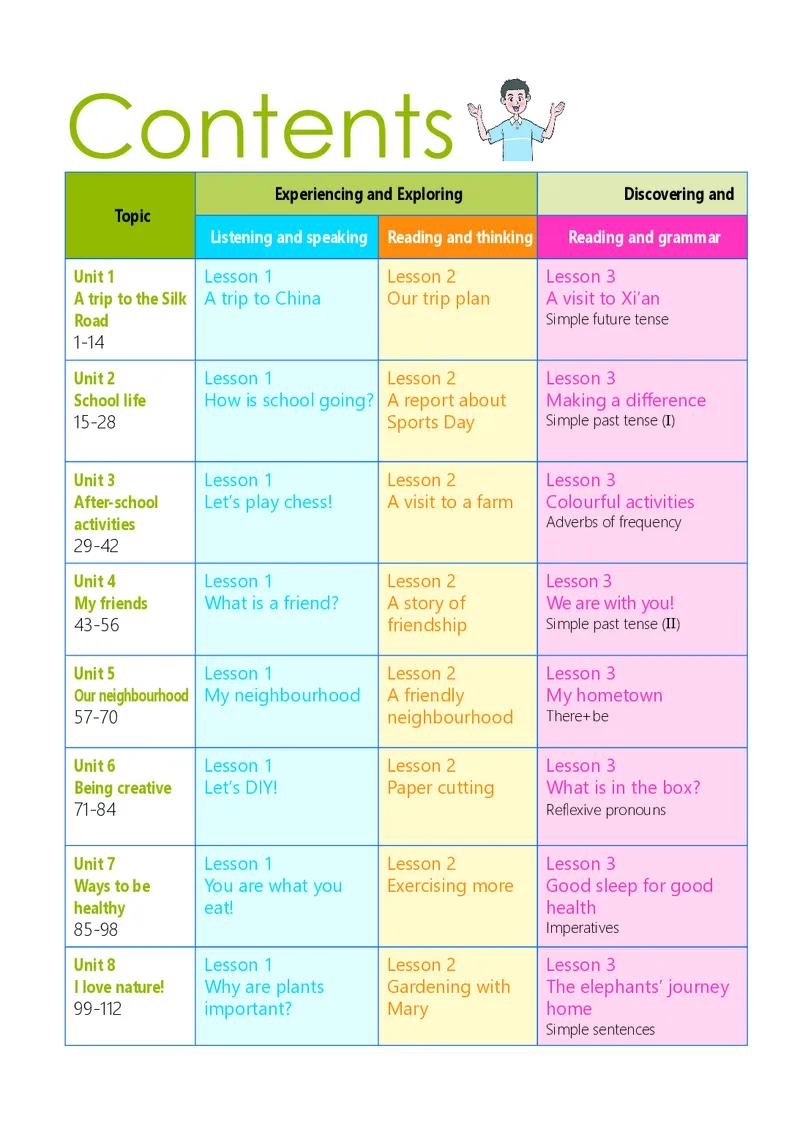
Experiencing and Exploring Discovering and
Topic
Listening and speaking Reading and thinking Reading and grammar
Unit 1 Lesson 1 Lesson 2 Lesson 3
A trip to the Silk A trip to China Our trip plan A visit to Xi’an
Road Simple future tense
1-14
Unit 2 Lesson 1 Lesson 2 Lesson 3
School life How is school going? A report about Making a difference
15-28 Sports Day Simple past tense (I)
Unit 3 Lesson 1 Lesson 2 Lesson 3
After-school Let’s play chess! A visit to a farm Colourful activities
activities Adverbs of frequency
29-42
Unit 4 Lesson 1 Lesson 2 Lesson 3
My friends What is a friend? A story of We are with you!
43-56 friendship Simple past tense (II)
Unit 5 Lesson 1 Lesson 2 Lesson 3
Our neighbourhood My neighbourhood A friendly My hometown
57-70 neighbourhood There+be
Unit 6 Lesson 1 Lesson 2 Lesson 3
Being creative Let’s DIY! Paper cutting What is in the box?
71-84 Reflexive pronouns
Unit 7 Lesson 1 Lesson 2 Lesson 3
Ways to be You are what you Exercising more Good sleep for good
healthy eat! health
85-98 Imperatives
Unit 8 Lesson 1 Lesson 2 Lesson 3
I love nature! Why are plants Gardening with The elephants’ journey
99-112 important? Mary home
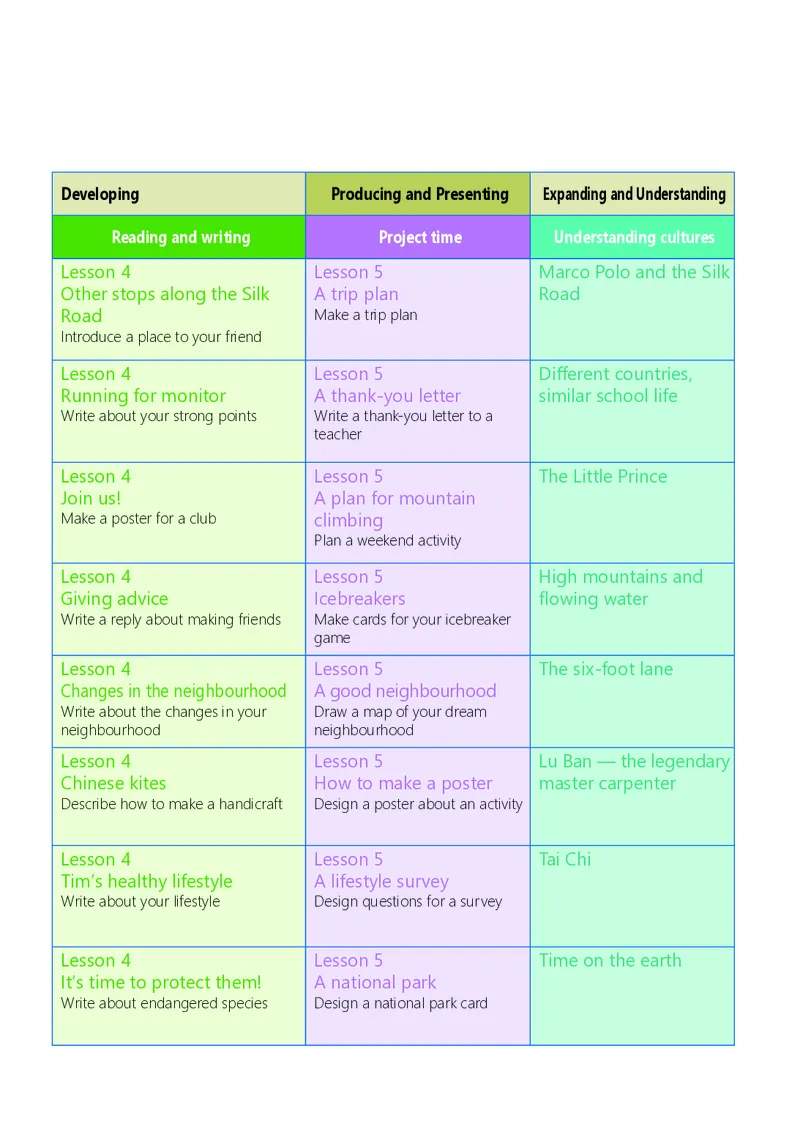
Simple sentencesDeveloping Producing and Presenting Expanding and Understanding
Reading and writing Project time Understanding cultures
Lesson 4 Lesson 5 Marco Polo and the Silk
Other stops along the Silk A trip plan Road
Road Make a trip plan
Introduce a place to your friend
Lesson 4 Lesson 5 Different countries,
Running for monitor A thank-you letter similar school life
Write about your strong points Write a thank-you letter to a
teacher
Lesson 4 Lesson 5 The Little Prince
Join us! A plan for mountain
Make a poster for a club climbing
Plan a weekend activity
Lesson 4 Lesson 5 High mountains and
Giving advice Icebreakers flowing water
Write a reply about making friends Make cards for your icebreaker
game
Lesson 4 Lesson 5 The six-foot lane
Changes in the neighbourhood A good neighbourhood
Write about the changes in your Draw a map of your dream
neighbourhood neighbourhood
Lesson 4 Lesson 5 Lu Ban — the legendary
Chinese kites How to make a poster master carpenter
Describe how to make a handicraft Design a poster about an activity
Lesson 4 Lesson 5 Tai Chi
Tim’s healthy lifestyle A lifestyle survey
Write about your lifestyle Design questions for a survey
Lesson 4 Lesson 5 Time on the earth
It’s time to protect them! A national park
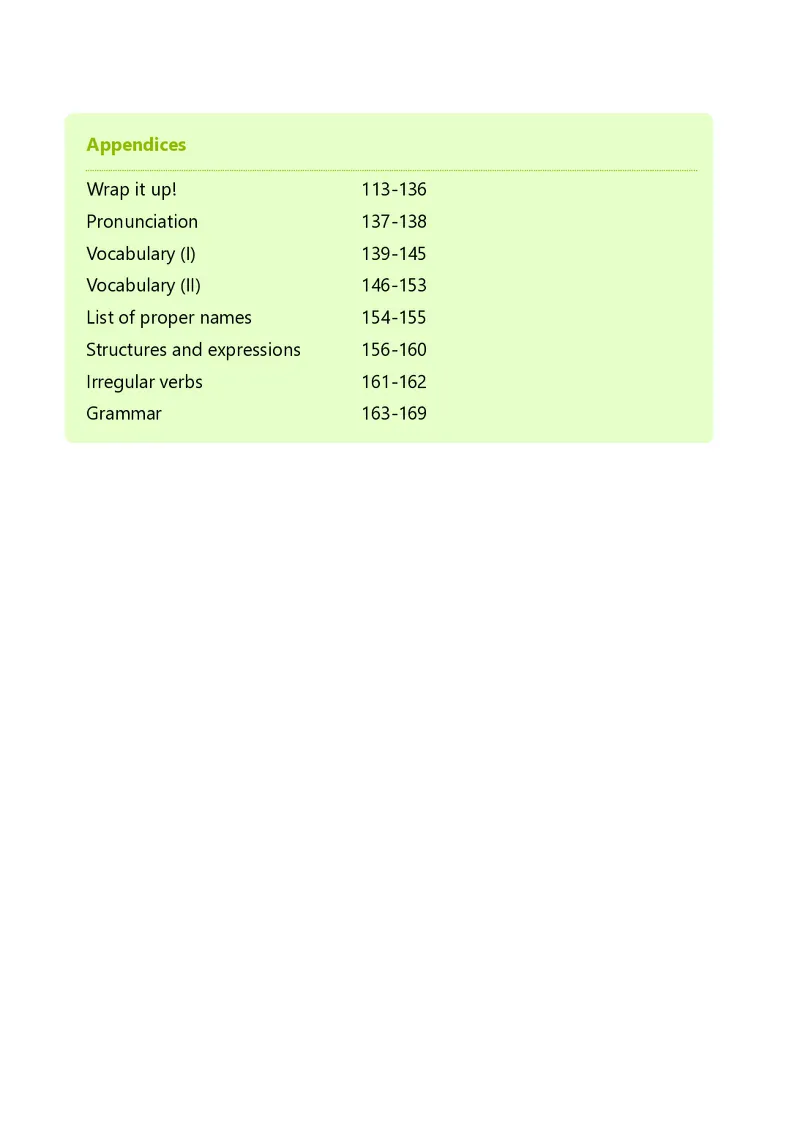
Write about endangered species Design a national park cardAppendices
Wrap it up! 113-136
Pronunciation 137-138
Vocabulary (I) 139-145
Vocabulary (II) 146-153
List of proper names 154-155
Structures and expressions 156-160
Irregular verbs 161-162
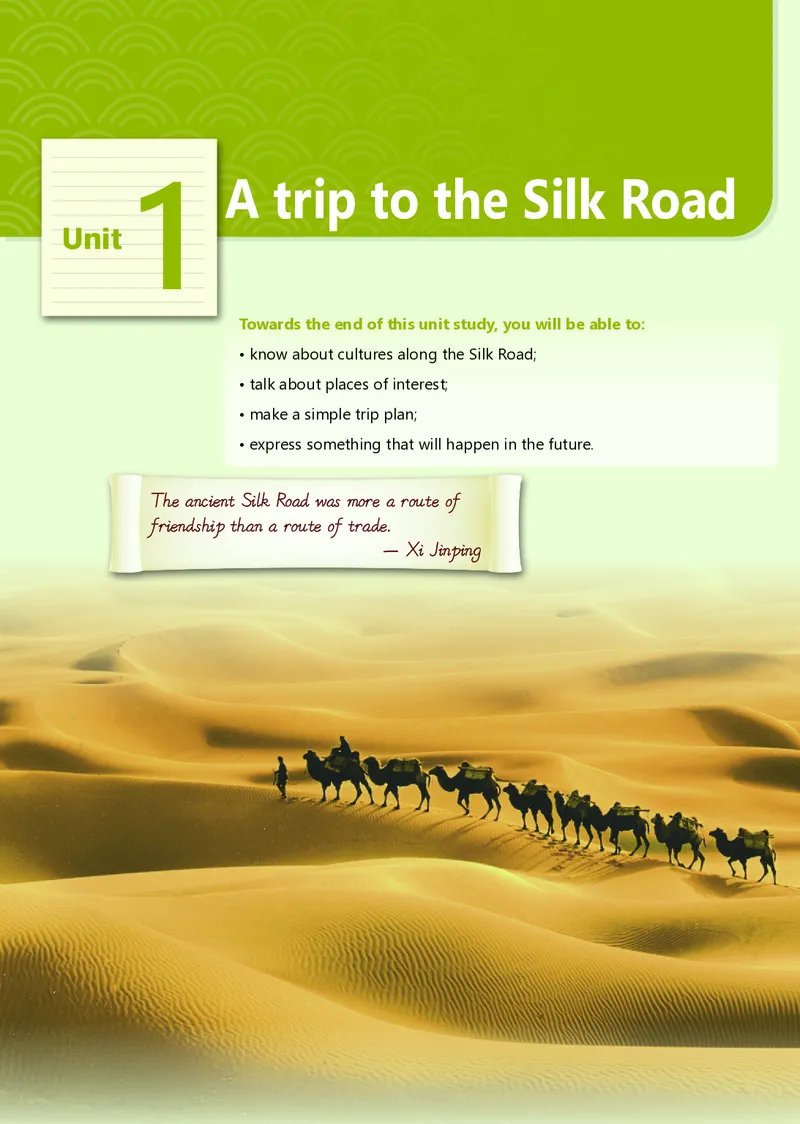
Grammar 163-169A trip to the Silk Road
1
Unit
Towards the end of this unit study, you will be able to:
• know about cultures along the Silk Road;
• talk about places of interest;
• make a simple trip plan;
• express something that will happen in the future.
The ancient Silk Road was more a route of
friendship than a route of trade.
— Xi Jinping1 A trip to China
1 What do you know about the Silk Road? Talk with your partner.
2 Listen to the conversation and write true (T) or false (F).
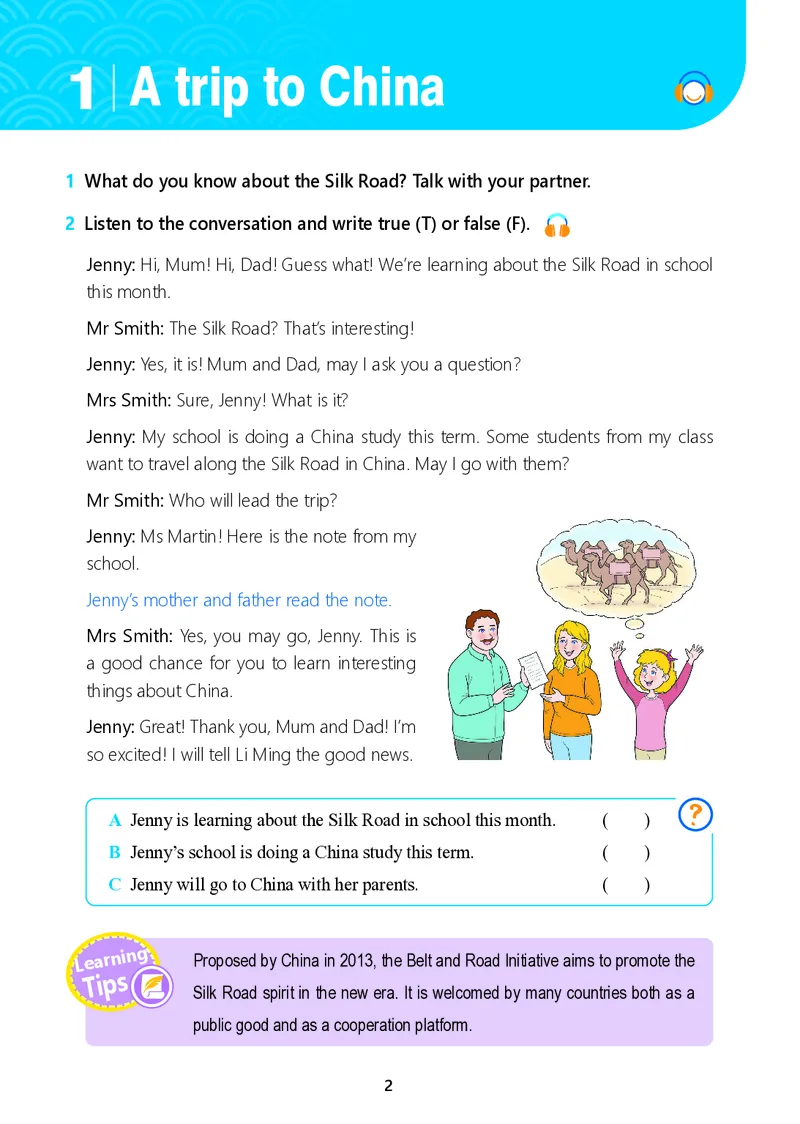
Jenny: Hi, Mum! Hi, Dad! Guess what! We’re learning about the Silk Road in school
this month.
Mr Smith: The Silk Road? That’s interesting!
Jenny: Yes, it is! Mum and Dad, may I ask you a question?
Mrs Smith: Sure, Jenny! What is it?
Jenny: My school is doing a China study this term. Some students from my class
want to travel along the Silk Road in China. May I go with them?
Mr Smith: Who will lead the trip?
Jenny: Ms Martin! Here is the note from my
school.
Jenny’s mother and father read the note.
Mrs Smith: Yes, you may go, Jenny. This is
a good chance for you to learn interesting
things about China.
Jenny: Great! Thank you, Mum and Dad! I’m
so excited! I will tell Li Ming the good news.
A Jenny is learning about the Silk Road in school this month. ( )
B Jenny’s school is doing a China study this term. ( )
C Jenny will go to China with her parents. ( )
Learning
Proposed by China in 2013, the Belt and Road Initiative aims to promote the
Tips
Silk Road spirit in the new era. It is welcomed by many countries both as a
public good and as a cooperation platform.
2UNIT 1
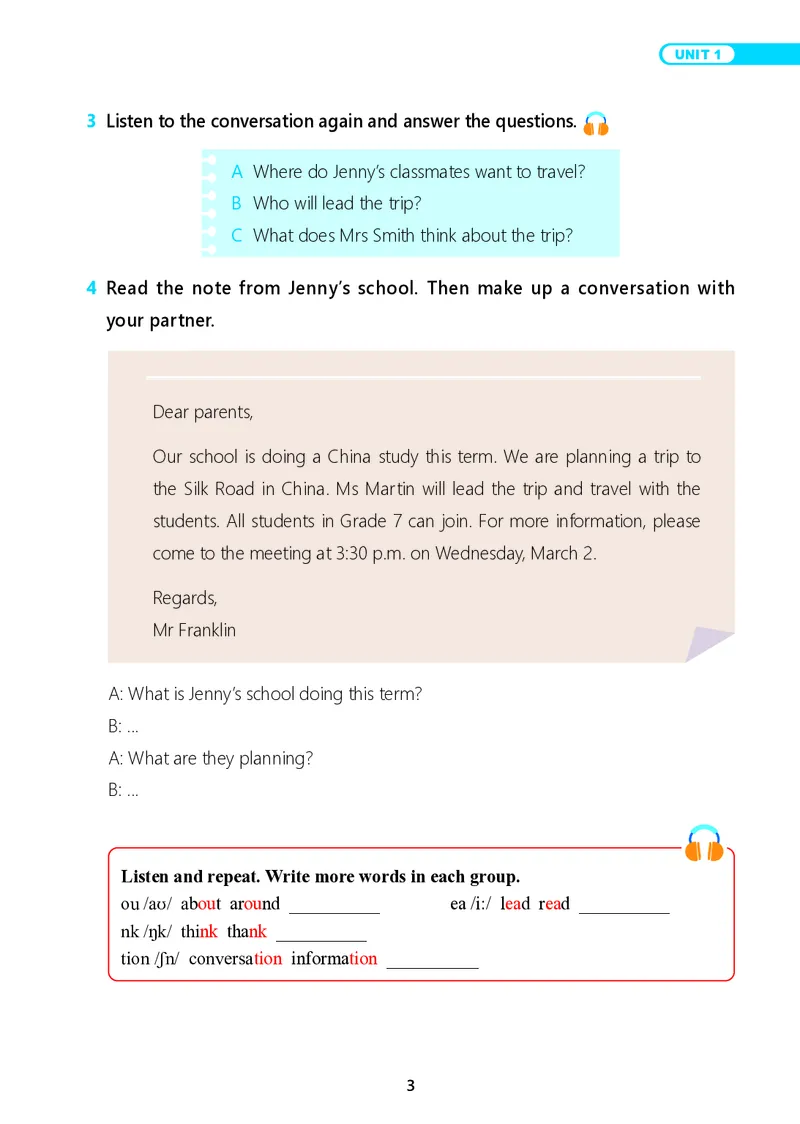
3 Listen to the conversation again and answer the questions.
A Where do Jenny’s classmates want to travel?
B Who will lead the trip?
C What does Mrs Smith think about the trip?
4 Read the note from Jenny’s school. Then make up a conversation with
your partner.
Dear parents,
Our school is doing a China study this term. We are planning a trip to
the Silk Road in China. Ms Martin will lead the trip and travel with the
students. All students in Grade 7 can join. For more information, please
come to the meeting at 3:30 p.m. on Wednesday, March 2.
Regards,
Mr Franklin
A: What is Jenny’s school doing this term?
B: ...
A: What are they planning?
B: ...
Listen and repeat. Write more words in each group.
ou /aʊ/ about around __________ ea /i:/ lead read __________
nk /ŋk/ think thank __________
tion /ʃn/ conversation information __________
32 Our trip plan
1 What do you know about the cities along the Silk Road? Discuss with your partner.
Xi’an Lanzhou Dunhuang Kashi
2 Read the email and answer the questions.
Hi, Li Ming,
I’m so excited! My classmates and I will go to China! We will travel along the
Silk Road.
We will start in Xi’an. We will visit the Terra Cotta Warriors and have some
Chinese food. Then we will take a train to Lanzhou. It is not far from Xi’an.
I want to walk along the Yellow River. Our last stop along the Silk Road is
Dunhuang. Dunhuang is my dream city. I’m looking forward to visiting the
Mogao Caves. I can’t wait to see the beautiful ancient paintings there.
The Silk Road is very long, and we don’t have enough time. We can only see
part of it. But this trip will be very special. We will learn about the history and
culture of China along the way.
Our trip ends in Beijing. I hope to see you there.
That is the plan for our trip.
Your friend,
Jenny
4UNIT 1
A How will Jenny and her classmates go to Lanzhou from Xi’an?
B Where are the Mogao Caves?
C What is special about this trip?
3 Read the email again and complete the timeline.
visit _______________ visit the Mogao
and eat Chinese food Caves and see
Xi’an Dunhuang
_______________
Lanzhou _______________ Beijing
the Yellow River
4 Complete the conversation and then role-play it.
Li Ming: Hi, Mum. ____________
Mum: That’s wonderful. Where will they go?
Li Ming: They will travel along the Silk Road. ____________
Mum: Which places will they visit?
Li Ming: ____________
Mum: I guess they will also go to Dunhuang.
Li Ming: ____________ They will see the beautiful ancient
paintings in the Mogao Caves.
Mum: It will be a nice journey!
A. They will visit Xi’an and Lanzhou.
B. Yes, that’s their last stop along the Silk Road.
C. Jenny and her classmates will come to China.
D. They will learn about the history and culture of China along the way.
53 A visit to Xi’an
1 Where can you see these places of interest? Look and talk.
the Big Wild Goose Pagoda the Bell Tower
the Drum Tower the Terra Cotta Warriors
2 Read the passage and number the places of interest.
Hello everyone, welcome to Xi’an. I’m so happy to meet you. I will show you
around this ancient city.
First, we will walk along the City Wall. It is over 13 kilometres long and more than
600 years old. You can ride a bicycle on the ancient wall. Then we will go to the
Drum Tower and the Bell Tower. You can enjoy wonderful shows there.
This afternoon, we will go to the Shaanxi History Museum. We
will learn a lot about Chinese history. Later, we will visit the
Big Wild Goose Pagoda. It is more than 1,300 years old.
Tomorrow, we will visit the famous Terra Cotta Warriors.
They are more than 2,000 years old! We can also try some
delicious Chinese food and enjoy
the special dishes of Xi’an.
I hope you will have lots of fun!
6UNIT 1
the Terra Cotta Warriors the Big Wild Goose Pagoda
the Drum Tower and the Bell Tower the Shaanxi History Museum
1 the ancient wall
3 Read the sentences, paying attention to the parts in yellow. Then fill in the blanks.
● First, we will walk along the City Wall.
We usually use
● We will learn a lot about Chinese history.
will in front of a verb
● Later, we will visit the Big Wild Goose Pagoda.
to talk about things
A — When ____________ the show ____________ (start)?
that may happen in
— In ten minutes.
the future.
B Li Ming ____________ (visit) his grandparents next week.
C My bike is broken. I ____________ (take) a bus to school this afternoon.
4 Complete the conversation with the correct forms of the words.
take have watch call
Li Ming: Hi Jenny! Hi Danny! What Li Ming: We ____________ them Bing Ma
are you up to? Yong in Chinese.
Jenny: We are visiting the Drum Danny: I am looking forward to seeing
Tower. It is so big. the warriors!
Danny: We ____________ Drum Beating Jenny: The day after tomorrow, we will
Show. It will be fun. visit Lanzhou.
Li Ming: Wow, sounds great! Where will Danny: I ____________ a picture with the
you go tomorrow? Yellow River in the background!
Jenny: We will visit the Terra Cotta Li Ming: I think you ____________ a great
Warriors. time.
74 Other stops along the Silk Road
1 What do you know about Lanzhou and Dunhuang? Talk with your partner.
2 Read the webpages and answer the questions.
Welcome to Lanzhou!
Lanzhou is the capital city of Gansu. It has a long
history. You can walk across the Zhongshan Bridge.
It was the first bridge over the Yellow River. Do
you know how long the Yellow River is? It is about
5,400 kilometres long. We all call it the Mother River. Beside the river, you
can have a look at the sculpture of a mother with a baby — the Yellow
River Mother Sculpture. Many people take pictures there.
Come have a wonderful experience in this ancient city!
Welcome to Dunhuang!
Dunhuang is one of the main stops along the Silk
Road. Here, you cannot miss the Mogao Caves,
the Art Museum of the East. You can see ancient
paintings and sculptures in the Mogao Caves.
They are amazing! You can also ride camels on
Mingsha Mountain. It will be a lot of fun.
Come discover the secrets of this ancient city!
A What was the first bridge over the Yellow River?
B How long is the Yellow River?
C What can you do in Dunhuang?
8UNIT 1
3 Read the webpages again and complete the paragraph with the phrases.
take a picture walk across have a look
Dunhuang and Lanzhou are two important cities along the Silk Road. In Lanzhou,
you can taste noodles with beef. You can ____________ the Yellow River on the
Zhongshan Bridge. You can also ____________ beside the Mother River Sculpture. In
Dunhuang, you cannot miss the Mogao Caves. The paintings are amazing. You will
____________ at people’s lives in ancient times.
4 Complete the table and talk with your partner.
Suppose Jenny and Danny are coming to visit you. Which place would you show
them?
Place Where is it? What’s special?
5 Write a passage about the place in Activity 4.
Hello, my name is... I’m going to show you around…
Useful expressions
• Welcome to... • I will show you around... • This is... • You’ll see...
95 A trip plan
1 Read Jenny’s diary and tick the correct answers.
Date: March 15
Weather: Cloudy, windy, and cool
Dear Diary,
It is 9:00 p.m. We are in Beijing now.
Tomorrow, we will go to the Great Wall. It is about 6,000 kilometres
long and over 2,000 years old. There you can travel thousands of years
back in time. We are going to have Beijing roast duck for dinner. It is
a famous dish in the world. Then, we will see the Beijing opera. I am
looking forward to the interesting traditional art and the colourful
costumes!
The day after tomorrow, we are going to visit the Palace Museum. It
is one of China’s largest museums. I will learn more about Chinese
culture. Then we will fly home in the evening. I can’t believe our trip
will be over soon.
Oh, my! It’s late. I have to go to bed now. I can’t wait to visit the Great
Wall tomorrow!
A When will Jenny go to the Great Wall?
Tomorrow. This evening. The day after tomorrow.
B What will Jenny have for dinner tomorrow evening?
Dumplings. Beijing roast duck. Lanzhou beef noodles.
10UNIT 1
2 Complete Jenny’s activity plan in Beijing.
Day What will she do?
1
2
3 Suppose you are going on a short trip. Talk about the following questions with
your partner.
A Where will you travel?
B When will you go on your trip?
C Who will travel with you?
D What places of interest will you visit?
E What is special about them?
4 Make a trip plan and present it to the class.
MY TRIP PLAN
When From _______________ to ___________________
Where
Who
Day Places of interest What is special? What will I do?
1
2
3
…
11Marco Polo and the Silk Road
1 Read the passage and tick the correct pictures.
Marco Polo was a man from Italy. At
the age of 17, he began to travel along
the Silk Road with his father and uncle.
They moved goods between Europe
and Asia. They travelled by boat,
horse, and camel. Their journey lasted
about 20 years!
In 1275, Marco Polo arrived in Beijing.
He met the emperor and worked
for him for 17 years. The Chinese
discovered coal and invented paper.
Marco Polo brought some back to
Italy. He also brought back a lot of silk, tea, and other goods. These things were
new to Italians.
There is a famous book, The Travels of Marco Polo, about Marco Polo’s trip to China.
How did Marco
Polo’s family move
goods along the
Silk Road?
12UNIT 1
2 Read the passage again and answer the questions.
A When did Marco Polo come to China?
B What did Marco Polo bring back to Italy from China?
C What’s the name of the book about Marco Polo’s trip to China?
3 Here is a brief description of China in The Travels of Marco Polo. What do you
think the word in bold is?
The city of Cambaluc is in a vast, level plain. It
forms a square, each side of which is about six miles
in length, and it is enclosed by a wall which is made
of very strong and thick stones, well-cemented
with lime and brick.
4 There are other important persons related to the Silk Road. Find more
information and introduce them to the class.
Zhang Qian Ban Chao Zheng He
13Self-check
● I can introduce places of interest along the Silk Road:
• It is more than 1,300 years old.
• Dunhuang is one of the main stops along the Silk Road.
● I can express something that will happen in the future:
• Tomorrow, we will go to the Great Wall.
• It will be a lot of fun.
● I know about Chinese culture along the Silk Road:
• Tomorrow, we will visit the famous Terra Cotta Warriors.
• You can see ancient paintings and sculptures in the
Mogao Caves.
● Improvement needed:
Fun
My trip
Time
My trip is so much fun,
In the sun, we all run,
Climbing mountains big and tall,
And splashing in a waterfall,
My heart is filled with joy galore,
Can’t wait to do it all once more!
14School life
2
Unit
Towards the end of this unit study, you will be able to:
• describe your school days;
• be active in class activities;
• express thanks to a teacher;
• tell stories that happened in the past.
The roots of education are bitter,
but the fruit is sweet.
— Aristotle1 How is school going?
1 Read the questions and give your answers.
A How do you like school?
B What subjects do you have? What’s your favourite subject?
2 Listen to the conversation and write down what subjects the students have.
Hi, Jenny. How is school going?
Well, I am a little busy this term. I have six classes every day. How
about you, Wang Mei?
Almost the same. I get up at 6:30. After breakfast, I go to school.
School starts at 8:00 and ends at 17:00. I am very busy but I am
learning about many interesting subjects.
What subjects do you have?
I have Chinese, English, maths, history, geography and some other
subjects. PE is my favourite. We have a big sports meet twice a year.
Last term I won first place in the long jump.
Wow! You’re good at the long jump. Good job!
Thank you! What subjects do you have?
I have social studies, shop, maths, English, Chinese, art... and I like PE too.
16UNIT 2
3 Listen to the conversation again and answer the questions.
A How many classes does Jenny have every day?
B What sport is Wang Mei good at?
C Do Wang Mei and Jenny have the same favourite subject?
4 Write down your class timetable for a certain day. Then use it to make up a
conversation.
Day: ____________
No. Time Subject
1
2
3
4
5
6
A: How many classes do you have on Monday/Tuesday/...? B: …
A: When does the first/second/… class start? B: …
5 How is school going? Talk with your partner.
The following questions may help you:
● How do you feel about school?
● What subjects do you have?
● What subjects are you good at?
Listen and repeat. Write more words in each group.
ar /ɑ:/ start art __________ oo /u:/ school too __________
al /ɔ:l/ almost always __________ th /ð/ they other __________
ch /tʃ/ Chinese French __________ x /ks/ six box __________
172 A report about Sports Day
1 Which sports would you like to take part in on Sports Day? Tick and talk.
running high jump long jump hurdles
2 Read Danny’s report and complete the table.
Sports Day was a big success this year! really hard, but my tail got in the way.
All the students and teachers took So I only got fourth place. I felt a little
part in the sports events. There were sad, but then my teammates said,
ten different events like running, long “Good work, Danny. Winning is not
and high jumps, and ball throwing. everything. It is important to have fun.”
They were right! We all had lots of fun!
Everyone worked hard and got some
good exercise. There were many Thank you everyone for a great Sports
winners. Kim, from Grade 7, won first Day.
place in four events. Tony, from Grade
8, won first place in two events and
second place in three events. And
Mike, from Grade 9, was the champion
in three events. Well done!
I took part in a running event. I ran
18UNIT 2
Name Grade Results
Kim 7 won first place in four events
won ________________ place in ________________ event(s)
Tony
and ________________ place in ________________ event(s)
Mike was the ________________ in ________________ event(s)
Danny 7 won ________________ place in ________________ event(s)
3 Complete the conversation with the correct forms of the phrases.
take part in work hard have fun get in the way
Li Ming: How was Sports Day this year, ____________. I felt a little sad.
Danny?
Li Ming: Don’t be sad. You did a
Danny: It was a big success. We great job.
____________ and got some exercise.
Danny: Thanks. My teammates said,
Li Ming: Did you ____________ any “Winning is not everything. It is
events? important to ____________.”
Danny: Yes, a running event. I only got Li Ming: They were right.
fourth place. I ran hard, but my tail
4 Talk about the last sports meet at your school and write a short passage.
● How many events were there? ● Who took part in the events?
● Who were the winners? ● Did you have fun?
A: Did you have fun at the sports meet last year?
B: Yeah. It was great! I took part in three events.
A: Really? What were they?
...
193 Making a difference
1 Read the questions and give your answers.
A Who is your favourite teacher?
B Does he/she do something important for you? If yes, what is it?
2 Read the passage and write true (T) or false (F).
Hello. My name is Hao Tongxin. I live people, too.” She gave me hope.
in a small village. I’m in Grade 7. And
My teacher is great. She often visits her
I like my school!
students and their families. She does not
Last year, I wanted to give up my want anyone to drop out of school. She
studies. I wanted to stay home and always helps us in every possible way. She
help my family. But my teacher said, is making a big difference in our lives.
“With a good education, you can
Now, I never miss a day of school. I want
make a difference. You can make a
to make a difference in the future — just
good life for yourself. And you can
like my teacher.
help your family, friends, and other
Hao Tongxin is a student from a village.
Hao Tongxin wanted to give up his studies last year.
The teacher encouraged Hao Tongxin to make a difference through education.
Hao Tongxin didn’t take the teacher’s advice in the end.
20UNIT 2
3 Read the sentences, paying attention to the parts in yellow. Then rewrite the
sentences in the simple past tense.
● Last year, I wanted to give up my studies.
● She often visits her students and their families.
When we talk about things that happen regularly now, we use the simple
present tense. When we talk about things that happened in the past, we
use the simple past tense.
A I want to stay home and help my family. (last year)
I wanted to stay home and help my family last year.
B Everyone works very hard in the sports events. (yesterday)
____________________________________________________________________________
C I never miss a day of school. (last term)
____________________________________________________________________________
D Lily plays ping-pong with her father. (last Sunday)
____________________________________________________________________________
4 Fill in the blanks with the correct forms of the phrases.
drop out of in the future give up make a difference
A Our teachers want us to get a good education. They don’t want us to
__________________ school.
B Don’t __________________ hope. We know you can do it.
C Science is __________________ in our lives.
D He wants to be a doctor and help sick people __________________.
5 Who made a difference in your life? How did he/she help you? Talk about it.
My teacher made a difference in my life. She helped me after class, and she
encouraged me...
214 Running for monitor
1 Who do you think should complete the following tasks? Match the person
with the duty.
class monitor organise a basketball match
learning monitor keep the classroom tidy
PE monitor hold a class meeting
art monitor organise an art show
cleaning monitor share study experience
2 Read the speeches and answer the questions.
Hello, everyone! I’m Li Ming. I would like to be the class monitor.
In primary school, I was a good class monitor and got lots of
experience. I’m really kind and friendly. I like to talk with people. I
try to be friends with all my classmates. I can also help the teachers.
I can be a bridge between the teachers and the class. Choose me
for class monitor and we can make our class better.
Hi, class. I’m Wang Mei. I want to be the learning monitor. In the
first term of junior high school, I got good grades. I like to read
books and learn new things. I get along well with everyone and I’m
always ready to help others. I would like to share my learning skills
with my classmates. Choose me and let’s make progress together.
A What are Li Ming and Wang Mei doing?
B What does “bridge” mean in Li Ming’s speech?
C How were Wang Mei’s grades in the first term?
22UNIT 2
3 Read the speeches again and fill in the blanks.
Strong points
• has _________________ as a class • gets good _________________
monitor in primary school • likes to read books and
• is kind and _________________ ________________ new things
• likes to talk with people • gets along well with everyone
• helps the teachers • helps others
• can be a _________________ • shares ________________ with
between the teachers and the class her classmates
4 Complete the conversation with the correct forms of the phrases.
get along well with share... with make progress be ready to
Some students from Li Ming’s class are likes to ____________ her learning skills
having a discussion after class. ____________ us.
Zhang Ying: Hi, Wang Lei. What do you Zhang Ying: You’re right! She
think of the two speeches? helped me solve a maths problem
yesterday. A learning monitor should
Wang Lei: They are both great! Li Ming is
always ____________ help others.
good at communicating with others.
Wang Lei: What’s more, monitors
Zhang Ying: That’s true. A class monitor
should help the class ____________
should ____________ classmates. How about
together.
Wang Mei?
Zhang Ying: Indeed!
Wang Lei: She works very hard and she
5 What are your strong points? What monitor would you like to be? Write a
short passage.
Useful expressions
• I want/would like to be... • I’m kind/friendly/active... • I like to talk/help/share...
• I can be a bridge between... • Choose me and...
235
A thank-you letter
1 Read the letter and describe Zhang Guimei in a sentence.
Dear Ms Zhang,
How time flies! It has been three years since we first met you at Huaping
Girls’ High School. Our time together was short but unforgettable.
Over the past three years, you took care of everything for us. Early in the
morning, you would wake us up and turn on the lights in the dormitory
building for us. In class, you checked our homework. Late at night, you
would walk in and around the building for our safety.
“Get up, girls!” “Time for early morning reading, girls!” “Good night!” All
these will stay with us.
We feel so lucky to have you with us. Your
deep love will light our way for the rest of
our lives.
Thank you, Ms Zhang, for everything! We
will miss you.
Forever yours,
Li Linlin
Zhang Guimei _________________________________________________________________________
________________________________________________________________________________________.
24UNIT 2
2 Read the letter again and discuss with your partner.
A What did Zhang Guimei do for her students at school?
________________________________________________________________________________
B Why did the author write a thank-you letter to Zhang Guimei?
________________________________________________________________________________
C How do you understand the sentence “Your deep love will light our way for the
rest of our lives”?
________________________________________________________________________________
3 Think of one of your favourite teachers and complete the table.
Who is your Why do you like What does/did
...
favourite teacher? him/her? he/she do?
4 Write a thank-you letter to your favourite teacher and send it to him/her.
25Different countries, similar school life
1 Read the passage and answer the questions.
My name is Lisa. I am in Year 7 at City of London School in England. It is a
girls’ school. There are only girl students here. We have many fun classes,
but art is my favourite. When I have time, I go
outside and find a quiet place to draw pictures.
We have an art show every year in our school.
We draw about our own lives, so we get to learn
more about our classmates through art. I love
this activity a lot. Every time, I try my best to draw
a nice picture.
My name is Alice. I am in Year 7 at Box Hill High
School, Melbourne, Australia. There are many
amazing classes such as art and PE, and we have
lots of fun activities.
At the start of the year, every group plans a
play, and the group leaders choose the main
characters. We then practice during lunchtime.
After the play, the winning group gets a prize.
This is one of the most exciting events of the year.
26UNIT 2
I’m Steven. I am in 7th grade at Brooklyn Friends
School, New York, USA. Every Friday we have a DIY
class. In the class, the teacher gives a topic. We try to
think creatively. Then we make things by ourselves.
We have different classes every day. Our school days
are busy but fun. After school, I often play sports with
my friends.
A What kind of school is Lisa in?
B What school activity can Alice join?
C When does Steven have a DIY class?
2 Read the passage again and fill in the table.
Name Country School Favourite class/school event
3 What do you think of your school life? Talk in pairs.
Useful expressions
• I think my school life is... • I don’t think so.
• I agree with you. • I don’t agree.
27Self-check
● I can describe my school life using adjectives:
• My school is beautiful/big/small...
• My school life is colourful/interesting/exciting...
● I can be active in class activities:
• I can be a bridge between the teachers and the class.
• I get along well with everyone and I’m always ready
to help others.
● I can talk about school life using the simple past
tense:
• Last term I won first place in the long jump.
• All the students and teachers took part in the sports events.
● I can express thanks to my teachers:
• We feel so lucky to have you with us.
• Your deep love will light our way for the rest of our lives.
● Improvement needed:
Fun
Junior school days
Time
In halls of learning, laughter’s sound,
Junior school days, joy profound.
Friends we made, an endless smile,
With innocence we ran each mile.
Teachers’ guidance, like a guiding light,
Junior school memories, forever bright.
28After-school activities
3
Unit
Towards the end of this unit study, you will be able to:
• talk about different after-school activities;
• choose the proper activities for yourself;
• describe your daily life using adverbs of frequency.
If you don’t do what’s best for your body,
you’re the one who comes up on the short end.
— Julius Erving1 Let’s play chess!
1 Look at the pictures and answer the questions.
A What activities can you see in the pictures?
B What activities do you do after school?
2 Listen to the conversation and tick the correct answers.
Jack: Would you like to play chess with me after school tomorrow?
Li Ming: Sorry, Jack. I’d love to, but I can’t. I practice ping-pong on
Tuesdays. How about Wednesday?
Jack: Hmm… Wednesday is not good for me. I am going to the swimming
club after school. How about Thursday?
Li Ming: My uncle will teach me to play the erhu
this Thursday.
Jack: Maybe Friday?
Li Ming: I visit my grandparents on Fridays.
Jack: Well, what are you going to do this evening?
Li Ming: Nothing! Let’s play chess tonight.
Jack: Sounds good!
30UNIT 3
A When will Jack and Li Ming play chess?
This evening. Tomorrow. On Friday.
B Who will teach Li Ming to play the erhu on Thursday?
His friend. His grandparents. His uncle.
3 Listen to the conversation again and match the activities with the days and the
students.
Monday
visiting grandparents
Tuesday
playing the erhu
Wednesday going to the swimming club
playing chess
Thursday
practicing ping-pong
Friday
4 Work in pairs. Invite your friends to do after-school activities. Make up a dialogue.
A: Would you like to play chess with me?
B: Yes, that sounds great./Sorry. I’d love to, but…
Listen and repeat. Write more words in each group.
ing /ɪŋ/ swimming nothing __________ ay /eɪ/ maybe always __________
th /θ/ nothing Thursday __________
312 A visit to a farm
1 Talk about what you can do on a farm.
pick strawberries water vegetables plant trees feed animals
2 Read the conversation and answer the questions.
Li Ming is visiting his uncle’s farm. His Wang Mei: Yes! They are eating very
friend Wang Mei is with him. quickly.
Li Ming: This is my favourite cow. Her
Wang Mei: Wow, Li Ming! The
name is Niuniu.
countryside is nice and quiet. This
farm is beautiful! Wang Mei: Hello, Niuniu. Are you
hungry?
Li Ming: I love visiting the farm! But it’s
far from the city. Niuniu: Moo…
Wang Mei: What do you like to do Wang Mei: She answered me! This is
here? fun!
Li Ming: I like to feed the animals and
pick vegetables and fruit. Come on!
Let’s feed the animals!
Wang Mei: Hmm... I’m afraid of animals.
Li Ming: Don’t worry! The animals are
friendly. You will be fine. Come on!
We can feed the cows.
Wang Mei: Okay!
Li Ming and Wang Mei are feeding the
cows.
Li Ming: You are doing a good job,
Wang Mei! The cows are happy.
32UNIT 3
A What does Wang Mei think of the countryside?
B What does Li Ming like to do on the farm?
C How well does Wang Mei do at feeding the cows?
3 Read the conversation again and complete the passage.
Li Ming is visiting his uncle’s farm with Wang Mei. The ____________ is nice
and quiet. This farm is beautiful, but it’s so ____________ from the city. Li Ming
____________ the farm. He likes to ____________ the animals and ____________
vegetables and fruit. The animals are very ____________. His favourite cow is Niuniu.
4 Talk about the picture with your partner. Then write a paragraph.
A What can you see on the farm?
Useful expressions
B Do you like the farm? Why?
• beautiful/nice/quiet/big...
C What do you like to do on the farm?
• feed sheep/pick strawberries/
water flowers...
333 Colourful activities
1 What clubs would you like to join? Talk with your partner.
2 Some students are doing a survey about clubs. Read, circle your choice and
write.
A survey about clubs
● Do you get enough exercise?
A Always! I love sports.
B Sometimes. But I often listen to music and relax.
C Seldom. I usually draw pictures in my free time.
D Never. I like to read books and exercise my mind.
● What is your favourite school subject?
A PE. I like to be active.
B Music. I like to play an instrument.
C Art. I love to draw and paint.
D Chinese. I enjoy reading and writing.
● What do you do on a cold, snowy day?
A I can’t sit still. I always do something active inside.
B I usually listen to music or play an instrument.
C I often paint or draw a picture.
D I usually read a book or write a story.
● You are going on a trip, but you can only take one thing with you. What
would you take?
A Running shoes. I can’t go anywhere without them.
B My earphones. I can’t live without music.
C Some paper and a pencil. I always draw pictures on the way.
D A good book. I feel bored without a book.
34UNIT 3
Now look at your answers!
3 or more As — Sports 3 or more Bs — Music
3 or more Cs — Art 3 or more Ds — Reading
Or maybe you are in the middle!
For example: 2 As + 2 Bs — Sports and Music
My choice of club is ___________________. I like ___________________.
I often ___________________.
3 Look at the students’ answers in the pictures. Then write sentences.
3 Cs Wang Hong usually draws pictures.
Her choice is the art club. 3 Bs
___________________________________
___________________________________
___________________________________
4 As
___________________________________ 4 Ds
___________________________________
___________________________________
4 Complete the sentences using the correct words.
never seldom sometimes often usually always
0% 100%
A I __________ get up at 6:30 a.m. I like being awake early every day.
B Jack always goes to school on time. He is __________ late.
C My father usually goes to work by car, but __________ he walks to get some exercise.
D David __________ goes to visit his parents these days because he is busy.
354 Join us!
1 What after-school activities do you like? Tick or write. Then talk with your partner.
playing chess painting pictures practicing the piano
going swimming playing ping-pong Other: _________________
2 Read the posters and fill in the table.
Welcome to the Acting Group
Join our club and
Acting is fun and useful. You can meet many be a star!
new people and improve your social skills.
We do lots of role-play games in our classes.
Everyone can learn to act. Join our club and
be a star! We meet at the school theatre
every Friday after school.
Time: 6 p.m.-7 p.m., Fridays
Place: school theatre
If you would like to be one of us, please fill Contact: Mary Brown
Telephone: (311) 986-337-899-20
in the form and give it to Mary Brown on a
weekday.
Join Our Swim Team
Time: 6 p.m.-7 p.m., Thursdays
Swimming isn’t just good exercise — it’s also Place: school gym
Contact: Steven Smith
fun! You can stay in shape and have a good For more information, e-mail us at
swimclub@mail.com
time.
We have lessons for different levels. We
meet at the school gym every Thursday after
Join us today!
school.
If you want to join us, just come to the
swimming pool!
36UNIT 3
Acting Group Swim Team
• fun and ____________ • fun and good exercise
1 What after-school activities do you like? Tick or write. Then talk with your partner.
Advantages • ____________ many new people • ____________ in shape and have a
and ____________ social skills good time
Meeting time every ____________ after school every ____________ after school
Meeting place the school ____________ the school gym
3 Here is the information for an art club. Put the sentences in the correct order.
( ) We meet in Room 286 after school on Tuesdays and Thursdays.
( 4 ) Come join us!
( ) Do you like to draw or paint?
( ) Everyone has fun drawing and painting in our club.
4 What can you do in these clubs? Make sentences and write them down.
sports club music club science club movie club art club
Try the sports club. The matches are fun and you can make many friends.
Join the music club. You can learn to play the guitar and have a good time.
_____________________________________________________________________________________________
_____________________________________________________________________________________________
5 Choose a club and create a poster for it.
375 A plan for mountain climbing
1 Read the plan and choose the right subtitles to complete it.
Plan for mountain climbing
____________: May 1
____________: Baiyun Mountain
Goals:
● To get good exercise
● To be close to nature
● To develop friendships
Schedule:
● 13:00 meet at the school gate and take the school bus to Baiyun
Mountain
● 13:30 arrive at the foot of the mountain; students get tickets from the
teacher; mountain climbing begins
● 16:00 meet at the ticket office and return to school
● 16:30 arrive at school
____________:
● Bring a jacket and a raincoat.
● Follow the team leader all the way.
Notes Date Place
38UNIT 3
2 What group activities do you want to do on the weekend? When and where?
Talk with your partner.
visit a museum have a picnic do some gardening
volunteer at a
senior’s house pick apples climb a mountain
3 Plan a weekend activity. Discuss in your group and write a plan.
Plan for ____________
Date:
Place:
Goals:
Schedule:
Notes:
4 Present your group plan to the class.
39The Little Prince
1 Read the passage and answer the questions.
I like reading very much. I am in a and travels to other places. He goes to
reading club and often read books many planets. He meets many different
after school. people.
I am reading The Little Prince by a In the end, the boy wants to return
French writer. The book is about a home, but nobody knows what happens
little prince. He travels from his small to him.
planet. His planet is as small as a
I love the story. It’s about loneliness,
house. He is the only person on it. He
friendship, love, and loss.
meets a talking rose. They fall in love.
But the little prince leaves the planet
A Where is the author of this book from?
B What is the story about?
40UNIT 3
2 What do you know about the following books? Write their Chinese names.
Talk with your partner.
A B
I like Water Margin by I like Cao Xueqin’s The
Shi Naian. Dream of Red Mansions.
________________ ________________
C D
I like The Old Man I like Journey to the
and the Sea by Ernest West by Wu Cheng’en.
Hemingway. ________________
________________
3 What book do you like best? Fill in the table.
Name of the book
Writer
Name(s) of the hero(es)
What is it about?
Why is it special to me?
4 Work in pairs. Talk about your favourite book.
Useful expressions
• I love… • It is interesting... • It is about...
41Self-check
● I can list the after-school activities:
play chess, play an instrument, swim, dance, ride a
bike, play sports, feed animals, pick vegetables and
fruit, visit museums...
● I can talk about my favourite after-school activity:
• After-school activity: ________________________________
• Why: __________________________________
• When: _________________________________
• Where: ________________________________
● I can introduce my favourite book:
• My favourite book: ___________________
• The writer: ___________________
• The story: ___________________
● I can use proper adverbs of frequency to describe
my daily life.
● I can make an activity plan.
● Improvement needed:
After-school activities
Fun
After-school activities, so much fun,
Time
Exploring new things under the sun.
Sports and clubs, laughter in the air,
Making memories with friends who care.
Learning and growing beyond the books,
Unleashing talents with every look.
In these moments, we truly thrive,
After-school activities make our spirits alive.
42My friends
4
Unit
Towards the end of this unit study, you will be able to:
• understand the meaning of friendship;
• know how to make friends;
• use the simple past tense to tell stories.
If you have a friend afar who knows your
heart, distance cannot keep you apart.
— Wang Bo1 What is a friend?
1 Read the questions and give your answers.
A Who is your friend?
B How did you become friends?
2 Listen to the conversation and tick the information mentioned.
Ms Liu picks up a piece of chalk and writes a word on the blackboard.
Ms Liu: Hello, class! Today,
we are going to talk about
friends. What are “friends”?
Do you have any ideas?
Song Hua: They may love to
play the same sports as you.
Wang Mei: They may like the
same subjects at school.
Li Ming: A friend is a second self.
Ms Liu: So friends have the same interests?
Li Lin: Not always. My friend and I have different hobbies.
Wang Mei: I agree. And a friend cares about you.
Li Ming: My friends help me out in hard times. They make me happy.
Ms Liu: I think all of you understand the meaning of “friendship”. You can
find out more meanings of “friendship” with your friends.
Friends may love to play the same sports. Friends are kind to you.
Friends may like the same subjects. Friends love to talk with you.
Friends care about you. Friends help you out in hard times.
44UNIT 4
3 Listen to the conversation again and fill in the blanks.
What’s the meaning of “friends”? Friends may like the same sports or
____________. A friend is a ____________ self. They may have different ____________.
A friend ____________ about you. A friend helps you out in ____________ times.
Friends make you happy.
4 Work in groups. Talk about friends and complete the mind map.
may have the
same hobbies
Friends
help you out
5 Read the poem.
Friendship is like the breeze
Listen and repeat.
Friendship is like the breeze.
You can’t hold it,
Smell it, get interest about
Taste it, play happy agree
friend second ahead
Or know when it’s coming.
time meaning become
But you can always feel it.
And you’ll always know it’s there.
It may come and then go.
But you can know it’ll always be back.
452 A story of friendship
1 Do you know any stories about friendship? What are they? Share one with
the class.
2 Read the story and write true (T) or false (F).
Lee and Jim were good friends. One Lee asked him, “You wrote in the sand
day, they were going through a desert. then and you write on a stone now.
Why?”
On the way, they had an argument.
And Lee hit Jim. Jim felt hurt. He said “When someone does something
nothing but wrote in the sand, “Today, hurtful, we should write it down in the
my best friend hit me.” sand. The wind can blow it away. When
someone does something good for us,
They kept on walking and got to a
we should write it down on a stone.
small lake. They decided to take a
No wind can erase it.”
bath. They jumped into the lake. But
all of a sudden, Jim couldn’t move.
Something caught him in the water.
He had trouble breathing. He cried,
“Help!” Luckily, Lee heard him in time
and saved him. Jim wrote on a flat
stone, “Today, my best friend saved
my life.”
A Jim hit Lee and Lee felt hurt. ( )
B Jim couldn’t breathe in the water and then Lee saved him. ( )
C Jim told his friend, “Today, my best friend saved my life.” ( )
D Jim wrote about Lee’s help on a stone. He wanted to remember it. ( )
46UNIT 4
3 Read the story again and tick the correct answers.
A Why did Jim write “Today, my best friend hit me” in the sand?
Because Lee saved him.
Because he wanted to forget it.
Because he hated Lee very much.
B What does this story tell us?
The wind can blow everything away.
There are no arguments between friends.
We should forgive others and remember to be thankful to others.
4 Complete the conversation with the correct forms of the phrases.
go through keep on blow away write... down
Wang Mei: Hey, Li Ming. Yesterday, Li Ming: Why did Jim write in the sand
I read a story about two friends, Lee first but on a stone later?
and Jim. They _______________ a desert.
Wang Mei: Because the wind can
Li Ming: What happened then? _______________ the words in the sand
but cannot erase the words on a stone.
Wang Mei: They had an argument.
Lee hit Jim. And Jim _______________ it Li Ming: Wow, that’s a good story. We
_______________ in the sand. should always remember friends’ help.
Li Ming: Did they _______________
walking or stop?
Wang Mei: They didn’t stop. Then Lee
saved Jim’s life. Jim wrote it on a stone.
5 When you have problems with your friends, what do you usually do? Talk with
your partner.
473 We are with you!
1 If someone in your class has the following problems, how can you help? Talk
with your partner.
● He/She failed the exam.
● He/She hurt his/her arm.
● He/She cannot speak English well.
2 Read the passage and answer the questions.
On the first day of school, something terrible happened. Liu Ping and his family
lost everything in a big house fire. It was a very hard time for them.
Liu Ping’s classmates heard the bad news. They wanted to help him and said, “Don’t
be afraid. We are with you.”
The next day, many students brought clothes and food from their homes. Some
students even donated their lucky money. In just three days, the school raised
20,000 yuan.
Yesterday, the school gave the money to Liu Ping’s family. Liu Ping said, “Thank you,
my dear teachers and classmates. My family and I will never forget this.”
A What happened to Liu Ping and his family?
B Who helped Liu Ping and his family?
C How did they help Liu Ping and his family?
48UNIT 4
3 Read the sentences and compare the verbs. Then put the following verbs in
the simple past tense.
● It is a very hard time for them. It was a very hard time for them.
● Some students even donate their lucky money. Some students even
donated their lucky money.
● Liu Ping’s classmates hear the bad news. Liu Ping’s classmates heard the
bad news.
When we talk about a thing in the past, we usually add -ed or -d at the end
of the verb. Some words do not follow the rules.
write — ____________ keep — ____________ bring — ____________
say — ____________ give — ____________ forget — ____________
4 Fill in the blanks with the correct forms of the words.
A I can’t open the door because I ____________ my key just now. happen
B She ____________ her old books to the local library last month. lose
C Last week, we ____________ 20,000 yuan for Liu Ping’s family. raise
D I didn’t see you at school yesterday. What ____________? donate
5 Read and complete the thank-you letter from Liu Ping.
Dear teachers and classmates,
Thank you for all your help. My family and I ____________ (get) through this
difficult time with your love and support. We were deeply touched. We
____________ (rent) an apartment and ____________ (begin) our new life. My
parents ____________ (go) to work this morning. I believe everything will get
better. Your love makes this world more beautiful. Thank you very much!
Liu Ping
494 Giving advice
1 When you have a problem, you get advice from ____________.
A parents B teachers C friends D the internet
2 Read the post and complete the mind map.
Sam:
In primary school, I had many friends and we had a good time. But
things changed. Now I am afraid of the new things in junior high
school. I don’t get along well with my classmates. I don’t have any
friends. This makes me sad. What should I do?
Bob:
Don’t be sad. And don’t be shy. You are a new student, and other
students are new, too. Everything will be okay.
Claire:
You need to work on yourself. I once experienced the same problem.
I felt lonely. It was a hard time for me. I tried many ways to develop
friendships. Smiling worked best.
David:
I feel the same as you! Can you play ping-pong? We can have fun
after school.
Emma:
What is your hobby? You can join some clubs in your school. I think
that’s an easy way to make friends!
50UNIT 4
Don’t be sad or shy.
Advice for Sam
3 Emma is telling her story of making new friends. Complete the story with the
correct forms of the verbs.
join change play feel develop
I started at a new school last year. I was afraid to see strange faces at first. I
____________ lonely. Then I ____________ the ping-pong club and things ____________.
The club had activities on Tuesdays and Thursdays. I ____________ friendships with
some of the players in the club. We ____________ ping-pong every day after school.
We had a lot of fun. My school days became interesting.
4 Write a reply to Sam. Give him some advice. You can tell your stories of making
friends.
Hi, Sam. I think...
Useful expressions
• go through a hard time • Everything will be okay.
• wish you all the best • enjoy junior high
515 Icebreakers
Li Ming wants to learn more about working
well in groups. So he joins a club. The club
gets students to play some icebreaker games
to help them get to know one another.
1 Write words in the table and circle the word that best describes you. Then
play Bingo.
Work in groups. Brainstorm words to describe a person and write them in a table.
Choose and circle one word to describe yourself.
kind shy honest
brave cute bright
warm- easy-
quiet
hearted going
kind shy honest
See if the three words
your group members
circled can make a line. If brave cute bright
so, Bingo!
warm- easy-
quiet
hearted going
52UNIT 4
2 Share three things about yourself.
I think I’m very warm-hearted.
I love playing the erhu.
My best friend is Li Ming.
Find out who has two or three things in
common with you. That student will stand
up and you two will greet each other.
3 Meet another friend.
Pay attention to the student you are interested in. Choose one word to describe
him/her. Talk with that student and get more information about him/her.
4 Make cards for your icebreaker game.
Now you have two new friends. Make a card for each of them.
I broke the ice with Wang Lei I broke the ice with _____________
I think Wang Lei is quiet. He
thinks he is careless. He often
forgets things. We both like to
play the erhu. He likes sports
too. We both enjoy reading
stories. We will play basketball
together after school.
53High mountains and flowing water
1 Aristotle summarised three kinds of friendship. What kind of friendship do
you like best? Discuss with your partner.
● Self-interested friendship: Some people use others for their own purposes.
● Friendship just for fun: All they want is to have a good time.
● True friendship: They truly love and support each other.
2 Read this Chinese story about friendship and answer the questions.
Yu Boya was a famous musician
during the Spring and Autumn
Period. He was good at playing
the guqin.
One day, when Boya was playing
his instrument, Zhong Ziqi, a
woodcutter stood by quietly.
He enjoyed the music so
much. When Boya played a
piece of music about high
mountains, Ziqi said, “This is
as high and great as Mount Taishan!” He was sad to find that Ziqi had
When Boya played a piece of music passed away. He played the music
about water, Ziqi said, “The music is as High Mountains and Flowing Water
great as a flowing river!” for Ziqi. Then he broke his guqin. He
never played music again because he
Boya realised that Ziqi could understand
believed no one could ever get the
his music. The two became the best
meaning of his music again.
friends.
Years later, Boya went to visit Ziqi.
54UNIT 4
A What were Boya’s two songs about?
B What kind of friendship did Boya and Ziqi build?
3 Write about you and your friend.
The following questions may help you:
● What is your friend’s name? What is he/she like?
● How did you meet him/her?
● What do you often do together?
4 Do you know the following stories of friendship? Search the internet for more
information and share what you know with your classmates.
管鲍之交 忘年之交 羊左之交
55Self-check
● I know what a friend is:
• They may love to play the same sports as you.
• A friend is a second self.
• A friend cares about you.
● I know how to make friends with others:
• care about others • be kind to others
• join some clubs
● I can tell stories using the simple past tense.
● Improvement needed:
Fun
Friends
Time
Friends are special, they bring us cheer,
Always there to lend an ear.
They make us smile when we are sad,
Hold our hand when things look bad.
Friends are like sunshine on a rainy day,
They stand by us, come what may.
Through thick and thin, they are a treasure,
Bringing joy and love, without measure.
With friends, life is filled with fun and laughter,
Creating memories that will forever last hereafter.
Let’s celebrate friendship, so pure and true,
For having a friend like you makes everything new.
56Our neighbourhood
5
Unit
Towards the end of this unit study, you will be able to:
• describe places and people in your neighbourhood;
• talk about changes in your neighbourhood;
• know how to be a good neighbour;
• describe places using there be structure.
A neighbour is better than a distant relative.
— Chinese proverb1 My neighbourhood
1 What is there in your neighbourhood? Tick the places.
a store a bank a square
a restaurant a school a park
a supermarket a gym a movie theatre
2 Listen to the conversation and circle the correct words.
Li Lin: Hi, Wang Mei. I moved to your neighbourhood last Sunday.
We are neighbours now.
Wang Mei: Great! We can go to school together. What do you
think of the neighbourhood? Do you like it?
Li Lin: Yes. It seems very nice. It’s clean. There are trees and flowers
everywhere. And there is a nice big square.
Wang Mei: I like that
square. I often play jianzi
there with friends on
weekends. My grandpa
practices Tai Chi and my
grandma dances in the
square.
Li Lin: Can you teach
me to play jianzi?
Wang Mei: Sure, no
problem. How about
this Saturday morning?
Li Lin: It’s a deal.
58UNIT 5
A Li Lin moved to a new (neighbourhood/school) last Sunday.
B There is a nice big (square/park) in the neighbourhood.
C Wang Mei often plays jianzi with her friends (on weekends/on Mondays).
D Wang Mei’s (grandpa/grandma) practices Tai Chi in the square.
E Li Lin will learn to (play jianzi/practice Tai Chi).
3 Listen to the conversation again and answer the questions.
A What does Wang Mei’s grandma do in the square?
B When will Wang Mei and Li Lin play jianzi in the square?
C How can you describe Wang Mei’s neighbourhood?
4 Listen to the dialogue and write true (T) or false (F).
A Jack moved to this new neighbourhood last weekend. ( )
B There is a nice gym in Jack’s neighbourhood. ( )
C They will play basketball this weekend. ( )
5 Work in groups. Describe your neighbourhood.
A: What do you think of your neighbourhood?
B: It’s new/nice/... There is a square/supermarket/... in my neighbourhood.
A: What do you like to do in your neighbourhood?
B: I like to play sports/talk to my neighbours/...
Listen and repeat. Write more words in each group.
ow /aʊ/ now how __________ ere /eə/ there everywhere __________
ee /i:/ tree weekend __________ ds /dz/ friends weekends __________
eigh /eɪ/ neighbour weigh __________
592 A friendly neighbourhood
1 Think about your neighbourhood and answer the questions.
A What do you know about the people in your neighbourhood?
B Have you done anything to help your neighbourhood?
2 Read the passage and complete the mind map.
I did a fun project in my neighbourhood
yesterday. The topic was “How do you
like your neighbourhood?” Our teacher
asked us to interview people with
different jobs.
First, I went to Mr Wang’s tailor shop. to make bread. It is ready by 6:30 a.m.
He was busy but still answered my I am busy but happy. The people here
questions. “I like my job and I like this are kind and polite.”
neighbourhood. I have many friends
After the bakery, I visited a grocery
here. People help one another in this
store, a flower shop, a bookstore, and
neighbourhood. This is a friendly place.”
a clothing shop. I learned a lot about
My second stop was Ms Li’s bakery. the people in my neighbourhood. They
It was warm inside and full of yummy think this neighbourhood is nice and
treats. “I get up at 5:00 a.m. every day clean. Doing the interviews was fun.
a tailor’s shop
The places I visited
60UNIT 5
3 Read the passage again, match the person with the description, and then
answer the questions.
I am busy but happy. The people here are kind
and polite.
Mr Wang I like my job. I have many friends here. People help
one another in this neighbourhood.
He/She gets up at 5:00 a.m. every day to make
bread. It’s ready by 6:30 a.m.
Ms Li
He/She was busy but still answered my questions.
A Do you think Mr Wang likes this neighbourhood? Why?
B What kind of person is Ms Li?
C What can you learn from the information above?
4 Tick the actions that you think help make a neighbourhood friendly. You can
add more items and talk with your partner.
They say “Happy Chinese New Year” to their neighbours during the Spring Festival.
They say hello to their neighbours.
They sing, dance, and make loud noises when neighbours are at home.
They take care of the plants in the neighbourhood.
They help neighbours when they are in need.
They hold the door for the elderly.
They walk the pet dogs without a leash.
_____________________________________________________________________________________________
_____________________________________________________________________________________________
613 My hometown
1 Look at the pictures. Tick the places where you want to live and talk with
your partner.
2 Read the passage and answer the questions.
This is my hometown. It is on a hill. It go farming in the fields during the
has a long history. day and children play in the streets.
We all know each other. We are all
My town is not big, but it is beautiful.
neighbours. Dogs and hens run here
There are colourful flowers and green
and there. Grandmas sit in a circle
grass all year round. My school is in the
under a big tree. They talk and laugh.
middle of the town. Behind the school,
there is a small river. It snakes its way The people here grow their own
across the town. vegetables so they can have fresh and
healthy food. People share special food
The people here live a simple life. They
and many other things with each other.
are friendly and kind. Men and women
A What is the author’s hometown like?
B Do you think people enjoy their life in the town? Why?
62UNIT 5
3 Read the sentences, find the rules, and complete the table.
● There are colourful flowers and green grass all year round.
● Behind the school, there is a small river.
a river/an apple...
____________
water...
There
____________ flowers/three shops/many people...
4 Complete the passage with the correct forms of be.
I live in a small town. There ____________ trees and flowers everywhere. There
____________ a park near my home. My friends and I often play basketball after
school there. There ____________ no big supermarkets around. But we can buy
things at the corner store. We don’t need to go far.
People in my neighbourhood ____________ very friendly. Everyone ____________
kind and polite. We help one another. We are like a big family.
I love my neighbourhood.
5 Play the Chain Game with your classmates.
Teacher: What is there in a neighbourhood?
Student A: There is a square in the
neighbourhood.
Student B: There is a square and a supermarket
in the neighbourhood.
Student C: There is a square, a supermarket,
and a movie theatre in the neighbourhood.
...
634 Changes in the neighbourhood
1 Look at the pictures in each group. Listen and tick the correct picture.
A B C
2 Read the conversation and underline the changes in Grandma’s neighbourhood.
Today, Shanshan is visiting her grandma.
Shanshan: Hi, Grandma! I missed you.
Grandma: I missed you, too.
Shanshan: How are your knees these days, Grandma?
Grandma: Much better. We have the lifts. They help a lot.
Shanshan: That’s great!
Grandma: Many old apartment buildings in my neighbourhood have lifts now.
Shanshan: There are so many changes. The roads are wider, too.
Grandma: Yes, they were indeed narrow in the past.
Shanshan: And I can see there is a new park on the street corner.
Grandma: There will be a big mall and a new subway. The subway will lead to
the railway station.
Shanshan: Really? That’s wonderful!
Grandma: We are so happy with these changes.
64UNIT 5
3 Write the opposites of the words below. Then choose the proper ones to
complete Shanshan’s diary.
tall — short new — ____________
big — ____________ wide — ____________
I visited my grandma today. We talked about the changes in her neighbourhood.
There were no lifts in the past and the roads were ____________. Now, there are lifts
in many ____________ apartment buildings. This really helps a lot. And there is a
____________ park. People have more space to have fun. The roads are ____________.
There will be a ____________ mall and a ____________ subway. People are very happy
with the changes.
4 Interview your parents or grandparents and take notes.
● Mum, how was your neighbourhood in the past?
● Was there a park around your neighbourhood?
● Where did you buy things in those days?
...
Past Present
There was no park before. There is a park now.
5 Write about the changes in the neighbourhood according to your interview
above.
655 A good neighbourhood
1 Read the passage and complete the mind map.
My name is Michael and I live in
Highland Village.
There is a pond near my house.
During the winter, it freezes,
and I can play hockey on it with
my friends.
There is also a new shopping
centre in my neighbourhood.
It’s only three blocks from my house. It is the bookstore. I like to go there on
has a grocery store, a bank, a bookstore, weekends. It’s quiet and the chairs are
and a movie theatre. My mum and dad very comfortable. Sometimes I read
shop at the grocery store. Sometimes I for the whole afternoon.
go with them.
My neighbours are kind and polite. It
My favourite place in the neighbourhood seems everyone enjoys a nice life here.
pond
shopping centre places
bookstore
Michael’s house
They are kind and polite.
neighbours
66UNIT 5
2 What should we do to have a good neighbourhood? Write down your ideas.
● Say hello to each other.
● Be quiet at night.
● Keep the neighbourhood clean.
● ____________________________________________________________
● ____________________________________________________________
● ____________________________________________________________
3 What would you like to have in your neighbourhood? Talk with your partner.
Would you like your neighbourhood to have...
● a park? You can exercise there.
● a theatre? You can go to a concert or see a movie.
● a library or a bookstore? You can read, borrow, or buy books there.
● a grocery store? You can go grocery shopping there.
4 Discuss in groups. Draw
GROCERY
STORE
a map of your dream
neighbourhood.
MOVIE
THEATRE
My dream neighbourhood
5 Introduce your dream neighbourhood to the class. Don’t forget to mention
your favourite place.
67The six-foot lane
1 Read the story and number the sentences.
In the Qing Dynasty, there was a up this lane. The Zhangs wrote a letter
famous family in Tongcheng, Anhui — to Zhang Ying. They asked Zhang Ying
the Zhang family. Zhang Ying was to deal with this problem. Zhang Ying
a Daxueshi in Beijing. He held great wrote back a few lines. He asked his
power. family to give away their three feet of
land to their neighbour.
The Zhangs’ house neighboured on
the Wus’. There was a narrow lane The Wu family felt ashamed. They also
between the two houses. The Wus gave their three feet away. This is why
planned to build their house and take there is now the historic six-foot lane.
The Zhangs gave away their three feet of land to their neighbour.
The Wus wanted to take up the lane between their house and their neighbour’s.
The Wu family felt ashamed and gave their three feet away.
The Zhangs wrote a letter to Zhang Ying about this.
68UNIT 5
2 Read the story again and answer the questions.
A Why did the Zhangs write a letter to Zhang Ying?
________________________________________________________________________________
B Why do we call the lane “the six-foot lane”?
________________________________________________________________________________
C What can you learn from the story?
________________________________________________________________________________
3 Listen and read aloud the letter by Zhang Ying and its English version.
千里修书只为墙, Travelling thousands of miles,
The letter is but about a wall.
让他三尺又何妨?
Why not give away the three feet of land?
万里长城今犹在,
The Great Wall is still there,
不见当年秦始皇。
But where is Qinshihuang?
4 There are many sayings about neighbours. Translate them into Chinese and then
talk about how to be good neighbours.
● When your neighbour’s house is on fire, yours is likewise in danger.
● A good neighbour is a found treasure.
● A good neighbour adds value to your house.
● Love your neighbour, but put up a fence.
69Self-check
● I can talk about my neighbourhood:
• I like this neighbourhood.
• I have many friends here.
• The people here live a simple life.
● I can talk about the changes in my neighbourhood:
• There are so many changes. The roads are wider, too.
• They were indeed narrow in the past.
● I can describe places using there be structure:
• There are trees and flowers everywhere.
• There is also a new shopping centre in my
neighbourhood.
● Improvement needed:
Fun
A friendly neighbourhood
Time
In a friendly neighbourhood, we reside, Gardens bloom with colours bright,
Where friends and laughter coincide. Children playing from morning till night.
Neighbours near and dear to our heart, Sharing stories and dreams so true,
Living together, never apart. In our neighbourhood, friendships grew.
We share smiles and lend a helping hand,
A close-knit community, oh so grand.
Playing games and running free,
Our neighbourhood is where we long to be.
70Being creative
6
Unit
Towards the end of this unit study, you will be able to:
• talk about the steps of making a hand-made product;
• learn about traditional Chinese handicrafts;
• talk about DIY using reflexive pronouns.
One of my rules is: never try to do anything.
Just do it.
— Ani DiFranco1 Let’s DIY!
1 Read the questions and give your answers.
A What is DIY? Explain in your own words.
B When giving a gift, do you usually buy one or make one by yourself? Why?
2 Listen to the conversation and match the words with the pictures.
Mr Green: It’s time for our shop class now. I brought a lot of wood. Let’s DIY!
What would you like to do with the wood?
Jenny: Hmm... I’d like to make a bird house.
Mr Green: Why do you want to do that?
Jenny: I want to put it in a tree. It will be a home for wild birds.
Mr Green: That’s great! What about you, Peter?
Peter: I want to make a small table. It will be a gift for my grandparents.
Mr Green: Good idea. And you, Tom?
Tom: I want to make a penguin. I will
give it to my little sister.
Mr Green: Good. How do you plan
to make it?
Tom: I will draw a penguin on the
wood. Then, I will cut out the shape.
Mr Green: I’m looking forward to
seeing your great ideas come to life.
Let’s get started!
Learning
DIY is short for “do-it-yourself”. It is quite popular throughout the world.
Tips
72UNIT 6
Jenny little sister
Peter grandparents
Tom birds
3 Listen to the conversation again and fill in the blanks.
I am Jenny. We took a shop class last week. I made a bird house from
____________. I put it in a tree and it became a ____________ for ____________
birds. Peter made a table for his ____________ and Tom made a ____________
for his little sister.
4 Let’s DIY. What would you like to do? Talk with your partner.
A: What would you like to do?
B: I’d like to make...
A: Why do you want to make that?
B: ...
A: How do you plan to make it?
B: ...
Listen and repeat. Write more words in each group.
or /ɔ:/ forward corner __________ oo /ʊ/ wood look __________
sh /ʃ/ shop wash __________ dr /dr/ draw dream __________
732 Paper cutting
1 Talk about the pictures. What art form is this? What do these images mean?
2 Read the passage and write true (T) or false (F).
Paper cutting is a traditional art form in China. I love it!
When I was a child, I watched my grandma turn paper into flowers, trees,
humans, animals and almost anything else. She has magic hands. Her works are
lively and beautiful.
Later Grandma gave me a pair of scissors and taught me to make different
paper-cuts. We make paper-cuts with red paper to welcome the Chinese New
Year. We put them on the walls and windows. We hope they bring us good luck
and happiness in the coming year.
Paper cutting is creative. Do you want to do a paper-cut by yourself? You can use
your imagination in your paper-cuts. Try it now!
A Paper cutting is a new form of art. ( )
B Only elderly people like to make paper-cuts. ( )
C You can use your imagination to decide what paper-cuts to make. ( )
74UNIT 6
3 Read the passage again and fill in the blanks.
Paper cutting is a traditional Chinese art form. Paper-cuts can be in different
shapes, such as flowers, trees, ____________, and animals. We put red paper-
cuts on the ____________ and windows to welcome the Chinese New Year.
We hope they bring us good ____________ and happiness in the coming
year.
Paper cutting is creative. Do you want to make a paper-cut by
____________? Use your ____________. Try it now!
4 Complete the conversation and then role-play it.
Jack: ____________ What is it?
Wang Mei: It’s a gift for you. Can you see the lady and the rabbit on the moon?
Jack: I do! Thanks. ____________
Wang Mei: Yes, that’s right. Do you know this story?
Jack: Yeah, I like Chinese culture. ____________
Wang Mei: Yes, my grandma taught me how.
Jack: That’s cool. Why do people make red paper-cuts?
Wang Mei: ____________
Jack: This is a really great form of art.
A. Did you make it by yourself?
B. This paper-cut is lovely.
C. They invite good luck and happiness.
D. Is it about the famous Chinese story of Chang’e?
5 What other Chinese art forms do you know? Talk with your partner.
753 What is in the box?
1 Look at the pictures and answer the questions.
A What animals are they?
B Can you make them?
2 Read the conversation and underline what is in the box.
Wang Mei: What’s in the box? Wang Mei: Done! Let’s see... It’s the
Monkey King!
Li Lin: Can you guess?
Li Lin: The Dragon Boat Festival is
Wang Mei: No idea. Come on! What
coming. Let’s make some small dragon
is it?
boats by ourselves. We can give them
Li Lin: Let’s open the box together.
to our friends.
Wang Mei: Wow! It’s a cute monkey
Wang Mei: Good idea! DIY is fun and
and some costumes!
creative.
Li Lin: I made the monkey out of clay. I
painted it myself.
Wang Mei: That’s wonderful. Did you
make the costumes by yourself?
Li Lin: Yes, I used some old cloth. It’s
easy.
Wang Mei: That’s great. Can I put the
costumes on the monkey?
Li Lin: Go ahead.
76UNIT 6
3 Read the conversation again and fill in the blanks.
Li Lin had a box. Wang Mei was eager to find out what was inside. So they
____________ it. They found a ____________ and some costumes. Li Lin used
____________ to make the monkey and painted it ____________. She used some
____________ to make the costumes. Then Wang Mei ____________ the costumes
____________ the monkey. It was the Monkey King. DIY is fun and creative. They
want to make some small dragon boats by ____________ for their friends.
4 Read the sentences and complete the table.
● I painted it myself.
● Let’s make some dragon boats by ourselves.
We use a reflexive pronoun to emphasize that someone does something
without any help.
I you he she it we you they
myself
5 Complete the conversation with the words from the table above.
A — How was the birthday party for your grandpa yesterday?
— We enjoyed ____________ at the party.
B — The scarf is beautiful. Is it a gift from your mother?
— Yes, my mum made it ____________.
C — You are a good cook. The food smells delicious.
— Thank you. Help ____________ to some fish, Jack.
D — Do you need to drive David to school?
— No, he is old enough to go by ____________.
774 Chinese kites
1 Do you like to fly kites? Where do you fly kites?
2 Read the passage and answer the questions.
Kites are a traditional form of art in glue. Next, we cut the paper into a
China. They have a history of about shape. Then, we connected the string
2,300 years. Traditional kite patterns to the main part of the kite. Finally, we
can mean many things, including good drew beautiful patterns on our kite.
luck, long life, and happiness. People
On the day of the festival, we had so
fly kites to express their wishes for a
much fun. There were many beautiful
better life.
kites in the sky. They came in many
Last week, there was a kite festival different shapes. Some kites looked like
at our school. We were happy to birds, some looked like butterflies, and
be able to make kites ourselves. My some looked like fish. Guess what our
group made a special one. First, we kite was. It was a dragon! We won a
got different materials: special paper, special award at the festival.
a string, bamboo sticks, scissors, and
A How far back does the history of kites go?
B What do you need to make a kite?
C What shape of kite did the author’s group make this year?
78UNIT 6
3 Find the key information from the passage to fill in the table.
Main idea Key information (2–4 sentences)
Introduction to the
Paragraph 1
Chinese kite
Steps to
Paragraph 2
make a kite
Paragraph 3 Shapes of kites
4 Do you know the steps to make a kite? Put the sentences in the correct order.
A Find special paper, strings, bamboo sticks, scissors, and glue.
B Draw beautiful patterns on the kite.
C Connect the string to the main part of the kite.
D Use scissors to cut the paper into a shape.
5 What kind of handicraft do you want to make? Search online for information
and write down the steps.
First
Next
Then
Finally
795 How to make a poster
1 Look at the poster. What are the major parts of a poster? Read the passage
and use the keywords to label the poster.
TRADITIONAL CHINESE FESTIVAL
DDRRAAGGOONN BBOOAATT FFEESSTTIIVVAALL
The fifth day of the fifth month
in the Chinese lunar calendar
9 a.m. — 5 p.m. Shangde Lake
Dragon Boat Race and Zongzi Making
picture
Best Wishes for Health and Happiness!
Do you know how to make a poster? Let’s try!
Step 1: Choose a subject. You can discuss with your partner.
Step 2: Search the internet for information on the subject.
Step 3: Choose an eye-catching title.
Step 4: Take notes on important points. Make those points clear and short.
Step 5: Prepare materials. Pencils, markers, scissors, paper, and rulers
should be on your list.
Step 6: Add pictures and words. Draw or cut out some pretty pictures.
Write information under the title.
All in all, your poster should have a subject, an eye-catching title, useful
information, nice pictures, and a slogan. The key to a good poster is to organise
the information well.
80UNIT 6
2 Look at the poster and answer the questions. Discuss with your partner.
Chinese Culture Club Activity
A What is on the poster?
PPaappeerr--ccuutt WWoorrkkss
B What is the subject of the poster?
C Where can we do paper cutting
Date: July 19
Place: Art Building Floor 3, Room 2
on July 19?
Join us!
D What is the purpose of the club?
Let your imagination run with a piece of
paper and a knife or a pair of scissors.
3 Work in groups. Design a poster about an activity. Discuss and complete
the table.
What’s the What’s What pictures
What’s What’s your
subject of the useful will you
the title? poster’s slogan?
your activity? information? include?
4 Make your poster and present it to the class.
This is the poster
of our group...
81Lu Ban — the legendary master carpenter
1 Read the passage and answer the questions.
Lu Ban, or Gongshu Ban, was born in the State of Lu.
When he was young, Lu Ban worked with his family. He was a quick learner. He was
also creative. He had great interest in inventing new tools.
One day, Lu Ban cut his finger on a leaf. He saw that the leaf had teeth on its edges.
He realised that a toothed edge could make cutting easier. In the following days, Lu
Ban invented the first saw in history.
Lu Ban invented many other things, such as grappling hooks and rams for
fighting on boats and the “cloud ladder” for attacking walled towns.
He also helped build many bridges and palaces in the State of Lu and other states.
He made a big difference in China.
A What did you learn after reading the third paragraph?
B What is a “cloud ladder”?
82UNIT 6
Learning In Chinese, we have the phrase ban men nong fu. This phrase has something
Tips
to do with Lu Ban. What does it mean? Some people think we need to ban
men nong fu sometimes. Do you agree with them?
2 The Four Great Inventions in ancient China greatly promoted the development
of China and the world. Do you know what they are? Look at the pictures and
match them to their names. Then discuss with your classmates.
paper-making printing compass gunpowder
3 There are many creative inventors in the world. Work in groups and introduce
one of them.
The following questions may help you:
What did
he/she invent?
Name of
the inventor
What is his/her What can you
field of interest? learn from him/her?
83Self-check
● I can talk about the steps of making a hand-made
product:
• First, we got different materials.
• Next, we cut the paper into a shape.
• Finally, we drew beautiful patterns on our kite.
● I can talk about traditional Chinese handicrafts:
• Paper cutting is a traditional art form in China.
• People fly kites to express their wishes for a better life.
● I can talk about DIY using reflexive pronouns:
• I made the monkey out of clay. I painted it myself.
• Did you make the costumes by yourself?
● Improvement needed:
Fun
DIY
Time
In a world of imagination, where dreams unfold,
DIY becomes an adventure, a story yet untold.
With tools and creativity, we take our stand,
Transforming ordinary things with our hands.
Scissors cut, glue sticks, and paintbrushes dance,
As we craft and create, taking every chance.
Piece by piece, we shape our vision true,
DIY magic, bringing dreams to life anew.
84Ways to be healthy
7
Unit
Towards the end of this unit study, you will be able to:
• talk about good habits;
• know how to stay healthy;
• give advice on how to be healthy using imperatives.
Health is a must for promoting well-rounded
personal development.
— Xi Jinping1 You are what you eat!
1 Read the questions and give your answers.
A What is a balanced diet? Is your diet balanced?
B What does “You are what you eat” mean?
2 Listen to the conversation and write true (T) or false (F).
Jenny: What would you like to have for as usual. My uncle said to me, “You
lunch, Danny? shouldn’t eat so many donuts at a time.
It’s not good for your health. You should
Danny: Today I would like a salad with
also eat some vegetables.”
many different vegetables.
Jenny: Your uncle is right.
Jenny: That’s surprising! You don’t like
vegetables, right? Danny: He also told me, “You are what
you eat!” Later that night, I had a dream.
Danny: Well, vegetables are healthy.
In the dream I became a big donut and
They are good for us.
everyone tried to eat me. It was awful!
Jenny: That’s true.
Jenny: Oh no! Poor Danny!
Danny: To tell you the truth, I decided
Danny: Yeah! Then I woke up and
to change my eating habits last night.
decided to have a balanced diet.
Jenny: Really, Danny?
Jenny: It’s a good change, Danny! We all
Danny: Yes. Last night, I ate five donuts
need a balanced diet.
86UNIT 7
A Jenny and Danny talked about food. ( )
B Danny had a bad dream. ( )
C Jenny asked Danny to change his eating habits. ( )
3 Listen to the conversation again and answer the questions.
A What did Danny want to eat for lunch?
B What did Danny’s uncle say to him?
C Why did Danny decide to have a balanced diet?
4 Work in groups. Interview your classmates and fill in the table.
Favourite Healthy Unhealthy Eating habits
Name How often?
foods foods foods or
apples 5 times a week √
Zhao Wenli cabbage once a week √
tomatoes twice a week √
The following questions may help you:
● What are your favourite foods?
● How often do you eat these foods?
● Are they healthy foods or not?
● Do you think you have good eating habits?
Listen and repeat. Write more words in each group.
ou /ʊ/ would should __________ er /ə/ yesterday later __________
ea /e/ health bread __________ tr /tr/ truth try __________
ts /ts/ donuts habits __________
872 Exercising more
1 Which sports do you like? Talk with your partner.
playing playing
skipping running swimming skiing
basketball badminton
2 Read the passage and write true (T) or false (F).
Ben and Tim are good friends. They used
to exercise a lot together. They ran after
school. They played sports outdoors.
But now Tim watches too many videos
on his phone and plays lots of computer
games. And he is putting on weight. Ben
worries about Tim. He sends his friend a
poem:
Don’t be a couch potato all day.
And I think there is another way!
Play a game and have fun.
Ride a bike and stay in the sun!
Tim arrives home from school. There is a letter at his front door. It’s Ben’s poem!
He reads the poem and smiles. He decides to make a change.
Tim exercises more. He plays sports almost every day. He often goes for a walk and
plays badminton or tennis with Ben. He is becoming healthy again. Ben is happy
for him.
88UNIT 7
A Tim used to exercise a lot. ( )
B Ben watches videos much but never plays computer games. ( )
C Ben and Tim are both putting on weight. ( )
D Tim is becoming healthy again. ( )
3 Fill in the blanks with the correct forms of the phrases.
worry about go for a walk put on weight used to
A — How do you get to school, Mike?
— I ____________ walk to school, but now I ride a bike.
B — Be careful and don’t stay out too late.
— Don’t ____________ me, Mum! I will be okay!
C Tom doesn’t get any exercise, and he doesn’t eat healthy foods. He is ____________.
D — What do you like to do after supper? — I like to ____________.
4 Complete the conversation and then role-play it.
Jenny: You look great, Tim. Are you exercising?
Tim: Well, I play sports regularly. ____________ Then I ride my bike to school.
Jenny: Do you feel tired after running in the morning?
Tim: No. ____________
Jenny: What other sports do you like to play?
Tim: ____________
Jenny: Good for you!
A. Exercise helps me stay healthy and gives me energy.
B. I play badminton or tennis with Ben on weekends.
C. I usually run for half an hour in the morning.
5 Do you exercise enough? If not, how could you include more exercise in your
day? Talk with your partner.
893 Good sleep for good health
1 Read the questions and give your answers.
A How many hours do you sleep every night?
B Do you sleep well?
2 Read the passage and write true (T) or false (F).
Getting enough sleep is important What can you do to sleep well? Don’t
for your health. Sleep gives you time stay up late. Go to bed at the same
to rest and helps you feel refreshed in time every night. Don’t spend too
the morning. When you don’t sleep much time on your phone before going
well, you may feel sleepy all day. You to bed. Your brain needs to calm down.
can’t think or work well. Sometimes, The light from the screen can keep
you may have trouble getting along you awake. Put your phone away 30
with others. minutes or more before bedtime. Keep
your room dark and quiet.
This will help you sleep well
all night.
Remember the saying: early
to bed and early to rise
makes us healthy, wealthy,
and wise.
A When you sleep well, you think and work well. ( )
B It’s a good habit to go to bed at the same time every night. ( )
C A bright and quiet room will help you sleep well all night. ( )
90UNIT 7
3 Read the sentences and tick the imperatives.
● Go to bed at the same time every night.
● Put your phone away 30 minutes or more before bedtime.
● Don’t stay up late.
● Don’t spend too much time on your phone before going to bed.
The imperative most commonly functions as commands, instructions or
orders. We do not usually include the subject in an imperative clause.
A Come on! B She is healthy.
C Don’t take photos! D Go ahead!
E The student went for help. F Don’t feed the animals!
G He got angry. H Listen to yourself.
4 Read and complete the conversation.
Mary: Hi, Jack. You look tired today.
Jack: I am tired!
Mary: When did you go to bed last night?
A. I played games on my phone.
Jack: ____________ And I didn’t sleep well.
B. Don’t spend too much time
Mary: What did you do?
on your phone.
Jack: ____________
C. I stayed up late.
Mary: That’s too bad.
Jack: What can I do to sleep better?
Mary: ____________ It keeps you awake.
5 Your friend feels sleepy all the time.
What can you do to help him/her?
914 Tim’s healthy lifestyle
1 Do you have the following habits? Do you think these habits are good or bad?
Habit Good Bad
eating breakfast every day
eating a large amount of sweet foods
sleeping eight to ten hours a day
playing sports at least twice a week
having a cold drink right after exercising
looking at your phone for more than three hours a day
2 Read the diary and answer the question.
Dear Diary,
Good exercise, enough sleep, and a balanced diet can help us build a strong
body. A healthy body helps me live a better life.
Thanks to Ben’s efforts, he and I exercise every day after school. Sometimes
we go for a walk; sometimes we play badminton or tennis. Physical activity
helps me feel better and happier.
I cut down on my video and game time. I’m getting nine hours of sleep a
night. Having enough sleep is very important. It helps me do well in school.
I am developing healthier eating habits. Healthy foods include vegetables,
fruits, milk, eggs, meat, and fish. Of course, I drink plenty of water every
single day. I love pizza but I eat it less often.
A healthy lifestyle is about healthy choices. Drink water instead of soft drinks.
Eat fruit instead of sweets. Simple choices can make a huge difference!
Tim
92UNIT 7
According to Tim, what are three ways to be healthy?
________________________________________________________________
3 Read the diary again and complete the mind map.
daily exercise:
good exercise
Tim’s
_________________ enough sleep
lifestyle
healthy foods and drinks:
4 Here are some tips for a healthy lifestyle. Fill in the blanks.
A Don’t just eat the food you ____________ (love/hate). You should have a
balanced diet.
B Don’t eat too ____________ (quickly/slowly). Your stomach may hurt.
C Don’t play on your phone before you sleep. That makes it ____________ (easy/
difficult) for you to fall asleep.
D Go to bed early and get up ____________ (early/late).
E ____________ (Warm up/Sit for a while) before exercising. It is safer for your body.
5 Simple choices can make a huge difference. Think about your lifestyle and
write about it.
I’m developing a healthy lifestyle...
935 A lifestyle survey
1 Read the passage. How many questions did the interviewees answer?
Hello. This is the Health Channel. Today How are your sleeping habits? 1
we are going to present you a health in 10 British people only get 2 to 4
survey from the UK. hours of sleep per night. Only 33%
get 7 to 8 hours of sleep per night.
Do you keep a healthy and balanced
diet? In the UK, 40% of the interviewees Health is a matter of great
say yes. However, 3% of the interviewees importance to us. Do you have a
never have healthy food. Most of them healthy lifestyle?
are overweight.
How often do you play sports or
exercise? 13% of the interviewees
do sports or exercise every day.
They are happy and energetic. 2%
of the interviewees exercise once
a month.
2 The three questions below are part of the survey. Tick your answers and discuss
with your partner.
• What time do you usually go to bed?
Earlier than 9 p.m. 9 p.m. to 11 p.m. Later than 11 p.m.
• What time do you usually get up?
Before 6 a.m. 6 a.m. to 8 a.m. After 8 a.m.
• How many hours of sleep do you get every night?
Less than 6 hours. 6 to 9 hours. More than 9 hours.
94UNIT 7
A Do you feel good about the sleep you get?
B Do you feel tired in the morning?
3 Work in groups and do a lifestyle survey. You can add more questions to make
this survey better.
1 Do you keep a healthy and balanced diet?
Yes, very often. Yes, sometimes. ____________
2 Do you enjoy PE class at school?
Yes. No. Sometimes.
3 How often do you exercise?
Once a week. 2 to 3 times a month. ____________
...
THANK YOU FOR YOUR PARTICIPATION!
4 Look at the chart and complete the following descriptions.
Half of my classmates like eating
Eating Habits in My Class
________________. ________________ of
my classmates like eating candies 10%
and cakes. 10% of my classmates Vegetables & Fruits
Fast food
30% 50%
like ________________, while another Candies & Cakes
Milk & Eggs
10% like ________________.
10%
5 Present the survey results and have a lifestyle discussion in your class.
A Do your classmates have a healthy lifestyle?
B What habits should we avoid to stay healthy?
95Tai Chi
1 Read the conversation and complete the introduction to Tai Chi.
Danny: Hey! Liu Yan, you have perfect balance! I want to have good balance too.
Please tell me how.
Liu Yan: Well, I practice Tai Chi. It helps me become patient, focused, and relaxed.
Danny: Cool! That’s just what I need! What is Tai Chi then?
Liu Yan: Tai Chi is an ancient Chinese martial art. It includes a series of slow and gentle
movements. It is good for health.
Danny: Can you teach me to practice Tai Chi?
Liu Yan: Sure! Let’s warm up first. Now take a slow, deep breath like me. You must
learn to control your energy. Don’t shake your body.
Danny: Okay... I’m getting the hang of it. I think I can become a Tai Chi master one
day!
96UNIT 7
Name: Tai Chi
Type of art: ____________________________________________________
Benefits:
● Building up balance of the whole body
● Helping you ________________________________________________
Description:
● Including ____________________________________________________
● Breathing deeply
Tips:
● Controlling your _____________________________________________
● Don’t ________________________________________________________
2 Read the conversation again and answer the questions.
A What is Tai Chi?
B Why does Liu Yan practice Tai Chi?
C How do you warm up before you practice Tai Chi?
3 Chinese kung fu, also known as wushu or
Chinese martial arts, is an important part of
traditional Chinese culture. Do you think it
is the same as Tai Chi?
Talk with your partner.
97Self-check
● I know what good habits are:
• We all need a balanced diet.
• He plays sports almost every day.
● I know how to stay healthy:
• Having enough sleep is very important.
• Drink water instead of soft drinks. Eat fruit instead of sweets.
● I can give advice on how to be healthy using imperatives:
• Play a game and have fun.
• Don’t spend too much time on your phone.
● Improvement needed:
Fun
Staying healthy
Time
Listen up, dear children, this rhyme is for you,
To teach you the importance of being healthy too.
First, eat your fruits and veggies, colourful and bright,
They’ll give you energy and keep you feeling right.
Get moving and play, with laughter in the air,
Running, jumping, dancing, without a single care.
Next, drink lots of water to stay hydrated and strong,
It keeps you refreshed, all day long!
Remember to wash your hands, so germs won’t spread,
Keep them squeaky clean, before you break bread.
Lastly, get plenty of rest each and every night,
Sleep tight, my little ones, and wake up shining bright!
98I love nature!
8
Unit
Towards the end of this unit study, you will be able to:
• talk about the importance of plants;
• find ways to care for and protect nature;
• understand the idea of harmony between humankind and nature.
Heaven has its own law and those
who embrace it will prosper.
— Xun Zi1 Why are plants important?
1 Talk with your partner about plants.
A Do you think plants are important?
B What can plants do to help nature? Give some examples.
2 Listen to the conversation and tick the main idea.
Li Ming: I love the forest.
There are so many trees here.
The air is fresh.
Wang Mei: Trees and other
plants are important for us.
Li Ming: Yes, you are right.
Plants clean the air. They
give us food like fruits and
vegetables. Some medicine
and clothing are also made
from plants.
Wang Mei: The forest is
important for animals, too. Many animals live in the
forest and eat leaves and fruits from the trees.
Li Ming: Plants also play a part in the water cycle.
And they cover the soil. That way, the wind and water
don’t carry the soil away. Plants make the world look
beautiful.
Wang Mei: Indeed, we can’t live without plants!
It’s a pleasure to walk in the forest.
We can’t live without plants.
Trees and animals are part of our life.
100UNIT 8
3 Listen to the conversation again and tick what is mentioned.
People can eat plants or use them as medicine.
Plants help keep the air clean.
Many animals live in the forest.
Books, paper, pencils, and erasers all come from plants.
Animals eat leaves and fruits from the trees.
Plants cover the soil and keep dust away.
Plants make everything look beautiful.
People use wood from trees to build houses and furniture.
4 Work in groups. Talk about why we need plants and complete the mind map.
You can use some of the ideas in Activity 3.
Functions of plants
Listen and repeat.
• The forest is important for animals,↘too. • I love the↘forest.
• Do you think plants are↗important? • Can people eat ↗ plants?
• Do you like the green↗one or the red↘one? • Why are plants↘important?
1012 Gardening with Mary
1 What gardening work do you like to do? Talk with your partner about it.
2 Read the introduction to the TV programme and write true (T) or false (F).
Show: Gardening with Mary
Time: Saturdays, 2:00 p.m.
TV channel 53 (Channel GIF)
Do you like gardening? Don’t miss out on “Gardening with Mary” on Saturday
afternoons. Mary Green will show you the best ways to grow all kinds of
plants. She has lots of good advice for every gardener!
What kinds of flowers will grow best in your garden? When is the best time to
plant vegetables? How much water do new trees need? Mary knows. She has
all the answers!
“Gardening is a very enjoyable hobby,” says Mary Green. “First, you have fun
working in your garden. I just love to dig in the soil! Then, you can enjoy nice
flowers and fresh fruits and vegetables from your own garden.”
Mary Green wrote many popular books
about gardening. Now she has a TV show!
Watch Mary at work in her own garden. She
will plant an apple tree. She will show you
the best place to grow potatoes. She will tell
you about her favourite flowers: roses.
Log onto our website and post your questions
there. During the show, she will read the posts
and answer your questions.
102UNIT 8
A Mary Green has her own garden. ( )
B Mary has lots of advice for every gardener. ( )
C Mary’s favourite flowers are roses. ( )
D Mary will answer your questions on the website. ( )
3 Read the introduction again and answer the questions.
A When and where will the “Gardening with Mary” show play?
B What will Mary Green show us?
C What do you think of Mary Green?
4 Complete the sentences with the correct forms of the words.
answer plant water garden show
A They especially like ____________ flowers and have a garden full of ____________.
B This flower needs lots of ____________ and he ____________ it every day.
C I can ____________ this question and I think its ____________ is very easy.
D Mary likes ____________ so much and spends most of her time in the ____________.
E Yesterday, Mr Ross ____________ us the best way to make noodles on the TV
____________.
Learning The words in the box play different roles in each sentence. How are they
Tips
different? Can you find more words like those?
5 Suppose you are writing to Mary. What questions would you like to ask her
about gardening?
1033 The elephants’ journey home
1 Complete the questionnaire about wildlife protection.
A Do you know the meaning of “wildlife”? Yes No
B Do you know of any endangered animals in China? Yes No
C Are you interested in wildlife protection? Yes No
D Do you think it is necessary to protect wildlife? Yes No
2 Read the webpage and write true (T) or false (F).
Good news! The Asian elephants are even streets in the cities. They ate in
finally back home! the fields and slept in the wild. During
their journey, Chinese police officers
In 2021, 17 elephants left home and
protected them all along the way.
headed north. They travelled about
500 kilometres and visited many Asian elephants are endangered.
places in Yunnan, China. They walked Zhang Li, a professor from Beijing
through forests, rivers, mountains, and Normal University, said, “Human
engineering developments made the
lives of elephants difficult.” However,
China works hard to protect elephants.
It provides first-class protection to
elephants as well as giant pandas.
China’s Yunnan Province is home to
Asian elephants.
A These Asian elephants travelled only in the wild. ( )
B Chinese villagers protected the Asian elephants on their way home. ( )
C Asian elephants get first-class protection in China. ( )
104UNIT 8
3 Put the sentences that share the same structure in the correct box.
● They ate in the fields.
● Asian elephants are endangered.
● Chinese police officers protected them all along the way.
The subject of a sentence is usually the doer of an action. The object is the
receiver of the action from the subject. Here are three structures of simple
sentences: SV (subject + verb); SP (subject + link verb + predicative); SVO
(subject + verb + object).
A Asian elephants leave their home. D Lions roar in the forest.
B Asian elephants sleep in the wild. E China protects wildlife.
C Asian elephants are on their way home. F The elephants are safe now.
SV SP SVO
4 Read and complete the conversation.
Jack: These baby pandas Jack: Oh, that’s great! ____________
are so cute. ____________
Li Lin: No. They are safe because China does a
Li Lin: Yes, they do. very good job helping them live a happy life.
____________
Jack: Will these baby A. Are pandas endangered now?
pandas live their whole
B. They live in protection centres, right?
lives in protection
C. Some of them will be released into the wild
centres?
when they grow up.
Li Lin: No, not usually!
D. But some pandas live in the wild.
____________
1054 It’s time to protect them!
1 Match the words with the pictures. Do you know which animals are endangered?
Talk with your partner.
tiger snow leopard blue whale wolf giant panda Asian elephant
Learning Endangered animals are those that are at risk of dying out. They must be
Tips
protected to keep our environment balanced.
2 Read the passage and answer the question.
Loss of wildlife can happen naturally. in Southeast Asia. They are famous for
Dinosaurs, for example, died out about their large noses. But now, they become
65 million years ago. endangered because of habitat loss,
pollution, and hunting.
Loss of wildlife can happen because
of human activity. Expanding housing,
industry, and farming harms wildlife.
A study from 2016 shows that nearly 72%
of the endangered animals are at risk
because of hunting and fishing. Nearly
62% are endangered by farming, 35% by
city development, and 27% by diseases.
For example, long-nosed monkeys live
106UNIT 8
What can you find in the 2016 study about the loss of wildlife?
_________________________________________________________________
3 Read the passage again and tick the reasons mentioned for the loss of wildlife.
hunting fishing littering fights between animals
diseases air pollution farming city development
What other reasons do you think there are?
___________________________________________________________________________________
4 Search the internet and find more information about long-nosed monkeys to
complete the card.
Name: Proboscis monkey
Habitat: Southeast Asia
Foods: ______________________________________________
Characteristics: _____________________________________
Living situation: extinct endangered
Protection: _________________________________________
Now, introduce the long-nosed
monkey to your partner.
5 Work in pairs. Find information about an
Useful expressions
endangered species. Write an introduction
• It gets its name from…
to it.
• It lives in… • Its population is…
1075 A national park
1 Read the news and talk about its main idea.
In the national park of the Qilian chain started in early 2011.
Mountains in China, people discovered
“The food chain for wild animals
over 70 kinds of wildlife. The park is on
here is becoming complete,” says
the list of the country’s key protection
Ma Duifang. Ma is head of the
projects.
Animal Management Division at
The Qilian Mountain National Park is the national park. He believes
in Gansu Province in northwest China. that protecting the food chain
The local government began setting up is important. It can increase the
the park to protect wildlife in 2017. But number of wild animals.
the protection of the wildlife and food
2 Read the news again and search the internet to complete the card.
Welcome to the Qilian Mountain National Park!
☆Location:
☆Characteristics:
☆Wildlife: snow leopards, wild donkeys, blue sheep...
☆Slogan:
108UNIT 8
3 Some people are talking about the national park. Match the comments with
the speakers and talk with your partner.
I enjoy taking photos in this place. Can you see the sheep
on the top of the snowy mountain? Moreover, there are
A volunteer
beautiful plants in the background. You can take beautiful
photos anywhere and anytime here.
In the past, Qinghai’s wildlife was endangered because of
environmental problems. Now, we are working on it. The
A photographer
land becomes greener, the water becomes cleaner, and
the environment becomes better.
I have lived here for more than 40 years. This beautiful
A local person land is my home. My country is protecting it. Thanks to
the park, more and more wildlife lives here happily.
What do you know from their comments?
___________________________________________________________________________________
4 Work in groups. Discuss the questions and design a national park card together.
You can search the internet for more information.
● Have you ever been to a national park?
● Where is the park?
● Are there any wildlife?
5 Present your work in front of your classmates. Make an album of national parks
for your class.
109Time on the earth
1 Read the passage and write true (T) or false (F).
Our planet is about 4.6 billion years old. According to the latest research, humans
appeared only 2.5 million years ago. If we shorten this into one day, humans
appeared in the last two minutes. How did that happen?
Midnight on the earth started with
a burst of volcanoes. Around 3 to
4 a.m., life appeared at the bottom
of the oceans. At 6 p.m., water and
sunlight began to provide energy
for life. All kinds of plants started to
grow. At 9 p.m., the earth gave birth to different creatures. At 11:30 p.m., dinosaurs
appeared. They were one of the largest creatures in the history of the earth. The
last 20 minutes of the day was the “busiest” time: after the age of dinosaurs, it was
the age of all kinds of animals, including humans.
A The earth has a long history. ( )
B Dinosaurs arrived last on the earth. ( )
110UNIT 8
2 Read the passage again and complete the table.
Time What happened
midnight burst of volcanoes
3 Work in pairs. Discuss the questions.
A What’s the relationship between the earth and humans?
B What will happen to the world in the future?
C What will you do to protect the earth?
4 Do you know World Earth Day is on April 22 every year? It is an event that
encourages people to save the earth. What kind of activities can you do to
help save the earth? Talk in groups and share your ideas with your classmates.
Useful expressions
• We can… • We should… • We should not…
111Self-check
● I can talk about the importance of plants:
• Plants clean the air.
• They give us food like fruits and vegetables.
● I am aware that some animals are endangered:
• Asian elephants are endangered.
• They become endangered because of habitat loss,
pollution, and hunting.
● I can introduce ways and take action to protect nature.
● I understand the idea of harmony between nature
and humans.
● Improvement needed:
Fun
Loving nature
Time
With every sunrise and sunset’s golden hue,
Nature whispers love’s message, oh so true.
The melody of birdsong, the dance of a stream,
Love’s harmony in nature, like a blissful dream.
So let’s cherish the earth, our sacred space,
Embrace its wonders and protect it with grace.
For love of nature is love for ourselves too,
A bond that nourishes and sustains us through.
112Wrap it up!
UNIT 1 A trip to the Silk Road
Listening and speaking
1 Listen to the passage and complete the information sheet.
Information Sheet
Big Wild Goose Pagoda: an ancient from the Tang Dynasty
Location: in the of Xi’an
Time:
Height: metres tall
2 Listen to the passage again. Talk about the Big Wild Goose Pagoda in pairs.
A: We will visit the Big Wild Goose Pagoda this afternoon.
B: Great! Where is it?
A: It’s in…
Building your vocabulary
3 Read the conversation and fill in the blanks with the words from this unit.
Jenny: Hi, Danny! Guess what! Our school is planning a to China.
Danny: Sounds great! We’re learning about the Silk Road in school. I want to
along the Silk Road around China.
Jenny: Me too. Maybe we can from Xi’an. It’s a beautiful city with
a rich and it is an stop on any China trip.
Danny: Sure! What place do you want to most?
Jenny: The Big Wild Goose Pagoda. We can climb up and see the scenery from
above.
113Danny: That’s amazing! Where else can we go?
Jenny: The Terra Cotta Warriors are worth visiting.
Danny: I can’t wait. I think they will be in my again.
Jenny: Haha... You can’t them in Xi’an.
Grammar in use
4 Fill in the blanks with the correct forms of the verbs.
1 Don’t worry. I (not miss) the trip to the Bell Tower
tomorrow.
2 Work hard and your dream (come) true.
3 Jenny thinks her journey to China next month (be)
exciting. She (learn) a lot about Chinese culture.
4 you (join) the school soccer team
next term? If so, we can play together.
5 We (go) to see Beijing opera tomorrow. I am looking
forward to listening to the wonderful music.
Putting it all together
5 Put the words in order to make questions. Then match them with the answers.
1 now, you, what, doing, are
?
2 you, go on, will, a, where, trip
?
3 go, will, why, you, there
?
4 history, Lanzhou, does, a, long, have
?
5 places, will, what, interest, you, of, visit
?
114A. I will visit the Zhongshan Bridge. B. I’m making a trip plan.
C. Yes, it is an ancient city. D. I will go to Lanzhou.
E. Because it’s an important city along the Silk Road.
6 Read the passage and write true (T) or false (F).
The Silk Road is an ancient trade route. It connects China with other
countries. Along the Silk Road, you can visit some ancient cities, such as
Xi’an and Lanzhou. The Big Wild Goose Pagoda and the Mogao Caves are
places of interest. You will be happy to see them.
Another ancient trade route is the Maritime Silk Road. It connects China
with other countries through the sea. It started more than 2,000 years ago.
Along this route, businessmen traded goods such as silk, tea, and other
things. They exchanged not only goods, but also ideas, art, languages, and
skills. This helped different cultures learn from one another.
The Silk Road is a land route, while the Maritime Silk Road is a sea route.
Both routes have a lasting influence on our world.
1 The Silk Road is a sea trade route. ( )
2 Along the Silk Road, we can visit the Mogao Caves. ( )
3 The Maritime Silk Road connects China with other countries
through the sea. ( )
4 Along the Maritime Silk Road, businessmen only exchanged silk. ( )
7 Jenny is coming to China for a trip. You want to show her around your city. Write
her an email and tell her about your trip plan.
The following questions may help you:
1 Where will you go on the trip? 2 When will you go on the trip?
3 What places of interest will you visit? 4 What’s special about it?
115UNIT 2 School life
Listening and speaking
1 Listen to the conversation and choose the correct answers.
1 How is Steve’s school life going?
A. It’s busy. B. It’s tiring. C. It’s hard.
2 What’s Steve’s favourite subject?
A. English. B. History. C. PE.
3 Which activity did Steve take part in and win first prize?
A. Running. B. Long jump. C. English speech.
4 What does Liu Mei think of Steve?
A. He is patient. B. He is friendly. C. He is active.
5 How does Steve feel about his school life?
A. The teachers are patient.
B. The school activities are fun.
C. Both A and B.
2 Pair work. Talk with your partner about your school life.
The following questions may help you:
1 How do you feel about your school life?
2 What subjects do you have?
3 What’s your favourite subject? Why?
4 What subjects are you good at?
3 Read and find the word with the same sound in the sentences.
School is going well. This term we have a new art teacher. She comes from
France and she can say hi in six languages. She is always kind to us.
116A. start B. too C. almost
D. they E. China F. box
Building your vocabulary
4 Complete the sentences with the words or phrases from this unit.
1 We have big sports meets , one in the autumn and the other
in the spring.
2 This year, Sports Day was a big . Both students and teachers
took part in different sports .
3 In the sports meet, my teammates and got in
five events and second place in three events.
4 My teacher said, “With a good education, you can in your
life. So don’t give up your studies.”
5 Jack has to make the wooden plane by . His brother has no
time to help him.
Grammar in use
5 Read the conversation and fill in the blanks.
Jenny: Hi, Mike. What do you think of my T-shirt?
Mike: Wonderful! Where (do) you get it?
Jenny: I (make) it in my DIY class yesterday.
Mike: Cool! I want to make a T-shirt, too. Can you help me?
Jenny: There are a few steps. I (send) them to
you later.
Mike: Thank you. What do you usually do in your DIY class?
Jenny: Once, we made a birdhouse out of wood. We (paint) it red
and put it in a tree. Last week, we made paper cups.
Mike: Sounds interesting!
117Putting it all together
6 Read the passage and choose the correct answers.
Jack had a hard time last term. He was always worried about his studies.
However, he was lucky enough to meet a teacher, Martha. Martha was a
kind person. She often told her students to study hard and never give up.
One day, Martha walked into the classroom and saw Jack with his head
down, looking unhappy. Martha sat next to Jack and asked softly, “Jack, why
are you so sad?” Jack told Martha about his grades. Martha smiled and
said, “Jack, everyone is unique and has their own talents. You don’t need to
compare yourself to others. Just try your best and be yourself.”
Jack tried his best in his studies. He made progress in the final exam. He
was thankful to Martha, and he began to believe that he could really do it.
1 How was school going for Jack last term?
A. It was wonderful. B. It was hard.
C. It was boring.
2 Why was Jack lucky?
A. He went to a good school. B. He made many friends.
C. He met a nice teacher.
3 What do we know about Martha?
A. She was kind. B. She was strict.
C. Her idea didn’t work.
4 What do you think Jack will do in the future?
A. He will have a hard time with his studies.
B. He will work hard and succeed.
C. He will be a teacher.
7 Write a short passage about your school life.
118UNIT 3 After-school activities
Listening and speaking
1 Listen to the conversation and write true (T) or false (F).
1 The boy likes climbing mountains. ( )
2 One of the advantages of outdoor activities is enjoying fresh air. ( )
3 The girl’s uncle’s farm is in the mountains. ( )
2 Listen to the conversation and choose the correct answers.
1 What are they talking about?
A. Outdoor activities. B. After-school activities. C. Their favourite club.
2 What does the boy learn?
A. To play chess. B. To play volleyball. C. To play the erhu.
3 What club may the girl join?
A. The chess club. B. The art club. C. The music club.
3 Group work. Talk about your school life with your partners and take notes to
complete the table.
1 Which activity would you like to do after school? Why?
2 What club would you like to join?
Name Favourite school activity Reason Choice of clubs
Building your vocabulary
4 Complete the sentences with the words or phrases from this unit.
1 My friend Danny likes ping-pong. He can join .
1192 Jenny’s brother likes best. He would like to join the
art club.
3 A: I like reading stories, but I want to learn to play an instrument. What
can I join?
B: I think the music club is the best .
4 A: Jenny! What are you doing?
B: I’m thinking about after-school activities.
A: We plan to mountains. Would you like to join us?
B: Sounds fun. We can nature and get good
.
Grammar in use
5 Read the passage and fill in the blanks with the words.
always usually sometimes often seldom never
Students’ daily lives are full of different experiences. They are
learning new things. they face challenges, but they
give up. In my school, students are bored as they take part in after-
school activities. As for me, I study hard and finish my homework.
, I talk with my classmates and friends during breaks and lunchtime.
In my free time, I go to the school library twice a week. I enjoy reading there.
Putting it all together
6 Read the passage and answer the questions.
After-school activities are great for students. Joining a club is good
because we can improve our skills and have fun. There are different clubs in
our school, such as the music club, the chess club, and the hiking club.
120In the music club, we practice playing musical instruments. Some students
enjoy playing the piano. I like to play the erhu. It’s relaxing and helps me
improve my musical abilities.
I often play chess in the chess club. I seldom win, but it’s fun to play with
friends.
Mountain-climbing is a popular activity
in our school, so we started a hiking club.
It’s a way to get good exercise and enjoy
the beauty of nature. In this club, I always
have a good time.
I like to be in after-school clubs. I am making new friends. We do lots of
fun activities together. We always have a great time and return home feeling
relaxed and happy.
1 What does the author think about joining a club?
2 What clubs does the author join?
3 Is the author good at playing chess?
4 What does the author feel after doing after-school activities?
7 Your school will have an after-school activity. All the students will go to Sunshine
Farm. Write a notice to inform everyone of the following matters.
The following questions may help you:
1 When and where will you meet? 2 How can you get there?
3 What can you do on the farm? 4 Why do you have this trip?
121UNIT 4 My friends
Listening and speaking
1 Listen to the passage and match the people with their activities.
Jane helps me with maths.
Lucy goes to school by bike.
Mary is good at drawing pictures.
Tom will go back to Ottawa by plane.
John will go on a trip to Shanghai.
2 Listen to the passage and answer the questions.
1 How old is Peter?
2 How do they get to school?
3 What is Peter good at?
4 What do they often do on Sundays?
3 Group work. Play a game.
Play a game called “Who’s your friend?”. Each student writes his/her friend’s
name on the paper. The other students take turns asking yes/no questions to
guess the person.
A: Is your friend a boy? B: Yes, he is.
A: Is he tall? B: No, he isn’t.
A: Do you have the same hobbies? B: No, we don’t.
A: Is he good at sports? B: Yes, he is.
Building your vocabulary
4 Read the conversation and fill in the blanks with the correct forms of the phrases.
Sarah: Hey, Linda! How are you doing?
122Linda: I’m actually feeling a little down.
what’s wrong
Sarah: Oh no, ? You can talk to me
a lot
about it. We’re friends, right?
care about
Linda: Yeah, I know. I’m with my studies. have a hard time
Sarah: Don’t worry, Linda. You always help me. Now it’s help... out
my turn to .
Linda: Thanks, you are so kind. That means to me.
Sarah: That’s what friends are for. We should always each other’s
feelings and offer help.
Linda: Yeah, true friendship is not just about having fun together but also being
there for each other during difficult times.
Grammar in use
5 Fill in the blanks with the correct forms of the words.
1 She (be) sad to hear the bad news yesterday.
2 They (be) happy to move into a new house last week.
3 He (eat) an ice cream and played with his dog.
4 We (ride) our bikes to the park and had a picnic there.
5 I (sleep) for 8 hours last night. I’m really energetic today.
Putting it all together
6 Read the passage and answer the questions.
Lily is a middle school student. She started
seventh grade at a new school and felt
nervous about making friends. On her first
day, she walked into the classroom and saw
a girl named Emily. They exchanged warm
123smiles and sat next to each other.
As the days went by, Lily and Emily started talking during breaks. They
found they had many things in common. They both loved reading, playing
ping-pong, and drawing pictures. During lunchtime, they usually sat
together to talk and share stories.
Their friendship grew stronger with each passing day. Lily and Emily
supported each other through difficult times and celebrated each other’s
success.
As the school year came to an end, Lily learned that making friends wasn’t
difficult. With kindness and an open heart, she found that a real friend could
bring happiness and support you during hard times. Lily and Emily promised
to be friends forever.
1 When did Lily meet Emily?
2 How did they become friends?
3 Why did Lily and Emily want to be friends forever?
4 What does the author want to tell us?
7 Write a short passage.
Lin Hua has a problem. She is shy and afraid of new things in junior high
school. She doesn’t have any friends in her class. She wants to get along well
with her classmates. Give her some advice.
Hi, Lin Hua! I know how you feel.
124UNIT 5 Our neighbourhood
Listening and speaking
1 Listen to the conversation and complete the information sheet.
My neighbourhood
In the past Now
The roads were narrow and . The roads are and clean.
There weren’t many . There are trees and flowers .
There was only one in the There is a new park with a big
town. in my neighbourhood.
There were only several small . There is a near my home.
Building your vocabulary
2 Fill in the blanks with the correct forms of the words or phrases.
1 A: Do you live in a new neighbourhood?
B: Yes, I do. I there last weekend. change
friendly
A: What do you it?
move
B: It seems very nice.
over there
2 A: How do you like your neighbourhood?
in the past
B: I think it’s a good place. The streets are clean. People
think of
help . I have many friends here. This is a each other
place.
A: Is there a bank near your neighbourhood?
B: Yes. It’s .
3 A: Is your hometown big?
B: Yes, it is. But it was small . There have been so many .
125Grammar in use
3 Complete the sentences with there is, there are, there was, or there were.
1 a beautiful park in the middle of the town. You can see many
trees and flowers there.
2 three small bakeries in my neighbourhood. People often go
there to buy delicious bread.
3 no supermarket on the main street. But now there are two.
4 a library at the corner of the street. There are many books in it.
5 two school buses for my school last year. There are four this year.
6 a lot of rain in my city in summer.
7 a boy and some girls in the room.
8 three apples and a pear in the basket.
Putting it all together
4 Read the passage and answer the questions.
Welcome to our neighbourhood.
In this neighbourhood, you will find
everything you need for your daily
life. There is a bank on the main
street. You will also see many stores
along the main street, such as clothing stores, art shops, and gift shops.
You can find something nice in these shops. There are two schools in our
neighbourhood.
Need any fresh air and outdoor fun? We have a big park with lots of trees,
beautiful flowers, and playgrounds. You can enjoy playing sports or simply
relax on the benches. In the past, people didn’t watch movies because there
wasn’t a movie theatre in the neighbourhood. Now we have one. It’s in the
126centre of our neighbourhood, next to the park.
If you are hungry, you can eat delicious, healthy food in nearby restaurants.
There is a large restaurant near the theatre and the park. For grocery
shopping, we have a big supermarket. It’s on the main street, too. When you
walk around our neighbourhood, you will find people are friendly and polite.
If you decide to move here, you can make many friends.
1 What do you think of this neighbourhood?
2 Where can people buy food?
3 Where is the park?
5 Put the words in order to make questions. Then match them with the answers.
1 there, were, tall buildings, many, your, neighbourhood, in
Were there many tall buildings in your neighbourhood?
2 what, like to do, you, do, in your
A. I like to talk to my
neighbourhood
neighbours.
?
B. I bought things in a
3 you, like, do, neighbourhood, how, your
small shop.
?
C. No, there were only
4 people, do, how, here, live
two.
?
D. It’s nice and beautiful.
5 there, are, in your town, changes, any
E. Yes, the roads are wider.
?
F. They live a simple life.
6 in the past, things, you, did, buy, where
?
6 Write a short passage to introduce your dream neighbourhood to the class.
127UNIT 6 Being creative
Listening and speaking
1 Listen to the conversation and complete the information sheet.
Jack’s DIY work
First Jack a plane shape on the wood and the details.
Then He out the shape from the wood.
Finally He the wooden plane with colours.
2 Talk about your DIY works with your partner.
Example: A: Why do you want to make that?
A: What would you like to do with B: Because…
the coloured paper? A: How do you plan to do it?
B: I’d like to make… B: First,… Then,… Finally,…
Building your vocabulary
3 Fill in the blanks with the correct forms of the phrases.
go ahead be good at in the wild good luck be afraid to a pair of
1 We decided to go on a hiking trip and explore the beautiful scenery
.
2 You have an important exam tomorrow. !
3 Are you ready? and present your project to the team.
4 Don’t take risks or make mistakes.
5 She playing the piano and often performs in school.
6 He bought running shoes on his trip.
128Grammar in use
4 Fill in the blanks with the correct reflexive pronouns.
1 I enjoy spending time by . I often take long walks in nature alone.
2 Do you want to fix the broken shelf by ? I would like to help you.
3 After a long day at work, he likes to treat to a delicious meal.
4 She believed in and worked hard to achieve her dreams.
5 The children enjoyed by playing games during the family party.
Putting it all together
5 Read the passage and write true (T) or false (F).
Have you ever heard of DIY? It stands for “Do It Yourself.” It’s a fantastic
way to create things using your own hands and imagination.
DIY is fun and exciting. You can start with simple projects like making
a paper plane or designing your own bookmark. All you need are some
materials like paper, scissors, and coloured pencils. Follow the instructions,
and soon you’ll have your own creation!
With DIY, you can make a special card for your friend’s birthday, decorate
your room with handmade crafts, or create a beautiful photo frame for your
parents. It’s a great way to show your creativity and make something special.
So, why not give DIY a try? Remember, with a little effort and imagination,
the possibilities are endless!
1 DIY requires your own hands and imagination. ( )
2 DIY projects only involve using paper, scissors, and coloured pencils. ( )
3 DIY allows you to make a special card for a friend’s birthday. ( )
4 You can decorate your home with handmade crafts. ( )
5 DIY is a great way to show your creativity. ( )
1296 Read the passage and answer the questions.
In my neighbourhood, there is a girl
named Lily. She enjoys making things.
One day, she wanted to create something
special all by herself. She decided to try
her hand at DIY.
Lily started with a simple project: making a photo frame. First, she
gathered all the materials she needed — cardboard, colourful paper, glue,
and scissors. She measured and cut the cardboard into a square shape.
Then, she picked a piece of paper and carefully glued it onto the cardboard.
Next, Lily put her favourite photo inside the frame. It looked lovely! Finally,
Lily hung up her handmade frame in her bedroom.
Now, DIY is Lily’s hobby. She often gives her creations to her classmates
on their birthdays. Lily hopes to bring joy to others with her handmade
gifts.
1 Why did Lily decide to try her hand at DIY?
2 What was her first project?
3 What did she do with her first work?
4 What do you know about Lily according to the passage?
7 Think about an item you created yourself. Write about how it was made, explain
why you made it, and talk about your feelings about it.
The following questions may help you:
1 What DIY projects did you do? 2 Why did you want to make that?
3 How did you make it? 4 How did you feel after you finished it?
130UNIT 7 Ways to be healthy
Listening and speaking
1 Listen to the conversation and choose the correct answers.
1 What are they talking about?
A. They are talking about Tom.
B. They are talking about healthy food.
C. They are talking about good habits.
2 What is an awful habit according to the conversation?
A. Not running for half an hour each day.
B. Not having a balanced diet.
C. Not getting enough sleep.
3 What does the boy do to keep healthy?
A. He often eats apples. B. He eats more vegetables.
C. He usually exercises.
2 How can we stay healthy? Talk with your partner.
For example: Eat good foods./Play sports./Have a good sleep./...
Building your vocabulary
3 Complete the sentences with the phrases given.
make a difference plenty of as usual keep healthy
used to stay up late
1 We should eat a balanced diet and exercise regularly to .
2 I wake up at 7 a.m. to get ready for school.
3 I eat ice cream when I was a child.
1314 My parents don’t let me because they know it’s important for
me to get enough sleep.
5 Don’t worry. There are books in the library.
6 Doing exercise every day to your health.
Grammar in use
4 Look at the rules in the library. Write two more rules for the library using imperatives.
Library Rules
•
• Keep quiet.
• Don’t smoke.
• Don’t eat.
•
• Don’t make noise.
• Don’t write anything in the books.
• Don’t borrow more than 5 books
at a time.
Putting it all together
5 Read the passage and complete the following tasks.
To achieve a healthy lifestyle, balance is the key. Here are some tips:
• Eating healthily
Fill your plate with fresh fruits, vegetables, whole grains, and healthy fats.
And drink plenty of water during the day.
• Doing exercise
Regular physical activity is good for your health. Engage in activities you
enjoy, like walking, cycling, dancing, or playing a sport. Exercise at least two
and a half hours per week.
132• Getting enough sleep
Enough sleep is important for health. People need seven to nine hours of
quality sleep every night to rest their mind and body.
•
Remember that regular physical examination is necessary.
Develop good lifestyle habits so your body will be in a healthy state. Then
you will live a happy life.
1 How many tips did the author give us to stay healthy?
2 What does the underlined phrase “engage in” mean?
3 Write down the title of the fourth tip.
4 To stay healthy, it’s necessary to develop .
6 Write questions based on the answers and the given words.
1 you, balanced, have, do, a, diet
A: ? B: Yes. I eat different vegetables every day.
2 Ben, become, how, again, does, healthy
A: ? B: He often goes for a walk and plays ping-pong.
3 you, do, sports, how, play, usually
A: ? B: I usually run for 20 minutes in the morning.
4 enough, important, your, sleep, is, health, for, why
A: ? B: Because it gives us time to rest.
5 you, exercise, how, do, often
A: ? B: About three times a week.
7 Write a short passage about your partner.
The following questions may help you:
1 How many meals does he/she eat every day?
2 What food does he/she often eat? What food doesn’t he/she eat?
3 How much water does he/she drink every day?
4 What does he/she do to keep healthy?
133UNIT 8 I love nature!
Listening and speaking
1 Listen to two conversations and answer the questions.
1 What is one of our basic needs?
2 Where does fresh air come from?
3 What are they talking about?
4 How can we protect pandas and elephants?
2 Talk with your partner about how to protect endangered animals.
Example: A: Can you name some of endangered animals in the world?
B: …
A: How can we protect them?
B: …
Building your vocabulary
3 Complete the sentences with the words from this unit.
1 Nature p us with beautiful landscapes, wildlife, and a sense of peace.
2 Here are some helpful tips to make your j in China easier.
3 He was a professor at the local u .
1344 Public pressure to p__________ the environment is strong and growing.
5 The first symptom of the d_________ is a very high temperature.
6 Use of these chemicals may present a fire r .
Grammar in use
4 Write the questions based on the answers.
Example: Did they visit many places in Yunnan?
They visited many places in Yunnan.
1
Some pandas live in protection centres.
2
They ate in the field.
3
They are famous for their large noses.
Putting it all together
5 Read the passage and answer the questions.
In a small village in the green mountains, there lived a young girl named
Gao Xiang. She liked animals. One day, she learned about endangered
animals and felt sad. Gao Xiang decided to make a difference.
Gao Xiang organised a village
cleanup event. She and her friends
picked up litter and planted trees
to creat a more suitable habitat for
wildlife. They built birdhouses to
provide shelters for birds.
The villagers joined hands. They
135worked with the local government to build protected areas to save several
endangered animals.
Years later, the village became a shelter for animals. Animals lived in
their natural habitats. Gao Xiang’s simple beginnings grew into a powerful
movement. It brought hope and a brighter future for endangered animals.
1 What do we learn about Gao Xiang in the passage?
2 What did Gao Xiang and her friends do to help the endangered animals?
3 Did Gao Xiang make a difference? How do you know?
6 Match the two parts of each sentence.
1 The earth gave A. that nearly 72% of the wildlife is at risk.
2 Forests provide B. to walk in the forest.
3 Plants take C. birth to different creatures.
4 It’s fun D. to take meaningful action to save our planet.
5 It shows E. energy from the sun and turn it into food.
6 China works F. homes for a huge number of different creatures.
7 We need G. hard to protect the Asian elephants.
7 Asian elephants are endangered. We should take action to save them. Write a
short passage to introduce Asian elephants and ask more people to save them.
The following questions may help you:
1 Where do Asian elephants live?
2 What can Asian elephants do?
3 What should we do to save them?
136Pronunciation
Rules of Reading 辅音和辅音字母组合读音规则表
137Stress 单词重音
任何单词的读音,都可以分解为一个个音节。音节是读音的基本单位,是含有一个响亮音
素的声音片段。一个元音音素可构成一个音节,一个元音音素和一个或几个辅音音素结合也可
以构成一个音节。一般说来,辅音发音不响亮,不能单独构成音节(/m/、/n/、/1/例外)。
1.由一个音节构成的单词称为单音节词。单音节词总是重读,但音标中不标出重音符
号。例如:
bad /bæd/ should /ʃʊd/ wind /wɪnd/ house /haʊs/
2.由两个音节构成的单词称为双音节词。由三个及三个以上音节构成的单词称为多音节
词。在双音节或多音节词中,总有一个音节读得重而强(重读音节),其余的音节读得轻而
弱。重读音节用符号“'”表示。例如:
agree /ə'ɡri/ water /'wɔːtə(r)/ fire /'faɪə(r)/ money /'mʌni/
forget /fə(r)'ɡet/ away /ə'weɪ/ afraid /ə'freɪd /
3.有的单词有两个重读音节,包括一个重读音节和一个次重读音节。次重读音节用符号
“ˌ”表示。例如:
information /ˌɪnfə(r)'meɪʃ(ə)n/ introduce /ˌɪntrə'djuːs/
understand /ˌʌndə(r)'stænd/ outside /ˌaʊt'saɪd/
thirteen /ˌθɜː(r)'tiːn/ violin /ˌvaɪə'lɪn/
Tone 语调
说话或朗读时声音的抑扬称为语调。英语句子的语调通常分为升调和降调两种,升调或降
调都从句子中最后一个重读音节开始。一般遵循以下规则:
1.一般疑问句用升调。
Do you think plants are ↗ important? Do you like ↗ gardening?
2.省略句表示疑问用升调。
See this ↗ puppy? Carrot and egg ↗ dumplings?
3.陈述句用降调。
I love the ↘ forest. Asian animals are ↘ endangered.
4.特殊疑问句用降调。
What plants grow near your ↘ home? Why are some animals ↘ endangered?
When is the best time to plant ↘ vegetables?
5.选择疑问句中,or 前面的用升调,后面的用降调。
Do you like the green ↗ one or the red ↘ one?
6.列举事物时,and 前面的用升调,后面的用降调。
They walked through ↗ forests, ↗ rivers, ↗ mountains, and ↘ streets.
138Vocabulary ( I )
【注】本词表中的黑体词为要求掌握的词汇。
139140141142143144145Vocabulary ( II )
【注】本词表中的黑体词为要求掌握的词汇。
146147148149150151152153List of proper names
Unit 1 Tony 托尼 (18)
Lisa 莉萨 (26)
the Silk Road 丝绸之路 (2) City of London School 伦敦城市学校
Smith 史密斯 (2) (英国) (26)
Martin 马丁 (2) Box Hill High School 博士山中学(澳大
the Belt and Road Initiative “一带一路” 利亚) (26)
倡议 (2) Melbourne 墨尔本(澳大利亚) (26)
Franklin 富兰克林 (3) Brooklyn Friends School 布鲁克林友谊学
the Terra Cotta Warriors 兵马俑 (4) 校(美国) (27)
the Yellow River 黄河 (4)
the Mogao Caves 莫高窟 (4) Unit 3
the Drum Tower 鼓楼 (6)
the Bell Tower 钟楼 (6) Julius Erving 朱利叶斯·欧文 (29)
the Shaanxi History Museum 陕西历史博 Mary Brown 玛丽·布朗 (36)
物馆 (6) The Little Prince 《小王子》(短篇小说,
the Big Wild Goose Pagoda 大雁塔 (6) 法国作家安托万·德·圣埃克苏佩里
the Yellow River Mother Sculpture 黄河 著) (40)
母亲雕塑 (8) Water Margin 《水浒传》(中国明代小
Mingsha Mountain 鸣沙山 (8) 说,施耐庵著) (41)
Beijing opera 京剧 (10) The Dream of Red Mansions 《红楼梦》
Marco Polo 马可·波罗(约1254-1324, (中国清代小说,曹雪芹著) (41)
意大利旅行家) (12) The Old Man and the Sea 《老人与海》
Italy 意大利 (12) (中篇小说,美国作家海明威著) (41)
The Travels of Marco Polo 《马可·波罗 Ernest Hemingway 欧内斯特·海明威
行纪》 (12) (1899-1961,美国作家) (41)
Cambaluc 元大都 (13) Journey to the West 《西游记》(中国
明代小说,吴承恩著) (41)
Unit 2
Unit 4
Aristotle 亚里士多德(384-322 BCE,古
希腊哲学家,形式逻辑的创始人) (15) Jim 吉姆 (46)
Kim 金 (18) Claire 克莱尔 (50)
154List of proper names
David 戴维 (50) Tim 蒂姆 (88)
Emma 艾玛 (50) Mary 玛丽 (91)
High Mountains and Flowing Water Health Channel 健康频道 (94)
《高山流水》(中国古代琴曲) (54)
the Spring and Autumn Period 春秋时期 Unit 8
(770-476 BCE,中国历史时期) (54)
Ross 罗斯 (103)
Mount Taishan 泰山 (54)
Beijing Normal University 北京师范大学
Unit 5
(104)
Proboscis monkey 长鼻猴 (107)
Tai Chi 太极 (58) Qilian Mountains 祁连山脉 (108)
Michael 迈克尔 (66) the Qilian Mountain National Park 祁连山
the Qing Dynasty 清朝 (68) 国家公园 (108)
the Animal Management Division 动物管
Unit 6 理部门 (108)
World Earth Day 世界地球日(4月22日)
Ani DiFranco 安妮·迪弗兰科 (71)
(111)
the Four Great Inventions 四大发明 (83)
Unit 7
Ben 本 (88)
155Structures and expressions
Unit 1
Guess what! 猜猜看! (2)
learn about 学习;了解 (2)
do a study 做研究 (2)
travel along 沿……旅行 (2)
far from 离……远 (4)
look forward to 期待…… (4)
welcome to... 欢迎来到…… (6)
show... around 带……参观 (6)
walk across 走过;穿过 (8)
have a look 看看 (8)
take a picture 拍照 (8)
Unit 2
How is... going? ……怎么样? (16)
sports meet 运动会 (16)
first place 一等奖;第一名 (16)
long jump 跳远 (16)
be good at 擅长 (16)
Sports Day 运动会 (18)
a big success 一次巨大的成功 (18)
take part in 参加 (18)
sports event 体育项目 (18)
work hard 努力 (18)
Well done! 干得好! (18)
get in the way 阻碍 (18)
have fun 玩得开心 (18)
give up 放弃…… (20)
make a (big) difference 起(重大)影响;有(积极)作用 (20)
drop out of school 辍学 (20)
in every possible way 以各种可能的方式 (20)
156Structures and expressions
in the future 在未来 (20)
junior high school 初级中学 (22)
get good grades 取得优异成绩 (22)
get along well with 和……相处融洽 (22)
be ready to do 乐意做某事 (22)
share... with... 和……分享…… (22)
make progress 取得进步 (22)
Unit 3
play chess 下国际象棋 (30)
be good for 对……有利;适于 (30)
Sounds good! 听起来不错! (30)
be afraid of 害怕;担心 (32)
do a good job 做得很棒 (32)
free time 空闲时间 (34)
play an instrument 演奏乐器 (34)
fill in 填写 (36)
stay in shape 保持身材 (36)
Unit 4
pick up 拿起;提起;拾起;捡起 (44)
care about 关心 (44)
help sb. out 帮助某人 (44)
in hard times 在艰难时期 (44)
understand the meaning of... 理解……的意思 (44)
find out 找出;发现;弄明白 (44)
go through 穿过 (46)
have an argument 争论 (46)
keep on doing... 继续做…… (46)
all of a sudden 突然地 (46)
have trouble doing 做某事有困难 (46)
in time 及时 (46)
write down 写下来 (46)
157blow away 吹走 (46)
Don’t be afraid. 别害怕。 (48)
lucky money 压岁钱 (48)
work on oneself 专注于自身 (50)
the same as 和……一样 (50)
make friends 交朋友 (50)
Unit 5
think of 认为;想象 (58)
on weekends 在周末 (58)
in the square 在广场 (58)
It’s a deal. 说定了。 (58)
full of 充满 (60)
get up 起床 (60)
on a hill 在小山上 (62)
all year round 全年;一年到头 (62)
in the middle of 在……中间 (62)
here and there 到处;处处 (62)
much better 好多了 (64)
in the past 在过去 (64)
Unit 6
It’s time for... 该做某事了 (72)
Good idea. 好主意。 (72)
cut out the shape 剪出形状 (72)
come to life 变得活跃 (72)
get started 开始 (72)
turn... into 变成 (74)
a pair of scissors 一把剪刀 (74)
good luck 好运 (74)
by oneself 独自 (74)
Go ahead. 请吧,继续。 (76)
be able to 能 (78)
158cut... into... 切成;割成 (78)
connect... to... 把……和……连接起来 (78)
Unit 7
to tell you the truth 说实话 (86)
as usual 和往常一样 (86)
at a time 每次 (86)
wake up 醒来 (86)
balanced diet 均衡的饮食 (86)
used to 曾经 (88)
put on weight 增加体重;长胖 (88)
worry about 担心 (88)
all day 整天 (88)
go for a walk 散步 (88)
stay up late 熬夜 (90)
spend time on 在……上花费时间 (90)
calm down 冷静;(使)平静下来 (90)
keep awake 保持清醒 (90)
put... away 把……移开;收起 (90)
thanks to 幸亏;由于 (92)
cut down 削减 (92)
of course 当然 (92)
plenty of 大量;充足 (92)
instead of 代替;而不是 (92)
Unit 8
be made from 由……制成 (100)
play a part in 在……中扮演角色 (100)
carry... away 带走 (100)
miss out 错失……机会 (102)
all kinds of 各种 (102)
have fun doing... 做……有乐趣 (102)
log onto 登录 (102)
159in the fields 在田间 (104)
in the wild 在野外 (104)
be home to 是……的故乡;栖息地 (104)
for example 例如,比如 (106)
die out 灭绝 (106)
at risk 处于危险之中 (106)
be famous for 因……而著名 (106)
because of 由于 (106)
160Irregular verbs
awake awoke awoken fly flew flown
be was/were been forget forgot forgotten
bear bore born/borne freeze froze frozen
beat beat beaten get got got/gotten
become became become give gave given
begin began begun go went gone
bleed bled bled grow grew grown
blow blew blown hang hung hung
break broke broken have had had
bring brought brought hear heard heard
build built built hide hid hidden
burn burnt/burned burnt/burned hit hit hit
buy bought bought hold held held
can could — hurt hurt hurt
catch caught caught keep kept kept
choose chose chosen know knew known
come came come lay laid laid
cost cost cost lead led led
cut cut cut learn learnt/learned learnt/learned
deal dealt dealt leave left left
dig dug dug lend lent lent
do did done let let let
draw drew drawn lie lay lain
dream dreamt/dreamed dreamt/dreamed light lit/lighted lit/lighted
drink drank drunk lose lost lost
drive drove driven make made made
eat ate eaten may might —
fall fell fallen mean meant meant
feed fed fed meet met met
feel felt felt mistake mistook mistaken
fight fought fought must must —
find found found pay paid paid
161put put put speak spoke spoken
read read read speed sped/speeded sped/speeded
ride rode ridden spell spelt/spelled spelt/spelled
ring rang rung spend spent spent
rise rose risen spread spread spread
run ran run stand stood stood
say said said steal stole stolen
see saw seen stick stuck stuck
sell sold sold sweep swept swept
send sent sent swim swam swum
set set set take took taken
shake shook shaken teach taught taught
shall should — tell told told
shine shone shone think thought thought
shoot shot shot throw threw thrown
show showed shown understand understood understood
shut shut shut wake woke woken
sing sang sung wear wore worn
sit sat sat will would —
sleep slept slept win won won
smell smelt/smelled smelt/smelled write wrote written
162Grammar
一般将来时(Simple future tense)
1.一般将来时的用法
一般将来时表示将来某一时刻或将来某一段时间内发生的动作或存在的状态,通常和
表示将来的时间状语连用,如tomorrow、the day after tomorrow、next week/month/year、in
three days等。
2.一般将来时的构成
(1)句子谓语由“助动词will+动词原形”构成(第一人称作主语,助动词还可以用
shall)。以walk为例,将其句式列表如下:
陈述句
肯定式 否 定 式
I/You//He/She will walk along the wall. I/You/He/She will not (won’t) walk along the wall.
We/You/They will walk along the wall. We/You/They will not (won’t) walk along the wall.
疑问句及简略回答
Will I walk along the wall? Will you walk along the wall? Will he/she walk along the wall?
Yes, you will. Yes, I will. Yes, he/she will.
No, you will not (won’t). No, I will not (won’t). No, he/she will not (won’t).
Will we walk along the wall? Will you walk along the wall? Will they walk along the wall?
Yes, we will. Yes, we will. Yes, they will.
No, we will not (won’t). No, we will not (won’t). No, they will not (won’t).
will常简略为’ll,与作主语的人称代词连写。例如:I’ll、you’ll、he’ll、she’ll、we’ll、
they’ll、it’ll等。
(2)句子谓语由“be going to +动词原形”构成。
be going to是一种固定结构,后接动词原形,表示按计划或安排将要发生的动作,有时也
可以表示推测将要或肯定会发生的动作,有“准备;打算”的意思,与表示将来的时间状语连
用。例如:
163She is going to talk about her favourite season.
They are going to write the best report!
be going to结构中的助动词be随主语的人称和数而变化,其否定结构是在助动词be后加
not;疑问句是把 be 置于句首,句末用问号。例如:
I am going to swim tomorrow. He is not going to swim tomorrow.
Are you going to swim tomorrow? (Yes, I am./No, I am not.)
注意:
“will +动词原形”与“be going to+动词原形”都可表示将来,二者通常可以互换使用。
“will +动词原形”表示将要发生的动作或状态,“be going to+动词原形”在口语中常常表示
事先计划好或打算要做的事,或者很可能发生的事,也可以用来表示自然现象。例如:
I will travel along the Silk Road.
We will learn about the history and culture of China along the way.
I will tell Li Ming the good news. It will bring you a lot of fun.
We are going to pick apples on the farm tomorrow.
He is going to take his son to the zoo. It is going to rain tomorrow.
一般过去时(Simple past tense)
1.一般过去时的用法
一般过去时表示过去某个时间发生的动作或存在的状态,也可以表示过去经常反复发生的
动作,通常和表示过去的时间状语连用,如ago、last year、yesterday等。例如:
Last year, I wanted to give up my studies.
I first met you at Huaping Girls’ High School three years ago.
I taught Li Ming to play basketball this morning.
2.一般过去时的句式(以动词be、want为例)
陈述句
动词 肯定 否定
I/He/She was a good class monitor. I/He/She was not (wasn’t) a good class monitor.
be We/You/They were good class We/You/They were not (weren’t) good class
monitors. monitors.
I/You/He/She wanted to stay home. I/You/He/She didn’t want to stay home.
want
We/You/They wanted to stay home. We/You/They didn’t want to stay home.
164疑问句及简略回答
Were you a good class monitor? Was he/she a good class monitor?
Yes, I was. Yes, he/she was.
No, I was not (wasn’t). No, he/she was not (wasn’t) .
be
Were you good at playing soccer? Were they good at playing soccer?
Yes, we were. Yes, they were.
No, we were not (weren’t). No, they were not (weren’t).
Did you want to stay home? Did he/she want to stay home?
Yes, I did. Yes, he/she did.
No, I did not (didn’t). No, he/she did not (didn’t).
want
Did you want to stay home? Did they want to stay home?
Yes, we did. Yes, they did.
No, we did not (didn’t). No, they did not (didn’t).
3. 动词过去式的构成
动词过去式的构成分为规则和不规则两类。规则动词过去式的构成如下:
构成规则 例词
ask—asked, call—called, happen—happened,
一般情况下,直接加-ed
join—joined, want—wanted
以不发音的e结尾的动词直 arrive—arrived, close—closed, invite—invited, like—liked,
接加-d live—lived, move—moved, use—used
以重读闭音节结尾且词尾只
clap—clapped, hug—hugged, plan—planned,
有一个辅音字母的动词,先
shop—shopped, skip—skipped, stop—stopped, trip—tripped
双写该字母,再加-ed
以辅音字母加y结尾的动词, cry—cried, dry—dried, study—studied, try—tried,
变y为i,再加-ed worry—worried
注意:
“-ed”在清辅音后读/t/,在浊辅音、元音后读/d/,在/t/、/d/后读/ɪd/。
不规则动词的过去式可参见本书第161-162页的不规则动词表。
165一般现在时(Simple present tense)
1.一般现在时的用法
(1)一般现在时表示经常性、习惯性的动作或存在的状态,通常与always、usually、
often、sometimes等频度副词连用。例如:
We always have a big sports meet twice a year.
She often visits her students and their families.
(2)一般现在时还可以表示主语具备的性格和能力。例如:
I love to draw and paint.
You’re good at the long jump.
2.一般现在时的句式
(1)句子的谓语动词是be(am、is或are)。例如:
I am a little busy this term.(肯定句)
Are you Danny?(疑问句)
He isn’t a teacher.(否定句)
注意:
这类句子的一般疑问句形式,是将动词be(am、is或are)放在句首,句末用问号。肯定
答语一般为:“Yes,主语+be”;否定答语一般为:“No,主语+be+not”。
(2)句子的谓语动词是实义动词。例如:
I live in a small village.(肯定句)
She does not want anyone to drop out of school.(否定句)
What subjects do you have?(疑问句)
注意:
这类句子变为否定句时,要在实义动词前面加“do (does) +not”。do (does)是助动词,
本身无意义,可以与not缩写成 don’t (doesn’t)。例如:
I don’t like donuts.
She doesn’t like meat.
变为一般疑问句时,要在句子开头加助动词 Do (Does),句末用问号。肯定答语一般
为:“Yes,主语+do (does)”;否定答语一般为:“No,主语+do (does) +not”。例如:
—Does he walk to school?
—Yes, he does./No, he doesn’t.
1663.一般现在时的谓语动词变化
一般现在时的谓语由动词原形表示,但主语为第三人称单数时,谓语动词要加-s或-es,其
变化规则如下:
动词第三人称单数的变化规则
构成规则 例词
start—starts, make—makes,
一般情况下,在动词词尾加-s。-s在清辅音后读 visit—visits, leave—leaves,
/s/,在浊辅音或元音后读/z/ know—knows, play—plays,
help—helps, lead—leads
guess—guesses, fix—fixes,
以字母 s、x、ch、sh 结尾的动词加 -es,-es 读
teach—teaches, wash—washes,
/ɪz/。如果动词原形词尾已有e,则加-s。以o结
close—closes, go—goes,
尾的动词加-es,-es读/z/
do—does
以辅音字母加y结尾的动词,先变y为 i,再加 fly—flies, carry—carries,
-es,-es读/z/ study—studies
There be 结构(There be structure)
“there be +主语+状语”表示在某地有某人/物/事。there作为引导词本身无词义,be后的名
词是句子的主语,be和后面的名词在数方面保持一致。当主语为多个名词并列时,be的形式一
般与邻近的主语保持一致。例如:
There is a nice big square. There is a school in the middle of the town.
There are only two streets. There is a pond near my house.
There are trees and flowers everywhere. There is a bed and two chairs in the room.
there be句型变为否定句时,在be后面加not;变为疑问句时,将be提到句首,其他词顺序
不变,句末用问号。例如:
There aren’t so many changes.
Are there so many changes? (Yes, there are./No, there aren’t.)
在there be句型中,动词be要随时态的变化而变化。例如:
There were no supermarkets a long time ago.
There are hundreds of people on the square.
There will be a meeting tomorrow morning.
167反身代词(Reflexive pronouns)
反身代词是一种表示反射或强调的代词,意思是“自己;本身;亲自”。反身代词与它所
指代的名词或代词形成互指关系,在人称和数上应保持一致。
1.反身代词的单复数形式
人称 单数 复数
第一人称 myself ourselves
第二人称 yourself yourselves
第三人称 herself himself itself themselves
2.反身代词的用法
(1)作宾语,表示动作执行者(主语)和动作承受者(宾语)是同一(或一些)人或事
物。例如:
Jenny bought herself a nice dress as a birthday gift.
(2)作同位语,常用来加强语气。例如:
I painted it myself.
(3)含反身代词的常用词组:
teach oneself 自学 learn by oneself 自学 enjoy oneself 玩得高兴
help oneself to 随便吃/用…… by oneself 独自
注意:
(1)反身代词不能单独作句子的主语,但可以作主语的同位语。
误:Ourselves can make dinner for our parents.
正:We ourselves can make dinner for our parents.
(2)反身代词表示“某人自己”,而不表示“某人自己的……”;表示“某人自己
的……”时,应用one’s own。例如:
I drove my own car to a movie theatre.
祈使句(Imperatives)
用于表达建议、命令、请求、劝告、警告、禁止等的句子叫作祈使句。祈使句的主语通常
168是you,但往往省略;谓语动词用动词原形。例如:
Play a game and have fun.
Ride a bike and stay in the sun!
Keep your room dark and quiet.
变为否定句时多在句首加don’t。例如:
Don’t spend too much time on the phone before bed.
由let开头的祈使句后面可以接第一、三人称代词宾格,再接动词原形,多表示“建议”。
例如:
Let me do it.
Let him go!
由let’s开头的祈使句表示祈使对象包括说话人和听话人双方。例如:
Let’s do it.
Let’s have a balanced diet!
简单句(Simple sentences)
简单句是只包含一个主语(或并列主语)和一个谓语(或并列谓语)的句子。简单句分为
五种基本句型。下面是其中的三种常见句型:
1.主语+谓语(SV)
They ate in the fields and slept in the wild.
Giant pandas live in the wild.
2.主语+谓语+宾语(SVO)
I love the forest.
Asian elephants leave their home.
They enjoy first-class protection in China now.
3.主语+系动词+表语(SP)
Trees are important.
The air is clean and fresh.
注意:
系动词(也称连系动词)本身有词义,但不能单独作谓语,后边必须跟表语,构成系表
结构说明主语的状况、性质、特征等。be (am、is、are、was、were)是最常用的系动词。还有
一些动词也可用作系动词,如get、become、turn、grow、look、feel、smell、taste、sound等。
169后 记
本套教材凝聚了英语教育专家、教研人员以及一线教师的集体智慧,他们
的专业素养和辛勤努力,确保了教材内容符合《义务教育英语课程标准(2022年
版)》要求,并便于一线教学使用。在此特别感谢何让琴、李婧、叶海萍、曾
韬、屠毓露、任晓霞、魏勇军、杨秀敏、王骥腾、田洁、吕彦金等对本套教材的
编写工作所作出的贡献。
在本套教材编写过程中,我们通过多种渠道与教材选用作品(包括照片、
画作等)的作者进行联系,并得到了他们的大力支持。对此,我们表示衷心的
感谢!
我们诚挚地希望广大教师、学生及家长在使用本套教材过程中提出宝贵意
见和建议。让我们携起手来,为推动基础外语教育和人才培养作出积极贡献!
联系电话:0311-88643531
电子邮箱:learningenglish@hbep.com
河北教育出版社义 义 务 教 育 教 科 书
务
教
育
教
英 语
科
书
七年级下册
英
语
七
年
级
下
册
冀发改价调[2022]1365号 定价:10.45元
冀发改价审[2024]
全国价格举报电话:12315