义
务
义 务 教 育 教 科 书
教
育
教 五·四学制
科
书
五
·
四
学
英 语
制
英
语
六 年 级 下 册
六
年
级
定价:8.20元
批准文号:京发改规〔2016〕13号
价格举报电话:12315
下
册义 务 教 育 教 科 书
五·四学制
英 语
六 年 级 下 册
主 编
程晓堂
编 者
王玉青 王晓春 朱启勇
李姿姿 宋 蕾 郭 颖
(按照姓氏笔画排序)致同学
各位同学,你们好!欢迎学习本套教材!
本套教材共7册。六至八年级分为上、下两册,九年级为全一册。六至八
年级各册由 5个学习单元、1个复习单元及附录组成,其中六年级上册第一个
学习单元(Welcome to junior high)为小初衔接单元。九年级包括 6个学习单
元、2个复习单元及附录。
每个学习单元由以下板块构成:背景激活(Start it!)、词汇准备(Get
ready)、阅读与新知(Read to learn)、听说提升(Listen up)、语言运用
(Language in action 1 & 2)、交际互动(Speak out)、写作实践(Write now)、
文化广角(About our world)/ 综合实践(Project)、单元回顾(Wrap up)、策
略拓展(Learn to learn)。复习单元通过形式多样、语境丰富的词汇、语法和
综合运用活动,帮助同学们巩固本册教材的核心语言知识,强化语用实践,
提升综合素养。教材的附录包括 Notes on the texts、Words and expressions等
板块。
本套教材提供了大量真实、地道且价值导向正确的语篇,使同学们在学习
英语的同时,亦能充分了解社会发展新变化、科学技术进步新成果、社会主义
建设新成就。为帮助大家循序渐进地学习各种语言知识和技能,深入探究主题
意义,教材中提供了形式丰富多样的学习活动,并从完成活动所需要的语言知
识、学习策略及百科知识入手,搭建有效支架,为同学们在真实生活中运用语
言做好充足的准备。本套教材非常重视跨文化意识的培养,通过学习及比较中
外文化,大家能够深入探索不同国家优秀文化的内涵,了解文化异同,发展跨
文化沟通与交流的能力,同时加深对中华文化的理解和认同,树立国际视野,
坚定文化自信。
英语学习需要长期的努力。同学们要保持学习的积极性,树立能学好英语
的信心,大胆说、勤练习、不怕错。希望大家通过本套教材的学习,发展语言
能力、文化意识、思维品质和学习能力等核心素养,为今后继续学习英语和走
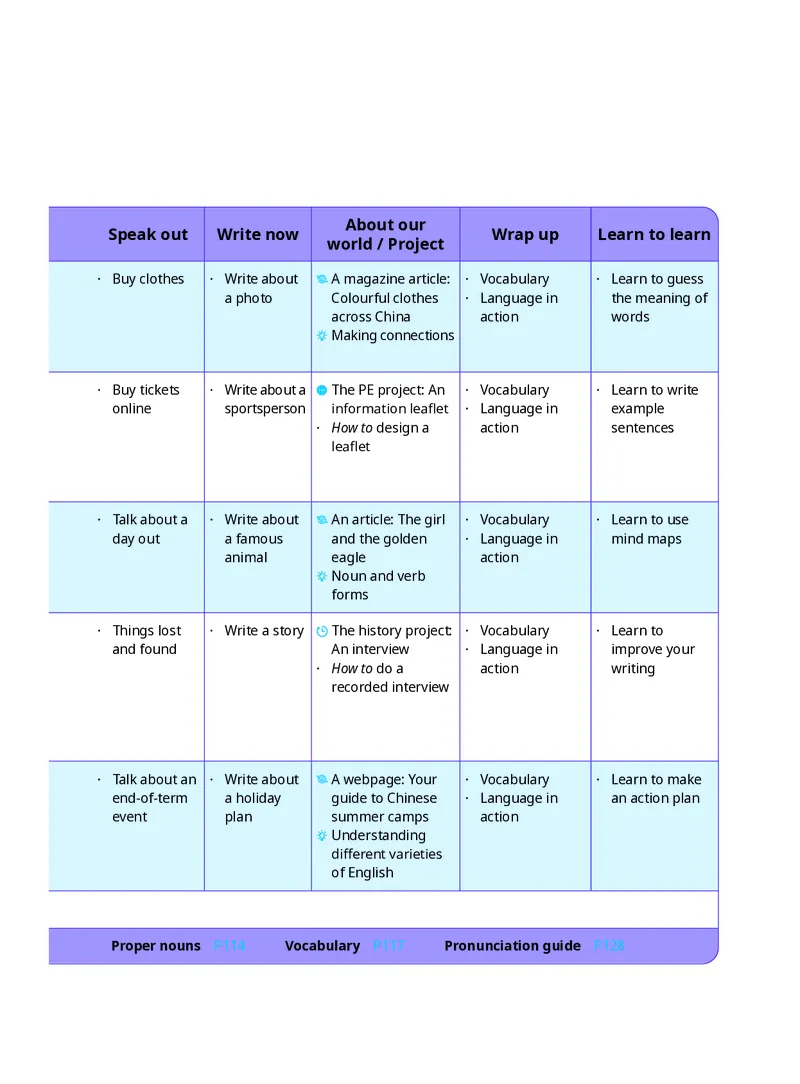
向更广阔的世界打下坚实的基础。Scope and sequence
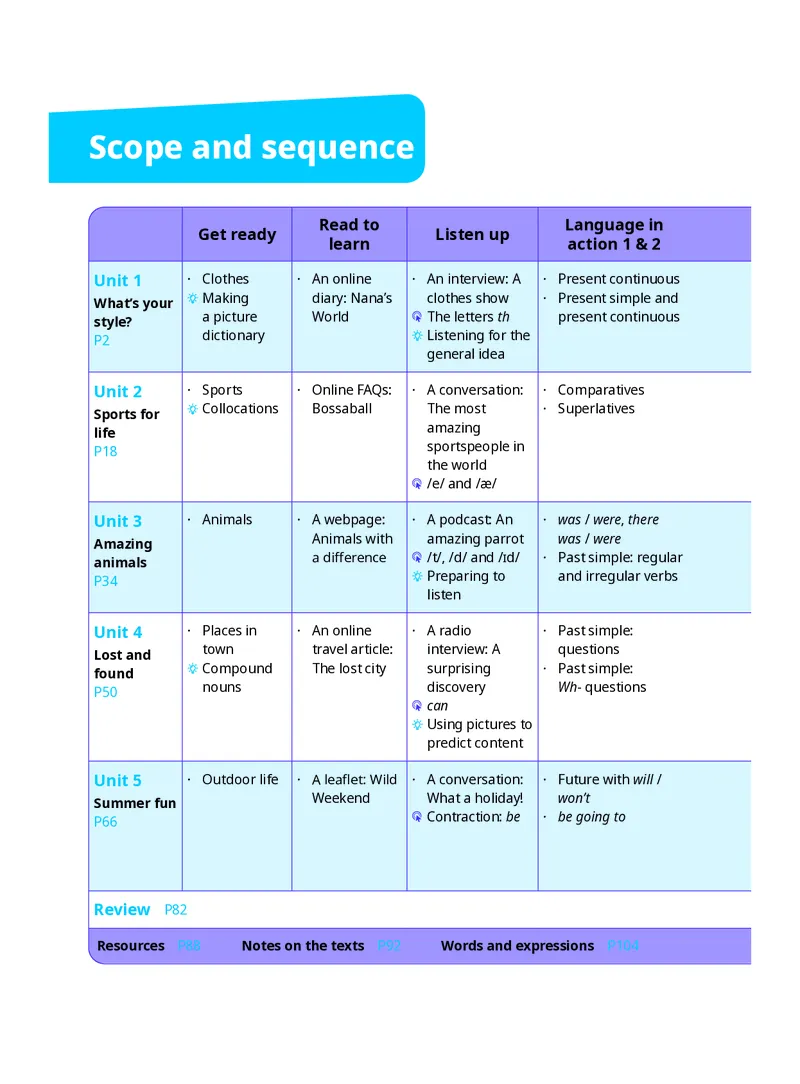
Read to Language in About our
Get ready Listen up Speak out Write now Wrap up Learn to learn
learn action 1 & 2 world / Project
Unit 1 · Clothes · An online · An interview: A · Present continuous · Buy clothes · Write about A magazine article: · Vocabulary · Learn to guess
Making diary: Nana’s clothes show · Present simple and a photo Colourful clothes · Language in the meaning of
What’s your
a picture World The letters th present continuous across China action words
style?
dictionary Listening for the Making connections
P2
general idea
Unit 2 · Sports · Online FAQs: · A conversation: · Comparatives · Buy tickets · Write about a The PE project: An · Vocabulary · Learn to write
Collocations Bossaball The most · Superlatives online sportsperson information leaflet · Language in example
Sports for
amazing · How to design a action sentences
life
sportspeople in leaflet
P18
the world
/e/ and /æ/
Unit 3 · Animals · A webpage: · A podcast: An · was / were, there · Talk about a · Write about An article: The girl · Vocabulary · Learn to use
Animals with amazing parrot was / were day out a famous and the golden · Language in mind maps
Amazing
a difference /t/, /d/ and /Id/ · Past simple: regular animal eagle action
animals
Preparing to and irregular verbs Noun and verb
P34
listen forms
Unit 4 · Places in · An online · A radio · Past simple: · Things lost · Write a story The history project: · Vocabulary · Learn to
town travel article: interview: A questions and found An interview · Language in improve your
Lost and
Compound The lost city surprising · Past simple: · How to do a action writing
found
nouns discovery Wh- questions recorded interview
P50
can
Using pictures to
predict content
Unit 5 · Outdoor life · A leaflet: Wild · A conversation: · Future with will / · Talk about an · Write about A webpage: Your · Vocabulary · Learn to make
Weekend What a holiday! won’t end-of-term a holiday guide to Chinese · Language in an action plan
Summer fun
Contraction: be · be going to event plan summer camps action
P66
Understanding
different varieties
of English
Review P82
Resources P88 Notes on the texts P92 Words and expressions P104 Proper nouns P114 Vocabulary P117 Pronunciation guide P128Read to Language in About our
Get ready Listen up Speak out Write now Wrap up Learn to learn
learn action 1 & 2 world / Project
Unit 1 · Clothes · An online · An interview: A · Present continuous · Buy clothes · Write about A magazine article: · Vocabulary · Learn to guess
Making diary: Nana’s clothes show · Present simple and a photo Colourful clothes · Language in the meaning of
What’s your
a picture world The letters th present continuous across China action words
style?
dictionary Listening for the Making connections
P2
general idea
Unit 2 · Sports · Online FAQs: · A conversation: · Comparatives · Buy tickets · Write about a The PE project: An · Vocabulary · Learn to write
Collocations Bossaball The most · Superlatives online sportsperson information leaflet · Language in example
Sports for
amazing · How to design a action sentences
life
sportspeople in leaflet
P18
the world
/e/ and /æ/
Unit 3 · Animals · A webpage: · A podcast: An · was / were, there · Talk about a · Write about An article: The girl · Vocabulary · Learn to use
Animals with amazing parrot was / were day out a famous and the golden · Language in mind maps
Amazing
a difference /t/, /d/ and /Id/ · Past simple: regular animal eagle action
animals
Preparing to and irregular verbs Noun and verb
P34
listen forms
Unit 4 · Places in · An online · A radio · Past simple: · Things lost · Write a story The history project: · Vocabulary · Learn to
town travel article: interview: A questions and found An interview · Language in improve your
Lost and
Compound The lost city surprising · Past simple: · How to do a action writing
found
nouns discovery Wh- questions recorded interview
P50
can
Using pictures to
predict content
Unit 5 · Outdoor life · A leaflet: Wild · A conversation: · Future with will / · Talk about an · Write about A webpage: Your · Vocabulary · Learn to make
weekend What a holiday! won’t end-of-term a holiday guide to Chinese · Language in an action plan
Summer fun
Contraction: be · be going to event plan summer camps action
P66
Understanding
different varieties
of English
Review P82
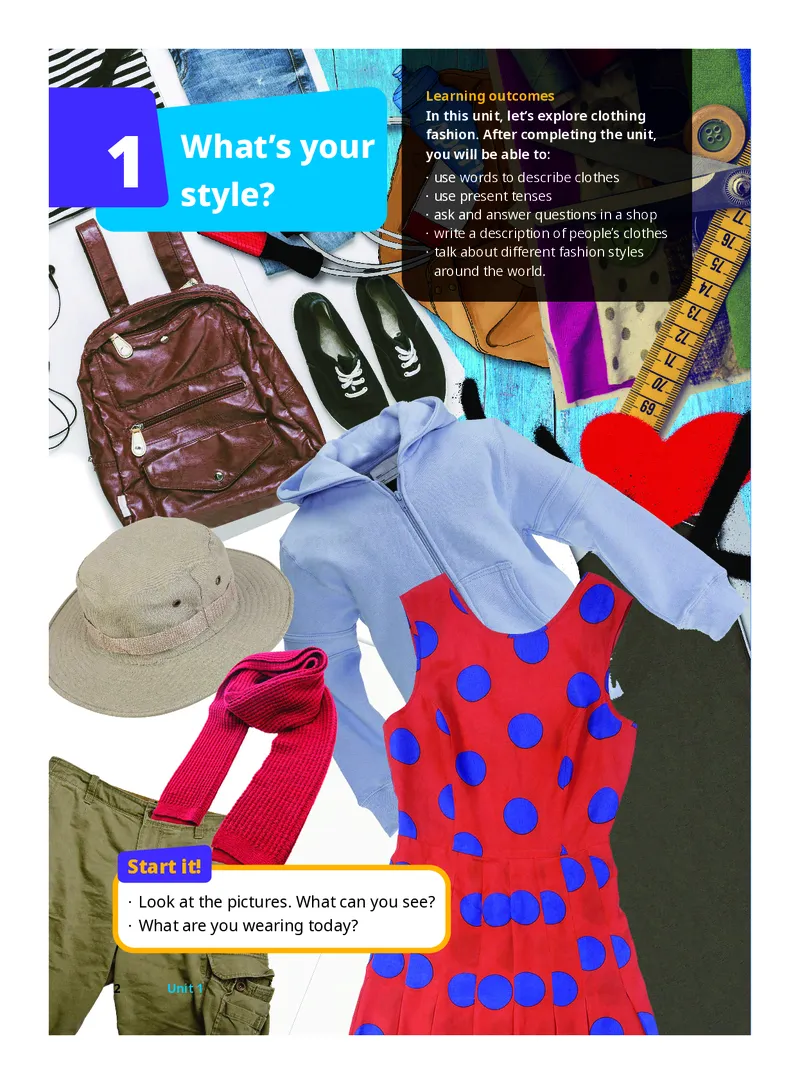
Resources P88 Notes on the texts P92 Words and expressions P104 Proper nouns P114 Vocabulary P117 Pronunciation guide P128Learning outcomes
In this unit, let’s explore clothing
fashion. After completing the unit,
What’s your
1
you will be able to:
· use words to describe clothes
style?
· use present tenses
· ask and answer questions in a shop
· write a description of people’s clothes
· talk about different fashion styles
around the world.
Start it!
· Look at the pictures. What can you see?
· What are you wearing today?
2 Unit 1 What’s your style?Get ready
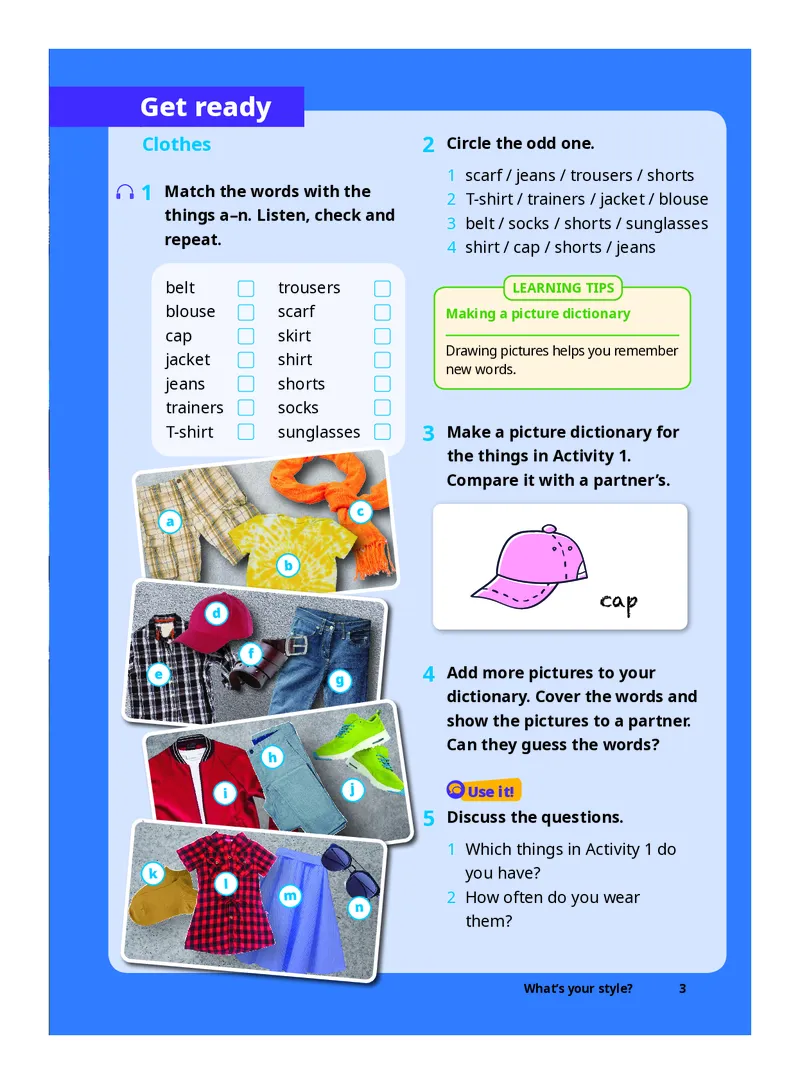
Clothes 2 Circle the odd one.
1 scarf / jeans / trousers / shorts
1 Match the words with the
2 T-shirt / trainers / jacket / blouse
things a–n. Listen, check and
3 belt / socks / shorts / sunglasses
repeat.
4 shirt / cap / shorts / jeans
belt trousers LEARNING TIPS
blouse scarf Making a picture dictionary
cap skirt
Drawing pictures helps you remember
jacket shirt
new words.
jeans shorts
trainers socks
T-shirt sunglasses 3 Make a picture dictionary for
the things in Activity 1.
Compare it with a partner’s.
c
a
b
cap
d
f
e 4 Add more pictures to your
g
dictionary. Cover the words and
show the pictures to a partner.
Can they guess the words?
h
i j Use it!
5 Discuss the questions.
1 Which things in Activity 1 do
k you have?
l
m 2 How often do you wear
n
them?
What’s your style? 3Read to learn
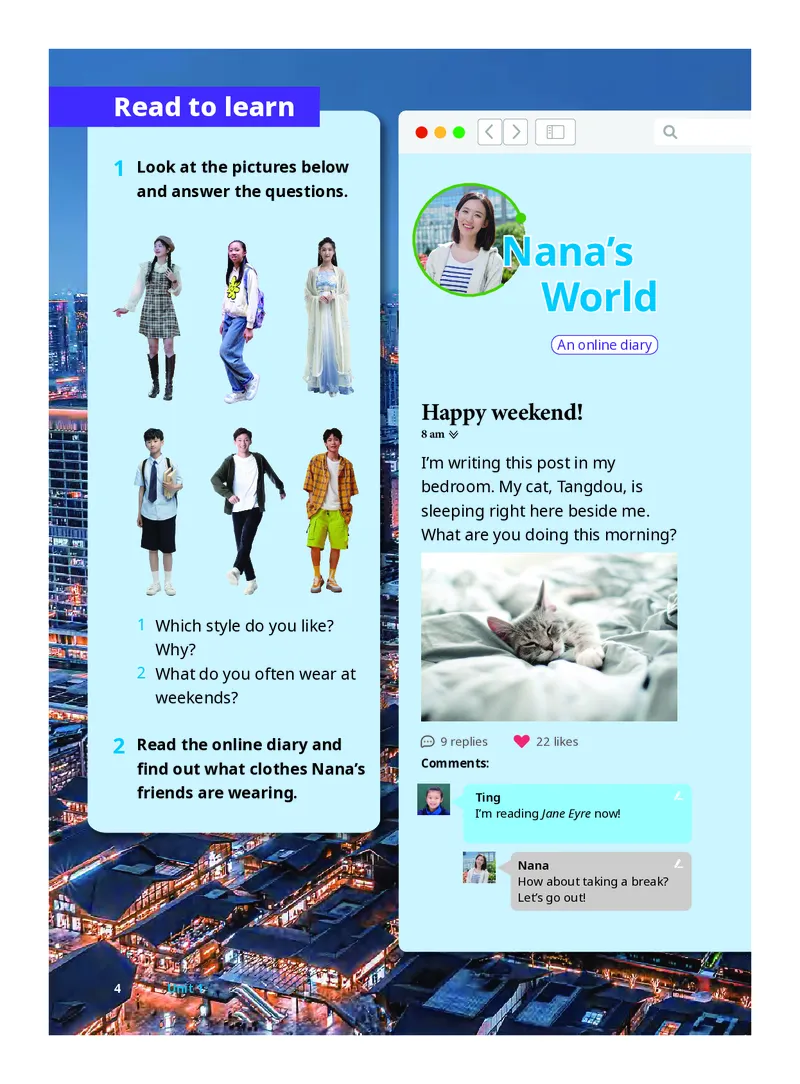
1 Look at the pictures below
and answer the questions.
NNaannaa’’ss
WWoorrlldd
An online diary
Happy weekend!
8 am
I’m writing this post in my
bedroom. My cat, Tangdou, is
sleeping right here beside me.
What are you doing this morning?
1 Which style do you like?
Why?
2 What do you often wear at
weekends?
2 Read the online diary and 9 replies 22 likes
Comments:
find out what clothes Nana’s
friends are wearing.
Ting
I’m reading Jane Eyre now!
Nana
How about taking a break?
Let’s go out!
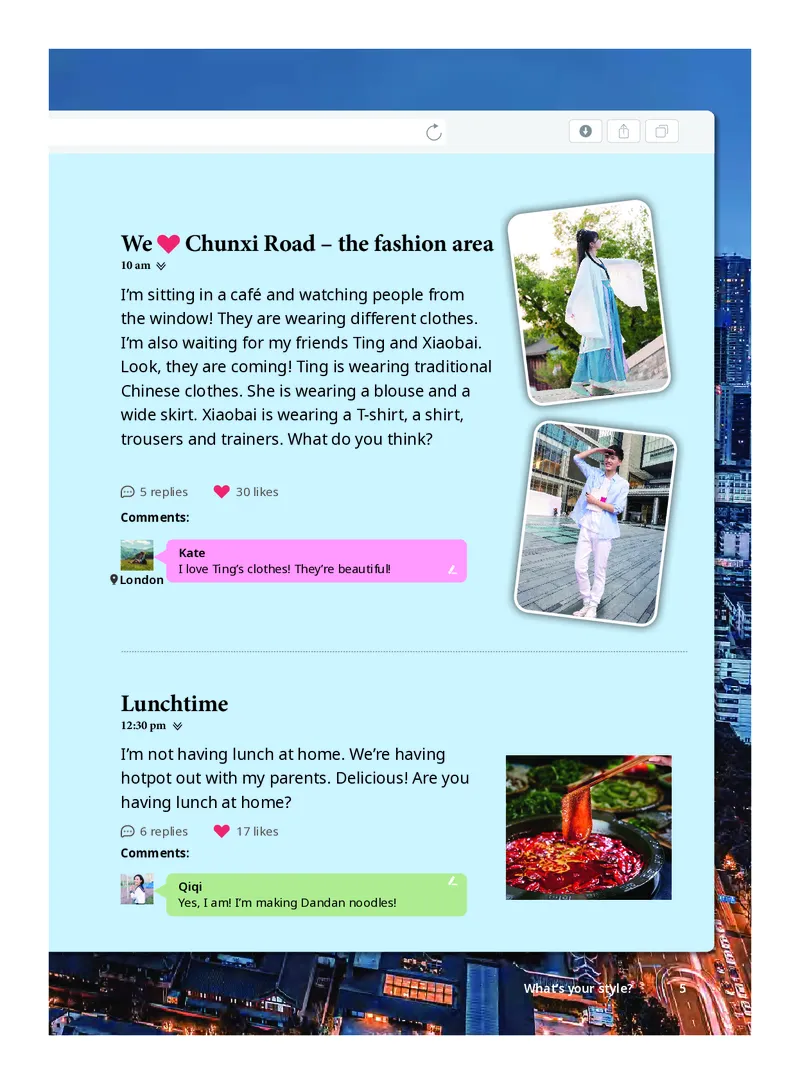
4 Unit 1 What’s your style?We Chunxi Road – the fashion area
10 am
I’m sitting in a café and watching people from
the window! They are wearing different clothes.
I’m also waiting for my friends Ting and Xiaobai.
Look, they are coming! Ting is wearing traditional
Chinese clothes. She is wearing a blouse and a
wide skirt. Xiaobai is wearing a T-shirt, a shirt,
trousers and trainers. What do you think?
5 replies 30 likes
Comments:
Kate
I love Ting’s clothes! They’re beautiful!
London
Lunchtime
12:30 pm
I’m not having lunch at home. We’re having
hotpot out with my parents. Delicious! Are you
having lunch at home?
6 replies 17 likes
Comments:
Qiqi
Yes, I am! I’m making Dandan noodles!
What’s your style? 5Language in action 1
3 Read the online diary and
write the correct answers. Present continuous
Nana Ting Xiaobai Qiqi
1 Complete the examples in the
tables below. Use the online
Who …?
diary on pages 4–5 to help you.
1 is writing the posts
I
2 has got a pet
I 1 this post in my
bedroom.
3 is reading a book
I 2 lunch at home today.
4 is wearing trainers
he / she / it
5 is cooking at home
Ting 3 traditional
Chinese clothes.
4 Complete the table below —4 Xiaobai a
and then describe Nana’s black shirt?
weekend to your partner. —No, he 5 .
8 am 10 am 12:30 pm
we / you / they
Where is she?
We 6 hotpot out.
What is she
doing? What 7 you this
morning?
Who is she
with? They 8 different clothes.
Voice it!
5 Discuss the questions.
1 Do you dress like your
friends? Why or why not?
2 What influences your choice
about clothes?
3 What can you tell about
people from their clothes?
6 Unit 1 What’s your style?2 Use information in the online Use it!
diary on pages 4–5 to correct 4 Write present continuous
the sentences. questions. Ask and answer
with a partner.
1 Tangdou is eating fish.
Tangdou isn’t eating fish. It is 1 what / you / wear / today?
sleeping.
2 Ting is sleeping. 2 which book / you / read /
this month?
3 Nana is sitting in a restaurant. 3 where / your best friend / sit?
4 what / you / think about /
4 Ting and Xiaobai are leaving right now?
the café.
What are you wearing today?
5 Qiqi is having hotpot at home.
I’m wearing my favourite jeans,
but I’m not wearing a belt.
3 Complete the post with the present continuous form of the verbs
in brackets.
Amy
I 1 (paint) my own design on a T-shirt. I 2
(create) my own style. What 3 you (do)?
Feifei It is sunny today. I 4 (sit) on the beach and I
5 (wear) sunglasses.
Sam I 6 (not go) to the beach. I 7 (read) a
book today.
What’s your style? 7Listen up
2 Listen to the interview. What
is Tom talking about?
a his family
b his job
An interview c his hobby
1 What do you know about the 3 Listen again. Are the
clothes of Chinese teenagers sentences T (true) or F (false)?
from the 1980s? Discuss Correct the false sentences.
with your partner and draw
Tom …
pictures for the clothes.
1 designs clothes for musicians.
2 usually starts work at 7 am.
3 never works late.
4 is starting the designs for
the girls’ clothes.
5 makes the clothes.
LEARNING TIPS
Voice it!
Listening for the general idea
4 Discuss the questions.
When you listen for the first time, you 1 Do you like the clothes from
may not understand every word. Don’t
the 1980s? Why or why not?
worry about it. Try to listen for the
2 Would you like to do Tom’s
general idea.
job?
PrPornonuunncicaitaitoinon
The letters th
1 Listen and repeat. the think without thirsty weather
1. /θ/ thanks Smith
through though there them thin
2. /ð/ clothes with
2 Put the words in the correct /θ/ /ð/
place according to the
pronunciation of the letters th.
3 Listen, check and repeat.
8 Unit 1 What’s your style?Language in action 2
Present simple and present continuous
1 Complete the examples in the table below. Use the interview to
help you. Listen and check.
Present simple Present continuous (things
(facts and habits) happening now)
What 1 you ? I 4 to Tom Smith.
I 2 clothes for actors. What 5 she now?
I sometimes 3 late. Emily 6 a short skirt.
Time expressions: adverbs of Time expressions: now, just now,
frequency, days of the week, right now, today, this morning /
every day week / month / year, at the moment
2 Match 1–5 with a–e. Compare with a partner.
1 Tom finishes work a all the clothes.
2 Tom is working on b a skirt with a belt today.
a TV programme c the designs for the girls’
3 Tom is finishing clothes right now.
4 Emily makes d at about 6 pm every day.
5 Emily is making e at the moment.
What’s your style? 93 Complete the blog post with Use it!
the present simple or present 4 Write questions with the
continuous form of the verbs present simple or present
in brackets. continuous. Ask and answer.
What …?
1 you (want)
1 you / always / wear / at
to know more about our life?
weekends
What 2 we
(do) this week?
2 music / you / listen to / at
the moment
We 3 (study) the history
of fashion in art. It’s really
Who …?
interesting and I 4
3 you / sit next to / right now
(learn) lots of cool new things.
4 you / usually sit next to / at
We 5 (prepare) for our
lunchtime
class fashion show this week,
too. Huihui and I 6
(wear) clothes from the 1980s.
What do you always wear at weekends?
We 7 usually
I always wear jeans and trainers.
(not wear) clothes like this, but
we like the look! I 8
(love) the 1980s.
What 9 you
(do) right now?
POST A COMMENT:
10 Unit 1 What’s your style?Speak out Buy clothes
1 Listen to the conversation. What is Leilei
looking for?
2 Complete the conversation with the help of
the Useful language box. Listen and check.
Useful language
I’m looking for … What about this one / these?
Can I see … There’s a special offer today.
Have you got it in a different size / colour / style? Can I help you?
(SA=SHOP ASSISTANT) SA Here you go. What do
SA Good afternoon. 1 you think?
LEILEI Yes, please. 2 LEILEI It’s perfect. How much
a scarf for my grandma. is it?
SA 3 SA It’s 80 yuan, but 6
LEILEI My grandma doesn’t wear pink. Buy two for
4 120 yuan.
SA Yes, I have. You’re in luck! It LEILEI No, thanks. I’m fine with
comes in blue and purple. just one!
LEILEI 5 the purple SA Are you sure? It’s a real
one, please? bargain.
LEILEI No, honestly. One is fine.
3 Look at the Everyday English box. Find and underline the
expressions in the conversation.
Everyday English
You’re in luck! It’s perfect. It’s a real bargain. No, honestly.
4 Work in pairs. Practise the conversation.
5 Work in pairs. Act out a conversation about buying clothes.
What’s your style? 11Write now
Write about a photo
1 Look at the photo. Which person is Eric? Read the description
and find the answer.
My favourite photo
By Eric
A description
1 This is a photo of
my friends and
me. We’re sitting
by the river and
celebrating Iris’s
13th birthday.
2 I am in the middle with Iris. She’s wearing a
white T-shirt and a jacket. She’s laughing. I’m
wearing a grey coat with a T-shirt under it. Greg
is on the left. Greg’s wearing a red shirt. He
usually wears a cap but he isn’t wearing it that
day. Sophie is next to Greg. She’s wearing jeans.
Harry is on the right.
3 I love this photo because I’m with my friends and
we’re all having a great time.
12 Unit 1 What’s your style?2 Read the description Write your own description
again and answer the of a photo.
questions.
PLAN
1 Where are they?
5 Choose one of your favourite
2 What are they
photos and make notes.
celebrating?
Decide on the information for
3 What is Iris wearing?
each paragraph. Use Activity 3
4 What does Greg
to help you.
usually wear?
5 Why does Eric like
WRITE
this photo?
6 Write your description.
3 Match the topics a-c with Remember to use the present
the paragraphs 1–3. simple, present continuous
and the expressions from the
a Description of the
Useful language box.
people in the photo.
b Brief description of who
CHECK
is in the photo.
7 Do you ...?
c Opinion on why it is the
writer’s favourite photo. · describe people in the photo,
including their clothes
4 Complete the expressions
· describe the people’s positions
in the Useful language box. in the photo
· say why you like the photo
Useful language
1 the middle
on 2 left
3 the right
next 4
(someone)
What’s your style? 13ABOUT
1 Look at the pictures and discuss
OUR
WORLD
the questions.
1 Where do you think the people in
the pictures are from?
2 What is special about their clothes?
2 Read the article and check your
Colourful
answers to Activity 1.
clothes across
Hi! I’m Caixian, a Miao
China
girl. My grandma made
me this traditional dress.
A magazine article It has many colourful
flowers on it. We
China has 56 ethnic groups, wear a lot of silver,
and each has its own special too. It is shiny and
clothes. These clothes show pretty. This shiny
who they are and where silver hat is special
they live. because it was made by my dad. I
like it so much!
Hi! I’m Aylin
from Xinjiang Hello! My name is Temur, and I’m a
Uygur Mongolian boy. Today I’m wearing
Autonomous my blue robe, “deel”, and black
Region. This boots. They keep me warm when I
is my favourite ride my horse. I’m learning archery
skirt. It’s very from my grandpa.
bright with red, It’s not just sport.
black and yellow It’s a special
colours. I love part of our
dancing so much. culture.
When I dance,
my skirt moves
with me beautifully, like a peacock
spreading its feathers.
14 Unit 1 What’s your style?3 Read the article again and 5 Describe to your partner
write T (true) or F (false). the traditional clothes from
another ethnic group in your
1 Aylin’s skirt doesn’t move
hometown or other places in
when she dances.
China. Use the thinking map to
2 There is a peacock on Aylin’s
organise your ideas.
skirt.
3 Caixian’s traditional dress
What What are the
was made by her grandma.
traditional colours and
4 Archery in Inner Mongolia is
clothes do they designs of their
just for fun.
wear? traditional
5 Temur wears boots only for
clothes?
horse riding.
LEARNING TIPS
Making connections
The ethnic group’s
name and where
When you read an article, try to
make connections with your own life they live
and experiences. This can help you
understand the article more easily.
Why are their traditional clothes
important or special to them?
Voice it!
4 Discuss the questions.
1 Do you think Aylin, Caixian
and Temur like wearing their
Explore it!
traditional clothes? Why?
2 Whose clothes do you like Guess the correct answer.
Why is red a popular colour in traditional
best? Why?
Chinese dresses?
3 Can you mix traditional
a It looks pretty.
clothes with new fashion? b It brings good luck.
Give an example. c It keeps away the cold.
Find out some interesting facts about
traditional clothes. Choose your
favourite one and write a question for
your partner to answer.
What’s your style? 15Language in action
WRAP
UP
3 Complete the conversations.
Use the correct form of the
verbs.
Vocabulary 1 you / watch / TV / just now? Learn to guess the
✗
do / my homework meaning of words
1 Complete the names of clothes.
1 j ns
2 tr n rs 2 Linda / wear / a red T-shirt /
3 sh rt always?
✗
4 b t wear / a blue shirt
5 sh ts
6 tr s s
3 Mike / chat / with his friends /
2 Look at the pictures and write.
at the moment?
What are they wearing? ✗
take / a photo
4
5
1 4 Write sentences with the
6
present simple or the
2
present continuous.
3
7
1 wear / some people / sports
clothes / at weekends
.
2 right now / look for / I /
1 5
some jeans
2 6
.
3 7
3 the clothes for the show /
4
make / they / now
.
4 Nina / red clothes / buy /
usually
.
16 Unit 1 What’s your style?LEARN
2 Read the text. Discuss the questions
TO
LEARN
about each of the words in bold
with a partner.
I don’t like tight jeans.
I prefer baggy jeans Jeff
Learn to guess the
because they’re comfortable. I
meaning of words
have lots of T-shirts, but I don’t like
When you don’t know a word, T-shirts with logos – I don’t like
you can guess the meaning. pictures or writing on my clothes.
1 Circle the answers that 1 Are they nouns, verbs or adjectives?
are true for you.
I think “baggy” is an adjective.
When I see a word I don’t
2 What clues about the meaning can
know, I usually …
you find in the text?
1 guess the meaning.
2 ask the teacher. Baggy jeans are comfortable.
3 look it up in a dictionary.
3 What do you think “baggy” means?
4 write it in my notebook.
I think “baggy” means not tight.
3 Read the text on page 88. Use
questions in Activity 2 to help you
guess each of the words in bold.
Resources p88
Self-assessment
I can use words to describe clothes as many as possible.
I can use the present continuous to talk about what is
happening now.
I can use the present simple and the present continuous.
I can ask and answer questions in a shop.
I can write a description of people’s clothes.
I can talk about different fashion styles around the world.
What’s your style? 17Learning outcomes
Get ready
In this unit, let’s explore fun sports.
After completing the unit, you will be
Sports
2 able to:
· use words and expressions to talk
for life about sports
· use comparatives and superlatives
· buy tickets online
· write a profile of a sportsperson
· share information about different
sports at home and abroad.
Start it!
Look at the picture. What do you think they are doing?
18 Unit 2 Sports for lifeGet ready
b
a
Sports
1 Match the words with the pictures
a–j. Listen, check and repeat.
c d
badminton rock climbing
basketball swimming
gymnastics table tennis
tai chi volleyball
f
running yoga e
LEARNING TIPS
Collocations
g h
Some words are often used together–we call
these collocations. Learn them as phrases.
There are three main verbs we use with sports.
play ball sports
go sports in the form of v. + -ing
i
do other sports j
2 Write the sports from Activity 1 Use it!
in the spidergram. How many 4 Discuss the questions.
more sports can you add?
1 Which sports do you do?
SPORTS How often do you do them?
basketball
2 Do you prefer team sports
go play
or individual sports? Why?
Explore it!
do
Guess the correct answer.
Which of the following sports started in
China?
3 Work in pairs. Say a sport and
a football b table tennis c volleyball
your partner says the verb.
Find an interesting fact about a sport.
Table tennis. Write a question for your partner.
Play.
Sports for life 19Read to learn
1 Look at the pictures and read
the fact file of Filip Eyckmans.
Then answer the questions. What sports do you like?
Volleyball,
football or
gymnastics?
Filip Eyckmans
Filip Eyckmans comes If you like all three,
Bossaball
from Belgium. He used is the sport for you!
to be a tennis player and
he also likes football.
He loves music and
dance, too. He mixes his
favourite things to invent
a new sport, Bossaball.
A5
Q1: What is Bossaball?
Q2: Is it a team game?
Q3: W here can I play it?
1 Can you guess how to play Q4: W hat is the equipment
Bossaball? for playing Bossaball?
2 Do you think it’s fun to play Q5: C an players touch the
Bossaball? Why or why not? ball?
Q6: C an anyone play it?
2 Read the online FAQs. Check
your answers to Activity 1.
Then match the questions
with the answers in the FAQs.
20 Unit 2 Sports for lifeBB oo ss ss aa bb aa ll ll
Online FAQs
A1: A Bossaball ball, of course. Then a trampoline and a volleyball-
style net, but the net is usually higher than that of volleyball. At
the same time, the playground is softer than that of volleyball.
A2: Yes. It’s suitable for people of all ages.
A3: Yes, it is. There are two teams. Each team often has four players.
A4: Yes. They can use their hands, arms or feet.
A5: It’s a mix of football, volleyball, gymnastics and music. In some
places, it’s becoming more popular than beach volleyball.
A6: You can play it indoors if the weather’s bad, but people usually
play it outdoors.
Bossaball players think the sport is better than
volleyball and more exciting than football. It isn’t
boring to watch and it’s even more amazing to
play. What are you waiting for?
Sports for life 21Language in action 1
3 Read the FAQs again and
write T (true) or F (false). Comparatives
1 You can play Bossaball
1 Complete the examples in the
alone.
table below. Use the online FAQs
2 Players can’t use their
on pages 20–21 to help you.
feet.
3 The net of Bossaball is
Comparative adjectives
usually the same as that of
Short adjectives
volleyball.
4 You can play Bossaball The net is usually 1 than
when it’s raining. that of volleyball.
5 A Bossaball team often
The playground is 2 than
has four people.
that of volleyball.
4 Complete the table for Long adjectives
Bossaball.
Bossaball is 3 than
Bossaball football.
Rules It’s even 4 to play.
Players
Irregular adjectives
Equipment Bossaball is 5 than volleyball.
Place
The weather is worse today than
yesterday.
Voice it!
5 Discuss the questions.
1 Do you want to try
Bossaball?
2 Do you know any other
new sports?
22 Unit 2 Sports for lifeUse it!
2 Compare different sports 4 Write sentences to compare
with the comparative form some of the things below. Use
of the adjectives in the box. adjectives from the box. Then
discuss them with a partner.
small tall long heavy popular
boring comfortable difficult
1 In some places, Bossaball is easy exciting good healthy
becoming than beach interesting smart tasty
volleyball.
2 The time for a marathon is table tennis / tennis
than that for a meeting friends / going shopping
basketball match. Italian food / Chinese food
3 A bowling ball is than a skirts / trousers
tennis ball.
I think table tennis is more interesting
4 A basketball player is usually
than tennis. What do you think?
than a table tennis
player. I don’t agree. I think
5 A golf is than a football. tennis is more interesting.
3 Complete the conversation with the comparative form of the adjectives
in brackets.
TOM Hi, Li Hua! It’s good to see you again. How was your winter
holiday? You look 1 (fit)!
LI HUA Thanks, Tom. That’s because I’m doing tai chi.
TOM Seriously? Tai chi? Isn’t that for elderly people?
LI HUA Many people think that way, but it’s not true. Tai chi is
becoming 2 (popular) nowadays, because of its health
benefits.
TOM Really? Tell me more about these health benefits.
LI HUA Tai chi mixes slow movements and deep breathing. This can
make you 3 (strong) and
4 (healthy). After practising,
you will feel 5 (focused).
TOM Wow! Can I do tai chi with you?
LI HUA Sure!
Sports for life 23Listen up
The most
amazing
ssppoorrttssppeeooppllee
2 Listen again. Circle the
in the world correct words and numbers.
A conversation 1 Johanna Quaas trains for an
hour every week / day.
1 Look at the photos. Why do
2 Johanna Quaas doesn’t eat
you think these people are
much meat / fruit.
amazing? Listen and check.
3 Sun Mingming is 2.36 / 2.26
metres tall.
4 Sun Mingming’s trainers are
size 41 / 60.
Voice it!
3 Discuss the questions.
Johanna Quaas
1 Which facts about these
two people surprise you the
most?
2 Which of these two people
do you think is more
amazing? Why?
Sun Mingming
PrPornonuunncicaitaitoinon
/e/ and /æ/
1 Listen and repeat. 3 Listen and repeat the sentences.
1. /e/ every best next 1. The cat sat on the mat and
2. /æ/ at that gymnastics waited to be fed.
2 Listen and circle the words 2. He said, “Get ready to play; it’s
you hear. time for the match.”
1. met / mat 4. set / sat 3. The empress met the tennis
2. bed / bad 5. pen / pan athlete in the Palace.
3. head / had 6. said / sad 4. Ben’s friend Mat can bend really
well.
24 Unit 2 Sports for lifeLanguage in action 2
Superlatives
1 Complete the examples in the table below. Use the conversation
to help you. Listen and check.
Superlative adjectives
Short adjectives Long adjectives Irregular adjectives
Johanna Quaas is The article is about She thinks fruit and
1 gymnast some of 2 vegetables are
in the world. sportspeople in the 3 things
world. to eat.
2 Complete the profile of each person with the superlative form of
the adjectives in brackets.
Johanna Quaas is a gymnast. She’s
probably 1 (fit) and 2
(healthy) person in their 90s.
Sun Mingming is one of 3 (tall)
basketball players in the world. He’s probably
got 4 (big) feet, too!
Sports for life 25Speak out
3 Complete the sports quiz 4 Listen and check your answers
with the superlative form of to Activity 3.
the adjectives in brackets.
Guess, write and circle the Use it!
words and number. Then 5 Write four sentences about your
discuss with a partner. opinions on sports. Use the words
in boxes A and B.
easiest most interesting
A
A SPORTS QUIZ most difficult
1 Fauja Singh was over 100 when B do go learn play watch
he attended his last match.
the oldest
He’s (old) person to
run a marathon / climb Mount
Qomolangma.
2 Juju Noda started driving
at a very young age. She is
6 Work in pairs. Read your
(young) person to
sentences to your partner. Do
drive an F4 / F1 racing car.
you agree with your partner’s
3 Wu Minxia / Guo Jingjing won
opinions?
(many) gold medals
at the Olympics for diving from I think watching Olympic Games
2004 to 2016. on TV is the most interesting thing.
4 (fast) time for the
I can’t agree with you. In
men’s 100 m race at the Olympic
my opinion, doing a sport in
Games is 9.58 / 9 seconds.
person is more interesting.
5 Beach volleyball / Table tennis is
one of (popular)
indoor sports. People of all ages
play it.
6 One of (good)
foods to eat before you do
sports is a cabbage / banana.
26 Unit 2 Sports for lifeSpeak out
Buy tickets online
1 Listen to the conversation. How much do the boys pay for the tickets?
2 Complete the conversation with the help of the
Useful language box. Listen and check.
Useful language
How much are the tickets? Let’s go.
They’re … Let’s book … Shall we go?
What’s the quickest / cheapest way to get there?
LIN TAO Look! Our favourite HAN DONG That’s OK. 4
football team is playing them.
this afternoon. 1 LIN TAO Got them! We collect
HAN DONG Why not? 2 and pay for the paper
LIN TAO The best seats are the tickets when we get
most expensive. 3 there. The match
480 yuan. starts in an hour.
HAN DONG That’s crazy! Are there HAN DONG What are we waiting
any cheaper tickets? for? 5
LIN TAO Yes, there are. The LIN TAO 6
cheapest tickets are 160 HAN DONG Run – fast!
yuan , but they’re for the LIN TAO Wait for me!
farthest seats.
3 Look at the Everyday English box. Find and underline the
expressions in the conversation.
Everyday English
Look! Why not? That’s crazy! Got them! What are we waiting for?
4 Work in pairs. Practise the conversation.
5 Work in pairs. Act out a conversation about buying tickets online
for a sports event.
Sports for life 27Write now
Write about a sportsperson
1 Look at the pictures. What sport do you think Su Bingtian does?
Read the profile and check your answer.
My favourite sportsperson
By Yang Zihui A profile
1 My favourite sportsperson is Su Bingtian. He’s a
100-metre runner from China.
2 Su Bingtian trains hard every day to get faster. He
trains hard to become stronger and perform better,
too. He also enjoys playing basketball.
3 I admire Su Bingtian because he has a strong will
and does his best to do everything. He is the first
Asian to run 100 metres in less than 10 seconds. He
is also the fastest runner in China.
28 Unit 2 Sports for life2 Match the topics a–c with Write your own profile of your
the paragraphs 1–3. favourite sportsperson.
a Achievements
PLAN
b Basic information and
5 Make notes about your
description
favourite sportsperson.
c Training and other
Decide on the information for
interests
each paragraph. Use Activity 2
3 Read the profile again to help you.
and write two pieces of
information for each point WRITE
in Activity 2. 6 Write your profile. Remember
to include three paragraphs,
Achievements: first Asian
and use comparatives,
to run 100 metres in less than 10
superlatives and expressions
seconds …
from the Useful language box.
CHECK
4 Read the Useful language 7 Do you …?
box and circle the correct
· give basic information
words. Use the profile to
and a description of the
help you.
sportsperson
· describe their training
Useful language
and personal interests
We use also and too to using comparatives and
give extra information. superlatives
We use also 1 before / after · talk about their achievements
the verb “be”. and why you like them
We use also 2 before / after
other verbs.
We use too at the
3 beginning / end of a
sentence.
Sports for life 29THE PE
PROJECT
An information leaflet
1 Look quickly at the leaflet. Circle
its purpose.
1 to give directions to a sports club
2 to give information about a sport
2 Read the leaflet carefully and make
notes on the ideas in the box. STREETBALL
What? Who? When? Where?
WHAT IS IT?
Equipment Rules Benefits
It’s outdoor basketball in your local
area.
WHO?
How to design a leaflet
Everyone is welcome! You don’t
need to belong to a team.
Read the tips on designing a
WHAT TO BRING?
leaflet. Circle the ones you think
We’ve got a basketball and nets. Just
are good pieces of advice.
bring yourself and your trainers!
a Use bright colours like red, yellow
WHEN AND WHERE?
or bright blue.
We meet every Tuesday at 5:30 pm
b Use photos and a map.
at the West Street sports centre.
c Make sure the people are smiling
Come along and join us!
in the photos.
d Use headings to organise
Find us here:
information.
e Include contact details.
f Choose a clear font (if you’re
using a computer) or write neatly.
g Include everything you know
WHY NOT COME ALONG AND MAKE
about this topic.
NEW FRIENDS?
30 Unit 2 Sports for lifeMake your own leaflet.
PLAN
3 Work in groups. Choose a sport
and find out information about
it. Complete the steps below.
· Decide on the information you
want to include.
· Decide and choose the photos
to include.
· Make your leaflet.
RULES
· Discuss how you can improve
Different streetball games have
your leaflet.
different rules, but these are ours:
• A team can play with only two PRESENT
players but there are never more 4 Prepare your final leaflet
than five. and present it to the class.
• Players can bounce, throw and Remember to include facts
catch the ball. about the sport, photos and
• When you score, your team gets maps, and use the tips in How
one point. to box.
• After you score, your team keeps
the ball. CHECK
• A team wins when they score 5 Look at other groups’ leaflets
seven points. and complete the notes.
BENEFITS
· Which sport is the most
• It’s free!
interesting?
• It’s a great way to get fitter and
· Which leaflet has the best
healthier!
design?
• The matches are faster and more
· Which sport do you want to try?
exciting than normal basketball.
Why?
• It’s great fun!
Any questions?
Email Greg
Sports for life 31Language in action
WRAP
UP
3 Write the comparative form
of the adjectives.
1 bad
Vocabulary 2 big Learn to write example
3 easy sentences
1 Complete the sentences.
4 interesting
5 good
rock climbing table tennis
beach volleyball yoga 4 Look at the information
and write sentences. Use
1 You need a net to play comparative or superlative
and . adjectives.
2 is a ball game
Jack’s opinion
that people always play
Table Basket- Tennis
outdoors.
tennis ball
3 People usually do
indoors.
4 can be dangerous,
so you need very good easy
equipment. exciting
popular
2 Circle the correct words.
Jack thinks ...
I like doing sports. At school,
1 table tennis / easy
we do 1 running / tai chi and
I like that. At the weekend I
2 basketball / easy / tennis
often go 2 swimming / yoga
with my brother. I really
3 tennis / exciting / table tennis
like team sports, and in the
holidays I sometimes play
4 table tennis / popular / tennis
3 basketball / volleyball with
my friends on the beach. I
5 basketball / popular
also love going 4 yoga / rock
climbing with my dad in the
6 basketball / exciting
mountains.
32 Unit 2 Sports for lifeLEARN
Language in action
TO
LEARN
Yiyi’s English
learning blog
Learn to write example Today’s tip, 20 Mar
sentences When I learn new words, I use them
in example sentences. I think this is
better than writing them in Chinese.
Example sentences help you
There are different types of example
understand and remember words.
sentences:
A. sentences about me or my parents
1 Read Yiyi’s blog. How does she
with pictures – this makes it easier to
remember new words? Why? remember the words
B. funny sentences – a funny image
2 Circle the example sentences you can help the word stay in your memory
prefer. Compare your answers C. sentences to explain the words –
this makes the meaning clear
with a partner’s and say why.
Look at my notebook! What do you
1 bananas
think?
a. Bananas are nice.
My parents
b. Bananas are a long yellow fruit. do yoga in
the garden.
I prefer example sentence b because
I run to school
the words “long”, “yellow” and “fruit” when I’m late.
help me remember what bananas are.
2 kick 3 Write an example sentence for
a. In football, players kick a ball. each of the words on page 89.
b. They kick it.
Resources p89
Self-assessment
I can name sports in English as many as possible.
I can use comparative adjectives to compare two people or
things.
I can use superlative adjectives to compare three or more people
or things.
I can buy tickets online.
I can write a profile of my favourite sportsperson.
I can talk about different sports at home and abroad.
Sports for life 33Learning outcomes
In this unit, let's explore amazing
animals. After completing the unit, you
Amazing
3 will be able to:
· use some new words to describe animals
animals · use different forms of the past simple
· ask for and respond to information
· write an article about a famous animal
· share stories between animals and
human beings around the world.
Start it!
· What’s happening in the picture?
· What do you know about this animal?
34 Unit 3 Amazing animalsGet ready
b
a
Animals
c
1 Match eight animals with the pictures
d
a–h. Listen, check and repeat. Which
six animals are not in the pictures?
ant gorilla penguin
bear giraffe snake
butterfly lion whale
eagle mouse wolf
fox parrot
e
1 2 3
4 5 6
2 Listen to the noises. Which animals from
Activity 1 do you hear?
f
1 2 3
4 5 6
3 Do the quiz about animals and share
your answers with your partner.
Animal Quiz
g
1 Which animal weighs the same as a blue whale’s
tongue?
a. a horse b. an elephant c. a giraffe h
2 Which bird sometimes sleeps with an eye open?
a. a duck b. a parrot c. an eagle
3 Which animal doesn’t have a heart?
Explore it!
a. a snake b. a jellyfish c. a mouse
Find an interesting
4 How long does a koala sleep every day?
animal fact. Write
a. 4–8 hours b. 10–14 hours c. 18–20 hours a question for your
partner to answer.
Amazing animals 35Read to learn
1 Read the fact files and
answer the questions.
1 What do you learn about
gorillas, elephants and tigers?
2 What surprises you most?
GORILLA FACT FILE
HABITAT
Forests and
mountains
FOOD F
G
r
o
u
r
it
il
s
la
a
s
n
m
d
a
le
k
a
e
v
t
e
h
s
eir new nests
AAnniimmaallss
wwiitthh
FACT
every night. aa
ddiiffffeerreennccee
AFRICAN ELEPHANT FACT FILE A webpage
HABITAT African grasslands and forests Snowflake
FOOD Grass, leaves and fruits
FACT Elephants can use their feet From 1966 until 2003, there was
to listen. a special gorilla in Barcelona
Zoo, Spain. His name was
BENGAL TIGER FACT FILE
Snowflake, and he was born
HABITAT Forests and mountains in in Africa. Snowflake was a star
Southeast Asia in the zoo because he was
FOOD Deer, buffaloes, antelopes different – he was the world’s
and other animals only white gorilla at that time.
FACT There aren’t two tigers with
the same stripes.
2 Look at the pictures. Is there
anything unusual about
Snowflake, Nómade and Artico?
3 Read the webpage. Check
your answers to Activity 2.
36 Unit 3 Amazing animalsArtico
In 2004, Artico, a Bengal tiger,
was born in a wildlife centre
in Spain. Artico’s parents
were orange tigers with black
Nómade stripes. But he was white with
no stripes. Today, there are
In the 1990s, in southern only about 200 Bengal tigers
Africa, a baby elephant was without stripes in the world.
born without tusks. Her name
was Nómade. Her 11 sisters
were born without tusks, too.
About one hundred years
ago, 99% of African elephants
were born with tusks. Today,
in some areas of Africa, 98%
of female elephants are born
without tusks.
Amazing animals 37Language in action 1
4 Read the webpage again and
write T (true), F (false) or DS was / were, there was / were
(doesn’t say).
1 Complete the examples in
1 Snowflake died in 2003.
the tables below. Use the
2 Tusks are very important for
webpage on pages 36–37
elephants.
to help you.
3 Nómade was a male
elephant.
was(n’t) / were(n’t)
4 Only female elephants are
His name 1
born without tusks.
Snowflake.
5 Artico’s parents were yellow
with black stripes. Artico’s parents 2
orange with black stripes.
5 Complete the table with
information about the three Artico 3 like his
animals. parents.
4 Artico’s parents
Snowflake Nómade Artico
white?
What animal
No, they 5 .
is it?
When was it
there was(n’t) / were(n’t)
born?
6 lots of elephants
What did it
born with tusks.
look like?
Why was it 7 a special gorilla
special? in the zoo.
8 another gorilla like
Voice it!
Snowflake.
6 Answer the questions.
9 other white
1 Which of the three animals is
gorillas in the world?
the most amazing? Why? No, 10 .
2 Do you know any other
amazing animals?
38 Unit 3 Amazing animalsAA
FF aa nn tt aa ss tt ii cc II ss ll aa nn dd
Use it!
2 Use information in the webpage 4 Think about the following
on pages 36–37 to correct the questions. Ask and answer
sentences. with a partner.
1 Snowflake and Artico were black. 1 What was your favourite
They weren’t black. They were white. animal when you were a kid?
2 Nómade was born in Spain. 2 Was there a pet in your
family years ago?
3 Nómade was an Indian elephant. 3 Who was your best friend
when you were at primary
4 There were many African school?
elephants without tusks 100 4 Where were you at six o’clock
years ago. last Sunday evening?
5 When was your first time
5 Artico was a lion. going to the zoo?
3 Complete the text with the correct form of was / were,
there was / were.
Around 100,000 to 60,000 years ago, on the Island of Flores, 1
animals like elephants. But 2 one difference: they 3
very small. 4 also Komodo dragons on the island. Their tails
5 as long as their bodies. 6 people on Flores? Yes,
7 , but they 8 very tall. They 9 only about
one metre tall. That’s about the size of a three-year-old! And their
brain 10 the size of an orange!
Amazing animals 39Listen up
LEARNING TIPS
Preparing to listen
Think about the questions before you listen.
It can help you get the correct answers.
A podcast
3 Listen again and answer the
1 Discuss the questions questions.
with a partner.
1 How old was Hannah?
1 What can parrots do? 2 Who was very noisy?
2 Are parrots good pets? 3 Who wasn’t at home on the day
Why or why not? of the story?
4 Why was Hannah’s bread on the
2 Listen to the podcast
table?
and circle what it’s
5 Where was Megan when Hannah
about.
ate the bread?
a a hungry parrot
4 Work in pairs. Take turns to tell
b a smart parrot
the story.
c a dangerous parrot
There was a little girl called Hannah.
There was a parrot.
Pronunciation
/t/, /d/ and /ɪd/
1 Listen and repeat.
/t/ picked /d/ lived /ɪd/ shouted
2 Listen and write A (/t/ or /d/) or B (/ɪd/).
1. looked 2. wanted 3. danced 4. needed
3 Write the past simple form of the following verbs and put them in the
correct place.
call climb hunt play start watch
/t/ or /d/:
/ɪd/:
4 Listen, check and repeat.
5 Work in pairs. You say a verb from Activity 3 and your partner says the
past simple form of it. Check your partner’s pronunciation. Take turns.
4400 UUnniitt 33 AAmmaazziinngg aanniimmaallssLanguage in action 2
Past simple: regular and irregular verbs
1 Complete the examples in the tables below. Use the podcast to
help you. Listen and check.
Regular verbs Irregular verbs
We 1 with my friend. Megan 3 a pet parrot.
Megan 2 up Hannah. She 4 into the kitchen.
A piece of bread 5 out of
Past time expressions
her mouth.
6 , Masha told me
a story about an amazing
parrot.
My story happened ten years
7 .
2 Complete the sentences. Correct three
of the facts according to the podcast.
Megan ...
1 (not make) Hannah bread.
2 (leave) the bread on
the table.
3 (not hear) Willie.
4 (see) Hannah’s face
was blue.
5 and Willie (not save)
Hannah’s life.
AAmmaazziinngg aanniimmaallss 4411Use it!
3 Complete the text with the 4 Write sentences with ago. Change
correct form of the verbs in the words in bold so that the
brackets. sentences are true for you.
1 This lesson / start / thirty minutes
This lesson started thirty minutes ago.
2 I / get up / four hours
3 I / start / school / seven years
On 12 May 2008, a huge
earthquake 1 hit (hit)
4 I / have / lunch / an hour
southwest China. In Wolong
National Nature Reserve, the
5 I / meet / my English teacher /
ground 2 (shake). The
six months
pandas were very scared. Some
pandas 3 (hide) in safe
places, and other pandas
5 Write three true and three false
4 (climb) up trees. Liu Juan
sentences about yourself. Use
was one of the panda keepers.
the past simple and past time
She 5 (see) a panda called
expressions.
Hua Ao. His eyes were wide with
fear. Liu Juan 6 (want) to
6 Take turns to say your sentences.
help Hua Ao. She 7 (run)
Can your partner guess which are
over a bridge. The bridge 8
true and which are false?
(move) from side to side. Liu
I went to Beijing on holiday last week.
Juan was scared, too! But she
9 (know) she 10
False! You were at school last week.
(have) to rescue Hua Ao. Finally,
she 11 (reach) Hua Ao and
12 (pick) him up. Hua Ao
13 (give) his keeper a big
hug!
PP aa nn dd aa rr ee ss cc uu ee
42 Unit 3 Amazing animalsSpeak out Talk about a day out
1 Listen to the conversation. Where was Mary yesterday?
2 Complete the conversation with the help of the Useful language
box. Listen and check.
Useful language
It was really cool / amazing / interesting!
What was it / that like? How was …? What about …?
DANIEL Hey, Mary. 1 4 lions?
the school trip yesterday? MARY Yeah, there was a family
MARY 2 We went to of lions. One of them
a safari park. looked inside our car.
DANIEL Really? 3 DANIEL Wow! No way!
MARY It was amazing! MARY Yep. It did. Then it
DANIEL Were there any elephants? climbed onto the
MARY Yeah, there were, but I window and ate my
didn’t see them. lunch.
DANIEL I can’t believe you didn’t DANIEL You’re joking!
see any elephants. MARY Of course I’m joking!
3 Look at the Everyday English box. Find and underline the
expressions in the conversation.
Everyday English
Really? Wow! No way! You’re joking!
4 Work in pairs. Practise the conversation.
5 Work in pairs. Talk about a day out.
Amazing animals 43Write now
Write about a famous animal
1 Look at the pictures. Do you think this dog is different?
Why or why not? Read the article and check your ideas.
A life-saving dog
By Linda White
An article
1 Barry was a famous Saint Bernard
dog from Switzerland. He was
born in 1800 and died at the age
of 14. He worked in the Swiss
Alps and helped people trapped
in snow. He saved over 40 people
during his life.
2 There is a story about Barry and
a little boy. One cold day, Barry
found a boy in the snow, but he
was too weak to walk. Barry let
the boy climb on his back and
carried him to a safe place.
3 People remember Barry as a hero.
They built a statue of him on his
100th birthday. He was such a
brave and kind dog!
44 Unit 3 Amazing animals2 Match the topics a–c with Write your own article about
the paragraphs 1–3. a famous animal.
a Description of details
PLAN
b General introduction to
5 Read the notes about a dog
the animal
called Betsy. Use the notes to
c Conclusion with people’s
write an article or make your
views on the animal
own notes about a famous
3 Read the article again and animal.
complete the notes.
An intelligent dog
A life-saving dog Who Betsy
Who Barry Where Vienna, Austria
Where What understood more
What than 340 words
How people remember him
Decide on the topic for each
paragraph. Use Activity 2 to
4 Look at the Useful language help you.
box. Find and underline
the time expressions in the WRITE
article. 6 Write your article. Remember
to include three paragraphs,
Useful language
and use the past simple and
in 1800 time expressions.
at the age of 14
during his life CHECK
on his 100th birthday 7 Do you ...?
· introduce the animal in the
Get it right!
first paragraph
We use in for months and years.
· describe what the animal did
in October / in 1800
We use at for specific times and ages. · include people’s opinions on
at the age of 14 / at 3 o’clock the animal
We use during for a period of time.
· use time expressions
during his life / during the summer holiday
We use on for dates and days.
on 23rd June / on his 100th birthday
Amazing animals 45ABOUT
1 Look at the picture. Where do
OUR
WORLD
you think the girl is from? Why
is she special? Read the article
to check your answers.
The girl and the golden eagle
An article
People in Mongolia used eagles for hunting thousands of years ago. It
is passed from father to son. Boys learn it when they are only 13.
Eagles can fly fast and see small animals from more than three
kilometres away. There are about 300 male eagle hunters today. But no
girls … until now.
The film, The Eagle Huntress, tells Aisholpan’s story. Her father was an
eagle hunter. When she was small, Aisholpan wanted to be an eagle
hunter, too. So, she went to the high Altai Mountains with her father
to find a baby eagle. The journey was difficult and dangerous. But
Aisholpan did it. She found her baby eagle!
Aisholpan’s father became her trainer. Aisholpan trained hard in
freezing temperatures. Her
baby eagle grew into a big
and strong golden eagle.
In 2016, Aisholpan competed in the
Golden Eagle Festival. She was the first
Mongolian girl in the competition.
There were 70 competitors. She was the
youngest competitor and the only girl. And guess
what? Aisholpan and her eagle won. What an
amazing pair!
46 Unit 3 Amazing animals2 Read the article again and
LEARNING TIPS
answer the questions.
Noun and verb forms
1 How old are the boys when
When you learn a new word, try to
they learn to hunt with
learn some other forms of the word.
eagles? This will help you understand texts.
We can add different endings to
2 How far away can eagles see
verbs to make nouns, such as -er,
small animals from?
-ing, -or, -tion, and so on.
3 Where was Aisholpan’s baby
eagle when she found it?
4 Who was Aisholpan’s trainer? 5 Complete the table with the
words from the article.
3 Retell the story of Aisholpan
to your partner. Use the Noun Noun
Verb
thinking map to organise (person) (thing)
your ideas.
1
competitor
2
Who is she? Where is she
hunt
3 4
from?
train
5
training
6
learner learning
Aisholpan
6 Work in pairs. Write sentences
How did she learn What
with the words from Activity 5.
eagle-hunting? achievement
Take turns to say your sentence
did she make?
but do NOT say the word. Can
your partner guess your word?
Voice it! They (learn) to hunt when they are young.
4 Discuss the questions.
Is the word “learn”?
1 Why do you think only boys
can hunt with eagles?
2 Why do you think Aisholpan
won the competition?
3 Do you want to learn to
hunt with eagles? Why or
why not?
Amazing animals 47Language in action
WRAP
UP
3 Joe and Linda went to a
wildlife park last week. Write
sentences with the correct
form of there was / were.
Vocabulary
1 many animals? (?)
1 Write down the names of the
2 two lions.(√)
animals.
3 an elephant with
no tusks. (×)
1 4
4 a tiger with no
stripes. (√)
5 a white gorilla? (?)
4 Complete the text with the
2 5 past simple form of the
verbs in brackets.
Mammoths 1 (live)
many, many years ago in
3 6
Africa, Asia, Europe and North
America. They 2 (die)
because the weather
3 (get) warmer and
2 Complete the adjectives. they 4 (not can) find
any food. They 5 (be)
1 w_ld 7 d_ng_r_ _s
about 3.5 m tall and 6
2 sm_ll 8 h_ _lthy
(weigh) about 6,000 kg. Their
3 n_ _sy 9 c_t_
tusks 7 (be) very,
4 b_ _ _t_f_l 10 l_rg_
very long – about five metres!
5 _m_zing 11 f_m_ _ _
They 8 (not eat) other
6 l_zy 12 cl_v_r
animals. They 9 (eat)
grass and flowers.
48 Unit 3 Amazing animalsLEARN
Learn to use mind maps
TO
LEARN
Mind maps can help you think of
ideas and plan how to organise them.
1 Han Bing made a mind 2 Complete Han Bing’s mind map with
map to help him with a the words and expressions below.
presentation. What is
1 tropical forests 2 What?
the topic?
3 small ears 4 food 5 Why?
a
keep warm and communicate
honey
black fur with a pale patch on chest
d What? insects
b
looks
fruit
a long tongue
strong and curved
An amazing animal – sun bear
claws
c
interesting fact habitat Where? Southeast Asia
They are the smallest bears. e
3 Make a mind map about your 5 Circle how you feel in the
favourite animal. checklist on page 89. Compare
and discuss your answer with
4 Use your mind map to talk your partner.
to your partner about your
Resources p89
favourite animal.
Self-assessment
I can name animals in English as many as possible.
I can use was / were, regular / irregular verbs to talk about the past.
I can ask for and respond to information.
I can write an article about a famous animal.
I can talk about stories between animals and human beings
around the world.
Amazing animals 49Learning outcomes
Get ready
In this unit, let’s explore losing and
finding things. After completing the
Lost and
4 unit, you will be able to:
· use words and expressions to
found describe places in town
· ask past simple questions
· offer help to find something
· write a blog post about your day
· share different people’s stories about
lost and found around the world.
Start it!
· Describe the picture. What place do you think this is?
· What do you do when you lose something?
50 Unit 4 Lost and foundGet ready d
a c
Places in town
b e
1 Match the words with the pictures
a–j. Listen, check and repeat.
f
aquarium post office
car park shopping centre g
cinema bank
hospital sports centre
museum swimming pool
h
2 Answer the questions. Write two
more questions about the places
i
in Activity 1 for your partner to
answer.
j
Where do you go to …?
1 buy clothes
2 see fish and other sea animals
LEARNING TIPS
3 see a doctor
Compound nouns
4 watch a film
5 do sports and exercise There are many compound nouns
in English. The two words together
6
usually have a different meaning
7
from the individual words.
3 Look at the words in Activity 1.
Which words are compound
Explore it!
nouns? Can you think of more
Guess the correct answer.
compound nouns?
In England, many shops and
supermarkets can only open six
Use it! hours on .
a Fridays b Saturdays c Sundays
4 Which places in Activity 1 are
Find an interesting fact about
there in your town? Which ones the places in your town. Write
do you sometimes or often go a question for your partner to
answer.
to? Compare with a partner.
Lost and found 51RReeaadd ttoo lleeaarrnn
1 Look at the picture below
and answer the questions.
The lost
city
1 What do you think
happened to the city?
2 What are people doing?
An online travel article
2 Read the online travel Last week, I visited the ancient city,
article and check your Pompeii. It was like going back in time!
answer to Activity 1.
About 2,000 years ago, Pompeii was
a busy and lively city in Italy. More
than 10,000 people lived there. They
enjoyed good food, music and art.
But everything changed in 79 CE. A
volcano near the city blew up. The
ash turned the sky dark. Pieces of
rock flowed down the mountain, and
hot gases filled the sky. Before long,
the city disappeared under 7 metres
of ash.
People found the lost city in 1748.
The ash kept everything. In 1997,
Pompeii became a UNESCO World
Heritage Site.
52 Unit 4 Lost and foundI walked through the empty streets and buildings. I couldn’t help
imagining the city’s golden days. There was once a shopping centre,
a noisy theatre, a busy hospital and beautiful houses. We can find lost
things and learn from them. Isn’t it interesting?
Comments
Did people in Pompeii survive the disaster?
Li Chen
@Li Chen Yes, some did. They ran away when
the volcano blew up. But many stayed at
Li Mei
home. They didn’t survive.
Cool experience! Did you get a tour guide for your
trip there?
Libby
@Libby Yes, I did. I wanted to learn about
Pompeii’s history. My guide was very helpful.
Li Mei
Lost and found 53Language in action 1
3 Read the article again and
correct the wrong information Past simple: questions
in the sentences.
1 Complete the examples in the
1 Pompeii was a busy and lively
table below. Use the article on
city in England.
pages 52–53 to help you.
2 There were once more
than 5,000 people living in
Short
Pompeii. Yes / No questions
answers
3 A big earthquake destroyed
the city. people in 1 Yes, some
4 The city was buried under 10 Pompeii the did. /
metres of ash. disaster? No, many
of them
4 Tell the story of Pompeii to 2 .
Did
your partner. Use the timeline
Li Mei 3 a Yes, she
to organise your ideas.
tour guide 4 .
The lost city of Pompeii
for her
about 2,000 trip there?
years ago
in 79 CE
in 1748
in 1997
Voice it!
5 Discuss the questions.
1 Do you know any towns like
Pompeii?
2 Do you agree that we can
learn from lost things? Why
or why not?
3 Look at the comments. Think
of two more questions to ask
Li Mei about Pompeii.
54 Unit 4 Lost and foundUse it!
2 Write past simple questions and 4 Write past simple questions.
answers. Check your answers Ask and answer with a
according to the article on pages partner.
52–53.
1 you / go / to the swimming
1 Li Mei / visit the ancient city / pool / last Saturday?
yesterday
Did Li Mei visit the ancient city yesterday?
2 you and your family / watch
No, she didn’t. She visited it last week.
TV / last night?
2 a volcano near Pompeii / blow up /
in 1748 3 you / have / a maths lesson /
yesterday?
3 Pompeii / disappear / in 79 CE
4 your best friend / text / you /
4 the ash / keep / everything in Pompe ii this morning?
5 the tour guide / help Li Mei / learn
about Pompeii’s history
3 Complete the conversation with the correct form of the verbs in
brackets.
CHEN FEI 1 you (go) to the Sanxingdui Museum last week?
NANA No, I 2 . I 3 (catch) a cold that day.
CHEN FEI I am sorry to hear that. We can go together next time.
NANA That’s very nice of you. 4 you (have) a great
time there?
CHEN FEI Yes, I 5 . I saw the masks, and many other ancient
things. 6 you (know) many of them came from
more than 3,000 years ago?
NANA No, I 7 . That’s amazing! How 8 people
(find) the place?
CHEN FEI I read about it. In the late 1920s, a farmer and his son
9 (discover) some ancient things in their field. Then
others arrived and 10 (find) a huge ancient site there!
NANA Wow! So, it was such a wonderful discovery!
Lost and found 55Listen up
3 Listen again. Read the
A surprising sentences and write T (true) or
F (false).
disc very
1 Andrew goes out every
A radio interview weekend to look for treasure.
2 Andrew usually does his
1 Look at the pictures on pages
hobby alone.
56–57. Work with
3 A special machine helped
a partner. What
Andrew find gold coins.
do you think
4 Andrew dug out more than
the interview is
600 gold coins.
about?
5 Andrew kept these coins.
Voice it!
4 Discuss the questions.
2 Listen to the interview
1 Do you know anyone with an
and check your answer to
unusual hobby like Andrew?
Activity 1. Were you correct?
2 If you found some ancient
LEARNING TIPS treasure, how would you
feel? What would you do?
Using pictures to predict content
Before you listen, look carefully at the
pictures. Think about the connection
between them.
Pronunciation
can
1 Listen and repeat. 2 Listen and circle the option you hear.
1. /kən/ It can be about 2,000 1. I can / can’t hear you.
years old. 2. Peter can / can’t help you with your
2. /kən/ Can you tell us a bit homework.
about your hobby, Sir? 3. They can / can’t count to 20 in Russian.
3. /kæn/ Yes, I can. 4. Can / Can’t you use your phone at
4. /kɑːnt/ I can’t keep it. school?
5566 UUnniitt 44 LLoosstt aanndd ffoouunnddLanguage in action 2
Past simple: Wh- questions
1 Complete the examples in the table below. Use the interview to
help you. Listen and check.
how where what who when
1 find?
2 go last weekend?
3 did you go with?
4 know their history?
5 find them?
2 Put the words in the correct order to write
questions. Then answer the questions
according to the interview.
1 Andrew / find / did / the treasure / when / ?
2 did / Andrew / find / where / the treasure / ?
3 the host / how / feel / did / ?
4 the special machine / what / did / do / ?
5 speak to / did / Andrew / who / ?
LLoosstt aanndd ffoouunndd 5577Use it!
Speak out
3 Complete the conversations with 4 Work in pairs. Think of
the question words and the correct your favourite thing.
form of the verbs in brackets. Write questions to guess
your partner’s thing. You
can use the ideas below or
How much Where
your own ideas.
A: Hey! Cool trainers! 1 Where did you 1 when / get it?
get (get) them?
B: I bought them online. 2 why / want it?
A: 2 they (cost)?
B: £40. 3 where / buy it?
4 how much / cost?
What Which Who
A: 3 you (do) on 5
Saturday afternoon?
6
B: I went to the cinema.
A: 4 you (go) with?
7
B: I went with Lucas.
A: 5 film you (see)?
8
B: We saw a film about life on Mars. It
was amazing!
5 Work in pairs. Ask and
When Where answer the questions in
Activity 4. Can you guess
A: 6 your dad (lose) the thing?
his passport?
When did you get it?
B: He lost it yesterday.
A: 7 he (lose) it? I got it for my 12th birthday.
B: I don’t know. He needs to find
Is it your favourite notebook?
it because we’re going to Paris
tomorrow! Yes, you got it!
58 Unit 4 Lost and foundSpeak out Things lost and found
1 Listen to the conversation. Where is
Billy’s bus pass?
2 Complete the conversation with the help of
the Useful language box. Listen and check.
Useful language
Did you have it when …? Did you put it in …?
What did you do with it after that?
When did you last have / use / see it?
BILLY I can’t find my bus pass, BILLY Yes. I’m sure I did.
Emma. EMMA 4
EMMA Don’t panic! your bag?
BILLY But I need it to get home. BILLY Maybe.
EMMA Calm down. Let’s think. EMMA Right. What’s that?
1 BILLY Yesterday’s lunch.
BILLY On the bus this morning. EMMA Gross! What’s this?
EMMA Right, OK. 2 BILLY My bus pass. I don’t
BILLY I can’t remember. know what to say.
EMMA Well, 3 you EMMA Thanks, maybe?
got off the bus?
3 Look at the Everyday English box. Find and underline the
expressions in the conversation.
Everyday English
Don’t panic! Calm down. Let’s think. Gross!
4 Work in pairs. Practise the conversation.
5 Work in pairs. Act out a conversation about lost and found.
Lost and found 59Write now
Write a story
1 Read the story. Why did Zhao Xing wait by the road?
A kind act
A story
It was a windy day in was no other information like
February. Zhao Xing, a 6th- a phone number. So he went
grade student, found a wallet to the nearest police station. A
on the street. He thought the police officer found the owner,
owner might come back to Mr Wang. He was deeply
look for it, so he picked up moved and wrote a thank-you
the wallet and waited by the letter to Zhao Xing.
road. But after about an hour,
nobody came. He checked “This is a very natural thing to
the wallet and found the do. I’ll always do the same,”
owner’s ID card, but there said Zhao Xing.
60 Unit 4 Lost and found2 Read the story again. Put Write a story about lost and
the events in the correct found.
order.
PLAN
a Zhao Xing went to the
5 Make notes about the story.
nearest police station.
Think about the answers to
b Mr Wang wrote a thank-
these questions.
you letter to Zhao Xing.
c Zhao Xing found a wallet
on the street. · When did the story happen?
d A police officer found the · Where did the story happen?
owner, Mr Wang. · What did the owner lose?
e Zhao Xing checked the · How did the owner get his thing
back?
wallet and found the
owner’s ID card.
3 Retell the story to your Decide on the information for
partner. Use the thinking each paragraph. Use Activity 3
map to organise your ideas. to help you.
When Where Who
WRITE
6 Write the story. Remember to
A kind act
include the past simple tense
What Why How and the expression from the
Useful language box.
4 Look at the useful language
box and underline some CHECK
examples of so in the story. 7 Do you ...?
· Give a title for your story
Useful language
· Join ideas and explain the
We use so to connect two results using so
sentences and show a
result.
Lost and found 61THE
HISTORY
3 Listen again and answer the
PROJECT questions.
1 How many people were
there in Lisa’s family?
2 What buildings were there
An interview
in Lisa’s street?
3 What happened when Lisa
1 Look at the pictures. What’s
was seven?
the connection between them?
4 What happened to Cookie?
5 In Lisa’s opinion, what are
2 Listen to Ruby and Jacob’s
the most important things
interview. Check your answer
in life? Do you agree?
to Activity 1. Were you correct?
How to do a recorded
interview
Read the tips below. Write the tips
a–h in the table. Do you think Ruby
and Jacob followed all the tips?
Radley
Boulevard
1947
Before the During the After the
interview interview interview
a Keep the interview short. Radley Boulevard today
b Plan your questions.
c Introduce yourself.
d Record your interview or make notes.
e Send a copy and a thank-you email /
letter to the interviewee.
f Check you have everything you need. Cookie
g Say why you’re doing the interview or
why you want to interview the person.
h Type or write up the interview.
62 Unit 4 Lost and found4 Read the information below,
and then read the interview Do your own interview.
questions 1–5. Are they open,
closed or follow-up questions? PLAN
5 Work in pairs. Choose a
Closed questions: Questions like “Did
person to interview for the
you see a bird?" Speakers can answer
Living Memories Project.
them with a simple “yes” or “no”.
Think about the things you
Open questions: Questions like “What did want to know. Use the tips
the bird look like?” Speakers need to share from the How to box.
more information to answer them.
PRESENT
Follow-up questions: These are questions
6 Play your recording to the
that are asked after speakers have given
class or display your written
an answer to another question, such as
interviews on the wall with
asking “Where did you see the bird?" after
pictures. Remember to
a friend mentioned seeing a bird. Follow-
include pictures of the person
up questions help you get more details and
and the place in the past and
understand better.
now, and use polite language.
CHECK
7 Listen to or read your
classmates’ interviews and
complete the notes.
· Who did they interview?
Lisa 1949 · Which interview question
Lisa today
was the most interesting?
· Write down two interesting
or surprising facts for you.
Interview questions for Lisa
open
1 Where did you live as a child?
2 What did you do each day?
3 Why did you move?
4 How did you feel about the
change?
5 Who was Cookie?
Lost and found 635 your parents / watch / the
WRAP
UP
concert?
a No, but she rang me last night.
Vocabulary
b Yes, it did.
1 Match 1–4 with a–d to make c No, I always have toast.
places in a town. d No, they didn’t.
e Yes, we bought some clothes
1 post a park
at the market.
2 shopping b pool
3 car c centre
3 Look at the answers and write
4 swimming d office
Wh- questions.
Language in action 1 A: you / on TV last night?
2 Write the past simple
questions 1–5 and match
B: We watched a really
them with the answers a–e.
exciting film.
1 you / have / an egg for 2 A: your cousin / her keys?
breakfast / this morning?
B: She lost them at the
2 you and Mike / go / shopping shopping centre.
yesterday? 3 A: Ana’s parents / to China?
3 Teresa / send / you a text / B: They came here in 2017.
this morning? 4 A: Martin / at the cinema?
4 your new passport / arrive / B: He met Jamie and Emma.
last week? 5 A: eggs / you?
B: I bought twelve.
64 Unit 4 Lost and foundLEARN
Learn to improve your writing
TO
LEARN
When you write something, ask your
partner to check it. This improves both
of your writing.
1 Read the writing task and Owen’s story. Correct
Owen’s mistakes to help him improve.
WRITING TASK A nice day I had in town
by Owen
Write a story about a fun day Last Saturday 1 is was my birthday.
you had in your town. My 2 parent gave me a skateboard. In
· Write between 50 and 70 words. the morning I went to the 3 skateparc
· Use words for places in town. to try it. In the afternoon, I met my
· Use the past simple tense. friend Bill. We love fish, so we visited
· Describe people, places and the aquarium and saw lots of fish. I
things to make it interesting. didn’t 4 took any photos because I
· Give your story a title. 5 leaved my phone at home, but
* Don’t forget to use punctuation and
Bill took lots. In the evening I
check your spelling! 6 have dinner with my family
in a restaurant.
2 How do you think about 3 Write your own story for the task
Owen’s writing? Circle the in Activity 1.
stars in the checklist on
page 90. 4 Work in pairs. Read your partner's
story. Use the checklist on page 90
Resources p90
to improve the writing.
Self-assessment
I can name places in English as many as possible.
I can ask Yes / No questions using the past simple.
I can ask Wh- questions using the past simple.
I can offer help to find something.
I can write a blog post about my day.
I can share different people’s stories about lost and found
around the world.
Lost and found 65Learning outcomes
Get ready
In this unit, let’s explore holidays.
After completing the unit, you will
Summer
5 be able to:
· use words and expressions to talk
fun about outdoor life
· use the future tenses
· make suggestions and respond to
them
· write an email about a holiday plan
· share different summer holiday plans
at home and abroad.
Start it!
· What is the boy doing in the picture?
· What do you usually do on holiday?
66 UUnniitt 55 Summer funb
a c
Get ready
Outdoor life
e
d
1 Match the activities with the pictures
a–j. Listen, check and repeat.
put up a tent
g
catch fish
f
collect wood
h
cook over a campfire
find water
recognise plants i
light a fire
j
pick fruit
read a map
use a compass
Use it!
2 C ircle the correct expressions. 3 Discuss the questions.
Listen and check.
1 Which things in Activity 1
1 A: I’m thirsty. can you do?
B: OK. Let’s go and find some 2 Which ones do you think are
water / light a fire. the most useful? Why?
2 A: I’m hungry. 3 Which ones do you want
B: Why don’t we put up a tent / to learn?
pick some fruit to eat?
Explore it!
3 A: This plant looks good. Can
Guess the correct answer.
we eat it?
The compass is one of the “Four Great
B: No. It’s important to collect
Inventions” of ancient China. When did the
wood / recognise plants Chinese invent the compass?
a in the Tang dynasty
before you eat them.
b in the Han dynasty
4 A: Oh no! We’re lost. Shall we
c in the Song dynasty
read a map / catch fish? Find an interesting fact about outdoor
B: Let’s cook over a campfire / survival tools. Write a question for your
partner to answer.
use a compass first.
Summer fun 67Read to learn
WILD
1 Look at the pictures. What
WEEKEND
do you think the leaflet is
about? What do you want
A leaflet
to know about it?
2 Match the questions a–d Do you want a new experience
with the right places in the this summer? Join us in Dali,
leaflet (1–4). Read and check China. Every weekend from
your answers. Friday to Sunday.
a What will you eat?
b Who will look after you?
c Where will you sleep?
1
d What will you do during the
You’ll put up a tent yourself
weekend?
and sleep in it.
2
You won’t be near any shops.
You’ll find and cook your own
food!
3
Daytimes
· Catch fish in the lake.
· Go mountain biking.
· Learn to light a fire.
Evenings
· Get to make new friends.
· Cook food over the campfire.
· Dance to the traditional
music of Bai.
68 Unit 5 Summer fun4
Meet your instructors!
I’m Zhang Wei. I’ll teach
you survival skills. You’ll
also learn how to light a
fire. You’ll begin to love life
in the outdoors.
I’m Lin Qian and I’ll help
you catch fish, pick fruit
and recognise plants.
Look out for my campfire
cooking challenge! Will you
be a winner?
You’ll learn new skills, make new friends and have fun! For more
information, visit our website now!
Summer fun 69Language in action 1
3 Read the leaflet again and
choose the correct answer. Future with will / won’t
You Zhang Wei Lin Qian
1 Complete the examples in
Who will …?
the table below. Use the
You
1 find and cook food leaflet on pages 68–69 to
2 learn new things help you.
3 organise a cooking challenge
will / won’t
4 put up a tent I 1 teach you survival
5 teach how to light a fire skills.
Where 2 you sleep?
4 Complete the summary
You 3 sleep in a tent.
about Wild Weekend.
You 4 be near any shops.
Wild Weekend
5 you be a winner?
Time: Place:
Yes, you 6 . / No, you
• Where to sleep:
7 .
• Things to do:
• Things to learn:
Voice it!
5 Discuss the questions.
1 What do you think is the
most interesting part of Wild
Weekend?
2 Do you want to try the Wild
Weekend? Why or why not?
3 Why is it important …?
· to be careful when lighting
a fire
· to recognise plants before
eating them
70 Unit 5 SSuummmmeerr ffuunnUse it!
2 Use information in the 4 Write the words in the correct
leaflet on pages 68–69 to order to make questions.
correct the sentences.
1 with your family / will / this
1 You’ll put up a tent with the year / you / go on holiday / ?
help of your instructor.
You won’t put up a tent with the 2 tomorrow / will / you / do /
help of your instructor. You will do what / ?
it yourself.
2 You’ll bring food from home. 3 this summer / go / you /
where / will / ?
3 You’ll swim in the river. 4 will / you / who / next week /
see / ?
4 You’ll learn to sing the
5 Work in pairs. Ask and answer.
traditional songs of Bai.
Will you go on holiday with your
family this year?
5 You won’t make new friends.
Yes, I will.
3 Complete the email with will or won’t and the verbs in brackets.
Hi, Victoria,
I got back a few hours ago from my family camping trip. It was OK,
but my sister says she 1 (go) again. And she 2 (sleep)
in a tent again! Next year, she 3 (go) with her friends to the
beach. That’s because it 4 (be) sunny there. They 5 (do)
anything all day – just sleep and swim! She’s 18 now, so I guess she
and I 6 (see) each other much next summer. I 7 (miss)
her! How was your holiday?
Yours,
Meimei
SSuummmmeerr ffuunn 7711Listen up
2 Listen. Which places in
What
Activity 1 are mentioned in
a holiday!
the conversation? Tick the
pictures.
A conversation
1 Look at the pictures below. 3 Listen again. Write M (Mary)
Do you want to go to or L (Li Tao).
these places to spend your
Who …?
summer holidays?
1 likes football
b
2 is taking a plane
a 3 is going to Zhejiang
4 has got a cousin in Italy
Voice it!
4 Discuss the questions.
c
1 What is your dream holiday?
2 What types of activities are
popular during holidays in
China?
Pronunciation
Contraction: be
1 Listen and repeat.
1. I am not sure yet. → I’m not sure yet.
2. He is having a party! → He’s having a party!
3. It is my favourite sport! → It’s my favourite sport!
4. You are going to have a nice holiday. → You’re going to have a nice holiday.
5. We are visiting my aunt and uncle. → We’re visiting my aunt and uncle.
2 Listen and circle the option you hear. Practise saying the sentences.
1. They are / They’re listening to music.
2. She is / She’s going to make a cake this weekend.
3. He is / He’s skiing in France this winter.
4. I am / I’m watching a film tonight.
5. You are / You’re going to buy a new T-shirt.
6. It is / It’s raining.
72 Unit 5 SSuummmmeerr ffuunnLanguage in action 2
be going to
1 Complete the examples in the table below. Use the conversation
to help you. Listen and check.
What 1 do this summer?
I 2 Zhejiang to visit my grandparents.
Where 3 go?
We 4 Italy first.
Look at the clouds. It 5 rain.
Get it right!
We use “be going to” for future intentions: We’re going to go around Europe for one
month. We can also use “be going to” for future predictions when there is evidence
in the present. For example, Look at the clouds. It’s going to rain. For fixed plans in
the future, we can use present continuous: Tomorrow I’m flying back to the UK.
2 Write questions with be going to or the present continuous form.
Then write the answers according to the conversation.
1 Mary and Li Tao / stay at home / this summer?
Are Mary and Li Tao going to stay at home this summer? No, they aren’t.
2 what / Li Tao / do / in the last week of June?
3 where / Li Tao / go / in July?
4 Who / fly back to the UK?
5 when / Mary / visit her aunt and uncle?
SSuummmmeerr ffuunn 7733Use it!
Speak out
3 Complete the conversation 4 Write questions and answers
with the correct form of with be going to to talk about
be going to or the present your intentions this summer.
continuous form. You can use the ideas below
or your own ideas.
LI XIAO 1 Are you going (you /
1 learn to make pizza
go) to leave for Are you going to learn to make
the summer camp pizza? Yes, I am.
tomorrow?
2 sleep in a tent
WU TAO Yes. 2 (I /
leave) really early in
the morning.
3 visit some museums
LI XIAO What 3 (you /
do) there?
WU TAO According to our
4 study a new language
timetable, 4
(we / hike) on the first
day.
5
LI XIAO 5 (you / try)
mountain biking?
6
WU TAO Yes. 6 (I / try)
rock climbing, too.
LI XIAO 7 (you / have) 5 Write one intention and one
a great time there! fixed plan you have for this
WU TAO What are you doing summer. Ask and answer with
right now? a partner.
LI XIAO 8 (I / meet)
1
my dad at the
2
bookshop at 4 o’clock.
What are you going to do this summer?
WU TAO It’s a quarter to four
now. Hurry! 9
I’m going on holiday in August.
(you / be) late!
What are you going to do on holiday?
I’m going to visit some museums.
74 Unit 5 Summer funSpeak out Talk about an end-of-term event
1 Listen to the conversation. What do Mark,
Nadia and Aya decide to do in the end?
2 Complete the conversation with the help of
the Useful language box. Listen and check.
Useful language
What about …? I’m not sure about that. What are we going to do?
I’d rather not do that. Why don’t we …? Let’s do that!
MARK We’re having an end-of-term NADIA We can have a fancy-
event next Saturday. dress party, indoors or
NADIA Great! 1 outdoors. Easy!
MARK 2 a film night? MARK OK. 6
NADIA I’m on it! AYA Great! I will dress up like
AYA 3 We’re never going a princess.
to agree on a film. NADIA Wait! I’m going on
MARK OK. Forget about that then. holiday next Saturday.
4 have a picnic? It’s such a pity!
AYA According to my weather app, MARK Nadia! You’re
it’s going to rain on that day. unbelievable!
5 AYA Don’t worry, Mark. You
can count on me!
3 Look at the Everyday English box. Find and underline the
expressions in the conversation.
Everyday English
I’m on it! Forget about that then. Easy! You’re unbelievable!
4 Work in groups. Practise the conversation.
5 Work in groups. Plan an end-of-term event and talk about it.
Summer fun 75Write now
Write about a holiday plan
1 Read the email. Why is Martin writing to Mengmeng?
To: Mengmeng
Subject: Our summer holiday
Hi, Mengmeng, An email
1 It was great to hear from you. I’m really excited about next
week, too. I think you’ll love England.
2 We’re spending the weekend at home. The weather’s going
to be good, so we can camp in the yard. It won’t rain. It
almost never rains in August! Honest!
3 On Monday, we’re going to drive to the beach. We’re staying
in a holiday home for three days. Let’s go swimming every
day! My dad is going to teach us to catch fish!
4 I’m going to meet you at the airport at 2 pm with my
parents. It will be a tiring week but it will be fun! See you
on 1 August!
Yours,
Martin
Send
76 Unit 5 Summer funWrite your own email about your
2 Match the topics a–d with holiday plan.
the paragraphs 1–4.
PLAN
a End the email
5 Your friend is coming to stay for
b Respond to the friend’s
a week. Write an email to him /
last email
her about your holiday plan.
c Describe the week ahead
Make notes about these things
d Describe the weekend
for your email.
3 Read the email again and
answer the questions.
· things you want to do
1 Where are they spending
· predictions about what will happen
the weekend?
· the place you are meeting
2 What are they going to
do on Monday?
Decide on the information for
3 How long are they staying
each paragraph. Use Activity 2 to
in a holiday home?
help you.
4 Who is going to teach
them to catch fish?
WRITE
5 When will Martin and
6 Write your email. Remember
Mengmeng meet?
to include at least three
4 Complete the Useful paragraphs, and use will, be going
language box with at, in or to and the present continuous
on. Use Martin’s email to for future, and expressions from
help you. the Useful language box.
Useful language CHECK
7 Do you …?
1 Monday
2 home · include your plan for things to do
3 August · make predictions
4 1 August · tell your friend where you are
5 the airport going to meet him / her
Summer fun 77ABOUT
1 Look at the names of the three
OUR
WORLD
summer camps. What do you
think students will do in each
of them?
Language for Life, Beijing Shaolin Youth Center, Henan
Root-seeking Road, Shandong
2 Read the webpage and check your answers to Activity 1. Write the
names of the camps in the right places 1–3 on the webpage.
YYYooouuurrr ggguuuiiidddeee tttooo CCChhhiiinnneeessseee
sssuuummmmmmeeerrr cccaaammmpppsss
A webpage
Looking for an exciting vacation? Want to know more about China? Look
no further! Here are our three favorite Chinese summer camps.
1
Here, you’ll jump into a world of language and culture. You’ll learn
Chinese and the art of Chinese writing. In your spare time, you will visit
Beijing’s wonderful museums. You won’t eat burgers
and fries for two weeks. Instead, you’ll get a taste of
real Chinese food!
2
Are you crazy about Chinese kung fu? You’ll get
training and find your inner talent for kung fu. Our
skilled masters will make sure that even beginners
will learn the basics of kung fu.
78 Unit 5 Summer funVoice it!
4 Discuss the questions.
1 Which summer camp would
3
you most like to go to? Why?
Qufu is the birthplace of
2 What would be your dream
Confucius. Here, you will
summer camp? Why?
find the true meaning of
Chinese culture. You’ll visit the LEARNING TIPS
Confucius Temple and get an Understanding different varieties
of English
understanding of Confucian
practices and thinking.
Different English-speaking countries
Our instructors use different types of English. Make a
note of them in your notebook.
will guide you
through each
workshop. You 5 Is the webpage written
will experience in American English or
traditional British English? Look at the
Chinese music, highlighted words, and match
theater, dance, them with the British English
and even the art words below.
of tea drinking.
1 centre center
2 holiday
3 favourite
3 Read the webpage again.
4 chips
Match the sentences a–e
5 theatre
with the camps 1–3.
Explore it!
a You’ll learn from skilled
Circle the correct answer.
masters.
In Australia, students have a six-week
b You’ll eat Chinese food for
summer / winter holiday from mid-
fourteen days. December to the end of January.
c You’ll learn about Confucian Find an interesting fact about summer
holidays and write a question for your
practices and thinking.
partner to answer.
d This camp has a number of
workshops.
e Even kung fu beginners can
join this camp.
Summer fun 79WRAP
UP
3 Complete the sentences with
the correct form of be going to.
1 they (go)
to a summer camp this year?
Vocabulary 2 I (not get up) early Learn to make an action plan
on Saturday!
1 Match the verbs 1–5 with the
3 Becca (cook) all the
nouns a–e.
food for the party.
1 recognise a a map 4 We (not stay) in
2 put up b a tent Italy this summer.
3 catch c fish 5 you (visit)
4 read d plants your grandparents this
5 use e a compass summer holiday?
6 Ben and Jane
Language in action (travel) to Beijing and
explore its museums during
2 Complete the sentences with
their next holiday.
will / won’t and a verb from
the box. 4 Circle the correct options.
organise have
speak host take 1 I’m going to visit / I’ll visit
my cousins in Paris in May.
1 I know you an 2 Which subjects are you
amazing holiday in Scotland. choosing / will you choose
2 Fang Mei any next year?
English in Russia. 3 Jack can’t come to the
3 our team cinema tomorrow. He’s
the championship this year? working / He’ll work.
4 Mary and Jane a 4 How will you celebrate / are
surprise party for their mum. you going to celebrate your
5 I a cooking class birthday?
to learn traditional Chinese
dishes.
80 Unit 5 Summer funLEARN
TO
LEARN
I have an app on my
phone with flashcards. I
Sarah use it a lot and sometimes
Learn to make an action plan I watch films in English. I also
love English pop music. I find
An action plan can help you improve the words of songs online,
a little every day. check their meaning, and sing
in my bedroom!
1 Read the texts and write S (Sarah)
or L (Li Tao). I read blogs in English, and
Who …? lots of books too. Also, my
1 watches films
S best friend Gao Lei and
Li Tao
2 reads blogs
I sometimes chat in English.
3 watches online videos
I don’t usually watch films,
4 reads books because they’re difficult, but I
5 listens to songs watch lots of short videos online.
6 chats with a friend
7 uses an app
2 Choose three ways to practise 3 Tell your partner about your
English from Activity 1, then action plan. Are there any
make an action plan on page 91. things you can do together?
Resources p91
Self-assessment
I can name outdoor life activities in English as many as possible.
I can use will and won’t to talk about the future.
I can use be going to to talk about intentions in the future and
the present continuous to talk about fixed plans.
I can make suggestions and respond to them.
I can write an email about my holiday plan.
I can talk about different summer holiday plans at home and
abroad.
Summer fun 81Review
2 Put the sports words into the
right places.
badminton running swimming
Vocabulary
table tennis volleyball yoga
tai chi gymnastics basketball
1 Look at the pictures and rock climbing
circle the correct words.
Water Ball Other
sports games sports
1 blouse / skirt 2 T-shirt / shirt
3 Find the animal words in the
word search.
3 jeans / jacket 4 cap / scarf E L E P H A N T E D E Y
T I G E R B D O N K E Y
J L S I S W A Y U K A G
P H W B C N G D N T G I
A M H E K M A N I J L R
R Q O A V I D K T H E A
R K R R P L U Z E B C F
5 sunglasses / belt 6 trainers / socks
O R S N A K C D W V E F
T X E G T W K M O U S E
Z F W H A L E S K S B A
A N F M P B M O N K E Y
L I O N S T C N U I J X
8822 RReevviieeww4 Where did Tim do these things last week? Match the sentences
with the places in the box. There are three extra ones.
aquarium car park cinema hospital
museum post office shopping centre
skate park sports centre swimming pool
1 He posted a letter for his grandma.
2 He watched a basketball match.
3 He visited his sick uncle.
4 He watched an amazing film.
5 He bought a new pair of jeans.
6 He saw lots of dolphins!
7 He played in the water.
5 Circle the correct options.
1 build / recognise plants 6 catch / collect wood
2 catch / light fish 7 take / cook over a campfire
3 pick / build fruit 8 meet / use a compass
4 read / put up a tent 9 pick / find water
5 cook / light a fire 10 listen to / read a map
8833Language in action
6 Complete the conversation with the present simple
or present continuous form of the verbs in brackets.
DANA What are you doing, Xiaohui?
XIAOHUI I 1 (look) at my clothes. Some of
them are too small now. I often 2
(need) new clothes in the summer.
DANA Oh! Can I have this skirt?
XIAOHUI Well, I always 3 (give) my small
clothes to my little sister, but she 4
(not wear) skirts, so it’s yours!
DANA Thanks! Where do you usually buy your
clothes?
XIAOHUI A shop near home. My mum 5 (shop)
there right now.
DANA I 6 (look for) a pair of sunglasses at
the moment. Do they sell them, too?
XIAOHUI Yes, they do! They 7 (sell) lovely
sunglasses. We can go shopping there
together next time!
84 Review7 Write questions with the comparative or superlative form of the
adjectives. Then choose the correct answers.
SPORTS QUESTION TIME!
1 Which match is / long ? 4 Which is one of the / new / sports?
a. a basketball match a. tennis ball
b. an ice hockey match b. 360ball. You use a racket and a
2 Which sport is / popular ball and play it in a round court.
in Brazil? 5 Which country is / good / at table
tennis?
a. volleyball b. football
3 Which is one of the / old / ball a. China b. India
sports? 6 Which sport is / difficult / for
many people?
a. Pok-a-tok. It comes from
Ancient Maya. a. rock climbing b. running
b. Cuju. It comes from China.
8 Complete the text with was(n’t) / were(n’t) , there was(n’t) / were(n’t)
or the past simple form of the verbs in brackets.
When I 1 a girl, I 2 (live) in South Africa.
3 a lot to do but 4 lots of animals to see
because our house 5 next to a wildlife park. In
the mornings, I 6 (see) lots of animals from a big
window of my bedroom. 7 hippos in the water and
huge elephants sleeping. A big giraffe 8 always
next to a tree and a strange bird 9 (sit) on the tree.
My favourite animals are tigers, but 10 any tigers in
the wildlife park. That’s because there are no tigers in South
Africa.
85Put it together
9 Complete the conversation with the present simple or past
simple questions. Use the verbs in brackets. Add correct
question words if necessary.
BRENDA Hi, Theo. 1 (go) yesterday?
THEO I went to the skate park.
BRENDA 2 (go) skateboarding?
THEO No! I don’t like skateboarding. I think it’s dangerous!
BRENDA So 3 (do) there?
THEO I went there to watch my brother.
BRENDA 4 your brother (go)?
THEO He practises every week for about three hours. He
wants to be the best skateboarder in town!
BRENDA That’s really cool! 5 (be) at the skate park
all day yesterday?
THEO No, of course not!
BRENDA 6 (get) home?
THEO I can’t remember, but I got home really late.
10 Put the words in the correct order to make questions. Then
answer the questions in your notebook.
1 with your family / Will / this year / you / go on holiday / ?
2 you / Will / see / at the weekend / your best friend / ?
3 tomorrow / going to / are you / do / What / ?
4 What books / read / going to / this week / are you / ?
5 go shopping / you / Will / tomorrow / ?
86 ReviewPut it together
11 Listen and complete the text.
I had 1 holiday in my life last year. 2 ? I went
to Türkiye on an adventure 3 ! We put up a tent to
sleep in and learnt 4 new things, like how to catch
fish and find fruit to eat in the forest. We 5 , too. They
6 ! I liked hot air ballooning but I 7 horse
riding. It was frightening! I’ve taken a lot of photos.
This holiday was 8 my holiday two years ago. At that
time, I had to stay at home, because my mum and dad had
to work all the summer. Now I have got 9 . At the
moment, we 10 emails to each other.
12 Work in pairs and talk about your last winter holiday to
your partner. Use the thinking map to organise your ideas.
Where did you go? What did you do?
The last winter
holiday
What did you like Was there anything
the most? Why? you didn’t like?
What was it?
8877Resources
Unit
1
I never wear rings or earrings because I
don’t like jewellery, but I have lots of hats, Kate
gloves and scarves. Why? Well, my grandma
loves to make them for me – she especially loves
to knit them. I’m happy about this because I like to
be warm on cold winter days. Woollen clothes are
great for that!
jewellery
1 noun
2
3
knit
1
2
3
woollen
1
2
3
88 Resourcescatch rock climbing score volleyball
Unit
2
1
2
3
4
Unit
3
The mind map helped me … agree disagree
· think of ideas 5 4 3 2 1
· organise my ideas 5 4 3 2 1
· remember to say all my ideas 5 4 3 2 1
l enjoyed ...
· making the mind map 5 4 3 2 1
· using the mind map 5 4 3 2 1
Resources 89Unit
4
Checklist for story writing task
Owen My partner
Did he / she …
1 write about the topic? ☆☆☆☆ ☆☆☆☆
2 write between 50 and 70 words? ☆☆☆☆ ☆☆☆☆
3 use words for places in town? ☆☆☆☆ ☆☆☆☆
4 use the past simple tense? ☆☆☆☆ ☆☆☆☆
5 make it interesting? ☆☆☆☆ ☆☆☆☆
6 give the story a title? ☆☆☆☆ ☆☆☆☆
7 use punctuation? ☆☆☆☆ ☆☆☆☆
8 use correct spelling? ☆☆☆☆ ☆☆☆☆
90 ResourcesUnit
5
Action Plan
1 Read a blog 2 3
Monday
Tuesday
Wednesday
Thursday
Friday
Saturday
Sunday
Resources 91Notes on
the texts
1 My cat, Tangdou, is sleeping right here beside me.
1
译文:我的猫咪糖豆正在我旁边睡觉。
1) 句中的“Tangdou”是猫咪的名字,是主语“My cat”的同位
语。同位语通常指与前面的名词或名词短语在语法上处于同
等地位的名词或名词短语,起补充信息的作用,帮助我们更
好地理解名词或名词短语所代表的人或物。例如:
My sister, Emily, is practising a new song. 我的姐姐埃米莉正在
练习一首新歌。
The sun, a bright yellow star in the sky, gives us light and warmth.
太阳是天空中一个明亮的黄色星体。它给了我们光和温暖。
2) 在这句话中,“sleeping”是sleep的现在分词形式,即动词
的-ing形式,在句子中和系动词“is”一起充当句子的谓语,
构成现在进行时态,表示主语“my cat”正在进行的动作。
2 I’m sitting in a café and watching people from the window!
译文:我正坐在咖啡店里,从窗户看着来往的人们!
在这句话中,“and”连接了两个并列的动作—“sitting in a café”
和“watching people from the window”,表示主语“I”同时进行
的两个动作——一边坐着一边看来往的人们。
3 I’m also waiting for my friends Ting and Xiaobai.
译文:我还在等我的朋友婷和小白。
“wait for”是一个固定的短语,意为“等,等待”。例如:
They are waiting for the train to arrive. 他们正在等待火车进站。
She is waiting for her classmate outside the library. 她正在图书馆外
等她的同学。
92 Notes on the texts4 Ting is wearing traditional Chinese clothes.
译文: 婷穿着中国传统服装。
1) 汉服是我国汉族人民的传统服饰,完善于汉朝,具有悠久的
历史和文化背景。它通常包括襦、袄、裙等,是我国古代人
的常见着装。现在,人们对汉服进行了现代化的设计和搭配,
创造出了不同的时尚风格,许多年轻人也热衷于将传统元素
融入服装、配饰和造型。这体现了对我国传统文化的尊重和
传承,也展现了传统和时尚的结合。
2) “traditional Chinese clothes”,当多个形容词共同修饰一个名
词时,通常按以下方式排列:描绘形容词—大小(长短高低)
形容词—形状形容词—年龄(新旧)形容词—颜色形容词—
国籍(产地)形容词—材料形容词—用途(类别)形容词。
例如:
This is a nice (好看的) small (小小的) round (圆形的) new (新的)
brown (褐色的) French (法国的) oaken (橡木制的) writing desk
(写字台).
5 I’m not having lunch at home.
译文:我不在家吃午饭。
在英语中,“at home”是一个固定的短语,用来表示“在家”。例如:
We usually have dinner at home at weekends. 周末我们通常在家吃
晚饭。
He’s busy studying for his exams at home. 他正在家里忙着备考。
Let’s watch a film at home this Friday. 这个星期五我们在家看电影吧。
1 Online FAQs
2
译文:线上常见问题解答
FAQs(Frequently Asked Questions)是一种文体形式,翻译为
Notes on the texts 93“常见问题解答”,通常在应用程序、论坛等平台上使用,旨在回
答用户经常提出的问题。它以简洁明了的问题和对应的答案形
式,帮助用户解决疑惑,提供指导和信息。
2 What sports do you like? Volleyball, football or gymnastics?
译文:你喜欢什么运动?排球、足球还是体操?
在句子中,“Volleyball, football or gymnastics?”是一个省略的
问句,省略了主语和谓语动词,完整形式应该是“Do you like
volleyball, football or gymnastics?”。这种省略形式在英语中很常
见,通常是为了简化句子结构,强调信息。
3 If you like all three, Bossaball is the sport for you!
译文:如果你三者都喜欢,波沙球就是适合你的运动!
1) 在这个句子中,“if”引导了一个条件状语从句,用来表达假
设、条件或可能性。主句是“Bossaball is the sport for you”。
它们之间通常使用逗号连接。
2) Bossaball(波沙球)是一种结合了排球、足球和体操等元素
的娱乐性体育运动。它于2005年由比利时人Filip Eyckmans
创立,现已被全球多个国家引入。波沙球的特点是在一个充
气的蹦床上搭建一个类似排球场的场地,参与者击球使其越
过球网、落到对方场地,球触地即可得分。参与者可以使用
手、臂、脚等身体部位做各种技巧动作,例如扣球、发球和
踢球等。波沙球结合了音乐和运动,创造了一种富有活力和
娱乐性的运动体验。
4 It’s suitable for people of all ages.
译文:它适合所有年龄段的人。
在这个句子中,“suitable for”后面接的是“people of all ages”,表
示波沙球适合所有年龄段的人群。“be suitable for”是英语中的固
定搭配,表示某物或某事适合特定的条件、情况或人群等。例如:
This movie is suitable for children. 这部电影适合儿童观看。
94 Notes on the textsThe jacket is suitable for cold weather. 这件夹克适合在寒冷的天
气穿。
5 It’s a mix of football, volleyball, gymnastics and music.
译文:它是足球、排球、体操和音乐的融合。
在这个句子中,“a mix of”描述了波沙球融合了足球、排球、体
操和音乐这些不同元素的特性。“a mix of”表示一种混合、融合
或组合,用来描述多种不同元素、特性或成分等的结合。例如:
The painting is a mix of blue and green colours. 这幅画融合了蓝色
和绿色。
The party is a mix of games, music and dancing. 这场派对融合了游
戏、音乐和舞蹈。
6 It isn’t boring to watch and it’s even more amazing to play.
译文:光看(比赛)就很有趣了,而亲自参与更加乐趣无穷。
句子中的两个“it”在这里均作为形式主语,分别指代后面的不
定式短语“to watch”和“to play”。使用形式主语是为了避免句
子头重脚轻,使句子结构更加协调。例如:
It’s wrong to tell a lie. 说谎是错误的。
1 From 1966 until 2003, there was a special gorilla in Barcelona
3
Zoo, Spain.
译文:从1966年到2003年,一只特别的大猩猩生活在西班牙巴
塞罗那动物园。
“from … until”这个短语描述了一个事件或者动作从开始到结束
的时间,强调了时间段的延续性,其中 until也可以用 till和to
替换,till多用于口语中,例如:
The store is open from 8 am until 9 pm. 商店的营业时间是早上8点
到晚上9点。
I usually work from nine until / till five. = I usually work from nine to
five. 我通常从9点工作到5点。
Notes on the texts 952 His name was Snowflake, and he was born in Africa.
译文:他的名字叫雪花,出生在非洲。
“be born”是被动语态,其后不可接“by”引导的短语。“be born
in”后既可以接“大”地点,又可接表示年、月等的时间名词。
“be born on”后要接表示具体某一天等概念的名词。例如:
His wife was born in India. 他的妻子出生于印度。
Swift was born in 1667. 斯威夫特生于1667年。
I was born on 15 December 2010. 我生于2010年12月15日。
3 Snowflake was a star in the zoo because he was different – he was
the world’s only white gorilla at that time.
译文:雪花是动物园里的明星,因为他与众不同——他在当时是
世界上唯一一只白色大猩猩。
1) 句子中的“because”为连词,引导原因状语从句,把主句和
从句连接起来,主要用于说明主句中行为的“理由”或“原
因”。注意:表示因果关系的“because”和“so”通常不能
同时使用。例如:
He didn’t come to school today because he has got a fever. 他今
天没来上学,因为他发烧了。
2) 句子中的“only”为形容词,意为“唯一的,仅有的”,仅用
于名词前。例如:
He is our only child. 他是我们唯一的孩子。
She’s the only person for this job. 她是这项工作的唯一人选。
4 In the 1990s, in southern Africa, a baby elephant was born
without tusks.
译文:在20世纪90年代,一只没有象牙的小象出生在非洲南部。
1) 句中的“in the 1990s”是年代表示法,意为“在 20世纪90
年代”,也可以写作:“in the 1990’s”。注意:“the 1990s /
1990’s”要译为“20世纪90年代”,不能译为“19世纪90
年代”。
96 Notes on the texts2) “be born without …”可以看成一个固定表达,意为“生来就
没有……”。
5 About one hundred years ago, 99% of African elephants were
born with tusks.
译文:大约一百年前,百分之九十九的非洲象出生时都有象牙。
句子中的“one hundred years ago”意为“一百年前”,是一个常
用于一般过去时的时间状语,其他常见的一般过去时时间状语
还有很多,如:a few days ago,yesterday,at that moment / time,
last night / week / month / year等。例如:
I’m sorry you’ve missed the train. It left 10 minutes ago. 很遗憾,你
错过了这班火车。它十分钟前开走了。
—When did you visit your old friend?
—The day before yesterday.
——你什么时候去看你的老朋友的?
——前天。
6 Artico’s parents were orange tigers with black stripes.
译文:阿尔蒂科的父母都是橙色带黑条纹的老虎。
句中的“with black stripes”是一个介词短语,用作“orange
tigers”的后置定语。例如:
a book with a green cover 一本绿色封面的书
We need someone with new ideas. 我们需要有新观念的人。
7 Today, there are only about 200 Bengal tigers without stripes in
the world.
译文:今天,世界上只有大概两百只没有条纹的孟加拉虎。
句中的“without stripes”也是一个介词短语,用作“Bengal
tigers”的后置定语。例如:
a house without a graden 一栋不带花园的房子
Do you take your coffee with or without sugar? 你的咖啡加不加糖?
Notes on the texts 971 Last week, I visited the ancient city, Pompeii.
4
译文:上周我参观了古城庞贝。
庞贝(Pompeii)是意大利那不勒斯附近的一座古城,约建于公
元前7世纪。庞贝城建造在史前熔岩流上,呈不规则形状。公元
79年维苏威火山喷发,庞贝被火山灰湮没。至1748年开始挖掘
时,庞贝已经被埋葬了近1700年。
庞贝古城 1997年被联合国教科文组织列为世界遗产,城中保留
有石头街道、各种建筑物、工艺品及雕塑、壁画等大量遗迹,为
考古学研究留下了宝贵的遗产。
2 But everything changed in 79 CE.
译文:但是公元79年,一切都变了。
CE(Common Era)意为“公元”,是国际通行的纪年体系,用
于表示从公元1年开始算起的年份。与其对应的是BCE(Before
the Common Era),指“公元前”,表示公元1年以前的年份。
3 A volcano near the city blew up.
译文:庞贝城附近的一座火山爆发了。
1) 此处火山指“维苏威火山”。维苏威火山是欧洲大陆著名的
活火山,位于意大利南部那不勒斯湾畔。最著名的一次喷发
在公元79年,将附近包括庞贝(Pompeii)在内的许多古城
湮没。
2) blow up意为“爆炸,炸毁,爆发”。例如:
The enemies planned to blow up the bridge. 敌人计划炸毁桥梁。
A storm blew up on the sea. 海面袭来一阵暴雨。
根据搭配及语境的不同,此短语也可引申为“发脾气”或
“(形势、争论等)突然加剧,事情急剧恶化或失控”。例如:
He blew up when he found out the truth. 发现真相时他火冒三丈。
The accident blew up into a disaster in the end. 这场意外最终成
了一个灾难。
98 Notes on the texts4 Before long, the city disappeared under 7 metres of ash.
译文:很快,7米厚的火山灰就湮没了这座城市。
1) 短语before long意为“很快,不久以后”。例如:
The snow stopped before long. 雪很快就停了。
It began to rain, but before long, the sun came out again. 天开始
下雨,但很快,太阳又出来了。
注意区分该短语与long before。before long指未来的时间,
long before指过去的时间,后要跟 sb/sth,意为“在……之前
很久”。例如:
The train came long before us. 我们到的时候,火车早到了。
People wrote letters to each other long before phones were
invented. 手机发明之前,人们彼此写信交流。
2) “7 metres of ash”用来描述火山灰的厚度。“数词 + 量词 + of +
名词”这种结构在英语中常常用来描述度量对象的数量。
例如:
3 litres of milk 3 升牛奶
5 kilograms of rice 5 千克大米
10 pounds of apples 10 磅苹果
4 glasses of water 4 杯水
5 The ash kept everything.
译文:火山灰将一切保存了下来。
kept是动词 keep的过去式,在这句话中,用作及物动词,表示
“保存,保留”,它描述了火山灰如何有效地保存了庞贝城在火山
爆发前的状态,包括建筑、艺术品,甚至居民的生活痕迹。例如:
The museum kept all the artifacts safe for centuries.博物馆将所有的
文物安全保存了数百年。
6 In 1997, Pompeii became a UNESCO World Heritage Site.
译文:庞贝在1997年被联合国教科文组织列为世界遗产。
1) UNESCO指联合国教科文组织,全称United Nations Educational,
Notes on the texts 99Scientific and Cultural Organization,是联合国专门机构之一,
总部设于法国巴黎。
2) World Heritage Site指“世界遗产”,即“世界文化与自然遗
产”,是经联合国教科文组织世界遗产委员会确认的、人类文
明史和地球发展史上罕见的、无法取代的、具有世界价值和
特殊意义的自然景观和文物古迹。世界遗产包括文化遗产、
自然遗产、文化和自然遗产(双重遗产)及文化景观四类。
7 I couldn’t help imagining the city’s golden days.
译文:我不禁想象着这座城市的黄金时代。
can’t help doing something表示“忍不住(或无法抑制)做某事”,
又作“can’t help but do sth.”。例如:
I can’t help thinking about the problem. 我忍不住去想那个问题。
She couldn’t help laughing when she saw that. 她看到那个时忍不住
大笑起来。
8 Isn’t it interesting?
译文:这不是很有趣吗?
这是一个否定疑问句。否定疑问句常见语序为“助动词/系动词
be + n’t +主语”,可以表示就肯定相信的事实要求证实,即暗示
说话人想要得到yes或其他正面的回答。例如:
Isn’t the weather lovely? 天气不是很好吗?(= Of course the weather
is lovely.)
Didn’t she forget our birthday? 难道她不是忘了我们的生日吗?
(Yes. She did forget our birthday.)
本句位于段落末尾,暗示作者认为我们可以从庞贝古城遗迹中发
现和学习到很多东西,这是很有趣的一件事。
9 Did people in Pompeii survive the disaster?
译文:庞贝古城的人们在灾难中幸存下来了吗?
survive有两种用法。作及物动词时,表示“从……幸存;挺过,
100 Notes on the texts艰难度过;比……活得久”,后面直接跟宾语。例如:
Luckily, they survived the plane crash. 幸运的是,他们从坠机中幸
存下来。
This small plant survived the cold winter. 这株弱小的植物挺过了这
个寒冬。
Humans survive other animals by many years. 人类比其他动物多活
很多年。
本句中的survive the disaster即为这种用法。
survive也可作不及物动词,意思与及物动词的含义相近,表示
“存活;挺过去,艰难度日;遗留,留存”,但后面不能跟宾语。
例如:
Few animals survived after the forest fire. 森林火灾后,几乎没有动
物生还。
People in that country are struggling to survive. 那个国家的人们艰
难度日。
What makes a writer’s work survive? 是什么让作家的作品留存于世?
1 Do you want a new experience this summer?
5
译文:你想在今年夏天获得新的体验吗?
此句中,“experience”为可数名词,指的是单个特定的经历、事
件或体验。例如:
I had a great experience hiking in the mountains. 我有过一次很棒的
在山里徒步旅行的经历。
当“experience”作不可数名词时,指的是(某项工作或活动方面
的)经验、(生活的)经验或阅历。例如:
Travelling gives you valuable experience. 旅行使你获得宝贵的经验。
Experience told me not to believe him. 经验告诉我不要相信他。
Notes on the texts 1012 Go mountain biking.
译文:进行山地骑行。
go与-ing形式连用,表示没有固定开始时间或结束时间的活动。
这种结构常用于体育休闲活动的表达方式中,例如:
go swimming 去游泳
go hiking 去徒步旅行
go skiing 去滑雪
go surfing 去冲浪
3 Learn to light a fire.
译文:学会生火。
“learn to do”表示通过学习获得某种能力或技能,通常用于描述广
泛的能力或技能,强调的是整体的学习过程。例如:
learn to cook 学会做饭
learn to play a musical instrument 学习演奏一种乐器
与之相对,“learn doing”表示学习或掌握某种具体的技能或动
作。强调的是实际动作的学习过程。这个结构通常用于描述具体
的操作、技能或动作。例如:
learn cooking 学习烹饪
learn playing the guitar 学习弹吉他
两者的区别在于着重点的不同,一个强调了整体的技能,另一个
强调了具体的动作。
4 Get to make new friends.
译文:有机会结交新朋友。
1) “get to do”表示有机会、有幸或得以做某事,通常用于描述
某人有机会去体验或完成某种活动、动作或目标。例如:
get to travel 有机会旅行
get to meet someone 有机会见到某人
get to try a new dish 有机会尝试新的菜肴
2) “make friends”是一个固定搭配,表示结交朋友。例如:
102 Notes on the textsDuring the summer camp, I had the opportunity to make friends
from different countries. 在夏令营期间,我有机会结交来自不
同国家的朋友。
5 Look out for my campfire cooking challenge!
译文:请关注我的野外篝火烹饪挑战!
1) “look out for”是一个短语,表示留意、注意。例如:
Look out for the new film coming out next month! 关注下个月即
将上映的新电影!
2) “campfire cooking challenge”指的是野外篝火烹饪挑战活动。
在这种情境下,“challenge”表示一项任务、竞赛或活动,需
要参与者克服困难或达到特定目标。例如:
She took part in a fitness challenge. 她参加了一个健身挑战。
Notes on the texts 103Words and
expressions
influence /ˈɪnfluəns/ v. 影响,
对……起作用 (6)
choice /tʃɔɪs/ n. 选择 (6)
restaurant /ˈrestərɒnt/ n. 饭店,
UNIT 1
餐馆 (7)
design /dɪˈzaɪn/ n. 设计 (7)
style /staɪl/ n. 设计,款式 (2)
musician /mjuːˈzɪʃən/ n. 音乐家;
belt /belt/ n. 腰带,皮带 (3)
乐师 (8)
blouse /blaʊz/ n. 女衬衫 (3)
would /wʊd/ mod.v. 会 (8)
jacket /ˈdʒækɪt/ n. 夹克,短上衣 (3)
without /wɪðˈaʊt/ prep. 缺乏,没有
jeans /dʒiːnz/ n. 牛仔裤 (3)
(8)
trainer /ˈtreɪnə/ n. 运动鞋,跑鞋 (3)
thirsty /ˈθɜːsti/ adj. 口渴的 (8)
T-shirt /ˈtiː ʃɜːt/ n. T恤(衫),
through /θruː/ prep. 穿过,通过 (8)
短袖运动衫 (3)
though /ðəʊ/ conj. 虽然,尽管 (8)
scarf /skɑːf/ n. 围巾;头巾;披巾 (3)
actor /ˈæktə/ n. 演员 (9)
diary /ˈdaɪəri/ n. 日记 (4)
expression /ɪkˈspreʃən/ n. 词;词组;
comment /ˈkɒment/ n. 评论 (4)
措辞 (9)
road /rəʊd/ n. 道路 (5)
adverb /ˈædvɜːb/ n. 副词 (9)
fashion /ˈfæʃən/ n. 时尚 (5)
frequency /ˈfriːkwənsi/ n. 发生的
area /ˈeəriə/ n. 地区,区域 (5)
频率 (9)
café /ˈkæfeɪ/ n. 咖啡馆,小餐馆 (5)
moment /ˈməʊmənt/ n. 片刻,瞬间
wide /waɪd/ adj. 宽的 (5) (9)
hotpot /ˈhɒtpɒt/ n. 火锅 (5) size /saɪz/ n. 尺码 (11)
注:加粗词汇为义务教育英语课程标准三级词汇
104assistant /əˈsɪstənt/ n. 店员 (11) shiny /ˈʃaɪni/ adj. 光滑发亮的,
闪光的 (14)
luck /lʌk/ n. 幸运 (11)
pretty /ˈprɪti/ adj. 漂亮的,
purple /ˈpɜːpəl/ adj. 紫色的 (11)
好看的,标致的 (14)
perfect /ˈpɜːfɪkt/ adj. 最适当的,
Mongolian /mɒŋˈɡəʊliə/ adj. 蒙古的;
完美的 (11)
蒙古国的 (14)
real /rɪəl/ adj. 真的,真正的 (11)
robe /rəʊb/ n. 长袍 (14)
bargain /ˈbɑːɡɪn/ n. 便宜货,
boot /buːt/ n. 靴子 (14)
减价品 (11)
archery /ˈɑːtʃəri/ n. 射箭(运动) (14)
honestly /ˈɒnɪstli/ adv. 真的,
不骗你 (11) part /pɑːt/ n. 部分 (14)
celebrate /ˈselɪbreɪt/ v. 庆祝 (12)
grey (gray) /ɡreɪ/ adj. 灰色的 (12)
UNIT 2
opinion /əˈpɪnjən/ n. 意见,看法 (13)
colourful /ˈkʌləfəl/ adj. 颜色鲜艳的, badminton /ˈbædmɪntən/ n. 羽毛球
色彩丰富的 (14) (19)
across /əˈkrɒs/ prep. 穿过,越过 (14) gymnastics /dʒɪmˈnæstɪks/ n. 体操
(19)
bright /braɪt/ adj. 鲜艳的,鲜亮的
(14) tai chi /ˌtaɪ ˈtʃiː/ 太极(拳) (19)
peacock /ˈpiːkɒk/ n.( 雄)孔雀 (14)
rock /rɒk/ n. 岩块,大石块 (19)
spread /spred/ v. 展开,张开 (14)
climbing /ˈklaɪmɪŋ/ n. 登山,攀岩
feather /ˈfeðə/ n. 羽毛,翎 (14) (19)
silver /ˈsɪlvə/ n. 银 (14) tennis /ˈtenɪs/ n. 网球 (19)
table tennis n. 乒乓球运动 (19)
Words and expressions 105volleyball /ˈvɒlibɔːl/ n. 排球 (19) boring /ˈbɔːrɪŋ/ adj. 无聊的 (21)
yoga /ˈjəʊɡə/ n. 瑜伽 (19) even /ˈiːvən/ adv. 甚至;即使 (21)
individual /ˌɪndɪˈvɪdʒuəl/ alone /əˈləʊn/ adv. 单独 (22)
adj. 个人的,供一个人的 (19)
marathon /ˈmærəθən/ n. 马拉松
invent /ɪnˈvent/ v. 发明,创造 (20) 赛跑 (23)
Bossaball /bɒsɑːˌbɔːl/ n. 波沙球 (20) bowling /ˈbəʊlɪŋ/ n. 保龄球 (23)
if /ɪf/ con. 如果 (20) golf /ɡɒlf/ n. 高尔夫球运动 (23)
equipment /ɪˈkwɪpmənt/ n. 装备, seriously? /ˈsɪəriəsli/ adv.
设备 (20) 真的? (23)
touch /tʌtʃ/ v. 触摸,碰 (20) elderly /ˈeldəli/ adj. 年老的;
渐老的(委婉用法) (23)
anyone /ˈeniwʌn/ pron. 任何人,
无论谁 (20) nowadays /ˈnaʊədeɪz/ adv. ( 与过去
相比)现今,现时 (23)
trampoline /ˈtræmpəliːn/ n. 蹦床 (21)
health /helθ/ n. 健康(状况) (23)
suitable /ˈsuːtəbəl/ adj. 合适的 (21)
benefit /ˈbenɪfɪt/ n. 好处 (23)
become /bɪˈkʌm/ v. 变成 (21)
deep /diːp/ adj. ( 呼吸或叹息)
popular (pop) /ˈpɒpjələ/ adj.
深深的 (23)
受欢迎的 (21)
breathing /ˈbriːðɪŋ/ n. 呼吸 (23)
indoors /ˌɪnˈdɔːz/ adv. 往室内;
在室内 (21) practise /ˈpræktɪs/ v. 练习,实践 (23)
outdoors /ˌaʊtˈdɔːz/ adv. 在户外, focus /ˈfəʊkəs/ v. ( 把……)
在野外 (21) 集中(于) (23)
better /ˈbetə/ adj. ( good和well comfortable /ˈkʌmftəbəl/ adj.
的比较级)更好的,较好的 舒适的 (23)
(21)
smart /smɑːt/ adj. 聪颖的,机灵的,
exciting /ɪkˈsaɪtɪŋ/ adj. 令人兴奋的; 明智的 (23)
使人激动的;刺激的 (21)
Italian /ɪˈtæliən/ adj. 意大利的 (23)
106agree /əˈɡriː/ v. 同意;赞成 (23) Olympics /əuˈlimpiks/ n. 奥林匹克运
动会 (26)
metre (meter) /ˈmiːtə/ n. 米 (24)
diving /ˈdaɪvɪŋ/ n. 跳水 (26)
mat /mæt/ n. 地垫;地席 (24)
second /ˈsekənd/ n. 秒 (26)
set /set/ v.( 小心地)放置,放下 (24)
ticket /ˈtɪkɪt/ n. 票,入场券 (27)
pan /pæn/ n. 平底锅 (24)
shall /ʃəl/ modal v. ……好吗?
ready /ˈredi/ adj. 准备好的 (24)
要不要……? (27)
match /mætʃ/ n. 体育比赛,竞赛
quick /kwɪk/ adj. 快的,短时间的
(23)
(27)
empress /ˈemprɪs/ n. 女皇,皇后 (24)
cheap /tʃiːp/ adj. 便宜的 (27)
athlete /ˈæθliːt/ n. 运动员;
seat /siːt/ n. 座,座位 (27)
田径运动员 (24)
expensive /ɪkˈspensɪv/ adj. 昂贵的
palace /ˈpælɪs/ n. 王宫;宫殿 (24)
(27)
bend /bend/ v. 俯身;(使)弯腰 (24)
crazy /ˈkreɪzi/ adj. 疯狂的 (27)
gymnast /ˈdʒɪmnæst/ n. 体操运动员
collect /kəˈlekt/ v. 接走;领取 (27)
(25)
pay /peɪ/ v. 付款 (27)
person /ˈpɜːsən/ n. 人 (25)
sportsperson /ˈspɔːtsˌpɜːsən/ n.
probably /ˈprɒbəbli/ adv. 很可能,
运动员 (28)
大概 (25)
runner /ˈrʌnə/ n. 赛跑运动员,
attend /əˈtend/ v. 参加 (26)
跑步者 (28)
climb /klaɪm/ v. 攀登,爬 (26)
perform /pəˈfɔːm/ v. 表现 (28)
racing /ˈreɪsɪŋ/ adj. 比赛用的 (26)
admire /ədˈmaɪə/ v. 钦佩 (28)
gold /gəʊld/ n. 黄金 (26)
everything /ˈevriθɪŋ/ pron. 一切 (28)
medal /ˈmedl/ n. 奖牌 (26)
Asian /ˈeɪʃən/ n. 亚洲人;亚裔 (28)
race /reɪs/ n. 赛跑 (26)
less /les/ adv. 更少地,较少地 (28)
Words and expressions 107leaflet /ˈliːflɪt/ n. 传单;广告单 (30) fox /fɒks/ n. 狐狸 (35)
quickly /ˈkwikli/ adv. 迅速地; gorilla /ɡəˈrɪlə/ n. 大猩猩 (35)
很快地 (30)
giraffe /dʒɪˈrɑːf/ n. 长颈鹿 (35)
circle /ˈsɜːkəl/ v. 将……圈起来 (30)
parrot /ˈpærət/ n. 鹦鹉 (35)
purpose /ˈpɜːpəs/ n. 意义;目的 (30)
penguin /ˈpeŋɡwɪn/ n. 企鹅 (35)
direction /dɪˈrekʃən/ n. ( 行路的)
snake /sneɪk/ n. 蛇 (35)
指引,指示 (30)
whale /weɪl/ n. 鲸 (35)
local /ˈləʊkəl/ adj. 地方性的,
wolf /wʊlf/ n. 狼 (35)
当(本)地的 (30)
weigh /weɪ/ v. 重量是…… (35)
need /niːd/ v. 需要 (30)
tongue /tʌŋ/ n. 舌头 (35)
belong /bɪˈlɒŋ/ v. 属于 (30)
heart /hɑːt/ n. 心(脏) (35)
west /west/ adj. 西面的;朝西的 (30)
jellyfish /ˈdʒelifɪʃ/ n. 水母;海蜇 (35)
along /əˈlɒŋ/ adv. 向前 (30)
koala /kəʊˈɑːlə/ n. 树袋熊,考拉 (35)
bounce /baʊns/ v(. 使)弹起,
(使)反弹 (31) file /faɪl/ n. 档案,卷宗 (36)
throw /θrəʊ/ v. 投,扔 (31) habitat /ˈhæbɪtæt/ n.( 动物的)
栖息地 (36)
score /skɔː/ v. 得分 (31)
nest /nest/ n. 窝,穴 (36)
point /pɔɪnt/ n. 分数,得分 (31)
African /ˈæfrɪkən/ adj. 非洲的 (36)
grassland /ˈɡrɑːslænd/ n. 草原 (36)
UNIT 3
southeast /ˌsaʊθˈiːst/ n. 东南,
东南方 (36)
happen /ˈhæpən/ v. 发生,出现 (34)
deer /dɪə/ n. 鹿 (36)
ant /ænt/ n. 蚂蚁 (35)
buffalo /ˈbʌfələʊ/ n. 非洲水牛 (36)
butterfly /ˈbʌtəflaɪ/ n. 蝴蝶 (35)
antelope /ˈæntɪləʊp/ n. 羚羊 (36)
eagle /ˈiːɡəl/ n. 雕 (35)
108stripe /straɪp/ n. 条纹,线条 (36) huge /hjuːdʒ/ adj. 巨大的;程度深的
(42)
difference /ˈdɪfǝrəns/ n. 差别,差异
(36) earthquake /ˈɜːθkweɪk/ n. 地震 (42)
snowflake /ˈsnəʊfleɪk/ n. 雪花 (36) southwest /ˌsaʊθˈwest/ adj. 西南部的
(42)
tusk /tʌsk/ n. 长牙,獠牙 (37)
national /ˈnæʃənəl/ adj. 国家的,
hundred /ˈhʌndrəd/ n(. 数字)100
全国性的 (42)
(37)
nature /ˈneɪtʃə/ n. 大自然,自然界
wildlife /ˈwaɪldlaɪf/ n. 野生生物 (37)
(42)
die /daɪ/ v. 死亡 (38)
reserve /rɪˈzɜːv/ n. ( 野生生物)
Indian /ˈɪndiən/ adj. 印度的 (39)
保护区 (42)
fantastic /fænˈtæstɪk/ adj. 极好的,
shake /ʃeɪk/ v. ( 上下或左右)
有趣的 (39)
摇动;(使)颤动 (42)
brain /breɪn/ n. 脑,大脑 (39)
scared /skeəd/ adj. 害怕的,恐惧的;
primary /ˈpraɪməri/ adj. 小学教育 紧张的 (42)
的,初级教育的 (39)
hide /haɪd/ v. 把……藏起来,隐藏
podcast /ˈpɒdkɑːst/ n. 播客 (40) (42)
dangerous /ˈdeɪndʒərəs/ adj. 危险的 keeper /ˈkiːpə/ n. 饲养员 (42)
(40)
fear /fɪə/ n. 害怕,恐惧 (42)
noisy /ˈnɔɪzi/ adj. 喧闹的 (40)
bridge /brɪdʒ/ n. 桥梁 (42)
shout /ʃaʊt/ v. 大声说,喊叫 (40)
side /saɪd/ n. 边,面,侧 (42)
hunt /hʌnt/ v(. 人)打猎;(动物)
finally /ˈfaɪnəli/ adv. 终于;总算
猎食 (40)
(42)
past /pɑːst/ adj. ( 动词)过去式的
reach /riːtʃ/ v. 伸;伸手(以碰触
(41)
或提起某物) (42)
save /seɪv/ v. 挽救 (41)
hug /hʌɡ/ n. 拥抱 (42)
rescue /ˈreskjuː/ v., n. 营救,救援 (42)
thirty /ˈθɜːtɪ/ n.( 数字)30 (42)
Words and expressions 109trip /trɪp/ n. 旅游;出行 (43) journey /ˈdʒɜːni/ n. ( 尤指长途的)
旅行,旅程 (46)
safari /səˈfɑːri/ n. 野外观兽(猎兽)
旅行 (43) freezing /ˈfriːzɪŋ/ adj. 极冷的,
严寒的 (46)
yeah /jeə/ 是,对 (43)
temperature /ˈtemprɪtʃə/ n. 温度,
believe /bɪˈliːv/ v. 相信 (43)
气温 (46)
yep /jep/ adv. 是,对 (43)
compete /kəmˈpiːt/ v. 参加比赛 (46)
joke /dʒəʊk/ v. 说笑话;开玩笑 (43)
competition /ˌkɒmpəˈtɪʃən/ n. 竞争;
life-saving /ˈlaɪfˌseɪvɪŋ/ adj. 救命的;
角逐 (46)
救生的 (44)
competitor /kəmˈpetɪtə/ n. 竞争者;
trap /træp/ v. 使困住;使受
对手 (46)
限制 (44)
weak /wiːk/ adj. 虚弱的,
不强壮的 (44)
UNIT 4
hero /ˈhɪərəʊ/ n. 英雄 (44)
statue /ˈstætʃuː/ n. 雕像;雕塑 (44) describe /dɪˈskraɪb/ v. 描述,描写,
叙述,形容 (50)
brave /breɪv/ adj. 勇敢的,无畏的
lose /luːz/ v. 丢失,找不到 (50)
(44)
golden /ˈɡəʊldən/ adj. 金色的,金 aquarium /əˈkweəriəm/ n. 水族馆 (51)
黄色的 (46) office /ˈɒfɪs/ n. 办公楼 (51)
hunting /ˈhʌntɪŋ/ n. 打猎,狩猎 (46) bank /bæŋk/ n. 银行 (51)
thousand /ˈθaʊzənd/ n.( 数字) 1,000 pool /puːl/ n. 游泳池 (51)
(46)
lost /lɒst/( lose的过去式)adj.
pass /pɑːs/ v. 给;递;传递 (46) 丢失的,遗失的 (52)
hunter /ˈhʌntə/ n. 猎人;狩猎者 (46) ancient /ˈeɪnʃənt/ adj. 远古的;
古代的 (52)
huntress /ˈhʌntrɪs/ n. 女猎人,
女狩猎者 (46) lively /ˈlaɪvli/ adj. 充满活力的,
生机勃勃的 (52)
110CE /ˌsiː ˈiː/ (Common Era) 公元 (52) guide /gaɪd/ n. 导游,向导 (53)
volcano /vɒlˈkeɪnəʊ/ n. 火山 (52) destroy /dɪˈstrɔɪ/ v. 破坏,毁掉 (54)
blow /bləʊ/ v(. 风)吹,刮 (52) bury /ˈberi/ v. 掩埋,埋藏 (54)
ash /æʃ/ n. 灰,灰烬 (52) mask /mɑːsk/ n. 面具;面罩 (55)
sky /skaɪ/ n. 天,天空 (52) discover /dɪˈskʌvə/ v. 发现,找到
(55)
flow /fləʊ/ v. 流动;流向 (52)
field /fiːld/ n. 田地,田野 (55)
gas /ɡæs/ n. 气体 (52)
discovery /dɪsˈkʌvəri/ n. 发现 (55)
fill /fɪl/ v(. 使)充满 (52)
treasure /ˈtreʒə/ n. 珍宝,珍品 (56)
disappear /ˌdɪsəˈpɪə/ v. 消失,不见
(52) machine /məˈʃiːn/ n. 机器 (56)
heritage /ˈherɪtɪdʒ/ n(. 文化) coin /kɔɪn/ n. 硬币 (56)
遗产,传统 (52)
dig /dɪɡ/ v. 挖(土等),掘(洞) (56)
site /saɪt/ n. 地点;遗址 (52)
unusual /ʌnˈjuːʒuəl/ adj. 异常的;
empty /ˈempti/ adj. 无人的 (53) 不平常的 (56)
could /kəd; kʊd/ v. 能,会 sir /sə/ n. 先生,阁下 (56)
(can的过去式) (53)
host /həʊst/ n. 主人,东道主 (57)
imagine /ɪˈmædʒɪn/ v. 想象,设想
cost /kɒst/ v. 价格为;需支付 (58)
(53)
passport /ˈpɑːspɔːt/ n. 护照 (58)
theatre (theater) /ˈθɪətə/ n. 剧场,
panic /ˈpænɪk/ v. 恐慌,惊慌失措
戏院 (53)
(59)
survive /səˈvaɪv/ v. 幸存 (53)
calm /kɑːm/ v. 平静,镇定 (59)
disaster /dɪˈzɑːstə/ n. 灾难,灾祸
(53)
experience /ɪkˈspɪəriəns/ n. 经历;
UNIT 5
阅历 (53)
tour /tʊə/ n. ( 观光)旅游,旅行 campfire /ˈkæmpfaɪə/ n. 营火,
(53) 篝火 (67)
Words and expressions 111recognise /ˈrekəɡnaɪz/ v. 认出; tonight /təˈnaɪt/ adv.( 在)今晚 (72)
认识 (67)
cloud /klaʊd/ n. 云;云团 (73)
compass /ˈkʌmpəs/ n. 指南针,
camp /kæmp/ n. ( 青少年的)活动
罗盘 (67)
营地,度假营地 (74)
useful /ˈjuːsfəl/ adj. 有用的;
accord /əˈkɔːd/ v. ( 与……)一致,
有益的 (67)
符合 (74)
invention /ɪnˈvenʃən/ n. 发明(物)
timetable /ˈtaɪmˌteɪbəl/ n. 时间表,
(67)
日程表 (74)
dynasty /ˈdɪnəsti/ n. 朝;代 (67)
hike /haɪk/ v. ( 在……)徒步旅行,
wild /waɪld/ adj. 十分有趣的; 远足 (74)
令人激动的 (68)
bookshop /ˈbʊkʃɒp/ n. 书店 (74)
biking /ˈbaɪkɪŋ/ n. 骑行 (68)
quarter /ˈkwɔːtə/ n. 一刻钟,
instructor /ɪnˈstrʌktə/ n. 指导员, 十五分钟 (74)
教练 (69)
end-of-term adj. 期末的,学期末的
survival /səˈvaɪvəl/ n. 继续生存 (69) (75)
skill /skɪl/ n. 技能,技巧 (69) event /ɪˈvent/ n. 活动 (75)
challenge /ˈtʃælɪndʒ/ n. 挑战, rather /ˈrɑːðə/ adv. 还不如说;
(比赛等的)提议,邀请 (69) 相反 (75)
winner /ˈwɪnə/ n. 获胜者 (69) picnic /ˈpɪknɪk/ n. 野餐 (75)
website /ˈwebsaɪt/ n. 网站 (69) app /æp/ n. 应用程序,应用软件
(75)
organise /ˈɔːɡənaɪz/ v. 排列,编组
(70) fancy-dress n. 化装舞会服装 (75)
few /fjuː/ adj. 一些,几个 (71) princess /ˌprɪnˈses/ n. 公主 (75)
camping /ˈkæmpɪŋ/ n. 野营活动 (71) pity /ˈpɪti/ n. 真可惜,真遗憾 (75)
type /taɪp/ n. 类型,种类 (72) unbelievable /ˌʌnbɪˈliːvəbəl/
adj. 不可信的,难以相信的 (75)
contraction /kənˈtrækʃǝn/ n. ( 词的)
缩约形式 (72)
112spend /spend/ v. 度过,消磨, talent /ˈtælənt/ n. 天资,天赋,
花(时间) (76) 才能 (78)
yard /jɑːd/ n. 后院 (76) skilled /skɪld/ adj. ( 人)有技能的,
熟练的 (78)
honest! /ˈɒnɪst/ adj. 真的!不骗你!
(76) master /ˈmɑːstə/ n. 大师;能手 (78)
airport /ˈeəpɔːt/ n. 机场,航空站 beginner /bɪˈɡɪnə/ n. 新手,生手;
(港) (76) 初学者 (78)
root-seeking /ruːt-siːkɪŋ/ 寻根 (78) basics /ˈbeɪsɪks/ n. 基础;基本原则
(78)
youth /juːθ/ n. 青年,年轻人 (78)
birthplace /ˈbɜːθpleɪs/ n. ( 尤指
vacation /vəˈkeɪʃən/ n. 假期,休假
名人的)出生地 (79)
(78)
meaning /ˈmiːnɪŋ/ n. ( 某事物的)
writing /ˈraɪtɪŋ/ n. 书写;书法 (78)
意义,本质,重要性 (79)
spare /speə/ adj. 空闲的 (78)
temple /ˈtempəl/ n. 庙宇,寺院;
burger /ˈbɜːɡə/ n. 牛肉饼;牛肉
圣殿 (79)
汉堡包 (78)
understanding /ˌʌndəˈstændɪŋ/ n.
fries /fraɪz/ n. 薯条 (78)
了解;掌握;知识 (79)
instead /ɪnˈsted/ adv. 相反;而;却
thinking /ˈθɪŋkɪŋ/ n. 思想;观点 (79)
(78)
workshop /ˈwɜːkʃɒp/ n. 研讨会,
training /ˈtreɪnɪŋ/ n. 训练,培训;
研习班 (79)
受训 (78)
drinking /ˈdrɪŋkɪŋ/ n. 喝酒;
inner /ˈɪnə/ adj. 隐蔽的;内在的 (78)
喝,饮 (79)
Words and expressions 113Proper
nouns
Juju Noda /ˈdʒuːdʒuː nəʊdə/ 野田树润
(26)
Hannah /ˈhænə/ 汉娜 (40)
NAMES Megan /ˈmeɡən/ 梅根 (41)
Willie /ˈwɪli/ 威利 (41)
Kate /keɪt/ 凯特 (5)
Linda /lɪndə/ 琳达 (44)
Sam /sæm/ 山姆 (7)
Emily /ˈemɪli/ 埃米莉 (9) Barry /ˈbæri/ 巴瑞 (44)
Eric /ˈerɪk/ 埃里克 (12) Libby /ˈlɪbi/ 利比 (53)
Iris /ˈaɪərɪs/ 艾丽斯 (12) Andrew /ˈændruː/ 安德鲁 (56)
Greg /ɡreɡ/ 格雷格 (12) Lucas /ˈluːkəs/ 卢卡斯 (58)
Sophie /ˈsəʊfi/ 索菲 (12) Billy /ˈbɪli/ 比利 (59)
Harry /ˈhæri/ 哈利 (12) Emma /ˈemə/ 艾玛 (59)
Filip Eyckmans /fɪlɪp aɪkmənz/ Lisa /li:zə/ 丽莎 (62)
菲利普·艾克曼斯 (20)
Victoria /vɪkˈtɔːriə/ 维多利亚
(71)
Johanna Quaas /jəʊhænæ kwæs/
约翰娜·夸斯 (24)
Mark /mɑːk/ 马克 (75)
Ben /ben/ 本 (24) Nadia /ˈnɑːdiə/ 娜迪亚 (75)
Fauja Singh /ˈfaʊdʒə sɪŋ/ 福杰·辛格 Martin /ˈmɑːtɪn/ 马丁 (76)
(26)
Confucius /kənˈfjuːʃəs/ 孔子 (79)
114Pompeii /pɔmˈpei/ 庞贝 (52)
PLACES
Italy /ˈɪtəli/ 意大利 (52)
Xinjiang Uygur Autonomous Region
Paris /ˈpærɪs/ 巴黎 (58)
新疆维吾尔自治区 (14)
Radley Boulevard /ˈrædli ˈbuːləvɑːd/
Mongolia /mɔŋˈɡəuliə/ 蒙古 (15)
拉德利大道 (62)
Belgium /ˈbeldʒəm/ 比利时 (20)
France /frɑːns/ 法国 (72)
Mount Qomolangma
Confucius Temple /kənˈfjuːʃəs ˈtempəl/
/ˈtʃəʊməʊˌlɑːŋmə/ 珠穆朗玛峰
孔庙 (79)
(26)
Australia /ɒˈstreɪliə/ 澳大利亚 (79)
Barcelona /ˌbɑːsəˈləʊnə/ 巴塞罗那
(36)
Spain /speɪn/ 西班牙 (36) OTHERS
Africa /ˈæfrikə/ 非洲 (36)
Jane Eyre /dʒeɪn ˈeə/《 简·爱》 (4)
Flores /ˈflɒrez/ 弗洛雷斯岛 (39)
FAQ /fæk/ ( 缩写 = frequently asked
Wolong National Nature Reserve question)常见问题 (21)
卧龙国家级自然保护区 (42)
Bengal Tiger /ˌbenˈɡɔːl ˈtaɪɡə/
Switzerland /ˈswitsələnd/ 瑞士 (44) 孟加拉虎 (36)
Swiss Alps /swɪs ælps/ 瑞士
Komodo dragon /kəˌməʊ dəʊ
阿尔卑斯山 (44)
ˈdræɡ ən/ 科莫多巨蜥 (39)
Altai Mountains /ˈɑltɑi ˈmaʊntɪənz/
Saint Bernard /seɪnt ˈbɜːnəd/
阿尔泰山脉 (46)
圣伯纳犬 (44)
Proper nouns 115The Eagle Huntress Mars /mɑːz/ 火星 (58)
/ðiː ˈiːɡəl ˈhʌntrəs/ 《 女猎鹰人》
kung fu /ˌkʌŋ ˈfuː/ 中国功夫 (78)
(46)
116Vocabulary
app /æp/ n. 应用程序,应用软件
(75)
aquarium /əˈkweəriəm/ n. 水族馆 (51)
archery /ˈɑːtʃəri/ n. 射箭(运动) (14)
A
area /ˈeəriə/ n. 地区,区域 (5)
accord /əˈkɔːd/ v. ( 与……)一致, ash /æʃ/ n. 灰,灰烬 (52)
符合 (74)
Asian /ˈeɪʃən/ n. 亚洲人;亚裔 (28)
across /əˈkrɒs/ prep. 穿过,越过 (14)
assistant /əˈsɪstənt/ n. 店员 (11)
actor /ˈæktə/ n. 演员 (9)
athlete /ˈæθliːt/ n. 运动员;
admire /ədˈmaɪə/ v. 钦佩 (28) 田径运动员 (24)
adverb /ˈædvɜːb/ n. 副词 (9) attend /əˈtend/ v. 参加 (26)
African /ˈæfrɪkən/ adj. 非洲的 (36)
agree /əˈɡriː/ v. 同意;赞成 (23)
B
airport /ˈeəpɔːt/ n. 机场,航空站
(港) (76)
badminton /ˈbædmɪntən/ n. 羽毛球
alone /əˈləʊn/ adv. 单独 (22) (19)
along /əˈlɒŋ/ adv. 向前 (30) bank /bæŋk/ n. 银行 (51)
ancient /ˈeɪnʃənt/ adj. 远古的; bargain /ˈbɑːɡɪn/ n. 便宜货,
古代的 (52) 减价品 (11)
ant /ænt/ n. 蚂蚁 (35) basics /ˈbeɪsɪks/ n. 基础;基本原则
(78)
antelope /ˈæntɪləʊp/ n. 羚羊 (36)
anyone /ˈeniwʌn/ pron. 任何人, become /bɪˈkʌm/ v. 变成 (21)
无论谁 (20) beginner /bɪˈɡɪnə/ n. 新手,生手;
初学者 (78)
Vocabulary 117believe /bɪˈliːv/ v. 相信 (43) bright /braɪt/ adj. 鲜艳的,鲜亮的
(14)
belong /bɪˈlɒŋ/ v. 属于 (30)
buffalo /ˈbʌfələʊ/ n. 非洲水牛 (36)
belt /belt/ n. 腰带,皮带 (3)
bend /bend/ v. 俯身;(使)弯腰 (24) burger /ˈbɜːɡə/ n. 牛肉饼;牛肉
汉堡包 (78)
benefit /ˈbenɪfɪt/ n. 好处 (23)
bury /ˈberi/ v. 掩埋,埋藏 (54)
better /ˈbetə/ adj. ( good和well
的比较级)更好的,较好的 butterfly /ˈbʌtəflaɪ/ n. 蝴蝶 (35)
(21)
biking /ˈbaɪkɪŋ/ n. 骑行 (68)
C
birthplace /ˈbɜːθpleɪs/ n. ( 尤指
名人的)出生地 (79)
café /ˈkæfeɪ/ n. 咖啡馆,小餐馆 (5)
blouse /blaʊz/ n. 女衬衫 (3)
calm /kɑːm/ v. 平静,镇定 (59)
blow /bləʊ/ v(. 风)吹,刮 (52)
camp /kæmp/ n. ( 青少年的)活动
bookshop /ˈbʊkʃɒp/ n. 书店 (74) 营地,度假营地 (74)
boot /buːt/ n. 靴子 (14) campfire /ˈkæmpfaɪə/ n. 营火,
篝火 (67)
boring /ˈbɔːrɪŋ/ adj. 无聊的 (21)
Bossaball /bɒsɑːˌbɔːl/ n. 波沙球 (20) camping /ˈkæmpɪŋ/ n. 野营活动 (71)
bounce /baʊns/ v(. 使)弹起, CE /ˌsiː ˈiː/ (Common Era) 公元 (52)
(使)反弹 (31) celebrate /ˈselɪbreɪt/ v. 庆祝 (12)
bowling /ˈbəʊlɪŋ/ n. 保龄球 (23) challenge /ˈtʃælɪndʒ/ n. 挑战,
(比赛等的)提议,邀请 (69)
brain /breɪn/ n. 脑,大脑 (39)
brave /breɪv/ adj. 勇敢的,无畏的 cheap /tʃiːp/ adj. 便宜的 (27)
(44) choice /tʃɔɪs/ n. 选择 (6)
breathing /ˈbriːðɪŋ/ n. 呼吸 (23) circle /ˈsɜːkəl/ v. 将……圈起来 (30)
bridge /brɪdʒ/ n. 桥梁 (42) climb /klaɪm/ v. 攀登,爬 (26)
118climbing /ˈklaɪmɪŋ/ n. 登山,攀岩
D
(19)
cloud /klaʊd/ n. 云;云团 (73) dangerous /ˈdeɪndʒərəs/ adj. 危险的
(40)
coin /kɔɪn/ n. 硬币 (56)
deep /diːp/ adj. ( 呼吸或叹息)
collect /kəˈlekt/ v. 接走;领取 (27)
深深的 (23)
colourful /ˈkʌləfəl/ adj. 颜色鲜艳的,
deer /dɪə/ n. 鹿 (36)
色彩丰富的 (14)
describe /dɪˈskraɪb/ v. 描述,描写,
comfortable /ˈkʌmftəbəl/ adj.
叙述,形容 (50)
舒适的 (23)
design /dɪˈzaɪn/ n. 设计 (7)
comment /ˈkɒment/ n. 评论 (4)
compass /ˈkʌmpəs/ n. 指南针, destroy /dɪˈstrɔɪ/ v. 破坏,毁掉 (54)
罗盘 (67) diary /ˈdaɪəri/ n. 日记 (4)
compete /kəmˈpiːt/ v. 参加比赛 (46) die /daɪ/ v. 死亡 (38)
competition /ˌkɒmpəˈtɪʃən/ n. 竞争; difference /ˈdɪfǝrəns/ n. 差别,差异
角逐 (46) (36)
competitor /kəmˈpetɪtə/ n. 竞争者; dig /dɪɡ/ v. 挖(土等),掘(洞) (56)
对手 (46)
direction /dɪˈrekʃən/ n. ( 行路的)
contraction /kənˈtrækʃǝn/ n. ( 词的) 指引,指示 (30)
缩约形式 (72)
disappear /ˌdɪsəˈpɪə/ v. 消失,不见
cost /kɒst/ v. 价格为;需支付 (58) (52)
could /kəd; kʊd/ v. 能,会 disaster /dɪˈzɑːstə/ n. 灾难,灾祸
(can的过去式) (53) (53)
crazy /ˈkreɪzi/ adj. 疯狂的 (27) discover /dɪˈskʌvə/ v. 发现,找到
(55)
discovery /dɪsˈkʌvəri/ n. 发现 (55)
diving /ˈdaɪvɪŋ/ n. 跳水 (26)
Vocabulary 119drinking /ˈdrɪŋkɪŋ/ n. 喝酒; expression /ɪkˈspreʃən/ n. 词;词组;
喝,饮 (79) 措辞 (9)
dynasty /ˈdɪnəsti/ n. 朝;代 (67)
F
E
fancy-dress n. 化装舞会服装 (75)
eagle /ˈiːɡəl/ n. 雕 (35) fantastic /fænˈtæstɪk/ adj. 极好的,
有趣的 (39)
earthquake /ˈɜːθkweɪk/ n. 地震 (42)
fashion /ˈfæʃən/ n. 时尚 (5)
elderly /ˈeldəli/ adj. 年老的;
渐老的(委婉用法) (23) fear /fɪə/ n. 害怕,恐惧 (42)
empress /ˈemprɪs/ n. 女皇,皇后 (24) feather /ˈfeðə/ n. 羽毛,翎 (14)
empty /ˈempti/ adj. 无人的 (53) few /fjuː/ adj. 一些,几个 (71)
end-of-term adj. 期末的,学期末的 field /fiːld/ n. 田地,田野 (55)
(75)
file /faɪl/ n. 档案,卷宗 (36)
equipment /ɪˈkwɪpmənt/ n. 装备, fill /fɪl/ v(. 使)充满 (52)
设备 (20)
finally /ˈfaɪnəli/ adv. 终于;总算
even /ˈiːvən/ adv. 甚至;即使 (21)
(42)
event /ɪˈvent/ n. 活动 (75) flow /fləʊ/ v. 流动;流向 (52)
everything /ˈevriθɪŋ/ pron. 一切 (28) focus /ˈfəʊkəs/ v. ( 把……)
exciting /ɪkˈsaɪtɪŋ/ adj. 令人兴奋的; 集中(于) (23)
使人激动的;刺激的 (21)
fox /fɒks/ n. 狐狸 (35)
expensive /ɪkˈspensɪv/ adj. 昂贵的 freezing /ˈfriːzɪŋ/ adj. 极冷的,
(27)
严寒的 (46)
experience /ɪkˈspɪəriəns/ n. 经历; frequency /ˈfriːkwənsi/ n. 发生的
阅历 (53)
频率 (9)
fries /fraɪz/ n. 薯条 (78)
120hero /ˈhɪərəʊ/ n. 英雄 (44)
G
hide /haɪd/ v. 把……藏起来,隐藏
gas /ɡæs/ n. 气体 (52) (42)
giraffe /dʒɪˈrɑːf/ n. 长颈鹿 (35) hike /haɪk/ v. ( 在……)徒步旅行,
远足 (74)
gold /gəʊld/ n. 黄金 (26)
honest! /ˈɒnɪst/ adj. 真的!不骗你!
golden /ˈɡəʊldən/ adj. 金色的,金
(76)
黄色的 (46)
honestly /ˈɒnɪstli/ adv. 真的,
golf /ɡɒlf/ n. 高尔夫球运动 (23)
不骗你 (11)
gorilla /ɡəˈrɪlə/ n. 大猩猩 (35)
host /həʊst/ n. 主人,东道主 (57)
grassland /ˈɡrɑːslænd/ n. 草原 (36)
hotpot /ˈhɒtpɒt/ n. 火锅 (5)
grey (gray) /ɡreɪ/ adj. 灰色的 (12)
hug /hʌɡ/ n. 拥抱 (42)
guide /gaɪd/ n. 导游,向导 (53)
huge /hjuːdʒ/ adj. 巨大的;程度深的
gymnast /ˈdʒɪmnæst/ n. 体操运动员
(42)
(25)
hundred /ˈhʌndrəd/ n(. 数字)100
gymnastics /dʒɪmˈnæstɪks/ n. 体操
(37)
(19)
hunt /hʌnt/ v(. 人)打猎;(动物)
猎食 (40)
hunter /ˈhʌntə/ n. 猎人;狩猎者 (46)
H
hunting /ˈhʌntɪŋ/ n. 打猎,狩猎 (46)
habitat /ˈhæbɪtæt/ n.( 动物的)
huntress /ˈhʌntrɪs/ n. 女猎人,
栖息地 (36)
女狩猎者 (46)
happen /ˈhæpən/ v. 发生,出现 (34)
health /helθ/ n. 健康(状况) (23)
I
heart /hɑːt/ n. 心(脏) (35)
heritage /ˈherɪtɪdʒ/ n(. 文化)
if /ɪf/ con. 如果 (20)
遗产,传统 (52)
Vocabulary 121imagine /ɪˈmædʒɪn/ v. 想象,设想 journey /ˈdʒɜːni/ n. ( 尤指长途的)
(53) 旅行,旅程 (46)
Indian /ˈɪndiən/ adj. 印度的 (39)
individual /ˌɪndɪˈvɪdʒuəl/
K
adj. 个人的,供一个人的 (19)
indoors /ˌɪnˈdɔːz/ adv. 往室内;
keeper /ˈkiːpə/ n. 饲养员 (42)
在室内 (21)
koala /kəʊˈɑːlə/ n. 树袋熊,考拉 (35)
influence /ˈɪnfluəns/ v. 影响,
对……起作用 (6)
inner /ˈɪnə/ adj. 隐蔽的;内在的 (78)
L
instead /ɪnˈsted/ adv. 相反;而;却
(78) leaflet /ˈliːflɪt/ n. 传单;广告单 (30)
instructor /ɪnˈstrʌktə/ n. 指导员, less /les/ adv. 更少地,较少地 (28)
教练 (69)
life-saving /ˈlaɪfˌseɪvɪŋ/ adj. 救命的;
invent /ɪnˈvent/ v. 发明,创造 (20) 救生的 (44)
invention /ɪnˈvenʃən/ n. 发明(物) lively /ˈlaɪvli/ adj. 充满活力的,
(67) 生机勃勃的 (52)
Italian /ɪˈtæliən/ adj. 意大利的 (23) local /ˈləʊkəl/ adj. 地方性的,
当(本)地的 (30)
lose /luːz/ v. 丢失,找不到 (50)
J
lost /lɒst/( lose的过去式)adj.
丢失的,遗失的 (52)
jacket /ˈdʒækɪt/ n. 夹克,短上衣 (3)
luck /lʌk/ n. 幸运 (11)
jeans /dʒiːnz/ n. 牛仔裤 (3)
jellyfish /ˈdʒelifɪʃ/ n. 水母;海蜇 (35)
joke /dʒəʊk/ v. 说笑话;开玩笑 (43)
122need /niːd/ v. 需要 (30)
M
nest /nest/ n. 窝,穴 (36)
machine /məˈʃiːn/ n. 机器 (56)
noisy /ˈnɔɪzi/ adj. 喧闹的 (40)
marathon /ˈmærəθən/ n. 马拉松
nowadays /ˈnaʊədeɪz/ adv. ( 与过去
赛跑 (23)
相比)现今,现时 (23)
mask /mɑːsk/ n. 面具;面罩 (55)
master /ˈmɑːstə/ n. 大师;能手 (78)
O
mat /mæt/ n. 地垫;地席 (24)
match /mætʃ/ n. 体育比赛,竞赛
office /ˈɒfɪs/ n. 办公楼 (51)
(23)
Olympics /əuˈlimpiks/ n. 奥林匹克运
meaning /ˈmiːnɪŋ/ n. ( 某事物的)
动会 (26)
意义,本质,重要性 (79)
opinion /əˈpɪnjən/ n. 意见,看法 (13)
medal /ˈmedl/ n. 奖牌 (26)
organise /ˈɔːɡənaɪz/ v. 排列,编组
metre (meter) /ˈmiːtə/ n. 米 (24)
(70)
moment /ˈməʊmənt/ n. 片刻,瞬间
outdoors /ˌaʊtˈdɔːz/ adv. 在户外,
(9)
在野外 (21)
Mongolian /mɒŋˈɡəʊliə/ adj. 蒙古的;
蒙古国的 (14)
musician /mjuːˈzɪʃən/ n. 音乐家; P
乐师 (8)
palace /ˈpælɪs/ n. 王宫;宫殿 (24)
pan /pæn/ n. 平底锅 (24)
N
panic /ˈpænɪk/ v. 恐慌,惊慌失措
(59)
national /ˈnæʃənəl/ adj. 国家的,
parrot /ˈpærət/ n. 鹦鹉 (35)
全国性的 (42)
part /pɑːt/ n. 部分 (14)
nature /ˈneɪtʃə/ n. 大自然,自然界
(42) pass /pɑːs/ v. 给;递;传递 (46)
Vocabulary 123passport /ˈpɑːspɔːt/ n. 护照 (58) purpose /ˈpɜːpəs/ n. 意义;目的 (30)
past /pɑːst/ adj. ( 动词)过去式的
(41)
Q
pay /peɪ/ v. 付款 (27)
peacock /ˈpiːkɒk/ n.( 雄)孔雀 (14)
quarter /ˈkwɔːtə/ n. 一刻钟,
penguin /ˈpeŋɡwɪn/ n. 企鹅 (35) 十五分钟 (74)
perfect /ˈpɜːfɪkt/ adj. 最适当的, quick /kwɪk/ adj. 快的,短时间的
完美的 (11) (27)
perform /pəˈfɔːm/ v. 表现 (28) quickly /ˈkwikli/ adv. 迅速地;
很快地 (30)
person /ˈpɜːsən/ n. 人 (25)
picnic /ˈpɪknɪk/ n. 野餐 (75)
pity /ˈpɪti/ n. 真可惜,真遗憾 (75)
R
podcast /ˈpɒdkɑːst/ n. 播客 (40)
point /pɔɪnt/ n. 分数,得分 (31) race /reɪs/ n. 赛跑 (26)
pool /puːl/ n. 游泳池 (51) racing /ˈreɪsɪŋ/ adj. 比赛用的 (26)
popular (pop) /ˈpɒpjələ/ adj. rather /ˈrɑːðə/ adv. 还不如说;
相反 (75)
受欢迎的 (21)
practise /ˈpræktɪs/ v. 练习,实践 (23) reach /riːtʃ/ v. 伸;伸手(以碰触
或提起某物) (42)
pretty /ˈprɪti/ adj. 漂亮的,
好看的,标致的 (14) ready /ˈredi/ adj. 准备好的 (24)
primary /ˈpraɪməri/ adj. 小学教育 real /rɪəl/ adj. 真的,真正的 (11)
的,初级教育的 (39) recognise /ˈrekəɡnaɪz/ v. 认出;
认识 (67)
princess /ˌprɪnˈses/ n. 公主 (75)
probably /ˈprɒbəbli/ adv. 很可能, rescue /ˈreskjuː/ v., n. 营救,救援 (42)
大概 (25) reserve /rɪˈzɜːv/ n. ( 野生生物)
保护区 (42)
purple /ˈpɜːpəl/ adj. 紫色的 (11)
124restaurant /ˈrestərɒnt/ n. 饭店, shall /ʃəl/ modal v. ……好吗?
餐馆 (7) 要不要……? (27)
road /rəʊd/ n. 道路 (5) shiny /ˈʃaɪni/ adj. 光滑发亮的,
闪光的 (14)
robe /rəʊb/ n. 长袍 (14)
rock /rɒk/ n. 岩块,大石块 (19) shout /ʃaʊt/ v. 大声说,喊叫 (40)
root-seeking /ruːt-siːkɪŋ/ 寻根 (78) side /saɪd/ n. 边,面,侧 (42)
runner /ˈrʌnə/ n. 赛跑运动员, silver /ˈsɪlvə/ n. 银 (14)
跑步者 (28) sir /sə/ n. 先生,阁下 (56)
site /saɪt/ n. 地点;遗址 (52)
size /saɪz/ n. 尺码 (11)
S
skill /skɪl/ n. 技能,技巧 (69)
safari /səˈfɑːri/ n. 野外观兽(猎兽) skilled /skɪld/ adj. ( 人)有技能的,
旅行 (43) 熟练的 (78)
save /seɪv/ v. 挽救 (41) sky /skaɪ/ n. 天,天空 (52)
scared /skeəd/ adj. 害怕的,恐惧的; smart /smɑːt/ adj. 聪颖的,机灵的,
紧张的 (42) 明智的 (23)
scarf /skɑːf/ n. 围巾;头巾;披巾 (3) snake /sneɪk/ n. 蛇 (35)
score /skɔː/ v. 得分 (31) snowflake /ˈsnəʊfleɪk/ n. 雪花 (36)
seat /siːt/ n. 座,座位 (27) southeast /ˌsaʊθˈiːst/ n. 东南,
东南方 (36)
second /ˈsekənd/ n. 秒 (26)
southwest /ˌsaʊθˈwest/ adj. 西南部的
seriously? /ˈsɪəriəsli/ adv.
(42)
真的? (23)
set /set/ v.( 小心地)放置,放下 (24) spare /speə/ adj. 空闲的 (78)
shake /ʃeɪk/ v. ( 上下或左右) spend /spend/ v. 度过,消磨,
花(时间) (76)
摇动;(使)颤动 (42)
Vocabulary 125sportsperson /ˈspɔːtsˌpɜːsən/ n. thirty /ˈθɜːtɪ/ n.( 数字)30 (42)
运动员 (28)
though /ðəʊ/ conj. 虽然,尽管 (8)
spread /spred/ v. 展开,张开 (14)
thousand /ˈθaʊzənd/ n.( 数字) 1,000
statue /ˈstætʃuː/ n. 雕像;雕塑 (44) (46)
stripe /straɪp/ n. 条纹,线条 (36) through /θruː/ prep. 穿过,通过 (8)
style /staɪl/ n. 设计,款式 (2) throw /θrəʊ/ v. 投,扔 (31)
suitable /ˈsuːtəbəl/ adj. 合适的 (21) ticket /ˈtɪkɪt/ n. 票,入场券 (27)
survival /səˈvaɪvəl/ n. 继续生存 (69) timetable /ˈtaɪmˌteɪbəl/ n. 时间表,
日程表 (74)
survive /səˈvaɪv/ v. 幸存 (53)
tongue /tʌŋ/ n. 舌头 (35)
tonight /təˈnaɪt/ adv.( 在)今晚 (72)
T
touch /tʌtʃ/ v. 触摸,碰 (20)
tour /tʊə/ n. ( 观光)旅游,旅行
table tennis n. 乒乓球运动 (19)
(53)
tai chi /ˌtaɪ ˈtʃiː/ 太极(拳) (19)
trainer /ˈtreɪnə/ n. 运动鞋,跑鞋 (3)
talent /ˈtælənt/ n. 天资,天赋,
training /ˈtreɪnɪŋ/ n. 训练,培训;
才能 (78)
受训 (78)
temperature /ˈtemprɪtʃə/ n. 温度,
trampoline /ˈtræmpəliːn/ n. 蹦床 (21)
气温 (46)
trap /træp/ v. 使困住;使受
temple /ˈtempəl/ n. 庙宇,寺院;
限制 (44)
圣殿 (79)
treasure /ˈtreʒə/ n. 珍宝,珍品 (56)
tennis /ˈtenɪs/ n. 网球 (19)
trip /trɪp/ n. 旅游;出行 (43)
theatre (theater) /ˈθɪətə/ n. 剧场,
T-shirt /ˈtiː ʃɜːt/ n. T恤(衫),
戏院 (53)
短袖运动衫 (3)
thinking /ˈθɪŋkɪŋ/ n. 思想;观点 (79)
tusk /tʌsk/ n. 长牙,獠牙 (37)
thirsty /ˈθɜːsti/ adj. 口渴的 (8)
type /taɪp/ n. 类型,种类 (72)
126west /west/ adj. 西面的;朝西的 (30)
U
whale /weɪl/ n. 鲸 (35)
unbelievable /ˌʌnbɪˈliːvəbəl/
wide /waɪd/ adj. 宽的 (5)
adj. 不可信的,难以相信的 (75)
wild /waɪld/ adj. 十分有趣的;
understanding /ˌʌndəˈstændɪŋ/ n. 令人激动的 (68)
了解;掌握;知识 (79)
wildlife /ˈwaɪldlaɪf/ n. 野生生物 (37)
unusual /ʌnˈjuːʒuəl/ adj. 异常的;
winner /ˈwɪnə/ n. 获胜者 (69)
不平常的 (56)
without /wɪðˈaʊt/ prep. 缺乏,没有
useful /ˈjuːsfəl/ adj. 有用的;
(8)
有益的 (67)
wolf /wʊlf/ n. 狼 (35)
workshop /ˈwɜːkʃɒp/ n. 研讨会,
V 研习班 (79)
would /wʊd/ mod.v. 会 (8)
vacation /vəˈkeɪʃən/ n. 假期,休假
writing /ˈraɪtɪŋ/ n. 书写;书法 (78)
(78)
volcano /vɒlˈkeɪnəʊ/ n. 火山 (52)
volleyball /ˈvɒlibɔːl/ n. 排球 (19)
Y
yard /jɑːd/ n. 后院 (76)
W yeah /jeə/ 是,对 (43)
yep /jep/ adv. 是,对 (43)
weak /wiːk/ adj. 虚弱的,
不强壮的 (44) yoga /ˈjəʊɡə/ n. 瑜伽 (19)
website /ˈwebsaɪt/ n. 网站 (69) youth /juːθ/ n. 青年,年轻人 (78)
weigh /weɪ/ v. 重量是…… (35)
Vocabulary 127Pronunciation
guide
I
Consonants
Symbol Keyword Symbol Keyword
p pen ʃ shop
b back ʒ usually
t ten h hot
d day tʃ chair
k keyboard dʒ job
g get m some
f fat n sun
v visit ŋ spring
θ thing w war
ð then l let
s soup r red
z zoo j year
128II
Vowels
Symbol Keyword Symbol Keyword
short ɔː four
ɪ bit uː pool
e desk ɜː bird
æ cat diphthongs
ɒ dog eɪ make
ʌ but aɪ lie
ʊ put ɔɪ boy
ə about əʊ home
i happy aʊ now
u actual ɪə idea
long eə chair
iː bean uə sure
ɑː father
Pronunciation guide 129III
/iː/ green he me meet
/i/ busy country family happy
/ɪ/ big live sit trip
/e/ desk let pen red
/æ/ at bag cat lab
/ə/ about America teacher mother
/ɜː/ bird girl shirt thirty
/ʌ/ luck much mum sun
/ɑː/ card farm park start
/ɒ/ box dog hot job
/ɔː/ forty important morning sport
/ʊ/ book cook football good
/uː/ cool food room tooth
/eɪ/ cake date game name
/aɪ/ fine like nice time
/ɔɪ/ boy enjoy join
/əʊ/ close home open those
/aʊ/ brown down how now
130/ɪə/ dear hear near year
/eə/ chair share their where
/ʊə/ tour usually
/p/ help map pen put
/b/ bean bear bit bus
/t/ cut let tall tea
/d/ dad desk good hand
/k/ back chick kilo kind
/g/ bag egg girl green
/f/ Africa family father friend
/v/ five have very visit
/θ/ thank thing think thirty
/ð/ brother mother that then
/s/ sale see send sit
/z/ eggs is labs these
/ʃ/ fish shall she wash
/ʒ/ usually
/h/ home house how hurry
Pronunciation guide 131/r/ read red rice run
/tʃ/ chair check search such
/dʒ/ January job join juice
/tr/ travel train tree trip
/dr/ draw drink drive driver
/ts/ gets lots meets parents
/dz/ cards sends weekends words
/m/ home make meat time
/n/ can name now run
/ŋ/ coming eating standing talking
/l/ call leave luck wall
/w/ what when where which
/j/ year yes you your
132后 记
本套初中英语教科书由程晓堂教授担任主编,全国优秀教育教学专家、教
研员和一线教师担任编者,由教育科学出版社和外语教学与研究出版社联合
出版。
本套教材的编写得到了广大教研员和一线教师的无私帮助。他们提供的宝
贵意见和建议使教材内容和设计更加科学合理,更加贴合一线教学需求。
众多专家学者、社会各界人士及组织的支持保证了教材语言真实地道、内
容丰富鲜活。在此,我们一并表示诚挚的谢意。
我们真诚地欢迎广大师生和社会各界人士在使用过程中提出宝贵意见,帮
助我们共同打造培根铸魂、启智增慧的精品教材。
电 话:010-64989543 4008987008
电子邮箱:beed@fltrp.com
教育科学出版社
外语教学与研究出版社