义务教育教科书(五·四学制) 英语 六年级 下册
价格批准编序号:鲁发改价格核(2025)902001
绿色印刷产品 举报电话:12345
定价:7.41元主 编:王 卓
本册主编:徐 飞
编写人员:(按姓氏笔画排序)
李 佳 周飞宇 夏 锋 顾红燕
黄小锐
责任编辑:王 希
责任校对:陶 逸
封面设计:吴江楠
YIWU JIAOYU JIAOKESHU (WU·SI XUEZHI)
YINGYU
LIU NIANJI XIA CE
义务教育教科书(五·四学制)
英语
六年级 下册
出 版:山东教育出版社(济南市市中区二环南路 2066 号 4 区 1 号)
人民教育出版社(北京市海淀区中关村南大街 17 号院 1 号楼)
网 址:www.sjs.com.cn
发 行:山东新华书店集团有限公司
印 刷:山东潍坊新华印务有限责任公司
版 次:2025 年 1 月第 1 版
印 次:2025 年 1 月第 1 次
开 本:787 毫米×1092 毫米 1/16
印 张:7.75
字 数:155 千
书 号:ISBN 978-7-5701-3042-9
定 价:7.41元
著作权所有·请勿擅用本书制作各类出版物·违者必究
山东出版传媒股份有限公司教材中心售后服务电话:(0531)82098188致同学
亲爱的同学们:
欢迎你们进入六年级下学期的学习!这套教科书将继续陪伴你们的
英语学习,见证你们的进步和成长。
本套教科书各单元以主题为引领,以问题为线索,以活动为途径,
关联现实生活,体现时代特征,包含丰富的文化内容。学习这套教科书
可以帮助你们发展语言能力、培育文化意识、提升思维品质、提高学习
能力、树立国际视野、涵养家国情怀、坚定文化自信,形成正确的世界
观、人生观和价值观。
六年级下册共有七个单元,分别围绕不同的主题安排了丰富的语言
学习活动。第一单元通过学习时间表达法,帮助你们培养良好的作息习
惯。第二单元通过学习过生日的相关表达,引导和培养你们如何关心他
人、热爱生活。第三单元以介绍和谈论动物为主线,帮助你们意识到保
护动物的重要性。第四单元以规章制度为主线,帮助你们正确认识规章
制度的意义和作用,进一步规范日常行为。第五单元以青少年运动锻炼
为主线,引导你们找到适合自己的运动方式,养成良好的运动习惯。第
六单元以健康饮食为主线,帮助你们增强健康饮食的意识,认识不良饮
食习惯的危害,坚持健康的饮食方式。第七单元通过学习谈论购买衣物
及比较线上购物和线下购物的优缺点,帮助你们树立初步的理财意识。
木受绳则直,金就砺则利。希望你们在英语学习的过程中,多实
践,勤反思,脚踏实地,克服困难。继续努力吧,同学们!祝你们在初
中英语的学习中取得更大进步!CONTENTS
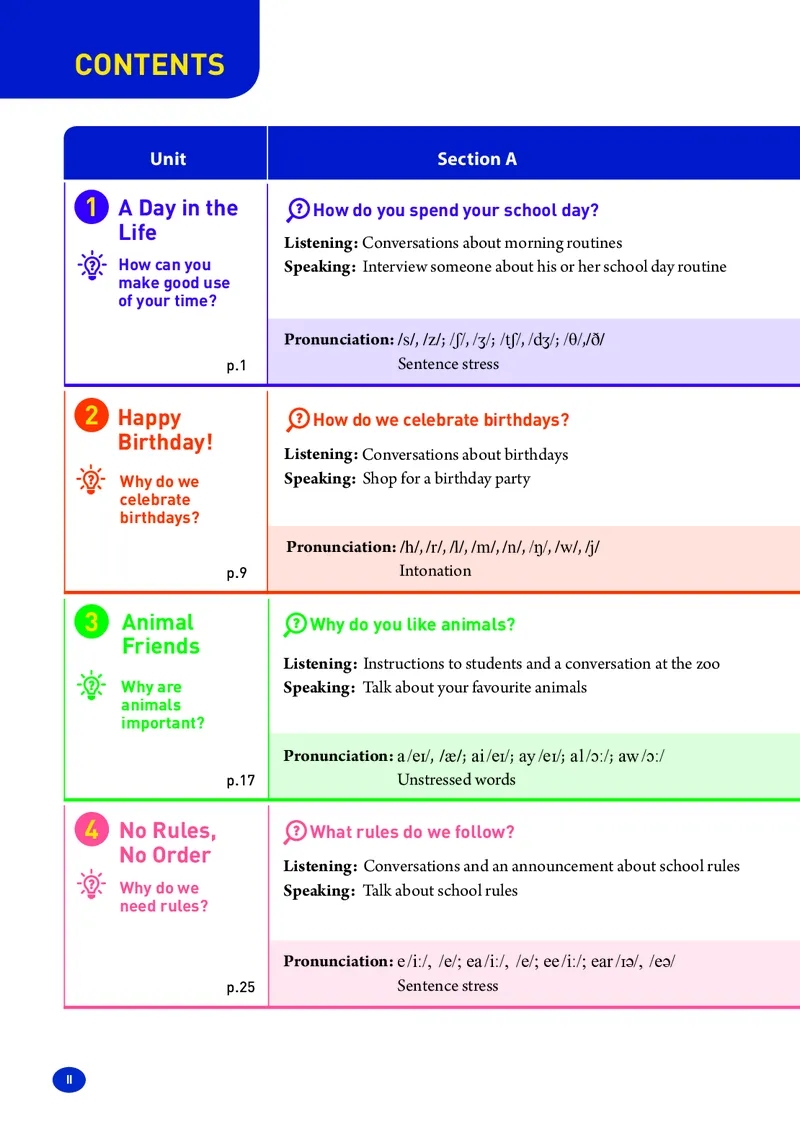
Unit Section A
1 A Day in the How do you spend your school day?
Life
Listening: Conversations about morning routines
How can you Speaking: Interview someone about his or her school day routine
make good use
of your time?
Pronunciation: /s/, /z/; /ʃ/, /ʒ/; /tʃ/, /dʒ/; /θ/,/ð/
p.1 Sentence stress
2 Happy How do we celebrate birthdays?
Birthday!
Listening: Conversations about birthdays
Why do we Speaking: Shop for a birthday party
celebrate
birthdays?
Pronunciation: /h/, /r/, /l/, /m/, /n/, /ŋ/, /w/, /j/
p.9 Intonation
3 Animal Why do you like animals?
Friends
Listening: Instructions to students and a conversation at the zoo
Why are Speaking: Talk about your favourite animals
animals
important?
Pronunciation: a/eɪ/, /æ/; ai/eɪ/; ay/eɪ/; al/ɔː/; aw/ɔː/
p.17 Unstressed words
4 No Rules, What rules do we follow?
No Order
Listening: Conversations and an announcement about school rules
Why do we Speaking: Talk about school rules
need rules?
Pronunciation: e/iː/, /e/; ea/iː/, /e/; ee/iː/; ear/ɪə/, /eə/
p.25 Sentence stress
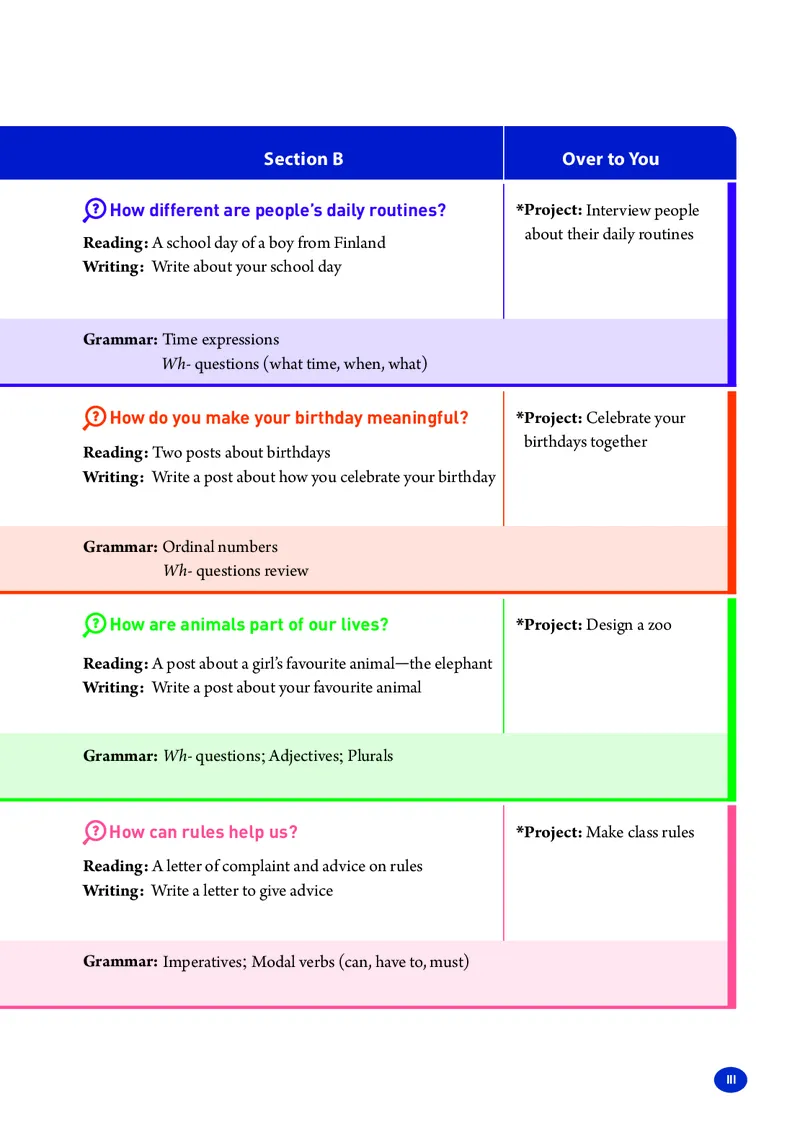
IISection B Over to You
How different are people’s daily routines? *Project: Interview people
about their daily routines
Reading: A school day of a boy from Finland
Writing: Write about your school day
Grammar: Time expressions
Wh- questions (what time, when, what)
How do you make your birthday meaningful? *Project: Celebrate your
birthdays together
Reading: Two posts about birthdays
Writing: Write a post about how you celebrate your birthday
Grammar: Ordinal numbers
Wh- questions review
How are animals part of our lives? *Project: Design a zoo
Reading: A post about a girl’s favourite animal—the elephant
Writing: Write a post about your favourite animal
Grammar: Wh- questions; Adjectives; Plurals
How can rules help us? *Project: Make class rules
Reading: A letter of complaint and advice on rules
Writing: Write a letter to give advice
Grammar: Imperatives; Modal verbs (can, have to, must)
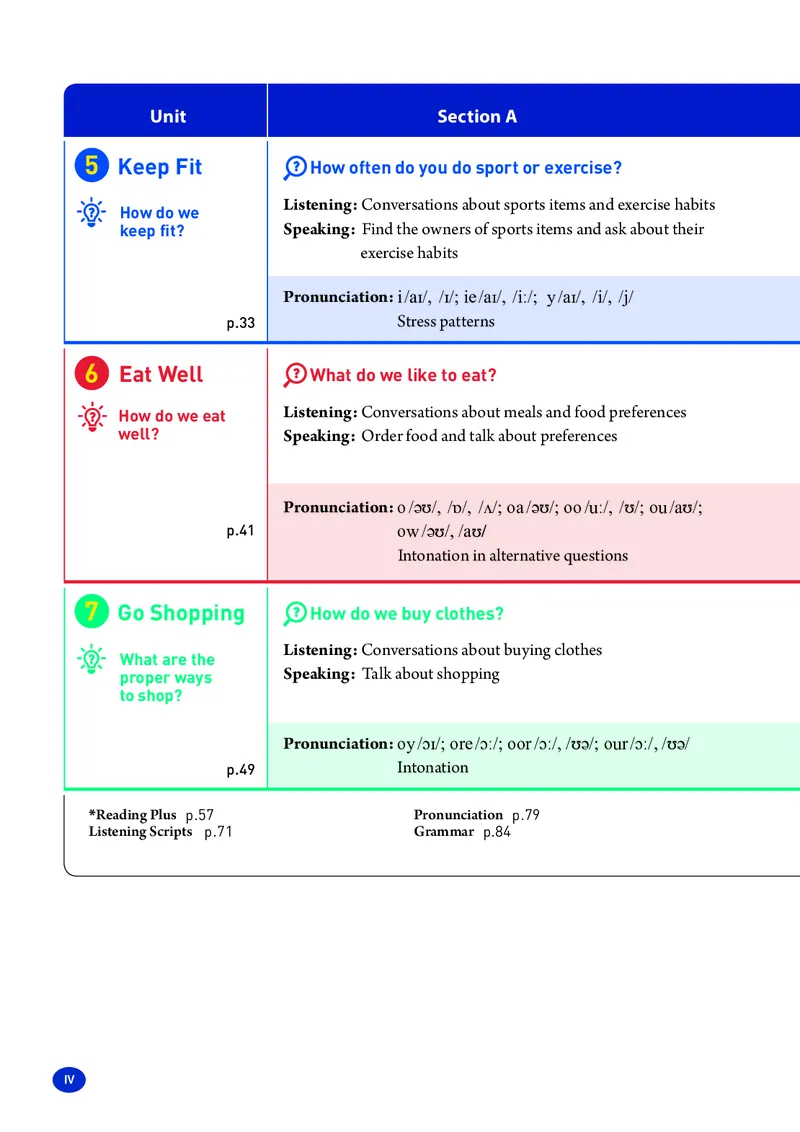
IIIUnit Section A
5 Keep Fit How often do you do sport or exercise?
Listening: Conversations about sports items and exercise habits
How do we
keep fit? Speaking: Find the owners of sports items and ask about their
exercise habits
Pronunciation: i/aɪ/, /ɪ/; ie/aɪ/, /iː/; y/aɪ/, /i/, /j/
p.33 Stress patterns
6 Eat Well What do we like to eat?
How do we eat Listening: Conversations about meals and food preferences
well? Speaking: Order food and talk about preferences
Pronunciation: o/ə /, /ɒ/, /ʌ/; oa/ə /; oo/uː/, / /; ou/a /;
p.41 ow/ə /, /a /
Intonation in alternative questions
7 Go Shopping How do we buy clothes?
Listening: Conversations about buying clothes
What are the
proper ways Speaking: Talk about shopping
to shop?
Pronunciation: oy/ɔɪ/; ore/ɔː/; oor/ɔː/,/ ə/; our/ɔː/,/ ə/
p.49 Intonation
*Reading Plus p.57 Pronunciation p.79
Listening Scripts p.71 Grammar p.84
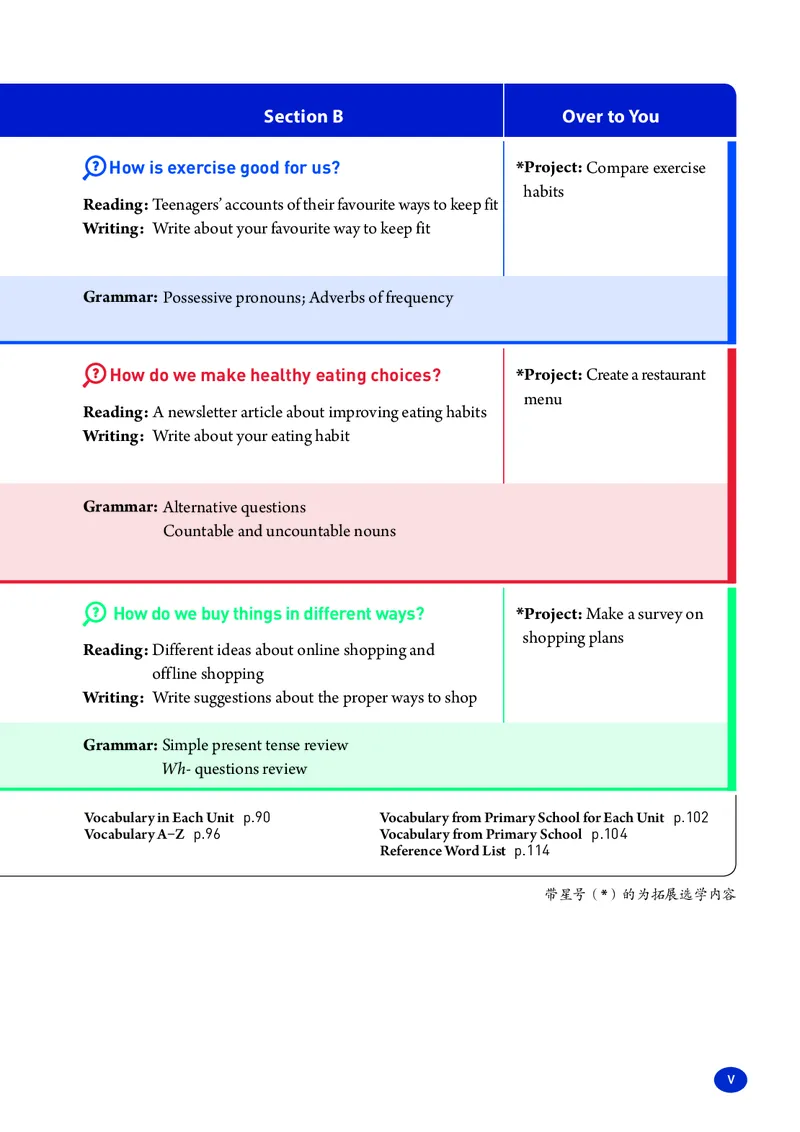
IVSection B Over to You
How is exercise good for us? *Project: Compare exercise
habits
Reading: Teenagers’ accounts of their favourite ways to keep fit
Writing: Write about your favourite way to keep fit
Grammar: Possessive pronouns; Adverbs of frequency
How do we make healthy eating choices? *Project: Create a restaurant
menu
Reading: A newsletter article about improving eating habits
Writing: Write about your eating habit
Grammar: Alternative questions
Countable and uncountable nouns
How do we buy things in different ways? *Project: Make a survey on
shopping plans
Reading: Different ideas about online shopping and
offline shopping
Writing: Write suggestions about the proper ways to shop
Grammar: Simple present tense review
Wh- questions review
Vocabulary in Each Unit p.90 Vocabulary from Primary School for Each Unit p.102
Vocabulary A–Z p.96 Vocabulary from Primary School p.104
Reference Word List p.114
带星号(*)的为拓展选学内容
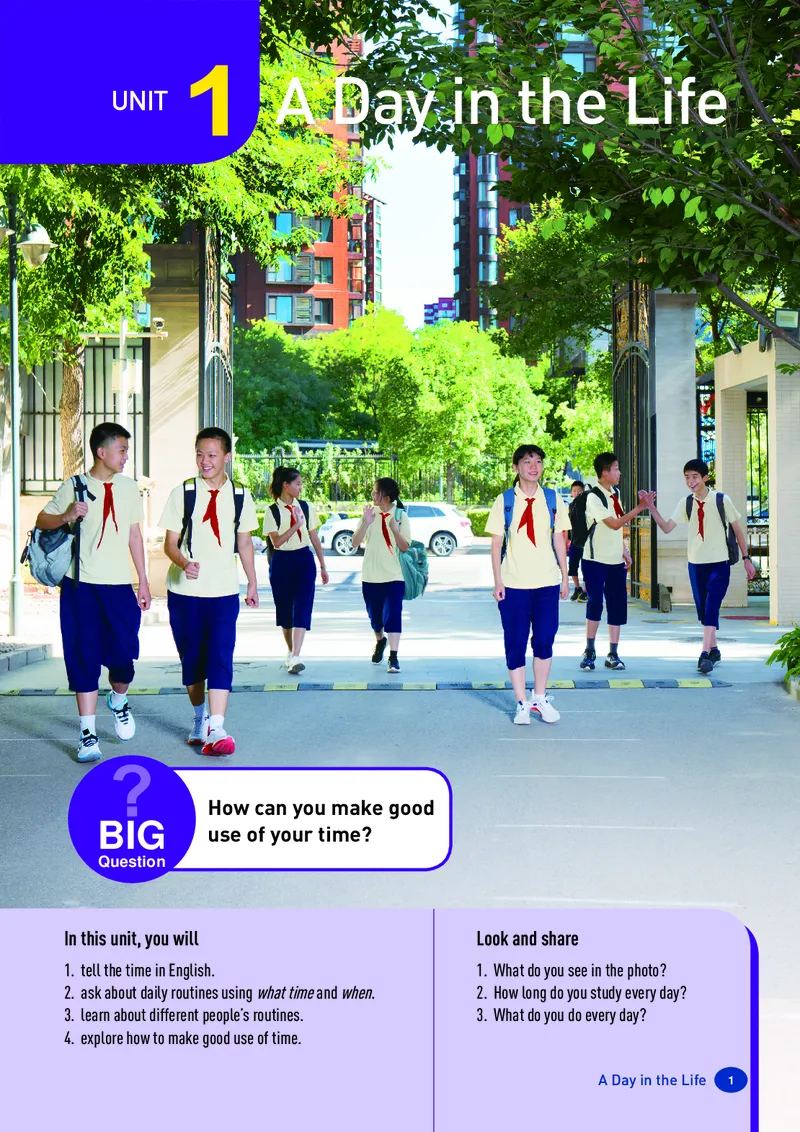
VA Day in the Life
1
UNIT
How can you make good
BIG use of your time?
Question
In this unit, you will Look and share
1. tell the time in English. 1. What do you see in the photo?
2. ask about daily routines using what time and when. 2. How long do you study every day?
3. learn about different people’s routines. 3. What do you do every day?
4. explore how to make good use of time.
A Day in the Life 1E
CTIO
S N
A
How do you spend your school day?
1a
Match the clocks with the times.
A B C D
one forty-five/a quarter to two six fifteen/a quarter past six
eight/eight o’clock four thirty/half past four
1b Listen to the first conversation and tick Peter’s activities this morning.
take a shower get dressed
brush his teeth have breakfast at home
1c Listen to the second conversation. Why are Peter and Han Lin at school
early? Match the names with the reasons.
1. Peter A. do some reading before class
2. Han Lin B. on duty
1d Listen to the two conversations again and fill in the blanks.
1. Peter’s school begins at .
2. Peter usually gets up at .
3. Peter usually has breakfast at .
4. Peter usually takes a shower .
5. Han Lin usually takes a shower .
1e
Talk about your school day routine in the morning.
What time do you usually get up?
I usually get up at …
When do you have breakfast?
I usually have breakfast at …
2 UNIT 1Pronunciation
1 Listen and repeat.
/s/ /z/ /ʃ/ /ʒ/ /tʃ/ /dʒ/ /θ/ /ð/
sad zoo sheep usually chair Jane three that
this those fish television watch orange tooth then
2 Listen to the beginning part of the conversation in 2a and repeat. Notice the
stressed words. Then mark other stressed words in the conversation in 2a.
Lu Jiaqi: Hi! I’m Lu Jiaqi, a school reporter. What’s your name?
Tom: Tom.
Lu Jiaqi: So Tom, what time do you usually get up?
Tom: At a quarter to seven.
2a Listen to the conversation and fill in the blanks.
Lu Jiaqi: Hi! I’m Lu Jiaqi, a school reporter.
What’s your name?
Tom: Tom.
Lu Jiaqi: So Tom, what time do you usually
get up?
Tom: At 6:45.
Lu Jiaqi: And then?
Tom: I have breakfast at about .
Then I go to school at 7:50.
Lu Jiaqi: When do you go home?
Tom: Around .
Lu Jiaqi: What do you do after that?
Tom: Sometimes I play basketball. I have dinner at . Then
I do my homework.
Lu Jiaqi: When do you usually go to bed? We usually use what time to ask
Tom: At . about specific times. But we use
Lu Jiaqi: That’s early! when for both specific times
Tom: Well, you know the saying, “Early and any time period.
to bed, early to rise!”
A Day in the Life 32b
Read the conversation and answer the questions.
1. What does Lu Jiaqi ask Tom about?
2. How long does Tom stay at school?
3. Why does Tom go to bed early?
2c
Read again and complete Tom’s school day timetable.
Time Tom’s activity
6:45 a.m.
have breakfast
7:50 a.m.
go home
before dinner
have dinner
after dinner
go to bed
2d Listen to the conversation again and pay attention to the stressed words.
Then role-play the conversation.
2e
Ask a partner about his or her school day routine. Then give a report.
get up have breakfast go to school have class
play sport have lunch go home do homework
brush teeth have dinner take a shower go to bed
A: What time do you get up on a school day?
B: I get up at …
A: When do you …?
B: I …
This is …’s school day routine. He / She gets up at …
4 UNIT 1Grammar Focus
3a
Complete the questions with what, what time, or when.
do you usually get up? I usually get up at 6:30 a.m.
does Tom usually go to bed? He usually goes to bed at 9:30 p.m.
do they go to the music club? They go on Monday afternoons.
Sometimes I read books or do my
do you do after dinner?
homework.
He brushes his teeth and takes a
does Peter do before breakfast?
shower.
3b
Answer the questions with the times in brackets.
1. What time does Mike usually get to school? (at 7:30 a.m.)
2. What time do they have lunch? (at 12:10 in the afternoon)
3. When is your maths class? (at 1:45 p.m.)
4. When does Lisa do her homework? (after dinner)
5. When does David play basketball? (on Thursdays)
3c
Complete the passage with the correct forms of the verbs in brackets.
On Saturdays, Sam sometimes (get) up at 9:00. He
(make) breakfast for his family and then (do) his homework.
Around 2:00 in the afternoon, he (meet) his friends, and they
(play) football together. At about 6:30, he sometimes
(go) to a restaurant with his family for dinner. On Sunday mornings, Sam often
(help) his mother with housework. Sometimes he
(watch) a film in the afternoon. After dinner, he usually (play)
the guitar for a while. He (go) to bed at about 10:00.
3d
Ask a partner about his or her weekend routine.
Weekend activity Time A: What time do you usually get up at
weekends?
get up
B: I usually get up at …
have breakfast
A: When do you …?
B: …
A Day in the Life 5E
CTIO
S N
B How different are people’s daily
routines?
1a
Look at the photos below. Guess which part of the world the boy is from.
What do you want to know about him?
1b
Read the text and choose a suitable title for it.
A. Timo’s School B. One of Timo’s School Days C. Timo’s Hobbies
My name is Timo Halla. I’m 13 years old. I live with my
parents in Helsinki, Finland. Now it’s December. Every
Tuesday, I usually get up at 7:40. I often listen to the
news or music. After breakfast, I walk to school. It’s
only a 10-minute walk. My school begins at 9:00. There
are 18 students in my class. Each lesson is 45 minutes
long, and there’s a break between lessons. I have one
Finnish lesson and two home economics lessons in the
morning. After that,
I have lunch at 12:00. The afternoon
lessons begin at 12:30 and finish at
2:15. Then I go to my ice hockey club.
I usually get home around 4:00. It’s
already dark outside. I often have
dinner at 6:00. After that, I read with
my parents for an hour. That’s an
important part of my everyday life.
Then I prepare my schoolbag for the
next day. At 9:30, it’s time for me to go
to bed.
6 UNIT 11c
Read again and complete the timetable with Timo’s activities.
Time Timo’s activity
7:40 a.m.
9:00 a.m.
12:00
12:30 p.m.
2:15 p.m.
after school
4:00 p.m.
6:00 p.m.
after dinner
9:30 p.m.
1d
Read again and answer the questions.
1. What lessons does Timo have every Tuesday morning?
2. How long is each lesson at his school?
3. What club does Timo go to?
4. How does he make good use of his time?
2a
Complete the timetable about one of your school days. How different is your
school day from Timo’s?
Time My activity
2b
Use the information in 2a to write about your day.
My name is . I’m years old. I live .
Every , I usually get up at . Then .
My school begins at . I have in the morning.
After that, . In the afternoon, .
I usually get home around . Then . At
, it’s time for me to .
A Day in the Life 7Over to You
Interview people about their daily
Project
routines
1
Choose a profession that you want to know more about.
● police officer ● teacher ● farmer ● reporter
● bin worker ● nurse ●
2
Ask a person who works in that profession questions to find out his or her
workday routine. Complete the table below.
Question ’s routine
What time do you usually get up?
When do you have breakfast?
When do you go to work?
When do you have lunch?
What time do you get off work?
What time do you have dinner?
When do you exercise / study / relax?
When do you go to bed?
3
Give a report in class.
My uncle is a farmer in a small village. Every day, he gets up at ...
Reflecting
How well can you do these things? Very well OK Needs work
1. I can tell the time in English.
2. I can ask about daily routines with what time
and when.
3. I can talk about people’s daily routines.
4. I can make good use of my time.
To plan time is to save time.
8 UNIT 1Happy Birthday!
2
UNIT
Why do we celebrate
BIG
birthdays?
Question
In this unit, you will Look and share
1. talk about people’s birthdays. 1. What are the people doing in the photo?
2. express dates in English. 2. Whose birthday is it?
3. learn to use English expressions for shopping. 3. How do you celebrate your birthday?
4. explore how and why people celebrate birthdays.
Happy Birthday! 9E
CTIO
S N
A
How do we celebrate birthdays?
1a Listen and repeat. Then circle the month and day of your birthday.
Months:
January February March April
May June July August
September October November December
Days:
1st 2nd 3rd 4th 5th 6th 7th 8th 9th 10th
11th 12th 13th 14th 15th 16th 17th 18th 19th 20th
21st 22nd 23rd 24th 25th 26th 27th 28th 29th 30th
31st
1b Listen to three conversations. Match the people
with their birthdays. Ways to tell dates
1. Helen A. 12th June British English:
2. Fu Xing B. 3rd December 2nd August / 2 August
3. Teng Fei’s father C. 22nd August American English:
4. Ms Gao D. 9th January August 2nd / August 2
1c Listen again and answer the questions.
1. How old is Helen?
2. What birthday gift can Teng Fei give his father?
3. What does Peter want to do for Ms Gao’s birthday?
1d Find out your group members’ ages and birthdays. Then line up from the
youngest to the oldest.
How old are you?
I’m …
When is your birthday?
It’s on …
10 UNIT 2Pronunciation
1 Listen and repeat.
/h/ /r/ /l/ /m/ /n/ /ŋ/ /w/ /j/
how right let May ninth thing week yes
house read help climb hundred wing sweet year
who price will swim win tank when yogurt
2 Listen to the humorous conversation. Notice the intonation in each sentence.
Then repeat the conversation.
A: Can I ask you some questions? B: Sure. Go ahead.
A: When is your birthday? B: On 23rd July.
A: Which year? B: Every year.
A: What do you always get on your birthday? B: One year older.
2a Listen to the two parts of the conversation and fill in the blanks.
Teng Fei: Hi, Peter! It’s Ella and Emma’s birthday soon. How about a
surprise party for them?
Peter: ! Let’s go and buy something for the party.
[At the shop.]
Woman: Good morning. Can I help you?
Teng Fei: . How much is this birthday cake?
Woman: We have a sale today. It’s 85 yuan, and it comes with some
candles.
Peter: Good, we’ll take it. How much are those oranges?
Woman: Six yuan a kilo. How many kilos do you want?
Peter: Five kilos, please. Teng Fei, how about some yogurt?
Teng Fei: . How
much is the yogurt?
Woman: Five yuan a bottle.
Teng Fei: 10 bottles, please.
What’s the total?
Woman: 165 yuan.
Teng Fei: .
Woman: Thank you! Have a nice day!
Teng Fei & Peter: Thanks. You too.
Happy Birthday! 112b Read the conversation and complete the table.
Thing Price Number
Total: yuan
2c Listen to the conversation again and pay attention to the intonation. Then
role-play the conversation.
2d What else would you like to buy for a birthday party? Put the things in the
box into different groups on the shopping list. You can add more.
eggs noodles balloons juice apples
milk chocolate pizza candles candies
Shopping List
Food Drinks
Other
things
2e Practise buying the things on the shopping list for a birthday party.
A: Can I help you?
B: Yes, please. How much is / are ...?
12 UNIT 2Grammar Focus
3a
Read the sentences. Circle the question words.
When is your birthday? It’s on 2nd August.
How old are you? I’m 12.
What do you want to do on her birthday? I want to sing a song for her.
How much are those oranges? Six yuan a kilo.
How many kilos do you want? I want five kilos.
3b Fill in the blanks with the question words in the box. Then match the
questions with the answers.
how many / much / old what when who where why
1. is your mum’s birthday? A: A new pair of shoes.
2. balloons do you want? B: With my parents.
3. do you want for a birthday gift? C: To wish for a long life.
4. is your father? D: I want 10.
5. are the birthday card and the doll? E: She’s from Australia.
6. do you celebrate your birthday with? F: It’s on 15th July.
7. is Ms Green from? G: He’s 45 years old.
8. do people eat birthday noodles? H: 55 yuan.
3c Read the passage and underline the dates of the special birthdays. Do you
know any other special birthdays?
We celebrate our own birthdays. We also celebrate the birthdays of our family
and friends. Do you know of any other special birthdays? For example, we
celebrate William Shakespeare’s birthday, 23rd April, as English Language
Day. And we celebrate International Nurses Day on 12th May. It marks the
birthday of Florence Nightingale, a famous nurse.
3d
Talk about special days. You can add more.
National Day A: When is China’s National Day?
CPC Founding Day B: It’s on ...
PLA Day A: What do you do that day?
School Founding Day B: ...
Happy Birthday! 13E
CTIO
S N
B
How do you make your birthday
meaningful?
1a
Tick the activities you do on your birthday.
eat birthday noodles take photos
open birthday gifts have a birthday cake
make a wish hear the “Happy Birthday” song
1b
Read the posts from an online forum. Choose the main idea of the posts.
A. How to celebrate birthdays
B. Who to celebrate birthdays with
C. Where to celebrate birthdays
Birthday Celebrations
HOME ABOUT POSTS CONTACT
By: Yu Xiaoming on 08/06 5:07 PM #1
My birthday is on 13th June. On that day, I always eat
birthday noodles with eggs. Long noodles are a symbol of
long life. Every year, my family and I take a photo together
under the big tree in our village. I like taking photos because
they help me remember fun times with my family. This year,
I want to plant a small tree for my 14th birthday. I’d like to
watch it grow with me. When is your birthday? How do you
celebrate it?
By: Judy Clark on 09/06 7:54 PM #2
It’s a great idea to plant a tree for your birthday! My birthday
is on 28th July. I usually have a party with my friends to
celebrate. My mother always makes my favourite chocolate
cake. Everyone sings the “Happy Birthday” song, and then I
make a wish and blow out the candles. Next, we enjoy the
cake, and I open all my gifts. My father marks my height on
the door every year. It’s fun to look at the marks later. Next
time, I also want to do something different. Any good ideas?
14 UNIT 21c
Read again and complete the table.
Name Birthday Activity
Yu Xiaoming
Judy Clark
1d
Read again and answer the questions.
1. Why does Xiaoming eat birthday noodles on his birthday?
2. Where do Xiaoming and his family take photos together every year?
3. What does Judy like about Xiaoming’s 14th birthday?
4. Why does Judy’s mother make a chocolate cake for her birthday?
5. Can you give Judy some ideas about how to spend a meaningful birthday?
2a
Complete the mind map about how you celebrate your birthday.
When What to prepare Where to go
Celebrating my birthday
With whom What to do How I feel
2b
Write a reply to the post in 1b to talk about your birthday.
By: on #3
I think it’s a good idea to on your
birthday. My birthday is on . I usually
to celebrate it. I do this because
. But this year, I want to
.
Happy Birthday! 15Over to You
Project Celebrate your birthdays together
1 Work in groups. Find out the birthdays in your group. Write the names and
dates on the calendar.
A: When is your birthday? B: It’s on …
January February March April May June
July August September October November December
2
Find out whose birthdays are this month.
3
Work out a meaningful way to celebrate the birthdays together.
● When do you want to celebrate together?
● Where do you want to celebrate?
● Who do you want to invite?
● What do you want to do?
4
Report your group’s idea to the class. Vote for the best plan.
Reflecting
How well can you do these things? Very well OK Needs work
1. I can say dates in English.
2. I can use proper English expressions for
shopping.
3. I can talk about different ways to celebrate
birthdays.
4. I can tell how to spend a meaningful birthday.
Every birthday is a gift of life.
16 UNIT 2Animal Friends
3
UNIT
Why are animals
BIG important?
Question
In this unit, you will Look and share
1. talk about different animals. 1. Can you name the animals in the photo?
2. introduce your favourite animal. 2. What do you know about these animals?
3. use adjectives to describe animals. 3. Do you know any other special animals in
4. explore the meaning of caring for animals. China?
Animal Friends 17EE
CCTTIIOO
SS NN
A
Why do you like animals?
1a
Write the animals in the box under the pictures.
fox lion tiger giraffe monkey eagle wolf penguin
A B C
AA
D E F G H
1b Listen to the teacher’s instructions. Answer the questions.
1. Where are the students?
2. Why are they there?
3. When should they be back?
1c
Listen to the conversation. Circle T for true or F for false.
1. All three students like monkeys. T F
2. Yaming doesn’t like wolves. T F
3. Wolves take good care of their babies. T F
4. The three students see the monkeys before the wolves. T F
1d
Talk about your favourite animal.
What’s your favourite animal?
It’s the monkey.
Why do you like monkeys? Because they’re clever
and funny.
18 UNIT 3Pronunciation
1
Listen and repeat. Add one more word to each group.
a ai ay al aw
/eɪ/ /æ/ /eɪ/ /eɪ/ /ɔː/ /ɔː/
game fat rain way walk draw
make cat brain play small law
2 Listen and repeat. Notice the pronunciation of –(e)s.
sharks lions boxes cats birds
giraffes monkeys foxes elephants toads
3 Listen and repeat. Notice how the unstressed words are pronounced.
1. A: Let’s go and see the monkeys. They’re my favourite animals.
B: Why do you like them?
A: Because they’re clever and funny.
2. A: Oh, look! A baby wolf and its mother! Do you like wolves?
B: No, I don’t. They’re very dangerous.
2a Listen to the conversation and circle the coloured words you hear.
Peter: The penguin is my favourite animal. What’s your favourite animal,
Fu Xing?
Fu Xing: I like penguins too. Why do you like them so much?
Peter: Because they’re very cute / cool!
Teng Fei: Yes, they look lovely / amazing. Let’s go and see them.
Peter: Oh, there they are! They can’t fly like other birds, but they can
swim fast. I like how they walk. It’s funny / interesting!
Teng Fei: Yes, it is! Where are they from?
Fu Xing: Look here! It says they’re from Antarctica. It’s very cold there, so
they often stand close together. It helps them keep warm.
Peter: They’re so clever / smart.
What do they eat?
Teng Fei: Fish and small sea animals,
I think.
Fu Xing: I have a fish sandwich …
Teng Fei: Don’t give them your sandwich!
It’s not good for them.
Animal Friends 192b Read the conversation and take notes.
1. Name 2. Looks
3. Home 4. Food
5. Ability
2c Listen to the conversation again and pay attention to the unstressed words.
Then role-play it.
2d Match the headers (1—5) in 2b with the questions (A—E).
A. What does it look like? / How does it look?
B. What’s your favourite animal?
C. What can it do?
D. Where does it usually live? / Where is it from?
E. What does it usually eat?
2e Complete a card about your favourite animal.
[Picture] Name:
Looks:
Home:
Food:
Ability:
2f Use the questions in 2d to ask about your partner’s favourite animal.
20 UNIT 3Grammar Focus
3a
Read the sentences. Circle the word that introduces a reason.
What’s your favourite animal? It’s the monkey.
Where are penguins from? They’re from Antarctica.
Why do you like penguins so much? Because they’re very cute!
Why don’t you like snakes? Because they’re really scary.
3b
Complete the conversation with the words in the box. Underline the animal
nouns.
Jane: Sam, are giraffes from?
They’re
Sam: from Africa. Do you like giraffes? because
Jane: Yes, I do. where
do
Sam: Why you like them?
don’t
Jane: Well, they’re interesting. They have
What’s
long necks. your favourite animal?
Sam: Guess! It lives in the sea.
Jane: Is it the shark?
Sam: No. I don’t like sharks.
Jane: Why you like sharks?
Sam: Because they’re really scary.
3c
Make the nouns in the box plural. Then use the plural nouns to complete the
sentences.
eagle fox giraffe mouse penguin
shark sheep snake whale bear
I like because they’re cute / smart / interesting / funny / huge / ...
I don’t like because they’re dangerous / scary / ...
3d
Think of an animal. Ask and answer questions with a partner to guess each
other’s animal.
A: Is the animal’s tail long? A: Where’s it from?
B: No, it isn’t. B: It’s from China.
A: Is it black and white? A: It’s a panda!
B: Yes, it is. B: Yes, you’re right!
Animal Friends 21EE
CCTTIIOO
SS NN
B
How are animals part of our lives?
1a
What do you know about elephants? Share your ideas with a partner.
1b
Read Malee’s post and choose the best title for it.
A. What Is an Elephant?
B. My Favourite Animal: The Elephant
C. How to Save Elephants
Hi, I’m Malee and I live in Thailand!
The elephant is my favourite animal. I love elephants because they are
strong and clever. They are also a symbol of good luck here. The elephant
is our national animal. On 13 March, we celebrate Thai Elephant Day.
Elephants look very different from other animals. They are huge. They
have large ears and long trunks. They can pick up and carry heavy things
with their trunks.
Elephants are like us in some ways. They are very playful and love to play
in the water. They are great swimmers. They are also clever. For example,
they can remember one another and places with food and water after
many years. Elephants are very kind too. They look after other elephants
when they don’t feel well. The big elephants also help the baby ones.
Elephants are an important part of
Thai life and culture. However, they
are in danger. They live in forests,
but people cut down too many
trees. People also kill elephants for
their ivory. Let’s save the forests
and not buy things made of ivory.
Every elephant counts.
22 UNIT 31c
Read the post again and answer the questions.
1. When do Thai people celebrate Thai Elephant Day?
2. What do elephants use to carry things?
3. Are elephants clever? Give your reasons.
4. Why are elephants in danger now?
5. How can we help save elephants?
1d Complete the mind map with the information from the post.
3. What they can do
2. What they look like ● pick up and carry 4. What they are like
things
● huge ● playful
● play and in the water
● ears ●
● places and other
● trunk ● kind
elephants well
1. What they are 5. How to save them
● Thailand’s ● don’t too
animal many trees
● a symbol of ● don’t things
made of ivory
2a
Complete the passage with the words in the box.
close friendly big great beautiful
2 hours ago
My dog, Xiaohua, is part of the family. She is quite a dog, but she
is not scary at all! She has fur. She is really and loves
to play with everyone. She is also very special. You see, I am blind. Xiaohua is
my eyes. She helps me find my way around. She can see and has
hearing. She helps me walk to school and stay safe. I love her very much. We
are friends.
2b Write a post about your favourite animal. Use the questions to help you.
● What does it look like? ● What can it do?
● What is it like? ● Why do you like it so much?
Animal Friends 23Over to You
Project Design a zoo
1
In groups, take turns to think of an animal. Describe it. Guess one another’s
animals and write them down in the table.
Land Water Sky
2
You’re going to design a zoo. Choose some of the animals from 1 for your
zoo. Give your reasons.
3 Draw a map of your zoo and
present it to the class. Use the
map and the expressions in the
box to help you. Vote for the
zoo you like.
● Welcome to our zoo!
● This is .../These are ...
● Here you can see ...
● There is/are ...
● These animals are ... Exit
Entrance
● We like ... because they
are ... Wolves Eagles Giraffes Sharks
Lions Elephants Penguins Snakes
Restrooms Food Gifts
Reflecting
How well can you do these things? Very well OK Needs work
1. I can talk about different animals.
2. I can explain what I like or dislike about animals.
3. I can talk about the importance of animals.
4. I can think of ways to care for animals.
Animals are our best friends.
24 UNIT 3No Rules,
4
UNIT
No Order
Why do we need
BIG rules?
Question
In this unit, you will Look and share
1. talk about rules by using imperatives and modal verbs 1. What school rules does the photo show?
can, have to, and must. 2. Do you follow rules like these?
2. explain why we need to follow rules. 3. What do you think about them?
3. understand how rules are helpful.
No Rules, No Order 25EE
CCTTIIOO
SS NN
A
What rules do we follow?
1a
Does your school have these rules? Tick the ones that your school has.
Mary, Sally, and
Rule Your school
Tony’s school
Don’t be late for school. Arrive on time.
Don’t run in the hallways.
Don’t eat in the classroom.
Wear the school uniform.
Don’t use your phone in class.
Don’t litter. Keep your school clean and tidy.
Be polite and treat everyone with respect.
Put up your hand if you want to ask your teacher
a question.
1b
Listen to the first part of the recording. Tick the rules that are mentioned.
A B C D
1c
Listen again. Complete the sentences.
1. Mary can’t in the .
2. Sally mustn’t wear her own jacket at . She has to wear
.
3. Tony can’t . He must keep the school .
1d Listen to the second part of the recording. Who is the speaker? What rules
does she talk about? Tick them in 1a.
1e
In pairs, talk about the rules in 1c.
Can Mary run in the hallway?
No, she can’t. She has to walk in the hallway.
26 UNIT 4Pronunciation
1 Listen and repeat. Add one more word to each group.
e ea ee ear
/iː/ /e/ /iː/ /e/ /iː/ /ɪə/ /eə/
she bed please head tree ear pear
these pet speak ready sleep dear bear
2 Listen to the chant and notice the stressed words. Then listen again and repeat.
Across the country, in many schools, Every day, from Monday to Friday,
Students like us follow rules! Keep our school clean and tidy!
Be on time. Don’t be late for class. Raise your hand. Walk and don’t run.
Keeping the rules is good for us! Keep the rules and let’s have fun!
2a Listen to the conversation and circle the coloured words you hear.
Anne: Hi, I’m Anne. What’s your name?
Tom: Hello! I’m Tom. It’s my first day here.
Anne: It’s nice to meet you, Tom! Is everything OK?
Tom: Well, I can’t find my pencil box / pen. I think it’s in my locker /
at home.
Anne: Here, I can lend you my pen.
Tom: Thanks! Would you like a sweet?
Anne: No, thank you. We can’t eat snacks in class.
Tom: Can we eat fruit / drink water?
Anne: Yes, of course.
Tom: OK, thanks ... Oh! I’m sorry,
I have to answer my phone.
Anne: Oh, but we can’t / mustn’t bring
our mobile phones to class.
We have to turn them off and
put / keep them in our lockers.
That’s another rule.
Tom: OK! Thanks for telling me, Anne.
Anne: You’re welcome, Tom.
No Rules, No Order 272b
Read the conversation and complete Tom’s notes about the school rules.
School rules
We cannot
We must not
We have to
2c
Read the conversation again and answer the questions.
1. Why is the day special for Tom?
2. What does Anne lend to Tom?
3. Why doesn’t Anne take a sweet from Tom?
4. Can Tom and Anne use their phones in class?
5. Where must they keep their phones?
6. Do you think they have good school rules? Give your reasons.
2d
Complete a summary of the conversation.
It’s Tom’s day at this school. He doesn’t know the school
well. Anne tells him about them. They eat snacks in class, but they
drink water. They can’t bring their mobile to class. They
must them off and keep them in their .
2e
Listen to the conversation again and pay attention to the stressed words. Then
role-play the conversation.
2f Talk about the rules you have at school. Use the expressions to help you.
We must/mustn’t … We should …
What rules
do we have We can/can’t … Don’t …
at school?
We have to … Always …
28 UNIT 4Grammar Focus
3a
Read the sentences. Do the verbs in bold need to change forms? Why?
Walk in the hallway. Don’t run!
Be polite and treat one another with Don’t litter./You mustn’t litter./You
respect. can’t litter.
No, we can’t. We must keep them in
Can we bring our phones to class?
our lockers.
No, we can’t eat in class. We have to
Can we eat snacks in class?
eat in the dining hall.
3b Complete the sentences using can, have to /must, or can’t / mustn’t.
1. Don’t jump the queue. You wait your turn.
2. I feed my dog many kinds of food, but I give him
chocolate. It is bad for him!
3. A: Can I leave the classroom if I don’t feel well?
B: Yes, but you tell your teacher about it when you
be absent from class.
4. A: Hey! Can I look at your book?
B: Shh, we talk quietly in the library.
5. A: Can you put on your seat belt? We wear one when we’re in
a car.
B: Sure. Thanks!
3c
Look at the first sign and read the rules. Then write the rules for the other
signs.
• Do not eat or drink.
• No eating or drinking.
• You can’t / mustn’t eat or drink.
3d
In groups, brainstorm three rules for one of the places below. Then draw signs
to show the rules. Share your signs in class and explain what they mean.
library school dining hall park cinema hospital
In the library, we must keep quiet. We mustn’t make noise. We can’t …
No Rules, No Order 29EE
CCTTIIOO
SS NN
B
How can rules help us?
1a
What are some of the rules in your home? What do you think about them?
1b Read Alice’s letter to Dr Know and Dr Know’s reply. Then answer the questions.
1. Why is Alice unhappy?
2. Does Dr Know think Alice is right?
Dear Dr Know,
Help! There are too many rules in my life! Every morning, I have to make
my bed before breakfast. I have to hurry to school because I can’t be late
for school. When I’m at school, I mustn’t use my phone in class either. And
I have to wear the uniform.
After school, there are even more rules! I have to finish my homework
first. I can only play basketball after I practise the piano. I can’t hang out
with my friends on weekdays. I know some rules are important, but this is
awful! What can I do?
Yours,
Alice
Dear Alice,
Yes, there are many rules in life! But they can help you to become a better
person.
You mustn’t be late for class. That shows respect for your class and teacher.
You can’t use your phone in class because you need to focus on learning.
You have to wear a uniform because it builds school spirit.
You can also think about the things you can do! You can use your phone at
home. You can relax after you finish your homework. And you can hang out
with friends at weekends!
I know it’s hard, but rules can help to make the world better. Remember: No
rules, no order!
Best,
Dr Know
30 UNIT 41c
Read the letters again and complete Alice’s notes about her problem.
● have to before
Home ● have to because I for school
rules ● have to and before I can play basketball
● can’t with my friends on weekdays
School ● mustn’t use in class
rules ● must only wear
● understand rules help me to become a
Dr Know’s
● think about the things I
advice
● understand rules help to make
2a
Complete the letter to Dr Know using can, have to /must, or can’t /mustn’t.
Dear Dr Know,
Can you help me? I follow too many rules at home and at
school. I clean my room every day, and I let my
desk get untidy. At school, I wear my own clothes. I
wear my favourite cap either. After school, I watch TV, but only
after I finish my homework, walk the dog, and do lots of other things!
I can’t even relax at weekends, because I practise
the violin every day! I never have fun. What I do?
Yours,
Eric
2b
Choose three important rules from 2a. Discuss the questions with a partner.
● Why is each rule important?
● What is your advice for each rule?
2c
Write a reply to Eric as Dr Know. Give him some advice.
Dear Eric,
I know it can be difficult to follow many rules. But rules can be good for us …
No Rules, No Order 31Over to You
Project Make class rules
1
In groups, choose one goal that you hope your class can achieve.
● learn better ● have fun at school
● get along well ● take care of the classroom
2
Brainstorm 5—10 rules to help your class to achieve the goal. Write them down.
3
Work together to design a poster for your rules. Think of interesting ways to
present the rules.
IN THIS CLASS
Always be kind WE ARE FAMILY Don’t use bad
and helpful. words.
FFFSayaaa “thammmnk yoiiiu”lll whyyyen
your classmates help
you.
Don’t fight Say “please”
with your when you
classmates. ask for help.
4
Share your rules in class. Vote for your favourite set of class rules.
In our class, we must get along well with others. We have to be kind to our classmates.
We mustn’t fight with them. We can …
Reflecting
How well can you do these things? Very well OK Needs work
1. I can talk about the things I can and cannot do
according to the rules.
2. I can explain how rules can be helpful.
3. I can use modal verbs to describe the rules in
different places.
4. I can understand how different people think and
feel about rules.
Nothing can be achieved without rules.
32 UNIT 4Keep Fit
5
UNIT
How do we keep fit?
BIG
Question
In this unit, you will Look and share
1. talk about how to keep fit. 1. Can you name the sport in the photo?
2. share how often you do sport or exercise. 2. Is it a popular sport in China? Why do
3. use possessive pronouns to identify ownership. you think so?
4. discover how exercise helps you keep fit. 3. Do you like to do this sport? Why or
why not?
Keep Fit 33EE
CCTTIIOO
SS NN
A
How often do you do sport or exercise?
1a Write the sports items in the box under the pictures.
baseball baseball glove basketball exercise mat
jump rope ping-pong bat running shoes tennis racket
A B C D
E F G H
1b Listen to the conversations at a sports centre. Answer the questions.
1. Whose football is it?
2. Whose baseball glove is it?
3. Whose tennis racket is it? How do you know?
1c Listen again. Complete the table with the correct information.
Name Sport How often
Han Lin
Emma hardly ever
Peter once or twice at weekends
Fu Xing
Binbin
tennis
Ella
1d In pairs, find one sports item that you both have. Talk about the sport or
exercise you do with it.
Do you have a ping-pong bat?
Yes, I do.
How often do you play ping-pong?
I play it three times a week.
34 UNIT 5Pronunciation
1 Listen and repeat. Add one more word to each group.
i ie y
/aɪ/ /ɪ/ /aɪ/ /iː/ /aɪ/ /i/ /j/
mine big pie piece sky party yard
time hill lie niece why healthy yours
2 Listen and clap when you hear the stressed words. Then listen again and repeat.
keep fit once a week work as a team if you like
play sport keep me fit play with my friends in the summer
Don’t talk. Not at all. Give her a book. Is it hers?
What’s this? Where’s my phone? Why do you like it? Do you see it?
2a Listen to the conversation and fill in the blanks.
Emma: There is a bat here. Is it yours?
Jim: No, it isn’t mine. Is it Ella’s?
Emma: No, hers is .
Jim: Maybe it’s Yaming’s.
Emma: Hi, Yaming! Is this your bat?
Yaming: Oh yes, it’s mine. Thanks!
Emma: . Your bat looks well-used. Do you play often?
Yaming: Yes, , and sometimes more! And you?
Emma: Hardly ever. I’m at it!
Yaming: Well, practice makes perfect. How often do you play, Jim?
Jim: I seldom do, but I often play badminton.
Yaming: Oh, me too.
Emma: I play badminton with Ella. We should all play doubles
sometime!
Keep Fit 352b Read the conversation. How often do the students do each sport? Tick the
correct boxes.
Ping-pong Badminton
Name
seldom sometimes often seldom sometimes often
Emma
Jim
Yaming
2c Retell the conversation with the information from the table in 2b.
Emma, Jim, and Yaming talk about the sports they do and how often they do them.
Emma and Jim seldom play ... , but Yaming ...
2d Listen to the conversation again and match the stress patterns below with the
coloured sentences. Then role-play the conversation.
A. B. C. D.
2e Imagine you have found an item at a sports centre. Make up a conversation
with your partner. Use the expressions to help you.
ping-pong bat,
badminton racket, play football / basketball /
a few times / three
baseball glove, jump badminton / ...
times / only once
rope, volleyball, mat, go swimming / jogging / ...
or twice (a month,
running shoes ... do exercise
a week ...)
jump rope
hers, his, theirs ...
A: Excuse me, is this your ...?
B: Yes, that’s mine. Thanks! / No, that’s not mine. I think it’s ...
A: Do you often ...?
B: Yes, I ... two or three times a week / ... How often do you ...?
A: I often / sometimes / hardly ever ...
36 UNIT 5Grammar Focus
3a Read the sentences. Decide what the pronouns in bold refer to. Circle the adverbs
of frequency and put them in order from the least to the most often.
Is this baseball glove yours? Yes, that’s mine. Thank you.
Whose badminton racket is this? I think it’s Han Lin’s. His has “HL” on it.
Do you often play ping-pong? Yes, I play once / twice / three times a week.
I play it twice a week, usually at weekends.
How often do you play football? I seldom / hardly ever play it.
I never do.
3b Complete the conversations with the correct pronouns.
1. A: Dad, where are my tennis shoes? And Tom’s?
B: Yours are right here. are over there.
2. A: Whose badminton racket is that? It looks just like mine!
B: It’s Sarah’s. It’s not !
3. A: Who does this T-shirt belong to? Is it yours?
B: Yes, it’s . Thanks!
4. A: Are these our baseballs?
B: No, they’re not . They belong to Emma and Ella.
They’re .
3c Complete the passage with always, usually, sometimes, seldom, or never.
I love jogging! I jog in the park near my
home in the morning. The air is clean, and I can hear
birds singing. I jog in the evening after work,
but I jog when I’m tired. I jog in
the afternoon on working days because I’m busy then.
It’s easy to go jogging. You just need running shoes.
I jog three times a week or more. I’m full of
energy after jogging. Keeping fit is not that hard!
3d
In groups, ask one another how to keep fit. Take notes and give a report.
Name What sport / exercise do you do? How often do you do it?
jogging every day
Lin Tao
badminton twice a week
In our group, many students like to do sport and exercise. Lin Tao jogs every day ...
Keep Fit 37EE
CCTTIIOO
SS NN
B
How is exercise good for us?
1a How are sport and exercise good for us? Discuss your ideas with a partner
and write them down.
1b Read three students’ accounts of their ways to keep fit. Fill in the blanks with
use an exercise app, skateboarding, or play baseball.
Xia Tian
I like very much. My
friends and I practise at a special park twice
a week. My skateboard is really cool, and so
are theirs. We encourage one another to do
tricks. Some tricks are difficult, but once you
succeed, you feel great! I like skateboarding
because it keeps me fit.
Jenny
This year, my goal is to be really
fit. I jog, swim, and do sit-ups. But
my favourite way of keeping fit is
to to work out.
The app gives me exercises to do
every day. It can show my progress. My friends use the app too. We have fun
when we keep fit together!
Steve
I’m in my school’s baseball club, so I
quite often. It’s my favourite
sport. We play many matches. The other
teams are great, but I think ours is the best!
We usually practise three times a week
after school. We also exercise a lot because
it keeps us fit and helps us play better.
Baseball also builds team spirit. All of us are good friends, both on and off
the field. We work as a team, and we win or lose as a team.
38 UNIT 51c Read the accounts again and complete the table.
Name How often he / she does it Why he / she likes it
Xia Tian
Jenny
Steve
1d Which activity in 1b would you like to try? Give your reasons.
2a A website wants to learn more about how teenagers keep fit. Read Kate’s post
and complete the mind map.
How teenagers keep fit
My favourite sport is swimming. It’s fun to swim and play with my
friends in the water. Also, I like swimming because the cool water
Kate feels great when it’s hot. I
go swimming two or three
times a week. Swimming
is good for me because it
keeps me healthy. It is good
exercise for my body. I think
everyone should try it!
Kate’s favourite sport or exercise
What does she like about it? How often does she do it? Why is it good for her?
2b Make a similar mind map about your favourite sport or exercise.
2c Use your mind map to write a post about your favourite way to keep fit.
Keep Fit 39Over to You
Project Compare exercise habits
1 In groups, ask your group members questions about their favourite sport
or exercise. Take notes in the table.
● What sport or exercise do you do most often?
● Why do you like it?
● How often do you do it?
Name Sport / Exercise Reason Frequency
Ai Ling basketball fun; good exercise twice a week
2 Write a brief report for your group. Then present it to the class.
In our group, three students’ favourite sport is basketball. Two students like tennis,
and one likes running. We like these for different reasons. Ai Ling plays basketball
for fun and exercise. She does it twice a week ...
3 Compare the reports. Find out which is the most popular sport or exercise
and why people like it.
Reflecting
How well can you do these things? Very well OK Needs work
1. I can talk about different ways to keep fit.
2. I can tell others about how often I do sport
or exercise.
3. I can talk about the things that I own and that
others own.
4. I can explain the importance of doing sport
and exercise.
Exercise shapes your body and mind.
40 UNIT 5Eat Well
6
UNIT
How do we eat well?
BIG
Question
In this unit, you will Look and share
1. talk about what you or others have for meals. 1. Can you name any of the foods or dishes in
2. ask others about their food preferences and offer choices. the photo?
3. use countable and uncountable nouns to talk about food 2. Which dish would you like to eat the most?
and drink. 3. What is your favourite food? Do you often
4. explore how eating affects our health. eat it?
Eat Well 41EE
CCTTIIOO
SS NN
A
What do we like to eat?
1a Write the foods in the box under the pictures. Which food(s) do you like?
watermelon cabbage mutton cookie onion carrot
A B C
D E F
1b Listen to the first conversation. Tick what Li Meng and Jane would like for lunch.
1. Jane would like to have
beef and carrot dumplings mutton and onion dumplings
watermelon juice coffee
2. Li Meng would like to have
mutton and onion dumplings noodles with beef and cabbage
tea watermelon juice
1c Listen to the second conversation. What does Jane have for breakfast (B),
lunch (L), and dinner (D)?
beef bread and milk chicken cookies
eggs and beans fish and chips ice cream juice
pizza salad sandwiches yogurt
1d Write what you usually eat for breakfast, lunch, and dinner. Then ask your
classmates about their meals.
What do you usually have for breakfast / lunch / dinner?
I usually have porridge for ...
42 UNIT 6Pronunciation
1 Listen and repeat. Add one more word to each group.
o oa oo ou ow
/əʊ/ /ɒ/ /ʌ/ /əʊ/ /uː/ /ʊ/ /aʊ/ /əʊ/ /aʊ/
no hot come coat food look about own down
home clock done roast school book trousers know brown
2 Listen and repeat. Notice the intonation.
A: Welcome to my home! First, do you want to play football or basketball in
the garden?
B: Football!
A: Okay. Later, would you like to eat Chinese food or Western food?
B: Chinese food!
A: Nice! And after dinner, what about playing a game or watching a film?
B: Both!
A: Wow, you’re full of energy! Yes, let’s do it all!
2a Listen to the conversation and circle the coloured words you hear.
Waiter: Hello! What would you like to order / eat?
Tom: What about Gongbao chicken? We often have it in America, but it may
taste different here. I’d like to try it.
Dad: Good idea!
Mum: Do you have anything with tofu?
Waiter: Yes. Would you like a hot tofu dish or a cold one?
Mum: A hot tofu dish, please.
Waiter: We have Mapo tofu. Would you like that?
Mum: Yes, please. We should also order some vegetables / a salad.
Dad: How about a chicken and cabbage salad?
Tom: That sounds good. Can we order / get soup too?
Dad: OK. Let’s see … Which soup would you like, chicken or fish?
Mum: Fish, please!
Dad: Sure. Now, would you like rice or
dumplings / noodles?
Tom: Rice, please.
Mum: OK. Let’s get that.
Eat Well 432b Read the conversation and complete the table.
Person Choice for the family meal
Tom
Mum
Dad
2c Listen to the conversation again and pay attention to the intonation in the
alternative questions. Then role-play it.
2d What food and drink would you and your partner like to order at a restaurant?
Take notes and discuss your ideas. You can use the words to help you.
Beijing roast duck cabbage Dongpo pork fish soup
hot pot juice Gongbao chicken salad
strawberry cake tea beef noodles yogurt
Food Drink
2e Role-play a conversation between a customer and a waiter or waitress at a
restaurant.
A: Welcome to our restaurant!
Here is a menu for you. What
would you like to drink?
B: I’d like ...
A: OK! Now what would you like
to eat?
B: Do you have ...?
A: Yes, would you like ... or ...?
B: ..., please.
44 UNIT 6Grammar Focus
3a Read the sentences. Circle all the nouns for food and drink. Are they countable
or uncountable in the context?
I usually have some bread and milk.
What do you usually have for breakfast?
Sometimes I have eggs and beans.
Which would you like with your meal, rice or
Noodles, please!
noodles?
Would you like juice or coffee? No, thanks. I’d like a cup of tea.
3b Complete the jokes with the correct forms of
Countable nouns:
the nouns in brackets.
bean, chip, cookie,
1. Customer: Do you serve (fish)?
dumpling, egg, noodle,
Waitress: Sir, we serve everyone. strawberry, vegetable
2. Waiter: Would you like the
Uncountable nouns:
(bill) now?
beef, bread, meat, milk,
Customer: You can bring it over, but I’m
mutton, pork, rice, sugar,
sure I won’t like it! tofu
3. Waitress: Would you like
Countable & uncountable
(chip), (noodle),
nouns:
or (rice) to go with
cabbage, cake, chicken,
your (chicken)?
drink, fish, food, fruit, salad,
Customer: I don’t know. Where is my sweet, tea
chicken going?
3c Complete the passage with the correct forms of the nouns in brackets.
I try to eat healthy food every day. I eat fruit and (vegetable)
with every meal. I don’t eat (sweet). Instead, I have a pear, a
banana, or some (strawberry)! I love juice, but my mum says that
it’s not good to drink too much of it. It usually has a lot of (sugar).
Now I try to drink more (water) and (milk).
3d Imagine that your friends are at your home. Offer them food and drink.
A: Would you like ... or ...?
B: I’d like ...
A: What ... would you like, ... or ...?
B: ..., please.
Eat Well 45EE
CCTTIIOO
SS NN
B
How do we make healthy eating choices?
1a
List what you want to eat tomorrow. Discuss if your choices are healthy.
Give your reasons.
1b
Read the article from a clinic’s newsletter. How many poor eating habits are
mentioned?
ANNOUNCEMENTS PEOPLE WHAT’S NEW
Joy Clinic
NEWSLETTER
Improve Your Eating Habits
Healthy eating is important for a healthy body and mind. Both what we
eat and how we eat are important!
For example, some people have fast food every week. It is easy and
delicious! But it often has lots of salt, fat, and sugar. That makes us put
on weight. Eating fast food like pizza and hamburgers too often may
cause heart problems later. If you cook your own meals instead, you can
make healthy balanced meals.
Eating three meals a day is important. But some people don’t have
breakfast. Maybe they don’t feel hungry in the morning, or they are too
busy to eat anything. But food gives us energy. It is easy to feel sleepy
and find it hard to focus on our work or studies if we don’t eat breakfast.
Some people also eat too many sweet things. Ice cream, sweets, and
chocolate are delicious, but they usually have lots of sugar. This can
cause tooth problems. When you want
a snack, why don’t you have some fruit
instead? After all, an apple a day keeps
the doctor away.
Remember: You are what you eat. Healthy
eating means eating healthy food and
having good eating habits.
46 UNIT 61c
Complete the table with the information from the article.
Poor eating habit Result Reason for the result Idea / Advice
have fast food too
often
feel sleepy; hard to
need food for energy
focus
have fruit for
snacks
1d
Read the article again and answer the questions.
1. What foods have lots of salt and fat?
2. What foods have lots of sugar?
3. What does “You are what you eat” mean?
4. Do you think the poor eating habits in the article are common among young
people? Why or why not?
2a
The Joy Clinic wants teenagers to share their eating habits. Read Lisa’s post.
How many eating habits does Lisa write about? What are they?
5 hours ago
I have some good eating habits. I eat three meals a day, and I
have them on time. I eat a lot of vegetables too. Some of my
friends don’t like carrots or other vegetables, and they don’t eat
them, but I eat all kinds of vegetables.
Lisa
However, I have some bad eating habits too. First, I drink too many
soft drinks. I love soft drinks because they taste so good! But soft
drinks usually have a lot of sugar. They’re bad for me. Second, I
don’t drink enough water. I drink water when I am thirsty, but it’s
better to drink before I get thirsty. In future, I should drink more
water.
2b
Talk about your own eating habits. Use the questions to help you.
1. What good habit(s) do you have?
2. What bad habit(s) do you have?
3. What can you do to improve your eating habits?
2c
Write about your own eating habits with the information from 2b.
Eat Well 47Over to You
Project Create a restaurant menu
1 In groups, create a list of menu dishes. You can choose dishes from China or
any other country.
2 Make a menu. You can also add prices or other information, such as ingredients.
Soups
MENU
Staples
Cold dishes
Drinks
Hot dishes
Desserts
3 Swap your menu with another group. Use the following points to check the
menu and make revisions.
● Are there many kinds of dishes? ● Are there any special dishes?
● Are the dishes healthy? ● Do the dishes look good?
4 Work with a partner from a different group. Role-play ordering food at a
restaurant.
A: Good evening! Welcome to our restaurant. Here is our menu. Would you like
something to drink first?
B: Yes, please. What drinks do you have?
A: We have tea and four kinds of juice: apple, orange, grape, and watermelon ...
Reflecting
How well can you do these things? Very well OK Needs work
1. I can name foods, drinks, and special dishes.
2. I can find out what others prefer to eat or drink
and offer them choices.
3. I can use countable and uncountable nouns for
food and drink.
4. I can make good food choices and develop
healthy eating habits.
Food is life.
48 UNIT 6Go Shopping
7
UNIT
What are the proper
BIG
ways to shop?
Question
In this unit, you will Look and share
1. talk about how to shop. 1. What can you see in the photo?
2. learn the language for shopping. 2. What are the people doing?
3. learn to compare online and offline shopping. 3. How do you go shopping?
4. explore what are the proper ways to shop.
Go Shopping 49E
CTIO
S N
A
How do we buy clothes?
1a Write the words from the box under the correct pictures.
socks jeans trainers skirt shorts scarf shirt tie
A B C D
E F G H
1b Listen to the conversations and tick the items in 1a. Then fill in the table.
Item
Price (¥)
1c Listen again and choose the best answer.
1. Why does the woman like the skirt?
A. Because it is cheap. B. Because it is popular. C. Because it is cool.
2. What size of the skirt does the woman want?
A. Small size. B. Medium size. C. Large size.
3. How much does the man need to pay for three pairs of socks?
A. 35 yuan. B. 30 yuan. C. 13 yuan.
4. How would the man like to pay for a pair of jeans?
A. In cash. B. By card. C. We don’t know.
1d
Work in pairs and role-play a customer and a shop assistant. Use the
structures to help you.
Can I help you?
I’d like ... What size ...?
Small / Medium / Large
size, please.
How much ...?
It is / They are ...
50 UNIT 7Pronunciation
1 Listen and repeat. Add one more word to each group.
oy ore oor our
/ɔɪ/ /ɔː/ /ɔː/ / ə/ /ɔː/ / ə/
toy more door poor pour tour
boy bored floor moor your gourd
2 Listen to the sentences and repeat. Notice the intonation of each sentence.
1. A: Can I help you? B: Yes, please.
2. A: How much is it? B: It is 60 yuan.
3. A: What size do you want? B: Small size, please.
4. A: Is there anything I can do for you?
B: I’d like to buy a dress, a shirt, and a hat.
2a Listen to the conversation and circle the words you hear.
Meimei: What do you want to do /
buy?
Emma: I’d like to go shopping
with my parents. My clothes
are too short / small for me.
I need some new ones.
Meimei: I don’t usually go
shopping. My parents
always go shopping and
buy things for me.
Emma: Really? Well, I always go shopping with my parents.
Meimei: How often do you go shopping?
Emma: Once / Twice a week. Would you like to go shopping with us, Meimei?
Meimei: Sure, I’d love to. What do you need to buy?
Emma: Let me see ... My mother wants to buy a skirt for myself / me, and a tie
for my father. Next Sunday is my father’s birthday.
Meimei: OK. I think we can find some nice ones.
Emma: Sounds good / great!
Go Shopping 512b Read the conversation and answer the questions.
1. Why does Emma need to buy some new clothes?
2. Does Meimei often go shopping with her parents?
3. How often does Emma go shopping with her parents?
4. What does Emma’s mother need to buy?
5. Who does Emma go shopping with?
2c Listen to the conversation again. Then role-play it.
2d Summer vacation is coming. What do you need to buy for a summer camp?
Make up a conversation and discuss with a partner. Use the structures below.
What do you How much ... ? What size do
need to buy? you need?
It’s / They’re ...
I need to buy ... I need ...
2e
Make a survey in your group. Take notes and report on the results in your
class.
Who do you go How often do you What do you usually
Name
shopping with? go shopping? buy?
For example, “In our group,
we all go shopping with
our family members. Lily
goes shopping once a week
with her parents. They
usually buy ...”
52 UNIT 7Grammar Focus
3a Read the sentences. Circle the question words.
How much is the skirt? It is 60 yuan.
How much are the socks? They are 30 yuan for three pairs.
What size do you want? Small / Medium / Large size, please.
How often do you go shopping? I go shopping once a week.
What would you like to buy? I would like to buy a shirt and a tie.
3b Write the questions according to the answers.
1. ? The skirt is 60 yuan.
2. ? This pair of socks is 10 yuan.
3. ? Large size, please.
4. ? Twice a month.
5. ? Two bottles of yogurt.
3c Complete the conversation with the words in the box.
What size Can What colour for or
How about How much else take try
Shop assistant: I help you?
Woman: Yes. My daughter needs a sweater school.
Shop assistant: does she like?
Woman: Blue.
Shop assistant: this one?
Woman: It looks nice. Can she it on?
Shop assistant: Sure. does she wear?
Woman: Medium size, please.
Shop assistant: OK. Have a try.
Woman: Well. It’s lovely. is it?
Shop assistant: It is 60 yuan.
Woman: We will it.
Shop assistant: Do you need anything ?
Woman: No, thanks.
Shop assistant: How would you like to pay, in cash by card?
Woman: In cash, please.
Go Shopping 53E
CTIO
S N
B
How do we buy things in different ways?
1a
Look at the pictures and discuss in which way you buy the following items,
online or offline. Why?
1b Read the text about different ways to shop. Which way is proper and why?
Different Ways to Shop
My name is Mike. I’m 12 years old. I’m from the US. My
parents work in China. I live with my parents and go to
a middle school. I often go shopping with my parents.
It’s fun to go to the shops. I can see many products
in the store. I can talk to the assistants about the
products. After buying some things, I can take them
home and use them right away.
I’m Cindy. I’m 13 years old. I’m from Canada. My
mother often buys things on the internet, because
online shopping is very convenient. It is also very
popular. She doesn’t have to spend much time going
to the shopping malls. In some special festivals, many
kinds of products from online stores are on sale.
However, it is important to buy what you need, not
what you want. Don’t spend too much time or money
on the internet.
54 UNIT 71c Read the text again and compare online shopping with offline shopping.
Complete the table with proper words or phrases.
Online shopping Offline shopping
2a Complete the passage with proper words.
People have different ideas about different ways to . Some
people think that it is very to go to the shops, because they can
see many in the . They can talk to the
about the products. After buying, they can take them home and use them
. Some people think that buying things on the
is very . They don’t need to too much
time going to the shopping . On some special days, many products
from stores are . However, it’s very
important to buy what you , not what you . Don’t
spend too much time or money on the internet.
2b Imagine that your mother wants to buy a new computer for you. Which
way would she try, online shopping or offline shopping? Write down your
suggestions to your mother.
Go Shopping 55Over to You
Project Make a survey on shopping plans
1 Work in groups and discuss some questions about their shopping plans.
Take notes in the table.
What do you need to How much/many do How much do you
Name
buy? you want to buy? plan to spend?
2 List two products and discuss with a partner about the proper ways to shop
and give reasons. Then complete the mind map.
Shopping
Product 1 Product 2
Online Offline Online Offline
Reason Reason
3 Compare the reports. Find out which way is proper to shop and why people
choose it.
Reflecting
How well can you do these things? Very well OK Needs work
1. I can talk about how to shop.
2. I can use English when shopping.
3. I can explain different ways to shop.
4. I can explore the proper ways to shop.
Buy what you need, not what you want.
56 UNIT 7*Reading Plus
Unit 1
A
Wenwen’s mother, China
My mother is a nurse in a hospital. When she works
at night, we eat dinner together at 6:30 p.m., and
then she goes to work. Her work starts at 10:00.
She checks on each patient every three hours. She
finishes work at 8:00 a.m. the next day and arrives
home by 9:00. Her bedtime is around 10:30. She is
busy with her work, but when she is free, we go to
the park and have a good time together.
Colin’s father, the UK
My father is a bin worker. I usually don’t see him in
the morning because he gets up at 4:00 a.m. He has
something to eat and then goes to work. By 5:00,
he is at his first house to empty rubbish bins into a
lorry. Work ends around 3:00 p.m. Then he comes to
school to pick me up at 4:30. We talk a lot on the way
home. Dinner is at 6:00. After dinner, he watches TV
for a while. Then he goes to bed early at 8:30. We try
to keep quiet at night so he sleeps well.
1 Read the texts and complete the timelines for Wenwen’s mother and Colin’s father.
Wenwen’s mother
Colin’s father
2 Discuss the questions.
1. How are Wenwen’s and Colin’s parents’ routines different from your parents’?
2. What other jobs have special routines?
Reading Plus 57B
A Day in China’s Space Station
Being an astronaut on China’s space
station is really cool! There are usually
three astronauts living in China’s space
station. Let’s look at their daily routines
in space.
At 5:40 a.m. Beijing time, the astronauts
wake up and begin their day. They have
breakfast at around 7:30 a.m. They start
working at 8:00 a.m. After morning
work, it’s time for lunch. They begin to work in the afternoon at 2 p.m. They work
for four hours. Dinner is ready at about 6 p.m. They watch the news after dinner.
They do exercise for about an hour at night. At 10:40 p.m., they go to bed.
Would you like to live and work in China’s space station?
Word Bank:
astronaut /ˈæstrənɔːt/ n. 宇航员;航天员
exercise /ˈeksəsaɪz/ v.锻炼;训练;操练
Read the text and answer the questions.
● What time do they wake up?
● When do they start work?
● What do they do after dinner?
● What time do they go to bed?
58 *Reading PlusUnit 2
Dear Penny,
A
You laugh all the time, and you have
amazing as you are, my dear friend.
Q JDL (cid:1) Z PV (cid:1) V Q (cid:15)(cid:1) ) B Q Q Z (cid:1) C JSU IE B Z (cid:13)(cid:1) B O E (cid:1) TU B Z (cid:1)
IB Q Q Z (cid:1)F W F SZ (cid:1)E B Z (cid:2)
Your best friend forever,
Tina
My dear son,
It’s so wonderful to watch you grow
up. I like to see your smile every
day! Thank you for bringing joy To my wonderful mum,
to the family. Sometimes you do
I wish you a happy birthday!
drive me up the wall with your
Thank you so much for taking
loud music. But I wouldn’t change care of me and loving me every
a thing about you. I love you so
much. Happy birthday! and kind woman. I want to be
just like you when I grow up.
Love you,
Dad Your loving daughter,
Amy
1 Read the birthday cards and answer the questions.
1. Why does the father say he wouldn’t change a thing about his son?
2. What kind of person is Tina’s friend?
3. How does Amy describe her mother?
4. Why do people write birthday cards?
2 Write a birthday card to a friend or a family member.
Dear ,
Reading Plus 59B
The Chinese Zodiac
Chinese people use twelve animals to
name the year of a person’s birth. Do
you know why? One of the folk stories
goes like this:
A long time ago, people didn’t know
their birth years and could not remember
their ages. The Jade Emperor then
wanted to choose twelve animals as
the Chinese zodiac, one animal for
each year. How would he do? He asked
all animals to join a race. The first twelve animals won the race. These animals are
rat, ox, tiger, rabbit, dragon, snake, horse, goat, monkey, rooster, dog, and pig.
Now every Chinese person is connected with a zodiac animal. What is your zodiac
animal?
Word Bank:
the Chinese Zodiac /ˌtʃaɪˈniːz ˈzə diæk/ dragon /ˈdræɡən/ n(. 传说中的)龙
十二生肖 rooster /ˈruːstə(r)/ n. 公鸡
folk /fə k/ adj. 流传民间的 Jade Emperor /dʒeɪd ˈempərə(r)/
birth /bɜːθ/ n. 出生 玉皇大帝
rat /ræt/ n. 老鼠 race /reɪs/ n. 比赛
ox /ɒks/ n. 公牛
Read the text and answer the questions.
1. What do we use to name their birth years?
2. Why do we use zodiac animals to name their birth years?
3. How did the Jade Emperor choose the 12 animals?
4. What are the Chinese zodiac animals?
60 *Reading PlusUnit 3
A
The Amazing Octopus
Among the many amazing animals in the world, few are as
strange and unusual as the octopus. There are around 300
different kinds of octopuses, and they come in all sizes!
The smallest is only around 2.5 centimetres long, but some
octopuses can grow up to more than five metres long. There
was even an octopus over nine metres long!
The octopus’s body is very interesting. All octopuses have eight arms. Their brain is
not just in their head, but also in their arms! This helps them to think about and do
more than one thing at once. Octopuses can also fit into small places because they
do not have any bones! And did you know that octopuses have three hearts? These
hearts work with different parts of the body.
Octopuses can also do many amazing things. Most of them can change their colour
and shape to look like plants or other sea animals, and they can also make ink. They
keep it inside a very small bag in their body. When they produce ink, the ink makes it
hard for other animals to see them. This helps the octopuses to get away fast. What’s
more, when an octopus loses an arm, it can grow it back!
Studying amazing animals like the octopus is important because we can learn a lot
from them. But they also show us how wonderful nature is and why it is important
to protect it!
1
RReeaadd tthhee tteexxtt.. CChhoooossee ssiixx aammaazziinngg tthhiinnggss aabboouutt ooccttooppuusseess ttoo ccoommpplleettee tthhee
mind map.
The octopus
Body Ability
2
Think of some other amazing animals. Discuss them.
● What are they like?
● What can they do?
● What is amazing about their bodies or abilities?
Reading Plus 61B
Giant Panda National Park
Do you know there is a kind of animal
that can be found in China? It’s a symbol
of China—the panda! However, pandas
are quite rare in the world. That’s why
China has set up the Giant Panda National
Park to protect them. With more than
27,000 square kilometres, the park covers
the provinces of Sichuan, Shaanxi, and
Gansu.
In the park, pandas enjoy a happy life. They eat bamboo, play with each other, and
climb trees.
China is the home of giant pandas. This park protects not only pandas but also
various natural resources.
Word Bank:
giant /ˈdʒaɪənt/ adj. 巨大的 set up 建立
Giant Panda National Park 大熊猫国家 cover /ˈkʌvə(r)/ v. 覆盖;包括
公园 natural /ˈnætʃrəl/ resource /rɪˈsɔːs/
rare /reə(r)/ adj. 稀罕的;珍贵的 自然资源
Read the text and use the words to make some sentences.
● a symbol of China
● set up; protect
● cover; province
● enjoy; play
● home; natural resources
62 *Reading PlusUnit 4
A
Rules around Us
Do not feed the animals.
No flash photography. Do not litter.
Do not bring food or drink near exhibits. Do not shout or make loud noises.
Do not touch exhibits. Do not disturb the animals.
No smoking. Do not climb over or put your
Turn off or silence your phones. hands or arms through fences.
Do not push others to get to the front No flash photography.
of the crowd. No smoking.
Watch your step around exhibits. Follow instructions when you take
Do not shout or make loud noises. part in activities.
Arrive early or on time.
Do not run in the pool area.
Wear formal clothes.
Do not dive or jump in the pool.
Take your seats quickly and do
Children and swimming learners must
not block the aisles.
always be with a good swimmer.
No filming or photography.
Do not bring food or drink to the pool area.
Turn off your phones.
Do not talk during the Wear swimsuits in the pool.
performance. Only change clothes in the correct areas.
Clap only at the end of the No pets allowed.
performance.
Shower before entering the pool.
1 Read the signs and write the names of the four places in the boxes above.
SWIMMING POOL ZOO MUSEUM CONCERT HALL
2
Introduce the rules and explain why they are important.
Ladies and gentlemen, welcome to the … Before you enter, please listen to our rules.
First, you must …
Reading Plus 63B
Keep to the Rules
Mencius once said, “Even with Li Lou’s keen
vision and Lu Ban’s skill, they cannot draw
either squares or circles without using a ruler
or a compass.” Li Lou was a man with good
eyesight, and Lu Ban was a man with good skill
of hand. Mencius believed that people could
not draw a fine circle or a square without tools
even with great talent such as the talents Lu
Ban and Li Lou had.
The saying tells us that nothing can be done if there are no rules to go by. Rules put
the world in order. There are many rules that we should keep to, such as rules in the
library, in the classroom, or in the hospital. Can you share some more rules in your
family?
Word Bank:
Mencius /menʃɪəs/ 孟子 skill /skɪl/ n. 技巧;技能
keen /kiːn/ adj. 敏锐的 compass /ˈkʌmpəs/ n. 圆规
vision /ˈvɪʒn/ n. 视力;视野 square /skweə(r)/ n. 正方形;正方形物
eyesight /ˈaɪsaɪt/ n. 视力
Read the text and answer the questions.
1. What are the talents of Li Lou and Lu Ban?
2. What do people need to draw squares and circles?
3. What does Mencius’ saying tell us?
4. Why is it important for us to follow the rules?
64 *Reading PlusUnit 5
A
Healthy Body, Healthy Mind
We all know exercise is important, yet we don’t
always want to do it! Often we are too busy or feel
lazy. But we should try our best to exercise every day.
Exercise is good for our body. When we exercise, our body changes. Exercise develops our
muscles and makes us stronger. When we exercise, we use energy. This keeps our weight
down. Being overweight puts stress on our body. It can cause pain in our back and knees,
and even cause more serious problems such as heart disease later in life.
Exercise is also great for our brain. During exercise, our heart beats faster and we
breathe harder. Our brain gets more oxygen because of this, and that helps our
memory improve. Scientists also tell us the body makes more of certain chemicals
after exercise. This helps us to learn and think well. So, when you have trouble with
your homework, do some exercise, then try again!
Exercise also helps us to feel happier. When we exercise, our brain makes special
chemicals. These chemicals can relax our body and calm our mind. Feeling fit can also
make us feel better and more confident about ourselves. When we play a sport with
others, we can even make new friends.
Remember: Health is wealth. The more you exercise, the healthier you become. Try
to make exercise a part of your life.
1 Read the text and complete the outline.
Introduction
How is it good for our ...?
body brain mind
Main Parts
Conclusion
2
Read the text again and answer the questions.
1. What are some common reasons people give for not exercising?
2. What do you think the writer means by “Health is wealth”? Do you agree?
Reading Plus 65B
Taijiquan: A Good Exercise
On 17th December, 2020, Taijiquan,
also known as Tai Chi, was added to the
Representative List of the Intangible
Cultural Heritage of Humanity by UNESCO.
Taijiquan is not just a form of martial arts,
but also represents the harmony and
unity of nature and man.
As one kind of traditional Chinese culture,
it attracts people from all around the world. Taijiquan is popular in over 150
countries. People of all ages practise Taijiquan to keep fit and relax.
Are you interested in Taijiquan? Do you want to try it?
Word Bank:
Representative List of the Intangible Cultural harmony /ˈhɑːməni/ n. 和谐;协调
Heritage of Humanity 人类非物质文 unity /ˈjuːnəti/ n. 联合;统一
化遗产代表作名录 traditional /trəˈdɪʃənl/ adj. 传统的
UNESCO 联合国教科文组织
martial art /ˌmɑːʃl ˈɑːt/
n(. usually pl.)武术
Read the text and answer the questions.
1. When was Taijiquan added to the Representative List of the Intangible Cultural
Heritage of Humanity?
2. How old are the people who practise Taijiquan?
3. What does Taijiquan represent?
4. Why do people all over the world like to practise Taijiquan?
66 *Reading PlusUnit 6
A
Food Myths
“Only fruit and vegetables are healthy
foods.”
The human body needs to eat many different
types of food to stay healthy. The Chinese
Food Guide Pagoda shows us what food we
should eat. While fruit and vegetables are
healthy choices, it is just as important to eat foods from other food groups. Milk, for
example, contains many nutrients and is good for our bones. We should include milk
or dairy products among the things we eat.
“Eating fat makes you fat.”
Eating fat is important for keeping us healthy. It gives us energy and helps our body
to take in nutrients. Not all fat makes us gain weight. Some fat can even encourage
our body to lose weight. It is necessary to include some, but not too much, fat in our
food to help our body work well.
“It’s OK to eat only what I like while I’m young.”
When we are young, it might feel like we can just eat whatever we want! For example,
sweets and fried foods taste delicious. But we cannot eat those foods alone. Eating
balanced meals is very important when we are young. It helps our body and brain to
grow well. Bad eating habits may stay with us our whole life, so it is best to develop
good eating habits early!
1 Read the text and answer the questions.
1. What are the three food myths in the text?
2. Why is milk good for the body? Give two reasons.
3. Should we eat fat? Why or why not?
4. Why do young people also need to be careful about what they eat?
5. Do you agree with the ideas in the text? Is there anything you might
change about your eating choices?
2 Brainstorm for other ideas about healthy food and eating habits. Which do
you think are true? Discuss your ideas.
Reading Plus 67B
Guotie, a Taste of Home
Every place has its own special food. It always
gives people a warm feeling of home. Guotie is the
kind of special food that can give people such a
feeling. As a kind of dumpling, it is very popular in
many places.
There are many folk stories about Guotie. One
is from an emperor in the Song Dynasty. The
emperor didn’t want to eat anything because his
mother died. One day, when he walked around
the garden, he found that someone was frying
some dumplings in a pan, and they smelt very
good. So the emperor decided to eat them. These
fried dumplings tasted delicious. The emperor asked the cook about the name of
them, but the cook could not answer. Then the emperor gave the name Guotie to
the food.
For many people, Guotie is more than just food. It is also a taste of home and a symbol
of good luck.
Word Bank:
dynasty /ˈdɪnəsti/ n. 朝代 pan /pæn/ n. 平底锅
die /daɪ/ v. 死亡 smell /smel/ v. 有(或发出)……气味;
fry /ˈfraɪ/ v. 油煎;油炸 闻到
Read the story and use the words to make some sentences.
● emperor; eat; died
● walk around; dumplings
● eat; taste delicious
● give the name
● a taste of home
68 *Reading PlusUnit 7
A
Online Shopping Tips
Do you want to buy something online? If you do, there are
some steps you can follow to get the right products at the
right prices.
First, plan your budget. Ask yourself, “How much am I willing
to spend?” Remember to consider shipping costs. Be careful
and avoid overspending.
Next, decide what’s important to you, the look of the product
or the price. What are must-haves about them? This will help
you choose the product that meets your needs.
Third, take a few minutes to compare the products. Enter the name into a search box on
your computer along with the word “review”. Read online
reviews from other people. Look for reviews about the
products you want and choose the right one.
Fourth, consider the total cost of the products. Compare
prices from different websites and check if you can get free
shipping.
Lastly, choose secure payment methods. Avoid setting overly
simple passwords. It is important to have a mix of letters and
numbers for added security. Moreover, only shop on trusted
and reputable websites.
By following these steps, you can make your online shopping
experience both safe and fun.
1 Order the shopping steps.
Compare the products Choose secure payment methods
Plan your budget Decide what is important
Consider the total cost
2 Discuss the questions.
1. Why do we read online reviews from other people?
2. How can you make a strong password?
3. What is important to you when shopping online?
4. What other tips do you know for online shopping?
Reading Plus 69B
Online Shopping Sales
Online shopping sales are now of great popularity. These online shopping sales
usually take place during the Spring Festival, Women’s Day, Children’s Day, the
Mid-Autumn Festival, and other important festivals or days.
For some online shoppers, these shopping sales are like grand celebrations. They
eagerly wait for these sales to take advantage of discounts. During these shopping
sales, online shoppers often plan to buy their
favoured things or necessary items at reduced
prices. Once they place their orders, they
expect the arrival of their packages and are
excited to find what surprises lie inside those
packages.
More importantly, online shopping sales can
not only promote consumption, but also drive
economic growth.
Word Bank:
grand /ɡrænd/ adj. 重大的 promote /prəˈmə t/ v. 促进;增进
eagerly /ˈiːɡəli/ adv. 热切地;渴望地 consumption /kənˈsʌmpʃn/ n. 消费
package /ˈpækɪdʒ/ n. 包;包裹 economic growth 经济增长
discount /ˈdɪsˈka nt/ n. 折扣
Read the text and answer the questions.
1. When do the online shopping sales usually take place?
2. Why do people wait for these online shopping sales?
3. What do people do during these online shopping sales?
4. What are the advantages of online shopping sales?
70 *Reading PlusListening Scripts
Unit 1 A Day in the Life
Section A, 1b, 1c, and 1d
Conversation 1
Mum: Peter! Get up! You’re late!
Peter: What time is it?
Mum: A quarter past six.
Peter: It’s too early! School is at eight.
Mum: But you’re on duty today!
Peter: Oh, no! I’m late!
Mum: Quickly! There’s no time for a shower. Get dressed and go.
Peter: I can still brush my teeth.
Mum: And here’s your breakfast. Take it to school.
Peter: Thank you, Mum! Bye!
Mum: Be safe.
Conversation 2
Han Lin: Why are you at school so early, Peter? It’s only seven o’clock.
Peter: I’m on duty today. You’re here early too, Han Lin!
Han Lin: I like to do some reading before class. What time do you usually get up?
Peter: At half past six.
Han Lin: When do you have breakfast?
Peter: At ten to seven. Before that, I brush my teeth and take a shower.
Han Lin: Oh, I usually take a shower at night.
Peter: Really? My family take showers in the morning.
Section A, 2a and 2d
Lu Jiaqi: Hi! I’m Lu Jiaqi, a school reporter. What’s your name?
Tom: Tom.
Lu Jiaqi: So Tom, what time do you usually get up?
Tom: At a quarter to seven.
Lu Jiaqi: And then?
Tom: I have breakfast at about ten past seven. Then I go to school at ten to eight.
Lu Jiaqi: When do you go home?
Listening Scripts 71Tom: Around five.
Lu Jiaqi: What do you do after that?
Tom: Sometimes I play basketball. I have dinner at half past six. Then I do my homework.
Lu Jiaqi: When do you usually go to bed?
Tom: At half past nine.
Lu Jiaqi: That’s early!
Tom: Well, you know the saying, “Early to bed, early to rise!”
Unit 2 Happy Birthday!
Section A, 1b and 1c
Conversation 1
Fu Xing: Today is 3rd December. Happy birthday, Helen!
Helen: Thank you, Fu Xing!
Fu Xing: How old are you?
Helen: I’m 15. And you?
Fu Xing: I’m 13.
Helen: When is your birthday?
Fu Xing: On 22nd August.
Helen: So can you come to my birthday party?
Fu Xing: Sure! When is it?
Helen: At 6 o’clock this evening.
Fu Xing: I’d love to come!
Conversation 2
Teng Fei: Ella, can you help me? I want to give my father a birthday gift.
Ella: Oh, that’s sweet, Teng Fei! When is his birthday?
Teng Fei: On 9th January, next month.
Ella: That’s soon! You can make a card for him.
Teng Fei: That’s a good idea!
Conversation 3
Peter: Meimei, when is Ms Gao’s birthday?
Meimei: Why do you ask?
Peter: Because I want us all to give her a surprise.
Meimei: Sounds fun! Her birthday is on 12th June.
Peter: Let’s sing a song for her. I’ll play the guitar.
Meimei: Great idea!
72 Listening ScriptsSection A, 2a and 2c
Teng Fei: Hi, Peter! It’s Ella and Emma’s birthday soon. How about a surprise party for
them?
Peter: Good idea! Let’s go and buy something for the party.
[At the shop.]
Woman: Good morning. Can I help you?
Teng Fei: Yes, please. How much is this birthday cake?
Woman: We have a sale today. It’s 85 yuan, and it comes with some candles.
Peter: Good, we’ll take it. How much are those oranges?
Woman: Six yuan a kilo. How many kilos do you want?
Peter: Five kilos, please. Teng Fei, how about some yogurt?
Teng Fei: Sure. How much is the yogurt?
Woman: Five yuan a bottle.
Teng Fei: 10 bottles, please. What’s the total?
Woman: 165 yuan.
Teng Fei: Here you are.
Woman: Thank you! Have a nice day!
Teng Fei & Peter: Thanks. You too.
Unit 3 Animal Friends
Section A, 1b
Teacher: Listen up, everyone! Now, we’re at the zoo to learn about different animals, from
funny pandas and penguins to powerful lions and eagles. What’s your favourite
animal? Who likes the same animal? Make a group. Go and learn about them! Come
back before 12 o’clock.
Section A, 1c
Yaming: I like monkeys.
Emma: Me too! Why do you like them, Yaming?
Yaming: Because they’re really clever and funny. What about you, Chen Jie?
Chen Jie: They’re my favourite too.
Yaming: Great! Let’s go and see them.
Chen Jie: Oh, look! A baby wolf and its mother! Do you like wolves, Emma?
Emma: No, I don’t. They’re very dangerous.
Yaming: But I do. They’re dangerous, but they take good care of their babies.
Emma: Look! The monkeys are over there.
Chen Jie: Wow! Aren’t their faces interesting?
Yaming: Yes. They look like us!
Listening Scripts 73Section A, 2a and 2c
Peter: The penguin is my favourite animal. What’s your favourite animal, Fu Xing?
Fu Xing: I like penguins too. Why do you like them so much?
Peter: Because they’re very cute!
Teng Fei: Yes, they look lovely. Let’s go and see them.
Peter: Oh, there they are! They can’t fly like other birds, but they can swim fast. I like how
they walk. It’s funny!
Teng Fei: Yes, it is! Where are they from?
Fu Xing: Look here! It says they’re from Antarctica. It’s very cold there, so they often stand
close together. It helps them keep warm.
Peter: They’re so smart. What do they eat?
Teng Fei: Fish and small sea animals, I think.
Fu Xing: I have a fish sandwich …
Teng Fei: Don’t give them your sandwich! It’s not good for them.
Unit 4 No Rules, No Order
Section A, 1b, 1c, and 1d
Part 1
Ms Brown: Mary, slow down! Don’t run in the hallway, please.
Mary: I’m sorry! I don’t want to be late.
Ms Brown: Sally, you know the rules. You can only wear the uniform at school. You can’t wear
that jacket here.
Sally: Sorry, Ms Brown.
Ms Brown: Why is there a bottle here?
Tony: Oh! Sorry, Ms Brown. Sorry.
Ms Brown: Tony, you know you mustn’t litter. We have to keep the school clean and tidy.
Tony: Yes, Ms Brown.
Part 2
Ms Brown: Good morning, students. This morning I had to tell some students to follow the
school rules. Please remember them, everyone! Walk in the hallway. Don’t run! You
have to wear the uniform. You mustn’t wear other clothes to school instead. Don’t
litter. Make sure to keep the school tidy. And most importantly, we must be polite
and treat everyone with respect. If we follow these rules, we can have a happy and
safe school! Thank you.
Section A, 2a and 2e
Anne: Hi, I’m Anne. What’s your name?
Tom: Hello! I’m Tom. It’s my first day here.
74 Listening ScriptsAnne: It’s nice to meet you, Tom! Is everything OK?
Tom: Well, I can’t find my pencil box. I think it’s in my locker.
Anne: Here, I can lend you my pen.
Tom: Thanks! Would you like a sweet?
Anne: No, thank you. We can’t eat snacks in class.
Tom: Can we drink water?
Anne: Yes, of course.
Tom: OK, thanks … Oh! I’m sorry, I have to answer my phone.
Anne: Oh, but we mustn’t bring our mobile phones to class. We have to turn them off and keep
them in our lockers. That’s another rule.
Tom: OK! Thanks for telling me, Anne.
Anne: You’re welcome, Tom.
Unit 5 Keep Fit
Section A, 1b and 1c
Conversation 1
Emma: Is this football yours, Han Lin?
Han Lin: Yes, thank you. That’s mine.
Emma: How often do you play football?
Han Lin: I play football three times a week. How about you?
Emma: Hardly ever. Maybe just once a year? I’m not very good at it!
Han Lin: You can practise with me if you like.
Emma: Thanks!
Conversation 2
Fu Xing: Whose baseball glove is this?
Peter: Oh, that’s mine. Thanks!
Fu Xing: You’re welcome, Peter. Do you play baseball often?
Peter: Yes. I usually play once or twice at weekends. How often do you play?
Fu Xing: Twice a week. Can I join your game this weekend?
Peter: Of course!
Conversation 3
Binbin: Ella, is this tennis racket yours?
Ella: No, it’s not mine. Ask Han Lin. I think it’s his.
Binbin: Oh, you’re right. It has “HL” on it.
Ella: Do you play tennis, Binbin?
Binbin: I never do. I don’t like it! What about you?
Ella: I like tennis.
Listening Scripts 75Binbin: How often do you play it?
Ella: I play it three times a week, and sometimes more!
Binbin: That’s a lot!
Section A, 2a and 2d
Emma: There is a ping-pong bat here. Is it yours?
Jim: No, it isn’t mine. Is it Ella’s?
Emma: No, hers is at home.
Jim: Maybe it’s Yaming’s.
Emma: Hi, Yaming! Is this your bat?
Yaming: Oh yes, it’s mine. Thanks!
Emma: Not at all. Your bat looks well-used. Do you play often?
Yaming: Yes, twice a week, and sometimes more! And you?
Emma: Hardly ever. I’m not very good at it!
Yaming: Well, practice makes perfect. How often do you play, Jim?
Jim: I seldom do, but I often play badminton.
Yaming: Oh, me too.
Emma: I sometimes play badminton with Ella. We should all play doubles sometime!
Unit 6 Eat Well
Section A, 1b
Jane: Oh, dumplings, my favourite! Look, Li Meng, there are two kinds.
Li Meng: Lucky you! Well, there’s beef and carrot, and mutton and onion. Which would you
like, beef or mutton?
Jane: Beef, please. Do you want dumplings too?
Li Meng: Not really. I’d like noodles with beef and cabbage.
Jane: That sounds delicious. Now, what would you like to drink?
Li Meng: Is there any tea or juice?
Jane: There isn’t any tea, but there’s watermelon juice! That’s what I like. Do you want that?
Li Meng: Sure!
Section A, 1c
Li Meng: What do you usually eat for breakfast in England, Jane?
Jane: I usually have some bread and milk. Sometimes I have eggs and beans.
Li Meng: And what about lunch?
Jane: Oh, I usually have lunch at school. Sometimes I have chicken or beef, sometimes I
have sandwiches, and sometimes fish and chips. I also drink juice or eat yogurt.
Li Meng: And what about dinner?
76 Listening ScriptsJane: My family really likes pizza and salad for dinner. After that we sometimes have ice
cream or cookies for a treat!
Section A, 2a and 2c
Waiter: Hello! What would you like to order?
Tom: What about Gongbao chicken? We often have it in America, but it may taste different
here. I’d like to try it.
Dad: Good idea!
Mum: Do you have anything with tofu?
Waiter: Yes. Would you like a hot tofu dish or a cold one?
Mum: A hot tofu dish, please.
Waiter: We have Mapo tofu. Would you like that?
Mum: Yes, please. We should also order a salad.
Dad: How about a chicken and cabbage salad?
Tom: That sounds good. Can we order soup too?
Dad: OK. Let’s see … Which soup would you like, chicken or fish?
Mum: Fish, please!
Dad: Sure. Now, would you like rice or noodles?
Tom: Rice, please.
Mum: OK. Let’s get that.
Unit 7 Go Shopping
Section A, 1b and 1c
Conversation 1
Shop assistant: Good morning!
Woman: Good morning!
Shop assistant: Can I help you?
Woman: I would like to buy some clothes for summer.
Shop assistant: How about these skirts? They are very popular.
Woman: I like this red one.
Shop assistant: What size do you want?
Woman: Small size, please. Can I try this one on?
Shop assistant: Of course.
Woman: Really nice. How much is this skirt?
Shop assistant: It is 60 yuan.
Conversation 2
Shop assistant: Hello!
Man: Hi!
Listening Scripts 77Shop assistant: What can I do for you?
Man: Do you sell trainers and socks?
Shop assistant: This way, please. What colour do you want?
Man: White. What are the prices on the trainers?
Shop assistant: This pair costs 100 yuan.
Man: How about these socks?
Shop assistant: They’re 30 yuan for three pairs.
Man: Well, I would like to buy three pairs of socks.
Conversation 3
Shop assistant: Is there anything I can do for you?
Man: Yes, I need a pair of jeans.
Shop assistant: OK. Come and have a look. How about this pair?
Man: All right. That’s what I need. What’s the price?
Shop assistant: It is 69 yuan. How would you like to pay? In cash or by card?
Man: In cash, please.
Shop assistant: What else do you need? We have many nice shirts.
Man: No, thanks.
Shop assistant: Have a nice day.
Man: You too.
Section A, 2a and 2c
Meimei: What do you want to do?
Emma: I’d like to go shopping with my parents. My clothes are too short for me. I need some
new ones.
Meimei: I don’t usually go shopping. My parents always go shopping and buy things for me.
Emma: Really? Well, I always go shopping with my parents.
Meimei: How often do you go shopping?
Emma: Once a week. Would you like to go shopping with us, Meimei?
Meimei: Sure, I’d love to. What do you need to buy?
Emma: Let me see ... My mother wants to buy a skirt for me, and a tie for my father. Next
Sunday is my father’s birthday.
Meimei: OK. I think we can find some nice ones.
Emma: Sounds great!
78 Listening ScriptsPronunciation
一、英语字母在单词中的读音
表1 元音字母及元音字母组合在重读音节中的读音归类
元音字母
读音 例词
及组合
/eI/ game late sale same skate snake table whale
/{/ app hang thank habit dragon happy jacket
a
/Q/ watch what want
/A:/ (在f、s、
after ask last class basketball father
th等前)
al /O:/ all ball call small talk walk
ar /A:/ dark March star shark smart alarm market
aw /O:/ draw saw awful strawberry
ay /eI/ day May pay say away
/i:/ he me she we these
e
/e/ lend guess let next sell twelve respect
/i:/ leave please speak treat team easy teacher
ea
/e/ head bread breakfast healthy sweater
ee /i:/ beef feed meet free sweet fifteen seem
er /3:/ serve term perfect person certainly
/I@/ clear dear hear near
ear
/e@/ bear pear wear
/aI/ like price quite ride shine smile tidy
i
/I/ fit kick kill think trip with litter middle
/aI/ die lie pie
ie
/i:/ field piece thief believe
ir /3:/ girl shirt skirt third birthday thirty thirsty
y /aI/ cry dry fly try sky why
Pronunciation 79续表
元音字母
读音 例词
及组合
/@U/ hope phone photo rope sofa those
o /Q/ fox jog lost soft belong dollar model
/V/ (在m、
become Monday brother mother glove love
n、th、v前)
oa /@U/ boat coat goal road roast
/U/ book foot good look
oo
/u:/ cool food room school too
or /O:/ north pork short sport morning order
found ground shout sound south about mountain
ou /aU/
trousers
/@U/ grow know low show snow
ow
/aU/ brown down how now powerful
oy /OI/ boy joy toy enjoy
/ju:/ music excuse huge Tuesday useful computer
lunch much trunk rush culture dumpling mutton
u /V/
number ugly uncle
/u:/ blue June rule ruler
ur /3:/ turn burger purple Thursday
表2 元音字母及元音字母组合在非重读音节中的读音归类
元音字母
读音 例词
及组合
a arrive China salad sofa banana
e / i science moment April
o / or /
/@/ carrot dragon seldom tomato doctor colour
our
ar / er dollar brother dinner under number
u / ur August difficult Saturday
e eraser eleven relaxing
/I/
i English evening morning music
80 Pronunciation表3 辅音字母的读音归类
辅音字母 读音 例词
b /b/ bean brain Bob
/k/ call carry music
c
/s/ city pencil price
d /d/ danger feed decide
f /f/ father forest wolf
/g/ glad grow big
g
/dZ/ geography vegetable orange
h /h/ huge happy heavy
j /dZ/ jog jacket subject
k /k/ key king shark
luck glove July
l /l/
ball full world
m /m/ match maths moment
n /n/ noise north onion
p /p/ pick polite step
r /r/ race rule break
/s/ salt skate artist
s
/z/ noise always yours
t /t/ tape tiger forest
v /v/ advice voice serve
w /w/ war wind waste
/ks/ fox relax excuse
x
/gz/ exam example exactly
y /j/ yes your yellow
z /z/ zero zoo size
Pronunciation 81表4 辅音字母组合的读音归类
辅音字母
读音 例词
组合
ch /tS/ choose March rich
ck /k/ racket pick quick
dr /dr/ drop dragon children
ds /dz/ beds cards sounds
kn /n/ know knife knock
ng /N/ hang king morning
nk /Nk/ think thank drink
ph /f/ phone photo geography
qu /kw/ quilt queen question
sh /S/ dish shark fisherman
tch /tS/ catch hatch match
/T/ thank thought truth
th
/D/ brother either with
tr /tr/ trip treat straight
ts /ts/ bats hats habits
/w/ what white whale
wh
/h/ who whose whole
wr /r/ write wrong writer
二、朗读基本知识
1. 句子重音(Sentence Stress)
英语中每个独立的词都有词的重音,但在连贯言语中有些词就失去重音了,这是因
为并非所有的词在语句中都有同等的重要性。一般来说,名词、动词、形容词和副词等重
读,而冠词、连词、介词、人称代词、助动词、情态动词肯定式等不重读。例如:
(1) A: I can sing, but I can’t dance.
(2) A: Does she like history?
B: No, she doesn’t.
82 Pronunciation(3) A: What time do you usually get up?
B: At eight thirty in the morning.
2. 语调(Intonation)
在说话或朗读时声调的抑扬叫作语调。英语的基本语调分为“降调”和“升调”两
种,主要表现为语句末尾语调的降与升,用语调符号“ ”(指降调)或“ ”(指升调)
来表示。
英语语调变化非常丰富。初学者要首先了解这两个基本语调的主要用法。
(1)降调一般用于:
A. 陈述句 It’s time to get up.
B. 特殊疑问句 When does he go to bed?
C. 祈使句 Don’t run in the hallways.
D. 感叹句 What a nice day!
(2)升调一般用于:
A. 一般疑问句 Can we bring music players to school?
B. 选择疑问句or前的部分 Is his hair long or short?
3. 弱读(Unstressed Words)
一般来说,句子中传达重要意义的实词常常重读,重读时,单词的音会发得更高、
更长和更响亮。在句子中起粘合作用的助动词、代词、连词、冠词、情态动词等常常会
弱读,弱读时,音发得短而快。这些词往往都有自己的弱读音形式(weak form)。例如:
A: Why do you duj@ like pandas?
B: Because they’re De@ very cute.
A: What are you @ju doing?
B: We’re wI@ jogging.
英语中的助动词和情态动词在句子开头往往弱读,在句子末尾一般重读。例如:
A: Did you have a good time last night?
B: Yes, I ˈdid.
A: Are you feeling better?
B: Yes, I ˈam.
Pronunciation 83Grammar
一、名词(Nouns)
1. 可数名词和不可数名词
名词按其所表示的事物的性质可分为可数名词和不可数名词。可数名词有单数和复
数两种形式,如an apple—two apples、a bag—some bags等。不可数名词一般只有一
种形式,没有复数形式,如milk、bread、rice等。还有一些词既可以充当可数名词,也
可以充当不可数名词,如fruit、fish、chicken等。
2. 名词复数
名词的复数形式一般在单数形式后面加-s或-es。名词复数词尾-s或-es的读音规律
一般是:在清辅音后读作/s/,在浊辅音和元音后读作/z/,在/s/、/z/、/S/、/tS/、/dZ/
等后读作/Iz/。
名词复数的构成和读音示例如表1所示。
表1 名词复数形式的构成和读音
类别 构成方法 例词与读音
book—books /bUks/
cap—caps /k{ps/
job—jobs /dZQbz/
一般情况 词尾加-s
bag—bags /b{gz/
key—keys /ki:z/
boy—boys /bOIz/
class—classes /ˈklA:sIz/
以-s、-x、
box—boxes /ˈbQksIz/
-ch、-sh等结 词尾加-es
watch—watches /ˈwQtSIz/
尾的词
dish—dishes /ˈdISIz/
family—families /ˈf{m@lIz/
以辅音字母加 变y为i,再
strawberry—strawberries /ˈstrO:b@rIz/
-y结尾的词 加-es
party—parties /ˈpA:tIz/
注:少数名词的复数形式是不规则的,如man—men、woman—women、child—
children、sheep—sheep等。
84 Grammar二、形容词(Adjectives)
形容词可修饰名词或代词,在句子中通常用作定语、表语和补语等。
1. 用作定语。例如:
But only clever people can see them!
It feels like a magical place.
Those young people like sports very much.
2. 用作表语,置于系动词之后。例如:
She is busy.
The film is boring.
A good student must be diligent.
They are very hard-working.
3. 用作补语。例如:
We need to keep our school clean and tidy.
She made me angry last night.
三、副词(Adverbs)
1. 副词的用法和意义
副词在句中主要用作状语,修饰动词、形容词、其他副词以及全句,表示时间、地点、
程度、方式等概念。
(1)修饰动词。例如:
It’s raining heavily.
(2)修饰形容词。例如:
The dog is quite cute.
(3)修饰其他副词。例如:
She drives very carefully.
(4)修饰全句。例如:
I usually have bread and milk for breakfast.
2. 频度副词
频度副词是副词的一种,表示事情发生的频率。常用的频度副词有 always、
usually、often、sometimes、seldom (hardly ever)、never等,它们在频度上的差异为:
always > usually > often > sometimes > seldom (hardly ever) > never
频度副词通常放在实义动词前面。如果句子里有情态动词、助动词或系动词be,频
度副词通常放在这类动词之后。例如:
I always play tennis near my house.
Grammar 85We usually practise three times a week after school.
I often go swimming because it keeps me healthy.
Sometimes I have eggs and beans.
I seldom / hardly ever see my friend Lucy now.
A kind word is never lost.
四、情态动词(Modal Verbs)
情态动词表示说话人的语气和情态,如请求、许可、意愿、可能等。在形式上,情
态动词一般没有人称和数的变化。有的情态动词没有时态的变化,如must。情态动词本
身不能单独作谓语,必须和动词原形连用。常见的情态动词有can、may、must、have
to、should、would等。情态动词一般有多个意义。情态动词的否定式一般是在其后加
not构成,一般疑问句通常将它提到句首。情态动词的肯定式一般不重读。
1. can和could的用法
(1)表示能力。例如:
We can speak a little English.
I can play badminton, but I can’t play volleyball.
He could swim when he was only six.
(2)表示许可。例如:
You can play basketball at the weekend.
We can’t run in the hallways.
Father said I could swim in the pool.
(3)表示请求。例如:
Can you help me with my Chinese?
could也可表示请求,但比can的语气更委婉。例如:
Could you tell him to call me back?
2. may的用法
(1)表示许可,意思是“可以”。例如:
May I borrow your dictionary?
Class is over. You may go now.
may和can都可以表示许可,但两者略有差别。may的用法比can更正式,语气更
委婉。
(2)表示可能性,意思是“也许;可能”。例如:
I may be late, so don’t wait for me.
That may be true.
86 Grammar3. must的用法
must表示“必须”。例如:
Don’t arrive late for class. We must be on time.
You must read a book before you watch TV.
4. have to的用法
have to表示“不得不;必须”。例如:
We have to be quiet in the library.
She has to do her homework first when she gets home.
have to表示“必须”时,与must意义很接近,有时可与must互换。例如:
We have to / must follow the rules.
但它们在以下方面有所不同。
(1)must通常表示的是说话人的主观看法,语气比较强烈,have to往往强调客观
需要。例如:
We must hurry. I don’t want to miss the beginning of the show.
We have to hurry. The train is leaving in five minutes.
(2)它们的否定式含义大不相同。mustn’t表示“不准;禁止”,而don’t have to
表示“不必”。例如:
You mustn’t talk to your mother like that.
You don’t have to come if you don’t want to.
(3)must没有人称和数的变化,而have to有人称和数的变化。例如:
I / We / You / They must do something about it.
I have to finish my work today.
She has to work late today.
They have to get to the station before five o’clock.
五、物主代词(Possessive Pronouns)
物主代词是表示所有关系的代词,分为形容词性物主代词和名词性物主代词两种。
六年级上册已介绍了形容词性物主代词,此处介绍名词性物主代词。
名词性物主代词相当于名词,不能用于名词前,说话时要加重语气。例如:
A: Is this your pen?
B: No, it isn’t. The blue pen is mine.
A: There is a ping-pong bat here. Is it yours?
B: No, it isn’t mine. Is it Ella’s?
C: No, hers is at home.
Grammar 87表2 物主代词的分类
单数 复数
物主代词
第一人称 第二人称 第三人称 第一人称 第二人称 第三人称
形容词性
my your his her its our your their
物主代词
名词性
mine yours his hers its ours yours theirs
物主代词
他(她、它)
含义 我的 你的 他的 她的 它的 我们的 你们的
们的
六、数词(Numerals)
数词是表示数目多少或顺序先后的词,包括基数词和序数词两种。
1. 基数词
基数词表示数目的多少。
表3 基数词
one 1 nine 9 seventeen 17 fifty 50
two 2 ten 10 eighteen 18 sixty 60
three 3 eleven 11 nineteen 19 seventy 70
four 4 twelve 12 twenty 20 eighty 80
five 5 thirteen 13 twenty-one 21 ninety 90
six 6 fourteen 14 twenty-two 22 one hundred 100
seven 7 fifteen 15 thirty 30 one hundred and one 101
eight 8 sixteen 16 forty 40 two hundred 200
2. 序数词
序数词表示顺序的先后。序数词前常用定冠词the或物主代词,有时亦可用不定冠
词或零冠词。
表4 序数词
first 1st ninth 9th seventeenth 17th fiftieth 50th
second 2nd tenth 10th eighteenth 18th sixtieth 60th
third 3rd eleventh 11th nineteenth 19th seventieth 70th
fourth 4th twelfth 12th twentieth 20th eightieth 80th
fifth 5th thirteenth 13th twenty-first 21st ninetieth 90th
sixth 6th fourteenth 14th twenty-second 22nd hundredth 100th
seventh 7th fifteenth 15th thirtieth 30th one hundred
101st
eighth 8th sixteenth 16th fortieth 40th and first
88 Grammar七、疑问句
疑问句包括一般疑问句、特殊疑问句、选择疑问句和附加疑问句。疑问句句末用问号。
此处重点介绍一般疑问句和特殊疑问句。
特殊疑问句是以特殊疑问词开始的以寻求信息为目的的疑问句。常见的特殊疑问词
包括what(什么)、who(谁)、whose(谁的)、where(在哪里)、when(何时)、
why(为什么)、how(如何)等。例如:
A: What’s your name?
B: My name is Peter Brown.
A: Who’s she?
B: She’s my sister, Helen.
A: Whose piano is that?
B: It’s my mother’s.
A: Where’s Ms Gao’s office?
B: Her office is in the teachers’ building.
A: When is your birthday?
B: On 2nd August.
A: Why do you like history?
B: Because it’s exciting to learn about the past.
A: How do you spell your name?
B: P-E-T-E-R, Peter. B-R-O-W-N, Brown.
在特殊疑问句中,疑问词与后面的系动词be或助动词常用缩略形式,如what’s、
who’s、where’s。
特殊疑问句既可以使用完整答语(其中名词常用代词替代),也可以只回答提问部分。
例如:
A: What’s your favourite subject?
B: Maths. (=My favourite subject is maths.)
A: How much are those oranges?
B: Six yuan a kilo. (=They’re six yuan a kilo.)
Grammar 89VoVcoacbaublaurlayr iyn iEna Ecahc Uhn Uitnit
注:依据《义务教育英语课程标准(2022年版)》,本词表中的重点词汇用粗体显示。
Unit 1 only /ˈəʊnli/ adv. 只;仅 p.6
make use of 使用……;利用…… p.1 break /breɪk/ n. 休息;间断
routine /ruːˈtiːn/ n. 常规 p.1 v(. 使)破碎;损坏 p.6
daily /ˈdeɪli/ adj. 每日的;日常的 p.1 Finnish /ˈfɪnɪʃ/ n. 芬兰语
daily routine 日常生活 p.1 adj. 芬兰的;芬兰人的;芬兰语的 p.6
quarter /ˈkwɔːtə(r)/ n. 一刻钟; finish /ˈfɪnɪʃ/ v. 结束;完成 p.6
四等份之一 p.2 hockey /ˈhɒki/ n. 曲棍球 p.6
shower /ˈʃaʊə(r)/ n. 淋浴;淋浴器 ice hockey 冰球运动;冰上曲棍球 p.6
v. 洗淋浴 p.2 already /ɔːlˈredi/ adv. 已经;早已 p.6
take a shower 淋浴 p.2 dark /dɑːk/ adj. 昏暗的;深色的 p.6
get dressed 穿衣服 p.2 outside /ˌaʊtˈsaɪd/ adv. 在外面
brush /brʌʃ/ v(. 用刷子)刷 adj. 外面的 prep. 在……外面 p.6
n. 刷子;画笔 p.2 part /pɑːt/ n. 部分 p.6
duty /ˈdjuːti/ n. 值班;职责 p.2 everyday /ˈevrideɪ/ adj. 每天的;日常的 p.6
on duty 值班 p.2 prepare /prɪˈpeə(r)/ v. 把……预备好;
usually /ˈjuːʒuəli/ adv. 通常地;一般地 p.2 准备 p.6
get up 起床;站起 p.2 prepare sth for 为……把某物准备好 p.6
reporter /rɪˈpɔːtə(r)/ n. 记者 p.3
around /əˈraʊnd/ prep. & adv. 大约; Timo /ˈtiːməʊ/ 蒂莫 p.6
环绕;到处 p.3 Halla /ˈhælə/ 哈拉 p.6
homework /ˈhəʊmwɜːk/ n. 家庭作业 p.3 Helsinki /helˈsɪŋki/
go to bed 上床睡觉 p.3 赫尔辛基(芬兰首都) p.6
saying /ˈseɪɪŋ/ n. 谚语;格言 p.3 Finland /ˈfɪnlənd/ 芬兰 p.6
stay /steɪ/ v. 停留;待 p.4 home economics /ˌiːkəˈnɒmɪks/
restaurant /ˈrestrɒnt/ n. 餐馆;餐厅 p.5 家庭经济学 p.6
housework /ˈhaʊswɜːk/ n. 家务劳动 p.5
while /waɪl/ n. 一段时间;一会儿 Unit 2
conj. 在……期间;当……的时候 p.5 celebrate /ˈselɪbreɪt/ v. 庆祝;庆贺 p.9
weekend /ˌwiːkˈend/ n. 周末 p.5 surprise /səˈpraɪz/ n. 惊奇;惊讶
at weekends 在周末 p.5 v. 使感到意外 p.11
90 Vocabulary in Each Unitsomething /ˈsʌmθɪŋ/ contact /ˈkɒntækt/ n. 联系;接触
pron. 某事;某物 p.11 v. 联系;联络 p.14
sale /seɪl/ n. 出售;销售 p.11 symbol /ˈsɪmbl/ n. 象征;符号 p.14
kilo /ˈkiːləʊ/ n(. = kilogram, take a photo 拍照 p.14
kilogramme /ˈkɪləɡræm/) village /ˈvɪlɪdʒ/ n. 村庄;村镇 p.14
(pl. kilos)千克;公斤 p.11 grow /ɡrəʊ/ v. 成长;长大;增长 p.14
yogurt /ˈjɒɡət/ n(. = yoghurt) 酸奶 p.11 blow /bləʊ/ v. 吹;刮 p.14
total /ˈtəʊtl/ n. 总数;合计
blow out 吹灭 p.14
adj. 总的;全体的 p.11
enjoy /ɪnˈdʒɔɪ/
price /praɪs/ n. 价格 p.12
v. 享受……的乐趣;喜欢 p.14
balloon /bəˈluːn/ n. 气球 p.12
height /haɪt/ n. 身高;高度 p.14
chocolate /ˈtʃɒklət/ n. 巧克力 p.12
later /ˈleɪtə(r)/ adv. & adj. 以后(的);
pizza /ˈpiːtsə/ n. 比萨饼 p.12
后来(的) p.14
list /lɪst/ n. 名单;清单
next time 下次 p.14
v. 列表;列清单 p.12
whom /huːm/ pron. 谁;什么人 p.15
own /əʊn/
adj. & pron. 自己的;本人的 p.13
William /ˈwɪljəm/ Shakespeare
example /ɪɡˈzɑːmpl/ n. 例子;范例 p.13
/ˈʃeɪkspɪə(r)/ 威廉·莎士比亚 p.13
for example 例如 p.13
Florence /ˈflɒrəns/ Nightingale
language /ˈlæŋɡwɪdʒ/ n. 语言 p.13
/ˈnaɪtɪŋɡeɪl/ 弗洛伦斯·南丁格尔 p.13
international /ˌɪntəˈnæʃnəl/
National Day 国庆节 p.13
adj. 国际的 p.13
CPC Founding Day
mark /mɑːk/ v. 做记号;纪念;打分
中国共产党建党纪念日 p.13
n. 记号 p.13
PLA Day 中国人民解放军建军节 p.13
national /ˈnæʃnəl/
Judy /ˈdʒuːdi/ 朱迪 p.14
adj. 国家的;民族的 p.13
Clark /klɑːk/ 克拉克 p.14
found /faʊnd/ v. 创建;创立 p.13
meaningful /ˈmiːnɪŋfl/
adj. 重要的;重大的 p.14 Unit 3
make a wish 许愿 p.14 fox /fɒks/ n. 狐狸 p.18
online /ˌɒnˈlaɪn/ adj. 在线的;联机的; giraffe /dʒəˈrɑːf/ n. 长颈鹿 p.18
联网的 p.14 eagle /ˈiːɡl/ n. 雕;鹰 p.18
post /pəʊst/ n. 帖子;邮政 wolf /wʊlf/ n(. pl. wolves /wʊlvz/)狼 p.18
v. 邮寄;发布 p.14 penguin /ˈpeŋɡwɪn/ n. 企鹅 p.18
celebration /ˌselɪˈbreɪʃn/ n. 庆典; care /keə(r)/ n. 照顾;护理
庆祝(活动) p.14 v. 关心;在乎 p.18
Vocabulary in Each Unit 91take care of 照顾;护理 p.18 quite /kwaɪt/ adv. 相当;完全 p.23
sandwich /ˈsænwɪtʃ; ˈsænwɪdʒ/ quite a 相当;非常 p.23
n. 三明治 p.19 not ... at all 一点也不;完全不 p.23
dangerous /ˈdeɪndʒərəs/ adj. 危险的; fur /fɜː(r)/ n(. 动物浓厚的)软毛 p.23
有危害的 p.19 blind /blaɪnd/ adj. 瞎的;失明的 p.23
snake /sneɪk/ n. 蛇 p.21 hearing /ˈhɪərɪŋ/ n. 听力;听觉 p.23
scary /ˈskeəri/ adj. 吓人的;恐怖的 p.21
neck /nek/ n. 脖子 p.21 Antarctica /ænˈtɑːktɪkə/ 南极洲 p.19
guess /ɡes/ v. 猜测;估计 p.21 Africa /ˈæfrɪkə/ 非洲 p.21
shark /ʃɑːk/ n. 鲨鱼 p.21 Malee /mɑːˈliː/ 马莉 p.22
whale /weɪl/ n. 鲸 p.21 Thailand /ˈtaɪlænd/ 泰国 p.22
huge /hjuːdʒ/ adj. 巨大的;极多的 p.21
save /seɪv/ v. 救;储蓄;保存 p.22 Unit 4
luck /lʌk/ n. 幸运;运气 p.22 order /ˈɔːdə(r)/ n. 秩序;命令
Thai /taɪ/ adj.泰国的;泰国人的 v. 点菜;命令 p.25
n. 泰国人;泰语 p.22 rule /ruːl/ n. 规则;规章 p.25
trunk /trʌŋk/ n. 象鼻 p.22 follow /ˈfɒləʊ/ v. 遵循;跟随 p.25
pick /pɪk/ v. 捡;摘 p.22 late for 迟到 p.26
pick up 拿起;举起 p.22 arrive /əˈraɪv/ v. 到达 p.26
carry /ˈkæri/ v. 拿;提 p.22 on time 准时 p.26
playful /pleɪfl/ adj. 爱嬉戏的;爱玩的 p.22 hallway /ˈhɔːlweɪ/ n. 走廊 p.26
swimmer /ˈswimə(r)/ n. 游泳者 p.22 uniform /ˈjuːnɪfɔːm/ n. 校服;制服 p.26
one another 互相 p.22 litter /ˈlɪtə(r)/ v. 乱扔 n. 垃圾 p.26
look after 照顾 p.22 polite /pəˈlaɪt/ adj. 有礼貌的 p.26
however /haʊˈevə(r)/ adv. 然而; treat /triːt/ v. 对待;招待;治疗
无论如何 p.22 n. 款待 p.26
danger /ˈdeɪndʒə(r)/ n. 危险 p.22 respect /rɪˈspekt/ n. & v. 尊敬 p.26
in danger 处于危险之中 p.22 if /ɪf/ conj. 如果 p.26
forest /ˈfɒrɪst/ n. 森林 p.22 jacket /ˈdʒækɪt/ n. 夹克衫;短上衣 p.26
cut down 砍伐;减少 p.22 everything /ˈevriθɪŋ/
too many 太多 p.22 pron. 每件事;一切 p.27
kill /kɪl/ v. 杀死;弄死 p.22 lend /lend/ v. 借给;借出 p.27
made of 由……制成 p.22 sweet /swiːt/ n. 糖果 adj. 甜的 p.27
ivory /ˈaɪvəri/ n. 象牙 p.22 snack /snæk/ n. 点心;小吃 p.27
friendly /ˈfrendli/ adj. 友好的 p.23 of course /kɔːs/ 当然 p.27
92 Vocabulary in Each Unitmobile /ˈməʊbaɪl/ adj. 可移动的 p.27 spirit /ˈspɪrɪt/ n. 精神;情绪 p.30
mobile phone 手机 p.27 think about 思考;考虑 p.30
have to 不得不 p.27 relax /rɪˈlæks/ v. 放松;休息 p.30
turn off 关掉(水、电或煤气) p.27 advice /ədˈvaɪs/ n. 建议;意见 p.31
queue /kjuː/ n. 队 p.29 understand /ˌʌndəˈstænd/
jump the queue 插队 p.29 v. 理解;领会 p.31
feed /fiːd/ v. 喂养;饲养 p.29 untidy /ʌnˈtaɪdi/ adj. 不整洁的 p.31
leave /liːv/ v. 离开;留下 p.29
absent /ˈæbsənt/ adj. 缺席的;不在的 p.29
Mary /ˈmeəri/ 玛丽 p.26
Tony /ˈtəʊni/ 托尼 p.26
absent from 缺席;不在 p.29
Anne /æn/ 安妮 p.27
shh /ʃ(/ = sh) interj.
Eric /ˈerɪk/ 埃里克 p.31
嘘(用以让别人安静下来) p.29
quietly /kwaɪətli/ adv. 轻声地;安静地 p.29
Unit 5
belt /belt/ n. 安全带;腰带;皮带 p.29
fit /fɪt/ adj. 健康的;健壮的 v. 适合 p.33
noise /nɔɪz/ n. 声音;噪声 p.29
baseball /ˈbeɪsbɔːl/ n. 棒球(运动) p.34
unhappy /ʌnˈhæpi/ adj. 不快乐的 p.30
glove /ɡlʌv/ n(. 手指分开的)手套 p.34
Dr( = doctor)博士;医生 p.30
mat /mæt/ n(. 运动用的)垫子 p.34
make sb’s/the bed 整理床铺;铺床 p.30
rope /rəʊp/ n. 绳子;粗绳 p.34
either /ˈaɪðə(r); ˈiːðə(r)/
jump rope 跳绳用的绳子;
adv. 也(用于否定词组后) p.30
跳绳(运动) p.34
practise /ˈpræktɪs/ v. 训练;练习 p.30
racket /ˈrækɪt/ n(. 网球、羽毛球等的)
hang /hæŋ/ v. 悬挂 p.30
球拍 p.34
hang out 闲逛;常去某处 p.30
hardly /ˈhɑːdli/ adv. 几乎不;几乎没有 p.34
weekday /ˈwiːkdeɪ/ n. 工作日
ever /ˈevə(r)/ adv. 在任何时候;
(星期一至星期五的任何一天) p.30
从来;曾经 p.34
awful /ˈɔːfl/ adj. 糟糕的;讨厌的 p.30
hardly ever 几乎从不 p.34
become /bɪˈkʌm/ v. 变成;成为 p.30 once /wʌns/ adv. 一次;曾经
better /ˈbetə(r)/ adj. 较好的 conj. 一旦 p.34
adv. 较好地 p.30 twice /twaɪs/ adv. 两次;两倍 p.34
person /ˈpɜːsn/ n. 人 p.30 mine /maɪn/ pron. 我的(所有物) p.35
focus /ˈfəʊkəs/ v. 集中(注意力、 hers /hɜːz; ɜːz/ pron. 她的(所有物) p.35
精力等);聚焦 p.30 maybe /ˈmeɪbi/ adv. 也许;大概 p.35
focus on 集中(注意力、精力等)于 p.30 well-used /ˌwelˈjuːzd/ adj. 使用得多的 p.35
build /bɪld/ v. 创建;建造 p.30 practice /ˈpræktɪs/ n. 练习;实践 p.35
Vocabulary in Each Unit 93perfect /ˈpɜːfɪkt/ adj. 完美的;极好的 p.35 progress /ˈprəʊɡres/ n. 进步;进展 p.38
seldom /ˈseldəm/ adv. 很少;不常 p.35 match /mætʃ/ n. 比赛;竞赛 p.38
badminton /ˈbædmɪntən/ team /tiːm/ n. 队;组 p.38
n. 羽毛球运动 p.35 ours /ˈaʊəz; ɑːz/ pron. 我们的(所有物) p.38
double /ˈdʌbl/ n. 双打(doubles);两倍 lose /luːz/ v. 输掉;丢失 p.38
adj. 成双的;两倍的 p.35 teenager /ˈtiːneɪdʒə(r)/
sometime /ˈsʌmtaɪm/ adv. 在某个时候 p.35 n. 青少年(13岁至19岁之间) p.39
theirs /ðeəz/ pron. 他们的,她们的,
它们的(所有物) p.36
Steve /stiːv/ 史蒂夫 p.38
jog /dʒɒɡ/ v. 慢跑 p.36
few /fjuː/ adj(. 表示否定的)很少的;
Unit 6
几乎没有的 p.36
watermelon /ˈwɔːtəmelən/ n. 西瓜 p.42
a few 少数;几个 p.36
cabbage /ˈkæbɪdʒ/ n. 卷心菜 p.42
excuse /ɪkˈskjuːz/ v. 原谅;宽恕 p.36
mutton /ˈmʌtn/ n. 羊肉 p.42
excuse me 劳驾;请原谅 p.36
cookie /ˈkʊki/ n. 曲奇饼 p.42
over there 在那边 p.37
onion /ˈʌnjən/ n. 洋葱;葱头 p.42
just /dʒʌst/ adv. 只是;正好 p.37
dumpling /ˈdʌmplɪŋ/ n. 饺子 p.42
T-shirt /ˈtiːʃɜːt/ n. T恤衫 p.37
coffee /ˈkɒfi/ n. 咖啡 p.42
belong /bɪˈlɒŋ/ v. 应在(某处) p.37
bean /biːn/ n. 豆 p.42
belong to 属于(某人) p.37
chip /tʃɪp/ n. 炸薯条 p.42
working /ˈwɜːkɪŋ/ adj. 工作的 p.37
fish and chips 炸鱼薯条 p.42
working day 工作日 p.37
salad /ˈsæləd/ n. 沙拉;色拉 p.42
full of 有许多;充满 p.37
porridge /ˈpɒrɪdʒ/ n. 粥;麦片粥 p.42
energy /ˈenədʒi/ n. 精力;能量 p.37
waiter /ˈweɪtə/ n(. 男)服务员 p.43
group /ɡruːp/ n. 组;群 p.37
What about ... ? ……怎么样? p.43
skateboard /ˈskeɪtbɔːd/ n. 滑板 p.38
taste /teɪst/ v. 有……味道;尝
encourage /ɪnˈkʌrɪdʒ/ v. 鼓励;激励 p.38
trick /trɪk/ n. 技巧;戏法 p.38 n. 味道 p.43
succeed /səkˈsiːd/ v. 成功;达到目标 p.38 anything /ˈeniθɪŋ/ pron. 某事物;
skateboarding /ˈskeɪtbɔːdɪŋ/ 任何事物 p.43
n. 滑板运动 p.38 dish /dɪʃ/ n. 一道菜;盘子 p.43
goal /ɡəʊl/ n. 目标;目的 p.38 choice /tʃɔɪs/ n. 选择 p.44
sit-up /ˈsɪtʌp/ n. 仰卧起坐 p.38 meal /miːl/ n. 一餐所吃的食物;一餐 p.44
work out 锻炼 p.38 pork /pɔːk/ n. 猪肉 p.44
app /æp/ n(. = application /ˌæplɪˈkeɪʃn/) strawberry /ˈstrɔːbəri/ n. 草莓 p.44
应用程序 p.38 customer /ˈkʌstəmə(r)/ n. 顾客 p.44
94 Vocabulary in Each Unitwaitress /ˈweɪtrəs/ n. 女服务员 p.44 soft drink 软饮料(不含酒精) p.47
menu /menjuː/ n. 菜单 p.44 enough /ɪˈnʌf/ adj. 足够的;充足的
serve /sɜːv/ v. 提供;服务 p.45 adv. 足够地;充分地
sir /sɜː(r)/ n. 先生 p.45 pron. 足够;充分 p.47
go with 搭配;相配 p.45 thirsty /ˈθɜːsti/ adj. 渴的 p.47
instead /ɪnˈsted/ adv. 反而;代替 p.45
pear /peə(r)/ n. 梨 p.45 Gongbao chicken 宫保鸡丁 p.43
too much 太多 p.45 America /əˈmerɪkə/ 美国;美洲 p.43
sugar /ˈʃʊɡə(r)/ n. 糖 p.45 Dongpo pork 东坡肉 p.44
poor /pɔː(r); pʊə(r)/ adj. 不好的;
贫穷的;可怜的 p.46 Unit 7
improve /ɪmˈpruːv/ v. 改进;改善 p.46 proper /ˈprɒpə(r)/ adj. 恰当的;正确的 p.49
habit /ˈhæbɪt/ n. 习惯 p.46 offline /ˌɒflaɪn/ adj. 离线的;未联机的;
fast food 快餐 p.46 未连线的 p.49
salt /sɔːlt; sɒlt/ n. 盐 p.46 jeans /dʒiːnz/ n. 牛仔裤 p.50
fat /fæt/ n. 脂肪 adj. 肥胖的 p.46 trainer /ˈtreɪnə(r)/ n. 运动鞋 p.50
put on 增加;穿上 p.46 scarf /skɑːf/ n. 围巾;披巾 p.50
weight /weɪt/ n. 体重;重量 p.46 tie /taɪ/ n. 领带 p.50
hamburger /ˈhæmbɜːɡə(r)/ n. 汉堡包 p.46 size /saɪz/ n. 大小;尺码 p.50
cause /kɔːz/ v. 造成;导致 p.46 medium /ˈmiːdiəm/ adj. 中等的;
heart /hɑːt/ n. 心脏;中心 p.46 中号的 p.50
balanced /ˈbælənst/ adj. 均衡的; pay /peɪ/ v. 支付;付费 p.50
平衡的 p.46 cash /kæʃ/ n. 现金 p.50
too ... to 太……以至于不能 p.46 assistant /əˈsɪstənt/ n. 助理;助手 p.50
sleepy /ˈsliːpi/ adj. 困倦的;想睡的 p.46 myself /maɪˈself/ pron. 我自己 p.51
after all 毕竟;终归 p.46 product /ˈprɒdʌkt/
away /əˈweɪ/ adv. 离开;在别处 p.46 n. 产品;制品;商品 p.54
article /ˈɑːtɪkl/ n. 文章;冠词 p.47 store /stɔː(r)/ n. 商店;店铺 p.54
result /rɪˈzʌlt/ n. 后果;结果 p.47 right away 马上;立刻 p.54
common /ˈkɒmən/ convenient /kənˈviːniənt/ adj. 方便的;
adj. 共同的;普遍的 p.47 便捷的 p.54
among /əˈmʌŋ/ mall /mɔːl/ n. 商场;购物中心 p.54
prep. 在……中;……之一 p.47 festival /ˈfestɪvl/ n. 节日 p.54
soft /sɒft/ adj. 柔和的;柔软的 p.47 on sale 降价出售;出售;上市 p.54
Vocabulary in Each Unit 95Vocabulary A—Z
(注:依据《义务教育英语课程标准(2022年版)》,本词表中的重点词汇用粗体显示。)
A belong /bɪˈlɒŋ/ v. 应在(某处) p.37
a few 少数;几个 p.36 belong to 属于(某人) p.37
absent /ˈæbsənt/ adj. 缺席的;不在的 p.29 belt /belt/ n. 安全带;腰带;皮带 p.29
absent from 缺席;不在 p.29 better /ˈbetə(r)/ adj. 较好的
advice /ədˈvaɪs/ n. 建议;意见 p.31 adv. 较好地 p.30
after all 毕竟;终归 p.46 blind /blaɪnd/ adj. 瞎的;失明的 p.23
already /ɔːlˈredi/ adv. 已经;早已 p.6 blow /bləʊ/ v. 吹;刮 p.14
among /əˈmʌŋ/
blow out 吹灭 p.14
break /breɪk/ n. 休息;间断
prep. 在……中;……之一 p.47
v(. 使)破碎;损坏 p.6
anything /ˈeniθɪŋ/ pron. 某事物;
brush /brʌʃ/ v(. 用刷子)刷
任何事物 p.43
n. 刷子;画笔 p.2
app /æp/ n(. = application /ˌæplɪˈkeɪʃn/)
build /bɪld/ v. 创建;建造 p.30
应用程序 p.38
around /əˈraʊnd/ prep. & adv. 大约;
C
环绕;到处 p.3
cabbage /ˈkæbɪdʒ/ n. 卷心菜 p.42
arrive /əˈraɪv/ v. 到达 p.26
care /keə(r)/ n. 照顾;护理
article /ˈɑːtɪkl/ n. 文章;冠词 p.47
v. 关心;在乎 p.18
assistant /əˈsɪstənt/ n. 助理;助手 p.50
carry /ˈkæri/ v. 拿;提 p.22
at weekends 在周末 p.5
cash /kæʃ/ n. 现金 p.50
away /əˈweɪ/ adv. 离开;在别处 p.46
cause /kɔːz/ v. 造成;导致 p.46
awful /ˈɔːfl/ adj. 糟糕的;讨厌的 p.30
celebrate /ˈselɪbreɪt/ v. 庆祝;庆贺 p.9
celebration /ˌselɪˈbreɪʃn/ n. 庆典;
B
庆祝(活动) p.14
badminton /ˈbædmɪntən/
chip /tʃɪp/ n. 炸薯条 p.42
n. 羽毛球运动 p.35 chocolate /ˈtʃɒklət/ n. 巧克力 p.12
balanced /ˈbælənst/ adj. 均衡的; choice /tʃɔɪs/ n. 选择 p.44
平衡的 p.46 coffee /ˈkɒfi/ n. 咖啡 p.42
balloon /bəˈluːn/ n. 气球 p.12 common /ˈkɒmən/
baseball /ˈbeɪsbɔːl/ n. 棒球(运动) p.34 adj. 共同的;普遍的 p.47
bean /biːn/ n. 豆 p.42 contact /ˈkɒntækt/ n. 联系;接触
become /bɪˈkʌm/ v. 成;成为 p.30 v. 联系;联络 p.14
96 Vocabulary A—Zconvenient /kənˈviːniənt/ adj. 方便的; example /ɪɡˈzɑːmpl/ n. 例子;范例 p.13
便捷的 p.54 excuse /ɪkˈskjuːz/ v. 原谅;宽恕 p.36
cookie /ˈkʊki/ n. 曲奇饼 p.42 excuse me 劳驾;请原谅 p.36
customer /ˈkʌstəmə(r)/ n. 顾客 p.44
cut down 砍伐;减少 p.22 F
fast food 快餐 p.46
D fat /fæt/ n. 脂肪 adj. 肥胖的 p.46
daily /ˈdeɪli/ adj. 每日的;日常的 p.1 feed /fiːd/ v. 喂养;饲养 p.29
daily routine 日常生活 p.1
festival /ˈfestɪvl/ n. 节日 p.54
danger /ˈdeɪndʒə(r)/ n. 危险 p.22
few /fjuː/ adj(. 表示否定的)很少的;
dangerous /ˈdeɪndʒərəs/ adj. 危险的;
几乎没有的 p.36
有危害的 p.19
finish /ˈfɪnɪʃ/ v. 结束;完成 p.6
dark /dɑːk/ adj. 昏暗的;深色的 p.6
Finnish /ˈfɪnɪʃ/ n. 芬兰语
dish /dɪʃ/ n. 一道菜;盘子 p.43
adj. 芬兰的;芬兰人的;芬兰语的 p.6
double /ˈdʌbl/ n. 双打(doubles);两倍
fish and chips 炸鱼薯条 p.42
adj. 成双的;两倍的 p.35
fit /fɪt/ adj. 健康的;健壮的 v. 适合 p.33
Dr(= doctor)博士;医生 p.30
focus /ˈfəʊkəs/ v. 集中(注意力、
dumpling /ˈdʌmplɪŋ/ n. 饺子 p.42
精力等);聚焦 p.30
duty /ˈdjuːti/ n. 值班;职责 p.2
focus on 集中(注意力、精力等)于 p.30
follow /ˈfɒləʊ/ v. 遵循;跟随 p.25
E
for example 例如 p.13
eagle /ˈiːɡl/ n. 雕;鹰 p.18
forest /ˈfɒrɪst/ n. 森林 p.22
either /ˈaɪðə(r); ˈiːðə(r)/
found /faʊnd/ v. 创建;创立 p.13
adv. 也(用于否定词组后) p.30
fox /fɒks/ n. 狐狸 p.18
encourage /ɪnˈkʌrɪdʒ/ v. 鼓励;激励 p.38
friendly /ˈfrendli/ adj. 友好的 p.23
energy /ˈenədʒi/ n. 精力;能量 p.37
full of 有许多;充满 p.37
enjoy /ɪnˈdʒɔɪ/
v. 享受……的乐趣;喜欢 p.14 fur /fɜː(r)/ n(. 动物浓厚的)软毛 p.23
enough /ɪˈnʌf/ adj. 足够的;充足的
adv. 足够地;充分地 G
pron. 足够;充分 p.47 get dressed 穿衣服 p.2
ever /ˈevə(r)/ adv. 在任何时候; get up 起床;站起 p.2
从来;曾经 p.34 giraffe /dʒəˈrɑːf/ n. 长颈鹿 p.18
everyday /ˈevrideɪ/ adj. 每天的;日常的 p.6 glove /ɡlʌv/ n(. 手指分开的)手套 p.34
everything /ˈevriθɪŋ/ go to bed 上床睡觉 p.3
pron. 每件事;一切 p.27 go with 搭配;相配 p.45
Vocabulary A—Z 97goal /ɡəʊl/ n. 目标;目的 p.38 J
group /ɡruːp/ n. 组;群 p.37 jacket /ˈdʒækɪt/ n. 夹克衫;短上衣 p.26
grow /ɡrəʊ/ v. 成长;长大;增长 p.14 jeans /dʒiːnz/ n. 牛仔裤 p.50
guess /ɡes/ v. 猜测;估计 p.21 jog /dʒɒɡ/ v. 慢跑 p.36
jump rope 跳绳用的绳子;
H 跳绳(运动) p.34
habit /ˈhæbɪt/ n. 习惯 p.46 jump the queue 插队 p.29
hallway /ˈhɔːlweɪ/ n. 走廊 p.26 just /dʒʌst/ adv. 只是;正好 p.37
hamburger /ˈhæmbɜːɡə(r)/ n. 汉堡包 p.46
hang /hæŋ/ v. 悬挂 p.30 K
hang out 闲逛;常去某处 p.30 kill /kɪl/ v. 杀死;弄死 p.22
hardly /ˈhɑːdli/ adv. 几乎不;几乎没有 p.34 kilo /ˈkiːləʊ/ n(. = kilogram,
hardly ever 几乎从不 p.34 kilogramme /ˈkɪləɡræm/)
have to 不得不 p.27 (pl. kilos)千克;公斤 p.11
hearing /ˈhɪərɪŋ/ n. 听力;听觉 p.23
heart /hɑːt/ n. 心脏;中心 p.46 L
height /haɪt/ n. 身高;高度 p.14 language /ˈlæŋɡwɪdʒ/ n. 语言 p.13
hers /hɜːz; ɜːz/ pron. 她的(所有物) p.35 late for 迟到 p.26
hockey /ˈhɒki/ n. 曲棍球 p.6 later /ˈleɪtə(r)/ adv. & adj. 以后(的);
homework /ˈhəʊmwɜːk/ n. 家庭作业 p.3 后来(的) p.14
housework /ˈhaʊswɜːk/ n. 家务劳动 p.5 leave /liːv/ v. 离开;留下 p.29
however /haʊˈevə(r)/ adv. 然而; lend /lend/ v. 借给;借出 p.27
无论如何 p.22 list /lɪst/ n. 名单;清单
huge /hjuːdʒ/ adj. 巨大的;极多的 p.21 v. 列表;列清单 p.12
litter /ˈlɪtə(r)/ v. 乱扔 n. 垃圾 p.26
I look after 照顾 p.22
ice hockey 冰球运动;冰上曲棍球 p.6 lose /luːz/ v. 输掉;丢失 p.38
if /ɪf/ conj. 如果 p.26 luck /lʌk/ n. 幸运;运气 p.22
improve /ɪmˈpruːv/ v. 改进;改善 p.46
in danger 处于危险之中 p.22 M
instead /ɪnˈsted/ adv. 反而;代替 p.45 made of 由……制成 p.22
international /ˌɪntəˈnæʃnəl/ make a wish 许愿 p.14
adj. 国际的 p.13 make sb’s/the bed 整理床铺;铺床 p.30
ivory /ˈaɪvəri/ n. 象牙 p.22 make use of 使用……;利用…… p.1
98 Vocabulary A—Zmall /mɔːl/ n. 商场;购物中心 p.54 one another 互相 p.22
mark /mɑːk/ v. 做记号;纪念;打分 onion /ˈʌnjən/ n. 洋葱;葱头 p.42
n. 记号 p.13 online /ˌɒnˈlaɪn/ adj. 在线的;联机的;
mat /mæt/ n(. 运动用的)垫子 p.34 联网的 p.14
match /mætʃ/ n. 比赛;竞赛 p.38 only /ˈəʊnli/ adv. 只;仅 p.6
maybe /ˈmeɪbi/ adv. 也许;大概 p.35 order /ˈɔːdə(r)/ n. 秩序;命令
meal /miːl/ n. 一餐所吃的食物;一餐 p.44 v. 点菜;命令 p.25
meaningful /ˈmiːnɪŋfl/ ours /ˈaʊəz; ɑːz/ pron. 我们的(所有物) p.38
adj. 重要的;重大的 p.14
outside /ˌaʊtˈsaɪd/ adv. 在外面
medium /ˈmiːdiəm/ adj. 中等的;
adj. 外面的 prep. 在……外面 p.6
中号的 p.50
over there 在那边 p.37
menu /menjuː/ n. 菜单 p.44
own /əʊn/
mine /maɪn/ pron. 我的(所有物) p.35
adj. & pron. 自己的;本人的 p.13
mobile /ˈməʊbaɪl/ adj. 可移动的 p.27
mobile phone 手机 p.27
P
mutton /ˈmʌtn/ n. 羊肉 p.42
part /pɑːt/ n. 部分 p.6
myself /maɪˈself/ pron. 我自己 p.51
pay /peɪ/ v. 支付;付费 p.50
pear /peə(r)/ n. 梨 p.45
N
penguin /ˈpeŋɡwɪn/ n. 企鹅 p.18
national /ˈnæʃnəl/
perfect /ˈpɜːfɪkt/ adj. 完美的;极好的 p.35
adj. 国家的;民族的 p.13
person /ˈpɜːsn/ n. 人 p.30
neck /nek/ n. 脖子 p.21
pick /pɪk/ v. 捡;摘 p.22
next time 下次 p.14
pick up 拿起;举起 p.22
noise /nɔɪz/ n. 声音;噪声 p.29
pizza /ˈpiːtsə/ n. 比萨饼 p.12
not ... at all 一点也不;完全不 p.23
playful /pleɪfl/ adj. 爱嬉戏的;爱玩的 p.22
polite /pəˈlaɪt/ adj. 有礼貌的 p.26
O
poor /pɔː(r); pʊə(r)/ adj. 不好的;
of course /kɔːs/ 当然 p.27
offline /ˌɒflaɪn/ adj. 离线的;未联机的; 贫穷的;可怜的 p.46
未连线的 p.49 pork /pɔːk/ n. 猪肉 p.44
on duty 值班 p.2 porridge /ˈpɒrɪdʒ/ n. 粥;麦片粥 p.42
on sale 降价出售;出售;上市 p.54 post /pəʊst/ n. 帖子;邮政
on time 准时 p.26 v. 邮寄;发布 p.14
once /wʌns/ adv. 一次;曾经 practice /ˈpræktɪs/ n. 练习;实践 p.35
conj. 一旦 p.34 practise /ˈpræktɪs/ v. 训练;练习 p.30
Vocabulary A—Z 99prepare /prɪˈpeə(r)/ v. 把……预备好; sandwich /ˈsænwɪtʃ; ˈsænwɪdʒ/
准备 p.6 n. 三明治 p.19
prepare sth for 为……把某物准备好 p.6 save /seɪv/ v. 救;储蓄;保存 p.22
price /praɪs/ n. 价格 p.12 saying /ˈseɪɪŋ/ n. 谚语;格言 p.3
product /ˈprɒdʌkt/ scarf /skɑːf/ n. 围巾;披巾 p.50
n. 产品;制品;商品 p.54 scary /ˈskeəri/ adj. 吓人的;恐怖的 p.21
progress /ˈprəʊɡres/ n. 进步;进展 p.38 seldom /ˈseldəm/ adv. 很少;不常 p.35
proper /ˈprɒpə(r)/ adj. 恰当的;正确的 p.49 serve /sɜːv/ v. 提供;服务 p.45
put on 增加;穿上 p.46 shark /ʃɑːk/ n. 鲨鱼 p.21
shh /ʃ(/ = sh) interj.
Q 嘘(用以让别人安静下来) p.29
quarter /ˈkwɔːtə(r)/ n. 一刻钟; shower /ˈʃaʊə(r)/ n. 淋浴;淋浴器
四等份之一 p.2 v. 洗淋浴 p.2
queue /kjuː/ n. 队 p.29 sir /sɜː(r)/ n. 先生 p.45
quietly /kwaɪətli/ adv. 轻声地;安静地 p.29 sit-up /ˈsɪtʌp/ n. 仰卧起坐 p.38
quite /kwaɪt/ adv. 相当;完全 p.23 size /saɪz/ n. 大小;尺码 p.50
quite a 相当;非常 p.23 skateboard /ˈskeɪtbɔːd/ n. 滑板 p.38
skateboarding /ˈskeɪtbɔːdɪŋ/
R n. 滑板运动 p.38
racket /ˈrækɪt/ n(. 网球、羽毛球等的) sleepy /ˈsliːpi/ adj. 困倦的;想睡的 p.46
球拍 p.34 snack /snæk/ n. 点心;小吃 p.27
relax /rɪˈlæks/ v. 放松;休息 p.30 snake /sneɪk/ n. 蛇 p.21
reporter /rɪˈpɔːtə(r)/ n. 记者 p.3 soft /sɒft/ adj. 柔和的;柔软的 p.47
respect /rɪˈspekt/ n. & v. 尊敬 p.26 soft drink 软饮料(不含酒精) p.47
restaurant /ˈrestrɒnt/ n. 餐馆;餐厅 p.5 something /ˈsʌmθɪŋ/
result /rɪˈzʌlt/ n. 后果;结果 p.47 pron. 某事;某物 p.11
right away 马上;立刻 p.54 sometime /ˈsʌmtaɪm/ adv. 在某个时候 p.35
rope /rəʊp/ n. 绳子;粗绳 p.34 spirit /ˈspɪrɪt/ n. 精神;情绪 p.30
routine /ruːˈtiːn/ n. 常规 p.1 stay /steɪ/ v. 停留;待 p.4
rule /ruːl/ n. 规则;规章 p.25 store /stɔː(r)/ n. 商店;店铺 p.54
strawberry /ˈstrɔːbəri/ n. 草莓 p.44
S succeed /səkˈsiːd/ v. 成功;达到目标 p.38
salad /ˈsæləd/ n. 沙拉;色拉 p.42 sugar /ˈʃʊɡə(r)/ n. 糖 p.45
sale /seɪl/ n. 出售;销售 p.11 surprise /səˈpraɪz/ n. 惊奇;惊讶
salt /sɔːlt; sɒlt/ n. 盐 p.46 v. 使感到意外 p.11
100 Vocabulary A—Zsweet /swiːt/ n. 糖果 adj. 甜的 p.27 U
swimmer /ˈswimə(r)/ n. 游泳者 p.22 understand /ˌʌndəˈstænd/
symbol /ˈsɪmbl/ n. 象征;符号 p.14 v. 理解;领会 p.31
unhappy /ʌnˈhæpi/ adj. 不快乐的 p.30
T uniform /ˈjuːnɪfɔːm/ n. 校服;制服 p.26
take a photo 拍照 p.14 untidy /ʌnˈtaɪdi/ adj. 不整洁的 p.31
take a shower 淋浴 p.2 usually /ˈjuːʒuəli/ adv. 通常地;一般地 p.2
take care of 照顾;护理 p.18
taste /teɪst/ v. 有……味道;尝 V
n. 味道 p.43 village /ˈvɪlɪdʒ/ n. 村庄;村镇 p.14
team /tiːm/ n. 队;组 p.38
teenager /ˈtiːneɪdʒə(r)/
W
n. 青少年(13岁至19岁之间) p.39
waiter /ˈweɪtə/ n(. 男)服务员 p.43
Thai /taɪ/ adj.泰国的;泰国人的
waitress /ˈweɪtrəs/ n. 女服务员 p.44
n. 泰国人;泰语 p.22
watermelon /ˈwɔːtəmelən/ n. 西瓜 p.42
theirs /ðeəz/ pron. 他们的,她们的,
weekday /ˈwiːkdeɪ/ n. 工作日
它们的(所有物) p.36
(星期一至星期五的任何一天) p.30
think about 思考;考虑 p.30
weekend /ˌwiːkˈend/ n. 周末 p.5
thirsty /ˈθɜːsti/ adj. 渴的 p.47
weight /weɪt/ n. 体重;重量 p.46
tie /taɪ/ n. 领带 p.50
well-used /ˌwelˈjuːzd/ adj. 使用得多的 p.35
too ... to 太……以至于不能 p.46
whale /weɪl/ n. 鲸 p.21
too many 太多 p.22
What about ... ? ……怎么样? p.43
too much 太多 p.45
while /waɪl/ n. 一段时间;一会儿
total /ˈtəʊtl/ n. 总数;合计
conj. 在……期间;当……的时候 p.5
adj. 总的;全体的 p.11
whom /huːm/ pron. 谁;什么人 p.15
trainer /ˈtreɪnə(r)/ n. 运动鞋 p.50
wolf /wʊlf/ n(. pl. wolves /wʊlvz/)狼 p.18
treat /triːt/ v. 对待;招待;治疗
working /ˈwɜːkɪŋ/ adj. 工作的 p.37
n. 款待 p.26
working day 工作日 p.37
trick /trɪk/ n. 技巧;戏法 p.38
work out 锻炼 p.38
trunk /trʌŋk/ n. 象鼻 p.22
T-shirt /ˈtiːʃɜːt/ n. T恤衫 p.37
Y
turn off 关掉(水、电或煤气) p.27
twice /twaɪs/ adv. 两次;两倍 p.34 yogurt /ˈjɒɡət/ n(. = yoghurt)酸奶 p.11
Vocabulary A—Z 101Vocabulary from Primary School for Each Unit
Unit 1 candle /ˈkændl/ n. 蜡烛 p.11
o’clock /əˈklɒk / will /wɪl/ modal v. 将要;会 p.11
adv(. 表示整点)……点钟 p.2 egg /eɡ/ n. 蛋 p. 12
half /hɑːf/ pron. 半数 n. 一半;半 p.2 juice /dʒuːs/ n. 果汁 p. 12
dress /dres/ v. 穿衣服 n. 连衣裙 p.2 milk /mɪlk/ n. 牛奶 p.12
breakfast /ˈbrekfəst/ n. 早餐 p.2 candy /ˈkændi/ n. 糖果 p.12
before /bɪˈfɔː(r)/ prep. & conj. drink /drɪŋk/ n. 饮品 v. 喝 p.12
在……以前 adv. 以前 p.2 card /kɑːd/ n. 厚纸片;卡片 p.13
begin /bɪˈɡɪn/ v. 开始 p.2 doll /dɒl/ n. 玩偶;玩具娃娃 p.13
dinner /ˈdɪnə(r)/ n. 正餐;主餐 p.3 Mrs /ˈmɪsɪz/( 对已婚妇女的礼貌称呼)
early /ˈɜːli/ adj. 早的;早期的 夫人;太太 p.13
adv. 提前;在早期 p.3 eat /iːt/ v. 吃 p.13
ask /ɑːsk/ v. 询问;请求 p.4 wish /wɪʃ/ v. 希望;祝愿 n. 愿望 p.13
lunch /lʌntʃ/ n. 午餐 p.4 nurse /nɜːs/ n. 护士 p.13
film /fɪlm/ n. 电影 p.5 hear /hɪə(r)/ v. 听到 p.14
boy /bɔɪ/ n. 男孩 p.6 door /dɔː(r)/ n. 门 p.14
world /wɜːld/ n. 世界 p.6
lesson /ˈlesn/ n. 课;一节课 p.6 Unit 3
bag /bæɡ/ n. 袋子;提包 p.6 lion /ˈlaɪən/ n. 狮子 p.18
ice /aɪs/ n. 冰;冰块 p.6 tiger /ˈtaɪɡə(r)/ n. 老虎 p.18
monkey /ˈmʌŋki/ n. 猴子 p.18
Unit 2 should /ʃʊd; ʃəd/ modal v. 应该;
birthday /ˈbɜːθdeɪ/ n. 生日 p.9 应当 p.18
month /mʌnθ/ n. 月;月份 p.10 cool /kuːl/ adj. 妙极的;酷的 p.19
gift /ɡɪft/ n. 礼物 p.10 lovely /ˈlʌvli/ adj. 优美的;迷人的 p.19
party /ˈpɑːti/ n. 聚会 p.11 cold /kəʊld/ adj. 寒冷的 p.19
buy /baɪ/ v. 买 p.11 stand /stænd/ v. 站立 p.19
shop /ʃɒp/ n. 商店 close /kləʊs/ adv. 紧挨着;靠近
v. 逛商店;在商店购物 p.11 adj. 亲密的;接近的 p.19
woman /ˈwʊmən/ warm /wɔːm/ adj. 温暖的;暖和的 p.19
n. (pl. women /ˈwɪmɪn/) 女人 p.11 sea /siː/ n. 海;海洋 p.19
102 Vocabulary from Primary School for Each Unitlook /lʊk/ n. 看;瞧; never /ˈnevə(r)/ adv. 从不 p.31
(pl. looks)相貌;容貌 p.20
mouse /maʊs/ n. (pl. mice /maɪs/)老鼠 p.21 Unit 5
bear /beə(r)/ n. 熊 v. 承受;容忍 p.21 over /ˈəʊvə(r)/ adv. 在另一边
tail /teɪl/ n.尾巴 p.21 prep. 在……上方;超过 p.37
black /blæk/ adj. & n. 黑色(的) p.21 near /nɪə(r)/ prep. 在……附近
elephant /ˈelɪfənt/ n. 象 p.22 adv. 在近处 p.37
strong /strɒŋ/ adj. 强壮的;强健的 p.22 air /eə(r)/ n. 空气 p.37
ear /ɪə(r)/ n. 耳朵 p.22 evening /ˈiːvnɪŋ/ n. 晚上 p.37
heavy /ˈhevi/ adj. 重的;沉的 p.22 tired /ˈtaɪəd/ adj. 累的;疲倦的 p.37
water /ˈwɔːtə(r)/ n. 水 p.22 win /wɪn/ v. 获胜;赢 p.38
cut /kʌt/ v. 砍;切 p.22 healthy /ˈhelθi/ adj. 健康的 p.39
safe /seɪf/ adj. 安全的 p.23 body /ˈbɒdi/ n. 身体 p.39
try /traɪ/ v. & n. 尝试;努力 p.39
Unit 4
show /ʃəʊ/ v. 表明;展示 n. 演出 p.25 Unit 6
late /leɪt/ adj. 迟到的;晚的 p.26 tea /tiː/ n. 茶;茶叶 p.42
phone /fəʊn/ n. 电话 p.26 bread /bred/ n. 面包 p.42
hand /hænd/ n. 手 p.26 ice cream n. 冰激凌 p.42
must /mʌst; məst/ modal v. 必须 p.26 vegetable /ˈvedʒtəbl/ n. 蔬菜 p.43
pen /pen/ n. 钢笔 p.27 soup /suːp/ n. 汤 p.43
fruit /fruːt/ n. 水果 p.27 rice /raɪs/ n. 米饭;大米 p.43
bring /brɪŋ/ v. 带来 p.27 cup /kʌp/ n. 杯 p.45
turn /tɜːn/ v. 转动 p.27 banana /bəˈnɑːnə/ n. 香蕉 p.45
jump /dʒʌmp/ v. 跳 p.29 hungry /ˈhʌŋɡri/ adj. 饥饿的 p.46
bad /bæd/ adj. 不好的;坏的 p.29 doctor /ˈdɒktə(r)/ n. 医生 p.46
car /kɑː(r)/ n. 小汽车 p.29 young /jʌŋ/ adj. 年轻的 p.47
cinema /ˈsɪnəmə/ n. 电影院 p.29
hospital /ˈhɒspɪtl/ n. 医院 p.29 Unit 7
hurry /ˈhʌri/ v. & n. 匆忙 p.30 sock /sɒk/ n. 短袜 p.50
clothes /kləʊðz/ n. 衣服 p.31 shirt /ʃɜːt/ n. 衬衫 p.50
TV /ˌtiː ˈviː/ n. shorts /ʃɔːts/ n. 短裤 p.50
(= television /ˈtelɪvɪʒn/ ) 电视 p.31 internet /ˈɪntənet/ n. 互联网 p.54
Vocabulary from Primary School for Each Unit 103Vocabulary from Primary School
A aunt /ɑːnt; ænt/ n. 姑(姨、伯、婶、舅)母
a /eɪ; ə/(an /æn; ən/)art.( 用于可数名词 autumn /ˈɔːtəm/ n. 秋天;秋季
或单数名词前,表示未曾提到的)一
(人、事、物) B
about /əˈbaʊt/ prep. 关于 adv. 大约 baby /ˈbeɪbi/ n. 动物幼崽;婴儿
after /ˈɑːftə(r)/ prep. & conj. 在……以后 back /bæk/ n. 后背;背部
afternoon /ˌɑːftəˈnuːn/ n. 下午 adj. 后面的;背后的
again /əˈɡen; əˈɡeɪn/ adv. 再一次;又一次 adv. 回来;回原处
age /eɪdʒ/ n. 年龄 bad /bæd/ adj. 不好的;坏的
ago /əˈɡəʊ/ adv. 以前 bag /bæɡ/ n. 袋子;提包
air /eə(r)/ n. 空气 ball /bɔːl/ n. 球
all /ɔːl/ pron. & adj. 所有(的);全部(的) banana /bəˈnɑːnə/ n. 香蕉
also /ˈɔːlsəʊ/ adv. 也;而且 basketball /ˈbɑːskɪtbɔːl; ˈbæskɪtbɔːl/ n. 篮球;
always /ˈɔːlweɪz/ adv. 总是 篮球运动
am /æm; əm/ v. 是 be /biː; bi/ v. 是
and /ænd; ənd/ conj. 和;又 beach /biːtʃ/ n. 海滩;海滨
angry /ˈæŋɡri/ adj. 愤怒的;生气的 bear /beə(r)/ n. 熊 v. 承受;容忍
animal /ˈænɪml/ n. 动物 beautiful /ˈbjuːtɪfl/ adj. 美丽的
answer /ˈɑːnsə(r)/ v. 回答;答复 n. 答案 because /bɪˈkɒz/ conj. 因为
any /ˈeni/ adj. & pron. 任何(的); bed /bed/ n. 床
任一(的) bee /biː/ n. 蜜蜂
apple /ˈæpl/ n. 苹果 before /bɪˈfɔː(r)/ prep. & conj. 在……以前
are /ɑː(r); ə(r)/ v. 是 adv. 以前
arm /ɑːm/ n. 手臂;上肢 begin /bɪˈɡɪn/ v. 开始
art /ɑːt/ n. 艺术;美术 behind /bɪˈhaɪnd/ prep. 在……的后面
ask /ɑːsk/ v. 询问;请求 beside /bɪˈsaɪd/ prep. 在……旁边;
astronaut /ˈæstrənɔːt/ n. 宇航员;航天员 在……附近
at /æt; ət/ prep. 向;朝;在(某处、某时间 best /best/ adj. 最好的 adv. 最
或时刻) between /bɪˈtwiːn/ prep. 在……之间
104 Vocabulary from Primary Schoolbig /bɪg/ adj. 大的 car /kɑː(r)/ n. 小汽车
bicycle /ˈbaɪsɪkl/ n(. =bike)自行车;脚踏车 card /kɑːd/ n. 厚纸片;卡片
bird /bɜːd/ n. 鸟 careful /ˈkeəfl/ adj. 小心;注意;细致的
birthday /ˈbɜː(r)θdeɪ/ n. 生日 cat /kæt/ n. 猫
black /blæk/ adj. & n. 黑色(的) catch /kætʃ/ v. 捕捉;接住
blackboard /ˈblækbɔː(r)d/ n. 黑板 chair /tʃeə(r)/ n. 椅子
blue /bluː/ adj. & n. 蓝色(的) chicken /ˈtʃɪkɪn/ n. 鸡;鸡肉
boat /bəʊt/ n. 小船;舟 child /tʃaɪld/ n(. pl. children /ˈtʃɪldrən/)
body /ˈbɒdi/ n. 身体 儿童;小孩
book /bʊk/ n. 书 China /ˈtʃaɪnə/ 中国
box /bɒks/ n. 箱;盒;方框 Chinese /ˌtʃaɪˈniːz/ adj. 中国的
boy /bɔɪ/ n. 男孩 n. 中国人;汉语
bread /bred/ n. 面包 chore /tʃɔː(r)/ n. 日常事务;琐事
breakfast /ˈbrekfəst/ n. 早餐 cinema /ˈsɪnəmə/ n. 电影院
bring /brɪŋ/ v. 带来 city /ˈsɪti/ n. 城市;都市
brother /ˈbrʌðə(r)/ n. 兄;弟 class /klɑːs/ n. 班级;课
brown /braʊn/ adj. & n. 棕色(的); classroom /ˈklɑːsruːm/ n. 教室
褐色(的) clean /kliːn/ adj. 干净的
bus /bʌs/ n. 公交车 v. 使……干净;打扫
busy /ˈbɪzi/ adj. 忙碌的;无暇的 clever /ˈklevə(r)/ adj. 聪明的
but /bʌt; bət/ conj. 但是 clock /klɒk/ n. 时钟;钟
buy /baɪ/ v. 买 close /kləʊs/ adv. 紧挨着;靠近
by /baɪ/ prep(. 表示方式)按照;靠近 adj. 亲密的;接近的
bye /baɪ(/ =goodbye)interj. 再见 clothes /kləʊðz/ n. 衣服
cloudy /ˈklaʊdi/ adj. 多云的;阴天的
C coat /kəʊt/ n. 外套;外衣
cake /keɪk/ n. 蛋糕 cold /kəʊld/ adj. 寒冷的
call /kɔːl/ v. 把……叫作;(给……)打电话; colour /ˈkʌlə(r)/ n(. =color)颜色
呼唤 n. 打电话;大声呼叫 come /kʌm/ v. 来;来到
can /kæn; kən/ modal v. 能;会 computer /kəmˈpjuːtə(r)/ n. 电脑
candle /ˈkændl/ n. 蜡烛 cook /kʊk/ v. 做饭 n. 厨师
candy /ˈkændi/ n. 糖果 cool /kuːl/ adj. 妙极的;酷的
cap /kæp/ n(. 无帽边或有帽舌的)帽子; cousin /ˈkʌzn/ n. 堂兄(弟、姊、妹);
棒球帽 表兄(弟、姊、妹)
Vocabulary from Primary School 105cow /kaʊ/ n. 奶牛 earth /ɜːθ/ n. 地球;世界
cry /kraɪ/ v. 哭;大叫 easy /ˈiːzi/ adj. 容易的
cup /kʌp/ n. 杯 eat /iːt/ v. 吃
cut /kʌt/ v. 砍;切 egg /eɡ/ n. 蛋
cute /kjuːt/ adj. 可爱的 elephant /ˈelɪfənt/ n. 象
email /ˈiːmeɪl/ n. 电子邮件 v(. 给某人)发
D 电子邮件
dad /dæd/ n. 爸爸 English /ˈɪŋɡlɪʃ/ n. 英语;英格兰人
dance /dɑːns/ v. & n. 跳舞 adj. 英语的;英格兰的
day /deɪ/ n. 一天;白天 evening /ˈiːvnɪŋ/ n. 晚上
dear /dɪə(r)/ adj. 亲爱的 every /ˈevri/ adj. 每一;每个
desk /desk/ n. 书桌 excited /ɪkˈsaɪtɪd/ adj. 兴奋的;激动的
difficult /ˈdɪfɪkəlt/ adj. 困难的 exercise /ˈeksəsaɪz/ n. & v. 运动;锻炼;练习
dinner /ˈdɪnə(r)/ n. 正餐;主餐 eye /aɪ/ n. 眼睛
dirty /ˈdɜːti/ adj. 肮脏的;污秽的
do /duː; də/ aux v. & v.( 第三人称单数形式 F
does /dʌz/); 用于构成否定句和疑问句; face /feɪs/ n. 脸
做;干 family /ˈfæməli/ n. 家庭
doctor /ˈdɒktə(r)/ n. 医生 famous /ˈfeɪməs/ adj. 著名的
dog /dɒɡ/ n. 狗 fan /fæn/ n. 扇子;电风扇
doll /dɒl/ n. 玩偶;玩具娃娃 far /fɑː(r)/ adv. 远;(离……)有多远
door /dɔː(r)/ n. 门 adj. 较远的;远端的
down /daʊn/ adv. 下;向下 farm /fɑːm/ n. 农场
draw /drɔː/ v. 画画 farmer /ˈfɑːmə(r)/ n. 农场主;农民
dress /dres/ v. 穿衣服 n. 连衣裙 fast /fɑːst/ adv. 快地 adj. 快的
drink /drɪŋk/ n. 饮品 v. 喝 father /ˈfɑːðə(r)/ n. 父亲;爸爸
driver /ˈdraɪvə(r)/ n. 司机 favourite /ˈfeɪvərɪt/ adj(. =favorite)
duck /dʌk/ n. 鸭子 最喜欢的;最爱的
feel /fiːl/ v. 感觉;觉得
E film /fɪlm/ n. 电影
ear /ɪə(r)/ n. 耳朵 find /faɪnd/ v. 找到;发现
early /ˈɜːli/ adj. 早的;早期的 fine /faɪn/ adj. 健康的;美好的
adv. 提前;在早期 fire /ˈfaɪə(r)/ n. 火;火灾 v. 射击;开火
106 Vocabulary from Primary Schoolfish /fɪʃ/ v. 钓鱼 n. 鱼;鱼肉 grape /ɡreɪp/ n. 葡萄
floor /flɔː(r)/ n. 地板 grass /ɡrɑːs/ n. 草
flower /ˈflaʊə(r)/ n. 花 great /ɡreɪt/ adj. 美妙的;伟大的
fly /flaɪ/ v. 飞 green /ɡriːn/ adj. & n. 绿色(的)
food /fuːd/ n. 食物
foot /fʊt/ n(. pl. feet /fiːt/)脚 H
football /ˈfʊtbɔːl/ n. 足球;足球运动 hair /heə(r)/ n. 头发
for /fɔː(r); fə(r)/ prep. 为了;给;对 half /hɑːf/ pron. 半数 n. 一半;半
free /friː/ adj. 免费的;自由的;空闲的 hand /hænd/ n. 手
friend /frend/ n. 朋友 happy /ˈhæpi/ adj. 快乐的
from /frɒm; frəm/ prep. 从……来; hard /hɑːd/ adj. 困难的 adv. 努力地
从……开始 have /hæv; həv/ v(. 第三人称单数形式
front /frʌnt/ n. 前面 has /hæz; həz/)有
fruit /fruːt/ n. 水果 he /hiː; hi/ pron. 他
head /hed/ n. 头
G healthy /ˈhelθi/ adj. 健康的
game /ɡeɪm/ n. 游戏;运动 hear /hɪə(r)/ v. 听到;听见
garden /ˈɡɑːdn/ v. 做园艺工作;种植花木 heavy /ˈhevi/ adj. 重的;沉的
n. 园圃;庭园 hello /həˈləʊ/ interj. 你好;喂
get /ɡet/ v. 去取(或带来);得到 help /help/ v. & n. 帮助
gift /ɡɪft/ n. 礼物 helpful /ˈhelpfl/ adj. 有用的;有益的
girl /ɡɜːl/ n. 女孩 her /hɜː(r); hə(r)/ pron. 她
give /ɡɪv/ v. 给;送给;供给 here /hɪə(r)/ adv. 在这里
glass /ˈɡlɑːs/ n. 玻璃;玻璃制品 hi /haɪ/ interj. 嗨;喂
(pl. glasses /ˈɡlɑːsiz/)n. 眼镜 hill /hɪl/ n. 山丘;小山
go /ɡəʊ/ v. 去;走 him /hɪm; ɪm/ pron(. he的宾格)他
good /ɡʊd/ adj. 好的 his /hɪz/ pron. 他的
goodbye /ˌɡʊdˈbaɪ/ interj. & n. 再见;再会 holiday /ˈhɒlədeɪ; ˈhɒlədi/ n. 假期;节日
grandmother /ˈɡrænmʌðə(r)/ home /həʊm/ n. 家
n(. =grandma /ˈɡrænmɑː/)奶奶;外婆 hometown /ˈhəʊmtaʊn/ n. 家乡;故乡
grandpa /ˈɡrænpɑː/ horse /hɔːs/ n. 马
n(. =grandfather /ˈɡrænfɑːðə(r)/) hospital /ˈhɒspɪtl/ n. 医院
爷爷;外公 hot /hɒt/ adj. 热的;炎热的
Vocabulary from Primary School 107hour /ˈaʊə(r)/ n. 小时 L
house /haʊs/ n. 房子 lake /leɪk/ n. 湖
how /haʊ/ adv. 怎样;如何 last /lɑːst/ adj. 最后的;末尾的
hungry /ˈhʌŋɡri/ adj. 饥饿的 late /leɪt/ adj. 迟到的;晚的
hurry /ˈhʌri/ v. & n. 匆忙 learn /lɜːn/ v. 学习;得知
hurt /hɜːt/ v(. 使)疼痛 adj. 受伤的 left /left/ n. 左边 adv. 向左边
leg /leɡ/ n. 腿
I lesson /ˈlesn/ n. 课;一节课
I /aɪ/ pron. 我 let /let/ v. 允许;让
ice /aɪs/ n. 冰;冰块 letter /ˈletə(r)/ n. 信;字母
ice cream n. 冰淇淋 library /ˈlaɪbrəri/ n. 图书馆
idea /aɪˈdɪə/ n. 想法;主意 light /laɪt/ n. 灯;光 adj. 轻的
ill /ɪl/ adj. 生病的 like /laɪk/ v. 喜欢 prep. 例如;像……一样
in /ɪn/ prep. 在……里;表示某事完成或发 lion /ˈlaɪən/ n. 狮子
生的方式 listen /ˈlɪsn/ v. 听
interesting /ˈɪntrəstɪŋ/ adj. 有趣的 little /ˈlɪtl/ adj. 小的;年幼的
internet /ˈɪntənet/ n. 互联网 live /lɪv/ v. 居住;生活
is /ɪz/ v. 是 long /lɒŋ/ adj. 长的
it /ɪt/ pron. 它 look /lʊk/ v. 看;瞧;(pl. looks)相貌;容貌
its /ɪts/ pron. 它的;他的;她的 lot /lɒt/ pron. 大量;许多
love /lʌv/ v. & n. 喜爱;爱
J lovely /ˈlʌvli/ adj. 优美的;迷人的
job /dʒɒb/ n. 工作 lunch /lʌntʃ/ n. 午餐
juice /dʒuːs/ n. 果汁
jump /dʒʌmp/ v. 跳 M
make /meɪk/ v. 使成为;制造
K man /mæn/ n(. pl. men /men/)男人;人类
keep /kiːp/ v(. 使)保持;保留 many /ˈmeni/ adj. & pron. 许多
kid /kɪd/ n. 小孩;儿童 v. 开玩笑;戏弄 map /mæp/ n. 地图
kind /kaɪnd/ n. 种类 adj. 体贴的;亲切的 maths /mæθs/ n(. =mathematics
kitchen /ˈkɪtʃɪn/ n. 厨房 /ˌmæθəˈmætɪks/, math /mæθ/)数学
kite /kaɪt/ n. 风筝 may /meɪ/ modal v. 可以;可能
know /nəʊ/ v. 知道 me /miː/ pron(. I的宾格)我
108 Vocabulary from Primary Schoolmeat /miːt/ n. 肉 new /njuː/ adj. 新的;刚出现的
meet /miːt/ v. 遇见;相逢 next /nekst/ adj., adv. & n. 下一个(的)
middle /ˈmɪdl/ n. 中间 adj. 中间的 nice /naɪs/ adj. 令人愉快的;宜人的
milk /mɪlk/ n. 牛奶 night /naɪt/ n. 夜晚
minute /ˈmɪnɪt/ n. 分;分钟 no /nəʊ/ interj. 不;不要 adv. 没有;不是
Miss /mɪs(/ 对未婚女子的礼貌称呼) noodle /ˈnuːdl/ n(. usually pl.)面条
小姐;女士 nose /nəʊz/ n. 鼻子
money /ˈmʌni/ n. 钱;金钱 not /nɒt/ adv. 不;没有
monkey /ˈmʌŋki/ n. 猴子 now /naʊ/ adv. 现在;目前
month /mʌnθ/ n. 月;月份 nurse /nɜːs/ n. 护士
moon /muːn/ n. 月亮
morning /ˈmɔːnɪŋ/ n. 早晨;上午 O
mother /ˈmʌðə(r)/ n. 母亲 o’clock /əˈklɒk / adv(. 表示整点)……点钟
mouse /maʊs/ n(. pl. mice /maɪs/)老鼠 of /ɒv; əv/ prep. 属于(某人);关于(某人)
mouth /maʊθ/ n. 嘴 off /ɒf/ adv. 离开;(切)断;(停)止
move /muːv/ v. 移动 often /ˈɒfn; ˈɒftən/ adv. 时常;常常
Mr /ˈmɪstə(r)/( 用于男子的姓氏或姓名前) OK /əʊˈkeɪ/ interj. 好;行
先生 adj. & adv. 可以(的)
Mrs /ˈmɪsɪz/( 对已婚妇女的礼貌称呼) old /əʊld/ adj. 老的;旧的
夫人;太太 on /ɒn/ prep. 在……上
Ms /mɪz; məz/( 用于女子的姓氏或姓名前, open /ˈəʊpən/ v. 打开 adj. 开放的;敞开的
不指明婚否)女士 or /ɔː(r)/ conj. 或者;也不(用于否定句)
much /mʌtʃ/ adv. 非常;十分 orange /ˈɒrɪndʒ/ adj. & n. 橙红色(的);
pron. & adj. 许多;大量;多少 橘黄色(的) n. 橙子;柑橘
mum /mʌm/( =mom /mɒm/)n. 妈妈 our /ɑː(r); ˈaʊə(r)/ pron. 我们的
music /ˈmjuːzɪk/ n. 音乐 out /aʊt/ adv. & prep(. 从……里)出来;
must /mʌst; məst/ modal v. 必须 出去
my /maɪ/ pron. 我的 over /ˈəʊvə(r)/ adv. 在另一边
prep. 在……上方;超过
N
name /neɪm/ n. 名字;名称 P
near /nɪə(r)/ prep. 在……附近 adv. 在近处 pair /peə(r)/ n. 一双;一对
never /ˈnevə(r)/ adv. 从不 panda /ˈpændə/ n. 熊猫
Vocabulary from Primary School 109paper /ˈpeɪpə(r)/ n. 纸 R
parent /ˈpeərənt/ n. 父(母)亲 rabbit /ˈræbɪt/ n. 兔子
park /pɑːk/ n. 公园 rain /reɪn/ v. 下雨 n. 雨
party /ˈpɑːti/ n. 聚会 read /riːd/ v. 读;阅读
PE /ˌpiːˈiː/ n(. =physical /ˈfɪzɪkl/, red /red/ adj. & n. 红色(的)
education /ˌedʒuˈkeɪʃn/)体育 rice /raɪs/ n. 米饭;大米
pen /pen/ n. 钢笔 right /raɪt/ n. 右边 adv. 向右边
pencil /ˈpensl/ n. 铅笔 adj. 正确的;适当的
people /ˈpiːpl/ n. 人;人们 river /ˈrɪvə(r)/ n. 河
pet /pet/ n. 宠物 robot /ˈrəʊbɒt/ n. 机器人
phone /fəʊn/ n. 电话 room /ruːm/ n. 房间
photo /ˈfəʊtəʊ/ n(. =photograph ruler /ˈruːlə(r)/ n. 尺;直尺
/ˈfəʊtəʊɡrɑːf/)(pl. photos)照片 run /rʌn/ v. & n. 跑;跑步
piano /piˈænəʊ/ n(. pl. pianos)钢琴
picture /ˈpɪktʃə(r)/ n. 照片;图画 S
pig /pɪɡ/ n. 猪 sad /sæd/ adj. 伤心的;难过的
ping-pong /ˈpɪŋpɒŋ/ n. 乒乓球运动 safe /seɪf/ adj. 安全的
pink /pɪŋk/ adj. & n. 粉红色(的) say /seɪ/ v. 说
place /pleɪs/ n. 地方;地点 school /skuːl/ n. 学校
plane /pleɪn/ n. 飞机 schoolbag /ˈskuːlbæɡ/ n. 书包
plant /plɑːnt/ n. 植物 v. 种植 science /ˈsaɪəns/ n. 科学
play /pleɪ/ v. 玩 sea /siː/ n. 海;海洋
playground /ˈpleɪgraʊnd/ n. 游乐场;操场 season /ˈsiːzn/ n. 季节
please /pliːz/ interj.( 用于客气地请求或 see /siː/ v. 看见
吩咐)请 sell /sel/ v. 卖出
police /pəˈliːs/ n. 警察部门;警方 share /ʃeə(r)/ v. 分享;合用;分担
potato /pəˈteɪtəʊ/ n(. pl. potatoes)土豆 she /ʃiː; ʃi/ pron. 她
put /pʊt/ v. 放 sheep /ʃiːp/ n(. pl. sheep)羊;绵羊
ship /ˈʃɪp/ n(. 大)船;舰
Q shirt /ʃɜːt/ n. 衬衫
question /ˈkwestʃən/ n. 问题 shoe /ʃuː/ n. 鞋
quiet /ˈkwaɪət/ adj. 安静的 shop /ʃɒp/ n. 商店 v. 逛商店;在商店购物
short /ʃɔːt/ adj. 短的;矮的
110 Vocabulary from Primary Schoolshorts /ʃɔːts/ n. 短裤 summer /ˈsʌmə(r)/ n. 夏季;夏天
should /ʃʊd; ʃəd/ modal v. 应该;应当 sun /sʌn/ n. 太阳
show /ʃəʊ/ v. 表明;展示 n. 演出 sunny /ˈsʌni/ adj. 阳光充足的;开朗的
sing /sɪŋ/ v. 唱歌 supermarket /ˈsuːpəˌmɑːkɪt/ n. 超市
sister /ˈsɪstə(r)/ n. 姐;妹 sure /ʃʊə(r)/ adv. 当然;一定
sit /sɪt/ v. 坐 sweater /ˈswetə(r)/ n. 套头衫;套头毛衣
skirt /skɜːt/ n. 短裙 sweep /swiːp/ v. 扫;清扫
sleep /ˈsliːp/ n. & v. 睡觉;入睡 swim /swɪm/ v. 游泳
slow /sləʊ/ adj. 慢的;迟钝的
small /smɔːl/ adj. 小的 T
snow /snəʊ/ n. 雪;雪花;积雪 v. 下雪 table /ˈteɪbl/ n. 桌子
so /səʊ/ conj(. 用来引出评论或问题)所以 tail /teɪl/ n. 尾巴
adv. 这么;那么 take /teɪk/ v. 拍照;拿;取;买下
sock /sɒk/ n. 短袜 talk /tɔːk/ v. & n. 说话;交谈
some /sʌm; səm/ adj. 一些;某些 tall /tɔːl/ adj. 高的
pron. 有些;有的 taxi /ˈtæksi/ n. 出租车
sometimes /ˈsʌmtaɪmz/ adv. 有时 tea /tiː/ n. 茶;茶叶
song /sɒŋ/ n. 歌曲 teacher /ˈtiːtʃə(r)/ n. 教师
sorry /ˈsɒri/ adj. 抱歉的;惋惜的 tell /tel/ v. 告诉
soup /suːp/ n. 汤 thank /θæŋk/ v. 感谢;谢谢
space /speɪs/ n. 空间;太空 that /ðæt/ pron. 那;那个
speak /spiːk/ v. 说(某种语言);说话 the /ðiː; ðə, ðɪ/ art. 指已提到或易领会到的
sport /spɔːt/ n. 运动 或事物
spring /sprɪŋ/ n. 春季;春天 their /ðeə(r)/ pron. 他(她、它)们的
stand /stænd/ v. 站立 them /ðem; ðəm/ pron(. they的宾格)
star /stɑː(r)/ n. 星;恒星 他(她、它)们
stop /stɒp/ v. 停下 then /ðen/ adv. 那时;然后;那么
story /ˈstɔːri/ n. 故事 there /ðeə(r)/ adv. 在那里
street /striːt/ n. 街道 these /ðiːz/ pron. 这些
strong /strɒŋ/ adj. 强壮的;强健的 they /ðeɪ/ pron. 他(她、它)们
student /ˈstjuːdnt/ n. 学生 thin /θɪn/ adj. 薄的;细的;瘦的
study /ˈstʌdi/ v. & n. 学习;研究 think /θɪŋk/ v. 思考
subject /ˈsʌbdʒɪkt/ n. 学科;科目 this /ðɪs/ pron. 这;这个
Vocabulary from Primary School 111those /ðəʊz/ pron. 那些 V
tidy /ˈtaɪdi/ adj. 整洁的;井井有条的 vegetable /ˈvedʒtəbl/ n. 蔬菜
tiger /ˈtaɪɡə(r)/ n. 老虎 very /ˈveri/ adv. 很;非常
time /taɪm/ n. 时间;次 visit /ˈvɪzɪt/ v. & n. 参观;拜访
tired /ˈtaɪəd/ adj. 累的;疲倦的
to /tuː; tə/ prep(. 常用于原形动词之前,表 W
示该动词为不定式)朝;至 wait /weɪt/ v. 等待;等候
today /təˈdeɪ/ adv. 在今天 n. 今天 wake /weɪk/ v. 睡醒
toilet /ˈtɔɪlət/ n. 厕所;抽水马桶 walk /wɔːk/ v. & n. 行走;步行
tomato /təˈmɑːtəʊ; təˈmeɪtəʊ/ wall /wɔːl/ n. 墙
n(. pl. tomatoes) 西红柿 want /wɒnt/ v. 想要
tomorrow /təˈmɒrəʊ/ n. 明天 warm /wɔːm/ adj. 温暖的;暖和的
too /tuː/ adv. 也;又;太 wash /wɒʃ/ v. 洗
top /tɒp/ n. 顶;顶部 watch /wɒtʃ/ v. 注视;观看 n. 表;手表
toy /tɔɪ/ n. 玩具 water /ˈwɔːtə(r)/ n. 水
train /treɪn/ n. 火车;列车 v. 训练;培训 way /weɪ/ n. 方式;道路
travel /ˈtrævl/ v. & n. 旅行;游历 we /wiː; wi/ pron. 我们
tree /triː/ n. 树 wear /weə(r)/ v. 穿;戴
trousers /ˈtraʊzəz/ n(. pl.)裤子 weather /ˈweðə(r)/ n. 天气;气象
try /traɪ/ v. & n. 尝试;努力 week /wiːk/ n. 周
turn /tɜːn/ v. 转动 welcome /ˈwelkəm/ adj. 受欢迎的
TV /ˌtiːˈviː/ n(. =television /ˈtelɪvɪʒn/)电视 interj., v. & n. 欢迎
well /wel/ interj. 嗯;好吧
U adv. 好;令人满意地 adj. 健康的
umbrella /ʌmˈbrelə/ n. 伞 what /wɒt/ pron. & adj. 什么
uncle /ˈʌŋkl/ n. 舅父;叔父;伯父;姑父; when /wen/ adv. 什么时候
姨父 where /weə(r)/ adv. 在哪里;到哪里
under /ˈʌndə(r)/ prep. 在……下 which /wɪtʃ/ pron. 哪一个;哪一些
up /ʌp/ adv. 向上 white /waɪt/ adj. & n. 白色(的)
us /ʌs; əs/ pron(. we的宾格)我们 who /huː/ pron. 谁;什么人
use /ˈjuːz/ v. 使用;利用 whose /huːz/ pron. 谁的
/juːs/ n. 使用;用途 why /waɪ/ adv. 为什么
112 Vocabulary from Primary Schoolwill /wɪl/ modal v. 将要;会 worry /ˈwʌri/ v. & n. 担心;发愁
win /wɪn/ v.获胜,赢 write /raɪt/ v. 写
window /ˈwɪndəʊ/ n. 窗户 wrong /rɒŋ/ adj. 错误的
windy /ˈwɪndi/ adj. 多风的;风大的
winter /ˈwɪntə(r)/ n. 冬季;冬天 Y
wish /wɪʃ/ v. 希望;祝愿 n. 愿望 year /jɪə(r); jɜː(r)/ n. 年
with /wɪð; wɪθ/ prep. 和……在一起;带有; yellow /ˈjeləʊ/ adj. & n. 黄色(的)
使用 yes /jes/ interj. 是的;可以
woman /ˈwʊmən/ n.( pl. women /ˈwɪmɪn/) yesterday /ˈjestədeɪ; ˈjestədi/ n. 昨天
女人 you /juː/ pron. 你;您;你们
wonderful /ˈwʌndəfl/ adj. 精彩的;绝妙的 young /jʌŋ/ adj. 年轻的
word /wɜːd/ n. 词;字 your /jɔː(r); jə(r)/ pron. 你的;您的;你们的
work /wɜːk/ v. & n. 工作
worker /ˈwɜːkə(r)/ n. 工人;工作者 Z
world /wɜːld/ n. 世界 zoo /zuː/ n. 动物园
Vocabulary from Primary School 113VocRaebfuelraernyc ien WEaocrhd ULinsitt
数词
基数词 序数词
one /wʌn/ num. 一 first /fɜːst/ num. 第一
two /tuː/ num. 二 second /ˈsekənd/ num. 第二
three /θriː/ num. 三 third /θɜːd/ num. 第三
four /fɔː(r)/ num. 四 fourth /fɔːθ/ num. 第四
five /faɪv/ num. 五 fifth /fɪfθ/ num. 第五
six /sɪks/ num. 六 sixth /sɪksθ/ num. 第六
seven /ˈsevn/ num. 七 seventh /ˈsevnθ/ num. 第七
eight /eɪt/ num. 八 eighth /eɪtθ/ num. 第八
nine /naɪn/ num. 九 ninth /naɪnθ/ num. 第九
ten /ten/ num. 十 tenth /tenθ/ num. 第十
eleven /ɪˈlevn/ num. 十一 eleventh /ɪˈlevnθ/ num. 第十一
twelve /twelv/ num. 十二 twelfth /twelfθ/ num. 第十二
thirteen /ˌθɜːˈtiːn/ num. 十三 thirteenth /ˌθɜːˈtiːnθ/ num. 第十三
fourteen /ˌfɔːˈtiːn/ num. 十四 fourteenth /ˌfɔːˈtiːnθ/ num. 第十四
fifteen /ˌfɪfˈtiːn/ num. 十五 fifteenth /ˌfɪfˈtiːnθ/ num. 第十五
sixteen /ˌsɪksˈtiːn/ num. 十六 sixteenth /ˌsɪksˈtiːnθ/ num. 十六
seventeen /ˌsevnˈtiːn/ num.十七 seventeenth /ˌsevnˈtiːnθ/ num. 第十七
eighteen /ˌeɪˈtiːn/ num. 十八 eighteenth /eɪˈtiːnθ/ num. 第十八
nineteen /ˌnaɪnˈtiːn/ num. 十九 nineteenth /ˌnaɪnˈtiːnθ/ num. 第十九
twenty /ˈtwenti/ num. 二十 twentieth /ˈtwentiəθ/ num. 第二十
thirty /ˈθɜːti/ num. 三十 thirtieth /ˈθɜːtiəθ/ num. 第三十
forty /ˈfɔːti/ num. 四十 fortieth /ˈfɔːtiəθ/ num. 第四十
fifty /ˈfɪfti/ num. 五十 fiftieth /ˈfɪftiəθ/ num. 第五十
sixty /ˈsɪksti/ num. 六十 sixtieth /ˈsɪkstiəθ/ num. 第六十
seventy /ˈsevnti/ num. 七十 seventieth /ˈsevntiəθ/ num. 第七十
eighty /ˈeɪti/ num. 八十 eightieth /ˈeɪtiəθ/ num. 第八十
ninety /ˈnaɪnti/ num. 九十 ninetieth /ˈnaɪntiəθ/ num. 第九十
hundred /ˈhʌndrəd/ num. 百 hundredth /ˈhʌndrədθ/ num. 第一百
thousand /ˈθaʊznd/ num. 千 thousandth /ˈθaʊzndθ/ num. 第一千
million /ˈmɪljən/ num. 百万 millionth /ˈmɪljənθ/ num. 第一百万
114 Reference Word List月份
January /ˈdʒænjuəri/ n. 一月 July /dʒuˈlaɪ/ n. 七月
February /ˈfebruəri/ n. 二月 August /ˈɔːɡəst/ n. 八月
March /mɑːtʃ/ n. 三月 September /sepˈtembə(r)/ n. 九月
April /ˈeɪprəl/ n. 四月 October /ɒkˈtəʊbə(r)/ n. 十月
May /meɪ/ n. 五月 November /nəʊˈvembə(r)/ n. 十一月
June /dʒuːn/ n. 六月 December /dɪˈsembə(r)/ n. 十二月
星期
Monday /ˈmʌndeɪ; -di/ n. 星期一 Friday /ˈfraɪdeɪ; -di/ n. 星期五
Tuesday /ˈtjuːzdeɪ; -di/ n. 星期二 Saturday /ˈsætədeɪ; -di/ n. 星期六
Wednesday /ˈwenzdeɪ; -di/ n. 星期三 Sunday /ˈsʌndeɪ; -di/ n. 星期天
Thursday /ˈθɜːzdeɪ; -di/ n. 星期四
Reference Word List 115后 记
《义务教育教科书(五·四学制)·英语》(六至九年级)由人民教育
出版社和山东教育出版社合作编写,是在刘道义、郑旺全主编的人教版六·三
学制《义务教育教科书·英语》(七至九年级)的基础上改编而成的,供五·四
学制地区师生使用。
本套教科书以教育部《义务教育英语课程标准(2022年版)》为依据,
吸取了五·四学制地区多年来在教学实践中探索、积累的丰富经验,凝聚了
教育专家、学科专家、教材编写人员、教研人员及一线教师的集体智慧,集
中反映了基础教育课程改革的最新成果。教科书的修订,得到了五·四学制
地区教育行政部门、教研部门,特别是人民教育出版社的大力帮助和支持,
衷心感谢所有关心和支持本套教科书编写、审读、试教、出版、发行的单位、
同仁和社会各界朋友!
教科书出版之前,我们通过多种渠道与教科书选用作品的作者进行了联
系,得到了他们的大力支持。对此,我们表示诚挚的感谢!
我们真诚地希望广大教师、学生及家长在使用本套教科书过程中提出宝
贵的意见和建议。我们将本着精益求精的态度,集思广益,不断修订,努力
使教科书日趋完善。
联系电话:(0531)82092610;电子邮箱:jiaocai@sjs.com.cn。
� 山东教育出版社