图书在版编目(CIP)数据
义务教育教科书. 英语 五四学制 六年级 上册 / 程晓堂主编. -- 北京 :
教育科学出版社, 2024. 8. -- ISBN 978-7-5191-4030-4
Ⅰ. G634
中国国家版本馆CIP数据核字第2024DK0884号
出 版 人 郑豪杰 王 芳
项目负责 刘 蕾 张黎新
策划编辑 张 奥
责任编辑 张 妍 李为妤
责任校对 贾静芳 颜 颜
美术编辑 沈晓萌 姚雅雯 孙 伟 马庆晓
绘图人员 曾新蕾 高黛琳
出版发行 教育科学出版社 外语教学与研究出版社
社 址 北京市朝阳区安慧北里安园甲9号(100101)
北京市西三环北路19号(100089)
印 刷 中煤(北京)印务有限公司
开 本 787×1092 1/16
印 张 8
版 次 2024年8月第1版
印 次 2024年8月第1次印刷
书 号 ISBN 978-7-5191-4030-4
定 价 7.75元
批准文号 京发改规〔2016〕13号
价格举报电话 12315
如有图书采购需求,图书内容或印刷装订等问题,侵权、盗版书籍等线索,请拨打客服电话:400 898 7008义 务 教 育 教 科 书
五·四学制
英 语
六 年 级 上 册
主 编
程晓堂
编 者
刘玉祥 许 敏 苏 勇
沈湘平 张志清 武继国
(按照姓氏笔画排序)致同学
各位同学,你们好!欢迎学习本套教材!
本套教材共7册。六至八年级分为上、下两册,九年级为全一册。六至八
年级各册由 5个学习单元、1个复习单元及附录组成,其中六年级上册第一个
学习单元(Welcome to junior high)为小初衔接单元。九年级包括 6个学习单
元、2个复习单元及附录。
每个学习单元由以下板块构成:背景激活(Start it!)、词汇准备(Get
ready)、阅读与新知(Read to learn)、听说提升(Listen up)、语言运用
(Language in action 1 & 2)、交际互动(Speak out)、写作实践(Write now)、
文化广角(About our world)/ 综合实践(Project)、单元回顾(Wrap up)、策
略拓展(Learn to learn)。复习单元通过形式多样、语境丰富的词汇、语法和
综合运用活动,帮助同学们巩固本册教材的核心语言知识,强化语用实践,
提升综合素养。教材的附录包括 Notes on the texts、Words and expressions 等
板块。
本套教材提供了大量真实、地道且价值导向正确的语篇,使同学们在学习
英语的同时,亦能充分了解社会发展新变化、科学技术进步新成果、社会主义
建设新成就。为帮助大家循序渐进地学习各种语言知识和技能,深入探究主题
意义,教材中提供了形式丰富多样的学习活动,并从完成活动所需要的语言知
识、学习策略及百科知识入手,搭建有效支架,为同学们在真实生活中运用语
言做好充足的准备。本套教材非常重视跨文化意识的构建与发展,通过学习及
比较中外文化,大家能够深入探索不同国家的优秀文化成就,理解文化异同,
发展跨文化沟通与交流的能力,同时加深对中华文化的理解和认同,树立国际
视野,坚定文化自信。此外,本套教材的版面设计美观大方、图文并茂,使同
学们在轻松愉快的状态下进行体验式英语学习。
英语学习需要长期的努力。同学们要保持学习的积极性,树立能学好英语
的信心,大胆说、勤练习、不怕错。希望大家通过本套教材的学习,初步发展
语言能力、文化意识、思维品质和学习能力等核心素养,为今后继续学习英语
和走向更广阔的世界打下坚实的基础。Scope and sequence
Read to Language in action
Get ready Listen up
learn 1 & 2
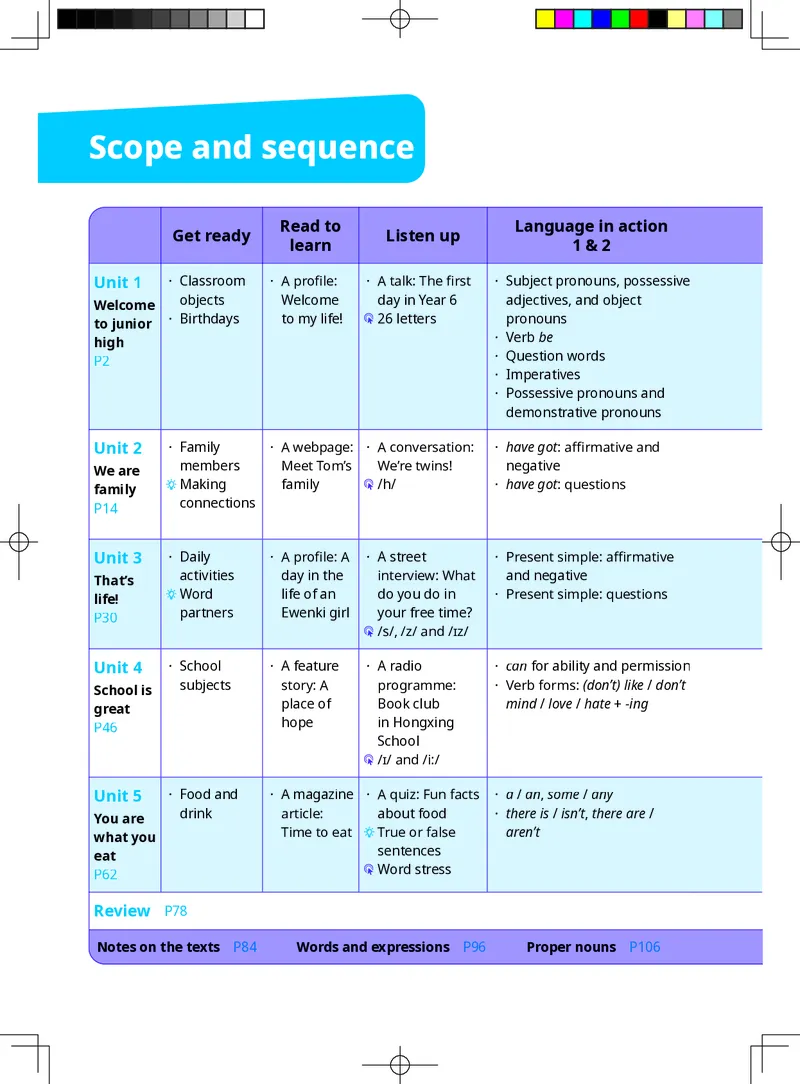
Unit 1 · Classroom · A profi le: · A talk: The fi rst · Subject pronouns, possessive
objects Welcome day in Year 6 adjectives, and object
Welcome
· Birthdays to my life! 2266 lleetttteerrss pronouns
to junior
· Verb be
high
· Question words
P2
· Imperatives
· Possessive pronouns and
demonstrative pronouns
Unit 2 · Family · A webpage: · A conversation: · have got: affi rmative and
members Meet Tom’s We’re twins! negative
We are
Making family //hh// · have got: questions
family
connections
P14
Unit 3 · Daily · A profi le: A · A street · Present simple: affi rmative
activities day in the interview: What and negative
That’s
Word life of an do you do in · Present simple: questions
life!
partners Ewenki girl your free time?
P30
//ss//,, //zz// aanndd //ɪɪzz//
Unit 4 · School · A feature · A radio · can for ability and permission
subjects story: A programme: · Verb forms: (don’t) like / don’t
School is
place of Book club mind / love / hate + -ing
great
hope in Hongxing
P46
School
//ɪɪ// aanndd //ii:://
Unit 5 · Food and · A magazine · A quiz: Fun facts · a / an, some / any
drink article: about food · there is / isn’t, there are /
You are
Time to eat True or false aren’t
what you
sentences
eat
WWoorrdd ssttrreessss
P62
Review P78
Notes on the texts P84 Words and expressions P96 Proper nouns P106About our
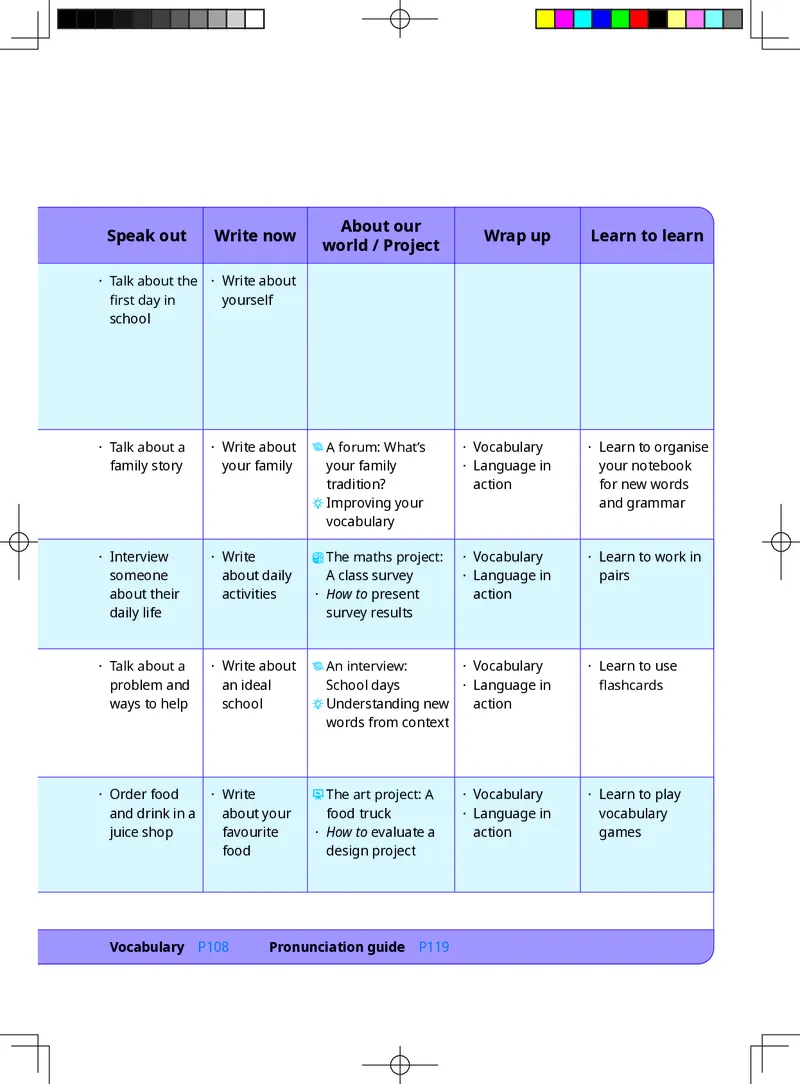
Speak out Write now Wrap up Learn to learn
world / Project
· Talk about the · Write about
fi rst day in yourself
school
· Talk about a · Write about A forum: What’s · Vocabulary · Learn to organise
family story your family your family · Language in your notebook
tradition? action for new words
Improving your and grammar
vocabulary
· Interview · Write The maths project: · Vocabulary · Learn to work in
someone about daily A class survey · Language in pairs
about their activities · How to present action
daily life survey results
· Talk about a · Write about An interview: · Vocabulary · Learn to use
problem and an ideal School days · Language in fl ashcards
ways to help school Understanding new action
words from context
· Order food · Write The art project: A · Vocabulary · Learn to play
and drink in a about your food truck · Language in vocabulary
juice shop favourite · How to evaluate a action games
food design project
Vocabulary P108 Pronunciation guide P119Learning outcomes
In this unit, let’s explore junior high
school life. After completing the unit,
1 Welcome to you will be able to:
· introduce yourself and talk about your
school things
junior high
· use pronouns, adjectives, verb be,
question words and imperatives
· talk about your first day in school
· write a letter about yourself
· get ready for junior high life
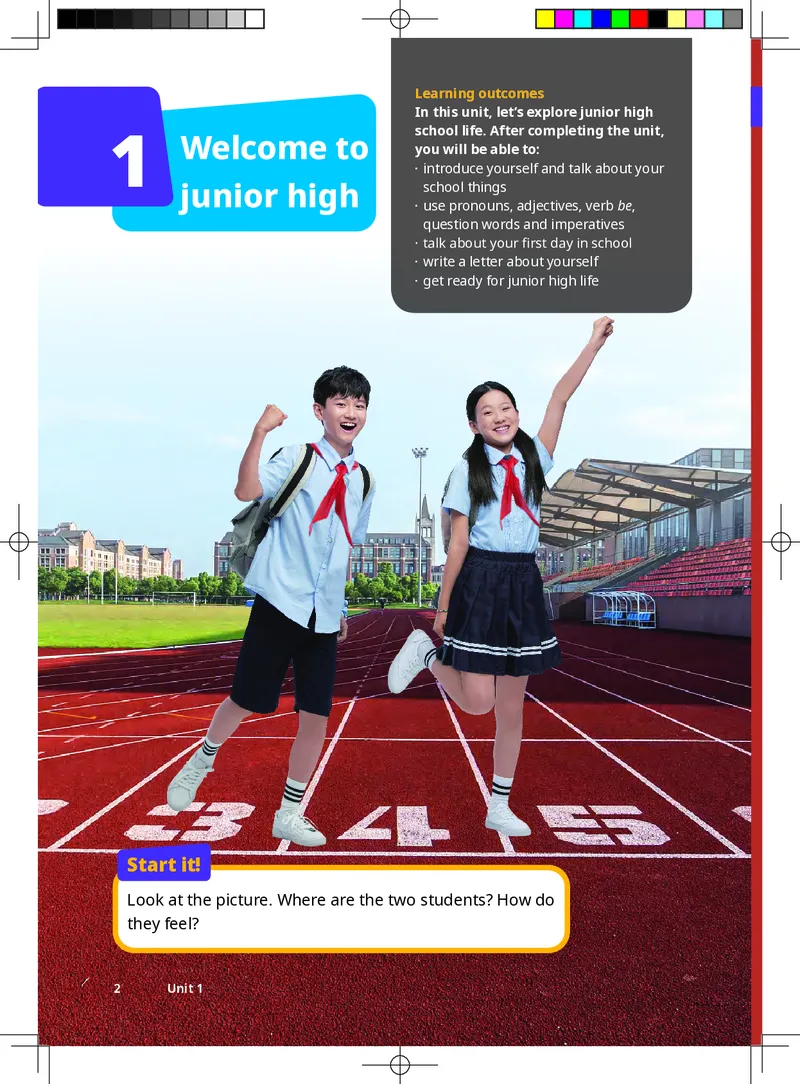
Start it!
Look at the picture. Where are the two students? How do
they feel?
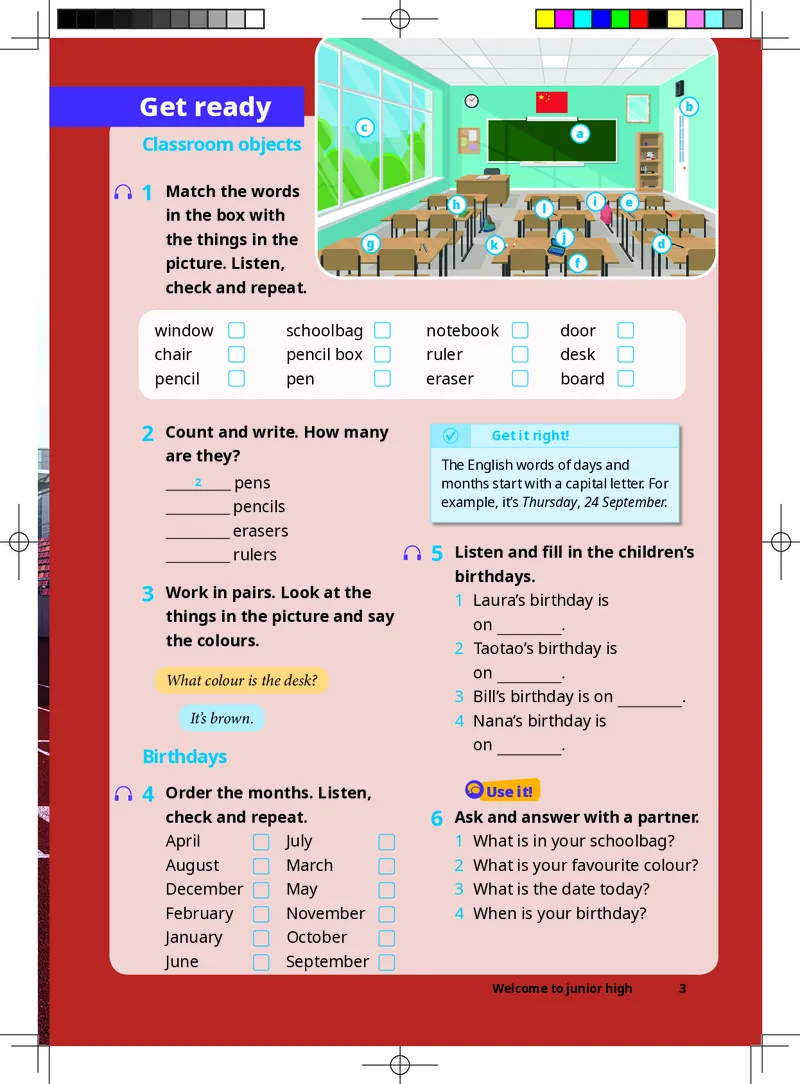
2 Unit 1 Welcome to junior highGet ready b
c
a
Classroom objects
1 Match the words
h i e
l
in the box with
the things in the j
g k d
picture. Listen, f
check and repeat.
window schoolbag notebook door
chair pencil box ruler desk
pencil pen eraser board
2 Count and write. How many
Get it right!
are they?
The English words of days and
2
pens months start with a capital letter. For
pencils example, it’s Thursday, 24 September.
erasers
rulers 5 Listen and fi ll in the children’s
birthdays.
3 Work in pairs. Look at the
1 Laura’s birthday is
things in the picture and say
on .
the colours.
2 Taotao’s birthday is
on .
What colour is the desk?
3 Bill’s birthday is on .
It’s brown. 4 Nana’s birthday is
on .
Birthdays
4 Order the months. Listen, Use it!
check and repeat. 6 Ask and answer with a partner.
April July 1 What is in your schoolbag?
August March 2 What is your favourite colour?
December May 3 What is the date today?
February November 4 When is your birthday?
January October
June September
Welcome to junior high 3Read to learn
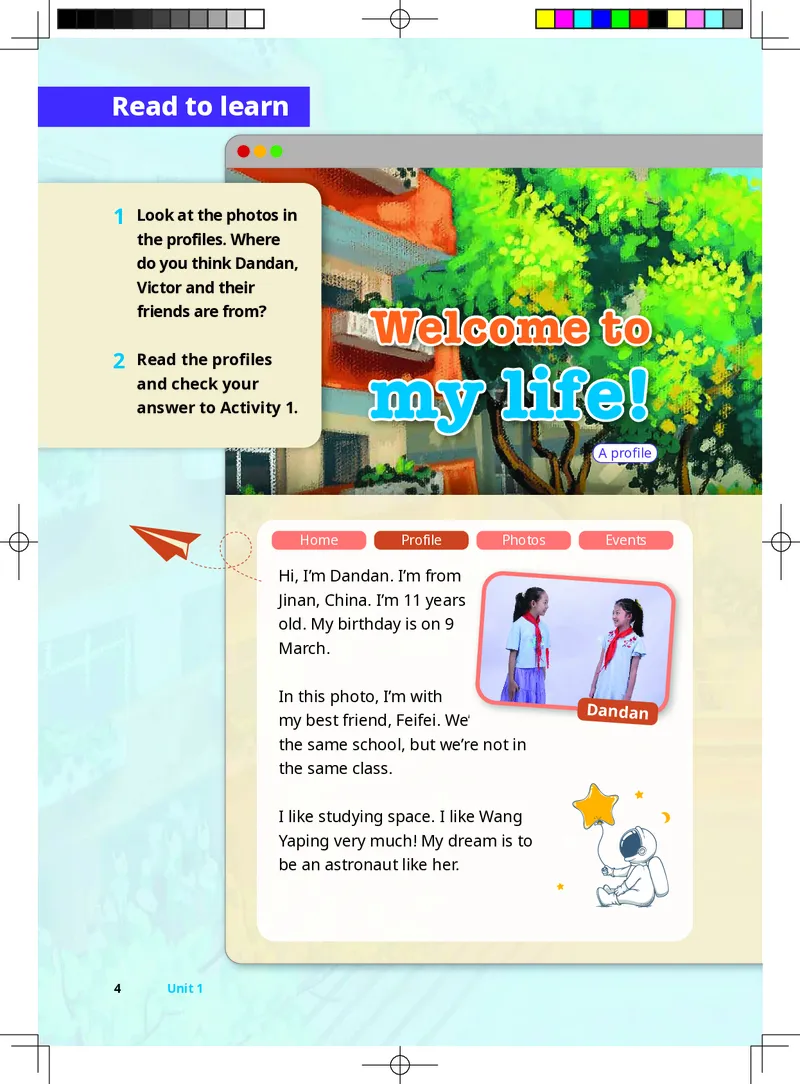
1 Look at the photos in
the profiles. Where
do you think Dandan,
Victor and their
friends are from? WWeellccoommee ttoo
2 Read the profiles
mmyy lliiffee!!
and check your
answer to Activity 1.
A profi le
Home Profile Photos Events
Hi, I’m Dandan. I’m from
Jinan, China. I’m 11 years
old. My birthday is on 9
March.
In this photo, I’m with
Dandan
mmyy bbeesstt ffrriieenndd,, FFeeiiffeeii.. WWee’’rree aatt
the same school, but we’re not in
the same class.
I like studying space. I like Wang
Yaping very much! My dream is to
be an astronaut like her.
4 Unit 1 Welcome to junior highHome Profile Photos Events
Hello! My name’s Victor. I’m from
New York, the USA. Today is 5
September. It’s my birthday.
I’m 12 now!
II’’mm wwiitthh AAnnddyy aanndd JJiimm iinn tthhiiss pphhoottoo..
They’re my best friends. Andy
Victor
is American, but Jim isn’t. He is
Mexican.
I like playing basketball. My dream
is to be a basketball player.
Welcome to junior high 5Language in action 1
3 Where can you fi nd the
profi les? Subject pronouns, possessive
adjectives, and object pronouns
a. in a newspaper
b. in a magazine
1 Complete the examples in the
c. on the internet
table below. Use the profi les on
4 Read the profi les again pages 4–5 to help you.
and complete the table.
Subject Possessive Object
Name Dandan Victor
pronouns adjectives pronouns
Age 1 2 me
Birthday you your you
Hobby 3 his him
she her 4
Dream
5 its it
Voice it! 6 our us
5 Complete the sentences
7 their them
with your ideas. Compare
your answers with
2 Circle the correct words.
a partner.
1 Our / We are from China.
1 Dandan likes Wang
2 His / He name is Victor. His / He
Yaping because
is 12.
.
3 Their / They names are Andy
2 I like and
and Jim. They are my / me best
my dream is to
friends.
be .
4 Do you like playing basketball
with he / him?
6 Unit 1 Welcome to junior highVerb be 4 Write questions with the verb be.
1 you / 11?
3 Complete the examples in the Are you 11?
tables below. Use the profi les on
2 you / from / Jinan?
pages 4–5 to help you.
3 your best friends / in your class?
Affi rmative
I 1 from Jinan.
4 your teacher / Chinese?
She 2 my best friend.
5 today / 19 September?
We 3 at the same school.
Negative
Question words
We 4 in the same class.
Andy 5 Mexican. 5 Match the question words with
their functions.
Dandan and Feifei 6 American.
1 what a ages
2 where b people
Questions and short answers
3 when c places
7 Jim American?
4 how old d things
No, 8 .
5 who e time and dates
9 Dandan and Feifei good
friends? 6 Complete the questions with the
Yes, 10 . question words from Activity 5.
1 are you from?
2 is your birthday?
3 — are you?
—I’m 11 years old.
4 is your name?
5 has a green schoolbag?
Use it!
7 Work in pairs. Ask and answer
the questions in Activity 4 and
Activity 6.
Welcome to junior high 7Listen up
TTTThhhheeee ffffiiiirrrrsssstttt ddddaaaayyyy
in Year 6 2 Listen to the talk. What are
the students talking about?
A talk
1 What do you talk about on 3 Listen again. Circle the correct
your fi rst day in school? words and number.
Circle them.
1 Spencer is a teacher / student.
2 Newtown is a big / great school.
a 3 Lucy is in Year 6 / 9.
b
4 The lunchbox is / isn’t Alex’s.
Voice it!
new
classmates 4 Discuss the questions.
sscchhooooll rruulleess 1 Do you like Newtown Junior
High School? Why or why
c
not?
2 How do you feel on the fi rst
day in junior high?
new teachers 3 What are some rules at your
school?
Pronunciation
26 letters 2 Put the letters with the same sound
into the correct place. Listen, check
1 Listen and repeat.
and repeat.
Aa Bb Cc Dd Ee Ff Gg
/eἹ/ Aa
Hh Ii Jj Kk Ll Mm Nn /i/ Ee
/aἹ/ Ii
Oo Pp Qq Rr Ss Tt Uu
/əʊ/ Oo
/ju/ Uu
Vv Ww Xx Yy Zz
/e/
/ɑ/
88 UUnniitt 11 Welcome to junior highLanguage in action 2
Imperatives
1 Complete the examples in the 3 Complete the instructions
table below. Use the talk to with the words and
help you. Listen and check. expressions in the box.
Affi rmative Negative Don’t forget Don’t run
Listen to Clean Write
1 the door, 2 worry!
please.
1 inside the
teaching building!
2 Complete the rules of Newtown 2 new words in
Junior High School according to your notebook!
the talk. 3 to do your
homework!
4 your teacher!
5 the classroom!
Rules of Newtown
Junior High School
1 late!
2 in class!
3 in the classroom!
Welcome to junior high 9Possessive pronouns and demonstrative pronouns
Speak out
4 Those are our chairs. Those
Possessive pronouns
are .
It’s mine.
5 It is their classroom. It is .
6 Are these her scissors? Are
It’s yours.
these ?
Whose
It’s his.
lunchbox is
It’s hers. 5 Put the words in the correct
this?
order to make questions. Listen
It’s ours.
and match the questions with
It’s theirs. the answers.
Demonstrative pronouns 1 book / whose / this / is
2 notebooks / those / are / whose
3 are / pens / whose / these
This is my That is my
pencil. eraser. 4 that / ruler / whose / is
a It’s his.
b It’s mine.
These are my Those are my c They’re hers.
notebooks. scissors. d They’re ours.
4 Look at the table above. Use it!
Complete the sentences with 6 Ask and answer questions
possessive pronouns. and give instructions. Then
change roles.
1 It’s your pencil. It’s .
2 That’s his notebook. Whose book is this?
That’s .
It’s mine.
3 This is my eraser. This is
. Write your name on it!
10 Unit 1 Welcome to junior highSpeak out
Talk about the first day in school
1 Listen to the conversation. Who is Jack?
2 Complete the conversation with
the help of the Useful language box.
Listen and check.
Useful language
Hey / Hi, (name). How are things?
OK / Fine, thanks. How are you? See you later.
TINGTING 1 , Evan. TINGTING Is his birthday on
EVAN Hi, Tingting. 2 1 March?
TINGTING Very well. 3 EVAN Yes, it is! That’s funny!
EVAN 4 So, how’s Maybe it’s the same
school? boy.
TINGTING It’s good. TINGTING That’s not funny at all!
EVAN Do you make any new friends? EVAN Got to go! Bye!
TINGTING Yes, I do. His name’s Jack. TINGTING OK. 5
EVAN Cool! I have a new boy in my
class. His name’s Jack, too.
3 Look at the Everyday English box. Find and underline the expressions
in the conversation.
Everyday English
Cool! Got to go! That’s funny! That’s not funny at all!
4 Work in pairs. Practise the conversation.
5 Work in pairs. Act out a phone conversation about your first day
in school.
Welcome to junior high 11Write now
2 Match the topics a–d with the
Write about yourself paragraphs 1–4.
a Information about your favourite
1 Read Mary’s letter. Who is Ms
things and your dream
Weston?
b Information about your age
and nationality
cc Information about your friends
dd Information about your class
33 RReeaadd MMaarryy’’ss lleetttteerr aaggaaiinn.. WWhhaatt
A letter
iinnffoorrmmaattiioonn iissnn’’tt iinn tthhee lleetttteerr??
CCiirrccllee tthheemm..
Dear Ms Weston, name age birthday
1 My name is Mary Jones and I’m favourite school subject
11. I’m from London. I’m English.
country dream
2 It’s my first day in this school. I’m names of her best friends
in Class 6A. That’s your class!
favourite colour and place
3 The students here are from all
favourite sport
over the world. My best friends
are May and Leona. May is
American and Leona is Canadian.
4 My favourite colour is pink and
my favourite place in school is my
classroom. My dream is to be a
teacher – just like you!
Best wishes,
Mary
12 Unit 1 Welcome to junior high4 Look at the Useful language Write your own letter to
box and complete the introduce yourself.
information with the
words and expression PLAN
from Mary’s letter. 6 Decide on the information for
each paragraph. Use Activity 2
Useful language to help you.
To start: 1 Mr
WRITE
(man) / Ms (woman) +
7 Write your letter. Remember
surname
to include four paragraphs,
To end: All the best, or
and use the words and
2
expressions from the Useful
To join two ideas in one
language box.
sentence: 3
CHECK
5 Join the sentences with and. 8 Do you …?
· introduce yourself and
1 My name is Sam. I’m 12
give your name, age and
years old.
nationality
· use and to join ideas
· say what your dream is
2 I’m Chinese. I’m from
Nanjing.
3 My favourite number is 15.
My favourite colour is red.
Welcome to junior high 13Learning outcomes
In this unit, let’s explore family stories.
After completing the unit, you will be
We are
2 able to:
· use family words and some adjectives to
family describe people
· use have got
· ask for information
· write an email about your family
· talk about family values in diff erent
cultures.
Start it!
Look at the picture. How many families can you see?
14 Unit 2 We are familya b
Get ready
Family members Victor Amanda
c d e f
Andy Sara Ryan Lizzie
g h i
Leo Beth Amy Jenny and Nancy
1 Look at Beth’s family tree. 3 Complete the lists with the
Match nine family words in family words from Activity 1.
the box with the pictures a–i.
Male:
Listen, check and repeat.
Female:
aunt brother
cousins dad
Male or female:
daughter grandpa
grandma grandson
LEARNING TIPS
husband mum
Making connections
nephew niece
Think of examples from your own life
sister son
to help you remember new words.
uncle wife
granddaughter
Use it!
4 Draw your family tree.
2 Look at Beth’s family tree again.
Complete the answers with the
5 Work in pairs. Say a name
family words from Activity 1.
on your family tree. Let your
1 Andy + Sara = husband and partner guess.
wife
Li Feng.
2 Lizzie + Jenny = mum and
3 Amanda + Leo = grandma
Is he your brother?
and
4 Ryan + Beth = and No, he isn’t. Try again.
5 Lizzie + Leo = and
6 Leo + Beth = and
We are family 15Read to learn
Meet Tom’s
ffaammiillyy
1 Look at the word cloud
and predict. What’s the
passage about?
a big house together
A webpage
favourite times
10 people birthdays
Tom Smith is from England. He’s
family happy
11 years old today! His mum is a
2 Read the webpage and doctor and his dad is a postman.
check your answer to
Activity 1. He has got two brothers and three
sisters and a dog. His grandma
and grandad live with them. Tom’s
also got an aunt, an uncle and
16 Unit 2 We are familyfour cousins. They haven’t got any Tom also likes birthdays in his
pets, but they’ve got a big house. family. They’ve got a birthday
They live in front of Tom’s house. party almost every month! Today,
everyone is at Tom’s party: his
Tom’s favourite times of the day are family and his friends.
the morning and the evening –
his family are all together for Is Tom happy in his big family?
breakfast and dinner. That’s 10 Yes. He hasn’t got a bedroom
people round one table! of his own. He shares it with his
two brothers. But he’s got lots of
people to talk to.
We are family 17Language in action 1
have got: affi rmative and
3 Read the webpage again. negative
Are the sentences T (true)
or F (false)? 1 C omplete the examples in the
tables below. Use the webpage
1 Tom is English.
on pages 16–17 to help you.
2 Tom’s mother is a teacher.
3 Tom has got a cat. have (’ve) got
4 His cousins live in the have not (haven’t) got
house next door. They 1
5 The family are together in
a birthday party
the morning and evening.
almost every month!
I / you /
we / they Tom’s cousins
6 Tom has got his own
2 any
bedroom.
pets.
4 Make a profi le for Tom.
has (’s) got
Name: Tom Smith has not (hasn’t) got
Country:
He 3 two
Age:
brothers and three
he /
Family members:
sisters and a dog.
she /
it He 4 a
Favourite times at
bedroom of his own.
home and reasons:
Voice it!
5 Discuss the questions.
1 Do you think Tom’s happy
at home? Why or why not?
2 Is your family like Tom’s?
Why or why not?
18 Unit 2 We are familyUse it!
2 C ircle the correct words. Check 4 Write sentences with have got
your answers with the webpage or haven’t got. Use the ideas
on pages 16–17. below or your own ideas.
My grandparents’ house is pink.
1 Tom has got / hasn’t got a big 1
They’ve got a big garden.
family.
2 Tom has got / hasn’t got fi ve 2 I haven’t got .
cousins. 3 My ’s name .
3 Tom’s two brothers have got / got .
haven’t got their own 4 My ’s house .
bedrooms. got .
4 Tom’s aunt and uncle have got /
5 Work in pairs. Take turns to
haven’t got a big house.
say your sentences and ask
5 Tom has got / hasn’t got lots of
your partner questions.
people to talk to.
I haven’t got any sisters or brothers.
3 Complete the text with the
How about you?
correct form of have got.
The skiing brothers
Jamie and Joel are brothers
from Jamaica. They
1 haven’t got (×) any sisters.
Jamaica 2 (×) any
snow, but Jamie and Joel are
amazing skiers. Their home
town 3 (√) an
indoor ski club. It 4
(√) 150 members. Jamie and
Joel 5 (√) their own
ski teachers, too. They think
Jamie and Joel 6 (√)
a great future for skiing!
We are family 19Get it right!
Listen up
The following table can help you
describe people.
WWee’’rree
Eyes black grey
ttwwiinnss!!
Hair long short
A conversation
Height short tall
1 Choose a person and try to
describe him / her. Other
slim glasses
features
a c
Remember adjectives usually go
before nouns in English.
We say brown eyesNOT eyes brown.
b d
Voice it!
4 Describe someone in your family
to your partner. Ask your partner
to draw the person. Does it look
2 Listen to the conversation like them?
and tick the picture of Jack’s
My brother is tall and slim. He has
brother in Activity 1.
got short brown hair and glasses.
3 Listen again. Circle the
Pronunciation
correct words.
/h/
1 It’s Jack’s / Eva’s fi rst day at
1 Listen and repeat.
school.
/h/ have got Hey! hair home
2 Jack’s brother has got black /
2 Listen and circle the words you
blue eyes. hear.
1. hat / at 3. has / as
3 Jack hasgot / hasn’tgot
2. hair / air 4. hand / and
glasses.
3 Listen and repeat the sentences.
4 Eva has got one brother / 1. Hunter has got brown hair and he
two brothers. is happy.
2. Hey! How are things?
20 Unit 2 We are familyLanguage in action 2
have got: questions
1 Complete the examples in the table below. Use the conversation
to help you. Listen and check.
Have Jack and 1 Jack 4 brothers and
his brother got blue sisters 5 Eva
short hair? eyes? ?
Yes, they have. Yes, he 2 . She 6 two brothers.
No, they haven’t. No, he 3 . She 7 any sisters.
2 Complete the questions with the correct form of have got. Match
them with the answers according to the conversation.
1 Eva brothers? a Yes, she has.
2 Jack a brother? b Yes, they have.
3 Jack and his brother brown hair? c Yes, he has.
4 Jack and his brother black eyes? d No, he hasn’t.
5 Eva sisters? e No, they haven’t.
6 Jack’s brother glasses? f No, she hasn’t.
We are family 21Use it!
3 Write questions and answers 4 Write questions with the
about Lauren and Hayleigh in correct form of have got.
the quiz below. Listen and circle
1 a brother or sister
the correct answers.
2 long hair
star
THIS WEEK’S INTERVIEW
3 a pet
1 Lauren / yellow hair?
Has Lauren got yellow hair?
4 a bike
a (√) light yellow hair
Yes, she has. She has got light
5 a niece or nephew
yellow hair.
b (x) light brown hair
No, she hasn’t. She has got light
5 Ask some classmates your
brown hair.
questions. Write down
2 Hayleigh / green eyes? their answers.
Have you got a brother or sister?
a (√) dark green eyes
Yes, I have. I’ve got a sister.
b (x) dark brown eyes
6 Look at their answers.
3 Lauren and Leah / fair skin? Are they interesting or
surprising?
a (√) fair skin
b (x) black skin
4 How many / sisters /
Lauren / ?
a three sisters
b two sisters
22 Unit 2 We are familySpeak out TTaallkk aabboouutt aa ffaammiillyy ssttoorryy
1 LLiisstteenn ttoo tthhee ccoonnvveerrssaattiioonn.. WWhhaatt ddoo yyoouu
know about the daughter?
2 CCoommpplleettee tthhee ccoonnvveerrssaattiioonn wwiitthh tthhee hheellpp ooff
the Useful language bbooxx.. LLiisstteenn aanndd cchheecckk..
Useful language
What is it? When did this / it start?
What do you think? What’s up? How’s that?
JILL Hey, Meimei! 1 What’s up? daughter with her learning.
MEIMEI Look at this! It is really JILL That’s amazing!
touching. 4
JILL 2 MEIMEI About 9 years ago.
MEIMEI It’s a story about a mother JILL Wow! That’s really
from Liaoning, China. something! She’s a great
She is also her daughter’s mum.
deskmate. MEIMEI Totally! It’s so nice to see the
JILL 3 love between a mother and
MEIMEI The daughter is deaf. daughter. 5
Her mother wants to be JILL For sure! I think they make a
her ears. She helps her great team.
3 Look at the EverydayEnglish box. Find and underline the expressions
in the conversation.
Everyday English
Wow! That’s really something! Totally! For sure!
4 Work in pairs. Practise the conversation.
5 Work in pairs. Share a family story of your own or someone else.
We are family 23Write now
Write about your family
1 Look at the photo. Which boy is Daniel? Read his email to his
pen friend Max and fi nd the answer.
New message
To: Max
An email
Hello Max,
1 I’m Daniel and I’m from Dunoon, a small town in
Scotland. I’ve got a very big family!
2 I’ve got six brothers and one sister. My brother,
George, is my twin. He’s tall. He’s got short brown
hair and brown eyes, like me. My sister, Connie, is
10. She’s got long brown hair and blue eyes. I’ve got
a pet rabbit. Its name is Snowball!
3 Here’s a photo of me with Connie and George (he’s
got a red shirt).
4 Have you got a big family? Have you got any pets?
Write soon!
Daniel
Send
24 Unit 2 We are family2 Match the topics a–d with Write your own email to a
the paragraphs 1–4. pen friend.
a Daniel’s questions for Max
PLAN
b Information about
5 Make notes about these things.
Daniel’s family
Age:
c Daniel’s self-introduction
Family:
d Other information
Pets:
3 Read the email again and Decide on the information
answer the questions. for each paragraph. Use your
notes and Activity 2 to
1 How many brothers and
help you.
sisters has Daniel got?
2 How old is Daniel’s sister?
WRITE
3 Who is Snowball?
6 Write your email. Remember
to include four paragraphs,
4 Look at the Useful language
and use have got and the
box and complete the
words and expressions from
information with the words
the Useful language box.
and expressions from
Daniel’s email.
CHECK
7 Do you ...?
Useful language
· use expressions to start and
At the start: Hi … Hey … end your email
1 · give information about
At the end: Email me soon. yourself and your family
That’s all for now. 2 ! · ask questions about your
Symbols: Use emojis to pen friend
help express your feelings.
Contractions: I’m, 3 ,
4 , she’s, 5
We are family 25ABOUT
OUR
1 Look at the photos. What are
WORLD Huahua and Anna talking
about? Read the forum and
check your answer.
What’s your family tradition?
A forum
Many families have their own traditions. They follow them every year, or
every week! What is your family tradition?
Every year, my dad and I go to the lake in
my home town Zhenjiang and take photos.
We’ve got 43 photos now and lots of happy
times!
Huahua,
China This is our first photo. It was a sunny day.
I was just one year old then.
This is another photo. I was 17
years old.
Now I’m no longer a little girl. I’m
a mother and I’ve got two young
daughters. Each year, we go to the
lake together and smile for the
camera.
In our family, Friday night means a lot! Every Friday, I help
my mum and my sister prepare the pizzas. Then Dad
cooks the pizzas. Friday night isn’t only pizza night – it’s film
night, too! We take turns to choose the film. This week it’s my
Anna,
turn. I can’t wait!
Germany
26 Unit 2 We are family2 Read the forum again and 2 Have you got any family
answer the questions. traditions?
3 Why are family traditions
1 What are the family traditions
important?
mentioned in the forum?
2 How do they feel about their
family traditions? LEARNING TIPS
Improving your vocabulary
3 Circle the correct words.
When you learn an adjective, it’s
1 Family traditions usually
a good idea to learn the opposite
change all the time / stay the adjective. This can improve your
vocabulary.
same.
2 Huahua and her father take
5 Write the opposite adjectives
photos each week / year.
for these words. Find them in
3 Huahua has got one daughter /
the forum.
two daughters.
4 Every Friday, Anna’s dad / 1 sad happy 3 last
mum cooks the pizzas. 2 big 4 old
5 Each week, Anna / someone in
Anna’s family chooses the fi lm. 6 Close your book. Say an
adjective from Activity 5. Can
Voice it!
your partner remember the
4 Discuss the questions.
opposite adjective?
1 Which family tradition do
you like? Why?
We are family 27Language in action
WRAP
UP
3 Put the words in the correct
order to make sentences. Match
them with the pictures.
Vocabulary
a b c
1 Look at David’s family tree.
Complete the sentences.
d e
George and Annie
Dave and Debbie Chris and Jill
1 bike / I / haven’t / a / got
David Joe Dan Kate
1 Joe: George and Annie are 2 My / got / grandad / hasn’t /
my . a / mobile phone
2 Dave and Debbie: David is
our . 3 home / We’ve / pets / at /
3 David: Dan and Kate are four / got
my .
4 Jill: David is my . 4 best friends / at / school /
5 Dan and Kate: Dave is our . two / I’ve / got
2 Complete the descriptions 5 My / two / got / boards /
with the words from the box. classroom’s
black (×2) short tall
4 Write questions with the
correct form of have got.
Answer them with the
Leilei is 1 . information in brackets.
He’s got 2 3 hair.
1 how many / sisters / you (four)
He’s got 4 eyes.
2 Toby / any cousins (×)
3 you / a big family (√)
4 your best friend / a pet (√)
Leilei
(two cats)
28 Unit 2 We are familyLEARN
Learn to organise your notebook
TO
LEARN
for new words and grammar
It’s important to organise your notebook
to help you fi nd your notes.
1 Ask and answer with a partner. 3 Look at Mark’s notebook. Is
his notebook diff erent from
1 Have you got a notebook?
Lily’s? How?
2 Are your notes easy or
hard to read? Verb be
AAffffiirrmmaattiivvee NNeeggaattiivvee QQuueessttiioonnss
I’m from I’m not Are you from
China. from China. China?
She’s my She isn’t Is she your
sister. my sister. sister?
He’s my He isn’t my Is he your
brother. brother. brother?
We’re at We aren’t Are you at
a 23 September school. at school. school?
b They’re my They aren’t Are they your
have got
cousins. my cousins. cousins?
I / you / we / they have / haven’t got
he / she / it has / hasn’t got
c family members
4 Answer the questions.
1 What is good about Lily’s
dad husband mum wife
notebook? What is good about
brother son sister daughter
uncle nephew aunt niece Mark’s?
grandad cousin grandma cousin
2 What are some other ways to
grandson granddaughter
organise a notebook?
d Learn the family words from Unit 2.
3 Which is your favourite way? Why?
rammarg
sdrow
wen
seton
krowemoh
2 Look at Lily’s notebook. Match
the topics with the information.
1 Today’s new words
2 Today’s date
3 Today’s homework
4 Today’s grammar
Self-assessment
I can use family words and some adjectives to describe people.
I can use have got in affi rmative and negative sentences, as well
as questions.
I can ask for information.
I can write an email about my family.
I can share my opinion on family values in diff erent cultures.
We are family 29Learning outcomes
In this unit, let’s explore daily
activities. After completing the unit,
That’s life!
3 you will be able to:
· use words and expressions to describe
your daily life
· use the present simple
· ask and respond to interview questions
· write an article about daily activities
· talk about young people’s lifestyle at
home and abroad.
Start it!
How does the girl in the picture feel? Why does she feel so?
30 Unit 3 That’s life!c
a
b
d
Get ready
Daily activities
1 Match ten activities in the box with the
e
f
pictures a–j. Listen, check and repeat.
brush your teeth go to school
do your homework have a shower
g
get dressed have breakfast
get up listen to music
go home pack your schoolbag
do exercise read a book
h
go to bed wake up
i
2 Which activities in Activity 1 are not in the
pictures? Write them in the correct order.
Listen, check and repeat.
j
wake up
3 Complete the table with the activities from
Activity 1. Think of one more activity for
each verb.
LEARNING TIPS
go do get have
Word partners
to school
When you learn
new words, think
about the words
that go with them.
This can help you to
Use it! remember them.
4 When do you do each activity from Activity 1?
Work in pairs. Say one activity and let your
partner guess the time.
Have breakfast. 7 o’clock? No, try again.
That’s life! 31Read to learn
1 Look at the pictures.
A day in the
Then read the
information about the
life of an
Ewenki people and
answer the questions.
Ewenki girl
A profi le
The Ewenki people
Where: Inner Mongolia
Autonomous Region and
Heilongjiang Province
Population: around 30,000
Food: meat, grain and milk
Clothes: clothes made
from animal skins
1 Where do the Ewenki This is Wuren. She is 20 years
people live? old. She is an Ewenki girl. The
2 What do they eat and word “Ewenki” means “people of
drink? the mountains and forests”. Like
3 What kind of clothes do many Ewenki people, Wuren and
they wear? her family live a traditional way
of life.
2 Read the profile. Say one
surprising thing about Every morning, Wuren wakes up
Wuren’s life. with the sun. She and her family
always have breakfast with hot
milk tea.
During the day, Wuren usually
takes care of their reindeer
32 Unit 3 That’s life!in the woods. She feeds them and brushes their coats carefully.
Sometimes she rides the reindeer. How cool it is!
After a whole day’s work, Wuren and her mum usually cook meat
for dinner.
At night, Wuren and her sister don’t watch TV.
They often lie in their round tent in the forest
and look at the stars. It brings them peace
and joy.
Wuren doesn’t feel bored with her life. In her
eyes, a life with nature is very special. Nature is
always her home and her good friend!
TThhaatt’’ss lliiffee!! 3333W
Language in action 1
3 Read the profi le again and
complete the sentences. Present simple:
affi rmative and negative
1 Wuren is an Ewenki
.
1 C omplete the examples in the
2 Wuren and her family live
tables below. Use the profi le
a way of life.
on pages 32–33 to help you.
3 Wuren takes care of their
reindeer in the .
I / you / we / they
4 Wuren and cook
meat for dinner. She and her family always
5 In Wuren’s eyes, nature 1 with hot milk tea.
is her home and
Wuren and her sister
her .
2 TV.
4 Complete the table about They often 3 in
Wuren’s daily activities. their round tent.
Time of
Activities
the day
he / she / it
Early in the
Every morning, Wuren
morning
4 with the sun.
Daytime
Wuren usually 5
Evening
the reindeer.
Wuren 6 bored
Voice it!
with her life.
5 Discuss the questions.
1 How does Wuren feel
about her life?
2 How is Wuren’s life
diff erent from yours?
3 What do you like about
Wuren’s day?
34 Unit 3 That’s life!2 C orrect the sentences. Use
Get it right!
the profi le on pages 32–33 to
An adverb of frequency describes how
help you.
often an action happens, such as always,
usually, often, sometimes, and never. They are
1 The Ewenki people live
diff erent in the level of frequency.
in the city. don’t live
2 Wuren doesn’t wake up with 0% 100%
never sometimes often usually always
the sun.
3 Wuren and her family don’t
have breakfast.
Use it!
4 Wuren doesn’t feed their
4 Write three positive and
reindeer.
three negative sentences
5 Wuren feels bored with
with adverbs of frequency
her life.
about your daily activities.
3 C omplete the text with the Use the ideas in the box.
correct form of the present
do homework
simple.
have breakfast at 7:00
go to bed early
Amir is a Bajau boy and he
watch TV in the evening
1 (come) from an island
read books at noon
in Southeast Asia. Every
go for a bike ride after school
morning, he 2 (go)
hang out with friends at weekends
with his father to catch fi sh
for meals. After breakfast,
Amir usually 3 (meet) 5 Work in pairs. Take turns to
his friends. The older Bajau say your sentences. Do you
people 4 (teach) them do the same thing at the
to make nets and build boats. same time?
In the afternoon, Amir and his
I always watch TV in the evening.
friends 5 (play) in the
water. In the evening, Amir’s I never watch TV in the
mother 6 (cook) fi sh evening. I read books.
and the family 7 (have)
dinner together. Amir 8
(know) his age or his birthday.
Why? The Bajau people 9
(count) hours, days or years.
That’s life! 35Listen up
2 L isten to the street interview
What do you do and circle the correct words.
in your free time?
1 Nina and her friends like /
A street interview don’t like the same music.
2 Nina does / doesn’t do her
1 Look at the activities. Which
homework before she
do you often do?
reads books.
3 Anton plays / doesn’t play ping-
pong with his dad.
4 George lives / doesn’t live
near Anton.
5 Anton takes / doesn’t take photos.
hang out with friends listen to music
Voice it!
3 Discuss the questions.
1 Which activities in Activity 1 do
you like? Why?
read books draw pictures
2 What other free time activities
do you think people usually do?
play ping-pong take photos
Pronunciation
/s/, /z/ and /ɪz/ 3 Add -s or -es to the verbs and
put them in the correct place.
1 Listen and repeat.
break catch choose
/s/ speaks /z/ does /ɪz/ studies
go say think watch
2 Listen and write A (/s/ or /z/) or
B (/ɪz/).
/s/ or /z/ /ɪz/
1. comes 3. changes
2. takes 4. teaches
4 Listen, check and repeat.
36 Unit 3 That’s life!Language in action 2
Present simple: questions
1 Complete the examples in the tables below. Use the street
interview to help you. Listen and check.
I / you / we / they
1 they the same
music as you?
Yes, they 2 . / No, they don’t.
Get it right!
What 3 you in your
Remember to use do or
free time?
does in present simple
How often 4 you that? questions. We say Where
does your friend live? NOT
Where your friend lives?
he / she / it
5 he near you?
Yes, he does. / No, he 6 .
Who 7 Anton with?
2 Put the words in the correct order to make questions. Write
the answers according to the street interview.
1 Nina and Anton / Where / do / live
—Where do Nina and Anton live? —They live near the Eiffel Tower.
2 Nina / hang out with friends / Does
3 Nina and her friends / Do / like / the same music
4 Nina / read books / How often / does
5 Anton / play ping-pong / with George / Does
That’s life! 37Use it!
Speak out
3 Write questions and complete 4 Use the ideas below to
the conversation. Use the words write questions. Ask and
in brackets. answer with a partner.
1 What / you / do / on
WU LE 1 What do you do (what / you /
Friday nights?
do) in your free time?
LI HAO I usually meet my best friend
2 When / you / get up / on
or go for a bike ride with my
Sunday?
brother.
WU LE 2 (you / see) your
3 How often / you and your
best friend every day?
friends / play together?
LI HAO Yes, most days. 3
(who / is) your best friend?
4 Where / you and your
WU LE Tian Tao, but I don’t see him
friends / usually meet?
all the time.
LI HAO 4 (how often /
5 What things / you and
you / see) him?
your friends / like?
WU LE It depends. Usually at
weekends. We sometimes
play basketball on What do you do on Friday nights?
Saturdays.
I usually watch a film.
LI HAO Hey! I play basketball, too.
5 (where / you /
meet)?
WU LE At the sports centre.
LI HAO 6 (you / want to)
hang out next Saturday?
WU LE Sure! I’ll call you.
LI HAO OK, great!
38 Unit 3 That’s life!Interview someone
Speak out
about their daily life
1 Listen to the conversation. What is it about?
2 Complete the conversation with the help of the
Useful language box. Listen and check.
Useful language
Thank you very much for your time. That’s cool / amazing / interesting!
Is that OK? I’ve just got one more question.
I’ve got some questions to ask you about …
LIN FEI Hello, Yaping. WANG YAPING Ah, it’s also important
1 life on the to stay fi t in space! We
space station. 2 often use an exercise
WANG YAPING Go ahead! bike in the evening.
LIN FEI When do you start work? LIN FEI Amazing! 4
WANG YAPING That’s easy. At 8:00 am WANG YAPING Sure!
every day. LIN FEI Do you have any days off ?
LIN FEI What do you do in your WANG YAPING Yes, we have one day
free time? off during the week.
WANG YAPING We watch the news On Saturdays, we often
online. It keeps us clean the space station.
up-to-date. LIN FEI 5
LIN FEI 3 What else do WANG YAPING No problem.
you do?
3 Look at the EverydayEnglish box. Find and underline the expressions
in the conversation.
Everyday English
Go ahead! Sure! Th at’s easy. No problem.
4 Work in pairs. Practise the conversation.
5 Work in pairs. Interview each other about your daily life.
That’s life! 39Write now
Write about daily activities
1 Read the article. Choose the best title.
a What does a vlogger do at weekends?
b What’s a vlogger’s daily life like?
c What does a vlogger do in their
free time?
An article
Amy Smith is a Canadian vlogger.
She vlogs about her daily life.
1 A my always wakes up at 7:00 am, then has
breakfast and checks her phone. She
plans her vlog. She usually goes for a bike ride at
11:00 am.
2 S he has lunch at 1:00 pm and listens to music.
Between 2:00 pm and 3:00 pm, she takes some
photos and creates her vlog.
3 A my doesn’t have much free time. She sometimes
watches TV before dinner. She always posts
her vlog at 9:00 pm and goes to bed at 11:00 pm after
taking a bath.
40 Unit 3 That’s life!2 Match the topics a–c with Write your own article about
the paragraphs 1–3. daily activities.
a Description of Amy’s
PLAN
evening activities
5 Choose a person. Think about
b Description of her
their daily activities. Decide
morning activities
on the information for each
c Description of her
paragraph. Use Activity 2 to
afternoon activities
help you.
3 Read the article again.
What does Amy do at WRITE
these times? 6 Write your article. Remember
to include the information
1 7:00 am
in the correct order, and use
2 11:00 am
the present simple, adverbs
3 1:00 pm
of frequency and time
4 9:00 pm
expressions.
4 Find and underline the time
expressions in the article. CHECK
Complete the information 7 Do you ...?
in the Useful language box.
· include an interesting title in
the form of a question
Useful language
· introduce the person, their
We use 1 to talk nationality and job
about a specifi c time. · introduce the person’s
We use 2 to daily activities
describe a period of time.
That’s life! 41THE
MATHS
PROJECT Our Class Survey
Survey of Class 6A: Students’
Free Time Activities
A class survey
What do you do on Saturday
mornings?
1 Circle the correct answer.
Total number of students: 30 (16
A survey is a …
girls and 14 boys)
a test to check your knowledge.
b list of questions to find a hang out with friends 9
out information. b do exercise
c go shopping
2 Look at the bar chart and d watch TV
complete the results of a class e listen to music
survey. f stay in bed late
3 What do the results show?
hang out
Complete the summary of the with friends
do exercise
survey results on page 43.
go shopping
watch TV
4 Do you think it is a good
listen to music
summary? Read the How to box stay in bed late
and share your ideas.
0 5 10 15 20 25 30
Number of students
How to present survey results
a Say what questions you ask in your survey.
b Say why you want to do the survey.
c Give information about the people in the survey.
d Present the results.
e Give your opinion on the results.
f Comment on some surprising results.
42 Unit 3 That’s life!Our survey is about 1 students’ Do your class survey.
free time activities on Saturday
mornings. We do the survey PLAN
because we want to plan an 5 Work in groups. Choose one
end-of-year party. There are of these topics. Complete the
2 students in our steps below.
class. They are all between 11
and 12 years old. Sixteen are
After-school activities
3 and 4 are
Weekend activities
boys. Here are the results of
our survey: · Decide on your questions and
· Students do a lot of diff erent the activities for your questions.
activities on Saturday mornings. · Ask your questions and write
· Only three students 5 down the answers.
on Saturday mornings. That’s · Add up the results.
good news. After all, the early · Draw a bar chart to show your
bird catches the worm. results.
· Most of the students in our
class 6 on Saturday PRESENT
6 Present your results to the class.
mornings. We think it’s a great
It will be a good idea to follow
way to start the weekend!
the tips in the How to box.
CHECK
7 Listen to your classmates’
presentations and answer the
following questions.
· What questions do they ask?
· What is their conclusion after
the survey?
· What are the interesting or
surprising facts?
That’s life! 43Language in action
WRAP
UP
3 Complete the text with the
correct form of the verbs
in brackets.
Vocabulary
My Morning Activities
1 Match the two halves of My day 1 (start) at
each expression. 6:30 am during the week. I
usually 2 (do) exercise
1 brush a your schoolbag
with my best friend, David. We
2 get b home
always 3 (go) running
3 have c dressed
in the morning. Breakfast is at
4 pack d your teeth
7:30 am. Then my sister and I
5 go e a shower
4 (pack) our schoolbags.
2 Circle the correct words. I 5 (not go) to school
with David because we are in
1 watch / read / do a book
diff erent schools.
2 listen to / go / chat music
3 go for / play / stay a bike ride
What do you do in the morning?
4 do / take / listen to photos
4 Write questions and answer them with your own ideas.
1 your best friend / draw pictures?
2 How often / you / watch TV?
3 What / your friends / do / at the weekend?
4 When / school / start / in the morning?
5 Where / you / hang out / with friends?
6 How often / you / go for a bike ride?
44 Unit 3 That’s life!LEARN
2 Ask and answer with a partner.
TO
LEARN
Complete the sentences. Follow the
advice in Activity 1.
1 We both like .
2 My partner likes but I don’t.
Learn to work in pairs 3 I like but my partner doesn’t.
4 We don’t like .
When you work in pairs, you
learn from your partner. Do you like hanging out with friends?
Yes, I do.
1 Complete the advice with
Always or Never. Me, too. Let’s write “hanging
out with friends” in sentence 1.
Let’s
work
well
3 Do you work well in pairs? Write
together!
always, sometimes or never.
1 Always listen to your
When my partner and I work in
partner.
pairs …
2 answer your
1 I listen to my partner.
partner’s questions.
2 …
3 speak at the
same time as your partner. 4 Tell your partner your sentences
4 laugh at your from Activity 3. Do they agree?
partner’s mistakes. Why or why not?
5 ask questions to
I always listen to my partner.
get more information.
Hmm. You sometimes listen to your partner.
Self-assessment
I can use words and expressions to describe my daily life.
I can use the present simple in affi rmative and negative
sentences, as well as questions.
I can ask and respond to interview questions.
I can write an article about daily activities.
I can talk about young people’s lifestyle at home and abroad.
That’s life! 45Learning outcomes
In this unit, let’s explore school life.
After completing the unit, you will be
School is
4 able to:
· use words and expressions to talk
great about school subjects
· use can / can’t and like / love / etc.+ -ing
· ask for and off er help
· write a description of an ideal school
· talk about students’ school life in
diff erent countries.
Start it!
Look at the picture. Where are they?
46 Unit 4 School is greata b c d
Get ready
School subjects g
e
1 Match the school subjects in the f
box with the pictures a–m. Listen,
check and repeat.
h
maths biology English
music Chinese geography
i
physics chemistry history
j
art moral education and law
information technology (IT)
physical education (PE)
k N
S
l
2 Circle the correct words.
m
1 Maths / Art is my favourite
subject. I love numbers.
2 I like PE / IT. I prefer doing
exercise and enjoying
3 Choose three subjects in Activity 1.
the sunshine.
Describe the subjects. Can your
3 This year I want to study
partner guess them?
poems by Du Fu in physics /
Chinese. You draw and paint in this subject.
4 I can’t remember the dates
Art!
in history / chemistry.
5 Geography / Biology isn’t
Use it!
just about the natural
4 Work in pairs. Talk about:
environment. It’s also about
culture and people. · the subjects in your school
6 Music / English is great fun. · your favourite subjects
My words of the week are · the subjects you’re good at
“To be, or not to be: that is · the subjects you’re not good at
the question”.
I’m good at PE. I’m not good
at art. What about you?
School is great 47Read to learn
A railway station is a busy
place, yet in India, Khurana, a
1 Look at the pictures and
kind lady, turns it into a place
answer the questions.
to learn. She often sees poor
1 What is the building?
kids around the station. Their
a. a hospital
family can’t afford to send them
b. a railway station
to school. So, she decides to
c. a museum
2 What are the children give them a hand: she founds a
doing? Platform School.
3 Do you think they are
happy? Why or why not? In this school, children do not
sit in a classroom. They learn
2 Read the feature story.
on the platform. The ground
Check your answers to
is their blackboard! They learn
Activity 1.
maths, languages, music and
drama. They can sing, dance and
play games together. But there
are also rules. For example, they
can’t chat in class, but they can
ask questions by raising hands.
4488 UUnniitt 44 SScchhooooll iiss ggrreeaattA PLACE OF HOPE
A feature story
There are many Platform Schools in India.
They give wings to these kids’ dreams. Arun is
a student there. He says, “I can learn so much
here. It gives me the chance to work hard for my
future.”
SScchhooooll iiss ggrreeaatt 4499Language in action 1
3 Read the feature story again can for ability and permission
and answer the questions.
1 C omplete the examples in the
1 Who take classes in these
tables below. Use the feature story
Platform Schools?
on pages 48–49 to help you.
2 What subjects do children
learn in these schools?
Ability
3 What can students do in
these schools? I 1 learn so much here.
4 What are some rules in
Their family 2 aff ord to send
these schools?
them to school.
4 Introduce a Platform School
to your partner. Use the
Permission
thinking map to organise
your ideas. They 3 ask questions by raising
hands.
Where is it? Who decides to
build it? They 4 chat in class.
A Platform School
2 Circle the correct words. Check
your answers with the feature
What things story.
can it give to
1 Students can / can’t talk with each
What is it for? children?
other in class.
2 Students can / can’t play games
Voice it!
together.
5 Discuss the questions.
3 Poor parents can / can’t send their
1 Do you think Arun likes his kids to school.
school? Why or why not? 4 Students can / can’t sing and dance
2 Do you think Platform on the platform.
Schools and ordinary
schools are the same? Why
or why not?
5500 UUnniitt 44 School is great3 Complete the text with
Get it right!
can or can’t and the words
We use the verb without to after can. We
in brackets.
say Vicki can sing.NOT Vicki can to sing.
I study at Feilong Wushu School. It is diff erent.
1 Can you guess (you / guess) why? Here, we
2 (study) kung fu. We train every day.
Our teachers help us with our movements. We
Wang Long
3 also (learn) diff erent
Henan Province,
courses such as Chinese, IT or music. But of course
China
we 4 (talk) during classes. I think my
school is cool!
I study at Damxung County Middle School. My
51 classmates and I 5 (study) many
subjects. Maths is my favourite subject. But the
school is far, so I 6 (go) home from
Drolma Monday to Friday. We 7 (have) free
Xizang Autonomous
meals and dormitories here. I really like my school.
Region, China
I 8 (be) more happy here!
Use it! 5 play football in the
4 Write sentences about things classroom
you can or can’t do. Use the ideas 6 run fi ve kilometres
below or your own ideas. Do they
5 Ask and answer with a
express ability or permission?
partner. Find one thing
Write A (ability) or P (permission).
you and your partner can
1 say “Hello!” in another foreign
both do and one thing
language
you both can’t do.
2 use your mobile after class
3 sing a song in English Can you say “Hello!” in
4 discuss questions with your another foreign language?
partner in class
Yes, I can. How about you?
School is great 51Listen up
2 The club meets once a week /
month.
3 The club starts / fi nishes at
4:00 pm.
4 Mrs Ma is Li Hui’s drama /
in Hongxing School
Chinese teacher.
A radio programme 5 Lin Tao lives near / far from
the school.
1 Write down two things you want
to know about a book club. Voice it!
4 Discuss the questions.
1 What kinds of books do you like?
2 Have you got a book club at
2 Listen to the radio programme.
your school?
What do they talk about?
3 Which club(s) do you go to?
3 Listen again. Circle the
correct words.
1 The club is usually in the
main hall / library.
Pronunciation
/ɪ/ and /i:/
1 Listen and repeat. 3 Write the words in the correct place according
/ɪ/ this in to the pronunciation of the letter(s) in bold.
/i:/ week read
green with meet three
2 Listen and circle the
six teacher bee gift
words you hear.
1. it / eat //ɪɪ// //ii:://
2. live / leave
3. hit / heat
4. ship / sheep
4 Listen, check and repeat.
5522 Unit 4 SScchhooooll iiss ggrreeaattLanguage in action 2
Verb forms: (don’t) like / don’t mind / love / hate + -ing
1 Complete the examples in the table below. Use the radio
programme to help you. Listen and check.
We all 1 books.
We 2 about them, too!
I usually 3 to after-school
clubs.
I 4 home late.
I 5 for the book club.
2 Write sentences with the correct form of the verbs.
1 I / like / go / to the music club
2 We / hate / go / to bed / too late
3 Tracy / not mind / do / sport / in the sports hall
4 Gina / love / play / football / on Sunday afternoon
5 My brother / not like / take / the school bus
6 They / love / read / in the library / after school
7 My friends and I / not mind / work / on group projects
SScchhooooll iiss ggrreeaatt 5533Use it!
3 Complete the poster with love, 4 Write sentences with love,
hate, (don’t) like and don’t mind hate, (don’t) like and don’t
and the correct form of the verbs mind. Use the ideas in the
in brackets. box or your own ideas.
do homework with friends
learn new words
read a book
Join
take an exam
the Dream Drama Club
go to after-school clubs
and Explore get up early
the World of Words!
5 Ask and answer with a
partner. Find three things
you have in common.
Do you like getting up early?
1 Love being (be) the centre of attention?
No! I hate getting up early. What
Join our Dream Drama Club!
about you?
2 (try) new things? We do
I don’t mind getting up early on
acting, singing and much more!
weekdays.
3 (make) people laugh? Our
new play is very funny.
4 ((bbee)) oonn ssttaaggee?? WWee aarree aallssoo
llooookkiinngg ffoorr wwrriitteerrss aanndd ssttaaggee ddeessiiggnneerrss..
5 ((mmiissss)) yyoouurr lluunncchh bbrreeaakk??
DDoonn’’tt wwoorrrryy!! FFoooodd iiss pprroovviiddeedd..
6 ((ssttaayy)) iinn ccllaassss aafftteerr sscchhooooll??
SSeeee yyoouu aatt 1122::0000 nnoooonn eevveerryy TTuueessddaayy
in Class 6A.
JJuusstt aasskk ddrraammaa
tteeaacchheerr MMrr SSnnooww ffoorr
mmmmoooorrrreeee
iiiinnnnffffoooorrrrmmmmaaaattttiiiioooonnnn....
54 Unit 4 School is greatTalk about a problem and ways
Speak out
to help
1 LLiisstteenn ttoo tthhee ccoonnvveerrssaattiioonn.. WWhhaatt iiss LLii WWeeii’’ss pprroobblleemm??
2 CCoommpplleettee tthhee ccoonnvveerrssaattiioonn wwiitthh tthhee
help of the Useful language box.
Listen and check.
Useful language
What’s the problem? Can you do me a favour?
Can you help me, please? Let’s do it together!
LI WEI Hi, Sun Lin. How’s it going? SUN LIN Of course you can.
SUN LIN Not bad, thanks. And you? 3
LI WEI Not great. I can’t do my (Ten minutes later)
maths project. I’m stuck! LI WEI Oh, I see! Now I can do
SUN LIN Oh dear! it! Thanks!
LI WEI 1 Can you do me a favour? SUN LIN You’re welcome! 4
SUN LIN Of course! 2 LI WEI Sure.
LI WEI I hate working out the results SUN LIN Stop talking about maths
of a survey. I can’t do it. and let’s go for lunch!
3 Look at the Everyday English box. Find and underline the expressions
in the conversation.
Everyday English
Not great. Oh dear! I’m stuck!
4 Work in pairs. Practise the conversation.
5 Work in pairs. Act out a conversation about asking for help. Use the
ideas below or your own ideas.
a school project your homework a scientifi c experiment
School is great 55Write now
2 Match the topics a–d with
Write about an ideal school the paragraphs 1–4.
a Lessons
1 Read Zoe’s description. Do you
b Classrooms
think Green Valley School is a
c Subjects
real school? Why or why not?
d Teachers
GGrreeeenn
VVaalllleeyy
School
A description
I’m a student at Green
Valley School.
1 Students here can study subjects like maths and
English. They can also study “how to” subjects
such as how to make videos.
2 Students never have more than four lessons a
day. They can also decide when lessons start
and finish.
56 Unit 4 School is great3 Look at the Useful language Write your own description of an
box. Find and underline the ideal school.
sentences with the word and
expressions in Zoe’s description. PLAN
4 Make a spidergram about your
Useful language
ideal school.
for example like such as
Name
Subjects Teachers
My ideal
school
Lessons Classrooms
3 Students can choose their own
teachers, too. They interview Opinion about studying at the school
them and choose them
Decide on the information
together. For example, they can
for each paragraph. Use your
choose a well-known athlete to
spidergram and Activity 2 to
be their PE teacher.
help you.
4 Students don’t always have WRITE
lessons in classrooms – they can 5 Write your description. Remember
be in learning groups inside or to include four paragraphs, and
outside the classrooms. I love use can / can’t and the word and
expressions from the Useful
learning outside in the sunshine.
language box.
I love studying at Green Valley
CHECK
School.
6 Do you ...?
· give the name of the school in
Zoe
the opening sentence
· include all of the information
from your spidergram
· give your opinion about
studying at the school in your
closing sentence
School is great 57ABOUT
OUR
1 Look at the pictures. What
WORLD do you know about the She
people? Talk with a partner.
Read the interview. Does it
match your ideas?
SSSccchhhoooooolll dddaaayyysss
An interview
LLeeii CChheennyyuu iiss aa 1133--yyeeaarr--oolldd SShhee bbooyy ffrroomm ZZhheejjiiaanngg.. HHee sshhaarreess
hhiiss lliiffee aatt sscchhooooll wwiitthh uuss..
INTERVIEWER: Hi, Lei Chenyu. Can you tell me about your school day?
LEI: Sure. We arrive at school at about 7:40 and begin our first
class at 8:00. We have eight classes every day. Each class
lasts 45 minutes.
INTERVIEWER: Which subjects do you study?
LEI: We study many subjects, such as Chinese, maths and
history. I like English best.
INTERVIEWER: Are there any special classes about your ethnic group?
LEI: Yes, we have classes about the culture and history of
the She people. We also learn the She language. In art
classes, we draw and paint our traditional clothes. It’s our
responsibility to carry on our traditions.
INTERVIEWER: That sounds great! So do you wear traditional clothes
at school?
LEI: We usually wear the school uniform. There is a phoenix on
our school uniform. It’s a special bird for the She people.
We wear traditional clothes for special activities, such as the
“San Yue San” (Double Third) Festival.
INTERVIEWER: That’s nice. How about your after-school activities?
LEI: I’m in a She singing and dancing club. I can sing quite well!
We also do some traditional She sports, such as “Driving
Wild Pigs”. Doing sports helps us stay strong and they’re fun!
INTERVIEWER: Your school sounds really special. Thank you for telling me
about it!
58 Unit 4 School is great2 Read the interview again and 4 Lei can sing very well.
complete the notes about the 5 Students wear traditional
interview. clothes for special festivals.
6 “Driving Wild Pigs” helps
Lei’s school life students run fast.
Interviewee: 1
Age: 2 Voice it!
Ethnic group: 3 4 Discuss the questions.
Arrive at school at 4
1 What surprises you the most
Begin the fi rst class at
about Lei’s school life?
5
2 What similarities and
Subjects: 6
diff erences are there between
Special classes: 7
your school and Lei’s?
Clothes for school: 8
After-school activities:
LEARNING TIPS
clubs: 9
Understanding new words from
sports: 10 context
When you read a text, don’t look up
every word. Find other word(s) you
3 Read the sentences and write T know from its context and try to guess
the meaning of the unknown word.
(true) or F (false).
1 Lei has eight classes each day.
5 Look at the words in bold in
the interview. What do
2 Each class lasts 40 minutes.
they mean?
3 Lei likes maths best.
School is great 593 students / eat food / in class? (×)
WRAP
UP
4 I / borrow your pencil? (√)
3 Write questions with can you.
Vocabulary
Answer them with your own
1 Write the school subjects. ideas.
1 speak two languages
a d g
2 play the guitar
3 dance
b e h 4 ride a bike
4 Complete the text with the
correct form of the verbs in
brackets.
c f i
I’ve got a twin brother but
we’re very diff erent! He
1 (hate / get up)
early but I 2 (not
mind / do) so for school. He
Language in action
3 (love / do) sport
2 Write questions and short and I 4 (like / read)
answers. Use can or can’t. books. I 5 (not
like / go) to parties. I 6
1 students / work in groups /
(like / stay) at home. My brother
in maths lessons? (√)
7 (love / hang out)
with his friends and
2 Tingting / sing well? (×)
8 (have) a good
time. How diff erent we are!
60 Unit 4 School is greatLEARN
a
TO
LEARN c
library
glasses
b d
Learn to use fl ashcards
moustache out
Flashcards can help you
remember new vocabulary.
1 Match the front and back of the fl ashcards.
1 3
2
4
You can
hang
borrow books
with friends
from it.
2 Tick the types of fl ashcards 3 Choose fi ve words or expressions
you can see in Activity 1. from this unit. Use them to
make the fi ve diff erent types of
1 word + picture
fl ashcards in Activity 2.
2 word + expression with
one word missing 4 Show the front of your fl ashcards
3 word in English + word to your partner. Can they guess
in Chinese what is on the back
4 word + meaning of each fl ashcard? physical
5 word + example
Physical … Oh, I don’t know!
sentence
It’s a school subject.
Physical education!
Yes! Th at’s right!
Self-assessment
I can use words and expressions to talk about school subjects.
I can use can and can’t to talk about ability and permission.
I can use verbs to talk about what I like doing and don’t like doing.
I can ask for and off er help.
I can write a description of an ideal school.
I can talk about students’ school life in diff erent countries.
School is great 61Learning outcomes
Get ready
In this unit, let’s explore food around
us. After completing the unit, you will
5 You are what be able to:
· use words to describe food and drink
· use a / an, some / any, there is / isn’t, and
you eat
there are / aren’t
· order food and drink
· write a description of your favourite food
· share stories about diff erent food
cultures around the world.
Start it!
· Look at the picture. What can you see?
· Name three kinds of food in the picture.
62 Unit 5 You are what you eatGet ready c
a bb
Food and drink
1 Match the food and drink words and
e
eexxpprreessssiioonn iinn tthhee bbooxx wwiitthh tthhee ppiiccttuurreess aa––nn..
d
Listen, check and repeat.
bananas eggs f
beans soft drink g
carrots biscuits
cabbages juice
h
butter rice
i
meat milk
chocolate bread
j
2 When do you have the food and drink
in Activity 1? Write the words and
expression in the right place. k
l
Breakfast Lunch Dinner
m
3 CCoommppaarree yyoouurr aannsswweerrss wwiitthh aa ppaarrttnneerr’’ss..
n
Write sentences about your partner’s
meals. Use adverbs of frequency.
Xiaohui always has rice for lunch.
Get it right!
Explore it!
When referring to apples in general, we say
I don’t like apples. NOT I don’t like the apples.
Guess the correct answer.
Mooncakes are traditional food for .
Use it! a Mid-Autumn Festival
b Dragon Boat Festival
4 Discuss the questions.
c Spring Festival
1 Which food do you love? Find another interesting fact about
food. Write a question for your partner.
2 Which food is good for your body?
You are what you eat 63Read to learn
1 L ook at the pictures.
Which country does
each picture stand for?
TTiimmee ttoo eeaatt
A magazine article
2 Look at the foods in the
magazine article. Where
does each food come
Fangfang is from
from? Use countries in
Guangzhou, China.
Activity 1 to help you.
She hasn’t got any rice today. She’s
got some rice noodle rolls. There
3 R ead the article and
is some meat and some vegetables
check your answer to
inside. “It is my favourite dim sum!
Activity 2.
They are soft and tasty!”
64 Unit 5 You are what you eatJimmy is from the UK. He hasn’t got any sandwiches
today. He’s got fish and chips. He usually buys it from
a shop on the way home from school. “The chips are
crispy and delicious! I like fish with some sour
sauce, too.”
Luca is from Italy. He hasn’t got any bread today.
He’s got an apple and a piece of pizza. It has
tomatoes, cheese and a lot of meat on it. “My
mother often makes
it for me. It’s yummy!
I like sharing it with
friends at school.”
You are what you eat 65Language in action 1
4 Read the article again and a / an, some / any
choose the correct answers.
Some questions may have 1 C omplete the examples in the
more than one answer. tables below with the words in the
box. Use the article on pages 64–65
Fangfang Jimmy Luca
to help you.
Who ...?
a an some any
1 enjoys sharing food with
friends
Countable singular
2 usually buys food after
school He usually buys them from 1
3 eats some vegetables shop on the way home from school.
4 has got two kinds of food
He’s got 2 apple and a piece
today
of pizza.
5 Introduce the three kinds
of traditional food to your
Countable plural
partner. Use the thinking map
Fangfang’s got 3 rice noodle
to organise your ideas.
rolls!
Where is it from? What’s in it? Jimmy hasn’t got 4
sandwiches today.
Name:
Uncountable
Has Fangfang got 5 rice
How does it taste?
today?
No, she hasn’t got 6 rice
Voice it!
today.
6 Discuss the questions.
There is 7 meat and some
1 Which of the food do you
vegetables inside.
want to try? Why?
2 What is the special food of
your home town?
66 Unit 5 You are what you eat2 Complete the recipes with a,
Get it right!
some or any.
Some nouns are countable: you can
Rice noodle roll count them, such as chips, a banana
and an apple. Other nouns are
First, make 1 rice noodle uncountable: you can’t count them,
Make
sure
such as cheese, fi sh and meat.
there's an
adult base. Then put 2 meat and
to
help
you!
3 vegetables on top of the base.
Steam for 10 minutes. Roll to make
Pizza
4 delicious rice noodle roll.
First, put 8 tomato sauce
Fish and chips on 9 big piece of bread.
Add 10 cheese and
Take 5 fish. Then cut 6 potato into pieces. 11 meat you like. Heat it
Cook them in oil until they are crispy. Enjoy your fish and up until the cheese melts. Then
chips with 7 sour sauce. you make 12______ simple pizza!
3 Complete the conversation with a, an, some or any.
LUCY Have we got 1 food for the party?
NICK Let me have a look. Right, we’ve got 2 cheese.
LUCY OK. Have we got 3 bread?
NICK Oh, we haven’t got 4 bread, but we’ve got 5
cakes.
LUCY Have we got 6 fruit or vegetables?
NICK We’ve got 7 apple and 8 carrot.
LUCY What about drinks?
NICK We’ve got 9 water and juice.
LUCY Er …
Use it!
4 Work in pairs. Change the food and drink words in Activity 3 and
write your own conversation. Then practise your conversation.
5 Listen carefully to the conversations of others. Which party do you
want to go to?
You are what you eat 67Listen up
2 Listen to the quiz and check.
Fun t ot
How many of your guesses
are correct?
A quiz 1 There is more than 96%
water in a cucumber.
2 There is more water in
LEARNING TIPS
a watermelon than in a
True or false sentences
cucumber.
With true or false sentences, you’ve 3 There are 1,000 peanuts in
got a 50% chance of being correct!
one bottle of peanut butter.
Before you listen, read the sentences
and try to guess the answers.
Voice it!
1 Look at the following food
3 Discuss the questions.
and talk about what you
1 Which fact surprises you
know about them. Then
the most?
read the sentences in
2 WWhhaatt ootthheerr iinntteerreessttiinngg ffaaccttss
Activity 2 and guess. Are the
aabboouutt ffoooodd ddoo yyoouu
sentences T (true) or F (false)?
kknnooww?? SShhaarree tthheemm
wwiitthh yyoouurr ppaarrttnneerr..
cucumber peanut butter
Pronunciation
Word stress 2 LLiisstteenn aanndd cchheecckk..
3 MMaattcchh tthhee wwoorrddss iinn AAccttiivviittyy 11 wwiitthh
1 How many syllables have
the stress patterns.
these words got?
butter 2 possible 1. Oo butter
2. oOo
peanut cucumber
3. Ooo
water unhealthy
4 Listen, check and repeat.
6688 Unit 5 YYoouu aarree wwhhaatt yyoouu eeaattLanguage in action 2
there is / isn’t, there are / aren’t
1 Complete the examples in the table below. Use the quiz to help
you. Listen and check.
there is / isn’t, there are / aren’t, and are there
1 a quiz in this magazine.
Countable There isn’t a quiz in this magazine.
singular Is there a quiz in this magazine?
Yes, there is. / No, there isn’t.
2 more than 96% water in a cucumber.
Uncountable Is there any water?
Yes, there is. / No, there isn’t.
How many questions 3 ?
4 many – only four.
Countable
How many peanuts 5 in one bottle of peanut
plural
butter?
6 about 500 peanuts.
2 Complete the questions in the quiz with the correct form of there
is / are. Then circle the correct answers.
HHOOWW MMUUCCHH DDOO YYOOUU KKNNOOWW??
1 How much milk in 1kg of cheese? 4 no soya beans in
a. 10 litres b. 5 litres egg tofu. True or false?
2 How much water in a banana? a. true b. false
a. 74% b. 90% 5 not any cacao in
3 How many coff ee beans in a 1kg white chocolate. True
bag of coff ee? or false?
a. about 1,500 b. about 8,800 a. true b. false
You are what you eat 693 C ircle the correct words. 4 Look at the picture and write
Speak out
questions and answers. Use
there is / are.
LILI I’m hungry! Let’s
make some fi sh
and rice.
DAD Let me see. We have
some fi sh, but there
1 is / isn’t any rice.
LILI 2 Is / Are there any
1 any fruit?
noodles?
—Is there any fruit?
DAD No, there 3are / aren’t, but
—Yes, there is.
there 4are / aren’t some
2 any meat?
potatoes.
LILI Great! We can make fi sh
and chips.
3 any vegetables?
DAD Good idea. 5There are /
Are there any eggs? We
can also make a cake.
4 any rice?
LILI 6There’s / There are only
one egg, but 7there’s /
there are some apples.
DAD How about making a pie?
LLIILLII SSoouunnddss ggoooodd!!
UUssee iitt!!
55 WWoorrkk iinn ppaaiirrss.. TThhiinnkk aabboouutt
yyoouurr lluunncchh.. AAsskk aanndd aannsswweerr
tthhee qquueessttiioonnss iinn AAccttiivviittyy 44..
IIss tthheerree aannyy ffrruuiitt??
YYeess,, tthheerree iiss..
70 Unit 5 You are what you eatOrder food and
Speak out
drink in a juice shop
THE JUICE SHOP
1 Listen to the conversation. What does Lily
choose from the juice shop?
2 C omplete the conversation with the help of
the Useful language box. Listen and check.
Useful language
Can I have …? Can I help you? How much is that? What kind?
I’d like a / an / some … Anything else? What’s in the …?
WAITRESS Hi. 1 Can I help you? beans and a green
LILY 2 juice, please. apple in that.
WAITRESS No problem. 3 LILY Thanks. 5
LILY I’m not sure. 4 a soft drink and an
Sunshine Start? apple?
WAITRESS There are two oranges, a WAITRESS Of course. No worries!
carrot and three tomatoes 6
in that one. It’s really LILY No, thank you.
healthy. 7
LILY Hmm. What about the WAITRESS £2.25, please.
Grow Green? That sounds LILY Here you go.
delicious. WAITRESS Thanks. Enjoy!
WAITRESS There are some green LILY Thank you. Bye!
3 Look at the Everyday English box. Find and underline the expressions
in the conversation.
Everyday English
Here you go. Enjoy! No problem. No worries!
4 Work in pairs. Practise the conversation.
5 Work in pairs. Act out a conversation about ordering food and drink.
You are what you eat 71Write now
Write about your favourite food
1 Look at the photos. What do you think the food is? Read the
description and check.
By Wenshuo
A description
1 I’m Wenshuo from Harbin, China’s “ice city”, and here
are some photos of my favourite food.
2 I like to eat hongchang, or “red
sausage” for breakfast. It’s a bit
salty, but very tasty. I eat it with
dalieba, a kind of Russian bread.
3 For lunch, I oft en eat guobaorou.
It’s pork in sweet-and-sour
sauce. It’s crispy on the outside,
but soft on the inside. I like it
very much!
4 I sometimes have frozen pears
as a snack. My grandma makes
them. Th ey don’t look very nice,
but they taste great!
72 Unit 5 You are what you eat2 Match the topics a–d with Write a description of your
the paragraphs 1–4. favourite food.
a Snack
PLAN
b Introduction: who you are
5 Make notes to describe your
and what the description
favourite food. Say its name,
is about
what’s in it, and what it’s like.
c Breakfast
Decide on the information for
d Lunch
each paragraph. Use Activity 2
3 Read the description to help you.
again and answer the
questions. WRITE
6 Write your description.
1 Where is Wenshuo from?
Remember to include four
2 How does hongchang
paragraphs, and use there
taste?
is / are, countable and
3 What is special about
uncountable nouns and
guobaorou?
the words from the Useful
4 Who makes frozen pears
language box.
for Wenshuo?
4 Find and underline the CHECK
sentences with and, but 7 Do you …?
and or in Wenshuo’s · introduce yourself and say
description. Complete the when you eat your favourite
information in the Useful food
language box. · use words and expressions
to describe food
Useful language · say why you like each kind
of food
We use 1 to add
more information.
We use 2 to give
diff erent information.
We use 3 when
there is a choice (usually
between two things).
You are what you eat 73THE
ART
2 Look at the food truck and
PROJECT answer the questions.
1 What kind of soup does this
truck sell?
2 How much does today’s
A food truck
special cost?
3 What sweet food can you buy?
1 Discuss the questions.
4 What is the special off er?
1 What food do you buy in the
street or from food trucks?
2 When do people buy food from
SSuunnnnyy
food trucks?
3 Are there any food trucks near
your home?
How to evaluate a design project
1 What do you think are the most important
things in a design project? Circle the
things in the list.
Delicious dishes
a pictures c punctuation e spelling
Fresh vegetable soup
b content d grammar
with bread
… £2.50
2 How well do you think the Sunny Island
Chicken with sauce
project presents the things in the table?
… £3.50
Use the key to evaluate them.
Red hot chilli
Excellent Very good
… £3.00
Good Fair
Meat with garlic potatoes
Information Design
… £4.75
Menu
Name
presentation
Today‛s special
Types of
Pictures Fish with red rice, beans
food
and bananas
Food and
Colours … £5.00
drink
Prices
74 Unit 5 You are what you eat3 Work in pairs. Choose the
food you want to order Make your own food truck.
from the food truck.
Compare your food with PLAN
another pair’s. 4 Work in groups. Design your
food truck. Follow the steps
below.
· Choose a name for your
food truck.
· Decide on the pictures for it.
· Decide and agree on the food
IIssllaanndd
you want to sell.
· Decide and agree on the
prices.
· Plan and design the menu.
· Draw your food truck.
PRESENT
5 Display your food truck design on
Sweet treats
your classroom wall. Remember
… £2.50
to include an interesting menu
Hot bananas with chocolate
with well-organised information
Peanut butter balls
and an attractive design.
Drinks
CHECK
… £2.00
6 Look at your classmates’
Fruit juice: choose from apple,
designs and answer the
banana or orange, or mix
questions.
your own!
· What does each food truck sell?
Water
· Which food truck has the best
Soft drinks
design?
· Which food truck would you
Special offer
like to eat from? Why?
Buy one delicious dish and get
one free sweet treat!
You are what you eat 753 Complete the sentences.
WRAP
UP
Use a, an, some or any and
the correct food words.
1 Have you got
?
Vocabulary 2 Sam usually eats
for breakfast.
1 Complete the food and drink
3 Linda always eats
words with the missing letters.
at break time.
1 b ns 7 m k 4 Sorry. We haven’t got
2 b tt 8 j e .
3 c rr ts 9 v g t es 5 I always have
4 m t 10 fr t and
5 ch c l te 11 dr k for snacks.
6 br d 12 p t t es
4 Circle the correct words.
Language in action 11 There is / are some rice and
some chicken for dinner.
2 Are the words C (countable)
2 There’s some / any sugar in
or U (uncountable)?
this drink.
1 bean 3 There isn’t / aren’t any
2 soft drink carrots in the soup.
3 butter 4 How much / many students
4 bread is / are there in your class?
5 rice 5 There is / are a lot of
6 vegetable cheese in the fridge.
7 tomato 6 Is / Are there any eggs? I
8 milk want to make a cake!
7 Why aren’t there many /
much books in the library?
76 Unit 5 You are what you eatLEARN
3 Work in pairs. Play Three Clues.
TO
LEARN
Player A: Think of a food or
drink. Don’t say it.
Learn to play Give Player B three
vocabulary games
clues.
Player B: After each clue,
Games can help you practise and guess Player A’s
remember new words. word. Start with 3
points. Lose 1 point
1 Do you play any games to for each wrong
practise English? guess.
2 Work in pairs. Play Word Wizard. Take turns to be Player A and
Player B. The player with the
1 Your partner chooses a letter. most points at the end of the
2 You both write a list of all the food game is the winner.
and drink words you know beginning
with the letter in 1 minute. Don’t
show each other the words.
Clue 1. Th ey’re healthy. Vegetables.
3 Compare the lists. You get 5 points
for a word on both lists. You get 10 No! Clue 2. Th ey’re sweet. Bananas!
points for a word only on your list.
4 Play the game again. This time No. Last clue. Sometimes
they’re green and Apples!
you choose the letter.
5 The person with the most points sometimes they’re red.
is the Word Wizard. Bingo! You get 1 point!
Self-assessment
I can say as many food and drink words in English as possible.
I can use countable and uncountable nouns with a / an and some / any.
I can use there is / isn’t and there are / aren’t.
I can order food and drink.
I can write a description of my favourite food.
I can share stories about diff erent food cultures around the world.
You are what you eat 77Review
TED SARAH STTEEVDE MARY
Vocabulary
LUKE JANE
1 Look at Ada’s family tree.
ASAHDLAEY KKYENLE
Are the sentences T (true) or
F (false)? Correct the false
AANNDRNEA ROB
sentences.
1 Ada is Ken’s cousin.
2 Jane is Mary’s daughter.
3 Ted is Ada’s grandad.
ADA’S
4 Luke is Ann’s brother.
FAMILY TREE
5 Jane is Ken’s mum.
6 Ada and Ken are Ted’s grandchildren.
7 Rob is Ada’s aunt.
8 Ada and Ken are Sarah’s nieces.
2 Complete the text with the correct form of the words and expression
in the box.
brush do dressed music fi nish
have pack shower wake up read
I 1 at 6:30 and get up at 7:00. Then I have a
2 and 3 my teeth. I get 4 in my
school clothes and 5 my bag for school. At 7:30, I
6 breakfast with my mum and dad. I go to school at
8:30 and school 7 at 15:30. After school, I 8
my homework and then I’ve got some free time. I usually
9 a book or listen to 10 .. IInn tthhee eevveenniinngg,, II hhaavvee
dddiiinnnnnneeerrr wwwiiittthhh mmmyyy pppaaarrreeennntttsss aaannnddd ttthhheeennn III gggooo tttooo bbbeeeddd aaattt aaabbbooouuuttt 111000:::000000...
78 Review3 Complete the school subjects.
1 I learn languages in C and E lessons.
2 I learn numbers in m lessons.
3 I learn things in the past in h lessons.
4 I study countries in g lessons.
5 In the lab, I study p , ch and b .
6 I learn singing in m lessons.
7 I learn painting in a lessons.
8 I study m to learn about right and wrong
and understand laws.
9 I do sports in P lessons.
10 I work on the computer in I lessons.
4 Write the food and drink words. Use the pictures to help you.
1 It’s a long and orange vegetable.
2 You can make cheese from this drink.
3 It’s usually brown and sweet. It’s made from cacao.
4 It comes from the river or sea. It’s delicious.
5 They come from chickens.
6 It’s a yellow fruit.
7 You make this drink with fruit or vegetables.
8 We can drink it, and we can also use it for cleaning.
5 What other food and drink can you see in the picture?
Write their names.
79Language in action
6 Read the profile and circle the correct words.
1 I / My name is Chen Wei. I 2 am / are from
China. My best friends 3 are / is Li Ming and
He Chao. 4 We / Our are in the same school, but
5 their / they aren’t in my class. My favourite
sport 6 is / are football. I love playing 7 it / its at
weekends. My dream is to be a footballer one
day. How about 8 your / you?
7 Complete the text with the correct form of have got.
Bill and Anna 1 a big house. It 2 a big garden
and four rooms. They 3 one daughter called Lina. Bill is
very tall, and he 4 brown eyes. Anna and Lina
5 blonde hair. Anna 6 blue eyes, and Lina
7 brown eyes. Lina 8 any sisters or brothers, but
she 9 a lovely cat named Candy! They are best friends!
80 Review8 Complete the conversation with the present simple form of the
verbs in brackets. Add question words where necessary.
LIN TAO 1 you (brush) your teeth every day?
HE FAN Yes, I 2 .
LIN TAO 3 your mum (pack) your bag for you?
HE FAN No, she 4 .
LIN TAO 5 your cousins (play) the piano?
HE FAN No, they 6 .
LIN TAO 7 time 8 you (go) to school?
HE FAN At 7:00.
LIN TAO 9 often 10 you (read) books?
HE FAN Every day.
LIN TAO Where 11 you (go) on Sundays?
HE FAN I often go to the park with my family.
9 Look at the table. Complete the sentences with can / can’t and
the correct verbs.
You’re my 你好!
sunshine.
LEO
Li Ping
1 Leo the guitar.
2 Li Ping the guitar.
3 — Leo songs in English? — , he .
4 — Li Ping songs in English? — , she .
5 Leo and Li Ping Chinese.
81Put it together
10 Look at the emojis. Write sentences with love, hate, (don’t) like
and don’t mind.
1 We / / talk to / our teachers
2 I / / play football
3 She / / listen to / music
4 They / / have lunch / at school
5 He / / be / late for class
11 Complete the conversation with the words and expressions in
the box.
Is there any How many Are there any a
how much some there are There aren’t
LILY Let’s make dinner.
JOHN OK. We can cook some chicken with vegetables.
1 vegetables?
LILY Yes, 2 . We’ve got 3 carrot and some
tomatoes.
JOHN 4 tomatoes are there? I need three.
LILY 5 three – only two.
JOHN OK. 6 cheese? We can have the tomatoes with
some cheese.
LLIILLYY YYeess,, tthheerree’’ss 7 cchheeeessee!!
JJOOHHNN GGrreeaatt.. AAnndd 88 cchhiicckkeenn iiss tthheerree??
LLIILLYY AA lloott!! WWee ccaann eeaatt cchhiicckkeenn ffoorr bbrreeaakkffaasstt,, lluunncchh aanndd
ddiinnnneerr!!
82 ReviewPut it together
12 Listen and complete the conversation.
SUN MING Hi, Qiqi! 1 a football lesson today?
LI QIQI No, I 2 . It’s Wednesday today.
SUN MING When 3 practice?
LI QIQI On Tuesdays and Thursdays. At weekends
4 matches.
SUN MING Oh! And 5 watch your matches?
LI QIQI 6 come and see me.
SUN MING Hey, 7 does school fi nish today?
LI QIQI At three o’clock! It’s Wednesday, remember?
SUN MING Oh, great! Lin Feng and I 8 for a
bike ride after school on Wednesdays.
LI QIQI 9 he now?
SUN MING He’s in the library. He 10 a maths
project.
LI QIQI Well, I 11 cycling. 12
I go with you?
SUN MING Sure!
13 Work in pairs. Practise the conversation.
83Notes on
the texts
1 Welcome to my life!
1
译文:欢迎走进我的生活!
welcome to表示欢迎某人来到某个地方、环境或团体等。如果表
示地点的词是back, home等副词,需要省略to。例如:
Welcome to China!欢迎来到中国!
Welcome to our team!欢迎加入我们团队!
Welcome back.欢迎回来。
Welcome home.欢迎回家。
2 Hi, I’m Dandan.
译文:嗨,我是丹丹(我叫丹丹)。
这是自我介绍的一种表达方法,相当于“My name’s Dandan.”。
I’m 是I am的缩写,I’m ...是本单元的一个重要句型,意思是
“我是……”。例如:
I’m a new student.我是新来的学生。
I’m Chinese. 我是中国人。
3 I’m from Jinan, China.
译文:我来自中国济南。
be from用于表示某人的出生地,后面常接具体的地点。come
from 也可用来表示出生地,在表达这一含义时,两者可互换使
用。例如:
She’s from Germany.她来自德国。
I’m from England.我来自英格兰。
The boy comes from New York.这个男孩来自纽约。
She comes from a small town in Texas. 她来自得克萨斯州的一个
小镇。
84 Notes on the texts4 We’re at the same school, but we’re not in the same class.
译文:我们在同一所学校,但不在同一个班。
but意为“但是,然而”,用来连接两个意思不同或相反的句子,
表示对比或转折。例如:
He’s only 12 years old, but he’s very tall.他只有12岁,但长得很高。
The homework is difficult, but I can do it. 家庭作业很难,但我能
完成。
5 My dream is to be an astronaut like her.
译文:我的梦想是成为像她那样的宇航员。
dream 在这里意为“梦想,愿望,理想”,sb’s dream is to do sth
表示“某人的梦想是做某事”。例如:
My dream is to become a writer. 我的梦想是成为一名作家。
The boy’s dream is to become a soldier. 这个男孩的梦想是成为一名
军人。
6 Today is 5 September.
译文:今天是九月五日。
在英国英语中,日期的写法通常遵循“日、月、年”的顺序,表
示“日”的数字后有时会加上序数词的最后两个字母(如1st,
2nd, 3rd, 6th)。但在美国英语中,通常遵循“月、日、年”的顺
序,且“日”和“年”通常用逗号隔开。例如:
1 October 1949 / 1st October 1949(英国英语)1949年10月1日
October 1, 1949(美国英语)1949年10月1日
7 I like playing basketball.
译文:我喜欢打篮球。
like在这里是动词,意为“喜欢,喜爱”,like doing sth表示“喜
Notes on the texts 85欢做某事”。like to do sth也表示同样的含义,两者通常可以互换。
例如:
I like going to bed early.我喜欢早睡。
She likes to go swimming at weekends.她周末喜欢去游泳。
1 He has got two brothers and three sisters and a dog. His grandma
2
and grandad live with them. Tom’s also got an aunt, an uncle and
four cousins.
译文:他有两个兄弟和三个姐妹,还养了一只狗。他的爷爷奶奶
和他们住在一起。Tom 还有一个姑姑、姑父和四个表亲。
1)中西方在亲属之间的称谓上存在很大的差异。在中国,亲属
之间的称谓可体现长幼(如姐弟和兄妹)、性别(如表哥和表
姐)、血缘关系(如奶奶、外婆、舅舅和伯伯),通过称谓便可清
楚得知双方的血缘关系和辈分等。
在英语国家却不一样,亲属之间的称谓对于长幼、性别、血缘
关系等不做细分。例如:sister既可指姐姐,也可指妹妹;cousin
则泛指伯伯、叔叔、姑姑、舅舅、姨妈的孩子,且不分性别;
uncle 和aunt 既可指父亲的兄弟姐妹及其配偶,也可指母亲的兄
弟姐妹及其配偶;grandpa 既可指爷爷,也可指外公。
2)have / has got sb / sth 表示“有某人/某物”。若要表达“没有
某人 /某物”,则对 have / has 进行否定,即have not (haven’t) /
has not (hasn’t) got sb / sth。例如:
I have got a pen.我有一支钢笔。
He has got many friends.他有很多朋友。
We haven’t got any milk in the fridge.我们冰箱里没有牛奶了。
She hasn’t got any money with her today. 今天她身上没带钱。
2 They live in front of Tom’s house.
译文:他们家在Tom 家前面。
in front of 是一个方位短语,表示“在……的前面”。但需要注意
的是,in front of 指在某物体或场所外部的前面,而 in the front of
86 Notes on the texts指在某物体或场所内部的前面。例如:
The man is standing in front of the classroom.(指在教室外面)那
个人正站在教室前。
The man is standing in the front of the classroom.(指在教室里面)
那个人正站在教室前方。
3 Tom’s favourite times of the day are the morning and the evening –
his family are all together for breakfast and dinner.
译文:在一天中,Tom 最喜欢的是早上和晚上——他们一家人聚
在一起吃早餐和晚餐。
time在句中表示“具体时刻”。例如:
She always does her best at any time.任何时候她都会全力以赴。
My home town is very lovely at this time of year. 每年这个时候,我
的家乡都非常迷人。
time还可以表示“(钟表上显示的)时间,时刻”。例如:
What time is it now?现在几点了?
The girl is learning to tell the time.这个女孩正在学看表说时间。
4 Is Tom happy in his big family?
译文:Tom 在他的大家庭里幸福吗?
这是一个一般疑问句,其陈述句是“Tom is happy in his big
family.”。be 的一般疑问句式是将be 提至句首。例如:
She is from China. → Is she from China? 她来自中国吗?
He is very happy. → Is he very happy?他很开心吗?
The books are on the desk. → Are the books on the desk?那些书在
桌子上吗?
5 He hasn’t got a bedroom of his own.
译文:他没有自己的卧室。
of sb’s own表示“属于某人自己的”。句中的of his own指卧室是
“他个人独有的,他自己的”,强调卧室不与别人共享。例如:
Notes on the texts 87She has a car of her own.她有自己的车。
I have a place of my own.我有一个属于自己的地方。
6 He shares it with his two brothers.
译文:他和两个兄弟共住一间卧室。
share意为“共享;共用,合用”,常见的用法是share sth with sb。
例如:
She shares this flat with two other people. 她和另外两个人合住这套
公寓。
I share an office with some other teachers. 我和其他老师共用一间办
公室。
7 But he’s got lots of people to talk to.
译文:但是他有很多可以和他聊天的人。
在这个句子中,to talk to是不定式短语,作lots of people 的后置
定语,进一步解释说明主语 he 和宾语people 之间的关系,表达
了他有很多人可以和他聊天的意思。
1 She is an Ewenki girl.
3
译文:她是一个鄂温克族女孩。
鄂温克族是中国少数民族之一。“鄂温克”意为“住在大山林中
的人们”“住在山南坡的人们”。其居民主要分布在内蒙古呼伦贝
尔市和黑龙江讷河市等地,主要从事畜牧业和农业。
2 Like many Ewenki people, Wuren and her family live a traditional
way of life.
译文:像许多鄂温克族人一样,乌仁和她的家人过着传统的
生活。
1)句中的 like是介词,意为“像,类似”,用来将一个人或物与
其他人或物进行比较,表示两者在某方面相似或类似。like many
88 Notes on the textsEwenki people 是指乌仁和她家人的生活方式与其他很多鄂温克
族人相似。例如:
He swims like a fish. 他游得像鱼一样快。
2)live在这里意为“以(某种方式)生活”,live a + 形容词 +
life 是固定搭配,表示“过着……的生活”。例如:
The writer lives a peaceful life in the countryside. 这位作家在乡下过
着平静的生活。
The family is living a happy life. 这家人过着幸福的生活。
3 During the day, Wuren usually takes care of their reindeer in the
woods.
译文:白天,乌仁通常在树林里照顾他们的驯鹿。
1)take care of sb / sth 是固定搭配,表示“照看(照料)某人或
某物”。例如:
My parents take care of the dog while I’m away. 我不在的时候,我
的父母照看我的狗。
Please take care of yourself at school. 在学校要照顾好你自己。
2)the woods 指“小树林,林地”。例如:
She often walks in the woods. 她经常在树林中散步。
4 She feeds them and brushes their coats carefully.
译文:她给驯鹿喂食,并认真梳理它们的皮毛。
coat 本意指“外套,大衣”,在句中指“(动物的)皮毛”,另外
还可以指“(表面的)覆盖物;涂层”。例如:
The dog has a nice thick coat. 这只狗的皮毛又厚又漂亮。
The door needs a new coat of paint. 这扇门需要涂一层新漆。
5 How cool it is!
译文:这多酷呀!
how ... it is! 是由how构成的感叹句,句子结构为“how +形容词/
副词+ 主语+ 动词”,译为“这多……呀!”,表示赞美、惊讶等
情绪。例如:
Notes on the texts 89He’s planning to travel the world next year. How exciting it is! 他计
划明年环游世界。这多令人兴奋呀!
6 They often lie in their round tent in the forest and look at
the stars.
译文:她们经常躺在林中的圆形帐篷里看星星。
1)这里的圆形帐篷指的是“撮罗子”,是旧时游猎的鄂温克族的
一种原始游动性住所。一般将一些长木杆顶部交叉,支成圆锥形
屋架,再覆上桦树皮、兽皮等防风保暖。撮罗子不会完全封顶,
而是留有“天窗”,用于透气和排烟,所以乌仁和妹妹可以躺在
里面看到天空中的星星。
2)句中的lie是“躺,平卧”的意思。例如:
He is lying on the bed. 他正躺在床上。
She lies on the beach to enjoy the sunshine. 她躺在沙滩上享受阳光。
7 Wuren doesn’t feel bored with her life.
译文:乌仁并不觉得她的生活无聊。
feel / be / get bored with … 是固定搭配,意为“对……感到厌烦
或失去兴趣”。例如:
Children quickly get bored with playing indoors. 孩子们很快就不想
在室内玩了。
1 feature story
4
译文:新闻特写(专题文章)
新闻特写是新闻报道的一种。与传统新闻只报道简单事实相比,
它会更深入地探讨特定的人物、地点、事件、问题等,提供更多
的背景信息、人物画像、故事细节等,还会使用生动的描述和具
体的例子,以增加新闻的吸引力。
90 Notes on the texts2 A railway station is a busy place, yet in India, Khurana, a kind
lady, turns it into a place to learn.
译文:火车站是一个繁忙的地方,然而在印度,善良的Khurana
女士将它变成了一个学习的地方。
1)yet 是连词,意为“然而,可是,但是”,用于在先前说过的
内容之后引出令人惊讶的事实、情况或品质等。例如:
The soup is hot, yet delicious.汤很热,但很美味。
This is a sad yet beautiful story. 这是一个凄美的故事。
Dogs don’t speak human languages, yet they seem to understand what
we say. 狗不会说人类的语言,但它们似乎听得懂我们的话。
2)turn (sb / sth) into …是固定搭配,意为“(把……) 变
成……”。例如:
The sofa turns into a bed. 这张沙发可以变成一张床。
A few weeks later, winter will turn into spring. 再过几周,将冬去
春来。
3 Their family can’t afford to send them to school.
译文:他们的家庭无力供他们上学。
afford 常与can 搭配,can afford (to do) sth 表示“买得起,承担
得起”,但通常多用否定式。例如:
She can’t afford the rent on her own.她单靠自己付不起房租。
I can’t afford to buy this dress.我买不起这件连衣裙。
We can’t afford to wait any more, or we will miss the train.我们不能
再等了,否则会赶不上火车的。
4 So, she decides to give them a hand: she founds a Platform School.
译文:所以她决定帮助他们——她创办了一所站台学校。
1)decide to do sth是固定用法,意为“决定做某事”。例如:
I decide to go to the library. 我决定去图书馆。
My family decide to go to Beijing this summer.我们全家决定今年
夏天去北京。
Notes on the texts 912)hand 在此处是“帮忙,支援”的意思,give / lend (sb) a hand
表示“(给某人)提供帮助”。例如:
Can you give me a hand to put this bag on the car? 能帮我把这个包
放车上吗?
Steve is always willing to lend a hand. Steve总是乐于帮忙。
5 For example, they can’t chat in class, but they can ask questions
by raising hands.
译文:例如,他们课上不能聊天,但可以举手问问题。
1)for example意为“例如,举例来说”,是固定表达。例如:
Many types of Chinese food, for example dumplings and tofu, are
popular around the world. 很多种类的中国食物,比如饺子和豆腐,
在全世界都很受欢迎。
2)介词 by在这里意为“通过,借由”,用来表示方式方法。by
doing sth表示“以某种方式或手段”。例如:
He makes a living by selling fish.他以卖鱼为生。
You can shop at home by using the internet. 你可以在家上网购物。
6 They give wings to these kids’ dreams.
译文:它们帮助这些孩子实现梦想。
wing意为“翅膀”,give wings to sb’s dream的字面意思是“给某
人的梦想插上翅膀”,意即“帮助某人实现梦想”。
7 It gives me the chance to work hard for my future.
译文:它让我有机会为自己的未来而努力。
chance意为“机会,机遇”,a chance to do sth表示“做某事的机
会”。例如:
All students need the chance to tell their ideas. 所有学生都需要这个
机会说出自己的想法。
I get a chance to travel abroad.我获得了一个出国旅行的机会。
92 Notes on the texts1 She hasn’t got any rice today. She’s got some rice noodle rolls.
5
译文:她今天没吃米饭,吃了些肠粉。
1)rice noodle roll 的中文译名是“肠粉”,是中国南方部分地区
的一种美食。以肉类、虾、蔬菜等作为馅料,然后用米粉制成的
薄饼将馅料卷起来,形状类似于肠。常搭配酱油或甜辣酱等调味
品一起食用,口感柔软滑嫩。
2)some 和any 都是用来表示数量的词,但some多用于肯定句,
而any 多用于否定句和疑问句。例如:
I need some tomatoes for this dish.做这道菜我需要一些番茄。
Have you got any money?你身上有没有钱?
2 There is some meat and some vegetables inside.
译文:里面有肉和蔬菜。
这个句子是there be句型,表示存在或发生。需要注意,当be 后
面是并列名词或名词短语时,be 动词的选择遵循就近原则。如
果靠近 be 动词的是单数名词(短语)或不可数名词(短语),be
动词用 is或was。比如句子里的 some meat是不可数名词,所以
be动词用 is。如果靠近be 动词的是可数名词(短语)复数,be
动词则用are或were。例如:
There is a book and some magazines on the desk. 书桌上有一本书和
几本杂志。
There are some magazines and a book on the desk. 书桌上有几本杂
志和一本书。
3 It is my favourite dim sum!
译文:它是我最喜欢的点心!
dim sum 是粤语中“点心”的音译,通常指广东和香港等地的一
些小吃,例如虾饺、烧卖、凤爪、糯米鸡、春卷、肠粉等,常作
为早茶的一部分供应。
Notes on the texts 934 He’s got fish and chips.
译文:他吃了炸鱼薯条。
fish and chips 指“炸鱼薯条,炸鱼薯”,是英国的标志性美食,
通常包括一块裹着面糊经过油炸的鱼和一份炸薯条,还会配一些
调料(如番茄酱、酸醋)和配菜(如豌豆泥、柠檬片)。
5 He usually buys it from a shop on the way home from school.
译文:他通常在放学回家路上经过的一家店里买炸鱼薯条。
on the way home from school 表示“在从学校回家的路上”。the
way to / from …意为“去某处或从某处出发的路”;句子里的
home 是副词,所以省略了to。例如:
She usually buys vegetables on the way home from work. 她通常在
下班回家的路上买菜。
I met my classmate Jack on the way to school.我在去学校的路上碰
见了同班同学Jack。
I made many new friends on the way to Dali. 我在去大理的路上交
到了很多新朋友。
6 I like fish with some sour sauce, too.
译文:我还喜欢蘸着酸酱汁吃炸鱼。
1)with意为“和……一起”,在这里可以理解为“配着……一起
吃或喝”。例如:
He drinks coffee with milk. 他喝咖啡要加牛奶。
2)too意为“也,还”,相当于also。原句是说他不仅喜欢吃薯
条,还喜欢在吃鱼时加一些酸酱汁。例如:
My brother came too. 我弟弟也来了。
7 He’s got an apple and a piece of pizza.
译文:他吃了一个苹果和一块比萨。
piece意为“一块;一片;一张;一点”等,翻译时的具体意思
视of 后的名词而定。例如:
94 Notes on the textsa piece of bread 一片面包
a piece of land 一块土地
a piece of advice 一点建议
a piece of paper 一张纸
Notes on the texts 95Words and
expressions
thing /θɪŋ/ n. 东西,物 (7)
classmate /ˈklɑːsmeɪt/ n. 同班同学 (8)
rule /ruːl/ n. 规则,章程 (8)
UNIT 1
forget /fəˈɡet/ v. 忘记,遗忘 (9)
junior /ˈdʒuːniə/ adj. 初级的 (2)
inside /ɪnˈsaɪd/ prep. 在(建筑物、
high /haɪ/ n. 中学 (2) 房间)内 (9)
junior high 初级中学 (2) teach /tiːtʃ/ v. 教 (9)
object /ˈɒbdʒɪkt/ n. 实物,物体 (3) building /ˈbɪldɪŋ/ n. 楼房 (9)
notebook /ˈnəʊtbʊk/ n. 笔记本 (3) teaching building 教学楼 (9)
eraser /ɪˈreɪzə/ n. 橡皮 (3) homework /ˈhəʊmwɜːk/ n. 家庭
作业,功课 (9)
board /bɔːd/ n. 黑板 (3)
mine /maɪn/ pron. 我的(东西) (10)
date /deɪt/ n. 日期,日子 (3)
yours /jɔːz/ pron. 你的(东西);
profile /ˈprəʊfaɪl/ n. 人物简介 (4)
你们的(东西) (10)
life /laɪf/ n. 生活 (4)
hers /hɜːz/ pron. 她的(所有物) (10)
same /seɪm/ adj. 相同的 (4)
ours /aʊəz/ pron.( 属于)我们的 (10)
dream /driːm/ n. 梦想,愿望 (4)
theirs /ðeəz/ pron. 他们的,
她们的 (10)
American /əˈmerɪkən/ adj. 美国的 (5)
Mexican /ˈmeksɪkən/ adj. 墨西哥的 (5) scissors /ˈsɪzəz/ n. 剪刀 (10)
hobby /ˈhɒbi/ n. 业余爱好 (6) hey /heɪ/ interj. 嘿,喂 (11)
注:加粗词汇为义务教育英语课程标准三级词汇
96later /ˈleɪtə/ adv. 随后,之后 (11) male /meɪl/ adj. 男的 (15)
funny /ˈfʌni/ adj. 有趣的 (11) female /ˈfiːmeɪl/ adj. 女的 (15)
maybe /ˈmeɪbi/ adv. 也许,可能 (11) together /təˈɡeðə/ adv. 一起 (16)
yourself /jɔːˈself/ pron. 你自己; webpage /ˈwebpeɪdʒ/ n. 网页 (16)
你们自己 (12)
postman /ˈpəʊstmən/ n. 邮递员 (16)
Canadian /kəˈneɪdiən/ adj.
grandad /ˈɡrændæd/ n. 爷爷;外公 (16)
加拿大的 (12)
round /raʊnd/ prep. 在……周围 (17)
just /dʒʌst/ adv. 正好,恰好 (12)
almost /ˈɔːlməʊst/ adv. 几乎 (17)
everyone /ˈevriwʌn/ pron. 每个人,
UNIT 2
人人 (17)
member /ˈmembə/ n. 成员 (15)
bedroom /ˈbedrʊm/ n. 卧室 (17)
daughter /ˈdɔːtə/ n. 女儿 (15)
own /əʊn/ adj. 自己的 (17)
grandson /ˈɡrænsʌn/ n. 孙子;外孙 (15)
true /truː/ adj. 符合事实的 (18)
husband /ˈhʌzbənd/ n. 丈夫 (15)
false /fɔːls/ adj. 不真实的 (18)
nephew /ˈnefjuː/ n. 侄子;外甥 (15)
country /ˈkʌntri/ n. 国家 (18)
niece /niːs/ n. 侄女;外甥女 (15)
reason /ˈriːzən/ n. 原因,理由 (18)
son /sʌn/ n. 儿子 (15) skiing /ˈskiːɪŋ/ n. 滑雪运动 (19)
wife /waɪf/ n. 妻子,太太 (15) amazing /əˈmeɪzɪŋ/ adj. 了不起的 (19)
granddaughter /ˈɡrænˌdɔːtə/ skier /ˈskiːə/ n. 滑雪者 (19)
n. 孙女;外孙女 (15)
Words and expressions 97indoor /ˈɪndɔː/ adj. 室内的 (19) something /ˈsʌmθɪŋ/ pron. 某物;
某事;某种东西 (23)
ski /skiː/ n. 滑雪板 (19)
be (really / quite) something
club /klʌb/ n. 俱乐部 (19)
真了不起 (23)
future /ˈfjuːtʃə/ n. 前途 (19)
totally /ˈtəʊtl-i/ adv. 完全地 (23)
twin /twɪn/ n. 双胞胎中的一个 (20)
team /tiːm/ n.队 (23)
conversation /ˌkɒnvəˈseɪʃən/
town /taʊn/ n. 镇,城镇 (24)
n. 会话 (20)
soon /suːn/ adv. 不久,很快 (24)
slim /slɪm/ adj. 苗条的,修长的 (20)
tradition /trəˈdɪʃən/ n. 传统 (26)
hat /hæt/ n. 帽子 (20)
forum /ˈfɔːrəm/ n. 论坛,讨论区 (26)
as /æz/ prep. 作为,身为 (20)
follow /ˈfɒləʊ/ v. 遵循 (26)
interview /ˈɪntəvjuː/ n. 采访 (22)
another /əˈnʌðə/ deter. 另一个,
dark /dɑːk/ adj. 深色的 (22)
别的,不同的 (26)
fair /feə/ adj. 白皙的 (22)
each /iːtʃ/ deter. 每个,各 (26)
skin /skɪn/ n. 皮肤 (22)
smile /smaɪl/ v. 微笑 (26)
start /stɑːt/ v. 开始 (23)
camera /ˈkæmərə/ n. 照相机 (26)
really /ˈrɪəli/ adv. 很,十分 (23)
mean /miːn/ v. 重要,意义重大 (26)
touching /ˈtʌtʃɪŋ/ adj. 令人同情的;
prepare /prɪˈpeə/ v. 准备 (26)
感人的,动人的 (23)
pizza /ˈpiːtsə/ n. 比萨饼,意大利
deskmate /ˈdeskmeɪt/ n. 同桌 (23)
薄饼 (26)
deaf /def/ adj. 耳聋的,失聪的 (23)
only /ˈəʊnli/ adv. 只是,不过 (26)
wow /waʊ/ interj. 呀,哇 (23)
choose /tʃuːz/ v. 挑选,选择 (26)
98reindeer /ˈreɪndɪə/ n. 驯鹿 (33)
UNIT 3
wood /wʊd/ n. 小树林,林地 (33)
daily /ˈdeɪli/ adj. 每日,每天 (31)
feed /fiːd/ v. 喂养,饲养 (33)
activity /ækˈtɪvɪti/ n. 活动 (31)
ride /raɪd/
brush /brʌʃ/ v. ( 用刷子)刷 (31) v. 骑,骑马 (33)
n. 骑车旅行 (35)
tooth /tuːθ/ n(. 复数 teeth)牙,
牙齿 (31) whole /həʊl/ adj. 全部的 (33)
shower /ˈʃaʊə/ n. 淋浴 (31) lie /laɪ/ v. 躺,平卧 (33)
tent /tent/ n. 帐篷 (33)
pack /pæk/ v. ( 把……)打包;
(把……)装箱 (31) peace /piːs/ n. 和平 (33)
province /ˈprɒvəns/ n. 省 (32) joy /dʒɔɪ/ n. 愉快,喜悦 (33)
population /ˌpɒpjəˈleɪʃən/ n. 人口 (32) bored /bɔːd/ adj. 厌烦的 (33)
around /əˈraʊnd/ prep. 大约 (32) nature /ˈneɪtʃə/ n. 大自然 (33)
grain /ɡreɪn/ n. 谷物,粮食 (32) special /ˈspeʃəl/ adj. 特殊的 (33)
mountain /ˈmaʊntɪn/ n. 高山 (32) different /ˈdɪfərənt/ adj. 不同的 (34)
forest /ˈfɒrɪst/ n. 森林 (32) island /ˈaɪlənd/ n. 岛屿 (35)
traditional /trəˈdɪʃənəl/ adj. 传统的 meal /miːl/ n. 一餐;饭 (35)
(32)
net /net/ n. 网 (35)
during /ˈdjʊərɪŋ/ prep. 在……期间 build /bɪld/ v. 建造 (35)
(33)
count /kaʊnt/ v. 计数 (35)
usually /ˈjuːʒuəli/ adv. 通常地 (33)
noon /nuːn/ n. 正午,中午 (35)
care /keə/ n. 照顾,照料 (33)
hang /hæŋ/ v. 悬挂 (35)
take care of sb / sth 照看(照料)
某人/某物 (33) hang out 常去某处 (35)
Words and expressions 99weekend /ˌwiːkˈend/ n. 周末 (35) important /ɪmˈpɔːtənt/ adj.
重要的 (39)
other /ˈʌðə/ deter. 别的,其他的 (36)
stay /steɪ/ v. 保持原状,维持 (39)
change /tʃeɪndʒ/ v. 变化,改变 (36)
fit /fɪt/ adj. 健壮的,健康的 (39)
break /breɪk/ v. 使破碎,使破裂;
使断裂 (36) vlogger /ˈvlɒɡə/ n. 视频博客博主 (40)
tower /ˈtaʊə/ n. 塔;塔楼 (37) article /ˈɑːtɪkəl/ n. 文章 (40)
most /məʊst/ deter. 大多数 (38) vlog /vlɒɡ/
v. 发布视频博客
it depends 那得看情况 (38)
n. 视频博客 (40)
centre /ˈsentə/ n. 中心 (38)
check /tʃek/ v. 检查 (40)
someone /ˈsʌmwʌn/ pron. 某人 (39)
plan /plæn/ v. 计划,筹划 (40)
more /mɔː/ deter. 另外的 (39)
pm /ˌpiː ˈem/ 下午 (40)
station /ˈsteɪʃən/ n. 站 (39)
create /kriˈeɪt/ v. 创作 (40)
ahead /əˈhed/ adv. 向前 (39)
post /pəʊst/ v. 发布 (40)
go ahead 可以 (39)
bath /bɑːθ/ n. 洗澡,淋浴 (40)
am /ˌeɪ ˈem/ 午前,上午 (39)
survey /ˈsɜːveɪ/ n. 调查 (42)
news /njuːz/ n. 新闻(报道) (39)
test /test/ n. 测验,测试 (42)
online /ˈɒnlaɪn/ adj. 在线的,
knowledge /ˈnɒlɪdʒ/ n. 知识 (42)
联网的 (39)
list /lɪst/ n. 清单 (42)
up-to-date adj. 包含最新信息的 (39)
information /ˌɪnfəˈmeɪʃən/ n. 资料;
else /els/ adv. 另外,其他 (39)
消息 (42)
ah /ɑː/ interj. 啊(表示惊奇、
bar chart 条形图,柱状图 (42)
喜悦等) (39)
100result /rɪˈzʌlt/ n. 结果 (42) enjoy /ɪnˈdʒɔɪ/ v. 享受……的乐趣
(47)
summary /ˈsʌməri/ n. 概要 (42)
sunshine /ˈsʌnʃaɪn/ n. 阳光 (47)
total number 总数 (42)
poem /ˈpəʊɪm/ n. 诗 (47)
shopping /ˈʃɔpɪŋ/ n. 购物 (42)
remember /rɪˈmembə/ v. 记住 (47)
go shopping 逛街,购物 (42)
natural /ˈnætʃərəl/ adj. 自然的 (47)
end-of-year adj. 年终的 (43)
environment /ɪnˈvaɪrənmənt/
worm /wɜːm/ n. 幼虫 (43)
n. 生态环境 (47)
culture /ˈkʌltʃə/ n. 文化 (47)
UNIT 4
fun /fʌn/ n. 乐趣 (47)
biology /baɪˈɒlədʒi/ n. 生物学 (47)
paint /peɪnt/ v. ( 用颜料)画,绘,
geography /dʒiˈɒɡrəfi/ n. 地理 (47) 作画 (47)
physics /ˈfɪzɪks/ n. 物理学 (47) railway /ˈreɪlweɪ/ n. 铁路,铁道 (48)
chemistry /ˈkemɪstri/ n. 化学 (47) museum /mjuːˈziəm/ n. 博物馆 (48)
history /ˈhɪstəri/ n. 历史学 (47) feature /ˈfiːtʃə/ n. ( 报纸或杂志的)
特写 (48)
moral /ˈmɒrəl/ adj. 道德(上)的 (47)
yet /jet/ conj. 但是,可是 (48)
education /ˌedjʊˈkeɪʃən/ n. 教育 (47)
lady /ˈleɪdi/ n. 女士,女子 (48)
law /lɔː/ n. 法律 (47)
into /ˈɪntuː/ prep.( 表示状态
moral education and law
的改变) (48)
道德教育与法律 (47)
technology /tekˈnɒlədʒi/ n. 科技 (47) poor /pɔː/ adj. 贫穷的,贫困的 (48)
physical /ˈfɪzɪkəl/ adj. 身体的 (47) afford /əˈfɔːd/ v. 承担得起 (48)
prefer /prɪˈfɜː/ v. 更喜欢 (47)
Words and expressions 101send /send/ v. 安排(某人)去, foreign /ˈfɒrɪn/ adj. 外国的 (51)
将(某人)送往 (48)
mobile /ˈməʊbaɪl/ n. 移动电话,
decide /dɪˈsaɪd/ v. 决定,决断 (48) 手机 (51)
found /faʊnd/ v. 创立 (48) discuss /dɪˈskʌs/ v. 谈论,讨论 (51)
platform /ˈplætfɔːm/ n. 站台 (48) partner /ˈpɑːtnə/ n. 搭档,同伴 (51)
ground /ɡraʊnd/ n. 地,地面 (48) kilometre /ˈkɪləˌmiːtə/ n. 千米 (51)
language /ˈlæŋɡwɪdʒ/ n. 语言, radio /ˈreɪdiəʊ/ n.( 无线电)
语言文字 (48) 广播节目 (52)
drama /ˈdrɑːmə/ n. 戏剧表演 (48) programme /ˈprəʊɡræm/ n. 节目 (52)
example /ɪɡˈzɑːmpəl/ n. 例子 (48) main /meɪn/ adj. 最大的 (52)
chat /tʃæt/ v. 闲聊,聊天 (48) hall /hɔːl/ n. 大厅 (52)
raise /reɪz/ v. 举起 (48) once /wʌns/ adv. 一次,一回 (52)
hope /həʊp/ n. 希望,期望 (49) once a week 每周一次 (52)
wing /wɪŋ/ n. 翅膀 (49) finish /ˈfɪnɪʃ/ v. 结束,终止 (52)
chance /tʃɑːns/ n. 机会,可能性 (49) leave /liːv/ v. 出发,离开 (52)
ordinary /ˈɔːdənəri/ adj. 普通的 (50) hit /hɪt/ v. 打,击 (52)
guess /ɡes/ v. 猜,猜测 (51) heat /hiːt/ n. 热,热量 (52)
kung fu /ˌkʌŋ ˈfuː/ n. 中国功夫 (51) hate /heɪt/ v. 讨厌,不喜欢 (53)
course /kɔːs/ n. 课程 (51) mind /maɪnd/ v. 介意,在意 (53)
such as 像,诸如,例如 (51)
group /ɡruːp/ n. 组,群 (53)
county /ˈkaʊnti/ n. 郡;县 (51)
project /ˈprɒdʒekt/ n. 课题,研究
dormitory /ˈdɔːmətəri/ n. 宿舍 (51) 项目 (53)
102join /dʒɔɪn/ v. 加入 (54) real /rɪəl/ adj. 实际存在的,
非想象的 (56)
explore /ɪkˈsplɔː/ v. 探究 (54)
video /ˈvɪdiəʊ/ n. 录影,录像 (56)
attention /əˈtenʃən/ n. 关注 (54)
than /ðæn/ prep. 比(用于两个
acting /ˈæktɪŋ/ n. 表演 (54)
事物的比较,引出第二个
laugh /lɑːf/ v.( 大)笑 (54) 事物) (56)
stage /steɪdʒ/ n. 舞台 (54) well-known /ˌwel ˈnəʊn/ adj. 众所
周知的,著名的 (57)
designer /dɪˈzaɪnə/ n. 设计师,
设计者 (54) athlete /ˈæθliːt/ n. 运动员 (57)
miss /mɪs/ v. 错过 (54) outside /aʊtˈsaɪd/ adv. 在外面,
在户外 (57)
provide /prəˈvaɪd/ v. 提供,供应 (54)
arrive /əˈraɪv/ v. 到达,抵达 (58)
exam /ɪɡˈzæm/ n. 考试 (54)
ethnic /ˈeθnɪk/ adj. 种族(民族,
weekday /ˈwiːkdeɪ/ n. 工作日 (54)
部落)的 (58)
problem /ˈprɒbləm/ n. 问题;困难 (55) responsibility /rɪˌspɒnsɪˈbɪlɪti/
n. 责任 (58)
favour /ˈfeɪvə/ n. 善意的行为 (55)
stick /stɪk/ v. 卡住,陷住 (55) carry /ˈkæri/ v. 携带,带着 (58)
carry on sth 进行(从事)某事
Oh dear! 天哪,天啊 (55)
(58)
of course 当然,当然可以 (55)
sound /saʊnd/ v. 听起来 (58)
ideal /ˌaɪˈdɪəl/ adj. 理想的 (56)
uniform /ˈjuːnəfɔːm/ n. 制服 (58)
description /dɪˈskrɪpʃən/ n. 描述,
phoenix /ˈfiːnɪks/ n. 凤凰 (58)
描写 (56)
double /ˈdʌbəl/ adj. 连续两个的 (58)
valley /ˈvæli/ n. 山谷 (56)
festival /ˈfestəvəl/ n. 节日 (58)
Words and expressions 103quite /kwaɪt/ adv. 很 (58) chip /tʃɪp/ n. 炸马铃薯条 (65)
drive /draɪv/ v. 驱赶 (58) fish and chips 炸鱼薯条 (65)
wild /waɪld/ adj. 野生的 (58) crispy /ˈkrɪspi/ adj.( 食物)
外皮松脆的 (65)
delicious /dɪˈlɪʃəs/ adj. 美味的 (65)
UNIT 5
sour /saʊə/ adj. 酸的 (65)
bean /biːn/ n. 豆 (63)
sauce /sɔːs/ n. 酱汁 (65)
carrot /ˈkærət/ n. 胡萝卜 (63)
piece /piːs/ n. 一块 (65)
cabbage /ˈkæbɪdʒ/ n. 卷心菜, cheese /tʃiːz/ n. 干酪,奶酪 (65)
洋白菜,甘蓝 (63)
yummy /ˈjʌmi/ adj. 很好吃的 (65)
butter /ˈbʌtə/ n. 黄油 (63)
taste /teɪst/ v. 有……的味道 (66)
chocolate /ˈtʃɒklɪt/ n. 巧克力 (63)
adult /ˈædʌlt/ n. 成人,成年人 (67)
soft /sɒft/ adj. 软性的 (63)
base /beɪs/ n. 底部 (67)
soft drink 软饮料 (63)
steam /stiːm/ v. 蒸 (67)
biscuit /ˈbɪskɪt/ n. 饼干 (63)
roll /rəʊl/ v. 滚动 (67)
dragon /ˈdræɡən/ n. 龙 (63)
oil /ɔɪl/ n. 植物油,动物油 (67)
magazine /ˌmæɡəˈziːn/ n. 杂志,
until /ʌnˈtɪl/ conj. 直到……为止 (67)
期刊 (64)
add /æd/ v. 添加,增加 (67)
rice noodle roll /raɪs ˈnuːdl rəʊl/
肠粉 (64) melt /melt/ v. 融化;熔化 (67)
dim sum /ˌdɪm ˈsʌm/( 中国的)
simple /ˈsɪmpəl/ adj. 简单的 (67)
点心 (64) er /ɜː/ interj. 嗯,哦 (67)
tasty /ˈteɪsti/ adj. 好吃的 (64) fact /fækt/ n. 事实 (68)
sandwich /ˈsænwɪdʒ/ n. 三明治, quiz /kwɪz/ n. 问答比赛 (68)
夹心面包 (65)
104cucumber /ˈkjuːkʌmbə/ n. 黄瓜 (68) hmm /m/ interj. 唔,嗯 (71)
peanut /ˈpiːnʌt/ n. 花生 (68) grow /ɡrəʊ/ v. 逐渐变得 (71)
watermelon /ˈwɔːtəˌmelən/ n. 西瓜 sausage /ˈsɒsɪdʒ/ n. 香肠 (72)
(68)
a bit 有点儿,稍微 (72)
bottle /ˈbɒtl/ n. 一瓶之量 (68)
salty /ˈsɔːlti/ adj. 咸的 (72)
surprise /səˈpraɪz/ v. 使感到意外 (68)
Russian /ˈrʌʃən/ adj. 俄罗斯的 (72)
stress /stres/ n. 重音,重读 (68)
pork /pɔːk/ n. 猪肉 (72)
possible /ˈpɒsəbəl/ adj. 可能的 (68)
sweet-and-sour adj. 甜酸的 (72)
unhealthy /ʌnˈhelθi/ adj. 对健康
frozen /ˈfrəʊzən/ adj. 冷冻的 (72)
有害的 (68)
pear /peə/ n. 梨 (72)
kg n. ( kilogramme的书面缩写)
千克,公斤 (69) snack /snæk/ n. 小吃,点心 (72)
litre /ˈliːtə/ n. 升(公制容量单位) truck /trʌk/ n. 货车,卡车 (74)
(69)
menu /ˈmenjuː/ n. 菜单 (74)
coffee /ˈkɒfi/ n. 咖啡 (69)
dish /dɪʃ/ n. 菜肴,一道菜 (74)
soya bean /ˈsɔɪə biːn/ n. 大豆 (69)
fresh /freʃ/ adj. 新鲜的 (74)
tofu /ˈtəʊfuː/ n. 豆腐 (69)
chilli /ˈtʃɪli/ n. 辣椒 (74)
cacao /kəˈkɑʊ/ n. 可可豆 (69)
garlic /ˈɡɑːlɪk/ n. 蒜 (74)
pie /paɪ/ n. 水果馅饼,派 (70)
sweet /swiːt/ adj. 甜的,味甜的 (75)
order /ˈɔːdə/ v. 点,要 (71)
treat /triːt/ n. 美味食物 (75)
anything /ˈeniθɪŋ/ pron. 某事物 (71)
mix /mɪks/ v. 调制,配制 (75)
waitress /ˈweɪtrɪs/ n. 女服务员,
offer /ˈɒfə/ n. ( 商店的)特价 (75)
女侍者 (71)
Words and expressions 105Proper
nouns
Lizzie /ˈlɪzi/ 丽兹 (15)
Leo /ˈliːəʊ/ 利奥 (15)
Beth /beθ/ 贝丝 (15)
NAMES Amy /ˈeɪmi/ 埃米 (15)
Laura /ˈlɔːrə/ 劳拉 (3) Jenny /ˈdʒeni/ 詹妮 (15)
Bill /bɪl/ 比尔 (3) Nancy /ˈnænsi/ 南希 (15)
Victor /ˈvɪktə/ 维克托 (4) Tom Smith /tɒm smɪθ/ 汤姆·
史密斯 (16)
Andy /ˈændi/ 安迪 (5)
Jamie /ˈdʒeɪmi/ 杰米 (19)
Jim /dʒɪm/ 吉姆 (5)
Joel /dʒəʊl/ 乔尔 (19)
Spencer /ˈspensə/ 斯宾塞 (8)
Eva /ˈiːvə/ 伊娃 (20)
Lucy /ˈluːsi/ 露西 (8)
Hunter /ˈhʌntə/ 亨特 (20)
Alex /ˈælɪks/ 亚历克斯 (8)
Lauren /ˈlɔːrən/ 劳伦 (22)
Evan /ˈevən/ 埃文 (11)
Hayleigh /ˈheɪli/ 海莉 (22)
Jack /dʒæk/ 杰克 (11)
Leah /ˈliə/ 利亚 (22)
Weston /ˈwestən/ 韦斯顿 (12)
Jill /ˈdʒɪl/ 吉尔 (23)
Mary Jones /ˈmeəri ˈdʒəʊnz/
玛丽·琼斯 (12) Max /mæks/ 迈克斯 (24)
Leona /liːˈəʊnə/ 利欧娜 (12) Daniel /ˈdænjəl/ 丹尼尔 (24)
Amanda /əˈmændə/ 阿曼达 (15) George /dʒɔːdʒ/ 乔治 (24)
Sara /ˈseərə/ 萨拉 (15) Connie /ˈkɒni/ 康妮 (24)
Ryan /ˈraɪən/ 里安 (15) Anna /ˈænə/ 安娜 (26)
106Amir /əˈmɪə/ 阿米尔 (35) Dunoon /dəˈnuːn/ 达农 (24)
Nina /ˈniːnə/ 妮娜 (36) Scotland /ˈskɒtlənd/ 苏格兰 (24)
Anton /ˈæntɒn/ 安东 (36) Germany /ˈdʒɜːməni/ 德国 (26)
Khurana /kəˈrɑːnə/ 库拉娜 (48) Inner Mongolia Autonomous Region
/ˈɪnə mɒŋˈɡəʊliə ɔːˈtɒnəməs
Arun /ˈærən/ 阿伦 (49)
ˈriːdʒən/ 内蒙古自治区 (32)
Tracy /ˈtreɪsi/ 特雷西 (53)
Southeast Asia /ˌsaʊθˈiːst ˈeɪʃə/
Gina /ˈdʒiːnə/ 吉娜 (53) 东南亚 (35)
Zoe /ˈzəʊi/ 佐伊 (56) India /ˈɪndiə/ 印度 (48)
Jimmy /ˈdʒɪmi/ 吉米 (65) UK /ˌjuː ˈkeɪ/ 英国 (65)
Luca /ˈluːkə/ 卢卡 (65) Italy /ˈɪtəli/ 意大利 (65)
Nick /nɪk/ 尼克 (67)
Lily /ˈlɪli/ 莉莉 (71)
OTHERS
Ewenki /əˈwenki/ 鄂温克族 (32)
PLACES
Bajau /ˈbɑːdʒaʊ/ 巴瑶族 (35)
New York /ˌnjuː ˈjɔːk/ 纽约 (5) Eiffel Tower /ˌaɪfəl ˈtaʊə/
USA /juː es ˈeɪ/ 美国 (5) 埃菲尔铁塔 (37)
London /ˈlʌndən/ 伦敦 (12) Mid-Autumn Festival
/mɪd ˈɔːtəm ˈfestəvəl/ 中秋节 (63)
England /ˈɪŋɡlənd/ 英格兰 (16)
Dragon Boat Festival /ˈdræɡən bəʊt
Jamaica /dʒəˈmeɪkə/ 牙买加 (19)
ˈfestəvəl/ 端午节 (63)
Proper nouns 107Vocabulary
anything /ˈeniθɪŋ/ pron. 某事物 (71)
around /əˈraʊnd/ prep. 大约 (32)
arrive /əˈraɪv/ v. 到达,抵达 (58)
A
article /ˈɑːtɪkəl/ n. 文章 (40)
a bit 有点儿,稍微 (72)
as /æz/ prep. 作为,身为 (20)
acting /ˈæktɪŋ/ n. 表演 (54)
athlete /ˈæθliːt/ n. 运动员 (57)
activity /ækˈtɪvɪti/ n. 活动 (31)
attention /əˈtenʃən/ n. 关注 (54)
add /æd/ v. 添加,增加 (67)
adult /ˈædʌlt/ n. 成人,成年人 (67) B
afford /əˈfɔːd/ v. 承担得起 (48) bar chart 条形图,柱状图 (42)
ah /ɑː/ interj. 啊(表示惊奇、 base /beɪs/ n. 底部 (67)
喜悦等) (39)
bath /bɑːθ/ n. 洗澡,淋浴 (40)
ahead /əˈhed/ adv. 向前 (39)
be (really / quite) something
go ahead 可以 (39)
真了不起 (23)
almost /ˈɔːlməʊst/ adv. 几乎 (17)
bean /biːn/ n. 豆 (63)
am /ˌeɪ ˈem/ 午前,上午 (39)
bedroom /ˈbedrʊm/ n. 卧室 (17)
amazing /əˈmeɪzɪŋ/ adj. 了不起的 (19)
biology /baɪˈɒlədʒi/ n. 生物学 (47)
American /əˈmerɪkən/ adj. 美国的 (5)
biscuit /ˈbɪskɪt/ n. 饼干 (63)
another /əˈnʌðə/ deter. 另一个,
board /bɔːd/ n. 黑板 (3)
别的,不同的 (26)
bored /bɔːd/ adj. 厌烦的 (33)
108bottle /ˈbɒtl/ n. 一瓶之量 (68) chance /tʃɑːns/ n. 机会,可能性 (49)
break /breɪk/ v. 使破碎,使破裂; change /tʃeɪndʒ/ v. 变化,改变 (36)
使断裂 (36)
chat /tʃæt/ v. 闲聊,聊天 (48)
brush /brʌʃ/ v. ( 用刷子)刷 (31)
check /tʃek/ v. 检查 (40)
build /bɪld/ v. 建造 (35)
cheese /tʃiːz/ n. 干酪,奶酪 (65)
building /ˈbɪldɪŋ/ n. 楼房 (9)
chemistry /ˈkemɪstri/ n. 化学 (47)
butter /ˈbʌtə/ n. 黄油 (63)
chilli /ˈtʃɪli/ n. 辣椒 (74)
chip /tʃɪp/ n. 炸马铃薯条 (65)
C
chocolate /ˈtʃɒklɪt/ n. 巧克力 (63)
cabbage /ˈkæbɪdʒ/ n. 卷心菜,
洋白菜,甘蓝 (63) choose /tʃuːz/ v. 挑选,选择 (26)
cacao /kəˈkɑʊ/ n. 可可豆 (69) classmate /ˈklɑːsmeɪt/ n. 同班同学 (8)
camera /ˈkæmərə/ n. 照相机 (26) club /klʌb/ n. 俱乐部 (19)
Canadian /kəˈneɪdiən/ adj. coffee /ˈkɒfi/ n. 咖啡 (69)
加拿大的 (12)
conversation /ˌkɒnvəˈseɪʃən/
n. 会话 (20)
care /keə/ n. 照顾,照料 (33)
carrot /ˈkærət/ n. 胡萝卜 (63) count /kaʊnt/ v. 计数 (35)
carry /ˈkæri/ v. 携带,带着 (58) country /ˈkʌntri/ n. 国家 (18)
carry on sth 进行(从事)某事 (58) county /ˈkaʊnti/ n. 郡;县 (51)
centre /ˈsentə/ n. 中心 (38) course /kɔːs/ n. 课程 (51)
create /kriˈeɪt/ v. 创作 (40)
Vocabulary 109crispy /ˈkrɪspi/ adj.( 食物) dormitory /ˈdɔːmətəri/ n. 宿舍 (51)
外皮松脆的 (65)
double /ˈdʌbəl/ adj. 连续两个的 (58)
cucumber /ˈkjuːkʌmbə/ n. 黄瓜 (68)
dragon /ˈdræɡən/ n. 龙 (63)
culture /ˈkʌltʃə/ n. 文化 (47)
drama /ˈdrɑːmə/ n. 戏剧表演 (48)
dream /driːm/ n. 梦想,愿望 (4)
D
drive /draɪv/ v. 驱赶 (58)
daily /ˈdeɪli/ adj. 每日,每天 (31)
during /ˈdjʊərɪŋ/ prep. 在……期间
(33)
dark /dɑːk/ adj. 深色的 (22)
date /deɪt/ n. 日期,日子 (3)
E
daughter /ˈdɔːtə/ n. 女儿 (15)
deaf /def/ adj. 耳聋的,失聪的 (23) each /iːtʃ/ deter. 每个,各 (26)
decide /dɪˈsaɪd/ v. 决定,决断 (48)
education /ˌedjʊˈkeɪʃən/ n. 教育 (47)
delicious /dɪˈlɪʃəs/ adj. 美味的 (65) else /els/ adv. 另外,其他 (39)
description /dɪˈskrɪpʃən/ n. 描述, end-of-year adj. 年终的 (43)
描写 (56)
enjoy /ɪnˈdʒɔɪ/ v. 享受……的乐趣
designer /dɪˈzaɪnə/ n. 设计师, (47)
设计者 (54)
environment /ɪnˈvaɪrənmənt/
deskmate /ˈdeskmeɪt/ n. 同桌 (23) n. 生态环境 (47)
different /ˈdɪfərənt/ adj. 不同的 (34) er /ɜː/ interj. 嗯,哦 (67)
dim sum /ˌdɪm ˈsʌm/( 中国的) eraser /ɪˈreɪzə/ n. 橡皮 (3)
点心 (64)
ethnic /ˈeθnɪk/ adj. 种族(民族,
discuss /dɪˈskʌs/ v. 谈论,讨论 (51) 部落)的 (58)
dish /dɪʃ/ n. 菜肴,一道菜 (74)
110everyone /ˈevriwʌn/ pron. 每个人, forget /fəˈɡet/ v. 忘记,遗忘 (9)
人人 (17)
forum /ˈfɔːrəm/ n. 论坛,讨论区 (26)
exam /ɪɡˈzæm/ n. 考试 (54)
found /faʊnd/ v. 创立 (48)
example /ɪɡˈzɑːmpəl/ n. 例子 (48)
fresh /freʃ/ adj. 新鲜的 (74)
explore /ɪkˈsplɔː/ v. 探究 (54)
frozen /ˈfrəʊzən/ adj. 冷冻的 (72)
fun /fʌn/ n. 乐趣 (47)
F
funny /ˈfʌni/ adj. 有趣的 (11)
fact /fækt/ n. 事实 (68)
future /ˈfjuːtʃə/ n. 前途 (19)
fair /feə/ adj. 白皙的 (22)
false /fɔːls/ adj. 不真实的 (18)
G
favour /ˈfeɪvə/ n. 善意的行为 (55)
garlic /ˈɡɑːlɪk/ n. 蒜 (74)
feature /ˈfiːtʃə/ n. ( 报纸或杂志的)
geography /dʒiˈɒɡrəfi/ n. 地理 (47)
特写 (48)
go shopping 逛街,购物 (42)
feed /fiːd/ v. 喂养,饲养 (33)
grain /ɡreɪn/ n. 谷物,粮食 (32)
female /ˈfiːmeɪl/ adj. 女的 (15)
grandad /ˈɡrændæd/ n. 爷爷;外公 (16)
festival /ˈfestəvəl/ n. 节日 (58)
granddaughter /ˈɡrænˌdɔːtə/
finish /ˈfɪnɪʃ/ v. 结束,终止 (52)
n. 孙女;外孙女 (15)
fish and chips 炸鱼薯条 (65)
grandson /ˈɡrænsʌn/ n. 孙子;外孙 (15)
fit /fɪt/ adj. 健壮的,健康的 (39)
ground /ɡraʊnd/ n. 地,地面 (48)
follow /ˈfɒləʊ/ v. 遵循 (26)
group /ɡruːp/ n. 组,群 (53)
foreign /ˈfɒrɪn/ adj. 外国的 (51)
grow /ɡrəʊ/ v. 逐渐变得 (71)
forest /ˈfɒrɪst/ n. 森林 (32)
guess /ɡes/ v. 猜,猜测 (51)
Vocabulary 111H I
hall /hɔːl/ n. 大厅 (52) ideal /ˌaɪˈdɪəl/ adj. 理想的 (56)
hang /hæŋ/ v. 悬挂 (35) important /ɪmˈpɔːtənt/ adj.
重要的 (39)
hang out 常去某处 (35)
indoor /ˈɪndɔː/ adj. 室内的 (19)
hat /hæt/ n. 帽子 (20)
information /ˌɪnfəˈmeɪʃən/ n. 资料;
hate /heɪt/ v. 讨厌,不喜欢 (53)
消息 (42)
heat /hiːt/ n. 热,热量 (52)
inside /ɪnˈsaɪd/ prep. 在(建筑物、
hers /hɜːz/ pron. 她的(所有物) (10) 房间)内 (9)
hey /heɪ/ interj. 嘿,喂 (11) interview /ˈɪntəvjuː/ n. 采访 (22)
high /haɪ/ n. 中学 (2) into /ˈɪntuː/ prep.( 表示状态
的改变) (48)
junior high 初级中学 (2)
island /ˈaɪlənd/ n. 岛屿 (35)
history /ˈhɪstəri/ n. 历史学 (47)
it depends 那得看情况 (38)
hit /hɪt/ v. 打,击 (52)
hmm /m/ interj. 唔,嗯 (71)
J
hobby /ˈhɒbi/ n. 业余爱好 (6)
join /dʒɔɪn/ v. 加入 (54)
homework /ˈhəʊmwɜːk/ n. 家庭
作业,功课 (9) joy /dʒɔɪ/ n. 愉快,喜悦 (33)
junior /ˈdʒuːniə/ adj. 初级的 (2)
hope /həʊp/ n. 希望,期望 (49)
just /dʒʌst/ adv. 正好,恰好 (12)
husband /ˈhʌzbənd/ n. 丈夫 (15)
112K M
kg n. ( kilogramme的书面缩写) magazine /ˌmæɡəˈziːn/ n. 杂志,
千克,公斤 (69) 期刊 (64)
kilometre /ˈkɪləˌmiːtə/ n. 千米 (51) main /meɪn/ adj. 最大的 (52)
knowledge /ˈnɒlɪdʒ/ n. 知识 (42) male /meɪl/ adj. 男的 (15)
kung fu /ˌkʌŋ ˈfuː/ n. 中国功夫 (51) maybe /ˈmeɪbi/ adv. 也许,可能 (11)
meal /miːl/ n. 一餐;饭 (35)
L mean /miːn/ v. 重要,意义重大 (26)
lady /ˈleɪdi/ n. 女士,女子 (48) melt /melt/ v. 融化;熔化 (67)
language /ˈlæŋɡwɪdʒ/ n. 语言, member /ˈmembə/ n. 成员 (15)
语言文字 (48)
menu /ˈmenjuː/ n. 菜单 (74)
later /ˈleɪtə/ adv. 随后,之后 (11)
Mexican /ˈmeksɪkən/ adj. 墨西哥的 (5)
laugh /lɑːf/ v.( 大)笑 (54)
mind /maɪnd/ v. 介意,在意 (53)
law /lɔː/ n. 法律 (47)
mine /maɪn/ pron. 我的(东西) (10)
leave /liːv/ v. 出发,离开 (52)
miss /mɪs/ v. 错过 (54)
lie /laɪ/ v. 躺,平卧 (33)
mix /mɪks/ v. 调制,配制 (75)
life /laɪf/ n. 生活 (4)
mobile /ˈməʊbaɪl/ n. 移动电话,
list /lɪst/ n. 清单 (42) 手机 (51)
litre /ˈliːtə/ n. 升(公制容量单位) moral /ˈmɒrəl/ adj. 道德(上)的 (47)
(69)
moral education and law 道德教育
与法律 (47)
Vocabulary 113more /mɔː/ deter. 另外的 (39) once /wʌns/ adv. 一次,一回 (52)
most /məʊst/ deter. 大多数 (38) once a week 每周一次 (52)
mountain /ˈmaʊntɪn/ n. 高山 (32) online /ˈɒnlaɪn/ adj. 在线的,
联网的 (39)
museum /mjuːˈziəm/ n. 博物馆 (48)
only /ˈəʊnli/ adv. 只是,不过 (26)
N order /ˈɔːdə/ v. 点,要 (71)
natural /ˈnætʃərəl/ adj. 自然的 (47)
ordinary /ˈɔːdənəri/ adj. 普通的 (50)
nature /ˈneɪtʃə/ n. 大自然 (33) other /ˈʌðə/ deter. 别的,其他的 (36)
nephew /ˈnefjuː/ n. 侄子;外甥 (15) ours /aʊəz/ pron.( 属于)我们的 (10)
net /net/ n. 网 (35) outside /aʊtˈsaɪd/ adv. 在外面,
在户外 (57)
news /njuːz/ n. 新闻(报道) (39)
own /əʊn/ adj. 自己的 (17)
niece /niːs/ n. 侄女;外甥女 (15)
noon /nuːn/ n. 正午,中午 (35)
P
notebook /ˈnəʊtbʊk/ n. 笔记本 (3)
pack /pæk/ v. ( 把……)打包;
(把……)装箱 (31)
O
paint /peɪnt/ v. ( 用颜料)画,绘,
object /ˈɒbdʒɪkt/ n. 实物,物体 (3) 作画 (47)
of course 当然,当然可以 (55) partner /ˈpɑːtnə/ n. 搭档,同伴 (51)
offer /ˈɒfə/ n. ( 商店的)特价 (75) peace /piːs/ n. 和平 (33)
Oh dear! 天哪,天啊 (55) peanut /ˈpiːnʌt/ n. 花生 (68)
oil /ɔɪl/ n. 植物油,动物油 (67) pear /peə/ n. 梨 (72)
114phoenix /ˈfiːnɪks/ n. 凤凰 (58) project /ˈprɒdʒekt/ n. 课题,研究
项目 (53)
physical /ˈfɪzɪkəl/ adj. 身体的 (47)
physics /ˈfɪzɪks/ n. 物理学 (47) provide /prəˈvaɪd/ v. 提供,供应 (54)
pie /paɪ/ n. 水果馅饼,派 (70) province /ˈprɒvəns/ n. 省 (32)
piece /piːs/ n. 一块 (65)
Q
pizza /ˈpiːtsə/ n. 比萨饼,意大利
薄饼 (26)
quite /kwaɪt/ adv. 很 (58)
plan /plæn/ v. 计划,筹划 (40)
quiz /kwɪz/ n. 问答比赛 (68)
platform /ˈplætfɔːm/ n. 站台 (48)
pm /ˌpiː ˈem/ 下午 (40) R
poem /ˈpəʊɪm/ n. 诗 (47) radio /ˈreɪdiəʊ/ n.( 无线电)
广播节目 (52)
poor /pɔː/ adj. 贫穷的,贫困的 (48)
population /ˌpɒpjəˈleɪʃən/ n. 人口 (32) railway /ˈreɪlweɪ/ n. 铁路,铁道 (48)
pork /pɔːk/ n. 猪肉 (72) raise /reɪz/ v. 举起 (48)
possible /ˈpɒsəbəl/ adj. 可能的 (68) real /rɪəl/ adj. 实际存在的,
非想象的 (56)
post /pəʊst/ v. 发布 (40)
really /ˈrɪəli/ adv. 很,十分 (23)
postman /ˈpəʊstmən/ n. 邮递员 (16)
prefer /prɪˈfɜː/ v. 更喜欢 (47)
reason /ˈriːzən/ n. 原因,理由 (18)
reindeer /ˈreɪndɪə/ n. 驯鹿 (33)
prepare /prɪˈpeə/ v. 准备 (26)
remember /rɪˈmembə/ v. 记住 (47)
problem /ˈprɒbləm/ n. 问题;困难 (55)
responsibility /rɪˌspɒnsɪˈbɪlɪti/
profile /ˈprəʊfaɪl/ n. 人物简介 (4)
n. 责任 (58)
programme /ˈprəʊɡræm/ n. 节目 (52)
Vocabulary 115result /rɪˈzʌlt/ n. 结果 (42) simple /ˈsɪmpəl/ adj. 简单的 (67)
rice noodle roll /raɪs ˈnuːdl rəʊl/ ski /skiː/ n. 滑雪板 (19)
肠粉 (64)
skier /ˈskiːə/ n. 滑雪者 (19)
ride /raɪd/
skiing /ˈskiːɪŋ/ n. 滑雪运动 (19)
v. 骑,骑马 (33)
n. 骑车旅行 (35) skin /skɪn/ n. 皮肤 (22)
roll /rəʊl/ v. 滚动 (67) slim /slɪm/ adj. 苗条的,修长的 (20)
round /raʊnd/ prep. 在……周围 (17) smile /smaɪl/ v. 微笑 (26)
rule /ruːl/ n. 规则,章程 (8) snack /snæk/ n. 小吃,点心 (72)
Russian /ˈrʌʃən/ adj. 俄罗斯的 (72) soft /sɒft/ adj. 软性的 (63)
soft drink 软饮料 (63)
S someone /ˈsʌmwʌn/ pron. 某人 (39)
salty /ˈsɔːlti/ adj. 咸的 (72) something /ˈsʌmθɪŋ/ pron. 某物;
某事;某种东西 (23)
same /seɪm/ adj. 相同的 (4)
son /sʌn/ n. 儿子 (15)
sandwich /ˈsænwɪdʒ/ n. 三明治,
夹心面包 (65) soon /suːn/ adv. 不久,很快 (24)
sauce /sɔːs/ n. 酱汁 (65) sound /saʊnd/ v. 听起来 (58)
sausage /ˈsɒsɪdʒ/ n. 香肠 (72) sour /saʊə/ adj. 酸的 (65)
scissors /ˈsɪzəz/ n. 剪刀 (10) soya bean /ˈsɔɪə biːn/ n. 大豆 (69)
send /send/ v. 安排(某人)去, special /ˈspeʃəl/ adj. 特殊的 (33)
将(某人)送往 (48)
stage /steɪdʒ/ n. 舞台 (54)
shopping /ˈʃɔpɪŋ/ n. 购物 (42)
start /stɑːt/ v. 开始 (23)
shower /ˈʃaʊə/ n. 淋浴 (31)
116station /ˈsteɪʃən/ n. 站 (39) technology /tekˈnɒlədʒi/ n. 科技 (47)
stay /steɪ/ v. 保持原状,维持 (39) tent /tent/ n. 帐篷 (33)
steam /stiːm/ v. 蒸 (67) test /test/ n. 测验,测试 (42)
stick /stɪk/ v. 卡住,陷住 (55) than /ðæn/ prep. 比(用于两个
事物的比较,引出第二个
stress /stres/ n. 重音,重读 (68)
事物) (56)
such as 像,诸如,例如 (51)
theirs /ðeəz/ pron. 他们的,
她们的 (10)
summary /ˈsʌməri/ n. 概要 (42)
sunshine /ˈsʌnʃaɪn/ n. 阳光 (47) thing /θɪŋ/ n. 东西,物 (7)
surprise /səˈpraɪz/ v. 使感到意外 (68) tofu /ˈtəʊfuː/ n. 豆腐 (69)
survey /ˈsɜːveɪ/ n. 调查 (42) together /təˈɡeðə/ adv. 一起 (16)
sweet /swiːt/ adj. 甜的,味甜的 (75) tooth /tuːθ/ n.( 复数 teeth)牙,
牙齿 (31)
sweet-and-sour adj. 甜酸的 (72)
total number 总数 (42)
totally /ˈtəʊtl-i/ adv. 完全地 (23)
T
touching /ˈtʌtʃɪŋ/ adj. 令人同情的;
take care of sb / sth 照看(照料)某
感人的,动人的 (23)
人/某物 (33)
tower /ˈtaʊə/ n. 塔;塔楼 (37)
taste /teɪst/ v. 有……的味道 (66)
town /taʊn/ n. 镇,城镇 (24)
tasty /ˈteɪsti/ adj. 好吃的 (64)
teach /tiːtʃ/ v. 教 (9) tradition /trəˈdɪʃən/ n. 传统 (26)
teaching building 教学楼 (9) traditional /trəˈdɪʃənəl/ adj. 传统的
(32)
team /tiːm/ n.队 (23)
treat /triːt/ n. 美味食物 (75)
Vocabulary 117truck /trʌk/ n. 货车,卡车 (74) watermelon /ˈwɔːtəˌmelən/ n. 西瓜
(68)
true /truː/ adj. 符合事实的 (18)
webpage /ˈwebpeɪdʒ/ n. 网页 (16)
twin /twɪn/ n. 双胞胎中的一个 (20)
weekday /ˈwiːkdeɪ/ n. 工作日 (54)
weekend /ˌwiːkˈend/ n. 周末 (35)
U
well-known /ˌwel ˈnəʊn/ adj. 众所
unhealthy /ʌnˈhelθi/ adj. 对健康
周知的,著名的 (57)
有害的 (68)
whole /həʊl/ adj. 全部的 (33)
uniform /ˈjuːnəfɔːm/ n. 制服 (58)
wife /waɪf/ n. 妻子,太太 (15)
until /ʌnˈtɪl/ conj. 直到……为止 (67)
up-to-date adj. 包含最新信息的 (39) wild /waɪld/ adj. 野生的 (58)
wing /wɪŋ/ n. 翅膀 (49)
usually /ˈjuːʒuəli/ adv. 通常地 (33)
wood /wʊd/ n. 小树林,林地 (33)
worm /wɜːm/ n. 幼虫 (43)
V
wow /waʊ/ interj. 呀,哇 (23)
valley /ˈvæli/ n. 山谷 (56)
video /ˈvɪdiəʊ/ n. 录影,录像 (56)
Y
vlog /vlɒɡ/
v. 发布视频博客 yet /jet/ conj. 但是,可是 (48)
n. 视频博客 (40)
yours /jɔːz/ pron. 你的(东西);
vlogger /ˈvlɒɡə/ n. 视频博客博主 (40) 你们的(东西) (10)
yourself /jɔːˈself/ pron. 你自己;
你们自己 (12)
W
yummy /ˈjʌmi/ adj. 很好吃的 (65)
waitress /ˈweɪtrɪs/ n. 女服务员,
女侍者 (71)
118Pronunciation
guide
Consonants
Symbol Keyword Symbol Keyword
p pen ʃ shop
b back ʒ usually
t ten h hot
d day tʃ chair
k keyboard dʒ job
g get m some
f fat n sun
v visit ŋ spring
θ thing w war
ð then l let
s soup r red
z zoo j year
Pronunciation guide 119Vowels
Symbol Keyword Symbol Keyword
short ɔː four
ɪ bit uː pool
e desk ɜː bird
æ cat diphthongs
ɒ dog eɪ make
ʌ but aɪ lie
ʊ put ɔɪ boy
ə about əʊ home
i happy aʊ now
u actual ɪə idea
long eə chair
iː bean uə sure
ɑː fffaaather
120 Pronunciation guide/iː/ green he me meet
/i/ busy country family happy
/ɪ/ big live sit trip
/e/ desk let pen red
/æ/ at bag cat lab
/ə/ about America teacher mother
/ɜː/ bird girl shirt thirty
/ʌ/ luck much mum sun
/ɑː/ card farm park start
/ɒ/ box dog hot job
/ɔː/ forty important morning sport
/ʊ/ book cook football good
/uː/ cool food room tooth
/eɪ/ cake date game name
/aɪ/ fine like nice time
/ɔɪ/ boy enjoy join
/əʊ/ close home open those
/aʊ/ brown down how now
Pronunciation guide 121/ɪə/ dear hear near year
/eə/ chair share their where
/uə/ sure usually
/p/ help map pen put
/b/ bean bear bit bus
/t/ cut let tall tea
/d/ dad desk good hand
/k/ back chick kilo kind
/g/ bag egg girl green
/f/ Africa family father friend
/v/ fi ve have very visit
/θ/ thank thing think thirty
/ð/ brother mother that then
/s/ sale see send sit
/z/ eggs is labs these
/ʃ/ fi sh shall she wash
/ʒ/ usually
/h/ home house how hurry
122 Pronunciation guide/r/ read red rice run
/tʃ/ chair check search such
/dʒ/ January job join juice
/tr/ travel train tree trip
/dr/ draw drink drive driver
/ts/ gets lots meets parents
/dz/ cards sends weekends words
/m/ home make meat time
/n/ can name now run
/ŋ/ coming eating standing talking
/l/ call leave luck wall
/w/ what when where which
/j/ year yes you your
Pronunciation guide 123后 记
本套初中英语教科书由程晓堂教授担任主编,全国优秀教育教学专家、教
研员和一线教师担任编者,由教育科学出版社和外语教学与研究出版社联合
出版。
本套教材的编写得到了广大教研员和一线教师的无私帮助。他们提供的宝
贵意见和建议使教材内容和设计更加科学合理,更加贴合一线教学需求。
众多编审专家、社会各界人士及组织的支持保证了教材语言真实地道、内
容丰富鲜活。本册第二单元“文化广角”部分课文的前四张配图由华允庆先生
提供。第四单元“文化广角”部分的课文和配图由雷夏莲女士授权与提供。在
此,我们一并表示诚挚的谢意。
我们真诚地欢迎广大师生和社会各界人士在使用过程中提出宝贵意见,帮
助我们共同打造培根铸魂、启智增慧的精品教材。
电 话:010-64989543 4008987008
电子邮箱:beed@fltrp.com
教育科学出版社
外语教学与研究出版社