主    编  马  承  李世虬
副 主 编  王传伟  安宏侠
美术设计  炽热风美术工作室
审    校  [ 美] Betty Marple
法律顾问  唐国玺
责任编辑  邓  文
责任校对  王勤杰
责任印制  李晓霖
英语.五年级.下册/北京市现代教学研究所编著.—北京: 科学普及出版社, 2015.1(2021.1重印)
(义务教育教科书)
ISBN 978-7-110-08816-6
Ⅰ. ①英… Ⅱ. ①北… Ⅲ. ①英语课-小学-教材    Ⅳ. ①G624.311
图书在版编目(CIP) 数据
中国版本图书馆CIP 数据核字(2014) 第268143 号
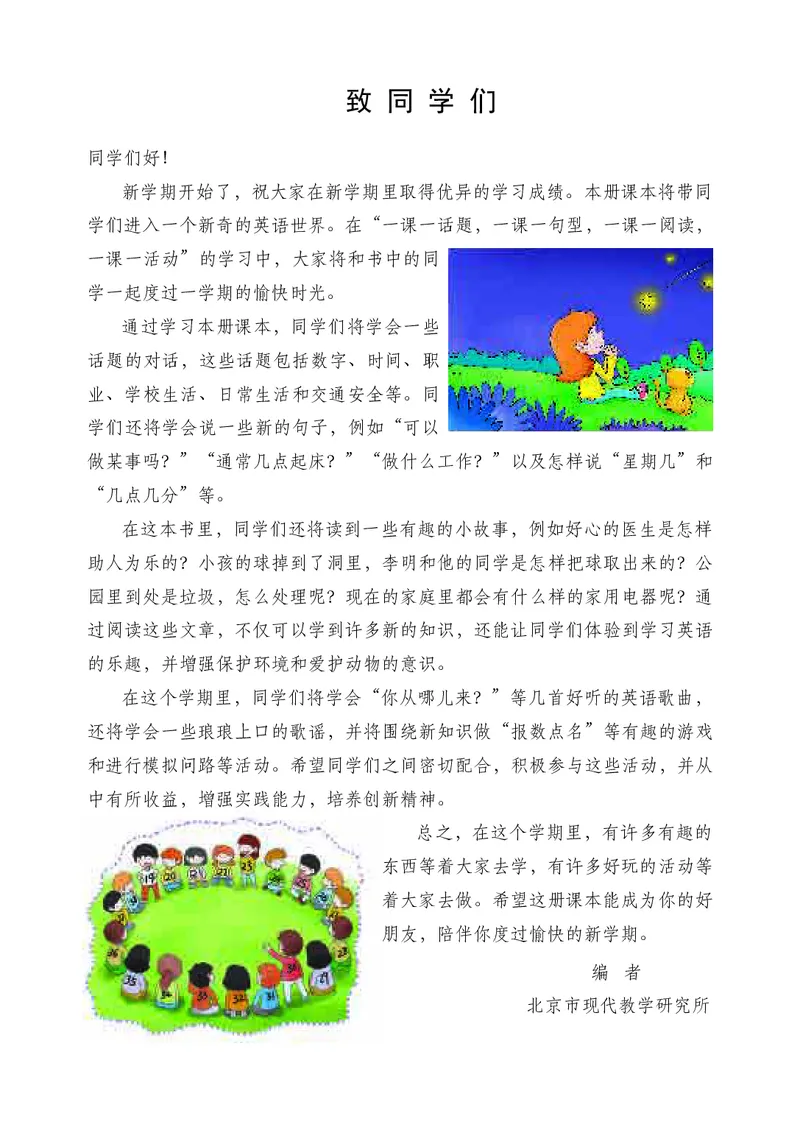
致 同 学 们
同学们好!
新学期开始了,祝大家在新学期里取得优异的学习成绩。本册课本将带同
学们进入一个新奇的英语世界。在“一课一话题,一课一句型,一课一阅读,
一课一活动”的学习中,大家将和书中的同
学一起度过一学期的愉快时光。
通过学习本册课本,同学们将学会一些
话题的对话,这些话题包括数字、时间、职
业、学校生活、日常生活和交通安全等。同
学们还将学会说一些新的句子,例如“可以
做某事吗?”“通常几点起床?”“做什么工作?”以及怎样说“星期几”和
“几点几分”等。
在这本书里,同学们还将读到一些有趣的小故事,例如好心的医生是怎样
助人为乐的?小孩的球掉到了洞里,李明和他的同学是怎样把球取出来的?公
园里到处是垃圾,怎么处理呢?现在的家庭里都会有什么样的家用电器呢?通
过阅读这些文章,不仅可以学到许多新的知识,还能让同学们体验到学习英语
的乐趣,并增强保护环境和爱护动物的意识。
在这个学期里,同学们将学会“你从哪儿来?”等几首好听的英语歌曲,
还将学会一些琅琅上口的歌谣,并将围绕新知识做“报数点名”等有趣的游戏
和进行模拟问路等活动。希望同学们之间密切配合,积极参与这些活动,并从
中有所收益,增强实践能力,培养创新精神。
总之,在这个学期里,有许多有趣的
东西等着大家去学,有许多好玩的活动等
着大家去做。希望这册课本能成为你的好
朋友,陪伴你度过愉快的新学期。
                                      编   者
                        北京市现代教学研究所
Lesson 1
May I speak to Mary?                                              2
Lesson 2
We mustn’t cross the street now                             8
Lesson 3
How many pupils are there?                                  14
Lesson 4
Where do you live?                                                20
Lesson 5
What do you do?                                                    26
Lesson 6
Revision                                                                 32
Lesson 7
It’s seven thirty-five                                                38
Contents
Contents
Lesson 8
What day is it today?                                             44
Lesson 9
Do you always have lunch at twelve?                    50
Lesson 10
Does she always come before six thirty?               56
Lesson 11
When do you usually get up?                                 62
Lesson 12
Revision                                                                 68
Words in each lesson                                             76
Word list                                                  79
Word families                                          82
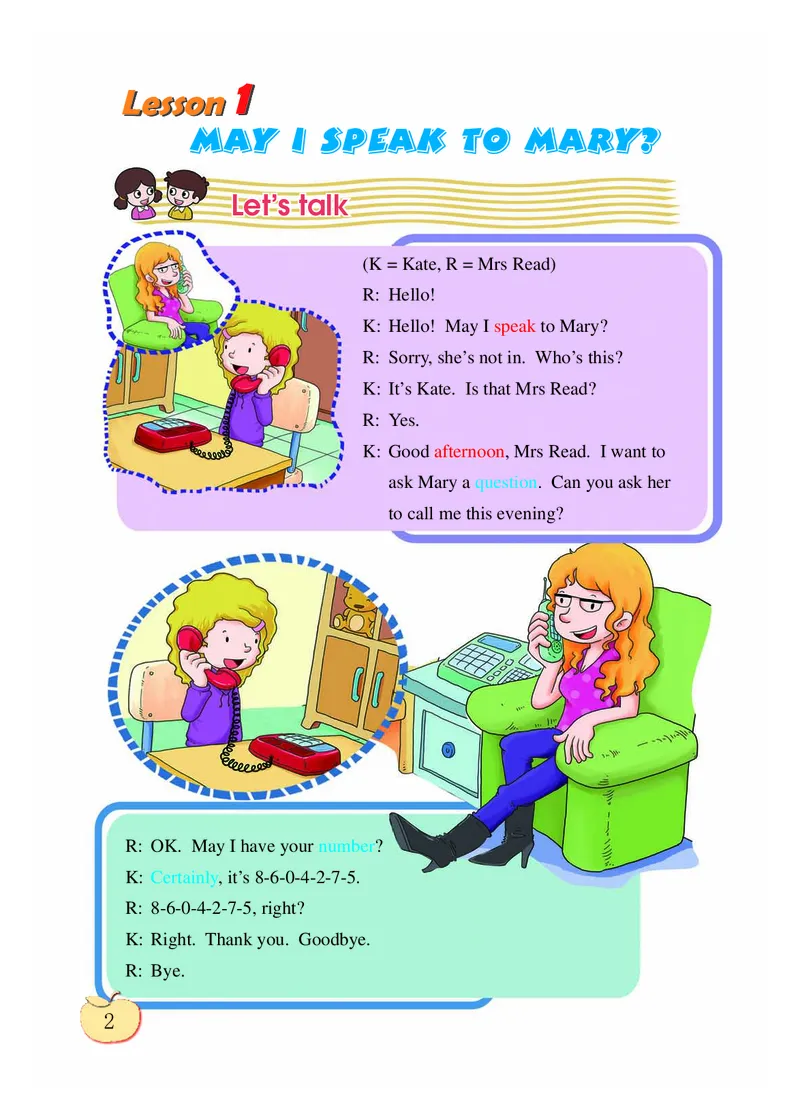
(K = Kate, R = Mrs Read)
R: 	Hello!
K: 	Hello!  May I speak to Mary?
R: 	Sorry, she’s not in.  Who’s this?
K:	It’s Kate.  Is that Mrs Read?
R: 	Yes.
K:	Good afternoon, Mrs Read.  I want to

ask Mary a question.  Can you ask her

to call me this evening?
R: 	OK.  May I have your number?
K: 	Certainly, it’s 8-6-0-4-2-7-5.
R: 	8-6-0-4-2-7-5, right?
K: 	Right.  Thank you.  Goodbye.
R: 	Bye.
Let’s talk
may I speak to mary?
Lesson 1
2
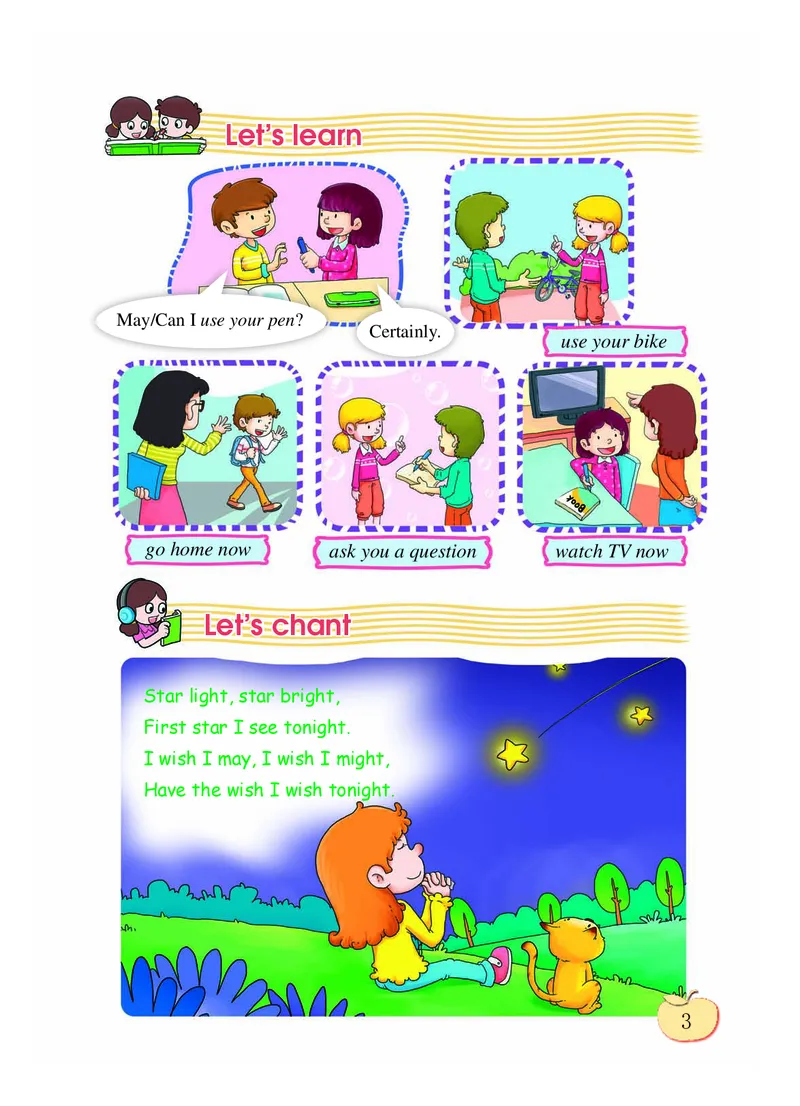
Star light, star bright,
First star I see tonight.
I wish I may, I wish I might,
Have the wish I wish tonight.
use your bike
ask you a question
go home now
watch TV now
May/Can I use your pen?
Certainly.
Let’s learn
Let’s chant
3
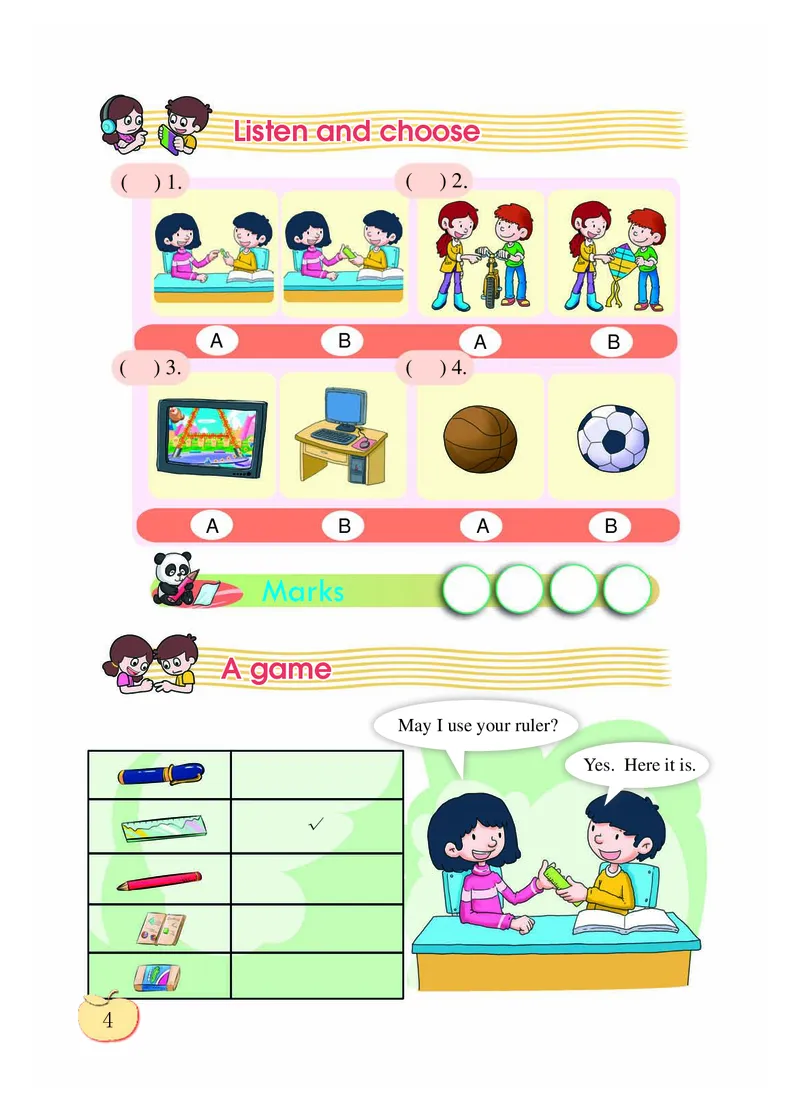
May I use your ruler?
Yes.  Here it is.
Listen and choose
A game
(     ) 1.
(     ) 2.
(     ) 3.
(     ) 4.
√
Marks
A
B
A                      B
A
B
A                     B
4
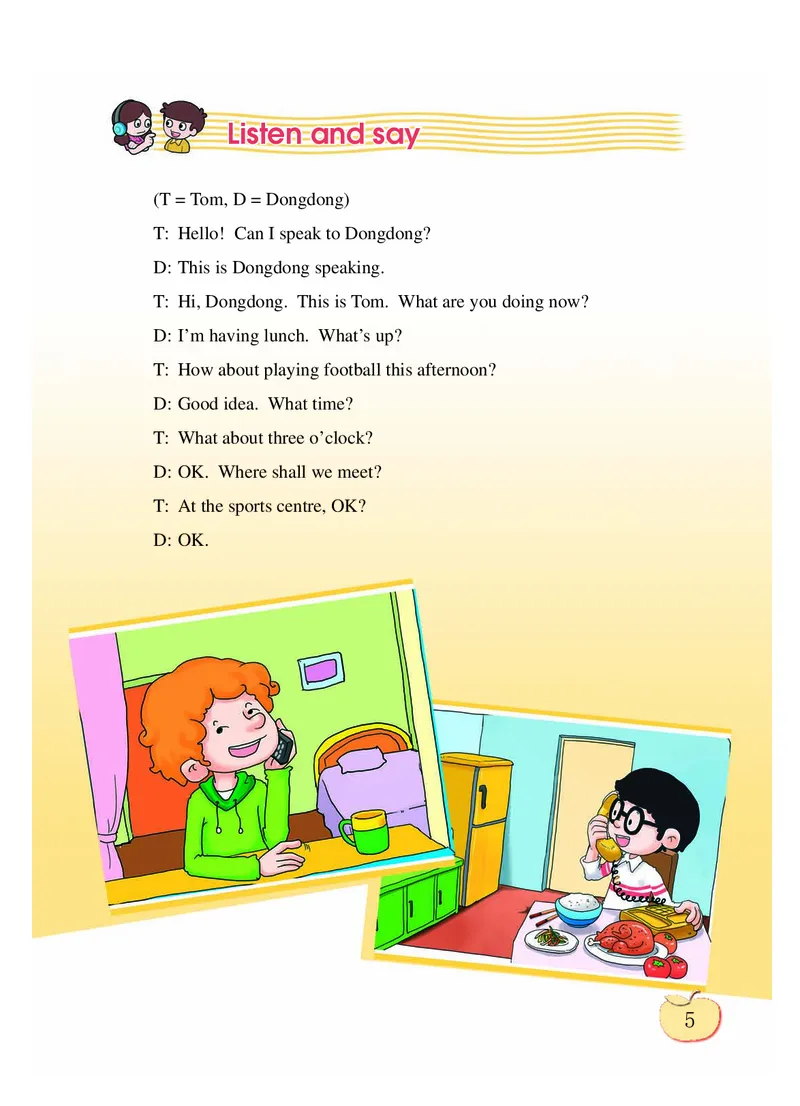
Listen and say
(T = Tom, D = Dongdong)
T:	 Hello!  Can I speak to Dongdong?
D:	This is Dongdong speaking.
T: 	Hi, Dongdong.  This is Tom.  What are you doing now?
D: 	I’m having lunch.  What’s up?
T: 	How about playing football this afternoon?
D: 	Good idea.  What time?
T: 	What about three o’clock?
D: 	OK.  Where shall we meet?
T: 	At the sports centre, OK?
D: 	OK.
5
Mom, are you making a pizza ①?
May I help you?
Yes, Tom.  Thanks.
Mom, can I learn how to make it?
Certainly.
Can I put some water into it now?
Yes, please.
Making a pizza
Read
①pizza /?pi:tsE/ 比萨饼
6
Let me put some meat on it, OK?
OK.
Can we bake ① it now?
Yes, we can.
Mom, it’s done. ②
May I eat some now?
Of course, you may!
You did a great job.
①bake /beIk/ 烤   ②it’s done 做好了
7
(J = Jim, M = Mum)
J:	 Are you going shopping, Mum?
M: 	Yes.
J: 	 May I go with you?
M: 	Yes, but you mustn’t run

in the street.
J: 	 OK.
M: 	Look at the red light. We

mustn’t cross the street now.
J: 	 OK.
M: 	Now the light is green.

We can cross the street.
J: 	 Yes.
M:      	 Look at these white lines.

We must cross the street here.
J: 	 Oh, I see.
Let’s talk
we mustn't cross the street now
Lesson 2
8
No left turn    Left turn
No parking      Parking
No u-turn           U-turn
Look to the left.
Look to the right.
There is a car in sight.
So we do what’s right.
There’s none on the left.
There’s none on the right.
The way is clear.
We can cross without fear.
You mustn’t cross the street here.
You can cross the street there.
turn left
park the car
turn around
OK.
Let’s learn
Let’s chant
9

1.
2.
3.
4.


3 →
2 →
 →
4 →
1 →
↓
1
↓
3
↓
4
↓
2
e
r
s
h
p
t
d
5
5.
A puzzle
Write the words.
Down
Listen and number

1.
2.
3.
4.


Across
Marks
10
(G = Girl, B = Boy,
W = Woman)
G: 	Look, a seat!

You can sit here.
B: 	No, you sit here,

please.
G:	Thank you.
B:	 Look, an old granny!
G:	 I should give my seat to her.
B:	 Yes.
G:	 Hello, Granny!  Please sit here.
W:	Oh, thank you.
G:	 You’re welcome.
Listen and say
11
Tom and his cousin Bob are going to play football.  Now they are
walking in the street.  Bob is playing with his ball.  “Hi, Bob!  You
mustn’t play with your ball here,” says Tom.  “All right,” Bob
answers.
“Oh!  You mustn’t cross the street here.
We must cross there.”
“Oh, yes.”
Read
Don’t cross the street here
12
“Look!  The light is green.”
“We can cross now.”
“Yes.  Let’s go.”
“Don’t cross now.  The light is red.
We must wait.”
“OK.”
13
(K = Kate, D = Dad)
D:	 Hi, Kate!  What are you doing?
K: I’m making some flowers for our classroom.
D:	 Do you have a new classroom this term?
K:	 Yes, Dad.
D:	 Is it nice?
K:	 Yes.  We have a big glass blackboard.
D:	 Do you have a clock in your classroom?
K:	 Yes, we have a new clock and we have some green plants, too.
D:	 How many pupils are there in your class this term?
K:	 There are forty-five.
D:	 Oh, that’s a big class.
Let’s talk
HOW MANY PUPILS ARE THERE?
Lesson 3
14
How many girls are there
in Class Two?
Girls in Class Two: 23
Women in the car: 3
Men in the room: 3
Boys in Class One: 35
There are 23.
Number 23.
Let’s learn
A game
Here!  Number 30.
Here!  Number ...
15
Look and write
Listen and number
1. How many red balls are there?
	 __________________________
2. How many blue balls are there?
	 __________________________
3. How many yellow balls are there?
	 __________________________
4. How many green balls are there?
	 __________________________
Marks
16
How many desks are there?
There are twelve.
How many chairs are there?
There are ...
17
Look and say
twelve desks
————                  ————                  ————
————                  ————                  ————
————                  ————
Some people drop things everywhere.  They drop paper in the
streets.  They drop bottles in the parks.  This makes the streets
and parks very dirty.  But many of the things are useful.  We
shouldn’t throw them away.
It’s Sunday.  There are
many pupils in the park.
They are picking up useful
things.
Read
Doing a good job
18
Mary and Meimei are picking up paper.
Ann is putting the paper into a bin ①.
How much paper is there?
About half a kilo.
Mike and Li Lin are picking up bottles.  Jill
and Liu Xin are putting them into a bag.  How
many bottles are there?  There are forty-eight.
The pupils are doing a good
job, and they are very happy.
19
①bin  垃圾箱
(B = Boy, M = Man)
B:	 Excuse me.  Where do you come from?
M:	I come from the USA.
B:	 Where do you live?
M:	I live in New York ①.
B:	 Where does Ms Green come from?
M:	She comes from the USA, too.
B:	 Does she live in New York, too?
M:	No, she doesn’t.  She lives in Washington ②.
Let’s talk
Where do you live?
Lesson 4
①New York /Lnju:?jC:k/ 纽约  ②Washington /?wFSIYtEn/ 华盛顿
20
Where do you come from?
France, Paris
the UK, London
China, Beijing
Russia, Moscow
Where do you come from?
I come from China.
Where do you live?
I live in Beijing.
Let’s learn
Let’s sing
Where do you come from?  Where are you from?
I come from England.  I’m from England.
Where do you live?  Where do you live?
I live in London, in London.
Where does he come from?  Where is he from?
He comes from China.  He’s from China.
Where does he live?  Where does he live?
He lives in Beijing, in Beijing.
21
I come from ...
I live in ...
Where do you come from?
Where do you live?
Let’s practise
Listen and choose
(     ) 1.
(     ) 2.
(     ) 3.
(     ) 4.
(     ) 5.
A
A
A
A
A
B
B
B
B
B
Sichuan                    Henan                 Anhui                       Jilin
Marks
22
Listen and say
(P = Policeman, L = Lingling)
P: 	Hi, little girl.  Why are you crying?
L: 	I can’t find my mum.
P: 	Oh, don’t worry.  I can help you.  What’s your name?
L: 	Lingling.
P: 	How old are you?
L: 	Four.
P: 	Where do you live?
L: 	I live in a tall building.
P: 	OK.  Do you know your mother’s phone number?
L: 	Yes, it’s 6253382.
P: 	OK.  Let me call your mother.
L: 	Thank you.
23
Read for fun
A kind doctor
Liu Jun is a doctor.  He comes from Sichuan.  Now he is working
in a small town in Yunnan.  He is always ready to help others.
One day a farmer came to his office.
“My wife is very ill.  Can you come and see her?”
“Where do you live?” asked Liu Jun.
“I live in a small village.”
“OK.  Let’s go at once.”
24
They walked for a long time and got to the village very late.
Liu Jun examined ① the sick woman and gave her some
medicine.
The farmer took out some money and gave it to him.  Liu
Jun didn’t take it.
The farmer thanked him, but Liu Jun said, “It’s my
pleasure. ②  I’m happy to help others.”
①examine /IG?zZmIn/ 检查
②It’s my pleasure/?pleWE/. 不客气。
25
(G = Girl,  F = Farmer)
G:	What do you do?
F:	 I am a farmer.
G:	Where do you work?
F:	 I work on a farm.
G:	Is your work easy?
F:	 No, it isn’t.
(G = Girl,  P = Policeman)
G:	Are you a policeman?
P:	 Yes, I am.
G:	Where do you work?
P:	 I work in the street.
G:	Is your work interesting?
P:	 Yes.  I like it very much.
Let’s talk
What do you do?
Lesson 5
26
doctor, hospital
teacher, school
postman, post office
— What do you do?
— I am a worker.
— Where do you work?
— I work in a factory.
Let’s sing
Let’s learn
What do you do?
What do you do?  What do you do?
I am a teacher.  I’m a teacher.
Where do you work?  Where do you work?
I work in a school.
27
A
A
B
B
What do you do?
I am a ...
Where do you work?
I work ...
Listen and circle
Match and say
1
2
3
4
Marks
A
A
B
B
28
Listen and say
A:	 Hi!
B: 	Hello!
A: 	Where do you come from?
B: 	I come from the UK.
A: 	Do you work in this city now?
B: 	Yes, I do.
A: 	What do you do?
B: 	I’m a doctor.
A: 	That’s a good job.  Where do you live?
B: 	I live near the hospital.
A: 	Do you like this city?
B: 	Yes.  It’s beautiful, and the people here are very nice.
29
Mr Smith is a manager.  He wants an
office worker.  Two girls want to get
this job.  Mr Smith doesn’t know who
to choose.  Then he has an idea.
Go and find your
manager.
OK.  But can you help
me clean the room?
No.  It’s not my job.
I can’t help you.
Excuse me.  Is Mr Smith here?
What do you do?
No, he isn’t.
I’m a cleaner.
Read
Which girl can get the job?
30
Now Mr Smith knows
who to choose.  Which
girl can get the job?  Can
you guess?
Let me help you.
Thank you.  You’re so kind.
Hello!  Yes, this is Mr Smith.
You are Mr Smith?
I’m the manager.
Yes.
What do you do?
31
Let’s talk
(D = Dongdong,  M = Mum)
D:	 Mum, can I play football with Tom?
M:	Certainly.  But you mustn’t play football in

the street.
D:	 OK.
(Q = Qiqi, W = Mrs White)
Q:	 Where do you come from, Mrs White?
W:	 I come from the UK.
Q:	 Do you live in Beijing now?
W:	 Yes, I do.
Q:	 What do you do?
W:	 I’m a doctor.
Q:	 Where do you work?
W:	 I work at Heping Hospital.
Q:	 How many doctors are there in your

hospital?
W:	 There are thirty-four.
revision
Lesson 6
32
1. Listen and choose.
2. Listen and number.
Revision Exercises
(     ) 1.
(     ) 2.
(     ) 3.
(     ) 4.
A                           B
A                                B
A                                B
A                                B
33
This is Tom’s room.  What can you see _____ this room?  We
can see a bed, two desks and two chairs.  _____ the bed there is a
teddy bear.  _____ the teddy bear is a bag.  There is a desk _____
the window.  There are some books and a pencil box _____ the
desk.  _____ the pencil box there is a pen, a pencil and an eraser.
_____ the desk there is a chair.  _____ the chair there is a cat.
	 on	  	     under	  	     beside	 	     near	 	     in
3. Look and write.
4. Choose the right word to complete the sentences.
1. — _____(May, Must) I ask you a question?  — Certainly.
2. You _____(mustn’t, can) play football in the street.
3. The boy is good at swimming.  He _____(may, can) swim well.
4.	— _____(Can, Must) you ride a bike?  — Yes.
5. You _____(can, mustn’t) waste water(浪费水).  You _____
	 (must, 	can) save water(节约用水).
34
1. Certainly.  Here you are.
2. There are fourteen.
3. This is Mr Black speaking.
4. Certainly.  It’s 6-2-0-1-6-2-4-5.
5. OK.


6. I live in New York.
7. I am a worker.


8. He works in a school.
35
5. Read and match.
 May I speak to Mr Black?
 Where do you live?
 What do you do?
 May I use your pen?
 Where does your father work?
 You mustn’t play football in the street.
 How many books are there on the desk?
 May I have your number?

6. Complete the puzzles.
fourteen
eighteen
thirty
twelve
one
six
twenty-seven
sixty
forty-three
fifty-two
forty-four
thirty-four
A
B
8. Look at the map and answer the questions.
Liu Lei
1. — Do you live in Moscow, Nick?
— ___________________
2. — Do you live in New York, Hans?
— ___________________
3. — Where do you come from, Mary?
— ___________________
4. — Where do you come from, Liu Lei?
— ___________________
Mary
Hans
Nick
London
Beijing
New York
Moscow
Sydney
7. Look at the pictures and complete the dialogues.
1. — What do you do?
    — I’m a ________.
    — Where do you work?
    — I work in ________.
2. — What do you do?
    —  ________________.
    — Where do you work?
    —  ________ a factory.
①
②
③
④
4. — What ___________?
    — I’m __________.
    — Where __________?
    — I work __________.
3. — What __________?
    — I’m a __________.
    — Where __________?
    — I work in __________.
36
I can say
Self-assessment
I know these words
I can say
I know these words
May I speak to Mary?
Sorry, she’s not in.
We must cross the street here.
We mustn’t cross the street now.
How many pupils are there in your class?
There are forty-five.
Where do you come from?
I come from the USA.
Where do you live?
I live in New York.
What do you do?
I am a farmer.
Where do you work?
I work on a farm.
speak  afternoon  put
must  street  light  cousin  answer
blackboard  pupil  forty  paper  dirty
live  Ms
farm  easy  interesting  kind
hospital  thirty
37
(T = Tom, G = Grandma)
G:	Tom, breakfast is ready.  Please sit down.
T: 	Thank you, Grandma.
G:	What time is school over?
T: 	School is over at three forty on Tuesday, Thursday and Friday.
G: 	What about Monday and Wednesday?
T: 	School is over at four thirty on
   	 Monday, and at two fifty on Wednesday.
G:	OK, I see.
T: 	What time is it, Grandma?
G: 	It’s seven thirty-five.
T: 	Oh, it’s time for school.

I must go.  Goodbye,

Grandma.
G:	Goodbye.
Let’s talk
It’s seven thirty-five
Lesson 7
38
Tick, tock, tick, tock.
Merrily sings the clock.
It’s time for dinner.
It’s time for supper.
So it sings through all the day.
Tick, tock, tick, tock.
Merrily sings the clock.
7:10, school
12:25, lunch
5:45, supper
—	What time is it?
—	It’s six thirty.

It’s time for breakfast.
6:30, breakfast
Let’s learn
Let’s chant
39
Listen and number
Look and match
A. nine o’clock
B. two fifteen
C. ten thirty
D. one fifty
E. eleven forty-five
Marks
40
Son: 	 Mum, it’s not seven fifty.

It’s six fifty-five.
Mum: 	Oh, yes.  So let’s have

a big breakfast.
Son: 	 OK, Mum.
Mum:	 Get up!  Get up!
Son:  	 What’s the time, Mum?
Mum: 	It’s seven fifty.  You’re late.
Son:  	 Oh, no!
Listen and say
41
Read
The ball in the hole
It’s four fifty.  School is over.  Li Ming and Wang Ying are walking
home.  On the way they see a boy.  He is crying.
“What’s wrong?”  Li Ming asks.
“My ball is in that hole.  I can’t get it out.”
“Don’t worry.  We can help you.”
42
They try to take the ball out, but the hole is too deep.  They think
and think, and then Li Ming has an idea.  He says, “We can use water.”
They get some water and fill the hole with it.  Then the ball comes
up.  Wang Ying gives the ball to the boy.  The boy smiles and thanks
them for their help.
43
(D = Dongdong,  K = Kate)
D:	 What day is it today?
K:	 It’s Monday.
D:	 What classes do you

have this morning?
K:	 We have Chinese, maths,

English and art.
K:	 Do you have English

lessons on Wednesdays?
D:	 No, we don’t.
K:	 When do you have English?
D:	 On Tuesdays, Thursdays and Fridays.
K:	 Do you have PE on Fridays?
D:	 No.  We have PE on Tuesdays.
Let’s talk
What day is it today?
Lesson 8
44
Monday, Tuesday, Wednesday,
Thursday, Friday, Saturday,
Sunday, Sunday, Sunday.
Sunday, Saturday, Friday,
Thursday, Wednesday, Tuesday,
Monday, Monday, Monday.
Today is a fun day.
A fun day, a fun day!
— What day is it today?
— It’s Monday.
—	What classes do you have

this afternoon?
— We have Chinese and PE.
Monday Tuesday
Wednesday Thursday Friday
maths
Chinese
English
science
  art                      music                     PE                    computer
Let’s learn
Let’s chant
45
What day is it today?
It’s ...
What classes do you have?
We have ...
Listen and circle
A game
Yes.
No.
Yes.
No.
Yes.
No.
1
2
4
3
5
6
Monday
Tuesday
Wednesday
Thursday
Friday
English
maths
Chinese
PE
computer
Yes.
No.
Yes.
No.
Yes.
No.
Marks
  Time
    Tue.
   8:00
 Chinese
   8:55
 English
  10:00
     PE
  10:55
  maths
Lunch time
  14:00
     art
  14:55
 science
  Time
    Mon.
   8:00
 Chinese
   8:55
   maths
  10:00
 English
  10:55
     art
Lunch time
  14:00
computer
  14:55
   music
46
(B = Boy, G = Girl)
B:	 Do you have the timetable?
G:	 Yes, I do.
B:	 I want to make a new timetable.  Can you help me?
G:	 Certainly.
B:	 What classes do we have on Monday morning?
G:	 We have maths, English, Chinese and computer class.
B:	 (Says and writes) Maths, English, Chinese and computer class.

OK.  What about Monday afternoon?
G:	 We have science and art.
B:	 (Says and writes) Science

and art.  OK.

...
47
Listen and say
  maths
Chinese
Chinese
 English
English
English
 Chinese
 music
maths
computer
 maths
art
 science
 writing
computer
   art
 PE
ME
①
①ME = Moral Education 思想品德课
Read
48
Eve is ill and she didn’t come to school today.  Lulu
is writing an email to her now.
An email to Eve
49
Dear Eve,
I’m sorry to hear that you’re ill and can’t come to school.  Let me
tell you what we did today.
Today we had six classes.  We had maths, English, Chinese and
art in the morning.  We have a new maths teacher this term.  Her
name is Sarah Black.  She is very nice.  In English class we learned
an American song Old Black Joe, and in Chinese class we studied
a short story.  We drew pictures in art class.  I drew some flowers.
The teacher said I did a good job.
In the afternoon, we had two classes, science and PE.  Science
is a new subject.  It’s very interesting.  In PE class we played
basketball.
Hope to see you soon.


                       Lulu
Eve2001@abc.com
Greetings
(L = Lulu, T = Tom)
L:	 What time is it?
T: 	It’s twelve o’clock.
L:	 Oh, it’s time for lunch.
T:	 Yes, it is.
L:	 Do you always have lunch at twelve?
T:	 Yes, I do.  What about you?
L:	 I usually have lunch at eleven thirty.

Sometimes I have lunch at twelve.
T:	 What do you usually have for lunch?
L: 	Rice, chicken and soup.
Let’s talk
do you always have lunch
at twelve?
Lesson 9
50
lunch, 12:00
rice and beef
The music room
— Do you always have lunch at twelve?
— Yes, I do.
— What do you usually have for lunch?
— I usually have rice and beef.
supper, 6:00
noodles
Let’s sing
Let’s learn
breakfast, 7:00
bread and milk
In the music room there’s a little piano.
Whenever we sing, it will sing along.
Do, ti, la, so, mi, so, do, ti, la, so.
Whenever we sing, it will sing along.
51
Talk and write
Listen and choose
A
B
A
B
A
B
A
B
A
B
(     ) 1.
(     ) 2.
(     ) 3.
(     ) 4.
(     ) 5.
Name    Breakfast time     Drink/Food
 Lulu              7:00              bread/milk
Do you usually have
breakfast at seven?
Yes, I do.
What do you have
for breakfast?
I always have
bread and milk.
Marks
52
Read, choose and say
A: 	 I’m doing a survey ①.
     	 Can I ask you some questions?
B: 	 Oh, yes.
A: 	 (Are / Do) you from the USA?
B: 	 Yes, I (am / do).
A:	 What food (are / do) you often have?
B: 	 We often have hamburgers.
A: 	 (Are / Do) you usually drink tea?
B: 	 No, we (aren’t / don’t).  We usually drink coke.
A: 	 Thank you.
B: 	 You’re welcome.
①survey /?sB:veI/ 调查
53
I usually get up at 6:30, but now it’s 8:00.
It’s time for school.  I’m late.
I always do morning exercises at 7:10,
but today I have no time.
Mum always makes
breakfast at 7:00, but she
isn’t in the kitchen today.
She isn’t in the bedroom.
She isn’t in the toilet,
either.  Where is she?
Is he late?
Read
54
Dad always takes me to school at 8:00, but he isn’t at home now, so
I have to run to school.
What are you doing, Scott?
I’m going to school.
I’m late.
Late?  No, you’re early.
It’s only 6:45.
Oh, I see.  The clock in my
room isn’t working.
55
Let’s talk
(L = Lulu, D = Dongdong)
L:	 Eve comes here every morning.  But where is she today?
D:	 I don’t know.  Does she do morning exercises here every day?
L: 	Yes, she does.
D:	 Does she always come before six thirty?
L: 	Yes, she does.
D:	 What time is it now?
L:	 It’s about seven.  I’m afraid she isn’t feeling well today.
D:	 Let’s go and see her, OK?
L: 	OK.  Let’s go.
does she always come
before six thirty?
Lesson 10
56
I try to do my best each day,
In my work and in my play.
And if I always do my best,
I needn’t worry about my test.
 take a walk
 after supper
 do sports
 in the afternoon
 do morning exercises
 every day
watch TV
in the evening
Does she do morning exercises every day?
Yes, she does. / No, she doesn’t.
Let’s learn
Let’s chant
57
Look and say
Listen and match
(     ) 1.
(     ) 2.
(     ) 3.
(     ) 4.
Does your mother ... in the evening?
Yes, she does.
What about your father?
He usually ...
Marks
A
B
C
D
58
Listen and say
(L = Li Bing, E = Eve)
L: 	 Hey, look at that boy.  Who is he?
E: 	 He’s Jimmy.  He’s new here.
L: 	 Does he come from the UK?
E: 	 No, he comes from the USA.
L: 	 Does he like sports?
E: 	 Yes, he does.  He plays basketball very well.
L: 	 Let’s say hello to him.
E: 	 OK.  Let’s go.
Sports in the world
football
basketball
skiing
surfing
59
Read
Mr Fox and his friends are playing in a forest.
Suddenly they hear someone crying, “Help!  Help!”  It
is Miss Rabbit.  She is in a pit ①.  She says to Mr Fox,
“Hi, Mr Fox!  Please help me.”
Mr Fox says, “Oh, Miss Rabbit.  Don’t worry.  We
will help you. ”
Miss Rabbit and Mr Fox
①pit 深坑
60
Mr Fox and his friends think and think.  Then they have an
idea.  They get a lot of grass and throw the grass into the pit.
Miss Rabbit stands on the grass and gets out soon.  Mr Fox and
his friends are very happy.
“Thank you so much,” says Miss Rabbit.
“That’s all right.  We’re friends, and we should help each
other,” Mr Fox says.
61
(L = Lulu, T = Tom)
L:	 Hello, Tom!
T: 	Hello, Lulu!
L:	 You are very early.
T: 	You too.  When do you usually get up?
L:	 I usually get up at seven.
T:	 How do you usually go to school?
L:	 I usually go to school by bike.
T:	 Does Lingling go to school by bike, too?
L:	 No, her home is not far from the school,


so she always goes to school on foot.
Let’s talk
When do you usually get up?
Lesson 11
62
I usually get up at six.
I usually go to school on foot.
6:30, by bus
6:20, by bike
6:00, on foot
6:40, by car
When do you usually get up?
How do you usually go to school?
What time does Peter go to school?
He goes to school at eight o’clock.
Let’s learn
Let’s practise
63
Right.
1
2
3
4
5
6
Listen and circle
Yes.
Yes.
Yes.
Yes.
Yes.
Yes.
     No.
     No.
     No.
     No.
     No.
     No.
on foot
by bus
by plane
by bike
by car
A game

g
o
to
 t
he
 z
o
o

g
o
to
 t
he

U
S
A

g
o
to
 w
o
rk
vi
si
t
Gr
a
n
d
m
a

g
o
to
 s
c
h
o
ol
— How do you go to school?
— I often go to school on foot.
64
Listen and say
Mom:	 Look!  It’s Tom’s letter from the summer camp ①.
Dad:
How is he doing?
Mom:	 He’s very busy.
Dad:
Good!  What time does he get up?
Mom:	 He gets up at 5:30.
Dad:
Wow.  So early!
Mom:	 They play team sports ②, go hiking ③, and do many


other things.
Dad:
Sounds great!  When do they go to bed?
Mom:	 At 9:30.
Dad:
That’s not too late.
                 Day  1
5:30      get up
6:00      have breakfast
7:00      team sports
12:00    have lunch
13:30    go hiking
17:30    have supper
19:00    sing and dance
21:30    go to bed
                  Day  2
5:30      get up
6:00      have breakfast
7:00      walk in the forest
12:00    have lunch
13:30    take swimming lessons
17:30    have supper
19:00    have a campfire
④
21:30    go to bed
①summer camp 夏令营
②team/ti:m/ sports 团队活动
③go hiking 去远足
④campfire /?kZmpfaIE/ 营火会
65
Mr Brown usually gets up at seven
thirty.  He usually has breakfast at eight
and has lunch at twelve.
It’s twelve fifteen.
Mr Brown is having lunch.
The telephone rings.  It’s
Lily.  Mr Brown is happy.

Mr Brown lives in London.
His daughter Lily works in New York.
Is Lily’s clock slow?
Read
66
“What?  You are having breakfast?
Do you always get up so late?”
“No.  I always get up early.”
“What time do you usually get up?”
“I usually get up at seven.”
He talks to her for a minute.  Then he asks,
“What are you doing now, Lily?”  Lily says,
“I’m having breakfast.”
“But it’s lunch time now.  Why are you
still having breakfast?”  “No, it’s only seven
twenty by my clock.” “Your clock is slow!”
Is Lily’s clock slow?
No, her clock is right.
When it is 7:00 in New
York, it is 12:00 in London.
67
(Q = Qiqi, L = Lulu)
Q:	 What day is it today?
L:	 It’s Friday.
Q:	 What classes do you have this afternoon?
L:	 We only have art and PE this afternoon.


Classes are over at three thirty.
Q:	 Great!  What time is it now?
L:	 It’s one o’clock.  It’s time for class.
Q:	 Let’s go to the cinema after class, OK?
L: 	OK.
Let’s talk
revision
Lesson 12
(M = Mary, Q = Qiqi)
Q: 	 Hi, Mary.  You’re very early.

When do you get up every day?
M:	 I usually get up at 7:00.
Q: 	 What time does your mother get up?
M:	 She usually gets up at 6:30.
   	 She cooks breakfast for me every day.
Q: 	 How do you usually go to school?
M:	 I usually go to school on foot.
68
Today we have many machines in
our homes.  Machines can do many
things for us.
This is a room in my home. Look!
There is a fridge, a washing machine and
many other machines in it.
This is our sitting
room.  There is a TV,
a DVD, a fan and a
telephone in it.
Read
The machines in our homes
69
The TV is on the wall.
It’s very thin, and it looks
like a picture.
This new telephone is my favourite
machine.  When I talk to my friend
on it, I can see him.  It’s wonderful.
This is my room.
There is a computer in it.
I often use it to send emails to my friends.
70
What new machines do we want?
My father wants a 4G mobile.  My
mother wants a machine to cook food.
And I want a machine to help me do
my homework.
71
1. Listen and tick (√)  the sentences you hear.
 1.
    A. We must wait when the light is red.
    B. We mustn’t cross the street when the
      	 light is red.
    C. We can cross the street when the light

is green.
A. It’s time for breakfast.
B. It’s time for lunch.
C. It’s time for supper.
 A. Fangfang has English lessons on Mondays.
 B. Fangfang has English lessons on Fridays.
 C. Fangfang has English lessons on Tuesdays.
Revision Exercises
A. I usually get up at seven thirty.
B. I usually go to bed at nine o’clock.
C. I usually have lunch at eleven thirty.
2.
3.
  4.
72
2. Listen and choose the correct picture.
 (     ) 1.
 (     ) 2.
 (     ) 3.
 (     ) 4.
3. Do a survey.
Find out how your classmates go to school and put ticks(√) in the boxes.
Then report to your class.  You can ask questions like this:
Do you usually come to school on foot?
Do you usually come to school on foot or by bus?
How do you usually come to school?
Name     On foot       By bus      By bike      By car
A
A
A
A
B
B
B
B
73
4. Look at the pictures and answer the questions.
get up
6:30 am
do morning exercises
6:40 am
have breakfast
7:00 am
go to school
7:20 am
have lunch
12:00 am
go home
4:40 pm
have supper
6:00 pm
go to bed
9:00 pm
1.	What time does Dongdong get up?
	 He usually _____ _____ at _____ _____.
2.	Does he do morning exercises at six fifty?
	 _____, he _____.
3.	Does he have breakfast at seven o’clock?
	 _____, he _____.
4.	How does he go to school?
	 He _____ to school _____ _____.
5.	What time does he usually have lunch?
	 He usually _____ _____ at _____ o’clock.
6.	What time does he usually go home?
	 He usually _____ _____ at _____ _____.
7.	Does he usually have supper at six thirty?
	 _____, he _____.
8.	What time does Dongdong usually go to bed?
	 He usually _____ _____ _____ at _____ o’clock.
注:am 上午   pm 下午
74
I can say
Self-assessment
I know these words
I can say
I know these words
breakfast   Monday  fifty  way  try
maths  art  lesson  when  PE  song  science
subject
rice  soup  exercise  kitchen  toilet  early
before  afraid   stand
far  minute  by  slow
cinema  after  fan  thin  wonderful
What time is it?
It’s seven thirty-five.  It’s time for school.
What day is it today?
It’s Monday.
What classes do you have this morning?
We have Chinese, maths, English and art.
Do you always have lunch at twelve?
Yes, I do.
What do you usually have for lunch?
Rice, chicken and soup.
Does she always come before six thirty?
Yes, she does.
When do you usually get up?
I usually get up at seven.
How do you usually go to school?
I usually go to school by bike.
75
各课词汇表
Words in each lesson
Lesson 1
speak /spi:k/
讲, 说
afternoon /LA:ftE?nu:n/
下午
put /pHt/
放
question /?kwestSn/
问题
number /?nVmbE/
数字
certainly /?sB:tnlI/
当然
learn /lB:n/
学习
into /?Intu:/
到……里
meat /mi:t/
肉
job /dWFb/
工作
Lesson 2
must /mVst/
必须
street /stri:t/
街道
light /laIt/
灯, 光线
cousin /?kVzn/                   堂表兄弟姐妹
answer /?A:nsE/
回答
cross /krFs/
穿过
line /laIn/
线
   all right
     好
Lesson 3
blackboard /?blZkbC:d/
黑板
pupil /?pju:pl/
小学生
forty /?fC:tI/
四十
paper /?peIpE/
纸
dirty /?dB:tI/
脏的
drop /drFp/
掉落
useful /?ju:sfl/
有用的
should /SHd/
应该
throw /OrEH/
投掷
pick /pIk/
摘, 拾
    throw away
     扔掉
    pick up                      捡起
Lesson 4
live /lIv/
居住, 生活
Ms /mIz/
女士
town /taHn/
城镇
ready /?redI/
准备好的
office /?FfIs/
办公室
wife /waIf/
妻子
sick /sIk/
病的
medicine /?medIsn/
药
out /aHt/
           	 在外
   come from             	来自
   be ready to

愿意做某事
( 注:本表中只收录Let’s talk 和Read 部分的生词)
76
   at once

立刻
   take out

取出
Lesson 5
farm /fA:m/
农场
easy /?i:zI/
容易的
interesting /?IntrIstIY/       	有趣的
kind /kaInd/                          和善的; 种类
policeman /pE?li:smEn/    	警察
manager /?mZnIdWE/
经理
choose /tSu:z/
选择
cleaner /?kli:nE/
清洁工
which /wItS/
哪个
   on a farm
   在农场
Lesson 6
hospital /?hFspItl/
医院
thirty /?OB:tI/
三十
Lesson 7
breakfast /?brekfEst/
早餐
Monday /?mVndI/
星期一
fifty /?fIftI/
五十
way /weI/
路
try /traI/
尝试
Tuesday /?tju:zdI/
星期二
Thursday /?OB:zdI/
星期四
Wednesday /?wenzdI/
星期三
hole /hEHl/                      	洞, 孔
deep /di:p/                 	 深的
fill /fIl/                          	 填满
smile /smaIl/                	 微笑
     on the way           	      在……路上
Lesson 8
maths /mZOs/            数学( 美math)
art /A:t/
艺术
lesson /'lesn/
课, 功课
when /wen/
什么时候
PE /?pi:?i:/
体育
song /sFY/
歌曲
science /?saIEns/
科学
subject /?sVbdWIkt/
学科, 主题
American /E?merIkEn/      美国人(的)
hope /hEHp/               希望
soon /su:n/
不久
Lesson 9
rice /raIs/
米饭
soup /su:p/
汤
exercise /?eksEsaIz/
练习, 体操
kitchen /?kItSIn/
厨房
toilet /?tCIlIt/
厕所
early /?B:lI/
早的
usually /?ju:WHElI/
通常
bedroom /?bedrHm/
卧室
77
    have lunch
     吃午饭
    get up
     起床
    do morning exercises   做早操
Lesson 10
before /bI?fC:/                 	 在……以前
afraid /E?freId/
害怕的
stand /stZnd/
站
suddenly /?sVdnlI/      	 突然
someone /?sVmwVn/
某人
    get out
   出去
    each other
   互相
 Lesson 11
far /fA:/
远的
minute /?mInIt/         分钟, 一会儿
by /baI/
乘( 车等)
slow /slEH/
慢的
daughter /?dC:tE/
女儿
telephone /?telIfEHn/
电话
ring /rIY/
( 铃) 响
	 by bike
骑自行车
	 on foot
步行
	 have breakfast
吃早餐
	 for a minute
一会儿
            Lesson 12
cinema /?sInImE/
电影院
after /?A:ftE/
在……之后
fan /fZn/              风扇, 爱好者
thin /OIn/
瘦的, 薄的
wonderful /?wVndEfl/
极好的
machine /mE?Si:n/
机器
wall /wC:l/
墙
send /send/                     送, 寄, 派遣
mobile /?mEHbaIl/
手机
【注】红色词是课标规定的重点词,要
求学生能够听、说、认读、拼写,蓝色
词要求学生能够听、说、认读,不要求
拼写。
78
词 汇 表
Word list
A
afraid /E?freId/
害怕的
10
after /?A:ftE/
在……之后
12
afternoon /LA:ftE?nu:n/	 下午
1
American /E?merIkEn/	 美国人( 的)	 8
answer /?A:nsE/
回答
2
art /A:t/           	 艺术
8
B
bedroom /?bedrHm/
卧室
9
before /bI?fC:/
在……以前
10
blackboard /?blZkbC:d/	黑板
3
breakfast /?brekfEst/
早餐
7
by /baI/           	 乘( 车等)
11
C
certainly /?sB:tnlI/
当然
1
choose /tSu:z/
选择
5
cinema /?sInImE/
电影院
12
cleaner /?kli:nE/
清洁工
5
cousin /?kVzn/
堂表兄弟姐妹	 2
cross /krFs/
穿过
2
D
daughter /?dC:tE/
女儿
11
deep /di:p/
深的
7
dirty /?dB:tI/
脏的
3
drop /drFp/
掉落
3
E
early /?B:lI/
早的
9
easy /?i:zI/
容易的
5
exercise /?eksEsaIz/
练习, 体操
9
F
fan /fZn/
风扇, 爱好者	12
far /fA:/
远的
11
farm /fA:m/
农场
5
fifty /?fIftI/
五十
7
fill /fIl/           	 填满
7
forty /?fC:tI/
四十
3
H
hole /hEHl/
洞, 孔
7
hope /hEHp/        	希望
8
hospital /?hFspItl/
医院
6
I
interesting /?IntrIstIY/ 	 有趣的
5
into /?Intu:/
到……里
1
79
J
job /dWFb/
工作
1
K
kind /kaInd/
和善的; 种类	 5
kitchen /?kItSIn/
厨房
9
L
learn /lB:n/
学习
1
lesson /'lesn/
课, 功课
8
light /laIt/
灯, 光线
2
line /laIn/
线
2
live /lIv/
居住, 生活
4
M
machine /mE?Si:n/
机器
12
manager /?mZnIdWE/	 经理
5
maths /mZOs/      数学( 美math)	8
meat /mi:t/
肉
1
medicine /?medIsn/
药
4
minute /?mInIt/
分钟, 一会儿	11
mobile /?mEHbaIl/
手机
12
Monday /?mVndI/
星期一
7
Ms /mIz/
女士
4
must /mVst/
必须
2
N
number /?nVmbE/
数字
1
O
office /?FfIs/
办公室
4
out /aHt/
在外
4
P
paper /?peIpE/
纸
3
PE /?pi:?i:/
体育
8
pick /pIk/
摘, 拾
3
policeman /pE?li:smEn/ 警察
5
pupil /?pju:pl/
小学生
3
put /pHt/
放
1
Q
question /?kwestSn/ 	 问题
1
R
ready /?redI/
准备好的
4
rice /raIs/
米饭
9
ring /rIY/
( 铃) 响
11
S
science /?saIEns/
科学
8
send /send/
送, 寄, 派遣	12
should /SHd/
应该
3
sick /sIk/         	 病的
4
slow /slEH/        	 慢的
11
smile /smaIl/       	 微笑
7
someone /?sVmwVn/
某人
10
song /sFY/
歌曲
8
80
soon /su:n/        	 不久
8
soup /su:p/
汤
9
speak /spi:k/
讲, 说
1
stand /stZnd/      	 站
10
street /stri:t/
街道
2
subject /?sVbdWIkt/
学科, 主题
8
suddenly /?sVdnlI/   	突然
 10
T
telephone /?telIfEHn/ 	 电话
 11
thin /OIn/
瘦的, 薄的
12
thirty /?OB:tI/
三十
6
throw /OrEH/
投掷          	 3
Thursday /?OB:zdI/  	 星期四
7
toilet /?tCIlIt/
厕所
9
town /taHn/        	 城镇
4
try /traI/          	 尝试
7
Tuesday /?tju:zdI/   	 星期二
7
U
useful /?ju:sfl/
有用的
3
usually /?ju:WHElI/
通常
9
W
wall /wC:l/
墙
12
way /weI/
路
7
Wednesday /?wenzdI/	 星期三
7
when /wen/
什么时候
8
which /wItS/
哪个
5
wife /waIf/
妻子
4
wonderful /?wVndEfl/ 	 极好的
12
Expressions
all right
好
2
at once
立刻
4
be ready to
愿意做某事
4
by bike
骑自行车
11
come from
来自
4
do morning exercises 做早操
9
each other
互相
10
for a minute
一会儿
11
get out
出去
10
get up
起床
9
have breakfast
吃早餐
11
have lunch
吃午饭
9
on a farm
在农场
5
on foot
步行
11
on the way
在……路上
7
pick up
捡起
3
take out
取出
4
throw away
扔掉
3
【注】红色词是课标规定的重点词。
81
1. b________
     2. l____
       3. s_____
1
2
3
Word families
分类词汇表
F
E
D
A
C
B
星期日
G
星期五
C
星期二
F
星期四
D
星期六
B
星期三
E
星期一
A
(     ) 1. Sunday
(     ) 2. Monday
(     ) 3. Tuesday
(     ) 4. Wednesday
(     ) 5. Thursday
(     ) 6. Friday
(     ) 7. Saturday
G
20                	 30                 40                	50
60                	 70                 80                	90
twenty
B
(     ) 1. driver
(     ) 2. student
(     ) 3. pupil
(     ) 4. manager
(     ) 5. cleaner
(     ) 6. policeman
A
D
B
E
C
F
82
D
(     ) 1. Chinese
(     ) 2. English
(     ) 3. maths
(     ) 4. science
(     ) 5. music
(     ) 6. PE
(     ) 7. art
ABC
美 术
音 乐
体 育
语 文
English
数 学
科 学
A
B
C
D
E
(     ) 1. always
(     ) 2. often
(     ) 3. sometimes
(     ) 4. usually
(     ) 5. never
E
(     ) 1. bedroom
(     ) 2. study
(     ) 3. kitchen
(     ) 4. toilet
(     ) 5. garden
A
A
B
C
G
F
E
D
A
B
C
E
D
83
后    记
本套教材于2001年8月经国家教育部审查通过。在十多年的使用过程中,
受到了基层学校和广大师生的欢迎。2011 年在教育部的统一部署下,我们
对教材进行了全面修订,使之更具有中国特色、更符合时代特点和更能体现
素质教育的要求。
我们主要从以下几方面对教材进行了修订:①更加注重教材的思想性,
选入了一些新的、有利于少年儿童道德品质教育的材料;②增加了贴近学生
生活实际的听说材料,为学生提供更多的语言实践机会;③加强了知识的复
现,在复习课中增加了Let’s talk 版块和Self-assessment 版块,对学过的
知识进行系统复习;④降低了难度,删去了新课标不要求掌握的教学内容,
修改了较长、较难的阅读文章并删去了部分较难单词;⑤删去了部分较难的
歌曲和歌谣,重新编入了更加新颖有趣的游戏和活动。
本套教材为三年级起点教材,仍保持原教材的编写体例,全套教材共8
册,供小学3 ~6 年级共四个学年使用。本册12 课,其中第6 课和第12 课
为复习课,其余为新课。新课采取“一课一话题、一课一句型、一课一活动、
一课一阅读”的编排方式,结构与功能相结合。通过语言实践学习语言知识,
使学生的语言运用能力得到切实的提高。
本册教材中选用的图片,有一部分未能与作者取得联系,恳请入选图片
的作者与我们联系,以便支付稿酬。
在本套教材的编写过程中,姜雪、孙房雪、刘月平等参与了具体编写和
修订工作。