主    编  马  承  李世虬
副 主 编  王传伟  安宏侠
美术设计  炽热风美术工作室
审    校  [ 美] Betty Marple
法律顾问  唐国玺
责任编辑  肖  叶  邓  文
责任校对  王勤杰
责任印制  李晓霖
    英语.六年级上册 / 北京市现代教学研究所编著. --北京 : 科学普及出版社,
2015.6(2021.7重印)
    (义务教育教科书)
    ISBN 978-7-110-09013-8
    Ⅰ. ①英… Ⅱ. ①北… Ⅲ. ①英语课-小学-教材    Ⅳ. ①G624.311
图书在版编目(CIP) 数据
中国版本图书馆CIP 数据核字(2015) 第121116 号
同学们好!
新学期开始了,祝大家在新学期里取得优异的学习成绩。本册课本将带同
学们进入一个新奇的英语世界。在“一课一话题,一课一句型,一课一阅读,
一课一活动”的学习中,大家将和书中的同学们一起度过一学期的愉快时光。
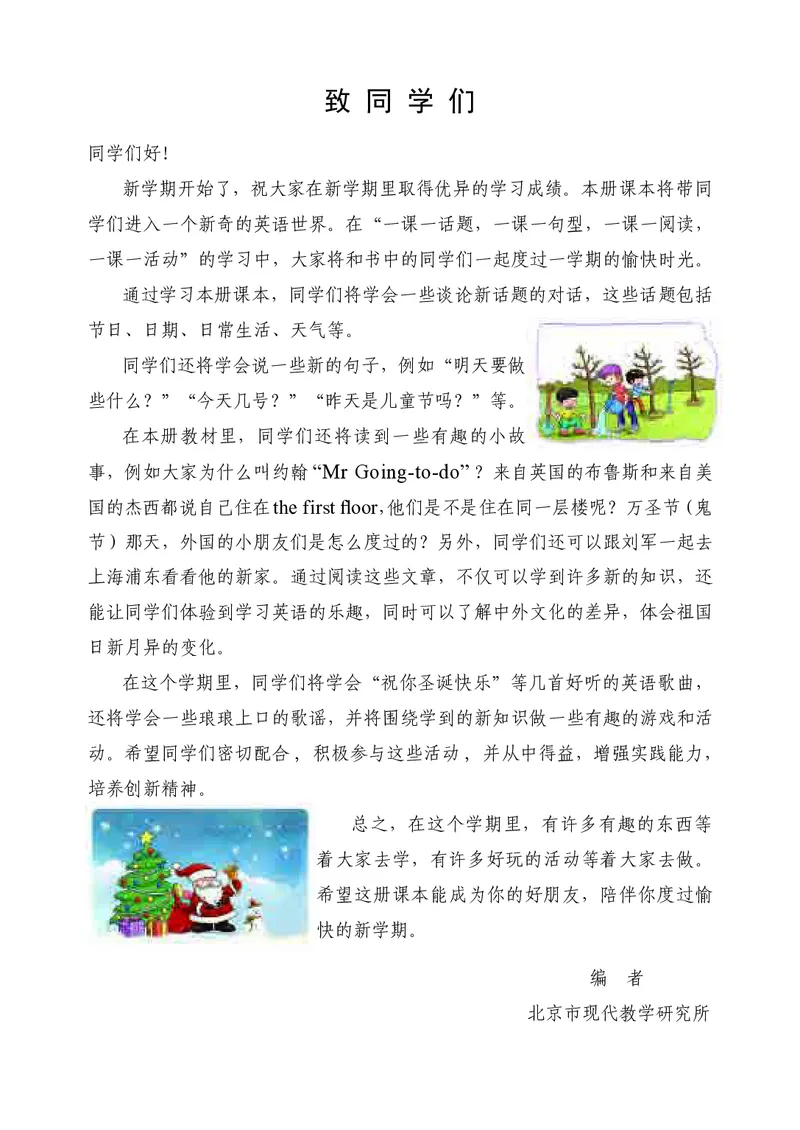
通过学习本册课本,同学们将学会一些谈论新话题的对话,这些话题包括
节日、日期、日常生活、天气等。
同学们还将学会说一些新的句子,例如“明天要做
些什么?”“今天几号?”“昨天是儿童节吗?”等。
在本册教材里,同学们还将读到一些有趣的小故
事,例如大家为什么叫约翰“Mr Going-to-do” ?来自英国的布鲁斯和来自美
国的杰西都说自己住在the first floor,他们是不是住在同一层楼呢?万圣节(鬼
节) 那天,外国的小朋友们是怎么度过的?另外,同学们还可以跟刘军一起去
上海浦东看看他的新家。通过阅读这些文章,不仅可以学到许多新的知识,还
能让同学们体验到学习英语的乐趣,同时可以了解中外文化的差异,体会祖国
日新月异的变化。
在这个学期里,同学们将学会“祝你圣诞快乐”等几首好听的英语歌曲,
还将学会一些琅琅上口的歌谣,并将围绕学到的新知识做一些有趣的游戏和活
动。希望同学们密切配合, 积极参与这些活动, 并从中得益,增强实践能力,
培养创新精神。
总之,在这个学期里,有许多有趣的东西等
着大家去学,有许多好玩的活动等着大家去做。
希望这册课本能成为你的好朋友,陪伴你度过愉
快的新学期。
                                                编  者
                                            北京市现代教学研究所
致 同 学 们
Contents
Contents
Lesson 1
Are you going to have a birthday party?
2
Lesson 2
What are you going to do tomorrow?
8
Lesson 3
It will be sunny this Sunday
14
Lesson 4
What kind of books will you buy?
20
Lesson 5
Revision
26
Lesson 6
It’s on the fifth floor
32
Lesson 7
What’s the date today?
38
Lesson 8
Merry Christmas!
44
Lesson 9
Were you at school yesterday?
50
Lesson 10
Revision
56
Words in each lesson
64
Word list
67
Word families
70
Additional word list
73
Are you going to have a
birthday party?
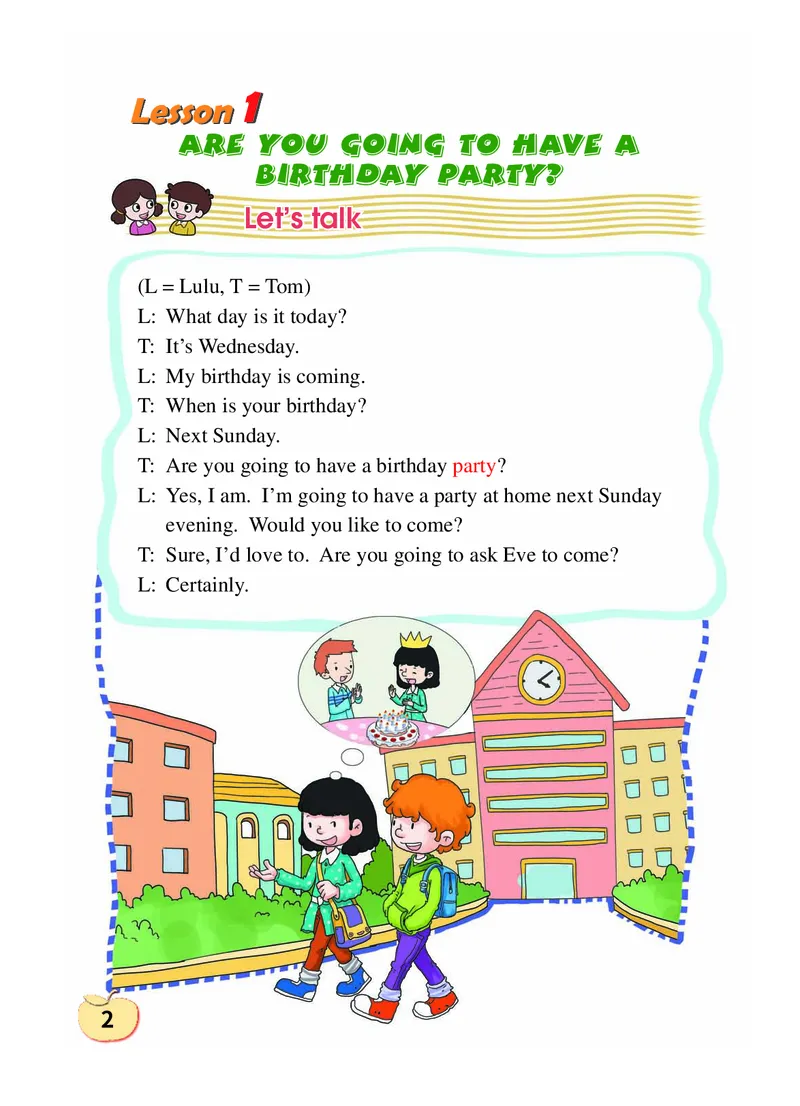
(L = Lulu, T = Tom)
L:	 What day is it today?
T:	 It’s Wednesday.
L:	 My birthday is coming.
T:	 When is your birthday?
L:	 Next Sunday.
T:	 Are you going to have a birthday party?
L:	 Yes, I am.  I’m going to have a party at home next Sunday

evening.  Would you like to come?
T:	 Sure, I’d love to.  Are you going to ask Eve to come?
L:	 Certainly.
Let’s talk
Lesson 1
2
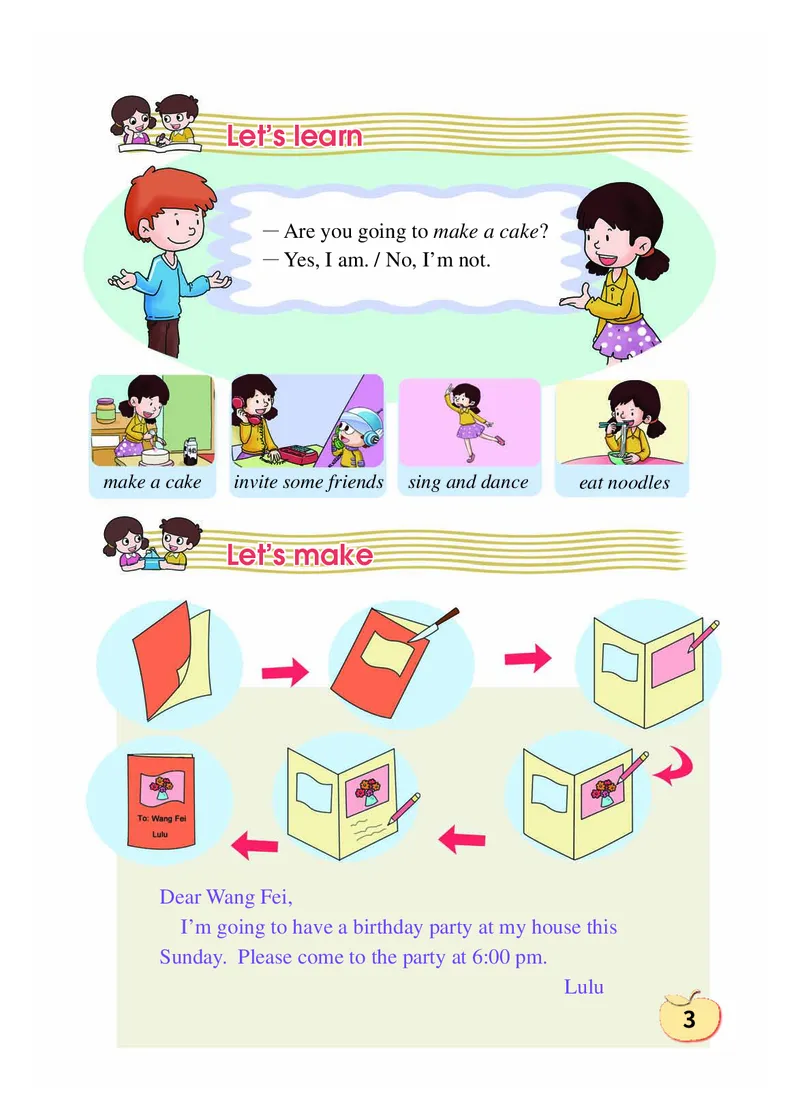
— Are you going to make a cake?
— Yes, I am. / No, I’m not.
Let’s learn
make a cake
invite some friends
eat noodles
sing and dance
Let’s make
3
Dear Wang Fei,
    I’m going to have a birthday party at my house this
Sunday.  Please come to the party at 6:00 pm.


                            Lulu
Listen and choose
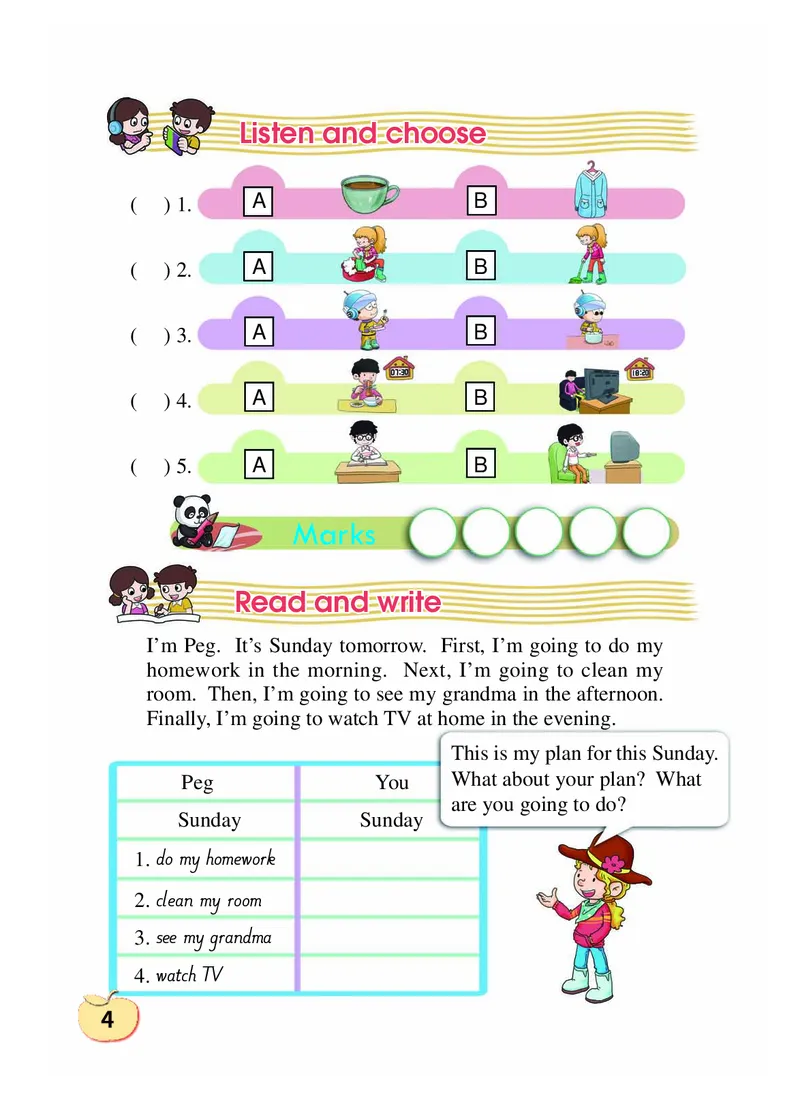
I’m Peg.  It’s Sunday tomorrow.  First, I’m going to do my
homework in the morning.  Next, I’m going to clean my
room.  Then, I’m going to see my grandma in the afternoon.
Finally, I’m going to watch TV at home in the evening.
This is my plan for this Sunday.
What about your plan?  What
are you going to do?
Peg
You
Sunday
Sunday
1. do my homework
2. clean my room
3. see my grandma
4. watch TV
Read and write
(     ) 1.
(     ) 2.
(     ) 3.
(     ) 4.
(     ) 5.
Marks
A
B
A
B
A
B
A
B
A
B
4
Make and say
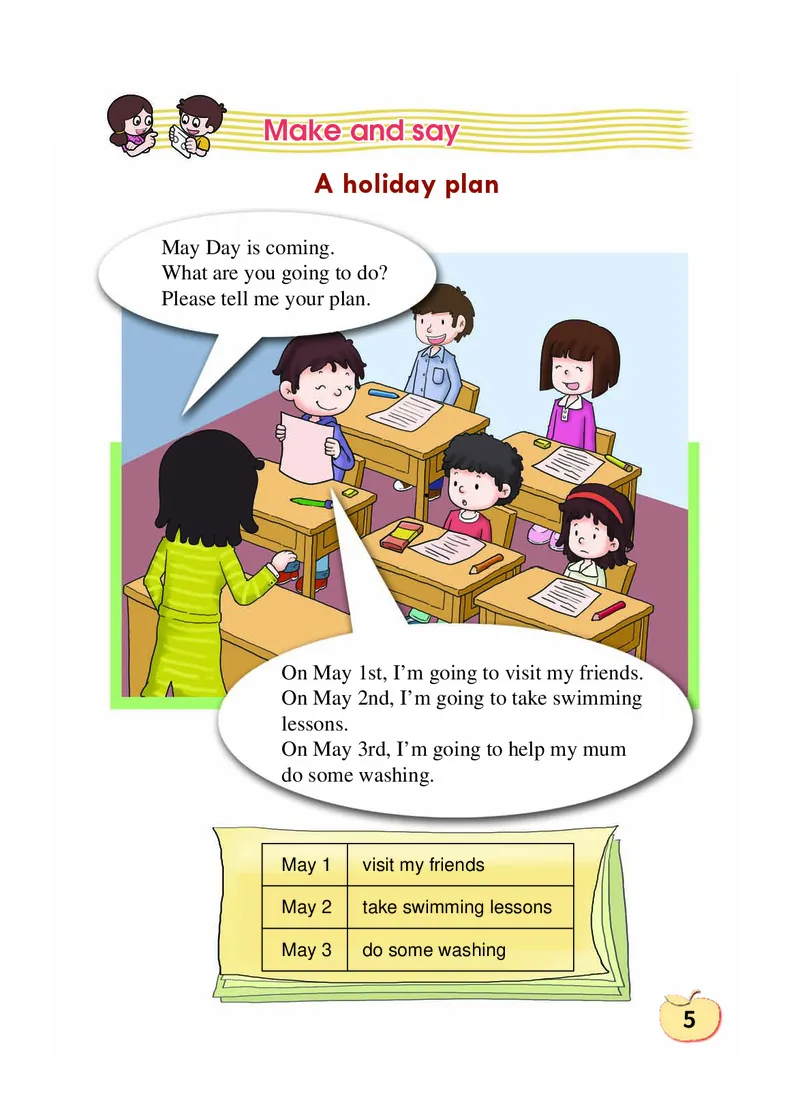
May Day is coming.
What are you going to do?
Please tell me your plan.
On May 1st, I’m going to visit my friends.
On May 2nd, I’m going to take swimming
lessons.
On May 3rd, I’m going to help my mum
do some washing.
5
May 1    	 visit my friends
May 2
take swimming lessons
May 3   	 do some washing
A holiday plan
I’m Mary.  Today is my father’s
birthday.  The weather is good.
It’s sunny.  We are going to have
a birthday party for him.  Now
my mother and I are doing some
shopping.
I’m going to buy some
fruit.  Mother is going to
buy some eggs.  She is
going to make a birthday
cake for my father.
The party will begin at
four o’clock.  It’s one o’clock
now and I’m asking my uncle
and aunt to come to the party.
Father’s birthday party
Read
6
“Hi, Aunt Lucy!  Today is
my father’s birthday.  Would
you like to come to his party?”
“Oh, I’d love to.  Today is
also Tim’s birthday.  Could I
bring him to the party?”
“Of course, you can.  By the way, who is Tim?”
“Ha-ha!  Tim is my little dog.”
7
(E = Eve, D = Dongdong)
E: 	What are you going to do tomorrow?
D: 	I’m going to do some shopping.
E: 	What are you going to buy?
D: 	I’m going to buy a map of China.
E:       	I want to buy some crayons.
     	Can I go with you?
D: 	Sure!
E:        	How can we get there?
D: 	By bike, OK?
E: 	OK.
Let’s talk
What are you going
to do tomorrow?
Lesson 2
8
Tell me your plan:
After school, I ...
This evening, I ...
Tomorrow, I ...
This Sunday, I ...
Next week, I ...
tomorrow, do some shopping
buy some school things
this evening, see a film
listen to music
next Sunday, wash some clothes
clean his room
after school, do sports
play football
Let’s learn
Look and say
9
— What are you going to do tomorrow?
— I’m going to do some shopping.
— What’s he going to do?
— He’s going to buy some school things.
Listen and choose
Make and say
A
B
(     ) 1.
(     ) 2.
(     ) 3.
(     ) 4.
(     ) 5.
What are you going to do this Saturday?
I’m going to see a film.
Marks
A
B
A
B
A
B
A
B
10
What are you going to do
tomorrow morning?
I’m going to play football.
A game
11
1
2
3
4
5
6
John lives in a village.  But people often call him “Mr
Going-to-do”.  Do you want to know why?  John always
says, “I’m going to do ...”  But he never does it.
Every Saturday, John goes
to Mr Smith’s house and talks
with him.  “I’m going to clean
my house tomorrow,” he says,
or “I’m going to wash my car
next week.”
Read
Mr Going-to-do
12
Mr Smith usually says, “Are you, John?”  John isn’t going
to clean his house or wash his car.  Mr Smith knows that.
Then he says, “Excuse me,
John.  I’m going to do some
work now.”  And he goes into
his house.
Mr Smith often says to
his son, “If you say you are
going to do something, then
do it.  Don’t be another ‘Mr
Going-to-do’.”
13
(D = Dongdong,  L = Lulu)
D:	It’s nice outside, isn’t it?
L:	 Yes, it is.
D:	 What will the weather be like tomorrow?
L:  	 It will be cloudy and windy.
D:	 Will it be cold?
L:	 Yes, it will.  But it’ll be sunny this Sunday.
D:	 That’s good.  I think it’ll be warm, too.
L: 	Yes, I think so.
D:	What are you going to do this Sunday?
L:	 I’m going to see my grandpa.  And you?
D:	I’m going to play football.
Let’s talk
Lesson 3
14
It will be sunny this
Sunday
The rain is raining all around.
It falls on trees and on the ground.
It rains on flowers and on me.
And on the ships at sea.
What will the weather
be like tomorrow?
It’ll be sunny.
hot
cold
windy
rainy
warm
cloudy
   cool
sunny
Let’s learn
Let’s chant
15
Look and say
Listen and number
 City                       Date/Weather
Harbin
Beijing
Sanya
— Today is June 12th.  What’s the weather like today in ...?
— It’s ...
— What will the weather be like tomorrow in ...?
— It will be ...
June 12, windy           June 13, sunny
June 12, cloudy           June 13, rainy
June 12, sunny          June 13, cloudy
Marks
16
Listen and say
(L = Lili, J = John)
L:	Hi, John!  The winter holiday is coming.

What are you going to do?
J:	 We’re going to Australia ①.
L:	Wow!  What will the weather be like in

Australia?
J: 	It will be sunny and hot.  It’s summer in

Australia now.
L:	That’s great!  You can swim in the sea

there.
J: 	Yes, and what about you, Lili?
L:	I’m going to Hainan with my parents.
J: 	Have a nice holiday!
L:	You too!
17
①Australia /F?streIljE/ 澳大利亚
The earth is getting warmer ①.  In some places, the water
in the sea will be hotter ②, and this will bring about great
changes in the weather.
    There will be strong wind, and it will bring heavy rain
to some places.  And in some other places, the weather
will be very dry.  That will be bad for the people there.
Changes in the weather
Read
18
①warmer 更温暖
②hotter 更热
But it isn’t always bad.  In some dry places the rain
makes lakes full of water.  Then birds come back again, and
the people are very happy.
19
Lake Nakuru in Kenya
( 充沛的雨水使肯尼亚已近
干枯的纳库鲁湖重现汪洋一
片,150 多万只火烈鸟又回
到湖边栖息。)
(L = Lulu, H = Henry)
L:	 What are you going to do tomorrow?
H:	I’m going to the bookshop.
L:	 What kind of books will you buy?
H:	I’m going to buy some books about science.
L:	Science?  Do you have science

class this term?
H:	No, we will have it next term.

It’s new.  Is it difficult?
L:	Yes, it’s difficult, but it’s interesting.
H:	Do you like it?
L:	Yes, I do.
Let’s talk
What kind of books
will you buy?
Lesson 4
20
— What will you do tomorrow?
—  I will go to the bookshop.
— Will you buy any books?
— Yes, I will.
sports centre
play basketball
park
take some photos
cinema
see a film
bookshop
buy some books
Morning comes early
Let’s learn
Let’s sing
Morning comes early and bright with dew.
Under your window I sing to you.
Up then my comrades, up then my comrades,
Let us be greeting the morn so blue.
21
Listen and number
Look and say
What will Tom do this Sunday?
He will play basketball.
Tom
Bob
Eve
Dongdong
Taotao
Lulu
Lanlan
Marks
22
Let’s practise
What will you do when you grow up ①?
I will be a nurse.
I will work in Yushu.
teacher
Wenchuan
driver
Shenzhen
nurse
Yushu
farmer
Heilongjiang
23
①grow up 长大
nurse
Yushu
Trees
It is Tree Planting Day tomorrow.  Many people will go up
to the hills and plant trees.
Trees can make the air clean.  Animals and
people can get food from them, too.
Read
24
We must plant more trees.  They will make the
people healthy, and make our country more beautiful.
But people are cutting down too many trees.  That
will bring about great changes in the weather.  It will be
too cold or too wet in some places.  It will be too hot or
too dry in other places.
25
(A = Ann, Q = Qiqi)
A:	What will the weather be like tomorrow, Qiqi?
Q: It’ll be sunny.

What will you do tomorrow?
A: I’ll go shopping.
Q: What are you going to buy?
A: I’m going to buy some food.

Tomorrow is my birthday.
Q:	Are you going to have a party?
A:	Yes, I am going to have a party tomorrow evening.


Would you like to come?
Q:	Sure, I’d love to.
Let’s talk
revision
Lesson 5
26
1. Listen and number.
2. Listen and circle the right answer.
Revision Exercises
1.
2.
3.
4.
5.
A. I’m going to play basketball.
B. I’m reading a book.
A. I want to buy a bag.
B. I’m going to buy some books.
A. I’ll go to the park.
B. Yes, I will.
A. No, I’m not.
B. Yes, I do.
A. It will be rainy.
B. Yes, it will.
27
3. Read and match.
(     ) 1. Lingling is going to wash some clothes this afternoon.
(     ) 2. Lele is playing football now.
(     ) 3. They will go to fly kites next Sunday.
(     ) 4. It will be sunny tomorrow.
(     ) 5. Tom is going to play basketball this afternoon.
(     ) 6. It is cold today.
4. What will you do tomorrow?  Write two sentences
      after the model.
Model: play football
1. go swimming
2. clean my room
3. see a film
4. fly a kite
5. play basketball
A
B
C
D
E
F
I will play football. I>m going to play football.
28
29
7. Look at the pictures and complete the sentences.
Jill will go to                 after school.
5. Look at the pictures and fill in the missing words.
6. Fill in each blank with the correct form of the word.
1. This is a map of ______(Chinese).
2. It will be ______(sun) tomorrow.
3. What kind of books will you ______(buy)?
4. He likes ______(play) football very much.
5. They ______(be) going to visit Shanghai next week.
It is ____ today.  It is very ____.
Bob is going to ____ next Sunday.
Eve will ____ this evening.
1. It will be w______ tomorrow.
2. There are many birds on the l______.
3. Lulu is going to play games after s______.
4. My father is a teacher and I’m a p______.
5. An elephant has two big e______ and a long n______.
Model:
29
fly a kite
8. Look at the pictures and complete the dialogues.
9. Fill in the blanks.
07:30 am   	 get up
1:00 pm
do her homework
09:00 am
clean her room
3:00 pm
buy some food
10:30 am
call her friends      	 5:30 pm
have a party
11:00 am
make a cake
9:30 pm
go to bed
1. Eve ____ ____ ____ at seven thirty tomorrow morning.
2. Eve will clean her room at ____ ____ tomorrow morning.
3. — Can Eve make a cake?   — ____, ____ ____.
4. — What will Eve do at three o’clock tomorrow afternoon?
    — She will ____ ____ ____.
5. — Is Eve going to have a party tomorrow?
    — ____, ____ ____.
Eve’s plan for tomorrow
1. — What will the weather be like tomorrow?
    — It will _____ _____.
2. — What will you do tomorrow?
   	— I will _____ _____ tomorrow.
3. — Are you going to sing at the party?
    — _____, _____ _____.
4. — Will it be cold tomorrow?
    — _____, _____ _____.
30
Self-assessment
party  weather  sunny  will  begin  bring
map  China  crayon  Saturday  son
cloudy  windy  place  strong  rain  lake
difficult  healthy
I can say
I know these words
Are you going to have a birthday party?
Yes, I am.
Would you like to come?
Sure, I’d love to.
What are you going to do tomorrow?
I’m going to do some shopping.
What will the weather be like tomorrow?
It will be cloudy and windy.
Will it be cold?
Yes, it will.
What kind of books will you buy?
I’m going to buy some books about science.
31
Q: 	Is Kate in the reading room?
E: 	No, she’s in her classroom.
Q: 	What class is she in?
E:	She’s in Class Three.
Q: 	Is it on the second floor?
E:	No, it’s on the fourth floor.
Q: 	Thank you very much.
(Q = Qiqi, L = Lulu, E = Eve)
Q:	Where is Kate?
L:	 I think she’s in the reading room.
Q: 	Where is the reading room?
     	Is it on the third floor?
L: 	No, it’s on the fifth floor.
it's on the fifth floor
Lesson 6
Let’s talk
32
The muffin man
1st — first
2nd — second
3rd — third
4th — fourth
5th — fifth
8th — eighth
9th — ninth    	 10th — tenth
11th — eleventh
12th — twelfth
— Where is the reading room?
— It’s on the fifth floor.
the reading room, fifth
teachers’  office, third
the lab, fourth
Class 1, first
Class 5, second
Let’s sing
Let’s learn
Do you know the muffin man, the muffin man, the muffin man?
Yes, I know the muffin man.  He lives on the First Street.
Do you know the fireman, the fireman, the fireman?
Yes, I know the fireman.  He lives on the Second Street.
Do you know the milkman, the milkman, the milkman?
Yes, I know the milkman.  He lives on the Third Street.
Do you know the postman, the postman, the postman?
Yes, I know the postman.  He lives on the Fourth Street.
33
Look and talk
— Where is Class Five?
— It’s on the third floor.
Listen and number
Marks
34
Listen and say
(N = Nick, L = Liu Mei)
N:	 Liu Mei, is this your house?
L: 	Yes.  Come in, please.
N:	 Wow!  What a nice house!  Where’s your bedroom?
L:  	It’s on the second floor.
N:	 Do you have a study
①?
L:  	Yes, I do.
N:	 Where is it?
L: 	It’s on the third floor.  Come and have a look.
N:	 Oh, so many books.  Can I read this one?
L:  	Sure.
35
①study /?stVdI/ 书房
Read
36
Bruce and Jess are friends.  They are in Class Three,
Grade Five.  Bruce comes from the UK and Jess comes
from the USA.  They live in the same building in Beijing.
First floor or second floor?
    “I’m Bruce.  I’m from the UK.  I live on the first
floor,” Bruce says.
    “I’m Jess.  I’m from the USA.  I live on the first
floor,” Jess says.
    “Oh, you live on the same floor,” Lingling says.
37
Do you know why?
Because in the UK “the first
floor” is the same as
① “the
second floor” in the USA.
①the same as 与……一致
I live on the first floor.
Bruce lives on the second floor.
?
“No, Jess lives on the ground floor,” says Bruce.
“No, Bruce lives on the second floor,” says Jess.
(Q = Qiqi,  E = Eve)
Q:	What’s the date today?
E:	It’s April 30th.
Q:	Oh, my birthday is coming.
E:	When is your birthday?
Q:	It’s on May 5th.  When is your birthday?
E:	My birthday is in May, too.
Q:	Oh, then we’re the same age.
E:	No, I’m twelve years old.  And you’re ten years old.
	 	 So I’m older than you ①.
Let’s talk
what's the date today?
Lesson 7
38
①older than you 比你年长
__ What’s the date today?
__ It’s June 2nd.
August 8th
When is your birthday?
Guess.
Is it in spring or autumn?
Neither.  It’s in summer.
Is it in July?
Yes, it is.
Let’s learn
A game
May 20th
July 1st
April 15th
June 2nd
39
Listen and number
Ask and write
Name              Birthday
Hello, Feifei.  When is your birthday?
My birthday is on ...
Marks
40
There is a cake on the table.
You can have it.
Listen and say
Look, Mom!  “Eat before May 20th.”
What’s the date today?
It’s May 22nd.  So you can’t
eat it.  There is some bread in
the fridge.  Go and get some.
Mom, I’m back.
I’m hungry.
41
OK, Mom.
Read
42
In the USA and the UK, some people don’t like the
number 13.  They don’t think 13 is a good number.  For
example, they don’t like to live on the thirteenth floor.
The number 13
    It was May 4th, Jack’s birthday.  He asked some of his friends to
dinner.  When everyone sat around the table, Jack began to count the
people.  Suddenly, he cried, “Oh, there are 13 people here!”  Everyone
was worried
① but Mrs Brown, Jack’s mother.  She said slowly with a
smile, “Don’t worry, children!  We have fourteen people here.  I am
going to have a baby in three months.”
    They all became happy again.  They enjoyed the nice food and had
a good time that night.
43
①worried /?wVrId/ 担心的
B & N:	 Merry Christmas, Dad!

Merry Christmas, Mum!
D & M:	 Merry Christmas, children.
M:
Go to the sitting room and

find your presents.
B:	 Oh, what a beautiful tree!
N: 	Oh, the presents are under it.
M:	This toy dog is for you, Nick.
D:	 The doll is for you, Bess.
B & N: Thank you, Dad.  Thank you,

       Mum.
(N = Nick, B = Bess, D = Dad, M = Mum)
N: 	It’s December 25th.  It’s Christmas Day!
B: 	Let’s say Merry Christmas to Mum and

Dad.
N: 	OK.
Let’s talk
Merry Christmas!
Lesson 8
44
We wish you a merry Christmas
Mother’s Day
the second Sunday in May
Children’s Day
June 1st
Halloween
October 31st
New Year’s Day
January 1st
Christmas
December 25th
When is Christmas?
It’s on December 25th.
Let’s sing
Let’s learn
We wish you a merry Christmas.
We wish you a merry Christmas.
We wish you a merry Christmas and a happy New Year.
Good tidings to you, wherever you are.
Good tidings for Christmas and a happy New Year.
45
Let’s practise
Listen and number
When is New Year’s Day?
It’s on January 1st.
Marks
Apr.
Jan.
Feb.
Mar.
May
Jun.
Jul.
Aug.
Sept.
Oct.
Nov.
Dec.
46
(S = Son, M = Mum)
S:	 Happy Mother’s Day, Mum!  Here’s a card for you.
M:	It’s beautiful.  Thanks.
S: 	 Thank you for your love, Mum.  What can I do for you today?
M:	Nothing, Son.
S: 	 I’ll do the cleaning for you.  You have a good rest.
M:	Oh!  You’re a good boy.
S: 	 Thanks, Mum.  I love you.
Listen and say
47
It’s October 31st.
It’s Halloween
①.
The kids are very happy.
They are making masks
②.
①Halloween /LhZlEH?i:n/ 万圣节前夕   ②mask /mA:sk/ 面具
③Jack-o’-lantern /LdWZk E ?lZntEn/ 南瓜灯笼   ④ghost /GEHst/ 幽灵
They are making
Jack-o’-lanterns
③.
Then they dress up
like ghosts
④.
Halloween
Read
48
①Trick or treat! 不给糖果就捣乱!
49
“Don’t run away,” the
ghost cries.  “It’s just us.
We are Bob and Rob.”
The kids all laugh.
In the evening they go from door to door.  They knock
at the door of a house and cry, “Trick or treat! ①”  A woman
comes out and gives them some candy.  They thank her and
go to another house.
They knock at the door and cry,
“Trick or treat!”  This time a tall
ghost comes out.  The kids cry “Ah!
A ghost!” and run away.
(G = Grandpa, E = Eve)
G:	 Eve, what was the date

yesterday?
E:	 Today is June 2nd, so

yesterday was June 1st.
G:	 It was Children’s Day,

wasn’t it?
E:
 Yes, it was.
G:	 Were you at school yesterday?
E:	 Yes, I was.
G:	 What did you do?
E:	 We had a sports meeting.
G:	 Did you have a good time?
E:	 Yes, we did.
Let’s talk
Were you at school yesterday?
Lesson 9
50
Thirty days have September,
April, June and November.
All the rest have thirty-one,
Excepting February alone,
Which has but twenty-eight days clear,
And twenty-nine in each leap year.
Jun. 1
Children’s Day
Oct. 1
National Day
Sept. 10
Teachers’ Day
Jan. 1
New Year’s Day
Mar. 8
Women’s Day
is, am — was 	 	 	 are — were
Let’s learn
Let’s chant
What was the date yesterday?
It was June 1.
It was Children’s Day.
51
(     ) 1.
(     ) 2.
(     ) 3.
(     ) 4.
(     ) 5.
What’s the date today?
What was the date yesterday?
It’s May 12th.
It was May 11th.
Ask and answer
Listen and choose
B
A
B
A
B
A
B
A
B
A
Marks
May
52
(W = Wang Li, T = Tom)
W:	Hi, Tom.  How was your weekend?
T:	 It was great!  I went fishing with my father.
W:	Are you good at fishing?
T: 	 No, I’m not.  But my father is.

How was your weekend?
W: 	It was OK.  I was at home.

My dog was ill.  I had to look after her.
T:	 Is she better now?
W:	Yes, she is much better.  Thank you.
Listen and say
53
Read
April Fools’ Day
①slow down 减速   ②passenger /?pZsIndWE/ 乘客
③lean/li:n/ forward/?fC:wEd/ 向前倾
54
It was April 1st.  A bus was going down a country road.
Then it slowed down ① and stopped.  The driver tried hard
to start it, but he couldn’t.
Then he turned to the passengers②
and said, “This bus is too old.  I can’t
start it.  Now we can only do one
thing.  I will count to three, and on
the word three, I want you all to lean
forward ③ together.  Then the bus will
start again.”
All the passengers said yes, and the driver
began to say, “One!  Two!  Three!”  When they
heard “Three”, they all leaned forward hard, and
the bus started again.
When the driver said “April Fools!”, the passengers suddenly
remembered it was April Fools’ Day① and they all began to laugh.
55
①April Fools’ Day 愚人节

(A = Ann, Q = Qiqi)
Q:	What’s the date today, Ann?
A:	It’s May 31st.
Q:	Oh, tomorrow is June 1st.
   		 It’s Children’s Day.
A:	Yes.  I want to make some
    	cards for my friends.
Q:	Good idea.  Can I join you?
A:	Certainly.
Let’s talk
Revision
Lesson 10
56
(D = Dongdong, A = Ann)
D:	What was the date yesterday?
A:	Yesterday was April 11th.

It was my birthday.
D:	How old are you?
A:	I’m twelve.  What about you?
D:  	 I’m twelve, too.
A:	We are the same age.

When is your birthday?
D:     	It’s in May.
A: 	 Then I am older than you.
We drove along some streets
and over a bridge.  At last we
stopped in front of a tall building.
My name is Liu Jun.  I live in Shanghai.  Now my family
and I are driving to our new home.  It’s in Pudong.
My new home
Read
57
From the window I can see many cars
and people down in the streets.  They look
very small.  The cars look like toys.
Our new home is on the eighteenth floor.
My bedroom is big and bright.
58
To the west, I can see
the Huangpu River and
many tall buildings along it.
At night we watch the lights go on over the city.
The lights look like stars in the sky.  And the city is
very beautiful.  I like my new home.
59
1. Listen and choose the correct answer.
4.  What’s the date today?
2.  Was it Children’s Day yesterday?
e.g. 	 1.  Listen: I always have breakfast at 7:00.


       Question: Do you always have breakfast at 7:00?
3.  Where is the library?
No, it wasn’t.
Yes, I do.
2. Listen and number.
Revision Exercises
No, I don’t.
Yes, it was.
It’s on the second floor.
It’s April 2nd.
It’s May 8th.
It’s on the fifth floor.
60
3.	 A. He usually goes to school on foot.

B. How does he usually go to school?

C. Yes, it is.
    	D. Is that Ken?


(1) ____
(2) ____


(3) ____
(4) ____
4.	A. It was June 1st.

B. Was it Children’s Day?

C. What was the date yesterday?

D. Yes, it was.


(1) ____
(2) ____


(3) ____
(4) ____
2.	 A. It’s December 25th.

B. Yes, it is.
    	C. What’s the date today?
 	 D. Is it Christmas Day?


(1) ____
(2) ____


(3) ____
(4) ____
3. Put the sentences in the right order.
e.g. 1.	 A. I’m fine, too.

B. Hi, Mrs Hen!  How are you?

C. I’m fine.  Thank you.  And you?

    (1)   B  	    (2)   C
(3)    A
___          ___           ___
61
5. Fill in the blanks.
4. Look at the pictures and complete the dialogues.
Mary’s busy Sunday
2:30 pm
played outside
5:30 pm
went home
6:30 pm
had supper
7:30 pm
did her homework
9:30 pm
went to bed
1. Mary ____ ____ at seven o’clock last Sunday.
2. — ____ she go to the park last Sunday morning?  — ____, she did.
3. Mary ____ ____ at twelve last Sunday.
4. At six thirty in the afternoon, she ____ ____.
5. — Did Mary go to bed at ten?  — ____, she ____.
                            1. — Where is Class One?
                                — It is on the _____ _____.
2. — When is _____ _____?
    — It is on the second Sunday in May.

3. — What is he going to do tomorrow?

                                 — He is going to _____ _____.
4. — What _____ the date yesterday?
    — It was _____ 9th.
07:00 am   	 got up
07:30 am   	 had breakfast
08:00 am   	 went to the park
12:00 am   	 had lunch
62
63
Self-assessment
Where is the reading room?
It’s on the fifth floor.
What’s the date today?
It’s April 30th.
When is your birthday?
It’s on May 5th.
It’s December 25th.  It’s Christmas Day!
Merry Christmas!
What was the date yesterday?
It was June 1st.
Were you at school yesterday?
Yes, I was.
third   floor   fifth   second   first
April   May   year   dinner   month   night
kid   candy
yesterday   June   road   stop   driver   turn   word
window   river   city   star
I can say
I know these words
各课词汇表
Words in each lesson
Lesson 1
party /?pA:tI/
聚会
weather /?weDE/
天气
sunny /?sVnI/
晴朗的
will /wIl/
将要
begin /bI?GIn/
开始
bring /brIY/
带来
   do some shopping	 买东西
Lesson 2
map /mZp/
地图
China /?tSaInE/
中国
crayon /?kreIEn/
蜡笔
Saturday /?sZtEdI/
星期六
son /sVn/
儿子
never /?nevE/
从不
another /E?nVDE/
另一个
Lesson 3
cloudy /?klaHdI/
多云的
windy /?wIndI/
有风的
place /pleIs/
地方
strong /strFY/
强壮的, 强烈的
rain /reIn/
雨; 下雨
lake /leIk/
湖
earth /B:O/
地球
change /tSeIndW/
改变
wind /wInd/
风
dry /draI/
干的
full /fHl/
满的
  bring about
带来, 引起
  be bad for
对……有害
  full of
充满
Lesson 4
difficult /?dIfIkElt/
困难的
( 注:本表中只收录Let’s talk 和Read 部分的生词)
64
healthy /?helOI/
健康的
bookshop /?bHkSFp/
书店
hill /hIl/
小山
air /eE/
空气
wet /wet/
湿的
more /mC:/
较多的; 更
country /?kVntrI/       	 国家
  cut down
砍倒
Lesson 6
third /OB:d/
第三
floor /flC:/
地板
fifth /fIfO/
第五
second /?sekEnd/
第二; 秒
first /fB:st/
第一
same /seIm/
相同的
building /?bIldIY/
大楼
ground /GraHnd/
地面
Lesson 7
April /?eIprEl/
四月
May /meI/
五月
year /jIE/
年
dinner /?dInE/
正餐, 晚餐
month /mVnO/
月份
night /naIt/
夜晚
date /deIt/
日期
age /eIdW/
年龄
than /DZn/
比
around /E?raHnd/        在周围
count /kaHnt/
数
become /bI?kVm/        成为
    for example
例如
    have a good time 	 玩得高兴
Lesson 8
kid /kId/
小孩
candy /?kZndI/
糖果
December /dI?sembE/	 十二月
Christmas /?krIsmEs/	 圣诞节
merry /?merI/
愉快的
present /?preznt/
礼物
October /Fk?tEHbE/
十月
just /dWVst/         	       正好, 仅仅
65
Lesson 10
window /?wIndEH/
窗
river /?rIvE/
江河
city /?sItI/
城市
star /stA:/
星星
join /dWCIn/
参加
drive /draIv/
驾驶
along /E?lFY/
沿着
bridge /brIdW/
桥
bright /braIt/
明亮的
west /west/
西方
sky /skaI/
天空
  at last                     	 最后


laugh /lA:f/
笑
    dress up
打扮
    from door to door 	挨家挨户
    run away
逃跑
Lesson 9
yesterday /?jestEdI/
昨天
June /dWu:n/
六月
road /rEHd/
路
stop /stFp/                    停止; ( 停车) 站
driver /?draIvE/
司机
turn /tB:n/                   转向, 把……变成
word /wB:d/
单词
meeting /?mi:tIY/
会议, 集会
hard /hA:d/
努力地; 困难的
start /stA:t/
开始, 动身
   sports meeting     运动会
66
【注】红色词是课标规定的重点词,要求
学生能够听、说、认读、拼写,蓝色词要
求学生能够听、说、认读,不要求拼写。
词 汇 表
Word list
A
age /eIdW/
年龄
7
air /eE/
空气
4
along /E?lFY/
沿着
10
another /E?nVDE/
另一个
2
April /?eIprEl/            	四月
7
around /E?raHnd/
在周围
7
B
become /bI?kVm/
成为
7
begin /bI?GIn/                	 开始
1
bookshop /?bHkSFp/
书店
4
bridge /brIdW/
桥
10
bright /braIt/
明亮的
10
bring /brIY/                   	 带来
1
building /?bIldIY/
大楼
6
C
candy /?kZndI/
糖果
8
change /tSeIndW/
改变
3
China /?tSaInE/
中国
2
Christmas /?krIsmEs/	 圣诞节
8
city /?sItI/
城市
10
cloudy /?klaHdI/
多云的
3
count /kaHnt/
数
7
country /?kVntrI/
国家
4
crayon /?kreIEn/
蜡笔
2
D
date /deIt/
日期
7
December /dI?sembE/ 	十二月
8
difficult /?dIfIkElt/
困难的
4
dinner /?dInE/
正餐, 晚餐
7
drive /draIv/
驾驶
10
driver /?draIvE/
司机
9
dry /draI/
干的
3
E
earth /B:O/
地球
3
F
fifth /fIfO/
第五
6
67
first /fB:st/
第一
6
floor /flC:/
地板
6
full /fHl/
满的
3
G
ground /GraHnd/
地面
6
H
hard /hA:d/
努力地; 困难的	9
healthy /?helOI/
健康的
4
hill /hIl/
小山
4
J
join /dWCIn/
参加
10
June /dWu:n/
六月
9
just /dWVst/
正好, 仅仅
8
K
kid /kId/
小孩
8
L
lake /leIk/
湖
3
laugh /lA:f/
笑
8
M
map /mZp/
地图
2
May /meI/
五月
7
meeting /?mi:tIY/
会议, 集会
9
merry /?merI/
愉快的
8
month /mVnO/
月份
7
more /mC:/
较多的; 更
4
N
never /?nevE/
从不
2
night /naIt/
夜晚
7
O
October /Fk?tEHbE/
十月
8
P
party /?pA:tI/
聚会
1
place /pleIs/
地方
3
present /?preznt/
礼物
8
R
rain /reIn/
雨; 下雨
3
river /?rIvE/
江河
10
road /rEHd/
路
9
S
same /seIm/
相同的
6
68
Saturday /?sZtEdI/
星期六
2
second /?sekEnd/
第二; 秒
6
sky /skaI/
 天空
10
son /sVn/
儿子
2
star /stA:/
星星
10
start /stA:t/
开始, 动身
9
stop /stFp/
停止;( 停车) 站	9
strong /strFY/           	 强壮的, 强烈的	3
sunny /?sVnI/
晴朗的
1
T
than /DZn/
比
7
third /OB:d/
第三
6
turn /tB:n/               转向, 把……变成	 9
W
weather /?weDE/
天气
1
west /west/
西方
10
wet /wet/
湿的
4
will /wIl/
将要
1
wind /wInd/
风
3
window /?wIndEH/
窗
10
windy /?wIndI/
有风的
3
69
【注】红色词是课标规定的重点词。
word /wB:d/
单词
9
Y
year /jIE/
年
7
yesterday /?jestEdI/
昨天
9
Expressions
at last                        最后
10
be bad for        对……有害
3
bring about       带来, 引起
3
cut down           砍倒
4
do some shopping  买东西
1
dress up                    打扮
8
for example       例如
7
from door to door   挨家挨户
8
full of            充满
3
have a good time   玩得高兴
7
run away                   逃跑
8
sports meeting      运动会
9
70
Word families
分类词汇表
1st          	 2nd          	 3rd           	4th          	 5th
6th           	 7th           	 8th           	9th           	12th
f irst
C
D
B
A
A
D
E
(     ) 1. light
(     ) 2. telephone
(     ) 3. photo
(     ) 4. umbrella
(     ) 5. fan
(     ) 6. medicine
(     ) 7. mobile
(     ) 8. present
B
C
G
F
H
A
(     ) 1. morning
(     ) 2. afternoon
(     ) 3. evening
(     ) 4. night
71
一月
A
二月
E
三月
I
四月
B
五月
F
六月
J
七月
C
八月
G
九月
K
十月
D
十一月
H
十二月
L
(     ) 1. January
(     ) 2. March
(     ) 3. May
(     ) 4. July
(     ) 5. February
(     ) 6. April
(     ) 7. October
(     ) 8. December
(     ) 9. June
(     ) 10. November
(     ) 11. August
(     ) 12. September
A
D
J
C
I
G
M
N
F
L
H
E
K
(     ) 1. sky
(     ) 2. sun
(     ) 3. moon
(     ) 4. star
(     ) 5. earth
(     ) 6. river
(     ) 7. lake
(     ) 8. forest
(     ) 9. hill
(     ) 10. island
(     ) 11. sea
(     ) 12. tree
(     ) 13. flower
(     ) 14. grass
A
B
C
(     ) 1. cloudy
(     ) 2. windy
(     ) 3. sunny
(     ) 4. rainy
(     ) 5. snowy
D
72
A
D
G
C
C
(     ) 1. picture
(     ) 2. computer
(     ) 3. email
(     ) 4. keyboard
(     ) 5. mouse
(     ) 6. ruler
(     ) 7. paper
(     ) 8. blackboard
(     ) 9. crayon
(     ) 10. map
B
E
CC
F
I
J
E
H
E
D
A
C
B
73
新课标二级词汇表
Additional word list
A
a, an /E, Zn/
一个
about /E?baHt/            关于; 大约, 到处
afraid /E?freId/
害怕的
after /?A:ftE/
在……之后
afternoon /LA:ftE?nu:n/
下午
again /E?GeIn/
再
all /C:l/
都
also /?C:lsEH/
也
always /?C:lweIz/
总是
am /Zm/
是
and /Znd/
和
angry /?ZYGrI/
生气的
animal /?ZnIml/
动物
answer /?A:nsE/
回答
any /?enI/
一些
apple /?Zpl/
苹果
April /?eIprEl/
四月
are /A:/
是
arm /A:m/
手臂
art /A:t/
艺术
ask /A:sk/
问
at /Zt/
在……
aunt /A:nt/                   姑, 姨, 舅母等
autumn /?C:tEm/
秋天
B
baby /?beIbI/
婴儿
back /bZk/
向后; 背
bad /bZd/
坏的
bag /bZG/
书包
ball /bC:l/
球
banana /bE?nA:nE/
香蕉
basketball /?bA:skItbC:l/ 	 篮球
be /bi:/
是
bear /beE/
熊
beautiful /?bju:tEfl/
美丽的
bed /bed/
床
before /bI?fC:/
在……以前
begin /bI?GIn/
开始
behind /bI?haInd/
在……后
74
beside /bI?saId/
在……旁边
between /bI?twi:n/       在( 两者) 之间
big /bIG/
大的
bike /baIk/(bicycle)
自行车
bird /bB:d/
鸟
birthday /?bB:OdeI/
生日
black /blZk/
黑色的
blackboard /?blZkbC:d/
黑板
blue /blu:/
蓝色的
boat /bEHt/
小船; 划船
body /?bFdI/
身体
book /bHk/
书
box /bFks/
盒子
boy /bCI/
男孩
bread /bred/
面包
breakfast /?brekfEst/
早餐
bring /brIY/
带来
brother /?brVDE/
兄弟
brown /braHn/
棕色的
bus /bVs/
公共汽车
busy /?bIzI/
忙的
but /bVt/
但是
buy /baI/
买
by /baI/
乘( 车等)
bye /baI/
再见
C
cake /keIk/
蛋糕
call /kC:l/
打电话, 叫
can /kZn/
能
candy /?kZndI/
糖果
cap /kZp/
便帽
car /kA:/
小汽车
card /kA:d/
卡片
cat /kZt/
猫
chair /tSeE/
椅子
chicken /?tSIkIn/
鸡, 鸡肉
child /tSaIld/           儿童( 复children)
China /?tSaInE/
中国
Chinese /LtSaI?ni:z/   汉语, 中国人( 的)
cinema /?sInImE/
电影院
city /?sItI/
城市
class /klA:s/
班级
clean /kli:n/                 弄干净; 清洁的
clever /?klevE/
聪明的
clock /klFk/
钟
close /klEHz/
关
75
clothes /klEHDz/
衣服
cloudy /?klaHdI/
多云的
coat /kEHt/
外套, 上衣
cold /kEHld/
冷的
colour /?kVlE/               颜色( 美color)
come /kVm/
来
computer /kEm?pju:tE/
计算机
cook /kHk/                        厨师; 煮, 烧
cool /ku:l/
凉快的, 酷
cousin /?kVzn/                堂/表兄弟姐妹
cow /kaH/
奶牛
crayon /?kreIEn/
蜡笔
cry /kraI/
哭, 喊
cup /kVp/
茶杯
D
dad /dZd/
爸爸
dance /dA:ns/
跳舞
day /deI/
白天
dear /dIE/
亲爱的
desk /desk/
书桌
difficult /?dIfIkElt/
困难的
dinner /?dInE/
正餐, 晚餐
dirty /?dB:tI/
脏的
do /du:/
做
doctor /?dFktE/
医生
dog /dFG/
狗
door /dC:/
门
down /daHn/
向下
draw /drC:/
画
dress /dres/      连衣裙, 女服; 打扮
drink /drIYk/
喝; 饮料
driver /?draIvE/
司机
duck /dVk/
鸭子
E
ear /IE/
耳朵
early /?B:lI/
早的
easy /?i:zI/
容易的
eat /i:t/
吃
egg /eG/
蛋
eight /eIt/
八
elephant /?elIfEnt/
大象
eleven /I?levn/
十一
email /?i:meIl/
电子邮件
English /?IYGlIS/               英语; 英国的
evening /?i:vnIY/
晚上
every /?evrI/
每一个
76
exercise /?eksEsaIz/
练习, 体操
eye /aI/
眼睛
F
face /feIs/
脸, 面孔
family /?fZmElI/
家庭
fan /fZn/                         风扇, 爱好者
far /fA:/
远的
farm /fA:m/
农场
farmer /?fA:mE/
农民
fast /fA:st/
快
fat /fZt/
肥胖的
father /?fA:DE/
父亲
favourite /?feIvErIt/
最喜爱的
                      ( 美favorite)
feel /fi:l/
感觉
fifteen /LfIf?ti:n/
十五
fifth /fIfO/
第五
fifty /?fIftI/
五十
film /fIlm/
电影
find /faInd/
找到
fine /faIn/                        好的, 晴朗的
first /fB:st/
第一
fish /fIS/                        鱼, 鱼肉; 钓鱼
five /faIv/
五
floor /flC:/
地板
flower /?flaHE/
花
fly /flaI/                     放( 风筝等), 飞
food /fu:d/
食物
foot /fHt/
脚( 复feet)
football /?fHtbC:l/
足球
for /fC:/
为, 给
forty /?fC:tI/
四十
four /fC:/
四
Friday /?fraIdI/
星期五
friend /frend/
朋友
from /frFm/
从, 来自
fruit /fru:t/
水果
G
game /GeIm/
游戏
get /Get/
得到, 到达
girl /GB:l/
女孩
give /GIv/
给
go /GEH/
去
good /GHd/
好的
goodbye /GHd?baI/
再见
grandfather /?GrZnfA:DE/
77
                   爷爷, 外公( 口grandpa)
grandmother /?GrZnmVDE/
                   奶奶, 外婆( 口grandma)
grass /GrA:s/
草
great /GreIt/                     伟大的, 太棒了
green /Gri:n/
绿色的
H
hair /heE/
头发
half /hA:f/
一半
hand /hZnd/
手
happy /?hZpI/
快乐的
have /hZv/
有, 吃
he /hi:/
他
head /hed/
头
healthy /?helOI/
健康的
hear /hIE/
听见
heavy /?hevI/
重的
hello /hE?lEH/
你好
help /help/
帮助
hen /hen/
母鸡
her /hB:/
她, 她的
here /hIE/
这里
hi /haI/
嗨
high /haI/
高的
him /hIm/
他
his /hIz/
他的
holiday /?hFlEdI/
假日
home /hEHm/
家
horse /hC:s/
马
hospital /?hFspItl/
医院
hot /hFt/
热的
hour /?aHE/
小时
house /haHs/
房子
how /haH/
多么, 如何
hungry /?hVYGrI/
饥饿的
I
I /aI/
我
ice cream /LaIs?kri:m/
冰淇淋
idea /aI?dIE/
主意
ill /Il/
生病的
in /In/
在……里面
interesting /?IntrIstIY/
有趣的
is /Iz/
是
it /It/
它
its /Its/
它的
78
J
juice /dWu:s/
果汁
jump /dWVmp/
跳
June /dWu:n/
六月
K
kid /kId/
小孩
kind /kaInd/                    和善的; 种类
kitchen /?kItSIn/
厨房
kite /kaIt/
风筝
know /nEH/
知道
L
lake /leIk/
湖
late /leIt/
迟的
left /left/
左边
leg /leG/
腿
lesson /'lesn/
课, 功课
let /let/
让
library /?laIbrErI/
图书馆
light /laIt/
灯, 光线
like /laIk/
喜欢; 像
listen /?lIsn/
听
little /?lItl/
小的
live /lIv/
居住, 生活
long /lFY/
长的
look /lHk/
看
love /lVv/
爱
lunch /lVntS/
午饭
M
make /meIk/
做
man /mZn/                      男人( 复men)
many /?menI/
许多
map /mZp/
地图
maths /mZOs/                数学( 美math)
may /meI/
可以
May /meI/
五月
me /mi:/
我
meet /mi:t/
遇见
milk /mIlk/
牛奶
minute /?mInIt/                   分钟, 一会儿
Miss /mIs/
小姐
mom /mFm/                     妈妈( 美口语)
Monday /?mVndI/
星期一
monkey /?mVYkI/
猴子
month /mVnO/
月份
moon /mu:n/
月亮
79
morning /?mC:nIY/
早晨, 上午
mother /?mVDE/
母亲
mouth /maHO/
嘴
Mr /?mIstE/
先生
Mrs /?mIsIz/
夫人
Ms /mIz/
女士
much /mVtS/
多, 非常
mum /mVm/
妈妈
music /?mju:zIk/
音乐
must /mVst/
必须
my /maI/
我的
N
name /neIm/
名字
near /nIE/
在……附近
new /nju:/
新的
next /nekst/
下一个
nice /naIs/
好的
night /naIt/
夜晚
nine /naIn/
九
no /nEH/
不
noodle /?nu:dl/
面条
nose /nEHz/
鼻子
not /nFt/
不
now /naH/
现在
nurse /nB:s/
护士
O
of /Fv/
……的
often /?Ffn/
经常
old /EHld/             老的, 旧的,……岁的
on /Fn/
在……上
one /wVn/
一
open /?EHpEn/
开
or /C:/
或者, 否则
orange /?FrIndW/         橘子; 橘色的
our /?aHE/
我们的
P
panda /?pZndE/
熊猫
paper /?peIpE/
纸
parent /?peErEnt/
父( 母) 亲
park /pA:k/
公园; 停车
party /?pA:tI/
聚会
PE /?pi:?i:/
体育
pen /pen/
钢笔
pencil /?pensl/
铅笔
people /?pi:pl/
人们
photo /?fEHtEH/
照片
80
picture /?pIktSE/
图画, 照片
pig /pIG/
猪
place /pleIs/
地方
plane /pleIn/
飞机
plant /plA:nt/
种植; 植物
play /pleI/
玩; 戏剧
playground /?pleIGraHnd/	 操场
please /pli:z/
请
police /pE?li:s/
警察
potato /pE?teItEH/
土豆
pupil /?pju:pl/
小学生
put /pHt/
放
R
rain /reIn/
雨; 下雨
read /ri:d/
读
red /red/
红色的
rice /raIs/
米饭
right /raIt/                          正确的; 右边
river /?rIvE/
江河
road /rEHd/
路
room /ru:m/
房间
ruler /?ru:lE/
尺子
run /rVn/
跑
S
sad /sZd/
悲伤的
Saturday /?sZtEdI/
星期六
say /seI/
说
school /sku:l/
学校
schoolbag /?sku:lbZG/
书包
science /?saIEns/
科学
season /?si:zn/
季节
second /?sekEnd/
第二; 秒
see /si:/
看见, 明白
seven /?sevn/
七
she /Si:/
她
sheep /Si:p/
绵羊
ship /SIp/
轮船
shirt /SB:t/
衬衣
shoe /Su:/
鞋
shop /SFp/
商店
short /SC:t/
短的, 矮的
shorts /SC:ts/
短裤
sing /sIY/
唱
sister /?sIstE/
姐妹
sit /sIt/
坐
six /sIks/
六
81
skirt /skB:t/
裙子
sleep /sli:p/
睡觉
slow /slEH/
慢的
small /smC:l/
小的
snow /snEH/
雪; 下雪
sock /sFk/
短袜
some /sVm/
一些
sometimes /?sVmtaImz/
有时
son /sVn/
儿子
song /sFY/
歌曲
sorry /?sFrI/
对不起
soup /su:p/
汤
speak /spi:k/
讲, 说
sport /spC:t/
运动
spring /sprIY/
春天
stand /stZnd/
站
star /stA:/
星星
stop /stFp/                停止;( 停车) 站
story /?stC:rI/
故事
street /stri:t/
街道
strong /strFY/              强壮的, 强烈的
student /?stju:dEnt/
学生
study /?stVdI/
学习
subject /?sVbdWIkt/
学科, 主题
summer /?sVmE/
夏天
sun /sVn/
太阳
Sunday /?sVndI/
星期日
sunny /?sVnI/
晴朗的
supermarket /?su:pEmA:kIt/ 超市
supper /?sVpE/
晚餐
sweater /?swetE/
毛衣
swim /swIm/
游泳
T
table /?teIbl/
桌子
take /teIk/
拿
talk /tC:k/
谈话
tall /tC:l/
高的
taxi /?tZksI/
出租汽车
tea /ti:/
茶
teacher /?ti:tSE/
教师
tell /tel/
告诉
ten /ten/
十
thank /OZYk/
谢谢
that /DZt/
那个
the /DE/
这个
their /DeE/
他们的
them /Dem/
他们
82
then /Den/
那么
there /DeE/
在那里
these /Di:z/
这些
they /DeI/
他们
thin /OIn/
瘦的, 薄的
thing /OIY/
东西, 事情
think /OIYk/
想, 认为
third /OB:d/
第三
thirteen /LOB:?ti:n/
十三
thirty /?OB:tI/
三十
this /DIs/
这个
those /DEHz/
那些
three /Ori:/
三
tiger /?taIGE/
老虎
time /taIm/
时间
tired /?taIEd/
累的
to /tu:/
到
today /tE?deI/
今天
toilet /?tCIlIt/
厕所
tomato /tE?mA:tEH/
西红柿
tomorrow /tE?mFrEH/
明天
too /tu:/
也, 太
toy /tCI/
玩具
train /treIn/
火车
travel /?trZvl/
旅行
tree /tri:/
树
trousers /?traHzEz/
裤子
try /traI/
尝试
turn /tB:n/                   转向, 把……变成
TV /?ti:?vi:/
电视机
twelve /twelv/
十二
twenty /?twentI/
二十
two /tu:/
二
U
umbrella /Vm?brelE/
雨伞
uncle /?VYkl/                      叔, 伯, 舅等
under /?VndE/
在……下
up /Vp/
向上
us /Vs/
我们
use /ju:z/
使用
V
vegetable /?vedWItEbl/
蔬菜
very /?verI/
非常, 很
visit /?vIzIt/
参观, 探望
83
W
wait /weIt/
等待
walk /wC:k/
走
want /wFnt/
想要
warm /wC:m/
暖和的
wash /wFS/
洗
watch /wFtS/
手表; 观看
water /?wC:tE/
水; 浇水
way /weI/
路
we /wi:/
我们
wear /weE/
穿
weather /?weDE/
天气
week /wi:k/
星期
welcome /?welkEm/
欢迎
well /wel/
健康的; 好
what /wFt/
什么
when /wen/
什么时候
where /weE/
在哪里
white /waIt/
白色的
who /hu:/
谁
whose /hu:z/
谁的
why /waI/
为什么
will /wIl/
将要
window /?wIndEH/
窗
windy /?wIndI/
有风的
winter /?wIntE/
冬天
with /wID/
和, 用
woman /?wHmEn/    妇女( 复women)
wonderful /?wVndEfl/
极好的
word /wB:d/
单词
work /wB:k/
工作
worker /?wB:kE/
工人
worry /?wVrI/
担忧
write /raIt/
写

wrong /rFY/
错误的
Y
year /jIE/
年
yellow /?jelEH/
黄色的
yes /jes/
是的
yesterday /?jestEdI/
昨天
you /ju:/
你( 们)
young /jVY/
年轻的
your /jC:/
你( 们) 的
Z
zoo /zu:/
动物园
后    记
本套教材于2001 年8 月经国家教育部审查通过。在10 年的使用过程中,
受到了基层学校和广大师生的欢迎。2011 年在教育部的统一部署下,我们
对教材进行了全面修订,使之更具有中国特色、更符合时代特点和更能体现
素质教育的要求。
我们主要从以下几方面对教材进行了修订:①更加注重教材的思想性,
选入了一些新的、有利于少年儿童道德品质教育的材料;②增加了贴近学生
生活实际的听说材料,为学生提供更多的语言实践机会;③加强了知识的复
现,在复习课中增加了Let’s talk 版块和Self-assessment 版块,对学过的
知识进行系统复习;④降低了难度,删去了新课标不要求掌握的教学内容,
修改了较长、较难的阅读文章并删去了部分较难单词;⑤删去了部分较难的
歌曲和歌谣,重新编入了更加新颖有趣的游戏和活动。
本套教材为三年级起点教材,仍保持原教材的编写体例,全套教材共8
册,供小学3 ~6 年级共四个学年使用。本册10 课,其中第5 课和第10 课
为复习课,其余为新课。新课采取“一课一话题、一课一句型、一课一活动、
一课一阅读”的编排方式,结构与功能相结合。通过语言实践学习语言知识,
使学生的语言运用能力得到切实的提高。
本册教材中选用的图片,有一部分未能与作者取得联系,恳请入选图片
的作者与我们联系,以便支付稿酬。
在本套教材的编写过程中,姜雪、孙房雪、刘月平等参与了具体编写和
修订工作。