文档文本内容
•
But the most important thing is to learn something new and have fun.
(教材18页)
•
重点名词:fun (n)快乐的事,乐趣
•
Going shopping is a great fun
•
看电视真是个快乐的事
•
核心词组:have fun: 玩的高兴
•
We have lots of fun today in the park
•
have fun doing sth:做…很快乐
•
I have fun playing football with my friends
•
一个人呆在家真是快乐的事情啊
•
I have great fun staying at home alone
Unit3-4 教材提前看
•
想想看
•
同义句转换
•
You’ll have fun at the party tonight
•
You’ll _____ _____ _____ _____ at the party tonight
•
You’ll _____ _____ at the party tonight
•
教材经典原句分析
•
My best friend is similar to Larry (教材22页)
•
My best friend Larry is quite different from me (教材21页)
•
It’s not necessary to be the same (教材21页)
•
Be the same as
•
Be similar to
•
Be different from
•
他跟他爸爸一样
•
他跟他爸爸相似
•
他跟他爸爸不同
•
A true friend reaches for your hand and touches your heart. (教材21页)
•
初二核心动词reach
•
(1) 伸手够,伸手触摸(vi)
•
reach for sth
•
He reaches for the box, but he is too short
•
我伸手去够手机
•
我伸手摸闹钟
1
•
(2)到达(vt)
•
Arrive
•
Get
•
Reach
•
When do you _____ school every day?
•
We _____ in Beijing yesterday
•
He _____ to the park by bus
•
How did you _____ the island?
•
“教材原句”However, if you don’t take these shows too seriously, they
are fun to watch.
•
serious (a)
•
(1)严重的
•
严重的疾病
•
严重的错误
•
严重的事故
•
(2)严肃的,认真的
•
a serious person
•
Please be serious for a minute, this is very important.
•
-Are you kidding?
•
-No, I’m serious
•
核心词组:
•
Take sth seriously:重视,认真对待
•
I only joked, but he took it seriously
•
澳大利亚人很重视游泳
•
我很重视这次相亲(blind date)
•
(教材原句)It’s always interesting to watch other people show their
talents (教材29页)
核心语法:感官动词的用法
1.什么是感官动词?
•
_________________
•
_________________
•
_________________
•
_________________
•
_________________
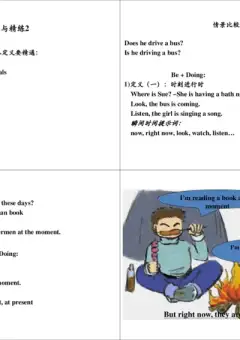
Somebody did something +I saw this
I saw somebody do something.
2
Somebody was doing something +I saw this
I saw somebody doing something.
I didn’t hear you come in
I suddenly felt something touch  me on the shoulder
I could hear it raining
Listen to the birds singing!
Can you smell something burning?
I found Sue in my room reading my letters.
2.练习与巩固
(1)Did anybody see the accident (happen/happening)?
(2)We listened to the old man (tell/telling) his story from beginning to end.
(3)Listen! Can you hear a baby (cry/crying)?
(4)-Why did you turn round suddenly?
-I heard someone (call/calling) my name.
(5)We watched the two men  (open/opening) a window and (climb/climbing)
through it into the house
(6)When we got home, we found  our cat (sleep/sleeping) on the table.
3
3.感官动词的被动语态
•
I saw the girl come in.
•
I saw the girl dancing.
•
变为被动句:
•
I heard a child crying-
•
I smell the cake burning-
•
I find him working in the room-
•
I saw my father go away-
•
I looked at him finish his homework-
•
I watched my sister’s car pull in-
感官动词考点突破:
(
) 1.He looked around and caught a man ______ his hand into the
pocket of a passenger.
A. put
B. to be putting
C. to put
D. putting
(
) 2.People often see him ______ basketball on the playground.
A. play
B. playing
C. to play
D. played
(
) 3.The girl is heard ______ the piano in the next room on Sundays.
A. plays
B. to play
C. played
D. play
(
) 4.Mary was seen______ along the street when the accident happened.
A. to run
B. running
C. run
D. ran
•
It's very common to meet different people in public places.
•
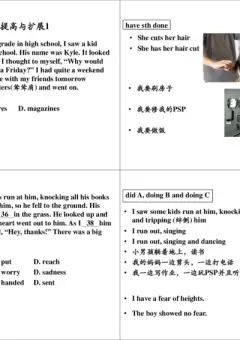
When I was 12 years old, l got a small job in a 16   . On my first day at
work,I didn't come home for lunch. When I came home at night, Mum
asked, "How did you 17       your lunch, dear?" I answered, "I made some
new friends in the supermarket, twin brothers, their mom and dad. They
were my customers. They invited me 18   lunch.“
•
16. A. supermarket       B. post office      C. factory      D. bank
•
17. A. find
B. make
C. manage      D. eat
•
18. A. at
B. for
C. after        D. before
完形填空真题精讲精练
•
common (a) 普遍的,常见的
4
•
难点动词manage (v)
•
(1)管理,经营
•
manage a department
•
管理一家工厂
•
管理一个公司
•
Manage your time
•
Manage your money
•
(2)(设法)应对,做成
•
I manage on 50 yuan a week.
•
I don't know how she manages with seven children.
•
I didn’t make good preparations for the test. Buy I managed with it
•
核心词组:manage to do (设法)成功做了
•
The doctor managed to save the boy’s life
•
我成功到达学校
•
我成功从我弟弟那借来了1000美元
•
Mum was happy that I had made new friends but she wanted to know
what kind of 19 they might be.
•
Several days later, I asked my friends to come to the supermarket where
I worked 20   let Mum meet them. Mum was very 21    to find out
that the twin brothers were joined at the chest. She felt very strange
because I didn’t tell her about that before.
•
19. A. men              B. boys           C. boys        D. people
•
20. A. and               B. but            C. or          D. so
•
21. A. surprised         B. excited          C. interested     D. disappointed
•
The twin brothers were joined at the chest.
•
join
•
(v)加入(become a member)
•
+俱乐部
•
+足球队
•
+公司
•
(v)连接
•
Join A to B
•
The highway joined Beijing to Tianjian
•
把这个板子钉到墙上
•
把Psp连到电脑上
5
•
When Mom asked me about this, I said, “I know that, too. But do you
know that their mom has to make all clothes because it’s 22  difficult
to find anything to fit them? They are also good 23   . That day, Joe,
the one on the right, made me noodles for lunch.”
•
When Mom saw the twins, she must have thought how strange they
24  . But to me, what I cared about was that they had difficulty 25
clothes and they were good cooks.
•
22. A. so                B. very
C. too          D. really
•
23. A. friends            B. singers         C. workers      D. cooks
•
24. A. smelled           B. looked          C. felt          D. sounded
•
25. A. selling            B. making          C. wearing     D. buying
•
重点词组:too +adj+to do
•
His father was too poor to send his son to school.
•
他太年轻而不能结婚
•
我太笨而不能上学
She was so weak that she couldn’t take care of her baby. (改同义句)
She was _______weak ______take care of her baby.
•
fit (a)健康的
•
fit (v)适合,合适
•
Her coat fits her well
•
核心辨析:fit, suit, match
•
这个衬衫很适合你
•
(1)The shirt suits you well
•
(2) The shirt fits you well
•
(3) The shirt matches you well
•
fit; match; suit
•
The seven o'clock train will _____ us very well
•
The key doesn't _____ the lock
•
Do you think these two colours_____?
•
Would it _____ you to come at five?
•
No one can _____ her at chess.
•
核心词组:
•
(1)have difficulty doing
•
做某事很困难
•
我们费了九牛二虎之力找到了你的家
•
背单词真的很难
•
跟他聊天很难
•
(2)have fun doing sth
6