文档文本内容
@小红书:苏苏老师精品资料——原创制作
2026 秋新人教PEP 版六年级上册英语知识清单
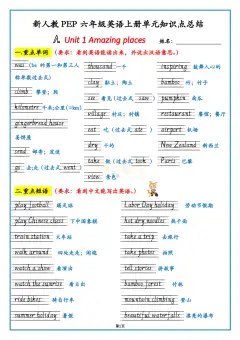
Unit 1 Amazing landmarks
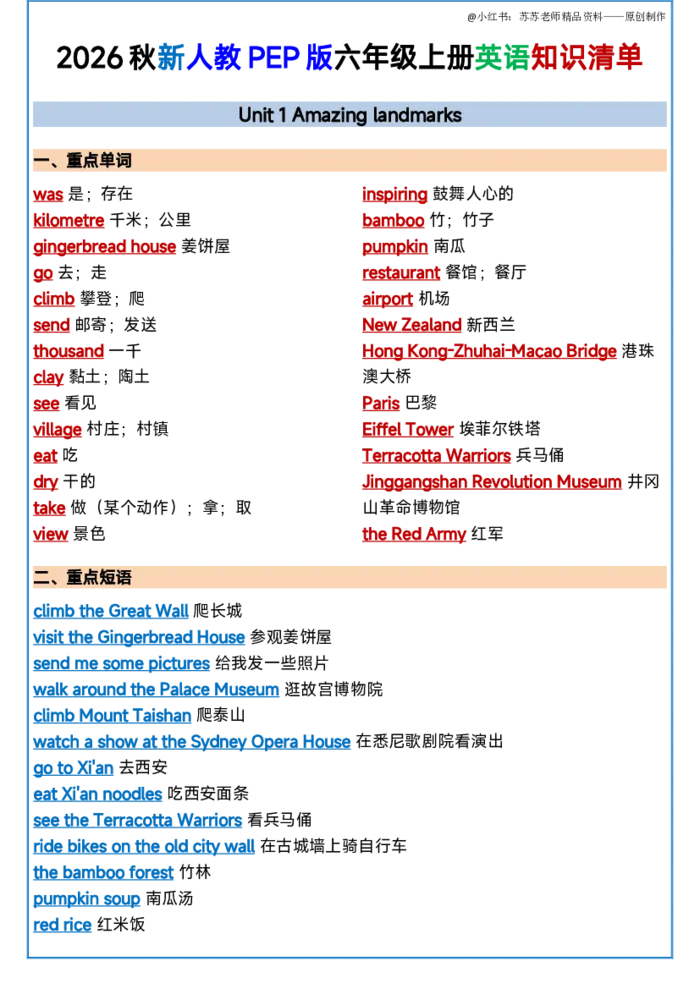
一、重点单词
was 是;存在
kilometre 千米;公里
gingerbread

  house

  姜饼屋
go 去;走
climb 攀登;爬
send 邮寄;发送
thousand 一千
clay 黏土;陶土
see 看见
village 村庄;村镇
eat 吃
dry 干的
take 做(某个动作);拿;取
view 景色
inspiring 鼓舞人心的
bamboo 竹;竹子
pumpkin 南瓜
restaurant 餐馆;餐厅
airport 机场
New

  Zealand

  新西兰
Hong

  Kong-Zhuhai-Macao

  Bridge

  港珠
澳大桥
Paris 巴黎
Eiffel

  Tower

  埃菲尔铁塔
Terracotta

  Warriors

  兵马俑
Jinggangshan

  Revolution

  Museum

  井冈
山革命博物馆
the

  Red

  Army

  红军
二、重点短语
climb

  the

  Great

  Wall

  爬长城
visit

  the

  Gingerbread

  House

  参观姜饼屋
send

  me

  some

  pictures

  给我发一些照片
walk

  around

  the

  Palace

  Museum

  逛故宫博物院
climb

  Mount

  Taishan

  爬泰山
watch

  a   show

  at
   the

  Sydney

  Opera

  House

  在悉尼歌剧院看演出
go
   to
   Xi'an

  去西安
eat

  Xi'an

  noodles

  吃西安面条
see

  the

  Terracotta

  Warriors

  看兵马俑
ride

  bikes

  on
   the

  old

  city

  wall

  在古城墙上骑自行车
the

  bamboo

  forest

  竹林
pumpkin

  soup

  南瓜汤
red

  rice

  红米饭
@小红书:苏苏老师精品资料——原创制作
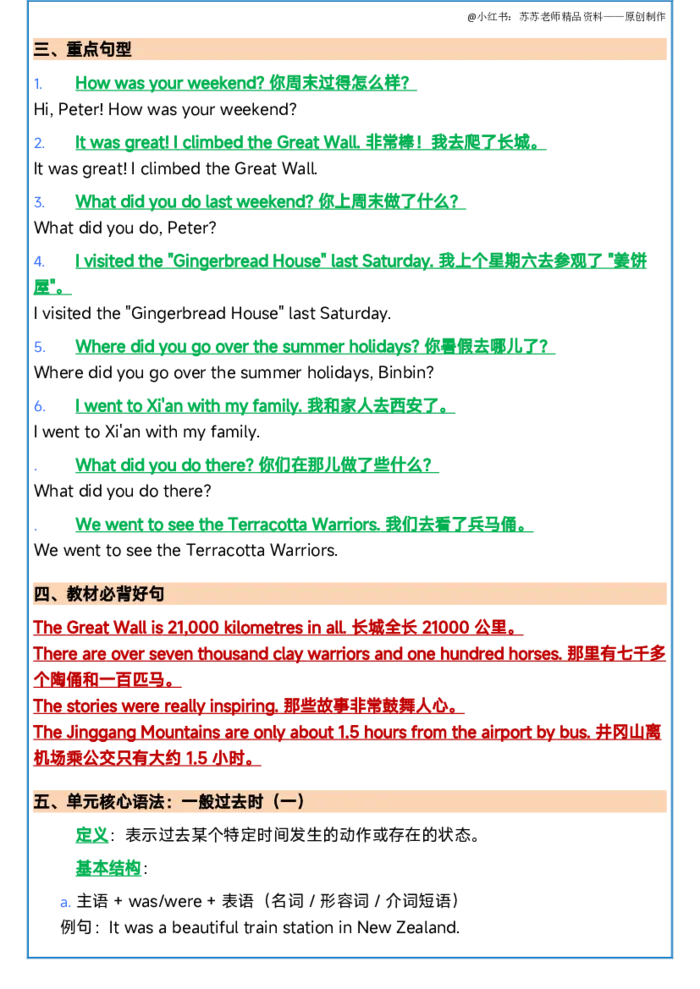
三、重点句型
1.
How

  was

  your

  weekend?

  你周末过得怎么样?


Hi, Peter! How was your weekend?
2.
It   was

  great!

  I  climbed

  the

  Great

  Wall.

  非常棒!我去爬了长城。


It was great! I climbed the Great Wall.
3.
What

  did

  you

  do
   last

  weekend?

  你上周末做了什么?


What did you do, Peter?
4.
I  visited

  the

  "Gingerbread

  House"

  last

  Saturday.

  我上个星期六去参观了

 " 姜饼


屋
  " 。

I visited the "Gingerbread House" last Saturday.
5.
Where

  did

  you

  go
   over

  the

  summer

  holidays?

  你暑假去哪儿了?


Where did you go over the summer holidays, Binbin?
6.
I  went

  to
   Xi'an

  with

  my

  family.

  我和家人去西安了。


I went to Xi'an with my family.
7.
What

  did

  you

  do
   there?

  你们在那儿做了些什么?


What did you do there?
8.
We

  went

  to
   see

  the

  Terracotta

  Warriors.

  我们去看了兵马俑。


We went to see the Terracotta Warriors.
四、教材必背好句
The

  Great

  Wall

  is   21,000

  kilometres

  in
   all.
   长城全长

 21000

  公里。


There

  are

  over

  seven

  thousand

  clay

  warriors

  and

  one

  hundred

  horses.

  那里有七千多


个陶俑和一百匹马。
The

  stories

  were

  really

  inspiring.

  那些故事非常鼓舞人心。


The

  Jinggang

  Mountains

  are

  only

  about

  1.5
   hours

  from

  the

  airport

  by
   bus.

  井冈山离


机场乘公交只有大约

 1.5
   小时。


五、单元核心语法:一般过去时(一)
•
定义

 :表示过去某个特定时间发生的动作或存在的状态。
•
基本结构

 :
a. 主语 + was/were + 表语(名词 / 形容词 / 介词短语)
例句:It was a beautiful train station in New Zealand.
@小红书:苏苏老师精品资料——原创制作
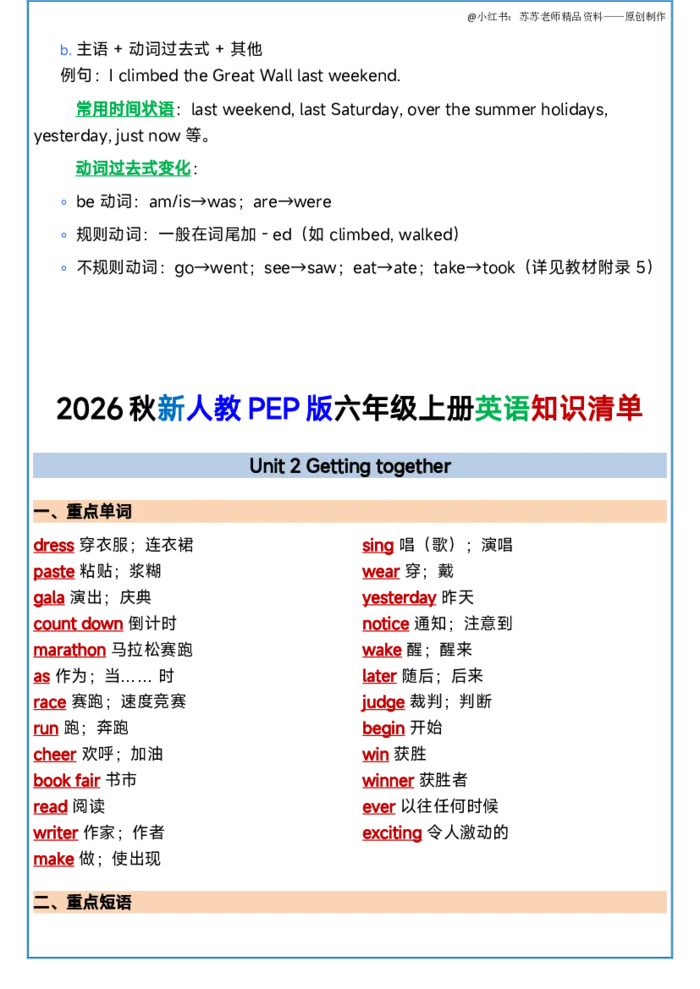
b. 主语 + 动词过去式 + 其他
例句:I climbed the Great Wall last weekend.
•
常用时间状语

 :last weekend, last Saturday, over the summer holidays,
yesterday, just now 等。
•
动词过去式变化

 :
○be 动词:am/is→was;are→were
○规则动词:一般在词尾加 - ed(如 climbed, walked)
○不规则动词:go→went;see→saw;eat→ate;take→took(详见教材附录 5)
2026 秋新人教PEP 版六年级上册英语知识清单
Unit 2 Getting together
一、重点单词
dress 穿衣服;连衣裙
paste 粘贴;浆糊
gala 演出;庆典
count

  down

  倒计时
marathon 马拉松赛跑
as 作为;当…… 时
race 赛跑;速度竞赛
run 跑;奔跑
cheer 欢呼;加油
book

  fair

  书市
read 阅读
writer 作家;作者
make 做;使出现
sing 唱(歌);演唱
wear 穿;戴
yesterday 昨天
notice 通知;注意到
wake 醒;醒来
later 随后;后来
judge 裁判;判断
begin 开始
win 获胜
winner 获胜者
ever 以往任何时候
exciting 令人激动的
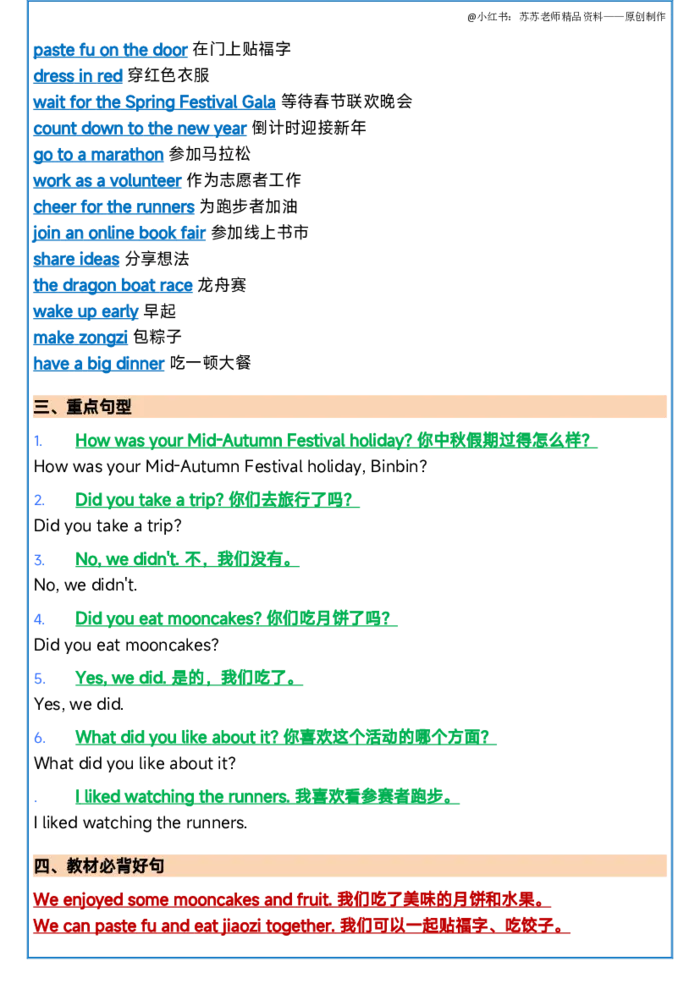
二、重点短语
@小红书:苏苏老师精品资料——原创制作
paste

  fu
   on
   the

  door

  在门上贴福字
dress

  in
   red

  穿红色衣服
wait

  for
   the

  Spring

  Festival

  Gala

  等待春节联欢晚会
count

  down

  to
   the

  new

  year

  倒计时迎接新年
go
   to
   a   marathon

  参加马拉松
work

  as
   a   volunteer

  作为志愿者工作
cheer

  for
   the

  runners

  为跑步者加油
join

  an
   online

  book

  fair

  参加线上书市
share

  ideas

  分享想法
the

  dragon

  boat

  race

  龙舟赛
wake

  up
   early

  早起
make

  zongzi

  包粽子
have

  a   big

  dinner

  吃一顿大餐
三、重点句型
1.
How

  was

  your

  Mid-Autumn

  Festival

  holiday?

  你中秋假期过得怎么样?


How was your Mid-Autumn Festival holiday, Binbin?
2.
Did

  you

  take

  a   trip?

  你们去旅行了吗?


Did you take a trip?
3.
No,

  we
   didn't.

  不,我们没有。


No, we didn't.
4.
Did

  you

  eat

  mooncakes?

  你们吃月饼了吗?


Did you eat mooncakes?
5.
Yes,

  we
   did.

  是的,我们吃了。


Yes, we did.
6.
What

  did

  you

  like

  about

  it?
   你喜欢这个活动的哪个方面?


What did you like about it?
7.
I  liked

  watching

  the

  runners.

  我喜欢看参赛者跑步。


I liked watching the runners.
四、教材必背好句
We

  enjoyed

  some

  mooncakes

  and

  fruit.

  我们吃了美味的月饼和水果。


We

  can

  paste

  fu
   and

  eat

  jiaozi

  together.

  我们可以一起贴福字、吃饺子。


@小红书:苏苏老师精品资料——原创制作
Finally,

  his
   team

  won

  the

  race!

  最后,他的队伍赢得了比赛!


It   was

  the

  best

  Dragon

  Boat

  Festival

  ever!

  这是有史以来最好的端午节!


五、单元核心语法:一般过去时(二)—— 一般疑问句
•
结构

 :Did + 主语 + 动词原形 + 其他?
•
肯定回答

 :Yes, 主语 + did.
•
否定回答

 :No, 主语 + didn't.
•
例句

 :
Did you eat mooncakes?
Yes, we did. / No, we didn't.
•
注意

 :助动词 did 后必须跟动词原形,原来的动词过去式要还原。
2026 秋新人教PEP 版六年级上册英语知识清单
Unit 3 Healthy life
一、重点单词
@小红书:苏苏老师精品资料——原创制作
cold 感冒;寒冷的
ill 不舒服;有病
head 头;头部
runny

  nose

  流鼻涕
soon 很快;马上
fever 发烧;发热
cough 咳嗽
discuss 讨论;商量
diet 日常饮食
stay

  up
   熬夜
cry 哭;哭泣
another 另一;不同的
call 打电话;称呼
email 电子邮件;发邮件
unhappy 不快乐的;难过的
glass 一杯(的量);玻璃
may 也许;可能
add 补充说;增加
video 视频;录像
better 好转的;更好的
二、重点短语
have

  a   bad

  cold

  得了重感冒
have

  a   fever

  发烧
have

  a   cough

  咳嗽
see

  a   doctor

  看医生
go
   to
   hospital

  去医院
get

  well

  soon

  早日康复
have

  a   healthy

  diet

  保持健康饮食
exercise

  often

  经常锻炼
think

  about

  happy

  things

  想开心的事情
join

  clubs

  and

  teams

  加入俱乐部和团队
make

  video

  calls

  打视频电话
cheer

  you

  up
   让你振作起来
三、重点句型
1.
How

  do
   you

  feel?

  你感觉怎么样?


How do you feel?
2.
I  feel

  ill.
   My

  head

  hurts

  and

  I  have

  a   runny

  nose.

  我感觉不舒服。我头痛还流鼻


涕。
I feel ill. My head hurts and I have a runny nose.
3.
Maybe

  you

  should

  see

  a   doctor.

  也许你应该去看医生。


Maybe you should see a doctor.
@小红书:苏苏老师精品资料——原创制作
4.
How

  can

  we
   live

  a   healthy

  life?

  我们怎样能过健康的生活?


How can we live a healthy life?
5.
We

  need

  to
   eat

  healthy

  food.

  We

  should

  exercise

  too.

  我们需要吃健康的食物

 ,

还需要运动。
We need to eat healthy food. We should exercise too.
四、教材必背好句
My

  mum

  is   going

  to
   take

  me

  to
   hospital

  this

  afternoon.

  我妈妈今天下午要带我去医


院。
Health

  is   having

  a   good

  body

  and

  feeling

  happy.

  健康是拥有健康的身体和快乐的心情。


Exercise

  may

  cheer

  you

  up!

  运动可能会让你振作起来!


I  also

  joined

  a   ping-pong

  club

  and

  made

  some

  new

  friends.

  我还加入了乒乓球俱乐部

 ,

交了一些新朋友。
五、单元核心语法
1.
一般现在时(描述身体状况)


结构:主语 + 动词原形 / 第三人称单数 + 其他
例句:My head hurts.
2.
一般将来时(

 be
   going

  to
   结构)


结构:主语 + am/is/are going to + 动词原形 + 其他
例句:My mum is going to take me to hospital this afternoon.
3.
情态动词

 should

 (提建议)


结构:主语 + should + 动词原形 + 其他
否定式:主语 + shouldn't + 动词原形 + 其他
例句:You should drink some water and have a rest.
@小红书:苏苏老师精品资料——原创制作
2026 秋新人教PEP 版六年级上册英语知识清单
Unit 4 Managing money well
一、重点单词
money 钱
pocket

  money

  零花钱
schoolbag 书包
goods 商品
drink 饮料;喝
service 服务
haircut 理发;发型
microscope 显微镜
lucky 幸运的
save

  up
   攒钱
sale 特价销售;出售
ticket 票
manage 管理
difficult 困难的
sell 售;售卖
jar 罐子
half 一半
for
   example

  例如
二、重点短语
count

  pocket

  money

  数零花钱
buy

  a   schoolbag

  买书包
buy

  goods

  买商品
pay

  for
   services

  支付服务费用
have

  a   haircut

  理发
lucky

  money

  压岁钱
save

  up
   for
   a   computer

  攒钱买电脑
wait

  for
   a   sale

  等打折
make

  a   spending

  plan

  制定消费计划
use

  money

  wisely

  明智地用钱
@小红书:苏苏老师精品资料——原创制作
三、重点句型
1.
How

  are

  you

  going

  to
   spend

  it?
   你打算怎么花这些钱?


How are you going to spend it?
2.
I'm
   going

  to
   buy

  a   schoolbag.

  我打算买一个书包。


I'm going to buy a schoolbag.
3.
I  also

  want

  to
   buy

  some

  books.

  我还想买一些书。


I also want to buy some books.
4.
I  need

  to
   save

  more.

  我需要攒更多钱。


I need to save more.
5.
What

  else

  are

  you

  going

  to
   buy?

  你还打算买什么?


What else are you going to buy?
四、教材必背好句
I  have

  three

  hundred

  and

  fifty-seven

  yuan.

  我有三百五十七元。


We

  use

  money

  to
   buy

  goods

  and

  pay

  for
   services.

  我们用钱买商品和支付服务费用。


Maybe

  we
   can

  wait

  for
   a   sale!

  也许我们可以等打折!


Writing

  a   spending

  plan

  helps

  us
   use

  money

  wisely.

  制定消费计划能帮助我们明智地


用钱。
五、单元核心语法
1.
一般将来时(

 be
   going

  to
   结构表计划)


用法:表示将来打算、计划做的事情
例句:I'm going to buy a pair of sunglasses for Grandpa.
2.
want

  to
   与

 need

  to
   的用法


○want to + 动词原形:表示 "想要做某事"(主观愿望)
例句:I want to buy a microscope.
○need to + 动词原形:表示 "需要做某事"(客观需求)
例句:I need to save more money.
@小红书:苏苏老师精品资料——原创制作
2026 秋新人教PEP 版六年级上册英语知识清单
Unit 5 Exploring space
一、重点单词
planet 行星
earth 地球
sky 天;天空
daytime 白天
cloud 云
moon 月球;月亮
star 恒星;星
space 太空;空间
outer

  space

  外层空间
space

  station

  空间站
ocean 大海;海洋
marble (玻璃)弹子
satellite 人造卫星
soil 土壤
alien 外星生物
sunrise 日出
rover 探测器
into 朝;进入
@小红书:苏苏老师精品资料——原创制作
telescope 望远镜
astronaut 宇航员
month 月;月份
spaceship 宇宙飞船
taikonaut 中国航天员
cloth 布;织物
toothpaste 牙膏
question 问题
time 次;回
sunset 日落
Mars 火星
二、重点短语
travel

  around

  the

  Sun

  绕着太阳转
look

  at
   the

  stars

  看星星
from

  outer

  space

  从外太空
the

  Blue

  Planet

  蓝色星球
Mother

  Earth

  地球母亲
look

  into

  space

  with

  telescopes

  用望远镜观察太空
go
   into

  space

  进入太空
fly
   by
   spaceship

  乘宇宙飞船飞行
live

  on
   a   space

  station

  住在空间站
grow

  vegetables

  种蔬菜
give

  classes

  to
   children

  给孩子们上课
do
   exercise

  做运动
三、重点句型
1.
What

  can

  you

  see

  in
   the

  sky?

  你能在天空中看到什么?


What can you see in the sky?
2.
We

  can

  see

  the

  Sun

  and

  the

  clouds.

  我们能看到太阳和云。


We can see the Sun and the clouds.
3.
At
   night,

  we
   can

  see

  the

  Moon

  and

  the

  stars.

  在晚上,我们能看到月亮和星星。


At night, we can see the Moon and the stars.
4.
Is   there

  any

  water

  on
   Mars?

  火星上有水吗?


Is there any water on Mars?
5.
Yes,

  there

  is.
   There

  is   soil

  too.

  是的,有。那里还有土壤。


Yes, there is. There is soil too.
6.
Are

  there

  any

  aliens?

  有外星人吗?


Are there any aliens?
@小红书:苏苏老师精品资料——原创制作
7.
There

  aren't

  any

  living

  things.

  那里没有生物。


There aren't any living things.
四、教材必背好句
Earth

  looks

  like

  a   big

  blue

  marble

  from

  outer

  space.

  从外太空看,地球像一个蓝色的


大弹子。
China

  already

  put

  a   rover

  on
   Mars.

  中国已经在火星上放置了探测器。


Taikonauts

  can

  see

  the

  sunrise

  and

  sunset

  16
   times

  a   day.

  中国航天员一天能看到

 16

次日出和日落。
Their

  life

  in
   space

  is   special

  but

  hard.

  他们在太空的生活很特别但也很辛苦。


五、单元核心语法
1.
情态动词

 can

 (表能力

 /   可能性)


结构:主语 + can + 动词原形 + 其他
否定式:主语 + can't + 动词原形 + 其他
例句:We can see mountains and oceans from outer space.
2.
There

  be
   句型(一般现在时)


○肯定句:There is + 单数名词 / 不可数名词 + 其他;There are + 复数名词 + 其他
○一般疑问句:Is there + 单数名词 / 不可数名词 + 其他?;Are there + 复数名词
+ 其他?
○回答:Yes, there is/are./ No, there isn't/aren't.
例句:Is there any water on Mars? Yes, there is.
2026 秋新人教PEP 版六年级上册英语知识清单
Unit 6 Energy, nature and us
@小红书:苏苏老师精品资料——原创制作
一、重点单词
power 能;能量
electricity 电
solar 太阳的
type 类型;种类
energy 能源
light 照亮;光
source 来源
heat 加热;热量
cool (使)变凉;凉爽的
run 使运行;跑
resource 资源
run

  out

  用完
few 不多;很少
change 改变;变化
quick 迅速的;快的
shower 淋浴
unplug 拔掉电源插头
difference 差别;不同
reduce 减少
air
   conditioner

  空调机
drive 驾驶;开车
reuse 再次使用
own 自己的;拥有
top 最高的;顶部
market 集市;市场
bottle 瓶子
dirty 脏的
useful 有用的
side 一面;一边
二、重点短语
water

  power

  水能
solar

  power

  太阳能
wind

  power

  风能
green

  energy

  绿色能源
make

  electricity

  发电
light

  our

  homes

  照亮我们的家
run

  cars

  发动汽车
save

  energy

  节约能源
take

  quick

  showers

  快速淋浴
use

  LED

  lighting

  使用 LED 照明
unplug

  computers

  拔掉电脑电源
follow

  the

  "3R"

  rules

  遵守 "3R" 原则
use

  both

  sides

  of
   paper

  使用纸的两面
recycle

  bottles

  回收瓶子
三、重点句型
@小红书:苏苏老师精品资料——原创制作
1.
Running

  water

  can

  make

  electricity.

  流水可以发电。


Running water can make electricity.
2.
Where

  does

  water

  come

  from?

  水从哪儿来?


Where does water come from?
3.
How

  can

  we
   save

  energy?

  我们怎样才能节约能源?


How can we save energy?
4.
We

  can

  take

  quick

  showers.

  我们可以快速淋浴。


We can take quick showers.
5.
We

  should

  always

  unplug

  our

  computers

  and

  TVs.

  我们应该总是拔掉电脑和电


视的电源插头。
We should always unplug our computers and TVs.
6.
Small

  changes

  can

  make

  a   big

  difference.

  小改变能带来大不同。


Small changes can make a big difference.
四、教材必背好句
Wind

  power,

  solar

  power

  and

  water

  power

  are

  types

  of
   green

  energy.

  风能、太阳能


和水能是绿色能源的类型。
Mother

  Earth

  is   running

  out

  of
   resources!

  地球母亲的资源快要耗尽了!


We

  should

  use

  air
   conditioners

  less.

  我们应该少用空调。


Sunlight

  is   a   great

  source

  of
   energy.

  阳光是一种很好的能源来源。


五、单元核心语法
1.
一般现在时(描述客观事实)


用法:用于描述科学真理、客观存在的事实
例句:Wind power is clean and good for Mother Earth.
2.
情态动词

 should

 (表建议

 /   责任)


用法:表示 "应该做某事",用于提出建议或说明责任
例句:We should save energy and protect our Earth.
3.
"3R"

  原则表达


○Reduce(减少):Use air conditioners less.
○Reuse(重复使用):Bring our own bags to shops.
○Recycle(回收利用):Recycle bottles and boxes.
@小红书:苏苏老师精品资料——原创制作
@小红书:苏苏老师精品资料_______原创制作,更多精品原创资料请关注小红书