@小红书:苏苏老师精品资料——原创制作
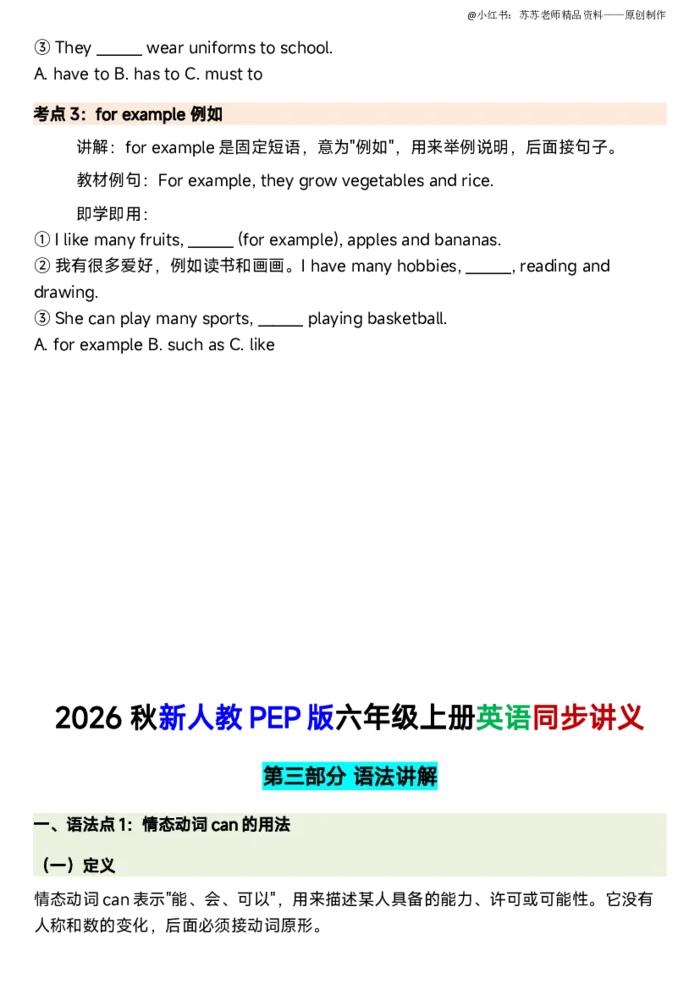
2026 秋新人教PEP 版六年级上册英语同步讲义
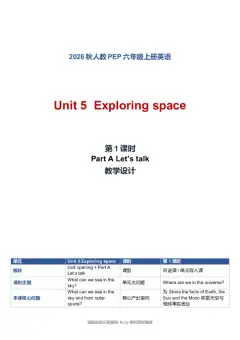
Unit 5 Exploring space 同步讲义
第一部分 知识清单
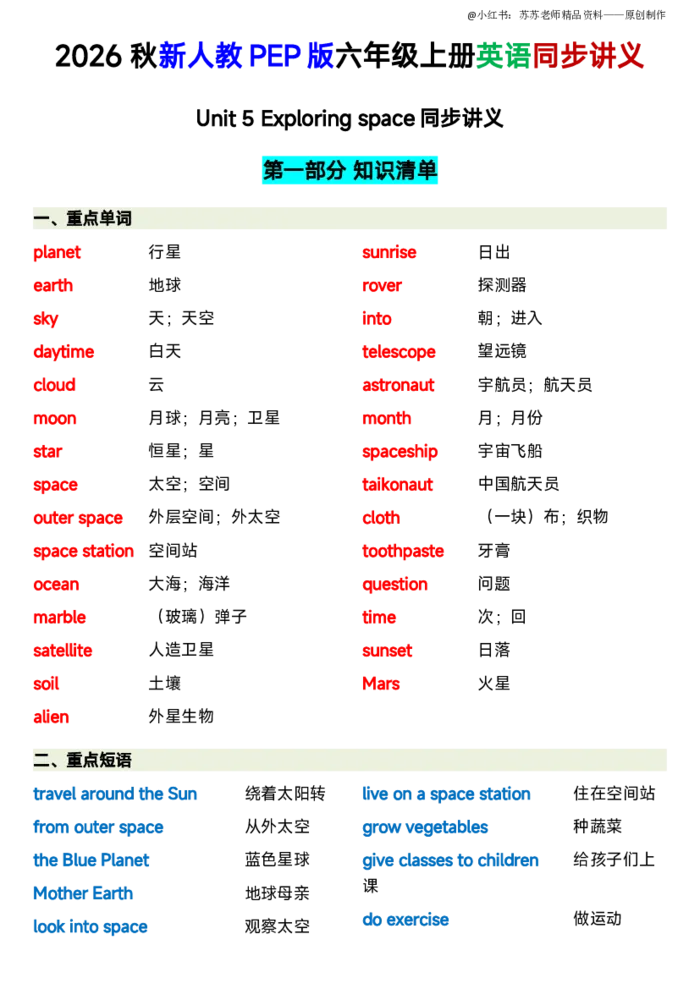
一、重点单词
planet
行星
earth
地球
sky
天;天空
daytime
白天
cloud
云
moon
月球;月亮;卫星
star
恒星;星
space
太空;空间
outer space
外层空间;外太空
space station
空间站
ocean
大海;海洋
marble
(玻璃)弹子
satellite
人造卫星
soil
土壤
alien
外星生物
sunrise
日出
rover
探测器
into
朝;进入
telescope
望远镜
astronaut
宇航员;航天员
month
月;月份
spaceship
宇宙飞船
taikonaut
中国航天员
cloth
(一块)布;织物
toothpaste
牙膏
question
问题
time
次;回
sunset
日落
Mars
火星
二、重点短语
travel around the Sun
绕着太阳转
from outer space
从外太空
the Blue Planet
蓝色星球
Mother Earth
地球母亲
look into space
观察太空
live on a space station
住在空间站
grow vegetables
种蔬菜
give classes to children
给孩子们上
课
do exercise
做运动
@小红书:苏苏老师精品资料——原创制作
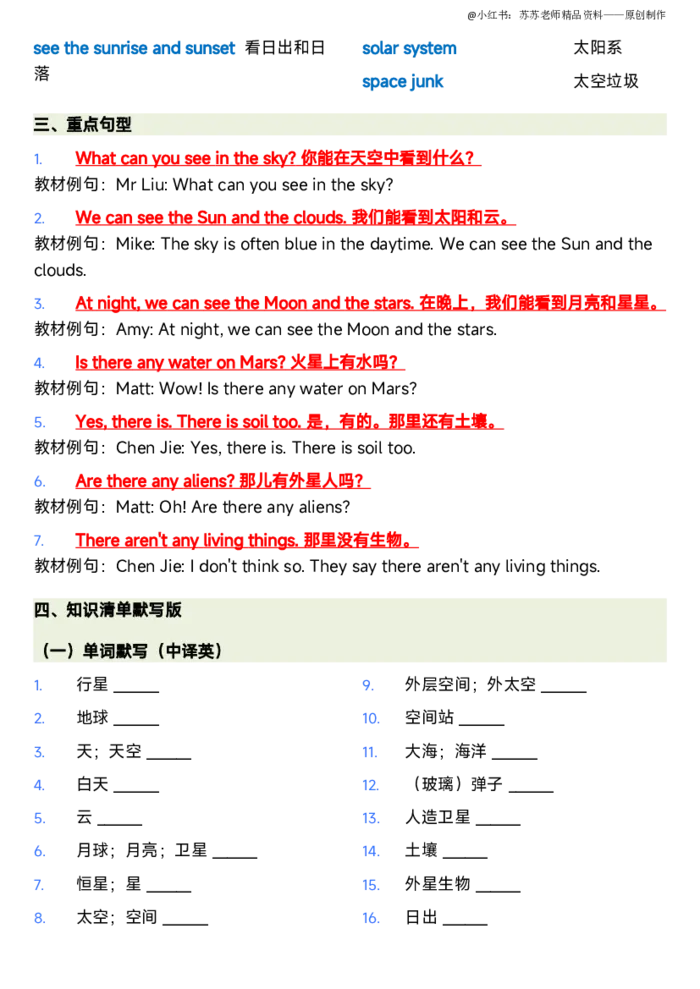
see the sunrise and sunset 看日出和日
落
solar system
太阳系
space junk
太空垃圾
三、重点句型
1.
What

  can

  you

  see

  in
   the

  sky?

  你能在天空中看到什么?


教材例句:Mr Liu: What can you see in the sky?
2.
We

  can

  see

  the

  Sun

  and

  the

  clouds.

  我们能看到太阳和云。


教材例句:Mike: The sky is often blue in the daytime. We can see the Sun and the
clouds.
3.
At
   night,

  we
   can

  see

  the

  Moon

  and

  the

  stars.

  在晚上,我们能看到月亮和星星。


教材例句:Amy: At night, we can see the Moon and the stars.
4.
Is   there

  any

  water

  on
   Mars?

  火星上有水吗?


教材例句:Matt: Wow! Is there any water on Mars?
5.
Yes,

  there

  is.
   There

  is   soil

  too.

  是,有的。那里还有土壤。


教材例句:Chen Jie: Yes, there is. There is soil too.
6.
Are

  there

  any

  aliens?

  那儿有外星人吗?


教材例句:Matt: Oh! Are there any aliens?
7.
There

  aren't

  any

  living

  things.

  那里没有生物。


教材例句:Chen Jie: I don't think so. They say there aren't any living things.
四、知识清单默写版
(一)单词默写(中译英)
1.
行星 ______
2.
地球 ______
3.
天;天空 ______
4.
白天 ______
5.
云 ______
6.
月球;月亮;卫星 ______
7.
恒星;星 ______
8.
太空;空间 ______
9.
外层空间;外太空 ______
10.
空间站 ______
11.
大海;海洋 ______
12.
(玻璃)弹子 ______
13.
人造卫星 ______
14.
土壤 ______
15.
外星生物 ______
16.
日出 ______
@小红书:苏苏老师精品资料——原创制作
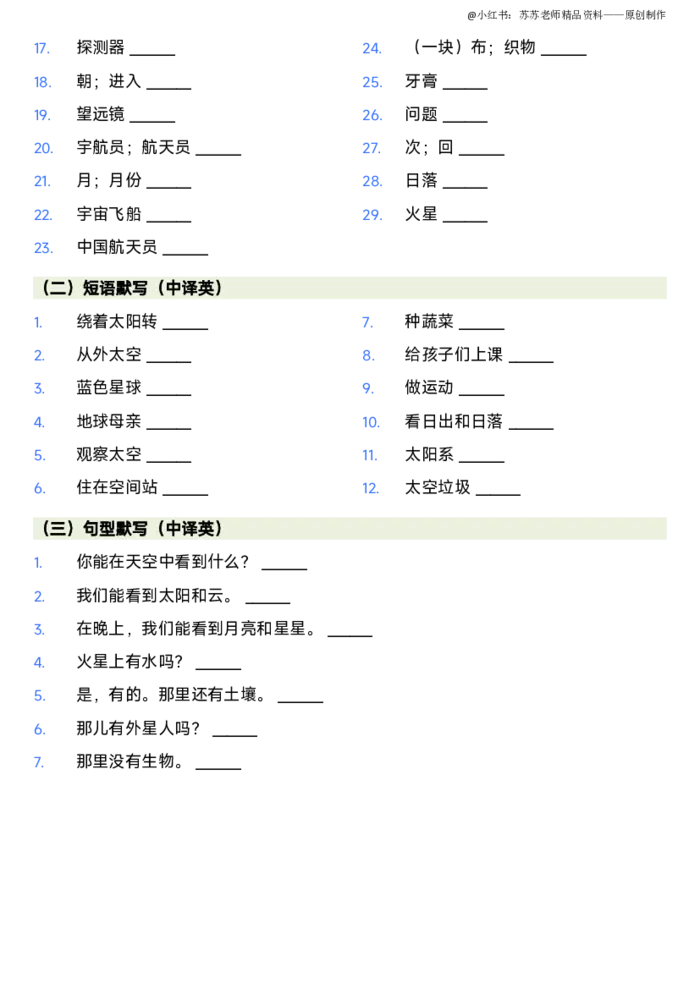
17.
探测器 ______
18.
朝;进入 ______
19.
望远镜 ______
20.
宇航员;航天员 ______
21.
月;月份 ______
22.
宇宙飞船 ______
23.
中国航天员 ______
24.
(一块)布;织物 ______
25.
牙膏 ______
26.
问题 ______
27.
次;回 ______
28.
日落 ______
29.
火星 ______
(二)短语默写(中译英)
1.
绕着太阳转 ______
2.
从外太空 ______
3.
蓝色星球 ______
4.
地球母亲 ______
5.
观察太空 ______
6.
住在空间站 ______
7.
种蔬菜 ______
8.
给孩子们上课 ______
9.
做运动 ______
10.
看日出和日落 ______
11.
太阳系 ______
12.
太空垃圾 ______
(三)句型默写(中译英)
1.
你能在天空中看到什么? ______
2.
我们能看到太阳和云。 ______
3.
在晚上,我们能看到月亮和星星。 ______
4.
火星上有水吗? ______
5.
是,有的。那里还有土壤。 ______
6.
那儿有外星人吗? ______
7.
那里没有生物。 ______
@小红书:苏苏老师精品资料——原创制作
2026 秋新人教PEP 版六年级上册英语同步讲义
第二部分 课文精讲精练
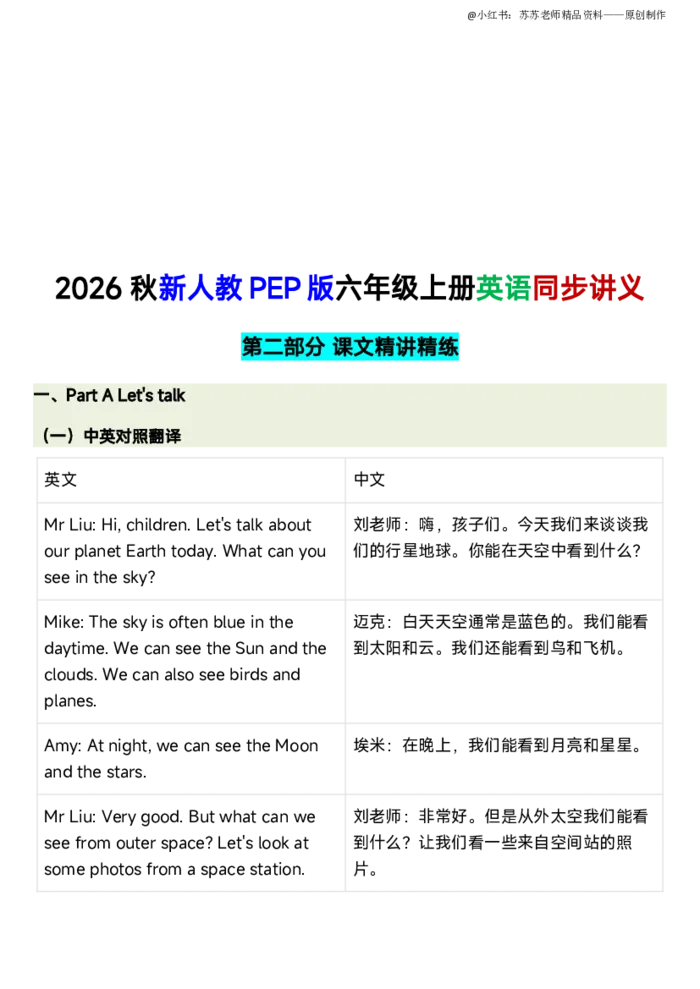
一、Part A Let's talk
(一)中英对照翻译
英文
中文
Mr Liu: Hi, children. Let's talk about
our planet Earth today. What can you
see in the sky?
刘老师:嗨,孩子们。今天我们来谈谈我
们的行星地球。你能在天空中看到什么?
Mike: The sky is often blue in the
daytime. We can see the Sun and the
clouds. We can also see birds and
planes.
迈克:白天天空通常是蓝色的。我们能看
到太阳和云。我们还能看到鸟和飞机。
Amy: At night, we can see the Moon
and the stars.
埃米:在晚上,我们能看到月亮和星星。
Mr Liu: Very good. But what can we
see from outer space? Let's look at
some photos from a space station.
刘老师:非常好。但是从外太空我们能看
到什么?让我们看一些来自空间站的照
片。
@小红书:苏苏老师精品资料——原创制作
(一)中英对照翻译
(二)精讲精练
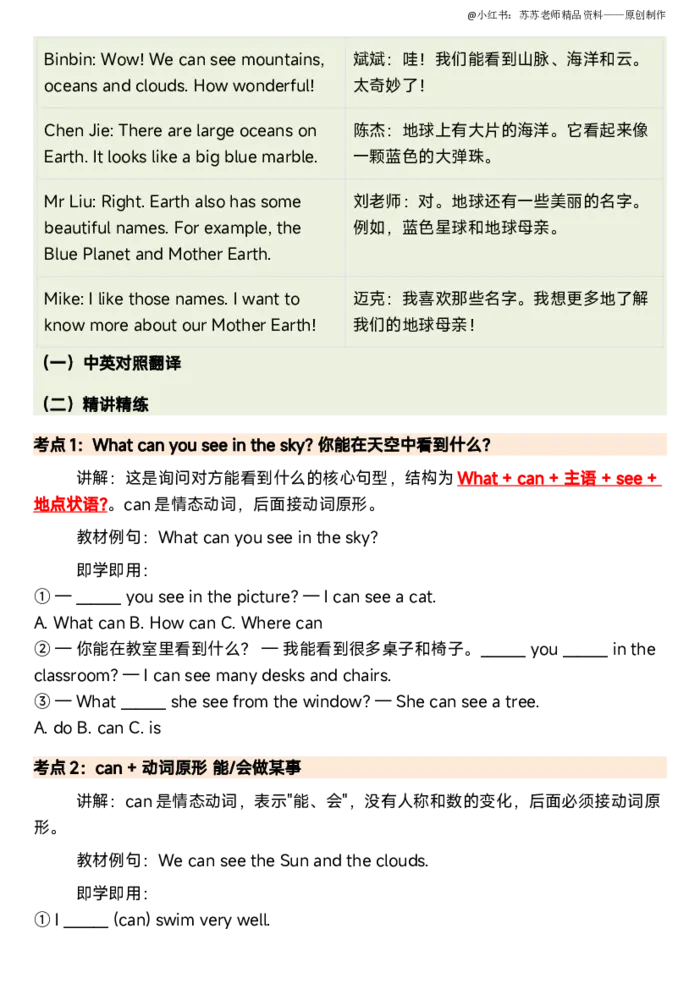
考点1:What can you see in the sky? 你能在天空中看到什么?
•
讲解:这是询问对方能看到什么的核心句型,结构为What

  +   can

  +   主语

 +   see

  +
地点状语

 ?  。can 是情态动词,后面接动词原形。
•
教材例句:What can you see in the sky?
•
即学即用:
① — ______ you see in the picture? — I can see a cat.
A. What can B. How can C. Where can
② — 你能在教室里看到什么? — 我能看到很多桌子和椅子。______ you ______ in the
classroom? — I can see many desks and chairs.
③ — What ______ she see from the window? — She can see a tree.
A. do B. can C. is
考点2:can + 动词原形 能/会做某事
•
讲解:can 是情态动词,表示"能、会",没有人称和数的变化,后面必须接动词原
形。
•
教材例句:We can see the Sun and the clouds.
•
即学即用:
① I ______ (can) swim very well.
Binbin: Wow! We can see mountains,
oceans and clouds. How wonderful!
斌斌:哇!我们能看到山脉、海洋和云。
太奇妙了!
Chen Jie: There are large oceans on
Earth. It looks like a big blue marble.
陈杰:地球上有大片的海洋。它看起来像
一颗蓝色的大弹珠。
Mr Liu: Right. Earth also has some
beautiful names. For example, the
Blue Planet and Mother Earth.
刘老师:对。地球还有一些美丽的名字。
例如,蓝色星球和地球母亲。
Mike: I like those names. I want to
know more about our Mother Earth!
迈克:我喜欢那些名字。我想更多地了解
我们的地球母亲!
@小红书:苏苏老师精品资料——原创制作
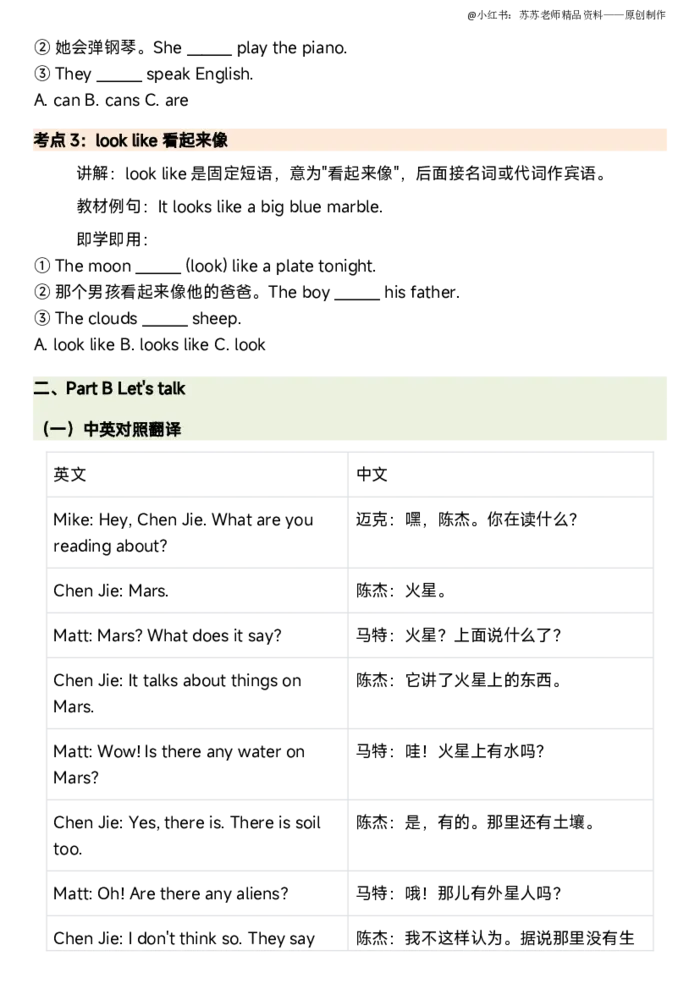
② 她会弹钢琴。She ______ play the piano.
③ They ______ speak English.
A. can B. cans C. are
考点3:look like 看起来像
•
讲解:look like 是固定短语,意为"看起来像",后面接名词或代词作宾语。
•
教材例句:It looks like a big blue marble.
•
即学即用:
① The moon ______ (look) like a plate tonight.
② 那个男孩看起来像他的爸爸。The boy ______ his father.
③ The clouds ______ sheep.
A. look like B. looks like C. look
二、Part B Let's talk
(一)中英对照翻译
英文
中文
Mike: Hey, Chen Jie. What are you
reading about?
迈克:嘿,陈杰。你在读什么?
Chen Jie: Mars.
陈杰:火星。
Matt: Mars? What does it say?
马特:火星?上面说什么了?
Chen Jie: It talks about things on
Mars.
陈杰:它讲了火星上的东西。
Matt: Wow! Is there any water on
Mars?
马特:哇!火星上有水吗?
Chen Jie: Yes, there is. There is soil
too.
陈杰:是,有的。那里还有土壤。
Matt: Oh! Are there any aliens?
马特:哦!那儿有外星人吗?
Chen Jie: I don't think so. They say
陈杰:我不这样认为。据说那里没有生
@小红书:苏苏老师精品资料——原创制作
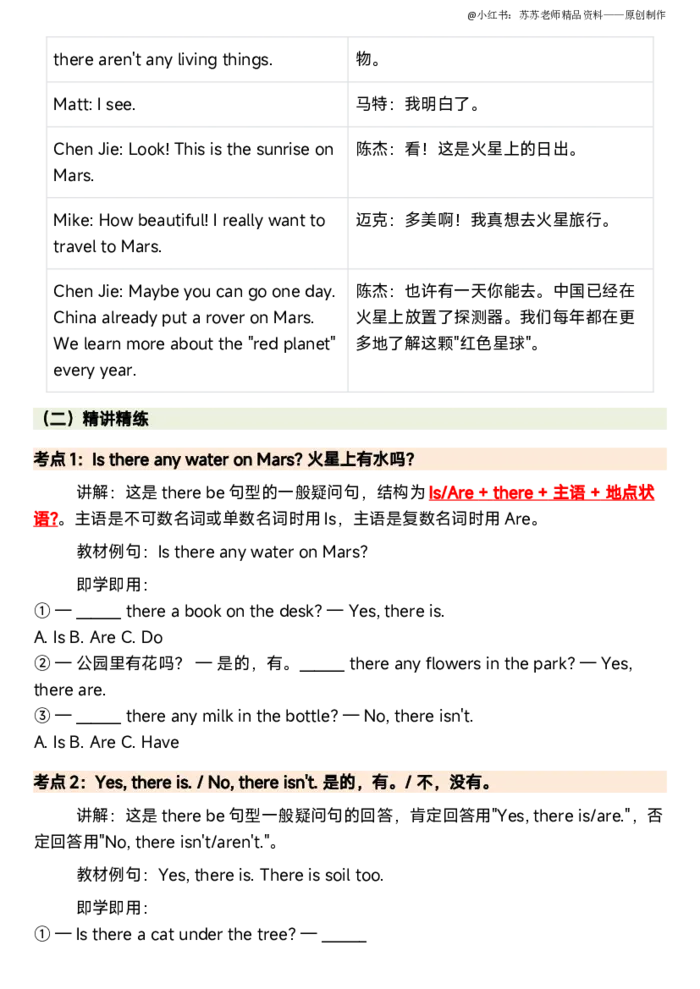
there aren't any living things.
物。
Matt: I see.
马特:我明白了。
Chen Jie: Look! This is the sunrise on
Mars.
陈杰:看!这是火星上的日出。
Mike: How beautiful! I really want to
travel to Mars.
迈克:多美啊!我真想去火星旅行。
Chen Jie: Maybe you can go one day.
China already put a rover on Mars.
We learn more about the "red planet"
every year.
陈杰:也许有一天你能去。中国已经在
火星上放置了探测器。我们每年都在更
多地了解这颗"红色星球"。
(二)精讲精练
考点1:Is there any water on Mars? 火星上有水吗?
•
讲解:这是there be 句型的一般疑问句,结构为Is/Are

  +   there

  +   主语

 +   地点状


语
  ?  。主语是不可数名词或单数名词时用Is,主语是复数名词时用Are。
•
教材例句:Is there any water on Mars?
•
即学即用:
① — ______ there a book on the desk? — Yes, there is.
A. Is B. Are C. Do
② — 公园里有花吗? — 是的,有。______ there any flowers in the park? — Yes,
there are.
③ — ______ there any milk in the bottle? — No, there isn't.
A. Is B. Are C. Have
考点2:Yes, there is. / No, there isn't. 是的,有。/ 不,没有。
•
讲解:这是there be 句型一般疑问句的回答,肯定回答用"Yes, there is/are.",否
定回答用"No, there isn't/aren't."。
•
教材例句:Yes, there is. There is soil too.
•
即学即用:
① — Is there a cat under the tree? — ______
@小红书:苏苏老师精品资料——原创制作
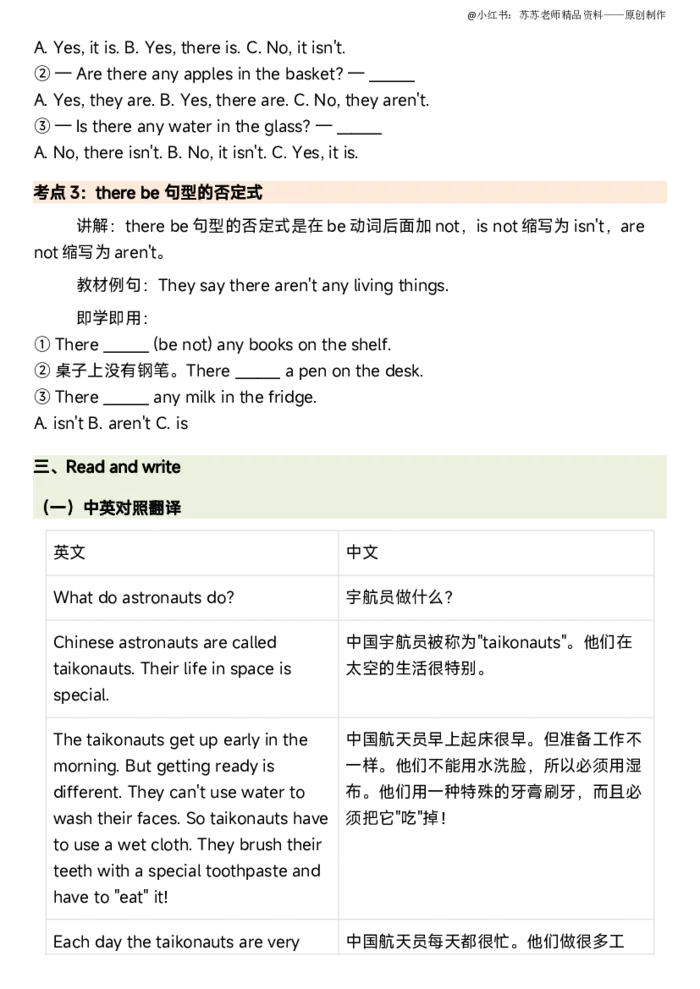
A. Yes, it is. B. Yes, there is. C. No, it isn't.
② — Are there any apples in the basket? — ______
A. Yes, they are. B. Yes, there are. C. No, they aren't.
③ — Is there any water in the glass? — ______
A. No, there isn't. B. No, it isn't. C. Yes, it is.
考点3:there be 句型的否定式
•
讲解:there be 句型的否定式是在be 动词后面加not,is not 缩写为isn't,are
not 缩写为aren't。
•
教材例句:They say there aren't any living things.
•
即学即用:
① There ______ (be not) any books on the shelf.
② 桌子上没有钢笔。There ______ a pen on the desk.
③ There ______ any milk in the fridge.
A. isn't B. aren't C. is
三、Read and write
(一)中英对照翻译
英文
中文
What do astronauts do?
宇航员做什么?
Chinese astronauts are called
taikonauts. Their life in space is
special.
中国宇航员被称为"taikonauts"。他们在
太空的生活很特别。
The taikonauts get up early in the
morning. But getting ready is
different. They can't use water to
wash their faces. So taikonauts have
to use a wet cloth. They brush their
teeth with a special toothpaste and
have to "eat" it!
中国航天员早上起床很早。但准备工作不
一样。他们不能用水洗脸,所以必须用湿
布。他们用一种特殊的牙膏刷牙,而且必
须把它"吃"掉!
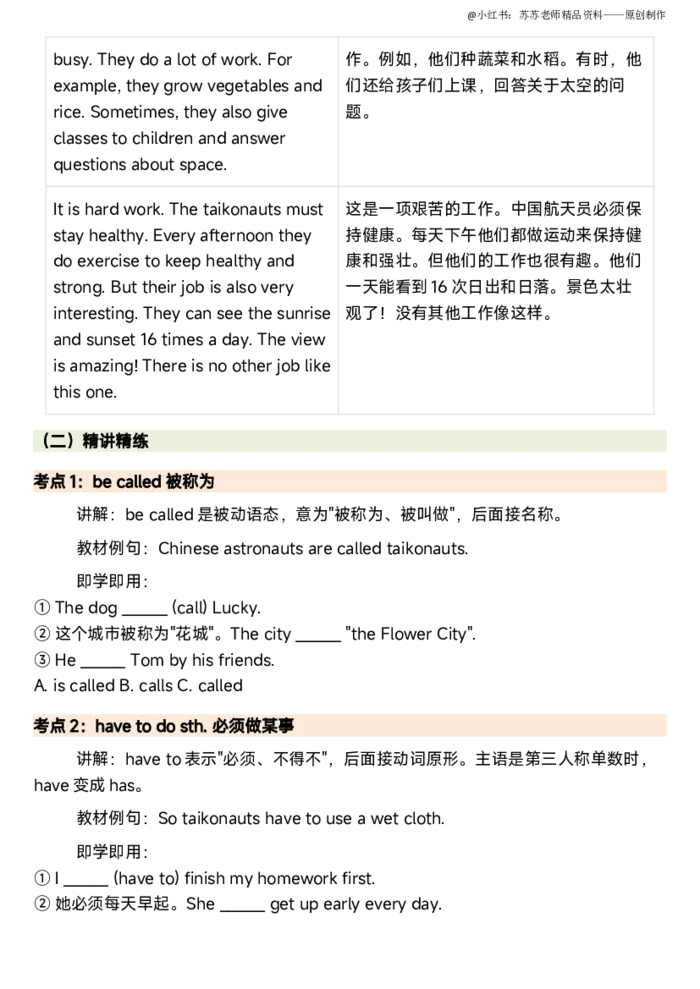
Each day the taikonauts are very
中国航天员每天都很忙。他们做很多工
@小红书:苏苏老师精品资料——原创制作
busy. They do a lot of work. For
example, they grow vegetables and
rice. Sometimes, they also give
classes to children and answer
questions about space.
作。例如,他们种蔬菜和水稻。有时,他
们还给孩子们上课,回答关于太空的问
题。
It is hard work. The taikonauts must
stay healthy. Every afternoon they
do exercise to keep healthy and
strong. But their job is also very
interesting. They can see the sunrise
and sunset 16 times a day. The view
is amazing! There is no other job like
this one.
这是一项艰苦的工作。中国航天员必须保
持健康。每天下午他们都做运动来保持健
康和强壮。但他们的工作也很有趣。他们
一天能看到16 次日出和日落。景色太壮
观了!没有其他工作像这样。
(二)精讲精练
考点1:be called 被称为
•
讲解:be called 是被动语态,意为"被称为、被叫做",后面接名称。
•
教材例句:Chinese astronauts are called taikonauts.
•
即学即用:
① The dog ______ (call) Lucky.
② 这个城市被称为"花城"。The city ______ "the Flower City".
③ He ______ Tom by his friends.
A. is called B. calls C. called
考点2:have to do sth. 必须做某事
•
讲解:have to 表示"必须、不得不",后面接动词原形。主语是第三人称单数时,
have 变成has。
•
教材例句:So taikonauts have to use a wet cloth.
•
即学即用:
① I ______ (have to) finish my homework first.
② 她必须每天早起。She ______ get up early every day.
@小红书:苏苏老师精品资料——原创制作
③ They ______ wear uniforms to school.
A. have to B. has to C. must to
考点3:for example 例如
•
讲解:for example 是固定短语,意为"例如",用来举例说明,后面接句子。
•
教材例句:For example, they grow vegetables and rice.
•
即学即用:
① I like many fruits, ______ (for example), apples and bananas.
② 我有很多爱好,例如读书和画画。I have many hobbies, ______, reading and
drawing.
③ She can play many sports, ______ playing basketball.
A. for example B. such as C. like
2026 秋新人教PEP 版六年级上册英语同步讲义
第三部分 语法讲解
一、语法点1:情态动词can 的用法
(一)定义
情态动词can 表示"能、会、可以",用来描述某人具备的能力、许可或可能性。它没有
人称和数的变化,后面必须接动词原形。
@小红书:苏苏老师精品资料——原创制作
(二)基本用法
1.
表示能力

 :表示某人具备做某事的能力。
○教材例句:We can see the Sun and the clouds.(我们能看到太阳和云。)
○例句:She can speak English.(她会说英语。)
2.
表示许可

 :表示某人被允许做某事。
○例句:You can go home now.(你现在可以回家了。)
3.
表示可能性

 :表示某事有可能发生。
○例句:It can rain this afternoon.(今天下午可能会下雨。)
(三)句式变化
1.
肯定句:主语

 +   can

  +   动词原形

 +   其他

 .
○教材例句:At night, we can see the Moon and the stars.
2.
否定句:主语

 +   can

  not

  (can't)

  +   动词原形

 +   其他

 .
○例句:I can't swim.(我不会游泳。)
3.
一般疑问句:

 Can

  +   主语

 +   动词原形

 +   其他

 ?
○肯定回答:Yes, 主语 + can.
○否定回答:No, 主语 + can't.
○教材例句:— Is there any water on Mars? — Yes, there is.(注:此处为there
be 句型,can 的一般疑问句如:Can you see the stars? — Yes, I can.)
4.
特殊疑问句:疑问词

 +   can

  +   主语

 +   动词原形

 +   其他

 ?
○教材例句:What can you see in the sky?
(四)易错点辨析
1.
can

  后面必须接动词原形,不能接名词或动名词


○错误:I can swimming.
○正确:I can swim.
2.
can

  没有人称和数的变化


○错误:He cans play football.
○正确:He can play football.
@小红书:苏苏老师精品资料——原创制作
3.
can

  和
  be
   able

  to
   的区别


○can 表示现在的能力,be able to 可以表示各种时态的能力。
○例句:I can sing.(我现在会唱歌。)/ I will be able to sing English songs next
year.(明年我会唱英文歌。)
二、语法点2:there be 句型的一般现在时
(一)定义
there be 句型表示"某地有某物/某人",强调存在关系。be 动词的单复数由后面的主语
决定,遵循"就近原则"。
(二)基本结构
1.
肯定句:

 There

  is   +   单数名词

 /  不可数名词

 +   地点状语

 .
○教材例句:There is soil too.(那里还有土壤。)
○例句:There is a book on the desk.(桌子上有一本书。)
2.
肯定句:

 There

  are

  +   复数名词

 +   地点状语

 .
○教材例句:There are large oceans on Earth.(地球上有大片的海洋。)
○例句:There are three pens in the pencil box.(铅笔盒里有三支钢笔。)
(三)句式变化
1.
否定句:

 There

  is/are

  +   not

  +   主语

 +   地点状语

 .
○缩写:isn't = is not, aren't = are not
○教材例句:They say there aren't any living things.(据说那里没有生物。)
○例句:There isn't any water in the bottle.(瓶子里没有水。)
2.
一般疑问句:

 Is/Are

  +   there

  +   主语

 +   地点状语

 ?
○肯定回答:Yes, there is/are.
○否定回答:No, there isn't/aren't.
○教材例句:— Is there any water on Mars? — Yes, there is.
○例句:— Are there any apples in the basket? — No, there aren't.
3.
特殊疑问句:疑问词

 +   is/are

  +   there

  +   地点状语

 ?
○例句:How many students are there in your class?(你们班有多少学生?)
@小红书:苏苏老师精品资料——原创制作
(四)易错点辨析
1.
主谓一致错误(就近原则)


○错误:There is a pen and two books on the desk.(正确,因为a pen 是单数,
就近原则)
○错误:There are a pen and two books on the desk.(错误)
○提示:be 动词的单复数由离它最近的主语决定。
2.
there

  be
   和
   have

 的区别


○there be 表示"某地有某物",强调存在;
○have 表示"某人有某物",强调所属。
○例句:There is a book on the desk.(桌子上有一本书。——存在)/ I have a
book.(我有一本书。——所属)
3.
否定句和疑问句中

  some

  变
  any


○肯定句:There is some water in the glass.
○否定句:There isn't any water in the glass.
○疑问句:Is there any water in the glass?
三、单元语法专项练习
(一)单项选择(10 道)
1.
______ you see the Moon at night?
A. Do B. Can C. Are
2.
There ______ a spaceship in the picture.
A. is B. are C. be
3.
What ______ you do with a telescope?
A. can B. do C. are
4.
There ______ any aliens on Mars.
A. is B. are C. aren't
5.
She ______ speak English very well.
A. can B. cans C. is
6.
______ there any stars in the sky tonight?
A. Is B. Are C. Do
@小红书:苏苏老师精品资料——原创制作
7.
I ______ swim, but I can skate.
A. can B. can't C. am not
8.
There ______ some soil on Mars.
A. is B. are C. be
9.
______ can you see from the space station?
A. What B. How C. Where
10.
There ______ five planets in the picture.
A. is B. are C. be
(二)用所给单词的适当形式填空(5 道)
1.
I ______ (can) see the Sun in the daytime.
2.
There ______ (be) a big blue marble in the box.
3.
They ______ (can) not fly to the Sun.
4.
There ______ (be) many stars in the sky at night.
5.
She ______ (can) answer the question about space.
(三)根据中文提示写出英文(5 道)
1.
你能看到什么? ______ you ______?
2.
桌子上有一本书。 ______ a book on the desk.
3.
我会弹钢琴。 I ______ play the piano.
4.
火星上有土壤。 ______ some soil on Mars.
5.
那里没有外星人。 ______ any aliens there.
(四)选词填空(5 道)
can, can't, is, are, isn't
1.
I ______ see the stars clearly with a telescope.
2.
There ______ a rover on Mars.
3.
You ______ live on the Sun. It's too hot.
4.
______ there any water on the Moon?
5.
There ______ any living things on the Moon.
@小红书:苏苏老师精品资料——原创制作
(五)完形填空(10 道)
The solar system is very big. There 1 ______eight planets in it. The Sun is a star. It is
very big and hot. We 2______ see the Sun in the daytime.
Earth is our home. It 3______ a beautiful planet. There 4______ many oceans and
mountains on Earth. We 5______ live on Earth.
Mars is the "red planet". There 6______ some soil and water on Mars. But there
7______ any living things there.
Astronauts 8 ______go into space. They 9______ live on a space station for months.
They 10______ do a lot of work there.
1.
A. is B. are C. be
2.
A. can B. can't C. are
3.
A. is B. are C. be
4.
A. is B. are C. be
5.
A. can B. can't C. are
6.
A. is B. are C. be
7.
A. isn't B. aren't C. is
8.
A. can B. can't C. are
9.
A. can B. can't C. are
10.
A. can B. can't C. are
@小红书:苏苏老师精品资料——原创制作
第四部分 作文讲义
一、单元主题作文介绍
本单元作文主题是写一篇关于太空一天的短文(A day in space)。这是小学英语写作
中常见的想象类记叙文,重点考查情态动词can 和there be 句型的用法,要求内容具体、
想象合理、条理清晰。
二、作文审题
•
主题

 :想象自己在太空度过的一天
•
人称

 :第一人称(I)
•
时态

 :主要使用一般将来时(描述计划和想象),可适当使用一般现在时(描述
太空的客观情况)
•
结构

 :
a. 开头:点明自己成为宇航员,即将开始太空一天的生活
b. 中间:按时间顺序描述一天的主要活动(起床、洗漱、工作、运动、看风景等)
c. 结尾:表达对太空生活的感受和对未来的向往
三、主题词汇句型积累
(一)常用单词
@小红书:苏苏老师精品资料——原创制作
astronaut 宇航员, spaceship 宇宙飞船, space station 空间站, float 漂浮, wash 洗,
brush 刷, eat 吃, work 工作, exercise 运动, see 看见, Earth 地球, stars 星星, amazing
令人惊奇的, wonderful 极好的, busy 忙碌的, happy 开心的
(二)常用短语
get up 起床, wash face 洗脸, brush teeth 刷牙, have breakfast 吃早餐, do
experiments 做实验, look out of the window 向窗外看, do exercise 做运动, have
dinner 吃晚餐, go to bed 睡觉, take photos 拍照
(三)常用句型
If I were an astronaut, I would... 如果我是宇航员,我会……
I will get up early in the morning. 我早上会早起。
I can see the beautiful Earth from the window. 我能从窗户看到美丽的地球。
There are many stars around me. 我周围有很多星星。
It will be an amazing day! 这将是令人惊奇的一天!
四、作文技巧全解析
1.
按时间顺序写作

 :使用first, then, next, finally 等连接词,让文章条理清晰。
2.
结合单元知识点

 :正确使用情态动词can 描述能做的事情,使用there be 句型描
述太空的事物。
3.
加入合理想象

 :想象太空生活的特别之处,比如漂浮、用湿布洗脸、一天看多次
日出等。
4.
表达真实感受

 :在结尾加入自己对太空生活的感受,让文章更有感染力。
(一)开头句型(带翻译)
1.
If   I  were

  an
   astronaut,

  I  would

  have

  a   wonderful

  day

  in
   space.

  如果我是宇航员

 ,

我会在太空度过美好的一天。
2.
Today

  I  am

  an
   astronaut.

  I  am

  on
   the

  space

  station.

  今天我是一名宇航员,我在


空间站里。
3.
I  have

  always

  wanted

  to
   go
   to
   space.

  Today

  my

  dream

  comes

  true.

  我一直想


去太空,今天我的梦想实现了。
(二)中间句型(带翻译)
@小红书:苏苏老师精品资料——原创制作
1.
First,

  I  will

  get

  up
   early

  and

  wash

  my

  face

  with

  a   wet

  cloth.

  首先,我会早起,


用湿布洗脸。
2.
Then,

  I  will

  have

  breakfast.

  The

  food

  in
   space

  is   special.

  然后,我会吃早餐。太


空里的食物很特别。
3.
Next,

  I  will

  do
   some

  experiments.

  I  will

  also

  give

  a   class

  to
   children

  on
   Earth.


接下来,我会做一些实验。我还会给地球上的孩子们上课。
4.
In
   the

  afternoon,

  I  will

  do
   exercise

  to
   keep

  healthy.

  下午,我会做运动来保持健


康。
5.
I  will

  look

  out

  of
   the

  window.

  I  can

  see

  the

  blue

  Earth

  and

  many

  bright

  stars.


我会向窗外看,能看到蓝色的地球和很多明亮的星星。
(三)结尾句型(带翻译)
1.
What

  a   wonderful

  day

  in
   space!

  I  will

  never

  forget

  it.
   多么美好的太空一天啊!


我永远不会忘记。
2.
It   is   an
   amazing

  experience.

  I  hope

  I  can

  go
   to
   space

  again.

  这是一次令人惊奇


的经历,我希望能再去太空。
3.
Space

  is   so
   beautiful.

  I  want

  to
   learn

  more

  about

  it.
   太空太美了,我想更多地了


解它。
(四)好句积累
1.
I can float around the space station. It's very fun. 我能在空间站里漂浮,非常有
趣。
2.
I can see the sunrise 16 times a day. How amazing! 我一天能看到16 次日出,
太神奇了!
3.
The Earth looks like a big blue marble from space. 从太空看,地球像一颗蓝色
的大弹珠。
五、优秀范文(带翻译与解析)
(一)范文
A day in space
@小红书:苏苏老师精品资料——原创制作
If I were an astronaut, I would have a great day in space.
First, I will get up early. I will wash my face with a wet cloth and brush my teeth.
Then, I will have breakfast. Next, I will do some experiments. In the afternoon, I will
do exercise. I will look out of the window. I can see the beautiful Earth and many
stars.
It will be an amazing day. I love space!
(二)翻译
太空的一天
如果我是宇航员,我会在太空度过美好的一天。
首先,我会早起。我会用湿布洗脸,刷牙。然后,我会吃早餐。接下来,我会做一些实
验。下午,我会做运动。我会向窗外看,能看到美丽的地球和很多星星。
这将是令人惊奇的一天。我爱太空!
(三)名师解析
•
结构

 :文章按照"开头-中间-结尾"的结构写作,开头点明主题,中间用First, Then,
Next, In the afternoon 按时间顺序描述活动,结尾表达感受,逻辑清晰。
•
时态

 :全文正确使用一般将来时描述想象中的太空生活,时态准确。
•
知识点运用

 :正确使用了情态动词can(I can see the beautiful Earth)和if 引导
的虚拟语气(If I were an astronaut),体现了对单元知识点的掌握。
•
内容

 :描述了起床、洗漱、吃早餐、做实验、做运动、看风景等活动,内容具体,
想象合理。
•
好词

 :astronaut, space station, wet cloth, experiments, amazing
•
好句

 :If I were an astronaut, I would have a great day in space.(如果我是宇
航员,我会在太空度过美好的一天。)/ I can see the beautiful Earth and many stars.
(我能看到美丽的地球和很多星星。)
六、单元作文练习
(一)题目
请以"My dream day in space"为题,写一篇60 词左右的短文,描述你想象中的太空一
天。要求:内容完整,语句通顺,时态正确。
@小红书:苏苏老师精品资料——原创制作
2026 秋新人教PEP 版六年级上册英语同步讲义
第五部分 单元综合练习
一、单项选择(10 道)
1.
______ can you see in the sky?
A. What B. How C. Where
2.
There ______ a lot of water on Earth.
A. is B. are C. be
3.
We ______ see the Moon and stars at night.
A. can B. cans C. are
4.
______ there any living things on Mars?
A. Is B. Are C. Do
5.
The Earth ______ like a big blue marble.
A. look B. looks C. looking
6.
Astronauts ______ live on a space station.
A. can B. can't C. are
7.
There ______ any aliens in space.
A. is B. are C. aren't
@小红书:苏苏老师精品资料——原创制作
8.
______ you see the sunrise from the space station?
A. Can B. Do C. Are
9.
There ______ many planets in the solar system.
A. is B. are C. be
10.
I want to be ______ astronaut one day.
A. a B. an C. the
二、根据首字母提示完成单词(5 道)
1.
The Earth is a p______.
2.
We can see the s______ and the Moon at night.
3.
Astronauts go into space by s______.
4.
There is some s______ on Mars.
5.
The rover is on M______.
三、选出不同类的一项(5 道)
1.
A. Earth B. Mars C. planet
2.
A. astronaut B. teacher C. space
3.
A. can B. is C. are
4.
A. sunrise B. sunset C. sky
5.
A. spaceship B. plane C. bus
四、用所给单词的适当形式填空(5 道)
1.
I ______ (can) see many stars in the countryside.
2.
There ______ (be) a space station in space.
3.
They ______ (can) not live on the Moon.
4.
There ______ (be) many beautiful stars at night.
5.
She ______ (want) to be an astronaut.
五、根据描述选单词(5 道)
A. astronaut B. space station C. telescope D. Mars E. satellite
1.
It is a person who goes into space. ______
@小红书:苏苏老师精品资料——原创制作
2.
It is a place where astronauts live and work in space. ______
3.
It is a machine that helps us see faraway things. ______
4.
It is the "red planet" in our solar system. ______
5.
It travels around the Earth. ______
六、选词填空(5 道)
see, is, are, can, can't
1.
We ______ use a telescope to look at the stars.
2.
There ______ a rover on Mars now.
3.
You ______ see the Sun at night.
4.
______ there any clouds in the sky?
5.
I ______ the beautiful Earth from the window.
七、完形填空(10 道)
Space is a very 1______ place. There are many stars and planets in it. We live on
Earth. It is one of the planets in the 2______ system.
Astronauts are people 3______ go into space. They go there by 4______ . They can
5______ on a space station. They do a lot of work there. For example, they 6
______experiments and grow vegetables.
There 7 ______any living things on Mars. But scientists are 8______ more about it
every day.
I want to be an astronaut 9 ______I grow up. I want to 10______ the Moon and Mars.
It will be amazing!
1.
A. small B. big C. short
2.
A. sun B. solar C. moon
3.
A. who B. which C. what
4.
A. plane B. car C. spaceship
5.
A. live B. work C. both A and B
6.
A. do B. make C. take
7.
A. is B. are C. aren't
8.
A. learn B. learning C. learns
@小红书:苏苏老师精品资料——原创制作
9.
A. when B. where C. what
10.
A. visit B. go C. come
八、补全对话(选择合适的句子补全对话)
A: Hi, Binbin! 1. ______
B: I'm reading a book about space.
A: That's interesting. 2. ______
B: Yes, I do. I want to be an astronaut one day.
A: Wow! 3. ______
B: Because I want to go to Mars and see the aliens.
A: 4. ______
B: No, there aren't any aliens on Mars. But I still want to go there.
A: 5. ______
B: Thank you.
A. Do you like space?
B. What are you doing?
C. Why do you want to be an astronaut?
D. Are there any aliens on Mars?
E. I hope your dream will come true.
九、阅读理解
(一)阅读短文,选择正确答案
The Sun is a star. It is very big and hot. It gives us light and heat. All the planets
travel around the Sun.
Earth is our home. It is the third planet from the Sun. There are many oceans and
mountains on Earth. There are also many living things on Earth.
Mars is the fourth planet from the Sun. It is called the "red planet" because it looks
red. There is some soil and water on Mars. But there are no living things there.
Astronauts have been to the Moon. But no one has been to Mars yet. China sent a
rover to Mars in 2021. We are learning more about Mars every day.
1.
What is the Sun?
A. A planet. B. A star. C. A satellite.
@小红书:苏苏老师精品资料——原创制作
2.
Which planet is the third from the Sun?
A. Earth. B. Mars. C. The Moon.
3.
Why is Mars called the "red planet"?
A. Because it has red soil. B. Because it looks red. C. Because there are red flowers
on it.
4.
Is there any water on Mars?
A. Yes, there is. B. No, there isn't. C. We don't know.
5.
When did China send a rover to Mars?
A. In 2020. B. In 2021. C. In 2022.
(二)阅读短文,判断正(T)误(F)
Astronauts have a special life in space. They can't do things like we do on Earth.
When they get up in the morning, they can't use water to wash their faces. They
have to use a wet cloth. They brush their teeth with a special toothpaste and have
to eat it.
They eat special food in space. The food is in bags. They can't use knives and forks
because food will float away.
Every afternoon, they do exercise to keep healthy. They can see the sunrise and
sunset 16 times a day. The view is very beautiful.
1.
Astronauts use water to wash their faces in space. ( )
2.
They eat special food in bags. ( )
3.
They use knives and forks to eat. ( )
4.
They do exercise every afternoon. ( )
5.
They can see the sunrise 16 times a day. ( )
十、书面表达
请以"I want to be an astronaut"为题,写一篇60 词左右的短文,介绍你为什么想成为
宇航员以及你想在太空做什么。要求:内容完整,语句通顺,时态正确。
@小红书:苏苏老师精品资料——原创制作
@小红书:苏苏老师精品资料——原创制作,更多精品资料关注小红书