九年级第一学期英语单元检测题(三)
(Units 5~6)
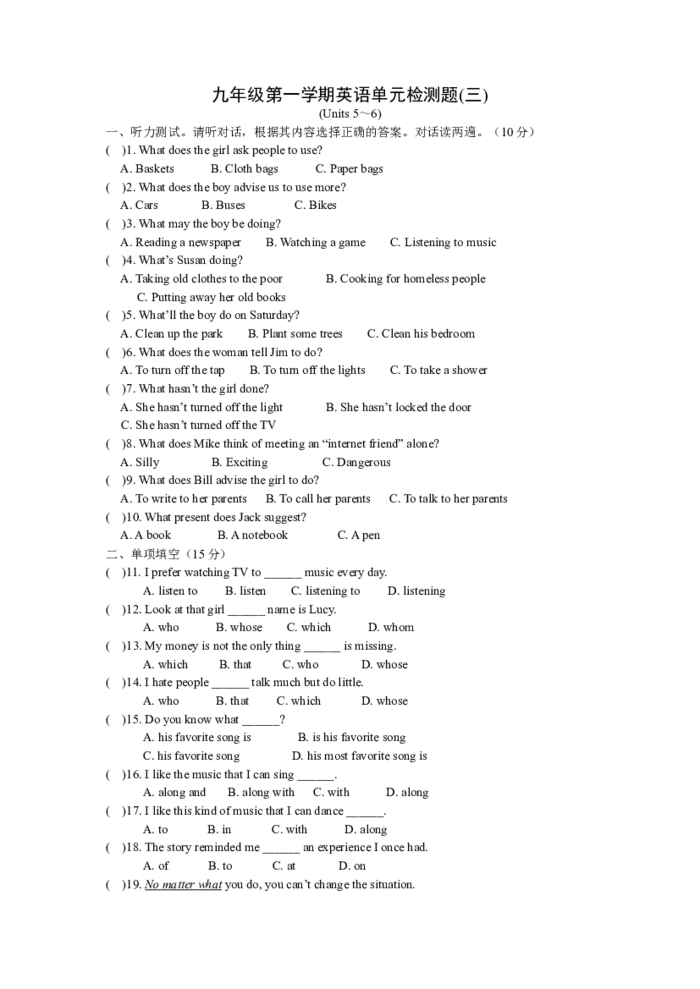
一、听力测试。请听对话,根据其内容选择正确的答案。对话读两遍。(10 分)
(    )1. What does the girl ask people to use?
     A. Baskets            B. Cloth bags            C. Paper bags
(    )2. What does the boy advise us to use more?
     A. Cars              B. Buses                C. Bikes
(    )3. What may the boy be doing?
     A. Reading a newspaper        B. Watching a game        C. Listening to music
(    )4. What’s Susan doing?
     A. Taking old clothes to the poor              B. Cooking for homeless people
C. Putting away her old books
(    )5. What’ll the boy do on Saturday?
     A. Clean up the park        B. Plant some trees        C. Clean his bedroom
(    )6. What does the woman tell Jim to do?
     A. To turn off the tap        B. To turn off the lights        C. To take a shower
(    )7. What hasn’t the girl done?
     A. She hasn’t turned off the light              B. She hasn’t locked the door
     C. She hasn’t turned off the TV
(    )8. What does Mike think of meeting an “internet friend” alone?
     A. Silly                 B. Exciting                  C. Dangerous
(    )9. What does Bill advise the girl to do?
     A. To write to her parents      B. To call her parents      C. To talk to her parents
(    )10. What present does Jack suggest?
     A. A book               B. A notebook                C. A pen
二、单项填空(15 分)
(    )11. I prefer watching TV to ______ music every day.
A. listen to         B. listen        C. listening to         D. listening
(    )12. Look at that girl ______ name is Lucy.
A. who            B. whose        C. which            D. whom
(    )13. My money is not the only thing ______ is missing.
A. which          B. that          C. who              D. whose
(    )14. I hate people ______ talk much but do little.
A. who            B. that         C. which             D. whose
(    )15. Do you know what ______?
A. his favorite song is               B. is his favorite song
C. his favorite song                 D. his most favorite song is
(    )16. I like the music that I can sing ______.
A. along and       B. along with      C. with            D. along
(    )17. I like this kind of music that I can dance ______.
A. to             B. in             C. with            D. along
(    )18. The story reminded me ______ an experience I once had.
A. of             B. to             C. at              D. on
(    )19. No matter what you do, you can’t change the situation.
A. whoever        B. wherever       C. whatever        D. what ever
(    )20. Beijing is one of the ______ in the world today.
A. busiest city      B. busiest cities    C. busy city        D. busy cities
(    )21. I mean ______ class meeting on Monday afternoon.
A. have            B. to have        C. having          D. to having
(    )22. Mary sings English songs well and ______.
A. Jane does too     B. either does Jane     C. so Jane does     D. so does Jane
(    )23. I didn’t know ______.
A. where does he live    B. where do he lives   C. where he lives    D. where he lived
(    )24. What the boy said sounds ______.
A. reason              B. reasonable         C. reasonably       D. reasoning
(    )25. I feel my heart ______ fast now.
A. beated              B. beating            C. beat            D. to beat
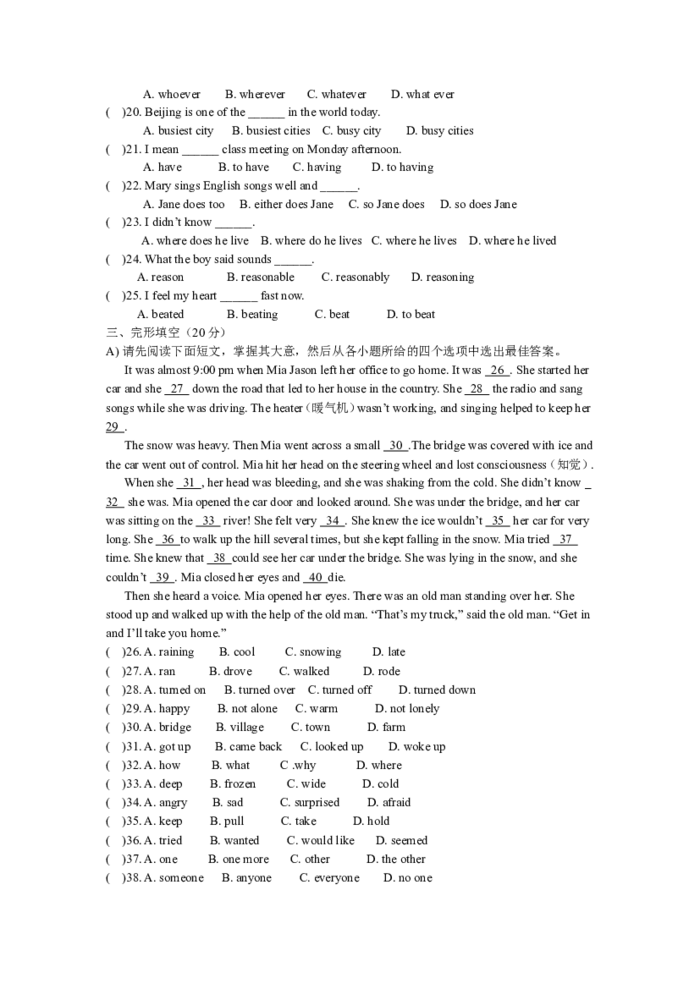
三、完形填空(20 分)
A) 请先阅读下面短文,掌握其大意,然后从各小题所给的四个选项中选出最佳答案。
It was almost 9:00 pm when Mia Jason left her office to go home. It was   26  . She started her
car and she   27   down the road that led to her house in the country. She   28   the radio and sang
songs while she was driving. The heater(暖气机)wasn’t working, and singing helped to keep her
29  .
The snow was heavy. Then Mia went across a small   30  .The bridge was covered with ice and
the car went out of control. Mia hit her head on the steering wheel and lost consciousness(知觉).
When she   31  , her head was bleeding, and she was shaking from the cold. She didn’t know
32   she was. Mia opened the car door and looked around. She was under the bridge, and her car
was sitting on the   33   river! She felt very   34  . She knew the ice wouldn’t   35   her car for very
long. She   36  to walk up the hill several times, but she kept falling in the snow. Mia tried   37
time. She knew that   38  could see her car under the bridge. She was lying in the snow, and she
couldn’t   39  . Mia closed her eyes and   40  die.
Then she heard a voice. Mia opened her eyes. There was an old man standing over her. She
stood up and walked up with the help of the old man. “That’s my truck,” said the old man. “Get in
and I’ll take you home.”
(    )26. A. raining        B. cool          C. snowing          D. late
(    )27. A. ran           B. drove         C. walked           D. rode
(    )28. A. turned on      B. turned over    C. turned off         D. turned down
(    )29. A. happy         B. not alone      C. warm            D. not lonely
(    )30. A. bridge        B. village         C. town            D. farm
(    )31. A. got up        B. came back      C. looked up        D. woke up
(    )32. A. how          B. what          C .why             D. where
(    )33. A. deep         B. frozen          C. wide            D. cold
(    )34. A. angry        B. sad            C. surprised         D. afraid
(    )35. A. keep         B. pull            C. take            D. hold
(    )36. A. tried         B. wanted         C. would like       D. seemed
(    )37. A. one          B. one more       C. other            D. the other
(    )38. A. someone      B. anyone         C. everyone        D. no one
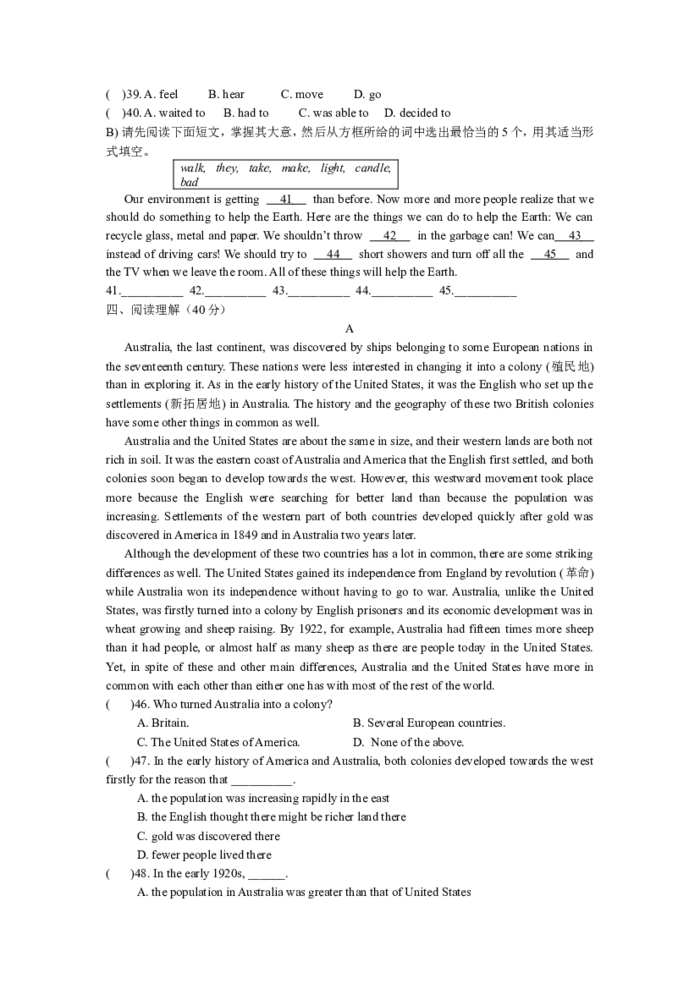
(    )39. A. feel          B. hear            C. move          D. go
(    )40. A. waited to      B. had to          C. was able to     D. decided to
B) 请先阅读下面短文,掌握其大意,然后从方框所给的词中选出最恰当的5 个,用其适当形
式填空。
walk, they, take, make, light, candle,
bad
Our environment is getting
  41

   than before. Now more and more people realize that we
should do something to help the Earth. Here are the things we can do to help the Earth: We can
recycle glass, metal and paper. We shouldn’t throw
  42

   in the garbage can! We can
  43


instead of driving cars! We should try to
  44

   short showers and turn off all the
  45

   and
the TV when we leave the room. All of these things will help the Earth.
41.__________  42.__________  43.__________  44.__________  45.__________
四、阅读理解(40 分)
A
Australia, the last continent, was discovered by ships belonging to some European nations in
the seventeenth century. These nations were less interested in changing it into a colony (殖民地)
than in exploring it. As in the early history of the United States, it was the English who set up the
settlements (新拓居地) in Australia. The history and the geography of these two British colonies
have some other things in common as well.
Australia and the United States are about the same in size, and their western lands are both not
rich in soil. It was the eastern coast of Australia and America that the English first settled, and both
colonies soon began to develop towards the west. However, this westward movement took place
more because the English were searching for better land than because the population was
increasing. Settlements of the western part of both countries developed quickly after gold was
discovered in America in 1849 and in Australia two years later.
Although the development of these two countries has a lot in common, there are some striking
differences as well. The United States gained its independence from England by revolution (革命)
while Australia won its independence without having to go to war. Australia, unlike the United
States, was firstly turned into a colony by English prisoners and its economic development was in
wheat growing and sheep raising. By 1922, for example, Australia had fifteen times more sheep
than it had people, or almost half as many sheep as there are people today in the United States.
Yet, in spite of these and other main differences, Australia and the United States have more in
common with each other than either one has with most of the rest of the world.
(
)46. Who turned Australia into a colony?
 A. Britain.
    B. Several European countries.
 C. The United States of America.
D. None of the above.
(
)47. In the early history of America and Australia, both colonies developed towards the west
firstly for the reason that __________.
 A. the population was increasing rapidly in the east
 B. the English thought there might be richer land there
 C. gold was discovered there
 D. fewer people lived there
(
)48. In the early 1920s, ______.
 A. the population in Australia was greater than that of United States
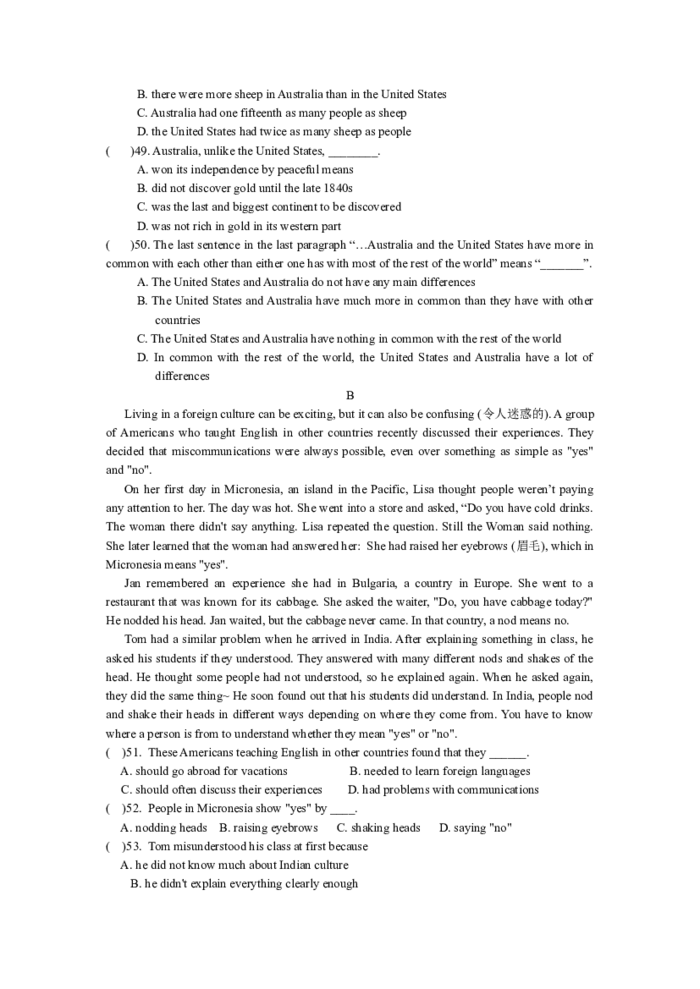
 B. there were more sheep in Australia than in the United States
 C. Australia had one fifteenth as many people as sheep
 D. the United States had twice as many sheep as people
(
)49. Australia, unlike the United States, ________.
 A. won its independence by peaceful means
 B. did not discover gold until the late 1840s
 C. was the last and biggest continent to be discovered
 D. was not rich in gold in its western part
(
)50. The last sentence in the last paragraph “…Australia and the United States have more in
common with each other than either one has with most of the rest of the world” means “_______”.
 A. The United States and Australia do not have any main differences
B. The United States and Australia have much more in common than they have with other
countries
 C. The United States and Australia have nothing in common with the rest of the world
D. In common with the rest of the world, the United States and Australia have a lot of
differences
B
Living in a foreign culture can be exciting, but it can also be confusing (令人迷惑的). A group
of Americans who taught English in other countries recently discussed their experiences. They
decided that miscommunications were always possible, even over something as simple as "yes"
and "no".
On her first day in Micronesia, an island in the Pacific, Lisa thought people weren’t paying
any attention to her. The day was hot. She went into a store and asked, “Do you have cold drinks.
The woman there didn't say anything. Lisa repeated the question. Still the Woman said nothing.
She later learned that the woman had answered her:  She had raised her eyebrows (眉毛), which in
Micronesia means "yes".
Jan remembered an experience she had in Bulgaria, a country in Europe. She went to a
restaurant that was known for its cabbage. She asked the waiter, "Do, you have cabbage today?"
He nodded his head. Jan waited, but the cabbage never came. In that country, a nod means no.
Tom had a similar problem when he arrived in India. After explaining something in class, he
asked his students if they understood. They answered with many different nods and shakes of the
head. He thought some people had not understood, so he explained again. When he asked again,
they did the same thing~ He soon found out that his students did understand. In India, people nod
and shake their heads in different ways depending on where they come from. You have to know
where a person is from to understand whether they mean "yes" or "no".
(    )51. These Americans teaching English in other countries found that they ______.
     A. should go abroad for vacations          B. needed to learn foreign languages
     C. should often discuss their experiences    D. had problems with communications
(    )52. People in Micronesia show "yes" by ____.
     A. nodding heads    B. raising eyebrows   C. shaking heads      D. saying "no"
(    )53. Tom misunderstood his class at first because
     A. he did not know much about Indian culture
   B. he didn't explain everything clearly enough
     C. some students didn't understand his questions
     D. he didn't know where the students came from
(    )54. Which of the following is TRUE according to this passage?
     A. In Bulgaria, nodding heads means no.    B. Jan taught English on a Pacific island.
     C. Lisa was trying to buy some cabbage.    D. In India, only shaking heads means "YES".
(    )55. The passage is mainly about _____.
     A. body language in foreign restaurants        B. class discussion in Indian schools
     C. miscommunication in different cultures      D. English teaching in other countries
C
Once there was a piano player in a bar. People came just to hear him play. But one night, a
lady asked him to sing a song. "I don't sing," said the man. But the lady told the waiter, "I'm tired
of listening to the piano. I want the player to sing! The waiter shouted across the room, "Hey,
friend! If you want to get paid, sing a song!' So he did. He had never sung in public before. Now
he was singing for the very first time! Nobody had ever heard the song Mona Lisa sung so
beautifully!
He had talent(天赋) he was sitting on! He may have lived the rest of his life as a no-name
piano player in a no-name bar. But once he found, by accident, that he could sing well, he went on
working hard and became one of the best-known singers in the US. His name was Nat King Cole.
You, too, have skills and abilities. You may not feel that your talent is great, but it may be better
than you think. With hard work, most skills can be improved. Besides, you may have no success at
all ff you just sit on your talent.
(    )56. The lady asked the player to sing a song because _____.
     A. she had paid him for this           B. she knew him very well
     C. she wanted to have a change        D. she enjoyed his singing
(    )57. Nat King Cole succeeded because _____.
     A. the lady helped him a lot            B. he caught the chance
     C. he continued to play in the bar        D. he stopped playing the piano
(    )58. The words "sit on" in the passage probably mean"
A. fail to realize      B. forget to use    C. try to develop       D. manage to show
(    )59. From the story we know if you have some talent, you should _____.
     A. hide it and wait           B. ask others for help
     C. pay no attention to it       D. work hard to improve yourself
(    )60. Which could be the best title for the passage?
     A. Sing in the Bar              B. Achieve Success in Life
     C. Never Lose Heart            D. Find Your Hidden Talent
D
Doctor Seuss was born in 1904. By the middle 1950s, he had become one of the best-loved
and most successful children's book writers in the world. His books are very popular with young
readers. They enjoy the invented words and the pictures of unusual funny animals and plants.
In 1954, life magazine published(刊登) a report about school children who could not read. The
report said many children's books were not interesting. Doctor Seuss strongly hoped to help
children and decided to write books that were interesting and easy to read. He used words with the
same ending sound, like fish and wish. He did not receive training in art. Yet, he drew the pictures
for most of his books.
In 1957, Dr. Seuss wrote The Cat in the Hat. He used less than 230 words to write the book
and even a six-year-old should be able to read it. It was a fun story and easy to read. Children
loved it. Their parents loved it, too. Today it is still one of the stories they like best. The success of
The Cat in the Hat made him want to write more books for children. In 1960, he wrote a book
using less than fifty words. The book is called Green Eggs and Ham.
In 1984, Doctor Seuss won a Pulitzer Prize (普利策奖). He was honored for the education and
enjoyment his books provided American children and their parents.
He died at the age of 87, but his influence remains. Millions of his books have been sold
worldwide. People say his books helped change the way American children learned to read. Yet,
his books are loved by people of all ages. Doctor Seuss once said, "I do not write for children. I
write for people.
(    )61. Doctor Seuss learned from the magazine that _______.
     A. some school children could not read      B. many children's books were interesting
     C. children wanted to learn to read          D. a writer for children was wanted
(    )62. People like his books because the books ______.
     A. are cheap and easy to get            B. were written in different languages
     C. are easy and interesting to read       D. were written with invented words
(    )63. He wrote the book The Cat in the Hat at the age of _____.
     A. 50          B. 53            C. 56        D. 87
(    )64. Which of the following is TRUE according to the passage?
     A. Doctor Seuss wrote Green Eggs and Ham with over 230 words.
     B. Doctor Seuss wrote books only for children in the United States.
     C. The Cat in the Hat was written only for six-year-old children.
     D. His books provided education and enjoyment for Americans.
(    )65. From the text we know that Doctor Seuss __________.
     A. won a Pulitzer Prize soon after his death
B. sold millions of his books himself worldwide
     C. changed American children's way of reading
D. wrote the largest number of books in the world
五、书面表达(15 分)
假定你叫张华,最近从报纸上得知美国某公司将在你的家乡建一座工厂,请给该公司写
封电子邮件。要点如下:表示欢迎:有利于家乡发展等;感到担忧:造成环境污染等;希望了解
有关环保措施及更多信息。 注意:1.词数80—100;2.请不要逐句翻译,可适当发挥以使行
文连贯;
听力材料
请听对话,根据其内容选择正确的答案。对话读两遍。
1. W: There’s too much white pollution in our city.
  M: What should we do to stop it?
  W: I think we should use cloth bags.
2. M: Why do so many people have breathing problems in big cities?
  W: Because there’re too many cars in big cities and the cars have polluted the air.
  M: Oh, we’d better drive less and ride bikes as often as possible.
3. W: Do you think noise is the king of pollution?
  M: I think so. The news says noise can cause hearing loss.
4. M: Hi, Susan! Where are you taking all those old clothes?
  W: I want to give them to the poor so that they can wear them.
  M: You’re so kind.
  W: Thanks. And it’s also a good way to protect our environment.
5. M: Tomorrow is Saturday. What’re you going to do?
  W: I’m going to help clean the park. How about you?
  M: So am I.
6. W: Jim, don’t forget to turn off the lights after you take a shower.
  M: Oh, I know, Mom.
7. M: Have you locked the door and turned off the light?
  W: God! I remember the light is still on.
8. W: Mike, would it be dangerous to meet an “internet friend alone?
  M: Yes. Because you hardly know anything about him.
9. W: Bill, my parents are always strict with me. What should I do?
  M: You should talk to them about your problems and then they may understand you.
10. W: Jack, Tomorrow is Tom’s birthday. What present should I give him?
   M: Well, if I were you, I’d give him a book.
参考答案
1~5  BCAAA      6~10  BACCA      11~15  CBBAA      16~20  BAACB
21~25  BDDBB      26~30  CBACA   31~35  DDBBD      36~40  ABDCA
41. worse      42. them     43. walk      44. take       45. lights
46~50  ABCAB      51~55  DBAAC      56~60  CBADD      61~65  ACBDC
One possible version:
Dear Sir or Madam,
I am a middle school student. I have recently learned from the newspaper that you are going to
build a factory here in my hometown. There is no doubt that it is good for the development of my
hometown and it will provide us with more jobs. Most of us stand by the program. However, some
of us are worried that the factory will make much noise and pollute the environment of the area. I
would like to know whether you have any plans for the environment protection.
Would you please offer us more information about it?
I'm looking forward to hearing from you.
                                                                 Yours faithfully,
Zhang Hua