九年级第一学期英语单元检测题(八)
(期末考试卷)
一、听力测试。(10 分)
请听下面10 段对话,根据其内容选择正确的答案。每段对话读两遍。
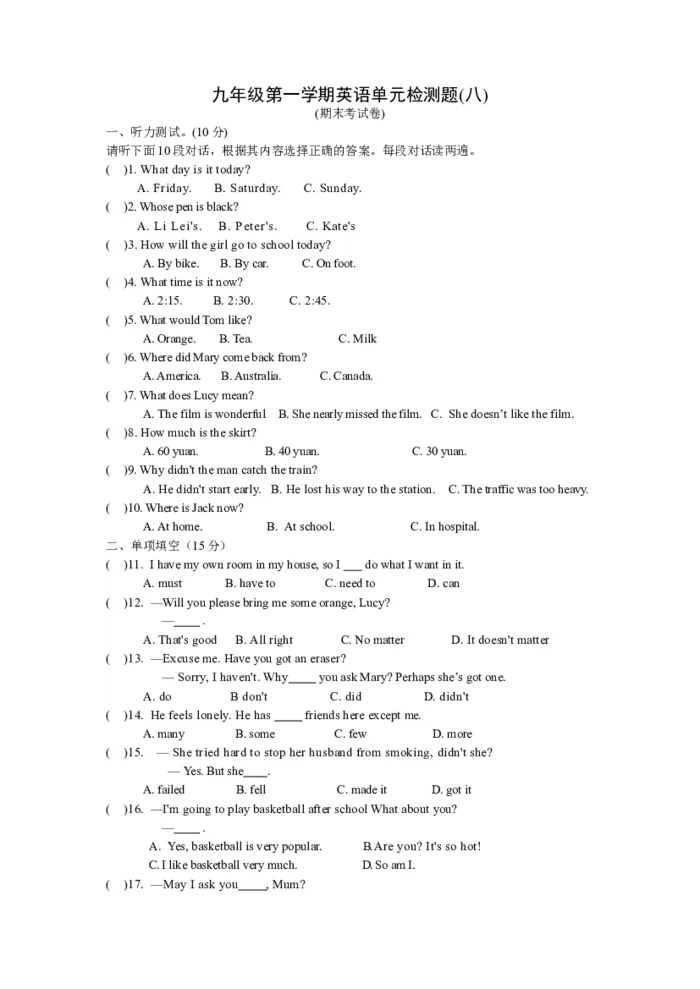
(    )1. What day is it today?
A. Friday.      B. Saturday.      C. Sunday.
(    )2. Whose pen is black?
A. Li Lei's.    B. Peter's.       C. Kate's
(    )3. How will the girl go to school today?
A. By bike.       B. By car.           C. On foot.
(    )4. What time is it now?
A. 2:15.          B. 2:30.           C. 2:45.
(    )5. What would Tom like?
A. Orange.        B. Tea.
          C. Milk
(    )6. Where did Mary come back from?
A. America.       B. Australia.          C. Canada.
(    )7. What does Lucy mean?
A. The film is wonderful  B. She nearly missed the film.  C. She doesn’t like the film.
(    )8. How much is the skirt?
A. 60 yuan.              B. 40 yuan.               C. 30 yuan.
(    )9. Why didn't the man catch the train?
A. He didn't start early.  B. He lost his way to the station.  C. The traffic was too heavy.
(    )10. Where is Jack now?
A. At home.            B. At school.                C. In hospital.
二、单项填空(15 分)
(    )11. I have my own room in my house, so I        do what I want in it.
A. must         B. have to         C. need to         D. can
(    )12. —Will you please bring me some orange, Lucy?
—         .
A. That's good
 B. All right
  C. No matter
D. It doesn't matter
(    )13. —Excuse me. Have you got an eraser?
— Sorry, I haven't. Why         you ask Mary? Perhaps she’s got one.
A. do           B don't           C. did           D. didn't
(    )14. He feels lonely. He has          friends here except me.
A. many          B. some            C. few            D. more
(    )15.  — She tried hard to stop her husband from smoking, didn't she?
— Yes. But she        .
A. failed          B. fell              C. made it         D. got it
(    )16. —I'm going to play basketball after school What about you?
—         .
A. Yes, basketball is very popular.       B. Are you? It's so hot!
C. I like basketball very much.           D. So am I.
(    )17. —May I ask you         , Mum?
—Yes.  What is it?
—Our class are going to have a picnic tomorrow. Can I go?
A. something
B. anything
C. some questions
D. a problem
(    )18. Mum, this T-shirt is much too small for me. Would you buy me a         one?
A. nice           B. large           C. nicer             D. larger
(    )19. —How many teachers are there in your school?
—         , but I'm not sure.
A. Hundreds
B Hundred
     C. Hundreds of
D. One hundred
(    )20. Mr. Smith comes form Australia, but he has worked in China for five years. So you  can
talk with him         .
A. either in English or in Chinese           B. not in Chinese but in English
C. just in English, not in Chinese           D. neither in Chinese nor in English
(    )21. —Tomorrow is Mothers' Day. What shall we give to mother as a present?
—        some flowers?
A. Have you bought    B. Did you buy
C. Will you buy
D. What about
(    )22. Would you please speak more slowly? I can hardly       you.
A. talk with           B. agree with
C. follow
        D. hear
(    )23. —Hi, Lin Tao. I didn't see you at the party.
—Oh, I       ready for the math exam.
A. am getting
   B. was getting
C. got
       D. have got
(    )24. The smile on the teacher's face showed that she was      with us.
A. strict              B. pleased         C. angry           D. sorry
(    )25. —What a day! It's raining again. I'm afraid we can't go boating tomorrow.
—Don't worry. It won't       long.
A. drop               B. last             C. rain             D. go
三、完形填空(25 分)
A) 请先阅读下面短文,掌握其大意,然后从各小题所给的四个选项中选出最佳答案。
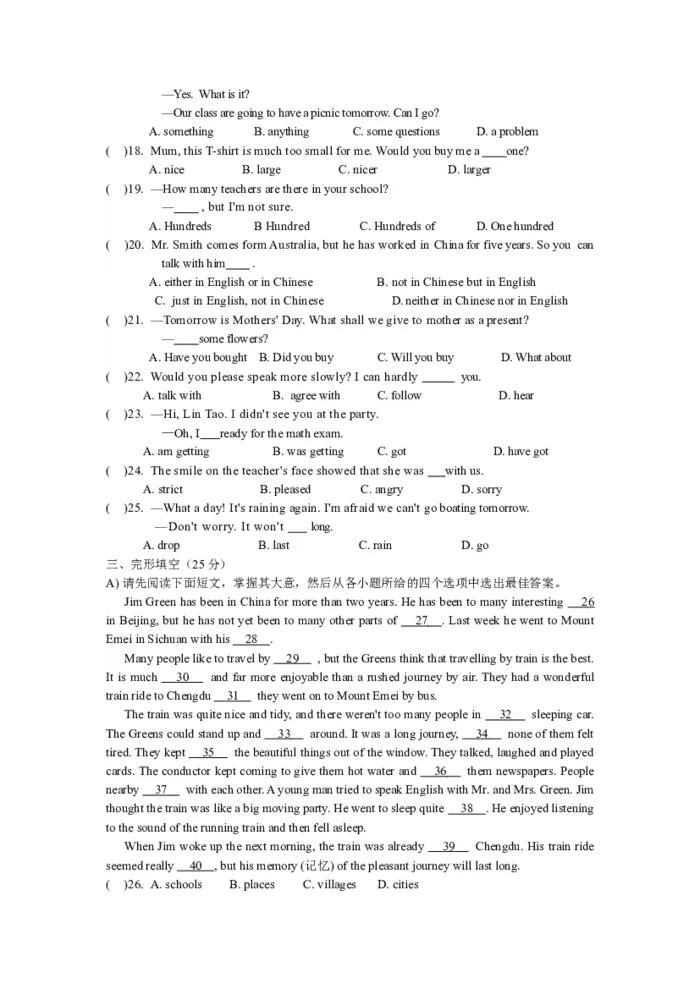
Jim Green has been in China for more than two years. He has been to many interesting
  26

in Beijing, but he has not yet been to many other parts of
  27

  . Last week he went to Mount
Emei in Sichuan with his
  28

  .
Many people like to travel by
  29

   , but the Greens think that travelling by train is the best.
It is much
  30

   and far more enjoyable than a rushed journey by air. They had a wonderful
train ride to Chengdu
  31

   they went on to Mount Emei by bus.
The train was quite nice and tidy, and there weren't too many people in
  32

   sleeping car.
The Greens could stand up and
  33

   around. It was a long journey,
  34

   none of them felt
tired. They kept
  35

   the beautiful things out of the window. They talked, laughed and played
cards. The conductor kept coming to give them hot water and
  36

   them newspapers. People
nearby
  37

   with each other. A young man tried to speak English with Mr. and Mrs. Green. Jim
thought the train was like a big moving party. He went to sleep quite
  38

  . He enjoyed listening
to the sound of the running train and then fell asleep.
When Jim woke up the next morning, the train was already
  39

   Chengdu. His train ride
seemed really
  40

  , but his memory (记忆) of the pleasant journey will last long.
(    )26. A. schools      B. places
C. villages     D. cities
(    )27. A. England     B. America     C. China       D. the world
(    )28. A. friends
B. classmates  C. father       D. family
(    )29. A. air
B. bus
C. train          D. ship
(    )30. A. cheaper
B. dearer
C. dirtier       D. quicker
(    )31. A. before
B. when
C. after          D. while
(    )32. A. my
B. your
C. our           D. their
(    )33. A. sit           B. walk       C. run           D. dance
(    )34. A. and
B. so
C. also          D. but
(    )35. A. looking      B. drawing
C. watching      D. getting
(    )36. A. reading      B. buying      C. selling        D. writing
(    )37. A. talked        B. spoke
C. told          D. said
(    )38. A. early         B. late        C. easily         D. hard
(    )39. A. beside        B. to         C. past           D. near
(    )40. A. quick         B. slow
C. short          D. long
B) 请先阅读下面短文,掌握其大意,然后从方框所给的词中选出最恰当的10 个,用其适当形
式填空。
on, listen, others, hear, of, ask, answer, activity, another, small,
learn, we
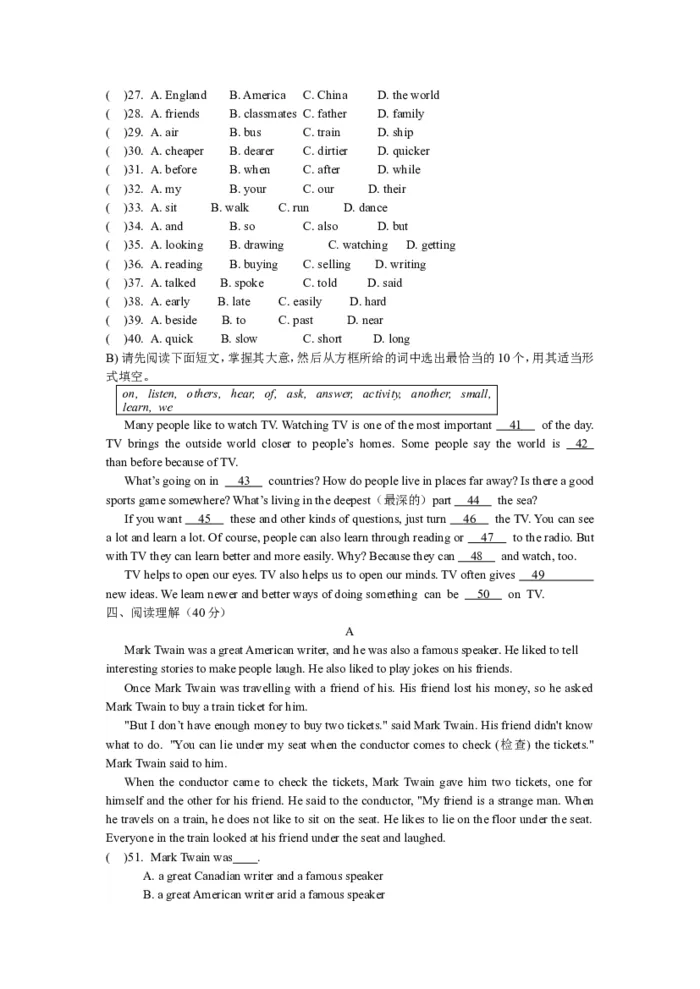
Many people like to watch TV. Watching TV is one of the most important
  41

   of the day.
TV brings the outside world closer to people’s homes. Some people say the world is   42

than before because of TV.
What’s going on in
  43

   countries? How do people live in places far away? Is there a good
sports game somewhere? What’s living in the deepest(最深的)part
  44

   the sea?
If you want
  45

   these and other kinds of questions, just turn
  46

   the TV. You can see
a lot and learn a lot. Of course, people can also learn through reading or
  47

   to the radio. But
with TV they can learn better and more easily. Why? Because they can
  48

   and watch, too.
TV helps to open our eyes. TV also helps us to open our minds. TV often gives
  49


new ideas. We learn newer and better ways of doing something can be
  50

   on TV.
四、阅读理解(40 分)
A
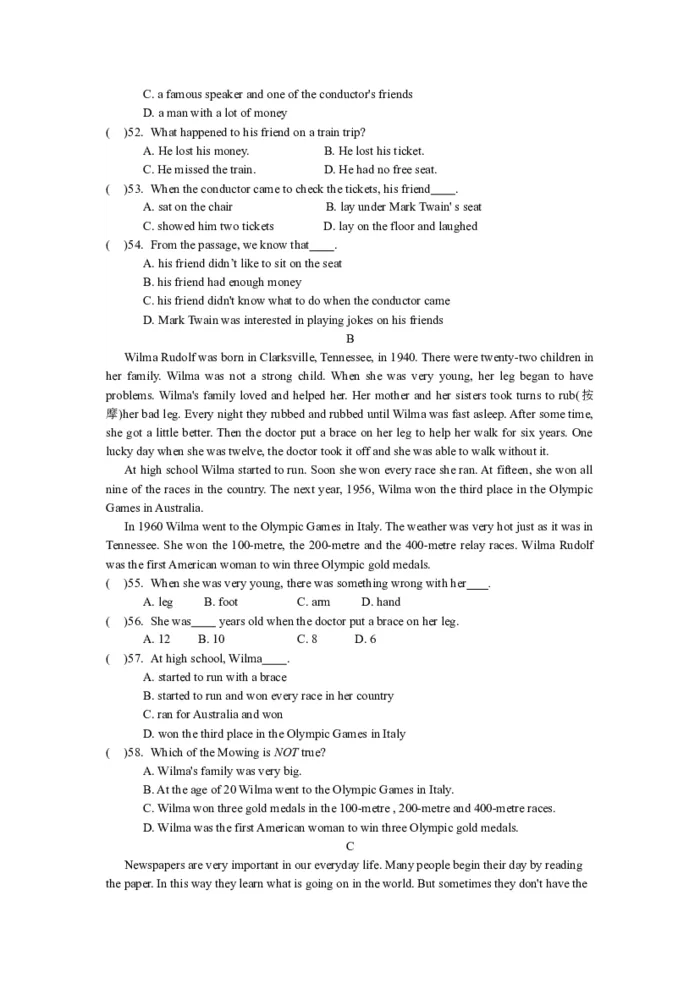
Mark Twain was a great American writer, and he was also a famous speaker. He liked to tell
interesting stories to make people laugh. He also liked to play jokes on his friends.
Once Mark Twain was travelling with a friend of his. His friend lost his money, so he asked
Mark Twain to buy a train ticket for him.
"But I don’t have enough money to buy two tickets." said Mark Twain. His friend didn't know
what to do. "You can lie under my seat when the conductor comes to check (检查) the tickets."
Mark Twain said to him.
When the conductor came to check the tickets, Mark Twain gave him two tickets, one for
himself and the other for his friend. He said to the conductor, "My friend is a strange man. When
he travels on a train, he does not like to sit on the seat. He likes to lie on the floor under the seat.
Everyone in the train looked at his friend under the seat and laughed.
(    )51. Mark Twain was        .
A. a great Canadian writer and a famous speaker
B. a great American writer arid a famous speaker
C. a famous speaker and one of the conductor's friends
D. a man with a lot of money
(    )52. What happened to his friend on a train trip?
A. He lost his money.            B. He lost his ticket.
C. He missed the train.           D. He had no free seat.
(    )53. When the conductor came to check the tickets, his friend        .
A. sat on the chair               B. lay under Mark Twain' s seat
C. showed him two tickets        D. lay on the floor and laughed
(    )54. From the passage, we know that        .
A. his friend didn’t like to sit on the seat
B. his friend had enough money
C. his friend didn't know what to do when the conductor came
D. Mark Twain was interested in playing jokes on his friends
B
Wilma Rudolf was born in Clarksville, Tennessee, in 1940. There were twenty-two children in
her family. Wilma was not a strong child. When she was very young, her leg began to have
problems. Wilma's family loved and helped her. Her mother and her sisters took turns to rub( 按
摩)her bad leg. Every night they rubbed and rubbed until Wilma was fast asleep. After some time,
she got a little better. Then the doctor put a brace on her leg to help her walk for six years. One
lucky day when she was twelve, the doctor took it off and she was able to walk without it.
At high school Wilma started to run. Soon she won every race she ran. At fifteen, she won all
nine of the races in the country. The next year, 1956, Wilma won the third place in the Olympic
Games in Australia.
In 1960 Wilma went to the Olympic Games in Italy. The weather was very hot just as it was in
Tennessee. She won the 100-metre, the 200-metre and the 400-metre relay races. Wilma Rudolf
was the first American woman to win three Olympic gold medals.
(    )55. When she was very young, there was something wrong with her       .
A. leg         B. foot
       C. arm          D. hand
(    )56. She was         years old when the doctor put a brace on her leg.
A. 12         B. 10           C. 8            D. 6
(    )57. At high school, Wilma        .
A. started to run with a brace
B. started to run and won every race in her country
C. ran for Australia and won
D. won the third place in the Olympic Games in Italy
(    )58. Which of the Mowing is NOT true?
A. Wilma's family was very big.
B. At the age of 20 Wilma went to the Olympic Games in Italy.
C. Wilma won three gold medals in the 100-metre , 200-metre and 400-metre races.
D. Wilma was the first American woman to win three Olympic gold medals.
C
Newspapers are very important in our everyday life. Many people begin their day by reading
the paper. In this way they learn what is going on in the world. But sometimes they don't have the
time to read the newspaper carefully and must be pleased with a quick look at the front page.
Sometimes they may be in such a hurry that they have time only to look at the headlines quickly.
There’re newspapers to please every reader. In big cities there are many kinds with several
different editions (版本) every day. In small towns there are fewer newspapers and perhaps only
one edition each day. Some papers in small towns have several editions, especially on Sundays.
Besides the front page with the most important news, there is the sports page, the amusements(娱
乐) page, the business page and so on..
(   )59. If people don't have enough time to read all the pages of a newspaper carefully,        .
A. they sometimes read the front page      B. they sometimes read the headlines
C. they don't read it at all                D. Both A and B
(    )60. The word headlines may mean      .
A. important editions          B. words in large letters above stories in a newspaper
C. interesting stories          D. some sports and amusements pages
(    )61. By reading the newspaper, people can know
A. what is happening in the world     B. how many editions there are each day
C. the headlines are not so important   D. the sports page isn’t as clear as the others
(    )62. Some newspapers in small towns have      on Sundays than usual.
A. more editions  B. more pictures    C. fewer editions
D. fewer pictures
(    )63. If you want to watch a football match, you’d better read       in the newspaper.
A. the business page
      B. the front page
C. the sports page
      D. the amusements page
D
TIMETABLE
AIRBEIJING(INTERNATIONAL)CAAC

Beijing
Bahrain
Doha
Abu Dhabi
Dubai
Muscat

Flight No.
Leaving
Arriving
Arriving
Arriving
Arriving
Arriving
Mon
F002
10:00
19:20

22:25
07:05

Tues
F004
10:00

19:30


22:25
Wed
F008
10:00
19:20

22:25

23:50
Thurs
F012
10:00

19:30
22:25


Fri
F016
10:00
19:20


22:25
Sat
F018
20:45
06:05


08:55
10:35
Sun
F014
20:45
06:05


09:45
(    )64. If one takes F008 on Wednesday, which places can't he reach?
A. Bahrain and Doha.              B. Doha and Abu Dhabi.
C. Doha and Dubai.                D. Dubai and Muscat.
(    )65. How many flights can take people from Beijing to Bahrain in a week?
A. Five.        B. Four.
       C. Two.      D. Three.
(    )66. On what days can one fly from Beijing in the morning and arrive in Muscat at night?
A. Tuesday, Saturday and Sunday         B. Tuesday, Wednesday and Friday.
C. Tuesday and Wednesday.              D. Wednesday and Friday.
E
Dear editor,
I am not a good-looking boy and I'm not good at studying, either. Some people don't even want
to talk to me. So I usually feel lonely. Sometimes I think that if I wanted to leave home, nobody
would care. How can I stop feeling like this?
Peter
*   *    *   *   *  *   *    *   *   *   *
Dear Peter,
Without knowing more about you, it is hard for me to give you some good advice.
But first, I am sure that you are wrong that nobody would care if you left home. What about
your parents? And other family members? It seems that you are very sad. You'd better go to see a
doctor or talk to your parents. They will be able to help you.
Second, I'm sure there s someone in your class who feels lonely, too. You never know how
other people feel inside. Try to make friends with them.
Or you may join a club to meet new people and to keep yourself busy.
You need to find happiness in yourself. Write a list of all the good things about yourself, learn
to like yourself, and then others will see your confidence and like you, too.
Editor
(    )67. What's the trouble with Peter?
A. He doesn't like his parents.          B. He doesn't like others.
C. His parents don't like him.           D. He isn't good at studying and feels lonely.
(    )68. Why does Peter write to the editor?
A. Because he wants to make friends with him.
B. Because he wants to ask the editor to help him.
C. Because he wants the editor to know about him.
D. Because he wants to give the editor some advice.
(    )69. If Peter joins a club, he can      .
A. meet new people and make friends with them       B. keep his friends busy
C. study hard but never think about others            D. be a good-looking boy
(    )70. Peter will probably feel       when he reads the letter from the editor.
A. sad         B. lonely
         C. glad         D. afraid
五、书面表达(10 分)
本月兴国县开展以“做文明市民,从不闯红灯做起”为主题的交通安全宣传月。请你写
一篇80 词左右的短文,谈谈如何遵守交通法规。短文的开头一给出。
要求: 1. 条理清楚,语意连贯, 句式规范,字迹工整。 2. 以下内容供参考。
walkers
look, cross, left and right, carefully…
drivers/riders
drink, slow down, wear a seat belt, traffic light, a helmet(头盔), fast…
passengers
get on/off, push, wait, in line…
In order to keep the road orderly and people safe, everyone should follow traffic rules.
听力材料
请听下面10 段对话,根据其内容选择正确的答案。每段对话读两遍。
1. W: Hi Bill! Shall we go out for a walk?
M; I' d love to. But I have to get ready for tomorrow’s math exam.
W: Tomorrow? Tomorrow is Saturday. We don' t have school on Saturday.
2. W: Hi, Li Lei!
M: Hi, Kate! Is this black pen yours?
W: No. Mine is blue.
M: Whose pen is it?
W: It's Peter's.
3. W: Dad, my bike is broken. Could you drive me to school this morning?
M: It's still early. Why not walk there?
W: OK.
4. W: You're late, Mr. Smith.
M: I'm sorry. But doesn't the meeting begin at 2:30?
W: Yes, but it's already 2:45 now.
M: My watch is just at 2: 15. That must be something wrong with it.
5. W: Would you like orange or tea, Tom?
M: Tea, please.
W: With sugar or milk?
M: Milk.
6. M: Mary, it's you! You've come back to New York so soon. Did you enjoy yourself during the
holiday?
W: Very much. I visited many places of interest in Australia. M: Australia? I thought you had
been to Canada.
7. W: I'm home, Dad.
M: You've come back early, Lucy. Isn't the film good?
W: Yes, very nice. You really can't miss it.
8. W: Excuse me. How much is this kind of skirt?
M: It was 60 yuan each last week, but now you can pay only half for it.
9. W: You mean you didn't catch the train? M: Yes, though I started very early.
W: How could it happen?
M: I didn't know the way to the station was so busy.
10. W: Bill, where is Jack? He didn't come to school today.
M: He s at home, Mrs. Black. He was hurt in an accident yesterday.
W: Oh, I'm sorry to hear that. Is it serious?
M: Luckily, he wasn’t hurt badly, or he must be in hospital now.
参考答案
1~5  ABCCB      6~10  BACCA      11~15  DBBCA       16~20  DADDA
21~25  DCBBB    26~30  BCDAA     31~35  ADBDC       36~40  CABDC
41. activities     42. smaller         43. other        44. of          45. to answer
46. on          47. listening        48. hear         49. us          50. learned /
learnt
51~55  BABDA    56~60  DBCDB     61~65  AACCA       66~70  BDBAC
One possible version:
   In order to keep the road orderly and people safe, everyone should follow traffic rules.
When you walk, you should walk at the side of the road. Always be careful and look left and right
before you cross the road. If you like riding, don’t run through the red traffic lights. Don’t ride too
fast. If you ride a motorbike, remember to wear your helmets. If you drive, you should slow down
at the traffic lights. You must always wear a seat belt. You must never drink. When many
passengers are waiting for the bus, please stand in line and wait for your turn. Don’t push others.
Don’t get off the bus until it has stopped.
   Let’s try our best to make our city more beautiful.