1
Unit16 On the London Eye 在伦敦眼上
句型与结构词
课文注释:
题目:On the London Eye—乘坐几乎所有的交通工具我们都on 来表示。
图1:Isn’t this fun? — Isn’t….? — 需要用“Yes”来回答的疑问句;fun—抽象的不可数名词前面不
加冠词。
图2:the River Thames — 河流名称前面要加the;the River Thames — 表示名称的首字母要大写泰
晤士河是流经伦敦及伦敦河口汇入大海的一条河流。它会有潮汐现象,即使在伦敦市的西边
(内陆)也如此;只有在涨潮的时候,船只才能进出伦敦塔桥上游的伦敦池(Pool of
London)。
图3:Tower Bridge — 在地标性建筑的纪念物的名称前不加冠词。
It’s open — 塔桥(Tower Bridge)的桥身可以分开并抬起,大型般只可以由此驶向上游的伦
敦池。
Pass me — 与give me 和show me 作比较一双宾语动词,其间接宾语是me,直接宾语是the
binoculars。固定短语。the binoculars — 只有复数形式,后接复数动词。
图4:Can you see any ships there? — 我们用a ship 来表示非具体所指的单数名词。问句中的复数用
any ships 来表示。Any 指不确定的数量。
I can see one — one,代词,指代“one ship”。
Westminster Bridge — 在地标性建筑和纪念物的名称前不加冠词。
Some people/cars/buses — some 用于肯定句中,表示不确定数量的复数名词。
图6:Big Ben — 著名的塔钟,与议会大厦毗邻。它的钟声通过英国广播电台BBC 传遍世界,因此
成为伦敦的象征。
其它:
否定疑问句
1、定义:疑问句的否定结构称为否定疑问句。
2、构成:
●There are two cars in/on/under ...
●Are there any women in front of / near / beside ...?
●There aren't any children in the park.
●There are some children in the classroom.
●How many boats are there in ...?
●I can't see any children in ... but I can see some in ...
●There are two men in the street. They are policemen.
2
完全式 助动词+主语+not+……? 简略式 助动词的否定缩略式+主语+……?
例如:(1)一般疑问句:Are you my uncle, Tom? 你是我叔叔汤姆吗?
否定疑问句:Are you not my uncle, Tom?
Aren’t you my uncle, Tom? 难道你不是我叔叔汤姆吗?
(2)一般疑问句:Is this great? 很棒吗?
否定疑问句:Is this not great?
Isn’t this great? 这难道不棒吗?
3、回答方式:回答否定疑问句时,如果是肯定的回答要用yes,加肯定句;否定的回答要用no,加
否定句。
例如:(1)Isn’t this interesting? 这难道没有趣吗
Yes, it is. 不,有趣。 No, it isn’t. 对,没有趣。
(2)Aren’t you happy? 你难道不高兴吗?
Yes, I am. 不,我高兴。No, I’m not. 是的,我不高兴。
【注】这类否定疑问句一般表示希望得到肯定答复。
不定代词some, any
1、定义:不指明代替任何特定名词或形容词的代词叫做不定代词。不定代词表示各种程度和
各种类型的不定意义。
2、用法:some, any 作为不定代词,意思是“一些” 、“几个”的时候,用于表示不定数或
不定量,可以修饰复数名词。一般说来,some 用于肯定句,any 用于否定句和疑问句。
例如:(1)肯定句:There are some apples on the table. 桌子上有一些苹果。
否定句:There are not any apples on the table. 桌子上没有苹果。
疑问句:Are there any apples on the table? 桌子上有苹果吗?
句型讲解
陈述句
Daisy/I
can’t
believe this.
We/They
are/’re
(all)together on the London Eye.
I
can see
Tower Bridge
There
are
some people on the bridge.
一般疑问句
Isn’t
this
fun/great/grey?
Can
you/she
believe it?/see Tower Bridge?
Are
there
any people on the bridge?
特殊疑问句
Where
are Daisy and Jack?
3
What
is grey and silver?
What colour
is the river?
what
can they see?
What time
is it?
How many ships
are there?
总结答案:
Daisy, Jack and Claire are all together on the London Eye. The River Thames is grey and silver. Tower
Bridge is open. Claire can see one ship, and some boats. There are some people on Westminster Bridge,
and there are some cars and buses on the bridge. It is twelve o’clock.
听力:
Lucy: Flora and her Dad are here today, but I can’t see them.
Paul: What about those people with the dogs?
Lucy: Hmm….I can’t see them very well. No, those dogs aren’t Flora’s. Flora’s dogs are both very big. Thosr
dogs are small.
Paul: show me. Pass me the binoculars, please.
Lucy: Just a minute…No, I can’t see them. …. OK. Here you are.
Paul: Who’s that man with the camera? No, that isn’t Flora’s father. Are you sure they are here today?
Lucy: Oh, look, Paul! I can see them! There they are. Can you see that girl on the horse? That’s Flora. Let’s
go and meet them.
答案:Flora is the girl on the horse. Flora’s father is the man beside her.
填词游戏:横栏:1 church 3 River 4 ready 5 people
竖栏:1 camera 2 Bridge
4
Unit17 Smile, please!笑一笑!
句型与结构词
课文注释:
题目:Smile, please — 这是摄影师对摄影对象发出的典型指令。
图1—5:smile/watch/look/come/take 这些词都是祈使动词。在can/can’t 后面它们也是原形。
图1—5:can 后面接不带to 的不定式(与祈使动词形式相同)can balance,can do,can take 等。在
疑问句中,can 放在主语前面:Can you balance? (与Are you…?/Is he…? 等用法相同),主语后
面接不带to 的不定式。否定式can’t 的构成方式与isn’t/aren’t 类似。(我们教给学生can’t 而
不是cannot,can’t 更常用,而cannot 不常用,在某些情况下cannot 似乎过于强调否定了。
现在不要把它介绍给学生。)
图1:can balance on this ball — can 在这指能力。
do it/that — do 是及物动词:它后面总是跟一个宾语,如:it/this/that。
I can try can 在这里指“可能性”=“it is possible for me to try”(我有可能试一试)
图2:as well — 与too 可以互换使用,放在动词短语的后面。
图3:on my knees — 即“kneeling”(跪着)。我们在所有描述身体部位的短语中都用on: on
my/one’s head/back/front/hands/feet 等等。
It’s fun — fun 是名词补语,it’s fun 的意思是It is enjoyable(有趣的)。
图4:good at/useless at + 名词 — 两个形容词都与at 搭配。
图4 和图5:gymnastica,Maths(Mathematics 的缩写)有一类名词以-ics 结尾,形式上是复数,但
是它们表示某个研究或实践的学科名称的时候,后面总是跟单数动词:Maths is fun.(美式英
语中把缩写成Math,而不是Maths。)
图5:Never mind! — 感叹句=“There’s no need for you to be upset!”(没关系,别沮丧!)
Maths,Music — 当它们指学术性研究学科时,要把首字母大写。
you can take a photo — can 在这里指“it is possible for you to take a photo” (你可以拍一张
照片)。Take a photo 的意思是“operate a camera”(操作一架相机),而不是“be in a
picture”(在照片中)【中国人经常把take 和have 相混淆。Take: Can I take a photo for you?
(我给你拍张照片)Have: Can I have a photo of you and me together = Can I have a photo of me
with you?(我的朋友会给我们拍照。)】
●Can you do Maths? Yes, I can. / No, I can't.
●Can you drive a car?Yes, I can. It's easy. / No, I can't. It's difficult.
●Can you play tennis? Yes, I can. I'm good at it. / No, I can't. I'm useless at it.
5
其它:
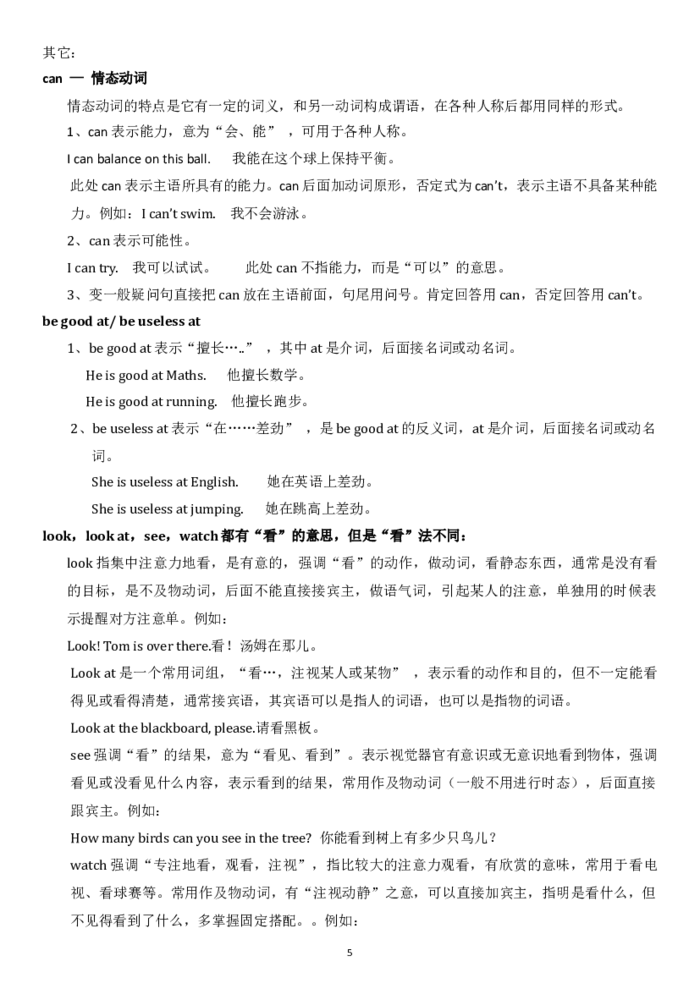
can — 情态动词
情态动词的特点是它有一定的词义,和另一动词构成谓语,在各种人称后都用同样的形式。
1、can 表示能力,意为“会、能” ,可用于各种人称。
I can balance on this ball. 我能在这个球上保持平衡。
此处can 表示主语所具有的能力。can 后面加动词原形,否定式为can’t,表示主语不具备某种能
力。例如:I can’t swim. 我不会游泳。
2、can 表示可能性。
I can try. 我可以试试。 此处can 不指能力,而是“可以”的意思。
3、变一般疑问句直接把can 放在主语前面,句尾用问号。肯定回答用can,否定回答用can’t。
be good at/ be useless at
1、be good at 表示“擅长…..” ,其中at 是介词,后面接名词或动名词。
He is good at Maths. 他擅长数学。
He is good at running. 他擅长跑步。
2、be useless at 表示“在……差劲” ,是be good at 的反义词,at 是介词,后面接名词或动名
词。
She is useless at English. 她在英语上差劲。
She is useless at jumping. 她在跳高上差劲。
look,look at,see,watch 都有“看”的意思,但是“看”法不同:
look 指集中注意力地看,是有意的,强调“看”的动作,做动词,看静态东西,通常是没有看
的目标,是不及物动词,后面不能直接接宾主,做语气词,引起某人的注意,单独用的时候表
示提醒对方注意单。例如:
Look! Tom is over there.看!汤姆在那儿。
Look at 是一个常用词组,“看…,注视某人或某物” ,表示看的动作和目的,但不一定能看
得见或看得清楚,通常接宾语,其宾语可以是指人的词语,也可以是指物的词语。
Look at the blackboard, please.请看黑板。
see 强调“看”的结果,意为“看见、看到”。表示视觉器官有意识或无意识地看到物体,强调
看见或没看见什么内容,表示看到的结果,常用作及物动词(一般不用进行时态),后面直接
跟宾主。例如:
How many birds can you see in the tree? 你能看到树上有多少只鸟儿?
watch 强调“专注地看,观看,注视”,指比较大的注意力观看,有欣赏的意味,常用于看电
视、看球赛等。常用作及物动词,有“注视动静”之意,可以直接加宾主,指明是看什么,但
不见得看到了什么,多掌握固定搭配。。例如:
6
watch TV,watch a film,watch the football match
also, too, either, as well 的区别
1、too 和 as well 多用于口语中,语气较轻,通常用于肯定句或疑问句,一般不用于否定句,
且通常放在句末。如:
I like you too [as well]. 我也喜欢你。
too 有时也紧跟在主语后(注:as well 不这样用),此用法较正式。如:
在 Me too, You too 这类简略答语中,通常不用 as well, also。如:
A:I’m tired. 我累了。
B:Me too. 我也是。
2、also 比 too 和 as well 正式,一般也不用于否定句,它在句中的位置通常是紧靠动词,即
放在行为动词之前,特殊动词之后。有时为了强调也放在句末(但不常见)。如:
He also came. / He came also. 他也来了。
She is young and beautiful,and also rich. 她年轻漂亮,而且有钱。
also 有时用于句首(其后通常有逗号),相当于连词and。如:
Also,his mother was dead. 再说,他母亲又过世了。
3、either(也)通常只用于否定句,且要放在句末。如:
I don’t know, either. 我也不知道。
He hasn’t finished it,either. 他也还没有做完。
注:有时在肯定句之后跟一个否定句,可能用 too,also。如:
He came, but she didn’t also came. 他来了,但她没有也一起来。
He went to Washington, but not to New York too.他去了华盛顿,但并不是也去了纽约。
take 的用法
take a photo of sb 是给某人照相,而且就是给他本人照相。
take a photo for sb 是为某人照相,相片上不一定有他本人。
take a photo 拍照片。
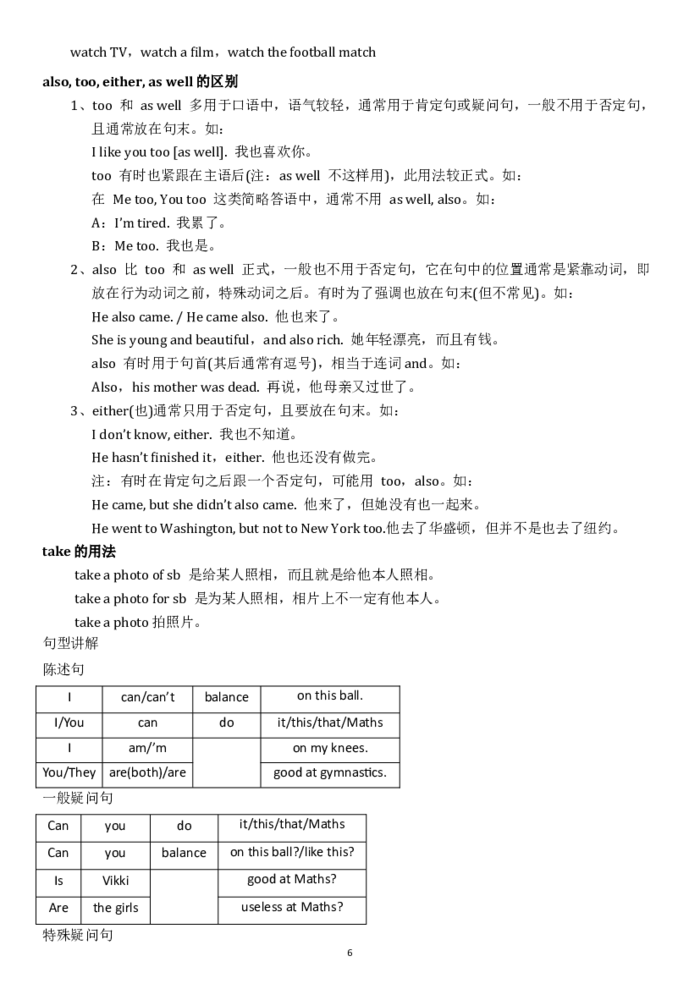
句型讲解
陈述句
I
can/can’t
balance
on this ball.
I/You
can
do
it/this/that/Maths
I
am/’m
on my knees.
You/They
are(both)/are
good at gymnastics.
一般疑问句
Can
you
do
it/this/that/Maths
Can
you
balance
on this ball?/like this?
Is
Vikki
good at Maths?
Are
the girls
useless at Maths?
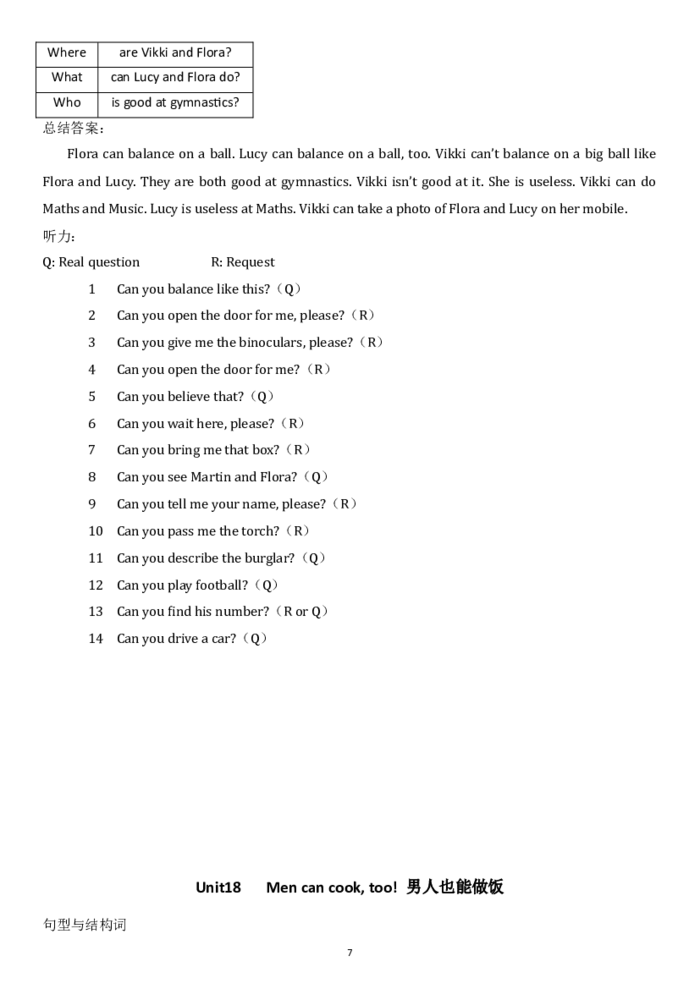
特殊疑问句
7
Where
are Vikki and Flora?
What
can Lucy and Flora do?
Who
is good at gymnastics?
总结答案:
Flora can balance on a ball. Lucy can balance on a ball, too. Vikki can’t balance on a big ball like
Flora and Lucy. They are both good at gymnastics. Vikki isn’t good at it. She is useless. Vikki can do
Maths and Music. Lucy is useless at Maths. Vikki can take a photo of Flora and Lucy on her mobile.
听力:
Q: Real question R: Request
1
Can you balance like this?(Q)
2
Can you open the door for me, please?(R)
3
Can you give me the binoculars, please?(R)
4
Can you open the door for me?(R)
5
Can you believe that?(Q)
6
Can you wait here, please?(R)
7
Can you bring me that box?(R)
8
Can you see Martin and Flora?(Q)
9
Can you tell me your name, please?(R)
10
Can you pass me the torch?(R)
11
Can you describe the burglar?(Q)
12
Can you play football?(Q)
13
Can you find his number?(R or Q)
14
Can you drive a car?(Q)
Unit18 Men can cook, too! 男人也能做饭
句型与结构词
8
课文注释:
题目:Men can cook — men — 复数可数名词前不加冠词,指“men in general”(泛指男人);
can cook — cook 可以作不及物动词,如此处的用法;也可以作及物动词,如:cook a meal。
图1—5:和“对话练习”的教学要点:本课介绍some 和any 的用法,i)指不确定数量的不可数名
词(some / any rice, some / any water);ii)指复数可数名词(some / any onions, some / any
knives, some / any forks, some / any spoons)。
图1:Let’s / Let us+不带to 的不定式 — Let’s 用于提出建议,包括说话人在内。这句话是一个“第
一人称复数祈使句”。
cook dinner — 提到膳食时通常不加冠词(breakfast, lunch, dinner, tea 等等),因为我们提到
的是“一般意义”的膳食或场合【表示具体的餐饮时,可以在前面加a / an 或the,如A good
dinner=a good one of its class.(一顿好晚餐)The dinner is late=This one in particular.(具体指
代那顿晚餐)】
some rice / some water=“an indefinite quantity of rice / water”(不确定数量的大米/水)。
rice 和water 通常都是不可数名词。也就是说,它们是单数形式,后面接单数动词。不可数名
词指的是“an amount”,“a quantity”(数量),从它们的基本意思来说,没有复数形式。
Some — some 用于肯定陈述句中。否定陈述句和疑问句中用any。
图2:Pass me a knife — pass 是带双宾语的动词:也就是说,pass 后面的第一个名词或代词是动作
的“接受者”,第二个名词或代词是动作再次出现时用one 来代替。在这种用法中,one 前面
总要加个限定词:the, a , this, that, which,表示具体是哪一个。
图3:chop — 及物动词,后面要跟名词或代词作宾语。
图4:a spoon — 单数可数名词(a spoon, an onion)。
get — 及物动词,后面要跟名词或代词作宾语,意思是“obtain”(获得)
图5:knives — knife 的不规则变化的复数形式。
plates,forks,onions,hands —规则变化的复数形式;词尾-s 在/t/(plates)和/k/(forks )
后读作清音/s/。在/n/(onions,spoons)和/nd/(hands)后面读作浊音/z/。
图6:you see — 对某事物进行解释时使用的固定短语。Oh, yeah! — 表示假装同意,即怀疑。
其它:
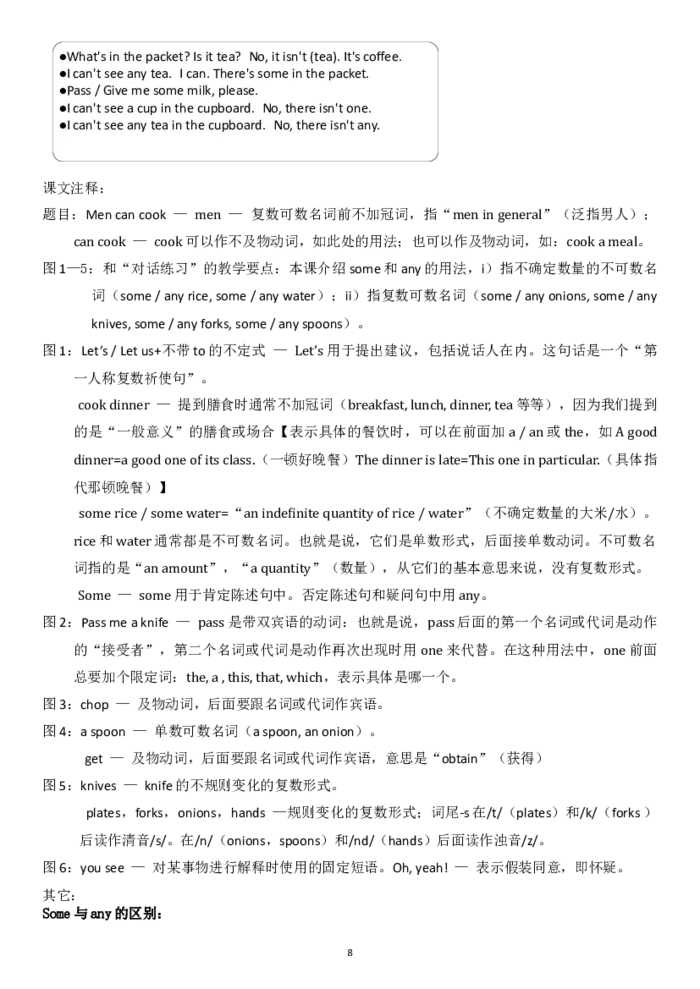
Some 与any 的区别:
●What's in the packet? Is it tea? No, it isn't (tea). It's coffee.
●I can't see any tea. I can. There's some in the packet.
●Pass / Give me some milk, please.
●I can't see a cup in the cupboard. No, there isn't one.
●I can't see any tea in the cupboard. No, there isn't any.
9
1. some 和any 既可以修饰可数名词又可以修饰不可数名词,some 常用在肯定句中,而any 则常用
在否定和疑问句中。因此 some 和any 的用法主要是考虑用在肯定句、疑问句还是否定句中,与名
词的可数与否无关。
2. some 意为“一些”,可作形容词和代词。它常修饰可数名词复数。如:some books 一些书,
some boys 一些男孩,也可修饰不可数名词,如:some water 一些水,some tea 一些茶叶,some 常
用在肯定句中。any 意为“任何一些”,它也可修饰可数名词复数或不可数名词,常用于疑问句和
否定句。
3. 但在表示建议,反问,请求的疑问句中,或期望得到肯定回答时,多用some 而不用any。如:
Would you like some coffee? 你要不要来点咖啡?
What about some fruit juice? 来点水果汁如何?
4. 当any 表示“任何”的意义,起强调作用时,它可以用在肯定句中;
Any student can answer this question.任何学生都可以回答这个问题。
must 的用法 :
1)表示主观的义务和必要, 主要用于肯定句和疑问句, 意思为 “必须……,得……,要……”;由
must 引起的疑问句,肯定回答要用must 或have to, 否定回答要用needn’t 或don’t have to, 意思是
“不必”;must 的否定形式mustn’t 表示禁止,意思是“不能,不许”。如:
I must finish my homework. 我必须完成我的作业
—Must I finish the homework right now? 我现在必须完成这个作业吗?
—Yes, you must. / Yes, you have to. 是的。
(—No, you needn’t. / No, you don’t have to. 不,不必。)
2)表示肯定的猜测,常用于肯定句中,意思为 “一定是, 必然……”。
注意must 表示推断或猜测的几种情况:
Your sister must be a doctor in this hospital. (现在的猜测) 你姐姐一定是这家医院的医生。
He must be reading newspapers in the reading room now. (正在进行的猜测)
他此刻一定正在阅览室读报。
have to / have got to 的用法
1)must 表示一种主观的需要,而have to 表示一种客观的需要,意思是“不得不”。 如:
I have to attend an important meeting this afternoon. 今天下午我不得不参加一个重要的会议。
2)have to 的否定形式是don’t have to, 相当于needn’t。如:
They don’t have to buy a computer at present. 他们目前没有必要买电脑。
3)have to 与have got to 常可以互换。
听力:
10
Lucy: Look at this photo, Dad. It’s me in the gym at school.
William: Oh, very nice, Lucy! It’s a lovely photo of you. Is this your friend, Vikki?
Lucy: No, that’s not Vikki. It’s Flora. Flora’s captain of gymnastics. She’s very good at sports.
William: Yes, I can see that. What about Vikki, then?
Lucy: Oh, Vikki can’t do these things. That is, she can’t do sports. She can’t see very well, so she’s useless at
gymnastics.
William: Poor Vikki!
Lucy: Not really, Dad. You see, Flora’s pretty, and she’s good at sports, but she isn’t clever like Vikki. Vikki’s
really clever. She’s brilliant at Maths and Science, just brilliant!
William: Really?
Lucy: Yes, believe me, Dad. And she’s good fun, too.
William: Is there a photo of Vikki here?
Lucy: I’m sorry, Dad. There isn’t. Vikki’s behind the camera, not in front of it.
William: Ah, yes, of course! She’s a clever girl!
听力答案:1 Flora 2 Vikki 3 Vikki 4 Flora; Vikki 5 Flora 6 Vikki
写问题:
1 Are there any spoons in this drawer?
2 Can you take a photo of us?
3 Whose orange juice is this?
4 What’s the name of the new English restaurant?
5 How many knives are there in the drawer?
6 What time is it?
7 What colour is the sea here?
8 Are you good at sports?
9 Where is the tea?
10 Where are the cups?
11
Unit19 You must eat! 你必须吃!
句型与结构词
课文注释:
题目:You must eat — must 表示不可回避的责任。
图1—5 和“对话练习”的教学要点:must 后面接不带to 的不定式(与祈使句中的动词形式相同)
must eat。在疑问句中,must 必须放在主语的前面:Must Nina eat something?(与Are
you…?/Is
he…? 以及Can I…? Can you…? 等用法相同)must 是助动词,主要动词要放在主语后面。否定
式mustn’t 与isn’t / aren’t 的构成形式相同。(否定式mustn’t 比must not 更常用。must not 表
示非常强烈的禁止,所以通常不太合适。
图1:I am, too — 不是I’m too。如果没有名词、代词或形容词作补语,就不能用缩略式。
图2:We can finish now — finish 可以作及物动词,后面可以跟宾语(如:finish our work),或者也
可以作不及物动词,如此处的用法。
There’s some food — some food 是不可数的(表示数量),所以后面的动词和单数。
图3:I can look, but I can’t eat — can+动词不定式。
Why not? — 这种简短形式代替的是Why can you not eat?。can you 和eat 是通过上下文的回指
来理解的,不必再说一次。
Food is the problem — food(不可数)— 表示泛指;is — 与不可数名词连用的单数动词;
the problem — 使用定冠词=“the particular problem in this context”(此处上下文中的这个特
定问题)。
图4:lots of — 限定词,后跟复数可数名词(如:good things, peaches)和不可数名词(如:food,
luck)。
图5:a peach — 某类东西中的一个,不管是哪一个。复数是peaches — 以-ch 结尾的名词变复数
●There's a lot of / lots of fish ...
●There are a lot of / lots of peaches ...
●Is there any fish ...?
●Yes, there is, but there isn't any meat.
●Are there any peaches ...?
●Yes, there are, but there aren't any grapes.
●Buy some bread / peaches, please.
●Why? There are a lot ...
●Don't buy any bread / peaches.
●Why not? There aren't any ...
●You must eat.
12
时要在后面加-es,读作/’pi:tʃiz/。help yourself — yourself,第二人称反身代词。
其它:
why 是疑问副词,表示“为什么”,why not 表示“为什么不”
一、why not 的口语用法
1、表示同意或赞成,意为:好的,可以啊,为什么不可以呢
A: May I go with you? 我可以和你一起去吗?
B: Why not? 可以呀。
2、表示劝诱、建议或命令,意为:…怎么样,为什么不…呢。
Why not go there at once? 为什么不马上去呢?
3、用来询问愿意(有时表示一种不可理解的心情)意为:为什么不呢?
A: Don’t touch it. 别碰它。B: Why not? 为什么不能?
4、表示坚持自己的观点,态度或做法,意为:为什么不呢
A: Are you really going to tell them? 你真的要告诉他们吗?
B: Yes, why not? 为什么不呢?
二、why not 后动词用什么形式以及结构形式
why not 后习惯上只接动词原形,不能接带to 不定式或现在分词,不能接句子,也不能用“ why
don’t+动词原形”这样不伦不类的句子。
You’re looking tired. Why not take a holiday?
注:在一定语境中,有时why not 后可省略动词原形
A: Let’s meet at the station. 我们在车站见面吧。
B: Why not at the hotel? 在饭店不行吗?(句中why not 可视为省略了动词wait)
lots of,some,与any 的用法比较
1、lots of 表示“许多,大量”,修饰可数名词复数和不可数名词。既可以用于肯定句,也可以用于
否定句和疑问句。lots of=a lot of
2、不定代词some,any 的用法
some,any 均可以用来修饰可数名词和不可数名词,在这一点上和lots of 是相同的。但是some 一般
用于肯定句,any 一般用于否定句和疑问句,而lots of 可以用于这三种句型。
含有第二人称主语的祈使句
祈使句表示请求、命令、建议等。句子中通常不用主语,谓语动词一律用原形。句末用感叹或者句
号,用降调。
例如:Be careful! 小心! Don’t make such a noise. 不要这么吵。
肯定的祈使句:动词原形+……(省略主语)
Stand up. 起立。 Be quite, please. 请安静。
有时为了加强语气,可以在动词之前加do。
13
用客气的语气表示祈使句时,可在句首或句尾加上please,但如果在句尾加please,那在please 之
前一定要加一个逗号。
祈使句中如果有唤语,一定要用逗号“,”隔开,放在句首或句尾。例如:Li Ming, come here.
否定的祈使句:Don’t+动词原形+……
Don’t swim in the river. 别在河里游泳。 Please don’t be noisy. 请不要在声喧哗。
总结:答案
It is four o’clock. Daisy and Nina are both hungry. There is some food on the table over there. Nina can
look, but she can’t eat. Food is the problem. There is some fish and some salad. There are some hot dishes,
too. Nina mustn’t eat. She can’t eat and be beautiful. Perhaps she can eat a peach or lots of peaches.
听力:
Who’s this in the picture? Oh, yes, it’s Nina. Can you remember Nina? She’s that beautiful girl in
Daisy’s photographs. Look at her. She’s tall and thin, with long hair. She’s lovely, isn’t she? Her hands are
long and elegant. And just look at that blouse and skirt! What an expensive outfit!
And what an expensive kitchen! Let me see. Yes, there’s a new washing-machine in the kitchen. Very
nice! And there’s a fine cooker, and a fridge. Lucky Nina! What a lovely kitchen!
What’s in the cupboard? I can see two bottles of water. There are some jars, too, sugar… coffee… rice…
Hmm… There is some coffee in the coffee jar. But the sugar jar and the rice jar are both empty! There are
some plates in the cupboard, and there’s a plate on the table and a bowl as well. But they’re empty! I can’t
believe this!
It’s a beautiful kitchen, but there isn’t any food in it! The fridge is empty! So what’s the matter with
Nina? She isn’t happy, is she? Poor Nina! She’s very sad. Tell me about Nina. Is she ill? Poor Nina! She’s just
hungry.
答案:1 a)beautiful 2 b)tall 3 c)expensive 4 b)lovely 5 d)empty 6 c)food 7 a)sad 8 c)hungry
14
Unit20 What a surprise! 好一个意外!
句型与结构词
课文注释:
题目:What a surprise! — What a +名词 — 惯用感叹句,表示吃惊。
图1:Nice to speak to you 在电话里问候某人的惯用语。
How are you? How is Ken? — 朋友和熟人之间开始谈话前的惯用语,表示礼貌的询问。
图2:图3 和图4:at 与具体的时刻连用:at a quarter to,at a quarter past,at half past。
图3:can’t find — can’t(cannot 的缩略式)=“negative possibility”(否定的可能性)=it is not
possible for me to find…(我不可能找到……);find — 及物动词,后面要跟名词或代词作宾
语。
图4:I must go — must 表示“necessity”(必须)。与can/can’t 的用法一样,must 后面要跟不带
to 的不定式(与祈使语气动词的形式相同)。
Can I call you…? Can 暗含的意思是“possibility”(可能性),引申为“social possibility”(交
际方面的可能性)=“permission”(允许)。Can I…? 是请求做某事时的惯用语。(有人认为,
有时用may 和might 比用can 更“准确”,其实不然:may 和might 只表示对某个社会或心理地
位较高的人更为恭顺,因此,使用得相对较少)。
go — 不及物动词,后面常常跟地点状语和时间状语:go there,go now。
图6 :hurry up 没有up 也可以单独使用hurry 。Up (副词)与一些不及物动词连用表示
“completely”(完全):finish up,write up 等。
其它:
关于时间
1、询问时间:
询问时间有两种表达方法:What’s the time? 或者What time is it?
2、时间的换算
one minute=sixty seconds 一分钟=六十秒
What time is it?
It's a quarter past two / half past two / a quarter to three.
What time's / When's your English lesson?
At one o'clock. / At a quarter past two. / At half past two. / At a quarter to
six.
I / We must hurry.
Come on! Hurry up!
15
a quarter=fifteen minutes 一刻钟=十五分钟
half an hour=two quarters=thirty minutes 半小时=两刻钟=三十分钟
an hour=two half hours=four quarters=sixty minutes 一小时=两个半小时=四刻钟=六十分钟
3、时间的表达
(1)整点:one o’clock 一点钟
(2)非整点用past 和to 来表示。其中past 表示“几点过……”,to 表示“差……不到几点。”
half past ten 十点三十分(十点半)
a quarter past two 两点十五分(两点一刻)
a quarter to two 一点四十五分(差一刻钟不到两点)
4、在某一个时间点用at
(1) — What time is your Maths lesson? 你的数学课在几点?
— It’s at a quarter to five. 在四点四十五。
(2) — When is your meeting? 你的会议在几点?
— It’s at nine o’clock. 在九点整。
情态动词的用法:
can, could, may, might 都可以用于请求许可,但是can 最常用。
could, may, might 表达请求许可时较为委婉,一般只表示对某个社会或心理地位较高的人更为恭顺,
使用较少,在回答中不用could,may,might,而用can 或must。
Could I open the door? 我可以打开门吗? Yes, you can. (√) No, you can’t/ mustn’t(√)
感叹句:
由what 引导的感叹句
what 修饰名词或名词短语,有以下两种形式:
1、What+a(an)+(形容词)+单数可数名词+主语+谓语!如:
What an apple this is! What a fine day it is!
2、What+(形容词)+可数名词复数/不可数名词+主语+谓语!
What kind women they are! What nice music it is!
由How 引导的感叹句
how 用来修饰形容词、副词或动词。其结构是:
1、How+形容词(副词)+主语+谓语!
How clever the girl is! How quickly the boy is writing!
2、How+形容词+a/an+可数名词单数+主语+谓语!
How beautiful a girl she is! 她是个多么漂亮的姑娘啊!
3、How+主语+谓语!
16
How time flies! 光阴似箭!
what 与how 引导的感叹句,一般情况下可以相互转换,转换后意义不变。如:
What an interesting story it is!==How interesting the story is!
What a beautiful building it is!==How beautiful the building is!
在口语中,感叹句的主语和谓语常常省略。如:
总结:
It is now a quarter to six. Lucy’s music lesson is at half past six. Lucy can’t find her music book. She
must look in her schoolbag. It isn’t there. She is sure. Then it is there. What a surprise! It is now six
o’clock and Lucy is ready.
听力:
1、A: Isn’t this fun! B: Oh, yes, it’s great fun!
2、A: I can’t believe this? Can you? B: No, I can’t! it’s a big surprise for me, too.
3、A: Are you good at Maths? B: Well, I’m not bad. What about you?
4、A: Is that the Happy Garden Restaurant? B: No, I’m sorry. It’s the Green Garden Restaurant.
17
Unit21 Breakfast blues 早餐忧郁
句型与结构词
课文注释:
题目:blues=感觉“life is difficult”(生活是艰辛的)。(也表示一种忧伤风格的民谣,表现日常生
活的艰辛,20 世纪初期新奥尔良的爵土乐是其典型代表。)
图1:Do you want…? — Not really… — 礼貌地表示给与和拒绝的惯用语。(do 作为助动词的一般
现
在时将在第23 单元正式讲解。)
I must eat something must 表示“necessity”(必须);something 不定代词,是eat 的宾语。
I mustn’t train on an empty stomach. — mustn’t, must not 的缩略式,意思是“prohibition”
(禁
止)=“it is against the rules”;on an empty stomach 的意思是“没吃任何东西” 作为固定短
语
来教。
Have got 的意思是“have available for use”(有,可使用)。
图2:How much+不可数名词,用于询问数量:How much juice? 短语how much juice 是want 的宾语。
Just a small glass, please=“I want just a small glass, please”;在答语中我们不必再重复动词。
图4:Tell me about it! 表示同意的俚语=“I am an expert about this, believe me!”(我是这方面的专
家,请相信我!)
at six o’clock — at 与具体的时刻连用;in the morning — in 指在一段时间“之内”
图5:You can take it with you… — it(宾语代词)回指yoghurt;and(you can)have it at the gym —
在第二个从句中没有必要重复you can;gym 是gymnasium 的缩写形式;the gym=你知道我指的
是哪一个gym。
图6:They haven’t got any yoghurt — in,介词,意思是“在某个空间的内部”:at,介词,意思是
“从外面看,在某个特定的位置”
Have you got any tea? Yes, I have. / No, I haven't.
Have we got any coffee? Yes, we have. / No, we haven't.
They've got some bread, but they haven't got any cake.
How much coffee have you / we got? I / We haven't got much.
Do you want any ...?No, I don't want any ...
I don't want any ..., but I want some ..
18
The food there is terrible — the 用来特指;there 回指in the canteen。
其它:
一、have got
1、在英国英语中have got 表示“有,可使用”,相当于实义动词have,用于现在时的肯定句、否
定句和一般疑问句中。第一人称和第二人称用have got,第三人称用has got。
肯定句:We have got some juice in the bottle. 瓶子里有一些果汁。
否定句:We haven’t got any juice in the bottle. 瓶子里没有果汁。
一般疑问句:Have we got any juice in the bottle? 瓶子里有果汁吗?
肯定回答:Yes, we have. 有 否定回答:No, we haven’t. 没有。
2、在美国英语中表达同样的意思经常用“助动词+主语+have”。
美国人可能说:Can you help me now? Do you have time? 你现在能帮我吗?你有时间吗?
而英国人却多半要这么说:Can you help me now? Have you got time?
二、Do you want…?
Do you want…? 用来询问“你想要……吗”
肯定回答:Yes, please. 否定回答: No, thanks. 否定句形式为:I don’t want…
三、How much…?
much 是不定代词,表示“许多,大量”,用来修饰不可数名词,如:water, coffee, money。
1、how much 是对不可数名词的量(多少)进行提问,不能提问可数名词。
⑴I want two cups of tea. (对划线部分提问)
How much tea do you want?
⑵We have got three bottles of milk. (对划线部分提问)
How much milk have you got?
2、how much 意为“多少钱”时,可单独使用,也可构成词组how much money,但英语中通常省
略money 来询问某物的价钱、价格。
例如:How much is the fridge? 这个冰箱多少钱? One hundred dollars. 一百美元。
总结:
It is six o’clock (in the morning). Paul must eat something. He mustn’t train on an empty stomach.
They have got some orange juice in the fridge and there is some tea in the pot. It is a very early start.
Paul can’t eat at six o’clock in the morning. They haven’t got any yoghurt in the canteen at the academy.
He can take some with him and have it at the gym.
听力:
1、A: Are there any peaches in that bowl? B: There’s one. Do you want it?
2、A: Have we got any tea in the house?
B: There’s some black tea, but there isn’t much. We’re got lots of green tea. Is that all right?
19
3、A: Is there any coffee in that pot? B: Yes, there’s some, but it’s a bit cold.
4、A: Is there a photo of Vikki there? B: Yes, there’s one, but it isn’t very good.
5、A: I can’t find any Maths books on this shelf.
B: No, there aren’t any there. There are some on the shelf in the living-room.
Unit22 Watching the neighbours 观察邻居们
句型与结构词
课文注释:
题目:Watching the neighbors — 当我们watch 某人或某物的时候,我们“专注地看,期望能够了
解什么东西”。
图1:again — 通常放在动词短语的最后。
very good friends — 在一般的陈述句中复数名词前面不加冠词。其单数形式是a very good
friend(那一类中的一个)。
图2:shy 通常表示赞许,用于形容那些在社交中不主动的人。
Perhaps — 可与maybe 互换使用;是在对话中轮流讲话时使用的非常有用的副词,用于提出
建议或进行试探性的解释。通常放在主语前面或动词短语的最后。
Many 在表示可获得/拥有等含义的肯定性陈述句中,即在与have got 和there are 连用时,a
lot of 更常使用。在疑问句和否定陈述句中我们用many +可数名词。
图4:He can introduce her — can - 表示“可能性”;introduce Claire/her — 及物动词后跟名词
或代词作直接宾语。Introduce + 宾语+ to(介词)+名词或代词宾语。*不是introduce them
her。
图6:Paul’s always busy — 此处always 与现在时连用,表示“永久性真理”。在陈述句中,always
放在be 的后面。在疑问句中,它放在主语的后面:Is he always…?
其它:
一、have got
1、当用于第三人称时,have got 要变成 has got。
肯定句:Kate has got lots of friends here. 凯特在这里有许多朋友。
否定句:Kate hasn’t got any friends here. 凯特在这里没有朋友。
一般疑问句:Has Kate got any friends here? 凯特这里有朋友吗?
He / She has got lots of CDs.
He /S he hasn’t got many DVDs.
Has he / she got any books?
How many friends has he / she got? — Lots. / Not many.
What about relatives? — He’s / She’s got lots of relatives.
20
肯定回答:Yes, she has. 有。 否定回答:No, she hasn’t. 没有。
2、如果用美式英语来表达,如下:
肯定句:He has some magazines. 他有一些杂志。
否定句:He doesn’t have any magazines. 他没有杂志。
一般疑问句:Does he have any magazines. 他有杂志吗?
肯定回答:Yes, he does. 有。 否定回答:No, he doesn’t. 没有。
二、How many…?
many 是不定代词,表示“许多、大量”,用来修饰可数名词复数,如:people,eggs,hats。
1、how many 的用法
how many 是对可数名词的量(多少)进行提问,如果主语是可数名词,不管主语是单数还是复数一
般都用复数形式提问,因为问话人不知道具体的数量是多少,而且many 只能接可数名词复数形式。
(1)We have got two skirts. (对划线部分提问)
How many skirts have you got?
(2)There are seven days in a week. (对划线部分提问)
How many days are there in a week?
2、记忆口诀
how many 在部首,名词复数跟着走,一般问句紧相随,其它成分不要丢。
many 还可以用作代词,指代许多人或许多物。
例如:A few people want money, but many want health.
一些人想要钱,但是许多人想要健康。
三、always 的用法
always 是频度副词,表示“一直,总是”。
1、在句中的位置
陈述句中always 放在be 动词之后,疑问句中always 放在主语之后。
She is always happy. 她总是很快乐。
Is she always happy? 她总是很快乐吗?
2、与进行时连用,带有一定的感情色彩(赞许、不快、厌恶等)。
He’s always smiling. 他总是面带笑容。
They are always complaining. 他们老是抱怨个没完。
3、与not 构成部分否定,此时always 要放在not 之后(而不能在其前)。
He isn’t always busy. 他并非总是很忙。
句型列表:
1
I’ve got some good books in my living-room.
2
I haven’t got any magazines in my desk.
21
3
He’s got lots of friends in his school.
4
He hasn’t got any videos in his room.
5
She hasn’t got many vegetables in her garden.
6
We’ve got lots of videos in our living-room.
7
We haven’t got any old teachers in our college.
8
She’s got a lot of CDs in her bag.
总结:
Claire is in Karen’s garden. She is with Paul. They are very good friends. Claire is very new here and she
is shy. There are lots of nice girls at the art the art college. Paul has got a lot of friends. He can introduce
Claire to them.
听力:
Daisy: Robert’s a very good actor.*He’s really funny in the school play.*
Jack: Is he? What’s his part?*
Daisy: His part? Let’s say,“ What are his parts?” *He’s got a lot of parts.*He’s a postman, and a
policeman,*and a teacher,*and lots of other people as well.*He’s got seven outfits for this school
play.*He’s brilliant!*You must come and see him!
22
Unit23 An expensive camera 一架昂贵的照相机
句型与结构词
课文注释:
图1:It’s a Japanese one — a — 表示“种类”;one — 不定代词,代替camera。
图2:the name=“此特定物品的名称”
I know — know 通常作及物动词。作不及物动词时,例如此处的用法,意思是“我记得”,
“我明白”。
图3:Lucky Claire! =“Claire is lucky.”
A very fine camera — fine 通常是“无法划分等级的”,特别是在be 和相关的动词之后,它的
意思的“非常好”,如:I’m fine. / It’s all fine。其固有的含义是“制作得好”,“在形式和功能
上较好”,它放在程度副词之后更是这种含义,如:very fine,rather fine,relatively fine。
Claire wants another one…-wants — want 的一般现在时第三人称单数形式;another one —
直接宾语;another — 限定词,与单数名词或代词连用=“a different”;one — 不定代词,
代替“camera”。
图4:Doesn’t she like…? 第三人称疑问句形式,在这里助动词does 与-n’t 连用(doesn’t)。否定
形式的疑问句表示吃惊,期待对方以“yes”回答。
She likes it, but she wants a new one — likes / wants 这些是一般现在时的第三人称单数(用在
she/he/it 之后)形式。
现在时:英语中的现在时态不止一种,我们要根据“说话者的态度”选择时态——这是英语语法中
一个非常重要的原则。在说话者看来,一般现在时表示“现在以及我所能见到的将来的一
段时间之内的事实”。学生可能在语法书中读到want 和like 只能用于一般时态;从广义
上来讲这是对的——但是他们需要理解其中的原因:一般时态表述的是简单(永恒的)事
实,这些可以是哲学上的永恒(Like is difficult),或者形式上的永恒——即从说话者的
Has he / she got a British camera? — Yes, he / she has. / No, he / she
hasn't.
What kind of camera has he / she got? — He's / She's got a Japanese one.
Claire wants a camera. She doesn't want a CD player.
He / She likes Japanese cameras.
What kind of bag do you want? — I want a leather one. I like leather bags.
23
角度来看是一个永恒的事实(Claire wants a new camera.)。
图5:for her birthday — for 是常用的表达原因/目的的介词:for dinner,for your birthday,for
our meeting。At any time — at+时间短语表示在某个时间点。
其它:
一、否定疑问句
1. 疑问句的否定结构称为否定疑问句。
2. 带助动词do 的一般疑问句的否定构成是把否定副词not 放在主语之后。如用not 的简略式,须与
助动词一起放在主语之前。
Do you want to go? (一般疑问句) 你想去吗?
Don’t you want to go ? (否定疑问句 ) 难道你不想去吗?
3. 回答否定疑问句时,如果是肯定的回答要用yes,加肯定句;否定的回答要用no,加否定句。
Doesn’t he want that camera? 难道他不想要那架照相机?
Yes, he does. 不,他想要。
No, he doesn’t. 是的,他不想要。
4. 否定疑问名可以表达惊讶的感情,期望得到对方的肯定的回答。
Don’t you remember me? 难道你不记得我了吗?
二、What kind of…?
kind 表示种类,“ What kind of…?” 指“ 什么样的东西” ,后面跟单数或复数可数名词
(如thing/things),
或者跟不可数名词(如meat)。
What kind of grapes do you need? 你需要什么样的葡萄?
What kind of man is he? 他是什么样的人?
What kind of coffee do you like? 你喜欢什么样的咖啡?
总结:答案
Claire has got a Japanese camera. It is a Canon Ixus. It is a very fine and very expensive camera. Claire
likes the camera, but she wants a new one. It is one of Daisy’s old cameras, and Claire wants a new one for
her birthday.
听力:
提示语
S1: I’m . What can ?
S2: There’s/There are in the bowl/cupboard/fridge. There’s some as well. How about a
glass /cup of ? Please help yourself.
S1: Thank you. Is there any ?
24
S2: Yes, there is. /No, I’m sorry! There isn’t any just now.
文本:
Robert: Mum! I’m hungry. What can I eat?
Karen: There are lots of things. How hungry are you? There are some nice apples in the bowl in the kitchen,
and there are some grapes in the fridge. Perhaps you can find some peaches there, too. You can help
yourself. And there’s lots of milk in the fridge. How about a glass of milk? Or some orange juice? Look
in the fridge, Robert! There’s some cold food in the fridge, too.
Robert: I don’t want any cold food now, Mum. Have we got any cake or chocolate?
Karen: Oh, Robert! You don’t want any cake or chocolate now! It’s half past five! We can have dinner at half
past six! Please, have some fruit and some milk now, and wait for your dinner. You can have a really
good dinner!
Robert: OK, Mum. What have we got for dinner?
听力:答案
1
Robert wants some food — maybe some cake or chocolate.
2
He doesn’t want any cold food.
3
He can have dinner at half past six/in an hour.
25
Unit24 A light dinner 一顿清淡的晚餐
句型与结构词
课文注释:
题目:A light dinner — light=“not heavy”(清淡的,轻的);用于表示“light/heavy”foods(口味
清淡/口味重的食物)的同样的形容词也用于表示重量(pounds 和kilos)。
图1:I love fish — 一般现在时表示永恒或绝对。
I really like-really — 起强调作用的词,放在它所强调的词的前面,可以修饰形容词(really
good)或副词(really love/like)
a nice piece of salmon — 表示“部分”:在谈论“有”某物的时候,在there is 后面
加a/an+名
词+of+不可数名词。
图2:Do you like — 一般现在时的第二人称疑问句形式;vegetables — 复数可数名词。表示“蔬菜
的总称”时,前面不加冠词。
Some new potatoes/some salad — 一定数量的new potatoes/salad。salad — 英语的大部分用
法中,salad 指的是“时令生蔬菜”(因此有salad garden,salad plants);但是在欧洲,多年
以来这个词被用于指“蔬菜配料”。在现代多元文化的欧洲,一盘salad 可以指任何一道摆上
桌的烹制的或生食的时令蔬菜,偶尔里面也放些肉或鱼。
图4:some fruit 这里是不可数名词,也可以作可数名词,可以说a fruit;for dessert — for 是表示
原因和目的常用介词:for dinner,for your birthday,for our meeting。
for dessert — 不可数/表示类属的名词前不加冠词:“无论吃的是哪一种,也无论吃多少”。
图5:great — 俚语。great 的典型含义是“重要的”,它还表示尺寸“大”,但是在俚语中,great
Do you like vegetables? —Yes, I do. / No, I don't.
Do you like tea? —Yes, I do, but I don't want any now.
I / We / They don't like vegetables very much.
I love vegetables! —I hate them!
练习更多的可数名词和不可数名词:vegetables/orange juice、strawberries/tea,sweets/wine
26
用于指“非常好”、“极好”。
图6:You can have… — have 的意思是“尝”、“享用”、“吃”、“体验”。
Just pick them first! — first,副词,意思是“首先”。first 既是一个副词,如此处的用法,又
是一个序数词(first、second、third 等)可以作形容词用,如the first day 等。
其它:
副词really 的用法
1、really 作为副词表示“真正地”,修饰形容词或动词,可以放在所修饰的形容词或者动词前面,
用
来加强语气。
Your coat is really beautiful. 你的衣服真漂亮。
I really like tomatoes. 你真的喜欢西红柿。
2、在否定句中,really 放在否定词前后所代表的意思是不同的。
(1)I don’t really agree with you.
really 放在否定词之后,表示不完全否定,也就是说:我不能完全同意你的观点。
(2)I really don’t know what to do.
而really 放在否定词之前则表示完全否定,所以这句话是说:我真的不知道该怎么办。
总结:答案
Claire loves fish. Karen has got a nice piece of salmon for dinner tonight. Claire likes vegetables,
too.
Karen has got some new potatoes, some salad, some lettuce and some cucumber. That’s Claire’s
favourite kind of food. Paul and Claire can pick some strawberries from the garden for dessert. It is a
really healthy meal.
听力:
Karen: Lucy! Robert! Dinner’s ready! Hurry up, please, Robert. But you must go and wash your
hands first.
Robert: Mum! Sam’s here! He’s in my room. What about dinner?
Karen: That’s OK. There’s lots of food. Sam can have dinner with us. He’s very welcome.
Robert: Thanks, Mum.
Karen: But you must call his mother first. Please do that now this minute. Then go and wash your
hands, both of you. Lucy! Where are you? Where is everybody? Dinner’s on the table.
Lucy: Here I am. Sorry I’m late!
Karen: No harm done.
Lucy: Oh, good! Salmon and new potatoes! My favourite meal!
27
Unit25 The weekend shopping 周末购物
句型与结构词
课文注释:
题目:The weekend shopping — 复合名词。前一个名词对后一个名词加以说明。
图1:There isn’t — 表示存在/有。sugar 是不可数名词,因此在形式上是单数,后面跟单数动词:
isn’t。
any sugar=不定数量的sugar,在否定词后面用any,而不用some。
I must go… —不可回避的义务;to the supermarket — 介词+名词宾语。
图2:How much…?=“有多少”不可数物质;do we need — need 的第一人称复数疑问句形式。
need 是及物动词。need 的宾语是How much sugar?
two bags of sugar — 数字(如one,two)+可数的“度量单位”(如bag,bags)+of+不可数
名词(如sugar)表示不可数物质的多少量。
图3:some tea — some+不可数名词(tea)表示不确定的量。比较four packets of tea,表示确定的
量。
There isn’t much tea in the tin — much+不可数名词(不定量)用于否定句和疑问句。在肯定句
中,我们会说We have a lot of tea in the tin.
图4:What about food…? — 表示泛指时名词前面不加冠词。
for the weekend — for 指“目的”“为了……”
I want a bag of sugar / a bottle of wine / a packet of tea ...
She / He needs some sugar.
How much (sugar) does she / he need?
She / He needs one / a box of chocolates.
不规则变化的名词复数: a / one loaf — two loaves
28
a loaf of bread — bread 不可数,因此为了表示“多少”,我们说a/ one loaf of bread 不
是a/one bread。loaf 的复数形式是loaves。
What vegetables — 表示泛指时名词前面不加冠词。
图5:A piece of meat — a piece of 指“多少”。
What about some nice things…? — 在What about…?后面用some,不用any。这些实际上是提
议或建议,而不是问题;用some 表示希望得到“Yes”的肯定回答。
What kind of 后跟单数或复数可数名词(如thing/things),或者跟不可数句词(如meat)。
Chocolate;ice cream — 表示泛指时名词前面不加冠词。
图6:a box of chocolate — chocolate 可以指不可数的物质名词,也可以指可数的巧克力糖果:one
chocolate/two chocolate/a box of chocolate。
Come ice cream — 不定数量的ice cream。
wine — 不可数;因此表示具体的量时用a bottle of wine。
其它:
一、at/on the weekend 或at/on the weekends 中,介词on 为美语,at 为英语。
We usually do our shopping at the weekend. 我们通常利用周末来购物品。
在美国英语中可省略其前的介词,即把weekends 作为副词。
He works weekends. 他周末工作。
二、need 的用法
1、、作为实义动词
need 后面的宾语可以是名词,动名词,动词不定式或代词,这种情况下,need 既可用于肯定句,也
可用于否定句和疑问句,构成否定句和疑问句时要借助于助动词do 或does.。
1)、need sth.
We need some tea.
2)、need doing
The door needs painting.
3)、need to do sth
You need to take good care of your mother.
2、用作情态动词
作为情态动词的need 具有情态动词的一般性质。
1)、没有人称和数的变化。不论主语是第几人称,不论主语是单数还是复数,情态动词都无形式变
化。
2)、不能单独充当谓语。情态动词必须与一个实义动词一起构成复合谓语,并且这个实义动词要始
终是动词原形。
29
3)、变为否定句时只需要在情态动词之后加not。
4)、变为疑问句时只需将情态动词提到主语前面。
这是情态动词的共性。
3、用作名词
need 作为名词,含义为“缺乏、需要”其复数表示“基本需要”。
三、不定代词both 和all 的用法
both/all 和be 动词,助动词,情态动词连用时,在它们之后。和实义动词连用时在实义动词之前。
They are both students. They both run aways. You can all go home.
2、both/all 跟“of 短语”连用时,当后面接名词时,both 和all 可以省略of;当后面接代词时,
both 和all 不能省略。
Both of them are workers. All(of)the students are ready for class.
四、big、large 的区别:
1、big“大的,巨大的”常指程度、范围、规模、容积、重量、数量等(还可以表示“伟大、重
要”之意)常可与large 互换,多用于具体的、有形的人或物(其反义词多为little/small)。
This is a big dog.
2、large“大的、巨大的”,常指面积、范围、可表示数和量(当它直接用于人时,可表示身体的
大),其反义词为small。
We have a large farm.
总结:答案
Karen and Lucy must make a shopping list. They need four packets of tea, a loaf of bread, some
meat for Sunday lunch and some vegetables. They want some nice things for the weekend, too. They
want a box of chocolate and some ice cream for Lucy and the boys, and a bottle of wine for Karen and
William.
听力:
Lyn: Claire, have you got a minute, please?
Claire: Yes, of course! What’s the matter, Lyn?
Lyn: It’s about cameras, Claire. I need a camera for the photography classes. I haven’t got one, and I…
er…I can’t buy one. It’s a bit difficult really. The other students have all got expensive cameras. I,
er…can you help?
Claire: Oh Lyn, of course I can! Look, my Mom’s a photographer. We’ve got lots of spare cameras in our
house. I’ve got one good cameras, and I want a new one for my birthday. I’m sure we can help.
You must come and talk to my Mom. She’s in the car over there. Come and meet her.
Lyn: Are you sure, Claire?
30
Claire: Sure, I’m sure! You’re welcome, Lyn. Come on now!
答案:Lyn needs a cameras. Claire can help. There are lots of spare cameras in Claire’s house.
Unit26 A self-service restaurant 一家自助餐厅
句型与结构词
课文注释:
题目:a self-service restaurant — self service 是复合名词,第一个词说明第二个词的类别:self 说
明是“什么样的”service。复合名词self-service 本身用作名词修饰语,说明另一个名词
restaurant 的类别:self-service 说明是“什么样的”饭店。
图1:on the menu — a list,a page,a piece of paper 等前面用on。
图3:vegetable soup — 复合名词,vegetable 说明是“什么样的”soup。
Isn’t it? — 反意疑问句,需要用“Yes”来回答。在英语中,我们通常在陈述句后面加一人反
意疑问句来确认自己的观点是正确的。
a bowl of soup/salad — soup 和salad 都是不可数名词;a bowl of 说明了有“多少”。
One soup,one salad — a/one soup/salad=a/one potion of soup/salad。(一份汤/沙拉)这
是英语中“说话者的态度”优先于语法规则的一个典型例子:侍者把餐厅里的所有菜肴视为有
Has Karen got a coat / any gloves?
No, she hasn't. Show her that one / those.
Show it / them / that one / those to Karen.
Give me / her / him that one / those.
Pass me / her / him that one / those.
Take her / him that one / those.
I don't want a coat / any gloves. I've already got one / some.
31
“构成整体的个体”,而不是“整体中的一部分”,因此对他来讲,soup 和salad 都是可数的。
图4:It’s meat and vegetables — It’s — 单数,指“that dish”.。
Give me one of those — one of those — 整体中的一部分。
and a small piece of fish — 整体中的一部分。
图5:Please just take them — them=“the dishes you request”(你点的那些菜)
my dear — 年龄或身份地位相当的人之间的称呼,my dear 是亲昵的称呼,但是用于长辈称
呼晚辈,或者地位高的人称呼地位低的人时,听起来能显出优越感。Annie 或者表示友善,或
者她在暗示她比这个年轻人自己还知道他的职责是什么。
图6:Ladies — 称呼两位或更多女性的礼貌用语。
其它:
一、show/pass/give/take/bring 的用法
show sb. sth.= show sth. to sb. pass sb. sth.= pass sth. to sb.
give sb. sth.= give sth. to sb. take sb. sth.= take sth. to sb.
bring sb. sth.= bring sth. to sb.
take 和bring 是一对意思相反的动词,take 意思是“拿去,带去”;bring 意思是“拿来,带来”。
take 是把东西从说话人这方拿走至另一方。
bring 是把东西从别处拿至说话人这一方。
注:双宾语结构中,物为直接宾语,人是间接宾语。当直接宾语为代词时,只能为give sth. to
sb.
二、反意疑问句(be 动词构成的反意疑问句)
1、定义和构成
在陈述句之后加上一个意思相反的简短问句,这种句子叫做反意疑问句。反意疑问句必须由意思相
反的两部分组成,在前一部分之后用逗号,后一部分之后用问号。反意疑问句的否定句必须用缩略
形式,同时它的主语必须用人称代词,不能用名词。
2、分类
⑴前一部分为肯定式,后一部分是否定式。
⑵前一部分为否定式,后一部分是肯定式。
3、在反意疑问句中,前后两部分的动词在人称,数和时态上通常保持一致,另外,后一部分的人称
代词应和前一部分的主语保持一致。
⑴The pen is yours, isn’t it? 这笔是你的,不是吗?
Yes, it is. 是的。 No, it isn’t. 不是。
前一部分的主语是the pen,动词是系动词is,则后一部分人称代词it 对应the pen,isn’t 对应is。
事实是肯定的,用Yes,事实是否定的,用No.
⑵I am a student, aren’t I? 我是一个学生,不是吗?
32
Yes, you are. 是的,你是。 No, you aren’t. 不,你不是。
前一部分的主语是I,动词是系动词am,则后一部分的人称代词I 对应I,aren’t 对应am。
事实是肯定的,用Yes,事实是否定的,用No.
三、paper 是不可数名词,当“试卷,论文”时,可数。
newspaper 和magazine 是可数名词
总结:答案
Polly and Annie are in a self-service restaurant. In the restaurant there isn’t a menu. You can see
the food, and you help yourself. Annie has a bowl of vegetable soup and Polly has a bowl of salad.
Annie
also has meat and vegetables in tomato sauce and Polly also has a small piece of fish. They want some
coffee and a jug of water with two glasses. The assistant can’t bring them the coffee and water. It is a
self-service restaurant.
听力:
Karen: William. We must buy some new clothes for Lucy. She’s very tall now. Her coat is like a jacket!
William: OK. You can take Lucy to London next weekend.
Karen: Robert needs some new clothes, too.
William: Robert hates London, and he hates shopping. You can ask him. What does Lucy need?
Karen: She needs a coat, a new skirt for school, some jeans, a pair of gloves and a nice dress. And she
wants some other little things as well.
William: I’m sure she does! Ah, well! Perhaps you need a new dress, or a coat and a pair off shoes, and
some other little things as well.
Karen: Well, I want one or two things, it’s true.
William: Yes, I’m sure. Robert’s right! Girls are good at shopping.
Karen: You’re not bad at shopping yourself. But you like shopping for boys’ things. You just don’t like
shopping for clothes!
William: How right you are!
33
Unit27 Toothache 牙痛
句型与结构词
课文注释:
题目:toothache — 表示泛指的名词前不加冠词。尽管我们在a headache,a pain 和a cold 中使用不
定冠词a 表示“某类中的一个”,但是大部分表示病痛和身体状态的词前面都不加冠词。
图1:He’s got toothache — 在肯定句中,我们可以把has got 缩写成’s got。’s 后面的got 表明’s
是has 的缩略,而不是is 的缩略。
图2:He looks awful — look 这类词后面跟形容词补语的时候,意思类似于动词be。
图3:make an appointment — 固定搭配。
It’s an emergency — It 是“虚主语”,如It six o’clock。It 不代替任何名词,放在这里只是
因为英语句子必须有个主语。
图4:that’s=what I have understood(根据我的理解)。that’s 的这一用法为标准用法,用于与信息
提供者确认信息的真实性。
图5 :You look miserable=that is how you seem to me (在我眼里你看起来的样子)。I feel
miserable=that
What day is it? —It's Sunday.
When is / When's your appointment? —It's on Sunday.
When can the dentist see you? —He can see me at four o'clock on Sunday.
How does Robert feel / look? —He feels awful. He looks miserable.
What's the matter with Robert? —He has got / He's got toothache."
34
is what I am experiencing(我正在感觉到的)。
图6:for today — for+时间,表示某事应该在什么时间。Let’s hope for the best — 固定短语。
其它:
一、感官动词
1. 定义
感官动词是指用眼耳鼻舌和皮肤,以及心理上可以感觉的动词。我们常见的有:feel(摸起来)、
look(看起来)、sound(听起来)、taste(吃起来)、smell(闻起来)等。
2. 用法
这些感官动词都属于连系动词,后面接形容词或名词,构成系表结构说明主语的状况、性质、特征
等。主语可以是人也可以是物。
You look young. 你看起来年轻。 I feel awful. 我感到不舒服。
That sounds good. 听起来不错。
That tomato smells bad. 那个西红柿闻起来坏了。
The cake tastes sweet. 蛋糕吃起来香甜。
二、have got+疾病
have got 后面可加表示疾病的名词,意思是“有什么样的病”。
1. 大部分表示身体病痛和身体状态的词前面都不加冠词。
have got earache 耳朵痛 have got toothache 牙痛
have got flu 患流感 have got stomach-ache 胃痛
2. 但是当表示头疼或者感冒时,疾病前可以加不定冠词a,表示“某类中的一个”。
have got a headache 头痛 have got a cold 感冒 have got a pain 病痛
【注】have got 的第三人称形式是has got。在肯定句中,我们可以把has got 缩写成’s got。’s 后
面的got 表明’s 是has 的缩写,而不是is 的缩写。
三、询问星期
1. 询问星期,我们用What day is it?,回答直接用It’s+星期几。
What day is it today? 今天星期几? It’s Sunday today. 今天星期天。
2. 询问什么时候,我们通常用when 来引导。所回答的是一个时间状语,这时要注意一些介词的用
法。在某个时间点用at,在星期几用on。
— When can I go to the zoo? 我什么时候能去动物园?
— You can go to the zoo on Saturday. 你星期六能去动物园。
— When is your appointment? 你的约会在什么时间?
— It’s at 3 p.m. on Friday. 在星期五下午三点。
总结:答案
Robert is not well. He has got toothache. Karen must call the dentist for an appointment for him. It
35
is an emergency. The appointment is for half past four this afternoon. Robert looks miserable and
William feels niserable.
听力
a ) 1 A: I feel awful! B: You look awful!
2 A: You don’t look very well. B: I don’t look very well!
b ) 1 A: You look a bit tired. B: I feel a bit tired.
2 A: Do you want a new skirt for school?
B: I don’t want a new shirt for school, but I need one.
3 A: Do you like fish? B: I love fish.
4 A: Does Claire need a new mobile? B: She doesn’t need a new mobile, but she wants one.
5 A: Hasn’t Lyn got a camera? B: Lyn hasn’t got a camera, but she needs one.
Unit28 Every day is different! 每一天都不同!
句型与结构词
课文注释:
题目:every day is — every+单数可数名词+单数动词。
图1:How are you today — today — 表示时间,放在动词短语的最后。
This weather — weather 一般用作不可数名词。weather(天气)是指一定的时间内特定地点
的温度、风、雨和阳光共同作用的结果,如the weather today/the weather in July/good weather
等等。climate 是主要的天气状况,如Siberia has a cold climate. /Britain’s climate is mild compared
with the climate in continental Europe.。
图2:quite nice — 与可分等级的形容词连用时,quite 是程度副词(降级的词)=低于最高的程度。
(与不可分等级的形容词连用时,例如dead,terrible,beautiful,lovely 等,quite 是加强程度
的词,即加强形容词所表达的意思,意为“绝对地”。)
It’s always wet — 频度副词,如always,often,ever,never usually,常常不用be 的后面。
(它们通常放在所有其他主要动词的前面:如Claire often takes photos of Paul.)
What's the weather like in spring / summer / autumn / winter?
Is it ever fine and warm in spring (in England)?
It's often/usually/sometimes/always/never fine and warm in spring.
The sun often shines. / It rains sometimes. / It sometimes snows.
Which season do you like? —I like winter.
36
Is it ever… — ever 用在疑问句中意思是“在任何时候”。通常不用在肯定句中(虽然也有例
外)。在肯定句中,我们用sometimes: It is sometimes fine and warm in England。在否定句中用
never 和not ever 都可以:It is never/It isn’t ever fine and dry.
图3:When is that?=when is summer?
for two days together — for=“贯穿”一段时间
图4:how it is — how=“方式”;注意这个肯定陈述句中的语序。
in summer,in July — in+季节、月份、年份=“within a period of time”(在一段时间之
内)
It rains sometimes — 在此句中,sometimes 放在动词之后,占据了“时间副词”的位置。
在普通有陈述句中,把这种用法当作“标准”来讲。我们也把sometimes 用作频度副词,放
在be 的后面和主要动词的前面;这时它表示“不总是”。
图5:now — 时间副词通常放在动词短语的最后。
图6:all the time — 固定短语,意思是“the whole time”(全部的时间)。
have — 这里have 用作普通完全动词(full verb),即用do/does 构成一般现在时的否定句
和疑问句。尽管此句中也可以用have got,但是have got 更倾向于强调“possess=have
(available)at this/that moment”:如Robert’s got toothache./Paul’s got a lot of friends.。要表
达“have=experience/enjoy(经历/享用)”,我们常用have(不加got),如:We have an
interesting climate. Lucy has a music lesson on Mondays.
其它:
一、频度副词
1. 定义
usually,sometimes,always,often 等词在英语中被称为“频度副词”,是用来表示动作频率的,
但
程度上有别。一般来说可按频度大小排列:
always(总是,一直)> usually(通常)> often(经常)> sometimes(有时)> seldom(很少)>
never
(决不)
2. 频度副词的位置
⑴在be 动词、助动词或情态动词之后。
She is sometimes very busy. 她有时很忙。
I will never forget the first time I met you. 我将永远忘不了和你的第一次见面。
⑵在实义动词之前。
We often go there. 我们常去那儿。
37
I never watch TV at night. 我晚上从不看电视。
⑶为加强语气,可将频度副词置于句首或句尾,sometimes 可放在句首、句中或句末,often 在句尾
时常被very 或quite 修饰。
Sometimes she writes to me. 她有时候给我写信。
He goes to the cinema quite often. 他经常去电影院。
3. 用法
⑴Often,always,usually 等通常和一般现在时连用,表示现在经常或反复发生的动作。
It often rains here in April. 这儿四月份常下雨。
⑵always 与进行时连用时,并不强调动作正在进行,而是表示赞叹、厌烦等情绪。
He is always thinking of others. 他总是想着别人。(赞叹)
She is always asking silly questions. 她老是问些愚蠢的问题。(厌烦)
⑶对这些频度副词提问时,用how often。
I write to my brother sometimes.(对划线部分提问)
How often do you write to your brother?
二、介词in,at, on 的用法
1. 介词in
介词in 后面加时间是指在这一段时间里,如:in the morning,是指在上午这一段时间里。in 后面可
加季节、月份、年份。
in summer 在夏季 in June 在六月 in 1998 在1998 年
2. 介词at
介词at 后面加具体的时间点,表示在这一个时间点、这一时刻。
at 7 a.m. 在上午七点钟 at noon 在中午十二点
3. 介词on
介词on 后面加具体的某一天,或者具体某一天的上午,下午,晚上等。
on Wednesday afternoon 在星期三下午 on July, 2nd 在7 月2 号
总结:答案
Claire is fine today, but she hates this weather. It is wet. In England it is often hot and dry in summer, but
it sometimes rains in summer, too. It is July now, and it is cool and wet. We have an interesting climate. The
weather change all the time, and every day is different.
听力
Daisy: Come in, Paul. What a day! Isn’t the weather terrible?
Paul: It’s all right. It’s just a bit of rain.
Daisy: Gee, Paul! What do you mean? Just a bit of rain! Look at you! You haven’t got an umbrella, or a
coat! You’re quite wet! Don’t you feel cold?
38
Paul: No, Daisy, really. I feel all right. It’s a fine, fresh day. It’s quite nice, really.
Daisy: That’s Paul, Mom! He likes this kind of weather. He likes wind and rain and snow. He especially
likes snow. Don’t you, Paul?
Paul: I like snow, it’s true. But I like sunny weather, too. I like all the seasons. Every season is different,
and they’re all good.
答案:
1 The weather’s terrible.(It’s wet.)
2 No, Paul hasn’t got the right clothes for the weather.(He hasn’t got an umbrella or a coat.)
3 Paul feels all right.
4 Paul likes wind and rain and(he especially likes)snow.
5 Paul hasn’t got a favourite season. He likes all the seasons.
Unit29 Many happy returns of the day! 长命百岁!
句型与结构词
课文注释:
题目:Many happy returns of the day! — 对过生日的人表示祝贺的惯用问候语。固定用法。
图1:The first of August=“the first day of August”(8 月的第一天)— the+序数词表示日期;除了在
文学作品中或者隆重的场合之外,通常省略day。
It’s Robert’s birthday — it=“虚主语”。
图2:Robert’s 10 — “10 years old”的缩写形式。
Already — 时间副词,意思是“so soon”(这么快)。
图3:a present — 不定冠词=“某类中的一个”;for you — present 与for 搭配;from your father
and me — 同时列举几个人时,礼貌的做法是最后提到自己(而不是from me and your
father);me 放在from 后面的宾格代词。
Which is the first / last month of the year? —January / December.
Which month comes after / comes before January? - February / December.
What's the date? —It's the second of February. / It's February the second.
When is Linda's birthday? —It's in January. /It's on the ninth of January / on January the ninth.
How old is Linda? —She's 42. / She's 42 years old.
39
图4:a new bike — 非正式=“a new bicycle”。Campagnolo — 高品质齿轮的著名品牌。
图5:quite tall — quite 使tall 的程度降低。
The traffic — 定冠词表示特指:“You and I both know which traffic I mean”(你和我都知道
我说的是哪里的交通)。
图6:Don’t worry about… — worry 与about 搭配,固定搭配。
Happy birthday! — 对过生日人表示祝贺的惯用问候语。
其它:
一、询问日期、生日、年龄
1. 询问日期
询问日期有多种表达方式:
—今天是几号?
What’s the date? What’s today’s date? What’s the date today? What date is it today?
回答方式也有多种:
—今天是1 月9 日。
It’s the ninth of January. It’s January the ninth. It’s 9th January. It’s January 9th.
【注】关于日期的写法,英式英语和美式英语有些差别。英式英语中日期的表达方式:日、月、年。
如2008 年3 月12 号表达为:12 March, 2008。美式英语中日期的表达方式:月、日、年。2008 年
3 月12 号表达为:March 12, 2008。
2. 询问生日
根据被询问人的回答,生日可以具体到某年某月某日,也可以回答几月几日,也可以只回答在哪个
月份。
When is your birthday? 你的生日是什么时候?
It’s in January. 在一月份。
It’s on January the ninth. 在一月九日。
【注】使用when 问句时,回答的是一个时间状语,应该有介词。
3. 询问年龄
⑴— How old are you? 你多大了? — I’m 12. / I’m 12 years old. 我12 岁。
⑵— How old is Mike? 麦克多大了? — He is 15. / He is 15 years old. 他15 岁了。
【注】在西方人的思维中,初次见面询问女士的年龄被认为是不礼貌的,另外诸如工资之类也不要
随便询问,这些在他们看来都是隐私的问题。
总结:答案
It is the first of August and it is Robert’s birthday. He is ten (years old)today. He has got a present
from
40
his parents. It is a new bike. He must be careful. The traffic is very dangerous.
听力:
Jack: It’s good to be here, Karen. What a lovely evening!
Karen: Yes, funny, isn’t it! You never know in England. But it’s beautiful today. It’s really warm.
Jack: Your garden’s lovely. I like your vegetable garden, Karen. Have you got much time for that?
Karen: Not really. William does a lot of things. And the children help, especially Paul. Paul’s very kind. He
isn’t my son, but I feel like his Mum. He’s here for the sports academy, you see. My poor sister! She’s
in Scotland, and her lovely son is here in England with me. It’s not easy for her. But Paul’s a young
man now. He’s nearly eighteen. How old in Claire, Jack?
Jack: She’s seventeen years old. Her eighteenth birthday is in March. My little girl! Sometimes I feel old!
Karen: That’s nonsense, of course. You’re not old. But we all feel old on our children’s birthdays. I like my
children’s birthdays, but I hate my own birthday and William’s. I’m 36 already, and William’s 38 in
there weeks’ time.
Jack: You’re both so young, Karen. Daisy’s 47 and I’m 48, and our daughter is a young lady now.
Karen: Never mind, Jack! We’re all very lucky. Our children are very good, aren’t they?
Jack: Oh, yes! They’re all fantastic. And young Paul, your nephew, what a nice young man he is! Sure, we’re
lucky, very lucky. They’re all great!
听力:
1 The weather is beautiful/lovely.
2 Jack likes Karen’s garden, especially her vegetable garden.(He describes it as‘lovely’.)
3 No, she hasn’t got much time for the garden(, but William and the children do a lot).
4 Claire is nearly eighteen.
5 Jack sometimes feels old.
6 Karen likes her children’s birthdays, but she hates her birthday and William’s.
7 Yes, she is.
8 Yes, he does.
9 Yes, he is.(Jack is a happy man.)
41
Unit30 An international 国际比赛
句型与结构词
课文注释:
图1:How long…? — long 表示从开始到结束的距离。(也用于指时间:如How long is your music
lesson?— An hour。)
图2:in the race — in 表示参加小组、活动或比赛。
图3:Like who?=“who for example”(比如哪个人)。There are some from Australia — some,代词。
代替“some runners”。
图4:compete with someone in something — 作为标准搭配来教。
in the first rank=the top group(最前面或最领先的一群人)。
It’s=“the race is”;my first half marathon=我将跑完的第一个半程马拉松。(马拉松全程26 英
里
多,所以半程马拉松就是13 英里多)
Where does he / she come from? — He / She comes from Australia.
Where do they / you come from? — They / We / I come from China.
Where does he / she live? — He / She lives in Sydney.
What language does he / she speak? — He / She speaks English.
42
图5:I need practice — 表示泛指的名词前不加冠词;practice,不可数名词。(可以说some
practice,但它的意思是“不确定数量的practice”) for=“为了……”,“为……作准备”。
do well — 完全动词do+方式副词well=“perform creditably”(做得好)。
Well,maybe… — well 是“轮流讲话”时使用的副词,用于发表意见或进行解释之前。
图6:the other runners — the other 与单数和复数名词连用:the other one/runner;the other
ones/runners。这里的对比对象是Paul:在比赛中,有Paul 和其他国际选手。
Moroccans,Brazilians,Canadians,Germans,Chinese — 许多表示国籍的形容词以-an 或-
ian 结尾,这些词也可以用作可数名词,表示这些国家的人。复数形式是通过在后面加-s 构
成。以-ese 结尾的表示国家的形容词:如Chinese,Japanese,Portuguese 等,也可用作可数
名词指人,但是它们的单数和复数形式没有变化:There is a Japanese next door. The Chinese are
impressive。然而,在有可能产生歧义的上下文中,我们常常在后面加个名词,以便说明所指
的对象,如a Chinese person,the Chinese people,two Portuguese men 等等。此处就没有必要
这么做了。
you name it — 固定用法,意思是“包括所有你能说出的例子”。
Let’s wait and see — Let’s,第一人称复数祈使句形式。
其它:
一、国家,国籍
1. 在英语中询问对方的国籍,有许多表达方法:
What’s your nationality? 你的国籍是什么?
What nationality is he? 你的国籍是什么?
Where do you come from? / Where are you from? 你来自哪里?
Where does he come from? / Where is he from? 他来自哪里?
二、How long…?
1. How long…? 用来询问距离
— How long is the river? 这条河有多长?
— One thousand metres. 一千米长。
2. How long…? 也可以用来询问的长短
— How long is your English lesson? 你的英语课多长时间?
— One hour. 一个小时。
总结:答案
The race this weekend is ten miles. There are lots of fantastic runners in the race, and they come from
all over the world. There are some runners from Australia, and they are impressive. Paul can compete in
the race, but it is his first half marathon. Paul needs practice for the London Marathon next year. The other
43
runners are really international. They come from lots of different countries, and they are all very good.
听力:
William: 0208-794-4419.
Daisy: Hello, William! Daisy here.
William: Hello, Daisy! How are you? And where are you?
Daisy: I’m in Paris, and I’m OK. But I’ve got a bit of a problem.
William: What is it?
Daisy: It’s Nina. She’s ill. She’s here with me in Paris. Poor Nina, she’s a silly girl, really. She doesn’t eat!
She’s very weak. Things are a bit difficult. I can’t find Jack. Can you meet me at the airport, and help
me with Nina, please?
William: Yes, of course. When is your flight?
Daisy: It’s B A 3712 from Paris at 16.30. It’s due into London at 17.20.
William: That’s B A 3712, into London at 17.20. Is that right?
Daisy: That’s right.
William: OK, Daisy. Don’t worry. See you then!
Daisy: Oh, William! Thank you!
William: That’s OK, Daisy. Bye for now!
听力:答案
1
Daisy’s in Paris.
2
Nina’s ill.
3
He must meet Daisy at the airport.
4
The flight is due in at 17.20.
5
The flight number is B A 3712.