Unit 4 I used to be afraid of the dark.
词句精讲精练

【词汇精讲】
1. silent
silent 是形容词,意为“沉默的;无言的”,其名词形式为silence。例如:
   We shouldn’t keep silent when the teacher asks us some questions.
当老师问我们问题时,我们不应该保持沉默。
She was silent when her mother asked her questions.
她妈妈问她问题她沉默不语。
【拓展】
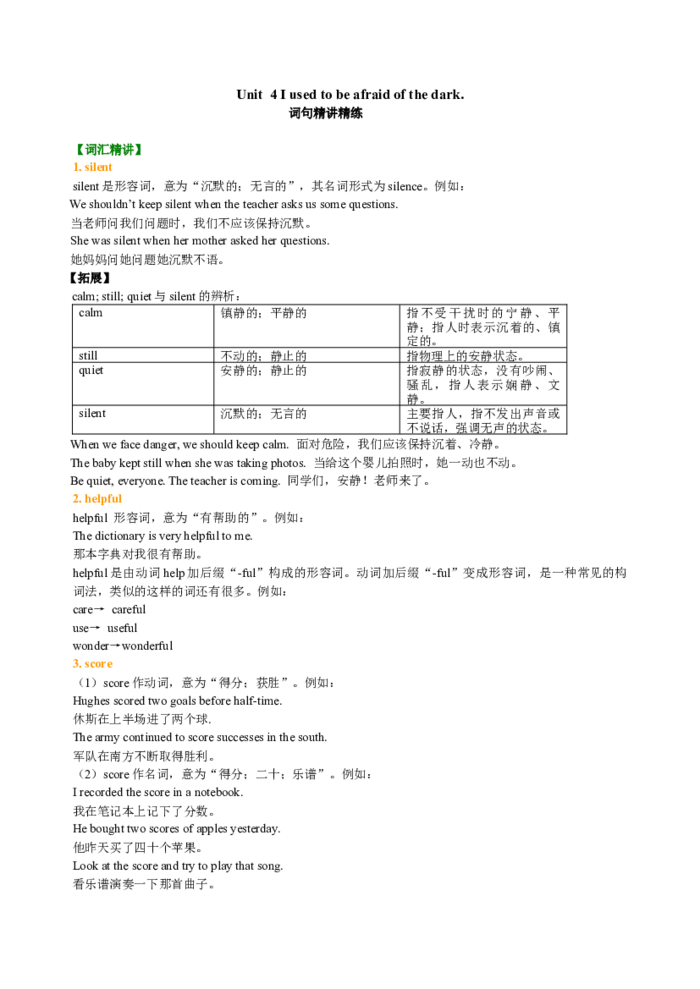
calm; still; quiet 与silent 的辨析:
calm
镇静的;平静的
指不受干扰时的宁静、平
静;指人时表示沉着的、镇
定的。
still
不动的;静止的
指物理上的安静状态。
quiet
安静的;静止的
指寂静的状态,没有吵闹、
骚乱,指人表示娴静、文
静。
silent
沉默的;无言的
主要指人,指不发出声音或
不说话,强调无声的状态。
When we face danger, we should keep calm. 面对危险,我们应该保持沉着、冷静。
The baby kept still when she was taking photos. 当给这个婴儿拍照时,她一动也不动。
Be quiet, everyone. The teacher is coming. 同学们,安静!老师来了。
2. helpful
helpful 形容词,意为“有帮助的”。例如:
The dictionary is very helpful to me.
那本字典对我很有帮助。
helpful 是由动词help 加后缀“-ful”构成的形容词。动词加后缀“-ful”变成形容词,是一种常见的构
词法,类似的这样的词还有很多。例如:
care→ careful
use→ useful
wonder→wonderful
3. score
(1)score 作动词,意为“得分;获胜”。例如:
  Hughes scored two goals before half-time.
  休斯在上半场进了两个球.
  The army continued to score successes in the south.
  军队在南方不断取得胜利。
  (2)score 作名词,意为“得分;二十;乐谱”。例如:
  I recorded the score in a notebook.
  我在笔记本上记下了分数。
  He bought two scores of apples yesterday.
  他昨天买了四十个苹果。
  Look at the score and try to play that song.
看乐谱演奏一下那首曲子。
4. interview
interview 用作动词,意为“采访,面试”。be interviewed by 意为“被……采访”。例如:
We are going to interview the manager of this company.
我们将要采访这家公司的经理。
He has interviewed a lot of people for the job.
他已面试过很多应聘这份工作的人。
5. dare
(1)dare 用作实义动词,意为“敢于;胆敢”。常构成短语dare to do sth.意为“敢于做某事”。有时
to 也可省去(尤其是在否定句或疑问句)。例如:
He didn’t dare to look at her in the eye.
他不敢正眼看她。
Did he dare (to) tell her? 他敢告诉她吗?
We don’t dare (to) say anything. 我们什么也不敢说。
(2)dare 可用作情态动词,用作情态动词时,意思是“敢”,其后接动词原形,通常只用于否定句或
疑问句以及if 或whether 引导的从句中,一般不用于肯定句。例如:
I don’t know whether he dare try. 我不知他是否敢试一试。
I daren’t ask her for a rise. 我不敢要求她加薪。
【注意】
dare 后通常不接动词的进行式。
6. seldom
seldom 是副词,意为“很少,不常”,反义词是often,通常置于行为动词之前,be 动词,情态动词和助
动词之后,是一个表示否定意义的副词。
    例如:Mr Brown seldom goes out. 布朗先生很少外出。
【拓展】
always, usually, often, sometimes 和never 是英语中最常见的频度副词。
(1)always 的频度为100%,表示动作重复、状态继续,中间没有间断,意思是“总是”、“永远地”。
例如:
The sun always rises in the east and sets in the west. 太阳总是东升西落。
(2)usually 的频度为80%左右,意为“通常”、“平常”,即很少有例外。例如:
He usually goes to bed at ten o’clock. 他通常10 点钟睡觉。
(3)often 的频度为60%左右,意为“常常”,但不如usually 那么频繁,表示动作重复,中间有间断。
例如:
He is often late for school. 他上学经常迟到。
(4) sometimes 的频度为40%左右,意为“有时”,表示动作偶尔发生。可以位于句首,以示强调。例如:
It is sometimes hot and sometimes cold.  天气忽冷忽热。
Sometimes he does it this way and sometimes he does it that way.
他有时这样做,有时那样做。
(5) seldom 的频度为20%左右,意为“很少”、“不经常”。例如:
I seldom go out these days. 这些天我几乎不出门。
(6) never 的频度为0,意为“从来不”、“永不”。例如:
My parents are never late for work.  我父母上班从来不迟到。
7. pride
pride 是名词,意为“骄傲,自豪”。
常用的结构: take pride in sth. 意为“为某事骄傲”。
They take great pride in her daughter who is now a famous scientist.
他们为成为科学家的女儿而感到自豪。
He is the pride of our city. 他是我们城市的骄傲。
【拓展】
proud 是形容词,常用结构:be proud of sth. 意为“以……而骄傲”。
I am very proud of being a Chinese. 作为一名中国人我很自豪
be proud to do sth. 意为“为做某事而骄傲”。
We are proud to be a league member. 我们为成为团员而骄傲。
8. absent
absent 是形容词,意为“不在的;缺席的”。例如:
How many students are absent today?
今天有多少学生缺席?
Who is absent today?
今天谁不在?
【拓展】
(1)absent 的名词是absence,反义词是present,常用结构:be absent from…意为“缺席……”。与be
away from…同义。例如:
Love was totally absent/away from his childhood.
他童年时根本没有得到疼爱。
The manager is absent/away from the meeting.
经理缺席了会议。
(2)absent-minded 意为“心不在焉的;健忘的”,可用作表语或定语。例如:
He is always absent-minded.
他老是心不在焉。
【词汇精练】
I.根据首字母提示补全句子。
1.Don't let me i_______ your decision.
2.He f_______ many times,but he doesn't lose heart.
3.She is never a_______ from work without good excuses.
4.You've arrived at e_______ the right moment.
5.  You didn’t d_____ tell her the truth?
II. 根据汉语提示完成句子。
1.The film is ________(幽默的)and moving.
2.Would you be good enough to keep ________(安静的)?
3.She needs to win this point to level the ________(得分).
4.Get the fall in the ________(背景),will you?
5.They ________(采访)people from all walks of life.
6.The _______(英国人)are said to have an unusual sense of humour.
7.The students were all listening to his _______(讲话).
8.He made the _______(介绍)and everyone shook hands.
9.She is sure to pass the _______(考试).
10.The first day of the month is a _______(公众的)holiday.
 III. 用括号中所给单词适当形式填空。
1.The experience in army is ________(help)to him.
2.That ________(Asia)stopped me and asked if 1 was Chinese.
3.The tour took in six ________(Europe)capitals.
4.Most ________(Africa)people are black people.
5.He used ________(live)in London.
IV. 用方框中所给单词填空。
absent   general   require    silent    seldom
1.John _______ gets together with his friends.
2.He was _______ for a moment,and then began his answer.
3.I _______ two children to help me.
4.How many students are _______ today?
5.Please give me a(n) _______ idea of the work.
   V. 听力链接。
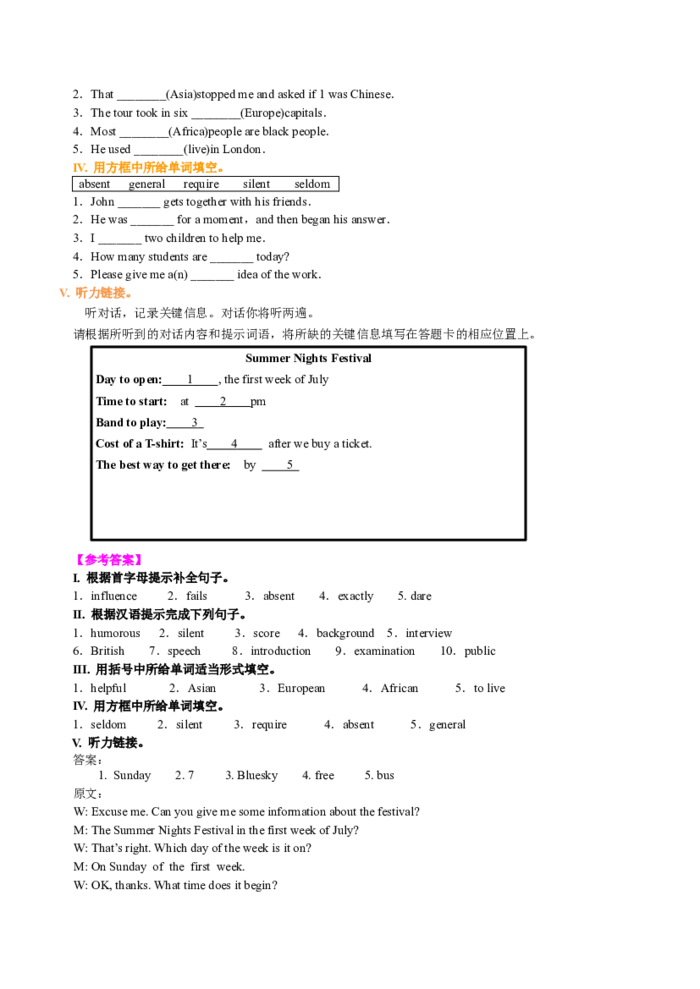
  听对话,记录关键信息。对话你将听两遍。
请根据所听到的对话内容和提示词语,将所缺的关键信息填写在答题卡的相应位置上。
【参考答案】
I. 根据首字母提示补全句子。
1.influence     2.fails      3.absent    4.exactly    5. dare
II. 根据汉语提示完成下列句子。
1.humorous   2.silent     3.score   4.background  5.interview
6.British    7.speech     8.introduction    9.examination    10.public
III. 用括号中所给单词适当形式填空。
1.helpful       2.Asian       3.European      4.African      5.to live
IV. 用方框中所给单词填空。
1.seldom     2.silent     3.require      4.absent      5.general
     V. 听力链接。
答案:
1. Sunday    2. 7     3. Bluesky    4. free     5. bus
原文:
W: Excuse me. Can you give me some information about the festival?
M: The Summer Nights Festival in the first week of July?
W: That’s right. Which day of the week is it on?
M: On Sunday of the first week.
W: OK, thanks. What time does it begin?
Summer Nights Festival
Day to open:

 1

 , the first week of July
Time to start:  at

 2

 pm
Band to play:

 3
Cost of a T-shirt: It’s

 4

  after we buy a ticket.
The best way to get there:  by

 5
M: It starts at 7:00 pm and ends at about 11:00at night.
W: And which band will play this year?
M: A new band called Bluesky. You spell that B-L-U-E-S-K-Y.
W: I’ve never heard of it.
M: Well, their music sounds fantastic! You’ll see on that day.
W: Good! And it’s said that a lot of special festival T-shirts will be offered. Is that right?
M: Yes. They look really great.
W: How much are they?
M: You can get a T-shirt for free after you buy a ticket. We’re also selling festival flags this year.
W: OK. And what’s the best way to get there? By car?
M: No, coming by bus is better. I can email you some more information if you want.
W: That’s very kind of you.
【句式精讲】
1. What’s he like now?
What is sb./sth. like?是用来询问性格特征的。例如:
—What is the old man like? 那个老人怎么样?
—He is kind. 他很和蔼。
【拓展】
把上面句子的“be like”改为“look like”,即“What does/do sb./sth. look like? ”这个句式是询问某个
人或物的外貌特征,意为“……看上去是什么样”。例如:
—What does the old man look like? 那个老人怎么样?
—He is short and thin. 他又矮又瘦。
2. The head teacher advised his parents to …
(1)advise 表示“建议”,通常为及物动词,若其后的宾语是动词,通常应是动名词,而不能是不定
式。例如:
I advise waiting till the right time.
我建议等到适当的时候。
(2)advise 之后不能直接跟不定式,但可接不定式的复合结构,常用于advise sb. to do sth.的结构中。
例如:
He advised us to sell the house. 他建议我们把房子卖了。
The doctor advised me to stop smoking. 医生建议我戒烟。
【拓展】
advice 是不可数名词,意为“意见、建议、劝告、忠告”,不能与不定冠词a 连用。例如:
a piece of advice 一条建议
Let me give you some advice. 让我给你一些建议。
3. They also told me that even though they…
     even though 意为“尽管;既然;纵然”,有退一步设想的意味,相当于even if,多用于书面语中,引
导让步状语从句。例如:
     He went on working with his assistant even though both of them were tired.
     尽管他们两个都累了,他仍然和他的助手继续工作。
     Even if I have to sell my house, I will keep my business.
     即使我卖掉房子,我还是要继续我的事业。
4. Maria, you used to be short, didn’t you?
(1)used to do sth 是一个固定结构,意思是“过去经常做某事”,后面用动词原形,表示过去的某种
经常性、习惯性的行为或者动作,并意味着这种动作目前已经不存在。例如:
肯定句:
I used to play with my friends after school.
过去放学后我常常和朋友们一起玩。
否定句:
You didn't use to like pop songs.=You usedn't to like pop songs.
你过去不喜欢流行歌曲。
一般疑问句:
Did your sister use to be quiet? = Used your sister to be quiet?
你的妹妹过去很安静吗?
there be 句式:
There used to be a lot of fishes in this river. 过去这条小河常常有许多鱼。
(2)you used to be short, didn’t you?是反意疑问句,表示对陈述句所说的事实提出相反的疑问,要求对方
用“yes”或“no”来进行回答。
反义疑问句由两部分组成:前一部分是陈述句,后一部分是疑问句,疑问句是由be ,have, 助动词或情态动
词后接主语构成。如果陈述句是肯定结构,反意疑问句须用否定结构;反之, 陈述句如果是否定结构,反
意疑问句须用肯定结构。
反意疑问句的两部分,必须保持人称和时态的一致。
  He is old, isn’t he?  他老了,不是吗?
  He never went there, did he?  他从没有去过那里,是吗?
  无论哪种形式的反意疑问句,回答时要遵循:“Yes,后接肯定式”或者“No,后接否定式”
  —The girl is helping her mother with the housework, isn’t she?
  那个女孩正在帮妈妈做家务,不是吗?
  —Yes, she is. 是的,她在帮。
  —No, she isn’t. 不,她没有帮。
5. This party is such a great idea.
such 是形容词,意为“如此的,这样的”。其后接名词,有以下几种用法:
(1) such a / an + 形容词 + 单数可数名词。例如:
Is there such a book? 有这样的书吗?
(2) such + 形容词 + 复数名词。例如:
There are such beautiful flowers. 有如此美丽的花。
(3) such + 形容词 + 不可数名词。例如:
I have never heard such terrible news. 我从未听说过这样可怕的消息。
【拓展】
so 与such 均有“如此的,这样的”之意,so 是副词,通常修饰形容词或副词,而such 是形容词,常修
饰名词。“such a / an + adj. + 单数名词”可转换成“so + adj. + a /an + 单数名词”;另外,在表示“这
么多(少)的……”时名词前有many; much; few 或little 时应用so 而不用such。例如:
She has so many books. 她有如此多的书。
She is such a nice girl. = She is so nice a girl. 她是如此好的女孩。
【句式精练】
I. 句型转换,按要求完成下列句子。
1.Tony used to have long hair.(改为一般疑问句)
   ________ Tony ________ to have long hair?
2.They used to play soccer.(改为反意疑问句)
   They used to play soccer,________ ________?
3.The old man used to be a soldier.(改为同义句)
   The old man ________ a soldier in the ________.
4.John used to collect stamps.(对划线部分提问)
   ________ ________ John ________ ________ ________?
5.She used to do exercise in the morning.(改为否定句)
   She ________ ________ ________ do exercise in the morning.
II. 根据汉语提示,完成句子。
1.我只是偶尔去超级市场。
   I only go to the supermarket ________ ________ ________ ________
2.你知道怎样处理这个问题吗?
    Do you know ________ ________ ________ ________this problem?
3.这是我第一次在公共场合发言。
    It is the first time that I speak ________ ________.
4.过去我常戴眼镜,但现在我戴隐形的。
    I ________ ________ ________ ________,but now I wear contacts.
5.我已经两年多没见到她了。
It is over two years ________ ________ ________ her.
6.我们为伟大的社会主义祖国而感到自豪。
   We _______ _______ _______ our great socialist motherland.
7.抱歉,我今天没法决定。
   I am sorry.I just cannot _______ _______ _______ today.
8.我真希望你在这里,好让我当面向你道谢。
   I wish you were here so that I could thank you _______ _______.
9.他的父母总是以他而自豪。
   His parents always_______ _______ _______ him.
10.那个男孩够大了,能照料自己了。
   The boy is old enough to _______ _______ _______.
III. 补全对话。
根据对话内容,从方框内的选项中选出能填入空白处的最佳选项。其中有两个为多余选项。
A: It is such a lovely day. I love sunshine.
B:
  1
  .
A: I hope it stays like this.
B:
  2
  .
A: Is the weather usually like this here?
B: A bit hotter than today.
A:
  3
  .
B: It’s pretty cold and it often snows in winter.
  4
  .
A: A lot like the weather here, not too hot or cold.
B: I heard it rains a lot.
  5
  .
A: Mmm, yes. It rains but not any more than other places.
A. I hope so, too.
B. What’s the weather like in winter?
C. Is that true?
D. I don’t think so.
E. Thank you for your kindness.
F. Yes, it’s really a nice and bright day.
G. What about your hometown?
【参考答案】
I. 句型转换,按要求完成下列句子。
1.Did:use     2.didn’t/usedn’t  they     3.was;past
4.What did;use to do     5.didn't use to
II. 根据汉语提示,完成句子。
1.from time to time     2.how to deal with     3.in public
4.used to wear glasses     5.since I saw   6.are proud of
7.make a decision    8.in person     9.take pride in
10.look after himself
III. 补全对话。
1-5 FABGC