文档文本内容
  Unit 8 It must belong to Carla.
   词句精讲精练

词汇精讲
1. must be
   “must + 动词原形”表示对现在的情况进行推测或判断,用于肯定句中,语气十分肯定,意为“一定,
肯定”。例如:
   This must be your room. 这一定是你的房间。
   He must be eighty now. 他现在一定有八十岁了。
【拓展】
   can’t be 意为“不可能是”,表示有把握的否定推测。例如:
He can’t be Mike, for I saw him in the library just now.
他不可能是Mike,因为我刚才还看见他在图书馆呢。
含有must be 的句子变为否定句时,需把must be 改为can’t be。例如:
  It must be Linda’s coat. 它一定是Linda 的外套。(肯定猜测)
  It can’t be Linda’s coat. 它不可能是Linda 的外套。(否定推测)
2. belong to
   belong to 意为“属于”,后接名词或代词,但后面不能接名词所有格。例如:
The house belongs to Mr. Wang.这所房子是王先生的。
The MP5 belongs to me.这个MP5 是我的。
【注意】belong to 无被动语态和进行时。
3. happen
  happen 是不及物动词,它的用法有:
(1) 表示“某地/某时发生了什么事”,常用“sth. + happened + 时间/地点”这一结构,此时主语应该是
物。例如:
  The story happened in 2008. 这个故事发生在2008 年。
  An accident happened in that street. 那条街上发生了一起事故。
(2) 表示“某人出了某事(常指不好的事)”要用“sth. + happened + to sb.”这一结构。例如:
  A car accident happened to her this morning. 今天上午她出了车祸。
  What happened to you? 你怎么啦?
(3) 表示“某人碰巧做某事”要用“sb. + happened + to do sth.”这一结构。例如:
  I happened to meet a friend of mine in the street yesterday.
昨天我碰巧在街上遇到了我的一个朋友。
【拓展】happen 和take place 的辨析:
 (1) happen 指具体客观事物的发生,常有偶然性,未能预见性,即“偶然发生”。例如:
   What happened to him? 他出了什么事?
 (2) take place 常用于历史事件或会议的发生,以及化学、物理变化,有事先预料或计划的意思,即“计划
发生”。例如:
  The party took place yesterday evening. 昨晚举办了晚会。
注意:happen 和take place 均为不及物动词,无被动语态。
4. noise
  noise 意为“噪音”、“喧闹声”,常指不悦耳、不和谐的嘈杂声。例如:
       Don’t make any noise! 别吵闹!
       The noise wakes me up.噪音吵醒了我!
【拓展】
(1) sound 可以指人或动物发出的声音,或物体碰撞的声音。这个词的使用范围很大。可以说,大自然的任
何“声音”都可以用sound。例如:
       Light travels much faster than sound.光的传播速度比声音快得多。
   (2) voice 一般指人的声音,说话、唱歌、谈笑都可用voice。sound 和noise 不仅能指人的声音,还可以表示
别的动物发出的声音,而voice 除了有时可指鸟的声音外,很少表示其它动物的声音。例如:
  The girl has a beautiful voice.那女孩嗓音很美。
  They are talking in low voices.他们正小声交谈。
  When the teacher came into the classroom,our monitor spoke in a loud voice,“Stand up!”
  老师走进教室时,班长大声喊:“起立!”
5. pick up
   pick up 意为“捡起,拾起”,是动副结构。例如:
    She picked up a stone and threw it at the dog. 她捡起一块石头朝那条狗扔去。
【拓展】pick up 还有以下几种含义:
(1) 表示“中途搭载乘客”;“接人”等意思例如:
。

The train stopped several times to pick up passengers. 火车沿途停了好几次,让乘客上车。
Wait here and I’ll pick you up at two o’clock. 在这儿等着,两点钟我来接你。
(2) 表示“意外发现”;“学到”;“获得”等意思例如:
。
Looking through the evening paper last night, I picked up a wonderful poem.
昨晚在浏览晚报时,我意外发现了一首好诗。
While working in the factory, the students picked up a great deal of information on machinery.
在工厂劳动期间,学生们学到了许多关于机械方面的知识。
 (3) 表示“收拾”;“整理”等意思例如:
。
The teacher told the students to pick up everything on the floor and get the room tidy before they went out.
老师告诉学生们在出去之前把地上的东西收拾起来,把房间整理干净。
Please pick up all your toys when you’ve finished playing. 你玩过后请把玩具收拾好。
 (4) 表示“(从电台收音机
、
)收听”;“接收”;“记录”等意思例如:
。
I managed to pick up an American news broadcast.
我设法收听到一家美国电台的新闻广播。
It is necessary to use a long wave radio to pick up the “Follow Me” program.
必须用一台长波收音机才能收听到“跟我学”这个节目。
6. run away
  run away 是固定搭配,表示“逃跑”。例如:
    The thief tried to run away, but he failed. 那个小偷试图逃跑,但失败了。
【拓展】常见的away 的短语有:
  take away 拿走,带走       stay away 离开     move away 搬走    put away 收起来
  give away 捐赠;赠给

7. fear
   fear 作不可数名词,意为“恐惧;惧怕;害怕;担忧”。例如:
    There is no reason for her mother’s fear. 她妈妈的担心是没有道理的。
【拓展】
   fear 作动词,意为“担心;害怕”,其后可接名词、代词、动词不定式、动词-ing 形式或that 从句。例如:
   The man fears his wife. 这个男人怕他老婆。
   The girl feared to speak before the public. 这个女孩害怕在公众面前讲话。
   I fear that he will come to school late. 我担心他上学会迟到。
8. probably
   probably 是副词,表示“很可能;大概”,语气较强,含有可能性较大的意味,常位于行为动词之前,情态
动词、助动词或be 动词之后,有时也位于句首。例如:
   He can probably tell us the truth. 他很可能会告诉我们实情。
【拓展】
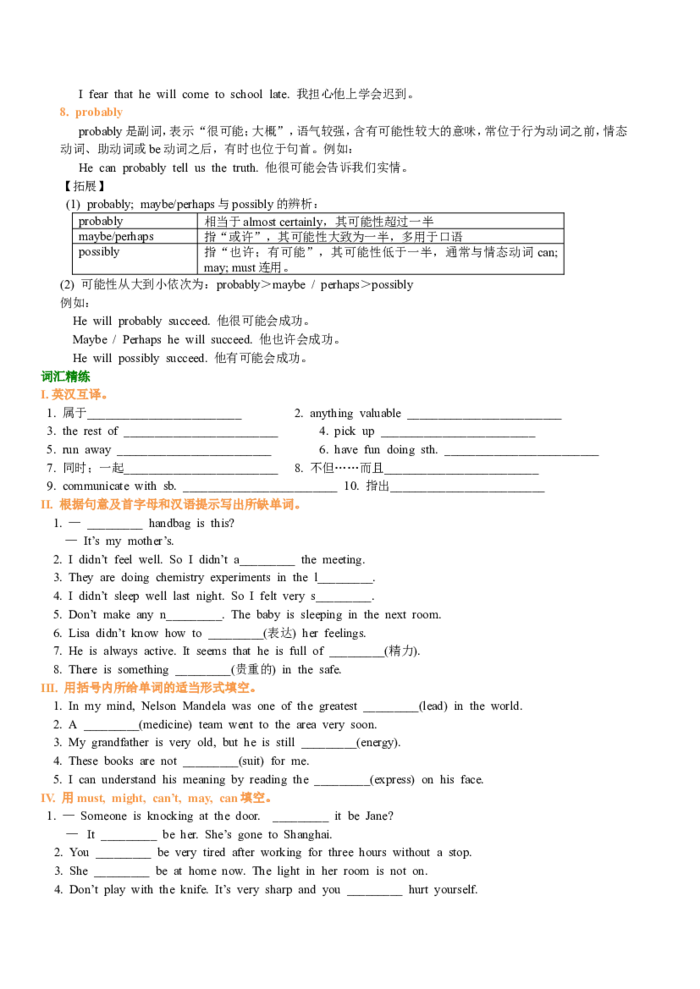
 (1) probably; maybe/perhaps 与possibly 的辨析:
probably
相当于almost certainly,其可能性超过一半
maybe/perhaps
指“或许”,其可能性大致为一半,多用于口语
possibly
指“也许;有可能”,其可能性低于一半,通常与情态动词can;
may; must 连用。
(2) 可能性从大到小依次为:probably>maybe / perhaps>possibly
例如:
  He will probably succeed. 他很可能会成功。
  Maybe / Perhaps he will succeed. 他也许会成功。
  He will possibly succeed. 他有可能会成功。
词汇精练
I. 英汉互译。
 1. 属于_________________________
2. anything valuable _________________________
 3. the rest of _________________________
4. pick up _________________________
 5. run away _________________________
6. have fun doing sth. _________________________
 7. 同时;一起_________________________
8. 不但……而且_________________________
 9. communicate with sb. _________________________ 10. 指出_________________________
II. 根据句意及首字母和汉语提示写出所缺单词。
  1. — _________ handbag is this?
    — It’s my mother’s.
  2. I didn’t feel well. So I didn’t a_________ the meeting.
  3. They are doing chemistry experiments in the l_________.
  4. I didn’t sleep well last night. So I felt very s_________.
  5. Don’t make any n_________. The baby is sleeping in the next room.
  6. Lisa didn’t know how to _________(表达) her feelings.
  7. He is always active. It seems that he is full of _________(精力).
  8. There is something _________(贵重的) in the safe.
III. 用括号内所给单词的适当形式填空。
  1. In my mind, Nelson Mandela was one of the greatest _________(lead) in the world.
  2. A _________(medicine) team went to the area very soon.
  3. My grandfather is very old, but he is still _________(energy).
  4. These books are not _________(suit) for me.
  5. I can understand his meaning by reading the _________(express) on his face.
IV. 用must, might, can’t, may, can 填空。
 1. — Someone is knocking at the door.  _________ it be Jane?
— It _________ be her. She’s gone to Shanghai.
2. You _________ be very tired after working for three hours without a stop.
3. She _________ be at home now. The light in her room is not on.
4. Don’t play with the knife. It’s very sharp and you _________ hurt yourself.
5. I bought him some sandwiches because I thought he _________ be hungry.
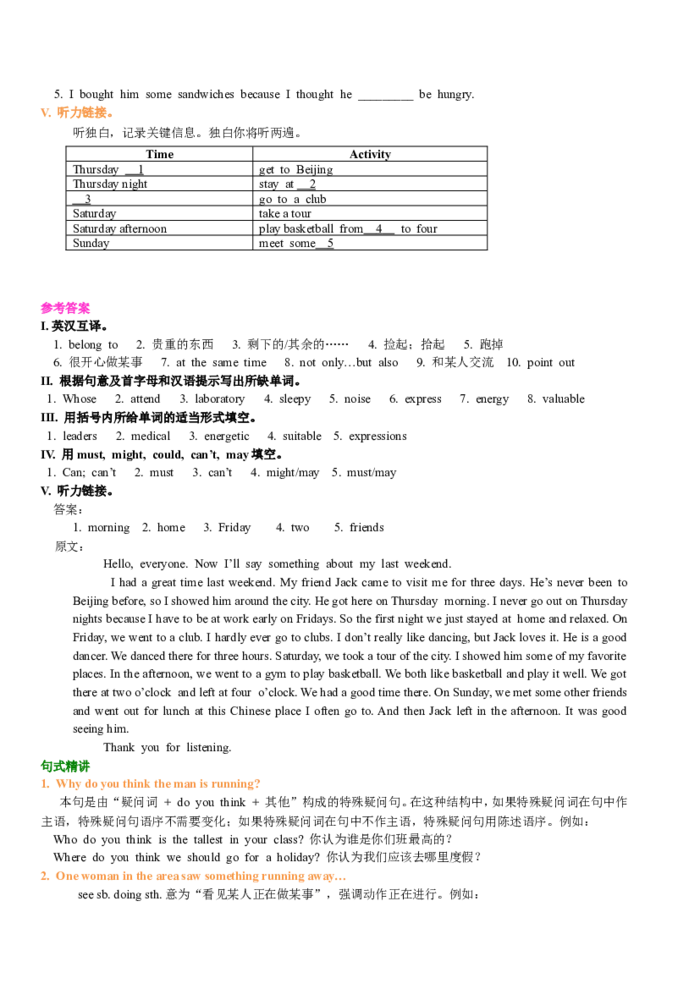
V. 听力链接。
听独白,记录关键信息。独白你将听两遍。
参考答案
I. 英汉互译。
  1. belong to   2. 贵重的东西   3. 剩下的/其余的……   4. 捡起;拾起   5. 跑掉
  6. 很开心做某事   7. at the same time   8. not only…but also   9. 和某人交流  10. point out
II. 根据句意及首字母和汉语提示写出所缺单词。
 1. Whose   2. attend   3. laboratory   4. sleepy   5. noise   6. express   7. energy   8. valuable
III. 用括号内所给单词的适当形式填空。
 1. leaders   2. medical   3. energetic   4. suitable  5. expressions
IV. 用must, might, could, can’t, may 填空。
 1. Can; can’t   2. must   3. can’t   4. might/may  5. must/may
V. 听力链接。
  答案:
1. morning  2. home   3. Friday    4. two    5. friends
原文:
     Hello, everyone. Now I’ll say something about my last weekend.
     I had a great time last weekend. My friend Jack came to visit me for three days. He’s never been to
Beijing before, so I showed him around the city. He got here on Thursday morning. I never go out on Thursday
nights because I have to be at work early on Fridays. So the first night we just stayed at home and relaxed. On
Friday, we went to a club. I hardly ever go to clubs. I don’t really like dancing, but Jack loves it. He is a good
dancer. We danced there for three hours. Saturday, we took a tour of the city. I showed him some of my favorite
places. In the afternoon, we went to a gym to play basketball. We both like basketball and play it well. We got
there at two o’clock and left at four o’clock. We had a good time there. On Sunday, we met some other friends
and went out for lunch at this Chinese place I often go to. And then Jack left in the afternoon. It was good
seeing him.
     Thank you for listening.
句式精讲
1. Why do you think the man is running?
   本句是由“疑问词 + do you think + 其他”构成的特殊疑问句。在这种结构中,如果特殊疑问词在句中作
主语,特殊疑问句语序不需要变化;如果特殊疑问词在句中不作主语,特殊疑问句用陈述语序。例如:
  Who do you think is the tallest in your class? 你认为谁是你们班最高的?
  Where do you think we should go for a holiday? 你认为我们应该去哪里度假?
2. One woman in the area saw something running away…
   see sb. doing sth. 意为“看见某人正在做某事”,强调动作正在进行。例如:

Time
Activity
Thursday
  1
get to Beijing
Thursday night
stay at
  2

  3
go to a club
Saturday
take a tour
Saturday afternoon
play basketball from
  4
   to four
Sunday
meet some
  5
 I saw him talking with a man on my way home yesterday.
昨天我回家的路上,看见他正在和一个人谈话。
When I entered the room, I saw her watching TV.
当我进门的时候,我看见他正在看电视。
【拓展】
see sb. do sth.意为“看到某人做某事”,强调看到某人做过某事或经常做某事。例如:
I often see him dance in the classroom.
我经常看见他在教室里跳舞。
I often see him help that old man do cleaning at weekends.
周末,我经常看见他帮助那个老人打扫房间。
3. Another popular idea is that Stonehenge might...
     that Stonehenge might...在此作is 的表语,是表语从句。引导表语从句的词除了that 外,还有what;
whether; as if; which; who; whose; when; where; why; how 等。表语从句与宾语从句一样,要求用陈述语序。
例如:
   That is where I was born. 那就是我出生的地方。
   The problem is whether he will come. 问题是他是否回来。
   This is what we need. 这就是我们所需要的。
4. For many years, historians believed Stonehenge was a temple where ancient leaders tried to communicate
with the gods.
   本句中含有一个定语从句,where 是关系副词,在定语从句中作地点状语。引导定语从句的关系词有:that;
who; when; why; where 等。
(1) 连接词that,既可指人,也可指物。例如:
The man that you met is my teacher. 你遇到的那个人是我的老师。
She is the singer that I saw last week. 她就是我上周遇到的那个歌唱家。
(2) 关系代词who(指人),whom(who 的宾格形式),whose,which(指物)。例如:
    The room whose window is broken is our classroom. 那个窗户坏了的房间是我们的教室。
    He is the man who knows the answer. 他是那个知道答案的人。
(3) 关系副词when(指时间),why(表原因),where(表地点)。例如:
    That is the place where I was born. 那就是我出生的地方。
    Can you tell me the time when you were born? 你能告诉我你出生的时间吗?
5. They think the stones can prevent illness and keep people healthy.
prevent 是动词,意为“阻止;阻挠”。prevent…from doing sth. 是固定搭配,意为“防止……做某事;阻止……
做某事”。例如:
 What can we do to prevent the disease spreading? 我们能做什么来防止这种疾病蔓延呢?
 The heavy rain prevented us from going home. 大雨使我们不能回家了。
句式精练
I. 根据汉语提示,完成英语句子(每空一词)。
 1. 这件上衣准是Tina 的。
   The coat __________ __________ __________ Tina.
 2. 请帮我捡起地上的书。
   Please help me __________ __________ the book on the ground.
 3. 那个小偷试图逃跑,但最终还是被警察抓住了。
  The thief tried to __________ __________, but in the end he __________ __________ by the policeman.
 4. 你的包里有贵重的东西吗?
  Is there __________ __________ in your bag?
 5. 《江南Style》这首歌不仅在韩国流行,而且在世界其他地方也很流行。
  The song Gangnam Style is popular __________ __________ in South Korea __________ __________ in
other parts of the world.
 6. 他在伦敦住了五年多。
  He has lived in London __________ __________ __________ __________ __________.
 7. 我不知道怎样和我的父母沟通。
  I don’t know how to __________ __________ __________ __________.
 8. 我的烦恼是我的妈妈不允许我晚上出去。
  __________ __________ __________ __________ my mother doesn’t allow me to go out at night.
 9. 我们的邻居过去是十分安静的。
  Our neighbors __________ __________ __________ very quiet.
 10. 他害怕有太多的家庭作业。
  He __________ __________ __________ having too much homework.
II. 句型转换,每空一词。
  1. The woman outside the school gate must be our head teacher. (改为否定句)
    The woman outside the school gate __________ __________ our head teacher.
  2. This might be Bill

 ’ s   basketball. (对划线部分提问)
    __________ basketball __________ this be?
  3. The man could be running for exercise. (对划线部分提问)
    __________ __________ the man __________ running for?
  4. Do you know whose dictionary it is? (改为同义句)
     Do you know __________ the dictionary __________ __________?
   5. There are some children who are having fun on the beach. (改为同义句)
     There are some children __________ __________ on the beach.
III. 补全对话。
      根据下面的对话情景,在每个空白处填上一个适当的句子,使对话的意思连贯、完整。
A: Morning, Tina. Did you enjoy your holiday in the country last week?
B: Yes, I really had a lot of fun there.
A: Great! 1.                     ?
B: With some of my friends.
A: 2.                         ? In a hotel?
B: No. We camped in a mountain village. And we cooked our meals over an open fire.
A: Sounds wonderful. How was the weather there?
B: 3.            . When we took a walk in the countryside, we met some villagers and had tea with them.
A: 4.                    ?
B: Yes. I will bring you some pictures tomorrow. By the way, what did you do last weekend?
A: 5.
B: Wow, pretty cool. I believe you had a great time, too.
参考答案
I. 根据汉语提示,完成英语句子(每空一词)。
  1. must belong to   2. pick up   3. run away; was caught   4. anything valuable  5. not only; but also
  6. for more than five years   7. communicate with my parents   8. My trouble is that
  9. used to be   10. is afraid of
II. 句型转换,每空一词。
  1. can’t be   2. Whose; might   3. What could; be   4. who; belongs to   5. having fun
III. 补全对话。
1. Who did you go there with /Who did you enjoy your holiday with
2. Where did you stay
3. It was fine/ sunny/ The weather was fine/ sunny/ very good/ not bad
4. Did you take photos / pictures
  Did you take any/a few/many/a lot of photos / pictures
5. …任何合理的描述过去周末做过的愉快的事情。(注意时态要用一般过去时,句子结构,拼写正确。)