文档文本内容
跟褚帅学单词
Lesson 18:He often does this! 他经常干这种事!
New words and expressions
pub   n. 小酒店
landlord    n. 店主
bill    n. 账单
leave
leave的意思很丰富。
①离开(某人或某地)
短语扩展:leave some place (离开某地),leave for some place (离开
到某地)
例句:We will leave for Beijing next week.
我们下周要去北京。
②不在居住于(某处);不再属于(某组织或团体)
例句:Emma left the company several days ago.
艾玛几天前从公司离职了。
③遗留;遗忘
短语扩展:leave sth. for sb. /leave sth to sb.
例句:He left his book on the desk.
他把书留在桌上了。/他把书忘在桌上了。
④听任其在某处;使保持某状态
例句:Leave him alone.
让他一个人呆着吧。
bill n.账单
电话账单phone bill
煤气账单gas bill
水费账单water bill
例句:Please pay the gas bill before the end of this month.
请在本月末前把煤气费交了。
1
听褚帅评课文
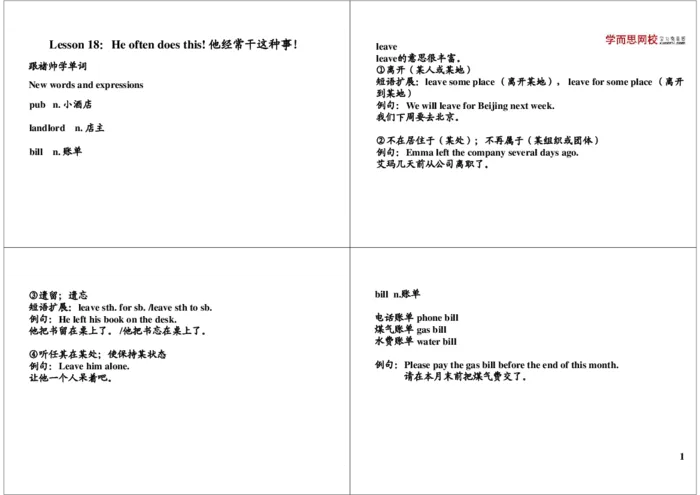
After I had had lunch at a village pub,
I looked for my bag.
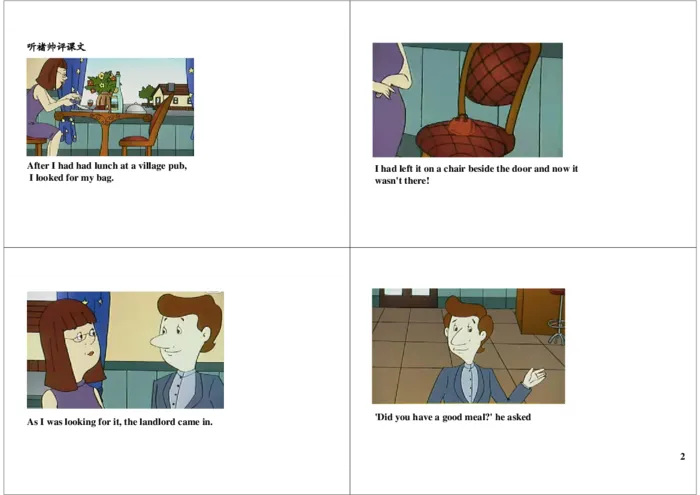
I had left it on a chair beside the door and now it
wasn't there!
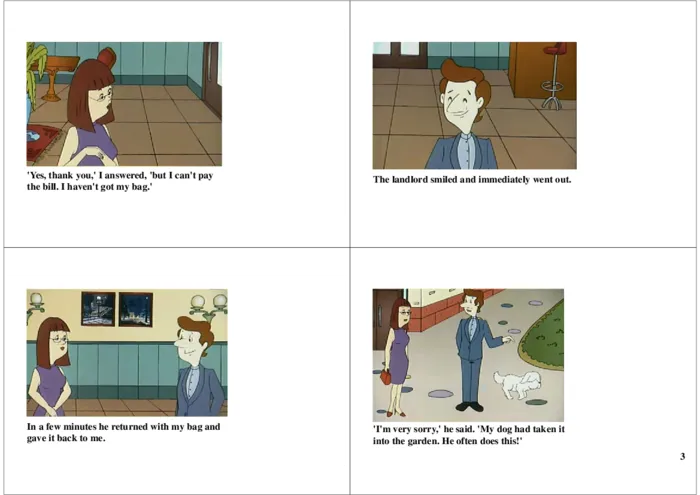
As I was looking for it, the landlord came in.
'Did you have a good meal?' he asked
2
'Yes, thank you,' I answered, 'but I can't pay
the bill. I haven't got my bag.'
The landlord smiled and immediately went out.
In a few minutes he returned with my bag and
gave it back to me.
'I'm very sorry,' he said. 'My dog had taken it
into the garden. He often does this!'
3
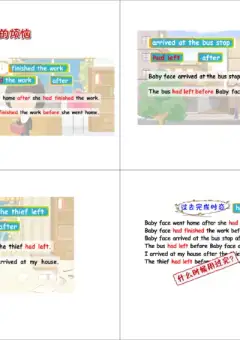
过去完成时
定义:过去某一时间或动作以前已经发生或是完成了的动作
结构:had + done
标志词:before; after; by+过去
一.用动词的适当形式填空
1. We _____________ (paint) the house before we ______________
(move) in.
2. That rich old man _____________ (make) a will before he _____
________ (die).
3. They _____________ (study) the map of the country before they
______ (leave).
4. The robbers _____________ (run away ) before the policemen_____
__ (arrive).
5. I __________ (turn off) all the lights before I ____________ (go) to b
ed.
have的用法
(1)动词have有两种用法。一是作为助动词构成各种完成时(包括过去、
现在、将来)和完成进行时:
I haven't seen him this morning.
我今天上午没见过他。
When I rang, Tim had already left.
我打电话的时候,蒂姆已经走了。
4
(2)have还可以作完全动词。当它作“具有”、“拥有”讲时,它和
have got通常可以互换。在英国英语中,疑问句和否定句中have(具有)
的用法与be相同,即可以不用助动词do(或did):
I haven‘t got any pencils. 我没有铅笔。
在美国英语中,常用do,did等与have一起构成疑问句和否定句,
这种形式在英国英语中现在也常见了。have作“具有”、“拥有”讲
时是状态动词,不能用于进行时态或被动语态。它通常用于一般现在
时:
You can have these apples if you want them. I've got a lot more.
如果你想要这些苹果你可以把它们拿走。我还有许多。
(3)have 作完全动词时,还可以表示eat,drink,enjoy,take等意思,
这时它是行为动词,可以用于包括进行时的各种时态:
Have a cigarette, Sam.
萨姆,抽根烟。
We will have dinner at seven o‘clock. 我们将于7点开饭。
Sam and I had lunch together today. 我和萨姆今天一起吃的午饭。
I‘m having a drink. 我正在喝点东西。
4