霍娜
英语新概念英语二册讲义
霍娜
教授新概念英语1 8 年;
美国宾夕法尼亚大学A C E 访问学习;
北京市海淀区优秀教师;
新东方集团优秀教师;
高途优秀教师;
家庭教育高级指导师
目录
Lesson11 单词讲解...........................................................................................................................4
Lesson11 语法讲解...........................................................................................................................5
Lesson11 课文讲解...........................................................................................................................5
Lesson11 知识拓展...........................................................................................................................6
Lesson12 单词讲解...........................................................................................................................7
Lesson 12 语法讲解...............................................................................................................................8
Lesson12 课文讲解.......................................................................................................................10
Lesson12 知识拓展.......................................................................................................................12
Lesson13 单词讲解............................................................................................................................. 13
Lesson 13 语法讲解............................................................................................................................ 14
Lesson13 课文讲解............................................................................................................................. 14
Lesson13 知识拓展............................................................................................................................. 16
Lesson 14 单词讲解............................................................................................................................ 16
Lesson14 语法讲解............................................................................................................................. 17
Lesson14 课文讲解............................................................................................................................. 19
Lesson14 知识拓展............................................................................................................................. 20
Lesson15 单词讲解............................................................................................................................. 20
Lesson15 语法讲解............................................................................................................................. 21
Lession15 课文讲解............................................................................................................................ 22
Lesson15 知识拓展............................................................................................................................. 23
Lesson16 单词讲解............................................................................................................................. 24
Lesson16 语法讲解............................................................................................................................. 26
Lesson 16 课文讲解............................................................................................................................ 27
Lesson 17 单词讲解............................................................................................................................ 28
Lesson17 语法讲解............................................................................................................................. 29
Lesson17 课文讲解............................................................................................................................. 31
Lesson17 知识拓展............................................................................................................................. 33
Lesson 18 单词讲解............................................................................................................................ 33
Lesson 18 语法讲解............................................................................................................................ 34
Lesson 18 课文讲解............................................................................................................................ 35
Lesson 18 知识拓展............................................................................................................................ 36
Lesson 19 单词讲解..........................................................................................................................................36
Lesson19 语法讲解............................................................................................................................. 37
Lesson 19 知识拓展............................................................................................................................ 39
Lesson 20 单词讲解............................................................................................................................ 40
Lesson 20 语法讲解............................................................................................................................ 41
Lesson 20 课文讲解............................................................................................................................ 42
Lesson11 单词讲解
1. turn [tɜː rn] n. 行为,举止
a good turn 帮忙
You did me a good turn by driving Max home last night.
a hand’s turn
一臂之力,一举之劳
She gave me a hand’s turn.
口语:Your turn.
It’s your turn.
Please wait your turn.
2. deserve [dɪˈzɜː rv] v. 应得到,值得
You deserve a break after all that hard work.
口语:You deserve it.
None but the brave deserve the fair.
惟有英雄可以配美人。
If you do wrong,you deserve the punishment.
如果你做错事, 应当受罚。
I don’t deserve you.
我配不上你。
He does not deserve to be the King.
他没有资格成为国王。
3. lawyer [ˈlɔː jər] n. 律师
4. bank
[bæŋk] n. 银行
5. salary [ˈsæləri] n. 工资
I saved part of my salary each month.
6. immediately [ɪˈmiː diətli] adv. 立刻
at once
right now
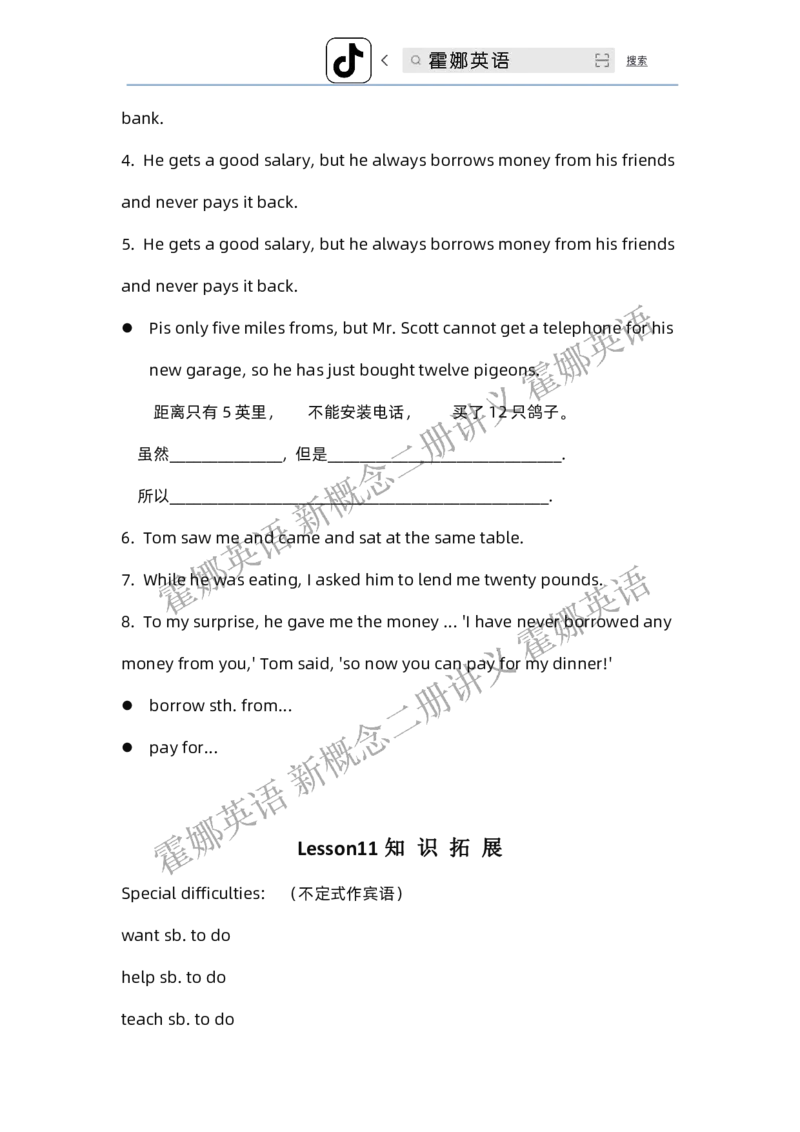
Lesson11 语法讲解
Lesson11 课文讲解
1. I was having dinner at a restaurant when Tom Steele came in.
steal
[stiː l]
v. 偷窃
Percy Button
2. Tom worked in a lawyer's office years ago, but he is now working at a
bank.
3. Tom worked in a lawyer's office years ago, but he is now working at a
bank.
4. He gets a good salary, but he always borrows money from his friends
and never pays it back.
5. He gets a good salary, but he always borrows money from his friends
and never pays it back.
Pis only five miles froms, but Mr. Scott cannot get a telephone for his
new garage, so he has just bought twelve pigeons.
距离只有5 英里,
不能安装电话,
买了12 只鸽子。
虽然______________, 但是_____________________________.
所以_______________________________________________.
6. Tom saw me and came and sat at the same table.
7. While he was eating, I asked him to lend me twenty pounds.
8. To my surprise, he gave me the money ... 'I have never borrowed any
money from you,' Tom said, 'so now you can pay for my dinner!'
borrow sth. from...
pay for...
Lesson11 知识拓展
Special difficulties:
(不定式作宾语)
want sb. to do
help sb. to do
teach sb. to do
advise sb. to do
order sb. to do
allow sb. to do
Lesson12 单词讲解
1.
luck [lʌk] n. 运气,幸运
good luck
I wish you good luck this year!
lucky
adj.
2.
captain
[ˈkæptɪn]n. 船长
cap 帽子
cap- 头,首
capital 首都
3.
sail [seɪl] v. 航行
sail from...
sail for....
This ship sails for New York on Monday.
这船将于星期一开往纽约。
4.
harbour [ˈhɑː rbər] n. 港口
at the harbour
5.
proud [praʊd] adj. 自豪
be proud of...
He was proud of himself for not giving up.
口语:I’m proud of you.
6.
important [ɪmˈpɔː rtnt] adj. 重要的
play an important role
He played an important role in my life.
Lesson 12 语法讲解
1. 一般将来时态的用法:表示现在的打算、计划、将来
2. 一般将来时态的构成:
主语+will\ shall+do
主语+is\am\are going to + do
我打算辞职。
I am going to quit.
她要去沏茶了。
She will make some tea.
主语+will\ shall+be+ 非动词
主语+is\am\are going to + be+非动词
我会伤心的。
I will be sad.
她会在7:30 到那。
She will be there at 7:30.
Sam 将会成为一位医生。
Sam is going to be a doctor.
鸟总有一天会飞往天空。
The bird will be in the sky some day.
主语+is\am\are going to + do\be+非动词
主语+is\am\are going to +地点
我们要去学校了。
We are going to school.
我的老师要去新西兰了。
My teacher is going to New Zealand.
3. 区别:
主语+will\ shall+do(意愿)
主语+is\am\are going to + do
(客观马上、计划、打算)
4. 一般将来的标志词?
tomorrow
the day after tomorrow
next week\month\year
in the future\in a week\in two months…
5. 一般将来的否定和疑问
主语+will\ shall+do
主语+is\am\are going to + do
主语+will\ shall+be+ 非动词
主语+is\am\are going to + be+非动词
Lesson12 课文讲解
1.
Our neighbour, Captain Charles Andy,will
sail from Portsmouth tomorrow.
一般将来时形式:will + do
Our neighbour, Captain Charles Andy,will
我们的邻居
=
Andy 船长(同位语)
2.
We'll meet him at the harbour early in the...
we’ll = we will
meet sb.
at the harbour
early in the morning
He will be in his small boat, Topsail.
介词短语
Topsail is a famous little boat.
3.
He will be in his small boat, Topsail.
他的小船=
Topsail(同位语)
... is a famous little boat.
4.
It has sailed across the Atlantic...
the Atlantic:大西洋
the Pacific:太平洋
5.
Captain Andy will set out at eight o'clock, so we'll have plenty of
time.
出发:
set out\start out
We'll see his boat and then we'll say goodbye to him.
He will be away for three months.
他将会离开三个月的时间。
He will be away for three months.
He will be leave for three months.
He will leave for three months.
短暂性\瞬间性动词
arrive,become,begin,borrow,break,buy,catch,close,open, come,
die,end,fall, finish,get,give,go,leave,put
我已经到达很久了。
I have arrived for a long time.
门已经关了两小时了。
The door has been closed for two hours.
此人已经去世很多年了。
The man has died for many years.
短暂性动词的转化
arrive- be here
close-be off
die- be away
leave- be away
break- be broken
come- be here
他将会离开三个月的时间。
He will be away for three months.
He will be leave for three months.
He will leave for three months.
We are very proud of him.
6.
He will take part in an important race across the Atlantic.
be proud of...
take part in...
Lesson12 知识拓展
一般将来时态的构成:
主语+is\am\are going to + do\be+非动词
口语缩略表达:
主语+is\am\are gonna + do
主语+is\am\are gonna + be+ 非动词
主语+is\am\are gonna + do
主语+is\am\are gonna + be+ 非动词
You’re gonna make a wonderful grown up.
You’re going to make a wonderful grown up.
What are you gonna do?
What are you going to do?
Lesson13 单词讲解
1. group
[ɡruː p]n. 小组,团体
a group of girls
a group of tourists
2. pop singer
美[pɑː p ˈsɪŋər] 英[pɒp ˈsɪŋə(r)] n. 流行歌手
He often dreams to be a pop singer.
pop music/song/culture/art...
3. club
[klʌb]n. 俱乐部
She is a member of the club.
a football/golf/ club
a night club
4. performance [pərˈfɔː rməns] n. 演出
give a performance
give five performances
live performance
5. occasion [əˈkeɪʒn] n. 场合
on the occasion:在这种情况下
on these occasions:在这些情况下
口语:on occasion
偶尔
This does happen on occasion.
Lesson 13 语法讲解
将来进行时:
1.结构:主语+ will be+ doing
主语+ shall be+ doing
We will be traveling in New Zealand next week.
Sam will be running at 7:00 this evening.
Susan will be living abroad next year.
强调客观
主观意愿
Susan won’t be coming.
Susan won’t come.
计划安排(确定发生)
临时起意
We will be traveling next week. We will travel.
委婉客气
How long will you be staying here? How long will...?
Lesson13 课文讲解
1. The ... are a group of pop singers.
a group of...
At present, they are visiting all parts of the country.
at present
recently
全国各地:all parts of the country
全世界各地:all parts of the world
They will be arriving here tomorrow.
They will be coming by train and most of the
... people in the town will be meeting them ...
Tomorrow evening they will be singing at the...
The ... will be staying for five days.
They will be trying to keep order.
Workers’club: 工人俱乐部
学生阅览室:the students’reading room
我父母的希望: my parents’ hope
儿童聚会:a children’s party
演出4 场:
give four performances
as usual: 像往常一样
have a difficult time
have a good time
Lesson13 知识拓展
Lesson 14 单词讲解
1. amusing [əˈmjuː zɪŋ] adj. 好笑的,有趣的
令人感到好笑的
amused: 感到好笑的、有趣的
an amusing game
I am amused.
工作经验:work experience
丰富的经验:rich experience
1 年及以上相关领域工作经历:
Above one year relative work experiences.
2. wave [weɪv] v. 招手
wave to sb.
3. lift [lɪft] n. 搭便车
take a lift
give a lift
I'll give you a lift to the station.
4. reply [rɪˈplaɪ] v. & n. 回答
①I am looking forward to your replay.
n.
②She only replied with a smile. v.
5. language [ˈlæŋɡwɪdʒ] n. 语言
a second language
the body language
the official language
the native language
Lesson14 语法讲解
时间状语:
by the end of…
by the end of last year\ last week\ last month…
by the time sb. + 动词过去时
by the time he arrived/I graduated…
疑问形式:
had 提前
He had left by the time I arrived.
Had he left by …?
否定形式:
had + not
He had left by the time I arrived.
He had not left by the time I arrived.
Lesson14 课文讲解
I had an amusing experience last year. the main idea
After I had left a ... in the south of France, I drove on to the next town.
I stopped and he asked me for a lift.
ask sb. a lift
give sb. a lift
As soon as he had got into the car, I said good morning to him ...and he
replied in the same language.
as soon as...
一......就......
他一到,我们就开始开会了。
As soon as he arrived, we started to have a meeting.
我一到那儿,就给你打电话。
As soon as I get there, I'll call you
As soon as he had got into the car, I said good morning to him in ...and
he replied in the same language.
主句:
said+
replied
从句:had got
I gave the alarm.I saw the smoke. (as soon as)
I gave the alarm as soon as I had seen the smoke.
As soon as I had seen the smoke,I gave the alarm.
Apart from a few words, I do not know any ...at all.
apart from:除了
I had nearly reached the town, when the young man suddenly said,
very slowly, "Do you speak...?' As I soon learnt, he was English himself!'
Lesson14 知识拓展
Lesson15 单词讲解
1. secretary
美[ˈsekrəteri] 英[ˈsekrətri]n. 秘书
secret
n. 秘密
Please contact my secretary to make an appointment.
2. nervous [ˈnɜː rvəs] adj. 精神紧张的
口语:Don’t be nervous.
3. afford
[əˈfɔː rd]
v. 负担得起
afford sth.
afford to do
Can we afford a new car?
We can't afford to go abroad this summer.
4. weak
[wiː k]
adj. 弱的
①She is still weak after her illness.
②Geography was my weak subject.
5. interrupt [ˌɪntəˈrʌpt] v. 插话,打断
Sorry to interrupt.
Lesson15 语法讲解
1. 宾语和宾语从句:
2. 零部件:
①主句& 从句
②引导词:that
3. 时态:主句一般现在,从句任意时态
5. 直接引语间接引语
He says, “ I invited him”.
He said that __________________________.
时态:says- said
invite- invited
人称:I- he
Lession15 课文讲解
1. The secretary told me that Mr. H would see me.
The secretary tells me, “Mr. H will see you”.
主句:tell-told
从句:时态will- would
人称me- you
2. I felt very nervous when I went into his office.
He did not look up from ... when I entered.
进入:go into/enter
抬头:look up from...
3. After I had sat down, he said that business was very bad.
4. He told me that the firm could not afford to pay such large salaries.
主句:tell- told
从句:can- could
5. Twenty people had already left.
I knew that my turn had come.
主句:know- knew
从句:have came- had came
6.
7. Then he smiled and told me I would receive an extra thousand
pounds...!
主句:tell- told
从句:will-would
加班:
do some extra work
Lesson15 知识拓展
1. interupt: v. 打断(说话)
interupt: v. 打断(说话)
inter: 在...中间
rupt: 破坏
I‘m so sorry to interput.
I’m realy sorry. But could I interupt for a second?
I didn't mean to interupt.
2. disturb:v. 打扰
I’m sorry to disturb.
Do not disturb others on the train.
3. bother: (尤指因小事不断)麻烦、烦扰(某人)
bother sb.
Stop bothering me. 别烦我。
Don’t bother. 不麻烦了。
4. interfere:v. 干预,干涉
interfere with
Don't interfere with my business.
不要干涉我的事情。
Lesson16 单词讲解
1. park [pɑː rk] v. 停放(汽车)
2. traffic
[ˈtræfɪk]
n. 交通
the traffic lights
the traffic police
the traffic accident
the traffic jam
3. ticket [ˈtɪkɪt]
n. 交通违规罚款单
票:a bus/theatre/plane/train ticket
罚单:a parking/speeding ticket
4. note
[noʊt]n. 便条
note pad
便利贴
5. area [ˈeriə] n. 地段
no parking area
mountainous area
desert area
urban area
6. area [ˈeriə] n. 地段
zone
地带
district 地区(行政)
7. sign [saɪn] n. 指示牌
Follow the signs.
v.签署
Sign your name here, please
8. reminder [rɪˈmaɪndər] n. 提示
remind
v.
It reminds me of my childhood life
9. fail [feɪl] v. 无视,忘记
v.失败
①He failed his driving test.
②She failed to get into art college.
v. 没能做成
①He failed to have a travel.
②I failed to finish my work on time.
v. 无视,忘记
Failure teaches success.
失败是成功之母。
口语:Words fail me.
10.
like-dislike
agree- disagree
appear- disappear
Lesson16 语法讲解
1. 什么是状语?
2. 条件状语从句:句子作条件状语
真实条件句:
If you let me stay, I will keep house for you
虚拟条件句:
If I can fly, I will be with you right now.
3. 主将从现
If there is anything you need , I will not be far away .
如果你需要,我就在你身边。
4. 主情从现
If you are the smartest person in the room, you must be in the wrong
room.
如果你是这个房间里最聪明的人,你一定呆错房间了。
5. 主祈从现
If you want something said, ask a man.
If you want something done, ask a woman.
Lesson 16 课文讲解
1. If you park your car in the wrong place, a traffic policeman will ...
2. You will be very lucky if he lets you go without ...
3. You will enjoy your stay here if you pay attention to our ...
4. If you receive a request like this, you cannot fail to ...!
不会+ 不遵照执行
If you receive ... you cannot fail to obey it!
cannot + fail to
never+ fail to
我是不会不爱你的。
I will not fail to love you.
I will never fail to love you.
Lesson 17 单词讲解
1. appear [əˈpɪr] v. 登场,扮演
出现:A ship appeared on the sea.
disappear
v. 消失
appear in movies
appear on the stage
appearance
n.外表
Do not judge a person by his appearance.
不要以貌取人
2. stage [steɪdʒ] n. 舞台
n. 阶段
the early stage
a new stage
on the stage
3. bright [braɪt]
adj. 鲜艳的
bright future
bright colors
bright moon
bright idea
4. stocking
美[ˈstɑː kɪŋ] 英[ˈstɒkɪŋ] n. (女用)长筒袜
sock
美[sɑː k] 英[sɒk]n. 短袜
christmans stockingcs
Lesson17 语法讲解
1. 情态动词:
必须:must
可以:may
能够:can
2. 情态动词表推测:
必须、一定:must
可以、可能:may
能够、不可能:can-can‘t
你是Sam.-
你一定是Sam.
You are Sam. - You must be Sam.
他12 岁。- 他一定12 岁。
He is twelve. - He must be twelve.
Lesson17 课文讲解
1. My aunt Jane is an actress.
actress
hostess
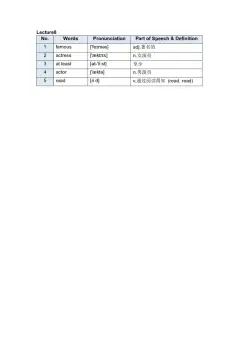
princess
poetess
2. She must be at least thirty-six years old.
at least: 至少
at most:最多
It may take about a week at the most.
它可能花费大约至多一星期。
3. In spite of this, she often appears on the stage
as a young girl.
in spite of this: 尽管如此
appear on the stage as: 出演...角色
The actress often appears on the stage as a princess.
4. Jane will have to take part in a new play soon.
have to:不得不
take part in: 参加
5. This time, she will be a girl of seventeen.
一个7 岁的小男孩:
a boy of seven (years old)
6. In the play, she must appear in a bright red dress and long black
stockings.
in: 穿着
She looks beautiful in her wedding dress.
7. Last year in another play, she had to wear short socks and a bright,
orange-coloured dress.
have to- had to
orange-coloured
green -coloured
8. If anyone ever asks her how old she is, she always answers, 'Darling,
it must be terrible to be grown up!'
grow up: v. 长大
grown up: n. \adj. 成年人, 长大的
Lesson17 知识拓展
1. as:
①as- because
I was absent because I was sick.
②as- whilie
As I was cooking, the mailman arrived.
③as- 按照
Do as I say.
④as- 作为...身份
My father
works as an engineer.
⑤as soon as...
As soon as I arrived, my son ran to clean up.
Lesson 18 单词讲解
1. pub
[pʌb]n. 小酒店,酒吧
public house
2. landlord [ˈlændlɔː rd] n. 店主
the landlord of the pub
房东
I owe the landlord one hundred dollars.
我欠房东一百美元。
3. bill [bɪl] n. 帐单
pay the bill
the electricity/gas bill
口语:
fit the bill
Lesson 18 语法讲解
①拥有:I have a new car.
I have got a new car.
否定:
I don’t have a ...
I haven’t got a ...
疑问:
Do you have a...?
Have you got a...?
情态动词:I have to leave now.
She has to stay here for two weeks.
I don’t have to leave now.
She doesn’t
have to stay...
Lesson 18 课文讲解
4. As I was looking for it, the ... came in.
While
5. 'Did you have a good meal?" he asked.
'Yes, thank you,' I answered, 'but I can't pay the bill. I haven't got my
bag.'
6. In a few minutes he returned with my bag and gave it back to me.
return with...
come back with...
go away with...
7. My dog had taken it into the ...
He often does this!'
Lesson 18 知识拓展
1.Yes. The writer had had lunch at a village pub.
2. No. She could not find her bag after her meal.
3. No. She could not pay the bill.
4. The landlord soon found it for her.
5. His dog had taken it into the garden.
Lesson 19 单词讲解
1. hurry 美[ˈhɜː ri] 英[ˈhʌri]
v. 匆忙
①Hurry up! We're going to be late.
②I hurry to school in the morning.
= I go to school hurridly in the morning.
③in hurry
I am in hurry.
2. ticket office 美[ˈtɪkɪt ˈɑː fɪs] 英[ˈtɪkɪt ˈɒfɪs] 售票处
3. pity [ˈpɪti] n. 令人遗憾的事
What a pity!
What a shame!
4. exclaim [ɪkˈskleɪm] v. 大声说
ex- 向外
exit\export
The children exclaimed with excitement.
孩子们兴奋地大叫。
5. return [rɪˈtɜː rn]
v. 退回
return to...
return from work...
in return for this...
6. sadly [ˈsædli]
adv. 悲哀地,丧气地
Her head drooped sadly.
她悲哀地垂着头。
Lesson19 语法讲解
1.情态动词:
必须:must
可以:may
能够:can
2.情态动词表推测:
必须、一定:must
可以、可能:may
能够、不可能:can-can‘t
他是我的老同学.-
他可能是我的老同学.
He is my old classmate.
He may be my old classmate.
情态动词-许可:May I...?
Lesson 19 课文讲解
1. 'The play may begin at any moment,' I said.
'It may have begun already,'
2.
I hurried to the ticket office.
'May I have two tickets please?' I asked.
3.
I hurried to the ticket office.
'May I have two tickets please?' I asked.
I hurry to= I'm in a hurry to get to the bank.
4. 'I'm sorry, we've sold out,' the girl said.
5. 'What a pity!' ... exclaimed
6. Just then, a man hurried to the ticket office.
'Can I return these two tickets?' he asked.
7.
'Could I have those two tickets please?'
8. 'but they're for next Monday's performance.
您还要吗?
我可能还是要吧。
Do you still want them?'
'I might as well have them,' I said sadly.
Lesson 19 知识拓展
Lesson 20 单词讲解
1. catch
[kætʃ]
v. 抓到
catch a fish
catch a ball
catch a bus/train/plane
catch a cold catch fire
口语:
What’s the catch?
2. fisherman [ˈfɪʃərmən] n. 渔民
postman
policeman
spaceman
businessman
fireman
dustman
3. boot [buː t] n.
靴子
a pair of boots
4. waste [weɪst]
n. 浪费
a waste of time/money/food
5. realize [ˈriː əlaɪz] v. 意识到
I didn't realize that you were unhappy.
How to realize my dream? (v. 实现)
Lesson 20 语法讲解
1. 动名词。
2. 动名词的本质:由动词变来的名词,动名词是名词!
Lesson 20 课文讲解
3. Fishing is my favourite sport.
打篮球是我最喜欢的运动。
Playing basketball is my favourite sport.
做饭是他的最爱。
1. Fishing is my favourite sport.
I often fish for hours without catching anything.
Instead of catching fish, they catch old
boots
and rubbish.
After having spent whole mornings on the river,
I always go home ...
'You must give up fishing!' my friends say.
I'm not really interested in fishing.
I am only interested in sitting in a boat and
doing nothing at all!
Cooking is his favourite.
4. I often fish for hours without catching anything. But this does not
worry me.
5. You will be very lucky if he lets you go without a ticket.
He left without a word
He drove away my car without permission.
6. Instead of catching fish, they catch old boots and rubbish.
instead of+ n./doing (没有做的事)
我给了他忠告,而不是钱。
I gave him advice instead of money.
他们在那聊天,没有写作业。
They talk there instead of doing homework.
7.
8. 'You must give up fishing! give up doing: 放弃...
9.
I'm not really interested in fishing.
I am only interested in sitting in a boat
and doing nothing at all!
be interested in doing:对...感兴趣