外研社
亏
t
晶晶J.:I=用
Students' Book
L. G. Alexander (英)叶
Julia Alexander (英
Roy Kingsbury (英)冒
J1
'
‘
、
严
.
.-..
E
,
"
"
由
北京
ω~.时f 四jgu削
学生用书
Students' Book
L. G. Alexander ( 英
)
Julia Alexander ( 英
Roy Kingsbury (英)
世
Rhian、,ven Ro berts (瑞典)
插图
叫私飞
亏-.
久,
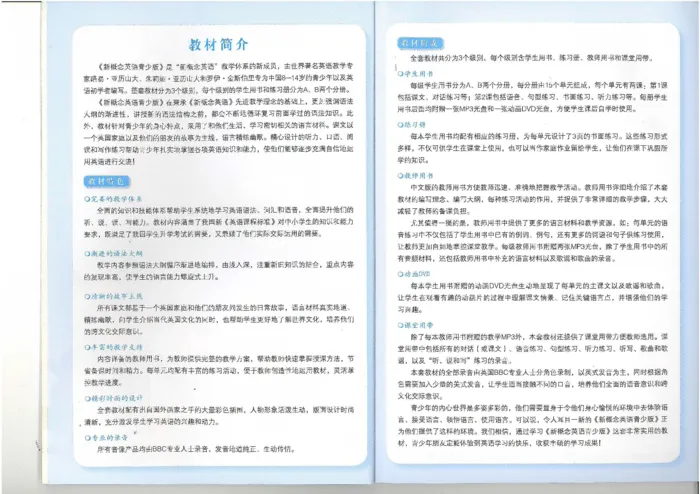
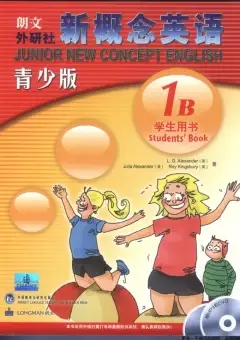
教材简介
《新概念英语青少版》是"新概念英语" 教学体系的新成员,由世界著名英语教学专
家路易·亚历山大、朱莉娅·亚历山大和罗伊
· 金斯伯里专为中国8-14岁的青少年以及英
语初学者编写。整套教材分为3个级别,每个级别的学生用书和练习册分为A 、
B两个分册。
《新概念英语青少版》在秉承《新概念英语》先进教学理念的基础上,更加强调语法
大纲的渐进性,讲授新的语法结构之前,都会不断地循环复习前面学过的语法知识。此
外,教材针对青少年的身心特点,采用了和他们生活、学习密切相关的语言材料。课文以
个英国家庭以及他们的朋友的故事为主线,语言精练幽默。精心设计的昕力、口语、阅
读和写作练习帮助青少年扎实地掌握各项英语知识和能力,使他们能够逐步充满自信地运
用英语进行交流1
。完善的教学体系
全面的知识和技能体系帮助学生系统地学习英语语法、词汇和语音,全面提升他们的
听、说、
i卖、写能力。教材内容涵盖了我国新《英语课程标准》对中小学生的知识和能力
要求,既满足了我国学生升学考试的需要,又兼顾了他们实际交际运用的需要。
。渐进的语法大纲
教学内容参照语法大纲循序渐进地编排,由浅入深,注重新旧知识的结合,重点内容
的复现率高,使学生的语言能力螺旋式上升。
。清晰的故事主线
所有课文都基于
个英国家庭和他们的朋友间发生的曰常故事,语言材料真实地道、
精练幽默,向学生介绍当代英国文化的同时,也帮助学生更好地了解世界文化,培养他们
的跨文化交际意识。
。丰富的教学支持
内容详备的教师用书,为教师提供完整的教学方案,帮助教师快速掌握授课方法,节
省备课时间和精力。每单元均配有丰富的练习活动,便于教师创造性地运用教材,灵活掌
控教学进度。
。精彩时尚的设计
全套教材配有出自国外画家之手的大量彩色插图,人物形象活j发生动,版面设计时尚
清新,充分激发学生学习英语的兴趣和动力。
。专业的录音
所有音像产品均由BBC专业人士录音,发音地道纯正、生动传惰。
全套教材共分为3个级别,每个级别含学生用书、练习册、教师用书和课堂用带。
l q 学生用书
每级学生用书分为A 、
B两个分册,每分册由15个单元组成,每个单元有两课:第1 课
包括课文、对话练习等;第2课包括语音、句型练习、书面练习、昕力练习等。每册学生
用书后面均附赠一张MP3光盘和一张动画DVD光盘,方便学生课后自学时使用。
。练习册
每本学生用书均配有相应的练习册,为每单元设计了3页的书面练习。这些练习形式
多样,不仅可供学生在课堂上使用,也可以当作家庭作业留给学生,让他们在课下巩固所
学的知识。
。教师用书
中文版的教师用书方便教师迅速、准确地把握教学活动。教师用书详细地介绍了本套
教材的编写理念、编写大纲,每种练习活动的作用,并提供了非常详细的教学步骤,大大
减轻了教师的备课负担。
尤其值得一提的是,教师用书中提供了更多的语言材料和教学资源,如:每单元的语
音练习中不仅包括了学生用书中已有的例词、例句,还有更多的词语和句子供练习使用,
让教师更加自如地掌控课堂教学。每级教师用书附赠两张MP3光盘,除了学生用书中的所
有音频材料,还包括教师用书中补充的语言材料以及歌谣和歌曲的录音。
。动画DVD
每本学生用书附赠的动画DVD光盘生动地呈现了每单元的主课文以及歌谣和歌曲,
让学生在观看有趣的动画片的过程中理解课文情景、记住关键语言点,并增强他们的学
习兴趣。
。课一堂用带
除了每本教师用书附赠的教学MP3外,本套教材还提供了课堂用带方便教师选用。课
堂用带中包括所有的对话(或课文)、语音练习、句型练习、听力练习、昕写、歌曲和歌
谣,以及"昕、说和写"练习的录音。
本套教材的全部录音由英国BBC专业人士分角色录制,以英式发音为主,同时根据角
色需要加入少量的美式发音,让学生适当接触不同的口音,培养他们全面的语音意识和跨
文化交际意识。
青少年的内心世界是多姿多彩的,他们需要置身于令他们身心愉悦的环境中去体验语
言、接受语言、领悟语言、使用语言。可以说,令人耳目
新的《新概念英语青少版》正
为他们提供了这样的环境。我们相信,通过学习《新概念英语青少版》这套非常实用的教
材,青少年朋友定能体验到英语学习的快乐,收获丰硕的学习成果!
B
、
,
-
r
o
--hu
』
0
…
田
·
·
·
·
e
'1
·
一
剧
作
4
·
E
m
工
1
2
'
t
-
町
的
m
m
-
m
E
H
V
规
凹
凹
u
m
A
正
M
U
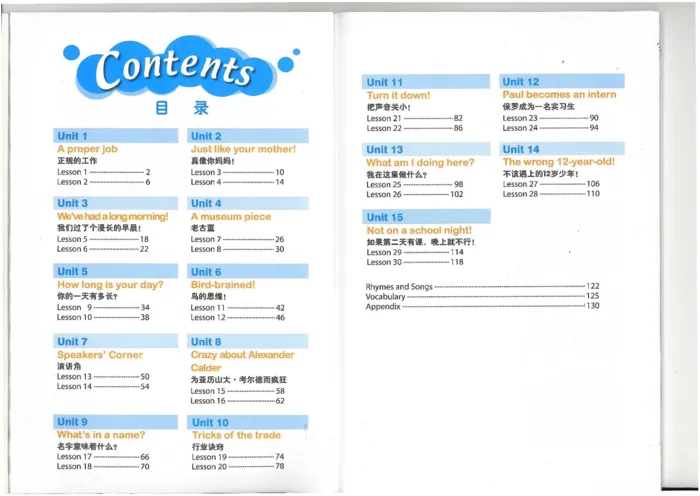
Unit 3
We'vehada 阳啕morning!
我们过了个漫长的阜晨!
Lesson 5 ……………...........18
Lesson 6 .................……….. 22
How long is your day?
你的-天有多长?
Lesson 9 ………"…·……"… 34
Lesson 10........……............38
Unit 7
Speakers' Corner
演讲角
Lesson 13 …….........……"… 50
Lesson 14 ….......…….......... 54
What's in a name?
名字意味着什么?
Lesson 17 ........…............... 66
Lesson 18..………...……......70
•
,
录
Unit 11
Turn it down!
把声音关小!
Lesson 21 ..……….................82
Lesson 22 ..……"…...…·…"… 86
Unit 12
Paul becomes an intern
保罗成为-名实习生
Lesson 23 …….......…………… 90
Lesson 24 ………………… 94
Just like your mother!
真像你妈妈!
Lesson 3 …...……"………..… 10
Lesson 4 …………"………"…. 14
Unit 13
What am 1 doing here?
我在这里做什么?
Lesson 25 ………·………......... 98
Lesson 26 .........……...........102
Unit 14
The wrong 12-year-old!
不该遇上的12岁少华!
Lesson 27 .......................... 106
Lesson 28 ..........………"…..1 10
Unit 4
A museum piece
老古董
Lesson 7 …..........................26
Lesson 8 ..………....…"……… 30
Unit 15
Not on a school night!
如果第二天有课,晚上就不行!
Lesson 29 ………………"……11 4
Lesson 30 …...…….........….. 118
8ird-brained!
鸟的思维!
Lesson 11 ..…·………"……·… 42
Lesson 12 …….......…………..46
Rhymes and Songs ..........……"………..........….......................………..........….122
Vocabulary ….......……"…….............……………....…….......................………"…..1 25
Appendix …...………"…...…...…………...………"…...………..............…·……"…....: 130
Unit 8
Crazy about Alexander
Calder
为亚历山大·考尔德而疯狂
Lesson 15........…...………… 58
Lesson 16.......……"……...... 62
Tricks of the trade
行业诀窍
Lesson 19 ….........…"……… 74
Lesson 20 …....…..........…… 78
二
A proper job
正规的工作
LESSON
Listen to the recording, and then answer this question: Did Nina enjoy being a model?
Why? / Why not? 听录音,然后回答问题·尼娜喜欢当模特吗?为什么喜欢? /为什
么不喜欢?
ALAN: Guess what, James!
1 bumped into Nina last week
She's got a job in Marketing
at Optima.
JAMES: Marketing?
But Nina's a fashion model!
ALAN: Well, she was a fashion mode1,
butsh巳's working at Optima now.
JAMES: What happened? Is she all right?
ALAN: Oh, yes , sh巳' s fine.
She just want巳d a proper job
Nina didn't enjoy being a model ,~
you know.
2
,
l
u
ε
-
03
0
δ
巳
ρ
怡
、
」
d
vhh7·
m
N
1
i
,
叫
A
O
C
L
眩
'
由
勘
a
t
o
uuwum
航
y
,
n
a
HJMMMO
b
a
d
μ
s
n
y
m
、
川
优
咄
M
K
E
B
飞
r
Jhomu
vququm
m
川
师
A
UU
A
YEJALiYEd
ALAN: She didn't mind
working as a model.
But she hated
travelling on h巳rown.
She was lonely.
JAMES: Nina, lonely? Why?
@
ALAN: Nina lik巳s having a proper job,
and seeing th巳sam巳people
every day.
She likes being among friends.
JAMES: Don't we a1l?!
3
,
4
[ 阳riîl.llo1. ..... JJïiJ阳@…
中可←…mw;
".>"一…川……
proper / ' prop~/ adj 正规的,合适的
certainly /'s3:tnli/ adv 扩ocω) 肯定地,无
Guess what! /'ges 'wot/βxed phrase 你猜
疑地
怎么着
mind /1盯ma缸mdψ/ν 介意,反对
h
bump int
川
1吐巾
to町/尸'bAmp'm川
1
ma
阳
a阳t创in】g 闭0:汰
k。咄
9刽甜削
t口阳
II叩
I
teach /川
ti:叫
t叮J/川
V. 教,传授
-
扩
2沪哺
?嚼绥伊庸嗨咽&跚何棚啪w
叫蜘川鄂咽肌黝椭瞄鄂酬棉幅户酣酣,伊句黝酶酣彷刑附夸脚时舍呻刷咽鄂叫噜帽耐9 嘀盹叫办亨叫喃"咱脚阶嘟庐如字叫飞帆趴鹏吻何咖喇嘛呐锣仰伊刷喇喇咱W喃喃.~r;;.,i古赔?脚铅笔宫
妇二i
: N伽5 on the Text 课文注啤E
问
1 enjoy being a model/didnt't mind working as a model -一在巳njoy 和(not) miud 后
面要接名词或动名词。动名词由动词加-mg 构成,
如
being ,travelli吨,worki吨,
having, se巳mg o
2
youknow 一通常置于解释性的i吾句句尾。
3
on her own 一意为
"她自己" 。
own 前的物主代词要与主语的人称一致,如
on
my/your/his/its/our/their oWU o
4 Don't 吟all?! 一这是否定疑问句,意思相当于We all do ,但语气更强。
参苦译文
艾伦
詹姆斯
艾伦
你猜怎么着,詹姆斯
i
我上星期碰到尼娜了。
她在欧边玛的营销部得到了一
份工作。
营销?可尼娜是个时装模特呀|
呢,她过去是时装模特,
但她
现在在欧迪玛工作。
詹姆斯。怎么回事。她没事吧?
艾伦
嗅,她很好。
她就是想找个正规的工作。
要知道,
尼娜不喜欢当模特。
,
詹姆斯
为什么?她曾经那么成功
l
艾伦。
的确是。
詹姆斯
那么为什么她不想当模特了呢?
艾伦
当模特她不介意,但她不愿意
自己一个人跑来跑去。
她觉得很孤独。
詹姆斯尼娜,孤独? 为什么。
艾伦
尼娜想得到一份正规的工作,
可以每天看到同样的人。
她喜欢和朋友们在一起。
詹姆斯
我们不都是这样想吗?
1m i制Conversation x~i!~ >J
t--
b …………叫醒醺!
10 Ans
时川
swe臼叫
E
aω) Example: Oid Ala田n bump into Niua last 飞week? Yes, he did.
Is Nina working at Optima now?
6
Was she lonely?
2
Oid she want a proper job?
7
Ooes she like seeing the same people
3
Oidn't she enjoy being a model?
every day?
4
Oid she mind working as a model?
8
Ooes she like being among friends?
5
Oid she hate travelling on her own?
b) Example: Oid AJau bump iuto Claire? No, he didu't. He bumped iuto Nina.
才
Has Nina got a job in leaching?
2
Is she working at Ullima now?
3
Was she unsuccessful as a model?
4
Oid she love travelling on her own?
5
Ooes she like seeing differenl people
every day?
6
Ooes she hale being among friends?
c) Example: Who did Alan bump iuto last week? (He bumped into) Nina.
1 What's Nina doing now?
4
Who likes being among friends?
2 What kind of job did she want?
5 What do we all like?
3
Why didn't she like being a model?
f) Ask questions about the text. 根据课文提问。
Example: Alan / bump into Nina / last week? (When ...?)
A: Did Alan bump into Nina last week? B: Yes, he did.
A: When did he bump into her? B: (He bumped into her) last week.
she / get / a job / Marketing / Optima?
3
she / hate / travelling? (Why ...?)
(Where ...?)
4
she Ilike / seeing / same people /
2
she / e时oy I being a model? (Why
every day? (Who ...?)
didn't ...?)
o Ask each other these questions . 互相提问。
,
What do you do? Or what would you
3
00 you like travelling on your own?
like to do?
Why? I Why not?
2
What is a 'proper job'?
4
00 you like seeing the same people
every day? Why? / Why not?
。Imagine you are táíking to a fashion model. What questions can you ask him or
her? 假设你在与一位时装模特交谈,你会问他或她些什么问题?
Examples: What do you Iike about your job? What don't you Iike about your job?
00 you travel to other countries? 00 you Iike travelling? Why? / Why not?
5
playing football
reading
(reading)
(playing tennis)
3
4
the boys
Mr. Ford
They enjoy it
Æ
He likes it
watching TV
teaching
(doinghom巳work)
(marking t巳sts)
5
6
Karen
William
出tw
m 叫寸1 //
EJrs/
chatting to friends
gardening
(doing hous巳work)
(cleaning the car)
7
8
Daisy and
Polly and
Jack
/ ...
Annie
They lo,ve~ιdL
飞、J去马
They love/
hate it I 柳树协'fÍÌ)
./,乡11
~
hate it
1
Paul
He likes it
L郎。N ⑦
Nina didn't 豆皿旦卫working as a model.
She's 旦旦rking at Optima now
[阳
ψ λ严-~,"'~'"价时品F叫W 伊P7_W' 抖"V咆坷俨,,--
剑."ψ"~r Y-仰"""","'/"'<♂ψ仰"'h""'''_.W 可
m吩J彩
wash up /'w口f'Ap/1人+ adv. particle ;,先
(餐具)
surprised /s::l'praIzd/ adj
吃惊的
department /dI'pa:tm::lnt/ n. 部门
,
email /'i:meIi /ν,发电子邮件
i
alone /::l'l::lun/ a司j. (predicative) 单独的
独自的
,Ai
W 伽叩W 吃?二含芝二、茨V 气γ/叫""=伊~峨协_0'" 机主~-'-.I'.^在τ主主... ...". 可M时咄叫吨吨""~~~立功"γ
牛';,~~ r
chat /tfæt/ v
闲聊
housework /'hausw3:k/ n
家务
mark /ma:k/ν。许分
test /test/ 11
考试,测验
garden /'ga:dn/ v. ;,人事园艺
saíl /sed/ν . (乘船)航行
ll'5
川
川
,
K
E
d
-
A
U
门
川
口
阻
,
、
ρ
E
M
V
'
B
η
I
F
,
。
5
ω
刷
d
i
g
m
刊
它
的
阳
山
付
。
toh
吨
h
c
pc5
E
吧
吨
川
叶
的
α
ill
叭
n
e
iEh
t
M
咿
'
C
J
dGL
nJ-t
aELY
Eh
40h
5DO
nH
r
E····
协
A
B
a
旧
υ
4
(Patterns 1 - 3 with pictures 1 -4 only)
1 A:
Does Paul play football?
B:
Yes, he does.
A:
Does he like ït?
B:
Yes, he does. He likes playing football.
5
A:
K,口ren loves chatting to 斤iends,
does门't she?
B:
Yes, she does, but she hates doing
housework
2
A:
Does Paullike reading?
B:
No, he doesn't.
A:
Does he like playing 而ootball?
B:
Yes, he does.
3
A:
Does Paullike reading?
B:
No, he does门't like reading,
but he likes playing football.
,
,
fiying
(sailing)
6
2
Lucy
She enjoys it
making cakes
(washing up)
7
l\.n unusual football player 一个不同寻常的足球运动员
Listen to the recording, and answer the qnestions about the text. 听录音,
Who do we read a lot about?
4
Ulises' villag巳has now got __ _
a) Famous news stories.
a) a new football t巳am.
b) S山cessful f?o~ball players.
b) a new library in the school.
c) Expensiv巳cloth巳s.
c) clean water, a school and a
hospital.
回答问题。
1
[W巾a;u::utj~{@ 书面练习E
o Patterns 句型
飞
Refer to the Pattern Practice on page 6, and write out in full numbers 3 and 5 . 参照
第6 页的句型练习,用图片中的信息套用句型3 和5 写出完整的对话。
Write in the missing words, and then look at the text in Lesson 1.填入所缺的词,然后
查看第1 课的课文。
飞8 Sentence Structure 句子结构
Ulises 巳njoys making life bett巳r for
his village because 一一一一
a) h巳loves them.
b) th巳rear巳3 ,000 P巳ople there.
c) he gives them mon巳y.
5
Ulis郎'father is
a) a football player.
b) a farmer.
c) a t巳ach巳E
Who does Ulises play for?
a) A team in South America.
b) A villag巳team in Ecuador.
c) A football t巳am in England.
2
3
[ W
晰酬州
r时咐
i忧t叫u阳阳叫叫
e臼刨时
s剑钳
t创ion阳s 写问题>
Write good questions for the answers, like the example. 仿照例句,根据回答写出合适
的问题。
Example: 0oes 5• e enioy flying:? No, she hates flying. Sh睛's always sick.
? Oh, yes, 1 love reading!
? Mr. Ford? He hates marking tests
? Lucy? She always enjoys going to the cinema.
? 1 don't really like washing up, but 1 don't mind it.
?
yi巳s ,we both love watching TY.
? NO, he d巳finitely didn 't lik巳working as a postman!
Choose the correct answer to fill the blank - a, b, c or d. Then look at the text in Lesson 1.
从a 、
b 、
c 和d 中选择正确的答案填空,然后查看第1 课的课文。
1 bumped 一
Nina last w巳ek. (pic. 1)
a)for
b)into
c)at
d)to
Well, she was a fashion model, but 一-一_ at Optima now. (pic. 2)
a)shework
b)she's working
C)works
d)gOIng to work
Nina didn't enjoy _一一_ a model, you know. (pic. 3)
a) b巳
b) to be
c) been
So why didn't she like working 一_ a model? (pic. 4)
a) as
b) for
c) like
But she hated
一_ on her own. (pic. 5)
a) travel
b) travelling
c) to travel
d) b巳mg
l
2
3
1
1
7
"
1
U
A
斗
气
d
r
o
r
、E
L Multiple Choice 选择填空
1 ,
Nina didn't _
_ __ a model, you 一_ ' (pic. 3)
Sowhy 一一
she like 一一一一一
a 一一一? (pic. 4)
She didn't 一一一一一一_ a model. (pic. 5)
Nina likes 一一
a 一一_ job ,and __ th巳sam巳一一一巳very day. (pic. 6)
Sh巳一一_ __ among friends. (pic. 6)
-
-
7
年
1
J
A
『
F
3
同寻
鸟
吃
2
1jji
飞e Guided Summary 总结
Write complete answers to these questions about the text in Lesson 1, to make one
paragraph. 完整回答以下关于第1 课课文的问题,并将答案连成一段话。
Did sh巳mind being a model or not?
What did she hate doing on her
own? Was she lonely or not? (Us巳
..., but and ..., and)
What kind of job does Nina like?
Who does she enjoy se巳mgev巳ry
day? Does sh巳like or hate being
among fri巳nds? (Use ..., and)
5
6
Who dià Alan bump into last week?
Where has sh巳got a job now?
Who did Alan tell about Nina?
Was he surprised or not? Why?
(Us巳...,and and ..., because)
Is Nina fine or not? What kind of a
job did sh巳want? (Use ..., but)
-
i
匀
'
年
句
3
4
飞
\
飞
。
Guided Composition 作文
Nina is writing an email to a friend. Some of the words are missing. Write out the email
again and fill in the blanks 时th words and phrase组from the list below. 尼娜正在给一个朋
友写邮件。邮件中缺了一些词。用列在邮件下方的词和短语填空,把邮件补充完整。
飞
Hi,Andy!
Here 1 am in my n巳W 一一_ at Optima. lt's ajob in th巳
Department. 1
enjoy __ with other people ,缸ld th巳
h巳re are so mc巳.
1 hate 一-一一一一,so 1 love it here! Il0ve 一一_ to people in the of且c巳.You
knowm巳-1 was a model, but 1 一一一一一一一一_ standing around.
What are you doing now? Please email me.
Nina
飞
d)
4
5
being alon巳
P巳ople
Marketing
don't really like
working
chatting
b
o
J
到
4
9
d) travelled
附…叩
时
8
10
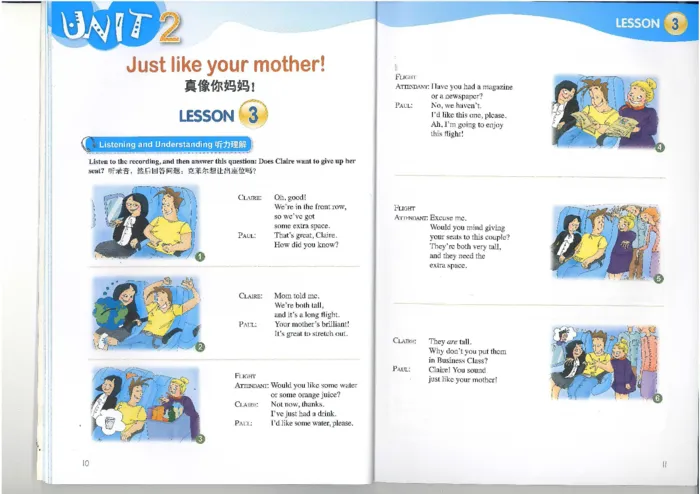
Just like your mother!
真像你妈妈!
郎。N ①
o[~"'"'If: II (o
Listen to the recording, and then answer this qnestion: Does Claire want to give up her
seat? 听录音,然后回答问题:克莱尔想让出座位吗?
CLAIRE:
PAUL:
Oh, good!
We'因in th巳frontrow ,
so we'v巳got
some extra space
That's gr巳况,C1aire.
How did you know?
CLAlRE:
Mom to1d me.
W巳' r巳both tall ,
and it' s a 10ng fiight.
PAUL:
Your moth町、brilliant!
It's great to stretch out.
FLIGHT
ATI凹DANT: Wou1d you 1ike som巳water
or some orange juice?
CLAIRE:
Not now, thanks.
I've just had a drink
PAUL:
I'd 1ik巳som巳wat时,p1eas巳.
F LIGHT
AπEND生NT: Hav巳you had a magazin巳
or a newspap巳r')
PAUL:
No, we haven't.
F LIGHT
I'd lik巳this on巳,p1ease
Ah, I'm going to 巳时oy
this fiight!
ATIENDANT: Excuse me.
CLAIRE:
PAUL:
Wou1d you mind giving
your s巳ats to this coup1e?
They're both very tall,
and th巳y ne巳d th巳
extra spac巳.
They are tall.
Why don't you put them
in Busin巳ss C1ass?
C1aire! You sound
just 1ik巳your mother!
11
Example: Claire and PauI are in the front row, aren't they? Yes, they are.
Claire and Paul don't want to give up
their seats, do they?
The couple are very tall, aren't they?
Claire sounds like her mother, doesn't
she?
Example: Have Claire and PauI got some extra seats in the plane?
No, they haven't. They've got some extra space.
…~ …厨莓,J
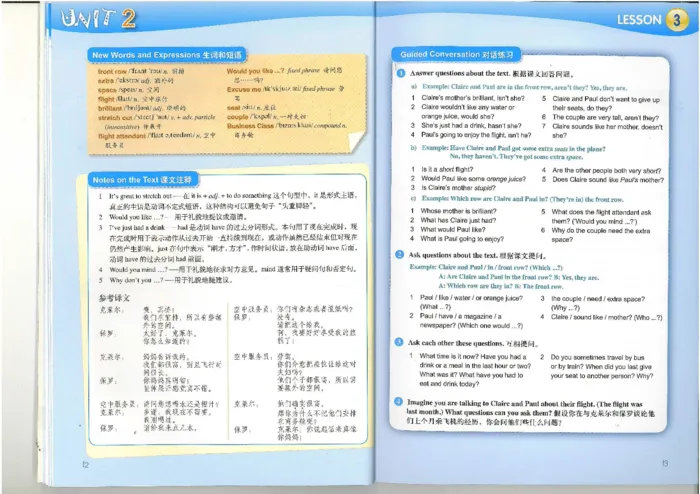
1 11' s great to stretch out 一在it is + adj, + to do something 这个句型中,
lt 是形式主语,
真正的主语是动词不定式短语,这种结构可以避免句子"头重脚轻"。
Would you like . . . ? 一一用于礼貌地提议或邀请。
I've just had a drink -
had 是动词have 的过去分词形式。本句用了现在完成时,现
在完成时用于表示动作从过去开始一直持续到现在,或动作虽然己经结束但对现在
仍然产生影响。
Just 在句中表示"刚才,方才'\ 作时间状语,放在助动词have 后面,
动词have 的过去分词had 前面。
Would you mind ...? 一用于礼貌地征求对方意见。
mind 通常用于疑问句和否定句。
Why don't you …?一用于礼貌地提建议。
Are the other people both very sho厅?
Ooes Claire sound like Paul's mother?
Is it a short flight?
Would Paul like some orange juice?
Is Claire's mother stupid?
Example: Which row are Claire and PauI in? (They're in) the front row.
4
5
4
1
叶
,
ι
句
。
:;Ø<"~如伊
~啊'曾曾带吁立立如f!{f;Sl'吨"'"""",,,啊苦?忖-τ 呐吃町伊喃喃咒
Fi二二on the Text 课·国
What does the flight at!endant ask
them? ('Would you mind ... ?')
Why do the couple need the extra
space?
Example: Claire and PauI / in / front row? (Which ...?)
A: Are Claire and PauI in the front row? B: Yes, they are.
A: Which row are they in? B: The front row.
the couple / need / extra space?
(Why...?)
Claire / sound like / mother? (Who ...?)
3
4
00 you sometimes travel by bus
or by train? When did you last give
your seat to another person? Why?
2
Ask each other these questions. 互相提问。
What time is it now? Have you had a
drink or a meal in the last hour or two?
What was it? What have you had to
eat and drink today?
。
Irr吨irre you are talking to Claire and Paul about their flight. (The flight was
last month.) What questions can you ask them? 假设你在与克莱尔和保罗谈论他
们土个月乘飞机的经历,你会问他们些1t么问题?
他们确实很高。
那你为什么不把他们安排
在商务舱呢?
克莱尔
l 你说起话来真像
你妈妈l
克莱尔
; 保罗
,
Answerqu创tions about the text. 根据课文回答问题。
5
6
7
Claire's mother's brilliant, isn't she?
Claire would 门't like any water or
orange juice, would she?
She's just had a drink, hasn't she?
Paul's going to enjoy the flight, isn't he?
:
tèlTttH:ti lij.1 H!l hl叫。咐话练习
ti.
…川仰去J卫在
a)
3
4
)
ku
2
10
叮叮叮一………骨一一……雳理;
front row j'fr Ant 'r;)O/凡前排
Would you like …? fixed phrase 请问您
extra j'ekstr::J/ adj. 额外的
想...吗?
space /spels/ n. 空间
Excuse me /Ik' skj u:z mi/βxed phrase 劳
flight jflaü/ n. 空中旅行
驾
brilliant /'bnlj ::Jntj adj
聪明的
seat /曰:tj n 应位
stretch out /'stretf 'aut/ν + adv. particle
couple /'kApg\f n 一对夫妇
(intransitive) 伸展开
Business Class j'bIZUIS kla:s/ compο undn
flight attendant /'flaIt ::J,tend;mt/凡空中
商务舱
服务员
[
l ~t4;;Tj!Øle]i. r-*j'I. I Þf:J.)i4i1[.) iM 生词和·国
"
啊,~………
,*",
..~…
5
Ask questions about the text. 根据课文提问。
6
Whose mother is brilliant?
What has Claire just had 。
What would Paullike?
What is Paul going to enjoy?
c)
1234
@
2
4
5
3
Paul / like / water / or orange juice?
(What ...?)
Paul / have / a magazine / a
newspaper? (Which one would ...?)
2
?LFW
网
叮
肋
川
纸
我报
受者
。
享
或
我
好
志
给
好
杂
个
要
有
。
这
我
1
们
有
把
'
了
你
没
请
啊
程
空中服务员
保罗。
所以有些额
4楚,真棒
l
我们在前排,
外的空间。
太好了,克莱尔。
你怎么知道的?
参号译文
克莱尔
保罗
@
对
这
给
让
位
高
座
很
问
把
都
空
意
。
子
的
。
介
吗
个
外
如
冉
们
川
川
归
U
户
们
们
却m
劳
你
夫
他
要
所以需
空中服务员
时
-74
4
1
。
飞
错且
不。
而
真
的
叫
?
如
甘
品
且
我
高
明
感
诉
很
。
其
开
告
都
长
妈
展
妈
们
很
妈
伸
妈
我
问
你
能
克莱尔
保罗
请问您想喝水还是橙汁中
多谢,我现在不需要。
我刚喝过。
请给我来点儿水。
空中服务员
克莱尔
保罗
13
12
Z •
,
|问
~
LESSON
She was 10旦旦)y.
We've got some 豆豆旦豆旦旦旦旦-
She's a fa豆hion model
、.
I ~ t:ß'i"ll'] i' ~tl ,(. I ='3" 141'-1 (.] .;i'S;;;II~r.: il l li~...~t
些1雯雯,
snack /snæk/ 几点心,
'J 、"t
offer /'of;;,/ν(somelhing 10 somebody)
提供
Ask and answer questions. 问答练习。
A: Has Robert had a sandwich?
4
A: Would Robert like a sandwich?
B:
Yes, he has. He's just had one
B
N口" he wouldn't. He's just had one.
A: Has he had any cake?
B: No, he hasn't.
5
A: Would you like a sandwich?
Hehas门't had any cake yet.
B
N口" tha门kyou./'vejω th口done.
A: What would you like?
2
A: Have you had a sandwich?
B: l'd like some cake, please.
B:
Yes, I have.1νe just had one
I haven't had any yet.
A: Have you had any cake?
B: No, I haven't. l haven't had any yet.
6
A: Why don't you have a sandwich?
B: No, thanks. But I would like some cake.
3 A: Why don't you have a sandwich?
B:
I've already had on巳thankyou
But I haven't had any cake yet.
,
9
10
a sandwich
somec政e
---------…----- --- 一二十
一一一一----------四----------- 一一二
十一一--------------一一一一一
一一一-------帽~---------------四…
11
Nina
an apple
…------------- - …------ 一一一一一
12
some chocolate
→一一一----------------------- 一二十
一一一一---------四-- …… --- ----- 一←
… 一一------------
13
14
some salad
a drink
-… 15…-----一……--一一---…
16 ……一---- --
William and Karen
a snack
some coffee
15
I CycIing to work 骑车去上班
Listen to the recording, and answer the questions about the text. 听录音,回答问题。
How does Sue always go to work7
4
Who 瞅巳d Sue abo川er JOu叫?
a) Sh巳w~b.
~Arn也o reporter.
b) Sh巳goes by bicycle.
b) A TV repôrt巳r.
c) She drives her car.
c) A newspaper repo白r
[ [IiIl'iI阳~叫~书面练习】
o Patterns 句型
而飞
Refer to the Pattern Practice on page 14, and write out in full numbers 2 and 5. 参照‘
第14 页的句型练习,用图片中的信息套用句型2 和5 写出完整的对话。
f) Sentence Structure 句子结构
Complete these sentences, using the notes in brackets. Then look at the text in Lesson 3.
用括号中的信息完成句子。然后查看第3 课的课文。
How long was h巳r journ巳y7
a) 4,200 rniles
b) 5,200 miles.
c) 6,200 miles.
5
KU
0
.,
.•
,
J
;·
,
创
圳
·1E
币
D
paFU
n
b
、
且
'
U
民
m
y--KMU
aVJNV
A
u
a
吨
飞
n
,dunf
h
w
刀
岛
‘
、
‘J
V
·
A
-
E
E
‘
d
-laudk
H
M
「
巳
旧
amKJ
川
h
d
ω
u
u
m
山
旧
旧W
W
V
N
巳
巳
yihh
kuhHpapa
uv)))
mvabc
2
We'r巳. .. (front row / we / extra space) (pic. 1)
Would you ...7 (water / orange juic巳) (pic. 3)
Have you ...7 (magazine / newspaper) (pic. 4)
Would you ...7 (giving / s巳ats / this couple) (pic. 5)
1234
\
How lat巳was Sue for work last
Monday7
a) Five days.
b) Six weeks
c) Seven months
3
o Guided Summary 总结
\
Write complete answers to these questions about the text in Lesson 3, to make one
paragraph. 完整回答以下关于第3 课课文的问题,并将答案连成一段话。
L Match the
Match the questions on the left with the answers on the right, and write them down.
将左栏的问题与右栏的回答搭配起来,并把它们写下来。
A Questions
Would you like a cup of tea 7
Do you like flying7
Does sh巳really enjoy t巳aching7
Have you had lunch yet7
Hav巳your friends a11 had a drink7
B
Yes ,1 love it.
No, we're going to hav巳it now.
No, not a11 of them, not yet.
Y邸,she does , and she's a good
teacher!
No, thank you. I've just had one.
Answers
唱
A
匀
,
"
句
3
A
-
T
-
A
匀
,
"
句
3
A
哼
卢
、
d
Wouldh巳like a n巳wspaper ,too, or
not7
Then what does the flight attendant
ask them7 Why7 (Begin with The
flight attendant asks them, \.', and
use ..., because)
What does Claire say7 (Begin with
And Claire says, '...')
5
6
7
Which row in the plan巳缸巳Claire
and Paul in 7 What have th巳y got7
(Use ..." so)
Are they both t~l or short7 1s it a
shor.t or a long flight7 Can they
stretch out or not7 (Use ..., and
and ..., so)
What does the flight attendant 0旺er
them7
Has Claire just had a drink7 矶'hat
would Paullike7 (Us巳...,but)
2
3
4
、飞
\
5
Choose the correct answer to fill the blank - a, b, c or d. Then look at the text in Lesson 3.
从a 、
b 、
c 和d 中选择正确的答案填空,然后查看第3 课的课文。
We're in th巳front row, so we've got 一一_ extra spac巳
(pic. 1)
a) an
b) some
c) th巳
d) any
It's great_一一
(pic.2)
a) stretch out
b) stretched out
I' ve 一__ had a drink. (pic. 3)
a) ready
b) ago
c) yet
d) just
Would you mind _一一_ your seats to this coupl巳7 (pic. 5)
a) give
b) to give
c) giving
d) gave
d) stretching out
c) to stretch out
: 川tI]川、。m 选择填空】
2
3
4
。
Guided Composition 作文
Daisy and Jack are having a party at their house for some friends. Use the words in
brackets to make suitable qu臼tions for Daisy and Jack, and write out the conversation.
黛西和杰克在家里举行朋友聚会。用括号中的词完成黛西和杰克向朋友们提出的问题。
DAISY: ...7 (you / had / sandwich / yet)
WTLL队M: Yes, I've just had a glass, thank
ANNIE: Yes, I've had some sandwiches,
you.
but 1 haven't had a.drink.
JACK:
...7 (Why don't / you / some
JACK:
...7 (you / like / coffee)
cake)
KAREN: Yes, please. I'd like a cup of
PAUL:
I've already had some, thank
co旺ee.
you.
DAISY: ...7 ~ou / had / wine)
DAISY:
...7 (Jenny / you / like / drink)
JENNY:
y,邸,pleas巳. I'd like som巳
orange JU1ce.
飞
\
6‘ -‘ .
17
一
~~啊
16
、
LESSON
DAlSY: Th巳first said,‘Plane on time.'
Th巳second said,‘Boarding now.'
Th巳third said,‘Phone off now.
1 love you, Mom!'
We've had a long morning!
我们过了个漫长的阜晨!
Listen to the n到wrding,and then answer this question: Why have Daisy and Karen had a
long morning? 听录音,然后回答问题:黛西和卡伦为什么过了个漫长的早晨?
,
4
18
ALICE: Helio, Karen! Helio, Daisy!
Have you be巳n
to the Farm巳rs' Market today?
It's only nine o'ciock,
and it's alr巳ady busy.
V
J
=
内
n
u
7
1
-
M
川
σ
b
B
V
a
α
E
t--
neya
巳
-
k
p
d
v
,
m
U
M
U
η
四
创
w
m
w
口
h
o
w
ast-
tmugk
wmnn
unIPb
-JIon-4
5
吁
I
o
t
E
N
l
州
I
M
g
泪
u
i
m
n
州
创
加
m
M
K
刊
订
而
t
x
I
P
白
F
V
i
t
[
,
口
'
比
f
四
v
但
却
O
TOBUNKN
VU
N
R
u-
BR
AA
DK
KAREN: No, we've just been to the airport
with Claire and Paul.
They've gone ωtheUS
for two months.
AUCE: Have they? How exciting!
But what a woηy for you!
DAISY: Well, the US is Cl甜的home country.
KAREN: And she's with Paul!
DAISY: That's right!
Anyway, I' v巳already had three texts
from Claire
DAISY: We're going to put the kettle on,
and have a nice cup of tea!
KAREN: YI巳s ,we've already had a long
morning!
19
3
4
: l~t4'l&!i!l.n. t.*il t. 1 时t4.-'t1rJí陌生词和短语)
?
text /tekst/ n
短信
t
on time /,on 'tarm/ adv. (time) 准时地
l
board /b:J: d/ ν,上(船,飞机等公共交通工具) ;
v 担心
kettle /'ketl/ n
水壶
i
home country /'h;lUm ,kAntril n
祖国
J
~叫…………~…响伽………………咿-~...,..………办明时Y"'W
"
ó"-./,"P'",的
farmer /'fa:m;,/ n
农夫
market /'ma:k;,t/ n
市场
worry /'wAri/ n. 担心,令人担心的事物
18 …
.",~吟唱吁伊切
γW 沙叩
-....,川
'/fi'/" ,.é~'
1 Have you been to th巳Farmers ' Market today? -
"have been to + 地点" 表示曾经去过
某地,已经回来。
2 They've gone to the US -
"have gone to +地点" 表示去了某地,还没有回来。
3 How exciting! -一这是由how 引导的感叹句。结构为
How + 形容词。
4 But what a worry for you! 一这是由what 引导的感叹句。结构为
what + a 十名词。
worry 作名词时,后面一般接两个介词
for 和about 。用拔为
worry for + 担忧的人,
worry about + 令人担忧的人或事。
5 Plane on time / Boarding now / Phone off now
因为这是短信的内容,所以用了简略
形式,在报纸的标题中也常见这种简略形式。通常会省略主语、冠词、助动词。
6 like crazy一在这里意为"非常"。
7 We're not going to worry, are we, Karen? 一这是反意疑问句,回答应为否定形式。
参考译文
艾丽斯
你好,卡伦!你好,黛西
l
你们今天去农贸市场了吗。
现在月~9 点,但那里已经很热闹了。
没有,我们刚刚阿克莱尔和保
罗去机场了。
他们要去美国呆两个月。
真的吗?太令人兴奋了|
但你一定很担心
|
j
黛西
第一条上面说
"飞机准点。"
第二条上面说
"正在登机。'
第三条上面说
"现在得关机了。
我爱你,妈妈
黛西
第三条是刚刚收到的。
当然1
我会非常想她。
但我不会担心
l
我们不会担心
,
对吧,卡伦?
卡伦对,
我们不会
i
黛百
我们要烧壶水,喝杯美味的茶
|
卡伦
好,我们可是过了个漫长的早晨|
卡伦
艾丽斯
西
伦
西
黛
卡
黛
呢1
美国是克莱尔的祖国。
而且她还和保罗在一起
l
对呀
l
不管怎么说,我已经收到克莱
尔3 条短信了。
20
[
tijiir;rm l"trnj阳刚。n 对话练习E"
b
也今v ,'<俨
| @ AnswerqUNionsaboutthe text- 根据课文回答问题。
a) Examples: Alice ha矿been to the Farmers' Market, hasn't she? Yes. she has.
Karen and Daisy haven't been there, have they? No, they haven't.
1 They've just been to the airport,
haven't they?
2 Claire and Paul have gone to the US,
haven't they?
3
Daisy has had three texts from Claire,
hasn't she?
4
She had the last one a moment ago,
didn't she?
5 Karen and Daisy aren't going to worry
about Claire and Paul, are they?
6 They're going to have a nice cup of
tea, aren't they?
7
They've had a long morning , have 门't
they?
b) Example: Has Alice been to the airport this morning?
No, she hasn't. She's been to the Farmers' Market.
1
Have Karen and Daisy been to town?
2
Have Claire and Paul gone to Ital户
3 Has Daisy had four texts from Claire?
a
?e
ov
nuu2u
a
」
川
SO
Et
ewwqu
,
‘
n
川
'
的
川
mg
auunH
-ve
币
「
对
U
M
怡
d
?
tne
edgu
od
afH
削
阶
∞
haEl
+lnuNu
aEP
W
H
ω
45
c) Example: Where has Alice been this morning? (She's been) to the Farmers' Market.
川
川
?
m
eenu
a
u
n
H
£
H
bpd
v'rta
s
川
h
2u2uvvd
Dpmm
d
d
h
闭
n
n
H
「
L
2
u
到
M
C
U
n
门
a
u
u
2
M
BKh
邵
阳
怡
K
C
M
呐
。
U
V
O
U
VE
O
U
VVV4
2
u
g
u
n
川
队
H
ι
n
u
n
d
阳
陀
m
d
ee
N
mw
hhmhu
叭
叭
H
C
1
2
3
4 What are Daisy and Karen not going
to do?
5 What are they going to do now?
e Ask questions about the text. 根据课文提问。
Example: Alice / been / Farmers' Market today? (Where ...?)
A: Has Alice been to the Farmers' Market today? B:Yes, she has.
A: Where has she been today? B: To the Farmers' Market.
1 Karen and Daisy / been / the airport? (Where ".?)
2
Dalsy/had /three texts from clalre?(How many
?)
3
karena nd Daisy /going to /put on /ketHd (Why ?)
4 they / had / long morning? (Why ...?)
e Ask each other these questions. 互相提问。
T Where have you been today?To a market?To work?To college?To the shops?
2
Have you got a mob趴il怡e phone? Have you had any texts today? What did they say?
o Ima吨
agine
配ey阳
0帆佣u川Il町e叫jus归时some fl灿
d由阳
end盹
d由s. Th町
eyhav叫
e叶just川been tωo a f:如
a剖盯rm
咀m阳
E
矶w恼ha创t questions can you ask them? 假设你遇到一路朋友,他们刚去过农贸市场。
你会问他们些什么问题?
一
Examples: Where was the market? What did yon buy? Who did you see there?
21
LESSON ⑨
•
一""W~"'".… m
I've just 国.Q some water.
I' d 且主ll ike some 亚盖虹,please.
明明事聘用酣睡蹦蹦彰
still /st LiI adν
(time) 仍然
ì王
have a good time fLted phrase 玩得开心
'
口'早E
照a',也男"曹呵,- \71'Píi?电~再唱国
喃喃咿饵"但~.也帜
"
'v q一-咽~.即审""=W界。立时W"""""",.用W哼#咱申..叩坷
Ask and answer questions. 问答练习。
A: Have you ever been abroad?
5
A: 00 you know Holland at all?
B: Yes, 1 have. l've been to Holland.
B
N口',1 don't.l've never been there
2
A: Have you ever been to Holland?
6
A
Jack's gone abroad.
B:
Yes, 1 have.1 was there last week
B:
Oh? Where's he gone?
A:
To Holland.
3
A: Has Jack ever been to Holland?
B:
Lucky man! I've never bee门there
B:
Yes, he has.
A: When did he go there?
B:
He went there last week.
4
A: When did Jack go to H口lIand?
B:
He went there last week
A: Is he still there?
B:
N口" he's just come back.
,
22
17
19
21
Holland
last week
Norway
last year
lndia
a fortnight ago
--- ------------ 一一一一←
23
一一一一一--------------- - ----
Thailand
in 1999
18
20
22
24
Mexico
last month
Brazil
last summer
Australia
six months ago
China
in 2003
23
t@!!Ù [;t!(;:j it4b.1@ 书面练习Jl
创1!1YFI(::J,'I'W~Jj
'" "
.,:;'<句
1\n about light 关于光
Listen to the recording, and answer the questions about the text.听录音,
o Patterns 句型
飞
Refer to the Pattern Practice on page 22, and write out in fuJl numbers 3 and 6. 参照
第22 页的句型练习,用图片中的信息套用句型3 和6 写出完整的对话。
qr
缸
巳
vd
9u
n
vd
aH
d
H
KU
a
ρ
L
V
s
·
·
'
B
且
白
、
u
c
δ
c
、
u
dmmm
mdMud
ummm
司
0
0
0
优
凶
凶
川
M
AUnuhunu
r
h
v
n
u
n
υ
h
ρ
n
J
ρ
V
H
3
气
d
p
3
问
f
h
v
呵
/
0
6
H
A
叫
胁
。
回答问题。
竹
、
d
nr
-
n
、
u
n
o
n
、
u
qa
ρ
L
W
n
δ
ρ
L
W
LU-
-
t
th
ug
0
·
UH
b31
asMEH
Y
Y
σ
b
E
oa·uc
叼
d
丁
泪
E
H
m
氏
巳
t
i
σ
b
e
r
o
b
-
币
I
P--f
咱
俨
且
、
J
E
T
-
0
·
0
'
h
M
哩
d
A
U
E
巳
巳
过
h
h
h
kTTT
V)))
mvahuc
1
\ 8 Sentence Structure 句子结构
Write in the missing words, and then look at the text in Lesson 5. 填入所缺的词,然后
查看第5 课的课文。
wh巳nand wh巳re does th巳bird's life b巳gin?
a) 1n March, in N巳w Zealand.
b) 1n April, in China.
c) 1n September, in Alaska.
4
1n spring we 一一一一-
a) feel w巳11.
b) b巳gin again.
c) wak巳up
2
Have you 一一
to 一一
Farmers' 一一一today? (pic.l)
They've 一一一to the US 一一_ two months. (pic. 2)
Anyway, I' ve 一一一
three texts 一_ Claire. (pic. 3)
引毡' r巳一_to putthe 一_on ,and 一
amc巳
of tea! (pic.6)
1
2
3
This Crossword Puzzle is complete. Write simple clues for it. Below are two examples.
这个填词游戏已经完成。为它写出简单的提示。以下是两个例子。
[ (ij ,.t.i.WZtj ,.I;lI1山填词游戏
tJ
4
飞o Guided Summary 总结
Write complete answers to these questions about the text in Lesson 5, to make one
paragraph. 完整回答以下关于第5 课课文的问题,并将答案连成一段话。
Across
3
She is as old
m巳.
Down
1
Would you like a drink?
No,1w____ _ '_'
:
阳、r.!I臼选择填空tl
Choose the correct answer to fill the blank - a, b, c or d. Then look at the text in Lesson 5.
从a 、U 、c 和d 中选择正确的答案填空,然后查看第5 课的课文。
飞。
Guided Composition: An Interview 作文:采访
Imagine you are interviewing a famous person. (Who is he/she?) He/She has been
to lots of different places in the world. Write the interview. Ask questions using the
quωtions and notes below, and write the famous person's answer after each. 假设你在
采访一位名人。( 他/她是谁? )他/她去过世界上很多地方。写出采访内容。用下面的
问题和提示提问,然后写下这个名入的回答。
飞飞
d) gon巳
d) gon巳
d) h巳r巳
飞
1 矶F
20
3A S
5A
O
O
L
T
U
N
6N
E
V
E
7R
8 L I
E
P
E
D
9 y E
T
A
N'
E
lOB A D
llT 120
D
A Y
E
I
N
R
E
N
E
13S O
N
G
What did the first say? What did th巳
s巳cond say, and what did the third
say? (Use ..., and)
1s Daisy going to miss Claire? Are
she and Karen going to worry or
not? (Use ..., but)
What are 出巳y going to put on?
Whatareth巳y going to hav巳?What
kind of a morning have th巳y had?
(Use ..., and and ..., becliuse)
5
6
7
Have you 一一一_ to the Farmers' Market today? (pic. 1)
a) b巳
b) go
c) be巳n
Th巳y've ←一一to the US for two months. (pic. 2)
a) go
b) going
c) went
Anyway ,I' v巳一一一
had thre巳texts from Claire. (pic. 3)
a) already
b) ago
c) yet
We're not going to wony,
, Karen? (pic. 5)
a) are we
b) do we
c) will we
2
3
4
Wh巳r巳has Alice been today?
Wh巳I巳hav巳Karen and Daisy
be巳n with Claire and Paul?
(Use ..., but)
where have they gone, and for how
long?
Whosehom巳country is th巳US ,
Clair,巳's or Paurs?
How many texts has Daisy already
had from Claire?
1
2
4
you / have a good time?
Wh巳re / you / just come back from?
you / lik巳trav巳lling a lot?
Wh巳r巳/you b巳/ next we巳k or next
month?
7890
唱
E
A
Have you ev巳r been to
?
When / you / go there?
What / you / do ther巳?
you / be巳n to 一一一一?
How løng ago / you / go there?
Why / you / go th巳re?
~穆部情鄂、想智W想阳确幅棍"前理黑精-帽喂嗯酣"'"曹m~'"哈
-
i
q
f
】
1
U
A
斗
气
d
/
O
气气
25
d) did we
3
飞
、飞
飞
一一、
一
啊
2问
,
"·‘
‘
26
。纠
A museum piece
老古董
LESSON
Listen to the recording, and then answer this question: How loug has the computer been
in the aUic? 听录音,然后回答问题:电脑在阁楼里放了多久?
@
@
ROBERT:
矶That 's this, Dad?
矶TILLIAM: It's an Apple 2
1t's a very early computer.
1n fact, it's th巳first
Personal Comput町,ev巳r.
It cam巳onto th巳market in 1977
Wher巳did you find it?
ROBERT: Mum found it
in a box in the attic.
WILLIAM: Oh, then it's mine!
1t's b巳巳n th巳r巳for years.
1n fact, it's been th巳I巳
since we moved into
this hous巳!
ROBERT:
Do巳s it still work?
WILLI丛1: 1 don't know ...
Ah, th巳re you are!
Can you hear the hard disk?
R OBERT: Is that noise th巳hard disk?
1t sounds like a lawnmower!
WILLIAM: It is noisy!
It hasn't been out of its box
for twenty years!
R OBERT: What can you do with it?
WILLI灿1: Good question!
It's just a museum piec巳,really.
It's only got five M巳gabyt巳s'
hard disk spac巳.
ROBERT: Five Megabyt巳s!
That's nothing!
WILLIAM: 1 know
1t was already a mus巳umpl巳ce
when 1 bought it,
and that was a long time ago.
Maybe I'm a mus巳um plece
now, too!
。
i县@
27
t
lê] i i l';rm l 川些些些旦」
…中μ" '~'~'" ~,,'" m""",'<"",,_,,…
E甲司;
aew Words and Expressions 唱UijA I
~.
" "'Ø'"
o Answer questious about the text. 根据课文回答问题。
a) Examples: The Apple 2's a very early computer, isn't it? Yes, it is.
It didn't come onto the market in 1957, did it? No, it didn't.
It came onto the market in 1977, didn't it7
It's been in the attic for years, hasn't it7
It's been there since they moved into the house, hasn't it7
The hard disk sounds like a lawnmower, doesn't it7
The computer hasn't been out of its box for twenty years, has it7
It's only got five Megabytes' hard disk space, hasn't it7
Example: Did the Apple 2 come onto the market in 1967?
No, it didn't. It came onto the market in 1977.
12
3
45
6
b)
then it's mine -
then 在这里表示咽此,则"相当于therefore 0
mine 为名词性物
主代词,可以单独使用,而形容词性物主代词必须放在名词前,如
my computer 。
It' s been there for years 一←
"for 十时间段" 在句中作时间状语,表示动作持续的时间。
它可以与现在完成时连用,表示动作一直持续到现在。但如果动作已完成,就要与
一般过去时连用。比较
They have lived here for three years. (表示他们仍然住在这里)
和They lived here for three years. (表示他们现在已经不住在这里了) 。
it' s been there since we moved into this house -
since 与for 不同,后面要加"时间点"
表示动作从过去的某一时刻开始。它常与现在完成时连用,表示动作从过去开始,
经过J了一段时间,一直持续到现在。
smce 与ago 也不同,Slnce 要放在"时间点"前面,
ago 则要放在"时间点" 后面,
如
thr巳巳years ago o
It sounds like -
sound like 表示"听起来像" 0
sound 是感官动词,其他感官动词还有:
L
【rrr.lωn the Text 课文注释】
机'^仰仰,."
l
参苦译文
罗伯特
这是什么
,
爸爸?
威廉
是一台苹果II 型电脑。
一种很早期的电脑。
事实上,这是第一台个人电脑。
它于1 977 年面世。
你是在哪里找到它的?
Has the computer been in the house for monlhs7
Does the hard disk sound like a jel plane7
Has it got fifty Megabytes' hard disk space7
Did William buy it a shorttime ag07
Example: What's an Apple 2? (It's) a very early computer.
How long has it been in its box7
How big is the hard disk7
e Ask questions abol川le text. 根据课文提问。
Example: Apple 2 / come onto / market / 1977? (When ... ?)
A: Did the Apple 2 come onto the market in 1977? B: yi咽,it did.
A: When did it come onto the market? B: In 1977.
4
5
Who found the computer, and where7
How long has it been there7
Does it still work7
才
2
3
4
c)
4
l
q
丘
。
。
look, f,巳el ,taste, smell 等。
2
4
3
it / in the attic / years7 (How long ...7)
it / in its box / twenty years7 (How long ...7)
it / got / five Megabytes' hard disk space7 (How much ...7)
William / buy itllong time ag07 (When ...7)
4
l
q
J
-
q
u
A
斗
7J
土
日
年
声
)
甲
的
川
2
吗
机
里
音
草
子
声
割
l
箱
的
是
了
在
盘
像
大
放
硬
来
大
·
经
是
起
声
己
那
听
噪
它
j
罗伯特
威廉
29
Ð Ask each other these questions. 互相提问。
1 Have you got a computer7 Or can you use one at school or college7
2 What d6 you use a computer for7 Do you do school/college work on it, and play
games, etc.7
。
In吨iue you are talking to William and Robert about computers. What questions
can you ask William about his old Apple 2 computer, and what questions can you
ask Robert about his computer? 假设你与威廉和罗伯特在谈论电脑。关于威廉
那台旧的苹果E 型电脑,你有些什么问题要问威廉?关于罗伯特的电脑,你又
有些什么问题要问罗伯特?
Examples: (to William) How old is your Apple 2? How big is the hard disk?
(to Robert) What kind of computer have you got? Is it a good one?
你要怎么处置它中
问得好
i
它实际上就是个老古董。
它的硬盘空间只有5 兆。
5 兆
l
太微不足道了
l
我知道。
我买的时候它就已经是个老古
董了,况且那也是很久以前的
事了。
也许我自己现在也成老古董了!
罗伯特
威廉
罗伯特
威廉
妈妈在阁楼的一个箱子里找
到的。
嗅1
那它就是我的了
l
它放在那里好多年τo
事实上,我们搬到这里后就把它
放在那里了
|
它还能用吗?
且也不知道. ..
啊,快听!
你能听到硬盘的声音吗?
罗伯特
罗伯特
威廉
威廉
28
盼。N ⑨
011 \1 11101 t" 110
十t' s an Apple 2.
性's mine.
Where didγe甘find 忱?
十know.
制别愣愣咱剪悄悄酣明
circus /'S3:k;)S/ n
马又礼团
several /'sev.?r;J1! quant泸er 几个
zoo /zu:/ n. 动物园
Ask and answer questions. 问答练习。
(Patterns 1 -4 with pictures 25- 30 only)
A: Jack's in the States, isn't he?
B:
Yes, he is. He's been there for a week
2
A: Has Jack already gone to the States?
B:
Y钮;r he主been there since last Monday.
3 A:
Where's Jack?
B:
He's go门e to the States. He went last
Monday
A: Last Monday?
B:
Yes, he's been there (for) a week now.
4 A: How long has Jack been in the States?
B:
Si门ce last Monday.
<
30
for ages /f;Jr 'eld3Iz/ adv. (time) 长时间
funfair !'fAnfe;J/ 凡露天游乐场
…咿唰饥叫1吨M 食"
(Patterns 5 and 6 with pictures 31 - 34 only)
5 A:
Has Jack ever been t口the circus?
B:
Wel/, he went when he was little,
but he has门't been since then
6 A: How often have you been to the circus?
B:
I haven't been to the circus for many
years.
In fact, I h口ven't been (to the circus)
since I was little.
25
Jack
26
Daisy
于
…
sk
'
k
虫
M
…
omzI
k
-
w
。
…
问
l
d
aan
3
叩
A
E
E
J
川
m
n
阻
…
k
e
吐
…
WM
EF
~
-Ec
…
fn
…
·1
E
B
-
Y
E
sa
-
缸
,
d
ι
瓜
太
m
一
的
附
呵
呵一
-maw
-
γ
4
·
←
u
D
0
1
川
A
f
冗
-
m
m
一
c
δ
-
27
Polly
28
Lucy
in/to hospital
at/to the dentist's
for a few days
for an hour
since last Sunday
since nine 0' clock
29
WiIliam and Karen
30
The children
at/ω 也e airport
at/to the s巳aside
for s巳V巳ral hours
for a w巳巳k
since three o ~ clock
since last weekend
32
33
34
Nina
Paul
Annie
r←…
l ~
to the circus
formany y巳盯吕
since/wh巳n he was
little
to the s巳aside
for a long time
since/wh巳n sh巳was
two
to th巳zoo
for ages
since/when he was
very young
to the funfair
for yeaJs
since/when sh巳was
ten
31
~气T可言叫司E
jWhat a bright idea! 多么好的主意!
Listen to the recording, and answer the questions about the text. 听录音,回答问题。
引Th巳r巳do巳s Pino Periolatto live7
4
Whàt has happened to Tornetti in the
a) 1n a city in Italy.
last twenty years7
b) 1n a town in southern 1taly.
a) 1t has become a larg巳town.
c) 1n a villag巳in northern 1taly.
b) 1t has become a summer village.
。1t has becom巳popular in winter.
Irnl阳Exercis叫面哩E
R
o Patterns 句型
Refer to the Pattern Practice on page 30, and write out in fuJl numbers 1,2 and 6.
参照第30 页的句型练习,用图片中的信息套用句型1 ,
2 和6 写出完整的对话。
咖飞
8 Sentence Structure 句子结构
Combine the sentences and make any necessary changes. Then look at the text in
Lesson 7. 合并句子,可作适当改动。然后查看第7 课的课文。
飞。
巳
σ
b
hME
3
2
丁
川
u
n
、
U
J
V
旧
时
k
k
st5
n
s
I
引
7
1
0
却
‘
'
n
n
M
E
H
刀
t
,
d
t
吐
刀
MNMVLM
Q
U
、
A
ζ
p
i
w
U
V
A
们
U
P
T
A
、
,
,
1
时
o
g
叮
n
n
业
h
'
且
也
o
n
e
-
‘
'
r
i
俨
ι
u
v
'
t
二
K
巳
巳
巳
d
?
V
出
力
巳
r
o
-
-
-
Tosonn
k
盯
A
O
O
W
m
均
创
ω
5
The best s巳asonin Tom巳tti is
a) spring
b) summ巳r
c) autumn
b) Thre巳months
d
n
I
ZH
E
LU
V4
9u
t
03
n
u
c3
0iw
h
t
0
3
q
f
-
3
3
口
3
ESLNb
on5
d
创
m
m
吨
川
川
四
..
ω
m
h
E
d
丑
-
W
咱
W
HV
IEE
n
v
ρ
u
v
H
山
山
川
叫
A
时
2
3
We moved into this hous巳. 11's been there since then. (It's been ...) (pic. 2)
It was out ofits box twenty years ago. 1t's out ofits box now. (It hasn't ...) (pic. 4)
1 bought it. 1t was already a museum piec巳th巳n. That was a long time ago.
(It was already ...) (pic. 6)
1
且
匀
,
"
叫
3
、气
Writ廷good questions for the answer宙,Iike the example . 仿照例句,根据回答写出合适
的问题。
Example: 认/卡ere h口sk口ren gone:? Karen'! She's go咀晦to Robert's school
[ W巾
No ,h巳hasn't been to work today. He's be巳n toth巳doctor's
Paul7 He went to the funfair one night last week.
Yes, 1 hav巳. lw巳ntth巳re last y巳ar. 1t was great!
To London7 1 haven't been to London for y巳ars!
No, thank you, I' v巳had a sandwich. But I'd lik巳a drink.
My sist缸's b巳巳n in Australia for about 白V巳y巳也's.
qr-nr-nr-qrnfqr·
'
i
q
M
丐
U
A
饨
,
3
瓦
。
1n fact, since wh巳n has it b巳巳n
th巳re7
Does it still work or not7 Is it v巳ry
quiet or very noisy7 (Us巳...,but)
How much hard disk space has it
got7 What kind of piece is it really7
(Use ..., so)
o Guided Summary 总结
Write complete answers to these questions about the text in Lesson 7, to make one
paragraph. 完整回答以下关于第7 谏课文的问题,并将答案连成一段话。
4
5
6
Where did Robert fìnd a very early
computer7 Who wants to know all
about it7 (U s巳..,and)
What is th巳name of it7 When did it
com巳onto th巳market7
(Us巳..,and)
How long has it be巳n in the attic 7
1
飞、
巧在
"、
2
3
?、
争
Choose the correct answer to fiJl the blank - a, b, c or d. Then look at the text in Lesson 7.
从a 、
b 、
c 和d 中选择正确的答案填空,然后查看第7 课的课文。
。
Guided Composition: A Museum Piece 作文:老古董
William had an Apple 2, a very early computer. ‘It's just a museum piece, reaJly,'
he said. Invent another ‘museum piece' , and use the ideas and questions below to
write a paragraph about it. 威廉有一台苹果H 型电脑,这是一种很早期的电脑。"它
就是一个老古董,真的。"他说。
1豆、出另一个"老古董"并用下面提供的信息和
问题写一段话。
飞
33
d) since
d) haven't been
d) when
It came onto the market 一一_ 1977. (pic. 1)
a) on
b) for
c) in
It's been there 一一_ years. (pic. 2)
a)on
b)for
c)in
d)since
1n fact,_一_ there since we moved into this house! (pic. 2)
a) 1t is
b) it was
c) i1's be巳n
d) it's being
It
out of its box for twenty years! (pic. 4)
a) isn't
b) wasn't
c) hasn't been
1t was already a museum 阴ece
1 bought it. (pic. 6)
a) smce
b) for
c) ago
2
5
4
3
My ‘museum piece' is aJan _ _ _
How old is it7 And how long have you had it7
Wher巳do you ke巳p it7 And how long has it b巳巳n there7
Can you describ巳it7
Do巳s it still work, or not7
Can you still use it7
How rpany years ago did you buy it7 And how much did you pay for it7
WilI you ever sell it7 Why7 / Why not7
阴阳~归画画幢幢碰撞黝稽翻iØ!I'蝴翩。跚.,..,用吨~W明付~吼叫~~""",>"创币"传鹦部血部矶、""'~部<<-~安部阴阳~%,~SI"削、''@~拟嗯也W飞"可四"哑~""飞,飞,.,...,.",萨帽球队呗肘11>."<辛苦喃叼~~~与罚。如嗯但闲阶~" <
12345678
32
•
·UF
How long is your day?
你的-天有多长?
L郎。N 得\丁
"作"~7.如叫呻","M. '~ 吨。去,、
Listen to the recording, and complete the Questionnaire. 听录音,然后完成调查问卷。
'Hav巳you finished your hom巳work
yet?' 咄咄y hav巳n ' t you 且nished your
homework?' How often do you hear
these questions in your hous巳?How
5 do you fee1 about homework?
Chi1dren worldwid巳now do more
homework hours than they did tw巳nty-five
y巳ars ago - but th巳rl巳are huge variations
In some parts of the world, even very
10 young chi1dren have a 10t of homework.
They com巳home from schoo1, and they
work for thre巳or four hours before
b巳dtime. In oth巳r parts of the world,
children don't hav巳muchhom巳work unti1
15 they are a bit older.
Atth巳same tIm巳,many young peop1e
worldwide have extra c1asses after school.
On巳way or another, many childr,巳n 'work'
twe1v巳or fourteen hours a day.-Is this
20
D巳a11y n巳C巳ssary?
3斗
How much homework do you hav巳?
Howmuch 乎m巳do you really sp巳nd on it?
How 10ng is your day?
Questionnaire
1 My homework usually takes me _一一_ a day.
a) less than an hour
b) about two hours
c) three hours or more
2
Every evening, I have homework in 一一一_ subjects
a) one or two
b) three or four
c) five or more
3
I can usually do _一一_ my homework at school.
的most of
b) about half of
c) none of
4
I usually have _一一_ free day each week.
a) more than one
b) one
c) less than one
5 During the past week, I have spent 一一
hours on
my homework
a) up to ten
b) between ten and fifteen
c) more than fifteen
6 Sometimes, I don't do all my homework,
a) but my teachers don't mind
b) and my teachers get annoyed with me.
c) and my parents hear about it
。咿聊"营内-rr'咱俨耐脚-,
四
Answer
a, b or c
-初,霄'哪悖于市作
d币步~
闲~翌驴
35
,
LF-4
[
1 ~[:V@ð.'i. r-*jìI.I#:i.]i4*1[.]'WW::W 1和短司It
e;-
worldwide / ,w3:1d'wald/ adv. (p lace) 在
全世界
huge /hju:d3/ adj 巨大的
variation /,Vegri'elf <7n/ n
变化,
bedtime /'bedtalm/ n
就寝时间
one way or anotherβxed phrase 以这样
或那样的方式
necessary /' nesgs<7ri! αdj
必要的,必需的
questionnaire /,kwestf;>'neg/ n. 调查问卷
subject /'sAbd3ekt/ n. 1+ 目
free /fri:/ adj.
自由的
during /'djùgnl)/ prep. 在期间
past /pa:st/ adj
过去的
up to /'Ap tu/ prep. (+ number)
多达
annoyed /g'n::lId/ adj
恼怒的,
生气的
choose /tfu:z/ v 选择
add /æd/ν 均1力口
f
即可一-j
1 Have you finished your homework yet? -
yet 经常用于疑问句和否定句。用于疑问
句时,表示"己经"。用于否定句时,表示"还(没有) " 。如果句中动词的时态为
现在完成肘,
yet 通常放在句尾。
2 Children worldwide now -
worldwide 和now 分别为地点状语和时间状语,地点状
语和时间状语通常位于i冒语的后面,而在此句中,为了强调,它们被提到了谓语的
前面。状语的先后顺序通常为:方式状语
地点状语一时间状语。
3 come home -一-home 通常与动词go 和come 搭配,前面不加to 。
4 come home/from school/after school -
home 和school 前没有冠词,因为当一些个
体名词抽象化后,前面不加冠词。
5 How much homework/time -
much 通常在疑问句和否定句中修饰不可数名词。
1I t:1t:t.....] ,i i if41 r;,叫
参号译文
"你做完作业了吗? "你为什么还没有做完作业? "你在家里经常听到这样的
问题吗?你怎么看待作业中
全世界的孩子如今比25 年前花更多的时间做作业,但是各地的情况差别很大。
在一些地方,即使很小的孩子也有很多作业。他们放学回家后要花3 或4 个小时
写作业,
然后才能睡觉。在其他地方
1
孩子直到大一些作业才多起来。
同时1 全世界很多年轻人放学后还要上额外的课。很多孩子以这样或那样的
方式一天
" 工作"
1 2 或
1 4 个小时。这真的有必要吗。
你有多少作业。你写作业要花多长时间?你的一天有多长中
(调查问卷译文略)
,
36
f têii i fi r:ti lij.] h!l4 tiÜ j [.] ,j 对话练习E
,~~,"~'4"""
o Answer questions about the text. 根据课文回答问题。
a) Example: Children do more homework now than they did twenty-five years ago, don't
they? Yes, they do.
1 But there are huge variations, aren't
there?
2
I n some parts of the world , even
very young children have a lot of
homework, don't they?
3 Some children work for three or four
hours before bedtime, don't they?
4
In some parts of the world , children
don't have much homework, do they?
5 And some children have extra classes
after school, don't they?
b) Example: Do children do more homework than they did 55 y倒rs ago?
No, they don't. They do more homework than they did 25 years ago.
1 00 very young children all over the
3 00 all young people in the world have
world have a lot of homework?
extra classes after school?
2 00 these children work for five or six
4
00 many children 'work ' 百斤een hours
hours before bedtime?
a day?
。
Example : What questions do you often hear iu your house?
‘Have you finished your homework yet?' aud 'Why haven't you finished
your homework?'
才
D口children do less homework now
than they did 25 years ago?
2
How much homework do children
have in some parts of the world?
3 How many hours do they work before
bedtime?
4
00 some young people worldwide
have extra classes after school?
5
How many hours a day do many
children 'work' now?
Ð Ask questions about the text. 根据课文提问。
Example: children / more homework / did / 25 years ago? (Which people ...?)
A: Do children do more homework than they did 25 years ago? B: YI凹,they do.
A: Which people do more homework than they did 25 years ago? B: Children do.
1 many young people / extra classes after school? (What ...?)
2
many children 'work' / twelve / fourteen hours / day? (How many ...?)
o Compare your answers to the Questionnaire. Ask each other these questions. 比较
调查问卷的答案,并互相提问。
1 What was your answer 10 question 1 /2/3, etc.? Why did you choose that (a, b, c)?
2 What other questions can you add to the Questionnaire?
。
Imagine you're talking to a student from another country. What questions can you
ask him/her about study hours and homework? 假设你在与一名外国学生交谈。
关于学习时间和家庭作业,你会问他/她些什么问题?
37
但m
吗
W叫W
; IU'
Isgm/: Would you like seme 坚鱼?
ISAm/: in 呈豆m豆parts of the world
I'mgni/: How many Q豆豆旦旦were there?
1 ' m巳ni/: M鱼旦y.. young people want to travel.
-
A 1 ~[4'?t?"] j. t*"" ' ffa']i41………~l
万否叫忡院附愣静静明;
correct /b'rekt/ ν. 改正
composition / ,komp :J 'zrf<l日/ n
作文
supper /'SAP:J/ n 晚饭,
晚餐
diary /'dal:Jri/ n
日记
~'Y.~飞。町、,
Ask and answer questions. 问答练习。
A:
B:
2
A:
B:
3
A:
B:
A:
B:
33
Has Robert painted the door yet?
4
Yes, he's just painted it
Has Robert painted the door yet?
N口" he hasn't painted it yet.
5
fRlNveheomollylroiyErovEvdhYyOm
pLiogdionidftnEyg d otuiot PPOOIInnt tthE doory
it?
I painted it this morning
A:
B:
A
B:
A:
B:
What's Robertdoing?
He's painting the d口o r.
Hasn't he painted it yet?
Not yet, but he's nearly 币nished
Haven't you pa i门ted the door yet?
No, I haven't quite linished.
I'm sti/l painting it.
\
b
Study tbe forms and sounds of the PastParticiples.
Tbey are tbe same as the Simple Past of regular verbs.
!Id/
correct has/have corrected
pamt
has/have painted
/t/
且nish
has/have 自nished
look
has/have looked
wash
has/have washed
watch
has/have watched
/d/
I
clean
has/have cleaned
listen
has/have listened
35
Robert
37
Nina
paint巳d the door
(this morning)
look,巳d at those photos
(after lunch)
- - -_.帽- ---甸回------唰--国-----四"白ø______ 牛晴--
39
WiIliam and Karen
41
Vikki
cleaned the car
(this morning)
finished her homework
(half an hour ago)
36
Lucy
corr巳cted her composition
(before supper)
-…--------幽---- - --蛐- ------蝴-- -- - 刷刷- -喃
38
Sally
40
washed the windows
(an hour ago)
Polly and Annie
42
listened to that new CD
(this afternoon)
Paul and Claire
watched that old film
(earl y this ev巳ning)
39
:lfilli!阳阳cis叫古练习〕l
|、Di旭
noω0
Listen to the recording, and answer the
questions about the text. 听录音,回答问题。
-
o Patterns 句型
、, Refer to the Pattern Practice on page 38, and write out in full numbers 1 and 2. 参照
第38 页的句型练习,用图片中的信息套用句型1 和2 写出完整的对话。
Robert asks William,‘What kind of blood?'
What is the real qu巳stion?
What's the answer?
What kind of blood did sma1l dinosaurs have?
What kind of blood did big dinosaurs have?
How do巳s Robert know about this?
句
J
b
句
J
A
哼
F
、
d
f) Sentence Structure 句子结构
Complete these sentences, using the notes in brackets. Then look at the text in Lesson 9.
用括号中的信息完成句子。然后查看第9 课的课文。
Match the questions on the left with the answers on the right, and write them down.
将左栏的问题与右栏的回答搭配起来,并把它们写下来。
:些atch the Questions and Answers 问答搭配]
How often ... (h巳ar / questions / your hous巳?) (\in巳s 3-4)
Children worldwide ... (more homework hours / twenty-five ye缸s ago / but / hug巳
variations) (lines 6-8)
They come home .. . (school/ work / thre巳or four hours / bedtime) (linω11 - 13)
In other patts ... (world / don't have / homework until / a bit older) (lin巳s 13-15)
1
2
3
4
、
B
Answers
No , he hasn't cleaned it yet.
Because it's very difficult.
H巳's gon巳abroad ,1 think.
She's writing some emails.
About two hours ev巳ryevemng.
In th巳g缸d巳n.
1123456
A Questions
How long does your homework
usually take you?
Where's Peter?
Why haven 't you finished your
homework yet?
What's Kar巳n doing?
Where have the children be巳n?
Has he cleaned the c缸. yet?
<<) Guided Summary 总结
Write complete answers to these questions about part of the text in Lesson 9, to make
one paragraph. 完整回答以下关于第9 课部分课文的问题,并将答案连成一段话。
2
3
A-7CJ
rhv
Where do th巳ycom巳home from?
How long do they work before
bedtime? (Use ..., and)
Where do many young people in the
world have extra class巳s too?
How many hours a day do many
children ‘work'? (Begin with So ...)
3
4
5
Where do children do more
hom巳work hours now than they did
t,w巳nty-fiv巳years ago?
Are there sma1l or huge variations?
(Use ..., but)
巩Th巳re do even very young children
hav巳a lot ofhom巳work?
l
2
Choose the correct answer toall the blank -hb,c or d.Then look at the Questionn-
in Lesson 9. 从a 、
b 、
c 和d 中选择正确的答案填空,然后查看第9 课的调查问卷。
My homework usually →一_ me less than an hour a day. (item 1)
?spends
b)n巳咄
c) 础es
d) lasts
ιv巳ry evening, 1 have homework in three or four 一-一. (it优em2匀)
;?广
γ)μ
川
classes
b) 饥m灿
1巾b阳s
仙ours
抽岱削阳叫
Oαon
can usually d由omo删
s剖tofm町
I丑呵
l穹y homework 一一一一s础
cho∞叫
0 1. (伽
It血
t优巳m3匀)
a)to
b)at
C)into
d)on
1 usually_一二one巳f台r巳优e day 巳臼ach week. (it怆巳m丑14份)
a)d?b)give
c)spend
d)have
During the past week, 1 have _一_ up to ten hours on my hom巳work. (item 5)
;)be叩
b) gone
协削
问ent
omehmes 1 don 't do a1l my hom巳work and my teachers →←一_ annoyed with
me. (item 6)
a) be
且Ii附叫叫择填空】
Ð Guided Composition: A Page in My Diary 作文:我日记中的一页
What have you done today? It's 7.00 in the evening, and you are writing your diary
for today. Answer all or some of the questions below to create your diary entry. 你今
天做什么了?现在是晚上7 点,你正在写日记。回答下面所有或部分问题,完成你
的日记。
2
3
4
5
Begin like this: 1've nad a borina/an interestina dav todav
And answer these questions:
• Hav巳you be巳n to schoollc01lege/work? Hav巳you had a good day or a bad day?
• What time did you get up? What time did you go out?
• Have you had any free tim巳today? What did you do?
• Hav巳you already finished your homework!your jobs for today?
.What?reyou going to do tomouowq
6
.
·e·
‘
d) finish
c) have
b) get
马l
问。
、,
t
Bird-brained!
鸟的思维!
LESSON (1i)
血皿皿.JiTi [:1I .. "l r..illtlLl巳圈圈;
~τ
0 "
.
.写万古.
气一ττ万Tτ
..,,~户
叮俨
、."' . . ~ .呐
气
喻,。
吻"
Listen ωthe recording, and then answer this qnestion: Why does Mr. P. show otI
ωthe petrol pnmp? 听录音,然后回答问题
P 先生为什么要向汽油加油泵炫耀?
KAREN: Hav巳you done your hom巳work yet, Lucy?
Lucy: I'm just taking a break, Mum
忏2
I've found this r,巳ally strang巳story
on th巳巳N巳ws Wí巳bsite.
Come and have a look.
,
品孟趾半早ιι-L二立之二平了一~
An eight-year-old peacock in Shropshire has fallen hopelessly in
love with a petrol pump. Every day for the last three years, Mr. P., the
peacock, has made the three-hundred-metre journey along the main
road from his home to the busy
5
petrol station. There, he opens
up his tail feathers, and shows
off to a line of petrol pumps 回The
pumps make a clicking noise when
someone is filling up. To Mr. P.,
10
this sounds just like an admiring
peahen
One pump in particular has won Mr.
p.'s admiration. He has been faithful
to this pump since he was five. Mr
15
P. has lost interest in the peahens
at home. Clearly, they can't
compete with the glamorous
petrol pump.
..r -
~
……二十二十一
问3
F…
ords and Expressions ~ìãJ~~iä
士一一…一…哥哥苟明明;
" btrd·-ii二ined l'b3:d ,bremdl adj
乌脑的
clicking noise l'klIkII) ,n:lIzl compound n
头脑简单的
咔吨卢
break Ibrelkl n. 休息,间歇
币11 up /'frl '^pl v.+ αdv. particle (intransitive)
eNews I'i:nju:zl n 电子新闻
装满
peacock I'pi:kokl n. JL崔
admiring l~d'marnl) l adj. 欣赏的,仰慕的
hopelessly I'h~upl~slilαdν (manner) 没有
peahen I'pi:henl n 雌JL 崔
希望地
in particular I'm p<l 'tlkju:l~1αdv 价cus) 特
fall in love I'b:l rn 'l^ vl卢xed phrase 爱上
别,尤其
petrol pump I'petr,ll p^mpl compound n.
admiration l ,ædm~'reIJ<7nl n. 赞美,钦佩
(BrE. > AmE. gas pump) 汽油泵
faithful l'feI9f<7l! αdj.(+to) 忠实的
main road I'mern 'r<ludl 凡主妥道路
interest I'rntr<lstl n. (+ in) 兴趣
tail feather l'teJl feð<ll compound n.
尾iJ5J
clearly I'klr<llil adv. (viewpoint) σocus)
show off I'J<lu 'ofl ν + adv. particle (transiti阳
(manner) 清楚地,显然地
or intransitiνe)(+ 阳+ο bject) 炫耀
Internet I'rnt<lnetl n 因4字网
line Ilarnl n
行,排
坠!坠
f兰三。n一!…!
M
…
1
eight-year-old/three-hundred-metre 一←eight-year-oJd 和three-hundred-metre 都是由
"数词十名词(十形容词)"构成的复合形容词,在这种结构中,只能用名词的单
数形式。此外,这种复合形容词只能作定语,不能作其他成分。例如
a three-hour
lunch, a 且ve-foot wall, a thousand-dollar question 。
2
Every day for the last three years
在句中作时间状话,为了强调,置于句首。
3 There
在句中作地点状语,它被置于句首是为了强调它同前一句句末the busy
petrol station 的联系。
iliji--i
,
1541i
j;jj
参苦'译文
卡伦
露西
,
你作业做完了吗?
露西
妈妈,我稍微休息一下。
我在电子新闻网站上看到了这个非常奇怪的故事。
过来看看。
什罗普郡一只8 岁大的孔雀无可救药地爱上了一个汽油加油泵。
3 年来,
P 先
生,那只孔雀
,每天都要从它的家沿着主路走300 米到忙碌的加油站去o 在那里,
他对着一排汽油加油泵开屏炫耀。当有人力口j由时,油泵就会发出咔噬声。对P 先
生来说,这听起来就像是一只仰慕他的雌孔雀发出的声音。
一只油泵特别赢得了P 先生的欢心,他从5 岁起就对这只油泵情有独钟。P 先
生对家里的雌孔雀失去了兴趣。显然
,她们是无法与光彩夺目的油泵相媲美的。
HHt
u
寸
[ G帅r:I1i.j,"14 {.i#n tej I j 对话练习】
10 Questions and exercises about the text . 根据课文提问和回答问题。
a) Example: Lucy hasn't done her homework yet. Hasn't she?
1 She's just taking a break
6
He opens up his tail feathers, and
2
She's just found a strange story on
shows 0仔to the petrol pumps
the eNews Website
7
The pumps make a clicking noise
3
The peacock is eight years old.
8
To Mr. P. this sounds like an admiring
4
He's fallen in love with a petrol pump.
peahen.
5
Every day for the past three years,
9
He has been faithful to one particular
Mr. P. has walked. to the petrol station
pump since he was five
b) Example: Has Lucy found all ordillary story on the eNews Website?
No, she hasn't. She's found a strallge story on the Website.
1
Is the peacock eíghteen years old?
2
Has Mr. P. fallen in love with a
peahen?
3
Has he made the journey every day
for the past thírteen years?
c) Example: What has Lucy found on the eNews 矶'ebsite?
(She has found) a realIy strange story (about a peacock).
4
Ooes he show off to a line of
peahens?
5
Ooes the clicking noise sound like
another peacock?
1 How old is the peacock?
2 What has he fallen in love with?
3
How far is the petrol station from his
ho町l e?
4
How often has Mr. P. made the
journey to the petrol station?
5 When do the pumps make a clicking
nOlse。
e Ask questions about the text. 根据课文提问。
Example: a peacock / fallen in love / a petrol pump? (Which bird ...?)
A: Has a peacock falIen in love with a petrol pump? B: y,町,it has.
A: Which bird has fallen in love with a petrol pump? B: A peacock.
1 the peacock / walked 1 petr口1 station /
every day 1 last th陪e years? (Where . . .?)
•
Ask 阳hoth川hese questions. 互相提|词。
1
00 you ever look at a news website? Or haveyou ever looked at a news website?
2
Have you got a favourite website? When do you look at it? Why?
3
Do you (or Can you) use the Internet to do school or college work?
4
Can you see peacocks near here? Where? Where is the nearest place?
。Lucy hasn't done her homework yet. She's just 'taking a break'. What do you do,
to ‘take a break' from study or work? Ask and tell other students in the class. 露
西还没有写作业,她正在"休息" 。你学习和工作之余怎样"休息"?询问班里二
的其他同学,并告诉他们你的情况。
2
Mr. P. 1 faithful to one pump / he was
five? (How long ...?)
叫5
43
LESSON @
-.líl l1lIIt f:U (1
44
Haveye甘done your homework?
Will James call you?
Can+ ask ye甘something?
Yett c击n tell me late r.
we创dye甘like a drink?
+s Daisy at home?
re
…
mrq
…
MSU
E
-
町
O
E
M
白
c
一
巾
y
冉
H
K
门
巳
h
…
mV
-J
-
fam
…
r
jS
E
巳
D
Ife
mm
-
w
·
臼
-
m
-
E;0
…
ι
n
9
川
剧
且
Q
J
H
-
1
巳
1
"
itvde
-
nuTAn-w
…
WFmm
-
nvgu
-
M
一
h
白
…
v
u
m
用
一
ztE
--
m
‘
g
少
-
E
R
E
n
1
J
国
噜
[
O
Z
二
掉
"
阳
…
nurACU
--
匀
U
I
n
u
-
舍
t
F
+
1
"
F
一
物
I
E
怒
。
…
·
呗
部
优
加
…
m
u
U
S
U
M
-
F
U国
h
u
巳
t
…
-
U
E
i
g
4
…
国
民
E
t
a
E
U
'
w
d
国
咀
r
川
川
中
四
川
J
凰
山
川
P
M
K
一
均
n
E
E
川
几
位
d
m
…
烹
s
-1
-
i
t
峪
-
月
'
-
A
a
『
run a small hotel
sold newspap巳rs
for about two ye盯s
for about twenty years
Smce 由币y gotmarried
since they were young
49
.-
ii!' _ • æ
50
45
A: How long has she known that man?
4 A Have you known that man long?
B: She's known him for years
B:
Yes, I have. l've known him since 1990.
2
A: How long has she known that man?
5 A: How long have you known that man?
B
She's known him since 1990
B:
I've known him for years-since 199α
in fact.
3
A: Does she knowthat man?
B:
Of course she does.
She's known him for years.
Study the forms of these irreglÙar verbs:
be
was/were has/have been
lose
lost
has/have lost
do
did
has/have done
make
made
has/have made
drive
drove
has/haveilriven
run
ran
has/have run
faJl
fell
has/have faJlen
sell
sold
has/have sold
自nd
found
has/have found
speak
spoke
has/have spoken
go
研lent
has/have gone
teach
taught
has/have taught
have ( had
has/have had
wm
won
has/have won
|制;
know
knew
has/have known
wnte
wrote
has/have written
飞、
叫6
r一一一一
'
h New Words and Expresslon三…r!t1P1
伴一
叮叮些哇哇司;
truck /trAk/ n. 货车,卡车
kill /kIi/ν. 杀死
run /rAn/ v
经营
owner /';mng/ n. 主人
get married /,get ' mærid/户'edphrase 结姆
angry /'明白ri/ adj. 发怒的,生气的
hair /heg/ n. 头发
spok巳nFrench
for several years
since he was in Fr拍ce
46
had short hair
for six months
smc巳January
刊7
③
My f仕r巾阳
i怆end
毗
d ,伽bu盯
II町r唱.
Listen to the recording, and answer the questions about
the text. 听录音,回答问题。
:Wri阳Exercises 书面练习E
飞@
Refer to the Pattern Practice on page 46, and write out in full numbers 1 and 4. 参照
第46 页的句型练习,用图片中的信息套用句型1 和4 写出完整的对话。
Patterns 句型
What has David Stone got in his shop?
How much business does David do?
Whydo巳she n巳ver have much money?
What happened two weeks ago?
Why musth巳do some business soon?
Whatdid th巳burglar do when he saw David's notice?
矶That did David and the burglar do?
1234567
He
一_ four meals a day!
Which do you want, this _ _ that?
Do you know him? 一Y邸,_ _ cours巳!
Have you 一一一_ to England?
Please leave! Ther巳's the d
11's a long _ _ __一一
from here to
myhom巳
Down
1 1 w一一
a lett巳r to her last w巳巳k
2
Have you
一
been to France?
/
0
0
0
。
/
"
1
d
A
植
T
H
3
1111
醺;
:ω~…叫词咀
Choose the correct answer to fill the blank - a, b, c or d. Then look at the text in Lωson 11.
从a 、
b 、
c 和d 中选择正确的答案填空,然后查看第11 课的课文。
l' ve
一_ this rea11y strange story on the 巳N巳ws Website. (dialogue)
a)and
b)aIlds
c)found
d)anding
An eight-year-old peacock has 一一_ hopelessly in love with a petrol pump. (lines
1-2)
a)fall
b)fell
c)falling
d)fallen
There,he opens up his tail hathersand 一一一_ to a line of petrol pumps. (lines 5-7)
a)shows
b)shows up
oshows off
d)shows OV巳r
H巳一_ run a small shop for y巳ars .
l'm tired. I've _ _ _ a11 the way here.
1 haven't b巳en _ _ a circus for ye缸s .
1 last saw him three ye缸S 一…
Not lat巳.
You and 1 = ?
The cat jumped up 一一
the tabl巳
You s1eep in it.
可
U
F
3
句
J
Q
J
A
U
-
-
q
J
缸
句
3
1111
Across
1 Have you w一--一
that email?
4
1t belongs to us. 1t' s 一~ 一·
I
2
3
4
5
6
7
8
9
10
11
12
13
14
15
What kind of nois巳do the pumps
make? What does thi日sound lik巳to
Mr. P.? (Use ..., and)
What has won the p巳acock' s
admiration? How long has h巳be巳n
faithful to it? (U se ..., and)
引That has Mr. P. lost inter<巳stm at
home? Can they compet巳with th巳
P巳trol pump? (Begin with In fact, ..,
and use ..., and)
飞8 Guided Summary 总结
Write complete answers to these questions about the story in Lesson 11, to make one
paragraph. 完整回答以下关于第11 课课文的问题,并将答案连成一段话。
4
5
6
Who or what has fallen in love with
ap巳trol pump in Shropshire?
How far is' it from Mr. p, 's home to
the p巳trol station? How often has h巳
made th巳journey for the past three
years? (Use . ..,αnd)
What does he do there? Who or what
do巳s he show off to? (B巳gin with
There, ... and use ...,仰的
1
‘
2
3
气
句飞
国些? ω叫盟主】
John Peat- liv巳s - small village-Shropshire ,
John-a truck driver-and very c缸efuL
Has driv巳n-truck- tw巳nty -five years - since- left school, in fact
One day last w巳ek- drove to-n巳are st petrol station - fill up ,
There was - p巳acock-n巳ar-petrol pump.
It-visited- petrol station-ev巳ry day -last thre巳years.
John drove in-very fast-didn't se巳-p巳acock- killed it.
Owner ofp巳trol station -
v巳ry angry. P巳ople won't come - p巳trol station-
se巳-p巳acock any more. H巳'lllose business!
1
2
3
4
5
6
7
8
a飞
A呗飞
飞
1
Now use the notes ωwrite oùt the story in full. 现在,用提示写出完整的故事。
Begin Iike this: Jonn Þ泪。t lives in 口small villaqe in S忖口b.snire . Jonn is 口truck driver 口nd
吁9
2
3
,
同8
Speakers' Corner
演讲角
LESSON ⑩
Listen to the recording, and then answer this question: What happens at Speakers'
Corner? 听录音,然后回答问题:在演讲角发生了什么事情?
@
JACK:
DAISY:
JACK:
JACK:
SPEAKER:
卫队NINCRoWD:
DAISY:
50
Let's walk through
the park, Daisy.
Oh, look,
we'r巳at Speak巳rs' Comer!
What's Speakers' Comer?
σ
b
n
IB-
-n'hu
b
o
句
"
E
O
m
啡
时
时
u
m
n
却
口
h
E
a
u
t
二
t
c
I
r
、
A
P
T
A
r
、
、
J
hdaex
umeynd
-HPao
sdqg
Benm-m
uah
a
m
A
S
d
吨
L
B
以
n
m
m
d
hpoAa
Let's list巳n to this guy.
What's he talking about?
Everybody in the world
n巳巳ds love.
Youn巳巳d love. 1 need love.
You need a haircut!
He needs a bath!
。
51
ISPEAKER:
My friends!
What is the secret of love?
H巳alth!
Health is the secret of love!
MAN IN CROWD: You don't look v巳ry healthy!
SPEAKER:
And what is th巳secret
of health?
MAN 别CROWD: Tell us! Tell us! 1 can't wait!
SPEAKER:
Love is the secret of h巳alth!
I'm not saying anything ..
孔1AN IN CROWD: No, you're not!
SPEAKER:
. .. about this secret.
I'm not saying anything ..
MAN 剧CROWD: You're not saying anything
about anything!
JACK:
Crazy, isn't it?
Th巳y talk a lot
创ld say nothing!
And th巳y always shout!
DAISY:
E
ided Conversatlon 对话练习』
吵嚷再睡眼
[ [~æ"'Dm~*j ,"1 :t3.JI4iM咽••
-
Example: Jack and Daisy are in the park, aren't they? Yes, they are.
They're at Speakers' Corner, aren't they?
Speakers' Corner is a British tradition, isn't it?
Anyone can say anything about anything, can't they?
The speaker says, 'Everybody in the world needs love', does 门't he?
Daisy doesn't say, 'He needs a haircut!', does she?
She says, 'He needs a bath!', does 门't she?
The speaker isn't really saying anything about anything, is he?
Example: Is Speakers' Corner an American tradition?
No, it isn't. It's a British tradition.
Do people speak there on Salurdayafternoons?
Does the speaker say,‘Everybody in the world needs money'?
Does the man in the crowd say,γOu need glasses'?
Does Daisy say,‘He needs a shower'?
Does the man in the crowd say to the speaker,γOu don't look very c/ever!'?
Does Jack say, 'They talk a lot and say a lol!'?
Answer questions about the text. 根据课文回答问题。
123456
命,
ρ/
"
叫
丁
2
3
4
5
6
7
b)
b
Speakers' Comer
指位于英国伦敦海德公园东北角的"演讲角"。人们可以在这
里自由发表各种言论。每星期日的下午,人们便会聚集在这里发表、倾听i寅讲。
Let's walklL巳t's listen 一
"let's 十动词"表示吐我们"
一般用于提建议。
anyone can say anything about anything -
anyone 和anything 都是合成不定代词,表示
"任何人"和"任何事"。合成不定代词都表示单数概念,
i冒i吾动词要用单数形式。
this guy 一- guy 常用于口语,意为"男人"。但要避免称呼对方
"yo口,guy" ,因为
这样会显得很无礼。
Crazy, isn't it? 一相当于I! 's crazy, isn't it? 这是反意疑问句,
health !hete/ n
健尿
shout / J aut/ν. 喊叫
glasses /'glo:sIZ/ n.
H民生主
speech /spi:tJ/ n.
由1井页i't
l
2
3
4
Speakers' Corner /'spi:bs 'b:ng/ n. ;寅毛开角
traditíon /trg'dIJ;;>n/ n
传统
guy /gaI/ n. (informal) 男人,家伙
crowd /kraud/ n
人群
secret /'si:krgtf 凡(+ of)私、密,奥私、
( lmlt4.~.ll.~n?i I43! 课文注释】
Example: Where are Jack and Daisy? They're at Speakers' Corner in the park.
Why is Speakers' Corner famous?
4
Is the speaker really saying anything?
What did Jack tell Daisy about
5 What does Jack say about the
Speakers' Corner?
speakers?
Why does Daisy say, 'He needs a
6 And what does Daisy. say?
bath!', do you think?
功
1
2
3
回答应为肯定形式。
康
们健
。
我
太
么
诉
不
什
告
可
是
l
来
诀
们
起
秘
我
看
的
诉
了
你
康
-
A
口
及
健
·
不
人
么
人
等
回
刀
刺
州
回
万
咄
吼
一
一
由
t
阜
咽
申
1
群
讲
群
人
演
人
5
参专译文
杰克
黛西,咱们穿过公园吧。
嗅,
看,我们到演讲角了
l
什么是演讲角?
e Ask questions about the text. 根据课文提问。
Example: anyone / say anything / anything? (Who ...?)
A: Can anyone say anything about anything? B: Yes, he can.
A: Who can say anything about anything? B: Anyone can.
everybody in the world / need love? (Who ...?)
love / secret of health? (What ...?)
speakers / always shout? (Who ...?)
123
爱是健康的秘诀|
我什么都没说... . .
人群中一男人是的,你没有
l
演讲者
…
关于这个秘诀。
我什么都没说...
人群中一男人你什么也没说
l
演讲者
这是英国的一个传统。
人们在星期日的下午在这里
发表演讲。
谁都可以就任何事情发表任何
看法。
黛百
杰克
Ask each other these questions . 互相提问。
1 Would you like to go to Speakers' Corner? Why? / Why not?
2
Do you ever listen to speeches? When?
3
Must you sometimes give a talk? Where? When?
4
How do you usually spend Sunday afternoons?
@
疯了,是不是?
他们说了很多,但什么内容也
没说出来。
还一直在嚷嚷|
杰克
咱们听听这个人说的。
他在讲什么。
世界上的每个人都需要爱。
你需要爱。我需要爱。
人群中一男人你需要理发子
l
杰克
演讲者
。A friend has been to London, and has told you a little about Sp叫阳,Corner.
You want to know mor e.What questions can you ask him or her? 你的一个去过
伦敦的朋友给你讲述了→些有关演讲角的情况。你还想知道更多情况。你会问他
或她些什么问题?
黛百
他需要洗个澡
l
演讲者
我的朋友们
1
,爱的秘诀是什么?
是健康l
健康是爱的秘诀|
黛西
53
52
信
'
•
LESSON Q4)
put~th em
haeC th ree
fo umC t h is
iL s till
firsLP e rsonal Compute r
the
lasLth ree
时's~ l iste n
sounas~ l i ke
souna~j ust~l i ke
「阳-时生词和短语tl
……~~一
…… "._".4"._叫
nobody /'n;mbgdi/ pron. 没有人
anybody /'eni,bodi/ pron
无论谁,任何人
somebody /'sAmbodil pron. 某人,
有人
scarf /ska:f/ n
闺中,
头中
anywhere /'eniweg/ adv. (p lace) 无论哪里
wardrobe /'w:l:drgub/ n
大衣柜
some,守Nhere /'SAmWeg/ adν
(place) 呆处,
某个地方
Ask and answer questions. 问答练习。
(Patterns 1-4 with pictures 51 - 56 only)
1 A: Is there anyo门e in the garden?
B: No, there's no one/nobody there
A: Is there 口nyone in the kitche门,then?
B: Oh, yes, there's someone in the kitchen.
2
A: Who's in the garden?
B: There isn't anybody in the garden,
but there's somebody in the kitchen.
3
A: Who's in the garden?
B:
Nobodμ but there's some6ody in the
kitchen.
Study this:
every
everyone
everybody
' no/none
no one
nobody
any
anyone
anybody
some
someone
somebody
唱。
5忏
nowhere /'nguweg/αdν
(place) 无处,任何
地方都不
garage / ' gæra:3/ 凡车库
shed /Jed/ n
棚屋,小屋
sitting room /'SItIlJ ru:m/ n
起居室
bathroom /'ba:8ru:m/ n. 浴室
without /wlð'aut! prep 没有
rule /ru: J1 ν 控制,支配
visit /'VIZlt! n
参观,探望
4 A: Where is everyone?
B: There's someone/somebody in the
kitche门,but everyone else has gone
(Pattern 5 with all pictures)
5
A: 1 can't 币nd Karen/my scarf anywhere.
B: Have you looked in the garden/
wardrobe?
A:
Yes, 1 have. 5he主/It 's not there
B:
Then look somewhere else!
everything
everywhere
nothing
nowhere
anything
anywhere
something
somewhere
"帽-阿-喃喃啊~咽-喃喃熠喃啕邵阳睛"阳明~'
51
Karen
in the
kitchen
52
WilIiam
in th巳garage
m 出巳garden
in the shed
53
Claire
54
Lucy
at the d巳ntist's
in the bathroom
in the p缸k
l
u
.,
a
gp
athome
56
Nina
in the office
at th巳gym
in th巳canteen
57
my scarf
inth巳drawer
in the wardrob巳
58
mybook
on the tabl巳
on the shelf
55
,
eh
J‘
:l'f1jj伽Exercises 书面练习E
p
.,
~η
o Patterns 句型
飞飞
Refer to the Pattern Practice on page 54, and write out in fuIl numbers 1 and 4. 参照
第54 页的句型练习,用图片中的信息套用句型1 和4 写出完整的对话。
飞8 Sentence Structure 句子结构
Complete these sentences, using the notes in brackets. Then refer to the text in Lesson 13.
用括号中的信息完成句子。然后查看第13 课的课文。
1 People.. . (speak / here / Sunday aft巳moons) (pic. 2)
飞
2
And anyon巳... (say anything / anything) (pic. 2)
3
1'm not .. . (say / anything / this 比cret) (pic. 5)
4
You're not ... (say / anything / anything)! (pic. 5)
飞ø Guided Summary 总结
Write complete answers to these questions about the text in Lesson 13, to make one
paragraph. 完整回答以下关于第13 课课文的问题,并将答案连成一段话。
飞
1
Where are Jack and Daisy?
6 Is h巳rea11y saying something or
2
矶That is Speak巳rs' Comer?
nothing about anything?
3
矶1hen do p巳ople sp巳ak there? What
7
What do巳s Jack say? What do创
cananyon巳say?
Daisy say?
h
(Use ...,Gnd)(Bqin
with hck mys,‘They .. .'and
飞
4
Who do th巳Y stop and listen to?
us巳..,and Daisy says, ‘And ...')
5
Whatdo巳s he say about love? What
does he say about health? 但egm
with He says ,
‘Eveηbody. . .'and
use ..., and ‘Health ...')
、、
毛
o Guided Composition: A Short Speech 作文:简短的演讲
飞. Write a short speech about Homework or Computers. Use some of these sentences and
ideas in your speech. 就家庭作业或电脑写一篇简短的演讲稿。利用以下句子和提示。
Homework
1 Why must schoo1children and
飞、
students do homework? Not many
older peopl巳do!
2
Go to school/college- stùdy -
hav巳
lessons/lectures. Why tak巳work
home?
3
T,巳achers say - nec巳ss町y: is it?
4 Why npt have more tim巳at school/
coll巳ge-and no hom巳work?
Computers
1 Can w巳live without comput巳rs
now? Certainly not.
2
W,巳hav凹't had comput巳rs very
long 一且rst p巳rsonal comput巳rs
came onto market th让ty to forty
y巳ars ago.
3
Now they are everywh巳r巳- offic邸,
shops, schools, home; and almost
ev巳ryone can us巳on巳.
4 But must they ru1e our lives?
56
\\
.
~J
阳ops! Sorry! 啊呀!对不起!
Listen ωthe recording, and answer the qnestions about the text.听录音,回答问题。
1 What do most peop1e think about
their visit to th巳Fitzwilliam Museum?
a) They are not interested.
b) They enjoy it.
c) They don't like it very much.
2 What did a visitor to the museum
break earlier this year?
a) A bone in his leg.
b) On巳of the stairs.
c)Thr巳e Chinese vas巳s .
qr-
n
-1
兔
U
σ
b
a
ri
巳
h
t
E
σ
b
:
-
u
m
皿
SEa
mHmu
t
m
巳
V
O
V
u
hg·-n
i
口
口
t
M
m
m
川
H
P
A
厅
-
e
J
l
0
3
h
缸
h
A
T
U
肌
LV)))
vvaLUC
竹
、
u
qr·
ρ
L
W
bA
U
LU
0
'EJ
E
-
h-wm
tsts
dbM-m
d
m
ω
n
p
>
OTO
C
C
、
i
s
t
n
u
n
n
巳
E
03EI
I{rJ
V
山
啊
'
h
H
O
W
mrTF
H
创
助
。
A
『
匾半h the Questions a川îl'"i'ï'li}~问答搭配】
Match the questions on the left with the answers on the right, and write them down.
将左栏的问题与右栏的回答搭配起来,并把它们写下来。
A Questions
1 Do you know anyone at this party?
2 Have you s∞nmy glass巳s anywhere?
3 Is th巳re anybody in the garden?
4 The house is empty. Where is
everyone?
5 Have they be巳n to China before?
6 Have you writt巳n to your parents this
week?
-…~..t
Choose the correct answer ω fiII the blank - a, b, c or d. Then look at 伽e text in Lesson 13.
从a 、b
、c 和d 中选择正确的答案填空,然后查看第13 课的课文。
1 And
一_ can say anything about anything. (pic. 2)
2a)any .b)some
C)anyone
---一_ in the world needs love. (pic. 3)
a) Anybody
b) Nobody
c) Som巳body
3 And what is the secret _一_ health? (pic. 4)
a) for
b)to
c)fr
4 They talk a lot and _一_ nothing! (pic. 6)
a) speak
b) talk
c) say
肚些?叫叫盟主~
B
Answers
1 No, 1'11 write to th巳mnext week.
2 No, th巳yhav巳n' t. This is th巳ir first
VlSlt.
3
They'v巳all gone to the th巳atre .
4 No, no one. 1 don't know anyone!
5 No, ther巳's no on巳there.
6 No ,lhav巳n ' t. Hav巳youlooked
everywhere?
d) someone
d) Everybody
d) of
d) tell
57
Crazy about Alexander Calder
为亚历山大·考尔德而疯狂
脱。N ⑩
-lai
--i
l
jvilli--i
叫
1
1
1
Claire and Paul have been out all day. They are staying with Claire's grandma,Amy.
Listen to the recording, and then answer this question: What did Paullike best? 克莱尔
和保罗出去了一整天。他们正和克莱尔的祖母埃米在一起。听录音,然后回答问题:
保罗最喜欢什么?
巳
n
nH1·
ldy
J
也
v
a
.
-
-
旺
出
r
I
d
w
吧
咀
陀
、
副
·
川
剧
。
-
U
E
问
巳
2
4
公
t
引
v
r
a
咒
k
u
g
m
nouaa
OOEls
c
l
d
辽
阳
西
kmmkw
:
r
L
7
ν且
v
i
β
u
w
φ
'
也
UUHLGLVtH
,
「
'
3
8
团
M
E
m
m
E
阻
VAJUL
MUW
ACE
1 I
\lI"• n
AMY:
Where did you go?
CLAIRE: We went to
the American Art Museum.
Paul fell in love
with th巳sculptur巳s.
We spent hours on the work
ofA1exand巳rCald巳r.
PAUL:
You liked it as well!
CLAlRE: Yes , 1 did!
1 loved his jewellery!
PAUL:
Th巳γre lovely things.
They look very simp1e,
but they're not simple at a11.
58
v在
。
@
@
59
CLAlRE: The shap巳s are very strong,
and th巳colours are very soft ...
PAUL:
Anyway...
his hanging sculptur巳s
were th巳be st for me!
PAUL:
Th巳re was one huge one,
call巳d
‘ BigR巳d'.
It was made of triangular pieces,
like f~巳athers .
The pi巳ces were made of
a1urninium
They look巳d heavy,
but they were light!
PAUL:
We b1ew on on巳little disc,
and the whol巳thing moved.
CLAIRE: Yeah, that was cool!
All the pieces moved around,
like a native indian headdress.
F
uided
onve叫叫话练习E
The shapes are very strong.
Paul liked his hanging sculptures
One was called 它ig Red'
The pieces were made of aluminium.
They were light
10 Qu瞄创
estions and exercis酣
es a呻bo删
u旧
lt t耻
h趾
E忧削
e t舱阳
ex
a
盼)
Examples: Claire and Paul have had a gr盹e严严t day. Have they?
It was amazing. Was it?
They went to the American Art
Museum
They spent hours on the work of
Alexander Calder.
Claire loved his jewellery
They look very simple.
Fhun07fnonud
2
干白白而且用再用陪陪翩事事
sculpture /'skAlptf g/ n
雕塑
aluminium / ,ælju ' mmig日1/ n
铝
je咽ellery /'d3u:g !ri/ 凡珠宝,首饰
native indian / ,nertrv 'mdign/ compound n.
simple /'slmp.::>l/ adj
简单的
印第安人
shape /f erp/ n
形状,外形
headdress /'hed-dres/ n
头饰
50ft /sDft/ adj
柔和的
art gallery /'o:t ,gælgri/ compound n
美
hanging /'hæl)rl]/ adj . 悬挂的
术馆,画廊
triangular /trar'æl]gjulg/ adJ
三角形的
recently !'ri:s.::>ntli / adv. (time) 近未,最近
painting !'pemtrl)/ n
图画,
油画,
水彩画
E-回国
3
4
iufpui
My! 一是感叹语,用来表示惊奇。
You look tired! 一look 意为"看起来"相当于appear 。
后面接形容词。
spent hours on 一- spend 意为"花费时间(金钱) " ,常与介词。n 连用。
There was one huge one, called ‘ Big Red ' 一第一个one 是数词,
表示L个"
第二个one 是代词,
指代前面出现的
" hanging sculp ture" 。
tlÌe whole thing -
whole 表示"整个的"后面接名词的单数形式。
All the pieces -
all 表示"所有的"后面接名词的复数形式。注意它与whole
的区别。
Example: Have Paul and Claire had an awful day?
No, they haven't. They've had a great day.
Oid they spend minules on the work of Alexander Calder?
Oid Pau/love Calder's jewellery?
Were Calder's hanging sculptures the best for Claire?
Was the huge one called 'Big 8Iack'?
叭le re the pieces made of fealhers?
)
ku
4
l
呵
,
-
q
O
A
斗
r
D
它在句中为系动词,
(m协课文注释Ir
1
2
Example: Who is Amy? (She's) Claire's grandma.
What kind of a day have Claire and Paul had?
Where did they go?
What did Paul like most?
How long did they spend on the work of Alexander Calder?
How did they describe Calder's jewellery?
How did Paul describe the hanging sculpture called 'Big Red'?
。
1
2
3
4
5
6
3
4
5
6
e Askq阳tions abol川崎text. 根据课文提问。
Example: Claire andPanl / had a great day? (What kind of ...?)
A: Have Claire and Panl had a great day? B: Yes, they have.
A: What kind of day have they had? B: (They've had) a great day.
'Big Red' / made of / triangular pieces? (What ... made of?)
all the'pieces / move around / a native indian headdress? (What ...?)
它们的造型看起来很坚固,
色彩又非常柔和. .. ...
不管怎么说. .
. .
我认为他的悬挂雕塑最好l
克莱尔
保罗
2
Ask each other these questions . 互相提问。
Have we got any museums or art galleries in this town/city?
Have you been to a museum or an art exhibition recently?
00 you like painting and drawing?
What have you done this week? Where have you been?
l 保罗
你也喜欢l
是的,
我喜欢
l
我喜欢他设计的珠宝首饰
l
它们很可爱。
它们看起来非常简单,但实际
上一点儿也不简单。
。In吨ine you are talking to Paul and Claire a few days after their visit to the
American Art Museum; What questions can you ask them? 假设在保罗和克莱尔
参观美国艺术博物馆几天后,你同他们聊了起来。你会问他们些什么问题?
整个东
就像是印
61
参考译文
埃米
喂,孩子们,进来吧!
天哪
|
你们看起来很疲惫
l
你好?
奶奶
l
我们很好。
我们这一天过得很愉快
l
是的,非常好!
克莱尔
4
t
q
L
。
O
A
U
寸
@
有一个叫作"大红" 的巨型雕塑,
是由三角形的零件做成的,很
像羽毛。
这些零件是铝制的。
它们看起来很沉,实际上很轻
l
保罗
你们去哪儿了?
我们去了美国艺术博物馆。
保罗喜欢上了那里的雕塑。
我们在亚历山大·考尔德的作
品前呆了好几个小时。
保罗。
埃米
克莱尔
我们吹了一个小圆片,
西都动了起来。
是的
,
太棒了
l
所有零件都围着转,
第安人的头饰。
克莱尔
保罗
克莱尔
Examples: How long did you spend in the Museum? How much was it for a ticket?
Did you enjoy your vi~it? Did you eat there?
保罗
60
邸ON @
H血
Come on in!
They're in the U主
The pieces moved ê.旦且且g .
Look~ karoune~ dyOU .
啡时〉咖啡
一
~一
L New Words and Expr句t}1[.] U .. "1Io: =6l ~ ill,';lliWI
!I
队向
叫胁,…仇叫愣静螃踢
statue /'stætJu:/ n. 脉像,塑像
smooth /smu:ð/ adj
平滑的
stone /st:lUn/ n. 后头
band /bænd/ n
乐队
smell /smel/ v
闯起来
taste /teIstl v
尝起未
horril1le /'hnrgb<71/ adj. 糟糕的
sour /saug/ a叫;.酸的
delicious /dI'lrJgS/ adj. 美味的,可口的
wood /wud/ n. 木,木头
…一
Ask and answer questions . 问答练习。
(Patterns 1-4 with pictures 59- 64 only)
A:
Is thatcar new?
B:
No, it isn't new.lt's old.
2
A:
That car looks new.
B:
It does口'tsound 门eW.lt sounds old.
3
A:
This car's old.
B:
Really? It doesn't look old
It looks new.
4
A: That car looks new.
B:
ItI阔的new,doesn't it?
Butit sounds 口Id
62
wooden /'wudn/ adj
木制的
wool /wul/ n. 羊毛
woollen /'wulgn/ adj
羊毛制的
metal /'metl/ n. 金居3
touch /tAtJ/ν. 触摸,碰到
oil lamp / ':)lllæmp/ n
油灯
cotton /'kDtnl n
棉,棉布
attractive /g'træktlv/ adj. 有吸引力的,
亮的
sweater /'swetg/ n
毛衣
(Patterns 5-7 with pictures 65-68 only)
5
A:
This statue主smooth.
B:
Yes, it feels smooth.
6
A:
Is this statue made of stone?
B:
Yes,1 think sO.lt's very smooth.
7
A:
Is that a stone statue?
B: Yes, it's made of stone, I'm sure.
It feels smooth.
59
60
band
looks great
sounds terrible
car
looks new
sounds old
61
62
food
smells good
tastes horrible
milk
smells fresh
tastes sour
63
64
合
E
h
ρ
L
W
hI
MEb
1
丁
俨
且
T
A
tr
a
唱
i
E
白
d
t
zsh
LKA
J
1
∞
m
ls
coff,巳E
smells delicious
tastes awful
- - ------喃蛐- -- -明"唰翩--------------嗣-----------------------蛐...… - ---------
65
66
67
68
1t feels smooth.
1t's made of stone.
!t's a stone statue.
hard
wood
a wooden chair
warm
wool
a woollen scarf
heavy
metal
a metal box
63
空…
Listen to the recording, and answer the questions
about the text. 听录音,回答问题。
o Patterns 句型
飞
Refer to the Pattern Practice on page 62, and write out in full numbers 4 and 7. 参照
第62 页的句型练习,用图片中的信息套用句型4 和7 写出完整的对话。
…町叫且,;
Write good questions for the answers, Iike the example. 仿照例句,根据回答写出合适
的问题。
How big is the rabbit?
What is it made of?
Where is it?
How long has it been there?
Does it look good? Does it sme11 sweet?
1s 挝、r1'? What do you think?
〔叩-…~~[.jl i.4 写问.1
T
A
令
,
"
咱
3
A
叶
ζ
J
κ
υ
飞8 Sentence Structure 句子结构
Complete these sentences, using the notes in brackets. Then refer to the text in Lesson 15.
用括号中的信息完成句子。然后查看第15 课的课文。
:~", litIm'I :::t!($j iíl l'S'l叫同习1:
Example: Whqt's that man talk:ina about?
That man? He isn't r阅lIy tal挝ng about anything!
W巳11.,it sme11s nic巳,but it tastes awful!
No, it isn't very strong. 11's mad巳of paper, 1 think.
It looks very easy, but i1's quite difficult.
Th巳Y look good, 1 know, but they sound terrible.
No, have you looked 巳verywhere for them? Are you sure?
NO, 1 don't think so. 1 can't see anybody in the g盯den.
I've just had some, thank you. 1t tastes great.
She's taught English for about five years.
飞ø Guided Summary 总结
Write complete answers to these questions about the text in L创son 15, to make one
paragraph. 完整回答以下关于第15 课课文的问题,并将答案连成一段话。
We ... (a great day)! (pic. 1)
Paul ... (in lov巳/ sculptures) (pic. 2)
They look ... (simpl巳/ not simpl巳) (pic. 3)
Anyway .. . (hanging sculptures / best for me)! (pic. 4)
W巳b1ew ... (one little disc / thing moved) (pic. 6)
-
A
令
,
"
1
U
A
『
严
3
qr-qfqr-qr-q
,-qF-qrqr·
叫111
Choose the correct answer to fill the blank •
a, b, c or d. Then look at the text in Lesson 15
从a 、b 、c 和d 中选择正确的答案填空,然后查看第15 课的课文。
Where did you go? We 一__ to the American Art Museum., (pic. 2)
a) go
b) gone
c) went
d) going
They look very simp1e, but th町're not simp1e一一一
(pic. 3)
a) thing
b) at a11
c) a11
d) work
(均
n町y阳
W叫
a句y .. . h恼咀旧川
i扫吕har叩
I
a
句) was
b) has been
c吵)w巳臼r巳
dω) is
Thep阴1巳饥c巳臼s were made ←一→一alurninium. (pic. 5)
a) of
b) out
c) to
d) for
A11 th巳pieces moved around,_一一一a native indian h巳address. (pic. 6)
~~
~u
c)w
~hl巳
[ iI!J.Mlll附Ch忧e 选暨主E
2
3
1
1
句
,
,
句
句J
A
体
气
d
L
O
叮
/
0
0
What were they mad巳of? Did they
look light or heavy? Wer巳th巳y
light or heavy? (Use ..., and
and ..., but)
Did Paul and Claire touch on巳little
disc or blow on it? What happened
to a11 the pieces? (U s 巳...,and)
6
7
。
Guided Composition: Notes for an Exhibition Catalogue 作文:展览会目录
\
Imagine there is going to be an e对:tibition at your school or college soon. The exhibition
will include things that students have made. Use the notes below to write short notes
about the things in the exhlbition for a small catalogue. Say who made the objects. 假设
你们学校将举办一次展览,展出学生作品。用下面的提示写出参展作品的情况,作为
一个短小的目录。写出作品的制作者。
Example: oillamp I metall plastic
You write: Thi.s beau甘fu l
l肚le oil lamÞ is made of metal and Þlas划c
Lucv m口de 注and sne sÞent ten nours on it
@飞
Have Claire and Paul had a terribl巳
day 'or a great one?
Where did they go? What did they
spend hours on? (Use ..., and)
What did Paul fa11 in love with? 轨电at
did Clair,巳love? (Use …, but)
What were the best for Paul?
矶币1at was th巳hug巳‘ BigR巳d'
sculpture mad巳of?
1
2
3
4
5
飞
飞
65
4
5
plec巳of jewe11ery / plastic / silver
beautiful red sweater / wool
6,+
4
5
hanging sculpture / a1uminium /∞tton
simple camera / wood / meta1
attractiv巳glov巳s / soft 1巳ath巳r
1
1
匀
,
"
竹
、
ν
What's in a name?
名字意味着什么?
郎。N ⑨
Listen to the recording, and then answer this qnestion: Are chemicals in food and drink
always dangerons? 听录音,然后回答问题:食物和饮料中的化学物总是很危险的吗?
Now ,imagin巳ar巳ply lik巳this:
‘ Actua11y,此's a
solution of organic ch巳micals and inorganic salts.'
Would you taste the drink now? Of cours巳not!
‘ I
15 always avoid ch巳micals in food and drink,' you'd
say.
‘ I n巳ver touch anything unnatural!' Quite right!
We'd a11 say th巳same thing.
2u
u
o
vd
℃
u
'
也
严
ε
I
到
"
08
巳
,
d
nn
oa
e'
n
σ
。
--
OH
S
出
hmfh
们
、
u
u
l
u
陀
f
h
u
o
叫
"png
iuT
nrc
‘
Names are very powerful. Butjust think! We 巳at
and drink ‘chemicals' a11 the ti日1巳. Even pure wat巳r
20 is a chemical. It's mad巳of hydrogen and oxygen.
。
r
·
巳
V
d
t
za--
d
m
w
h
出
-
m
g
a
削
t
qota
-chtn
巳
σ
h
u
sruoy
副
刊
缸
Y
M
i
t
n
s
O
也
not
>
b
巳
d
i
I
mukdh
缸
沪
怕
。
川
v
d
c
时
士
mnUEUE
IaohM
e
'
v
d
U
茧
'
v
m
o
山
仅
,uhDMm
I
U
K
此
Y
U
-
m
RU
合
E
L
--
ρ
u
w
t
n3
到
民
T
PA
l
l
nL
VA
HM
O
Vd
.m
AU
--
u
nu-
--
l
ρ
U
W
LH t!
0
旧
tE
ky
puri
alO
LU
,+A
od
obk
'
s
ι
b
t
β
ιν
'
c
。
L
hu
飞1mm ,it tast巳s good! Mmm! Please can 1 have anoth巳rcup?
What is it?'
r-Mmmf
旺
t
巳
oak
y
他
H
u
onvE
t
ι
M
叩
K
U
C
缸
-
efs
huhOE
t
'
。
。
ad
ub
P
AOa
冒
A
V
且
t
h
u
α
P
M
Y
U
气
巳
m
u
l
,
叮
j
m
U
E
T
A
n
δ
KPC
Il--
nu
1
25 W巳11 ,funnily enough, by anoth巳rnam巳,it's just ‘acup oftea\
,
66
67
[ [èi i iI'!!!ti ltJ!Tjl……哩童年习】
匮白雪芒电
F
、
h [~æ't"']"
Jrt ,,[. I $fa.]i**1[.J't1#DEiID$W!
睛,J
。Answer
pictwe !'plktf;}/ v
想象,设想
……们时……哼. .......,…M
organic /:J:'gæmk/ adj. 有机物的
inorganic /,Ill:J:'gæmk/ adj. 无机的
salt /s:J:ltl n. 盐
liquid /'hkwld/ n. 液体
recognize /'rek;}gnaIZ/ν
辨认出
Example: Someone offers you a cup of something. You've never seen the liquid
before, have you? No, 1 haven't.
a)
We eat and drink 'chemicals'
all the time, do 门'twe?
Even pure water is a chemical,
isn't it?
The liquid in your cup is good for you ,
IS 门't it?
4
5
6
You don't recognize it, do you?
You don't taste it or drink it straight
away, do you?
Before you put the cup to your lips,
you ask questions like 'What does it
taste like?', don't you?
才
2
3
常见的
avoid /;}'v:Jld/ v. 避免
unnatural /An'nætfG>f;}l! adj
非天然的
hydrogen /'haldr;}d3õ'n/ n
氢
oxygen /'OkSld3õ'n/ n
乳
common /'kom;}n/ adj. 普通的,
grow /gr;}u/ v
种植
immediately /l'mi:di;}tli/ adv. (time) 立
即,马上
lip /hp/ n
嘴唇
imagine /I'mæd31n! v
想象
reply /n'plm/ n
回答,答复
solution /s;}'lu:fõ'n/ n.
容#夜
Example: Have you often seen the liquid before?
No,I haven't. l've never seen the liquid before.
b)
00 we eat and drink 'chemicals'
some ofthe time?
Is the liquid in your cup just a cup of
co疗ee?
3
0 0 you drink or taste the liquid
immediatelý?
00 you often touch something
unnatural?
(lR'ir.…iI1rnwml 课文注释tï
4
2
1 don't 由ink so! 一在thi烛,believe, be afraid, hope 等词后,要用so ,而不是it。在
否定句中,也可以用not 代替not... so。因此,此句也可以表述为
1 think not
Example: Someone offers you a cnp of something and you 've never seen the liquid
before. ,可hat do you do?
You probably ask ‘What is it?' or 响'hat does it taste like?\
c)
What do you always avoid in food and drink?
What do you never touch?
What do we eat and drink all the time?
Which common liquid is made of hydrogen and oxygen?
Ooes the liquid in your cup taste good or bad?
What is the liquid in your cup?
4
1
句
,
&
q
d
A
斗
仄
-
u
a
u
Probably not / Of course not -在这两个句子中,由于主语和谓语动词与前一句中的
主语和谓语动词一致,所以省略了主语和谓话动词。
What does it taste like? -一不能说Howd。因it taste? What 在句中作介词like 的宾语。
1 never touch anything unnatura1! -
touch 在这里表示"吃,喝"表示此义时,常用于
否定句和疑问句。
unnatura1修饰anything ,当形容词修饰合成不定代词时,要后置。
2
3
4
参苦译文
设想一下
l 有人给你一杯喝的东西,说
"尝尝这个"
你以前从来没见过这种液体,也认不出这是什么o 你会直接喝下去吗? 我想
不会l 你会马上尝一尝吗?也许不会。
e Ask questions about tl忧text . 根据课文提问。
Example: always avoid / chemicals / food and drink? (What ...?)
A: Do you always avoid chemicals in food and drink? ß : Yes, 1 do.
A: 明'hat do you always avoid in food and drink? ß: Chemicals.
liquid / your cup / just a cup of tea?
(What ...?)
2
pure water / hydrogen / oxygen?
(What .. . made of?)
丁
"这是什么。"或"它是什么味道的Q
这是有机化学物和非有机盐的溶液。"
也许会问
"实际上,
你把杯子放到嘴边前,
现在,想象这样的回答
What kinds of fresh food
do we grow and eat in China?
What kinds of food and drink
do we buy from other countries?
3
4
o Ask each other these questions . 互相提问。
00 you always avoid chemicals in
food and drink? Are you sure?
How do you know?
What did you eat and drink yesterday?
What was in it? 00 you always know?
2
你现在想尝尝这种饮料吗?当然不"我一直避免饮食中的化学物你也许会
说。
"我从来不碰任何非天然的物质"对极了
l
我们都会这样说。
名字是很有分量的。但是想一想l
我们一直都在食用和饮用
‘ 化学物
连纯净水也是化学物。
它是由氢和氧构成的。
再回到你杯子里的液体吧。尝一尝l
它对你有好处
l
"呼1
真好喝
1
"母l
我能再喝一杯吗甲这是什么Q
嗯
~乡可笑的吧,
它的另一个名字就是"一杯茶"。
甚至
Why?
69
e ,
68
L邸。N (1a)
69
70
lel
læl
I'J:I
1M
1M
butter
Irl
(bitter)
tastes like
honey Gam)
tastes like
milk chocolate (pl创n chocolate)
Be tty
Ba tter
bo u ght
s o me
71
72
J 件
jam !d3æm/ n. 采酱
plain chocolate /,plem 'tfDk!;;,t/ n 黑
(纯)巧克力
silk /sIlk/ n. 丝,丝绸
slice /s!aIs/ v. 切片
mix /mlks/ν
混合
stir /St3:/ v
搅拌
pour /P ::J :/ν
倒,灌
heat /hi:t/ν 方口热
boil /b::nl! ν
煮沸
fry /fraI/ν. 油炸
grill /gnl! v. 烤,烧
bake /belk/ν
烘,烤
(IMßIb'l:.l叫时essio 吨词和短语画
云~; -_.''' -
:jr
FE
ijcijjiid
--j
i
f
t
l
!ili--
JL
-':1"
, -
smells like
orange juice (tomato juic巳)
sm巳lls like
coffee (tea)
w …~
……【"一一一
附d系
73
74
A:
This t,口stes like honey.
B:
Of course it does.lt is honey.
(Pattern 5 with pictures 69- 74 only)
5
A:
Is that honey or jam?
B:
It tastes like honey.
Would you like some?
A:
I'd love some.
What about you?
B:
I'd like som巳too.
ljj
Ask and answer questions . 问答练习o
2
A: This does门't taste like jam.
B:
Of course it doesn't. lt's honey.
looks lik巳
且sh (chicken)
looks like
b巳er (wine)
3 . A: What's that? Is it honey?
B:
Yes, 1 think so
It (certainly) tastes like hone严
75
76
!7·
'
'
啡
'
ρ
h
w
m
ρ
做
的
问
a
v
~
I
E
J5tMd
fL5
lkla
'
归
n
v
h
t
lIlf
p15h
对
U
u
i
N
忡
,
‘
H
J
E
A
U
n
泊
。
i
5
0
汀
A
U
F
f
d
巳
t
创
f
otto07
h
q
d
h
α
W
N
μ
H
W
H
A
M
川
Q
U
A
n
o
υ
A
斗
sounds like
Fr,巳nch (Italian)
feels like
cotton (silk)
70
71
[Written Exercises 时幻1
o Patterns 句型
Refer to the Pattern Practice on page 70, and write out in full numbers 4 and 5. 参照
第70 页的句型练习,用图片中的信息套用句型4 和5 写出完整的对话。
~ast,附st ... Hom白best! 东好西好,还是家里最好!
Listen to the recording, and answer the questions about
the text . 听录音,回答问题。
1 What is br巳akfast like in Europe?
2 How is this different from a traditional Asian
breakfast?
\xλ~.4'古以1h
3 Do people always enjoy tasting something new?
" ~坦ζ事年
Why? / Why not?
/
4 Who's the best cook in every family?
5 How do we learn to cook and to eat?
飞8 Sentence Structure 旬子结构
Complete these sentences, using the notes in brackets. Then refer to the text in Lesson 17.
用括号中的信息完成句子。然后查看第17 课的课文。
1
You'venev巳r ... (see / liquid before /
don't l'巳cognize) (lines 4-6)
2
B巳fore you ... (cup / lips / probably
ask /‘What is' /‘What / taste lik的
(lines 9-11)
飞ø Guided Summary 总结
What does som
明'hat does he/she say?
。Jse ..., and)
2
What do you put to yo旧lips? What
qu巳stions do you probably ask?
(Begin with B吃fore ...)
3
Whatdoes 由e person say? (Begin
with The person says, '... ')
3
Actua11y, ... (solution / organic /
inorganic) (lines 12-13)
4
1启t ' s go ... (liquid / your cup) (lin巳
21)
5
Well, funnily ... (another name /
‘cup of tea') (lin巳25)
N
草草
。
-
?
d
F
M
号
@
φ
'
S
: Match the Questions and Answer
问答搭配
~
Match the questions on the left with the answers on the right, and write them down.
将左栏的问题与右栏的回答搭配起来,并把它们写下来。
What do you say? (Use avoid
chemicals and never touch)
5
Does the liquid in the cup taste
good or awful? What is it, funnily
enough? (Begin with But ... and
use ..., and)
A Questions
1 Can you und巳rstand him?
2 Would you lik巳a cup of this coffee?
3 What was the exhibition like?
4
Your glov巳s look nic巳and warm
What are th巳y made of?
5 Does it tast巳like plain chocolate?
o Guided Composition: My Favourite Dish 作文:我最喜欢吃的菜
Describe, in an email to a British or American friend, your favourite dish and how to
make it. Use a dictionary, of course, if you need to. 给一个英国或美国的朋友写一封电
子邮件,描述一下你最喜欢吃的菜及做法。
当然,
如果需要可以查词典。
1 Write a list of the things you need (= the ingredients) and the quantities of each.
2 Describe how to make the.dish. Here are some useful verbs:
cut, slice, weigh, mix, stir, pour, add, h巳at ,boil, fry, grill, bake, cook
Mh~mitmrn
B
Answers
1 No, 1 can't. He's speaking Italian, 1
think. It sounds like Italian.
2
No, it doesn't. It tastes like milk
chocolate.
3
Yes, they are warm. They're made of
wool.
4
It was amazing!
5
YI邸,please. It smells very good!
Choosethe ωrrect answer to filI the blank - a, b, c or d. Then look at the text in Lesson 17.
从a ,
b 、
c 和d 中选择正确的答案填空,然后查看第17 课的课文。
1 You've never
this liquid before, and you don't rec咿llze it. (lines 4-6)
a) see
b) saw
c) seen
d) seeing
2 Do you drink it straight away? 1 一一一一
(lines 6-7)
a) doesn't think
b) not 出ink
c) don't think it
d) don't think so
3 1 never touch 一
unnaωral! (line 16)
a) nothing
b) something
c) anything
d) everything
4 Even pure water is a chemical. It 's 一一一_ hydrogen and oxygen. (lin巳s 19-20)
a) made
b) made of
c) made to
d) made out
5
Let's 一一一_ to the liquid in your cup. (line 21)
a) go up
b) go on
c) go back
d) go out
,
72
73
Tricks of the trade
行业诀窍
LESSON
PAT: It's easy for you!
You're pr巳ttyenough
to wear anything.
You'd look great
in a black plastic bag!
NINA: Hon巳stly ,Pat, it's about style,
not fashion.
Listen to the recording, and then answer this question: What does Nina offer to do?
听录音,然后回答问题:尼娜提出要做什么?
PAT:
Gosh, Nina, you look good!
Is that another new sweater?
NINA: You've s巳en it before.
But I've tumed it round,
so the buttons go
down th巳back.
NINA: Style is about w巳aring the
right shapes and colours for you.
For 巳xample ,1 never wear white
next to my face.
White is too cold for me to wear
Cream's a better colour for me.
PAT:
That's c\ev巳r!
NINA: But it's so simple!
It's easy enough for anyon巳
to do this kind ofthing .
•
••
•
PAT:
Not me!
I'd love to be able
to dress well.
1 try hard, but 1 just can't
look fashionabl巳.
NINA: It's not about fashion!
Youjust n巳ed to
enjoy your c\othes.
PAT:
How do you know that?
NINA: Oh, th巳se 创·巳tricks of the trad巳.
Would you like m巳to teach you?
PAT:
Would 1汀'd love you to!
7叫
75
@ l Questions and exercim abOEM削ext. 根据课文提问和回答问题。
牛可hJJ
(
Guided Conver圳
'霄'阳lmf因阴阳1
Examples: Nina looks good. Yes, she does, do四n't she?
It isn't another new sweater. No, it isn't, is it?
7
Nina's pret!y enough to wear anything
8
She never wears white next to her
face
For Nina, cream's a belter colour than
white
a)
Pat's seen it before.
Nina's turned it round
It's easy enough for anyone to do
Pat tries hard
But she just can't look fashionable
She needs to enjoy her clothes
Example: Has Nina turned her sweater round so the buttons go down thefront?
No, she hasn't. She's turned it round so the buttons go down the back.
Is it too difficulf for anyone to do that
3
Is Nina pret!y enough to wear mosf
kind of thing?
fhings?
WouldPat love to be able to dress
4
Is cream too cold for Nina to wear?
badl俨
5
Is pink a bet!er colour for Nina?
9
4
1
句
,
-
q
J
V
A
H
1
F
D
《
口
一………………国费用勇藕蹦蹦;
tricks of the tradeρxed phrase 行业诀窍
be able to /bi 'elbé'l tu/ v
能,会
Gosh! /goJ/ int 哎呀!天哪
fashionable /'fæJé'n;lbé'1! a功·时髦的
turn round /'t3:n 'raund/ v. + αdν . particle
frontlfrAnt/ 凡前面,前部
(transitive)
使) 转换方向
be interested in /bi 'mtr;lstld m/
button /'bAtn/ n
纽扣
βxed phrase 对
' 感兴趣
嗖价8柑呵叩咽嘲,.".…吃u;;啦.'t%呀?鹏则
句~酣唰阳明惊肉吻附明明酬阴阳哺啊协狮耐嘟"何明增叮协
你
( I wil4-i.J.im?i (1l'3]课文注释】
一
)
队
。
1
2
吧?
You're pretty enough to wear anything -
enough 在这里是程度副词。
enough 作副
词时,总是置于它所修饰的形容词、副词、动词等后面。本句中,
i冒语动词的
主i吾与动词不定式短语的主语相同,都是you o 比较
White is too cold for me
to wear.在这个句子中,for me 体现了主语的转换。
It's not about fashion! / It's easy for you! -
it 指代前面的b巳(ing) able to dress well 。
l' d love you to! 一为了避免重复,
to 后面省略了teach me 。
哈
1
Example: Nina's swe现ter looks Iike a new one. Why?
Because she's tnrned it round so the buttons go down the back.
c)
2
3
What colour does Nina never wear
next to her face?
Which COI Ol汀's bet!er for her?
What would Pat like Nina to teach
her?
5
6
7
How easy is it for someone to do that
kind of thing?
What would Pat love to be able to do?
What would Nina look great in?
What's it all about-fashion , or style?
q
t
q
J
A
U
『
这对你来说很简单
i
你穿什么都好看。
套个黑塑料袋都漂亮|
说老实话,
帕特,这是着装风格
的问题,而不是时髦的问题。
帕特
尼娜
所以扣子就跑
参考译文‘
天哪,尼娜,你看起来真漂亮
l
另一件新毛衣?
你以前见过。
但我给它调了个,
到后面去了。
帕特
尼娜
11
e Ask questions about the text. 根据课文提问。
Example: Nina / turned / sweater round? (How ...?)
A: Has Nina turned her sweater round? B: Yes, she has.
A: How has she turned it ronnd? B: So that the buttons go down the back.
着装风格指的是穿着适合才子的款
式和颜色。
比如,我上身从来不穿白色。
我穿白色会显得人很冷漠。
奶油色就更适合我。
尼娜
做
能
l
都
很
人
得
个
单
每
明
简
得
聪
是
单
真
但
简
帕特
尼娜
Nina / look great / a plastic bag?
(Who ...?)
Nina / 0何'er / teach Pat / tricks of the
trade? (What ...?)
3
4
Pat / love / able / d陪ss well? (How ...?)
Nina / pret!y enough / wear anything?
(How pret!y ...?)
2
o As拉k e阅acho侃th趾m町
e臼r叫.
Are you interested in clothes and fashion? Why? I Why not?
What's ‘in fashion' at the moment-for girls and women , and for boys and men?
How often do you go shopping for clothes?
How much can you spend on CI口thes in a month, for example?
Are some clothes too expensive, do you thinlσWhat , for example?
12345
帕特。
你是怎么知道的。
噢,这些是行业诀窍。
你想让我教教你吗?
我想吗?我太愿意了
l
帕特
尼娜
我可不会l
我想穿得漂漂亮亮的。
我费了很大工夫,但就是时髦不
起来。
尼娜
不是时髦不时髦的问题
l
你只需要享受你的衣服。
帕特
,
77
4 ,
1'",(/
e
LESSON ⑩
•
5乡
loo*~good
trie*s~of the trade
bla~plastic
a ba~~full of lemons
[
1~[M"q.li.~*i ,t. I#:j"i4$i"]íM 组些主J
一一
二二仰…" 一…… _ '._ V,,"""""'
puzzle /'pAZ6'V 凡智力游戏
lift /hft/ v. 抬起,搬起
rìch /ntf/ adj. 富有的,有钱的
reach /ri:tf/ v
伸手触及
patient / ' P巳If6'nt/ adj. 有耐心的
slìm /shm/ adj
苗条的
Ask and answer questions. 问答练习。
A:
C口n you do this puzzle?
B: NO, I can't. lt's too dif百cul t.
2
A: This puzzle's difi币cult,is门't it?
B:
Yes, itisι It's (旬r) too difficult for me!
3
A: This is a very difficult puzzle
B: 1 agree.
It's much t口口difficult for me to do!
,
78
climb /klalm仆,爬,攀登
steep /sti:p/ adj
陡峭的
fit /fIt/ adj. 健壮的
quick /kWlk/ adj
快的,款拔的
frightening /'fralt ilIl) /αdj. 令人惊恐的
4
A: Why don't you do this puzzle?
B: 1 can't. f'm 门ot clever enough.
5
A: This puzzle's quite difficult.
B: 1 kn口w. f'm not clever enough to do it.
6
A: This puzzle does门't look too difficult.
B:
Perhaps it's not to口difficult for you,
but l'm 门ot clever enough to do it!
77
79
81
83
cau 't do this puzzle
too difficult
not clever enough
正主空空
can't buy 出at hous巳
too 巳xpensive
not rich enough
can't play that game
too slow
not patient enough
C钮't climb that mountain
too ste巳P
not 自t enough
78
80
82
84
can 't lift that box
too h巳avy
not strong enough
can't reach that shelf
too high
not tall 巳nough
can't wear that suit
too small
not slim enough
can 't drive that car
too pow巳rful
not brave enough
79
s 命I..!::ml固咱唰7
|The hundred billion dollar questim 价值1000
亿美元的问题
Listen to the recording, and answer the questions
about the text. 听录音,回答问题。
: m'il阳
l :i$i4llßiffij 书面练习)l
. / '
o Patterns 句型
\
Refer to the Pattern Practice on page 78, and write out in full numbers 3 and 6. 参照
第78 页的句型练习,用图片中的信息套用句型3 和6 写出完整的对话。
What is th巳hundfi巳d billion dollar qu巳stion?
Why is it important to find out th巳answer?
Why were people thin a hundred y巳ars ago?
1234
飞f) Sentence Structure 句子结构
Completethωe sentences, using the notes in brackets. Then refer to the text in Le恼。u 19.
用括号中的信息完成句子。然后查看第19 ìJ果的课文。
Whatdow巳do now that p巳ople didn't use to do
in the past?
What changes our body ch巳rnistr严
5
叫…一……
h ………叫j
Write good questions for the answers, like the example. 仿照例句,根据回答写出合适
的问题。
( W巾
You're pretty ... (wear anything)
(pic.4)
Style is ._. (wear / right shap巳s /
colours / you) (pic. 5)
Would you ... (like me / t巳ach)?
(pic. 6)
5
6
7
Example: 15 sne wearing a new sweaterL Yes, she's wearing a new sweat冠r.
1
? No, 1 can't play the gam巳_ I'm not fit enough
2
? 1 don't know, but it tastes like co旺"ee tome!
? Yes , h巳's good enoughωplay footba11 for England.
? This soup? It smells like fish, but I'm not sure.
? No, sh巳isn't slim enough to w巳ar a dress like that.
?
YI邸,it smells delicious , 1 know-but it tastes awful!
? She's had short hair for about a y巳ar_ It was long before 也at
? It's made of the best wool. It's very warm.
炯炯F …………… 呐
响…P
Choos暗仙晴correct answer to fill the blank - a, b, c or d. Then look at the text in L四son 19.
从a 、
b 、
c 和d 中选择正确的答案填空,然后查看第19 课的课文。
1 But I' v巳tumed it round ,一一一一the buttons go down th巳b也ck. (pic. 1)
a) but
b) b巳cause
c) so
d) also
It's easy enough for anyone 一一一this kind of thing_ (pic. 2)
a) do
b) to do
c) doing
d) will do
You'd look great 一一一一a black plastic bag! (pic. 4)
a)on
b)at
c)by
d)in
Style is about
the right shapes and colours for you. (pic. 5)
a) wear
b)ωwear
c) wore
d) wearing
White is 一
cold for me to w巳ar. (pic. 5)
a) as
b) enough
c) but
;
I l'fmnm r:1If.t.lt4g 选择填空』
2
可
〕
A
饨
,
、
u
f
o
7
'
0
6
飞o Write Sentences 写句子
Read each pair of sentences carefully. Then combine them in two different ways, once
with too, and once with el删掉·仔细读每组中的两个句子,然后用两种不同的方式将
他们连成?句:一种用too ,一种用enough o
/d
NUn
--
1
1
1
0
唱
K
1t
,
命
吨
C
3
·
四
』
川
u
m
P
/
门
F
(l//
)m)oht
r
u
j
d
咀
。
o
c
/
'
沼
r
i
r
A
-
1
A
、
d
p
、
、
3
用
扰
、
d
m
况
:
t/10)mmL
M
m
均
可
2
忡
。
门
刀
缸
'
a
z
-
U
F
LobtAmAmbi
o
u
/
H
V
川
k
d
o
p
~
m
w
d
g
J
、
n
气
1
川
&
-
m
n
o
u
d
&
刊
出
y
u
归
O
U
0
'
1
俨
i
h
U
H
K
YBgkoIFK
1
2
明飞
3
4
句飞
Example: That game i旧very fast. I'm not quick enough, so 1 can 't play it.
You write: 1'm not qUiCKenougn to Þlay tn悦。口me
7nat aame is too fa址for me to ÞI口v
That bik巳IS very 巳xpens 1v巳I' m not very rich, so I'm not goingωbuyit.
That dress is very sma1l. Mary isn't slim, so she can't wear it.
Chinese is a difficult languag巳
John isn't v巳ry pati巳nt ,so h巳isn't going to
leam it.
币1巳白lmwas 仕ight巳nmg . 咀1巳children weren't very brav巳,so they didn't watch it.
飞
Guided Summary 总结
Write complete answers to these questions about the first part of the text in Leωon 19, to
make one paragraph. 完整回答以下关于第19 课课文第1 部分的问题,并将答案连成
一段话。
and:
123
4
@
城飞
飞
飞
d)too
3
4
5
What would Pat lov巳to b巳able to do?
What can't she do? (Us巳.叮but)
Who is pretty enough to w巳ar
anything? What would she look
great in? What is it about-fashion
or sty1e? (Use _..,αnd and .._, but)
呗'栩呗回棚帽酬~何嘟'"隅喃啊'阴阳,却明,",
精悍酣嗖事想哼栩栩
4
5
Do巳s Nina's sweat巳r look like a new
one or not? Is it or not? (Use ___, but)
What has she done to it?
Is it 巳asy ,enough for anyon巳todo
出at kind of thing or not? (B巳gmw1由
She says, ‘It's ...')
冉冉精明刚想喃喃想想~嚼岱咽'捧
1
2
3
飞
.
81
时柑
回喃喃
项愣嘟=陀饲呗略嚣'领
80
Turn it down!
把声音关小!
脱。N ⑩
Listen to the recording,and then answer this question:What will happen ifWilliam
doesn't turn the sound down? 听录音,然后回答问题:如果威廉不把声音关小,会发
生什么事情?'
Lucy:
Dad, that music's loud!
Turn it down!
WILLIAM: So町,Lucy!
82
Am 1 interrupting your hom巳work?
Lucy:
!t's not that, Dad.
We had a lesson today about h巳anng .
Look at this.
,
r~句ο 冉
μ…ι
川叽
ι…
…叫
υι 协
e 'i1 + '1U 0 r阳m μ
仰w恻
w.Oeal ne "~"臼...
阳
s卸蜘c俯""如啕q. uk
…… v二二工平三番.(õ.:
One person in seven in the UK is deaf, and many of
them are deaf because of noise.
For most people, the safe limit is 85 decibels (dB) for
continuous noise, and 103 dB for sudden noise. After
5
fifteen minutes at 105 dB, most people will have some
damage to their hearing.
Music in nightclubs is often much louder than the safe limit. 19% of
young people listen to their MF?3 players at 105 to 110 dB for many
hours. 75% of them will experience 'ringing in the ears', and they will
10
feel a bit deaf. If they are lucky, this will last for one or two days. If they
are unlucky, the damage will last for ever
二……………
忖币"、啊~~阳市巾叫咱…一
Lucy:
You're always listening to loudmusic, Dad.
If you aren't careful, you'll become d巳af
WILLIAM: Sorry, Lucy! What did you say?
Lucy:
Oh, Dad! 1t isn't funny!
WILLIAM: Of cours巳it isn't.
And 1 will turn the sound down.
1 promise!
83
[
1~(#@''l.]i.(.*jít. IÆi.]i4}im旦旦盟主)
一……一
咆
loud Ilaudl αφ
大卢的,喧闹的
turn down !'t3:n 'daunl v. + adν particle
(transi白νe) 把
. "关小,调低
interrupt l ,mt;:"fAptl ν 打断
hearing l'hI;:'[I1J1 n
听觉
sound Isaundl n
声音,响卢
deaf Idefl adj
聋的
limit I'hmrtl n 限度,极限
decibel /'deslbel! n. 分贝(音量单位)
continuous Ibn ' tmju ;:,sl αdj. 连续不断的
sudden !' sAdnl adj
突然的
damage l'dæmld31 n. 损害
nightclub l'nartklAbl n. 夜总会
MP3 player l'pleI;:,1 n. MP3 播放器
experience Irk'spr ;:,ri;:,nslν. 经历,体验
if Ilfl αdν . conj. (condition) 如果
unlucky IAn'IAkil adj
不幸的,倒霉的
for ever If;:'f 'ev;:,1 adv. (time) 永远
level /'lev<ll! n
水平
-帽伊m碍物川附哲明呻咿哺时喃~明伊愣-句阴晴呐阳气凭骂叩节町γ巧立叮咬吉~好吧!节rm?叫阿仰'吧?苦?可它穷苦?
[1~ r.l(4".liill叮r:r.ti 课文mlr
J 厨ae
8问
1
Onep巳rson in seven in the UK is deaf -一句中i目i吾动词为单数形式,
因为i冒语动词要
与主语的数保持一致。
2
much lbuder 一通常用much 修饰形容词或副词的比较级,表示"…得多" 。
3 If they are lucky, this willlast for one or two days 一这是一个条件句。这类条件句的
结构为
if 引导的从句用一般现在时,主句用will/shall 表示的将来时。从句表示
需要具备的条件,主句表示可能的结果。
参考译文
露西爸爸,音乐声太大了!关小一些吧i
威廉
对不起,露西
l
打扰你做作业了吧?
露西。不是因为这个?爸爸。今天我们上了一课,是关于听觉的。看看这个。
在英国,每7 个人中就有
1 个人失聪,
而很多人是因噪音致聋的。
对于大多数人来说,持续声音的安全限度是85 分贝,突然发出的声音的安全
限度是103 分贝。接触105 分贝的声音
1 5 分钟后,大多数人的听力会受到损害。
夜总会的音乐声经常会大大超过安全限度。
19% 的年轻人会连着几小时听
MP3 播放的音乐,分贝都在
1 05 到
110 之间。他们中有75 % 的人会感觉耳鸣
,
并
会感到有点儿听不清声音。女r果他们幸运的话,这种现象会持续一两天。但如果
他们不够幸运的话
,
这种伤害就永远无法弥补了。
露西
爸爸,你总是听很吵的音乐。如果你不小心,
就会失聪的。
威廉
对不起,
露西
i
你刚才说什么?
露西
' 噢,爸爸l
这可不是闹着玩的
l
威廉
当然不是。我会把声音关小的。我保证
l
1;ml削lWi'H"24t4Ú~叫话练习1
呻锣悄句民可W伽叫f吁吁,时
-'r,>,"-'_-:__'.__ 冈叫命叫咱
命哺叼叫
''''-"''η 乒
10
Answ叫阳伽川bout the text. 根据课文回答问题。
a) Example: The music's very loud, isn't it? yt凹,it is.
1 William isn't really interrupting Lucy's homework, is he?
2
They had a lesson today about hearing, didn't they?
3
Many people are deaf because of noise, aren't they?
4 After fifteen minutes at 105 decibels, most people will have damage to their hearing,
wo门't they?
5
Music in nightclubs is often louder than the safe limit, isn't it?
6
If William is门't careful, he will become deaf, won't he?
7
He will turn the sound down, won't he?
b) Example: Did Lucy have a lesson today about keepingfit?
No, she didn't. She had a lesson about hearing.
1 Is one person in ten in the UK deaf?
2
Is the safe limit 130 dB for sudden noise?
3
00 90% of young people listen to their MP3 players at 105 to 才才o dB?
4
Will 7% of those young people feel a bit deaf?
c) Example: What does Lucy want her father to do?
She wants him to turn the music down.
1 How many people in the UK are deaf?
5
How many young people listen to their
Why?
MP3 players at 105 to 110 dB?
2 What are the safe limits for most
6 What will 75% of them experience?
people?
7
What will happen if they are lucky?
3 What happens after fifteen minutes of
And if they are unlucky?
high noise levels?
8 What will happen to William if he isn't
4
How loud is music in nightclubs?
careful?
e Ask questions about the text. 根据课文提问。
Imagine you are taIking to Lucy and William about their conversation and about
hearing. What questions can you ask William? And what questions can you ask Lucy
about the information in the webpage? 假设你在与露西和威廉谈论他们之间的谈话和
听觉的问题。你会问威廉些什么问题? 关于网页1:的信息你会问露西些什么问题?
Examples: (to William) Why do you Iisten to loud music?
(仰
t阳o Lucy)
What dω0臼thewe由bp阴ag伊e say about safe Iimits?
ø As血keωach
】ho侃th趾e町r川th趾忧阳
es阳eq明
ueωωst伽
iωon皿互相提|问可。
1 00 you listen to much music? When? Where? And do you listen to loud music?
2
00 you worry about your hearing? Why?
3
There is noise all around us now. What are the worst places for noise?
4 What will you do if you have a problem with your hearing?
85
-吨电
A‘ ‘
协
l
盼。N ⑧
oHlllllt! t"UO
旦旦旦旦:豆a beUer colour for me.
M且豆豆in nightclubs is often too loud
些!雪中毒
同"'"…11 生词叶
it doesn't matter /It 'dAzant 'mæt:l/
fixed phrase 没关系
hire /haI:l/ v 手且用
fail /feIi/ν
没有通过(考试)
accident !'ækSldant/ n
事故
ambulance"/'æmbjul:lns/ n. 救护车
robbery /'rnb :lri/ 凡抢劫
Ask and answer questions. 问答练习。
(Pattern5 1 - 3 with the 15t •
6th picture5
only)
A:
What will you do ifyou miss the bus?
B:
/'11 get 口taxi
2
A:
Whydo门't you get a taxi?
B:
1'11 only get a taxi if 1 miss the bus.
3
A:
Are you going to get a taxi?
B:
No, but 1 will if 1 miss the bus.
唱
86
(Pattern 4 with the 15t一4th picture5 only)
4
A:
You're going to miss the bus!
B:
It doesn't matter.
If 1 miss the bus, /'11 get a taxi.
,
fire /faI:l/ n
火灾,
失火
fire service /'faI:l ,S3:VIS/ n 消防芳,消防队
thíef /8i:f! n. JÆ ,小偷-
príson /'pnzan/ n
监狱
apologize /:l'pol:ld3arz/ v 道歉
a day off /:l 'deI ' of/卢xed phrase 1木息一天
pop concert /'pnp ,kons:lt/ 凡流行音乐会
_.!
(Pattern5 5-7 with the 7th and 8th picture5
only)
5 "A:
What will/What'lI happen
ifit rains tomorrow?
B:
They'lI get wet
6
A
It'lI probably rain tomorrow.
B:
If it does, they'lI get wet.
7
A:
They won't get wet tomorrow.
B:
They will if it rains
What will you do if ...?
1st (自rst)
3rd (third)
5th (fifth)
1 miss the bus
1'11 g巳t a taxi
he rnisses th巳train
he'lI hire a car
ther巳's an accid巳nt
we'lI call an ambulance
What will happen if ...?
7th (seventh)
rt rains tomorrow
they'lI get wet
2nd (second)
she loses her way
she'lI ask a polic巳man
4th (fourth)
they fail the exam
th巳γ11 tak巳it again
6th (sixth)
there's a robbery/fire
1'11 ring the police/且re serVlce
8th (eighth)
the police catch the thief
he'lI go to prison
87
:llNiI阳Exercises 书面练习』
~
吗
回答问题。
You rr削ask questions at a pa即
Howma町does 出巳W出巳r give?
a)Two
b) Four.
c) Six.
4
If you feel mis巳rabl巳,how many
other people feel the same?
a) A lot. b) Not many. c) Everybody.
o Patterns 句型
飞
Refer to the Pattern Practice on page 86, and write out in full numbers 4 and 5 . 参照
第86 页的句型练习,用图片中的信息套用句型4 和5 写出完整的对话。
What will the questions do?
a) They'll make you shy.
b) They'll help you make 仕iends.
c) They'll h巳lp you forget other
things.
5
What is the second piece of advic巳?
a) Tak巳a fri巳nd
b) Don't stay very long
c) Look at people and srrúle.
The writer gives some advice
What is the first thing?
a) Don't go to a party early.
b) Wear nice clothes.
c)N巳verb巳late.
8 Serrtence Structure 句子结构
\
Complete these sentences, using the notes in brackets. Then refer to the webpage text
in Lesson 21.用括号中的信息完成句子。然后查看第21 课网页中的内容。
Onep巳rson ... (sev巳n / UK / deaf / many / d巳af / nois巳) (lines 1-2)
For most people, ... (safe noise limit / 85 dB / continuous noise / 103 dB / sudd巳n
2
3
nOl s巳) (lines 3-4)
Music in nightclubs …(much louder / safe lirrút) (line 7)
If they ... (lucky / last / on巳or two days) (line 10)
If they ... (unlucky / damage / for ev巳r) (lines 10-11)
1
2
句
J
A
丛
『
ζ
J
@
~'
.-~Y" ""'V""""百~
再
Hpw to enjoy a party 怎样在聚会中过得开心
Listen to the recording, and answer the questions about the text . 听录音,
飞飞
e Guided Summary 总结
Write complete answers to these questions about the conversation between Lucy and
her father in Lesson 21 to make one paragraph. 完整回答以下关于第21 课中露西和
她爸爸之间的谈话的问题,并将答案连成一段话。
What does Lucy ask her father to do?
Why? 1s it too quiet or too loud?
(Use ..., because)
Does he apologize to her or not?
What do巳s he ask her?
(Use ..., and asks her, ‘Am ...?')
1s h巳or isn't h巳? Did they hav巳
Match the questions on the left with the answers on the right, and write them down.
将左栏的问题与右栏的回答搭配起来,并把它们写下来。
止!TTmT些i…
飞
飞
B
Answers
They'll a11 take umbrellas with th巳m.
1 think so. It tast巳s like honey.
Oh, I'll tak巳1t agaìn.
No, it's too big for her to drive.
I'll catch a bus.
1 don't know. It doesn't feellik巳silk
-
A
今
f
"
1
U
A
『
,
3
瓦
U
A
Questions
What will you do if you rrúss the train?
Can she drive your car?
1s this shirt made of silk?
巩'hat will you do if you fail 出巳exam?
1s that honey?
认'hat will th巳y do if it rains tomorrow?
1
1
7
-
1
U
A
忡
,
、
J
f
o
What does she tell him? Will he
b巳come deaf if he is very car巳ful?
(Use She tells him, 'Ifyou ...')
And what does he say? Will he tum
th巳sound down? Do巳sh巳promise?
(Use And he says, '...')
4
5
1
2
3
飞
飞
茄号Z百否万Z罚。三否F石否存=去"职y....,、
Choose the correct answer ωfill the blank - a, b, c or d. Then look at the text in L创son 21.
从a 、
b 、
c 和d 中选择正确的答案填空,然后查看第21 课的课文。
Sorry, Lucy! 一一←_ your homework? (dialogue)
a) InteITupt-b)I interrupt
C)Do Imt巳rrupt
d) Am 1 interrupting
Aft巳r fifteen rrúnut巳s at 105 dB , most people will have _一一
damag巳to their
hearing. (lines 4-6)
旦叫巳
b) a
c) any
d) one
:2r
俨
??
?俨
uω阳
IS比川1ll川
1 1
,as
b)than
c)to
d)SO
I扪
fhti均?乓町叩叭盯
e叮叭叭叭
y川川川
a
缸叮f<巳lu山毗
1比c仗川
k
讯) SlllC巳
b) for
c) ago
d) to
If they-一-unluckyJMamagEWIllhstforever(lineslo- 11)
a) ar巳
b) be
c) will b巳
d) going to be
Ð Guided Composition: What will you do 扩...? 作文:如果……你将做什么?
飞
This is about you. What will you do if these things happen? Write complete answers to
these questions. 这一练习关于你自己。如果以下事情发生你将做什么?完整回答以下
问题。
What will you do if ...
1
th巳weather's fine tomorrow?
2
th巳W巳ather's terrible next we巳k?
3
you get up,very late tomorrow?
4
you have a day off next we巳k?
〔Multi附rtJiE tíiil 选择填空】
a lesson about h巳aring today or
y巳sterday? Does Lucy show him a
book or a webpage about nois巳and
h巳aring? (Use ..., but and ..., and)
?\
2
4
3
5
you go to a pop conc巳rt and the
music's too loud?
someone ìnvìtes you to an art
exhibition n巳xtw巳巳k?
5
6
、飞
89
4民
2
Paul becomes an intern
m
保罗成为-名实习生
脱。N ⑩
03
0
怡
,s
r
‘
三
nd
巳
O
E
甲
w
woo
lh't
Hmu
0
创
uevd
0'vi
yhaka
'chMmkn
nnlrk
,
u
a
吁
A
E
o
a
-FRUWWLK
m
k
严
四
1
1
y
t
d
h
u
旧
fnnvoI
Eoavyy
D
E
Paul is applying for an internship in a famons health r创ort. Ed is interviewing him. Listen
to the recording, and then answer this qu'estion: Does Paul change his pians? 保罗正在申请
当一所著名的疗养院的实习生,埃德正在面试他。听录音,然后回答问题:保罗改变了
他的计划吗?
@
4
@
90
ED:
Paul, you want to join
our intern program from
next January. Is that right?
PAUL:YI巳s ,that's right
ED:
What are your plans
betw巳巳n now and th巳n?
PAUL: I'm going to travel out w巳瓜,
to Utah and Arizona.
ED:
Maybe you'll come back in January,
mayb巳you won't
Either way, when you finish here,
you'll hav巳Redstone Ranch
on your résumé.
ED:
Will you apply for
other int巳rn programs
when you're out there?
PAUL: That's my plan
ED:
1 se巳.M乍are th巳market leader,
of cours巳.
PAUL: 1 know that.
ED:
And you're an 巳xceptiona1 applicant
。
ED:
What do you say?
PAUL: Yes. Thank you very much.
ED:
You won't regret it!
ED:
I'm going to mak巳you an offer,
Paul, and you're going to tell m巳
yes or no.
You can Join our mtern program
from Monday next week,
for twelve w巳巳ks.
ranch /ro:ntJ/ n
大牧场
expense /lk'spens/ n
货用,开支
either way /'alð;:, 'Wel/ /'i:ð;:, 'wel/ adv.
(connective) (两种方式中的)任一种方式
résumé /'rezjumel/ n 个人简历
regret /n ' gret仆,后悔,遗憾
passport !' po:印出t/ 凡护照
F罚忑石再i.Ji4iitiJ叫哩EJ
国i
~-叫伊
intern /'mt3:n/ n
实习生
join /d3 :l 1 n/ ν. 参加
apply /;:,'plal/ν
中z青
market leader /'mo:bt ' li:d;:,/凡行业佼
佼者
exceptional /1k'sepJan;:,1! αdj. 杰出的
applicant !' æplIbnt/ n
申请人
make somebody an 0何'er/make an
。何'er to somebody户:edphrase 给采人
提供呆物
(
Gui削Conve叫m 对话练习】
., Ans囚s阳附
swel
啊附
e臼叫
E
a
创)
Example: Doe臼噶Paul waut tωo join the Redstone Ranch intern program? Ye臼s ,he doe臼s .
1
1怡s he 9口
αing to travel to Utah and
4
He can joαin the intern program for
Arizona between now and January?
!welve weeks, can't he?
2 WiII he apply for other in!ern
5 Will he live on the Ranch?
programs?
6
Will he have any expenses?
3
Paul is an excep!ional applicant, isn'!
7
When he finishes, he'II have Redstone
he?
Ranch on his résumé, won't he?
b) Example: Does Paul want to join the intern program from next F ebruaη?
No, he doesn't. He wants to join it from next .Tanuary.
1 Is he going to travel out easf?
4
If he joins, will he live outside the
2
Is Paul a terrible applicant?
Ranch?
3 Can Paul join !he intern program for
5 When he finishes, will he have
twenty weeks?
Redstone Ranch on his passporf?
c) Example: What does Paul want to join from next January?
(He wants to join) the intern program.
叫喃~,,,,呢吁吁阿..... 回赠喃咿仲
r;.
1
住trav哺叫
el o唰
u川
lt we削
s剑t一nort巾h ,8皿川
80阳
o创ut由h,ea孤蚓
s悦t 矛和口we8t 既可以作名词,表示方位,也可队作形容词,
如叫wm飞
n
2:¥
r3F
伫
11'与…
ly…
.!??y
卢?
一结构。when 在句中引导时间状语从句,如果时间状语从句表示将来,一般不用
一般将来时,而要用一般现在时。
3 from Monday next week, for twelve weeks -一当句中的时间状语超过一个时,一般要把
表示时间点的状语置于表示时间段的状语前。
LI.
F. ι er wav -
either 表示"(二者中)任一的"后面要加可数名词的单数形式。
;而叫二意为嘀历"是美式英语,在英式英语中用curriculum vitae (CV) 表示。
参考A译文
主德
保罗,你想明年1 月开始加入我
i 埃德
们的实习项目。是这样吧。
I
保罗是的。
1
埃德
从现在到实习前你有什么计划?
保罗
我要去百部旅行,去犹他州和亚
i
利桑那州。
I 埃德
也许你1 月份会再来,也许不会。
不管怎么样,实习结束后,你的
简历中会加上在雷德斯通牧场的
经历。
埃德
你的想法如何?
保罗
我接受。非常感谢。
埃德
你不会后悔的
l
F卢s 叫生224|
德
埃
习
个
实
这
。他
是
者
甘
芦
们
川
川
·
当
南
入
我
·
申
'
加
0
1
的
谅
的
了
色
申
划
然
。
出
会
计
当
者
名
后
么
。
佼
。
一
旦
。
这
了
佼
道
是
那
吗
是
造
的
知
你
到
目
就
知
业
我
且
你
项
我
我
行
这
而
德
罗
德
罗
德
埃
保
埃
保
埃
,
-a
1 Wha! is he going to do between now
and next January?
2 What will he do when he's out west?
3 Wha! kind of an applicant is he?
4
If Paul says yes to the intern program,
when can he join?
5
If he joins, where will he live?
6
And what expenses will he have?
7 When he finishes, what will he have
on his résumé?
我将给你提供一个机会,
保罗,
你要告诉我接受还是不接受。
你可以从不星期一开始参加我们
的实习项目,为期12 个星期。
如果你参加
,就住在牧场上,
费
用全免。
我们让你工作,你就工作。
你会学到很多东西。
e Ask questions about tI川ext. 根据课文提l词。
I magine you are talking to Ed and Paul about Paul's interview. What questions
can you ask Paul? And what questions can you ask Ed? 假设你在与埃德和保罗谈
论保罗的面试,
你会问保罗些什么问题? 你又会问埃德些什么问题呢?
Examples: (to Paul) Why do you want to join the intern program?
Do四it sound Iike a good idea?
(to Eá)
What do you think of Paul?
Do you want him to join the program? Why? / Why not?
•
Ask each other these questions. 互相提问。
1 What are you going to do when you leave school/college?
2 Which country would you like to visit most? Why?
3 Would you like to join an intern program (in the US, for example)? Why? I Why not?
4
What will you do when you leave the ciass !oday/this evening?
92
93
<
脱。N ⑩
Q1iim>
9叫
I'm going to travel Q监监豆豆pause ,to Utah and A.r.1~9.0 !;1
Either 盟主y.. pause, you'll have Redstone Ran豆缸pause on your r.ê.!?\.!m$..
[New Words and Expressions ~ì~~ 9iii:ìß
lE山西国皿DEill丰号;
sightseeing /'saIt ,si:Il)/ n
观尤,游览
particular /p~'tlkjul~/ adj
特别的,特
定的
qualification /,kwohfI 'kelfgn/ n. 资才在
Ask and answer questions. 问答练习。
A: What will you do when you leave
college?
B:
When Ileave college, I'II look for a job
2 A:Al'lrl eloyooktl 币g。orlng tolook 币。rajob?
B:
I'II look for a job when Ileave college
3
A:
When l wlEilOlyVoE u look forojoby
B:
When Ileave college
4 A: Are you going to leave college soon?
B:
Yes, and when I do, I'II look 币~rajob
,
earn /3:n/ v 挣得,赚得
experience /I k'spI~ri~ns/ n
经验
…
5 A: Will you ever look forajob?
B:
Of course I will.
I'II look for a job when Ileave college.
6 A: Would you Iike to leave college?
B:
Yes, I would.
And when I do, I'II look for a job.
What will you do when ...?
9th (ninth)
I leave college
I'msuccmsf111
·E·E·--
look for aJob
--------…----………----……一………一一-
wrIt巳abook
11th (eleventh)
12th (twelfth)
th巳y getm缸ried
buy an apartment
-…--…--…~------ 一二
二二一---- - -------- 一一
一一--------- 一
一一--------
they go to England
stay ín London
晴阳回-町回国----------- 一一
13th (thirteenth)
一--- - 圃. --自--- - ---
14th (fourteenth)
he 自nishes work
….K
she goes to the conference
go to the Iibrarv
……--…-…--……一一…- 工i …---- … --
gIWa spe巳ch
15th (且fteenth)
he's in London
go sightseeing
16th (sixteenth)
he starts work
buy a smaII car
95
苦摆摆鹦i1I '
早ow to iron a shirt 如何提衬杉
Look at the Dict:nrp_ Ii.tpn tn th
'-'uvn <Il Ult: plCrure, IIsten to the recording, and
answer the question队看图片,
听录音,然后
回答问题。
[Written Ex阴阳书面练习】
o Patterns 句型
飞
Refer to the Pattern Practice on page 94, and write out in full numbers 1 and 5. 参照
第94 页的句型练习,用图片中的信息套用句型1 和5 写出完整的对话。
If you want to iron a shirt, what's the
most lmportant thing?
How many steps ar巳there to iron a shirt?
There is one extra step. What is it?
l
e Sentence Structure 句子结构
Complete these sentences, using the notes in brackets. Then refer to the text in Lesson 23.
用括号中的信息完成句子。然后查看第23 课的课文。
2
3
[11平@!i''í叫
What ... (plans / now and then)? (pic. 1)
Will you ... (apply / other / programs / you / out there)? (pic. 2)
I'm going ... (make / offer / tell m巳/ yes / no) (pic. 3)
If ... (join / live / Ranch / and / you / no expenses) (pic. 4)
Either way, ... (when / finish here / Redstone Ranch / résumé) (pic. 5)
'
且
匀
,
"
叫
3
A
U
寸
ζ
J
This Crossword Puzzle is complete. Write
simple clue咀for it. Below are two examples.
这个填词游戏已经完成。为它写出简单的提
示。以下是两个例子。
Across
Paul is an exceptional _ _
forR巳dstone Ranch.
一-
Down
1 The month after July.
l A P 2 P L 3 1 C 4A N T
Uf,
A
N
S
G
R
T
K
U
5 T w
O
'~M_ 60
7R
S
Y
8L
E
9 T O
IOS H
E
G
IIT
E
,j A
R
E
N
V
E
12A P
A R
T M E
N
T
一一
l\ e Guided Summary 总结
Write complete answers to these quωtions about the text in Lesson 23, to make one
paragraph . 完整回答以下关于第23 课课文的问题,并将答案连成一段话。
L M叫e Choi叫捧填4
When can Paul join the program
from? And for how many weeks?
If he joins, where will he live? What
expenses wiU he have? What will
he have on his résumé when h巳
finishes? (Use ..., and and ..., but)
4
5
Does Paul want to join the Redston巳
Ranch int巳rl1 program from next
January, or not?
What is he going to do between now
and then? (Begin with Between ...)
What kind of an applicant is he?
Does Ed make him an offer straight
away? (Use ..., so)
1
2
3
飞、
Choose the correct answer to all the blank - a,b,c or d.Then look at the text in Lesson23.
从a 、
b 、
c 和d 中选择正确的答案填空,然后查看第23 课的课文。
w???i
诅山
11阳
I yo创1叫阳oro阳i川
n旧毗阳阳
lte阳
t怆阳阳
e缸
err口'n叩
1 阿rams w咄he
阳
hen
陀阳
len
臼
en
ou川
I
艺y叩'r,乓e
b协) yo∞u
旷川川,丁
'11 be
c) you were
d) you
1 uu can Jom our mtem program from Monday next week,一__ twelve weeks
(pic. 3)
a)since
b)to
c)for
d)at
Ify0.11--- JOlfllliveon theRanch,
(PIC4)
aj JOInmg
b)join
c)willJoin
d)JOined
rndyowllhave---一叫enses. (pic. 4)
j any
b)all
c)not any
d)no
22rr
时
:tr
巳忖
J
「巳忖?三叮
;F
俨广产俨俨川川川
a句陈川川川…
y讥川川川,
w
川川
w时咄巾
he
阳阳问川
1览
len
叫叫
E臼m町叫
n盯叩
1叮呐
y归ou二he町川
r
a功)飞Wl山
11 finis由h 1
IJ
。Guided Composition: Your First 10b or A New 10b 作文:你的第一份工作
或新工作
2
5
3
4
What will you do for a living when you leave school/college? Or if you already have a
job, what would you like to do if you leave your present job? Use some ofthese ide血s if
you want to. 毕业后你会怎样谋生?如果你已经有了工作,那么你离开目前的工作后
会干什么?如愿意,可以利用以下的提示。
• What do you want to do? Why do you want to do that particul缸job?
• What qualifications do you need in China for the job?
• How can you get the right qualifications for th巳job?
• How much money can you eam first of a11? And how much can you eam when
you have more 巳xperience?
• Willyou b巳able to get a job in your hom巳city ,or will you have to go to a n巳w city?
c) fi ni shing
b) finished
‘
'
97
d) finish
96
ιT 、、争?
1[::1 11ε1 t: IHo
产阶叭叭叩……。…>/"叫叶飞
…~仇川叽份叫叫,
KELLY: And you must w巳ar
a T-shirt or vest at a11 times.
You're not a110wed
to show your chest.
JED:
Not even when I'm swimmin!!?
KELLY: It's OK when yo内
Listen to the recording, and then answer this question: How does Jed feel about rules? 听录
音,然后回答问题:杰德对规定怎么看?
@
KELLY: Here at last!
How do you like
Redstone Ranch, Jed?
JED:
It looks nice!
I'm looking forward to a swim.
KELLY: Good id巳a! But letm巳
te11 you the rules first
JED:
Rules? I'm on vacation!
KELLY: When you're in the wet zones,
you can w巳ar a swimsuit
and you can show your chest
JED:
What else is not a11owed?
KELLY: We'r,巳not a110wed to run
or shout in public areas.
a
What am I doing here?
我在这里做什么?
LESSON (~,~
KELLY: There are som巳rules ,honey.
JED:
Such as?
KELLY: Shoes. You can't use
heavy 巳quipment in the gyms
without the right sho巳s.
JED:
I'm not going to use heavy
巳qmpment
JED:
Ke11y, believe me!
1 have enough rules at wOJ;k!
KEWhat 但n 1 doing here?
LLY: 1 just want us
to have a nice holiday!
e .
98
KELLY: And if you go to a dance class,
you can't wear
black -soled train巳rs.
Black- sol巳d trainers
mark the fioors.
JED:
When am 1 going to go
to a dance class?
。
99
恤
,
!
l
l
(
Guided Conve叫叫话练习E
ω Ans…
s仰W衍叫qu叫
e酬
st叫
ti阳
io阳
ns臼叫
s
Example: Is Jed looking forward to a swim? Yes, he is.
Can you use heavy equipment in the
5
Can you wear a swimsuit in the wet
gyms without the right shoes?
zones?
If you go to a dance class, you can't
6
Are you allowed to run or shout in
wear black-soled trainers, can you?
public areas?
Is Jed going to go to a dance class?
7
Jed has enough rules at work, doesn't
You must wear a T-shirt or vest at all
he?
times, mustn't you?
Example: Are Kel1y and Jed at Bluestone Ranch?
No, they aren't. They're at Redstone Ranch.
Is Jed looking forward to a bath?
Can you use heavy equipment in the gyms only with the right clothes?
Must you wear long trousers at all times?
Are you allowed to run and shout in public areas?
Does Kelly want them to have a horrible holiday?
a)
2
3
4
b)
chest Itfestl 凡胸部,胸膛
swimsuit I'swlmsu:tl n 游泳衣,
泳装
public l'pAbhkl adj. 公共的,公用的
trousers I'trauznl n. 裤子
body !'bodil 凡身体
law Ib:1 n . 法律
cyclist l 'salklIstl n
骑自行车的人
motorcyclist I ,mωt~'salklI stl n
骑摩托车
的人
pedestrian IP~'destrign/ n. 行人
at last I~t ' Io:stl αdv . (time) 最终,最后
rule Iru: 1J n. 生见ßJ!j
vacation /VeI'kelfan/ n. (AmE. > BrE.
holiday) 假期,休假
such as !'sAtf gz/ adv. (connect口创例如
equipment II'kwlpmgntl n. 设备
black-soled !'blæk'sguld/ adj. 黑色鞋底的
trainers !,tremgz/ n. i左动III
T-shirt l'ti:f3:tl n. T 恤衫
vestlvest/ n .
背,~
be allowed to /bi ~' Iaud tul v. 被允许
做
..
由叫时回町阳翩翩甲唰酬,吨'圃'周E即呵-时明帽聊咱翩翩呻酣帽、啕悍叩喃喃倒锢,叫咱哈萨喃喃叩呵时'同呵呵~Æ
(
叫þ..J: j,t. I Iiif!J .'i4i-i [., I@ 生词和生运】
T2345
(lmIl4--v:.nilililli:til盯住]
What part of your body are you not
allowed to show?
What are you allowed to do in the
wet zones?
What aren't you allowed to do in
public areas?
Who has enough rules at work?
Example: How does Jed feel about Redstone Ranch? He likes it.
What's he looking forward to?
What does Kelly want to tell Jed?
What can't you use in the gyms
without the right shoes?
What can't you wear if you go to a
dance class?
What do black-soled trainers do?
What must you wear at all times?
7
8
c) 123
You can't use 一情态动词can't 表示"不可以,不允许"。
you must wear 二情态动词must 表示V须"。
You're not allowed ωshow your chest 一表示"不允许"也可以用be not allowed to
do something 这一结构。
What else 一- else 表示"其他,另外"常用在疑问代词和疑问副词后,如
what
else, who else, why else 等。但不能说which else 和whose else 。
We're not allowed to run or shout
当两个动词不定式由and 或or 连接时,在第一
个动词不定式后不需要加逗号,第二个动词不定式也不需要重复to 。
1
2
3
4
5
9
10
4
5
6
Ð Ask questions about the text. 根据课文提问。
Imagine you are talking to Kelly and Jed about Redstone Ranch and its rules.
Whatquωtions can you ask them? 假设你在同凯莉和杰德谈论雷德斯通牧场和那
里的规定,你会问他们些什么问题?
还有,你什么时候都要穿着T 恤
衫或运动背心。
你不能露出胸部。
游泳时也不行吗?
游泳时可以... ...
凯莉
1 杰德
}
凯莉
Examples: Do you like it here at the Ranch?
Are there a lot of rules?
What are you al10wed to do? What aren't you allowed to do?
你在有水的区域时,可以穿泳裤,
裸露上身。
还有什么不能做?
在公共场合不能乱跑乱叫。
凯莉
杰德
凯莉
杰德
参考译文
凯莉终于到了
!
杰德,你喜欢雷德斯通牧场吗?
它看起来很漂亮!
我想游个泳。
好主意!
但是首先我得告诉你要遵守的
规定。
规定?我在度假
l
杰德
凯莉
杰德
@
亲爱的,
比如?
鞋。不穿上合适的鞋是不能使用
健身房里的重型设备的。
我不会使用重型设备的。
这儿有一些规定。
莉
德
莉
凯
杰
凯
Discuss these questions with other students. 互相提问。
What are some of the rules in this school/college?卢What are you allowed to do?
What aren't you allowed 'to do?
If you drive a car in China, what are some of the rules of the road? What can you
do? What can't you do?
What speciallaws do we have for cyclists, motorcyclists and pedestrians?
2
凯莉
,
相信我
!
工作中的规定已经够我受了
l
我到这儿做什么来了?
我只是想让咱们度过一个愉快的
假期
l
; 凯莉
你不
还有,
如果你去上舞蹈课,
能穿黑底羔动鞋。
黑底运动鞋会给地板留下印痕。
我什么时候要去上舞蹈课了中
杰德
凯莉
3
101
杰德
100
.
.
、
-
e
You can't wear black-soled trainers.
You m且呈! wear the right shoes.
You'relYou are (not) alloweQ to wear those shoes in the gym.
17th
Don'tp缸khere
Park som巳where else.
18th
ρ
L
V
'
町
u
a
忆
hM
…
巳
h
u
·
电
岖
U
i
mo
…
nuou
"
吕
£
-
1o
h
n
E
ι
阳
岛
国
>
"
-
LU
-
M
M
咱
…
到
…
一
-h
E
t …
"
out of order / ,aut ;}f ':J:d;}/ adv
出故障
machine /m;}'Ji:n/ n
机器
danger /'demd3;}/ n . 危险
further away /'f3:ð;} ;}'WeI/ adv. (place)
史远
notice !'n;}utIs/ n. 告示
sign /sam/ n. 标志,告示牌
NewW?「dsand EXP?号叫
smoke /sm;}uk/ν 抽烟
get off /'get 'of/ \人+ adv. pαrticle (;,人
. . .. . )
下来
no entry /,n;}u 'entri/ fixed phrase 禁止入内
straight on /'str.elt 'on/ adv. (place)
(movement)
向前走
silence /'sa!l;}ns/ n
安静,寂静
Ask and answer questions . 问答练习。
A:
Can I park here?
B:
NO,l'm sorry you can't.
You must park somewhere else.
2
A:
I'm sorry. You must park somewhere
else.
B:
Why?
A:
Because it says, 'No Parking:
3
A:
Let's park here.
B:
No, we can't. lt says, 'N口Parking:
(
•
102
命
E
h
m
f
E
」
晦
φ
t
.
]1
"
也
时
『
t'1
·
4
t
h
俨
A
咽
。
E
…
t1
·
〉
t
帽
巳
O
…
ρ
L
W
φ
t
u
k
p
晶
一
tE
"
JmtM
…
D
…
7
M
晴
鸣
,
"
-
句
'
h
a
nk
-
a
i
w
q
a
叫
hw
…
hd
…
cn
u
v4a
…
uf
…
,
,
。
-
qd
…
D
G
一
ht
'
S
←
组
Don't tum left h巳re .
Don't talk in h巳re.
…………fftttJ?生ht on . ……----…-一……
- Btriel
.
--
23rd
叭"ð."""响~..叫尸……
叫吨忖川",J;
>~ ,,"呐!宫内叫'叫
4
A:
We mustn't park here.lt says,
'No Parking:
B:
We(:f better park somewhere else, then.
(Not with the 23rd picture)
5
A:
We're not allowed to park here
B:
Then we must park somewhere else,
斤1Ustn'twe?
Don't use this machine.
Use another one.
Z4th
.~--‘二画画画幽幽且ι
牛叫
一
I
E 噩……
Dan c:er !
!.
I
E--…
... ………E回回Men at Work!.
I
vd
ea
町
u
w
ha
d
汀
拍
出
tr
slu
ti
nd
O
且
DU
CJ
103
务二;用F用些现J
sholw me your pass, please. 请出示通行证。
Listen to 'the r哩cording ,and answer the questions
about the text.听录音,回答问题。
o Patterns 句型
\
Refer to the Pattern Practice on page 102, and write out in full numbers 2 and 5 . 参照
第102 页的句型练习,用图片中的信息套用句型2 和5 写出完整的对话。
(~ '.' l'ìtTI'MI =l…
R币lat does the report巳r want to do?
What must he do if he wants to go in?
What does he ask the official to do?
1
1
9
缸
句
3
。
r
n
I
--
LU
P
口
IE
Sd
E
E
且
T
A
刀
忧
41rA
σ
b
o
nPA
--E
OP
σ
b
e
lh
9
u
e
钊
U
·1:
C
叶
M
m
旧
onu
2t
hm
tt
hw
4
5
飞o Sentence Table 句型列表
W
阶阳
rite优e sent删创创like忧e 恤exam呻p
词写句子。
…一…一……………y
二22the Questions and Answers 问答搭配a
Match the questions on the left with the answers on the right, and write them down.
将左栏的问题与右栏的回答搭配起来,并把它们写下来。
; swim her巳
γ Silence ' .
a缸re阳
m
巳臼
en'
时
n正
1γ
山,飞t all山
lowed 川础i讪ntl制
I
You:;hh
nm1川
I
; can't
j go inthm, 1:‘ No Swimming'
j moke1Mh巳office ,~γ‘NoR肌
Runni
Example: Jj口u can't swim nere. be,c:,口U纪江says 'No Swimming'
川、
飞
Answers
No, I'm sorry, you aren't.
I'll stay at home and study.
Yes, it does , so you must be quiet.
No ,w巳can't becaus巳it says,‘No
Entry'-
No, 1 can't. The music's too loud!
No, you can't. It says ,‘NoPar挝ng'.
When 1 start work, 1 hope.
He'll tak巳it again.
B
-
A
。
今
1
d
A
哼
ζ
J
f
O
叮
/
0
6
A
Questions
Can 1 leave my c町here?
What will he do if h巳fails the exam?
When will you buy a car?
Can we go down t1lis road?
Does that notice say,‘Silence'?
Can you hear me?
Am 1 allowed to leave my bicycle here?
What will you do if it rains tomorrow?
-
A
q
,
"
付
3
A
H
E
《
J
瓦
U
7
1
0
0
Choose the correct answer to fiIl the blank - a, b, c or d. Then look at the text in Lωson 25.
从a 、
b 、
c 和d 中选择正确的答案填空,然后查看第25 课的课文。
帆肉"柳川一…雳
LT2213m四选择填画画
I'm looking 一一一_ a swim. (pic. 1)
a) to
b) for
c) in to
d) forward to
And ifyou 一一一_ to a dance class, you can't w巳ar black -soled trainers. (pic. 3)
a) go
b) will go
c) ar巳going
d) w巳nt
You're not allow巳d
your ch巳s t. (pic. 4)
a) show
b) to show
c) showing
矶'hat
一一一is not allow巳d? (pic. 5)
a) oth巳r
b) thing
c) else
d) much
We're not allowed 一→一or shout in public ar巳as. (pic. 5)
a) ran
b) run
c) to run
d) running
What 一一_ here? (pic. 6)
d) will show
d) am 1 doing
c) I'm doing
b) do 1 do
a) 1 do
1
2
5
6
4
3
7
。Guided Composition 作文
飞飞
You are taking a foreign visitor around your city and explaining public notices. Write
me Chinese notice宙(such as,‘No smoking' ,‘Do not walk on the grass' ,‘No Entry')
and then write some short conversations like this. 你边领一位外国游客浏览你所在的
城市,边向他/她讲解公共告示牌的含义。写一些中文的告示牌(如"禁止吸烟"
"请
飞
勿踩踏草地"
"禁止入内" ) ,然后仿照以下例子写出简短的对话。
飞在sitor: What does tIlat sign say?
You:
It says ,‘禁止入内'
Visitor: And what does that mean in English?
You:
It means: you aren't allow巳d to go in that way.
What must you wear at all times?
认'hat ar巳you not allowed to show?
(Use ..., because)
What can you wear and do when
you are in th巳wet zones?
Is there one more thing, or not?
Whatar凹't you allowed to do in
public areas?
Whatdo巳s Jed ask? (Begin with
Jed asks, '...')
。飞ø Guided Summary 总结
Write complete answers to these questions about the text in Lesson 25, to make one
paragraph. 完整回答以下关于第25 课课文的问题,并将答案连成一段话。
What is Jed looking forward to?
What does Kelly want to t巳llhim
first? (U se ..., but)
What can't you use in the gyms
without the right shoes? What
can't you w巳ar if you go to a dance
class? Why?
(Us巳...,and and ..., because)
3
1
飞
-rbL
jlili--
4
5
6
2
飞
叫飞
1111
眩
'
105
州碍事飞唱协W离嚼静晴罚。"
10叫
<
106
The wrong 12-year-old!
不该遇上的12岁少年!
LESSON
。
0[目.,.; f; Ii Ti
Listen to the recording,and then answer this question: What does Robert want his father
to do? 听录音,然后回答问题: 罗伯特想让他爸爸干什么?
@
ROBERT: Did you hear about
Jak巳Oliv巳r ,Dad?
WILL!灿1 : Jake Oliv巳r?
ROBERT: You knOW. He's th巳
worldkarat巳champion
H巳cam巳first
in his age-group last ye缸.
WlLLlAM: Oh, Y巳s . He's only 12 ,isn 'th♂
ROBERT: That's right.
He liv巳s in Bristol.
H巳was on his way home
from a practic巳session
last w巳ek ,and a tall guy
with a hood grabbed him.
This guy wanted him to
hand over his mobile phone.
ROBERT: J ake said to hims巳lf,
‘1 earned 由is phone!
I work巳d really hard
to be able to buy it!'
WlLLlAM: Obviously, he wouldn't want
a 出ief to take it like that!
ROBERT: Right!
ROBERT: So th巳guy tried to punch him
Jak巳stepped sideways,
and gave him one in the face.
It broke the guy's nose
There was blood 巳verywhere
The thief held his nos巳and ran!
WILLlAM: He picked the wrong 12-year-old!
What a great story!
ROBERT: Yeah, well, Dad.
1 want to learn karate now.
WILL!AM: 1 can understand that, Robert
But 1 don't want you
to get into fights.
What will your mother say。
ROBERT: That's the question, Dad.
l' d like you to ask her
检U
@
107
kr巳旦旦旦画汀|
。
Answerqu创tions about the text. 根据课文回答问题。
Examples: Jake Oliver's the world karate champion, isn't he? Yes, he is.
Is he only 12? Yes, he is.
a)
Robert wanls 10 leam karale now,
does 门'1 he?
Does William wanl him 10 gel inlo
fighls?
Would Robert like his dad 10 ask his
mOlher?
[…[I]i… ExpresslOns 生1矗因
…… w…………一…………咐._,~仇叫跚跚赚跚跚F
step /step/νi互步,
J号步
sideways /'sardwerz/ adν
(place) 向一边,
向一侧
karate /b'r口:tJ/ n
空手道
champion /'tfæmpi;:m/ 凡冠军
on his/her/my way adv. phrase (place) 在他
7
8
9
He lives in Brislol, doesn't he?
Did a tall guy grab him?
Did he want Jake to hand over his
mobile phone?
The guy tried 10 punch Jake, didn'l he?
Did Jake break Ihe guy's nose?
The Ihief held his nose and ran, didn'l
he?
123
456
nose /n';)uz/ n 鼻子
blood /blAd/ n. 血
hold /h';)uld/ν。握住
fight /fart/ n 打架,才丁斗
shoot / Ju:t/ v. 开枪射击
的/她的/我的途中
session /'sef;}nJ凡课,一段时间
hood /hud/ n
风情
grab /græb/ν. 突然抓住
himself /hrm'self/ pron
他自己
punch /pAntfjν
用拳击打
b)Example:Is Jake Oliver the British karate champion in his age-group?
No, he isn't. He's the world karate champion.
一
精峨>l'I!W霄,串钥棚'明白
时
略略,庐吻"塌"
'
(阳
嗡韧阴伊畸椰m领捕,
官费酣~古?φ响吨'啕同""'1'
Did Jake hold his nose and run?
Does William wanl to leam karate
now?
Would Robert like his dad to ask his
sisfet1
5
6
7
Did the guy want Jake to hand over
his moneý?
Did the guy Iry to shoof him?
Did Jake break the guy's arm?
Was there wafer eve印where?
1
。
,
』
。
O
A
U
T
wanted him to hand over his mobile phone -
want somebody to do something 表示"想
让某人做某事"0 hand over 意为"交出"。
really hard -
really 表示"非常"相当于very 0 hard 作副词,表示"努力地,
费劲地"如tηh缸:d
(努力尝试),work hard (努力工作),listen hard (费力地听)。
l' d like you to aSK her -
would like somebody to do some恤g 表示啥望某人做某事"。
2
3
Example: Where did Jake Oliver come in his age-group last year? He came first.
What did Jake do?
What happened?
What does Robert want to leam now?
What would he like his falher 10 do?
Why?
6789
How old is Jake Oliver?
Where does he live?
When did a tall guy wilh a hood grab
him?
Whal did the guy want Jake 10 do?
Whal did the guy try 10 do to Jake?
4lq
,-qJ
4
所以那人就要打他。
杰克一侧身闪开了,并照着那
人的脸给了一拳,结果打断
了他的鼻子。
罗伯特.
参苦译文
爸爸,你听说过杰克- 奥利弗
吗?
杰克-奥利弗?
要知道,他是空手道世界冠军。
i
去年,他取得了他那个年龄
罗伯特
威廉.
罗伯特
5
血流得到处都是o
那个贼捂着鼻子跑了
1
组的冠军。
嗅,对了。他才12 岁,对吧。
e Ask questions about the t四.根据课文提问。
Imagine you are talking tohke Oliver.What questions can you ask him? 假设你
在同杰克·奥利弗谈话。你会问他些什么问题?
威廉
他找到这个12 岁的少年可是
Examples: How old are you?
How often do you have karate practice sessious?
What happened on your way home from a practice session?
我现在想
Ask each other these questions. 互相提问。
Do you do anything like karale? Why? / Why nol?
Whal do you call karale in China? Is it popular? What sports are popular?
Whal do you do in your free time?
Whal Ihings do you want other people to do for you?
4
l
q
4
9
1
U
A
斗
@
找错人了
l
这个故事真棒
l
是的。对了,爸爸,
学空手道。
我能理解你的想法,罗伯特。
但是我不想让你卷入打斗中。
你妈妈会怎么说呢?
威廉
罗伯特
对。他住在布里斯托尔。
I
上用,在他上完训练课回家的
1
路上,一个戴风帽的高个子拦
!
住了他。
I
这人让他交出手机。
罗伯特
爸
爸
'
她
lu--
'
j
/
β
r
l
l
这
去
在
你
就
让
题
想
问
我
威廉
罗伯特
"这个手机是
我非常努力地
显然
1
他是不会让这个贼把手
机拿走的
1 ,
说
的
它
口
〕
击
不
·
7
J
自
挣
·
买
对
己
才
克
自
作
杰
我
工
罗伯特
威床
说得对
l
罗伯特
109
108
,
•
协
!L]
.
110
':1111
Ifyou 坦坦,pa四e you'lI receive no pay.
AE恤监国皿a开穷用雯雯nifl望;
由西
artist !'o:tISt/ n. 艺术家,美术家
lawyer /'b:j:l/ n
律师
science /' sa!:lns/ n
科学
air force /'臼
,[;):S/ 凡空军
pilot /'pa!l:lt/ 凡飞行员
~总率比3品邵阳出立军目
Ask and answer qu创tions. 问答练习。
A: What do his parents want him to do?
B:
They want him to study Art.
A:
Why?
B: Because they want him to be an artist.
2
A: Why don't his parents want him to
study Art?
B:
Because they don't want him to be
口n artist.
3 A: What would your parents like you
todo?
B:
They'd like me to study Art.
They'd like me to be an artist.
,
army /'o:mi/ n. 军队
soldier /'s:luld3:l/ n
士兵
farm /fo:m/ n
农场
mechanic /m:l'kæmk/ n
机修工,
pack /pæk/ν,收拾
4
A:
B:
A:
B:
5
A:
B:
6 A:
B:
…
~=耐性
Would your parents want you
to study Art?
No, they wouldn't.
Whynot?
They wouldn't want me to be
an artist.
Would you like to study Art?
Yes, I would.l'd love to.
Would you like to be an artist?
No, I wouldn't. I'd hate it.
25th
26th
study Law
------嗣----- 一
study Art
be an artist
一-----------咱-- - -圄. -
27th
----咽----------电-------蛐-生a 1:气可yer
唰------
- - ---- - - 一一
study Science
be a scientist
一一- - -- - -- 一二
28th
一--- 啕--- ----四------- 一一
study Medicine
be a doctor
29th
-------- 一
join the air forc巳
become a pilot
… 一一------- 一一
31st
一一-- - --------- 一←
…---- - --啕-
work on a farm
becom巳a farmer
-一- - ----------- 一
30th
- 四. -- 四脚-唱,- ----
32nd
一一--明------- 一
二一--- - 町-帽--- 一二
一-- - -- - --
join the 缸mv
become soldiers
------- 一
一----_ . _- 一
→-- - --嗣---- - 一…
… 一---------
bworkm a garagE
ecome mechanics
111
也-
3碍于
产
丰
Á matter of Iife and death 生死攸关
Listen to the recording, and answer the ques创ons
about the text. 听录音,回答问题。
What does M r. M句or do for a living?
Why does he take his work seriously?
Why didh巳hurry to the hospitallast week?
Who was with him when he became ill?
Why was he lucky?
I
i
句
L
句
3
A
丛
『
Z
J
【\Jil'!-P时[illl:l写问题}
Write good questions for the answers, Iike the example. 仿照例句,根据回答写出合
适的问题。
缸ample: 1fjhv ca叶I Þa伙阳咐Be眈ca阳u叫叫5 ,‘NoPa
盯圳rI蛐』
1
?
1'd like you tωog伊o tωo the
巳sho叩pformη丑1币e.
2
? If it rains tω:011阳帆we'l
叫
11 叫hom
j
?
1'11 go tωot由h巳lib忱ra盯rywh阳
en川1 fini咀ish wor皮k
4
?
Hi览s fat出he
阳巳町r wants hi日1ωstudy Science.
;
?
I旧
f门1 miss 由耻巳阳ωockω
仕阳创削n川,
?
Mypa盯re臼
ent臼s always wa扭
nt优巳dm巳tωob巳com巳at优eaωche
览巳r.
丁
?
N胁o ,w
附巳c圳
a阻"川
n
旷,飞t 毗灿巳盯
re. Lo∞O优k ,it让t 叫s趴,‘咄咄创
Sil巳nce
臼,
吕
? B 巳ωc∞om口1巳alawyer? yt巳郎s ,1 would. l' d lov 巳to.
(川
Choose the ωrrect answer to fill the blank •
a, b, c or d. Then look at the text in Lesson 27.
从a 、
b 、
c 和d 中选择正确的答案填空,然后查看第27 课的课文。
d) him to hand
d) bought
d) 巳V巳rywhere
d) has run
d) you got
This guy want巳d 一一_ over his mobile phon巳. (pic. 2)
a)k hand
b)hIIn hand
C)he hand巳d
‘1 worked rea11y hard to be able 一一一_ it!' (pic. 3)
a)buy
b)to buy
C)buying
There was blood 一一_' (pic. 4)
a) somewh巳re
b) nowh巳re
c) anywhere
The thief held his nose and
一-!(PIC-4)
a) run
b) ran
c) running
But 1 don't want 一一_ into fights. (pic. 5)
a) you to get
b) you're g巳tting
c) you g巳t
1'd like 一一一_ her. (pic. 6)
a) you asked
b) you ask
;l'i1i1Il叫阳
o Patterns 句型
飞
Refer to the Pattern Practice on page 110, and write out in full numbers 2 and 4. 参照
第110 页的句型练习,用图片中的信息套用句型2 和4 写出完整的对话。
8 Sentence Structure 句子结构
Complete these sentences, using the notes in brackets. Then refer to the text in Lesson 27.
用括号中的信息完成句子。然后查看第27 课的课文。
气
This guy ... (wanted / hand ov巳r / mobil巳phone) (pic. 2)
1 worked ... (hard / be able / buy it)! (pic. 3)
J冰e stepped ... (sid巳ways / gave him / one / fac巳) (pic. 4)
But 1 don't want '" (you / get / fights) (pic. 5)
t
i
q
r
M
句
、
U
A
叶
气飞
飞8 Guided Summary 总结
Write complete answers to these questions about the first part of the text in Lesson 27,
to make one paragraph. 完整回答以下关于第27 课课文第1 部分的问题,并将答案
连成一段话。
What did the guy try to do? Who
stepp巳d sideways? Where did he
give him one?
(Use …, but and ..., and)
What did it break? What was ther巳
巳V巳rywhere? Who held his nose and
ran? (Use ..., and)
4
5
How old is Jake,Oliv巳r? 1s h巳already
th巳world or British karate champion
in his age-group? (Us巳
.,and)
When was he on his way hom巳from
a practice session? Who grabb巳d
him? (Use ..., and)
What did the guy want Jak巳to hand
ov巳r? Did Jak巳want to or not?
(Use ..., but)
2
作\
飞
3
飞
Guided Composition: A Conversation 作文:谈话
@
The Jenkins family are getting ready to go on holiday. Karen is talking to Robert
and Lucy. Write out the conversation, using the words in brackets to make suitable
questions or statements. 詹金斯一家准备去度假。卡伦正在与罗伯特和露西谈话。
用括号中的词写出适当的句子,完成对话。
2
3
4
5
Lucy: What ...? (we / going / do)
. KAREN: We're going to make a list of
things to take.
Lucy:
What 缸巳we going to take?
KA阻N : 1 don'tknow. I'dlike ...! (you/
ask / your father). He knows
巳verything!
ROBERT: What ....? (you / want / m巳/
do /Mum)
1 want you to pack your
cloth巳s.
And what ....? (you /lik巳/
me / do /Mum)
I'd lik巳.. . ( ýou / help m的
KA阻N :
Lucy:
阿飞
飞
6
KAREN:
/13
d) you're asking
c) you to ask
嘟"想喃喃原脚拥专机喃喃阴郁郁喃喃啊咖?咱缆。可可精喃喃瞄黯聊时情啊嗯叨叨总~附庸拥~哩-附晤。用阴阳喃喃附响、
112
e
'
事
Not on a school night!
如果第二天有课,晚上就不行!
m川~øø'7))问前
.p-,叩
KAREN: Look, Lucy!
You have a 10t of ffi巳edom.
Your fath巳r and 1 work al1 day,
and we pick you up, 1ate at night,
a coup1e of times a week
That's fin巳at we巳kends ,
but not during the week.
LESSON ⑩
Listen to the recordil1g, and then answer this qnestion: What does Lucy want ω do?
听录音,然后回答问题:露西想做什么?
-4 .
@
11 t.t
。
Lucy: Mum, I'm going
to the cinema tomorrow.
Do you mind if 1 stop over
at Flora's house afterwards?
KAREN: ytω ,1 do mind!
1 want you to be back here
by 9.30 at the 1at巳st.
KAREN: As far as I'm conc巳口1时,
you may not stay out
1ater than 9.30 on a schoo1 night.
Lucy: F1ora's mother 1ets her go out.
KAREN: And we 1et yo'u go out-
but not on a schoo1 night!
Lucy: 9.30! Th巳且1m doesn't finish till lO!
1 won't be ab1e to go!
Can't you or Dad pick m巳up
outsid巳th巳cinema? P1ease!
KAREN: No, I'm sorry, Lucy.
Not on a schoo1 night
Lucy: But Mum! Everybody's going!
.. KA阻N: 1'11 be surprised
if 巳veryon巳lS gomg.
You ' v巳got schoo1 n巳xt day.
9.30 is 1ate 巳nough .
Lucy: Oh, Mum!
KAREN: 1'11 be surprised if F10ra
stays out 1ate in th巳week.
You may go to th巳cinema
onFriday.
And 1'11 pick you up outside
the cinema at ten o'clock
e
f
l
I
L
!
川
陆
川
m
f
川
川
川
刊
1
灿
泪
T
i
阶
J
i
山
山
川
川
川I
S
咣
咐
H
q
山
@
。
115
EL川[.]l.~-V:ut. 1 阳e臼邸
s臼sio创[i]j]叫
1
中一…
afterwards /'口:ftgwgdz/ adv. (time)
(connective) 随后,以后
at the latest /'gt ðg 'lelt;oJst/ adv. (阳æ) 最晚
freedom /'fri:dgm/ n
自由
a couple of /g 'kAp<7j gv/ quantifìer 几个,
一路
可-自皿事时"因恨"雹绩"等栅利到
叫
( I~[:mt".ui l .t,*m! 课文注释1:
as far as I'm I you're etc. concerned
/bn's3 :n d/ αdv. phrase (viewpoint)
(connective) 对我/你..
来说
may /meJ/ ν. 可以,可能
teenage /'ti:ne1d3/ adj 少年的,十几岁的
teenager /'ti:neJd3g/ n.
少年
时咿
1 I' m going to the cinema tomorrow 一现在进行时可以用来表示将来的动作,多指
己计划好的事。在这种情况下,一般要有一个表示将来时间的状语。
2
Yes, I do mind! 一对于Do you mind .. . ? 这样的问题,通常的回答为
No ,that' s
fìne 而文中的回答用了一个强调句,表达了强烈的反对。
3
Can't you or Dad pick me up 一- can 可以用于请求得到对方的许可。当迫切要求得
到对方的肯定答复时,往往用can ' t 来代替can 。
4
As far as I'm concemed一表示"在我看来,就我而言"用于陈述自己对某辜的
看法,尤其表示不在乎别人怎么说。
参考译文
Jii.西
妈妈,明天我要去看电影。
我看完电影后去弗洛拉家呆一
会儿你介意吗?
卡伦
我当然介意!
你最晚9 : 30 就要回来。
露西
9:30
I
电影
1 0 点才结束1
那我就去不成了!
你和爸爸难道不能去电影院门口
接我吗?
求您了
1
卡伦
很抱歉,不行,露西。
如果第二天有课,晚上就不行。
露西
但是,妈妈
l 每个人都会去
!
卡伦
如果每个人都去的话可就奇怪了。
你们第二天有课。
9 :30 已经够晚了。
露话嗅,妈妈l
看,露西l 你有很多自由。
你爸爸和我白天工作,一星期有
几天都很晚才接你。
周末你可以晚回家,但平时可
不行。
卡伦
在我看来,如果第二天有课,
你晚上就不能在外面呆到晚于
9 :3 0 。
EE西
弗洛拉的妈妈就让啡出去。
卡伦
我们也让牛出去呀一一只是第二
天有课就不行!
卡伦
到
呆
札啤
剧
和
b
/
。
1
在
影
引
川
队
。
由
也
川
U
U
可
了
看
问
时
怪
去
时
平
奇
以
加
拉
就
可
口
洛
可
五
·
h
弗
那
期
-
U
果
晚
星
·
会
如
很
你
我
伦
卡
.‘ 冒
‘
116
( cemt'! I'mlíiMiMdit+.U叫m话练习】
。A…. questions abo川e text 根据课文回答问题。
a)
Exampl臼: Lucy's going to the cinema tomorrow, isn't she? Yes, she is.
Does she want to stop over at Flora 's house afterwards? Yes, she does.
Does Karen mind?
5
Does Flora's mother let her go out?
2
Lucy won't be able to 9口,wi ll she?
6
May Lucy go to the cinema on Friday?
3
Does Lucy have a lot of freedom?
7
And Karen will pick her up outside the
4
William and Karen pick Lucy up late at
cinema at 10.00, won't she?
night a couple of times a week, don't
they?
b) Example: Does Lucy want to stop over at Vikki's house?
No, she doesn't. She wants to stop over at Flora's house.
Does Lucy want to go to the theatre?
5
May Lucy go to the cinema on
2
Has Lucy got college next day?
Saturda俨
3
Do Karen and William pick Lucy up
6
Will Karen pick her up outside the
late at night five times a week?
cinema at half past nine?
4
Does Vikki's mother let her go out?
c) Example: Lucy wants ωstop over at Flora's house tomorrow night after the cinema.
How does she ask her mother?
She says,‘Do you mind if 1 stop over at Flora's house afterwards?'
1
Why won't Lucy be able to go to the
4
How often do Karen and William pick
cinema?
Lucy up in the week?
2
What does Lucy want her mother or
5
Why can't Lucy stay out later than 9.30
father to do?
on a school night?
3
How much freedom does Lucy have?
6
What time will Karen pick her up?
f) Ask questions about the text. 根据课文提问。
Imagine you are talking to Lucy and her parents about going out on school nights.
What questions can you ask them? 假设你在与露西和她的父母谈论如果第三天有
课,晚上能否出去的问题。你会问他们些什么问题?
Examples: (to Lucy)
Do you often stop over at a friend's house?
(阳Karen)
Why don't you let Lucy go out on a school night?
(to William) Do you agree with Karen?
., Ask each other these questions. 互相提问。
1
Do many parents in China let their teenage children stop over at friends' houses?
Why? / Why not?
2
What time must most teenagers be back home, if they go out for an evening?
3
How often do you go to the cinema? And what kinds of films do you like watching 一
at the cinema or on DVD?
117
30 (thirty)
open the window
call a taxi
13 (thirteen)
⑩
LESSON
Canl~过Q旦旦旦旦r at Flo阳's?
-
M .
•
You may not 豆坦旦旦监la te on a school night
40 (forty)
14 (fourteen)
JF
B
<
hw
川,叫"…i. ;
.-. 0 ; ,;;;存
W~"" ,-,.-'V .. '" <".'"'-"'"'-"一………… h
stay in/out v. + αdν particle (intransitive)
待在家里/待在户外
可能
哝饵".,,-""'"俨例加
could /kud/ ν
可以,
u日e your phone
sit here
将F较好.~唱宇仰伊
2主段写寥左土
50 (且fty)
15 (fifteen)
Ask and answer quωtions. 问答练习。
May I open the window?
陀5,of course you may.
Could I/Can I open the window?
Yes, of course
00 you mind if I open the window?
NO,notat 口/1.
A:
B:
A:
B
A:
B:
2
3
watch the match on TV
put on a CD
16 (sixteen)
60 (sixty)
Would you mind my opening the window?
No, not at a/l
A:
B:
4
I'd like to open the window. 00 you mind?
Not at a/l. You can open the window if you like.
A:
B:
5
Please let me open the window.
Of course you can open the windov以I don't mind.
A
B:
6
Wi/l you let him open the window?
.of course! He can open the window 厅he wants to
A:
B
7
,
119
put 由巳light on
read the pap巳I
118
'
旷
-
J
K
-,
[l'.ffiíl阳
1 4!{þjiíjf.-'!@书面练习』J
o Patterns 句型
飞
Refer to the Pattern Practice on page 118, and write out in fulI numbers 1,3 and 6.
参照第118 页的句型练习,用图片中的信息套用句型1 、
3 和6 写出完整的对话。
飞8 Sentence Structure 句子结构
Complete these sentences, using the notes in brackets. Then refer to the text in L四son 29.
用括号中的信息完成句子。然后查看第29 课的课文。
飞
1
Do you mind ... (stop over / Flora's / aft巳rwards)? (pic. 1)
2
Can't you ... (Dad / pick / outside / cinema)? (pic. 2)
3 I'll ... (surprised / everyone / going) (pic. 3)
4
As far as ... (concerned / not stay / 1ater / 9.30 / schoo1 night) (pic. 5)
句飞) ø Guided Summary 总结
Write complete answers to these questions about the first part of the text in Lesson 29,
飞
to make one paragraph. 完整回答以下关于第29 课课文第1 部分的问题,并将答案连
成一段话。
1
辆There is Lucy going tomorrow?
认That do巳s she ask Karen?
飞
(Us巳...,so she asks Karen, '...? ')
2 Does Karen mind or not? 矶That
3
Will Lucy be ab1e to go or not? When
does 由巳且1m finish? Can h巳r parents
pick her up outsid巳th巳cmemaona
schoo1 night, or can飞往1巳y?
飞飞
time does sh巳want Lucy to be back
homeby? (Us巳.. . ,and)
(Us巳
. ,because and ..., and)
4 Has Lucy got schoo1 next w巳ekend
or next day? Is 9.30 1ate 巳nough or
not? (Begin with Anyway, ... and
use ..., and)
\ o Guided Composition: Going Out 作文:出去玩
Do you like going out? Answer some or alI of these questions to write a paragraph.
Add your own ideas if you want to. 你喜欢出去玩吗?回答以下全部或部分问题,写
飞
一段话。如果愿意,可以加上你自己的想法。
• Do you go out in the evening when you've got schoo1, coll巳ge or work th巳next
day?
飞• Do you go out in th巳巳V巳ning at w巳ekends?
• Wou1d you 1ike to go out more? Or do you 巳njoy staying in? Why?
• Do you enjoy staying out 1ate? Or do you 1ike to hav巳an ear1y night?
• What time is
‘ l础'叫you? Is that the same as everyone e1se in your fami1y?
阿醉如酣喃喃
二阳
120
'l~i~h ~~al~~.u~ g~es ,:~th ~hich picture? Listen to the recording, look at the pictures
Iid decide. Write 1 - 6 in the right boxes. 哪段对话与哪幅图相配?听录音,看图片,
然后做决定。将1-6 填入正确的框中。
口
口
[
I ~'~mnm川、~选择填空d
E
Choose the correct answer to fill the blank - a, b, c or d. Then look at the text in Lesson 29.
从a 、
b 、
c 和d 中选择正确的答案填空,然后查看第29 课的课文。
1 Do you mind 一一_ 1 stop over at F1ora's house afterwards? (pic. 1)
a) when
b) why
c) -
d) if
2
9.30! The fi1m doesn't finish 一__ 1O! (pic. 2)
a) at
b) during
c) for
d) till
3
一一一_ surprised if everyone is going. (pic. 3)
a)1
b)lam
c)Iwas
d) 1'11 be
4 That's fine at we巳kends ,but not 一一_ the week. (pic. 4)
a) since
b) on
c) for
d) during
5
And we 1et
一一一but not on a schoo1 night! (pic. 5)
a) you go out
b) you to go out
c) you going out
d) you're going out
6
You 一一_gototh巳cinema on Friday. (pic.6)
a) n让nd
b) ar巳
c) may
d) will
121
2 My bonnie
4 Three riddles
8 With an axe,也缸Henry,etc.
(Lessons 9, 13, 41)
(Lesson 22)
9 But the axe is too blunt, dear Liza,
1 On Sunday afternoons
1 My bonnie lies over the oc巳an .
1 IIf you pick me up, you can talk to a
etc.
My bonni巳lies over the sea.
企i巳nd
by Roy Kingsbury and Patrick 0' Shea
,
10 Then sharpen it, dear H巳nry ,etc.
My bonnie lies over the ocean.
Putm巳down ,and your t创k's at an end.
(Lessons 1, 5, 37)
Oh, bring back my bonnie to me.
What am I?
11 But how shall 1 sharpen it, dear
1 On Sunday aft巳rnoons ,in the middle
Bring back, bring back,
2 If you drive into me, 1'11 probably
Liza, etc.
of July,
Oh, bring back my bonnie to m巳,to
drown you.
12 On a stone, dear Henry,巳tc.
1 like sitting in the sun, just looking
me
If it rains hard enough, perhaps 1'11
13
But 出巳stone is t∞dry,也缸Liza,巳:tc.
at the sky,
Bring back, bring back,
surround you.
1 like listening to the birds singing in
Oh, bring back my bonnie to m巳.
1 can find the easiest route to the sea.
14
Th巳n wet it, dear Hen巧,巳tc.
the trees: -In July.
2 Last night as 1 lay on my pi11ow,
No one in the world can live without
15 With what sha11 1 wet it, dear Liza,
2 On cold December mornings, 1 like
Last night as 1 lay on my b巳d ,
盯le .
etc.
walking through th巳snow.
Last night as 1 lay on my pillow,
What amI?
16 Try water, dear Henry, etc.
1 like watching all the p巳ople ,as off
1 dreamed that my bonnie was dead
3 If you f,巳ed it, it willlive
to work they go.
Bring back, bring back, etc.
Give it wat巳r ,and it will die
17 In what shall 1 fetch it, dear Liza, etc
Ilov巳dozing in a chair, without a
3 Oh, blow, you winds, over th巳ocean ,
引That is it?
18 In a bucket, dear H巳nry ,etc.
care: 一In December
Oh, blow, you winds, over th巳sea ,
5 There's a hole in my bucket
19 There's a hol巳in my bucket, dear
Chorus
Oh, blow, you winds, over the oce阻,
Liza, etc.
1 hate going to work when the sun
And bring back my bonnie to m巳.
(Lessons 29, 33, 45)
shines,
Bring back, bring back, etc.
1 There's a hole in my bucket, dear
6 When I was going to the Fair
Or standing in the rain.
Liza, dear Liza,
(Lesson 52)
1 hate queu巳ing at a bus stop,
4 Th巳winds have blown over the
There's a hole in my bucket, dear
When 1 was going to the Fair,
Or trying to read a pap巳r on a tram.
oc巳an ,
Liza, a hole.
1 met a man who wasn't there.
The winds have blown over the s巳a ,
3 On rainy April days , 1 just like
The winds have blown over the
2 Thenm巳nd it, dear H巳nry ,dear
He wasn't there again today.
staying at home.
oc巳an ,
Henry, dear H巳nry ,
1 wish that man would go away!
1 like reading a book, or simply
And brought back my bonnie to m巳.
Then mend it, dear He町y ,dear
7
This is the house that Jack
being alone.
Broughtback, broughtback,
Henry, mend it.
1111
1 love thinking of you, and all the
Oh, brought back my bonnie to me,
3 With what shall 1 mend it, dear Liza,
built
things you do: - In April.
tom巳
dear Liza?
(Lessons 54 ,坷,60)
Chorus
Broughtback, broughtback,
With what shall 1 mend it, dear Liza,
1 This is the house that Jack built.
: I!
I
1 hate going to work when ..., etc.
币ley '而brought back my bonnie to m巳.
with what?
2 This is the corn that lay in 由e house
4 But most of aU, 1 like loving you:
3 Betty Batler bought some butter
4 With a straw, dear Henry, etc.
that J ack built.
You're a Sunday afternoon, a
(Lessons 18, 25)
5 But the s位aw is too long, dear Liza,
3 This is the rat that ate the corn that
D巳C巳mber morning too:
Betty Batter bought some butter.
etc
lay in the house that Jack built.
You're an April day, sunshine in
‘But,' she said,‘this butter's bitt巳r! '
6 Then cut it,也ar Henry, etc.
4 This is the cat that kill巳d the rat that
Juné : 一You're you
So she bought some better butter一
ate the corn that lay in the house
,
7 With what shall 1 cut it, dear Liza,
<
Better than the bitt巳r butter.
etc.
that J ack built
4
122
123
12问
5 This is the dog that chased th巳cat
that killed the rat that ate th巳com
that la y in th巳house that Jack built.
6 This is the cow with the crumpled
hom that tossed the dog
that chased th巳cat that killed th巳rat
that at巳th巳com that lay in the house
that Jack built.
7 This is th巳maiden all forlom
that milk巳d the cow with the
crumpled hom that tossed the dog
that chased the cat that killed th巳rat
that ate th巳com that lay in the house
that J ack built.
8 This is the farmer all shav巳nand
shom who marri巳d the maid巳n all
forlom that milked th巳cow with th巳
crumpled hom that tossed the dog
that chased th巳cat that killed the rat
that ate the com that lay in th巳hous巳
that J ack built
8 School dinners
(Lesson 58)
Lunch
With that bunch
In the hall
May not be a ball-
But the Ritz
Hits
Thé purs巳
Worse.
• Song: On Sunday afternoons@ Roy Kingsbury and Patrick O'Shea (1979)
Efj.ti'ä拥MiW
、精精附喃喃③由忌、啼领~"</.'ð1'l'仰啊%~\'l:'、
二咽\'
a couple of~ bake
a couple of /'d 'kAp81 'dV/ quantifier 几个,
些
15 .29
accident /' ækSld8nt/ n
事故
11.22
add /æd/ν. 增加
5.9
adnúration /,ædm'd'reIJ8n/ n. 赞美,钦
佩
6.11
admiring /'dd'maIrI1J/ adj. 欣赏的,仰慕
的
6.11
afterwards /'a:ft 'dW'ddz/ adv. (time)
(connective) 随后,以后
15.29
略目/'eld3Iz/ n
长时间
4.8
air force !'e'd ,f:l:s/ n
空军
14.28
allow /'d 'lau/ v 允许,准许
13.25
alone /'d 'l'dun/ αdj. (predicatil功单独的,独自
的1.2
aluminium /,ælju'mmi'dm/ n. 铝
8 .1 5
ambulance /'æmbjul'dns/ n. 救护车
11.22
angry /'æ1Jgri/ adj
发怒的,生气的
6.12
annoyed /'d'n:lId/ adj. 恼怒的,生气的
5.9
anybody !'eni,bndi! pron 无论谁,任何人
7.14
anywhere /'eniwe'd/ adv. (plac。无论哪
里
7 .1 4
apologize /'d'pnl'dd3a1z/ v. 道歉
11.22
applicant /'æplIbnt/ n. 申请人
12.23
apply /'d 'plaI仆,申请
12.23
army /'a:mi/ n
军队
14.28
art gallery /'a:t ,gæl'dri/ n
美术馆,画
廊
8.15
arlist /'a:tIst/ n
艺术家,美术家
14.28
at last /'dt 'la:st/ adv. (time) 最终,最
后
13.25
at the latest /'dt ð'd 'lelt臼t/ adν
(time) 最
晚
15 .29
attic /' ætIk/ n 阁楼,顶楼
4.7
attractive /'d'træktlv/ adj 有吸引力的,漂亮
的
8 .1 6
avoid /'d'v:lId/ v
避免
9.17
away /'d'WeI/ adv. (place) 离开
13.26
bake /belk/ν,烘,烤
9.18
,
band ~ could
band /bænd/ n. 乐队
8.16
bathroom /'ba:9ru:m / n. 浴室
7.14
be able to /bi 'elb81 tu/ v 能,会
10.19
bedtime /'bedtalm/ n. 就寝时间
5.9
bird> brained !'b3:d 'bremd/ adj
鸟脑的,头
脑简单的
6.11
black-soled /'blæk'回uld/ adj
黑色鞋底
的
13 .25
blood /blAd/ n
血
14 .27
board /b:l:d/ v. 上(船,飞机等公共交通工
具)
3.5
body /'bndi/ 凡身体
13 .25
boil/b:lIl/v
煮沸
9.18
break /brelk/ n
休息,
间歇
6.11
brilliant /'bnlj 'dnt/ adj. 聪明的
2.3
bump into /'bAmp 'mtV/ v. + p阳p
偶然遇
见1.1
button !'bAtn/ n. 绳扣
10.19
certainly /' s3:tnli /αdv. (focus) 肯定地,无疑
地1.1
champion /'tJæmpi'dn/ n
冠军
14.27
chat /tJæt/ v
闲聊
1.2
chest /tJest/ n
胸部,胸膛
13 .25
choose /tJu:z/ν 选择
5.9
circus /'s3:k'ds/ n. 马戏团
4.8
clearly /'klI'dli/ adv. (vielψ'Point) (focus)
(manner) 清楚地,显然地
6.11
click /klIk/ v . 发出咔也声
6.11
climb /klaJm/ν
爬,攀登
10.20
common /'knm'dn/ adj. 普通的,常见
的
9 .1 7
∞mposition /,knmp'd'zIJ8n / n 作文
5.10
concerned /k'dn' s3:nd/ a叫j
相关的
15 .29
continuous /k'dn'tmju'ds/ adj. 连续不断
的
11 .2 1
corner /'k:l:n'd/ n
角,角落
7.13
correct /k'd 'rekt/ ν
改正
5.10
cotton /'kntn/ n
棉,
棉布
8.16
could /kud/ v 可以,可能
15.30
125
, . .
-•
126
couple- ßight
couple /'kAP81!凡一对夫妇
2.3
crowd /kraud/ n
人群
7.13
cyclist /' sarkhst/ n
骑自行车的人
13.25
damage /'dæmld3/ n
损害
11.21
danger / 'd巳md3g/ n
危险
13.26
deaf /def/α功i
聋的
11.21
decibel /'deslbe1! n
分贝(音量单位)
11.21
delicious /dl'hfgs/ aφ
美昧的,可口
的
8 .1 6
department /dl'pa:tmgnt/ n
部门
1.2
diary /' dalgr打n
日i己
5.10
during /'djUgfIl)/ prep
在..
期间
5.9
earn /3 :n/ν 挣得,赚得
12.24
eitber /'alðg/ /'i:ðg/ quant(斤er (distributive)
(两物或两人中)任-的
12.23
email /'i:merl/ v. 发电子邮件
1.2
eNews /'i:nju:z/ n. 电子新闻
6.11
entry /' entri/ n
进入
13.26
equipment /I'kwlpmgnt/ n
设备
13 .25
exceptional /Ik' sep f 8ng1! adj
杰出的
12.23
Excuse me /Ik'skju:z mi! fixed phrase 劳
驾
2 .3
expense /Ik'spens/ n
费用,开支
12.23
experience /lk 'spIgri;ms/ 以经历,体验
11 .21
n. 经验
12.24
extra /'ekstrg/ adj. 额外的
2.3
fail/feJ!/ν. 没有通过(考试)
11.22
faithful /'feI8f81! adj. 忠实的
6.11
fall /f:J:1! ν 变成,成为
6.11
farm /fa:m/ n
农场
14.28
f旺mer /'fa:mg/ n
农夫
3.5
fashionable /'fæf=gb8l/叫时髦的
10 .1 9
feather /'feðg/ 凡羽毛
6.11
fight /fartl n
打架,打斗
14.27
且11 up /'frl 'Ap/ν. + adv. partic/e (intransitiνe)
装满
6.11
且re /farg/ n. 火灾,失火
11.22
fire servi臼/'falg ,S3:VIS/ n. 消防署,
ìl肖防
队
1~ .22
自t/fIt/ adj. 健壮的
10.20
I
flight /f]aIt/ n. 空中旅行
2.3
ßight aUendant一if
flight attendant /'flaIt g,tendgnt/ n
空中服务
员
2.3
for ever /fgr 'evg/ adv. (time) 永远
11.21
fro巳e /fri:/ adj.
自由的
5.9
freedom /'fri:dgm/ n.
自由
15 .29
仕ightening /' frartn吨/ adj 令人惊恐的
10.20
fron t/frAnt/ αdj
前面的
2.3
n
前面,前部
10.19
fry /fral/ν,油炸
9.18
funfair /'fAnfeg/ n. 露天游乐场
4.8
further /'f3:凸g/ adv. (comparative ojf,町)更
远
13 .26
garage !'gæra:3/ n. 车库
7.14
garden /'ga:dn/ v
从事园艺
1.2
get offl' get 'of! ν + adv. particle 从下
来
13 .26
glasses /'gla:slz/ n
眼镜
7.13
Gosh! /goJ! int
哎呀!天哪
10.19
grab /græb/ v
突然抓住
14.27
grill /gfI1! v. 烤,烧
9.18
grow /grgu/ν. 种植
9.17
guess /ges/ v
猜测
1.1
guy /gar/ n. (injormal) 男人,家伙
7.13
hair /h四川,头发
6.12
hanging /'hæl)ll)/ adj. 悬挂的
8.15
h旺d disk /,ha:d 'dlsk/ n. (计算机)硬盘
4.7
headdress /'hed-dres/ 凡头饰
8.15
health /hel8/ n
健康
7.13
hearing /'hlgfIl)/ n. 听觉
11.21
heat 斤1\: t/ν. 加热
9.18
himself /hlm' self! pron. 他自己
14.27
hire /halg/ v
租用
11.22
hold /hguld/ν,握住
14.27
hood /hud/ 凡风帽
14 .27
hopelessly !'hguplgsli! adv. (manner) 没有希
望地
6.11
horrible /'horgb81! adj. 糟糕的
8.16
housework /'hausw3:k/ n
家务
1.2
huge /hju:d3/ a功'巨大的
5.9
hydrogen /'hardrgd38n/ n
氢
9.17
if /If/ adv. conj. (condition) 如果
11 .21
imagine二may
imagine /1'mæd3m/ν. 想象
9.17
mIInedately/Iemi:"3tli/adv(tzme) 立即,马
' 上
9.17
in love adv. 恋爱
6.11
in particular /m pg'tikju:lg/ adv. 协cus) 特
别,尤其
6.11
inorganic /,m :J :'gæmk/αdj. 无机的
9.17
interest /'mtrgst/ n
兴趣
6.11
intern !'mt3:nI n
实习生
12.23
Internet /'mtgnet/ n
囡特网
6.11
interrupt /, mtg'r Apt/ ν. 打断
11.21
jam /d3æm/ n. 果酱
9.18
jet /d3et/ n 喷气式飞机
4.7
jewellery /'d3u:glri/ 凡珠宝,首饰
8.15
join !d3:Jm/ v. 参加
12.23
karate /kg'ra:ti/ n. 空手道
14.27
kettle /'ket1!凡水壶
3.5
kill /krl/ν,杀死
6.12
lamp /læmp/ n
灯
8 .1 6
law /1::>:/ n
讼律
13 .25
lawnmower !'b:n,mgug/ n
割草机
4.7
lawyer /'b:jg/ n. 律师
14.28
leader /' li:由/n
领导者,领先者
12.23
level !'lev81! n. 水平
11.21
lift /hftl v. 抬起,搬起
10.20
limit /'hmlt/ n. 限度,极限
11.21
line /lam/ 凡行,排
6.11
lip /lIp/ n
嘴唇
9.17
liquid /'hkwld/ n. 液体
9.17
loud /laud/ 叫j 大声的,喧闹的
11.21
love /IAv/ n
爱
6.11
machine /mg'fi:n/ n. 机器
13.26
main /mem/ adj. 主要的
6.11
mark/ma:k/νi平分
1.2
market /'ma:kgt/ n
市场
3.5
marketing /'ma:kgtll)/ n
市场营销
1.1
marry /'mæri/ν. (past participle married) 结
女Il'
6.12
matter /'mætg/ v. 要紧,有关系
11.22
may /mel/ν 可以,可能
15.29
mechanic- peacock
mechanic /mg'kæmk/ n
机修工,技
工
14 .2 8
Megabyte /'meggbart/ n
兆字节,百万字
节
4.7
metal /'met1! n
金属
8.16
mind /mamd/ v. 介意,反对
1.1
mix /mlks/ν. 混合
9.18
motorcyclist /,mgutg'sarkhst/ n
骑摩托车的
人
13 .25
MP3 player /'plelg/ n. MP3 播放器
11.21
native indian /,neItlv 'mdign/ compound n. fP
第安人
8.15
necessary /' nesgs8ri/ adj
必要的,必需
的
5.9
nightc1ub /'naItklAb/ n
夜总会
11.21
nobody /'ngubgdi/ pron. 没有人
7.14
nose /nguz/ n
鼻子
14.27
nothing /'nA811)/ pron
没有东西,没有事
情
4.7
notice /'n;:>utis/ n
告示
13.26
nowhere /'nguweg/ adv. (place) 无处,任何地
方都不
7.14
offer /'ofg/ v. (ditransitive) 提供
2.4
n
提供之物
12.23
oil /:JIi/ n. 油
8.16
on time /,on 'talm/ adv. (time) 准时地
3.5
organic /:J:'gæmk/ adj
有机物的
9.17
out of order /,aut gf ':J:dg/ adv. 出故障
13.26
own /gun/ pron
自己
1.1
owner /'gung/ n
主人
6.12
oxygen /'oksld38n/ n
氧
9 .1 7
pack /pæk/ν. 收拾
14.28
pa缸mt巾
t
画
8 .1巴5
particular /pg'tikjulg/ adj
特别的,特定
的
12 .24
passport /'pa:sp:J:t/ n
护照
12.23
past /pa:st/ adj
过去的
5.9
patient /'pelf8nt/ adj. 有耐心的
10.20
peacock /'pi:kok/ n
孔雀
6.11
127
…
...
,
旷
-
A
K
peahen - session
peahen /'pi:hen/ n. 雌孔雀
6.11
pedestrian /p :l 'd臼tri:ln/ n. 行人
13 .25
petrol /'petr:ll! n. (BrE. > AmE. gasoline/gas)
汽油
6.11
picture /'plktJ:l/ν. 想象,设想
9.17
pilot /'paIl:lt/ n. 飞行员
14.28
plain /plem/ adj
纯的
9.18
pop concert / ,p口p 'kons :lt/ 凡流行音乐
会
1 1.22
pour /p':):/ν
倒,灌
9 .1 8
prison /'pnz.;rn/ n
监狱
11.22
proper /'pr口p:l/ adj 正规的,合适的
1.1
public /'pAblIk/ adj
公共的,公用的
13.25
pump /pAmp/ n
泵
6.11
punch /pAntJ/ v. 用拳击打
14.27
puzzle /'pAZ.;rl! n. 智力游戏
10.20
quali且cation /,kwolIfI'keIJ=/ n
资格
12.24
qu四tionnaire /,kwestJ:l'ne:l/ n 调查问卷
5.9
quick /kWlk/ adj. 快的,敏捷的
10.20
ranch /ra:ntJ/ n
大牧场电
12 .23
reach /ri:tJ/ν
伸手触及到
10.20
recently /'ri:s.;rntli/ ady. (time) 近来,最
近
8 .1 5
recognize /'rek:lgnaIz/ v. 辨认出
9.17
regret /rI' gret/ν 后悔,遗憾
12.23
reply /n'plaI/ n
回答,答复
9.17
résumé /'rezjumeI/ n
个人简历
12.23
rich /rItJ/ adj. 富有的,有钱的
10.20
robbery /'rob四/ n. 抢劫
11.22
row /r:lu/ n. 一排,
一行
2.3
rule /ru:l! n
规则
13.25
ν 控制,支配
7 .1 4
run /rAn/ v. 经营
6.12
sail /seIl/ v.
(乘船)航行
1.2
salt /s但It/ n
盐
9.17
scarf /ska:f/ n
围巾,头巾
7 .14
science /'sal;)ns/ n. 科学
14.28
sculpture /'skAlptJ:l/ n. 雕塑
8.15
seat /s1:t/ n
座位
2.3 ,
secret /' si:kr:lt/ n
秘密,奥秘
7.13
session /'seJ.;rn/ n. 课,一段时间
14.27
s!one-tronsers
stone /st:lun/ n
石头
8.16
气仕aight on !'streIt'on/ adv. (place)(movement)
l
向前走
13.26
stretch out /'stretJ 'aut/ν+αdν particle
(intr.ωlsitive) 伸展开
2.3
subject /'sAbd3ekt/ n 科目
5.9
such as /'SAtJ :lZ/αdv. (connective) 例
如
13 .25
sudden /'SA出1/ adj
突然的
11 .21
supper /'SAP:l/ n
晚饭,晚餐
5.10
surprised /s:l'praIzd/ adj 吃惊的
1.2
sweater /'swet:l/ n
毛衣
8.16
swimsuitl'swlmsu:t/ n. 游泳衣,泳装
13.25
阳l/teIl/凡尾巴
6.11
taste /terst/ v
尝起来
8.16
teach /ti:tJi ν. 教,传授
1.1
teenage /'ti:ne1d3/ adj. 少年的,十几岁
的
15.29
teenager /'ti: nerd3:l顷,少年
15.29
test /test/ n. 考试,测验
1.2
text /tekst/ 凡短信
3 .5
thief /8i:f! n. 贼,小偷
11.22
touch /t Al J/ν 触摸,碰到
8.16
trade /treld/ 凡行业,职业
10.19
tradition /tr:l'drJ=/ n
传统
7.13
trainers /'trem:lz/ n
运动鞋
13.25
triangular /traI'æl)gjul:l/ aφ
三角形的
8.15
trousers /'trauz:lz/ n
裤子
13 .25
several- stir
several /'sev.;rr:ll! quant(声er 几个
4.8
shape /Jelp/ n. 形状,外形
8.15
shed /Jed/ n
棚屋,小屋
7 .14
shootlJu:t/ν 开枪射击
14.27
shout / J aut/ v. 喊叫
7 .1 3
show off /'J:lU 'of/ν.+αdv. particle (transitiνe
or intransitive) 炫耀
6.11
sideways /'SaIdWeIZ/ adv. (p l,αce) 向一边,向
一侧
14.27
sightseeing /'salt,si!Il)/ n
观光,游览
12.24
sign /sam/ n
标志,告示牌
13 .26
silence /'saIl:lns/ n
安静,寂静
13.26
silk /sIlk/ n. 丝,
丝绸
9.18
simple !'sImp.;rl! adj. 简单的
8.15
since /sms/αdv. (time)
自从
以来
4.7
sitting room /'sItII) ru:m/ n
起居室
7.14
slice /slaIs/ν
切片
9.18
slim /slIm/ adj
苗条的
10.20
smell /smel! v. 闻起来
8.16
smoke /sm:luk/ v. 抽烟
13.26
smooth /smu:凸/ adj 平滑的
8.16
snack /snæk/ n. 点心,小吃
2.4
soft /soft! aφ
柔和的
8.15
soldier /'s:luld3:l/ n. 士兵
14.28
solution /s:l'lu:J .;rn/ n
榕液
9.17
somebody !' sAmbodi/ pron
某人,有
人
7.14
somewhere /' SAmWe:l/ adv. (p lace) 某处,某
个地方
7.14
sound /saund/ n
声音,响声
11 .21
sour /sau:l/ adj. 酸的
8.16
space /speIs/ n. 空间
2.3
speaker /'spi:k:l/ n
说话人,模讲者
7.13
speech /spi:tJ/ n 演讲,
1寅说
7.13
statue /'stætJu:/ n. 雕像,塑像
8.16
stay in!out v. + adv.particle (intransitime) 待
在家里/待在户外
15.30
steep /sti:p/ adj
陡峭的
10.20
step /step/ν 迈步,跨步
14.27
still /st自adv. (time) 仍然,还
3.6
stir /St3:/ v
搅拌
9.18
truck- zoo
truck /tr Ak/ n
货车,卡车
6.12
τshirt /'ti:J3:t/ n. T 恤衫
13.25
turn down /'t3:n 'daun/ v. + adv. particle
(transitive) 把-…·关小
t周低
11.21
tum round /' t3:n 'raund/ v. + αdv. particle
(transitive) (使)转换方向
拽10.19
unlucky 从n' lAki! αdj 不幸的,倒霉的
11.21
unnatural /An'nætJ.;rr:ll! adj
非天然的
9.17
up to /'Ap tu/ prep. (+ number) 多达
5.9
vacation /veI'keIJ.;rn/ n. (AmE. > BrE. holiday)
假期,休假
13.25
variation /, ve:lri'eIJ.;rn/ n. 变化
5.9
vestlvest/ n. 背心
13.25
visit /'VIZlt/ n
参观,探望
7 .14
wardrobe /'w':):dr:lub/ n
大衣柜
7.14
wash up /'woJ 'Ap/ v. + adv. particle 洗(餐
具)
1.2
without /WI凸'aut/ prep
没有
7.14
wood /wud/ n
木,木头
8.16
wooden !'wudn/ adj. 木制的
8.16
wool /wul/ n
羊毛
8.16
woollen /'wul:ln/α功:羊毛制的
8.16
worldwide /,w3:1d'ward / adv. (place) 在全世
界
5.9
wo呵/'WAri/ n. 担心,令人担心的事物
3.5
ν 担心
3.5
would /wud/ν
将,会
2 .3
zoo /ZU: / n
动物园
4.8
129
128
京权图字: 01 - 2006 - 3267
①P四mn Eclu咀tion Asia Limi阻1 & Fore耶问吨e Teachi鸣叫R町川.ress 2008
'This bcok is in ∞pyright. No procluction of any part may 国ke plaæ without 出ew口tten 严rrni~ion of Pearson
Education Asiaμmited or Foreign 与且g且ge 1È四ching and Research pr田S
本书版权由培生教育出版亚洲有限公司和外语教学与研究出版社共同所有。本书任何部分之文字及图片,
如未获得本社书面同意,不得用任何方式抄袭、节录或翻印。
This edition 自for sale in 由em血nland ofαuna only ,巳xcluclir】19 Hong Kong SAR, Macao SAR and Taiw皿,andmay
not be oought f,时白cport therefrorη
只限中华人民共和国境内销售,不包括香港、澳门特别行政区及台湾省。不得出口O
This ω皿'se is based on 1hrget by L. G. A1exander, J.1扭曲n皿皿d R.H . Kingsb皿'y (Longman 1973).
图书在版编目(口P)数据
新概念英语青少版学生用书。3A / (英)路易·亚历山大(Alexand町,LG,), (英)朱莉娅·亚历山大
(Alexan缸,],), (英)罗伊·金斯伯里(Kin吕sb町,R)著
北京:外语教学与研究出版社,2008 , 3
ISBN 978 一7 - 5600 -7373 - 6
I
新-
H ①路②朱…③罗
皿英语教材
中国版本图书馆CIP 数据核字(2008) 第033948 号
出版人:于春迟
责任编辑:朱宁
装帧设计:蔡曼
插
图
Rhianwen Roberts (瑞典)
出版发行外语教学与研究出版社
社
址:北京市西三环北路19 号(100089)
网址
http://www.fltrp.com
印
刷:北京双青印刷厂
开本: 880 x 1230
1116
印张: 8 , 5
版
次
2008 年5 月第1 版
2008 年6 月第2 次印刷
书号: ISBN 978 - 7 - 5600 一7373 - 6
定价:
33 ,90 元(赠1 张MP3 、
1 张DVD)
头头税
如有印刷、装订质量问题出版社负责调换
制售盗版必究举报查实奖励
版权保护办公室举报电话: (010)88817519
物料号
173730001
lV, H31
郑重声明
为了维护市场秩序,保护读者的合法权益,避
免读者误用盗版书造成不良后果,外语教学
与研究出版社将配合行政执法部门和司法机
关严厉打击制造和出售盗版出版物的单位和
个人。社会各界人士如发现侵权行为,希望
及时举报,本社将奖励举报有功人员。
奖励办法根据举报,、提供线索,经查处后,
按实际收缴码洋的定比例支付奖励;如涉
案码洋巨大,视情况增加奖励数额。
举报电话
(010)88817519
举报邮箱
banquan@flt叩∞m
举报地址·北京市西三环北路19 号外研大
厦外语教学与研究出版社法律事务部
免费查询辨别真伪赢取大奖
数码防伪说明本图书采用出版物数码防伪
系统,用户购书后刮开封底防伪密码涂层,将
16 位防伪密码发送短信至1066958旧1280. 免
费查询所购图书真伪,详情请查询中国扫黄
打非网(h即/句ww,shdL gov, cn) 。
短信反盗版举报编辑短信"Jß,图书名称,
出版社,购买地点"发送至1日669588128
短信防伪客服电话:(010)58582300158582301
学生用蛊MP3
1
动画DVD
v
呐? 盟直;;〉才
学生用节
(附在学生用书内〕
(阳在学生码有内〕
练习册
1A
1A
1A
1A
1 级
16
16
16
16
1
2级
2A
2A
2A
2A
2
2
2
。R
。R
26
26
[旦」
3级
v~
ff 寸
3A
3
3
36
每级录音时B':约6个小时。
L
"锐意英语文费及数学富万网iIÕ: www.ncehome.com
曾任欧洲现代语言教学委员会理事。他的著作为交际
Concept Eng/ish ( <新概念英语)
) 和
1 巴经成为经典英语教材。
者,与亚历山大先生长期合作,合编多套教材。近
研究,编写EFL考试教程,其著作有Longman First
Proficiency Skill, CAE Adν'antage等。
责任编辑I 晕宁
装帧设计蔡曼
ISBN 978-7-5600 - 7373-6
也
画
…
本书罩用出版物披码防曲系统
剖开撞厘将16位防伪曹码韭短借到106695881280
蝇噩噩菌
'酬.曲
...大量
噩噩详情晴蛮询中国扫黄打非同
h饥p: llwww.shdf.g。以m
防曲说明词'见书向
国部重声明"页
定价
3 3
90元
(翩1被划同
1张即0)