文档文本内容
高 中
时 事
为何 “向善人工智能” 当下尤为重要
Why AI for Good Matters Now More Than Ever
critical [ˈkrɪtɪk(ə)l]
adj. 批判性的;临界的;危急
的;关键的;至关重要的
evolution [ˌevəˈluːʃ(ə)n]
n. 进化;演变;发展
technology [tekˈnɑːlədʒi]
n. 科技;技术
expand [ɪkˈspænd]
v. 扩大;膨胀;更充分地阐述
integrate [ˈɪntɪgreɪt]
vi & vt. (使) 结合;(使) 合并
environment [ɪnˈvaɪrənmənt]
n. 环境
advocate [ˈædvəkeɪt]
v. 提倡;主张 / n. 提倡者;拥护
者;辩护律师
advance [ədˈvæns]
n. 发展;进步;提前 / v. 前进;
发展;提前 / adj. 预先的;在前
的
human [ˈhjuːmən]
adj. 人的;人类的 / n. 人;人类
limit [ˈlɪmɪt]
n. 限制 / v. 限制
cloud [klaʊd]
n. 云朵;云层 / v. 布满云;使不
清楚
platform [ˈplætfɔːrm]
n. 平台;站台;月台
factory [ˈfækt(ə)ri]
n. 工厂;制造厂
hospital [ˈhɑːspɪt(ə)l]
n. 医院
satellite [ˈsætəlaɪt]
n. 卫星;人造卫星
单词数:204个
@2026/01/23  ✅每日1篇时事精读  ✅高效积累高中3500词
DATE:
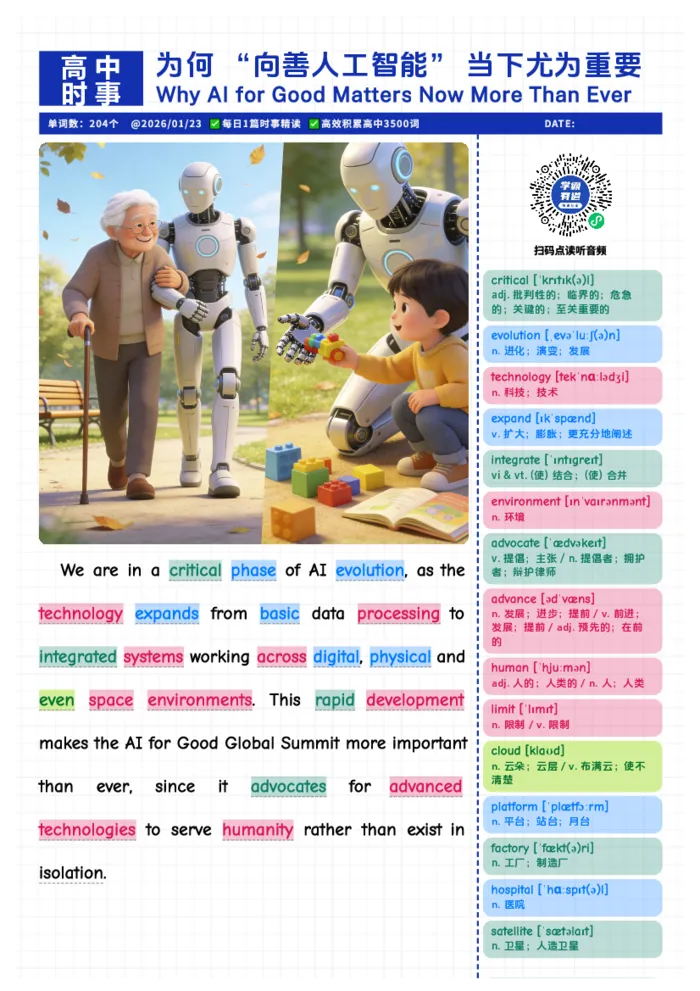
We are in a critical phase of AI evolution, as the
technology   expands   from   basic   data   processing to
integrated systems working across digital, physical and
even   space   environments. This   rapid   development
makes the AI for Good Global Summit more important
than   ever,   since   it   advocates   for   advanced
technologies  to  serve  humanity  rather  than  exist in
isolation.
扫码点读听音频
disabled [dɪsˈeɪb(ə)ld]
adj. 残疾的;无能力的 / v. 使残
废;使无能力;“disable”的过
去式和过去分词
complex [ˈkəmpleks]
adj. 复杂的;费解的 / n. 综合楼
(群);情结
address [əˈdres]
n. 地址;演讲 / v. 向…讲话;提
出;解决
brain [breɪn]
n. 脑;脑力;智力
example [ɪɡˈzæmp(ə)l]
n. 例子;实例;榜样
ethical [ˈeθɪkl]
adj. 伦理的;道德的;合乎道德
的
ownership [ˈəʊnərʃɪp]
n. 所有权;物主身份
ensure [ɪnˈʃʊr]
v. 确保;保证;担保
demand [dɪˈmænd]
n. 要求;请求;需求 / v. 要求;
请求;需求
international [ˌɪntərˈnæʃnəl]
adj. 国际的
engineer [ˌendʒɪˈnɪr]
n. 工程师;机械师 / v. 设计(工
程);策划
bridge [brɪdʒ]
n. 桥;桥梁
organization [ˌɔːrɡənə
ˈzeɪʃ(ə)n]
n. 组织;机构
promote [prəˈmoʊt]
v. 促进;推动;提拔;宣传;推
销
global [ˈɡloʊb(ə)l]
adj. 全球的
optional [ˈɑːpʃən(ə)l]
adj. 可选择的;非强制的
humanity [hjuːˈmænəti]
n. 人类;人道;仁慈;人文学科
Today’s AI is no longer limited to cloud platforms; it
is moving into factories, hospitals, satellites and daily
life. It   powers   innovations   like   brain-computer
interfaces that help disabled people communicate and
disaster-response   robots   that   save   lives. However,
these advances also bring complex risks that require
cross-field cooperation to address.
Take   brain-computer   interfaces   as   an   example.
They restore dignity to those with paralysis but raise
ethical   questions   about   neural   data   ownership and
consent. Similarly,   space-based   AI   aids   climate
monitoring yet demands international coordination to
ensure safe and shared use. Such issues cannot be
solved by engineers alone.
The AI for Good model bridges the gap between
technology   and   real   needs   by   bringing   together
governments, experts and organizations. It promotes
global   standards,   skill   training   and   collaborative
solutions. In an era of fast-growing AI, such inclusive
cooperation   is   not   optional—it   is   the   only   way to
ensure AI benefits all of humanity.