文档文本内容
高 中
时 事
为什么有的人睡觉爱举起双手
Why Do Some People Raise Their Hands While Sleeping?
核心词汇
raise [reɪz]
v. 提起;升起;增加;养育;筹
募;引起 / n. 加薪
underlying [ˌʌndəˈlaɪɪŋ]
adj. 潜在的;根本的;在下面的
tension [ˈtenʃ(ə)n]
n. 紧张;紧张局势;紧张关系
pattern [ˈpætərn]
n. 模式;图案;样式 / v. 形成图
案;仿造
comfortable [ˈkʌmfərtəbl]
adj. 舒服的;安逸的
temporarily [ˌtempəˈrerəli]
adv. 暂时地;临时地
breathe [briːð]
v. 呼吸;透气;呼出;低语
stress [stres]
n. 压力;紧张;强调;重音 / v.
着重;强调
switch [swɪtʃ]
v. 转换 / n. 开关
shoulder [ˈʃoʊldər]
n. 肩膀 / v. 承担
muscle [ˈmʌsl]
n [C] & [U] 肌肉;力量;实力
tense [tens]
adj. 紧张的;拉紧的;n. 时态;
vt. & vi. (使)紧张;(使)拉紧
increase [ɪnˈkriːs]
n. 增加;增长 / v. 增加;增多
relieve [rɪˈliːv]
v. 减轻;缓解
frozen [ˈfroʊz(ə)n]
adj. 冰冻的;冻结的 / v. 结冰;
冻结;“freeze”的过去分词
impact [ˈɪmpækt]
冲击(力)
影响力/
冲
单词数:155个
@2026/01/02  ✅每日1篇时事精读  ✅高效积累高中3500词
DATE:
It’s   common   for   some   people   to   unconsciously
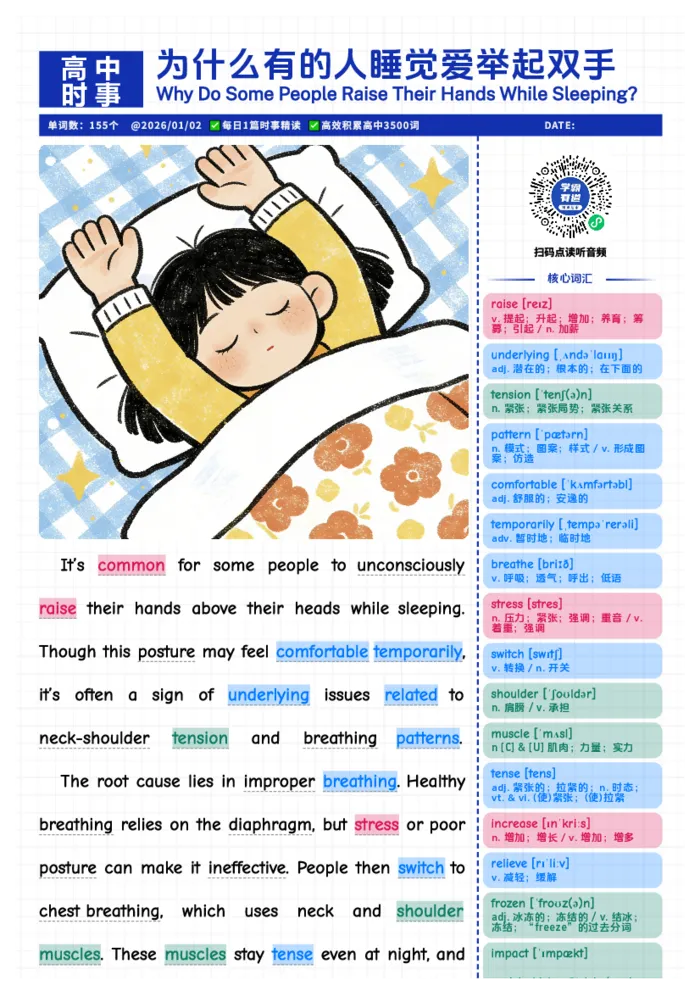
raise   their   hands   above   their   heads   while sleeping.
Though this posture may feel comfortable temporarily,
it’s   often   a   sign   of   underlying   issues   related   to
neck-shoulder   tension   and   breathing   patterns.
The root cause lies in improper breathing. Healthy
breathing relies on the diaphragm, but stress or poor
posture can make it ineffective. People then switch to
chest breathing,   which   uses   neck   and   shoulder
muscles. These muscles stay tense even at night, and
扫码点读听音频
n. 冲击(力);影响力 / v. 冲
击;撞击;对…产生影响
improve [ɪmˈpruːv]
v. 改善;改进;提高
practice [ˈpræktɪs]
n. 练习;实践;惯常做法 / v. 练
习;从事;习惯做
expand [ɪkˈspænd]
v. 扩大;膨胀;更充分地阐述
recommend [ˌrekəˈmend]
v. 建议;推荐
protect [prəˈtekt]
v. 保护
advise [ədˈvaɪz]
v. 向…提出建议;劝告;通知
核心词组
1. chest breathing
胸式呼吸
2. raising hands
举手
3. blood flow
血流
4. acid reflux
胃酸反流
raising hands helps increase blood flow to relieve the
tension.
However,   long-term   use   of   this   posture   brings
harms, such as poor blood circulation in the upper
body,   frozen   shoulders,   acid reflux,   and   impacts on
heart and lung health.
To   improve,   practice   abdominal   breathing: place
hands on the belly, inhale to expand it, and exhale to
relax. Recommended   postures   include   lying   on the
back (relieves back pain) or side (protects the brain),
while prone sleeping is not advised.