文档文本内容
高 中
时 事
中国研究团队启动侵入性脑机接口临床试验
Chinese research team launches
clinical trial for invasive brain-
computer interface
accident [ˈæksɪdənt]
n.①[C](交通)事故;车祸;意
外遭遇;失事
②[C,U]意外;偶然的事
chess [tʃes]
n.[U]国际象棋
science [ˈsaɪəns]
n.[u]科学;理科
[U,C]自然科学学科
technology [tekˈnɒlədʒi]
n.[U,C]科技;工艺;技术
research [rɪˈsɜːtʃ ]
n.[U]研究;调查
v.研究;探讨;调查
medicine [ˈmedsn]
n.[U,C]药[U]医学
device [dɪˈvaɪs]
n.①[C]装置;仪器;器具;设备
②[C]手段;方法;技巧
③[C]炸弹;爆炸性武器
infection [ɪnˈfekʃn]
n.①[U]传染;感染
②[C](身体某部位的)感染;传
染病
failure [ˈfeɪljə(r)]
n.①[U]失败
②[C]失败(的人或事物)
③[U,C]未做,未履行(应做之
事)
④[U,C](机器)故障;(身体机
能的)衰竭
report [rɪˈpɔːt]
n.[U,C](白色或彩色的)粉笔
key [kiː]
单词数:204个
@2025/06/15   ✅每日1篇时事阅读  ✅高效积累高中3500词
DATE:
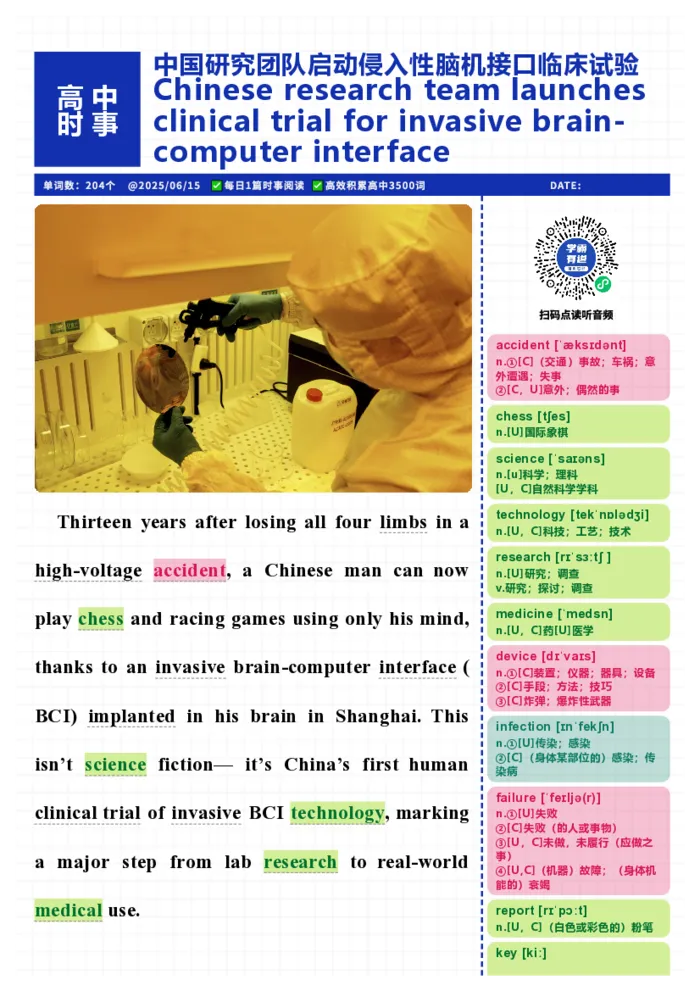
Thirteen years after losing all four limbs in a
high-voltage   accident,   a   Chinese   man   can now
play chess and racing games using only his mind,
thanks to an invasive brain-computer interface (
BCI)   implanted   in   his   brain   in   Shanghai. This
isn’t   science   fiction—   it’s   China’s   first human
clinical trial of invasive BCI technology, marking
a   major   step   from   lab   research   to real-world
medical use.
扫码点读听音频
n.[C]钥匙;键;调
[常用sing.]关键
a,关键的
damage [ˈdæmɪdʒ]
n.①[U]损坏,破坏,损失;损
害;伤害
②(damages)[pl.](法院判定
的)损害赔偿金
vt.③毁坏;损害;伤害;破坏
product [ˈprɒdʌkt]
n.[C,U]产品;制品[C]产物
prove [pruːv]
v.-link.①证明是,结果是
vt.②证明,证实
③显示(优点),展现,展示;
向人证明(自己)是
signal [ˈsɪɡnəl]
n.①[C]信号;暗号;迹象;预示
②[C](传输声音、图像或其他信
息的电波)信号
③[C]信号灯,指示灯,红绿灯
v.④发信号;发暗号;示意
vt.⑤标志;表明;预示
plan [plæn]
n.[C]计划;规划
v.计划,筹划;打算
patient [ˈpeɪʃnt ]
n.①[C]接受治疗者,病人(尤指
医院里的)
adj.②有耐心的;能忍耐的
approve [əˈpruːv]
vi.①赞成;同意
vt.②批准,通过(计划,要求
等)
③认可;核准
transform [trænsˈfɔːm]
vt.使改变形态;使改变外观(或
性质);使改观
injury [ˈɪndʒəri]
n.①[C,U](对躯体的)损伤,伤
害
②[U](对感情的)伤害,挫伤
disability [ˌdɪsəˈbɪləti]
n.①[C](某种)缺陷,障碍
②[U]残疾状态;(身心、学习等
方面的)缺陷,障碍
treat [triːt]
vt.对待;把……看作;医治
The   trial   is   a   collaboration   between   the
Chinese   Academy   of   Sciences’   brain   science
center   and   Huashan   Hospital. China   thus
becomes the second country, after the US, to test
invasive   BCI   in   humans. Since   the   device was
implanted in March 2025, it has worked stably
without infection or failure, the team reported.
The key lies in ultra-flexible neural electrodes
as thin as 1% of a human hair, minimizing brain
damage. The implant, about the size of a coin, is
half as large as Elon Musk’s Neuralink product.
It decodes neural signals in milliseconds, proven
safe   in   monkey   tests   before   the   human   trial.
The   team   plans   to   help   the   patient control
robotic   arms   and   even   robot   dogs   next. If
approved by 2028, this BCI could transform lives
for millions with spinal cord injuries or severe
disabilities,   opening   new   doors   for   treating
neurological diseases.