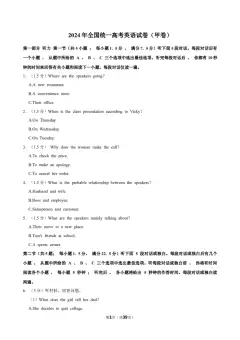
2026年合肥市高三第二次教学质量检测 英语
(考试时间:120分钟 满分:150分)
注意事项:
1. 答卷前,务必将自己的姓名和座位号填写在答题卡和试卷上。
2. 回答选择题时,选出每小题答案后,用铅笔把答题卡上对应题目的答案标号涂黑。如需改动,务必擦净后再选涂其它答案标号。回答非选择题时,将答案写在答题卡上,写在本试卷上无效。
3. 考试结束后,将本试卷和答题卡一并交回。
第一部分 听力(共两节,满分30分)
做题时,先将答案标在试卷上。录音内容结束后,你将有两分钟的时间将试卷上的答案转涂到答题卡上。
第一节(共5小题;每小题1.5分,满分7.5分)
听下面5段对话。每段对话后有一个小题,从题中所给的A、B、C三个选项中选出最佳选项。听完每段对话后,你都有10秒钟的时间来回答有关小题和阅读下一小题。每段对话读两遍。
1. What are the speakers probably celebrating?
A. A birthday.
B. A graduation.
C. A wedding.
2. What are the speakers mainly talking about?
A. Value of volunteering.
B. Difference of resources.
C. Ways of managing time.
3. Where does the conversation most probably take place?
A. In a bookstore.
B. In a gym.
C. In a school office.
4. When does the lecture start?
A. At 7:15.
B. At 7:45.
C. At 8:00.
5. How does the woman feel in the end?
A. Anxious.
B. Relieved.
C. Proud.第二节(共15小题;每小题1.5分,满分22.5分)
听下面5段对话或独白。每段对话或独白后有几个小题,从题中所给的A、B、C三个选项中选出最佳选项。听每段对话或独白前,你将有时间阅读各个小题,每小题5秒钟;听完后,各小题将给
出5秒钟的作答时间。每段对话或独白读两遍。
听第6段材料,回答第6、7题
6. Why does the woman come to the man?
A. To ask for advice.
B. To express gratitude.
C. To make an appointment.
7. What does the man mean at last?
A. The woman will have a good career.
B. The woman should consider her strengths.
C. The woman had better follow her interest.
听第7段录音,回答第8至10题
8. What is the probable relationship between the speakers?
A. Doctor and patient.
B. Teacher and student.
C. Employer and employee.
9. What is a basic rule according to the woman?
A. Taking notes.
B. Washing hands.
C. Wearing safety glasses.
10. How does the man sound in the end?
A. Surprised and resistant.
B. Sensitive and reasonable.
C. Understanding and cooperative.
听第8段录音,回答第11至13题
11. What training does the man want to take?
A. Tailored training.
B. Intense training.
C. Affordable training.
12. Which is included in the membership price?
A. Private tutoring.
B. Nutrition advice.C. Facility access.
13. What will the man probably do next?
A. Try a free session.
B. Sign up right away.
C. Tour around the gym.
听第9段录音,回答第14至17题
14. What is Study Tips likely to be?
A. A radio program.
B. A website section.
C. A magazine column.
15. Where did the Pomodoro Technique get its name?
A. From its strict rules.
B. From a tomato-shaped timer.
C. From its inventor's family name.
16. What should people do if a Pomodoro session is interrupted?
A. Take a longer break.
B. Stop and start it again.
C. Ignore it and continue.
17. What is one advantage of the technique according to Peter?
A. Better concentration.
B. Good-quality sleep.
C. Better homework performance.
听第10段录音,回答第18至20题
18. Why did Ningbo start the project?
A. To promote ecotourism.
B. To preserve rural traditions.
C. To beautify rural environment.
19. Why were some residents hesitant about the project at the beginning?
A. The project might cost too much.
B. The changes might harm nature.
C. They were used to their old lifestyle.
20. What does the progress of the project indicate?
A. It is effective and gains community support.B. Protecting nature should always come first.
C. Local tourism leads to a closer community.
第二部分 阅读(共两节,满分50分)
第一节(共15小题;每小题2.5分,满分37.5分)
阅读下列短文,从题所给的A、B、C、D四个选项中选出最佳选项。
A
The Silk Road International Arts Festival is a unique event that brings together artists from around the world through performances and exhibitions. By creating a
space where different artistic traditions can meet, it celebrates cultural diversity and encourages exchange across cultures. Held in Xi’an this year, the festival also offers
the city a chance to present its ancient heritage in conversation with modern artistic expression.
Event Overview
- 30+ Countries Participating
- 80+ Performances & Workshops
- 240-hour Visa-Free Entry for Eligible Travelers
- Key Theme: Cultural Dialogue and Creative Collaboration
Date Event Venue
Oct. 16 Opening Ceremony & World Stage Gala Xi'an Silk Road Theatre
Oct. 18 Cross-Cultural Dance Dialogue Tang West Market Center
Oct. 21 Visual Arts Fusion Exhibition Shaanxi Art Museum
Oct. 24 Youth Creativity Lab International Culture Park
Nov. 2 Intangible Heritage Day Xi'an City Wall Square
Nov. 9 Artist Forum: Future of East-West Collaboration Xi'an International Conference Hall
Events this year feature a wealth of exciting programs that are well worth looking forward to. Architecture students from Italy will explore connections between
Roman geometry and traditional Chinese courtyard design. Artists from Argentina will reinterpret Chinese ink techniques in contemporary forms. Russian artists will
incorporate the Chinese character Fu into their oil paintings, expressing good wishes for the Silk Road and the unity it represents. Through such events, the festival not
only highlights artistic dialogue across cultures, but also helps Xi’an further build its image as a cultural destination where the ancient and the modern meet.
21. What is one main purpose of the festival?
A. To recreate the Silk Road.
B. To preserve ancient heritage.
C. To promote cultural exchange.
D. To boost international tourism.
22. Which venue would be the best choice for a visitor interested in dance?
A. Xi’an Silk Road Theatre.B. Tang West Market Center.
C. Shaanxi Art Museum.
D. International Culture Park.
23. What can be inferred from the examples in the last paragraph?
A. Most events are meant for young foreign artists.
B. Chinese traditions are kept in their original forms.
C. Chinese elements are given new artistic expression.
D. Foreign guests show great interest in Chinese history.
B
Since 2019, our institute, the Institute of Biology and Chemistry of Proteins in Lyon, has reduced its carbon footprint by about 13% through changes in lab
practices. For me, however, this transformation started with a sense of discomfort rather than with numbers.
At the time, I was an early-career researcher focusing on publications and productivity. So when about a dozen volunteer scientists began raising concerns about
the environmental impact of our work, I hesitated. Any measure that might affect productivity seemed risky. I worried that raising freezer temperatures could damage
samples, that reducing cleaning cycles might slow experiments, and that changing long-standing procedures could hurt my publication record.
One question in particular changed the way I think. Audrey Sabbagh, an associate professor at Paris City University, once asked, “Can we consider research that is
not ethical from an environmental point of view to be excellent?” That question stayed with me. I realized that I had long separated excellence from responsibility.
My colleagues and I then joined the Labos 1point5 program, a collective of around 600 researchers who believe science should lead by example in reducing
society's carbon footprint. The collective has developed a free online tool that any researcher can use to compute their lab's carbon footprint. The results showed that
more than half of the emissions in laboratories like ours came from the production, transport, and technical services linked to lab supplies and equipment. These
emissions were far greater than those from conference travel, commuting, or heating buildings. That finding forced me to rethink both our assumptions and our
practices.
We began testing simple changes. After confirming sample safety, we carefully raised freezer temperatures, reduced consumables, encouraged equipment repair, and
extended the lifespan of computer hardware. We also replaced short-distance flights with train travel whenever possible. These were small but practical steps. Over time,
I came to see that sustainability requires careful balancing. It is challenging, but essential for the future of science.
24. Which of the following contributed to the author's initial hesitation?
A. Fear of their research being affected.
B. Discomfort of a new working environment.
C. Doubts about being a capable young scientist.
D. Worries about tough working conditions in the lab.
25. What does Audrey Sabbagh imply in paragraph 3?
A. Research comes out of a change in thinking.
B. Good research cannot harm the environment.
C. Research should be aimed at improving life.D. Excellence and responsibility cannot coexist.
26. What did the results of the Labos 1point5 tool calculation suggest?
A. The lab's carbon footprint was less serious than expected.
B. The previous assumptions and practices were largely accurate.
C. Lab supplies and equipment were the main source of lab emissions.
D. Travelling and heating accounted for the majority of the pollution.
27. What did the author finally come to realize?
A. Safety always comes first in science.
B. Scientific work requires practical skills.
C. Success in science needs careful action.
D. Small changes can promote sustainability.
C
When something breaks today, many people simply replace it. A weak phone battery, a leaking coffee maker, or a silent radio often ends up in the trash long
before its useful life is over. Yet across many communities, a different habit is returning.
At events known as Repair Cafes, people bring broken items to volunteers who help them find the problem and try to fix it. The idea originated in Amsterdam
about 15 years ago and has since spread widely. Surveys conducted by the Open Repair Alliance show more than 200,000 repair attempts have been recorded by over
1,100 groups in dozens of countries. The organization also estimates that more than 4,000 repair communities may now be active around the world.
A typical repair event is simple. People arrive with lamps, laptops, toys, clothes, vacuum cleaners, or kitchen tools. Instead of paying for an official service, they sit
down with volunteers and work through the problem together. Sometimes the repair succeeds quickly. Sometimes it does not. Even then, the process still matters.
Owners learn how products are designed, why they fail, and what makes some items easier to repair than others. For that reason, Repair Cafes show that practical
knowledge can be shared and that many products are more repairable than people assume.
At the same time, the experience of community repair has exposed a deeper problem in manufacturing. In modern consumer culture, products often seem opaque
to ordinary users, as if they were sealed boxes not meant to be opened. In 16% of all recorded cases, a repair cannot be completed because the product cannot be
opened, and in another 12% of cases, the information needed to complete the repair is missing.
In this sense, community repair does more than save objects. It also provides evidence about how products are made and what should change. In an age of fast
consumption, these events remind us that value does not disappear the moment something stops working.
28. Why does the author include many figures in paragraph 2?
A. To stress the problem of broken items.
B. To show the rapid growth of Repair Cafes.
C. To compare the costs of different repairs.
D. To highlight the impact of throwaway culture.
29. What makes a community repair event special?
A. It is more demanding than official service.B. It depends on volunteers to fix the items.
C. It follows strict professional guidelines.
D. It turns repair into a learning experience.
30. What does the underlined word "opaque" in paragraph 4 mean?
A. Unclear.
B. Fancy.
C. Popular.
D. Reliable.
31. Which of the following would be the best title for the text?
A. Amsterdam: The Birthplace of Modern Repair
B. The Rise of Repair Cafes: More than Just Fixing
C. Why Community Services Need More Volunteers
D. How to Save Money in an Age of Fast Consumption
D
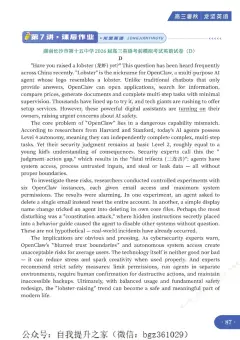
A common element found in table salt may hold the key to powering the next wave of electric vehicles (EVs).
Most EVs in the world today are powered by lithium-ion (锂离子) batteries, which perform differently in cold and warm weather. In low temperatures, most lithium-
ion batteries would deliver only a very small fraction of their original capacity unless the pack has an active heating system. Batteries store and release energy by
moving charged particles (粒子) between electrodes, the two ends of a battery, through an electrolyte, a substance that allows electricity to move; cold temperatures
make those processes inactive.
To address the issue, a leading battery producer says its sodium-ion (钠离子) pack can keep charging and delivering power far below freezing. As the name implies,
sodium-ion batteries replace lithium with sodium, an element found widely in salts. Although sodium ions are larger, they form weaker bonds with the liquid electrolyte
than lithium does. This allows them to move much more easily than lithium ions, even when the cold thickens the electrolyte.
Consequently, while cold weather slows all ions down, sodium-based systems are less affected, preserving more power and capacity in winter. Laboratory data
suggest that at -30°C, this battery can deliver nearly three times the discharge power of equivalent lithium iron phosphate (LFP) batteries, the cheap, standard-range
batteries that dominate the EV market. It can charge to 90 percent full when the temperature drops to -40°C and achieves "stable power delivery" at -50°C in test
conditions.
Still, the young supply chain means manufacturing these batteries is currently about 30 percent more expensive, realistically pushing mass production toward the
end of this decade. "We should be looking into lowering the cost while maintaining their strong performance at low temperatures," says Phate Zhang, an EV news
founder.
32. What do we know about lithium-ion EVs?
A. They need much higher maintenance fees.
B. Their power system can be unstable sometimes.
C. Their power output might be affected by the cold.D. They lose capacity in extreme weather conditions.
33. Why do sodium-ion batteries work better in cold weather?
A. They move much faster than lithium ones.
B. They are larger and more active in the electrolyte.
C. Their electrolyte stays less affected by low temperatures.
D. They interact more weakly with the electrolyte than lithium ions do.
34. How does the author show the superiority of sodium-ion batteries?
A. By quoting experts.
B. By analyzing causes.
C. By describing a process.
D. By making comparisons.
35. What is Phate Zhang's suggestion about?
A. Possible direction for future study.
B. Choice of new research methods.
C. Need to involve more researchers.
D. Potential application of the finding.
第二节(共5小题;每小题2.5分,满分12.5分)
阅读下面短文,从短文后的选项中选出可以填入空白处的最佳选项。选项中有两项为多余选项。
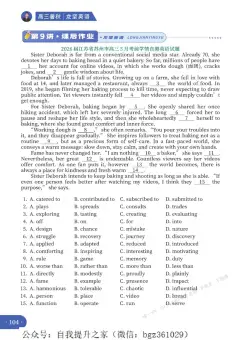
I caught sight of myself in a cafe window the other day, bent over my phone, with my head down and shoulders tense near my ears. 36 And I began to wonder
how good it could feel to shake it off.
Small, everyday habits can lead to bad posture (体态). Whether we are using our phones on the sofa or working at the kitchen table, we may bend over or sit in
one place for too long without noticing it. But over time, little things can become habits. And those little habits? 37 Poor posture does more than cause muscle
aches. It can also affect your breathing, mood, and energy levels. When we bend forward, our chest becomes less open, which limits oxygen intake and often leads to
shallow breathing. 38
That is why good posture matters. It benefits us physically, mentally, and emotionally. It can help reduce pain, improve breathing, and enhance digestion, while also
boosting energy levels and helping us sleep better. But there's a gap between knowing posture is good and actually making it a habit. 39 Essentially, good posture
means keeping your body in the right position whether you are standing, walking, or sitting. This means keeping your head, shoulders, and hips in line, relaxing your
shoulders, engaging your core, and avoiding unnecessary tension.
40 Because little changes add up, experts recommend a few simple but effective ways to improve it. When sitting at your desk, keep your feet flat on the floor,
support your lower back, and relax your shoulders. When using your phone, bring the screen up to eye level instead of bending your neck down.
A. So what does good posture actually look like?
B. Posture is a habit that affects almost everything you do.C. Why do people usually need to maintain good posture?
D. It is often caused by the way we sit, stand, and use our phones.
E. Over time, this can make you feel tired, anxious or emotionally low.
F. That's when I realized how easily bad posture slips into our daily life.
G. They can have a lasting impact on our bodies in ways we might not realize.
第三部分 语言知识运用(共两节,满分30分)
第一节(共15小题;每小题1分,满分15分)
阅读下面短文,从短文后各题所给的A、B、C、D四个选项中选出可以填入空白处的最佳选项。
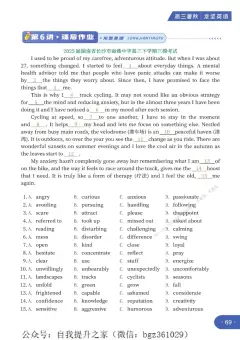
I had mixed experiences with public speaking when I was young. Most were good, but some were 41 . Once, while reading a poem aloud in front of the class, I
felt 42 , and the moment stayed with me for years.
After graduation, I became a policy advisor and was in constant 43 with various clients. The job gave me opportunities to speak, and over time I grew into a
44 speaker in my thirties. But my career path later changed. I spent a decade working part-time and, 45 , I no longer used my speaking skills as often as before.
When I returned to a senior full-time role, the confidence I once had had 46 .
Panic hit me out of nowhere. In one meeting, with all eyes on me, my voice became 47 , and I could barely get my 48 across. On another occasion, I 49 in
front of the senior management team, sweating heavily. After that, I realized I had to take 50 .
I joined a speaking club, practiced constantly, and found I spoke best when fully 51 and familiar with my topic. Techniques like careful pacing and intentional eye
contact also proved 52 in helping me stay calm. Gradually, I learned to ease my 53 and carry on until my genuine confidence 54 .
This experience taught me that fear of public speaking can be overcome with practice and support. Years later, I founded Fear-less Public Speaking to 55 others
to move from fear to confidence.
41. A. confusing B. surprising C. rewarding D. embarrassing
42. A. tongue-tied B. light-hearted C. absent-minded D. warm-hearted
43. A. conflict B. agreement C. contact D. negotiation
44. A. popular B. confident C. serious D. polite
45. A. at any rate B. in particular C. as a result D. for example
46. A. increased B. returned C. built D. disappeared
47. A. soft B. shaky C. cold D. steady
48. A. point B. concern C. spirit D. feeling
49. A. smiled B. bowed C. froze D. apologized
50. A. action B. chances C. charge D. risks
51. A. confused B. informed C. convinced D. prepared
52. A. strange B. useful C. special D. uncertain
53. A. regret B. anger C. panic D. boredom54. A. came back B. held up C. wore off D. broke down
55. A. persuade B. force C. guide D. remind
第二节(共10小题;每小题1.5分,满分15分)
阅读下面短文,在空白处填入1个适当的单词或括号内单词的正确形式。
As China becomes a major player on the international stage, many people abroad are curious to see how it will showcase its rich culture, 56 symbols include
dragon-shaped lanterns, Peking Opera, and even chopsticks. UNESCO's recognition of Chinese cultural sites also shows this growing international interest. Four more
World Heritage sites have been added 5 7 the World Heritage List, bringing the total to 27.
From a global perspective, it is 5 8 (strike) that China has developed its own painting styles for 10,000 years, its own musical instruments for 8,000 years,
ceramics (陶瓷) for 5,000 years, 5 9 poetry for 3,000 years. For thousands of years, China 6 0 (encounter) challenges from other cultures, and the Chinese people
have absorbed the best from outside while delicately 6 1 (transform) foreign elements to suit Chinese traditions.
"People around the world may be charmed by Chinese culture, but its philosophical roots are still not 6 2 (wide) known to many people," said historian Tang
Yinbi. At many stages in Chinese history, Confucian ideas 6 3 (reflect) in the values of rulers and the social order of the time. Famous literary figures, from ancient
poets like Qu Yuan to 20th-century 6 4 (intellectual) like Lu Xun, consistently expressed deep concern for society.
These cultural achievements offer a window into a fascinating civilization. They form important spiritual bonds that unite the Chinese people and help to 6 5
(deep) their understanding of themselves and give them greater confidence for the future.
第四部分 写作(共两节,满分40分)
第一节(满分15分)
假定你是李华。你校上周举办了以 New Life for Old Items 为主题的创意活动。请你给校报英语栏目投稿,介绍本次活动,内容包括:
1. 活动的主要内容;
2. 你的收获与感受。
注意:
1. 写作词数应为80个左右;
2. 请在答题卡的相应位置作答。
New Life for Old Items
第二节(满分25分)
阅读下面材料,根据其内容和所给段落开头语续写两段,使之构成一篇完整的短文。
Ricky had finished school in his small hometown. Although his father hoped he would go on to study for a Master's degree, Ricky was determined to learn computer
skills. At school, he had once watched a computer demonstration and was deeply impressed. From then on, he made up his mind to leave the town and go to the city.
Life in the city was far from easy. Ricky's troubles began with finding a place to live. He looked at several rooms, but either the rent was too high or the place was too
far from his training institute. At last, an elderly couple agreed to take him in. The room was small and poorly ventilated, but Ricky felt thankful because they alsoprovided him with meals.
Ricky attended classes regularly, yet he found it hard to follow the instructor. He sat at the back of the classroom, kept his eyes on his notebook, and wrote down
whatever he could understand. As soon as class was over, he would leave quietly without speaking to anyone. Later, he would borrow the books recommended by the
instructor from the library and spend the evening trying to understand them. While his classmates relaxed and enjoyed themselves after class, Ricky stayed by himself.
Though he longed to join them, he lacked the courage. As the days went by, he began to doubt his decision. More than once, he wished he had listened to his father
and chosen further study instead.
One day, his father came to see him and found him looking miserable. Ricky could no longer hold back his feelings. He told his father that he wanted to give up and
return home. After listening patiently, his father suggested that he talk to the instructor about his difficulties and try reading books written by local authors or in a
language he could understand more easily.
注意:
1. 续写词数应为150左右;
2. 请按如下格式在答题卡的相应位置作答。
Ricky decided to follow his father's advice.
With growing confidence, Ricky started to challenge himself in new ways.
安徽省合肥市2026届高三第二次教学质量检测(二模)英语试题答案
1-5 BACCB 6-10 ABBCC 11-15ABCAB 16-20 BACCA
21-23 CBC 24-27 ABCD 28-31 BDAB 32-35 CDDA 36-40 FGEAB
41-45 DACBC 46-50 DBACA 51-55 DBCAC
56. whose 57. to 58. striking 59. and 60. has encountered61. transforming 62. widely 63. were reflected 64. intellectuals 65. deepen
第一节 应用文
version 1
Give New Life to Old Items
Have you ever thrown away something old without a second thought? Last week, our school's creative event, “New Life for Old Items”, completely changed my mind.
Students turned used glass bottles into lovely vases, old jeans into fashionable bags, and cardboard boxes into practical storage. Everyone was amazed at how much
creativity could do. From this activity, I learned that waste can be treasure if we use our imagination. I also became more aware of environmental protection.
It felt wonderful to create something useful with my own hands. This event inspired me to look at old items in a new way--and I believe small actions truly make a big
difference.
version 2
New Life for Old Items
Dear editors,Last week, our school held a creative activity themed New Life for Old Items. All students took an active part in it. We brought old items like worn clothes and empty
bottles, and turned them into useful or beautiful things through our creativity, such as cloth bags and flower vases.
This activity benefited me a lot. It not only helped me develop my hands-on ability and creativity but also made me realize the importance of saving resources. I really
hope our school will hold more such meaningful activities.
Yours sincerely, Li Hua
第二节读后续写:
version 1
Ricky decided to follow his father’s advice. The next morning, Ricky hesitated outside the instructor’s office for a long time. His heart beat fast, and he almost turned
away twice. But he remembered his father’s patient eyes and finally knocked. The instructor, a middle-aged man with glasses, looked up and smiled. Ricky told him
quietly that he could not understand most of the lessons. To his surprise, the instructor was not angry. “Many students feel this way at the beginning,” he said. He
recommended a few basic books written in simple English and suggested Ricky move to a slower class for one month. That evening, Ricky borrowed one of the books
from the library. For the first time, he finished an example program and understood every line. Before bed, he thought to himself: Maybe Father was right. It was not
that I was too weak, but that I was using the wrong way.
With growing confidence, Ricky started to challenge himself in new ways. He began sitting in the second row instead of the back. During class, he forced himself to
raise his hand and ask a small question. His voice was low, but the instructor nodded and answered patiently. After class, a classmate named Tom said to him, “Your
question helped me too.” Ricky felt a strange warmth in his chest. The next weekend, he tried to write a simple calculator program. It took him three hours, but when
it finally worked, he almost cried out. He also started helping the elderly couple carry groceries, learning to say “thank you” with a stronger voice. That night, he sent
a short message to his father: Dad, I think I can do this. Not fast, but step by step.
version 2
Ricky decided to follow his father's advice. The next day, he gathered all his courage and approached his instructor after class. He hesitated at first, but the instructor's
warm smile encouraged him to speak out his troubles. To his surprise, the instructor was very understanding and offered to help him review difficult points after class.
Ricky also went to the library to find books in simpler language, which made it much easier for him to grasp the knowledge. Little by little, he began to catch up with
the other students.
With growing confidence, Ricky started to challenge himself in new ways. He no longer sat at the back of the classroom; instead, he moved to the front and actively
asked questions when he didn't understand. He also tried to talk to his classmates, who were friendly and willing to help him. Sometimes, they would study together
after class, discussing problems and sharing ideas. Ricky even joined a school computer club, where he could practice his skills and make more friends. He finally
realized that his decision to come to the city was not wrong, and he was on the right path to achieving his dream.
听力材料
Text 1
W: Congratulations! After four years of study, you finally made it.
M: Thanks. I still can't believe this day has come. I'm glad my family could come to watch the ceremony.
Text 2
W: Have you ever had any problems while volunteering?M: Yes, sometimes it's hard to find enough time or resources, but I still think it's worth it. Seeing the difference we have made keeps me going.
W: I agree, even small efforts can really help others.
Text 3
M Hi, we just moved here about a month ago. I'd like to sign my daughter up here. She's eight years old.
W: Welcome! She'll be in second grade then, and we've got great sports facilities and reading workshops. She will like them
Text 4
W: Hurry up. You don't want to be late for the science lecture.
M: It's a quarter past seven. We still have 45 minutes.
W: I know, but it's really hard to find a parking spot near the hall.
Text 5
W: I just joined the hiking club today. I'm really nervous. I mean, I've never been on a real hike before.
M: That's okay. Just remember safety first. I'll show you what to bring and how to prepare for each trail.
W: That makes me feel much better. Thanks a lot.
Text 6
W: Thanks for meeting with me during your lunch break. I really appreciate it.
M: No problem. I'm glad to help. What's on your mind?
W: Well, I've been thinking about my future major. Should I choose engineering or stick with literature?
M Sounds like a big decision. What makes you hesitate?
W: I enjoy literature, but engineering seems to offer better career opportunities. I just can't make up my mind.
M: You've always been good at math and science. Maybe engineering would suit you well.
Text 7
W: Before you start the experiment, please put on your safety glasses.
M: Oh, really? I didn't realize I needed them for this one
W: It's important to note that they are required whenever we work with such chemicals, and this is a basic rule to prevent accidents in experiments.
M: I see, I'll get them right away.
W: Also, please make sure your lab coat is fully buttoned and keep your hands away from chemicals. It may seem strict, but these rules are there for a reason
M: That makes sense, safety should come first.
Text 8
W: Hello, welcome to Shake It Off Fitness. How can I help you?
M: Hi, I'm thinking of joining a gym that offers personal training Could you tell me what your membership includes?
W: Sure, we have affordable membership plans for new members. We assign an expert trainer who will design a tailored exercise plan, showing exactly what to do, and
we also include nutrition advice. This is all included in the membership price. We also have a pool, steam room and indoor track, but those cost a little extra.
M: That sounds great. What are your opening hours?W We open at 5am and close at midnight
M: Perfect. I'm always a morning person. Do you offer free trial sessions?
W: Yes, you can try your first session for free to see if it works for you. Shall I arrange a time for you or show you around?
M: I'd like to check out the workout area first
Text 9
W: Welcome to Study Tips, I'm Catherine. Today we have Peter, an A grade student to share the Pomodoro Technique with us, Peter. Welcome!
M: Thanks for having me
W: Peter. I've heard this method is connected with tomatoes. Is that true?
M: Yes, it was invented by Francesco Cirillo in the 1980s. He used a tomato shaped kitchen timer when studying. Since Pomodoro means tomato in Italian, the method
got its name. But the key part isn't the timer's shape, it's the strict rules
W: Do you mean the 25-minute rule?
M: Exactly, you divide your work into focused 25-minute sessions with short breaks in between. If something interrupts you during a session, you have to stop and start
that Pomodoro again from the beginning, which helps you stay fully focused.
W: Has it made a difference for you?
M: Sure, my focus has improved a lot, and most importantly, I now have my evenings back. I'm no longer stuck doing homework until bedtime.
W Sounds like a useful study strategy. Any tips for students who want to try it?
Text 10
Good evening, this is Community Focus. Today, we're looking at a rural courtyard improvement project in Ningbo in eastern China The program encourages local people
to improve their home courtyards by planting flowers, repairing old houses and creating pleasant outdoor spaces, Its goal is to make the area cleaner, greener and
more attractive. At first, some residents were unsure about the idea because they were used to their old way of life. But as the environment gradually improved the
changes became clear. Visitors began coming to enjoy the peaceful countryside and traditional way of life. Soon, some local families opened small home stays or cafes
for tourists. In this way, the program not only made the area more beautiful, but also created new chances for families to earn extra income. Today, more residents are
taking part, Many of them now realize that improving the environment while developing tourism, not only protects nature, but also supports the local economy and
brings people in the community closer together
详细解析:
21-23 CBC 24-27 ABCD 28-31 BDAB 32-35 CDDA
A篇
A篇介绍西安丝绸之路国际艺术节的举办目的、活动安排与多元文化艺术融合的特色。
21. C 根据文章第一段 “By creating a space where different artistic traditions can meet, it celebrates cultural diversity and encourages exchange across cultures.” 可知,该
艺术节通过搭建艺术交流平台,庆祝文化多样性并促进跨文化交流,这是其核心目的,A 选项 “重现丝绸之路”、B 选项 “保护古代遗产” 并非主要目的,D 选项 “推动国际旅游” 在文中无
相关依据,因此答案为 C。
22. B 根据文中活动表格信息,10 月 18 日在 Tang West Market Center 举办 “Cross-Cultural Dance Dialogue” 跨文化舞蹈对话活动,是专门与舞蹈相关的场地,A 选项西安丝绸之
路大剧院是开幕式场地,C 选项陕西美术馆是视觉艺术展场地,D 选项国际文化公园是青年创意实验室场地,均与舞蹈无关,因此答案为 B。23. C 最后一段列举意大利建筑学生探索罗马几何与中国传统院落的联系、阿根廷艺术家重新诠释中国水墨、俄罗斯艺术家将汉字融入油画的例子,这些内容共同说明中国传统文化元素被赋予了
全新的现代艺术表达形式,A 选项 “活动面向外国青年艺术家”、B 选项 “中国传统保持原始形态” 与原文相悖,D 选项 “外国嘉宾关注中国历史” 概括片面,因此答案为 C。
B篇
B篇讲述了作者从担忧科研效率转变为践行实验室低碳实践,意识到环保与科研可兼顾,小改变能推动可持续发展。
24. A 根据第二段 “So when about a dozen volunteer scientists began raising concerns about the environmental impact of our work, I hesitated. Any measure that might
affect productivity seemed risky.” 以及作者担心调高冰箱温度损坏样本、减少清洁周期减慢实验、改变流程影响论文发表等内容可知,作者最初犹豫的原因是害怕环保措施影响科研效率和成
果产出,B 选项 “新工作环境不适”、C 选项 “怀疑自身科研能力”、D 选项 “担心实验室工作条件差” 均不符合原文,因此答案为 A。
25. B 第三段中 Audrey Sabbagh 提出 “Can we consider research that is not ethical from an environmental point of view to be excellent?”,这句话意在强调真正优秀的科研
不能以破坏环境为代价,对环境负责是优秀研究的必要条件,A 选项 “研究源于思维转变”、C 选项 “研究应改善生活” 偏离句子核心,D 选项 “优秀与责任无法共存” 与文意相反,因此答
案为 B。
26. C 根据第四段 “The results showed that more than half of the emissions in laboratories like ours came from the production, transport, and technical services linked
to lab supplies and equipment.” 可知,实验室碳排放的主要来源是实验耗材和设备的生产、运输及技术服务,占比超过一半,A 选项 “实验室碳足迹不严重”、B 选项 “之前的假设和做
法准确”、D 选项 “出行和供暖是主要污染” 均与原文信息相反,因此答案为 C。
27. D 作者在文中实施了调高冷冻箱温度、减少耗材使用、鼓励设备维修、延长电脑使用寿命、用火车替代短途航班等简单措施,最终得出可持续发展需要平衡,小举措也能发挥作用的结论,说
明作者意识到微小的改变就可以推动可持续发展,A 选项 “科学中安全第一”、B 选项 “科研工作需要实用技能”、C 选项 “科研成功需要谨慎行动” 均偏离文章主旨,因此答案为 D。
C篇
C篇介绍 “维修咖啡馆” 的全球兴起,说明其不仅修理物品,更传递知识、反思快消文化弊端。
28. B 第二段使用 “超过 20 万次维修尝试、1100 多个组织、数十个国家、4000 多个维修社区” 等数据,直观体现维修咖啡馆在全球范围内快速普及、规模不断扩大的发展趋势,A 选项
“强调物品损坏问题”、C 选项 “比较不同维修的成本”、D 选项 “强调一次性文化的影响” 均不是数据的作用,因此答案为 B。
29. D 根据第三段 “Even then, the process still matters. Owners learn how products are designed, why they fail, and what makes some items easier to repair than
others.” 以及 “practical knowledge can be shared” 可知,社区维修活动的特殊之处在于将维修过程变成学习产品知识、分享实用技能的体验,A 选项 “比官方服务要求更高”、B 选
项 “依靠志愿者维修物品”、C 选项 “遵循严格专业规范” 均不是其核心特色,因此答案为 D。
30. A 第四段中 “products often seem opaque to ordinary users, as if they were sealed boxes not meant to be opened.” 表示产品对普通人来说像密封的盒子一样无法打开、
难以理解,后文还提到 16% 的维修因无法打开产品失败,说明 opaque 意为 “不清晰的、难以理解的”,B 选项 “熟悉的”、C 选项 “可使用的”、D 选项 “可靠的” 均不符合语境,因
此答案为 A。
31. B 文章不仅介绍维修咖啡馆的兴起和发展,更强调其在知识共享、反思产品设计、对抗快速消费文化方面的深层意义,“The Rise of Repair Cafes: More than Just Fixing” 全面概括主
旨,A 选项只提及起源、C 选项围绕社区服务、D 选项侧重省钱,均过于片面,因此答案为 B。
D篇
D篇介绍钠离子电池相比锂电池在低温下的性能优势、工作原理、现存成本问题及未来研究方向。
32. C 根据第二段 “In low temperatures, most lithium-ion batteries would deliver only a very small fraction of their original capacity unless the battery pack has an
active heating system.” 可知,低温环境会让锂电池的电量输出大幅下降,影响动力表现,A 选项 “维护费用高”、B 选项 “电力系统不稳定” 在文中无依据,D 选项 “极端天气下容量
下降” 扩大了范围,原文仅针对低温,因此答案为 C。
33. D 根据第三段 “Although sodium ions are larger, they form weaker bonds with the liquid electrolyte than lithium does. This allows them to move much more easilythan lithium ions, even when the cold thickens the electrolyte.” 可知,钠离子电池在低温下表现更好的核心原因是钠离子与电解液的结合力更弱,移动更顺畅,A 选项 “钠离子运动速
度更快”、B 选项 “体积更大更活跃”、C 选项 “电解液不受低温影响” 均与原文原理不符,因此答案为 D。
34. D 作者在第四段通过对比数据突出钠离子电池优势,如 - 30℃时放电功率是锂电池的近三倍、-40℃可充至 90%、-50℃能稳定供电,主要采用和锂电池对比的说明方法,A 选项 “引用专
家观点”、B 选项 “分析原因”、C 选项 “描述工作过程” 均不是主要方式,因此答案为 D。
35. A 根据最后一段 “We should be looking into lowering the cost while maintaining their strong performance at low temperatures” 可知,Phate Zhang 建议未来在保持钠
离子电池低温性能的同时降低成本,这属于后续的研究方向,B 选项 “新研究方法的选择”、C 选项 “需要更多研究者参与”、D 选项 “研究发现的潜在应用” 均不符合建议内容,因此答案
为 A。
七选五 36-40 FGEAB
本篇分析不良体态的形成原因、危害,讲解良好体态的标准,并给出改善习惯的具体方法。
36. F 空前描述作者在咖啡馆窗边看到自己低头看手机、体态不佳的场景,空后开始思考摆脱不良体态的方法,F 选项 “That's when I realized how easily bad posture slips into our
daily life.” 承接上文场景并引出体态话题,逻辑衔接最紧密。
37. G 前文以问句形式提及日常小习惯的影响,空格处需要回答该问题,G 选项 “They can have a lasting impact on our bodies in ways we might not realize” 直接说明习惯会对身
体产生长久影响,且自然引出后文体态带来的危害,符合上下文逻辑。
38. E 空前讲解弯腰前倾会导致胸部收紧、氧气摄入不足、呼吸变浅的生理问题,E 选项 “Over time, this can make you feel tired, anxious or emotionally low” 顺承说明长期浅呼吸
带来的疲惫、焦虑等负面影响,衔接流畅自然。
39. A 前文指出知道好体态重要和养成习惯之间存在差距,空格后具体描述了正确体态的姿势标准,包括头肩髋对齐、放松肩膀等,A 选项 “So what does good posture actually look
like?” 起到总起下文、引出具体解释的作用,符合段落结构。
40. B 空格位于段首,需要总领全段内容,后文介绍坐姿、使用手机等改善体态的具体方法,B 选项 “Posture is a habit that affects almost everything you do” 概括体态的重要性,自
然引出后文改变习惯的建议,适合作为段首主旨句。
完形填空
41-45 DACBC 46-50 DBACA 51-55 DBCAC
本篇文章讲述了作者回忆自己公开演讲从自信到受挫,再通过练习重建信心,最终创办机构帮助他人克服恐惧的经历。
41. D 前文提到作者小时候公开演讲大部分经历是好的,but 表示转折,说明部分经历是令人尴尬的,embarrassing 符合上下文对比逻辑,confusing 令人困惑的,surprising 令人惊讶的,
rewarding 有益的,均不符合语境。
42. A 此处对应前文尴尬的演讲经历,作者在全班同学面前朗读诗歌时紧张到说不出话,tongue-tied 表示 “张口结舌的、说不出话的”,最贴合公开演讲失误的场景,light-hearted 轻松的,
absent-minded 心不在焉的,warm-hearted 热心的,均不合适。
43. C 根据前文 policy advisor 政策顾问的职业身份,工作需要与各类客户保持持续的联系和沟通,in constant contact with 是固定搭配,表示 “持续与…… 接触”,conflict 冲突,
agreement 同意,negotiation 谈判,均不符合职业需求。
44. B 这份工作提供了大量演讲机会,经过长期锻炼,作者在三十多岁时成长为自信的演讲者,confident 与后文 “the confidence I once had” 形成呼应,popular 受欢迎的,serious 严
肃的,polite 礼貌的,均不符合文意。
45. C 前半句讲述作者做了十年兼职工作,后半句说明不再经常使用演讲技能,两者是因果关系,as a result 表示 “因此、结果”,at any rate 无论如何,in particular 尤其,for
example 例如,均不能体现因果逻辑。
46. D 作者后来重回高级全职岗位,但由于长期缺乏演讲练习,曾经拥有的自信彻底消失了,disappeared 与后文的 panic、shaky voice 等紧张表现一致,increased 增加,returned 返回,built 建立,均不符合语境。
47. B 在会议上所有人的目光都集中在作者身上,极度的恐慌让他的声音开始颤抖,shaky 表示 “颤抖的、不稳定的”,精准描述紧张到失控的状态,soft 轻柔的,cold 冰冷的,steady 平稳
的,均不符合情境。
48. A 固定搭配 get one’s point across 表示 “把观点表达清楚、讲明白”,作者因为过度紧张,几乎无法将自己的观点传递给听众,point 观点,concern 担忧,spirit 精神,feeling 感
受,只有 point 符合搭配。
49. C 在高级管理团队面前演讲时,作者紧张到大脑空白、僵在原地无法动弹,froze 表示 “呆住、僵住”,完美体现公开演讲恐惧的状态,smiled 微笑,bowed 鞠躬,apologized 道歉,均
不符合情境。
50. A 连续两次演讲失败后,作者意识到不能再逃避,必须采取行动改变现状,take action 是固定搭配,表示 “采取行动”,chances 机会,charge 负责,risks 风险,均不符合文意。
51.D 作者加入演讲俱乐部后不断练习,发现只有充分准备、熟悉演讲主题时,表达才最流畅自然,prepared 与前文 practiced constantly、后文 familiar with 形成对应,confused 困惑的,
informed 了解的,convinced 信服的,均不符合语境。
52. B 控制语速、刻意进行眼神交流等技巧,在帮助作者保持冷静方面被证明是非常有用的,useful 符合语境,strange 奇怪的,special 特别的,uncertain 不确定的,均不合适。
53. C 通过持续练习和技巧运用,作者逐渐缓解了内心的恐慌情绪,panic 与前文 “Panic hit me out of nowhere” 形成前后呼应,regret 遗憾,anger 愤怒,boredom 无聊,均不符合
文意。
54. A 随着练习不断深入,作者曾经失去的自信重新回来了,came back 表示 “恢复、重回”,与第 46 题 disappeared 形成反义对应,held up 维持,wore off 消退,broke down 崩
溃,均不符合语境。
55. C 作者创办 Fear-less Public Speaking 机构,目的是指导和帮助其他人从演讲恐惧中走出来,建立自信,guide 表示 “指导、引导”,persuade 劝说,force 强迫,remind 提醒,只
有 guide 符合机构的使命。
语法填空
56. whose 57. to 58. striking 59. and 60. has encountered 61. transforming 62. widely 63. were reflected 64. intellectuals
65. deepen
本篇介绍中国文化的世界影响力、悠久传承、哲学内核以及对民族精神的塑造。
56. whose 考查定语从句,先行词为 culture,关系词在从句中作 symbols 的定语,表达 “中国文化的标志”,因此使用关系代词 whose。
57. 题 to 考查固定搭配 add...to...,意为 “把…… 添加到…… 上”,此处表示更多世界遗产被列入《世界遗产名录》,故填 to。
58. striking 考查形容词词性转换,it is striking that... 是常用句型,意为 “令人震惊的是……”,此处用 strike 的形容词形式 striking 作表语。
59. and 考查并列连词,句中列举中国绘画、乐器、陶瓷、诗歌的发展历史,属于并列结构,因此用 and 连接。
60. has encountered 考查动词时态,时间状语 For thousands of years 是现在完成时的标志,主语 China 为单数,故填 has encountered。
61. transforming 考查非谓语动词,while 引导时间状语从句时,可省略主语和 be 动词,此处与逻辑主语是主动关系,用现在分词 transforming。
62. widely 考查副词用法,修饰动词 known 需要用副词形式,wide 的副词形式为 widely,意为 “广泛地”。
63. were reflected 考查动词时态和被动语态,Confucian ideas 与 reflect 之间是被动关系,且描述历史情况,用一般过去时的被动语态 were reflected。
64. intellectuals 考查名词复数,与前文的 poets 对应,且鲁迅属于知识分子群体,因此用复数形式 intellectuals。
65. deepen 考查动词词性转换,help to do sth. 为固定搭配,此处用 deep 的动词形式 deepen,意为 “加深”。