李辉老师带你 天精读文章背单词
31
“语境法背单词”
“全程精彩视频讲解”
“扎实提升英语实力”
“零基础直达高考英语 3500 词”
“快速看懂高考水平的英语文章”
Day 1
【语境就是力量】
“词本无意,意由境生”
i. 生活场景
ii.文章场景
“一篇文章就是一座宝藏!”
“学英语最大的敌人是似懂非懂!!!!”
“语境+拓展!”
【如何学习本课程】
上课的过程只是预习(左脑:分析和理解——听懂!)
课后的复习才是学习(右脑:感知和运用——念熟!)
“重复 100 遍,奇迹会出现!”
【如何做笔记】
“你的身体是你大脑的开关!”
“只记李辉老师敲的英语单词!”
【断句翻译法】
“念一截英语,翻一截中文!”
i. 括号之间顺序不变
ii.括号内部可以微调
iii. 每个单词都要翻译
【怎样算学会】
“学会=听懂+念熟”
1【代词很重要】
“代词是理解力的试金石!!!”
【我们的核心方法】
把“背单词”的动作,转化为“读文章”的动作!!!
(2012 全国 I 卷阅读理解 D 篇)
【原文回顾】
Grown-ups are often surprised by how well they remember something they
learned as children but have never practiced ever since. A man who has not had a
chance to go swimming for years can still swim as well as ever when he gets
back in the water. He can get on a bicycle after many years and still ride away.
He can play catch and hit a ball as well as his son. A mother who has not thought
about the words for years can teach her daughter the poem that begins “Twinkle,
twinkle, little star” or remember the story of Cinderella or Goldilocks and the
Three Bears.
One explanation is the law of overlearning, which can be stated as follows:
Once we have learned something,additional learning trials increase the length of
time we will remember it.
In childhood we usually continue to practice such skills as swimming,
bicycle riding, and playing baseball long after we have learned them. We
continue to listen to and remind ourselves of words such as “Twinkle, twinkle,
little star” and childhood tales such as Cinderella and Goldilocks. We not only
learn but overlearn.
The multiplication tables(乘法口诀表)are an exception to the general rule
that we forget rather quickly the things that we learn in school,because they are
another of the things we overlearn in childhood.
The law of overlearning explains why cramming ( 突 击 学 习 ) for an
examination, though it may result in a passing grade,is not a satisfactory way to
learn a college course. By cramming, a student may learn the subject well enough
2
更多一手课程及资料联系微信:xxbe750to get by on the examination, but he is likely soon to forget almost everything he
learned. A little overlearning,on the other hand, is really necessary for one’s
future development.
67.What is the main idea of Paragraph 1?
A.People remember well what they learned in childhood.
B.Children have a better memory than grown-ups.
C.Poem reading is a good way to learn words.
D.Stories for children are easy to remember.
68.The author explains the law of overlearning by ____.
A.presenting research findings
B.setting down general rules
C.making a comparison
D.using examples
69.According to the author,being able to use multiplication tables is ____.
A.a result of overlearning
B.a special case of cramming
C.a skill to deal with math problems
D.a basic step towards advanced studies
70.What is the author’s opinion on cramming?
A.It leads to failure in college exams.
B.It’s helpful only in a limited way.
C.It’s possible to result in poor memory.
D.It increases students’learning interest.
【辉神精读】
1 grow /ɡrəʊ/ 长 vi. (gr-长)
2 growth /ɡrəʊθ/ 成长 n.
3 grown-up /ˌɡrəʊn ˈʌp/ 成年人 n.
4 ground /ɡraʊnd/ 地面 n.
5 green /ɡriːn/ 绿色的 adj.
6 grass /ɡrɑːs/ 草 n.
7 grain /ɡreɪn/ 谷物 n.=gr+rain 雨
8 grape /ɡreɪp/ 葡萄 n.=gr+ape 猩猩
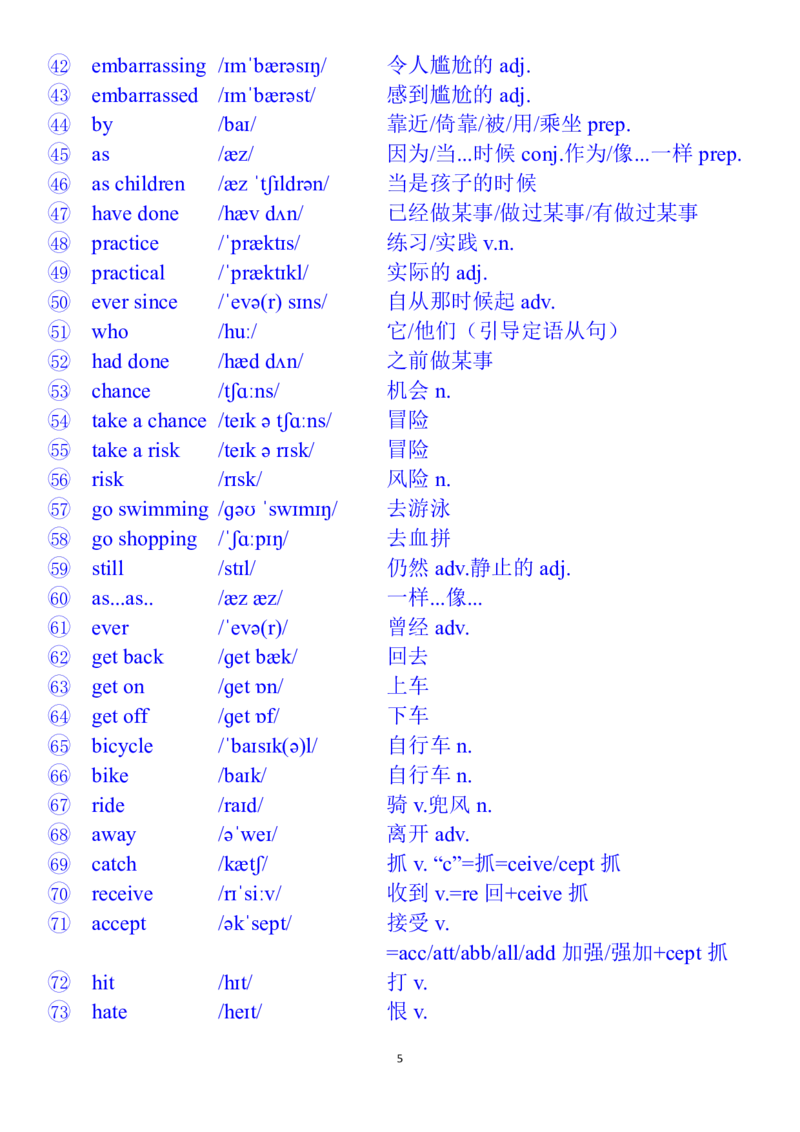
39 crop /krɒp/ 庄稼 n.
10 create /kriˈeɪt/ 创造 vt.
11 creator /kriˈeɪtə(r)/ 造物主 n.
12 creature /ˈkriːtʃə(r)/ 生物/受造之物 n.
13 creative /kriˈeɪtɪv/ 有创造性的 adj.
14 creation /kriˈeɪʃ(ə)n/ 创造 n.
15 increase /ɪnˈkriːs/ 增长 vi.=in 里面+cre 长
16 decrease /dɪˈkriːs/ 下降 vi.=de 低/底/cre 长
17 surprise /səˈpraɪz/ 使...惊讶 vt. 惊讶 n.
18 surprising /səˈpraɪzɪŋ/ 令人惊讶的 adj.
19 surprised /səˈpraɪzd/ 感到惊讶的 adj.
20 amaze /əˈmeɪz/ 使...惊讶 vt. “一个妹子”
21 amazing /əˈmeɪzɪŋ/ 令人惊讶的 adj.
22 amazed /əˈmeɪzd/ 感到惊讶的 adj.
23 shock /ʃɒk/ 使...震惊 vt.休克 n.
24 shocking /ˈʃɒkɪŋ/ 令人震惊的 adj.
25 shocked /ʃɒkt/ 感到震惊的 adj.
26 astonish /əˈstɒnɪʃ/ 使...震惊 v.
27 astonishing /əˈstɒnɪʃɪŋ/ 令人震惊的 adj.
28 astonished /əˈstɒnɪʃt/ 感到震惊的 adj.
29 interest /ˈɪntrəst/ 兴趣 n.使...有兴趣 v.
30 interesting /ˈɪntrəstɪŋ/ 令人感兴趣的 adj.
31 interested /ˈɪntrəstɪd/ 感到感兴趣的 adj.
32 excite /ɪkˈsaɪt/ 使...兴奋 v.
33 exciting /ɪkˈsaɪtɪŋ/ 令人兴奋的 adj.
34 excited /ɪkˈsaɪtɪd/ 感到兴奋的 adj.
35 bore /bɔː(r)/ 使...无聊 v.
36 boring /ˈbɔːrɪŋ/ 令人无聊的 adj.
37 bored /bɔːd/ 感到无聊的 adj.
38 tire /ˈtaɪə(r)/ 使...累 v.轮胎 n.
39 tiring /ˈtaɪərɪŋ/ 令人累的 adj.
40 tired /ˈtaɪəd/ 感到累的 adj.
41 embarrass /ɪmˈbærəs/ 使...尴尬 v.
4
更多一手课程及资料联系微信:xxbe75042 embarrassing /ɪmˈbærəsɪŋ/ 令人尴尬的 adj.
43 embarrassed /ɪmˈbærəst/ 感到尴尬的 adj.
44 by /baɪ/ 靠近/倚靠/被/用/乘坐 prep.
45 as /æz/ 因为/当...时候 conj.作为/像...一样 prep.
46 as children /æz ˈtʃɪldrən/ 当是孩子的时候
47 have done /hæv dʌn/ 已经做某事/做过某事/有做过某事
48 practice /ˈpræktɪs/ 练习/实践 v.n.
49 practical /ˈpræktɪkl/ 实际的 adj.
50 ever since /ˈevə(r) sɪns/ 自从那时候起 adv.
51 who /huː/ 它/他们(引导定语从句)
52 had done /hæd dʌn/ 之前做某事
53 chance /tʃɑːns/ 机会 n.
54 take a chance /teɪk ə tʃɑːns/ 冒险
55 take a risk /teɪk ə rɪsk/ 冒险
56 risk /rɪsk/ 风险 n.
57 go swimming /ɡəʊ ˈswɪmɪŋ/ 去游泳
58 go shopping /ˈʃɑːpɪŋ/ 去血拼
59 still /stɪl/ 仍然 adv.静止的 adj.
60 as...as.. /æz æz/ 一样...像...
61 ever /ˈevə(r)/ 曾经 adv.
62 get back /ɡet bæk/ 回去
63 get on /ɡet ɒn/ 上车
64 get off /ɡet ɒf/ 下车
65 bicycle /ˈbaɪsɪk(ə)l/ 自行车 n.
66 bike /baɪk/ 自行车 n.
67 ride /raɪd/ 骑 v.兜风 n.
68 away /əˈweɪ/ 离开 adv.
69 catch /kætʃ/ 抓 v. “c”=抓=ceive/cept 抓
70 receive /rɪˈsiːv/ 收到 v.=re 回+ceive 抓
71 accept /əkˈsept/ 接受 v.
=acc/att/abb/all/add 加强/强加+cept 抓
72 hit /hɪt/ 打 v.
73 hate /heɪt/ 恨 v.
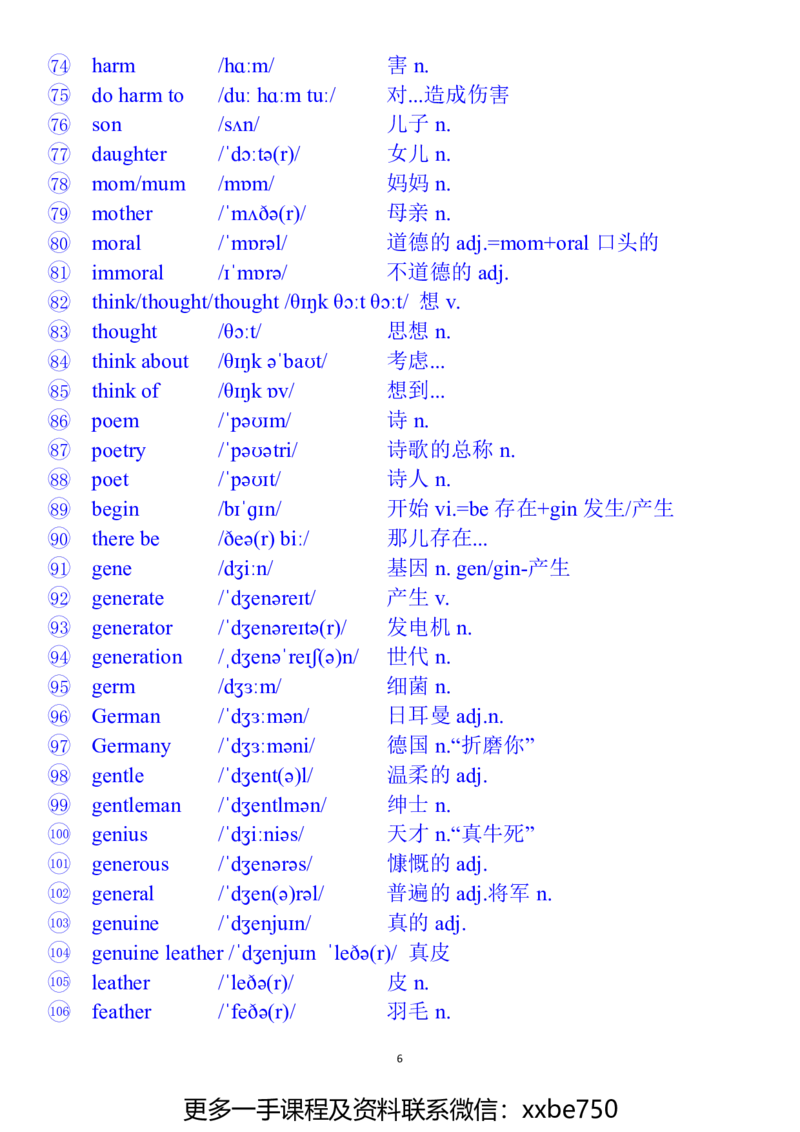
574 harm /hɑːm/ 害 n.
75 do harm to /duː hɑːm tuː/ 对...造成伤害
76 son /sʌn/ 儿子 n.
77 daughter /ˈdɔːtə(r)/ 女儿 n.
78 mom/mum /mɒm/ 妈妈 n.
79 mother /ˈmʌðə(r)/ 母亲 n.
80 moral /ˈmɒrəl/ 道德的 adj.=mom+oral 口头的
81 immoral /ɪˈmɒrə/ 不道德的 adj.
82 think/thought/thought /θɪŋk θɔːt θɔːt/ 想 v.
83 thought /θɔːt/ 思想 n.
84 think about /θɪŋk əˈbaʊt/ 考虑...
85 think of /θɪŋk ɒv/ 想到...
86 poem /ˈpəʊɪm/ 诗 n.
87 poetry /ˈpəʊətri/ 诗歌的总称 n.
88 poet /ˈpəʊɪt/ 诗人 n.
89 begin /bɪˈɡɪn/ 开始 vi.=be 存在+gin 发生/产生
90 there be /ðeə(r) biː/ 那儿存在...
91 gene /dʒiːn/ 基因 n. gen/gin-产生
92 generate /ˈdʒenəreɪt/ 产生 v.
93 generator /ˈdʒenəreɪtə(r)/ 发电机 n.
94 generation /ˌdʒenəˈreɪʃ(ə)n/ 世代 n.
95 germ /dʒɜːm/ 细菌 n.
96 German /ˈdʒɜːmən/ 日耳曼 adj.n.
97 Germany /ˈdʒɜːməni/ 德国 n.“折磨你”
98 gentle /ˈdʒent(ə)l/ 温柔的 adj.
99 gentleman /ˈdʒentlmən/ 绅士 n.
100 genius /ˈdʒiːniəs/ 天才 n.“真牛死”
101 generous /ˈdʒenərəs/ 慷慨的 adj.
102 general /ˈdʒen(ə)rəl/ 普遍的 adj.将军 n.
103 genuine /ˈdʒenjuɪn/ 真的 adj.
104 genuine leather /ˈdʒenjuɪn ˈleðə(r)/ 真皮
105 leather /ˈleðə(r)/ 皮 n.
106 feather /ˈfeðə(r)/ 羽毛 n.
6
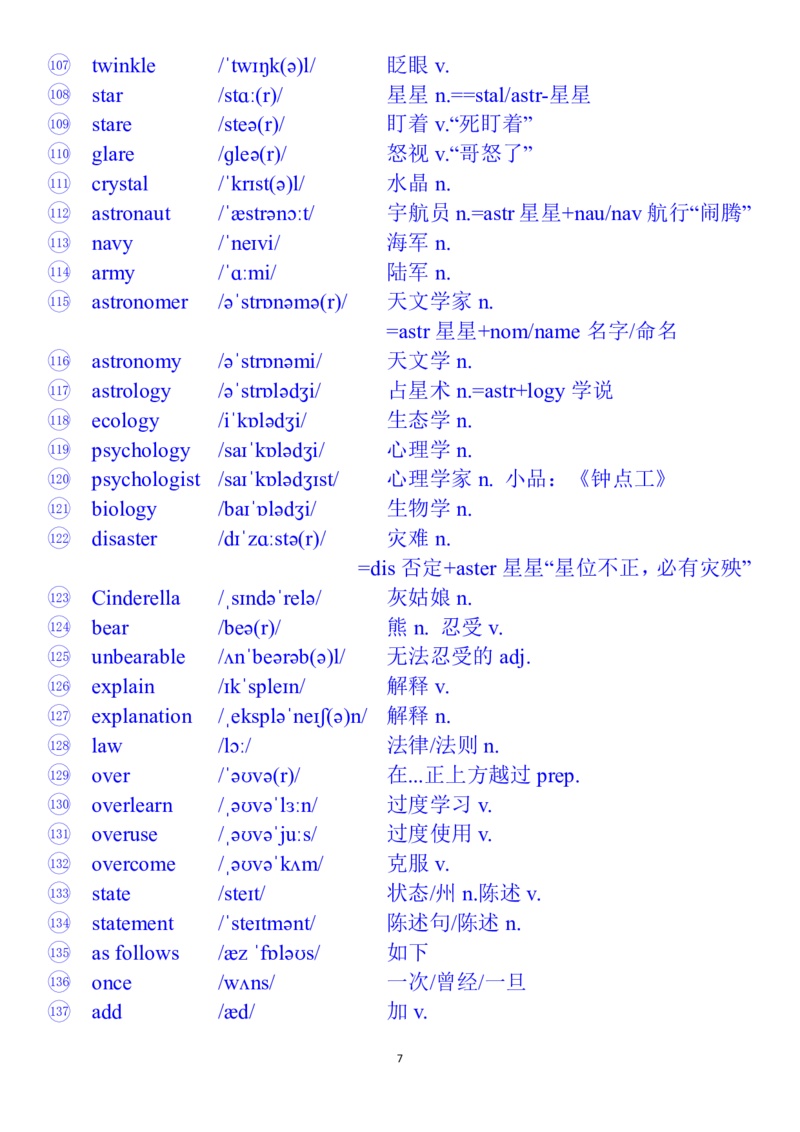
更多一手课程及资料联系微信:xxbe750107 twinkle /ˈtwɪŋk(ə)l/ 眨眼 v.
108 star /stɑː(r)/ 星星 n.==stal/astr-星星
109 stare /steə(r)/ 盯着 v.“死盯着”
110 glare /ɡleə(r)/ 怒视 v.“哥怒了”
111 crystal /ˈkrɪst(ə)l/ 水晶 n.
112 astronaut /ˈæstrənɔːt/ 宇航员 n.=astr 星星+nau/nav 航行“闹腾”
113 navy /ˈneɪvi/ 海军 n.
114 army /ˈɑːmi/ 陆军 n.
115 astronomer /əˈstrɒnəmə(r)/ 天文学家 n.
=astr 星星+nom/name 名字/命名
116 astronomy /əˈstrɒnəmi/ 天文学 n.
117 astrology /əˈstrɒlədʒi/ 占星术 n.=astr+logy 学说
118 ecology /iˈkɒlədʒi/ 生态学 n.
119 psychology /saɪˈkɒlədʒi/ 心理学 n.
120 psychologist /saɪˈkɒlədʒɪst/ 心理学家 n. 小品:《钟点工》
121 biology /baɪˈɒlədʒi/ 生物学 n.
122 disaster /dɪˈzɑːstə(r)/ 灾难 n.
=dis 否定+aster 星星“星位不正,必有灾殃”
123 Cinderella /ˌsɪndəˈrelə/ 灰姑娘 n.
124 bear /beə(r)/ 熊 n. 忍受 v.
125 unbearable /ʌnˈbeərəb(ə)l/ 无法忍受的 adj.
126 explain /ɪkˈspleɪn/ 解释 v.
127 explanation /ˌekspləˈneɪʃ(ə)n/ 解释 n.
128 law /lɔː/ 法律/法则 n.
129 over /ˈəʊvə(r)/ 在...正上方越过 prep.
130 overlearn /ˌəʊvəˈlɜːn/ 过度学习 v.
131 overuse /ˌəʊvəˈjuːs/ 过度使用 v.
132 overcome /ˌəʊvəˈkʌm/ 克服 v.
133 state /steɪt/ 状态/州 n.陈述 v.
134 statement /ˈsteɪtmənt/ 陈述句/陈述 n.
135 as follows /æz ˈfɒləʊs/ 如下
136 once /wʌns/ 一次/曾经/一旦
137 add /æd/ 加 v.
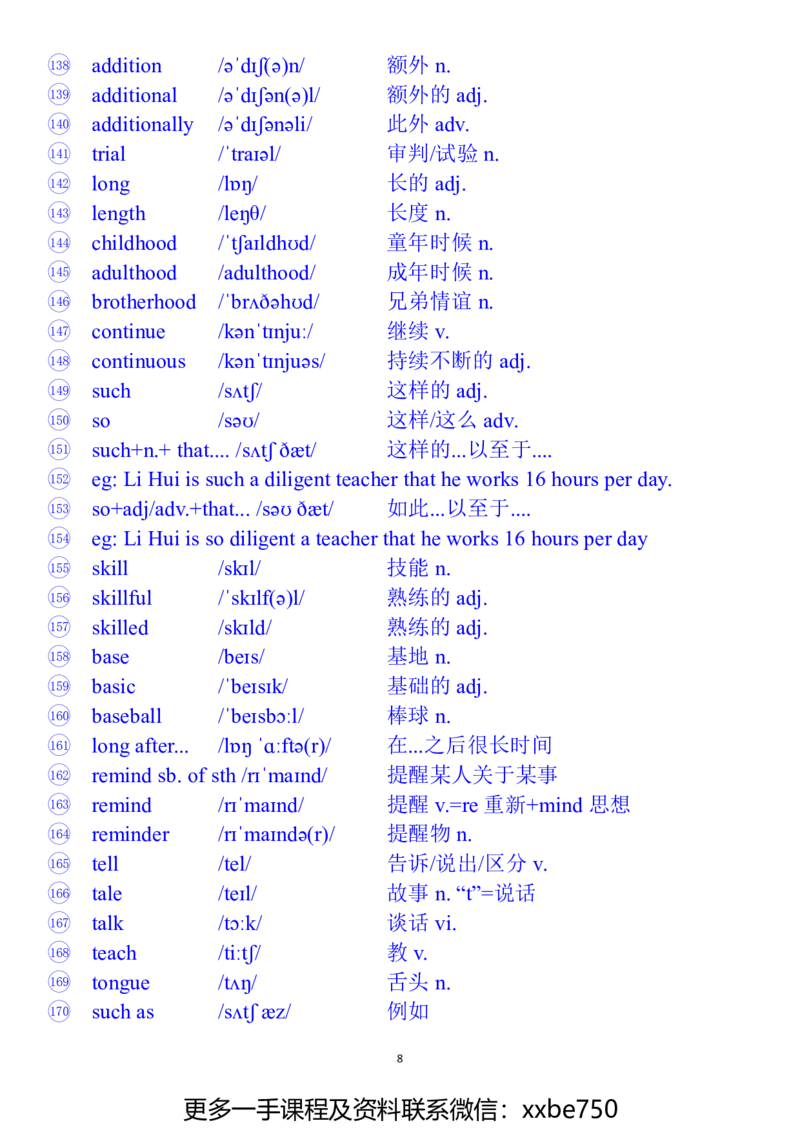
7138 addition /əˈdɪʃ(ə)n/ 额外 n.
139 additional /əˈdɪʃən(ə)l/ 额外的 adj.
140 additionally /əˈdɪʃənəli/ 此外 adv.
141 trial /ˈtraɪəl/ 审判/试验 n.
142 long /lɒŋ/ 长的 adj.
143 length /leŋθ/ 长度 n.
144 childhood /ˈtʃaɪldhʊd/ 童年时候 n.
145 adulthood /adulthood/ 成年时候 n.
146 brotherhood /ˈbrʌðəhʊd/ 兄弟情谊 n.
147 continue /kənˈtɪnjuː/ 继续 v.
148 continuous /kənˈtɪnjuəs/ 持续不断的 adj.
149 such /sʌtʃ/ 这样的 adj.
150 so /səʊ/ 这样/这么 adv.
151 such+n.+ that.... /sʌtʃ ðæt/ 这样的...以至于....
152 eg: Li Hui is such a diligent teacher that he works 16 hours per day.
153 so+adj/adv.+that... /səʊ ðæt/ 如此...以至于....
154 eg: Li Hui is so diligent a teacher that he works 16 hours per day
155 skill /skɪl/ 技能 n.
156 skillful /ˈskɪlf(ə)l/ 熟练的 adj.
157 skilled /skɪld/ 熟练的 adj.
158 base /beɪs/ 基地 n.
159 basic /ˈbeɪsɪk/ 基础的 adj.
160 baseball /ˈbeɪsbɔːl/ 棒球 n.
161 long after... /lɒŋ ˈɑːftə(r)/ 在...之后很长时间
162 remind sb. of sth /rɪˈmaɪnd/ 提醒某人关于某事
163 remind /rɪˈmaɪnd/ 提醒 v.=re 重新+mind 思想
164 reminder /rɪˈmaɪndə(r)/ 提醒物 n.
165 tell /tel/ 告诉/说出/区分 v.
166 tale /teɪl/ 故事 n. “t”=说话
167 talk /tɔːk/ 谈话 vi.
168 teach /tiːtʃ/ 教 v.
169 tongue /tʌŋ/ 舌头 n.
170 such as /sʌtʃ æz/ 例如
8
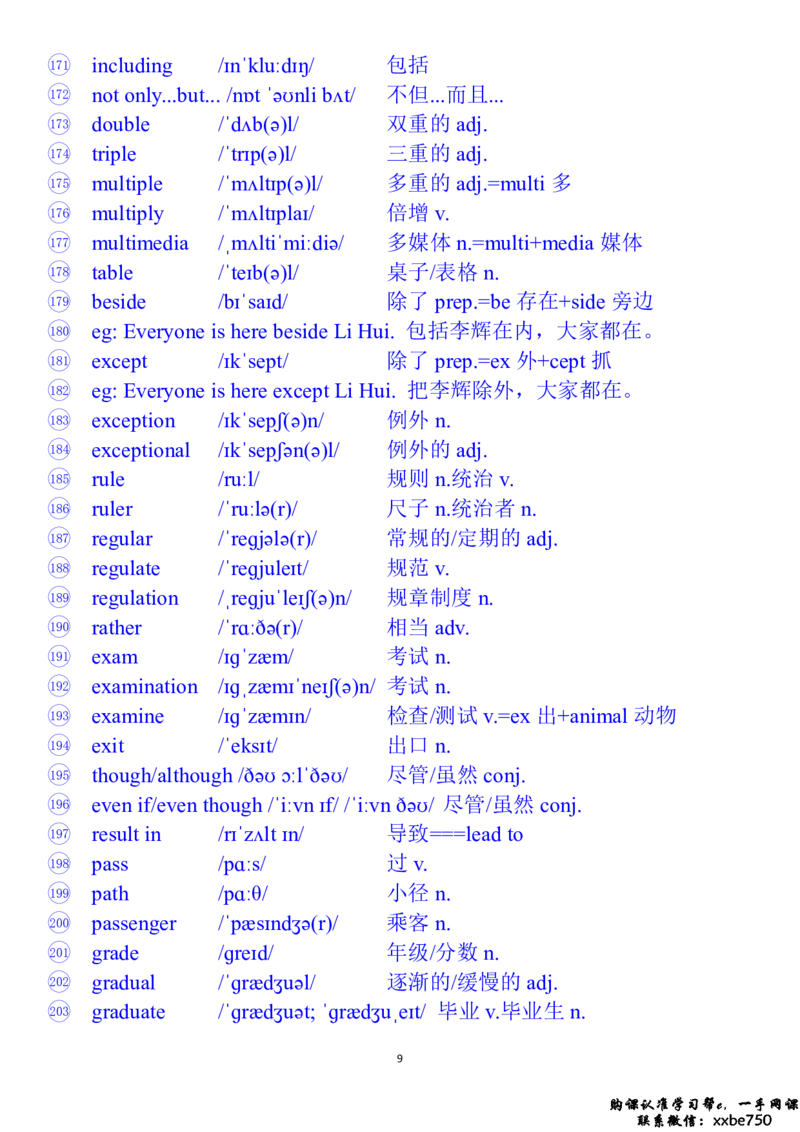
更多一手课程及资料联系微信:xxbe750171 including /ɪnˈkluːdɪŋ/ 包括
172 not only...but... /nɒt ˈəʊnli bʌt/ 不但...而且...
173 double /ˈdʌb(ə)l/ 双重的 adj.
174 triple /ˈtrɪp(ə)l/ 三重的 adj.
175 multiple /ˈmʌltɪp(ə)l/ 多重的 adj.=multi 多
176 multiply /ˈmʌltɪplaɪ/ 倍增 v.
177 multimedia /ˌmʌltiˈmiːdiə/ 多媒体 n.=multi+media 媒体
178 table /ˈteɪb(ə)l/ 桌子/表格 n.
179 beside /bɪˈsaɪd/ 除了 prep.=be 存在+side 旁边
180 eg: Everyone is here beside Li Hui. 包括李辉在内,大家都在。
181 except /ɪkˈsept/ 除了 prep.=ex 外+cept 抓
182 eg: Everyone is here except Li Hui. 把李辉除外,大家都在。
183 exception /ɪkˈsepʃ(ə)n/ 例外 n.
184 exceptional /ɪkˈsepʃən(ə)l/ 例外的 adj.
185 rule /ruːl/ 规则 n.统治 v.
186 ruler /ˈruːlə(r)/ 尺子 n.统治者 n.
187 regular /ˈreɡjələ(r)/ 常规的/定期的 adj.
188 regulate /ˈreɡjuleɪt/ 规范 v.
189 regulation /ˌreɡjuˈleɪʃ(ə)n/ 规章制度 n.
190 rather /ˈrɑːðə(r)/ 相当 adv.
191 exam /ɪɡˈzæm/ 考试 n.
192 examination /ɪɡˌzæmɪˈneɪʃ(ə)n/ 考试 n.
193 examine /ɪɡˈzæmɪn/ 检查/测试 v.=ex 出+animal 动物
194 exit /ˈeksɪt/ 出口 n.
195 though/although /ðəʊ ɔːlˈðəʊ/ 尽管/虽然 conj.
196 even if/even though /ˈiːvn ɪf/ /ˈiːvn ðəʊ/ 尽管/虽然 conj.
197 result in /rɪˈzʌlt ɪn/ 导致===lead to
198 pass /pɑːs/ 过 v.
199 path /pɑːθ/ 小径 n.
200 passenger /ˈpæsɪndʒə(r)/ 乘客 n.
201 grade /ɡreɪd/ 年级/分数 n.
202 gradual /ˈɡrædʒuəl/ 逐渐的/缓慢的 adj.
203 graduate /ˈɡrædʒuət; ˈɡrædʒuˌeɪt/ 毕业 v.毕业生 n.
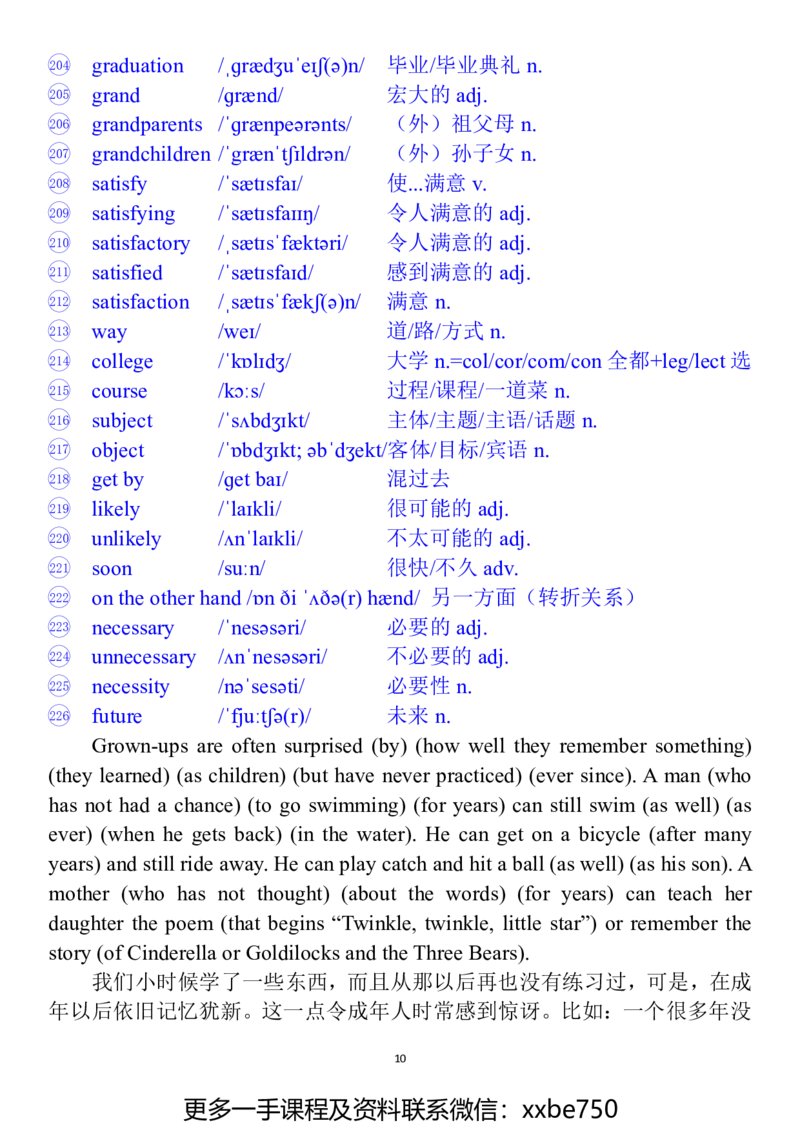
9204 graduation /ˌɡrædʒuˈeɪʃ(ə)n/ 毕业/毕业典礼 n.
205 grand /ɡrænd/ 宏大的 adj.
206 grandparents /ˈɡrænpeərənts/ (外)祖父母 n.
207 grandchildren /ˈgrænˈtʃɪldrən/ (外)孙子女 n.
208 satisfy /ˈsætɪsfaɪ/ 使...满意 v.
209 satisfying /ˈsætɪsfaɪɪŋ/ 令人满意的 adj.
210 satisfactory /ˌsætɪsˈfæktəri/ 令人满意的 adj.
211 satisfied /ˈsætɪsfaɪd/ 感到满意的 adj.
212 satisfaction /ˌsætɪsˈfækʃ(ə)n/ 满意 n.
213 way /weɪ/ 道/路/方式 n.
214 college /ˈkɒlɪdʒ/ 大学 n.=col/cor/com/con 全都+leg/lect 选
215 course /kɔːs/ 过程/课程/一道菜 n.
216 subject /ˈsʌbdʒɪkt/ 主体/主题/主语/话题 n.
217 object /ˈɒbdʒɪkt; əbˈdʒekt/客体/目标/宾语 n.
218 get by /ɡet baɪ/ 混过去
219 likely /ˈlaɪkli/ 很可能的 adj.
220 unlikely /ʌnˈlaɪkli/ 不太可能的 adj.
221 soon /suːn/ 很快/不久 adv.
222 on the other hand /ɒn ði ˈʌðə(r) hænd/ 另一方面(转折关系)
223 necessary /ˈnesəsəri/ 必要的 adj.
224 unnecessary /ʌnˈnesəsəri/ 不必要的 adj.
225 necessity /nəˈsesəti/ 必要性 n.
226 future /ˈfjuːtʃə(r)/ 未来 n.
Grown-ups are often surprised (by) (how well they remember something)
(they learned) (as children) (but have never practiced) (ever since). A man (who
has not had a chance) (to go swimming) (for years) can still swim (as well) (as
ever) (when he gets back) (in the water). He can get on a bicycle (after many
years) and still ride away. He can play catch and hit a ball (as well) (as his son). A
mother (who has not thought) (about the words) (for years) can teach her
daughter the poem (that begins “Twinkle, twinkle, little star”) or remember the
story (of Cinderella or Goldilocks and the Three Bears).
我们小时候学了一些东西,而且从那以后再也没有练习过,可是,在成
年以后依旧记忆犹新。这一点令成年人时常感到惊讶。比如:一个很多年没
10
更多一手课程及资料联系微信:xxbe750有游过泳的人,当他再次进入水中时却依旧能够游得像以前一样好。再比如:
很多年以后,他仍然可以蹬上自行车并把它骑走。他甚至还可以像他的儿子
一样,完成“接球”“打球”的动作。一位多年没有和单词打过交道的母亲
却依旧可以教她的女儿那首以“一闪一闪亮晶晶”开头的诗歌,而且还能记
住《灰姑娘》《金发姑娘》《三只熊》这三个故事。
One explanation is the law (of overlearning), (which can be stated) (as
follows): (Once we have learned something), additional learning trials increase
the length (of time) (we will remember it).
对此有一种解释,即“过度学习定律”。对于该定律可阐释如下:每当
我们学了一个东西,额外的学习实践就可以让我们把它记得更久。
(In childhood) we usually continue (to practice such skills) (as swimming,
bicycle riding, and playing baseball) (long after we have learned them). We
continue (to listen to and remind ourselves of words) (such as
“Twinkle,twinkle,little star”) (and childhood tales) (such as Cinderella and
Goldilocks).We not only learn but overlearn.
小的时候,我们会学一些技能,比如游泳、骑自行车、打棒球。很久以
后,我们通常还会继续操练。至于“一闪一闪亮晶晶”这首诗歌以及《灰姑
娘》和《金发姑娘》这样的儿童故事,我们也会一直听到或者时常忆起。所
以,我们不仅仅是“学习”,而且还“过度学习”。
The multiplication tables(乘法口诀表)are an exception (to the general rule)
(that we forget rather quickly the things) (that we learn) (in school), (because
they are another) (of the things) (we overlearn) (in childhood).
一般情况下,我们在学校学到的东西很快就会忘记,而乘法口诀表却是
个例外,因为它是另外一个我们在童年时期“过度学习”的东西。
The law (of overlearning) explains (why cramming)(突击学习)(for an
examination), (though it may result) (in a passing grade), (is not a satisfactory
way) (to learn a college course). (By cramming), a student may learn the subject
well enough (to get by) (on the examination), but he is likely soon (to forget
almost everything) (he learned). A little overlearning, (on the other hand), is
really necessary (for one’s future development).
尽管突击学习能够让我们考试及格,但是该方式并不适用于大学课程的
学习,“过度学习定律”就可以解释这一点。突击学习也许可以让学生勉强
通过考试,但是不久之后可能就把所学知识忘得一干二净。因此,适量的过
11度学习对一个人的未来发展确实是有必要的。
67.What is the main idea of Paragraph 1?
A.People remember well what they learned in childhood.
B.Children have a better memory than grown-ups.
C.Poem reading is a good way to learn words.
D.Stories for children are easy to remember.
67.第一段的主要思想是什么?
A.人们清楚地记得他们在童年时学到的东西。
B.孩子的记忆力比大人好。
C.诗歌阅读是学习单词的好方法。
D.儿童故事很容易记住。
68.The author explains the law of overlearning by ____.
A.presenting research findings
B.setting down general rules
C.making a comparison
D.using examples
68.作者用____解释了过度学习定律。
A.介绍研究成果
B.制定一般规则
C.进行比较
D.举例说明
69.According to the author, being able to use multiplication tables is ____.
A.a result of overlearning
B.a special case of cramming
C.a skill to deal with math problems
D.a basic step towards advanced studies
69.据笔者介绍,会使用乘法表是____。
A.过度学习的结果
B.突击学习的特例
C.处理数学问题的技能
D.迈向高级研究的基本步骤
70.What is the author’s opinion on cramming?
A.It leads to failure in college exams.
12
更多一手课程及资料联系微信:xxbe750B.It’s helpful only in a limited way.
C.It’s possible to result in poor memory.
D.It increases students’learning interest.
70.作者对突击学习有什么看法?
A.它导致大学考试失败。
B.它只在有限的方式上有帮助。
C.可能会导致记忆力差。
D.它提高学生的学习兴趣。
13Day 2
【英语单词逆向学习法】
不是“先背过单词才能读懂文章”;
而是“先读懂文章才能背过单词”!
【语法小课堂】
同位语从句:用来解释前面名词的内容!
【阅读理解精读突破法】
{原理}
一篇文章就是一座宝藏!!!
{方法}
i. 查单词!
ii.画括号!
iii. 抓主题!
iv.做题目!
v. 读熟练!
【主题=重复】
“看懂文章=理解主题=找到重复!”
(2007 全国 II 卷阅读理解 B 篇)
【原文回顾】
Some people have the feeling that nothing can be done about their poor
reading ability(能力). They feel hopeless about it. Can you learn to read better,
or must you agree that nothing can be done about it?
To be sure, people are different. You cannot do everything as well as certain
other people do. If all the students in a class tried out for basketball, some would
be very good players; others would be very poor; and many would be in between.
But even the very poor players can become much better players if they are
guided in the right way, and with plenty of practice. It is the same with reading.
14
更多一手课程及资料联系微信:xxbe750Some seem to enjoy reading and to read well without any special help. Others
find reading a slow and tiring job. In between, there are all degrees of reading
ability.
Many experiments have shown that just about every poor reader can
improve his reading ability. In these experiments, the poor readers were given
tests of reading ability. After some of the causes of their poor reading were
discovered, they were given special instruction and practice in reading. After a
few months, another test of the same kind was given. In nearly all cases, these
people had raised their reading scores.
46.With the example of a basketball players, the author shows ______.
A. why certain people are poor readers
B. that there are differences in people’s abilities
C. why some people are good basketball players
D. that good basketball players can be good readers
47. To improve their reading ability, people should ______.
A. work long and hard
B. take different forms of tests
C. have special help and practice
D. try different reading materials
48. The experiments mentioned in the text show that ______.
A. good readers seem to enjoy reading
B. almost all poor readers can make progress
C. causes of poor reading are difficult to find out
D. tests help people improve their reading ability
【辉神精读】
1 feeling /ˈfiːlɪŋ/ 感觉 n.
2 that /ðæt/ “说”(引导名词性从句)
eg: I know (that LH ishandsome).
3 poor /pɔː/ 糟糕的 adj.
4 hopeless /ˈhəʊpləs/ 无望的 adj.——>一定要找理由!
5 helpless /ˈhelpləs/ 无助的 adj.——>一定要找方法!
6 worthless /ˈwɜːθləs/ 不值得 adv.——>找自我价值 self-esteem
157 agree /əˈɡriː/ 达成一致意见/同意 v.
8 disagree /ˌdɪsəˈɡriː/ 不同意 v.
9 sure /ʃʊə/ 确定的 adj.
10 make sure that... /meɪkʃɔ:ðat/ 确保...
11 be sure that... /bi:ʃɔ:ðat/ 确信...
12 as...as... /æz, əz/ 一样...像...
13 certain /ˈsɜːtn/ 特定的/确定的 adj.
=cer/car/cur 心+tain 装着
14 certainly /ˈsɜːtnli/ 当然 adv.
15 certainty /ˈsɜːtnti/ 确定性 n.
16 heart /hɑːt/ 心 n.
17 heartfelt /ˈhɑːtfelt/ 衷心的 adj.
18 care /keə/ 关心 n.v.
19 careful /ˈkeəfl/ 认真的 adj.
20 careless /ˈkeələs/ 粗心的 adj.
21 cure /kjʊə/ 治愈 v.
22 curable /ˈkjʊərəbl/ 可治愈的 adj.
23 incurable /ɪnˈkjʊərəbl/ 不可治愈的 adj.
c
24 courage /ˈkʌrɪdʒ/ 勇气 n.= +our+age
25 courageous /kəˈreɪdʒəs/ 勇敢的 adj.
26 encourage /ɪnˈkʌrɪdʒ/ 鼓励 v.
27 discourage /dɪsˈkʌrɪdʒ/ 使泄气 v.
28 encouragement /ɪnˈkʌrɪdʒmənt/ 鼓励 n.
29 contain /kənˈteɪn/ 包含/控制 v.=con/com/col/cor 全都+tain 装
30 container /kənˈteɪnə/ 容器 n.
31 obtain /əbˈteɪn/ 获取 vt.=ob 朝着+tain 装
32 attain /əˈteɪn/ 达到 vt.=att/app/all/add 加强/强行+tain 抓
33 try out /traɪaʊt/ 尝试
34 would /wʊd, wəd/ 会
35 player /ˈpleɪə(r) / 选手/玩家 n.
36 poor /pɔː/ 糟糕的/穷的 adj.
37 in between /ɪnbɪˈtwiːn/ 在中间
38 even /ˈiːvn/ 即使/甚至 adv.
16
更多一手课程及资料联系微信:xxbe75039 guide /ɡaɪd/ 指导 v.指导员 n.
40 tour guide /tʊəɡaɪd/ 导游 n.
41 guidance /ˈɡaɪdns/ 指导 n.
42 in the right way /ɪn ðə raɪt weɪ/ 以正确的方式
43 in the same way/ɪn ðə seɪm weɪ/以同样的方式
44 in the way /ɪn//ðə, ði//weɪ/ 挡路
45 on one’s way to../ɒnwʌnzweɪtu/ 在某人去某地的路上
46 with /wɪð/ 伴随着/有/跟/和/用 prep.
47 without /wɪˈðaʊt/ 没有/如果没有 prep.
eg: Without you, where would I go?
48 Plenty of /ˈplentiɒv/ 大量的=a lot of
49 It is the same with... 这跟...是一样的。
50 special /ˈspeʃl/ 特殊的 adj.
51 specialist /ˈspeʃəlɪst/ 专家 n.
52 specialty /ˈspeʃəlti/ 专业技能 n.
53 science /ˈsaɪəns/ 科学 n.
54 scientific /ˌsaɪənˈtɪfɪk/ 科学的 adj.
55 scientist /ˈsaɪəntɪst/ 科学家 n.
56 piano /piˈænəʊ, ˈpjɑːnəʊ/ 钢琴 n.
57 pianist /ˈpɪənɪst/ 钢琴家 n.
58 art /ɑːt/ 艺术 n.
59 artist /ˈɑːtɪst/ 艺术家 n.
60 find A+B /faɪnd/ 发现 A 是 B
61 make A+B /meɪk/ 把 A 变成 B
62 slow /sləʊ/ 慢的 adj.减慢 v.
63 tire /ˈtaɪə/ 使...累 v.轮胎 n.
64 tiring /ˈtaɪərɪŋ/ 令人累的 adj.
65 tired /ˈtaɪəd/ 感到累的 adj.
66 job /dʒɒb/ 工作 n.
67 jobless /ˈdʒɒbləs/ 失业的 adj.
68 home /həʊm/ 家 n.
69 homeless /ˈhəʊmləs/ 无家可归的 adj.
70 degree /dɪˈɡriː/ 程度/学位 n.
1771 bachelor /ˈbætʃələ/ 学士学位/单身汉 n.“白痴了”
72 master /ˈmɑːstə/ 掌握 v.硕士/大师 n.
73 doctor /ˈdɒktə/ 博士/医生 n.===doc 文字
74 document /ˈdɒkjumənt/ 文件 n.
75 doctrine /ˈdɒktrɪn/ 教条 n.
76 show /ʃəʊ/ 展示/显示/出现 v.====prove
77 show up/ʃəʊʌp/ 出现
78 expert /ˈekspɜːt/ 专家 n.=ex 出+per 遍历
79 expertise /ˌekspɜːˈtiːz/ 专业技能 n.≈specialty
80 experiment /ɪkˈsperɪmənt/ 实验 n.
81 experience /ɪkˈspɪəriəns/ 经验/经历 n.
82 experienced /ɪkˈspɪəriənst/ 有经验的 adj.
83 inexperienced/ˌɪnɪkˈspɪəriənst/ 没经验的 adj.
84 perfect /ˈpɜːfɪkt, pəˈfekt/ 完美的 adj.=per 遍历+fect/fact 做
85 imperfect /ɪmˈpɜːfɪkt/ 不完美的 adj.
86 affect /əˈfekt/ 影响 v.=aff 加强/强加+fect 做
87 affection /əˈfekʃn/ 感情 n.==love
88 affectionate /əˈfekʃənət/ 多情的 adj.
89 effect /ɪˈfekt/ 效果/影响 n.=e 看+fect 做
90 effective /ɪˈfektɪv/ 有效的 adj.
91 ineffective /ˌɪnɪˈfektɪv/ 无效的 adj.
92 efficient /ɪˈfɪʃnt/ 高效的 adj.
93 inefficient /ˌɪnɪˈfɪʃnt/ 低效的 adj.
94 fact /fækt/ 事实 n.
95 factory /ˈfæktri/ 工厂 n.
96 manufacture /ˌmænjuˈfæktʃə/ 制造 v.
97 improve /ɪmˈpruːv/ 提高 v.
98 improvement /ɪmˈpruːvmənt/ 提升 n.
99 test /test/ 测试 n.v.
100 cause /kɔːz/ 缘起/缘由 n.导致 v.
101 cover /ˈkʌvə/ 覆盖 v.盖子 n.
102 discover /dɪˈskʌvə/ 发现 v.(发现未知事物)
103 discovery /dɪˈskʌvəri/ 发现 n.
18
更多一手课程及资料联系微信:xxbe750104 uncover /ʌnˈkʌvə/ 发现 v.(发现故意隐藏之物)
105 structure /ˈstrʌktʃə/ 结构 n.
106 instruct /ɪnˈstrʌkt/ 指导 v.=in 里面+struct 结构
107 instructor /ɪnˈstrʌktə/ 指导员 n.
108 instruction /ɪnˈstrʌkʃn/ 指导 n.
109 construct /kənˈstrʌkt/ 建筑 v.
110 construction /kənˈstrʌkʃn/ 建筑/建筑物 n.
111 destroy /dɪˈstrɔɪ/ 破坏 v.
112 destruct /dɪˈstrʌkt/ 破坏 v.
113 destructive /dɪˈstrʌktɪv/ 破坏的 adj.
114 of the same kind /ɒv ðə seɪm kaɪnd/ 同样种类的 adj.
115 nearly /ˈnɪəli/ 几乎/将近 adv.
116 case /keɪs/ 箱子/事件/案例/案件 n.
117 in case... /ɪnkeɪs/ 以防...
118 raise /reɪz/ 举起 vt. eg: You raise me up.
119 rise /raɪz/ 上升 vi. eg: sunrise 日出 n.
120 score /skɔː/ 分数 n.得分 v.
Some people have the feeling (that nothing can be done) (about their poor
reading ability) (能力). They feel hopeless (about it). Can you learn (to read
better), or must you agree (that nothing can be done) (about it)?
一些人有这样一种感觉——对自己糟糕的阅读能力无能为力。他们对此
感到绝望。你能学会更好地阅读吗?还是说你必须承认,你对于自己的阅读
能力确实无能为力?
(To be sure), people are different. You cannot do everything (as well) (as
certain other people do). (If all the students) (in a class) (tried out) (for
basketball), some would be very good players; others would be very poor; and
many would be (in between). But even the very poor players can become much
better players (if they are guided) (in the right way), and (with plenty of practice).
It is the same (with reading). Some seem (to enjoy reading) and (to read well)
(without any special help). Others find reading a slow and tiring job. (In
between), there are all degrees (of reading ability).
的确,人与人之间是不同的。你不可能像某些人一样,每件事情都做得
很好。假如班级里所有的学生都参加篮球选拔,有些学生可能打得很好,有
19些学生可能会很差,还有一些学生水平会处于两者之间。但如果用正确的方
式引导,再加上大量的练习,即使是打得最差的球员也可以比之前好得多。
阅读能力也是如此。有些人似乎很享受阅读,他们不需要任何特殊的帮助就
能顺利阅读;有些人则感觉阅读是一项缓慢而且令人疲惫的工作;其他人的
阅读能力则是介于这两类人之间。
Many experiments have shown (that just about every poor reader can
improve his reading ability). (In these experiments), the poor readers were given
tests (of reading ability). (After some) (of the causes) (of their poor reading)
(were discovered), they were given special instruction and practice (in reading).
(After a few months), another test (of the same kind) was given. (In nearly all
cases), these people had raised their reading scores.
很多实验表明,其实几乎每个阅读能力差的人都能提高阅读能力。实验
的内容是对阅读能力差的人进行阅读能力测试。当导致他们阅读能力弱的原
因被发现后,他们便接受了一些特殊的指导和训练。几个月之后,又进行了
一次同类测试。几乎所有实验对象的阅读分数都提高了。
46.With the example of a basketball players, the author shows ______.
A. why certain people are poor readers
B. that there are differences in people’s abilities
C. why some people are good basketball players
D. that good basketball players can be good readers
46.以篮球运动员为例,作者展示了______。
A.为什么某些人的阅读能力弱
B.人与人的能力存在差异
C.为什么有些人是优秀的篮球运动员
D.优秀的篮球运动员可以成为优秀的读者
47. To improve their reading ability, people should ______.
A. work long and hard
B. take different forms of tests
C. have special help and practice
D. try different reading materials
47.为了提高阅读能力,人们应该______。
A.长期努力工作
B.参加不同形式的测试
20
更多一手课程及资料联系微信:xxbe750C.有特别的帮助和练习
D.尝试不同的阅读材料
48. The experiments mentioned in the text show that ______.
A. good readers seem to enjoy reading
B. almost all poor readers can make progress
C. causes of poor reading are difficult to find out
D. tests help people improve their reading ability
48. 文中提到的实验表明,______。
A.阅读能力强的人似乎喜欢阅读
B.几乎所有阅读能力弱的人都能进步
C.阅读能力弱的原因很难找出
D.测试帮助人们提高阅读能力
21Day 3
【阅读理解做题技巧】
“建议态度看文尾!”
【原文回顾】
(2009 全国 II 卷阅读理解 E 篇)
How words came into being is unknown. All we assume(猜测) is that
some early men invented certain sounds, in one way or another, to express
thoughts and feelings, actions and things, so that they could talk with each other.
Later they agreed upon certain signs called letters, which could be put together to
show those sounds, and which could be written down. Those sounds, whether
spoken or written in letters, are called words.
The power of words, then, lies in their associations—the things they bring
up to our minds. Words become filled with meaning for us by experience; and the
longer we live, the more certain words bring back to us the happy and sad events
of our past; and the more we read and learn, the more the number of words that
mean something to us increases.
Great writers are those who not only have great thoughts but also express
these thoughts in words which have powerful effects on our minds and feelings.
This clever use of words is what we call literary style(文体). Above all, the real
poet is a master of words. He can express his meaning in words which sing like
music, and which by their position and association can move men to tears. We
should therefore learn to choose our words carefully and use them correctly, or
they will make our speech silly and common.
58. We learn from the text that language might have begun with _______.
A. expressions
B. actions
C. signs
D. sounds
59. What is mainly discussed in Paragraph 2?
A. The learning of new words.
B. The importance of old words.
22
更多一手课程及资料联系微信:xxbe750C. The relation of human experience with words.
D. The gradual change and development of words.
60. In the last paragraph, what does the author suggest that we should do?
A. Use words skillfully.
B. Make musical speeches.
C. Learn poems by heart.
D. Associate with listeners.
【辉神精读】
1 be /bi/ 存在 v.
2 there be /ðeəbi/ 那儿存在
3 come into being /kʌmˈɪntəˈbiːɪŋ/ 出现(进入存在)
4 invent /ɪnˈvent/ 发明 v.
5 inventor /ɪnˈventə/ 发明者 n.
6 invention /ɪnˈvenʃn/ 发明 n.
7 certain /ˈsɜːtn/ 特定的/确定的 adj.
8 sound /saʊnd/ 声音 n.听起来 vi.
9 In the same way/ɪn ðə seɪm weɪ/以同样的方式
10 In a new way /ɪn ə njuː weɪ/ 以一种新方式
11 In the way /ɪn ðə weɪ/ 挡路
12 press /pres/ 压 v.
13 pressure /ˈpreʃə/ 压力 n.
14 impress /ɪmˈpres/ 给...留下印象 v.
15 express /ɪkˈspres/ 表达 v.
16 impression /ɪmˈpreʃn/ 印象 n.
17 expression /ɪkˈspreʃn/ 表达方式/表情 n.
18 impressive /ɪmˈpresɪv/ 给人留下深刻印象的 adj.
19 expressive /ɪkˈspresɪv/ 表达效果良好的 adj.
20 print /prɪnt/ 打印 v.
21 stress /stres/ 紧张 n.强调 v.
22 stressful /ˈstresfl/ 紧张的 adj.
23 thought /θɔːt/ 思想 n.
24 feeling /ˈfiːlɪŋ/ 感觉 n.
2325 so that... /səʊðæt/ 以便...
26 in order that... /ɪnˈɔːdəðæt/ 以便...
27 so...that... /səʊ ðæt/ 如此...以至于...
28 such...that... /sʌtʃ ðæt/ 这样的...以至于...
29 Talk with sb. /tɔːk wɪð ˈsʌmbədi/ 跟某人说话
30 Talk to sb. /tɔːk tu ˈsʌmbədi/ 对某人说话
31 Talk about sth. /tɔːkəˈbaʊt ˈsʌmθɪŋ/ 谈论关于某事
32 Each other /ˌiːtʃˈʌðə/ 彼此
33 One another /ˌwʌnəˈnʌðə/ 彼此
34 agree /əˈɡriː/ 达成一致意见/同意 v.
35 disagree /ˌdɪsəˈɡriː/ 不同意 v.
36 sign /saɪn/ 符号 n.签 v.
37 resign /rɪˈzaɪn/ 辞职 v.=re 重新/回来+sign 签名
38 signature /ˈsɪɡnətʃə/ 签名 n.
39 signal /ˈsɪɡnəl/ 信号 n.
40 design /dɪˈzaɪn/ 设计 v.=de 低+sign 签
41 designer /dɪˈzaɪnər/ 设计师 n.
42 letter /ˈletə/ 字母/信 n.
43 literature /ˈlɪtrətʃə/ 文学 n.
44 literate /ˈlɪtərət/ 认字的 adj.
45 illiterate /ɪˈlɪtərət/ 文盲的 adj.
46 put together /pʊttəˈɡeðə/ 放到一起
47 write down /ˈraɪtdaʊn/ 写下来
48 take down /teɪkdaʊn/ 写下来
49 putdown /ˈpʊtdaʊn/ 写下来
50 copy down /ˈkɒpidaʊ/ 写下来
51 whether /ˈweðə/ 是否/无论 conj.
=when/where/why/what/who
52 weather /ˈweðə/ 天气 n.=wet 湿的 adj.=water 水 n.
53 power /ˈpaʊə/ 力量/权力/电力 n.
54 powerful /ˈpaʊəfl/ 有力量的/强大的 adj.
55 poweroff /ˈpaʊəɒf/ 没电了
56 lie in /ˌlaɪˈɪn/ 存在于
24
更多一手课程及资料联系微信:xxbe75057 associate /əˈsəʊsieɪt/ 联系 v.
58 association /əˌsəʊsiˈeɪʃn/ 联系/协会 n.
59 bring up /brɪŋʌp/ 带上来/抚养长大/呕吐
60 mind /maɪnd/ 思想 n.介意 v.
61 Do you mind my/me doing sth? 你介意我干啥事儿吗?
62 Be full of /bifʊlɒv/ 装满
63 Be filled with /bifɪldwɪð/ 装满
64 meaning /ˈmiːnɪŋ/ 意义/意思 n.
65 meaningful /ˈmiːnɪŋfl/ 有意义的 adj.
66 the more...the more... /ðəmɔː/ /ðəmɔː/ 越...就越....
67 sad /sæd/ 悲伤的 adj.
68 sadness /ˈsædnəs/ 悲伤 n.
69 sorrow /ˈsɒrəʊ/ 悲伤 n.
70 event /ɪˈvent/ 事件/大型活动 n.
71 writer /ˈraɪtə/ 作家 n.
72 author /ˈɔːθə/ 作者 n.
73 authority /ɔːˈθɒrəti/ 权威 n.
74 authorize /ˈɔːθəraɪz/ 授权 v.
75 those /ðəʊz/ 那些/那些人 pron.
76 these /ðiːz/ 这些/这些人 pron.
77 effect /ɪˈfekt/ 效果 n.
78 effective /ɪˈfektɪv/ 有效的 adj.
79 ineffective /ˌɪnɪˈfektɪv/ 无效的 adj.
80 efficient /ɪˈfɪʃnt/ 高效的 adj.
81 inefficient /ˌɪnɪˈfɪʃnt/ 低效的 adj.
82 style /staɪl/ 方式/风格 n.
83 what /wɒt/ ...的那个东西(引导名词性从句)
84 aboveall /əˈbʌvɔːl/ 首要的
85 poet /ˈpəʊɪt/ 诗人 n.
86 poem /ˈpəʊɪm/ 诗 n.
87 poetry /ˈpəʊətri/ 诗歌 n.
88 position /pəˈzɪʃn/ 位置 n.定位 v.
89 GPS=Global Positioning System /ˈɡləʊb(ə)l pə'zɪʃnɪŋ ˈsɪstəm/
25全球定位系统 n.
90 pose /pəʊz/ 放置 v.
91 posture /ˈpɒstʃə/ 姿势 n.
92 impose /ɪmˈpəʊz/ 强加 v.
93 expose /ɪkˈspəʊz/ 暴露 v.
94 expo /ˈekspəʊ/ 博览会 n.
95 dispose /dɪˈspəʊz/ 处理 v.=dis 否定+pose 放置
96 move men to tears /muːv men tu teəz/ 把人感动落泪
97 therefore /ˈðeəfɔː/ 因此 adv.
98 choose /tʃuːz/ 选择 v.
99 choice /tʃɔɪs/ 选择 n.
100 correct /kəˈrekt/ 正确的 adj.修正 v.
=cor/col/com/con 全都+rect 正
101 incorrect /ˌɪnkəˈrekt/ 不正确的 adj.
102 correction /kəˈrekʃn/ 修正 v.
103 angle /ˈæŋɡl/ 角 n.
104 triangle /ˈtraɪæŋɡl/ 三角 n. tri=three=三
105 rectangle /ˈrektæŋɡl/ 矩形 n. rect=right=正
106 right /raɪt/ 正确的 adj.权力 n.
107 or /ɔː/ 或者/否则 conj.
108 Find A B /faɪnd/ 发现 A 是 B
109 Make A B /meɪk/ 把 A 变成 B
110 speak /spiːk/ 讲话 v.
111 speech /spiːtʃ/ 讲话 n.
112 silly /ˈsɪli/ 傻的 adj.
113 common /ˈkɒmən/ 共同的/常见的 adj.
(How words came) (into being) is unknown. All (we assume) (猜测) is (that
some early men invented certain sounds), (in one way or another), (to express
thoughts and feelings, actions and things), (so that they could talk) (with each
other). (Later) they agreed (upon certain signs) (called letters), (which could be
put together) (to show those sounds), and (which could be written down). Those
sounds, (whether spoken or written) (in letters), are called words.
文字是如何形成的,不得而知。我们猜测的是:一些早期人类发明了某
26
更多一手课程及资料联系微信:xxbe750些特定的声音,以某种方式来表达思想和感受、行动和事物,以便相互交流。
后来,他们商定了特定的符号,并称之为字母。这些符号组合在一起就能表
达这些声音,而且还可以写下来。这些声音,无论是用口头说的还是用字母
写的,都称之为文字。
The power (of words), then, lies (in their associations)—the things (they
bring up) (to our minds). Words become filled (with meaning) (for us) (by
experience); and the longer we live, the more certain words bring back (to us) the
happy and sad events (of our past); and the more we read and learn, the more the
number (of words) (that mean something) (to us) increases.
因此,文字的力量在于联想,即文字能够带到我们大脑中的画面。有了
经历,文字对我们来说才充满了意义;我们生活的时间越长,就有越多的文
字能把我们带回到过去的快乐和悲伤中;我们阅读和学习得越多,对我们有
意义的文字数量就越多。
Great writers are those (who not only have great thoughts but also express
these thoughts) (in words) (which have powerful effects) (on our minds and
feelings). This clever use (of words) is (what we call literary style) ( 文 体 ).
(Above all), the real poet is a master (of words). He can express his meaning (in
words) (which sing) (like music), and (which) (by their position and association)
(can move men) (to tears). We should therefore learn (to choose our words
carefully and use them correctly), or they will make our speech silly and
common.
一个伟大的作者不仅拥有伟大的思想,而且还得能将这些思想用文字的
形式表达出来,进而对我们的思想和感受产生强烈的影响。这种巧妙的用词
就是我们所说的文体。综上所述,真正的诗人是文字的大师。他能用像音乐
一样动听的文字表达自己的意思,通过这些文字的排列和联想,能让人潸然
泪下。因此,我们应该学着去斟酌用词并准确地使用。否则,有些文字会使
我们的言语变得愚蠢平庸。
58. We learn from the text that language might have begun with _______.
A. expressions
B. actions
C. signs
D. sounds
58. 我们从文章中了解到,语言可能始于_______。
27A. 表情
B. 行动
C. 符号
D. 声音
59. What is mainly discussed in Paragraph 2?
A. The learning of new words.
B. The importance of old words.
C. The relation of human experience with words.
D. The gradual change and development of words.
59. 第二段主要讨论了什么?
A.学习新的文字。
B.古文字的重要性。
C.人类经验与文字的关系。
D.文字的逐渐变化和发展。
60. In the last paragraph, what does the author suggest that we should do?
A. Use words skillfully.
B. Make musical speeches.
C. Learn poems by heart.
D. Associate with listeners.
60.在最后一段中,作者建议我们应该做什么?
A.巧妙地使用文字。
B.发表音乐演奏。
C.用心学习诗歌。
D.与听众联系。
28
更多一手课程及资料联系微信:xxbe750Day 4
【五大理解难点】
i. 陌生概念 eg:play down/report card
ii.指代关系 eg:it
iii. 并列关系 eg:and
iv.修饰关系 eg:四朵金花
v. 解释关系 eg:抓主题——谁在被解释/谁在被重复
【原文回顾】
(2011 全国卷 II 阅读理解 E 篇)
Make Up Your Mind to Succeed
Kind-hearted parents have unknowingly left their children defenseless against
failure. The generation born between 1980 and 2001 grew up playing sports
where scores and performance were played down because “everyone’s a winner.”
And their report cards sounded more positive (正面的) than ever before. As a
result, Stanford University professor Carol Dweck, PhD, calls them “the
overpraised generation.”
Dweck has been studying how people deal with failure for 40 years. Her research
has led her to find out two clearly different mind-sets that have a great effect on
how we react to it. Here’s how they work:
A fixed mind-set is grounded in the belief that talen(t 才能)is genetic—you’re
a born artist, point guard, or numbers person. The fixed mind-set believes it’s
sure to succeed without much effort and regards failure as personal shame. When
things get difficult, it’s quick to blame, lie, and even stay away from future
difficulties.
On the other hand, a growth mind-set believes that no talent is entirely
heaven-sent and that effort and learning make everything possible. Because the
ego(自尊) isn’t on the line as much, the growth mind-set sees failure as a
chance rather than shame. When faced with a difficulty, it’s quick to rethink,
change and try again. In fact, it enjoys this experience.
We are all born with growth mind-sets. Otherwise, we wouldn’t be able to live
in the world. But parents, teachers, and instructors often push us into fixed
29mind-sets by encouraging certain actions and misdirecting praise. Dweck’s book,
Mind-set: The New Psychology of Success, and online instructional program
explain this in depth. But she says there are many little things you can start doing
today to make sure that your children, grandchildren and even you are never
defeated by failure.
57.What does the author think about the present generation?
A. They don’t do well at school.
B. They are often misunderstood.
C. They are eager to win in sports.
D. They are given too much praise.
58.A fixed mind-set person is probably one who ______.
A. doesn’t want to work hard
B. cares a lot about personal safety
C. cannot share his ideas with others
D. can succeed with the help of teachers
59.What does the growth mind-set believe?
A. Admitting failure is shameful.
B. Talent comes with one’s birth.
C. Scores should be highly valued.
D. Getting over difficulties is enjoyable.
60.What should parents do for their children based on Dweck’s study?
A. Encourage them to learn from failures.
B. Prevent them from making mistakes.
C. Guide them in doing little things.
D. Help them grow with praise.
【辉神精读】
1 make up one’s mind to do sth. /ˈmeɪk ʌp wʌnz maɪnd tə duː ˈsʌmθɪŋ/
下定决心去做某事
2 kin /kaɪnd/ 善良的 adj.
3 kind-hearted /ˌkaɪnd ˈhɑːtɪd/ 善良的 adj.
4 unknowingly /ʌnˈnəʊɪŋli/ 毫不知情地 adv.
5 leave+n.+adj. /liːv/ 使什么东西怎么样
30
更多一手课程及资料联系微信:xxbe7506 Leave me alone! /liːv miː əˈləʊn/ 别理我!
7 fence /fens/ 栅栏/剑术 n.
8 defense /dɪˈfens/ 防御 v.
9 defenseless /dɪˈfensləs/ 毫无防备的 adj.
10 defensive /dɪˈfensɪv/ 防御性的 adj.
11 offence /əˈfens/ 冒犯 v.
12 offensive /əˈfensɪv/ 冒犯性的 adj.
13 against /əˈɡenst/ 对抗/反对 prep.“我干死他”
14 fail /feɪl/ 失败 v.
15 failure /ˈfeɪljə(r)/ 失败 n.
16 grow up /ɡrəʊ ʌp/ 长大 v.
17 sport /spɔːt/ 运动 n.
18 score /skɔː(r)/ 分数 n.得分 v.
19 form /fɔːm/ 形式/表格 n.形成 v.
20 perform /pəˈfɔːm/ 表演 v.
21 performer /pəˈfɔːmə(r)/ 表演者 n.
22 performance /pəˈfɔːməns/ 表演/表现/性能 n.
23 reform /rɪˈfɔːm/ 改革 v.
24 inform /ɪnˈfɔːm/ 通知 v.
25 information /ˌɪnfəˈmeɪʃ(ə)n/ 消息 n.
26 well informed /ˌwel ɪnˈfɔːmd/ 消息灵通的 adj.
27 win /wɪn/ 赢 v.
28 winner /ˈwɪnə(r)/ 赢家 n.
29 victory /ˈvɪktəri/ 胜利 n.
30 victim /ˈvɪktɪm/ 牺牲 n.
31 Victor /ˈvɪktə(r)/ 维克多 n.
32 Victoria /vɪkˈtɔːriə/ 维多利亚 n.
33 report /rɪˈpɔːt/ 报告 n.v.
34 report card /rɪˈpɔːt kɑːd/ 成绩单 n.
35 positive /ˈpɒzətɪv/ 正面的/积极的/阳性的 adj.
36 negative /ˈneɡətɪv/ 负面的/消极的/阴性的 adj.
37 magazine /ˌmæɡəˈziːn/ 杂志 n.
38 ever before /ˈevə(r) bɪˈfɔː(r)/ 以往任何时候
3139 as a result /æz ə rɪˈzʌlt/ 因此/作为一个结果
40 professor /prəˈfesə(r)/ 教授 n.
41 profession /prəˈfeʃn/ 专业/职业 n.
42 professional /prəˈfeʃən(ə)l 专业的/职业的 adj.
43 praise /preɪz/ 表扬/赞美 n.v.
44 overpraised /ˌəʊvəˈpreɪzd/ 被过度表扬了的 adj.
45 have/has been doing /hæv biːn ˈduːɪŋ/ 一直做某事
46 deal with /diːl wɪð/ 处理/对付 v.
47 search sp. for sth /sɜːtʃ/ 搜索某地为了某物
48 research /rɪˈsɜːtʃ/ 研究 n.v.
49 researcher /rɪˈsɜːtʃə(r)/ 研究人员 n.
50 lead /liːd/ 领导 v.
51 leader /ˈliːdə(r)/ 领导 n.
52 find out /faɪnd aʊt/ 发现 v.
53 mind-set /maɪnd set/ 思维定势 n.
54 react /riˈækt/ 反应 v.
55 reaction /riˈækʃn/ 反应 n.
56 chemical reaction /ˈkemɪkl riˈækʃn/ 化学反应 n.
57 work /wɜːk/ 工作/作品 n. 起作用/管用 v.
58 It doesn’t work. /ɪt ˈdʌznt wɜːk/ 这不管用。
59 fix /fɪks/ 修/安装/固定 v.
60 mend /mend/ 修/缝缝补补 v.
61 repair /rɪˈpeə(r)/ 修/恢复功能 v.
62 ground /ɡraʊnd/ 以...为根据 v.
63 talent /ˈtælənt/ 天赋 n.
64 talent show /ˈtælənt ʃəʊ/ 达人秀 n.
65 gene /dʒiːn/ 基因 n.
66 genetic /dʒəˈnetɪk/ 遗传的 adj.
67 point guard /ˈpɔɪnt ɡɑːd/ 控球后卫 n.
68 effort /ˈefət/ 努力 n.
69 effortless /ˈefətləs/ 毫不费力的 adj.
70 regard A as B /rɪˈɡɑːd/ 看待 A 为 B
71 personal /ˈpɜːsən(ə)l/ 个人的 adj.
32
更多一手课程及资料联系微信:xxbe75072 personnel /ˌpɜːsəˈnel/ 人力资源的 adj.
73 shame /ʃeɪm/ 羞耻 n.
74 shameful /ˈʃeɪmfl/ 丢人的 adj.
75 blame /bleɪm/ 责备 v.
76 lie/lied/lied /laɪ//laɪd//laɪd/ 撒谎 v.
77 entire /ɪnˈtaɪə(r)/ 完全的 adj. eg: Heal the world
78 heaven /ˈhev(ə)n/ 天国 n.
79 paradise /ˈpærədaɪs/ 天堂 n.
80 find A B /faɪnd/ 发现 A 是 B
81 make A B /meɪk/ 把 A 变成 B
82 ego /ˈiːɡəʊ/ 自尊 n.
83 as...as... /æz//æz/ 一样...像...
84 chance /tʃɑːns/ 机会 n.
85 take a chance /teɪk ə tʃɑːns/ 冒险
86 take a risk /teɪk ə rɪsk/ 冒险
87 rather than /ˈrɑːðə(r) ðæn/ 而不是
88 instead of /ɪnˈsted əv/ 而不是
89 instead /ɪnˈsted/ 作为替换
90 sb. face sth. /feɪs/ 某人面对某物
91 sb. be faced with sth. /feɪst/ 某人面对某物
92 change /tʃeɪndʒ/ 改变 v.n.
93 with /wɪð/ 伴随着/有/跟/和/用 prep.
94 otherwise /ˈʌðəwaɪz/ 否则 adv.
95 direct /dəˈrekt/ 指导 v.直接的 adj.
96 indirect /ˌɪndəˈrekt/ 间接的 adj.
97 director /dəˈrektə(r)/ 导演 n.
98 direction /dəˈrekʃ(ə)n/ 方向 n.
99 psychology /saɪˈkɒlədʒi/ 心理学 n.
100 psychologist /saɪˈkɒlədʒɪst/ 心理学家 n. eg:99 春晚《钟点工》
101 online /ˌɒnˈlaɪn/ 在线 adj.adv.
102 instruct /ɪnˈstrʌkt/ 指导 v.
103 instructor /ɪnˈstrʌktə(r)/ 指导员 n.
104 instruction /ɪnˈstrʌkʃ(ə)n/ 指导 n.
33105 instructional /ɪnˈstrʌkʃən(ə)l/ 指导性的 adj.
106 program /ˈprəʊɡræm/ 节目/项目/程序 n.=pro 前+gram 写
107 telegram /ˈtelɪɡræm/ 电报 n.=tele 远程+gram 写/刻度
108 gram /ɡræm/ 克 n.
109 kilogram /ˈkɪləɡræm/ 千克 n.
110 explain /ɪkˈspleɪn/ 解释 v.
111 explanation /ˌekspləˈneɪʃ(ə)n/ 解释 n.
112 in depth /ˌɪn ˈdepθ/ 深入地
113 defeat /dɪˈfiːt/ 击败 v.
114 make sure that.. /meɪk ʃʊə(r) ðæt/ 确保....
115 be sure that.. /biː ʃʊə(r) ðæt/ 确信...
Make Up Your Mind (to Succeed)
为成功重整思维
Kind-hearted parents have unknowingly left their children defenseless
(against failure). The generation (born) (between 1980 and 2001) grew up
(playing sports) (where scores and performance were played down) (because
“everyone’s a winner.”) And their report cards sounded more positive (正面的)
(than ever before). (As a result), Stanford University professor Carol Dweck,
PhD, calls them “the overpraised generation.”
心地善良的父母在不知不觉中让孩子对失败失去了抵抗力。1980 年至
2001 年间出生的这一代人从小就在体育运动中长大,因为“每个人都是赢
家”,所以他们的分数和表现都被淡化了。他们的成绩单听起来比以往任何
时候都更加正面。因此,斯坦福大学教授卡罗尔·德韦克(Carol Dweck)
博士称他们为“被过度称赞的一代”。
Dweck has been studying (how people deal) (with failure) (for 40 years).
Her research has led her (to find out two clearly different mind-sets) (that have a
great effect) (on) (how we react) (to it). Here’s (how they work):
四十年来,德韦克教授一直在研究人们如何应对失败。她的研究发现了
两种截然不同的思维模式,这两种思维模式对我们如何应对失败有很大影响。
它们的运作方式如下:
A fixed mind-set is grounded (in the belief) (that talent ( 才 能 ) is
genetic)—you’re a born artist, point guard, or numbers person. The fixed
mind-set believes (it’s sure) (to succeed) (without much effort) and regards
34
更多一手课程及资料联系微信:xxbe750failure (as personal shame). (When things get difficult), it’s quick (to blame, lie,
and even stay away) (from future difficulties).
固定型思维模式的基础观念就是认为天赋是遗传的——你是天生的艺
术家、控球后卫或精通数字的人。固定型思维模式认为我们不费吹灰之力就
能成功,并把失败视为个人耻辱。当遇到困难时,他们会迅速责备、撒谎,
甚至逃避未来的困难。
(On the other hand), a growth mind-set believes (that no talent is entirely
heaven-sent) and (that effort and learning make everything possible). (Because
the ego(自尊)isn’t) (on the line) (as much), the growth mind-set sees failure (as
a chance) (rather than shame). (When faced) (with a difficulty), it’s quick (to
rethink, change and try again). (In fact), it enjoys this experience.
另一方面,成长型思维模式认为,没有什么天赋完全是上天赐予的,努
力和学习可以使一切成为可能。因为自尊没有那么重要,所以成长型思维模
式将失败视为机会而不是耻辱。当面临困难时,这种思维模式很快就会让人
重新思考、改变并再次尝试。事实上,这种思维模式很享受这种体验。
We are all born (with growth mind-sets). (Otherwise, we wouldn’t be able
to live in the world.) But parents, teachers, and instructors often push us (into
fixed mind-sets) (by encouraging certain actions and misdirecting praise).
Dweck’s book, Mind-set: The New Psychology of Success, and online
instructional program explain this (in depth). But she says (there are many little
things) (you can start doing) (today) (to make sure) (that your children,
grandchildren and even you are never defeated) (by failure).
我们生来就有成长型思维模式。否则,我们就无法生活在这个世界上。
但是,父母、老师和教员却往往通过鼓励某些行为和错误的表扬把我们推向
固定型思维模式。德韦克教授的著作《终身成长》和在线教学课程深入解释
了这一点。但她说,你今天就可以开始做很多小事,以确保你的子孙,甚至
你自己永远不会被失败打败。
57.What does the author think about the present generation?
A. They don’t do well at school.
B. They are often misunderstood.
C. They are eager to win in sports.
D. They are given too much praise.
57.作者对当代人有什么看法?
35A.他们在学校表现不佳。
B.他们经常被误解。
C.他们渴望在体育运动中获胜。
D.他们被给予了太多的赞美。
58.A fixed mind-set person is probably one who ______.
A. doesn’t want to work hard
B. cares a lot about personal safety
C. cannot share his ideas with others
D. can succeed with the help of teachers
58.固定型思维模式的人可能是一个______的人。
A.不想努力工作
B.非常关心人身安全
C.不能与他人分享他的想法
D.在老师的帮助下可以成功
59.What does the growth mind-set believe?
A. Admitting failure is shameful.
B. Talent comes with one’s birth.
C. Scores should be highly valued.
D. Getting over difficulties is enjoyable.
59.成长型思维模式相信什么?
A.承认失败是可耻的。
B.天赋与生俱来。
C.分数应受到高度重视。
D.克服困难是令人愉快的。
60.What should parents do for their children based on Dweck’s study?
A. Encourage them to learn from failures.
B. Prevent them from making mistakes.
C. Guide them in doing little things.
D. Help them grow with praise.
60.根据德韦克的研究,父母应该为孩子做些什么?
A.鼓励他们从失败中吸取教训。
B.防止他们犯错误。
C.引导他们做一些小事。
36
更多一手课程及资料联系微信:xxbe750D.用赞美帮助他们成长。
37Day 5
【语法小课堂】
“动宾构词法”
climb the mountain==>
I like mountain-climbing.
I am a mountain-climber.
I have a mountain-climbing club.
teach English==>
English teacher
drive a bus==>
bus driver
condition the air==>
air-conditioner
【为什么读不懂一个句子】
“句读之不知,惑之不解!”
i. 句读:断句!
ii.惑:词义!
“朗读 100 遍,奇迹会出现!”
【何为语感】
语感=对正确表达方式的熟练度!
【文章的本质】
文章=一件事换着花样反复说!!!
【原文回顾】
(2007 北京卷阅读理解 D 篇)
The Best of Friends
The evidence for harmony may not be obvious in some families. But it
seems that four out of five young people now get on with their parents, which is
the opposite of the popularly-held image(印象)of unhappy teenagers locked in
38
更多一手课程及资料联系微信:xxbe750their room after endless family quarrels.
An important new study into teenage attitudes surprisingly shows that their
family life is more harmonious than it has ever been in the past.“We were
surprised by just how positive today’s young people seem to be about their
families,” said one member of the research team. “They’re expected to be
rebellious(叛逆的) and selfish but actually they have other things on their
minds: they want a car and material goods, and they worry about whether school
is serving them well. There’s more negotiation(商议)and discussion between
parents and children, and children expect to take part in the family
decision-making process. They don’t want to rock the boat.”
So it seems that this generation of parents is much more likely than parents
of 30 years ago to treat their children as friends. “My parents are happy to
discuss things with me and willing to listen to me,” says 17-years-old Daniel
Lazall. “I always tell them when I’m going out clubbing. As long as they know
what I’m doing, they’re fine with it.” Susan Crome, who is now 21, agrees.
“Looking back on the last 10 years, there was a lot of what you could call
negotiation. For example, as long as I’d done all my homework, I could go out
on a Saturday night. But I think my grandparents were a lot stricter with my
parents than that.”
Maybe this positive view of family life should not be unexpected. It is
possible that the idea of teenage rebellion is not rooted in real facts. A researcher
comments, “Our surprise that teenagers say they get along well with their parents
comes because of a brief period in our social history when teenagers were
regarded as different beings. But that idea of rebelling and breaking away from
their parents really only happened during that one time in the 1960s when
everyone rebelled. The normal situation throughout history has been a smooth
change from helping out with the family business to taking it over. ”
67.What is the popular image of teenagers today?
A. They worry about school.
B. They dislike living with their parents.
C. They have to be locked in to avoid troubles.
D. They quarrel a lot with other family members.
68.The study shows that teenagers don’t want to ______.
39A. share family responsibility
B. cause trouble in their families
C. go boating with their family
D. make family decisions
69.Compared with parents of 30 years age, today’s parents ______.
A. go to clubs more often with their children
B. are much stricter with their children
C. care less about their children’s life
D. give their children more freedom
70.According to the author, teenage rebellion ______.
A. may be a false belief
B. is common nowadays
C. existed only in the 1960s
D. resulted from changes in families
71.What is the passage mainly about?
A. Negotiation in family.
B. Education in family.
C. Harmony in family.
D. Teenage trouble in family.
【辉神精读】
1 evidence /ˈevɪdəns/ 证据 n.=e 外+vid/vis 看+ence 名词
2 evident /ˈevɪdənt/ 明显的 adj.
3 self-evident /ˌself ˈevɪdənt/ 显而易见的 adj.
4 It is self-evident that... /ɪt ɪz ˌself ˈevɪdənt ðæt/
这件事显而易见那就是说....
5 visit /ˈvɪzɪt/ 参观 v.
6 visitor /ˈvɪzɪtə(r)/ 访客 n.
7 vision /ˈvɪʒn/ 视觉 n.
8 visual /ˈvɪʒuəl/ 视觉的 adj.
9 visualize /ˈvɪʒuəlaɪz/ 视觉化 v.
10 visualization /ˌvɪʒuəlaɪˈzeɪʃn/ 视觉化 n.
11 television /ˈtelɪvɪʒ(ə)n/ 电视 n.=tele 远程+vision 视觉
40
更多一手课程及资料联系微信:xxbe75012 telephone /ˈtelɪfəʊn/ 电话 n.=tele 远程+phone 声音
13 telegram /ˈtelɪɡræm/ 电报 n.=tele 远程+gram/graph 写
14 microphone /ˈmaɪkrəfəʊn/ 麦克风 n.=micro 小的+phone 声音
15 harmony /ˈhɑːməni/ 和谐 n.
16 harmonious /hɑːˈməʊniəs/ 和谐的 adj.
17 obvious /ˈɒbviəs/ 明显的 adj.
18 It is obvious that.. /ɪt ɪz ˈɒbviəs ðæt/ 很明显...
19 It seems that... /ɪt siːmz ðæt/ 好像说....
20 four out of five /fɔː(r) aʊt əv faɪv/五分之四
21 get on/along (well) with /ɡet ɒn wel wɪð//ɡet əˈlɒŋ wel wɪð/
跟...相处得好
22 ..., which... /wɪtʃ/ 这件事
23 opposite /ˈɒpəzɪt/ 相反的 adj.与...相反 prep.
24 web /web/ 网 n.
25 site /saɪt/ 地址 n.
26 website /ˈwebsaɪt/ 网址 n.
27 popular /ˈpɒpjələ(r)/ 流行的/普及的/受欢迎的 adj.
28 popularity /ˌpɒpjuˈlærəti/ 普及度 n.
29 hold /həʊld/ 握住/举办 v.
30 image /ˈɪmɪdʒ/ 画面 n.
31 imagine /ɪˈmædʒɪn/ 想象 v.=image+in
32 imagination /ɪˌmædʒɪˈneɪʃ(ə)n/ 想象力 n.
33 passion /ˈpæʃ(ə)n/ 热情 n.
eg: the Passion of Jesus/Christ
34 teenager /ˈtiːneɪdʒə(r)/ 13~19 岁的青少年 n.
35 teenage /ˈtiːneɪdʒ/ 青少年的 adj.
36 lock /lɒk/ 锁 n. Lock lock 乐扣乐扣
37 endless /ˈendləs/ 无尽的 adj.
38 quarrel /ˈkwɒrəl/ 争吵 v.
39 argue /ˈɑːɡjuː/ 争论 v.(提出一个可供争论的观
点)
40 argument /ˈɑːɡjumənt/ 议论文 n.
41 into /ˈɪntuː/ 进入/成为 prep.
4142 attitude /ˈætɪtjuːd/ 态度
43 surprise /səˈpraɪz/ 使...惊讶 v.
44 surprising /səˈpraɪzɪŋ/ 令人惊讶的 adj.
45 surprised /səˈpraɪzd/ 感到惊讶的 adj.
46 surprisingly /səˈpraɪzɪŋli/ 令人惊讶地 adv.
47 show /ʃəʊ/ 秀 n.出现/显示/证明 v.(研究证明
=文章主题)
48 positive /ˈpɒzətɪv/ 正面的/积极的/阳性的 adj.
49 negative /ˈneɡətɪv/ 负面的/消极的/阴性的 adj.
50 member /ˈmembə(r)/ 成员 n.===man
51 membership /ˈmembəʃɪp/ 会员身份 n.
52 expect /ɪkˈspekt/ 预期/期待 v.=ex 外+spect 看
53 expectation /ˌekspekˈteɪʃ(ə)n/ 预期 n.
54 unexpectedly /ˌʌnɪkˈspektɪdli/ 出人意料地 adv.
55 selfish /ˈselfɪʃ/ 自我的 adj.
56 matter /ˈmætə(r)/ 物质/问题 n.很重要/有关系 v.
eg: It doesn't matter.
57 material /məˈtɪəriəl/ 材料 n.物质的 adj.
58 materialism /məˈtɪəriəlɪzəm/ 唯物主义 n.
59 materialist /məˈtɪəriəlɪst/ 唯物主义者 n.
60 goods /ɡʊdz/ 货物 n.
61 worry /ˈwʌri/ 担心/使...担心 v.
62 worry about /ˈwʌri əˈbaʊt/ 担心...
63 be worried about /biː ˈwʌrid əˈbaʊt/ 担心...
64 A face B /feɪs/ =A 面对 B
65 A be faced with B /biː feɪst wɪð/ =A 面对 B
66 serve /sɜːv/ 服务/把菜端上桌 v.
67 take part in /teɪk pɑːt ɪn/ 参加 v.
68 participate /pɑːˈtɪsɪpeɪt/ 参加 v.
69 participant /pɑːˈtɪsɪpənt/ 参加者 n.
70 process /ˈprəʊses/ 过程 n.处理 v.=pro 前+cess 走
71 CPU=Central Processing Unit /ˈsentrəl ˈprəʊsesɪŋ ˈjuːnɪt/ 中央处理单元
72 necessary /ˈnesəsəri/ 必要的 adj.
42
更多一手课程及资料联系微信:xxbe750=ne/no 不+cess 走+ary 的
73 unnecessary /ʌnˈnesəsəri/ 不必要的 adj.
74 necessity /nəˈsesəti/ 必需品 n.
75 important /ɪmˈpɔːt(ə)nt/ 重要的 adj.
=im 不+port 移动+ant 的
76 importance /ɪmˈpɔːt(ə)ns/ 重要性 n.
77 rock /rɒk/ 石头 n.摇晃 v.
78 roll /rəʊl/ 滚动 v.
79 rock & roll /rɒk ænd rəʊl/ 摇滚 n.
80 likely /ˈlaɪkli/ 有可能的 adj.
81 unlikely /ʌnˈlaɪkli/ 不太可能的 adj.
82 treat /triːt/ 对待/治疗/请客 v.
83 treatment /ˈtriːtmənt/ 治疗 n.
84 Trick or Treat /trɪk ɔː(r) triːt/ 不给糖就捣蛋
85 willing /ˈwɪlɪŋ/ 愿意的 adj.
86 as long as /æz lɒŋ æz/ 只要...
87 what /wɒt/ ...的那个东西
88 strict /strɪkt/ 严格的 adj.
89 view /vjuː/ 观点/视野 n.
90 point /pɔɪnt/ 观点/点 n.
91 viewpoint /ˈvjuːpɔɪnt/ 观点 n.
92 rebel /ˈreb(ə)l; rɪˈbel/ 反叛 v.
93 rebellion /rɪˈbeljən/ 叛逆 n.
94 rebellious /rɪˈbeljəs/ 叛逆的 adj.
95 root /ruːt/ 根 n.扎根 v.
96 comment /ˈkɒment/ 评价 n.v.
=com/con/col/cor 全都+men 思想/观点/语言/灵魂
97 brief /briːf/ 短暂的 adj.简报 n.
98 abbreviate /əˈbriːvieɪt/ 化简 v.
99 abbreviation /əˌbriːviˈeɪʃn/ 化简 n.
100 UNESCO United Nations Educational, Scientific and Cultural Organization
101 period /ˈpɪəriəd/ 时期 n.
102 social /ˈsəʊʃ(ə)l/ 社会的 adj.
43103 society /səˈsaɪəti/ 社会 n.
社会=∑人=人+人+人+从+众...
104 socialism /ˈsəʊʃəlɪz(ə)m/ 社会主义 n.(主义=主张、看法)
105 socialist /ˈsəʊʃəlɪst/ 社会主义者 n.
106 regard A as B /rɪˈɡɑːd æz/ 看待 A 为 B
107 being /ˈbiːɪŋ/ 存在 n.
108 break away /breɪk əˈweɪ/ 离开
109 break up /ˈbreɪk ʌp/ 分手
110 norm /nɔːm/ 标准 n.
111 normal /ˈnɔːm(ə)l/ 正常的 adj.
112 abnormal /æbˈnɔːm(ə)l/ 不正常的 adj.
113 situation /ˌsɪtʃuˈeɪʃ(ə)n/ 情况 n.
114 throughout /θruːˈaʊt/ 贯穿 prep.
115 have/has been /hæv biːn//hæz biːn/ 一直
116 eg: Li Hui has been a teacher. He has been handsome.
117 smooth /smuːð/ 顺滑的/光滑的 adj.“手摸丝”
118 help sb. out /help aʊt/ 帮助某人(走出困境)
119 take over /teɪk ˈəʊvə(r)/ 占据 v.
120 because of /bɪˈkəz; bɪˈkɒz/ 由于
121 thanks to/owing to/due to/as a result of 由于
/θæŋks tu//ˈəʊɪŋ tu//djuː tu//æz ə rɪˈzʌlt ɒv/
The Best (of Friends)
最好的朋友
The evidence (for harmony) may not be obvious (in some families). But it
seems (that four out of five young people now get on) (with their parents),
(which is the opposite) (of the popularly-held image) ( 印 象 ) (of unhappy
teenagers) (locked)(in their room) (after endless family quarrels).
在某些家庭中,和谐的证据可能并不明显。但现在似乎有五分之四的年
轻人与父母相处地很和睦。这恰好与人们对青少年的普遍印象相反。我们一
般认为青少年是不快乐的,是在无休止的家庭争吵后把自己锁在房间里的形
象。
An important new study (into teenage attitudes) surprisingly shows (that
44
更多一手课程及资料联系微信:xxbe750their family life is more harmonious) (than it has) (ever been) (in the past).“We
were surprised (by just how positive today’s young people seem) (to be) (about
their families),” said one member (of the research team). “They’re expected (to
be rebellious(叛逆的) and selfish) but actually they have other things (on their
minds): they want a car and material goods, and they worry (about) (whether
school is serving them well). There’s more negotiation(商议)and discussion
(between parents and children), and children expect (to take part) (in the family
decision-making process). They don’t want (to rock the boat).”
最近,有一项关于青少年态度的重要研究。该研究的结果令人惊讶:他
们的家庭生活比过去更加和谐。研究小组的一位成员说:“我们惊讶地发现,
如今的年轻人对家庭的态度似乎非常好。人们认为他们叛逆、自私,但实际
上他们有其他的想法:他们想要汽车和物质财富,他们担心学校能否为他们
提供良好的服务。父母和孩子之间有更多的协商和讨论,孩子们希望参与家
庭决策。他们不想制造事端。”
So it seems (that this generation of parents is much more likely) (than
parents) (of 30 years ago) (to treat their children) (as friends). “My parents are
happy (to discuss things) (with me) and willing (to listen) (to me),” says
17-years-old Daniel Lazall. “I always tell them (when I’m going out) (clubbing).
(As long as they know) (what I’m doing), they’re fine (with it).” Susan Crome,
(who is now 21, agrees). “(Looking back) (on the last 10 years), there was a lot
of (what you could call negotiation). (For example), (as long as I’d done all my
homework), I could go out (on a Saturday night). But I think (my grandparents
were a lot stricter) (with my parents) (than that).”
如此看来,这一代父母比三十年前的父母更有可能把孩子当作朋友。“我
的父母很乐意与我讨论事情,也愿意倾听我的意见,”17 岁的丹尼尔·拉
扎尔说道。“当我出去泡吧时,我总是告诉他们。只要他们知道我在做什么,
他们就没什么意见。”现年 21 岁的苏珊·克罗姆也同意这一观点。“回顾
过去十年,有很多可以称之为谈判的事情。例如,只要我做完所有的作业,
我就可以在周六晚上出去。但我认为我的祖父母对我的父母比这严格得多。”
Maybe this positive view (of family life) should not be unexpected. It is
possible (that the idea) (of teenage rebellion) (is not rooted) (in real facts). A
researcher comments, “Our surprise (that teenagers say) (they get along well)
(with their parents) comes (because of a brief period) (in our social history)
45(when teenagers were regarded) (as different beings). But that idea (of rebelling
and breaking away) (from their parents) really only happened (during that one
time) (in the 1960s) (when everyone rebelled). The normal situation (throughout
history) has been a smooth change (from helping out) (with the family business)
(to taking it over). ”
也许这种对家庭生活的积极看法并不令人意外。认为青少年叛逆的想法
可能并没有植根于事实。一位研究人员评论道:“我们惊讶于青少年实际上
与父母相处得很好,因为在我们的社会历史中,曾有过一段短暂的时期,在
那个阶段青少年被视为不同的存在。但事实上这种叛逆、脱离父母的想法只
发生在 20 世纪 60 年代,那时每个人都叛逆。历史上的正常情况,是青少年
从帮助家族企业到接管家族企业的顺利转变。”
67.What is the popular image of teenagers today?
A. They worry about school.
B. They dislike living with their parents.
C. They have to be locked in to avoid troubles.
D. They quarrel a lot with other family members.
67.当今青少年普遍的形象是什么?
A.他们担心学业。
B.他们不喜欢和父母住在一起。
C.他们必须被锁在房间里以避免麻烦。
D.他们经常与其他家庭成员争吵。
68.The study shows that teenagers don’t want to ______.
A. share family responsibility
B. cause trouble in their families
C. go boating with their family
D. make family decisions
68. 研究表明,青少年不想______。
A.分担家庭责任
B.在家庭中制造事端
C.和家人一起去划船
D.做家庭决定
69.Compared with parents of 30 years ago, today’s parents ______.
A. go to clubs more often with their children
46
更多一手课程及资料联系微信:xxbe750B. are much stricter with their children
C. care less about their children’s life
D. give their children more freedom
69.与 30 年前的父母相比,今天的父母______。
A.和孩子一起去俱乐部更加频繁
B.对孩子严格得多
C.不太关心孩子的生活
D.给孩子更多的自由
70.According to the author, teenage rebellion ______.
A. may be a false belief
B. is common nowadays
C. existed only in the 1960s
D. resulted from changes in families
70.根据作者,青少年叛逆______。
A.可能是错误的观念
B.现在很常见
C.仅存在于 19 世纪 60 年代
D.由于家庭中的变化
71.What is the passage mainly about?
A. Negotiation in family.
B. Education in family.
C. Harmony in family.
D. Teenage trouble in family.
71.这篇文章主要讲了什么?
A.家庭谈判。
B.家庭教育。
C.家庭和睦。
D.家庭中的青少年问题。
47Day 6
【原文回顾】
(2015 天津卷阅读理解 D 篇)
Once when I was facing a decision that involved high risk, I went to a friend.
He looked at me for a moment, and then wrote a sentence containing the best
advice I’ve ever had: Be bold and brave -- and mighty(强大的)forces will come
to your aid.
Those words made me see clearly that when I had fallen short in the past, it
was seldom because I had tried and failed. It was usually because I had let fear of
failure stop me from trying at all. On the other hand, whenever I had plunged into
deep water, forced by courage or circumstance, I had always been able to swim
until I got my feet on the ground again.
Boldness means a decision to bite off more than you are sure you can eat.
And there is nothing mysterious about the mighty forces. They are potential
powers we possess: energy, skill, sound judgment, creative ideas -- even physical
strength greater than most of us realize.
Admittedly, those mighty forces are spiritual ones. But they are more
important than physical ones. A college classmate of mine, Tim, was an excellent
football player, even though he weighed much less than the average player. “In
one game I suddenly found myself confronting a huge player, who had nothing
but me between him and our goal line,” said Tim. “I was so frightened that I
closed my eyes and desperately threw myself at that guy like a bullet(子弹)--
and stopped him cold.”
Boldness -- a willingness to extend yourself to the extreme - is not one that
can be acquired overnight. But it can be taught to children and developed in
adults. Confidence builds up. Surely, there will be setbacks ( 挫 折 ) and
disappointments in life; boldness in itself is no guarantee of success. But the
person who tries to do something and fails is a lot better off than the person who
tries to do nothing and succeeds.
So, always try to live a little bit beyond your abilities -- and you’ll find your
abilities are greater than you ever dreamed.
51. Why was the author sometimes unable to reach his goal in the past?
48
更多一手课程及资料联系微信:xxbe750A. He faced huge risks.
B. He lacked mighty forces.
C. Fear prevented him from trying.
D. Failure blocked his way to success.
52. What is the implied meaning of the underlined part?
A. Swallow more than you can digest.
B. Act slightly above your abilities.
C. Develop more mysterious powers.
D. Learn to make creative decisions.
53. What was especially important for Tim’s successful defense in the
football game?
A. His physical strength.
B. His basic skill.
C. His real fear.
D. His spiritual force.
54. What can be learned from Paragraph 5?
A. Confidence grows more rapidly in adults.
B. Trying without success is meaningless.
C. Repeated failure creates a better life.
D. Boldness can be gained little by little.
55. What is the author’s purpose in writing this passage?
A. To encourage people to be courageous.
B. To advise people to build up physical power.
C. To tell people the ways to guarantee success.
D. To recommend people to develop more abilities.
【辉神精读】
1 once /wʌns/ 一次/曾经 adv.一旦 conj.
2 decide /dɪˈsaɪd/ 决定/决断 v.=de 下+cide 切
3 decision /dɪˈsɪʒ(ə)n/ 决定 n.
4 suicide /ˈsuːɪsaɪd/ 自杀 n.=sui 自己+cide 切
5 pesticide /ˈpestɪsaɪd/ 杀虫剂 n.
6 pest /pest/ 害虫 n.“拍死它”
497 precise /prɪˈsaɪs/ 精确的 adj.
8 precisely /prɪˈsaɪsli/ 精确地 adv.
9 Volvo /'vɔlvəu/ 沃尔沃 n.
10 involve /ɪnˈvɒlv/ 卷入/包含/涉及 v.
=in 里面+volve 旋转
11 evolve /ɪˈvɒlv/ 进化/演化 v.
12 evolution /ˌiːvəˈluːʃ(ə)n/ 进化 n.
13 the Evolution Theory /ðə ˌiːvəˈluːʃ(ə)n ˈθɪəri/ 进化论 n.
14 revolution /ˌrevəˈluːʃn/ 革命 n.
15 risk /rɪsk/ 风险 n.
16 risky /ˈrɪski/ 风险 adj.
17 for a moment /fɔː(r) ə ˈməʊmənt/ 过了一会儿 n.
18 sense /sens/ 感觉/意义 n.
19 sensor /ˈsensə(r)/ 传感器 n.
20 make sense /meɪk sens/ 有意义/可理解
21 sensitive /ˈsensətɪv/ 敏感的 adj.
22 sentence /ˈsentəns/ 句子 n.
23 contain /kənˈteɪn/ 包含 v.
24 container /kənˈteɪnə(r)/ 容器 n.
25 bold /bəʊld/ 大胆的 adj.
26 boldness /ˈbəʊldnəs/ 勇敢 n.
27 brave /breɪv/ 勇敢的 adj.
28 bravery /ˈbreɪvəri/ 勇敢 n.
29 mighty /ˈmaɪti/ 强大的 adj.
30 force /fɔːs/ 力量 n.逼迫 v.
31 army /ˈɑːmi/ 陆军 n.
32 navy /ˈneɪvi/ 海军 n.
33 air force /eə(r) fɔːs/ 空军 n.
34 force sb. to do /fɔːs ˈsʌmbədi tuː duː/ 逼迫某人去做
35 aid /eɪd/ 协助 n.v.
36 first aid /fɜːst eɪd/ 急救 n.
37 come to your aid /kʌm tuː jɔː (r) eɪd/ 来帮你
38 come to your rescue /kʌm tuː jɔː (r) ˈreskjuː / 来救你
50
更多一手课程及资料联系微信:xxbe75039 fall short /fɔːl ʃɔːt/ 缺乏 v.
40 seldom /ˈseldəm/ 少的 adj.“少点儿”
41 and /ænd; ənd/ 和/并且/然后/那么 conj.
42 try /traɪ/ 努力 v.
43 fail /traɪ/ 失败 v.
44 failure /ˈfeɪljə(r)/ 失败 n.
45 fear /fɪə(r)/ 恐惧 n.
46 fearful /ˈfɪəf(ə)l/ 恐惧的 adj.
47 fearless /ˈfɪələs/ 无所畏惧的 adj.
48 stop sb. (from) doing sth. /stɒp ˈsʌmbədi frɒm ˈduːɪŋ ˈsʌmθɪŋ/
阻止某人做某事
49 prevent sb. (from) doing sth. /prɪˈvent ˈsʌmbədi frɒm ˈduːɪŋ ˈsʌmθɪŋ/
阻止某人做某事
50 keep sb. doing sth. /kiːp ˈsʌmbədi ˈduːɪŋ ˈsʌmθɪŋ/ 保持某人做某事
51 keep sb. from doing sth./kiːpˈsʌmbədi frɒm ˈduːɪŋ ˈsʌmθɪŋ/ 阻止某人做某
事
52 on the other hand /ɒn ðə ˈʌðə(r) hænd/ 另一方面
53 plunge /plʌndʒ/ 陷入 v.
54 deep /diːp/ 深的 adj.
55 depth /depθ/ 深度 n.
56 circumstance /ˈsɜːkəmstəns/ 环境 n.
=circum/circle 圈+stance/stand 站
57 have/has/had been /hæv/hæz/hæd biːn/ 一直
58 foot/feet /fʊt fiːt/ 脚 n.
59 bite /baɪt/ 咬 v.
60 off /ɒf/ 断开 adv.prep.
61 mystery /ˈmɪst(ə)ri/ 谜 n.
62 mysterious /mɪˈstɪəriəs/ 神秘的 adj.
63 potential /pəˈtenʃ(ə)l/ 潜在的 adj.
64 power /ˈpaʊə(r)/ 力量/权力/电力 n.
65 powerful /ˈpaʊəf(ə)l/ 有力量的/有权力的 adj.
66 possess /pəˈzes/ 拥有 v.=pos 放置+sess 坐着
67 possession /pəˈzeʃ(ə)n/ 财产 n.
5168 energy /ˈenədʒi/ 能量 n.
69 energetic /ˌenəˈdʒetɪk/ 精力充沛的 adj.
70 skill /skɪl/ 技能 n.
71 skilled/skillful /skɪld ˈskɪlf(ə)l/ 熟练的 adj.
72 sound /saʊnd/ 合理的 adj. “Safe and sound!”
73 judge /dʒʌdʒ/ 判断 v. 裁判 n.
74 judgement /ˈdʒʌdʒmənt/ 判断 n.
75 create /kriˈeɪt/ 创造 v.
76 creative /kriˈeɪtɪv/ 有创造性的 adj.
77 physical /ˈfɪzɪk(ə)l/ 身体的 adj.
78 mental /ˈment(ə)l helθ/ 心灵的 adj.
79 physical and mental health /ˈfɪzɪk(ə)l ænd ˈment(ə)l helθ/ 身心健康 n.
80 realize /ˈriːəlaɪz/ 实现/意识到 v.
81 admit /ədˈmɪt/ 承认/允许进入 v.
82 be admitted to the university /biː ədˈmɪtɪd tuː ðə ˌjuːnɪˈvɜːsəti/ 被大学录取
83 admittedly /ədˈmɪtɪdli/ 诚然 adv.
84 spirit /ˈspɪrɪt/ 精神 n.==spir 气
85 spiritual /ˈspɪrɪtʃuəl/ 精神的 adj.
86 inspire /ɪnˈspaɪə(r)/ 启发/鼓舞 v.
87 inspiration /ˌɪnspəˈreɪʃ(ə)n/ 灵感 n.
88 conspire /kənˈspaɪə(r)/ 共谋 v.*
89 Sprite /spraɪt/ 小精灵/雪碧 n.
90 excellent /ˈeksələnt/ 优秀的 adj.
91 excellence /ˈeksələns/ 优秀 n.
92 weigh /weɪ/ 称重 v.
93 weight /weɪt/ 重量 n.
94 average /ˈævərɪdʒ/ 平均的 adj.
95 even /ˈiːv(ə)n/ 均匀的 adj.
96 evenly /ˈiːvnli/ 均匀地 adv.
97 confront /kənˈfrʌnt/ 对峙/面临 v.
98 huge /hjuːdʒ/ 巨大的 adj.
99 goal line /ˈɡəʊl laɪn/ 球门线
100 end zone /ˈend zəʊn/ 球门区
52
更多一手课程及资料联系微信:xxbe750101 touch down /tʌtʃ daʊn/ 触地得分
102 but /bʌt; bət/ 但是/除了
103 frighten /ˈfraɪt(ə)n/ 吓唬 v.
104 frightening /ˈfraɪt(ə)nɪŋ/ 令人害怕的 adj.
105 frightened /ˈfraɪt(ə)nd/ 感到害怕的 adj.
106 desperate /ˈfraɪt(ə)nd/ 绝望的/拼命的 adj.
107 bull /bʊl/ 公牛 n.
108 bullet /ˈbʊlɪt/ 子弹 n.
109 throw /θrəʊ/ 扔 v.
110 will /wɪl/ 意志 n.
111 will power /wɪl ˈpaʊə(r)/ 意志力 n.
112 willing /ˈwɪlɪŋ/ 愿意的 adj.
113 willingness /ˈwɪlɪŋnəs/ 意愿 n.
114 extend /ɪkˈstend/ 延申/延伸 v.
115 extent /ɪkˈstent/ 程度 n.
116 to some extent /tuː sʌm ɪkˈstent/ 在某种程度上
117 extreme /ɪkˈstriːm/ 极限 n.
118 extremely /ɪkˈstriːmli/ 极度的 adj.
119 acquire /əˈkwaɪə(r)/ 获取 v.
120 overnight /ˌəʊvəˈnaɪt/ 一夜之间 adv.
121 build up /ˈbɪld ʌp/ 积累起来 vi.
122 Li Hui teaches English. /ˈtiːtʃɪz ˈɪŋɡlɪʃ/ 李辉是教英语的。
123 Confidence builds up. /ˈkɒnfɪdəns bɪldz ʌp/ 信心是积累起来的。
124 Heat rises. /hiːt ˈraɪzɪz/ 热是上升的。
125 disappoint /ˌdɪsəˈpɔɪnt/ 使...失望 v.
126 disappointing /ˌdɪsəˈpɔɪntɪŋ/ 令人失望的 adj.
127 disappointed /ˌdɪsəˈpɔɪntɪd/ 感到失望的 adj.
128 disappointment /ˌdɪsəˈpɔɪntmənt/ 失望 n.
129 guarantee /ˌɡærənˈtiː/ 确保/保证 v.
130 better off /ˈbetə(r) ɒf/ 更好的/更富有的 adj.
131 a little bit /ə ˈlɪt(ə)l bɪt/ 一丢丢
132 beyond /bɪˈjɒnd/ 超越 prep.
(Once) (when I was facing a decision) (that involved high risk), I went (to a
53friend). He looked (at me) (for a moment), and (then) wrote a sentence
(containing the best advice) (I’ve ever had): Be bold and brave -- and mighty(强
大的)forces will come (to your aid).
有一次,当我面临一个涉及高风险的决定时,我去找了一位朋友。他看
了我一会儿,然后写了一句话,其中包含了我得到过的最好的建议:要胆大
和勇敢——强大的力量就会来帮助你。
Those words made me see clearly (that) (when I had fallen short) (in the
past), it was seldom (because I had tried and failed). It was usually (because I had
let fear) (of failure) (stop me) (from trying) (at all). (On the other hand),
(whenever I had plunged) (into deep water), (forced) (by courage or
circumstance), I had always been able (to swim) (until I got my feet) (on the
ground) (again).
这句话让我清楚地认识到,我过去的失败很少是因为我尝试过而失败,
而通常是因为我对失败充满恐惧,这种恐惧感阻止了我去尝试。另一方面,
每当我因勇气或环境而跳入深水时,我总是能够游到我的脚再次着地。
Boldness means a decision (to bite off more) (than you are sure) (you can
eat). And there is nothing mysterious (about the mighty forces). They are
potential powers (we possess): energy, skill, sound judgment, creative ideas --
even physical strength greater (than most of us realize).
胆大意味着决定去吃下的东西比自己原本能吃下的更多。这种强大的力
量并不神秘,其实就是我们拥有的潜在力量:精力、技能、正确的判断力、
创造性的想法——甚至是比我们大多数人都要强大的体力。
Admittedly, those mighty forces are spiritual ones. But they are more
important (than physical ones). A college classmate (of mine), Tim, was an
excellent football player, (even though he weighed much less) (than the average
player). “(In one game) I suddenly found myself (confronting a huge player),
(who had nothing) (but me) (between him and our goal line),” said Tim. “I was
so frightened (that I closed my eyes and desperately threw myself) (at that guy)
(like a bullet)(子弹)-- and stopped him cold.”
诚然,那些强大的力量都是精神力量。但它们比身体上的更重要。我的
大学同学蒂姆(Tim)是一名出色的橄榄球运动员,尽管他的体重比普通球
员轻得多。 “在一场比赛中,我突然发现自己面对的是一名身材高大的球
员,他和我们的球门线之间只有一个我,”蒂姆说。 “我吓坏了,闭上眼
54
更多一手课程及资料联系微信:xxbe750睛,拼命地像子弹一样扑向那个家伙——把他挡住了。”
Boldness -- a willingness (to extend yourself) (to the extreme) - is not one
(that can be acquired) (overnight). But it can be taught (to children) and
developed (in adults). Confidence builds up. Surely, there will be setbacks(挫折)
and disappointments (in life); boldness (in itself) is no guarantee (of success).
But the person (who tries) (to do something) (and fails) is a lot better off (than
the person) (who tries) (to do nothing) (and succeeds).
胆大是一种将自己发挥到极致的意愿,它不是一朝一夕就能获得的。但
它可以教给孩子,也可以培养成人。信心是建立起来的。当然,生活中肯定
会有挫折和失望;胆大本身并不能保证成功。但是尝试过却失败的人比什么
也不尝试却成功的人要好得多。
So, always try (to live a little bit) (beyond your abilities) -- and you’ll find
(your abilities are greater) (than you ever dreamed).
所以,总是试着做一些超出你能力的事情——你会发现你的能力比你梦
想的还要强大。
51. Why was the author sometimes unable to reach his goal in the past?
A. He faced huge risks.
B. He lacked mighty forces.
C. Fear prevented him from trying.
D. Failure blocked his way to success.
51.为什么作者过去有时无法达到他的目标?
A.他面临着巨大的风险。
B.他缺乏强大的力量。
C.恐惧使他无法尝试。
D.失败阻碍了他通往成功的道路。
52. What is the implied meaning of the underlined part?
A. Swallow more than you can digest.
B. Act slightly above your abilities.
C. Develop more mysterious powers.
D. Learn to make creative decisions.
52.下划线部分的隐含含义是什么?
A.吞咽的量超过你的消化能力。
B.行动略高于你的能力。
55C.发展更多神秘的力量。
D.学会做出创造性的决定。
53. What was especially important for Tim’s successful defense in the
football game?
A. His physical strength.
B. His basic skill.
C. His real fear.
D. His spiritual force.
53.对于蒂姆在足球比赛中的成功防守来说,什么特别重要?
A.他的体力。
B.他的基本技能。
C.他真正的恐惧。
D.他的精神力量。
54. What can be learned from Paragraph 5?
A. Confidence grows more rapidly in adults.
B. Trying without success is meaningless.
C. Repeated failure creates a better life.
D. Boldness can be gained little by little.
54.从第五段可以学到什么?
A.成年人的信心增长更快。
B.没有成功的尝试是没有意义的。
C.屡次失败创造更美好的生活。
D.胆量可以一点一点地获得。
55. What is the author’s purpose in writing this passage?
A. To encourage people to be courageous.
B. To advise people to build up physical power.
C. To tell people the ways to guarantee success.
D. To recommend people to develop more abilities.
55.作者写这篇文章的目的是什么?
A.鼓励人们勇敢。
B.劝告人们增强体力。
C.告诉人们保证成功的方法。
D.推荐人们发展更多的能力。
56
更多一手课程及资料联系微信:xxbe750Day 7
【原文回顾】
(2014 北京卷阅读理解 C 篇)
Choosing the Right Resolution(决定)
Millions of Americans began 2014 with the same resolution they started
2013 with, a goal of losing weight. However, setting weight loss as a goal is a
mistake.
To reach our goal of losing weight -- the output, we need to control what we
eat -- the inpu(t 输入). That is, we tend to care about the output but not to control
the input. This is a bad way to construct goals. The alternative is to focus your
resolution on the input. Instead of resolving to lose weight, try an actionable
resolution: “I’ll stop having dessert for lunch,” or “I’ll walk every day for 20
minutes.” Creating a goal that focuses on a well-specified input will likely be
more effective than concentrating on the outcome.
Recently a new science behind incentives(激励), including in education,
has been discussed. For example, researcher Roland Fryer wanted to see what
works best in motivating children to do better in school. In some cases, he gave
students incentives based on input, like reading certain books, while in others, the
incentives were based on output, like results on exams. His main finding was that
incentives increased achievement when based on input but had no effect when
based on output. Fryer’s conclusion was that the intensives for inputs might be
more effective because students do not know how to do better on an exam, aside
from general rules like “study harder.” Reading certain books, on the other hand,
is a well-set task over which they have much more control.
As long as you have direct control over your goal, you have a much higher
chance of success. And it’s easier to start again if you fail, because you know
exactly what you need to do.
If you want to cut down on your spending, a good goal would be making
morning coffee at home instead of going to a cafe, for example. This is a
well-specified action-based goal for which you can measure your success easily.
Spending less money isn’t a goal because it’s too general. Similarly, if you want
57to spend more time with your family, don’t stop with this general wish. Think
about an actionable habit that you could adopt and stick to, like a family movie
night every Wednesday.
In the long run, these new goals could become a habit.
【辉神精读】
1 choose /tʃuːz/ 选择 v.
2 choice /tʃɔɪs/ 选择 n.
3 alternative /ɔːlˈtɜːnətɪv/ 选择 n.
4 alter /ˈɔːltə(r)/ 改变 v.Alt
5 millions of /ˈmɪljənz ɒv/ 成百万的 adj.
6 with /wɪð/ 伴随着/用/有/跟/和 prep.
7 goal /ɡəʊl/ 目标 n.
8 lose weight /luːz weɪt/ 减肥 v.
9 weight loss /weɪt lɒs/ 减肥 n.
10 set /set/ 设置 v.
11 mistake /mɪˈsteɪk/ 错误 n.
12 reach /riːtʃ/ 到达/达成/够到 v.
13 output /ˈaʊtpʊt/ 输出 v.n.
14 input /ˈɪnpʊt/ 输入 v.n.
15 control /kənˈtrəʊl/ 控制 n.v.“ctrl”
16 That is.. /ðæt ɪz/ 那就是说...
17 tend to do /tend tuː duː/ 倾向于去做某事
18 tendency /ˈtendənsi/ 倾向 n.
19 intend to do /ɪnˈtend tuː duː/ 打算去做某事
20 intention /ɪnˈtenʃ(ə)n/ 打算/意图 n.
21 intentional /ɪnˈtenʃən(ə)l/ 故意的 adj.
22 construct /kənˈstrʌkt/ 建造 v.
23 construction /kənˈstrʌkʃn/ 建筑/建筑物 n.
24 instead of /ɪnˈsted ɒv/ 而不是 prep.
25 instead /ɪnˈsted/ 作为替换 adv.
26 actionable /ˈækʃənəbl/ 可行动的 adj.
27 present /ˈprez(ə)nt/ 礼物/当下 n.出现/呈现 v.
58
更多一手课程及资料联系微信:xxbe75028 dessert /dɪˈzɜːt/ 沙漠 n.抛弃 v.(名前动后)
29 desert /ˈdezət/ 甜点 n.“水少的是沙漠,水多的是
甜点”
30 breakfast /ˈbrekfəst/ 早餐 n.==break 打破+fast 禁食
31 fast /fɑːst/ 禁食 n.
32 feast /fiːst/ 盛宴 n.
33 lunch /lʌntʃ/ 午餐 n.“烂吃”
34 supper /ˈsʌpə(r)/ 晚餐 n.
35 super /ˈsuːpə(r)/ 超级的 adj.
36 dinner /ˈdɪnə(r)/ 正餐 n.
37 specific /spəˈsɪfɪk/ 特定的/具体的 adj.
38 well-specified /wel ˈspesɪfaɪd/ 明确具体的 adj.
39 likely /ˈlaɪkli/ 很可能的 adj.
40 unlikely /ʌnˈlaɪkli/ 不太可能的 adj.
41 effective /ɪˈfektɪv/ 有效的 adj.
42 ineffective /ˌɪnɪˈfektɪv/ 无效的 adj.
43 efficient /ɪˈfɪʃ(ə)nt/ 高效的 adj.
44 inefficient /ˌɪnɪˈfɪʃ(ə)nt/ 低效的 adj.
45 outcome /ˈaʊtkʌm/ 结果 n.
46 income /ˈɪnkʌm/ 收入 n.
47 focus /ˈfəʊkəs/ 焦点 n.聚焦 v.
48 focus on /ˈfəʊkəs ɒn/ 聚焦于
49 concentrate /ˈkɒns(ə)ntreɪt/ 聚集 v.
=con 全都+centr/center 中心+ate 动词
50 concentrate on /ˈkɒns(ə)ntreɪt ɒn/ 聚焦于
51 concentration /ˌkɒns(ə)nˈtreɪʃ(ə)n/ 专注 n.
52 work /wɜːk/ 工作/管用/起作用 v.作品 n.
53 move /muːv/ 移动/搬家 v.
54 motion /ˈməʊʃn/ 动作 n.
55 emotion /ɪˈməʊʃ(ə)n/ 情绪 n.“一抹神~”
56 emotional /ɪˈməʊʃən(ə)l/ 情绪化的 adj.
57 movie /ˈmuːvi/ 电影 n.
58 mobile /ˈməʊbaɪl/ 移动的 adj.
5959 motive /ˈməʊtɪv/ 动机 n.
60 motivate /ˈməʊtɪveɪt/ 激励 v.
61 motivation /ˌməʊtɪˈveɪʃ(ə)n/ 激励 n.
62 motivational /ˌməʊtɪˈveɪʃən(ə)l/ 励志的/激励人的 adj.
63 case /keɪs/ 盒子/案件/事件 n.
64 in that case /ɪn ðæt keɪs/ 在那种情况下
65 in some cases /ɪn səm ˈkeɪsɪz/ 在某些案例中
66 based on /beɪst ɒn/ 基于
67 while /waɪl/ 而
68 main /meɪn/ 主要的 adj.
69 mainly /ˈmeɪnli/ 主要地 adv.
70 major /ˈmeɪdʒə(r)/ 主修专业 n.主要的 adj.
71 majority /məˈdʒɒrəti/ 大多数 n.
72 minority /maɪˈnɒrəti/ 少数 n.
73 close /kləʊz/ 关闭 v.亲密的 adj.
74 include /ɪnˈkluːd/ 包括 v.
75 including /ɪnˈkluːdɪŋ/ 包括 prep. ≈ such as
76 conclude /kənˈkluːd/ 总结 v.
=con 全都+clude 关=一言以蔽之
77 conclusion /kənˈkluːʒn/ 总结/结论 n.
78 aside from /əˈsaɪd frəm/ 除了=beside
79 general /ˈdʒen(ə)rəl/ 普遍的 adj.将军 n.
80 general rule /ˈdʒen(ə)rəl/ 普遍的规则 n.
81 task /tɑːsk/ 任务 n.
82 as long as /æz lɒŋ æz/ 只要 conj.
83 direct /dəˈrekt/ 直接的 adj.
84 indirect /ˌɪndəˈrekt/ 间接的 adj.
85 chance /tʃɑːns/ 机会 n.
86 take a chance /teɪk ə tʃɑː ns/ 冒险
87 take a risk /teɪk ə rɪsk/ 冒险
88 exactly /ɪɡˈzæktli/ 精确地 adv.
89 spending /ˈspendɪŋ/ 开支 n.
90 spend /spend/ 花费 v.
60
更多一手课程及资料联系微信:xxbe75091 expense /ɪkˈspens/ 花费 n.
92 daily expenses /ˈdeɪli ɪkˈspensɪz/ 日常开销 n.
93 daily spending /ˈdeɪli ˈspendɪŋ 日常开支 n.
94 expensive /ɪkˈspensɪv/ 昂贵的 adj.
95 inexpensive /ˌɪnɪkˈspensɪv/ 不贵的 adj.
96 measure /ˈmeʒə(r)/ 测量 v.措施 n.
97 similar /ˈsɪmələ(r)/ 相似的 adj.
98 similarly /ˈsɪmələli/ 相似地 adv.
99 wish /wɪʃ/ 愿望 n.
100 habit /ˈhæbɪt/ 习惯 n.
101 adopt /əˈdɒpt/ 收养/采纳 v.“o”是大口袋,可以装
东西!
102 adapt /əˈdæpt/ 适应/改编 v.“a”是小蝌蚪,适应能
力强!
103 stick /stɪk/ 棍 n.粘贴/刺入/坚持 v.
104 stick to XXX /stɪk tuː/ 坚持 XXX
105 long run /lɒŋ rʌn/ 长期 n.
106 short run /ʃɔːt rʌn/ 短期 n.
107 long term /ˌlɒŋ ˈtɜːm/ 长期 n.
108 short term /ˌʃɔːt ˈtɜːm/ 短期 n.
109 cafe /ˈkæfeɪ/ 咖啡厅 n.
110 cafeteria /ˌkæfəˈtɪəriə/ 餐厅 n.
Choosing the Right Resolution(决定)
做正确的决定
Millions of Americans began 2014 (with the same resolution) (they started
2013 with), a goal (of losing weight). However, setting weight loss (as a goal) is
a mistake.
数百万美国人在2014年伊始下定了一个与2013年相同的决心——减肥。
然而,把减肥作为目标是一个错误。
(To reach our goal) (of losing weight) -- the output, we need (to control)
(what we eat) -- the inpu(t 输入). That is, we tend (to care) (about the output) but
not (to control the input). This is a bad way (to construct goals). The alternative is
(to focus your resolution) (on the input). (Instead of resolving) (to lose weight),
61try an actionable resolution: “I’ll stop having dessert (for lunch),” or “I’ll walk
(every day) (for 20 minutes).” Creating a goal (that focuses) (on a well-specified
input) will likely be more effective (than concentrating) (on the outcome).
为了达到减肥的目标——即“输出”,我们需要控制我们吃的东西——
即“输入”。也就是说,我们往往只关心输出而不是控制输入。这种构建目
标的方式是不对的。另一种方法是将你的决心集中在输入上。相比于下定减
肥的决心,不如尝试一个可行的决定:“我午餐不再吃甜点”,或者“我每
天步行 20 分钟”。创建一个具体的输入型目标可能比专注于结果更有效。
(Recently) a new science (behind incentives) ( 激 励 ) , (including in
education), has been discussed. (For example), researcher Roland Fryer wanted
(to see) (what works best) (in motivating children) (to do better) (in school). (In
some cases), he gave students incentives (based on input), (like reading certain
books), (while) (in others), the incentives were based (on output), (like results)
(on exams). His main finding was (that incentives increased achievement) (when
based)(on input) (but had no effect) (when based) (on output). Fryer’s conclusion
was (that the intensives) (for inputs) might be more effective (because students
do not know) (how to do better) (on an exam), (aside from general rules) (like
“study harder.”) Reading certain books, (on the other hand), is a well-set task
(over which they have much more control).
最近,人们在讨论“激励机制”背后的一门新科学,教育领域也囊括在
内。例如,研究人员罗兰·弗莱尔(Roland Fryer)想了解什么最能激励孩
子在学校里取得更好的成绩。在一些研究案例中,他根据学生的输入(例如
阅读某些书籍)给予学生激励;在另外的案例中,他根据输出(例如考试成
绩)给予学生激励。他的主要发现是,基于输入的激励可以提高成绩,但基
于输出的激励则没有效果。弗莱尔的结论是,激励输入可能更有效,因为一
般情况下,学生只知道“更加努力学习”才能在考试中取得更好的成绩,除
此之外,他们不知道任何其他途径。另一方面,阅读某些书籍是一项设定好
的任务,他们对此有更多的控制权。
(As long as you have direct control) (over your goal), you have a much
higher chance (of success). And it’s easier (to start again) (if you fail), (because
you know exactly) (what you need) (to do).
只要你能直接控制你的目标,你成功的机会就会大大增加。如果你失败
了,重新开始会更容易,因为你明确地知道你需要做什么。
62
更多一手课程及资料联系微信:xxbe750(If you want) (to cut down) (on your spending), a good goal would be
making morning coffee (at home) (instead of going) (to a cafe), (for example).
This is a well-specified action-based goal (for which you can measure your
success easily). Spending less money isn’t a goal (because it’s too general).
Similarly, (if you want) (to spend more time) (with your family), don’t stop (with
this general wish). Think (about an actionable habit) (that you could adopt and
stick to), (like a family movie night) (every Wednesday).
例如,如果你想减少开支,最好的选择是在家煮早晨的咖啡,而不是去
咖啡馆。这是一个明确的、基于行动的目标,你可以轻松见证你的成功。少
花钱不是目标,因为它太笼统了。同样,如果你想花更多时间陪伴家人,请
不要满足于这个笼统的愿望。可以考虑一个你可以采取并坚持的可行习惯,
例如每周三的晚上,和家人在一起看个电影。
(In the long run), these new goals could become a habit.
从长远来看,这些新目标可能会成为一种习惯。
63. The writer thinks that setting weight loss as a goal is a mistake because
____.
A. it is hard to achieve for most Americans
B. it is focused too much on the result
C. it is dependent on too many things
D. it is based on actionable decisions
63.笔者认为将减肥定为目标是一个错误,因为____。
A.对于大多数美国人来说,这很难实现
B.过于关注结果
C.它依赖于太多的东西
D.它基于可操作的决定
64. In Roland Fryer’s research, some students did better than the others
because ____.
A. they obeyed all the general rules
B. they paid more attention to exams
C. they were motivated by their classmates
D. they were rewarded for reading some books
64. 在罗兰·弗莱尔 (Roland Fryer) 的研究中,有些学生比其他学生做得
更好,因为 ____。
63A.他们遵守所有一般规则
B.他们更注重考试
C.他们受到同学的激励
D.他们因阅读一些书籍而获得奖励
65.According to the writer, which of the following statements is a good goal?
A. “I’ll give up dessert.”
B. “I’ll study harder.”
C. “I’ll cut down my expense.”
D. “I’ll spend more time with my family.”
65.根据作者的说法,以下哪种说法是好目标?
A.“我会放弃吃甜点。”
B.“我会更努力地学习。”
C.“我会削减开支。”
D.“我会花更多的时间陪伴我的家人。
66. The writer strongly believes that we should ____.
A. develop good habits and focus on the outcome
B. be optimistic about final goals and stick to them
C. pick specific actions that can be turned into good habits
D. set ambitious goals that can balance the input and output
66.作者坚信我们应该____。
A.养成良好的习惯,注重结果
B.对最终目标持乐观态度并坚持下去
C.采取那些可以变成好习惯的具体行动
D.设置一些有野心的目标,确保它能平衡输入和输出
64
更多一手课程及资料联系微信:xxbe750Day 8
【原文回顾】
(2016 天津卷阅读理解 C 篇)
When John was growing up, other kids felt sorry for him. His parents
always had him weeding the garden, carrying out the garbage and delivering
newspapers. But when John reached adulthood, he was better off than his
childhood playmates. He had more job satisfaction, a better marriage and was
healthier. Most of all, he was happier. Far happier.
These are the findings of a 40-year study that followed the lives of 456
teenage boys from Boston. The study showed that those who had worked as boys
enjoyed happier and more productive lives than those who had not. “Boys who
worked in the home or community gained competence and came to feel they
were worthwhile members of society,” said George Vaillant, the psychologist(心
理学家)who made the discovery. “And because they felt good about themselves,
others felt good about them.”
Vaillant’s study followed these males in great detail. Interviews were
repeated at ages 25, 31 and 47. Under Vaillant, the researchers compared the
men’s mental-health scores with their boyhood-activity scores. Points were
awarded [for part-time jobs, housework, effort in school, and ability to deal with
problems].
The link between what the men had done as boys and how they turned out
as adults was surprisingly sharp. Those who had done the most boyhood
activities were twice as likely to have warm relations with a wide variety of
people, five times as likely to be well paid and 16 times less likely to have been
unemployed. The researchers also found that IQ and family social and economic
class made no real difference in how the boys turned out.
Working - at any age - is important. Childhood activities help a child
develop responsibility, independence, confidence and competence - the
underpinnings(基础)of emotional health. They also help him understand that
people must cooperate and work toward common goals. The most competent
adults are those who know how to do this. Yet work isn’t everything. As Tolstoy
65once said, “One can live magnificently in this world if one knows how to work
and how to love, to work for the person one loves and to love one’s work.”
46. What do we know about John?
A. He enjoyed his career and marriage.
B. He had few childhood playmates.
C. He received little love from his family.
D. He was envied by others in his childhood.
47. Vaillant’s words in Paragraph 2 serve as ____.
A. a description of personal values and social values
B. an analysis of how work was related to competence
C. an example for parents’expectations of their children
D. an explanation why some boys grew into happy men
48. Vaillant’s team obtained their findings by ____.
A. recording the boys’effort in school
B. evaluating the men ’s mental health
C. comparing different sets of scores
D. measuring the men’s problem solving ability
49. What does the underlined word “sharp” probably mean in Paragraph 4?
A. Quick to react
B. Having a thin edge
C. Clear and definite
D. sudden and rapid
50. What can be inferred from the last paragraph?
A. Competent adults know more about love than work.
B. Emotional health is essential to a wonderful adult life.
C. Love brings more joy to people than work does.
D. Independence is the key to one’s success.
【辉神精读】
1 grow up /ɡrəʊ ʌp/ 长大 v.
2 sorry /ˈsɒri/ 抱歉/遗憾 adj.
3 have sb. do /hæv ˈsʌmbədi duː/ 让某人做某事
4 have sb. doing /hæv ˈsʌmbədi ˈduːɪŋ/ 让某人一直做某事
66
更多一手课程及资料联系微信:xxbe7505 have sth. done /hæv ˈsʌmbədi dʌn/ 让某事被做
6 weed /wiːd/ 草 n.除草 v.
7 seaweed /ˈsiːwiːd/ 海草 n.
8 garden /ˈɡɑːd(ə)n/ 花园 n.园艺 v.
9 carry out /ˈkæri aʊt/ 搬出去
10 garbage /ˈɡɑːbɪdʒ/ 垃圾 n.
11 deliver /dɪˈlɪvə(r)/ 递送 v.
12 delivery /dɪˈlɪvəri/ 递送 n.
13 childhood /ˈtʃaɪldhʊd/ 儿童时期 n.
14 boyhood /ˈbɔɪhʊd/ 男孩时期 n.
15 girlhood /ˈɡɜːlhʊd/ 女孩时期 n.
16 adulthood /ˈædʌlthʊd/ 成年时期 n.
17 better off /ˈbetə(r) ɒf/ 更好的/更富有的 adj.
18 playmate /ˈpleɪmeɪt/ 玩伴 n. “Good day, mate!”
19 job /dʒɒb/ 工作 n.
20 jobless /ˈdʒɒbləs/ 失业的 adj.
21 homeless /ˈhəʊmləs/ 无家可归的 adj.
22 satisfy /ˈsætɪsfaɪ/ 使...满意 v.
23 satisfying /ˈsætɪsfaɪɪŋ/ 令人满意的 adj.
24 satisfactory /ˌsætɪsˈfæktəri/ 令人满意的 adj.
25 satisfied /ˈsætɪsfaɪd/ 感到满意的 adj.
26 satisfaction /ˌsætɪsˈfækʃ(ə)n/ 满意 n.
27 marry /ˈmæri/ 结婚 v.
28 marriage /ˈmærɪdʒ/ 结婚 n.
29 heal /hiːl/ 医治 v.
30 health /helθ/ 健康 n.
31 healthy /ˈhelθi/ 健康的 adj.
32 wealth /welθ/ 财富 n.
33 wealthy /ˈwelθi/ 富有的 adj.
34 far+比较级 /fɑː(r)/ 远远更加 XXX
35 finding /ˈfaɪndɪŋ/ 发现 n.
36 year /jɪə(r)/ 年 n.
37 yearly /ˈjɪəli/ 年度的 adj.
6738 month /mʌnθ/ 月 n.
39 monthly /ˈmʌnθli/ 每月的 adj.
40 week /wiːk/ 星期 n.
41 weekly /wiːk/ 每周的 adj.
42 day /deɪ/ 天 n.
43 daily /ˈdeɪli/ 每天的 adj.
44 study /ˈstʌdi/ 学习 v.研究 v.n.书房 n.
45 follow /ˈfɒləʊ/ 跟随 v.
46 following /ˈfɒləʊɪŋ/ 下列的 adj.
47 those /ðəʊz/ 那些人 n.
48 had done /hæd dʌn/ 之前做某事
49 as boys /æz bɔɪz/ 当是男孩的时候
50 produce /prəˈdjuːs/ 生产 v.农产品 n.
51 product /ˈprɒdʌkt/ 产品 n.
52 producer /prəˈdjuːsə(r)/ 生产商 n.
53 production /prəˈdʌkʃ(ə)n/ 生产 n.
54 productive /prəˈdʌktɪv/ 高产的 adj.
55 community /kəˈmjuːnəti/ 社区 n.
56 communicate /kəˈmjuːnɪkeɪt/ 沟通 v.
57 communication /kəˌmjuːnɪˈkeɪʃ(ə)n/ 沟通 n.
58 Telecommunication /ˌtelikəˌmjuːnɪˈkeɪʃ(ə)n/ 通信 n.
59 common /ˈkɒmən/ 共同的/普遍的/普通的 adj.
60 pain /peɪn/ 痛苦 n.
61 painful /ˈpeɪnf(ə)l/ 痛苦的 adj.
62 gain /ɡeɪn/ 收获 v.n.
63 No pain, no gain. /nəʊ peɪn nəʊ ɡeɪn/ 不劳无获。
64 compete /kəmˈpiːt/ 竞争 v.
65 competitor /kəmˈpetɪtə(r)/ 竞赛选手 n.
66 competition /ˌkɒmpəˈtɪʃ(ə)n/ 竞赛 n.
67 competence /ˈkɒmpɪtəns/ 竞争优势 n.
68 competent /ˈkɒmpɪtənt/ 有竞争力的 adj.
69 come to do /kʌm tuː duː/ 渐渐地做某事
70 worthwhile /ˌwɜːθˈwaɪl/ 有价值的 adj.
68
更多一手课程及资料联系微信:xxbe75071 member /ˈmembə(r)/ 成员 n.
72 membership /ˈmembəʃɪp/ 会员身份 n.
73 social /ˈsəʊʃ(ə)l/ 社会的 adj.
74 society /səˈsaɪəti/ 社会 n.
75 socialism /ˈsəʊʃəlɪz(ə)m/ 社会主义 n.
76 socialist /ˈsəʊʃəlɪst/ 社会主义者 n.
77 psychology /saɪˈkɒlədʒi/ 心理学 n.
78 psychologist /saɪˈkɒlədʒɪst/ 心理学家 n.
79 discover /dɪˈskʌvə(r)/ 发现 v.
80 discovery /dɪˈskʌvəri/ 发现 n.
81 feel good about... /fiːl ɡʊdəˈbaʊt/ 感觉 XXX 好
82 feel good about oneself /fiːl ɡʊd əˈbaʊt wʌnˈself/ 自我感觉良好
83 male /meɪl/ 男性的 adj.
84 female /ˈfiːmeɪl/ 女性的 adj.“非 male”
85 in great detail /ɪn ɡreɪt ˈdiːteɪl/ 以庞大的细节
86 tail /teɪl/ 尾巴 n.
87 view /vjuː/ 看/看法/视野 n.
88 interview /ˈɪntəvjuː/ 采访/面试 v.n.
89 interviewer /ˈɪntəvjuːə(r)/ 面试官 n.
90 interviewee /ˌɪntəvjuːˈiː/ 受试者 n.
91 repeat /rɪˈpiːt/ 重复 v.
92 repetition /ˌrepəˈtɪʃ(ə)n/ 重复 n.
93 age /eɪdʒ/ 年龄 n.变老 v.
94 pair /peə(r)/ 对 n.
95 compare /kəmˈpeə(r)/ 比较 v.
96 comparison /kəmˈpærɪs(ə)n/ 比较 n.
97 physical /ˈfɪzɪk(ə)l/ 身体的 adj.
98 mental /ˈment(ə)l/ 心灵的 adj.
99 physical and mental health /ˈfɪzɪk(ə)l ænd ˈment(ə)l helθ/ 身心健康 n.
100 score /skɔː(r)/ 分数 n.
101 activity /ækˈtɪvəti/ 活动 n.
102 award /əˈwɔːd/ 奖励 n.v.“a 一个奖”
103 reward /rɪˈwɔːd/ 回报 n.v.“re 回报”
69104 part-time /ˌpɑːt ˈtaɪm/ 兼职的 adj.
105 full-time /ˌfʊl ˈtaɪm/ 全职的 adj.
106 housework /ˈhaʊswɜːk/ 家务活 n.
107 effort /ˈefət/ 努力 n.
108 effortless /ˈefətləs/ 不费力的 adj.
109 deal with /diːl wɪð/ 处理/对付/应对/解决 v.
110 link /lɪŋk/ 连接 v.n.
111 turn out to be /tɜːn aʊt tuː biː/ 结果是/被证明是
112 surprisingly /səˈpraɪzɪŋli/ 令人惊讶地 adv.
113 sharp /ʃɑːp/ 犀利的 adj.夏普 n.
114 shark /ʃɑːk/ 鲨鱼 n.
115 warm /wɔːmθ/ 温暖的 adj.温暖 v.
116 warmth /wɔːmθ/ 温暖 n.
117 wide /waɪd/ 宽的 adj.
118 widen /ˈwaɪd(ə)n/ 拓宽 v.
119 very /ˈveri/ 非常 adv.
120 vary /ˈveəri/ 变化 v.
121 variety /vəˈraɪəti/ 种类 n.
122 a variety of /ə vəˈraɪəti ɒv/ 各种各样的 adj.
123 various /ˈveəriəs/ 各种各样的 adj.
124 as...as... /æz/ 一样...像...
125 well paid /ˌwel ˈpeɪd/ 高薪的 adj.
126 employ /ɪmˈplɔɪ/ 雇佣/使用 v.
127 employment /ɪmˈplɔɪmənt/ 雇佣关系 n.
128 unemployed /ˌʌnɪmˈplɔɪd/ 失业的 adj.=jobless
129 IQ /ˌaɪ ˈkjuː/ 智商 n.
130 EQ /ˌi: ˈkju:/ 情商 n.
131 class /klɑːs/ 阶级/班级 n.
132 classify /ˈklæsɪfaɪ/ 分类 v.
133 economy /ɪˈkɒnəmi/ 经济 n.“依靠农民”
134 economic /ˌiːkəˈnɒmɪk/ 经济的 adj.
135 make a difference /meɪk ə ˈdɪfrəns/ 造成一个不同/带来一个影响
136 help sb. (to) do /help ˈsʌmbədi tuː duː/ 帮着某人做某事
70
更多一手课程及资料联系微信:xxbe750137 help (to) do /help tuː duː/ 帮着做某事
138 develop /dɪˈveləp/ 发展 v.
139 development /dɪˈveləpmənt/ 发展 n.
140 developed /dɪˈveləpt/ 发达的 adj.
141 developing /dɪˈveləpɪŋ/ 发展中的 adj.
142 response /rɪˈspɒns/ 回应 n.
143 respond /rɪˈspɒnd/ 回应 v.
144 responsible /rɪˈspɒnsəb(ə)l/ 负责任的 adj.
145 irresponsible /ˌɪrɪˈspɒnsəb(ə)l/ 不负责任的 adj.
146 responsibility /rɪˌspɒnsəˈbɪləti/ 责任/责任心 n.
147 irresponsibility /ˌɪrɪˌspɒnsəˈbɪləti/ 不负责任 n.
eg: I hate your irresponsibility.
148 depend on /dɪˈpend ɒn/ 依赖于 xxxx
===de 底下+pend/pens 挂着
149 dependent /dɪˈpendənt/ 依赖的 adj.
150 dependence /dɪˈpendəns/ 依赖/依赖性 n.
151 independent /ˌɪndɪˈpendənt/ 独立的 adj.
152 independence /ˌɪndɪˈpendəns/ 独立 n.
153 confident /ˈkɒnfɪdənt/ 有信心的 adj.
154 confidence /ˈkɒnfɪdəns/ 信心 n.
155 emotion /ɪˈməʊʃ(ə)n/ 情绪 n.“一抹神”
156 emotional /ɪˈməʊʃən(ə)l/ 情绪的/情绪化的 adj.
157 operate /ˈɒpəreɪt/ 操作/做手术 v.
158 operation /ˌɒpəˈreɪʃ(ə)n/ 操作/手术 n.
159 cooperate /kəʊˈɒpəreɪt/ 合作 v.
160 cooperation /kəʊˌɒpəˈreɪʃ(ə)n/ 合作 n.
161 goal /ɡəʊl/ 目标 n.进球 v.
162 toward /təˈwɔːd/ 朝着
163 inward /ˈɪnwəd/ 朝里
164 outward /ˈaʊtwəd/ 朝外
165 upward /ˈʌpwəd/ 朝上
166 downward /ˈdaʊnwəd/ 朝下
167 forward /ˈfɔːwəd/ 向前
71168 backward /ˈbækwəd/ 向后
169 eastward /ˈiːstwəd/ 朝东
170 westward /ˈwestwəd/ 朝西
171 southward /ˈsaʊθwəd/ 朝南
172 northward /ˈnɔːθwəd/ 朝北
173 awkward /ˈɔːkwəd/ 笨拙的/尴尬的 adj.
174 yet /jet/ 然而/还
175 one /wʌn/ 一个人 n.
176 magnificent /mæɡˈnɪfɪs(ə)nt/ 壮丽的 adj.
(When John was growing up), other kids felt sorry (for him). His parents
always had him (weeding the garden), (carrying out the garbage) and (delivering
newspapers). But (when John reached adulthood), he was better off (than his
childhood playmates). He had more job satisfaction, a better marriage and was
healthier. (Most of all), he was happier. Far happier.
在约翰(John)小的时候,其他孩子都替他感到悲伤。因为他的父母总
是让他给花园除草、倒垃圾、以及送报纸。但在约翰成年后,他比儿时的这
些玩伴过得更好——他对工作的满意度更高,婚姻更美满,身体也更健康。
最重要的是,他更幸福,而且幸福得多!
These are the findings (of a 40-year study) (that followed the lives) (of 456
teenage boys) (from Boston). The study showed (that those) (who had worked)
(as boys) (enjoyed happier and more productive lives) (than those) (who had not).
“Boys (who worked) (in the home or community) gained competence and came
(to feel) (they were worthwhile members) (of society),” said George Vaillant, the
psychologis(t 心理学家)(who made the discovery). “And (because they felt good)
(about themselves), others felt good (about them).”
接下来是一项为期四十年的研究成果,该研究追踪记录了 456 名波士顿
青少年男孩的生活。研究表明,那些小时候劳动过的人比那些没有劳动过的
人过着更快乐、更有成就感的生活。“在家里或社区劳动的男孩获得了能力,
并开始觉得自己是有价值的社会成员,”做出这一发现的心理学家乔治·威
兰特(George Vaillant)说。“因为他们对自己感觉良好,所以其他人对他
们也感觉良好。”
Vaillant’s study followed these males (in great detail). Interviews were
repeated (at ages 25, 31 and 47). (Under Vaillant), the researchers compared the
72
更多一手课程及资料联系微信:xxbe750men’s mental-health scores (with their boyhood-activity scores). Points were
awarded [for part-time jobs, housework, effort (in school), and ability (to deal)
(with problems)].
威兰特的研究针对这些男性进行了详细的追踪记录。在他们 25 岁、31
岁和 47 岁的时候进行了重复采访。在威兰特的领导下,研究人员将这些男
性的心理健康得分与他们童年时期的活动得分进行了对比。分数是根据兼职
工作、家务、在学校的努力以及处理问题的能力获得的。
The link (between) (what the men had done) (as boys) and (how they turned
out) (as adults) was surprisingly sharp. Those (who had done the most boyhood
activities) were twice (as likely) (to have warm relations) (with a wide variety of
people), five times (as likely) (to be well paid) and 16 times less likely (to have
been unemployed). The researchers also found (that IQ and family social and
economic class made no real difference) (in) (how the boys turned out).
这些人小时候的所作所为与他们成年后的表现之间的联系出奇地紧密。
那些少年时期活动最多的人,与各种各样的人建立友好关系的可能性是其他
人的 2 倍,获得高薪的可能性是其他人的 5 倍,相比其他人失业的可能性低
16 倍。研究人员还发现,智商、家庭、社会和经济阶层对这些男孩的表现
没有实质性的影响。
Working - (at any age) - is important. Childhood activities help a child
develop responsibility, independence, confidence and competence - the
underpinnings(基础)(of emotional health). They also help him (understand)
(that people must cooperate and work) (toward common goals). The most
competent adults are those (who know) (how to do this). Yet work isn’t
everything. (As Tolstoy once said), “One can live magnificently (in this world)
(if one knows) (how to work) and (how to love), (to work) (for the person) (one
loves) and (to love one’s work).”
无论在什么年龄,工作都很重要。童年活动可以帮助孩子培养责任感、
独立性、自信力和竞争力——这些是情绪健康的基础;还可以帮助孩子懂得
一个道理,即人们必须要合作进而努力实现共同目标。最有能力的成年人是
那些知道如何做到这一点的人。然而工作并不是一切。正如托尔斯泰(Tolstoy)
曾经说过的:“如果一个人懂得如何工作,如何去爱,为自己所爱的人工作,
热爱自己的工作,那么一个人就能在这个世界上活出精彩。”
46. What do we know about John?
73A. He enjoyed his career and marriage.
B. He had few childhood playmates.
C. He received little love from his family.
D. He was envied by others in his childhood.
46.关于约翰,我们了解多少?
A.他很享受自己的事业和婚姻。
B.他儿时的玩伴很少。
C.他从家人那里得到的爱很少。
D.他小时候被别人羡慕。
47. Vaillant’s words in Paragraph 2 serve as ____.
A. a description of personal values and social values
B. an analysis of how work was related to competence
C. an example for parents’expectations of their children
D. an explanation why some boys grew into happy men
47.威能在第二段中的话起____作用。
A.对个人价值观和社会价值观的描述
B.分析工作与胜任力的关系
C.父母对子女期望的例子
D.解释为什么有些男孩会长成快乐的男人
48. Vaillant’s team obtained their findings by ____.
A. recording the boys’effort in school
B. evaluating the men ’s mental health
C. comparing different sets of scores
D. measuring the men’s problem solving ability
48. 威能的团队通过____获得了他们的发现。
A.记录男孩在学校的努力
B.评估男性的心理健康
C.比较不同的分数组
D.衡量男性解决问题的能力
49. What does the underlined word “sharp” probably mean in Paragraph 4?
A. Quick to react
B. Having a thin edge
C. Clear and definite
74
更多一手课程及资料联系微信:xxbe750D. sudden and rapid
49. 第四段中带下划线的“sharp”一词可能是什么意思?
A.反应迅速
B.边缘较薄
C.清晰且明确
D.突然且迅速
50. What can be inferred from the last paragraph?
A. Competent adults know more about love than work.
B. Emotional health is essential to a wonderful adult life.
C. Love brings more joy to people than work does.
D. Independence is the key to one’s success.
50.从最后一段可以推断出什么?
A.与工作相比,有能力的成年人更懂得爱。
B.情绪健康对于美好的成年生活至关重要。
C.爱带给人们的快乐比工作更多。
D.独立是一个人成功的关键。
75Day 9
【科研类文章技巧】
“研究发现必为文章主题!”
【原文回顾】
(2016.6 浙江卷阅读理解 C 篇)
A scientist working at her lab bench and a six-month-old baby playing with
his food might seem to have little in common. After all, the scientist is engaged
in serious research to uncover the very nature of the physical world, and the baby
is, well, just playing…right? Perhaps, but some developmental psychologists(心
理学家)have argued that this“play” is more like a scientific investigation than
one might think.
Take a closer look at the baby playing at the table. Each time the bowl of
rice is pushed over the table edge, it falls to the ground -- and, in the process, it
brings out important evidence about how physical objects interact(相互作用);
bowls of rice do not float in mid-air, but require support to remain stable. It is
likely that babies are not born knowing the basic fact of the universe; nor are they
ever clearly taught it. Instead, babies may form an understanding of object
support through repeated experiments and then build on this knowledge to learn
even more about how objects interact. Though their ranges and tools differ, the
baby’s investigation and the scientist’s experiment appear to share the same aim
to learn about the natural world, overall approach gathering direct evidence from
the world, and logic are my observations what I expected.
Some psychologists suggest that young children learn about more than just
the physical world in this way -- that they investigate human psychology and the
rules of language using similar means. For example, it may only be through
repeated experiments, evidence gathering, and finally overturning a theory, that a
baby will come to accept the idea that other people can have different views and
desires from what he or she has, for example, unlike the child, Mommy actually
doesn’t like Dove chocolate.
Viewing childhood development as a scientific investigation throws light on
how children learn, but it also offers an inspiring look at science and scientists.
76
更多一手课程及资料联系微信:xxbe750Why do young children and scientists seem to be so much alike? Psychologists
have suggested that science as an effort -- the desire to explore, explain, and
understand our world -- is simply something that comes from our babyhood.
Perhaps evolution(进化)provided human babies with curiosity and a natural
drive to explain their worlds, and adult scientists simply make use of the same
drive that served them as children. The same cognitive(认知的)systems that
make young children feel good about figuring something out may have been
adopted by adult scientists. As some psychologists put it, “It is not that children
are little scientists but that scientists are big children.”
50.According to some developmental psychologists, ____.
A.a baby’s play is nothing more than a game
B.scientific research into babies’games is possible
C.the nature of babies’play has been thoroughly investigated
D.a baby’s play is somehow similar to a scientist’s experiment
51.We learn from Paragraph 2 that ____.
A.scientists and babies seem to observe the world differently
B.scientists and babies often interact with each other
C.babies are born with the knowledge of object support
D.babies seem to collect evidence just as scientists do
52.Children may learn the rules of language by ____.
A.exploring the physical world
B.investigating human psychology
C.repeating their own experiments
D.observing their parents’behaviors
53.What is the main idea of the last paragraph?
A.The world may be more clearly explained through children’s play.
B.Studying babies’play may lead to a better understanding of science.
C.Children may have greater ability to figure out things than scientists.
D.One’s drive for scientific research may become stronger as he grows.
54.What is the author’s tone when he discusses the connection between
scientists’research and babies’play?
A.Convincing.
B.Confused.
77C.Confidence.
D.Cautious.
【辉神精读】
1 labor /ˈleɪbə(r)/ 劳动 n.“ 累不?
2 laboratory /ləˈbɒrətri/ 实验室 n.
3 lab /læb/ 实验室 n.
4 bench /bentʃ/ 长椅/长方形工作台 n.
5 seem to do /siː m tu du / 看起来做某事
6 have something in common /hæv ˈsʌmθɪŋ ˈkɒmən/ 有些相似之处
7 have little in common /hæv ˈlɪt(ə)l in common/ 有很少相似处
8 have a lot in common /hæv ə lɒt ɪn ˈkɒmən/ 有很多相似之处
9 after all /ˈɑːftə(r) ɔːl/ 毕竟
10 be engaged in /bi ɪnˈɡeɪdʒd ɪn/ 参与/从事
11 serious /ˈsɪəriəs/ 严肃的 adj.
12 very /ˈveri/ 正是/就是 adv.
13 nature /ˈneɪtʃə(r)/ 本质/天性 n.
14 physical /ˈfɪzɪk(ə)l/ 物质的/身体的 adj.
15 mental /ˈment(ə)l/ 心灵的 adj. “馒头”
16 well /wel/ 好吧 int.
17 perhaps /pəˈhæps/ 可能 adv.
18 developmental psychology /dɪˌveləpˈment(ə)l saɪˈkɒlədʒi/ 发展心理学 n.
19 argue /ˈɑːɡjuː/ 争论/提出一个可供争论的观
点 v.
20 argument /ˈɑːɡjumənt/ 争论/议论文 n.
21 scientific /ˌsaɪənˈtɪfɪk/ 科学的 adj.
22 investigate /ɪnˈvestɪɡeɪt/ 调查/研究 v.
23 investigation /ɪnˌvestɪˈɡeɪʃ(ə)n/ 调查/研究 n.
24 one /wʌn/ 一个人
25 many /ˈmeni/ 很多人
26 some /sʌm; səm/ 一些人
27 those /ðəʊz/ 那些人
28 take a look at... /teɪk ə lʊk æt/ 看一眼...
78
更多一手课程及资料联系微信:xxbe75029 close /kləʊz/ 关闭 v.亲密的/亲近的 adj.
30 each time... /iː tʃ taɪm/ 每当... =whenever...
31 bowl /bəʊl/ 碗 n.
32 rice /raɪs/ 大米/米饭 n.
33 push /pʊʃ/ 推 v.
34 pull /pʊl/ 拉 v.
35 over /ˈəʊvə(r)/ 超过/结束/在..上方 adv.
36 edge /edʒ/ 边缘 n.
37 fall/fell/fallen /fɔːl fel ˈfɔːlən/ 落下 v.
38 feel/felt/felt /fiː l felt felt/ 感觉 v.
39 fail /feɪl/ 失败 v.
40 failure /ˈfeɪljə(r)/ 失败 n.
41 process /ˈprəʊses/ 过程 n.处理 v.
42 CPU=Central Processing Unit /ˈsentrəlˈprəʊsesɪŋˈjuːnɪt/ 中央处理单元 n.
43 bring out /brɪŋ aʊt/ 带出来
44 evidence /ˈevɪdəns/ 证据 n.
=e 出+vid/vis 看+ence 名词
45 evident /ˈevɪdənt/ 明显的 adj.
46 It is self-evident that... /ɪt ɪz ˌself ˈevɪdənt ðæt/ 这件事不言自明...
47 subject /ˈsʌbdʒɪkt/ 主题/主体/主语 n.
48 subjective /səbˈdʒektɪv/ 主观的 adj.
49 object /ˈɒbdʒɪkt; əbˈdʒekt/ 物体/客体/对象/宾语 n.
50 objective /əbˈdʒektɪv/ 客观的 adj. 目标 n.
51 interact /ˌɪntərˈækt/ 相互作用 v.
52 interaction /ˌɪntərˈækʃ(ə)n/ 相互作用 n.
53 fly /flaɪ/ 飞 v.===high
54 flow /fləʊ/ 流 v.===low
55 float /fləʊt/ 漂浮 v.
56 demand /dɪˈmɑːnd/ (上级对下级)要求 v.
57 request /rɪˈkwest/ (下级对上级)请求 v.
58 require /rɪˈkwaɪə(r)/ (客观)需要 v.
59 support /səˈpɔːt/ 支持 v.n.
60 supporter /səˈpɔːtə(r)/ 支持者 n.
7961 supportive /səˈpɔːtɪv/ 支持的 adj.
62 remain /rɪˈmeɪn/ 保持 v. 遗迹 n.
63 stable /ˈsteɪb(ə)l/ 稳定的 adj.
64 It is likely that... /ɪt ɪz ˈlaɪkli ðæt/ 很可能说...
65 It is unlikely that... /ɪt ɪz ʌnˈlaɪkli ðæt/ 不太可能说...
66 bear/bore/born /beə(r) bɔː(r) bɔːn/ 熊 n. 携带/承担/忍受/生 v.
67 be born /biː bɔːn/ 被生出来的 adj.
68 birth /bɜːθ/ 出生 n.
69 birthday /ˈbɜːθdeɪ/ 生日 n.
70 basic /ˈbeɪsɪk/ 基本的 adj.
71 fact /fækt/ 事实 n.
72 universe /ˈjuːnɪvɜːs/ 宇宙 n.
==uni 独一无二+verse 旋转/诗句
73 university /ˌjuːnɪˈvɜːsəti / 大学 n.
74 conversation /ˌkɒnvəˈseɪʃ(ə)n/ 对话 n.
==con 全都+verse 诗句
75 diverse /daɪˈvɜːs/ 多样的 adj.
==di 分开+verse 旋转
76 diversity /daɪˈvɜː səti/ 多样性 n.
77 divorce /dɪˈvɔː s/ 离婚 v.n.
78 nor/neither /nɔː(r)/ /ˈnaɪðə(r)/ 也不
79 ever /ˈevə(r)/ 曾经 adv.
80 instead /ɪnˈsted/ 作为替换 adv.
81 form /fɔː m/ 形成 v. 形式/表格 n.
82 repeat /rɪˈpiː t/ 重复 v.
83 expert /ˈekspɜː t/ 专家 n.
84 experiment /ɪkˈsperɪmənt/ 实验 n.
85 experience /ɪkˈspɪəriəns/ 经验/经历 n.v.
86 experienced /ɪkˈspɪəriənst/ 有经验的 adj.
87 inexperienced /ˌɪnɪkˈspɪəriənst/ 没经验的 adj.
88 build on /bɪld ɒn/ 以...为基础 v.
89 range /reɪndʒ/ 范围/系列 n.v.
90 range from A to B /reɪndʒ frɒm eɪ tuː biː/ 范围从 A 到 B
80
更多一手课程及资料联系微信:xxbe75091 a range of /ə reɪndʒ ɒv/ 一系列的 adj.
92 orange /ˈɒrɪndʒ/ 桔子 n.==o+range
93 arrange /əˈreɪndʒ/ 安排 v.
94 arrangement /əˈreɪndʒmənt/ 安排 n.
95 rearrange /ˌriːəˈreɪndʒ/ 重新安排 v.
96 tool /tuːl/ 工具 n.
97 differ /ˈdɪfə(r)/ 不一样 vi.
98 different /ˈdɪfrənt/ 不一样的 adj.
99 difference /ˈdɪfrəns/ 不同/差异 n.
100 indifferent /ɪnˈdɪfrənt/ 漠不关心的 adj.
101 appear to do /əˈpɪə(r) tuː du/ 好像做某事
102 share /ʃeə(r)/ 分享/共享 v.份儿 n.
103 aim /eɪm/ 目标 n.v.
104 overall /ˌəʊvərˈɔːl/ 总体的 adj.
105 approach /əˈprəʊtʃ/ 途径 n.接近 v.“饿,扑肉吃!”
106 gather /ˈɡæðə(r)/ 收集 v.
107 gathering /ˈɡæðərɪŋ/ 聚会 n.
108 together /təˈɡeðə(r)/ 一起 adv.
109 direct /dəˈrekt/ 直接的 adj.指导 v.
110 indirect /ˌɪndəˈrekt/ 间接的 adj.
111 director /dəˈrektə(r)/ 导演 n.
112 direction /dəˈrekʃ(ə)n/ 方向 n.
113 logic /ˈlɒdʒɪk/ 逻辑 n.
114 logical /ˈlɒdʒɪk(ə)l/ 逻辑的/有逻辑的 adj.
115 serve /sɜːv/ 服务 v.(看着你&帮你干活)
116 service /ˈsɜːvɪs/ 服务 n.
117 server /ˈsɜːvə(r)/ 服务者 n.==er-做事儿的人
118 servant /ˈsɜːvənt/ 仆人 n.==ant-底层的人
119 deserve /dɪˈzɜːv/ 值得/配得/活该 v.
120 reserve /rɪˈzɜː v/ 预定 v.
121 reservation /ˌrezəˈveɪʃn/ 预定 n.
122 reserved /rɪˈzɜː vd/ 被预定了的 adj.
123 conserve /kənˈsɜː v/ 保存/制成蜜饯 v.
81=con 全都+serve 看着
124 preserve /prɪˈzɜːv/ 保护/自然保护区 n.
125 observe /əbˈzɜːv/ 观察 v.
126 observation /ˌɒbzəˈveɪʃ(ə)n/ 观察 n.
127 suggest /səˈdʒest/ 建议/暗示/指出/表明 v.
128 in this way /ɪn ðɪs weɪ/ 用这种方式
129 in that way /ɪn ðæt weɪ/ 用那种方式
130 means /miːnz/ 方式/手段 n.
131 It is+被强调部分+that+其他... = 正是什么什么东西怎样怎样
132 overturn /ˌəʊvəˈtɜːn/ 翻转 v.
133 theory /ˈθɪəri/ 理论 n.
134 come to do /kʌm tuː duː/ 渐渐地做某事
135 accept /əkˈsept/ 接受 v.
136 acceptance /əkˈseptəns/ 接受 n.
137 desire /dɪˈzaɪə(r)/ 渴望 n.v.
138 like /laɪk/ 喜欢 v. 像 prep.
139 dislike /dɪsˈlaɪk/ 不喜欢 v.
140 unlike /ˌʌnˈlaɪk/ 不像 prep.
141 chocolate /ˈtʃɒklət/ 巧克力 n.
142 throw/threw/thrown /θrəʊ θruː θrəʊn/ 扔 v.
143 throw light on... /θrəʊ laɪt ɒn/ 阐明.../照亮.../使...显得清楚
144 provide /prəˈvaɪd/ 提供 v.
145 supply /səˈplaɪ/ (不断地)供应 v.
146 offer /ˈɒfə(r)/ (有爱的)提供 v.录取通知 n.
147 inspire /ɪnˈspaɪə(r)/ 启发/鼓舞 v.
148 inspiring /ɪnˈspaɪərɪŋ/ 启发人的/鼓舞人的 adj.
149 alike /əˈlaɪk/ 相似的 adj.
150 effort /ˈefət/ 努力 n.
151 effortless /ˈefətləs/ 毫不费力的 adj.
152 explore /ɪkˈsplɔː(r)/ 探索 v.
153 explorer /ɪkˈsplɔːrə(r)/ 探险家 n.
154 exploration /ˌekspləˈreɪʃ(ə)n/ 探索 n.
155 IE=Internet Explorer /ˈɪntənet ɪkˈsplɔːrə(r)/ 因特网探险家 n.
82
更多一手课程及资料联系微信:xxbe750156 explain /ɪkˈspleɪn/ 解释 v.
157 explanation /ˌekspləˈneɪʃ(ə)n/ 解释 n.
158 simply /ˈsɪmpli/ 仅仅 adv.
159 evolve /ɪˈvɒlv/ 演化 v.
160 evolution /ˌiːvəˈluːʃ(ə)n/ 演化 n.
161 Evolution Theory/ˌiːvəˈluːʃ(ə)n ˈθɪəri/ 进化论 n.
162 provide sb. with sth. /prəˈvaɪd ˈsʌmbədi wɪð ˈsʌmθɪŋ/ 提供某人以某物
163 curious /ˈkjʊəriəs/ 好奇的 adj.
164 curiosity /ˌkjʊəriˈɒsəti/ 好奇心 n.
165 nature /ˈneɪtʃə(r)/ 自然 n.
166 natural /ˈnætʃ(ə)rəl/ 自然的 adj.
167 drive /draɪv/ 驾驶/驱动 v. 驱动力 n.
168 driving force /ˈdraɪvɪŋ fɔːs/ 驱动力 n.
169 make use of /meɪk juː z ɒv/ 利用...
170 make full use of /meɪk fʊl juː z ɒv/ 充分利用...
171 make the most of /meɪk ðə məʊst ɒv/ 最大限度利用...
172 as children /æz; əz ˈtʃɪldrən/ 当是孩子的时候
173 system /ˈsɪstəm/ 系统 n.
174 systematic /ˌsɪstəˈmætɪk/ 系统的 adj.
175 figure out /ˈfɪɡə(r) aʊt/ 弄明白/搞清楚...
176 adopt /əˈdɒpt/ 收养/采纳 v.
“o”是大口袋,可以装东西
177 adapt /əˈdæpt/ 适应/改编 v.
“a”是小蝌蚪,适应能力强
178 as sb. puts it... /æz ˈsʌmbədi pʊts ɪt/ 正如某人所说...
179 It is not that...but that... /ɪt ɪz ðæt bʌt ðæt/ 并不是说...而是说...
A scientist (working) (at her lab bench) and a six-month-old baby (playing)
(with his food) might seem (to have little) (in common). (After all), the scientist
is engaged (in serious research) (to uncover the very nature) (of the physical
world), and the baby is, well, just playing…right? Perhaps, but some
developmental psychologists(心理学家)have argued (that this“play” is more)
(like a scientific investigation) (than one might think).
科学家在他实验室的工作台上工作,六个月大的婴儿在玩他的食物。这
83两者似乎没有什么共同之处。毕竟,科学家从事的是严肃的研究,揭示物理
世界的本质。而婴儿只是在玩耍……对吗?也许吧,但或许并不像人们所想
的那样,一些发展心理学家认为:(小孩子的)这种“玩”其实更像是一种
科学研究。
Take a closer look (at the baby) (playing) (at the table). (Each time the
bowl)(of rice) (is pushed) (over the table edge), it falls (to the ground) -- and, (in
the process), it brings out important evidence (about) (how physical objects
interact() 相互作用); bowls (of rice) do not float (in mid-air), but require support
(to remain stable). It is likely (that babies are not born) (knowing the basic fact)
(of the universe); nor are they ever clearly taught it. Instead, babies may form an
understanding (of object support) (through repeated experiments) and then build
(on this knowledge) (to learn even more) (about) (how objects interact). (Though
their ranges and tools differ), the baby’s investigation and the scientist’s
experiment appear (to share the same aim) (to learn about the natural world),
(overall approach)(gathering direct evidence from the world), (and logic)(are my
observations what I expected).
仔细看看在桌子上玩耍的宝宝。每当一碗米饭被推到桌边时,它就会掉
到地上,这个过程会呈现出关于物体如何相互作用的重要证据;米饭不会漂
浮在半空中,而是需要支持力才能保持稳定。也许婴儿并不是生来就了解宇
宙的基本事实;他们也从未被明确地教过。相反,婴儿可以通过反复的实验,
形成对物体支持力的理解,然后在这些知识的基础上更多地了解物体是如何
相互作用的。虽然科学家和婴儿研究的领域和工具不同,但婴儿的研究和科
学家的实验似乎有着相同的目标——了解自然世界;还有着相同的系统方法
——从世界上收集直接证据。逻辑就是我所观察到的东西,而我所观察到的,
正是我所期待的那样。
Some psychologists suggest (that young children learn) (about more) (than
just the physical world) (in this way) -- (that they investigate human psychology
and the rules) (of language) (using similar means). (For example), it may only be
(through repeated experiments, evidence gathering, and finally overturning a
theory), that a baby will come (to accept the idea) (that other people can have
different views and desires) (from) (what he or she has), (for example), (unlike
the child), Mommy actually doesn’t (like Dove chocolate).
一些心理学家认为,幼儿不仅以这种方式了解物理世界,还使用类似的
84
更多一手课程及资料联系微信:xxbe750方式研究人类心理和语言规则。例如,可能只有通过反复的实验、收集证据,
然后最终推翻一个理论,婴儿才会接受这样一种观点——其他人可以与他
(她)有不同的观点和追求。比如,与这个孩子不同,他(她)的妈妈实际
上并不喜欢吃德芙巧克力。
Viewing childhood development (as a scientific investigation) throws light
(on how children learn), but it also offers an inspiring look (at science and
scientists). Why do young children and scientists seem (to be so much alike)?
Psychologists have suggested (that) (science) (as an effort) -- the desire (to
explore, explain, and understand our world) -- (is simply something)(that comes)
(from our babyhood). Perhaps evolution(进化)provided human babies (with
curiosity and a natural drive) (to explain their worlds), and adult scientists simply
make use of the same drive (that served them) (as children). The same cognitive
( 认 知 的 ) systems (that make young children feel good) (about figuring
something out) may have been adopted (by adult scientists). (As some
psychologists put it), “It is not that children are little scientists but that scientists
are big children.”
将儿童时期发展视为一项科学调查,就可以揭示儿童的学习方式,但这
也提供了对科学和科学家的启发性视角。为什么年幼的孩子和科学家看起来
如此相似?心理学家认为,尽管科学是作为一种努力——渴望去探索、解释
和理解我们世界,但实际上只是来自我们幼儿时期的东西。也许进化给婴儿
提供了好奇心,驱动他们去解释世界,而成年的科学家只是利用了和婴儿相
同驱动力。这种认知系统驱使小孩子弄清楚一些事情,从而让自己感觉很好,
科学家也采用了这套相同的认知系统。正如一些心理学家所说:“并不是说
孩子是小科学家,而是说科学家是大孩子罢了。”
50.According to some developmental psychologists, ____.
A.a baby’s play is nothing more than a game
B.scientific research into babies’games is possible
C.the nature of babies’play has been thoroughly investigated
D.a baby’s play is somehow similar to a scientist’s experiment
50.根据一些发展心理学家的说法,____。
A.宝宝的玩耍只不过是一场游戏
B.对婴儿游戏进行科学研究是可能的
C.对婴儿游戏的性质进行了彻底的调查
85D.婴儿的玩耍在某种程度上类似于科学家的实验
51.We learn from Paragraph 2 that ____.
A.scientists and babies seem to observe the world differently
B.scientists and babies often interact with each other
C.babies are born with the knowledge of object support
D.babies seem to collect evidence just as scientists do
51.我们从第二段中了解到,____.
A.科学家和婴儿对世界的观察似乎不同
B.科学家和婴儿经常相互交流
C.婴儿天生就具备物体支持的知识
D.婴儿似乎像科学家一样收集证据
52.Children may learn the rules of language by ____.
A.exploring the physical world
B.investigating human psychology
C.repeating their own experiments
D.observing their parents’behaviors
52.儿童可以通过____学习语言规则。
A.探索物理世界
B.探究人类心理
C.重复自己的实验
D.观察父母的行为
53.What is the main idea of the last paragraph?
A.The world may be more clearly explained through children’s play.
B.Studying babies’play may lead to a better understanding of science.
C.Children may have greater ability to figure out things than scientists.
D.One’s drive for scientific research may become stronger as he grows.
53.最后一段的主要思想是什么?
A.通过儿童的玩耍,可以更清楚地解释世界。
B.研究婴儿的玩耍可能会使人们对科学有更好的理解。
C.儿童可能比科学家更有能力弄清楚事情。
D.一个人的科学研究动力可能会随着他的成长而变得更强。
54.What is the author’s tone when he discusses the connection between
scientists’research and babies’play?
86
更多一手课程及资料联系微信:xxbe750A.Convincing.
B.Confused.
C.Confidence.
D.Cautious.
54.作者在讨论科学家的研究与婴儿的玩耍之间的联系时,语气是怎样的?
A.令人信服。
B.困惑。
C.自信。
D.谨慎。
87Day 10
背单词==>读文章
i. 看懂:听课!(做笔记+做翻译)
ii.念熟:朗读!(追求遍数!!)
【搞清楚谁跟谁并列】
“并列是理解力的试金石!”
【原文回顾】
(2010 北京卷阅读理解 C 篇)
Pacing and Pausing
Sara tried to befriend her old friend Steve’s new wife, but Betty never
seemed to have anything to say. While Sara felt Betty didn’t hold up her end of
the conversation, Betty complained to Steve that Sara never gave her a chance to
talk. The problem had to do with expectations about pacing and pausing.
Conversation is a turn-taking game. When our habits are similar, there’s no
problem. But if our habits are different, you may start to talk before I’m finished
or fail to take your turn when I’m finished. That’s what was happening with
Betty and Sara.
It may not be coincidental that Betty, who expected relatively longer pauses
between turns, is British, and Sara, who expected relatively shorter pauses, is
American. Betty often felt interrupted by Sara. But Betty herself became an
interrupter and found herself doing most of the talking when she met a visitor
from Finland. And Sara had a hard time cutting in on some speakers from Latin
America or Israel.
The general phenomenon, then, is that the small conversation techniques,
like pacing and pausing, lead people to draw conclusions not about
conversational style but about personality and abilities. These habitual
differences are often the basis for dangerous stereotyping(思维定式). And these
social phenomena can have very personal consequences. For example, a woman
from the southwestern part of the US went to live in an eastern city to take up a
job in personnel. When the Personnel Department got together for meetings, she
88
更多一手课程及资料联系微信:xxbe750kept searching for the right time to break in—and never found it. Although back
home she was considered outgoing and confident, in Washington she was viewed
as shy and retiring. When she was evaluated at the end of the year, she was told
to take a training course because of her inability to speak up.
That’s why slight differences in conversational style—tiny little things like
microseconds of pause—can have a great effect on one’s life. The result in this
case was a judgment of psychological problems—even in the mind of the woman
herself, who really wondered what was wrong with her and registered for
assertiveness training.
64. What did Sara think of Betty when talking with her?
A. Betty was talkative.
B. Betty was an interrupter.
C. Betty did not take her turn.
D. Betty paid no attention to Sara.
65. According to the passage, who are likely to expect the shortest pauses
between turns?
A. Americans.
B. Israelis.
C. The British.
D. The Finns.
66. We can learn from the passage that _______.
A. communication breakdown results from short pauses and fast pacing
B. women are unfavorably stereotyped in eastern cities of the US
C. one’s inability to speak up is culturally determined sometimes
D. one should receive training to build up one’s confidence
67. The underlined word “assertiveness” in the last paragraph probably
means _____.
A. being willing to speak one’s mind
B. being able to increase one’s power
C. being ready to make one’s own judgment
D. being quick to express one’s ideas confidently
89【辉神精读】
1 pace /peɪs/ 拍子/节奏n.
2 pause /pɔːz/ 暂停n.v.
3 try to do /traɪ tuː duː/ 努力去做
4 try doing /traɪ ˈduːɪŋ/ 试着做做
5 befriend /bɪˈfrend/ 跟...交朋友vt.=make friends with...
6 hold /həʊld/ 握住/举办v.
7 complain /kəmˈpleɪn/ 抱怨v.
8 complaint /kəmˈpleɪnt/ 抱怨n.
9 chance /tʃɑːns/ 机会n.
10 take a chance /teɪk ə tʃɑːns/ 冒险
11 take a risk /teɪk ə rɪsk/ 冒险
12 have to do with /hæv tuː duː wɪð/ 跟...相关
13 have something to do with /hæv ˈsʌmθɪŋ tuː duː wɪð/ 跟...有点儿关系
14 have a lot to do with /hæv ə lɒt tuːduːwɪð/ 跟...有很大关系
15 have little to do with /hæv ˈlɪt(ə)l tuːduː wɪð/ 跟...几乎无关
16 have nothing to do with /hæv ˈnʌθɪŋ tuː duː wɪð/ 跟...没有关系
17 expect /ɪkˈspekt/ 预期/期待v.
18 expected /ɪkˈspektɪd/ 被期待的adj.
19 unexpected /ˌʌnɪkˈspektɪd/ 出人意料的adj.
20 expectation /ˌekspekˈteɪʃ(ə)n/ 预期/期待n.
21 take turns to do /teɪk tɜ:nz tuː duː/ 轮流去做某事
22 It’s my turn. /ɪts maɪ tɜːn/ 这是我的轮次。==轮到我了。
23 habit /ˈhæbɪt/ 习惯n.
habitual /həˈbɪtʃuəl/ 习惯的adj.
24
similar /ˈsɪmələ(r)/ 相似的adj.
25
similarity /ˌsɪməˈlærəti/ 相似性n.
26
27 fail to do /feɪl tuːduː/ 失败去做某事/没能做成某事
28 never fail to do /ˈnevə(r) feɪl tuː duː/ 总能够做某事
29 incident /ˈɪnsɪdənt/ 事件n.
30 accident /ˈæksɪdənt/ 事故n.
31 coincident /kəʊˈɪnsɪdənt/ 巧合n.
coincidental /kəʊˌɪnsɪˈdent(ə)l/ 巧合的adj.
32
90
更多一手课程及资料联系微信:xxbe750relative /ˈrelətɪv/ 相关的adj.亲戚n.
33
relatively /ˈrelətɪvli/ 相应地adv.
34
interrupt /ˌɪntəˈrʌpt/ 打断v.
35
interruption /ˌɪntəˈrʌpʃ(ə)n/ 打断n.
36
37 disturb /dɪˈstɜːb/ 烦扰v.
disturbing /dɪˈstɜːbɪŋ/ 烦人的adj.
38
have a hard time doing sth. /hæv ə hɑːd taɪm ˈduːɪŋ ˈsʌmθɪŋ/ 很难做某
39
事...
40 cut /kʌt/ 切v.小切口n.
41 carve /kɑːv/ 雕刻v.
42 Latin America/ˌlætɪn əˈmerɪkə/ 拉丁美洲n.
43 Israel /ˈɪzreɪl/ 以色列n.
eg: Just as an ancient Israel saying goes, ...
general /ˈdʒen(ə)rəl/ 普遍的adj.将军n.
44
45 phenomenon /fəˈnɒmɪnən/ 现象n. (复数:phenomena)
46 technique /tekˈniːk/ 技术n. (蓝翔技校)
technical /ˈteknɪk(ə)l/ 技术的adj.
47
48 technician /tekˈnɪʃ(ə)n/ 技工n.
49 technology /tekˈnɒlədʒi/ 技术n. (清华大学)
technological /ˌteknəˈlɒdʒɪk(ə)l/ 技术的adj.
50
technologist /tekˈnɒlədʒɪst/ 技术员n.
51
52 lead to /liːd tuː/ 导致
53 draw /drɔː/ 拽/画v.
54 drawer /drɔː(r)/ 抽屉n.
55 draw a conclusion /drɔː(r) ə kənˈkluːʒn/ 得出结论
56 not...but... /nɒt bʌt/ 不是...而是...
style /staɪl/ 风格n.
57
lifestyle /ˈlaɪfstaɪl/ 生活方式n.
58
way of life /weɪ ɒv laɪf / 生活方式n.
59
60 person /ˈpɜːs(ə)n/ 人n.
61 personal /ˈpɜːsən(ə)l/ 个人的adj.
personnel /ˌpɜːsəˈnel/ 人力资源的adj.
62
personality /ˌpɜːsəˈnæləti/ 个性n.
63
9164 basis /ˈbeɪsɪs/ 基础n.
basic /ˈbeɪsɪk/ 基础的adj.
65
consequence /ˈkɒnsɪkwəns/ 结果/后果n.
66
consequently /ˈkɒnsɪkwəntli/ 因此...
67
68 department /dɪˈpɑːtmənt/ 部门n.
=de下+part部+ment名词
69 department store /dɪˈpɑːtmənt stɔː(r)/ 百货商店n.
70 apartment /əˈpɑːtmənt/ 公寓n.=a一个+part部分+ment名词
get together /ˈɡet təɡeðə(r)/ 聚会v.
71
72 keep doing sth. /kiːp ˈduːɪŋ ˈsʌmθɪŋ/ 一直做某事
73 search sp. for+n. /sɜːtʃ speɪs fɔː(r)/ 搜索某地为了某物
74 breakin /ˈbreik in/ 破门而入
outgoing /ˈaʊtɡəʊɪŋ/ 外向的adj.
75
easygoing /ˌiːziˈɡəʊɪŋ/ 好相处的adj.
76
confident /ˈkɒnfɪdənt/ 自信的adj.
77
78 confidence /ˈkɒnfɪdəns/ 信心n.
79 view /vjuː/ 看v.n.
shy /ʃaɪ/ 害羞adj.
80
81 retire /rɪˈtaɪə(r)/ 退却/退休v.
82 retiree /rɪˌtaɪəˈriː/ 退休人员n.
83 retirement /rɪˈtaɪəmənt/ 退休n.
84 value /ˈvæljuː/ 价值n.重视v.
valuable /ˈvæljuəb(ə)l/ 有价值的adj.
85
invaluable /ɪnˈvæljuəb(ə)l/ 无价的adj.
86
valueless /ˈvæljuːləs/ 没价值的adj.
87
88 evaluate /ɪˈvæljueɪt/ 评价v.
89 evaluation /ɪˌvæljuˈeɪʃn/ 评价n.
90 select a course /sɪˈlekt ə kɔːs/ 选择一个课程
91 take a course /teɪk ə kɔːs/ 参加一个课程
92 drop a course /drɒp ə kɔːs/ 退掉一个课程
93 train /treɪn/ 火车n.训练v.
speak up /spiːk ʌp/ 大声说出来v.
94
slight /slaɪt/ 轻微的adj.=small+light
95
92
更多一手课程及资料联系微信:xxbe750tiny /ˈtaɪni/ 小小的adj.=mini 迷你的adj.
96
97 microsecond /ˈmaɪkrəʊsekənd/ 微秒n.
98 effect /ɪˈfekt/ 效果/影响n.
effective /ɪˈfektɪv/ 有效的adj.
99
ineffective /ˌɪnɪˈfektɪv/ 无效的adj.
100
efficient /ɪˈfɪʃ(ə)nt/ 高效的adj.
101
judge /dʒʌdʒ/ 判断v.裁判n.
102
judgement /ˈdʒʌdʒmənt/ 判断n.
103
wonder /ˈwʌndə(r)/ 琢磨/想知道v.
104
register /ˈredʒɪstə(r)/ 注册v. = sign up for 报名参加...
105
106 assert /əˈsɜːt/ 明确肯定/断言/坚持 v.
107 assertiveness /əˈsɜːtɪvnəs/ 自信/魄力 n.
Pacing and Pausing
节奏与停顿
Sara tried (to befriend her old friend Steve’s new wife), but Betty never
seemed (to have anything) (to say). (While Sara felt) (Betty didn’t hold up her
end) (of the conversation), Betty complained (to Steve) (that Sara never gave her
a chance) (to talk). The problem had to do (with expectations) (about pacing and
pausing).
萨拉(Sara)试图与她的老朋友史蒂夫(Steve)的新婚妻子交朋友,但
贝蒂(Betty)总是无话可说。萨拉觉得贝蒂没有接住她的话,而贝蒂向史蒂
夫抱怨萨拉从来没有给她说话的机会。这个问题出在对话的节奏和停顿的期
望上。
Conversation is a turn-taking game. (When our habits are similar), there’s
no problem. But (if our habits are different), you may start (to talk) (before I’m
finished) or fail (to take your turn) (when I’m finished). That’s (what was
happening) (with Betty and Sara).
对话是一个回合制游戏。当我们的习惯相似时,就没有问题。但是,如
果我们的习惯不同,你可能会在我说完之前就开始说话,或者在我说完时没
有能够接上话。这就是发生在贝蒂和萨拉身上的事情。
It may not be coincidental (that Betty), (who expected relatively longer
pauses) (between turns), (is British), (and Sara), (who expected relatively shorter
pauses), (is American). Betty often felt interrupted (by Sara). But Betty herself
93became an interrupter and found herself (doing most) (of the talking) (when she
met a visitor) (from Finland). And Sara had a hard time (cutting in) (on some
speakers) (from Latin America or Israel).
期待交流之间停顿时间相对较长的贝蒂是英国人,而期待停顿时间相对
较短的萨拉是美国人,这可能并非巧合。贝蒂经常觉得被萨拉打断了。但当
她遇到一位来自芬兰的游客时,贝蒂自己却成了打断者,因为她发现自己在
谈话中占了大部分比重。而萨拉在跟一些来自拉丁美洲或以色列的人交流时,
她觉得很难插得上话。
The general phenomenon, then, is (that the small conversation techniques),
(like pacing and pausing), lead people (to draw conclusions) not (about
conversational style) (but about personality and abilities). These habitual
differences are often the basis (for dangerous stereotyping) (思维定式). And
these social phenomena can have very personal consequences. (For example), a
woman (from the southwestern part) (of the US) went (to live) (in an eastern city)
(to take up a job) (in personnel). (When the Personnel Department got together)
(for meetings), she kept searching (for the right time) (to break in)—and never
found it. (Although back home she was considered outgoing and confident), (in
Washington) she was viewed (as shy and retiring). (When she was evaluated) (at
the end)(of the year), she was told (to take a training course) (because of her
inability) (to speak up).
因此,普遍的现象是:例如节奏和停顿这样的谈话小技巧,导致人们得
出的结论并不是关于对话风格,而是关于个性和能力。这些习惯性的差异往
往是危险的思维定式的基础。这些社会现象可能会对个人产生一些后果。例
如,一位来自美国西南部的女士前往东部城市居住,从事人事工作。当人事
部开会时,她一直在寻找合适的时机插话,但一直没有找到。虽然在家乡,
她被认为是外向和自信的,但在华盛顿,她被认为是害羞和不善交际的。当
她在年底接受评估时,她被告知要参加培训课程,因为她没有能力去开口。
That’s (why slight differences) (in conversational style)—tiny little things
(like microseconds)(of pause)—can have a great effect (on one’s life). The result
(in this case) was a judgment (of psychological problems)—even (in the mind)
(of the woman herself), (who really wondered) (what was wrong) (with her) and
registered (for assertiveness training).
这就是对话风格的细微差异——像微秒级停顿这样的微小的小事——
94
更多一手课程及资料联系微信:xxbe750会对一个人的生活产生很大影响的原因。这个案例被判定为心理问题——甚
至在女人自己的脑海中,她真的想知道她出了什么问题,并且报名参加了自
信力培训。
64. What did Sara think of Betty when talking with her?
A. Betty was talkative.
B. Betty was an interrupter.
C. Betty did not take her turn.
D. Betty paid no attention to Sara.
64.萨拉和贝蒂说话时对她有什么看法?
A.贝蒂很健谈。
B.贝蒂是一个打断者。
C.贝蒂没有接上她的轮次。
D.贝蒂没有理会萨拉。
65. According to the passage, who are likely to expect the shortest pauses
between turns?
A. Americans.
B. Israelis.
C. The British.
D. The Finns.
65.根据此段,谁很可能会在轮次之间的停顿最短?
A.美国人。
B.以色列人。
C.英国人。
D.芬兰人。
66. We can learn from the passage that _______.
A. communication breakdown results from short pauses and fast pacing
B. women are unfavorably stereotyped in eastern cities of the US
C. one’s inability to speak up is culturally determined sometimes
D. one should receive training to build up one’s confidence
66.我们可以从这篇文章中了解到_______。
A.短暂的停顿和快节奏导致沟通中断
B.女性在美国东部城市存在不好的刻板印象
C.一个人没有能力发言有时是由文化决定的
95D.一个人应该接受培训以建立自己的信心
67. The underlined word “assertiveness” in the last paragraph probably
means _____.
A. being willing to speak one’s mind
B. being able to increase one’s power
C. being ready to make one’s own judgment
D. being quick to express one’s ideas confidently
67. 最后一段中带下划线的“assertiveness”一词可能意味着_____。
A.愿意说出自己的想法
B.能够增加自己的力量
C.准备好做出自己的判断
D.自信且快速地表达自己的想法
96
更多一手课程及资料联系微信:xxbe750Day 11
【原文回顾】
(2016 天津卷阅读理解 D 篇)
Failure is probably the most exhausting experience a person ever has. There
is nothing more tiring than not succeeding.
We experience this tiredness in two ways: as start-up fatigue(疲惫)and
performance fatigue. In the former case, we keep putting off a task because it is
either too boring or too difficult. And the longer we delay it, the more tired we
feel.
Such start-up fatigue is very real, even if not actually physical, not
something in our muscles and bones. The solution is obvious though perhaps not
easy to apply: always handle the most difficult job first.
Years ago, I was asked to write 102 essays on the great ideas of some
famous authors. Applying my own rule, I determined to write them in
alphabetical(按字母顺序), never letting myself leave out a tough idea. And I
always started the day’s work with the difficult task of essay-writing. Experience
proved that the rule works.
Performance fatigue is more difficult to handle. Though willing to get
started, we cannot seem to do the job right. Its difficulties appear so great that,
however hard we work, we fail again and again. In such a situation, I work as
hard as I can - then let the unconscious take over.
When planning Encyclopedia Britannica (《大英百科全书》), I had to
create a table of contents based on the topics of its articles. Nothing like this had
ever been done before, and day after day I kept coming up with solutions, but
none of them worked. My fatigue became almost unbearable.
One day, mentally exhausted, I wrote down all the reasons why this problem
could not be solved. I tried to convince myself that the trouble was with the
problem itself, not with me. Relived, I sat back in an easy chair and fell asleep.
An hour later, I woke up suddenly with the solution clearly in mind. In the
weeks that followed, the solution which had come upin my unconscious mind
proved correct at every step. Though I worked as hard as before, I felt no fatigue.
Success was now as exciting as failure had been depressing.
97Human beings, I believe, must try to succeed. Success, then, means never
feeling tired.
51. People with start-up fatigue are most likely to ____ .
A. delay tasks
B. work hard
C. seek help
D. accept failure
52. What does the author recommend doing to prevent start-up fatigue?
A. Writing essays in strict order.
B. Building up physical strength.
C. Leaving out the toughest ideas.
D. Dealing with the hardest task first.
53. On what occasion does a person probably suffer from performance
fatigue?
A. Before starting a difficult task.
B. When all the solutions fail.
C. If the job is rather boring.
D. After finding a way out.
54.According to the author, the unconscious mind may help us ____ .
A. ignore mental problems
B. get some nice sleep
C. gain complete relief
D. find the right solution
55. What could be the best title for the passage?
A. Success Is Built upon Failure
B. How to Handle Performance Fatigue
C. Getting over Fatigue: AWay to Success
D. Fatigue: An Early Sign of Health Problems
【辉神精读】
1 possible /ˈpɒsəb(ə)l/ 可能的 adj.
2 probable /ˈprɒbəb(ə)l/ 可能的 adj.
3 likely /ˈlaɪkli/ 很可能的 adj.
98
更多一手课程及资料联系微信:xxbe7504 exhaust /ɪɡˈzɔːst/ 使...精疲力尽 v.
5 exhausting /ɪɡˈzɔːstɪŋ/ 令人精疲力尽的 adj.
6 exhausted /ɪɡˈzɔːstɪd/ 感到精疲力尽的 adj.
7 ever /ˈevə(r)/ 曾经 adv.
8 tire /ˈtaɪə(r)/ 使...累 v.轮胎 n.
9 tiring /ˈtaɪərɪŋ/ 令人累的 adj.
10 tired /ˈtaɪəd/ 感到累的 adj.
11 tiredness /ˈtaɪədnəs/ 累 n.
12 perform /pəˈfɔːm/ 表现/表演 v.
13 performer /pəˈfɔːmə(r)/ 表演者 n.
14 performance /pəˈfɔːməns/ 表现/表演/性能 n.
15 former /ˈfɔːmə(r)/ 前者 n.adj.
16 latter /ˈlætə(r)/ 后者 n.adj.
17 case /keɪs/ 盒子/案例/事例/案件/情况 n.
18 keep doing sth. /kiːp ˈduːɪŋ ˈsʌmθɪŋ/ 保持做某事/一直做某事
19 put off /pʊt ɒf/ 推迟 v.
20 delay /dɪˈleɪ/ 推迟 v.
21 defer /dɪˈfɜː(r)/ 推迟 v.
22 postpone /pəˈspəʊn/ 推迟 v.
23 task /tɑːsk/ 任务 n.
24 either...or... /ˈaɪðə(r) ɔː(r)/ 要么...要么...
25 bore /bɔː(r)/ 使...无聊 v.
26 boring /ˈbɔːrɪŋ/ 令人无聊的 adj.
27 bored /bɔːd/ 感到无聊的 adj.
28 the more... the more... /ðə mɔː(r) ðə mɔː(r)/ 越...就越...
29 such /sʌtʃ/ 这样的 adj.
30 even if/even though /ˈiːvn ɪf/ˈiːv(ə)n ðəʊ/ 即使
31 physical /ˈfɪzɪk(ə)l/ 身体的 adj.
32 mental /ˈment(ə)l/ 心灵的 adj.
33 muscle /ˈmʌs(ə)l/ 肌肉 n.
34 bone /bəʊn/ 骨头 n.
35 solve /sɒlv/ 解决 v.
36 solution /səˈluːʃ(ə)n/ 解决方案 n.
9937 obvious /ˈɒbviəs/ 明显的 adj.
38 It is obvious that.. /ɪt ɪz ˈɒbviəs ðæt/ 很明显...
39 though/although /ðəʊ ɔːlˈðəʊ/ 尽管/虽然
40 perhaps /pəˈhæps/ 可能 adv.
41 apply for /əˈplaɪ fɔː(r)/ 为了...而申请
42 apply to /əˈplaɪ tu/ 应用于...
43 application /ˌæplɪˈkeɪʃ(ə)n/ 应用/申请 n.
44 handle /ˈhænd(ə)l/ 把手 n.对付/处理/解决 v.=deal with
45 first /fɜːst/ 最早/最先 adv.
46 essay /ˈeseɪ/ 小论文 n.
47 author /ˈɔːθə(r)/ 作者 n.
48 determine /dɪˈtɜːmɪn/ 决定 v.
49 determination /dɪˌtɜːmɪˈneɪʃ(ə)n/ 决心 n.
50 alphabet /ˈælfəbet/ 字母表 n.
51 tough /tʌf/ 艰难的/坚强的 adj.
52 prove /pruːv/ 证明 v.
53 work /wɜːk/ 管用 v.
54 willing /ˈwɪlɪŋ/ 愿意的 adj.
55 unwilling /ʌnˈwɪlɪŋ/ 不愿意的 adj.
56 get started /ɡet ˈstɑːtɪd/ 开始 vi.
57 We do chicken right. /wiː duː ˈtʃɪkɪn raɪt/ 我们把鸡做对了/鸡就该这么做。
58 appear /əˈpɪə(r)/ 看起来/好像 v.
59 so...that... /səʊ ðæt/ 如此... 以至于...
60 however /haʊˈevə(r)/ 无论多么 adv.
61 again and again /əˈɡen ənd əˈɡen/ 一次又一次
62 situation /ˌsɪtʃuˈeɪʃ(ə)n/ 情况 n.
63 conscious /ˈkɒnʃəs/ 有意识的 adj.
64 unconscious /ʌnˈkɒnʃəs/ 无意识的 adj.
65 take over /teɪk ˈəʊvə(r)/ 占领/接管 v.
66 Encyclopedia /ɪnˌsaɪkləˈpiːdiə/ 百科全书 n.
=en 进入+cycle 圈+ped 走+ia 后缀
67 create /kriˈeɪt/ 创造 v.
68 table /ˈteɪb(ə)l/ 表格 n.
100
更多一手课程及资料联系微信:xxbe75069 content /ˈkɒntent / 内容 n.
70 be based on /biːbeɪst ɒn/ 基于
71 topic /ˈtɒpɪk/ 话题/主题 n.
72 article /ˈɑːtɪk(ə)l/ 文章/物件 n.
73 day after day /deɪ ˈɑːftə(r) deɪ/ 日复一日 n.
74 eg: Right here waiting.
75 come up with /kʌm ʌp wɪð/ 想到/想出
76 bear /beə(r)/ 承担/忍受/生 v.熊 n.
77 unbearable /ʌnˈbeərəb(ə)l/ 难以忍受的 adj.
78 write down /ˈraɪt daʊn/ 写下 v.
79 put down /ˈpʊt daʊn/ 写下 v.
80 take down /teɪk daʊn/ 写下 v.
81 copy down /ˈkɒpi daʊn/ 写下 v.
82 try to do /traɪ tu duː/ 努力去做
83 try doing /traɪ ˈduːɪŋ/ 试着做做
84 convince /kənˈvɪns/ 说服 v.
85 convincing /kənˈvɪnsɪŋ/ 有说服力的 adj.
86 convinced /kənˈvɪnst/ 被说服的 adj.
87 with /wɪð/ 伴随着/跟/有/和/用 prep.
88 relieve /rɪˈliːv/ 使...释然 v.
89 relieving /rɪˈli:vɪŋ/ 令人释然的 adj.
90 relieved /rɪˈliːvd/ 感到释然的 adj.
91 relief /rɪˈliːf/ 释然 n.
92 sit back /sɪt bæk/ 倚着后背坐着
93 easy /ˈiːzi/ 舒服的/容易的 adj.
94 uneasy /ʌnˈiːzi/ 不舒服的/不容易的 adj.
95 ease /iːz/ 舒服 n.使...变舒服 v.
96 disease /dɪˈziːz/ 疾病 n.
97 chair /tʃeə(r)/ 椅子 n.主持 v.
98 chair the meeting /tʃeə(r) ðə ˈmiːtɪŋ/ 主持会议
99 chairman /ˈtʃeəmən/ 主席 n.
100 go to bed /ɡəʊ tuː bed/ 上床
101 fall asleep /fɔːl əˈsliːp/ 入睡
101102 wake up /ˈweɪk ˌʌp/ 醒来 vi.叫醒 v.
103 sudden /ˈsʌd(ə)n/ 突然的 adj.
104 suddenly /ˈsʌd(ə)nli/ 突然 adv.
105 correct /kəˈrekt/ 正确的 adj. 修正 v.
106 incorrect /ˌɪnkəˈrekt/ 不正确的 adj.
107 step /step/ 步骤/台阶 n.迈步 v.
108 as...as... /æz æz / 一样...像...
109 press /pres/ 压 v.
110 depress /dɪˈpres/ 使...沮丧 v.
111 depressing /dɪˈpresɪŋ/ 令人沮丧的 adj.
112 depressed /dɪˈprest/ 感到沮丧的 adj.
113 depression /dɪˈpreʃn/ 沮丧 n.
Failure is probably the most exhausting experience (a person ever has).
There is nothing more tiring (than not succeeding).
一个人经历过的最疲惫的经历也许就是失败了。没有什么比不成功更累
人的了。
We experience this tiredness (in two ways): (as start-up fatigue(疲惫)and
performance fatigue). (In the former case), we keep putting off a task (because it
is either too boring or too difficult). And the longer we delay it, the more tired we
feel.
我们以两种方式体验这种疲劳:开启式疲劳和过程式疲劳。在前一种情
况下,我们不断推迟一项任务,因为它要么太无聊,要么太难。我们拖延的
时间越长,我们就越感到疲惫。
Such start-up fatigue is very real, (even if not actually physical), not
something (in our muscles and bones). The solution is obvious (though perhaps
not easy) (to apply): always handle the most difficult job first.
即使开启式疲劳并不是身体上的,也不是我们肌肉和骨骼中的东西,但
它带来的疲劳感是非常真实的。其解决方案也显而易见,但可能并不容易应
用:一定要首先处理最难的任务。
(Years ago), I was asked (to write 102 essays) (on the great ideas) (of some
famous authors). (Applying my own rule), I determined (to write them) (in
alphabetical)(按字母顺序), (never letting myself)(leave out a tough idea). And
I always started the day’s work (with the difficult task) (of essay-writing).
102
更多一手课程及资料联系微信:xxbe750Experience proved (that the rule works).
几年前,我被要求写 102 篇文章,介绍一些著名作家的伟大思想。按照
我自己的习惯,我决定按字母顺序来写它们,决不让自己遗漏任何一个难的
思想。我总是以写文章这项艰巨的任务开始一天的工作。实践证明,这条规
则行之有效。
Performance fatigue is more difficult (to handle). (Though willing) (to get
started), we cannot seem (to do the job right). Its difficulties appear so great
(that), (however hard we work), we fail (again and again). (In such a situation), I
work (as hard)(as I can) - then let the unconscious take over.
过程式疲劳更难处理。虽然愿意开始,但我们似乎无法顺利地完成这项
工作。它的困难似乎是如此之大,以至于无论我们多么努力,我们都会一次
又一次地失败。在这种情况下,我会尽我所能地努力工作——然后让潜意识
接管。
(When planning Encyclopedia Britannica) (《大英百科全书》), I had to
create a table (of contents) (based on the topics) (of its articles). Nothing (like
this) had ever been done (before), and (day after day) I kept coming up with
solutions, but none (of them) worked. My fatigue became almost unbearable.
在规划《大英百科全书》时,我必须根据文章的主题创建一个目录。以
前从未做过这样的事情,我日复一日地不断想出解决方案,但没有一个奏效。
我的疲惫几乎无法忍受。
(One day), mentally exhausted, I wrote down all the reasons (why this
problem could not be solved). I tried (to convince myself) (that the trouble was)
(with the problem itself), (not with me). Relived, I sat back (in an easy chair) and
fell asleep.
有一天,我感到精神疲惫,我写下了问题无法解决的所有原因。我试图
说服自己,问题并不是出在我身上,而是问题本身上。思想解脱后,坐回安
乐椅上睡着了。
(An hour later), I woke up suddenly (with the solution) (clearly in mind). (In
the weeks) (that followed), the solution (which had come up)(in my unconscious
mind) proved correct (at every step). (Though I worked) (as hard) (as before), I
felt no fatigue. Success was now (as exciting)(as failure had been depressing).
一个小时后,我突然醒来,脑海中清晰地浮现出一套解决方案。在接下
来的几周里,每一步的实践都证明了我潜意识中出现的这套解决方案是正确
103的。虽然我像以前一样努力工作,但我并不感到疲劳。现在,成功令人兴奋,
就像失败令人沮丧一样。
Human beings, I believe, must try (to succeed). Success, then, means never
feeling tired.
我相信,人类必须努力取得成功。因此,成功意味着永不感到疲倦。
51. People with start-up fatigue are most likely to ____ .
A. delay tasks
B. work hard
C. seek help
D. accept failure
51.有“开启式疲劳”的人最容易____。
A.延迟任务
B.努力工作
C.寻求帮助
D.接受失败
52. What does the author recommend doing to prevent start-up fatigue?
A. Writing essays in strict order.
B. Building up physical strength.
C. Leaving out the toughest ideas.
D. Dealing with the hardest task first.
52. 作者建议采取哪些措施来防止“开启式疲劳”?
A.严格按顺序写文章。
B.增强体力。
C.摒弃最棘手的想法。
D.先处理最难的任务。
53. On what occasion does a person probably suffer from performance
fatigue?
A. Before starting a difficult task.
B. When all the solutions fail.
C. If the job is rather boring.
D. After finding a way out.
53.一个人在什么情况下可能会感到“过程式疲劳”?
A.在开始一项艰巨的任务之前。
104
更多一手课程及资料联系微信:xxbe750B.当所有解决方案都失败时。
C.如果工作相当无聊。
D.找到解决方法后。
54.According to the author, the unconscious mind may help us ____ .
A. ignore mental problems
B. get some nice sleep
C. gain complete relief
D. find the right solution
54.根据作者的说法,潜意识可能会帮助我们____。
A.忽视心理问题
B.睡个好觉
C.获得完全缓解
D.找到合适的解决方案
55. What could be the best title for the passage?
A. Success Is Built upon Failure
B. How to Handle Performance Fatigue
C. Getting over Fatigue: AWay to Success
D. Fatigue: An Early Sign of Health Problems
55.这篇文章最佳的标题是什么?
A.成功是建立在失败之上的
B.如何应对“过程式疲劳”
C.克服疲劳:成功之道
D.疲劳:健康问题的早期征兆
105Day 12
【背单词==>读课文】
i. 看懂:上课辉哥带着看懂!
ii.念熟:下课自己多念几遍!
“重复 100 遍,奇迹会出现!”
【上课应该怎么学】
边听边记笔记——只记李辉老师敲出来的每一个英语单词!
【下课应该怎么学】
1. 自己把这篇文章翻译通
2. 把文章朗读 100 遍
3. 用“犹抱琵琶半遮面法”复习单词知识!
【原文回顾】
(2017 天津卷阅读理解 D 篇)
I read somewhere that we spend a full third of our lives waiting. But where
are we doing all of this waiting, and what does it mean to an impatient society
like ours? To understand the issue, let’s take a look at three types of “waits”.
The very purest form of waiting is the Watched-Pot Wait. It is without doubt
the most annoying of all. Take filling up the kitchen sink(洗碗池)as an example.
There is absolutely nothing you can do while this is going on but keep both eyes
fixed on the sink until it’s full. During these waits, the brain slips away from the
body and wanders about until the water runs over the edge of the counter and
onto your socks. This kind of wait makes the waiter helpless and mindless.
A cousin to the Watched-Pot Wait is the Forced Wait. This one requires a bit
of discipline. Properly preparing packaged noodle soup requires a Forced Wait.
Directions are very specific. “Bring three cups of water to boil, add mix, simmer
three minutes, remove from heat, let stand five minutes.” I have my doubts that
anyone has actually followed the procedures strictly. After all, Forced Waiting
requires patience.
Perhaps the most powerful type of waiting is the Lucky-Break Wait. This
106
更多一手课程及资料联系微信:xxbe750type of wait is unusual in that it is for the most part voluntary. Unlike the Forced
Wait, which is also voluntary, waiting for your lucky break does not necessarily
mean that it will happen.
Turning one’s life into a waiting game requires faith and hope, and is strictly
for the optimists among us. On the surface it seems as ridiculous as following the
directions on soup mixes, but the Lucky-Break Wait well serves those who are
willing to do it. As long as one doesn’t come to rely on it, wishing for a few good
things to happen never hurts anybody.
We certainly do spend a good deal of our time waiting. The next time you’re
standing at the sink waiting for it to fill while cooking noodle soup that you’ll
have to eat until a large bag of cash falls out of the sky, don’t be desperate.
You’re probably just as busy as the next guy.
51. While doing a Watched-Pot Wait, we tend to ____.
A. keep ourselves busy
B. get absent-minded
C. grow anxious
D. stay focused
52. What is the difference between the Forced Wait and the Watched-Pot
Wait?
A. The Forced Wait requires some self-control.
B. The Forced Wait makes people passive.
C. The Watched-Pot Wait needs directions.
D. The Watched-Pot Wait engages body and brain.
53. What can we learn about the Lucky-Break Wait?
A. It is less voluntary than the Forced Wait.
B. It doesn’t always bring the desired result.
C. It is more fruitful than the Forced Wait.
D. It doesn’t give people faith and hope.
54. What does the author advise us to do the next time we are waiting?
A. Take it seriously.
B. Don’t rely on others.
C. Do something else.
D. Don’t lose heart.
10755. The author supports his view by _____.
A. exploring various causes of “waits”.
B. describing detailed processes of “waits”.
C. analyzing different categories of “waits”
D. revealing frustrating consequences of “waits”
【辉神精读】
1 someone /ˈsʌmwʌn/ 某人
2 something /ˈsʌmθɪŋ/ 某物
3 somewhere /ˈsʌmweə(r)/ 某地
4 sometime /ˈsʌmtaɪm/ 某时
5 some time /səm taɪm/ 一些时间(时间是不可数名词)
6 some times /səm taɪmz/ 几次(次数是可数名词)
7 sometimes /ˈsʌmtaɪmz/ 有时
8 that /ðæt/ “说”
9 a third /ə θɜːd/ 三分之一(基数词=分子;序数词=分母)
10 two thirds /tuː θɜːdz/ 三分之二(分子是 1,分母用单数)
11 three fourths /ˌθriː ˈfɔːθs/ 四分之三(分子大于 1,分母用复数)
12 patient /ˈpeɪʃ(ə)nt/ 耐心的 adj.
13 impatient /ɪmˈpeɪʃ(ə)nt/ 不耐心的 adj.
14 patience /ˈpeɪʃ(ə)ns/ 耐心 n.
15 impatience /ɪmˈpeɪʃ(ə)ns/ 不耐心 n.
16 society /səˈsaɪəti/ 社会 n.
17 social /ˈsəʊʃ(ə)l/ 社会的 adj.
18 sociable /ˈsəʊʃəb(ə)l/ 好交际的 adj.
19 issue /ˈɪʃuː/ 问题 n.
20 take a look at /teɪk ə lʊk æt/ 看一眼
21 type /kind sort taɪp kaɪnd sɔːt/ 种类 n.
22 pure /pjʊə(r)/ 纯净的 adj.
23 purify /ˈpjʊərɪfaɪ/ 净化 v.
24 purified /ˈpjʊərɪfaɪd/ 被净化过的 adj.
25 Purified Water /ˈpjʊərɪfaɪd ˈwɔːtə(r)/ 纯净水 n.
26 form /fɔːm/ 形式/表格 n.形成 v.
108
更多一手课程及资料联系微信:xxbe75027 formal /ˈfɔːm(ə)l/ 正式的 adj.
28 informal /ɪnˈfɔːm(ə)l/ 非正式的 adj.
29 format /ˈfɔːmæt/ 格式 n.
30 pot /pɒt/ 锅 n.
31 hotpot /ˈhɒtpɒt/ 火锅 n.
32 without doubt /wɪˈðaʊt daʊt/ 毫无疑问的
33 undoubtedly /ʌnˈdaʊtɪdli/ 毫无疑问地 adv.
34 annoy /əˈnɔɪ/ 使...苦恼 v.
35 annoying /əˈnɔɪɪŋ/ 令人烦恼的 adj.
36 annoyed /əˈnɔɪd/ 感到烦恼的 adj.
37 take+n.+as an example 以...为例
38 fill up /ˈfɪl ʌp/ 装满
39 kitchen /ˈkɪtʃɪn/ 厨房 n.
40 chicken /ˈtʃɪkɪn/ 鸡 n.“吃啃”
41 sink /sɪŋk/ 沉 v. 水槽 n.
42 absolute /ˈæbsəluːt/ 绝对的 adj.
43 absolutely /ˈæbsəluːtli/ 绝对地 adv.===“Yes!”
44 go on /ɡəʊ ɒn/ 继续/进行 eg: My Heart Will Go On.
45 but /bʌt; bət/ 只有/除了
46 fix /fɪks/ 安装/固定 v.
47 brain /breɪn/ 大脑 n.
48 slip /slɪp/ 滑 v.
49 wander /ˈwɒndə(r)/ 溜达 v.
50 wander about /ˈwɒndə(r) əˈbaʊt/ 到处溜达
51 edge /edʒ/ 边缘 v. “挨着”
52 counter /ˈkaʊntə(r)/ 柜台 n.
53 sock /sɒk/ 袜子 n.
54 make +n.+adj /meɪk/ 把某人变成什么样子
55 mindful /ˈmaɪndfl/ 留心的 adj.
56 mindless /ˈmaɪndləs/ 不走心的 adj.
57 cousin /ˈkʌz(ə)n/ 堂表兄弟姐妹 n.
58 force /fɔːs/ 力 n. 武力 n. 逼迫 v.
59 forced /fɔːst/ 被迫的 adj.
10960 require /rɪˈkwaɪə(r)/ (客观)要求 v.
61 request /rɪˈkwest/ (下级对上级)请求 v.
62 demand /dɪˈmɑːnd/ (上级对下级)要求 v.
63 discipline /ˈdɪsəplɪn/ 纪律/学科 n.
64 a bit of... /ə bɪt ɒv/ 一点...=a little/ə ˈlɪtl/
65 proper /ˈprɒpə(r)/ 合适的 adj.
66 improper /ɪmˈprɒpə(r)/ 不合适的 adj.
67 prepare /prɪˈpeə(r)/ 准备 v.
68 preparation /ˌprepəˈreɪʃ(ə)n/ 准备 n.
69 well-prepared /wel prɪˈpeəd/ 做好充分准备的 adj.
70 package /ˈpækɪdʒ/ 包裹 n.
71 noodle /ˈnuːd(ə)l/ 面条 n.
72 soup /suːp/ 汤 n.
73 direct /dəˈrekt/ 直接的 adj.指导 v.
74 indirect /ˌɪndəˈrekt/ 间接的 adj.
75 director /dəˈrektə(r)/ 指导员 n.
76 direction /dəˈrekʃ(ə)n/ 方向/指导 n.
77 specific /spəˈsɪfɪk/ 明确的/具体的/特定的 adj.
78 boil /bɔɪl/ 煮沸 v. “煲油”
79 mix /mɪks/ 混合 v. 配料 n.
80 mixture /ˈmɪkstʃə(r)/ 混合物 n.
81 simmer /ˈsɪmə(r)/ 用文火炖 v.
82 remove /rɪˈmuːv/ 移走 v.
83 heat /hiːt/ 热 n.
84 actual /ˈæktʃuəl/ 真正的 adj.
85 follow /ˈfɒləʊ/ 跟随 v.
86 follower /ˈfɒləʊə(r)/ 跟随者 n.
87 procedure /prəˈsiːdʒə(r)/ 流程 n.
88 SOP=Standard Operation Procedure /ˈstændəd ˌɒpəˈreɪʃ(ə)n prəˈsiːdʒə(r)/
89 strict /strɪkt/ 严格的 adj.
90 restrict /rɪˈstrɪkt/ 限制 v.
91 restriction /rɪˈstrɪkʃ(ə)n/ 限制 n.
92 after all /ˈɑːftə(r) ɔːl/ 毕竟 n.
110
更多一手课程及资料联系微信:xxbe75093 perhaps /pəˈhæps/ 可能 adv.
94 power /ˈpaʊə(r)/ 力量/权力/电力 n.
95 powerful /ˈpaʊəf(ə)l/ 有力量的 adj.
96 luck /lʌk/ 运气 n.
97 lucky /ˈlʌki/ 幸运的 adj.
98 unlucky /ʌnˈlʌki/ 不幸的 adj.
99 break /breɪk/ 打破 v. 休息 n.
100 for the most part /fɔː(r) ðə məʊst pɑːt/ 多半/通常/大部分
101 will /wɪl/ 意志 n.
102 willing /ˈwɪlɪŋ/ 愿意的 adj.
103 unwilling /ʌnˈwɪlɪŋ/ 不愿意的 adj.
104 voluntary /ˈvɒləntri/ 自愿的 adj.
105 volunteer /ˌvɒlənˈtɪə(r)/ 志愿者 n.
106 necessary /ˈnesəsəri/ 必要的 adj.
107 unnecessary /ʌnˈnesəsəri; ʌnˈnesɪsəri/ 不必要的 adj.
108 necessity /nəˈsesəti/ 必需品 n.
109 necessarily /ˌnesəˈserəli/ 必要地/一定 adv.
110 turn A into B /tɜːn eɪ ˈɪntuː biː/ 变 A 成为 B
111 faith /feɪθ/ 信念 n.
112 hope /həʊp/ 希望 n.
113 optimistic /ˌɒptɪˈmɪstɪk/ 乐观的 adj.
114 pessimistic /ˌpesɪˈmɪstɪk/ 悲观的 adj.
115 optimism /ˈɒptɪmɪzəm/ 乐观 n.
116 pessimism /ˈpesɪmɪzəm/ 悲观 n.
117 optimist /ˈɒptɪmɪst/ 乐观主义者 n.
118 pessimist /ˈpesɪmɪst/ 悲观主义者 n.
119 surface /ˈsɜːfɪs/ 表面 n.
120 as...as.... /æz æz/ 一样...像...
121 ridiculous /rɪˈdɪkjələs/ 荒谬的 adj.
122 serve /sɜːv/ 服务 v.
123 those /ðəʊz/ 那些人 n.
124 as long as /æz lɒŋ æz/ 只要
125 one /wʌn/ 一个人 n.
111126 come to do /kʌm tuːduː; də/ 渐渐地做某事
127 rely on /rɪˈlaɪ ɒn/ 依赖于 v.
128 reliable /rɪˈlaɪəb(ə)l/ 可依赖的 adj.
129 unreliable /ˌʌnrɪˈlaɪəb(ə)l/ 靠不住的 adj.
130 religion /rɪˈlɪdʒən/ 宗教 n.
131 religious /rɪˈlɪdʒəs/ 宗教的 adj.
132 a good deal of /ə ɡʊd diːl ɒv/ 一大堆的 adj.
133 a great deal of/ə ɡreɪt diːl ɒv/ 一大堆的 adj.
134 cash /kæʃ/ 现金 n.
135 desperate /ˈdespərət/ 绝望 adj.
136 guy /ɡaɪ/ 伙计 n.
I read somewhere (that we spend a full third)(of our lives) (waiting). But
where are we doing all (of this waiting), and what does it mean (to an impatient
society) (like ours)? (To understand the issue), let’s take a look (at three types)
(of “waits”).
我曾在某处读到:我们一生当中,整整三分之一的时间都在等待。但是,
我们在哪里等待的呢?这对于像我们这样缺乏耐心的社会意味着什么?为
了理解这个问题,让我们看一下三种类型的“等待”。
The very purest form (of waiting) is the Watched-Pot Wait. It is (without
doubt) the most annoying (of all). Take filling up the kitchen sink(洗碗池)(as an
example). There is absolutely nothing (you can do) (while this is going on) but
keep both eyes (fixed) (on the sink) (until it’s full). (During these waits), the
brain slips away (from the body) and wanders about (until the water runs) (over
the edge) (of the counter) and (onto your socks). This kind of wait makes the
waiter helpless and mindless.
最纯粹的等待形式是“看锅等待”。毫无疑问,这是最烦人的。比如说,
你要把厨房里的洗碗池放满水,这时,你只能两只眼睛干巴巴地盯着水槽,
直到水槽放满为止,其他的事情啥也做不了。在等待的过程中,大脑会离开
身体并四处游荡,直到水槽里的水流过厨房柜台的边缘,并流到你的袜子上。
这样的等待,让等待者束手无策,不知不觉。
A cousin (to the Watched-Pot Wait) is the Forced Wait. This one requires a
bit of discipline. Properly preparing packaged noodle soup requires a Forced
Wait. Directions are very specific. “Bring three cups of water (to boil), add mix,
112
更多一手课程及资料联系微信:xxbe750simmer three minutes, remove (from heat), let stand five minutes.” I have my
doubts (that anyone has actually followed the procedures strictly). (After all),
Forced Waiting requires patience.
“强制等待”是“看锅等待”的近亲。这种等待需要一点准则。正确制
作包装好的汤面需要“强制等待”。操作步骤非常具体。“将三杯水烧开,
加入混合物,煮三分钟,离火,焖五分钟。”我怀疑是否有人真正严格遵守
了程序。毕竟,“强制等待”需要耐心。
Perhaps the most powerful type (of waiting) is the Lucky-Break Wait. This
type of wait is unusual (in that it is) (for the most part) (voluntary). (Unlike the
Forced Wait), (which is also voluntary), waiting (for your lucky break) does not
necessarily mean (that it will happen).
也许最强大的等待是“幸运时刻等待”。这种类型的等待是不寻常的,
因为它在很大程度上是自愿的。与同样是自愿的“强制等待”不同,等待你
的幸运时刻,并不一定意味着它会发生。
Turning one’s life (into a waiting game) requires faith and hope, and is
strictly (for the optimists) (among us). (On the surface) it seems (as ridiculous)
(as following the directions) (on soup mixes), but the Lucky-Break Wait well
serves those (who are willing) (to do it). (As long as one doesn’t come to) (rely)
(on it), wishing (for a few good things) (to happen) never hurts anybody.
把一个人的生活变成一场等待的游戏,这需要信念和希望,这完全是为
我们中的乐观主义者准备的。从表面上看,这就像按照汤料上的说明去做一
样荒谬,但“幸运时刻等待”非常适合那些愿意这样做的人。只要一个人不
依赖它,希望发生一些好事对谁都没有坏处。
We certainly do spend a good deal of our time (waiting). (The next time
you’re standing) (at the sink) (waiting) (for it) (to fill) (while cooking noodle
soup) (that you’ll have to eat) (until a large bag of cash falls) (out of the sky),
don’t be desperate. You’re probably just (as busy) (as the next guy).
我们确实花了很多时间等待。下一次,当你站在水槽旁,一边煮面汤一
边等待水槽注水,直到一大袋现金从天而降时,不要绝望。你可能和下一个
人一样忙碌。
51. While doing a Watched-Pot Wait, we tend to ____.
A. keep ourselves busy
B. get absent-minded
113C. grow anxious
D. stay focused
51. 在进行“看锅等待”时,我们倾向于 ____。
A.让自己忙碌起来
B.心不在焉
C.变得焦虑
D.保持专注
52. What is the difference between the Forced Wait and the Watched-Pot
Wait?
A. The Forced Wait requires some self-control.
B. The Forced Wait makes people passive.
C. The Watched-Pot Wait needs directions.
D. The Watched-Pot Wait engages body and brain.
52. “强制等待”和“看锅等待”有什么区别?
A.“强制等待”需要一些自我控制。
B.“强制等待”使人被动。
C.“看锅等待”需要指导。
D.“看锅等待”让身体和大脑参与进来。
53. What can we learn about the Lucky-Break Wait?
A. It is less voluntary than the Forced Wait.
B. It doesn’t always bring the desired result.
C. It is more fruitful than the Forced Wait.
D. It doesn’t give people faith and hope.
53. 关于“幸运时刻等待”,我们可以学到什么?
A.它不像“强制等待”那样自愿。
B.它并不总是带来预期的结果。
C.它比“被迫等待”更有成效。
D.它没有给人信心和希望。
54. What does the author advise us to do the next time we are waiting?
A. Take it seriously.
B. Don’t rely on others.
C. Do something else.
D. Don’t lose heart.
114
更多一手课程及资料联系微信:xxbe75054.作者建议我们下次等待时该怎么做?
A.认真对待。
B.不要依赖别人。
C.做点别的。
D.不要灰心。
55. The author supports his view by _____.
A. exploring various causes of “waits”.
B. describing detailed processes of “waits”.
C. analyzing different categories of “waits”
D. revealing frustrating consequences of “waits”
55. 作者支持自己的观点通过_____。
A.探索“等待”的各种原因。
B.描述“等待”的详细过程。
C.分析不同类别的“等待”
D.揭示“等待”的令人沮丧的后果
115Day 13
“学英语,靠良心”
“背单词=读文章”
i. 看懂——课上辉哥讲解!
a) 拓展单词
b) 翻译句子
ii. 念熟——课后自己用功!
“重复 100 遍,奇迹会出现”
【再次强调笔记方法】
只记李辉老师敲出来的所有英语单词!
【原文回顾】
(2017 浙江卷阅读理解 B 篇)
It’s surprising how much simple movements of the body can affect the way
we think. Using expansive gestures with open arms makes us feel more powerful,
crossing your arms makes you more determined and lying down can bring more
insights(领悟).
So if moving the body can have these effects, what about the clothes we
wear? We’re all well aware of how dressing up in different ways can make us
feel more attractive, sporty or professional, depending on the clothes we wear,
but can the clothes actually change cognitive(认知)performance or is it just a
feeling?
Adam and Galinsky tested the effect of simply wearing a white lab coat on
people’s powers of attention. The idea is that white coats are associated with
scientists, who are in turn thought to have close attention to detail.
What they found was that people wearing white coats performed better than
those who weren’t. Indeed, they made only half as many errors as those wearing
their own clothes on the Stroop Test one way of measuring attention. The
researchers call the effect “enclothed cognition,” suggesting that all manner of
different clothes probably affect our cognition in many different ways.
This opens the way for all sorts of clothes-based experiments. Is the writer
116
更多一手课程及资料联系微信:xxbe750who wears a fedora more creative? Is the psychologist wearing little round
glasses and smoking a cigar more insightful? Does a chef’s hat make the
resultant food taste better?
From now on I will only be editing articles for PsyBlog while wearing a
white coat to help keep the typing error count low. Hopefully you will be doing
your part by reading PsyBlog in a cap and gown(学位服).
25.What is the main idea of the text?
A.Body movements change the way people think.
B.How people dress has an influence on their feelings.
C.What people wear can affect their cognitive performance.
D.People doing different jobs should wear different clothes.
26.Adam and Galinsky’s experiment tested the effect of clothes on their
wearers’____.
A.insights
B.movements
C.attention
D.appearance
27.How does the author sound in the last paragraph?
A.Academic.
B.Humorous.
C.Formal.
D.Hopeful.
【辉神精读】
1 it /ɪt/ 这件事
2 surprise /səˈpraɪz/ 惊讶 n.使...惊讶 v.
3 surprising /səˈpraɪzɪŋ/ 令人惊讶的 adj.
4 surprised /səˈpraɪzd/ 感到惊讶的 adj.
5 simple /ˈsɪmp(ə)l/ 简单的 adj.
6 simply /ˈsɪmpli/ 仅仅 adv.
7 simplify /ˈsɪmplɪfaɪ/ 简化 v.
8 simplified /ˈsɪmplɪfaɪd/ 简化的 adj.
9 simplified Chinese /ˈsɪmplɪfaɪd ˌtʃaɪˈniːz/ 简体字 n.
11710 traditional Chinese /trəˈdɪʃənl ˌtʃaɪˈniːz/ 繁体字 n.
11 movement /ˈmuːvmənt/ 移动/运动 n.
12 affect /əˈfekt/ 影响 v. “A 是大长矛,主动去影响”
13 effect /ɪˈfekt/ 效果/影响 n.“e 是小眼睛,看得见效果”
14 expand /ɪkˈspænd/ 扩张 v.
15 gesture /ˈdʒestʃə(r)/ 手势 n.
16 arm /ɑːm/ 胳膊/武器 n.
17 power /ˈpaʊə(r)/ 力量/权力/电力 n.
18 powerful /ˈpaʊəf(ə)l/ 有力量的/有权利的 adj.
19 cross /krɒs/ 交叉 v. 十字架 n.
20 determine /dɪˈtɜːmɪn/ 决定 v.
21 determination /dɪˌtɜːmɪˈneɪʃ(ə)n/ 决心 n.
22 determined /dɪˈtɜːmɪnd/ 坚定的 adj.
23 lie/lied/lied /laɪ laɪd laɪd/ 规则的是说谎
24 lie/lay/lain /laɪ leɪ leɪn/ 不规则是躺
25 lay/laid/laid /leɪ/leɪd/leɪd/ 躺过就下蛋,下蛋不规则
26 insight /ˈɪnsaɪt/ 洞见/领悟 n.
27 insightful /ɪnˈsaɪtf(ə)l/ 有洞察力的 adj.
28 what about... /wɒt əˈbaʊt/ ...怎么样?
29 how about... /haʊ əˈbaʊt/ ...怎么样?
30 be aware of /biː; bi əˈweə(r) ɒv/ 意识到...
31 aware /əˈweə(r)/ 有意识的 adj.
32 awareness /əˈweənəs/ 意识 n.
33 dress up /dres ʌp/ 盛装打扮
34 attract /əˈtrækt/ 吸引 v.=att 加强/强加+tract 拉
35 attraction /əˈtrækʃ(ə)n/ 吸引 n.
36 attractive /əˈtræktɪv/ 有吸引力的 adj.
37 distract /dɪˈstrækt/ 分散...的注意力 v.
38 distraction /dɪˈstrækʃn/ 分散注意力的事物 n.
39 tractor /ˈtræktə(r)/ 拖拉机 n.
40 sport /spɔːt/ 体育 n.
41 sporty /ˈspɔːti/ 运动的 adj.
42 professor /prəˈfesə(r)/ 教授 n.=pro 前+fess 说+or 人
118
更多一手课程及资料联系微信:xxbe75043 profession /prəˈfeʃn/ 专业/职业 n.
44 professional /prəˈfeʃən(ə)l/ 职业 adj.
45 confess /kənˈfes/ 忏悔 v.
46 depend on /dɪˈpend ɒn/ 依赖于
47 cognitive /ˈkɒɡnətɪv/ 认知的 adj.
48 perform /pəˈfɔːm/ 表演/表现 v.
49 performer /pəˈfɔːmə(r)/ 表演者 n.
50 performance /pəˈfɔːməns/ 表演/表现/性能 n.
51 labor /ˈleɪbə(r)/ 劳动 n.“累不?”
52 lab /læb/ 实验室 n.
53 laboratory /ləˈbɒrətri/ 实验室 n.
54 attention /əˈtenʃ(ə)n/ 注意 n.“立正!”
55 associate /əˈsəʊsieɪt/ 联系 v.
56 be associated with /biː; bi əˈsəʊsieɪtɪd; əˈsəʊʃieɪtɪd wɪð/ 跟...联系 v.
57 association /əˌsəʊsiˈeɪʃn; əˌsəʊʃiˈeɪʃn/ 联系/协会 n.
58 close /kləʊz/ 亲近的/亲密的/密切的 adj.
59 detail /ˈdiːteɪl/ 细节 n.
60 in turn /ɪn tɜːn/ 轮流/反过来
61 indeed /ɪnˈdiːd/ 的确如此 adv.
62 as...as... /æz æz/ 一样...像...
63 error /ˈerə(r)/ 错误 n.
64 measure /ˈmeʒə(r)/ 测量 v. 措施 n.
65 enlarge /ɪnˈlɑːdʒ/ 扩大 v.
66 widen /ˈwaɪd(ə)n/ 拓宽 v.
67 encourage /ɪnˈkʌrɪdʒ/ 鼓励 v.
68 suggest /səˈdʒest/ 建议/暗示/指出/表明 v.
69 manner /ˈmænə(r)/ 人样 n.
70 sort/type/kind /sɔːt/taɪp/kaɪnd/ 种类 n.
71 all sorts of /kaɪnd sɔːrts ɒv/ 所有种类的...
72 different types of /ˈdɪfrənt taɪps ɒv/ 不同种类的...
73 a kind of /ə kaɪnd ɒv/ 一种...
74 base /beɪs/ 以...为基础 v.
75 basis /ˈbeɪsɪs/ 基础 n.
11976 basic /ˈbeɪsɪk/ 基本的 adj.
77 expert /ˈekspɜːt/ 专家 n.=ex 外+per 全/遍及
78 experiment /ɪkˈsperɪmənt/ 实验 n.
79 experimental /ɪkˌsperɪˈment(ə)l/ 实验的 adj.
80 experience /ɪkˈspɪəriəns/ 经历/经验 n.
81 experienced /ɪkˈspɪəriənst/ 有经验的 adj.
82 inexperienced /ˌɪnɪkˈspɪəriənst/ 没经验的 adj.
83 XXX-based /beɪst/ 基于 XX 的
84 writer /ˈraɪtə(r)/ 作家 n.
85 author /ˈɔːθə(r)/ 作者 n.
86 authorize /ˈɔːθəraɪz/ 授权 v.
87 authority /ɔːˈθɒrəti/ 权威/当局 n.
88 create /kriˈeɪt/ 创造 v.
89 creator /kriˈeɪtə(r)/ 造物主 n.
90 creature /ˈkriːtʃə(r)/ 生物/受造之物 n.
91 creation /kriˈeɪʃ(ə)n/ 创造 n.
92 creative /kriˈeɪtɪv/ 有创造性的 adj.
93 psychology /saɪˈkɒlədʒi/ 心理学 n.
94 psychologist /saɪˈkɒlədʒɪst/ 心理学家 n.
95 cigar /sɪˈɡɑː(r)/ 雪茄 n.
96 cigarette /ˌsɪɡəˈret/ 香烟 n.
97 chef /ʃef/ 厨师 n.
98 hat /hæt/ 帽子 n.
99 hut /hʌt/ 茅草屋 n.
100 Pizza hut /ˈpiːtsə hʌt/ 必胜客 n.
101 taste /teɪst/ 品尝 v.口味/品味 n.
102 From now on /frɒm naʊ ɒn/ 从现在起
103 From then on /frɒm ðen ɒn/ 从那时起
104 edit /ˈedɪt/ 编辑 v.
105 editor /ˈedɪtə(r)/ 编辑 n.
106 article /ˈɑːtɪk(ə)l/ 文章/物件 n.
107 blog /blɒɡ/ 博客 n.
108 micro blog /ˈmaɪkrəʊ blɒɡ/ 微博 n.
120
更多一手课程及资料联系微信:xxbe750109 type /taɪp/ 打字 n.
110 typist /ˈtaɪpɪst/ 打字员 n.
111 typewriter /ˈtaɪpraɪtə(r)/ 打字机 n.
112 count /kaʊnt/ 算数 v.
113 hopefully /ˈhəʊpfəli/= I hope.../aɪ//həʊp/
114 do your part /duː jɔː(r) pɑːt/ 做你那部分的工作
It’s surprising (how much simple movements) (of the body) (can affect the
way) (we think). Using expansive gestures (with open arms) makes us feel more
powerful, crossing your arms makes you more determined and lying down can
bring more insights(领悟).
说一件令人惊讶的事:简单的肢体动作就能对我们的思维方式产生巨大
的影响——张开双臂做扩展姿势让我们感觉更强大,交叉双臂让我们更有决
心,躺下可以带来更多领悟。
So (if moving the body can have these effects), what about the clothes (we
wear)? We’re all well aware (of) (how dressing up) (in different ways) (can make
us) (feel more attractive, sporty or professional), (depending) (on the clothes) (we
wear), but can the clothes actually change cognitive(认知)performance or is it
just a feeling?
那么,如果通过移动肢体就可以产生这些效果,那么我们穿的衣服呢?
我们都很清楚,不同的着装方式可以让我们感觉更有吸引力、更具运动感或
更专业,这些都取决于我们穿的衣服。但衣服真的能改变认知能力吗?还是
说这只是一种感觉?
Adam and Galinsky tested the effect (of simply wearing a white lab coat)
(on people’s powers) (of attention). The idea is (that white coats are associated)
(with scientists), (who are in turn thought) (to have close attention)(to detail).
亚当(Adam)和加林斯基(Galinsky)测试了仅仅穿白大褂对人们注意
力的影响。他们的想法是,白大褂与科学家联系在一起,而科学家又被认为
非常关注细节。
(What they found) was (that people) (wearing white coats) (performed
better) (than those) (who weren’t). Indeed, they made only half (as many errors)
(as those) (wearing their own clothes) (on the Stroop Test) (one way of
measuring attention). The researchers call the effect “enclothed cognition,”
(suggesting) (that all manner) (of different clothes) (probably affect our cognition)
121(in many different ways).
他们发现:穿白大褂的人比不穿白大褂的人表现更好。事实上,在测量
注意力的斯特鲁测试中,穿白大褂的人所犯的错误是那些穿自己衣服的人的
一半。研究人员将这种效应称为“穿着认知”,这表明,不同的衣服可能会
以多种不同的方式影响我们的认知。
This opens the way (for all sorts of clothes-based experiments). Is the writer
(who wears a fedora) more creative? Is the psychologist (wearing little round
glasses) and (smoking a cigar) more insightful? Does a chef’s hat make the
resultant food taste better?
这为各种基于着装的实验开辟了道路。戴软呢帽的作家更有创意吗?戴
着小圆眼镜、抽着雪茄的心理学家更有洞察力吗?厨师帽会让食物味道更好
吗?
(From now on) I will only be editing articles (for PsyBlog) (while wearing a
white coat) (to help keep the typing error count low). Hopefully you will be
doing your part (by reading PsyBlog) (in a cap and gown)(学位服).
从现在开始,我只穿白大褂为《心理博客》(PsyBlog)编辑文章,以
减少打字错误。希望你能戴上毕业方帽,穿着学位服,在阅读心理博客时尽
自己的一份力量。
25.What is the main idea of the text?
A.Body movements change the way people think.
B.How people dress has an influence on their feelings.
C.What people wear can affect their cognitive performance.
D.People doing different jobs should wear different clothes.
25.这篇文章主要思想是什么?
A.肢体动作改变了人们的思维方式。
B.人们的着装方式会影响他们的感受。
C.人们的穿着会影响他们的认知能力。
D.从事不同工作的人应该穿不同的衣服。
26.Adam and Galinsky’s experiment tested the effect of clothes on their
wearers’____.
A.insights
B.movements
C.attention
122
更多一手课程及资料联系微信:xxbe750D.appearance
26.亚当和加林斯基的实验测试了衣服对穿着者____的影响。
A.洞察力
B.行动
C.注意力
D.外观
27.How does the author sound in the last paragraph?
A.Academic.
B.Humorous.
C.Formal.
D.Hopeful.
27.作者在最后一段中语气是怎样的?
A.学术的。
B.幽默的。
C.正式的。
D.有希望的。
123Day 14
【何为阅读理解力?】
理解力=看出“重复”的能力!
【原文回顾】
(2018 天津卷阅读理解 D 篇)
Give yourself a test. Which way is the wind blowing? How many kinds of
wildflowers can be seen from your front door? If your awareness is as sharp as it
could be, you’ll have no trouble answering these questions.
Most of us observed much more as children than we do as adults. A child’s
day is filled with fascination, newness and wonder. Curiosity gave us all a natural
awareness. But distinctions that were sharp to us as children become unclear; we
are numb(麻木的)to new stimulation(刺激), new ideas. Relearning the art of
seeing the world around us is quite simple, although it takes practice and requires
breaking some bad habits.
The first step in awakening senses is to stop predicting what we are going to
see and feel before it occurs. This blocks awareness. One chilly night when I was
hiking in the Rocky Mountains with some students, I mentioned that we were
going to cross a mountain stream. The students began complaining about how
cold it would be. We reached the stream, and they unwillingly walked ahead.
They were almost knee-deep when they realized it was a hot spring. Later they
all admitted they’d felt cold water at first.
Another block to awareness is the obsession(痴迷)many of us have with
naming things. I saw bird watchers who spotted a bird, immediately looked it up
in field guides, and said, a “ruby-crowned kinglet”and checked it off. They no
longer paid attention to the bird and never learned what it was doing.
The pressures of “time” and “destination” are further blocks to awareness. I
encountered many hikers who were headed to a distant camp-ground with just
enough time to get there before dark. It seldom occurred to them to wander a bit,
to take a moment to see what’s around them. I asked them what they’d seen. “Oh,
a few birds,” they said. They seemed bent on their destinations.
Nature seems to unfold to people who watch and wait. Next time you take a
124
更多一手课程及资料联系微信:xxbe750walk, no matter where it is, take in all the sights, sounds and sensations. Wander
in this frame of mind and you will open a new dimension to your life.
51.According to Paragraph 2, compared with adults, children are more
____ .
A. anxious to do wonders
B. sensitive to others’feelings
C. likely to develop unpleasant habits
D. eager to explore the world around them
52.What idea does the author convey in Paragraph 3?
A. To avoid jumping to conclusions.
B. To stop complaining all the time.
C. To follow the teacher’s advice.
D. To admit mistakes honestly.
53.The bird watcher’s behavior shows that they ____ .
A. are very patient in their observation
B. are really fascinated by nature
C. care only about the names of birds
D. question the accuracy of the field guides
54.Why do the hikers take no notice of the surroundings during the
journey?
A. The natural beauty isn’t attractive to them.
B. They focus on arriving at the camp in time.
C. The forest in the dark is dangerous for them.
D. They are keen to see rare birds at the destination.
55.In the passage, the author intends to tell us we should ____ .
A. fill our senses to feel the wonders of the world
B. get rid of some bad habits in our daily life
C. open our mind to new things and ideas
D. try our best to protect nature
【辉神精读】
1 test /test/ 测验 n.
2 quiz /kwɪz/ 测验 n.
1253 exam /ɪɡˈzæm/ 考试 n.
4 examination /ɪɡˌzæmɪˈneɪʃ(ə)n/ 考试 n.=ex 外+amina 动物
5 examine /ɪɡˈzæmɪn/ 测试 v.
6 examiner /ɪɡˈzæmɪnə(r)/ 考官 v.
7 examinee /ɪɡˌzæmɪˈniː/ 考生 v.
8 wind /wɪnd/ 风 n.蜿蜒 v.
9 winding /ˈwaɪndɪŋ/ 蜿蜒的 adj.
10 blow /bləʊ/ 吹 v. 重拳击打 n.
11 wild /waɪld/ 野 n.adj.
12 mild /maɪld/ 温和的 adj.
13 fire /ˈfaɪə(r)/ 解雇 v.
14 hire /ˈhaɪə(r)/ 雇佣 v.
15 wildflower /ˈwaɪldˌflaʊə/ 野花 n.
16 aware /əˈweə(r)/ 有意识的 adj.
17 be aware of /biː əˈweə(r) ɒv/ 意识到...
18 awareness /əˈweənəs/ 意识 n.
19 as...as... /æz æz/ 一样...像...
20 sharp /ʃɑːp/ 犀利的/锋利的 adj.
21 sharpen /ˈʃɑːpən/ 使锋利 v.
22 shark /ʃɑːk/ 鲨鱼 n.
23 have trouble (in) doing sth /hæv ˈtrʌb(ə)l ɪn ˈduːɪŋ ˈsʌmθɪŋ/
做某事有麻烦
24 serve /ˈsʌmθɪŋ/ 服务 v.
25 reserve /rɪˈzɜːv/ 预定 v.
=re 回来+serve 服务
26 reserved /rɪˈzɜːvd/ 被预定了的 adj.
27 reservation /ˌrezəˈveɪʃn/ 预定 n.
28 deserve /dɪˈzɜːv/ 值得/配得/活该 v.
=de 下+serve 服务
eg: You deserve it.
29 observe /əbˈzɜːv/ 观察 v.=ob 朝着+serve 看着
30 observer /əbˈzɜːvə(r)/ 观察者 n.
31 observation /ˌɒbzəˈveɪʃ(ə)n/ 观察 n.
126
更多一手课程及资料联系微信:xxbe75032 conserve /kənˈsɜːv/ 保存/保守 v.
33 preserve /prɪˈzɜːv/ 保存/保护 v. 自然保护区 n.
34 as children /æz ˈtʃɪldrən/ 当是孩子的时候
35 as adults /æz ˈædʌlts/ 当是成年人的时
36 fill /fɪl/ 填满 v.
37 be filled with XXX /bi fɪld wɪð/ 被用 XXX 填满
38 be full of XXX /biː fʊl ɒv/ 装满 XXX
39 fascinate /ˈfæsɪneɪt/ 使...着迷 v.
40 fascinating /ˈfæsɪneɪtɪŋ/ 令人着迷的 adj.
41 fascinated /ˈfæsɪneɪtɪd/ 被迷住的 adj.
42 fascination /ˌfæsɪˈneɪʃ(ə)n/ 着迷 n.
43 wonder /ˈwʌndə(r)/ 奇迹 n. 想知道 v.
eg: 7 wonders 七大奇迹
44 wonderful /ˈwʌndəf(ə)l/ 精彩的 adj.
45 care /keə(r)/ 关心 v.n.
46 careful /ˈkeəf(ə)l/ 用心的 adj.
47 careless /ˈkeələs/ 粗心的 adj.
48 curious /ˈkjʊəriəs/ 好奇的 adj.
49 curiosity /ˌkjʊəriˈɒsəti/ 好奇心 n.
50 nature /ˈneɪtʃə(r)/ 自然 n.
51 natural /ˈnætʃ(ə)rəl/ 天然的 adj.
52 distinct /dɪˈstɪŋkt/ 不同的 adj.
=di 分开+stin/stand 站
53 distinction /dɪˈstɪŋkʃn/ 不同/差异 n.
54 numb /nʌm/ 麻木的 adj.
55 sting /stɪŋ/ 叮 v.n.
56 stimulate /ˈstɪmjuleɪt/ 刺激 v.
57 stimulation /ˌstɪmjuˈleɪʃ(ə)n/ 刺激 n.
58 relearn /riːˈlɜːn/ 重新学习 v.
59 art /ɑːt/ 艺术 n.
60 artist /ˈɑːtɪst/ 艺术家 n.
61 artisan /ˌɑːtɪˈzæn/ 工匠 n.
eg: Smartisan 锤子手机 n.
12762 art form /ˈɑːt fɔːm/ 艺术形式 n.
63 quite /kwaɪt/ 相当 adv.
64 quiet /ˈkwaɪət/ 安静的 adj.
65 quietness /ˈkwaɪətnəs/ 安静 n.
66 silent /ˈsaɪlənt/ 沉默的 adj.
67 silence /ˈsaɪləns/ 沉默 n.
68 simple /ˈsɪmp(ə)l/ 简单的 adj.
69 simply /ˈsɪmpli/ 仅仅 adv.
70 simplify /ˈsɪmplɪfaɪ/ 简化 v.
71 simplified /ˈsɪmplɪfaɪd/ 简化了的 adj.
72 simplified Chinese /ˈsɪmplɪfaɪd ˌtʃaɪˈniːz/ 简体字
73 traditional Chinese /trəˈdɪʃənl ˌtʃaɪˈniːz/ 繁体字
74 人 pay 钱 for 东西
75 人 spend 钱 on 东西
76 人 spend 时间(in)doing sth.
77 东西 cost 人+钱
78 事儿 take 人+时间
79 practice /ˈpræktɪs/ 练习 n.v.
80 demand /dɪˈmɑːnd/ (上级对下级)要求 v.
81 request /rɪˈkwest/ (下级对上级)请求 v.
82 require /rɪˈkwaɪə(r)/ (客观)要求 v.
83 break /breɪk/ 打破 v. 休息 n.
84 branch /brɑːntʃ/ 分支 n.
85 broom /bruːm/ 扫帚 n.
86 brother /ˈbrʌðə(r)/ 兄弟 n.“开枝散叶”
87 bread /bred/ 面包 n.
88 breathe /briːð/ 呼吸 v.
89 breath /breθ/ 呼吸 n.
90 breast /brest/ 胸部 n.
91 bra /brɑː/ 胸罩 n.
92 brave /breɪv/ 勇敢 adj.
93 =bra+ve 无
94 bravery /bravery/ 勇敢 n.
128
更多一手课程及资料联系微信:xxbe75095 habit /ˈhæbɪt/ 习惯 n.
96 habitual /həˈbɪtʃuəl/ 习惯的 adj.
97 step /step/ 台阶/步骤 n.迈步 v.
98 sense /sens/ 感觉/意义 n.
99 sensitive /ˈsensətɪv/ 敏感的 adj.
100 sensible /ˈsensəb(ə)l/ 理智的 adj.
101 sentence /ˈsentəns/ 句子 n.
(句子是表达意义的基本单位!!)
102 sensor /ˈsensə(r)/ 传感器 n.
103 wake /weɪk/ 醒来 vi.唤醒 vt.
104 awake /əˈweɪk/ 醒着的 adj.
(表语形容词 asleep/alive...)
105 awaken /əˈweɪkən/ 唤醒 v.
106 predict /prɪˈdɪkt/ 预言 v.=pre 前+dict 说
107 prediction /prɪˈdɪkʃ(ə)n/ 预言 n.
108 dictionary /ˈdɪkʃən(ə)ri/ 字典 n.
109 occur /əˈkɜː(r)/ 发生 v.
110 occurrence /əˈkʌrəns/ 发生 n.
111 It suddenly occurred to me... /ɪt ˈsʌd(ə)nli əˈkɜːd tuː miː/
我突然想到....
112 block /blɒk/ 块/街区 n.阻挡 v.
113 chill /tʃɪl/ 寒冷 n.冷却 v.
114 chilly /ˈtʃɪli/ 寒冷的 adj.
115 hike /haɪk/ 徒步旅行 v.
116 hiker /ˈhaɪkə(r)/ 徒步旅行者 n.
117 hiking /ˈhaɪkɪŋ/ 徒步旅行 n.
118 go hiking /ɡəʊ ˈhaɪkɪŋ/ 去徒步
119 rock /rɒk/ 岩石 n.
120 Rocky Mountains /ˈrɒki ˈmaʊntɪnz/ 落基山脉 n.
121 mention /ˈmenʃ(ə)n/ 提及 v.
122 cross /krɒs/ 穿过 v.
123 across /əˈkrɒs/ 表面上经过 prep.
124 through /θruː/ 介质中穿过 prep.
129125 over /ˈəʊvə(r)/ 正上方越过 prep.
126 stream /striːm/ 小溪 n.
127 steam /stiːm/ 蒸汽 n.
128 steam bread /stiːm bred/ 馒头 n.
129 cream /kriːm/ 奶油 n.
130 ice-cream /ˈaɪs kriːm/ 冰淇淋 n.
131 scream /skriːm/ 尖叫 v.=s 小蛇+cream 奶油
132 complain /kəmˈpleɪn/ 抱怨 v.
133 complaint /kəmˈpleɪnt/ 抱怨 n.
134 reach /riːtʃ/ 到达/够到 v.
135 will /wɪl/ 意愿 n.
136 willing /ˈwɪlɪŋ/ 愿意的 adj.
137 unwilling /ʌnˈwɪlɪŋ/ 不情愿的 adj.
138 volunteer /ˌvɒlənˈtɪə(r)/ 志愿者 n.“我来替尔”
139 voluntary /ˈvɒləntri/ 志愿的 adj.
140 ahead /əˈhed/ 向前 adv.
141 knee /niː/ 膝盖 n.
142 when /wen/ 正在这时突然 conj.
143 realize /ˈriːəlaɪz/ 实现/意识到 v.
144 hot spring /hɒt sprɪŋ/ 温泉 n.
145 spring /sprɪŋ/ 春天/泉水/弹簧 n.
146 admit /ədˈmɪt/ 承认/允许进入 v.
147 be admitted to+大学 /bi ədˈmɪt tu/ =被大学录取
148 at first /ət fɜːst/ 一开始
149 obsess /əbˈses/ 使...着迷 v.
150 obsessing /əbˈsesɪŋ/ 令人心烦的 adj.
151 obsessed /əbˈsest/ 感到着迷的/受困扰的 adj.
152 name /neɪm/ 名字 n. 命名 v.
153 spot /spɒt/ 看到 v.点 n.
154 immediate /ɪˈmiːdiət/ 立刻的/紧邻的/直接的 adj.
=im 否定+medi 中间
155 look up /lʊk ʌp/ 查阅
156 field /fiːld/ 领域/田野 n.
130
更多一手课程及资料联系微信:xxbe750157 guide /ɡaɪd/ 指南 n.
158 field guide /fiːld ɡaɪd/ 野外生存指南 n.
159 check off /tʃek ɒf/ 划掉
160 no longer /nəʊ lɒŋɡə(r)/ 不再
=no more
161 pay attention to/peɪ əˈtenʃən tu:/ 付出注意力于 XXX
162 press /pres/ 压 v. 出版社 n.
163 pressure /ˈpreʃə(r)/ 压力 n.
164 impress /ɪmˈpres/ 给...留下印象 v.
165 impression /ɪmˈpreʃ(ə)n/ 印象 n.
166 impressive /ɪmˈpresɪv/ 给人留下深刻印象的 adj.
167 express /ɪkˈspres/ 表达 v.
=ex 外+press
168 expression /ɪkˈspreʃ(ə)n/ 表达方式/表情 n.
169 expressive /ɪkˈspresɪv/ 表达效果良好的 adj.
170 print /prɪnt/ 打印 n.
171 destiny /ˈdestɪnɪ/ 命运 n.
172 destination /ˌdestɪˈneɪʃən/ 目的地 n.
173 further /ˈfɜːðə(r)/ 进一步的 adj.(far 的比较级)
174 farther /ˈfɑːðə(r)/ 更远的 adj.(far 的比较级)
175 encounter /ɪnˈkaʊntə(r)/ 遭遇/偶遇 v.
176 distant /ˈdɪstənt/ 遥远的 adj.
=di 分开+stant 站着
177 distance /ˈdɪstəns/ 距离 n.
178 camp /kæmp/ 营地 n.
179 campus /ˈkæmpəs/ 校园 n.
180 with /wɪð/ 伴随着 prep.
181 dark /dɑːk/ 黑暗的 adj.
182 black tea /blæk tiː/ 红茶 n.
183 dark tea /dɑːk tiː/ 黑茶 n.
184 seldom /ˈseldəm/ 很少 adv.“少点儿”
185 wander /ˈwɒndə(r)/ 溜达/漫步 v.
186 a bit /ə bɪt/ 一点
131187 moment /ˈməʊmənt/ 时刻 n.
188 be bent on /b i b e n t ɒ n / 专心于/躬身于
189 fold /f ə ʊ ld / 折叠 v.
190 unfold /ʌ n ˈ f əʊ ld / 展开 v.
191 take a walk /t e ɪk ə w ɔ ːk / 散个步
192 next time... /n e k s t t a ɪm / 下次某人做某事的是时候...
193 no matter... /n ə ʊ ˈ m æ t ə ( r) / 无论...
194 take in / t eɪ k ɪn / 吸收 v.
195 sight / sa ɪ t/ 景象 n.
196 insight / ˈ ɪn s a ɪt / 洞见 n.
197 short-sighted / ˌ ʃɔ ː t ˈs a ɪ tɪ d / 近视的 adj.
198 sensation / s e n ˈs e ɪ ʃn / 感知/震撼 n.
199 frame / fr e ɪ m / 框架 n.
200 famework /ˈ f re ɪ m w ɜ ːk / 框架 n.
201 dimension /d ɪ ˈm e n ʃn / 维度 n.
3D=three dimensions
Give yourself a test. Which way is the wind blowing? How many kinds of
wildflowers can be seen (from your front door)? (If your awareness is) (as sharp)
(as it could be), you’ll have no trouble (answering these questions).
测试一下自己——风往哪个方向吹?从你的前门可以看到多少种野
花?如果你意识的敏锐度达到了它该有的水平,那么你回答这些问题将毫无
困难。
Most (of us) observed much more (as children) (than we do) (as adults). A
child’s day is filled (with fascination, newness and wonder). Curiosity gave us all
a natural awareness. But distinctions (that were sharp) (to us) (as children)
become unclear; we are numb(麻木的)(to new stimulation(刺激), new ideas).
Relearning the art (of seeing the world) (around us) is quite simple, (although it
takes practice and requires breaking some bad habits).
我们大多数人在儿童时期所观察到的东西,比成年时期时观察到的要多
得多。因为孩子的一天充满了着迷、新鲜和好奇。好奇心给了我们所有人一
种天然的意识。但是,我们孩提时眼中那些明显的特征,现在却越来越模糊。
我们对新的刺激、新的想法麻木了……重新学习观察周围世界的艺术其实很
简单,不过这需要练习、改掉一些坏习惯。
132
更多一手课程及资料联系微信:xxbe750The first step (in awakening senses) is (to stop predicting) (what we are
going to see and feel) (before it occurs). This blocks awareness. (One chilly night)
(when I was hiking) (in the Rocky Mountains) (with some students), I mentioned
(that we were going) (to cross a mountain stream). The students began
complaining (about) (how cold it would be). We reached the stream, and they
unwillingly walked ahead. They were almost knee-deep (when they realized) (it
was a hot spring). (Later) they all admitted (they’d felt cold water) (at first).
唤醒感官的第一步,是在事情发生之前,停止预测我们将看到和感受到
的事情。这种预测会阻碍意识。一个寒冷的夜晚,当我和一些学生在落基山
脉徒步旅行时,我说我们要穿越一条山间的溪流。学生们开始抱怨那溪水会
是多么凉,所以当我们到了小溪边,他们都不情愿地向前走。但当他们意识
到这是一个温泉时,他们所到之处的水深几乎已经能够到达他们的膝盖了。
后来他们都承认一开始他们感到的是冷水。
Another block (to awareness) is the obsession(痴迷)(many of us have)
(with naming things). I saw bird watchers (who spotted a bird), immediately
looked it up (in field guides), and said, a “ruby-crowned kinglet”and checked it
off. They no longer paid attention (to the bird) and never learned (what it was
doing).
另一个会阻碍意识的事情是我们许多人痴迷于给事物命名。当我看到观
鸟者发现了一只鸟,他们就会立即在野外指南中查找它,并说,“红宝石冠
小鸟”,然后将其勾掉。然后就不再关注那只鸟了,也不去了解它在做什么。
The pressures (of “time” and “destination”) are further blocks (to
awareness). I encountered many hikers (who were headed)(to a distant
camp-ground) (with just enough time)(to get there) (before dark). It seldom
occurred (to them) (to wander a bit), (to take a moment) (to see) (what’s around
them). I asked them (what they’d seen). “Oh, a few birds,” they said. They
seemed bent (on their destinations).
“时间”和“目的地”的压力进一步阻碍了意识。我遇到过许多徒步旅
行者,他们要前往一个遥远的露营地,但是时间只够他们在天黑之前到达那
里。他们很少想去四处走走,或者花点时间看看周围有什么。我问他们看到
了什么, “哦,有几只鸟,”他们说。他们似乎决心要去目的地。
Nature seems (to unfold) (to people) (who watch and wait). (Next time you
take a walk), (no matter where it is), take in all the sights, sounds and sensations.
133Wander (in this frame) (of mind) and you will open a new dimension (to your
life).
大自然似乎在向那些善于观察和等待的人们展示它的魅力。下次散步时,
无论在哪里,都要把所有的景象、声音和感觉收进心底。徜徉在这样的心态
中,你将为自己的生活打开一个新的维度。
51.According to Paragraph 2, compared with adults, children are more
____ .
A. anxious to do wonders
B. sensitive to others’feelings
C. likely to develop unpleasant habits
D. eager to explore the world around them
51.根据第二段,与成人相比,儿童更____。
A.急于创造奇迹
B.对他人的感受敏感
C.容易养成不愉快的习惯
D.渴望探索周围的世界
52.What idea does the author convey in Paragraph 3?
A. To avoid jumping to conclusions.
B. To stop complaining all the time.
C. To follow the teacher’s advice.
D. To admit mistakes honestly.
52.作者在第三段中传达了什么想法?
A.避免妄下结论。
B.停止一直抱怨。
C.听从老师的建议。
D.诚实地承认错误。
53.The bird watcher’s behavior shows that they ____ .
A. are very patient in their observation
B. are really fascinated by nature
C. care only about the names of birds
D. question the accuracy of the field guides
53.观鸟者的行为表明他们____。
A.在观察中非常有耐心
134
更多一手课程及资料联系微信:xxbe750B.真的对大自然着迷
C.只关心鸟的名字
D.质疑野外指南的准确性
54.Why do the hikers take no notice of the surroundings during the
journey?
A. The natural beauty isn’t attractive to them.
B. They focus on arriving at the camp in time.
C. The forest in the dark is dangerous for them.
D. They are keen to see rare birds at the destination.
54.为什么徒步旅行者在旅途中没有注意周围的环境?
A.自然美景对他们没有吸引力。
B.他们专注于及时到达营地。
C.黑暗中的森林对他们来说很危险。
D.他们热衷于在目的地看到珍稀鸟类。
55.In the passage, the author intends to tell us we should ____ .
A. fill our senses to feel the wonders of the world
B. get rid of some bad habits in our daily life
C. open our mind to new things and ideas
D. try our best to protect nature
55.在这篇文章中,作者打算告诉我们应该____。
A.填满我们的感官,充分感受世界的奇迹
B.改掉日常生活中的一些坏习惯
C.敞开心扉接受新事物和新想法
D.尽最大努力保护自然
135Day 15
【原文回顾】
(2019 天津卷阅读理解 D 篇)
Would you BET on the future of this man? He is 53 years old. Most of his
adult life has been a losing struggle against debt and misfortune. A war injury has
made his left hand stop functioning, and he has often been in prison. Driven by
heaven-knows-what motives, he determines to write a book.
The book turns out to be one that has appealed to the world for more than
350 years. That former prisoner was Cervantes, and the book was Don Quixote
(《堂吉诃德》). And the story poses an interesting question: why do some
people discover new vitality and creativity to the end of their days, while others
go to seed long before?
We’ve all known people who run out of steam before they reach life’s
halfway mark. I’m not talking about those who fail to get to the top. We can’t all
get there. I’m talking about people who have stopped learning or growing
because they have adopted the fixed attitudes and opinions that all too often
come with passing years.
Most of us, in fact, progressively narrow the variety of our lives. We
succeed in our field of specialization and then become trapped in it. Nothing
surprises us. We lose our sense of wonder. But, if we are willing to learn, the
opportunities are everywhere.
The things we learn in maturity seldom involve information and skills. We
learn to bear with the things we can’t change. We learn to avoid self-pity. We
learn that however much we try to please, some people are never going to love us
-- an idea that troubles at first but is eventually relaxing.
With high motivation and enthusiasm, we can keep on learning. Then we
will know how important it is to have meaning in our life. However, we can
achieve meaning only if we have made a commitment to something larger than
our own little egos(自我), whether to loved ones, to fellow humans, to work, or
to some moral concept.
Many of us equate( 视 … 等 同 于 ) “commitment” with such “caring”
occupations as teaching and nursing. But doing any ordinary job as well as one
136
更多一手课程及资料联系微信:xxbe750can is in itself an admirable commitment. People who work toward such
excellence -- whether they are driving a truck, or running a store -- make the
world better just by being the kind of people they are. They've learned life’s most
valuable lesson.
51. The passage starts with the story of Cervantes to show that ____.
A. loss of freedom stimulates one’s creativity
B. age is not a barrier to achieving one’s goal
C. misery inspires a man to fight against his fate
D. disability cannot stop a man’s pursuit of success
52. What does the underlined part in Paragraph 3 probably mean?
A. End one’s struggle for liberty.
B. Waste one’s energy taking risks.
C. Miss the opportunity to succeed.
D. Lose the interest to continue learning.
53. What could be inferred from Paragraph 4?
A. Those who dare to try often get themselves trapped.
B. Those who tend to think back can hardly go ahead.
C. Opportunity favors those with a curious mind.
D. Opportunity awaits those with a cautious mind.
54. What does the author intend to tell us in Paragraph 5?
A. A tough man can tolerate suffering.
B. A wise man can live without self-pity.
C. A man should try to satisfy people around him.
D. A man should learn suitable ways to deal with life.
55. What is the author's purpose in writing the passage?
A. To provide guidance on leading a meaningful adult life.
B. To stress the need of shouldering responsibilities at work.
C. To state the importance of generating motivation for learning.
D. To suggest a way of pursuing excellence in our lifelong career.
【辉神精读】
1 bet /bet/ 打赌 v.
2 bet on /bet ɒn/ 把赌注押在...上面
1373 have/has been /hæv /ˈhæz biːn/ 一直
eg: Li Hui has been a teacher for a long time. 李辉长期一直是老师。
4 lose /luːz/ 失败 v.
5 loser /ˈluːzə(r)/ 失败者 n.
6 struggle /ˈstrʌɡl/ 奋斗/挣扎 v.n. “死抓够”
7 against /əˈɡenst/ 对抗/反对 prep.“我干死他”
8 debt /det/ 债 n.
9 fortune /ˈfɔːtʃuːn/ 运气/财富 n.“佛亲”
10 misfotune /ˌmɪsˈfɔːtʃuːn/ 不幸
11 fortunate /ˌmɪsˈfɔːtʃuːn/ 幸运的 adj.
12 unfortunate /ʌnˈfɔːtʃənət/ 不幸的 adj.
13 war /wɔː(r)/ 战争 n.
14 just /dʒʌst/ 刚刚/正好 adv. 公正的 adj.
15 unjust /ˌʌnˈdʒʌst/ 不公正的 adj.
16 adjust /əˈdʒʌst/ 调整 v.
17 adjustment /əˈdʒʌstmənt/ 调整 n.
18 justice /ˈdʒʌstɪs/ 正义 n.
19 justify /ˈdʒʌstɪfaɪ/ 辩护 v.
20 judge /dʒʌdʒ/ 裁判 n. 判断 v.
21 judgement /ˈdʒʌdʒmənt/ 判断 n.
22 injure /ˈɪndʒə(r)/ 伤害 v.
=in 否定+jur/just 公正的 adj.
23 injury /ˈɪndʒəri/ 伤害 n.
24 prejudice /ˈpredʒudɪs/ 偏见 n.
=pre 前+jud 判断=过早做出判断
25 function /ˈfʌŋkʃn/ 功能/函数 n. 起作用 v.
26 functional /ˈfʌŋkʃənl/ 功能性的 adj.
27 prison /ˈprɪzn/ 监狱 n.
28 drive /draɪv/ 驱动/驱使 v.
29 move /muːv/ 移动/搬家 v.
30 movie /ˈmuːvi/ 电影 n.
31 motion /ˈməʊʃn/ 动作 n.
32 motive /ˈməʊtɪv/ 动机 n.
138
更多一手课程及资料联系微信:xxbe75033 motivate /ˈməʊtɪveɪt/ 激励 v.
34 motivation /ˌməʊtɪˈveɪʃn/ 激励 n.
35 motivational /ˌməʊtɪˈveɪʃən(ə)l/ 励志的 adj.
36 mobile /ˈməʊbaɪl/ 可移动的 adj.
37 mobile phone /ˌməʊbaɪl ˈfəʊn/ 移动电话 n.
38 remote /rɪˈməʊt/ 遥远的 adj.
39 promote /prəˈməʊt/ 促进/提拔/促销 v.
40 emotion /ɪˈməʊʃn/ 情绪 n.
=e 从内而外+mo 动
=内心感受经由身体表现出来的状态
41 emotional /ɪˈməʊʃənl/ 情绪化的 adj. “emo 了”
eg: Motion /creates emotion. 动作创造情绪!
42 heaven /ˈhevn/ 天国 n.(强调地位高)
43 paradise /ˈpærədaɪ/ 天堂 n.(强调美好和幸福)
44 determine /dɪˈtɜːmɪn/ 决定 v.
45 be determined to do /bi dɪˈtɜːmɪnd tu duː/ 决定做某事
46 determination /dɪˌtɜːmɪˈneɪʃn/ 决心 n.
47 turn out to be /tɜːn aʊt tu bi/ 结果是/被证明是
48 appeal to /əˈpiːl tu/ 上诉/诉诸/要求/吸引
49 former /ˈfɔːmə(r / 前者 adj.n.
50 latter /ˈlætə(r)/ 后者 adj.n.
51 later /ˈleɪtə(r)/ 后来 adv.
52 pose /pəʊz/ 放置 v.
53 posture /ˈpɒstʃə(r)/ 姿势 n.
54 position /pəˈzɪʃn/ 位置 n.
55 impose /ɪmˈpəʊz/ 强加 v.
56 expose /ɪkˈspəʊz/ 暴露 v.
57 exposition /ˌekspəˈzɪʃn/ 展览会 n.
58 deposit /dɪˈpɒzɪt/ 押金/存款 n.
59 dispose /dɪˈspəʊz/ 处理 v.
60 vital /ˈvaɪtl/ 至关重要的/性命攸关的 adj.
61 vitality /vaɪˈtæləti/ 生命力 n.
13962 creativity /ˌkriːeɪˈtɪvəti/ 创造性 n.
63 while /waɪl/ 而 conj.(表对比)
64 go to seed /ɡ ə ʊ tu s iː d / 退化/不修边幅/自暴自弃*
65 long before /l ɒ ŋ b ɪ ˈ fɔ ː (r ) / 很久之前
66 run out of / rʌ n a ʊ t ɒ v / 用光
67 steam / s ti ːm / 蒸汽 n.
68 halfway / ˌ h ɑ ːf ˈ w e ɪ/ 半路
69 mark /m ɑ ː k/ 标记 v.n.
70 remark / rɪ ˈ m ɑ ː k / 评论 v.
71 remarkable /r ɪ ˈm ɑ ːk ə b l / 显著的 adj.
72 marker / ˈm ɑ ː k ə( r )/ 马克笔/记号笔 n.
73 market / ˈ m ɑ ː k ɪt / 市场 n.
74 marketing /ˈ m ɑ ːk ɪ tɪ ŋ / 市场营销 n.
75 fail to do /f e ɪl t u d u ː / 失败去做某事
76 never fail to do /ˈ n e v ə (r ) f e ɪl t u d u ː / 总能够做到某事
77 top / tɒ p / 顶端 n.
78 talk about /t ɔ ːk ə ˈ b aʊ t/ 谈论 XXX
79 grow /ɡ r ə ʊ / 生长/成长/种植 n.
80 growth / ɡ rə ʊ θ / 成长 n.
81 grown-ups / ɡ r əʊ n ʌ p s / 成年人 n.
82 adopt / ə ˈ d ɒ p t/ 收养/采纳 v.
“o”是大口袋,可以装东西
83 adapt /əˈdæpt/ 适应/改编 v.
“a”是小蝌蚪,适应能力强
84 fix /fɪks/ 安装/固定 v.
85 fixed /fɪkst/ 固定的 adj.
86 attitude /ˈætɪtjuːd/ 态度 n.
87 opinion /əˈpɪnjən/ 意见 n.
88 the end of sb’s days /ðə end ɒv ˈsʌmbədi's deɪz/ 一个人生命的末尾
89 all too often /ɔːl tuː ˈɒf(ə)n/ 经常
90 progress /ˈprəʊɡres/ 进步 n.
91 progressive /prəˈɡresɪv/ 进步的/逐步的 adj.
92 narrow /ˈnærəʊ/ 窄 adj.v.
140
更多一手课程及资料联系微信:xxbe75093 variety /vəˈraɪəti/ 种类 n.
94 a variety of /ə vəˈraɪəti əv/ 多种多样的 adj.
95 field /fiːld/ 田野/领域 n.
96 specialize /ˈspeʃəlaɪz/ 擅长 v.
97 specialization /ˌspeʃəlaɪˈzeɪʃ(ə)n/ 擅长/专业化 n.
98 trap /træp/ 陷阱 n.困住 v.
99 opportunity /ˌɒpəˈtjuːnəti/ 机会 n.
100 mature /məˈtʃʊə(r)/ 成熟的 adj.
101 maturity /məˈtʃʊərəti 成熟 n.
102 involve /ɪnˈvɒlv/ 涉及/包含/卷入 v.
103 bear /beə(r)/ 承担/忍受/生 v. 熊 n.
104 avoid /əˈvɔɪd/ 避免 v.
105 avoidance /əˈvɔɪdəns/ 避免 n.
106 self-pity /ˌself ˈpɪti/ 自我怜悯 n.
107 please /pliːz/ 取悦 v.
108 pleasant /ˈplez(ə)nt/ 令人愉悦的 adj.
109 pleased /pliːzd/ 感到满意的 adj.
110 pleasure /ˈpleʒə(r)/ 愉快 n.
111 sth troubles sb. /ˈsʌmθɪŋ ˈtrʌb(ə)lz ˈsʌmbədi/ 某事让某人麻烦
112 eventually /ɪˈventʃuəli/ 最终 adv.
=finally
113 lax /læks/ 腹泻 v.“拉稀”
114 relax /rɪˈlæks/ 使...放松 v.
115 relaxing /rɪˈlæksɪŋ/ 令人放松的 adj.
116 relaxed /rɪˈlækst/ 感到放松的 adj.
117 relaxation /ˌriːlækˈseɪʃ(ə)n/ 放松 n.
118 enthusiastic /ɪnˌθjuːziˈæstɪk/ 狂热的 adj.
119 enthusiasm /ɪnˈθjuːziæzəm/ 狂热 n.
120 keep on doing /kiːp ɒn ˈduːɪŋ/ 坚持做某事
121 meaning /ˈmiːnɪŋ/ 意义 n.
122 achieve /əˈtʃiːv/ 实现 v. “我妻一屋”
123 achievement /əˈtʃiːvmənt/ 成就 n.
124 only if /ˈəʊnli ɪf/ 只有如果
141125 if only /ɪf ˈəʊnli/ 要是...就好了
eg: If only I were a billionaire.
126 commit /kəˈmɪt/ 委身/承诺/投入/犯罪 v.
=com 全都+mit 送/派
127 commitment /kəˈmɪtmənt/ 委身/承诺 n.
128 committee /kəˈmɪti/ 委员会 n.
129 whether /ˈweðə(r)/ 是否/无论
130 fellow /ˈfeləʊ/ 同伴 n.
131 moral /ˈmɒrəl/ 道德 adj.n.
=mom 妈妈+oral 口头
132 immoral /ɪˈmɒrəl/ 不道德 adj.n.
133 concept /ˈkɒnsept/ 概念 n.
eg: New Concept English.《新概念英语》
134 occupy /ˈɒkjupaɪ/ 占据 v.
135 occupation /ˌɒkjuˈpeɪʃ(ə)n/ 职业 n.
136 nurse /nɜːs/ 护士 n.护理 v.
137 ordinary /ˈɔːdnri/ 普通的 adj.
138 as... as sb. can /æz æz ˈsʌmbədi kæn/ 尽某人所能地...
139 admire /ədˈmaɪə(r)/ 羡慕 v.
140 admirable /ˈædmərəbl/ 值得羡慕的/值得钦佩的 adj.
141 excellence /ˈeksələns/ 优秀 n.
142 excellent /ˈeksələnt/ 优秀的 adj.
143 truck /trʌk/ 卡车 n.
144 run /rʌn/ 跑 vi. 运行/运营 vt.
145 walk /wɔːk/ 走 vi. 遛/陪...走 vt.
146 store /stɔː(r)/ 商店 n.
147 value /ˈvæljuː/ 价值 n. 重视 v.
148 valuable /ˈvæljuəbl/ 珍贵的 adj.
149 invaluable /ɪnˈvæljuəbl/ 无价的 adj.
150 valueless /ˈvæljuːləs/ 没价值的 adj.
Would you BET (on the future) (of this man)? He is 53 years old. Most (of
his adult life) has been a losing struggle (against debt and misfortune). A war
injury has made his left hand stop functioning, and he has often been (in prison).
142
更多一手课程及资料联系微信:xxbe750(Driven) (by heaven-knows-what motives), he determines (to write a book).
你愿意赌一个人的未来吗?他今年 53 岁,成年后的大部分生活都是在
债务和不幸的失败中挣扎度过。战伤使他的左手失去了功能,他还经常入狱。
在不知什么动机的驱使下,他决心写一本书。
The book turns out (to be one) (that has appealed) (to the world) (for more
than 350 years). That former prisoner was Cervantes, and the book was Don
Quixote(《堂吉诃德》). And the story poses an interesting question: why do
some people discover new vitality and creativity (to the end) (of their days),
(while others go to seed) (long before)?
事实证明,这本书 350 多年来一直吸引着全世界。这位曾经的囚犯就是
塞万提斯(Cervantes),这本书就是《堂吉诃德》(Don Quixote)。这个故
事提出了一个有趣的问题:为什么有些人直到生命结束时都能发现新的活力
和创造力,而另一些人则很早就开始衰颓了?
We’ve all known people (who run out of steam) (before they reach life’s
halfway mark). I’m not talking (about those)(who fail) (to get) (to the top). We
can’t all get there. I’m talking (about people) (who have stopped learning or
growing) (because they have adopted the fixed attitudes and opinions) (that all
too often come)(with passing years).
我们都知道:有些人在人生走到一半之前就已经精疲力竭了。我不是在
说那些未能登上顶峰的人。我们不可能都到达那里。我说的是那些已经停止
学习或成长的人,因为他们采用了固定的态度和观点,而这些态度和观点往
往伴随着过去的岁月而来。
Most (of us), (in fact), progressively narrow the variety (of our lives). We
succeed (in our field) (of specialization) and then become trapped (in it). Nothing
surprises us. We lose our sense (of wonder). But, (if we are willing) (to learn), the
opportunities are everywhere.
事实上,我们大多数人都在逐渐缩小生活的多样性。我们在自己的专业
领域取得了成功,然后便陷入其中,无法自拔。没有什么能给我们带来惊喜。
我们失去了好奇心。但是,如果我们愿意学习,机会就无处不在。
The things (we learn) (in maturity) seldom involve information and skills.
We learn (to bear) (with the things) (we can’t change). We learn (to avoid
self-pity). We learn (that) (however much we try) (to please), some people are
never going to love us -- an idea (that troubles) (at first) (but is eventually
143relaxing).
我们成熟时学到的东西很少涉及信息和技能。我们学会忍受那些我们无
法改变的事情,我们学会避免自怨自艾,我们了解到,无论我们多么努力地
取悦别人,有些人永远不会爱我们——这个想法一开始会很让人烦恼,但最
终会让人放松。
(With high motivation and enthusiasm), we can keep (on learning). (Then)
we will know (how important it is) (to have meaning) (in our life). However, we
can achieve meaning (only if we have made a commitment) (to something)
(larger than our own little egos)(自我), (whether) (to loved ones), (to fellow
humans), (to work), or (to some moral concept).
有了高昂的动力和热情,我们就能继续学习。然后我们就会知道生命的
意义是多么重要。然而,无论是对爱人、同事、工作还是对一些道德观念,
我们只有致力于比我们的小我更伟大的事业,才能实现我们的意义。
Many (of us) equate(视…等同于)“commitment” with (such “caring”
occupations) (as teaching and nursing). But doing any ordinary job (as well as
one can) is (in itself) an admirable commitment. People (who work) (toward such
excellence) -- (whether they are driving a truck, or running a store) -- make the
world better just (by being the kind) (of people) (they are). They've learned life’s
most valuable lesson.
我们中的许多人将“承诺”等同于教学和护理等“关怀”职业。但尽自
己所能,做好任何一份普通工作,本身就是一项令人钦佩的承诺。那些为实
现卓越而努力的人——无论他们是开卡车,还是经营商店——只要成为这样
的人,就能让世界变得更美好。他们学到了人生最宝贵的一课。
51. The passage starts with the story of Cervantes to show that ____.
A. loss of freedom stimulates one’s creativity
B. age is not a barrier to achieving one’s goal
C. misery inspires a man to fight against his fate
D. disability cannot stop a man’s pursuit of success
51.这段话以塞万提斯的故事开头,表明____。
A.失去自由会激发一个人的创造力
B.年龄不是实现目标的障碍
C.苦难激励一个人与命运作斗争
D.残疾不能阻止一个人对成功的追求
144
更多一手课程及资料联系微信:xxbe75052. What does the underlined part in Paragraph 3 probably mean?
A. End one’s struggle for liberty.
B. Waste one’s energy taking risks.
C. Miss the opportunity to succeed.
D. Lose the interest to continue learning.
52. 第三段带下划线的部分可能是什么意思?
A.结束一个人争取自由的斗争。
B.浪费精力去冒险。
C.错失成功的机会。
D.失去继续学习的兴趣。
53. What could be inferred from Paragraph 4?
A. Those who dare to try often get themselves trapped.
B. Those who tend to think back can hardly go ahead.
C. Opportunity favors those with a curious mind.
D. Opportunity awaits those with a cautious mind.
53. 从第四段可以推断出什么?
A.那些敢于尝试的人往往会让自己陷入困境。
B.那些倾向于回头思考的人很难继续前进。
C.机会偏爱那些有好奇心的人。
D.机会等待着那些头脑谨慎的人。
54. What does the author intend to tell us in Paragraph 5?
A. A tough man can tolerate suffering.
B. A wise man can live without self-pity.
C. A man should try to satisfy people around him.
D. A man should learn suitable ways to deal with life.
54. 作者打算在第五段中告诉我们什么?
A.一个坚强的人可以忍受痛苦。
B.一个聪明的人可以不自怜地生活。
C.一个人应该努力满足他周围的人。
D.一个人应该学习适当的方法来应对生活。
55. What is the author's purpose in writing the passage?
A. To provide guidance on leading a meaningful adult life.
B. To stress the need of shouldering responsibilities at work.
145C. To state the importance of generating motivation for learning.
D. To suggest a way of pursuing excellence in our lifelong career.
55.作者写这篇文章的目的是什么?
A.为过有意义的成年生活提供指导。
B.强调在工作中肩负责任的必要性。
C.说明产生学习动机的重要性。
D.提出一种在我们终身职业生涯中追求卓越的方法。
146
更多一手课程及资料联系微信:xxbe750Day 16
【原文回顾】
(2020 天津卷阅读理解 D 篇)
After years of observing human nature, I have decided that two qualities
make the difference between men of great achievement and men of average
performance: curiosity and discontent. I have never known an outstanding man
who lacked either. And I have never known an average man who had both. The
two belong together.
Together, these deep human urges(驱策力)count for much more than
ambition. Galileo was not merely ambitious when he dropped objects of varying
weights from the Leaning Tower at Pisa and timed their fall to the ground. Like
Galileo, all the great names in history were curious and asked in discontent,
"Why? Why? Why?"
Fortunately, curiosity and discontent don’t have to be learned. We are born
with them and need only to recapture them.
"The great man," said Mencius(孟子), "is he who does not lose his child’s
heart. "Yet most of us do lose it. We stop asking questions. We stop challenging
custom. We just follow the crowd. And the crowd desires only the calm and
restful average. It encourages us to occupy our own little corner, to avoid foolish
leaps into the dark, to be satisfied.
Most of us meet new people, and new ideas, with hesitation. But once
having met and liked them, we think how terrible it would have been, had we
missed the chance. We will probably have to force ourselves to waken our
curiosity and discontent and keep them awake.
How should you start? Modestly, so as not to become discouraged. I think of
one friend who couldn’t arrange flowers to satisfy herself. She was curious about
how the experts did it. Now, she is one of the experts, writing books on flower
arrangement.
One way to begin is to answer your own excuses. You haven’t any special
ability? Most people don’t; there are only a few geniuses. You haven’t any time?
That’s good, because it’s always the people with no time who get things done.
Harriet Stowe, mother of six, wrote parts of Uncle Tom’s Cabin while cooking.
147You’re too old? Remember that Thomas Costain was 57 when he published his
first novel, and that Grandma Moses showed her first pictures when she was 78.
However you start, remember there is no better time to start than right now,
for you’ll never be more alive than you are at this moment.
51. In writing Paragraph 1, the author aims to ________.
A. propose a definition
B. make a comparison
C. reach a conclusion
D. present an argument
52. What does the example of Galileo tell us?
A. Trial and error leads to the finding of truth.
B. Scientists tend to be curious and ambitious.
C. Creativity results from challenging authority.
D. Greatness comes from a lasting desire to explore.
53. What can you do to recapture curiosity and discontent?
A. Observe the unknown around you.
B. Develop a questioning mind.
C. Lead a life of adventure.
D. Follow the fashion.
54. What can we learn from Paragraphs 6 and 7?
A. Gaining success helps you become an expert.
B. The genius tends to get things done creatively.
C. Lack of talent and time is no reason for taking no action.
D. You should remain modest when approaching perfection.
55. What could be the best title of the passage?
A. Curious Minds Never Feel Contented
B. Reflections on Human Nature
C. The Keys to Achievement
D. Never Too Late to Learn
【辉神精读】
1 observe /əbˈzɜːv/ 观察 v.
2 observer /əbˈzɜːvə(r)/ 观察者 n.
148
更多一手课程及资料联系微信:xxbe7503 observation /ˌɒbzəˈveɪʃn/ 观察 n.
4 human nature /ˌhjuːmən ˈneɪtʃə(r)/ 人性 n.
5 decide /dɪˈsaɪd/ 决定/确定 v.
6 quality /ˈkwɒləti/ 品质/质量 n.
7 average /ˈævərɪdʒ/ 平均的 adj.n.
8 even /ˈiːvn/ 均匀的 adj. 即使/甚至 adv.
9 curious /ˈkjʊəriəs/ 好奇的 adj.
10 curiosity /ˌkjʊəriˈɒsəti/ 好奇心 n.
11 content /ˈkɒntent/ 内容 n. 满意的 adj.
12 discontent /ˌdɪskənˈtent/ 不满足 n.adj.
13 perform /pəˈfɔːm/ 表演/表现 v.
14 performer /pəˈfɔːmə(r)/ 表演者 n.
15 performance /pəˈfɔːməns/ 表演/表现/性能 n.
16 outstanding /aʊtˈstændɪŋ/ 杰出的 adj.
17 lack /læk/ 缺少 n.v.
18 either /ˈaɪðə(r)/ 两者中的任一个
19 belong /bɪˈlɒŋ/ 属于 v.
=be 存在+long 长期
20 urge /ɜːdʒ/ 逼迫/催促 n.v.
21 count for /kaʊnt fɔː(r)/ 占据/解释 v.
22 ambition /æmˈbɪʃn/ 野心 n.“俺必胜”
23 ambitious /æmˈbɪʃəs/ 有野心的 adj.
24 Galileo /ˌgæləˈleɪəʊ/ 伽利略 n.
25 merely /ˈmɪəli/ 仅仅 adv.=only
26 object /ˈɒbdʒɪkt/ 物体/客体/宾语 n.
27 subject /ˈsʌbdʒɪkt / 主题/主体/主语 n.
28 vary /ˈveəri/ 变化 v.
29 variety /vəˈraɪəti/ 种类 n.
30 various /ˈveəriəs/ 多种多样的 adj.
31 a variety of /ə vəˈraɪəti ɒv/ 多种多样的 adj.
32 weight /weɪt/ 重量 n.
33 weigh /weɪ/ 称重 v.
34 lean /liːn/ 倾斜 n.
14935 tower /ˈtaʊə(r)/ 塔 n.
36 time /taɪm/ 时间/次数 n.计时 v.===tem-
37 timely /ˈtaɪmli/ 及时的 adj.
38 temporary /ˈtemprəri/ 临时的 adj.
39 contemporary /kənˈtemp(ə)rəri/ 当代的 adj.
40 with /wɪð/ 伴随着/用/有/和/跟 prep.
41 catch /kæt/ 抓 v.===-cept/-ceive
42 capture /ˈkæptʃə(r)/ 捕获 v.
43 recapture /ˌriːˈkæptʃə(r)/ 再次捕获/重获/夺回/重温 v.
44 confuse /kənˈfjuːz/ 使...困惑 v.
45 confusing /kənˈfjuːzɪŋ/ 令人困惑的 adj.
46 confused /kənˈfjuːzd/ 感到困惑的 adj.
47 confusion /kənˈfjuːʒn/ 困惑 n.
48 Confucius /kənˈfjuːʃəs/ 孔夫子 n.
=confuse + us
49 Mencius /menʃɪəs/ 孟子 n.
50 challenge /ˈtʃælɪndʒ/ 挑战 v.n.==call
51 challenging /ˈtʃælɪndʒɪŋ/ 有挑战性的 adj.
52 chant /tʃɑːnt/ 赞美诗 n.“唱它”
53 church /tʃɜːtʃ/ 教堂 n.“唱诗”
54 custom /ˈkʌstəm/ 习俗 n.
55 customs /ˈkʌstəmz/ 海关 n.
56 customer /ˈkʌstəmə(r)/ 顾客/大客户 n.
57 costume /ˈkɒstjuːm/ 戏服 n.
58 Cos-play /kɒspleɪ/ 角色扮演 n.
59 crowd /kraʊd/ 群 n. 聚集 v.
60 desire /dɪˈzaɪə(r/ 渴望 n.v.
61 calm /kɑːm/ 冷静 n.adj.v.
62 rust /rʌst/ 生锈 v.
63 rest /rest/ 休息 v.
64 restful /ˈrestfl/ 宁静闲适 adj.
65 occupy /ˈɒkjupaɪ/ 占据 v.
66 occupation /ˌɒkjuˈpeɪʃ(ə)n/ 职业 n.
150
更多一手课程及资料联系微信:xxbe75067 corner /ˈkɔːnə(r)/ 角落 n.
68 English corner /ˈɪŋɡlɪʃ ˈkɔːnə(r)/ 英语角 n.
69 avoid /əˈvɔɪd/ 避免 v.
70 avoidance /əˈvɔɪdəns/ 避免 n.
71 fool /fuːl/ 傻瓜 n.
72 foolish /ˈfuːlɪʃ/ 傻的 adj.
73 leap /liːp/ 跳跃 n.
74 satisfy /ˈsætɪsfaɪ/ 使...满意 v.
75 satisfying /ˈsætɪsfaɪɪŋ/ 令人满意的 adj.
76 satisfied /ˈsætɪsfaɪd/ 感到满意的 adj.
77 unsatisfied /ʌnˈsætɪsfaɪd/ 感到不满的 adj.
78 hesitate /ˈhezɪteɪt/ 犹豫 v.
79 hesitation /ˌhezɪˈteɪʃn/ 犹豫 n.
80 hesitant /ˈhezɪtənt / 犹豫的 adj.
81 had sb. done sth. /hæd ˈsʌmbədi dʌn ˈsʌmθɪŋ /
要是我们当时做了某事(虚拟过去)
eg: Had I learned about Li Hui earlier, I would have mastered English.
82 should sb. do sth. /ʃʊd ˈsʌmbədi duː ˈsʌmθɪŋ/
要是我们要做某事(虚拟将来)
eg: Should I go abroad, I would buy you a gift.
83 miss the chance /mɪs ðə tʃɑːns/ 错过机会
84 error /ˈerə(r)/ 错误 n.
85 terrible /ˈterəb(ə)l/ 可怕的 adj.
86 terrorist /ˈterərɪst/ 恐怖分子 n.
87 terrorism /ˈterərɪzəm/ 恐怖主义 n.
88 probably /ˈprɒbəbli/ 可能 adv.
89 force /fɔːs/ 逼迫 v. 武力 n.
90 wake /weɪk/ 醒来 vi. 唤醒 vt.
91 waken /ˈweɪkən/ 唤醒 vt.
92 awake /əˈweɪk/ 醒着的 adj.
93 awaken /əˈweɪkən/ 唤醒 vt.
94 middle /ˈmɪd(ə)l/ 中间的 adj.
95 medium /ˈmiːdiəm/ 中等的 adj.n.
15196 modern /ˈmɒd(ə)n/ 现代的 adj.n.
97 media /ˈmiːdiə/ 媒体 n.
98 medicine /ˈmedsn; ˈmedɪsn/ 药/医药 n. “中”
99 medical /ˈmedɪk(ə)l/ 医学的 adj.
100 modest /ˈmɒdɪst/ 谦虚的/中庸的 adj.
101 moderate /ˈmɒdərət/ 适度的 adj.
102 immediate /ɪˈmiːdiət/ 立刻的/紧邻的/直接的 adj.
103 model /ˈmɒd(ə)l/ 模特/模型 n.
104 mild /maɪld/ 温和的 adj.
105 wild /waɪld/ 野的 adj.
106 so as to do /səʊ æz tuː duː/ 为了去做某事
107 so as not to do /səʊ æz nɒt tuː duː/ 为了不去做某事
108 arrange /əˈreɪndʒ/ 安排 v.
109 arrangement /əˈreɪndʒmənt/ 安排 n.
110 range /reɪndʒ/ 范围/系列 n.v.
111 a range of /ə reɪndʒ ɒv/ 一系列的...
112 range from A to B /reɪnʤ frɒm eɪ tuː biː/ 范围从 A 到 B
113 excuse /ɪkˈskjuːs/ 借口 n.
114 special /ˈspeʃ(ə)l/ 特殊的 adj.
115 specialist /ˈspeʃəlɪst/ 专家 n.
116 specialty /ˈspeʃəlti/ 专业技能 n.
117 specialize /ˈspeʃəlaɪz/ 擅长 v.
118 specialization /ˌspeʃəlaɪˈzeɪʃ(ə)n/ 专门化 n.
119 genius /ˈdʒiːniəs/ 天才 n.
120 cabin /ˈkæbɪn/ 木屋 n.
121 cook /kʊk/ 做饭 v.厨师 n.
122 cooker /ˈkʊkə(r)/ 厨具 n.
123 publish /ˈpʌblɪʃ/ 出版 v.
124 public /ˈpʌblɪk/ 公众 n.adj.
125 novel /ˈnɒv(ə)l/ 小说 n.
126 nova /ˈnəʊvə/ 新星 n.
127 right now /raɪt naʊ/ 现在 n.
128 at the moment /æt ðə ˈməʊmənt/ 在现在
152
更多一手课程及资料联系微信:xxbe750(After years) (of observing human nature), I have decided (that two qualities
make the difference) (between men) (of great achievement) (and men) (of
average performance): curiosity and discontent. I have never known an
outstanding man (who lacked either). And I have never known an average man
(who had both). The two belong together.
经过多年对人性的观察,我认为有两个品质,决定了成就非凡的人和表
现平平的人之间的区别:好奇心和不满。我从未见过一个杰出的人缺乏好奇
心和不满。我也从未见过一个普通人同时具备好奇心和不满。两者是相辅相
成的。
Together, these deep human urges(驱策力)count for much more (than
ambition). Galileo was not merely ambitious (when he dropped objects) (of
varying weights) (from the Leaning Tower) (at Pisa) (and timed their fall) (to the
ground). (Like Galileo), all the great names (in history) were curious and asked
(in discontent), "Why? Why? Why?"
总的来看,这些深层次的人类冲动比野心更重要。伽利略(Galileo)从
比萨斜塔上扔下不同重量的物体并计算它们落地的时间,这不仅仅是因为野
心。和伽利略一样,历史上所有伟大的人物都充满好奇心,并不满地问:“为
什么?为什么?为什么?”
Fortunately, curiosity and discontent don’t have to be learned. We are born
(with them) and need only to recapture them.
幸运的是,好奇心和不满不需要学习。我们生来就有,只需要重新获得
它们。
"The great man," said Mencius(孟子), "is he (who does not lose his child’s
heart). "Yet most (of us) do lose it. We stop asking questions. We stop
challenging custom. We just follow the crowd. And the crowd desires only the
calm and restful average. It encourages us (to occupy our own little corner), (to
avoid foolish leaps) (into the dark), (to be satisfied).
孟子说:“大人者,不失其赤子之心者也。”然而,我们大多数人确实
失去了童心。我们不再提问,我们不再挑战习俗,我们只是随波逐流。而大
众只渴望平静安逸的平凡。它鼓励我们占据自己的小角落,避免愚蠢地跳入
黑暗,获得满足。
Most (of us) meet new people, and new ideas, (with hesitation). But (once
having met and liked them), we think (how terrible it would have been), (had we
153missed the chance). We will probably have to force ourselves (to waken our
curiosity and discontent and keep them awake).
我们大多数人遇到新朋友和新想法时都会犹豫不决。但是一旦遇到并喜
欢上他们,我们就会想“如果我们错过了机会,那将是多么糟糕”。我们可
能不得不强迫自己唤醒好奇心和不满,并让它们保持清醒。
How should you start? Modestly, (so as not to become discouraged). I think
(of one friend) (who couldn’t arrange flowers) (to satisfy herself). She was
curious (about how the experts did it). Now, she is one (of the experts), (writing
books) (on flower arrangement).
你应该如何开始?谦虚一点,以免气馁。我想到一位朋友,她无法插出
令自己满意的花朵。她很好奇专家们是怎么做到的。现在,她是一名插花专
家,写了很多关于插花的书。
One way (to begin) is (to answer your own excuses). You haven’t any
special ability? Most people don’t; there are only a few geniuses. You haven’t
any time? That’s good, (because it’s always the people) (with no time) (who get
things done). Harriet Stowe, mother (of six), wrote parts (of Uncle Tom’s Cabin)
(while cooking). You’re too old? Remember (that Thomas Costain was 57) (when
he published his first novel), and (that Grandma Moses showed her first pictures)
(when she was 78).
开始的一种方法就是回答你自己的借口。你没有任何特殊能力吗?大多
数人都没有;天才只是少数。你没有时间?那很好,因为总是没有时间的人
才能把事情做好。六个孩子的母亲哈里特·斯托在做饭的时候写了《汤姆叔
叔的小屋》的部分内容。你太老了吗?记得托马斯·科斯坦 57 岁时出版了
他的第一部小说,摩西奶奶 78 岁时才第一次展示她的照片。
(However you start), remember (there is no better time) (to start) (than right
now), (for you’ll never be more alive) (than you are) (at this moment).
无论你怎样开始,记住:现在就是开始的最好时机,因为你永远不会比
此刻更有活力。
51. In writing Paragraph 1, the author aims to ________.
A. propose a definition
B. make a comparison
C. reach a conclusion
D. present an argument
154
更多一手课程及资料联系微信:xxbe75051. 在撰写第一段时,作者旨在________。
A.提出定义
B.做一个比较
C.得出结论
D.提出论点
52. What does the example of Galileo tell us?
A. Trial and error leads to the finding of truth.
B. Scientists tend to be curious and ambitious.
C. Creativity results from challenging authority.
D. Greatness comes from a lasting desire to explore.
52.伽利略的例子告诉我们什么?
A.尝试和错误促使真理的发现。
B.科学家往往充满好奇心和雄心壮志。
C.创造力源于挑战权威。
D.伟大来自对探索的持久渴望。
53. What can you do to recapture curiosity and discontent?
A. Observe the unknown around you.
B. Develop a questioning mind.
C. Lead a life of adventure.
D. Follow the fashion.
53.你可以做些什么来重新获得好奇心和不满?
A.观察你周围的未知。
B.培养质疑的头脑。
C.过着冒险的生活。
D.追随时尚。
54. What can we learn from Paragraphs 6 and 7?
A. Gaining success helps you become an expert.
B. The genius tends to get things done creatively.
C. Lack of talent and time is no reason for taking no action.
D. You should remain modest when approaching perfection.
54.我们可以从第六段和第七段学到什么?
A.获得成功有助于您成为专家。
B.天才倾向于创造性地完成工作。
155C.缺乏天赋和时间不是不采取行动的理由。
D.在接近完美时,你应该保持谦虚。
55. What could be the best title of the passage?
A. Curious Minds Never Feel Contented
B. Reflections on Human Nature
C. The Keys to Achievement
D. Never Too Late to Learn
55.这篇文章最好的标题是什么?
A.好奇的头脑永远不会感到满足
B.对人性的反思
C.成就的关键
D.学习永远不会太晚
156
更多一手课程及资料联系微信:xxbe750Day 17
【科研类文章】
自然科学类:研究的是跟人类无关的物质世界
社会科学类:研究的是跟人类有关的人心世相
【语言之道】
1 通
2 理解+表达
3 概念+结构+主题
【心灵写作】
“写心声”:open up and connect; get in touch with your true feelings
1. 限制时间
2. 手不能停
3. 写你心声
4. 写完再改
“闭嘴,坐下,写!”
“真——善——>美”
“认识你自己!”
【如何总结主题?】
总=全!
结=连!
总结主题:把你找到的重复词全连起来!
eg: 为了拯救巴黎的咖啡行业,出现了一些诸如心理学咖啡厅的主题咖啡厅,
并且大受欢迎。
【原文回顾】
(2015 全国 I 卷阅读理解 D)
Conflict is on the menu tonight at the cafe La Chope. This evening, as on
every Thursday night, psychologist Maud Lehanne is leading two of France’s
favorite pastimes, coffee drinking and the “talking cure”. Here they are learning
157to get in touch with their true feelings. It isn’t always easy. The customers-some
thirty Parisians who pay just under $2 plus drinks per session-are quick to
intellectualize(高谈阔论), slow to open up and connect. “You are forbidden to
say ‘one feels,’ or ‘people think’,” Lehanne told them. “Say ‘I think,’ ‘Think
me’.”
A cafe society where no intellectualizing is allowed? It couldn’t seem more
un-French. But Lehanne’s psychology cafe is about more than knowing oneself:
It’s trying to help the city’s troubled neighborhood cafes. Over the years, Parisian
cafes have fallen victim to changes in the French lifestyle-longer working hours,
a fast-food boom and a younger generation’s desire to spend more time at home.
Dozens of new theme cafes appear to change the situation. Cafes focused around
psychology, history, and engineering are catching on, filling tables well into the
evening.
The city’s “psychology cafes”, which offer great comfort, are among the
most popular places. Middle-aged homemakers, retirees, and the unemployed
come to such cafes to talk about love, anger, and dreams with a psychologist.
And they come to Lehanne’s group just to learn to say what they feel. “There’s a
strong need in Paris for communication,” says Maurice Frisch, a cafe La Chope
regular who works as a religious instructor in a nearby church. “People have few
real friends. And they need to open up.” Lehanne says she’d like to see
psychology cafes all over France. “If people had normal lives, these cafes
wouldn’t exist,” she says. “If life weren’t a battle, people wouldn’t need a special
place just to speak.” But then, it wouldn’t be France.
32.What are people encouraged to do at the cafe La Chope?
A. Learn a new subject
B. Keep in touch with friends.
C. Show off their knowledge.
D. Express their true feelings.
33. How are cafes affected by French lifestyle changes?
A. They have bigger night crowds.
B. They stay open for longer hours.
C. They are less frequently visited.
D. They start to serve fast food.
158
更多一手课程及资料联系微信:xxbe75034. What are theme cafes expected to do?
A. Save the cafe business.
B. Supply better drinks.
C. Create more jobs.
D. Serve the neighborhood.
35. Why are psychology cafes becoming popular in Paris?
A. They bring people true friendship.
B. They give people spiritual support.
C. They help people realize their dreams.
D. They offer a platform for business links.
【辉神精读】
1 conflict /ˈkɒnflɪkt/ 冲突 n.
2 menu /ˈmenjuː/ 菜单 n.
3 cafe /ˈkæfeɪ/ 咖啡厅 n.
4 psychology /saɪˈkɑːlədʒi/ 心理学 n.
5 psychologist /saɪˈkɒlədʒɪst/ 心理学家 n.
6 lead /liːd/ 带领 v.
7 leader /ˈliːdə(r)/ 领导 n.
8 leading /ˈliːdɪŋ/ 带头的 adj.
9 favor /ˈfeɪvə(r)/ 偏爱 v.
10 favorite /ˈfeɪvərɪt/ 最喜欢的 adj.
11 pastime /ˈpɑːstaɪm/ 娱乐活动 n.
12 care /keə(r)/ 关心 n.v.
13 cure /kjʊə(r)/ 治愈 v.
14 curable /ˈkjʊərəbl/ 可治愈的 adj.
15 incurable /ɪnˈkjʊərəbl/ 不可治愈的 adj.
16 get in touch with /ɡet ɪn tʌtʃ wɪð/ 跟...取得联系
17 true feeling /truː ˈfiːlɪŋ/ 真实感觉
18 custom /ˈkʌstəm/ 习俗 n.
19 customs /ˈkʌstəmz/ 海关 n.
20 customer /ˈkʌstəmə(r)/ 顾客 n.
21 some /sʌm/ 一些;一些人;差不多
15922 Paris /ˈpærɪs/ 巴黎 n.
23 Parisian /pəˈrɪziən/ 巴黎人 n.
24 London /ˈlʌndən/ 伦敦 n.
25 Londoner /ˈlʌndənə(r)/ 伦敦人 n.
26 New York /njuː jɔːk/ 纽约 n.
27 New Yorker /njuː ˈjɔːkə(r)/ 纽约人 n.
28 pay /peɪ/ 付 v.
29 plus /plʌs/ 加
30 per /pə(r)/ 每
31 session /ˈseʃ(ə)n/ 环节/部分 n.
32 connect /kəˈnekt/ 连接 v.
33 connection /kəˈnekʃn/ 连接 n.
34 neck /nek/ 脖子 n.
35 net /net/ 网 n.
36 Internet /ˈɪntənet/ 互联网 n.
37 netizen /ˈnetɪzn/ 网民 n.
38 citizen /ˈnetɪzn/ 公民/市民 n.
39 forbade/forbid/forbidden /fəˈbeɪd fəˈbɪd fəˈbɪd(ə)n/ 禁止 v.
40 society /səˈsaɪəti/ 社会/社团 n.
41 where /weə(r)/ 在那儿(引导定从)
42 when /wen/ 那会儿(引导定从)
43 allow /əˈlaʊ/ 允许 v.
44 allowance /əˈlaʊəns/ 零花钱/津贴 n.
45 try to do /traɪ tu duː/ 努力去做
46 try doing /traɪ ˈduːɪŋ/ 试着做做
47 neighbor /ˈneɪbə(r)/ 邻居 n.
48 neighborhood /ˈneɪbəhʊd/ 片区 n.
49 fall victim to /fɔːl ˈvɪktɪm tu/ 沦落成 XXX 的受害者
50 victim /ˈvɪktɪm/ 受害者/牺牲品 n.
51 victory /ˈvɪktəri/ 胜利 n.
52 victorious /vɪkˈtɔːriəs/ 胜利的 adj.
53 style /staɪl/ 方式/风格 n.
54 lifestyle /ˈlaɪfstaɪl/ 生活方式 n.
160
更多一手课程及资料联系微信:xxbe75055 way of life /weɪ ɒv laɪf/ 生活方式 n.
56 boom /buːm/ 膨胀 n.
57 the post-war baby boom /ðə ˌpəʊst ˈwɔː(r) ˈbeɪbi buːm/ 战后婴儿潮 n.
58 desire /dɪˈzaɪə(r)/ 欲望 n.渴望 v.
59 tens of /tenz ɒv/ 几十个
60 dozens of /ˈdʌz(ə)nz ɒv/ 几十个
61 scores of /skɔːz ɒv/ 几十个
62 hundreds of /ˈhʌndrədz ɒv/ 几百上千个
63 thousands of /ˈθaʊz(ə)ndz ɒv/ 几千上万个
64 millions of /ˈmɪljənz ɒv/ 几百万个
65 billions of /ˈbɪljənz ɒv/ 几十亿个
66 theme /θiːm ɒv/ 主题 n.
67 appear /əˈpɪə(r)/ 出现 v.
68 disappear /ˌdɪsəˈpɪə(r)/ 消失 v.
69 appearance /əˈpɪərəns/ 出现/外表 n.
70 disappearance /ˌdɪsəˈpɪərəns/ 消失 n.
71 apparent /əˈpærənt/ 明显的 adj.
72 transparent /trænsˈpærənt/ 透明的 adj.
73 situation /ˌsɪtʃuˈeɪʃ(ə)n/ 情况 n.
74 focus /ˈfəʊkəs/ 聚焦 v.n.
75 catch on /kætʃ ɒn/ 流行 v.
76 engine /ˈendʒɪn/ 引擎 n.
77 engineer /ˌendʒɪˈnɪə(r)/ 工程师 n.
78 engineering /ˌendʒɪˈnɪərɪŋ/ 工程学 n.
79 telecommunications engineering /ˌtelikəˌmjuːnɪˈkeɪʃ(ə)nz ˌendʒɪˈnɪərɪŋ/ 通
信工程 n.
80 provide /prəˈvaɪd/ 提供 v.
81 offer /ˈɒfə(r)/ (有爱地)主动提供 v.录取通知书 n.
82 supply /səˈplaɪ/ (源源不断地)供应 v.
83 comfort /ˈkʌmfət/ 安慰 n.v. =com 来+fort 抚摸她
84 comforting /ˈkʌmfətɪŋ/ 安慰人的 adj.
85 comforted /ˈkʌmfətɪd/ 被安慰的 adj.
86 comfortable /ˈkʌmftəb(ə)l/ 舒服的 adj.
16187 uncomfortable/ʌnˈkʌmftəb(ə)l/ 不舒服的 adj.
88 between /bɪˈtwiːn/ 在两者之间 prep.
=be 存在+two 两者+in 之间
89 among /əˈmʌŋ/ 在三者或三者以上之间 prep.
90 popular /ˈpɒpjələ(r)/ 受欢迎的/流行的/知名度高的 adj.
91 popularity /ˌpɒpjuˈlærəti/ 知名度 n.
92 age /eɪdʒ/ 年纪 n.变老 v.
93 middle-aged /ˌmɪd(ə)l ˈeɪdʒd/ 中年的 adj.
94 homemaker /ˈhəʊmmeɪkə(r)/ 料理家务者 n.
95 retire /rɪˈtaɪə(r)/ 退休 v.
96 retirement /rɪˈtaɪəmənt/ 退休 n.
97 retiree /rɪˌtaɪəˈriː/ 退休人员 n.
98 anger /ˈæŋɡə(r)/ 愤怒 n. 激怒 v.
99 angry /ˈæŋɡri/ 生气的 adj.
100 communication /kəˌmjuːnɪˈkeɪʃ(ə)n/ 沟通 n.
101 communicate /kəˈmjuːnɪkeɪt/ 沟通 v.
102 community /kəˈmjuːnəti/ 社群 n.
103 common /ˈkɒmən/ 共同的/普通的 adj.
104 there is a need for XXX = 那儿存在一种对于 XXX 的需求
105 regular /ˈreɡjələ(r)/ 定期的/常规的 adj. 常客 n.
106 rely on /rɪˈlaɪ ɒn/ 依赖于 XXX
107 reliable /rɪˈlaɪəb(ə)l/ 可依赖的 adj.
108 unreliable /ˌʌnrɪˈlaɪəb(ə)l/ 不可依赖的 adj.
109 religion /rɪˈlɪdʒən/ 宗教 n.“可依赖的+真的”
110 religious /rɪˈlɪdʒəs/ 宗教的 adj.
111 instruct /ɪnˈstrʌkt/ 指导 v.
112 instruction /ɪnˈstrʌkʃ(ə)n/ 指导 n.
113 instructor /ɪnˈstrʌktə(r)/ 指导员 n.
114 nearby /ˌnɪəˈbaɪ/ 附近的 adj.
115 church /tʃɜːtʃ/ 教堂 n. “唱诗”
116 chant /tʃɑːnt/ 赞美诗 n. “唱它”
117 little/few /ˈlɪt(ə)l/ /fjuː/ 极少的 adj.
118 all over the world /ˈɔːl əʊvə(r) ðə wɜːld/ 遍布全世界
162
更多一手课程及资料联系微信:xxbe750119 norm /nɔːm/ 标准 n.
120 normal /ˈnɔːm(ə)l/ 正常的 adj.
121 abnormal /æbˈnɔːm(ə)l/ 不正常的 adj.
122 exist /ɪɡˈzɪst/ 存在 v.
123 existing /ɪɡˈzɪstɪŋ/ 现存的 adj.
124 existence /ɪɡˈzɪstəns/ 存在 n.
125 battle /ˈbæt(ə)l/ 战斗 n.
Conflict is (on the menu) (tonight) (at the cafe La Chope). (This evening),
(as) (on every Thursday night), psychologist Maud Lehanne is leading two (of
France’s favorite pastimes, coffee drinking and the “talking cure”). Here they are
learning (to get in touch) (with their true feelings). It isn’t always easy. The
customers-some thirty Parisians (who pay just under $2) (plus drinks) (per
session)-are quick (to intellectualize() 高谈阔论), slow (to open up and connect).
“You are forbidden (to say ‘one feels,’ or ‘people think’),” Lehanne told them.
“Say ‘I think,’‘Think me’.”
今晚,拉·乔普(La Chope)咖啡馆的菜单上有“冲突”这一选项。往
常每周四晚上,心理学家莫德·勒汉娜(Maud Lehanne)将带领大家体验两
种法国人最喜欢的消遣方式——喝咖啡和“谈心疗法”,今晚也不例外。在
这里,他们将学习去触达自己内心真实的感受,这件事其实并不容易。顾客
是三十几个巴黎人,他们每次只需支付不到 2 美元(另加饮品),很快就开
始高谈阔论,但是很难做到敞开心扉。勒汉娜告诉他们:“你们不要说‘有
人觉得’或者‘人们认为’这种话,而要说‘我认为’‘觉得我’。”
A cafe society (where no intellectualizing is allowed)? It couldn’t seem
more un-French. But Lehanne’s psychology cafe is (about more) (than knowing
oneself): It’s trying (to help the city’s troubled neighborhood cafes). (Over the
years), Parisian cafes have fallen victim (to changes) (in the French
lifestyle)-longer working hours, a fast-food boom and a younger generation’s
desire (to spend more time) (at home). Dozens of new theme cafes appear (to
change the situation). Cafes (focused) (around psychology, history, and
engineering) are catching on, (filling tables) well (into the evening).
咖啡馆里不允许人们高谈阔论吗?在法国,这种说法是不太可能的。但
勒汉娜的心理学咖啡馆不仅仅是为了帮助大家了解自己,还试图帮助这座城
市中陷入困境的社区咖啡馆重振旗鼓。多年来,由于人们工作时间变长、快
163餐业蓬勃发展,所以年轻人更乐意花更多的时间待在家里。因此,巴黎的咖
啡馆成为了法国生活方式变化的牺牲品。数十家的新型主题咖啡馆扭转了这
个局面。比如,主题为心理学、历史学和工程学的咖啡馆广受青睐,一到晚
上就座无虚席。
The city’s “psychology cafes”, (which offer great comfort), are (among the
most popular places). Middle-aged homemakers, retirees, and the unemployed)
come (to such cafes) (to talk) (about love, anger, and dreams) (with a
psychologist). And they come (to Lehanne’s group) (just to learn) (to say) (what
they feel). “There’s a strong need (in Paris) (for communication),” says Maurice
Frisch, a cafe La Chope regular (who works) (as a religious instructor) (in a
nearby church). “People have few real friends. And they need (to open up).”
Lehanne says (she’d like) (to see psychology cafes) (all over France). “(If people
had normal lives), these cafes wouldn’t exist,” she says. “(If life weren’t a battle),
people wouldn’t need a special place (just to speak).” (But then), it wouldn’t be
France.
“心理学咖啡馆”能够提供一个非常舒适的环境,是巴黎最受欢迎的地
方之一。许多中年的家庭主妇、退休人员以及失业者来到“心理学咖啡馆”,
他们与这位心理学家讨论爱情、愤怒和梦想。他们加入勒汉娜的队伍只是为
了学会说出自己的感受。莫里斯·弗里施(Maurice Frisch)是这家咖啡馆的
常客,他在附近的一家教堂担任宗教讲师。他说:“巴黎非常需要交流。”
勒汉娜希望心理学咖啡馆能够遍布整个法国,她表示:“人们很少有知心朋
友,他们需要打开心扉。如果人们的生活不存在问题,那么心理学咖啡馆就
没有存在的必要了;如果生活不是一场斗争,那么人们就不需要专门寻找一
个地方去交流了。不过,法国的现状就是如此。”
32.What are people encouraged to do at the cafe La Chope?
A. Learn a new subject.
B. Keep in touch with friends.
C. Show off their knowledge.
D. Express their true feelings.
32. 在拉·乔普咖啡馆里,人们被鼓励去做什么?
A. 学习一门新的学科。
B. 和朋友保持联系。
C. 炫耀他们的知识。
164
更多一手课程及资料联系微信:xxbe750D. 表达他们真实的感受。
33. How are cafes affected by French lifestyle changes?
A. They have bigger night crowds.
B. They stay open for longer hours.
C. They are less frequently visited.
D. They start to serve fast food.
33. 法国生活方式的变化给咖啡馆带来了什么影响?
A. 夜间人流量更大。
B. 营业时间更长。
C. 顾客变少了。
D. 开始提供快餐。
34. What are theme cafes expected to do?
A. Save the cafe business.
B. Supply better drinks.
C. Create more jobs.
D. Serve the neighborhood.
34. 主题咖啡馆期待去做什么?
A. 拯救咖啡馆业务。
B. 供应更好的饮品。
C. 创造更多的工作。
C. 为邻里社区服务。
35. Why are psychology cafes becoming popular in Paris?
A. They bring people true friendship.
B. They give people spiritual support.
C. They help people realize their dreams.
D. They offer a platform for business links.
35. 为什么心理学咖啡馆在巴黎变得流行?
A. 它们给人们带来了真正的友谊。
B. 它们给予人们精神上的支持。
C. 它们帮助人们实现梦想。
D. 它们为业务联系提供了一个平台。
165Day 18
【原文回顾】
(2015 浙江卷阅读理解 A 篇)
From the very beginning of school we make books and reading a constant
source of possible failure and public humiliation. When children are little we
make them read aloud, before the teacher and other children, so that we can be
sure they “know” all the words they are reading. This means that when they don’t
know a word, they are going to make a mistake, right in front of everyone. After
having taught fifth-grade classes for four years, I decided to try at all costs to rid
them of their fear and dislikeof books, and to get them to read oftener and more
adventurously.
One day soon after school had started, I said to them, “Now I’m going to
say something about reading that you have probably never heard a teacher say
before. I would like you to read a lot of books this year, but I want you to read
them only for pleasure. I am not going to ask you questions to find out whether
you understand the books or not. If you understand enough of a book to enjoy it
and want to go on reading it, that’s enough for me. And I’m not going to ask you
what words mean.”
The children sat stunned and silent. Was this a teacher talking? One girl,
who had just come to us from a schoolwhere she had had a very hard time,
looked at me steadily for a long time after I had finished. Then, still looking at
me, she said slowly and seriously, “Mr. Holt, do you really mean that?” I said just
as seriously, “I mean every word of it.”
During the spring she really astonished me. One day, she was reading at her
desk. From a glimpse of the illustrations I thought I knew what the book was. I
said to myself, “It can’t be,” and went to take a closer look. Sure enough, she was
reading Moby Dick, in the edition with woodcuts. I said, “Don’t you find parts of
it rather heavy going?” She answered, “Oh, sure, but I just skip over those parts
and go on to the next good part.”
This is exactly what reading should be and in school so seldom is -- an
exciting, joyous adventure. Find something, dive into it, take the good parts, skip
166
更多一手课程及资料联系微信:xxbe750the bad parts, get what you can out of it, go on to something else. How different
is our mean-spirited, picky insistence that every child get every last little scrap of
“understanding” that can be dug out of a book.
41.According to the passage, children’s fear and dislike of books may result
from ____.
A.reading little and think little
B.reading often and adventurously
C.being made to read too much
D.being made to read aloud before others
42.The teacher told his students to read ____.
A.for enjoyment
B.for knowledge
C.for a larger vocabulary
D.for higher scores in exams
43.Upon hearing the teacher’s talk, the children probably felt that ____.
A.it sounded stupid
B.it was not surprising at all
C.it sounded too good to be true
D.it was no different from other teachers’talk
44.Which of the following statements about the girl is TRUE according to
the passage?
A.She skipped over those easy parts while reading.
B.She had a hard time finishing the required reading tasks.
C.She learned to appreciate some parts of the difficult books.
D.She turned out to be a top student after coming to this school.
45.From the teacher’s point of view, ____.
A.children cannot tell good parts from bad parts while reading
B.children should be left to decide what to read and how to read
C.reading is never a pleasant and inspiring experience in school
D.reading involves understanding every little piece of information
【辉神精读】
1 very /ˈveri/ 正好的/恰好的/正是/就是 adv.
1672 A make B+C A 把 B 变成 C
3 constant /ˈkɒnstənt/ 持续的 adj.
4 source /sɔːs/ 源头 n.
5 resource /rɪˈsɔːs/ 资源 n.
6 possible /ˈpɒsəb(ə)l/ 可能的 adj.
7 failure /ˈfeɪljə(r)/ 失败 n.
8 fail /feɪl/ 失败 v.
9 public /ˈpʌblɪk/ 公共的/公开的 adj.
10 humiliate /hjuːˈmɪlieɪt/ 羞辱 v.
11 humiliation /hjuːˌmɪliˈeɪʃn/ 羞辱 n.
12 make sb. do sth. /meɪk ˈsʌmbədi duː ˈsʌmθɪŋ/ 让某人做某事
13 read aloud /riːd əˈlaʊd/ 大声朗读
14 before /bɪˈfɔː(r)/ 在...之前 prep.conj.
15 other /ˈʌðə(r)/ 其他的 adj.
16 so that... /səʊ ðæt/ 以便...
17 so...that... /səʊ ðæt/ 如此...以至于...
18 be sure that... /bi ʃʊr ðæt/ 确定...
19 mean /miːn/ 意味着/意思是 v.
20 make a mistake /meɪk ə mɪˈsteɪk/ 犯一个错误
21 right /raɪt/ 正确的/右边的/正好的 adj. 权利 n.
22 in front of xxx/ɪn frʌnt ɒv/ 在 xx 的前面
23 fifth-grade /fɪfθ ɡreɪd/ 五年级
24 decide to do /dɪˈsaɪd tu duː/ 决定去做某事
25 decision /dɪˈsɪʒ(ə)n/ 决定 n.
26 try to do /traɪ tu duː/ 努力去做某事
27 try doing /traɪ ˈduːɪŋ/ 试着做做某事
28 at all costs /æt ɔ:l kɒsts/ 不惜任何代价
29 rid /rɪd/ 使...解脱/使...摆脱 vt.
30 rid sb. of sth. /rɪd ˈsʌmbədi ɒv ˈsʌmθɪŋ/ 使某人摆脱某物
31 get rid of /ɡet rɪd ɒv/ 摆脱
32 fear /fɪə(r)/ 恐惧 n.v.
33 fearful /ˈfɪəf(ə)l/ 充满恐惧的 adj.
34 fearless /ˈfɪələs/ 无所畏惧的 adj.
168
更多一手课程及资料联系微信:xxbe75035 dislike /dɪsˈlaɪk/ 不喜欢 n.v.
36 get sb. to do sth. /ɡet ˈsʌmbədi tu duː ˈsʌmθɪŋ/ 让某人去做某事
37 adventure /ədˈventʃə(r)/ 冒险 n.
38 adventurous /ədˈventʃərəs/ 冒险的 adj.
39 soon /suːn/ 很快/不久 adv.
40 probable /ˈprɒbəb(ə)l/ 可能的 adj.
41 probably /ˈprɒbəbli/ 可能 adv.
42 never /ˈnevə(r)/ 从未/从不/绝不 adv.
43 would like /wʊd laɪk/ 想要
44 would like to do /wʊd laɪk tu duː/ 想要去做某事
45 would like sb. to do /wʊd laɪk ˈsʌmbədi tu duː/ 想要某人去做某事
46 pleasure /ˈpleʒə(r)/ 快乐 n.
47 pleasant /ˈplez(ə)nt/ 快乐的 adj.
48 find out /faɪnd aʊt/ 发现
49 whether /ˈweðə(r)/ 是否/与否
50 enough /ɪˈnʌf/ 足够的 adj.
51 go on /ɡəʊ ɒn/ 继续 v.
52 stun /stʌn/ 打昏 v.
53 stunned /stʌnd/ 惊呆了的 adj.
54 silent /ˈsaɪlənt/ 安静的 adj.
55 silence /ˈsaɪləns/ 安静 n.
56 had done /hæd dʌn/ 之前做某事
57 just /dʒʌst/ 正好/刚刚 adv. 正义的 adj.
58 have a good time /hæv ə ɡʊd taɪm/ 玩的开心/度过一段好时光
59 have a hard time /hæv ə hɑːd taɪm/ 过得很累/度过一段艰难的时光
60 steady /ˈstedi/ 稳定的 adj.
61 slow /sləʊ/ 缓慢的 adj.
62 serious /ˈsɪəriəs/ 严肃的 adj.
63 Do you mean that? 你真的是那个意思吗?你是认真的吗?
64 I mean every word. 我每个单词都是认真的。
65 during /ˈdjʊərɪŋ/ 在...期间 prep.
66 astonish /əˈstɒnɪʃ/ 使...震惊 v.
67 astonishing /əˈstɒnɪʃɪŋ/ 令人震惊的 adj.
16968 astonished /əˈstɒnɪʃt/ 感到震惊的 adj.
69 glimpse /ɡlɪmps/ 一瞥/瞥见 n.
70 illustration /ˌɪləˈstreɪʃ(ə)n/ 插图/图解 n.
71 It can’t be. /ɪt kɑːnt biː/ 不可能!
72 take a look /teɪk ə lʊk/ 看一眼
73 close /kləʊz/ 关闭 v. 紧密的/亲密的 adj.
74 sure enough /ʃʊr ɪˈnʌf/ 足够确定了
75 edit /ˈedɪt/ 编辑 v.
76 editor /ˈedɪtə(r)/ 编辑 n.
77 edition /ɪˈdɪʃ(ə)n/ 版本 n.
78 woodcut /ˈwʊdkʌt/ 木刻/木版画 n.
79 part /pɑːt/ 部分 n.
80 rather /ˈrɑːðə(r)/ 相当 adv.
81 heavy /ˈhevi/ 重的 adj.
82 skip /skɪp/ 跳过/略过 v.
83 over /ˈəʊvə(r)/ 正上方越过 prep.
84 exact /ɪɡˈzækt/ 精确的 adj.
85 exactly /ɪɡˈzæktli/ 正好/确切地/完全正确 adv.
86 seldom /ˈseldəm/ 很少的/少见的 adj.
87 excite /ɪkˈsaɪt/ 使...兴奋 v.
88 exciting /ɪkˈsaɪtɪŋ/ 令人兴奋的 adj.
89 excited /ɪkˈsaɪtɪd/ 感到兴奋的 adj.
90 joyous /ˈdʒɔɪəs/ 令人愉快的 adj.
91 dive /daɪv/ 跳水/潜水 v.
92 sky dive /skaɪ daɪv/ 跳伞
93 else /els/ 其他的 adj.
94 mean /miːn/ 小气的/卑鄙的 adj.
95 spirit /ˈspɪrɪt/ 灵魂 n.
96 mean-spirited /miːn ˈspɪrɪtɪd/ 心胸狭隘的 adj.
97 pick /pɪk/ 拣/选 v.
98 picky /ˈpɪki/ 挑剔的/难伺候的 adj.
99 insist /ɪnˈsɪst/ 坚持 v.
100 insistence /ɪnˈsɪstəns/ 坚持 n.
170
更多一手课程及资料联系微信:xxbe750101 scrap /skræp/ 碎片/碎屑 n.
102 dig/dug/dug /dɪɡ dʌɡ dʌɡ/ 挖 v.
(From the very beginning) (of school) we make books and reading a
constant source (of possible failure and public humiliation). (When children are
little) we make them read aloud, (before the teacher and other children), (so that
we can be sure) (they “know” all the words) (they are reading). This means (that)
(when they don’t know a word), (they are going to make a mistake), right (in
front) (of everyone). (After having taught fifth-grade classes) (for four years), I
decided (to try) (at all costs) (to rid them) (of their fear and dislike)(of books),
and (to get them) (to read oftener and more adventurously).
从孩子进入学校那一刻起,书本和阅读就变成了可能失败和当众蒙羞的
源头。当孩子还小的时候,我们就让他们在老师和其他孩子面前大声阅读,
因为这样就能确保他们“认识”这些文本上所有的字。换句话说,如果他们不
认识某个字,此时就会当众读错这个字。四年来,我一直从事五年级教学工
作,随后,我决定不惜一切代价带领他们摆脱对于书本的恐惧和厌恶,让他
们多读书,读好书。
(One day) (soon) (after school had started), I said (to them), “(Now) I’m
going to say something (about reading) (that you have probably never heard a
teacher say) (before). I would like you (to read a lot of books) (this year), but I
want you (to read them) (only for pleasure). I am not going to ask you questions
(to find out) (whether you understand the books or not). (If you understand
enough) (of a book) (to enjoy it) (and want) (to go on reading it), that’s enough
(for me). And I’m not going to ask you (what words mean).”
开学后不久的一天,我对孩子们说:“现在,我要谈一谈关于阅读方面
的事情,你们以前可能从来没有听老师说过。我希望你们今年可以阅读大量
的书籍,而且只为快乐而阅读。读完之后,我并不会通过提问的方式,来检
验你们是否读懂了这些书。如果对一本书的理解足够让你们享受其中,并且
这种享受感能够为你们提供持续阅读的动力,对我来说,这就足够了。同样,
我也不会问你们里面的字都是什么意思。”
The children sat stunned and silent. Was this a teacher talking? One girl,
(who had just come) (to us) (from a school)(where she had had a very hard time),
looked (at me) steadily (for a long time) (after I had finished). (Then), (still
looking) (at me), she said slowly and seriously, “Mr. Holt, do you really mean
171that?” I said just (as seriously), “I mean every word (of it).”
孩子们目瞪口呆,一时间,鸦雀无声。这话像是从一位老师口中说出来
的吗?其中有一个小女孩,刚从其他一所学校来到我们这里,她在那里度过
了一段非常艰难的时光。在我讲完之后,她定定地看了我许久。然后,用一
种缓慢而严肃的声音,看着我说:“霍尔特(Holt)先生,你说的都是真的
吗?”我同样也用严肃的声音回答道:“是的,每个字都是真的。”
(During the spring) she really astonished me. (One day), she was reading (at
her desk). (From a glimpse) (of the illustrations) I thought (I knew) (what the
book was). I said (to myself), “It can’t be,” and went (to take a closer look). Sure
enough, she was reading Moby Dick, (in the edition) (with woodcuts). I said,
“Don’t you find parts (of it) rather heavy going?” She answered, “Oh, sure, but I
just skip (over those parts) and go on (to the next good part).”
春天的时候,这个女孩的确让我大吃一惊。有一天,她正在课桌前读书。
我瞥了一眼书上的插图,就大概知道这是什么书了。我对自己说:“不可能。”
然后我走近一看,果然不出我所料,她读的正是《白鲸》这本书,而且是木
刻版的。我说:“你不觉得书里有些部分很阴沉吗?”她回答道:“哦,当
然,不过我跳过了这些,然后去读后面的部分。”
This is exactly (what reading should be and in school so seldom is) -- an
exciting, joyous adventure. Find something, dive (into it), take the good parts,
skip the bad parts, get (what you can) (out of it), go on (to something else). How
different is our mean-spirited, picky insistence (that every child get every last
little scrap) (of “understanding”) (that can be dug) (out of a book).
这正是阅读该有的样子,而在学校里却很少有这种令人兴奋、快乐的体
验。找到某样东西,深入其中,取其精华,去其糟粕,尽你所能地发掘式学
习,然后去做别的事情。相比以往我们以苛刻的要求,让孩子们最终达到“理
解”的目的,这种阅读方式是多么与众不同啊!
41.According to the passage, children’s fear and dislike of books may result
from ____.
A.reading little and think little
B.reading often and adventurously
C.being made to read too much
D.being made to read aloud before others
41. 根据文章内容,孩子们对于书本的恐惧和厌恶也许是源自____。
172
更多一手课程及资料联系微信:xxbe750A. 读书少、思考少
B. 多读书,读好书
C. 被要求读太多的书
D. 被要求在别人面前大声朗读
42.The teacher told his students to read ____.
A.for enjoyment
B.for knowledge
C.for a larger vocabulary
D.for higher scores in exams
42. 这位老师告诉他的学生要去读书____。
A. 为了享受
B. 为了知识
C. 为了扩大词汇量
D. 为了考试得高分
43.Upon hearing the teacher’s talk, the children probably felt that ____.
A.it sounded stupid
B.it was not surprising at all
C.it sounded too good to be true
D.it was no different from other teachers’talk
43. 当孩子们听到这位老师的话时,他们可能会感觉____。
A. 这听起来很愚蠢
B. 这一点也不令人惊讶
C. 这听起来过于美好,不可能是真的
D. 这和其他老师说的没啥不同
44.Which of the following statements about the girl is TRUE according to
the passage?
A.She skipped over those easy parts while reading.
B.She had a hard time finishing the required reading tasks.
C.She learned to appreciate some parts of the difficult books.
D.She turned out to be a top student after coming to this school.
44. 根据文章内容,以下关于这个女孩的陈述哪项是正确的?
A. 她在阅读时会跳过简单的部分。
B. 她很难完成要求的阅读任务。
173C. 她学着去欣赏难书的部分内容。
D. 来到这个学校之后,她变成了尖子生。
45.From the teacher’s point of view, ____.
A.children cannot tell good parts from bad parts while reading
B.children should be left to decide what to read and how to read
C.reading is never a pleasant and inspiring experience in school
D.reading involves understanding every little piece of information
45. 根据这个老师的观点,____。
A. 孩子们在阅读时无法区分好坏部分
B. 应让孩子们自己决定读什么和如何读
C. 在学校里,阅读从来不是一件令人愉快和鼓舞人心的事
D. 阅读涉及理解每一个微小的信息
174
更多一手课程及资料联系微信:xxbe750Day 19
【原文回顾】
(2009 全国 I 卷阅读理解 D 篇)
It’s not easy being a teenager—nor is it easy being the parent of a teenager.
You can make your child feel angry, hurt or misunderstood by what you say
without realizing it yourself. It is important to give your child the space he needs
to grow while gently letting him know that you’ll still be there for him when he
needs you.
Expect a lot from your child, just not everything. Except for health and
safety problems, such as drug use or careless driving, consider everything else
open to discussion. If your child is unwilling to discuss something, don’t insist he
tell you what’s on his mind. The more you insist, the more likely that he’ll clam
up. Instead, let him attempt to solve things by himself. At the same time, remind
him that you’re always there for him should he seek advice or help. Show respect
for your teenager’s privacy. Never read his mail or listen in on personal
conversations.
Teach your teenager that the family phone is for the whole family. If your
child talks on the family’s telephone for too long, tell him he can talk for l5
minutes, but then he must stay off the phone for at least an equal period of time.
This not only frees up the line so that other family members can make and
receive calls, but teaches your teenager moderation(节制). Or if you are open to
the idea, allow your teenager his own phone that he pays for with his own pocket
money or a part-time job.
68. The main purpose of the text is to tell parents _______.
A. how to get along with a teenager
B. how to respect a teenager
C. how to understand a teenager
D. how to help a teenager grow up
69. What does the phrase “clam up” in Paragraph 2 probably mean?
A. become excited
B. show respect
C. refuse to talk
175D. seek help
70. The last paragraph is about how to teach a teenager ______.
A. to use the phone in a sensible way
B. to pay for his own telephone
C. to share the phone with friends
D. to answer the phone quickly
71. What should parents do in raising a teenager according to the text?
A. Not allow him to learn driving or take drugs.
B. Give him advice only when necessary.
C. Let him have his own telephone.
D. Not talk about personal things with him.
【辉神精读】
1 it /ɪt/ 这件事 pron.
2 easy /ˈiːzi/ 容易的/舒服的 adj.
3 hard /hɑːd/ 坚硬/困难/努力 adj.adv.
4 hardly /ˈhɑːdli/ 几乎没有/几乎不 adv.
5 teenager /ˈtiːneɪdʒə(r)/ 青少年 n.(13~19 岁)
6 teenage /ˈtiːneɪdʒ/ 青少年的 adj.
7 nor/neither /nɔː(r)/ /ˈnaɪðə(r)/ 也不
8 parent /ˈpeərənt/ 父母中的一个 n.
9 make sb. do /meɪk ˈsʌmbədi duː/ 让某人做某事
10 angry /ˈæŋɡri/ 生气的 adj.
11 anger /ˈæŋɡə(r)/ 愤怒 n.激怒 v.
12 hurt /hɜːt/ 伤害 v.n.受伤的 adj.
13 understand /ˌʌndəˈstænd/ 理解 v.
14 misunderstand /ˌmɪsʌndəˈstænd/ 误解 v.
15 without /wɪˈðaʊt/ 没有/如果没有 prep.
16 within /wɪˈðɪn/ 在...之内 prep.
17 realize /ˈriːəlaɪz/ 意识到 v.
18 space /speɪs/ 空间 n.
19 grow /ɡrəʊ/ 成长/生长/种植 v.
20 growth /ɡrəʊθ/ 成长 n.
176
更多一手课程及资料联系微信:xxbe75021 gentle /ˈdʒent(ə)l/ 温柔的 adj.
22 gentleman /ˈdʒentlmən/ 绅士 n.
23 still /stɪl/ 仍然 adv. 静止的 adj.
24 expect /ɪkˈspekt/ 期待 v.
25 expectation /ˌekspekˈteɪʃ(ə)n/ 期待 n.
26 unexpected /ˌʌnɪkˈspektɪd/ 出人意料的 adj.
27 unexpectedly /ˌʌnɪkˈspektɪdli/出人意料地 adv.
28 expect for /ɪkˈspekt fɔː(r)/ 除了...
29 health /helθ/ 健康 n.
30 wealth /welθ/ 财富 n.
31 healthy /ˈhelθi/ 健康的 adj.
32 wealthy /ˈwelθi/ 富有的 adj.
33 save /seɪv/ 拯救/存/省 v.
34 safe /seɪf/ 安全的 adj.
35 safety /ˈseɪfti/ 安全 n.
36 such as /sʌtʃ æz/ 例如
37 drug /drʌɡ/ 药物/毒品 n.
38 consider /kənˈsɪdə(r)/ 考虑 v.
39 consideration /kənˌsɪdəˈreɪʃ(ə)n/ 考虑 n.
40 considerate /kənˈsɪdərət/ 考虑周到的 adj.
41 else /els/ 其他的 adj.
42 discussion /dɪˈskʌʃ(ə)n/ 讨论 n.
43 discuss /dɪˈskʌs/ 讨论 v.
44 will /wɪl/ 意愿 n.
45 willing /ˈwɪlɪŋ/ 愿意的 adj.
46 unwilling /ʌnˈwɪlɪŋ/ 不愿意的 adj.
47 insist /ɪnˈsɪst/ 坚持 v.
48 insistence /ɪnˈsɪstəns/ 坚持 n.
49 on one’s mind /ɒn wʌnz maɪnd/ 在某人大脑皮层上
50 The more..the more... /ðə mɔː(r)/ /ðə mɔː(r)/ 越...越...
51 likely /ˈlaɪkli/ 很可能的 adj.
52 unlikely /ʌnˈlaɪkli/ 不太可能的 adj.
53 clam /klæm/ 蚌/蛤蜊 n.闭嘴 v.
17754 instead /ɪnˈsted/ 作为替换 adv.
55 instead of /ɪnˈsted ɒv/ 而不是 prep.
56 attempt to do /əˈtempt tuː duː/尝试去做某事
57 solve /sɒlv/ 解决 v.
58 solution /səˈluːʃ(ə)n/ 解决方案 n.
59 at the same time /æt ðə seɪm taɪm/ 与此同时
60 remind /rɪˈmaɪnd/ 提醒 v.
61 reminder /rɪˈmaɪndə(r)/ 提醒物 n.
62 should sb. do sth. /ʃʊd ˈsʌmbədi duː ˈsʌmθɪŋ/ =如果某人将要做某事
63 seek /siːk/ 寻找 v.
64 respect /rɪˈspekt/ 尊重 v.n.
65 show respect for /ʃəʊ rɪˈspekt fɔː(r)/ 对...表示尊重(因为...而表现出敬意)
66 private /ˈpraɪvət/ 私人的 adj.
67 privacy /ˈprɪvəsi/ 隐私 n.
68 mail /meɪl/ 邮件 n.
69 e-mail /ˈiː meɪl/ 电子邮件 n.
70 listen in /ˈlɪsn ɪn/ 偷听/监听 v.
71 person /ˈpɜːs(ə)n/ 人 n.
72 personal /ˈpɜːsən(ə)l/ 个人的 adj.
73 conversation /ˌkɒnvəˈseɪʃ(ə)n/ 对话 n.
74 dialogue /ˈdaɪəlɒɡ/ 对话 n.
75 whole /həʊl/ 全部的/整个的 adj.
76 off /ɒf/ 断开 prep.adv.
77 stay off /steɪ ɒf/ 远离
78 at least /æt liːst/ 至少
79 equal /ˈiːkwəl/ 平等的 adj.
80 period /ˈpɪəriəd/ 时期 n.
81 not only...but (also)... /nɒt ˈəʊnli/ /bʌt ˈɔːlsəʊ/ 不但...而且...
82 not only...but ... (as well) /nɒt ˈəʊnli/ /bʌt/ /æz wel/ 不但...而且...
83 line /laɪn/ 线 n.
84 make phone calls /meɪk fəʊn kɔːlz/ 打电话
85 receive phone calls /rɪˈsiːv fəʊn kɔːlz/ 接电话
86 allow sb. sth. /əˈlaʊ ˈsʌmbədi ˈsʌmθɪŋ/ 给予某人某物/让某人拥有某物
178
更多一手课程及资料联系微信:xxbe75087 pocket /ˈpɒkɪt/ 口袋 n.
88 pocket money /ˈpɒkɪt mʌni/ 零钱 n.
89 part-time /ˌpɑːt ˈtaɪm/ 兼职的 adj.
90 full-time /ˌfʊl ˈtaɪm/ 全职的 adj.
91 own /əʊn/ 自己的 adj. 拥有 v.
92 owner /ˈəʊnə(r)/ 主人 n.
93 owe /əʊ/ 亏钱 v.
94 人 pay 钱 for 东西=人付钱为了东西
95 人 spend 钱 on 东西=人花钱在某东西上
96 人 spend 时间(in) doing sth.=人花时间(在)做某事(里)。
97 东西 cost 人+钱=东西花了人多少钱
98 事情 take 人+时间=事情花了人多少时间
99 It takes/took +人+时间+to do=这件事花费了某人多少时间去做某事...
100 talk on the telephone /tɔːk ɒn ðə ˈtelɪfəʊn/ 在电话上聊天
It’s not easy being a teenager—nor is it easy being the parent (of a teenager).
You can make your child (feel angry, hurt or misunderstood) (by) (what you say)
(without realizing it yourself). It is important (to give your child the space) (he
needs)(to grow) (while gently letting him know) (that you’ll still be there) (for
him) (when he needs you).
做一个孩子不容易,做一个孩子的父母也不容易。因为你说的话可能会
使你的孩子生气、受伤,而且还可能会被孩子误解,但你自己却没有意识到
这一点。重要的是,要给出孩子成长所需的空间,同时又要温柔地告诉他:
当他需要你时,你就在他身边。
Expect a lot (from your child), just not everything. (Except for health and
safety problems), (such as drug use or careless driving), consider everything else
open (to discussion). (If your child is unwilling) (to discuss something), don’t
insist (he tell you) (what’s on his mind). The more you insist, the more likely
(that he’ll clam up). Instead, let him attempt (to solve things) (by himself). (At
the same time), remind him (that you’re always there) (for him) (should he seek
advice or help). Show respect (for your teenager’s privacy). Never read his mail
or listen in (on personal conversations).
你可以对孩子寄予厚望,但不要事事都要求。除了健康和安全问题,如
吸食毒品或者疏忽驾驶,其他的问题都可以讨论。倘若你的孩子不愿意讨论
179某些事,你也不要强行逼迫他说出来。因为你的态度越是强硬,孩子越是不
愿意交谈。相反,你要试着放手,让他尝试自己去处理这些事。同时,提醒
他:如果需要建议或者帮助,你会一直在他身边。要尊重孩子的隐私——千
万不要阅读他的邮件或偷听他的私人谈话。
Teach your teenager (that the family phone is) (for the whole family). (If
your child talks) (on the family’s telephone) (for too long), tell him (he can talk)
(for l5 minutes), but then he must stay (off the phone) (for at least an equal
period of time). This not only frees up the line (so that other family members can
make and receive calls), but teaches your teenager moderation (节制). Or (if you
are open) (to the idea), allow your teenager his own phone (that he pays for)
(with his own pocket money or a part-time job).
告诉你的孩子:家庭电话是为全家人准备的。如果你的孩子用家庭电话
通话的时间过长,告诉他可以用 15 分钟,但是之后的 15 分钟就不可以再用
了。这样做不仅可以腾出电话线,让其他家庭成员可以用其通话,而且还能
教会孩子节制。或者你如果愿意让孩子拥有自己的手机,那么他可以用自己
的零花钱或者做兼职来支付这部手机的费用。
68. The main purpose of the text is to tell parents _______.
A. how to get along with a teenager
B. how to respect a teenager
C. how to understand a teenager
D. how to help a teenager grow up
68. 这篇文章的主要目的是告诉家长____。
A. 如何与青少年相处
B. 如何尊重青少年
C. 如何理解青少年
D. 如何帮助青少年成长
69. What does the phrase “clam up” in Paragraph 2 probably mean?
A. become excited
B. show respect
C. refuse to talk
D. seek help
69. 第二段中的“clam up”可能是什么意思?
A. 变得兴奋
180
更多一手课程及资料联系微信:xxbe750B. 表示尊重
C. 拒绝说话
D. 寻求帮助
70. The last paragraph is about how to teach a teenager ______.
A. to use the phone in a sensible way
B. to pay for his own telephone
C. to share the phone with friends
D. to answer the phone quickly
70. 最后一段是讨论如何教青少年____。
A. 明智地使用手机
B. 为自己打的电话付钱
C. 与朋友分享手机
D. 尽快接听电话
71. What should parents do in raising a teenager according to the text?
A. Not allow him to learn driving or take drugs.
B. Give him advice only when necessary.
C. Let him have his own telephone.
D. Not talk about personal things with him.
71. 根据文章内容,父母在教育青少年时应该做些什么?
A. 不让他学开车或吸毒。
B. 必要时再提供建议
C. 让他有自己的电话
D. 不和他谈私事
181Day 20
【原文回顾】
(2010 全国 I 卷阅读理解 D 篇)
Science can’t explain the power of pets, but many studies have shown that
the company of pets can help lower blood pressure(血压)and raise chances of
recovering from a heart attack, reduce loneliness and spread all-round good
cheer.
Any owner will tell you how much joy a pet brings. For some, an animal
provides more comfort than a husband/wife. A 2002 study by Karen Allen of the
State University of New York measured stres(s 紧张)levels and blood pressure in
people — half of them pet owners — while they performed 5 minutes of mental
arithmetic(算术)or held a hand in ice water. Subjects completed the tasks alone,
with a husband/wife, a close friend or with a pet. People with pets did it best.
Those tested with their animal friends had smaller change in blood pressure and
returned most quickly to baseline heart rates. With pets in the room, people also
made fewer math mistakes than when doing in front of other companions. It
seems people feel more relaxed around pets, says Allen, who thinks it may be
because pets don’t judge.
A study reported last fall suggests that having a pet dog not only raises your
spirits but may also have an effect on your eating habits. Researchers at
Northwestern Memorial Hospital spent a year studying 36 fat people and their
equally fat dogs on diet-and-exercise programs; a separate group of 56 people
without pets were put on a diet program. On average, people lost about 11
pounds, or 5% of their body weight. Their dogs did even better, losing an average
of 12 pounds, more than 15% of their body weight. Dog owners didn’t lose any
more weight than those without dogs but, say researchers, got more exercise
overall — mostly with their dogs — and found it worth doing.
67. What does the text mainly discuss?
A. What pets bring to their owners.
B. How pets help people calm down.
C. People’s opinions of keeping pets.
D. Pet’s value in medical research.
182
更多一手课程及资料联系微信:xxbe75068. We learn from the text that a person with heart disease has a better
chance of getting well if _________.
A. he has a pet companion
B. he has less stress of work
C. he often does mental arithmetic
D. he is taken care of by his family
69.According to Allen, why did the people do better?
A. They have lower blood pressure.
B. They become more patient.
C. They are less nervous.
D. They are in higher spirits.
70. The research mentioned in the last paragraph reports that _________.
A. people with dogs did more exercise
B. dogs lost the same weight as people did
C. dogs liked exercise much more than people did
D. people without dogs found the program unhelpful
【辉神精读】
1 explain /ɪkˈspleɪn/ 解释 v.
2 explanation /ˌekspləˈneɪʃ(ə)n/ 解释 n.(自然段=BTEEC)
1) B:background /ˈbækɡraʊnd/ 背景句
2) T:topic /ˈtɒpɪk/ 主题句
3) E:explanation /ˌekspləˈneɪʃ(ə)n/ 解释句
4) E:example /ɪɡˈzɑːmp(ə)l/ 举例子
5) C:conclusion /kənˈkluːʒn/ 总结句
3 power /ˈpaʊə(r)/ 力量/权力/电力 n.
4 powerful /ˈpaʊəf(ə)l/ 有力量的/有权力的 adj.
5 power off /ˈpaʊə(r) ɒf/ 没电了
6 pet /pet/ 宠物 n.
7 study /ˈstʌdi/ 学习/研究 n.v.
8 show /ʃəʊ/ 展示/显示/证明 v.
9 company /ˈkʌmpəni/ 公司/陪伴 n. “来陪你”
10 companion /kəmˈpænjən/ 同伴 n. “来陪您”
18311 help do sth. /help duː ˈsʌmθɪŋ/ 帮着做某事
12 help to do sth. /help tuː duː ˈsʌmθɪŋ/ 帮着做某事
13 help sb. do sth. /help ˈsʌmbədi duː ˈsʌmθɪŋ/ 帮某人做某事
14 help sb. to do sth./help ˈsʌmbədi tuː duː ˈsʌmθɪŋ/ 帮某人做某事
15 low /ləʊ/ 低 adj.
16 lower /ˈləʊə(r)/ 更低的 adj. 降低 v.
17 blood /blʌd/ 血液 n.
18 bloody /ˈblʌdi/ 血淋淋的 adj.
19 press /pres/ 压 v.
20 pressure /ˈpreʃə(r)/ 压力 n.
21 blood pressure /blʌd ˈpreʃə(r)/ 血压 n.
22 raise /reɪz/ 举起/提高/募捐/抚养 v.
23 chance /tʃɑːns/ 机会 n.
24 cover /ˈkʌvə(r)/ 覆盖 v.盖子 n.
25 recover /rɪˈkʌvə(r)/ 恢复/康复 v.
26 recovery /rɪˈkʌvəri/ 恢复/康复 n.
27 heart /hɑːt/ 心 n.
28 attack /əˈtæk/ 攻击 v.n.
29 heart attack /ˈhɑːt ətæk/ 心脏病 n.
30 reduce /rɪˈdjuːs/ 减少 v.
31 reduction /rɪˈdʌkʃ(ə)n/ 减少 n.
32 lonely /ˈləʊnli/ 孤独的 adj. eg:I feel lonely.
33 loneliness /ˈləʊnlinəs/ 孤独 n.
34 spread /spred/ 扩散 v
35 all-round /ˌɔːl ˈraʊnd/ 全面的/全方位的 adj.
36 cheer /tʃɪə(r)/ 欢呼 v.n.
37 good cheer /ɡʊd tʃɪə(r)/ 兴高采烈 n.
38 own /əʊn/ 拥有 v.
39 owner /ˈəʊnə(r)/ 主人 n.
40 joy /dʒɔɪ/ 快乐 n.
41 some /sʌm/ 一些;一些人
42 many /ˈmeni/ 很多;很多人
43 for some /fɔː(r) sʌm/ 对于一些人来说
184
更多一手课程及资料联系微信:xxbe75044 for many /fɔː(r) ˈmeni/ 对于很多人来说
45 animal /ˈænɪm(ə)l/ 动物 n.
46 provide /prəˈvaɪd/ 提供 v.
47 comfort /ˈkʌmfət/ 安慰 n.v.=com 来+fort 抚摸他
48 comforting /ˈkʌmfətɪŋ/ 安慰人的 adj.
49 comforted /ˈkʌmfətɪd/ 被安慰的 adj.
50 comfortable /ˈkʌmftəb(ə)l/ 舒服的 adj.
51 uncomfortable /ʌnˈkʌmftəb(ə)l/ 不舒服的 adj.
52 husband /ˈhʌzbənd/ 丈夫 n.
53 wife /waɪf/ 媳妇 n.
54 measure /ˈmeʒə(r)/ 测量 v. 措施 n.
55 stress /stres/ 紧张 n.
56 stressful /ˈstresf(ə)l/ 紧张的 adj.
57 level /ˈlev(ə)l/ 等级 n.
58 perform /pəˈfɔːm/ 表现/表演/施展 v.
59 performer /pəˈfɔːmə(r)/ 演员 n.
60 performance /pəˈfɔːməns/ 表现/表演/性能 n.
61 physical /ˈfɪzɪk(ə)l/ 身体的 adj.
62 mental /ˈment(ə)l/ 心灵的/心理的 adj.
63 hold/held/held /həʊld/ /held/ /held/ 握住/保持/举办 v.
64 hand /hænd/ 手 n.
65 ice /aɪs/ 冰 n.
66 icy /ˈaɪsi/ 冰的 adj.
67 subject /ˈsʌbdʒɪkt/ 主体(干某事的人)n.
68 object /ˈɒbdʒɪkt/ 客体(对象/物体/宾语)n.
69 complete /kəmˈpliːt/ 完成 v. 完全的/完整的 adj.
70 task /tɑːsk/ 任务 n.
71 alone /əˈləʊn/ 单独的 adv.
72 close friend /kləʊz frend/ 亲密的朋友 n.
73 those /ðəʊz/ 那些人 n.
74 test /test/ 测试 v.n.
75 change /tʃeɪndʒ/ 变化 v.n.零钱 n.
76 baseline heart rate /ˈbeɪslaɪn hɑːt reɪt/基线心率 n.
18577 base /beɪs/ 基础/基地 n.
78 basic /ˈbeɪsɪk/ 基本的 adj.
79 basis /ˈbeɪsɪs/ 基础 n.
80 line /laɪn/ 线 n.
81 rate /reɪt/ 率 n.
82 math /mæθ/ 数学 n.
83 mistake /mɪˈsteɪk/ 错误 n.
84 make a mistake /meɪk ə mɪˈsteɪk/ 犯一个错误
85 front /frʌnt/ 前面
86 in front of.. /ɪn frʌnt ɒv/ 在...的前面
87 relax /rɪˈlæks/ 放松/使...放松 v.
88 relaxing /rɪˈlæksɪŋ/ 令人放松的 adj.
89 relaxed /rɪˈlækst/ 感到放松的 adj.
90 It seems that.. /ɪt siːmz ðæt/ 好像说...
91 judge /dʒʌdʒ/ 判断 v. 裁判 n.
92 judgement /ˈdʒʌdʒmənt/ 判断 n.
93 report /rɪˈpɔːt/ 报道/报告 v.n.
94 reporter /rɪˈpɔːtə(r)/ 记者 n.
95 fall /fɔːl/ 落下 v.秋天 n.
96 suggest /səˈdʒest/ 建议/暗示/指出/表明 v.
97 spirit /ˈspɪrɪt/ 精神 n.
98 spiritual /ˈspɪrɪtʃuəl/ 精神的 adj.
99 affect /əˈfekt/ 影响 v.“A 是大长矛,主动去影响”
100 effect /ɪˈfekt/ 影响/效果/效应 n.“e 是小眼睛,看得
见效果”
101 have an effect on /hæv æn ɪˈfekt ɒn/ 对...有一个影响
102 habit /ˈhæbɪt/ 习惯 n.
103 habitual /həˈbɪtʃuəl/ 习惯的 adj.
104 search /sɜːtʃ/ 搜索 v.
105
search+地方+for+东西=搜索某地为了某物
106 research /rɪˈsɜːtʃ/ 研究 v.n.
107 researcher /rɪˈsɜːtʃə(r)/ 研究人员 n.
108 hospital /ˈhɒspɪt(ə)l/ 医院 n.
186
更多一手课程及资料联系微信:xxbe750109 fat /fæt/ 胖的 adj. 脂肪 n.
110 equal /ˈiːkwəl/ 相等的 adj.
111 diet /ˈdaɪət/ 饮食/节食 n.
112 exercise /ˈeksəsaɪz/ 锻炼 n.v.
113 program /ˈprəʊɡræm/ 项目/节目/程序 n.=pro 前+gram 写
114 programmer /ˈprəʊɡræmə(r)/ 程序员 n.
115 separate /ˈseprət/ 分开 v. 分开的 adj.
116 group /ɡruːp/ 组 n.
117 average /ˈævərɪdʒ/ 平均的 adj.
118 even /ˈiːv(ə)n/ 均匀的 adj. 即使/甚至 adv.
119 on average /ɒn ˈævərɪdʒ/ 平均而言
120 lose/lost/lost /luːz lɒst lɒst/ 丢 v.
121 pound /paʊnd/ 磅 n.
122 weight /weɪt/ 体重 n.
123 weigh /weɪ/ 称重 v.
124 overall /ˌəʊvərˈɔːl/ 全面的 adj.总体上 adv.
125 mostly /ˈməʊstli/ 主要地/通常 adv.
126 find sth. worth doing /faɪnd ˈsʌmθɪŋ wɜːθ ˈduːɪŋ/ 发现某事值得做
127 be worth doing /biːwɜːθ ˈduːɪŋ/ 值得做
Science can’t explain the power (of pets), but many studies have shown
(that the company) (of pets) (can help lower blood pressure (血压) and raise
chances) (of recovering) (from a heart attack), (reduce loneliness and spread
all-round good cheer).
科学无法解释宠物的力量,但许多研究表明:有宠物陪伴可以帮助主人
降低血压,提高心脏病发作后的康复几率,减少孤独感,传播各方面的快乐。
Any owner will tell you (how much joy a pet brings). (For some), an animal
provides more comfort (than a husband/wife). A 2002 study (by Karen Allen) (of
the State University) (of New York) measured stress (紧张) levels and blood
pressure (in people) — half (of them) pet owners — (while they performed 5
minutes) (of mental arithmetic) (算术) (or held a hand) (in ice water). Subjects
completed the tasks alone, (with a husband/wife), a close friend or (with a pet).
People (with pets) did it best. Those (tested) (with their animal friends) had
smaller change (in blood pressure) and returned most quickly (to baseline heart
187rates). (With pets) (in the room), people also made fewer math mistakes (than)
(when doing) (in front) (of other companions). It seems (people feel more relaxed)
(around pets), (says Allen), (who thinks) (it may be) (because pets don’t judge).
任何一个宠物的主人都会告诉你宠物能带来多大的欢乐。对一些人来说,
相比丈夫或者妻子,其实宠物提供的安慰更多。2002 年,纽约州立大学的
凯伦·艾伦(Karen Allen)进行了一项研究:测量人们(其中有一半的人养
宠物)的紧张程度和血压,过程中需要他们进行 5 分钟的心算或把手放进冰
水中。他们有的是独自完成这项实验,有的是与丈夫或妻子一起,有的是和
好朋友一起,还有的是和宠物一起。研究发现:和宠物一起完成实验的那部
分人测试结果最好。那些与宠物一起接受实验的人,血压变化较小,心率恢
复到基线水平的速度也最快。不仅如此,他们心算的出错率也比其他人的出
错率要更低。艾伦说,看来有宠物陪伴的人更加放松,并且还认为其原因是
动物不会评判。
A study (reported) (last fall) suggests (that having a pet dog not only raises
your spirits but may also have an effect) (on your eating habits). Researchers (at
Northwestern Memorial Hospital) spent a year (studying 36 fat people and their
equally fat dogs) (on diet-and-exercise programs); a separate group of 56 people
(without pets) were put (on a diet program). (On average), people lost about 11
pounds, or 5% (of their body weight). Their dogs did even better, (losing an
average) (of 12 pounds), more (than 15%) (of their body weight). Dog owners
didn’t lose any more weight (than those) (without dogs) but, say researchers, got
more exercise overall — mostly (with their dogs) — and found it worth doing.
去年秋天的一项研究表明:养一只宠物狗不仅能提高你的精神状态,似
乎还会影响你的饮食习惯。美国西北大学纪念医院的研究人员花费一年时间,
对 36 名胖子和他们同样也肥胖的宠物狗进行了节食和锻炼计划的研究;另
一组是 56 名不养宠物的人,他们也参与了这项节食计划。结果是:平均每
个人减重大约 11 磅或体重的 5%,但是他们的宠物狗减肥效果比主人还好,
平均每只狗减重大约 12 磅(相当于它们体重的 15%还多)。研究人员表示,
虽然养宠物狗的人并不比不养宠物狗的人减肥效果更好,但总体来说,养宠
物狗的人得到了更多的锻炼(主要是和他们的宠物狗一起锻炼),并且他们
认为这样做是值得的。
67. What does the text mainly discuss?
A. What pets bring to their owners.
188
更多一手课程及资料联系微信:xxbe750B. How pets help people calm down.
C. People’s opinions of keeping pets.
D. Pet’s value in medical research.
67. 这篇文章主要在讨论什么?
A. 宠物给它们的主人带来了什么。
B. 宠物是如何帮助人们冷静下来的。
C. 人们对于养宠物的观点。
D. 宠物在医学研究方面的价值。
68. We learn from the text that a person with heart disease has a better
chance of getting well if _________.
A. he has a pet companion
B. he has less stress of work
C. he often does mental arithmetic
D. he is taken care of by his family
68. 我们可以从文章中知道:心脏病患者如果____,就有更大的机会康复。
A. 他有宠物的陪伴。
B. 他的工作压力小。
C. 他经常做心算。
D. 他有家人照顾。
69.According to Allen, why did the people do better?
A. They have lower blood pressure.
B. They become more patient.
C. They are less nervous.
D. They are in higher spirits.
69. 根据艾伦所说,为什么人做得更好?
A. 人的血压更低。
B. 人变得更有耐心。
C. 人不会那么紧张。
D. 人的精神更高昂。
70. The research mentioned in the last paragraph reports that _________.
A. people with dogs did more exercise
B. dogs lost the same weight as people did
C. dogs liked exercise much more than people did
189D. people without dogs found the program unhelpful
70. 最后一段中的研究报告称____。
A. 养狗的人运动量更大
B. 狗的体重减轻幅度与人相同
C. 狗比人更喜欢运动
D. 不养狗的人认为该计划没有帮助
190
更多一手课程及资料联系微信:xxbe750Day 21
【原文回顾】
(2007 全国 II 卷阅读理解 E 篇)
Most people want to know how things are made. They honestly admit,
however, that they hardly know a thing when it comes to understanding how a
piece of music is made. Where a composer begins, how he manages to keep
going—in fact, how and when he learns his trade—all are covered in complete
darkness. The composer, in short, is a man of mystery.
One of the first things the common man wants to know about is the part
inspiration plays in a composer’s work. He finds it difficult to believe that
composers are not much interested in that question. Writing music is as natural
for the composer as eating or sleeping for all. Music is something that the
composer happens to have been born for.
The composer, therefore, does not say to himself: “Do I feel inspired?” He
says to himself: “Do I feel like working today?” And if he feels like working, he
does. It is more or less like saying to himself: “Do I feel sleepy?” If you feel
sleepy, you go to sleep. If you don’t feel sleepy, you stay up. If the composer
doesn’t feel like working, he doesn’t work. It’s as simple as that.
57. What would be the best title for the text?
A. Composer: a Man of Mystery
B. Practice Makes Good Music
C. Relation Between Sleeping and Music
D. Music: Product of Nature
58. The words “covered in complete darkness” underlined in paragraph 1
most probably mean ____.
A. difficult to be made
B. without any light
C. black in color
D. not known
59. Most people seem to think that a composer ____.
A. finds it difficult to write music
B. considers it important to have a good rest
191C. should like to talk about inspiration
D. never asks himself very simple questions
60. The author will most probably agree that composers ____.
A. are born with a gift for music
B. are people full of mystery
C. work late at night for their music
D. know a lot about eating and sleeping
【辉神精读】
1 honest /ˈɒnɪst/ 诚实的 adj.
2 honesty /ˈɒnəsti/ 诚实 n.
3 admit /ədˈmɪt/ 承认/允许进入 v.
4 be admitted to +大学 /bi ədˈmɪtɪd tuː/ = 被某大学录取
5 hardly /ˈhɑːdli/ 几乎没有/几乎不 adv.
6 when it comes to /wen ɪt kʌmz tu/ 当提到...的时候
7 a piece of music /ə piːs ɒv ˈmjuːzɪk/ 一段音乐
8 pose /pəʊz/ 放置 v.
9 posture /ˈpɒstʃə(r)/ 姿势 n.
10 position /pəˈzɪʃ(ə)n/ 位置 n.
11 compose /kəmˈpəʊz/ 创作/作文/作曲 v.=com 一起+pose 放置
12 composition /ˌkɒmpəˈzɪʃ(ə)n/ 作文 n.
13 composer /kəmˈpəʊzə(r)/ 作曲家 n.
14 manage to do /ˈmænɪdʒ tuː duː/ 成功做到某事
15 keep going /kiːp ˈɡəʊɪŋ/ 继续;保持前进
16 trade /treɪd/ 贸易/职业 n.
17 cover /ˈkʌvə(r)/ 覆盖 v. 盖子 n.
18 dark /dɑːk/ 黑暗的 adj.
19 darkness /ˈdɑːknəs/ 黑暗 n.
20 complete /kəmˈpliːt/ 完成 v. 完全的/完整的 adj.
21 in short /ɪn ʃɔːt/ 简单来说/简而言之
22 mystery /ˈmɪst(ə)ri/ 神秘/谜 n.
23 mysterious /mɪˈstɪəriəs/ 神秘的 adj.=of mystery
24 first /fɜːst/ 最早的 adj.
192
更多一手课程及资料联系微信:xxbe75025 know about /nəʊ əˈbaʊt/ 了解
26 play a part in /pleɪ ə pɑːt ɪn/ 在...中起作用
27 inspire /ɪnˈspaɪə(r)/ 启发/鼓舞 v.
28 inspiring /ɪnˈspaɪərɪŋ/ 鼓舞人的 adj.
29 inspired /ɪnˈspaɪəd/ 被鼓舞的 adj.
30 inspiration /ˌɪnspəˈreɪʃ(ə)n/ 灵感 n.
31 it /ɪt/ 这件事
32 be interested in /biː ˈɪntrəstɪd ɪn/ 对...感兴趣
33 as...as... /æz æz/ 一样...像...
34 nature /ˈneɪtʃə(r)/ 自然 n.
35 natural /ˈnætʃ(ə)rəl/ 自然的 adj.
36 happen to do /ˈhæpən tuː duː/ 偶然做某事/碰巧做某事
37 be born for /biː bɔːn fɔː(r)/ 为...而生
38 therefore /ˈðeəfɔː(r)/ 因此
39 feel like doing/fiːl laɪk ˈduːɪŋ/ 想要做某事=want to do/would like to do
40 more or less /mɔː(r) ɔː(r) les/差不多/或多或少
41 sleep /sliːp/ 睡觉 n.v.
42 sleepy /ˈsliːpi/ 困的 adj.
43 asleep /əˈsliːp/ 睡着的 adj.
44 stay up /steɪ ʌp/ 熬夜
45 simple /ˈsɪmp(ə)l/ 简单的 adj.
Most people want (to know) (how things are made). They honestly admit,
however, (that they hardly know a thing) (when it comes to understanding) (how
a piece of music is made). (Where a composer begins), (how he manages) (to
keep going)—(in fact), (how and when he learns his trade)—all are covered (in
complete darkness). The composer, in short, is a man (of mystery).
大多数人都想知道东西是如何制作而成的。然而,他们坦率地承认,在
音乐制作这一方面,他们几乎一无所知。作曲家从何处入手,又怎样坚持下
去(实际上,他是如何以及何时学会作曲的),这些都完全隐藏在黑暗之中。
总之,作曲家是个神秘的人物。
One (of the first things) (the common man wants) (to know about) is the
part (inspiration plays) (in a composer’s work). He finds it difficult (to believe)
(that composers are not much interested) (in that question). Writing music is (as
193natural) (for the composer) (as eating or sleeping) (for all). Music is something
(that the composer happens)(to have been born for).
普通人最想知道的是灵感在作曲家作品中所起到的作用。但是令人难以
置信的是,作曲家对这个问题并不感兴趣。对作曲家来说,创作音乐就和吃
饭、睡觉一样自然。音乐好像就是他们与生俱来的东西。
The composer, therefore, does not say (to himself): “Do I feel inspired?” He
says (to himself): “Do I feel like working (today)?” And (if he feels like working),
he does. It is more or less (like saying) (to himself): “Do I feel sleepy?” (If you
feel sleepy), you go (to sleep). (If you don’t feel sleepy), you stay up. (If the
composer doesn’t feel like working), he doesn’t work. It’s as simple as that.
因此,作曲家不会对自己说:“我有灵感吗?” 而是对自己说:“我
今天想工作吗?” 如果他想工作,他就会去工作。这多多少少有点像在说:
“我感觉困吗?” 如果你感觉困,你就去睡觉。如果不困,那就不睡觉。
同理,如果作曲家不想工作,他就不会工作,答案就这么简单。
57. What would be the best title for the text?
A. Composer: a Man of Mystery
B. Practice Makes Good Music
C. Relation Between Sleeping and Music
D. Music: Product of Nature
57.下列哪个选项最适合作为这篇文章的标题?
A. 作曲家:一个神秘的人
B. 练习造就好音乐
C. 睡眠与音乐的关系
D. 音乐:自然的产物
58. The words “covered in complete darkness” underlined in paragraph 1
most probably mean ____.
A. difficult to be made
B. without any light
C. black in color
D. not known
58. 第一段中划线的“covered in complete darkness”很可能是指____。
A. 很难做成
B. 没有光亮
194
更多一手课程及资料联系微信:xxbe750C. 黑色
D. 未知
59. Most people seem to think that a composer ____.
A. finds it difficult to write music
B. considers it important to have a good rest
C. should like to talk about inspiration
D. never asks himself very simple questions
59. 大多数人似乎认为:作曲家____。
A. 觉得谱写音乐难
B. 认为好好休息很重要
C. 应该谈谈灵感
D. 从来不问自己一些非常简单的问题
60. The author will most probably agree that composers ____.
A. are born with a gift for music
B. are people full of mystery
C. work late at night for their music
D. know a lot about eating and sleeping
60. 作者最有可能认为:作曲家____。
A. 都是富有音乐天赋的
B. 都是富有神秘感的人
C. 夜里还在为音乐工作
D. 对饮食和睡眠了解多
195196
更多一手课程及资料联系微信:xxbe750197198
更多一手课程及资料联系微信:xxbe750199Day 22
【原文回顾】
(2008 全国 II 卷阅读理解 B 篇)
The Queen’s English is now sounding less upper-class, a scientific study of
the Queen’s Christmas broadcasts had found. Researchers have studied each of
her messages to the Commonwealth countries since 1952 to find out the change
in her pronunciation from the noble Upper Received to the Standard Received.
Jonathan Harrington, a professor at Germany’s University of Munich,
wanted to discover whether accent changes recorded over the past half century
would take place within one person. “As far as I know, there just is nobody else
for whom there is this sort of broadcast records,” he said.
He said the noble way of pronouncing vowels had gradually lost ground as
the noble upper-class accent over the past years. “Her accent sounds slightly less
noble than it did 50 years ago. But these are very, very small and slow changes
that we don’t notice from year to year.”
“We may be able to relate it to changes in the social classes,” he told The
Daily Telegraph, a British newspaper. “In 1952 she would have been heard
saying ‘thet men in the bleck het’. Now it would be ‘that man in the black hat’.
And ‘hame’ rather than ‘home’. In the 1950s she would have been ‘lorst’, but by
the 1970s ‘lost’.”
The Queen’s broadcast is a personal message to the Commonwealth
countries. Each Christmas, the 10-minute broadcast is put on TV at 3 pm in
Britain as many families are recovering from their traditional turkey lunch.
The results were published in the Journal of Phonetics.
45. The Queen’s broadcasts were chosen for the study mainly because
______.
A. she has been Queen for many years
B. she has a less upper-class accent now
C. her speeches are familiar to many people
D. her speeches have been recorded for 50 years
46. Which of the following is an example of a less noble accent in English?
200
更多一手课程及资料联系微信:xxbe750A. “duaty”
B. “citee”
C. “hame”
D. “lorst”
47. We may infer from the text that the Journal of Phonetics is a magazine
on ______.
A. speech sounds
B. Christmas customs
C. TV broadcasting
D. personal messages
48. What is the text mainly about?
A. The relationship between accents and social classes.
B. The Queen’s Christmas speeches on TV.
C. The changes in a person’s accent.
D. The recent development of the English language.
【辉神精读】
1 king /kɪŋ/ 国王 n.
2 queen /kwiːn/ 王后/女王 n.
3 kingdom /ˈkɪŋdəm/ 王国 n.=king 国王+dom 主导
4 dominate /ˈdɒmɪneɪt/ 主宰/主导 v. “Dominating!”
5 domination /ˌdɒmɪˈneɪʃn/ 统治/控制 n.
6 dominant /ˈdɒmɪnənt/ 主宰的 adj.
7 dome /dəʊm/ 穹顶 n.
8 home /həʊm/ 家 n.=high+dome
9 freedom /ˈfriːdəm/ 自由 n. eg: Brave Heart.
10 sound /saʊnd/ 声音 n. 听上去是...v. “感官系动词”
11 look /lʊk/ 表情 n. 看上去是...v.
eg:Li Hui looks handsome.
12 taste /teɪst/ 口味 n. 尝起来是...v.
13 smell /smel/ 气味 n. 闻起来是...v.
14 feel /fiːl/ 感觉 n. 摸起来是...v.
15 upper-class /ˌʌpə ˈklɑːs/ 高阶层的 adj.
20116 lower-class /ˈləʊə(r) klɑːs/ 低阶层的 adj.
17 Christmas /ˈkrɪsməs/ 圣诞节 n.= Christ 基督+mass 弥撒
18 broadcast /ˈbrɔːdkɑːst/ 广播 n.v.
19 message /ˈmesɪdʒ/ 消息 n.
20 common /ˈkɒmən/ 共同的 adj.
21 wealth /welθ/ 财富 n.
22 Commonwealth /ˈkɒmənwelθ/ 英联邦 n.
23 noun /naʊn/ 名词 n.
24 pronounce /prəˈnaʊns/ 发音 v.
25 pronunciation /prəˌnʌnsiˈeɪʃ(ə)n/ 发音 n.
26 announce /əˈnaʊns/ 宣布 v.=ann/amm/att/all/add/app 加强/强加
27 announcement /əˈnaʊnsmənt/ 宣布 n.
28 noble /ˈnəʊb(ə)l/ 贵族的 adj.
29 the Received Pronunciation /ðə rɪˈsiːvd prəˌnʌnsiˈeɪʃ(ə)n/ 标准英音 n.
30 standard /ˈstændəd/ 标准的 adj.n.
31 professor /prəˈfesə(r)/ 教授 n.
32 profession /prəˈfeʃn/ 专业/职业 n.
33 cover /ˈkʌvə(r)/ 覆盖 n.v.
34 discover /dɪˈskʌvə(r)/ 发现 v.(发现未知事物)
35 uncover /ʌnˈkʌvə(r)/ 发现 v.(发现故意隐藏的东西)
36 recover /rɪˈkʌvə(r)/ 恢复/康复 v.
37 recovery /rɪˈkʌvəri/ 恢复/康复 n.
38 accent /ˈæksent/ 口音 n. =acc 加强/强加+cent/chant 唱
39 record /ˈrekɔːd/ 记录 v.n.
40 take place /teɪk pleɪs/ 发生 v.
41 as far as I know /æz fɑː(r) æz aɪ nəʊ/ 就我所知
42 sort/type/kind /sɔːt/ /taɪp/ /kaɪnd/ 种类 n.
43 vowel /ˈvaʊəl/ 元音 n.===verb
44 consonant /ˈkɒnsənənt/ 辅音 n.
45 Sony /ˈsəʊni/ 索尼 n.
46 song /sɒŋ/ 歌 n.
47 sing /sɪŋ/ 唱 v.
48 singer /ˈsɪŋə(r)/ 歌手 n.
202
更多一手课程及资料联系微信:xxbe75049 sonic /ˈsɒnɪk/ 音速的/声波的 adj.
50 supersonic /ˌsuːpəˈsɒnɪk/ 超音速的 adj.
51 ultrasonic /ˌʌltrəˈsɒnɪk/ 超音速的 adj.
52 ultra man /ˈʌltrə mæn/ 奥特曼 n.
53 gradual /ˈɡrædʒuəl/ 逐渐的 adj.
54 gradually /ˈɡrædʒuəli/ 逐渐地 adv.≈slowly
55 lose /luːz/ 丢失 v.
56 ground /ɡraʊnd/ 地面 n.
57 slight /slaɪt/ 轻微的 adj.=small 小+light 轻
58 notice /ˈnəʊtɪs/ 注意 v.通知 n.
59 relate /rɪˈleɪt/ 联系/引述 v.
60 class /klɑːs/ 班级/等级/阶级 n.
61 hourly /ˈaʊəli/ 每小时的 adj.
62 daily /ˈdeɪli/ 每日的 adj.
63 weekly /ˈwiːkli/ 每周的 adj. eg:《英语周报》English Weekly
64 monthly /ˈmʌnθli/ 每月的 adj.
65 yearly /ˈjɪəli/ 每年的 adj.
66 annual /ˈænjuəl/ 每年的 adj. ann-=一年年
67 anniversary /ˌænɪˈvɜːsəri/ 周年纪念 n.
68 telegraph /ˈtelɪɡrɑːf/ 电报 n.
69 telegram /ˈtelɪɡræm/ 电报 n.
70 rather than /ˈrɑːðə(r) ðæn/ 而不是
71 instead of /ɪnˈsted ɒv/ 而不是
72 personal /ˈpɜːsən(ə)l/ 个人的 adj.
73 personnel /ˌpɜːsəˈnel/ 人力资源的 adj.
74 tradition /trəˈdɪʃ(ə)n/ 传统 n.
75 traditional /trəˈdɪʃən(ə)l/ 传统的 adj.
76 turkey /ˈtɜːki/ 火鸡/土耳其 n.
77 public /ˈpʌblɪk/ 公众 n.adj.
78 publish /ˈpʌblɪʃ/ 公之于众/出版/发表 v.
79 phonetics /fəˈnetɪks/ 语音学 n.
80 journey /ˈdʒɜːni/ 旅行 n.
81 journal /ˈdʒɜːn(ə)l/ 日志/杂志 n.
20382 journalist /ˈdʒɜːnəlɪst/ 记者 n.
83 journalism /ˈdʒɜːnəlɪz(ə)m/ 新闻业 n.
The Queen’s English is now sounding less upper-class, a scientific study (of
the Queen’s Christmas broadcasts) had found. Researchers have studied each (of
her messages) (to the Commonwealth countries) (since 1952) (to find out the
change) (in her pronunciation) (from the noble Upper Received) (to the Standard
Received).
一项对女王圣诞广播进行的科学研究发现:女王的英语现在听起来不那
么上流了。从 1952 年以来女王给英联邦国家的每次致辞,研究人员都做了
研究,以此来找出她的发音变化——从高贵的上等英语转变到标准英语。
Jonathan Harrington, a professor (at Germany’s University) (of Munich),
wanted (to discover) (whether accent changes) (recorded) (over the past half
century) would take place (within one person). “(As far as I know), there just is
nobody else (for whom) (there is this sort of broadcast records),” he said.
乔纳森·哈灵顿(Jonathan Harrington)是德国慕尼黑大学的一名教授,
他想发现过去半个世纪的口音变化是否会在一个人身上体现出来。他说:“据
我所知,其他人没有这种广播记录。”
He said (the noble way) (of pronouncing vowels) had gradually lost ground
(as the noble upper-class accent) (over the past years). “Her accent sounds
slightly less noble (than it did) (50 years ago). But these are very, very small and
slow changes (that we don’t notice)(from year) (to year).”
他还表示,元音的高贵发音方式在过去几年里已经逐渐失去了上层阶级
的口音。“女王的口音听起来没有 50 年前那么高贵了。但是这些都是非常、
非常微小且缓慢的变化,我们无法每年都感觉的到。”
“We may be able (to relate it) (to changes) (in the social classes),” he told
The Daily Telegraph, a British newspaper. “(In 1952) she would have been heard
(saying ‘thet men) (in the bleck het’). (Now) it would be ‘that man (in the black
hat)’. And ‘hame’ (rather than ‘home’). (In the 1950s) she would have been
‘lorst’, but (by the 1970s) ‘lost’.”
“我们或许可以把这种变化与社会阶级的变化联系起来,”他告诉英国
的《每日电讯报》(The Daily Telegraph),“1952 年,人们会听到女王说
‘thet men in the bleck het’,而现在会说‘that man in the black hat’。那时
说‘hame’而不是‘home’。在 20 世纪 50 年代,她会说‘lorst’,但到了
204
更多一手课程及资料联系微信:xxbe75020 世纪 70 年代,她会说‘lost’。”
The Queen’s broadcast is a personal message (to the Commonwealth
countries). (Each Christmas), the 10-minute broadcast is put (on TV) (at 3 pm)
(in Britain) (as many families are recovering) (from their traditional turkey
lunch).
女王的广播是对英联邦国家的个人致辞。每年圣诞节下午 3 点,许多家
庭从传统的火鸡午餐中缓过神来,电视上都会播放这 10 分钟的女王广播。
The results were published (in the Journal) (of Phonetics).
研究结果发表在《语音学杂志》(Journal of Phonetics)上。
45. The Queen’s broadcasts were chosen for the study mainly because
______.
A. she has been Queen for many years
B. she has a less upper-class accent now
C. her speeches are familiar to many people
D. her speeches have been recorded for 50 years
45. 选择女王的广播进行研究,其主要原因是____。
A. 她当女王已经很多年了
B. 她的口音已经不那么上流了
C. 许多人都熟悉她的言语
D. 她的言语有 50 年的记录
46. Which of the following is an example of a less noble accent in English?
A. “duaty”
B. “citee”
C. “hame”
D. “lorst”
46.以下哪项是“不太高贵的”英语口音的例子?
A. “duaty”
B. “citee”
C. “hame”
D. “lorst”
47. We may infer from the text that the Journal of Phonetics is a magazine
on ______.
A. speech sounds
205B. Christmas customs
C. TV broadcasting
D. personal messages
47.我们可以从文章中推断出:《语言学杂志》是一本关于____的杂志。
A. 语音
B. 圣诞习俗
C. 电视广播
D. 个人信息
48. What is the text mainly about?
A. The relationship between accents and social classes.
B. The Queen’s Christmas speeches on TV.
C. The changes in a person’s accent.
D. The recent development of the English language.
48. 这篇文章主要在说什么?
A. 口音与社会阶级的关系。
B. 女王在电视上的圣诞广播。
C. 一个人的口音变化。
D. 英语最近的发展。
206
更多一手课程及资料联系微信:xxbe750Day 23
【原文回顾】
(2008 全国 II 卷阅读理解 C 篇)
Do you know of anyone who uses the truth to deceive? When someone tells
you something that is true, but leaves out important information that should be
included, he can give you a false picture.
For example, someone might say, “I just won a hundred dollars on the
lottery. It was great. I took that dollar ticket back to the store and turned it in for
one hundred dollars!”
This guy’s a winner, right? Maybe, maybe not. We then discover that he
bought $200 worth of tickets, and only one was a winner. He’s really a big loser!
He didn’t say anything that was false, but he left out important information
on purpose. That’s called a half-truth. Half-truths are not technically lies, but they
are just as dishonest.
Some politicians often use this trick. Let’s say that during Governor Smith’s
last term, her state lost one million jobs and gained three million jobs. Then she
seeks another term. One of her opponents says, “During Governor Smith’s term,
the state lost one million jobs!” That’s true. However, an honest statement would
have been, “During Governor Smith’s term, the state had a net gain of two
million jobs.
Advertisers(广告商)will sometimes use half-truths. It’s against the law to
make false statements so they try to mislead you with the truth. An advertisement
might say, “Nine out of ten doctors advised their patients to take Yucky Pills to
cure toothache.” It fails to mention that they only asked ten doctors and nine of
them work for the Yucky Company.
This kind of deception happens too often. It’s a sad fact of life: Lies are lies,
and sometimes the truth can lie as well.
49. How much did the lottery winner lose?
A. One hundred dollars.
B. Two hundred dollars.
C. Three hundred dollars.
D. Four hundred dollars.
20750. We may infer that the author believes people should ______.
A. buy lottery tickets
B. make use of half-truths
C. not take anything at face value
D. not trust the Yucky Company
51. What do the underline words “net gain” in Paragraph 5 mean?
A. final increase
B. big advantage
C. large share
D. total saving
52. What can we know from the example of the Yucky Pill advertisement?
A. False statements are easy to see through.
B. Half-truths are often used to mislead people.
C. Doctors like to act in advertisements.
D. Advertisements are based on facts.
【辉神精读】
1 know of /nəʊ ɒv/ 了解 v.
2 deceive /dɪˈsiːv/ 欺骗 v.
3 deception /dɪˈsepʃn/ 欺骗 n.
4 include /ɪnˈkluːd/ 包含 v.
5 true /truː/ 正确的 adj.
6 false /fɔːls/ 错误的 adj.
7 picture /ˈpɪktʃə(r)/ 画面 n.
8 lottery /ˈlɒtəri/ 乐透彩 n.
9 ticket /ˈtɪkɪt/ 票 n.
10 store /stɔː(r)/ 商店 n.储存 v.
11 turn in /tɜːn ɪn/ 上交 v.
12 guy /ɡaɪ/ 伙计 n.
13 buy/bought/bought /baɪ bɔːt bɔːt/ 买 n.
14 lose/lost/lost /luːz lɒst lɒst/ 丢失/失去 v.
15 loser /ˈluːzə(r)/ 失败者 n.
16 purpose /ˈpɜːpəs/ 目的 n.
208
更多一手课程及资料联系微信:xxbe75017 on purpose /ɒn ˈpɜːpəs/ 故意地 adv.
18 half /hɑːf/ 半 n.
19 lie/lied/lied /laɪ laɪd laɪd/ 规则的是撒谎
20 lie/lay/lain /laɪ leɪ leɪn/ 不规则是躺
21 lay/laid/laid /leɪ leɪd leɪd/ 躺过就下蛋,下蛋不规则
22 technique /tekˈniːk/ 技术 n.
23 technician /tekˈnɪʃ(ə)n/ 技术员 n.
24 technical /ˈteknɪk(ə)l/ 技术的 adj.
25 technology /tekˈnɒlədʒi/ 技术 n.
26 technologist /tekˈnɒlədʒɪst/ 技术专家 n.
27 technological /ˌteknəˈlɒdʒɪk(ə)l/ 技术的 adj.
28 honest /ˈɒnɪst/ 诚实的 adj.
29 dishonest /dɪsˈɒnɪst/ 不诚实的 adj.
30 honesty /ˈɒnəsti/ 诚实 n.
31 as...as... /æz æz/ 一样...像...
32 pole /pəʊl/ 杆子 n.
33 the North Pole /ðə nɔːθ pəʊl/ 北极 n.
34 the South Pole /ðə saʊθ pəʊl/ 南极 n.
35 polite /pəˈlaɪt/ 礼貌的 adj.
36 politics /ˈpɒlətɪks/ 政治 n.
37 politician /ˌpɒləˈtɪʃ(ə)n/ 政客 n.
38 political /pəˈlɪtɪk(ə)l/ 政治的 adj.
39 policy /ˈpɒləsi/ 政策 n.
40 police /pəˈliːs/ 警察 n.
41 trick /trɪk/ 把戏 n.
42 govern /ˈɡʌv(ə)n/ 统治 v.
43 governor /ˈɡʌvənə(r)/ 州长/省长/总督 n.
44 government /ˈɡʌvənmənt/ 政府 n.
45 term /tɜːm/ 时期/学期/任期/短语/术语 n.
46 state /steɪt/ 州/状态 n.陈述 v.
47 statement /ˈsteɪtmənt/ 陈述句 n.
48 gain /ɡeɪn/ 获得 v.n.
49 seek /siːk/ 寻找 v.
20950 opponent /əˈpəʊnənt/ 对手 n.
51 would have done /wʊd hæv dʌn/ 本来会做某事
52 could have done /kʊd hæv dʌn/ 本能够做某事
53 might have done /maɪt hæv dʌn/ 本可能做某做
54 should have done /ʃʊd hæv dʌn/ 本应该做某事
55 net /net/ 净 adj.
56 net interest /net ˈɪntrəst/ 净利润 n.
57 advertise /ˈædvətaɪz/ 做广告 n.
58 advertisement /ədˈvɜːtɪsmənt/ 广告 n.=AD
59 advertiser /ˈædvətaɪzə(r)/ 广告商 n.
60 against /əˈɡenst/ 反对 prep.
61 law /lɔː/ 法律 n.
62 try to do /traɪ tuː duː/ 努力去做
63 try doing /traɪ ˈduːɪŋ/ 试着做做
64 mislead /ˌmɪsˈliːd/ 误导 v.
65 misuse /ˌmɪsˈjuːz/ 误用 v.
66 misunderstand /ˌmɪsʌndəˈstænd/ 误解 v.
67 mistake /mɪˈsteɪk/ 误会 v.
68 nine out of ten /naɪn aʊt ɒv ten/ 十分之九
69 patient /ˈpeɪʃ(ə)nt/ 病人 n.耐心的 adj.
70 patience /ˈpeɪʃ(ə)ns/ 耐心 n.
71 pill /pɪl/ 药片 n.
72 cure /kjʊə(r)/ 治愈 v.
73 curable /ˈkjʊərəbl/ 可治愈的 adj.
74 incurable /ɪnˈkjʊərəbl/ 不可治愈的 adj.
75 ache /eɪk/ 疼痛 n.
76 toothache /ˈtuːθeɪk/ 牙疼 n.
77 stomachache /ˈstʌməkeɪk/ 肚子疼 n.
78 headache /ˈhedeɪk/ 头疼 n.
79 fail to do /feɪl tuː duː/ 没能做到某事
80 never fail to do /ˈnevə(r) feɪl tuː duː/ 总能够做到某事
81 mention /ˈmenʃ(ə)n/ 提及 v.
82 company /ˈkʌmpəni/ 公司/陪伴 n.
210
更多一手课程及资料联系微信:xxbe75083 companion /kəmˈpænjən/ 伙伴 n.
84 as well /æz wel/ 也 eg: I learned English with Huige as well.
85 too /tuː/ 也 eg: I learned English with Huige, too.
86 also /ˈɔːlsəʊ/ 也 eg: I also learned English with Huige.
87 either /ˈaɪðə(r)/ 也(不) eg: I don’t like other teachers, either.
Do you know (of anyone) (who uses the truth) (to deceive)? (When
someone tells you something) (that is true), (but leaves out important information)
(that should be included), he can give you a false picture.
你知道有人会利用真相欺骗你吗?当一个人告诉你部分真相,却故意漏
掉一些本该包含在内的重要信息时,他就是在欺骗你。
(For example), someone might say, “I just won a hundred dollars (on the
lottery). It was great. I took that dollar ticket back (to the store) and turned it in
(for one hundred dollars)!”
比如,有人会说,“我刚才中了 100 美元的彩票,真是棒极了,我把它
拿回商店,换了 100 美元!”
This guy’s a winner, right? Maybe, maybe not. We then discover (that he
bought $200 worth) (of tickets), and only one was a winner. He’s really a big
loser!
这个家伙是个赢家,对吗?也许是,也许不是。后来,我们发现他其实
买了 200 美元的彩票,但是只中了其中一张。所以说,他是个彻头彻尾的输
家!
He didn’t say anything (that was false), but he left out important information
(on purpose). That’s called a half-truth. Half-truths are not technically lies, but
they are just (as dishonest).
他并没有说什么假话,但是他故意漏掉了一些重要信息,这就叫做“半
真半假”。严格来说,半真半假算不上谎言,但也是不诚实的。
Some politicians often use this trick. Let’s say (that) (during Governor
Smith’s last term), her state lost one million jobs and gained three million jobs.
(Then) she seeks another term. One (of her opponents) says, “(During Governor
Smith’s term), the state lost one million jobs!” That’s true. However, an honest
statement would have been, “(During Governor Smith’s term), the state had a net
gain (of two million jobs).
这种伎俩是一些政客经常使用的。比如,在史密斯(Smith)州长的上
211一个任期内,她所在的州减少了 100 万个工作岗位,但是又增加了 300 万个
工作岗位。然后她寻求连任。结果,她的一个对手说:“史密斯州长在任时,
本州失去了 100 万个工作岗位!”这固然是事实,然而,诚实的说法应该是
“史密斯州长在任时,本州净增了 200 万个工作岗位。”
Advertisers(广告商)will sometimes use half-truths. It’s (against the law)
(to make false statements) (so they try) (to mislead you) (with the truth). An
advertisement might say, “Nine out of ten doctors advised their patients (to take
Yucky Pills to cure toothache.” It fails (to mention) (that they only asked ten
doctors and nine of them work) (for the Yucky Company).
广告商有时也会使用“半真半假”的手段。他们知道虚假宣传是违法的,
因此他们会诱导你误解真相。广告上可能写着“10 个医生中有 9 个建议他
们的病人服用雅克药(Yucky Pills)来治疗牙疼。”但是并没有提到他们一
共就只问了 10 个医生,且有 9 个医生在雅克公司工作。
This kind of deception happens (too often). It’s a sad fact (of life): Lies are
lies, and sometimes the truth can lie (as well).
其实这种欺骗手段屡见不鲜。“谎言就是谎言,但有时真相也会撒谎”
这是个令人悲伤的事实。
49. How much did the lottery winner lose?
A. One hundred dollars.
B. Two hundred dollars.
C. Three hundred dollars.
D. Four hundred dollars.
49. 彩票中奖者损失了多少钱?
A. 100 美元。
B. 200 美元。
C. 300 美元。
D. 400 美元。
50. We may infer that the author believes people should ______.
A. buy lottery tickets
B. make use of half-truths
C. not take anything at face value
D. not trust the Yucky Company
50. 我们可以推断出:作者认为人们应该____。
212
更多一手课程及资料联系微信:xxbe750A. 买彩票
B. 利用好“半真半假”的手段
C. 不要只看表面
D. 不要相信雅克公司
51. What do the underline words “net gain” in Paragraph 5 mean?
A. final increase
B. big advantage
C. large share
D. total saving
51. 第五段中的划线部分“net gain”是什么意思?
A. 最终增额
B. 巨大优势
C. 巨大份额
D. 结余总额
52. What can we know from the example of the Yucky Pill advertisement?
A. False statements are easy to see through.
B. Half-truths are often used to mislead people.
C. Doctors like to act in advertisements.
D. Advertisements are based on facts.
52.我们能从“雅克药广告”中知道什么?
A. 错误的陈述很容易看穿。
B. “半真半假”的手段经常用来误导人。
C. 医生喜欢演广告。
D. 广告基于事实。
213Day 24
【原文回顾】
(2007 湖北卷阅读理解 C 篇)
Almost every child is scared of something, from monsters in the cupboard to
dogs in the park. But the fact that such fears are common and normal doesn’t
mean they can be taken lightly. Kids experience fears and phobias(恐惧症)
much more strongly than adults. And the influence of the fear can be physical as
well as psychological(心理的). It can build up so they almost seem scared of
everything-a kind of childhood anxiety. Dr. Creswell says: “Your child may
always seem to expect the worst to happen and lack confidence in his or her
ability to deal with any challenge.” So don’t make the same old mistake of
treating them as if they’re silly for being a “scaredy cat”. Handling the fears is
essential.
Children can be born nervous and, if you have such a baby, you’ll tend to
prevent them from getting worried. So if they fear dogs, you’ll keep them away
from dogs, but in fact that can just confirm to the child that dogs are scary. What
is worse, keeping your child away from what they fear can turn that feeling into a
phobia. Instead, you should encourage them to get in touch with the thing they
fear, in a safe and supportive environment. Dr. Andy Field, a researcher of
childhood fears, says: “You shouldn’t force, for example, a dog anxious child to
go up to a dog. But you can approach it yourself, show them there is nothing to
be afraid of, stroke(抚摸) it, and talk about the dog being friendly. Once your
child dares to stroke a dog-one that’s good with children, of course-then you
should encourage them to carry on until they feel calmer, and reward them for
‘being brave’.”
69. Children’s fears are usually taken lightly because ____.
A. they will not develop into phobias
B. their influence is psychological
C. they exist widely in the world
D. they will disappear gradually
70. If we fail to help children to overcome fears, they will____.
A. make the same old mistake
214
更多一手课程及资料联系微信:xxbe750B. overcome them by themselves
C. experience the worst of things
D. grow up lacking self-confidence
71. According to Dr. Andy Field, if a child is afraid of a cat, parents
should____.
A. tell the child not to be afraid of it
B. show the child how to approach it
C. keep the child away from it
D. ask the child to stroke it
【辉神精读】
1 scare /skeə(r)/ 吓唬 v.
2 scary /ˈskeəri/ 吓人的 adj.
3 scared /skeəd/ 害怕的 adj.
4 be scared of /biː skeəd ɒv/ 害怕...
5 monster /ˈmɒnstə(r)/ 怪兽 n.
6 cup /kʌp/ 杯子 n.
7 board /bɔːd/ 板子 n.
8 cupboard /ˈkʌbəd/ 碗橱 n.
9 park /pɑːk/ 公园 n.停车 v.
10 such /sʌtʃ/ 这样的 adj.
11 fear /fɪə(r)/ 恐惧 n.
12 fearful /ˈfɪəf(ə)l/ 充满恐惧的 adj.
13 fearless /ˈfɪələs/ 无所畏惧的 adj.
14 common /ˈkɒmən/ 常见的/共同的/普通的 adj.
15 norm /nɔːm/ 标准 n.
16 normal /ˈnɔːm(ə)l/ 正常的 adj.
17 abnormal /æbˈnɔːm(ə)l/ 不正常的 adj.
18 mean /miːn/ 意味着/意思是 v.
19 take XXX seriously /teɪk/ /ˈsɪəriəsli/ =重视 XXX
20 take XXX lightly /teɪk/ /ˈlaɪtli/ =不重视 XXX
21 experience /ɪkˈspɪəriəns/ 经历 n.v.经验 n.
22 experienced /ɪkˈspɪəriənst/ 经验丰富的 adj.
21523 inexperienced /ˌɪnɪkˈspɪəriənst/ 经验不丰富的 adj.
24 phobia /ˈfəʊbiə/ 恐惧症 n.
25 adult /ˈædʌlt/ 成年人 n.
26 influence /ˈɪnfluəns/ 影响 n.v.
27 influential /ˌɪnfluˈenʃ(ə)l/ 有影响力的 adj.
28 as well as /æz wel əz/ 和≈and
29 physical /ˈfɪzɪk(ə)l/ 生理的 adj.
30 mental /ˈment(ə)l/ 心灵的 adj.
31 psychological /ˌsaɪkəˈlɒdʒɪk(ə)l/ 心理的 adj.
32 psychology /saɪˈkɒlədʒi/ 心理学 n.
33 psychologist /saɪˈkɒlədʒɪst/ 心理学家 n.
34 build up /ˈbɪld ʌp/ 积累起来
35 seem /siːm/ 看起来 v.
36 a kind of /ə kaɪnd ɒv/ 一种
37 a type of /ə taɪp ɒv/ 一种
38 a sort of /ə sɔːt ɒv/ 一种
39 childhood /ˈtʃaɪldhʊd/ 童年时期 n.adj.
40 anxiety /æŋˈzaɪəti/ 焦虑 n.
41 anxious /ˈæŋkʃəs/ 焦虑的 adj.
42 expect /ɪkˈspekt/ 期待/预期 v.
43 expected /ɪkˈspektɪd/ 意料之中的 adj.
44 unexpected /ˌʌnɪkˈspektɪd/ 意料之外的 adj.
45 expectation /ˌekspekˈteɪʃ(ə)n/ 期待 n.
46 happen /ˈhæpən/ 发生 v.
47 good/better/best /ɡʊd ˈbetə(r) best/ 好的 adj.
48 bad/worse/worst /bæd wɜːs wɜːst/ 糟糕 adj.
49 lack /læk/ 缺乏 n.v.
50 confidence /ˈkɒnfɪdəns/ 信心 n.
51 confident /ˈkɒnfɪdənt/ 有信心的 adj.
52 ability /əˈbɪləti/ 能力 n.
53 deal with /diːl wɪð/ 对付/应对/处理 v.
54 handle /ˈhænd(ə)l/ 对付/应对/处理 v.
55 challenge /ˈtʃælɪndʒ/ 挑战 n.v.
216
更多一手课程及资料联系微信:xxbe75056 challenging /ˈtʃælɪndʒɪŋ/ 有挑战性的 adj.
57 treat /triːt/ 对待/请客/治疗 v.
58 treatment /ˈtriːtmənt/ 疗法 n.
59 as if/as though /æz ɪf; ðəʊ/ 就好像
60 silly /ˈsɪli/ 傻的 adj.
61 scaredy cat /ˈskeəˌdi kæt/ 胆小猫
62 essential /ɪˈsenʃ(ə)l/ 必要的 adj.
63 nerve /nɜːv/ 神经 n.
64 nervous /ˈnɜːvəs/ 紧张的 adj.
65 tend to do /tend tuː duː/ 倾向于做某事
66 tendency /ˈtendənsi/ 倾向 n.
67 prevent sb. (from) doing sth. /prɪˈvent ˈsʌmbədi frɒm ˈduːɪŋ ˈsʌmθɪŋ/ 阻止
某人做某事
68 worry /ˈwʌri/ 使...担忧 v.
69 worrying /ˈwʌriɪŋ/ 令人担忧的 adj.
70 worried /ˈwʌrid/ 感到担忧的 adj.
71 be worried /biː ˈwʌrid/ 是感到担忧的
72 get worried /ɡet ˈwʌrid/ 变得感到担忧
73 keep sb. away from sth. /kiːp ˈsʌmbədi əˈweɪ frɒm ˈsʌmθɪŋ/ 保持某人远离
某物
74 firm /fɜːm/ 紧的 adj. 公司 n.
75 confirm /kənˈfɜːm/ 确认 v.=con 全都+firm 紧
76 confirmation /ˌkɒnfəˈmeɪʃ(ə)n/ 确认 n.
77 what is worse /wɒt ɪz wɜːs/ 更糟糕的是
78 turn A into B /tɜːn eɪ ˈɪntuː biː/ 转变 A 为 B
79 instead /ɪnˈsted/ 作为替换
80 instead of /ɪnˈsted ɒv/ 而不是
81 courage /ˈkʌrɪdʒ/ 勇气 n.
82 courageous /kəˈreɪdʒəs/ 勇敢的 adj.
83 encourage /ɪnˈkʌrɪdʒ/ 鼓励 v.
84 discourage /dɪsˈkʌrɪdʒ/ 使泄气 v.
85 touch /tʌtʃ/ 触碰 v.n.
86 get in touch with /ɡet ɪn tʌtʃ wɪð/ 跟...取得联系
21787 save /seɪv/ 拯救 v.
88 safe /seɪf/ 安全的 adj. 保险柜 n.
89 safety /ˈseɪfti/ 安全/安全性 n.
90 support /səˈpɔːt/ 支持 n.v.
91 supportive /səˈpɔːtɪv/ 支持的 adj.
92 environment /ɪnˈvaɪrənmənt/ 环境 n.
93 environmental /ɪnˌvaɪrənˈment(ə)l/ 环境的 adj.
94 force /fɔːs/ 力/武力 n. 逼迫 v.
95 air force /ˈeə fɔːs/ 空军 n.
96 approach /əˈprəʊtʃ/ 途径 n. 接近 v.“饿扑肉吃”
97 be afraid of /biː əˈfreɪd ɒv/ 害怕...
98 talk about sth. /tɔːk əˈbaʊt ˈsʌmθɪŋ/ 谈论某物
99 talk to/with sb. /tɔːk tuː ˈsʌmbədi/ /tɔːk wɪð ˈsʌmbədi/ 跟谁聊天
100 friendly /ˈfrendli/ 友好的 adj.
101 once /wʌns/ 曾经/一次/一旦
102 dare to do /deə(r) tuː duː/ 敢于做某事
103 of course /ɒv kɔːs/ 当然
104 carry on /ˈkæri ɒn/ 坚持 v.
105 carry out /ˈkæri aʊt/ 实行/执行 v.
106 calm /kɑːm/ 冷静 adj.v.
107 award /əˈwɔːd/ 奖 n.
108 reward /rɪˈwɔːd/ 回报 v.n.
109 reward sb. for doing sth. /rɪˈwɔːd ˈsʌmbədi fɔː(r) ˈduːɪŋ ˈsʌmθɪŋ/ 因为做某
事而回报某人
110 brave /breɪv/ 勇敢的 adj.
Almost every child is scared (of something), (from monsters) (in the
cupboard) (to dogs) (in the park). But the fact (that such fears are common and
normal) doesn’t mean (they can be taken lightly). Kids experience fears and
phobias (恐惧症) much more strongly (than adults). And the influence (of the
fear) can be physical as well as psychological (心理的). It can build up (so they
almost seem scared) (of everything)-a kind of childhood anxiety. Dr. Creswell
says: “Your child may always seem (to expect the worst) (to happen) and lack
confidence (in his or her ability) (to deal) (with any challenge).” So don’t make
218
更多一手课程及资料联系微信:xxbe750the same old mistake (of treating them) (as if they’re silly) (for being a “scaredy
cat”). Handling the fears is essential.
几乎每个孩子都会害怕一些东西,比如橱柜里的怪物、公园里的狗。虽
然这些恐惧是正常且常见的,但是并不意味着家长可以掉以轻心。孩子的恐
惧感和恐惧症比成年人要强烈得多。恐惧不仅对生理上会有影响,而且还会
对心理上产生影响。这种恐惧感会不断累积,直到孩子似乎对一切事物都产
生恐惧,这是一种童年恐惧症。克雷斯威尔(Creswell)博士说:“你的孩
子可能总会想到最坏的情况发生,并且不相信自己有应对挑战的能力。”因
此,不要和以前一样,把孩子当成“胆小鬼”,认为他们很傻。解决孩子的
恐惧感才是首要问题。
Children can be born nervous and, (if you have such a baby), you’ll tend (to
prevent them) (from getting worried). So (if they fear dogs), you’ll keep them
away (from dogs), but (in fact) that can just confirm (to the child) (that dogs are
scary). (What is worse), keeping your child away (from) (what they fear) can turn
that feeling (into a phobia). Instead, you should encourage them (to get in touch)
(with the thing) (they fear), (in a safe and supportive environment). Dr. Andy
Field, a researcher (of childhood fears), says: “You shouldn’t force, (for example),
a dog anxious child (to go up) (to a dog). But you can approach it yourself, show
them (there is nothing)(to be afraid of), stroke (抚摸) it, and talk (about the dog)
(being friendly). (Once your child dares)(to stroke a dog)-one (that’s good) (with
children), (of course)-then you should encourage them (to carry on) (until they
feel calmer), and reward them (for ‘being brave’).”
有的孩子天生就有这种紧张的心理状态,如果你的孩子就是这样,那么
你肯定会让孩子远离他们所害怕的东西。比如他们害怕狗,你就会让他们远
离狗,但是这么做会让孩子更加坚信“狗是可怕的”。更糟糕的是,让孩子
远离他们害怕的东西,会让这种感觉变成恐惧症。所以,在安全且有人协助
的前提下,你应该鼓励孩子去接触他们所害怕的东西。安迪·菲尔德(Andy
Field)博士是童年恐惧症领域的研究者,他说:“举个例子,你不应该强迫
害怕狗的孩子去接近狗。但是你自己可以走到狗的面前,以此来暗示孩子—
—狗没有什么可怕的,然后抚摸它,说狗其实可以很友好。一旦你的孩子敢
去摸一只狗了(当然,这只狗对人友好的前提下),那么你就应该鼓励他们
继续抚摸下去,直到他们的感觉平静下来,然后奖励孩子的这种‘勇敢’行
为。”
21969. Children’s fears are usually taken lightly because ____.
A. they will not develop into phobias
B. their influence is psychological
C. they exist widely in the world
D. they will disappear gradually
69. 人们通常对儿童的恐惧不以为然,因为____。
A. 并不会发展成恐惧症
B. 其影响是心理上的
C. 世界上广泛存在这种现象
D. 会逐渐消失
70. If we fail to help children to overcome fears, they will____.
A. make the same old mistake
B. overcome them by themselves
C. experience the worst of things
D. grow up lacking self-confidence
70. 如果我们没有帮助孩子克服恐惧,他们会____。
A. 犯过去同样的错误
B. 自己克服
C. 吃尽苦头
D. 不自信
71. According to Dr. Andy Field, if a child is afraid of a cat, parents
should____.
A. tell the child not to be afraid of it
B. show the child how to approach it
C. keep the child away from it
D. ask the child to stroke it
71. 根据安迪·菲尔德博士所说,如果一个孩子害怕猫,家长应该____。
A. 告诉孩子不要怕它
B. 给孩子演示如何接近它
C. 让孩子远离它
D. 让孩子抚摸它
220
更多一手课程及资料联系微信:xxbe750Day 25
【原文回顾】
(2007 湖北卷阅读理解 D 篇)
Over the last 70 years, researchers have been studying happy and unhappy
people and finally found out ten factors that make a difference. Our feelings of
well-being at any moment are determined to a certain degree by genes. However,
of all the factors, wealth and age are the top two.
Money can buy a degree of happiness. But once you can afford to feed,
clothe and house yourself, each extra dollar makes less and less difference.
Researchers find that, on average, wealthier people are happier. But the link
between money and happiness is complex. In the past half-century, average
income has sharply increased in developed countries, yet happiness levels have
remained almost the same. Once your basic needs are met, money only seems to
increase happiness if you have more than your friends, neighbors and colleagues.
“Dollars buy status, and status makes people feel better,” conclude some
experts, which helps explain why people who can seek status in other
ways—scientists or actors, for example—may happily accept relatively
poorly-paid jobs.
In a research, Professor Alex Michalos found that the people whose
desires—not just for money, but for friends, family, job, health—rose furthest
beyond what they already had, tended to be less happy than those who felt a
smaller gap(差距). Indeed, the size of the gap predicted happiness about five
times better than income alone. “The gap measures just blow away the only
measures of income.” says Michalos.
Another factor that has to do with happiness is age. Old age may not be so
bad “Given all the problems of aging, how could the elderly be more
satisfied?”asks Professor Laura Carstensen.
In one survey, Carstensen interviewed 184 people between the ages of 18
and 94, and asked them to fill out an emotions questionnaire. She found that old
people reported positive emotions just as often as young people. Some scientists
suggest older people may expect life to be harder and learn to live with it, or
they’re more realistic about their time running out. Older people have learned to
221focus on things that make them happy and let go of those that don’t.
“People realize not only what they have, but also that what they have cannot
last forever,” she says. “A goodbye kiss to a husband or wife at the age of 85, for
example, may bring far more complex emotional responses than a similar kiss to
a boy or girl friend at the age of 20.”
72. According to the passage, the feeling of happiness _____.
A. is determined partly by genes
B. increases gradually with age
C. has little to do with wealth
D. is measured by desires
73. Some actors would like to accept poorly-paid jobs because the jobs_____.
A. make them feel much better
B. provide chances to make friends
C. improve their social position
D. satisfy their professional interests
74. Aged people are more likely to feel happy because they are more _____.
A. optimistic
B. successful
C. practical
D. emotional
75. ProfessorAlex Michalos found that people feel less happy if _____.
A. the gap between reality and desire is bigger
B. they have a stronger desire for friendship
C. their income is below their expectation
D. the hope for good health is greater
【辉神精读】
1 over the last 3 years /ˈəʊvə(r) ðə lɑːst θriː jɪə(r)z/ 在过去三年里(永远跟现
在完成时搭配)
2 have/has been doing /hæv biːnˈduːɪŋ/ /hæz biːnˈduːɪŋ/ 一直做某事
3 find out /faɪnd aʊt/ 发现 v.
4 factor /ˈfæktə(r)/ 因素 n.
5 make a difference /meɪk ə ˈdɪfrəns/ 造成一个差异/带来一个影响
222
更多一手课程及资料联系微信:xxbe7506 well-being /ˈwel biːɪŋ/ 舒坦/安康/福祉/巴适 n.
7 determine /dɪˈtɜːmɪn/ 决定 v.
8 be determined to do /biː dɪˈtɜːmɪnd tu duː/ 决定做某事
9 determination /dɪˌtɜːmɪˈneɪʃ(ə)n/ 决心 n.
10 certain /ˈsɜːt(ə)n/ 确定的/特定的 adj.
11 degree /dɪˈɡriː/ 度数/程度/学位 n.
12 to a certain degree /tuː ə ˈsɜːt(ə)n dɪˈɡriː/ 在一定程度上
13 gene /dʒiːn/ 基因 n.
14 genetic /dʒəˈnetɪk/ 基因的 adj.
15 generate /ˈdʒenəreɪt/ 产生 v.
16 generator /ˈdʒenəreɪtə(r)/ 发电机 n.
17 generation /ˌdʒenəˈreɪʃ(ə)n/ 世代 n.
18 one of us /wʌn ɒv ʌs/ 我们中的一个
19 a friend of mine /ə frend ɒv maɪn/ 我的朋友们中的一个
20 one of my friends /wʌn ɒv maɪ frendz/ 我的朋友们中的一个
21 a degree of /ə dɪˈɡriːɒv/ 一定程度的 adj.
22 afford to do /əˈfɔːd tu duː/ 承担得起去做某事
23 feed /fiːd/ 喂养 v.
24 cloth /klɒθ/ 布 n.
25 clothes /kləʊðz/ 衣服 n.
26 clothe /kləʊð/ 给...穿衣服 v.
27 extra /ˈekstrə/ 额外的 adj.
28 average /ˈævərɪdʒ/ 平均的 adj.
29 even /ˈiːv(ə)n/ 均匀的 adj.
30 long /lɒŋ/ 长的 adj.
31 length /leŋkθ/ 长度 n.
32 link /lɪŋk/ 连接 n.v. “l-”=长
33 line /laɪn/ 线 n.
34 life /laɪf/ 生命 n.
35 leg /leɡ/ 腿 n.
36 light /laɪt/ 光线 n.
37 loose /luːs/ 松 v.
38 lip /lɪp/ 嘴唇 n.
22339 complex /ˈkɒmpleks/ 复杂的 adj.“乱”
40 complicated /ˈkɒmplɪkeɪtɪd/ 复杂的 adj.“难”
41 income /ˈɪnkʌm/ 收入 n.
42 outcome /ˈaʊtkʌm/ 结果 n.
43 sharp /ʃɑːp/ 锋利的/犀利的 adj.
44 level /ˈlev(ə)l/ 等级/水平 n.
45 lever /ˈliːvə(r)/ 杠杆 n.
46 remain /rɪˈmeɪn/ 保持 v. 遗迹 n.
47 once /wʌns/ 一旦/一次/曾经 adv.
48 meet one’s need /miːt wʌnz niːd/ 满足某人的需要
49 neighbor /ˈneɪbə(r)/ 邻居 n.
50 neighborhood /ˈneɪbəhʊd/ 邻里/片区 n.
51 league /liːɡ/ 联盟 n. “LOL=League of Legend”
52 colleague /ˈkɒliːɡ/ 同事 n.===col/cor/com/con 全都
53 status /ˈsteɪtəs/ 地位 n.
54 social status /ˈsəʊʃ(ə)l ˈsteɪtəs/ 社会地位 n.
55 conclude /kənˈkluːd/ 总结 v.
56 conclusion /kənˈkluːʒn/ 总结 n.
57 expert /ˈekspɜːt/ 专家 n.
58 expertise /ˌekspɜːˈtiːz/ 专业技能 n.
59 ...,which.... /wɪtʃ/ 这件事
60 relative /ˈrelətɪv/ 相对的 adj.
61 poor /pɔː(r)/ 穷的/糟糕的 adj.
62 pay /peɪ/ 付 v.
63 well-paid /ˌwel ˈpeɪd/ 高薪的 adj.
64 poorly-paid /ˈpɔːli peɪd/ 低薪的 adj.
65 desire /dɪˈzaɪə(r)/ 渴望 n.v.
66 not...but... /nɒt bʌt/ 不是...而是...
67 rise /raɪz/ 上升 vi.
68 raise /reɪz/ 举起 vt.
69 tend to do /tend tu duː/ 倾向于做某事
70 tendency /ˈtendənsi/ 倾向 n.
71 gap /ɡæp/ 差距/沟壑 n.
224
更多一手课程及资料联系微信:xxbe75072 indeed /ɪnˈdiːd/ 的确如此 adv.
73 size /saɪz/ 尺寸 n.
74 predict /prɪˈdɪkt/ 预言 v.=pre 前+dict 说
75 measure /ˈmeʒə(r)/ 测量 v.n.措施 n.
76 A have a lot to do with B = A 和 B 有很大关系
77 A have a little to do with B = A 和 B 有一点关系
78 A have little to do with B = A 和 B 几乎无关
79 A have nothing to do with B =A 和 B 完全无关
80 given/provided /ˈɡɪv(ə)n/ 给定/既然
81 satisfy /ˈsætɪsfaɪ/ 使...满意 v.
82 satisfying /ˈsætɪsfaɪɪŋ/ 令人满意的 adj.
83 satisfied /ˈsætɪsfaɪd/ 感到满意的 adj.
84 survey /ˈsɜːveɪ/ 调查研究 n.
85 interview /ˈɪntɒvjuː/ 面试/采访 v.
86 interviewer /ˈɪntɒvjuːə(r)/ 采访者/面试官 n.
87 interviewee /ˌɪntɒvjuːˈiː/ 受访人/受试者 n.
88 fill in /fill out /fɪl ɪn/ /fɪl aʊt/ 填(表)
89 emotion /ɪˈməʊʃ(ə)n/ 情绪 n. “一抹神”
90 emotional /ɪˈməʊʃən(ə)l/ 情绪的 adj.
91 questionnaire /ˌkwestʃəˈneə(r)/ 问卷 n.
92 positive /ˈpɒzətɪv/ 积极的/正面的/阳性的 adj.
93 negative /ˈneɡətɪv/ 消极的/负面的/阴性的 adj.
94 suggest /səˈdʒest/ 建议/暗示/指出/表明 v.
95 live with it /lɪv wɪð ɪt/ 接受它
96 realistic /ˌriːəˈlɪstɪk/ 现实的 adj.
97 run out of /rʌn aʊt ɒv/ 用完
98 use up /juːz ʌp/ 用光
99 eat up /iːt ʌp/ 吃光
100 drink up /drɪŋk ʌp/ 喝光
101 clean up /ˈkliːn ʌp/ 打扫干净
102 focus on /ˈfəʊkəs ɒn/ 聚焦于
103 let go of /let ɡəʊ ɒv/ 放手
104 last /lɑːst/ 延续 v.
225105 blast /blɑːst/ 爆炸 v.
106 forever /fərˈevə(r)/ 永远 adv.
107 response /rɪˈspɒns/ 回应 n.
108 respond /rɪˈspɒnd/ 回应 v.
109 responsible /rɪˈspɒnsəb(ə)l/ 负责任的 adj.
110 irresponsible /ˌɪrɪˈspɒnsəb(ə)l/ 不负责任 n.
111 responsibility /rɪˌspɒnsəˈbɪləti/ 责任 n.
(Over the last 70 years), researchers have been studying happy and unhappy
people and finally found out ten factors (that make a difference). Our feelings (of
well-being) (at any moment) are determined (to a certain degree) (by genes).
However, (of all the factors), wealth and age are the top two.
在过去的 70 多年里,研究人员一直在探讨一件事——导致人们开心与
否的因素到底有哪些。最后,他们发现,一共有 10 种因素造成这种区别。
不论何时,我们的幸福感在某种程度上都由基因所决定。然而,在所有因素
中,排在前两位的是财富和年龄。
Money can buy a degree of happiness. But (once you can afford to feed,
clothe and house yourself), each extra dollar makes less and less difference.
金钱可以买到某种程度上的幸福感。但是,一旦你的财富超出了衣食住
行所需的总值时,每多花一美元所带来的区别就会越来越小。
Researchers find (that), (on average), wealthier people are happier. But the
link (between money and happiness) is complex. (In the past half-century),
average income has sharply increased (in developed countries), yet happiness
levels have remained almost the same. (Once your basic needs are met), money
only seems (to increase happiness) (if you have more) (than your friends,
neighbors and colleagues).
研究人员发现,大体上看,越有钱的人越开心。但是,金钱和幸福感之
间的关系是复杂的。在过去半个世纪里,发达国家的人均收入大幅增加,但
是人们的幸福感却几乎保持不变。所以说,一旦你的基本需求都满足了之后,
只有当你比你的朋友、邻居和同事拥有更多的钱时,金钱似乎才会增加幸福
感。
“Dollars buy status, and status makes people feel better,” conclude some
experts, (which helps explain) (why people) (who can seek status) (in other
ways)—scientists or actors, (for example)—may happily accept relatively
226
更多一手课程及资料联系微信:xxbe750poorly-paid jobs.
一些专家总结说:“金钱可以买来地位,而地位能使人的感觉变好。”
这句话就有助于解释为什么科学家和演员这类人乐意接受收入相对较低的
工作。因为他们可以通过除了金钱以外的方式获取地位。
(In a research), Professor Alex Michalos found (that the people) (whose
desires)—not just (for money), but (for friends, family, job, health)—(rose
furthest) (beyond) (what they already had), tended (to be less happy) (than those)
(who felt a smaller gap) (差距). Indeed, the size (of the gap) predicted happiness
(about five times better) (than income alone). “The gap measures just blow away
the only measures (of income).” says Michalos.
亚历克斯·米哈洛斯(Alex Michalos)教授在一项研究中发现:有些人
对金钱、朋友、家庭、工作、健康的渴望远超出他们已有的范围,他们往往
比那些欲望略低的人更不快乐。的确,依靠差距大小来评判幸福感比仅仅依
靠收入来评判要准五倍。所以,米哈洛斯教授说:“以差距为衡量标准战胜
了以收入为衡量标准。”
Another factor (that has to do) (with happiness) is age. Old age may not be
so bad “Given all the problems (of aging), how could the elderly be more
satisfied?”asks Professor Laura Carstensen.
另一个与幸福感有关的因素是“年龄”。老年生活也许不是那么糟糕,“既
然衰老会带来那么多问题,那么老年人怎么会更加幸福呢?”劳拉·卡斯坦森
(Laura Carstensen)教授问道。
(In one survey), Carstensen interviewed 184 people (between the ages) (of
18 and 94), and asked them (to fill out an emotions questionnaire). She found
(that old people reported positive emotions) (just as often) (as young people).
Some scientists suggest (older people may expect life) (to be harder) (and learn)
(to live) (with it), or they’re more realistic (about their time) (running out). Older
people have learned (to focus) (on things) (that make them happy) and let go (of
those) (that don’t).
在一项调查中,卡斯坦森教授采访了 184 个人,且年龄在 18 到 94 岁不
等,让他们填写一张关于情绪的调查问卷。她发现老年人的积极情绪居然和
年轻人一样多。一些科学家认为,老年人也许预料到生活会更加艰辛,所以
他们学着适应生活。或者说他们认清了“自己的时间越来越少”这个现实。因
此,老年人反而把精力聚焦在能使自己开心的事情上,对那些烦心事并不在
227意。
“People realize not only (what they have), but also (that) (what they have)
(cannot last forever),” she says. “A goodbye kiss (to a husband or wife) (at the
age of 85), (for example), may bring far more complex emotional responses (than
a similar kiss) (to a boy or girl friend) (at the age of 20).”
卡斯坦森教授说:“人们很清楚自己拥有什么,而且也知道现在拥有的
东西终有一天会失去。比如,在 85 岁的年龄,与丈夫或妻子吻别所带来的
情感反应,可能远比 20 岁男女朋友之间的吻要复杂得多。”
72. According to the passage, the feeling of happiness _____.
A. is determined partly by genes
B. increases gradually with age
C. has little to do with wealth
D. is measured by desires
72. 根据这篇文章的内容,幸福感____。
A. 部分取决于基因
B. 随着年龄逐渐增长
C. 与财富几乎没有关系
D. 由欲望来衡量
73. Some actors would like to accept poorly-paid jobs because the jobs_____.
A. make them feel much better
B. provide chances to make friends
C. improve their social position
D. satisfy their professional interests
73. 有些演员愿意接受收入微薄的工作,因为这些工作____。
A. 让他们感觉好多了
B. 提供交朋友的机会
C. 提高他们的社会地位
D. 满足他们的职业兴趣
74. Aged people are more likely to feel happy because they are more _____.
A. optimistic
B. successful
C. practical
D. emotional
228
更多一手课程及资料联系微信:xxbe75074. 老年人更容易感到幸福,因为他们更____。
A. 乐观
B. 成功
C. 实际
D. 情绪化
75. ProfessorAlex Michalos found that people feel less happy if _____.
A. the gap between reality and desire is bigger
B. they have a stronger desire for friendship
C. their income is below their expectation
D. the hope for good health is greater
75. Alex Michalos 教授发现:如果 _____,人们的幸福感就会降低。
A. 现实与愿望之间的差距更大
B. 他们对友谊的渴望更强烈
C. 收入低于预期
D. 对健康的希望更大
Day 26
【原文回顾】
(2009 全国 II 卷阅读理解 B 篇)
Having a husband means an extra seven hours of housework each week for
women, according to a new study. For men, getting married saves an hour of
housework a week. “It’s a well-known pattern,” said lead researcher Frank
Stafford at University of Michigan’s Institute for Social Research. “Men usually
work more outside the home, while women take on more of the housework.”
He points out that differences among households exist. But in general,
marriage means more housework for women and less for men. “And the situation
gets worse for women when they have children,” Stafford said.
Overall, times are changing in the American home. In 1976, women busied
themselves with 26 weekly hours of sweeping-and-dusting work, compared with
17 hours in 2005. Men are taking on more housework, more than doubling their
229housework hours from six in 1976 to 13 in 2005.
Single women in their 20s and 30s did the least housework, about 12 weekly
hours, while married women in their 60s and 70s did the most — about 21 hours
a week.
Men showed a somewhat different pattern, with older men picking up the
broom more often than younger men. Single men worked the hardest around the
house, more than that of all other age groups of married men.
Having children increases housework even further. With more than three
children, for example, wives took on more of the extra work, clocking about 28
hours a week compared with husbands’10 hours.
45. According to the “well-known pattern” in Paragraph 1, a married man
______.
A. takes on heavier work
B. does more housework
C. is the main breadwinner
D. is the master of the house
46. How many hours of housework did men do every week in the 1970s?
A. About 28.
B. About 26.
C. About 13.
D. About 6.
47. What kind of man is doing most housework according to the text?
A. An unmarried man.
B. An older married man.
C. A younger married man.
D. A married man with children.
48. What can we conclude from Stafford’s research?
A. Marriage gives men more freedom.
B. Marriage has effects on job choices.
C. Housework sharing changes over time.
D. Having children means doubled housework.
【辉神精读】
230
更多一手课程及资料联系微信:xxbe7501 according to /əˈkɔːdɪŋ tuː/ 依据
2 according to sb. /əˈkɔːdɪŋ tuː ˈsʌmbədi/ 依据某人所说的话
3 husband /ˈhʌzbənd/ 丈夫 n.
4 wife /waɪf/ 妻子 n.
5 extra /ˈekstrə/ 额外的 adj.
6 housework /ˈhaʊswɜːk/ 家务活 n.
7 homework /ˈhəʊmwɜːk/ 作业 n.
8 marry /ˈmæri/ 结婚 v.
9 marriage /ˈmærɪdʒ/ 婚姻 n.
10 get married /ɡet ˈmærid/ 结婚 v.
11 save /seɪv/ 救/节约/存 v.
12 well-known /ˌwel ˈnəʊn/ 广为人知的 adj.
13 famous /ˈfeɪməs/ 著名的 adj.
14 fame /feɪm/ 名声 n.
15 pattern /ˈpæt(ə)n/ 模式/图案 n.
16 lead /liːd/ 带领 v.
17 leader /ˈliːdə(r)/ 领导 n.
18 institute /ˈɪnstɪtjuːt/ 研究机构/学术机构 n.
19 social /ˈsəʊʃ(ə)l/ 社会的 adj.
20 society /səˈsaɪəti/ 社会 n.(社会=人+人+...+人)
21 while /waɪl/ 而/当...时候/然而 conj.
22 take on /teɪk ɒn/ 承担 v.
23 point out /pɔɪnt aʊt/ 指出 v.
24 among /əˈmʌŋ/ 在...之间 prep.
25 household /ˈhaʊshəʊld/ 家用的 adj. 家庭 n.
26 exist /ɪɡˈzɪst/ 存在 v.
27 existing /ɪɡˈzɪstɪŋ/ 现存的 adj.
28 existence /ɪɡˈzɪstəns/ 存在/存在性 n.
29 general /ˈdʒen(ə)rəl/ 普遍的 adj.
30 generally speaking /ˈdʒen(ə)rəli ˈspiːkɪŋ/ 普遍而言
31 in general /ɪn ˈdʒenrəl/ 普遍而言
32 situation /ˌsɪtʃuˈeɪʃ(ə)n/ 情况 n.
33 get worse /ɡet wɜːs/ 变得更糟糕
23134 overall /ˌəʊvərˈɔːl/ 总体上 adv.
35 busy /ˈbɪzi/ 忙碌的 adj.
36 with /wɪð/ 伴随着/有/跟/用/和 prep.
37 hourly /ˈaʊəli/ 每小时的 adj.
38 daily /ˈdeɪli/ 每天的 adj.
39 weekly /ˈwiːkli/ 每周的 adj.
40 monthly /ˈmʌnθli/ 每月的 adj.
41 yearly /ˈjɪəli/ 每年的 adj.
42 annual /ˈænjuəl/ 每年的 adj.
43 sweep /swiːp/ 扫 v.
44 dust /dʌst/ 尘土 n. 除尘 v.
45 dusty /ˈdʌsti/ 脏的 adj.
46 single /ˈsɪŋɡ(ə)l/ 单独的 adj.
47 double /ˈdʌb(ə)l/ 两倍的 adj.
48 triple /ˈtrɪp(ə)l/ 三倍的 adj.
49 multiple /ˈmʌltɪp(ə)l/ 多倍的 adj.
50 in one’s 20s /ɪn wʌnz ˈtwentiz/ 在某人 20 多岁的时候
51 least /liːst/ 最少的 adj.
52 most /məʊst/ 最多的 adj.
53 somewhat /ˈsʌmwɒt/ 有点 adv.
54 pick up /pɪk ʌp/ 捡起 v.
55 broom /bruːm/ 扫帚 n.
56 that/those /ðæt/ /ðəʊz/ 同类事物的比较
The weather in Beijing is different from that in Shanghai.
The students in our class work harder than those in your class.
57 increase /ɪnˈkriːs/ 增加 v.
58 decrease /dɪˈkriːs/ 减少 v.
59 even /ˈiːv(ə)n/ 即使/甚至 adv.
60 clock /klɒk/ 钟表 n. 达到(多少)时间 vt.
Having a husband means an extra seven hours of housework (each week)
(for women), (according to a new study). (For men), getting married saves an
hour of housework (a week). “It’s a well-known pattern,” said lead researcher
Frank Stafford (at University of Michigan’s Institute) (for Social Research).
232
更多一手课程及资料联系微信:xxbe750“Men usually work more (outside the home), (while women take on more) (of
the housework).”
一个新的研究发现:对于已婚女性来说,每周要多做 7 个小时的家务。
对于已婚男性来说,每周反而节省了 1 小时做家务的时间。弗兰克·斯塔福
德(Frank Stafford)是密歇根大学社会研究所的首席研究员,他说:“这是
一个众所周知的现象。因为男人通常工作在外,所以女人承担了更多的家
务。”
He points out (that differences) (among households) (exist). But (in general),
marriage means more housework (for women) and less (for men). “And the
situation gets worse (for women) (when they have children),” Stafford said.
他还指出,这种现象也要因家庭而异。但是总体上,婚姻对女人来说意
味着更多的家务,男人则反之。“而且有了孩子之后,女人要承担的家务更
多。”
Overall, times are changing (in the American home). (In 1976), women
busied themselves (with 26 weekly hours) (of sweeping-and-dusting work),
(compared) (with 17 hours) (in 2005). Men are taking on more housework, more
(than doubling their housework hours) (from six) (in 1976) (to 13) (in 2005).
总体而言,美国家庭格局正在发生着变化。1976 年,女人每周要做 26
个小时的清扫和除尘工作,相比之下,2005 年只有 17 个小时。而男人承担
了更多的家务,他们的家务劳动时间从1976年的每周6个小时增加到了2005
年的每周 13 个小时,翻了一倍还多。
Single women (in their 20s and 30s) did the least housework, about 12
weekly hours, (while married women) (in their 60s and 70s) (did the most) —
about 21 hours (a week).
20~30 多岁的单身女性做家务的时间最少,大约是每周 12 个小时,然
而 60~70 多岁的已婚女性做家务的时间最多,大约是每周 21 个小时。
Men showed a somewhat different pattern, (with older men) (picking up the
broom)(more often) (than younger men). Single men worked the hardest (around
the house), more than that (of all other age groups) (of married men).
男性的情况略有不同,年长的男性比年轻的男性更经常拿起扫帚。单身
男性的家务劳动强度最大,超过了其他所有年龄段的已婚男性。
Having children increases housework even further. (With more than three
children), (for example), wives took on more (of the extra work), (clocking about
23328 hours) (a week) (compared) (with husbands’10 hours).
有了孩子以后,家务劳动的强度会进一步加大。比如,如果有 3 个以上
的孩子,妻子就会承担更多的额外工作,大约每周 28 个小时,而丈夫则为
每周 10 个小时。
45. According to the “well-known pattern” in Paragraph 1, a married man
______.
A. takes on heavier work
B. does more housework
C. is the main breadwinner
D. is the master of the house
45. 根据第一段中的“众所周知的模式”,已婚男子 ______。
A. 承担更多的工作
B. 做更多的家务
C. 主要养家糊口
D. 是家庭的主人
46. How many hours of housework did men do every week in the 1970s?
A. About 28.
B. About 26.
C. About 13.
D. About 6.
46. 20 世纪 70 年代,男性每周要做多少小时的家务?
A. 大约 28 小时。
B. 大约 26 小时。
C. 大约 13 小时。
D. 大约 6 小时。
47. What kind of man is doing most housework according to the text?
A. An unmarried man.
B. An older married man.
C. A younger married man.
D. A married man with children.
47. 根据文章内容,什么样的男人做的家务最多?
A. 未婚男子。
B. 年长的已婚男人。
234
更多一手课程及资料联系微信:xxbe750C. 年轻的已婚男人。
D. 有孩子的已婚男人。
48. What can we conclude from Stafford’s research?
A. Marriage gives men more freedom.
B. Marriage has effects on job choices.
C. Housework sharing changes over time.
D. Having children means doubled housework.
48. 我们能从斯塔福德的研究中得出什么结论?
A. 婚姻给了男人更多的自由。
B. 婚姻对工作选择有影响。
C. 家务分担会随着时间的推移而改变。
D. 有了孩子就意味着家务劳动增加了一倍。
235Day 27
【语法小课堂】
位移动词用进行时表示将来(趋势):
come/go/leave/arrive/enter/appear/disappear/die/end/begin/start
【原文回顾】
(2009 北京卷阅读理解 A 篇)
How I Turned to Be Optimistic
I began to grow up that winter night when my parents and I were returning
from my aunt’s house, and my mother said that we might soon be leaving for
America. We were on the bus then. I was crying, and some people on the bus
were turning around to look at me. I remember that I could not bear the thought
of never hearing again the radio program for school children to which I listened
every morning.
I do not remember myself crying for this reason again. In fact, I think I cried
very little when I was saying goodbye to my friends and relatives. When we were
leaving I thought about all the places I was going to see—the strange and
magical places I had known only from books and pictures. The country I was
leaving never to come back was hardly in my head then.
The four years that followed taught me the importance of optimism, but the
idea did not come to me at once. For the first two years in New York I was really
lost—having to study in three schools as a result of family moves. I did not quite
know what I was or what I should be. Mother remarried, and things became even
more complex for me. Some time passed before my stepfather and I got used to
each other. I was often sad, and saw no end to “the hard times.”
My responsibilities in the family increased a lot since I knew English better
than everyone else at home. I wrote letters, filled out forms, translated at
interviews with Immigration officers, took my grandparents to the doctor and
translated there, and even discussed telephone bills with company
representatives.
From my experiences I have learned one important rule: almost all common
troubles eventually go away! Something good is certain to happen in the end
236
更多一手课程及资料联系微信:xxbe750when you do not give up, and just wait a little! I believe that my life will turn out
all right, even though it will not be that easy.
56. How did the author get to know America?
A. From her relatives.
B. From her mother.
C. From books and pictures.
D. From radio programs.
57. Upon leaving forAmerica the author felt ______.
A. confused
B. excited
C. worried
D. amazed
58. For the first two years in New York, the author ______.
A. often lost her way
B. did not think about her future
C. studied in three different schools
D. got on well with her stepfather
59. What can we learn about the author from Paragraph 4?
A. She worked as a translator.
B. She attended a lot of job interviews.
C. She paid telephone bills for her family.
D. She helped her family with her English.
60. The author believes that ______.
A. her future will be free from troubles
B. it is difficult to learn to become patient
C. there are more good things than bad things
D. good things will happen if one keeps trying
【辉神精读】
1 optimistic /ˌɒptɪˈmɪstɪk/ 乐观的 adj.
2 pessimistic /ˌpesɪˈmɪstɪk/ 悲观的 adj.
3 optimism /ˈɒptɪmɪzəm/ 乐观 n.
4 pessimism /ˈpesɪmɪzəm/ 悲观 n.
2375 aunt /ɑːnt/ 姑婶姨 n.
6 uncle /ˈʌŋk(ə)l/ 叔伯舅 n.
7 leave 老地方 for 新地方 /liːv fɔː(r)/ =为了新地方而离开老地方
8 bear /beə(r)/ 承担/忍受/生孩子 v. 熊 n.
9 thought /θɔːt/ 想法/思想 n.
10 radio /ˈreɪdiəʊ/ 广播 n. (rad-=root=根=放射)
11 radioactive /ˌreɪdiəʊˈæktɪv/ 放射性的 adj.
12 program /ˈprəʊɡræm/ 节目/项目/程序 n.
13 programmer /ˈprəʊɡræmə(r)/程序员 n.
14 reason /ˈriːz(ə)n/ 原因 n.推理 v.
15 reasonable /ˈriːznəbl/ 合理的 adj.
16 unreasonable /ʌnˈriːz(ə)nəb(ə)l/ 不合理的 adj.
17 relative /ˈrelətɪv/ 亲戚 n.
18 relation /rɪˈleɪʃ(ə)n/ 关系 n.
19 relationship /rɪˈleɪʃ(ə)nʃɪp/ 关系 n.
20 relate /rɪˈleɪt/ 联系/引述 v.
21 relevant /ˈrelɒvənt/ 相关的 adj.
eg: Here are some relevant details.
22 goodbye /ˌɡʊdˈbaɪ/ 神与你同在=God + by
23 think about /θɪŋk əˈbaʊt/ 考虑
24 think of /θɪŋk ɒv/ 想到/想起
25 strange /streɪndʒ/ 奇怪的/陌生的 adj.
26 stranger /ˈstreɪndʒə(r)/ 陌生人 n.
27 magic /ˈmædʒɪk/ 魔法 n. eg: Sleepless in Seattle
28 magical /ˈmædʒɪk(ə)l/ 魔法的 adj.
29 had done /hæd dʌn/ 之前做某事
30 hardly /ˈhɑːdli/ 几乎没有/几乎不 adv.
31 head /hed/ 脑袋 n.
32 head to /hed tuː/ 前往 v.
33 forehead /ˈfɔːhed/ 额头 n.
34 follow /ˈfɒləʊ/ 跟着 v.
35 follower /ˈfɒləʊə(r)/ 跟随者 n.
36 fellow /ˈfeləʊ/ 伙计 n.
238
更多一手课程及资料联系微信:xxbe75037 at once /æt wʌns/ 立刻/马上
38 move /muːv/ 移动/搬家 v.n.
39 as a result of n. /æz ə rɪˈzʌlt ɒv/ 作为...的结果/由于...
40 because of n. /bɪˈkəz ɒv/ 由于
41 thanks to n. /θæŋks tu/ 由于
42 owing to n. /ˈəʊɪŋ tu/ 由于
43 due to n. /djuː tu/ 由于
44 what I am /wɒt aɪ æm/ 我是谁(本质)
45 who I am /huː aɪ æm/ 我是谁(身份)
46 marry /ˈmæri/ 结婚 v.
47 marriage /ˈmærɪdʒ/ 婚姻 n.
48 get married /ɡet ˈmærid/ 结婚
49 complex /ˈkɒmpleks/ 复杂的 adj.“乱”
50 complicated /ˈkɒmplɪkeɪtɪd/ 复杂的 adj.“难”
51 some time /sʌm taɪm/ 一些时间(“时间”是不可数名词)
52 some times /sʌm taɪmz/ 很多次(“次数”是可数名词)
53 sometime /ˈsʌmtaɪm/ 某时
54 somewhere /ˈsʌmweə(r)/ 某地
55 something /ˈsʌmθɪŋ/ 某物
56 somebody /ˈsʌmbədi/ 某人
57 sometimes /ˈsʌmtaɪmz/ 偶尔/经常/有时候(频率副词)adv.
58 before /bɪˈfɔː(r)/ 在...之前 / 然后 conj.
59 stepfather /ˈstepfɑːðə(r)/ 继父 n.
60 stepmother /ˈstepmʌðə(r)/ 继母 n.
61 get used to n. /ɡet juːzd tu/ 变得习惯于
62 be used to n. /bi juːzd tu/ 习惯于
63 be used to do /bi juːzd tu duː/ 被用来去做
64 used to do /juːzd tu duː/ 过去常常做某事
65 each other /ˌiːtʃ ˈʌðə(r)/ 彼此=one another
66 respond /rɪˈspɒnd/ 回应 v.
67 response /rɪˈspɒns/ 回应 n.
68 responsible /rɪˈspɒnsəb(ə)l/ 负责任的 adj.
69 irresponsible /ˌɪrɪˈspɒnsəb(ə)l/ 不负责任的 adj. ir/il/im/in-否定
23970 legal /ˈliːɡ(ə)l/ 合法的 adj.
71 illegal /ɪˈliːɡ(ə)l/ 非法的 adj.“衣里狗”
72 else /els/ 其他的 adj. (el/al-其他的)eg: Elsa
73 because /bɪˈkəz/ 因为 conj.+真正的原因
74 eg: The road is wet (because it rained last night).
75 for /fɔː(r)/ 因为 conj.+解释的理由
eg: It must have rained last night, (for the road is wet).
76 since /sɪns/ 既然/因为 conj.+强调双方都知道
eg: Let’s start our meeting (since everyone is here).
77 as /æz/ 由于/因为 conj.+强调客观的情况
78 eg: I moved to Beijing (as it is too wet in the south).
79 fill in/fill out /fɪl ɪn; aʊt/ 填 v.
80 form /fɔːm/ 形式/表格 n. 形成 v.
81 formal /ˈfɔːm(ə)l/ 正式的 adj.
82 informal /ɪnˈfɔːm(ə)l/ 非正式的 adj.
83 format /ˈfɔːmæt/ 格式 n.
84 reform /rɪˈfɔːm/ 改革 v.
85 Reform and Open to the World Policy 改革开放政策
86 letter /ˈletə(r)/ 字母/信 n.
87 translate /trænzˈleɪt/ 翻译 v.
88 translator /trænzˈleɪtə(r)/ 议员 n.
89 literature /ˈlɪtrətʃə(r)/ 文学 n.
90 literary /ˈlɪtərəri/ 文学的 adj.
91 literacy /ˈlɪtərəsi/ 认字能力 n.
92 literate /ˈlɪtərət/ 认字的 adj.
93 illiterate /ɪˈlɪtərət/ 文盲的 adj.
94 immigrate /ˈɪmɪɡreɪt/ 移民 v.“往里”
95 emigrate /ˈemɪɡreɪt/ 移民 v.“往外”
96 office /ˈɒfɪs/ 办公室 n.
97 officer /ˈɒfɪsə(r)/ 官员/警官 n.
98 official /əˈfɪʃ(ə)l/ 官方的/正式的 adj.官员 n.
99 bill /bɪl/ 账单
100 pay the bill /peɪ ðə bɪl/ 埋单
240
更多一手课程及资料联系微信:xxbe750101 represent /ˌreprɪˈzent/ 代表 v.
102 representative /ˌreprɪˈzentətɪv/ 代表 n.
103 rule /ruːl/ 规则 n.统治 v.
104 ruler /ˈruːlə(r)/ 尺子/统治者 n.
105 regulate /ˈreɡjuleɪt/ 规范 v.
106 regular /ˈreɡjələ(r)/ 定期的/常规的 adj.
107 regulation /ˌreɡjuˈleɪʃ(ə)n/ 规章制度 n.
108 regulator /ˈreɡjuleɪtə(r)/ 管理人员 n.
109 eventually /ɪˈventʃuəli/ 最终 adv.=finally
110 in the end /ɪn ði end/ 最后=at last eg: In the end
111 give up /ɡɪv ʌp/ 放弃 v.
112 give in /ɡɪv ɪn/ 屈服 v.
113 give out /ɡɪv aʊt/ 释放 v.
114 turn out... /tɜːn aʊt/ 结果...
115 even if/even though /ˈiːvn ɪf; ðəʊ/ 尽管
116 that /ðæt/ 那么
117 not that easy /nɒt ðæt ˈiːzi/ 没那么简单
How I Turned (to Be Optimistic)
我是如何变得乐观的
I began (to grow up) (that winter night) (when my parents and I were
returning) (from my aunt’s house), and my mother said (that we might soon be
leaving) (for America). We were (on the bus) (then). I was crying, and some
people (on the bus) were turning around (to look) (at me). I remember (that I
could not bear the thought) (of never hearing again the radio program) (for
school children)(to which I listened) (every morning).
我成长的开始,是在那个冬夜。我和父母正在从我姑姑家回来的路上,
母亲说我们可能很快就要动身去美国了。那时我们在公交车上,我哭了起来,
车上一些人纷纷转过头来看我。以往每天早上,我都会收听专门为学生开设
的广播节目,可是一想到以后再也听不到了,我就抑制不住泪水。
I do not remember myself (crying)(for this reason) (again). (In fact), I think
(I cried very little) (when I was saying goodbye) (to my friends and relatives).
(When we were leaving) I thought (about all the places) (I was going to
see)—the strange and magical places (I had known) (only from books and
241pictures). The country (I was leaving) (never to come back) was hardly (in my
head) (then).
印象中,从那以后我再也没有因为这个原因而哭过。其实,当我要和朋
友、亲戚告别的时候,几乎没怎么哭过。当我们动身去美国的时候,脑海只
有我即将到达的地方——是以前只能在书本和图片上看到的地方,是独特且
神奇的地方。那时,我几乎就没有想过现在即将要离开、一去不复返的国家
了。
The four years (that followed) taught me the importance (of optimism), but
the idea did not come (to me) (at once). (For the first two years) (in New York) I
was really lost—(having to study) (in three schools) (as a result) (of family
moves). I did not quite know (what I was) or (what I should be). Mother
remarried, and things became even more complex (for me). Some time passed
(before my stepfather and I got used) (to each other). I was often sad, and saw no
end (to “the hard times.”)
接下来四年,我懂得了乐观的重要性,但并不是一下子就领悟到的。在
纽约的头两年,我真的感到很迷茫——由于搬家,我不得不换了三所学校。
我不太清楚自己是什么样子,也不知道自己应该是什么样子。母亲再婚后,
我的生活变得更加复杂。过了一段时间,我和继父才慢慢适应彼此。我常常
感到难过,感觉这种“苦日子”根本看不到尽头。
My responsibilities (in the family) increased a lot (since I knew English
better) (than everyone else) (at home). I wrote letters, filled out forms, translated
(at interviews) (with Immigration officers), took my grandparents (to the doctor)
and translated there, and even discussed telephone bills (with company
representatives).
由于我的英语比家里其他人都好,所以我在家庭中的责任也增加了许多。
比如,写信、填表、与移民官面谈时做翻译、带祖父母看病时做翻译,甚至
与公司代表讨论电话账单。
(From my experiences) I have learned one important rule: almost all
common troubles eventually go away! Something good is certain (to happen) (in
the end) (when you do not give up), and just wait a little! I believe (that my life
will turn out all right), (even though it will not be that easy).
从以上种种经历中,我意识到一条重要的规则:几乎所有常见的麻烦最
终都会烟消云散!只要不放弃,稍加等待,最终就一定会有好事发生!所以
242
更多一手课程及资料联系微信:xxbe750我相信,尽管生活不是那么容易,但是终有一天我的生活会好起来。
56. How did the author get to know America?
A. From her relatives.
B. From her mother.
C. From books and pictures.
D. From radio programs.
56.作者是如何了解美国的?
A. 从她的亲戚那里。
B. 从她母亲那里。
C. 从书本和图片上。
D. 从广播节目上。
57. Upon leaving forAmerica the author felt ______.
A. confused
B. excited
C. worried
D. amazed
57. 动身去美国时,作者感到____。
A. 困惑
B. 兴奋
C. 担忧
D. 惊讶
58. For the first two years in New York, the author ______.
A. often lost her way
B. did not think about her future
C. studied in three different schools
D. got on well with her stepfather
58. 在纽约的头两年,作者____。
A. 经常迷失方向
B. 没有考虑自己的未来
C. 在三所不同的学校学习
D. 与继父相处融洽
59. What can we learn about the author from Paragraph 4?
A. She worked as a translator.
243B. She attended a lot of job interviews.
C. She paid telephone bills for her family.
D. She helped her family with her English.
59. 从第四段我们可以了解到作者的哪些信息?
A. 她当过翻译。
B. 她参加了很多求职面试。
C. 她为家人支付电话费。
D. 她用英语帮助家人。
60. The author believes that ______.
A. her future will be free from troubles
B. it is difficult to learn to become patient
C. there are more good things than bad things
D. good things will happen if one keeps trying
60. 作者认为____。
A. 她的未来将没有烦恼
B. 很难学会忍耐
C. 好事多于坏事
D. 只要不断努力就会有好事发生
244
更多一手课程及资料联系微信:xxbe750Day 28
【原文回顾】
(2009 北京卷阅读理解 C 篇)
How Room Designs Affect Our Work and Feelings
Architects have long had the feeling that the places we live in can affect our
thoughts, feelings and behaviors. But now scientists are giving this feeling an
empirica(l 经验的,实证的)basis. They are discovering how to design spaces that
promote creativity, keep people focused, and lead to relaxation.
Researches show that aspects of the physical environment can influence
creativity. In 2007, Joan Meyers-Levy at the University of Minnesota, reported
that the height of a room’s ceiling affects how people think. Her research
indicates that higher ceilings encourage people to think more freely, which may
lead them to make more abstract connections. Low ceilings, on the other hand,
may inspire a more detailed outlook.
In additions to ceiling height, the view afforded by a building may influence
an occupant’s ability to concentrate. Nancy Wells and her colleagues at Cornell
University found in their study that kids who experienced the greatest increase in
greenness as a result of a family move made the most gains on a standard test of
attention.
Using nature to improve focus of attention ought to pay off academically,
and it seems to, according to a study led by C. Kenneth Tanner, head of the
School Design & Planning Laboratory at the University of Georgia. Tanner and
his team found that students in classrooms with unblocked views of at least 50
feet outside the window had higher scores on tests of vocabulary, language arts
and mathsthan did students whose classrooms primarily overlooked roads and
parking lots.
Recent study on room lighting design suggests that dim(暗淡的) light
helps people to loosen up. If that is true generally, keeping the light low during
dinner or at parties could increase relaxation. Researchers of Harvard Medical
School also discovered that furniture with rounded edges could help visitors
relax.
So far scientists have focused mainly on public buildings. “We have a very
245limited number of studies, so we’re almost looking at the problem through a
straw,” architect David Allison says. “How do you take answers to very specific
questions and make broad, generalized use of them? That’s what we’re all
struggling with. ”
64. What does Joan Meyers-Levy focus on in her research?
A. Light.
B. Ceilings.
C. Windows.
D. Furniture.
65. The passage tells us that ______.
A. the shape of furniture may affect people’s feelings
B. lower ceilings may help improve students’creativity
C. children in a dim classroom may improve their grades
D. students in rooms with unblocked views may feel relaxed
66. The underlined sentence in the last paragraph probably means that
______.
A. the problem is not approached step by step
B. the researches so far have faults in themselves
C. the problem is too difficult for researchers to detect
D. research in this area is not enough to make generalized patterns
67. Which of the following shows the organization of the passage?
CP: Central Point P: Point Sp: Sub-point (次要点) C: Conclusion
246
更多一手课程及资料联系微信:xxbe750【辉神精读】
1 sign /saɪn/ 签名 v. 记号 n.
2 signal /ˈsɪɡnəl/ 信号 n.
3 signature /ˈsɪɡnətʃə(r)/ 签名 n.
4 design /dɪˈzaɪn/ 设计 v.
5 designer /dɪˈzaɪnə(r)/ 设计师 n.
6 resign /rɪˈzaɪn/ 辞职 v.
7 assign /əˈsaɪn/ 分 配 / 布 置 v.==ass/att/all/abb 加 强 / 强 加
+sign 签名
8 assignment /əˈsaɪnmənt/ 作业/任务 n.
9 affect /əˈfekt/ 影响 v.“A 是大长矛,主动去影响”
==fect 做
10 effect /ɪˈfekt/ 效果/影响 n.“e 是小眼睛,看得见效果”
11 affection /əˈfekʃn/ 感情 n.===love
12 affectionate /əˈfekʃənət/ 饱含深情的 adj.
13 effective /ɪˈfektɪv/ 有效的 adj.
14 ineffective /ˌɪnɪˈfektɪv/ 无效的 adj.
15 efficient /ɪˈfɪʃ(ə)nt/ 高效的 adj.
16 inefficient /ˌɪnɪˈfɪʃ(ə)nt/ 低效的 adj.
17 architect /ˈɑːkɪtekt/ 建筑师 n.===arch 拱门+tect 技术
18 architecture /ˈɑːkɪtektʃə(r)/ 建筑物 n.
19 thought /θɔːt/ 思想 n.
20 behave /bɪˈheɪv/ 表现 v.
21 behavior /bɪˈheɪvjə(r)/ 行为 n.
22 behavioral /bɪˈheɪvjərəl/ 行为的 adj.
23 basis /ˈbeɪsɪs/ 基础 n.
24 experience /ɪkˈspɪəriəns/ 经验 n.v. 经历 v.
25 expert /ˈekspɜːt/ 专家 n.=ex 外+per 遍历
26 expertise /ˌekspɜːˈtiːz/ 专业技能 n.
27 experienced /ɪkˈspɪəriənst/ 有经验的 adj.
28 inexperienced /ˌɪnɪkˈspɪəriənst/ 没经验的 adj.
29 experiment /ɪkˈsperɪmənt/ 实验 n.
24730 space /speɪs/ 空间 n.
31 spacial /ˈspeɪʃl/ 空间的 adj.
32 move /muːv/ 移动/搬家 v.
33 movie /ˈmuːvi/ 电影 n.
34 motive /ˈməʊtɪv/ 动机 n.
35 motivate /ˈməʊtɪveɪt/ 激励 v.
36 motivation /ˌməʊtɪˈveɪʃ(ə)n/ 激励 n.
37 motivational /ˌməʊtɪˈveɪʃən(ə)l/ 激励人的 adj.
38 motion /ˈməʊʃn/ 动作 n.
39 emotion /ɪˈməʊʃ(ə)n/ 情绪 n.“一抹神”(内心感受经由身体表
现出来的状态!!!!)
40 emotional /ɪˈməʊʃən(ə)l/ 情绪化的 adj.
41 mobile /ˈməʊbaɪl/ 移动的 adj.
42 mobile phone /ˌməʊbaɪl ˈfəʊn/ 移动电话 n.
43 auto mobile /ˈɔːtəməbiːl/ 小汽车 n.
44 promote /prəˈməʊt/ 推动/提拔/促销 v.==pro 前+mo 动
45 promotion /prəˈməʊʃ(ə)n/ 促销 n.
46 remote /rɪˈməʊt/ 遥远的 adj.
47 remote control /rɪˌməʊt kənˈtrəʊl/ 遥控器 n.
48 create /kriˈeɪt/ 创造 v.
49 creator /kriˈeɪtə(r)/ 造物主 n.
50 creature /ˈkriːtʃə(r)/ 受造之物 n.
51 creation /kriˈeɪʃ(ə)n/ 创造 n.
52 creative /kriˈeɪtɪv/ 创造性的 adj,.
53 creativity /ˌkriːeɪˈtɪvəti/ 创造性 n.
54 focus /ˈfəʊkəs/ 焦点 n.聚焦 v.
55 lead /liːd/ 领导 v.
56 leader /ˈliːdə(r)/ 领导 n.
57 leading /ˈliːdɪŋ/ 领头的 adj.
58 lead to /liːd tu/ 导致
59 loose /luːs/ 松的 adj.
60 lose/lost/lost /luːz lɒst lɒst/ 失去/失败 v.
61 lax /læks/ 腹泻 v. “拉稀”
248
更多一手课程及资料联系微信:xxbe75062 relax /rɪˈlæks/ 使...放松 v.
63 relaxing /rɪˈlæksɪŋ/ 令人放松的 adj.
64 relaxed /rɪˈlækst/ 感到放松的 adj.
65 analyse /ˈænəlaɪz/ 分析 v.
66 analysis /əˈnæləsɪs/ 分析 n.
67 analyst /ˈænəlɪst/ 分析师 n.
68 aspect /ˈæspekt/ 方面 n.==a 一个+spect 看
69 inspect /ɪnˈspekt/ 调查研究 v.
70 inspector /ɪnˈspektə(r)/ 调查员 n.
71 look into /lʊk ˈɪntuː/ 调查研究
72 respect /rɪˈspekt/ 尊敬 v.
73 respectful /rɪˈspektfl/ 充满敬意的 adj.
74 respectable /rɪˈspektəbl/ 值得尊敬的 adj.
75 retrospect /ˈretrəspekt/ 回顾 v.
76 prospect /ˈprɒspekt/ 前瞻/前景 v.
77 suspect /səˈspekt/ 怀疑 v.==sub/sup/sus 在下面
78 suspicious /səˈspɪʃəs/ 怀疑的 adj.
79 subway /ˈsʌbweɪ/ 地铁/赛百味 n.
80 subscribe /səbˈskraɪb/ 订阅 v.=sub 下面+scribe 写
81 subscriber /səbˈskraɪbə(r)/ 订阅用户 n.
82 describe /dɪˈskraɪb/ 描写 v.=de 下+scribe 写
83 description /dɪˈskrɪpʃn/ 描写 n.
84 prescribe /prɪˈskraɪb/ 开处方 v.
85 prescription /prɪˈskrɪpʃn/ 处方 n.
86 physical /ˈfɪzɪk(ə)l/ 物理的/身体的 adj.
87 mental /ˈment(ə)l/ 心灵的/心理的 adj.“馒头”
88 environment /ɪnˈvaɪrənmənt/ 环境 n.
89 environmental /ɪnˌvaɪrənˈment(ə)l/ 环境的 adj.
90 flu /fluː/ 流感 n.
91 influence /ˈɪnfluəns/ 影响 n.v.=in 往里+flu 流动
92 influential /ˌɪnfluˈenʃ(ə)l/ 有影响力的 adj.
93 height /haɪt/ 高度 n.
94 weight /weɪt/ 重量 n.
24995 ceiling /ˈsiːlɪŋ/ 天花板 n.
96 delicate /ˈdelɪkət/ 精美而易碎的 adj.“黛玉美丽脆弱”
97 dedicate /ˈdedɪkeɪt/ 奉献 v.“Daddy 奉献一生”
98 indicate /ˈɪndɪkeɪt/ 暗示/提示/指出 v.“弟弟里面提示”
99 free /friː/ 自由的/免于的 adj.
100 water free /ˈwɔːtə(r) friː/ 无水的 adj.
101 problem free /ˈprɒbləm friː/ 没有麻烦的 adj.
102 freedom /ˈfriːdəm/ 自由 n. eg: Brave Heart
103 mercy /ˈmɜːsi/ 怜悯 n.
104 merciful /ˈmɜːsɪf(ə)l/ 充满怜悯的 adj.
105 courage /ˈkʌrɪdʒ/ 勇气 n.==c 月亮+our 我们的+age 年纪
106 courageous /kəˈreɪdʒəs/ 勇敢的 adj.
107 encourage /ɪnˈkʌrɪdʒ/ 鼓励 v.
108 discourage /dɪsˈkʌrɪdʒ/ 使泄气 v.
109 ...,which... /wɪtʃ/ 这件事
110 abstract /ˈæbstrækt/ 抽象的 adj.=abs 离开+tract 拽
111 attract /əˈtrækt/ 吸引 v.==att 加强/强加+tract 拽
112 attractive /əˈtræktɪv/ 有吸引力的 adj.
113 attraction /əˈtrækʃ(ə)n/ 吸引力 n.
114 distract /dɪˈstrækt/ 分散...的注意力 v.
115 distraction /dɪˈstrækʃn/ 分散注意力的东西 n.
116 tractor /ˈtræktə(r)/ 拖拉机 n.
117 draw /drɔː/ 拽/画 v.
118 drawer /drɔː(r)/ 抽屉 n.
119 drawing /ˈdrɔːɪŋ/ 画 n.
120 withdraw /wɪðˈdrɔː/ 撤退/取钱 v.
121 inspire /ɪnˈspaɪə(r)/ 启发/鼓舞 v.
122 inspiration /ˌɪnspəˈreɪʃ(ə)n/ 灵感 n.
123 detail /ˈdiːteɪl/ 细节 n.
124 detailed /ˈdiːteɪld/ 细节化的 adj.
125 outlook /ˈaʊtlʊk/ 看法/态度 n.
126 in addition to /ɪn əˈdɪʃn tu/ 除了==besides
127 view /vjuː/ 视角/视野/景象 n.
250
更多一手课程及资料联系微信:xxbe750128 preview /ˈpriːvjuː/ 预习 n.v.
129 review /rɪˈvjuː/ 复习/评论 n.v.
130 interview /ˈɪntɒvjuː/ 采访/面试 v.n.
131 interviewer /ˈɪntɒvjuːə(r)/ 面试官/采访者 n.
132 interviewee /ˌɪntɒvjuːˈiː/ 受试者/被访者 n.
133 viewpoint /ˈvjuːpɔɪnt/ 观点 n.
134 afford /əˈfɔːd/ 负担得起 v.“我付的”
135 occupy /ˈɒkjupaɪ/ 占据/占领 v.
136 occupant /ˈɒkjəpənt/ 占据者/居住者 n.
137 occupation /ˌɒkjuˈpeɪʃ(ə)n/ 职业 n.
138 center /ˈsentə(r)/ 中心 n.
139 central /ˈsentrəl/ 中央的 adj.
140 concentrate /ˈkɒns(ə)ntreɪt/ 聚焦 v.
141 concentration /ˌkɒns(ə)nˈtreɪʃ(ə)n/ 焦点/聚焦 n.
142 league /liːɡ/ 联盟 n. “李哥联盟”
143 colleague /ˈkɒliːɡ/ 同事 n. com/con/col/cor-全都
144 as a result of /æz ərɪˈzʌlt ɒv/ 由于/作为...的结果
145 gain /ɡeɪn/ 收获 v.n.
146 standard /ˈstændəd/ 标准 n.adj.
147 attention /əˈtenʃ(ə)n/ 注意力 n.“立正!”
148 ought to /ˈɔːt tu/ 理所应当
149 pay off /ˈpeɪ ɒf/ 有所回报
150 academy /əˈkædəmi/ 学院 n.
151 academic /ˌækəˈdemɪk/ 学院的/学术的 adj.
152 academical /ˌækəˈdemɪk(ə)l/ 在学业方面的 adj.
153 block /blɒk/ 大块/街区 n. 封锁 v.
154 unblocked /ˌʌnˈblɒkt/ 不被阻碍的 adj.
155 at most /æt məʊst/ 至多...
156 at least /æt liːst/ 至少...
157 score /skɔː(r)/ 分数 n. 进球得分 v.
158 voice /vɔɪs/ 声音 n.
159 vocal /ˈvəʊk(ə)l/ 声音的 adj.
160 vocabulary /vəˈkæbjələri/ 词汇 n.
251161 primary /ˈpraɪməri/ 主要的/优先的 adj.
162 principle /ˈprɪnsəp(ə)l/ 原则 n.
163 principal /ˈprɪnsəp(ə)l/ 校长 n.
164 prince /prɪns/ 王子 n.
165 princess /ˌprɪnˈses/ 公主 n.
166 primary school /ˈpraɪməri skuːl/ 小学 n.
167 overlook /ˌəʊvəˈlʊk/ 忽视/俯瞰 v.
168 park /pɑːk/ 公园 n. 泊车 v.
169 parking lot /ˈpɑːkɪŋ lɒt/ 停车场 n.
170 school /skuːl/ 学校/学院/学派 n.
171 labor /ˈleɪbə(r)/ 劳动 n. “累吧?”
172 laboratory /ləˈbɒrətri/ 实验室/工作间 n.
173 lab /læb/ 实验室 n.
174 suggest /səˈdʒest/ 建议/暗示/指出/表明 v.
175 general /ˈdʒen(ə)rəl/ 普遍的 adj. 将军 n.
176 generalize /ˈdʒenrəlaɪz/ 普遍化 v.
177 during /ˈdjʊərɪŋ/ 在...期间 prep.
178 dentist /ˈdentɪst/ 牙医 n.
179 dinner /ˈdɪnə(r)/ 正餐 n.
180 dining hall /ˈdaɪnɪŋ hɔːl/ 餐厅 n.
181 dining table /ˈdaɪnɪŋ teɪbl/ 餐桌 n.
182 dinosaur /ˈdaɪnəsɔː(r)/ 恐龙 n.
183 breakfast /ˈbrekfəst/ 早餐 n. == break 打破+fast 禁食
184 lunch /lʌntʃ/ 午餐 n.“烂吃”
185 supper /ˈsʌpə(r)/ 晚餐 n.
186 super /ˈsuːpə(r)/ 超级的 adj.
187 supermarket /ˈsuːpəmɑːkɪt/ 超市 n.
188 party /ˈpɑːti/ 聚会/党派 n.
189 furniture /ˈfɜːnɪtʃə(r)/ 家具 n.
190 furnished /ˈfɜːnɪʃt/ 配好家具的 adj.
191 unfurnished /ʌnˈfɜːnɪʃt/ 没有家具的 adj.
192 edge /edʒ/ 边缘 n.
193 medicine /ˈmedsn/ 医药 n.
252
更多一手课程及资料联系微信:xxbe750194 medical /ˈmedɪk(ə)l/ 医药的 adj.
195 so far/by now/up to now/up till now/till now
/səʊ fɑː(r)/ /baɪ naʊ/ /ʌp tu naʊ/ /ʌp tɪl naʊ/ /tɪl naʊ/ 到现在为止(现在完成时)
196 mainly /ˈmeɪnli/ 主要地 adv.
197 limit /ˈlɪmɪt/ 限制 v. 极限 n.
198 limitation /ˌlɪmɪˈteɪʃ(ə)n/ 限制 n.
199 limited /ˈlɪmɪtɪd/ 有限的 adj.
200 unlimited /ʌnˈlɪmɪtɪd/ 无限的 adj.
201 straw /strɔː/ 稻草/吸管 n.
202 specific /spəˈsɪfɪk/ 明确的/特定的/具体的 adj.
203 special /ˈspeʃ(ə)l/ 特殊的 adj.
204 specialist /ˈspeʃəlɪst/ 专家 n.
205 make use of /meɪk juːz ɒv/ 利用
206 make the most of /meɪk ðə məʊst ɒv/ 最大限度利用
207 broad /brɔːd/ 宽广的 adj.
208 broaden /ˈbrɔːdn/ 拓宽 n.
209 abroad /əˈbrɔːd/ 去国外/在国外 adv.=a 去+broad 宽阔的 adj.
210 aboard /əˈbɔːd/ 在船上/在飞机上 adv.
211 board /bɔːd/ 板子/董事会 n.登机 v.
212 boarding /ˈbɔːdɪŋ/ 登机中 adj.
213 boarding pass /ˈbɔːdɪŋ pɑːs/ 登机牌 n.
214 boarding gate /ˈbɔːdɪŋ ɡeɪt/ 登机口 n.
215 blackboard /ˈblækbɔːd/ 黑板 n.
216 cupboard /ˈkʌbəd/ 碗橱 n.
217 struggle /ˈstrʌɡ(ə)l/ 挣扎/奋斗 v.“死抓够”
How Room Designs Affect Our Work and Feelings
房间设计是如何影响我们的工作和感受的
Architects have long had the feeling (that the places) (we live in) (can affect
our thoughts, feelings and behaviors). But now scientists are giving this feeling
an empirical (经验的,实证的) basis. They are discovering (how to design spaces)
(that promote creativity, keep people focused, and lead) (to relaxation).
长期以来,建筑师一直有这样的感觉:我们居住的地方会影响我们的思
想、情感和行为。但是,现在的科学家正在为这种感觉提供实证依据。他们
253正在研究如何设计房间才能提高创造力,让居住者注意力更集中,而且还能
有放松的感觉。
Researches show (that aspects) (of the physical environment) (can influence
creativity). (In 2007), Joan Meyers-Levy (at the University) (of Minnesota),
reported (that the height) (of a room’s ceiling) affects (how people think). Her
research indicates (that higher ceilings encourage people) (to think more freely),
(which may lead them) (to make more abstract connections). Low ceilings, (on
the other hand), may inspire a more detailed outlook.
研究表明:我们所处的环境会在方方面面影响我们的创造力。2007 年,
琼·迈耶斯·莱维(Joan Meyers-Levy)发表了一份报告,她来自美国明尼苏达
大学。报告中说,房间天花板的高度会影响人们的思维方式。她的研究表明:
天花板越高,人们的思维越开放,因为天花板高可能会使他们产生更多抽象
的想法。另一方面,天花板低可能会使人们产生更多具象的画面。
(In additions to ceiling height), the view (afforded) (by a building) may
influence an occupant’s ability (to concentrate). Nancy Wells and her colleagues
(at Cornell University) found (in their study) (that kids) (who experienced the
greatest increase) (in greenness) (as a result) (of a family move) (made the most
gains) (on a standard test) (of attention).
除了天花板的高度以外,房间提供的视野也可能影响居住者的注意力。
美国康奈尔大学的南希·韦尔斯(Nancy Wells)以及她的同事们在研究中发
现,家庭搬迁后绿化面积增加量最多的孩子,在标准注意力测试中取得的结
果最好。
Using nature (to improve focus) (of attention) ought to pay off academically,
and it seems to, (according to a study) (led) (by C. Kenneth Tanner), head (of the
School Design & Planning Laboratory) (at the University) (of Georgia). Tanner
and his team found (that students) (in classrooms) (with unblocked views) (of at
least 50 feet) (outside the window) had higher scores (on tests) (of vocabulary,
language arts and maths)(than did students) (whose classrooms primarily
overlooked roads and parking lots).
肯尼思·坦纳(C. Kenneth Tanner)是美国佐治亚大学学校设计与规划实
验室的主任,他发起的一项研究是利用自然环境来提高学生注意力的方法,
这种方法应该能帮助学生在学业上取得进步。坦纳和他的团队发现:在窗外
无遮挡视野(至少有 50 英尺)的教室里上课的学生,他们在词汇、语言艺
254
更多一手课程及资料联系微信:xxbe750术和数学测试中的得分高于那些教室窗外俯瞰道路和停车场的学生。
Recent study (on room lighting design) suggests (that dim (暗淡的) light
helps people) (to loosen up). (If that is true generally), keeping the light low
(during dinner) or (at parties) could increase relaxation. Researchers (of Harvard
Medical School) also discovered (that furniture) (with rounded edges) (could
help visitors relax).
最近一项有关室内照明设计的研究表明:暗淡的光线有助于人们放松。
如果普遍确实如此的话,那么在晚餐或者聚会时,把灯光调暗就能营造更加
放松的氛围。美国哈佛大学医学院的研究人员还发现:边缘呈圆形的家具可
以帮助客人放松下来。
(So far) scientists have focused mainly (on public buildings). “We have a
very limited number of studies, so we’re almost looking (at the problem)
(through a straw),” architect David Allison says. “How do you take answers (to
very specific questions) and make broad, generalized use of them? That’s (what
we’re all struggling with). ”
迄今为止,科学家主要关注的领域是公共建筑。建筑师大卫·埃利森
(David Allison)说:“我们的研究数量非常有限,因此我们几乎是通过一根
吸管来看待问题的。那么,如何从非常具体的问题中获取答案,并能使其普
遍应用,这是我们在努力解决的问题。”
64. What does Joan Meyers-Levy focus on in her research?
A. Light.
B. Ceilings.
C. Windows.
D. Furniture.
64. 琼·迈耶斯·莱维的研究重点是什么?
A. 光。
B. 天花板。
C. 窗户。
D. 家具。
65. The passage tells us that ______.
A. the shape of furniture may affect people’s feelings
B. lower ceilings may help improve students’creativity
C. children in a dim classroom may improve their grades
255D. students in rooms with unblocked views may feel relaxed
65. 这篇文章告诉我们____。
A. 家具的形状可能会影响人们的感受
B. 较低的天花板可能有助于提高学生的创造力
C. 孩子们在昏暗的教室里可能会提高成绩
D. 学生在视野开阔的教室里可能会感到放松
66. The underlined sentence in the last paragraph probably means that
______.
A. the problem is not approached step by step
B. the researches so far have faults in themselves
C. the problem is too difficult for researchers to detect
D. research in this area is not enough to make generalized patterns
66. 最后一段中划线句子的意思可能是____。
A. 没有逐步解决问题
B. 迄今为止的研究本身存在缺陷
C. 研究人员发现问题的难度太大
D. 这方面的研究还不足以形成普遍的模式
67. Which of the following shows the organization of the passage?
CP: Central Point P: Point Sp: Sub-point (次要点) C: Conclusion
67. 以下哪项显示了这段话的组织结构?
CP: 中心要点
P: 要点
256
更多一手课程及资料联系微信:xxbe750Sp: 次要点
C: 结论
257Day 29
【原文回顾】
(2011 全国 II 卷阅读理解 B 篇)
For those who study the development of intelligence in the animal world,
self-awareness is an important measurement. An animal that is aware of itself has
a high level of intelligence.
Awareness can be tested by studying whether the animal recognizes itself in
the mirror, that is, its own reflected image. Many animals fail this exercise
bitterly, paying very little attention to the reflected image. Only humans, and
some intelligent animals like apes and dolphins, have been shown to recognize
that the image in the mirror is of themselves.
Now another animal has joined the club. In the Proceedings of the National
Academy of Sciences, researchers report that an Asian elephant has passed the
mirror self-reflection test.
“We thought that elephants were the next important animal,” said Diana
Reiss of the Wildlife Conservation Society, an author of the study with Joshua M.
Plotnik and Fans B. M. de Waal of Emory University. With their large brains,
Reiss said, elephants “seemed like cousins to apes and dolphins.”
The researchers tested Happy, Maxine and Patty, three elephants at the
Bronx Zoo. They put an 8-foot-square mirror on a wall of the animals’ play area
out of the sight of zoo visitors and recorded what happened with cameras,
including one built in the mirror.
The elephants used their long noses to find what was behind it, and to
examine parts of their bodies.
Of the three, Happy then passed the test, in which a clear mark was painted
on one side of her face. She could tell the mark was there by looking in the
mirror, and she used the mirror to touch the mark with her long nose.
Diana Reiss said, “We knew elephants were intelligent, but now we can talk
about their intelligence in a better way.”
45.What can mirror tests tell us about animals?
A. Whether they have large brains.
B. Whether they have self-awareness.
258
更多一手课程及资料联系微信:xxbe750C. Whether they enjoy outdoor exercises.
D. Whether they enjoy playing with mirrors.
46.Why does the author mention apes and dolphins in the text?
A. They are most familiar to readers.
B. They are big favorites with zoo visitors.
C. They are included in the study by Reiss.
D. They are already known to be intelligent.
47.What made Happy different from Maxine and Patty?
A. She used her nose to search behind the mirror.
B. She recognized her own image in the mirror.
C. She painted a mark on her own face.
D. She found the hidden camera.
【辉神精读】
1 those /ðəʊz/ 那些/那些人 pron.
2 these /ðiːz/ 这些/这些人 pron.
3 some /sʌm/ 一些/一些人 pron.
4 many /ˈmeni/ 很多/很多人 pron.
5 one /wʌn/ 一个/一个人 pron.
6 who/whom/which/that /huː/ /huːm/ /wɪtʃ/ /ðæt/ 他/它们 pron.
7 intelligent /ɪnˈtelɪdʒənt/ 智慧的/智能的 adj.
8 intelligence /ɪnˈtelɪdʒəns/ 智慧/智能/智力 n.
9 Intel /ˈɪntel/ 因特尔 n.
10 self /self/ 自己 n.
11 selfish /ˈselfɪʃ/ 自私的 adj.
12 aware /əˈweə(r)/ 有意识的/意识到的 adj.
13 be aware of /biː əˈweə(r) ɒv/意识到...
14 awareness /əˈweənəs/ 意识 n.
15 measure /ˈmeʒə(r)/ 测量 v. 措施 n.
16 measurement /ˈmeʒəmənt/ 测量 n.
17 level /ˈlev(ə)l/ 水平 n.
18 lever /ˈliːvə(r)/ 杠杆 n.
19 test /test/ 测试 n.v.
25920 study /ˈstʌdi/ 学习/研究 v. 研究/书房 n.
21 whether /ˈweðə(r)/ 是否/与否 conj.
22 recognize /ˈrekəɡnaɪz/ 认出 v.
23 cognitive /ˈkɒɡnətɪv/ 认知的 adj.
24 cognition /kɒɡˈnɪʃ(ə)n/ 认知 n.
25 mirror /ˈmɪrə(r)/ 镜子 n.
26 miracle /ˈmɪrək(ə)l/ 奇迹 n.
27 miraculous /mɪˈrækjələs/ 奇迹的 adj.
28 that is /ðæt ɪz/ 那就是说...
29 own /əʊn/ 拥有 v. 自己的 adj.
30 owner /ˈəʊnə(r)/ 主人 n.
31 on one’s own /ɒn wʌnz əʊn/ 靠某人自己===by oneself
32 owe /əʊ/ 欠 v.
33 reflect /rɪˈflekt/ 反映/反射/反思 v.
34 image /ˈɪmɪdʒ/ 画面 n.
35 imagine /ɪˈmædʒɪn/ 想象 v.
36 imagination /ɪˌmædʒɪˈneɪʃ(ə)n/ 想象/想象力 n.
37 imaginative /ɪˈmædʒɪnətɪv/ 想象的 adj.
38 fall/fell/fallen /fɔːl fel ˈfɔːlən/ 落下 v.
39 fail /feɪl/ 失败 v.
40 failure /ˈfeɪljə(r)/ 失败 n.
41 exercise /ˈeksəsaɪz/ 练习 v.=ex 外+erc/erg/org/urg 动
42 energy /ˈenədʒi/ 精力/能量 n.=en-使
43 energetic /ˌenəˈdʒetɪk/ 精力充沛的 adj.
44 organ /ˈɔːɡən/ 器官 n.
45 organic /ɔːˈɡænɪk/ 有机的 adj.
46 organize /ˈɔːɡənaɪz/ 组织 v.
47 organization /ˌɔːɡənaɪˈzeɪʃn/ 组织 n.
48 urge /ɜːdʒ/ 催促 v.
49 urgent /ˈɜːdʒənt/ 紧急的 adj.
50 urgency /ˈɜːdʒənsi/ 紧急事件 n.
51 butter /ˈbʌtə(r)/ 黄油 n.
52 bite/bit/bitten /baɪt bɪt ˈbɪtn/ 咬 v.
260
更多一手课程及资料联系微信:xxbe75053 bitter /ˈbɪtə(r)/ 苦的 adj.
54 pay /peɪ/ 付 v.
55 pay attention to /peɪ əˈtenʃn tu/ 付出注意力于
56 attention /əˈtenʃ(ə)n/ 注意力 n. “立正”
57 human /ˈhjuːmən/ 人类 n.
=hum 泥土+man 灵魂/记忆/思想/语言
58 humid /ˈhjuːmɪd/ 潮湿的 adj.
59 solid /ˈsɒlɪd/ 固体的 adj.
60 liquid /ˈlɪkwɪd/ 液体的 adj.
61 acid /ˈæsɪd/ 酸性的 adj.
62 memory /ˈmeməri/ 记忆 n.
63 memorize /ˈmeməraɪz/ 记住 v.
64 remember /rɪˈmembə(r)/ 记得 v.
65 mind /maɪnd/ 思想 n.介意 v.
66 remind /rɪˈmaɪnd/ 提醒 v.
67 reminder /rɪˈmaɪndə(r)/ 提醒物 n.
68 mention /ˈmenʃ(ə)n/ 提及 v.
69 mental /ˈment(ə)l/ 心灵的 adj.
70 ape /eɪp/ 猩猩 n.
71 dolphin /ˈdɒlfɪn/ 海豚 n.
72 show /ʃəʊ/ 展示/证明 v.
73 have been done /hæv biːn dʌn/ 已经被做
74 have been doing /hæv biːn ˈduːɪŋ/ 一直做
75 that /ðæt/ “说”
76 club /klʌb/ 俱乐部 n.
77 Academy /əˈkædəmi/ 学院/阿卡德米 n.
78 academic /ˌækəˈdemɪk/ 学院的/学术的 adj.
79 search /sɜːtʃ/ 搜索 v.
80 search+地方+for+东西 /sɜːtʃ fɔː(r)/ =搜索某地为了某物
81 research /rɪˈsɜːtʃ/ 研究 v.n.
82 researcher /rɪˈsɜːtʃə(r)/ 研究人员 n.
83 port /pɔːt/ 港口 n.
84 porter /ˈpɔːtə(r)/ 搬运工 n. “跑腿儿”
26185 portable /ˈpɔːtəb(ə)l/ 可移动的 adj.
86 report /rɪˈpɔːt/ 报告 v.n.
87 reporter /rɪˈpɔːtə(r)/ 记者 n.
88 export /ˈekspɔːt; ɪkˈspɔːt/ 出口 n.v.
89 import /ˈɪmpɔːt; ɪmˈpɔːt/ 进口 n.v.
90 transport /ˈtrænspɔːt/ 运输 v.n. “trans-穿梭”
91 important /ɪmˈpɔːt(ə)nt/ 重要的 adj.
=im/in/il/ir 否定+port 移动+ant 的
92 elephant /ˈelɪfənt/ 大象 n.
93 pass /pɑːs/ 通过 v.
94 path /pɑːθ/ 小径 n.
95 passenger /ˈpæsɪndʒə(r)/ 乘客 n.
96 passage /ˈpæsɪdʒ/ 文章 n.
97 thought /θɔːt/ 思想 n. 认为/原以为/本以为 v.
98 wild /waɪld/ 野的 adj.
99 mild /maɪld/ 温和的 adj.
100 wildlife /ˈwaɪldlaɪf/ 野生动物 n.
101 conserve /kənˈsɜːv/ 保存/保护 v.
102 conservation /ˌkɒnsəˈveɪʃ(ə)n/ 保存/保护 n.
103 conservative /kənˈsɜːvətɪv/ 保守的 adj.
104 social /ˈsəʊʃ(ə)l/ 社会的 adj.
105 society /səˈsaɪəti/ 社会/社团 n.
106 socialism /ˈsəʊʃəlɪz(ə)m/ 社会主义 n.(-ism 主义)
107 socialist /ˈsəʊʃəlɪst/ 社会主义者 n.(-ist 经过专门训练的人才)
108 author /ˈɔːθə(r)/ 作者 n.
109 authorize /ˈɔːθəraɪz/ 授权 n.
110 authority /ɔːˈθɒrəti/ 权威/当局 n.
111 universe /ˈjuːnɪvɜːs/ 宇宙 n.==uni 独一无二+verse 旋转
112 university /ˌjuːnɪˈvɜːsəti/ 大学 n.
113 with /wɪð/ 伴随着 prep.
114 brain /breɪn/ 大脑 n.
115 cousin /ˈkʌz(ə)n/ 堂表兄弟姐妹 n.
116 Zoo /zuː/ 动物园 n.
262
更多一手课程及资料联系微信:xxbe750117 zoology /zuˈɒlədʒi/ 动物学 n.
118 Zootopia /zuːˈtəʊpiə/ 疯狂动物城 n.
119 Utopia /juːˈtəʊpiə/ 乌托邦 n.
120 foot/feet /fʊt/ /fiːt/ 脚/英尺 n.
121 square /skweə(r)/ 广场/平方 n.
122 area /ˈeəriə/ 区域 n.
123 acre /ˈeɪkə(r)/ 英亩 n.
124 agriculture /ˈæɡrɪkʌltʃə(r)/ 农业 n.
125 agricultural /ˌæɡrɪˈkʌltʃərəl/农业的 adj.
126 record /ˈrekɔːd/ 记录 v. 记录/唱片 n.
127 camera /ˈkæm(ə)rə/ 相机 n. “快门”
128 built in /ˌbɪlt ˈɪn/ 内置的(被放在里面的)adj.
129 include /ɪnˈkluːd/ 包含 v.=in 里面+clude/close
130 exclude /ɪkˈskluːd/ 排外 v.
131 exclusive /ɪkˈskluːsɪv/ 专属的 adj.
132 conclude /kənˈkluːd/ 总结 v.
133 conclusion /kənˈkluːʒn/ 总结 n.
134 nose /nəʊz/ 鼻子 n.
135 examine /ɪɡˈzæmɪn/ 检查 v.=ex 外+amine/anima 动
136 examination /ɪɡˌzæmɪˈneɪʃ(ə)n/ 考试 n.
137 of /ɒv/ 的(表修饰/表属于)
138 clear /klɪə(r)/ 清楚的 adj.
139 clean /kliːn/ 干净的 adj.
140 mark /mɑːk/ 标记 v.n.
141 marker /ˈmɑːkə(r)/ 记号笔/马克笔 n.
142 market /ˈmɑːkɪt/ 市场 n.=mark+it=给东西明码标价的地方
143 marketing /ˈmɑːkɪtɪŋ/ 市场营销 n.
144 paint /peɪnt/ 画/粉刷 v.颜料 n. “喷它”
145 painter /ˈpeɪntə(r)/ 画家 n.
146 tell /tel/ 告诉/分辨/说出 v.
147 distinguish /dɪˈstɪŋɡwɪʃ/ 分辨 v.
148 distinguished /dɪˈstɪŋɡwɪʃt/ 突出的/独特的 adj.
149 touch /tʌtʃ/ 触摸 v.
263150 touching /ˈtʌtʃɪŋ/ 感人的 adj.
(For those) (who study the development) (of intelligence) (in the animal
world), self-awareness is an important measurement. An animal (that is aware)
(of itself) has a high level (of intelligence).
对于那些研究动物智力发展的人来说,自我意识是一个很重要的指标。
如果一个动物拥有自我意识,那么它的智力水平是比较高的。
Awareness can be tested (by studying) (whether the animal recognizes itself)
(in the mirror), that is, its own reflected image. Many animals fail this exercise
bitterly, (paying very little attention) (to the reflected image). Only humans, and
some intelligent animals (like apes and dolphins), have been shown (to recognize)
(that the image) (in the mirror) (is) (of themselves).
通过动物能否辨认出镜子中的自己,就能测试出它有没有自我意识,也
就是说,看它能否认出自己在镜子中的成像。但遗憾的是,许多动物都没能
通过这项测试,它们几乎不怎么在乎镜子里的成像。只有人类和一些智商高
的动物,比如猿和海豚,能够认出镜子中的自己。
Now another animal has joined the club. (In the Proceedings) (of the
National Academy) (of Sciences), researchers report (that an Asian elephant has
passed the mirror self-reflection test).
现在,另外一种动物也加入到了高智商的梯队。《美国国家科学院院刊》
中的研究人员在一份报告中说:一头亚洲象通过了“镜子测试”。
“We thought (that elephants were the next important animal),” said Diana
Reiss (of the Wildlife Conservation Society), an author (of the study)(with
Joshua M. Plotnik and Fans B. M. de Waal)(of Emory University). (With their
large brains), Reiss said, elephants “seemed (like cousins) (to apes and
dolphins).”
“我们认为大象是下一个重点研究对象。”野生动物保护协会的戴安
娜·雷斯(Diana Reiss)说,她是这项研究的主理人之一,与美国埃默里大学
的约书亚·普洛特尼克(Joshua M. Plotnik)和范斯·德瓦尔(Fans B. M. de Waal)
共同完成了这项研究。
The researchers tested Happy, Maxine and Patty, three elephants (at the
Bronx Zoo). They put an 8-foot-square mirror (on a wall) (of the animals’ play
area) (out of the sight) (of zoo visitors) and recorded (what happened) (with
cameras), (including one) (built) (in the mirror).
264
更多一手课程及资料联系微信:xxbe750研究人员对布朗克斯动物园的三头大象 Happy、Maxine 和 Patty 进行了
测试。他们将一面 8 平方英尺的镜子挂在动物活动区的墙上,避开动物园游
客的视线,并用摄像机进行记录,其中有一台摄像机内置在镜子中。
The elephants used their long noses (to find) (what was) (behind it), and (to
examine parts) (of their bodies).
大象用它们长长的鼻子去寻找背后的东西,并用来检查身体的各个部位。
(Of the three), Happy then passed the test, (in which a clear mark was
painted) (on one side) (of her face). She could tell (the mark was there) (by
looking) (in the mirror), and she used the mirror (to touch the mark) (with her
long nose).
随后,这三头大象中,Happy 通过了“镜子测试”,测试中,在她脸的一
侧做出清晰的印记。她只要照照镜子就能知道印记在那里,而且她还看着镜
子中的成像,从而用长鼻子碰了碰印记。
Diana Reiss said, “We knew (elephants were intelligent), but (now) we can
talk (about their intelligence) (in a better way).”
戴安娜·雷斯说:“我们知道大象很聪明,但现在我们可以用更好的方式
来谈论它们的智慧了。”
45. What can mirror tests tell us about animals?
A. Whether they have large brains.
B. Whether they have self-awareness.
C. Whether they enjoy outdoor exercises.
D. Whether they enjoy playing with mirrors.
45.镜子测试能告诉我们关于动物的什么信息?
A. 它们是否有大脑袋。
B. 它们是否有自我意识。
C. 他们是否喜欢户外运动。
D. 他们是否喜欢玩镜子。
46. Why does the author mention apes and dolphins in the text?
A. They are most familiar to readers.
B. They are big favorites with zoo visitors.
C. They are included in the study by Reiss.
D. They are already known to be intelligent.
46. 作者为什么在文中提到猿和海豚?
265A. 它们是读者最熟悉的动物。
B. 它们是动物园游客的最爱。
C. 它们被列入雷斯的研究范围。
D. 人们已经知道它们很聪明。
47. What made Happy different from Maxine and Patty?
A. She used her nose to search behind the mirror.
B. She recognized her own image in the mirror.
C. She painted a mark on her own face.
D. She found the hidden camera.
47. Happy 对于 Maxine 和 Patty 有什么不同?
A. 她用鼻子在镜子后面探索。
B. 她认出了镜子里自己的样子。
C. 她在自己的脸上画了一个记号。
D. 她发现了隐藏的摄像头。
266
更多一手课程及资料联系微信:xxbe750Day 30
【原文回顾】
(2008 北京卷阅读理解 D 篇)
When it comes to friends, I desire those who will share my happiness, who
possess wings of their own and who will fly with me. I seek friends whose
qualities illuminate me and train me up for love. It is for these people that I
reserve the glowing hours, too good not to share.
When I was in the eighth grade, I had a friend. We were shy and “too
serious” about our studies when it was becoming fashionable with our classmates
to learn acceptable social behaviors. We said little at school, but she would come
to my house and we would sit down with pencils and paper, and one of us would
say:“Let’s start with a train whistle today.” We would sit quietly together and
write separate poems or stories that grew out of a train whistle. Then we would
read them aloud. At the end of that school year, we, too, were changing into
social creatures and the stories and poems stopped.
When I lived for a time in London, I had a friend. He was in despair and I
was in despair. But our friendship was based on the idea in each of us that we
would be sorry later if we did not explore this great city because we had felt bad
at the time. We met every Sunday for five weeks and found many excellent
267things. We walked until our despairs disappeared and then we parted. We gave
London to each other.
For almost four years I have had a remarkable friend whose imagination
illuminates mine. We write long letters in which we often discover our strangest
selves. Each of us appears, sometimes in a funny way, in the other’s dreams. She
and I agree that, at certain times, we seem to be parts of the same mind. In my
most interesting moments, I often think: “Yes, I must tell...” We have never met.
It is such comforting companions I wish to keep. One bright hour with their
kind is worth more to me than the lifetime services of a psychologist, who will
only fill up the healing silence necessary to those darkest moments in which I
would rather be my own best friend.
66. In the eighth grade, what the author did before developing proper social
behavior was to ______.
A. become serious about her study
B. go to her friend’s house regularly
C. learn from her classmates at school
D. share poems and stories with her friend
67. In Paragraph 3, “We gave London to each other” probably means
______.
A. our exploration of London was a memorable gift to both of us
B. we were unwilling to tear ourselves away from London
C. our unpleasant feeling about London disappeared
D. we parted with each other in London
68.According to Paragraph 4, the author and her friend ______.
A. call each other regularly
B. have similar personalities
C. enjoy writing to each other
D. dream of meeting each other
69. In the darkest moments, the author would prefer to ______.
A. seek professional help
B. be left alone
C. stay with her best friend
D. break the silence
268
更多一手课程及资料联系微信:xxbe75070. What is the best title for the passage?
A. Unforgettable Experiences
B. Remarkable Imagination
C. Lifelong Friendship
D. Noble Companions
【辉神精读】
1 when it comes to /wen ɪt kʌmz tu/当提到...的时候
2 desire /dɪˈzaɪə(r)/ 渴望 n.v.
3 desire to do /dɪˈzaɪə(r) tu duː/ 渴望去做某事
4 have a great desire to do /hæv ə ɡreɪt dɪˈzaɪə(r) tu duː/ 渴望去做某事
5 those /ðəʊz/ 那些人
6 these /ðiːz/ 这些人
7 some /sʌm/ 一些人
8 many /ˈmeni/ 很多人
9 one /wʌn/ 一个人
10 who/whom/which/that /huː/ /huːm/ /wɪtʃ/ /ðæt/ 它/他们
11 share /ʃeə(r)/ 分享 v. 份儿 n.
12 shareholder /ˈʃeəhəʊldə(r)/ 股东 n.
13 possess /pəˈzes/ 拥有 v.==pos 放置+sess/siss 坐
14 possession /pəˈzeʃ(ə)n/ 财产 n.
15 pose /pəʊz/ 放置 v.
16 posture /ˈpɒstʃə(r)/ 姿势 n.
17 position /pəˈzɪʃ(ə)n/ 位置 n.定位 v.
18 GPS=Global Positioning System /ˈɡləʊb(ə)l pəˈzɪʃənɪŋ ˈsɪstəm/ 全球定位
系统 n.
19 impose /ɪmˈpəʊz/ 强加 v.
20 expose /ɪkˈspəʊz/ 暴露 v.
21 exposition /ˌekspəˈzɪʃ(ə)n/ 展览 n.
22 Expo /ˈekspəʊ/ 博览会 n.
23 dispose /dɪˈspəʊz/ 处理 v.
24 wing /wɪŋ/ 翅膀 n.
25 sing/sang/sung /sɪŋ sæŋ sʌŋ/ 唱 v.
26926 own /əʊn/ 拥有 v.自己的 adj.
27 on one's own /ɒn wʌnz əʊn/ =by oneself /baɪ wʌnˈself/ 靠自己
28 owner /ˈəʊnə(r)/ 主人 n.
29 owe /əʊ/ 欠 v.
30 fly /flaɪ/ 飞 v.===high
31 flow /fləʊ/ 流 v.===low
32 float /fləʊt/ 漂浮 v.
33 with /wɪð/ 伴随着/有/和/跟/用 prep.
34 seek+ sth/sb. /siːk ˈsʌmθɪŋ; ˈsʌmbədi/ 寻找某物或某人 v.
35 search+sp+for+sb.sth. /sɜːtʃ ˈsʌmpleɪs fɔː(r) ˈsʌmbədi; ˈsʌmθɪŋ/
搜索某地为了某人或某物
36 whose /huːz/ 它的/他们的
37 quality /ˈkwɒləti/ 质量/品质 n.“夸”
38 quantity /ˈkwɒntəti/ 数量 n.“筐”
39 illuminate /ɪˈluːmɪneɪt/ 照亮 v. lumin-流明
40 illumination /ɪˌluːmɪˈneɪʃn/ 照亮 n.
41 illusion /ɪˈluːʒ(ə)n/ 幻觉 n.“一路神”
42 reserve /rɪˈzɜːv/ 预定 v.
43 reservation /ˌrezəˈveɪʃn/ 预定 n.
44 reserved /rɪˈzɜːvd/ 被预定了的 adj.
45 glow /ɡləʊ/ 发光 v.
46 too ...to... /tuː tuː/ 太...而不能...
47 grade /ɡreɪd/ 年级/分数/等级 n.
48 gradual /ˈɡrædʒuəl/ 缓慢的 adj.
49 gradually /ˈɡrædʒuəli/ 逐渐地 adv.==slowly
50 graduate /ˈɡrædʒuˌeɪt/ 毕业 v. 毕业生 n.
51 graduation /ˌɡrædʒuˈeɪʃ(ə)n/ 毕业/毕业典礼 n.
52 shy /ʃaɪ/ 害羞的 adj.
53 shyness /ˈʃaɪnəs/ 害羞 n.
54 serious /ˈsɪəriəs/ 严肃的/严重的 adj.
55 fashion /ˈfæʃ(ə)n/ 时尚 n.
56 fashionable /ˈfæʃ(ə)nəb(ə)l/ 时尚的 adj.
57 it /ɪt/ 这件事
270
更多一手课程及资料联系微信:xxbe75058 accept /əkˈsept/ 接受 v.
=acc/add/all/att 加强/强加+cept/ceive 拿
59 acceptable /əkˈseptəb(ə)l/ 可接受的 adj.
60 behave /bɪˈheɪv/ 表现 v. “Behave!”
61 behavior /bɪˈheɪvjə(r)/ 表现 n.
62 whistle /ˈwɪs(ə)l/ 哨子 n.v.
63 whisper /ˈwɪspə(r)/ 耳语 n.
64 quite /kwaɪt/ 相当 adv.
65 quiet /ˈkwaɪət/ 安静的 adj.
66 quietness /ˈkwaɪətnəs/ 安静 n.
67 silent /ˈsaɪlənt/ 安静的 adj.
68 silence /ˈsaɪləns/ 安静 n.
69 separate /ˈseprət/ 分开 v.adj.
70 poem /ˈpəʊɪm/ 诗 n.
71 poet /ˈpəʊɪt/ 诗人 n.
72 poetry /ˈpəʊətri/ 诗歌 n.
73 change /tʃeɪndʒ/ 改变 v.零钱 n.
74 exchange /ɪksˈtʃeɪndʒ/ 交换 v.
75 exchange student /ɪksˈtʃeɪndʒ ˈstjuːd(ə)nt/ 交换生 n.
76 create /kriˈeɪt/ 创造 v.
77 creator /kriˈeɪtə(r)/ 造物主 n.
78 creature /ˈkriːtʃə(r)/ 受造之物/生物 n.
79 creation /kriˈeɪʃ(ə)n/ 创造 n.
80 creative /kriˈeɪtɪv/ 创造性的 adj.
81 into /ˈɪntuː/ 进入/成为 prep.
82 despair /dɪˈspeə(r)/ 失望/绝望 n.=de 否定+spir 气
83 desperate /ˈdespərət/ 绝望的 adj.
84 spirit /ˈspɪrɪt/ 精神 n.
85 spiritual /ˈspɪrɪtʃuəl/ 精神的 adj.
86 conspire /kənˈspaɪə(r)/ 共谋 v.
87 inspire /ɪnˈspaɪə(r)/ 启发/鼓舞 v.
88 inspiration /ˌɪnspəˈreɪʃ(ə)n/ 灵感 n.
89 inspiring /ɪnˈspaɪərɪŋ/ 启发人的 adj.
27190 inspired /ɪnˈspaɪəd/ 被启发的 adj.
91 be based on /biː beɪst ɒn/ 基于
92 sorry /ˈsɒri/ 遗憾的 adj.
93 sorrow /ˈsɒrəʊ/ 悲伤
94 explore /ɪkˈsplɔː (r)/ 探索 v.=ex 外+plore 扒拉/折腾
95 explorer /ɪkˈsplɔːrə(r)/ 探险家 n.
96 IE=Internet Explorer /ˈɪntənet ɪkˈsplɔːrə(r)/ 因特网探险家 n.
97 excellent /ˈeksələnt/ 优秀的 adj.=ex 外+cel 跑/速度+ent 的
98 excellence /ˈeksələns/ 优秀 n.
99 accelerate /əkˈseləreɪt/ 加速 v.
100 acceleration /əkˌseləˈreɪʃ(ə)n/ 加速度 n.
101 decelerate /ˌdiːˈseləreɪt/ 减速 v.
102 celebrate /ˈselɪbreɪt/ 庆祝 v.
103 celebration /ˌselɪˈbreɪʃn/ 庆祝 n.
104 celebrity /səˈlebrəti/ 名人 n.
105 appear /əˈpɪə(r)/ 出现 v.
106 disappear /ˌdɪsəˈpɪə(r)/ 消失 v.
107 appearance /əˈpɪərəns/ 出现/外表 n.
108 disappearance /ˌdɪsəˈpɪərəns/ 消失 n.
109 apparent /əˈpærənt/ 明显的 adj.
110 transparent /trænsˈpærənt/ 透明的 adj.
111 part /pɑːt/ 分开 v.部分/零件 n.
112 part with sb. /pɑːt wɪð ˈsʌmbədi/ 跟某人分手
113 depart /dɪˈpɑːt/ 离港 v.
114 departure /dɪˈpɑːtʃə(r)/ 出发 n.
115 arrival /əˈraɪv(ə)l/ 到达 n.
116 mark /mɑːk/ 标记 v.n.
117 marker /ˈmɑːkə(r)/ 记号笔/马克笔 n.
118 remark /rɪˈmɑːk/ 评论 v.
119 remarkable /rɪˈmɑːkəb(ə)l/ 显著的/重要的 adj.
120 image /ˈɪmɪdʒ/ 画面 n.
121 imagine /ɪˈmædʒɪn/ 想象 v.
122 imagination /ɪˌmædʒɪˈneɪʃ(ə)n/ 想象 n.
272
更多一手课程及资料联系微信:xxbe750123 cover /ˈkʌvə(r)/ 覆盖 v. 盖子 n.
124 discover /dɪˈskʌvə(r)/ 发现 v.(发现未知事物)
125 uncover /ʌnˈkʌvə(r)/ 发现 v.(发现故意隐藏之物)
126 recover /rɪˈkʌvə(r)/ 恢复/康复 v.
127 recovery /rɪˈkʌvəri/ 恢复/康复 n.
128 strange /streɪndʒ/ 奇怪的/陌生的 adj.
129 stranger /ˈstreɪndʒə(r)/ 陌生人 n.
130 Doctor Strange /ˈdɒktə(r) streɪndʒ/ 奇异博士 n.
131 self /self/ 自己 n.
132 selfish /ˈselfɪʃ/ 自私的 adj.
133 agree /əˈɡriː/ 达成一致意见 v.
134 certain /ˈsɜːt(ə)n/ 特定的/确定的 adj.=cer 心+tain 装
135 certainty /ˈsɜːt(ə)nti/ 确定性 n.
136 seem to do /siːm tu duː/ 好像做某事
137 appear to do /əˈpɪə(r) tu duː/ 看起来做某事
138 moment /ˈməʊmənt/ 时刻 n.
139 such /sʌtʃ/ 这样的 adj.
140 so /səʊ/ 如此 adv.
141 comfort /ˈkʌmfət/ 安慰 n.v.=com 来+fort 抚他 Westlife
142 comforting /ˈkʌmfətɪŋ/ 安慰人的/治愈系的 adj.
143 comforted /ˈkʌmfətɪd/ 被安慰的/被治愈的 adj.
144 comfortable /ˈkʌmftəb(ə)l/ 舒服的 adj.
145 uncomfortable /ʌnˈkʌmftəb(ə)l/ 不舒服的 adj.
146 company /ˈkʌmpəni/ 公司/陪伴 n. “来陪你”
147 companion /kəmˈpænjən/ 同伴 n. “来陪您”
148 bright /braɪt/ 明亮的/聪明的/灵光的 adj.
149 be worth sth. /biː wɜːθ ˈsʌmθɪŋ/ 值得 XXX
150 lifetime /ˈlaɪftaɪm/ 终生
151 psychology /saɪˈkɒlədʒi/ 心理学 n.
152 psychologist /saɪˈkɒlədʒɪst/ 心理学家 n.
153 fill /fɪl/ 填 v.
154 he /hiː/ 他 pron.
155 she/her /ʃiː ; hɜː(r)/ 她 pron.
273156 high /haɪ/ 高 adj.
157 huge /hjuːdʒ/ 巨大的 adj.
158 heavy /ˈhevi/ 重的 adj.
159 hill /hɪl/ 山 n.
160 house /haʊs/ 大屋 n.
161 hall /hɔːl/ 大厅 n.
162 heal /hiːl/ 医治 v. Heal the World
163 health /helθ/ 健康 n.
164 healthy /ˈhelθi/ 健康的 adj.
165 heel /hiːl/ 鞋跟 n.
166 necessary /ˈnesəsəri/ 必要的 adj.=ne/no 不+cess 走+ary 的
167 unnecessary /ʌnˈnesəsəri/ 不必要的 adj.
168 necessity /nəˈsesəti/ 必需品 n.
169 dark /dɑːk/ 黑暗的 adj.
170 would rather /wʊd ˈrɑːðə(r)/ 宁愿
171 would rather do than do /wʊd ˈrɑːðə(r) duː ðæn duː/ 宁愿做啥也不愿做啥
(When it comes to friends), I desire those (who will share my happiness),
(who possess wings) (of their own) and (who will fly) (with me). I seek friends
(whose qualities illuminate me and train me up) (for love). It is (for these
people) (that I reserve the glowing hours), too good not to share.
说起朋友,我希望能给对方分享我的喜悦,他们拥有翅膀,能和我一起
振翅飞翔。我想寻找的朋友是那种品质能够照亮我的人,能够教会我爱的人。
正是为了这些人,我才将欢喜的日子保留起来,不舍得与人分享。
(When I was) (in the eighth grade), I had a friend. We were shy and “too
serious” (about our studies) (when it was becoming fashionable) (with our
classmates) (to learn acceptable social behaviors). We said little (at school), but
she would come (to my house) and we would sit down (with pencils and paper),
and one (of us) would say:“Let’s start (with a train whistle today).” We would sit
quietly together and write separate poems or stories (that grew) (out of a train
whistle). (Then) we would read them aloud. (At the end) (of that school year), we,
too, were changing (into social creatures) and the stories and poems stopped.
在我读八年级的时候,我交了一位朋友。当同学之间流行起来学习一些
可接受的社会行为时,我们俩却不这么做,反之,我们只对学习“非常用功”。
274
更多一手课程及资料联系微信:xxbe750在学校里,我们几乎不怎么说话,但是她会来到我的家里,然后我们坐下来,
拿起铅笔和纸,其中一人说道:“就从今天的火车汽笛开始吧。”就这样安
安静静地写着各自关于火车汽笛的诗或故事。完成之后,我们会大声读出我
们的作品。那年学期末的时候,我们也随波逐流,变成了社会生物,故事和
诗也不写了。
(When I lived) (for a time) (in London), I had a friend. He was (in despair)
and I was (in despair). But our friendship was based (on the idea) (in each of us)
(that we would be sorry) (later) (if we did not explore this great city) (because we
had felt bad) (at the time). We met (every Sunday) (for five weeks) and found
many excellent things. We walked (until our despairs disappeared) and then we
parted. We gave London (to each other).
我在伦敦住过一段时间,在那也交了一位朋友。我们同深处绝望之中,
这段友谊其实是建立在我们一条共同的观点之上——如果只是因为心情糟
糕而没有去探索这座宏伟的城市,以后是会后悔的。我们相约每周日见面,
一直持续了五个星期,发现了许多美好的事物。就这样一直走,后来我们的
绝望感也消失了,然后我们才分开,把伦敦交给了对方。
(For almost four years) I have had a remarkable friend (whose imagination
illuminates mine). We write long letters (in which we often discover our strangest
selves). Each (of us) appears, sometimes (in a funny way), (in the other’s dreams).
She and I agree (that), (at certain times), (we seem) (to be parts) (of the same
mind). (In my most interesting moments), I often think: “Yes, I must tell...” We
have never met.
近四年来,我有一位了不起的朋友,她的想象力照亮了我的生活。我们
经常写信,信中发现对方最独特的一面。我们有时还会以一种有趣的方式出
现在对方的梦中。她和我都认为,我们的思想在某些时候似乎是用同一个大
脑在产出。最有趣的是,有时我经常会想:“是的,我必须要告诉自己……”
我们的确从来没见过面。
It is such comforting companions I wish (to keep). One bright hour (with
their kind) is worth more (to me) (than the lifetime services) (of a psychologist) ,
(who will only fill up the healing silence) necessary (to those darkest moments)
(in which I would rather be my own best friend).
我想留住的正是这种令人舒心的同伴。对我来说,与他们相处的一小时,
远比心理学家相伴一生要更有价值。因为心理学家只会在你的至暗时刻填补
275必要的治疗,而在这些时刻,我宁愿做自己最好的朋友。
66. In the eighth grade, what the author did before developing proper social
behavior was to ______.
A. become serious about her study
B. go to her friend’s house regularly
C. learn from her classmates at school
D. share poems and stories with her friend
66. 八年级时,作者在养成正确的社会行为之前所做的事情是____。
A. 认真学习
B. 经常去朋友家
C. 在学校向同学学习
D. 与朋友分享诗歌和故事
67. In Paragraph 3, “We gave London to each other” probably means
______.
A. our exploration of London was a memorable gift to both of us
B. we were unwilling to tear ourselves away from London
C. our unpleasant feeling about London disappeared
D. we parted with each other in London
67. 在第三段中,“我们把伦敦送给了对方”可能是指____。
A. 我们对伦敦的探索对我们俩来说都是一份难忘的礼物
B. 我们不愿离开伦敦
C. 我们对伦敦的不愉快感消失了
D. 我们在伦敦分开了
68.According to Paragraph 4, the author and her friend ______.
A. call each other regularly
B. have similar personalities
C. enjoy writing to each other
D. dream of meeting each other
68. 根据第四段,作者和她的朋友____。
A. 经常打电话给对方
B. 性格相似
C. 喜欢给对方写信
D. 梦想见面
276
更多一手课程及资料联系微信:xxbe75069. In the darkest moments, the author would prefer to ______.
A. seek professional help
B. be left alone
C. stay with her best friend
D. break the silence
69. 在最黑暗的时刻,作者更愿意____。
A. 寻求专业帮助
B. 独自一人
C. 和她最好的朋友呆在一起
D. 打破沉默
70. What is the best title for the passage?
A. Unforgettable Experiences
B. Remarkable Imagination
C. Lifelong Friendship
D. Noble Companions
70. 下列哪个选项最适合作为这篇文章的标题?
A. 难忘的经历
B. 非凡的想象力
C. 终生友谊
D. 高贵的伙伴
Day 31
【原文回顾】
(2012 北京卷阅读理解 C 篇)
Decision-making under Stress
A new review based on a research shows that acute stress affects the way the
brain considers the advantages and disadvantages, causing it to focus on pleasure
and ignore the possible negative consequences of a decision.
The research suggests that stress may change the way people make choices
in predictable ways.
“Stress affects how people learn,” says Professor Mara Mather. “People
learn better about positive than negative outcomes under stress.”
For example, two recent studies looked at how people learned to connect
277images with either rewards or punishments. In one experiment, some of the
participants were first stressed by having to give a speech and do difficult math
problems in front of an audience; in the other, some were stressed by having to
keep their hands in ice water. In both cases, the stressed participants remembered
the rewarded material more accurately and the punished material less accurately
than those who hadn’t gone through the stress.
This phenomenon is likely not surprising to anyone who has tried to resist
eating cookies or smoking a cigarette while under stress—at those moments, only
the pleasure associated with such activities comes to mind. But the findings
further suggest that stress may bring about a double effect. Not only are
rewarding experiences remembered better, but negative consequences are also
less easily recalled.
The research also found that stress appears to affect decision-making
differently in men and women. While both men and women tend to focus on
rewards and less on consequences under stress, their responses to risk turn out to
be different.
Men who had been stressed by the cold-water task tended to take more risks
in the experiment while women responded in the opposite way. In stressful
situations in which risk-taking can pay off big, men may tend to do better; when
caution weighs more, however, women will win.
This tendency to slow down and become more cautious when decisions are
risky might also help explain why women are less likely to become addicted than
men: they may more often avoid making the risky choices that eventually harden
into addiction.
64. We can learn from the passage that people under pressure tend to
______.
A. keep rewards better in their memory
B. recall consequences more effortlessly
C. make risky decisions more frequently
D. learn a subject more effectively
65. According to the research, stress affects people most probably in their
______.
A. ways of making choices
278
更多一手课程及资料联系微信:xxbe750B. preference for pleasure
C. tolerance of punishments
D. responses to suggestions
66.The research has proved that in a stressful situation, ______.
A. women find it easier to fall into certain habits
B. men have a greater tendency to slow down
C. women focus more on outcomes
D. men are more likely to take risks
【辉神精读】
1 stress /stres/ 紧张 n.
2 stressful /ˈstresf(ə)l/ 紧张的 adj.
3 preview /ˈpriːvjuː/ 预习 v.n.
4 review /rɪˈvjuː/ 回顾/评论/报告 v.n.
5 interview /ˈɪntɒvjuː/ 采访/面试 v.n.
6 based on /beɪst ɒn/ 基于 XXX
7 acute /əˈkjuːt/ 尖锐的 adj.
8 acid /ˈæsɪd/ 酸的 adj.
9 ace /eɪs/ 扑克牌里的“A”
10 agony /ˈæɡəni/ 痛苦 n. “爱过你”
11 affect /əˈfekt/ 影响 v.“(A”是大长矛,主动去影响)
12 effect /ɪˈfekt/ 影响 n.(“e”是小眼睛,看得见效果)
13 brain /breɪn/ 大脑 n.
14 advantage /ədˈvɑːntɪdʒ/ 优势 n.=ad 加强/强加+van/ven 走
15 disadvantage /ˌdɪsədˈvɑːntɪdʒ/ 劣势 n.
16 adventure /ədˈventʃə(r)/ 冒险 n.
17 adventurous /ədˈventʃərəs/ 冒险的 adj.
18 advance /ədˈvɑːns/ 前进的 adj.
19 advanced /ədˈvɑːnst/ 先进的 adj.
20 focus on /ˈfəʊkəs ɒn/ 聚焦于
21 pleasure /ˈpleʒə(r)/ 乐趣 n.
22 pleasant /ˈplez(ə)nt/ 欢乐的 adj.
23 positive /ˈpɒzətɪv/ 积极的 adj.
27924 negative /ˈneɡətɪv/ 消极的 adj.
25 consequence /ˈkɒnsɪkwəns/ 结果/后果 n.
26 consequently /ˈkɒnsɪkwəntli/ 因此 adv.
27 suggest /səˈdʒest/ 建议/暗示/指出/表明 v.
28 predict /prɪˈdɪkt/ 预言 v.=pre 前+dict 说
29 prediction /prɪˈdɪkʃ(ə)n/ 预言 n.
30 predictable /prɪˈdɪktəb(ə)l/ 可预测的 adj.
31 income /ˈɪnkʌm/ 收入 n.
32 outcome /ˈaʊtkʌm/ 结果 n.
33 connect /kəˈnekt/ 连接 v.
34 connection /kəˈnekʃn/ 连接 n.
35 connected /kəˈnektɪd/ 被连接起来的 adj.
36 image /ˈɪmɪdʒ/ 画面 n.
37 imagine /ɪˈmædʒɪn/ 想象 v.
38 imagination /ɪˌmædʒɪˈneɪʃ(ə)n/ 想象力 n.
39 either...or... /ˈaɪðə(r) ɔː(r)/ 要么...要么...
40 award /əˈwɔːd/ 奖 n.“a=一个”
41 reward /rɪˈwɔːd/ 回报 v.n.“re=回”
42 rewarding /rɪˈwɔːdɪŋ/ 回报高的/值得做的 adj.
43 punish /ˈpʌnɪʃ/ 惩罚 v.
44 punishment /ˈpʌnɪʃmənt/ 惩罚 n.
45 participate /pɑːˈtɪsɪpeɪt/ 参加 v.
46 participant /pɑːˈtɪsɪpənt/ 参加者 n.(-ant 普通人)
47 assistant /əˈsɪstənt/ 助手 n.
48 accountant /əˈkaʊntənt/ 会计 n.
49 consultant /kənˈsʌltənt/ 咨询师 n.
50 peasant /ˈpez(ə)nt/ 佃农 n.
51 servant /ˈsɜːvənt/ 仆人 n.
52 applicant /ˈæplɪkənt/ 申请者 n.
53 teacher /ˈtiːtʃə(r)/ 教员 n.(-er 做事的人)
54 driver /ˈdraɪvə(r)/ 司机 n.
55 singer /ˈsɪŋə(r)/ 歌手 n.
56 dancer /ˈdɑːnsə(r)/ 舞者 n.
280
更多一手课程及资料联系微信:xxbe75057 manager /ˈmænɪdʒə(r)/ 经理 n.
58 rapper /ˈræpə(r)/ 说唱歌手 n.
59 professor /prəˈfesə(r)/ 教授 n.(-or 高级做事的人)
60 doctor /ˈdɒktə(r)/ 大夫 n.
61 tutor /ˈtjuːtə(r)/ 导师 n.
62 visitor /ˈvɪzɪtə(r)/ 访客 n.
63 actor /ˈæktə(r)/ 演员 n.
64 translator /trænzˈleɪtə(r)/ 译员 n.
65 editor /ˈedɪtə(r)/ 编辑 n.
66 inventor /ɪnˈventə(r)/ 发明家 n.
67 artist /ˈɑːtɪst/ 艺术家 n.(-ist 经过专业训练的人才)
68 pianist /ˈpɪənɪst/ 钢琴家 n.
69 scientist /ˈsaɪəntɪst/ 科学家 n.
70 specialist /ˈspeʃəlɪst/ 专家 n.
71 journalist /ˈdʒɜːnəlɪst/ 记者 n.
72 psychologist /saɪˈkɒlədʒɪst/ 心理学家 n.
73 chemist /ˈkemɪst/ 药剂师 n.
74 dentist /ˈdentɪst/ 牙医 n.
75 violinist /ˌvaɪəˈlɪnɪst/ 小提琴家 n.
76 tourist /ˈtʊərɪst/ 旅行家 n.
77 musician /mjuˈzɪʃ(ə)n/ 音乐家 n.(-cian 神奇的人才)
78 magician /məˈdʒɪʃn/ 魔术师 n.
79 politician /ˌpɒləˈtɪʃ(ə)n/ 政治家 n.
80 physician /fɪˈzɪʃ(ə)n/ 内科大夫 n.
81 do math problems /duːmæθ ˈprɔ:bləmz/ 做数学题
82 matter /ˈmætə(r)/ 物质/问题 n. 重要 v. eg: It doesn’t matter.
83 material /məˈtɪəriəl/ 材料 n.
84 case /keɪs/ 盒子/例子/案例/案件 n.
85 accurate /ˈækjərət/ 准确的 adj.
86 accuracy /ˈækjərəsi/ 准确性 n.
87 go through /ɡəʊ θruː/ 经历
88 phenomenon /fəˈnɒmɪnən/ 现象 n.
89 likely /ˈlaɪkli/ 很可能的 adj.
28190 unlikely /ʌnˈlaɪkli/ 不太可能的 adj.
91 resist /rɪˈzɪst/ 抵抗 v.
92 resisting /rɪˈzɪstɪŋ/ 抵抗的 adj.
93 resistance /rɪˈzɪstəns/ 抵抗 n.
94 cookie /ˈkʊki/ 曲奇 n.
95 smoke /sməʊk/ 烟 n. 吸烟 v.
96 cigar /sɪˈɡɑː(r)/ 雪茄 n.
97 cigarette /ˌsɪɡəˈret/ 香烟 n.
98 associate /əˈsəʊsieɪt/ 联系 v.
99 association /əˌsəʊsiˈeɪʃn/ 联系/协会 n.
100 such /sʌtʃ/ 这样的 adj.
101 bring about /brɪŋ əˈbaʊt/ 带来
102 single /ˈsɪŋɡ(ə)l/ 单独的 adj.
103 double /ˈdʌb(ə)l/ 双重的 adj.
104 triple /ˈtrɪp(ə)l/ 三重的 adj.
105 multiple /ˈmʌltɪp(ə)l/ 多重的 adj.
106 recall /rɪˈkɔːl/ 回想 v.
107 appear to do /əˈpɪə(r) tu duː/ 看起来做某事
108 seem to do /siːm tu duː/ 好像做某事
109 while /waɪl/ 而/尽管/然而/当...时候
110 response /rɪˈspɒns/ 反应 n.
111 risk /rɪsk/ 风险 n.
112 risky /ˈrɪski/ 有风险的 adj.
113 turn out to be /tɜːn aʊt tuː bi/ 结果是/被证明是
114 opposite /ˈɒpəzɪt/ 相反的 adj.prep.
115 pay off /ˈpeɪ ɒf/ 回报 v.
116 caution /ˈkɔːʃ(ə)n/ 慎重 n.
117 cautious /ˈkɔːʃəs/ 谨慎的 adj.
118 weigh /weɪ/ 称重 v.
119 weight /weɪt/ 重量 n.
120 tend to do /tend tu duː/ 倾向于做某事
121 tendency /ˈtendənsi/ 倾向 n.
122 addict /ˈædɪkt/ 使...上瘾 n.
282
更多一手课程及资料联系微信:xxbe750123 addicted /əˈdɪktɪd/ 上瘾的 adj.
124 addiction /əˈdɪkʃ(ə)n/ 上瘾 n.
125 harden /ˈhɑːd(ə)n/ 硬化/变硬 v.
126 widen /ˈwaɪd(ə)n/ 拓宽 v.
127 enlarge /ɪnˈlɑːdʒ/ 扩大 v.
128 lighten /ˈlaɪtn/ 点亮 v.
129 enlighten /ɪnˈlaɪt(ə)n/ 启发 v.
130 shorten /ˈʃɔːt(ə)n/ 缩短 v.
Decision-making (under Stress)
在压力下做出决策
A new review (based on a research) shows (that acute stress affects the way)
(the brain considers the advantages and disadvantages), (causing it) (to focus) (on
pleasure) (and ignore the possible negative consequences) (of a decision).
一项研究的新综述显示,突如其来的压力会影响大脑权衡利弊的方式,
使其只聚焦于快乐的一面,从而忽视了决策所带来的负面影响。
The research suggests (that stress may change the way) (people make
choices) (in predictable ways).
人们在理智状态下时,会先对决策的影响做出预判,而这项研究表明:
压力可能会改变人们的这种决策方式。
“Stress affects (how people learn),” says Professor Mara Mather. “People
learn better (about positive than negative outcomes)(under stress).”
马拉·马瑟(Mara Mather)教授说:“压力会影响人们的记忆方式。
在压力作用下,人们记住的更多的是积极结果而非消极结果。”
(For example), two recent studies looked (at) (how people learned) (to
connect images) (with either rewards or punishments). (In one experiment), some
(of the participants) were first stressed (by having to give a speech and do
difficult math problems) (in front of an audience); (in the other), some were
stressed (by having to keep their hands) (in ice water). (In both cases), the
stressed participants remembered the rewarded material more accurately and the
punished material less accurately (than those) (who hadn’t gone) (through the
stress).
比如,最近有两项研究,探讨了人们的记忆如何把奖励或惩罚连接起来。
在一项实验中,部分参与者首先要在观众面前发表演讲并解决数学难题,以
283此让他们产生压力;在另一项实验中,部分参与者要把手放在冰水里,以此
让他们产生压力。在这两种情况下,与没有受到压力的人相比,受到压力的
参与者对奖励信息的记忆更准确,而对惩罚信息的记忆则不那么准确。
This phenomenon is likely not surprising (to anyone) (who has tried) (to
resist eating cookies or smoking a cigarette) (while under stress)—(at those
moments), only the pleasure (associated) (with such activities) comes (to mind).
But the findings further suggest (that stress may bring) (about a double effect).
Not only are rewarding experiences remembered better, but negative
consequences are also less easily recalled.
在有压力的时候,如果一个人抗拒吃饼干或者去抽烟,这种现象其实并
不奇怪。因为那个时候,只有这些活动才能给他带来快乐。但进一步的研究
结果表明:压力可能会带来双重效应。不仅对他们有益的经历更容易记住,
而且负面的后果也更不容易回忆起来。
The research also found (that stress appears) (to affect decision-making
differently) (in men and women). (While both men and women tend) (to focus)
(on rewards) (and less) (on consequences) (under stress), their responses (to risk)
turn out (to be different).
这项研究还发现,压力似乎会对男性和女性的决策产生不同的影响。虽
然在压力下,男性和女性都倾向于关注正面回馈而较少考虑负面影响,但他
们对风险的反应却有所不同。
Men (who had been stressed) (by the cold-water task) tended (to take more
risks) (in the experiment) (while women responded) (in the opposite way). (In
stressful situations) (in which risk-taking can pay off big), men may tend (to do
better); (when caution weighs more), however, women will win.
那些经历了“冰水实验”的男性,他们接受风险的能力更强,女性则反
之。在有压力的情况下,冒险会带来巨大的回报,所以男性这方面可能做得
更好;相反,当谨慎会带来巨大回报时,女性则会做得更好。
This tendency (to slow down and become more cautious) (when decisions
are risky) might also help explain (why women are less likely) (to become
addicted) (than men): they may more often avoid making the risky choices (that
eventually harden) (into addiction).
当做出的决策会承担一些风险时,女性往往会放慢脚步,变得更加谨慎。
这也就解释了为什么女性比男性更不容易上瘾,因为她们会经常避免做出可
284
更多一手课程及资料联系微信:xxbe750能会引发上瘾的决策。
64. We can learn from the passage that people under pressure tend to
______.
A. keep rewards better in their memory
B. recall consequences more effortlessly
C. make risky decisions more frequently
D. learn a subject more effectively
64. 从这段话中我们可以得知:人在压力下往往会 ______。
A. 更好地记住奖励信息
B. 更容易回忆起后果
C. 更经常地做出冒险的决定
D. 更有效地学习一门学科
65. According to the research, stress affects people most probably in their
______.
A. ways of making choices
B. preference for pleasure
C. tolerance of punishments
D. responses to suggestions
65. 根据研究结果,压力最有可能影响人的____。
A. 做选择的方式
B. 对享乐的倾向
C. 对惩罚的容忍度
D. 对建议的反应
66.The research has proved that in a stressful situation, ______.
A. women find it easier to fall into certain habits
B. men have a greater tendency to slow down
C. women focus more on outcomes
D. men are more likely to take risks
66. 研究表明:在有压力时,____。
A. 女性更容易养成某些习惯
B. 男性更容易放慢脚步
C. 女性更注重结果
D. 男性更容易冒险
285286
更多一手课程及资料联系微信:xxbe750