点击输
入封面
文案标题
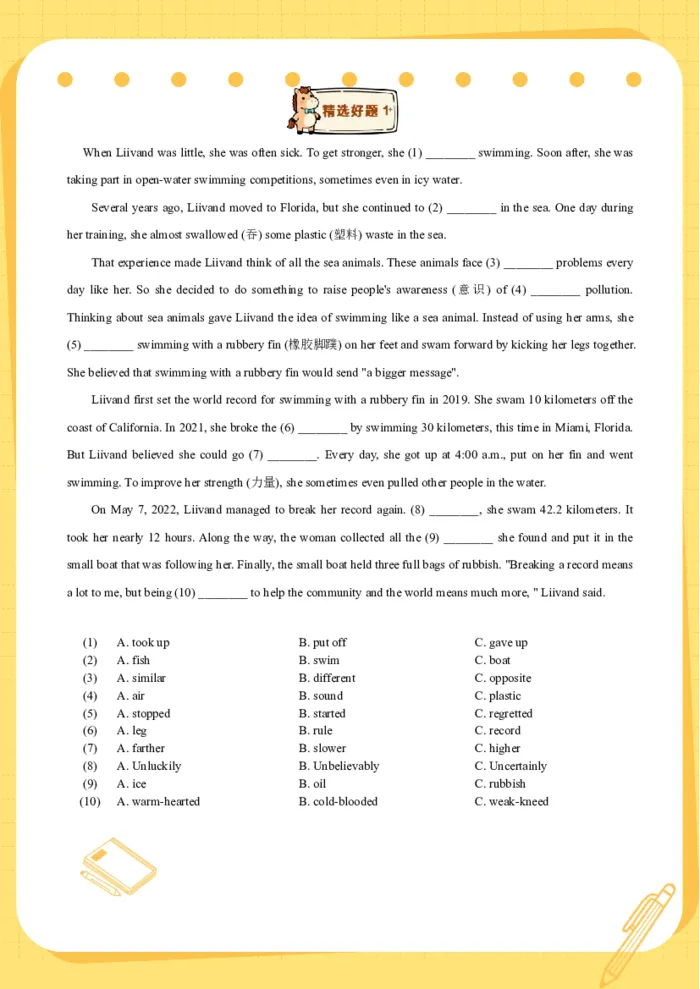
When Liivand was little, she was often sick. To get stronger, she (1) ________ swimming. Soon after, she was
taking part in open-water swimming competitions, sometimes even in icy water.
Several years ago, Liivand moved to Florida, but she continued to (2) ________ in the sea. One day during
her training, she almost swallowed (吞) some plastic (塑料) waste in the sea.
That experience made Liivand think of all the sea animals. These animals face (3) ________ problems every
day like her. So she decided to do something to raise people's awareness ( 意识) of (4) ________ pollution.
Thinking about sea animals gave Liivand the idea of swimming like a sea animal. Instead of using her arms, she
(5) ________ swimming with a rubbery fin (橡胶脚蹼) on her feet and swam forward by kicking her legs together.
She believed that swimming with a rubbery fin would send "a bigger message".
Liivand first set the world record for swimming with a rubbery fin in 2019. She swam 10 kilometers off the
coast of California. In 2021, she broke the (6) ________ by swimming 30 kilometers, this time in Miami, Florida.
But Liivand believed she could go (7) ________. Every day, she got up at 4:00 a.m., put on her fin and went
swimming. To improve her strength (力量), she sometimes even pulled other people in the water.
On May 7, 2022, Liivand managed to break her record again. (8) ________, she swam 42.2 kilometers. It
took her nearly 12 hours. Along the way, the woman collected all the (9) ________ she found and put it in the
small boat that was following her. Finally, the small boat held three full bags of rubbish. "Breaking a record means
a lot to me, but being (10) ________ to help the community and the world means much more, " Liivand said.
(1)
A. took up
B. put off
C. gave up
(2)
A. fish
B. swim
C. boat
(3)
A. similar
B. different
C. opposite
(4)
A. air
B. sound
C. plastic
(5)
A. stopped
B. started
C. regretted
(6)
A. leg
B. rule
C. record
(7)
A. farther
B. slower
C. higher
(8)
A. Unluckily
B. Unbelievably
C. Uncertainly
(9)
A. ice
B. oil
C. rubbish
(10)
A. warm-hearted
B. cold-blooded
C. weak-kneed
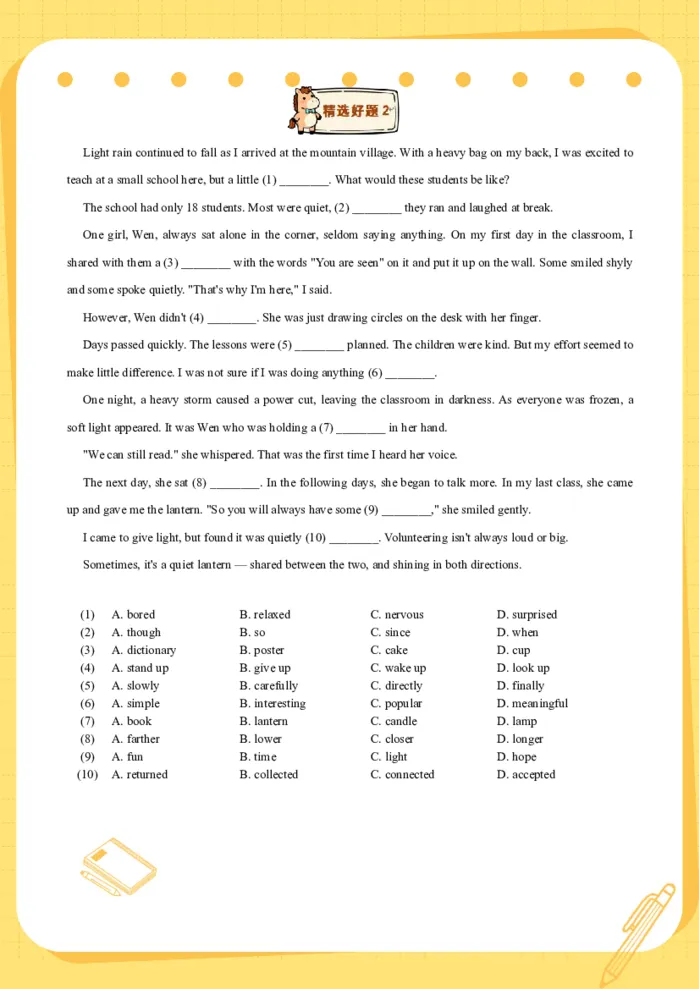
Light rain continued to fall as I arrived at the mountain village. With a heavy bag on my back, I was excited to
teach at a small school here, but a little (1) ________. What would these students be like?
The school had only 18 students. Most were quiet, (2) ________ they ran and laughed at break.
One girl, Wen, always sat alone in the corner, seldom saying anything. On my first day in the classroom, I
shared with them a (3) ________ with the words "You are seen" on it and put it up on the wall. Some smiled shyly
and some spoke quietly. "That's why I'm here," I said.
However, Wen didn't (4) ________. She was just drawing circles on the desk with her finger.
Days passed quickly. The lessons were (5) ________ planned. The children were kind. But my effort seemed to
make little difference. I was not sure if I was doing anything (6) ________.
One night, a heavy storm caused a power cut, leaving the classroom in darkness. As everyone was frozen, a
soft light appeared. It was Wen who was holding a (7) ________ in her hand.
"We can still read." she whispered. That was the first time I heard her voice.
The next day, she sat (8) ________. In the following days, she began to talk more. In my last class, she came
up and gave me the lantern. "So you will always have some (9) ________," she smiled gently.
I came to give light, but found it was quietly (10) ________. Volunteering isn't always loud or big.
Sometimes, it's a quiet lantern — shared between the two, and shining in both directions.
(1)
A. bored
B. relaxed
C. nervous
D. surprised
(2)
A. though
B. so
C. since
D. when
(3)
A. dictionary
B. poster
C. cake
D. cup
(4)
A. stand up
B. give up
C. wake up
D. look up
(5)
A. slowly
B. carefully
C. directly
D. finally
(6)
A. simple
B. interesting
C. popular
D. meaningful
(7)
A. book
B. lantern
C. candle
D. lamp
(8)
A. farther
B. lower
C. closer
D. longer
(9)
A. fun
B. time
C. light
D. hope
(10)
A. returned
B. collected
C. connected
D. accepted
Yesterday was the Mid-Autumn Festival. I went out to (1) ________ the celebrations with my best friend,
Liu Lin. We saw a wonderful (2) ________ on the Central Square. Liu Lin told me it was called Datiehua (打铁
花) , a traditional art in China.
When the (3) ________ came, a man scooped up the molten iron (舀起熔化的铁) and threw it into the sky.
At the same time, the other man hit it hard with a board. This brought a shower of sparks (火花). It was beautiful
and it (4) ________ like fireworks (烟花). The whole square was bright (5) ________ the sparks were shining in
the night sky. All the people couldn't help cheering for the two (6) ________.
Liu Lin told me that Datiehua had a (7) ________ history. It started in the Northern Song Dynasty. In the past,
fireworks were too expensive for people, so they (8) ________ Datiehua. During the Ming and Qing dynasties, it
got (9) ________. People considered it as a sign of good luck.
As time goes (10) ________, Datiehua has been a tradition in some areas in China. I'm proud that we
Chinese people are so clever that we have made so many fantastic things.
(1)
A. stop
B. enjoy
C. change
(2)
A. show
B. sale
C. speech
(3)
A. afternoon
B. morning
C. night
(4)
A. smelled
B. looked
C. tasted
(5)
A. though
B. unless
C. when
(6)
A. men
B. women
C. children
(7)
A. modern
B. long
C. fresh
(8)
A. created
B. grew
C. fixed
(9)
A. boring
B. deep
C. popular
(10)
A. off
B. by
C. up
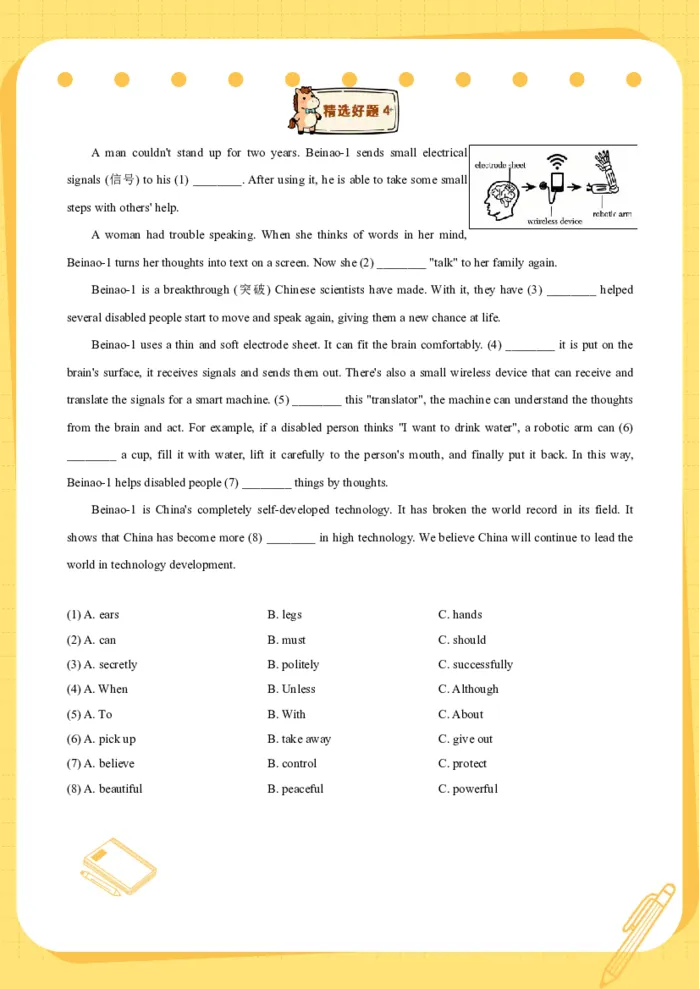
A man couldn't stand up for two years. Beinao-1 sends small electrical
signals (信号) to his (1) ________. After using it, he is able to take some small
steps with others' help.
A woman had trouble speaking. When she thinks of words in her mind,
Beinao-1 turns her thoughts into text on a screen. Now she (2) ________ "talk" to her family again.
Beinao-1 is a breakthrough (突破) Chinese scientists have made. With it, they have (3) ________ helped
several disabled people start to move and speak again, giving them a new chance at life.
Beinao-1 uses a thin and soft electrode sheet. It can fit the brain comfortably. (4) ________ it is put on the
brain's surface, it receives signals and sends them out. There's also a small wireless device that can receive and
translate the signals for a smart machine. (5) ________ this "translator", the machine can understand the thoughts
from the brain and act. For example, if a disabled person thinks "I want to drink water", a robotic arm can (6)
________ a cup, fill it with water, lift it carefully to the person's mouth, and finally put it back. In this way,
Beinao-1 helps disabled people (7) ________ things by thoughts.
Beinao-1 is China's completely self-developed technology. It has broken the world record in its field. It
shows that China has become more (8) ________ in high technology. We believe China will continue to lead the
world in technology development.
(1) A. ears
B. legs
C. hands
(2) A. can
B. must
C. should
(3) A. secretly
B. politely
C. successfully
(4) A. When
B. Unless
C. Although
(5) A. To
B. With
C. About
(6) A. pick up
B. take away
C. give out
(7) A. believe
B. control
C. protect
(8) A. beautiful
B. peaceful
C. powerful
When I was at school, I didn't think I was good at anything. The other children learned things (1) ________,
but I didn't. The only thing that (2) ________ me were cars. I spent ages looking at how my grandpa's old car
worked. But my mom wasn't interested in cars at all, and she was (3) ________ me going on about them all the
time.
One day, there was a school trip. I woke up early to (4) ________ the bus. We were going down the road
when the bus suddenly (5) ________; I thought we had run out of petrol, but the driver told us there was
something (6) ________ with the engine and he would have to call the garage. I (7) ________ to see for myself
and soon worked out what to do: I just needed to put back a cable. After ten minutes, the bus was on the road
again. And everyone in the bus (8) ________ me.
After that, I realized there was something I could (9) ________. When I left school, I (10) ________ my own
car repair business. Now, I'm doing really well.
(1)
A. carelessly
B. openly
C. nervously
D. quickly
(2)
A. feared
B. interested
C. broke
D. trembled
(3)
A. tired of
B. proud of
C. patient with
D. pleased with
(4)
A. park
B. repair
C. drive
D. catch
(5)
A. arrived
B. left
C. stopped
D. appeared
(6)
A. common
B. wrong
C. new
D. similar
(7)
A. offered
B. failed
C. forgot
D. refused
(8)
A. collected
B. guarded
C. praised
D. controlled
(9)
A. mix
B. do
C. add
D. dry
(10)
A. set up
B. heard of
C. called at
D. gave away
Graduation party was a great success! All my friends received wonderful (1) ________: a diamond, a watch,
or something else special. I was wondering what surprise my family (2) ________ for me.
And when I got home — there was the pink dresser set (梳妆盒)! The one in Mr. Schiller's store that I always
(3) ________! Mama and Papa smiled at my excitement.
The next morning, I (4) ________ my wonderful dresser set to my sister Christine. She looked at me and said,
"So you (5) ________ what you wanted. Guess what Mama exchanged for that. Her silver brooch (胸针)!"
"What? That's the only thing her mother (6) ________ her! If I knew — I would never let her — "I started to
cry then, and Papa (7) ________ my shoulder gently. "Mama wanted you to be (8) ________, more than she
wanted the brooch."
I knew what I must do. And on my way to the store, I thought of how (9) ________ it was for Mama to ask
Mr. Schiller to take the brooch as payment (抵偿).
Mr. Schiller (10) ________ the dresser set carefully. Bravely, I asked, if he would give me back the brooch, I
would work for him every (11) ________ day of my summer vacation. He kindly agreed. It was not so hard as I
(12) ________.
I left the store not only with Mama's brooch, but with a (13) ________ that started tomorrow. I felt very (14)
________. It seemed that the dresser set (15) ________ became a childish and silly thing.
I pinned (用针别住) the brooch on my dress. I would keep it forever.
(1) A. cakes
B. flowers
C. presents
D. letters
(2) A. prepared
B. imagined
C. built
D. recorded
(3) A. carried
B. admired
C. owned
D. collected
(4) A. lent
B. donated
C. returned
D. showed
(5) A. forgot
B. bought
C. got
D. controlled
(6) A. left
B. reminded
C. missed
D. taught
(7) A. pushed
B. shook
C. beat
D. touched
(8) A. careful
B. happy
C. confident
D. brave
(9) A. safe
B. important
C. difficult
D. smooth
(10) A. repaired
B. checked
C. made
D. decorated
(11) A. sunny
B. lucky
C. ideal
D. single
(12) A. thought
B. proved
C. required
D. wished
(13) A. smile
B. trip
C. hobby
D. job
(14) A. lost
B. tired
C. proud
D. nervous
(15) A. recently
B. suddenly
C. highly
D. properly
It was a lovely morning, a perfect start for Jack's birthday. Mum and Dad prepared a birthday cake and a
basket of food. Jack carried the cake himself. The whole family got into the car and headed for the (1) ________.
After arriving there, Mum and Dad found a nice place for a picnic. They put up the tent and spread out the
beach blanket (毯子). Jack (2) ________ the cake and played the game, Treasure Hunt, with his parents on the
beach.
When it was time for lunch, Dad went back to the car to (3) ________ the basket of food. But it wasn't there.
Dad said Mum put it in the car. Mum said Dad did it. They became (4) ________.
"No worry, Mum and Dad," Jack broke the silence. "We can still (5) ________ the cake."
Mum picked the cake up, but tripped (绊) over the blanket. The cake fell onto the sand.
"No way can we eat the cake now," Mum sighed (叹气).
"Mum, I'm not hungry yet," Jack said.
A moment later, dark clouds came and it began to rain. The family (6) ________ packed up everything and
decided to leave.
Dad made a(n) (7) ________, "We'll have a big meal on the way home." But later they found the only
restaurant on the way back was closed. Mum and Dad were a little sad. Luckily, Jack (8) ________ many jokes
that could cheer them up.
When they got home, they saw the (9) ________, right there inside the front door.
"We can have a picnic now!" Jack said with joy.
"A perfect end for my (10) ________," Jack thought to himself. "Well, OK, maybe it wasn't quite 100%
perfect. But it was never boring!"
(1) A. beach
B. hill
C. farm
D. forest
(2) A. threw away
B. put down
C. gave back
D. held up
(3) A. fill
B. repair
C. choose
D. get
(4) A. silent
B. strict
C. busy
D. glad
(5) A. share
B. buy
C. show
D. cover
(6) A. lazily
B. secretly
C. quickly
D. strangely
(7) A. noise
B. mistake
C. answer
D. promise
(8) A. needed
B. guessed
C. forgot
D. knew
(9) A. tent
B. basket
C. treasure
D. cake
(10) A. game
B. morning
C. birthday
D. hunt
The sixth planet was ten times larger than the last one. There the little prince
met an old gentleman who was writing a big book.
"What is that big book?" said the little prince. "What are you doing? "
"I am a geographer," the old gentleman said to him. "And I am writing about all
the seas, mountains and deserts. "
"That is interesting," said the little prince. "So could you tell me something
about your planet? "
"I couldn't tell you," said the geographer. "But you are a geographer!"
"Exactly," the geographer said. "But I am not an explorer. We don't have any explorers here. I don't go out to
count the seas, mountains and deserts. Instead, I receive explorers from other planets in my study. I ask them
questions, and I write down their answers."
The geographer's eyes suddenly shone with excitement.
"But you, you come from far away! You are an explorer! You shall describe your planet to me!"
"Oh, where I live," said the little prince, "it is all so small. I have a flower on my planet."
"We do not record flowers," said the geographer.
"Why is that? The flower is the most beautiful thing on my planet!"
"We do not record them," said the geographer, "because they are ephemeral."
"What does that mean 'ephemeral'?"
"Geographies," said the geographer, "are the books about eternal things. The thing that matters to us is the
mountain. It doesn't change. But your flower is different.
"It will not last long. It is ephemeral."
"My flower is ephemeral, "the little prince said to himself, "and I have left her on my planet, all alone!"
That was his first moment of regret. But he took courage and asked, —What place would you advise me to
visit now? "
"The planet Earth," replied the geographer.
"I promise you will like it."
And the little prince went away, thinking of his flower.
— Adapted from The Little Prince
(1) Where is this text most likely taken from?
A. A film poster.
B. A storybook.
C. A travel guide.
D. A news report.
(2) What can we learn about the geographer?
A. He knows his planet well.
B. He collects explorers' experiences.
C. He loves reading a large book.
D. He has been to many other planets.
(3) What does the underlined word "ephemeral" mean?
A. Staying the same.
B. Looking beautiful.
C. Lasting a short time.
D. Sounding interesting.
(4) What can we learn from the text?
A. One flower doesn't bring spring.
B. A good book is a light to the mind.
C. We should protect our home planet—Earth.
D. You can find beauty even if it doesn't last long.
It was difficult not to see the 8-year-old boy run in and out of his house repeatedly. His repeated actions caused
the curiosity of his neighbor, William Dunn.
"He said he didn't have a father," says Dunn, now aged 58. "And I realized that there might be something I
could do to help him. "
That "something" was fishing, a hobby that Dunn's father had once shared with him. He did it at once. After
fishing together several times, Dunn saw encouraging changes in the boy's behavior.
That was 16 years ago. Since then, Dunn has taken groups of fatherless kids fishing almost every weekend,
teaching them how to set up a fishing line and bring in a big catch.
"They've been through a lot, and their lives have been challenging," Dunn explains. "But when they're fishing,
all those pains disappear. On the boat, they laugh, smile, and make new friends. I knew I was onto something
special."
Jayden, now 23, has become a fisherman and thanks Dunn for helping him grow up. He proudly mentions
catching a shark with Dunn's help, "I hope he knows that I mean it when I say thank you."
Another girl, 21-year-old Bella Smith, who is in a foster (抚养) program for young adults, notes that Dunn
pays special attention to self-respect and spiritual strength. "When I'm fishing, I can forget about the past and
enjoy something fun," says Bella Smith. "Fishing has taught me that I can have a better life than what I had.
Whenever I feel down, I know it's time to go fishing."
"There's nothing like feeling the first pull on the line and seeing a kid's face light up with a smile," Dunn adds.
"I feel lucky to witness that every weekend."
(1) What do we know about the 8-year-old boy?
A. He didn't like fishing.
B. His father was a fisherman.
C. He was the first child Dunn taught to fish to help.
D. His repeated actions were to catch his father's attention.
(2) Why did Dunn take children fishing almost every weekend?
A. His father told him to do so.
B. He wanted to help them live on fishing.
C. Their fathers didn't want them to learn fishing.
D. He believed fishing could help them in some way.
(3) What does Bella Smith think Dunn gives importance to?
A. Personality development.
B. Fishing skills.
C. Unhappy experiences.
D. Wealthy life.
(4) Which of the following can best describe Dunn?
A. Hard-working.
B. Caring.
C. Romantic.
D. Strict.
For centuries, Chinese people have been growing, picking, making, and enjoying tea. This has led to different
types of tea — green tea, white tea, oolong tea and so on. People drink and share these teas. These traditions have
been passed down through generations and played an important part in everyday life in China. Let's look at how
oolong tea is made.
Sun-drying
Sun-drying is a way of letting the tea leaves dry. People put the tea leaves in the dustpans (簸箕) and put
them under the sun. This step is important for making good tea. It doesn't just get rid of water from the leaves; it
also makes a series of chemical changes happen. These changes make it possible for the next step, where the tea
leaves get shaken up.
Shaking
Oolong tea has a special aroma (芳香) because of a step called "shaking". During the step, tea makers gather
many tea leaves, shaking them together. This makes the tea leaves taste less bitter and lets out the aromas from the
tea leaves.
Frying
Because of shaking, the tea leaves have less water now. Next, it's important to use just the right high
temperature to stir — fry (翻炒) the leaves quickly. Cook the tea leaves until they get soft and curl. This step helps
get rid of water and make the tea smell even better.
Baking (烘焙)
Baking is the last step when making tea. By doing it, we get rid of extra water in the tea leaves. Oolong tea
isn't baked just once. When we bake the tea, we have to pay attention to how the leaves are changing and adjust
the heat from time to time. We start with a high temperature and then lower it. Stirring during baking can make the
tea look better, smell nicer, and taste greater!
(1) What's the main purpose of paragraph 1?
A. To talk about different kinds of tea.
B. To show which tea is the most popular.
C. To explain why Chinese people love tea.
D. To raise people's interest in learning about tea.
(2) Which picture best describes the second step?
A.
B.
C.
D.
(3) What can we learn about baking?
A. It is the most important step.
B. It takes place more than once.
C. It works at a certain temperature.
D. It happens before frying the tea leaves.
(4) What takes place in all the four steps?
A. Setting the right temperature.
B. Stirring the tea leaves quickly.
C. Removing water from the tea leaves.
D. Shaking the tea leaves from time to time.
(5) What's the best title of the passage?
A. The art of making oolong tea.
B. The development of oolong tea.
C. Making tea — a tradition in China.
D. Steps in making different kinds of tea.
①Everybody enjoys acts of kindness. But can you explain why? Some people think kindness is something out
of love and care, while others believe it is just a tool that we use to become more popular. But research shows that
being kind can activate (激活) an area of the brain called Striatum. Research also shows that kindness improves
people's mood. But why and how does it happen? Here are a number of different ways.
②Being kind can make someone smile. If you see yourself smile in a situation, people around may be smiling,
too. This is especially true for your close friends and family. A kind act makes someone who is sad feel better. It
can also make ourselves feel good. So why not set off that chain (链条) of good feelings to people around?
③Secondly, being kind starts or develops a social connection with others. Kind acts like buying someone a
present make friendships stronger. Research has shown that spending money on others may help you get a
stronger feeling of happiness than spending it on yourself. Similarly, charities also open up new circles of people
to connect with someone on the other side of the world.
④In another recent research, even children in their first year of secondary school know how being kind makes
them feel happy. If one person is kind, he or she makes others in the group kind. It also lifts everyone's spirits.
Imagine that you make cakes for the office and it makes others do it each month. Then you're getting cakes a lot
more days than providing them.
⑤All in all, being kind may improve your mood, but research has also shown that if you're in a good mood,
you can act much more kindly. This makes it a wonderful two-way relationship, doesn't it?
(1) The writer leads in the topic by ________.
A. telling a story
B. asking questions
C. giving examples
D. making a survey
(2) What is Paragraph 4 mainly about?
A. The way how kindness can make people happy.
B. The way why kindness can make people happy.
C. A story why happy children can act more kindly.
D. A story how happy children can act more kindly.
(3) Which of the following statement is NOT mentioned in this article?
A. Being kind could improve your mood.
B. Being kind can help you get good grades.
C. A kind act can make people around happy.
D. A kind act can lift everyone's spirits in a group.
(4) Which of the following best shows the structure of the passage?
A.
B.
C.
D.
For many people, having a cup of coffee right out of bed is the best way to start a day. But a report from Asap
Science says otherwise. It says the worst time for coffee is soon after we get up. When we wake up, our bodies
start to make cortisol (皮质醇).
Cortisol helps us to think clearly and be quick to understand and act. The cortisol levels rise after we wake up
and climb to the highest in about an hour. So there are two problems when we drink coffee during this time: our
bodies will make less cortisol, and the cortisol will make coffee less useful. And that's why some of us drink more
and more coffee. Then, when's the best time to have coffee? When the cortisol levels are going down, the report
says. Cortisol levels are usually highest between 8 a. m. and 9 a. m., between noon and 1 p. m., and between 5:30
p. m. and 6:30 p. m. So if you want to have coffee, enjoy it after these times, and this popular drink will help you
the most.
Three people read the news and wrote what they thought about it.
What do you think?
Mike: The best time to drink coffee is when you want to drink coffee.
Sarah: I often wake up after I drink coffee.
Charlie: If you need someone to tell you when to drink coffee, well, that's just sad.
(1) The underlined word "otherwise" in Paragraph 1 probably means the report ________.
A. has different ideas
B. has nothing to do with it
C. is made up
D. has the same idea
(2) The picture shows how the cortisol levels rise and fall during a day. From the passage, which is a good time
for coffee?
(3) What did three people think of the news?
A. They wanted to try what it said.
B. They were sad about what it said.
C. They disagreed with what it said.
D. They took what it said seriously.
(4) Which idea is talked about in the passage?
A. How often we should drink coffee.
B. What happens when we have too much coffee.
C. How to help the body make the cortisol we need.
D. What happens when we have coffee at the wrong time.
One morning, I stopped at my favorite restaurant to get something to eat
and got comfortable at a small table. Shortly after, I noticed four young
people sitting at a table near me. After simply greeting each other and
ordering, they all looked at their phones and continued to do so until their
orders arrived. After photographing their food, they ate, continuing to look at
their phones. I was wondering why they came here to eat together. They were
phubbing, or phone snubbing (冷落), a very common problem these days.
You may not know the word "phubbing", but this kind of act is not strange to you. In fact, 32% of people
report that they are phubbed two or three times a day.
Do you have a conversation on your phone while talking to another person face to face? Do you scroll (上下滑
动) through your phone while eating with someone for fear of missing out? If your answer is yes to either of them,
you might be a "phubber".
The writer of The Psychology of Phubbing did a survey and found that the influence of phubbing on
relationships can be very harmful or destructive. For example, children felt that parents who phubbed them didn't
care about them. This led to a feeling of being left out. Also, partners who were phubbed might be less satisfied
with the relationship because of jealousy (嫉妒) and worries.
Phubbing is a learned act, so unlearning it is possible. Start by accepting the problem. Set a time limit for not
using your phone. Create areas where phones are off-limits.
Don't let the modern technology which is designed to bring people together separate you from others.
(1) What did the four young people keep doing before their orders arrived?
A. Greeting each other.
B. Looking at their phones.
C. Photographing their food.
(2) How does the writer introduce the word "phubber" in Paragraph 3?
A. By raising questions.
B. By listing numbers.
C. By giving reasons.
(3) What does the underlined word "destructive" in Paragraph 4 mean?
A. 微乎其微的
B. 积极正向的
C. 有破坏性的
(4) What is the main purpose of the text?
A. To warn people against phubbing.
B. To show how phones bring people closer.
C. To present the advantages of modern technology.
In a small village, there was a wise old man named Ryan. One day his young nephew (侄子) Keith came to
visit him. During their talk, Keith said he was sad and worried about his little progress in learning the guitar.
However hard he tried, he just couldn’t improve much.
Keith asked his uncle for advice. "Follow me." said Ryan, and he led Keith up to the high hills around the
village. This road was long and difficult, but Keith followed the old man. As they got higher. Ryan said that he
needed to go to the top of the highest hill where he had never been to. Keith was surprised but decided to help his
uncle.
With great difficulty, Keith helped his uncle climb the hill. Sometimes he even carried the old man on his back.
At the top, sweating (流汗), he put his uncle back on the ground and laughed with joy.
"Do you remember the times when you were a little boy? Sometimes you returned home with tears in your
eyes," said Ryan. "The other children teased (嘲笑) you. Do you remember why?"
Keith looked around and nodded. He remembered that as a child he often played on the hills with other
children. They called this hill Mount Impossible, because small children couldn't reach its top. "At that time, I was
unable to get here," said Keith. "The bigger kids had no problem."
"And today," said Ryan. "You not only climbed here, but also dragged me up."
"I became bigger and stronger."
"Instead of climbing Mount Impossible every day, you played on the smaller hills and became better at
climbing. You became stronger." said Ryan. "Mount Impossible became possible for you to climb while you
weren't even thinking about it."
(1) What made Keith sad and worried?
A. His guitar skill improved little.
B. It was tiring to practice the guitar.
C. He wasn’t big and strong enough.
D. Other children often laughed at him.
(2) How did Ryan and Keith climb up the highest hill?
A. Ryan carried Keith on the back.
B. They chose a smooth and short path.
C. Keith followed Ryan with great difficulty.
D. Keith tried different ways to drag Ryan up.
(3) To solve Keith’s problem, what did Ryan do on top of the hill?
A. He introduced some big kids to Keith.
B. He shared his own climbing experience.
C. He showed Keith around Mount Impossible.
D. He talked about Keith’s progress in climbing.
(4) What did Ryan want to tell Keith?
A. Rome was not built in a day.
B. There is no success without effort.
C. The future is what you make it.
D. Nothing is impossible for a wise man.
(2025•广东)配对阅读。左栏是五则向AI 提问的指引, 右栏是七个具体例子, 请为每则指引匹配对应
的例子。选项中有两项为多余选项。
(1) ________ Don't use general questions
when you ask AI for instructions. Instead,
ask it to give you clear steps.
(2) ________ Make no mistakes in your
question or you may not get correct answers.
(3) ________ AI can answer questions about
facts. But don't try to ask it for other people's
private information.
(4) ________ If you are not happy with a
painting or a song AI creates, give it more
instructions until you get what you like.
(5) ________ It's better to tell AI who you
are. In this way, you'll get answers, that meet
your needs.
A. If you are wondering about the population of Canada,
questions like "What is the popular of Canada?" will not get you
the correct answer.
B. Instead of asking "How do I cook a meal?" you can say "What
are the steps to make a pancake with a pan? "
C. If you tell AI "Guess if I'm happy today," it will fail to do it
because it has no ability to judge human feelings.
D. If you aren't satisfied with the picture AI draws, give more
requirements like "Please add a pink window and paint the walls
yellow".
E. For a student who wants to improve his English reading, it is
better to ask questions like "How can I improve my English
reading as a Grade 9 student? "
F. If you ask "Could you tell me the address of my desk-mate
Mary?" AI will refuse to give you the answer because it is
designed to protect people's personal information.
G. A question like "Will it be nice tomorrow for jogging
outside?" should be changed into "What is the weather like
tomorrow?"
(2025•兰州)任务型阅读。
From Tradition to the Modern
Customs and Tradition
During the Dragon Boat Festival, Chinese always put mugwort leaves on doors
or windows to make the air fresh and keep flies and other insects away. Mugwort, a
kind of plant, is highly valued for its medical use in TCM (Traditional Chinese
Medicine). Chinese have been making use of herbs (草药) like mugwort to help
people improve health or treat illness for thousands of years.
_____________
Nowadays, we are seeing more interest in TCM especially among the young. ①Influenced by
TCM ideas, some young people stop having icy drinks. They accept hot Chinese herbal tea, instead.
When people feel ill, some choose to go to TCM hospitals and clinics for treatment. With the spread
of TCM, some schools start courses about it. For example, students learn to make joss sticks (线香)
with herbs in class. More TCM programs appear on TV and the Internet, which helps people form
better living habits.
Ideas and Spirit
In fact, the ideas of Traditional Chinese Medicine are everywhere around us. Following the
natural rules can make us healthier. As an old saying goes, "Early to bed, early to rise." TCM also
pays more attention to the balance of diet. Different colored foods are friendly to different parts of
the body. White food is good for lungs, red for heart…If a body is like a tree, TCM focuses on its
root. It aims at keeping the body and mind in harmony (和谐).
Chinese traditions are making a difference to our modern life.
(1) Where do Chinese put mugwort leaves during the Dragon Boat Festival?
_______________________________________________________________.
(2) 请根据文中①处的句意,补全下面的句子,使句意不变,完整通顺。(每空仅限一词)
Influenced by TCM ideas, some young people __________ __________ having icy drinks.
(3) What idea does the old saying "Early to bed, early to rise." tell us? (每空仅限一词)
We should follow the __________ __________.
(4) 请为第二段________处选择一个恰当的小标题。_____________________________
A. Science and Skill
B. Practice and Spread
(5) Share one of your healthy living habits based on TCM, and give the reason.
_______________________________________________________________.
(2025•贵州)任务型阅读(1-4 题不超过3 个词)
Jin Ying, 26, is a lover of Traditional Chinese Medicine (TCM). She took
part in a three-month training course on acupuncture and tuina (针灸推拿) in
the winter of 2023 at Beijing University of Chinese Medicine.
Jin's life has been different since the training. She changed her life habits
after learning the Five Elements theory. For example, she avoided sweating too
much during exercise in winter because the cold of winter means people should
slow down, according to TCM. For her, learning these skills and theories was not about becoming a
TCM doctor but rather about embracing (拥抱) a new lifestyle.
She is not an unusual example of young people becoming interested in TCM. A survey by
China Youth Daily showed that 93.3 percent of the 1,000 young people who took part had tried
different TCM treatments.
"I have seen a rising number of young people come to me for neck and back pains, which are
usually related to the elderly." said Ma Huifang, a TCM doctor at Guoyitang, a TCM hospital
affiliated with Beijing University of Chinese Medicine.
Between Western medicine and TCM, young people often choose TCM "because of its efficacy
(疗效)," according to Ma. Some people question why TCM treats the same illnesses with different
prescriptions. "This is actually an advantage of TCM, rather than a shortcoming, as it can be a more
accurate (精准的) treatment for different patients," Ma explained.
Younger age groups are embracing TCM, and, at the same time, TCM is also benefiting young
people. As Jin noted, "It helps young people understand Chinese medicine and learn why it is
believed to be a treasure of our Chinese culture. "
(1) ____________ in TCM
Jin's story
Jin (2) ____________ her life habits after a TCM training.
TCM knowledge helped her enjoy a new lifestyle.
Ma's words
More young people turn to Doctor Ma for help.
Young people (3) ____________ because of its efficacy.
TCM can offer accurate treatments to patients.
Conclusion
Young people are embracing TCM.
Young people benefit from TCM.
They realize TCM (4) ____________ of Chinese culture.
Will you try TCM? Why or why not?
(5) ___________________________________
(2025•长沙)任务型阅读。
One recent weekend, I decided to learn how to make jiaozi with my
grandmother. I thought it would be fun and easy at the very beginning, but soon it
came to me that it wasn't as simple as it looked.
At first, I didn't pay attention to the sharp knife while cutting vegetables. My
finger got cut because of my carelessness. Luckily, it wasn't serious. Grandma was
nervous, and quickly helped me clean the cut. "My poor little girl! Be careful next time!" said
Grandma softly. Through the painful lesson, I learned the hard way that safety should always come
first.
After that accident, I continued working with Grandma. We made the dough (面团), mixed the
filling, and started shaping the dumplings. However, I kept making mistakes. Some of my
dumplings were too thick, others were not properly sealed (封闭), and some even had too much
filling, making them difficult to close. It was so discouraging, but Grandma kept encouraging me.
Until noon, we had a plate full of dumplings — some are perfect, and some are a bit messy.
Dad ate my ugliest dumpling first. "Tastes better than it looks!" he laughed. Mom encouraged me,
"They're the most delicious dumplings I have ever had. I am so proud of you!"
Now I understand that making jiaozi isn't just about the final product; it is about learning
patience, having fun with my family, and improving through mistakes. Mistakes aren't signs of
weakness. Instead, they should be viewed as stepping stones to achievements.
(1) What did the writer think of making jiaozi at the very beginning?
_______________________________________________________________
(2) What happened to the writer's finger because of her carelessness?
_______________________________________________________________
(3) Did the writer give up making jiaozi after the accident?
_______________________________________________________________
(4) How do Mom's words sound?
_______________________________________________________________
(5) What does the writer view mistakes as?
_______________________________________________________________
(2025•陕西)任务型阅读。
Zhao Xiang is a seventh grader who loves music. He has a good voice and is in a singing club.
Recently, he had a problem. His school would hold a singing competition. His class teacher, Mr.
Yao, talked to the class and they decided to sing a chorus masterpiece*at the competition.
For the performance, Mr. Yao even invited his wife, a local musician, to guide the practice.
Zhao Xiang thought it was a good chance for him to show his talent.
At the first practice, things did not go as what Zhao Xiang had expected — he was too good to
join the others. The musician was not satisfied and Zhao Xiang felt bad. Mr. Yao saw everything
and he came up to Zhao Xiang and comforted him, "Please remember, Zhao Xiang, singing a
chorus is NOT one person's job. Everyone has to work together to achieve a good result." Zhao
Xiang realized that his voice would not help if he failed to work well with others.
Zhao Xiang changed his way of singing — he did not sing so loud as he used to, and his voice
became more mixed with the others'. He even helped the musician to train those who had trouble in
singing by showing them how to breathe (换气), how to control voice and sing gracefully. The
practice was hard, but everyone was happy with him — the class teacher, the musician, his
classmates, and even his parents — about his development!
At last, the Big Day came. The whole class was on the stage. They tried their best and they
made it! When the headmaster read out first prize, everyone jumped up and shouted with joy. They
threw Zhao Xiang up into the air. Zhao Xiang felt great because he knew he was not just singing for
himself but for the class as a team. He learned that teamwork is needed everywhere and that
teamwork is about trust and helping one another. He was so proud because he had done something
important for his class!
*A chorus masterpiece is a song that is well-known and is sung together by a group of people.
(1) What did the class decide to do at the competition?
They decided to ______________________ at the competition.
(2) How did Zhao Xiang feel at the first practice?
He felt ______________________.
(3) What does the writer mainly talk about in Paragraph 4?
About Zhao Xiang's ______________________ and the people's attitude to him.
(4) Who is "everyone" in Paragraph 5?
They are " ______________________ ".
(5) What can we learn from Zhao Xiang's experience? (The answer should be in no more than 8
words.)
We can learn that ______________________.
(2025•河北)任务型阅读。
We may have an interview for our volunteer work. And the following suggestions will help
make the interview a success.
We should do some research on the volunteer work. We can call the organization or visit its
website to find out some information about it. It's also important for us to think about what
questions the interviewers may ask. It will help us to keep the interview going smoothly.
When leaving for the interview, we must remember to take everything we need. And we're
supposed to be at the interview about 30 minutes early. It allows us to get ready for the interview.
Before we go into the interview room, we can take a deep breath to relax ourselves. When we
hear someone ask us to go inside, we can enter the room. We should greet the interviewers with a
smile and stand until they ask us to sit down.
In answering questions, we had better be confident to show our talent and skills. It's important
to look into the interviewers' eyes even if we are very nervous and shy. If we can't understand the
interviewers' questions, it's OK to ask the interviewers to explain them further.
Before the interview is over, the interviewers usually invite us to ask some questions. We can
ask a question about the work or the interview. For example, "What kind of training do you offer to
volunteers?" We are supposed to thank the interviewers before we leave.
With these suggestions, we will have a good chance of getting volunteer work.
(1) How can we do research on the volunteer work?
_________________________________________
(2) Why are we supposed to be at the interview early?
_________________________________________
(3) What can we do to relax ourselves before we go into the interview room?
_________________________________________
(4) What should we do if we can't understand the interviewers' questions?
_________________________________________
(5) What question do you want to ask the interviewers before the interview is over? (Your
question should be different from the underlined one in the text.)
_________________________________________
(2025•南充)任务型阅读。
In the past, scientists didn't know that trees could sense things. Now they are discovering that
trees can notice lots of things around them!
Trees can feel the four main periods of the year. They know when to drop their leaves in
autumn, and when to grow new leaves in spring.
Trees can sense light. They know where the sun is, so their branches grow in that direction.
That's why trees in the northern hemisphere (半球) usually have more branches growing out on the
south side.
Trees can recognize insects. If an insect starts eating a tree of a certain species, the tree has
clever ways of fighting back. For example, if an insect is eating the trunk of a pine tree, the tree can
produce a glue-like liquid (液体), and use it to catch the enemy.
Trees can sense directions. They can feel where "up" and "down" are. There is no light down in
the earth, but the roots always know which way to grow.
Tree roots can also sense sounds. They really like the sound of running water when they are
thirsty. If the sound continues for a long time, the roots will slowly start growing towards it.
There are still many things we don't know about trees. Scientists are working hard to find out
more.
(1) ________________________________
(2) ________________________________
(3) ________________________________
(4) ________________________________
(5) ________________________________
第一篇
阅读短文,在空白处填入一个适当的单词或用括号内所给词的正确形式填空,使短文通顺、连贯。
At the 2025 CCTV Spring Festival Gala, Li Ziqi amazed everyone with her elegant look and her special
clothes. Her outfit (装束) combined 13 traditional Chinese crafts, showing how old skills can still be beautiful and
(1) ________ (mean) today.
Her dress was made using natural dyes (染料) from plants, giving it soft, natural colors which show respect
for nature. The patterns on her dress were made with Nanjing Yunjin, (2) ________ famous type of silk known for
its detailed designs. Each pattern told a story from history. The back of her dress had butterfly wings (3) ________
(make) with skills from Weifang kites and gold thread work, making her look both lively and (4) ________ (art).
Her accessories (配饰) were also special. She (5) ________ (wear) traditional Chinese knots, Beijing silk
flowers, Qing Shen bamboo art, and Ying Shan wrapped flowers, each showing a different part of Chinese culture.
Her hair was decorated with a flower made from peony porcelain and other pieces that used mother-of-pearl and
Chengdu lacquer art, adding more beauty (6) ________ her look.
Li Ziqi’s (7) ________ (appear) was not just about looking good; it was a way to show how traditional
crafts can be part of modern life. By (8) ________ (mix) old skills with new ideas, she helped people see the value
of keeping these traditions alive. Her creativity reminds us that our cultural heritage (遗产) is not just something
from the past — it can still inspire (9) ________ connect us today. Through her work, we can see how important it
is to protect and share (10) ________ (us) traditions with the world.
1. ____________ 2. ____________ 3. ____________ 4. ____________ 5. ____________
6. ____________ 7. ____________ 8. ____________ 9. ____________ 10. ____________
精选好题1
第二篇
阅读下面短文,在空白处填入1 个适当的单词或括号内单词的正确形式。
China is testing self-driving taxis in the busy streets of Wuhan. Some people worry that self-driving taxis
may do harm (1) ________ our society because they may be unsafe and leave some drivers jobless.(2) ________
report in March said that AI could do a quarter of all the work that humans could do. Now, in Europe and America,
with the (3) ________ (develop) of AI, 300 million people may lose (4) ________ (they) jobs.
(5) ________ it’s not all bad news. Scientists say that there (6) ________ (be) still some jobs that AI can’t
do now. The first jobs are (7) ________ (real) creative: people should come up with new ideas from time to time.
The second jobs need people (8) ________ (have) a very deep understanding of interpersonal ( 人际的)
relationships. The third jobs require people’s (9) ________ (nature) talents and wonderful skills in handwork (手
艺), such as artists.
In short, finding a job that fits the changes of society is a good way to avoid (10) ________ (lose) jobs.
1. ____________ 2. ____________ 3. ____________ 4. ____________ 5. ____________
6. ____________ 7. ____________ 8. ____________ 9. ____________ 10. ____________
精选好题2
第三篇
阅读下面短文,在空白处填入一个适当的词,或填入括号中所给单词的正确形式。
China’s first Triple-A video game (1) ________ (introduce) to the public on Tuesday, thrilling gamers
around the world.
The game, Black Myth: Wukong, an action role-playing game developed by Shenzhen-headquartered Game
Science, was inspired by the amazing variety of Chinese mythology and the 16th-century influential novel
Journey to the West, one of the four great classic (2) ________ (novel) of Chinese literature. It is infused (充满)
with traditional Chinese cultural elements, offering gamers a novel experience of Chinese imagination and
landscape.
In the game, players step into the shoes of the iconic Sun Wukong, also known (3) ________ the Monkey
King, who is (4) ________ leading hero in the novel, as they navigate his epic adventures westward.
As the game combines ancient dialogue and a worldview that blends (融合) Confucianism, Buddhism (5)
________ Taoism, players are immersed in an environment in which simply strolling leisurely or sitting alone by
a cold rivet offers its own unique (6) ________ (pleasant).
Feng Ji, Game Science founder and CEO, (7) ________ (say) in a recent interview with Xinhua News
Agency that “the script and artistic concepts always take the lead, seamlessly incorporating Chinese stories and
classical cultural elements into the game”.
Feng emphasized that the game was designed (8) ________ (entire) by a Chinese team, with the aim of (9)
________ (bring) Chinese stories to the global gaming stage.
When choosing to develop a game based on mythology, the developers do not consider (10) ________ a
theme is “popular or outdated”, Feng said, but reflect instead on whether the subject excites them. Feng added that
his team aimed to go beyond the myths and also learned from other excellent games.
1. ____________ 2. ____________ 3. ____________ 4. ____________ 5. ____________
6. ____________ 7. ____________ 8. ____________ 9. ____________ 10. ____________
精选好题3
第四篇
根据短文内容及所给首字母提示写出所缺单词,使短文意思完整,每空一词。
In the digital (数字) age, you may think that people no longer need a paper calendar. However, I (1) s________
prefer it. At the end of a year, I always search for a perfect one. It'll be on my desk for the next twelve (2)
m________.
Then comes January 1st, I (3) o________ my new calendar. 365 fresh pages look at me, and they seem to
whisper, "Let's get started!" You can circle important dates like birthdays or exams. Day by day, each new page
cheers me on, reminding me of every (4)v________ moment.
There's something else about paper calendars. With photos of popular tourist attractions or excellent paintings
(5) i________, they offer an escape (逃离) from the daily hard work. Though it's just for a short (6) p ________,
they take your mind to other places, calming and refreshing your brain.
Also, you get to learn some (7) k________. Take the popular Palace Museum Calendar for example. Each page
is a mini work of art. The 2025 calendar (8) i_________ more than 400 objects from the museum's large
collection. (9) W________ you turn a page, there's a new cultural treasure to discover. Over time, you can be a
little "art historian".
Why don't you (10) a________ a paper calendar to your desk? It won't simply tell you the date. It will also be a
beautifully designed buddy for the year ahead. Some "old" traditions are just too good to let go!
1. ____________ 2. ____________ 3. ____________ 4. ____________ 5. ____________
6. ____________ 7. ____________ 8. ____________ 9. ____________ 10. ____________
精选好题4
第五篇
阅读短文,从方框中选出恰当的单词并用其适当形式填空,使短文通顺、意义完整。每空仅填一词,每词
仅用一次。
create around challenge good teach free smart cost solve itself
DeepSeek is a new AI company from China. Recently, it has become very popular. On January 20th, 2025,
DeepSeek introduced two new models. These models are very (1) ________ and can do many things. One of the
models, called DeepSeek-R1-Zero, is very special. It can (2) ________ math problems, write simple code, and
chat like humans. What’s special? It learns by practicing, not just reading examples.
DeepSeek-R1-Zero learns like students do homework. Other AIs need many examples to learn, but R1
improves by (3) ________. “It’s like (4) ________ a bird to fly,” said an engineer. “The more it tries, the (5)
________ it becomes.”
The AI is (6) ________ for schools and small businesses. A teacher in Vietnam said, “Now even villagers
can use AI without worrying about (7) ________ .”
But there are (8) ________. AI sometimes makes mistakes in languages like German or Russian. The team
is trying to fix this. “We want AI to help everyone (9) ________ the world,” they said.
DeepSeek’s success shows that China is getting better at making AI. It is changing the world of AI. It tells
us that great things come from (10) ________ and hard work, not just money.
1. ____________ 2. ____________ 3. ____________ 4. ____________ 5. ____________
6. ____________ 7. ____________ 8. ____________ 9. ____________ 10. ____________
精选好题5
Old new medicines
What should you do if you have a headache? In modern times, people often take aspirin (阿司匹林). But is
aspirin (1) ________ (actual) a modern medicine?
More than 4,000 years ago, ancient Egyptians used dried leaves to treat pain. And in the fourth century B. C.,
a medicine made from tree bark (树皮) (2) ________ (use) to treat fevers. In the nineteenth century, European
scientists discovered that both medicines have the same chemical (化学物质). They used the chemical to make a
modern medicine — aspirin. Today, it's one of the world's (3) ________ (cheap) and most helpful medicines.
Some of the medicines we have today come (4) ________ traditional Chinese medicine. In the third century
B.C., some people (5) ________ (begin) studying the human body. They tried many different ways to treat the
patients and recorded (6) ________ (they) results. For more than 2,000 years, doctors recorded (7) ________ they
found in books. These ancient books are still useful today. Tu Youyou, a Chinese medical researcher, found that in
(8) ________ past, people used a herb with yellow flowers to treat fevers. After studying it, she developed a
medicine that saved millions of people from dying.
For (9) ________ (century), Western medicine paid little attention to traditional Chinese medicine. But
today, scientists are studying traditional treatments (10) ________ (develop) new medicines.
1. ____________ 2. ____________ 3. ____________ 4. ____________ 5. ____________
6. ____________ 7. ____________ 8. ____________ 9. ____________ 10. ____________
精选好题6
第七篇
(1) It is ________ of you to send the message to the wrong person without checking. (careful)
(2) The yangko dance performed by the robots in the party is ________ amusing. (real)
(3) Lisa was ________ as the lead role in the school play last week. (choose)
(4) Instead of buying gifts, we enjoy making presents for friends ________. (we)
(5) Our school teaches ________ (safe) rules to prevent accidents.
(6) A DeepSeek ________ said, "We want AI to be a friend, not something only the rich can use." (工程师)
(7) Last year, she had the chance to go ________ to taste different cultures. (国外)
(8) Some scientists still believe the ________ planet exists and try to find it. (第九)
(9) The girl is ________ under the tree, enjoying the warm sunshine. (躺)
(10) My father is a very calm person but my mother is just the ________. (对立的人)
1. ____________ 2. ____________ 3. ____________ 4. ____________ 5. ____________
6. ____________ 7. ____________ 8. ____________ 9. ____________ 10. ____________
精选好题7