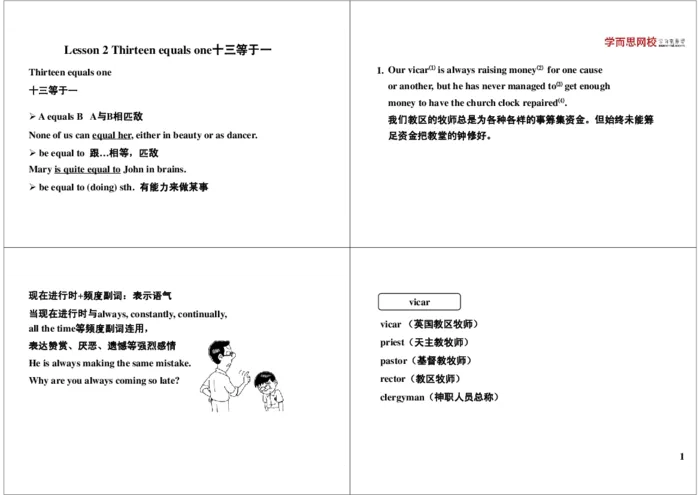
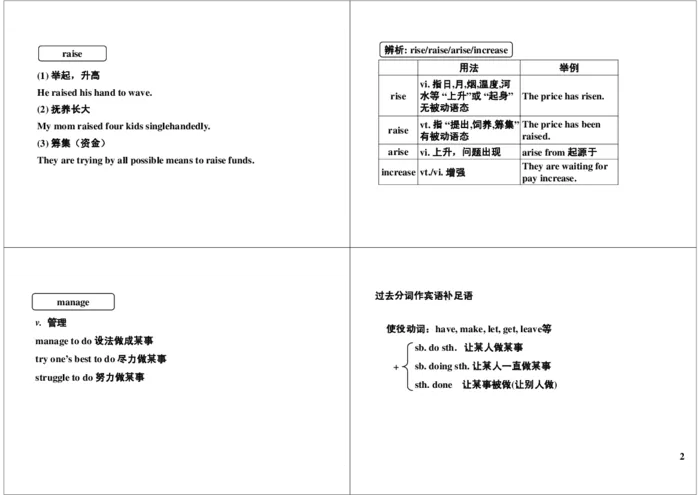
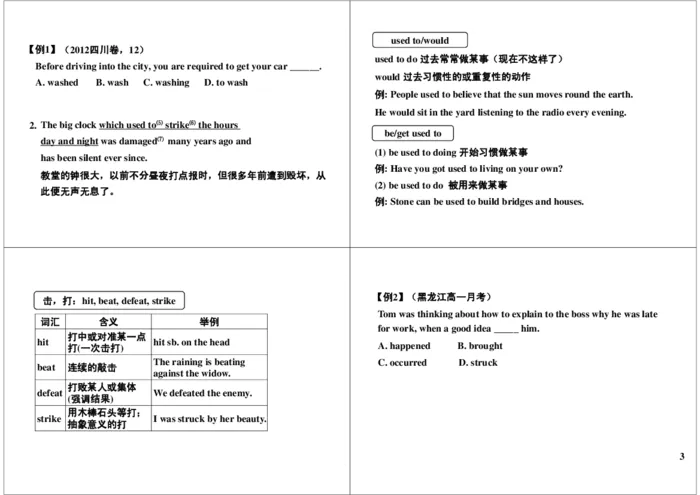
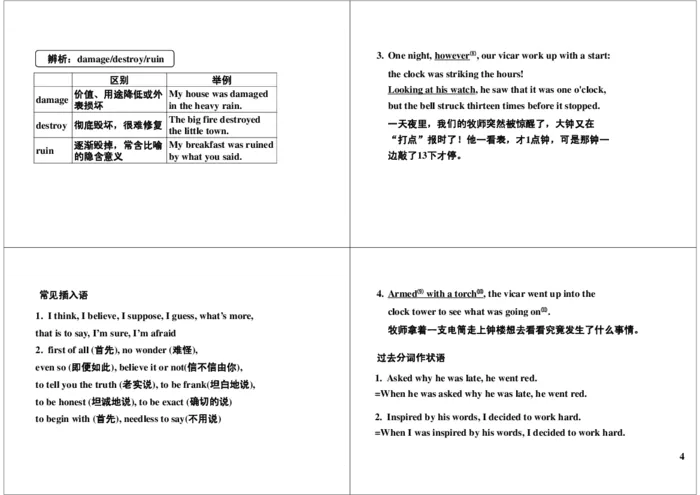
Thirteen equals one
十三等于一
A equals B A与B相匹敌
None of us can equal her, either in beauty or as dancer.
be equal to 跟…相等,匹敌
Mary is quite equal to John in brains.
be equal to (doing) sth. 有能力来做某事
Lesson 2 Thirteen equals one十三等于一
1. Our vicar⑴is always raising money⑵for one cause
or another, but he has never managed to⑶get enough
money to have the church clock repaired⑷.
我们教区的牧师总是为各种各样的事筹集资金。但始终未能筹
足资金把教堂的钟修好。
当现在进行时与always, constantly, continually,
all the time等频度副词连用,
表达赞赏、厌恶、遗憾等强烈感情
He is always making the same mistake.
Why are you always coming so late?
现在进行时+频度副词:表示语气
vicar (英国教区牧师)
priest(天主教牧师)
pastor(基督教牧师)
rector(教区牧师)
clergyman(神职人员总称)
vicar
1
(1) 举起,升高
He raised his hand to wave.
(2) 抚养长大
My mom raised four kids singlehandedly.
(3) 筹集(资金)
They are trying by all possible means to raise funds.
raise
辨析: rise/raise/arise/increase
用法
举例
rise
vi. 指日,月,烟,温度,河
水等“上升”或“起身”
无被动语态
The price has risen.
raise
vt. 指“提出,饲养,筹集”
有被动语态
The price has been
raised.
arise
vi. 上升,问题出现
arise from 起源于
increase vt./vi. 增强
They are waiting for
pay increase.
v. 管理
manage to do 设法做成某事
try one’s best to do 尽力做某事
struggle to do 努力做某事
manage
使役动词:have, make, let, get, leave等
+
过去分词作宾语补足语
sb. do sth. 让某人做某事
sb. doing sth. 让某人一直做某事
sth. done 让某事被做(让别人做)
2
(2012四川卷,12)
Before driving into the city, you are required to get your car ______.
A. washed B. wash C. washing D. to wash
【例1】
2. The big clock which used to⑸strike⑹the hours
day and night was damaged⑺many years ago and
has been silent ever since.
教堂的钟很大,以前不分昼夜打点报时,但很多年前遭到毁坏,从
此便无声无息了。
used to do 过去常常做某事(现在不这样了)
would 过去习惯性的或重复性的动作
例: People used to believe that the sun moves round the earth.
He would sit in the yard listening to the radio every evening.
used to/would
(1) be used to doing 开始习惯做某事
例: Have you got used to living on your own?
(2) be used to do 被用来做某事
例: Stone can be used to build bridges and houses.
be/get used to
击,打:hit, beat, defeat, strike
词汇
含义
举例
hit
打中或对准某一点
打(一次击打)
hit sb. on the head
beat
连续的敲击
The raining is beating
against the widow.
defeat 打败某人或集体
(强调结果)
We defeated the enemy.
strike 用木棒石头等打;
抽象意义的打
I was struck by her beauty.
【例2】(黑龙江高一月考)
Tom was thinking about how to explain to the boss why he was late
for work, when a good idea _____ him.
A. happened B. brought
C. occurred D. struck
3
区别
举例
damage 价值、用途降低或外
表损坏
My house was damaged
in the heavy rain.
destroy 彻底毁坏,很难修复The big fire destroyed
the little town.
ruin
逐渐毁掉,常含比喻
的隐含意义
My breakfast was ruined
by what you said.
辨析:damage/destroy/ruin
3. One night, however⑻, our vicar work up with a start:
the clock was striking the hours!
Looking at his watch, he saw that it was one o'clock,
but the bell struck thirteen times before it stopped.
一天夜里,我们的牧师突然被惊醒了,大钟又在
“打点”报时了!他一看表,才1点钟,可是那钟一
边敲了13下才停。
1. I think, I believe, I suppose, I guess, what’s more,
that is to say, I’m sure, I’m afraid
2. first of all (首先), no wonder (难怪),
even so (即便如此), believe it or not(信不信由你),
to tell you the truth (老实说), to be frank(坦白地说),
to be honest (坦诚地说), to be exact (确切的说)
to begin with (首先), needless to say(不用说)
常见插入语
4. Armed⑼with a torch⑽, the vicar went up into the
clock tower to see what was going on⑾.
牧师拿着一支电筒走上钟楼想去看看究竟发生了什么事情。
1. Asked why he was late, he went red.
=When he was asked why he was late, he went red.
2. Inspired by his words, I decided to work hard.
=When I was inspired by his words, I decided to work hard.
过去分词作状语
4
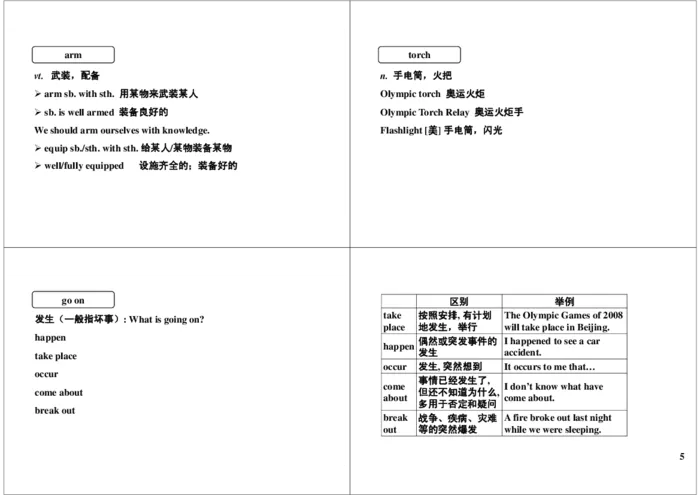
vt. 武装,配备
arm sb. with sth. 用某物来武装某人
sb. is well armed 装备良好的
We should arm ourselves with knowledge.
equip sb./sth. with sth. 给某人/某物装备某物
well/fully equipped 设施齐全的;装备好的
arm
n. 手电筒,火把
Olympic torch 奥运火炬
Olympic Torch Relay 奥运火炬手
Flashlight [美] 手电筒,闪光
torch
发生(一般指坏事): What is going on?
happen
take place
occur
come about
break out
go on
区别
举例
take
place
按照安排, 有计划
地发生,举行
The Olympic Games of 2008
will take place in Beijing.
happen 偶然或突发事件的
发生
I happened to see a car
accident.
occur
发生, 突然想到
It occurs to me that…
come
about
事情已经发生了,
但还不知道为什么,
多用于否定和疑问
I don’t know what have
come about.
break
out
战争、疾病、灾难
等的突然爆发
A fire broke out last night
while we were sleeping.
5
5. In the torchlight, he caught sight of⑿a figure⒀
whom he immediately recognized⒁as Bill Wilkins,
our local grocer.
借着电筒光。他看见一个人,马上认出那是本地杂
货店主经比尔.威尔金斯。
vt. 发现,看到
stare
glare
peep
peer
glance
glimpse
catch sight of
notice
recognize
spot
observe
catch sight of
figure
(1) n. 体型;身材;数字;
v. 计算;想象;认为
(2) have /keep a good figure 拥有/保持好身材
(3) figure out 理解;计算出
(4) figure sb. to be 料想某人是
(5) figure in 包括,算进
(6) figure on 期待,指望
(湖北)
The present situation is very complex, so I think it
will take me some time to _____ its reality.
A. make up B. figure out
C. look through D. put off
【例3】
6
(1) recognize sb. 认出某人
I recognized him immediately in the crowd.
(2) recognize sb. to be/as… 把某人认为成…
He was recognized as a successful businessman.
(3) recognize that 承认…
They refused to recognize that a wrong decision had
been made.
(4) recognize by/from 根据…辨认出…
(5) beyond recognition 面目全非
6. “Whatever are you doing up here Bill?” asked the
vicar in surprise⒂.
“你究竟在这上面干什么,比尔?”牧师惊讶地问。
“I'm trying to repair the bell,” answered Bill.
“I've been coming up ⒃here night after night for weeks
now. You see, I was hoping to give you a surprise.”
“我想把这口钟修好,”比尔回答说。“好几个星期了,
我天天夜里到钟楼上来。嗯,我是想让你大吃一惊。”
现在完成时p.k 现在完成进行时
现在完成时:动作已完成,描述事实;动作可能
间断过
I have seen that film.(看过电影,了解内容)
现在完成进行时:动作从未间断过,还将继续,
有强烈感情色彩
I have been waiting for you for a long time.(一直
等,持续到现在,带有强烈感情色彩)
7. “You certainly did⒄give me a surprise!” said the vicar.
“You've probably woken up everyone in the village
as well⒅. Still⒆, I'm glad the bell is working again.”
“你确实使我大吃了一惊!”牧师说,“也许同时你
把村里所有的人都吵醒了。不过,钟又能报时了,我
还是很高兴的。”
7
强调谓语动词,借助助动词do, did, does
例: Do come this evening.
Jack does study hard now.
I did call you last night.
对谓语动词的强调
【例4】(2010四川卷)
If you have a job, ______ yourself to it and finally you’ll succeed.
A. do devote B. don’t devote C. devoting D. not devoting
辨析:as well/also/too/either/likewise
also
比too正式一些,语气较重,只用于肯定句,
一般紧靠动词。
too
语气较轻,多用于口语,在肯定句中使用,
通常位于句末。
as well
一般不用否定句,通常放在句末,强调时
可放在句中。
either
用于否定句,放在句末,之前加逗号。
likewise 是书面语用词
写作技巧2:用转折制造悬念
The man spat into the lake.
The woman threw rubbish and talked loudly.
There was a sign “No Littering” nearby.
Although there was a sign “No Littering” nearby, the man spat into
the lake while the woman threw rubbish and talked loudly.
8
用高级词汇/短语替换
Although there was a︿sign “No Littering” nearby, the man spat into
the lake while the woman threw rubbish and talked loudly︿.
Although there was a noticeable sign “No Littering” nearby, the man
spat into the lake while the woman threw rubbish and talked loudly as if
they were the only people in the park.
8. “That's the trouble, vicar,” answered Bill. “It's
working all right, but I'm afraid that at one o'clock it will strike t
hirteen times and there's nothing
I can do about it.”
“问题就在这里,牧师”比尔回答说,“不错,钟能报时了,但
是恐怕每到1点钟,它总要敲13下,对此我已无能为力了。”
9. “We'll get used to⒇that, Bill,” said the vicar.
“Thirteen is not as good as(21) one, but it's better
than nothing(22) . Now let's go downstairs and
have a cup of tea.”
“大家慢慢就习惯了,比尔”牧师说,“13下是不如1下好,但总
比1下也不敲强。来,咱们下楼去喝杯茶吧。”
(1) as+原级+as
Tom is as old as Jim.
(2) not so/as+原级+as
He cannot run so/as fast as you.
(3) 否定词+比较级=最高级
I can't agree with you more.
我完全同意你。(再同意不过了)
比较级表达法
9
【例5】(2010,全国卷Ⅱ)
Mr. Black is very happy because the clothes made in his factory have
never been _______.
A. popular
B. more popular
C. most popular
D. the most popular
1.
写作技巧2:用转折制造悬念
2.
现在进行时+频度副词:表示语气
3.
过去分词做宾语补足语
4.
插入语的用法
5.
过去分词做状语
6.
现在完成时p.k 现在完成进行时
7.
对谓语动词的强调
8.
比较级表达法
斐斐点睛-Grammar
1.
equal
2.
vicar
3.
raise
4.
manage
5.
arm
6.
torch
7.
go on
斐斐小测-Vocabulary
8.
catch sight of
9.
figure
10. recognize
11. in surprise
12. wake up
13. as well
14. 辨析: rise/raise/arise/increase
15. 辨析:used to/be used to
16. 辨析:hit/beat/defeat/strike
17. 辨析:destroy/damage/ruin
18. 辨析:happen/take place/occur/come
about/break out/go on
10