文档文本内容
LESSON 4:AN EXCITING TRIP 激动人心的旅行
第一节:生词和短语
New words and expressions:
第一节:生词和短语
exciting (adj)令人兴奋的
exciting (adj). 令人兴奋的
excite(vt) 使某人兴奋
这个决定使我兴奋
这个决定使我兴奋
The decision excited me
这个博物馆令同学们兴奋
这个博物馆令同学们兴奋
excited (a)
exciting (a)
interest (vt)
bore (vt)
surprise (vt)
p
(
)
1. That is a _____ problem. We are all _____ to death(bore )
2. We are all _____ in the storybook(interest )
3. What an _____ conversation they had! (interest)
4. The boy gave everyone a _____ look (surprise)
receive v. 接受,收到
All the children will receive a small gift.
g
收到一个明信片
重点区分:receive 与accept
重点区分
与
p
接受一个礼物
接受一束花
接受
束花
I received a gift this morning but I didn’t accept it
•
firm (n). 商行,公司
•
“不同”公司
1
•
A law firm
•
A software firm
•
An insurance frim
•
…
different adj. 不同的
形容词的位置:
形容词的位置:
adj+名词
不同的公司
不同的公司
系动词+adj
核
词组
A与B不同
核心词组:A与B不同
我的戒指与你的戒指不同
centre n. 中心
in the centre of sth:在…的中心
There is a table in the center of the room.
这个座位在剧院的中心
我的小买卖在博物馆的中心
我的小买卖在博物馆的中
central (a) 中心的
We live in the center of London
We live in the center of London
We live in central London
My business is in the central part of the museum
My business is in the central part of the museum
•
abroad (adv). 在国外
•
他出国了
•
他居住在国外
•
他在国外旅行
2
•
Learn the text with Mr. Fly
课文一起学
•
I have just received a letter from my brother, Tim. He is in Australia.
He has been there for six months. Tim is an engineer. He is working
for a big firm and he has already visited a great number of different
for a big firm and he has already visited a great number of different
places in Australia. He has just bought an Australian car and has
gone to Alice springs, a small town in the centre of Australia. He will
gone to Alice springs, a small town in the centre of Australia. He will
soon visit Darwin.
•
From there, he will fly to Perth. My brother has never been abroad
,
y
y
before, so he is finding this trip very exciting.
重点语法:现在完成时:
基本公式
公式:have + done :现在完成时态
肯定句
Y
h
k d
肯定句
You have worked
疑问句
疑问句
Have you worked?
否定句
You haven’t worked
I/b
/
I/buy/a new car: ____________________
My father/start/a new job: _________________
I/give up/smoking: _________________
Charles and Sarah/go/to Australia ______________
Susan/have/a baby ______________
3
基本定义
定
(
)过去结束
在影响
定义(一)过去结束,现在影响
•
I have finished my lunch
•
I finished my lunch
•
What a clean room it is! Who _______ it? (北京中考)
•
A. cleaned          B. has cleaned
•
Just:     表示刚刚,方才
,
•
Already: “已经”
Already:
已经
•
Yet: “到目前为止”
•
Yet:
到目前为止
just/already/yet
1.
Would you like something to eat?   No, thanks. I’ve just had lunch.
2. Do you know where Julia is?
Yes I
her (just/see)
Yes. I _______________ her. (just/see)
3 Wh t ti
i D
id l
i
?
3. What time is David leaving?
He _______________.(already/leave)
4 What’s in the newspaper today? I don’t know I
4. What s in the newspaper today? I don t know. I
_______________(not /read/ yet)
5. Is Ann coming to the cinema with us? No, she
the film. (already/see)
________________
(
y
)
6. Are your friends here yet? They
. (just/arrive)
6. Are your friends here yet?  They _______________. (just/arrive)
7 What does Tim think about your plan?
7. What does Tim think about your plan?
I _______________ (not/tell/yet)
4
基本定义(二)
用于谈论从过去到现在的经历
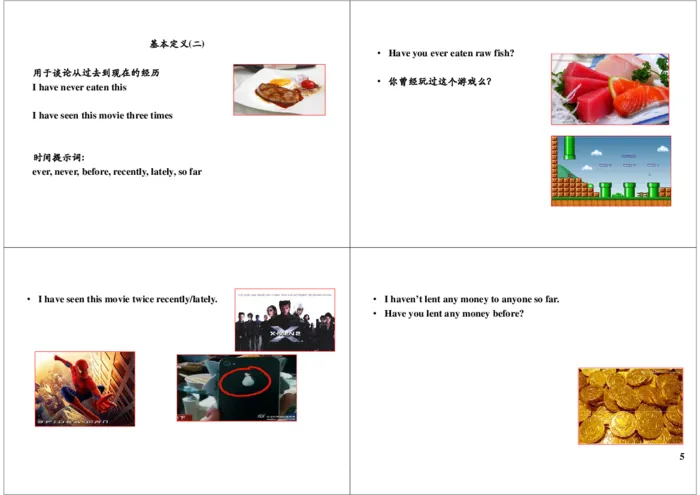
I have never eaten this
I have seen this movie three times
时间提示词:
ever, never, before, recently, lately, so far
•
Have you ever eaten raw fish?
Have you ever eaten raw fish?
•
你曾经玩过这个游戏么?
你曾经玩过这个游戏么?
•
I have seen this movie twice recently/lately.
y
y
•
I haven’t lent any money to anyone so far.
y
y
y
•
Have you lent any money before?
5
1. –What is his sister like?   -- I don’t know. I _____________ her.
(never/meet)
2. – How is Amy these days?  --I ___________________ her recently
(not/see)
3. – Are you hungry?  -- Yes. I _____________________much today
(not/eat)
4. – What’s the book like? –I don’t know.
______________________________it. (never/read)
5. – Do you like dog meat?  -- I don’t know.
_____________________________it. (never/eat)
6. – Is Berlin an interesting place?  -- I have no idea.
______________________there (never/be)
7. --I read a newspaper yesterday but I
______________________________one today.( not/read)
•
I have just received a letter from my brother, Tim. He is in Australia.
He has been there for six months. Tim is an engineer. He is working
for a big firm and he has already visited a great number of different
l
i A
t
li
H h
j
t b
ht
A
t
li
d h
places in Australia. He has just bought an Australian car and has
gone to Alice springs, a small town in the centre of Australia. He will
soon visit Darwin
soon visit Darwin.
•
From there, he will fly to Perth. My brother has never been abroad
before, so he is finding this trip very exciting.
before, so he is finding this trip very exciting.
•
I have just received a letter from my brother, Tim. He is in Australia.
He has been there for six months. Tim is an engineer. He is working
for a big firm and he has already visited a great number of different
l
i A
t
li
places in Australia.
核
组
•
核心词组:a number of
•
He has just bought an Australian car and has gone to Alice springs, a
small town in the centre of Australia. He will soon visit Darwin.
•
核心辨析:have been to与have gone to
•
I have been to Australia:
•
My father has gone to Germany:
y
g
y
6
Ms Li is on holiday. He has _____to Italy.
Hello! I have just
to  the shops. I’ve bought lots of things.
j
_____
p
g
g
Alice isn’t here at the moment. She’s
to  the shop to get a
ce s
t
e e at t e
o
e t. S e s _____to t e s op to get a
newspaper.
--Are you going to the bank?
---No, I’ve already
 to the bank.
,
y _____
From there, he will fly to Perth. My brother has never been abroad
before, so he is finding this trip very exciting.
动词:find +名词+adj
我觉得英语容易
我发现这个问题难
我觉得这个服务员很粗鲁
我觉得这个博物馆有趣
不规则动词变化表(一周之内反复看)
•
1. A---A---A型
•
2. A---A---B型(现在式和过去
•
动词原形(现在式)过去式过
去分词
(
式同形)
•
beat    beat
beaten   打
•
cost   cost
cost 花费
•
cut    cut
cut 割,切
•
3. A---B---A型(现在式和过去
分词同形)
,
•
hit     hit
hit 打
•
let     let
let 让
•
come     came    come 来
•
become   became   become 变
•
put    put
put 放下
•
read read
read 读
•
run       ran        run 跑
read   read
read 读
•
hurt    hurt
hurt 伤害
•
4. A ---B ---B型
•
(1)在动词原形后加一个辅音字母d或t构成过去式或过去分词。
•
learn    learned/learnt    learned/learnt   学习
学
•
mean    meant     meant 意思
•
hear     heard      heard 听见
听见
•
(2)把动词原形的最后一个辅音字母“d”改为“t” 构成过去式或过
去分词。build    built    built 建筑
•
lend    lent      lent 借给
•
lose    lost      lost 失去
失去
•
send    sent     sent 送
•
spend spent
spent 花费
spend   spent    spent 花费
7
•
(3)其他
•
catch   caught    caught 抓住
•
pay    paid    paid 付钱
•
say   said     said 说
•
teach   taught     taught 教
•
feel     felt       felt 觉得
•
bring     brought    brought 带来
•
buy      bought     bought 买
•
find      found     found 发现
•
get    got     got 得到
y
g
g
•
think     thought     thought 想
•
sleep      slept     slept 睡
g
g
g
•
have   had      had 有
•
leave    left    left 离开
p
p
p
•
keep       kept     kept 保持
•
stand
stood
stood 站
离开
•
make    made   made 制造
•
meet
met
met 遇见
stand      stood     stood 站
•
understand  understood  understood
明白
meet     met     met 遇见
•
sell      sold    sold 卖
•
tell
told
told 告诉
明
•
win    won   won 得胜it    sat    sat 坐
tell      told     told 告诉
•
5. A---B---C型(现在式、过去
•
drive    drove     driven 驾驶
式和过去分词都不相同)
•
(1)在动词原形后加-n或-en
•
throw    threw    thrown 抛,扔
•
blow     blew     blown 吹
构成过去分词。
•
Eat    ate   eaten 吃
•
grow     grew     grown 生长
•
know     knew     known 知道
•
fall     fell    fallen 落下
•
steal   stole    stolen 偷
知道
•
fly     flew    flown 飞
•
draw drew drawn 绘画
•
give    gave    given 给
•
take    took     taken 拿
draw   drew   drawn 绘画
•
show    showed    shown 展示
•
see    saw      seen 看见
•
write    wrote     written 写
•
ride     rode      ridden 骑
•
(2)过去式加-n或-en构成过去分词。speak
spoke spoken 说话
spoke   spoken 说话
•
break     broke    broken 破碎,折断wake
woke
waken 醒来
woke    waken 醒来
•
choose    chose    chosen 选择
•
forget
forgot
forgotten 忘记
•
forget     forgot     forgotten 忘记
•
(3)变单词在重读音节中的元音字母“i”分别
为“a”(过去式)和“u”(过去分词)
为a (过去式)和u (过去分词)。
•
begin    began    begun 开始
•
ring
rang
rung 按铃
•
ring      rang      rung 按铃
•
sing      sang      sung 唱
•
swim
swam
swum 游泳
•
swim     swam      swum 游泳
•
drink      drank      drunk 饮
(4)其他不规则动词的变化。
am, is     was      been 是
are       were      been 是
do       did        done 做
go       went       gone 去
lie       lay         lain 平躺
wear      wore       worn 穿
8
Repeat the text with Mr. Fly
文章一起背,错误一起改
I __________(刚刚收到了)a letter from my brother, Tim. He is in
Australia.
He ________(去了)there ____six months. Tim is an ______.
He is working _____a big firm and he ________(已经参观了)
___________different places in Australia.
He _________(刚买了)an Australian car and _________(已经去了)
Alice springs, a small town __________of Australia.
He will soon visit Darwin.
From there, he will fly to Perth. My brother __________(从没出过国)
before, so he is finding this trip very__________.
9