mffif;Hi# fralf+tfi. Brsfi4ifr
*ffii3iiffiffi
HffiIft)HW
+tffi{=HE 5 E#ffi txE7, mi*s.ia
Q zft -EE EhtE +HiEtEiJ,, +fifri*Hi=
v +ffitffi H7, E4Eiptri)|r+.lftl*?
fr\6h, xt T t#l^f , H p fEE 5 tr+ffi frUEtrd,xE6 E|[fu " tE +ffi txJ Effi 'l*,,tt * T ffi +.f
fr\ 4 frffi9+, €tF. ffi *th#:trstt r f, f, FI + ffi , Bli4 X T ffiX1E 4frffiruTi|-t, frLfr,5 *Xz
i{Tf,J5 , F7.IFIEffiNB"
K4
ffi%
ffiffi
J".)1
GT, frVH-&Rffilv+ 5 ffrfc /K+
+FA %,2 F.titkl 2*z lE Hfr\ Xi0tn, R*T +\HrE#
6r +z h r.fr\t^+ +ffia4+t#. 5 E+ffi{Ft + Ht'+ z Htifr
l
zJ' # h Ft H! iE Y* + r E XE, .F. E I E H' r& 4 H(,, l, # HIVXE H E -*.A tf,H.2# ffn Hrn+,fr t+ "
,*a frhfrtTT x+,E r#, fr,fr4py.Ewh1trEit +Lfi!. zJ.Yh w6frMi^trtr "4ft8))rl2* +
i
trntr+ E!trfr*i1'lz" rl Eii,iEY*Z<84, mEqrdq+Z)E}*Hlril, 2#Ai9ffi,*
. ,K2#. +iE+ffi+ fr\iEl*%.ZEliEAA1. ffiElititfr\"
BF{E
t7 Et:
/r!\tEl
id,lz
f\
ttl+ **a$r:iu#frw&rfi E ft#z, fliit+ aE
IRH{THAfifr?
ry A {L+A8trilft+r*Hq l{trX ffi4++Z Fi,R , dEila Dl, +D! F , L. , f*#HT"rt@t1+.n
ixffia, M6 4 +f+ffi iN +AHlEfi#f E E ffi fr\ *tr+ W+ri* . fi
=
[N,+n 6 lyxfrrr iN H! r 4n,
fHr HtE6.
l
-.l+
i;Wi
JvI_
-
-J
t..t
RJ
-l=F r:E
*I,H
i tR:E 6
#4r#>l ffiiH, iHHlHtilH - rEfig
EH#ffiilEIffi
ilmffiffirffi
EHffiffi
+E.t\,#-frfr.,
EIHi#EIffi
g8EffiDI
ffiffi9[u ffi
is*#rffi
i8xfiffiUU
" 42lDFiol "
ffiE
w.*ww
Htrg[S
#*i+ffi
HffiffiS
g}+EfrF,
fuEH Ib]EEiHE}Hff'E
G f,,l1,l"f-;llHJ*
,>
' tgl ,Y, '
-#fr\"
trffi I +48F^
EffifrU I Id' E
+tfrtEtr
+^+E+
*fiatqnfr I $t ffi[
ts,{.rtxln *ft I Id' E
A*At ( SAT.A-level.IB.PIS A) 6f-nfr I E tr
Arlfr,X-(AMC.uKMT.IMC.Eucliil6fnfr I E 6
B#lfil$ I Ff;E= l,J tE ll(XX Xtl E ={+ln tfi ry
ffi#
'KiFilA IESIE *h
EEE= H#
EHXF Xl] ft
tfrFf,nn
ilinffU{f EFI I tKflHflH XUI+[+ '& 't* Id'BtE I|JHZiF
='f€iE
?.tE+iaE,B.ffi I ',& ;fi ffirr=
tr++tlEEr'l I +E EI XU n +ffiE tEH E,H;ffi fibh'+
i*#EE# I tsrt+ffifi&+
Fffi{69fi8
.*,)fr I XllHf|J +B@tat xll tE t rrfr 9=la ftffilF .
+E
{4 H rtttr*tr + EI EEEiE F,il(E +{*ryf Hdtlr
t=HH *+EE fi tF ta1; ,fr.
n P I ;IHfr ifiIffi^ idi+iE +{:tfr EIEiff . E rgE+
*+!f #rq- *EiE Etl+rE +Hfr+ thHE t+#.r?
IKF,L. iI=+ fE4HlE ?EIEi#
,E,,t I gEI)t EI+tr EEEHfl 9KIEIff iEIfrfr Xffiffi Ff;IdId
'I(x;E
ThHtr, E;T'E
,r'=E I lf W
i[HolJH I ={+fi xl] ffi
IK +
IZffifE
66ffiU{f I H?.t= Ett#fi Uf&EE *EE EiEEF 't*D++
Ef;;Eil+ E'EIH
In^HI+ERr-fr I + +i$
ir 1, :l
,i',,i
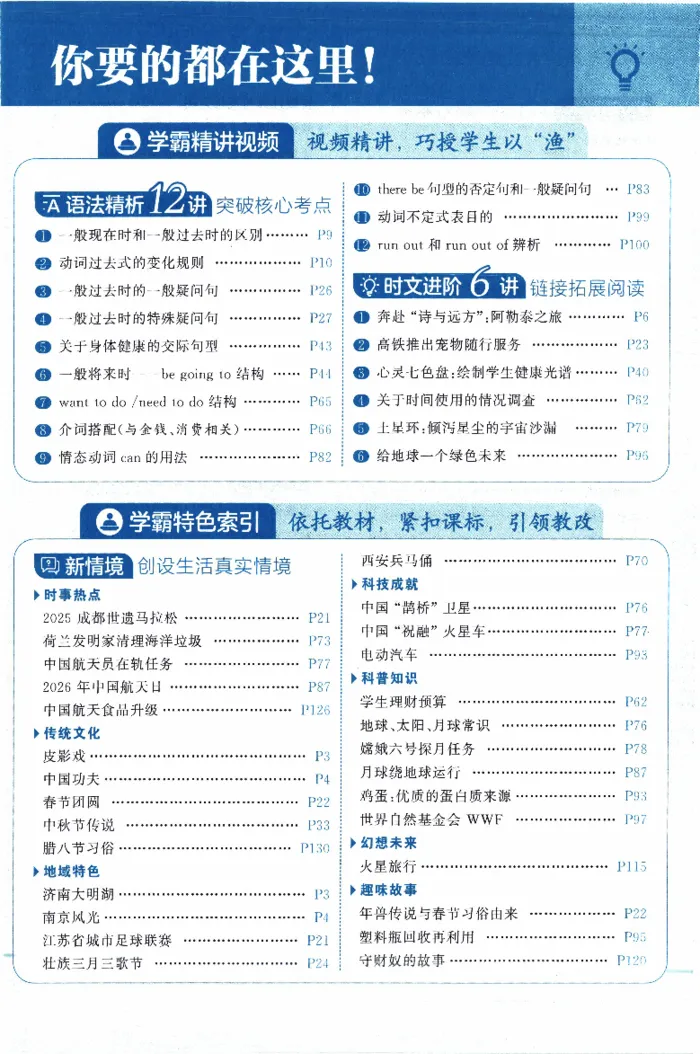
Contents
o
+,co
+.coo
',ffiffiffi*#,,' # ut
.)
o
o
o
o
o
o
o
o
^6H[A,L'+
^8,
-ffirl,aEsf!-ffifi *Hf B! E5lJ ......... pe
Aiflit*tt ful*.[t*Lt[U """
.'. P10
-fftit*BfH!*flt$tl"l6 """ P26
-flttr*Et'B\WffiffiHA ......P27
*+HWffiHHttffiA4 """ P43
-ffi,|s*E{-be going to #t8 """ P.1,1
want to do /need to do #P8
... P65
f if,#m ( 5 +4x., ;iti fr *a X. ) ...... ...... t']66
iEAAi-,] can H!H]*
"' PBZ
there be 8J4JffJEfrtrffi-ffiffi1',JE ... P83
Ar,lTErt* H H'i
...... Pee
run out f,fi run out of #ff
... Ploo
+E+*+ER|Hi*
#tL "i.+5frt",BElryJAZlE ... PG
HffiffifrEWWlfiflF.* ......... P2s
,L.E -k€# ,*ffi1++.MH/6i# ......... p4()
XTEfIEI{F,HHO{HffiiEA ......P62
l.Erf.,{mEE'+Ht+BZ!;ffi ......... P7!)
hfut*-+A*E *X
"' I'eti
i ,,ffiffiffi,ir
K+E+f++a,L'#.#
) t{tt#i
+wf}-[tE#
.........P11rr
) i,EEEH
wtrBi5wffiiE.H
......... r,60
+Bl+rfr.f\Hfr1*rLffi "' P122
) SiEiEE
dlVJffillH{H,H.i5H5itH ......Pss
&ffirEiEzffirtrffi
'.."".'P118
) #ttrEFt
#lrFtHXBt+
frfrh#&xn
4,1*iHfr
frFrfrfrA
> fih*fi
@RTAE
{*+Ftr$
frnfra{R
fiErf/F..i1dr
ffiHHifiZ'lfit ......
)|Effiffi"trfi+)i[XLfq
) ililFts
=F H fii,Atit
"' PZo
#fi'ffidrhH
... Pss
4lL*,{tfr.H1+fr!l .........P5e
HH]fHE'fffifA '.'
"."".' P116
X9ffitufr4ffi "'
""" P13o
>,8'E++E
*{lH.ffij41
...... r)56
zoso adf*Zffi
...... Peo
zj<ffiiffiffifi{8,H,ffi}E "' P1o6
&fHHffi
""""' P11e
) +flile
4lLffiW.+i+H54iEiaH "' Pse
P20
P60
[,6 1
P116
Ps9
P79
P94
P96
PI12
A&:ltH5*i*trH
"' P63
) *if,tx
iEHi-,lxEffi ...
......... Plo6
) EfiIEffi
> 4Ef+X
I)24.l']ll1.Pse,Ptio
) . F*H
... r'>22,P72
+8tr*fiflEri*,fa*k
> fEstH{+
ffienft:lI
EgTTW' 4ffi
taei6
) rfii+Et
BEIH&ffi'EA
) E j*lEH
ft+s# E *
> E ETfiF
tft{ritill
> fr,EME
Plogging ffiAi&ffi
> iEtSt'it#
,ti,fxHffi
) irirfrrEE
*fi,*,[fr.ffi
... P95
+RR*y.+i+-ffk,
P23
Ir32
I)BB
P94
P80
Ir5 6
Pl23
P63
MAp6+2-
fia{'4+1-
fiE{.4+A=
rnEl{1+2tr
rne!6+rJfr.
INEft+EA
ITEE,IEH+U
frfi+ffi
"' P12
#,ff:Ed1+ffiVffilill ...... PZe
sarah trJllibie+- ......... P46
Wt6tfrWiL ""'.". P68
ffixfffiEEffi .'..'.".'.. P8s
fr+trI* E
...... Ploz
tr+;t1]h
"' Przt
Unir I l+ffi}
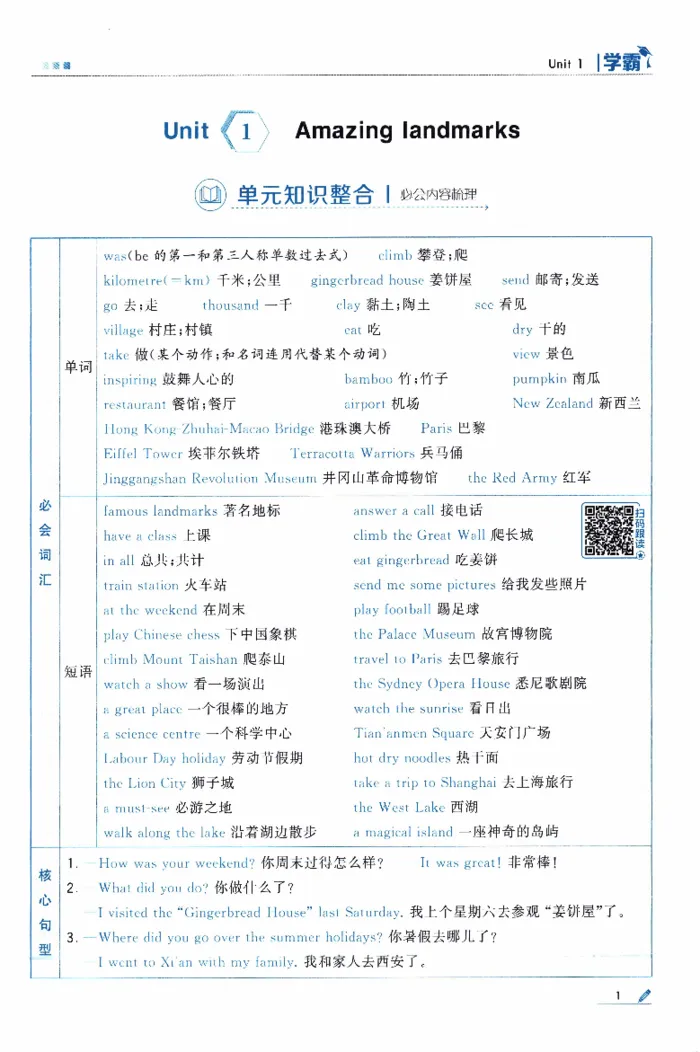
Unit ffi) Amazing landmarks
@ +zE-XIiRHA ! rularteffiE-,
was(be #'Jffi-pffi = )'-/ll+*tit*d)
climb 4H;IIE
kilonretre( .-knr) +X;/a\E
gingcrbrczrd house *fftr
I
+
8o 2r;rE
thousand -f
clav 4fi4.;Wt
cat Fts2,
village ff E;fffE
trrke 'ffi( *+A+f ;tu Litli€Ifl4\+* +AA)
inspiring fiffiu\,L.Pi
rcstzrrrrirnt Effi;Etrl-
4i"f
brrnlroo tt *tT
airltort t)l,Et
s"nd fi[ff tfr.*
see 84,
d.v TEt
view F@,
pumpkin H/R
New Zealand #E -*
the Red Army 2IT
AA
ifl
ir
d,[-
ffiiE
Ilong Kong ZhLrhai-lV1acao I]riclge B4#/tffi
Paris E&
Flitfel 'l-ower tRlErf#.E
'l'erracotta Wrirriors trqffi
j J i,rss,,ns. hnn R t'vo I r.rtion M use unr # n L\Hft!fi]frJ fH
t__
| [nnlou. landnrarks #&fuF',r
i
have a clars tiR
in all ,H,*;*it
train statirn )<#ifr
at llrc wcekcncl &HX
answer a calt l*Eifr
climb the Great Wall I[EKfil
ea1 gingerbreacl tz*tfr
send me some pictures
play football WEI*
h#,H,WWH
llrer Palace Museum fr\.trffi-+rJW
triLvel to Paris *\ryffift
thc Sydney Opera House #trffiE{H
watch the sunrise E H fr
'lian'anmen Srluare XXn-. Ih
hot dry noodles ffiTH
tzrkc a trip to Sharrghai *t-Wffi?1
the Wesl l.akc Eirfi
a nragical islzrnd -EiF6'H'i,ftd6
pkLy ('hinese chess T+E*.H
clinib Mount 'I'aishan IEAilI
wirtch a slrow A-%Wfr
a srcat place -f flE&ffJfut
a science centrc' -ffll++,L'
LiLlr<xrr Dny holiclay frdJfrIWW
rhc l.ion (:ity trJI[Tfil
a nrrrst-see 'l'ffiZfu
wiLlk i,long thr lakc #Elffibffi.D
I
I
t
r['
frJ
fl
Ilt.,w wirs your w.r,kend'l {.fiHf,-itf+ffi tat#?
Whrrt clirl you clo'/ ttflfr.ftAT?
It was great! IFH'ffi!
I visirccl the "()ingcrbreacl House" last Szrturdzry. fitfEffix**Lfr,"*tfiET
"
Whcrc dicl you so over thc summer holidays'/ [EZ[F..*WF)LTt
I w.nt to Xr an wrth rny fzrnrily. fr,ffixL*EXT .
t3
5--- -.
I
=ffi1
trL=^-Erntr
EE
5
;t}H
)t
*n
,'B
+E
E
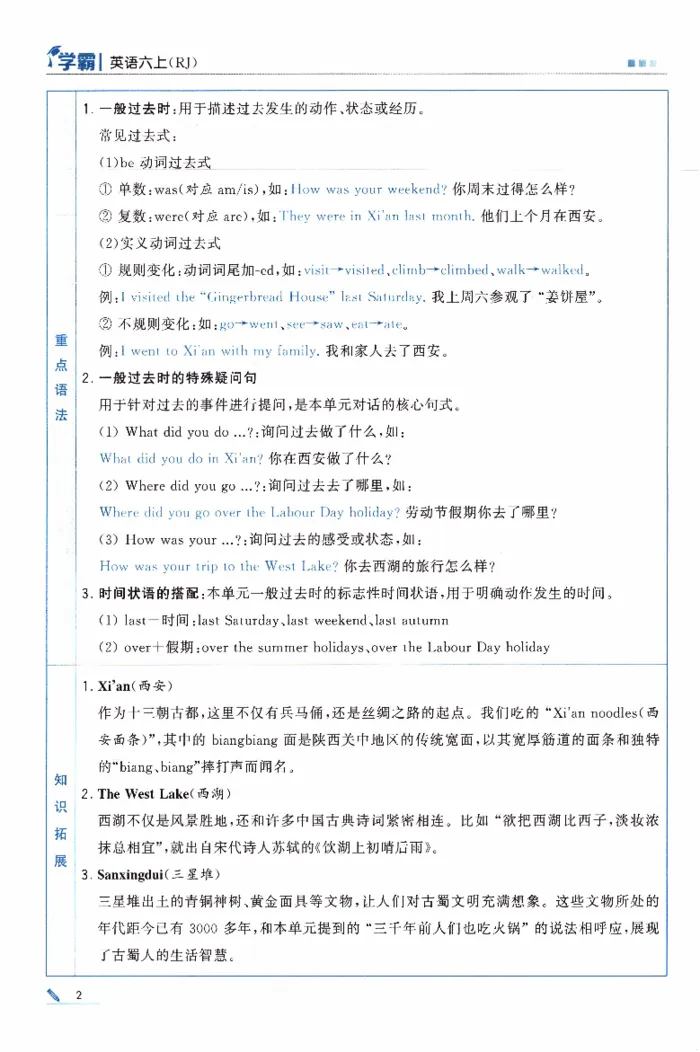
1 . -&iJ*FL,ffiTffiiEtr*EH ffJdrtE.:[t#448 "
HrLit*fr,
(1)be &li-,li$*rt
O +ry:was(rtlrr amlis) ,ip, How was your we,eken,l'l ltiBf-jJf$ffi Atr?
@ E-W.:were(ftirr are)ol[,']'ht'r,wcrc in Xi'an lzrst nronl]r. lfi,ll1l.+E&E*"
(2)qXAiAfi*rt
@ inUE.4t rdJi1irdBfi[-ed, itl , visit "-visitecl. climb*climbecl. walk-walkc,d"
f{;l visirccl the '"(iingerbrczrcl [{ouse" lzLst Salurday. fitIflx*\nT
"*ffril.
@ 6 *4I|J A lN, r{n : go.+wcr) t \ sco > szrw . cat+at c.
fU:l wt'nt to Xi'an with my lirnrily. fr,ffiXL*TE.X"
2 -fieil*r.Ifrl#*ffirEtl
ffi T ft xf fi * H! S {+it Tt ft14, E 4 B zuxtifi H! lZ,L' A fr .
(1) What did you do...?,iElhlrj*'ffiTit/a,!fr,
What clicl you clo in Xi'an? ttffrWElfrT 4lAl
(2) Where did you so ...?'if,Jlrlil**f ry[E,ff '
Wlrrrc rlitl i,ou go ove.r the l-alrour l)ay holiday? fr&Ifr[HWttfXTElljf?
(3) How was your ...?,fr|{iS*Ptl*EEIfi#,ltl'
[{ow was y<rur rril-r ro the- Wesr l-;rkc' ttl,*W1frfr\fft.11R,AtYl
3 . r.J r4 {t iE Ht H EB, 4 S /6 - ffi fi * Et' H! t,n H'H Ef lHt )tti#, ffi + HA ffi dJ tF H.4 H! H{ I El
"
(1) last*B{14,last Saturday.last weekend.last autumn
(2) overf'fHH'over the summer holidays.over the Labour Day holiday
l. Xi'an(6+)
tE-lt+-ffifi#[ 'ts86{XHtrqffi ,frftrLmz$frB!E,F, " ft{ll f7,ffi "xi'an noodles( 6
,* tu *) " , H + fii biangbians EEHtrX + ffi Eitulltqfr,fr,ffi , UEffi,f+ffiG.ffJfrRfiElil++
kl " bians. bians"fFtJF m I4 € "
2. The West Lake( 6 #X )
E Xfi T'fX E EI F ffi e, fi frE 1+ * + tr fi 4 i+ i-,1 K ffi fH,S " Lf,rt "'&+EW lfr LV,N +, lfr.V,W
ffi ,H.fEH", f;li fr H fi {ti+^fi #,ffJKt {tttil r6,trm ).
3. Sanxingdui(aEff)
= E,& fi A H,l H ffi ?+ ftf . H A W R + X,WJ, it ,,\ {[ xf fi 6 I HA fi,ffi M^ " )* e X. WJ ffi nb. #)
+,ftSE+ E 4' sooo *+ ,frAB)L EEtJill " =+ +BfrAfi e, W, r<hfr" H! iI,fXfE n{'M., ffi.Tn
r Sffi H,iHffiHH"
\2
Unir I l+ffi}
/=\
(r?
,84*8fr,i*A Part A A+f + 4 8,7,i\iu,r*4 fr-tt"
- ' +RIEH+Effi;rr'i1'+ A+ ' #itF -\A+tH
E EE,Hi E,H, \BF-ffi+ 5#ruffi +f; E 6J "
A.
1S
toc
rip
in Tai'an,
it?
to the Great
Kong-Zhuhai-
long.
"G
) 3. Mike got to the Hong
Macao Bridge. It's 55 k
)4. Peter explored the
w
H
"-a beautiful train station
in New Zealand.
)5 [rt4#-6-]1;1,
t
visited
and
the Eiffel Jbwer
last holiday.
+rnit#.
)1.@vt,
best friend and I
a traditional shadow puppet
(B-#jr\) show last weekend.
A. watched B. watch C. watches
)2. The National Stadium (Bird's Nest)
like a big bird nest, and it's
a famous landmark in Beijing.
A. look
B. looks C. looked
) 1. [l&}4"4*o Mount Taishan, a famous
mountaln
Shandong.
)2. It w
in China,
Do you want
a great t
iRruEffiffi.llt.(-)l'"no
)3 Ulrii4Ll -what
you do at
the school's Chinese Culture Week?
-I learned to make paper-cuts.
A. do
B. did
C. does
Lake in Jinan.
A. send
B. draw C. make
)5. -How is the weather today?
. It's sunny but a little windy.
A. It's bad. B. Great. C. Not too bad.
= . .H Ff
'AEia
HtE,ffi M*,tHE. "
1. She
( be) happy yesterdav (aF k)
me
because she got a nice gift.
2.My classmates and I
asked my cousin to
some photos of Daming
( clean ) our
Friday.
for the morning
(landmark).
classroom after school last
3. You
( be ) Iate
reading class last time.
4. China has many amazing
E . tRrEH'+EEll.TtiEHtErrr jH+
"
Last holiday' my family and I v
Qingdao. It is a beautiful city by the sea. How
was our trip? It
great !
We were there for three days
Wew
along the beautiful coastal road
and the beach for hours. I took many nice
photos at the famous seafood market.
The weather was fine every day, and
food was delicious. We all had a good t
love Qingdao, and I want to go there again !
3@
all.
the
.I
使用前
可删除
此页面
f+gl FL=^..<nl>
:ffi
)e44E-*,i*E Part B A+f + 4 h,rt,h"iu,t#4 &41.
- .,fR+EGr Hffi H+qlEzrrtH+ .
Sunday. I w
to the park last
people do Chinese
kung fu there.
2. Is
a lovely bird in the tree yesterday
morning.
The clothes are
in the sun.
His words were
our best at that
We had dinner
park and it took
We got to the a
old
3.
4.
5.
6.
us an hour.
Xi'an last National Day.
very l
time.
ln a nlce r
after a long time
and we tried
near the
and took a plane to
=. Eq
fR*E{HH, jtHAiEHt A+ ft,fi
rf if;.
(Li Ying is reading a postcard of Nanjing
with Sherry now. )
Sherry: Nanjing is really a great city. Look!
l.
Li Ying: Wowo you got a postcard.
there before?
Sherry : Yes, I did. 2.
Did you go
Li Ying: That's cool. 3.
Sherry: We went there by high-speed train.
Li Ying: Did you climb Zijin Mountain!
Sherry: Yes. 4.
Li Ying: What did you do there?
Sherry: 5.
Li Ying: Sounds great. I also want
there next time !
\r
to travel
@ ixr^rxntle_t/r (: ) ll:rt p ,
A. My family and I visited there last summe
holiday.
B. We bought some presents and tried som
nice snacks.
. Mountains and lakes make it beautiful.
D. How did you go there?
E. We visited the Cnnfucius Temple(*-f ,6) too.
=. @thl
i* ltfi ,H Ht ffr ,# i+ it, E rE E
6J Ff gs+i'l HtiE
=
trr=tlE+ .
Chen Jie-Guilin, China
Wonderful views and delicious food! *****
Guilin was a great place for our spring
trip because the weather was nice and the
scenery was beautiful. We I.
( climb ) the green hills and 2.
(take) many photos of the mountains and
clear rivers. I'11 always remember how
peaceful it felt there.
We also 3.
(eat) tasty Guilin rice noodles
and some local snacks at a
small restaurant near the
river. Everything 4.
(be) fresh and delicious!
The city is only about two hours from
train station by buso so it's easy
(visit). I really hope to go back
dav!
the
5. _
one
rlli'i
iij..'irl
i#fl.miErE{t r-l
- - Qozs ny,h*t f )*HHtrH!H*{tlE*+trirlff,#rt ,ElfrtAlfr.liliE#-T+trB!FHnE,! rfl
i*t Ft ,fr,11.1f#. "
O l€i{m Eil : ? ,* 4f
@ ffiE : *****
e) ffi fltr tuT rU fi {n + +.ffi# e.f+ A ffi,fi1BiI B0 fit fi . r 4 ft t )
(
) I . Lucy is a quiet girl. She loves nature and likes beautiful scenery such as mountains and rivers.
(
)2. Mike likes old cities because he can learn a lot from them. He doesn't want to go to new cities.
(
)3. Peter loves hot weather. Swimming is his favourite sport.
(
)4. Tom likes snow best. He wants to see the ice and snow world.
(
)5. Cathy is good at cooking. She likes eating different delicious foods.
(-)tfli*ffiLEl6l{M.
I. Why do lots of people go to Sanya for winter holidays?
2. What does Guilin's natural scenery look like?
-. @mm KErauz rHi*iEt ,t Ffitiktrfrrn+ jtu6EI.H,ra HrlH!ffi,f+jtrn.Erf, +H-rfrit*
+itrR
OI=I{HES: T,l4f
g ffiH: ***** I
Last year's spring was a perfect time to hike(4Lt ) on Mount
turned out to be pretty heavy for the hike. We didn't book a hotel
order to watch the sunrise, we tried to find a place to live on top of
Huangshan. l.
They
room and started the trip. In
the mountain.
There are many beautiful cities in China. Here is some information('f?,S) about five famous cities.
A. Chongqing is a city in the west of China. It is beautiful at night. It is famous for
yummy food like its spicy(7i) hot pot.
s4
{#l
&ubd,b
Giel
B. Harbin is in the north of China. It is very cold in winter and famous for ice and
snow. There are amazing ice lanterns and snow sculptures(FrE&) every year.
C. Sanya is in the south of China. It has beautiful beaches and clear sea water. It is
warm all year round. Lots of people go there to spend their winter holidays.
D. Guilin is in the south of China. It is famous for its green mountains and clear
rivers. The natural scenery(# 6) here looks like a beautiful painting.
E. Xi'an has a long history. It is one of the oldest(&t* 6'i) cities in China. There
are many famous places in this city.
5@
,e--- _.
t-=ffi1 HLE^I(RJ)
3'#l
2.
So many steps made me want to go back to a safe and comfortable place. "Look!
" With the help of my friend's encouragement(Bi.
The top is getting closer and closer. 3.
frh) , I cheered up and kept going.
Aftera three-hour tiring hike, we finally reached the top and also found a hotel that looked
good. But the hotel worker said we could get a big room for 1,500 yuan! 4.
I was only
looking forward to a relaxins bed! Finally, we asked for the possibility of a tent(tK€). Bingo!
The hotel's owner sold us a tent for 80 yuan.5.
in a tent in front of the hotel on Mount Huangshan !
So, that night, we ended up sleeping
A. We are almost there.
B. I am not an experienced hiker(fr%.b#l0h)r*).
C. That's so much money!
D. That stopped so many visitors.
E. My {riend and I prepared our backpacks.
F. He was so friendly that he even helped to put it up.
iAtffHE: book ". 1fri.7
order tcr \JT Qe#-+>
Hrl'miEE{t t=l
-. ".r -"Hllt'4, AAffiEtr€E Sam *41T fr+l'lfft,f iHtRrEfUHifft,ffW&.#UffiTflA+#tE
(T)iE(I').
O f*flffiFf : S h\if
g ffitr: *****
I
Sam's Labour Day Holiday
o')\ fi.Kt*tffi-4-
%
Anshun
The second stop (2 days)
visit Huangguoshu Waterfall
The first stop (3 days)
Qianlinsshan Park(,P|( & za\ E )
eat Siwawa and Huaxi Beef Noodles
_#
;;,.;
eat Rice Wrapper Rolls (*.E)
Kaili
\6
EW@
i.i iffi il
unir r l#ffi}
(
) I . Sam stayed in Guizhou for g days.
(
)2. Sam went to Anshun from Guiyang by bus.
(
)3. Sam visited Qianlingshan Park in Kaili.
(
)4. At the third stop, Sam visited China's Sky Eye in Pingtang.
(
)5. Sam ate Siwawa and Huaxi Beef Noodles in Guiyang.
: . @ffipx pEr 6E, tE i* tE t, tR rE *s t 6J 6, it F E 6fr fr! tr * .
Parts of a Plant
oeixffir$: 7 h\+f gxfiE: ***** I
OPlants have roots, leaves, and {lowers. They have seeds too. Some
seeds fall on the field. New plants grow from these seeds next to the old
plants. When plants grow in this way, there are too many of them in one
place. Some of them can't live. So some seeds get the ability to travel.
And there are many ways to do that.
@Some plants grow near the water. Their seeds go into the water
and travel away with it like boats. They may travel many miles be{ore
they stop. When they stop, they begin to grow.
@ A
Some seeds have their own special little parts. They look like small wings({Xf).
When the wind comes, the seeds fly away. Soon they fall to the ground and new plants may grow
there.
@Some seeds have special parts called "stickers". The stickers help the seeds travel far. How?
These seeds wait for an animal to walk by. Then they stick(,F&) on the animal to get a free ride.
Sometimes they can travel a long way. Birds carry some plant seeds to new places too.
@Seeds don't have arms or legs, so they can't walk, run or climb. But they can travel with the
help of water, wind and animals.
(
) 1 . According to Paragraph 1, which part of a plant can travel?
A. Roots.
B. Seeds.
C. Leaves.
)2. According to the passage, which o{ the following is TRUE?
A. Seeds grow the best near the water.
B. Plants only have roots: leaves and flowers.
C. Some seeds can stick on the animals to travel.
(
)3. Which is the best sentence(4Jt) to put in the A
?
A. The wind helps the plants grow tall.
B. The wind is not important for seeds to grow.
C. Water is not the only way for seeds to travel.
(r:;rH=: ahiliry n. fiv)l
7a
lr
get a free ride #84
*"1
""....9
Tfi)J€IEIE{,[
-. ffi*E.E*I+ r-s gATr[EH]lFF" (,rr&6)
ffi *E' tRfEI,}iE fi A+|J WA+E ('l) iF ( I") . ('fr $t @)
) 1. Linda went to Beijing in April.
)2. Linda went there by plane.
) 3 . Linda went to visit her parents.
)4. Linda went to the Great Wall, Tian'anmen Square and the Palace Museum.
)5. Linda enjoyed her holiday very much.
ffi *8, fnlEfEt fi #jt#iEffi H!6* " ( otr&d )
) 1 . When did they have a nice trip!
(
(
(
(
(
=.
(
l;liffirl
[:=1^rt-'-*
|
()
B. To Shanghai.
C. By plane.
C. Happy.
)5. What did they do on the way?
A. They ate.
B. They read.
C. They played cards.
[q1q1{l ffi*E.tRrEFf ffifi6,l.haFE.t=H,E+-ia . (,n r&& )
A. Last week.
)2. Where did they go?
A. To Beijing.
B. Last month.
)3. How did they go there?
A. By car.
B. By train.
)4. How did Jim feel?
A. Sad.
B. Tired.
C. Last year.
C. To Hebei.
E.
Dear Mary'
Iam havingagood time in 1.
. I came here by 2.
.I will
stay here for a 3
I visited some interesting places and took many beautiful 4.
. To I -
r ,
r
I I o: lvrarY Lee
buy some 5.
, I am going to Wangfujing Street tomorrow.
20, xxx 193d,
How is your holiday?
Love,
Alice
Guangzhou
\8
,iltrrn1iiri.lri,,,
,,. ;r,., i,11,rr1,i,lf ii,,1 11.i." i ,;iili,1rt.ltr*"1.1t,'.
iE;*€IEIE{T
( - ) -fifirflEEitrr-ffiiJ*EiH!trElJ
EXEffii#
1 . *Mwa.Ef fr-&ff * B'I B9 *4 trElJiuT,
2. -&fi*EfBtffiB,
( 1 ) fi * +,+ E r,f E E H ffJ dr tF H EAffi H! it * E{ lEJ,fi * FI 14 & "
fiJ , They visited the museum last weekend. 'lt tl t.rA *'81fr"-{ ffi M tE "
( 2 ) ff * H! ft # il Z,lft, fff s$*x+r'f H B!,lHlil "
frJ'When I was a child, I loved cartoons. +Lz].fttifr{REYX+iEH"
fiHil|4+
+rnit#.
) 1. I often
A. play
football with my good friends after school.
B. plays
C. played
)2. My mother usually
TV plays at home after dinner every evening.
A. watch
)3. They
A. visit
)4. When I
A. love
)5. Where
A. do
B. watches
C. watched
the science museum with their teachers last weekend.
B. visits
C. visited
was a little child' I
colourful cartoons very much.
B. loves
C. loved
you go for your summer holidays last year?
-ffirEGr.I
-f,Etrtr.J
42,L.H_[
glH'l*, Z'ffi'l*.il tF ; E xfl S * &EE .
is * + + H{ lel fr. 4.fr+J, f, fr fr,ffJ d1 +E &
)trffi.
H'f i4ffiffi
often, usually, always, every day, on
Sundays
yesterday, last week,
ago; in
2025, just now
drrs1yfr
2. tiEE he/ she/ it/ HW.A i,4 dJia1ffi
= l.ttr+Wrfi"
1. -ffi tr * r.t ;F jl *.8, 4 &H A iFl
JI-},J*r\.
2. $ldJia1 did tr ,*'Hffidrlf,lRV.
EIh1
I play football every Sunday.
I played football yesterday.
B. does
c. did
e@
f+wl q*^-t<nr>
fB
( : ) Etri-;JiE*fi H! gft tfl nU
N.hL, AJIFIXHHI*ifi "a, fr.* fr,-i* / a/ *, / t / "
Ft) rplay - played
walk - walked
look * looked
2. D) e #RffJdl;d, H&/:n-d
N.IN,,XE-Efi. e, THfrHfrn,H1*in d,EBi*/a/*./t/ "
@J,like * liked(Eli.)
dance * danced( $E*)
close * closed(*.}.)
3. ,JffiB+E*v #RffJdlfl,{ y } i,Fi[-ed
zJ'EHE, EffiB?& *v(*e dry, r* y), in*EiB?& * v(a / e/ i/ o/ u*y, *, play, a* y), H
&ln"arFhffi1*).
N.lL,y*i* ed, H.Et* / a/ "
fr{: study * studied
cry + cried
trY -+ 1ti"6
4 HiimBfr#H, HXRRA-f ffiB+&, x[5ffi#+e,EiB-"d
ffi s*il ffi E, drfrffi.E = ++effi ,g r ffi + 7r + ffi r ( fii t + fi. + + +fr + ), -H. E E A Etr -+B
=F'FJtX5. (,J'+frLiL+++' a/e/i/o/rt#6*4#, fh-l a/e/i/o/u #t ++)
*.lN,,XXtr XRffiB * ed, fr.* t* / t / .
@J,stop * stopped
5. HH WTil,X\N.+L.
gO --+ Went
have * had
take + took
skip --* skipped
chat + chatted
do * did
see + saw
get + got
say * said
make * made
eat + ate
read * read(r**t)
fi,s.il|1+
H +frB fiFf gA+iFlHiEfifrtr rtrHH.
1.I
(walk) to school with my best friend yesterday morning.
(stop) and
(chat) with each other under the tree just now.
2. They
3. My sister
4. He
(dance) and
5. We
(study) Maths hard and
(go) to the zoo and
(see) many lovely animals last Sunday.
6. The little baby
(cry) loudly because he couldn't find his mum just now.
(close) the door and
(sing) beautifully at the party last week.
(get) a good grade yesterday.
(read) a storybook be{ore sleeping.
(make) a card for my mum last night.
7. She
8.I
\ro
(have) a big dinner and
AE/tr,+tflll.u\i.F,Ti+*5fF{rfHJ€ktirllE,6+ZTfi'lElfffS-tLffi/-tff.,l4fiffrffiE" it+t
fi - E ia ffi #f H H! irl lt ffi EJ N, frl X x /t 4 - tLttr W ffi Y ffi 1- ng I
Eft#+
A ++I
64)e,X
Hello, I'm Tom. I went to Jinan last holiday. It is called the
"City of Springs" and it's very charming.
In Jinan' I visited many beautiful places. First, I went to
Baotu Spring. The water was so clear! Then I walked around
Daming Lake. The willow trees by the lake were very beautiful. I
also ate some delicious food.
I really enjoyed this trip. Travelling is fun!
t *, il ^.*ru,+4 a Lfu
{*4i$t ?1fr "
f J,il , 4 .f+ + 9a Etli h #t Frt n,
Ffrl*-.
t* E: ,*eb f,*4i#t a & "
4riil9#
ffi tE ffi in -n,8, ffi + K l{ ffi E rrr, tr " tr lt| fu1 * lF.ffi'4l,
^
6 EI iE Y Fffi , 6'). T 5 0 iFl "
It is a beautiful city.
f lri: ffifi-ix4i+ attFfi
fl_,Ffri*k"
eb4: L&f*4iat$*"
I like this trip very much.
I really enjoyed this trip.
Where did you go?
What did you see or hear there?
What did you do there?
My summer holiday
How was your summer holiday?
Who played with you?
My summer holiday
ll ?
f+w nm^-r<nlr
IH,
rFtr lL#z-,,Rttrx+ff;
frr&rE *-, ffi-* Ntr ia, di.,mn-t *,i+ + 4 -e, * fu1 ffi # #" i&- * ;* *., tfi 4L * *,fl lfi.,J. S
-&", lfl *E
^
+ A L #.t r+,fJ 4+ €, tr* -& 14 Ft, frt t * 4> 4 it.E " w fr & fr, 2 A frt, - t*",J+ 4 +,ii.
ill" #J fr {x-4t,2*""
(-)1ffilftt1+fifrj{l#*.8 ,l,rfia E +{ll r}+}HE 5^ LU A*B! X*k1241fr.,t/. a-r' + it#6iE
H!Af ,ihex'Iif;,H **)frtfr "
A: Hi, Li Ming! I.
B: It was great! I went to Jinan with my iamily.
A' Wow! 2.
B, We went to Baotu Spring first.
A: What did you do there?
B' 3.
A: What did you think of Baotu Spring?
B t It was beautiful and amazing.
A' 4.
B: Yes! We ate Jinan fried noodles for lunch.
( - ) t,fr fT ie * I'fft tr rft ?r E its, + ie * 7 - x ffi 'fi tE, H +f; + FJ + iA H! E ffi fir tt ;irF A fE t .
Last Labour Day holiday ' I 1 .
(go) to Jinan with my family. We 2.
(get) up
early and 3.
(take) the train to Jinan. In the morning, we 4.
( visit ) Baotu
Spring. The water 5.
(be) very clear and the springs 6.
(be) beautiful. At Dooor
we7.
(eat) Jinan fried noodles at a restaurant near Furong Street. They were delicious! In
the afternooo, w€ walked along Daming Lake and 8.
(see) many beautiful lotus flowers.
The trip was great and we had a wonderful time.
( = ) [ffr ?i ffi Mllr,F m IEJ # lmy fr.tl +7 iU Hi )] H' zffr. " tR fE IE t h 6, YlJ ffi 6r + E ( r) iF ( F) .
Last Saturday, I went to Jinan with my elder sister. Our first stop was Black Tiger Spring. We
saw three stone tiger heads, and the spring water came out from their mouths. It was very
wonderful. At noon, we ate braised pork ribs with lotus root( €.# ft,J+6) , a kind of special food in
Jinan. In the afternoon, we visited the Shandong Museum. We saw many old clay pots and ancient
paintings there. We also watched a short show about Jinan's history. In the evening, we walked on
Quancheng Road and bought some souvenirs(9e*8"). The trip was great' and I learned a lot about
Jinan's culture.
(
) 1 . Their first stop was Baotu Spring.
(
)2. They ate braised pork ribs with lotus root for lunch.
(
)3. They visited the Shandong Museum in the afternoon.
(
)4. They didn't buy any souvenirs in Jinan.
\12
A. Good morning!
B. Where did you go in Jinan?
Bye ! See you tomorrow.
D. Did you eat any special food?
E. How was your weekend?
F. We saw the famous springs an
took manv photos.
Wil
Unir I l+ffi}
Unit 1 LE'f7tE
( r'i l'{l 'AO .l/*
'ffi'zt ' 100 '\
)
tfi )1frl|il ( 30
^
)
ffi *8,&tEFfffi 6 #it#Effi HIELH " ("t fr@.) ( s A)
)1.A.
B.
(
)2. A.
)3. A.
)4. A.
A. Hainan.
(
)2. When did Tony go there?
A. On January 3rd.
c. a,frh,E)
I .r-r-&
I
t@l
"M
'@
'm
B.[-T_l
L.'--e-lWd::.:-:l
lffiffiP-]
[=-""1
'm
)s. A.
-. Ef*E,itiliEtfi#JEA" (ot&@)(5 a\)
(
) I . A. He went to the Bund. B. They went to Jinan.
(
)2. A. I have a good time.
B. It was great fun.
(
)3. A. I visited the Nanjing Museum.
B. I go to
C. I often climb Mount Taishan.
)4. A. At school.
B. Yes, he did.
)5. A. It's in Hong Kong.
B. It's in Sydney.
) 1 . Where did Tony go over his winter holidays?
B. Harbin.
B. On February 2nd.
(
(
=
(
C. I went to Jinan.
C. I went to the park.
the Palace Museum.
C. He did housework.
C. It's in Paris.
C. Hebei.
C. On February 3rd.
133
f+ml EL=^-Ernl>
)3. How did Tony go theref
A. By plane.
B. By train.
)4. What did Tony do there?
A. Ice-skated.
B. Took pictures.
C. By subway.
C. Ice-skated and took pictures.
did.
)5. Did Tony like ice-skating before?
A. No, I didn't.
B. No, he didn't.
C. Yes,
rE * E . tE tE i.f iE 6r B{+ +E E'l=,H H! ffi + lH 5 frffi#, L . ('t & {a ) ( 5
he
h\)
E.
A
@
F;A
J.
a. @
ffi*E,tR+EFfFf rtJE,if.eErE+El . (,fr&@)(10 r\)
and the Summer Palace
in
It
3.
4.
5 @
We usually
last year we
\14
_(go)
to the Temple Fair( fr*) during the Spring Festival, but
(stay) at home and
(make) sweet potato pancakes together.
A. Turpan B. Beijing C. by train D. by plane E. stayed at the hotel F. took pictur
-1.
)
!.
-
+=\
---\
@
M
'{_-/t
IT"',,I
4.
6.
Kitty
London, the UK
bv 2.
hv 7.
her 8.
visited 4.
, the Palace Museum
visited Big Ben, Tower Bridge
and the British Museum
on Wangfujing Street
on the [nndon Eye
ate Beijing Roast Duck
and 6.
ate 10.
and chips
€iEt*[r] (70 ';)
^.
HIEEfi FfifAHtaHtE{frY,.*.tH*.. (10 ,\)
1 [J&,}J.t4t6l Last National Day, we
(go) to Jinan's Daming Lake and
(see) the
beautiful lotus flowers by the water.
2.1
(take) a photo of the giant "Gingerbread House" and
(send) it to my cousin
Shanghai.
(be) very dry in Jinan last springo so the bamboo in Baotu Spring Park grew slowly.
(thousand) people at the show last weekend.
They
(see) about two
[.a^st Summer
Holiday
Withwhom
.i4 I
Unit 1 l#ffi)
t. ftEaiEH!6r+:irh+fiif; " (6-'frft_rt*'fr)(10 a\)
(Liu Tao is talking with Eric now.)
Eric: London is really a great city.
Liu Tao: Yes. Did you go there before?
Eric: l.
My family went there last summer.
Liu Tao: That's cool! 2.
Eric: We went there by plane.
Liu Tao: 3.
Eric: Yes. I visited the London Bridge too.
Liu Tao: What did you do there?
Eric: 4.
Liu Tao: Sounds great! Can I see your pictures sometime?
Bric: 5.
/\.@tfli*uire*trfrfr,,,t1Eie.*UffiT,{fr+E-(T)i*(F).(10,\)
A. No, you can't.
B. Sure.
How did you go there?
D. We took lots o{ pictures.
E. Did you visit Big Ben?
F. Yes, I did.
Sunday, June 1st
In the morning, I went to Kaifeng from Zhengzhou with my parents by car. We ate lunch
there and had a rest at the hotel. We were a little tired but very excited.
Monday, June Znd
At 8:30 in the morningr we went to the Millennium City Park(ita[LFIEI) by bus. It was
really beautiful and it made us feel that we were in the Song Dynasty(XnA). We took many
pictures there. After dinner, we visited Tianbo Yangfu. It's the former residence(*-E) of Yang
Ye.
Tuesday, June 3rd
It was the last day in Kaifeng. It was hot today. We got up at 8:00 in the morning. After
breakfast, w€ wert to the Song Dynasty of Kungfu City(tR*.,Rl}i.). We watched many shows
there. Before we came back to Zhengzhou, we at€ much delicious food and bought some gifts.
(
) 1. Mike went to Kaifeng from Zhengzhou by bike.
(
)2. Mike visited the Millennium City Park on June 1st.
(
)3. Tianbo Yangfu is the former residence of Yang Ye.
(
)4. It was cool on June 3rd.
(
)5. Mike watched shows in the Song Dynasty of Kungfu City.
n. rEi**Et,it#E'f+itrE. ( i5 ,\)
Last weekend our geography teacher, Mr Read, took us to the Green Town for a school trip.
He wrote to some hotels there. In the end he chose the Ally Hotel.
153
f+m! E;=^trnl>
We left home at 7:00 a.m. on Saturday morning. Mr Read drove the school bus. The bus ride
took many hours ! Some of us were asleep on the way because we got up very early in the morning.
We finally arrived at the Green Town at 11:30 p.m. Then it started to rain heavily.
We got up early on Sunday morning and looked outside. We could see the river. The water
level(7Y4t) was very high. We went down for breakfast. Oh, there was water everywhere in the
kitchen! Then at lunch, orre of the boys fell into the river. I-uckily, Mr Read was very good at
swimming. He heard his shouts and ran out for him.
Sunday afternoon was terrible too. Two girls didn't tell Mr Read and went to the centre of the
town. They got lost. A policeman sent them back to our hotel. Mr Read was very angry.
We returned to our city on Sunday evening. We were cold, wet and tired. Never again !
) l. How did they go for the school tripf
A. By train.
B. By car.
)2. What was the weather like on Saturday?
A. Sunny.
B. Rainy.
fi ar,r,
C. By bus.
C. Windy.
D. By subway.
D. Snowy.
D.o,-t\
@c@
\L"-
@
)3@Whatdoestheunderlinedword..returned,,inParagraph5meanJ
A. Gave back.
B. Came back.
C. Sat up.
)4@Whatwouldbethebesttitleforthispassage?
A. A bad school trip
C. A helpful and kind teacher
)5. What would be the best structure of the
A. c
B.oo o@
@
B. A happy
D. A sweet
passagef
C.
experlence
day to remember
D. Went with.
e@@@V
/?\
lJ,
+.@
ff*4.rxtif " (1s r\)
Dear Li Ming'
Thank you for inviting me to your hometown. I really had a good time in Harbin.
Harbin is called the "Ice City". It is famous for its cold and snowy winters. This city became a
hot tourist destination(ia*'&A #Jrb,) at the beginning of 2024. And the 9th Asian Winter Games
were held in Harbin in February,2025. As for me, I visited Harbin for Chinese New Year holiday
with your warm welcome.
On the {irst day, I took the high-speed train to Harbin. You picked me up at the station. In the
evening, we walked through Central Street. I saw lots of interesting things and tried the frozen
pears. On the second day, we visited the Harbin Ice and Snow World. It was great fun. I also went
skating and watched the ice dance. On the third day, you invited me to your home. Your mother
\ro
,11ffiI
Unir I !+ffi}
cooked yummy dishes. Thanks a lot ! I really liked Fried Pork in Scoop.
Though I missed the Asian Winter Gamesr mf stay in Harbin was wonderful. I hope to visit
Harbin again and try more activities, like skiing. I can't wait!
Yours,
Jack
(-) &ffi{Ht+frF,tr6i.,1ffi" (s r>)
1. When is the best time to visit Harbin?
2. How did Jack go to Harbin?
3. You can find two kinds of special foods of Harbin in this letter. What are they?
(:)
(
+Effi{H,f+p! d,fr#ffi.t+frtfr. (6
'\)
B. spicy in taste
D. di{ficult and worrying
)1.@Theunderlinedword..hot,,means(€,g.,&-)"
A. high temperature( E.A)
C. very popular
(
)2. Which of the following is RIGHT?
A. Jack went to Harbin for the 9th Asian Winter Game in early 2025.
B. Jack doesn't want to go to Harbin next time.
C. Jack went skiing and watched ice dance in Harbin.
D. Jack walked through Central Street with Li Ming in the evening.
+-. #Eitit( 10 a\)
ffi }.l " A visit to a city" t m, mffi P-l T,E, 4E+ K,q -tr lF*#+fi fr'fft Wffi % )!. "
4* , t. 50 rslE6 t2. ?ttIH*Lr*Er *.,.I.5 Enil ,frdfrM)#ffi, ,EAWfih "
Where did you go?
How long did it take you to get there?
Who did you go with?
What did you do there?
A visit to a city
How did you get the-re?
How did vou feel?
J
17/
f+ml q*ttrn:r
Unit O
Getting together
HTEfrUiRHA I u'artemm
+ia
paste f,frflfi
drcss 4tfE
gala iHH;EE
c()un1 down 'lFlJitH{
nrarzLthon B&fla\#,lE u, lFh
cheer ,tff ;if iH book fair #fi
make ffi;&fi![
sing [fl(4t);iHE
race #fE; EEfi#
run flE ;#fiE
writer tEXttF#
read lfli*
wear f ;ff
yc'sterday Bfif,
notice iEf,fl
wakc HE; HE*
win ff,ffi
later ffiE;E*
jLrdee #*U
begin #ih
wi n ner tf, trt ki u\ ( d" r/. ) ; filt)t#
ever G*.4i !b+t trt n+ne#,i*n)U'EitlE1tlF
exciting + LW.AJffJ
hzrve trreakiast E,-F€
eat jiuozi together *frfaWT
clean the house +TfrE+
clress in red ff?IEt.Eft
colrnt down to the new year lSJi+Bt'jt[&M+
I)ragon lJoat F'estivnl ffi+fi'
Mid-Autumn Festival +tlfi
'l'eachers' D"v ffilfrfi
work as ;r volunteelffi#tr#
cheer for the nrnners IJEE*#lJltfr
rlrn a marathon rlEq&fla\
go tamping logethcr -E*ffiH
on a rirce team fI*f *ffiWE
win tl.re race ffi1r*LV,#
Mid-Autumn I'estival holiday +ft^fr lE.ffi
eat mooncakes VazE tfr
make cards ftU'ff -F,H
paste.f'z on the door Ell_Lflfi "M" +
wait for the Spring Festival Gala €i#FfrffiXRW,*
tzrke a trip *ffil1
enjoy some mooncakes and fruit Hffi-rt-t'Etf.frffilKff
tell .stories i+fiIS
il,
A4
irl
ir
fdiE
Children's Dov .JLEfi
I-anlern Festival )LHfr
National Dov ElEiS
go to a marathon *^)nq&fla\
watch the race XnAt|.,#
hike in the mountains 4tI lf'lrtDnkft
put up a camp WTr1KE
dragon boat race )f,frffi
wake up early-flffi
make zrrrg zi @ffil
tt,
rl'
frr
*u
l.
2.
Did you tzrke a trip? lFlll*ift'llT Wl
No, we didn't. 6 , +tfi&A .
- Did you eat mooncakes'! 0tflllP6,EtXTP4?
Yes, we did. EH!,WT .
3. - What clid you like about it? {tfBfiit+iEdffiW$t7ffil
I liked watching the runnert. fikEXRES##(iUl) "
\re
Unit 2 I#ffi1
EE
Cr
,'t
}E
it
I . Did 5l +ri_ffiffi lbl6r ( rE it +.fe,t.fe.)
,m ft' H* l{ EU-,\ " i$*A lA H lfrH#"' @E'y"rfrft" ft / E" "
*" t6,Did + + iE + a ia IRM + H lfu,t
HE 86, Yes, +i#+did. 6E EI6,No' tiE*didn
fitJ, I)id you take a trip? lf.lll*ffi|-T wJ?
we didn't. T,+kll1lL6 .
I)id you eat mooncak.t'i $$lll[i,zBtXTpan
Yes. we did. Effi,fr-T "
nffiftW' l"lAEftlA 1fl'il,rnffil*M ,6frV,Hfr.*rt "
-f,f u*r.IH!ffi*ffi i']fi
# tq ffi hl iA ( w ha t / H o w ) * d i d * + iE + A i-,1 IRM + H fifi, t
FtJ, - What did you clo last we,ckcnd'/ ttf t-lAXW.l+AT?
I joined zrn online book fair. tk*)UT-+*,1:fl8.
and ttt*#ildift
,H i*, ffi and +EN + d1 tFfrN + +rJ F, #E- fr ' #rri " f,[, .X. . ffi E' .
ffiJ,l run and cheere.d for my dad. fiEE#t€€inifi.
We enjoyed some mooncakes zrnd fruit. *,fiFlzT-WEtfrfillL#-"
n ffi ftW, H a nd jg +* E + r$ * dr tF Ht, W + dr ts1#FE H fi * rt "
/)iEl on ffJHIE(Efr a l*4+*-x-l
ffiFx, tfi "fr......Et'{E",Em1*t El .4 E .ESlrL,E,fA E Sl "
tt ++
)LlelJ
*rz,E lfr -
+nr.,E
IR,&.H98
l[if;{Xrt. ]
I
EEiS on Earth Day E&,I* E on Children's I)ay fr
on October lst & 10 E 1 E
-xHfrH o",L+ l
tival) , +t^fiHWW*l}-lLFJi6,
^ffExLE!ft"
,,\fll
f.Xfr + ffi X \- frrzFf W +fr-, H, &lL .
=FE + Eft Eq Htis E,i#^fi+ IB irl+f " {ll A[f 2rfi=+.
ival), ffi +fi 4# )ifr .8 ffi+, fth T 4,ftE.tr i+,,lE
fti5tretr,,\R+IFjftifi,,iE tr4 E H! E +,&!fr.*#Tr
ffiJ:on National I-)uy E
on Sunday ftEffiH
DffiRW.T E .E,f+H
frIfi (Mid-Autumn Fes
E " tr+fiffi.€,s+fu,
t(Spring Festival):6
ffi..@w+"
f f (Drrgon Boat Fest
if?EH,tHH.
ftfif National Day), El
+Wtffi+'tfra)r "
tr
D1.
#
#
uvffi
ffi
EI
IE
*r
,.tr
tfi
E
19?
f+ml EL=^..<nlr
I&,
,,-\
(tl+\
\ir
/
\- ,/
;eF#lfti^,iF.f Part
fR fE E H EE E- + E +E?r^ft, ttfi 7 "
2.
3.
WTLT4EMy family _
fu on the
door last week.
2 WEZAChildren like to
1n
clothes on Chinese New Year's Day.
Festival Gala
3. We w
{or the
last night.
4. We usually c
the Spring Festival.
5. People always c_
welcome the new year happily.
- . srnit++"
the h
before
)l []&l,\1roMyfamily
Sichuan
hot pot to celebrate the Spring Festival
last year.
A. enjoy
)2. -Did you
B. enjoyed C. enjoys
zongzi with your
family on the Dragon Boat Festival?
-Yes, we did. It was very delicious.
A. make B. made C. makes
)3. -How was your trip?
great !
was
-It
A. is
B.
C. were
)4 @
which of the following is a
kind of traditional food for the Mid-
Autumn Festival?
A. Mooncakes. B. Dumplings.
C. Zongzi.
\20
iftltJEttlfllft(-)l'ono
A Af[ + 1 E, i,l\tUe#A &4t "
)5. I make cards
Teachers' Day.
A. at
= . tRtE'EH, it# AiE kiitrE *FIi'IiE .
Mike: How was your Lantern Festival, Lilyt
Lily: It was wonderful ! I .
Mike: What did you do? Did you go to the
lantern show in the city square!
Lily: 2.
We stayed at home and made
our own paper lanterns together.
Mike:3.
Lily: Yes, we did. We also watched the lion
dance on TV.
Mike: That sounds amazing! 4.
Lily: Sure! You can also join us for the
Qingming Festival. 5.
Mike: Perfect! I'm really looking forward to it!
A. Did you eat tangyuan'!
B. No, we didn't.
. Can I join you next year'!
D. We can go to the park and fly kites together.
E. Mv familv and I had a
trme.
E.@frn*niRrEff.
1. Did you watch dragon boat
Dragon Boat Festival?
Why do we celebrate Teachers' Day?
What do children usually do on Children's
DaYt
B. to
my teachers on
C. for
races on the
2.
3.
Unit 2 l+ -1
illr
- . H +FE Fr Ff ,H+ia trtEffiM=liH * "
t @
Many people
(run) in the
2025 Chengdu World Heritage Marathon (.di"
*f*i6.4J.ii).) to keep hcalthy.
2. Our sports meet
yesterday.
(begin) at 8: 30
( feel ) very huppy when
(win) the race yesterday.
3. We
we
iRltErul#ltu
( write ) when
4. [rt,rt?F6.l161. was
(excite) football match!
for the Jiangsu Football
(win) !
5. She became a good
such an
We
( cheer)
City League
she was only fifteen years old.
_ - +RTE,HiH, iS iF] FT A . HFTI'TiE .
Lily: How was your weekend, Tom?
Tom: It was great ! 1 .
(went; Ir on' trip; ar school) I worked
as a volunteer guide.
Lily: That sounds cool! 2.
?
(did, what, like, aboutr you, it)
Tom: I liked walking through the woods and
seeing all the different trees and flowers.
The fresh air was amazing too !
Jack: Nice ! And you, Lily? 3.
? ( what,
you, do, last, did ' weekend)
Lily: I went to a community art class with my
best friend, Emma. 4.
Jack: What did you like
Lily: 5.
.(I, enjoyed, really, it)
about it?
.(we,
ifl41ft-i, 'iFA Part B ++ls+4 8,rt,iln!',2*,4 &-4L"
(_)
! nort B--------)
of , the, pictures, painted, park) We also
talked about our favourite colours and
ideas.
Jack: Wow, that's really {un!
= . 16 T rl6J rtlFrIJ Et -EiEIIA Hi $IiE "
) Sure.
) I danced with my friends.
) What do you think of the New Year's
party?
)Excuse rn€r ffia! I ask you some questionsJ
)It was great.
)What did you do at the party, then?
(
(
(
(
(
(
tell
1.
ilth birthday. I didn't
about it, but they
nice surprise.
( get ) to the
(eat) the
21 3
tr . U@@B EfE+ fiFfitidiia HiiE *ftri\
lH+
"
Yesterday was my
my classmates
(give) me a
When | 2.
classroom r my classmates 3.
( come)
to me. They said, " Happy Birthday !" I was
so surprised. I couldn't say a word.
My best friend Lrcy 4.
( bring)
a big cake. lVe 5.
(sing) the birthday
song together and
cake. The cake
then 6.
was very delicious. Some
classmates gave me small gifts. I 7 . _
(open) the gifts and thanked them.
I will never forget this birthday party. It
8.
(make) me feel warm. Because I
have such good classmates and I am always
h"ppy at school.
-, Q025 h,1 #f ) rfl i*Ist, it#E'f+itiE.
OEIIIEBT:7'l1f
g Htr: t***t)
Last Spring Festival was my most memorable(xEE 6i) one, because I spent
it with my grandparents in their village.
As soon as we arrived at my grandparents' house, the warm smell of
traditional iood filled the air. I ran to help Grandma wrap(0) dumplings. Grandpa
put a clean coin into one dumpling for good luck in the new year.
When dinner was ready, the whole family sat around the table to enjoy it. We talked and
laughed-Mum told funny work stories, Grandma shared interesting things about the village, and
my cousin showed me her photos. After dinner, we watched the Spring Festival Gala on TV and
played card games until midnight. When the clock struck twelve, we S€t off fireworks outside. I
held Grandpa's hand tightly, feeling warm and happy.
On the day we left, Grandma packed a big bag of homemade snacks for us. She held my hand
and said, "Come back soon, my dear." I noddedo with tears in my eyes.
Those huppy moments will stay in my heart forever.
(
) 1 . Who put a coin into one dumpling?
A. Grandpa.
B. Grandma.
C. Mum.
D. Cousin.
(
)2. What did they do after dinner?
A. They wrapped dumplings together.
B. They set off fireworks at once.
C. They watched TV, played games, and later set off {ireworks.
D. They packed snacks {or the trip home.
(
)3. We can learn from the passage that
A. the writer ate the dumpling with a coin in it
B. the writer's family set off fireworks in the morning
C. the writer felt bored during the Spring Festival
D. the writer didn't want to leave his grandparents
)4 [j.E,Ji€l What is the main idea of the passage!
A. To tell why Spring Festival is the most important holiday in China.
B. To tell how to make dumplings and set off fireworks correctly.
C. To share a story about a memorable Spring Festival spent with family.
D. To list different traditional activities people do during Spring Festival.
\zz
- . Qo25 r\.
'a4 x ) + frrlF#. .
OEil,HSJz 6h\ff
@ ffitr: *****
A long time ago, there was a monster(+*htt) named Nian. It came down to the village every
Unit 2 IHtr}
year. It had 1
claws and teeth. People were very scared of it. One winter day, a wise man
visited the village and had a good 2 . He told people to stick 3
paper on windows. When
Nian came at night, people lighted torches. The bright red light made Nian's 4 hurt. Then they
5
outside and played the drums. The loud sound scared Nian away. It ran back to the
mountains and never came back. From then on r people 6 this special day every year.
,lW I
) 1. A. small
)2. A. time
)3. A. red
)4. A. eyes
)5. A. talked
)6. A. greet
B. big
B. treat
B. white
B. ears
B. run
B. celebrate
C. cute
C. idea
C. green
C. feet
C. ran
C. understand
iAiffRH r sciircd adj. g,lfi H!
HfrH ffJ
i*rl-miEE{/t t=l
6 fiEixHflil: T h\4
g ffiE; **,t**
Dear Amy'
How are you doing? I can't wait to tell you something about my great class trip.
Last Saturday, our class took a trip to a castle(ri.6). 1.
We had to find the answers
when we were there. It made the trip more interesting.
Mrs Dean asked us to go to the garden of the castle first and draw a picture of it.2.
I thought so too. But Tina said she had a lot of fun in the garden. A{ter drawing a picture,
many photos with her new phone. We had lunch in the castle garden.
3.
That was my favourite part of the trip. The castle was old but beautiful. We
walked around some of the rooms in the castle. 4.
family living in this castle.
But to my surprise, there was still a
5.
I will ask my parents to take me there again.
with me!
Where did you go last week? Please share
Yours sincerely,
Ella
A. We went to the castle by bus.
B. I thought no one lived in castles.
C. Carole said that was really boring.
D. After that, we walked into the castle.
E. We didn't really have much time to visit the castle this time.
F. Before our visit, Mrs Dean asked us some questions about the castle.
she took
23?
{*IZLffil *;=x.r(RJ)
Ifif
-. @n-ln pFf62,J ,ffi*EiEttfFH!=E =fffrng? it+t{n-frB*E-ErE! {a*fl)fli*.
O ftEiXHfj: t0 h\1f
el ffiE: *****
Oth" Zhuang People's Folk Song Festival is also known as Sanyuesan Festival. Last month, I
had the chance(t/LA) to celebrate it in a small town in Guangxi.
@Early in the morning, people in traditional clothes got together in the town square. The
festival began with a lively dance show. People held hands, forming circles and moving with the
rhythm(fi*) of drums. Some even danced between bamboo sticks-it looked difficult but fun!
After that, groups of people sang folk songs. Their voices mixed beautifully, showing love and
nature.
@Of course, food was everywhere! Families shared plates of colourful "{ive-coloured sticky
rice(ffi*tE-)" made with natural dyes( **+) from plants. The five colours of sticky rice mean good
luck and health. I tried a sweet rice cake wrapped in leaves-it tasted like a mix of sugar and
flowers.
@By evening, lanterns made the streets bright. Kids laughed while playing games, and elders
chatted happily. I learned this festival was not only about singing and eating, but also about keeping
traditions alive('it * #D.
OI left with a full stomach and a heart full oi memories. The Zhuang People's Folk Song
Festival taught me how Guangxi's culture is as colourful as its rainbow-coloured rice!
( - ) &ffi i.Effi FJ 6, &4>F E 6 l,l ffi "
l. When did the writer celebrate the Sanyuesan Festival?
2. Where did people in traditional clothes get together?
3. What did groups of people do a{ter the dance show?
4. What do the five colours of sticky rice mean?
What was the festival about in the writer's opinion(rL,F-)?
( - ) )ft?+#iE Ptitrfr E 6 14 ffi "
)[.E:E;ff:1] What does the underlined
A. Quiet and slow.
C. Boring and short.
word "lively" in Paragraph 2 mean?
B. Happy and active.
D. Cold and sad.
iAiEHEr be known "rVfr.ffTh;Afr.i)'hft;D)"""#tr5 clifficult adj. Effifi! mix v.
\24
-. ffi*E'Hffi+ r-s rd"Tt|JElHfiFtr. ('t ffti&)
rfi *8, it#tHtr Ht tEft fr €6r . ('fr ffi &.)
) 1 . A. It was wonderful.
C. It will be fun.
>2. A.It's OK!
C. I like it.
)3. A. Did you play with Peter last night?
B. Will you stay at home this weekend?
C. What did you do last night?
)4. A. What did you have for lunch?
B. What did you do yesterday?
C. Where did you go last weekend?
)5. A. No, I don't.
B. Yes, I did.
ffi*E,frttfr+ 8"J "" (,t fii&_)
B. I went to the Palace Museum.
B. I liked watching the runners.
C. Yes, I will.
(
/CIfi
ohd
ffi
th
@
fiffi
Zhang Peng
John
Ken
Tim
The plan for the National Day finally 1.
out last Friday. I was excited because my
family would go to the 2.
In the morning ' my dad 3.
me up early. We went to the zoo later and 4.
the opening. Then the zoo opened r and we went in. 'We saw many animals, like pandas, tigers and
monkeys. The pandas were so cute! They 5.
bamboo all the time. We took many photos.
In the evening, our family had a big dinner for the festival. We were all happy. It was the best
National Day 6.
!
for
25?
2.
( - ) -ffi8*EiH!-fiAFEE6J
EiE+Ei#
l. 4 ts 7E + 4 + A T * & t * H{ + e * X A irl B0 - ffi ffi lol A, H E + # t6 t'
Did + t.iE + a i,I IF.M + H til,t
E H, tiEE I, you, we. they. he. she. it, Bfi * ial,F-W&iE Bf , AH -'H H Did. f[ A E ffi T
Did,Emaia'/arfrM.wlflM.
BEE6 :Yes, tiB+aia. 6EtrS,No, tiE*didn't.
in , -Oid you clean your room yesterday? 4t VF x+f E H l l 7 ,4 ?
-Yes, I did./No, I didn't. ft.W,tt ff+, t " /4,ltiAtIA.
frR ,fr b" &Jif, (was/were) ffi-&ffiIEA
#t6 .Was/Were+ ti$ + H{& t
tiBE he. she,it,Bfi€ i"] E{, ffi Was"
HEEI6 :Yes, tiB*l"a.. AEE6,No' fri#*wasn't.
Itl,-Wu" she late this mornins? lt,+x-+-LiEfli 7 v\?
-Yes, she was./No, she wasn't. fr.W,t&,iBrl] 1 . /4,tr&iErl] "
+iBE you . we. th ey ,HW6in]H-f , ffi 'Were .
HEEl6 :Yes, iiB*were. 68tr6,No, *iE*weren't.
iE,-W"r" they at home yesterday? {t'fll BF X&*-'11
-Yes, they were./No, they weren't. frfu!,1&,11fr" /4,{'b,4114#"
fiHil|ffi
- . H Did/Was/Were &H?5EtrttiEf , ?,l.tl{if; "
l. -
2.-
3. -
4.-
5. --. ErnftE"
you watch TV last night? -Yes, I
he go to the park yesterday? -No, he
she at home this morningJ -Yes, she
they in the library yesterday? -No, they
your father clean his car last Sunday? -Yes, he
to school yesterday?
(
(
(
)r.
)2.
)3.
B.
B.
A.
A.
Did; went
Was
Did; go
Were
Were; go
Did
C.
C.
you
your mother at home last night?
A.
they play football last weekend? -No, they
\26
Did; didn't
B. Did; did
C. Were; weren't
Unit 2 l#ffi}
( = ) -f,qU*EiH!++r'*EEt"l6J
EXEffii#
- ffi ff * Hf Ht ++ffi Bt l,j 61 tlE,ffi 'l# tfi,, * be d; ifl was/ were kl A +. A * X A if, #J 6J + "
1. *ffi,u*Hf Blt+ffiffiEa( xy-aa)E+#t[fr,
++ffi ffi l{ iFl + did + tiE + dr in1 RM+ H {& z
Hfr,W*htl4i"J,what(+l D.where(4F-9).when(,f{ft}).who(rE),how(,6i#).why(;b,ft A)+"
tr E H! * X dl1f, Mrfr ffi dlfr IF.M "
i[ , -What did you do yesterd av? ltf,W Xltkl+ A 1 ?
-I played football. #"W R-tt{l .
-How did they go to the park? {U,fll k i***ar WW?
-They went there by bus. +t lil*'^*)\+-*W "
2. -ffiit*Bf HtBffiftEA(+ be dtt4)E##Mft
++ffiffi 14ifl * was/were* tiE *H{&t
tiEE he.she,it *,HW.EiolEf ,fH was"
itl'-How was your weekend? ltf.WH*'RLtr? -It was great. 4fr&"
+iFE you.we.th.v fi,HWEiFlBf ,ffi were.
itl,-Ho* were they yesterday? l&,111W x-k- A#? -They were happy. 4Utl {Rff,,\'.
xt,firtl4+
- . tRfE tr,H fn t,l ArErrr, 5 H,[H& #JEE) "
1. -What did you do last weekend?
2. -Where did your brother go yesterday afternoonJ
- , /'1;t-tE+it}+AjEfftrfrJ++l'*x.fif;. (4 , #ib'1^)
Tom: Hi, Amy ! I .
ffi'ffi
Amy: I visited my
Tom: That sounds
Amy: It
Tom: 3.
Amy, I
grandparents on the farm.
fun ! 2.
was sunny and warm.
A. How was the weather there?
B. What did you do last SundayJ
C. Did you go there by bus?
D. How did you go to the farm?
E. Where did you go last Sunday?
went there by car.
27/
-5
+$rt, +t{llil.i.Af i+*5fr E frffiafE*Hli-,lYt,6+ Z T lllTtfiid-AffiH H!t' E 4ffi4.
iI +t'fll - E iA H +f + ffi iA it ffi A 4, ro1 f.^lt fr -T tB eF
^W^tJ
ffr fi E EI ffi A rE !
6+fr*
The Spring Festival was great fun !
First, we cleaned our house and put up red couplets and
paper-cuts. Then, my parents and I went to the supermarket
to buy all kinds of delicious food and new clothes. In the
afternoon r we visited my grandparents and gave them our
best wishes. At night, the whole family got together to have
a big dinner and watch the Spring Festival Gala. 'We also set
off beautiful fireworks.
It was a warm and happy festival !
ft*,41^itru-6-f rp fratut
2* 14,, ,(.rlxI*-t frt A ft "
4tirtBT
ffi EZT rtJEl.H, P-t --. ]ix$ H ffJ,ffi d: tr +m, q -ffi M.y. 88, *ItrH ffi , iEA iEliln ;6 D T 50 iE "
f r'dl , *4++% &*-fr #t - fi. rt
:.t- =*
la.rJ o
tr;k: ,{ aAfi a lftaa4hfu*
{+a&"
The ... Festival /... was great!
It is a very important festival. / ...
A festival /
A big event
f fal:jsd-fr a l#A+fiFfi1,
Ftitk"
I ate ... / I watched ... / I played ...
I like this ... very much.
,bE-,: *-tLrtT n l#Ahlt&ft"
I really enjoyed this ...
It was a wafln and happy ...
\ze
ir,{ u
Unir 2 l#ffi}
B: It was exciting ! I had a great time there.
A' Wow! 2.
B: I ran a 100-metre race and cheered for my classmates.
A: What did you like about it?
B: 3.
It was so wonderful to see everyone work
hard.
A:4,
IR tr |L#Z - , +tB!trAD *ffi*rEfilEl
X- rh &fi n *rt,,y + it h k i*- I & * FJ 6i +f @ E A * g, & - )k # n0,. .4 - F "fr ,8"*F A 4+ *
iLfr. it- rt ,iL*"tt14t,fl ii El,l. i?,* , n *i**ii Fl4+. i*.s..fr-t r ttF, g 4rflFi-b)flsLr-/lr*6
A,ti 6t Oflwl i^l "
(-)I#th*ifrllF*ttiEdriE,#,$frEE-x,tfrlEl# Lucy *tgil*4V|fr,1,[. A-['+it#AiEk:6rr
;ilhefiifi ,H fi*frtfr "
A: Hi, Lucy! 1.
A. Did you win the race?
B. What did you do in the sports meet?
C. What did you do yesterday?
D. How was your sports meet?
E. I liked the games and the spirit of
our class.
F. Good morning!
B: No, I didn't. But I tried my best, and that's enough.
( =)l#thtfi ffilltFEW.E l- ffi ffi + 5 T T e e ffr :gtrt*.[, lEl, l t' E + ft #'fr iE frl + fil, # H H E
ifrYt;t.+l'*tE t ( +iiJfk ltl - ;k)
"
run
cheer
dress
go
make
begin
Yesterday was our school sports meet. I woke up early and 1.
in my sports clothes.
After breakfast, I 2.
to school with my friend. The sports meet 3.
at 8:30. I
4.
a 200-metre race. My classmates 5.
for me loudly. At noon, we had some
bread and milk together. In the afternoon, I cheered for the runners. I also 6.
a card for
the winner. The sports meet was great, and I had a wonderful time.
(=)l#tbtfi.+I'lftHilE# n,m trIllfrfrH,*-tr)+TlfrffJtrdi*4Lffi,ffitEE-+&fE7F,il'+iEt"
Yesterday, our school held a great sports meet. I went there with my brother. I didn't run any
race-I 1 . w
as a volunteer. I 2. h
the judges count the scores and 3. g
water to the runners. At noon , I 4. a
rice and vegetables with my brother. In the
afternoon, I 5. w
the dragon boat race. It was very exciting. I cheered for the race teams
loudly. My best friend was on a race teamr and his team 6. w
the race. I was so happy for
2e3
him. In the evening' I told my parents about the sports meet. They were prclud o[ me.
f+wl n'=x-trru>
Ig
unit 2tfrlti#,
( E+ l,ii ,60 h-/* ;ffi A ' 100 ,\ )
tfr rtfr$tl r so ,> )
. ffi*E'E*l+ t-s SATrtJEHtlE,i. ('tfft@)(s r\)
()
:. ffi*H,EH.E
()
nfrtT#frJ" ('n&@.)(s h-)
B. I'm huppy.
B. I went to Beijing.
B. Yes, I am.
B. I play games.
B. Last Sunday.
(
) 1. A. It was great.
(
)2. A. I go to Beijing.
(
)3. A. Yes, I do.
(
)4. A. I played games.
(
)5. A. By plane.
C. It is interesting.
C. I will go to Beijing.
C. Yes, I did.
C. I'm playing games.
C. With my parents.
)2. I went there with my friends.
) 4 . The weather was rainy and cold.
=. ffi*8,+UE[Trlj6:TE'<rli*(F) " (,fr ffi@.)(5 a\)
(
)'l . I went to the countryside during the holiday. (
(
)3. We picked apples on the farm.
(
(
)5. We had a good time.
(-) Fti ffi -H xf ifr , H" J " -ftWE + ffi fi Kate ft* Afr fi?1 *l'{fr dJ " Q +)
( -)EFf -ffixfifi ,*tlwTrtJEJrtr(T)iE(F) "
(
) 1 . Kate stayed in the park for 2 hours.
(
)3. Kate read a storybook a{ter dinner.
E. ffi +8, tRfEFf ffi fi 6,ihetm, E + -ia .
(3 r\)
(
)2. Kate had lunch at home.
(,frffi6)(10 r\)
ffi@@@ffi@
When
Iast I
Where
to the 2. _
Who
my 3.
and I
Weather
sunnY--+4.
What
5. _
many animals: cute 6. _,
clever monkeys .
had a 7.
: some 8.
and juice
How to go back 9.
by 10
\so
Wil
Unit 2 l+ffi}
A. Children's Day
D. Mid-Autumn Festival
Dragon Boat Festival
National Day
C. Lantern Festival
F. Teachers'Day
B.
E.
€iEt*[r] Qo +)
;li. @
tErHis;tr*t" i*-i*,E#E{fifrif Hi$,H,IHFE " ez
^)
(
) 1 . We eat zongzi and watch dragon boat races on this day.
(
)2. We often eat mooncakes and enjoy the bright full moon with family.
(
)3. We can watch beautiful lanterns and eat sweet tangyuan at this festival.
(
)4. It's on October 1st. We celebrate the founding(r€-a) of our country.
(
)5. We say "Thanks!" to our teachers and give them cards or flowers.
(
)6.It's a huppy day for kids. We have parties and get gifts.
t . +IFit#E "
( 10 a\ )
(
) 1 . -Did you
up early and
the house yesterday?
-Yes ' I did.
A. wake; clean
B. woke; cleaned
C. wake; cleaned
(
)2. They went to watch the race and
for the
A. cheer; runner
B. cheered; runners
C. cheered; run
(
)3. People usually count down and
the new year
New Year's Eve.
A. welcome; on
B. welcomed; in
C. welcome; at
(
)4. She worked
a volunteer and watched the dragon boat races.
A. as
(
)5.r
A. even
(
)8. He dressed
B. for
C. in
my friends last Children's Day.
some cards and
A. make; visited
B. made; visited
C. made; visit
(
)6. The
said he was the
of the race.
A. judge; winner
B. judge; win
C. judged; winner
(
)7. It was the most exciting race we
had.
B. every
red and
C. ever
for the Spring Festival Gala.
A. in; wait
B. in; waited
C. at; waited
(
)9. We went to the book fair and
with the famous writer.
A. read
B. reads
C. readed
(
)10. Last year, we
to Harbin for the winter holiday. I -_:
to ski there.
A. went; learnt
B. went; learn
C. go; learn
31 3
f+gl *r=n-rrnl>
/\. @B
tRlEfEr fi *. jtFE{E * Ht#R. ( 10 r\)
) l. Liam really wanted to
A. try the tradition
C. share secrets
in Spain on
)2.Liam laughed to tears at midnight probably
A. he was sad that he didn't finish grapes
B. he thought the experience was funny
C. the huge grapes made him feel sick
D. everybody else laughed at him
)3. The secret of Diego's family is that they
A. eat six grapes
C. make juice
New Year's Eve.
B. hear the chime
D. learn about {ood
because
practlse eatrng
choose grapes
B.
D.
ffiffi x"* message
EX
From r Liam
To, Mum & Dad
Subject; My New Year's Eve in Spain
Hi, Mum and Dad!
Huppy New Year! I had a wonderful New Year's Eve in Spain with my friend Dego and his family.
There's a tradition in Spain. People eat twelve grapes at midnight: one for each chime
Gt F ) of the clock, for good luck. I really wanted to try it ! When the clock started
ringing, I tried to eat the grapes as fast as I could. But it was too difficult! I had grape
juice all over my face, and I couldn't chew(,x.B) fast enough. Everyone in Diego's family made
it, but I could only finish six. At midnight, I laughed to tears(ERiE) with six huge hard grapes in
my mouth.
A{ter midnight, I asked Diego, "How does anyone do that? I thought I knew the tradition."
Diego smiled. He showed me a bowl of small so{t grapes in the water. "This is our secret,"
he said. "LJnderstanding the tradition isn't just about knowing you eat twelve grapes. It's about
knowing how to do it and getting everything ready before midnight !"
Last night taught me a lot. Now I know the best way to try any tradition.
Miss you both' and I'm learning so much here.
Love,
Liam
\32
6J
Unit 2 l+ -]iltr
)4. Liam thinks the best way to try any tradition is
A. to enjoy the fun moments
B.
C. to get ready for the celebration
D.
to
to
share the experiences
ask friends for help
)t. @it++AiEkiElE?he*st ( 6 -'n ? h q> " ( 10 r\ )
t.
A story about the Mid-Autumn Festival
A great {estival for the Chinese takes place on the 15th day of the 8th Chinese lunar month.
In 2026, the Mid-Autumn Festival falls on September 25th. As a time for families to
be together, the Mid-Autumn Festival has its typical food-the mooncake which is round and
delicious.
2.
Long ago there was a king in China who was very cruel(t\,&#J) to the people and
the country didn't go well. 3.
So they wrote notes telling about the meeting place and
time and put them into cakes. On the 15th of August every person was told to buy the cakes. When
they ate them, they discovered(.t4,) the notes. So they got together to make a sudden attack(k
*) on the king. From then on, the Chinese people celebrated on August 15th.
When the Mid-Autumn Festival is near, shop owners decorate their shop windows beautifully
with pictures of ancient Chinese ladies. People go to buy many kinds of mooncakes.
4.
On the evening of the day, people and their family have a big meal. After it, they
eat mooncakes and watch the fullest and brightest moon.
A. There is a popular folk story about it.
B. Almost every kid in China can have some lucky money.
l. It is called the Mid-Autumn Festival or the Chinese Moon Festival.
D. The people were so angry that some brave ones suggested killing the king.
E. And they send presents such as wine, fruits and mooncakes to their friends and relatives.
+. 1T#flrHJi*,, (18 a\)
In our school ' an exciting basketball game happened last week. Our team played against the
strong team from another school. At first, we faced a big problem. Their players were very
powerful( lg,k#J ) and fast. We tried hard to control(JE#,I) the ball, but they always got it back. In
one momert, our best player fell down and hurt his knee. Everyone worried about him, but he
stood up and continued to play. This made us braver.
The score was not good for us. They led by many points. But we did not give
up(;it f ). We worked together as a team. I held the ball and passed it to my
teammate. He caught it and shot. The ball went into the basket. We all cheered. We
tied(*T*) the game. It was a wonderful moment. The crowd in the court shouted
and clapped [or rrs.
In the end, we won the game. A newspaper reported about our victory(Mfrt). We felt very
33?
f+gl EL=^rrnl>
huppy and proud. This game taught us that
(-) Ei*ffiI *UBtrrE(T)E(F) . (8 ,>)
(
) 1 . Our team played against a team from another school.
(
)2. Their players were weak and slow at first.
(
)3. Our best player hurt his arm and left the game.
(
)4. We didn't give up when we were behind(EE).
( -)tfli*ffiL Elsl4ffi. (10 a)
1. An exciting basketball game happens this week, doesn't it?
2. What problem did we face at first?
3. How did we feel when our best player hurt?
4. Who shot the ball to tie the game? The writer or his teammate?
5. How can we fill the last sentence?
+-. +Etit" (10 r\)
-L f lfl X,
^
fr, HH ff , + + - XH.il f fi * m'RE H't - X " iH lBffiffi tn R Wffi zi, ffi En + + ietr-
B-x"
E>F,1. 6/)'T 50 i"l;
2. ffiX.fr dffi E A A R frJ E+ Ffi H H,e., EI D.l iE E E fr M.* ;
3. iEaiElrm, H,E,i6E , Et#ArE, fl5*4ffi "
A Happy Day
morrung
t,dl
Fna;ETarl
r ll ILJL--jl-
.- --'h -- *
;td'ffi',:' El (-++ M:--
f4f ti1'(eEdrF =llLvaltr *illl,--Jt
}P#M
--RhTffi-
l8f4 )d bt
-bB yg-ut-"*
afternoon
\34
Unit 3 l+ffi1
Unit O
Healthy Iife
HTEXUiR#6 I u,aruannm
cold B H
rul1ny nose i;fiFl#
cough &lfi
stay r-rp ffi{{
ili 6ffEE;Hffi
soor-r 7E'R;4t'
discuss itiA;ffiEt
..y 9{;Xii
head *;**F
fcvcr H'HtH.ffi
diet El HffiA
email H,TH['fS
il,
AE
ia
ir
fh
rf,.
frl
4l
tsia
ffi.E
another fr - tTlE Ht (,td. F *n>
r.rnhappy 6'R.6 Ht ; Xft tr Ht
muy &,if ; PI6E
video ilffi t*18
have a runny .,ore iffiFW
head hurts */H
take sb. to hospital ffi+u\*Effi
get well soon F EffiF-
feel cold /*ffi1+
have a rest {fi,H,-T
have a cough [}ffi
prepare {or lE&
feel happy BE|jTF,L'
cat healthy food fa&f ffi frilEVJ
take care of your eyes atrd teeth
healthy diet &*Htf,A
play ball s?imes it{Tl.*#iaA
move to another citv ffiFUfi-tfitfi
join after-school clubs *l\fil*tr+lW
fecl better /*Htf,fif
call (45"."')fTEi6
glass -ffi (#J A); fiffi
add ?l'fii4;8Ir
better ffi W e iltr t (fa *) *TW ffJ
have a bad cold El* E'
see a doctor €tr4^
take care {flE
not feeling well 66f[R
drink some water r6,fi2ft
have a lever fr.'R
in hospital ,ff H
good body *THW
healthy life &8H4if;
do exercise lfrj6dl
*+P[tfffJ1flHfrffitfr drink enough water WEWffrtK
jump rope BblE
fcerl down 'HghlK,l&
make video calls +Ifl,fifrH,ffi
nrake new friends f,ffiAEX-
take a deep lrrezrth ffiryry
l. How do you fccl? ltfffiffiRAtr?
2. I feel ill. My head hurts ancl I l'rave a runny,.,or.. ftl$fr,T**T" +t*ffitrffi,H'}fr.
My mum is going to take me to hospital this afternoon.
trrtrnB+XT+Effi+t* E H .
Maybe you shouid sce a docr<-rr. fi-i4$flfil\A€E+-.
3.
4.
3s3
f+ml x*^-trnr>
I
l
f .i6Jtilrfi'lHFiHHtl4l:"what's wrong with sb.?" HEE"H E/AT?". EXAE
"What's the matter with sb.?"" ilH,E+* f6,fti-,1illE+&Ml\. iE#hl+u\/*ffiE Aff,
nt tli[", How doldoes* *iB* feel (now) ?
2 HtrAEHIHETI,
(1) have EU5*..ml#-ffifr\hif,i$ffi,trrl ",H+ffitrffi",l!t|ln,I have a cokl. +tEH T "
Shc hzts a fever. nfr,fr.'HT "
ha"e HtH'f&mfX ' 5-Eb -dJflffiEnFlMW Eif,iSH, *rT X+dy(F,ln, have a look/
walk/ talk ; tr 4 D-l 5 # zi lfi dl frtl Eid f# m, l[, hur" a party f picnicl lesson.
(n FID)m"tiE*be ihidl{eel(s)* frtdf,1(J,tA)." ffJEJN" ffrJln I'm tired. ftHT.
He feels cold. 'f&,HfU6"
f eel EB -B R A1A, H'fdts -E' 6 dJi:il6d look( fr L * ), sound ('fr fu k) +, tr EFM d tf, .
(3) H{&#b,fflfin:My leg hr.rrrs. fiH!fi8)8.
3 . - ffi {+ * Y.f
-5.
going to : *z\ +TH . itiU . {+4,ffi + S "
#ffi , t iE f amlis/ are * going to * &1 f4 IRM+ E {t,.
FtJEl rMy mum is going to takc mc 1o hospitzrl this aftcrnoon.
+AT+fi'qE1THffi+T,*E.W.
D ffi ,F,, be goi ng to E ffi ,l' lfr.frR dl ifl 'tRM, 6 frVltl -sl-edl-ing .
4. 'H#Aif, should HtEr*:should *.^ "fr.14" ,lLd
^ffiffiW.trJE.4t
,EWdyfdlRM.
(1) HXEHrgi,(ffi,ts E,EEf*dirlRM" B)ln,She shor-rlcl wezrr more clothet. *fr,fiLi*.
**,F,rfrv"
Q) dfr.Mrt should not:shouldn't. Frlln,You shoulcln't eat too much meat. tBTfr-i^
tzX*fr"
(3) "what should ... do?" *7s "......tfr.1hifr.|tA?". 1aEJ4ffiTiful{H/\Dialfi.lt/a
S,IH.
fr*LEX.4N,+ , i4iA&fH fil,ffi%Bl ,H -*gffi9-itH ffiiEH frfr ,
I E,You look a bit down. Is everything okay'/ tEEfr*.H,{iH* " -b)J#F*TW?
How arc yor-r feeling? You cio.'t secm likc yourself. ttiffiffi,EAt*l tF6fu*Tl^+fltW
ffi+.
EDJ€,L'Bt',[hTH+*i],BEl{m, &ilUii#.zrBiff,BiI,ryE'H/X:'l'hanks for asking. I'm just
a bit sacl because my lriend rnovctl awrry. ihtifltt/n*lX,1." +t,F,EA,F,x&iJ,Elh+\V1frEh.W.
EJ "
EE
a
.l_E
lp
it
*r
;tr
TE
E
\.
36
,$1 ffi
Unii 3 l# -1
UEI
/:\
(ll:+)
Y_/
l.
2.
3.
)F-F#bft;<,iF.& Part
, tR+EH+Effi,rr,it f +iA.
My sister has a f
. She feels very hot.
I have a cough. I can't s
coughing.
r
Tom has a bad coid and he has a
5. If you feel ill, you should see a d
-. +rnfti+.
(
) 1. -What's wrong with
-He has a cold.
A. he
B. him
4 My head h
rest.
so much. I need to have a
C. his
. I think I
some warm water.
happily C. good
you feel now?
)3.
)4.
)5.
)b.
better.
B. does
Maybe you
have a good
A. should
My father
C. are
stay in bed and
rest.
B. are
C. will
going to take me
to see the doctor this afternoon.
A. am
B. is
C. are
-What's the matter with I-ily?
eyes hurt.
C. His
A. Her
B. She
= . E FfiLhiA[HtiE{frfirrt}HE.
)2 @Ifeel
need to drink
A. cold
B.
-How
-I feel
A. do
1. My brother
(have) a fever. He can't
373
iiRr^JErslE_flr(- ) lt:rl ,
water and
4. Let's
A A+lr + 1 E, nl*"tUgfr 4 fr41.
go to school.
2. She
( not feel ) well. She needs to
should
(drink) more
3.
together.
5. His head
football today.
6. Maybe she
(eat) healthy food.
(take) care of the sick boy
( hurt ). He can't play
(need) to see a doctor.
A. I have a headache and a fever.
B. You should stay in bed and rest too.
. What should I do?
D. Do you eat any cold food?
E. I feel good.
F. You look very pale.
G. I ieel better.
Doctor:
Patient:
Doctor:
Patient:
Doctor:
Patient:
Doctor:
Good
Good
What'
2.
Let
3.
morning. 1.
morning. I don't feel well at all.
s wrong with you?
I couldn't sleep last night.
me check. You have a bad cold.
should drink a lot of warm water,
take the medicine three times a day.
You
and
4.
Patient: Thank you very much, Doctor.
Doctor: You're welcome.
have a rest.
Qi 71fi-ftt)You
f+*t n,=^-t<ru>
;F.
,8#ffi.fr:lF8 Part
- . fR+E E H EIH+E}ErrriE+ .
1. To stay healthy' we should
e
often.
2. When you feel sad, you can
t
to your friends or family.
It's not good to s
to sleep well.
A healthy d
up late. We need
vegetables and less junk food.
5. You should take c
of your eyes and
teeth.
iftttEIURlt
means eatlng more
3.
4.
B.
A. friend
\38
B. to
C. at
after-school clubs to make
)4.WiE61You shouldn't stay up late.
It's bad
your health.
A. for
)5. I often join
new
+rFit# "
-How can we live a healthy
-We should
healthy food.
"You are what
As the old saying go€s r
you eat."
A. eat
A. eat
IJ. ate
(
)2.@
It's important
C. eattng
good rest every day.
A. have B. to have C. having
) 3. -What should I do when I feel down?
-You can
happy things.
A. think about B. think
C. thinking about
B. friends C. friendly
She feels much 10.
now.
(:)trrl?
,
B A+tr +4 8,rt.tu"il.r#A #-4t"
iEtEiF * 6 6+|J Sf 617E ( r) iE ( F) .
) 1. Liu Jia felt sad because her good friend
moved to another city.
)2. Miss White told Liu Jia to think about
huppy things.
)3. Liu Jia tried to call her {riend but it
didn't help.
)4. Liu Jia joined a basketball club and
made new friends.
)5. Liu Jia still feels unhappy now.
because her
(
w. @lr
i-E + it# 6 iE kt + ia, #
HEEffitr,tt+FeiEt , €++iol RH -)t.
hrppy exercise call email bette
lub friend sad move think
Chen Xi felt 1.
good friend 2.
teacher
to relax,
to a new city. They
once made zongzi together for the Dragon
Boat Festival and had many sweet memories.
Her teacher saw her unhappiness and
gave her advice. She told Chen Xi to
3.
about those 4.
festival
moments. She also said Chen Xi could
5.
her friend or send 6.
with zongzi-making photos. The
suggested she do some 7.
or join the school's culture 8.
make new 9
Now Chen Xi keeps in touch with her
friend often and has new friends in the club.
i#rl.lfli*rE{r[ (-)
-, Qozs A fu rytf ) tHli*r*6,ft,dLtr4 "
Oft3iXHAil: 5 h\1f
g l*tr: *****
Jack has many bad habits. One day, he has a dream. In the dream, he is
Tom, a health guardian(.I-t) of Jack's body.
Jack likes eating sweet food. But he never brushes his teeth, so he has a
toothache.
Tom has to brush the teeth every day. With his hard work, those teeth are
clean again.
Jack doesn't like to eat healthily. He needs more vegetables and less oily
(+refii) food. Tom helps him eat the right food.
e) mi**+, +\w rt( r) iF ( F) .
(
) 1. Jack is a health guardian of Tom's body.
(
)2. The word toothache means "TR" in Chinese.
(
)3. Jack brushes his teeth every day.
(
)4.Jack needs more oily food and fewer vegetables.
(
)5. Tom helps Jack eat the right food.
C ) ffi ttrh Jack E-f &8ffi i- E H0 uJ.€iL .
You can
- . Qo25,hn Hf ) tEi*iEt, ;ihetfi&
"
6 ftgiIHES: 7 'a.1f
g ffitr: **r** I
Peter is a lovely boy in Grade Six. He has a healthy lifestyle. Every morning, his alarm clock
rings at 6:30, and he gets up immediately(ihl). Right after that, he goes outside to do exercise,
breathing in the fresh morning air. Whether it's sunny or a bit chilly, he goes to school and comes
back home on foot every day.
He always eats a big breakfast with eggs, milk' and fruit. He loves colourful vegetables like
carrots and broccoli, and he rarely eats junk food. He never eats sweet snacks. Because he thinks
sweet snacks have too much sugar in them and they are not good for his health. " Healthy food
makes me strong !" he says.
3e@
f+ml F;=^r<nlr
At school, Peter works hard in PE class. He plays basketball with his friends and always wins
races. But sometimes, he isn't very careful in Maths class. When the teacher writes on the
blackboard, he chats with his deskmate or draws little robots in his notebook. His teacher often
reminds trim,-IPeter, listen carefully!"
tr $l'
ffi r, friend Peter
Living habits
Eat 1.
In class
. Peter doesn't get up
2._
and does
exercise every morning.
. He 3._
to
school every day.
. He always eats a big breakfast.
. He likes vegetables.
. He doesn't like junk food or sweet snacks.
He says that healthy food makes him
4._!
. He does 5._
in PE class.
. He doesn't listen
carefully in
Maths
class.
exercise n./v. ffi'!ff.
chilly adj. +i$H!
remind ". EHE
i.tr,'il
iltrl.rfliElE{ri (=)
:
o EtxHEs: 7 h\4f
@ ffiH: ***** I
China Urges Citizens to Lose Weight( f tr "f 'f E A)d,fg)
Our country China has made a three-year plan called "Weight Management(€ trL) Year".
Now, many children and adults are getting fat. According to a report(*E+E€), over half of adults
and about 20% of school-age children in China are overweight(*€.€#t). Being too fat can make
people ill. So we should have a healthy weight.
School will make more time for students to do sports every day. Students can have a fifteen-
minute rest between lessons now. They can do some outdoor activities, such as running r and
playing football. If it rains, they can also do some indoor activities, such as playing basketball or
badminton. The eating habit is also important. People should cook food with less( 9-'y #J ) sugar or
oil. Keeping healthy isn't just about weight. Let's work together to lose weight and have better
health.
\40
iAiEH=t alarm ". l'mlffi
breath v. frYW
rarely adv. trE./)-
immediately adv. ihtJ
fresh adj. ffiW-ff)
junk food erR€'ffi
WI
Unit 3 IHffi}
( - ) &ffi EI 6t 6, +lW 6J+rt.( r) iE ( F) "
) I . China's "Weight Management Year" is a plan for three years.
(
)2. Over 20% o{ adults and about half of school-age children in China are overweight.
(
)3. To have a healthy eating habit, we should cook food with more sugar and oil.
(
)4. When students have a rest between lessons, they can watch TV on rainy days.
c)E*+ EI6t4ffi"
What can you do to keep healthy?
:. "u)rf,"E.+4ExEEERr.I{<frEEt;E illaf+Ltf+Hlz rf;Ji*x.IH4r#t( 1)ffi 45 .li+tfriiltl6
E*.HFTTEHiEEEI"
Sleeping time(hours)
Activities at weekends
Weekend Activities
How many students
do housework
10
play sports
t2
go on outings
l4
play computer games
6
have classes
J
( ) tRffir/fl A#-*l&.ffi ,)fr#frfiA+ffi*Ffiffi{B,H. .
Sleeping Time
) (l)
A.
B.
C.
7-8 hours
9-10 hours
>10 hours
O ft*IIHE$ : 7 *fr
@ XfiE: ***** I
( - ),fEffi lE 6.t, fr FXffiEW.E " fr?+ E^ffi ff)
:i
At weekends, there are 1 .
%of
students sleeping for nine to ten hours. It's
good for their health. About activities, the
number of going on outings is 2.
than the number of playing computer games.
Only 3 students have classes at weekends. As
a result( E *b), we think these students have
3.
weekends.
1. A. 26.7
2. A. shorter
3. A. worried
B. 17.8
B. bigger
B. terrible
c. 55.6
C. smaller
C. nice
fi+/\
>l,lH
weight
rep(l rt
n. BE
n. *EiE
managemernt
o1111i1rrry 6ij.
n. €IE
F il-frr)
n. A\R
adj. AFl fi
aclult
lralrit
Sleeping Time
How many students
7-8 hours
t2
9-10 hours
otr.
)10 hours
8
Weekend Activities
161
t2l
8l
4l
0l
(
)(2)
A. play computer games
B. do housework
C. play sports
idiETRH:
.,,. ,,ft
4ta
B.
(
ffi *E' it H -5Ff ffi h 6fE f+ Ht B H . ('fr ffi &.)
)1. A.
.W
t-ffi1
| ,s,h(
|
Iwsl
c'li*- -_l
I E@I
l,ml
@
r@t
l*W\l
c. 4*---)
linfrml
IWI
.m
tMt
)2. A.
)3. A.
)4. A.
B.
B.
,
(
(
a
ffi * H, +tJ ffi T rU A 7 -i Ffi sfi fiJ 6 E ?5 ffi f+, tE t+ ffi E
* r", T tH {S Ht -E
* F' " (,t ffi &-)
) I . Anna is a schoolgirl.
(
)2. Anna is at school with her friends today.
)3. Anna sees the doctor because she is ill.
(
)4. Anna has a bad cold.
)5. Anna should go running every day.
ffifrE , tR+Ex'liE 6J Eitf+iEffi Fltr* " (ot ffr&-)
) 1 . What is Lily preparing forJ
A. A health report for the class meeting. B. A maths test. C. A speech about sports.
)2. What does Lily think we should do first?
A. Go to bed early.
B. Eat more vegetables and fruit, and do sports.
C. Stay up late to study.
)3. What does the boy think is also important for a healthy life?
A. Eating more meat.
B. Keeping good habits like sleeping early.
C. Watching TV for a long time.
A report
Name
Symptom(E. j{)
Reason( Re)
Sue
I
goes swimming
Bob
has a toothache
2.
Ben
3.
plays outside in the cold wind
John
4.
5.
E.
\42
iE;*€rErE{r[
(- ) *THtf$fiEHH!3.EmE4
E*Effii#
4 +78 E,fi + Z T itu l,l H WWn. ffi id I {f 6 iE B! H" H A 4, ffi + iE, 6J U.# /rA.
f6 #f m ffi E
,EXIA.
t. frtEtHl*)trIil,
fiJfl
Ef;&EH
gtfi
What's wrong with sb.?
+^ft.L7?
sb. 4' lfr ffi Lf6'ft i',l E ffi ( me/
him/her/them/you) o
-What's wrong with her?
.-She has a cold.
What's the matter with
sb. ?
*^ft.L7 ?
5-L- E)fr,+lElX, E[E&, sb.
IEI#ffi^Bfi&.
-What's the matter with
them?
-They have a fever.
How do/does sb. feel?
* A fr,KAH?
tiB t ffi = /r.ffi B W. $e/ she/ it/
4*f-Z #J ) H does; HA f l/yot/
we/they/E*-Aa)ffi do.
-How do you feel?
-I feel i11.
-How does Tom feel?
-He feels tired.
2. ffifrH/66i8,
Hfa
E,H'Aft
+riffiffiffifit#8frJft
have*E)ffi / HWZK)fi*ir1
TB ",ffiHffiffi.
a'Hffi6iE"
have a cold. have a fever, have a
cough.have a runny nose
.EiE*feel /be+Mdfr
#.iLHt*#{&tr#/l*E I feel i11./He is cold./She feels
tired.
+iF + 9{ffr{{i *hurt(s) tit "H+HW#liw" My head hurts./His leg hurts.
I'J,firtl1+
My sister has a bad cold.(r.l'q *.+f +lX-14)
Tom feels ill.(*I'4 *"+Fi&-14)
with your sister?
Hi, Mike. You look sad. 'l
.
I feel ill. 2.
A. How does he feel?
B. What's wrong with you?
C. My stomach hurts.
I'm sorry to hear that. 3.
Yes, my mother will take
Hope you get well soon!
t.
2.
A:
B:
A:
B:
A:
Tom
me to hospital.
43@
f+wl HL=^-rrnl>
ffi#x
( = ) -fie{+*Ei-ne going to F-'ffi
ElE)fHi#
---- t + rE F ir[# f6 't E"ffi* #'B$il,t &$ ffi 14 ruS0it*U("*B 6E*4.-if,"9-*- 8. ffr,) " & ,b A,***-
b e &1 irl H'l l\ f6 # m . 6 E / ffi I,l # tA, ffi &dJ 1FS mM, E zJ' # JS * Ht W #.n#,Mrt, fi ffi ffi af ffi A #,
NJH#+qHffi.
1 . &,1. ft X, #zi i},ifr
if tU . fTH . {+ 4'ffi H +, dl tF H Hll..* X, H EAffiB! i+ trj H K .
2.61fi#M
6'Jrt
HM
glEt
HEA
+i# + am/is/are* going to*
AtAmru(+*{e).
I am. going to see a doctor.
4\,fi H*AW E.
6E6J
tiB + am/ rsf are* not * going
to*di-olHffi<+ *4t).
I am not going to play football today.
{X,+x 4fi H-trh R-rt<"
-fltBil{61
Am/Is/Are *EiE*
going to
+dylf,RV( +.F4e) ?
-Are you going to see a doctor?
tttfiH-*frtr +.,4?
-Yes, I am./No, I'm not.
fr.W,1r,fiH-. /4'&4+dH"
*+r*ffiHA
++ ffi ffi. I4 if, ( what/where/
When) * am/is/are * *iE *
going to* fi iol H fr, G * 4e,) ?
-What are you going to do? lFttHl#.ltLl
-I'm going to have a rest. *,fi Hli,g. -- T.
3 +t ,bhffi,R
(1)be AiflH0,\f6HEB,t ffi am,you ffi are,ffi= LffiHW./flW$ix1ffi is,HW/we/they H are;
( 2) be going to ffi M'ffi&dJliJl*frr,ZKfrEiln s / ed/ ins ;
( 3 ) E 6-ffi ffi l"l A E{, be d ifl ffi 5 14 A'fXf+ --*., FfrV,ffi do/do.' El 6 .
ffi be going to HttiEE ,ft,FiAfE[$IiE"
(not eat) junk food any more.
2.
your sister
(see) a doctor tomorrow morning?
3. We
(do) more exercise to keep healthy.
4. -What
Tom
(do) ? -He
(have) a good rest.
-. 614+tffr.
l. She is going to stay
She
3.
in bed for a day.Gk-lJ4-R-AJ)
stay in bed for a day.
2. We are going to drink more warm
you
water. (fkh'fih-*ft-n A *+f i E E 8)
drink more warm water? -Yes,
\44
ZIE€IEIE{'E
4+7tr +E ffi#,ffiR+if; i* - tZ,L. rt ffi Rfr , E I H A + 7E iA if . E &, H ffi fff iE H Wffn, h
fr &tH eiX *jl fr MffiH0 4 ffi tr rt . iI fi fll rE H Ffi + ffl i1,h % -T H B H! ffi ffi 4 if; trrt pE !
5,{f,EE
6tfr.*
It's very important to live a healthy life. I have good
healthy habits.
First, I have a healthy diet. I eat lots of vegetables and
fruit every day. I don't eat much junk food. Second, I
exercise often. I jump rope in the morning and play
basketball after school. Third, I don't stay up late. I sleep
nine hours every night.
These habits make me strong and happy.
4riil9f
&ffi,8'9&+El , Lll"My healthy li{e"}ffi ,q-ffi 50 i'18fiH!*iEffiI.
t * ,,*. EX & R 4 )t #,t €-*,W , 4l *,
a a$&.Ra,m "
f f'dl , ,>r'l,tLAtA. E-A .4+ , afr
fr */6+9a4AR rJ {fr "
* fa, E2|&-R-E ffi#t &&.4",1(# "
It's important to ...
I have good healthy habits.
We need to ... to keep healthy.
f Fl: ,,),*./f A€+4+hltl{Rq 'ffi "
Healthy life
Having a healthy diet is good for us.
Living a healthy life makes us strong
and happy.
th E : ,€,9b1*..&-tr ,liifi.l€ rL I 4,L#."
do things you enjoy
have a good habit
L?
f+wl n*ntrnr>
IR tr M#Z = : Sarah B! l"l Aie*
&.R.ftfi"Xat &iJgq ft.X*,"f ffnl--61ffitr; +*ttfiff*tx,tt *,fr &ee&&-
,{E d(,fi 'b&#l *:itt*-h?" rt- ik,-tLl\4n4N,q"&R,l'flh *" ,++zikiL Sarah #t frl'ad.-lie,*
++ +P A Lfu4&,)-#rt*.Ro
( - )li, *rtiElSarah T frI EE, lg !g H lU * E E & ",t\ a-r' + it 61 r,i'l' t $i6, H g *frrn "
Mum: Good morning, Doctor! My daughter Sarah didn't sleep well last night.
Doctor r Good morning ! Please sit down. I .
Sarah: 2.
And I have a cough too. I couldn't stop coughing last night.
Doctor: Let me take your temperature. Oh, you have a slight fever.3.
Sarah: 4.
I don't want to miss my lessons at school.
Doctor: You should drink plenty of warm water' stay in bed and have a good rest. You shouldn't
stay up late or eat cold food.
Sarah, Thank you so much, Doctor.
Doctor: 5.
A. What should I do to get better soorl, Doctor?
B. I feel ill. My head hurts badly and I have a runny nose.
C. You're welcome. Remember to follow the advice and you'll get well soon.
D. What's wrong with you, Sarah? You look very tired.
E. My mum is going to take me home and take care of me.
F. Don't worry. You iust have a bad cold and a little fever.
( - )(1fi'lEie*IiH{ftiRfE Sarah fE E+ H!I'f i6 , }HE E *.ffi'!fr (+T-- #l ) "
Name, Sarah
Age: 12
Date: October 28th
1 . She feels
2. She has a
head hurts and
3. She also has a
Medical Record
(ill/happy) and very tired.
cold and a slight fever. Her
has a runny nose.
. She couldn't sleep
it.
Doctor's Advice:
O Sh" should drink plenty of warm
and rest well.
@ Sh" should stay in
school for one day.
@ Sh" shouldn't stay
food.
and not go to
she
up late or eat
well last night because of
\46
l. il
I |Itril
Unit 3 lip -]Elr
Unit B IE'f/rE
( fl.i f,il ,60 ,s4+ i& h\ ,100 ,\ )
Ffi )tfiftfi ( 30
^
)
Ef *E' +RtEFf ffi fi #it#Effi H! BIH . ('ft ffi@ ) ( 5 a\ )
)1. A.
)2. A.
)3. A.
)4. A.
)5. A.
- . ffitE .it H iEffi #tEA "
(
) l. A. He is ill.
(
)2. A. He is sleeping.
(
)3. A. It is interesting.
B. a----l---]
I "u/'/A'
I
1 uob"i\
I
I dr,e
I
c. a------)
l^l
I l*-.=:^ I
I
\LiL
_/
I
ir'm
H1-yr UH
c. 1-,p";-]
tw
'l@l
Id4
I
C. He should see the doctor.
C. He feels cold.
B. It's a cat.
C. I'm sorry to hear that.
B. He should count to ten.
B.
(
B. She is ill.
B. He is fat.
C. It is about an old man and a little girl.
)4. A. You're tired.
B. I am fine.
)5. A. He should wear more clothes.
C. He should do less exercise.
ffi * H, tR tE Ff Ef i,l if; fE ht ru, ft # lE ffi H! 6 * . (,t & @. ) ( s 2\ )
) 1. A. He would like a cup of tea.
C. He would like a cup of coffee.
)2. A. She can't eat sweets.
C. She can't go to bed early.
B. He would like a glass of water.
B. She can't brush her teeth.
47?
f+wl n*^-r<nlr
)3. A. Yes, he's at school.
C. Yes, he's in the hospital.
B. No, he's not at school.
(
(
E.
)4. A. He has a bad cough. B. He has a runny nose.
)5. A. He's at the zoo.
B. He's in the hospital.
ffifrE, H4t+ l-s gfTrilEHliFJi. (,t r&@ ) (i, 2\)
()()()
r.
ffirtE.fFtTErftfEtr.€t-irt . ('frr&io.)
,ro*ing,l I n" takes a 3.
J'"!f""1'?:---) i 1
with his 5.
They come back home
in the late 10.
C.
C.
He has a cold.
He's in the library.
(
(l0a\)
The doctor 6.
and says he 7.
outdoor exercise.
They walk to the 8.
near the hospital.
over Jackl
*:l
eiit*llr) (70 ';)
x, ,H,6EI*JFf LA.H.irlHtEffifirrt}.H4. ( 10 ,z.)
1. -What's wrong with
(he)? -He has a bad cough.
2. My leg
(hurt). I can't play football with you.
3. They are going to
4. She shouldn't
(see) a doctor this evening.
(stay) up late. It's bad for her health.
5. -How
(do) your father feel todayJ -He {eels better.
t, tr F fr iE Ht 6r + ;irl'+ i,iif; ,, ( fr -'r ft , A rfr I ( 1 0,2\ )
David: Good morning, Doctor.
Doctor: Sit down, please. l.
David: I have a headache.
Doctor: 2.
David: I have a
Doctor: 3 .
sore throat too.
Put it under your tongue(*i().
David: OK.
Doctor, Now, let me see. Oh, 38.2C.
David: Ahhh.
Doctor: You have a cold. 4,
\48
Jack meets two of his friends
and has great 9.
A. Anything else?
B. I don't think so.
What's wrong with you?
D. First, take some medicine.
E. You shouldn't eat too much at night.
F. Let me take your temperature.
You have a {ever. Open your mouth and say "Ah"
iMil
Unit 3 I#
-*]utr
David: Do I need an injection( )i-,+)?
Doctor: 5.
Drink more water and stay in bed. If you still have a fever, come to see me
tomorrow.
David: OK. Thank you, Doctor.
/\.@
ft,frrra*. (ir r\)
A boy and a doctor
In the doctor's waiting roorr; sick men and women are sitting on their chairs. Bob, a
schoolboy, is 1 among them. They all look sad' but Bob doesn't. During the 2 time, he is
reading an interesting storybook. Just 3 , the doctor comes in to say he is ready for the next
4 . Bob jumps up and runs into the doctor's room.
"W'hat's wrong with you?" says the doctor. 5 Bob can say a word, the doctor makes htm
lie(4ih) down on the bed. "Now let me listen to your heart." Bob tries to 6 . The doctor 7
him not to say anything. "Let me check," he says. Bob tries to sit up, 8 the doctor stops him.
After a moment; the doctor says, "Well, boy, you don't have a fever. There's 9 wrong with
you." "I know there isn't," says Bob. "I just come here to get 10 medicine for my father."
)1. A. sits
)2. A. waiting
)3. A. than
)4. A. person
)5. A. When
)6. A. speak
)7. A. speaks
)8. A. but
)9. A. everything
)]0. A. a
B. sitting
B. playing
B. then
B. man
B. Before
B. play
B. says
B. and
B. anything
B. some
C. sit
C. checking
C. when
C. woman
C. After
C. sleep
C. tells
C. so
C. nothing
C. a few
D. wait
D. studying
D. while
D. girl
D. As
D. go
D. talks
D. because
D. something
D. few
/'.@E4HLittlePeterHtlBl-B'|+T-HtH.ffi}EEt,jtFEdfrH!s*.(10a\)
Want to stay away from colds? Put on a happy face.
Compared to unhappy people, those who are cheerful and relaxed are less likely to suf{er from
(i€.&) colds, according to a new study. It's possible that being huppy helps the body fight illness,
say the researchers from New York University.
"It seems that positive(#,t\-#l) feelings may reduce the danger of illness," said the study's
chief researcher Sheldon Cohen.
In an earlier study, Cohen found that people who were cheerful and lively caught coughs and
colds less often. People who showed positive feelings were also less likely to tell their doctors that
4e3
{*IZLffil x;=xt(RJ)
they felt ill.
In this study, Cohen interviewed 193 adults every day for two weeks. During the interviews,
the people told researchers that they were given colds by doctors and had to stay alone in a room for
six days.
The results showed that everyone in the study was equally likely to get ill. But for people who
said they felt happy during the research period, their illness was less serious and lasted for a
shorter time.
Cohen believes that when people experience positive feelings, their body may produce a
chemical that helps fight illness and disease. So if you are worried about your health, look on the
bright side more often.
(
) 1 . Which of the {ollowing was NOT a part of the study?
A. People talked about their feelings.
B. People were kept alone for six days.
C. People were given colds by doctors.
D. People were made to feel unhappy.
(
)2. What did the study find?
A. People who felt hrppy never got ill.
B. People's {eelings didn't influence their health.
C. People with good feelings became ill more easily.
D. People with positive feelings had less serious illness.
(
)3. According to Cohen, which of the following may help fight illness?
A. Eating.
B. Crying.
C. Laughing.
D. Sleeping.
(
)4. This passage is a(n)
A. advertisement B. newspaper report C. story
D. diary
(
)5 EEFfl
What is the best title for this passageJ
A. Smiles Can Fight Colds
B. Cause of Colds Found
C. The Danger of Colds
D. How People Get Sick
+. {I+4rfli*. (1s a\)
Tom was a little boy who loved his phone. He watched films and played games on it all day.
His friends, Ben and Max, often invited him to play outside with them. But Tom always
answeredo "No, thanks. I'm busy with my phone." He stayed indoors day after day.
After some timeo Tom started to feel terrible. His eyes turned red from looking at the screen
for so long. His body {elt stiff('[Er{.6t) because he spent too much time sitting. He was not hungry
at meals and felt sleepy all the time.
One sunny afternoon, Ben and Max came again. "Come on; Tom! It's a beautiful day. Let's
play football!" Tom was sad. "I can't run. I feel too tired," he said. Ben looked at him with worry.
W *r,
\so
'ut
Unit 3 IHffi}
"Tom, lou use your phone too much. Come with us. You will feel better!"
So, Tom went outside with them. They played football in the park. After a while, Tom
started to smile. "This is fun!"
From that day on; Tom used his phone less. He played outside with his friends every day.
Soon, he became healthier-his eyes were better and he didn't feel stiff any more. What's more, he
felt much happier.
Tom learned an important lesson. Phones can be fun, but playing with friends outside is much
better !
(-) &ffiffi t^#,Hw+hTilw h#Ftr" (5 r\)
(-)@
tRffii#ffi'FJ6, &F>F El#lorffi . ( 10 a)
1. What did Tom do on his phone all day?
2. Why did Tom's body {eel stiff?
3. Where did Tom and his friends play football?
4. What changes did Tom have after he started playing outside? (r€it
15 A)
5. What can we learn {rom Tom's story? (r*€it 15 #l)
+-. #trtit. ( 10 'z\)
Tom * E W.Effi . #A WH Ezr, * E t#AtLffi,^,ld if, l,l ffi 'H 9J E fi eil, mH E 4 fil Tom
Z'IEI Etxtifi ,T,rT 6 Affi "
Doctor:
Tom:
Doctor:
Tom:
Doctor:
Tom:
_sl _@
E--- -
-
r-=ffi1 EiEfi.rtn:r
I+
F.E+ffiA,nllitt6
( E+ i'r-l : t)t.t ,t 4'Y i,6 rt , 100 a\ I
rfi hfrltll t so z) )
. ffi * E' tR *EFf ffi 6 6 it f+ E {fr H! tr,H,, ('fr th,tg ) ( r, a\ )
)2. A.
)3. A.
)4. A.
)5. A.
:. ffifr8,ft HE{fr fftEfrJ " ('t&re.) (s
(
) l. A. I go to school by bus.
C. We rode bikes together.
B. I went to a village nearby.
(
)2. A. Yes, I do.
(
)3. A. That's good.
C. I feel ill and I have a runny nose.
(
)4. A. I feel tired.
B. I read a book.
C. I saw a big tree.
(
)5. A. I usually exercise after school.
B. I usually have a cold in winter.
C. Health is having a good body.
= . ffi * E . iR +Erfifr fi 6 it f+ rE{ft Hi tr *,, ( ofr & {4. ) ( s r\ )
(
) 1. A. She pasted fu on the door.
B. She cleaned the house.
C. She watched TV.
(
)2. A. He ate mooncakes. B. He ate dumplings.
(
)3. A. She should see a doctor. B. She should sleep.
\s2
M
ffi-t
L-wt
ffi
ffiffi
t2_t#
C.
ffi
[#m
t&t E
l,' -/Hi
E==V--J
@t
l'-l
ffi
@
'z\ )
B.
B. Yes, I did.
C. Yes, I can.
B. He looks worried.
C. He ate noodles.
C. She should exercise.
C.
C.
C.
C.
B.
B.
B.
B.
ffi+H6ilUEr6 l#
ffi}ilEr
(
)4. A. The Great Wall.
B. The Eif{el Tower.
C. The Sydney Opera House.
(
)5. A. He cheered for the runners.
B. He ran in the marathon.
C. He worked as a volunteer.
E. EftE'tE*EFfEf fi6*ilEITrUA+E (r)iF(F). {'frff] r@.)(5 r')
(
) 1. Lily went to Hangzhou with her family last summer holiday.
(
)2. Lily and her family drank Longjing tea and ate some noodles by the West Lake.
(
)3. They visited the former home of Lu Xun in Shaoxing.
(
)4. Lily took many photos of the forests and waterfalls.
(
)5. Lily thought her trip to Hangzhou was special and great.
E. Ff *E' tRtEFf ffi FJ 6,iFetffi . ('t trr,&) ( 10 a\)
x. HtFEfi Ffi4h+1a1*tr8-6frM=\.jH+. (tz h\)
;sffi
'@Myfamily(go)toGuilinlastNationalDay.We-(see)beautiful
mountains and rivers there. Just as the saying go€S, "East or west, Guilin's landscape is best(il
+^,lr rlcFiT)."
2,@Mygrandmausually-(pastdfuonthedoorbeforetheSpringFestival.It's
a traditional custom.
3. If you feel sad, lou should _(think)
about huppy things and talk with your friends.
4. The students
(cheer) for the runners at the school marathon last Friday.
5 @
-What did you eat in Wuhan?
-I
(eat) hot dry noodles. They were very tasty.
t. @
jt#AiEfrifir,ih+r'jiE. tz +)
Tony: Hi, Li Ming! I heard you climbed Mount Huangshan during the Double Ninth Festival.
't.
Li Ming: It was great! It's a special mountain in Anhui.
Tony: Sounds cool! 2.
Healthy Lifestyle
What to do
whv
l. _
diet
eat fruit and 2.
keep the body 3.
4.
often
run; jump rope and play ball
5._
make the body 6.
Sleep well
go to bed 7,
not feel 8.
Be happy
talk with 9.
and friends
keep the 10.
healthy
Li Ming: No, I went there with my parents.
533
{*t1+ffi I x;=xt(RJ)
A{4
Tony: 3.
Li Ming:
Always eat breakfast in the morning. It
Remember to run and play outside too.
(
) 1. A. school
B. body
(
)2, A. fruits
B. rice
(
)3. A. Watermelon B. Chicken
(
)4. A. juice
B. yogurt
(
)5. A. strong
B. soft
(
)6. A. plant
B. grow
(
)7. A. fresh
B. healthy
(
)8. A. healthy
B. bad
(
)9. A. gave
B. give
(
)10. A. angry
B. happy
)t , <zozs )q )V F.A t) ff*U.rhl i* " ( 1 4 ,\ )
First, I climbed Mount Huangshan and watched the
beautiful! Then we went to the old people's home. 4.
sunrise with
It'
my parents. It was so
s a traditional drink for
the Double Ninth Festival.
Tony: Wow, you had a busy holiday! Are you OK now? You look a little tired.
Li Ming: Not very good. 5.
Tony: I'm sorry to hear that. 6.
Li Ming: Thank you! I will take your advice.
A. We drank chrysanthemum tea with the old people. B. How was your trip?
C. You should drink more water and not run too fast.
D. Did you go there with your friends!
E. What did vou do there with your familv?
F. I have a small coush now.
Healthy Eating
We need to eat healthy food. It's good for our 1
We should eat 2
like apples and
bananas every day. They have many kinds of vitamins(9E L*).
g , such as carrots and
tomatoes, help us see well. We need to drink 4
every day. It keeps us clean inside(?iA). Milk
makes our bones(tr#) 5 . Eating eggs and {ish gives us protein to
6
Try not to eat too much 7
food like hamburgers and chips. They are bad for our health.
Candy and chocolates are not 8
9 us energy( hVA) to start the day.
Healthy food and exercise make us 10
C. friend
D. {arm
C. noodles
D. meat
C. Vegetables
D. Plants
C. coffee
D. water
C. tall
D. nice
C. buy
D. order
C. delicious
D. fast
C. unhealthy
D. well
C. gives
D. giving
C. sad
D. tired
Spring Festival is coming. Alex is going to Guangzhou for five days with his {amily. They are
very happy about this trip. His father is a businessman. His mother is a teacher. She likes taking
photos, so she is going to take many photos in Guangzhou. Alex likes reading books and playing
\s4
ffi+ffi6illJu46 l+-3
gEr
football. They are going to Guangzhou by plane. AIex feels a little worried because this is his first
time on a plane. But his father says he can listen to music and read books on the plane. He is going
to eat a lot of delicious food, climb Baiyun Mountain, visit the Canton Tower r see the animals in
Guangzhou Zoo and take photos in Yuexiu Park.
It X -, ffi ffi H ffi {H,H. fl D-t i fr! d *\W EJ+ E ( r) iF ( F ) . G + )
BOARDINC PASS
Name
AIexXu i'i i, ,
Classfrt4iff9&
Econorny
I
To
Guangphou' ,
Flightf;i9r
,f;A5936
Date H #l
Jun,,.3S..
Gatet**I-s
856,,
Time
10:30
Seat
,;ii,.[$f'
;
ililililililililil1tilt
To G,ug,ngelroffi,'
Flight CASffi6
Seat t F
No. CIe5
30 JAN
(
) 1 . Alex is going to Guangzhou on Jan. 30.
(
)2. Now, it's 1 p.m. onJan.30. Alex is at home.
l+ X -, ffiffi i) W fr H! tr zr {,,+',H. fr FJ 6 ;ftt+ 86fr frl )fr$. ( 4 } )
,lil ffi
) l . [E iq4 / Alex is 1.5 metres tall. His brother is 1 metre tall. How much should they pay
for the tickets( I-l *)?
A. Y40.
B. Y30.
c. Y 20.
(
)2. Now, they are at the gate. They are going to see the elephants. How can they get thereJ
A. Go straight and turn left at the Dolphin Centre.
B. Walk straight, and then turn right at the Monkey Mountain.
C. Go straight, then turn left at the Parrot Theatre and go straight again.
l+X=,tEffifrf+A d@ETrrJIEEE" (6 ,\)
1. What is Alex's father's job?
2. Why does Alex feel worried?
3@rWhatdidyoudoduringthe1astSpringFestiva1?
s5@
f+wl EL=^-Ernl>
ffi lii
A travel plan in China
I
I
I
, \'
+_1/
t
I
I
I
lst Stop (3 davs)
-ffi- visit Shanehai
i
lvluseum
i
lvruseum
fl_visit rhe TV Tower
.
Last Storr (3 days)
e?
/a?
\e/4
{@
-@l_fi,'-]
Xi'an
Shanghai
Chengdu
@
+. F +E JrFl rHli* u Ming frUtFktrffi.'Gt+tilt.HFtTrtJ&ffi ( r0 ,\)
(- ) ffi ffi -LitittUt ;frfr rtffiW$#- " Q h\)
(
)'l . Which city is the first stop?
A.
(
)2. How will Li Ming go to Chengdu? A.
( - )tEffi-Liditnllt, E6TEl4ffi . Q +)
How many days will(:lf,*) he travel in China?
e ) lWW|lt'E Li tvii"g, ltf
^
i+ i,\E)t H, tfr.4f A t
Beijing
By train.
Chengdu
By plane.
C. Shanghai
C. On foot.
B.
B.
@
o
iH}E tr H&4T " (4 +)
E + {ll, * + * [W.{,Bfl] * Btr g H [W.T W,t EtEffi ,E' 1E + K Em, D)" My last summer holiday" ]
ffi,5-ffiffi.y^frttrtrl*4w$E,. 4tiEaiE/lm, aL'@A 4 f4,fi ,6,)'+ 6 Effi "
What did you
do there?
Mv last summer holidav
JJ
What was the weather like there?
Did you have a good time there?
My last summer holiday
Where did you go?
Where did you stay?
\so
,*r
Unir 4 l+ffi}
Unit @
Managing money well
HrE*[iRHe I ru,artanne
lrocket money *ft,e,
dnnk fi#l
microscope fl'ffiffi,
.nl" t#fIfHtr; HH
difficult EXEH!
half -*
,1,
A
ijil
ir
+if,
ffiiE
*crrr"y &
soods ffi'ffi
haircut &E;frH
.ou" .,p #t&
-onog" €IE
jar ffi7
piggy ltank E#,W
eat too muc'h h*.*
pay for services Y.ltnftf-ffiH
home deliveries Xfft ll
go to a dance c1as. *t'#ffii.*
see a docto: Etr*-
things for now ETffiEH!frtr
zr pair oI strnglass". -_E[t[8ffi
wait for a serle +iftffi/tIffi
be careful witl'r monev EfHH&
schoolbag Sts
.c'rvice fE#
lucky +trH!
ticket H
st,ll fitr;B*
for exampl" MJin
coln)r v<rrrr pocke1 rroney w.tll'trJ4ft,*,
buy goods ftt*ffiffi
havc er haircrrr 4E
go swinrnrins *mfi(
go 1o the cinema *EHffi
Spending plon iHfiitt{
a book zrbout r1,o." -fXTtAB!fl
things for lzrlr,r Utrffi9-H0frE
szrvc up for a comPtrter Ffi*-6Eflfr
a robot show ticker ttt#,,\EllH
M
[.
6)
1.
2.
3.
4.
usc our moncy wisely EEHru&H*,ll1ffJ#,.ronry l..urzrgement K+94
manasr) money well {EiIflXHIE#ffi
sell wastc anrl olcl things *EffiflIEfitr
save up for big things *JXI+WffiEe, ;t long timc ago 4H.LUffi
exchange goocls or services teffiffi4fEf .h"ll moncy tLfitrfi
mctal .oi". #Effiffi
1)a[)er ,',,,,,,,'y frffi
pay for your hnircut. I'fttlH0frE-frH pay i, .,,.h HI[#i'f{
usc my mobile pltone {EffifiB!+di
so tluick ;tncl t'iLs1, X'RXtrE
How are you gr>ing ro spend fl llf'tlHK/aftGt&1D?
I'm going to buy a schoolbac. +t+lH*-f+@.
I also want to buy a microscope. +ttrH*-+fl:ffiffi,"
I still rrcccl 1o s.\.'c nrorc. fifif*ffiF*#R*,.
rui
s7@
f+wl nmxtrn,
I M,i
1. fiJt''li+tUf,frHtHEt]4, How are you going to*&Ji"lRV"""l
H,B E" f6 fl H- Effi [fr."' "' ?". IEI X t* E" How will you * &1'AIRM " " " 7" o
E.H,to Faffi'il'lfr,Wd:jnllF.M*'fflUUdtil-insW-*,&,Ef,tHHTijf,hllL{;k.lt#..'ffiSH!
E {+}-fr " in *ffi iE lE'f& ,,\ Ht i.t ntl f tt, .R ffi +E i iB you 6 & FI xf D ffJ LtrJ\ ( *" he/she/
they),be Ai-rlXtD&lJ is/are,fiJ,How is she going to save money? tMtTHffiffi#t*l
2. i6lili.+JtilfiJEHtHEdlU,What are you going to do...?
H,E, 8",f6 fI Hlfr.4t /a... ... ?". E _X. t*8* What will you do ... ?,, .
ii H, do tr E nI f*tr{+ H'i B{ lnl . }1U,fr {tiB ( *s this weekend/next month), +l' fi ifu l{ it i{ Pl
Bf 14EI}&,H,; liE#&Hf ,be SljnlEJf-N.ll,, fU' What is he going to do with his lucky
money? fifi,+I H- H ED i*,ltr lt At
3. want to dolneed to do frffi,BE,+Ht|tr#F&dliF1l*M ,*fiHEffi 'I,'F-'W"
(1)want to do sth. tr1s "H${fi#S",tfitfi;fX[trp." FrJ:She wants to go to the cinema.
iufrB*E HW.
(2)need to do sth. tB "ffip'ffi#S",l[1fl*\n,1,4flt" f[,] need to save more money.
*,ffi**E *ffi"
E I +. should,can f,E maybe
,fi |
(1)should #-7s "\fi-1a",HThiliAlEeiI . M),We should use our money wisely. +t{[D
iE i i*,lfrHtr&ffi +t{t1ffr#", "
;r* | (2)cantrs "F[D),fr?W",ffiTffi'f*iE#dtrJFE'l+.. Ft]:You can buy some animal books.
tlrr{U*-wAVJfrffi"
(3)maybe EUi"f , #.7s "fr,i+.4i.+"'ffiTE frFffifr.Hleil.,iEfr&*W," EJ,Maybe you
can buy some animal books. fr,1,+[t.I'trlU*-WdJWfiffi.
5. Goods fE Services
(1)Goods(ffif"),EIDJ16*Y!*W. @J'food and drink, clothes, school things, books
(2)Services(,{R#),ffigttfrffJ11IJ-d',ffidJ" fiJ,haircuts, home deliveriesr seeing a
doctor
6. w.+5fr.ffi#t
25 yuan + twenty-five yuan 357 yuan - three hundred and fifty-seven yuan
146 yuan + one hundred and forty-six yuan
H'ffit*,
total: Y200
,H.i+,200 )L
save: Y50
t*#,so tr
spendr Ytso
iHfr,150 7E
\58
rWI
Unit 4 I#*1
JEI
ieF&-,f 'rFA Part A ,t.si6+A E,i,t*"n|,ti4 &41"
- . @
r"TrtJ#iaft FeiE HiH* tr+y
(fr?+,Ltf t"
A. goods
B. want
C. service
D. piggy bank E. spend
F. need
G. haircuts H. pocket m
) 1 . The act of using money to pay for
something you buy.
)2. Small amounts of money given to
children regularly(E-#:l&) Uy parents.
)3. Things that are made to be sold(e.g.,
food, books, schoolbags).
)4. Jobs that people do for others in
exchange ( {- & ) for money (e.g.,
haircuts).
)5. Something you must have because it is
necessary( ')b*#l).
)6. Something you would like to have, but
it is not essential( ,YrZ^T 'Y #t),
+rnit#.
)1. -
are you going to spend
your pocket money?
-I'm going to buy some storybooks.
A. How
B. What C. Where
)2. I also want
some lce cream
with my pocket money.
A. buy
B. to buy C. buying
) 3 @
which of the following is
NOT a kind of "goods"!
A. A carton of milk.
B. A new schoolbag.
C. A haircut.
iRItJEtt|ffilft(-)lnortn
schoolbag
storybook
them, he
ice cream.
4.2
I. Matt is
(count) his pocket money in
the room.
2. I also want to buy some
books.
3. We use money to pay for different
( service).
4 @-should
I buy a lot of ice cream?
-No. You
sweet food.
( not eat ) too much
E . tRlEi+6 h 6#U Bf tr. rr> iE < r'> .
(
) l. Matt has 375 yuan of pocket money.
(
)2. Matt is going to buy a new schoolbag
first.
(
) 3. Mike advises Matt to buy some picture
books.
)4. Matt wants to buy some ice cream.
)5. Mike tells Matt to eat too much ice
cream.
(
(
:l.@nE*E#r"tE"
l. What do you need to buy with your pocket
money this month?
2. What do you want to buy in the future? Whyt
){. [Fil,q*e Na11. has 39 yuan. The
costs 23 luan, and the
costs 13 yuan. After buying
has
yuan left for
B. 3
C.4
( animal)
se@
f+ml HL=^trru>
Iffi
)F-#&-i::iF.f, Part
- . +R,Etl HfE E'+EtrE;niH + .
1. Sarah is going to s
microscope because it's expensive.
2. We should w
foras
expensive things
3. Chen Jie k
up for a
to buy
at a lower price.
her money in three
money Jars to manage rt w
4. It's important to make a spending plan
you spend money.
HUi-tE.
) I. He is going to buy a nice gift
Grandpa.
A. to
B. for
C. at
)2. Mike ' together with his friends,
to save up for a computer to
learn AI.
A. plan
B. plans C. planning
)3. Chen Jie gets extra money by
waste and old things.
A. sell
B. selling C. to sell
)4 @
The old saying "A penny
saved is a penny earned(m)." means
saving money is as good as earning it.
Which of Chen Jie's actions matches
this sayingJ
A. She uses Jar 1 to buy books.
B. She uses Jar 2 to buy gifts.
C. She uses Jar 3 to save money.
)5 @
which of the following is
\.
oo
NOT a good tip for managing money?
iffiruEffiRfift(-)l'on,
B A+r + 4 E, rt,funbrf,, E #-4t "
A. Write a spending plan.
B. Spend all your money at once.
C. Save money for big things.
= . l@ia,*
rH H, m ffi t r *.in,Ffi h
iE zr iEJ iH 5 + iEl, il' + lE t "
At the start of every month, the Jones
family sit down at the kitchen table
l.
(make) a budget (+frtr). They
understand the importance of managing their
money 2.
( good ) ' no matter how
difficult it can be sometimes. Mr and Mrs
Jones teach their kids that it's important to
save 3.
a rainy day(6 Fi4€).
Their son, Timmy, is 4.
player
in the school football tearn r and he dreams o{
becoming the biggest star in the sport one
day. This month, Timmy needs a new pair of
football shoes, but there is a problem: the
money. Shoes come in many different
5.
( kind ) and prices. Timmy's
dream shoes are beyond the family budget.
Timmy knows that he needs 6.
( find ) a cheaper pair. After 7 .
(look) through many stores, Timmy and his
dad find a suitable pair. It's not expensive,
but just right for Timmy's needs.
Timmy learns an important lesson about
money 8.
responsibility( fr tt). He
has the support of his family and a pair of
shoes to play the game he loves.
iltfl.iiili*lE{/i t-l
- . (2025 h,1 fr^ ) thl i* *s t,
^
Ffr ta ifrrfr + it H HE iH /\ s H tL H! ffi .f* it rR, E + H - rfr E t +.
itrn.
O eUH[$ : 6 bfr
s ffiE: **r** I
Saving
future. To
First '
buy.2.
money is very important. It helps you manage your money well and prepare for the
save money, you should think about how to spend it wisely. l.
make a shopping list(64) and write down all the things you really need to
If something is not in your budget or on the list, choose to save the
later.
a good idea to compare(xItb) the
a lot of time. 4.
price and quality(fi'E) of things in different shops. It
Third, do the shopping before or during holidays.
at that time, so you can save more.
money for
3.
Do some homework before shopping. It's always
may take
There are usually discounts on many things
5.
It's a good habit in your lifetime.
A. Second, don't try to buy anything in a hurry.
B. Here are some useful(6'lfl 6t) shopping tips for you.
C. It's important not to buy things you don't need.
D. You can also follow what your friends buy to save time.
E. Becoming a smart shopper can help you save more money.
F. However, it really helps you get the best one at the lowest( &0t"trr ) price.
- . Qo25,flerlSi)rhli*lg*.I\f +E+Et+iE*fi+iAEtEiE,iHz\EEffiYtit." trt+iijEt+E
iE{r H -)k .
O EiyHES : 6 *4f
g Btr: ***r*
I
want to
take
show
pocket money
look fo
Little Susan has three dollars-the 1.
she saves up. She wants to buy a
2.
he
birthday gift for her father. She comes to a
"Can I help you, little girl?" says the
a gift for my dad," says Susan,
r a nice shirt and says, "What about this one?"
"Thank you. But my father doesn't like blue.
she sees a beautiful white tie. She 4.
worried.
big shop.
shopkeeper, Mr King. "Yes, please. I'm
"but I don't know what to buy." Mr King
And I have only three dollarse" says Susan. Then
get it, but the price may be very high. She is
/
6l
f+gl HL=^r<ru>
I8,r
"How much is it?" she
dollars." "Oh, fine!" Susan
asks. Mr King takes off the
says happily. "I'll 5.
price tag and says, "That's just three
it."
i"];ttRE: dollar n. *.x
+!
shoplreeper n. /E _t
tie n. ffffi
- . lH i*fE *, it#fr 'ltltrfi .
It's helpful to know how much money we
know how much money we will have, we can
things we can go without.
Here is a student's weekly budget during
SfiEt[ffiffi: 6,11f
o ffiH: ***** I
usually spend on different things. Then' if we also
decide which things we should buy now and which
the school year.
Bus fares to class $ 5
Movies $ 6
Candy/Gum $ 5
Soft drinks $ 3
School lunches $ 10
CDs $ 10
Restaurants $ 15
computer games $ 10
Total, $ 04
This student has only $ 50 a week to spend; so he must spend less on some things or not have
them at all. If he wants to save on bus fares, he can walk to class. If he doesn't buy any candy, he
can save $ 5 a week. Or, he can save $ S ii he has no soft drinks. He can save on lunches if he
brings his own.
He may be able to save on CDs by borrowing ( 4+ ) them from his friends or buying them
second-hand. He doesn't have to go to the movies or restaurants.
Different people need or want different things, so their budgets are different. Girls may not
like computer games. They may want to spend more money on clothes or jewellery.
For most of us, a weekly budget is only a little helpful. We really need to have a monthly
budget r or ever a yearly budget. This is because we have to pay for some things only once a month
or once a year. For example, clothes, textbooksr vacations and so on are not weekly expenses(ff
/lJ ). They are monthly or yearly expenses.
\oz
-#I
Unir 4 !+ffi}
)l.Wecansee
if we use a monthly budget.
A. more money
C. how prices go up quickly
B. things we don't buy all the time
D. the best place to buy sweets
)2@Ifthestudentdoesn,tgotothemoviesanddoesn,tbuysoftdrinks{orthree
weeks, he can save
A. $ ie2
B. $64
C. $27
)3. [,-[,EEE] The writer mainly tries to tell the readers
A. buying second-hand things can help to save lots of
B. students can only buy textbooks once a month
C. a weekly budget is not helpful at all
D. making plans for money is very important
-. Oxil+A KEre?i; rnli**T Mary fn wu Hui H!*i,.8trt.]tr"
D. $21
that
money
olEEixHrf | 6,s4f
o ffitr: *****
The school English CIub has
Mary
had an interview about pocket money. Let's have a look.
I have f,15 as pocket money a month. Look at the chart on the right. I use
the pocket money in this way. I think pocket money gives a kid a sense of
independence(tri,-a). If kids have their own money, they can buy what they need.
Wu Hui
I get Y100 a month from my parents. My parents buy me clothes, so I don't
spend any money on them. As the chart on the right shows, I save a half. So
sometimes I can go to the cinema or buy birthday gifts for my parents and friends.
I think it's important for kids to learn how to manage money. Of course, it
doesn't mean "The more pocket money, the better." I think YIOO a month is enough for someone
of my age. Kids may buy something they don't need if they have too much pocket money.
L What does Mary spend 30% of her pocket money on!
2. What can Wu Hui do with his savingsJ
3. How do you spend your pockct money? Why?
iA ;f [F E I go wi t ho ut ft]pfi ... ... H,i,H /n T W+ / T ffi / TW
fare n. *tJl #fr
... -ffi......tulffifr,/xfrfi
inlerview ". *1fr
chart n. EI*
a scnse o{
633
:ril:ffi
r+\ili:i+
_. ffi*E,iTEEffiHiEIH " (,t ffi@)
(
)r. A.
)2. A.
)3. A.
)4. A.
)5. A.
C.
B.
C.
C.
C.
B.
B.
B.
M
GA
ls-l
@
r..\
tkH
I
tMl
tdi$_l
l ]
[ffi"l
t1{'I
|
''ip
I
| -''J
I
t-ffi,-]
t_:" _J
@
@
C.
-. Ef *E,tE+EfEtfiJ#Ef+iEffiHt#* " ('tffl&-)
(
) 1 . Why do Mrs Smith and her son go shopping?
A. To buy some books. B. To buy some gifts.
(
)2. How do Mrs Smith and her son go to the shopping
C. To buy some food.
mall?
C. By car.
mall?
C. The third floor.
shopping mall?
C. 300 yuan.
A. On foot.
B. By bike.
(
)3. Which floor does Mrs Smith go to in the shopping
A. The first floor.
B. The second floor.
(
)4. How much is the cheapest( &4f.-i.6t) jacket in the
A. 100 yuan.
B. 200 yuan.
(
)5.Why do Mrs Smith and her son go to the smaller shops around the corner(Elfifrtr.'t)?
A. To buy something cheaper.
B. To look for something special.
C. To buy a more expensive camera.
= . Ef +E, fR+EFf Ef fi 6,iit &tffi , Et-iA . ('t fft &-)
Peter's lucky money
when
He gets some lucky money on special days, like his birthday or the 1.
2.
what
. He spends most of his lucky money on 3.
things, such as pens, books and rulers.
. He also 4. _
some money to 5
people in need.
. He 6.
the rest in his bank account.
\64
iE;T€IEIE{'[
( - ) want to do ,/ need to do t*-"f4
EEffii#
1 . W +#tr[ fr tr *dJ1f, IF.M, ffif t it 4 M th R + Ht t X[, tr E ( want tO ffi &ffi,ffi * ( need to ),
E++7Effi$iHfrffi*WHffi#fA.
#ffi
t4,L',ffi*
ffiJ6J
want to
do sth.
t "m*ffix
EF", 5E }H * X[,
HIE
,s-o
(D Matt wants to buy a new schoolbag and some animal books.
4ffiffiX-+trtfe,tu-UdtM+#.
@ Sh. wants to wait for a sale to buy a microscope.
,Ut +'f,t# X -+&M.ffi.
need to
do sth.
t "ffig{fix
*F",ifi ffi*ffi
d'E{t"
O Sarah needs to save more money because the microscope is
expensive. F& ffi 4 & ##,,W h fl'Mffififrfr .
@ We need to be careful with our pocket money.
+Jt,flt ffi Eig,lE&.]fl *fr&.
2 +&lbh#,fi, ' (j)ffi#trfr'y',rfr&dJAlF,M ,TffAfrn-s/-ea/-ing(*r X wants to buys,J wants
to buy; X need to saving,J need to save) "
( 2 ) need fF * i(AiFl Bf , + LE t ffi =
^fB
4fi ( helshe / it / 4 *. A fl ) rf , ffi i[-s ( r, X She need
to saverJShe needs to save) "
HHil[4+
+rEitffi"
(
)1. Tom
to buy a robot show ticket, but he
to save money first.
C. wants; need
2.
A. want; need
)2. -What do you need
-I need to buy a new pencil
A. do
)3. My sister
A. don't
)4. -Mum, can I play football
-Of courser but you
A. need to
B. wants; needs
with your pocket money?
box.
B. to do
want to spend money on snacks. She wants to save for a storybook.
B. isn't
C. doesn't
with my friends?
finish your homework first.
C. doing
B. need
C. want to
65?
f+ml x*x-tcnlr
IE;
( = )
^iAIHEB
( Er b4\. iff ffi la *.>
ETEffii#
t.4$zuE,€+65ffi
,ffiTiet+le-
#rH.c"
/lia
M.,tlHl*
MJA
for
#. "trrT (*^/*
#)",tr&iH ffixtx*,
Hkt
O Binbin is going to buy a gift for Grandpa.
ififitr # h++*-hiLryt "
@ W. use money to pay for goods and services.
AfiH #,tMXfrF,tpfrftf-.
by
t"iEff(*frr
d)",,tr&#BA&*
4[tfr!]-fr
O Chen Jie gets extra money by selling waste and old
@ We can save money by waiting for a sale.
+x,,fi]E rxiEt+ ffi.ffi#&..
with t"H(+1\)",8&
trffifr{,f{n'fr
O I'- going to buy a new schoolbag with my pocket money.
4\il#taE-fi,e,x-+ffi+a"
@ Sh" pays for the book with cash. !&,1fl1L+*-'1.iit++.
2 +til,bnffiR
( 1 ) /} i,f by tr Wdtfr1frt, ffi ffi dl trirl D rt ( doing) ( *r X by sell, J by sellins) ;
Q)tr/}puy for fu buy with:pay for El* "m!.X#l*t*",buy with E& " L4'l#1fr
^/b1k""
(*p Xpay{orthemoney, Jpay forthebook; Xbuythebookwiththeshop, Jbrythebook
with money) "
x.IHillrf;
+IRJTF "
(
) I . My mother buys a new dress
me
her salary( Lfr).
A. for; with
B. to; with
C. for; to
(
)2. We can get extra pocket money
selling old storybooks.
A. with
B.by
C. for
(
)3. -How do you pay
the robot show ticket?
-With my pocket money.
A. for
B. with
C. by
(
)4. He saves money
not buying useless snacks.
2.
A. for
\.
66
B. with
c. bv
fr & ffi i.+ i!, 1t fr H e Ht E M t *, u D_ h l&, Lffi fi iH fr, e iL " iL ft f[ E ffi n + ril iF,, lt fr -T fr J
H0rHfri+*ffie6fr*rB !
E.If+EE
6*fr*.
It's important to manage money well. I have a good
spending plan for my pocket money.
First' I'm going to buy a new schoolbag. My old one is
broken. And I also want to buy a microscope. It's expensive,
so I will save up for it and wait for a sale. I keep the rest of
my money in a piggy bank.
This plan helps me use money wisely and form good
habits.
dtirt9#
&ffi,Bffi+ @ ,D)"My Spending Plan"tff ,E-m 50 lf,EfrffJfriBffiI.
t *,,i*En tgP. #t €*,W, 41 * A L
#t Xfi,e",'Ei fr i+ i'l "
f fdl , *,8#-**6t+ A,*E&
4X 6t flffi4kLrYq f Ji" , &E 4l
fr,*thft+#r *AF "
?* fa : fi,. * t+ \l #r +F frl
-rs
i4 n
4\,trr-lt"frE W "
f;k:,(-,EtgM#J€
*,lL, rl *aL6i,Pi
ft rt r,J Sirs M >l ,ffi,
"
It's imnortant to manase monev well.
I have a good spending plan.
First,I'm going to buy ... because I need it.
f Fl: A,F*/t9A*4+.#r
,'ii frrtr'ld.ewi*"
My Spending
Plan
And I also want to buy..., so I will save up for it.
I keep my money in... to manage it well.
This plan helps me use money wisely.
9bE:,&*19.M#tk
)L/{tfi"
Managing money well makes me a
responsible person.
67,
f+*l HL=x-rcnl>
Iffitr'
rRtr lL#zE ,wfiltfrffi?t
Fa rt,,i."#"X ( 5) r/iFI. n i " tgP. 4frff-il"
tJ ,9M fuix " )E&*t 1 "q?
;iF+ X-*rr€1ii?fl;{+ta fi.; fr i;l.tt+&.ffii*-h , +
r - l(x,liEffi*I+Z!,FlgiiH 7 *fi68'fittrIEnilFR r,l ( financial advisor) 9ft,fX,lIE|J Wr&.fiRBEM*[ iR
e i# . tR fE It iE, +lJ ffi T rll ifi, t* E ( r ) 6 < r > ff, 6 il(,H,H Hi r lF .
Miss Li: Children, let's welcome our special guest, MrZhang from the City Bank.
Lily: Mr Zhang, what does a financial advisor do?
Mr Zhang: I help people find out where their money goes. I look at their spending habits and find
"money leaks"( )kfr #1fu,i).
Tom: Can you give an example?
Mr Zhang: Sure! If someone buys too many snacks every week, I will help them make a plan to
save. I also teach kids to tell "needs" from "wants".
Children: That sounds cool !
Mr Zhang: I also go to different schools and give students tips on spending. My goal( H *6) is to
help everyone be a smart money manager.
(
) l. Mr Zhang helps people find out where their money goes.
(
)2.Mr Zhang looks {or "money leaks" in spending habits.
(
)3. Mr Zhang teaches kids to buy more snacks.
(
)4. Mr Zhang gives students money tips at different schools.
(
)5 . Mr Zhang's goal is to help people be smart money managers.
( - ) ( H {+ r} +F I tH i* rE [' it *
-,.,H
* Hi e T[ ft ", it E fr .ft jt u .
Xiao Ming has 20 yuan of pocket money every week. On Monday, he bought a new toy for 15
luar, because his classmates had it. On Wednesday, he saw nice stickers(flI2fi,) at the school gate
and spent 3 yuan on them. On Friday, he had only 2 yuan left. He couldn't buy the exercise book he
needed. He is confused(4fr.*), "Where did my money goJ"
(
)'l . What did Xiao Ming buy on Monday? A. A toy. B. Stickers. C. An exercise book.
(
)2. Why did Xiao Ming buy the toy?
A. Because he needed it.
B. Because his classmates had it.
C. Because it was cheap.
)3. How much money was left on Friday!
A. 2 yuan. B. 3 yuan. C. 15 yuan.
)4, What was Xiao Ming's problem?
A. He saved too much money.
B. He spent money without a plan.
C. He bought only school things.
(
(
\os
trl
Unit 4 l+r1
unit 4+Rlli#
fo*t#rolo fExmrEi
rffiffi
-. ffi*E,Hffi+
( FI i6l ,Ao ,l1f iffi,z\,100 ,z\)
Efi )t*lttl ( 30
^
)
-. Ef*E'E#18ffi. ('tffi@)(s a\)
lfrffi-Wxtffi, tr6TEffifuJ.ffi.
(
) I . Who usually gives the boy some pocket money?
A. His parents.
B. His grandparents.
C. His friends.
(
)2. How does the boy spend his pocket money?
A. He uses it to buy some unhealthy food.
B. He gives the money to his parents.
C. He spends the money on useful things.
Efi ffi =wxti6,
EI alT ffi a f zJrffi
"
(
)3. What did Max buy?
A. Pens.
B. Drinks.
C. Snacks.
(
)4. Where are the two speakers!
A. On a bus. B. In a shop. C. At a restaurant.
(
)5. What is the conversation mainly about?
A. Choosing school things.
B. Making shopping lists.
C. Being smart shoppers.
=. Ef *E'tEtE*Eth*itf+EffiHi$* " (otffir&.) (5 a\)
(
) 1. Where does Sarah work?
A. In a factory.
(
)2. How much does Sarah save a
C. At a restaurant.
C. 5,000 yuan.
C. Her teachers.
She loves to play fun games.
B. In a school.
year?
B. 25,000 yuan.
A. 30,000 yuan.
(
)3. Who does Sarah live with in Shanghai!
A. Her parents.
B. Her friends.
(
)4. What does Sarah love to do in her free time?
A. She loves to read books.
B.
C. She loves to go to museums and parks.
69,
f+ml HL=^..cnl>
n #.,1
(
)5. What does Sarah think of saving money?
A. A difficult thing.
B. A kind of game.
C. A good habit.
(
) l. Speaker 1
(
)2. Speaker 2
(
)3. Speaker 3
(
)4. Speaker 4
(
)5. Speaker 5
tr. @
ffi*E,r€f iHif;#jt#titt/'ir,,fiHtitrn " (,rTffi@)(s a\)
A. Money is not so easy to make.
B. Money is important, but it isn't everything.
C. We shouldn't use all our money to buy what we like.
D. We should learn how to use money from our parents.
E. We should make a clear plan to save money.
A Smart Shopper
. It's 1.
today.
. She plans to take 2.
to go shopping.
' To save time and 3.
, she makes a shopping list.
. Then we walk to the supermarket at 4
. The supermarket is on 5.
today.
€iEt*tlr) Qo ';)
^
. H rEB h Ff ,A+i-.I ffi86frIi,,*jH+ " ( 10 /,l\ )
I. We want
(visit) the Palace Museum during the Spring Festival.
2 @
-What does your sister save money for?
-She
(save) money for visiting the Terracotta Warriors.
3. Many students enjoy
(learn) about money management from stories.
4 @+6lEveryone should
(be) careful with money in daily life.
5 [Jt4,i,iDl My grandma needs
(buy) some red paper to teach me how to do paper
cuttlng.
t. tr*+AiEHi6r+;il'+i{ifr " (frtrt'fift_?#'n )(10 r\)
Millie: Mum, I have some pocket money and I want to use it well. l.
Mum: Sure. What do you want to do with your
money?
Millie: First' I want to buy some new things.
Mum: OK. 2.
Millie: I don't have any notebooks. I need some
new ones. 3,
Mum: Do you have any ideas for the rest of your
money?
\.
70
A. Thanks, Mum!
B. I'll just wait there.
C. Can you help me?
D. What do you want to buy?
E. I have no idea.
F. Where can I buy the notebooks?
I also want to buy some gifts for my friends.
ffi!t
Unir 4 I+ffi}
Millie: 4.
Mum: Maybe you can put it in the bank. I can help you.
Millie: Great! 5.
I'm Simon. I have a good friend,
money well. Jack also enjoys 2.
/\ . rH if fE I, i.l r' tE + it++ iE E Ht + ia # E H E [fr fir tt ]H + . ( 1 0 a\ )
ut pocket but spend for save popular interest important he
name is Jack. Jack always manages his
money. He gets some 3.
money from his parents
every week. He has a piggy bank. He 4.
some of his pocket money into it every week. He
it all. And 6.
example, he plans to buy a video game. It is very
in his school. He is really 8.
in it. 9.
he needs to buy some school
things as well. School things are 10.
, so he buys them first. The video game has to wait.
/r. #.:WffiKEreg, fr,yrrili.. (10 a\)
Lucy had $ 50 from her birthday. She wanted to buy a new dress, but
parents taught her to spend money 1
First, Lucy went to a 2
shop. She saw a beautiful dress and it
3
and l.
does not 5.
7.
it. But then she thought, "Do | 4
need this dres5J" $6
Next r she walked into a shoe store. There was a pair
nice, and they were very 5 . Her friend Lily said, "Buy
she remembered her
$ +0. She really liked
she decided not to buy it.
of shoes on sale for $ 15. They looked
them ! You can wear them every dayl"
But Lucy 6 , "No, I don't need new shoes right now. If I buy them, I won't have enough
money left for school things."
After 7
the shoe store, Lucy went to a bookstore. She found a book about saving money.
It said, "Always ask yourself- 8 do you really want?" Lucy read the book carefully, 9
she
didn't pay for it. She didn't buy anything that day.
When she got home, Lucy put all the $ 50 into her savings jar. She felt 10 because she
spent her money wisely. Her parents praised her and said, "You learn to be a smart shopper."
(
) 1. A. wisely
(
)2. A. food
(
)3. A. paid
(
)4. A. always
(
)5. A. expensive
(
)6. A. asked
(
)7. A. Ieaving
(
)8. A. when
(
)9. A. but
(
) 10. A. sorry
B. slowly
B. vegetable
B. spent
B. usually
B. old
B. answered
B. finding
B. how
B. and
B. happy
D. happily
D. clothes
D. took
D. carefully
D. cheap
D. ordered
D. passing
D. what
D. so
D. sad
quickly
shoe
was
really
bad
told
seeing
why
or
angry
71 3
f+ml x*tr<ru>
lWi
+ . @
rnti*fEt, jtf+ffi'f+itIn. ( i0 r\ )
Are you good with money? Do you get pocket money from your parents or do you work to
make money? Read on to find out about British teenagers ( * E A 'y + ) and how they save and
spend their money.
Pocket money; Most teenagers in Britain get pocket money from their parents. They might
have to do housework to get their pocket money' such as cleaning, cooking, doing the dishes' and
washing cars.
Part-time jobs: Teenagers who don't have pocket money or who want to make a little more
money usually choose to do a part-time job. About t5% of teenagers have a job. Only children over
the age of 13 can work. Babysitting, delivering(jelits) newspapersr shop work and restaurant work
are some popular part-time jobs for them.
Teenagers in Britain can work at most two hours a day on a school day, but not during school
hours. During weekends and school holidays, they can work longer hours.
Bank accounts([K,P ), Some teenagers have bank accounts. Parents can put pocket money into
their children's bank accounts. Most banks have a prepaid(ff,,f+6t) bank card for young people.
So many teenagers are getting experience by working part-time, dealing with banks and
deciding whether to save or spend their money. These are all important for teenagers to make better
decisions(*t) when it comes to managing their own money.
()'@ABritishboymightgethispocketmoneyby
'ls,*ml
i* ryry1
)2. What does the underlined word "them" in Paragraph 3 refer to?
A. People without jobs.
B. Some places to find work.
C. All the children.
D. Kids who want to make money and are over 13.
)3. How long are teenagers in Britain allowed( iLi+) to work on Sunday?
according to the passage.
C.
A.
A. One hour.
C. More than( , A) two hours.
B. At most two hours.
D. Less than( 'y t) {ive hours.
)4. What can we learn from the passage!
A. British children can't work on school days.
B. ),5% oi British teenagers can't work.
C. Having a prepaid bank card is bad for young people to save money.
D. Making good decisions on money is important to teenagers.
B.
D.
Making more money
Opening a bank account
)5 [j.Hd€.l Which is the best title for the passagef
A. Getting pocket money
C. Saving and spending money
\72
iII
Unir 4 lHBl
Boyan Slat is a young man from the Netherlands. He wants to clean the ocean. When he was
just 18 years old, he saw too much plastic( fr*+) in the sea while diving(#rK) in Greece. Instead of
doing nothing, he decided to help.
ln 2012, he gave a talk about his idea to clean the ocean. Many people liked his idea and gave
him money to start his project called The Ocean Cleanup.[n2025, his team did amazing work.
They put 100 clean-up machines ()il\* ) in the Pacific Ocean where there was a lot of floating
plastic. They used smart boats with computers to stop plastic in 30 big rivers before it went into the
ocean. By 2025, they collected over 30 million kilos of rubbish-that was as heavy as 3 Eiffel
Towers.
Boyan doesn't just throw the plastic away. His team makes new things from it, like
sunglasses. The money from selling these things helps pay for more clean-up work. Many people
said his idea wouldn't work, but Boyan didn't give up. He shows us that young people can change
the world. His story teaches us that everyone can help protect('f*lP) the Earth. If we work hard,
small ideas can become big things.
1. How old was Boyan when he first had the idea to help the ocean?
2. Where did he see too much plastic?
3. When did he give a talk about his idea?
4. What does Boyan's team make from the collected plastic?
5. @
What do you think of Boyan!
+-. SEtit" (10/z\)
t, E - ffi 5 0 in1 Efr W *1*n ffi .y 85 i+ ffi , i^Wt\ tr E E ffi #, ffJ lfr .ffi 'lH tril lR. rE H .
Pocket Money Management
73?
f+n I xsntrnr>
lffi
Unit
Exploring space
@ -IP7E-frriRHa I uartanne
-----------)
o
,l'
A6
iil
ir
Ei-,1
planct fTE
crarth (also Earrh) 1&I*
sky tr;Xf
daytime EX
cloud i
moon (also the Moon) ES; EH;A^E
star'[EE;E
space ltE;Al4
ocean ti6;i6if
marble (r[r*)rBf
satellite llELE
soil i.H
alien glE*-W
sunrise E H
rover ffiIflll#
into HE;ffA
telescope l4jfffi,
astronaut +ffiE;filXE
slrzrceship +Bnf,ft
month E;frlll
taikonaut +EfiilXE
cloth (-,*)fr;4,W
toothpzLste -TH
question lRlffi
sunset El#
time fi;El
Mars:kE
ffiE
explore space ffiHfte
in the universe A+B+
outer space ,ltrE.lrJ;tl'td
space station AIHlffi travel
put a rover on Mars #!<EJ'WE-f#UU*$
look into
talk about ih.it
around #"""Bfl
Ifr,R;#fi.
brush one's teeth ffiUT
get up Eft
wash one's face iftXft
grow vegetables and rice ffiffi#ffitKtr| give classes to childre" rh%+llll.i.+
stay healthv {*f*&trffi do exercise lfr.trdJ feel the warmth of the Sun BEtpHBiiHffi
&
rf,r
frJ
ru
l. -What can you see in the sky? lf'frAtrXE.fEfll4tAl
- We can see the Sun and the clouds. +kmfrAAflUtPEffiZ.
2. At night, w€ czrn see the Moon and the stars. #Wj-,*lntrAEgJAHfrlEE"
3. It looks like a big blue marble. E6fr*-@'--+tr)EffiW.AWHt+ffi"
4. Is tlrere any water on Mars? :)<EJ-HIKWZ
Yes. there is. Therc is soil too. E,Hk\" flFEtrA.t'4"
5. Are there any nliens'/ fll\)LdrlEAISt
-l don't think so. They say there aren't any living things.
fi76iI#i,r \r " ffiiilflFL&6 +.ryJ "
6. China alre;rdy put a rover on Mars. +EEr4.fr:)<E..LtrIETffiUU*$"
7. -How can we explore spacc'J fr'fllffiffiffiHJtdt
Wc can look into space with telcscop"r. fi{ll4ItllHgEiEffiX[F7tA.
8. The taikonzruts get up early in the morning. +Ef,fiXEtrtE^+.
9. Every afternoon they clo exercise to keep healthy and strong.
@ x r +,f& ltl lfi.E i) *{* ++ &s H ffi eE tt .
\74
Etl
E5
rz}la
)t
Unit 5 I# ffi)
1, _ W N-eFJffi iI B T4H * fE H #
,H E, H T ffi 6 r E n{ 14 El qt H! F} + S *, XW:gT:. *Lle-4, fl H Z{fi "
#+q,+ig + AiA ffi - /.trr 4W. / IRM+ H{&. "
filj,Earth travels around the Sun. fu*ffi,Ej(.pE#.
nffiRW, E +iEEH =
^trsF&(
*s Earth, the Sun) Et ,ilir'J,Y,ni[-' 4-"',6FEi6ffi "
2. there ue ft4HtEE6]
t h e r e b e hJ 4 ffi T UX,HA X rf-F, E H +rJ, b e 4l irl ffJ + A- W. 5 H B & i]f ffi h iA - *., # W E f,1
ilZKEIW.Eif,ffi is ,FW.trif,H are. E*#t6, HE: There is/are* Eif,+ ru,fi.. 68,
There is not/are not*Eirf +ffi,H. . HHffiH:is not:isn't; are not:aren't
f|Jtl'here is a book on lhe desk. * There isn't a lrook on the desk.
'lherc arL. some birds in the trcr. -'l-herc aren't any birds in tl-re tree.
ilH,6-fr.EJf ,some EAr5t uny.
\IREJFH no,EIH+*ffi There is no*€inJ:There isn't a/any+Eta1"
3. tr#AriFl can tfrBETilEIHE{t
ffi i*, #tsH ,,\EI XWJ frU,W l&H #, fr H ffi 'tH ilil, El frA fr. +. .
#M,IiE * can * dnf, IRM+ H{&. .
frd'We can see mountainsr oc€noS and clouds. fiflEl^U€1\tr+fi.i61+ffi=+.
n ffi WW, c an 8,il, /Ii EP.AI 1f, IRM, T frEfin to, &, 6 6E ffi + iE H! ,,\ f6 trI Wffi M. lL .
4. -WffiliJft Is there ...?/Are there ...?
ffilt,ffiTiful4rfti,f.X&LftEAHVJ, EI6H Yes 4 No"
#M .I s there * n[ W.fr ia 4W. / 6 nI W Ai"l * ffi,,H, r / Are there + El W. fr rd F-W * W,,R t
ff\r-- Ar" thcre zrny living thingsJ flFHA+-VlE&Wt - No, there aren't. 6,YLH.
D ffi ftW' a,y rB H,ffi T Bt hl A frEA tr 6J, Sorne iE H' ffi T H E A ; E H be &l iE 5 H E fr ill
W&n1ffJHF-W.-W."
1. Blue Planet( frF- Ert )
flU I* Ht + tr *f,\, E t,1. t e E, ffifi#E t *[ A & E f+ tr ffi , EflH ffi e W tl ffi" ]& ]* E
E Hfr /r.+ E f[ H! ptr - H +.fr tre ff)'tl 8,ffi A iE H H! iH H . zF fr t ft,,'fft +F B ffi " ffi.& E
$" EA/\+Ht*Eff,ff .
2. Taikonaut( f trfi,X-fi )
1^tn1fr+I "AE" il,JtfrE taikong f[rEI astronaut #Afri*-,E€tr+EffiXEHt4I
t)t, wilT + E ffi t s iL 6! rH ffi ,lt fl E ffi iI. EI H . + E ffi x fr T ly&4.tEt nfi tr E AI + *
&, tr iE it "
^
B i.* H " f,l A$ H')' +* X-XA *il i.A, Taikonaut e, II T + E fiil x Ht - $K E
w&h;
fn
itr
TE
E
7s3
f+wl nxxrrn:r
DW
-. tRIEE +E+Errr,i'1.4, 6)+ . #it,+ Efr+tr1
E Ed, kl tr H . \4 .4 H+ 5 trEEEfr +fr E 6,,
A.
ffi'ffi
) I . From space, Earth looks like a
beautiful blue m
)2 [f*JtE:;r/Jl Magpie Bridge(*4dF) is the
name of a Chinese s
between
the Earth and the Moon. It makes the
Chinese dream come true.
, visitors
can enjoy a
view of the
)3 @when
Taishan, we can
in the blue s
we climb Mount
see white c
on sunny days.
)4.@xDlDuring the Mid-Autumn
Festival' families can enjoy the full
at night.
)5 @Inthed
on the Great Wall
magnificent ( *I F[ 6't )
mountains.
= . @
ft FeiE Hicr T,irFexf ifr .
Miss Zhang: l.
Cindy: It was great!
Miss Zhang: What did you
Cindy: 2.
\76
do?
ift ItJ Eft lftlft ( - ) | ,"n o
)tflift-f,:,iFA Part A A+f + 4.E,i,tl"nu,4i,4 &-4t"
Miss Zhang: Great. Let me ask you some
questions. 3.
Cindy: I can see the Sun
night ' I can see the
too.
Miss Zhang: 4.
Cindy: Because half of the Earth faces the Sun.
And the Earth takes one year to go
around the Sun.
Miss Zhang: Wonderful. 5.
Cindy: Springr surrrrn€rr autumn and winter.
A. What are they?
B. I watched a film about Earth.
C. What can you see in the sky?
D. Why do we have four seasons?
E. How was your weekend' Cindy!
and the clouds. At
Moon and the stars
= . @
tnfe.t rtiEHfEE +qfezrrH+.
Our
Mother
.It
is a beautif ul
p
S
is its
It keeps
neighbour. It is very important to us.
us alive.
What can we see from o
. The green parts are f
. They can
keep the air clean. They can cool the air too.
. The brown parts are lands. People build
their houses there. There are many wonderful
. The blue parts are o
fish from them.
People g
Let's protect our home together!
E
t
around t
And the M
ffiI
Unit 5 l+ -3
l,lr
@ iRfiE{ttEflr (r ) !r:l
,_
ifl#&-fii,;F^ Part B A+f + tJ E,ft,t"ru,t*,E &4i.
. +R+E E,H E[E-+E]Ezr frFl"A+ "
2.
3.
t. @
" Zhurong" is China's first Mars
. This name means the god of fire in
Chinese mythology( rf ,6 ).
Z.[.4*J{€lfl-l n, the Beijing Planetarium,
on the Sun, so no
there.
visitors can look into space with huge
3 [Jt,}i.4f6] Many painters love to paint the
beautiful
over West I-ake in Hangzhou
in the late afternoon, with the sky turning
orange and red.
4. Before going i_
space r the a
waved to the camera.
5. There is no s
plants can live
: . @r&,8-l jt# A iE H! 6r ++hei,iiE "
Mike: We will have a special Science class.
t.
Yes. They're taikonauts.
Wow ! 2.
They work on a space station.
Really? 3.
Yes, but they can't use water to wash
their {aces. They have to use a wet cloth.
barbecue('H.W) in
5.
can even have a
space.
They can do exercise and grow vegetables
John,
Mike:
John:
Mike:
John:
Mike: Is there any food?
John: 4.
They
Mike:
John:
and rice.
Mike: Wonderful!
7.
8.
A. Is there any waterf
B. Yes, there is.
C. And what can they do there?
D. Do you know who the teachers are?
E. Where do they work?
(long) than that on Earth, but
(it) thin air makes breathing very
difficult without a spacesuit(d,iX-XE ).
I imagine standing on a Martian(RE.6t)
island of red sand, watching the Earth shine
like a bright 9.
(star). As an old
saying goesr "The stars belong to everyone."
With hard work, my 10.
journey could begin !
( space )
773
= . @E
*EE Ft Ffi h+ i,i Ht tr * flz =t
iH+.
Mars is l
(Earth) red neighbour,
about 225 million kilometres away on average
(+,rJ).
2.
( prepare ) for the trip to
Mars, taikonauts train for years. They learn
how to live in a spaceship and use special
machines like a lander( #fh#*) to touch down
(i+ts) 3.
(safe). China has already
put a rover on Mars. We can see many
4.
(photo) of its rocky surface and
dry riverbeds ( .B E #t &fr fu + iA fi 'Ff R> .
On Mars, we might find signs of past
life. 5.
( scientist ) use computer
programmes to study the 6.
(planet). A day on Mars is only 40 minutes
Hrl.rlili*lE{/t r-r
(2025 ?E'{l *X-fi-) thli*IE*, HFITT\JE#. "
O ftgiyHFJ: I ,l4f
el XEH: ***** I
Chang'e 6 is a Chir,"i" lunar probe. It explored the far side of the Moon and colleeted soil
samples in 2024, No one had ever collected soil samples from that area before.
As we all know, the Moon travels around Earth. It always faces the same side toward Earth,
so we cannot see its far side from our planet. It's also super quiet there because it's hard for any
messages to get through. Landing there is more difficult than landing on the near side. Because of
these challenges, Chang'e 6's whole mission was more complex and lasted about 53 days.
To solve the communication problem, China first launched a satellite called Queqiao 2. It was
placed in a special orbit where it could "see" both the far side of the Moon and Earth. This special
position helped Queqiao 2 pass messages between Chang'e 6 and Earth.
What does the far side look like?
The far side looks a lot like the near side. But it has more craters. It also has a super large
basin called the South Pole-Aitken basin. It's the largest of its kind in the solar system. This is
where Chang'e 6 lands.
Is the far side always in the dark?
No. Both sides o{ the Moon have night and day just like Earth does.
Fun Moon facts:
l+ * -, tH i*f,d L fi FIT E*Tfffi ffi x € Ht {H,H, t "
Task
Landing spot
Trip time
Its satellite friend
It * =, +tlWT Frl H+E ( T) iE ( F) "
(
) 1 . Landing on the far side of the Moon is difficult.
\.
78
*The Moon has much less gravitv(€h ) than Earth. If you weigh
30 kg on Earth, you would weigh only about 5 kg on the Moon.
#,qfu
3o kg
6U
,@\ffi
*th" Moon is about 384,400 km away from Earth. W.e would have
to put about 18 Great Walls end to end to reach the Moon.
@;--ffi
*It's very hot during the day and very cold at night on the Moon.
Dayt 130 degrees
Night: -180 degrees
@a@a
130 degrees -l80degrees
Day
Nisht
'&r
Unir 5 l+ffi1
(
(
(
(
)2. The far side of the Moon looks much different from the near side.
)3. The Moon has much less gravity than Earth.
)4. It's very cold during the day on the Moon.
)5. The far side is always dark during the day.
i.f;EtREl lunar probe fiI*ffiU||#$
crater n. frMil South
soil samplcs :t&ffiA whole mission W+11f. orbit
I'ole Aitken basin ffi+e-Jt++Hfije solar system
itrl'tlili*lE{t t=l
fr,frrtF* "
O ftEIIHEtr: r ,tr.4f.
o Htr: **t** I
Our planet Earth is a beautiful place. There are forests, rivers, mountains and fields. Some
places are very hot, and some are very cold. We live 1 our Earth. It's 2
home. But how
much do you know about it? Let me tell you 3 about our Earth.
Earth looks like 4 big marble. Like the other seven planets, Earth is travelling around the
Sun. It's the third nearest planet to the Sun. It takes Earth about 365 days 5
around the Sun.
At the same time, Earth is going around itself. 6
you are in space, /ou can see 7
white
clouds over the surface of Earth. Through the clouds, lou can see the blue colour of the seas and
the brown colour of the land. About ?0% of Earth is covered 8
water.
Earth used to be very clean and beautiful. But today there 9 too much pollution. People cut
down trees and kill animals. They put rubbish into rivers and seas. So, more and more water is
becoming polluted. We must stop 10 these things. I think it is important for us to protect Earth
for our future.
(
)1. A. in
(
)2. A. us
(
)3. A. something
(
)4.A.a
(
)5, A. travelling
(
)6. A. But
(
)7. A. lot of
(
)8. A. with
(
)9. A. is
(
)10. A. doing
B. at
B. our
B. anything
B. an
B. travel
B. If
B. lots of
B. at
B. are
B. to do
C. on
C. ours
C. nothing
C. the
C. to travel
C. Because
C. a lot
C. for
C. be
C. do
79?
f+ml HL=^..cnlr
-. rAiE#68*.HFITTtJ#ru.
@
(-)ffiffiEtr hitN ,fr#&.i+frtn "
(
) l. What is this book about?
A. Music.
B. Science.
(
)2. On which page can you find this picture?
A. Page 38.
B. Page 45.
)3. How many lessons can you see!
A. 5.
B. 6.
c )&ffiFfih*ttf+, H44fl Ht,E,4+ El .
OEil[Hftf : 7 h\+f
O HH: ***** I
C. Art.
C. Page 50.
c. 10.
Contents
Unit 1 Our Earth, Sun and Moon
Lesson 1 What is the Earth?
Lesson 2 Day and Night
Lesson 3 The Moon
Unit 2 Seasons
Lesson 1 What is Spring!
Lesson 2 What is Summer?
Lesson 3 What is Autumn?
Lesson 4 What is Winter?
Unit 3 Animals
Lesson 1 Kinds of Animals
50
Lesson 2 Where Do Animals Live?
61
Lesson 3 How Do Animals Get Food?
75
2
10
19
27
32
38
45
(fr 2 4,ru>
The Earth, Day and Night, (l)
Our Earth, Sun and Moon
Spring, Summer, Autumn, W.inter
All About the Earth
Kind, Habitat, Food
( = ) fi+4fl6€^ Unit 4 ,+W&El!ryfrEt tRffi-Li8M N ,Lfrtr Unit 4 fil El * "
Unit 4
Lesson 1
Lesson 2
Lesson 3
86
97
10
idiETRH:
ftEr
fr.w
E+
4X- lnl
nru
r,rsecl to l,cE%.fr
habitat rr. ffi,H,tr
\80
D.
C.
A.-. ffitE ,tflffi{r,FFfitfiElJHi6J#,itHffieHfE,h . (fr 7 h,L"n )('f ffi@.)
3.
4.
(
(
. Ef RE, itHEffi Ht til a ir6,Et. (oft&&)
) 1. A. 'Where can you see stars?
B. What do you know about Earth?
C. What can you see in the sky?
)2. A. Yes, there is.
B. No' there isn't.
C. We don't know.
)3. A. The space station.
B. I like the space station.
C. We can look into space with telescopes.
)4. A. Where do astronauts live?
B. What do astronauts do in space?
C. How do astronauts go to space?
)5. A. Why do taikonauts exercise?
B. What do taikonauts do to keep healthy?
C. How often do taikonauts do exercise?
(
) 1 . Tiangong is China's space station.
(
)2. Taikonauts stay on the space station for weeks.
(
)3. Taikonauts give classes to students on Earth.
(
)4. Wang Yaping was the second woman taikonaut to give a lesson from space.
(
)5. Taikonauts can see the sunrise 16 times a day.
E. ffi*E,+l.+TEtfi&" (+E-#t)('tr&&)
5.
l.
(
Planets
I
5.
Venus
Jupiter
Saturn
Features
G* 4r->
looks like a big blue
2.
has water and
6._
the 7.
planet
the biggest
8._
and has a
{amous bis
9._
has over ten
10,
has 3._
and
mountains
has many 4. _
81 @
( - ) 'lE#6tri4 can H!ffii*
EXE$Hi#
mi.EiF ,"an $HIFH Lt.r'ffiW.ffJN.tL, BIl g tiBtH =,,\f8+&E{ ,can S1iflfrfJ,ffr#fiq. H
1. AH "un H!H.E6J#M\J"tiB*"^n+dltn1lRV+H{&.". l[,From the top of the mountain,
visitors can see the entire valley. A ilr TF L ,W EfrV,A A) &+ ilr A "
2. frH "un H!6861,ff can Ellil not,5t cannotrtEIUffiqfJ can'to 6ft.6JF,H any,f{fr
someo l[,Oliu"r can't run very fast. Nfii)frfu|l+4W""
3. aH "un H!-l& ffi.lE.hJ,w can wflJhJH *t5E ?e,E.+W.ht'ol+ " E -.W.ffi.tEA +, in+
R ft + rfifrl,l {H,H,, H' H any'ft B so me ; iE R E E fl ffi * 4 eil', * ft W1+#lJ xf tr Ht H' E E F-,
NinH someo l[,Cun I have some water? {t fiEo&,k zl<r*t Xf f can H!-ffiffilE6],H8tr6
i"Yes,ii#*can.";68 El6t"No, tiB*can't." ,!8, -.Cun you help me? lt frU,# t\'41
-Yes, I can. ft-#l ,A 64.
4. AH can H!ffiffi ffif4il#+At"ffil,liA*can*iiB +dJiFllRM*Hlb?". H,ffiftloliE], what,
where, when, who, how S" in:What can you see in the sky? l^hl,&x.*.+A4t)1+L? /
How can we explore space? A'fn fu1T# R kdt
E,H, fi iA t iE E ffi JL
^fB
*, H E-N., can ffi ft ffi++ Z-. A, HH tr,1' rfr E&. dl fq IHM .
-. trialH+.
1. My friend
(can/like) draw pictures. 2.My sister can swim, but I
(can/can't).
3.
(Can/Do) your father drive a car? 4. The cat
(can/cans) climb trees.
can't see
(some/any) stars in the daytime.
(What/Where) can we put these books? -On the shelf.
7 . -l can't make a puppet. -Don't be sad. I
- . &E* fr,fitfit+ "
1. Danny's sister can dance.(FI,E, 9\4Ih\lLt1)
(can/cannot) help you.
2. Robin can do some kung fu.Gklt-fikbft-neJ,++F6ft-@E)
3. What can he do? ( frNE SFIXE)
MM
5. We
6. -
4. Can she play the pipa? (fr E E 8lE f6)
\s2
(ffi3n
(ffi 4n
ifl{ifln
Unir 5 l+ffi}
( : ) there be EEH!6EEf[-flAXEiEE
E}ETEi#
there be E! H,B. E " t. ", 5 have fr1J XfriJE T : there be ffi Flfr,f+EffJ" A ", *.fr XfuHfrH L
*H+rJ, ft-ffi #fr*.6 ;have ffi + X[ l' " ffi H ", *.fi #
^ffiH
X+rJ, E - ffi ld R *A" there be
HHt there EEI+iA ,+Hfi9ffiHX, be EE&H! trta1ftdtf H0tiF" 4$7rfrfllE,fii#ffi
there be AU B!686]fl -ffiffi I'EA "
-. there be ftflki75Efi
1. there be 6l&HHEAAfiAEA ,ffiW& be d:.ifltrfil not( alfr*h isn't/aren't). IEHftA
ffi'some,Em any'ft#" lH,There isn't a bird in the tree. irt jrAd *. There aren't any
people in the park. /a\ @ EikA L.
2. there be 64H!EEaJtrEIDJfH"Therebe no*&i-,1+H{&."ffJ#tA,no EEikER€iA,6Bin
ffilf,d',# any +. in# be dii-,lE is,no EffiEflnlff.&ifl-H^ffifr#T.trI&hifri;in# be d:if,E
are , ro tr E,IRE& fr1f,FW.. l[ , There is no juice on the table. * R LikA Xit . There are
no apples on the tree. #i }. lkH+X.
I. there be f,4Ht-ffiffitilfi
1 . E+r|ffi : Is/Are* there* a/an / any ... + ffiF1+ H,f& t ( A a h t *. A14 +*t Fi, fr fr hs af an;
nlE-ed.^T&.&abLfr frl any.),€'Etr6,Yes,there is/are. ft.W,fr " 6EEl6,No,
there isn't f aren't. 4 ,WH "
2, ,B there be 6J4fl!DF6A&r-ffi48t.{6H{ , *E be Aif,E$UAE +tEE ?&;6 F Ht .o-.
e*.trJ uny;)vfr$tFffilfrN.tL(*o my 4.;i your);be ?]i,JWFH-W.Rffi4'S,lllfrtrffiffJ€rp1F.
E, ln , There are some keys in my schoolbag. +I, Ht S €, EA - * ffifu" *Are there any keys
in your schoolbas? '|fi et S H,EA - Uffifu'Xl
fiHillrf;
+IRJTF.
(
) l. There
any milk in the fridge. Let's go and buy some.
A. is
B. are
C. isn't
D. aren't
(
)2. There
water in the bottle. It's empty.
A. is no
B. are no
C. is not
D. are not
(
)3. -
there any students in the classroom?
-No ,
. They are all in the playground.
A. Is; there isn't
B. Are; there aren't C. Is; there are
D. Are; there are
(
)4. Look!
a big tree in the park. It
many leaves.
A. There is; has
B. There is; there is C. It has; has
D. It has; there is
83@
:, :li
AIEQIEIE{T
ft+H;mffJ+Z + , +t{lli,tiXTtemHfHXH0{U,1.iEYf , &,HE T *t;tE if;A H0E,H EJN "
it +t {t] - E r5 H ff + H! if, it ffi A 4, r,] 7t A fff it a Jt e e iffi H! iE a 5 /* E rE !
5,ff+E+
t*: rl *EiiAA
it-^.6tr6fE "
The life in soace is
Brush the teeth with a special toothpaste.
t rat: +eaERE-E
fi#a "
Grow vegetables and rice on the space station.
*E: ,4*&*.,E8
€-^6-ia&.
I enjoy my day in space very much.
Let me tell you about a day on the space station.
@
I am a taikonaut.
day in space.
I get up early in the morning. I use a wet cloth to wash my face
and brush my teeth with a special toothpaste. I'm very busy and do a
lot of work. I grow vegetables and rice. I also give classes to children
on Earth and answer their questions about space. In the afternoon, I
do exercise to stay healthy and strong. I can see the sunrise and
sunset 16 times a day.
I enjoy my day in space very much. My job is interesting and I
am proud to work in space.
A Day in Space
Life in space is special. Let me tell you about a
t*, 1lx4J(tr/Et-
kfr|i#ru"
f r6't , frti&J(a-nf
6tta,u'itA .
,*8, &ehrt&JlaAit
-f.-#tAfr" ++j,ru.
[w.lnttr'&#tE rjittlj ffi H -ffi u" + E ffi t " i ]ffi H! +R
E. lEh&.flie# Z-, $$fr!ff &5-ffi'*+ + E ffi xE &A
l4ifi E!- XW ffi.t. 1H{6ffi ffifr tufrtJ fr dfr FXWtr lt+ " *
>F,i"f fi 60 Efr;@ffiFfiHWm FJ#, EIi6 *fr#; #*frffi,iE
aiElm.
X216:OO a.m.
frtt
*sa
)tob
+
8:00 a.m.
7:30 a.m.
t_tE
,t+t&
i
12:30 p.m.
2:00 p.m.
"L*te
#.'|*
+t'
t*ifr-&j'ft
t
.
8:0O-10:0O p.m 6:00 p.m.
EIN$I6I
T4L
li9t 1O:00 p.m.
_LFF@fr,
\s4
,* dl
Unir 5 l#ffi}
IRtr IL+ZE, fiNXSAREEflN
+P rA &tr, B # ? ts ffi" * fi, & & til, " t- i- E h )t f i,4. +t & &. A'rtiL f.-W * #r fu h, fr T 7 E,
tALfi-frri.^.f&.!
( - )tfffixg#It^{E?*TffiEl)Letr;Arr++FIrfih.gt 74r&.r,E, *W-r *#S. tU6Etr
#.n#*h+r,*r4,flilxs ! l ftE+it#AiEHltr+,it t*E*. (6 -'r. I +)
Nine junior high school students from Nepal made their space dream come true. l.
A
Chinese rocket named Lijian-1 Y11 carried their satellite into the right orbit (#u&) high above
Earth. 2.
Slippers2Sat. With guidance from Chinese experts and
science skills first. 3.
Their hard work paid off.
It will watch lakes and
4.
earthquakes. When the students watched the
Slippers2Sat is small but very useful. 5.
A. The satellite has two important jobs. B. The students are from a high school in Nepal.
C. Then they designed and built the small satellite.
The students spent months working on
local teachers, they learned basic space and
rivers on Earth, and
rocket take off, they
D. Their satellite, Slippers2Sot, succesSfully went into space on
E. This task was part of a China-Nepal education programme.
F. Their story shows that young people can also do great things for
December 10, 2025.
work hard.
also check for early signs of
felt so excited and proud.
( - ) [# H r E I74(
^if
ItJ 7 - ffi X + /' iE r E Ht t E, rHJ iE I E H! r'{f +H i6 .t E u! EBtH & H! K H "
We are starting our work. Now, I'm looking at the sky. It's time to
help people make the weather report.
1
We can help farmers grow plants. Scientists are listening to our
signals(4?f ) now. We tell them when to water the plants.
'17:20
l9:30
'21:30
After school, how do you get home? We are using our superpower
to show people the right way.
2.
What do you usually do after dinner? When you are watching TV,
we are sending(4t€) signals in time from space.
3.
Some of us help people know more about other planets. We are
measuring space in a special way.
4.
space science if t
854
f+wl HL=^-trnlr
I 6fi\
Unit 5
( Bt lrl , t;r.i 2t t'F
rfi fi*lS/; r:lr ,,) )
)1. A.
)2. A.
)3. A.
)4. A.
)s. A.
ffi*E,itHEtfi#IEGJ" ('t &@ )(5
) 1. A. I can see clouds and rain.
C. I can see Earth and the Sun.
B.
B.
B.
B.
W
t@ffi
[a-D
&:6l
I ,-Z*8,'l
W
@
M
C.
tttlrE
M
@
ffi
f---r--{
t()
|
\_-/l
ldt
;)r
B.
C. Yes, there is.
B. They use a special toothpaste.
C. 8 times.
C. A wet cloth.
C. Birds and planes.
C- Water and soil.
(
(
(
(
>2. A, Yes, there are.
)3. A. They use water.
C. They don't brush.
)4. A. 16 times.
)5. A. It is man-made.
)2^ What is on Mars?
A. Water only.
B. No, there aren't.
B. 24 times.
B. A telescope.
ffitH.iRrEi'jiEfiAftFEffiH!#* ,, (,t &@)(s ,\)
) I . What can Mike see?
A. The Moon and stars.
B. Some buildings and a river.
LE'f7t6
i,6 r\ : 100 a\ )
C.
C.
C.
C.
B. I can see birds and planes.
\86
B. Aliens.
I
unit 5 l+-3
utl
)3. What do taikonauts use to wash their faces?
A. Water.
B. A wet cloth.
)4. Does the boy want to travel to Mars?
A. Yes, he does.
B. No, he doesn't.
)5. What does the girl think of space travel?
A. Boring.
B. Amazing.
C. A toothbrush.
C. He is not sure.
C. Difficult.
E.
2.
: heln us see distant 3.
and nlanets
Rovers: help us leam more about different 4.
Grow 8.
and rice
Astronauts' work
ona6.
Give online classes to
children on 9.
Do 10.
to keerr
healthy and strong
,.-. HrEitlE" (10 /z\)
(
) 1. There
€i,tfrt]r)(70 /s)
living things on Mars according to scientists.
A. is no
B. are no
C. isn't any
)2'@TheMoonisEarth,son1ynaturalsate1litelandittravels
the Earth
every 27 days.
A. around
There isn't any life on the
A. Sun
Which of the following is
A. Using telescopes.
)s.
)4.
) 5. @
rfr" theme of the 2026 China
Exploration: Join Hands to Explore the Heavens(-tdAHnn&,&*ff-tt,F)"
A. Labour Day
B. Space Day
C. National Day
B. into
. But it gives
B. Moon
NOT a way to explore spaceJ
B. Sending astronauts.
C. through
us light and keeps us warm.
C. Earth
C. Swimming in the ocean.
is " Seventy Years of Space
873
f+ml xxx-trnlr
me,
t, (2025 {ry.nf )itFAiEH!fiJ7,il'+I'Irfr" (
(Yesterday uas Daming's birthday. He got
with Simon.)
Earth moves around the Sun. 2.
Sun, it is night.
Simon: What a great book ! I .
Daming: My mum gave it to me. 2.
Simon: What's it about?
Daming:3.
There are many pictures o{
spaceships from China, Russia and the US.
Simon: 4.
Damingr Yang I-iwer.
Simon r How great he is ! I want to
Daming: Let's read it together! 5.
Simon: That's great!
read about that.
/ \ . iR +EE T 6 6, {+ T tr H! A + tr JH E{l T + + E'[,,{E *E * I*J
We can see the Sun in the day and the Moon at night. Do
1.
6 -"n g #>r 10 a\)
a book from his mum. Now he is talking about it
A. It's about space travel.
B. Whose book is this?
C. It's my birthday present.
D. Then we can make a paper
spaceship.
E. Who gave it to you?
F. Who is the first Chinese man to
o into space?
6HH.Elrln " (fr -,, ? #) ( 10
^)
you want to know more about them?
When our part of the Earth turns away from the
because it's much nearer to
too. But it doesn't give any
But sometimes the Moon looks bigger than the Sun,
It gives very strong light. The Moon looks quite brisht
3.
Earth.
4.
light at all.
5.
smaller than the
But in fact, the stars are much bigger and brighter than the Moon. They look
Moon because they are much farther away from us.
A. And the Moon moves around Earth.
B. The Sun is much bigger than the Moon.
C. The Moon looks much bigger and brighter than the stars.
D. I-et me tell you more about them.
E. The Sun is very bright.
F. Let's explore the space!
t t& EU 7 * H flnx E Ht {H . tR+EH + E+E z' ?h + Is * "
( 1 0 a\ )
Dear Mumu,
Hello ! I'm an a
and I'm writing to you from a very special place-in a s
Up here in space, life is very d
from what you have on E
. We {loat around
instead of walking, and we must do everything c
because we don't have gravity(€ h) to
help us. We have special food to eat, and we even do e
to keep h
and strong.
\88
Unir 5 I#ffi1
One of the most exciting parts of my job is looking out of the window and seeing Earth. It's
amazing to see our p
. I hope my story makes you have a big dream and work h
Maybe one day, you'll be an astronaut too.
Take care and keep e
space.
Yours sincerely,
Your friend in s
+. @,Nj,'ffi PEreVfi ft,fiw*.. (12 h\)
Have you ever dreamed of becoming an astronaut? How did these astronauts get there?
OHealth is important
To be an astronautr you need to be very healthy. Good eyesight and a strong heart are
important. You'd better not have other small problems. For example' bad teeth problems could get
1 in space and bring trouble to astronauts.
OBecome stronger with
2
You must be a great pilot before you can be an astronaut. You must fly more than 600 hours
without 3
and then you may be chosen as a backup astronaut and start training. It's very
difficult. You need to make yourself very strong by running, swimming and doing pull-ups. You
will also wear a 200-kilogram suit and do tasks under water for six or seven hours. This is like
doing tasks during a spacewalk.
OLearn science
Knowledge is important. Astronauts need to take 60 courses
spacewalks ' including
5
something terrible
maths, spacecraft design and many more. So they will know what to do
happens. They can also do scienti{ic experiments( *4f) in space.
Even if you are great enough to become an astronaut, it's 6 that you will never go to
space. There are many unsung( fuA#J) heroes of the space programme.
ffit
to
to
(
)1. A. cleaner
(
)2. A. hard training
(
)3. A. food
(
)4. A. talk about
(
)5. A. when
(
)6. A. useful
B. brighter
B. long journey
B. rest
B. get to
B. since
B. possible
C. worse
C. different activities
C. glasses
C. hear from
C. until
C. relaxing
D. harder
D. heavy suit
D. accidents
D. prepare for
D. because
D. convenient
+_ . tHi*IE* , jt#Effi His* " ( l0 a\ )
Tom is reading an interesting book. Let's go and have a look.
Hello' everyone. I am Yutu-Z. I am on the far side of the Moon. I am 1.5
metres long, 1 metre wide(fi,), t.t metres tall, and 140 kilograms. Although I look
heavy. I am not a fat rabbit.
89?
{*,
tlL ffil n*xr(Rr)
6
t=,
"gr\u
will
Do you want to travel to space?
take people to space. People will
Come on ! Blue Origin, an
go there by rocket( r(ft) !
American company'
Do you want to try?
Welcome to our
live and work there.
families on Earth.
new home in space. It's
They can eat delicious
the Tiangong space station. People can
food, do exercise and talk with their
)1.
)2.
)3.
Yutu-2 is on the
A. Sun
People can go to
A. train
People can't
far side of the
B.
space by
Moon
C. Earth
C. rocket
C. do exercise
C. tall; long
A. buy delicious food
)4. Yutu-2 is 1.1 metres
A. tall; wide
)5. What kind of book is Tom
A.
B. ship
in the Tiangong space station.
B. talk with their families
and 1.5 metres
B. wide; Iong
reading?
B.ar- --rl
| | lreof z0o,ll
I
llffiwll I
I t-#a;ffi;t I
\__-_,
'ffi
t=. t,s. flc {FitnflEg 2030 +.1tl1n+&.fr9,7-i[*.Sll-fiztfr " ffiltriRfEr)tT*F,rfi+trH!
87,', L)l"R trip to the Space Station"truS-ffiHiEfEt,its,*[k)lfrfifi" (8 ,\)
E H' ( 1 ) rIAE,&+ K
^
6E,rs Ht Erilt i6 I fEE{H,H. ;
( D E 6J #fr., 6 D T 6 6Jrt " fg I B! &n ffi ffl # * e 4h fr , n i+ ,H. iA & .
A Trip to the Space Station
There was a trip to the space station in our school.
ak*.trib<.it*
t*4ila*.|e,{
1. Fl 16l . 4-€rJ(
2.9 Lat)L
)€qJ
t. +vn ktr iE
,li#.{"Aft
1. 4(*.: 7 fr+9-9 Xt
kE Htal*a'lF,
2. Bft: """
\po
! lLJl
Unit 6 lii -*1
JEI
Unit O
Energy, hoture and us
AV,
AV E
power EE; HEE
so,rrce ftffi
elcctricity S,
solar 1t[HH!
li-ht BEE
rrh,rr
/rr\ru
energy 6EYE
run {EE4J
il,
AE
iil
it
M
,L\
frJ
,TU-
HiFl
ffiiE
heat i[ft; (,ft) Affi;flEt
cool (,ft) 4H'6*p
re,source ffiffi
tew (bV#-*B- fewer) 6*;flED
change ('f{.) 6lEJ ;ek*.
quick fliEHt;'RE0 shower ffiffr
r-rnplug W+8"" " H0 E lHrffi*
rliffcre'nce #.frtJ;68(<-ft.) reduce ffi,/)- drive 44t fr4
rer.rsc Bft&,ffi; AE-ffi.ffi own H E B!
market Rfi ;frtVt bottle ffiT
rop (4:i-8,r8-fi1d"+EE) eHfr! useful Hffiill;Hffi.ffi dirty [EH! side *E;-th
rrrn out fBft
air conditioner SiEttl
find out 84,
make elecrricity frft,
work on it together *lEi{fiB{+EF
solar power aPHFE
cool a room %RIEIF+ffi
run a car qg{H+
give an example #+Ml+
come from f; fi
wind power XEE
green energy &@,fr?W
light a bulb ,fiH*li@
dry up Tffi
save energy frnAV,{R
take showcrs/a shower Iffin
'
vL
irt a lrrr]e -/
both sides of paper ffi,fr1JWW
unplug lhe computers and TVs ffifEHnfiflEifl,H!tsiF
niakc a differcnce F+-ffilfil
turn off J€fH
walk nrore ancl clrive less *ftW,')'#+
recycle bottles Eltltffi+
rcduce cncrgy usc [fi4'6EiFiHffi
r,rseful tips E.ffiBlEm
sc.t llre air conditioner to 26"L WEtBt*.H-h ZA"C
Whar clo you know about itl *TEtFfrfiWilAl
Ilunrring war('r can make clectricity. ffizJ<flD)H.fr,.
Whar else clo you wanl to know about wzrter'/ *.TIK[B[.M.TffiWll/al
Whcre cloes water come fronr'/ /(rr\EFJL*?
Wincl powt:r, solar power antl watcr powcr are typcs of grecn energy.
Et frE . 7t trE 6E ffi zJ< 6E E 6 E 4 UffiA*AfrE{F. .
l3r-rt nrany resour(:es arc running ofi. lHft4W*W{F,'W4ffiEf .
\\'ir;,t .'lrt,ttl.-l w. .1"? fi{llfiE,A)l'l
?
91
f+wl HL=^t<nl>
f $fi
tr*
,Lr
frl
,trJ
8. IIow can we save enersv? ft'fllF,Httr€fr?\frEjffi.l
9. We can lakc rquick show"... ft'[ll4Dl'REffiffi"
10. Wc can also usc LE[) lighting. fi{ll6trIUlfr.H I-ED n€EE.
11. We sl-roulcl always unplug our com[)utcrs antl J'Vs.
+ilt1fr.ih&tR#pw+EH,flfrffi trt]E H! E ffitffi)k.
12. Small changes can make a big diffcrence. zJrzJrffi&qefiVffi*-try'..fr\Flpfr:"
13. We should use air conditioners lcss. *,ll1Mi7.D'ffiAi,E.
1 iliiJTErtt E Ht
"to|_i)frlRfrr" #+6ltEJ+IF H H!)triE ,iX,HfrdJtFH! H H! "
frU,W.'lrlant tret,s to care for nzrturc. +t'fl]ffitrfEhT*+FE*.
2. run out tE run out of #fif
run out *.fi"*V1W,ffift.ffitr",Wff+i#, fi&.dy. run out of tzi"HlffiftTHW",
AfF +iE, E T* " W.HftffJfr,W" "
ffU,The salt in tl.re kitchen ran out. EEEH'l*hHfrT "
I ran <rut of the water in the bucket. fi+g+mEH!7KHft,T.
3. It's*too*Yt,Ffrf to do sth. 614
i^#+aH! H,E tr",ffi # s t ... ... r ( v\ a t le ^
atJ / *
^
L 1 ) " " It tFM a\+ 18, E E H't +
iEEEmHlTEtt to do sth. i^f"MffiiB"lfrZK9tJ",ilHfl It'sifldif,*to do sth.(X€
rt.d+4+++fr)8h.
ff{'lt's too late to change. il,trElk{.E 4Kfrfr,T "
4. can ffl should tzrfEiI,
can f,n should 4 t'H A A i"l, m T t * e iI flt, tr t*dJ tn1 lRM, fim = LfiT FWM. 4L' 6 E
trtilHt*#i,f Er[ not. should #eiLEtiEftEE,E,l'rfrlffiful iL. ca" #€i.X\\H*W"
{I{,w" should save enersy. frll1frlafrqfrAW" we can rccycle bottles. ft'flltr^t}Eq(ffi+.
5 . - W\-ftB{ f[ -ffi I+* E{ H! YEA,fEffi
t B jE 48, ffi
'[,
A H{ iL EA " rnfrE U [fi.ffi #",,H {+ * E{ ifr,W " fi /a tfi.Z E * P +-ffJ H R" .
f[,Yo,, can reuse bottles. This will help protect natLrrc. ttSEUfrA-flJHffi+. tsAErT
liltFfrtrr-"
*ry EI X<*"6Afi"rt*)9-fifh*+ffi"+ry4 tr 4tffilJ , Xt #IE{Afrrl"f{r'E+ry #.,Wfrfi+gHffi
& fi ffi TF' € ffi E {t f/1, tJL ++ * fi Ep fr,it, FI E W.+P e & r[ A 4 +ft WA +rJ #." ii ffi dl fitJ ffi 4iX W.
ffiJ ffi 8n E &, ir ffi 7 & H -,f.18 fr H- fiiJ H, Wyfr ,)- fr "W'E W, y t* # + R rli'f* Z'tfi .
H
E
;E
}H
rX
*E
itr
+a
m
\?2
L'-1'H
Unir 6 l+-1
llr
@rftISErttrf/t(-)!ryl o
)fr*&-i< ,ix& Part A ++l\+ tJ E , nt\"*U,2*,A &4L.
t.
. HFfi tA Hjrl*tr8-nfrfrrttr.H E .
We can get
( electric )
energy of running water.
2. There are many different
plants in the garden.
3. The sun rises and
this project
science class.
A. in
B. on
)2.-
can we
( light )
from the
(type) of
the dark
( source)
I will work
together in the
C. at
use wind power
street.
4, EIE-+,-a Eggs are a good
of protein( & A fr) for our bodies.
- , +rnit#.
(
) L My classmates and
for?
-We can use it to make electricity
and run big machines.
A. What B. How
C. Where
) 3 [.Ai*€c -It's so hot. I want to
down
drink ice water.
-Don't let your body
so quickly. It's unhealthy.
A. cool B. light
C. cold
if 6r r Elrf ifr . it# -5 fi H tH t+ Ht tr H .
) I . Running water is a good source of
energy.
)2. The street lamps collect solar power
during the daytime and light the
streets at night.
)3. Electricity is useful. We use it to heat
the water.
=,
(
)4. -What are those? They're like huge fans.
-They're wind-driven generators (.EL
h LE ilu). They change wind power
into electricity.
)5. -How did people in ancient China use
solar energy?
-They used it to dry food and crops
in the sun.
)6 |f}J{lt+;.;i};.l -Why is the licence plate
(+1,+) of this
-Because it's
ii+). It uses
B.
car greenf
an electric
electricity
vehicle( { 4
to run.
C.
m'M
tr . it#AE Hlia #{eH HE ffi firrt:irl.t*Et .,
wind
type
change warm
cookins run
eift
sunlisht
There are many 1.
of energy in
our lives, including light' heat, electricity, and
water. One kind of energy can also 2.
into another. For example,
(*A) to make 3.
use energy from the
machines. Also, we
make heat for 5.
wind to 4.
we use solar panels
into electricity. We
huge
can burn fuels ( P* *t ) to
and to keep
6.
. Energy is very useful. Some of it is
renewable (al * L #1 ), like water and
7.
Somc is non-renewable. like coal
(HX-). They are 8.
of nature for us.
e33
f+wl *'=n-rrnlr
ffi
/-.
fit*\
--,/ iftfiJErUlftllt
iflr#&-f,< ,i*i- Part B ++f + 1 E , nk"t|,9+.>J &4f "
1.
. tR +E 6r.a* fu 6 I ElE rrrlH + .
Many natural r
are runnrng OUt r SO
we need to save them.
2. Let's u
the computer when we don't
use it. It can save electricity.
3. We can r
plastic bottles and paper to
protect the environment.
4. Our actions are small but can make a big
d_
in the world.
5 [jf4s6] After I wash the rice, I o{ten
the water to water flowers.
- . tRfE E H +Errr+l'+tr +.
1. We can reuse the paper
to hold old toys.
2.
3.
Please turn off the
when you leave the
My mum always
cloth bags to the market. She
seldom uses plastic bags.
4. Look ! I use an old glass
to grow small
plants.
5. Shared
are popular
room.
They're convenient
the environment.
@q
+ffi(
in big cities.
and good for
=. EilItr e 'r im E trtu-X+ eE iH {E E Ht rR
El, TEE fU H! iJB 6f" *, iE +R fE E F h 6 fE E
+EfErr',iF+IgI "
7KF,3oto
R,4e
fr)h
23o/o
**x.
\e4
ANAV,
t9m 2(m 20t0 2020 2030 2040 2050
(:)lterl ? ,
Tim does a project about 1. e
is reporting the result(At*-),
.He
Most of our energy comes from
2.o
and coal. But they're limited(6F&
fr'l) and they will 3. r
out one day. So
we should save
should not drive
of energy and
5.w
or
energy. For 4. e
rW€
so much because cars use a lot
make pollution. We can
take a bus to work or school.
w . @it
E 6 iE Ht tr rf, ;i.t f r.Iifr "
Kate: Hello, Ben.
Ben: 1.
What are you doing?
Kate: When is Earth Day?
Ben:2.
Kate: What do people do on Earth Day!
Ben: 3.
Kate: That's good. 4.
Ben: We can save water and electricity.
Kitty: Yes ! We can stop using plastic bags
too.
Ben: You're right! 5.
Kate: OK.
A.
B.
C.
D.
E.
It's on 22nd April every year.
I'm learning about Earth Day.
Let's work together to save Earth.
They do a lot of things to help the Earth '
like planting trees and cleaning the park.
What should we do?
- . tH i* T Eii*'fr|rlfJ E tE #, #|J ffi T rlj ifi,,t E ( r ) 6 ( F) tr ffi .
O $giXHFJ: 6 ,l1f
g ffitr: *****
(
) 1 . Amy's home may be 3.5 km away from her school.
(
)2. Amy always walks to school.
(
)3.Amy puts used batteries in groups and throws them in the rubbish bin.
(
)4. A-y often uses plastic bags when shopping.
(
)5. There is noise pollution in Amy's community.
(
)6. A-y is a person with a green life.
- . (2025 l#'tt1 B,fi.) tHi**Et,fr,fitTttJtr*. "
0 leUHEi: 6 h\if
g HH: ***** I
One week ago, I was full of yummy juice. A boy bought me at the supermarket and took me
home. The next morning, he drank all my juice, and threw me into a rubbish bin. A street cleaner
found me and picked me up. Then, he put me in a truck. There were many other friends like me.
The truck brought us to a factory. There, workers put us into a big machine. We became small
pieces(Etfi ). These pieces were washed carefully to get rid of any leftover(r\W 6t) drink or dirt.
Finally, we were used to make new products. Some of us (including me) became pieces of cloth.
Some of us became warm blankets( e&). Some even changed into new drink bottles.
Name: Amy
Age: 11
Date: May Sth, 2026
l. How far is it from your home to school?
M L".. than 2 km.
Iz-s t-.
l-l ou", 5 km.
2. How do you go to school?
l-l By .u..
l-l sv ur..
I ny uit ".
M o, foo,.
3. What do you do with used batteries( {}&) in your house?
l--l thro* them in the rubbish bin directly.
I fr, them in groups and throw them in the rubbish bin.
fl fut" them to a place that recycles old batteries.
4. What kind of shopping bags do you use when you go to the mall?
l_l R"rr"d plastic bags. M R".y.led cloth bags. I
Si"gle-use plastic bags.
5. Does your family sort waste into different bins at home?
f v"r, we do.
[-l Sometimes.
E *o, we don't.
6. What environmental problems does your community have?
The noise is so loud that I can't sleep well at night.
e5@
f+n I E,*^-trnl>
Now I'm part of a jacket! My change shows how to recycle and protect our Earth. What other
"rubbish" can people recycle!
li*- ,frt+ffi.1t)ftrfr,.
) l. What am "I" in the
A. A paper bag.
)2. What is the RIGHT
OPurt of a jacket.
D. A banana skin.
@Small pieces. @A piece of cloth. @A bottle.
sffi;
story?
B. An old jacket.
C. A plastic bottle.
order of "my" change?
A. @@OO
B. @@@O
c. @@@O
)3@Whichrubbishbindidtheboythrow..me,,into?
D. @o@o
'[-m I
tlMl
ff*.'@Whatother..rubbish,,canpeoplerecycle|Pleaselisttwoexamples.
C.
ir*rFtfli*IE{/i t=l
- . itFE'lH' * H! Hi-Fl, :i'l'eEi .
o eixHrf : 7 ,l4f
g ffitr: *****
A green world is important for all living things. To make our planet healthier, we should live
green life and protect the 1 . Here's how our community helps our planet.
Reduce' Reuse, Recycle
We use reusable bags when shopping. We 2 rubbish into paper, plastic, and food waste.
Every week, we collect old bottles and boxes for recycling.
Plant More Green Friends
I
a
Last springr our cornrrrunity planted
small insects make 3 here, and bees
50 trees and many flowers in the park. Now birds and
buzzhappily! This year' we are going to plant more!
don't use them. On
clean the floor after
much as possible(&tI6b).
take buses to reduce 6
Save Energy
Families turn 4 lights and other electrical appliances({:g) when they
5
days r we dry clothes outdoors instead of using dryers. We reuse water to
washing vegetables.
Eco-Friendly( *I4 *r &.i*t6i ) Transport
We walk or ride bikes for short trips and take public transport as
For example, kids ride bikes or walk to school. Adults share cars or
pollution.
\po
iIW! I
I 'P/l
Unir 6 !|f
ffi}
EET
Help Witdlife
We build bird feeders( 4A@)
jA) because animals could get 7
Join us! Small actions will make a
of life !
) 1. A. Earth
)2. A. throw
)3. A. houses
)4. A. up
)5. A. windy
)6. A. land
)7. A. ill
)8. A. decision
and leave water for squirrels in summer. Never litter( $L4n li
!
8 . Let's keep our neighbourhood cleanr green' and full
B. Sun
B. put
B. homes
B. on
B. cloudy
B. water
B. angry
B. difference
C. Moon
C. pick
C. food
C. off
C. sunny
C. air
C. hot
C. difficulty
D. sea
D. sort
D. rooms
D. down
D. rainy
D. light
D. warm
D. discovery
=. ffirt+r KEr ffih {ftffiE- wwF ft.Hjr+fr4^,il1ffiE-n9,r trti*iEt, jt#ffi,f*itu.
6 ft=iltHEi: 6 'l1f
e ffitr:
The World Wide Fund for Nature (WWF) is a famous organization(Afl4X) in the
many animals and plants become endangered because people kill them and destroy (
homes. WWF works to protect these wild animals and plants.
WWF began in Switzerland on April 29' 1961. It uses a panda as its logo. Now, it has offices
in more than 100 countries and about 5 million members all over the world. The members are from
different groups, including governments, businesses ' scientists and farmers. They have played an
active role in saving our Earth. One o{ WWF's projects is protecting the Amazon rain{orest. It also
helps giant pandas in the wild by increasing(Wto) the size of panda reserves( A?*4*+ttr).
There are many organizations like WWF. They try to protect the living places of many
endangered animals. They do studies and they educate(&6) people. Not only the big organizations
but also you can help. You can give away money or you can volunt€€rr or you can just follow the
"3R" rules.
(
) 1 . What does the underlined word "endangered" mean
A. HEtutr
B. tfrfr,iltr
(
)2. What can we do to help protect our Earth according to the
A. Be a volunteer.
B. Follow the "3R" rules.
)3 [EE,*'E.] What is the main purpose of the text?
A. To tell us how to protect wild animals. B. To show us the members and size of WWF.
C. To introduce \4/WF and encourage us to help protect our Earth.
****it I
world. Now
9t if,. ) their
in Chinese?
c. *#ktr
text?
C. Both A and B.
f
I idiE[HE:
I
I
hezLlthier adj. E&tHPi
inscc't n. E-H.
t,lectrical adj. E P!,5H+E*fr!
e73
-. ffi*E,Hffi+ r-s#,TttJEHflF,+" etffi&)
:. Hf*E,fRffiltiEh6+ilEftl7E (r)iF(F). ('t ffifii.)
(
) I . Mike's project is about green energy.
(
)2, Tim has no LED lights at home.
(
)3. Jerry is taking a shower now.
(
)4. The boy wants to make a bag with the old toys.
(
)5. Wind power and solar power are good for the environment.
= . ffi *H, tR*Ex'IiE 6 #itt+iEffi k!6* " ('t trr e.)
(
) I . What club does Kate want to join?
A. The running club.
B. The walking club.
C. The cycling club.
C. Laura and Kate.
(
)2. Who started the walking club?
A. Kate and Andy.
B. Andy and Laura.
(
)3. What do the members in the walking club do?
. A. Walking to school and other places. B. Running to school every day.
C. Taking the bus to work and school.
(
)4. Kate thinks the walking club can _.
A. help people keep healthy
B. save a lot of energy
C. help people in need
(
)5. Does the man want to join the club with Kate?
A. Yes, he does.
B. No, he doesn't.
C. We don't know
E . ffi fHB'r BE ffi 4 fri H,#t5 fE E t Ki fiT fi , U E E t H # " ET iJfl
'R EH ffi" ffi E HT $T ffi " ffi * E .
,it +tfi&'l=,8 " ('fr fft&-)
One of the "greenest" cities in Europe-Stockholm
Ways of transportation
Many people go to work by 1
Greenhouses
Collect rainwater for 2.
Their electricity comes from 3.
The special energy
It's made from waste 4.
Aim
Use only 5. _
energy.
\ps
(- ) EtrialTEit*EH!
EIEffii#
,ttr€,fiqffiax,&EE&fF H" driflFErtt E B0B{ ,M,btrffiftin1E"{fix#*! ElHi.H
w" " v,#taiE H' {n T 6J +*R, &,q E T a H " fr6JE Hf ffi H iE € 5 t a ffi ff , L'ft WEJf-* H
ffiEgEfl{,^fr"HffJ'" M!98,
I get up early to catch the first bus. #"+fufr.h T ft-L ffi -*^X+.
We should close the window so as not to let the cold air in. +I.tlEV,*.LW P ,h X 4i.t7+45,
tr*"
To protect the environment, everyone should reduce waste. h 1 1*#4fr,,&+ x4 M'frJfi"') iH& "
E,€, t. E-tl"TEmt H B!"5"6ErttFRL=" ,tH HtE{,TErtE)ttiE ,inBdlfFP0Hffi ttER
iEE{,TEfrEAiAfilEE,ftAffWxt*-. FIJ:I want to eat an apple. ljttts% =t#+. iItJffi
+68fr to eat an apple fF want BiEiB,6E EIB!"
H" " ffiJ,She goes to the library to read books; i&,* K fi 4Hfr fi " "E#"ffi"*Eflffi"Hf tiE#F
E she,"ES"E"*El #H"ffJ ElH0.
x'lHill4+
-. EIE+h+iaHtEffirrfiH+"
1.
(learn) English well, you must read more.
2. We plant trees
3, We should
(make) our city beautiful.
(save) water and energy
(protect) Earth.
4 My mother often gets up early
5. We should eat less junk food
(cook) breakfast for the family.
(keep) healthy.
(study) very hard
- . 6r fl ft f4, {+ffi 6rifr A *"-Aifr , {EH TErtt E Hi "
1 He sets up earrv evervi,:;],;r-",
;: -:,:::":;Ty
day.
6. I like
7. Let's
8. Lily
2. They will go to
: They will go
(read). I often
(sit) down to
the supermarket. They
to the supermarket
go to the bookstore
(buy) books.
(have) a rest. I'm tired.
(get) good grades.
want to buy some food.
some food.
ee@
f+ml HL=^t<nl>
IH
( = ) run out f[ run out of ir+tE
ExEi€i#
run out f,ll run out of fr##'ffifr;ffi8 2'84 iA'H .+iB -ffi *Et.€zEE-efr!,Ml\E&fr-
T" ftE h+tJ" fr " iiEE Lfr ft,w" "
1. run ot ft6&.WJd1f4ffi.ffi,fiW.Ai##,EEnHEHf*f*EiB(
^fiB,nfr.
run out sth.). +iEjEH'
frW(*6" XMi n n-{ ") ,l&1H"HWHh#ffiffrE"H! H f&tr# ,firfrWh" )\"#JdltF " FrJ,in,
Our time is running out. fl{,'lll Ht F} l4'RlA frl " (].i* time fthh)
The petrol ran out on the way to the airport. fr*ilLfr frtB}.'fr.i&/fl Hl . (il* petrol ftirh)
2. run out of ftX.VJdJfdmlE,AW.Altr#,trW,Jl'fiHRiE(Bp run out of sth.,.&fr"nfr#-
#t") " +iBiEHE
^(hfr"
*,t/fl n-{ *+h"),r&iE"/\lal#ffiRWJ,+*x+tJffi8", ryEmffi
LI.$JAIF" ffilfin
I ran out of money. tr\.H ftl#.. (i1* I E-,\,R:.ft money)
She ran out of patience after waiting for an hour.
+ 1 - + A. F't,E,lhf.'* 1 mi,\ " (ii+ She .€A, E^i*ftpatience)
3. ?]'fi EX*B : run out: be used up( ii*E- Mt) ; run out o{: use up( ii*E-A) . fiJln .
The ink ran out.:The ink was used up. E/('ffi ft,'{ "
He ran out of ink. : He used up the ink. 'f& fr1 ft,l B .dt "
x.JHill1+
_. EHE,IEEU.
(
) 1. Time
quickly when you are busy.
A. runs out
B. runs out of
C. is run out
(
)2. The battery of my phone
yesterday, so I couldn't call you.
A. ran out
B. ran out of
C. run out
(
)3. She
all her energy after finishing the marathon( htra*X>.
A. ran out
B. run out of
C. ran out of
(
)4. If we don't save water' we
it in the future.
A. will run out
B. will run out of
C. run out of
(
)5. We
petrol, So w€ walked to the nearest gas station()te)hi*).
A. run out
B. ran out of
C. were used up
- . ,t H fHiE#Bltr . tr61,F.€'-4f ffii* "
1. The time is running out of , so we must hurry up.
2.I ran out all my paper. Could you give me some?
\ _Lqo_
AIEEIEIE{T
+ #tL, +t'fll HffiE L 5 H f H! * 6, 1,\ i.A T fr f* n- hT +t {ll frt ffi flH -
frEW, H i.A FlJ T fr %)
6E ffi B! E E'14, tr it v[ T 4W * lrstF ffi I* e * ktr f, W ft a)t. it +t {ll - E ia H +f + H0 iF] [ fl A N, # A
H H ffJ +ffi %W, H E E E fi ,f*F ffi I$&* B! ry [F[E !
5.ff+E+
... can make a big difference.
6*fr*
The resources on our Earth are running out. We should
take actions to save our Mother Earth. Here are some useful
tips.
First, we can save water. When we brush our teeth, we
turn off the tap. Second, we need to use less electricity.
When we don't watch TVs, we should turn them off and
unplug them. Third, we c&fl recycle old things in our lives,
such as clothes and toys.
It is not too late to change. Take actions now !
t * ,6f a.r6*8-,j aA fu,rj*fr 16
#t @&,, haA&*k-rbrii++ 6t ,i,s .
f I,iJ, ,$ *,*fratftt*#J*x,*
,s.itw,4+ €;ra b * -r *+l#t
$rt+ ,ru4&r6 * Efr "
!* E-, E-* iry *-qe-4iAfi*t.
d.irtBT
iuatE+t{t1*ftuL#wxa, H HfiEiHE E &ffift,#, {*+Fxu}tZlZK*ffi" E+{[i nYWX.x
'f* +F e S ftU +F T -*Wffi , ffi ltr hi& ffi Fff tu I + fr d, E frfE iL . E 8' * IE H ffi , iE A iE Im ; 6,)' T
60 inl.
f ;k: ,F* a[rbt*frrl##t fu*n :
,ftrfr.w{, i6&,ii*+.
f f,-l: ,5*448€ix, ei+
Third, we need to ...
It is not too late to change.
*H: /.-4bt+,f"
Protect Earth
effi\/
rol 3
_d'p\
u*Yr'
f+wl n*^-rrnr>
3e
rRtr lb+z^, t[ffiiurxE
& + #J 4 A 22 B'€"#)F,&, r& E"'-, *nfrtffiffi *ffftAr*e-*J&,rit*+** . Joh* Ffi ,{tfi -
,E W- t & -r " fi av 4i a " #t
^
4- +, -iI ri" .f[ - fu * fr fr ,e, !
(-)ti iRiu}fiI+i{t'tk'ftG.-t+EEkl9*6E}*t,i*fEr*$a#{t]t.*flg.lr+ilmtlfiEfr,+tL.
John fE IA +{ll A-r -+^21turrtt#t*EH , tEtE+H fi 6 .H *t+ t-s lAT rl@h }1E/? .
This is Earth. The green part is land. The blue part is the sea. The white part is clouds. Our
Earth is very beautiful and interesting. There are rivers; SesS and lakes. There are hills and
mountains. It gives living places to plants and animals. But now it faces problems. People are
cutting down the trees. Many wild animals, birds and insects lose their homes. People are polluting
the air, land and water. Their factories emit(JlFit) dirty gas. There is a lot of rubbish on the road.
Some resources are starting to run out. It's time for us to save our Earth!
()()()()()
(- )lfr62;(i&)IJotrn frE+{lli'}iA#E,E E E,ttrEHlltr,i.-r.TttJtrTEEfiJUffiE h#*lffi{t{rl
trrtilrE6r{rfrH E!+.8!1ffr8 O ,6fr.t1ktrtr O .
) 1 . Amy: I always order too much food but I can't eat it all. O
)2. John: I walk to school with my classmates every arr.O
)3, Linda: I turn off the lights when I leave the classroo-.O
D.
(= )(.W,ti+T+It TE*1tfr8*fifre?Gdi,{X+FiUffiE+, Et E +triliT 7 H E, Ht+T+t, Hg H e
E E H + ?E + d 6E E ++ {* +F fi ra.#t'fi } . iH'fft iR +E T lEl ki + ifr 1H H iq it {fi H! +T + t "
)4. Tom, I often collect the bottles and make them into other things. O
)5. Mike: I pick up
^[@--]
:rl
f________l_]]_u
rubbish when I see
C.
it on the road.
B.
o
E. tE;=Affi
D collect the bottles and boxes
I
tr
tr
T
At school
turn offthe lights after school
\
ro2
H}I
Unir 6 l+ffi}
Unit 6
( B.l l,il ,eo ,t4f
Ffr)t*Sl| (30 +)
ffi *8, ffi +EFf ffi 6 #it#E6fr H! E H " ('fr $t@. ) ( i.,'z\ )
)1. A.
C.
B.
)2. A.
)3. A.
)4. A.
)5. A.
,m
e. a--;-_=)
t@l
B. a------_-)
tg
B. a----l
t,Hl
@
ffi
r--^_]
Nry]
@
ffi
C.
C.
C.
(
ffi *8, it il 86fr kl#frlEI iE 6r . ('t fii @-)( s ?' )
) 1 . A. It's good for the environment.
B. It comes from the sea and rivers.
C. We can reuse the bags.
A. Driving a car.
B. Taking a
A. We can reduce waste.
C. We can watch TV all day.
)4. A. What are the 3R rules?
C. Why do we have to save energy?
)5. A. Can we ride a bike to school?
C. Do we need to use more plastic bags?
ffi fr E, fR fE fE t 6 6 +rJ 6[ T rU ifi, i* E ('t ) 6 ( F ) ]E fift . ('fr fl] ,0. ) ( 1 0 a\ )
) 1 . New energy is dirty and bad for the environment.
)2. Wind energy is a kind of new energy.
)3. Solar energy uses the sunshine to make power.
)2,
)3.
=
(
(
(
IE'f7tB
j&2\,100 r\)
C.
plane.
C. Walking.
B. Electricity is very useful.
B. How can we save energy?
B. Can we reuse old bottles?
ro3 3
f+ml n'*^-trn:>
* $!'
(
(
E.
)4. New energy cars use gas to run.
)5. China will use more new energy
ffi*H, tR*EFf ffi 61 6?1.+ttfi'{=,8-.
3 [+|-T{EA If we forget to
our phones.
Walking and riding
To
In summerr w€ uS€ solar energy to
. HIRE++, (8r\)
) 1 . In ancient times, people used candles to
A. cool
B. heat
)2. -Why do we need to save energy?
-Because many natural resources are
A. running out
B. going out
)3.
wind power is a good way
in the future.
('fr $b @. ) ( 1t) ,\ )
for taking a shower.
the room at night.
C. light
Earth Hour( j&,r[- ,J. ft] )
Date
On the 28th of 1
When
2.
thirty in the evening
What does he/she usually do?
What is he/she doing?
Kate
She usually reads 3.
before
bedtime.
She is chatting with her 4.
Wendy
She usually watches 5.
with
her parents.
She is looking at the 6.
[-i Hua
He usually does his 7.
at night.
He is telling 8.
with his friends.
Jack
He usually plays 9.
games.
He is 10.
outside.
€iitE[A (70 ';)
E, 1,r.tr+E fi itlEAiEH!tEiE+1.€ fr)+ . ( tz + )
green travel
reduce food waste
both sides o{
heat water
turn off
save wate
Don't throw this piece of paper. We can use
t7r"€i{l The Chinese poem "iEfi#+€,&*ilEo+#" tells us that getting food is not easy, so
we should
1t.
1.
2.
the lights and we aren't at homer w€ csrr do so with
bikes to school are good ways of
r we can use the water again after washing fruit and vegetables.
4.
5.
6.
:
(
(
electricity.
C. running out of
C. Using; to make
v104
A. Using; making
B. To use; make
WI
Unit 6 I+-1
trfl
()4.@-ourCountryisworkinghardforthedoublecarbongoals(..xLd',,Hi6),and
everyone should do their best.
-Yes.
A. It's too late to make changes.
B. Small changes can make a difference.
C. V[e can waste some energy in daily life.
t, xf;ftf.{,Mike Eg+Tff+iJa. TtrE Mike fE!\r4zfitJHtx'f ifr,iftEeiEkiGlT;i1.4$}iE.
(fr-'^R-, Aral110,z\)
Mike: Mum, it's so hot today. 1.
Mum: Sure, but you should set the temperature to 26C or more.
Mike: Why? It will not be cool. I want to set it to 20C.
Mum: 2.
Mike: Use electricity less? Why should we do that?
Mum: Because the environmental problem is serious( FE#l) now. 3.
Mike: Oh, I see. 4.
Mum: A lot of things. We can reduce the amount of rubbish we produce.5.
For example,
we can turn off the tap( rY)LX) when we don't use it.
Mike: That's easy to do. I will remember all these small things.
Mum: Good boy!
A. We should save energy and protect
C. It helps us use electricity less.
E. What else can we do for Earth?
Earth.
B. We can also save water.
D. Can I turn on the air conditioner!
F. Solar power can make electricit
/\ .'fft *E jEAEtu{EI F +.trtrg? E€,{+ .aBt!,pEr rHi*tEt . f FITrlltf-. ( 10 a\ )
Where does wind come from? Let's find out.
When the Sun warms Earth, the air near the ground gets warm too. Warm air is lighter than
cool air and rises up into the sky. Cool air then moves in to take its place( E#4trH). This moving
air is wind.
There are two types of wind.
When the wind blows strongly, we call it a strong wind. It can move windmills(IL+) quickly.
It can make electricity and dry wet clothes fast. Children can fly kites happily on a windy day. But
very strong wind, like a typhoon( e N), can destroy many houses and plants. That's dangerous(6
b6t ).
When the wind blows gently, we call it a gentle wind or breeze(ffi.fi\,). It can trans{er pollen
(++4&trt*n) to help plants grow. It also makes people feel comfortable on hot days.
los @
f+ml HL=^r<ru>
aw
ff* -,*\WT rtJiXi*E (r) 6 (F) rtffi " Q
^)
(
) 1. Wind is moving air when cool'air rises and warm air takes its place.
(
)2. There are two types of wind in the passage.
(
)3. A typhoon is a kind of gentle wind and it is safe.
(
)4. Gentle wind can help plants by transferring pollen.
ff*-,)fr#&.filfttfr" (6 r\)
(
)t @AELlThe underlined word "lighter" in the sentence "'Warm air is lighter than cool
,rraa
aff means
A. EryEHH!
B. E+Affi(#,&.,J.)
C. EEfla\fri
best structure of the passage? (O:Paragraph 1, ...)
" here in Chinese.
(
)2. What would be the
A.oA/i\\
o@@@
rrv,
@
c.co@@V
@
D.cn
@@n
@o
,,-@Sarahtr'EjIUffif+*FJfr5,hbTffiT\.tfr,*tffiL3H'|zt'+HlEtR?E7kE#,ffi^*
*lJtrllfi Ed('fi iHfEft*H! tr ffi . thli* m fr.,fr,FI*F.rE+ E, € E-irl . ( 10 /z\ )
+. @$jffiKErau,h thti*iE{.E}+fr,f+jtrE" (10 r\)
All around the world, buildings are going green ! People are making green buildings. What is a
\
106
Earth has a lot of water, so it might look like we have enough water 1or everyone.
However, only 3% o{ the water is fit for human us€r and the rest is frozen(,*,t #l) or
salty. Now, our Earth is facing the problem-water shortage(*E**).
-*(,
There are many reasons. First, the heat makes water dry out because of
g
'fft) change. The next is water pollution. Chemicals (4N,+*h fr> from factories
Whv?'
get into groundwater. It pollutes the clean water people can use. Third r rrore
born, making the water shortage worse(E-,f**i).
It's time to take action. Here are three ways for us to save water in daily life.
( Take a quick shower. Save a minute or two of your shower time.
( Check your taps. If you forget to turn off a tap, all those wasted drops add
up-sometimes 5,300 litres( 1l) of water a yearl
( Reuse water. Collect water after washin
etables and pour it on
r plants.
tt,r*(
climate( {"
and farms
people are
unir 6 I#ffi]
green building? It uses energlr water' and other materials in a green way. It is good for Earth.
When planning green buildings, designers must think about how to use energyr waterr and
materials in an environment-friendly way. To save energy, they use natural light. They also use
solar power or wind power. To save water, gre€n buildings collect rainwater on the roofs. The
toilets in the bathroom use less water. As for materials, it is important to use materials that are
good for the air or water. Recycled materials are welcome to build green buildings.
Here are some green buildings: The Academy of Sciences building in California, lJS, uses
recycled materials and solar energy. It also has a huge "living roof" of plants. A temple(*rtli) i"
Thailand is made from 1.5 million recycled glass bottles! This is a great use of recycled materials.
And it also lets natural light into the templer making it beautiful.
More and more green buildings are being built ' and they are making the world a better place !
(
) 1. What is a green building?
A. A building painted green.
B. A building using green ways to build.
C. A building with many plants.
(
)2. What does the underlined word "environment-friendly" in Paragraph 2 mean in Chinese?
A. frtH.E*TffJ
B.r6B,F-*W
c. frH,*ffiffJ
(
)3. How do green buildings save energy!
@By using natural light.
@By using solar power or wind power.
@By planting trees around. @ Bv using old materials
ltt
A. o@
B. o@
(
)4. The temple in Thailand uses
A. a "living roof" of plants B. smart toilets
(
)5. Which book is this passage from?
A. A storybook.
+-. +Eitit( 10 ,\)
B. A science book.
C. A cookbook.
,UltE+tfll*fruLtrW*ffi ,WE
^XHtffi*TffiiBrh
, +tfi E E f*Filtr RW,+$IqiH H ffi
MlN, . lBtR ffi T E trl,B 9ft + El, LI " Protect Earth" h ffi ,5 - ffi' HiE ffi I .
F>F,f . iBtsiEnm,titBfiffi,4tr,Rfiffi,+5Ig t2.6')'T 60 iA"
save water
c. @@
C. glass bottles
How was it
in the past
We should ...
107 /,
E--- _.
I +ffi1 EL=^-ErnJr
o
(-)rfifi
l-.1 lATrUtrH*1FJi,, ("f 14@)
()()()(
Ef t E, y|J E[ T rIJ E H 5 Ffr rfr fi 6 E ( r) 6 ( rr ) tH f+ . (,t fft @.)
2.
3,
4.
ffi*H.tRrEFf ffil.fiE,jtFEffiHis# " (,t fi@.)
) 1. What's wrong with Tim?
A. He has a bad cough.
B. His head hurts.
C. He has a cold.
)2. What did Su Hai do during her holiday?
A. She visited her father.
B. She went to Beijing and visited the Great Wall.
C. She went to Shanghai.
)3. How was Mike's holiday?
A. It was great fun.
B. It was sad.
C. Yes, it was.
(
)4. What did Taotao do during his holiday?
A. He picked apples.
B. He went to the Great Wall. C. He visited his uncle.
(
)5. What can't Yang Ling do today?
A. She can't eat an apple. B. She can't go swimming.
E , ffi*E . iRlETEffifgi{iE , it#Erft H!€* " ('fr rrt !a )
(- ) rfi ffi -& x,f i6, fr F\ t - 2 ffi "
(
) 1 . How many power stations are there in the cityf
C. She can't stay at home.
,H*{+
=.
(
A. Two.
(
)2. What do power
A. Solar power.
B. Three.
C. Four.
stations use to produce electricity( 6ifr,)?
B. Wind power.
C. Water power.
c )Efim-&xf ifi ,ftdi" 3-5 ffi.
(
)3. What does the man think of electricity?
A. It's important.
B. It's dangerous.
C. It's interesting.
)4. How many ways of saving electricity does the woman mention(t€41)?
A. Two.
B. Three.
C. Four.
)5. Where may the dialogue take place? A. In a shop. B. In a hotel. C. In a school.
r08
(
\
sl
ffix€mE{/r l+ffi}
][. ffi *E, tRrETtrffi ffi IEr . it#trEfr H!tr*,, (,fr & jra )
e)wffi-ffi'ffiI ,ft,F\7-2 ffi.
(
) I . What is not mentioned in the text about Earth?
A. Mountains and forests. B. Fields and rivers.
C. New energy.
(
)2. How can we start to protect Earth?
A. By saving energy.
B. By stopping using lights.
C. By stopping producing rubbish.
(-)Ffim=ffi'ffiI ,fffiX 3-b ffi.
(
)3. What makes our planet look blue from space?
A. The sky.
B. The land.
(
)4. What is the special day for Earth?
A. April 12th.
B. April 22nd.
(
)5. What is the speaker doing on Earth Day?
A. Cleaning up parks.
B. Planting trees.
7\ . Ef *8. tRfEtEt 6 6,tr}+E{fr H!6* . (,t&@ )
(
) 1 . Where does Shirley go on Saturday morning?
A. To the park.
B. To the supermarket.
(
>2 Why does Shirley go there?
A. Because she wants to buy a gift for her sister.
B. Because she wants to buy a new dress for her mother.
C. Because she wants to buy something to eat.
(
)3. Which dress does Shirley buy?
A. A white one.
B. A blue one.
(
)4. How much does Shirley pay for the dress?
A. 150 yuan.
(
)5. How does Shirley's
A. Happy.
B. 500 yuan.
sister feel after seeing the dress?
ts. Sad.
C. The water.
C. May 22nd.
C. Making a poster.
C. To the shopping mall.
C. A pink one.
C. 550 yuan.
C. Surprised.
t. @
ffi*H .tt1tBFfirfi fi6;ihe,E rE+E.trE-iat " ("t &@ )
went home at
6.
-
some insects and
7.
to 8.
10._
|
1.
-
from
my home at 8:30
went
bv 3.
to the 2.
i and 9.
with them
I
r-l
roe 3
f+wl **^t<ni>
lffi
(-)iElif
-. IEEE)Ll ffiitr,ffrt. if -i*, jt#rEffiHti*,E,IEFE"
) I . It is a bag for students. We often put books, pencils and notebooks in it.
)2.\t is a place. Many people live there. It is usually small and quietr flot a big city.
)3. It is a special place. People go there to eat nice food when they don't cook at home.
)4.It is very useful. We can use it to see very small things clearly.
)5. We use it to buy many things like food, drinks and school things. We can save it too.
)6.It is in the sky at night. It goes around our Earth and sometimes looks bright and round.
)7. Earth is one of them. They go around the Sun in space.
)8.It can give us power. We need it to make machines work and keep our liie going.
)9. It is a small piece of paper. We need it to get on the bus, take a train or go into a place.
)10. It is usually made of glass or plastic. We can put water' milk or juice in it.
:'@+fifrEEa65:kE#*tr*,tfl,Ht*H+frffiTEE"iH,ffifR}EEHfnts.?E
+ErrrlHS+iA.
= . ltgxS+ia.
1 . good( 'ElrA )
2. interest( fiE-A)
4. win(d*d)
3 . diif icult ( X- )L ,4 )
5. happy(E-jLE)
6. wear(d,+d)
8. bv( Fl+r{ )
7. hobby('B-*L)
9. should( 4- re-fr
^)
10. write( Afr)
E . ffi fEiEffi fE E +E+ErrlHE HiA, +t +6r + "
1.Iw
A.
F.
money B. village
microscope G. Moon
C. restaurant
H. energy
D. schoolbag
I. planets
E. ticket
J. bottle
\ilo
in Beijing last summer holiday. I visited the Great Wall.
ilI
ffi*€ruE{/i l+ffi}
2. We can c
mountains and enjoy the beautiful v
in the countryside.
3. She s
a nice song at the school gala yesterday.
4.@If
you have a cold and a f
: you should stay in bed and have a rest.
5. We can use m
to buy school things, food and drinks.
6. He r
in the marathon and his classmates c
for him loudly.
7 @We
should try to s
e
and keep our Earth clean.
8 [3-;6€/fl] Don't throw away bottles. We can r
them and make new things.
9. I want to be an astronautr and go into o_
s_
one day.
10. I s
an email to my friend and told him about my trip.
i[ . E Ffi?F"+iF1HliE E Y,.*,8*., +1.+6-J7 "
1. I
(go) to the village with my family last weekend.
2. She
(see) the Terracotta Warriors and
(take) many photos yesterday.
3. My head
(hurt) and I have a runny nose. I don't feel well today.
4 . Wind pow€r, solar power and water power
( be ) types of green energ!, but many
resources are
(run) out.
5.My mother and I took part in a marathon last Sunday. I liked _(watch)
the runners.
6. Binbin ate mooncakes with his family last Mid-Autumn Festival. He
(think) they were
delicious.
7. The
(different) between summer and winter is very clear.
8. I think there are going to be
(few) books in the future because people will read on
computers.
9. It's
(use) to learn how to reuse the waste water at home.
10. If you feel _(ill),
you should _(stay)
at home and rest.
t . l f, tE + it # A iE Ht + iiJ Et lE iE # E E iE E rr rtiE H, +h e iE t "
health
eat
get together
heat
love
important
Why don't many Chinese people like ready-made(1frfr!#t ) food? Because hot food is very
l.
for Chinese people. Traditional Chinese doctors say hot food can warm the body and
keep us 2._.
Ready-made food is cold, So w€ must 3
it again. After heating, it
still doesn't taste fresh out of the pot. Also, food is not just for 4
It helps us
5.
with family and friends. When we cook, we put love in the food. Ready-made food is
only a product (P 8"). It looks the same every time and has no 6._.
So many Chinese
people still like cooking at home. They enjoy hot and fresh meals together.
111 3
f+*l n*^-trn,
ffi
(= )frJ+
) l. -What did you do last weekend?
the Jinggang Mountains with my parents.
C. am visiting
the Spring Festival?
C. How
see a doctor right now.
C. will
B. want
C. need
from the plane?
, white clouds, and green forests on Earth.
B. cars
C. houses
take quick showers.
A. can
i* -i*, tfi +E E H f Ft1.Iifr .
B. would
-I
A. vtstt
B. visited
do we get together at
)3.
A. am going to
)5. -What can we see
-We can see blue
A. oceans
)6 @
To save energy' we
C. mustn't
2.
,M
I went to Xi'an last summer holiday. Where did you go?
My family are going to watch the Mid-Autumn Festival Gala this weekend. What about you!
G.P"*E X 6J *8. Fl )
-Because we love our family.
A. Why
B. Where
You look tired and have a cold. You
A. may
B. should
)4. -How are you going to manage your pocket money?
-I
save some to buy a science book about space.
I A:
B:
2. A,
B:
3. A:
B:
4. A:
B:
5. A:
B:
I can see many white clouds.
I feel ill. I have a cough and a runny nose. 'What should I do?
\
tt2
(4ftE8)
How are you going to spend your pocket money?
,is il
ffix€ffiE,n l+ffi1
if -iH .it H E'fifr H! itrR "
s a story about Oliver's interesting week.)
C.
,ffi
)1. On Monday, Oliver learned about festivals. He watched a dragon boat race on TV.
)2. On Wednesday, Oliver visited a space museum. He learned what astronauts do every day.
)3. On Friday, Oliver thought about his pocket money. He made a spending plan for next
month.
)4. On Saturday, Oliver went on a trip. He wrote a short travel review about the Jinggang
Mountains.
)5. On Sunday, Oliver studied "Healthy LiIe". He made a healthy lifestyle pamphlet for his
friends.
&EXft,ffiA+ "
visited the "Gingerbread House" last Saturday.(rt,4 ,\'$f
^l,ft-14)
you
last Saturday?
2. We are going to see a film about space travel next week.Gkh -frtit*fr.f )
3.@DHe
needs to buy some red packets for the Spring Festival.(*i,qr\+fs';lpl4)
4. Astronauts took many photos of Earth from the space station.(fkh6'LA)
5@WevisitedtheTerracottaWarriorsMuseum.WeusedanARappto..walk,,withthe
warriors. (++ h - eJ, /fl and j€l+)
B.
(
(
(
(
E.
1.I
E . +nfEt T t rFHi+ iFl FI fi], ?h a1'Ii6.
Ben: Are you counting your pocket rrron€!; A-y?
Amy: Yes. I have one hundred yuan.
Ben: Wow! l.
? (your spend, it, going, howr ar€r to)
. ( new, lou r need : olle r a)
Amy:
Ben:
Amy:
I'm going to buy a new schoolbag.
Nice ! 2.
you can buy some candy too.
idea! I like candy.
.(wantr Ir sofire, buy, storybookso also, to)
3.
Ben: Maybe
Amy: Great
Ben: 4.
Amy: You're right. I won't.
. ( don't , too, butr cstr much)
il33
f+*l F;=^t<ru>
II
( E),lEFtffi
-. EEE_irE'[f,.88-6ilm-HH^M'm'M
) l. -How was your weekend?
-It was great! I visited the Hong Kong-Zhuhai-Macao Bridge.
)2. -What are you going to do? -I'm going to write a notice about the dragon boat race.
)3. -How do you feel? -I feel ill. I have a runny nose.
)4. -How are you going to spend your money? -I'm going to buy a science book.
)5. -What can we see in the sky? -We can see the Sun.
)6. -How do we save energy? -We can ride bikes.
iTEiEffi ffJM.Efi "
(
(
(
(
(
(
(
(
(
(
(
) 1. Did you eat mooncakes in the festival?
)2. What did you do last holiday?
)3. I need to buy a new schoolbag.
)4. Are there any living things on the Moon?
)5. Where does water come from?
)6. What should I do to keep healthy?
;il'tl,f if; "
(---.)
A. You should eat more vegetables.
B. It comes from the sea and the rain.
C. No, there aren't.
D. So you need to save your pocket money.
E. Yes, we did. They were delicious.
F. I wrote a travel review about Xi'an.
El.atrn
^nffi+frFxfD
ffrfl+il+xtifr . (fr , A^'fr)
What's the matterr ]oung man?
1.
And I hardly ever sleep well.
That sounds bad. Let me have a look.
Do I have a cold, doctor?
No, your temperature is all right. 2.
Oh' I usually play computer games until very late every night.
114
A:
B:
A:
B:
A:
B:
\
if,$ il
trx€ffiE.t/E l+ffi)
A, 3.
B, No, I don't. I want to sleep more in the morning. Can you give me some medicine?
A: Sorry, medicine can't help you.4.
First, stop playing too late at night. Second, take
much exercise every day. Third, eat healthily. Then you will feel better soon.
B' 5.
A.
D.
F.
I don't feel well.
B. Thanks a lot, doctor.
You play computer games for a long time.
It's important for you to take medicine.
C. You should live a healthy life.
What do you usually do every night?
Do you get up early and take exercise?
E.
G.
(-)
|F;e.-^e +Rffi iBlH iH E aiE Ht 6 6 ?t'axtifr "
A: Hi, Jane. I read an interesting book last night.
B: Reallyf What's it about?
A, It's about an interesting journey(tr*l?-) to 1.
B, Do you think we can travel to Mars?
A,r 2.
. Spaceships can take us there. Do you think we can live there?
B: I don't think so.
A' 3.
B: Because the gravity(€h ) on Mars isn't as strong as it's on Earth. We can hardly stand still on
Mars.
A, You are right. The temperature on Mars changes a lot. Sometimes it can be 27'C, but
sometimes it's too 4.
. The lowest temperature can be -138C.
B: Yeah. It's really hard for us to live there. But maybe we can 5.
our holidays
there in the future.
A: I wish to fly to Mars some day. That must be great fun.
tr . tRIEH?Efn iEffi lE,l', iheiE* "
If you have 100 luan, how much do you spend? And how much do you save?
Spending and saving are the two things we often do with our 1. m
Our families usually spend money 2.o_
food, clothes and fun activities like travelling
or going to the movies. Spending helps us get the things we 3. n
to enjoy life.
4. S
helps us prepare( )E&) for the future. My mum usually puts money in the bank.
By putting money aside, we can 5 b_
some bigger things later, like a car or even a house.
It also helps in emergencies( tfr6,lt)i-), like going to the doctor. Try to find a balance (+4ft)
between spending and saving. You can live a better life !
ils3
f+ml x*xt<ru>
Itri
rar lHi*rEft'B-5#E#A
- . @
rHli*'fEiY # .F-fr.tr* "
Save Electricity, Save Earth
Electricity is useful. We use it every day. People use electricity to run the air ^ I
a->2
conditioner. People use electricity to run the machines. People use electricity to cook -\--,l
food. So we must save electricity. When we leave the classroorr, we should turn off the lights.
When we use the air conditioner, we should keep it at26'C,
) 1 . Which is NOT the use of electricity in the passage!
A. Running the machines.
B. Cooking food.
C. Washing.
)2. What does the passage tell us to do to save electricity with the air conditioner?
A. Never use it on hot days.
B. Keep it at 26C when using it.
C. Turn it on all the time.
People don't use electricity to run the
We can learn from the passage that
.
A. bike
B. fridge
C. computer
A. electricity has only three uses in life
B. small daily actions can help save electricity
C. we don't need to save electricity at home
(
)3.
(
)4.
5 [F&l;lBl When we don't watch TV, we should
-. r)tTE Jiamin H!{FiSB4;Eie*" tHti**Ei .fr,dttr#. "
Last week, Ben and I travelled to Harbin. We went there by plane and stayed with my cousin.
It was my first time to visit the city and I felt so excited.
On the first day, we visited the Children's Park. We took some lovely photos and played lots of
games with my cousin. In the evening: we watched TV for a long time and stayed up very late. We
didn't go to bed until it was one o'clock at night.
On the second day, we walked to the supermarket and tasted delicious food {or lunch. I felt ill.
I had a stomachache( H;4) because I ate too much ice cream. Then I became better after I took
some medicine.
On the third day of the trip, Ben and my cousin went skiing in the Harbin Ice and Snow
World. It was cold and snowy there. Ben said skiing was so much fun. But I thought it was boring
because I didn't like any sports. So I just sat there and waited for them. After that, we flew back
home.
It was a really unforgettable(4rE 6t ) trip!
\il6
ffi*€ruEflr l#ffi1
( - ) rEi*ffi L iE# l{ ffi ffr EffiEX .
) l. W'here did Jiamin and Ben go on a tripJ
A. Beijins.
B. Hainan.
C. Harbin.
What did they do in the Children's Park?
A. They took photos.
B. They ate ice cream. C. They went skiing.
How did Jiamin feel after he ate too much ice cream?
A. He felt ill.
B. He felt tired.
C. He felt excited.
)4. Whv didn't Jiamin go skiing with Ben?
A. He was tired.
B. The weather was cold. C. He didn't like taking exercise.
)2.
)3.
( : ) @
tE ffi ffi r frJ 6,,f,'' f tE + fr?+ frffiH! iE in,H
H 4 + El ( 4 f{ x i& - + I * ) .
A. read books under the sun
B. stayed up very late
didn't like any sports
D. ate too much ice cream
E. played computer games all da
= . E jE, + & Etj jE Ei +, E ffi ,E rE U 7 - #' E * HH € " . E E e'h t6 7E, tft t H+ER,rtrO[4 .,
T1l+E+{lllE'[tii5#.#&AAEfr.frT-+-t&Bfr.4+t&,*,'lEAt"iEA" iHtR]El.)lT]ErrrE-H
ilHs4 1.'y,rfr@,aFfiHwfifH,H.,EIi6EffiE;2. H,EiH€,tAiBltm,'.r1yfiF,+5flffi;3. iol
w 60 Efr (t * Lb *, d. itr.,(. i4 *t) "
These days, many students spend a lot of money on "Blind Box Pens". It's fun to try new
things but it is also important to spend money wisely. I have some tips to share with you.
watched TV for
a long time
the first day
Jiamin's bad habits
(Jiaminft T.FL*-rt
,,|fr)
the third day
My Tips for Saving Money
At the beginning of every month
1 . Plan how to spend 2. Make a list
At the store
l. Look for
2. Check
3.
My hope
117 /,
{*ta+ffil nxxt(RJ)
lffii
- . @
r+T ril fiIih it#rt& Ht E,F. "
) I . Beijing
)2. Shanghai
)3. Kunming
)4. Hong Kong
)5. Hangzhou
) 6 . Lhasa
=. @
i*-iE, jtuE&tEi*HttrEfrffii:E"
)1. Turn left, then follow your nose and you'11 find the shop.
A. ![,!,\F.+HTEflF B. -H]TrHfrT C. EEH+ft
)2.It made me look like a duck to water.
) 3. She is under the weather.
c. zJ<EH!flBT
A. ax5.TE B. frrEx5,
c. 6ffi88,+.ffi D. TBrtitt*r
)4. When Tom meets with a difficult problem, he always buries his head in the sand.
A. +E)L4ittb+E B. #**<
C. XFXiIEffiH,!#E D. E+&*,UbfiN
)5. Don't make faces in class. You should listen to the teacher care{ully.
A. the Oriental Pearl TV Tower
B. the Stone Forest
C. the Potala Palace
D. the Palace Museum
E. West Lake
F. Victoria Harbour
A. ffim
)6. Please go
^. &tfr+
B. IffiHffi
c. *4tr
to bed early, Dad. Don't be a night owl.
B. ffiI.H!/H*tr C. M.LE'H*E
)7. My {riend told me something about the film. It was so short
A. n.ffixfrH B. x.ffixtH
c. fifrlb,ih,tr,
)8. It's once in a blue moon that you get a chance like that.
A. #frin+
B. *EE }*
c. T#xfitr
)9. She dolls up like a girl of eighteen.
^. @t+l*r*
B. +I#1tr+wH:'F":'ftffJc. q*
)10. Don't let the cat out of the bag.
A. ,H,I.€,EH* B. \HE.AE
c. &.lxfrtult$
D. )ttfr/.ttrfrl,L'H
D. BKSfYi(ffiFg+
D. ,f&ffi
D. ,H*tr
and sweet.
D. ffiN.EAT
D. a-fffi€,HtE r*E
D. &Entritr?+ffitr
D. luffifrIB
(
)1.
(
)2.
In the UK, people call the metro "
". A. underground B. subway C. metro
You can find
in the USA.
\u8
A. Yellowstone National Park
B. the Great Wall
C. Stonehenge
,ffiil
a{RE{/r l+
ffi}fitr
(
)3.
(
)4.
(
)5.
)6.
)7.
The
is in London.
In the USA, we call a policeman
The Olympic Games are held
A. every {ive years
B. every six years
The Buckingham Palace lies in
Earth Day is on
B. Tower Bridge C. Niagara Falls
A. doctor B. fireman C. cop
C. every four years
A. London B. Edinburgh C. Sheffield
B. June 5th
C. Aprll?Znd
A. Uluru
aa
,,
(
(
(
)8@Whichwordcanweputintheblankinthepoem?
A. May Sth
At sunset hillside village still seems far;
Cold and lonely the poor houses are.
At wooden gate a dog is heard to bark;
With wind and snow I come when night is
By Liu Changqing
A. dark
B. cool
C. long
tr . @
i*ibl+,frt+rtmn! +rHE "
(
) 1 . Where there is a will, there is a way.
(
)2. Better to do well than to say well.
(
)3. Even the walls have ears.
(
)4. Great winds blow upon high hills.
(
)5. Haste makes waste.
(
)6. When in Rome, do as the Romans do.
(
)7. Look before you leap.
E. iltsqf;,EIE "
A policeman' a waiter, a businesswoman and a nurse go to
and wear di{ferent animal masks (fr *). Read the clues( *"k)
mask.
A. ftfa+dx,.
B. iil4+*Tz..lnl<*fr "
c. ffiHfl|l^x.
D. Lgwrd.
E. H#,#+HtrT"
F.:-.ERTE'i"
G. ffiffia4.
a party. They dress up in costumes
and try to guess who is under the
A. The
B. The
C. The
waiter likes small animals.
person under the duck mask works in a hospital.
person under the tiger mask is a man.
* fli,,*,\?t E*,i,1' fi H # .
How to keep healthy
. But how can we keep healthy? First, we should try to eat
lle lf
1.
2.
3.
4.
Tiger mask,
Duck mask t
Chicken mask,
Horse maskt
Everybody wants to be 1 .
f+wl HL=^rrru>
il ffi:
t . @
rHi*+Mfl fr!ffi H, #FIT TIJE* "
Long long ago, there was a miser(+M*x-). He had lots of money. He buried
(19) a large bag of coins under a tree. Every week, he came to dig(iE) it up and
have a look.
One nightr soln€oo€ took all the money away. When the miser came again, he found nothing.
All his coins were lost.
"Where is my money?" He was angrl, and then cried. People all heard him and came around.
He told them the story. "Did you ever take any of it out?" asked a man. "No," he said. "I only
came to have a look at it. I never use it to buy anything."
"Then come again and have a look at the hole(ilEl)," said the man. "It will be the same as
looking at the money."
From the story, we know that money is nothing if people
(-)@
tEffi IH Fr d,EED-I TtEffi "
( :) 4Rffi ffi I FJ 6, ?].AIHE E - 6J
"
(
)From the storl, we know that money is nothing if people
healthy food. We should eat a lot of fruit
and 2.
. 'We should drink more
Eat healthy food.
We should eat fruit
and vegetables.
Drink more milk.
Enough sleep.
We must sleep early.
Sleep well, study well.
Third r we rnUSt exercise more than
playing ball games are good exercise.
healthy.
milk. Secondr we must have enough
steep. We must-sl€€p 3.
.Ifwe
don't sleep well, we can't study well.
three times a week. Walking, 4.
, jumping and
So, healthy 5.
r enough sleep and exercise keep us
6;;N
land)\r/
Where
What
How
whv
1. Where did the miser bury his money?
2. What did he do every week?
3. How did he feel when he couldn't find his money?
4. Why couldn't the miser find his money?
A. use it
\
r2o
B. don't use it
C. buy things with it
xEru,EH+z l+ffi}
ffi + tfi '1*, h T ru&ffi W * + ffJ flJX, J i m ffi X
^tE
& ft x $t 11 Jt fi lh, fi fi a +. * H IE lfJ
H^WJtrn ,ifi,fillfrfl,T 4R*HffiffJ+rJF, ,fr{ll-E* EE1V "
- . lg g E G ffi E tE f[, t E E- *s !\ E Ht fft ?T ie * fE rfi ?i r.t fH ffi Ht .ffi H, iJ * - + {u {tl - x L * T
ffi. * rfifi . iH +E HH H fE t + E EE,, # tR fE H + E fE irr fE t + ie * ;il' + . E 4 - ia .
_. Jim ErE#Er.J,Hr[.&i4,7drE{,lEl$tffi*Ht}Uffi{I,TEEft.rtErgrgtril.IiE,it#eiEffiitrE
+htxtiE,H-u**"
Jim: 1 .
It's my old globe!
Mum: Wow, that's been missing(*l.T.6t)#l) for years! You loved it so much when you were little.
Jim: Yes! It was the first thing I bought with my own saved money!
Mum: Really? 2.
Jim, I saved my pocket money every week. I also did
buy ice cream or toys for three months.
Mum: That's amazing! 3.
housework to get money from you. I didn't
Jim r I was interested in space at that time. It was a tool to help me learn space knowledge.
'xa
In February, w€ went to Milan
huge. It looks so wonderful. We
Games, like skating and skiing.
in Italy. Look at this building. It's 1.
watched some exciting games of the
The players tried their best and they
t-,
and
Winter Olympic
were so cool.
In April; we visited Nanjing. We 2. w_
along Xuanwu Lake( *fi\';fl), visited
Jiming Temple(tg'$+) and enjoyed the nice view. The weather was warm and fine.
There were many beautiful pink cherry blossoms(#&). W" 3. u
local food too.
some tasty
Over the summer holiday' we went
beautiful and quiet island. There are
island. We went to the beach, played
really relaxing.
to Xiamen. We visited Gulangyu Island. It is a
many old houses and green 4. t_
on the
with the sand and enjoyed the blue sea. It was
In October, we w€rrt to Shanghai. We visited the Oriental Pearl Tower(
^iaA*'fr,ifl,
,S). tt looked so bright and beautiful, especially at 5.._.
The night view o[
Shanghai was amazing. We walked along the Bund and enjoyed the modern city.
D.
C.
B.
A.
121 ?
{*taLffi I x;=xt(Ri)
MM
Jim, But now I want to be a writer.
Mum: How do you deal with(ALl9) it?
Jim, The old globe is dirty but good.
5.
She will use it in her science
class.
Mum: 0K. She will like this gift.
Mum: Haha, I remember. 4.
A. I took it to my school and shared it with my
friends.
B. How did you save up for it?
C. Mum, look what I found under the bookease !
D. I will clean it and give it to my cousin, Lucy.
E. You even wanted to be an astronaut.
F. Why did you like it so much?
= . 6 6 * T *fi #J E E', lE fft E E e #Tm E 7, Jim ft lE E Ifi Lfr.I4, U Efr )q * H ?tl ffJ ei-Fl
-"
=
ttx". rhl if lE t, it#Erft #* .
The dog days of SUrrrln€rr also called sanfutictn in
Chinese, refer to(&fr) the hottest days of the year. It
starts in July and lasts for about 30 to 40 days. These
days can be different from year to year. Sanfutian have
three stagesz chufu, zhongfu and mofu.
In Chinese, "Fu" has the meaning of "hiding". So
(
)2. What can people choose to eat during the sanfutian period?
A. Cold {ood.
B. Hot food.
2026
Ch"f"
15 July-24 July
Zhongfu
25 July-I3 August
Mofu
14 August-23 August
C. August 25th.
C. Food {ull oi protein.
Chinese people believe that staying quiet can make them feel cool even on hot days. Activities like
deep breathing(**) r reading, fishing and gardening can help people relax and cool down.
Because of high temperatures, people may have a poor appetite(EN> during sanfutian. To
stay healthy, it is important to choose the proper('W5#J ) food during the sanfutian period. People
like to eat something sour to improve(f*-+) their appetite. Food that is easy to digest()'H4N,) and
full o{ protein(&h fr) is a good choice. To stay cool during sanfutian o doctors say that icy drinks
and too much ice cream may not be good for health. Chinese have dif{erent kinds of foods during
sanfutian r such as cucumbers and wax gourd duck soup.
As a saying goes, "Eating a chicken at the beginning of the sanlzrlan period will keep you
healthy for a whole year." When the sanfutian period, arrives' it will be better to choose proper
food to keep healthy.
(
) 1 . Which day is NOT one of sanfutian in 2026?
A. July Zoth.
B. August 2nd.
(
)3.@l*EnWhat's the meaning of the underlined sentence in Chinese?
A.4nlfr.vzR7E,-+ITHW. B. +,f A{dlH,WZ#iHfr"
c. *{teia-X.,ffiRL'TT "
(
)4, What is the passage mainly about?
A. Weather during the sctnfutian period.
B. Feelings o{ the sanfutian period.
C. Knowledge about the sanfutian penod,
\
rzz
"ffiil
AEffi,,HHHZ I+ffi}
E.@.IimfiHIeHeH!#.fr.IE7-lrB,ft+.t'Ei^2ETHEg4ElniJffi'iril]-
"plogging(id t@)" " lili*Et " EtITr[ l** "
Do you like running? Do you care for our Earth? Now there is an activity that combines(4tl*
A) the two things-plogging.
What is plogging? Plogging means picking up rubbish while jogging. People take rubbish bags
with them during their jogging time. When they see rubbish on the road, they will pick it up and
put it in their rubbish bags. This sport started in Sweden(Iff4), and it became popular around the
world quickly. Ploggers from different countries like to share their routes(Y**<) and rubbish bags
on the Internet.
Why do people like plogging? Firstly, it can help people keep fit and strong. Secondly, during
the plogging time, people can have a good time in nature( H *). They can relax(;iti}) their eyes
and minds(/iffi). Thirdly' plogging also helps keep the environment clean.
In short(,(.Z.), plogging is a cool way to exercise. Luckily, we will have a plogging in our
Central City Park. Come and have fun with us ! Here is a poster about it.
lr* -, lrgJf{lrBl mi*ffi r, fi fi ,8 ffi + El .
picking up l.-
while jogging
origin (fu,fr.)rZ.
Topic: If garbage does not fall to the ground, our city will be more beautifirl.
Date: July lst (Saturday)
Starting time: 8 a.m.
Ending time: 5 p.m.
Meeting place: East Gate of City Central Park
Tips: Don't run too fast. And please bring your own garhage bags.
advantages
(*rrL)
help people keep fit and
heln oeonle 4.
3.
help protect the 5.
ff* -, mi*K I,+\wT r\iill*E rr> 6 (F) Em .
(
)'1. We don't have to bring our own garbage bags.
(
)2. We can join the activity at 1:00 p.m.
their eyes and minds
123 3
f+wl nx^-rcnl>
(
)3. The meeting place is at the west gate of City Central Park.
(
)4. This activity is a great way to make our city cleaner and to get some exercise.
r. ,riJ-xfri#/:.JimfE66L\L\r1+tE7tEqf ,A+}+-r,f&,{n&}auTlEal*tEH!l,tFafiEE
ffi , + rA ix t-b f; tr E fiF 7 * rI " tE tE Is t h 6 . # FI t fi&{=,8. .
Some of them are still in good condition( *4*)-clesrrr Dot broken( tt#J) and not
too old. We don't need to throw them away. We can donate ( JE nB ) these good old
clothes to poor families. It is kind to help people in need. Some clothes are broken. We
can make them into cleaning cloths to clean tables and floors. If they are too old, we can throw
them into the special bins for old clothes.
First, we can send them to the recycling station. We can fold paper boxes to
save space. For bottl€s r we need to pour out the water in them. Workers can recycle
them to make new products. Second, we can reuse them to make handicra{ts. We can
use paper boxes to make storage boxes r pencil cases or small toy houses. We can turn empty
bottles into pretty vases, or small flower pots. It is very interesting. 'We can make useful and lovely
things with our family.
We can give old toys and books to our friends. We need to clean the toys and
make the books tidy first. They will be very happy to receive(4tr{) others' gifts.
Secondr w€ cdo sell them on second-hand platforms(=++6) ut a low price. We
can put nice photos of them with simple information. These old things can have a new use and we
will get pocket money too.
n=. Jim H!JaErE,iSEEffifrElEW*HH!$t#3itAT Jim H Ht[IE,'lEE Jim ffigE-+rl4ttHi.+til.
,ffi ru {fi E J im, {fi * fi {EI tL rE i* +ffi,nB? iH tR tE tE zr H H & }E . E - ffi H iE iE t, 60 iA Efr "
I want to buyt
-gi{ts for my parents
-school things
IS
ffim
I rl
W
\
r24
Things
How to deal with them
old I
ln good condition
2. _
them to poor families
broken and too old
make them into cleaning cloths
throw them into the special 3.
Paper boxes
and bottles
send them to the 4.
station
reuse them to make 5.
like pencil cases and pretty vases
Old toys and
7._
give them to others tip: make them clean and 6.
sell them online
tips: take 8.
, write simple in{ormation
'?I
trxffiailljfiB l+ffi}
ffiXffie)flUifi6
( r$ lul ,00 ..a.af iffi ,z\ , I oo A\ )
Ffr lt*fsfi (:lo /,) )
ffi*E ,ftfrtitFfitfi slJ Ht fi *. ('fr $t @ ) ( s a\ )
(
(
(
(
(
) 1. A. climb
)2. A, thousand
)3. A. healthy diet
)4. A. run out
)5. A. take a shower
B. cried
B. marathon
B. pocket money
B. stay up
B. count down
C. cool
C. astronaut
C. green energy
C. save up
C. have a fever
1.
2.
=. Ef *E,EEE{frHtitrfl " (,fr &@.)(.,
BIiffi - wttffi , fr fi\ 1 - 2 zJrffi
"
(
) l. What thing did John lose?
A. His schoolbag.
B. His pencil case.
(
)2. What will John do?
A. Save money.
B. Ask the teacher for help.
BJiffi-wxtffi,ftd,. 3-5 /rffi.
(
)3. What will they do in the park?
A. Clean the park.
B. Plant trees.
C. A and B.
(
)4. What can Jack do for the activity!
A. Give a speech.
B. Buy some little trees.
C. Make a poster.
(
)5. When will they meet?
A. At 9:00 a.m. on Sunday.
C. At 8:00 a.m. on Sunday.
B. At 8:00 a.m. on Saturday.
E. ffi*8,*|JffiTr|JiH'tE(1')6(l')Etfi " (,t &@.)(5 ,})
(
) 1 . Chen Jie spent the Lantern Festival with her grandparents.
(
)2. They made sweet rice balls together in the morning.
(
,l)
uffi
K e#-ffi
l:r_-- ->--l
f----:"-:
I
Y::__'___::::J
C. His cap.
C. Go to the market.
h\)
125 ?
f+wl x*^-rrn:r
(
)3. Chen Jie's mum taught her to draw cats on the lanterns.
(
)4. They watched the Lantern Festival Gala at home in the evening.
(
)5. Chen Jie had a happy time in the Lantern Festival.
E. Bolr+lHtr*{Fi*rfrfif ., ffi*E,fR+EfiiEfiJ6*trli sob H!rft,ffi+til, l-3 +}HCiA,Ef -
ial;{-5 t}H$f&EHkiJ"B(E ,&)" ('fr$t@)(l0 a\)
€iitEtlr) (70 +)
. it s Trlj€rEHiir EtlEiE + T Ia *ffi -u "
( 5 a\ )
m fif,
--!-
(
(
(
(
(
+,
B. ill
B. cough
B. astronaut
B. restaurant
) l. A. Eiffel Tower
)2. A. difficult
) 3. A. headache
)4. A. writer
)5. A. reduce
B. Terracotta Warriors C. spaceship
C. healthy
C. exercise
C. month
C. recycle
D. Great Wall
D. sell
D. fever
D. doctor
D. reuse
tR rE H + & +E rrr, +l' + 6r T E[ I'f if; , # E Ed,fi iU H! E H, ]H F € . ( s r\ )
C.
D.
Ir
a marathon last Sunday. This sport is good for my body.
-I have a runny n
. I think I may have a cold.
-Take a rest and drink more warm water.
) 3. We can see the beautiful v
from the top of the Eiffel Tower.
)4 [j.}FJ&El China made great progress in space food. T
B.
(
)r.
(
)2.
Bob's travel plan
Time
Ll._
Place
2.
Transport
Bv 3.
Activities
Preparation Qlf &)
Saving money for 5.
A.
\
126
the space station.
could roast('W) meat in
l$tr1
ffixffi6ilt1il6 I+
ffi}Etr
()5.@TheoldmanSetofffirecrackerstodriveawaythemonsterNian.Fromthen
on, people b
to celebrate()Xtx,) the Spring Festival every year.
/\. +IRit#. (s r\)
(
) l. -How was your summer holiday?
-It was great! I
the Yellow Crane Tower(*fS#) in Wuhan.
A. visit
B. visited
C. will visit
D. am visiting
(
)2. -How do you feel now? -I feel ill. Maybe I
see a doctor this afternoon.
A. should
B. need
C. want
D. am
(
)3 WEEeWe go to the old people's home in the Double Ninth Festival every year. I
to buy some gifts for those old people.
A. save energy
B. save up money
C. study hard
D. get together
(
)4. -Did you eat mooncakes with your family in the Mid-Autumn Festival?
. We also listened to Grandpa's stories.
A. Yes, I did
B. No, I didn't
C. Yes, I was
D. No, I wasn't
(
)5. -
any living things on Mars?
-No, there aren't. But there
soil and water on Mars.
A. Are there; are
B. There are; is
C. Are there; is
D. There are; are
n . @
ffi +E t T t, it E 6 iE Ht tr T ?1. f I'l iE, E' - rR * * . ( 1 0 r\ )
Betty: Hello, Mary. Long time no see. I .
Mary: Wonderful! I went to Yunnan. It's a great place. Look at this photo of me.
Betty: Mary, you look so happy in the photo. 2.
Mary: I was in the Water-Sprinkling Festival in Yunnan. Lots of people poured water on me.
Betty: Why do people throw water in this festival?
Maryt Well, the Water-Sprinkling Festival in Yunnan is Dai's New Year.3.
Betty: Sounds interesting. What else did you do there?
Mary: 4.
I also enjoyed delicious food.
Mary: You'll be happy there! Visitors are welcome to join in these activities. I even saw some
foreigners there.
A. They think the water makes people huppy and healthy.
C. I saw the peacock(4L)E) dance and some other shows.
E. I'd like to travel to Yunnan in the future.
F.
But why were you all wet?
How was your holidayf
T
think it's an important festival.
B.
D.
+ . E +F q + Ffi h if, ( rn. ) ffiiE + fir rt EI tE fE H + E+E ,J' ;ih e fE I . ( I 0 + )
It l.
(be) Sunday yesterday. Lucy and Amy 2.
(not go) to school. They
127 @
f+gl n*n-trn,
went to the Space Museum. It was their first time to visit the museum r and they were very
3. e
They
told them
blue 5. m
saw many 4.
(photo) of planets-Mars, Venus, Jupiter and so on. The guide
some fun facts about each of them. They liked the photo of Earth best. It looked like a
from space. They also watched a video. It introduced ( ,lf ,4) some Chinese
taikonauts. They knew taikonauts lived and worked in the space station for months. They did a lot
of science work and 6.
(do) exercise every day to keep healthy. They saw a photo of an
astronaut. He was the first Chinese man in space. His name was Yang Liwei. They liked
7.
(he) very much.
f
F;ii
Lucy and Amy also learnt about the 8.
taikonauts only ate dry food in space. It didn't taste good
can even eat 9. h
and tasty food.
All the things in the museum were amazing. Lucy
great space achievements(it"ii,). They decided to 10. s
they can do something for our country's space dream in
+-. thli* Jact< Hi E ie ,ft,Fll** " ( 10 a\)
in space food in the museum. At first,
and there were few choices. But now, they
and Amy felt very proud of our country's
hard in all the subjects. They hope
the future !
Monday, November 15th #
Today is a happy day! I got my pocket money from my mum-20 luanr and I also found m
old lucky money in the drawer, that was an extra 60 yuan! I'm rich now.
I need a new notebook for my English class, so I bought one in the bookstore. It was 5 yuan.
I also want a pencil case. It cost me 15 yuan. I put the rest(*lh#t) of the money in my empty(E
6't ) piggy bank.
Wednesday, November lTth Q
On my way home, I bought an ice cream for 3 yuan, it was my favourite strawberry flavour!
In the evening, I helped my mum with sweeping the floor. And I earned(ffi) 2 yuan because of it.
urday, November 20th +
Today is my friend's birthday. I went to the market and bought a toy car for her. It was small
but expensive. I spent 55 yuan. Seeing the money in the piggy bank, I find myself poor again.
lan to save money in my daily life. So I can buy a science book next month. It's 40 yuan.
lt*-,@iHfi$Ja.kid*{&tr-EH!'ltI,4t^H"*,,,9Hm"-",+&&.E-,fr&tr.E
xfiJAHlfi" (s a\)
Monday
Wednesday
Saturday
-55 yuan
\
rze
ffixHailllH6 !+ffi}
lI+ *,Y\WT rlliilittr<rl 6 (F) Em. (5 r>)
(
)1. At Jack's home, the child can earn money by doing housework.
(
)2. Jack bought a pencil case for 5 yuan on Monday.
(
)3. The notebook is a "need" for Jack, and the ice cream is a "want".
(
)4. Jack wants to buy a 40-yuan storybook next month.
(
)5. Jack needs an extra 36 yuan to buy the book next month.
+-. (2025 )Errl #ll f )lllfrtrl+LE city wark rg'i tEi**E*, jt#ffi.f+ftin" ( 10 ,\)
People like to take a city walk now. What is a city walk? It means people travel around a city
on foot.
Some people don't have a plan for a city walk. They just walk along the street with some
friends. When they see a drink shop, they go and buy some drinks. When they see a museum, they
go and have a look. After they come out ' they turn to another street and keep on walking. People
may({6b) find a very nice noodle shop, or they may buy a cute bag. These surprises often make
people huppy.
Some people make a plan for a city walk. They want to learn about the history ( fr {) of the
city, so they go to some old streets and visit some old buildings. Some want to eat something
delicious, so they walk to the restaurants and enjoy the food.
A city walk can help people learn about their city, and it's good exercise too. Please put on
your sports shoes and take a city walk with your parents or friends at the weekend !
(
) l. When people take a city walk, they
A. walk fast
B. visit nice places
C. don't talk
(
)2. The word "surprises" in the passage means "
" in Chinese.
A. ffidy
B. 'HS
c.l*
(
)3. The writer thinks a city walk can help people
A. stay healthy
B. make friends
C. clean the city
A. a city walk can be seen as a kind of sport
B. we should take a city walk every day
C. young people don't like to take a city walk with their parents
,T
(
)4. Which is the RIGHT structure(rb*D of the passageJ (O:Paragraph 1, ...)
A. O
B.C@O
c. O
A,
\ t/
,,^\
/t\
v
@ @
eOe
@
\."
@
(
)5. From the passag€r w€ know that
12e @
f*ml HL=^tcnl>
n*$,,
+ = . @{a
/. {tl H itr, " iJ T EH / \ idi E + " . fiH / \ t H lt a >l i6 trr'? +t {tl - fte * E - 8 " thl i* iE
I'Elfft,lru" (8 a\)
In China, the 12th month o{ the lunar calendar (.& fr ) is called La Yue. Chinese people
celebrate( E.iI.) the Laba Festival on the eighth day of the month. It marks(ifr,t) the start of the
Spring Festival season. After the festival, people begin to get ready for the Spring Festival.
On this day, people usually have I-aba porridge(ffi). People often use rice, red datesGt{1 ,
beans, and dried fruits to make the porridge nice. TraditionallvGtll,-,|'b,) o there are eight dif{erent
things. So the porridge is also called eight-treasure porridge(z\f *5). But you can put other things
you like in the porridge too. The sweet and hearty porridge is believed to bring good luck and
health.
Another tradition( 4 (*) is making Laba garlic(*5). Families put fresh garlic into vinegar(E*) '
and over time, the garlic turns green. It has a sour and crisp taste and people later eat it with
dumplings during the coming Chinese New Year.
Different places have their own ways of celebration. For example, in parts o{ Anhui Province,
people eat a special dish called Laba tofu a few days before the festival. In Qinghai Province, beef or
mutton is added to the porridge in some places.
1. When is the Laba Festival?
2. What does Laba porridge mean in our culture?
3. What do people use to make Laba garlic?
4@HowdoyoucelebratetheLabaFestivalinyourhometown?
+E. {WtufrFfrE#tgrrfr.aU4#11U"'fi+H+if;,'Hfi*{Fi"tEEEklUI*,iHtRtEtltTlE-H0EH,
fi ,ALfr+I HtE'lEI tr iJ i8 t + {Fi . g *, iF fil rE iln . t j8 *4 fi ; 60 iFJ Efr . Q'; )
My Colourful Winter Holiday
Celebrate the
Spring Festival
\
r3o
w#frffi.ffiH(crP)&ffi
+HflEif , 2026.5. -- ISBN 978 -7 -s7zz -0461 -6
I. c624.313
+ E EI Xffi#tE ctP W.ffit4,?ffi zozexsg toz €
ffiE
E E + eh E i$.tz +, *"4n & frl ? €+^ + h E-#t tF €" " .A,tL, 4(,fi ,t,s * +F t" #1 4F * hfr WW#t €kF. tu
Aifr" .fcfif *r,\+F*#twLt"tu rrL^l.+,*"4t1ft,j*w-44#4,&i**tifr*+F*Lfr+F+&,t*5*\.frwa,v\
{q.t.l.}i64il ,**:ltrWt
w&p,i€:025-846s1016
#AL,E-B-
+ E sE*iE. r.zu
WUXING YINGYU.UU SHANG RI
+
+ rsBN 978-7-5777-0461-6
frEffiH '&
ffi
*fEiiEi+ nu[ffif;l
frffia:fr iEjEll+Hffiii
ru fi ffiHft'trHw | +(tsF&ffits, 2100e8)
H i,f; (o2s)837378s2(,H.ffiE)
fr *
33s Ea)Kxl23o"Z* t/r6
ETJ ffi 8.5
+
W. t7o ++
HE if. 2026 + s EH | ffi.
EIr ik 2026 + s EH I rtEtrffi{
E
fft 39.80 7E
*"fr8 +ep *frAnxl,t Er *nL#-A'tHl*." (K&fr,i*:025-84651016)
,|lllnJlJ|Jtryt{Ltr[il
fil[ill[fiffiilil[
EffI: 3e.8oi