Tiger Times 01
能源地缘政治新变化:美国为何无法威胁中国?
(上)
讲师丨查克 来源丨The Economist 日期丨2020.10.09 Fri.
▶ 特朗普吹嘘美国成为能源巨头的合理性在哪里?
▶ 二战后的历届美国总统在石油问题上有什么共同的担忧?
▶ 在当今风云诡谲的政治局势中,为何能源发展如此重要?文章中所说的
地缘政治新机会对美国来说意味着什么?
▶ 哪三个相关联的国际趋势正逐步削弱能源巨头的存在作用?
扫码听课
听课笔记
The changing geopolitics of energy
America's domination of oil and gas will not
cow China
讲解正文
Being an importer of fossil fuels and an exporter of renewable
technology is not so bad
"The United States of America is now the number-one energy
superpower anywhere in the world," President Donald Trump told
oilmen in Midland, Texas this summer, from a stage decorated with
gleaming black barrels. The sheer volume of hydrocarbons that
such American oilmen have released from the shale beneath Midland
and previously unforthcoming geology elsewhere gives substance
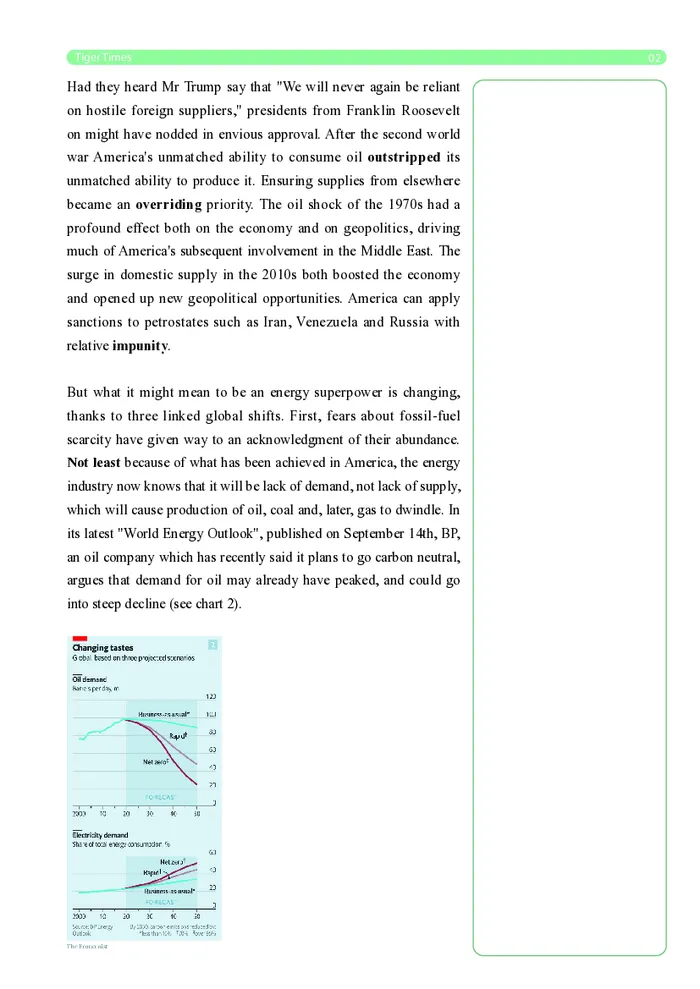
to his boast (see chart 1). Over the past decade America's oil output
has more than doubled and its gas production increased by over 50%.
America is now the world's top producer of both fuels.
Had they heard Mr Trump say that "We will never again be reliant
on hostile foreign suppliers," presidents from Franklin Roosevelt
on might have nodded in envious approval. After the second world
war America's unmatched ability to consume oil outstripped its
unmatched ability to produce it. Ensuring supplies from elsewhere
became an overriding priority. The oil shock of the 1970s had a
profound effect both on the economy and on geopolitics, driving
much of America's subsequent involvement in the Middle East. The
surge in domestic supply in the 2010s both boosted the economy
and opened up new geopolitical opportunities. America can apply
sanctions to petrostates such as Iran, Venezuela and Russia with
relative impunity.
But what it might mean to be an energy superpower is changing,
thanks to three linked global shifts. First, fears about fossil-fuel
scarcity have given way to an acknowledgment of their abundance.
Not least because of what has been achieved in America, the energy
industry now knows that it will be lack of demand, not lack of supply,
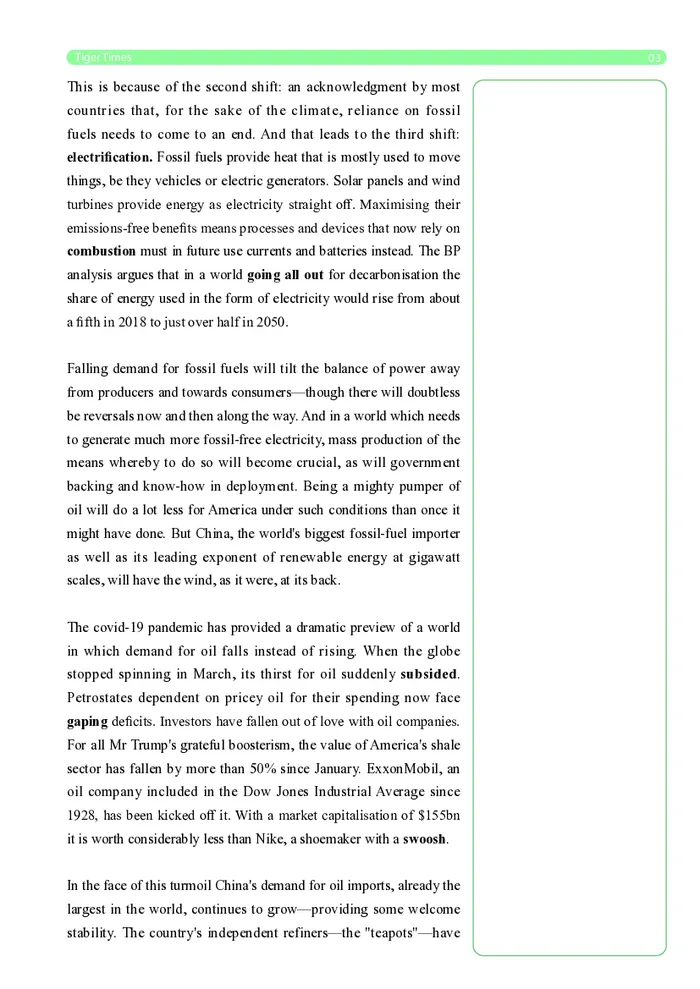
which will cause production of oil, coal and, later, gas to dwindle. In
its latest "World Energy Outlook", published on September 14th, BP,
an oil company which has recently said it plans to go carbon neutral,
argues that demand for oil may already have peaked, and could go
into steep decline (see chart 2).
Tiger Times
02
This is because of the second shift: an acknowledgment by most
countries that, for the sake of the climate, reliance on fossil
fuels needs to come to an end. And that leads to the third shift:
electrification. Fossil fuels provide heat that is mostly used to move
things, be they vehicles or electric generators. Solar panels and wind
turbines provide energy as electricity straight off. Maximising their
emissions-free benefits means processes and devices that now rely on
combustion must in future use currents and batteries instead. The BP
analysis argues that in a world going all out for decarbonisation the
share of energy used in the form of electricity would rise from about
a fifth in 2018 to just over half in 2050.
Falling demand for fossil fuels will tilt the balance of power away
from producers and towards consumers—though there will doubtless
be reversals now and then along the way. And in a world which needs
to generate much more fossil-free electricity, mass production of the
means whereby to do so will become crucial, as will government
backing and know-how in deployment. Being a mighty pumper of
oil will do a lot less for America under such conditions than once it
might have done. But China, the world's biggest fossil-fuel importer
as well as its leading exponent of renewable energy at gigawatt
scales, will have the wind, as it were, at its back.
The covid-19 pandemic has provided a dramatic preview of a world
in which demand for oil falls instead of rising. When the globe
stopped spinning in March, its thirst for oil suddenly subsided.
Petrostates dependent on pricey oil for their spending now face
gaping deficits. Investors have fallen out of love with oil companies.
For all Mr Trump's grateful boosterism, the value of America's shale
sector has fallen by more than 50% since January. ExxonMobil, an
oil company included in the Dow Jones Industrial Average since
1928, has been kicked off it. With a market capitalisation of $155bn
it is worth considerably less than Nike, a shoemaker with a swoosh.
In the face of this turmoil China's demand for oil imports, already the
largest in the world, continues to grow—providing some welcome
stability. The country's independent refiners—the "teapots"—have
Tiger Times
03
become large enough that they help set oil's price floor. "They are
essentially the vacuum cleaner of the crude market," says Per Magnus
Nysveen of Rystad Energy, a consultancy. Michal Meidan, who
leads China energy studies at Oxford University, points out that the
trading arms of state-owned oil giants SINOPEC and China National
Petroleum Corporation are now two of the three largest traders of
crude cargoes priced on the Platts Dubai futures contract, which
means they influence the price of crude bound for Asia. Low prices
also allow China to build up its strategic reserves.
Big finds off the coasts of Brazil and Guyana and the development of
Australia's liquefied natural gas (LNG) capacity, along with America's
shale boom, add to China's opportunities; a buyers' market is a good
place to be the biggest buyer, notes Kevin Tu of Columbia and
Beijing Normal Universities. There are plenty of bullish oilmen who
think that, BP to the contrary, peak demand has yet to be reached. But
even they recognise that the supply of oil below ground outstrips the
thirst above it, and that competition for customers is likely to heat up.
In some instances competition for Chinese demand may be
straightforward. When it embarked on a price war with Russia
this spring, Saudi Arabia slashed prices on shipments bound for
China. The country's biggest refiners are mulling a plan for a
buying consortium to strengthen their negotiating power with the
Organisation of the Petroleum Exporting Countries. China will
probably also flex its financial muscle as petrostates buckle under
debt. It has issued oil-backed loans to crude-rich countries such as
Angola and Brazil for more than a decade.
China's position as a buyer also allows it to undercut America's
attempts to squeeze oil exporters. Chinese buyers long continued to
import Iranian and Venezuelan crude. Its energy alliance with Russia
is particularly important.
Tiger Times
04
Tiger Times
05
cow /kaʊ/ v. 恐吓;吓唬;威胁;胁迫
○ [usually passive] to frighten sb. in order to make them
obey you
○ e.g. She was easily cowed by people in authority. 她很容
易被有权势的人吓住。
gleaming /ˈɡliːmɪŋ/ adj. 闪耀的;明亮的
○ shining brightly
○ e.g. gleaming white teeth 皓齿
○ gleam /gliːm/ v. 发微光;隐约闪光;闪烁
○ to shine with a pale clear light
○ e.g. The moonlight gleamed on the water. 月光照在水面
上泛起粼粼波光。
sheer /ʃɪə(r)/ adj.(用来强调事物的大小、程度或数量);
完全的,纯粹的,十足的
○ [only before noun] used to emphasize the size, degree or
amount of sth.
○ e.g. The area is under threat from the sheer number of tour
ists using it. 这一地区由于游客人数太多而面临威胁。
○ [only before noun] complete and not mixed with anything
else
○ e.g. The concert was sheer delight. 这场音乐会是一次十
足的享受。
hydrocarbon /ˌhaɪdrəˈkɑːbən/ n. 烃;碳氢化合物
○ (chemistry) a chemical made up of hydrogen and carbon
only. There are many different hydrocarbons found in petrol/
gas, coal and natural gas.
shale /ʃeɪl/ n. 页岩
○ a type of soft stone that splits easily into thin flat layers
unforthcoming /ˌʌnfɔːθˈkʌmɪŋ/ adj.(需要之物)尚未准备
好的
○ (of something required) not ready or made available when
wanted or needed
○ e.g. With money unforthcoming from the company, the
project has had to be delayed. 因公司资金未到位,工程不
得不推迟。
○ forthcoming /ˌfɔːθˈkʌmɪŋ/ adj. 即将发生(或出版等)的;
现成,随要随有
○ [only before noun] going to happen, be published, etc. very
soon
○ e.g. the forthcoming elections 即将举行的选举
○ [not before noun] ready or made available when needed
○ e.g. Financial support was not forthcoming. 财政支援尚未
到手。
substance /'sʌbstəns/ n. 物质,物品,东西;事实基础,根
据
○ a type of solid, liquid or gas that has particular qualities
○ e.g. a chemical/radioactive, etc. substance 化学、放射性
等物质
○ e.g. a sticky substance 一种黏乎乎的东西
○ the quality of being based on facts or the truth
○ e.g. It was malicious gossip, completely without substance.
这是恶意造谣,完全没有事实根据。
词汇
boast /bəʊst/ n. 夸耀;夸口 v. 自夸;自吹自擂
○ (often disapproving) something that a person talks about in
a very proud way, often to seem more important or clever
○ e.g. Despite his boasts that his children were brilliant,
neither of them went to college. 尽管他夸赞他的两个孩子
聪明,他们却都没有读大学。
○ to talk with too much pride about sth. that you have or can
do
○ e.g. She is always boasting about how wonderful her chil
dren are. 她总是夸耀她的孩子多么出色。
outstrip /ˌaʊt'strɪp/ v. 比… 大(或重要等),超过,胜过;
超过,超越(竞争对手)
○ to become larger, more important, etc. than sb./sth.
○ e.g. Demand is outstripping supply. 需求快超过供给了。
○ to be faster, better or more successful than sb. you are
competing against
○ e.g. Their latest computer outstrips all its rivals. 他们最新
型的计算机超越了所有的对手。
overriding /ˌəʊvəˈraɪdɪŋ/ adj. 最重要的;首要的;凌驾一
切的
○ [only before noun] more important than anything else in a
particular situation
○ the overriding factor/consideration/concern 首要因素/考
虑/关注的事
○ e.g. Their overriding aim was to keep costs low. 他们的首
要目标是维持低成本。
○ override /ˌəʊvəˈraɪd/ v.(以权力)否决,推翻,不理会;
比… 更重要,凌驾
○ to use your authority to reject sb.'s decision, order, etc.
○ e.g. The chairman overrode the committee's objections and
signed the agreement. 主席不顾委员会的反对,径行签署
了协议。
○ to be more important than sth.
○ e.g. Considerations of safety override all other concerns.
对安全的考虑高于一切。
impunity /ɪmˈpjuːnəti/ n. 免于惩罚;不受惩处;逃过惩罚
○ (formal, disapproving) if a person does sth. bad with impu
nity, they do not get punished for what they have done
○ e.g. It's astonishing that these criminals are free to walk the
streets with impunity. 令人惊讶的是,这些罪犯可以招摇
过市、逍遥法外。
not least 特别;尤其
○ especially
○ e.g. We had many things to consider, not least the safety of
our children. 我们有很多事要考虑,尤其是我们孩子的安
全问题。
electrification /ɪˌlektrɪfɪˈkeɪʃn/ n. 电气化
○ the process of changing sth. so that it works by electricity
○ electrify /ɪ'lektrɪfaɪ/ v. 使电气化;使通电;使带电
○ [usually passive] to make sth. work by using electricity; to
pass an electrical current through sth.
○ e.g. The railway line was electrified in the 1950s. 这条铁
路线在 20 世纪 50 年代实现了电气化。
Tiger Times
06
combustion /kəm'bʌstʃən/ n. 燃烧;(快速)氧化
○ the process of burning
○ (specialist) a chemical process in which substances com
bine with the oxygen in the air to produce heat and light
go all out 全力以赴,竭尽全力
○ to try very hard to do or get something
○ e.g. We're going all out for victory in this afternoon's game.
我们将拼尽全力赢得下午的这场比赛。
○ e.g. The company will be going all out to improve on last
year's sales. 公司将全力以赴,争取创下比去年更好的销
售业绩。
subside /səb'saɪd/ v. 趋于平静,平息,减弱,消退;(水)
回落,减退
○ to become calmer or quieter
○ e.g. She waited nervously for his anger to subside. 她提心
吊胆地等他的怒气平息下来。
○ e.g. I took an aspirin and the pain gradually subsided. 我服
了一片阿司匹林,疼痛逐渐缓解了。
○ (of water) to go back to a normal level
○ e.g. The flood waters gradually subsided. 洪水缓缓回落。
gaping /'geɪpɪŋ/ adj.(洞)豁开的;(伤口)敞开的;(嘴
巴)张大的
○ a gaping hole, wound, or mouth is very wide and open
○ e.g. The aircraft took off with a gaping hole in its fuselage.
飞机起飞了,机身上有一个裂开的口子。
○ e.g. a gaping wound in her back 她背上开裂的伤口
○ gape /ɡeɪp/ v.(洞、伤口等)张开,裂开;张口结舌地看,
目瞪口呆地凝视
○ If you say that something such as a hole or a wound gapes,
you are emphasizing that it is big or wide.
○ e.g. The front door was missing. A hole gaped in the roof.
前门不翼而飞,屋顶豁开了一个洞。
○ to stare at sb./sth. with your mouth open because you are
shocked or surprised
○ e.g. His secretary stopped taking notes to gape at me. 他的
秘书停止了记录,目瞪口呆地望着我。
swoosh /swuːʃ/ n. 闪光形(或彩色条形)标记(或图案)v.
嗖嗖地迅速移动
○ an emblem or design representing a flash or stripe of co
lour
○ e.g. white running shoes with the Nike swoosh 带有闪光
形耐克标志的白色跑鞋
○ to move quickly through the air in a way that makes a
sound
○ e.g. Cars and trucks swooshed past. 汽车和卡车嗖嗖地疾
驶而过。
slash /slæʃ/ v.(用利器)砍,劈;大幅度削减,大大降低
○ to make a long cut with a sharp object, especially in a vio
lent way
○ e.g. Someone had slashed the tyres on my car. 有人把我的
汽车轮胎割破了。
○ [often passive] (informal) to reduce sth. by a large amount
○ e.g. to slash costs/prices/fares, etc. 大幅度降低成本、价
格、车费等
mull /mʌl/ v. 仔细考虑;反复思考
○ If you mull something, you think about it for a long time
before deciding what to do.
○ e.g. Last month, a federal grand jury began mulling evi
dence in the case. 联邦大陪审团于上月开始仔细审查本案
的证据。
○ e.g. Do you know why he was mulling and hesitating? 你
知道他为什么前思后想、犹豫不决吗?
consortium /kənˈsɔːtiəm/ n.(合作进行某项工程的)财团,
银团,联营企业
○ a group of people, countries, companies, etc. who are
working together on a particular project
○ e.g. the Anglo-French consortium that built the Channel
Tunnel 修建英吉利海峡隧道的英法财团
flex /fleks/ v. 屈伸,活动(四肢或肌肉,尤指为准备体力
活动)
○ to bend, move or stretch an arm or a leg, or contract a mus
cle, especially in order to prepare for a physical activity
○ e.g. to flex your fingers/feet/legs 活动手指/双脚/双腿
○ e.g. He stood on the side of the pool flexing his muscles.
他站在游泳池旁活动肌肉。
○ flex your muscles 显示实力,炫耀力量(尤指作为警告
或威胁)
○ to show sb. how powerful you are, especially as a warning
or threat
buckle /ˈbʌkl/ v.(使)搭扣扣住;(被)压垮,压弯
○ to fasten sth. or be fastened with a buckle
○ e.g. She buckled her belt. 她扣上了腰带。
○ to become crushed or bent under a weight or force; to
crush or bend sth. in this way
○ e.g. The steel frames began to buckle under the strain. 钢
架在重压下开始变形。
○ e.g. A weaker man would have buckled under the pressure.
意志薄弱的人在这种压力下可能就垮了。
Tiger Times
07
今日习题
1. 根据英文释义写出文中出现的对应单词
______: (often disapproving) something that a person talks about in a very proud way, often to seem more
important or clever
______: (formal, disapproving) if a person does sth. bad with impunity, they do not get punished for what
they have done
2. 一词多义
Which of the following underlined words is closest in meaning to the one in the sentence "The sheer
volume of hydrocarbons that such American oilmen have released from the shale beneath Midland and
previously unforthcoming geology elsewhere gives substance to his boast."? ____
A. I agreed with what she said in substance, though not with every detail.
B. Nothing of any substance was achieved in the meeting.
C. There is no substance to the rumours.
D. Plutonium 238 is one of the most toxic substances known to man.
3. 翻译:根据给定中文回译英文
如果富兰克林· 罗斯福往后的总统们听到特朗普说“ 我们再也不用依赖充满敌意的外国石油供应
国”,他们可能会嫉妒地点头肯定。
_____________________________________________________________________________________
_________________________________________________________________
习题答案
1. boast; impunity
2. C
3. Had they heard Mr Trump say that "We will never again be reliant on hostile foreign suppliers,"
presidents from Franklin Roosevelt on might have nodded in envious approval.
编辑丨童雨欣