普通高中教科书
必 修
第三册
英语
第三册
必 修
普
通
高
中
教
科
书
英语
·北京·
ENGLISH
人民教育出版社 课程教材研究所
英语课程教材研究开发中心
圣
智
学
习
集
团
(中国)
(美国)
编著
普通高中教科书 英语 必修 第三册
(中国)
人民教育出版社 课程教材研究所
英语课程教材研究开发中心 编著
(美国)圣
智
学
习
集
团
出 版
(北京市海淀区中关村南大街17 号院1 号楼 邮编:100081)
网 址 http://www.pep.com.cn
版权所有·未经许可不得采用任何方式擅自复制或使用本产品任何部分·违者必究
如发现内容质量问题,请登录中小学教材意见反馈平台:jcyjfk.pep.com.cn
主 编:刘道义 郑旺全
副 主 编:吴 欣 张献臣
编写人员: Patrick Wallace Sarah H. Miller Simon McCue Edward Yoshioka
肖 菲 张琳琳 徐 卓 庄 力
责任编辑:肖 菲 张琳琳
美术编辑:胡白珂
《普通高中教科书 英语》是为了适应新时代的发展需要,依据《普通高中英语课程标
准(2017年版)》的精神,充分征求广大师生的反馈意见,在《普通高中课程标准实验教科
书 英语》的基础上精心修订而成。此次教材修订的主要目的是:全面落实立德树人根本任
务,培育社会主义核心价值观,弘扬中华优秀文化,充分体现英语课程工具性和人文性的统
一,发展学生的语言能力、文化意识、思维品质和学习能力等英语学科核心素养,充分体现
英语学科特殊的育人价值,培养具有中国情怀、国际视野和跨文化沟通能力的社会主义建设
者和接班人。
修订后的教材主要具有以下特点:
注重思想引领 教材融入了社会主义核心价值观的基本内容和要求,注重培养学生良好
的政治素质、道德品质和健全人格,弘扬中华优秀文化,增强文化自信,引导学生形成正确
的世界观、人生观和价值观。
反映时代要求 教材充分反映当代社会发展新变化、科技进步新成果,展示新时代中国
特色社会主义新成就,将先进的教育思想和理念融入教材之中,同时紧密结合学生的学习和
生活实际,关注信息化环境下学生的发展需求。
强调语言实践 教材以英语学习活动观为指导,以主题为引领,以语篇为依托,通过板
块式设计将语言知识与听、说、读、看、写等技能有机整合,强调学习过程和学习策略,突
出活动目标,让学生用语言做事情,在实践中培养语言运用能力和创新思维。
突出文化意识 教材通过展示多姿多彩的中外文化来培养学生对中华文化的认同和传承,
加深对人类优秀文化的学习和鉴赏;通过让学生分析中外文化异同,发展其多元思维和批判
性思维,增强学生跨文化理解和跨文化沟通能力,构建人类命运共同体意识。
激发学习动机 教材以真实性、趣味性、规范性和经典性作为内容选编原则,主题覆盖
面广,语篇题材和体裁丰富,活动呈现形式多样,版式设计生动活泼且富有美感,力求激发
学生的学习兴趣和动机,引发他们积极思考、主动参与语言实践活动,提升英语学习效率。
满足不同需求 教材编排内容和活动设计既充分考虑学生的共同基础,又兼顾学生不同
的能力水平和学习需求,提供了拓展性的教学内容,为教师灵活使用教材进行教学提供了便
利,也切实促进学生的个性发展。
本套教材为高中英语教学提供了丰富的教学资源。希望教材能够帮助同学们打下坚实的
语言基础,提高英语水平,获得全面发展;同时希望老师们能够充分利用教材,在实践中不
断完善教学,取得良好的教学效果。
前 言
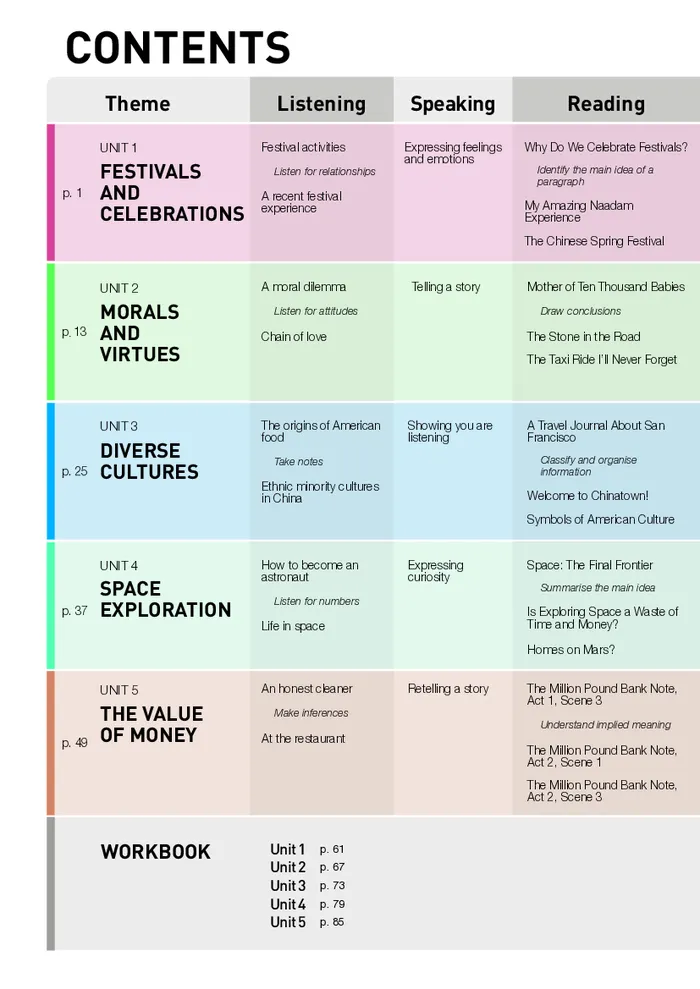
CONTENTS
Listening
Speaking
Reading
Expressing feelings
and emotions
Telling a story
Showing you are
listening
Why Do We Celebrate Festivals?
Identify the main idea of a
paragraph
My Amazing Naadam
Experience
The Chinese Spring Festival
Mother of Ten Thousand Babies
Draw conclusions
The Stone in the Road
The Taxi Ride I’ll Never Forget
A Travel Journal About San
Francisco
Classify and organise
information
Welcome to Chinatown!
Symbols of American Culture
p. 1
p. 25
p. 49
Theme
p. 13
UNIT 2
MORALS
AND
VIRTUES
UNIT 1
FESTIVALS
AND
CELEBRATIONS
UNIT 3
DIVERSE
CULTURES
p. 37
UNIT 5
THE VALUE
OF MONEY
Unit 1 p. 61
Unit 2 p. 67
Unit 3 p. 73
Unit 4 p. 79
Unit 5 p. 85
WORKBOOK
Festival activities
Listen for relationships
A recent festival
experience
A moral dilemma
Listen for attitudes
Chain of love
The origins of American
food
Take notes
Ethnic minority cultures
in China
How to become an
astronaut
Listen for numbers
Life in space
An honest cleaner
Make inferences
At the restaurant
Expressing
curiosity
Retelling a story
Space: The Final Frontier
Summarise the main idea
Is Exploring Space a Waste of
Time and Money?
Homes on Mars?
The Million Pound Bank Note,
Act 1, Scene 3
Understand implied meaning
The Million Pound Bank Note,
Act 2, Scene 1
The Million Pound Bank Note,
Act 2, Scene 3
UNIT 4
SPACE
EXPLORATION
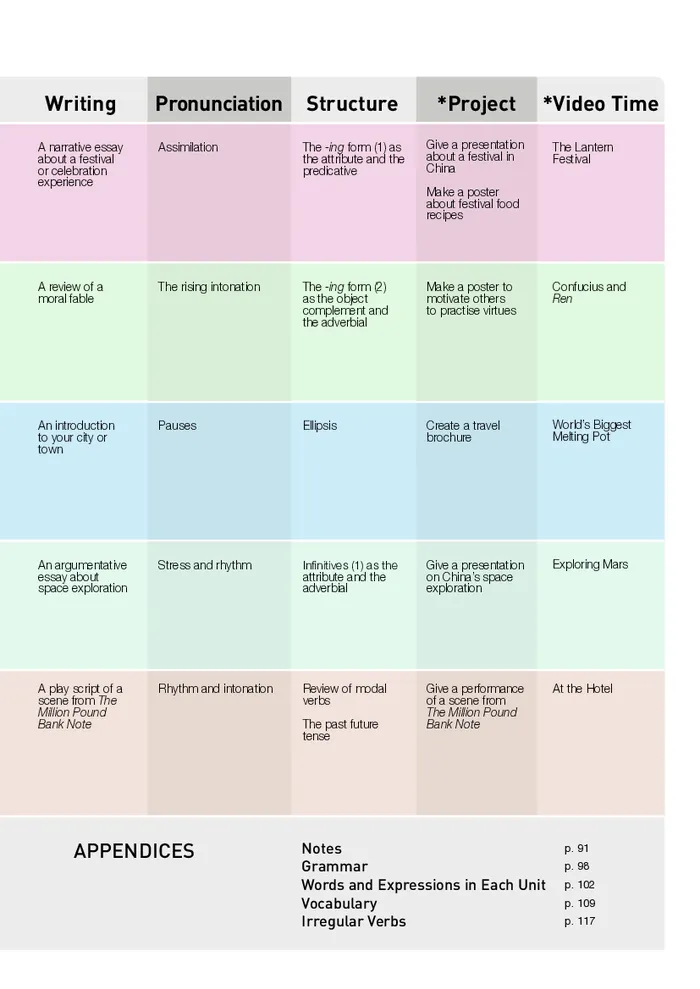
Writing
Pronunciation
Structure
APPENDICES
Notes
p. 91
Grammar
p. 98
Words and Expressions in Each Unit
p. 102
Vocabulary
p. 109
Irregular Verbs
p. 117
A narrative essay
about a festival
or celebration
experience
A review of a
moral fable
An introduction
to your city or
town
Assimilation
The rising intonation
Pauses
The -ing form (1) as
the attribute and the
predicative
The -ing form (2)
as the object
complement and
the adverbial
Ellipsis
An argumentative
essay about
space exploration
A play script of a
scene from The
Million Pound
Bank Note
Stress and rhythm
Rhythm and intonation
Infinitives (1) as the
attribute and the
adverbial
Review of modal
verbs
The past future
tense
*Video Time
The Lantern
Festival
Confucius and
Ren
World’s Biggest
Melting Pot
Exploring Mars
At the Hotel
*Project
Make a poster to
motivate others
to practise virtues
Give a presentation
about a festival in
China
Make a poster
about festival food
recipes
Give a presentation
on China’s space
exploration
Give a performance
of a scene from
The Million Pound
Bank Note
Create a travel
brochure
FESTIVALS AND CELEBRATIONS UNIT 1
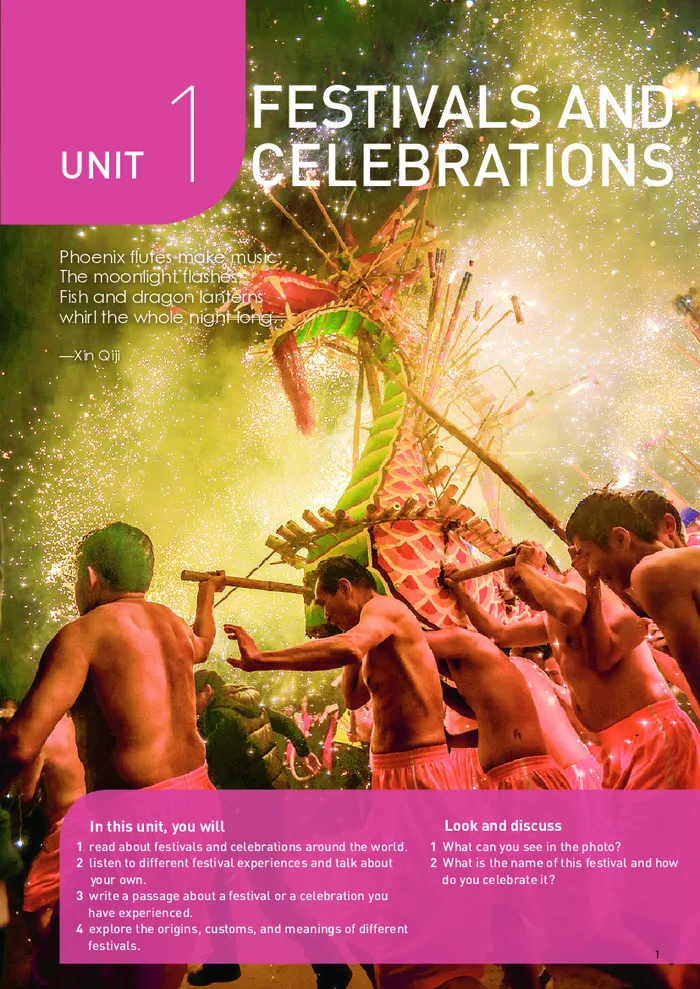
FESTIVALS AND
CELEBRATIONS
Phoenix flutes make music,
The moonlight flashes,
Fish and dragon lanterns
whirl the whole night long.
—Xin Qiji
1
UNIT
In this unit, you will
1 read about festivals and celebrations around the world.
2 listen to different festival experiences and talk about
your own.
3 write a passage about a festival or a celebration you
have experienced.
4 explore the origins, customs, and meanings of different
festivals.
Look and discuss
1 What can you see in the photo?
2 What is the name of this festival and how
do you celebrate it?
1
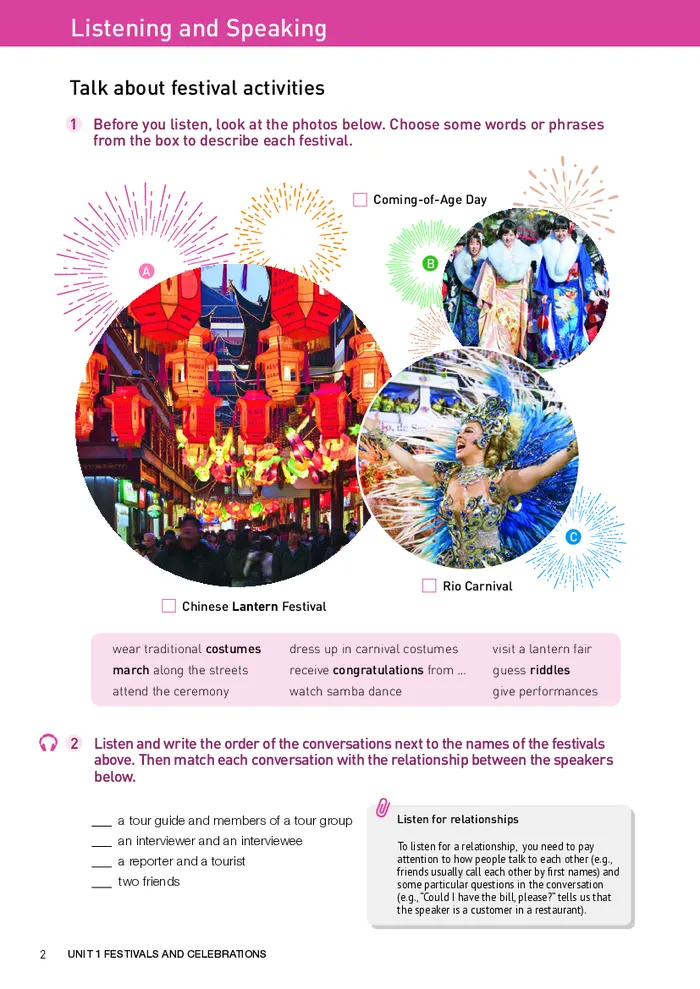
Talk about festival activities
1 Before you listen, look at the photos below. Choose some words or phrases
from the box to describe each festival.
Listening and Speaking
2 Listen and write the order of the conversations next to the names of the festivals
above. Then match each conversation with the relationship between the speakers
below.
To listen for a relationship, you need to pay
attention to how people talk to each other (e.g.,
friends usually call each other by first names) and
some particular questions in the conversation
(e.g., “Could I have the bill, please?” tells us that
the speaker is a customer in a restaurant).
Listen for relationships
a tour guide and members of a tour group
an interviewer and an interviewee
a reporter and a tourist
two friends
Chinese Lantern Festival
Rio Carnival
Coming-of-Age Day
wear traditional costumes
dress up in carnival costumes
visit a lantern fair
march along the streets
receive congratulations from …
guess riddles
attend the ceremony
watch samba dance
give performances
A
B
C
2
UNIT 1 FESTIVALS AND CELEBRATIONS
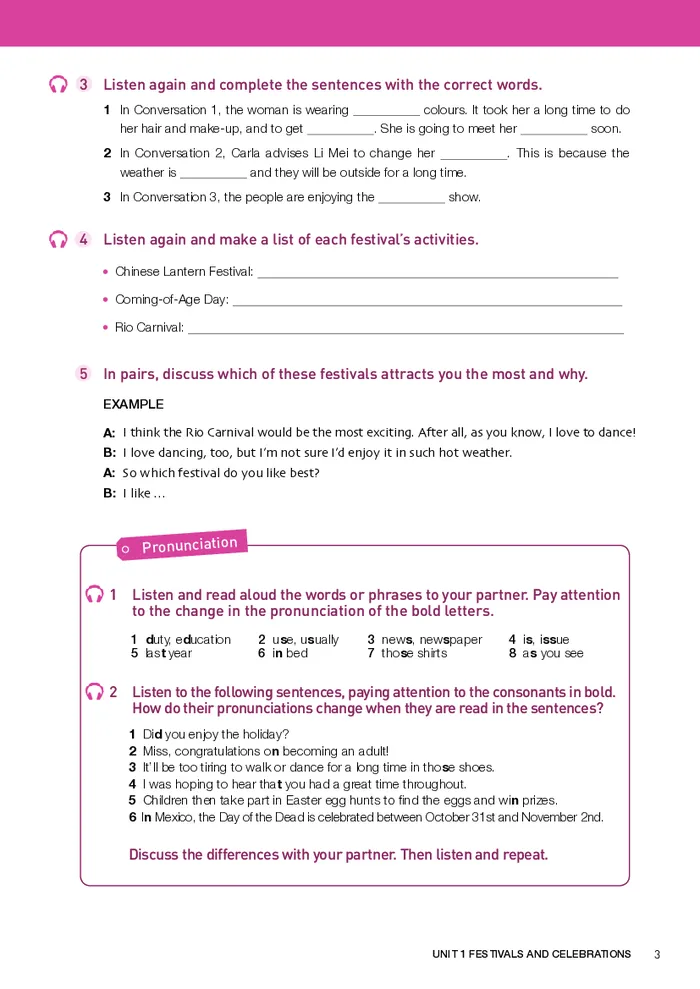
Pronunciation
1 Listen and read aloud the words or phrases to your partner. Pay attention
to the change in the pronunciation of the bold letters.
1 duty, education
2 use, usually
3 news, newspaper
4 is, issue
5 last year
6 in bed
7 those shirts
8 as you see
Discuss the differences with your partner. Then listen and repeat.
2 Listen to the following sentences, paying attention to the consonants in bold.
How do their pronunciations change when they are read in the sentences?
1 Did you enjoy the holiday?
2 Miss, congratulations on becoming an adult!
3 It’ll be too tiring to walk or dance for a long time in those shoes.
4 I was hoping to hear that you had a great time throughout.
5 Children then take part in Easter egg hunts to find the eggs and win prizes.
6 In Mexico, the Day of the Dead is celebrated between October 31st and November 2nd.
4 Listen again and make a list of each festival’s activities.
Chinese Lantern Festival:
Coming-of-Age Day:
Rio Carnival:
3 Listen again and complete the sentences with the correct words.
1 In Conversation 1, the woman is wearing
colours. It took her a long time to do
her hair and make-up, and to get
. She is going to meet her
soon.
2 In Conversation 2, Carla advises Li Mei to change her
. This is because the
weather is
and they will be outside for a long time.
3 In Conversation 3, the people are enjoying the
show.
5 In pairs, discuss which of these festivals attracts you the most and why.
EXAMPLE
A: I think the Rio Carnival would be the most exciting. After all, as you know, I love to dance!
B: I love dancing, too, but I’m not sure I’d enjoy it in such hot weather.
A: So which festival do you like best?
B: I like …
3
UNIT 1 FESTIVALS AND CELEBRATIONS
Reading and Thinking
Discover the reasons for festivals and celebrations
1 Before you read, discuss these questions in groups.
Festivals are celebrated all around the world. They
have a wide range of origins, such as the seasons
of the year, religions, famous figures, and important
events. Every festival has its different customs and
unique charms. However, no matter how different
they may seem, all over the world, the spirit of
sharing joy, gratitude, love, or peace is common in
all festivals.
Of all the traditional festivals, the harvest festival
can be found in almost every culture. This important
agricultural festival takes place after all the crops
have been gathered in. People celebrate to show
that they are grateful for the year’s supply of food.
In ancient Egypt, the harvest festival was celebrated
during the springtime—the Egyptian harvest season.
It featured a parade and a great feast with music,
dancing, and sports. Today, in some European
countries, people decorate churches and town
halls with flowers and fruit, and get together to celebrate over a meal. During the
Mid-Autumn Festival in China, families gather to admire the shining moon and enjoy
delicious mooncakes.
Customs play a significant role in festivals, but sometimes they can change over time.
With the development of modern society and the spread of new ideas, some traditions
may fade away and others may be established. One example is the typical Chinese
Spring Festival custom of lighting firecrackers to drive away the evil spirits and
celebrate the new year. Nowadays, many big cities have given up this custom in order
to avoid air pollution. Another example is Halloween, which slowly became an exciting
festival for children, in spite of its religious origins.
1 What festivals do you celebrate with your family each year?
2 Why do you think people celebrate different festivals?
WHY DO WE CELEBRATE FESTIVALS?
2 Read the text and find out the answer to the question in the title.
4
UNIT 1 FESTIVALS AND CELEBRATIONS
3 Read the text again and underline the
topic sentence of each paragraph that
gives the main idea.
4 In pairs, discuss the following questions.
1 What do most festivals seem to have in common? Why do you think people around the
world find these things important?
2 How do you feel about festival customs that have already faded away?
3 What is the writer’s attitude towards the commercialisation of festivals?
5 Complete the following passage using suitable words from the text. Be sure
to use the correct forms.
Festivals are becoming more and more
commercial, with businesses taking
advantage of the celebrations. Online
shopping websites and social media
apps have made it much easier for the
public to spend more on gifts for their
loved ones. Although some believe
festivals should not be commercialised,
others believe the increase in spending
is good for the economy and public happiness.
Festivals are an important part of society. They reflect people’s wishes, beliefs, faiths,
and attitudes towards life. They are occasions that allow us to relax and enjoy life, and
forget about our work for a little while. They help us understand where we came from,
who we are, and what to appreciate. And if you study festivals carefully, you may be
surprised to find that different cultures actually have a lot in common after all.
Identifying the main ideas of paragraphs
is necessary when analysing a text.
Most paragraphs will have a “topic
sentence” that tells you the paragraph’s
main idea. It is often the first sentence,
but sometimes it is found elsewhere in
the paragraph.
Identify the main idea of a
paragraph
Today’s festivals have a wide
of origins, including the seasons of the year, famous
, important events, and religions. The
festival is one of the most popular
festivals and is celebrated in many cultures. Customs play a
role in festivals, but
they can change over time. For example, some Chinese cities no longer allow firecrackers
during the Spring Festival, as they can increase air pollution. These days, festivals are becoming
more
, with people spending more money on gifts. Festivals
people’s
wishes, beliefs, faiths, and attitudes towards life. They are
to spend time with family,
and to relax and enjoy life.
5
UNIT 1 FESTIVALS AND CELEBRATIONS
Discovering Useful Structures
1 Read the sentences below and discuss the functions and meanings of the
italicised -ing form. Find more examples from the unit.
These lanterns are amazing.
During the Mid-Autumn Festival in China, families gather to admire the shining moon and
enjoy delicious mooncakes.
Families celebrating the Chinese New Year can enjoy exciting dragon dances and carnivals
together.
Describe festival activities
3 Complete the passage with the appropriate -ing form.
La Tomatina is a festival that takes place in the Spanish
town Buñol every August. I think many food festivals are
because people are just eating. However, this
festival is
because people don’t actually eat
the tomatoes. Instead, they throw them at each other!
The number of people
part in this tomato fight
can reach up to 20,000, and it is a very
fight
that lasts for a whole hour. The
thing is how
clean Buñol is after the tomatoes are washed away after
the fight. This is because the juice from tomatoes is really
good for making surfaces clean!
2 Read the following messages posted by some exchange students on an Internet
forum. Underline the -ing form used as the attribute or the predicative.
Discussion: Which festival is your favourite?
Rio Carnival! I spent a really fun day there with my friends. It was great
fun walking along the streets, enjoying the relaxing atmosphere! The
performances were just amazing.
The Spring Festival in China, especially the dinner on the Chinese New
Year’s Eve! All family members get together. And I get lucky money in
red envelopes from my parents and relatives, so it’s always an exciting
time for me.
Perhaps Thanksgiving. What could be better? Families getting together
and eating delicious food, people watching sports games on TV, friends
laughing and talking, etc. Plus there’s Black Friday, if shopping is your
thing.
I think it’s Christmas. I just can’t take my eyes off the shining lights
on the Christmas trees everywhere. Lots of smiling faces, and people
singing Christmas carols and wishing each other “Merry Christmas!”
Today 9:05 am
Today 9:11 am
Today 10:11 am
Today 10:24 am
Sunnyli
Vincent1119
Wizard_Oz
Cooper_08
6
UNIT 1 FESTIVALS AND CELEBRATIONS
Listening and Talking
Talk about festival experiences
3 Read the conversation below and underline the phrases that express feelings
about festivals. Role-play the conversation with your partner.
Joe:
Did you enjoy the holiday, Song Lin?
Song Lin: Oh yes, it was great, thanks! The food, the parades, and the beautiful fireworks—
it’s always exciting for me. It’s good to spend time with my family, too, although
it can get a bit boring in my hometown after a while. How about you?
Joe:
Well, this was my first Chinese New Year. I loved watching the traditional
performances, and I was invited to lots of delicious meals. But, to be frank, the
fireworks going off throughout the night were really annoying.
Song Lin: Oh, well, yes, I can see your point there! But it’s all part of the tradition to
frighten away the evil spirits.
Joe:
Yes, well, there seemed to be a lot of them in my area! Anyway, except for that,
everything was fine. I’m really looking forward to the next festival.
4 Share a recent festival experience with your partner and tell him/her how
you felt about the festival and why.
Listening and Talking
1 Song Lin and Max are talking about a recent festival experience. Listen to their
conversation and answer the questions.
1 What festival is Max talking about?
2 What did Max do during the festival?
3 What dishes did Max’s mother cook?
pumpkin pie
pudding
apple pie
roast turkey
mashed potatoes
4 What did Max and his family do during
and after the dinner?
5 What was the best part of the festival?
2 Listen again and tick the phrases that Max or Song Lin uses.
It was fantastic!
How wonderful!
How exciting!
That’s amazing.
It was great fun!
It’s very exciting.
It was great to …
I’m really happy that …
I’m pleased to ...
Expressing feelings and emotions
7
UNIT 1 FESTIVALS AND CELEBRATIONS
Reading for Writing
Write about your festival experience
1 Read the diary entry and answer the questions.
Opening Paragraph:
State the topic
(e.g., where, when,
and with whom
you celebrated the
festival, and also
your main feeling).
First Body
Paragraph:
Describe the start
of the festival and
the surroundings.
Second Body
Paragraph:
Describe in
detail the festival
activities.
Closing Paragraph:
Give a brief
summary of the
experience.
Third Body
Paragraph:
Describe in detail
the festival activities.
MY AMAZING NAADAM EXPERIENCE
I experienced the Naadam Festival in China’s Inner Mongolia
Autonomous Region for the first time this year. The festival
falls on the fourth day of the sixth month of the Chinese lunar
calendar, usually lasting for three days. Naadam means “games”
in Mongolian, and it is represented by three events: horse racing,
wrestling, and archery, which are all so exciting to watch!
On the first day, I set off to the games early with my friend Burin.
I saw a lot of people wearing fancy Mongolian robes. Some
were feeding their horses, some were practising archery, and
others were chatting or taking photographs. Burin told me that
Mongolians travel every year from near and far to attend the
festival, just as their ancestors had done for centuries.
After the opening ceremony and some amazing performances,
the wrestling competition began. Mongolian wrestling is different
from the wrestling in the Olympic Games. There are no rounds,
and wrestlers are not separated by weight. The wrestler loses if
any part of his body above his knee touches the ground. After
singing some songs, the competitors danced onto the green field,
waving their arms in the air as if they were eagles. I was quite
moved by their show of strength and grace.
I absolutely enjoyed the archery, too, but the horse races were
my favourite part. However, I was surprised to see that the riders
were boys and girls! I heard it is because children are lighter and
the horses can run faster and farther. At first, I was a little worried
about the children’s safety, but Burin said, “Don’t worry. They’ve
been riding horses all their lives. They’ll be just fine.” That was the
moment I started to understand why people say “Horses are at
the heart of Mongolian culture”. ...
I’m finally back home now, feeling really tired, but celebrating
Naadam with my friend was totally worth it. He invited me back for
the winter to stay in a traditional Mongolian tent and eat hot pot. I
can’t wait!
8
1 What does “Naadam” mean? Which events does it include?
2 What Naadam Festival customs did you learn about?
3 What in your opinion is the most impressive thing about the festival?
4 What else would you like to know about the festival and the writer’s experience?
2 Study the organisation and language features.
This was my first time spending … and it was an enjoyable and exciting experience
for me.
I’ll never forget … because …
I’ll always … because …
1 Read the sentence patterns below and use them to rewrite the opening sentence of the article.
2 Underline the sentences that describe the writer’s feelings and emotions.
4 Put up your writing in your classroom or read it to the class.
3 Use what you have learnt to write about a festival or a celebration you have
experienced recently.
3 Get your draft back and revise it.
1 Make notes of your ideas in the table and then write your draft.
Outline
Main idea of each paragraph
Details
Feelings
The name of the festival/celebration:
1
2 Exchange drafts with a partner. Use the checklist to give feedback on your partner’s draft.
Is the writing well-organised?
Is there an opening sentence in the first paragraph?
Does each paragraph include the necessary details?
Does the writer describe his/her feelings and emotions?
Does the writer use the -ing form correctly in the writing?
Are there any grammar, spelling, or punctuation errors?
4
A summary of my festival/
celebration experience
The topic and my feeling
2
How I prepared for the
festival/celebration
3
The festival/celebration
activities
9
UNIT 1 FESTIVALS AND CELEBRATIONS
2 Circle the correct word in each sentence.
1 Taking part in the celebration was a satisfying/satisfied experience for us.
2 Most of the people were amazing/amazed by the lion dances during the new year
celebrations.
3 The child seemed annoying/annoyed when he found his gift broken.
4 The man dressing/dressed in a ghost costume looks quite frightening/frightened.
5 Kate was surprising/surprised by the sight of the Kongming lanterns flying/flown up
into the sky.
Which festival(s) mentioned in this unit was/were new to you?
Which festival did you find the most interesting? Why?
Do you wish to add one extra holiday in China? What would you like to celebrate? Why?
Which part of this unit did you find the most difficult?
Overall, I thought this unit was
interesting
useful
so-so
difficult.
1 Fill in the blanks with the correct forms of the words in the box.
1 The beautiful flowers on cherry branches are the most
sign of the arrival of spring.
2 In December, many companies have
dress parties to celebrate the end of the year.
3 The female soldiers forming the biggest
group in the National Day parade
attracted a lot of interest from the
.
4 The most common colour you see during the Spring Festival is red because red
life,
wealth, and good luck in Chinese culture.
5 The newly married couple received dozens of letters of
from their friends.
6 If you are the best man at a wedding, it is best to keep your speech simple and
.
7 She will never forget the
when she saw all the audience clapping their hands and
cheering after her performance.
8 Falling on the 9th day of the 9th
month, the Chongyang Festival is also called the
Double Ninth Festival. It is a day for people in China to show respect to seniors.
9 To be frank, this
chicken tastes horrible.
march
brief
media
congratulation
significant
moment
roast
lunar
represent
fancy
Assessing Your Progress
REFLECTING
10
UNIT 1 FESTIVALS AND CELEBRATIONS
In groups, choose one festival in China, research it, and then give a presentation
to the class. Use the example outline below to help you.
Time: On the third day of the third month of the
Chinese lunar calendar
Place: In the Guangxi Zhuang Autonomous
Region
Ethnic minority group: The Zhuang people
Festival activities: Sing songs, ...
Local festival food: five-coloured sticky rice,
duck in lemon sauce, ...
Facts about the Zhuang People’s Folk Song Festival
The Laba Festival usually occurs about a month before the Chinese Spring Festival. The
festival’s traditional food is Laba porridge.
Possible ingredients and steps:
15 Chinese dates
5 peeled longan fruit
3 walnuts
1/2 cup of sticky rice
1/4 cup of millet
1/4 cup of peanuts
1/4 cup of red beans
1/4 cup of mung beans
1/4 cup of raisins
Wash the rice,
millet, peanuts, red
beans, and mung
beans, and soak
them in 2 cups of
water overnight.
Put these ingredients
and the dates into a pot.
Pour in 6 cups of water,
and bring the pot to a boil
before simmering for one
and a half hours over low
heat.
Wash the raisins,
walnuts, and longan
fruit, and then put
them into the pot
with some sugar
before simmering for
another 30 minutes.
Turn off the
heat and then
wait for 10
minutes before
serving the
porridge.
1
2
3
4
*Project 1: Give a presentation about a festival in China
*Project 2: Make a poster about festival food recipes
In groups, collect some festival food recipes. If possible, learn to cook the food at
home and then make a poster with pictures for the class. Use the example below
to help you.
11
UNIT 1 FESTIVALS AND CELEBRATIONS
BEFORE YOU WATCH
How much do you know about the Lantern Festival? Look at the table below
and try to fill in the blanks.
AFTER YOU WATCH
Work with a partner. Use the notes above to help you give a brief introduction
to the Lantern Festival.
* Video Time
The Lantern Festival
The Lantern Festival is one of the most
important traditional festivals in China. The
custom of joyfully celebrating the Lantern
Festival began in ancient times and still has
great influence on Chinese people today.
WHILE YOU WATCH
Complete the table with the correct words.
Date
• On the
day of the
lunar month
• The
day of the Chinese New Year celebrations
• The fire dragon dance in Puzhai Town in
Province has a
history of over
years.
• The Lantern Festival was known as the Chinese
Day in the
past. It was a good day for
.
• Many ancient poets wrote poems about the festival, which describe
happy
and also the stories of young
.
Interesting
events in
history
1 Looking at lanterns
• Places to see the lanterns:
• Most cities will
.
2 Guessing riddles
Riddles are often written
.
3 Eating yuanxiao or tangyuan
• Different fillings are stuffed into balls of sticky
.
• The
symbolises reunion, harmony, and
.
Festival
activities
12
UNIT 1 FESTIVALS AND CELEBRATIONS
MORALS AND VIRTUES UNIT 2
2
UNIT
In this unit, you will
1 read about a compassionate doctor, Lin Qiaozhi.
2 listen to discussions about moral dilemmas and
the power of kindness and talk about the virtues
that we cherish.
3 write a review of a moral fable.
4 explore the importance of moral values and virtues.
Look and discuss
1 What do you think the teenagers are doing?
2 Can you list some virtues that are admired
in every culture?
13
The best portion of a good man’s life is his
little, nameless, unremembered acts of
kindness and of love.
—William Wordsworth
MORALS AND
VIRTUES
Listening and Speaking
Talk about moral dilemmas
1 Before you listen, look at the definition and the picture below. Then discuss
the questions with your group.
2 Listen to the conversation and complete the table to describe the moral
dilemma that Jane is talking about.
3 Listen again and decide whether the statements
are true (T) or false (F).
A moral dilemma
is a situation in
which you have
two or more
difficult choices
to make. If you
choose one,
you might get in
trouble for not
choosing the
other(s).
1 What moral dilemma is the boy in the picture facing?
2 Have you ever faced a moral dilemma or heard of someone who did? Describe it.
The girl’s
choices
Situation
Possible
results
or
She can
.
She can
.
The girl is taking the entrance examination for
in
Beijing. During the exam, the student next to her fainted.
, but
.
, but
.
Listen for attitudes
When you listen, you should pay
attention not only to the words
but also to HOW the speaker is
talking. If people strongly disagree
with something, they might
exaggerate their intonation. If you
hear people speaking very quickly
or loudly, they may be excited or
angry. If they speak slowly or stop
often, they may be confused or not
sure about what they are saying.
1 Jane is eager to share the magazine article
with Luke.
2 Luke doubts that young people face moral
dilemmas all the time.
3 Jane admires what the girl in the story did.
4 Luke doesn’t believe anybody would do what
the girl in the story did.
5 Jane wonders how the girl became a doctor
later.
T
F
T
F
T
F
T
F
T
F
14
UNIT 2 MORALS AND VIRTUES
4 Listen to the conversation carefully and answer the questions.
5 Think about what you would do if you were ever faced with the same situation
as the girl. Then share your thoughts with your group, and explain the reasons
for your choice.
EXAMPLE
A: If I were ever in a situation like the girl faced, I think I would choose to …
B: Why? Are you sure?
A: Because I think that … is most important. What about you?
B: I think I would …
1 What did the girl do to help the student?
2 What was the girl’s name? What was she famous for?
3 What did Jane say about the girl’s life?
Pronunciation
1 Listen to the conversations and match each rising intonation with its
meaning.
1 A: You know Angela?
B: Yes.
2 A: You volunteer at the local shelter,
don’t you?
B: Yes. It’s a great experience.
3 A: Did you hear that James helped an old woman who fell down while crossing
the street?
B: Yes. It was a bit dangerous, but he got all the cars to stop.
2 Read the conversation and mark in the correct places. Then listen to
the recording to check. Notice the meaning of each rising intonation.
A Having more to say.
B Hoping the other person will
continue to talk.
C Asking for confirmation.
Peter:
It’s a nice day, isn’t it?
Nick:
Yes, but it looks gloomy to me.
Peter:
Why? What happened?
Nick:
You know Tony?
Peter:
Yes.
Nick:
He asked me to write an essay for him. But I don’t think it’s the right thing to
do. Do you?
Peter:
No, it’s not.
Nick:
But I’m afraid to lose him as a friend.
Peter:
Well, good friends should help each other. But it doesn’t mean you should
help him cheat! Why not help him with his schoolwork?
Nick:
Good idea!
15
UNIT 2 MORALS AND VIRTUES
Reading and Thinking
Learn to make choices in life
1 Before you read, think about this question and share your ideas with your
partner: What are some important life choices?
2 Read the text about Lin Qiaozhi and then answer the following questions.
“Life is precious. … To a person nothing is more
precious than their life, and if they entrust me
with that life, how could I refuse that trust, saying
I’m cold, hungry, or tired?” These words of Dr Lin
Qiaozhi give us a look into the heart of this amazing
woman, and what carried her through a life of hard
choices.
As a five-year-old girl, Lin Qiaozhi was deeply
affected by her mother’s death. At age 18, instead
of following the traditional path of marriage like the
majority of girls, she chose to work and study. “Why
should girls learn so much? Finding a good husband
should be their final goal!” her brother complained,
thinking of the high tuition fees. She responded,
“I’d rather stay single to study all my life!” Later, she
went on to study medicine as she had wished.
In 1929, Lin graduated from Peking Union Medical
College (PUMC) with the Wenhai Scholarship, the highest prize given to graduates. She
immediately became the first woman ever to be hired as a resident physician in the OB-
GYN department of the PUMC Hospital. Within six months, she was named a chief resident
physician, a position that usually took four years to achieve. After working for a few years,
she was sent to study in Europe and then, in 1939, in the US. She greatly impressed her
American colleagues, who invited her to stay. Dr Lin, however, rejected the offer. She wanted
to serve the women and children at home.
In 1941, Dr Lin became the first Chinese woman ever to be appointed director of the OB-GYN
department of the PUMC Hospital, but just a few months later, the department was closed
because of the war. Thinking of all the people still in need of help, Dr Lin opened a private
clinic. She charged very low fees to treat patients and often reduced costs for poor patients.
At times she was even seen riding a donkey to faraway villages to provide medical care.
1 What hard choices was Dr Lin faced with throughout her life? Underline the sentences about
these choices.
2 What were the results of her choices?
3 What does the author want to illustrate by mentioning Dr Lin’s life choices?
Lin Qiaozhi (1901—1983)
16
UNIT 2 MORALS AND VIRTUES
3 Read the text again and answer the questions.
Use the facts and details from the text to support
your conclusions.
1 What was the main principle guiding Dr Lin through the
choices in her life?
2 What kind of person do you think Dr Lin was?
Draw conclusions
As you read, pay attention to
facts and details mentioned
by the author, and put them
together to draw conclusions
about the topic.
The new People’s Republic of China saw Dr Lin Qiaozhi playing a key role. In 1954, she was
elected to the first National People’s Congress and, over the next several decades, she held
many important positions. Her heart, however, was elsewhere. She was more interested in
tending patients, publishing medical research on care for women and children, and training
the next generation of doctors. “The OB-GYN department cares for two lives,” she told new
staff in her department. “As doctors, we should
be responsible for the patients and treat them as
our sisters.”
Though Lin Qiaozhi never married, she was known
as the “mother of ten thousand babies”, having
delivered over 50,000 babies in her lifetime. Dr
Lin did not retire until the day she died, 22 April
1983. Since she had no children of her own, she
left her savings to a kindergarten and a fund for
new doctors. And even as she lay dying, her final
thoughts were for others. “I’m ready to go,” she
said. “Don’t try to rescue me any more. Don’t
waste the medicine any more.”
4 Complete the following sentences using suitable verbs from the text. Be sure
to use the correct forms.
1 Many studies have shown that shy, passive children tend to be socially
by
their classmates.
2 She was so scared during the interview that she completely forgot how she should
to the questions.
3 Many Americans
about the sharp increase in the cost of health care and
health insurance recently.
4 One of the advantages of
energetic and positive young people is that they
to show interest in their work and they are eager to learn.
5 The student union will hold a special meeting in January to
someone to
replace the secretary.
17
UNIT 2 MORALS AND VIRTUES
Discovering Useful Structures
Describe people’s actions
1 Read the sentences below and discuss the function and meaning of each -ing
form. Then find more examples from the unit.
1 … her brother complained, thinking of the high tuition fees.
2 Thinking of all the people still in need of help, Dr Lin opened a private clinic.
3 The new People’s Republic of China saw Dr Lin Qiaozhi playing a key role.
3 Read the following story and rewrite the underlined parts using the -ing form.
2 Complete the sentences with the correct forms of the verbs in the box.
feel want face smile return worry hear knock
1
that his wife had been injured in an accident, Mr Johnson hurried to the hospital.
2 During the operation, she sat in the waiting room for over an hour
about him.
3 I saw her whispering something into his ear, obviously not
to be heard.
4 He suddenly woke up at midnight when he heard someone
at his door.
5
higher import and export costs, the company is looking for ways to survive.
6
from the North Pole, the traveller wrote a book about his experience and had
it published the following year.
7 The child lay on her mother’s lap,
sweetly.
8
hurt by the rejection, she bit her lip and quietly walked away.
Henry Norman Bethune was a Canadian doctor with a very
creative mind and a determination to help people. As a small
boy, he became very interested in medicine and decided to
become a doctor. After he graduated from medical college
in 1916, Bethune worked as a doctor in England, the
US, and Canada. He reinvented or redesigned over 10
medical instruments to make them more useful. In
1938, Bethune left for China, after he heard that many
people were dying in the war. Despite the difficult
situation, Dr Bethune did whatever he could to assist
the Chinese people. He helped to organise hospitals,
taught doctors and nurses, and showed people how to
give first aid. Sadly, Dr Bethune passed away in November
the following year and was buried in Shijiazhuang. After Dr
Bethune’s death, Chairman Mao Zedong wrote an article in
memory of him, in which he praised Dr Bethune as a hero to
be remembered in China.
18
UNIT 2 MORALS AND VIRTUES
Listening and Talking
Talk about the importance of kindness
Listening and Talking
1 Listen to a radio show and answer these questions.
1 What is the name of the radio show?
2 What does “paying it forward” mean?
3 What does the guest want the listeners to do?
2 Listen to the radio show again and fill in the blanks to complete the story.
I’m sure you’ve heard the famous country music song “Chain of Love”. The song starts with
a man who helps a lady whose car
. The lady wants to pay him, but he won’t
accept payment, instead telling the lady to just
to another person. Later,
when the lady stops at a café, she notices her waitress is pregnant and
. When
the lady finishes eating, she pays for her meal with a
. Then the lady walks
out,
the change and a note for the waitress. Her note tells the waitress to
continue the chain of kindness. The song has a
ending. The waitress goes
home to her
, happy because of the kindness the lady showed her. Finally we
find out that he is the man who first
the chain of kindness!
Tell a story
When telling a story, you can start by
saying what the story is about. Give the
background to the listeners, including
when and where it took place. Say what
happened step by step and be sure to
use correct tenses. Do not forget to use
sequencing words or linking words.
Finally, finish your story by saying why it is
important to you or why you remember it.
3 Think of a story of showing or receiving kindness, either your own story or one
that you have heard of. Then share it with your group. Here are some words and
expressions that may help you.
I remember this happened when I was …
I was on my way to …
I was sitting … when …
It was a … day/morning …
There were … on the street …
once upon a time long ago
first of all then after that
later
finally so
however although but
Telling a story
19
UNIT 2 MORALS AND VIRTUES
Reading for Writing
Share your opinions about a moral story
The Stone in the Road
Once upon a time there was a king who often thought, “Nothing good can come to a
nation whose people only complain and expect others to solve their problems.” One
day, he had an idea.
Early one morning, the king disguised himself and went to a local village. He placed
a large stone in the middle of the main street and hid gold coins under the stone.
Then he hid behind a huge maple tree and watched.
The first person down the street was a milkman with his cart. He crashed into the
stone, spilling the milk everywhere. “What fool put this stone here?” he shouted. He
picked himself up and angrily went away.
After a while, a group of women came along, each balancing a pot of water on her
head. One woman tripped over the stone and her water pot went crashing to the
ground. She picked herself up and limped away in tears. Neither she nor her friends
thought about moving the stone out of the road.
The king watched all day as many people complained about the stone, but he found
nobody making an attempt to move it. The king was in despair. “Is there no one in
this village who feels any responsibility to keep their neighbours from harm?”
Just then, the king saw a young girl coming along. She was the daughter of a local
farmer. She had been working all day and was very tired. But when she saw the
stone, she said to herself, “This stone is a danger to anyone who comes down the
street after dark. I’ll move it out of the way.”
The girl pushed the stone with all her might. After a great deal of effort, she
finally succeeded in moving it to the side of the street. Imagine her surprise when
she saw the gold coins where the stone had been!
Just then, the king stepped out from behind the tree. “Oh sir,” the girl said, “does
this gold belong to you? If not, we surely must find the owner, for he will certainly
miss it.”
The king said, “My dear, the gold is mine. I put it in the road and moved the stone
over it. Now the gold is yours, because you are the only person who has learnt the
lesson I wanted to teach my people.”
1 Read the fable below and answer the questions.
1 What was the king’s idea for teaching an important lesson to his people?
2 What was the response from most of the people?
3 What did the young girl think and do when she saw the coins?
20
UNIT 2 MORALS AND VIRTUES
2 This story presented different people’s emotions and responses when they came
across the same problem. Complete the table according to the story.
Person
Experience
Emotion
Response
milkman
crashed into the stone
angry
went away
woman with water
other villagers
young girl
3 Work in pairs. Discuss the questions.
Write a review
The main purpose of a review
is to give your opinion about a
piece of writing. You should first
give a short description of the
writing, and then clearly state
your opinion and your reasons.
1 What do you think this fable is trying to tell us? Do you
think the king was wise? Why or why not?
2 Can you think of times in your own life when you felt
and acted like the girl or like the other people in the
story? Give examples.
4 Write a review of the fable. Use the outline below to help you.
Paragraph 1:
Basic information
about the story
• What is the title of the story?
• What kind of story is it?
• What is the main idea of the story?
Paragraph 2:
Your analysis of
the story
• What is the author’s purpose?
• Were the details of the story clear?
• Do you think the story achieved its purpose?
Paragraph 3:
Your opinion about
the story
• What did you like about the story?
• What did you not like about the story?
• Would you recommend this story to others?
5 Exchange drafts. Use the checklist to give feedback on your partner’s draft.
Does the writer give a short description of the story?
Does the description include the most important details of the story?
Does the writer give his/her opinion about the characters or their actions?
Is the review well-organised?
Does the writer use the -ing form as the adverbial in the review?
Are there any grammar, spelling, or punctuation errors?
6 Get your draft back and revise it. Then put your review up in the classroom.
21
UNIT 2 MORALS AND VIRTUES
Assessing Your Progress
2 Complete the passage with the correct forms of the words below. Then
answer the question: What is the author’s attitude towards the doctors?
clinic complain majority staff response harm physician
According to a recent survey, the
of doctors believed their incomes did not match
how hard they worked. The survey found that about 50 percent of the doctors were not
satisfied with their working conditions, especially those from hospitals in small towns.
A
working in a large public hospital often has to see 100 patients per day. The
researchers conducting the survey concluded that if hospitals and
serving the
general public received more support, it would help to keep their medical
from
leaving the profession, and therefore the public would continue to receive good health services.
In
to a question about tensions between doctors and patients, some respondents
that misleading media reports about doctors have greatly
society, causing
the public to distrust medical workers.
1 Circle the correct word in each sentence.
1 Jack stood in front of the class, completely forgetting/forgotten every word that he had
prepared for his speech.
2 Seeing/Seen the tennis star leaving the court, the girl quickly picked up her camera and
ran over to him.
3 They were very proud to see their son awarded/awarding the university scholarship.
4 When asking/asked about their work schedules, many people preferred more flexible
work hours.
5 John watched the woman talking/talked to the air, thinking/thought that she might be
crazy.
6 Impressed/Impressing with her fluent English, the manager offered Julie a job interview.
My favourite story of this unit was
because
.
After studying this unit, I think
is/are the most important of all virtues.
I found it
to understand and use the grammar structures in this unit.
I had some problems with
.
I would like to learn more about
.
Overall, I thought this unit was
interesting
thought-provoking
so-so
difficult.
REFLECTING
22
UNIT 2 MORALS AND VIRTUES
1 In groups, brainstorm more virtues to add to the list below. Then discuss which of
these virtues are most needed in our society today.
integrity
cooperation
courage
friendliness
forgiveness
generosity
honesty
loyalty
patriotism
thankfulness
2 Make a poster to explain what virtue it is and to motivate people to practise it.
Divide up the work among your group members.
1 Collect sayings or quotations about the virtue.
2 Analyse the sayings and group them in a logical way.
3 Look for or draw a picture to illustrate the virtue.
Thankfulness is realising and appreciating what you have.
Be thankful, because you have more than others!
If you see no reason for giving thanks, the fault lies in yourself. (Indian proverb)
I had no shoes and complained, until I met a man who had no feet. (Indian proverb)
Be thankful, because you have been given much!
If you can read this, thank a teacher. (Anonymous)
When eating fruit, think of the person who planted the tree. (Asian proverb)
Be thankful, because it will shape your whole life!
Be thankful for what you have; you’ll end up having more. If you concentrate on
what you don’t have, you will never, ever have enough. (Oprah Winfrey)
*Project: Make a poster to motivate others to practise virtues
23
UNIT 2 MORALS AND VIRTUES
WHILE YOU WATCH
1 Check your answers in Before You Watch.
2 Circle the correct words to complete the sentences below.
1 Confucian thought is still greatly valued in China and in other East/Southeast Asian countries.
2 If students really understood Confucian ideas, it could change society/their lives.
3 In English, only a few/many different words can be used to translate Confucius’s highest
moral principle.
4 Mencius/Zigong explained this principle as “loving one’s parents, loving people, loving
everything in the world”.
5 Confucius taught Zigong that the one single concept to take as a guide for all actions in
life is happiness/fairness.
AFTER YOU WATCH
Work in groups. Discuss the questions.
1 In what ways do you think Confucian thought still influences education and society in China?
2 Do you think that your life would change if you understood and practised ren every day?
3 How would the Confucian idea of fairness change society around you if everybody started
practising fairness in everything?
BEFORE YOU WATCH
Complete each sentence with your best guess.
1 The teachings of Confucius have been an important part of Chinese culture for more than
years.
2 His teachings are all about the most basic
of life.
3 Confucius thought that
was the most important moral principle.
4 According to Confucius, this highest principle begins with love for
.
5 Confucius said, “Whatever you don’t like done to yourself, don’t
.”
* Video Time
The teachings of Confucius, one of the most
respected teachers of ancient China, are still
known and studied around the world today.
Confucius identified the concept ren as the most
important principle in life, a principle which is still
relevant in modern society.
Confucius and Ren
24
UNIT 2 MORALS AND VIRTUES
DIVERSE CULTURES UNIT 3
3
UNIT
DIVERSE
CULTURES
In this unit, you will
1 read a travel journal about San Francisco and
discover its Chinatown.
2 listen to an interview about American food and
talk about Chinese ethnic minority cultures.
3 write a cultural introduction to your city or town.
4 explore the diverse cultures of the world.
Look and discuss
1 Where do you think this photo was taken?
2 What can you see in the photo? How
would you describe it?
The beauty of the world lies
in the diversity of its people.
—Unknown
25
Listening and Speaking
Talk about the origins of American food
1 Look at the photos of American food and match them with their names. Then
guess which countries’ cuisine influenced the food’s invention.
2 Listen to a radio interview about American food and check whether your
answers to Activity 1 are correct.
3 Listen to the interview again and decide whether the statements are true (T)
or false (F).
1 No food was ever invented in America.
2 Hamburgers were invented in Germany.
3 Nachos were invented for Americans by a foreigner.
4 Every Chinese restaurant in America has fortune cookies.
5 American cooking often mixes things from around the world to make
something completely new.
T
F
T
F
T
F
T
F
T
F
hamburger
fortune cookie
gumbo
nachos
A
C
B
D
26
UNIT 3 DIVERSE CULTURES
4 Listen to the interview
again and complete the
notes below.
Pronunciation
1 Listen to the passage about Native Americans. Mark the pauses that you
hear. The first sentence has been done for you.
2 Listen again and repeat.
No one really knows exactly | when the first people arrived | in what we now know as
California. || It is likely that Native Americans moved to California at least fifteen thousand
years ago. Scientists believe that these settlers crossed the Bering Strait by a land
bridge which existed in prehistoric times. In the 16th century, the native people suffered
greatly after the arrival of the Europeans. Thousands of them were killed or forced into
slavery. In addition, many died from the diseases brought by the Europeans. However,
some survived these terrible times, and today there are more Native Americans living in
California than in any other state of America.
Names of food
Notes
Hamburger
• mix of
+
cultures
Fortune cookie
Nachos
•
chips covered in cheese
• made by
cook for
Gumbo
• invented in
about
yrs ago
• a piece of
with
on it inside cookie
• spicy stew
• invented in N.O. about
yrs ago
• mixes
,
,
, + Spanish cooking
When taking notes, just write down the key words, such as names,
dates, and numbers. They will help you remember things later
on. To save time and space, omit all articles (a, an, the) and use
abbreviations. For example, use “N.O.” for New Orleans, “bc” for
because, “yrs” for years, “+” for and, and so on.
Take notes
5 Imagine you are invited to a potluck dinner at an American friend’s house. Work
in pairs and discuss what special dish(es) you will take. The following questions
may help you.
1 What food/snack from which area/ethnic group will you bring?
2 How is the food prepared and what is it made of?
3 How is this food special?
27
UNIT 3 DIVERSE CULTURES
Today was my first day back in San Francisco after camping in the Redwood Forest and
visiting the wine country of Napa Valley. I have to admit that it definitely feels good to be back
in the city again. And what a city—a city that was able to rebuild itself after the earthquake that
occurred in 1906. There are so many beautiful old buildings—many sitting on top of big hills,
offering great views of the city, the ocean, and the Golden Gate Bridge.
My hotel is near downtown, in the Mission District, one
of the oldest parts of the city. Many of the people living
here are from Mexico or Central America. This district
used to be a poor area of town, but is now a centre for
art, music, and food. In fact, an art movement called
the “Mission School” started here. It’s influenced by
graffiti art and comic art. I walked around looking at the
street art for a few hours. It was quite modern and lively.
Afterwards, I ate some delicious Mexican-Chinese
noodles from a food truck. A real mix of cultures here!
In the afternoon, I headed to a local museum that showed the
historical changes in California. I learnt that America got California
from Mexico in 1848. In the same year, gold was discovered
near San Francisco, which started a gold rush. Over 300,000
people came from all over the world to seek their fortune, and
San Francisco quickly became a big city. Many Chinese arrived
during this period. To earn a living, some opened up shops and
restaurants in Chinatown. Many others found jobs on farms, joined
the gold rush, or went to build the railway that joined California to
the eastern region of the country. The museum did a really good
job of showing how America was built by immigrants from different countries and cultures.
When these immigrants left their countries, they carried a bit of home in their hearts, and built a
new home here.
Wednesday, 21 June
Reading and Thinking
Learn about a city that has diverse cultures
1 Find San Francisco on
the map and discuss this
question in groups: What
do you know and want to
know about the city?
2 Scan Li Lan’s travel
journal and find out the
places that she has been
to or plans to visit.
28
UNIT 3 DIVERSE CULTURES
4 Answer the questions using information from the travel journal.
1 What impressed the writer first about San Francisco?
2 What is so special about the Mission District?
3 Why did Chinese immigrants go to San Francisco?
4 What examples of ethnic diversity can you find in the journal?
3 Read the travel journal again and complete the timeline of Li Lanʼs trip.
Morning
Afternoon
Evening
Tomorrow
Classify and organise information
We can better understand a passage by classifying
or organising the information in it. Classifying
means deciding the kind of information, e.g., dates,
numbers, opinions. Organising means putting things
in order, e.g., according to how old, how much, what
kind. Sometimes it is a good idea to draw a diagram
to organise the information in the passage.
Before coming to San Francisco
6 Complete the following sentences using words from the travel journal. Be
sure to use the correct forms.
1 Over 3,000 lives were claimed in the 1906 San Francisco earthquake and the series of
fires that
after it. More than 80% of the city was destroyed, including much of
the
area. One area that was hit the hardest was the Mission
.
2 Yunnan Province is
one of the most diverse provinces that I have ever been to.
Apart from being the kingdom of flowers, it is home to many ethnic minority groups. After
visiting the southern part of Yunnan, I have to
that it is the best
of
China to escape the cold winter.
5 Discuss these questions in groups.
1 Have you ever been to a place that has a diverse culture? What do you think brought about
the cultural diversity?
2 What are the benefits and challenges of cultural diversity?
This evening, I went to Chinatown. There were so many good cafés and restaurants to choose from.
I selected a Cantonese restaurant that served its food on beautiful china plates. What great food!
That’s enough for today. Tomorrow evening, I’m going to a jazz bar in the Richmond District. Can’t wait!
29
UNIT 3 DIVERSE CULTURES
Discovering Useful Structures
Understand the use of ellipsis in English
30
UNIT 3 DIVERSE CULTURES
3 Read the conversation. Find out which words have been left out.
Justin: Linlin, I’m going to Guizhou Province next month. I’m super excited! Any
recommendations for places to visit?
Linlin: Wow, cool! Guizhou is a province with a lot of cultural diversity. Places to visit … well,
definitely the Huangguoshu Waterfall first.
Justin: What’s special about the waterfall?
Linlin: Well, have you ever heard of the Chinese novel Journey to the West?
Justin: Yes, I have. Why?
Linlin: In the back of the waterfall, you will find a cave, which is the home of the Monkey King.
Justin: Really? Cool! I’ll definitely check it out.
Linlin: And I strongly recommend the ethnic minority villages. You’ll find Chinese culture is
much more diverse than you thought.
Justin: Sounds great, thanks!
1 Read the following sentences and find the words that have been omitted to
avoid repetition.
1 A: Oh, I just love nachos! Mexican corn chips covered in cheese!
B: Me, too.
2 A: So it’s the food of many different cultures, all in one dish?
B: Exactly.
3 A real mix of cultures here!
4 Can’t wait!
2 Rewrite the sentences by taking out the unnecessary parts.
1 You mean you are planning a trip across the Atlantic for a holiday? It sounds like a good
idea.
2 He tried to solve his financial problems, but he couldn’t solve the problems.
3 If it is necessary, I’ll finish my report on American poetry as soon as it is possible.
4 Are you going to dress like that? Wearing a dress might be better than wearing jeans and
boots.
5 Some wild mushrooms are poisonous and some are not poisonous.
6 I really like that paper folding book, and my son likes that paper folding book, too.
30
Listening and Talking
Talk about ethnic minority cultures in China
1 Look at the photos below and guess what ethnic minority groups might be
talked about.
2 Justin met a new friend while travelling in Guizhou. Listen to their conversation
and complete the summaries below.
Part 1
Justin and
watched some
people play the
. The
instrument has a history of over
years and it is even mentioned in the oldest
collection of Chinese poetry. Then they watched the
. Justin wanted to buy
some hand-made
accessories as souvenirs. He was told that the price will
depend on the percentage of
.
Part 2
They will go to a pretty
village called
. They will see the
and the
. They may also see a performance of
.
3 Work in groups. Imagine Justin is telling some friends about his trip to
Guizhou. One of you is Justin and the rest of you are his friends. Ask Justin
questions about his trip and experience. The following expressions may help
you.
Exactly!
You’re right!
I see.
I know what you mean.
No way!
You’re kidding!
Really?
I can’t believe it!
Great!/Super!
That’s interesting.
Wow!
Tell me about it!
Showing you are listening
31
UNIT 3 DIVERSE CULTURES
Reading for Writing
Describe a place with distinctive cultural identity
1 Read the introduction to the Chinatown in San Francisco and answer the
questions.
1
What are the famous tourist sites in the Chinatown of San Francisco?
2
What else can you do there?
3
What is the cultural importance of Chinatowns?
The Chinatown in San Francisco is the biggest in America, and also the oldest. It is a
very popular tourist draw that receives more visitors each year than even the Golden
Gate Bridge. The climate is mild all year round, meaning it is always a good time to visit.
Historically, Chinese immigrants settled in the area during the railroad construction and
gold rush period. What started as a residential area for Chinese immigrants then turned
into a centre for Chinese culture. The majority of residents in Chinatown are still ethnic
Chinese, many of whom do not speak English fluently. This allows visitors to experience
a real taste of China.
Most of Chinatown was destroyed in
the 1906 earthquake, but the city and
residents rebuilt it, taking care to include
lots of Chinese architecture. Traditionally,
visitors enter Chinatown through the
legendary Dragon Gate, which was built
using materials donated from China. Other
famous sites include the Tin How Temple
and Bank of Canton, to name but a few.
Visitors can also spend hours just exploring the interesting sights, smells, and sounds
of China. Portsmouth Square is also a key site, being the centre of Chinatown. It has a
long and famous history, with the author Robert Louis Stevenson having spent much
time writing there. These days, the square is a great place to see traditional Chinese
culture in real life, such as games of Chinese chess, and people practising tai chi.
The stores in the Chinatown offer a unique range of souvenirs, goods, and clothing. All
kinds of traditional Chinese herbal medicine can be found, too, and there are Chinese
tea stores, where visitors can taste and buy varieties of Chinese tea.
But perhaps what many tourists and San Franciscans treasure most about Chinatown
is its food. There is Chinese food to suit everyone’s taste, with traditional dishes from all
over China.
Chinatowns are an important part of the diverse culture of the USA. They allow visitors
who have never been to China to experience traditional Chinese culture first hand.
WELCOME TO CHINATOWN!
32
UNIT 3 DIVERSE CULTURES
4 Put up your introduction in your classroom or read it to the class.
2 Study the organisation and language features.
location
climate
history
population
ethnic groups
languages
famous figures
legends/stories
famous food/drink
tourist attractions
businesses and
industries
other names for
the city/town
1 What information is included in the introduction? Tick the items that are mentioned.
2 Underline the sentences that are used to describe the items above.
4 Get your draft back and revise it.
3 Exchange drafts with a partner. Use the checklist to give feedback on your partner’s draft.
Is the city/town introduction clear?
Is the information specific and are the facts correct?
Does the city/town introduction contain all the important information?
Is the information arranged in good order?
Does the passage have a proper beginning and conclusion?
Are there any grammar, spelling, or punctuation errors?
3 Use what you have learnt to write an introduction to your city/town.
1 In groups, brainstorm as much information as possible about your city/town and its culture.
Then write an outline of your introduction.
2 Write an introduction to your city/town. The following phrases and expressions may help you.
is located in/on
has a history of … years
is divided up into
has a population of
is … in size
is home to ... ethnic groups
the most popular/greatest/largest
popular festivals/foods/tourist sights
include ...
33
UNIT 3 DIVERSE CULTURES
Assessing Your Progress
1 Complete the following sentences using the correct forms of the words in the box.
2 Simplify the underlined sentences using ellipsis. Then role-play the
conversation. Pay attention to how ellipsis is used.
A: Weʼve got to write a paper on music in the US. Do you have any ideas about what kinds of
music are popular there? I only know hip-hop seems popular.
B: Yeah. Hip-hop is generally popular in the US, but different parts of the country listen to
different types of music.
A: Can you give an example of this?
B: Well, for example, in southern US, they have their own culture.
A: So, do you mean they have something like a subculture?
B: Right. The history in that region has given them a different identity.
A: Country music is popular there, right?
B: Well. Not only is country music popular in the south, but blues, rock and roll, bluegrass,
and jazz are popular in the south as well.
A: Ah, of course they are popular! I forgot about New Orleans jazz!
What did you learn about cultural diversity in this unit?
What else would you like to know about different cultures around the world?
What was the most interesting thing that you learnt in this unit?
What problems did you have in learning this unit?
Overall, I thought this unit was
interesting
useful
so-so
difficult.
admit claim diverse downtown fold mild
mission occur select settle suit super
1 The population of this district is quite
, with immigrants from many countries
here.
2 When Columbus landed in the New World, he
the land for Spain.
3 The famous bar street is located in the
area of the city. A large number of
restaurants and cafés have opened along the street since 2000.
4 I don’t think a man’s main
in life is to earn as much money as possible. My dream
is to live a more meaningful life.
5 It was confirmed that a
earthquake
at 6:37 p.m. on Saturday evening in
Hebei Province, causing no damage.
6 She really did a
job. I must
that she is the best designer I have ever met.
7 We have a range of gifts to
all tastes, and we also have a programme that can
make it quicker and easier for you to
from our products.
8 He arranged all the books in a neat row and then put his
clothes away.
REFLECTING
34
UNIT 3 DIVERSE CULTURES
3 Present your travel brochure to the class. Then vote on which trip your class
would like to take.
1 In groups, discuss these questions.
1 How long will the travellers stay in China?
2 What kind of activities will they be interested in?
3 Which provinces or cities should be introduced? What cultures are these places famous for?
4 What attractions do these places have?
Imagine you are working in a Chinese travel agency and you are supposed to create a
travel brochure for foreign travellers so that they can experience diverse cultures in
China.
2 Search online for more information and then write out your travel brochure.
Use the information from this unit and the example below to help you.
*Project: Create a travel brochure
New cultures, new experiences
Welcome to the United States, one of the most culturally diverse countries in the world!
Here, you can visit historical attractions and learn more about the cultural traditions of
different ethnic groups.
African Americans
Tennessee: Visit the National Civil
Rights Museum to listen to first-hand
accounts of life before the American Civil
War.
Louisiana: Explore Tremé, New
Orleans, the oldest African American
neighbourhood in the United States,
and enjoy amazing performances in the
hometown of jazz music.
Asian Americans
California:
• Explore the oldest Chinatown in North
America, one of the most popular tourist
attractions in the city of San Francisco.
• Take a boat ride to Angel Island and visit
the state park to find out more about the
experiences of the first Asian immigrants
to the United States.
Native Americans
Washington: Make a trip down to the
National Museum of the American
Indian, the first national museum that
showcases Native American heritage.
New Mexico: Learn more about Native
American arts, crafts and traditions
by participating in the Gathering of
Nations, the largest gathering in North
America with representatives from
hundreds of tribes.
35
UNIT 3 DIVERSE CULTURES
Queens is a neighbourhood in the city of New York.
It claims to be one of the most diverse places in the
world. With almost half of the population born in
another country, it is a great example of a melting
pot.
World’s Biggest Melting Pot
BEFORE YOU WATCH
Match each word or phrase with the correct definition. You may use a dictionary
to help you.
1 global village
the fact of belonging to a particular race
2 multiculturalism
without a set plan or pattern
3 resident
used to describe a world where everything is connected
4 ethnicity
someone who lives in a place
5 cherish
a place where people of different backgrounds live together
6 Hispanic
accepting and including people from different cultures
7 random
treat with care and love
8 melting pot
a person whose first language is Spanish, especially one
from Latin America living in the US
WHILE YOU WATCH
Complete the sentences with the correct words.
1 The residents of Queens come from
different nations.
2 Almost
different languages are spoken in Queens.
3 The family of one woman who was interviewed has been Puerto Rican for more than
generations.
4 A 2001 study measured diversity based on how likely it is for
randomly
selected people to have different backgrounds.
5 This survey can prove that Queens is the
place in the US.
AFTER YOU WATCH
Discuss the following questions in groups.
1 Do you think it would be easy to live in Queens if you were an immigrant? Why or why not?
2 Do you think China is a diverse country? Why or why not?
* Video Time
36
UNIT 3 DIVERSE CULTURES
SPACE EXPLORATION UNIT 4
4
UNIT
SPACE
EXPLORATION
Mystery creates wonder and
wonder is the basis of man’s
desire to understand.
—Neil Armstrong
In this unit, you will
1 read about the development and value of space
exploration.
2 listen to two interviews with astronauts and learn
to talk about astronauts’ life in space.
3 write an argumentative essay about the value of
space exploration.
4 explore the mysteries of the universe and the
achievements in space exploration.
Look and discuss
1 What can you see in the photo? Who do
you think took the photo?
2 What do you know about the history and
development of space exploration?
37
1 You are going to listen to an interview with an astronaut. Before you listen, discuss
the questions in groups.
Talk about how to become an astronaut
Number questions are typically related
to: time, telephone numbers, addresses,
prices, weights, distances, etc. When
you listen for numbers, you need to pay
special attention to big numbers as
well as those that sound quite similar,
such as thirteen and thirty, fourteen
and forty, etc.
Listen for numbers
1 Can you name any famous astronauts from China or abroad?
2 Do you know anything about the selection procedure for astronauts? Make a list of the
possible requirements.
Listening and Speaking
2 Listen to the interview and tick the correct statements.
1 The audience is curious about how Yang Liwei became the first Chinese astronaut.
2 Mr Yang always believed that he would become an astronaut one day.
3 Mr Yang was selected to attend pilot training with 13 other people.
4 To become an astronaut in China, you have to have 1,350 hours of flying experience.
5 Astronauts not only had to learn how to use space equipment, but also had to do a lot
of mental and physical training.
3 Listen again and fill in the blanks with the correct numbers.
1 Yang Liwei graduated from college at the age of
.
2 Before joining China’s space programme, Mr Yang
trained as a fighter pilot for about
years.
3 Mr Yang was one of the
pilots who were
chosen to train for space flights.
4 At the time when Mr Yang entered the space
programme, astronauts had to be shorter than
cm in height and less than
kg in
weight.
5 Mr Yang became China’s first astronaut when he
was
years old.
38
UNIT 4 SPACE EXPLORATION
4 Listen to the interview again and make a list of the requirements for becoming an
astronaut.
Pronunciation
One day, Isaac Newton sat Not only apples, but all of us
And saw an apple fall. Stay still though Earth spins round.”
Then he thought, “It’s not just fruit! Of course, we know that this is true!
Something pulls us all.” Earth goes round but we stay still.
“There is a force,” he said to himself, What goes up must come down,
“That pulls things to the ground, And it always will.
1 Read the poem. Mark the stressed syllables with and unstressed syllables with .
Then try reading the poem to each other with rhythm.
Gravity
2 Listen and repeat after the recording. Check whether your mark-ups are correct.
Education background:
Experience:
Health condition:
Courses:
Special training:
5 Work in pairs. Discuss whether you would like to be an astronaut in the future and
give your reasons. Use what you have learnt from the interview to help you.
EXAMPLE
A: You know, I think being an astronaut would be cool.
B: Do you want to work in space in the future?
A: I’m not sure, but I think it might be too difficult for me. There are so many requirements.
First of all, you must be intelligent enough to get a related college degree. Then you
have to ...
B: So what might be the most difficult part for you?
A: I guess it might be the ...
39
UNIT 4 SPACE EXPLORATION
1 Before you read, look at the title and the photos. Discuss these questions in pairs.
Learn about the development of space exploration
1 What do you think are the main reasons for space exploration?
2 What do you expect to read about in this text?
“Are we alone? What’s out there?” People have always looked up at the stars and
wondered about space. Today, scientists design vehicles to carry astronauts into space
to make important discoveries.
Before the mid-20th century, most people felt travelling into space was only a dream
that could never come true. However, scientists were determined to realise that dream.
On 4 October 1957, the Sputnik 1
satellite was launched by the USSR and successfully orbited around Earth. Afterwards,
the USSR focused on sending people into space, and on 12 April 1961, Yuri Gagarin
became the first person in the world to enter space. Over eight years later, on 20
July 1969, American astronaut Neil Armstrong
stepped onto the moon, famously saying, “That’s
one small step for [a] man, one giant leap for
mankind.” Following this, there were many more
important space achievements. For example, on 5
September 1977, America’s NASA space agency
launched Voyager 1 to study deep space, and it
still transmits data to this day. And the International
Space Station (1998) has provided a continuous
human presence in space, with astronauts from
many different countries on board.
For example, all the astronauts on the Soyuz 11,
SPACE: THE FINAL FRONTIER
Reading and Thinking
A Although scientists try to make sure nothing
goes wrong, accidents can still happen.
B Space exploration has come a long way, and
we now hope to discover other planets that
are suitable enough to support life.
C The future of space exploration remains bright.
D After many experiments, they succeeded in
making rockets that could escape Earth’s
gravity.
When the main idea is not clearly
stated in a topic sentence, you
should read the full paragraph
or passage carefully and find
the words or ideas that repeat
themselves. They are likely
evidence of the author's main idea.
Summarise the main idea
2 Read the text. Several sentences have been removed from it. Choose the
correct sentence (A–D) to fill each gap.
Apollo 11 Moon Landing
40
UNIT 4 SPACE EXPLORATION
3 Use your own words to summarise the main idea for each paragraph.
4 What does the title “Space: The Final Frontier” mean to you? Share your ideas
with the whole class.
5 Complete the passage with words from the text.
M
is exploring space in the hope of finding out more about the u
. However,
exploring space is both dangerous and challenging. One of the most dangerous parts
of space exploration is helping people to escape Earth’s g
. If there is a mistake
during the l
, it can lead to an accident that kills everyone on b
. Getting out
of o
and back to Earth’s surface is also very dangerous. Despite the huge risks
though, people will always continue to explore this final f
so as to learn its secrets.
Challenger, and Columbia spacecraft died during their missions.
However, while such disasters brought much sadness and
disappointment, the desire to explore the universe did not die. This
is because people believe in the importance of carrying on space
exploration despite the huge risks.
China’s space programme started later than those of Russia and the
US, but it has made great progress in a short time. China became the
third country in the world to independently send humans into space
in 2003, when Yang Liwei successfully orbited Earth in the Shenzhou
5 spacecraft. Then Shenzhou 6 and 7 completed a second manned
orbit and the first Chinese spacewalk, followed by the vehicle Jade
Rabbit being sent to the moon to study its surface. On 23 July 2020,
China sent Tianwen 1 to explore the surface of Mars. It arrived in
February 2021 and then sent back lots of valuable information. And
from 2021 to 2022, China completed a number of rocket missions to
establish its own space station. In 2022, the launch of the Mengtian
module signalled the basic completion of the Tiangong Space
Station. This modern space station will allow astronauts to conduct
many important experiments, greatly furthering our understanding of the universe.
Many countries have plans to further
study planets like Mars and Jupiter. Despite the difficulties, scientists hope to make more
valuable discoveries that will enable the human race to survive well into the future.
Paragraph 1:
Paragraph 2:
Paragraph 3:
Paragraph 4:
Paragraph 5:
Challenger after
the accident
Zhurong rover
41
UNIT 4 SPACE EXPLORATION
Describe space facts and efforts to explore space
1 Look at the following sentences and focus on the italicised infinitives. In pairs,
discuss their functions and meanings. Find more examples from the unit.
1 I trained for a long time to fly airplanes as a fighter pilot.
2 As we all know, an astronaut needs to be healthy and calm in order to work in space.
3 First of all, you must be intelligent enough to get a related college degree.
4 Scientists were determined to realise the dream to explore space.
5 On 12 April 1961, Yuri Gagarin became the first person in the world to go into space.
Discovering Useful Structures
2 Rewrite the sentences using infinitives or “in order to/so as to + do”. Change the
italicised parts accordingly.
1 In 2003 Yuri Malenchenko became the first person who got married in space. →
In 2003 Yuri Malenchenko became the first person to get married in space.
2 In space, astronauts collect all dirty water so that it can be recycled for later use. →
In space, astronauts collect all dirty water so as to recycle it for later use.
3 Mankind has always been curious about the universe and many people have dreamt that
one day they would fly into space.
4 Astronauts’ bones and muscles can get very weak in space due to the lack of gravity, so
they need to exercise every day, which will help them stay healthy.
5 Astronauts have to use tape to stick everything down while working in space because
everything would float off otherwise.
6 During a spacewalk, astronauts have to move slowly so that they can keep their bodies
under control.
3 Complete the passage with the correct forms of the verbs in brackets.
Sending people to other planets or even beyond the solar system is not an easy goal
(achieve). One of the problems is that the trip would take a very long time. For example,
(use) current technology, it would take over a year
(get) to Mars and come
back. Although light is the fastest thing
(know) in the universe, it could take more than
four years to reach the nearest star system. Will scientists figure out a way
(store)
sufficient food and water for the long journey? Is it possible to travel faster than light? No one
knows the answers yet. However, space scientists never give up. They are experimenting with
growing crops in space so as
(help) astronauts get enough food on longer journeys
through space.
42
UNIT 4 SPACE EXPLORATION
Talk about life in space
1 Before you listen, look at the pictures below and guess whether they would be useful
for astronauts in space.
3 Work in groups. Imagine you are going to a space camp and Captain Brown has
been invited to give a talk. Discuss the questions you would like to ask him and
then make a list.
EXAMPLE
A: Hey, guys. We’re going to meet a real astronaut. Isn’t it exciting?
B: Yeah. I can’t wait to see Captain Brown! I’m really curious about his life in space. I have
plenty of questions to ask him.
C: Such as?
B: Oh, such as what facilities do they have in space to support their daily life?
C: That sounds like a good question. But I’d also like to know about how astronauts sleep.
What do they do so as not to float around while they sleep?
Listening and Talking
2 Max is interviewing Captain Brown about his life in space. Listen to the interview
and answer the questions.
1 What did Captain Brown usually wear inside the station?
2 How did he prepare his food in space?
3 How did he keep himself clean in space?
4 How did he spend most of his time in space?
5 What did he do during his free time?
6 What did he look forward to most during his stay in space?
soap
microwave
Expressing curiosity
I’d love to know …
I wonder how/what/why/…
Well, I’d really like to find out …
I’d particularly like to know …
I’m most curious about …
I’m most interested to discover …
I’m very keen to know …
I wish to know …
I hope you won’t mind me asking about …
towel
guitar
shower
telescope
pen
tape
tissue
43
UNIT 4 SPACE EXPLORATION
Present an argument about space exploration
Reading for Writing
1 Read the argumentative essay about space exploration and answer the questions.
IS EXPLORING SPACE
A WASTE OF TIME AND MONEY?
Countries around the globe are spending billions
of dollars and lots of time on various space
missions, whether to Mars or other planets
much further away. Some people argue that we
should stop wasting time and money exploring
space. Instead, we should feed the worldʼs poor
and find immediate solutions to other problems,
such as pollution and fatal diseases. However,
others feel this is a shallow view which fails to
realise how exploring space helps us.
Firstly, exploring space has already made a
difference in the fight against world hunger. It
has directly resulted in the many satellites that
now orbit Earth. A number of the satellites
record data on land and weather patterns.
Then the data is transmitted to scientists on
Earth. After careful analysis, the scientists
can provide useful recommendations and
advice for farmers. As a result, space-based
science has helped farming in its efforts to
grow enough food to feed Earthʼs increasing
population.
Secondly, space exploration has already
promoted technological improvements that
benefit us all. High-end products around the
world are made to a higher standard now
because of advanced technology which was first
created to meet the requirements for space
exploration. For example, space technologies
have helped the research and development of
different types of new material. They have also
helped companies make better heart monitors
and other machines that doctors regularly use.
Today, space technologies are widely used in
all kinds of industries, and everyday products,
such as memory foam pillows and smartphone
cameras, are changing our lives.
Finally, sending astronauts into space has helped
people to think about the worldʼs problems and
even to find ways to solve them. Seeing pictures
of our planet as an island in a black sea made
people realise that our planetʼs resources are
limited. In order to provide for such a rapidly
increasing population, scientists are trying to
find other planets that could one day be our new
home. The greatest attention at present is on
Mars because it is closer to Earth. In the future,
humans may live on both planets.
In closing, exploring space provides the world
with many different benefits. Therefore, it
should continue so as to provide new and better
solutions to peopleʼs short-term and long-term
problems.
satellite image of a typhoon
44
UNIT 4 SPACE EXPLORATION
1 Why are some people against space exploration?
2 What has space exploration done for food production?
3 What did the pictures of Earth from space make people realise?
4 How does space exploration benefit the products that people use nowadays?
2 Study the organisation and language features.
1 Read the first paragraph and underline the different opinions about space exploration.
2 Find the three topic sentences that summarise the writer’s arguments about space
exploration.
3 Underline the sentence that repeats the writer’s opinion in the last paragraph.
4 Present your essay to the rest of the class.
1 Are these arguments for or against exploring space? Put them in the table below. Then add
your own ideas and write your essay.
A There are a lot of unsolved mysteries on Earth. So why are we going into space to
explore?
B It is necessary to find a new home for people in space, as the resources on Earth will
run out.
C I cannot understand spending all this money on expensive research and experiments
when so many people need food.
D Exploring space encourages scientists to improve technology that can help people in
other ways, too.
3 Use what you have learnt to write about your opinion about space exploration.
For space exploration
Against space exploration
2 Exchange drafts with a partner. Use the checklist to give feedback on your partner’s draft.
Does the introduction state the topic?
Does the introduction express different opinions about the topic?
Does the body give arguments with suitable supporting information?
Does the closing express the writer’s opinion and end properly?
Are there any grammar, spelling, or punctuation errors?
3 Get your draft back and revise it.
45
UNIT 4 SPACE EXPLORATION
1 Read the passage about Lee’s work in space and fill in the blanks with the
words and phrases in the box.
agency
astronaut
data
determined
intelligent
satellite
figure out
result in
Lee was busy at work. Unlike most people around the world though, his workplace was in
space. There was a problem with a(n)
. It was supposed to send information about
the sun back to the
on Earth, but the equipment for sending the
was not
working properly. So it was Lee’s mission to
the problem and solve it.
Lee was very
as a(n)
, and he was also very careful. He was
to
make the satellite work properly again, but he would make sure to be safe. He knew that one
small mistake could
death.
2 Complete the sentences with the correct forms of the words in the box.
send survive prevent reach breathe step land sleep use help
1 After having succeeded in
satellites into space, people wanted to know if it was
safe for a human to go into space. On 3 November 1957, a dog named Laika became the
first living thing
space. She was also the first one to die there.
2 The USSR and the US both wanted to be the first to send a person to the moon. Later,
the US succeeded, and Neil Armstrong became the first man
onto the moon.
During the first moon landing, astronauts had no vehicles
, so they had to
explore the moon on foot. On the fourth mission
on the moon, astronauts took
a lunar vehicle so that they could explore places further away.
3 Astronauts must wear spacesuits when they work in space because there is no air
and it can be very cold outside the spacecraft. While
, they must attach
themselves to something so as
floating around.
4 The accident on the Apollo 13 spacecraft resulted in a loss of oxygen, water, and electrical
power. The astronauts on board had to fight
. At the same time, Houston’s
Mission Control worked hard
the astronauts return to Earth safely.
What do you think is the most interesting part of an astronaut’s life? Why?
What new information did you learn from this unit?
Do you find it easier to use English to express curiosity now?
Do you feel more confident about writing an argumentative essay in English now?
Why or why not?
Overall, I thought this unit was
inspiring
interesting
so-so
difficult.
Assessing Your Progress
REFLECTING
46
UNIT 4 SPACE EXPLORATION
4 Show your slide presentation to the whole class.
3 Prepare a slide presentation using the information you have found.
2 Get into groups. Each group will be assigned several missions. Prepare for the
presentation by finding out more details.
Pictures
Interesting stories
Outcomes
News reports
Videos
1 Search online or in the library for information about Chinaʼs achievements in
space exploration, especially the important technological breakthroughs and
space missions. Organise the information into a table like the one below.
China’s Space Missions
Missions
Launch
Time
Launch
Vehicles
Astronauts
Mission Goals
Shenzhou 1
Shenzhou 2
Shenzhou 3
Shenzhou 4
Shenzhou 5
Shenzhou 6
Shenzhou 7
Tiangong 1
Shenzhou 8
Shenzhou 9
Shenzhou 10
Tiangong 2
Shenzhou 11
Tianzhou 1
...
*Project: Give a presentation on China’s space exploration
47
UNIT 4 SPACE EXPLORATION
AFTER YOU WATCH
Work in pairs. One student acts as a space expert and the other acts as a
reporter. Use what you have learnt from the video to make up an interview.
1 Mars is the fourth planet from the Sun and the smallest planet in the
solar system.
2 It is one of the few planets that we can see with the naked eye.
3 Like Earth, Mars has volcanoes, valleys, polar ice caps, seasons, and
weather.
4 Olympus Mons, the largest volcano on Mars, is about twice as high as
Mount Qomolangma.
BEFORE YOU WATCH
How much do you know about Mars? Read the statements below and decide
whether they are true (T) or false (F).
T
F
T
F
T
F
T
F
* Video Time
Mars is truly a fascinating planet for people on
Earth. Although exploring the Red Planet has
never been easy, scientists are determined to
continue their explorations.
Exploring Mars
WHILE YOU WATCH
2 Put the events in the correct order.
The probe separates from the launch vehicle.
The lander lands on the surface of Mars.
The probe enters the Earth-Mars transfer orbit.
Controllers on Earth guide the probe into the orbit around Mars.
The lander discards the protective shield and the parachute.
The space-to-ground communications link is created.
The orbiter and the lander separate.
The rover transmits data back to Earth and receives orders from Earth.
The rover begins to explore the surface of Mars.
1
1 Check your answers in Before You Watch.
48
UNIT 4 SPACE EXPLORATION
THE VALUE OF MONEY UNIT 5
5
UNIT
THE VALUE
OF MONEY
Money is a good servant
and a bad master.
—Francis Bacon
In this unit, you will
1 read excerpts from the script of The Million
Pound Bank Note.
2 listen to a news report and watch a film clip
about people's attitudes towards money.
3 write a scene for a play.
4 read more about how people feel about money
and its impact.
Look and discuss
1 What does Francis Bacon’s saying mean?
Do you agree with him?
2 What is the man holding in his hand?
3 What do you think this film is about?
49
Listening and Speaking
Listening and Speaking
Discuss the good deed of returning lost money
1 Before you listen, discuss these questions in pairs.
Sometimes things are not said
directly. However, you can make
logical guesses on the basis
of what the speakers say. To
draw a conclusion, you need to
understand the given information
and use your background
knowledge. Also, while listening,
donʼt ignore the speakersʼ tone
and intonation—these can be
important clues, too.
Make inferences
1 What do people have to buy in order to lead a good life?
2 What can people not buy with money?
3 Is money the basis of a happy life? Why or why not?
3 Listen again and put these events in the correct order.
Chen Liyan found Wang Zheng’s money and returned it to him.
Chen gave an interview to the local newspaper.
Wang built a website to help raise funds for Liu Xia.
Ma Dongbao shared Chen’s story with Wang.
Chen spent all her savings and took out a large loan.
Wang offered Chen 5,000 yuan.
5 Discuss your answers to the questions with your
partner and explain your reasoning.
T
F
T
F
T
F
T
F
T
F
1 It was the first time Chen Liyan’s story was reported.
2 Chen found 10,000 yuan in a small plastic bag in Taiyuan railway station.
3 Wang Zheng apologised to Chen because he couldn’t offer her more
money.
4 Chen took out a large loan to cure her daughter.
5 Wang set up a fundraising website for Chen’s daughter after Chen told
him about her situation.
4 Listen again and decide if the following statements are true (T) or false (F).
2 Listen to the news report and match the people with the correct information.
1 Chen Liyan
2 Wang Zheng
3 Ma Dongbao
4 Liu Xia
A the owner of the lost money
B a cleaner at Taiyuan railway station
C a police officer living in Chen’s apartment building
D Chen’s 16-year-old daughter
1 What kind of person do you think Chen Liyan is?
2 Did Chen return the money because she didn’t need it?
3 Is it common for people to do what Chen did?
4 How did Wang Zheng feel about the return of his money?
5 Why did Ma Dongbao tell Wang about Chen’s family?
6 How did the news reporter feel about Chen’s actions?
50
UNIT 5 THE VALUE OF MONEY
Pronunciation
6 Work in groups of four. Discuss the following questions.
1 Listen to the short conversation and mark the intonation with , or
. Then discuss with a partner what they intend to convey by using
different intonation.
Owner:
You know what? It’s a million-pound bank note.
Waiter 1: Really?
Waiter 2: Really!
Waiter 3: Really?!
2 Listen to the conversations. Underline the parts that are stressed and
mark the intonation. Then talk about the implied meanings of the
responses with different intonations. Listen again and repeat.
1 Henry: It’s a nice suit.
Owner: Oh, it’s perfect!
2 Henry: Well, that’s very kind of you.
Owner: Kind, sir? No, it’s kind of you.
You must come whenever you
want and have whatever you
like. Just having you sit here is
a great honour!
3 Henry: Well, to be honest, I have none.
Oliver: (happily) What luck! Brother, what
luck!
Henry: Well, it may seem lucky to you
but not to me! If this is your idea
of some kind of joke, I don’t think
it’s very funny. Now if you’ll excuse
me, I ought to be on my way.
Roderick: Please don’t go …
EXAMPLE
A: What kind of person do you think Chen Liyan is?
B: I think she must be an honest person because …
A: I bet she’s really determined too. You can tell this by how …
1 Do you agree with Chen Liyan? What would you do if you were in her situation?
2 When we help someone, should we expect to get something in return?
3 What do you think is the best way to get money?
4 Should we judge people based on how much money they have?
EXAMPLE
A: I think that Chen Liyan did the right thing by returning the money and refusing to take
a single cent from Wang Zheng.
B: Well, I think that Chen Liyan was correct in returning the money, but she should have
accepted the money Wang offered.
51
UNIT 5 THE VALUE OF MONEY
Reading and Thinking
Read about a bet between two wealthy men
1 What would you do if you had a million-pound bank note? Discuss the question
in pairs.
2 Read the scene and answer the questions.
Narrator: Two rich brothers, Roderick and Oliver,
have made a bet. Oliver believes that
with a million-pound bank note a man
could live a month in London. His
brother Roderick doubts it. They see a
poor young man walking outside their
house. It is Henry Adams.
Roderick: Young man, would you step inside a
moment, please?
Henry:
Who? Me, sir?
Roderick: Yes, you.
Servant:
(opening a door) Good morning, sir.
Would you please come in?
(Henry enters the house.)
Roderick: How do you do, Mr ... er ...?
Henry:
Adams. Henry Adams.
Oliver:
Come and sit down, Mr Adams.
Henry:
Thank you.
Roderick: You’re an American?
Henry:
That’s right, from San Francisco.
Roderick: May we ask what you’re doing in this
country and what your plans are?
Henry:
Well, I can’t say that I have any plans.
As a matter of fact, I landed in Britain by
accident.
Oliver:
How is that possible?
Henry:
Well, I had my own boat. About a month
ago, I was sailing, and towards night
I found myself carried out to sea by a
strong wind. The next morning I was
spotted by a ship.
Oliver:
And it was the ship that brought you to
England.
Henry:
Yes. I went to the American consulate to
seek help, but ... Anyway, I didn’t dare
to try again. (The brothers smile at each
other.)
Roderick: Well, you mustn’t worry about that. It’s
an advantage.
Henry:
I’m afraid I don’t quite follow you, sir.
Roderick: Tell us, what sort of work did you do in
America?
Henry:
I worked for a mining company. Could you
offer me work here?
Roderick: Patience. If you don’t mind, may I ask you
how much money you have?
Henry:
Well, to be honest, I have none.
Oliver:
(happily) What luck! Brother, what luck!
Henry:
Well, it may seem lucky to you but not
to me! If this is your idea of some kind
of joke, I don’t think it’s very funny. Now
if you’ll excuse me, I ought to be on my
way.
Roderick: Please don’t go. You mustn’t think we
don’t care about you. Oliver, give him the
letter.
Oliver:
Yes, I was about to go get the letter. Wait!
(getting it from a desk and giving it to
Henry) The letter.
Henry:
(taking it carefully) For me?
Roderick: For you. (Henry starts to open it.) Oh, no,
you’d better not open it. You can’t open it
until two o’clock.
Henry:
Oh, this is silly.
Roderick: Not silly. There’s money in it.
Henry:
Oh, no. I don’t want your charity. I just
want a job that earns an honest income.
Roderick: We know you’re hard-working. That’s why
we’ve given you the letter. (to the servant)
Show Mr Adams out.
Henry:
Well, why don’t you explain what this is all
about?
Roderick: You’ll soon know. In exactly an hour and a
half.
Servant:
This way, sir.
Roderick: Not until 2 o’clock. Promise?
Henry:
Promise. Goodbye.
THE MILLION POUND BANK NOTE
ACT 1, SCENE 3
52
UNIT 5 THE VALUE OF MONEY
1 What bet did Roderick and Oliver make?
2 How did Henry come to England?
3 How does Henry want the brothers to help him?
4 Why do you think Henry does not want the brothersʼ charity?
5 Why do you think the brothers chose Henry for their bet?
3 Read these sentences and describe Henry’s feelings using suitable adjectives.
1 Who? Me, sir?
2 Well, I can’t say that I have any plans. As a matter of fact, I landed in Britain by accident.
3 I’m afraid I don’t quite follow you, sir.
4 Well, it may seem lucky to you but not to me! If this is your idea of some kind of joke, I
don’t think it’s very funny.
5 Well, why don’t you explain what this is all about?
4 Explain what the speakers mean by saying
these sentences.
1 I went to the American consulate to seek help, but
... Anyway, I didn’t dare to try again.
2 You mustn’t worry about that. It’s an advantage.
3 What luck! Brother, what luck!
4 Oh, this is silly.
Some sentences have an implied
meaning which is not clearly stated.
This implied meaning often indicates
people’s feelings, attitudes, or motives.
You can find this implied meaning
by looking at the context. You have
to read between the lines because
the real messages are often hidden
beneath the literal meaning.
Understand implied meaning
The two gentlemen had been having a heated
argument for a couple of days, and had decided
to make a
which would settle their
argument. They were going to find someone
to take part in their bet when they saw Henry
walking on the street outside. They invited him
into their house, where Henry told them he had
landed in Britain by
. Although he had
gone to the American consulate to
help, he had not received any. Henry hoped that
the brothers would offer him some
of work because he had no money. Henry got
upset with the brothers when they seemed too happy about his bad luck. They quickly
told him not to feel that way and they gave him an envelope with money in it. They said the
letter inside would explain what it was all about, but he had to postpone opening it until 2
o’clock. Henry felt that was odd. The
ended with Henry leaving their house and
promising that he would not open the letter until 2 o’clock.
5 Complete the passage with words from Act 1, Scene 3.
6 Listen to Act 1, Scene 3 and role-play it with your partners.
53
UNIT 5 THE VALUE OF MONEY
Discovering Useful Structures
Express modality and talk about future events in the past
1 Modal verbs have many functions, including the following (A–F). Find modal
verbs in previous sections and discuss their functions.
A necessity B possibility C obligation D request E advice F intention
2 Read the passage and fill in the blanks with suitable modal verbs in the box.
may
must
can
ought to
might
had better
would
should
In the film The Million Pound Bank Note, Henry Adams is stuck in a foreign country without
money and friends, and with nowhere to stay. While this situation
seem unusual,
it can sometimes happen to travellers. In case it happens to you on a trip abroad, what
you do? First, and most importantly, you
stay calm. Fear
cause you to become confused. You need to think clearly. Second, you should go to your
nearest consulate. They
be able to help to some extent. Third, you
do
well to check with some local charities. They
offer help to travellers in need. Fourth,
you
avoid getting into trouble. You
think that stealing some money or
food would help you, but you should not do so. Getting caught
ruin your life.
1 Philip bought two tickets for The Phantom of the Opera. He
(watch) this musical
with his girlfriend on the weekend.
2 I was so surprised at the news that David
(play) the role of the dinosaur in the play
that I gave him a hug out of joy.
3 Lily decided that she
(settle) in New York and pursue her dream of becoming an actress.
4 Hey, Timmy. I
(call) you. But now that you are here, I don’t have to.
5 The competition was so close that no one was sure who
(win) the Best Actor award.
6 Jim is not here right now. He said he
(be) on duty at the library this afternoon.
3 Both “would do” and “was/were going to do” can be used to talk about future
events or intentions in the past. Complete the following sentences that
describe the future using either form of the given verbs.
4 Work in pairs. Discuss the scene from The Million Pound Bank Note on page 52
and share your understanding of the story. Use modal verbs when necessary.
The example below may help you.
EXAMPLE
A: I think it’s kind of Roderick and Oliver to give Henry the money.
B: I’m afraid I disagree. They shouldn’t be making a bet on him.
A: But Henry might get into trouble if they didn’t offer him the money.
B: Well, if they really wanted to help Henry, they could offer him a job.
A: Maybe you’re right. But I guess that would be a different story ...
54
UNIT 5 THE VALUE OF MONEY
Viewing and Talking
Describe people's changing attitudes in a film clip
1 You are going to watch part of the film The Million Pound Bank Note. Look at
these photos and guess what happens in the film.
2 Watch the film clip and check if you are correct. Then discuss the questions.
1 Why does the owner of the restaurant want Henry to sit somewhere else?
2 What does Henry order? Why is the waiter surprised?
3 Why does the owner think Henry hesitates to pay the bill?
4 Why does the owner think the bank note is probably real?
5 What happens in the end?
4 Watch the film clip again and make up your own script to match it. Then
watch the film without sound and act out your script for the class.
3 Work in groups. Retell the story in the film clip you have just watched. The
pictures in Activity 1 may help you.
After leaving the brothers’
home, Henry went to a
small restaurant. He was
about to sit down at a
table when ...
Sequencing words
Connecting words
After leaving the brothers’ home ...
After that ...
Then ...
Later (on) ...
In the end/Eventually ...
... because ...
... so ...
... but ...
However ...
To one’s surprise ...
Retelling a story
a
a
a
55
UNIT 5 THE VALUE OF MONEY
Reading for Writing
Write a dramatic scene
1 Read the scene and answer the questions.
THE MILLION POUND BANK NOTE
Narrator: Henry is walking along the street holding
the bank note in his hand. His coat is
worn in several places. He sees a sign
for a tailor’s shop.
Henry:
(entering the shop) I’d like to have a suit
coat.
1st Clerk: (in a rude manner) See him there.
(pointing to another clerk)
2nd Clerk: Ready-made suits? Downstairs.
Henry:
(after going down some stairs) Can you
show me a suit, please?
3rd Clerk: Yes, I can, sir. This way, please. Ah, here
we are, the very thing you need.
1st Clerk: (pulling the 3rd clerk aside and
whispering) Mr Reid says you’d better
serve him quick and get him out quick!
3rd Clerk: I know what I’m doing. I’ve got eyes,
haven’t I?
Henry:
It’s a little too bright, isn’t it?
3rd Clerk: (looking at him with a frown) It’s all we
have in your size.
Henry:
Well, I suppose it ought to do for now. I’ll
take it.
3rd Clerk: Good. Shall I put it in a box?
Henry:
No. I’ll wear it. Oh, I’d rather not pay you
now. I’d like to pay in a month. You see,
I don’t have any small change.
3rd Clerk: (trying not to show he’s angry) I suppose
a gentleman like you only carries very
large bills.
Henry:
Now, you shouldn’t judge people by their
clothes. I just don’t want to cause you
trouble with a large note.
3rd Clerk: It’s no trouble at all.
Henry:
In that case, there’s no problem. (He gives
the clerk the bank note. The clerk drops
Henry’s coat. Then he folds the bill and
slowly unfolds it again, as if looking at
something he can’t believe is there.)
Owner:
Well, what seems to be the trouble?
Henry:
I’m just waiting for my change.
Owner:
Give him his change, Todd. Get going …
(after getting the bank note from Todd)
Would it … could it be the one I saw in the
papers last week? I remember thinking that
never would I hold such a note as this ... (to
Henry) Oh, take off this coat, sir. (to Todd) Go
get the others, Todd! (to Henry again) Allow
me, sir! This way, sir.
(in another part of the shop, where there is a wide range of
options for Henry to choose from)
Henry:
This is nice, but I really don’t need it.
Owner:
Never mind. (with a broad smile) Oh, it’s
perfect! It was made for some king but he’ll
just have to wait. You’ll need many suits for
many occasions. Yes, indeed you will.
Henry:
Wait a minute. I only came here to get a suit
coat to wear today. I dare not buy all these
things. You would have to wait a long time to
get paid.
Owner:
A long time, sir? Why, you donʼt have to
worry about that!
3rd Clerk: Yes, we can wait forever!
Henry:
Well, all right. I’ll take the suit coat for now
and get the others later.
Owner:
Fine, fine. Your address, sir?
Henry:
I don’t have one. Er … I’m moving.
Owner:
Of course you are! That’s very normal! A
busy man, I’m sure.
ACT 2, SCENE 1
56
UNIT 5 THE VALUE OF MONEY
4 Perform your scene before the class.
3 Use what you have learnt to write a new scene for the play where Henry will
try to use the bank note.
1 Work in groups. Brainstorm a place that Henry will go to, and what difficulties he might face.
2 In your group:
A Make a list of the characters.
B Make an outline of the events in the scene.
C Decide how the characters’ feelings change during the scene.
D Think of an exciting ending.
E Write the dialogue.
F Write the stage directions which tell the actors what to do or how to say something.
3 In your group, use this checklist to help you revise the draft.
Are all the elements of a play included and in good order?
Do the characters use suitable language?
Are the stage directions clear and useful?
Is the plot clear and exciting enough?
Are there any grammar, spelling, or punctuation errors?
1 Where does Henry go? What does he want?
2 What do the clerks show Henry at first? Why?
3 What makes the people in the store change their attitudes towards Henry?
4 Why would the owner be willing to wait for a long time to get paid?
5 Is it right to judge people by their clothes? Why or why not?
2 Study the language features.
1 Underline the sentences that show how people’s attitudes change towards Henry.
2 Read the scene again and find an example for each of the following elements. Then
discuss with your partner how to write each element.
character names
lines of dialogue
narration
scene
stage directions
title of play
57
UNIT 5 THE VALUE OF MONEY
Assessing Your Progress
What did you learn about plays and scripts that you did not know before?
What did you learn about the value of money and wealth in society?
What part of this unit was the most difficult? What part was the most interesting?
Overall, I thought this unit was
interesting
meaningful
so-so
difficult.
2 Complete the passages with suitable modal verbs or the correct forms of the
verbs in brackets. Add not if necessary.
1
The saying “Don’t judge a book by its cover” means that we
judge the value of something
just based on its external appearance. This is a useful principle to remember when we meet new
people. We
treat everyone we meet for the first time nicely, no matter how they look.
Most of us
like to be judged on our appearance, because it
be unfair to us. So
we
remind ourselves to give new people we meet a fair chance. Anybody
be
someone who is worth getting to know. In fact, this person
end up becoming your good
friend if you
take a chance and get to know him or her!
2
Three rich men talked about their ideas for next year. One said he
(make) even more
money and keep it in the bank. Another said he
(give) half of all his money to the
government to help poor people. The third man said he also
(make) more money, but he
(use) half of this new money to build a new hospital for his hometown. Which of these
ideas do you think is the best and why?
1 Complete the script below using the words in the box.
bet case downstairs duty occasions ought to settle tailor
N: After that, it seemed like everyone in London
was talking about Henry. The American
ambassador to Britain invited Henry to
an upper-class party. Henry felt it was his
to go. He wanted to maintain a
good relationship with the ambassador in
others found out just how poor he
really was.
A: Ah, there you are.
P: (to Henry) How do you do?
A: Mr Adams, my special guest, Miss Portia
Langham.
H: How do you do?
A: If you’ll excuse me, I must go
to
see the other guests. (He leaves.)
P: Won’t you sit down, please?
H: Yes, I’d love to ... with your permission.
Thank you, Miss.
P: That poor, dear ambassador. He hates these
almost as much as I do. Nothing
but talk, talk, talk. And no one says anything
anyone wants to hear, do they?
H: No, I
they don’t.
P: The ambassador tells me you are a rich man.
He tells me you are the talk of London. Why,
it seems that every banker and
in
the city is eager to meet you.
H: Yes, I’ve heard. I can’t understand why, really.
I’m not so special as that.
P: Are you planning to
in London?
H: Well, I hadnʼt really thought about it much.
P: You
think about it.
THE MILLION POUND BANK NOTE
ACT 2, SCENE 2
N = Narrator A = Ambassador P = Portia H = Henry
REFLECTING
58
UNIT 5 THE VALUE OF MONEY
You are going to perform one of the scenes from The Million Pound Bank Note, or
one that you wrote yourself.
Step 1 Choose a scene to perform.
Step 2 Choose the producer and the director.
The producer is the organiser of a play. He or she hires people, and makes
sure that everyone has what they need for their jobs.
The director guides the actors.
Step 3 (The producer) Decide on:
the main actors, including the narrator
the extras (actors without speaking parts)
the set decorator (the person who makes the set)
the prop person (the person who provides or makes the props)
the costume manager
Step 4 Have a rehearsal.
The actors should practise and remember their lines. They should pay
attention to their facial expressions, gestures, intonation, and actions.
The director should help the actors.
The producer should help the set decorator, the prop person, and the
costume manager to get everything they need.
Step 5 Have a dress rehearsal.
The actors perform together dressed in their costumes. The set, props,
music, etc. should be ready at the same time.
Step 6 Perform your scene for the class.
Step 7 After all the scenes have been performed, the class should then
give awards for the best scene, best producer, best director,
best actor, best costumes, etc.
RESTAURANT
*Project: Give a performance of a scene from the play
59
UNIT 5 THE VALUE OF MONEY
In this scene from The Million Pound Bank
Note, the owner of the tailorʼs shop has called
the Bumbles Hotel and told them that a rich
American, Henry Adams, is coming and that they
should give him their best room.
At the Hotel
BEFORE YOU WATCH
1 Look at the characters listed in the box and predict who will appear in the
film clip.
2 What do you think this scene is about? Choose the best answer.
bellboy
manager
tailor
police officer
maid
waiter/waitress
doorman
driver
secretary
chef
A Henry Adams lost his bank note at the hotel.
B Henry Adams fell in love with Portia at the hotel.
C Henry Adams received a warm reception at the hotel.
WHILE YOU WATCH
1 Check your answers in Before You Watch.
2 Put the events in the correct order.
The real Henry Adams appears.
Henry makes friends with the man.
The doorman thinks the man is Henry, and so he invites him inside.
A man appears wearing a hat.
The hotel manager realises he has made a mistake.
3 Answer the questions.
1 Why do the people at the hotel mistake the man for Henry Adams?
2 The man seems odd to the hotel workers. Why are they so nice to him?
3 How do the hotel workers treat the man when they discover that he is not Henry? Why?
4 What does the man do for a job?
5 Why does Henry want to make friends with the man?
AFTER YOU WATCH
Discuss the following questions with your classmates.
1 Why do people treat Henry and the man differently at the hotel?
2 Do you think “money makes the world go aroundˮ? Why or why not?
* Video Time
60
UNIT 5 THE VALUE OF MONEY
UNIT 1 FESTIVALS AND CELEBRATIONS
Using Words and Expressions
UNIT 1
FESTIVALS AND CELEBRATIONS
WORKBOOK
2 Look up the following words in
the dictionary. Then complete the
sentences with the correct words.
1 Match each word with its definition.
Then complete the sentences
below with the correct forms of the
suitable words.
1
If you can solve the
on the
lanterns, you will get a prize.
2
Thanksgiving and the Mid-Autumn
Festival are harvest festivals when people
and celebrate what they are
for.
3
There are various opinions about the
of the Dragon Boat Festival,
but the most popular one is related to the
poet Qu Yuan.
4
Festivals of the dead, such as Obon,
the Day of the Dead, or the Qingming
Festival, allow people to pay
to their ancestors.
1 The Western festival Halloween has its
in old beliefs about the return
of the spirits of dead people.
2 With a smile of
on his face,
Timmy went up to the stage to get his prize.
3 According to the report, only 10%–15% of
the land in China is good for
.
4 After seeing signs of improvement, she
began to have
in the doctor’s
skills.
5 We have
confidence in Sarah’s
abilities, and we believe she will solve the
problem.
6 We enjoy the fresh air and the sunshine
in the countryside. We have picnics, read
books under big trees, and listen to the birds
singing
in the branches.
7 Why don’t we sit down and have a
discussion about your future
plan?
8 Some
themes of Chinese New
Year paintings are folk tales and gods.
riddle inner belief gather
respect crop origin grateful
joy/joyful agriculture/agricultural
faith/faithful origin/original
frank/frankly merry/merrily
typical/typically absolute/absolutely
A
a feeling of admiration for
somebody or something
because of their good qualities
B
the feeling of being certain that
something exists or is true
C
a plant that is grown by
farmers and used as food
D
inside; private and secret
E
a question that is very
confusing and that has a
surprising answer
F
to come together; to bring
people or things together
G showing or expressing thanks
because somebody has done
something kind for you
H
the point from which
something starts
1 婚礼宴会持续了几个小时,人们自始至
终边唱边跳,沉浸在欢乐的气氛中。
(wedding, joyful, atmosphere)
3 Translate the sentences into English,
using the words and expressions in
brackets.
61
WORKBOOK
6
1
4
5
3
2
Happy Silver
Anniversary!
Congratulations
New Parents
Save the
Date
Emma
& David
Best wishes
for the holidays
and happiness
throughout the
New Year!
It’s your special
day.
May it be happy
in every way.
I am so
grateful
that I have
you
all with me.
4 Match the greeting cards to the occasions.
Using Structures
1 Complete the sentences with the
correct forms of the verbs.
1 I don’t know exactly on which day Father’s
Day falls. The date changes. I feel totally
(confuse) .
2 Do you know how to cook a turkey?
The instructions in the recipe are really
(confuse) and I really need your
help.
3 The sounds of the fireworks were terribly
(annoy). I was woken up by the
noise quite a few times.
4 The girl was
(annoy) with her
boyfriend, who was late for her birthday
party.
5 It was a rather
(bore) party.
Nothing was interesting and nobody talked
to me.
6 I’m
(bore) with cooking, cleaning,
shopping, and all that stuff. I just want to
have a relaxing holiday.
A
Your parents have been married for 25 years.
B
A friend wants to say “thank you” on
Thanksgiving Day.
C
New Year’s Day is coming.
1 赛龙舟是端午节最令人兴奋的部分。
(excite)
2 孩子们兴致勃勃地去看烟花表演。(excite)
3 多么令人惊奇的表演啊!这是我经历过
的最棒的音乐节。(amaze)
4 我们都对她那顶滑稽的帽子感到惊讶。
(amaze)
5 他在大会上振奋人心的演讲赢得了听众
的赞赏。(inspire)
6 这个具有挑战性的游戏考验你的记忆力
和观察能力。(challenge)
2 Translate the sentences into English,
using the -ing form or the past participle
of the verbs in brackets.
2 每年,人们都会举办各种各样的活动庆
祝国庆节,从升旗仪式到烟花表演。
(range from … to …, flag-raising ceremony,
fireworks)
3 当夜幕降临,许多孩子装扮成吓人的样
子,然后去邻居家里索要糖果。(dress
up)
4 表演者从我们的视野里消失了,音乐和
嘈杂声也逐渐消散了。(fade away)
5 每逢一个节日即将来临,你就能看到各
种商业机构利用社交平台销售它们的产
品。(take advantage of, social media)
6 尽管雪下得很大,他还是赶在新年前夕
回到了家。(in spite of, New Year’s Eve)
D
It’s a friend’s birthday.
E
A baby was just born.
F
A couple is going to get married.
62
UNIT 1 FESTIVALS AND CELEBRATIONS
3 Rewrite the sentences by changing
the relative clauses into the -ing form
or past participle phrases.
1 The little girl who is wearing a Snow White
costume is my daughter.
2 The full moon that is reflected on the
surface of the lake reminds people of their
families far away.
3 The Rio Carnival is a festival that is held
in February or March every year and it is
considered the biggest carnival in the world.
4 Halloween is a festival that is celebrated on
the night of 31st October.
5 On the night of the Lantern Festival,
the park is filled with people who are
appreciating the beautiful lanterns.
6 I ran through the crowd of people who were
hurrying to get on the train.
5 Complete the sentences using the
-ing form or the past participle.
1 The boy
under the Christmas
tree seemed satisfied with his presents.
2 The flowers, the lights, the music, and the
food in the house created a
atmosphere for all the guests.
3 The woman
in front of
the float is one of the most famous samba
dancers in Brazil.
4 Most of the guests
to the
party left with light hearts.
5 During the carnival, there was a street parade
of floats
in flowers.
John:
Oh, I’m
you think
so. To be honest, I was rather
disappointed (失望的) with it.
Emily:
Didn’t you think the hero of the
story was attractive?
John:
He was handsome indeed, but I
wasn’t
with the plot.
I felt
most of the time.
2 Linda:
George, do you know the girl
next to Bob?
George: Which girl? You mean the girl
a golden mask?
Linda:
No, no, no, I’m talking about the
girl
up as a princess.
George: I’m afraid I don’t know her, but she
looks
.
1 Emily:
That was an
Christmas movie, wasn’t it?
interest
amaze
wear
stand
bore
dress
surprise
satisfy
4 Complete the conversations with the
correct forms of the words in the box.
Use what you have learnt from the unit
to describe a scene at a celebration
party.
63
WORKBOOK
Reading and Writing
1 Read the text below and then match the main ideas with the paragraphs.
The Chinese Spring Festival is regarded as the most significant festival of the year among
the Chinese. It lasts for 15 days but Chinese people also consider the days of preparation
beforehand as an important part of the Spring Festival.
There are a number of things people usually
do before the Chinese Spring Festival. One of
these is cleaning the house for the Chinese
New Year. Dust makes people think of old or
outdated things. Therefore, sweeping dust out
of the house is a way of saying goodbye to
old things and welcoming new things. Another
important custom for families is to decorate
their doors with red couplets. The phrases on
the couplets express hopes for a prosperous
new year. In the southern part of China, people will buy fresh flowers or orange trees to decorate
their homes. The most important custom of the Chinese Spring Festival is the big family dinner
on the eve of the Chinese New Year. This is usually a big reunion of grandparents, parents, and
children. It reflects how important family is to Chinese people around the world. That is why
millions of Chinese people travel long distances to get home before the eve of the Chinese New
Year. Also, families typically eat certain types of lucky food at the family reunion dinner. Eating
fish, for example, is supposed to bring more wealth and prosperity than one needs, as the
pronunciation of “fish” in Chinese (yu) is also used for “surplus”.
When the New Year comes, there are many interesting festival
activities. Adults give children “lucky money” in red envelopes.
People greet family and friends with “Xinnian Hao” or “Gongxi
Facai” whenever they may meet. Another part of this custom
of sharing good wishes is to pay visits to relatives and bring
them gifts. Commonly exchanged gifts include food such as
fruit, sticky rice cakes, and homemade desserts. In addition,
friends and family go out to enjoy loud and colourful fireworks,
spend time at temple fairs, and watch exciting dragon and lion
dances.
The Chinese Spring Festival symbolises a farewell to the old year and a warm welcome to the
brand new year. More importantly, it is a special occasion to return home and gratefully reunite
with family members. This deeply rooted tradition has been an integral part of Chinese culture
for a very long time, and will continue to live forever in the hearts of the Chinese people.
THE CHINESE SPRING FESTIVAL
64
UNIT 1 FESTIVALS AND CELEBRATIONS
2 Read the text again and complete the table.
Festival customs Reasons for the customs
3 In groups, think of a better title for the text. Then write it down.
Paragraph 1
Paragraph 2
Paragraph 3
Paragraph 4
A
What is the most important part of the festival?
B
How long does the festival last?
C
What do people do before the Chinese New Year comes?
D
What do people do when the Chinese New Year arrives?
4 In groups, choose a local festival or celebration that you think is interesting
and make notes about it.
The name of the festival
The origin of the festival
The activities people usually do
The food people usually eat
The exact date(s) and location of the festival
5 Write an article about the festival or celebration based on your notes above.
65
WORKBOOK
* Expanding Your World
WINTER CARNIVAL IN QUEBEC
A group of very cold tourists are sitting in a café in old Quebec,
drinking hot coffee to try to warm up. The windows are covered with
steam from the heat inside. Outside, the temperature is -32°C. Snow
covers the streets and is piled up along the sidewalks. The music and
the lights of the Quebec Winter Carnival continue, but after a whole
day of watching parades, riding in horse carriages, and listening to
music, the touristsʼ feet are freezing and their noses are red.
Every year, hundreds of thousands of people come to Quebec to take
part in the week-long winter festival. Everyone who comes must be prepared to keep moving, as
it is too cold to stand and watch for long.
Early in the morning, you can watch the snowboarding competition on the hill overlooking the
river. Competitors speed down the track and through the air as though they could fly.
The more brave of heart may try the canoe races. Five or six men paddle each canoe across
the partly-frozen St Lawrence River. The river is full of big chunks of ice, and if you were to fall in,
you would freeze to death in under two minutes.
One of the favourite events is the dog-sled race, in which teams of about six husky dogs pull
long sleds at great speeds along a snowy track. One person drives the sled, shouting to the
dogs to encourage them. The sound of the dogs barking, the calls of the drivers, and the shouts
of the crowd create an exciting northern experience. The dogs are strong and beautiful animals
with thick fur, and many have blue eyes.
While admiring the ice sculptures everywhere in the city, much like those in Harbin in China, you
can stop off with other tourists in an igloo for hot tea or coffee. It is amazing how warm these ice
houses can be!
Later in the evening, you can join the crowd at the Ice Palace, where Bonhomme the snowman
is king. You can dance outside to the music of a band, whose members are all dressed in heavy
clothes—even some of their instruments are dressed up for winter.
Finally, you will probably want to sit down in a café to warm up and plan for the next day. You
might want to join the snowmobile races—or maybe you should just sleep in!
Bonhomme
66
UNIT 2 MORALS AND VIRTUES
Using Words and Expressions
UNIT 2
MORALS AND VIRTUES
1 Write down the new words from the
unit based on the definitions.
3 Compare each pair of words
with the help of a dictionary.
Then choose the correct word to
complete each sentence.
1
the relationship between two
people who are married
2
a period of ten years
3
a school for children aged two
to five
4
an amount of money that you
have not spent
5
a moral rule or a strong belief
that influences your actions
6
having a lot of energy or
determination
7
twelve o’clock at night
8
the upper part of your legs
when you are sitting down
9
to say something very quietly,
using your breath rather than
your voice
10
the most northern or most
southern point on a planet
2 Match the words on the left to the
words on the right to make phrases.
Then write sentences using five of
the phrases.
A
B
tuition
case
health
physician
precious
tree
heart
pot
island
fees
maple
insurance
resident
operation
court
income
coffee
chain
flexible
stone
majority/most
1 The survey says that the
of
citizens are satisfied with the governmentʼs
efforts to reduce smog.
2 When he came out of his office, it was
already midnight and
of the
restaurants were closed.
illustrate/describe
3 This picture
how water can be
reused and recycled.
4 Can you
what your hometown
was like when you were young?
reject/refuse
5 You might not believe this, but even some
famous authorsʼ books were
many times before being accepted and
published.
6 He offered her more coffee, but she
politely.
harm/damage
7 There is no
in letting the child
read more books.
8 The worst ever Ebola (埃博拉病毒)
outbreak caused huge
to West
African economies.
tend/intend
9 Do you think many parents
to pressure their children to get stable jobs
instead of letting them pursue their own
interests?
10 I didnʼt
to scare her away. I
was just playing a joke.
67
WORKBOOK
5 Translate the sentences into English,
using the words and phrases in
brackets.
1 赢得奖学金之后,他感到缴学费的压力
减轻了许多。(win a scholarship, fee)
2 他拥有敏锐的视觉,能很快辨认出两个
双胞胎的不同。(sharp eyes)
per/every
11 Kenya announced that it would export
much more crude oil (原油)
day the next year.
12 A balanced diet and regular exercise can
help you stay energetic
day.
4 Fill in the blanks with the words in the
box. Then translate the sentences into
Chinese.
elsewhere majority
might
chains
principle
precious complain
reject
1 Of all possessions a friend is the most
. —Herodotus
2 The strongest
of growth lies in
human choice. —George Eliot
3 Whenever you find yourself on the side of
the
, it is time to pause and
reflect. —Mark Twain
4 The highest form of ignorance is when you
something you donʼt know
anything about. —Wayne Dyer
5 Anyone who does not know how to
make the most of his luck has no right to
if it passes by him. —Miguel
de Cervantes
6 Man was born free, and everywhere he is in
. —Jean-Jacques Rousseau
7 Whatever you do, do with all your
. —Marcus Tullius Cicero
8 When we are unable to find tranquility
(宁静) within ourselves, it is useless to
seek it
. —Francois de La
Rochefoucauld
1 Complete the conversations using
the correct forms of the words in
brackets.
1 A: You look really
(tire). You
should go home and have a rest.
B: Yes, well, a five-hour operation is pretty
(tire).
2 A: Did you hear that Susan and Bob got
married?
B: Really? That’s the most
(shock) news I have heard today.
3 A: Harry, you forgot to return my phone call
last night!
B: Oh, I’m very sorry. I went to sleep
(listen) to music.
4 A: How can you sit inside
(play)
games all day? Isn’t there anything more
important you can do with your time?
B: Come on, Mum. It’s a holiday.
5 A: The museum was
(interest),
wasn’t it?
B: It was great. I was quite
(interest) in those ancient pieces of jade.
6 A: Are you sure this is the man you saw that
night?
B: That’s right. From my window, I saw him
(come) into the building.
A: Did you hear a gunshot after that?
B: No, but I heard people
(shout) downstairs.
A: What did you see when you came down?
B: I saw an injured man
(lie) on
the floor.
Using Structures
3 搬入新家之前,母亲让人把房子重新装
修了一番,把地板都换了。(redecorate,
replace)
4 为了节省时间和避免更多的麻烦,他
们为这一案件聘请了一位律师。(hire a
lawyer)
5 在山间远足时,他的腿被一条蛇咬了一
口。(bite)
68
UNIT 2 MORALS AND VIRTUES
2 Rewrite the following sentences using
the -ing form or the past participle as
the adverbial.
EXAMPLE
Because I did not know anyone, I sat alone
in my seat for two hours. →
Not knowing anyone, I sat alone in my seat
for two hours.
Although Joe was upset by the reporter’s
words, he responded to his questions
politely. →
Although upset by the reporter’s words, Joe
responded to his questions politely.
1 As she was frightened by the noise, Amy
turned on all the lights in the house.
2 While they were driving along the freeway,
they noticed a kangaroo standing in the
middle of the road.
3 After we watched the movie for ten minutes,
we felt so bored that we decided to leave.
4 As I came out of my house, I saw the volcano
erupting (爆发).
5 After she turned fifteen, she became interested
in travelling.
6 Because she didn’t want to be late, Sally ran
to the subway station.
7 Tim was feeling tired, so he went to bed as
soon as he got home.
3 Complete the passage using the
-ing form or the past participle of
the verbs in the box.
hold
get
walk
hear
sing
excite
dance
admire
After
that I was going to be my
aunt’s bridesmaid, I felt so
that
I didn’t sleep very well the night before her
wedding day. Although I was tired, I didn’t
mind
up early the next morning
to go to my aunt’s house to get dressed up. I
put on my blue dress and my aunt, of course,
wore a white silk dress. When my aunt finally
appeared at the back of the church,
a bunch of flowers, everybody looked at her
with
smiles. After the wedding, I
left the church
slowly behind my
aunt and her husband. In the evening, we had
a celebration party. Everybody was very happy,
and
until midnight.
8 After he gathered all his courage, he ran back
into the burning house to rescue the child.
4 Watch five minutes of a cartoon,
a sports event, a documentary,
or a film and take notes on what
happened. Then write a paragraph
describing the actions of the
characters. Use the -ing form in your
description.
69
WORKBOOK
Reading and Writing
1 Read the story and answer this question: Why will the writer never forget the
taxi ride?
Twenty years ago, I drove a taxi. One time, I was called at midnight to pick
someone up. When I arrived, the building was completely dark except for one light
in a window.
I walked to the door and knocked. After a long wait, the door opened. A small
woman in her 80s stood before me. By her side was a small suitcase.
“Would you carry my bag out to the car?” she said. I took her suitcase and gave her
my arm. We walked slowly to the street. She kept thanking me for my kindness.
“It’s nothing,” I told her. “I try to treat my passengers how I want my mother
treated.”
“You’re such a good boy,” she said. When we got in the taxi, she gave me an
address. Then she asked, “Could you drive through the downtown?”
“It’s not the shortest way,” I answered.
“I don’t mind,” she said. “I’m in no hurry. I’m on my way to a hospice (临终安养院).”
I saw her eyes shining with tears.
“I don’t have any family left,” she continued. “The doctor says I don’t have very
long.”
I quietly turned off the meter. “What road do you want me to take?” I asked.
For hours, we drove through the city. She showed me the building where she had
once worked. We drove through the neighbourhood where she and her husband
had lived. Sometimes she asked me to just slow down while she sat staring into the
darkness, saying nothing.
As the sun was coming up, she suddenly said, “I’m tired. Let’s go now.”
We drove in silence to the hospice. As we pulled up, two nurses were waiting for us.
They helped her into a wheelchair.
“How much do I owe you?” she asked me, reaching for her purse.
“Nothing,” I said. Without thinking, I leaned down and gave her a hug. She hugged
me tightly.
THE TAXI RIDE I’LL NEVER FORGET
(adapted from the story of the same name by Kent Nerburn)
70
UNIT 2 MORALS AND VIRTUES
3 Discuss the following questions with a partner.
1 What is the author’s purpose in writing this story? Do you think he succeeded?
2 What did you like about this story? What did you not like? Why?
3 Would you recommend this story to others? Why or why not?
“You gave an old woman a little moment of joy,” she said. “Thank you.”
I squeezed her hand and then walked back to my taxi. For the rest of that day, I
could hardly talk.
I believe I have never done anything more important in my life. We usually think
that our lives are defined by great moments. But I now realise that great moments
catch us by surprise, because they often seem quite small.
Story planner
Beginning
Use an interesting sentence to
catch the attention of your readers.
Body
Describe how the events
developed.
Use specific words to describe the
characters’ feelings and the scene.
Ending
Finish your story with one or two
clear, strong sentences that tell
readers the main point of the story.
2 Analyse the story by filling in the table below.
What is the main point of the story?
Where does this story happen?
mostly in a taxi
Who are the main characters in the story?
What are the main events in the story?
4 Write your own inspiring story about an act of kindness that you have seen or
experienced.
71
WORKBOOK
* Expanding Your World
THE FIVE VIRTUES
Benevolence
Look at others with love, compassion, and
kindness, so as to stay in harmony with all people.
亲亲而仁民,仁民而爱物。—孟子
Mencius: Men of virtue love and care for their loved ones, they are
therefore kind to other people. When they are kind to people, they
treasure everything on earth.
Righteousness
子曰:君子喻于义,小人喻于利。
Always act according to what you know is right, so as to preserve your
own integrity.
The Master said, “A gentleman takes as much trouble to discover
what is right as lesser men take to discover what will pay.”
Propriety
Always behave respectfully towards others.
子曰:非礼勿视,非礼勿听,非礼勿言,非礼勿动。
The Master said, “To look at nothing in defiance of ritual, to listen to
nothing in defiance of ritual, to speak of nothing in defiance of ritual,
and never to stir hand or foot in defiance of ritual.”
Wisdom
Learn as much as possible so that you can judge what is right
from what is wrong, and what is good from what is evil.
子曰:我非生而知之者,好古,敏以求之者也。
The Master said, “I for my part am not one of those who have innate knowledge.
I am simply one who loves the past and who is diligent in investigating it.”
Fidelity
Be true to yourself: be sure that what you do is true to what you
say, and what you say is true to what you think.
子曰:人而无信,不知其可也。
The Master said, “I do not see what use a man can be put to,
whose word cannot be trusted.”
Confucius
72
UNIT 3 DIVERSE CULTURES
SPORTS AND FITNESS
UNIT 3
DIVERSE CULTURES
UNIT 3
1 Complete the crossword with the
words that match the definitions.
2 Choose one word from each box
and then use the correct forms of
the words to make noun phrases.
Explain their meanings.
Using words and expressions
1
1
2
3
3
4
4
5
6
Across:
1 the process of building things like houses,
bridges, or roads
2 the typical weather conditions in a certain
area
3 after an event that has been mentioned
4 very different from each other
Down:
1 a small amount of food that is eaten between
main meals
2 a hard white material used for making cups,
plates, etc.
3 to be right or good for somebody or
something
4 a large area of land
5 a simple drawing that shows where
something is, how something works, etc.
6 to bend something, especially paper or cloth,
so that one part lies on top of another part
climate culture construction
dead fortune hike history
jazz love rescue travel
band boot change diverse
event journal mission
poetry poison site tell
3 Rewrite the following sentences using
the words and phrases in brackets.
1 Globalisation has had a huge impact on
people all around the world, including both
significant benefits and great challenges.
(bring about)
2 The couple did all sorts of jobs to survive,
even though there were many difficulties in
the new environment. (earn a living, in spite
of)
73
WORKBOOK
Answers
A Why so?
B Not at all.
C I hope not.
D I’m afraid not.
E Maybe not.
F I’d love to. / I’d be glad to.
1 A: How can we make Italian vegetable soup?
B: I don’t know how we can make it.
2 A: When did you get to Florence?
B: I got to Florence yesterday.
3 A: Are you a student of English literature?
B: No, though I wish I were a student of
English literature.
4 A: Did he go to Egypt?
B: He said he would go, but he didn’t go.
5 A: Would you like to try on this pair of jeans?
B: Yes, I would like to try on that pair of jeans.
2 Match the questions to the most likely
answers. Notice how ellipsis is used in
the answers.
1 Read these sentences. In pairs,
decide which words can be left out.
4 Complete the passage using the
correct forms of the words and
phrase in the box.
Capital cities usually
a wide variety
of people. This
due to people
moving to the city to
. Although
many
it is tough to
a good living in the city, most choose to
there. The latest report shows that
the
of people moving to the city
is on the rise. This in turn increases the cultural
of the city, which makes the city
even more attractive to outsiders.
Questions
1 Do you think it’s going to rain this
afternoon?
2 We were quite surprised after we saw
the paintings in the gallery.
3 Will you join our trip to South
Africa?
4 Will the flight to Rome take off on
time?
5 Would you mind using a diagram
to explain these percentages to me?
6 Has Lily ever been to the Louvre
Museum?
Using Structures
claim contain diverse
earn occur percentage
seek one’s fortune settle
3 A large number of people are moving
towards Times Square for the countdown to
midnight. (head to)
4 Have you heard of the new 24-hour
bookshop? I’m going to visit it tonight.
(check out)
5 The boy hardly watches TV programmes,
except for nature documentaries. (apart
from)
6 After Shenzhen became a special economic
zone in 1980, people from all over China
went to the city to get rich. (seek one’s
fortune)
74
UNIT 3 DIVERSE CULTURES
3 Ellipsis is often used in public signs,
headlines, diaries, notes, or informal
letters. Rewrite these sentences
using ellipsis.
1 Taking photos is not allowed here.
2 You should not walk on the grass.
3 There will be roadworks ahead.
4 There may be children crossing the road
ahead.
5 The sooner it happens, the better it will be.
6 A millionaire was poisoned in his home in
Beverly Hills.
7 The plane crash in Colorado last week
claimed 15 lives.
8 There is an exhibition of fine china at the
museum.
4 Read George’s first diary entry and
underline the parts where ellipsis
is used. Then revise his second
diary entry using ellipses when
possible.
Monday, 12th June
Arrived early this morning by bus. Went
straight to hotel to drop off my luggage,
shower, and shave. Went exploring
afterwards.
Took a ride on a cable car first. Got
a spectacular view of San Francisco
Bay and the city. Learnt that Andrew
Hallidie invented the cable car system in
1873 in order to find a form of transport
better than horse-drawn trams. He’d
been shocked after seeing a series of
events in which a tram’s brakes failed,
the conductor couldn’t control the
situation, and the tram slipped down the
hill dragging the horses with it. Horrible
accident indeed!
Had a late lunch at Fisherman’s Wharf, the
district where Italian fishermen first came
to San Francisco and set up the fishing
industry. Now it’s a tourist area with lots
of shops, restaurants, and bakeries. Did
so much exploring at Fisherman’s Wharf.
Exhausted and don’t feel like doing
anything else. Early night tonight!
Wednesday, 14th June
I hopped on a ferry to Angel Island this
morning. I had a good view of the Golden
Gate Bridge on the way.
I read that from 1882 to 1940, Angel Island
was a famous immigration station where
many Chinese immigrants applied to live
in the USA. The cells in the station were
very small, cold, and damp; some did not
even have light, but the immigrants had
nowhere else to go. Their miserable stay
felt like punishment rather than justice
and freedom. They wrote poems on the
walls about loneliness, and mourned their
earlier life in China. The civil authorities
reformed the system in 1940, and many
more Chinese took the opportunity to
settle in the USA.
The visit to Angel Island made me think
about my life. I am thankful for my easy life
today.
75
WORKBOOK
1 Read the web page and fill in the blanks below.
1 America is called the “
Nation”.
2 For most people,
is “America’s game”.
3
is often called “America’s music”.
Each country has its own unique culture, often represented by symbols, such as foods,
sports, music, and clothes, which tell us something about it. When you think of America, what
symbols come to your mind first?
Perhaps one of the most famous symbols of the US is fast food. Fast-food restaurants became
popular when people began driving cars around the country. Many of the earliest fast-food
restaurants were drive-ins where people ate in their cars while they were parked. However,
now drive-throughs have become popular because people need to keep up with the speed
of modern life. With a drive-through, you can just drive up to a window, pick up the food, and
then drive away. About 20% of all American meals are eaten in the car, and Americans spend
about 10% of their income on fast food. No wonder America is called the “Fast-Food Nation”!
When it comes to seeing a game in person, baseball is by far the most popular sport in
America. In a typical year, more people attend baseball games than football and basketball
games combined. And for most people, baseball is “America’s game” in a way that football
and basketball are not, because it is a special symbol of the American spirit. For one thing,
while baseball is a team sport, every player can be a hero or star. For another, almost anyone
can play baseball, even if you do not have great skills or ability. Finally, there is nothing more
American than eating a hot dog while watching a baseball game on a hot summer afternoon.
Baseball still is the “national pastime”.
Jazz is often called “America’s music”. It is a music style completely created in the United
States by African American musicians. Jazz music broke through the colour barriers, and has
become a key part of American culture. One early jazz pioneer was the trumpet player Louis
Armstrong (1901–1971). Perhaps more than any other person, Armstrong helped spread
jazz beyond its home in New Orleans to the rest of the United States, and to the world. Jazz
musicians freely make up their own music to express their own feelings, even while playing in a
group. This freedom and individuality make jazz a popular symbol of America.
There are many other symbols of America, such as the Statue of Liberty, Hollywood, and
Broadway. These are but a few symbols that show something of American culture.
SYMBOLS OF AMERICAN CULTURE
Reading and Writing
76
UNIT 3 DIVERSE CULTURES
2 Read the text again and answer these questions.
1 What are some common cultural symbols of America?
2 What made fast food popular in the US?
3 Why is baseball important in the life of Americans?
4 What can a musician express with jazz?
5 Can you think of other symbols of American culture?
3 Note the organisation of the text.
1 Circle the topic sentence of each paragraph.
2 Underline explanations, reasons, or details that support the topic sentence.
5 Use the table below to help you arrange your notes into an outline. Write
down your topic sentences, and make notes of any reasons or details that
support the topic sentences.
Symbols of China
Symbol 1:
Topic sentence:
Reasons/Details:
Symbol 3:
Topic sentence:
Reasons/Details:
Symbol 2:
Topic sentence:
Reasons/Details:
Symbol 4:
Topic sentence:
Reasons/Details:
4 In groups, brainstorm four symbols of China and discuss these questions about
each symbol. Take notes on your answers.
What does this symbol represent about
China or the Chinese people?
Why is this symbol loved by Chinese people?
What is the history of this symbol?
Are there any famous people or events that
helped to make this a symbol of China?
Are there any sayings that connect this
symbol to China?
Use your notes to write a web page about the symbols of China. Make sure
that you include an introduction and a conclusion.
77
WORKBOOK
* Expanding Your World
NEW ZEALAND AND MAORI CULTURE
—THE LAND OF THE LONG WHITE CLOUD
Due to its remote location in the Pacific Ocean, New Zealand was one of the last countries
to be discovered by humans. Although the majority of the current population is of European
descent, it was the ethnic minority group known as the Maori who were the first to settle
there. They named the country “Aotearoa”—the “Land of the Long White Cloud”. Today,
both past and present Maori culture can be found all over the country for all welcomed
visitors to appreciate.
Maori arts and crafts are world-
renowned and very popular with
tourists. The Waka is a traditional
canoe that has been skillfully carved
out of a tree trunk, with beautiful
carvings added to show tribal history
and culture. A large war canoe could
be up to 40 metres long and hold up
to 80 people. Visitors to Maori historic
buildings, such as tribal meeting halls,
can see beautifully carved wooden
architecture. In addition, there are countless smaller objects and masks that were made to
honour ancestors or legends, or to preserve a story for future generations.
Another well-known part of Maori culture is the traditional kapa haka dance—made famous
by New Zealandʼs national rugby union team, who often perform it before games. The
kapa haka is a traditional dance performed for celebrations, special guests, and battle
ceremonies. The performance includes different dances and songs that make up a whole. A
common dance sequence could be waiata tira (warm-up song), whakaeke (entrance song),
waiata-ā-ringa (action song), haka (challenge), pou (old-style singing), poi (ball-swinging),
and whakawātea (closing song).
Traditional tattoos, known as “moko”, are also a strong visual part of Maori culture. They are
most often done in spiral forms across a man’s face, and on the chin and lips of a woman.
They represent a person’s status, and are also believed to increase attractiveness. Receiving
moko is seen as a great honour, and it is often part of a ritual to signal a person has passed
an important milestone. As such, it is usually added in stages as a person grows older and
achieves more, in a sense telling a unique story of a person’s life.
There is so much more for visitors to discover about Maori culture. It is an essential part of
what makes New Zealand the modern country that it is: a multicultural country that is forever
evolving in new and interesting ways.
78
UNIT 4 SPACE EXPLORATION
SPACE EXPLORATION
UNIT 4
3 Complete the sentences with the
correct forms of the words in the box.
argue
determine
independent
limited
muscle
orbit
otherwise
pattern
procedure
sufficient
2 Think of a word that best fits each
definition and complete the crossword.
Across:
1 information or facts
4 a piece of equipment used to check or
record something
5 a vehicle used for travelling or carrying
things into space
8 enough for a particular purpose
Down:
1 a strong hope or wish
2 to be a sign that something exists or is going
to happen
3 a piece of cloth used for washing or drying
things
4 something that things can be made from
6 happening or existing now
7 on or to the further side of something
1 Some satellites can go around Earth in 90
minutes. Others that are much further away
can take a whole day to
Earth.
2 Crop circles first began appearing in
England in 1975. Some people believe these
mysterious
are created by aliens.
3 The musician hopes that he will have
time to make the new album.
4 Before you begin exercising, you should
spend five or ten minutes warming up your
.
5 Please write down a list of the things you
want to buy. You will forget them
.
6 If you encourage students to express their
thoughts and creative ideas, they will learn
to become
thinkers.
7 You might be right, but don’t try to convince
people by
. Because if they are
angry, they will be unable to hear you.
8 The safety video shows the proper
for leaving the cinema in case of fire.
9 The direction in which education starts a
man will
his future life.
—Plato
10 This training is designed for anyone who has
knowledge of outdoor survival.
1 Make phrases with the words in the two
columns and explain their meanings.
Then make sentences with the phrases.
1
travel
argument
2
regular
facilities
3
mental
resources
4
sports
illness
5
shallow
customer
6
natural
agency
B
A
1
2
3
4
5
6
8
7
Using Words and Expressions
79
WORKBOOK
5 Make compound words from groups A
and B. Then write your own sentences
using five of them. Use a dictionary to
help you.
4 Complete the following sentences with
the correct forms of the phrases or
expressions in the box.
1 Wang Yaping, the only female astronaut
the Shenzhou 10 spacecraft
taught a physics lesson to Chinese students
through a live video.
2 The Challenger disaster that occurred on 28
January 1986
the deaths of five
NASA astronauts and two specialists.
3
, I would like to thank you for
all the happy times you shared with me, and
all the great memories you gave to me.
4 They
visit the space museum
because a famous astronaut will give a lecture
there.
5 Thousands of people come to Loch Ness
each year
seeing the famous
monster.
6 The water
before they could
reach the next city.
7 If we
polluting our planet, what
will happen to our children?
8 Many people do not realise the importance
of space exploration technology in their lives.
, space exploration becomes a
waste of time and money in their eyes.
carry on
on board
canʼt wait to
as a result
result in
in closing
run out
in the hope of
1 Complete the sentences using
infinitives as the attribute or the
adverbial.
1 Q: Why is Yang Liwei famous in China?
A: Because he is
(第一个进入太空的中国宇航员).
2 Q: How do you feel about the film 2001:
A Space Odyssey?
A: I’m afraid the film is
(太长、太乏味而无法看完).
3 Q: Why was the Russian space station
Mir (和平号空间站) brought down
out of orbit?
A: One of the reasons is that Mir was too
old and
(不再是安全的居所).
4 Q: Would you like to travel into space some day?
A: Yes, and I want to become
(登陆火星的第一个中国人).
5 Q: Could you provide a simple introduction
to how space rockets work?
A: I’m afraid the whole process is
.
(太复杂了,无法用几句话解释清楚).
Using Structures
space
man
worth
smart
else
world
down
through
high
hard
out
narrow
heart
long
sight
grown
kind
walk
wide
phone
where out
work
while
see
mind
up
end
go
break
term
town
A
B
80
UNIT 4 SPACE EXPLORATION
2 Complete the sentences using the
correct forms of the words in the box.
1 The space shuttle (航天飞机) was created
as a reusable launch vehicle
astronauts and other equipment into space
and back again. The shuttle looks like an
ordinary plane but it has a cargo bay (货仓)
that is large enough
a satellite.
2 Space probes (航天探测器) are often
sent to places that are too far away or too
dangerous for a human
foot in.
For example, in 1977, the Voyager 1 space
probe was sent
pictures of the
planets Saturn and Jupiter.
3 The International Space Station was too
big
on Earth and
into space, so different countries worked
together and built about 100 modules (分
离舱). Afterwards, these modules were
joined together in space
living
quarters, laboratories, and other equipment
for astronauts
for months.
4 As the first woman
to make a trip
into space, Tereshkova felt lucky and proud.
When the great day finally came, she was
almost too excited
asleep!
3 Complete the passage with the correct
forms of the verbs in the box.
hold build provide live
set carry select fall
take launch
make
do
be
connect
get
see
send
On 17 October 2016, China’s space agency
launched the Shenzhou 11 space vehicle
with the Tiangong 2 space laboratory.
The vehicle carried the astronauts Jing Haipeng
and Chen Dong. The connection between
Shenzhou 11 and Tiangong 2 took about two
hours to be completed.
The astronauts had many tasks
in
space as part of their mission. Firstly, they had
to float through a narrow 80-centimetre wide
tube so as
on board Tiangong 2.
Once safely on board, the pair waved to the
camera on Tiangong 2,
greetings to
everyone back home.
Then they performed various experiments. For
example, they grew rice in space. They also gave
themselves medical check-ups
how
their bodies were affected by
in space.
Jing Haipeng and Chen Dong finally returned
to Earth 30 days later,
their space
mission the longest such mission by Chinese
astronauts to date.
4 Use your own ideas to complete the
sentences.
1 I think
is too difficult to
.
2 I think
enough to
.
3 I hope scientists will invent a
to
.
4 I think we need to find a
to
.
5 I
so as to
.
81
WORKBOOK
1 Read the text below and answer the questions.
Some of the world’s most important scientists think the idea of people living on Mars will
come true one day. They believe humans must move into space to survive. Robert Zubrin,
a rocket scientist, thinks starting with Mars makes the most sense. He thinks sending
people to Mars will allow us to learn a lot—for example, about the ability of humans to live
in a very different environment.
However, scientists will need to terraform Mars for people to be able to live. Terraforming
means changing the environment on a planet so that it is similar to Earth’s. One of the
main goals of terraforming Mars is to warm it up because the average temperature
there is about -60°C. One idea for warming Mars is to build factories there that produce
greenhouse gases. This could take many centuries. However, it should lead to rainfall and
the growth of plants, resulting in more air that people can breathe.
Another big concern for scientists is whether humans can move to Mars and still stay
healthy in mind and body. As a test, six people lived in a Mars-like environment in Hawaii
for a year before “returning to Earth” recently. It was a 1,200-square-foot room that was on
the side of a volcano and used the sun for energy. Christiane Heinicke, one of the people
who lived there, said that one of the biggest issues was feeling bored. So humans on Mars
would always need to keep themselves busy with various activities. Another important
finding was that the people living together should all be able to get along and work
together.
One particular organisation based in Europe is planning to send the first humans to Mars
before 2030. The organisation believes that its project is giving people worldwide the chance
to be part of the first human crew ever to live on Mars for good. However, many experts
think the project’s cost of US$6 billion is too low for it to be successful. The American space
agency NASA believes that sending people to Mars would cost about US$100 billion,
although this estimate is based on bringing them back to Earth, too. Regardless, it seems
that humans living on Mars may well happen a lot sooner than most people believe.
Reading and Writing
Humans Terraforming Mars
82
UNIT 4 SPACE EXPLORATION
3 In pairs, discuss the following questions. Then write an essay that gives your opinion
about the idea of humans living on Mars. In your essay, make sure to include the
answers to the questions.
1 What is some scientists’ viewpoint on sending humans to other planets to live?
2 What does “terraforming” mean?
3 According to the test done in Hawaii, what might be one of the biggest problems for the first
humans living on Mars? What might be the solution?
4 What is the writer’s conclusion about living on Mars?
2 Look at the sentences taken from the text and explain the italicised parts in your own
words.
1 Robert Zubrin, a rocket scientist, thinks starting with Mars makes the most sense.
2 As a test, six people lived in a Mars-like environment in Hawaii for a year ...
3 However, many experts think the project’s cost of US$6 billion is too low for it to be successful.
Do you think this will happen in the future? If yes, when and why? If no, why not?
What do you think are the main advantages and disadvantages of humans living on Mars?
Do you think it is a good idea for some people to move to Mars for good? Why or why not?
Would you like to live on Mars? Why or why not?
83
WORKBOOK
* Expanding Your World
What is the Big Bang Theory?
The Big Bang Theory is an idea about how our universe began. Many
scientists believe that everything in the universe used to be tightly
pressed together. Then this mass of high energy separated into
smaller pieces very quickly about 14 billion years ago to create the
universe. At the moment of creation, the universe was extremely hot
and everything was very close together. Then it began to spread out
and cool. Today, the universe is still getting bigger. The Big Bang is
considered to be the beginning of everything: time, space, and all the
matter in the universe.
What is the Hubble Space Telescope?
The Hubble Space Telescope is a very powerful telescope
and was put into low orbit around Earth in 1990. Its four main
instruments use a 2.4-metre mirror to look deep into space.
The telescope does not have to deal with the effects of
background light like telescopes on Earth, so it has been able
to take very detailed pictures of space. A big achievement of
the telescope has been to help scientists correctly measure
how quickly the universe is expanding.
What is FAST?
China’s Five-hundred-metre Aperture Spherical Telescope is better
known as FAST. Located in Guizhou Province in southwestern
China, FAST has been used since 25 September 2016. Its
500-metre dish is the world’s largest single-dish radio telescope.
As such, scientists can use it to look for various things in the
universe that are very far away. They can also use it to search for
signs of communication that are not coming from Earth. Finding
such things would prove that there is intelligent life somewhere else
in the universe!
What is a quantum satellite?
On 16 August 2016, China became the first country in the
world to launch a quantum communications satellite into
space. A quantum satellite is different from other satellites
because it links together very small things, called subatomic
particles, and uses them to send and receive information.
Unlike other information, this information is completely safe
from people who may want to steal it. If anyone tries, the link
between the subatomic particles changes and the information
becomes unreadable.
84
UNIT 5 THE VALUE OF MONEY
THE VALUE OF MONEY
UNIT 5
Using Words and Expressions
in case in a direct manner by accident
as a matter of fact in that case
1 What does each word mean as a
noun and a verb? Complete the
sentences using the correct forms
of these words.
2 Complete the passage with the
phrases in the box.
1 We should all try to be the
of
person who maintains a balance between
their income and expenses well.
2 Sam
the film DVDs according
to genres (体裁), like action, comedy, and
horror.
3 All students are required to dress formally
on this occasion, so each boy must wear a
and tie.
4 The director of the opera decided
immediately during the woman’s audition
(试唱) that the role
her
perfectly.
5 They invited a famous singer-songwriter to
be one of the
on the newest
season of that popular talent show.
6 I feel that we should not
people
on the basis of how they look or how much
money they have. Qualities like kindness and
honesty should not be ignored.
7 He won a Best Actor award for a film role
that had been specially
for him.
Critics (评论家) said this had been the best
performance of his career so far.
8 The school hired an experienced
to make the lifelike dinosaur
costumes the students needed for their
performance.
9 This is the
where they filmed
that scene from Forrest Gump with him
saying “Life is like a box of chocolates. You
never know what you’re gonna get.”
10 She became a professional actress after she
was
by a talent scout (星探)
who saw her perform in a school play.
I came to love stage design
. When
I was in the ninth grade, my teacher Ms Weaver
asked me to join her stage design team for
a play. I told her that I didn’t know anything
about stage design. But Ms Weaver said, “Give it
a try,
you have a talent for it!”, so I
became part of her team. And
,
Ms Weaver turned out to be right—I was good
at stage design! Ms Weaver was strict and spoke
, but she was always encouraging
and inspiring. For example, if we could not
figure out what kind of stage design to create
for a scene, she would say, “
, think
about the plot from a different point of view.
You never know what will pop into your mind!”
I have to say, learning stage design greatly
broadened my mind. And thanks to Ms Weaver,
I began to have more confidence in my own
creativity, and I developed such a strong interest
in stage design that I realised I wanted to spend
the rest of my life doing it.
judge
sort
spot
suit
tailor
85
WORKBOOK
3 Complete the passage with the correct
forms of the words in the box.
4 Translate the sentences into English
using the words and phrases in
brackets.
settle
whisper
duty
patience
judge
permission
hesitate seek
Wearing blue jeans, Gary stood in front of an
expensive tailor’s shop. After
for
several moments, he finally went in and asked
to see the suit in the window. The shop assistant
looked down on Gary because of the way he
was dressed. Glancing at him impatiently, he
to the owner nearby. With the
owner’s
, he said that the suit had
already been sold. Gary was angry that he was
being
by his clothes. The next day
he returned to the same shop, dressed more
properly this time. After
out the
assistant, he asked to see an expensive-looking
suit on an upper shelf. Not realising who Gary
was, the assistant was eager to carry out his
properly this time. With great
and difficulty, he climbed up to
bring the suit down, apologising for keeping
Gary waiting. The moment Gary looked at it
more closely, however, he said he did not like it.
He enjoyed himself making the assistant bring
almost everything in the shop to him before he
finally
on buying a tie. Would you
do the same if you were Gary?
1 我坐在歌剧院外面的台阶上,欣赏着它
的外观,想起多年前在这里看演出的那
一天。 (stair, opera, external)
2 作者暗示,在一定程度上,男女主人公
对最后的悲惨结局都负有责任。(indicate,
to ... extent, tragic)
3 作为一个制片人,他的职责之一是为这部
剧中的角色寻找最佳演员,包括银行职员、
裁缝、酒店经理、服务员、仆人这样的小
角色。(duty, seek, clerk, tailor, servant)
4 这部剧讲的是小伙子买小船周游世界的
故事以及他回到家乡定居之前的冒险经
历。(settle down, sail)
5 得知女儿想考戏剧学院,他们每月都存
一点儿钱,这样女儿上大学就不需要申
请贷款了。(set aside, loan)
6 当店员看到那张百万英镑的钞票时,吃
惊得说不出话来。他恢复常态后,因为
不能兑开钞票而连声道歉。(normal, make
apologies, break the note)
1 Work out the meanings of the
modal verbs from the context. Then
translate the sentences into Chinese.
1 had better and ought to
It’s hard to tell what will happen to someone
with a million-pound bank note. We’d
better make a bet.
We ought to find the perfect person for our
bet.
2 must and can't
Get him his change? You must be joking.
That can’t be true. It is £1,000,000!
If you lose the bet, you must pay £20,000,
and you can’t eat your words!
3 will and would
A: The gentlemen have left for the
Continent, and they said they would not
be back until a month later.
B: Will you tell them I’ve been here, and
that I will keep coming till they tell me
what this is all about?
4 may and might
May I tell you a story? What do you think
may happen to a millionaire in rags?
Henry played a passive role in the bet. What
might have happened if he had known
from the beginning what it was all about?
Using Structures
86
UNIT 5 THE VALUE OF MONEY
2 John is learning English proverbs.
Fill in the blanks with suitable
modal verbs to explain these
proverbs to him.
1 One good turn deserves (值得) another.
If someone does something nice for you, you
do something nice in return.
2 Hope for the best, but prepare for the worst.
Bad things might happen, so you
be prepared.
3 Thereʼs no such thing as a free lunch.
Things that are offered for free
have a hidden cost.
4 God helps those who help themselves.
You
(not) just wait for good things
to happen to you. Work hard to achieve your
goals.
5 Beggars canʼt be choosers.
If you are asking for something from others,
you
take whatever they give you.
3 Fill in the blanks with suitable modal
verbs in the box. Add not if necessary.
Some words can be used more than once.
could
must
can
ought to
had better
would
Karen: Oh no! I
find the earrings
that I’m supposed to wear in the first
scene of the play!
Sandy: You mean the silver earrings? They
be there beneath your play
script. I saw them just now.
Karen: No, they’re not. Someone
have taken them!
Sandy: Don’t worry. I can help you look for them
if you
like me to.
Karen: Oh, that would be great!
you start searching from the other side of
the room? I’ll start from this side.
Sandy: Sure, no problem! But what will happen if
we
find the earrings?
Karen: Then I
think of a solution
quickly! Those earrings are an important
part of my costume.
Sandy: Hmm … Actually you have another
option. You
go to the store
to buy another pair of earrings that looks
similar to the missing pair. They’re not
expensive, right?
Karen: That’s a good idea! Thanks, Sandy!
4 Complete the sentences with would,
was/were going to, and the words in
brackets.
1 The clerk in the consulate told Henry that
they
(not, give, a
loan).
2 Henry entered the gentlemen’s house,
wondering if they
(offer, a job).
3 The gentlemen said that Henry
(know, everything) in an hour
and a half.
4 Henry
(explain
why, not pay, the bill) right away when the
waiter became impatient.
5 The owner of the tailor’s shop never thought
he
(hold, such a
large note).
6 After one month, Henry went to see the
gentlemen with Portia. He
(give back, note).
5 can and could
When the clerk saw the million-pound note,
he couldn’t believe his eyes. “Could you
please come this way, sir?” he said. “Let me
show you some of our best clothes.”
Some people never play any game for
fun. If they can’t make something or lose
something—they don’t care which—they
won’t play.
87
WORKBOOK
Reading and Writing
1 Read the following scene from The Million Pound Bank Note and choose a
phrase to summarise it.
The winner of the bet Henry’s new job Money talks
A happy ending Falling in love The fate of the bank note
THE MILLION POUND BANK NOTE
ACT 2, SCENE 3
N: Henry and Portia fell in love. Henry also
met an old family friend who had money
troubles. His friend used Henry’s name to
get people to invest in his gold mine. This
made Henry rich. A month has passed.
Knowing the two brothers were back,
Henry dressed himself in the finest clothes
and went to see them with Portia.
(At the brothers’ home, the servant lets them
in. The two brothers are seated, waiting.)
H: Good morning, gentlemen. (Roderick
seems very surprised to see Portia.)
Portia, these are the men who helped me.
P: So very nice to meet you, kind sirs. (She
gives Oliver a wink.)
H: Gentlemen, I’m ready to report.
R: Er ... Portia, I ...
O: Now we can decide the result of the bet
which Roderick and I made. If you’ve
won for me, you shall have any job as my
gift. Have you got the million-pound bank
note?
H: Here it is, sir.
O: I’ve won! Now what do you say, Roderick?
R: I say that I’ve lost twenty thousand
pounds. Why, that is amazing, man!
H: Come, let’s be going now, Portia.
O: But wait, wait! The job, you know. I ought
to give you a job, as I promised.
H: Well, thank you very much, but I really
don’t want one now.
P: Henry, I’m disappointed in you. You didn’t
thank the gentlemen properly. May I do it for
you?
H: Let me see you try.
(Portia walks over to Roderick and gives him a
hug. Then she sits in Oliver’s lap, puts her arms
around his neck and kisses him on the cheek.
Oliver begins laughing.)
P: Papa, he says he doesn’t want anything else
from you.
H: (surprised) My dear, is that your papa?!
P: He’s my stepfather.
H: Oh, my dearest dear sir, I apologise for what
I said. You have got a job opening that I
want.
O: Name it.
H: Son-in-law.
O: Well, well, well! But you’ve never had such a
job before. How can I be sure you can do it
successfully?
H: Try me ... oh, do, I beg of you!
O: Oh, well, all right.
N: Were Portia and Henry happy? Words alone
were not enough to describe it. Eventually,
Portia’s stepfather took that bank note back
to the Bank of England and cashed it. The
bank note was then useless for money but
was his wedding gift to the young couple.
Yes, the bank note was worth a million
pounds, but it was not worth even one tenth
of what Henry felt for Portia.
N = Narrator H = Henry P = Portia R = Roderick O = Oliver
88
UNIT 5 THE VALUE OF MONEY
1
In pairs, discuss what elements are usually included
in a review of a written play.
3 Answer the following questions.
4 Write a review of the play The Million Pound
Bank Note.
2 Put the following events in the correct order.
3
Now write your review using full sentences. Remember you should explain your ideas.
___ Oliver cashes the bank note.
___ Henry falls in love with Portia.
___ Henry finds out Oliver is Portia’s stepfather.
___ Roderick and Oliver come back from their trip.
___ Oliver offers Henry a job.
1 How did Henry become rich?
2 Who won the bet, Roderick or Oliver? Why?
3 Why didn’t Henry want a job from Oliver?
4 What happened to Henry and Portia in the end?
5
What kind of person do you think Henry was at the beginning? How did he change during
the one month?
6 How did people treat Henry during that month? What do these people have in common?
7 What do you think the writer wanted to tell us through this story?
There are two kinds of play reviews: a
review of a written play, and a review
of a performance. The purpose of a play
review is to give information to others
so they can decide whether or not they
want to read or watch the play.
Play reviews
An introduction:
What is the name of the play?
Who is the author?
A short summary of the play:
What is the play about? (Do not give away the ending of the play!)
Who are the characters and what are they like?
How do the characters’ attitudes towards Henry change during the play?
Your thoughts and feelings about the play:
Did you enjoy the play? Why or why not?
Would you recommend the play to other people? Why or why not?
2
Use the outline below to make notes about your review.
89
WORKBOOK
WORKBOOK
* Expanding Your World
MY UNCLE JULES (Adapted)
Henri René Albert Guy de Maupassant
When I was growing up in Havre, my family was very poor.
My father worked long hours to support our family. We ate the same food
every day, saved where we could, and tried our best to keep up appearances.
Every Sunday, we would put on our best clothes and go for a walk by the
sea. My parents would walk at the back with great dignity. My sisters, both
of marriageable age, would stride ahead, hoping to attract the right people.
On those days, when we saw the ships returning from distant countries, my father would remark:
“What a surprise it would be if Jules were on that one! Eh?”
My uncle Jules was the black sheep of the family. He had squandered both his inheritance and my
father’s, before setting forth for America. There, he set up a business in New York and wrote to say
that he would soon repay my father. The news caused a dramatic change. Once regarded as a hopeless
case by all, Uncle Jules was now considered a good and honest man, like all the other Davranches.
“When I am wealthy, I shall return to Havre,” he promised in another letter. “I hope it won’t be too
long and that we shall all live happily together.”
That letter was pulled out and read at every opportunity. The more time passed, the more hopeful my
family became. After all, our dreams were built on the wealth of Uncle Jules.
A few years later, one of my sisters got married to a clerk—a man whom I suspect to have seen the
letter—and my family celebrated by going on a rare holiday together. On the ship bound for Jersey,
we saw an old man shucking oysters for the passengers.
“That man looks extraordinarily like Jules,” my father muttered to my mother.
Astonished, my mother went to take a closer look. She, too, turned pale as a sheet. My father then
asked the captain for more information.
The captain said, “He’s a tramp whom I met in America. He’s avoiding his family in Havre because
he owes them money. I think his name is Jules—Jules Darmanche or Darvanche, or something like
that.”
“It’s he! What should we do?” moaned my father.
My mother, suddenly furious, exclaimed, “I knew that thief would remain useless! What else can we
expect from a Davranche!”
Only the three of us were in the know. Determined to keep it that way, my parents handed me five
francs and asked me to pay for the oysters discreetly.
“How much do we owe you, monsieur?” I asked.
“Two francs fifty,” he replied.
I handed him the money and received change from his poor wrinkled hand. I looked at his old and
unhappy face, and I, too, saw my uncle. Unable to help myself, I gave him back fifty centimes.
“Thank you so much, young sir!” he said gratefully, without recognising me.
“Are you insane?” my mother exclaimed when I returned with two francs. “Giving a tip to that
man—”
My father pointed at his son-in-law. Everyone fell silent. As we drew closer to Jersey, I wanted
desperately to see my Uncle Jules again and to console him with tender words, but he had long
disappeared below the deck.
90
Notes
Notes 注释
Unit 1
1 Phoenix flutes make music, ... whirl the whole night long. 凤箫声动,玉壶光转,一夜鱼
龙舞。
这几句词源自我国宋朝词人辛弃疾(1140—1207)的著名词作《青玉案· 元夕》,英译摘自《古
诗苑汉英译丛:宋词》(杨宪益、戴乃迭等译)。全词描绘了我国古代元宵节景人合一的民俗风情画卷。
该词作全文为:“东风夜放花千树。更吹落、星如雨。宝马雕车香满路。凤箫声动,玉壶光转,一夜鱼
龙舞。蛾儿雪柳黄金缕。笑语盈盈暗香去。众里寻他千百度。蓦然回首,那人却在,灯火阑珊处。”
2 Coming-of-Age Day 成人节
迈入成年是人生成长的重要标志,具有深远意义,因此,世界各国人民都非常重视,不仅有明确的
成年标准,还会举行仪式庆祝。有的国家还形成特有的节日,将其称作“成人礼”或“成人节”。日本
成人节为每年一月第二个星期一,成人式是该国的一种传统,以庆祝青年人年满20岁,迈入成年。日
本女性通常会穿着一种叫作“振袖”(furisode)的和服参加成人式,男性也会穿传统服饰,但现在很多
男性更愿意穿西式服装。
3 carnivals 狂欢节
狂欢节又称“嘉年华”,该节日的欢庆方式包括歌舞、音乐和多姿多彩的热闹的游行等。狂欢节起
源于中世纪,在每年的大斋期(Lent)前举办。也有专家认为狂欢节源于古罗马时代的仲冬节。世界
上有不少极负盛名的狂欢节,其中包括巴西里约狂欢节(Rio Carnival)和美国新奥尔良狂欢节(Mardi
Gras in New Orleans)。
里约狂欢节被认为是世界上最盛大的狂欢节,于每年二月或三月举办,时长五至七天。里约狂欢节
以各流派桑巴舞(samba)表演最为闻名。狂欢节期间,各舞蹈团体、歌唱团体、演奏团体之间相互竞
艺,欢庆的人们服装华丽,表演火热奔放且持续时间长,场面极为壮观。
4 This important agricultural festival takes place after all the crops have been
gathered in. 这一重要的农耕节日(一般)会在所有农作物收割完毕后举行。
During the Mid-Autumn Festival in China, families gather to admire the shining
moon and enjoy delicious mooncakes. 在中国中秋节期间,家庭成员团聚在一起,共赏明月,
品尝美味的月饼。
gather一词的含义非常丰富。上面所列的第一句中,gather sth (in) 表示“收割;收获”。第二句中
的gather表示“聚集;集合”,在表达这一含义时,gather之后还可接介词或副词,如round、together
等。例如:
Many people in the square were attracted by the beautiful music and they soon gathered round the
performers. 广场上许多人被那美妙的音乐所吸引,很快都聚集在演奏者的周围。
It is a tradition for most American families to gather together to celebrate Thanksgiving. 对于大多数
美国家庭而言,聚在一起庆祝感恩节是一种传统。
此外,gather还可表示“收拢;归拢”“搜集;采集”“认为;猜想”等含义。例如:
The boy gathered all his toys from the floor and then put away in a box. 男孩将地上所有的玩具收起
来,然后放在盒子里。
Gather ye rosebuds while ye may. 花开堪折直须折(意思是花开了可以折的时候要赶紧去折)。
I gather from your letter that you are not satisfied with your new job. 从你的来信中我了解到,你对
你的新工作不是很满意。
Appendices
附录
91
Appendices
5 But, to be frank, the fireworks going off throughout the night were really annoying.
但是,说实话,整晚的烟花燃放声真的有些令人烦躁。
此句中going off throughout the night用作fireworks的定语,其中动词短语go off表示“爆炸”。除
了这一含义以外,go off 还可表达 “离开”“(警报器)发出响声”“(设备)停止运转”“(食物)变质”
等含义。例如:
He hung up the phone and went off in a hurry. 他挂了电话,匆忙地离开了。
The central heating in the building goes off at 6 oʼclock. 大楼的中央供暖系统六点停止供暖。
The alarm clock went off at 6:40 and woke him up. 6点40分,闹钟响了,把他叫醒了。
Donʼt drink the milk; itʼs gone off. 别喝那牛奶,牛奶坏了。
【思考】你还学过哪些与go相关的短语?请将它们列出来并说明其意义和用法。
6 the Naadam Festival “那达慕”大会
“那达慕”大会是蒙古族传统节日,主要流行于我国内蒙古自治区、甘肃省、青海省、新疆维吾尔
自治区和蒙古国。“那达慕”大会举办时间一般在七八月,节期一至数日。“那达慕”为蒙古语,意为
“娱乐”“游戏”。“那达慕”源于蒙古族的“祭敖包”仪式。“敖包”以石块堆积而成,原是道路和境界
的标志,后来成为祭祀场所。人们意在通过祭敖包,祈求吉祥多福、人畜兴旺,同时也举行一些体育娱
乐活动,后来演变为“那达慕”大会,成为欢庆农业丰收和畜牧业兴旺的节日盛会。每年夏秋牧闲时
节,由一旗或数旗联合举办“那达慕”大会。届时,牧民身着盛装,骑马或乘车赶来。传统的“那达
慕”盛会要进行赛马、射箭和摔跤三项竞技,现在还增添了马球、马术、田径比赛以及文艺演出等新内
容,同时进行物资交流。大会期间,与会者相互邀请做客,敬酒祝愿。
7 I’m finally back home now, feeling really tired, but celebrating Naadam with my
friend was totally worth it. 现在我终于回到家了,感到十分疲倦,但是和我的朋友一起欢度“那
达慕”大会是完全值得的。
be worth it是一种非正式表达,常用来表示某事是否值得做。与之相反的表达是be not worth it,即
表示某事不值得做。例如:
It took us at least three hours to get to the top of the mountain, but the view up there is worth it. 到
山顶至少花了我们三个小时,但是(观赏)上面的景色还是值得的。
A: Shall we go and see the museum? 我们去不去看那个博物馆?
B: No, itʼs not worth it. 不去,不值得去。
Unit 2
1 To a person nothing is more precious than their life, ... 对一个人来说,没有什么比他们的
生命更加珍贵了,⋯⋯
此处“nothing is + (形容词)比较级 + than ...”是一个常见的句型,表示“没有什么比……更
加……”。如:
To me, nothing can be more important than a healthy body. 对我来说,没有什么比健康的身体更重
要。
In my eyes, nothing is better than your presence. 依我看,没有什么比你亲自出席更好的了。
句中their相当于his or her。在现代英语中,人们对诸如person、somebody、anyone这类性别不
明的指代,除了宽泛地使用he or she、him or her或his or her外,更多时候会结合语境选用复数概念进
行指代,即使用they/them/their。再如:
Letʼs keep our voices low―someone is taking their naps in the classroom. 我们说话低声些,有人
在教室里午休呢。
If anyone finds my glasses, could they let me know? 如果有哪位看到我的眼镜了,麻烦告诉我好吗?
92
Notes
2 These words of Dr Lin Qiaozhi give us a look into the heart of this amazing woman,
and what carried her through a life of hard choices. 林巧稚医生这一席话使我们得以窥见这
位非凡女性的内心世界,并了解是什么支撑她度过充满艰难抉择的一生。
林巧稚(1901—1983),中国著名医学家,我国妇产科学的先驱。1929年,林巧稚毕业于私立北
平协和医学院(后更名为北京协和医学院),被聘为协和医院妇产科大夫,为该院第一位毕业留院的中
国女医生。新中国成立后,她曾担任中华医学会副主席等职务,是中国科学院首届学部委员,在妇产医
学和妇幼保健领域作出了杰出贡献。
carry sb through为短语动词,表示“帮助或使得某人勇闯难关、战胜病魔等”。如:
My confidence, together with the skills you taught me, carried me through the exams. 我的信心,加
上您教给我的技巧,帮助我通过了考试。
It was your words that carried her through. 是你的话支撑着她渡过了难关。
3 At times she was even seen riding a donkey to faraway villages to provide medical
care. 有时人们甚至会看到她骑着毛驴到遥远的村庄给人看病。
与see 类似的表示感觉和心理状态的动词,如hear、feel、smell、watch、find等,其后都可接“宾
语+动词-ing 形式”构成的复合宾语结构,动词-ing 形式充当宾语补足语,用来补充说明宾语的动作和
情况。如:
We often see her dancing in front of the public. 我们常常看到她在公众面前翩翩起舞。
I didnʼt notice him leaving the building. 我没注意到他离开大楼。
faraway是一个形容词,主要用作前置定语,修饰具体的名词。如:
We enjoy his stories of all the faraway countries he has visited. 我们喜欢听他讲所有他去过的遥远国
度的故事。
而far away短语则不同,除用作状语外,还可作后置定语,对名词进行限定。如:
We could hear the sound of water not far away. 我们听得见不远处水的响声。
Sam lives far away from his school. 萨姆住的地方离他的学校很远。
4 And even as she lay dying, her final thoughts were for others. 即使在她弥留之际,她最
后惦念的仍是他人。
be/lie dying相当于汉语“弥留之际”,是一种地道的英语表达方式。如:
He was dying, but still thinking about the safety of others. 在他弥留之际,依然想着他人的安危。
5 After a while, a group of women came along, each balancing a pot of water on her
head. 过了一会儿,一群妇女走了过来,每个人头上都顶着一罐水。
本句中each balancing a pot of water on her head是一个由代词each和动词-ing 形式短语组成的
独立结构,充当句子的状语,这种语法现象被称作“独立主格结构”。该结构通常由“名词或代词+动
词-ing 形式短语或过去分词短语、不定式短语、介词短语等”构成。在该结构中,名词或代词和其后的
短语构成逻辑上的主谓关系,用来修饰谓语动词或整个句子,表示时间、条件、原因、伴随、目的或结
果等。如:
The day being hot, we went swimming. 天气炎热,我们去游泳了。
He lay on his back, his hands crossed under his head. 他仰面躺着,交叉的双手枕在头下。
Unit 3
1 a potluck dinner/party “百乐餐”
potluck dinner/party 是美国很受欢迎的一种聚餐形式。它最早出现在16 世纪的英格兰,取意于
“luck of the pot”,即“锅里正巧有的食物”,指非特意准备的家常便饭。potluck dinner/party的中文翻
译为“百乐餐”,后衍生成客人自带食物的聚会。被邀请的客人需自带一款亲自烹调的食物与大家一同
93
Appendices
分享,这样所有人既可以品尝到丰盛的美味,还能帮助主人减少花销和准备时间。由于这样的聚会方式
既方便又省钱,因而成为美国一种大众化的请客方式。
2 Native Americans 美洲土著居民
美洲土著居民,即印第安人,属蒙古人种美洲支系。他们使用印第安语,包括十几个语族。多数学
者认为,美洲印第安人是在大约两三万年前分多批从西伯利亚经白令海峡到达阿拉斯加,逐步向南迁
徙,一直抵达美洲最南端,散布于整个美洲。在哥伦布到达美洲时,印第安人人口众多,估计在2,000
万到4,000万之间。从16世纪起,由于遭受欧洲殖民者的入侵和屠杀,印第安人人口急剧减少。其后
缓慢回升,到21世纪初约有5,000万人。
印第安人对世界文化有特别显著的贡献。他们首先栽培了玉米、马铃薯、向日葵、木薯、可可、烟
草等农作物。其次是对艺术的创造,特别是安第斯地区印第安人的艺术,表现出对生活的丰富想象力和
细致的观察力。工艺品有木雕、编织、纺织、羽饰、刺绣和陶器等。独具一格的印第安艺术至今仍是现
代美洲人民艺术发展的基础。
3 gold rush 淘金热
19世纪40年代末,加利福尼亚发现金矿的消息很快传遍美国并轰动世界,人们蜂拥而至,形成空
前的淘金热潮。这一热潮使得美国吸引了更多来自世界各地的移民,极大地推动了西部地区的发展。作
为淘金热的中心地区,圣弗朗西斯科(又称三藩市)被称为“旧金山”。
1851年,人们在澳大利亚墨尔本也发现了金矿,并在那里形成淘金热,故墨尔本又被称为“新金
山”。
4 Apart from being the kingdom of flowers, it is home to many ethnic minority
groups. (云南)除了是花的王国以外,还是许多少数民族的居住地。
介词短语apart from 可表示“除了……外”“除了……还”“此外”等含义,相当于美国英语中的
aside from。例如:
Apart from the boring fight between the two heroes, it is a really good movie. 除了两个主人公之间
乏味的打斗以外,这部电影还真的不错。
Apart from being a painter, she is also a yoga coach. 除了是位画家,她还是个瑜伽教练。
【思考】你能再说出几个表示“除了……外”或“此外”的介词或介词短语吗?请用它们造句,说
明其用法。
5 What started as a residential area for Chinese immigrants then turned into a centre
for Chinese culture. 早先作为中国移民的住宅区的地方后来变成了中华文化的中心。
What started as a residential area for Chinese immigrants是一个主语从句,整句话的谓语是turned
into。
Unit 4
1 Space: The Final Frontier 太空:最后的边境
这个标题源于美国系列连续剧《星际迷航》(Star Trek)每一集最初的引语,是剧中人物James
Kirk舰长的一段独白,全文为:Space, the final frontier. These are the voyages of the starship Enterprise.
Its continuing mission, to explore strange new worlds, to seek out new life and civilisations, to boldly go
where no man has gone before.
94
Notes
2 However, scientists were determined to realise that dream. 然而,科学家们决意要实现
这个梦想。
此句中be determined to do sth 的意思是“下定决心做某事”,其中determined是形容词,表示
“有决心的;意志坚定的”。如:
She was determined to lose weight successfully this time. 这一次,她下定决心一定要减肥成功。
His father made a determined effort to quit smoking. 他爸爸决定努力戒烟。
动词determine则表示“决定;确定”,其后可接名词、从句或不定式。如:
Investigators are trying to determine the cause of the accident. 调查人员在设法弄清事故的原因。
Doctors have determined that the old man died of a heart attack. 医生们确定老人死于心脏病发作。
He determined to leave the city at once. 他决定马上就离开这个城市。
3 Yuri Gagarin 尤里·加加林
尤里·加加林是苏联航天员。他于1934年出生,1960年被选为航天员。1961年4月12日,他驾
驶“东方一号”飞船完成人类有史以来首次太空飞行。他被授予“苏联英雄”称号,曾获列宁勋章。
1968年,他因飞机失事遇难。为纪念他,他的出生地被改名为加加林区,国际航空联合会设立了加加
林金质奖章,月球表面的一座环形山也以他的姓氏命名。
4 That’s one small step for [a] man, one giant leap for mankind. 对一个人来说,这是一小
步;对人类来说,这是一大步。
这是1969年美国宇航员尼尔·阿姆斯特朗登月成功时所说的一句名言,充分表达出这次登月成功
是人类太空探索的重要里程碑。
5 This is because people believe in the importance of carrying on space exploration
despite the huge risks. 这是因为人们坚信太空探索的重要性,哪怕面临巨大的风险。
carry on sth/with sth这一短语的意思是“继续做某事”或“坚持做某事”。carry on也可接动词-ing
形式,表示“继续做某事”。如:
Donʼt stop. Please carry on. 别停,请继续。
She threw the ball back to the boy and then carried on reading her book. 她把球扔回给男孩,然后
继续看她的书。
Can you carry on with your work while I am away? 我不在的时候你能继续干你的活吗?
【思考】你还学过哪些表示“继续做某事”的短语?它们有何异同?请举例说明。
6 Then Shenzhou 6 and 7 completed a second manned orbit and the first Chinese
spacewalk, ... 此后,神舟六号和神舟七号分别完成了第二次载人环绕地球飞行以及中国人的第一次
太空行走,⋯⋯
spacewalk意为太空行走,又称为出舱活动,指航天员离开载人航天器到舱外进行的活动。1965
年3月18日,苏联航天员列昂诺夫在“上升二号”飞船上借助供氧“脐带”进行了24分钟的舱外活动,
这是人类第一次太空行走。2008年9月27日,中国“神舟七号”载人飞船上的航天员翟志刚实现了中
国航天员首次太空行走。
Unit 5
1 The Million Pound Bank Note 《百万英镑》
《百万英镑》是美国著名作家马克· 吐温的一部短篇小说,讲述了一个因帆船失事而陷入困境的美
国小伙子亨利· 亚当斯在伦敦的一次奇遇。伦敦的两位富家兄弟打赌,把一张百万大钞借给亨利,看他
95
Appendices
在一个月内能否生存。一个月的期限到了,亨利不仅没有饿死或被捕,反倒成了富翁,并且赢得了一位
漂亮小姐的芳心。小说以略带夸张的艺术手法和幽默的语言,辛辣地讽刺了20世纪初英国社会的拜金
主义思想。
马克· 吐温(Mark Twain,1835—1910)的真实姓名是塞缪尔· 兰霍恩· 克莱门斯(Samuel
Langhorne Clemens)。“马克· 吐温”这个笔名原是密西西比河水手在航道上测量水的深度时所用的术
语。马克· 吐温一生写了大量作品,其代表作有《百万英镑》《哈克贝利· 费恩历险记》《汤姆· 索亚历
险记》等。
2 Money is a good servant and a bad master. 金钱是善仆,也是恶主。
这是英国哲学家弗朗西斯· 培根(Francis Bacon)的一句名言,它形象地阐明了金钱在人们生活中
的作用,提醒人们要做金钱的主人而不是奴隶。
3 And it was the ship that brought you to England. 是那条船把你带到了英国。
这是一个强调句,被强调的部分是the ship。在英语中,我们常用“It is/was + 被强调部分(通常
是主语、宾语或状语)+ that/who/whom + 其他”的结构突出强调句子的某一成分。在这个句型中,it
用来引出被强调的成分,没有实际意义。如果被强调的部分是人,可以用who、whom或that来连接。
如果被强调的是事物,则一律用that来连接,并且that不能省略。如:
It was his devotion and contribution that motivated me greatly. 是他的付出和贡献极大地激励了我。
It is our parents and teachers that/whom we should be most grateful to. 我们最该感恩的是我们的
父母和老师。
It was from my chemistry teacher that I learnt how to watch carefully when doing experiments.从我
的化学老师那里,我学到了如何在做实验的过程中仔细观察。
4 I was about to go get the letter. 我正要去拿信呢。
be about to表示即将发生的动作,在时间上指最近的将来,意思是“即将、正要做某事”。如:
Can I call you back later? Weʼre about to have dinner. 我晚点再给你回电话好吗?我们马上要吃晚
饭了。
在课文中,Oliver 正想把信交给Henry,但是Roderick 先他一步提到了信,所以Oliver 说“I was
about to go get the letter.”。这里用了was而不是am,表示刚才他就打算这么做了,指的是过去的将
来。下面的例句也是用was about to表示过去的将来:
I was just about to ask you the same thing. 我刚才正要问你同一件事情。
We were just about to leave when Jerry arrived. 我们正要离开的时候,杰里来了。
【思考】你知道还有哪几种方式可以表示过去将来时态吗?在本单元中找一找!
5 I remember thinking that never would I hold such a note as this ... 记得当时我以为我
(手里)永远不会握着这样一张钞票⋯⋯
这句话中包含一个宾语从句that never would I hold such a note as this,该从句是一个倒装句,正
常的语序为 I would never hold such a note as this。
倒装是一种语法手段,用于特定的句子结构或强调某一句子成分。英语的基本结构是主、谓结构,
倒装就是将这种比较固定的词序加以颠倒。否定词或词组放在句首时常用倒装。如:
He was not wrapped in grief. Nor did he let the disease stop him from living the kind of life he had
always dreamt about. 他没有沉浸在悲伤中,疾病也没能阻止他追求梦想的生活。
Down came the rain and up went the umbrellas. 下雨了,伞都撑起来了。
By the window sat a young lady with a magazine in her hand. 窗边坐着一位年轻女士,手里拿着一
本杂志。
96
Notes
6 Go get the others, Todd! 托德,快去取别的衣服过来!
这句话相当于“Go to get the others, Todd!”或者“Go and get the others, Todd!”,口语中经常会
有这种非正式的用法。
戏剧为对话体,所以剧本中使用了较多具有口语特征的结构。英语的语体类型通常包括书面形式
(written form)和口语形式(spoken form)。书面表达较为正式,句子结构完整,而口语表达较随意,
且多用省略句,语句简短,如:See him there. Your address, sir? Ready-made suits? Downstairs. This
way, please.
【思考】你还能在课文中找到其他类似的句子吗?
7 I dare not buy all these things. 我不敢买这么多东西。
dare既可用作情态动词,又可用作实义动词。用作情态动词时,dare只有一种形式,即后接动词原
形,且主要用于否定句和疑问句。如:
Iʼm so afraid that I dare not move. 我吓得一动也不敢动。
How dare you speak to me like that? 你怎么敢这么和我说话?
用作实义动词时,dare有动词的全部形式,可用于各种句式。如:
After receiving training for some time, she dared to sing in front of her class. 接受了一段时间的训练
后,她敢在全班同学面前唱歌了。
I didnʼt dare to tell her the truth. 我不敢告诉她真相。
He wonʼt dare to break his promise. 他不敢违背自己的诺言。
8 play 戏剧
play即“剧本;戏剧”,是写出来让演员在舞台上表演的故事,并且通常有舞台说明来描绘人物的
外表和行为。剧本主要由剧中人物的对话、独白、旁白和舞台指示等组成。戏剧基本要素的英文表达如
下:
title of play剧名
scene场
characters人物(一般可分为主角和配角)
lines of dialogue台词(剧本的主要构成元素)
narration旁白;解说
stage directions舞台指示(剧本中关于演员上下场、表演动作等的说明)
【思考】对于一场成功的演出,有了剧本还要做哪些准备?如何进行排练?
97
Appendices
Grammar 语法
I The -ing Form 动词-ing 形式(1)(2)
动词-ing 形式由“动词原形+ -ing”构成。动词-ing 形式可在句中作主语、宾语、表语、定语、宾语
补足语和状语,但不能单独作谓语。
成 分
用 法
例 句
定 语
如果是单个的动词-ing 形
式作定语,常放在被修饰
词前作前置定语;如果是
动词-ing 形式短语作定语,
则常放在被修饰词后作后
置定语。
It was great fun walking along the streets, enjoying the
relaxing atmosphere!
I just can’t take my eyes off the shining lights on the
Christmas trees everywhere.
Families celebrating the Chinese New Year can
enjoy exciting dragon dances and carnivals together.
表 语
一种表示主语的性质、特
征和状态,其作用相当于
形容词;另一种具体说明
主语的内容,即主语等同
于表语,两者可互换。
You look amazing tonight.
Seeing is believing.
The most important thing is getting there in time.
宾 补
置于某些及物动词和宾语
之后,补充说明宾语的动
作或状态。在这种情况下,
及物动词通常是表示感觉
和心理状态的动词或使役
动词。
Along the way, we saw many people playing music,
singing, and dancing.
She heard someone knocking at the door.
You have kept me waiting the whole morning.
状 语
可以表示时间、条件、原因、
让步、结果、方式或伴随
状况,其作用相当于状语
从句。此外,动词-ing 形
式的逻辑主语应与句中主
语一致。
Having dressed up nicely, we went out to have some
good local food and enjoy the celebrations.
Thinking of all the people still in need of help,
Dr Lin opened a private clinic.
She sat at the desk reading a newspaper.
II Infinitives 动词不定式(1)
初中阶段大家已经学习了动词不定式作宾语、宾语补足语和目的状语的用法。动词不定式作定语和状
语的用法如下页表格所示:
98
Grammar
成 分
用 法
例 句
定 语
一般置于被修饰词
之后用作后置定语。
Scientists were determined to help humans realise their
dream to explore space.
On 12 April 1961, Yuri Gagarin became the first person in
the world to go into space.
Sending people to other planets or even beyond the solar
system is not an easy goal to achieve.
Jessie got a new toy to play with.
She has no friend to depend on.
状 语
可以表示目的、结
果或原因等。
Scientists work hard to find out the secrets of the universe.
As we all know, an astronaut needs to be healthy and calm in
order to work in space.
You must be intelligent enough to get a related college
degree.
I’m afraid the whole process is too complicated to explain in a
few words.
We were surprised to find that he had already left.
III Modal Verbs 情态动词
情态动词表示说话人对某一动作或状态的态度。初中阶段大家已经学习了一些情态动词,这
里将对情态动词的特征、功能和用法进行总结。
1 情态动词的基本特征
(1) 在形式上,情态动词没有实义动词的各种变化,只有could、would、had to、might 等几个过去式,
其他情态动词如must、ought to 等的过去式皆与现在式同形。
(2) 在意义上,大多数情态动词有多个意义,如can 可以表达“能力”“可能”“许可”等。
(3) 在用法上,情态动词后接动词原形,构成谓语动词。
2 情态动词的否定式及缩略形式
情态动词
否定式
缩略形式
情态动词
否定式
缩略形式
can
cannot/can not
can’t
shall
shall not
shan’t
could
could not
couldn’t
should
should not
shouldn’t
may
may not
/
will
will not
won’t
might
might not
mightn’t
would
would not
wouldn’t
must
must not
mustn’t
need
need not
needn’t
dare
dare not
daren’t
ought to
ought not to
oughtn’t to
99
Appendices
3 情态动词的主要表意功能
用 法
例 句
表示能力
The little boy can read and write.
I could feel the ground shaking.
表示可能和推测
Those of you who are familiar with the game will know this.
They made a bet which would settle their argument.
Oh, you must be Sylvia’s husband.
It may seem lucky to you but not to me!
That might not be true.
There ought to be enough space for all of us.
表示许可或禁止
You can go off duty now.
You can’t open it until two o’clock.
You may not smoke in here.
You shouldn’t take her help for granted.
You mustn’t do that.
表示发出指示或提出请求
Will you please take her to the library?
Could you offer me work here?
Can I ask a question?
May we ask what you’re doing in this country?
表示提出帮助或发出邀请
Will you stay for lunch?
Wouldn’t you like to come with me?
May I help you?
Shall I put it in a box?
表示提出建议
You could ask the teacher for help.
You should write him a letter.
You’d better serve him quick and get him out quick.
The cookies Susan made are delicious. You ought to try some.
表示愿望
Would you recommend the play to other people?
I would like to know the date.
I’d love to go to your birthday party.
I’d rather not pay you now.
表示义务和需要
You must come at once.
We have to wear uniforms at school.
I ought to be on my way.
100
Grammar
IV Tenses 时态(2)
过去将来时(The Past Future Tense)
过去将来时表示在过去某一时间将要发生的动作或存在的状态。过去将来时常用在主句谓语动词为过去
时态的宾语从句中。过去将来时句子中有时包含时间状语the next day、soon 等。如:
They said the letter inside would explain what it was all about. 他们说里面的信会解释所有的事情。
The director said he would meet the famous actor the next day. 导演说他会在第二天与那个著名男演员
见面。
过去将来时的基本结构是“would +动词原形”,否定式是在would 后面加not。如:
Jeff knew he would be tired the next day. 杰夫知道他第二天会很累。
He promised that he would not open the letter until 2 o’clock. 他许诺两点钟之前不会打开信。
除了上述结构,be going to、be about to 等结构也用在过去将来时中,如:
They were going to find someone to take part in their bet when they saw Henry walking on the street
outside. 他们正准备找一个人来参与他们的赌局,这时,他们看到亨利走在外面的大街上。
Mrs Thomson was about to sit down to watch the opera when her phone rang. 汤姆森夫人刚要坐下看
剧的时候,她的电话响了。
V Ellipsis 省略
在英语中,为了使语言简洁或避免重复,常常省略句中的一个或几个成分,这种语法现象称为省略。
被省略的部分
例 句
主语
(I) Beg your pardon.
(You) Sit down, please.
(It) Sounds like a good idea.
谓语或谓语的一部分
(Is there) Anything I can do for you?
(Is) Anybody here?
宾语
A: Where has Mr Smith gone?
B: Sorry, I don’t know (where he has gone).
主语和谓语,或主语和谓
语的一部分
(Are you) Hungry?
(I want) Orange juice, please.
(Do you) Understand?
不定式to 后省略动词
A: Would you like to come to the party?
B: I’d love to (come to the party).
You don’t have to tell me if you don’t want to (tell me).
101
Appendices
Words and Expressions in Each Unit
各单元生词和习惯用语
注:黑体部分为课标词和短语;白体部分为非课标词;专有名词在每单元词表后面单独列出。
Unit 1
lantern /l{nt@n/ n. 灯笼;提灯
carnival /k:nIvl/ n. 狂欢节;嘉年华
costume /kQstju:m/
n. (某地或某历史时期的)服装;戏装
dress (sb) up 穿上盛装;装扮
march /m:tS/ vi. & n. 行进;前进;示威游行
congratulation /k@n%gr{tSuleISn/ n. 祝贺;恭喜
congratulate /k@ngr{tSuleIt/
vt. 向(某人)道贺;(因某事)为自己感到自豪
riddle /rIdl/ n. 谜语;神秘事件
ceremony /ermni/ n. 典礼;仪式
samba /{/ n. 桑巴舞;桑巴舞曲
make-up n. 化妆品;性格;构成方式
after all 毕竟;别忘了
range /reIndZ/ n. 一系列;范围、界限
vi. 包括;(在一定范围内)变化
range from ... to ... 包括从……到……之间
origin /QrIdZIn/ n. 起源;起因;出身
religion /rIlIdZ@n/ n. 宗教;宗教信仰
religious /rIlIdZ@s/ adj. 宗教的;笃信宗教的
figure /fIg@(r)/ n. 人物;数字;身材
vt. 认为;认定
charm // n. 魅力;迷人的特征;咒语
joy /dZOI/ n. 高兴;喜悦
joyful /dZOIfl / adj. 高兴的;快乐的
gratitude // n. 感激之情;感谢
harvest /h:vIst/
n. 收获季节;收获;收成
vi. & vt. 收割(庄稼);捕猎(动物、鱼)
agricultural /%{grIkVltS@r@l/
adj. 农业(劳动/ 生产)
agriculture /{grIkVltS@(r)/ n. 农业;农艺
crop /krQp/ n. 庄稼;作物;一季的收成
gather /g{D@(r)/ vi. 聚集;集合
vt. 聚集;搜集;收割
grateful /greItfl/ adj. 感激的;表示感谢的
feature /fi:tS@(r)/ vt. 以……为特色
n. 特色;特征;特点
decorate /dek@reIt/ vt. 装饰;装潢
church /tS3:tS/ n. (基督教的)教堂;礼拜堂
significant /sIgnIfIk@nt/ adj. 有重大意义的;显著的
fade // vi. & vt. 逐渐消失;(使)褪色;
(身体)变得虚弱
fade away 逐渐消失;(身体)变得虚弱
typical /tIpIkl/ adj. 典型的;有代表性的;平常的
firecracker /%/ n. 鞭炮;爆竹
evil // adj. 邪恶的;有害的;罪恶的
n. 邪恶;罪恶;恶行
in spite // of 不管;尽管
commercial //
adj. 商业(化)的;以获利为目的的
commercialise (NAmE also –ize)
// vt. 使商业化;利用……牟利
commercialisation (NAmE also –ization)
/%/ n. 商业化
take advantage of 利用;欺骗;占……的便宜
medium /mi:di@m/
n. (pl. media /mi:di@/)媒介;手段;方法
adj. 中等的;中号的
the media 大众传播媒介
reflect /rIflekt/ vt. 显示;反映;反射
belief /bIli:f/ n. 信仰;信心;信任
faith /feIT/ n. 宗教信仰;信任;相信
occasion /@keIZn/
n. 特别的事情(或仪式、庆典);(适当的)机会
have sth in common
(兴趣、想法等方面)相同;有相同的特征
atmosphere /{tm@sfI@(r)/
n. 气氛;氛围;(地球的)大气(层)
eve /i:v/ n. 前夕;前一天
envelope /env@l@Up/ n. 信封;塑料封套
102
Words and Expressions in Each Unit
Christmas carol /k{r@l/ 圣诞颂歌
merry /meri/ adj. 愉快的;高兴的
Merry Christmas! 圣诞快乐!
pumpkin n. 南瓜
pudding /pUdIN/ n. 布丁;(餐末的)甜食
mashed /m{St/ potatoes 土豆泥
roast /r@Ust/ adj. 烤的;焙的
vi. & vt. 烘烤;焙
turkey /t3:ki/ n. 火鸡;火鸡肉
roast turkey 烤火鸡肉
pleased /pli:zd/ adj. 高兴的;满意的
firework /faI@w3:k/ n. 烟火;烟花;[pl.]烟花表演
frank /fr{Nk/ adj. 坦率的;直率的
to be frank 坦白说;坦率地说
go off 爆炸;走火;离开
except for 除……之外
inner /In(r)/ adj. 内部的;里面的;内心的
autonomous /nms/ adj. 自治的;有自治权的
region // n. 地区;区域;地带
lunar /lu:n@(r)/ adj. 阴历的;月球的;月亮的
represent /%reprIzent/ vt. 象征;代表;相当于
wrestling // n. 摔跤运动
wrestle // vi. & vt. 摔跤;奋力对付
wrestler /(r)/ n. 摔跤运动员
archery // n. 射箭术;射箭运动
set off 出发;动身;启程
fancy /f{nsi/ adj. 花哨的;精致的;昂贵的
vt. 想要;倾慕;自认为是
robe // n. 袍服;礼袍
eagle // n. 雕
grace // n. 优美;优雅;高雅
absolutely /{bs@lu:tli/ adv. 绝对地;完全地
moment /m@Um@nt/ n. 片刻;瞬间
tent /tent/ n. 帐篷
pot /pQt/ n. 罐;壶;锅
brief /bri:f/ adj. 简洁的;简单的;短暂的
branch /br:ntS/ n. 树枝;分支;支流
wedding /wedIN/ n. 婚礼;结婚庆典
clap /kl{p/ vt. 鼓掌;拍手;击掌
n. 鼓掌;拍手;掌声
respect /rIspekt/ n. & vt. 尊敬;尊重
horrible /hQr@bl/
adj. 令人震惊的;恐怖的;极坏的
Coming-of-Age Day 成人节
Rio /ri:@U/ (全称Rio de Janeiro /%ri:@U d@
dZ@nI@r@U/)里约热内卢(巴西城市)
Carla /k:l@/ 卡拉
Halloween /%h{l@Un/ 万圣节前夕
Thanksgiving /%{ksgv/ (Day) 感恩节
La Tomatina /%l: t@Um:tIn:/ 番茄大战
Buñol /%bu:nQl/ 布尼奥尔(西班牙小镇)
the Naadam // Festival “那达慕”大会
Inner Mongolia // Autonomous
Region 内蒙古自治区
Mongolian //
adj. 蒙古人的;蒙古的;蒙古语的
n. 蒙古语;蒙古人
Unit 2
moral /mQr@l/ adj. 道德的;道义上的
n. 品行;道德;寓意
virtue /v/ n. 高尚的道德;美德;优秀品质
dilemma /dIlem@/ n. 进退两难的境地;困境
moral dilemma 道德困境
faint /feInt/ vi. 昏倒;晕厥
adj. 不清楚的;微弱的
illustrate /Il@streIt/
vt. (举例)说明;阐明;给(书或文章)加插图
precious /preS@s/ adj. 珍稀的;宝贵的
entrust /IntrVst/ vt. 委托;交付
carry sb through sth 帮助某人渡过难关
marriage /m{rIdZ/ n. 结婚;婚姻
majority /m@dZQr@ti/ n. 大部分;大多数
complain /k@mpleIn/ vi. & vt. 抱怨;发牢骚
tuition /tjuISn/ n. (小组)教学;讲课
fee /fi:/ n. 专业服务费;报酬
tuition fees 学费
respond /rIspQnd/ vt. 回答;回复
vi. 做出反应;回应
response /rIspQns/ n. 反应;回答;回复
union /junin/ n. 协会;联合会;工会
scholarship /skQl@SIp/ n. 奖学金
hire /haI@(r)/ vt. 聘任;雇用;租用
n. 租借;租用
physician /fIzISn/ n. 医师;(尤指)内科医生
resident physician 住院医师
colleague // n. 同事;同僚
reject /rIdZekt/ vt. 拒绝接受;不录用
rejection n. 拒绝接受;否决
appoint /@pOInt/ vt. 任命;委派
clinic /klInIk/ n. 诊所;门诊部
faraway /frwe/ adj. 遥远的
103
Appendices
disguise /dIsgaIz/ vt. 装扮;假扮;掩盖
n. 伪装;化装用具
maple /meIpl/ n. 枫树;槭树
cart /k:t/ n. 手推车;运货马车
spill /spIl/ vt. & vi.(spilt/spilled, spilt/spilled)
(使)洒出;(使)溢出
trip over 被……绊倒
limp /lImp/ vi. 跛行;一瘸一拐地走
tear /tI@(r)/ n. 眼泪;泪水
in tears 流着泪;含着泪
despair /dIspe@(r)/ n. 绝望
vi. 绝望;感到无望
in despair 处于绝望中
harm /h:m/ n. & vt. 伤害;损害
might /maIt/ n. 力量;威力
a great deal (of) 大量
fable /febl/ n. 寓言;寓言故事
court /kO:t/ n. (网球等的)球场;法院;法庭
flexible /fleks@bl/ adj. 灵活的;可变通的
income /InkVm/ n. 收入;收益
per /p@(r); p3(r):/ prep. 每;每一
therefore /De@fO:(r)/ adv. 因此;所以
tension /tenSn/ n. 紧张关系;紧张;焦虑
Peking Union Medical College (PUMC)
北京协和医学院
the Wenhai Scholarship “文海”奖学金
the OB-GYN department (全称Department of
Obstetrics and Gynecology)妇产科
the People’s Republic of China 中华人民共和国
the National People’s Congress /kQNgres/
全国人民代表大会
the North/South Pole 北极/ 南极
Henry Norman Bethune /henri nO:m@n b@Tju:n/
亨利·诺曼·白求恩
Unit 3
diverse /3:s/ adj. 不同的;多种多样的
diversity
n. 差异(性);不同(点);多样性
fortune /fO:tSu:n; NAmE fO:rtS@n/ n. 机会;运气
fortune cookie 幸运曲奇
gumbo /gVmb@U/
n. 秋葵汤(用秋葵荚做的浓鸡汤或海鲜汤)
nachos /n{tS@Uz/ n.[pl.]墨西哥玉米片
elect /Ilekt/ vt. 选举;推选
election // n. 选举;推选;当选
decade /dekeId/ n. 十年;十年期
elsewhere /%elswe@(r)/ adv. 在别处;去别处
tend /tend/ vt. 照顾;照料 vi. 倾向;趋于
tend to do sth 易于做某事;往往会发生某事
publish /pVblIS/ vt. 发表(作品);出版
staff /st:f/ n. 员工;全体职员
retire /rItaI@(r)/ vi. & vt. 退休;退职;退出
saving /sev/ n. 节省物;节省;节约;
[pl.] 储蓄金;存款
kindergarten /kInd@g:tn/ n. 学前班;幼儿园
principle /prIns@pl/ n. 道德原则;法则;原则
passive /p{sIv/ adj. 被动的;顺从的
scared /ske@d/ adj. 害怕的;对……感到惊慌或恐惧的
scare /ske@(r)/ vt. 惊吓;使害怕
vi. 受惊吓
sharp /S:p/ adj.(增长、下跌等)急剧的;锋利的;
明显的
insurance /InSU@r@ns/ n. 保险;保险业
energetic /%en@dZetk/ adj. 精力充沛的;充满活力的
replace /rIpleIs/ vt. 接替;取代;更换
accident n. 事故;车祸;失事
operation /%Qp@reISn/ n. 手术;企业;经营
whisper /wIsp@(r)/
vi. & vt. 悄声说;耳语;低语
n. 耳语(声);低语(声);传言;谣传
midnight /mIdnaIt/ n. 子夜;午夜
import /ImpO:t/ n. 进口;进口商品
/ImpO:t/ vt. 进口;输入;引进
export /ekspO:t/ n. 出口;出口商品
/IkspO:t/ vt. 出口;输出;传播
pole /p@Ul/ n.(行星的)极;地极
lap /l{p/ n. (坐着时的)大腿部;(跑道等的)一圈
bite /baIt/ vt. & vi.(bit /bIt/, bitten /bItn/)咬;叮;蜇
n. 咬;(咬下的)一口;咬伤
lip /lIp/ n. 嘴唇
assist /@sIst/ vt. 帮助;援助
first aid 急救
pass away 去世
chairman // n. 主席;主持人;董事长
memory n. 记忆力;回忆
in memory of 作为对……的纪念
chain /tSeIn/ n. 一连串(人或事);链子;链条
café /k{feI; NAmE k{feI/ n. 咖啡馆;小餐馆
waitress /weItr@s/ n. (餐馆的)女服务员;女侍者
pregnant /pregn@nt/ adj. 怀孕的;妊娠的
104
Words and Expressions in Each Unit
chip /tSIp/
n. (英)炸土豆条;(美)炸薯片;芯片;碎片
cheese /tSi:z/ n. 干酪;奶酪
spicy /spaIsi/ adj. 加有香料的;辛辣的
ethnic /eTnIk/
adj. 具有民族特色的;异国风味的;民族的;种族的
admit /@dmIt/ vi. & vt. 承认
vt. 准许进入(或加入)
definitely /defIn@tli/ adv. 肯定;确实
occur /@k3:(r)/ vi. 发生;出现
downtown /%daUntaUn/ adv. 在市中心;往市中心
mission n. 传教(区);重要任务;使命
districtdstrkt n. 地区;区域
graffiti // n.[pl.]涂鸦;胡写乱画
comic // n. 连环画杂志;漫画杂志;喜剧演员
adj. 滑稽的;使人发笑的
afterwards /:ft@w@dz/
(NAmE usually afterward) adv. 以后;后来
head to(朝……)前进;(向……)去
historical /hIstQrIkl/ adj.(有关)历史的
seek // vt. & vi. (sought //, sought)
寻找;寻求;争取;(向人)请求
seek one’s fortune 寻找成功致富之路;闯世界
earn /n/ vt. & vi. 挣得;赚得;赢得;博得
earn a living 谋生
immigrant /ImIgr@nt/ n.(外来)移民;外侨
select /sIlekt/ vt. 选择;挑选;选拔
china /tSaIn@/ n. 瓷;瓷器
jazz /dZ{z/ n. 爵士乐
bar /b:(r)/ n. 酒吧;小吃店;小馆子
diagram /daI@gr{m/ n. 简图;图解;图表;示意图
journal /dZ3:nl/ n. 日志;日记;报纸;刊物
bring about 导致;引起
claim /kleIm/ vt. & n. 夺取(生命);宣称;断言
series /sI@ri:z/ n. 一系列;连续;接连
series of 一系列或一连串(事件)
apart from(especially NAmE aside from)
除了……外(还);此外
minority // n. 少数民族;少数派;少数人
escape /IskeIp/ vi. & vt. 逃走;逃脱;避开
n. 逃跑;逃脱;解脱
Atlantic /@tl{ntIk/ adj. 大西洋的
financial /faIn{nSl/ adj. 财政的;财务的;金融的
poetry /p@U@tri/ n. 诗集;诗歌;诗作
jeans /dZi:nz/ n. 牛仔裤
boot /bu:t/ n. 靴子
mushroom /mrm/ n. 蘑菇;蕈
poisonous //
adj. 引起中毒的;有毒的;分泌毒素的
poison /pOIzn/ n. 毒物;毒药;毒素
vt. 毒死;毒害
fold /f@Uld/ vt. 包;裹;折叠
vt. & vi.(可)折小;(可)叠平
super /su:p@(r); BrE also sju:p@(r)/
adv. 特别;格外
adj. 顶好的;超级的
collection /k@lekn/ n. 作品集;收集物;收藏品
accessory // n. 配饰;附件;配件
souvenir // n. 纪念物;纪念品
percentage /p@sentIdZ/ n. 百分率;百分比
climate /klaIm@t/ n. 气候
mild // adj. 温和的;和善的;轻微的
settle // vt. & vi. 定居;结束(争论);解决(纠纷)
construction //
n. 建筑;建造;建造物;(句子、短语等的)结构
material /m@tI@ri@l/ n. 材料;布料;素材
adj. 物质的;实际的
to name but a few 仅举几例
tai chi /%taI ti/ (also t’ai chi) 太极拳
clothing // n. 衣服;服装
herbal // adj. 药草的;香草的
suit /sju:t; NAmE also su:t/
vt. 适合;满足……需要;相配;合身
n. 西服;套装
(at) first hand 第一手;亲自
item /aItm/ n. 项目;一件商品(或物品);一条(新闻)
contain /k@nteIn/ vt. 包含;含有;容纳
neat /ni:t/ adj. 极好的;整洁的;整齐的
San Francisco /%s{nfr@nsIsk@U/
圣弗朗西斯科(旧金山)(美国城市)
Napa Valley /%n{p@ v{li/ 纳帕谷(美国)
the Golden /g@Uld@n/ Gate Bridge 金门桥
the Mission District 教会区(旧金山)
Mexico /meksIk@U/ 墨西哥(北美洲国家)
California /%k{lIfO:ni@/ 加利福尼亚(美国州名)
Cantonese adj. 广东的;粤语的
n. 粤语;广东人
the Richmond // District
里士满区(旧金山)
Huangguoshu Waterfall /wO:tfl/ 黄果树瀑布
Journey to the West 《西游记》
Tin How Temple 天后古庙
Bank of Canton /kntn/ 广东银行
105
Appendices
Portsmouth // Square
花园角广场(旧金山)
Robert Louis Stevenson //
罗伯特·路易斯·斯蒂文森(英国作家)
Unit 4
astronaut /{str@nO:t/ n. 宇航员;太空人
procedure /pr@si:dZ@(r)/ n. 程序;步骤;手续
mental /mentl/ adj. 精神的;思想的
cm abbr. (centimetre /sentImi:t@(r)/ or
centimeter) 厘米
intelligent /IntelIdZ@nt/
adj. 有智慧的;聪明的;有智力的
rocket /rQkIt/ n. 火箭;火箭弹
gravity /gr{v@ti/ n. 重力;引力
frontier /frVntI@(r)/ n. 边境;国界;边远地区
vehicle /vi:@kl/ n. 交通工具;车辆
determined /dIt3:mInd/
adj. 有决心的;意志坚定的
determine /dIt3:mIn/ vt. 查明;确定;决定
satellite /s{t@laIt/ n. 人造卫星;卫星
launch /lO:ntS/ vt. & n. 发射;发起;上市
orbit /O:bIt/
n. (环绕地球、太阳等运行的)轨道;势力范围
vt. & vi. 沿轨道运行;环绕……运行
giant /dZaI@nt/ adj. 巨大的;伟大的
n. 巨人;巨兽;伟人
leap /li:p/ n. 跳跃;剧增;剧变
(leapt, leapt /lept/ or leaped, leaped)
vi. & vt. 跳过;跃过
mankind /m{nkaInd/ n. 人类
agency /eIdZ@nsi/
n. (政府的)专门机构;服务机构;代理处
transmit /tr{nsmIt/ vt. & vi. 传输;发送
data /deIt@/ n.[pl.]资料;数据
on board 在宇宙飞船上;在船上;在飞机上
spacecraft /speskr:ft/ n. 航天器;宇宙飞船
disappointment /%dIs@pOIntm@nt/ n. 失望;沮丧
disappointed /%dIs@pOIntId/ adj. 失望的;沮丧的
desire /dIzaI@(r)/ n. 渴望;欲望
vt. 渴望;期望
universe /ju:nIv3:s/ n. 宇宙;天地万物
carry on 继续做,坚持干
independently /%IndIpend@ntli/
adv. 独立地;自立地
independent /%IndIpend@nt/
adj. 独立的;自立的
spacewalk /speIswO:k/ n. 太空行走;太空行走的时间
jade /ded/ n. 玉;翡翠;玉器
module /mQdju:l/ n. 舱;组件;模块
signal /sIgn@l/ vt. & vi. 标志着;标明;发信号
n. 信号;标志
in the hope of doing sth 抱着……的希望
so as to (do sth) 为了;以便
recycle /%/ vt. 回收利用;再利用
muscle /mVsl/ n. 肌肉;实力;影响力
lack // n. 缺乏;短缺 vt. 没有;缺乏
float flt vi. 浮动;漂流;漂浮
vt. 使浮动;使漂流
otherwise /VD@waIz/ adv. 否则;要不然
beyond /bIjQnd/ prep. 在更远处;超出
solar adj. 太阳的;太阳能的
solar system 太阳系;类太阳系
current /kVr@nt/ adj. 当前的;现在的
n. 水流;电流;思潮
figure out 弄懂;弄清楚;弄明白
sufficient /s@fISnt/ adj. 足够的;充足的
soap /s@Up/ n. 肥皂
towel /taU@l/ n. 毛巾;抹布
telescope /telIsk@Up/ n. 望远镜
microwave /maIkr@weIv/
n. (also microwave oven)微波炉
tissue /;sj/ n. 纸巾;(人、动植物细胞的)
组织
facility /f@sIl@ti/ n. 设施;设备
keen /ki:n/ adj. 热衷的;渴望的
globe /gl@b/ n. 地球;世界;地球仪
argue /:gju:/ vt. & vi. 论证;争辩;争论
argument n. 争论;争吵;论点
fatal /feItl/ adj. 致命的;灾难性的
shallow /S{l@U/ adj. 肤浅的;浅的
result in 导致;造成
pattern /p{tn/ n. 模式;图案;模范
analysis /nlsIs/ n. (pl. analyses /nlsiz/)
(对事物的)分析;分析结果
as a result 所以;结果(是)
high-end adj. 高端的
monitor /mQnIt@(r)/ n. 监视器;监测仪
vt. 监视;监测;监控
regularly /regj@l@li/ adv. 经常;定期地
regular /regj@l@(r)/ adj. 定期的;经常的;正常的
foam // n. 泡沫橡胶;泡沫
pillow /pIl@U/ n. 枕头
smartphone /sm:tf@Un/ n. 智能手机
106
Words and Expressions in Each Unit
resource /rIsO:s/ n. 资源;财力;物力
limited /lImItId/ adj. 有限的
provide for sb 提供生活所需
closing /kl@UzIN/ adj. 结尾的;结束的
n. 停业;关闭;倒闭
in closing 最后
mystery /mIstri/ n. 神秘事物;谜
run out 用完;耗尽
attach /@t{tS/ vt. 系;绑;贴
oxygen /QksIdZ@n/ n. 氧;氧气
Sputnik /sptnIk/ 1
“旅伴一号”(苏联发射的人类第一颗人造卫星)
the USSR abbr. the Union of Soviet Socialist
Republics 苏联
Yuri Gagarin /j@ri g@g:rIn/
尤里·加加林(苏联宇航员)
Neil Armstrong /ni:l :mstrQN/
尼尔·阿姆斯特朗(美国宇航员)
NASA /n{s@/ abbr. National Aeronautics and Space
Administration ( 美国) 国家航空与航天局
Voyager /vOIIdZ@(r)/ 1“旅行者一号”
Soyuz /s:jz=/ 11“联盟11 号”
Challenger /tS{lIndZ@(r)/“挑战者”号航天飞机
the International Space Station 国际空间站
Jade Rabbit “玉兔”月球车
Mars /m:z/ 火星
Jupiter /dZu:pIt@(r)/ 木星
Unit 5
basis /beIsIs/ n. 基础;根据;基点
on the basis of 在某事的基础上;根据某事
loan /l@Un/ n. 贷款;借款
take out a loan 取得贷款
plastic /k/ n. 塑料
adj. 塑料制的;塑料的
apologise /@pQl@dZaIz/ (also apologize)
vi. 道歉;谢罪
ignore /IgnO:(r)/ vt. 忽视;对……不予理会
in return 作为回报;作为回应
judge /dZVdZ/ vt. & vi. 评价;评判;判断
n. 法官;审判员;裁判员
scene /si:n/
n.(戏剧或歌剧的)场;现场;场面
narrator /n@reIt@(r)/
n.(书、戏剧或电影中的)叙述者;讲述者;(电视
节目中的)幕后解说员
narration /n@reISn/ n. 叙述;讲述;解说
bet /bet/ n. 打赌;赌注
(bet, bet)vi. & vt. 下赌注;用……打赌
vt. 敢说
make a bet 打个赌
servant /s3:v@nt/ n. 仆人;用人
as a matter of fact 事实上;其实;说真的
by accident 偶然地;意外地
sail /seIl/
vi. & vt.(船)航行;(人)乘船航行
spot /spQt/ vt. 看见;注意到;发现
n. 地点;处所;斑点;污迹
consulate /kQnsj@l@t; NAmE k:ns@l@t/ n. 领事馆
dare /de@(r)/ vi. & modal v. 胆敢;敢于
sort /sO:t/ n. 种类;类别
mining /maInIN/ n. 采矿;采矿业
patience /peISns/ n. 耐心;忍耐力;毅力
to be honest 说实话;坦率地说
ought /O:t/ to 应该;应当
be about to do sth 即将或正要(做某事)
indicate /IndIkeIt/ vt. & vi. 表明;显示
vt. 象征;暗示
beneath /bIni:T/
adv. & prep. 在(或往)……下面;在……的表面之下
postpone /p@sp@Un/ vt. 延迟;延期;延缓
odd /Qd/ adj. 奇怪的;怪异的;反常的
obligation /%QblIgeISn/ n. 义务;职责;责任
intention /IntenSn/ n. 打算;计划;意图;目的
nowhere /n@Uwe@(r)/ adv. 无处;哪里都不
in case 以防;以防万一
extent /Ikstent/ n. 程度;限度;大小;范围
to … extent 到……程度;在……程度上
opera /Qpr@/ n. 歌剧
musical n. 音乐剧 adj. 音乐的
dinosaur /daIn@sO:(r)/ n. 恐龙
hug /hVg/ vt. & vi. 拥抱;抱紧
pursue vt. 追求;致力于
duty /dju:ti; NAmE du:ti/ n. 责任;义务;职责;值班
on duty 值班;值勤
hesitate /hezIteIt/ vi. 犹豫;迟疑;顾虑
sequence vt. 按顺序排列 n. 顺序;一系列
eventually /IventSu@li/ adv. 最后;终于
107
Appendices
tailor /teIl@(r)/ n.(男装)裁缝
vt. 专门制作;定做
clerk /kl:k; NAmE kl3:rk/ n. 职员;文书;店员
manner /m{n@(r)/
n. 举止;行为方式;方法;[pl.] 礼貌;礼仪
in a … manner
以一种……的方式;带着一副……的样子
downstairs /%daUnste@z/
adv. 顺楼梯而下;在楼下;往楼下
stair /ste@(r)/ n. 楼梯;梯级
aside /@saId/ adv. 到旁边;在旁边;留;存
frown /fraUn/ n. & vi. 皱眉
in that case 既然那样;假使那样的话
option /QpSn/
n. 可选择的事物;选择;选择权
broad /brO:d/ adj. 宽阔的;广阔的;广泛的
indeed /Indi:d/ adv. 其实;实际上;当然;确实
normal /nO:ml/
adj. 典型的;正常的;一般的;精神正常的
n. 常态;通常标准;一般水平
willing /wl/ adj. 愿意;乐意
be willing to do sth 愿意或乐意做某事
element /elIm@nt/ n. 要素;基本部分
plot /plQt/ n. 故事情节;布局;阴谋
ambassador /{mb{s@d@(r)/
n. 大使;使节;代表
upper-class adj. 上流社会的;上等阶层的
upper /Vp@(r)/ adj. 上面的;上层的;靠上部的
the upper class 上流社会;上等阶层
maintain /meInteIn/
vt. 维持;保持;维修;保养
permission /p@mISn/
n. 准许;许可;批准;许可证
permit /p@mIt/ vt. & vi. 允许;准许;使有可能
saying /seIIN/ n. 谚语;格言;警句
external /Ikst3:nl/ adj. 外部的;外面的;外来的
Roderick /rQd@rIk/ 罗德里克
Oliver /QlIv@(r)/ 奥利弗
Henry Adams /henri {d@mz/ 亨利·亚当斯
The Phantom /fnt@m/ of the Opera
《歌剧魅影》(音乐剧)
Reid /ri:d/ 里德
Todd /tQd/ 托德
Portia Langham /p m/ 波希亚·兰厄姆
108
Vocabulary
A
(at) first hand 第一手;亲自
(3)
a great deal (of) 大量
(2)
absolutely /{bs@lu:tli/ adv. 绝对地;完全地
(1)
accessory // n. 配饰;附件;配件
(3)
accident n. 事故;车祸;失事
(2)
by accident 偶然地;意外地
(3)
admit /@dmIt/ vi. & vt. 承认
vt. 准许进入(或加入)
(3)
after all 毕竟;别忘了
(1)
afterwards /:ft@w@dz/
(NAmE usually afterward) adv. 以后;后来 (3)
agency /eIdZ@nsi/
n. (政府的)专门机构;服务机构;代理处
(4)
agriculture /{grIkVltS@(r)/ n. 农业;农艺
(1)
agricultural /%{grIkVltS@r@l/
adj. 农业(劳动/ 生产)
(1)
ambassador /{mb{s@d@(r)/
n. 大使;使节;代表
(5)
analysis /nlsIs/ n. (pl. analyses /nlsiz/)
(对事物的)分析;分析结果
(4)
apart from(especially NAmE aside from)
除了……外(还);此外
(3)
apologise /@pQl@dZaIz/ (also apologize)
vi. 道歉;谢罪
(5)
appoint /@pOInt/ vt. 任命;委派
(2)
archery // n. 射箭术;射箭运动
(1)
argue /:gju:/ vt. & vi. 论证;争辩;争论
(4)
argument n. 争论;争吵;论点 (4)
as a matter of fact 事实上;其实;说真的
(5)
as a result 所以;结果(是)
(4)
aside /@saId/ adv. 到旁边;在旁边;留;存
(5)
assist /@sIst/ vt. 帮助;援助
(2)
astronaut /{str@nO:t/ n. 宇航员;太空人
(4)
Atlantic /@tl{ntIk/ adj. 大西洋的
(3)
atmosphere /{tm@sfI@(r)/
n. 气氛;氛围;(地球的)大气(层)
(1)
attach /@t{tS/ vt. 系;绑;贴
(4)
autonomous /nms/
adj. 自治的;有自治权的
(1)
B
△Bank of Canton /kntn/ 广东银行
(3)
bar /b:(r)/ n. 酒吧;小吃店;小馆子
(3)
basis /beIsIs/ n. 基础;根据;基点
(5)
on the basis of 在某事的基础上;根据某事
(5)
be about to do sth 即将或正要(做某事)
(5)
belief /bIli:f/ n. 信仰;信心;信任
(1)
beneath /bIni:T/
adv. & prep. 在(或往)……下面;在……的表面之下 (5)
bet /bet/ n. 打赌;赌注
(bet, bet)vi. & vt. 下赌注;用……打赌
vt. 敢说
(5)
make a bet 打个赌
(5)
beyond /bIjQnd/ prep. 在更远处;超出
(4)
bite /baIt/ vt. & vi.(bit /bIt/, bitten /bItn/)咬;叮;蜇
n. 咬;(咬下的)一口;咬伤
(2)
boot /bu:t/ n. 靴子
(3)
branch /br:ntS/ n. 树枝;分支;支流
(1)
brief /bri:f/ adj. 简洁的;简单的;短暂的
(1)
bring about 导致;引起
(3)
broad /brO:d/ adj. 宽阔的;广阔的;广泛的
(5)
△Buñol /%bu:nQl/ 布尼奥尔(西班牙小镇)
(1)
C
café /k{feI; NAmE k{feI/ n. 咖啡馆;小餐馆
(2)
△California /%k{lIfO:ni@/ 加利福尼亚(美国州名) (3)
△Cantonese adj. 广东的;粤语的
n. 粤语;广东人
(3)
△Carla /k:l@/ 卡拉
(1)
Vocabulary
词汇表
注:黑体部分为课标词和短语;白体部分为非课标词;带△符号的词汇为专有名词。
109
Appendices
carnival /k:nIvl/ n. 狂欢节;嘉年华
(1)
carry on 继续做,坚持干
(4)
carry sb through sth 帮助某人渡过难关
(2)
cart /k:t/ n. 手推车;运货马车
(2)
ceremony /ermni/ n. 典礼;仪式
(1)
chain /tSeIn/ n. 一连串(人或事);链子;链条
(2)
chairman // n. 主席;主持人;董事长
(2)
△Challenger /tS{lIndZ@(r)/
“挑战者”号航天飞机
(4)
charm // n. 魅力;迷人的特征;咒语
(1)
cheese /tSi:z/ n. 干酪;奶酪
(3)
china /tSaIn@/ n. 瓷;瓷器
(3)
chip /tSIp/
n. (英)炸土豆条;(美)炸薯片;芯片;碎片
(3)
Christmas carol /k{r@l/ 圣诞颂歌
(1)
church /tS3:tS/ n. (基督教的)教堂;礼拜堂
(1)
claim /kleIm/ vt. & n. 夺取(生命);宣称;断言 (3)
clap /kl{p/ vt. 鼓掌;拍手;击掌
n. 鼓掌;拍手;掌声
(1)
clerk /kl:k; NAmE kl3:rk/ n. 职员;文书;店员 (5)
climate /klaIm@t/ n. 气候
(3)
clinic /klInIk/ n. 诊所;门诊部
(2)
closing /kl@UzIN/ adj. 结尾的;结束的
n. 停业;关闭;倒闭
(4)
in closing 最后
(4)
clothing // n. 衣服;服装
(3)
cm abbr. (centimetre /sentImi:t@(r)/ or
centimeter) 厘米
(4)
colleague // n. 同事;同僚
(2)
collection /k@lekn/ n. 作品集;收集物;收藏品 (3)
comic // n. 连环画杂志;漫画杂志;喜剧演员
adj. 滑稽的;使人发笑的
(3)
△Coming-of-Age Day 成人节
(1)
commercial //
adj. 商业(化)的;以获利为目的的
(1)
commercialise (NAmE also –ize)
// vt. 使商业化;利用……牟利
(1)
commercialisation (NAmE also –ization)
/%/ n. 商业化
(1)
complain /k@mpleIn/ vi. & vt. 抱怨;发牢骚
(2)
congratulate /k@ngr{tSuleIt/
vt. 向(某人)道贺;(因某事)为自己感到自豪 (1)
congratulation /k@n%gr{tSuleISn/
n. 祝贺;恭喜
(1)
construction //
n. 建筑;建造;建造物;(句子、短语等的)结构 (3)
consulate /kQnsj@l@t; NAmE k:ns@l@t/ n. 领事馆 (5)
contain /k@nteIn/ vt. 包含;含有;容纳
(3)
costume /kQstju:m/
n. (某地或某历史时期的)服装;戏装
(1)
court /kO:t/ n. (网球等的)球场;法院;法庭
(2)
crop /krQp/ n. 庄稼;作物;一季的收成
(1)
current /kVr@nt/ adj. 当前的;现在的
n. 水流;电流;思潮
(4)
D
dare /de@(r)/ vi. & modal v. 胆敢;敢于
(5)
data /deIt@/ n.[pl.]资料;数据
(4)
decade /dekeId/ n. 十年;十年期
(2)
decorate /dek@reIt/ vt. 装饰;装潢
(1)
definitely /defIn@tli/ adv. 肯定;确实
(3)
desire /dIzaI@(r)/ n. 渴望;欲望
vt. 渴望;期望
(4)
despair /dIspe@(r)/ n. 绝望
vi. 绝望;感到无望
(2)
in despair 处于绝望中
(2)
determine /dIt3:mIn/ vt. 查明;确定;决定
(4)
determined /dIt3:mInd/
adj. 有决心的;意志坚定的
(4)
diagram /daI@gr{m/ n. 简图;图解;图表;示意图 (3)
dilemma /dIlem@/ n. 进退两难的境地;困境
(2)
dinosaur /daIn@sO:(r)/ n. 恐龙
(5)
disappointed /%dIs@pOIntId/ adj. 失望的;沮丧的 (4)
disappointment /%dIs@pOIntm@nt/ n. 失望;沮丧 (4)
disguise /dIsgaIz/ vt. 装扮;假扮;掩盖
n. 伪装;化装用具
(2)
districtdstrkt n. 地区;区域
(3)
diverse /s/ adj. 不同的;多种多样的
(3)
diversity
n. 差异(性);不同(点);多样性
(3)
downstairs /%daUnste@z/
adv. 顺楼梯而下;在楼下;往楼下
(5)
downtown /%daUntaUn/ adv. 在市中心;往市中心 (3)
dress (sb) up 穿上盛装;装扮
(1)
duty /dju:ti; NAmE du:ti/ n. 责任;义务;职责;值班 (5)
on duty 值班;值勤
(5)
E
eagle // n. 雕
(1)
earn /n/ vt. & vi. 挣得;赚得;赢得;博得
(3)
earn a living 谋生
(3)
elect /Ilekt/ vt. 选举;推选
(2)
110
Vocabulary
election // n. 选举;推选;当选
(2)
element /elIm@nt/ n. 要素;基本部分
(5)
elsewhere /%elswe@(r)/ adv. 在别处;去别处
(2)
energetic /%en@dZetk/
adj. 精力充沛的;充满活力的
(2)
entrust /IntrVst/ vt. 委托;交付
(2)
envelope /env@l@Up/ n. 信封;塑料封套
(1)
escape /IskeIp/ vi. & vt. 逃走;逃脱;避开
n. 逃跑;逃脱;解脱
(3)
ethnic /eTnIk/
adj. 具有民族特色的;异国风味的;民族的;种族的 (3)
eve /i:v/ n. 前夕;前一天
(1)
eventually /IventSu@li/ adv. 最后;终于
(5)
evil // adj. 邪恶的;有害的;罪恶的
n. 邪恶;罪恶;恶行
(1)
except for 除……之外
(1)
export /ekspO:t/ n. 出口;出口商品
/IkspO:t/ vt. 出口;输出;传播
(2)
extent /Ikstent/ n. 程度;限度;大小;范围
(5)
to … extent 到……程度;在……程度上
(5)
external /Ikst3:nl/
adj. 外部的;外面的;外界的;外来的
(5)
F
fable /febl/ n. 寓言;寓言故事
(2)
facility /f@sIl@ti/ n. 设施;设备
(4)
fade // vi. & vt. 逐渐消失;(使)褪色;
(身体)变得虚弱
(1)
fade away 逐渐消失;(身体)变得虚弱
(1)
faint /feInt/ vi. 昏倒;晕厥
adj. 不清楚的;微弱的
(2)
faith /feIT/ n. 宗教信仰;信任;相信
(1)
fancy /f{nsi/ adj. 花哨的;精致的;昂贵的
vt. 想要;倾慕;自认为是
(1)
faraway /frwe/ adj. 遥远的
(2)
fatal /feItl/ adj. 致命的;灾难性的
(4)
feature /fi:tS@(r)/ n. 特色;特征;特点
vt. 以……为特色
(1)
fee /fi:/ n. 专业服务费;报酬
(2)
figure /fIg@(r)/ vt. 认为;认定
n. 数字;人物;身材
(1)
figure out 弄懂;弄清楚;弄明白
(4)
financial /faIn{nSl/ adj. 财政的;财务的;金融的 (3)
firecracker /%/ n. 鞭炮;爆竹
(1)
firework /faI@w3:k/ n. 烟火;烟花;[pl.]烟花表演 (1)
first aid 急救
(2)
flexible /fleks@bl/ adj. 灵活的;可变通的
(2)
float flt vi. 浮动;漂流;漂浮
vt. 使浮动;使漂流
(4)
foam // n. 泡沫橡胶;泡沫
(4)
fold /f@Uld/ vt. 包;裹;折叠
vt. & vi.(可)折小;(可)叠平
(3)
fortune /fO:tSu:n; NAmE fO:rtS@n/ n. 机会;运气 (3)
fortune cookie 幸运曲奇
(3)
frank /fr{Nk/ adj. 坦率的;直率的
(1)
to be frank 坦白说;坦率地说
(1)
frontier /frVntI@(r)/ n. 边境;国界;边远地区
(4)
frown /fraUn/ n. & vi. 皱眉
(5)
G
gather /g{D@(r)/ vt. 聚集;搜集;收割
vi. 聚集;集合
(1)
giant /dZaI@nt/ adj. 巨大的;伟大的
n. 巨人;巨兽;伟人
(4)
globe /gl@b/ n. 地球;世界;地球仪
(4)
go off 爆炸;走火;离开
(1)
grace // n. 优美;优雅;高雅
(1)
graffiti // n.[pl.]涂鸦;胡写乱画
(3)
grateful /greItfl/ adj. 感激的;表示感谢的
(1)
gratitude // n. 感激之情;感谢
(1)
gravity /gr{v@ti/ n. 重力;引力
(4)
gumbo /gVmb@U/
n. 秋葵汤(用秋葵荚做的浓鸡汤或海鲜汤)
(3)
H
△Halloween /%h{l@Un/ 万圣节前夕
(1)
harm /h:m/ n. & vt. 伤害;损害
(2)
harvest /h:vIst/
n. 收获季节;收获;收成
vi. & vt. 收割(庄稼);捕猎(动物、鱼)
(1)
have sth in common
(兴趣、想法等方面)相同;有相同的特征
(1)
head to(朝……)前进;(向……)去
(3)
△Henry Adams /henri {d@mz/ 亨利·亚当斯 (5)
△Henry Norman Bethune /henri nO:m@n
b@Tju:n/ 亨利·诺曼·白求恩
(2)
herbal // adj. 药草的;香草的
(3)
111
Appendices
hesitate /hezIteIt/ vi. 犹豫;迟疑;顾虑
(5)
high-end adj. 高端的
(4)
hire /haI@(r)/ vt. 聘任;雇用;租用
n. 租借;租用
(2)
historical /hIstQrIkl/ adj.(有关)历史的
(3)
horrible /hQr@bl/
adj. 令人震惊的;恐怖的;极坏的
(1)
△Huangguoshu Waterfall /wO:tfl/
黄果树瀑布
(3)
hug /hVg/ vt. & vi. 拥抱;抱紧
(5)
I
ignore /IgnO:(r)/ vt. 忽视;对……不予理会
(5)
illustrate /Il@streIt/
vt. (举例)说明;阐明;给(书或文章)加插图 (2)
immigrant /ImIgr@nt/ n.(外来)移民;外侨
(3)
import /ImpO:t/ n. 进口;进口商品
/ImpO:t/ vt. 进口;输入;引进
(2)
in case 以防;以防万一
(5)
in return 作为回报;作为回应
(5)
in spite // of 不管;尽管
(1)
in that case 既然那样;假使那样的话
(5)
in the hope of doing sth 抱着……的希望
(4)
income /InkVm/ n. 收入;收益
(2)
indeed /Indi:d/ adv. 其实;实际上;当然;确实
(5)
independent /%IndIpend@nt/
adj. 独立的;自立的
(4)
independently /%IndIpend@ntli/
adv. 独立地;自立地
(4)
indicate /IndIkeIt/ vt. & vi. 表明;显示
vt. 象征;暗示
(5)
inner /In(r)/ adj. 内部的;里面的;内心的
(1)
△Inner Mongolia // Autonomous
Region 内蒙古自治区
(1)
insurance /InSU@r@ns/ n. 保险;保险业
(2)
intelligent /IntelIdZ@nt/
adj. 有智慧的;聪明的;有智力的
(4)
intention /IntenSn/ n. 打算;计划;意图;目的
(5)
item /aItm/ n. 项目;一件商品(或物品);
一条(新闻)
(3)
J
jade /ded/ n. 玉;翡翠;玉器
(4)
△Jade Rabbit “玉兔”月球车
(4)
jazz /dZ{z/ n. 爵士乐
(1)
jeans /dZi:nz/ n. 牛仔裤
(3)
journal /dZ3:nl/ n. 日志;日记;报纸;刊物
(3)
△Journey to the West 《西游记》
(3)
joy /dZOI/ n. 高兴;喜悦
(1)
joyful /dZOIfl / adj. 高兴的;快乐的
(1)
judge /dZVdZ/ vt. & vi. 评价;评判;判断
n. 法官;审判员;裁判员
(5)
△Jupiter /dZu:pIt@(r)/ 木星
(4)
K
keen /ki:n/ adj. 热衷的;渴望的
(4)
kindergarten /kInd@g:tn/ n. 学前班;幼儿园 (2)
L
△La Tomatina /l: t@Um:tIn:/ 番茄大战
(1)
lack // n. 缺乏;短缺 vt. 没有;缺乏
(4)
lantern /l{nt@n/ n. 灯笼;提灯
(1)
lap /l{p/ n. (坐着时的)大腿部;(跑道等的)一圈
(2)
launch /lO:ntS/ vt. & n. 发射;发起;上市
(4)
leap /li:p/ n. 跳跃;剧增;剧变
(leapt, leapt /lept/ or leaped, leaped)
vi. & vt. 跳过;跃过
(4)
limited /lImItId/ adj. 有限的
(4)
limp /lImp/ vi. 跛行;一瘸一拐地走
(2)
lip /lIp/ n. 嘴唇
(2)
loan /l@Un/ n. 贷款;借款
(5)
take out a loan 取得贷款
(5)
lunar /lu:n@(r)/ adj. 阴历的;月球的;月亮的
(1)
M
maintain /meInteIn/
vt. 维持;保持;维修;保养
(5)
majority /m@dZQr@ti/ n. 大部分;大多数
(2)
make-up n. 化妆品;性格;构成方式
(1)
mankind /%m{nkaInd/ n. 人类
(4)
manner /m{n@(r)/
n. 举止;行为方式;方法;[pl.]礼貌;礼仪
(5)
in a … manner
以一种……的方式;带着一副……的样子
(5)
maple /meIpl/ n. 枫树;槭树
(2)
march /m:tS/ vi. & n. 行进;前进;示威游行
(1)
marriage /m{rIdZ/ n. 结婚;婚姻
(2)
△Mars /m:z/ 火星
(4)
112
Vocabulary
mashed /m{St/ potatoes 土豆泥
(1)
material /m@tI@ri@l/ n. 材料;布料;素材
adj. 物质的;实际的
(3)
medium /mi:di@m/
n. (pl. media /mi:di@/)媒介;手段;方法
adj. 中等的;中号的
(1)
the media 大众传播媒介
(1)
memory n. 记忆力;回忆
(2)
in memory of 作为对……的纪念
(2)
mental /mentl/ adj. 精神的;思想的
(4)
merry /meri/ adj. 愉快的;高兴的
(1)
Merry Christmas! 圣诞快乐!
(1)
△Mexico /meksIk@U/ 墨西哥
(3)
microwave /maIkr@weIv/
n.(also microwave oven)微波炉
(4)
midnight /mIdnaIt/ n. 子夜;午夜
(2)
might /maIt/ n. 力量;威力
(2)
mild // adj. 温和的;和善的;轻微的
(3)
mining /maInIN/ n. 采矿;采矿业
(5)
minority // n. 少数民族;少数派;少数人 (3)
mission n. 传教(区);任务;使命
(3)
module /mQdju:l/ n. 舱;组件;模块
(4)
moment /m@Um@nt/ n. 片刻;瞬间
(1)
Mongolian //
adj. 蒙古人的;蒙古的;蒙古语的
n. 蒙古语;蒙古人
(1)
monitor /mQnIt@(r)/ n. 监视器;监测仪
vt. 监视;监测;监控
(4)
moral /mQr@l/ adj. 道德的;道义上的
n. 品行;道德;寓意
(2)
moral dilemma 道德困境
(2)
muscle /mVsl/ n. 肌肉;实力;影响力
(4)
mushroom /mrm/ n. 蘑菇;蕈
(3)
musical n. 音乐剧
(5)
mystery /mIstri/ n. 神秘事物;谜
(4)
N
nachos /n{tS@Uz/ n.[pl.]墨西哥玉米片
(3)
△Napa Valley /%n{p@ v{li/ 纳帕谷(美国)
(3)
narration /n@reISn/ n. 叙述;讲述;解说
(5)
narrator /n@reIt@(r)/
n.(书、戏剧或电影中的)叙述者;讲述者;
(电视节目中的)幕后解说员
(5)
△NASA /n{s@/ abbr. National Aeronautics and
Space Administration ( 美国) 国家航空与航天局 (4)
neat /ni:t/ adj. 极好的;整洁的;整齐的
(3)
△Neil Armstrong /ni:l :mstrQN/
尼尔·阿姆斯特朗(美国宇航员)
(4)
normal /nO:ml/
adj. 典型的;正常的;一般的;精神正常的
n. 常态;通常标准;一般水平
(5)
nowhere /n@Uwe@(r)/ adv. 无处;哪里都不
(5)
O
obligation /%QblIgeISn/ n. 义务;职责;责任
(5)
occasion /@keIZn/
n. 特别的事情(或仪式、庆典);(适当的)机会
(1)
occur /@k3:(r)/ vi. 发生;出现
(3)
odd /Qd/ adj. 奇怪的;怪异的;反常的
(5)
△Oliver /QlIv@(r)/ 奥利弗
(5)
on board 在宇宙飞船上;在船上;在飞机上
(4)
opera /Qpr@/ n. 歌剧
(5)
operation /%Qp@reISn/ n. 手术;企业;经营
(2)
option /QpSn/
n. 可选择的事物;选择;选择权
(5)
orbit /O:bIt/
n. (环绕地球、太阳等运行的)轨道;势力范围
vt. & vi. 沿轨道运行;环绕……运行
(4)
origin /QrIdZIn/ n. 起源;起因;出身
(1)
otherwise /VD@waIz/ adv. 否则;要不然
(4)
ought /O:t/ to 应该;应当
(5)
oxygen /QksIdZ@n/ n. 氧;氧气
(4)
P
pass away 去世
(2)
passive /p{sIv/ adj. 被动的;顺从的
(2)
patience /peISns/ n. 耐心;忍耐力;毅力
(5)
pattern /p{tn/ n. 模式;图案;模范
(4)
△Peking Union Medical College (PUMC)
北京协和医学院
(2)
per /p@(r); p3(r):/ prep. 每;每一
(2)
percentage /p@sentIdZ/ n. 百分率;百分比
(3)
permit /p@mIt/ vt. 允许;准许
vt. & vi. 允许;使有可能
(5)
permission /p@mISn/
n. 准许;许可;批准;许可证
(5)
physician /fIzISn/ n. 医师;(尤指)内科医生
(2)
resident physician 住院医师
(2)
113
Appendices
pillow /pIl@U/ n. 枕头
(4)
plastic /k/ n. 塑料
adj. 塑料制的;塑料的
(5)
pleased /pli:zd/ adj. 高兴的;满意的
(1)
plot /plQt/ n. 故事情节;布局;阴谋
(5)
poetry /p@U@tri/ n. 诗集;诗歌;诗作
(3)
poison /pOIzn/ n. 毒物;毒药;毒素
vt. 毒死;毒害
(3)
poisonous //
adj. 引起中毒的;有毒的;分泌毒素的
(3)
pole /p@Ul/ n.(行星的)极;地极
(2)
△Portia Langham /p lm/
波希亚·兰厄姆
(5)
△Portsmouth // Square
花园角广场(旧金山)
(3)
postpone /p@sp@Un/ vt. 延迟;延期;延缓
(5)
pot /pQt/ n. 罐;壶;锅
(1)
precious /preS@s/ adj. 珍稀的;宝贵的
(2)
pregnant /pregn@nt/ adj. 怀孕的;妊娠的
(2)
principle /prIns@pl/ n. 道德原则;法则;原则
(2)
procedure /pr@si:dZ@(r)/ n. 程序;步骤;手续
(4)
provide for sb 提供生活所需
(4)
publish /pVblIS/ vt. 发表(作品);出版
(2)
pudding /pUdIN/ n. 布丁;(餐末的)甜食
(1)
pumpkin n. 南瓜
(1)
pursue vt. 追求;致力于
(5)
R
range /reIndZ/
vi. 包括(各种不同的人或物);(在一定范围内)变化
n. 一系列;(变动或浮动的)范围、界限
(1)
range from ... to ... 包括从……到……之间 (1)
recycle /%/ vt. 回收利用;再利用
(4)
reflect /rIflekt/ vt. 显示;反映;反射
(1)
region /ri:dZ@n/ n. 地区;区域;地方
(1)
regular /regj@l@(r)/ adj. 定期的;经常的;正常的 (4)
regularly /regj@l@li/ adv. 经常;定期地
(4)
△Reid /ri:d/ 里德
(5)
reject /rIdZekt/ vt. 拒绝接受;不录用
(2)
rejection
n. 拒绝接受(相信……);否决
(2)
religion /rIlIdZ@n/ n. 宗教;宗教信仰
(1)
religious /rIlIdZ@s/ adj. 宗教的;笃信宗教的 (1)
replace /rIpleIs/ vt. 接替;取代;更换
(2)
represent /%reprIzent/ vt. 象征;代表;相当于
(1)
resource /rIsO:s/ n. 资源;财力;物力
(4)
respect /rIspekt/ n. & vt. 尊敬;尊重
(1)
respond /rIspQnd/ vt. 回答;回复
vi. 做出反应;回应
(2)
response /rIspQns/ n. 反应;回答;回复
(2)
result in 导致;造成
(4)
retire /rItaI@(r)/ vi. & vt. 退休;退职;退出
(2)
riddle /rIdl/ n. 谜语;神秘事件
(1)
△Rio /ri:@U/ (全称Rio de Janeiro /%ri:@U d@
dZ@nI@ r@U/)里约热内卢(巴西城市)
(1)
roast /r@Ust/ adj. 烤的;焙的
vi. & vt. 烘烤;焙
(1)
roast turkey 烤火鸡肉
(1)
robe // n. 袍服;礼袍
(1)
△Robert Louis Stevenson //
罗伯特·路易斯·斯蒂文森(英国作家)
(3)
rocket /rQkIt/ n. 火箭;火箭弹
(4)
△Roderick /rQd@rIk/ 罗德里克
(5)
run out 用完;耗尽
(4)
S
sail /seIl/
vi. & vt.(船)航行;(人)乘船航行
(5)
samba /{/ n. 桑巴舞;桑巴舞曲
(1)
△San Francisco /%s{nfr@nsIsk@U/
圣弗朗西斯科(旧金山)(美国城市)
(3)
satellite /s{t@laIt/ n. 人造卫星;卫星
(4)
saving /sev/ n. 节省物;节省;节约;
[pl.] 储蓄金;存款
(2)
saying /seIIN/ n. 谚语;格言;警句
(5)
scare /ske@(r)/ vt. 惊吓;使害怕
vi. 受惊吓
(2)
scared /ske@d/
adj. 害怕的;对……感到惊慌或恐惧的
(2)
scene /si:n/
n.(戏剧或歌剧的)场;现场;场面
(5)
scholarship /skQl@SIp/ n. 奖学金
(2)
seek /si:k/ vt. & vi. (sought /sO:t/, sought)
寻找;寻求
(3)
seek one’s fortune 寻找成功致富之路;闯世界 (3)
select /sIlekt/ vt. 选择;挑选;选拔
(3)
sequence vt. 按顺序排列
n. 顺序;一系列
(5)
114
Vocabulary
series /sI@ri:z/ n. 一系列;连续;接连
(3)
series of 一系列或一连串(事件)
(3)
servant /s3:v@nt/ n. 仆人;用人
(5)
set off 出发;动身;启程
(1)
settle /setl/ vt. 解决(分歧);确定;安排好
vi. 和解;定居
(3)
shallow /S{l@U/ adj. 肤浅的;浅的
(4)
sharp /S:p/ adj.(增长、下跌等)急剧的;锋利的;
明显的
(2)
signal /sIgn@l/ vt. & vi. 标志着;标明;发信号
n. 信号;标志
(4)
significant /sIgnIfIk@nt/
adj. 有重大意义的;显著的
(1)
smartphone /sm:tf@Un/ n. 智能手机
(4)
so as to (do sth) 为了;以便
(4)
soap /s@Up/ n. 肥皂
(4)
solar adj. 太阳的;太阳能的
(4)
solar system 太阳系;类太阳系
(4)
sort /sO:t/ n. 种类;类别;品种
(5)
souvenir // n. 纪念物;纪念品
(3)
△Soyuz /s:jz=/ 11“联盟11 号”
(4)
spacecraft /speskr:ft/ n. 航天器;宇宙飞船
(4)
spacewalk /speIswO:k/
n. 太空行走;太空行走的时间
(4)
spicy /spaIsi/ adj. 加有香料的;辛辣的
(3)
spill /spIl/ vt. & vi.(spilt/spilled, spilt/spilled)
(使)洒出;(使)溢出
(2)
spot /spQt/ vt. 看见;注意到;发现
n. 地点;处所;斑点;污迹
(5)
△Sputnik /sptnIk/ 1
“旅伴一号”(苏联发射的人类第一颗人造卫星)
(4)
staff /st:f/ n. 员工;全体职员
(2)
stair /ste@(r)/ n. 楼梯;梯级
(5)
sufficient /s@fISnt/ adj. 足够的;充足的
(4)
suit /su:t; BrE also sju:t/
n. 西服;套装
vt. 适合;满足……需要;相配;合身
(3)
super /su:p@(r); BrE also sju:p@(r)/
adv. 特别;格外
adj. 顶好的;超级的
(3)
T
tai chi /%ta ti/ (also t’ai chi) 太极拳
(3)
tailor /teIl@(r)/ n.(男装)裁缝 vt. 专门制作;定做 (5)
take advantage of 利用;欺骗;占……的便宜 (1)
tear /tI@(r)/ n. 眼泪;泪水
(2)
in tears 流着泪;含着泪
(2)
telescope /telIsk@Up/ n. 望远镜
(4)
tend /tend/ vt. 照顾;照料 vi. 倾向;趋于
(2)
tend to do sth 易于做某事;往往会发生某事 (2)
tension /tenSn/ n. 紧张关系;紧张;焦虑
(2)
tent /tent/ n. 帐篷
(1)
△Thanksgiving /%{ksgv/ (Day) 感恩节 (1)
△the Golden /g@Uld@n/ Gate Bridge 金门桥 (3)
△the International Space Station 国际空间站 (4)
△the Mission District 教会区(旧金山)
(3)
△the Naadam // Festival “那达慕”大会 (1)
△the National People’s Congress /kQNgres/
全国人民代表大会
(2)
△the North/South Pole 北极/ 南极
(2)
△the OB-GYN department (全称Department
of Obstetrics and Gynecology)妇产科
(2)
△the People’s Republic of China
中华人民共和国
(2)
△The Phantom /fnt@m/ of the Opera
《歌剧魅影》(音乐剧)
(5)
△the Richmond // District
里士满区(旧金山)
(1)
△the USSR abbr. the Union of Soviet Socialist
Republics 苏联
(4)
△the Wenhai Scholarship “文海”奖学金 (2)
therefore /De@fO:(r)/ adv. 因此;所以
(2)
△Tin How Temple 天后古庙
(3)
tissue /;sj/ n. 纸巾;(人、动植物细胞的)
组织
(4)
to be honest 说实话;坦率地说
(5)
to name but a few 仅举几例
(3)
△Todd /tQd/ 托德
(5)
towel /taU@l/ n. 毛巾;抹布
(4)
transmit /tr{nsmIt/ vt. & vi. 传输;发送
(4)
trip over 被……绊倒
(2)
tuition /tjuISn/ n. (尤指对小组的)教学;讲课
(2)
tuition fees 学费
(2)
turkey /t3:ki/ n. 火鸡;火鸡肉
(1)
typical /tIpIkl/ adj. 典型的;有代表性的;平常的 (1)
U
union /junin/ n. 协会;联合会;工会
(2)
universe /ju:nIv3:s/ n. 宇宙;天地万物
(4)
115
Appendices
upper /Vp@(r)/ adj. 上面的;上层的;靠上部的
(5)
the upper class 上流社会;上等阶层
(5)
upper-class adj. 上流社会的;上等阶层的
(5)
V
vehicle /vi:@kl/ n. 交通工具;车辆
(4)
virtue /v/ n. 高尚的道德;美德;优秀品质
(2)
△Voyager /vOIIdZ@(r)/ 1“旅行者一号”
(4)
W
waitress /weItr@s/ n. (餐馆的)女服务员;女侍者 (2)
wedding /wedIN/ n. 婚礼;结婚庆典
(1)
whisper /wIsp@(r)/
vi. & vt. 悄声说;耳语;低语
n. 耳语(声);低语(声);传言;谣传
(2)
willing /wl/ adj. 愿意;乐意
(5)
be willing to do sth 愿意或乐意做某事
(5)
wrestle // vi. & vt. 摔跤;奋力对付
(1)
wrestler /(r)/ n. 摔跤运动员
(1)
wrestling // n. 摔跤运动
(1)
Y
△Yuri Gagarin /j@ri g@g:rIn/
尤里·加加林(苏联宇航员)
(4)
116
Verb
Past tense
Past participle
be (am, is, are)
was, were
been
bear
bore
born, borne
beat
beat
beaten
become
became
become
begin
began
begun
bet
bet
bet
bite
bit
bitten
blow
blew
blown
break
broke
broken
bring
brought
brought
build
built
built
burn
burnt/burned
burnt/burned
buy
bought
bought
catch
caught
caught
choose
chose
chosen
come
came
come
cost
cost
cost
cut
cut
cut
deal
dealt
dealt
dig
dug
dug
do (does)
did
done
draw
drew
drawn
dream
dreamt/
dreamed
dreamt/
dreamed
drink
drank
drunk
drive
drove
driven
eat
ate
eaten
fall
fell
fallen
feed
fed
fed
feel
felt
felt
fight
fought
fought
find
found
found
fly
flew
flown
forget
forgot
forgotten
Verb
Past tense
Past participle
forgive
forgave
forgiven
get
got
got/gotten
give
gave
given
go
went
gone
grow
grew
grown
hang ( 悬挂)
hung
hung
have (has)
had
had
hear
heard
heard
hide
hid
hidden
hit
hit
hit
hold
held
held
hurt
hurt
hurt
keep
kept
kept
know
knew
known
lay
laid
laid
lead
led
led
lean
leant/leaned
leant/leaned
leap
leapt/leaped
leapt/leaped
learn
learnt/learned
learnt/learned
leave
left
left
lend
lent
lent
let
let
let
lie ( 躺)
lay
lain
light
lit/lighted
lit/lighted
lose
lost
lost
make
made
made
mean
meant
meant
meet
met
met
mistake
mistook
mistaken
overcome
overcame
overcome
oversleep
overslept
overslept
pay
paid
paid
put
put
put
Irregular Verbs 不规则动词
117
Irregular Verbs
Appendices
Verb
Past tense
Past participle
quit
quit/quitted
quit/quitted
read /ri:d/
read /red/
read /red/
ride
rode
ridden
ring
rang
rung
rise
rose
risen
run
ran
run
say
said
said
see
saw
seen
seek
sought
sought
sell
sold
sold
send
sent
sent
set
set
set
shake
shook
shaken
shine
shone
shone
shoot
shot
shot
show
showed
shown
shut
shut
shut
sing
sang
sung
sit
sat
sat
sleep
slept
slept
slide
slid
slid
smell
smelt/smelled
smelt/smelled
speak
spoke
spoken
Verb
Past tense
Past participle
speed
sped/speeded sped/speeded
spell
spelt/spelled
spelt/spelled
spend
spent
spent
spill
spilt/spilled
spilt/spilled
spread
spread
spread
stand
stood
stood
steal
stole
stolen
stick
stuck
stuck
strike
struck
struck/stricken
sweep
swept
swept
swim
swam
swum
take
took
taken
teach
taught
taught
tell
told
told
think
thought
thought
throw
threw
thrown
understand
understood
understood
upset
upset
upset
wake
woke
woken
wear
wore
worn
win
won
won
write
wrote
written
118
后 记
本册教科书由人民教育出版社课程教材研究所英语课程教材研究开发中心与美国圣
智学习集团合作,依据教育部《普通高中英语课程标准(2017年版)》编写。
本册教科书的编写,集中反映了我国十余年来普通高中课程改革的成果,吸取了
2004年版《普通高中课程标准实验教科书 英语》的编写经验,凝聚了参与课改实验的教
育专家、学科专家、教材编写专家、教研人员和一线教师,以及教材设计装帧专家的集体
智慧。本册教科书的执笔者还有Jacqueline Eu、Ravin Daswani、Rayne Ngoi、马晓蕾、熊
金霞、葛炳芳、赖朝晖、徐雁光、贵丽萍、郭砚冰、赵钰莲。为本册书绘制插图的是怡彩
艺术设计。
我们感谢2004年版《普通高中课程标准实验教科书 英语》的副主编龚亚夫和编写人
员Dodie Brooks、Noral Allingham、Rick Sjoquist、生平等。我们感谢为本册书提供专业
支持的中国载人航天工程办公室、北京空间科技信息研究所。我们感谢所有对教科书的
编写、出版、试教等提供过帮助与支持的同仁和社会各界朋友。
本册教科书出版之前,我们通过多种渠道与教科书选用作品(包括照片、画作)的作
者进行了联系,得到了他们的大力支持。对此,我们表示衷心的感谢!
本册教科书投入使用后,我们根据各方意见作了修订,真诚希望广大师生和家长继续
提出宝贵意见!
联系方式
电话:010-58758866
电子邮箱:jcfk@pep.com.cn
人民教育出版社 课程教材研究所
英语课程教材研究开发中心
谨向为本书提供照片的单位和人士致谢
东方IC图片网(P2一张图,P6一张图,P8一张图,P11两张
图,P28一张图,P38一张图,P39一张图,P40一张图,P41一张图,
P64一张图,P66两张图,P84一张图);
全景网(P13一张图);
Alamy Stock(P49一张图,P88一张图);
Getty Images(P28一张图,P76一张图);
National Geographic Creative(P76一张图);
Thinkstock(P76一张图)。
YINGYU
PUTONG GAOZHONG JIAOKESHU
®
绿色印刷产品