选择性必修
第三册
英语
第三册
选择性必修
普
通
高
中
教
科
书
英语
·北京·
ENGLISH
人民教育出版社 课程教材研究所
英语课程教材研究开发中心
圣
智
学
习
集
团
(中国)
(美国)
编著
普通高中教科书 英语 选择性必修 第三册
(中国)
人民教育出版社 课程教材研究所
英语课程教材研究开发中心 编著
(美国)圣
智
学
习
集
团
出 版
(北京市海淀区中关村南大街17 号院1 号楼 邮编:100081)
网 址 http://www.pep.com.cn
版权所有·未经许可不得采用任何方式擅自复制或使用本产品任何部分·违者必究
如发现内容质量问题,请登录中小学教材意见反馈平台:jcyjfk.pep.com.cn
主 编:刘道义 郑旺全
副 主 编:吴 欣 张献臣
编写人员: Patrick Wallace Tim Gibbs Simon McCue Edward Yoshioka
肖 菲 王生军 扈华唯 庄 力
责任编辑:肖 菲 王生军
美术编辑:胡白珂
《普通高中教科书 英语》是为了适应新时代的发展需要,依据《普通高中英语课程标
准(2017年版)》的精神,充分征求广大师生的反馈意见,在《普通高中课程标准实验教科
书 英语》的基础上精心修订而成。此次教材修订的主要目的是:全面落实立德树人根本任
务,培育社会主义核心价值观,弘扬中华优秀文化,充分体现英语课程工具性和人文性的统
一,发展学生的语言能力、文化意识、思维品质和学习能力等英语学科核心素养,充分体现
英语学科特殊的育人价值,培养具有中国情怀、国际视野和跨文化沟通能力的社会主义建设
者和接班人。
修订后的教材主要具有以下特点:
注重思想引领 教材融入了社会主义核心价值观的基本内容和要求,注重培养学生良好
的政治素质、道德品质和健全人格,弘扬中华优秀文化,增强文化自信,引导学生形成正确
的世界观、人生观和价值观。
反映时代要求 教材充分反映当代社会发展新变化、科技进步新成果,展示新时代中国
特色社会主义新成就,将先进的教育思想和理念融入教材之中,同时紧密结合学生的学习和
生活实际,关注信息化环境下学生的发展需求。
强调语言实践 教材以英语学习活动观为指导,以主题为引领,以语篇为依托,通过板
块式设计将语言知识与听、说、读、看、写等技能有机整合,强调学习过程和学习策略,突
出活动目标,让学生用语言做事情,在实践中培养语言运用能力和创新思维。
突出文化意识 教材通过展示多姿多彩的中外文化来培养学生对中华文化的认同和传承,
加深对人类优秀文化的学习和鉴赏;通过让学生分析中外文化异同,发展其多元思维和批判
性思维,增强学生跨文化理解和跨文化沟通能力,构建人类命运共同体意识。
激发学习动机 教材以真实性、趣味性、规范性和经典性作为内容选编原则,主题覆盖
面广,语篇题材和体裁丰富,活动呈现形式多样,版式设计生动活泼且富有美感,力求激发
学生的学习兴趣和动机,引发他们积极思考、主动参与语言实践活动,提升英语学习效率。
满足不同需求 教材编排内容和活动设计既充分考虑学生的共同基础,又兼顾学生不同
的能力水平和学习需求,提供了拓展性的教学内容,为教师灵活使用教材进行教学提供了便
利,也切实促进学生的个性发展。
本套教材为高中英语教学提供了丰富的教学资源。希望教材能够帮助同学们打下坚实的
语言基础,提高英语水平,获得全面发展;同时也希望老师们能够充分利用教材,在实践中
不断完善教学,取得良好的教学效果。
前 言
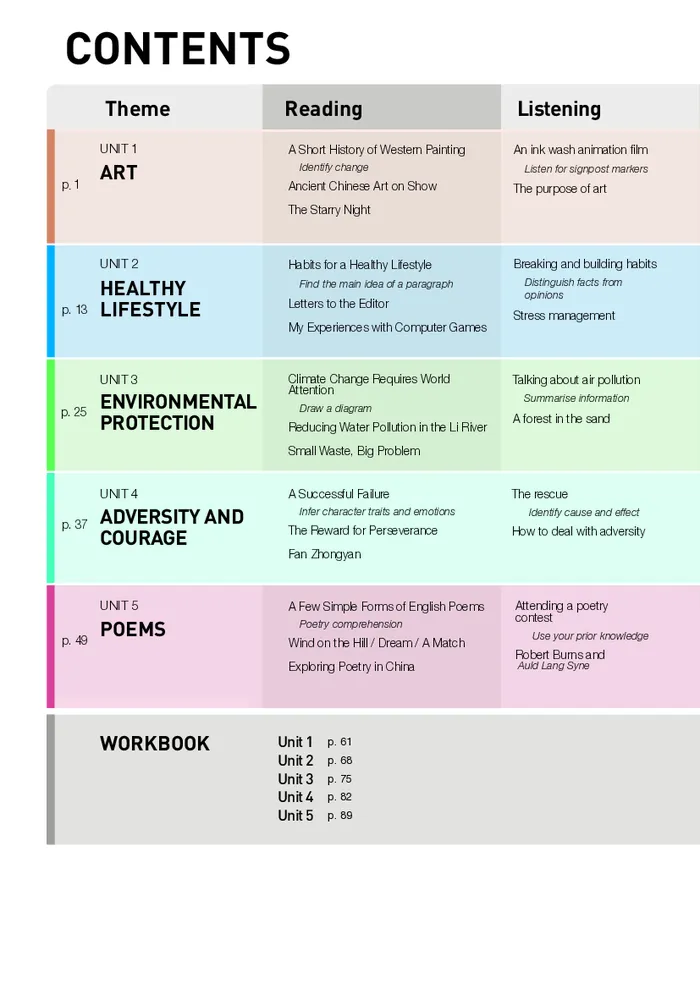
CONTENTS
Reading
Listening
Unit 1 p. 61
Unit 2 p. 68
Unit 3 p. 75
Unit 4 p. 82
Unit 5 p. 89
A Short History of Western Painting
Identify change
Ancient Chinese Art on Show
The Starry Night
Habits for a Healthy Lifestyle
Find the main idea of a paragraph
Letters to the Editor
My Experiences with Computer Games
A Successful Failure
Infer character traits and emotions
The Reward for Perseverance
Fan Zhongyan
A Few Simple Forms of English Poems
Poetry comprehension
Wind on the Hill / Dream / A Match
Exploring Poetry in China
Climate Change Requires World
Attention
Draw a diagram
Reducing Water Pollution in the Li River
Small Waste, Big Problem
An ink wash animation film
Listen for signpost markers
The purpose of art
Breaking and building habits
Distinguish facts from
opinions
Stress management
Talking about air pollution
Summarise information
A forest in the sand
The rescue
Identify cause and effect
How to deal with adversity
Attending a poetry
contest
Use your prior knowledge
Robert Burns and
Auld Lang Syne
p. 1
p. 13
p. 25
p. 37
p. 49
Theme
WORKBOOK
UNIT 1
ART
UNIT 2
HEALTHY
LIFESTYLE
UNIT 3
ENVIRONMENTAL
PROTECTION
UNIT 4
ADVERSITY AND
COURAGE
UNIT 5
POEMS
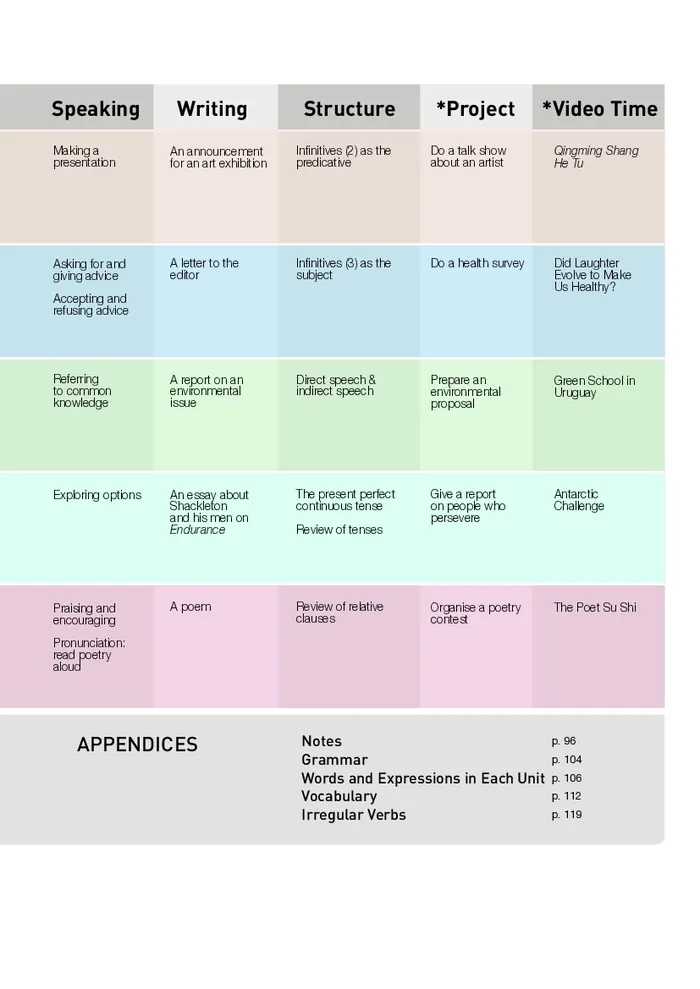
Speaking
Writing
Structure
APPENDICES
Notes
p. 96
Grammar
p. 104
Words and Expressions in Each Unit p. 106
Vocabulary
p. 112
Irregular Verbs
p. 119
Infinitives (2) as the
predicative
Infinitives (3) as the
subject
Review of relative
clauses
The present perfect
continuous tense
Review of tenses
Direct speech &
indirect speech
*Project
Do a talk show
about an artist
Do a health survey
Prepare an
environmental
proposal
Give a report
on people who
persevere
Organise a poetry
contest
*Video Time
Qingming Shang
He Tu
Did Laughter
Evolve to Make
Us Healthy?
Green School in
Uruguay
Antarctic
Challenge
The Poet Su Shi
An announcement
for an art exhibition
A letter to the
editor
A report on an
environmental
issue
An essay about
Shackleton
and his men on
Endurance
A poem
Making a
presentation
Asking for and
giving advice
Accepting and
refusing advice
Referring
to common
knowledge
Exploring options
Praising and
encouraging
Pronunciation:
read poetry
aloud
UNIT 1 PEOPLE OF ACHIEVEMENT
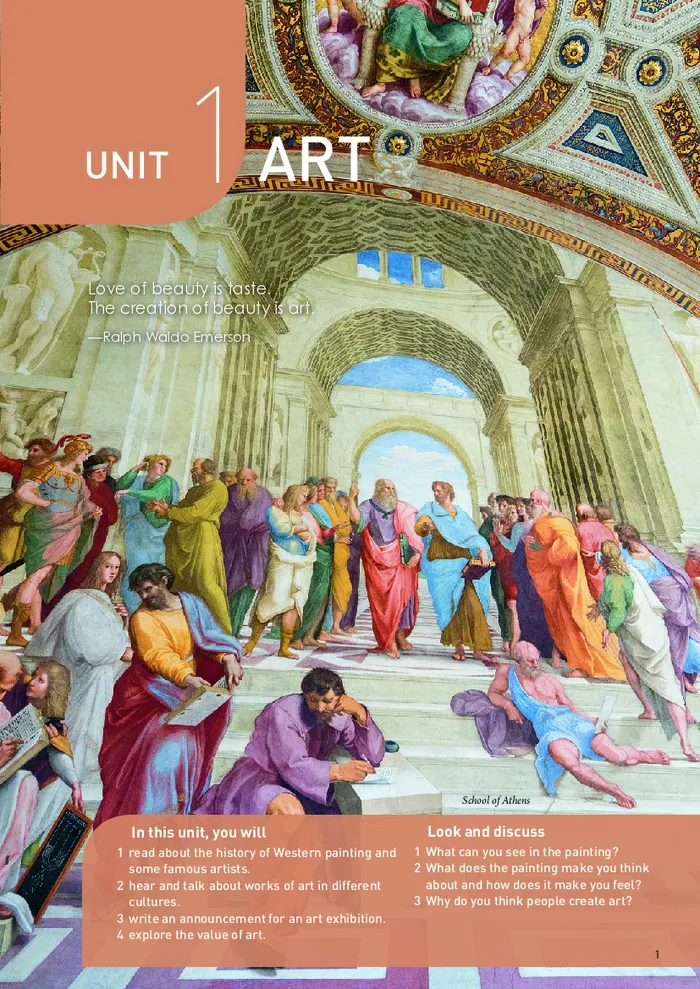
Love of beauty is taste.
The creation of beauty is art.
—Ralph Waldo Emerson
In this unit, you will
1 read about the history of Western painting and
some famous artists.
2 hear and talk about works of art in different
cultures.
3 write an announcement for an art exhibition.
4 explore the value of art.
Look and discuss
1 What can you see in the painting?
2 What does the painting make you think
about and how does it make you feel?
3 Why do you think people create art?
ART
UNIT 1
School of Athens
1
Learn about different painting styles in Western art
Reading and Thinking
1 Before you read, look at the paintings
in this section. What do you know about
them? Do you know who painted them?
2 Read the passage and make a flow
chart to show the changes in Western
painting styles.
A SHORT HISTORY OF WESTERN PAINTING
What is Western art? It is hard to give a precise definition. As there have been so many
different styles of Western art, it is impossible to describe them all in a short text. Perhaps the
best way to understand Western art is to look at the development of Western painting over
the centuries.
The Middle Ages (from the 5th to the 15th century)
During the Middle Ages, the purpose of Western art was to teach people about Christianity.
Thus, artists were not interested in painting realistic scenes. Their works were often primitive
and two-dimensional, and the main characters were often made much larger than
everyone else to show their importance. This began to change in the 13th century with
Giotto di Bondone (1267–1337). While his paintings still had religious themes, they showed
real people in a real environment. In particular, his paintings are set apart from other
paintings by their realistic human faces and deep emotional impact.
The Renaissance (from the 14th to the 17th century)
New ideas and values gradually replaced old ones from the Middle Ages. As a result,
painters concentrated less on religious themes. They began to adopt a more humanistic
attitude to life. An important breakthrough during this period was the use of perspective
by Masaccio (1401–1428). Influential painters such as Leonardo da Vinci (1452–1519),
Michelangelo (1475–1564), and Raphael (1483–1520) built upon Giotto and Masaccio’s
innovations to produce some of the greatest art that Europe
had ever seen.
Another innovation was the use of oil paints. With their deep
colours and realism, some of the best oil paintings look like
photographs. While painters as early as Da Vinci had used oil,
this technique reached its height with Rembrandt (1606–1669),
who gained a reputation as a master of shadow and light.
In subject matter, the emphasis increasingly shifted from
religious themes to people and the world around us. Kings,
nobles, and people of high rank wanted to purchase
accurate pictures of themselves and the people they loved.
Others wanted paintings showing important historical events
or stories from mythology. Finally, most clients wanted
paintings that were beautiful and interesting to look at.
Identify change
To help identify the changes that an
article talks about, look for words that
express change, such as development,
breakthrough, innovation, begin, and shift,
and the construction from … to ... .
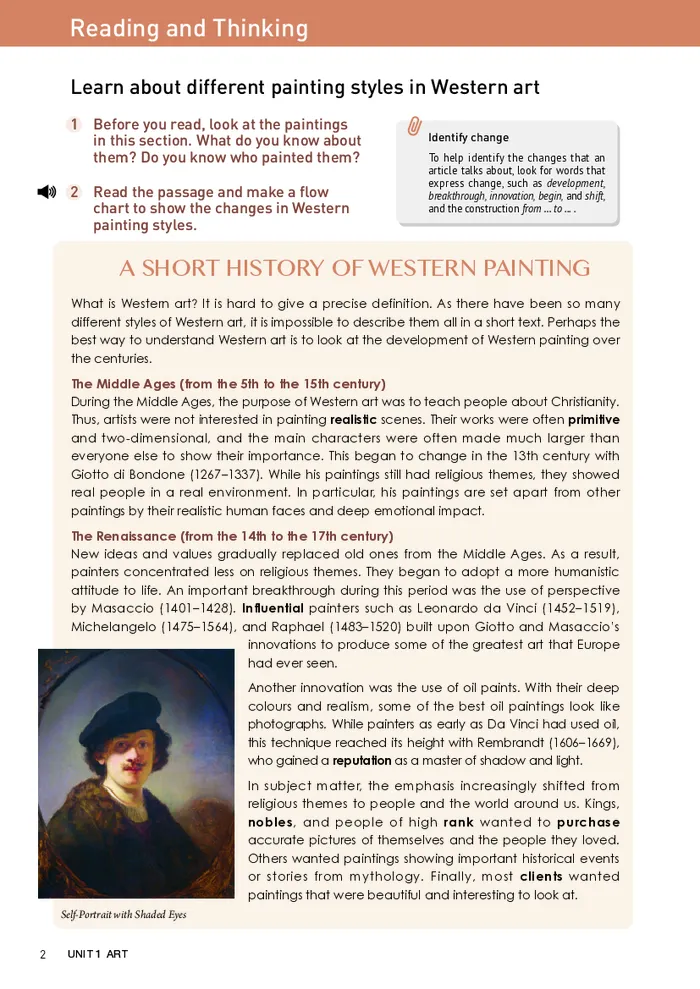
Self-Portrait with Shaded Eyes
2
UNIT 1 ART
4 Discuss the following questions in groups.
Impressionism (late 19th to early 20th century)
The development of Western art slowed until the invention
of photography in the mid-19th century. After that,
paintings were no longer needed to preserve what people
and the world looked like. Hence, painters had to find a
new way of looking at their art. From this, Impressionism
emerged in France. The name of this new movement
came from the painting by Claude Monet (1840–1926)
called Impression, Sunrise. In this work, Monet’s aim was
to convey the light and movement in the scene—the
subjective impression the scene gave him—but not a
detailed record of the scene itself.
While many Impressionists painted scenes of nature or daily life, others, such as Renoir (1841–
1919), focused on people. Unlike the cold, black-and-white photographs of that time period,
Renoir’s paintings are full of light, shadow, colour, and life. He sought to show not just the outer
image of his subjects, but their inner warmth and humanity as well.
Modern Art (from the 20th century to today)
After Impressionism, subsequent artists began to ask, “What do we do next?” Painters such
as Picasso (1881–1973) tried to analyse the shapes which existed in the natural world but in a
new way, with Cubism. Others gave their paintings a realistic but dream-like quality. Still others
turned to abstract art. What they attempted to do was no longer show reality, but instead to
ask the question, “What is art?”
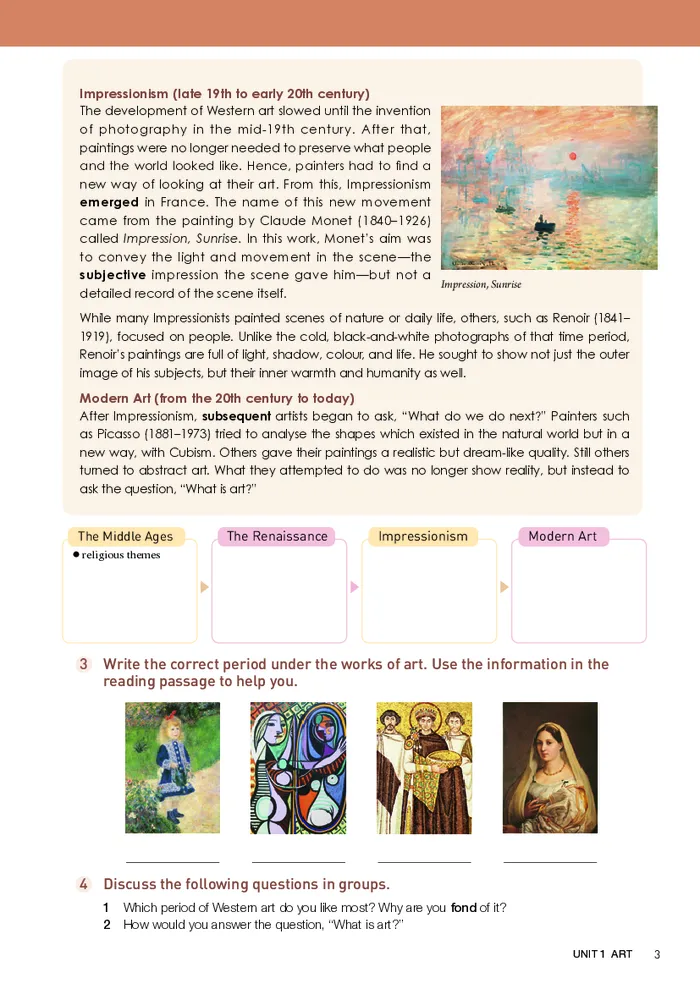
Impression, Sunrise
3 Write the correct period under the works of art. Use the information in the
reading passage to help you.
1 Which period of Western art do you like most? Why are you fond of it?
2 How would you answer the question, “What is art?”
The Middle Ages
religious themes
The Renaissance
Impressionism
Modern Art
UNIT 1 ART
3
Learning About Language
Build up your vocabulary
1 In groups, brainstorm
words and phrases
concerning art and
then make a mind
map to connect them.
2 Read the passage about Monet and Impressionism. Fill in the blanks with the
correct forms of the words or phrases in the box.
3 Work in groups. Look up each group of words in the dictionary and discuss their
differences. Then create a blank-filling activity based on your understanding of
these words. Exchange your activity with another group and see how well you
can do.
be fond of emerge influential in particular
purchase realistic subjective theme
accurately/precisely/exactly rank/grade/degree realistic/practical/actual
reputation/fame/popularity subsequent/later/latter
EXAMPLE
EXAMPLE
sculptor
tools
Unlike the earlier Realists who painted in a
style,
Impressionist painters focused more on their
feelings of things and instant impressions. When Impressionism
in France in the late 19th century, artists became
more interested in everyday subject matter. They were also
fascinated by modern objects. As one of the most
Impressionist painters, Claude Monet was impressed by the visual
effects of the steam engine
, and he later produced
twelve paintings of a train station in Paris. In 1883, Monet and his
large family moved to Giverny, where he
a house
and some land for his gardens. During his days at Giverny, Monet
painting his own gardens, with the water lilies, the
pond, and the arched bridge. From this we can see that there were two clear
apparent in his work throughout his career: colours and reflections in water.
realistic / practical / actual
• You need to have realistic expectations of the returns from investments.
• The bride appeared five years younger than her actual age.
• Mr Liu has a lot of practical experience in restoring historic buildings.
fine art
sculpture
painting
painter
4
UNIT 1 ART
Discover useful structures
1 Read these sentences and fill in the blanks using the correct words from the
text on pages 2 and 3. Discuss with your partner the function of the italicised
infinitives.
2 Match the sentence halves and underline the nouns or clauses used as the
subject in each sentence. Explain the meanings of the complete sentences.
3 Work in pairs. Make conversations using the following questions and sentence
patterns.
1 Perhaps the best
to understand Western art is to look at the development of
Western painting over the centuries.
2 During the Middle Ages, the
of Western art was to teach people about
Christianity.
3 In this work, Monet’s
was to convey the light and movement in the scene …
4
was no longer show reality, but instead to ask the question, “What is art?”
1 What’s your biggest dream/ambition in life?
2 How are you going to make your dream
come true?
3 How are you going to achieve your goal?
4 Do you have any plans?
5 What might be difficult for you?
6 How are you going to deal with ...?
1 The young singer’s intention of
performing the song was
2 The best way to do business is
3 What the survivors attempted to do was
4 The main purpose of art education in
schools is
5 The aim of the two leaders at the
conference was
6 For a humble person, one of the hardest
things might be
7 When you are faced with a serious
decision, my suggestion is
8 The mother’s wish is
9 All he wanted after a tiring day was
A to build trust between you and your
client.
B to achieve permanent peace between
their two countries.
C to build a memorial to the heroes who
saved their lives.
D to share his love for rock music with
his fans.
E to be left alone.
F to criticise other people.
G to inspire students to be creative.
H to listen to your own inner voice.
I
to raise her son to become a man with
a noble mind and a generous heart.
UNIT 1 ART
5
My biggest dream/ambition in life is to …
I think all I have to do is …
My plan is to …
I think one of the hardest things might be …
I guess the best way to … is …
Using Language
1 Before you listen, look at the following pictures and discuss the questions in
groups. Use the words and phrases in the box to help you.
2 Listen to the presentation and put the following items in the order that you hear
them.
3 Listen again and answer the questions.
Talk about works of art
a
b
c
These pictures are representative of ink wash animation films. Have you seen any of them
before? What do you know about them?
ink wash animation film ink wash painting Qi Baishi frame
Tadpoles Searching for Mother The Cowboy’s Flute
Feeling from Mountain and Water guqin symphony hand-painted
the background of ink wash animation films
a short review of the film
introduction to the topic of the presentation
a description of the story in the film
an explanation of the decline in ink wash animation
1 Which film does the speaker mainly talk about?
2 When were the three ink wash animation films produced?
3 Why is the film regarded as a masterpiece of Chinese ink wash animation?
4 What is the speaker’s attitude towards the ink wash animation style?
5 How do you feel about this kind of film?
6
UNIT 1 ART
Listening and Speaking
4 Listen again and tick the signpost words that you hear.
5 Work in groups. Choose a work of art you like and prepare information about it. Use
the table below to help you. Then give a presentation about the work of art to the
class.
Listen for signpost markers
Signpost markers are phrases and expressions that are used to tell a listener what is going
to be talked about next. Speakers use signpost markers when they want to introduce a
new topic, to start a new point, to give an example, to summarise, etc. By listening for
signposts, you will be able to follow what is being said.
Introduction
Welcome the audience:
Introduce the subject:
Main
body
Background of
the work of art
Description of
the work of art
Review of the
work of art
Conclusion
Making a presentation
Introducing the topic
I’m glad to have this opportunity to …
Today, I’d like to talk/speak (to you) about …
My topic today is …
I’d like to share some thoughts on …
Starting a point
Let me/Let’s start by …
First, let me tell you about …
I’ve divided my topic into … parts: …
Let’s turn now to …
Giving an example
For instance, …
For example, …
Take ... for example, …
Let me illustrate, …
To illustrate, …
Let me give you an example, …
Summarising the points
In conclusion, …
To conclude, …
In short, …
To sum up, …
All in all, …
In brief, …
UNIT 1 ART
7
Using Language
ANCIENT CHINESE ART ON SHOW
The Richfield Museum of Fine Art is proud to present our new exhibition, “From Shang to Qing:
Chinese Art Through the Ages.” Join us as we explore more than 3,000 years of wonderful art
from the Middle Kingdom. From bronze bowls to ceramic vases, and jade sculptures to ink wash
paintings, our goal is to display the Chinese artistic genius from ancient times.
The highlight of this exhibition is the painting Clearing After Snow on a
Mountain Pass, one of the great works of Tang Yin (1470–1524). Born during
the Ming Dynasty, Tang sought and failed to gain entry into the civil service,
so he turned to painting instead. In time, he gained recognition as one of the
greatest artists China has ever known. This painting, showing high mountains,
trees, and houses covered in snow, was made with extraordinary skill. Though it
is over 500 years old, it looks as fresh and full of life as the day it was created.
Also of primary note is a collection of nearly 100 bronze objects from the Shang
Dynasty (1600 BCE–1046 BCE). While the artists who made these great works are
not known, they showed great skill in creating these beautiful pieces. Some of the
items on display are thought to have come from the collection of Emperor Qianlong
(1711–1799), a great admirer of Shang Dynasty bronze.
Finally, we have many fine examples of Tang Dynasty (618–907) sculptures. Most of these are
of Buddhist origin. Even though Buddhism entered China much earlier, it did not really begin to
show expansion until the seventh century. During this same period, trade along the Silk Road also
boomed. Chinese sculpture thus found itself highly influenced by Buddhist art brought from India
and Central Asia through the Silk Road. These works were intended to spread Buddhism and they
are of exceptional beauty and quality. Looking at the faces of the figures in these
sculptures, one sees the faces of the past. History is brought to life.
This is just a small taste of what is in store for you in this exhibition. We guarantee
that “From Shang to Qing: Chinese Art Through the Ages” will transport you to
another time with its amazing collection of works.
“From Shang to Qing: Chinese Art Through the Ages” will run until November 25.
Opening hours are from 9:00 a.m. to 5:00 p.m., from Tuesday to Sunday (the museum
is closed on Mondays). No one will be admitted into the exhibition after 4:30 p.m.
Admission: $10 for adults; $8 for students; $5 for children under 12; free for children
under 5.
No photos or food and drink are allowed in the museum.
8
UNIT 1 ART
1 Read the text and discuss for whom it was written.
Write an art exhibition announcement
UNIT 1 ART
9
Highlights:
• The painting Clearing After Snow on a Mountain Pass, by
.
• A collection of nearly 100
.
• Many fine examples of
.
You will
.
Date: Now until
.
Opening hours:
a.m. to
p.m.
Museum is closed on
.
Tickets: Adults $
, Students $
, Children under 12 $5,
Children under 5 free
No photos or food and drink allowed in museum.
4 Exchange drafts with a partner. Use this checklist to give feedback on your
partner’s draft.
5 Get your draft back and revise it. Then put up your announcement in the classroom.
3 You are now going to write an announcement for art club members about a trip to
see an exhibition.
2 Read the text again and complete the advertising leaflet below.
1 Work in groups. Brainstorm the details about the exhibition and take notes. For example:
• What is the exhibition about?
• Where shall you meet?
• What are the highlights?
• How are you going to get there?
• When are you going?
• What should you bring?
2 Write your announcement based on your notes.
To:
From:
Subject: On
, we will go to see
.
This exhibition is …
Is the announcement clear and to the point?
Is all the necessary information about the exhibition and the trip included?
Does the writer use correct grammar, punctuation, and spelling?
NEW EXHIBITION
“
”
More than
of wonderful art from China on display.
RICHFIELD
MUSEUM
OF FINE ART
THE
1 Complete the sentences with the correct forms of the words in the box.
2 Use your own ideas to complete the sentences, using infinitives as the predicative.
3 Look at the paintings below and identify each painting style. Explain how you know.
What new information concerning art have you learnt from this unit?
Which artist mentioned in the unit do you like most? Why?
Which art style would you like to learn more about? Why?
Which part of this unit did you find the most difficult? How did you overcome it?
Overall, I thought this unit was
interesting
useful
so-so
difficult.
REFLECTING
dimension emerge exhibition guarantee investment
purchase recognition representative visual
Assessing Your Progress
1 The first principle for any art collector is to
only what you love.
2 If you are not interested in works of art by classical masters, contemporary art by
artists is also worthy of your attention.
3 In the art market, no one can
that an artist will be a good
.
4 The art competition gives young artists a chance to gain
from the most
respected art professionals.
5 Different from other
art forms, sculpture operates in three
.
6 The
From Rembrandt to Vermeer is quite
of the Dutch Golden
Age of art.
1 If you want to learn how to paint, my advice is
.
2 My plan for the summer holiday is
.
3 The most challenging thing for me might be
.
4 My ideal job is
.
5 If you want to be successful, the least you could do now is
.
6 What I want to do this weekend is
.
10
UNIT 1 ART
* Project: Do a talk show about an artist
You are going to make a role-play of a talk show which has a famous artist as the guest.
1 In groups, brainstorm a list of famous artists and their representative works.
Here are some ideas.
2 Decide on which artist your group is going to talk about.
3 Choose one person to be the talk show host, one person to be the artist, and the
remaining members to be a family member, a friend, a teacher, or an art critic.
Have each person do research on the artist and prepare notes on what he/she will say.
4 Now role-play your talk show before your class.
La Primavera, by Sandro Botticelli (1445–1510)
Le Poète, by Auguste
Rodin (1840–1917)
Shrimps, by Qi Baishi
(1864–1957 )
• talk show host: questions for the guests
• artist: biography of the artist, philosophy towards art, details about his/her most
representative works
• family: What was the artist like when he/she was a child or growing up? What was it like
living with the artist? What do they think of the artist’s talent and work?
• friend: How did they meet the artist? What is the artist like as a person? What do they think
of the artist and his work?
• teacher: What was the artist like as a student? Could he/she imagine that the artist would
grow up to be famous?
• art critic: How is the artist’s work critically received?
Notes for doing the talk show:
• Keep in mind that guests may have different opinions as to what the artist is like
and how talented he/she was, so they should feel free to disagree and discuss.
• If possible, the group should also find large photos or posters of the artist’s
representative work to be used as talk show exhibits.
• Towards the end of the talk show, the host should go out into the “audience”
(i.e., the class) and take questions from the audience.
UNIT 1 ART
11
BEFORE YOU WATCH
What do you know about the Chinese painting Qingming Shang He Tu? Read
the statements below and decide whether they are true (T) or false (F).
1 Qingming Shang He Tu is no more than 24 cm wide and 520 cm long.
2 The painting was once lost for some time and hundreds of copies
were made.
3 It is believed that the version in the Palace Museum is the Song Dynasty
original painting.
4 The painting shows life along the Yellow River during the Qingming Festival.
5 The painting scroll also includes a short biography of Zhang Zeduan
and the seals of its previous owners.
WHILE YOU WATCH
1 Check the answers in Before You Watch.
2 Take notes about the details that are displayed in the painting.
Left
Right
The city
The first city
gate
The roads
leading to
the city
The Rainbow
Bridge
The road and
the river
The countryside
AFTER YOU WATCH
Discuss the following questions in groups.
1 What does the following statement mean: “This painting’s great appeal is that it provides us
with a look into ordinary people’s lives in the Song Dynasty”? Who do you think the painting
is most appealing to?
2 Do you know of any other paintings like this one?
Qingming Shang He Tu
One of the most famous Chinese paintings in the
world is the Qingming Shang He Tu or Along the River
During the Qingming Festival, by Zhang Zeduan, a
court painter for the emperor during the Northern
Song Dynasty.
* Video Time
T
F
T
F
T
F
T
F
T
F
12
UNIT 1 ART
UNIT 1 PEOPLE OF ACHIEVEMENT
HEALTHY
LIFESTYLE
UNIT 2
Look and discuss
1 How do you think the people feel in the
photos?
2 Do you think they are all leading a healthy
lifestyle? Why or why not?
In this unit, you will
1 read about developing a healthy lifestyle.
2 hear and talk about breaking and building
habits.
3 read about making good lifestyle choices and
write your own story.
4 explore a lifestyle experiment and its results.
The greatest wealth
is health.
—Virgil
13
Reading and Thinking
14
UNIT 2 HEALTHY LIFESTYLE
Learn to develop good health habits
1 Before you read, discuss these questions in groups.
2 Read the text and find out what main ideas
are included in it. Tick the correct ones.
HABITS FOR A HEALTHY LIFESTYLE
1 Are bad habits easy to change? Why or why not?
2 What habits do you think are unhealthy?
3 What can you do to correct these bad habits?
As teenagers grow up, they become more independent and start making their own
decisions. However, during this period, it can be easy for some of them to form bad
habits. These bad habits, if left unchecked, could lead to more serious ones when they
become adults. For example, some of them may become involved in tobacco or alcohol
abuse, which can lead to physical and mental health problems. To prevent harmful
habits like these from dominating a teenager’s life is essential. They must learn to
recognise bad habits early and make appropriate changes.
To change bad habits is never easy, even with many attempts. There is a famous saying
based on the philosophy of Aristotle: “We are what we repeatedly do.” In many ways,
our lifestyle is the sum of choices we have made. We make a choice to do something,
and then we repeat it over and over again. Soon that choice becomes automatic and
forms a habit that is much harder to change. The good news is that we can change, if we
understand how habits work.
According to modern psychology, we must first learn
about the “habit cycle”, which works like this:
• Firstly, there is a “cue”, an action, event, or
situation that acts as a signal to do something.
• Secondly, there is a “routine”, the regular action
you take in response to the cue.
• Thirdly, there is the “reward”, the good thing or
feeling we get from the routine.
THE
HABIT
CYCLE
ROUTINE
REWARD
CUE
Find the main idea of a
paragraph
The main idea is sometimes
stated in either the opening or
closing sentence. If not, look for
another “standout” sentence, or
summarise the paragraph in your
mind by asking yourself, “What is
it mainly about?”
A How to change a bad habit and create good ones
B The cycle of how habits are formed
C Habits that can help us study better
D Changing habits gradually
E No easy way to change bad habits
F What a habit is
G Why bad teenage habits should be changed
ROUTINE
CUE
REWARD
UNIT 2 HEALTHY LIFESTYLE
15
3 Read the text again and answer the questions.
4 Work in groups. Complete the tasks.
For example, when we feel unhappy (cue), we eat lots of unhealthy snacks (routine),
which makes us feel happy (reward). The reward makes us much more likely to
continue the cycle, and the bad habit of relying on unhealthy snacks is formed.
To facilitate a positive change in our bad habits, we must first examine our bad habit
cycles and then try to adapt them. We can do this by combining the information from
our habit cycles with our own positive ideas. For example, we could try to replace a
negative routine with something more positive. So, when we feel unhappy again (cue),
rather than eat snacks, we could listen to some of our favourite music instead (routine),
which will make us feel relaxed (reward). Aside from changing bad habits, we can also
use the habit cycle to create good habits. For example, when we come to an escalator
(cue), our normal routine is to ride it, but we could change this routine into something
more positive by taking the stairs instead.
Many of us try to change bad habits quickly, and if we are not successful straight away,
we often become pessimistic and give up. In fact, the most successful way to change
is not suddenly, but over a period of time. As the Chinese philosopher Laozi wrote,
“A journey of a thousand miles begins with a single step.” One step seems small, but
it is essential. To reach the goal of change, a person must show some discipline and
repeatedly take many small steps. After all, it is not easy to break bad habits.
For young people, there is plenty of time to change bad habits. However, there is no
“magic pill” or delete button that will help you; you have to think about your bad habits
and decide on some changes. You have the power to build a happy and healthy life full
of good habits!
1 How can a choice lead to a habit?
2 What are the three stages of the habit cycle?
3 What should we do to change a bad habit?
4 How can a person use discipline to help change a bad habit?
5 Will you use the habit cycle to break your bad habits? Why or why not?
1 Think of one bad habit and write down the cue,
routine, and reward. Then come up with an
idea of how to break the bad habit.
2 Do you know any alternative ways to better
habits? Discuss with your partner which way
you think is most effective.
Learning About Language
Build up your vocabulary
2 Find “verb + a habit” collocations from the previous text. Then make
sentences with them.
3 Complete the passage using the correct forms of the words in the box. Add
more sentences or paragraphs to the passage if possible.
examine dominate facilitate rely on
alcohol
appropriate
cue
cycle
negative
pill
psychology
reward
tobacco
discipline
Simply speaking, a healthy lifestyle is about finding the right balance and making good choices.
Life is composed of many elements, such as family, friends, study, work, entertainment, and
so on. If one element
your life and the others are ignored, you will lose balance and
not feel good.
Carefully
your daily activities. Your health
what you choose to do in your daily
life. A healthy lifestyle is generally a balanced life in which you make wise choices. Neither too
much nor too little is good.
Slowly
changes in your lifestyle by using a step-by-step process. You do not have to
change everything at once. Make small changes each day and your lifestyle will become healthier.
form a habit
change a habit
16
UNIT 2 HEALTHY LIFESTYLE
1 Complete the summary using the words from the box below.
Teenagers often have bad habits. Most can be stopped by taking
action. However,
habits like
and
abuse can lead to serious addictions. According
to modern
, to change bad habits, we must first analyse them using the “habit
”. To fix or improve a bad habit, we must first find out what the
is. Then
we must change the old
routine to something more positive. If successful, we will
feel a sense of
and our bad habit may disappear. Changing a bad habit is difficult,
and it is easy to make excuses and give up. We need to make up our minds and show some
, and make small changes over time. There is no magic
to help us, but
changing will ensure we have a happy and healthy life!
Discover useful structures
1 To change bad habits is never easy.
2 It took the surgeon three hours to finish my mother’s lung surgery.
3 To join the People’s Liberation Army, it is required for men to shave off their beards.
4 It was not polite to disturb your neighbours with loud music last night.
begin with be in control of make a choice decide on make up one’s mind
1 important / avoid / passive cigarette smoking
It is important to avoid passive cigarette smoking.
2 will take / nutrition specialist / a balanced diet menu / make / an hour / for you
3 useful / turn to / fitness consultant / for advice
4 illegal / dangerous / take / drugs
5 harmful / skip breakfast / often
1 A: Hello, doctor. I want to lose weight, but I just can’t seem to do it. What can you do to
help me?
B: Well, first, it’s necessary to
what you eat. Cut out all fatty food and sugary
drinks, and eat more fruit and vegetables.
2 A: I really need to
a way to exercise more. I could use a fitness app, but my
phone’s full.
B: So delete a few files. I’m sure the app doesn’t take up much space.
3 A: Before exercising, always do a few warm-ups to
.
B: I know. But then I always feel too tired to continue!
4 A: Should I go for the pizza or the fried chicken? I hate
like these. You
know what—I’m going to eat both!
B: Wow! Don’t eat too much junk food—you’ll get fat. I’ve actually
to go on a
diet, so I’ll just stick to the fruit salad.
UNIT 2 HEALTHY LIFESTYLE
17
1 Look at the following sentences and pay attention to the italicised infinitives.
Find more infinitives in the reading passage. In pairs, discuss their meanings
and functions.
2 Join the words to make full sentences, and then join the sentences to make
a paragraph. You can add your own sentences if necessary to make your
paragraph more meaningful.
3 Complete the conversations with the correct forms of the phrases in the box.
Using Language
1 Look at the pictures. What choices or preferences make it easier for people to
develop these bad habits?
2 Listen to the conversation and complete the table below.
3 Listen again and answer these questions.
Give advice on changing bad habits
1
Why is a good night’s sleep important for the first student?
2
Why does the second student never exercise?
3
What is the expert’s bad habit? Do you think it is a health problem?
4
What would you advise the expert to do to control this habit?
2 using a phone too much
1 not sleeping enough
5 drinking too much coffee
4 overspending
3 overeating
Student 2
Student 1
Information
Problem
Cue
Routine
Reward
18
UNIT 2 HEALTHY LIFESTYLE
Listening and Speaking
4 Decide whether these statements from the conversation are facts (F) or opinions
(O). Discuss the opinions with a partner and see if you agree on them.
5 Work in pairs. Choose a bad habit from the box below and have a conversation
with your partner about it. The expressions below may help you.
It is important to know whether what the
speakers say is a fact or an opinion. An
opinion is a subjective statement and a
fact is objective. A fact is what really is true,
while an opinion is what you believe, often
using phrases like “I think/believe”, “in my
opinion”, “to me”, and so on.
Distinguish facts from opinions
EXAMPLE
A: I think I’m watching too much TV.
B: Yeah. Me too.
C: In my opinion, you should spend your time on something more active instead.
For example, try to get more exercise.
B: OK, sure, I’ll try that.
A: That’s a nice thought, but I don’t really enjoy exercising.
C: Hmm. How about reading more books instead?
A: All right, maybe I can try that.
1
It was a really interesting talk.
2
It often takes me half an hour to fall
asleep at night.
3
You look tired. Not enough sleep,
right?
4
It is affecting my schoolwork.
5
I failed in all my school subjects this
semester.
6
I usually pick up my phone.
7
I think the phone is the problem.
8
A five-minute walk is so easy that it is hard to say no!
sleeping too much
overeating
game addict
TV addict
Internet addict
staying up too late
overspending
• My problem is …
• I’m having problems with …
• I cannot stop …
• Please give me some advice about …
• I think/believe you should …
• So, why don’t you …?
• Well, have you thought about …?
• In my opinion, …
Asking for and giving advice
• Sure, I’ll do that.
• That’s a good idea!
• That’s just what I need!
• Lovely!
• Great!
• Terrific idea!
• Sorry, but I …
• I’d like/love to …, but …
• That’s a good idea, but …
• Thank you for telling me, but …
• It’s a nice thought, but …
• I cannot … because …
Accepting and refusing advice
UNIT 2 HEALTHY LIFESTYLE
19
Using Language
1 Two students attended the summer camp organised by the magazine Healthy Life
and wrote to the editor. Read the letters and then complete the table on page 21.
Write a letter to the editor about your lifestyle
20
UNIT 2 HEALTHY LIFESTYLE
Dear Editor,
As I took part in the summer camp about
personal life choices, I started to analyse my
choices, especially what I did to relax and how
it was affecting my whole life.
After starting high school, I felt stressed
out and always relaxed by playing computer
games. I got so absorbed that I played the
games day and night. Playing was fun, but I
felt even more worn out afterwards! So after
the camp, I realised that it was very, very
important to adjust my lifestyle. I decided to
take control of my life and find other ways to
relax.
It was a big struggle not to join my friends
in playing online games as I’m mad for them.
However, I realised that to succeed in quitting,
I had to replace it with something else. So
I thought about what to try. Rock climbing,
bowling, watching comedies, and playing
basketball were the things I thought of doing
instead.
Now my dad and I go rock climbing together
monthly! It has enhanced the quality of my
life, improving my health and increasing my
happiness. I get refreshed through climbing,
spend more time with my dad, and get to meet
new friends.
After six months of trying out new ways of
relaxing, I feel much more energetic. I feel that
I can change myself for the better. And if that’s
true for me, then it might truly be possible to
change the world for the better. As Gandhi said,
“Be the change you want to see in the world.”
Sincerely,
George Fielding
Dear Editor,
After I attended your summer camp about
health and lifestyle choices, I realised I hardly
ever felt well, either physically or mentally. I
often felt sleepy and dizzy, and lacked passion.
Most worrying, though, I got the flu easily and
experienced many toothaches, too.
At the end of the camp I heard, “Change the
world by changing yourself.” This stimulated
my motivation. A dentist once examined me
and told me that too much sugar in my meals
had damaged my teeth and health. I made up
my mind to change two things in my life: to eat
nothing with sugar and to exercise regularly.
After that I stopped buying all the sweets,
biscuits, and sugary drinks that I used to have
every day. Whenever I went out with friends, I
brought snacks from home, things that didn’t have
any added sugar: fruit, nuts, dried meat, etc.
My exercise was very simple: I went outside
every day for at least 30 minutes and did
something active. Sometimes I played table tennis
or badminton with my cousins. Other times I
jumped on my skateboard and rode around my
neighbourhood, or just took a long walk.
The results have been fantastic. I feel more
dynamic and stronger than ever, in both body
and mind. I sleep soundly at night now. I no
longer suffer from a flu virus or toothaches
either. Best of all, in my opinion, is how I feel
about myself. I feel like I’m in control of my
own life. To make choices about myself is
within my own power. I CAN change myself. I
just need to try.
Yours truly,
Wang Lu
3 Write a letter to the editor about one aspect of your own lifestyle that you would
like to change.
4 Exchange drafts with a partner. Use this checklist to give feedback on your
partner’s draft.
5 Get your draft back and revise it. Then share your letter with the rest of the class.
Wang Lu
George Fielding
Problem
• did not feel
• felt
, lacked
• got
, experienced
• felt
• felt even more
after
Decision
• to
• to
• to
Action
• stopped
• exercises every day for
• goes
Result
• more
in
• sleeps
, no longer
• feels like
• feels much more
• feels he can
2 Analyse the organisation of the letters. Label the paragraphs using the letters
below. Some paragraphs may cover more than one topic.
A identifying problem(s)
B considering what to do
C what he/she has done to change
D the results
Does the letter say what the writer’s problem is?
Does the letter explain the decisions the writer made to solve the problem?
Does the letter show the ways to change?
Are the results included in the letter?
Can you see the writer’s attitude and determination in the letter?
Is the letter clear and complete?
1
Brainstorm with your partner.
• What lifestyle habit you would like to change
• Why you want to change
• How you plan to change
• What result you hope to see
2
Draft your letter to the editor. Use the organisation of the letters above to help you.
Information
UNIT 2 HEALTHY LIFESTYLE
21
Assessing Your Progress
Do you know what a healthy lifestyle is after finishing this unit?
What is the most useful thing that you have learnt in this unit?
How can you use what you have learnt to improve your lifestyle?
What new words and expressions have you learnt in this unit?
Can you use the infinitive as the subject properly in different situations?
Overall, I thought this unit was
cool
useful
just OK
difficult.
REFLECTING
1 Complete the passage using the correct forms of the words in the box.
2 There are eight mistakes underlined in the passage. Correct them, read the
passage again, and then give a title to it.
monthly disturb harmful cigarette surgery consultant
My father used to smoke
far too often and was always coughing, which
me greatly. One day, I spoke to the health
at my school. He said
the nicotine in tobacco is
and can do great damage to my father’s lungs. Then
I persuaded my father to see a lung specialist. The specialist said my father should make a
plan to smoke less, otherwise he may need
in the future. I’m so
glad my father agreed to make a plan to break his bad habit!
It is not easy to manage stress successfully. When you are stressed, every problem
you have seems become worse. Serious stress can also lead to health issues,
such as dizziness, skin conditions, and breathing problems. So that is best to find
a solution as soon as possible. For minor stress, to wash your face with cold water
or go for a short walk outside. To fight long-term stress, it is a great idea taken up a
new hobby. Do something you really like—to ride a skateboard, go bowling, or watch
a comedy—whatever stimulates your mind and makes you feel happy. Absorbing
stress effectively, however, you must be sure to do something that completely takes
your mind off everything else. If you can find something else to concentrate for a
while, you will most certainly feel much more refreshed later on. So remember, to
free yourself from stress, try and find something positive replace it with. After all, it is
far too stressful to stress all the time!
22
UNIT 2 HEALTHY LIFESTYLE
*Project: Do a health survey
UNIT 2 HEALTHY LIFESTYLE
23
1 How well are your classmates looking after their physical and mental health?
Work in groups and make a survey. Design a multiple-choice questionnaire
to collect information. Use online survey tools if possible to help you make,
distribute, and analyse your questionnaires.
2 Each person in your group should help make the survey. Then ask classmates
outside your group to take the survey.
3 Collect and analyse the survey results by creating pie charts, bar charts, or other
ways of summarising data.
4 Prepare a written or oral report, giving general recommendations for how to
solve the most common lifestyle problems that you have found among your
classmates.
PHYSICAL HEALTH
1 Ask questions about what to eat and drink, such as staple foods, snacks, drinks, and other
substances, etc.
EXAMPLE
How often do you skip meals?
never
once a day
several times a week
others:
2 Ask questions about what to do with one’s body, such as sitting, exercise, sleeping, etc.
MENTAL HEALTH
1 Ask questions about what people do in their spare time, such as reading, watching TV, using
phone/Internet, playing video games, etc.
2 Ask questions about what people do to feel better when they are stressed, unhappy, or angry.
3 Ask questions about what to do with one’s mind, such as learning new things for fun, doing
creative activities, etc.
EXAMPLE
How Often Meals Are Skipped
BEFORE YOU WATCH
Look at the pictures below and answer the questions.
1 What do you think these people are doing?
A Singing. B Practising laughter yoga. C Doing belly laughs.
2 Why do you think they are doing this?
A To amuse themselves.
B To tell everyone how happy they are.
C To reduce the likelihood of a heart attack or stroke.
3 How do you think they feel?
WHILE YOU WATCH
1 Check your answers in Before You Watch.
2 Answer these questions.
1 What do adults not necessarily remember?
2 Aside from making us feel good, what else does laughter do according to research?
3 What happens when you have 5−10 minutes of laughter, besides your blood vessels
opening up like you have gone jogging or taken cholesterol medication?
4 What does it mean when we say that laughter is contagious?
5 What will a mother usually do if she tickles her baby and the baby fusses or cries?
6 Which do you think is more important for bringing out the benefits of laughter, the act of
laughing or the social interaction connected to it? What are your reasons?
AFTER YOU WATCH
Discuss these questions in groups.
1 How does laughter make you feel?
2 What is your way to make other people laugh? Do you think the ability to create laughter
is some kind of talent?
Did Laughter Evolve to Make Us
Healthy?
Laughter is a natural medicine for preserving
our health. It helps us to ease pain, feel
good, keep the blood vessels healthy, and is
good for our soul and heart.
* Video Time
1
2
3
24
UNIT 2 HEALTHY LIFESTYLE
UNIT 1 PEOPLE OF ACHIEVEMENT
3
UNIT
ENVIRONMENTAL
PROTECTION
Earth provides enough to
satisfy every man’s needs,
but not every man’s greed.
—Mohandas K. Gandhi
In this unit, you will
1 read about different environmental problems.
2 listen to an interview with an expert and talk about
air pollution.
3 write a report on an environmental issue.
4 learn more about environmental issues and ways to
protect our planet.
Look and discuss
1 Where do you think this photo was taken?
2 What does this photo make you think of?
25
Reading and Thinking
1 Before you read, look at the graph and the picture below and discuss these
questions in groups.
2 Read the text and answer the questions.
Discuss climate change
1 What is the graph about? What information can you get from it?
2 Have you ever seen the photo before? What might be the story behind it?
1 What happened to the polar bear in the photo? Why did the writer write about it?
2 Why is the “natural” greenhouse effect important and necessary?
3 What are the consequences of high greenhouse gas emissions?
4 Why did the author mention the climate scientists’ warning?
5 What is the author’s purpose of writing this text?
In 2013, a lot of people were shocked by a news photo of a dead polar bear that was found on
Norway’s Arctic island of Svalbard. According to the scientists who found its dead body, all that
remained of the polar bear was “skin and bones”. An expert who has studied polar bears for
many years said that from the position of its dead body, the bear appeared to have starved and
died. Experts claimed that low sea-ice levels caused by climate change meant the bear could
not hunt seals as before, so it had to travel greater distances in order to find food. This alarming
case showed how the increase in temperature had an impact on Earth’s ecology.
Then what is causing the increase in the global average surface temperature? Climate scientists
often mention a key climate process called the “greenhouse effect”, which has two common
meanings: the “natural” greenhouse effect and the “man-made” greenhouse effect. The “natural”
-0.6
-0.4
-0.2
0
0.2
0.4
0.6
0.8
1
1.2
1920
1928
1936
1944
1952
1960
1968
1976
1984
1992
2000
2008
2016
Temperature Anomaly (C)
YEAR
Global Surface Temperature: 1920-2016 Base Period
Temperature Anomaly (℃)
26
CLIMATE CHANGE REQUIRES THE WORLD’S ATTENTION
We have known about climate change for decades. There is little doubt that Earth is getting
warmer and warmer (see the graph). A warming ocean and atmosphere along with melting ice
and rising sea levels provide evidence of a dramatic change in the global climate.
greenhouse effect refers to the fact that heat from the sun enters the atmosphere and warms
Earth’s surface as short-wave radiation. The heat is released back into space at longer
wave lengths. Greenhouse gases in the atmosphere, such as methane and carbon dioxide,
trap some of the heat, keeping Earth’s climate warm and habitable. Without this process,
Earth could not sustain life. However, the “man-made” greenhouse effect has now become
a big problem. When people produce huge amounts of extra greenhouse gases by burning
fossil fuels, more heat energy is trapped in the atmosphere and causes Earth’s surface
temperature to rise quickly.
There is strong and comprehensive evidence that the rise in temperature has led to an
increase in extreme weather and natural disasters worldwide, not only causing serious
damage, but also costing human lives. Climate scientists have warned that if we do not take
appropriate actions, this warming trend will probably continue and there will be a higher
price to pay. In fact, news reports are frequently broadcast about extreme rainstorms and
heatwaves causing deaths and economic losses.
Continued greenhouse gas emissions will result in further warming and long-lasting changes to
the global climate. This requires the attention of people all over the world. Governments need to
consider making policies and taking appropriate actions and measures to reduce greenhouse
gas emissions. We as individuals can also reduce our “carbon footprint” by restricting the
amount of carbon dioxide our lifestyles produce. It is our responsibility to seize every opportunity
to educate everyone about global warming, along with its causes and impacts, because this is
the most serious issue affecting all of us on this planet. So what will you do to help?
3 Read the text again and create a diagram describing how the greenhouse effect
works.
4 Discuss these questions in groups.
1 What examples of extreme weather and disasters do you know? Can you make a list?
2 Do you think climate change is the result of human activity? Give your reasons.
3 Who do you think should take responsibility for dealing with climate change? What can we do?
Draw a diagram
Diagrams are very useful tools that can be used to
brainstorm ideas, map out processes, show cause and
effect relationships, explain a new idea or concept, and
so on. When you read an essay about scientific issues,
you can try drawing a diagram, which will not only
allow you to visualise the problems more clearly but
also can help demonstrate your creative thinking and
problem-solving.
27
Learning About Language
1 Complete the sentences with the correct forms of the words in the box.
2 Complete the passage with the correct forms of the words in the box.
3 The following words and phrases can all mean “to make something happen”.
Look them up in the dictionary and discuss their differences. Then create
sentences of your own using each of them.
Build up your vocabulary
broadcast comprehensive ecology starve seize
fuel policy release restrict sustain trend
• cause • be responsible for • bring about • lead to • result in
1 The Amazon basin, known as the “lungs of the world”, not only provides some
balance for the planet, but also food and resources for the local natives.
2 Thousands of baby penguins
to death because the changing climate forced
their parents to leave them and travel long distances in search of food.
3 Many experts link China’s economic success to the
reform that China has
undergone since 1978.
4 The speaker said the media should make more
that spread awareness of the
climate crisis and possible solutions.
5 To deal with climate change, we must
the initiative to do whatever is
necessary to protect our environment.
Carbon dioxide is
through human activities such as destroying forests and burning
fossil
, as well as natural processes such as volcanic eruptions. The measurements
by climate experts show a rising
of carbon dioxide emissions. If this continues, our
planet will face further environmental disasters. In response to this environmental issue, China
is implementing significant
and measures to address climate change, aiming to
coal consumption, promote a harmonious relationship between man and nature,
build a
energy system, and advocate a moderate, green, and low-carbon lifestyle.
EXAMPLE
•
According to the report submitted by researchers, between 20 and 25 percent of all annual
carbon dioxide emissions are caused by the destruction of tropical forests.
•
A breakdown in the computer system was responsible for yesterday’s chaos in the subway
station.
28
UNIT 3 ENVIRONMENTAL PROTECTION
1 Work in groups. Look at the sentences in both columns and discuss the
differences between each pair. Summarise the rules for changing direct
speech into indirect speech.
2 Here are some statements and questions by children who attended scientific
lectures. Guess who they were talking to and then change the sentences into
indirect speech.
3 Work in groups. Do a survey on what your group members are doing to help
the environment and what else they can do. Then report to the class.
Discover useful structures
Direct Speech
Indirect Speech
1 The expert said, “From the position of its
dead body, the bear appeared to have
starved and died.”
The expert said that from the position of its
dead body, the bear appeared to have starved
and died.
2 The reporter asked, “Will polar bears die out
because of climate change?”
The reporter asked whether polar bears would
die out because of climate change.
3 The reporter asked, “How can we save polar
bears from extinction?”
The reporter asked how we could save polar
bears from extinction.
4 “Let’s work together to stop climate change,”
the expert said.
The expert advised us to work together to stop
climate change.
Name
Statements/Questions
Diane
“What made Hurricane Katrina unusual?”
“Was it the worst natural disaster in American history?”
Martha
“I want to become a scientist and help the world.”
“I’m doing a project on behalf of my school about global warming.”
Bob
“Why is nuclear power a sensitive topic?”
“Could you explain how the nuclear disaster happened?”
Laura
“How many animals have disappeared because of human hunting?”
“What can we do to help wild animals?”
Vincent
“I’ve never been to the Amazon Jungle.”
“Will scientists discover new species there?”
Michelle
I always use my cloth bag when I go shopping, rather than use plastic bags.
Jack
I often walk or ride a bike instead of taking a taxi.
Sally
Don’t print out documents unless really necessary.
Joe
Would it be best to share books with others?
EXAMPLE
I asked my group members what they did to limit the amount of carbon dioxide produced in their
daily lives. Jack told me that he often walked or rode a bike instead of taking a taxi. Joe advised
us to share books with others. Sally asked us ...
UNIT 3 ENVIRONMENTAL PROTECTION
29
Using Language
Talk about air pollution
1 Before you listen, look at the pictures below and discuss the questions in groups.
2 Listen to an interview with an air pollution expert and decide whether the
statements are true (T) or false (F).
1 The expression “smog” originated in Britain and means a combination
of “smoke” and “fog”.
T
F
2 Smog became a severe problem in Britain because people at that time
burnt lots of fossil fuels.
T
F
3 The worst smog in British history happened in London in 1942.
T
F
4 The Great Smog of London claimed 5,000 lives.
T
F
5 Later, the UK government ordered people not to burn wood in their homes.
T
F
1 What information can you get from
these pictures?
2 How do these situations influence
your life?
30
UNIT 3 ENVIRONMENTAL PROTECTION
4 Work in groups. Discuss the questions. The expressions in the box may help you.
1 Have you experienced heavy smog where you live? Have you seen photos of big cities
under clouds of smog? What is it like?
2 What do you think are the major causes of smog in China?
3 What measures have the government and citizens taken to help address the problem?
Summarise information
In active listening, summarising
helps you review the key points of a
speaker’s message. In order to write
a good summary, you must take
notes of the most important points
as you listen. When summarising,
you need to be as concise as
possible and use your own words.
Vehicle restriction
Tree planting
3 Listen again and take notes on what the expert
said. Then summarise the information you got
from the interview.
Ben Drake, an expert on air pollution, is being
interviewed on the radio. He said that smog was a
severe problem
century
in Britain. At that time, Britain was experiencing
a boom in
. Factories
and homes
, which created smog. He also mentioned
the heavy smog in London
in 1952. Later the UK
government restricted
in homes and forced factories to
. As smog is harmful to everyone, the expert advised us
to
, use
, and further develop
.
• Everyone knows that …
• There is no doubt that …
• Most people think that …
• We all know that …
• As is known to all, …
• It is obvious that …
Referring to common knowledge
UNIT 3 ENVIRONMENTAL PROTECTION
31
Using Language
1 Look at the title and the picture below and discuss the questions.
2 Read the report and then answer the questions.
REDUCING WATER POLLUTION IN THE LI RIVER
Write a report on an environmental issue
The beautiful Li River and its amazing surrounding scenery is one of the most well-
known tourist destinations in China’s Guangxi Zhuang Autonomous Region. It attracts
millions of domestic and foreign visitors each year. However, its reputation as a top
destination has had negative effects on the river’s water quality. This report looks at
the problem of water pollution and some actions that have been taken to deal with it.
Previously, water quality in the Li River had suffered greatly from an increasing volume
of tourists, many of whom frequently threw garbage into the river. Many tour boats
contributed to the problem too. Kitchens on board were using lots of oil, which was
often thrown into the water. The growth in tourism also meant the local population rose
rapidly, as well as the number of commercial and industrial enterprises. Water pollution
levels increased, with more household and commercial waste ending up in the river.
In order to feed more people, more chemicals were used to increase crop production.
These chemicals led to severe water quality issues, causing a decrease in the number
of fish species. Local officials were concerned that the pollution was damaging the
natural environment and felt that urgent steps should be taken to restore the river’s
original beauty.
A comprehensive initiative was started, with a number of measures that addressed the
issues. The construction of waste water treatment facilities improved the water quality
and water conservation. The collection and transport of household waste was also
improved. Dozens of polluting enterprises were closed or moved. The local government
set up strict regulations regarding further industrial development. New rules were also
introduced regarding tour boat routes and garbage disposal methods. Furthermore,
1 What do you know about the Li River? Have you ever been there?
2 What do you think might have caused water pollution in the Li River?
32
3 Study the organisation and language features.
4 Use what you have learnt to write a report on an environmental issue.
5 Exchange drafts with a partner. Use this checklist to give feedback on your
partner’s draft.
6 Get your draft back and revise it. Then present your report to the class.
1 What were some of the negative effects on the Li River as a result of the growth in tourism?
2 What measures have been taken to improve the Li River’s water quality?
3 What is the “River Chief System”?
1 Read the text again and complete the paragraph summaries.
1 Choose an environmental problem that directly affects you or your local community.
Research the issue on the Internet. Consider the following questions:
• What is the issue? Why does it need to be dealt with?
• Where does the issue occur? What are its causes? What effects does it have?
• What actions have been taken so far? What future actions are planned?
• Has the issue been dealt with well? Is it likely to be solved completely? Why or why not?
What alternative solutions are possible?
2 Write your report.
2 Draw a mind map to show all the factors that caused the pollution.
Paragraph 1
Paragraph 2
Paragraph 3
Paragraph 4
Introducing the topic
Describing the
Presenting some
Presenting further
Does the writer describe the environmental issue clearly?
Do the measures taken to deal with it sound effective?
Does the writer use correct grammar, punctuation, and spelling?
the local authorities began to use the media to spread environmental awareness and
encourage greater use of clean energy. At the same time, they started to carry out
inspections regularly and fine tourist organisations for abuses. With these measures, it
is believed that the beauty of the Li River will be preserved for generations to come.
In addition, the ambitious “Water Ten Plan” is also now tackling water pollution across
the country. Other initiatives, such as the “River Chief System”, hold senior officials
responsible for reducing water pollution. With such campaigns in effect, China’s
waterways are heading towards a clean and sustainable future.
UNIT 3 ENVIRONMENTAL PROTECTION
33
Assessing Your Progress
1 Complete the passage with the correct forms of the words in the box.
2 Report the direct speech in Activity 1.
garbage harmonious initiative restrict restore dozen
REFLECTING
What new words and expressions have you learnt from this unit?
Can you report others’ statements, requests, or questions fluently and accurately? If
not, what are your difficulties?
What have you learnt about environmental issues from this unit?
What are you going to do to help solve the environmental problems we are facing?
Overall, I thought this unit was
interesting
useful
so-so
difficult.
When asked by a TV reporter to talk about air and water quality in his hometown, (1) Qi
Mu noted, “The air is great now, and we can take more walks and enjoy being outdoors
again.” He felt quite pleased because the villagers were living
with nature
once more. However, he could not forget about an earlier time when his village had
been struggling with a serious air quality problem.
In the 1990s,
from a nearby city was usually brought to the village. (2) “How
can we make use of this?” the villagers wondered. Soon they found that garbage could
be used to feed pigs. (3) “Over the next few years,
of pig farms were set
up,” Qi recalled. But then nobody in the village wanted to open their windows. (4) “The
smell from the garbage and pig waste was making us sick,” Qi said. The numbers of
mosquitoes and flies were also horrifying. (5) “Under such circumstances, no single
women wanted to marry anyone in our village and move here,” Qi sighed.
The villagers could no longer tolerate the situation. So an
was launched and
a “clean-up” campaign was added to the government agenda, including
large vehicles from passing through the village. Garbage from the city was no longer
disposed of in the village, and more trees were planted. (6) “We can all breathe more
freely now that the natural beauty of our village has been
,” said Qi.
1
2
3
4
5
6
34
UNIT 3 ENVIRONMENTAL PROTECTION
* Project: Prepare an environmental proposal
1 In groups, discuss the following questions.
1 What is the main environmental issue you want to address? Choose one from the list
below, or think of your own.
Plastic bag waste
Energy conservation
Waste sorting system for recycling
Water conservation
2 What small things can people do in their community to help? What simple inventions might
help reduce the impact of the issue? Use the Internet to help you find ideas and take notes.
3 Will you give advice for people to follow? What is your advice?
2 Now create your project presentation. Use diagrams and illustrations to show how
your ideas will work. Use the example below for ideas.
3 Now present your proposal to the class. Each member should take turns to
explain or show one part of the presentation.
4 After hearing all the presentations, discuss which proposals and
presentations were the best and give suggestions for improving them.
• Take shorter showers
• Turn off the light when you are not in the room
• Instead of turning up the heat, put on more clothes
• Don’t leave things like TVs and computers on standby
• Unplug appliances that are not in use
• Adjust the amount of water for toilet flushes
• Use cold water to wash clothes when possible
• Use energy-efficient light bulbs
• Put lids on cooking pots to cook faster
OUR PROJECT: SAVING ENERGY IN THE HOME
A lot of energy is wasted every day. We can make many small changes in our daily lives to
help improve energy conservation. Here are our ideas for saving energy in the home:
Following this advice can help reduce
energy consumption and save money.
UNIT 3 ENVIRONMENTAL PROTECTION
35
* Video Time
Green School in Uruguay
This video is about a green school in
Uruguay that teaches its students about
recycling, energy saving, and growing their
own food. Built from recycled materials, the
school produces no waste and is powered
by solar panels.
BEFORE YOU WATCH
Here are some photos from the video. In groups, use the following words and
phrases to describe what is going on in the photos.
WHILE YOU WATCH
1 Check your answers in Before You Watch.
2 Answer these questions.
1 Where is Uruguay?
2 Why is the school “autonomous”?
3 What nickname does the US architect Michael Reynolds call himself?
4 Who else other than the students learn from the workshops?
5 How does one student educate his mother about waste?
AFTER YOU WATCH
Discuss these questions in groups.
1 Do you know any similar projects in your city or country? How do people reuse and
recycle trash to create new things and technologies?
2 In small groups, discuss other ways trash could be reused and recycled. What things
could you make? What kinds of trash could you use?
solar panels
trash
school
reuse
build
tin cans
plants
volunteers
grow food
collect
old car tyres
learn
children
teach
1
4
2
5
3
6
36
UNIT 3 ENVIRONMENTAL PROTECTION
UNIT 1 PEOPLE OF ACHIEVEMENT
Great works are performed not
by strength, but perseverance.
—Samuel Johnson
In this unit, you will
1 read about Shackleton’s Antarctic expedition.
2 listen to the crew members talk about their
own experiences during the expedition.
3 write an essay about the story.
4 learn about explorers and other outstanding
people and how they overcame adversity.
Look and discuss
1 What happened to the ship in the photo?
2 How would you feel and what would you
do if you were on this ship?
ADVERSITY
AND COURAGE
UNIT 4
37
Explore the spirit of adventure
Reading and Thinking
1 Read this advertisement that was posted by a famous British explorer.
Discuss the questions with your group members.
2 Read the text and answer the questions.
for a dangerous journey: small wages, bitter
cold, long months of complete darkness, constant
danger, and safe return uncertain. Honour and
reward will follow if it is successful.
Ernest Shackleton
MEN WANTED
1 According to the advertisement,
what kind of men was Ernest
Shackleton looking for?
2 Would you like to join an
expedition like this? Why or why
not?
A SUCCESSFUL FAILURE
Perce Blackborow joined an expedition with Sir Ernest Shackleton to Antarctica on the ship
Endurance in 1914. Shackleton was one of the most famous explorers of his day and it was
considered a great honour to be part of his expeditions. Below are some of Blackborow’s diary
entries.
31 Oct 1914
… Well, it so happened that one morning I bought a newspaper and read the advertisement
about the Antarctic expedition.
An expedition to the South Pole with the great Sir Ernest Shackleton—this is the adventure
that I have been dreaming of. And I was ready for it. At the age of 19, I am fit and full of
vigour. However, when I applied to join the expedition, Shackleton turned me down because
he thought I was too young and wasn’t qualified. But I was so enthusiastic about the idea
of going along with them that I secretly went aboard his ship, the Endurance, and hid in a
small cupboard. Unfortunately, three days after we set off I was discovered. Shackleton did
not want to turn back so he offered me a job, but only after he promised me, “If anyone has
to be eaten, then you will be the first!” He assigned me to be a steward, and I now serve
meals for twenty-eight men, three times a day.
How everyone will envy me when I come back and tell them about the amazing places I have
been to!
21 Nov 1915
The journey has not been easy. Endurance became stuck in the ice as we approached
Antarctica. The ice froze around us and we were well and truly stuck! We saw the ship get
crushed by the ice. And when the ship sank, our hearts sank with it.
Before we abandoned the ship, Shackleton calmly called us together and told us to rescue
our most essential supplies—the small boats, our food, the cook stove, candles, clothes,
and blankets. This was no time to panic. We were not allowed to take most of our personal
belongings, and Shackleton himself threw away all his gold. But to our surprise, he allowed
Hussey to keep his banjo. Hussey often plays it to keep our spirits up.
We are now camped on the ice and we have been managing to survive, but spring is coming, and the
ice will soon begin to melt.
38
UNIT 4 ADVERSITY AND COURAGE
3 What do the highlighted words mean? Use your own words to explain them.
4 Read the text again and discuss the questions with your partner.
5 Imagine you are Perce Blackborow. Write a message in a bottle to explain
your situation and ask for help.
1 How did Blackborow come to join the expedition?
2 What happened to Endurance? What did the crew members have to do?
3 What did Shackleton do to make sure they could survive?
1 How did Blackborow’s feelings about being on
the expedition change as the days passed?
2 What personal qualities did Shackleton, Wild,
and Blackborow exhibit? Find examples from the
text to support your answers.
To infer means to guess something
based on the evidence. When inferring
character traits and emotions in a story,
you need to look at the characters' words
and actions. What do these tell us about
their personal qualities and feelings?
Infer character traits and emotions
20 May 1916
We have been struggling for days, but things on Elephant
Island are going from bad to worse. We are now crowded
together under one of our boats on the rocky shore of this
miserable place. Soon after we arrived, Shackleton left us to
find help on South Georgia Island, 1,320 kilometres away—the
voyage was too dangerous and difficult for all of us to make it
in our small boats. If Shackleton fails, will we have any hope of rescue? No. No navy in
the world ever stops at Elephant Island, and no one else knows that we are here.
I feel low. It’s cold and windy. The island has no plants. Sometimes we are able to catch
a seal or a penguin to eat. Otherwise, there is no food. I try to think of happier things:
decent food, warm and dry clothes, a cosy bedroom, sunny days, and my mother’s face …
However, these happy memories are soon interrupted by a sudden cold rush of air.
I shouted, “Shut the door!”
“Hold on now, Perce. Don’t you go turning into another Tom,” came the reply. “We’ve
caught another penguin, so it’s penguin soup tonight!”
Bless Frank Wild, the kindest man there is after our leader, Ernest Shackleton. How
could I become as selfish and bad-tempered as Thomas Orde-Lees!
Without Frank and Ernest, we’d all be dead by now. Their genuine concern for others,
their perseverance, and their resolve fill me with hope.
Perhaps there is a chance we will return home, after all.
Ernest Shackleton
UNIT 4 ADVERSITY AND COURAGE
39
Learning About Language
Build up your vocabulary
1 Find the suitable adjectives from the previous text to complete the sentences.
The first letter of each word has been given.
2 Choose the appropriate word to complete each sentence.
3 Complete the passage with the correct forms of the words in the box.
abandon aboard assign crew cupboard
resolve set off sink turn … down voyage
1 He behaves in a d
manner and we think he is a real gentleman.
2 With the gentle music, soft lights, and comfortable sofas, this café is everything you need
after a tiring day. It is a c
and relaxing place.
3 He used to be so cross and b
that nobody could tolerate him, but the birth of
his son changed his life and made him a better person.
4 Life was cruel to Oliver when he was young. Although living a m
life, he had a
very kind heart.
5 Try to learn from your mistakes and b
failures. It will eventually lead to success
as long as you persevere.
6 The young boy has demonstrated a g
interest in the expedition to the Antarctic.
1 The fire alarm caused a panic/worry in the theatre and the crowd fled in all directions.
2 Although my grandpa is retired, he is very enthusiastic/concerned about volunteer work.
3 The officer was assigned/employed to conduct a thorough investigation into the incident.
4 The sun was sinking/falling behind the mountains when we reached the top.
5 It took him a lot of vigour/energy to move all the items of furniture inside the house.
After seeing the advertisement in the newspaper, Perce Blackborow
to join the
Antarctic expedition led by Sir Ernest Shackleton no matter what challenges might lie ahead.
Unfortunately, his application
because he was too young and not qualified
enough. However, he managed to get
the Endurance with his friend’s help.
He hid in a
, but was soon discovered and brought to Shackleton. Although
the captain was angry, he
the boy the job of cooking for the
.
Their
did not go smoothly, and the Endurance became stuck in the ice. Before
the Endurance was crushed and
into the sea, Shackleton gave the order to
ship, and the crew had to camp on ice. They then sailed to Elephant Island.
Soon after that, Shackleton selected a boat party and
for South Georgia Island
to get help.
40
UNIT 4 ADVERSITY AND COURAGE
Discover useful structures
1 Look at the sentence in the present perfect continuous tense. Find more
examples from the previous text and discuss the function of the tense.
EXAMPLE This is the adventure that I have been dreaming of.
2 Read each situation and rewrite each sentence using the present perfect
continuous tense.
3 Complete the sentences below using the correct tenses of the verbs in
brackets. Then explain your reasons to your partner.
4 Work in pairs. Interview your partner about the things that he/she has been
doing. The following questions might help you.
1 The dog started to bark about two hours ago. I really hope it will stop soon.
The dog has been barking for about two hours. I really hope it will stop soon.
2 Steve started to play rugby at the age of eight. Now he has become a professional player.
3 Timmy is holding a table tennis bat and his short hair is damp with sweat. He looks a little
tired after playing table tennis for two hours.
4 Diane hasn’t got much sleep this week. She looks terrible today.
5 I tried to phone you this morning. I must have tried a dozen times before I caught you here.
1 For the whole morning, the board of directors
(discuss) the resolution to
increase wages in the coming year.
2 Jason’s only recreation is painting. He
(learn) how to paint for over five
years.
3 Even though we lost the game, we should be proud of ourselves because we
(try) our best and
(work) as a team.
4 He finally
(finish) the research paper under his tutor’s guidance.
5 My nephew Sam
(collect) comic books since he was five. Now he has
more than two hundred of them.
6 The company
(launch) an advertising campaign to promote its corporate
image.
• Do you have any hobbies or interests?
• How long have you been learning/playing …?
• What have you been doing recently?
UNIT 4 ADVERSITY AND COURAGE
41
Using Language
1 Shackleton and a team tried to sail to another island to find help. Look at the
picture below and discuss the challenges you think they faced.
2 Listen to one of the team members talk about the rescue plan and their journey.
Complete the summary.
3 Listen again and answer these questions.
Learn how to handle challenges
During a talk, a speaker can talk about
cause and effect. Causes are often
introduced with phrases like Due to …, The
reason for this is …, and because …, while
effects are introduced by phrases like
That’s why …, This means …, … so as to …, …
so that … .
Identify cause and effect
The team consisted of
members. They sailed on rough seas for days before they
landed on the
side of South Georgia Island. Later they climbed over the mountains
and
the whaling station. Later, Shackleton arranged for a rescue boat to return to
Island. Luckily, everyone was
.
1 Why was it necessary for Shackleton to
travel to South Georgia Island?
2 Why was it important to include a
navigator in the team?
3 Why did Shackleton choose the most
difficult and unfriendly man to join the
rescue mission?
4 Why did Shackleton look extremely old?
South Georgia Island
42
UNIT 4 ADVERSITY AND COURAGE
Listening and Speaking
4 Which two sailors do you think Shackleton chose to join the rescue team? Look at
the list below and discuss in groups who you think should join the team.
5 After you have selected your two sailors, present your choice to the class.
Who should join the rescue team?
Name
Skills
Qualities
1 Frank Wild
• good leader
• experienced in exploring the Antarctic
• loyal, kind, and calm
2 Frank Worsley
• excellent navigator
• experienced sailor
• odd behaviour at times, but
liked by crew
3 Tom Crean
• second officer
• experienced in living in the Antarctic
• strong, energetic, and
brave
4 Hubert Hudson
• navigator
• best at catching penguins
• friendly and lively
5 Thomas Orde-
Lees
• efficient store keeper
• motor expert
• excellent skier
• selfish, lazy, and bad-
tempered
Exploring options
• What do you think (about) …?
• Any ideas?
• How do you feel (about) …?
• What are the alternatives?
• Let’ s look at …
• Let’ s move on to the next candidate.
• What/How about …?
• Should we move on to the next one?
The expressions in the box below may help you with your discussion.
EXAMPLE
A: We have to decide on which two sailors Shackleton chose for his rescue team. Let’s look
at Frank Wild.
B: He is a good leader and is experienced in exploring the Antarctic. So, I think he’s suitable
to join the rescue team.
C: Hmm, I think we should move on to the next sailor. According to Perce’s diary entries,
Frank Wild was left with the other crew members on Elephant Island.
A: I agree. Let’s move on to the next candidate. What do you think about Frank Worsley?
B: Well, he is …
UNIT 4 ADVERSITY AND COURAGE
43
THE REWARD FOR PERSEVERANCE
1 This is a continuation of the story of Shackleton’s men who were left on
Elephant Island. In pairs, predict what happened to the crew members. Then
read the memoir below to see if your predictions were correct.
Learn about optimism and perseverance
We watched as Shackleton and the boat sailed away from Elephant Island. It was easy
to imagine the danger ahead of them. Would they ever return to find us? What might
happen to them? What if they were delayed? We felt so alone and desperate. But it was not
for long. There was nothing like a good dinner and some music to cheer us up.
Life fell into a regular pattern. Staying alive took all our time and energy. For example,
we needed water, and Elephant Island had none. We found that we could melt ice from
the ocean and drink the water from it. But how could we make fire? There were no trees
growing on Antarctica and no oil, so the only fuel we could use was animal fat. This gave
off oily, black smoke, but it stayed burning even in strong winds.
Food was also a problem, as we did not find any vegetables or fruit on the island. One
of our group members, Lionel Greenstreet, noted in his diary about how bored he was
with the meals: “The food now is pretty well all meat of sea creatures.” If it weren’t for sea
animals, we would all starve. As a chef, it was my duty to cook, so I tried to vary the meals
in whatever way I could. But it was difficult.
We had to be careful not to go outside too often, as the changing temperatures could make
us ill. It was almost as dangerous to become too hot from wearing too many clothes as to
become too cold from wearing too few. The sweat could freeze very quickly. Many of us also
became ill from the black smoke of the animal fat we burnt for our fires. It damaged our
eyes and burnt our lungs.
Using Language
Point Wild, where Shackleton’s men were rescued in 1916
44
UNIT 4 ADVERSITY AND COURAGE
2 Read the text again and answer the following questions.
3 Based on the diary entries and the memoir you have read, write an essay about the
story of Shackleton and his men on the ship Endurance.
4 Exchange drafts with a partner. Use the checklist to give feedback on your partner’s
draft.
5 Get your draft back and revise it. Then put up your essay in your classroom or read
it to the class.
1
Read the story again and think about the following questions. Make notes with your
answers.
• How does the author describe Shackleton and his crew members?
• What kind of relationship did Shackleton have with his crew?
• What struggles did they face?
• What were the motives for their actions?
• What did you like most about the story?
2
Begin your essay with a brief summary of the story. Remember to include who, what,
where, when, why, and how.
3
Use your notes and cite examples to explain what you think about the characters.
4
End your essay by talking about how the story made you feel, and give your overall
impressions of the expedition and the men who went on it. Explain why you feel this way.
1
What did the men eat and drink on the island?
2
What were the dangers of living on the island?
3
How did the men stay in good spirits while waiting to be rescued?
4
What do you think were the key reasons for their survival?
5
If you were one of the men on Elephant Island, would you have trusted Shackleton? Why
or why not?
Does the essay contain the main points in the story?
Is the essay written in the writer’s own words?
Does the writer give his/her opinion about the story?
Does the writer present his/her ideas clearly by using linking words and phrases?
The twenty-two of us lived like this in the cold for four months. Our discipline and team
spirit kept us optimistic and helped us deal with our fears in a positive and successful
way. We also celebrated our birthdays, festivals, and even the times when we caught a sea
animal. This was an episode in my life that I would never forget.
When we were finally rescued, we felt such relief and joy that many of us could not hide
our tears. We were at last free to go home to warm beds, good food, and the care of our
family and friends. Our optimism and faith in Shackleton had helped us persevere in
staying alive. And he paid us back by his commitment to save us from a slow but painful
death.
UNIT 4 ADVERSITY AND COURAGE
45
1 Complete the passage with the proper forms of the words in the box.
2 Complete the sentences with the correct forms of the verbs in brackets.
Assessing Your Progress
What have you learnt from Ernest Shackleton and the Endurance expedition?
What adjectives would you use to describe Shackleton and his crew? Give your
reasons.
What do you think are good ways to overcome adversity?
Which part of the unit did you find the most difficult? How did you cope with it?
Overall, I thought this unit was
interesting
useful
so-so
difficult.
REFLECTING
candidate commitment cruel damp motive resolution wage
One hundred years ago, exploring the Antarctic was a dangerous business. Because of the
weather and very little knowledge of how to survive in the Antarctic, the chances
of success were quite slim and many explorers died. The people who signed up for such
voyages were paid low
and had to tolerate poor working conditions and rough
seas, along with the cold and
weather. They also had to have a strong
to finish what they had started no matter how hard it was, great personal discipline, and a firm
to the other members of the team. Yet, many
still applied to join such
explorations. Some might have wanted to become famous. Others were looking for rewards.
However, the
for many was to experience a great adventure.
1
The philosophy of Confucius, also known as Confucianism,
deeply
(influence) Chinese culture.
2
Henry
(join) the navy when he was 20 and he
(retire) now.
3
The girl
(want) to meet the pianist ever since she
(attend) his concert.
4
you
(hear) of the saying “Curiosity killed the cat”?
5
Your fridge
(give off) a terrible smell. When
you last
(clean)
it?
6
As the children are older now, we
(think) of moving to a bigger house.
7
My friend Maggie
(ask) me to visit her for ages, but I
not really
(have) the time.
8
I
(expect) the movie to end happily, but actually it has a sad ending.
46
UNIT 4 ADVERSITY AND COURAGE
*Project: Give a report on people who persevere
Give a report on people who have encountered adversity in their lives but have
persevered and overcome the difficulties.
1 Work in groups. Brainstorm and make a list of possible candidates that you would
like to conduct research on.
2 Choose three people to do your research on. Each person should come from a
different country and have faced a different challenge.
3 Here are the kinds of information you should gather:
4 After gathering the information you need, create an outline to help you organise
ideas for your report.
5 Turn your outline into a report. Remember to include pictures. Then share your
report with the class.
EXAMPLE
Name
Gender
Occupation
Country
Frédéric François Chopin
(March 1, 1810–October 17, 1849)
male
composer, pianist
Poland
Sima Qian (145 BCE–?)
male
historian
China
Ludwig van Beethoven
(Dec 16, 1770–March 26, 1827)
male
composer
Germany
• Basic background information about the person
• Challenges that this person faced
• How he/she overcame the difficulties
• His/Her subsequent achievements
• What people think of him/her
UNIT 4 ADVERSITY AND COURAGE
47
BEFORE YOU WATCH
Read the following events and try to number them in the correct order.
___ The climbers wait in their tents for the bad weather to pass.
___ The team travels 64 kilometres over the ice and snow.
___ The team begins the climb again.
___ The team spends the night in tents that hang about 450 metres above the ground.
___ The team reaches the top of the mountain.
___ Lead climber Conrad Anker begins climbing Mount Rakekniven.
___ Jon Krakauer puts a flag on the top of the mountain.
___ The weather changes.
___ The team is forced to climb down the peak.
WHILE YOU WATCH
1 Check your answers in Before You Watch.
2 Answer the questions using information from the video.
1 What is so special about Mount Rakekniven?
2 What is Jon Krakauer’s main job on this climb?
3 Apart from the steepness of the mountain, what makes this climb especially difficult?
4 How long does the climb take in total?
AFTER YOU WATCH
Discuss these questions in groups.
1 Why do you think Krakauer wanted to climb another mountain again so soon after
climbing Mount Qomolangma?
2 The video says that the challenge of the climb was “not only physical, but personal” for
Krakauer. What do you think this means?
3 How might a difficult challenge help a person overcome sadness or other bad feelings?
Antarctic Challenge
In 1996, author and mountain climber Jon Krakauer
attempted to climb Mount Qomolangma. While he
was successful in his climb, the mountain was hit
by bad weather that day, and eight other climbers—
some of his good friends—were killed. Less than a
year later, Krakauer and five other men attempted
to climb Mount Rakekniven in Antarctica.
* Video Time
1
48
UNIT 4 ADVERSITY AND COURAGE
UNIT 1 PEOPLE OF ACHIEVEMENT
Two roads diverged in a wood, and I—
I took the one less travelled by,
And that has made all the difference.
— Robert Frost
In this unit, you will
1 read a brief introduction on some simple forms
of English poems.
2 listen to a discussion about poetry and talk
about how to write poems.
3 write your own poems.
4 explore the characteristics of different forms of
poems and learn to appreciate English poems.
Look and discuss
1 Do you understand the poem lines in the
photo? Can you use your own words to
explain them?
2 When you think of the words “poem” or
“poetry”, what comes to mind?
POEMS
UNIT 5
49
Appreciate different forms of English poems
Reading and Thinking
1 Before you read, discuss the questions with your partner.
1 Compared with other forms of literature such as the novel, drama, and the short story,
what are the characteristics of poetry?
2 Why do you think people write poems?
A FEW SIMPLE FORMS
OF ENGLISH POEMS
There are various reasons why people compose
poetry. Some poems tell a story or describe a
certain image in the reader’s mind. Others try to
convey certain feelings such as joy and sorrow. The
distinctive characteristics of poetry often include
economical use of words, descriptive and vivid
language, integrated imagery, literary devices such
as similes and metaphors, and arrangement of
words, lines, rhymes, and rhythm. Poets use many
different forms of poetry to express themselves.
Now we will look at a few of the simpler forms.
Some of the first poems a young child learns in
English are nursery rhymes. They are usually the
traditional poems or folk songs. The language of
these rhymes, like Poem A, is to the point but has
a storyline. Many children enjoy nursery rhymes
because they rhyme, have a strong rhythm, and
often repeat the same words. The poems may
not make sense and even seem contradictory, but
they are easy to learn and recite. By playing with
the words in nursery rhymes, children learn about
language.
One of the simplest kinds of poem is the “list
poem”, which contains a list of things, people,
ideas, or descriptions that develop a particular
theme. List poems have a flexible line length and
repeated phrases which give both a pattern and a
rhythm to the poem. Some rhyme (like B and C),
while others do not.
2 Read the text and complete the table on page 51.
Hush, little baby, don’t say a word,
Papa’s gonna buy you a mockingbird.
If that mockingbird won’t sing,
Papa’s gonna buy you a diamond ring.
If that diamond ring turns to brass,
Papa’s gonna buy you a looking glass.
If that looking glass gets broke,
Papa’s gonna buy you a billy goat.
If that billy goat won’t pull,
Papa’s gonna buy you a cart and bull.
Only One Mother
Hundreds of stars in the pretty sky,
Hundreds of shells on the shore together,
Hundreds of birds that go singing by,
Hundreds of lambs in the sunny weather.
Hundreds of dewdrops to greet the dawn,
Hundreds of bees in the purple clover,
Hundreds of butterflies on the lawn,
But only one mother the wide world over.
George Cooper
A
B
C
LIFE
Life can be good,
Life can be bad,
Life is mostly cheerful,
but sometimes sad
Life can be dreams,
Life can be great thoughts
Life can mean a person,
Sitting in court.
50
UNIT 5 POEMS
Brother
Beautiful, athletic
Teasing, shouting, laughing
Friend and enemy too
Mine
Another simple form of poem that amateurs can
easily write is the cinquain, which is made up of five
lines. With these, you can convey a strong picture
or a certain mood in just a few words. Look at the
example (D).
Haiku is a Japanese form of poetry that consists of
17 syllables. It has a format of three lines, containing
5, 7, and 5 syllables respectively. It is not a traditional
form of English poetry, but is very popular with
English writers. It is easy to write and, like the
cinquain, can give a clear picture and create a special
feeling using very few words. The haiku poem (E)
on the right is a translation from Japanese, which
shows a moment in the life of a delicate butterfly.
English speakers also enjoy poems from China,
those from the Tang Dynasty in particular. A lot of
Tang poetry has been translated into English, such
as this one (F).
With so many different forms of poetry to choose
from, you may eventually want to write poems of
your own. Give it a try!
3 Listen to the recording of the text and read aloud the poems.
Where she awaits her husband
On and on the river flows.
Never looking back,
Transformed into stone.
Day by day upon the mountain top,
wind and rain revolve.
Should the traveller return,
this stone would utter speech.
Wang Jian
Type of poem
Characteristics
Example
Topics and poetic devices
Nursery rhyme
• concrete but creative language
A
• love between father and baby
• rhymes, repetition
List poem
B
C
Cinquain
D
Haiku
E
Tang poem
F
Poems paint pictures with words through the use of figures of speech and metaphors, so to
understand a poem fully, you have to imagine in your mind the picture the poem is painting. Further,
the sounds, rhythm, and rhymes in a poem give it a musical quality. Poems often have to be read
aloud, and with feeling, to be really understood and enjoyed.
Poetry comprehension
D
A fallen blossom
Is coming back to the branch.
Look, a butterfly!
E
F
UNIT 5 POEMS
51
Learning About Language
Build up your vocabulary
1 Find the words in the poems that rhyme with the words below. Then add
other words that rhyme. The first one has been done for you.
3 Complete each sentence using the correct word.
2 Complete the sentences using the correct forms of the words in the box.
delicate drama arrange compose literary rhythm sorrow poetry
1
mockingbird, word, heard
2
sad
3
sky
4
together
5
teasing
1 It seems incredible to me that the question of how best to
books on shelves
could cause a lively online discussion.
2 The purpose of
criticism is to get to the core of the text and discover what
message the author is attempting to convey.
3 If you need to handle a
situation, you should behave wisely.
4 The poet
quite a few poems featuring the image of cherry blossoms, and
describing the joys and
of life.
5 Blank verse is probably one of the most common and influential forms of English
. It
is so close to the natural
of English speech and it has no rhyming. In Shakespeare’s
, characters from civilians to kings all speak in blank verse, but still in distinctive
voices.
recite / repeat / retell
1 Could you
what you just said?
2 Students are required to
over 60 ancient poems or works of prose they have
learnt from their Chinese course.
3 If you have finished reading the story, please try to
it in your own words.
emotion / mood / spirit
4 Her
rose at the approach of the summer holidays.
5 We couldn’t see any
in him. He is so calm in spite of what he has experienced.
6 Rainy days always put everyone in a depressed
.
52
UNIT 5 POEMS
Review useful structures
1 Connect the sentences using relative pronouns or adverbs. Then put the
sentences in the correct order to compose a passage.
2 Read the following introduction about the Brownings. Help the author edit
the passage to make it more concise, using relative clauses if necessary.
3 Work in pairs. Describe your favourite Chinese poets using sentences that
contain relative clauses.
1 The Crescent Moon is perhaps the most famous collection of children’s poems. It is known
to people in China.
2 There are also many poems written from a child’s perspective. In these poems the poet
Tagore shows a sympathetic understanding of children’s feelings.
3 The English version of the book contains nearly 50 poems. The focus of the poems is on
the parent-child relationship.
4 The initial poems were written from the perspective of a mother. The mother loves her baby
at play and at rest, in laughter and in tears.
5 Many people love to read this collection of poems. The reason is that they can feel the
warmth of love and enjoy the innocence of childhood.
6 It was written by the Indian poet Tagore. Tagore was the first Asian to win the Nobel Prize in
Literature.
If you study the history of English literature, you will find the names of Robert
and Elizabeth Barrett Browning. They were one of the most romantic literary
couples of the Victorian era. Elizabeth Barrett started to write poetry from
about the age of six. In 1844, Elizabeth’s Poems brought her great success.
It also attracted the admiration of poet Robert Browning. Browning fell in
love with her poetry and then they entered into personal correspondence.
The couple exchanged many letters. These letters obviously helped sow
the seeds of love between the two. Elizabeth had been ill for many years.
She stayed at home and almost never saw visitors. Browning was sure about
his love, so he found a way to visit her, and immediately convinced her to become
his bride. However, their subsequent marriage was carried out in secret. It was because
Barrett’s father was a dominant and selfish man. He would refuse to let his daughter go. The
couple moved to Italy in 1846. Elizabeth lived there for the rest of her life. Browning had a
great influence on Elizabeth’s writing. The best evidence that can be found is Sonnets from
the Portuguese. The sonnets were written during the time when she was in love with Robert
Browning.
EXAMPLE Bai Juyi was one of the greatest Chinese poets who ever lived. He was born during the
mid-Tang Dynasty, which was a period of rebuilding and recovery for the Tang Empire.
UNIT 5 POEMS
53
Using Language
1 Before you listen, discuss the following
questions with your partner.
2 You are going to listen to a conversation
between a teacher and her students about
a poetry contest. Listen to Part 1 and
answer the questions.
3 Listen to Part 2 and find out how the students will inspire themselves to write
poetry.
4 Listen to the two parts again and tick the expressions you hear that are used to
praise and encourage somebody.
Talk about attending a poetry contest
1 Have you ever written a poem before? If so,
what did you write about?
2 What might inspire you to write poems?
1 When is the deadline for the poetry contest?
2 What does Nora mean by saying that she needs time to polish her writing?
3 Why doesn’t Pitt want to enter a poem contest?
4 What does George plan to do?
George:
Nora:
Pitt:
Use your prior knowledge
If you come across a topic you are
familiar with, you can think about what
you already know about it before you
listen. Using prior knowledge will make
it easier for you to predict what you will
hear. This will also reduce your anxiety
and help you better understand the
conversation while listening.
That’s a good idea.
That’s a good effort.
What a great idea!
Keep up the good work.
I think that’s a fantastic idea.
Come on, you can do it.
I like that idea.
You are doing well.
Your ideas sound very encouraging to me.
Do your best.
You know what? That’s a good idea.
Give it your best shot.
Praising and encouraging
54
UNIT 5 POEMS
UNIT 1 PEOPLE OF ACHIEVEMENT
Listening and Speaking
5 Work in groups. Discuss entering a poem contest like the one in the listening
section. The expressions in Activity 4 and the following questions may help you.
1 What kind of poem are you going to write?
2 What are the topics you would love to write
about?
3 How will you inspire yourself to write the
poem?
4 Will you use rhyming words in your poem?
Why?
Pronunciation
Listen and practise reading the following poems aloud. Pay attention to the
rhyming words and the rhythm of the poems.
NIGHT
The sun descending in the west,
The evening star does shine;
The birds are silent in their nest,
And I must seek for mine.
The moon, like a flower,
In heaven’s high bower,
With silent delight,
Sits and smiles on the night.
Farewell, green fields and happy groves,
Where flocks have took delight.
Where lambs have nibbled, silent moves
The feet of angels bright;
Unseen, they pour blessing,
And joy without ceasing,
On each bud and blossom,
And each sleeping bosom.
William Blake
Read poetry aloud
Poetry should always be read aloud, as that
is when you can hear the music of the words.
When reading poetry aloud, start slowly. Find
and emphasise the rhythm of the words. Begin
to think about how the poem makes you feel—
happy, sad, in love—and read the poem with
emotion, pouring out your feelings.
THE ARROW AND THE SONG
I shot an arrow into the air,
It fell to earth, I knew not where;
For, so swiftly it flew, the sight
Could not follow it in its flight.
I breathed a song into the air,
It fell to earth, I knew not where;
For who has sight so keen and strong,
That it can follow the flight of song?
Long, long afterwards, in an oak
I found the arrow, still unbroke;
And the song, from beginning to end,
I found again in the heart of a friend.
H. W. Longfellow
55
Using Language
Write a poem
1 Before you read, discuss how to understand a poem with your partner. Make a list
of questions that the readers should consider while reading poems. The following
points may help you.
2 Read the poems below and then complete the table.
• Subject
• Images
• Tone
• Rhythm and sounds
• Feelings and emotions
• Rhetorical devices
No one can tell me,
Nobody knows,
Where the wind comes from,
Where the wind goes.
It’s flying from somewhere
As fast as it can,
I couldn’t keep up with it,
Not if I ran.
But if I stopped holding
The string of my kite,
It would blow with the wind
For a day and a night.
And then when I found it,
Wherever it blew,
I should know that the wind
Had been going there too.
So then I could tell them
Where the wind goes ...
But where the wind comes from
Nobody knows.
A. A. Milne
WIND ON THE HILL
DREAM
Hold fast to dreams,
For if dreams die
Life is a broken-winged bird
That cannot fly.
Hold fast to dreams,
For when dreams go
Life is a barren field
Frozen with snow.
Langston Hughes
If love were what the rose is,
And I were the leaf,
Our lives would grow together
In sad or singing weather,
Brown fields or flowerful closes,
Green pleasure or grey grief;
If love were what the rose is,
And I were like the leaf.
A. C. Swinburne
A MATCH
56
UNIT 5 POEMS
3 Choose one of the poems and write a short essay about it. The following example
may help you.
4 Write your own poem by following these steps.
5 Work in groups. Take turns to read aloud your poems and then have a discussion
on what you think they mean. Give your personal opinion or advice based on what
you have learnt from this unit.
6 Read aloud your poem to the class or put it up in the classroom.
Information
Wind on the Hill
Dream
A Match
Subject
Images
Rhyming words
Rhetorical devices
• Start with the theme first. Ask yourself, “What message do I want to give to the reader?
What is important to me?”
• Next, think about the words and phrases you would like to use. Make a list of words related
to your theme.
• Then check how well your details paint a picture in your head. Now write the poem. Read it
aloud and listen to how it sounds.
• Finally, give it a title. Now your poem is ready!
The poem Dream by Langston Hughes is very short with only 8 lines. When I read the
poem aloud I can hear that the ends of the second and fourth sentences rhyme—“die”
and “fly”. The last words from the sixth and eighth sentences also rhyme—“go” and
“snow”. These rhyming words sound nice and make the poem pleasing to read.
When I close my eyes, I can see different images from the poem. For example, I can
see two hands being held. I can see a bird flying in the sky. I can see a field and I can
imagine what it looks like with lots of snow. I start to feel cold when I read these lines!
I learnt a new phrase, “hold fast”, which means to hold onto something. “Barren” is also
a new word to me, which means empty.
I think the poet is giving us advice. He wants us to keep dreaming, because life is much
better when we dream and have something to look forward to.
UNIT 5 POEMS
57
amateur era format recite respective rhyme sow version
Poetry probably had its origins in traditional folk music tens of thousands of years ago. In that
, there were no TVs or films, and writing had not been invented, so people would sit
around the fire at night and sing songs to entertain themselves. These songs reflected themes
from the people’s daily lives, such as hunting animals or
crops. Since nothing was
written down, over the years different
of these songs developed, and each area
would have its own
rhythm. In addition to this, people would
stories of
past heroes. As these stories were often quite long, they often had
and rhythm to
help people remember them more easily. While in the beginning such songs and stories had a
very simple
, over time they became more complicated and more polished. These
were no longer the works of
sitting around a fire, but works of true poets who cared
about their art and who sometimes made a living from it.
Assessing Your Progress
1 Complete the passage using the correct forms of the words in the box.
2 Read the conversations below and write a short description about the poetry or the
poet they are talking about. Use relative clauses to connect your sentences.
A: Who was Langston Hughes?
B: He was a famous African-American poet.
A: What’s special about his poems?
B: Well, his poems mainly tell the story of black people in America, including their joys and
pain.
A: Can you give me an example?
B: Dream Variation, for example. It was one of his most celebrated poems. The poem is
about the dream of a world free of inequality and racial prejudice.
A: What is free verse?
B: Free verse is an open form of poetry.
A: What do you mean by “open”?
B: A free verse poem does not follow any rules. It has no regular metre or rhythm.
A: I see. So it means the poet has complete control over their creation.
I have learnt different forms of poetry from this unit, including
.
The poetic devices that I have learnt from this unit include
.
My favourite poem of this unit is
.
It describes
.
I had difficulty in understanding
.
I thought writing an English poem was
interesting
useful
challenging.
REFLECTING
58
UNIT 5 POEMS
blank verse cinquain concrete (shape) couplet free verse
haiku limerick list poem nursery rhyme sonnet
*Project: Organise a poetry contest
1 Work in groups. Surf the Internet to research different forms of poetry and discover
their formats. Find examples of three forms of poetry that you can imitate. Here are
the names of some poem types and examples to get you started:
2 Now think of the common themes that go with the three types of poems. For
example, a limerick should usually be silly, a haiku is often about nature, and a
sonnet is often about love.
4 Present your poems to the class and then have everyone vote on the best poem.
3 Brainstorm ideas and make a mind map related to your theme. You can include in
your mind map:
• metaphors and similes
• concrete nouns and vivid verbs
• words that rhyme
• your feelings
• a personal story
• anything the theme makes you think of
Then write your poems based on your mind maps.
Limerick:
There was an Old Man in a boat,
Who said, “I’m afloat! I’m afloat!”
When they said, “No! you aint!”
He was ready to faint,
That unhappy Old Man in a boat.
Edward Lear
Free verse:
THIS IS JUST TO SAY
I have eaten
the plums
that were in
the icebox
and which
you were probably
saving
for breakfast
Forgive me
they were delicious
so sweet
and so cold
William Carlos Williams
Concrete (shape) poem:
Dusk
Above the
Water hang the
loud
flies
Here
O so
gray
then
What A pale signal will appear
When Soon before its shadow fades
Where Here in this pool of opened eye
In us No Upon us as at the very edges
of where we take shape in the dark air
this object bares its image awakening
ripples of recognition that will
brush darkness up into light
even after this bird this hour both drift by stop the perfect sad instant now
already passing out of sight
toward yet-untroubled reflection
this image bears its object darkening
into memorial shades Scattered bits of
Light No of water Or something across
water Breaking up No Being regathered
Soon Yet by then a swan will have
gone Yes Out of mind into what
vast
pale
hush
of a
place
past
sudden dark as
if a swan
sang
UNIT 5 POEMS
59
BEFORE YOU WATCH
Match each word or phrase with the correct definition. You may use a
dictionary to help you.
WHILE YOU WATCH
1 Check your answers in Before You Watch.
2 There are three of Su Shi’s works that are mentioned in the video clip.
Take notes about what Su Shi wanted to convey or express through his
works and how important these works are.
1 Reflections on the Ancient Red Cliff:
2 The Cold Food Festival:
3 Shui Diao Ge Tou:
AFTER YOU WATCH
Discuss these questions in groups.
1 What else do you know about Su Shi and his works?
2 Based on what you have learnt about Fan Zhongyan and Su Shi from this book, what do
you think they have in common?
3 What do you think are the basic values that influenced these two Chinese scholars in
ancient times?
The Poet Su Shi
As one of the most popular Song Dynasty
poets, Su Shi was not only gifted in poetry, but
also made great contributions to other fields
such as painting and calligraphy.
* Video Time
1 cipai
2 magistrate
3 The Cold Food Festival
4 aspiration
5 the running style
A a fixed-rhythm form
B a cursive style of Chinese characters
C a strong desire to achieve something
D an official who acts as a judge in a local court of law
E an artistic masterpiece of calligraphy written by Su Shi
* Video Time
60
UNIT 5 POEMS
UNIT 1 ART
1 List the words with the following
suffixes and explain the use of each
suffix. Use a dictionary if necessary.
-ism:
-istic:
-ity:
-(t)ion:
-ist:
-ive:
EXAMPLE
-ism is used for people’s politics, beliefs, and
theories.
-tion is used to make nouns from verbs.
2 Think of a word that best fits each
definition and complete the puzzle.
Using Words and Expressions
UNIT 1
WORKBOOK
Across:
1 the increase of something in size, number,
amount etc.
2 believing you are less important than others
3 belonging to the present time
4 connected with ordinary people in a country
5 a container used to keep flowers
Down:
1 a decrease in number, value, quality, etc.
2 a small area of still water
3 a statue, or a stone that reminds people of a
past event or a person who has died
4 a long piece of music written for an orchestra
5 to express your disapproval of someone or
something
3 Translate these sentences into
English, using the words and
phrases in brackets.
1 他优雅的举止和英俊的面容使他与其他
来宾截然不同。(set … apart from)
2 在当代所有女作家中,我认为她是最值
得尊重的一位。(contemporary, be worthy
of)
3 近些年来,医学工作者在癌症研究方面获
得了突破。(make/achieve a breakthrough)
4 在我看过的所有印象派画作当中,我尤
其喜欢雷诺阿的作品。(in particular)
5 电影《敦刻尔克》(Dunkirk) 把二战中的
一次重要事件进行了真实的再现。(bring
… to life)
ART
realism,
realistic,
61
WORKBOOK
Using Structures
1 Rewrite each sentence using the
infinitive as the predicative.
1 If you really want to learn driving, going to a
driving school might be the best choice. (my
advice is …)
→If you want to learn driving, my advice is to go
to a driving school.
2 He bought the computer just because he would
rather work at home than go to the office. (The
reason that …)
3 Doing deep breathing exercises for ten minutes
can make you feel more relaxed. (A good way to
relax is …)
4 This year I hope I can achieve my goal of
performing a flute solo (独奏) at the school’s
art festival. (My goal this year is …)
5 To tell you the truth, I take yoga classes simply
because I want to stay in shape. (…, my
purpose …)
6 With his car stuck in the snow, he could do
nothing but wait for help to arrive. (…, all he
could do was …)
2 Complete the passage with the
correct forms of the verbs in brackets.
Star Primary School’s art studio, Room 26, is open
to any child at playtime, lunchtime, or after school.
On Fridays, if the children have completed all
their schoolwork, they can spend the rest of day
there. Artist Bob Smith and his assistant Joan
Grant Gibb are the only adults
(work) there. They are the children’s employees.
Room 26 is an independent business separate
from the school, and has a committee of members
all under the age of 12. For the committee,
they need to think of some ways
(make) ends meet. They take and sell school
photographs. They also make cards
(sell). Another way of managing their finances is
(raise) more funds. Thus they can
pay for art materials and employ professional
artists.
Instead of
(teach) how to draw,
the purpose of Room 26 is
(offer)
a kind of creative education. In Room 26,
students are encouraged
(be)
creative and responsible for themselves. They
have the freedom
(pursue) their
own ideas and interests rather than
(follow) a curriculum.
3 Work in groups. Imagine you are
going to open an art studio like
Room 26. Brainstorm ideas about
the purpose of your art studio
and your plan. Then write a short
introduction about it. Try to use
infinitives in your passage.
The aim/purpose of our art studio is to …
62
UNIT 1 ART
Listening and Speaking
1 You are going to listen to an interview about the purpose of art. Before you
listen, guess what topics will be discussed. Tick the boxes below.
□ art can be worth a lot of money
□ art can engage our minds
□ art can make our world beautiful
□ art inspires us
□ art is always pretty to look at
□ art shows us nature
□ art raises our spirits
□ art tells us about history
2 Now listen to the interview and see if your answers to Activity 1 were correct.
3 Listen again and answer the questions.
1 What happens when we take a second look at some paintings?
2 How does art differ from nature?
3 What happens when we try to understand a work of art?
4 How do works of art make our lives more interesting?
5 What else can art teach us?
4 In pairs, discuss the following statements from the interview, and find art
from the unit which matches the statements.
A “Some paintings may not seem beautiful when we first look at them. But when we take a
second look, … We are able to see a beauty that we did not see at first.”
B “The life and energy in works of art feeds us life and energy.”
C “Through art, we can learn about the people of the past.”
D “Through it, we can learn about noble things such as truth, goodness, and beauty.”
5 In groups, imagine that you are going to decorate some walls in your school.
Use the list from Activity 4 to choose some works of art. Share your reasons
with the rest of the class.
1 Brainstorm a list of works of art that you think are suitable.
2 Go through the list and discuss:
• Is every item suitable as a decoration?
• Is it necessary to provide simple introductions?
• How would you arrange all the items?
3 Report to the class about your decorating plan and explain your reasons.
63
WORKBOOK
1 Read the passage and write questions for the answers below. The first has been
done for you.
Perhaps my favourite painting is The Starry Night, by Vincent van Gogh (1853–
1890). Born in the Netherlands, Van Gogh had always been interested in art, and
tried to live as a professional painter starting from 1883. His early work was dark
and sad, so in 1886 Van Gogh’s brother Theo invited him to come to live in Paris.
Theo hoped that the bright colours of the Impressionist movement there would
influence his work. Van Gogh moved to the south of France in 1888. Later that
year, he suffered a mental collapse and went to live in a hospital. He made more
than twenty paintings of the view from his hospital window, during all times of the day and all kinds
of weather. However, he only made one painting of the scene at night. As Van Gogh wrote to his
brother Theo in June, 1889, “This morning I saw the countryside from my window a long time before
sunrise, with nothing but the morning star, which looked very big.” The “morning star” Van Gogh
referred to was actually the planet Venus. Van Gogh had longed to paint a night scene, and the sight
of Venus inspired him.
On the left side of The Starry Night, there
is a large tree which shoots up from the
ground like a dark fire. It reaches all the
way to the top of the painting. In the
background are rolling hills, with a small
village in a valley. In the centre of the village
is a white church. Its tower points up into
the sky like a sharp knife. Here and there,
you can see houses with windows shining
with yellow light. Above all this is dark blue
sky. A quarter moon fills the top-right corner
of the painting with yellow. Venus sits low
near the tree. It burns with white light.
Here and there in the sky above Venus are
yellow, orange, and red stars. Around these are lines of pure paint in different shades of blue, yellow,
and white. They flow out of control, like river rapids.
The Starry Night is not a realistic painting of the scene Van Gogh saw out of his window. For example,
in real life there is no village in that valley. However, perhaps the painting shows the deeper reality of
what Van Gogh could see with his mind’s eye. Though the scene is dark and quiet, the painting is full
of light and life. It gives us a look, perhaps, into the complex mind and genius of Van Gogh.
Reading and Writing
TH E STA RRY N I G H T
64
UNIT 1 ART
1 When did Vincent van Gogh decide to try to live as a professional painter?
In 1883.
2
?
Van Gogh’s early work was dark and sad.
3
?
The sight of Venus inspired him to paint The Starry Night.
4
?
In real life there is no village in that valley.
In groups, think of more questions and try to answer them.
2 In literary descriptions, the simile is one of the most commonly used figures of
speech. It directly compares something to something else, using the words like
or as. Read the passage again. Find the similes that the writer uses to describe
the painting and explain their meanings.
EXAMPLE It shoots up from the ground like a dark fire. (simile)
3 In groups, discuss your opinions of the painting. Finish the sentences below.
1 The painting makes me feel
because
.
2 I think Van Gogh must have felt/been
when he made the painting because
.
3 I like/dislike the painting because
.
4 Look at the painting on the right and
discuss the questions in groups.
1 How does the painting make you feel?
2 How would you describe the trees at the
front of the painting, the mountains in the
background, the clouds and sky above,
and any other interesting features? Think of
colours, shapes, and also what they remind
you of.
3 What do you think Van Gogh was thinking or
feeling when he made the painting?
4 Do you like or dislike the painting? Why?
5 Use your notes from your discussion to write a short essay about Olive Trees or
another painting you like. In your first paragraph, describe the painting. In your
second paragraph, give your opinion of the painting.
Olive Trees
65
WORKBOOK
MICHELANGELO’S DAVID
Most people agree that one of the greatest statues ever made was
Michelangelo’s David, in Florence, Italy. David was a hero in the Bible. As
a young boy, he fought and killed a giant, Goliath ( 歌利亚), using only a
sling and a small rock, inspiring his army to victory.
The Florence Cathedral first decided to have the statue made in 1464
to stand on its roof, along with statues of other heroes from the Bible.
Consequently, they purchased a block of white marble more than 5
metres in length and 6,000 kilograms in weight. Over the years, two
different sculptors attempted to work on the statue. However, both
gave up, complaining that the marble was of poor quality. Worse yet, it
appeared that the last sculptor had ruined the marble by cutting a huge
hole in it for the gap between David’s legs. The hole had an odd shape,
and left very little material on either side to work with. Everyone thought
it would be impossible to carve the statue’s legs properly, and that they
would be too thin—unable to hold the weight of the rest of the statue.
Thus, for 25 years, the marble lay in the yard of the cathedral’s workshop with no one working on it. In
1501, the cathedral invited many artists, including Leonardo da Vinci, to come and work on the project.
All of these artists declined. Finally, Michelangelo (1475–1564) took on the challenge. At 26 years old,
Michelangelo had already completed his other great sculpture, the Pieta, and was making a name for
himself as a great artist.
For more than two years, Michelangelo worked on David day and night, rain and shine, until it was
completed. No one knows exactly how David was made. Michelangelo refused to let others see
him work or see his artwork until it was completed. Michelangelo’s friend Giorgio Vasari claimed that
Michelangelo made a small model of the sculpture, laid it on its back, and then covered it in water.
Michelangelo then took away some of the water until a bit of the model appeared, and carved that bit
into the marble. He continued doing this, little by little, until the sculpture was finished. This was what
Vasari claimed, but this was just a guess: Michelangelo kept his methods a secret from everyone, even
Vasari. Indeed, years after he carved David, Michelangelo was working on another work of art, deep
into the night. Vasari tried to sneak in to see Michelangelo at work. However, as soon as Michelangelo
realised that the door had been opened, he quickly blew out the candles so that the room became
dark and his visitor could see nothing.
When Michelangelo finally revealed his statue to the people of Florence, everyone was amazed. They knew
at once that it was the greatest work they had ever seen. Not only was it a beautiful work of art, it was
different from all other statues of David ever made. Unlike other statues of David, which showed him as a
little boy wearing armour, Michelangelo’s David was a naked young man. Other statues always showed
David after the battle. Michelangelo’s David is before the battle, looking ahead in confidence, with his sling
across his shoulder. He shows no fear of his enemy, and he is already looking ahead to victory.
*Expanding Your World
66
UNIT 1 ART
Many people have noted that while the statue is called David, it does not remind them of a hero in the
Bible. Rather, it looks like one of those statues of Greek gods that are regarded as some of the greatest
works of art ever produced. Nevertheless, anyone seeing the statue for the first time would probably
agree that his David is an extraordinary masterpiece.
One fascinating thing about the statue is how imperfect it is, yet how perfect it seems. David stands
with his left foot forward, and all his weight is on his right foot. Given how narrow his legs are and how
much he leans to his right, one would think that the statue would break or fall over, yet it still stands
more than 500 years later. David’s head and hands are also larger than they should be. In fact, his right
hand is enormous. Finally, the statue is quite narrow from front to back—by proportion much narrower
than most people are in real life. This is due to the fact that the marble was too narrow to begin with.
Yet, somehow, even when viewed from the side, the statue still works and still looks realistic. Everything
looks perfect, even if it is not.
Those who first saw the statue certainly thought that it was perfect. Indeed, they thought the statue
was too good to go on top of the cathedral where people would have trouble seeing it. In truth, even if
they had decided to put it on top of the cathedral, given its weight, they had no way to lift it that high.
Indeed, they were not sure how they could move it from the workshop yard without breaking it. Finally,
after great effort and much care, they moved the statue to the main square of the city. There, it quickly
became a symbol of the city of Florence. The people were all inspired by the way David looked ahead
without fear of the future. However, in time, the statue became damaged by rain, snow, and wind.
In order to protect the statue from further damage, in 1873 it was moved inside to the Gallery of the
Academy in Florence, where today it is visited by up to three million people a year.
67
WORKBOOK
UNIT 2
work and watching TV or surfing the Internet.
Although this may seem relaxing, it is not
appropriate in the long term for personal growth.
Therefore, for the sake of a healthy personal
life, it is essential to be
and
not just
on such passive
activities. Show some passion and challenge
yourself to do something different every night, if
only for one hour at least. Set yourself goals, find
a hobby that
your mind,
or just get round to doing all those little things
you’ve been meaning to do. Once you resist
allowing work to
your life,
your
will be a great sense of
achievement.
3 Translate the sentences into
English, using the words and
phrases in brackets.
1 滑了一整天的滑板之后,我感到疲惫不
堪。 (skateboard, worn out)
2 健康顾问查看了我的血液检验结果,怀
疑我感染了病毒,建议我要么再做检查,
要么立即去看医生。(health consultant,
examine, virus, straight away)
3 想要提升你的听说读写技能,你不能只
靠课堂学习,还需要在课后不断学习和
运用。(enhance, rely on)
4 由于得了流感,感到眩晕,他不得不躺
在床上休息。(flu, dizzy)
5 十年来,他专注于健康生活方式的研究,
终于成了行业内的专家。(absorb)
6 十几年前,我叔叔在医学院学习外科学。
成为一名外科医生后,他每星期都做外
科手术。(surgery, surgeon)
7 我们的团队由七个人组成。(be
composed of)
1 Complete the sentences with the
correct forms of the phrases in the
box.
1 When the old man
his
beard, he looked more energetic.
2 His parents tried to persuade him to stay in
the local city to live a life of leisure, but he had
already
to work in the
countryside.
3 You cannot expect to feel better
after taking the
medicine.
4 He
his desire for high-
fat food and managed to lower his blood
pressure.
5 She walks 20,000 steps a day
her friend’s challenge.
6 He was
because he had
lost no weight after three months of dieting.
7 He used to
me to remind
him to exercise regularly.
8 The team
about being
able to win the championship.
2 Complete the passage with the
correct forms of the words in the
box.
Balancing one’s work and personal life can
be rather difficult. Many people get into the
of coming home from
Using Words and Expressions
make up one’s mind shave off
feel pessimistic
in response to
take control of
stress out
rely on
straight away
discipline
cycle
dominate
reward
rely
stimulate
68
UNIT 2 HEALTHY LIFESTYLE
Using Structures
1 A group of students are chatting
after class. Complete the
conversations with the correct
forms of the phrases in the box.
eat a good breakfast
get your parents’ permission
hang out with friends
balance work and personal life
1 A: I’m thinking about riding a motorbike to
school. What do you think?
B: Oh? Well, I think it’s necessary
first.
2 A: How come you fainted suddenly
yesterday? Didn’t you eat anything in the
morning?
B: I’m on a diet.
A: That’s so bad! You know it’s important
every
morning.
3 A: I often see you around Central Park.
B: Yes, I like
there every
weekend. We usually play ball games.
4 A: I hear that the new headmaster has too
many things to do.
B: Yes. It will be a big challenge for him
.
2 Number all the infinitives in the
passage. Then put the numbers
into the different categories.
These days, the attitude of many people is
to just eat food that they think tastes good.
However, this can lead to an unbalanced diet,
which often results in short-term and long-
term health issues. If you want to stay healthy,
then you need a balanced diet. Needless to say,
it is not always easy to plan such a diet, but the
good thing is that there is a lot of advice out
there.
To save yourself some time, you could try
looking at a “food pyramid”—a chart that shows
you how much of each type of food to eat. You
could also make healthy food at home and try
to avoid eating packaged foods or fast food. It
is essential for you to eat healthy food. You will
feel better, have more energy, and have fewer
health problems in later life.
As the subject:
As the object:
As the predicative:
As the attribute:
As the adverbial:
3 A holiday is a perfect time to relax.
You are planning a trip to Hangzhou
for your American friend. Complete
the paragraph about your plan.
It will take us about half an hour
( 到达) the West Lake. In the
morning, we will visit the places of interest
around or near the West Lake, including
the lake, Gu Hill, Lingyin Temple, and Lei
Feng Pagoda. This will be a good chance
( 欣赏) the beautiful
scenery as well as the history and culture
of Hangzhou. In the afternoon we may
( 尝试) a taste of Longjing
Tea and
( 看电影). For the
evening, there are many things we can choose
from, like dinner, shopping, and experiencing
the local night life. It will be fun for us
( 选择) together what we want
to do after you arrive.
69
WORKBOOK
1 Look at these photos. Discuss these questions in groups.
Listening and Speaking
Information
Tip 1
Tip 2
Tip 3
Do what?
For how long?
Details/Examples
Result
4 In groups, discuss these questions.
1 In what other ways can people relax?
2 In your life, what things make you stressed?
3 What do you do to reduce stress and relax?
4 Which of the speaker’s tips do you think would work for you?
2 Listen to a speech and answer these questions.
1 Who do you think the speaker is talking to?
2 What do many students worry about?
3 What puts your health at risk?
4 What did the student do in the evening?
5 What was the problem with the way she tried to relax?
3 Listen again and take notes on the speaker’s tips.
1 Why do people do these activities?
2 What do these activities have in common?
3 Which of these activities do you like best and why?
1
4
5
6
2
3
70
UNIT 2 HEALTHY LIFESTYLE
1 Read the text. Whom do you think this text is written for? What is the purpose?
Reading and Writing
I clearly remember the first time I played a computer game. I was seven years old. My friend
had gotten a computer for his birthday. He invited me to play a game, which was very simple by
today’s standards, but we loved it! We played for hours. We would meet after school every day to
play it. My addiction to computer games started then. Not long after that, my friend moved to the
city. I missed him, but I got my own computer and began playing by myself.
Over the years, computer games developed rapidly. Technology improved, and there were always
new and better games to play. You could then play games over the Internet with people from all
over the world, using either computers or smartphones. The online games were fascinating and it
was always exciting to play.
At first, I played games over the Internet after I had done my homework and eaten dinner. Then
I started playing as soon as I got home each day. My parents stopped me, so I started playing it
in the middle of the night. I went to school and often fell asleep in class. My teacher would scold
me but I would often do the same thing the next day! Shortly after that, I began to skip meals
and play through the night. My parents found out and took away my computer and smartphone.
I knew I had gone too far. My love of computer games had become an addiction. It was affecting
my schoolwork and my health, and I felt quite depressed.
Then one day I bumped into my friend again! He
had moved back to our hometown. We hadn’t
seen each other for ages. He looked happy and
healthy. We talked about the past and the good
times we had, playing that old game. He still
played computer games, but he also did many
other things. He invited me to play basketball
with some friends. I got tired quickly, but I loved it!
Afterwards, we played a board game. We laughed
and talked and played for hours. It was very
sociable and great fun. Playing games with my
friends in real life was much more enjoyable than
doing so online.
Computer games are great fun and I still play them sometimes. New technology is making more
amazing things possible. I’ve learnt that some games can even teach us to train our brains to solve
problems. However, games can also be addictive, so balance is important for a healthy lifestyle. We
can spoil good things by doing them too much. Now I enjoy playing games even more because I am
able to maintain a good balance between work and play.
MY EXPERIENCES WITH COMPUTER GAMES
71
WORKBOOK
2 Read the passage again and answer the questions below.
1 How did the writer’s love for computer games begin?
2 Why did the writer’s parents take away his computer and smartphone? Do you think they
were right? Why?
3 Why do you think the writer felt tired after playing basketball?
4 According to the writer, what is more fun than playing games online?
5 What did the writer learn by recovering from his game addiction?
3 Match the paragraphs with their main ideas. Then choose sentences from the text
that give more details.
4 Discuss these questions in groups.
1 What physical, mental, and social problems could arise from being addicted to computer
games?
2 Can parents reliably control how much their children play computer/mobile games? If so,
how? Please talk about your own or others’ experiences.
3 Computer games can “train our brains to solve problems”. Do you agree that games can be
useful in this way? Do you know of any examples?
5 Write a leaflet to warn other students about the risks of becoming addicted to
computer games and mobile games. Share your leaflet with your class.
Paragraph
Main ideas
Details
The addictive effects of computer
games
An understanding and appreciation
of computer games
Finding an alternative to computer
games
The boy’s first experiences with
computer games
Excitement over advances in the
computer game industry
72
UNIT 2 HEALTHY LIFESTYLE
THE EXPERIMENT
(adapted from Little Women)
*Expanding Your World
Little Women, written by Louisa May Alcott and published in 1868, is
a famous American novel. The story follows the lives of the March
family. While the father is working away from home, the mother
has to look after their four teenaged daughters—Meg, Jo, Beth,
and Amy—on her own.
“Vacation, finally!” exclaimed Meg, coming home to find Jo already lying on the sofa.
“What will you do on your vacation?” asked Amy.
“Stay in bed late, and do nothing,” replied Meg.
“Sit in the old apple tree and read!” said Jo.
“Beth, let’s not do any lessons for a while, but play all the time and rest, like Meg and Jo,” begged
Amy.
“I will, if Mother doesn’t mind. I want to learn some new songs,” replied Beth.
“May we all try what we want to do, Mother?” asked Meg.
“You may try your experiment for a week and see how you like it,” Mrs March said with a smile.
“It will be wonderful, I’m sure,” said Meg.
“Fun forever, and no work!” exclaimed Jo.
The next morning, Meg got up at ten o’clock and had breakfast alone. Jo spent the morning with
a friend and the afternoon reading in the apple tree. Beth pulled all her toys out of her closet but then
left them to play some music. Amy put on her best dress and went outside to draw, hoping someone
would notice the beautiful young artist. No one appeared, so she went for a walk, got caught in the
rain, and came home dripping.
In the evening, they all assured their mother the experiment was going well. She smiled, said
nothing, and did her work, keeping their home pleasant and running smoothly.
The days became longer and longer, and it affected all four girls. Meg found time hanging heavily
and started cutting and spoiling her clothes, trying to make them more fashionable. Jo read till her
eyes hurt and she was sick of books. Beth sometimes suddenly shook her doll and shouted at it.
Amy was quite bored, for she didn’t like dolls or reading, and she couldn’t draw all the time. But no
one would admit that they were tired of the experiment.
On Saturday morning, the girls got up to find no breakfast in the dining room and no mother to be
seen.
Meg ran upstairs and soon came back, looking relieved but a little ashamed.
“Mother isn’t sick, only very tired. She says she is going to rest today and let us do the best we
can. She says it has been a hard week for her, so we must take care of ourselves.”
The girls put together a breakfast tray for their mother and Jo brought it up to her. The tea was
very bitter, the eggs were burnt, and the biscuits tasted odd, but she thanked them for their kindness.
Louisa May Alcott
73
WORKBOOK
“They will have a hard time, I’m afraid, but they won’t suffer, and it will do them good,” she said to
herself after Jo left, taking out the breakfast which she had prepared for herself earlier.
Meg went to tidy the living room, hiding the litter under the sofa and shutting the curtains to save
her the trouble of dusting.
Jo went to ask their mother about lunch. “Eat whatever you like,” said Mrs March. “I’m going out
to lunch. I’m taking a vacation today.”
And so Jo discovered that something more than energy and effort is necessary to make a cook.
She boiled the vegetables for an hour, burnt the bread, found only a small bit of meat in the lobster,
and then declared lunch ready before the potatoes were quite done. The girls and their two guests
sat down to lunch.
The one strong point was the strawberries, for Jo had covered them in sugar and had a jug of
cream to go with them. Amy took a big spoonful and choked.
“What’s wrong?” exclaimed Jo.
“Salt, not sugar, and the cream is sour,” replied Meg.
Jo was about to cry, when suddenly she realized how funny it all was. She laughed till the tears ran
down her cheeks. So did everyone else, and the lunch ended with bread and butter and fun. They
were then busy for the whole afternoon, tidying and cleaning, as well as receiving guests and running
errands.
In the evening, the girls gathered on the porch.
Each girl groaned or sighed as she sat down.
“What a dreadful day this has been!” began Jo.
“It has seemed shorter than usual, but so
uncomfortable,” said Meg.
“Not a bit like home,” added Amy.
“Not without Mother,” sighed Beth.
“Here I am, dear. Are you satisfied with your
experiment, girls, or do you want another week of
it?” she asked.
“I don’t!” cried Jo.
“Nor I,” echoed the others.
“Mother, did you go away just to see how we’d get on?” said Meg.
“Yes, I thought you should see what happens when everyone thinks only of herself. Isn’t it
pleasanter to have daily duties and then relax? To help each other out, so home is comfortable for us
all?”
“Oh yes, Mother!” exclaimed the girls.
“Our little burdens seem heavy but will grow lighter as we learn to carry them. Work keeps us
from boredom and mischief, is good for health and spirits, and gives us a sense of power and
independence better than money or fashion. But remember, don’t go to the other extreme and work
like slaves! Have regular hours for work and play and make each day both useful and pleasant. Then
youth will be delightful, old age will bring few regrets, and life will become a success, whether you’re
rich or poor.”
74
UNIT 3 ENVIRONMENTAL PROTECTION
UNIT 3
ENVIRONMENTAL PROTECTION
1 Match the words from the two
boxes to make new phrases and
then use them to complete the
sentences below.
1 Most used vehicles are required to pass
a
before their sale or
transfer.
2 The Inner Mongolia
is the widest province in China and has
a diverse topography, including plateaus,
hills, plains, deserts, rivers, and lakes.
3 It is known to all that rivers have been the
cradles of human civilisation since ancient
times. For example, Chinese civilisation
originated in the Yellow
.
4 If you want to build a successful company,
you must focus on creating a strong
.
5 There has been a long-term debate
about whether
is
environmentally sustainable or not.
6 The goal of
is to protect
Earth’s biological diversity and maintain
the balance in nature.
2 Circle the best words to complete
the sentences. Then explain the
differences between the two words.
1 Karl Marx was clearly one of the most
influential/powerful philosophers in
history.
2 The meeting ended with the committee
members unable to agree on a(n) agenda/
schedule.
Using Words and Expressions
3 The country is still restoring/recovering
from the effects of the war.
4 The investigators were asked to submit/
hand in a comprehensive report before the
end of this month.
5 Experts say the leatherback turtles have
become increasingly unusual/rare due to
the special fishing technique.
6 It is estimated that the volume/total of
global trade would decline by 6% if there
were a trade war.
3 Translate the sentences into
English, using the words and
phrases in brackets.
1 一位著名探险家于1925 年在亚马孙丛林
里失踪。(jungle)
2 面对公众的压力,广告公司为广告中的
错误信息道了歉。(in response to)
3 他代表公司员工在会上发了言。(on
behalf of)
4 我们应该掌握主动权,采取一系列政
策和措施来减少空气污染。(seize the
initiative, policy)
5 2015 年,在联合国的一次峰会(summit)
上,193 个会员国家就《2030 年可持
续发展议程》达成了一致。(agenda,
sustainable)
autonomous
corporate nuclear
river
safety
wildlife
basin
conservation
culture
energy
inspection
region
4 List as many words as you can that
use the suffixes below.
-able
-ate
-ion
-ism
-ive
-ment
-ous
75
WORKBOOK
1 Last month you met your former
classmate Sarah, an exchange
student from Canada. Here are
some of the things she said to you.
Now you are telling another friend
what she said. Use indirect speech.
1 Sarah said that
.
2 She said that
.
3
.
4
.
5
.
6
.
2 Read the sentences in the box and
use them to complete the sentences
that follow, using indirect speech as
the example given.
Using Structures
A “Please slow down! ”
B “Could you hold the door for me, Henry?”
C “Turn the volume down, Jim. ”
D “ Don’t worry too much about it. ”
E “Did you have a good time?”
F “Why didn’t you come to the party?”
G “Do you like Italian food?”
H “How long have you been married?”
I “Just go to bed. ”
1 Bill was driving too fast, so I told him to slow
down.
2 Mother was answering the phone, so she
.
3 Sue was a little nervous about the exam, so I
.
4 Sarah was carrying a large box in her
hands and wanted to go out, so she asked
.
5 I wanted to invite Mary out for dinner, so I
.
6 Jack just came back from his holiday. I
.
7 William didn’t show up at my party, so I
.
8 The photographer was taking pictures of an
older couple. He
.
9 It was quite late when her son got home, so
she
.
3 Work in pairs. Report a piece of
news that you heard today to your
partner. The following expressions
may help you.
• I heard over the radio that …
• The reporter said that …
• It was announced that …
• The authorities warned that …
• The expert advised that …
• The researchers estimated that …
• The company claimed that …
• The police confirmed that …
I’m living in Beijing now.
I saw Helen at a party last week and she
gave me her new cell phone number.
I haven’t seen Paul for a long time.
I’m applying to become a volunteer at
the science museum.
I don’t take cooking classes any more,
but I still enjoy cooking.
I’ll go to Xi’an for the coming holiday
with my parents.
①
②
③
④
⑤
⑥
76
UNIT 3 ENVIRONMENTAL PROTECTION
1 Before you listen, look at the pictures below and discuss the following
questions.
1
Where do you think these photos were taken?
2
What do you think the two people are doing? Why are they doing it?
3
Do you believe an ordinary person can achieve great things?
2 Listen to the story and check your answers in Activity 1.
3 Listen again and decide whether the statements are true (T) or false (F).
Then correct the mistakes.
1
Yin Yuzhen moved to the desert to stay with her husband.
T
F
2
She started to plant trees because she wanted to create land for farming.
T
F
3 Many of the young trees had died before they found the best plants and methods
to use in the desert.
T
F
4
After decades, about 60,000 trees have been planted.
T
F
5
Yin Yuzhen has received awards and recognition from all over the world.
T
F
4 Work in groups. Discuss the questions.
1
What is the speaker’s attitude towards Yin Yuzhen and her husband’s actions? How did the
speaker describe Yin Yuzhen?
2
“Although actions may seem small and insignificant, over time they join together to become
great achievements.” What do you think this sentence means? Do you agree? Give your
reasons.
Listening and Speaking
1
2
3
77
WORKBOOK
1 Look at the title and the pictures below and decide what you think the text is about.
2 Read the text and complete the table.
Reading and Writing
SMALL WASTE, BIG PROBLEM
Many of us might not give a second thought to dropping a small piece of litter. After all, if it is
so small, it cannot possibly be that harmful, can it? In today’s world, the answer is certainly “Yes
it can!” With the growing use of plastic bags and the rising number of smokers, there is more
litter being produced than ever before.
Although cigarette butts are small, they are bad for the environment.
Worldwide, about 4.3 trillion cigarette butts are littered every year.
As well as spoiling the beauty of the environment, they contain toxic
chemicals. These find their way into the water supply where they affect
water quality and endanger plants and animals. Cigarette butts can
take up to 25 years to break down, and the toxic chemicals add up
to a large amount with so many littered. So, if people want to smoke,
they should dispose of the butts properly in a rubbish bin.
Plastic bags are another common form of litter that is dangerous to the
environment. They are easily blown by wind and float in water, so they
can travel long distances. They find their way to rivers, parks, beaches,
and oceans, killing many birds, mammals, fish, and sea animals each year worldwide. They
can last for hundreds of years in the environment. We should not let plastic bags become
litter. We should use fewer plastic bags, and reuse and recycle what we have already used.
78
UNIT 3 ENVIRONMENTAL PROTECTION
3 Work in groups. Discuss the questions.
1
What does the title mean? Can you name some other small pieces of trash?
2
What are the effective solutions to the problems?
3
Imagine you are a leader of your community, what proposals would you put forward to
improve the environment?
4 Work in groups. Make a poster about the use of plastic bags or littering.
1
Think about what information you will put on the poster and what message you want to
convey.
2
Decide the essential parts of your poster: headline, body, and signature. Make sure your
headline attracts the readers’ attention and your message is clear and impressive.
3
Choose a few good pictures for your poster.
4
Present your poster to the class or put it up in the classroom.
*5 Write an assessment of what is being done to control the “small waste”
problem.
1
Think about the measures that have been taken to deal with the “small waste” problem in
your local community and in the country overall.
2
Surf the Internet and find more facts about the measures taken to strengthen your
assessment.
3
Consider the following questions when forming your argument:
• Do you think the measures have been effective? Why or why not?
• What are the benefits of the measures? What are the disadvantages?
4
Write your assessment of the measures taken.
5
Present your assessment to the class or display it in the classroom.
Paragraph
Main idea
Important details
1
Small pieces of litter can be
harmful.
plastic bags and litter from smokers increased
2
3
4
One way to reduce the use of plastic bags is to charge for them. Shops used to give plastic
bags for free. But in some countries, including China, customers are now charged for each
bag. Some shops also have a “bag-for-life” scheme. They sell stronger bags that can be
reused, and they replace them for free if the bags ever break.
Waste is a big problem for the environment, so we need to do something. Not littering at all
or cleaning up “small waste” saves money spent on disposing of litter properly. However, it
would be better not to smoke or use plastic bags at all.
79
WORKBOOK
*Expanding Your World
A CLEAN, GREEN ENERGY FUTURE
The world’s energy needs are growing every year. As countries develop and their populations
grow, the demand for the energy to support them increases. Until now, this growth has relied
heavily on the use of fossil fuels (coal, oil, and gas). Although their use has been essential so
far, reliance on them has led to pollution problems, and perhaps the greatest future challenge
for mankind, climate change.
Thankfully, many countries are making the important change from fossil fuels to clean, green,
and renewable sources of energy. Fossil fuels produce emissions, such as carbon dioxide,
which contribute to the greenhouse effect and the global climate. They are also “finite”
sources, which means there is a limited supply of them. Once a source has been used up,
another must be found, and finding new sources becomes more difficult and expensive over
time. With no emissions or waste, renewable energy sources cause limited damage to the
environment. They are renewable because they can be naturally replaced and can therefore
be consumed without the risk of using them up.
Here are the main types of renewable energy, with facts and examples from around the world.
Hydropower
The power of water turns turbines which produce
electricity. Since ancient times, watermills have
been used for many things, from grinding wheat
to sawing timber. Countries such as Paraguay and
Norway already produce all or most of their energy
from hydropower. Most of the renewable energy
in China comes from hydropower plants, such as
the Three Gorges Dam, the world’s largest power
station.
Solar
Solar panels turn heat from the sun’s rays into
electricity, and solar heaters use that energy to heat
water directly. This is the fastest growing renewable
energy source, as the cost of the technology is
falling.
Germany has the highest solar capacity in the
world, but China is the world’s largest market and
the largest producer of solar technology.
80
UNIT 3 ENVIRONMENTAL PROTECTION
Wind
Tall turbines are turned by the wind to produce electricity. Wind “farms” are built on land, or
offshore, to take advantage of more frequent and powerful winds at sea. The world’s largest
wind farm is the London Array. It has 175 wind turbines and is 20 km off the coast of England.
Researchers think China could meet all her electricity demands from wind by 2030. Wind farms in
provinces such as Gansu have an endless wind supply.
Geothermal
This has been a natural source of energy for thousands of years. Today, heat from below the
earth’s surface heats water into steam that turns turbines to generate electricity. The USA has the
largest capacity, with over 80% generated in California. The Yangbajing Power Plant is the largest
geothermal plant in China.
Biofuel
This is material from biological sources (such
as corn or grain) or waste products that is used
to produce energy. It is used in generators for
electricity, or in cars and other machines. Brazil
has produced and used biofuel made from sugar
cane for 40 years. China is the world’s third
largest producer of biofuel.
So, what are the pros and cons of renewable energy?
The strongest “pro” is that it is clean, producing
almost no pollution. Resources are abundant and
free, and cannot be used up. Projects, once set up, require less to maintain. They are ideal on a
small scale; one can have solar panels on the roof, but not a coal power station in the kitchen! It
is also better for energy security. Getting resources from within the country means less reliance on
resources from abroad, and less risk from political or economic changes.
There are also some “cons”. With no wind or sun, there may be no power. Projects are built in
places where resources are abundant, but often far away from the cities where power is needed.
Solar projects are expensive to set up. Hydroelectric projects can cause problems with flooding
when they change the natural flow of rivers. Biofuel projects use up land, which could be used for
growing food.
Can renewables really be the future of energy? Our modern world has been built on fossil fuels, so
it is hard to change quickly. However, the use of renewable energy is growing in China and around
the world. Given the problems of climate change, there is little doubt that they will continue to grow.
As extracting fossil fuels is becoming more difficult and expensive, the cost of renewable energy is
falling. New battery technology, for example, solves the problem of bringing electricity from distant
sources to cities. Along with our being more aware of our energy consumption and waste, a clean,
green energy future is possible and necessary.
81
WORKBOOK
2 Think of a word that best fits each
definition.
1 large objects such as tables,
chairs, and beds
2 the short, loud sound made by
dogs or other animals
3 feeling or showing a lot of
interest or excitement about sth
4 money you earn that is paid
every week/month
5 the son of your brother or sister
6 of good enough standard or
quality; respectable
7 an event, a situation, or a period
of time in one’s life
1 Combine the suffixes with the
words to form new words. In pairs,
think of more words formed with
these suffixes and draw a mind
map.
Using Words and Expressions
UNIT 4
resolve self
commit
bitter
exhibit
vigour persevere invest
real
assign cruel
guide
tolerate sail
envy
navigate
bat
belongings
blanket
comic
corporate
entry
hidden
thorough
wage
-tion -ance -ment
-or
-ty
-ish
-ous
-al
-able -less -ness
3 Choose words from the box to complete
the phrases. Then make sentences
with these phrases.
1
increase
2
actress
3
motive
4 diary
5 baseball
6
investigation
7
image
8 a
of snow
9 personal
4 Translate the sentences into English,
using the words and phrases in
brackets.
1 在我看来,沙克尔顿不仅是一位称职的探险
家,还是一位了不起的领导者。(qualified)
2 即使当他命令船员弃船时,也不曾流露出
沮丧的情绪。(crew, abandon)
3 在他的指导下,船员们服从纪律,忙碌却
不慌乱。(guidance)
4 他鼓励船员们参与各种娱乐和庆祝活动,
因为他认为这些活动能使他们精神振作
起来。(recreation, keep one’s spirits up)
5 他知道,长时间在波涛汹涌的海上漂泊和
在令人痛苦的环境下生活,每个人都急切
地想要返回家乡。(rough, miserable)
6 他决心要将所有船员安全地带回祖国,这
也是他对船员们的真切关怀。(resolution,
genuine)
82
UNIT 4 ADVERSITY AND COURAGE
We are looking for cycling partners to
join us for a trip to Zhangjiajie, and we
are looking for people who are positive,
full of vigour, and highly disciplined,
preferably with a strong passion or interest
for photography, painting, or writing.
Guesthouses and camping along the way.
If you are interested, please email:
carol@rjcyclingteam.com.
Using Structures
1 Complete the sentences using
the correct forms of the verbs in
brackets.
1 I
(think) about what you
said … and I think you’re probably right.
2 We
(try) to arrange an
interview with the presidential candidate
for days, but we
(not receive) their response yet.
3 I guess that you
(use)
the computer a lot recently. You should rest
your eyes more often.
4 I’m sorry the meeting
(delay).
you
(wait) a long time?
5
you
(iron) the shirt? It is still damp.
6 The oven in her kitchen
(give) off a sweet smell. Do you know what
she is cooking?
2 Complete the conversations below
using the correct forms of the
verbs in brackets. Then explain
your choices.
1 A: George,
you
(see) Martin recently?
B: No, but I
(call) him last
week. He said he was busy.
A: What
he
(do)
these days?
B: I think he
(do) some
experiments. He has to finish a paper
before the end of this month.
2 A: How long
you
(play) for this team?
B: For two months.
A: How long
you
(play) rugby?
B: Since I was eight years old.
3 A: Jane, come and see what I
(find).
B: What’s so surprising?
A: Well, I
(look) through some
old photos and I
(find) this
one of you and me.
B: Oh, my goodness. This photo
(take) on the day when we
(enter) university. That was
15 years ago.
3 Read the advertisement below and
then write a letter to apply for the
job. The expressions below may
help you.
CYCLING PARTNERS WANTED
• I would like to …
• I’m interested in …
• I think I am a good candidate for your …
• I have been learning/practising/… since …
/ for …
• I also have … years’ experience as … in …
• I’m looking forward to hearing from you.
83
WORKBOOK
Listening and Speaking
1 Before you listen, discuss the questions with a partner.
1 Have you ever encountered a difficulty or challenge in your life?
2 What did you do to overcome that difficulty or challenge?
2 A school counsellor is giving a speech. Listen to the speech and choose the
best answers.
1 What is the subject of his speech?
A What adversity means.
B How to overcome adversity.
C How to build up confidence.
D Keeping a positive attitude towards life.
2 According to the speaker, what are the three ways to deal with adversity?
A Change the way you look at things. B Take action.
C Learn from your mistakes.
D Find someone to talk to.
E Focus on your goals.
F Develop healthy habits.
3 What is the purpose of writing down your problems in detail and putting them in order?
A To face your failures.
B To deal with your problems one by one.
C To restore confidence.
D To help you distinguish between real problems and unnecessary worries.
4 Which of the following is not mentioned in the speech?
A Improving your health can help you cope with adversity.
B Developing healthy habits will make you feel happy and confident.
C Developing healthy habits will help you concentrate on your work.
D Staying with friends and family may help you cope with adversity.
3 Discuss the questions in groups.
1 What other advice can you think of for overcoming difficulties?
2 Do you agree that adversity makes one stronger and better? Why or why not?
84
UNIT 4 ADVERSITY AND COURAGE
1 Read the passage about a famous person in ancient China and find out what
adversity he faced.
FAN ZHONGYAN
Perhaps one of the most famous sayings in China is, “To be the first
to feel concern for the troubles of the world, and the last to enjoy
its pleasures.” Written by Fan Zhongyan, this 11th century proverb
provides a goal for all Chinese government officials to aspire to.
Fan Zhongyan (989–1052) himself was a good example of someone
who lived by these words. Fan was born in Suzhou in 989 CE. When
he was just one or two years old, his father died and his mother
married another man. From a very young age, he was very diligent in
his schoolwork. Later, he left his stepfather’s family and had to stay
in a temple, where he was only able to eat porridge each day. In the
winter, he had to cut frozen porridge into pieces for his meals. It is said that one day one of his
friends noticed that he was not eating well, so he sent over some tasty food. Fan refused to
touch it, saying that he wanted to be content with what he had.
In 1015, Fan passed the imperial examination and became a government official. While he
served in Taizhou, he always had the people’s best interest at heart, and so he proposed
building a sea wall to protect homes from flooding. This sea wall was later called “Lord Fan’s
Embankment”. Serving with distinction, he helped build up defenses when the country was
threatened by war. Then, once the country was at peace again, he was promoted to a high-
level position in the capital, where he was able to advise the emperor on government policy.
As an advisor to the emperor, Fan then tried to institute government reforms, known as the
Qingli reforms. However, many conservative bureaucrats opposed him, and so the reforms
were stopped and Fan was forced to leave the capital and go into exile.
While in exile in 1045, Fan wrote an essay entitled Memorial to Yueyang Tower. In the essay, he
wondered if it was possible to find government officials who would be firm in their desire to look
after the needs of the common people,
and not worry about their own personal
welfare. Of such a man, Fan said,
“When serving in a high office at court,
he will be concerned for the people; if
living on distant rivers and lakes, he will
be concerned for his sovereign. When
serving, he worries; while in retirement,
he worries. And when does he enjoy
himself? One must say: To be the first to
feel concern for the troubles of the world,
and the last to enjoy its pleasures.”
Reading and Writing
85
WORKBOOK
After Fan retired, he bought a farm and used it to provide jobs for local people. The profits
from the farm were then used to pay for the education of poor children. Though by this time
he was a wealthy man, he spent all of his money helping others and lived a very simple life.
It is refreshing to think that there was once such a person who did not just speak wise words
to live by, but who also put those words into practice during his own life. Fan Zhongyan was
just such a man.
2 Put the events in the correct order.
Fan retired and bought a farm.
Fan wrote the essay Memorial to Yueyang Tower.
Fan was demoted.
Fan passed the imperial examination.
Fan’s father died.
Fan built a sea wall in Taizhou.
Fan helped build up the country’s defenses.
Fan was only able to eat one serving of porridge a day.
Fan tried to institute government reforms.
Fan became a government official.
3 Read the passage again and answer the questions below.
1 What do people expect an honest government official to live by?
2 Why did many bureaucrats oppose Fan’s reforms?
3 What did he express in his famous essay?
4 How did Fan use his farm to help others?
5 In the opinion of the author, what was refreshing about Fan’s life?
4 In groups, discuss the following questions.
1 How was Fan a good example of the saying?
2 In what ways can you put Fan’s saying into practice?
5 Have you ever met or heard of someone who persevered and overcame
adversity in his/her life? Write a story about this person. Your story should
include the following:
• An introduction which tells us the name of the person, what work he/she does, and how
you got to know him/her
• Some details about the problem he/she faced
• The different ways he/she tried to overcome the problem
• How he/she felt after overcoming the difficulties
• Any lessons that you learnt from this person’s story
1
86
UNIT 4 ADVERSITY AND COURAGE
AN EXCERPT FROM
THE OLD MAN AND THE SEA
(adapted)
Blood attracted the shark from deep down in the sea. Suddenly,
he was on top of the blue water, shining in the sun. Then he fell
back into the sea and started swimming in the direction of the skiff
and the fish.
Sometimes he lost the scent of the fish. But when he picked it up again, he swam hard in
that direction. He was a big Mako shark who swam as fast as the fastest fish in the sea, and
everything about him was beautiful, except his jaws. His back was blue like a sword fish, his
belly was silver, and his thick skin was smooth and handsome. He looked like a sword fish
except for his huge jaws. Just under the surface you could see his fin moving quickly through
the water. Inside his jaws all of his teeth were shaped like claws. They were long and sharp on
both sides. The shark is so fast and strong that he is king of the sea. Now he smelled a fresh
scent and swam quickly through the water.
When the old man saw him coming, he knew that this shark was not afraid. He prepared the
harpoon and some rope as the shark approached. The rope was short as he had cut some
away before to tie the fish.
The old man’s head was clear now and he was ready, but he was not hopeful. I can’t win, he
thought. He watched the great fish come closer. This might be a dream, he thought. I cannot
keep him from hitting me but maybe I can get him.
The old man saw the shark’s mouth open and take a bite of the fish just above its tail. The
shark’s head and back came out of the water and the old man could hear the noise of skin and
flesh ripping when he pushed the harpoon down onto the shark’s head between his eyes. That
was the location of the brain and the old
man hit it using all his strength. Despite
this, he worried that this was not over
yet and that things might still get worse.
The shark turned over again and again,
wrapping himself in the rope. The old
man knew that he was dead but the
shark would not accept it. Then, on his
back, with his tail lashing and his jaws
clicking, the shark plowed over the
*Expanding Your World
Ernest Hemingway
87
WORKBOOK
water. Three-quarters of his body was clear above the water when the rope broke. The shark lay
quietly for a little while on the surface and the old man watched him. Then he went down very
slowly.
“He took about forty pounds,” the old man said aloud. He took my harpoon too and all the
rope, he thought. And now my fish bleeds again and there will be other sharks soon.
He did not want to look at the
damaged fish anymore. When the fish
had been hit, it felt like he was hit.
But I killed the shark that hit my fish,
he thought. And he was the biggest
one that I have ever seen. And God
knows that I have seen big ones.
I knew I could not catch the shark, he
thought. I wish it had been a dream
now and that I had never caught the
fish and was alone in bed reading newspapers.
“But man is not made for defeat,” he said. “A man can be destroyed but not defeated.” I am
sorry that I killed the fish though, he thought. Now I do not even have a harpoon to protect
myself. The shark is cruel, strong, and intelligent. But I was more intelligent than he was.
Perhaps not, he thought. Perhaps I only had a better weapon.
“Don’t think, old man,” he said aloud. “It’s time to sail home.”
But I must think, he thought. Because it is all I have left. That and baseball. I wonder how the
great DiMaggio would have liked the way I hit the shark in the brain? It was no great thing, he
thought. Any man could do it.
“Think about something cheerful, old man,” he said. “Every minute now you are closer to home.
You sail lighter now for the loss of forty pounds.”
He knew this part of the current could be dangerous. But there was nothing to be done now.
“Yes, there is,” he said aloud. “I can tie my knife
to the bottom of one of the oars.”
So, he did that.
“Now,” he said. “I am still an old man. But I do
have a weapon.”
The breeze was fresh now and he sailed on well.
Some of his hope returned.
88
UNIT 5 POEMS
UNIT 5
POEMS
8
9
10
3 Complete the following sentences
using the phrases in Activity 2.
1 With such a wide variety of comedy
series on TV, I would say we are in a
of comedy.
2 I tried to explain what had happened, but he
just looked at me with a
and remained silent.
3 Just one month after the
was launched, the novel appeared
on several bestseller lists.
4 The happy couple, who are both over
80, celebrated their
anniversary last week.
5 Everyone on this project is working
extremely hard to meet the
.
6 You can improve your
by
reading a wide variety of texts.
7 The theatre has a reputation for
providing world-class
performance.
8 The room is filled with the smell of
.
4 Translate the following sentences
into English, using the words and
phrases in brackets.
1 我愿意和言行一致的人交朋友。
(correspond with)
2 这首诗有许多不同的英译版本。(version)
3 志愿者们希望能将爱的种子散播到每个
孩子的心中。(sow the seeds)
4 我需要一根绳子把这些气球扎起来。(a
piece of string)
5 在信中他表达了对战争中伤亡的无辜平
民的同情。(sympathy, innocent, civilian)
1 Write down the new words from the
unit based on the definitions.
1
difficult to understand
2
the way you feel at a
particular time
3
the general arrangement,
plan, design, etc. of something
4
a strong thread used for
tying things together
5
a difference between
similar things
6
a person who does an
activity just for pleasure, not as a job
2 Match the words from both columns
to make phrases. Look up the
meanings of the phrases in a
dictionary if necessary.
folk
comprehension
blank
deadline
core
expression
electronic
era
furniture
music
diamond
prejudice
golden
values
reading
version
racial
wedding
tight
polish
1
2
3
4
5
6
7
Using Words and Expressions
89
WORKBOOK
Using Structures
1 Use relative pronouns or adverbs
to connect the following sentences.
1 The Iliad (《伊利亚特》) and the Odyssey
(《奥德赛》) are among the earliest Western
poems. They are considered masterpieces of
Western literature.
2 In 2016, Bob Dylan was awarded the Nobel
Prize in Literature. This raised a heated
debate among the public: Can song lyrics
ever be poetry?
3 We learnt nursery rhymes as children. We
never seem to forget them.
4 It can be an enjoyable experience to recite
these poems. The rhymes and rhythm of
the poems give them a memorable quality.
5 Clicking the link will take you to the
website. There you can find classic poems
from all around the world.
6 Why did the poet write this poem? The reason
was to amuse people and make them smile.
7 The poem I Wandered Lonely as a Cloud
describes a special moment in time. At that
moment the poet was moved by a field of
yellow daffodils dancing in the wind.
8 Emily Dickinson was a great American
poet. Her life remained a mystery.
2 Read the following text and fill in
the blanks with correct words.
Mulan is a legendary woman from ancient
Chinese history, the earliest record
is a 360-word poem known as The Ballad of
Mulan. There is no proof
she was a
real person. The only information
we are sure about is that her story is connected
with the history of China in the 4th or 5th
century CE. In the ballad, Mulan decides to
take her aged father’s place in the army. After
twelve years’ fighting, the army returns and
the warriors are rewarded. Mulan turns down
an official post
is offered by the
Khan and asks only for a horse to take her back
home. After greeting her family, Mulan changes
back into her female clothing and visits her
comrades,
are all amazed and
confused. During the 12 years in the army, they
did not realise that Mulan was a woman.
*3 Read the lines taken from Tagore’s
Stray Birds. Follow the pattern of
words and use your imagination to
write your own lines.
• The hills are like shouts of children who
raise their arms, trying to catch stars.
• Let me think that there is one among those
stars that guides my life through the dark
unknown.
• Let him only see the thorns who has eyes to
see the rose.
• There are tracts in my life that are bare and
silent. They are the open spaces where my
busy days had their light and air.
90
UNIT 5 POEMS
Listening and Speaking
1 Read aloud the following lines taken from Robert Burns’s “Auld Lang Syne”
and answer the questions.
1 Have you ever heard of the poem or the song? Can you sing it?
2 What do you know about the song or the poet?
2 Listen to the introduction on Robert Burns and complete the notes.
3 Listen again and answer the questions.
1 What topic was Robert Burns interested in?
2 When do people usually sing the song “Auld Lang Syne”? What is so special about the lyrics?
3 Which night is known as Burns Night in Scotland? What do people do on the night?
4 Practise reading aloud the poem “Auld Lang Syne” and sing along with the
music.
Should old acquaintance be
forgot, and never brought to mind?
Should old acquaintance be
forgot, and auld lang syne?
For auld lang syne, my dear,
for auld lang syne,
we’ll take a cup of kindness yet,
for auld lang syne.
And surely you’ll buy your pint cup!
and surely I’ll buy mine!
And we’ll take a cup o’ kindness yet,
for auld lang syne.
For auld lang syne, my dear,
for auld lang syne,
we’ll take a cup of kindness yet,
for auld lang syne.
Born:
Nationality:
Education:
Occupation:
Notable works: 1 “Auld Lang Syne”, written in
2
3
ROBERT BURNS
91
WORKBOOK
1 Read the text and answer the questions.
1 What are the typical features of classical Chinese poetry?
2 How is modern poetry written?
3 What themes did the three Tang Dynasty poets like to write about?
4 Who first introduced Americans to Chinese poetry?
5 When did European literature come to China?
6 Who are the most popular English Romantic poets?
7 What does the writer think about translations of poems?
Poetry plays with sounds, words, and grammar. That makes poetry difficult to write but very
interesting to read. Poetry uses colours, feelings, experiences, and images to paint a picture
in your mind.
In Chinese classical poetry, the form is very important: the correct number of lines and the
number of characters in each line. Poetry often follows special patterns of rhythm and rhyme.
However, modern poets began to reject traditional forms and structures for poetry in the 20th
century. As a result, most poetry today is written in free verse, with lines of varying length.
During the Tang Dynasty, a high point of classical
Chinese poetry, poems by Li Bai, Du Fu, and
Wang Wei became very popular. Widely known
as a genius and often called the “Immortal Poet”,
Li Bai (701–762) wrote with a romantic style and
his poems celebrated things such as friendship,
nature, and wine. Du Fu (712–770) is also known
as one of the greatest Chinese poets. He has
been called the “Poet-Historian” and the “Poet-
Sage” by Chinese critics, and his poems cover
a range of topics, with his most famous poems
reflecting on the effects of war on the people.
Wang Wei (701–761) was a painter, musician, and
poet, and he was well known for his love of nature
in his paintings and poetry.
Reading and Writing
Exploring poetry in China
92
UNIT 5 POEMS
Outside of Asia, the study of Chinese language introduced the West to Chinese poetry. Americans
were first introduced to classical Chinese poetry by American poet Ezra Pound (1885–1973). He
translated 18 classical Chinese poems, mainly by Li Bai, into English, based on the notes of the
American art historian Ernest Fenollosa (1853–1908). At about the same time, Chinese writers
started reading more foreign poetry. From around 1910 onwards, European literature came to China
when some famous writers began to translate both poetry and novels into Chinese.
Just like readers in the West, Chinese readers admire Shakespeare, John Milton, Alexander
Pope and many others for their fine English poetry. English Romantic poets are greatly loved
in China. The nature poems by William Wordsworth, Ode to the West Wind by Percy Bysshe
Shelley, George Gordon Byron’s Isles of Greece, and long poems by John Keats have long
been favourites. The style and the atmosphere in their poems have often led to comparisons
with poets such as Du Fu and Li Bai. Among modern poetry, the American poet Robert Frost
and his poems might be the best known.
Today, many Chinese people are becoming more interested in reading poems, no matter in
what language they are written. Translations can be good, but being able to read in the original
language is best. No matter how well a poem is translated, something of the spirit of the
original work is lost. Besides, poems and literature can be bridges between East and West.
They can help us to understand each other better, or as the poet Mu Dan wrote:
Quietly, we embrace
In a world lit up by words.
2 Discuss the questions with your partner.
1 How has foreign poetry influenced Chinese poetry? Find the clues from the text to support
your opinion.
2 Do you think translating poems from one language to another is a good thing? Why?
3 Read the poems in Expanding Your World and choose the poem you like best.
Write an essay about your understanding of the poem, and explain why you
like it. The following expressions may help you.
• The poem is written from a parent’s/… perspective.
• The poet describes the scene …
• The poet compares … with …
• … reminded me of …
• The poet was filled with … as he/she wrote …
• The image of … brings a feeling of …
• The reason why I love this poem is that …
93
WORKBOOK
*Expanding Your World
ON THE STORK TOWER
Wang Zhihuan
The sun beyond the mountain glows;
The Yellow River seawards flows.
You can enjoy a grander sight
By climbing to a greater height.
(translated by Xu Yuanchong)
Two roads diverged in a yellow wood
And sorry I could not travel both
And be one traveler, long I stood
And looked down one as far as I could
To where it bent in the undergrowth;
Then took the other, as just as fair,
And having perhaps the better claim,
Because it was grassy and wanted wear;
Though as for that the passing there
Had worn them really about the same,
And both that morning equally lay
In leaves no step had trodden black.
Oh, I kept the first for another day!
Yet knowing how way leads on to way,
I doubted if I should ever come back.
I shall be telling this with a sigh
Somewhere ages and ages hence:
Two roads diverged in a wood, and I—
I took the one less traveled by,
And that has made all the difference.
Robert Frost
THE ROAD NOT TAKEN
SPRING MORNING
Meng Haoran
This spring morning in bed I’m lying,
Not to awake till birds are crying.
After one night of wind and showers,
How many are the fallen flowers?
(translated by Xu Yuanchong)
94
THE GIFT
I want to give you something, my child, for we are drifting in
the stream of the world.
Our lives will be carried apart, and our love forgotten.
But I am not so foolish as to hope that I could buy your heart
with my gifts.
Young is your life, your path long, and you drink the love we bring you at one draught and turn and run
away from us.
You have your play and your playmates. What harm is there if you have no time for thought for us?
We indeed, have leisure enough in old age to count the days that are past, to cherish in our hearts what
our hands have lost for ever.
The river runs swift with a song, breaking through all barriers. But the mountain stays and remembers,
and follows her with his love.
Tagore
ON CHILDREN
Your children are not your children.
They are the sons and daughters of Life's longing for itself.
They come through you but not from you,
And though they are with you yet they belong not to you.
You may give them your love but not your thoughts,
For they have their own thoughts.
You may house their bodies but not their souls,
For their souls dwell in the house of tomorrow,
which you cannot visit, not even in your dreams.
You may strive to be like them,
but seek not to make them like you.
For life goes not backward nor tarries with yesterday.
You are the bows from which your children
as living arrows are sent forth.
The archer sees the mark upon the path of the infinite,
and He bends you with His might
that His arrows may go swift and far.
Let your bending in the archer's hand be for gladness;
For even as He loves the arrow that flies,
so He loves also the bow that is stable.
Kahlil Gibran
UNIT 5 POEMS
95
Appendices
Notes 注释
Unit 1
1 The Middle Ages中世纪
中世纪也称作Medieval times/period,是指欧洲从罗马文明瓦解起到文艺复兴运动之间的大约1,000
年左右。这一时期,宗教教会统治严酷,艺术局限于为宗教服务,成为基督教的象征性再现,体现于教
堂建筑在艺术及工程设计所取得的传世成就,如拜占庭教堂、罗马式教堂、哥特式教堂,以及与宗教相
关的雕刻、绘画等。这一时期的艺术作品也偶有世俗内容的体现。
2 Their works were often primitive and two-dimensional, and the main characters ...
他们的作品通常较为粗糙且二维化,主体人物⋯⋯
dimension意为“维”,又称“维度”,系几何学及空间理论概念,也是绘画、构图的基本概念之
一。构成空间的每一个因素,如长、宽、高各自称作一维。直线是一维的,平面是二维的,普通空间
(立体)属于三维。
3 Giotto di Bondone (1267–1337) 乔托· 迪· 邦多纳
乔托是意大利文艺复兴初期的画家、雕塑家、建筑师,被誉为“欧洲绘画之父”。乔托的作品,突
出人物和形象的自然性,画作富有景深视觉效果,栩栩如生,为同时代绘画杰出楷模,在绘画艺术史上
产生了深远的影响。
4 The Renaissance文艺复兴时期
文艺复兴是欧洲新兴资产阶级在意识形态领域开展的反封建、反教会神权的一场思想文化运动。
13、14世纪酝酿并逐步兴起于意大利,15世纪末叶扩展至其他欧洲国家,16世纪达到顶峰。它从意识
形态领域各方面冲击封建教会束缚,提出并建立起人文主义世界观,即反对教会的“神性”,肯定人的
价值和尊严。这是一段科学和艺术的革命和变革时期,这一时期的绘画艺术受到人文主义思想的影响,
绘画技法得以创新发展,艺术家在人体表现、景深、色彩、动作形态表现以及形象布局等诸多方面有巨
大的发现和创新。
5 Masaccio (1401–1428) 马萨乔
马萨乔是意大利文艺复兴时期的重要画家。他的一生虽然短暂,但在西方美术史上却占有重要的地
位,他在画作中运用了透视法,极大地提升了绘画作品的真实性和可观赏性。
“透视法”(the use of perspective)为美术理论术语,指科学地利用线条或色彩在平面上表现立体
空间的方法。这一美术理论概念是文艺复兴的产物,马萨乔在其画作中最先体现这种透视关系,形成概
念,后经达· 芬奇等画家发展完善,形成完整的理论体系。
6 Influential painters such as Leonardo da Vinci (1452–1519), Michelangelo (1475–
1564), and Raphael (1483–1520) built upon Giotto and Masaccio’s innovations to
produce some of the greatest art that Europe had ever seen. 一些颇具影响力的画家,例
如莱昂纳多· 达· 芬奇、米开朗琪罗和拉斐尔,在乔托和马萨乔的创新基础上继续发展,创作出欧洲前
所未见的一些最伟大的艺术作品。
达· 芬奇、米开朗琪罗和拉斐尔是文艺复兴时期三位最为杰出的美术家,在西方美术史上是划时代
的里程碑式人物,有“文艺复兴美术三杰”之称。
达· 芬奇,意大利艺术家、学者、发明家。他自幼刻苦钻研科学,在天文、地理、力学、数学、解
Appendices
附录
96
Notes
剖学、植物学等领域成就卓著,在技术方面也有许多重大发明和革新。达· 芬奇是一位博学全才,尤以
在艺术领域的贡献最为突出,他建立了完整的绘画理论,其画作如《最后的晚餐》(The Last Supper)、
《蒙娜丽莎》(Mona Lisa)等,居意大利文艺复兴时期最优秀的艺术作品之列。
米开朗琪罗,意大利雕塑家、画家、建筑家、诗人。他所塑造的人物形象具有力量和健美完美结
合的特点,表现出雄浑壮伟的英雄精神。他的艺术作品,如《大卫》(David)雕像、西斯廷礼拜堂的壁
画,鲜明地体现了人文主义思想和现实主义与浪漫主义相结合的特征,是意大利文艺复兴鼎盛时期的代
表作。
拉斐尔,意大利画家。他绘有大量壁画,擅长塑造圣母形象。他的画作,如《雅典学院》(School
of Athens),表现出纯真优美、庄重自然、明快清晰、和谐简洁的古典美术品质。他优雅的人物描绘和
画面构图技巧一直影响到20世纪初期的艺术家。
7 While painters as early as Da Vinci had used oil, this technique reached its height
with Rembrandt (1606–1669), who gained a reputation as a master of shadow and
light. 尽管早在达· 芬奇时代,一些画家就使用油彩绘画,但伦勃朗使得这种技艺达到顶峰,他拥
有“光影大师”的雅称。
此句while为“尽管;虽然”之意,相当于although,引导让步状语从句,是连词while的基本用法之
一。例如:
While I like you personally, I don’t think you are doing the right thing this time. 尽管我喜欢你,但我认为这
一次你做得不对。
While the news, so far, has been good, there may be days ahead when it is bad. 虽然到目前为止好消息不
断,但未来的日子里或许会有坏消息。
伦勃朗,荷兰画家,是欧洲17世纪最伟大的艺术家之一。他擅画肖像、人物风俗、宗教历史题材画
作。伦勃朗擅长灵活独到地处理复杂画面中的明暗光线对比,用光线强化画中的主要部分,也让暗部去弱
化和消融次要因素,从而令画作传递出强烈的戏剧效应,形成独具个性的画风。其代表作有《夜巡》(The
Night Watch)等。
8 Impressionism印象主义(画派)
印象主义,兴起于19世纪60年代的法国,是西方绘画史中的重要艺术潮流运动,也被视为一个独立
的绘画流派。画家们受当时不断进步的光学理论和其他科学领域的启发,在用色上突出光线的反差对比,
注重绘画中光线明暗的表现和创新尝试。这一流派的典型特点是画作个性鲜明,从自然取材,重要的不是
表现主题,而是力求再现在一瞬间光从物体表面反射到眼睛的实际印象。这一流派的代表人物有莫奈、雷
诺阿、马奈、毕沙罗、西斯莱等。
莫奈(1840一1926),法国画家,西方绘画印象派的创始人和领袖,也是印象主义艺术大师中最具影
响力的人物。他擅长光影表现技法,他用光影和色彩描绘出自己时代世界的迷幻和浪漫,创作出一系列色
调丰富、观察力新颖、富有人生乐趣的风景画。其代表作有《印象· 日出》(Impression, Sunrise)、《圣拉
查尔火车站》(La Gare Saint-Lazare)、《睡莲》(Water Lilies)等。
雷诺阿(1841一1919),法国印象派重要的代表人物。除一些风景画作外,雷诺阿以描绘人物著称,
尤其是女性和孩童。他的画作多以阳光和鲜亮的色彩给观者带来愉悦的感受,向人们展现着世间美景和
人间的友善和温暖。他的代表作有《船上的午餐》(Luncheon of the Boating Party)、《煎饼磨坊的舞会》
(Dance at the Moulin De La Galette)等。
impressionism一词由impression和后缀-ism 构成。名词后缀-ism 相当于汉语的“主义;论;说;派;
性”。例如:capitalism 资本主义、modernism现代派、humanism人性等。
【思考】 你还知道哪些带有后缀-ism 的名词?它们分别表示什么意思?
97
Appendices
9 ink wash animation film 水墨动画电影(水墨动画片)
水墨动画片是我国艺术家和电影制作者共同努力,将国画传统绘画技艺与现代动画电影形式相结合的
创举,在我国乃至世界美术及影视艺术领域都具有划时代的意义。这个动画艺术新品种诞生于上世纪60年
代初期,上海美术电影制片厂经过一年多的精心努力,制作完成世界第一部水墨动画片《小蝌蚪找妈妈》,
该片根据方惠珍、盛璐德的同名童话改编,取材于国画大师齐白石绘画的鱼、虾等形象。影片获得国内外
一致好评,成为我国动画电影的里程碑。该厂后续还制作了《牧笛》《山水情》等水墨动画电影,获得国
内外广泛赞誉。
10 Also of primary note is a collection of nearly 100 bronze objects from the Shang
Dynasty (1600 BCE–1046 BCE). 同样十分重要的(看点)是一组近百件商代(公元前1600年—
公元前1046年)青铜器藏品。
of note是习语。如果人们说某人或事“of note”,则是表达此人或此事十分“重要;有趣”或是“值
得关注;值得一提”。例如:
Nothing of note happened that day. 那天没什么重要的事发生。
He had already designed some buildings of note by then. 那时他已经设计出一些颇具影响力的建筑物了。
11 This is just a small taste of what is in store for you in this exhibition. 这只是该展览供您
参观的一小部分。
此处,taste是“经历;感受;体验”的含义。taste作这种用法时,经常用作单数,形成较为固定的短
语a taste of。例如:
The trip aims to provide the children with a taste of the countryside first-hand. 这次旅行旨在让孩子们亲身
感受一下乡村。
This became his first taste of acting for the big screen. 这成为他登上大银幕的初次演出体验。
此句的in store (for somebody) 是习语,表示 “某事即将发生”,英语相当于“about to happen”。例如:
Who knows what lies in store for us? 谁知道前面有什么等着我们呢?
There is a real treat in store for everyone this weekend! 这个周末有好事等着大家呢!
Unit 2
1 For example, some of them may become involved in tobacco or alcohol abuse, which
can lead to physical and mental health problems. 例如,有些青少年会沉溺于烟酒不能自拔,
造成生理和心理健康问题。
tobacco or alcohol abuse意为“过度吸烟或饮酒”。abuse此处意为“(无节制的)滥用;妄用”,
既可以用作名词又可以用作动词。例如:the abuse of power滥用权力、abuse one’s position to do sth
滥用职权做某事。再如:
The leader has been arrested for the abuse of power. 这位领导人因滥用权力而被捕。
She abused her position as principal by giving jobs to her friends. 她滥用校长职权,把工作安排给
她的朋友们。
abuse还有“虐待”之意,作名词和动词皆可。如:
Measures have to be taken to stop animal abuse. 必须采取措施禁止虐待动物。
2 There is a famous saying based on the philosophy of Aristotle: “We are what we
repeatedly do.” 有一条基于亚里士多德哲学思想的著名谚语说道:“重复的行为造就了我们。”
亚里士多德(Aristotle),古希腊人,世界古代史上伟大的哲学家、科学家和教育家,堪称希腊哲学
的集大成者。他是柏拉图的学生。他有一句名言:“吾爱吾师,吾更爱真理。”
98
Notes
3 To facilitate a positive change in our bad habits, we must first examine our bad habit
cycles and then try to adapt them. 想要促使不良习惯朝着积极的方向转化,我们必须首先审视自
己的坏习惯循环,然后尽力去调整。
文中adapt和adjust都可以表示“调整;使适应”的意思,常见用法为adapt/adjust sth to do sth。
如:
It may be necessary to adjust/adapt your ideal to make it more practical. 你需要调整你的理想,让
它更实际。
而adapt/adjust to sth 的用法表示“适应(环境、形势)”。如:
It certainly takes time to adjust/adapt to new rules. 适应新规则当然需要时间。
4 I feel more dynamic and stronger than ever, in both body and mind. 我感到身体和精神都比
以前更富活力,更加强健。
After six months of trying out new ways of relaxing, I feel much more energetic. 用了六个
月尝试新的放松方式后,我感到精力充沛多了。
dynamic 和 energetic 都可以形容人有活力,但前者更强调精神上“有活力、有思想、有创意”,而
后者更强调体力上“精力充沛”。dynamic还可以表达某物、某地、某种关系有活力。如:
I am very happy to join this young and dynamic team. 我非常高兴加入这个年轻、有活力的团队。
The dynamic economy in this region has greatly improved people’s living standard.这个地区活跃的
经济极大地提高了人民的生活水平。
Once she steps on stage, she becomes extremely energetic. 她一站上舞台,就变得活力四射。
另外,dynamic还常可以表达“动态的”含义。如:
The policy-making process is dynamic and flexible. 决策过程是动态和灵活的。
5 Now my dad and I go rock climbing together monthly! 现在我和爸爸每个月都一块去攀岩。
monthly是由名词month和后缀-ly 构成,在此处是副词,意思是“每月”。monthly 有多种词性,
可以用作副词,也可以用作形容词(“每月的”,如:monthly pay 月薪)和名词(“月刊”)。类似的词还
有:daily、weekly。
【思考】 你还知道哪些“名词 + -ly”的单词,它们的词性是什么?表达什么意义?
6 As Gandhi said, “Be the change you want to see in the world.” 正如甘地所说,“欲变世界,先
变其身。”
甘地(1869一1948),印度现代民族解放运动的著名领袖,也是印度伟大的民族英雄。以倡导非暴
力不合作运动闻名于世,不仅激励了印度人民奋起争取民族解放,也鼓舞了其他殖民地国家的人民争取
民族独立、民权和自由。甘地一生著述颇丰,他的很多观点富含哲理。
Unit 3
1 greenhouse effect 温室效应
由于地球大气的作用很像是一个玻璃或塑料温室的屋顶和墙,温室效应因此而得名。地球的大气
允许大量阳光通过并加热地面。地球以红外辐射的形式发射热能返回大气中。由于大气中某些气体能
吸收它,许多辐射热能不能自由进入太空,它们变得温暖并发射红外辐射返回地球,再次使地表变
暖。这些气体被称为“温室气体”,主要包括水汽(water vapor)、二氧化碳(carbon dioxide)、甲烷
(methane)等。它们的作用是使地球表面变得更暖,类似于温室截留太阳辐射,并加热温室内空气。
99
Appendices
2 Previously, water quality in the Li River had suffered greatly from an increasing
volume of tourists, many of whom frequently threw garbage into the river. 以往,漓
江的水质因游客量的增长遭到了严重破坏,一些游客频繁将垃圾扔入江中。
volume作为名词,常用来表达“数量”意义,其数量概念大多与体积、容积有关;也与整个物体
的移动过程有关,常表达流量、吞吐量、消耗量、工作量等,例如the volume of rain water、so much
volume of traffic、the volume of work等。再如:
We have been so surprised by the volume of rain water this summer, which has been much more
than when we first moved here. 我们对今年夏天的降雨量感到很吃惊,(今年的雨量)可比我们刚搬到
这里时大多了。
How can the city government control such a large volume of traffic? 市政府怎样才能控制这么大的
交通流量?
volume、quantity和amount都可以表示“数量”概念,但三者在实际的使用中略有差别。quantity
表达“数量;数额”等含义时,用以说明事物“多少”的问题,常和large、enormous、high 以及
small、limited、minimum等程度形容词连用组成短语。这种表达数量的短语既可以修饰可数名词也可
以修饰不可数名词,例如:a large quantity of water、a limited quantity of services等。amount可以用作
动词,意为“总计;共计”;也可以作名词,用来表达“总量”或“数量”之意义,常用来修饰不可数
名词。例如:the amount of money、a massive amount of time、huge amount of food、the amount of
your investment等。再如:
All enrolled students can have access to a large quantity of books in the library. 所有注册的学生都能
接触到图书馆里大量的书籍。
We guarantee to return the original amount of your investment if everything goes well. 如果一切顺
利,我保证还你投资的本金。
3 Water Ten Plan 水十条
全称为《水污染防治行动计划》,最早叫“水计划”,因为要与已经出台的“大气十条”相对应,
改为“水十条”。由环保部所属环境保护部环境规划院牵头编制,2015年2月中共中央政治局常务委员
会会议审议通过,4月16日正式发布。“水十条”旨在通过在污水处理、全面控制污染物排放等多方面
进行强力监管和启动严格的问责制,改善全国水环境质量,实现生态系统的良性循环。
4 River Chief System 河长制
河长制,即由中国各级党政主要负责人担任“河长”,负责组织领导相应河湖的管理和保护工作。
河长制经水利部推广已经在全国许多省市落地。河长制的推行使诸多地区的水环境得到了明显改善,给
严峻而复杂的水环境治理带来了曙光。
5 In addition, the ambitious “Water Ten Plan” is also now tackling water pollution
across the country. Other initiatives, such as the “River Chief System”, hold senior
officials responsible for reducing water pollution. With such campaigns in effect,
China’s waterways are heading towards a clean and sustainable future. 另外,
“水十条”
的宏伟规划则是为了治理整个国家的水污染问题。例如“河长制”这样的举措,还将减少水污染作为高
级官员的责任。实际上,随着这些行动(的展开),中国的水资源正朝着洁净的、可持续发展的未来迈进。
这一段话先后出现了三个表述“计划”或“方案”的词:plan、initiative、campaign。plan一词可以理
解为“计划;条目”; initiative 一词可以理解为“新方案;倡议”; 而campaign则可以理解为 “运动;行动”
等含义。三个不同的词语使用不仅可以增强表达的丰富性,而且可以使句子衔接更为紧密。
【思考】 你能根据这三个词的不同含义分别写出不同的句子吗?
100
Notes
Unit 4
1 A SUCCESSFUL FAILURE 一次成功的失败
这个标题使用了矛盾修辞法(Oxymoron),这种修辞手法是将两个意义上相互矛盾或排斥的词放在
一起使用,以表面上不协调的搭配造成某种特殊的表达效果。又如:
No light, but rather darkness visible. 与其说是亮光,不如说是能看得见的黑暗。
The state of this house is a cheerless welcome. 房子里是一种冷清的欢迎气氛。
2 Perce Blackborow joined an expedition with Sir Ernest Shackleton to Antarctica on
the ship Endurance in 1914. 珀西· 布莱克博罗于1914年加入欧内斯特· 沙克尔顿爵士的“坚忍”
号南极探险之旅。
Perce Blackborow珀西· 布莱克博罗(1896一1949),威尔士水手。他因在“坚忍”号船上的服务表
现获得了“青铜极地勋章”(Bronze Polar Medal)。
Ernest Shackleton 欧内斯特· 沙克尔顿(1874一1922),英国极地探险家,曾带领英国探险队三次前
往南极洲,是南极探险英雄时代的主要人物之一。课文内容描述的就是他第三次带领探险队赴南极探险
(1914一1917)的故事,虽然最终没有到达原定的目标,但是沙克尔顿与“坚忍”号船员们在极地700多
天的求生经历,创造了20世纪一次伟大的生还奇迹。这一真实的探险故事,不仅催生出不少相关的文学
作品,还被拍摄成纪录片和电影。同时,沙克尔顿作为领导者的智慧和才能,常被各类经营管理类课程
与书籍列为经典案例。
3 The ice froze around us and we were well and truly stuck! 冰把我们周围都冻住了,我们
彻底被卡住了!
well and truly 意为“完全地;彻底地”。例如:
The party was well and truly over by the time he arrived. 他赶到时聚会已经完全结束。
I’d rather not make any big purchases until we are well and truly out of debt. 在我们完全摆脱债务之
前,我宁愿不买任何大件东西。
4 “Hold on now, Perce. Don’t you go turning into another Tom,” came the reply. 传来一
声回答:“要坚持住啊,珀西。你可不要变成另一个汤姆。”
hold on 可以表示“等一等;坚持住;继续”。例如:
Hold on. I’ll be ready in just a moment. 稍等,我马上就好。
We just had to hold on until help arrived. 我们必须坚持住直到救援到来。
We’ve got to go now. We can’t hold on any longer. 我们得离开了,不能再等了。
Now hold on, Ed, that wasn’t what we agreed at all! 你等一下,艾德,咱们说好的可不是这样的!
此处的Don’t you go ... 是一个祈使句,意思是“你可不要……”。其后的came the reply是倒装句,
这种倒装句式常出现在描绘人物对话的情节中,尤其是在文学作品中,其目的是为了使叙述更加连贯、
生动。例如:
“You are very much older than I am,” said Winston. 温斯顿说:“你比我年长多了。”
5 There was nothing like a good dinner and some music to cheer us up. 没有什么比得上
一顿好饭和一点儿音乐能让我们振作起来了。
there is/was nothing like ... 是用来表达赞美的常见句型,意思是“没有什么比……更……”。例如:
There’s nothing like a holiday to make one feel relaxed. 没有什么比得上假期更让人放松的了。
【思考】 你还学过哪些与nothing相关的常用短语或句型吗?请举例说明。
101
Appendices
Unit 5
1 The distinctive characteristics of poetry often include economical use of words,
descriptive and vivid language, integrated imagery, literary devices such as similes
and metaphors, and arrangement of words, lines, rhymes, and rhythm. 诗歌的显著特点
通常包括:用词简洁;语言描述生动、形象;具备整合的意象;使用明喻和暗喻等文学手法;词、行、韵、
节奏等编排有序。
诗歌(poetry)是依照一定的节奏、音调、韵律要求,以强烈而真挚的情感,凝练、形象的语言来
表达和反映人的精神世界和社会生活的一种文学形式。
2 different forms of poetry 不同种类的诗歌
nursery rhymes 儿歌或童谣,由历代儿童传承下来的传统韵文或儿歌,在美国通常被称为“鹅妈
妈儿歌”。常见的儿歌类型有摇篮曲(催眠曲)、玩耍儿歌、数目儿歌、历史事件或人物为题材的儿歌、
谜语等。儿歌的特点是形式短小、语言通俗易懂、节奏明快、韵律响亮。
cinquain 五行诗,指由五个诗行组成的诗歌形式。
Haiku 俳句是日本诗歌的一种形式,是最短的抒情诗之一。俳句由三行17个音节组成:第一行5个
音节,第二行7个音节,第三行5个音节。俳句中要有一个“季语”。所谓季语是指用以表示春、夏、
秋、冬及新年的季节用语。
blank verse 无韵诗,指不押韵的抑扬格五音步诗。
free verse 自由诗,指没有格律和没有押韵格式的诗。
sonnet 十四行诗,指用几种规定韵式所写的由14行组成的诗。意大利十四行诗也称为皮特拉克
十四行诗,一般韵式为abbaabba cdecde或abbaabba cdcdcd;英国十四行诗也叫莎士比亚十四行诗,
韵式是abab cdcd efef gg。
【思考】 你还知道其他常见的英文诗歌类型吗?请通过网络搜索找到答案。
3 The language of these rhymes, like Poem A, is to the point but has a storyline. 这些童
谣(如诗歌A)的语言简单明了,但带有故事情节。
to the point是习语,意思是“简明恰当;简洁中肯”。例如:
I think his advice is very much to the point. 我认为他的建议很中肯。
We don’t have much time left, so please make sure your comments are brief and to the point.我们
剩下的时间不多了,所以请务必简明扼要地陈述你的意见。
4 A lot of Tang poetry has been translated into English, such as this one (F). 有许多唐诗被
翻译成英文,比如这一首诗(F)。
望夫石
王建
望夫处,江悠悠,
化为石,不回头。
山头日日风复雨,
行人归来石应语。
王建(768一835),字仲初,颍川(现河南省许昌市)人,唐朝诗人。出身寒微,中过进士,曾一
102
Notes
度从军,也做过官,晚年无妻无子,生活凄苦。他的诗题材广泛,思想深刻,多反映社会生活和人民疾
苦。名篇有《田家行》《水夫谣》《羽林行》《射虎行》《古从军》《渡辽水》《田家留客》《望夫石》等。
5 Tagore 泰戈尔
拉宾德拉纳特· 泰戈尔(Rabindranath Tagore)(1861一1941),印度孟加拉语作家、诗人、哲学
家、艺术家、社会活动家。泰戈尔从15岁开始文学创作,到去世前共创作了50多部诗集、13部中长
篇小说、近100篇短篇小说、40多部剧本、2,000多首歌曲,以及大量散文、随笔、游记、论文、论著
等。1913年获诺贝尔文学奖。泰戈尔对中国怀有崇高的友情。他20岁时就写文谴责英国对中国倾销鸦
片毒害中国人民的罪行。他还抨击和斥责日本军国主义侵略中国的行动,支持和同情中国人民的正义
斗争。1924年他访问中国。中国人民尊敬他,也喜爱他的作品。他的诗集,如《吉檀迦利》《园丁集》
《新月集》《飞鸟集》等在我国都广受欢迎。
6 Elizabeth Barrett Browning 布朗宁夫人
伊丽莎白· 巴雷特· 布朗宁(1806一1861),英国女诗人。生于英格兰达勒姆附近,卒于意大利佛
罗伦萨。15岁时坠马受伤,长期卧病,在静养中博览群书,并从事诗歌创作。1838年以诗集《天使及
其他诗歌》成名。诗人罗伯特· 布朗宁慕名来访,与之相爱,后秘密成婚,并出走意大利。《葡萄牙人
的十四行诗集》(Sonnets from the Portuguese)(1850)是她赠给丈夫的真挚感人的爱情诗,诗句精
炼,才气横溢,被认为是19世纪中叶英国的优秀诗作。
7 the Victorian era 维多利亚时代
维多利亚时代指英国维多利亚女王(1819一1901)(Alexandrina Victoria)的统治时期。维多利亚
女王是英国历史上最有名的统治者之一,在位时期长达63年(1837一1901)。在这一时期,英国的国
力达到顶峰,并对外扩张,建立了庞大的殖民帝国。
8 Langston Hughes 兰斯顿· 休斯
兰斯顿· 休斯(1902一1967),美国黑人诗人、小说家、社会活动家、剧作家和专栏作家。他生于
密苏里州的乔普林市,卒于纽约。1922年他进入哥伦比亚大学学习,曾当过水手、看门人、饭馆厨师、
洗衣房工人和旅馆侍者,生活经验丰富。在此期间,他勤奋写作,在《危机》《机会》等黑人报刊上发
表了不少诗作,参加哈莱姆文艺复兴运动。他的文学作品包括多种体裁,主要以诗歌闻名,被称为“哈
莱姆的桂冠诗人”。他的创作始终围绕黑人(尤其是下层劳动人民)的生活而展开,倾诉了他们的苦难
与辛酸、欢乐与希望,以及对自由、民主的追求与渴望,表达对种族歧视的抗议;因而,他的诗歌对美
国与非洲黑人诗歌的发展产生了积极而深远的影响。他的诗歌从黑人民间音乐和民歌得到借鉴,有爵士
乐的韵律和节奏,格调清新,热情奔放。休斯也是最早的“爵士诗歌”创作者之一。
【思考】 本单元所涉及的诗人很多,例如还有H. W. Longfellow、Kahlil Gibran、Robert Frost等, 他们
来自哪个国家?写过哪些脍炙人口的诗作?请利用网络搜索相关信息,分享你最喜爱的英文诗歌作品。
103
Appendices
Grammar 语法
I Infinitives 动词不定式(2)(3)
动词不定式(Infinitives)是重要的非谓语动词形式之一,由“(to)+ 动词原形”构成。动词不定式
有动词特征,可与其逻辑主语、宾语、状语等一起构成不定式短语。动词不定式在句中的位置灵活、句法
功能丰富,可充当谓语以外的几乎所有句子成分。除前面学过的不定式作宾语、宾补、定语、状语等用法
外,不定式在句中还可以用作主语和表语。
1 不定式作主语
(1)用作主语的动词不定式及其短语常出现在谓语动词之后,这时需在句首用形式主语it 指代它。例如:
As a chef, it was my duty to cook, so I tried to vary the meals in whatever way I could.
It was easy to imagine the danger ahead of them.
During this period, it can be easy for some teenagers to form bad habits.
(2)不定式作主语位于句首常出现于正式文体中。例如:
To help others gives a person satisfaction.
To prevent harmful habits like these from dominating a teenager’s life is essential.
To change bad habits is never easy, even with many attempts.
2 不定式作表语
Perhaps the best way to understand Western art is to look at the development of Western painting
over the centuries.
In this work, Monet’s aim was to convey the light and movement in the scene.
3 “疑问词+ 不定式”结构
动词不定式可与疑问词when、where、how、what、which、who 等组合,构成不定式短语,在句中主
要用作主语、宾语和表语。
When to start has not been decided yet. ( 作主语)
Do you know where to find Tom? ( 作宾语)
My main concern is how to get there on time. ( 作表语)
II Direct Speech and Indirect Speech 直接引语和间接引语
引述别人的话有两种方式:直接引述别人的原话,叫直接引语(Direct Speech)。用自己的话转述别
人的话,叫间接引语(Indirect Speech)。间接引语在多数情况下构成宾语从句。直接引语一般前后要加引
号,间接引语不用引号。例如:
John told her, “I’d like to see a movie now.” ( 直接引语) →
John told her that he would like to see a movie then. ( 间接引语)
间接引语比直接引语使用起来更加灵活,而且还可以达到委婉、礼貌等交际目的,因此在语言交际中
间接引语比直接引语更加常用。使用间接引语时,所转述的信息要便于听者理解,这就要求说话人根据时
间、地点、指代关系等语境因素的变化,对直接引语中的部分词语在语言形式上进行必要的变化。例如:
The reporter asked, “Will polar bears die out because of climate change?”( 直接引语) →
The reporter asked whether polar bears would die out because of climate change. ( 间接引语)
使用间接引语时,英语和汉语既有相似之处(如人称、时间、地点、指代词的变化等),也有不同的
特点(如时态变化等)。例如:
He said, “I will go to see you at your home tomorrow.” →
He said that he would come to see me at my home the next day.
The reporter asked, “How can we save polar bears from extinction?” →
The reporter asked how we could save polar bears from extinction.
104
转述祈使句时,要根据说话人的情感和语气使用tell、ask、order、advise等动词,再把祈使句的动词原
形变为带to的不定式。如果祈使句为否定式,在不定式前加not。例如:
“Let’s work together to stop climate change,” the expert said. →
The expert advised us to work together to stop climate change.
He said, “Don’t make so much noise, boys.” →
He told the boys not to make so much noise.
III Tenses 时态(5)
现在完成进行时 (The Present Perfect Continuous Tense)
1 使用现在完成进行时的句子,谓语由“have/has + been + doing”构成。
现在完成进行时陈述句、一般疑问句和简单回答如表格所示(以动词work 为例):
陈述句
一般疑问句
简单回答
I/We/You/They have (not)
been working …
Have I/we/you/they been
working…?
Yes, I/we/you/they have.
No, I/we/you/they haven’t.
He/She/It has (not) been
working …
Has he/she/it been
working …?
Yes, he/she/it has.
No, he/she/it hasn’t.
2 使用现在完成进行时的句子,表达的是谓语动词所叙述的动作行为由过去开始,一直持续到说话之时且
有可能还在继续。例如:
This is the adventure that I have been dreaming of.
We have been struggling for days, but things on Elephant Island are going from bad to worse.
The dog has been barking for about two hours. I really hope it will stop soon.
3 使用现在完成进行时的句子,表意上需要动作行为具有延续性的特点。因此,某些不具延续性含义的动词,
如come、go、marry、die、finish 等,不适用于现在完成进行时。
IV Relative Clauses 定语从句
定语从句中一般不用which 作关系代词的几种情况:
1 当先行词为all、little、much、few、every、everything、any、anything、no、nothing、none 等不定代词
或由它们修饰时,关系代词多用that 而不用which。例如:
Is there anything (that) I can do for you?
All (that) I want is your advice.
There is nothing that can be done.
2 先行词前有序数词修饰时,关系代词通常用that 不用which。例如:
The first thing (that) we need to do is to work out a plan.
3 先行词前有形容词最高级修饰时,关系代词通常用that 不用which。例如:
That was the best film (that) I have ever seen.
4 先行词前有the very、the only、the same、the right 等修饰时,关系代词通常用that 不用which。例如
There were no trees growing on Antarctica and no oil, so the only fuel (that) we could use was animal fat.
5 当主句是以which、who、what 开头的特殊问句时,引导定语从句的关系代词一般用that,而不用
which。例如:
What is the main environmental issue (that) you want to address?
Which of those books that are on the desk belongs to you?
105
Grammar
Appendices
Unit 1
precise /prsas/ adj. 准确的;精确的
precisely /prsasli/
adv. 准确地;精确地;的确如此
Christianity /krstinti/ n. 基督教
realistic /lstk/ adj. 现实的;逼真的
realism /lzm/ n. 逼真;现实主义;务实作风
realist /rlst/
n. 现实主义画家(或作家等);现实主义者
primitive /prmtv/
adj. 发展水平低的;原始的;远古的
n. 文艺复兴前的艺术家(或作品)
two-dimensional /damennl/ adj. 二维的
dimension /damenn/ n. 维;规模;范围
in particular 尤其;特别
set apart from 使与众不同;使突出;使优于……
humanistic /hjumnstk/ adj. 人文主义的
humanity //
n. 人性;人道;(统称)人类
breakthrough /brekr/ n. 重大进展;突破
influential /nfluenl/
adj. 有很大影响力的;有支配力的
reputation /repjuten/ n. 名誉;名声
noble /nbl/ n. 贵族成员;出身高贵的人
adj. 崇高的;宏伟的;高贵的
rank /rk/ n. 地位;级别;行列
vt. & vi. 把……分等级;使排成行
purchase /pts/ vt. 购买;采购
n. 购买;购买的东西
mythology /mldi/ n. 神话;虚幻的想法
client /klant/ n. 委托人;当事人;客户
photography /ftrfi/ n. 照相术;摄影
Impressionism /mprenzm/
n. 印象主义;印象派(绘画风格)
emerge /md/ vi. & vt. 出现;浮现;暴露
sunrise /snraIz/ n. 日出
convey /knve/
vt. 表达;传递(思想、感情等);传送
subjective /sbdektv/ adj. 主观的
outer /at(r)/ adj. 外表的;外边的;外围的
subsequent /sbskwnt/
adj. 随后的;后来的;之后的
Cubism /kjubzm/ n. 立体主义;立体派
fond /fnd/ adj. 喜爱
be fond of 喜爱;喜欢
fine art (also fine arts) 美术(尤指绘画和雕塑)
sculpture /sklpt(r)/ n. 雕像;雕刻品;雕刻术
sculptor // n. 雕刻家;雕塑家
visual /vul/ adj. 视觉的;视力的
water lily // 睡莲
pond /pnd/ n. 池塘;水池
arched // adj. 拱形的;弓形的
arch // vt. & vi. 呈弧形横跨;(使)成弓形
n. 拱;拱形结构;拱门
investment /nvestmnt/
n. 投资额;投资;(时间、精力的)投入
bride /brad/ n. 新娘
permanent /pmnnt/
adj. 永久的;永恒的;长久的
memorial /mmril/
n. 纪念碑(或像等);纪念物;纪念品
adj. 纪念的;悼念的
humble /hmbl/ adj. 谦逊的;虚心的;卑微的
criticise (NAmE -ize) /krtsaz/
vi. & vt. 批评;指责;评价
criticism // n. 批评;指责;评论
representative /reprzenttv/
adj. 典型的;有代表性的
n. 代表
Words and Expressions in Each Unit
各单元生词和习惯用语
注: 黑体部分为课标词和短语;白体部分为非课标词;专有名词在每单元词表后面单独列出。
106
ink /k/ n. 墨水;墨汁;油墨
animation /nmen/
n. (电脑、录像)动画制作; 动画片
frame /frem/ n. 画面;框架
vt. 给……镶框;陷害
symphony /smfni/ n. 交响乐;交响曲
decline /dklan/
n. (数量、价格、质量等的)减少;下降;衰落
vi. & vt. 减少;下降;衰落;谢绝
exhibition /eksbn/
n. 展览;(技能、感情或行为的)表演
bronze /brnz/ n. 青铜;深红褐色
adj. 青铜色的;深红褐色的
ceramic /srmk/ n. 陶瓷制品;制陶艺术
vase /vz; NAmE / n. 花瓶;装饰瓶
artistic /tstk/ adj. 艺术的;艺术家的
entry /entri/ n. 加入;进入;参与
civil /svl/ adj. 国民的;民用的;民事的
recognition /reknn/ n. 承认;认出;赞誉
Buddhist /bdst/ adj. 佛教的
n. 佛教徒
Buddhism /bdzm/ n. 佛教
expansion /kspnn/ n. 扩张;扩展;扩大
bring … to life 赋予……生命;使……鲜活起来
guarantee /:/
vt. 保证;确保;肯定……必然发生
n. 保证;保修单;担保物
contemporary /kntemprri/
adj. 当代的;现代的;属同时期的
n. 同代人;同辈人
worthy /wi/ adj. 值得……的;有价值的
be worthy of 值得
The Middle Ages 中世纪
Giotto di Bondone /dt d bndne/
乔托·迪·邦多纳(意大利画家、雕刻家、建筑师)
the Renaissance /rnesns; NAmE rensns/
文艺复兴(时期)
Masaccio /mst/ 马萨乔(意大利现实主义画家)
Leonardo da Vinci /lind d vnt/
莱昂纳多·达·芬奇(意大利艺术家、学者、发明家)
Michelangelo /maklndl/
米开朗琪罗(意大利雕塑家、画家、建筑师、诗人)
Raphael /rfel/ 拉斐尔(意大利画家)
Rembrandt /rembrnt/ 伦勃朗(荷兰画家)
Claude Monet /kld mne/
克劳德·莫奈(法国印象派画家)
Renoir /renw/ 雷诺阿(法国印象派画家)
Picasso /pks/ 毕加索(西班牙画家、雕塑家)
Giverny /dI/ 吉维尼(法国小镇)
Tadpoles /tdpls/ Searching for
Mother 《小蝌蚪找妈妈》
The Cowboy’s Flute /flut/ 《牧笛》
Feeling from Mountain and Water
《山水情》
Clearing After Snow on a Mountain Pass
《函关雪霁图》(明代画家唐寅画作)
Unit 2
tobacco /tbk/ n. 烟草;烟叶
alcohol /lkhl/ n. 酒;酒精
abuse /bjus/ n. 滥用;虐待;辱骂
/bjuz/ vt. 滥用;虐待;辱骂
physical /fzkl/ adj. 身体的;客观存在的;物理学的
dominate /dmnet/ vt. & vi. 支配;控制;占有优势
repeatedly /rpitdli/ adv. 重复地
psychology /sakldi/
n. 心理学;心理;心理影响
cue /kju/ n. 提示;暗示;信号
vt. 给(某人)暗示(或提示)
in response to 回答;答复
reward /rwd/ n. 回报;奖励;报酬
vt. 奖励;奖赏;给以报酬
rely /rla/ vi. 依赖;依靠;信赖
rely on 依赖;依靠;信赖
facilitate /fsltet/ vt. 促进;促使;使便利
examine /zmn/ vt. (仔细)检查;审查;测验
negative /netv/ adj. 消极的;有害的;否定的
escalator /esklet(r)/ n. 自动扶梯;滚梯
straight away 立即;马上
pessimistic /pesmstk/ adj. 悲观的;悲观主义的
discipline /dspln/ n. 自制力;纪律;学科
vt. 自我控制;管教;处罚
pill /pl/ n. 药丸;药片
delete /dlit/ v. 删去;删除
decide on 决定;选定
make up one’s mind 下定决心
compose /kmpz/ vt. & vi. 组成;作曲;撰写
be composed of 由……组成(或构成)的
surgeon /sdn/ n. 外科医生
surgery /sdri/ n. 外科手术;外科学
107
Words and Expressions in Each Unit
Appendices
liberation /lbren/ n. 解放;摆脱
shave /ev/ vi., vt. & n. 剃(须发);刮脸
shave off 剃掉;刮去
beard /bd/ n. 胡须;络腮胡子
disturb /dstb/ vt. 打扰;搅乱;使烦恼
cigarette /sret/ n. 香烟;卷烟
specialist /spelst/ n. 专科医生;专家
consultant /knsltnt/ n. 顾问;高级顾问医师
drug /dr/ n. 毒品;药物
skip /skp/ vt. 跳过;不参加;悄悄溜走
vi. 蹦蹦跳跳地走;跳绳
n. 蹦跳
dizzy /dzi/ adj. 头晕目眩的
flu /flu/ n. 流感
stimulate /stmjulet/ vt. 激发;促进;刺激
dentist /dentst / n. 牙科医生
sugary /ri/ adj. 含糖的;甜的
nut /nt/ n. 坚果
skateboard /sketbd/ n. 滑板
vi. 滑滑板
dynamic /danmk/
adj. 充满活力的;精力充沛的;动态的
stressed out 焦虑不安;心力交瘁
worn out 筋疲力尽的;疲惫的
bowling /bl/ n. 保龄球运动
comedy /kmdi/ n. 喜剧;喜剧片;滑稽节目
monthly /mnli/ adv. & adj. 每月;每月一次的
n. 月刊
enhance /nhns; NAmE -hns/ vt. 提高;增强;增进
refresh /rfre/ vt. 使恢复精力;使凉爽;刷新
absorb /bsb/ vt. 吸引全部注意力;吸收
Aristotle /rsttl/ 亚里士多德(古希腊哲学家)
People’s Liberation Army (PLA)
中国人民解放军
Unit 3
graph /rf/ n. 图;图表;曲线图
emission /imn/ n. 排放物;散发物;排放
starve /stv/ vi. & vt. (使)挨饿;饿死
seal /sil/ n. 海豹
ecology /ikldi/ n. 生态;生态学
release /rlis/ vt. & n. 排放;释放;发布
methane /mien/ n. 甲烷;沼气
carbon /kbn / n. 碳
dioxide /daksad/ n. 二氧化物
carbon dioxide 二氧化碳
habitable /hbtbl/ adj. 适合居住的
sustain /ssten/ vt. 维持;遭受;承受住
sustainable /sstenbl/
adj. 可持续的;合理利用的
fossil /fsl/ n. 化石
fuel /fjul/ n. 燃料;刺激性言行
fossil fuel 化石燃料(如煤或石油)
comprehensive /kmprhensv/
adj. 全部的;所有的;详尽的
worldwide //
adv. 遍及全球地
adj. 世界各地的;影响全世界的
trend /trend/ n. 趋势;趋向;动向
frequently /fri:kwnti/ adv. 频繁地;经常
broadcast /brdkst/
vt. & vi. (broadcast, broadcast)
播送;广播; 传播
n. 广播节目;电视节目
policy /plsi/ n. 政策;方针;原则
footprint /ftprnt/
n. 足迹;(某物所占的)空间量;面积
restrict /rstrkt/ vt. 限制;限定;束缚
restriction /rstrkn/
n. 限制规定;限制法规;约束
seize /siz/ vt. 抓住;夺取;控制
basin /besn/ n. 流域;盆地;盆
penguin /pewn/ n. 企鹅
reform /rfm/ vi. & vt. 改革;(使)改正;改造
n. 改革;变革;改良
undergo // vt. (underwent, undergone)
经历;经受(变化、不快等)
implement /ImplImnt/ vt. 使生效;贯彻;执行
harmonious /hmnis/ adj. 和谐的
moderate /mdrt/ adj. 适度的;中等的;温和的
/mdret/ vi. & vt. 缓和;使适中
submit /sbmt/ vt. & vi. 提交;呈递;屈服
annual /njul/ adj. 每年的;一年的
n. 年刊;年鉴
tropical /trpIkl/ adj. 热带的;来自热带的
chaos /kes/ n. 混乱;杂乱;紊乱
on behalf /bhf/ of 代表(代替)某人
nuclear /njukli(r)/
108
adj. 原子能的;核能的;原子核的
sensitive /senstv/
adj. 敏感的;善解人意的;灵敏的
jungle /dl/ n. (热带)丛林;密林
smog /sm/ n. 烟雾(烟与雾混合的空气污染物)
originate /I/ vi. & vt. 起源;发源;创立
volume /vljum/ n. 量;体积;(成套书籍中的)一卷
garbage /bd/ n. 垃圾;废物
enterprise /entpraz/ n. 公司;企业;事业
restore /rst(r)/ vt. 恢复;使复原;修复
conservation /knsven/
n. (对环境、文物等)保护;保持
dozen /dzn/ n. (一)打;十二个
dozens of 许多;很多
regulation // n. 章程;规章制度
disposal // n. 去掉;清除;处理
inspection /nspekn/ n. 检查;查看;视察
fine /faIn/ vt. 对……处以罚款
campaign /kmpen/ n. 运动;战役
vi. & vt. 参加运动;领导运动
waterway /wtwe/ n. 水道;航道
tolerate /tlret/ vt. 忍受;包容;容许
agenda /dend/ n. 议程表;议事日程
Norway // 挪威(北欧国家)
Svalbard // 斯瓦尔巴群岛(挪威)
Hurricane Katrina /ktrin/
飓风卡特里娜
Unit 4
adversity /dvsti/ n. 困境;逆境
wage // n. 工资
bitter /(r)/ adj. 严寒的;激烈而不愉快的;味苦的
expedition // n. 探险;远征;探险队
endurance /IndjUrns/ n. 忍耐力;耐久力
vigour (NAmE vigor) /v(r)/
n. 精力;力量;活力
turn sb down 拒绝(某人)
qualified //
adj. 符合资格;具备……的知识(或技能、学历等)
enthusiastic // adj. 热情的;热心的
aboard /bd/ adv. & prep. 上(船、飞机、公共汽车等)
cupboard /kbd/ n. 橱柜;壁橱;衣柜
assign /san/ vt. 分派;布置;分配
steward /stu/
n. (轮船、飞机或火车上的)乘务员;服务员
envy /envi/ n. & vt. 羡慕;妒忌
crush /kr/ vt. 毁坏;压坏;压碎
n. 拥挤的人群
sink /sk/ vi. (sank /sk/ or sunk /sk/, sunk)
沉没;下沉;下降
vt. 使下沉;使沉没
abandon /bndn/ vt. 舍弃;抛弃;放弃
stove /stv/ n. 炉具;厨房灶具
blanket /blkt/ n. 毯子
belongings /blz/ n. [pl.] 财物;动产
banjo /bnd/ n. 班卓琴(乐器)
miserable /mzrbl/ adj. 痛苦的;令人难受的
voyage /vd/ n. & vi. 航海;航行
navy // n. 海军;海军部队
decent // adj. 相当不错的;正派的;得体的
cosy (NAmE cozy) /kzi/ adj. 温馨的;舒适的
selfish /self/ adj. 自私的
good/bad-tempered adj. 脾气好的/坏的
genuine /denjun/ adj. 真正的;真诚的;可信赖的
perseverance /psvrns/
n. 毅力;韧性;不屈不挠的精神
persevere /psv(r)/ vi. 坚持;孜孜以求
resolve /rzlv/
vi. & vt. 决定;决心;解决(问题或困难)
n. 决心;坚定的信念
resolution /rezlun/ n. 决议;解决;坚定
crew /kru/ n. (轮船、飞机等上面的)全体工作人员;
专业团队;一群人
cruel /kru:l/ adj. 残酷的;残忍的;冷酷的
thorough /r/ adj. 深入的;彻底的;细致的
furniture /fnt(r)/ n. 家具
unfortunately /nftntli/
adv. 不幸地; 遗憾地
fortunately /fOtntli/ adv. 幸运地
bark /bk/ vi. & n. (狗)吠叫;吠叫声
rugby /rbi/ n. 橄榄球运动
bat /bt/ n. 球拍;蝙蝠
vi. & vt. 用球板击球;挥打;拍打
damp /dmp/ adj. 潮湿的;湿气重的
recreation /rekrien/ n. 娱乐;消遣;游戏
guidance /adns/ n. 指导;引导;导航
nephew /nefju/ n. 侄子;外甥
109
Words and Expressions in Each Unit
Appendices
advertising /dvtaIzIN/ n. 广告活动;广告业
advertise /dvtaz/
vt. & vi. 公布;宣传;做广告
corporate /kprt/ adj. 公司的;法人的;社团的
rough /rf/ adj. 汹涌的;粗糙的;粗略的
navigator /nvet/
n. 领航员;(飞机、船舶等上的)航行者
loyal /ll/ adj. 忠诚的;忠实的
motor /mt(r)/ n. 发动机;马达
adj.有引擎的;机动车的
candidate /knddt/ n. 候选人;应试者
make fire 生火
give off 放出(热、光、气味或气体)
episode /epsd/
n. (人生的)一段经历;(小说的)片段;插曲
commitment /kmtmnt/ n. 承诺;保证;奉献
motive /mtv/ n. 动机;原因;目的
Confucianism
n. 孔子学说;儒家(学说)
Ernest Shackleton /nst kltn/
欧内斯特·沙克尔顿(英国探险家)
Perce Blackborow /ps blkbr/
珀西·布莱克博罗(“坚忍”号服务员)
Antarctica /ntktk/ 南极洲
the Antarctic /ntktk/ 南极地区
the South Pole 南极
South Georgia /dd/ Island
南乔治亚岛(南极洲)
Frank Wild 弗兰克·怀尔德
Thomas Orde-Lees /tms d liz/
托马斯·奥德利斯
Frank Worsley /wsli/ 弗兰克·沃斯利
Tom Crean /krin/ 汤姆·克林
Hubert Hudson /hjubt hdsn/
休伯特·赫德森
Lionel Greenstreet /lanl rinstrit/
莱昂内尔·格林斯特里特
Unit 5
drama /drm/ n. 戏;剧;戏剧艺术
sorrow /sr/ n. 悲伤;悲痛;伤心事
vi. 感到悲伤
imagery // n. 形象的描述;意象;像
literary /ltrri/
adj. 文学的;爱好文学的;有文学作品特征的
rhyme /ram/ n. 押韵词;押韵的短诗
vi. & vt. (使)押韵
rhythm /rm/ n. 节奏;韵律;规律
nursery/nsri/ adj. 幼儿教育的
n. 托儿所;保育室
nursery rhyme 童谣;儿歌
folk /fk/ adj. 民间的;民俗的;普通百姓的
mockingbird /mkbd/
n. 嘲鸫(美洲鸣禽,能模仿别种鸟的鸣叫)
diamond /damnd/ n. 钻石;金刚石;菱形
brass /brs/ n. 黄铜;黄铜制品;铜管乐器
billy goat /bli t/ 公山羊
bull /bUl/ n. 公牛
recite /rsat/ vt. 背诵; 吟诵;列举
bee /bi/ n. 蜜蜂
dewdrop /djudrp/ n. 露珠;水珠
dawn /dn/ n. 黎明;开端;萌芽
clover/klv(r)/ n. 三叶草
butterfly /btfla/ n. 蝴蝶
lawn /ln/ n. 草坪;草地
amateur // n. 业余爱好者
adj. 业余的;业余爱好的
cinquain /sken/ n. 五行诗
be made up of 由……组成(构成)
mood /mud/ n. 情绪;心情;语气
tease /tiz/ vi. & vt. 取笑(某人);揶揄;逗弄
haiku /haku/ n. 俳句
syllable /slbl/ n. 音节
format // n. 格式;总体安排;(出版物的)版式
vt. 格式化
respectively /rspektvli/ adv. 分别;各自;依次为
respective /rspektv/ adj. 分别的;各自的
blossom /blsm/ n. 花朵;花簇
delicate /delkt/ adj. 精美的;精致的;脆弱的
await // vt. 等候;期待;将发生在
revolve // vi. 旋转;环绕;转动
utter // vt. 出声;说;讲
adj. 完全的;十足的;彻底的
comprehension /kmprhenn/
n. 理解力;领悟力;理解练习
shelf /elf/ n. (pl. shelves //)架子;搁板
core /k/ n. 核心;精髓;(水果的)核儿
cherry /tSeri/ n. 樱桃;樱桃树;樱桃色
adj. 樱桃色的;鲜红色的
110
cherry blossom 樱花
blank /blk/
adj. 空白的;无图画(或韵律、装饰)的;没表情的
n. 空白;空格
verse /vs/ n. 诗;韵文;诗节
civilian /svlin/ n. 平民;老百姓
prose /prUz/ n. 散文
sympathetic /smpetk/
adj. 同情的;有同情心的;赞同的
sympathy /smpi/ n. 同情;赞同
version /vn/ n. 版本;(从不同角度的)说法
innocence /nsns/ n. 天真;单纯;无罪
innocent /nsnt/
adj. 天真无邪的;无辜的;无恶意的
era /r/ n. 时代;年代;纪元
correspondence /krspndns/
n. 来往信件;通信联系
correspond /krspnd/
vi. 相一致;符合;相当于;通信
sow /s/ vt. & vi. (sowed, sown // or sowed)
播种;种
seed /sid/ n. 种子;起源;萌芽
dominant /dmnnt/
adj. 首要的;占支配地位的;显著的
sonnet // n. 十四行诗
deadline /dedlan/ n. 最后期限;截止日期
contest /kntest/ n. 比赛;竞赛;竞争
/kntest/ vt. 争取赢得(比赛、选举等);争辩
polish /pl/ vt. 修改;润色;抛光
n. 上光剂;抛光;擦亮
string /r/ n. 细绳;线;一串
vt. (strung /r/, strung)悬挂;系
adj. 弦乐器的;线织的
wherever //
conj. 在任何地方;在所有……的情况下
adv. (用于问句)究竟在(到)哪里
barren // adj. 贫瘠的;不结果实的
grief // n. 悲伤;悲痛;伤心事
complicated // adj. 复杂的;难懂的
variation // n. 变化;变体;变奏曲
racial // adj. 种族的;人种的
prejudice // n. 偏见;成见
vt. 使怀有(或形成)偏见
Shakespeare //
莎士比亚 (英国剧作家、诗人)
The Crescent // Moon 《新月集》
Tagore // 泰戈尔(印度诗人、文学家)
Elizabeth Barrett Browning
/ /
伊丽莎白·巴雷特·布朗宁(英国诗人)
Robert Browning 罗伯特·布朗宁(英国诗人)
the Victorian // era 维多利亚时代
Sonnets from the Portuguese //
《葡萄牙人的十四行诗集》
Langston Hughes // 兰斯顿·休斯
111
Words and Expressions in Each Unit
Appendices
bat /bt/ n. 球拍;蝙蝠
vi. & vt. 用球板击球;挥打;拍打
(4)
be made up of 由……组成(构成)
(5)
beard /bd/ n. 胡须;络腮胡子
(2)
bee /bi/ n. 蜜蜂
(5)
belongings /blz/ n. [pl.] 财物;动产
(4)
billy goat /bli t/ 公山羊
(5)
bitter /(r)/ adj.
严寒的;激烈而不愉快的;味苦的
(4)
blank /blk/
adj. 空白的;无图画(或韵律、装饰)的;没表情的
n. 空白;空格
(5)
blanket /blkt/ n. 毯子
(4)
blossom /blsm/ n. 花朵;花簇
(5)
bowling /bl/ n. 保龄球运动
(2)
brass /brs/ n. 黄铜;黄铜制品;铜管乐器
(5)
breakthrough /brekr/ n. 重大进展;突破
(1)
bride /brad/ n. 新娘
(1)
bring … to life 赋予……生命;使……鲜活起来 (1)
broadcast /brdkst/
vt. & vi. (broadcast, broadcast)
播送;广播; 传播
n. 广播节目;电视节目
(3)
bronze /brnz/ n. 青铜;深红褐色
adj. 青铜色的;深红褐色的
(1)
Buddhism /bdzm/ n. 佛教
(1)
Buddhist /bdst/ adj. 佛教的
n. 佛教徒
(1)
bull /bUl/ n. 公牛
(5)
butterfly /btfla/ n. 蝴蝶
(5)
C
campaign /kmpen/ n. 运动;战役
(3)
vi. & vt. 参加运动;领导运动
candidate /knddt/ n. 候选人;应试者
(4)
carbon /kbn / n. 碳
(3)
Vocabulary
词汇表
注:黑体部分为课标词和短语;白体部分为非课标词;带△符号的词汇为专有名词。
A
abandon /bndn/ vt. 舍弃;抛弃;放弃
(4)
aboard /bd/ adv. & prep.
上(船、飞机、公共汽车等)
(4)
absorb /bsb/ vt. 吸引全部注意力;吸收
(2)
abuse /bjus/ n. 滥用;虐待;辱骂
/bjuz/ vt. 滥用;虐待;辱骂
(2)
adversity /dvsti/ n. 困境;逆境
(4)
advertise /dvtaz/
vt. & vi. 公布;宣传;做广告
(4)
advertising /dvtaIzIN/ n. 广告活动;广告业 (4)
agenda /dend/ n. 议程表;议事日程
(3)
alcohol /lkhl/ n. 酒;酒精
(2)
amateur // n. 业余爱好者
adj. 业余的;业余爱好的
(5)
animation /nmen/
n. (电脑、录像)动画制作;动画片
(1)
annual /njul/ adj. 每年的;一年的
n. 年刊;年鉴
(3)
△Antarctica /ntktk/ 南极洲
(4)
arch // vt. & vi. 呈弧形横跨;(使)成弓形
n. 拱;拱形结构;拱门
(1)
arched // adj. 拱形的;弓形的
(1)
△Aristotle /rsttl/
亚里士多德(古希腊哲学家)
(1)
artistic /tstk/ adj. 艺术的;艺术家的
(1)
assign /san/ vt. 分派;布置;分配
(4)
await // vt. 等候;期待;将发生在
(5)
B
banjo /bnd/ n. 班卓琴(乐器)
(4)
bark /bk/ vi. & n. (狗)吠叫;吠叫声
(4)
barren // adj. 贫瘠的;不结果实的
(5)
basin /besn/ n. 流域;盆地;盆
(3)
112
carbon dioxide 二氧化碳
(3)
ceramic /srmk/ n. 陶瓷制品;制陶艺术
(1)
chaos /kes/ n. 混乱;杂乱;紊乱
(3)
cherry /tSeri/ n. 樱桃;樱桃树;樱桃色
adj. 樱桃色的;鲜红色的
(5)
cherry blossom 樱花
(5)
Christianity /krstinti/ n. 基督教
(1)
cigarette /sret/ n. 香烟;卷烟
(2)
cinquain /sken/ n. 五行诗
(5)
civil /svl/ adj. 国民的;民用的;民事的
(1)
civilian /svlin/ n. 平民;老百姓
(5)
△Claude Monet /kld mne/
克劳德·莫奈(法国印象派画家)
(1)
△Clearing After Snow on a Mountain Pass
《函关雪霁图》(明代画家唐寅画作)
(1)
client /klant/ n. 委托人;当事人;客户
(1)
clover/klv(r)/ n. 三叶草
(5)
comedy /kmdi/ n. 喜剧;喜剧片;滑稽节目
(2)
commitment /kmtmnt/ n. 承诺;保证;奉献 (4)
complicated //
adj. 复杂的;难懂的
(5)
compose /kmpz/ vt. & vi. 组成;作曲;撰写 (2)
be composed of 由……组成(或构成)的
(2)
comprehension /kmprhenn/
n. 理解力;领悟力;理解练习
(5)
comprehensive /kmprhensv/
adj. 全部的;所有的;详尽的
(3)
Confucianism
n. 孔子学说;儒家(学说)
(4)
conservation /knsven/
n. (对环境、文物等)保护;保持
(3)
consultant /knsltnt/ n. 顾问;高级顾问医师 (2)
contemporary /kntemprri/
adj. 当代的;现代的;属同时期的
n. 同代人;同辈人
(1)
contest /kntest/ n. 比赛;竞赛;竞争
/kntest/ vt. 争取赢得(比赛、选举等);
争辩
(5)
convey /knve/
vt. 表达;传递(思想、感情等);传送
(1)
core /k/ n. 核心;精髓;(水果的)核儿
(5)
corporate /kprt/
adj. 公司的;法人的;社团的
(4)
correspond /krspnd/
vi. 相一致;符合;相当于;通信
(5)
correspondence /krspndns/
n. 来往信件;通信联系
(5)
cosy (NAmE cozy) /kzi/ adj. 温馨的;舒适的 (4)
crew /kru/ n. (轮船、飞机等上面的)全体工作人员;
专业团队;一群人
(4)
criticise (NAmE -ize) /krtsaz/
vi. & vt. 批评;指责;评价
(1)
criticism // n. 批评;指责;评论
(1)
cruel /kru:l/ adj. 残酷的;残忍的;冷酷的
(4)
crush /kr/ vt. 毁坏;压坏;压碎
n. 拥挤的人群
(4)
Cubism /kjubzm/ n. 立体主义;立体派
(1)
cue /kju/ n. 提示;暗示;信号
vt. 给(某人)暗示(或提示)
(2)
cupboard /kbd/ n. 橱柜;壁橱;衣柜
(4)
D
damp /dmp/ adj. 潮湿的;湿气重的
(4)
dawn /dn/ n. 黎明;开端;萌芽
(5)
deadline /dedlan/ n. 最后期限;截止日期
(5)
decent // adj. 相当不错的;正派的;得体的 (4)
decide on 决定;选定
(2)
decline /dklan/
n. (数量、价格、质量等的)减少;下降;衰落
vi. & vt. 减少;下降;衰落;谢绝
(1)
delete /dlit/ v. 删去;删除
(2)
delicate /delkt/ adj. 精美的;精致的;脆弱的 (5)
dentist /dentst / n. 牙科医生
(2)
dewdrop /djudrp/ n. 露珠;水珠
(5)
diamond /damnd/ n. 钻石;金刚石;菱形
(5)
dimension /damenn/ n. 维;规模;范围
(1)
two-dimensional /damennl/
adj. 二维的
(1)
dioxide /daksad/ n. 二氧化物
(3)
discipline /dspln/ n. 自制力;纪律;学科
vt. 自我控制;管教;处罚
(2)
disposal // n. 去掉;清除;处理
(3)
disturb /dstb/ vt. 打扰;搅乱;使烦恼
(2)
dizzy /dzi/ adj. 头晕目眩的
(2)
dominate /dmnet/
vt. & vi. 支配;控制;占有优势
(2)
dominant /dmnnt/
adj. 首要的;占支配地位的;显著的
(5)
dozen /dzn/ n. (一)打;十二个
(3)
113
Vocabulary
Appendices
dozens of 许多;很多
(3)
drama /drm/ n. 戏;剧;戏剧艺术
(5)
drug /dr/ n. 毒品;药物
(2)
dynamic /danmk/
adj. 充满活力的;精力充沛的;动态的
(2)
E
ecology /ikldi/ n. 生态;生态学
(3)
△Elizabeth Barrett Browning
/ /
伊丽莎白·巴雷特·布朗宁(英国诗人)
(5)
emerge /md/ vi. & vt. 出现;浮现;暴露
(1)
emission /imn/ n. 排放物;散发物;排放
(3)
endurance /IndjUrns/ n. 忍耐力;耐久力
(4)
enhance /nhns; NAmE -hns/
vt. 提高;增强;增进
(2)
enterprise /entpraz/ n. 公司;企业;事业
(3)
enthusiastic //
adj. 热情的;热心的
(4)
entry /entri/ n. 加入;进入;参与
(1)
envy /envi/ n. & vt. 羡慕;妒忌
(4)
episode /epsd/
n. (人生的)一段经历;(小说的)片段;插曲
(4)
era /r/ n. 时代;年代;纪元
(5)
△Ernest Shackleton /nst kltn/
欧内斯特·沙克尔顿(英国探险家)
(4)
escalator /esklet(r)/ n. 自动扶梯;滚梯
(2)
examine /zmn/
vt. (仔细)检查;审查;测验
(2)
exhibition /eksbn/
n. 展览;(技能、感情或行为的)表演
(1)
expansion /kspnn/ n. 扩张;扩展;扩大
(1)
expedition // n. 探险;远征;探险队 (4)
F
facilitate /fsltet/ vt. 促进;促使;使便利
(2)
△Feeling from Mountain and Water
《山水情》
(1)
fine /faIn/ vt. 对……处以罚款
(3)
fine art (also fine arts) 美术(尤指绘画和雕塑)
(1)
flu /flu/ n. 流感
(2)
folk /fk/ adj. 民间的;民俗的;普通百姓的
(5)
fond /fnd/ adj. 喜爱
(1)
be fond of 喜爱;喜欢
(1)
footprint /ftprnt/
n. 足迹;(某物所占的)空间量;面积
(3)
format // n. 格式;总体安排;(出版物的)版式
vt. 格式化
(5)
fortunately /fOtntli/ adv. 幸运地
(4)
unfortunately /nftntli/
adv. 不幸地; 遗憾地
(4)
fossil /fsl/ n. 化石
(3)
fossil fuel 化石燃料(如煤或石油)
(3)
frame /frem/ n. 画面;框架
vt. 给……镶框;陷害
(1)
△Frank Wild弗兰克·怀尔德
(4)
△Frank Worsley /wsli/ 弗兰克·沃斯利
(4)
frequently /fri:kwntli/ adv. 频繁地;经常
(3)
fuel /fjul/ n. 燃料;刺激性言行
(3)
furniture /fnt(r)/ n. 家具
(4)
G
garbage /bd/ n. 垃圾;废物
(3)
genuine /denjun/
adj. 真正的;真诚的;可信赖的
(4)
△Giotto di Bondone /dt d bndne/
乔托·迪·邦多纳 (意大利画家、雕刻家、建筑师) (1)
give off 放出(热、光、气味或气体)
(4)
△Giverny /dI/ 吉维尼(法国小镇)
(1)
good/bad-tempered adj. 脾气好的/坏的
(4)
graph /rf/ n. 图;图表;曲线图
(3)
grief // n. 悲伤;悲痛;伤心事
(5)
guarantee /:/
vt. 保证;确保;肯定……必然发生
n. 保证;保修单;担保物
(1)
guidance /adns/ n. 指导;引导;导航
(4)
H
habitable /hbtbl/ adj. 适合居住的
(3)
haiku /haku/ n. 俳句
(5)
harmonious /hmnis/ adj. 和谐的
(3)
△Hubert Hudson /hjubt hdsn/
休伯特·赫德森
(4)
humanistic /hjumnstk/ adj. 人文主义的
(1)
humanity //
n. 人性;人道;(统称)人类
(1)
humble /hmbl/ adj. 谦逊的;虚心的;卑微的
(1)
△Hurricane Katrina /ktrin/
飓风卡特里娜
(3)
114
I
imagery // n. 形象的描述;意象;像
(5)
implement /ImplImnt/
vt. 使生效;贯彻;执行
(3)
Impressionism /mprenzm/
n. 印象主义;印象派(绘画风格)
(1)
in particular 尤其;特别
(1)
in response to 回答;答复
(2)
influential /nfluenl/
adj. 有很大影响力的;有支配力的
(1)
ink /k/ n. 墨水;墨汁;油墨
(1)
innocence /nsns/ n. 天真;单纯;无罪
(5)
innocent /nsnt/
adj. 天真无邪的;无辜的;无恶意的
(5)
inspection /nspekn/ n. 检查;查看;视察
(3)
investment /nvestmnt/
n. 投资额;投资;(时间、精力的)投入
(1)
J
jungle /dl/ n. (热带)丛林;密林
(3)
L
△Langston Hughes //
兰斯顿·休斯
(5)
lawn /ln/ n. 草坪;草地
(5)
△Leonardo da Vinci /lind d vnt/
莱昂纳多·达·芬奇
(意大利艺术家、学者、发明家)
(1)
liberation /lbren/ n. 解放;摆脱
(2)
△Lionel Greenstreet /lanl rinstrit/
莱昂内尔·格林斯特里特
(4)
literary /ltrri/
adj. 文学的;爱好文学的;有文学作品特征的
(5)
loyal /ll/ adj. 忠诚的;忠实的
(4)
M
make fire 生火
(4)
make up one’s mind 下定决心
(2)
△Masaccio /mst/
马萨乔(意大利现实主义画家)
(1)
memorial /mmril/
n. 纪念碑(或像等);纪念物;纪念品
adj. 纪念的;悼念的
(1)
methane /mien/ n. 甲烷;沼气
(3)
△Michelangelo /maklndl/
米开朗琪罗 (意大利雕塑家、画家、建筑师、诗人) (1)
miserable /mzrbl/ adj. 痛苦的;令人难受的
(4)
mockingbird /mkbd/
n. 嘲鸫(美洲鸣禽,能模仿别种鸟的鸣叫)
(5)
moderate /mdrt/ adj. 适度的;中等的;温和的
/mdret/ vi. & vt. 缓和;使适中
(3)
monthly /mnli/ adv. & adj. 每月;每月一次的
n. 月刊
(2)
mood /mud/ n. 情绪;心情;语气
(5)
motive /mtv/ n. 动机;原因;目的
(4)
motor /mt(r)/ n. 发动机;马达
adj.有引擎的;机动车的
(4)
mythology /mldi/ n. 神话;虚幻的想法
(1)
N
navigator /nvet/
n. 领航员;(飞机、船舶等上的)航行者
(4)
navy // n. 海军;海军部队
(4)
negative /netv/
adj. 消极的;有害的;否定的
(2)
nephew /nefju/ n. 侄子;外甥
(4)
noble /nbl/ n. 贵族成员;出身高贵的人
adj. 崇高的;宏伟的;高贵的
(1)
△Norway // 挪威(北欧国家)
(3)
nuclear /njukli(r)/
adj. 原子能的;核能的;原子核的
(3)
nursery/nsri/ adj. 幼儿教育的
n. 托儿所;保育室
(5)
nursery rhyme 童谣;儿歌
(5)
nut /nt/ n. 坚果
(2)
O
on behalf /bhf/ of 代表(代替)某人
(3)
originate /I/ vi. & vt. 起源;发源;创立 (3)
outer /at(r)/ adj. 外表的;外边的;外围的
(1)
115
Vocabulary
Appendices
P
penguin /pewn/ n. 企鹅
(3)
△People’s Liberation Army (PLA)
中国人民解放军
(2)
△Perce Blackborow /ps blkbr/
珀西·布莱克博罗(“坚忍”号服务员)
(4)
permanent /pmnnt/
adj. 永久的;永恒的;长久的
(1)
perseverance /psvrns/
n. 毅力;韧性;不屈不挠的精神
(4)
persevere /psv(r)/ vi. 坚持;孜孜以求
(4)
pessimistic /pesmstk/
adj. 悲观的;悲观主义的
(2)
photography /ftrfi/ n. 照相术;摄影
(1)
physical /fzkl/
adj. 身体的;客观存在的;物理学的
(2)
△Picasso /pks/
毕加索(西班牙画家、雕塑家)
(1)
pill /pl/ n. 药丸;药片
(2)
policy /plsi/ n. 政策;方针;原则
(3)
polish /pl/ vt. 修改;润色;抛光
n. 上光剂;抛光;擦亮
(5)
pond /pnd/ n. 池塘;水池
(1)
precise /prsas/ adj. 准确的;精确的
(1)
precisely /prsasli/
adv. 准确地;精确地;的确如此
(1)
prejudice // n. 偏见;成见
vt. 使怀有(或形成)偏见
(5)
primitive /prmtv/
adj. 发展水平低的;原始的;远古的
n. 文艺复兴前的艺术家(或作品)
(1)
prose /prUz/ n. 散文
(5)
psychology /sakldi/
n. 心理学;心理;心理影响
(2)
purchase /pts/ vt. 购买;采购
n. 购买;购买的东西
(1)
Q
qualified //
adj. 符合资格;具备……的知识
(或技能、学历等)
(4)
R
racial // adj. 种族的;人种的
(5)
rank /rk/ n. 地位;级别;行列
vt. & vi. 把……分等级;使排成行
(1)
△Raphael /rfel/ 拉斐尔(意大利画家)
(1)
realistic /lstk/ adj. 现实的;逼真的
(1)
realism /lzm/
n. 逼真;现实主义;务实作风
(1)
realist /rlst/
n. 现实主义艺术家(或作家等);现实主义者
(1)
recite /rsat/ vt. 背诵; 吟诵;列举
(5)
recognition /reknn/ n. 承认;认出;赞誉
(1)
recreation /rekrien/ n. 娱乐;消遣;游戏
(4)
reform /rfm/ vi. & vt. 改革;(使)改正;改造
n. 改革;变革;改良
(3)
refresh /rfre/ vt. 使恢复精力;使凉爽;刷新
(2)
regulation // n. 章程;规章制度
(3)
release /rlis/ vt. & n. 排放;释放;发布
(3)
rely /rla/ vi. 依赖;依靠;信赖
(2)
rely on 依赖;依靠;信赖
(2)
△Rembrandt /rembrnt/ 伦勃朗(荷兰画家) (1)
△Renoir /renw/ 雷诺阿(法国印象派画家)
(1)
repeatedly /rpitdli/ adv. 重复地
(2)
representative /reprzenttv/
adj. 典型的;有代表性的
n. 代表
(1)
reputation /repjuten/ n. 名誉;名声
(1)
resolve /rzlv/
vi. & vt. 决定;决心;解决(问题或困难)
n. 决心;坚定的信念
(4)
resolution /rezlun/ n. 决议;解决;坚定 (4)
respective /rspektv/ adj. 分别的;各自的
(5)
respectively /rspektvli/
adv. 分别;各自;依次为
(5)
restore /rst(r)/ vt. 恢复;使复原;修复
(3)
restrict /rstrkt/ vt. 限制;限定;束缚
(3)
restriction /rstrkn/
n. 限制规定;限制法规;约束
(3)
revolve // vi. 旋转;环绕;转动
(5)
reward /rwd/ n. 回报;奖励;报酬
vt. 奖励;奖赏;给以报酬
(2)
rhyme /ram/ n. 押韵词;押韵的短诗
vi. & vt. (使)押韵
(5)
rhythm /rm/ n. 节奏;韵律;规律
(5)
△Robert Browning
罗伯特·布朗宁(英国诗人)
(5)
116
rough /rf/ adj. 汹涌的;粗糙的;粗略的
(4)
rugby /rbi/ n. 橄榄球运动
(4)
S
sculpture /sklpt(r)/ n. 雕像;雕刻品;雕刻术 (1)
sculptor // n. 雕刻家;雕塑家
(1)
seal /sil/ n. 海豹
(3)
seed /sid/ n. 种子;起源;萌芽
(5)
seize /siz/ vt. 抓住;夺取;控制
(3)
selfish /self/ adj. 自私的
(4)
sensitive /senstv/
adj. 敏感的;善解人意的;灵敏的
(3)
set apart from
使与众不同;使突出;使优于……
(1)
△Shakespeare //
莎士比亚 (英国剧作家、诗人)
(5)
shave /ev/ vi., vt. & n. 剃(须发);刮脸
(2)
shave off 剃掉;刮去
(2)
shelf /elf/ n. (pl. shelves //)架子;搁板
(5)
sink /sk/ vi. (sank /sk/ or sunk /sk/, sunk)
沉没;下沉;下降
vt. 使下沉;使沉没
(4)
skateboard /sketbd/ n. 滑板
vi. 滑滑板
(2)
skip /skp/ vt. 跳过;不参加;悄悄溜走
vi. 蹦蹦跳跳地走;跳绳
n. 蹦跳
(2)
smog /sm/ n. 烟雾(烟与雾混合的空气污染物) (3)
sonnet // n. 十四行诗
(5)
△Sonnets from the Portuguese //
《葡萄牙人的十四行诗集》
(5)
sorrow /sr/ n. 悲伤;悲痛;伤心事
vi. 感到悲伤
(5)
△South Georgia /dd/ Island
南乔治亚岛(南极洲)
(4)
sow /s/ vt. & vi. (sowed, sown // or sowed)
播种;种
(5)
specialist /spelst/ n. 专科医生;专家
(2)
starve /stv/ vi. & vt. (使)挨饿;饿死
(3)
steward /stu/
n. (轮船、飞机或火车上的)乘务员;服务员
(4)
stimulate /stmjulet/ vt. 激发;促进;刺激
(2)
stove /stv/ n. 炉具;厨房灶具
(4)
straight away 立即;马上
(2)
stressed out 焦虑不安;心力交瘁
(2)
string /r/ n. 细绳;线;一串
vt. (strung /r/, strung)悬挂;系
adj. 弦乐器的;线织的
(5)
subjective /sbdektv/ adj. 主观的
(1)
submit /sbmt/ vt. & vi. 提交;呈递;屈服
(3)
subsequent /sbskwnt/
adj. 随后的;后来的;之后的
(1)
sugary /ri/ adj. 含糖的;甜的
(2)
sunrise /snraIz/ n. 日出
(1)
surgeon /sdn/ n. 外科医生
(2)
surgery /sdri/ n. 外科手术;外科学
(2)
sustain /ssten/ vt. 维持;遭受;承受住
(3)
sustainable /sstenbl/
adj. 可持续的;合理利用的
(3)
△Svalbard // 斯瓦尔巴群岛(挪威)
(3)
syllable /slbl/ n. 音节
(5)
sympathy /smpi/ n. 同情;赞同
(5)
sympathetic /smpetk/
adj. 同情的;有同情心的;赞同的
(5)
symphony /smfni/ n. 交响乐;交响曲
(1)
T
△Tadpoles /tdpls/ Searching for
Mother 《小蝌蚪找妈妈》
(1)
△Tagore // 泰戈尔(印度诗人、文学家)
(5)
tease /tiz/ vi. & vt. 取笑(某人);揶揄;逗弄
(5)
△the Antarctic /ntktk/ 南极地区
(4)
△The Cowboy’s Flute /flut/ 《牧笛》
(1)
△The Crescent // Moon 《新月集》
(5)
△The Middle Ages 中世纪
(1)
△the Renaissance /rnesns; NAmE rensns/
文艺复兴(时期)
(1)
△the South Pole 南极
(4)
△the Victorian // era 维多利亚时代 (5)
△Thomas Orde-Lees /tms d liz/
托马斯·奥德利斯
(4)
thorough /r/ adj. 深入的;彻底的;细致的
(4)
tobacco /tbk/ n. 烟草;烟叶
(2)
tolerate /tlret/ vt. 忍受;包容;容许
(3)
△Tom Crean /krin/ 汤姆·克林
(4)
trend /trend/ n. 趋势;趋向;动向
(3)
tropical /trpIkl/ adj. 热带的;来自热带的
(3)
turn sb down 拒绝(某人)
(4)
117
Vocabulary
Appendices
U
undergo // vt. (underwent, undergone)
经历;经受(变化、不快等)
(3)
utter // vt. 出声;说;讲
adj. 完全的;十足的;彻底的
(5)
V
variation // n. 变化;变体;变奏曲
(5)
vase /vz; NAmE / n. 花瓶;装饰瓶
(1)
verse / vs/ n. 诗;韵文;诗节
(5)
version /vn/ n. 版本;(从不同角度的)说法
(5)
vigour (NAmE vigor) /v(r)/
n. 精力;力量;活力
(4)
visual /vul/ adj. 视觉的;视力的
(1)
volume /vljum/
n. 量;体积;(成套书籍中的)一卷
(3)
voyage /vd/ n. & vi. 航海;航行
(4)
W
wage // n. 工资
(4)
water lily // 睡莲
(1)
waterway /wtwe/ n. 水道;航道
(3)
wherever //
conj. 在任何地方;在所有……的情况下
adv. (用于问句)究竟在(到)哪里
(5)
worldwide //
adv. 遍及全球地
adj. 世界各地的;影响全世界的
(3)
worn out 筋疲力尽的;疲惫的
(2)
worthy /wi/ adj. 值得……的;有价值的
(1)
be worthy of 值得
(1)
118
Irregular Verbs 不规则动词
Verb
Past tense
Past participle
arise
arose
arisen
be (am, is, are) was, were
been
bear
bore
born, borne
beat
beat
beaten
become
became
become
begin
began
begun
bend
bent
bent
bet
bet
bet
bite
bit
bitten
bleed
bled
bled
blow
blew
blown
break
broke
broken
bring
brought
brought
broadcast
broadcast
broadcast
build
built
built
burn
burnt/burned
burnt/burned
buy
bought
bought
cast
cast
cast
catch
caught
caught
choose
chose
chosen
come
came
come
cost
cost
cost
cut
cut
cut
deal
dealt
dealt
dig
dug
dug
do (does)
did
done
draw
drew
drawn
dream
dreamt/dreamed dreamt/dreamed
drink
drank
drunk
drive
drove
driven
eat
ate
eaten
fall
fell
fallen
feed
fed
fed
Verb
Past tense
Past participle
feel
felt
felt
fight
fought
fought
find
found
found
flee
fled
fled
fly
flew
flown
forget
forgot
forgotten
forgive
forgave
forgiven
freeze
froze
frozen
get
got
got/gotten
give
gave
given
go
went
gone
grow
grew
grown
hang ( 悬挂)
hung
hung
have (has)
had
had
hear
heard
heard
hide
hid
hidden
hit
hit
hit
hold
held
held
hurt
hurt
hurt
keep
kept
kept
know
knew
known
lay
laid
laid
lead
led
led
lean
leant/leaned
leant/leaned
leap
leapt/leaped
leapt/leaped
learn
learnt/learned
learnt/learned
leave
left
left
lend
lent
lent
let
let
let
lie ( 躺)
lay
lain
light
lit/lighted
lit/lighted
lose
lost
lost
make
made
made
119
Irregular Verbs
Appendices
Verb
Past tense
Past participle
mean
meant
meant
meet
met
met
mistake
mistook
mistaken
output
output
output
overcome
overcame
overcome
oversleep
overslept
overslept
pay
paid
paid
put
put
put
quit
quit/quitted
quit/quitted
read /ri:d/
read /red/
read /red/
ride
rode
ridden
ring
rang
rung
rise
rose
risen
run
ran
run
say
said
said
see
saw
seen
seek
sought
sought
sell
sold
sold
send
sent
sent
set
set
set
shake
shook
shaken
shine
shone
shone
shoot
shot
shot
show
showed
shown
shut
shut
shut
sing
sang
sung
sit
sat
sat
sleep
slept
slept
slide
slid
slid
Verb
Past tense
Past participle
smell
smelt/smelled
smelt/smelled
sow
sowed
sown/sowed
speak
spoke
spoken
speed
sped/speeded
sped/speeded
spell
spelt/spelled
spelt/spelled
spend
spent
spent
spill
spilt/spilled
spilt/spilled
spread
spread
spread
stand
stood
stood
steal
stole
stolen
stick
stuck
stuck
strike
struck
struck/stricken
string
strung
strung
sweep
swept
swept
swell
swelled
swollen/swelled
swim
swam
swum
swing
swung
swung
take
took
taken
teach
taught
taught
tell
told
told
think
thought
thought
throw
threw
thrown
undergo
underwent
undergone
understand
understood
understood
upset
upset
upset
wake
woke
woken
wear
wore
worn
win
won
won
write
wrote
written
120
后 记
本册教科书由人民教育出版社课程教材研究所英语课程教材研究开发中心与美国圣智
学习集团合作,依据教育部《普通高中英语课程标准(2017 年版)》编写。
本册教科书的编写,集中反映了我国十余年来普通高中课程改革的成果,吸取了
2004 年版《普通高中课程标准实验教科书 英语》的编写经验,凝聚了参与课改实验的
教育专家、学科专家、教材编写专家、教研人员和一线教师,以及教材设计装帧专家的集
体智慧。本册教科书的执笔者还有Jacqueline Eu、Sarah H. Miller、Karina Thorne、Rayne
Ngoi、游晓霞、陈力、马晓蕾、邱玲、刘娟、李季、沈玉荣。为本册书绘制插图的是姜吉维。
我们感谢2004 年版《普通高中课程标准实验教科书 英语》的副主编龚亚夫和编写
人员Dodie Brooks、Maggie Aldhamland、Joanna Karmel、曹洁等。我们感谢所有对教科
书的编写、出版、试教等提供过帮助与支持的同仁和社会各界朋友。
本册教科书出版之前,我们通过多种渠道与教科书选用作品(包括照片、画作)的作
者进行了联系,得到了他们的大力支持。对此,我们表示衷心的感谢!
本册教科书投入使用后,我们根据各方意见作了修改,真诚希望广大师生和家长继续
提出宝贵意见!
联系方式
电话:010-58758866
电子邮箱:jcfk@pep.com.cn
人民教育出版社 课程教材研究所
英语课程教材研究开发中心
谨向为本书提供照片的单位和人士致谢
东方IC图片网(P3两张图,P10一张图,P26一张图,P37一
张图,P42一张图,P44一张图,P53一张图);
全景网(P13一张图)。
YINGYU
PUTONG GAOZHONG JIAOKESHU
®
绿色印刷产品
绿色印刷产品