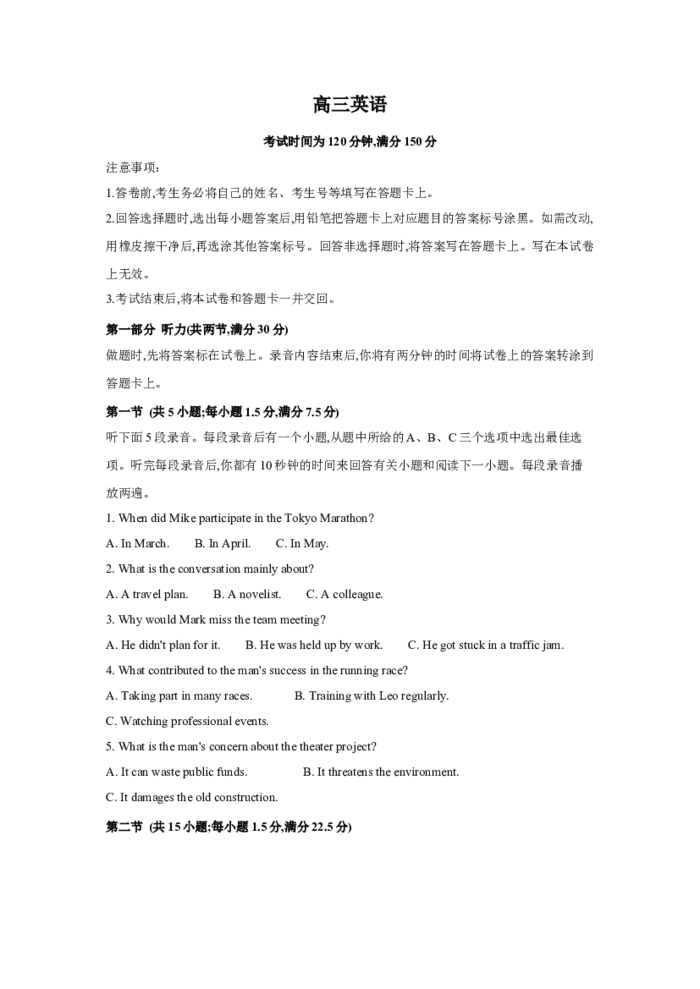
高三英语
考试时间为120 分钟,满分150 分
注意事项:
1.答卷前,考生务必将自己的姓名、考生号等填写在答题卡上。
2.回答选择题时,选出每小题答案后,用铅笔把答题卡上对应题目的答案标号涂黑。如需改动,
用橡皮擦干净后,再选涂其他答案标号。回答非选择题时,将答案写在答题卡上。写在本试卷
上无效。
3.考试结束后,将本试卷和答题卡一并交回。
第一部分 听力(共两节,满分30 分)
做题时,先将答案标在试卷上。录音内容结束后,你将有两分钟的时间将试卷上的答案转涂到
答题卡上。
第一节 (共5 小题;每小题1.5 分,满分7.5 分)
听下面5 段录音。每段录音后有一个小题,从题中所给的A、B、C 三个选项中选出最佳选
项。听完每段录音后,你都有10 秒钟的时间来回答有关小题和阅读下一小题。每段录音播
放两遍。
1. When did Mike participate in the Tokyo Marathon?
A. In March.
B. In April.
C. In May.
2. What is the conversation mainly about?
A. A travel plan.
B. A novelist.
C. A colleague.
3. Why would Mark miss the team meeting?
A. He didn't plan for it.
B. He was held up by work.
C. He got stuck in a traffic jam.
4. What contributed to the man's success in the running race?
A. Taking part in many races.
B. Training with Leo regularly.
C. Watching professional events.
5. What is the man's concern about the theater project?
A. It can waste public funds.
B. It threatens the environment.
C. It damages the old construction.
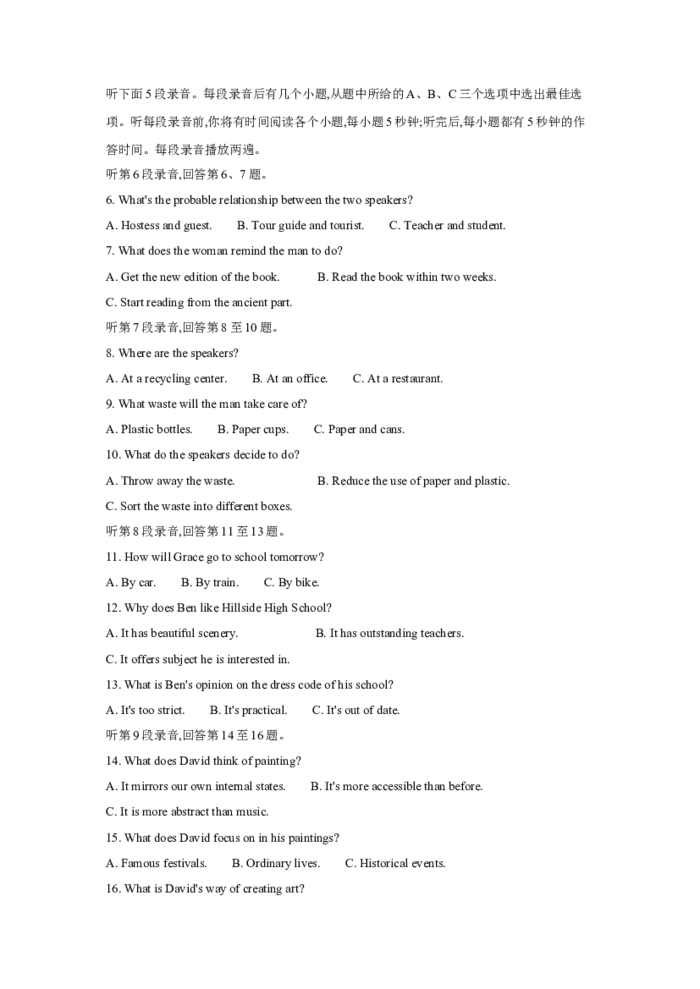
第二节 (共15 小题;每小题1.5 分,满分22.5 分)
听下面5 段录音。每段录音后有几个小题,从题中所给的A、B、C 三个选项中选出最佳选
项。听每段录音前,你将有时间阅读各个小题,每小题5 秒钟;听完后,每小题都有5 秒钟的作
答时间。每段录音播放两遍。
听第6 段录音,回答第6、7 题。
6. What's the probable relationship between the two speakers?
A. Hostess and guest.
B. Tour guide and tourist.
C. Teacher and student.
7. What does the woman remind the man to do?
A. Get the new edition of the book.
B. Read the book within two weeks.
C. Start reading from the ancient part.
听第7 段录音,回答第8 至10 题。
8. Where are the speakers?
A. At a recycling center.
B. At an office.
C. At a restaurant.
9. What waste will the man take care of?
A. Plastic bottles.
B. Paper cups.
C. Paper and cans.
10. What do the speakers decide to do?
A. Throw away the waste.
B. Reduce the use of paper and plastic.
C. Sort the waste into different boxes.
听第8 段录音,回答第11 至13 题。
11. How will Grace go to school tomorrow?
A. By car.
B. By train.
C. By bike.
12. Why does Ben like Hillside High School?
A. It has beautiful scenery.
B. It has outstanding teachers.
C. It offers subject he is interested in.
13. What is Ben's opinion on the dress code of his school?
A. It's too strict.
B. It's practical.
C. It's out of date.
听第9 段录音,回答第14 至16 题。
14. What does David think of painting?
A. It mirrors our own internal states.
B. It's more accessible than before.
C. It is more abstract than music.
15. What does David focus on in his paintings?
A. Famous festivals.
B. Ordinary lives.
C. Historical events.
16. What is David's way of creating art?
A. Painting staged scenes.
B. Asking people to model.
C. Capturing natural moments.
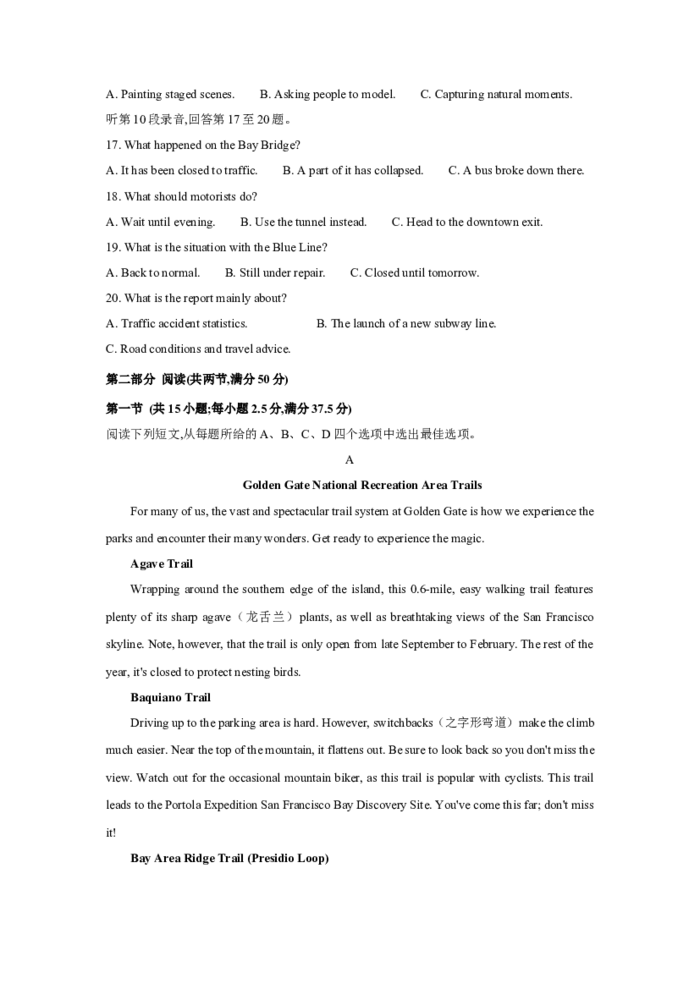
听第10 段录音,回答第17 至20 题。
17. What happened on the Bay Bridge?
A. It has been closed to traffic.
B. A part of it has collapsed.
C. A bus broke down there.
18. What should motorists do?
A. Wait until evening.
B. Use the tunnel instead.
C. Head to the downtown exit.
19. What is the situation with the Blue Line?
A. Back to normal.
B. Still under repair.
C. Closed until tomorrow.
20. What is the report mainly about?
A. Traffic accident statistics.
B. The launch of a new subway line.
C. Road conditions and travel advice.
第二部分 阅读(共两节,满分50 分)
第一节 (共15 小题;每小题2.5 分,满分37.5 分)
阅读下列短文,从每题所给的A、B、C、D 四个选项中选出最佳选项。
A
Golden Gate National Recreation Area Trails
For many of us, the vast and spectacular trail system at Golden Gate is how we experience the
parks and encounter their many wonders. Get ready to experience the magic.
Agave Trail
Wrapping around the southern edge of the island, this 0.6-mile, easy walking trail features
plenty of its sharp agave(龙舌兰)plants, as well as breathtaking views of the San Francisco
skyline. Note, however, that the trail is only open from late September to February. The rest of the
year, it's closed to protect nesting birds.
Baquiano Trail
Driving up to the parking area is hard. However, switchbacks(之字形弯道)make the climb
much easier. Near the top of the mountain, it flattens out. Be sure to look back so you don't miss the
view. Watch out for the occasional mountain biker, as this trail is popular with cyclists. This trail
leads to the Portola Expedition San Francisco Bay Discovery Site. You've come this far; don't miss
it!
Bay Area Ridge Trail (Presidio Loop)
Explore the charm, natural wonders, and historic and cultural variety of the Presidio.
Spectacular views await you on this short trip through forests and grasslands and along coastal
bluffs(悬崖), from the Presidio's south-central entrance to its northwest tip and back. The trail is
primarily used for hiking and walking and is accessible year-round.
Features include Andy Goldsworthy's "Spire" sculpture and several wonderful overlooks of
the ocean and bay. Dress for the coastal fog that often persists until afternoon.
Ecology Trail
The Ecology Trail is multi-use for walkers and cyclists. Check out El Polin Spring, a great site
for spotting hummingbirds, and keep an eye out for wildflowers like the native Presidio clarkia.
21. Which trail has limited opening dates?
A. Agave Trail.
B. Baquiano Trail.
C. Bay Area Ridge Trail.
D. Ecology Trail.
22. What is special about Bay Area Ridge Trail?
A. It's good for all skill levels.
B. Fog often happens in this region.
C. It's a line through the woods.
D. Biodiversity is well reflected here.
23. What do Baquiano Trail and Ecology Trail have in common?
A. They lead to a historic site.
B. They are near the mountain top.
C. They can be used by cyclists.
D. They feature spring water views.
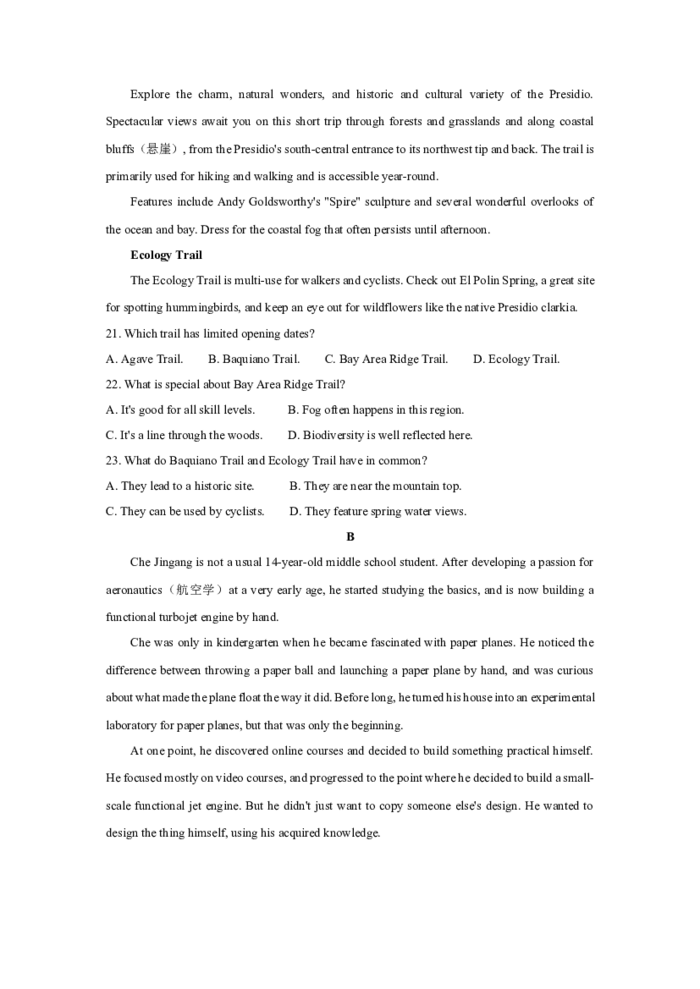
B
Che Jingang is not a usual 14-year-old middle school student. After developing a passion for
aeronautics(航空学)at a very early age, he started studying the basics, and is now building a
functional turbojet engine by hand.
Che was only in kindergarten when he became fascinated with paper planes. He noticed the
difference between throwing a paper ball and launching a paper plane by hand, and was curious
about what made the plane float the way it did. Before long, he turned his house into an experimental
laboratory for paper planes, but that was only the beginning.
At one point, he discovered online courses and decided to build something practical himself.
He focused mostly on video courses, and progressed to the point where he decided to build a small-
scale functional jet engine. But he didn't just want to copy someone else's design. He wanted to
design the thing himself, using his acquired knowledge.
To realize the dream, he started designing every little component from zero, making his own
2D engineering drawings in Computer-Aided Design (CAD), building 3D models in SolidWorks,
calculating airflow, temperature, and pressure using software.
He began documenting every process by uploading videos online, and before long, he started
interacting with like-minded people. Fellow enthusiasts shared advice in the comment section,
others cheered him on, and some even offered to 3D-print his components for free. Within six
months, he already had a prototype(原型).
Unfortunately, the test was a failure, as Che himself identified problems with the fuel and the
combustion chamber (燃烧室)design. But he didn't let that frustration curb his ambition.
"Nothing can be successfully accomplished on the first try. Even if I didn't succeed, I learned
something, and that gives me the motivation to build it a second time," the teen said. Now Che
Jingang is already working on a new and improved version of a functional turbojet engine and is
getting ready to test it.
24. What aroused Che Jingang's interest in aeronautics?
A. Taking advanced physics lessons.
B. Observing paper plane flight effect.
C. Watching original online courses.
D. Reading science books since youth.
25. What is paragraph 5 mainly about?
A. How Che improved the prototype.
B. How network affected human interaction.
C. How network brought help to Che.
D. How fellow enthusiasts shared advice.
26. What did Che think of his first test failure?
A. It gave him strength to move forward.
B. It discouraged him from taking risks.
C. It could have been effectively avoided.
D. It was caused by a coding error.
27. Which of the following can best describe Che Jingang?
A. Modest and responsible.
B. Patient and cooperative.
C. Independent and selfless.
D. Creative and determined.
C
Researchers from Edith Cowan University (ECU) in Western Australia examined data from
more than 179,000 UK Biobank participants, looking at their intake of the two main forms of dietary
vitamin K: vitamin K1—which is found mainly in leafy green vegetables—and vitamin K2, found
in foods such as meats, eggs and dairy.
"We saw a clearer association between higher vitamin K1 intake and lower Chronic
Obstructive Pulmonary Disease (COPD)(慢性阻塞性肺病)risk, as well as better lung
function," lead author Chengfeng Li said. Over an average follow-up period of 10.5 years, 3,135
participants developed COPD, which is an umbrella term for progressive lung diseases, including
emphysema and chronic bronchitis that make it increasingly difficult to breathe.
"It's possible that vitamin K1 itself contributes to the observed associations, but it's also
likely that it works as part of a broader healthy dietary pattern", Li said. It can't prove that eating
leafy greens directly prevents COPD. People who eat more leafy greens may also exercise more,
smoke less, have higher incomes, eat less processed food, or have other health behaviors that
lower disease risk.
The study also found that the association between higher K1 intake and better lung function
appeared stronger in smokers and people working in high-risk occupations, such as jobs involving
dust or fumes. That could suggest vitamin K1-rich diets are particularly helpful when the lungs are
under greater stress, but the researchers are careful not to oversell the finding. "I would not want
readers to think that eating greens can prevent or treat COPD on its own," said Li. "The most
important message for lung health remains to avoid smoking, and reduce harmful occupational or
environmental exposure where possible."
Still, the findings add to growing evidence that diet may play a meaningful supporting role in
lung health. The amount of vitamin K1 associated with better outcomes was achievable through
diet: roughly one extra serve of leafy greens could be enough to boost intake.
28. What do we know about vitamin K1?
A. It works better with vitamin K2.
B. It exists in both plant and animal foods.
C. It can completely prevent COPD.
D. It is mainly obtained from leafy greens.
29. What does Li mean by saying that "it works as part of a broader healthy dietary pattern"?
A. Vitamin K1 is not a key element.
B. There is a need for diversity in diet.
C. A healthy diet should be redefined.
D. Vitamin K1 may not be acting alone.
30. Which groups can get greater help from vitamin K1-rich diets?
A. Non-smokers who eat vegetables.
B. Groups already at high risk of lung damage.
C. Non-smokers with high pressure.
D. Groups who grow up in a good environment.
31. What can be a suitable title for the text?
A. Effective ways to improve lung health
B. Major functions of vitamin K1 in diets
C. Leafy greens linked to better lung health
D. How to reduce the risk of lung disease
D
In Hawaii, researchers are literally paving the roads with good intentions. They have come up
with an innovative method for putting the island's plastic pollution to work, covering its roads with
asphalt(沥青)mixed with plastic waste.
While plastic paving initiatives are happening in places like Missouri and Texas, the project in
Hawaii is the first to use marine waste. It is designed to solve the islands' unique exposure to
discarded fishing gear, tourist waste and the Great Pacific Garbage Patch, which completely covers
the island chain every few years. To date, 90 tons of plastic trash have been removed from the
Pacific Ocean.
One key question is whether wear and tear on that pavement might release microplastics into
the environment. Initial results show that the asphalt remains largely undamaged, researchers
reported on March 22 at the American Chemical Society meeting. "We're extremely concerned
about the releasing of plastics or other chemicals into the environment, because this can expose
humans and animals to toxic plastic additives, leading to a series of health problems," says chemist
Jennifer Lynch.
The team used a variety of methods to simulate how microplastics would normally be released
into the ecosystem, for example, simulating stormwater by pouring pure water onto the road, then
sweeping the roads to collect gravel (砂砾)dust to look for microplastics. "There wasn't
significant microplastic release compared with the road with no plastic mixed into the asphalt," says
Jennifer.
Bill Buttlar, director of the Innovation Lab at the University of Missouri, says he's impressed
with the program but notes that the challenges with road performance in Hawaii are different from
those in the mainland United States. The tropical climate with its heavy rains and volcanism faces
underground volatility(波动), and when the ground is constantly shifting, it can cause road
cracking. "The main challenge to scaling this is getting the recipe right with the asphalt because
what works in Hawaii may be a little different than what works in the Midwest," Buttlar says.
32. What does the author point out at the beginning of the text?
A. Marine pollution is increasingly serious.
B. Plastic waste can be used to pave roads.
C. Asphalt can be environmentally friendly.
D. Plastic is an excellent building material.
33. What does the underlined word "toxic" in paragraph 3 mean?
A. Complicated.
B. Flexible.
C. Rough.
D. Poisonous.
34. Why did the team collect the gravel dust?
A. To keep the roads clean.
B. To examine the road stability.
C. To test it for microplastics.
D. To remove the underlying risks.
35. What challenges the road performance in Hawaii?
A. Climatic and geological conditions.
B. The large construction scale.
C. New chemicals mixed in the asphalt.
D. Land surface temperature changes.
第二节 (共5 小题;每小题2.5 分,满分12.5 分)
阅读下面短文,从短文后的选项中选出可以填入空白处的最佳选项。选项中有两项为多余选
项。
Now, "romanticizing your life" has become a popular social media trend. It celebrates slowing
down and rediscovering life's simple pleasures. 36
What Does It Mean to Romanticize Your Life?
Across social media, people are embracing simple rituals such as baking fresh bread, growing
a garden, savoring a morning coffee, and spending more time outdoors. 37                 It's not about
comparison—it's about expression. In the midst of "busy" culture, the move toward slow living has
become a welcome way to embrace happiness in the present moment instead of waiting to reach the
next big goal.
The Benefits of Romanticizing Your Life
In fact, romanticizing your life has powerful benefits, including helping you focus on the good
in life by being grateful for small joys. 38                 Simple acts of self-care, including buying yourself
flowers or cooking yourself a delicious meal, can also help you nurture yourself. Finally, the practice
creates room for joy by showing that happiness can be found in the quiet, everyday moments if you
simply notice them.
39
You can start romanticizing your life when you wake up or during your nightly routine. Open
your curtains in the morning and bask in the sunshine, dress up for no reason at all, and play soft
music while you get ready for the day or before bed. If you're out in nature for the day, go for a walk
and notice beautiful things around you, gaze at the sky or watch a spectacular sunset without your
phone.
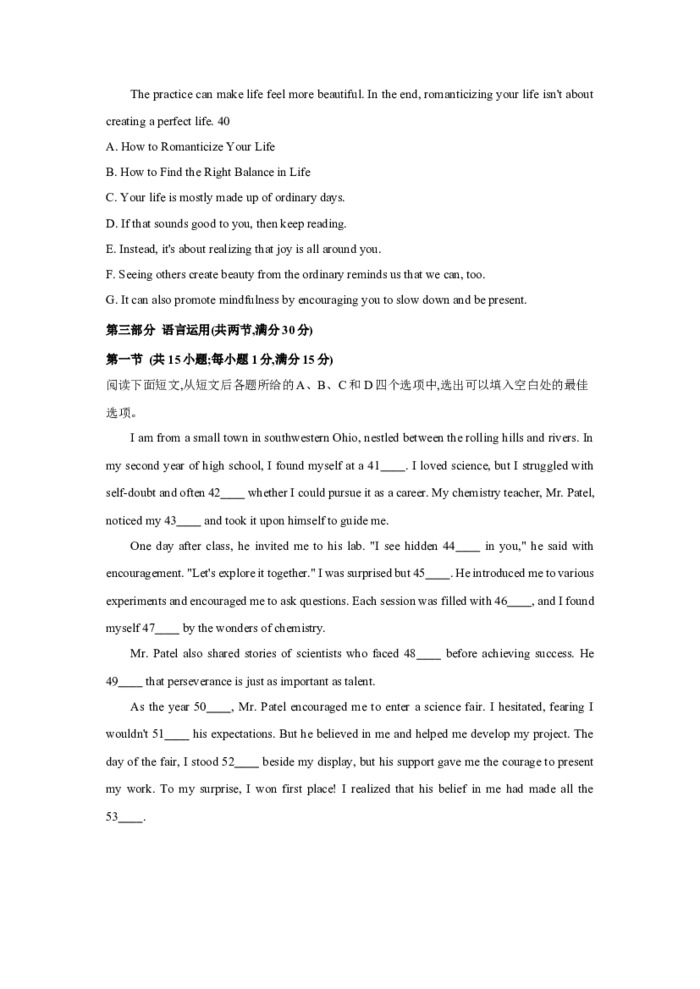
The practice can make life feel more beautiful. In the end, romanticizing your life isn't about
creating a perfect life. 40
A. How to Romanticize Your Life
B. How to Find the Right Balance in Life
C. Your life is mostly made up of ordinary days.
D. If that sounds good to you, then keep reading.
E. Instead, it's about realizing that joy is all around you.
F. Seeing others create beauty from the ordinary reminds us that we can, too.
G. It can also promote mindfulness by encouraging you to slow down and be present.
第三部分 语言运用(共两节,满分30 分)
第一节 (共15 小题;每小题1 分,满分15 分)
阅读下面短文,从短文后各题所给的A、B、C 和D 四个选项中,选出可以填入空白处的最佳
选项。
I am from a small town in southwestern Ohio, nestled between the rolling hills and rivers. In
my second year of high school, I found myself at a 41                . I loved science, but I struggled with
self-doubt and often 42                 whether I could pursue it as a career. My chemistry teacher, Mr. Patel,
noticed my 43                 and took it upon himself to guide me.
One day after class, he invited me to his lab. "I see hidden 44                 in you," he said with
encouragement. "Let's explore it together." I was surprised but 45                . He introduced me to various
experiments and encouraged me to ask questions. Each session was filled with 46                , and I found
myself 47                 by the wonders of chemistry.
Mr. Patel also shared stories of scientists who faced 48                 before achieving success. He
49                 that perseverance is just as important as talent.
As the year 50                , Mr. Patel encouraged me to enter a science fair. I hesitated, fearing I
wouldn't 51                 his expectations. But he believed in me and helped me develop my project. The
day of the fair, I stood 52                 beside my display, but his support gave me the courage to present
my work. To my surprise, I won first place! I realized that his belief in me had made all the
53                .
Today, I work in a field dedicated to sustainability, and I often 54                 Mr. Patel's
encouragement. I aim to be a mentor(导师)for the younger generation, just as he was for me,
reminding them that their dreams are within 55                .
41. A. point
B. crossroads
C. revolution
D. risk
42. A. questioned
B. realized
C. assumed
D. ignored
43. A. sorrow
B. grief
C. hesitation
D. boredom
44. A. dream
B. potential
C. expectation
D. responsibility
45. A. terrified
B. ashamed
C. excited
D. embarrassed
46. A. humor
B. discovery
C. secret
D. confusion
47. A. disturbed
B. trapped
C. defeated
D. fascinated
48. A. fortunes
B. opportunities C. challenges
D. rewards
49. A. emphasized
B. predicted
C. imagined
D. complained
50. A. approached
B. repeated
C. interrupted
D. progressed
51. A. measure up to
B. look up to
C. face up to
D. catch up with
52. A. proudly
B. nervously
C. casually
D. curiously
53. A. difference
B. effort
C. record
D. promise
54. A. capture
B. support
C. recall
D. invest
55. A. discussion
B. control
C. possibility
D. reach
第二节 (共10 小题;每小题1.5 分,满分15 分)
阅读下面短文,在空白处填入1 个适当的单词或括号内单词的正确形式。
The 2026 Beijing division final of the "Co-Making the Future" China-US Youth Maker
Competition concluded on June 14, 56                 (present) a dynamic cross-border innovation
ecosystem.
Organized by the Ministry of Education of China and recognized 57                 a key China-US
people-to-people exchange program, the competition attracted 258 teams and 1,199 participants.
This year also marked the introduction of a 58                 (dedicate) vocational(职业的)education
track, highlighting the rising role of applied technical talent alongside traditional academic
pathways.
In the competition, young innovators applied artificial intelligence 59                 (address) real-world
challenges. Projects spanned AI healthcare, intelligent transportation, aerospace communication,
emergency response, and cultural innovation.
The judging panel, composed of academics, industry experts and corporate representatives,
60                 (evaluate) projects based on technological innovation, real-world application, social value,
and market potential.
61                 total of 48 projects received awards, including 30 in the higher education track and
18 in the vocational education track. Five first prizes in the main track and three in the vocational
track 62                 (award) in cutting-edge fields, such as biomedical technology, smart healthcare,
robotics, cultural tech, and transportation systems. All first-prize teams from the Beijing division
will advance 63                 (direct) to the national finals in Shanghai.
Organizers emphasized that the competition is not only an innovation showcase but also a
platform 64                 promotes talent development. By integrating vocational and academic tracks, the
event highlights a growing 65                 (combine) of industry and education in shaping future-ready
innovators.
第四部分 写作(共两节,满分40 分)
第一节 (满分15 分)
假定你是李华,你的外教Peter 打算在班级开设英语晨读分享环节,现就具体开展形式向全班
征集建议。请你给他写一封邮件,内容包括:
1. 提出具体建议;
2. 说明建议的好处。
注意:
1. 写作词数应为80 个左右。
2. 请按如下格式在答题卡的相应位置作答。
Dear Peter,
_____________________________________________________________________________
_____________________________________________________________________________
_____________________________________________________________________________
_____________________________________________________________________________
_____________________________________________________________________________
_____________________________________________________________________________
_____________________________________________________________________________
_____________________________________________________________________________
_____________________________________________________________________________
_____________________________________________________________________________
Yours sincerely,
Li Hua
第二节 (满分25 分)
阅读下面材料,根据其内容和所给段落开头语续写两段,使之构成一篇完整的短文。
At his old school, Rohan was always picked first. He was the best dribbler(运球者)and
fastest runner, and every team hoped to have him on their side. However, at his new school in Pune,
none of that seemed to matter. Nobody here had ever seen him play before.
"Trials are Thursday," his new coach, Mr. Subramaniam, said on his first day. "Everyone starts
equal." Rohan almost laughed. He'd never had to try out for anything in his life.
Thursday came, and so did a surprise. There was a boy named Vihaan who could read the game
better than anyone Rohan had ever played with—always in the right space, always one step ahead,
even though he wasn't particularly fast or showy. Rohan, used to being the obvious star, found
himself constantly a half-second behind. He misjudged a pass, then another. By the end of trials, he
wasn't sure where he stood anymore.
The team list was posted on Friday morning. Rohan scanned it twice before he found his name
—not in the starting eleven, but on the bench. Second string (替补队员). "You'll get your
chance," Mr. Subramaniam said, noticing his face. "Use practice this week to learn from Vihaan.
He sees things most boys your age don't."
Rohan wanted to feel annoyed. Instead, watching Vihaan during practice that week, he found
himself actually paying attention—really watching, the way he didn't need to at his old school. He
noticed Vihaan checking his shoulder before every pass. He noticed how he never panicked, even
under pressure, just moved the ball simply and smartly to someone better placed. By watching and
learning from this teammate, he discovered a new way of playing.
By Saturday's match, Rohan came on as a substitute in the second half, his team down by one
goal.
注意:
1. 续写词数应为150 左右;
2. 请按如下格式在答题卡的相应位置作答。
He didn't try to be the star this time.
_____________________________________________________________________________
_____________________________________________________________________________
_____________________________________________________________________________
But Vihaan jogged over, smiling broadly, and embraced Rohan warmly.
_____________________________________________________________________________
_____________________________________________________________________________
_____________________________________________________________________________
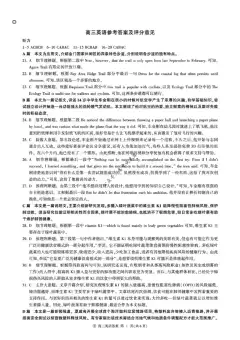
答案
听力
1-5 ACBCB  6-10 CABAC  11-15 BCBAB  16-20 CABAC
阅读理解
21. A 22.B 23.C 24.B 25.C 26.A 27.D 28.D 29.D 30.B 31.C 32.B 33.D 34.C 35.A
七选五
36. D 37.F 38.G 39.A 40.E
完形填空
41. B 42.A 43.C 44.B 45.C 46.B 47.D 48.C 49.A 50.D 51.A 52.B 53.A 54.C 55.D
语法填空
56. presenting
57. as
58. dedicated
59. to address
60. evaluated
61. A
62. were awarded   63. directly    64. which/that    65. combination
书面表达范文
Dear Peter,
Hearing that you are going to launch an English morning reading sharing session, I’m writing
to offer some practical suggestions.
To begin with, you could assign different topics each week, such as news, stories, or poems,
allowing us to choose what interests us most. This would make the sharing more engaging and
personalized. Besides, arranging a 5-minute free discussion after each sharing is a good choice,
which enables us to exchange ideas and deepen our understanding.
I hope my suggestions will be of some value to you.
Yours sincerely,
Li Hua
读后续写范文
He didn’t try to be the star this time. He checked his shoulder, the way Vihaan did. He found
the meaning of the simple pass instead of the showy run. He felt a connection with his team, knowing
exactly when to pass, when to make his decisions. With ten minutes left, he slipped a quiet, perfectly
timed pass through to Wayne, who scored a goal that was important in helping them turn the game
around. People at the gym cheered for Wayne loudly. Nobody noticed Rohan. Nobody chanted his
name.
But Vihaan jogged over, smiling broadly, and embraced Rohan warmly. “Good ball,” Vihaan
said. “Learned it from you,” Rohan said, and meant it completely. Rohan no longer cared about
being the center of attention as he used to. Walking side by side with Vihaan off the field, he
sincerely told Vihaan he owed the brilliant assist to his guidance. Walking home that evening, Rohan
realised something: being the best had once felt like the whole point. Being useful, it turned out, felt
better.
听力原文
Text 1
W: Mike, it's amazing you've run three marathons across Asia in just four months!
M: Yeah. But it's a pity that I had to drop out of the Seoul Marathon on March 12th, only a week
after the Tokyo one.
W: Well, you need to rest up.
Text 2
M: Mary, did you hear Mr. Frank is leaving by the end of this month?
W: Yes. I heard he wants to travel around the world and write historical novels. You know, he's
been a lawyer in our company for 20 years. I think he's looking forward to some changes.
Text 3
W: Hey, have you heard from Mark today? Is he going to make it to our team meeting this
afternoon?
M: He sent me a message just now. He intended to leave the office by 4:00 PM, but he's stuck at
work and doesn't know when he'll get out.
W: What a pity!
Text 4
W: I heard you won the running race last weekend. Congratulations. And what makes you so
successful?
M: Thanks, it was tough. My final race against Leo was intense. I think, watching those professional
competitions has helped me greatly.
Text 5
W: Are you aware of the new theater construction going on?
M: Yes, definitely. But seeing so much woodland cleared, don't you think they've ignored the
environmental damage it may cause?
Text 6
W: Hey, everyone. I know some of you find it hard to learn art history, so I'd like to recommend
Ways of Seeing written by John Berger.
M: Is it difficult? It looks quite thick.
W: Actually, it's easy to read. No big words, and each chapter has pictures that show its key points.
Last year, many students finished it in two weeks.
M: Is it a novel?
W: No, but it reads like a storybook. Berger goes from ancient times to modern art. Some think it's
boring at first, but once started, they can't put it down. Also, remember to get the new edition; it has
better pictures and print.
Text 7
W: Now environmental problems are really severe. Too many people create too much waste.
M: Yes. If everyone can recycle more, we'd reduce a lot of waste. Look at the amount of paper we
waste in this office. It's crazy.
W: Exactly. And there're coffee cups and plastic bottles, too. Let's do something.
M: Well, I will deal with the plastic bottles, take them to the recycling center, and then make a
collection box which people can put their plastic bottles in.
W: I'll make two collection boxes for paper and cans. I believe we'd save a lot of waste in this way.
We're going to make a difference.
Text 8
M: Grace, why do you look so bothered?
W: Oh, Ben, I had to take the train to school tomorrow because my father's car is in the shop. I hate
taking the train. I'd rather bike to school if it's not too far. I can ride along the riverside. It's
relaxing.
M: Yeah, your school is in a lovely spot. Actually, I felt really let down when I wasn't admitted to
your school last year.
W: But you're enjoying Hillside High School now, aren't you?
M: Yes. It's truly much better than I could have ever thought before. I wouldn't have been able to
study robotics if I'd gone to your school.
W: You are very lucky to pursue your passion. By the way, is your school considering changing its
dress code?
M: No. And I don't think our dress code needs to be changed. It's simple and pretty practical.
Text 9
W: Good evening, ladies and gentlemen. Welcome to Art in Focus. Today we're joined by David
Chen, whose new painting series has received great attention. David, you've long been known as a
musician. What made you pick up the paintbrush?
M: Well, music will always be part of me. But I found that when we view a painting, we project our
emotions onto the art and, in turn, feel those emotions reflected back at us.
W: Do you have any special moments to share with us?
M: Last spring, I spent weeks sitting in local parks at sunset, watching children playing, couples
talking. These aren't grand historical moments or famous festivals, but they're full of everyday
beauty.
W: Did you ask people to model for you?
M: Hardly ever. I believe real scenes happen when people aren't posing.
W: What do you hope visitors take away from your artworks?
M: That ordinary lives matter. Many told me they saw their own lives in the paintings. That's the
power of art. It invites you to feel first, then think.
Text 10
W: Here is your afternoon traffic report. A serious road accident involving two trucks has happened
on the Bay Bridge heading east, and it is now closed in both directions. All eastbound traffic is being
rerouted onto the coastal road, causing traffic delays of more than 45 minutes. Motorists are strongly
urged to stay away from the area and take the tunnel instead.
Also notice that on Motorway 9, a broken-down bus is blocking the way near the downtown exit,
causing heavy traffic for those heading west. Emergency crews are at the scene, but the traffic jam
is expected to continue through the evening rush.
On a positive note, the subway system on the Blue Line, which had signal troubles earlier today,
has been fixed and is now back to normal operation. People are advised to check the traffic apps for
any remaining minor delays before heading out.