学科网(北京)股份有限公司
高三英语月考试题
第1 页共11 页
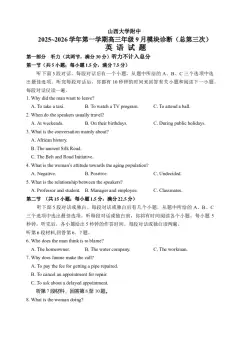
山西大学附中
2026~2027 学年第一学期高三8 月模块诊断
英语试题
考查时间:120 分钟
满分:150 分
考查内容:综合
命题人:王莉莉
审核人:闫黎夏
第二节(共15 小题;每小题1.5 分,满分22.5 分)
听下面5 段录音,每段录音后有几个小题,从题中所给的A、B、C 三个选项中选出最佳
选项。听每段录音前,你将有时间阅读各个小题,每小题5 秒钟;听完后,每小题都有5
秒钟的作答时间。每段录音播放两遍。
听第6 段录音,回答第6、7 题
6. How long did James run his business?
A.10 years.
B.13 years.
C.15 years.
7. How does the woman feel about James’ situation?
A.Embarrassed.
B.Concerned.
C.
第一部分听力(共两节,满分30 分)听力不计入总分
第一节(共5 小题;每小题1.5 分,满分7.5 分)
听下面5 段录音。每段录音后有一个小题,从题中所给的A、B、C 三个选项中选出最佳
选项。听完每段录音后,你都有10 秒钟的时间来回答有关小题和阅读下一小题。每段录
音播放两遍。更多试题与答案,关注微信公众号:三晋高中指南
1. Where does this conversation take place?
A.In a classroom.
B.In a hospital.
C.In a museum.
2. What does Jack want to do?
A.Take fitness classes.
B.Buy a pair of gym shoes.
C.Change his work schedule.
3. What are the speakers talking about?
A.What to drink.
B.Where to meet.
C.When to leave.
4. What is the relationship between the speakers?
A.Colleagues.
B.Classmates.
C.Strangers.
5. Why is Emily mentioned in the conversation?
A.She might want a ticket. B.She is looking for the man.
C.She has an extra ticket.
Disappointed.
听第7 段录音,回答第8 至10 题
8. What has Kate’s mother decided to do?
A.Return to school.
B.Change her job.
C.Retire from work.
学科网(北京)股份有限公司
高三英语月考试题
第2 页共11 页
9. What did Kate’s mother study at college?
A.Oil painting.
B.Art history.
C.Business administration.
10. What is Kate’s attitude toward her mother’s decision?
A.Disapproving.
B.Ambiguous.
C.Understanding.
听第8 段录音,回答第11 至13 题
11. What is the man doing?
A.Chairing a meeting.
B.Hosting a radio program.
C.Conducting a job interview.
12. What benefits Mary most in her job?
A.Her wide reading.
B.Her leaders’ guidance.
C.Her friends’ help.
13. Who will Mary talk about next?
A.Her teacher.
B.Her father.
C.Her mother.
听第9 段录音,回答第14 至17 题
14. Why does the man seldom do exercise?
A.He lacks motivation.
B.He has a heart problem.
C.He works all the time.
15. What does Jacob Sattelmair probably do?
A.He’s an athlete.
B.He’s a researcher.
C.He’s a journalist.
16. Why does the woman speak of a study?
A.To encourage the man.
B.To recommend an exercise.
C.To support her findings.
17. How much time will the man probably spend exercising weekly?
A.300 minutes.
B.150 minutes.
C.75 minutes.
听第10 段录音,回答第18 至20 题
18. What did the scientists do to the road?
A.They repaired it.
B.They painted it.
C.They blocked it.
19. Why are young birds drawn to the road surface?
A.It’s warm.
B.It’s brown.
C.It’s smooth.
20. What is the purpose of the scientists’ experiment?
A.To keep the birds there for a whole year.
B.To help students study the birds well.
C.To prevent the birds from being killed.
第二部分阅读(共2 节,满分60 分)
第一节(共15 小题;每小题3 分,满分45 分)
阅读下列短文,从每题所给的A、B、C、D 四个选项中选出最佳选项。
学科网(北京)股份有限公司
高三英语月考试题
第3 页共11 页
A
Are you fascinated by UNESCO World Heritage Sites? If so, let me take you on a journey
to some iconic landmarks. Each stands as a timeless symbol of its
culture’s
values
and
ambitions. Explore these iconic landmarks and their stories. Click here to see UNESCO’s
official World heritage List.更多试题与答案,关注微信公众号:三晋高中指南
Taj Mahal, India
The
Taj
Mahal, a white
marble
mausoleum
(陵墓),
is
celebrated as the
finest
example of Indo-Islamic architecture. Built in 1632 by Mughal Emperor Shah Jahan, it
commemorates his beloved wife, Mumtaz Mahal. lts grand design features arches, domes (圆
顶), and intricate stone inlay work (镶嵌画).
Angkor Wat, Cambodia
Angkor Wat, part of the ancient Khmer Empire’s capital, is the world’s largest religious
structure. Originally a Hindu temple for Vishnu, this 12th-century temple complex showcases
detailed carvings and remains a symbol of Southeast Asia’s rich history.
Acropolis of Athens, Greece
The
Acropolis of Athens
is
an
enduring symbol of Classical
Greece.
The
crown
jewel of this hilltop castle is the Parthenon, a former temple dedicated to the worship of Athena
in ancient Greek religion. Built by Ictinus and Callicrates, beginning in 447 BCE, this
Doric icon is regarded as the most important surviving ancient Greek monument.
The Great Wall, China
Stretching over 21,000 kilometres, the Great Wall is one of humanity’s most ambitious
architectural feats. Initially built during the 7th century BCE and expanded by later dynasties, it
served as a military defence system against invasions. The best-preserved sections near Beijing,
constructed with bricks and stone, display watchtowers and strategic passes. Despite erosion
and tourism pressures, it remains a proud symbol of Chinese civilization.
21. Why was the Taj Mahal built?
A.To honor an emperor’s wife.
B.To serve as a Hindu temple.
C.To defend against external attacks.
D.To showcase modern architecture.
22. Which two sites were originally religious structures?
A.Taj Mahal and Angkor Wat.
B.Angkor Wat and The Great Wall.
C.Angkor Wat and Acropolis of Athens.
D.The Great Wall and Acropolis of Athens.
23. Which part of the Great Wall is the best maintained according to the passage?
A.The original sections built from the 7th century BCE.
B.Sections near Beijing constructed with bricks and stone.
C.Sections built with watchtowers in the western regions.
学科网(北京)股份有限公司
高三英语月考试题
第4 页共11 页
D.The northernmost sections expanded by the Ming Dynasty.
B
This weekend I had the pleasure of seeing the Latvian animated film Flow in the theater. I’
d never heard of it, but all of the other options were sequels (续集) or Christmas
movies. Flow had a great trailer (预告片), excellent reviews, and won many awards.
It is about the adventures of a black cat, a yellow dog, and several other animals that band
together to survive a catastrophic flood. There are no people in the film. In fact, there is no
dialogue at all in the hour and a half.
You would think that a movie without any human characters or dialogue would be boring.
Well, Flow is anything BUT. On the contrary, I was often on the edge of my seat, terrified for
the danger these little guys faced. They’re constantly escaping enemies and rising water.
Eventually, our black cat finds himself in a new land. At the start of the movie he is alone, but
by the end he is surrounded by new friends.
What, if anything, does this movie “mean”? Clearly, one of the basic themes is unity —
different species that initially don’t get along eventually learn to help each other survive. But I
think the fact that humans are completely absent seems intentional. The animals pass through
run-down, abandoned towns, implying that humanity may have been wiped out by a disaster.
Combined with the flood, this suggests a metaphor about climate change and sea level rise. The
movie’s metaphors are subtle: water is an ever-present symbol in the film, and it is constantly
flowing forward, pushing the action and our characters. With the title literally named Flow,
temporariness seems to be the main message: things constantly changing, the world moves on.
We often can’t control storms of life. What we can control are our own actions. You can
choose to fight the current or go with it and make the best of what you find down river.
Or it could mean something else completely different to you! Like the best poems, this
movie is open to multiple interpretations.
24. What initially motivated the author to watch the film Flow?
A.Recommendations from strangers.
B.Its positive reception and many awards.
C.Curiosity about an unknown movie.
D.Its unique theme concerning animals.
25. Which of the following is a distinctive feature of Flow?
A.It involves more than human characters.
B.It contains no spoken dialogue.
C.It is a short animation within 90 minutes.
D.It is primarily a Christmas-themed story.
26. In the author’s opinion, what does humans’ absence from the film imply?
A.The loss of humanity.
B.The difficulty of survival.
C.The unpredictability of life.
D.The unity of diverse species.
27. Where is the text probably from?
A.A textbook on animation.
B.An eco-tour journal.
C.An editorial on global warming.
D.An entertainment website.
学科网(北京)股份有限公司
高三英语月考试题
第5 页共11 页
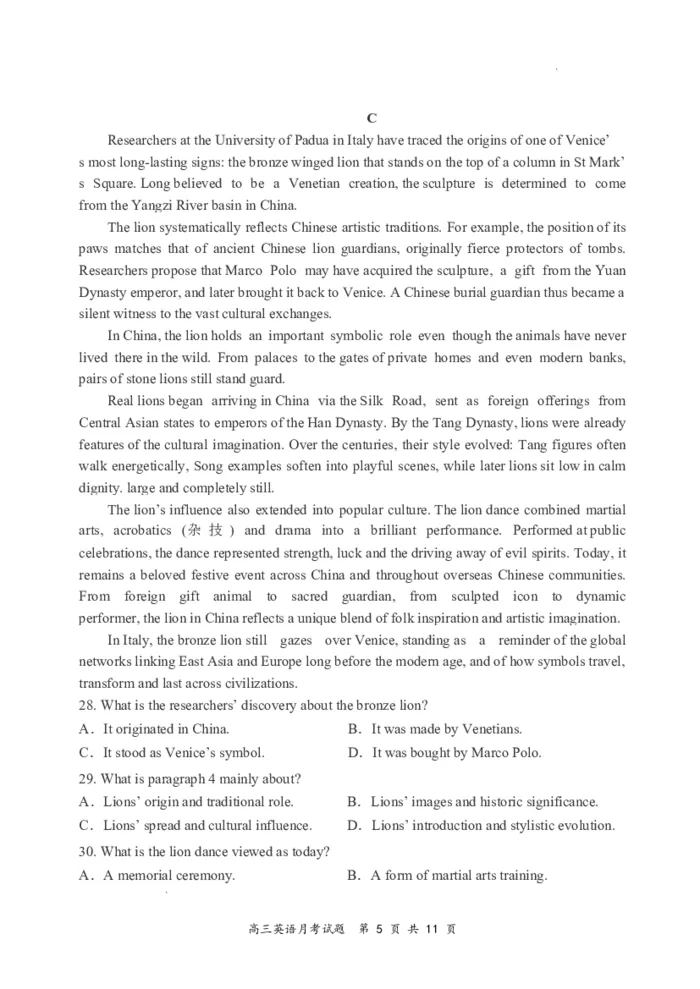
C
Researchers at the University of Padua in Italy have traced the origins of one of Venice’
s most long-lasting signs: the bronze winged lion that stands on the top of a column in St Mark’
s Square. Long believed to be a Venetian creation, the sculpture is determined to come
from the Yangzi River basin in China.
The lion systematically reflects Chinese artistic traditions. For example, the position of its
paws matches that of ancient Chinese lion guardians, originally fierce protectors of tombs.
Researchers propose that Marco Polo may have acquired the sculpture, a gift from the Yuan
Dynasty emperor, and later brought it back to Venice. A Chinese burial guardian thus became a
silent witness to the vast cultural exchanges.
In China, the lion holds an important symbolic role even though the animals have never
lived there in the wild. From palaces to the gates of private homes and even modern banks,
pairs of stone lions still stand guard.
Real lions began arriving in China via the Silk Road, sent as foreign offerings from
Central Asian states to emperors of the Han Dynasty. By the Tang Dynasty, lions were already
features of the cultural imagination. Over the centuries, their style evolved: Tang figures often
walk energetically, Song examples soften into playful scenes, while later lions sit low in calm
dignity. large and completely still.
The lion’s influence also extended into popular culture. The lion dance combined martial
arts, acrobatics (杂技) and drama into a brilliant performance. Performed at public
celebrations, the dance represented strength, luck and the driving away of evil spirits. Today, it
remains a beloved festive event across China and throughout overseas Chinese communities.
From
foreign
gift
animal
to
sacred
guardian,
from
sculpted
icon
to
dynamic
performer, the lion in China reflects a unique blend of folk inspiration and artistic imagination.
In Italy, the bronze lion still
gazes
over Venice, standing as
a
reminder of the global
networks linking East Asia and Europe long before the modern age, and of how symbols travel,
transform and last across civilizations.
28. What is the researchers’ discovery about the bronze lion?
A.It originated in China.
B.It was made by Venetians.
C.It stood as Venice’s symbol.
D.It was bought by Marco Polo.
29. What is paragraph 4 mainly about?
A.Lions’ origin and traditional role.
B.Lions’ images and historic significance.
C.Lions’ spread and cultural influence.
D.Lions’ introduction and stylistic evolution.
30. What is the lion dance viewed as today?
A.A memorial ceremony.
B.A form of martial arts training.
学科网(北京)股份有限公司
高三英语月考试题
第6 页共11 页
C.A traditional celebration.
D.An intercultural collaboration.
31. What can we learn from the bronze lion’s existence in Italy?
A.Venice served as an ancient trade center.
B.The bronze lion symbolized Venice’s history.
C.Ancient China exported lion statues widely.
D.Cultural exchanges existed earlier than assumed.
D
Using artificial intelligence to create artworks increases artists’ productivity and generates
more positive reactions, according to a study involving submissions to a popular art-sharing
website by more than 50,000 users. But generative AI works are more likely to display
stereotypical themes, reducing the novelty of an artist’s work.
The researchers tracked 4 million works published on the website by the artists. The artists
self-divided into two groups: those who continued to work using traditional methods — a sort
of control group, and those who adopted AI. The latter group, numbering about 5,800, were
identified by the use of tags (标签) on their work, such as “AI-generated” or the names of the
AI tools. Works posted into AI art communities on the site were also included.
Artists who adopted AI tools saw their productivity measured by the number of works
posted increase by 25 percent over the study period. They also saw a 50 percent rise in the
number of “favourites” their work received over six months. But novelty, measured by the
subject matter and specific details of the work, decreased for the AI-using group.
“The study completely tracks with my own experience with these tools and spaces,” says
Andres Guadamuz at the University of Sussex, UK. “At first, it felt that you could do anything,
bring anything in your head into existence, but the more I used them, the more I kept coming
back to themes I liked.”
Guadamuz points out that he isn’t judging the quality of the images produced by
generative AI nor their originality, nor the creativity involved in the process. All these things
are often hotly contested, with some artists saying that generative AI is using their works as
training data and limiting their ability to be recognized as creatives.
Zhou at Boston University is also considering these questions. He says, “The generative
technology accelerates the ability to produce. But it raises other issues: Are we foregoing the
process of understanding what goes into being creative and producing something meaningful,
in favour of just being able to force our way with technology?”
32. What do we know about the artworks created by AI according to paragraph 1?
A.They are abundant but less creative.
B.They are generative but less popular.
C.They balance popularity with artistic depth. D.They attract viewers with the trendy subjects.
33. How was the study conducted?
学科网(北京)股份有限公司
高三英语月考试题
第7 页共11 页
A.By surveying artists’ opinions on AI tools using.
B.By analyzing suggestions on generative AI works.
C.By comparing artworks with different AI involvement.
D.By observing the process of AI-assisted artistic creation.
34. What can be inferred from Guadamuz’s statement?
A.AI tools help artists explore new creative styles.
B.AI users receive more recognition for their creativity.
C.Artists believe AI improves the quality of their artworks.
D.Artists may repeat themes they like when using AI tools.
35. What is the best title for the text?
A.The Unstoppable Rise of AI Artworks. B.The Double-Edged Sword of AI in Artworks.
C.The Role of AI in Artistic Productivity. D.The Breakthrough of AI in Artistic Creation.
第二节(共5 小题;每小题3 分,满分15 分)
阅读下面短文,从短文后的选项中选出可以填入空白处的最佳选项。选项中有两项为多
余选项。更多试题与答案,关注微信公众号:三晋高中指南
Illeism: The Ancient Trick to Help You Think More Wisely
As a writer specialising in psychology, I’ve come across hundreds of evidence-based tips
for better thinking. Few have proven as useful to me as the ancient strategy of illeism.
Put simply, illeism is the practice of talking about oneself in the third person rather than
the first person.
36
In the emperor Julius Caesar’s account of the Gallic War, for
example, he wrote “Caesar avenged the public” rather than “I avenged the public”.
To the modern ear, illeism can sound a little silly or self-important.
37
If we
are trying to make a difficult decision, speaking about ourselves in the third person can help to
reduce the emotions that could lead our thinking off track, allowing us to find a wiser solution
to our problem.
38
This is because when making personal choices, we become too caught up in
our emotions, which cloud our thinking and prevent us from putting our issues in perspective.
If we have received negative feedback from a colleague, for example, our feeling of
embarrassment might lead us to become overly self-defensive.
By switching to the third person, our descriptions of the situation will start to sound as if
we are talking about someone else rather than ourselves.
39
By encouraging us to
put our problems in perspective, the use of illeism may also help us to have a more balanced
response to daily stresses.
Next time you face a challenging situation, try referring to yourself as “he” or “she”
instead of “I”.
40
学科网(北京)股份有限公司
高三英语月考试题
第8 页共11 页
A.Try this technique.
B.Politicians often use this method.
C.This creates helpful distance from emotions.
D.So why do emotions affect our decisions so much?
E.Yet research shows illeism brings real thinking benefits.
F.However, lack of objectivity can be problematic when choosing.
G.You might be surprised at how much clearer your thinking becomes.
第三部分语言运用(共2 节,满分50 分)
第一节完形填空(共15 小题;每小题2 分,满分30 分)
I still remember the day I bought my “nice” notebook. It was a leather-bound journal with
cream-colored pages. I was sure it would make me the type of person who journals regularly,
and who
41
beautiful thoughts. But it didn’t work.
That gorgeous notebook sat
42
for months. When I finally opened it, I hesitated.
The pages felt too delicate and too
43
to waste on my messy handwriting and ideas. So
I
44
it. Instead, I grabbed an old, ugly composition notebook with a
45
cover
and dog-eared corners. I started to
46
it with everything: morning pages, random
thoughts and reminders. This is surprisingly
47
. I actually wrote. Every day. Without
exception.
The psychology is real. When we
48
something too much, we place limits around
it, feeling it is “too good”. But the ugly notebook carries no such
49
. It has been used.
It tells me, “This is a
50
for thinking and living, not a museum piece.”
Here’s the thing:
51
notebooks are idea incubators (孵化器) . With the pressure
off, you experiment more. You try things that might
52
. And in that freedom, bad ideas
I was
53
embarrassed about gradually evolved into work I’m proud of. And that’s
where the real work of creation happens.
The best notebook is never the most beautiful one. It’s the one you’ll actually
54
.
Because the magic happens in the
55
, not in perfect pages.
Your ugly notebook is waiting.
41. A. changes
B. captures
C. follows
D. lacks
42. A. unfinished
B. unclaimed
C. undiscovered
D. untouched
43. A. secret
B. smart
C. precious
D. personal
44. A. closed
B. decorated
C. delivered
D. fixed
45. A. torn
B. hard
C. hidden
D. fancy
学科网(北京)股份有限公司
高三英语月考试题
第9 页共11 页
46. A. guard
B. surround
C. fill
D. serve
47. A. annoying
B. freeing
C. demanding
D. convincing
48. A. plan
B. doubt
C. control
D. admire
49. A. luck
B. warning
C. promise
D. pressure
50. A. tool
B. test
C. guide
D. reason
51. A. incomplete
B. impractical
C. imperfect
D. irregular
52. A. cheat
B. fail
C. hurt
D. disappear
53. A. slightly
B. initially
C. hardly
D. consequently
54. A. run into
B. refer to
C. look at
D. reach for
55. A. preparing
B. thinking
C. writing
D. reading
第二节(共10 小题;每小题2 分,满分20 分)
阅读下面短文,在空白处填括号内单词的正确形式。
At the Temple of Heaven, 73-year-old Li Shuyun stands tall, her arms rising slowly above
her head in a smooth movement, then stretching outward, hands open as though hugging the
sky. The calming practice of baduanjin,
56
ancient Chinese form of exercise, fills
the air
57
a sense of peace and focus.
Graceful eight movements are designed to strengthen and balance the body’s energy, also
known as qi in Chinese philosophy. Dating back to the Song Dynasty, this practice is gaining
new popularity especially among younger generations of Chinese
58
(face) the
pressures of modern life.
Ruan Yize, a 25-year-old PhD student, started practicing baduanjin in 2014,
59
(original) for fitness. After a sports
60
(injure) in 2017, however, the young man
realized
61
(it) true power. “It’s not just about physical fitness — it helps with
mental health and emotional balance,” he said.
Unlike tough workouts or difficult gym programmes, baduanjin
62
(combine)
slow, soft movements with deep breathing and mental focus. And the best part is that no special
equipment or a lot of space
63
(require), making it a perfect practice for busy city
residents. This is evidenced by the practice’s rise among younger people, many of
64
live inactive lifestyles and are continually pressured by office stress.
Whether practiced in a quiet living room
65
an open park, baduanjin offers a
moment of calm balance in a busy world.
第四部分写作(共两节,满分40 分)
第一节(满分15 分)
学科网(北京)股份有限公司
高三英语月考试题
第10 页共11 页
假定你是李华,你的英国朋友Tom 来信询问你的职业规划。请你给他回复一封电子邮件,
内容包括:
1. 目标职业及原因
2. 目前做的准备
注意:词数80 词左右。
Dear Tom,
____________________________________________________________________________
____________________________________________________________________________
Yours,
Li Hua
第二节(满分25 分)阅读下面的材料,根据其所给内容和所给段落开头语续写两段,使
Asher loved spending time in his grandfather’s garden. Every evening, he would carefully
hold the watering can as his grandfather showed him how to pour just the right amount on each
plant. “These plants need us, Asher,” Grandpa always said. “If we take care of them, they will
之构成一篇完整的短文。更多试题与答案,关注微信公众号:三晋高中指南
take care of us.”
Asher loved plants. He loved their bright green leaves, their gentle dancing in the wind,
and how they smelled fresh after the rain. Plants made him feel calm and safe. However, when
it came to people, Asher was not as confident. At school, he was one of the quietest kids. When
other kids laughed and played loudly, he often sat quietly, unsure if he should join.
One afternoon during break, Asher walked past the big oak tree (橡树) near the
playground. A group of kids stood nearby, pulling leaves from its branches and throwing them
into the air. “Look! Leaf rain!” one of them laughed.
Asher’s chest tightened. He felt angry. He loved trees. He knew how important leaves
were for them. He wanted to say something, but fear held him back. He worried that the others
might laugh or ignore him. After a moment, he turned away and left without saying a word.
That evening, Asher sat in the garden with his grandfather, watering the plants like always,
but his mind was not at peace. His silence didn’t escape Grandpa. After some time, Asher
shared what had happened at school and how he felt. He explained that he wanted to protect the
tree but did not feel brave enough.
注意:(1)续写词数应为150 个左右;(2)请按如下格式在相应位置作答。
Paragraph 1 The next day during break, Asher saw the same kids pulling leaves just like before.
____________________________________________________________________________
____________________________________________________________________________
His grandfather listened carefully. He told Asher that courage does not mean being
fearless. It means doing what is right, even when fear is present. He reminded Asher that
change often begins with one small voice and one brave choice. Those words replayed in Asher’
s mind all night.
Paragraph 2 The kids soon agreed to Asher’s suggestion._______________________________