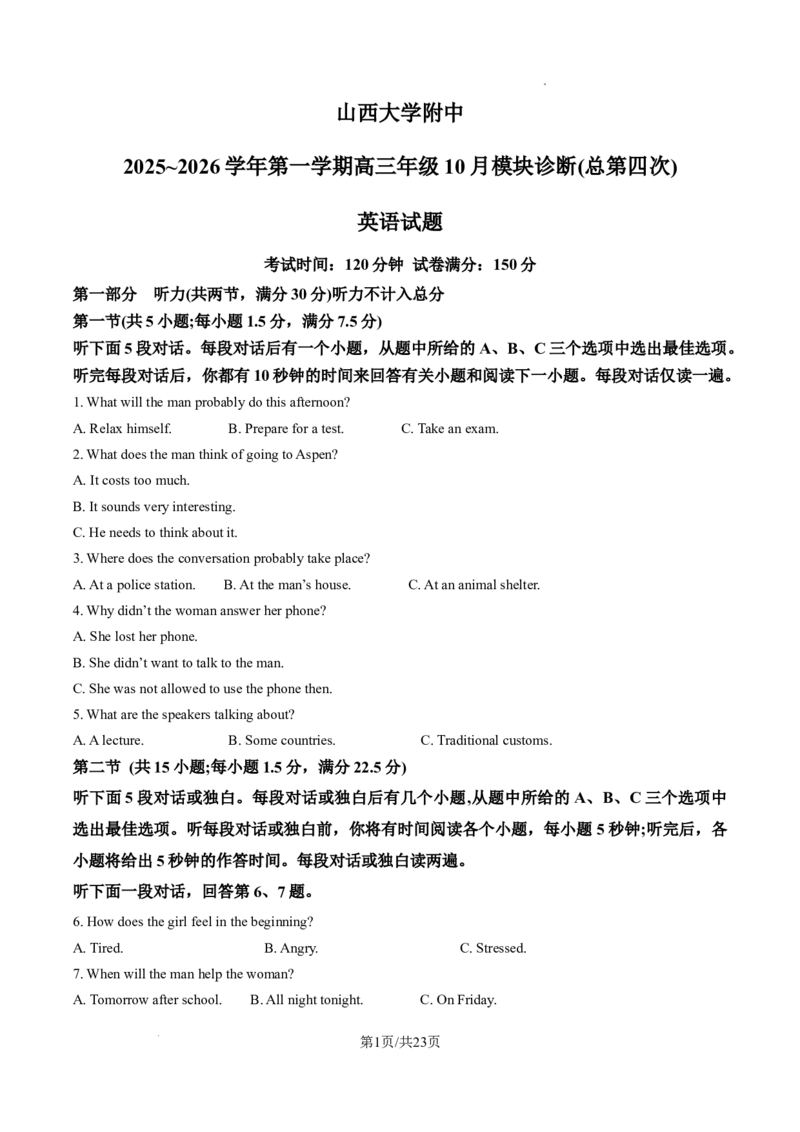
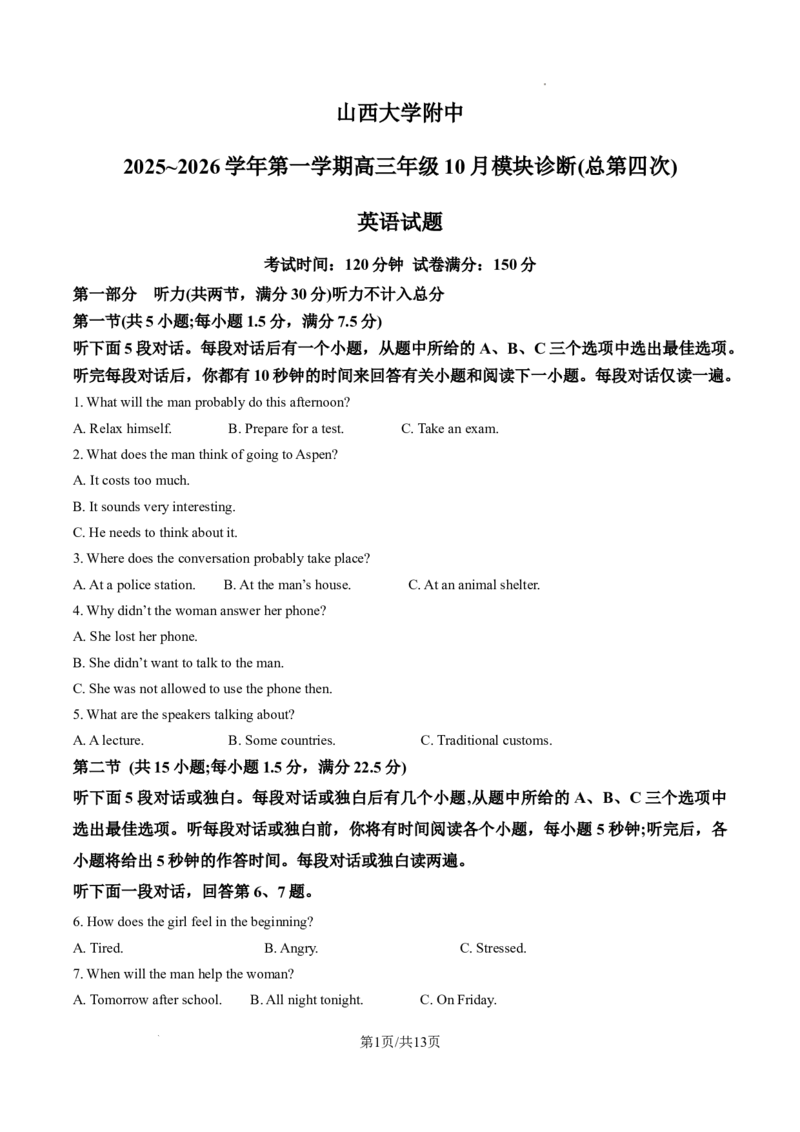
山西大学附中
2025~2026学年第一学期高三年级9月模块诊断(总第三次)
英 语 试 题
第一部分 听力(共两节,满分30分)听力不计入总分
第一节(共5小题;每小题1.5分,满分7.5分)
听下面5段对话。每段对话后有一个小题,从题中所给的A、B、C三个选项中选
出最佳选项。听完每段对话后,你都有10秒钟的时间来回答有关小题和阅读下一小题。
每段对话仅读一遍。
1. Why did the man want to leave?
A. To take a taxi. B. To watch a TV program. C. To attend a ball.
2. When do the speakers usually travel?
A. At weekends. B. On their birthdays. C. During public holidays.
3. What is the conversation mainly about?
A. African history.
B. The ancient Silk Road.
C. The Belt and Road Initiative.
4. What is the woman’s attitude towards the aging population?
A. Negative. B. Positive. C. Undecided.
5. What is the relationship between the speakers?
A. Professor and student. B. Manager and employee. C. Classmates.
第二节 (共15小题;每小题1.5分,满分22.5分)
听下面5段对话或独白。每段对话或独白后有几个小题,从题中所给的 A、B、C
三个选项中选出最佳选项。听每段对话或独白前,你将有时间阅读各个小题,每小题 5
秒钟。听完后,各小题给出5秒钟的作答时间。每段对话或独白读两遍。
听第6段材料,回答第6、7题。
6. Who does the man think is to blame?
A. The homeowner. B. The water company. C. The workman.
7. Why does Janine make the call?
A. To pay the fee for getting a pipe repaired.
B. To cancel an appointment for repair.
C. To ask about a delayed appointment.
听第7段材料,回答第8至10题。
8. What is the woman doing?A. Offering advice. B. Sharing an experience. C. Sitting an exam.
9. What does the woman usually do to reduce stress before exams?
A. Organize revision materials.
B. Set up a timetable for study.
C. Create a quiet learning space.
10. What does the woman remind the man to do at last?
A. Avoid entertainment. B. Have a good sleep. C. Think differently.
听第8段材料,回答第11至13题。
11. Where does the conversation take place?
A. In a house. B. In a shop. C. In a company.
12. How many bathrooms is the man looking for?
A. Two. B. Three. C. Four.
13. What is the local area like?
A. There is a supermarket nearby.
B. There are good transport links.
C. There are top schools around.
听第9段材料,回答第14至17题。
14. Where did the woman meet Kylie?
A. In a parking lot. B. Outside a hotel. C. At a radio station.
15. Why did Kylie start a conversation with the woman?
A. She was interested in the woman’s T-shirt.
B. She invited the woman to attend a show.
C. She offered to fix the woman’s car.
16. What soap opera was Jason in?
A. Home and Away. B. Neighbors. C. Ramsey Street.
17. What type of famous person did the man meet?
A. An author. B. An actress. C. A TV show host.
听第10段材料,回答第18至20题。
18. At what age did Simon enter his first under-eighteen competition?
A. Five. B. Eleven. C. Thirteen.
19. For what reason did Simon stop playing chess for a year?
A. To travel around the country.
B. To reflect on his past experiences.C. To make the most of his teenage life.
20. What does Simon want to do next?
A. Earn good grades. B. Make more friends. C. Get picked for his country.
第二部分 阅读(共两节, 满分60分)
第一节(共15小题;每小题3分,满分45分)
阅读下列短文,从每题所给的A、B、C和D四个选项中,选出最佳选项,并在答题纸
上将该项涂黑。
A
New year, new you... at least that’s the plan, right? We all start January with big
intentions, but actually sticking to those shiny New Year’s resolutions is a different story.
Luckily, there’s an app for that — actually, there are loads!
AllTrails
AllTrails is a great exercise app as it encourages you to get out into nature instead of
hitting up an overpriced gym. With detailed trail maps that guide you through numerous
outdoor activities, you’ll be working up a sweat in no time while taking advantage of natural
beauty!
Rocket Money
Cutting back on spending is the most popular New Year’s resolution globally, every year.
This user-friendly app simplifies everything that comes along with budgeting and expense
tracking, while also helping you manage subscriptions and bills. With features like automated
bill negotiation and credit score monitoring, you can think of Rocket Money as your personal
financial assistant.
Imprint
Want to cut doom-scrolling but not ready to drop your phone? Imprint is here to help. The
app takes big ideas from the world’s greatest thinkers and breaks them down into simple, visual
snippets (片段) that you can actually remember. Whether you want to master essential topics,
or just have a few fun facts to throw into your conversations, Imprint makes learning quick, and
easy!
Duolingo
This language app really is one of the best for sticking to your goals. From the way it
gamifies your progress to the user-friendly interface, Duolingo makes learning a new language
both easy and enjoyable! There’s just one major setback for Hong Kongers: the app only offers
Cantonese lessons for Mandarin speakers, so if you’re hoping to pick up some of the locallanguage, you’ll have to look elsewhere.
21. Which app best suits people who want to effectively manage their budgets?
A. AllTrails. B. Rocket Money. C. Imprint. D. Duolingo.
22. What is Duolingo’s key limitation for Hong Kong users?
A. It avoids games in teaching. B. It lacks a user-friendly interface.
C. It has limited language choices. D. It requires expensive subscriptions.
23. What is the shared purpose of the four apps?
A. To encourage healthy lifestyles. B. To support self-improvement.
C. To track real-time user progress. D. To help make new year resolutions.
B
The coming of warm weather here in Maine calls for a seasonal ritual (惯例) that, for
me, puts an end to winter — fetching the wooden screen door (纱门).
Note that I wrote “wooden”. The aluminum (铝) models just won’t do it — they close
too neatly and keep their perfect form for decades. In the 1960s, a time of imperfection, there
was no perfect house, no perfect car, no perfect kids or parents. Why should a screen door be
an exception?
I grew up with my siblings (兄弟姐妹) in a working-class neighborhood in New Jersey.
When the warm weather arrived, my dad would pull out the wooden screen door and install it
over the back door, which could then be left wide open, admitting a refreshing breeze (we had
no air conditioning).
My father was a Mr. Fix-it, so keeping the screen door serviceable was one of his
hobbies. Every few years he gave it a fresh coat of paint and fixed it a bit. I distinctly
remember him putting the last screw in the last hinge (铰链), and swinging the door shut with a
“crack!”
A good, wooden screen door, unsightly as it was, had an invaluable function in the age of
the stay-at-home mom: It alerted her to the coming and going of the kids. My siblings and my
friends ran in and out of the house, tearing the screen door open and letting it shut with a
bang behind us. A hundred times a day. It was all good, and my mom never complained about
the noise, because that was the purpose of a wooden screen door — to slam (砰地关上) shut
and thereby announce that her children were within earshot.
Several years ago, in a fit of nostalgia (怀旧), I went shopping for a wooden screen door.
I was disappointed in the choices available. They looked a bit too solid, too well made. But I
found one online, and within a week it was delivered to my doorstep.The firm had sent me one with the wrong dimensions, so I asked my carpenter to make
the necessary adjustments. Ozzie worked away at it for a couple of hours until he got it to sit
neatly in its frame. I gave it a test: I pulled it open and let go. It closed in a lazy fashion. “Not
good,” I pronounced. “Please remove the automatic door closer and adjust the door so it swings
shut with a good crack.”
Ozzie went about his work and a short while later the task was done. The door was uneven
in its frame, and the screen no longer lay flat. But when I pulled open the door and released it,
the thing clapped shut like a rifle shot. “What do you think?” I asked. “It looks like hell,” said
Ozzie. “But it sounds like heaven,” I said. And I, being the owner of the door — and the
memory — had the final word.
24. What particular function did the wooden screen door perform in the writer’s childhood?
A. It functioned as an air conditioner in summer.
B. It helped sharpen his father’s repairing skills.
C. It was more like a toy that kids often played with.
D. It made Mom aware that the kids were close by.
25. The reason why the writer asked the carpenter to continue to adjust the door after testing it
is that _________.
A. the door was not the right size for the frame
B. the door was so poorly made that it didn’t suit him
C. he wanted to see how the door was supposed to shut
D. he was determined to seize the ownership of the door
26. What does the wooden screen door mean to the writer now?
A. It is a reminder of the imperfect things.
B. It is a symbol of his memory of summer.
C. It is a contributor to the better life he leads.
D. It is an antique worth cherishing in the museum.
27. What is the best title for the passage?
A. The Good Old Days Are Gone B. Never Judge a Door by Its
Appearance
C. Summer Announces Itself With a Crack D. Every Single Imperfection Adds to
Beauty
C
Sometimes it’s hard to let go. For many British people, that can apply to institutions andobjects that represent their country’s past — age-old castles, splendid homes… and red phone
boxes.
Beaten first by the march of technology and lately by the terrible weather in
junkyards (废品场 ), the phone boxes representative of an age are now making
something of a comeback. Adapted in imaginative ways, many have reappeared on city
streets and village greens housing tiny cafes, cellphone repair shops or even defibrillator
machines (除颤器).
The original iron boxes with the round roofs first appeared in 1926. They were designed
by Giles Gilbert Scott, the architect of the Battersea Power Station in London. After becoming
an important part of many British streets, the phone boxes began disappearing in the 1980s,
with the rise of the mobile phone sending most of them away to the junkyards.
About that time, Tony Inglis’ engineering and transport company got the job to remove
phone boxes from the streets and sell them out. But Inglis ended up buying hundreds of them
himself, with the idea of repairing and selling them. He said that he had heard the calls to
preserve the boxes and had seen how some of them were listed as historic buildings.
As Inglis and, later other businessmen, got to work, repurposed phone boxes began
reappearing in cities and villages as people found new uses for them. Today, they are
once again a familiar sight, playing roles that are often just as important for the community
as their original purpose.
In rural areas, where ambulances can take a relatively long time to arrive, the phone boxes
have taken on a lifesaving role. Local organizations can adopt them for l pound, and install
defibrillators to help in emergencies.
Others also looked at the phone boxes and saw business opportunities. LoveFone, a
company that advocates repairing cellphones rather than abandoning them, opened a mini
workshop in a London phone box in 2016.
The tiny shops made economic sense, according to Robert Kerr, a founder of LoveFone.
He said that one of the boxes generated around $13,500 in revenue (收益) a month and
cost only about $400 to rent.
Inglis said phone boxes called to mind an age when things were built to last. “I like what
they are to people, and I enjoy bringing things back,” he said.
28. The phone boxes are making a comeback ________.
A. to form a beautiful sight of the city
B. to improve telecommunications servicesC. to remind people of a historical period
D. to meet the requirement of green economy
29. Why did the phone boxes begin to go out of service in the 1980s?
A. They were not well-designed. B. They provided bad services.
C. They had too short a history. D. They lost to new technologies.
30. The phone boxes are becoming popular mainly because of ________.
A. their new appearance and lower prices B. the push of the local organizations
C. their changed roles and functions D. the big funding of the businessmen
31. What can we infer about LoveFone from the passage?
A. It mainly focuses on opening workshops in phone boxes across the world.
B. It has earned more profits from phone box workshops than from other businesses.
C. It may pay attention to environmental protection in its business concept.
D. It opened its first business in 2016 by turning a London phone box into a workshop.
D
New era requires a new vocabulary. Will we still talk about the “mobile” phone
when all phones are mobile, or when they are implanted within us?
Technology is everywhere nowadays, especially at work. Some people are really
good at using all the cool new tools that keep popping up. They have something called
a TQ, or technology quotient. Think of it like a superpower for understanding the
latest tech stuff that our great-grandparents would have found really impossible. Having
a high TQ means you’re awesome at using all the cool new things that not everyone
knows about yet.
The examples are common and becoming more and more frequent. For the parent
it might
be a home-school video class. For the brand manager it might be search engine
optimization (最优化). And for the clinician (临床医师), it might be the role of
artificial intelligence in supporting the analysis of a CT scan. TQ attempts to quantify
our ability to make sensible use of current technologies and to quickly adapt, embrace
and capitalize on future creations. This adoption is critical from a variety of
perspectives, from social to business. One trip into the world of ChatGPT and we can
see how the dynamics of AI and search are changing for just about everyone.
Any Mom or Dad can understand the value of IQ and EQ in projecting the
potential for a child’s success. But what about technology? The ability for the childand the teacher to understand, embrace and assimilate technology will be a defining
aspect of their lives as we speed into the future. We are increasingly defined by
technology and our active participation in everything from smart phones to Facebook. It
might just be time for the basic human needs of food, water and shelter to incorporate
technology too. And when that happens, it just might be a good idea to measure it.
While this shift brings challenges, it’s unstoppable. As TQ rises, it will combine
with IQ and EQ, reshaping how we live, work, and learn — turning adaptability with
tech into a measurable edge.
32. What is TQ according to the text?
A. Speed of learning new languages. B. Skill of fixing high-tech products.
C. Talent to follow modern changes. D. Ability to apply new technologies.
33. Which of the following people has a high TQ?
A. A manager who often uses modern search engines.
B. A doctor who analyzes CT scans with AI assistance.
C. A grandparent who finds new tech devices awkward.
D. A mom who watches videos of her child’s school life.
34. What does the underlined word “assimilate” in the fourth paragraph mean?
A. Rely on. B. Take in. C. Benefit from. D. Learn
about.
35. What might be the best title for the passage?
A. Why Are IQ and EQ Important for TQ? B. How Has TQ Changed in the
Modern Era?
C. What Makes TQ the New Intelligence?D. Where to Start Adapting to TQ
Changes?
第二节(共5小题;每小题3分,满分15分)
根据短文内容,从短文后的选项中选出能填入空白处的最佳选项。有两项为多余选项。
What You Can Learn from Exam Papers
Exam papers are not just tools for assessment. 36 . By analyzing and
understanding exam papers, you can gain insights that go beyond the grades you
receive. Here are some key lessons you can learn from exam papers.
3 7
Exam papers provide a clear picture of your performance in different areas. By
reviewing your answers and the corresponding scores, you can identify which topics orskills you excel in and which ones need improvement. For example, if you consistently
score well in multiple-choice questions but struggle with essay questions, it indicates
that you might need to work on your writing skills or ability to synthesize information.
Improve time management
One of the most important skills you can develop from exam papers is effective
time management. By analyzing how you allocate time during an exam, you can
identify areas where you might be spending too much or too little time. For instance,
if you find that you often run out of time before completing the exam, it suggests that
you need to practice pacing yourself better. 38 .
Enhance critical thinking and problem-solving skills
Exam papers often require you to apply your knowledge in new and different
ways. By working through past exam questions, you can practice critical thinking and
problem-solving skills. 39 . The skill is essential not only for academic success
but also for success in your future career and personal life.
Develop a growth mindset
Reviewing exam papers can be a powerful way to develop a growth mindset.
Instead of focusing solely on the grades, look at the feedback (反馈) and use it as an
opportunity to learn and improve. 40 . By adopting this perspective, you can
turn exam papers into valuable learning experiences that contribute to your overall
development.
A. Keep practicing consistently
B. Identify your strengths and weaknesses
C. This skill is also useful for time-sensitive tasks in life
D. Every mistake is a chance to grow and become better
E. You can adjust your study habits based on the exam papers
F. They are also valuable resources for learning and self-improvement
G. The process helps you understand how to develop effective solutions
第三部分 语言运用(共两节,满分50分)
第一节 (共15小题;每小题2分,满分30分)
阅读下面短文,从每题所给的A、B、C、D四个选项中选出可以填入空白处的最佳
选项。
When I first built my website 3 years ago, I had no idea what I was doing. Naturally, I
went to various websites and blogs for 41 . I noticed the common features like socialmedia buttons, advertisements, comments and more. At first glance, these seemed 42
since every website had them. But as I 43 my site, I found they were not. Instead, a
clean, user-friendly design is a good 44 , which had positive effects. Without
advertisements or social media buttons, more people were 45 . It seemed that the more
my website was 46 , the better the results were.
Later, I noticed the 47 of simplicity in other areas of life.
As a kid, I was too weak. As an athlete, I needed to get stronger. So I spent hours
designing the right combination of exercises. But unfortunately, I 48 got stronger. I
assumed that I was missing some kind of exercise, so I kept 49 something new.
However, it took me years to realize that I had not been on the right track with my training,
with so many types of exercises 50 .
Accordingly, later I 51 the complex workouts and focused on just one or two
exercises. Surprisingly, there was a noticeable 52 in my strength in just four months.
From websites to workouts, I made progress by ignoring, reducing and 53 the
non-essential choices. I think this principle also 54 to most things in life. So when you
make a list of your plans, decide what truly matters to you and 55 the rest.
41. A. relaxation B. attention C. inspiration D. expectation
42. A. profound B. unique C. decent D. essential
43. A. tested B. dominated C. appreciated D. contacted
44. A. assumption B. initiative C. association D. option
45. A. trapped B. attracted C. tricked D. motivated
46. A. piled B. simplified C. handled D. shifted
47. A. impact B. purpose C. mistake D. limit
48. A. occasionally B. constantly C. barely D. obviously
49. A. adding B. avoiding C. achieving D. admiring
50. A. presented B. combined C. divided D. sorted
51. A. maintained B. confirmed C. abandoned D. highlighted
52. A. balance B. gap C. decrease D. boost
53. A. eliminating B. making C. facing D. accepting
54. A. responds B. applies C. appeals D. sticks
55. A. pick up B. try out C. cut out D. hang up
第二节(共10小题;每小题2分, 满分20分)
阅读下面材料,在空白处填入适当的内容(1个单词)或所给单词的正确形式。Chinese painting, standing as one of the world’s oldest and most enduring 56 (art)
legacies, has a rich and complex story 57 (tell). The journey begins with ink, a
fundamental material that is rubbed to the desired consistency on an inkstone with a little water.
Then the painter uses a pointed-tipped brush 58 (make) of the hair of goats, deer, or
wolves set in a shaft of bamboo. Typically, traditional Chinese paintings are brought to life on a
length of silk or a sheet of paper, 59 surface is absorbent, allowing no room for
correction. One must, 60 , know beforehand what he intends to do. To achieve a
successful 61 (create), each stroke demands unwavering confidence, swift execution
and a profound mastery of technique trained through years of practice.
Chinese painting consists of three main subjects: human figures, landscapes, and birds and
flowers. The Tang Dynasty 62 (witness) figure painting reach its unprecedented
height, while the Song Dynasty saw the flourishing of landscape painting and bird-and-flower
painting. During the nineteenth and twentieth centuries, having been exposed to Western art,
Chinese painters started to evolve new styles combining traditional 63 (technique)
with Western impressionism and perspective. 64 the perfect integration of ancient
and modern, Chinese painting is bound to shine with an even more glorious and distinctive
charm, 65 (attract) art lovers around the world.
第四部分 写作(共两节,满分40分)
第一节(满分15分)
假定你是李华,外教Ryan准备将学生随机分为两人一组,让大家课后练习口语,
你认为这样分组存在问题。请你给外教写一封邮件,内容包括:
1. 说明问题; 2. 提出建议。
注意:
1. 写作词数应为80个左右;
2. 请按如下格式在答题卡的相应位置作答。
Dear Ryan,
I’m Li Hua from Class 3. ___________________________________________________
____________________________________________________________________________
____________________________________________________________________________
____________________________________________________________________________
____________________________________________________________________________
________________________________________________________________________________________________________________________________________________________
____________________________________________________________________________
____________________________________________________________________________
____________________________________________________________________________
Yours sincerely,
Li Hua
第二节(满分25分)
阅读下面材料,根据其内容和所给段落开头语续写两段,使之构成一篇完整的短文。
The sky turned an unusual orange as 16-year-old Kalyna checked the saddle (马鞍) on
Sovereignty. Wildfires had been spreading through the Los Angeles area for days, forcing
nearly 200,000 people to leave their homes. The air smelled like burnt toast, making Kalyna’s
eyes water. Kalyna’s family had already loaded their horses onto trucks, but Sovereignty — a
nervous brown horse belonging to their neighbor — refused to enter the vehicle. Flames moved
closer, coloring the sky red. His ears twitched ( 抽 动 ) nervously as flames licked the
mountainside three miles away.
“Easy, boy,” Kalyna whispered, trying to keep him calm. She knew time was running out.
When Sovereignty stepped back nervously, smelling the smoke, Kalyna made a quick decision.
Holding his reins (缰绳) tightly, she climbed onto his back. “We’ll do this together,” she said.
The 14-mile escape path went through dangerous mountains. Kalyna sometimes rode and
sometimes walked beside Sovereignty to save his energy. Burning pieces of wood flew around
them like angry bees, while her father followed behind in his car, headlights shining through
the smoky air. Twice, Sovereignty stopped at broken branches, his body wet with sweat.
Kalyna’s legs hurt, and her throat felt dry, but she kept talking softly to the horse. “Just a little
farther,” she encouraged, offering him water from her canteen.
As they reached the safe area, people waiting by the road cheered. Sovereignty’s ears
moved forward at the sounds. Kalyna got off the horse, her legs shaking slightly, and touched
her face to the horse’s sweating side. “We made it,” she said quietly. A firefighter ran toward
them, but Kalyna kept watching Sovereignty — now eating grass peacefully, as if nothing had
happened. Kalyna smiled weakly, her heart pounding despite the relief.
注意:
1. 续写词数应为150个左右;
2. 请按如下格式在答题卡的相应位置作答。
Two months later, Kalyna stood nervously at an award ceremony.__________________
____________________________________________________________________________
____________________________________________________________________________
____________________________________________________________________________
____________________________________________________________________________
____________________________________________________________________________
____________________________________________________________________________
____________________________________________________________________________
____________________________________________________________________________
Backstage, a familiar horse sound made Kalyna turn quickly.
______________________
____________________________________________________________________________
____________________________________________________________________________
____________________________________________________________________________
____________________________________________________________________________
____________________________________________________________________________
____________________________________________________________________________
____________________________________________________________________________
____________________________________________________________________________