2025 年高三第一次模拟考试
英语试卷
注意事项:
1.答卷前,考生务必将自己的学校、班级、姓名及考号填写在答题卡上。
2.回答选择题时,选出每小题答案后,用2B铅笔把答题卡上对应题目的答案标号涂黑,如需
改动,用橡皮擦干净后,再选涂其他答案标号。回答非选择题时,将答案写在答题卡上。写
在本试卷上无效。
3.考试结束后,将本试卷和答题卡一并交回。
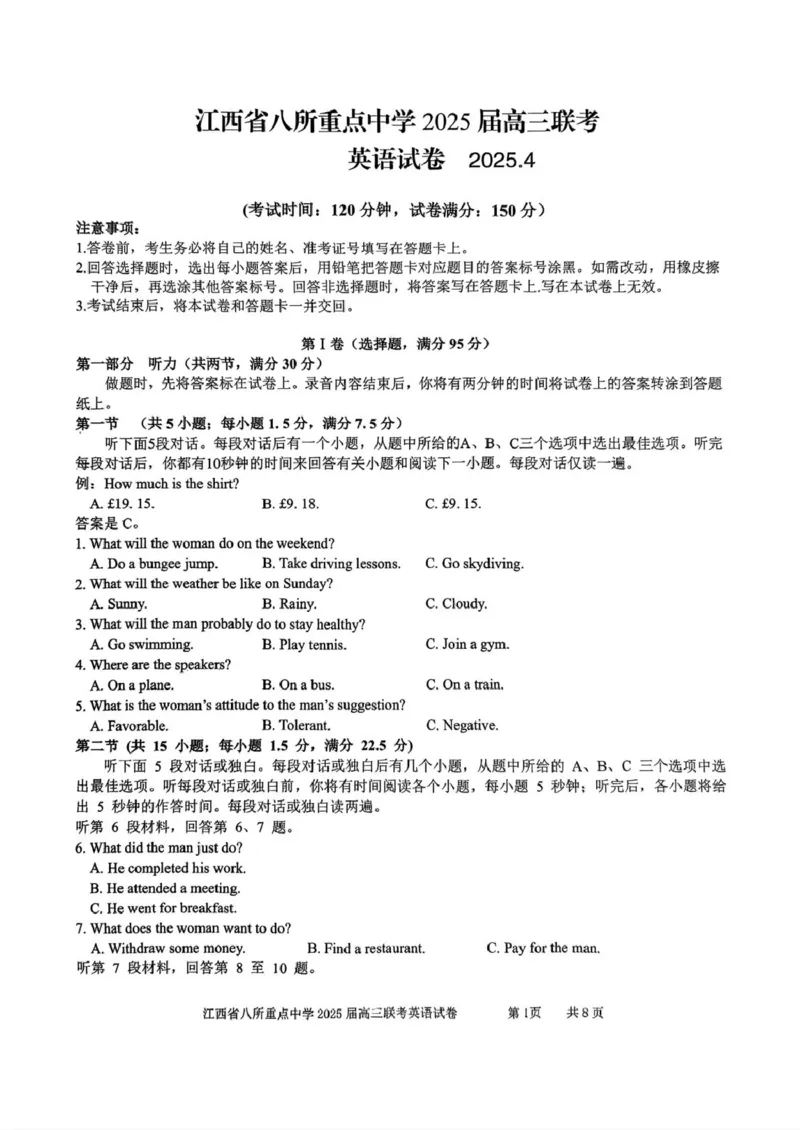
第一部分 听力(共两节,满分30分)
做题时,先将答案标在试卷上。录音内容结束后,你将有两分钟的时间将试卷上的答案转涂
到答题卡上。
第一节(共5小题;每小题1.5分,满分7.5分)
听下面5段对话。每段对话后有一个小题,从题中所给的A、B、C三个选项中选出最佳选项。
听完每段对话后,你都有10秒钟的时间来回答有关小题和阅读下一小题。每段对话仅读一遍。
例: How much is the shirt?
A. £19.15. B. £9.18. C. £9.15.
答案是C.
1. How much will the woman pay altogether?
A. $28. B. $40. C. $68.
2. Where does the conversation probably take place?
A. At a supermarket. B. At a hotel. C. At. a restaurant.
3. What will David do first?
A. Edit the journal. B. Write the report. C. Finish the project.
4. What does the woman want to do?
A. Delay the delivery.
B. Cancel her furniture order.
C. Pick up her furniture.
5. What are the speakers mainly talking about?
A. A building. B. An exhibition. C. An architect.
第二节(共15小题;每小题1.5分,满分22.5分)
听下面5段对话或独白。每段对话或独白后有几个小题,从题中所给的A、B、C三个选项中选出最佳选项。听每段对话或独白前,你将有时间阅读各个小题,每小题5秒钟;听完后,各
小题将给出5秒钟的作答时间。每段对话或独白读两遍。
听第6段材料,回答第6、7题。
6.What does the woman want to sign up for?
A. The yoga class. B. The fitness assessment. C. The meal planning program.
7. What will the woman need to show?
A. A health report. B. A service schedule. C. A form of identification.
听第7段材料,回答第8至10题。
8. What will the visitors see on the tour?
A. Designing items. B. Selecting fruits. C. Maintaining equipment.
9. What are the tourists allowed to do?
A. Purchase some apples. B. Operate machines. C. Pick fruits.
10. What is the company known for?
A. Its product packaging. B. Its high income. C. Its large workforce.
听第8段材料,回答第11至13题。
11. What is most likely the woman?
A. A tour guide. B. A store cashier. C. A hotel manager.
12. What does the man care about?
A. The cost of renting. B. The location of the house. C. The availability of extra beds.
13. What kind of house does the man like?
A. One near the lighthouse. B. One close to the main road.
C. One far away from the beach.
听第9段材料,回答第14至17题。
14. What does the man ask Lisa to do at first?
A. Speak up her mind. B. Raise her voice a bit. C. Tell her personal details.
15. What does Lisa think of herself in real life?
A. Unsociable. B. Easygoing. C. Talkative.
16. What does Lisa do through social networking sites?
A. Discuss social problems. B. Interact with her children.
C. Make more friends.
17. What is Lisa’s attitude towards kids’ making online friends?
A. Supportive. B. Disapproving. C. Indifferent.
听第10段材料,回答第18至20题。18. What is “Art Review”?
A. A TV programme. B. An art exhibition. C. A museum event.
19. Who stars in “The Vanishing Lady”?
A. Damien Hirst. B. Margaret Louden. C. Peter Field.
20. When is “Business Scenes” on?
A. At 7:30 p. m. B. At 8:00 p. m. C. At 9:30 p. m.
第二部分 阅读(共两节,满分50分)
第一节(共15小题;每小题2.5分,满分37.5分)
阅读下列短文,从每题所给的A、B、C、D四个选项中选出最佳选项。
A
Volunteers Wanted
Join Our Team for the Beyond the Canvas Exhibition!
Are you passionate about art and enjoy engaging with people? We’re looking for enthusiastic volunteers to
,
join us in delivering an unforgettable experience for visitors at Beyond the Canvas a fun exhibition featuring
incredible sculptural works from the Ingram Collection and paintings and drawings from the Rugby Collection.
What You’ll Be Doing:
·Engage with Visitors: Welcome visitors, answer questions about the exhibition, and help them connect with
the art.
·Support the Artwork: Keep an eye on the sculptures to ensure their safety and care.
·Enhance the Experience: Share insights to enrich visitors’ understanding of the artworks.
·Be a Friendly Presence: Create a warm and inviting atmosphere, making everyone feel welcome.
What We’re Looking for:
·A friendly and approachable attitude.
·An interest in art or culture(you don’t need to be an expert!).
·Good communication skills.
·Reliability and a willingness to learn about the exhibition.
What You’ll Gain:
·Learn about sculpture, modern art, and the stories behind the pieces on display through training and hands-
on experience.
·Develop new skills, including communication, visitor engagement, and teamwork, which can enhance your
CV.
·Play a key role in bringing the exhibition to life, creating a welcoming and enjoyable experience for visitors.·Help make art more accessible to your community by enhancing meaningful connections between people
and the artwork.
·Meet and work alongside other like-minded volunteers who share a passion for art and culture.
·Engage with visitors from diverse backgrounds, sharing stories and perspectives.
Details:
·Flexible shifts available across the exhibition’s opening times.
·Training will be provided to help you feel confident in your role.
·Volunteers of all ages and backgrounds are welcome.
.
Please email us at ragmvolunteers@rugby gov. uk Volunteers must be over 16 years of age.
1. What will volunteers do?
A. Organize the exhibition. B. Help restore damaged artworks.
C. Paint pictures for the exhibition. D. Monitor sculptures to ensure security.
2. What personal characteristic is essential for volunteers?
A. The dependable quality. B. The professional art expertise.
C. The team management ability. D. The academic qualifications.
3. What is one benefit for volunteers?
A. Earning an art degree. B. Training in art creation.
C. Meeting like-minded people. D. Gaining free travel opportunities.
B
My intention had been to park myself 300 meters from the finish line to cheer my son on in the final stretch of
the cross-country race. As he passed by me, I found his little face bright red, and his breathing labored. He kept
running with all his might, though. Seeing this, I suddenly found myself running, too. Calmer, more motionless
parents of his third-grade classmates fell by the wayside. Old words of support like “you got this, buddy!” and
“push, push, push!” shouted out of my mouth as I chased him to the end of the race.
Growing up, I wasn’t interested in sports. Then I had children. And they were interested in all sports. Initially,
watching them play sports was only amusing briefly. As they began competing, it became enjoyable. It kept
happening. Watching a Grade 6 girls’ touch football game, I wondered why I felt so nervous and excited. I was
genuinely disappointed by mistakes and cared deeply about winning. It was as if I was unrecognizable to myself. I
realized that I should have their courage - not just in sports but in life. Don’t hesitate to take up space. Charge
forward with determination and pursue your goals.
I tried out my new identity as a competitive athlete first against my eight-year-old son during a ball hockey
game. I gave him a bit of shoulder to the sternum (胸骨). I used my size advantage to stickhandle the ball out of hisreach. After I scored, I yelled, “Yes!” Immediately ashamed, I apologized. He looked at me inquiringly and said,
“That’s how you should always play, mama.” I realized that maybe it’s not much fun to play against someone who
isn’t trying their hardest.
The paths my kids take in life will lead them to fields of endeavor (努力) where their successes and failures
are less public than on a sports field. I might not be running beside them shouting words of encouragement. But,
perhaps, they will still hear my voice, telling them they are strong and can do hard things, and they’ll know that I
will always be cheering them on.
4. Why did the author start running with her son?
A. She had a sudden competitive nature.
B. She was inspired by her son’s willpower.
C. She felt peer pressure from other parents.
D. She desired to strengthen parent-child relationship.
5. What does the second paragraph mainly reflect about the author?
A. Her changing attitude towards sports.
B. Her gradual sports skill improvement.
C. Her challenges of coaching young athletes.
D. Her passionate love for her children.
6. What did the author’s son think she should do?
A. Stop being too competitive. B. Avoid being ashamed of failing.
C. Apologize for violent actions. D. Try to play as hard as possible.
7. What does the author decide to do for her children’s future?
A. Always be with them. B. Recognize their endeavors.
C. Cheer for them mentally. D. Help them in every way.
C
Corals (珊瑚) vary in shape, size, and color, building shelters to protect ocean biodiversity. Most of the over
6,000 known coral species are immobile as adults. However, there are lonely mushroom corals, some of which can
walk.
Ocean ecologist Brett Lewis calls them “very little” and “adorable.” He experimented with inch-long
mushroom corals. One side of the fish tank had white light like in shallow coastal areas, and the other had blue light
like in deeper ocean parts. In three trials, the mushroom corals preferred the blue light, moving towards it.
As for how a mushroom coral actually moves, Dr. Lewis’s research showed that the mechanics are
surprisingly similar to the way one of coral’s closest cousins, the jellyfish, gets around. “Jellyfish can move throughwater by turning and contracting muscles in and around the edges of that bell shape as it moves quickly,” he said.
With bodies shaped similarly to the bell of a jellyfish, the mushroom corals spend a long time filling gas into the
tissues on the outermost edge of their bodies before releasing it quickly. “And that allows the corals to kind of pop
themselves forward, jumping across the rock,” he said.
The corals frequently begin their lives living in groups. But these habitats tend to be crowded and hit by
waves. Later in life, the mushroom corals need to migrate (迁徙) to deeper but calmer waters, where they can
establish themselves on a sandy bottom with others of their kind. This also assists the animals in reproduction.
Migration “may help them to escape unfavorable situations, such as being buried underneath a layer of sand, being
pulled over or being too close to competitors for space,” said Dr. Hoeksema, another ocean ecologist.
A mushroom coral’s movement may seem unimportant when considered against the distances traveled by
other migrating creatures. But such slow movement has served the species well for hundreds of millions of years.
“They’re so little that this is such a large movement for their size,” Dr. Lewis said. “They’re moving their body
length in such a short time, with such a simple system. That’s a race for them.”
8. How do mushroom corals move in similar ways with jellyfish?
A. Using water currents for energy. B. Moving with the help of edge tissues.
C. Expanding body tissues suddenly. D. Turning their body to move forward.
9. Why do mushroom corals migrate?
A. To search for seasonal food sources. B. To keep away from various threats.
C. To follow the cycle of reproduction. D. To seek warmer water temperatures.
10. Why does Dr. Lewis describe the movement of mushroom corals as a “race”?
A. It is a short distance for their size. B. It can be performed at different speeds.
C. It is a fast movement for them. D. It is a rare and competitive behavior.
11. What is the best title for the text?
A. These Corals Have Unusual Features
B. The Corals Live in Groups Underwater
C. The Mushroom Corals Survive in Deep Waters
D. The Mushroom Corals Are Made for Walking
D
The rapid spread of AI has people wondering: Who’s most likely to embrace (接受) AI in their daily lives?
Many assume it’s those who understand how AI works are most eager to adopt it. Surprisingly, our new research
finds the opposite. People with less knowledge about AI are actually more open to using the technology. We call
this difference in adoption tendency the “lower literacy-higher receptivity” link.AI now performs tasks we once thought only humans could do. When AI creates a piece of art, writes a
heartfelt response, or plays a musical instrument, it can feel almost magical — like it’s crossing into human
territory. Of course, AI doesn’t actually possess human qualities. A chatbot might generate an empathetic (同感的)
response, but it doesn’t feel empathy. People with more technical knowledge about AI understand this. They know
how algorithms (算法), training data, and computational models operate. This makes the technology less magical.
On the other hand, those with less understanding may see AI as magical and awe-inspiring. We suggest this sense
of magic makes them more open to using AI tools.
Our studies show this link is strongest for using AI tools in areas where people associate with human
characteristics, like providing emotional support or counseling. When it comes to tasks that don’t cause the same
sense of humanlike qualities — such as analyzing test results — the pattern flips. People with higher AI literacy
are more receptive to these uses because they focus on AI’s efficiency, rather than any “magical” qualities.
Efforts to boost AI literacy might unintentionally dampen people’s enthusiasm for using AI by making it seem
less magical. This creates a tricky balance between helping people understand AI and keeping them open to its
adoption. To make the most of AI’s potential, businesses, educators and policymakers need to strike this balance.
By understanding how perceptions of “magicalness” shape people’s openness to AI, we can help develop new AI-
based products and services that take the way people view AI into account, and help them understand the benefits
and risks of AI.
And ideally, this will happen without causing a loss of the admiration that inspires many people to embrace
this new technology.
12. Why are less-informed people more open to AI?
A. They trust its moral standards. B. They admire the ability of AI.
C. They believe in its superior efficiency. D. They prefer its technical complexity.
13. What does the underlined word “flips” in Paragraph 3 probably mean?
A. Breaks down. B. Takes shape. C. Shows up. D. Turns over.
14. What is the tricky situation regarding AI literacy?
A. Balancing morals and capability. B. Reducing fear while ensuring safety.
C. Familiarizing without losing wonder. D. Prioritizing efficiency over magic.
15. What is the author’s attitude towards using AI?
A. Objective. B. Worried. C. Skeptical. D. Dismissive.
第二节(共5小题;每小题2.5分,满分12.5分)
阅读下面短文,从短文后的选项中选出可以填入空白处的最佳选项。选项中有两项为多余选
项。Getting and staying focused can be a challenge in the best of times. But with everything going on in the world,
concentrating can often feel down-right impossible. Here are some tips to help you find your flow.
Unfocus your brain. Schedule into every workday some breaks from all that focusing and allow your mind to
travel into what’s called the “default (默认) mode network” for a bit of freestyle thinking. It’s the place where our
minds find innovation and creativity and often make better decisions than the focused mind. ____16____
Know your body clock. Are you an early bird who is sharp and alert (警觉的) in the morning? Or is night owl
more your style? Either way, it doesn’t matter as long as you schedule your most important projects during your
brain’s periods of peak performance. ____17____ Instead, reserve your best brain time for the big stuff.
.
Try new hobbies Engaging in hobbies is fun. ____18____ Allowing your mind time to play is another way
to bring about solutions to real life issues in ways that focusing doesn’t.
Consider a digital break. There’s a lot of talk these days about the benefits of shutting off your devices - and
for good reason. ____19____ Taking a digital rest intentionally offers an important benefit. It reminds us there’s a
world outside our screens, helping us to “reset and think about what’s really important.”
____20____ Our days are filled with distractions (干扰), from others and ourselves. To help, turn off text
messaging, notifications and social media. Pretty basic? Sure, but vital when you want a deep dive into focus.
When distracting interruptions are shut off, our brains get a chance to complete full sentences of thought.
A. It also helps us solve daily problems.
B. Set aside time to rest from your screens.
C. They will expand the range of knowledge.
D. Improve efficiency by turning to digital devices.
E. Block interruptions before diving into deep work.
F. This increases creativity and decision-making skills.
G. Resist the attraction to spend your day doing busywork.
第三部分 语言运用(共两节,满分30分)
第一节(共15小题;每小题1分,满分15分)
阅读下面短文,从每题所给的A、B、C、D四个选项中选出最佳选项。
Nowadays, young adults seem to be struggling more with their mental health than ever before. However, one
benefit of this generation is their ____21____ to talk about their issues. Although social media can be
____22____, it provides people a platform where they can share their struggles, and maybe ____23____ others.
This was just the ____24____ with a video posted by Breamna Kate on TikTok that has got 5.6 million likes
already. In the video, Breanna Kate ____25____ a text conversation with her mom about feeling ____26____
and wanting to talk. Although her parents live 600 miles away, they hurried to their daughter’s side to ____27____in person.
It was adorable to see that both parents went to be by their daughter’s side — and lots of people commented
how ____28____ Breanna Kate’s father was as he patiently waited to get his hug. Another person so ____29____
commented: “You are a millionaire. I’m not talking about money.”
It’s interesting to see how a simple video of parents ____30____ for their daughter in trouble proved so very
____31____. Perhaps it’s a call for help so many youngsters would love to ____32____, but don’t feel able to do
so for multiple reasons.
However, the ____33____ to young adults is clear: If you’re feeling confused, reach out to your parents,
while they might not be able to take a 600-mile trip, they’ll certainly love to know they’re still ____34____ by
their children, and will no doubt do their best to ____35____ you.
21. A. priority B. preparation C. ability D. principle
22. A. convenient B. efficient C. necessary D. harmful
23. A. motivate B. accept C. encounter D. accompany
24. A. conflict B. case C. method D. problem
25. A. saved B. analyzed C. shared D. recited
26. A. anxious B. embarrassed C. excited D. astonished
27. A. investigate B. consult C. check D. chat
28. A. funny B. sweet C. nervous D. formal
29. A. sharply B. irresponsibly C. accurately D. professionally
30. A. moving on B. sitting by C. staying up D. showing up
31. A. important B. similar C. popular D. practical
32. A. make B. record C. toast D. receive
33. A. process B. message C. request D. advantage
34. A. assisted B. protected C. surrounded D. needed
35. A. find B. support C. influence D. promote
第二节(共10小题;每小题1.5分,满分15分)
阅读下面短文,在空白处填入1个适当的单词或括号内单词的正确形式。
Wan Yuan, a Miao ethnic craftsman (工匠), puts a knife into melted wax and makes a few movements with it,
resulting in a ____36____ (remarkable) vivid butterfly pattern appearing on a piece of cloth.
This Miao ethnic craftsman ____37____ (watch) his mother make batik (蜡染) when he was a child. Wan
practiced and gradually mastered this craft. Through his skilled hands, an ordinary piece of cloth is transformed
into ____38____ unique blue-and-white batik work, following multiple processes including wax painting, dyeing,dewaxing, washing and drying.
In a stand ____39____ (measure) over 10 square meters at the intangible heritage market in the city of Kaili
in Qiandongnan, his batik works are turned into ____40____ (product) like clothes, bags and tea mats — which
are welcomed by customers.
At his stand, he always introduces the cultural implications of the patterns ____41____ (choose) carefully by
himself. He hopes that ____42____ tourists take away is not only items, but also insights into such historic ethnic
culture.
“The ____43____ (recognize) and love of our handicrafts by domestic and foreign tourists have brought me
great confidence,” said Wan.
The market is not merely a space for goods trading. Instead, it serves ____44____ a stage for cultural
exchanges — thereby allowing traditional crafts ______45______ (preserve) and ethnic culture to shine brightly.
第四部分 写作(共两节,满分40分)
第一节(满分15分)
46. 假定你是高中学生李华。你班英语课将进行一次演讲比赛,主题为“学习资源众多,学生该如何精准
选择”。请你写一篇演讲稿,内容包括:
1.指出问题;
2.解决方法。
注意:1.写作词数应为80个左右;
2.请按如下格式在答题卡的相应位置作答。
Dear classmates,
____________________________________________________________________________________________
____________________________________________________________________________________________
____________________________________________________________________________________________
____________________________________________________________________________________________
___________________________
第二节(满分25分)
47. 阅读下面材料,根据其内容和所给段落开头语续写两段,使之构成一篇完整的短文。
I live in Samburu, in northern Kenya. Where I grew up, there were elephants living in the wild. I was attracted
by these creatures. They’re so social, complex and sympathetic; their size is breathtaking.
Now, working in the field for Save the Elephants in Kenya, I am mostly based in Samburu National Reserve -
a 165 km² protected park - recording details of the population and leading collaring operations. We arrange GPS
trackers around wild elephants’ necks, so we can monitor their movements.More than 1,000 known elephants use the reserve. One of those elephants was Rommel. Rommel didn’t come
often, but when he did turn up, we’d have to be prepared. He was huge and easy to be annoyed, weighing about six
tons.
In May 2019, in the middle of the wet season, Rommel appeared again. And it was his turn to be collared. We
sent three cars out to search for him.
There’s a river, the Ewaso Nyiro, running through the park where many elephants meet in the mornings. At
10:30 a. m., searching the groups around the river, John clocked Rommel, with a big cut on his right ear.
Rommel was darted (用飞镖射) a drug for him to sleep. Normally it takes seven minutes for the drug to hit,
but for Rommel’s size it can take longer.
When the dart hit him, he turned away, heading in an unexpected direction. Rommel started shaking. He was
in the middle of crossing the river when the drug hit. He collapsed into the water.
I jumped out of my vehicle: Rommel drowning would be a disaster. Only by lifting his trunk and stopping it
from being sunken in the river could we ensure his survival. The problem was the current of the river was fast
flowing and unpredictable, and the river was filled with crocodiles (鳄鱼)。
“We must go immediately,” John said as he assessed the situation. “I’ll help you steady his head so you can lift
his trunk more safely.”
注意:1.续写词数应为150个左右;
2.请按如下格式在答题卡的相应位置作答。
In a second, I decided to act quickly and put a GPS on his neck.
____________________________________________________________________________________________
____________________________________________________________________________________________
____________________________________________________________________________________________
____________________________________________________________________________________________
___________________________
Each time a small fish touched my legs, I would wonder if it was a crocodile.
____________________________________________________________________________________________
____________________________________________________________________________________________
____________________________________________________________________________________________
____________________________________________________________________________________________
___________________________
2025 年高三第一次模拟考试英语试卷 参考答案
第一部分 听力(听力答案省略)
第二部分 阅读(共两节,满分50分)
第一节(共15小题;每小题2.5分,满分37.5分)
阅读下列短文,从每题所给的A、B、C、D四个选项中选出最佳选项。
A
【1~3题答案】
【答案】1. D 2. A 3. C
B
【4~7题答案】
【答案】4. B 5. A 6. D 7. C
C
【8~11题答案】
【答案】8. B 9. B 10. C 11. D
D
【12~15题答案】
【答案】12. B 13. D 14. C 15. A
第二节(共5小题;每小题2.5分,满分12.5分)
阅读下面短文,从短文后的选项中选出可以填入空白处的最佳选项。选项中有两项为多余选
项。
【16~20题答案】
【答案】16. F 17. G 18. A 19. B 20. E
第三部分 语言运用(共两节,满分30分)
第一节(共15小题;每小题1分,满分15分)
阅读下面短文,从每题所给的A、B、C、D四个选项中选出最佳选项。
【21~35题答案】
【答案】21. C 22. D 23. A 24. B 25. C 26. A 27. D 28. B 29. C 30. D 31. C 32. A 33. B 34. D
35. B
第二节(共10小题;每小题1.5分,满分15分)
【36~45题答案】
【答案】36. remarkably.
37 watched
38. a 39. measuring
40. products
41. chosen 42. what
43. recognition
44. as 45. to be preserved
第四部分 写作(共两节,满分40分)
第一节(满分15分)
【46题答案】
【答案】Dear classmates,
Now we’re flooded with lots of learning resources. While it seems like a treasure, it’s actually a double-edged
sword. Too many options can be overwhelming and waste our precious time.
I think it’s crucial to choose these resources wisely. Here’s what we can do. First, identify our weak subjects
and search specifically for relevant high-quality courses. Second, listen to recommendations from teachers. Third,
create a study plan around the selected resources to ensure systematic learning. Let’s make the best use of these
resources and improve our study!
Thank you!
第二节(满分25分)
【47题答案】
【答案】 In a second, I decided to act quickly and put a GPS on his neck. I jumped in, and John followed closely
behind. Together, we struggled to keep Rommel’s huge trunk high up. We attempted to fit him with a GPS collar, but
we discovered that we didn’t have one big enough. We couldn’t risk keeping him there while we created a bigger
collar. So John and I continued holding his trunk high with all our strength. I stood there for at least half an hour. I
tried hard to keep my cool as my arms became exhausted.
Each time a small fish touched my legs, I would wonder if it was a crocodile. There was also a risk that other
elephants might come and cause trouble in the water. Rommel’s ears started to flap - a sign of consciousness
returning. John and I dropped his trunk and moved to safety. We watched him nervously until we were sure he was
fully awake and didn’t need assistance anymore. Within a couple of minutes, he was back to business, up and off to
look for food. That was one of my proudest moments.