高二—人教版选择性必修二—英语—第三单元
广州外国语学校 叶静
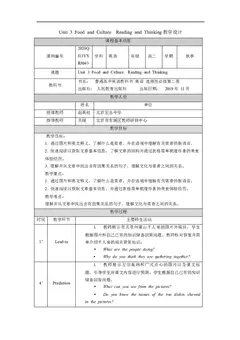
Unit 3 Food and Culture
Lesson 1   Opening page +
Reading and Thinking (1)
In today’s lesson, you are expected to:
1. read the opening page to predict the theme of this unit and
what is going to be learnt;
2. predict and scan a passage for its main idea and structure.
Opening page
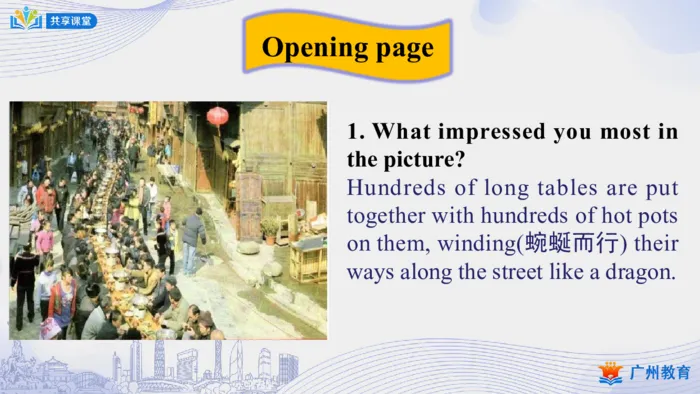
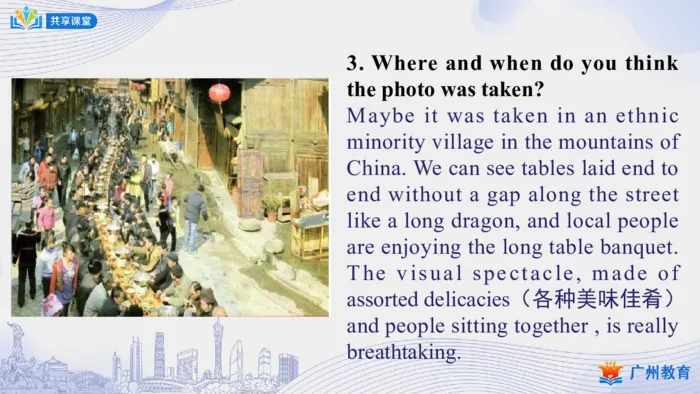
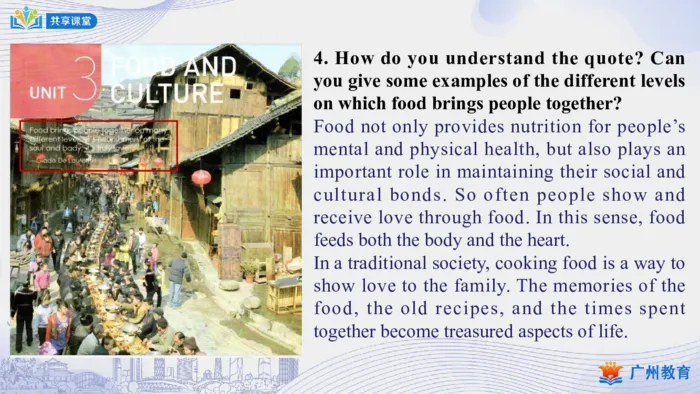
1. What impressed you most in
the picture?
Hundreds of long tables are put
together with hundreds of hot pots
on them, winding(蜿蜒而行) their
ways along the street like a dragon.
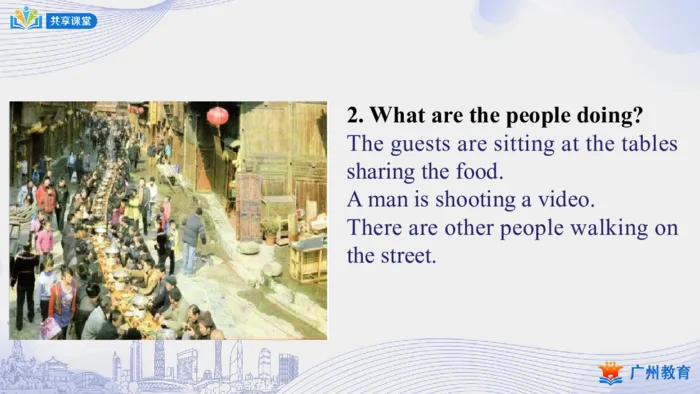
2. What are the people doing?
The guests are sitting at the tables
sharing the food.
A man is shooting a video.
There are other people walking on
the street.
3. Where and when do you think
the photo was taken?
Maybe it was taken in an ethnic
minority village in the mountains of
China. We can see tables laid end to
end without a gap along the street
like a long dragon, and local people
are enjoying the long table banquet.
The visual spectacle, made of
assorted delicacies(各种美味佳肴)
and people sitting together , is really
breathtaking.
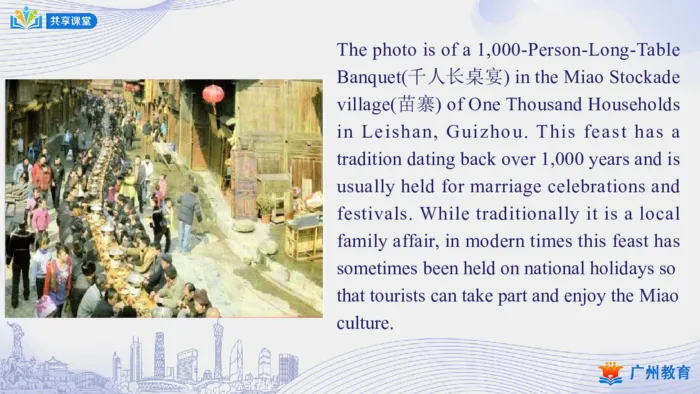
The photo is of a 1,000-Person-Long-Table
Banquet(千人长桌宴) in the Miao Stockade
village(苗寨) of One Thousand Households
in Leishan, Guizhou. This feast has a
tradition dating back over 1,000 years and is
usually held for marriage celebrations and
festivals. While traditionally it is a local
family affair, in modern times this feast has
sometimes been held on national holidays so
that tourists can take part and enjoy the Miao
culture.
The foods are all Miao delicacies, and
include lamb, pork, beef, chicken,
freshwater fish, and tofu dishes. The
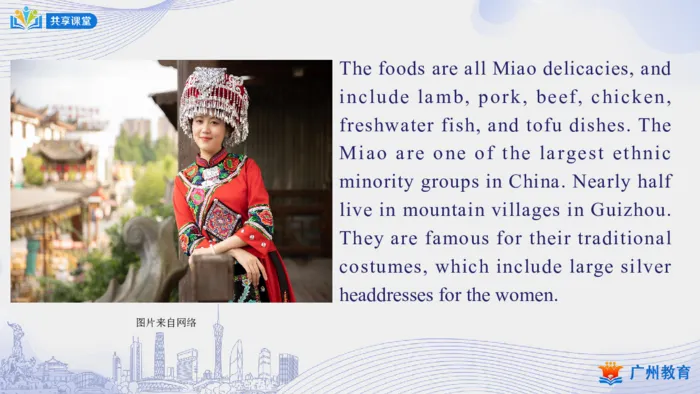
Miao are one of the largest ethnic
minority groups in China. Nearly half
live in mountain villages in Guizhou.
They are famous for their traditional
costumes, which include large silver
headdresses for the women.
图片来自网络
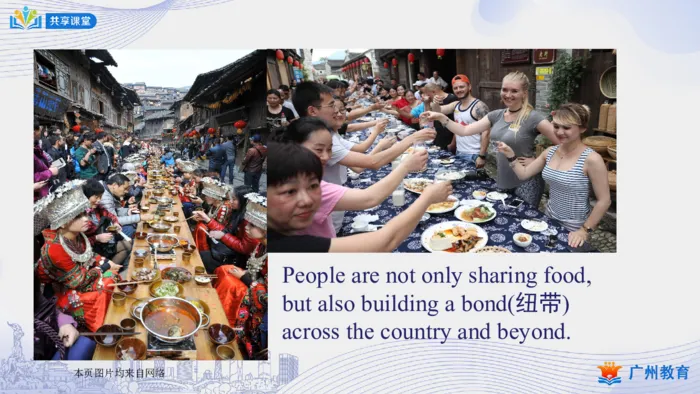
People are not only sharing food,
but also building a bond(纽带)
across the country and beyond.
本页图片均来自网络
4. How do you understand the quote? Can
you give some examples of the different levels
on which food brings people together?
Food not only provides nutrition for people’s
mental and physical health, but also plays an
important role in maintaining their social and
cultural bonds. So often people show and
receive love through food. In this sense, food
feeds both the body and the heart.
In a traditional society, cooking food is a way to
show love to the family. The memories of the
food, the old recipes, and the times spent
together become treasured aspects of life.
Reading and Thinking
Understand the link between food and culture
Before you read, discuss the questions in groups.
1. What are your favorite Chinese dihes? Do you know their English
names?
2. How many kinds of Chinese cuisine are there, and how can these
cuisines be described? Why are there so many cuisines?
3. What, if anything, do these cuisines tell you about the people who
eat them?
本页图片均来自网络
Stewed noodles
Hand-torn cabbage
Dim sum
Red braised pork
Steamed fish
Hot pot
How many kinds of Chinese cuisines in China?
How can these cuisine be described?
Why are there so many cuisines?
本页图片均来自网络
图片来自网络
Different regions
Various weather
conditions
Different preferences
in flavours
Different personalities
Different ingredients
图片来自网络
3. What, if anything, do these cuisines tell you about the people who
eat them?
The cuisines certainly say something about the kinds of ingredients
available to the people, and a lot about the kinds of flavours the people
prefer.
Read title and the pictures in the text and
answer the following questions.
1. What is the title of the text?
Culture and cuisine.
2. What can you see from the pictures in
the text?
We can see food.
3. What do you think the word “ cuisine”
in the title means?
“Cuisine” means food cooked in a certain
way.
4. What kinds of food are they?
They are Chinese food.
5. What do you think the text is about?
Maybe it’s about different kinds of Chinese
food and the culture each food represents.
1. Read the text to find out what the
author means by the quote “You are what
you eat”.
The author actually means the kinds of
food we eat reflect something about our
personalities, character, and culture.
Jean Anthelme Brillat-Savarin (1755-1826)
was a French lawyer and politician who was
also a great lover of food. He wrote
numerous books on many subjects, but is
best remembered for The Psychology of
Taste in English. As a series of philosophical
essays on the relationship between culture
and food, this was one of the books which
created the genre of food writing.
2. What is the function of the first
paragraph?
The first paragraph functions as an
introduction to the topic.
3. Which is the topic paragraph?
The last paragraph.
4. Which  is the topic sentence of the last
paragraph?
What we can say, however, is that culture
and cuisine go hand in hand, and if you do
not experience one, you can never really
know the other.
5. What writing technique does the writer
use to convey his ideas?
By giving examples of his experiences
with Chinese cuisine in different parts of
China.
6. In what order does the author talk
about his experiences?
In the order of time.
1. What is the main idea of each
paragraph?
2. How many parts can this passage be
divided into?
Match the main idea with each paragraph.
Para.1
Para.2
Para.3
Para.4
Para.5
Para.6
Para.7
Famous food in Xinjiang.
Famous food in Shandong.
Food in South  and central China.
Culture and cuisine go hand in hand.
Experience of Chinese dishes in America.
Experience of Sichuan food in Beijing.
 You are what you eat.

Part 2 (paras 2-6): My experiences
with Chinese food.
Part 1 (para 1): Introduction of the
topic: you are what you eat.
Part 3 (para7): Conclusion: culture
and cuisine go hand in hand.
General
Particular
General
3.What is the writer’s purpose in writing the passage? How
does he achieve his purpose?
To inform us of the fact: culture and cuisine go hand in hand. He
achieves his purpose by giving examples of his experiences with
Chinese food.
4. What is the text type of the passage?
The reason why the writer tells us about his experiences is that in
this way, he can make us better understand the link between food
and culture. So it is a piece of expository writing(说明文).
Summary
In today’s lesson, we
1. got to know the 1,000-Person-Long-Table Banquet(千人长
桌宴) in the Miao Stockade village(苗寨);
2. briefly discussed about China’s eight cuisines;
3. read a passage about food and culture for its main idea and
structure.
Homework
1. Follow the recording to read the text aloud several times
and review the important words and phrases learnt in this
period .
Topic: ______________________
Chinese food in America
in Beijing
in Shandong
in ___
in ___
in Henan
Conclusion:__________________________
2. Finish the following mind map according to the text.
Thanks for listening!
高二—人教版选择性必修二—英语—第三单元
答疑
Unit 3 Food and Culture
Lesson 1   Opening page +
Reading and Thinking (1)
Read the text and find out what the underlined pronouns
refer to.
1. Certainly, in many ways this seems to be true.
_____________________________________________________
______________________________________________________
“You are what you eat” ; What we eat reflects our personality,
character, and culture.
Read the text and find out what the underlined pronouns
refer to.
2. This is probably not an authentic Chinese recipe, however, so it cannot
tell us much about the Chinese.
    ______________________________________________________
    ______________________________________________________
General Tso's chicken, which consists of fried chicken covered in
a sweet sauce, flavoured with hot red peppers.
Read the text and find out what the underlined pronouns
refer to.
3. With this, we had the pleasure of experiencing an entirely new taste:
Sichuan peppercorns.
    _________________________________________________________
 The food we enjoyed at a Sichuan restaurant in Beijing.
Read the text and find out what the underlined pronouns
refer to.
4. It has become a favourite traditional dish of the people in North
China ...
   __________________________________________________________
 Boiled dumplings served with vinegar.
Read the text and find out what the underlined pronouns
refer to.
5. ... if you do not experience one, you can never really know the other.
__________________________________________________________
 Either one of cuisine and culture.
Fill in the following blanks according to the text.
The French author Jean Anthelme Brillat-Savarin once wrote, “Tell me what
you are and I will tell you what you are,” 1. ________ means “You are what
you eat.” In fact, Brillat-Savarin was actually 2.________(refer) to our
personality, character and culture. In many ways, this seems to be true.
Chinese cuisine is a case in point. China is a country with vast 3.
_________(area) and a large population. So the food is as 4. _________
(vary) as the people. For example, people in Shandong like boiled dumplings
which
referring
areas
various
Fill in the following blanks according to the text.
5. _______(serve) with vinegar, because the process of making dumplings
can bring the family members together. 6. _____________(traditional),
people in Xinjiang spent most of their time on horse backs, and that is
7.______ they prefer their food to 8. __________(cook) over an open fire. In
conclusion, through food, Chinese people everywhere show their culture as
well as their friendship and 9. __________(kind). So what we can say is that
culture and cuisine go hand 10. ______ hand, and if you do not experience
one, you can never really know the other.
served
Traditionally
why
be cooked
kindness
in
Find out the phrases in the text according to the Chinese.
1. 更简单地说
2. 恰当的例子
3. 在...之前
4. 给(食物等)调味
5. 向某人推荐某物
6. 无论老少
7. 在篝火上
8. 至少
9. 脾气火爆
10. 息息相关
put more simply
a case in point
prior to...
flavour...with...
recommend sth. to sb.
from the youngest to the oldest
over an open fire
at a minimum
have a hot temper
go hand in hand
Thanks for listening!