高二—人教版—英语—选择性必修二—第四单元
广东华侨中学 黄微崴
JOURNEY ACROSS A VAST LAND
Lesson 4 Using Language: Listening and Speaking
Review Activity
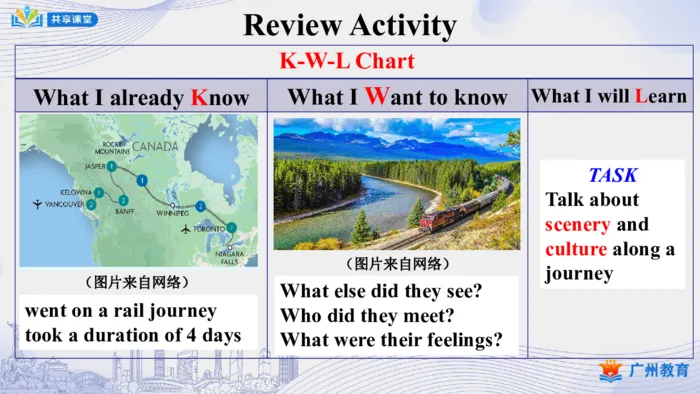
went on a rail journey
took a duration of 4 days
TASK
Talk about
scenery and
culture along a
journey
What else did they see?
Who did they meet?
What were their feelings?
What I will Learn
What I Want to know
K-W-L Chart
(图片来自网络)
(图片来自网络)
What I already Know
Pre-listening
1. On the train, Li Daiyu and Liu Qian start talking with a local passenger,
a young woman named Anna. Before you listen, look at the pictures below
and guess what they will be talking about.
① Which lake does the large
photo remind you of?
② What do you think the
speakers will talk about? How
can you tell?
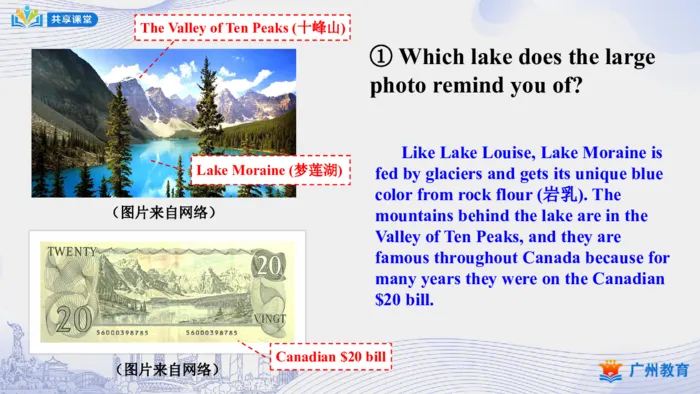
① Which lake does the large
photo remind you of?
Lake Moraine (梦莲湖)
The Valley of Ten Peaks (十峰山)
Canadian $20 bill
Like Lake Louise, Lake Moraine is
fed by glaciers and gets its unique blue
color from rock flour (岩乳). The
mountains behind the lake are in the
Valley of Ten Peaks, and they are
famous throughout Canada because for
many years they were on the Canadian
$20 bill.
(图片来自网络)
(图片来自网络)
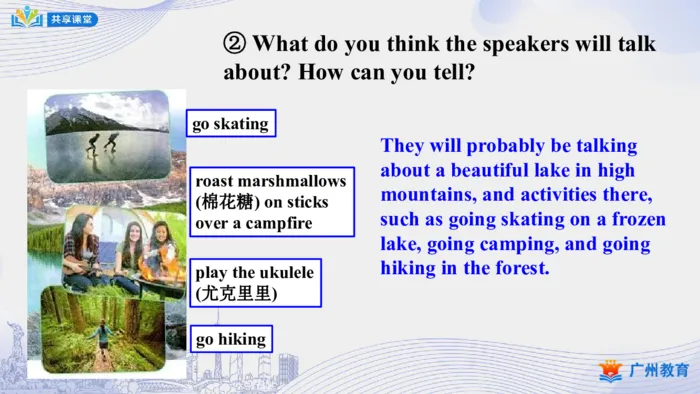
② What do you think the speakers will talk
about? How can you tell?
go skating
roast marshmallows
(棉花糖) on sticks
over a campfire
go hiking
play the ukulele
(尤克里里)
They will probably be talking
about a beautiful lake in high
mountains, and activities there,
such as going skating on a frozen
lake, going camping, and going
hiking in the forest.
While-listening
1. Listen to the conversation for the first time, and note down
some key words about what is mentioned in the listening.
Tip 1
Focus on the general idea
Listening to the main
aspects mentioned in the
conversation will give
you a full picture of the
material.
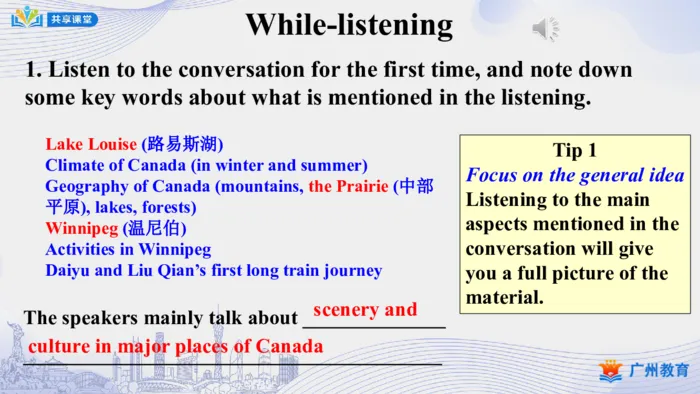
Lake Louise (路易斯湖)
Climate of Canada (in winter and summer)
Geography of Canada (mountains, the Prairie (中部
平原), lakes, forests)
Winnipeg (温尼伯)
Activities in Winnipeg
Daiyu and Liu Qian’s first long train journey
The speakers mainly talk about ______________
_________________________________________
                                                        scenery and
culture in major places of Canada
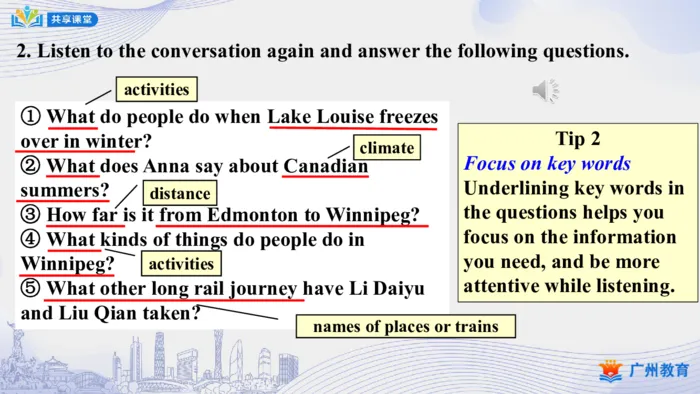
2. Listen to the conversation again and answer the following questions.
① What do people do when Lake Louise freezes
over in winter?
② What does Anna say about Canadian
summers?
③ How far is it from Edmonton to Winnipeg?
④ What kinds of things do people do in
Winnipeg?
⑤ What other long rail journey have Li Daiyu
and Liu Qian taken?
Tip 2
Focus on key words
Underlining key words in
the questions helps you
focus on the information
you need, and be more
attentive while listening.
activities
distance
activities
names of places or trains
climate
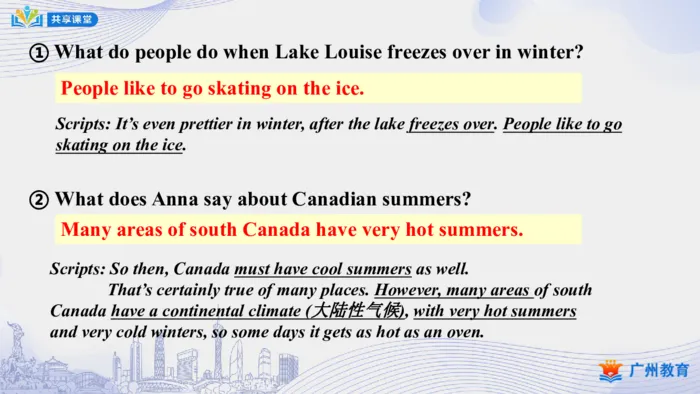
① What do people do when Lake Louise freezes over in winter?

② What does Anna say about Canadian summers?
Scripts: It’s even prettier in winter, after the lake freezes over. People like to go
skating on the ice.
People like to go skating on the ice.
Many areas of south Canada have very hot summers.
Scripts: So then, Canada must have cool summers as well.
             That’s certainly true of many places. However, many areas of south
Canada have a continental climate (大陆性气候), with very hot summers
and very cold winters, so some days it gets as hot as an oven.
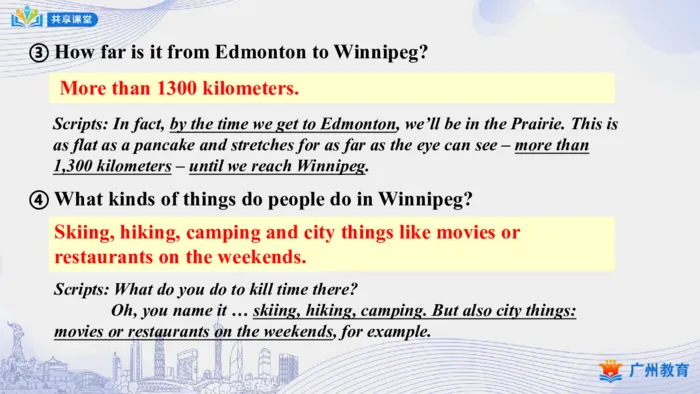
③ How far is it from Edmonton to Winnipeg?
④ What kinds of things do people do in Winnipeg?
 More than 1300 kilometers.
Scripts: In fact, by the time we get to Edmonton, we’ll be in the Prairie. This is
as flat as a pancake and stretches for as far as the eye can see – more than
1,300 kilometers – until we reach Winnipeg.
Skiing, hiking, camping and city things like movies or
restaurants on the weekends.
Scripts: What do you do to kill time there?
             Oh, you name it … skiing, hiking, camping. But also city things:
movies or restaurants on the weekends, for example.
⑤ What other long rail journey have Li Daiyu and Liu Qian taken?
They travelled from Beijing to Moscow on the Trans-Siberian
Railway through Mongolia.
Scripts: So is this your first long train journey?
             Oh, no. Last autumn, we travelled from Beijing to Moscow on the
Trans-Siberian Railway (西伯利亚大铁路) through Mongolia.
3. Listen again. Match the following idioms and similes with their meanings.
1
words fail me
2
as hot as an oven
3
as flat as a pancake
4
as far as the eye can see
5
dead center
6
kill time
7
you name it
A   with no mountains or hills
B   all kinds of things
C   for a long distance
D   I’m surprised
E   spend time
F   very warm
G   the exact middle of something
无话可说
热如火炉
平如煎饼
目之所及
正中心
消磨时间
应有尽有
Tip 3
Understand idioms
Idioms are often used in
the English language.
The meanings of some
can be guessed. However,
many others need to be
studied and remembered.
Try to paraphrase the sentences with definitions of the idioms on the right
column. What impressions do the sentences make with the idioms?
① It’s so beautiful! Words fail me.
     It’s so beautiful! I’m surprised.
② This is as flat as a pancake and stretches for as far as the eye can see.
     There are no mountains or hills on the Prairie which stretches for a long
distance.
③ It’s a small city almost in the dead center of North America.
     It’s a small city almost in the exact middle of North America.
④ What do you do to kill time?
     What do you do to spend time?
Idioms often use figures of speech such as simile (明喻),
metaphor (暗喻), exaggeration (夸张), personification (拟人) to
make your speech more vivid and concise (简洁的).
Post-listening
1. In groups of three, continue the conversation about Canada and China
based on your own travel experience or the information you heard or read in
this unit. End the conversation naturally.
① How does Anna
start to talk about
China?
② How do they end
the conversation and
say goodbye?
③ What will be
talked about in the
middle of the
conversation?
Anna:  I thought China would be very crowded, given its large
            population.
Daiyu: Well, contrary to what many people believe, there are a lot
            of vast and empty spaces in China, actually.
Anna: That’s great! There must be amazing scenery to see in
           China then!
…
Anna: Anyhow, the next station is my stop! Take care and enjoy
           the rest of your trip.
Daiyu: Thanks, Anna.
Liu Qian: It was really great to meet you!
Anna: And it was nice talking to you!
?
2. Make an outline of a journey taken by you across a vast land in China, and
supplement (补充) the information with your group members.
A journey across a vast land in China
Place
Transportation
Population
Climate
Geography
Amazing scenery
Activities
Similarities and differences between China and Canada
…
Tibet西藏
(图片来自网络)
Sample Work
A journey across a vast land in China
Place
Tibet
Transportation
Travel south across Kunlun Mountains; a special oxygen
supply on train
Population
Sparsely-populated (人口稀疏)
Climate
Cold in winter; still covered in snow in summer
Geography
Tibetan Plateau (西藏高原); Vast and empty spaces
Amazing scenery
Wide river valleys, high mountains, heavy forests, open
grasslands; wild animals; antelopes; snow leopards
Activities
Local Kazak (哈萨克) folk customs
Big gathering with ethnic characteristics – horse racing
Similarities and
differences between
China and Canada
High mountains and vast plain, beautiful scenery.
3. Now it is your turn to make a conversation with your partners. The useful
expressions below will help you.
Talking about space and position
Oh, my goodness!/Good heavens!
You’re kidding!
Are you kidding?
Are you serious?
It can’t be true!
Expressing surprise and curiosity
It’s about … kilometers northeast of …
… is close to
in/on/to the north/south/west/east of …
across the continent/lake
alongside the coast/river
go eastwards/westwards/northwards/southwards
Ending a conversation naturally
I have to run. Good talking to you.
I’ll catch you later.
It was good/nice meeting you.
I’m sure you want to relax a bit. I’ll let you go.
Sorry, I can’t talk longer. I’m actually on my way
to …
Well, I have to go. I’ll talk to you later.
Oh no! Really?
What a surprise!
I think it’s fantastic!
Wow! How interesting/amazing!
What was it like?
Assessment
ü Cover important details about the cousins’ trip. (the cousins)
ü Show surprise and curiosity to the experiences properly. (Anna)
ü Use appropriate idioms learnt from the listening material and use
appropriate expressions as suggested.
ü Organize the conversation logically by using connectors.
ü Speak fluently with the right tone.
4. While preparing, refer to the following points of attention.
In this lesson, we have:
1. learned about the scenery and culture along the journey across Canada;
2. practised listening skills such as predicting, listening for gist and details;
3. learned about the meanings and functions of some idioms based on the
context;
4. applied what we have learnt to make a conversation about a journey
across a vast land in China.
Summary
1. Continue the conversation about a journey across a vast land in China.
2. Make sentences with the seven idioms learnt in the lesson, and try to
find out more commonly used idioms.
3. Preview the lesson on P43-45.
Homework
Thanks for listening!
高二—人教版—英语—选择性必修二—第四单元
广东华侨中学 黄微崴
JOURNEY ACROSS A VAST LAND
Lesson 4 Using Language: Listening and Speaking
答疑课
1. Let’s listen to one group of the students’ work, and check whether they
have done a good job.
Nalati Grassland (那拉提草
原) in Xinjiang
(图片来自网络)
Yes. Daiyu and I have been to Nalati Grassland in Xinjiang. It’s one of the four largest
grasslands in the world. There are wide river valleys, high mountains, heavy forests,
and open grasslands. You can also experience local Kazak folk customs there.
Wow! Sounds amazing! How can I get there?
The most convenient way is to take a plane to Nalati Airport, but I do suggest you fly
to Yining first. You can rent a car and drive all the way to the Grassland. The scenery
along the way is worth it.
I like grassland very much. The great Canadian Prairie, you know, is so beautiful. It is
as flat as a pancake.
It’s true. We were truly amazed to see such an open country.
What do you think are the differences between Nalati Grassland and the Prairie?
Maybe, the climate! In Nalati Grassland, it’s cold in winter and not warm in summer.
And something interesting about it is that every spring, there is a big gathering with
the ethnic characteristics – horse racing.
Cool! I’ve seen the Calgary Stampede (卡尔加里牛仔节) in Canada and I’m
interested to see horse racing in China.
I’m sure it will be a unique experience.
Liu Qian:
Anna:
Daiyu:
Anna:
Liu Qian:
Anna:
Daiyu:
Liu Qian:
Anna:
Liu Qian:
2. What are the sentences you make with the idioms? Let’s check your work.
① You are so silly about the whole thing. Words fail me.
② The room is as hot as an oven in summer.
③ I like mountains and I dislike places that are as flat as a pancake.
④ There are maple trees as far as the eye can see.
① He's always as busy as a bee. I wonder if he ever takes a break.
② She was as clear as crystal (水晶) about her intentions.
③ I used to feel as free as a bird when I was younger.
④ He's as hard as nails (钉子) with his staff.
⑤ Don’t trust him because he’s as sly (狡猾的) as a fox.
as + adj. + as + n.
being busy and hard-working 忙忙碌碌
being clear in mind 心如明镜
being free and relaxed 自由自在
being tough 冷酷无情
being cunning 老奸巨猾
More idioms
① Not everyone can keep as cool as a cucumber in an emergency.
② For some, it may seem silly, a storm in a teacup.
③ A person with his head in the clouds should be brought back to reality.
④ I'm on top of the world. I never expected to do so well.
⑤ The diamond ring cost him an arm and a leg.
being calm in face of emergency 镇定自若
to wonder about something unrealistic 胡思乱想
to make a fuss 小题大做
being excited when doing something successfully 欣喜若狂
cost a large amount of money 价格昂贵
① 句中的given是介词,意思是“考虑到;鉴于”。
______________, she was not allowed to fly paragliding.
考虑到她的年龄,她不能参加滑翔伞运动了。
__________________________, teaching seems the right job for him.
考虑到他喜欢孩子,教书这个工作看来很适合他。
② given that是一个连词短语,引导从句,表达“考虑到;鉴于”之意。
______________________________, they’ve done a good job.
在缺乏经验的情况下,他们已经干得很不错了。
3. I thought China would be very crowded, given its large population.
Given her age
Given his interest in children
Given that they are inexperienced
① contrary to “与之相异的;相对立的”
② contrary (adj) “(在性质上或方向上)截然不同的;完全相反的”
常见搭配:
③ contrary (n) “反面;相反的东西,相反的情况”
常见搭配: on the contrary
                     to the contrary
                     quite the contrary
④ 表示对比、比较的常见短语
                     in contrast to
                     by contrast/comparison
4. Well, contrary to what many people believe, there are a lot of vast and
empty spaces in China, actually.
相反的建议/观点/论点
与此相反
相反的;相反地
恰恰相反;正相反
和……形成对比;和……相反
比较起来;相比之下
contrary advice/opinions/arguments
Thanks for listening!