高二—人教版—英语—选择性必修二第五单元
广东广雅中学 林靖苹
Unit 5 First Aid
Lesson 1  Opening Page + Reading and Thinking (I)
Look and Discuss
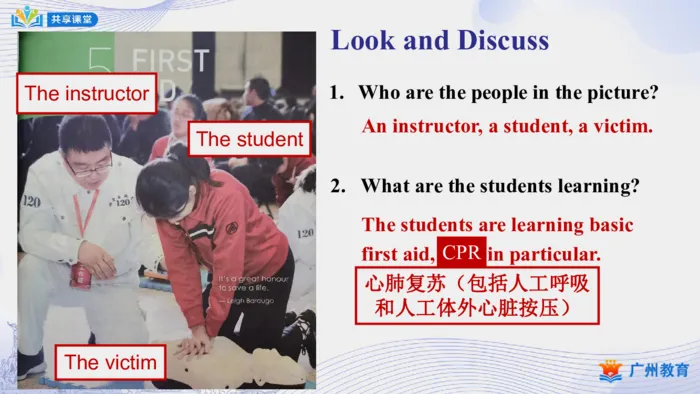
2.   What are the students learning?
1. Who are the people in the picture?
The students are learning basic
first aid, CPR in particular.
The instructor
The victim
The student
An instructor, a student, a victim.
心肺复苏(包括人工呼吸
和人工体外心脏按压)
CPR
Look and Discuss
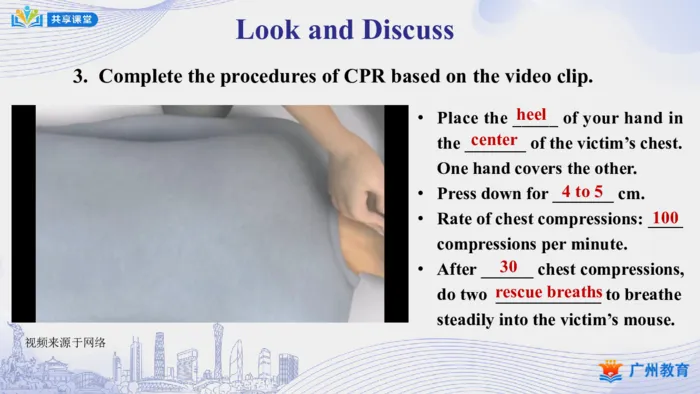
3.  Complete the procedures of CPR based on the video clip.
视频来源于网络
• Place the _____ of your hand in
the _______ of the victim’s chest.
One hand covers the other.
• Press down for _______ cm.
• Rate of chest compressions: ____
compressions per minute.
• After ______ chest compressions,
do two  ____________ to breathe
steadily into the victim’s mouse.
heel
center
4 to 5
rescue breaths
100
30
Look and Discuss
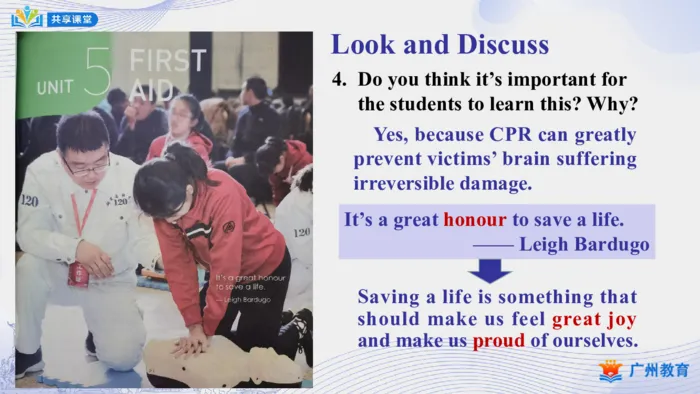
4.  Do you think it’s important for
     the students to learn this? Why?
It’s a great honour to save a life.
—— Leigh Bardugo
Saving a life is something that
should make us feel great joy
and make us proud of ourselves.
    Yes, because CPR can greatly
prevent victims’ brain suffering
irreversible damage.
Aims of this unit
In this unit, you will:
   1.  read about the first aid for burns and a story about an
        emergency situation.
   2.  learn about the -ing form.
   3.  listen to an emergency call and make a similar call for help.
   4.  write a story about first aid.
   5.  learn about how the Red Cross(红十字会)was founded
        and what it does.
Lesson 1  Reading and Thinking (I)
First Aid for Burns
Aims of this lesson
At the end of this lesson, you will be able to:
   1.  get some basic information about first aid.
   2.  understand the text type.
   3.  learn about causes, types and characteristics of burns
        as well as its first-aid treatment.
   4.  raise the awareness of the importance of performing
        first aid for burns.
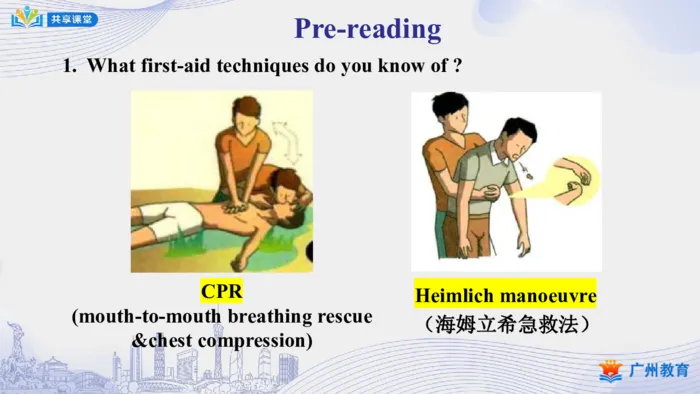
1.  What first-aid techniques do you know of ?
Pre-reading
CPR
(mouth-to-mouth breathing rescue
&chest compression)
Heimlich manoeuvre
(海姆立希急救法)
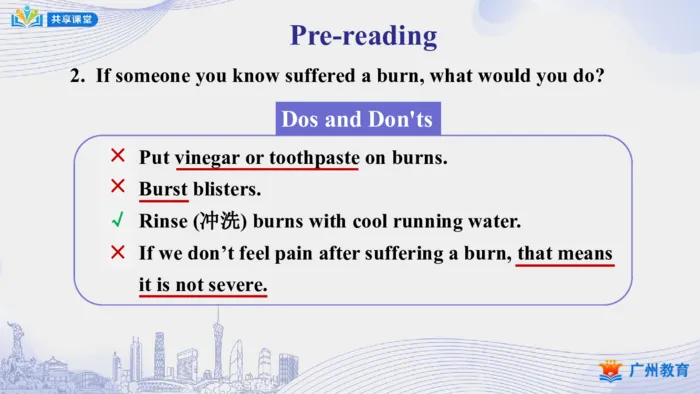
2.  If someone you know suffered a burn, what would you do?
Pre-reading
Dos and Don'ts
•
Put vinegar or toothpaste on burns.
•
Burst blisters.
•
Rinse (冲洗) burns with cool running water.
•
If we don’t feel pain after suffering a burn, that means
it is not severe.
×
×
×
√
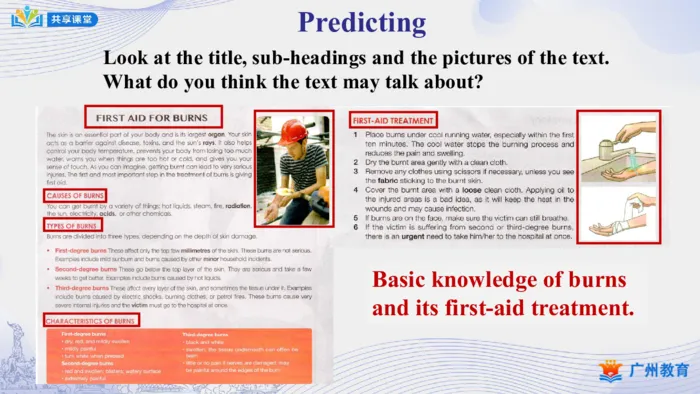
Look at the title, sub-headings and the pictures of the text.
What do you think the text may talk about?
Predicting
Basic knowledge of burns
and its first-aid treatment.
Read for Text Type
________ advertisement
________ hospital leaflet
________ newspaper article
________ blog post
________ email
________ short story
Ex.2, P.50: Look through the text and identify its style and language
features. Then tick its text type from the list below.
Understand text types
Different kinds of types can be
identified by their style of writing
and language features.
By understanding the text type of
a piece of writing, you can better
understand its purpose. You can
also better understand where to
find information in the text, and
what kind of information it is
likely to contain.
Ø styles
Ø language
features
Ø Why is it important to understand text types?
Ø How can you identify a text type?
Ø What are some common text types?
     Letter, diary, news, fable, ect.
Read for Text Type
advertisement:
hospital leaflet:
newspaper article:
persuasive language and colourful descriptions;
benefits of product;
uses of imperative to attract others
factual, informational, objective;
description of a medical problem and how to deal with it;
uses of imperative to give advice
factual, informational, objective;
who, what, when, why and how questions about a
recent event
宣传单
What are the styles and language features of the six text types?
What are the styles and language features of the six text types?
Read for Text Type
blog post:
email:
short story:
journal or diary about nature and something current or
new in the life of the author, or the author’s interests
with an opening and a closing like a letter;
sent to an individual;
about a matter concerning both the author and recipient
usually narrative;
vivid language and colourful descriptions to tell a story
with a beginning, a middle, and an end.
收件人
_____ advertisement          _____ blog post
_____ hospital leaflet         _____ email
_____ newspaper article    _____ short story
Ex.2, P.50: Look through the text and
identify its style and language features.
Then tick its text type from the list below.
Read for Text Type
Read Para.1 and summarize its main idea.
The skin is so essential that the first step in
the treatment of burns is giving first aid.
top layer
2nd layer
3rd layer
图片来源于网络
The functions of skin.
Read for Details
Paragraph
The functions of skin
Para.1
The skin is an _________ part and is its _________ organ.
Protect your body against ______, _____ and ____________;
Prevent your body from _____________________;
Warn you when things are ____ or _____;
Give you your _____________.
largest
essential
losing too much water
sense of touch
hot
cold
disease toxins
the sun’s rays
Read Para.1 again to learn more about the functions of skin.
Read for Details
Read for Details
Ex.3, P.51: Read the text and decide if the following statements are true (T)
or false (F).
1. Your skin gives you protection from many dangerous things.
2. A first-degree burn has this name because it is the most serious.
3. Second-degree burns can be the most painful kind of burn.
4. It is important to use cool water to stop the heat from remaining
    in the wound regardless of the degree of the burn.
5. Putting butter or oil on burns helps because it may reduce
    swelling and ease discomfort.
T
F
hurts
T
F
T
third-degree
keep
the heat and cause infection.
Para. 1
types of burns
characteristics
first-aid treatment
Tip: Pay more attention to the key words in the statements
and subheadings in the text.
first-aid treatment
Read for Details
Details
Types
First-degree burns
Second-degree burns
Third-degree burns
Depth
_____________
of the skin
________________
of the skin
_________ of the skin
and sometimes
________ underneath
Characteristics
dry, red, and
mildly _______;
mildly _______;
turn _______
when pressed
red and  swollen;
________;
 ________surface;
extremely _______
black and white;
swollen;
_______________ can
often be seen;
little or no pain if
______ are damaged.
top few millimetres
swollen
painful
white
below the top layer
blisters
watery
painful
every layer
the tissue underneath
nerves
the tissue
Ex.4, P.51: Complete the table to summarize the information about first aid for burns.
Treatment
( 6 steps )
1. Place under ________________ within the first ten minutes.
2. _______ the burnt area.
3. ____________ clothes.
4. _______ the burn.
5. Burn on the face: make sure the victim can ____________.
6. Second or third-degree burns: take the victim to _________
__________.
cool running water
Dry
Remove any
Cover
still breathe
the hospital
at once
Ex.4, P.51: Complete the table to summarize the information about first aid for burns.
Read for Details
Role Play
Suppose you are a doctor invited to our class to give a speech on
first aid on burns. Try to impress us with the importance of the
skin and how to do first-aid treatment.
Your speech should include:
1. the importance of giving first aid on burns
2. the types and the characteristics of burns
3. how to give first aid on burns
Summary
In this lesson, we have learned:
      1. The functions of skin
      2. Causes of burns
      3. Types of burns
      4. Characteristics of burns
      5. First-aid treatment
Assignment
1.
Draw a mind map of the text based on what you have learnt today.
2.
Read the text on Page 94 and think about the following questions.
      1) Who founded Red Cross and when?
      2) Why did the founder found it?
      3) What contributions did it make to the world?
      4) What do you think of volunteer’s work?
      5) What does the example of Salaymana tell us?
      6) What do you think of the founder’s life?
THANK YOU!
高二—人教版—英语—选择性必修二第五单元
广东广雅中学 林靖苹
Unit 5 First Aid
Lesson 1  Reading and Thinking (I)
答疑
prey
Dunant was horrified by the scene.
… be filled with compassion for the wounded men.
without regard to …
relief societies
zealous
the Red Crescent Societies
return the favour
… be caught up in war
Textbook P.94
Words and Expressions
猎物
杜兰特对眼前这番景象感到震惊。
…对这些伤者充满同情。
不顾;不考虑
救济会
热心的;热情的;热烈的
红新月会
报恩
…被卷入战争
1. Who founded the Red Cross and when?
2. Why did the founder found it?
3. What contributions did it make to the world?
4. What do you think of volunteer’s work?
5. What does the example of Salaymana tell us?
6. What do you think of the founder’s life?
Textbook P.94
1. Who founded the Red Cross and when?
Textbook P.94
2. Why did the founder found it?
Henry Dunant, a Swiss businessman,
founded the Red Cross in 1863.
For some people, a vision and desire
to help others come unexpectedly
and Dunant is such a case. He would
have met Napoleon III for business
but he was horrified by the scene
and was filled with compassion for
the wounded. Then he began his
devotion to the world selflessly.
3. What contributions did it make
    to the world?
Textbook P.94
The Red Cross organized an
international conference and
cares for soldiers and civilians
in times of war and natural
disasters. Besides, it provides
food, shelter, medical supplies
and medical care to those in
need in time of peace and quiet.
4. What do you think of volunteer’s
    work?
Textbook P.94
Volunteers tend to work in poor
and dangerous conditions but
their work is both rewarding
and important.
5. What does the example of Salaymana
tell us?
Textbook P.94
Most of the people who received help
from the Red Cross are very grateful
for the help, and some even want to
return the favour and help others.
Textbook P.94
6. What do you think of the founder’s
life?
Dunant gave up everything to help
others, losing his business and all his
money, but he was celebrated around
the world as the man responsible for
saving thousands of lives. Though he
is long gone, his spirit continues with
us until this day. Thus, what he did
was definitely worthwhile.
THANK YOU!