Unit 5 FIRST AID
Lesson 2: Reading and Thinking(2)+ Build up
your vocabulary
高二—人教版—英语—选择性必修二第五单元
广东广雅中学 严佩华
At the end of the lesson, you will be able to
1.
learn to prevent getting burnt
2.
summarize the writing style and language features
of expository writing
3.
build up your vocabulary on the first-aid for burns
Please take out the mind map of the reading passage you have
done after the first reading lesson;
Let's work out the missing words in this mind map.
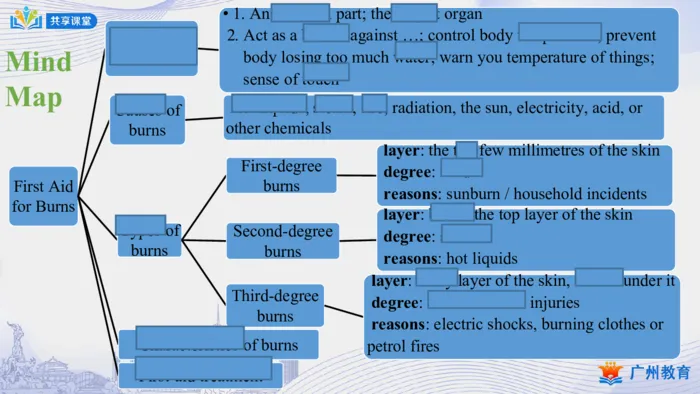
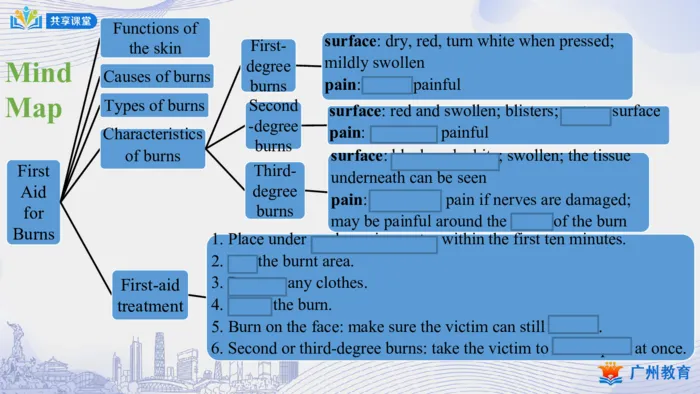
Mind
Map
First Aid
for Burns
Functions of
the skin
• 1. An essential part; the largest organ
 2. Act as a barrier against …; control body temperature; prevent
     body losing too much water; warn you temperature of things;
     sense of touch
Causes of
burns
 Hot liquids, steam, fire, radiation, the sun, electricity, acid, or
other chemicals
Types of
burns
First-degree
burns
 layer: the top few millimetres of the skin
 degree: mild
 reasons: sunburn / household incidents
Second-degree
burns
 layer: below the top layer of the skin
 degree: serious
 reasons: hot liquids
Third-degree
burns
 layer: every layer of the skin, tissues under it
 degree: severe internal injuries
 reasons: electric shocks, burning clothes or
petrol fires
Characteristics of burns
First-aid treatment
First
Aid
for
Burns
Functions of
the skin
Causes of burns
Types of burns
Characteristics
of burns
First-
degree
burns
surface: dry, red, turn white when pressed;
mildly swollen
pain: mildly painful
Second
-degree
burns
surface: red and swollen; blisters; watery surface
pain: extremely painful
Third-
degree
burns
surface: black and white; swollen; the tissue
underneath can be seen
pain: little or no pain if nerves are damaged;
may be painful around the edges of the burn
First-aid
treatment
1. Place under cool running water within the first ten minutes.
2. Dry the burnt area.
3. Remove any clothes.
4. Cover the burn.
5. Burn on the face: make sure the victim can still breathe.
6. Second or third-degree burns: take the victim to the hospital at once.
Mind
Map
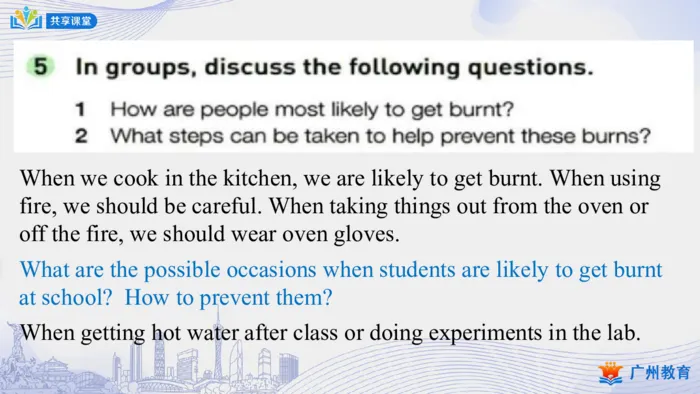
When we cook in the kitchen, we are likely to get burnt. When using
fire, we should be careful. When taking things out from the oven or
off the fire, we should wear oven gloves.
What are the possible occasions when students are likely to get burnt
at school?  How to prevent them?
When getting hot water after class or doing experiments in the lab.
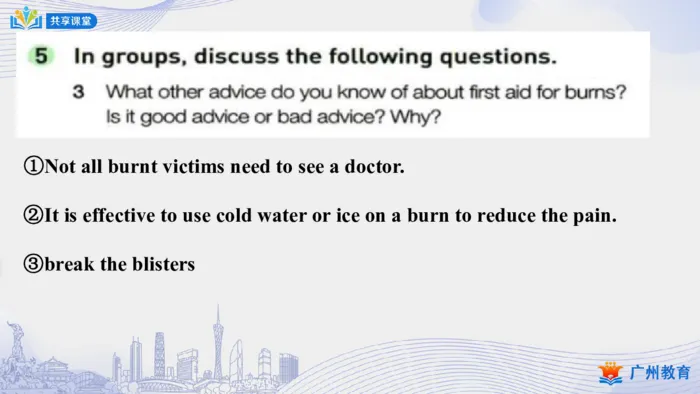
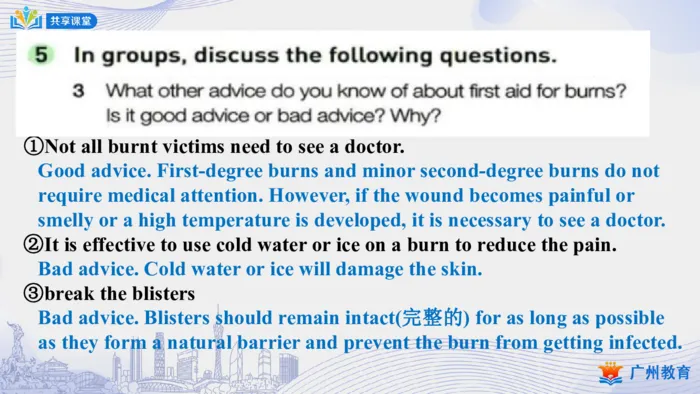
①Not all burnt victims need to see a doctor.
②It is effective to use cold water or ice on a burn to reduce the pain.
③break the blisters
①Not all burnt victims need to see a doctor.
②It is effective to use cold water or ice on a burn to reduce the pain.
③break the blisters
Good advice. First-degree burns and minor second-degree burns do not
require medical attention. However, if the wound becomes painful or
smelly or a high temperature is developed, it is necessary to see a doctor.

Bad advice. Cold water or ice will damage the skin.

Bad advice. Blisters should remain intact(完整的) for as long as possible
as they form a natural barrier and prevent the burn from getting infected.
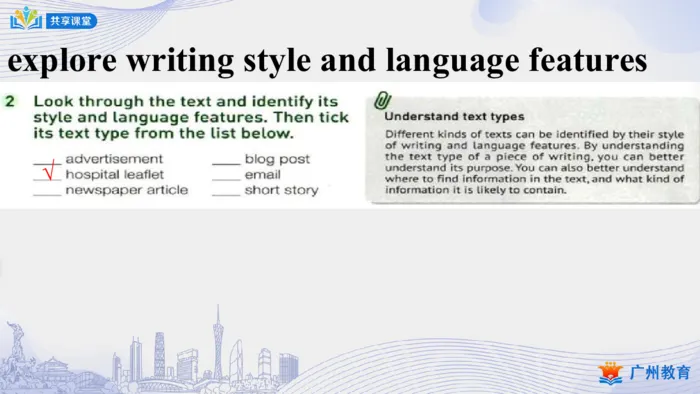
explore writing style and language features
√
1.
What is the genre of this text?
In narration(记叙文), the writer is a storyteller; in
description, the writer is a painter of the picture; in
argumentation(议论文), the writer is trying to convince(说
服) the reader that he is right and in expository writing(说明
文), the writer only states(陈述) the fact.
explore writing style and language features
2. What kinds of things are mentioned in the text?
functions of the skin, causes of burns, different types of burns,
characteristics of each type of burns and treatment for burns
The purpose of an expository writing is to provide the reader
with as much useful information as possible. The reader
should feel as if he or she has learned something after
reading. This can be accomplished through classification(分
类法), example, comparison and contrast(作比较),
numbers, definition, process, the analysis of cause and
effect(因果分析), etc.
explore writing style and language features
the analysis of
cause and effect
classification(分类法)
example
process
explore writing style and language features
3. Is this text mainly written in first, second or third person?
4. What tense is used?
5. Are there any passive voice? How do they make you feel?
In second and third person.
The simple present tense.
explore writing style and language features
5. Are there any passive voice? How do they make you feel?
explore writing style and language features
5. Are there any passive voice? How do they make you feel?
Yes. They make the text sound objective.
explore style of writing and language features
6. What adjectives can you think of to describe this text?
Objective(客观的), scientific(科学的), professional(专
业的), specific, clear, concise(简明的), etc.
summary
Expository writing, as its name implies(暗示), is
writing that exposes(呈现) facts. In other words, it’s
writing that explains and educates its readers, rather
than entertaining or attempting to persuade them.
When you read a scholarly(学术的) article, a
textbook page, a news report, or an instructional(指
导的) guide, you’re reading expository writing.
Learning About Language
Build up your vocabulary
organ
acid
millimetre
radiation/rays
fabric
victim
Building up your vocabulary through learning synonyms
context (语境)
relation
content
slight: small in size, degree, or amount; not serious
a slight breeze; It has only made a slight difference.
minor: less, or little, in importance, size etc.
She has to go into hospital for a minor operation.
tiny: extremely small
Though she was tiny, she had a very loud voice.
reduce: to make less, smaller etc.
The shop reduced its prices; The train reduced speed.
relax: to make or become less tight or less worried etc.
Relax your shoulders.
ease: to free from pain, trouble or anxiety减轻;缓解(痛苦
等)
A hot bath eased his tired limbs.
victim: a person or thing that suffers harm, death, etc.
Food is being sent to the victims of the disaster.
patient: a person who is being treated by a doctor, dentist etc.
The hospital had too many patients.
sufferer: a person suffering from an illness
accident: an unexpected event, especially one resulting in
damage or harm
car accidents on icy roads.
incident: an event or happening
There was a strange incident in the supermarket today.
occasion: a particular time or a special event
I've heard him speak on several occasions. The wedding was a
great occasion.
urgency: importance needing immediate attention 紧迫性
She stressed the urgency of an early solution.
emergency: an unexpected, especially dangerous happening
or situation 紧急情况;突发事件
Call the doctor – it's an emergency.
seriousness: importance, significance or danger 严重性
the seriousness of the crisis
Building up your vocabulary through completing a short
passage
acid
incidents
urgent
organs
loosely
victim
What we have learned today
1.
how to prevent getting burnt
2.
the writing style and language features of
expository writing
3.
how to build up your vocabulary
Homework
1. 从本课文选取10个单词,参考词典写出英语释义。
2. 找出课文中的-ing form,并确定其所充当的句子成分。
Thank  you!
Unit 5 FIRST AID
Lesson 2: Reading and Thinking(2)+ Build up
your vocabulary答疑
广东广雅中学 严佩华
高二—人教版—英语—选择性必修二第五单元
Vocabulary Expansion
short conversations
deal
noun
1. a bargain or arrangement 买卖,交易
a business deal.
2. the act of dividing cards among players in a card game (纸牌)分
发
verb – past tense, past participle dealt
1. to do business, especially to buy and sell 做买卖
I think he deals in stocks and shares.
2. to distribute (cards) 分发(纸牌)
deal
deal with
1. to be concerned with 涉及
This book deals with methods of teaching English.
2. to take action about, especially in order to solve a problem, get rid of
a person, complete a piece of business etc. 对付,应付,处理
She deals with all the inquiries.
a good deal / a great deal
much or a lot 大量
They made a good deal of noise; She spent a great deal of money on it.
paramedic
A person who is trained to give emergency medical treatment or assist
medical professionals
前缀para-来源于拉丁语,前缀para-原是一个希腊介词,它主要与希腊
语源的词根相结合,一般构成名词,其基本意思是“beside(旁),near
(近)。”,para-与少量的单词相缀合,这时,其意思相当于related to
(有关),supplementary to (辅助),subordinate to (副)等。
paraprofessional  [para- (=subordinate to 附属...的);professional 专业人
员 → " subordinate to a professional 从属于专业人员的"→]
  n.辅助专职人员的人
In that school, regular teachers together with paraprofessionals (mostly
mothers) help the children in reading and writing. 在那所学校里,正规教
员与辅助人员(大多数是母亲)一起帮助小孩学文化。
词源词根字典 www.etymon.cn
aid
noun
help
• Rich countries give aid to developing countries.
• He came to my aid when my car broke down.
verb
to help
• I was aided in my search by the library staff.
rush
verb
to (make someone or something) hurry or go quickly 催促,匆忙地做
He rushed into the room; She rushed him to the doctor.
noun
1. a sudden quick movement 冲,奔
They made a rush for the door.
2. a hurry
The office always operates in a rush.
rush hour 交通高峰期
a period when there is a lot of traffic on the roads, usually when people are
going to or leaving work.
matter
noun
1. solids, liquids and/or gases in any form, from which everything physical
is made 物质
The entire universe is made up of different kinds of matter.
2. a subject or topic (of discussion etc.) 事情,题材,课题
a private matter
verb
to be important 有关系,要紧
That car matters a great deal to him; It doesn't matter.
a matter of course: something that one expects to happen, be done etc. You
don't have to ask her – she'll do it as a matter of course. 理所当然之事
a matter of opinion: something about which different people have different
opinions or views
 Whether she's clever or not is a matter of opinion. 看法不同的问题